Faith after coronavirus
By ROKSANA AMID ramid@liherald.com

People turn to religion for comfort and hope in times of crisis and uncertainty — and March 2020, with the onset of the coronavirus pandemic in the U.S. and the resulting lockdowns — certainly was among such times.
Houses of worship helped many who were desperately searching for ways to cope with the stress of isolation and uncertainty about the changing restrictions set in place by governments.
According to data from the Pew Research Center in 2021, nearly three in 10 United States adults said the outbreak boosted their faith.
This past March, the center reported that more Americans say that their attendance habits have declined, but it’s a complicated picture: As of November 2022, 20 percent said they were attending in person less often, while 7 percent say they were doing so more often. On the other hand, 15 percent say they were participating in services virtually more often, while 5 percent said they were watching services online or on TV less often.
Now that the emergency is past, houses of worship on the North Shore are reflecting on how the pandemic affected their congregations.
Congregation Tifereth Israel


“Although there was tragedy all around us, we, as a house of worship, saw
How Covid-19 impacted senior centers
By WILL SHEELINE wsheeline@liherald.com

When the coronavirus pandemic hit the United States, Long Island senior centers had more than the virus to worry about.
Many seniors were immunecompromised and unable to gather. As a result, senior centers saw their doors closed for months at a time, which left many wondering if they would ever be able to reopen.
Post-Covid, people are still hungry
By LAURA LANE llane@liherald.com

When the coronavirus pandemic hit the United States in March 2020, many food pantries and soup kitchens closed as people working in places that traditionally provided for the food insecure were afraid to continue.
This was before there were Covid vaccines, with doctors working around the clock to understand the virus that was killing thousands of people.
Making matters even more problematic for the food insecure — people without access to enough of the food needed to remain healthy — was then-Gov.
Andrew Cuomo’s March 22, 2020, stay-athome executive order.
The “New York State on Pause” directive forbade non-essential businesses statewide to stay open while also restricting gatherings.

New Yorkers were in lockdown for a month and remained in a state of emergency until June 7.
CONTINUED ON PAGE 3
Before Covid-19 arrived, many senior centers and senior-focused programs operated like well-oiled machines, working week in and week out to provide entertainment and companionship for the community’s elderly. Peggy Como, president of the Mutual Concerns Committee, in Sea Cliff, said that the organization held senior lunches at St. Luke’s Parish Hall, but a week after the pandemic arrived, the program came to an end.
in a panic. I didn’t want to be responsible for anybody’s sickness.”
Similar scenes occurred across the North Shore and around the world. Judy Palumbo and Christine Rice, executive directors of the Life Enrichment Center at Oyster Bay and the Glen Cove Senior Center, respectively, added that it felt like the pandemic came out of nowhere and upended their work and the lives of their seniors.

Once Covid hit, we had to shut it all down.
PEGGY COMO President, Mutual Concerns Committee


“Once Covid hit, we had to shut it all down,” Como said. “People were in a panic. I was
Palumbo said that prior to the pandemic, the Life Enrichment Center had an average of 75 people coming in for lunch every day, and daily buses brought seniors in for physical and mental exercise as well as games and activities. Although Life Enrichment had been warned about the potential seriousness of the spreading virus by a concerned Oyster Bay resident, the hardest part initially was the suddenness of it all, although the center was able to avoid an outbreak among its members.
CONTINUED ON PAGE 4
JUNE 1-7, 2023 $1.00 Boys’ track is county champ Page 6 Observing Memorial Day Page 8 HERALD SEA CLIFF/GLEN HEAD
Courtesy People Loving People PEOPLE LOVING PEOPLE serves 175 families each week at the Oyster Bay food pantry. From left are founders Gina Kang, Valerie Monroy and Donna Galgano.
CONTINUED
ON PAGE 19
Covid Buying a home? We'll light the way. M O L L Y D E E G A N BRANCHREG COM 917 744 3961 C A R L O S S A N T A N A EMBRACEHOMELOANS COM 516- 604- 9895 C E L E S T E G U L L O INSTAGRAM @GULLOCELESTE 516 671 0001 where to begin what to look out for pre-approvals protecting your investment and so much more First Time Homebuyers Workshop Thursday, June 15th, 2023 • 6 - 7:30 pm Branch Real Estate Group • 203 Glen Cove Ave, Sea Cliff NY Event is free, but space is limited Register today at: Branchreg com/homebuyer Meet your local experts: 1217461
Living in a world after the Covid-19 pandemic
 By MICHAEL HINMAN mhinman@liherald.com

The country officially returned to normal on May 11 with the end of the federal public health emergency surrounding Covid-19 — but for many, it’s been pretty close to normalcy for months.


Virtually no one asks for proof of vaccination. Masks, while occasionally seen, have found themselves primarily back on the faces of medical professionals. And the floor markings intended to help people put six feet of distance from their neighbors have almost faded into time.
Unwinding Covid
This week — and in the coming weeks — the Herald is exploring local life in a post-pandemic world. We’re following up on the heroes and the stories that filled these pages from the very beginning of the pandemic lockdown, to the height of the virus invasion, to the aftermath. All with the hope we never have to experience such troubled times ever again.
Covid


Yet, the federal end to the emergency is far from ceremonial. Washington has stopped buying vaccines and treatment, although plenty of supplies already purchased remain on-hand. It once again became more difficult to qualify for Medicaid — something that has loosened significantly at the height of the pandemic. However, states like New York isn’t expected to address eligibility at the more local level until later this summer.
And, of course, many of the financial assistance programs that had almost become commonplace are long gone, but free vaccines for children remain thanks to efforts by the Centers for Disease Control and Prevention. Pfizer and Moderna — the two major pharmaceutical companies that supplied most of the country’s vaccine doses — vow they’ll continue providing free vaccines to those who can’t afford it, or don’t have the insurance to cover it.
Much closer to home, government officials with Nassau County as well as the towns of Hempstead and Oyster Bay, had nothing to say about the pandemic. County Executive Bruce Blakeman went after mask mandates — especially in schools — within minutes of being sworn in more than a year ago.
“The governor should adhere to the law, follow the science, and allow local officials to decide what is best for their hometown communities,” Blakeman said at the time. “Nassau is not in crisis, and shouldn’t be painted with the same broad brush as the rest of New York state.”
And more local programs, like the Household Assistance Program that offered a $375 per household grant from federal funds, as well as the Emergency Rental Assistance Program — ended last fall, with a lot of the money unclaimed.
In the end, nearly 6.7 million positive cases were reported statewide, with New York City accounting for nearly half of that with 3.1 million cases. Long Island reported 1.1 million cases, while 5,346 people in Nassau County died.
Nearly 85 percent of people in Nassau received at least one vaccine shot, representing more than 1.1 million people — the best overall percentage in the state, behind the 88 percent from Queens and Manhattan.
One woman the coronavirus would not defeat was Nancy Casale of Wantagh. Last year, the then-95-year-old walked out of the Glen Cove Center for Nursing and Rehabilitation on her own power, after months of fighting Covid-19 and its aftermath.
“Nancy is a wonderful soul, said Lynda Torel from the Glen Cove center. “At 95, she’s energetic, eager and willing — all the qualities that make her a fighter. She’s been on a fantastic journey. She never said ‘no.’”

June 1, 2023 — SEA CLIFF/GLEN HEAD HERALD 2 Your business isn’t cookie cutter. Your ERTC calculation shouldn’t be either. The Employee Retention Tax Credit (ERTC) is one of the best kept secrets around and was recently expanded to benefit more businesses. Even if you received a PPP loan, you can still qualify for this federal Covid-19 benefit for up to $26,000 per employee. At Easy Tax Credits, we analyze every business from scratch. Book a free, no obligation phone call with the expert lawyers and accountants at Easy Tax Credits today! Promotional offer: some restrictions apply. To qualify for promotional offer, business must enter into an agreement with Easy Tax Credits, LLC, and be eligible to receive ERTC funding. *Promotional offer furnished by Herald Community Media; Easy Tax Credits, LLC, not responsible for fulfillment of promotional offer. EasyTaxCredits.com Phone: 1-234-CREDITS (273-3487) $1,000 BONUS! Free advertising offer with Herald Community Media* Use reference code LIHERALD-2023 1217492
Laura Lane/Herald file
NANCy CAsALE stops to thank pulmonary rehabilitation director Lynda Torel outside the Glen Cove Center for Nursing and Rehabilitation last July, after battling Covid-19 and its aftermath for months. Nancy never let her age — 95 — stand in the way.
Many people continue to need food assistance
The number of people who were food insecure increased dramatically during this time: Not only were food pantries and soup kitchens scarce, but many people lost their jobs. But not every place providing food to vulnerable populations closed.
“All of the food pantries closed down because of the risk, but we didn’t. As soon as the restrictions were lifted, we did it outside,” said Donna Galgano from People Loving People, which worked out of First Presbyterian Church of Oyster Bay during the pandemic. “We had 300 cars one day lined up waiting for food. At the end of the day we said, ‘We did it!’”
People’s spirits were at their lowest during Covid, terrified by reports of deaths and worried about contacting the disease. Galgano did not want to add to the misery that people were experiencing.
“We would ask people what they needed, which we do today too,” she said. “That’s to give them dignity. They could choose what they wanted. We also didn’t want to waste anything giving people something they didn’t want.”
People Loving People moved to its own space on Audrey Avenue in Oyster Bay in November 2021. Today 175 families utilize the service.
For Galgano, it has been a rewarding experience.
“We’ve had people tell us because of the help we gave them they could take their kids to the doctor or buy medicine,” she said. “There are a lot of families in Oyster Bay who need help. I see over 100 families regularly.”
Linda Eastman, the director of operations for Nosh in Glen Cove, said the need for food remains high. Nosh provides emergency food delivery to individuals and families. Eastman said it delivers food to 265 families and helps 200 to 225 walk-in families each week.
Having lost its home at the Veterans of Foreign War building due to a fire in August 2021, Nosh has been housed in a new space on School Street in Glen Cove since September 2022.
Eastman said Nosh is expecting an upswing from people in need when school lets out. And more people are expected to need assistance from Nosh now that the pandemic-era increase in benefits under the Supplemental Nutrition Assistance Program has ended, although Eastman said she hasn’t noticed an upswing yet.
People Loving People is seeing five to 10 more people each week, which Galgano attributes to the end of the SNAP increase. She said when the number reaches 200, they will not be able to assist any additional people living outside the hamlet.
“It seems like Glen Cove has exploded,” she said. “Every week we get two to five people from Glen Cove. I think it’s because our place is like a little market. People even come off the street asking if they can buy stuff.”
Joan Adomsky, who coordinates the pantry at St. Dominic Catholic Church in Oyster Bay, said she is seeing the same number of people as she saw during Covid.
“The volunteers and I talked about it recently and we think it’s the price of food, how much it’s gone up,” Adomsky said. “Our parish members and groups are extremely generous in keeping our pantry full. We are able to even share some with other pantries in our community. We’ve been very fortunate.”
The pantry at the Church of St. Rocco in Glen Cove, which also relies on donations from parishioners, is in good shape too, according to coordinator Coleen Spinello. She said many came to the pantry for assistance during
Covid’s peak, but more food pantries have since formed. Spinello is on the board of the Inter Agency Council of Glen Cove, an outreach program where members network once a month. Some members such as St. Patrick’s Church have experienced an increase in people needing help. “Maybe it’s because the government supplements ran out?” Spinello wondered. “It’s odd we aren’t getting the walk-ins.”
Ingrid Morales, the outreach coordinator at Oyster Bay’s Youth and Family Counseling, is worried. The pantry, which helps the Spanish community, is very low on supplies, she said. She’s hoping the donations will increase, as many people need help.
“People aren’t giving what they used to,” she said. “I think they are holding on because everyone is struggling money-wise. I think what I’m seeing is not normal.”
The pantry does offer gift cards for Stop & Shop, purchased with donations from different organizations, but Morales said people don’t use it for food other than certain staples. “They use the gift cards for Pampers, toothpaste, milk and eggs,” she said. “They want to get food from us like rice and beans.”
No ethics violations for using Enterprise Security
By WILL SHEELINE wsheeline@liherald.com
The Town of Oyster Bay’s Board of Ethics ruled there was no ethical violations in the awarding of a request for proposal to Enterprise Security Solutions, a cybersecurity company based in New Jersey. The investigation came after the town board learned Enterprise owner Michael Esposito works for Town Inspector General Brian Noone at Nova Venture Partners, a security consulting firm where Noone serves as a partner and Esposito works as the cybersecurity practice leader.
Neither Noone, Esposito nor any representatives of Nova Venture Partners were able to be reached for comment.
Enterprise received an RFP contract from the town board in August 2022 to help reassess the town’s cybersecurity defenses. The RFP had been released following the hacking of Suffolk County’s website, which spurred Oyster Bay to reevaluate their online defenses.
When the town released the RFP, they
initially sent it to 30 firms, 13 of which ultimately expressed interest. In an interdepartmental memo provided to the Herald by Sea Cliff resident Arthur Adelman, Noone wrote that an RFP Review Committee composed of six town employees established a set of criteria for choosing the most qualified firm.
In the memo, Noone stated that Enterprise “was ranked with the highest numerical score” according to the criteria the Review Committee had established and recommended that they be awarded the RFP. Enterprise was subsequently awarded the RFP to work for the town for the period of one year in return for $2 million.
On March 21, the day that the town would have voted on approving the resolution the board chose to table the resolution. In a statement released by Brian Nevin, Oyster Bay’s public information officer, the board expressed concern, although it did not specify that Noone’s pre-existing business relationship with Esposito was the cause.
“Out of an abundance of caution, the matter was referred to the town attorney and the Board of Ethics,” Nevin wrote. “On May 22, 2023, the Board of Ethics ruled that no conflict of interest exists.”
Steven Leventhal, an attorney who has served as legal counsel to the Board of Ethics since 2015, explained that the Board went through a three step process to make the determination. First, they investigated whether Noone’s conduct violated the states’ code of conduct, then if it violated any provisions of the town’s code of ethics, and finally whether the conduct violated common law principles, which are stabled from cases decided by state judges over the years.
“Not only did Mr. Noone have no direct or indirect interest in the contract itself, he also had no interest in the proposed contracting party, Enterprise Security Solutions,” Leventhal said. “Mr. Esposito has no ownership interest in Nova Venture Partners.”
Despite this, not all residents are convinced that the issue of hiring Enterprise
has been properly addressed by the town. The aforementioned Adelman expressed concern that Enterprise, being a New Jersey-based company and therefore technically a foreign business according to state law, had not been properly registered to operate in this capacity in New York according to the state’s Limited Liability Company Law.
Adelman added that he repeatedly contacted Noone and other town employees with his concerns, but was initially told that he was incorrect, and subsequently that Enterprise would be properly registered by the time the contract began. Adelman alleges that the cybersecurity company had not registered by March 21, and it is currently unclear if it has subsequently registered.
“I mentioned to Frank Scalera (Town of Oyster Bay attorney) that ESS was not registered in New York state, and he said he would make sure that they were in full compliance before the town signed the contract with them,” Adelman said. “That was never done.”
3 SEA CLIFF/GLEN HEAD HERALD — June 1, 2023
CONTINUED FROM FRONT PAGE
Courtesy Courtney Callahan
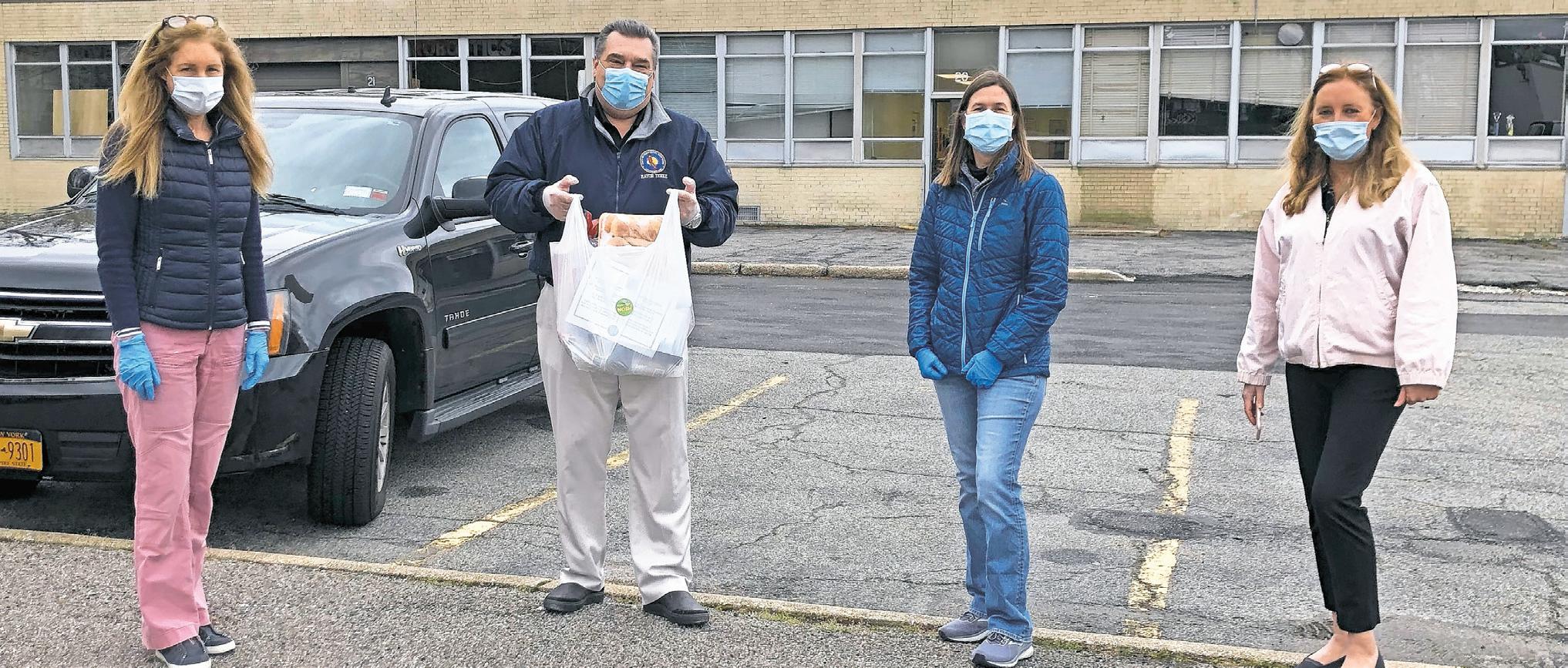
COURTNEY CALLAHAN, NOSH co-founder, far left; former Glen Cove Mayor Tim Tenke; Linda Eastman, Nosh’s head of operations; and County Legislator Delia DeRiggi-Whitton joined forces to help families in need during the pandemic.
Centers delivered food, had virtual programs
“I think there was a little bit of talk about it earlier in the year, maybe January or February, but at the time it was like it was distant,” Palumbo said. “You really didn’t know how badly it was going to affect us.”
Most seniors, due to advanced age or previous illnesses or conditions, were at risk and had to remain isolated, yet the same isolation that saved them from getting sick, took a toll on their mental and physical well-being, according to a 2022 study by the National Institutes of Health.
The need to satisfy the innately human need to socialize required quick thinking by the local senior service organizations which stayed in contact with many members over the phone and even provided the occasional lunch or goodie bag delivery.
Life Enrichment developed a grab and go program, serving to-go meals to seniors who picked them up at the back door without having to risk going inside.
The Glen Cove Senior Center and Life Enrichment also turned to online services to help provide connection and entertainment for the seniors trapped at home. Both organizations provided virtual exercise programs for seniors, and along with Mutual Concerns, offered outdoor lunch programs when viable.
Rice added that the pandemic provided the opportunity for care alternatives
for the staff as well as the seniors.
“We were so worried about how many members we were going to lose, not only to the physical aspect of the disease but to depression, or isolation or loneliness,” Rice said. “So it was a tough time for all of them.”
Even as the pandemic began to wind down for the rest of the country, the senior centers and programs struggled to balance the natural desire of seniors to begin reintegrating with ensuring their safety. Three years after the pandemic arrived, its effects are still being felt.
Como said Mutual Concerns held its senior lunch twice a week before the pandemic, but only hold it once a week now. There were also serious concerns amongst the senior centers that they may not recover from the pandemic, whether due to financial concerns or from a sheer loss of members. Most have not been able to offer transportation on par with what they had before the pandemic.
Despite this, the three organizations agreed that the most uplifting aspect of the ordeal was seeing how much seniors missed and appreciated their programs and socialization opportunities. Even during the darkest days of the pandemic, they would get calls about when they were reopening and asking how soon the seniors would be able to see the staff and their friends again.
Elder Law Misconceptions
One of the most common and devastating misconceptions about elder law estate planning is that it is too late to save money from nursing home costs. On the contrary, there are crisis planning tools that may save substantial assets from being spent on nursing home costs, even after the client has already entered the nursing home. Almost always, if there are assets left, much can be saved.
There are only three ways to pay for nursing home costs – your own assets, long-term care insurance (owned by less than five percent of the population), or Medicaid provided by the government.
Many people know about the “five-year look-back period” and assume nothing can be done without advance planning. The five-year look-back rule means that if you gave any gifts away within the last five years, when asking for Medicaid to pay for expensive nursing home costs, the gift amount creates a penalty period, which results in a period of ineligibility for Medicaid coverage.
Despite the five-year look-back, New York law allows people to protect assets from nursing home costs, even without pre-planning. For single applicants, you may be able to save about half of the assets through the “gift and loan” strategy. For married couples, where one spouse needs a nursing home, “spousal refusal” may protect substantial amounts of assets for the spouse at home. These techniques are discussed in detail at trustlaw.com, under “Practice Areas”, then “Medicaid Strategies”.


The five-year look-back rule does not affect eligibility of Medicaid home care, also known as “community” Medicaid. Currently, an applicant may transfer their assets out of their name and still qualify for home care in the next month.
Many assets, such as retirement accounts, rental properties and the family home in some cases, are exempt from Medicaid. The bottom line is that if someone you love is in failing health, the sooner you consult an elder law attorney the more you will likely be able to save.
■ WEB SITES: seacliff.liherald.com glenhead.liherald.com
■ E-MAIl: Letters and other submissions: seacliffeditor@liherald.com, glenheadeditor@liherald.com
■ EDITORIAl DEPARTMENT: Ext. 327 E-mails:
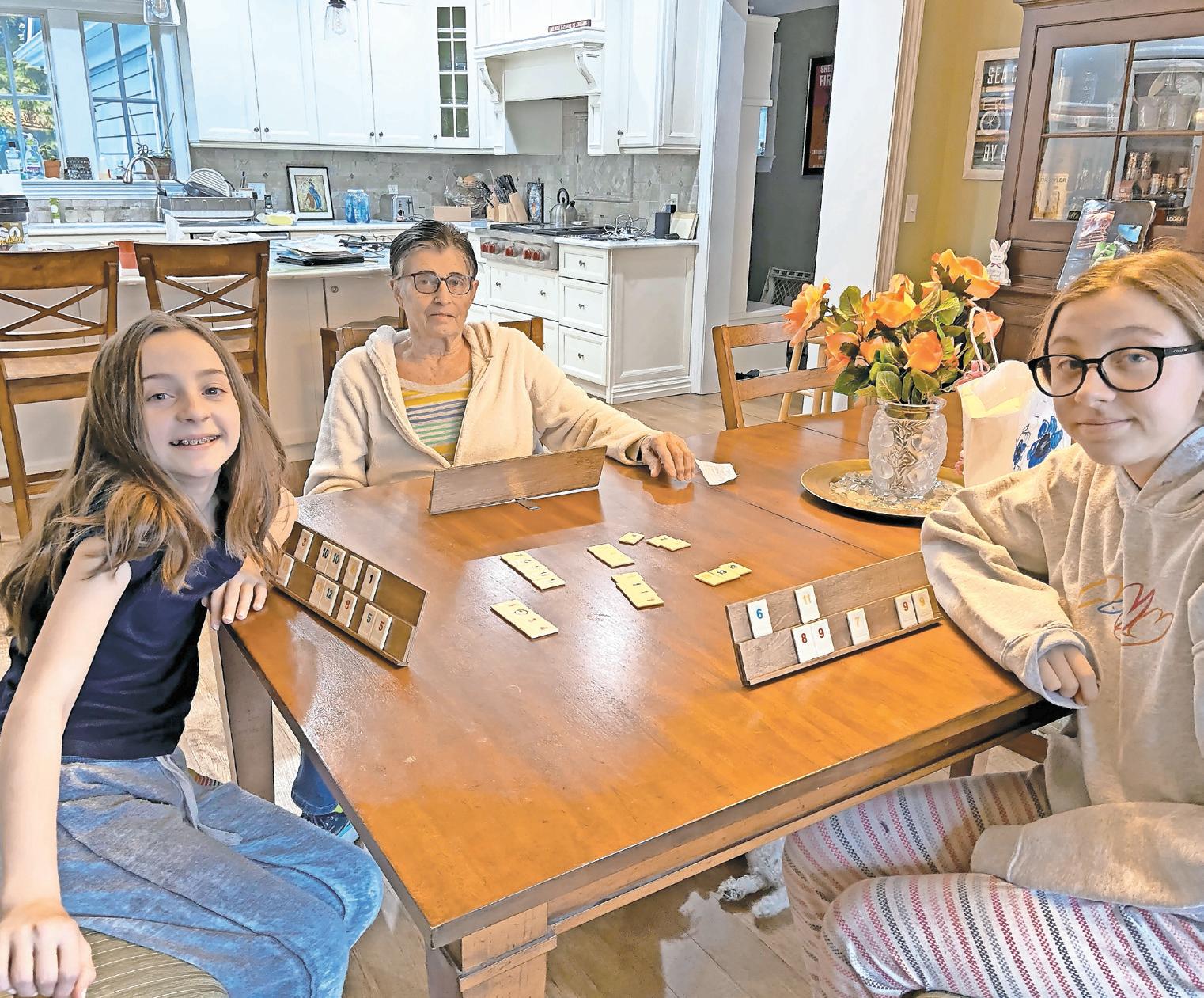
SENIORS LIKE BARBARA Lillis, above center, spent much of the pandemic at home playing games with relatives including her granddaughters Jordan, left, and Jessica.
THE LIFE ENRICHMENT Center worked with Americare to provide Covid vaccines for seniors such as Ty Gonzalez, left, with help from Americare nurses like Christine D’Angelo.

June 1, 2023 — SEA CLIFF/GLEN HEAD HERALD 4
Protecting Your Future
ETTINGER LAW FIRM ELDER LAW ESTATE PLANNING SINCE 1991 trustlaw.com Trusts & Estates • Wills & Probate • Medicaid FREE CONSULTATION: 516-327-8880 x117 or email info@trustlaw.com 100 Merrick Rd., Rockville Centre • 3000 Marcus Ave., Lake Success Other offices in Huntington • Melville • Islandia Visit us at trustlaw.com to learn more or search Ettinger Law on YouTube for our elder law estate planning videos 1216610 HOW TO REACH US Our offices are located at 2 Endo Blvd. Garden City, NY 11530 and are open from 8:30 a.m. to 5:30 p.m., Monday through Friday. MAIN PHONE: (516) 569-4000
Attorney advertising
with Michael and Suzanne Ettinger Attorneys-at-Law
seacliffeditor@liherald.com, glenheadeditor@liherald.com ■ SUBSCRIPTIONS: Press ”7” E-mail: circ@liherald.com Fax: (516) 569-4942 ■ ClASSIFIED ADVERTISING: Ext. 286 E-mail: ereynolds@liherald.com Fax: (516) 622-7460 ■ DISPlAY ADVERTISING: Ext. 249 E-mail: rglickman@liherald.com Fax: (516) 569-4643 Sea Cliff/Glen Head Herald is published weekly (every Thursday) by Richner Communications, Inc., 2 Endo Blvd. Garden City, NY 11530. Periodicals postage paid at Garden City, NY 11530 and additional mailing offices. POSTMASTER: Send address changes to Sea Cliff/Glen Head Herald, 2 Endo Blvd. Garden City, NY 11530. Subscriptions: $50 one-time payment within Nassau County or $60 outside of Nassau County or by qualified request in zip codes 11542, 11545, 11547, 11548 or 11579. Copyright © 2023 Richner Communications, Inc. All rights reserved. HERALD sea cliff/glen head
CONTINUED FROM FRONT PAGE
Courtesy Allison Lillis
Herald file photo
Floating litter traps return to Tappen
The Town of Oyster Bay’s Department of Environmental Resources has returned the floating litter trap technology, known as the ‘Collec’Thor,’ to Tappen Marina. Provided to the town by the Suffolk County Cornell Cooperative Extension last summer through a grant from the Long Island Sound Futures Fund, the Collec’Thor is a silent, motorized waste collector which attracts and engulfs all solid or liquid waste floating on the water surface.
“This innovative technology helps pro tect our environment and strengthens the ecosystem by removing debris from the water,” Joseph Saladino, town supervisor, said. “I thank all of the local environmen tal organizations who assisted the Town in implementing this environmental technol ogy, which collects up to 220 pounds of floating debris in just one cycle. Through partnership with Cornell Cooperative Extension, Friends of the Bay, The Water front Center and the Oyster Bay/Cold Spring Harbor Protection Committee, we are continuing to work together to improve the quality of our waterways and protect our environment.”
As the Collec’Thor returned to the waterways this spring, students from Beth page High School visited to take part in marine debris removal and data collection. The town continues to look for additional volunteers to help with future gathering and data collection.
“Our environmental ambassadors are a key component to this project being a suc cess. Once debris is collected, volunteers help analyze and track items retrieved. Students who participate in helping with the process earn volunteer hours and cer tification for their efforts,” Saladino added. “We thank the Bethpage School District for their participation and hope that their field trip inspires them and others to vol unteer this summer.”
Collec’Thors are the latest in marine debris collection technology, and have been identified as the most efficient trash skim mers available for marine and coastal usage. They are specifically designed to target solid and liquid waste, including plastic bottles, cigarette filters and packag ing, microplastics and hydrocarbons. The technology uses a small pump to draw in surrounding water and skims any floating trash into its receptacle. The mechanism adjusts with the tide and is easily affixed to a floating dock or waterfront location.
For more information on the Collec’Thor and volunteering to assist with future debris collection and tracking, contact the Town’s Department of Envi ronmental Resources at environmental@ oysterbay-ny.gov, (516) 624-5943 or visit oys terbaytown.com/environmental.
Planting Fields to hold its Pride Festival
Planting Fields Foundation is holding their second annual Planting Pride Festi val taking place on Saturday, June 24.
Planting Pride features a high-energy extravaganza filled with live music, spe cial guests, local vendor support, behind
the scenes access to historic spaces, a panel discussion and much more set amidst the beauty of Planting Fields in early summer. This year’s panel topic, “Gay through the Ages”, presents speakers across generations discussing their experience growing up gay, followed by a moderated question and answer session.
Coe Hall will be open all day for free tours of their Decisive Moments exhibition, which highlights two pioneering queer photographers who were instru
funding and support from the New York State Office of Parks, Recreation, and Historic Preservation Bureau of Historic Sites and Heritage Farm and Gardens.

For more information or questions about the event contact Katie Walsh, Planting Fields’ Community Engagement Manager, at kwalsh@plantingfields.org or 516-922-8680.
Pride flag raising soon
cer of the Gay & Lesbian Alliance Against Defamation. The city’s high school Gay Straight and Lesbian Alliance Club will also be attending.
The lesbian, gay, bisexual, transgender and queer community continue to fight for their rights and acceptance in society every day. In support of the community, Silverman organized the fourth annual Pride flag-raising downtown on June 2. She began the initiative in 2019 to spread
NEWS BRIEFS
1217737 5 SEA CLIFF/GLEN HEAD HERALD — June 1, 2023
HERALD SPORTS
North Shore girls’ track Three-Peats
By MARC BERMAN sports@liherald.com
The North Shore girls’ spring track program has been dominant in recent times but there was a slight worry before the Nassau County Class A championships May 24.
For the first time in a while, the Vikings were upset in a dual meet, losing to Island Trees. So a county title was not considered fait accompli.
All those concerns were put by the wayside as North Shore romped to its third straight county title, winning by landslide 30-plus points over runnerup Friends Academy.
“It was awesome,’’ said senior pole-vault champion Sophia DeMilio. “We actually were (surprised). We didn’t have an undefeated season – which we usually do. We were kind of nervous. We were trying to maximize the points we got.’’
“We didn’t expect to lead that much but in the end we did,’’ said junior star Bella Martocci.
It was never in doubt as the Vikings got a splendid day from Martocci, the middle and longdistance runner. She finished second in her best two events –3000 and 1600 – and then pulled
off a personal best in the 800, placing fifth and scoring points for the team title.
“I’m a long-distance girl personally,’’ Martocci said. “It’s more my forte. It comes down to a combination of the training and being in the right mindset on race day.’’ Now that we’ve reached tougher competition it’s a big help in terms of pushing me and bringing out my personal best.’’
The girls have taken its crosscountry superiority into the winter and spring seasons too.
“It’s always exciting to win a championship considering it seems we’re starting a tradition,’’ DeMillio said. “We have history in cross country but now we get to carry that over to our spring track performance.’’
DeMillio didn’t have close to her best day in winning the county title in pole vault after being the winter titlist.
Two weeks ago, she posted her personal best of 11-4½ . She vaulted a 9 last Thursdayenough to be champion. She’s all but qualified for the state meet in Middletown June 8.
“I had a very bad day,’’ DeMillio said. “I borrowed someone’s pole. I was feeling kind of sick.
It was awful.’’
We should all be so awful. Her freshman sister, Danielle, meanwhile, was delighted at how things transpired. The novice finished fourth at 7 feet, scoring team points.
“(Danielle) just started this year,’’ Sophia said. “(Boys polevault champion) Caden Paradis and I were teaching her.’’
There were plenty of other notable performances that added up to 102 points. Senior Jill Feuerborn was second in the shot put (31-3). The Vikings excelled in the three relays, finishing fourth in the 4x100, third in the 4x400 and second in the 4x800.

Sophia DeMillio, Sarena Modi, Sidney Lamond and Hannah Sadowski ran the 100 relay. Samantha Nelson, Annika Kaelin Kate Salerno and Joanna Kenney combined for the AllCounty 4x800 relay team.
In another huge effort, Madeline Bush (2;23.39) became All-County with a second-place finish in the 800. Madison O’Donnell grabbed fourth in the 400-meter hurdles while the maroon was all over the 2000 steeplechase - with Sophia Marchioli finishing second, Joanna Kenney third and Salerno fifth.
North Shore rises to county champs
By MARC BERMAN sports@liherald.com
The North Shore boys’ track program is no longer basking in the glow of the girls’ team’s dominance.
In an unexpected twist, the Vikings boys tracksters won the team crown at the Nassau County Class A championships at Carle Place on May 24, edging West Hempstead by 5 points in scoring a 101.
Two weeks ago, North Shore was as low as a sixth seed but moved up after a good showing in the 4A Divisional meet. The maroon bumped to the No. 2 seed entering counties as West Hempstead clearly was the team to beat.
“A lot of kids just “PR’D’’ - did way better than they were supposed to,’’ North Shore’s pole-vault champion Caden Paradis said. “A ton of people picked it up, moved ever so slightly a few positions that allowed our whole team to win it.’’
The Vikings have now won two spring track championships in three years for coach Jason Millard.
“It’s an excellent feeling,’’ Millard said. “Moreso, I’m happy for the boys, not myself, especially the five seniors, giving them a parting gift with the county title for their hard work.’’
One of the major keys to the team
title was the sprinting performance of unsung senior Michael Ye, who notched an unlikely 10 team points – finishing fourth in 100 meters and an All-County third place in the 200 with a 22.98.
Some observers didn’t believe Ye would score a point. “He outperformed where he was ranked,’ Millard said.
Others outdid themselves too - most notably senior Ryan Freund. The threesport star took second in the high jump with a 5-08 after being just seventh going in. Freund earned All-County with the finish – to go along with All-County honors in football and basketball.
It was also a spectacular day for Paradis, a junior who not only won the pole vault as expected but helped two of his teammates net second and third place in a clean All-County sweep.
The pole-vault domination for the Sea Cliff/Glen Head school was boosted by sophomore Lukas Costello, who copped second place, and junior John Della Ratta’s third place. Neither Costello nor Della Ratta had performed the pole vault until this season and now they are All-County after Paradis took the duo under his wing.
“I personally have been coaching the two kids,’’ Paradis said. “I taught them how to pole vault. I got them both jumping exceptional heights in one season. Our Coach Millard allowed us to take
out pole vaulting equipment when we wanted to practice as much as we could with different drills, setting up bungees. It allowed them to improve greatly.’’
Paradis, who won the winter county title, got first with a 10-foot pole vault. Costello tied that mark, posting a 10, but Paradis was champion based on less fails. Paradis also stopped after notching the 10-foot jump, knowing he had clinched.
Paradis’ personal best is 11-4 and is expected to be a qualifier for the state championships on June 8 in upstate Middletown. The state qualifier is hosted by North Shore this Thursday and Friday.
Aside from pole vault, Della Ratta made All-County in the 110 and 400 hurdles with a second-place in each event.
Other notables included Samuel Sturge landing in third place in the 800 and 1600 meters and Robby Levy finishing second in the 1600 and third in the 3200 meters.

Two other outstanding efforts were an All-County showing by Liam Bradythird in the 3000 steeplechase - and John Stehling, who scored team points with a fourth in the triple jump.
“It’s pretty great,’’ Paradis said, “to win as a team and rack up individual medals.’’
June 1, 2023 — SEA CLIFF/GLEN HEAD HERALD 6
Eric Dunetz/Herald photo
SENIOR JILL FEUERBORN placed second in the shot put to help the Vikings capture the Nassau Class C track and field championship May 24.
Eric Dunetz/Herald photo SAMUEL STURGE FINISHED All-County in the 800- and 1600-meter runs to help the Vikings overtake West Hempstead for the Class A title.
Voted Long Island’s Best Sports Camp two years in a row.


Hofstra’s Sports Academy Camps offer boys and girls in grades 2-12 the opportunity to learn from Hofstra’s Division I coaching staff while playing in state-of-the-art stadiums, fields, and practice facilities. In any of our 13 sports camps, players improve on the fundamentals in their chosen sport through a variety of instructional clinics, drills, and competitive gameplay. Camps are run in one-week sessions so you can customize the summer around your schedule.
Learn more about our award winning Sports Academy Camps by visiting the website at hofstra.edu/licamp or by calling (516)-463-CAMP


7 SEA CLIFF/GLEN HEAD HERALD — June 1, 2023
Hof_BestSportsCamp_Herald.indd 1 5/11/23 12:09 PM 1214429
GLEN COVE’S VETERANS and residents held their hands to their hearts while reciting the Pledge of Allegiance.

Memorial Day honors our fallen heroes
Memorial Day is a solemn day meant to honor the memories of the men and women who sacrificed their lives fighting for freedom in the United States. The day also recognizes the loss of families and friends of soldiers who died in times of war. This year, the city honored the memory of United States Army Specialist Dennis Brian Murray, and Marine Staff Sgt. Cherise Herrera, the parade’s grand marshal.
Murray was born Dec. 12, 1947 and attended Eastern Military Academy,
which is now Oheka Castle. There, he developed award-winning horsemanship skills. He was drafted into the Vietnam War in 1968, and felt strongly about the need to serve his country. He died in battle on June 12, 1969.
The day also celebrated Marine Staff Sgt. Cherise Herrera, the parade’s grand marshal. She has received numerous awards and honors recognizing her service in Afghanistan and the National Defense and Good Conduct medals. She is an active member of the city’s veteran community.
RIFLE SALUTES, ABOVE, are among some of the traditions used to honor fallen veterans.

SHAWN MURRAY, LEFT, and Carol Murray, honored Dennis Murray, a Vietnam veteran who died in 1969.

STUDENTS FROM THE Glen Cove Youth Bureau, far left, participated in the parade on their day off from school to highlight their appreciation for veterans.

June 1, 2023 — SEA CLIFF/GLEN HEAD HERALD 8
Tab Hauser/Herald photos
The pledge celebrates patriotism and loyalty to the country.


9 SEA CLIFF/GLEN HEAD HERALD — June 1, 2023
Tab Hauser/Herald photos
TEAM EVA, LEFT, run seven marathons in seven days to honor veterans. One of the parade’s grand marshal’s, Mike Mienko, right, marched in solidarity with the Fire Department.
GLEN COVE FOOTBALL and cheer, above, showed their school pride, and pride in their country by marching in the parade.
VETERANS TONY
JIMENEZ, far left, and Scott Ridden attended the parade to pay tribute to those who lost their lives to war.
ALLEN, LEFT, AIDEEN and Dao Huranca watched the parade on a bright and sunny afternoon to honor the memories of soldiers who died in war.
JEFFREY PRAVATO, RECEIVER of taxes, left, Joseph Saladino, town supervisor, and Vicki Walsh, councilwoman, visited Gaynor Park to celebrate the completion of its upgrades.

Gaynor Park field upgrades complete
Extensive improvements have been completed at Gaynor Park in Glen Head. New synthetic fields were installed at the southernmost full-sized field, complete with a new underdrain system. Field striping accommodates both soccer and lacrosse playing for boys and girls. The east baseball field also had its infield upgraded to synthetic turf and was striped for multiple age groups.
To provide for most use by children of

all ages, the southernmost field was striped for regulation soccer and striped for two youth-size soccer fields, as well as for boys and girls lacrosse.
While synthetic fields have an average useful life of approximately 8-10 years, they are less expensive than the long-term cost of maintaining natural grass and a dirt surface. Synthetic fields also provide the potential for fewer cancellations of games due to inclement weather.
Grillin’ for Good raises over $5K
Thomas Knoell, of Douglas Elliman
Real Estate, partnered with Rocco Romito, of Glen Head Hardware, to host a community fundraiser called Grillin’ for Good for the Real Men Wear Pink campaign to support the American Cancer Society.
On April 29 they invited neighbors, friends and Glen Head residents to a community barbecue at Glen Head Hardware, serving up ribeye steaks,

shrimp, burgers and more while holding a raffle to raise money. Despite the pouring rain, the event was a huge success, selling over 1,200 raffle tickets and raising nearly $5,500.
The event was held in honor of Knoell’s mother, Maria Knoell, who died of cancer over 10 years ago. The organizers thank everyone who was involved for their help and support for the fundraiser.

10 Invite you to a Summer Soiree THURSDAY, JUNE 15 5 PM-8 PM Join us for an evening of HORS D’OEUVRES COCKTAILS AND NETWORKING Guest Speakers • Giveaways • Valet Parking Pella Experience Center Showroom of Roslyn 79 Powerhouse Road, Roslyn Heights, NY 11577 631.219.9258 For more information or to RSVP: smortillaro@pellactny.com Doors SEPTEMBER 2022 21 SAVE THE DATE Launch Party Event Wednesday, September 21 l 5 - 8 PM an evening of dinner, cocktails and networking guest speaker • giveaways • valet parking Experience Center Showroom of Roslyn Powerhouse Road, Roslyn Heights, NY 11577 631-219-9258 information or to RSVP: smortillaro@pellactny.com SAVE THE DATE RICHNER Windows & Doors HERALD 1217437 NEIGHBORS IN THE NEWS
Courtesy Town of Oyster Bay
Courtesy Raquel Knoell ATTENDEES TO THE Grillin’ for Good fundraiser were treated to fresh shrimp, steaks and more while raising money for cancer research.
STEPPING OUT
Mamma Mia
Celebrated South Shore
Some final notes: music director bids farewell


 By Karen Bloom
t’s the end of era. The South Shore Symphony’s distinguished music director and conductor Scott Jackson Wiley will pass on his baton after the orchestra’s performance at St. Agnes Cathedral in Rockville Centre on Sunday.


Broadway comes to Long Island with Plaza Theatrical’s staging of ‘Mamma Mia,’ based on ABBA’s timeless songs. Journey to the Greek Isles in this jukebox musical. ABBA’s greatest hits are woven into the sunny tale, an ultimate feel-good show. On the eve of her wedding, a bride’s quest to discover her father’s identity brings three men from her mother’s past back to the place they last visited 20 years ago. Inspired by the storytelling magic of ABBA’s songs — from ‘Dancing Queen’ and ‘Take A Chance On Me,’ to ‘Super Trouper’ and ‘Thank you For the Music’ — an enchanting story of family and friendship unfolds. Relive those ‘70s melodies in a joyous show that’ll have everyone humming along.

STEPPING OUT
Creative advocacy





The annual concert at the majestic church is a fitting finale to Wiley’s 25-year tenure. The full orchestra — all 80 musicians — demonstrate the breadth and depth of their musicianship performing Mahler’s Symphony No. 2, “Resurrection.” The Diocesan Choir with guest soloists — along with organist Michael Bauer, director of music at St. Agnes — also participate. The vast work, lasting nearly 90 minutes, commands a complete orchestra, with extra brass, choir, soprano and contralto soloists.
“This is the third time in 25 years that we’ve played it,” says principal cellist Wayne Lipton, who is delighted the orchestra has another opportunity to perform Mahler’s masterpiece with Wiley at the podium.
“It’s an overwhelming experience with the sound of so many musicians. The music is just incredible,” he says. “It’s a very dramatic piece. Each time we do it, the audience jumps to their feet at the end.”
He expects a similar reaction yet again.
“The organ in the last movement is very powerful. Plus, we have a huge amount of brass, five trumpets and 11 or 12 French horns. So that’s a lot of firepower, plus two harps and the organ. You add it all together and it’s a powerful statement. If I were going out as a conductor, this is the piece I’d want to conduct. We’re so pleased to play it as his swan song.”
By Karen Bloom
WHERE WHEN






• June 4, 7 p.m.
From their roots in the Five Towns back in 1983, the South Shore Symphony has grown and flourished as a regional orchestra of note. For much of that time, Lipton — as the orchestra’s president since 1991 — and Wiley, who came on board in 1997, have been a forceful presence in guiding the orchestra through its many phases of growth.
Thursday, June 1, 2 p.m.; Friday, June 2, 7:30 p.m.; Saturday, June 3, 2:30 and 7:30 p.m.; Sunday, June 4, 2:30 p.m., $49, $45 seniors. Elmont Library Theatre, 700 Hempstead Turnpike, Elmont. For tickets, visit PlazaTheatrical.com, or call (516) 599-6870.
Pat McGann
• Free admission; $20 per person suggested donation
• Saturday and Sunday, noon-4 p.m.; Tuesday through Friday, 11 a.m.-4 p.m.

• St. Agnes Cathedral, 29 Quealy Place, Rockville Centre
“When Scott arrived, we were playing at South Shore Middle School. Since then, we’ve grown exponentially,” Lipton says. “For me, I’ve learned the orchestral repertoire as principal cellist. He took his time with us and challenged us. One of his greatest attributes is as a teacher.” (Wiley taught at Mannes College and as a diction coach in Italian, French, Spanish and Catalan, among his other roles).
• Emily Lowe Hall Gallery, South Campus, Hempstead. For information and to RSVP, call (516) 463-5672, or visit Hofstra.edu/museum
“I’m proud to have been the music director of the South Shore Symphony for these past 25 years and to be named its Conductor Laureate,” Wiley says. “It’s been immensely rewarding to have worked in close collaboration with Wayne Lipton, an important leader in the community. Through the orchestra’s residency at the Madison Theatre and under its director Angelo Fraboni, we have established an enduring bond with Molloy University, and have forged extraordinary musical partnerships.
• Visit SSSymphony.org for information
“When We All Stand,” Hofstra University Museum of Art’s new exhibition, examines the collective power of the arts in society.




















“I am also proud as well to have founded and directed Long Island Lyric Opera, under the sponsorship of Marty Bevilaqua, and to have brought operatic masterpieces by Mozart, Bizet and Puccini to the Madison Theatre. A home for all serious orchestral musicians, I am particularly pleased that the South Shore Symphony continues to draw an ever-increasing number of its players from the ranks of the gifted and dedicated music teachers of Long Island, who are the true stewards of music in the community.
Curated by Alexandra Giordano — the museum’s assistant director of exhibition and collection — the exhibit underscores artists’ civic responsibility and influence.
The orchestra’s move to the then-newly opened Madison Theatre on the Molloy University campus in 2012 brought Wiley and his orchestra to greater prominence. New collaborations included a yearly performance of “The Nutcracker” with local dance company, Leggz Ltd. Dance. There was also opera and musical productions with University’s CAP21 theatre arts students, and special guests.
“I’m honored to pass the baton to maestro Adam Glaser, of Hofstra University and the Juilliard School, and I look forward greatly to following the orchestra under his leadership.”
“It highlights the vital role that artists have in activating democratic values that promise equality and freedom, encouraging civic engagement, and cultivating unity,” Giordano says. “Artists often lead the charge and expose truths that may otherwise be ignored. The artists in this exhibition take a stand and call out injustices through their art and activism on issues such as immigration, gender, reproductive rights, mass incarceration, voting rights, racial bias, gun violence, and promises unfulfilled. They all combine the making of art with public service that has a grassroots approach in the hope of mobilizing their communities and the nation to ignite movement, create awareness, and inspire others to stand with them.”
“It’s been a long and successful trip with Scott,” Lipton adds. “I’m thrilled to have been a part of his life all these years.”
As for Wiley, an accomplished French hornist who also plays the violin, the piano, and the flamenco guitar, it’s a time of transition. But not certainly not “retirement,” in the traditional sense.


This exhibit, which runs through July 28, is in conjunction with Hofstra’s 13th presidential conference on the Barack Obama presidency coming up in April.
Wiley will remain active as music director of the Centre Symphony Orchestra in Manhattan and as a guest conductor. He will also continue as a conducting teacher and coach, and with his own studies.
His musical journey continues, as it surely does for the South Shore Symphony. “It’s been a wonderful year,” Lipton adds. “This the best orchestra we’ve ever had and a nice way to end our run with Scott. We’re a wonderful family of people creating together and there’s much more to come.”
“We were interested in the idea that the artist has a civic responsibility,” says museum director Karen Albert. “The initial idea for this exhibition was inspired by an Obama Administration White House briefing that took place on May 12, 2009, where more than 60 artists and creative organizers met with administration officials to
Jessie’s Girl
Pat McGann is quickly rising as one of the sharpest stand-ups on the comedy scene. A relative latecomer to comedy, he began doing standup at 31 after realizing he was not very good at selling packaging. He hustled his way to become the house emcee at Zanies Chicago, where he distinguished himself as especially adept at working the crowd. A husband and father of three young children, McGann’s appeal stems from his quick wit and relatable take on family life and marriage. In 2017, McGann began touring as the opening act for Sebastian Maniscalco, moving with him from clubs to theater, to arenas, including four soldout shows at Madison Square Garden. McGann’s relatively short, but impressive resume, includes Montreal’s famed Just For Laughs Festival, Gilda’s LaughFest, The Great American Comedy Festival, and more. McGann still calls Chicago home.
Saturday, Feb. 11, 8 p.m. $40, $35, $30, $25. The Paramount, 370 New York Ave., Huntington. (800) 745-3000 or Ticketmaster.com or ParamountNY.com.
It’s time to drag out that neon once again and give your hair its best ‘80s ‘do. Those crazy days are back— as only Jessie’s Girl can pull off. The band of NYC’s top rock/pop musicians and singers gets everyone into that ‘Back to the Eighties’ vibe with a 10th anniversary edition of their popular concert experience. It features a lineup that includes four pop-rock vocalists dressing and performing as ‘80s icons, backed by a dynamic band. Throw on top of that dynamic choreography, audience participation, props, costumes bubbles and confetti — and you have a party that audiences don’t want to leave. Jessie’s Girl has mastered over-the-top renditions of the some of world’s most unforgettable songs, all while dressed up as the iconic characters of that decade. This is theatre meets live music, covered in ‘80s glitz.
Friday, June 2, 8 p.m. $45, $35, $30, $20. The Paramount, 370 New York Ave., Huntington. (800) 745-3000 or Ticketmaster.com, or ParamountNY.com.

11 SEA CLIFF/GLEN HEAD HERALD — June 1, 2023
Photos courtesy South Shore Symphony
Maestro Scott Jackson Wiley (top right) will pick up his baton one more time as conductor of the South Shore Symphony Orchestra for its annual concert at St. Agnes Cathedral.
BALDWIN
13
HERALD — February 9, 2023
Can art change the world? It’s a question that’s been at the focus of our collective culture for centuries. Now as society navigates the complexities of modern life, art as a path for social change is at the forefront of artistic expression.
THE SCENE
Iris Dement












June 1











Deep Roots Farmers Market

June 9





















The Americana singersongwriter visits the Landmark stage, Friday, June 9, 8 p.m., with her timeless songs that blend traditional folk, country, and gospel influences. Iris DeMent is considered one of the finest singer-songwriters in America today, with an inimitable voice as John Prine described, “like you’ve heard, but not really.” Her unforgettable melodies are rooted in hymns, gospel and old country music. Praised for her storytelling and songwriting abilities, her career has spanned over three decades, seven studio albums and collaborations with John Prine, Emmylou Harris and Steve Earle, among others. On her transcendent new record, “Workin’ On A World,” DeMent faces the modern world — as it is right now — with its climate catastrophe, pandemic and epidemic of violence and social injustice — and not only asks us how we can keep working towards a better world, but implores us to love each other, despite our very different ways of seeing. Her songs are her way of healing our broken inner and outer spaces. $43, $38, $33. Jeanne Rimsky Theater at Landmark on Main Street, 232 Main St., Port Washington. (516) 767-6444 or LandmarkOnMainStreet.org.

On exhibit
Nassau County Museum of Art’s exhibition, “Eye And Mind: The Shin Collection,” highlights the extraordinary collection masterworks assembled by 31-year-old connoisseur Hong Gyu


















Shin, an internationally recognized figure in the global art world. He shares his treasures, including works by Whistler, Lautrec, Boucher, Daumier, Delacroix, Klimt, Schiele, Balthus, Warhol, de Kooning, Gorky and many other important names from art history provocatively juxtaposed with the painting and sculpture of our own time from both Asia and the West. On view through July 9. Nassau County Museum of Art, 1 Museum Dr., Roslyn Harbor. (516) 484-9337 or NassauMuseum.org.
Deep Roots Farmers Market opens on Saturday, June 3, from 9 a.m. to 1 p.m. at Garvies Point Park, 100 Garvies Point Road in Glen Cove. Pick up home-grown vegetables, fresh farm eggs, meats, dairy and more. More information at DeepRootsFarmersMarket.com.



Broadway on Long Island
Plaza Theatrical goes to the Greek Isles with this enchanting tale, based on ABBA’s timeless songs, Friday, June 2, 2:30 and 7:30 p.m.; Sunday, June 3, 2:30 p.m. The show features “Dancing Queen” “Super Trooper,” “Knowing Me, Knowing You,” and more. It’s performed at Plaza’s stage at the Elmont Library Theatre, 700 Hempstead Tpke., Elmont. $49, $45 seniors. Elmont. For tickets, call (516) 599-6870 or visit PlazaTheatrical.com.

Dirk Quinn Band

The Dirk Quinn Band performs at Still Partners, Thursday, June 15, starting at 8 p.m. Enjoy a mix of funk, jam and jazz from this Philadelphia band, 225 Sea Cliff Ave., in Sea Cliff. For more information, call (516) 2009229.



















June 1, 2023 — SEA CLIFF/GLEN HEAD HERALD 12 STARRING CONSTANTINE MAROULIS AND JOE PANTOLIANO RockAndRollManTheMusical.com NEW WORLD STAGES 340 W. 50TH ST. IN A BUSINESS BUILT ON SOUND, HE HAD A VISION. 1217415 1215305 GARDEN DAYS THE THIRD ANNUAL FRIDAY | JUNE 2 Plant Sale Preview Party For more information, please visit: www.oldwestburygardens.org/2023-garden-days or scan QR code Tour of Private Gardens & Plant Sale PLUS : Floral Workshops | Book Signing OWG Garden Tours | Children’s Activities Nature Walk | Afternoon Tea Plant Sale SUNDAY | JUNE 4 SATURDAY | JUNE 3 OWG-Garden-Days-2023-Herald.indd 1 5/3/23 8:43 PM
Your Neighborhood
Library Walking Club

Participate in Glen Cove Public Library’s at-your-own-pace hour walk, every Thursday, at 10 a.m. All fitness levels are welcome and attendees are encouraged to walk at their own pace, 4 Glen Cove Ave., Glen Cove. Register at GlencCoveLbrary.org or call (516) 676-2130 for more information.















Cruise Night
Stop by Audrey Avenue in Oyster Bay for Cruise Night, Long Island’s most beloved car show on Tuesday, June 6, starting at 5:30 p.m. Enjoy classic cars, restaurants, shopping and a Kid Zone with games, side walk chalk and more. For more information text (218) 229-8880.

Having an event?










Senior Lunch Program
Enjoy visiting friends, with a delicious lunch and chair yoga, at the popular senior program hosted by Mutual Concerns, every Tuesday, at Saint Luke’s Episcopal Church, at 253 Glen Ave., in Sea Clifff. Those iinterested in joining the lunch program can call Peggie Como at (516) 675-7239.





Storybook Stroll
Passion for Pride
On stage

Support PFY, a division of Long Island Crisis Center, at a 30th Anniversary Benefit celebration, Tuesday, June 13, 6-10 p.m. With drag bingo and performances by Ivy Stalls and Syn; also special guest honoree actor-author-activist Maulik Pancholy. The event, honoring PFY’s 30 years serving Long Island/Queens’ LGBTQ+ communities, is at Westbury Manor, 1100 Jericho Turnpike, Westbury. For more information and tickets, go to tinyurl.com/ pfyevent2023.


June
Bring the kids to Old Westbury Gardens for a storybook adventure, Saturday, June 3, 10:30-11:30 a.m. Stroll the gardens and listen to Arnold Lobel’s “Frog and Toad Are Friends.”


Later create a unique take home craft. For ages 3-5. Old Westbury Gardens, 71 Old Westbury Rd., Old Westbury. For information visit OldWestburyGardens.org or contact (516) 333-0048.
Whale of a Drink fundraiser


Back by popular demand, families will enjoy a musical adventure, ripped from the pages of Mo Willems’ beloved children’s books, on the Long Island Children’s Museum stage, Thursday and Friday, June 1-2, 10:15 a.m. and noon; Saturday, June 3, 2 p.m.

Items on The Scene page are listed free of charge. The Herald welcomes listings of upcoming events, community meetings and items of public interest. All submissions should include date, time and location of the event, cost, and a contact name and phone number. Submissions can be emailed to thescene@liherald.com.









Support The Whaling Museum by participating in Sandbar restaurant’s Whale of a Drink, Whale of a Cause fundraising effort, now through June 21. Enjoy the Sandbar’s iconic cocktail, the Whalebone, and a portion of the purchase will be donated to the museum. A “mocktail” version is also available. To help promote the fundraiser, mixologist Dan Leopold will offer a mixology demonstration and Whalebone tasting at the Museum’s Whales & Ales event on June 3, 2:30-3 p.m. Funds will support the Whaling Museum’s community education programs during its 2023 summer season. 55 Main St, Cold Spring Harbor. For information, visit SandbarColdSpringHarbor.com.
Elephant and Piggie storm the stage in a rollicking musical romp filled with plenty of pachydermal peril and swiney suspense perfect for young audiences. Together with nutty backup singers, The Squirrelles, the comedic duo even gets the audience involved in the action. $9 with museum admission ($7 members), $12 theater only. Long Island Children’s Museum, Museum Row, Garden City. (516) 224-5800 or LICM.org.

‘The Beautiful and Damned’
Enjoy a musical interpretation of the classic novel at Westbury House, Friday, June 9, 7-10 p.m. Before there was Gatsby, F. Scott Fitzgerald wrote “The Beautiful and Damned”: a story that delves into the psychological tribulations of, at first, having everything you’ve ever wanted. What first presents itself as a beautiful love story quickly turns harrowing as the characters struggle to keep themselves afloat. As New York City tumbles into the Jazz Age, Fitzgerald’s characters tumble down a financial and psychological spiral they may never recover from. This adaptation by Long Island native Brooke Di Spirito combines Fitzgerald’s meticulously detailed novel with the elements of a stage musical: a brand new script, score, choreography. Reservations required. $40. 71 Old Westbury Rd., Old Westbury. For information contact (516) 333-0048 or visit OldWestburyGardens.org.







June 9












13 SEA CLIFF/GLEN HEAD HERALD — June 1, 2023 FOR RESERVATIONS: 516-671-2100 HOSTED BY TUGBOAT MANNY La Bussola, 40 School St., Glen Cove, NY 11542 www.labussolaristorante.com PETER BALES JOHN PIZZI DINNER & SHOW SPECIAL INCLUDES THREE COURSE DINNER & SHOW Dinner at 6:30 PM, Followed By Show ADULTS ONLY DARCY NOVICK PRODUCTIONS PRESENTS per person plus tax & gratuity 74 $ CASH BAR 1215539
3
ACOMEDY FORTHEAGES. ALLAGES! BROADWAYGOESWRONG.COM 212-239-6200 NEW WORLD STAGES 340 W 50th St (between 8th & 9th Aves) PHOTOS BY MATTHEW MURPHY BROADWAY’S FUNNIEST SMASH HIT AND INTERNATIONAL PHENOMENON “A GUT- BUSTING HIT!
1216331
”
George Santos constituents react to indictment
By ROKSANA AMID & WILL SHEELINE of the Sea Cliff/Glen Head Herald

Since Congressman George Santos took office in January, his constituents have demanded his resignation. Santos has drawn deep, bipartisan scrutiny from falsehoods around his work experience, biography, and his financial statements, leaving many feeling misrepresented in the House. For four months his constituents organized protests outside his Queens office with others contacting elected leader’s offices to voice concerns.
In early February, furious protestors brought their voices directly to the Capitol Hill offices of not only Santos, but also his boss, House Speaker Kevin McCarthy delivering copies of petitions demanding Santos’s removal signed by more than 100,000 people.
Now, constituents believe the government is finally listening to their collective voices. On May 14, the embattled congressman was charged with making false statements, fraud, money laundering and other crimes in a 13-count federal indictment.
Several Sea Cliff residents shared their opinions on the indictment. Arthur Adelman, of Sea Cliff, said he was glad to see that Santos was finally being brought to task, but expressed concern that the congressional conman was still allowed to serve out his term.
“I understand that it’s ‘innocent until proven guilty,’ but I’m a little disappointed that he’s still able to serve,” Adelman said. “If he was on the local football team he would be suspended, but somehow he can still serve in Congress.”


Another Sea Cliff resident, Frank Ferrara, said that he’s hopeful that Santos will finally face justice. He also added that he thinks it’s important that the principle of innocent until proven guilty apply, although he personally believes Santos to be guilty.
“The principles and the precedents are very impor-


Will Sheeline/Herald file

SOME CONSTITUENTS FEEL the indictment of Congressman George Santos is a step in the right direction to remove him from office, but others also want the government to do more.
tant, and I think we’ve broken a lot of them in this country in the last few years,” Ferrara continued. “So as much as I’m dismayed by the fact that he’s in Congress and as much as I feel as though he will be convicted, as far as the charges go he’s innocent until proven guilty.”
Celeste Gullo, a Glen Cove resident, and mother, said
that it’s essential to keep elected officials to higher standards, not their families, not their children, but the officials themselves. She’s disappointed in House speaker Kevin McCarthy’s lack of political action towards removing the disgraced congressman from office and believes that the sole reason Santos remains there is to help Republicans maintain their majority in Congress.
“We teach our children not to lie, steal, and cheat so how can anyone support a liar, a thief or a cheater?” Gullo asked. “Stealing from charity, from a veteran, lying to steal money, is very low and he should be held accountable and removed immediately. We can do better.”
According to the breakdown of charges, the first five counts pertain to allegations that Santos misled donors into contributing money by telling them the contributions would be used for campaign ads. Santos is accused of spending those funds on designer clothes and credit card payments.

Counts six through eight alleges that in 2022, Santos illegally transferred a $25,000 campaign donation from one donor and a $24,000 donation from another to a bank account he controlled.
The ninth count — theft of public money — alleges that in 2020 and 2021, Santos embezzled U.S. funds by falsely obtaining money set aside for unemployed people during the height of the coronavirus pandemic, even though he was being paid a substantial salary at the time.
Counts 10 and 11 refer to an alleged scheme to obtain money earmarked to help Americans who lost work due to Covid. The count refers to two $564 checks that allegedly were wired to Santos.

Count 12 alleges Santos of lying on a 2020 House financial disclosure form, which requires legislators to give a complete account of their income and assets. The last count parallels count 12 but relates to alleged lying on his 2022 financial disclosure form.
Glen Cove Great Neck
Craft Beer, Cocktails, Wine & Spirits.


Lunch & Dinner Menu, Sushi and Brunch with Weekly Specials!
Trivia Tuesday Nights & Taco Tuesday Specials. Happy Hour ½ off Apps 4-6pm Weekdays. Inquire for Your Next Private Event on our Website. Tasting Room & Dining Room with dock & dine access. Visit Us on Open Table to make a reservation.

Taproom Hours: Mon-Thurs: 2pm-9pm | Friday-Saturday: 12pm -11pm | Sunday: 12pm-9pm


Restaurant Hours: Monday: Closed | Tuesday-Thurs: 5pm-9pm | Friday: 12pm-10pm | Saturday: 12pm-10pm | Sunday: 12pm-9pm



June 1, 2023 — SEA CLIFF/GLEN HEAD HERALD 14 F e a t u r i n g l o c a l l y g r o w n p r o d u c e , f r e s h f i s h , m e a t , d a i r y , e g g s , h o n e y , b r e a d s , b a k e d g o o d s , p a s t a s , p r e p a r e d f o o d s a n d m o r e ! W e e k l y g u e s t a r t a n d c r a f t v e n d o r s R A I N O R S H I N E J U N E - N O V E M B E R
9AM-1PM Garvies Point park 100 Garvies Point Rd SUNDAYs 10AM-2PM Firefighters park 30 Grace ave W W W D E E P R O O T S F A R M E R S M A R K E T C O M @ D E E P R O O T S F A R M E R S M A R K E T @ G R E A T N E C K F A R M E R S M A R K E T 2022 1215179
Saturdays
1215386
Minority Millennials declare they are future
By KEPHERD DANIEL kdaniel@liherald.com


They come from all walks of life, with diverse backgrounds and even more diverse plans for their individual futures. They are Minority Millennials, and they visited Hofstra University recently as a way to prepare to become tomorrow’s leaders.
The summit — which took place at the school’s David S. Mack Complex — was known as “We are the Future,” featuring sessions and presentations from a lineup of today’s thought leaders that included elected officials the state’s lieutenant governor, a number of New York City councilmembers, and Assemblywoman Taylor Darling.
The summit featured workshops and panel sessions designed to emphasize the importance of civic power, financial literacy, and taking on leadership roles. It featured live programming aimed to promote civic power and economic freedom, all while educating and empowering Black and brown young people from across the five boroughs and Long Island.
Minority Millennials is a nonprofit civic and youth development organization founded in 2017, and serves as a resource for emerging generations of color as they seek equity in social, political and economic developments.

“We created Minority Millennials and

now the We are the Future summit to bridge the gap between policy culture,” said Dan Lloyd, founder and president of Minority Millennials, in a release.
“We firmly believe the fundamental piece to economic freedom is ensuring young people of color are educated about the value of civic engagement.
COME TO THE FREE
included panel sessions and keynote presentations from New York City public advocate Jumaane Williams, as well as Suffolk County police commissioner Rodney Harrison, and Gen-Z activist Chelsea Miller.
“Coming up, the people who had the biggest impact on me and my future were the people who looked like me. Who gave me a chance. And who led by example,” said Brooklyn borough president Antonio Reynoso, in a release. “I’m glad to see the We are the Future summit creating this opportunity, not just for young adults, but for the adults who have a responsibility to empower the next generation of change-makers.”
AT&T was a major supporter of the summit, providing 1,000 free tickets for Long Island, Bronx, and Brooklyn high school students to attend.


Once a person understands their role in society and how powerful their voice is within a larger democracy, their leverage of power shifts, and their ability to develop both personally and professionally dramatically increases.”
In an effort to access inter-generational networking opportunities, the summit





“AT&T is proud to support such an important and meaningful summit, and applauds the organizers and all of the esteemed presenters for their commitment to engage in meaningful conversation about the importance of civic responsibility,” said Magdalonie ParisCampbell, a spokeswoman for AT&T, in a release. “As a company that connects people across all aspects of life, we are thrilled to support this effort to engage so many New York City and Long Island youth with the opportunity to inspire them to be the next generation of changemakers and civic leaders.”

15 SEA CLIFF/GLEN HEAD HERALD — June 1, 2023 REGISTER AT richnerlive.com/seniorexpo OR CALL Amanda Marte at 516-569-4000 x249
Wednesday June 28•2023 10AM-1PM Sunny Atlantic Beach Club 2035 Ocean Blvd, Atlantic Beach, NY 11509 PRESENTED BY: GUEST SPEAKERS + FREE GOODIE BAGS* DON’T MISS YOUR CHANCE TO WIN TONS OF PRIZES AND GIVEAWAYS* *must be present at drawing to win* *while supplies last* GOLD SPONSOR: SILVER SPONSORS: GIFT BAG SPONSOR: 1216221
Courtesy Daniel Lloyd
MINoRIty MILLENIALs fIRst We are the Future summit at Hofstra University, emphasized to Black and brown young people the importance of civic power, financial literacy and taking on leadership roles.
New Alzheimer’s respite care park offers some peace
By MALLORY WILSON mwilson@liherald.com

A new space dedicated exclusively to those with Alzheimer’s disease and their families has been added to Eisenhower Park.
The Alzheimer’s Foundation of America and Nassau County opened a new respite care relief park to help those living with Alzheimer’s or dementia, as well as their caregivers. The Eisenhower Park location is the second one of its sort in the country — the only other one is in the Town of Babylon.
More than 50,000 people on Long Island — or 3 percent — live with Alzheimer’s disease. Across the country, that number jumps to 6.2 million people — or one in every 53 — said Chuck Fuschillo, president and chief executive of the Alzheimer’s Foundation of America. There are more than 100,000 caregivers.
We created “a respite relief park to give them a place to get out in the open,” Fuschillo said. “Obviously in the beautiful park that’s here in Eisenhower Park, but also for the caregivers to come to a safe setting to avoid caregiver burnout. The caregivers in this county — and throughout the island — really are our heroes.”
The park was created both to serve those living with the disease, and to recognize the caregivers. It includes educational information about dementia and Alzheimer’s, along with benches, a brick walkway, a gazebo, and greenery. Its purpose is to enable a caregiver to have much-needed relief, and learn more about what resources are available for them.
It’s also a place for a caregiver and their individual with Alzheimer’s or dementia to come and chat in a peaceful, outdoor area.
“This is an integral part of what this park is about,” Nassau County Executive Bruce Blakeman said. “It’s not just about sporting events, it’s not just about cultural

events, it’s not just about entertainment — it’s about a place where people can go to be with nature, in a peaceful setting. And it’s incredibly important to those who have been afflicted with Alzheimer’s and dementia.”
Blakeman heard from many who have family members with Alzheimer’s or dementia about how disrupting it is for those families.
“They need places to go. They need programs. And that’s what the American Alzheimer’s Foundation does,” the county executive said.
“They create these programs. They create an environment to help not only people who are afflicted, but also those people who are living with it each and every day — the families and the caregivers.”
Private donors funded the park’s creation. Other money came from the Mother Cabrini Health Foundation, a charitable organization that gives money for health care and health-related initiatives in New York. The foundation helped fund the Town of Babylon location, and a new one that will be built in Yonkers this fall.
Fuschillo thanked county legislator Tom McKevitt for taking the lead on the project after the legislature approved the park.
“Alzheimer’s is not only so tough for the person who’s going through it, but especially to the family and caregivers — it’s completely consuming to their life,” McKevitt said. “They want to have a place where they can go with their relative, with their loved one, and have a few moments of peace.”
The Alzheimer’s Foundation of America was founded in 2002 by Bert Brodsky, whose mother lived with Alzheimer’s disease between 1980 and 1992. At the time that he was caring for her, Brodsky found there was not a lot of information out there regarding the disease, and he struggled with how to find support.
Now, the foundation helps hundreds of thousands of people annually.






“I never thought I could affect anybody’s life but my own, but I’ve been fortunate enough to be able to start the foundation and help those families that are dealing with this terrible, terrible disease,” Brodsky said.
“The respite park is a perfect example of what could happen when you put your mind to something, and you try and make the world just a little bit better.”
June 1, 2023 — SEA CLIFF/GLEN HEAD HERALD 16 NOMINATIONS NOW OPEN RICHNER are needed to see this picture. Produced By The 2nd annual HERALD 2023 Excellence in Healthcare Awards will recognize and honor deserving individuals, institutions, facilities and healthcare groups whose dedication and commitment have made a difference in the health and well-being of others. JOIN US AT THE HERITAGE CLUB AT BETHPAGE TO CELEBRATE Nominate at www.richnerlive.com/nominate For more information or to sponsor this event, contact Amy Amato at aamato@richnerlive.com or 516.569.4000 x224
27, 2023 6:00-9:00PM 1217393
SEPT
Mallory Wilson/Herald
BeRt BROdSkY, the founder and board chair of the Alzheimer’s Foundation of America, shares his experience of taking care of his mother, who had Alzheimer’s, during the unveiling of a respite care relief park at Eisenhower Park’s Field 6.

17 SEA CLIFF/GLEN HEAD HERALD — June 1, 2023 1217707
State parks prepare for busy summer of sharks
By MICHAEL MALASZCZYK mmalaszczyk@liherald.com
Excited about summer, but nervous about sharks? There are a few things to know.
Above all, state officials have a comprehensive plan they say will ensure swimmers and boaters will be safe from sharks this summer. Joining forces to make that happen are the state’s parks, recreation, and historic preservation office, along with the environmental conservation department and the state police. All will increase surveillance along every state park beach.
“With New Yorkers and visitors alike preparing to enjoy our beautiful Long Island beaches all summer long, their safety is our top priority,” Gov. Kathy Hochul said, in a release. “I encourage all New Yorkers to listen to local authorities, follow guidance, and take precautions to ensure a safe and responsible beach trip this summer.”
How state officials will patrol parks deserves a big thanks from technology. Some 18 drones will monitor beaches for sharks — up from eight last year, Nearly three-dozen state staffers — from police to lifeguards — have or will be trained, all by Fourth of July weekend.
Two new Yamaha WaveRunners — what many might know as jetskis — have been assigned to lifeguards to patrol both Jones Beach and Robert Moses state parks.
To keep swimmers away from high levels of fish activity — where sharks are more likely to prowl — buffer zones will be created between swimming areas and surf fishing areas.
“The action being taken along the South Shore of Long Island will give us eyes in the sky and along the coastline,” state parks commissioner Eric Kulleseid said. “Over the past two seasons, we’ve learned that drones are the most effective mecha-
nism to detect environmental conditions that could attribute to shark activity.”

Those environmental conditions include areas with seals, schools of fish, diving birds, and murky water. Shark activity also can be higher at dusk, night and dawn, according to experts.
Should a shark be sighted at any beach, swimming will be suspended for at least one hour. That sighting then will be referred to the Long Island Coastal Awareness Group,
an environmental organization which consists of more than 200 people from municipalities, agencies, and private beach operators from Queens and Long Island.

There was higher-than-usual amount of shark activity off of Long Island last summer, including one documented shark attack on Jones Beach. Other places on the island with confirmed shark attacks included two on Smith Point Beach, and one each on Ocean Beach, Seaview Beach, and Fire Island.






The Ocean Beach attack was identified as a sand tiger shark, which is native to Long Island’s waters. Typically docile, these are the sharks one might see on a trip to the Long Island Aquarium in Riverhead.
One of the attacks at Smith Point Beach was confirmed to be a tiger shark — most likely a juvenile.
None of the attacks were fatal, but the increased activity prompted the environmental conservation department to ease fears. State biologists Jim Gilmore and Chris Scott made two things clear to reporters last year — shark activity is not as dangerous as “Jaws” might lead you to believe. And shark activity means the environment of Long Island waters is doing well.
According to Gilmore and Scott, Long Island beachgoers may have let their guard down in recent years because the environment had not been thriving enough to support normal levels of shark activity.
“Many of our coastal shark species are protected now because they had declined,” Gilmore said, at the time. “And they were an important predator in the marine environment. So overall, this is good news for the marine environment and our ecosystems.”
Scott emphasized that seeing these ocean predators at Long Island beaches is completely normal.
“If you went to the woods in Alaska, you might see a bear,” he said. “If you go to the ocean here on Long Island, you might interact with a shark.”

June 1, 2023 — SEA CLIFF/GLEN HEAD HERALD 18
Michael Malaszczyk/Herald file
hardwood, tile, vinyl, and laminate, basic installation, s tandard padding, and materials. Excludes upgrades, stairs, take-up of permanently affixed flooring, non-standard furniture moving, other miscellane ous charges, and prior purchases. Product may not be sold separately from installation Residential installations only Not available in all areas. Valid through 07/02/2023. Subject to change. Details at EmpireToday.com **On in-stock carpet and flooring styles only in select areas. Excludes floor prep. Sales (except AZ, CA, MA, ME, NH, RI, UT) and installation provided by independent contractors . Licensure at EmpireToday.com. CSLB 1047108 © 2023 Empire Today, LLC Schedule a FREE In-Home Estimate! SHOP-AT-HOME CONVENIENCE PROFESSIONAL INSTALLATION, EVEN NEXT DAY** QUALITY PRODUCTS Making Beautiful New Floors Easy You Can Save Thousands! Select styles. Call 516-206-3499 or visit Empiretoday.com/save 1216824
THErE CouLd BE sharks lurking in this choppy water off of Jones Beach’s West End. But if there are, there’s a few things to know — like the state is putting resources into protecting swimmers from sharks, and that shark activity is a sign of a healthy environment. *Discount is applied to the regular price of select styles of carpet,
Houses of worship are experiencing ‘new normal’
this also as an opportunity to recalibrate how people interacted with prayer,” Rabbi Irwin Huberman, from Congregation Tifereth Israel, said. “When Covid hit, we already had some experience at offering Zoom-based religious services.”
Prior to the outbreak, Huberman noted there was a distinct lack of young adults in attendance, which the congregation sought to change. Their religious attendance did increase there and in other parts of North America at the height of the pandemic, and their attendance tripled. Although the congregation’s online audience decreased as the pandemic became less severe, their overall attendance remains high relative to their pre-pandemic numbers.

CTI found shortening its services helped retain a higher audience while remaining spiritually rewarding.
For CTI, the “new normal” is a hybrid with some attending in person and others
via Zoom. Members who are ill, far away from the synagogue, or uncomfortable with in-person services can remain connected to the CTI community.
“That’s the really positive thing about post-Covid,” Huberman said. “In spite of so many lives lost, that we’ve been able to come together following Covid with more people locally and around the world.”
North Shore Community Church
Although North Shore Community Church had a YouTube channel for those who preferred it, senior pastor John Yenchko said it didn’t have a high level of engagement.
Instead, the church decided to spend as much time as possible focusing on personal interactions through phone calls or delivering care packages to congregants’ homes. Church staff often would deliver packages of toilet paper and other household essentials while also praying — socially distanced — with families outside their homes. Yenchko said his congrega-
Public Notices
LEGAL NOTICE
NOTICE OF SALE SUPREME COURT. NASSAU COUNTY. L&L ASSOCIATES HOLDING CORP., Pltf. vs. JILA SOROUDIA et al, Defts. Index #605527/2022.
Pursuant to judgment of foreclosure and sale entered January 11, 2023, I will sell at public auction on the north front steps of Nassau Supreme Court, 100 Supreme Court Drive, Mineola, NY June 20, 2023 at 2:30 p.m. prem. k/a Section 9, Block 629, Lot 23. Sold subject to terms and conditions of filed judgment and terms of sale. Foreclosure auction will be held “rain or shine.” If proper social distancing cannot be maintained or there are other health or safety concerns, then the court appointed referee will cancel the auction.

JUDGE SCOTT H. SILLER, Referee. LEVY & LEVY, Attys. for Pltf., 12 Tulip Dr., Great Neck, NY. #100381 139532
Subject:Application of Fred and Natasha Kosnac, 116 Altamont Avenue, Sea Cliff, New York, for site plan approval pursuant to Village Code Chapter 107 to construct a swimming pool, which results in a substantial change in topography, and a permit pursuant to Village Code Chapter 64 to install retaining walls in excess of four (4) feet in height. Premises are designated as Section 21, Block 88, Lot 310B on the Nassau County Land and Tax Map.
Application of Timothy Clark, 51 Carpenter Avenue, Sea Cliff, New York, which requires site plan approval pursuant to Village Code Chapter 107 to construct new retaining walls, reconfigure the driveway, curb cut and topography.
Premises are designated as Section 21, Block 117, Lot 107 on the Nassau County Land and Tax Map. At the said time and place, all interested persons may be heard with respect to the foregoing matters. All relevant documents may be inspected at the office of the Village Clerk, Village Hall, 300 Sea Cliff Avenue, Sea Cliff, New York, during regular business hours.
LEGAL NOTICE
Village Of Brookville 18 Horse Hill Road, Brookville, NY 11545 516 626-0973
PLANNING BOARD
MEETING June 13, 2023
AHRC 189 Wheatley Road Brookville, NY
6:00 P.M.
AGENDA
1. Public Hearings Site Plan Review –Continuations
1. Abrishamian, 12 Quaker Ridge Drive, Brookville, NY - New Dwelling and Rear Patio
2. New Business
1.
3. Old Business/Continued
1.
4. Executive Session
1.
Hempstead, County of Nassau and State of New York, Section 7, Block 312 and Lot 7. Approximate amount of judgment is $961,399.74 plus interest and costs. Premises will be sold subject to provisions of filed Judgment Index #608310/2021. This foreclosure sale will be held on the north side steps of the Courthouse, rain or shine. COVID-19 safety protocols will be followed at the foreclosure sale. If proper social distancing cannot be maintained or there are other health or safety concerns, the Court Appointed Referee will cancel the sale.
tion has resumed a sense of normality and has paralleled local public schools’ Covid-19 guidelines in setting its own guidelines.
Although the church grieved for the physical divide set by social distancing guidelines, Yenchko said the community grew spiritually from the experience.
5. Communications:
1. 139861
LEGAL NOTICE
PUBLIC HEARING NOTICE
PLEASE TAKE NOTICE that a public hearing will be held as to the following matters:
Agency:Planning Board, Village of Sea Cliff
Date: June 14, 2023
Time:7:00 pm
Place:Village Hall, 300 Sea Cliff Avenue, Sea Cliff, New York
Any person having a disability which would inhibit attendance at, or participation in, the hearing should notify the Village Clerk at least three business days prior to the hearing, so that reasonable efforts may be made to facilitate such attendance and participation.
Dated: May 26, 2023
BY ORDER OF THE PLANNING BOARD 139860
LEGAL NOTICE NOTICE OF SALE SUPREME COURT COUNTY OF NASSAU, SSA NE ASSETS, LLC, Plaintiff, vs. ANGAD HOMES LLC, ET AL., Defendant(s). Pursuant to an Order Confirming Referee Report and Judgment of Foreclosure and Sale duly entered on April 6, 2023, I, the undersigned Referee will sell at public auction on the front steps on the north side of the Nassau County Supreme Court, 100 Supreme Court Drive, Mineola, NY 11501 on June 30, 2023 at 2:00 p.m., premises known as
Christine M. Grillo, Esq., Referee Friedman Vartolo LLP, 85 Broad Street, Suite 501, New York, New York 10004, Attorneys for Plaintiff. Firm File No. 200190-3 139858
“The two great commandments that Jesus taught are to love God and love your neighbor as yourself,” Yenchko said. “And actually, I feel as though through the pandemic, the core of our church, and our church as a whole, grew in loving God and in loving their neighbor.”
Our Saviour’s Lutheran Church
Our Saviour’s Lutheran Church saw a spike in attendance from 80 members to 500 members during the height of the pandemic. The Rev. Kimberly Wilson said that this drastic increase reflected new membership across the United States, and the increase of births related to the pandemic, which necessitated “more creative” baptisms. One baptism she performed by a lake, and another in front of the family’s home.
es, the inability to collectively sing hymns as a way of expressing faith and worshiping God was a “devastating loss,” she said.
Wilson remembers learning that her favorite hymn, “Now Thank We All Our God,” written during the Black Death pandemic, served as a reminder to be grateful to God for all things.
“It was written as an affirmation of life and faith in God,” Wilson said. “I think that’s where we’ve tried to stand, that in spite of sickness, in spite of suffering, in spite of isolation, there is goodness.”
RABBI IRWIN HUBERMAN Congregation Tifereth Israel
Wilson said she reflected on the mental-health impact from both isolation and the sudden loss of control people had over their lives. She believes that pandemic-related trauma still affects communities of faith in multiple ways, but also believes that healing lies in caring deeply for one another and using faith as a resource to cope. She said online resources for church services became a blessing for those too ill to attend services in person.
But some challenges were difficult to navigate around, especially in cold seasons. Although her church, like many, used online resources to continue servic-
Although church attendance is approaching pre-pandemic levels, Wilson said she and her congregation have learned to cherish every opportunity to gather in person, and to understand that God is with them in times of need.
66 Peachtree Lane a/k/a 66 Peach Tree Lane, Roslyn Heights, NY 11577. All that certain plot, piece or parcel of land, with the buildings and improvements thereon erected, situate, lying and being in the Town of North
LSCG1 0601 PUBLIC AND LEGAL NOTICES… Printed in this publication can be found online. To search by publication name, go to: www.newyorkpublicnotices.com TO PLACE AN AD CALL 516-569-4000 x 232 PUBLIC AND LEGAL NOTICES… Printed in this publication can be found online. To search by publication name, go to: www.newyorkpublicnotices.com TO PLACE AN AD CALL 516-569-4000 x 232 PUBLIC AND LEGAL NOTICES… Printed in this publication can be found online. To search by publication name, go to: www.newyorkpublicnotices.com TO PLACE AN AD CALL 516-569-4000 x 232 Search for notices online at: www.newyorkpublicnotices.com PUBLIC AND LEGAL NOTICES… Printed in this publication can be found online. To search by publication name, go to: www.newyorkpublicnotices.com TO PLACE AND AD CALL 516-569-4000 x 232 19 SEA CLIFF/GLEN HEAD HERALD — June 1, 2023
CONTINUED FROM FRONT PAGE
Although there was tragedy all around us, we, as a house of worship, saw this also as an opportunity to recalibrate how people interacted with prayer.
Courtesy Kimberly Wilson KAYLA AND EMMA Sorensen performed Christmas songs for Our Saviour’s Lutheran Church. The musicians wore their masks inside to follow state-mandated social distancing guidelines.









June 1, 2023 — SEA CLIFF/GLEN HEAD HERALD 20 TO PLACE AN AD CALL 516-569-4000 PRESS 5 1216443 We Buy Antiques, Coins, Fine Art and Jewelry Same Day Service Free In-Home Evaluations 45 Year Family Business Licensed and Bonded www.syl-leeantiques.com 516-671-6464 Immediate Cash Paid 1215793 1216532 DIRECT SUPPORT PROFESSIONALS NOW HIRING !! No Experience Necessary Flexible Hours. Paid Training. Requir ements: Valid NYS Driver's License High Sc hool Diploma or GED Complete Bac kground Screening Community Mainstreaming (CMA) www.communitymainstreaming.org | 516-683-0710, ext 256 Administrative Opening Monticello Central School High School Principal The Monticello CSD is seeking forward thinking and dynamic School Building Principal who can lead MCSD’s highly engaged faculty, staff, parents, students, and community. The successful candidate will have a vision of educational excellence, be highly motivated, and demonstrates an ability to impact student learning. Starting Salary: $150,000 NYS SDA/SAS/SBL Certification Required plus 2 yrs. of previous administrative leadership and 3 yrs. exp as a classroom teacher preferred. Please apply online by June 15th at https://monticelloschools.tedk12.com/hire or OLAS EOE 1134561216569 1199392 black forest Brian E. Pickering auto works 20CottageRow,GlenCove676-8477 1209989 We Rip-Out or Remove Anything & Everything! We Clean It Up & Take It Away! Residential & Comme RC ia l 516-538-1125 FRee estimates ContraCting inC. 1217463 All phAses of tree work 1212570 Fully Lic/Ins #H2083620000 Removals • Pruning • Trimming Hazard Tree Identification & Storm Damage Prevention Grading & Lawn Installations AAA cheAp tree The Best for Less! • Over 33 Years Owner Operated by ISA Certified Arborist FRee eSTImaTeS 631-254-0045 aaaCheapTree.com • angieslist.com/review/243137 FRee Safety Tree evaluation For any Future Storm 1213695 1214272 free estimates Lic 54264-RE All Work Guaranteed Credit Cards Accepted call dave davewireman.com 516-433-9473 ( wire ) 631-667-9473 ( wire ) 516-353-1118 ( Te XT ) • Flat TVs Mounted • All Wires Hidden • High Definition Television Antennas Installed • Camera & Stereo Systems Installed & Serviced • Telephone Jacks, Cable TV Extensions & Computer Wiring Installed & Serviced • Surround Sound/Sound Bars • Commercial & Residential Repairs wireman/cableman Veterans 10% Off 1212852 1212834 Dr. Efrat Fridman, LCSW Psychotherapist Individual, Couple and Family Therapy 2 Pinetree Lane Old Westbury, NY 11568 718-887-4400 OCEAN VIEW POWER WASHING Inc. 10% OFF ANY SERVICE Call Bobby • 516- 431- 7611 Homes • Fences • Decks • Cedar Homes Sidewalks • Patios • Staining & Painting Specializing In Power Washing 1213521 1214307 TREE SERVICE FREE ESTIMATES RESIDENTIAL COMMERCIAL OWNER OPERATED 516-216-2617 Nass. Lic. # 185081 Suff. Lic# HI-65621 WWW.WECARETREESERVICE.COM TREE REMOVAL • LAND CLEARING • PRUNING STUMPGRINDING • ELEVATING • STORM PREVENTION CERTIFIED ARBORIST ON STAFF ALL MAJOR CREDIT CARDS ACCEPTED 10 % Discount on any job done by 6/20/23 ($500 Minimum, Coupon must be presented at time of estimate) or FREE Stump Grinding with any Tree Removal SPRING FEVER 1215 488 1213751 Avoid the visit to the DMV Let us obtain your 516-403-2356 Save a trip to dmv...call me!!! CARLOS VARGAS info@85Quick.com • Plates • Registration • Title • Turn In Plates • And More... SAME DAY SERVICE 1212061 28th ANNUAL July 20- 29, 2023 stonybrookfilmfestival.com 1215946
Long Islanders have all kinds of non-romantic love affairs. They love their school boards, their teachers and their garbage collectors, and they even show some love for their utility companies. But when things go wrong, the love affair is over. That applies especially to the companies that provide electricity, gas or cable service.
The shortest of the love affairs is when the lights go out for a long period of time.
The problems with lighting companies date back to the early 1960s, when the Long Island Lighting Company was Public Enemy No. 1. Those of you who were living on Long Island at the time should remember that just uttering the word LILCO would get somebody mad. It was a powerful organization that had many friends in high places, but it made mistake after mistake, and its ratepayers wanted heads to roll. The company’s biggest calamity was when power was knocked out for weeks while its chair-
OPINIONS
The PSEG love affair is over
man was in Italy. He didn’t come home until it was too late, and that was the moment of truth.
For the following 20 years, ratepayers demonstrated, howled, screamed and went to war against LILCO, demanding that the state take it over. In 1988, Gov. Mario Cuomo signed a bill establishing the Long Island Power Authority, whose sole purpose was to take over LILCO and keep the lights on forever. LIPA bought out LILCO, and took over its workforce and operations. LIPA did a decent job, but it was always understood that someday the Long Island operation would be contracted out to a larger utility company.
Around 2010, LIPA decided to publicly ask the utility industry to consider operating on the island. Two companies, Con Edison and Public Service Electric and Gas, offered to become the power provider. Con Ed was well known, but many new arrivals from New York City had a bad taste in their mouths from its service, and PSEG began to get serious consideration. It had a lot of friends in high places, and in a short time won the con-
tract to provide electrical power to Long Island’s 1.3 million residents. The utility got a bad break when, two days after its contract took effect, the Island was hit with a major snowstorm, but we Islanders can be very forgiving, and PSEG was spared any criticism.
The romance with PSEG continued for quite some time, until we had three 100year storms in one year. Thousands of ratepayers were without power for weeks, and the company’s response was slow and inefficient. Part of the reason it was unable to get its customers post-storm relief was the aged power system. Its communication operation, as well, was antiquated, and the grid had to be made stronger and more efficient. That took money, and that meant rate increases. PSEG began taking long-overdue steps such as massive tree trimming, but the bonds of love had already broken.
Over the past few years, there has been a new effort to get the state to consider letting the power system be managed locally again, but with a whole new approach: municipalization, which means that LIPA would be overseen by a
whole new bunch of local citizens who would be responsible for its operation. The state created a commission and gave it $2 million for hearings and consultants. To date, the process has fallen flat, and it will be some time before it gets moving ahead again.
There are two things wrong with the drive to let John Q. Citizen run the power system. First of all, why not sit down with other power companies and see if they are willing to be the operators? It’s possible that we can find a company with the credentials to keep the lights on without jumping into some untested, citizenrun operation.
Second, even if we can’t immediately find a suitor, giving a group of local neighbors the power to dictate to professionals is a very dangerous move. Long Islanders don’t ask for much in the course of the average day. They need their lights to stay on, and the best way to accomplish that is to have people running our system who know what they’re doing.
Jerry Kremer was an Assemblyman for 23 years, and chaired the Assembly’s Ways and Means Committee for 12 years. He now heads Empire Government Strategies, a business development and legislative strategy firm. Comments about this column? jkremer@liherald.com.

Summer reading: To escape or go deep?
Of course, we must have a summer to take up the subject of summer reading. Which reminds me of a great book about Krakatoa, which was blown to oblivion in 1883 when a volcano erupted, creating what became known as the year without a summer. The book “Krakatoa: The Day the World Exploded,” by Simon Winchester, explains that the massive volume of debris thrown into the atmosphere darkened the world for months, not just in Indonesia, but around the globe.
of those people who eventually combusts from the pressure of awful news in the world and starts screaming at the TV or running down the street with my hair on fire. When I was a kid, my escape from stress was reading, and it still is. Still, it’s so hard to concentrate when I see with my own eyes glaciers the size of Rhode Island breaking off the Antarctic continent.
Possibility of Life,” by Jaime Green, on the search for other life in the universe. Think of it as the ultimate escape: Who’s out there, and how can we make contact? Spoiler alert: They won’t come in human form.
nonfiction account of an American soldier who goes back to Afghanistan after the war. His mission is to find the man who worked with him in country and help him escape.
RANDI KREISS

Anyway, what I was saying is that we’ve had plenty of chill winds this spring, but the days ahead look promising. If you’re still in indoor mode, you might pick up Winchester’s book and commiserate with the millions of people in the 19th century who lived in the shade of Krakatoa.
I would put that book in the category of “escape,” and I would add a few to the list for those reading to run away. Heaven knows, many of us have our traveling pants on. I feel as if I could become one
But we must persist. Add to the escape literature a blockbuster by a prince of a guy, Harry, the Duke of Sussex. He narrates “Spare,” the audible version of his memoir, in a warm and ironic voice. His tone is intimate and his affect is humble. The royals are an endless source of skullduggery and palace intrigue. This book is infused with tasty morsels of delicious gossip.
Also, pick up “Priestdaddy,” by Patricia Lockwood, the comic memoir of her childhood in a rectory as the daughter of a priest. She uses her own life as copy, and she gets why it would be an entertaining subject even for those of us whose fathers aren’t priests but just fathers.
One more on that list would be “The
If distraction and escape aren’t possible, if you’re too consumed by the political and cultural moment, then just give in and read deeply and widely so you can broaden your base of information and at least understand why the world is going to hell.
I’m leaning toward nonfiction and short stories these days. Try “The Great Leveler,” by Walter Scheidel. In this wellreviewed nonfiction book, he argues that only catastrophes like pandemics and great, violent upheavals like world wars can ever address economic inequality. Hey, you’re depressed anyway — might as well be educated as to why.
“The Soul of America,” by the great Jon Meacham, is a glorious history that basically asks, over many illuminating pages: How do we save our democracy?
“The Naked Don’t Fear the Water,” by Matthieu Aikins, is a timely and telling
“Tenth of December,” on the other hand, is both escapist and deep. The short stories by George Saunders — author of the popular and weird “Lincoln in the Bardo” — are challenging, but you can do it. They require concentration and focus, and that’s a good thing, because it means you may be able to tune out the news. I can’t begin to explain the stories; they defy summarizing. But I urge you to read them and absorb what Saunders has to say about our American culture.
Finally, you can read any number of books about the rise of Donald Trump, the end of civility in America, the undermining of our democracy and the threat of totalitarianism. But if you truly want to examine the real possibilities of the past serving as prologue to the present, try a nonfiction masterpiece, “Hitler,” by Ian Kershaw. One critic called it “mesmerizing,” and said that what was most amazing was the number of opportunities when Hitler might have been stopped in his mad rise to power. Nuf said.
Copyright 2023 Randi Kreiss. Randi can be reached at randik3@aol.com.
21 SEA CLIFF/GLEN HEAD HERALD — June 1, 2023
Broaden your base of info, and understand why the world is going to hell.
But giving neighbors the power to dictate to professionals is dangerous.
JERRY KREMER
Learn about dementia, for your sake and others’
Memory loss is common as we get older. Going to the grocery store and forgetting what you went there for. Trying to remember the name of an actor from your favorite movie. Even panicking because you have no idea where you left your keys.
These are experiences many people can relate to, especially once you reach your 50s.
But memory loss may be more than just a sign of aging. It can be an early sign of Alzheimer’s.
June is Alzheimer’s & Brain Awareness Month. More than 55 million people worldwide live with the disease or another type of dementia, according to the Alzheimer’s Association. Now is a great time to get checked, because early detection could make a major difference in how the disease progresses.
There is no cure for Alzheimer’s, but doctors recommend medications like galantamine, rivastigmine and donepezil. They’re helpful, according to the National Institute on Aging, because they prevent the breakdown of acetylcholine, which is important for memory and learning.
Put simply, the drugs help nerve cells communicate.
There are opportunities for everyone to observe Alzheimer’s & Brain Awareness Month. Spreading the word about the
LETTERS
D’Esposito punted on Santos
To the Editor:
importance of being tested for the disease as well as learning about the different types of dementia is something everyone should do.
And knowing the signs of Alzheimer’s can help you help others. The most obvious, of course, is memory loss — specifically about recent events. Difficulty completing tasks that were once part of your routine is another. And sometimes people’s personalities change, and they may become more aggressive, angry or hopeless.
Not being able to find the right word to express oneself is often another sign, as is an inability to do tasks that were once routine.
And while it might not seem related, it really is important to prevent and address hearing loss, even if it involves buying hearing aids. According to Johns Hopkins, hearing loss is estimated to account for 8 percent of dementia cases. Scientists believe hearing loss may actually be a cause of dementia. When you can’t hear, your brain works overtime as it strains to hear and fill in the gaps, which comes at the expense of other thinking and memory systems.

Researchers are also finding that hearing loss causes people to be less engaged. We can all think of a relative who sits in a corner and doesn’t participate at family functions, complaining they can’t hear
what’s being said.
Don’t ignore them. It’s important for them to be socially engaged, because they need to remain intellectually stimulated in order to avoid dementia. A little patience and encouragement from those around them can go a long way.
If you do find out you have early signs of Alzheimer’s or dementia, don’t give up. Find ways to train your brain to fight the disease. Do crossword puzzles, word searches, Sudoku. Play chess, or even video games. Challenge yourself to learn new information or skills, like how to knit. Enroll in a class.
And for those who can still find their keys, reduce your risk of Alzheimer’s or dementia by getting enough sleep, maintaining a healthy weight, not smoking, and managing your blood sugar.
Looking for a way to make a difference? Help people with Alzheimer’s by volunteering. The Long Island Alzheimer’s and Dementia Center, in Westbury, often has volunteers helping at its day program. They act as companions, and help people with memory loss be creative in arts and crafts. It can be a very rewarding experience.
Until there is a cure for Alzheimer’s, it’s important to take care of yourself by being tested and helping those around you who may need that little push. And it’s important to take care of yourself, too.
The Herald seemed intent on misleading its readers as to the actions of U.S. Rep. Anthony D’Esposito in last week’s story “D’Esposito wants George Santos out of Congress.”
The article stated that D’Esposito “spoke out in support of a resolution to expel his fellow Long Island Republican representative,” leaving the impression that he did all he could to remove Santos from Congress.
What the article left out, however, is that D’Esposito did not vote to expel Santos. Instead, he introduced the resolution that resulted in the matter of expulsion being referred to the House Ethics Committee, which has been investigating Santos since March.
D’Esposito disingenuously defended this vote by claiming that it would be the “quickest way” to rid Congress of Santos. Of course, that is false. The quickest way would have been for the majority of House Republicans — including all those who have called for Santos’ removal — to vote for his expulsion.
Instead, a direct vote on expulsion was blocked by the D’Esposito resolution. While D’Esposito’s rhetoric on Santos is welcome, actions speak louder than words. The people of Long Island and the nation deserved better. JAY
This Floridian agrees with Kremer about DeSantis
K. GOLDBERG
To the Editor: Re Jerry Kremer’s column “Something’s going wrong in Florida” (May 18-24): I totally agree with his observations. Back in the 1970s, I was a Nassau County
Democrat. I spent many days at headquarters in Mineola. Today I’m living in St. Augustine, Florida. When we moved to this area, Ron DeSantis was our congressman. Then, amazingly, Trump propelled him to the governor’s mansion.
I agree totally with Kremer’s assessment of the person I call “DeMentis” because he’s so crazy. With a compliant and willing legis-
HERALD EDITORIAL
Woodmere
June 1, 2023 — SEA CLIFF/GLEN HEAD HERALD 22 Sea Cliff/Glen Head HERALD Established 1991 Incorporating Gold Coast Gazette Laura Lane Senior Editor WiLL SheeLine Reporter ■ rhonda GLickman Vice President - Sales ■ office 2 Endo Boulevard Garden City, NY 11530 Phone: (516) 569-4000 Fax: (516) 569-4942 Web: seacliff.liherald.com glenhead.liherald.com E-mail: seacliffeditor@liherald.com glenheadeditor@liherald.com Twitter: @NSHeraldGazette Copyright © 2023 Richner Communications, Inc.
COMMUNITY NEWSPAPERS Cliff Richner Publisher, 1982-2018 Robert Richner Edith Richner Publishers, 1964-1987 ■ STuarT richner Publisher ■ Jim roTche General Manager ■ michaeL hinman Executive Editor Jeffrey BeSSen Deputy Editor Jim harmon Copy Editor karen BLoom Features/Special Sections Editor Tony BeLLiSSimo Sports Editor Tim Baker Photo Editor ■ rhonda GLickman Vice President - Sales amy amaTo Executive Director of Corporate Relations and Events Lori BerGer Sales Director eLLen reynoLdS Classified / Inside Sales Director ■ Jeffrey neGrin Creative Director craiG WhiTe Art Director craiG cardone Production Coordinator ■ dianne ramdaSS Circulation Director ■ heraLd communiTy neWSPaPerS Baldwin Herald Bellmore Herald East Meadow Herald Franklin Square/Elmont Herald Freeport Herald Glen Cove Herald Hempstead Beacon Long Beach Herald Lynbrook/East Rockaway Herald Malverne/West Hempstead Herald Merrick Herald Nassau Herald Oceanside/Island Park Herald Oyster Bay Herald Rockaway Journal Rockville Centre Herald Sea Cliff/Glen Head Herald Seaford Herald South Shore Record Uniondale Herald Beacon Valley Stream Herald Wantagh Herald memBer: Americas Newspapers Local Media Association New York Press Association Gold Coast Business Association Published by richner communications, inc. 2 Endo Blvd. Garden City, NY 11530 LIHerald.com (516) 569-4000
HERALD
Why Nassau needs a strong inspector general’s office
As a legislator who served during the height of corruption in Nassau County and witnessed the indictment of former County Executive Ed Mangano, I know firsthand how important it is to have mechanisms in place to protect taxpayer money from the pitfalls of waste and fraud.
Over the past few years, I have worked closely with my colleagues in the County Legislature’s Democratic minority caucus to strengthen the integrity of Nassau’s procurement system and make the process of awarding contracts as fair and secure as possible. We did so by increasing the rigor of our contract reviews; requiring vendors to submit the names of all principals and any political contributions they have made; and mandating the disclosure of any violations an applicant may have been issued.
Soon afterward, we created the Office of the Inspector General and appointed the county’s first inspector general, Jodi Franzese, with unanimous bipartisan
support following an extensive search. After the fights and scandals of the previous years, this was a truly proud moment in my legislative career, and represented real progress in our ongoing efforts to root out corruption in the county.
Operating as an independent official, the inspector general and their team promote transparency and increase the accountability of county operations by reviewing each contract to detect and prevent waste, fraud, and the abuse of taxpayer money in county procurement. Continued support for the office is critical to ensure the integrity of our procurement system — one that encompasses hundreds of millions of dollars each year.
At a time when the county has received hundreds of millions of dollars in federal American Rescue Plan Act funds and tens of millions more in settlements from the opioid manufacturers and distributors who flooded our communities with dangerous, addictive prescription drugs, I believe this function is especially vital. And with the Legislature’s vote on May 22, the county is also likely to face an array of substantial contracts in the not-too-distant future relat-
LETTERS
lature, he is turning Florida into our country’s leading autocracy. This state is a stark contrast to what it was when we first moved here in 1992. At that time it was affordable, safe and sane. Today it is expensive, dangerous and crazy.
Kremer is correct in his commentary on the sad social and political conditions in Florida in 2023 under the misguidance of Ron DeMentis. I do not believe he can or will win the 2024 Republican nomination, but I am fearful that he can persuade the state legislature to change the twoterm governorship limit. That would be devastating to a state his policies have already crippled.
RICHARD CORTELL St. Augustine, Florida
Post-pandemic, we need a new way forward
To the Editor:
During the coronavirus pandemic, New York froze. In particular, health care services froze in their tracks under the strain and demand, and shifted to responding to the new threat to the population’s health.
Unfortunately, health care services and interventions not related to Covid-19 were put on the back burner. As a result, nonCovid health issues were not prioritized, resulting in people getting sicker for a variety of reasons.
Although the pandemic was a prioritizing focus for health departments and the government, other issues did not need to be pushed to the side.
One issue that was left behind was the focus on reducing rates of sexually transmitted diseases, with an increase in infections reported by the Centers for Disease Control and Prevention in 2020. Due to the pandemic restrictions imposed to make people safer, many sexual health clinics and health care providers reduced service or close entirely.
Additionally, government resources previously dedicated to reducing STD rates were redirected to address the pandemic.
This allowed rates of STDs such as syphilis and gonorrhea to increase. This scenario is most harmful to adolescents and young adults, who are at disproportionately greater risk of testing positive for HIV and other sexually transmitted infections, as the CDC recommends routine testing for this age group. But the pandemic disrupted this routine for many.
In addition, disparities for marginalized communities, such as people of color and men who have sex with men, were exacerbated, with men of color who had sex with men disproportionately testing positive for STDs during the pandemic.
Although the government was required to redirect national health initiatives to address the crisis, a new way forward is needed, because these disparities persist, and there are proven methods of
ed to the redevelopment of the Nassau Hub in Uniondale, the outcome of which will profoundly shape our county for a generation.
However, it appears that there are efforts being made to weaken this crucial government watchdog at a time when I believe it is needed the most.
After her four-year term expired at the end of 2022, Franzese worked for months without being reappointed by the Legislature, putting herself and the entire office in an uncertain position. Without the protection of being formally appointed by a bipartisan, 13-vote supermajority, her ability to accomplish her mission of serving as an independent watchdog was inherently weakened. Our minority caucus introduced legislation in April to extend her contract through 2026. Unfortunately, the majority rejected our proposal.
I can’t help but wonder whether political considerations were a factor in the decision to stall Franzese’s reappointment. Consider this fact: If Republicans capture just one more seat in November, they will establish a 13-vote supermajority in the Legislature. With that, they
would have full control of every arm of county government, and could feasibly install an inspector general who would rubber-stamp whatever contracts come before the Legislature, undermining its ability to provide checks and balances as a truly coequal branch of government.
Such an atmosphere would be a tremendous disservice to county taxpayers.
I fear it would also create a fertile breeding ground for a return to the troubles of our recent past at a time when those taxpayers simply can’t afford to go backward.
For all these reasons, I am passionate about preserving and enhancing ethics safeguards like the inspector general’s office. Not only do such entities protect taxpayer money from waste, fraud and abuse, but they also deter future bad actors and help to ensure that elected officials have all the information they need to reach informed decisions. The minority caucus will continue to fight tirelessly to improve the procurement process to make it more open, inclusive and cost-effective, because it is essential for Nassau County to continue down the path of good government and transparency.
Delia DeRiggi-Whitton, of Glen Cove, represents Nassau County’s 11th Legislative District.
 FRAMEWORK by Tim Baker
addressing them. Targeted interventions are required to eliminate these disparities, making better use of our local communities to keeping us healthier going forward.
Redirecting funding back to local organizations and health care providers that are addressing these issues is an impor-

tant start. Go get tested, and stay safe!
DANIEL MORALES
The author is studying for his master’s degree in public health and management at the CUNY Graduate School of Public Health and Health Policy.
23 SEA CLIFF/GLEN HEAD HERALD — June 1, 2023
Illuminated art, projected onto a wall of the high school — Baldwin
I t appears there are efforts to weaken this crucial government watchdog.
OPINIONS
DELIA
e
D
RIGGI-WHITTON








June 1, 2023 — SEA CLIFF/GLEN HEAD HERALD 24 North Shore Office 266 Sea Cliff Avenue, Sea Cliff, NY | 516.759.6822 | danielgale.com Each Office Is Independently Owned And Operated. If you’re interested in your home’s current market value scan the QR code using your phone’s camera. Or, contact us directly for a custom market analysis and no obligation listing consultation from one of our Realtors® What’s Your Home Worth? The North Shore Office Our Marketing Our marketing expertise allows us to garner one of the highest average sale prices in the country by driving essential traffic to our listings. From Youngs Farm to The Four Corners, from Sea Cliff Beach to Morgan Park and everywhere in-between - we know our North Shore. 1200995