April 21, 2022
C
AM P
&
S
C
O O L H
Looking ahead to the final bell
T
Focus on school and avoid spring fever
he school year might be winding down, but this is one of the most treacherous times of the year when it comes to student attendance and focus. The advent of the nicer weather, plus the stress of intensive winter combine to produce a sort of “spring fever” that hits kids of every age, making them restless and inattentive. This is also the time of year when attendance numbers plummet as well, starting from April and worsening on through June. With spring in full swing, many students and families begin to think about the end of the school year. High school seniors aren’t the only ones who experience “senioritis” or the “end-ofthe-school-year-blues.” Even elementary school students can begin to shut down and dial back their efforts towards the end of the school year. It’s important to help children finish the school year strong. The goal is to raise responsible learners who don’t quit and are able to work hard despite distractions. School administrators are well aware of how the annual epidemic of spring fever impacts kids in the classroom. Toward this end, savvy teachers keep their students motivated with extra incentives, including engaging projects. Many teachers also instigate periodic “brain breaks,” when everyone takes a five-minute break to get up and stretch, or engage in some spontaneous, fun activity. Likewise, many schools schedule incentivizing activities during the last few weeks to keep kids interested and motivated. For parents, this can be a frustrating time of the year. You’re sympathetic about your child’s restlessness; but also concerned about keeping grades up, especially when it’s time for final exams. The good news is, with a bit of extra atten-
tion and creative thinking, you can be proactive in helping your child during these difficult last weeks of school. These tips, which can easily be implemented into your daily routine, can help your child stay motivated and focused until the bell rings for summer vacation. Create a list of mile markers Find out about upcoming school projects or assignments, and transfer them to a mile marker list, charting progress along the way. This will encourage your child to stick to the task without procrastinating, and will also help you keep track of your child’s progress without having to constantly ask questions. When the project is completed, plan a satisfying reward for your child. De-clutter work/study spaces Creating a peaceful, clutter-free work/study space for your child can go a long way toward relieving unnecessary stress. Encourage your child to join in with a bit of early spring cleaning, so that you’ll both be prepared for those last weeks of school.
Gear check After months of hard work and lots of time spent in the classroom, many [elementary level] students are left with less-than-ideal supplies. Pencils no longer have erasers and crayons have been worn down to nubs. It’s hard to do your best work when you don’t have the right tools. Support your children put forth their best effort up through the last day, by taking stock of their school supplies. A freshly sharpened pencil, a glue stick or two, and a new box of crayons can make a world of difference. Lead by example Kids learn by example, and are quick to adopt our attitude. If your child hears you talking about how you wish it was summer, or how you can’t wait for school to be over, he/she is likely to adopt that mindset. Avoid speaking negatively about school, homework, etc. in front of your child. It will be harder for your child to put forth his best effort if he thinks you don’t care, don’t like school, etc. We like to tell our kids that every assignment
e Se
e: d i s In
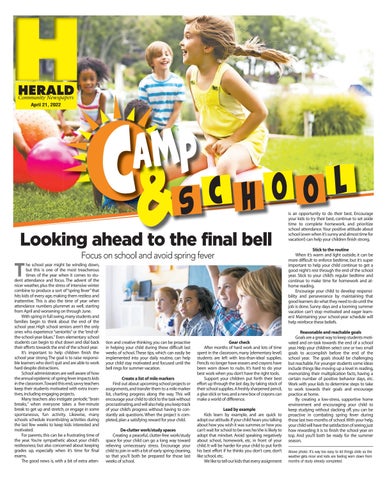
is an opportunity to do their best. Encourage your kids to try their best, continue to set aside time to complete homework, and prioritize school attendance. Your positive attitude about school (even when it’s sunny and almost time for vacation!) can help your children finish strong. Stick to the routine When it’s warm and light outside, it can be more difficult to enforce bedtime, but it’s super important to help your child continue to get a good night’s rest through the end of the school year. Stick to your child’s regular bedtime and continue to make time for homework and athome reading. Encourage your child to develop responsibility and perseverance by maintaining that good learners do what they need to do until the job is done. Sunny days and a looming summer vacation can’t stop motivated and eager learners! Maintaining your school-year schedule will help reinforce these beliefs. Reasonable and reachable goals Goals are a great way to keep students motivated and on-task towards the end of a school year. Help your children select one or two small goals to accomplish before the end of the school year. The goals should be challenging but reachable. For younger students some ideas include things like moving up a level in reading, memorizing their multiplication facts, having a certain number of positive behavior days, etc. Work with your kids to determine steps to take to work towards their goals and encourage practice at home. By creating a low-stress, supportive home environment and encouraging your child to keep studying without slacking off, you can be proactive in combating spring fever during those last two months of school. With your help, your child will have the satisfaction of seeing just how rewarding it is to finish the school year on top. And you’ll both be ready for the summer season. Above photo: It’s way too easy to let things slide as the weather gets nicer and kids are feeling worn down from months of study already completed.
Countdown to camp Making summer memories
As hours of sunlight increase, thoughts may Encourage your camper to sign up for many turn to summer vacation. For many children, activities, including those that normally may be summer vacation wouldn’t be the same without out of their wheelhouse. A camper may be camp. pleased to learn that a new craft activity or a Adults may have their own fond memories sports game piques his or her interest. of going to summer camp when they were chilConnect with fellow campers in advance: dren because of the opportunities it presented Before the season begins, check out the camp’s to be independent and meet new people. social media presence. Follow the camp’s posts Campers often bond over shared experiences, and connect with other like-minded campers whether they are planned activities or unex- even before they arrive. Talking with others who pected “disasters” like a rainstorm washing out a share similar interests can help campers feel canoe trip. That is why so many parents choose more comfortable about meeting up once they to carry on the summer camp tradition when arrive at camp. they have their own children. Develop a rapport with camp counselors: However, some kids may not be ready to The saying “you only get one chance to make a jump right into the summer camp lifestyle. Such first impression” extends to campers meeting youngsters may need extra reassurance and camp counselors. When campers interact with support to make the most of their time at camp. counselors for the first time, they should be outPlan ahead: Visit the camp in advance, if going, polite and open to new ideas. Counselors possible, and get a lay of the land. Knowing what will appreciate easy-going campers and could to expect in terms of facilities and activities can be good resources of useful information, such as assuage some anxiety. It also will help campers how to score an extra dessert at mealtime. hone in on what to pack and what to expect Follow the safety rules: While campers over the summer. may spread their wings a bit at summer camp Talk about expectations: Conversations when not under the watchful eyes of parents, about camp routines, events and even feelings any mischief should not come at the expense of are essential before camp begins. Be enthusias- safety. Campers should stick to the safety prototic about what to expect at camp but also be col so that camp is not memorable for the realistic. Tell them that they might prefer to be at wrong reasons. home some days, but that it will be a fun time Change another camper’s experience: A overall. Discuss different situations with your camper who recognizes a fellow camper is child, such as rain, boredom, homesickness and reserved and shy can invite that person to come hunger. Prepare by packing extra snacks, also sit with other friends at meals or to participate in family photos as backup for these worst-case an activity. This can help build a lasting friendscenarios for those going to sleepaway camp. ship and make ur that much more enjoyable ocamp ilies at in need. Try many new activities: Summer campeisr fafor someone m oth nter about expanding boundaries and withinterests. ting Ce
CONNECT... EXPLORE... LEARN... CELEBRATE... at the
t c e n Con
Award Winning
Above photo: Being proactive is key to helping your camper have the best experience. While email and high-tech gear have changed some aspects of the overall camp adventure, preparing kids for camp and summer programs remains the same.
HERJC Early Award Winning Childhood Center HERJC Early Childhood Center
aren
NEW P
Explore
as yo first ste ur child takes ps t the at our M owards indep ir en ommy & Me P dence rogram
Connect, Explore, Learn & Celebrate at the
t c e n n Co ur ies at o er famil r with oth renting Cente a NEW P
Dr. Helene H. Agatstein
E xplore Educational Consultant, Inc.
n r a e L
CONNECT... EXPLORE... LEARN... CELEBRATE...
Hewlett-East RockawayatJewish Centre Nursery School the Cheryl Karp, Early Childhood Director, 516.599.1169
Award Winning
Congregation Etz Chaim • 295 Main St., East Rockaway, NY 11518 Congregation Etz Chaim Andrew Rabbi • David Sislen, Hazzan • 516.599.2634 Early Warmflash, Bird 295 Main St., East Rockaway, NY 11518 www.herjc.org Registration for • www.facebook.com/herjc.community Summer & Fall. Rabbi Michel Schlesinger Inquire Today! Hazzan Bonnie Zakarin
HERJC Early Childhood Center
Hewlett-East Rockaway Jewish Centre Nursery School 516.599.2634 Cheryl Karp, Early Childhood Director, 516.599.1169
CelCeonbnercat
as yo first ste ur child takes ps to the at our M wards indep ir en ommy & Me P dence rogram
CONNECT... EXPLORE... LEARN... CELEBRATE. www.herjc.org at the
Congregation Etz Chaim • 295 Main St., East Rockaway, NY 11518 Andrew Warmflash, Rabbi • David Sislen, Hazzan • 516.599.2634 www.herjc.org • www.facebook.com/herjc.community
www.facebook.com/herjc.community “Your school district has a multitude of resources to which your child may be entitled. I can partner Extended the nex f our with you to design an effective, plan ce olong-term t steps n e i r Day Options e HERJC Early p in Jewi ere he or she e ex getsteall thchild whthat h r to ensure that your s We are proud to be g h Available u e l n o n e r e a j o rning a th y the b dC o o s l h l i d n S l e k i d y PJ Library Commun nagogu the next s nefits o Ch Childhood Center our the s success.” requiresEto academic arlyachieve ence of re e me teps in Je f e ing e experi develop
n wh n h th throug dhood Center ills childre or higher lear il sk h e C y th p Earl ed f Meetings and Disciplinary We attend CSE, CPSE, Team n develo er learning childre h ig h they ne r eed fo they n
Hearings. We also do Counseling and Parent Training Office: (516)791-1324 Cell: (516)445-1705 Helene@Agatstein.com Website: schoolingadvocate.com
t Celebr e ur ies at o er famil r with oth renting Cente a NEW P
ate E m x bleo p r s h i p rein g
Buildin
wish le
enjoy
arn
ing and BasSyyonucar gchkoilsgdutae thmeembebnefits oo f ur first steloB e eso rs ps touwildin Pkr th eirr hip in ardsginBdloc g at our M epeks Pam our ommy
ndenro cegram rogram
& Me P
Learn
r ce of ou xperien h the e Center where g u ro th d hildhoo p the skills Early C n develo er learning childre igh r ed fo h they ne
Award Winning
We are proud toJewish bewww.pjLibrary.org a Centre Nursery School Hewlett-East Rockaway Library CherylPJ Karp, EarlyCommunity Childhood Director, 516.599.1169 www.pjLibrary.org
Congregation Etz Chaim • 295 Main St., East Rockaway, NY 11518 Andrew Warmflash, Rabbi • David Sislen, Hazzan • 516.599.2634 www.herjc.org • www.facebook.com/herjc.community
Celebra the nex
te
t steps in Jewis h learn enjo ing and Synago y the benefits gue me o mbersh f Buildin ip in ou g Block r s Progra m
We are proud to b PJ Library Commu www.pjLibrary.o
1171343
Learn
1171260
April 21, 2022 — CAMP and SCHOOL HERALD COMMUNITY NEWSPAPERS
S-2
S-3
School’s let out, but don’t let up on a routine Managing those carefree summertime days
We all know that today’s kids have busier schedules than any previous generation of youngsters. Many extracurricular activities, including sports, require a nearly year-round commitment, and the dual-income household has landed many kids in afterschool programs where they tend to their schoolwork or engage in various activities that keep them occupied until a parent is available. Relax the schedule, but not too much Those busy schedules get a lot less hectic when the school year ends. Once school is out, kids used to a full schedule might find themselves with time on their hands. Though it’s good for kids to squeeze in some rest and relaxation during their summer break, it’s also important for kids to stay active and the family keep to a routine so they don’t develop poor habits as summer goes on. In addition, the American Psychological Association notes that kids who are physically active are more capable of coping with stress and tend to have higher self-esteem than kids who do not include physical activity as part of their regular routines. Kids often see the summer months as a time to do whatever they please, with no responsibilities or academic pressures. Some kids expect an endless range of fun activities — and besides that, if they are not at camp or don’t have a job or scheduled activity of some sort — they’re hanging out with friends, sleeping until noon, and might see an easing of the rules as their reward for making it through another school year. Your child might be imagining a summer that reality can rarely deliver, which sets them up to be let down. The change in routine alone can be sufficient to throw some kids off-kilter. When you combine these factors — expectations and a change in schedule — with an increase in family togetherness (or claustrophobia, depending on how you look at it), it’s only a matter of time before the level of conflict rises in your home. Having some amount of structure in the summer is helpful for most families. Determining how much structure to put into place will depend on the individual needs of your family. Look for ways to keep kids active throughout the summer while still allowing them to recharge their batteries after a long school year. Consider a camp. If you are a working parent who needs your child to be engaged in something all day every day, a camp is a great way to take a break from the traditional childcare you use during the school year. It is not true that the most expensive camp in the most exotic location is the best one. As long as your child is safe and has fun, any camp is a good one. See what the community has to offer. School districts, libraries, and parks are returning to their post-pandemic slate
of activities for families, although these may require you to have a flexible schedule. Also, consider our local museums, notably Long Island Children’s Museum and even Nassau County Museum of Art, which have special events and activities during the summer. Keep teens on their toes. While your teen may no longer want to attend summer camp or participate in a structured activity, he/she still needs to keep busy. If old enough, there’s increased opportunity in our post-pandemic economy to land a summer job. Another good option is volunteering. Many hospitals or libraries have opportunities for teens. If all else fails, give your teen something constructive to do at home, like watching a younger sibling, painting, or cleaning out the garage or basement and having a yard sale. While your teen will want to have some down time to hang out with friends, make sure you know where she is and that she is safe. Pencil in some family fun. Make sure that you take some time to enjoy each other’s company without the pressures of the school year. Some ideas include taking a family vacation, to going to the beach or having a picnic in the park, to attending community events such as free concerts or fireworks. Teach kids to garden. Interest in gardening grew rapidly during the pandemic, especially during when we were dealing with stay at home restrictions, and that trend continues strongly. Gardening might be seen as a peaceful and relaxing hobby, but it still requires a lot of elbow grease and hard work that pays physical dividends. A garden must be planted, hoed, weeded, and watered, and gardening gets kids out of the house to enjoy the great outdoors. When growing a vegetable garden, kids might embrace the chance to be directly involved in the foods that will eventually end up on their dinner tables. You can embrace this as an opportunity to teach the value of eating locally-produced foods and the positive impact such behavior has on the environment. Cool it on the screen time. Limit how much time kids spend watching television, playing video games or on social media. We all spent too much time glued to our screens and devices since the start of the pandemic. It’s so important now to step away from that. Kids might not love it when you turn their video games off or minimize their access to social media, but explain the limitations and let kids know you expect them to be physically active even if it is summer vacation.
Above photo: Just because the bus isn’t coming early in the morning to whisk your kids off to school, doesn’t mean you should give up on the family’s structure that you’ve worked so hard to enforce all throughout the school year.
Learning is for a lifetime — not just when class is in session Summertime — and the livin’ is easy. A bit too easy, as far as education experts are concerned. Multiple studies have shown that students who don’t do any studying over the summer can face significant academic setbacks in the fall. In fact, one study found that the average American student loses the equivalent of one month of learning in both reading and math every summer. That’s why it’s so important to find fun, creative ways to continue learning throughout the summer. Do Summer Reading Early. Instead of putting off all of the required summer reading until the last few weeks of break when your child’s brain has already turned to mush, try reading a little bit each week to keep your brain in shape. You can even help your student make a reading calendar with deadlines for when he will reach certain pages in the books assigned and check the calendar each day and celebrate when your child reaches her goals. Start A Book Club. Looking for new activities and socialization during those early months of the pandemic led many folks — of all ages — to get interested in book clubs. Keep it going. Need some motivation to get your summer reading list finished? Why not call a couple friends from school and create a book club? Pick a date when everyone agrees they’ll read the book by, and then get together at someone’s house, order a pizza, and talk about the book. Sounds much more fun than doing it yourself, doesn’t it? Do The Crossword Puzzle. It may seem old-school, but crossword puzzles are still popular — and great way to boost brain power. Grab a newspaper and challenge yourself to finish the crossword puzzle. Not only do crossword puzzles test everyone’s knowledge of a wide range
of facts, but they also force you to recall unusual words and keep your vocabulary sharp. Community Service. Instead of sitting around playing video games, why not find an organization that could use some help? Ideally, look for an opportunity that aligns with your child’s future goals, so if he want’s to become a doctor, volunteer at a hospital or nursing home; if she’s interested in going into architecture, build houses with Habitat for Humanity. They’ll get the chance to adapt to a new environment, learn new skills, and think in new ways. Plus, it’s a great thing to put on a future resume! Read For Fun. Yes, you read that correctly. Reading can actually be fun, especially when your student is not going to be tested on it. Head to the library and pick out something that interests you or ask a friend who enjoys reading to give you some recommendations. And it doesn’t have to be fiction. Check out some memoirs or biographies of people you admire to inspire you. Do A Project. A great way to work planning and execution skills is to come up with a project that your child can complete over the summer. He could redecorate your room, build a bench, organize a fundraiser or plant a garden. Take An Academic Workshop. Another great way to help your child keep his brain in shape over the summer is by attending an academic workshop to give her a leg up when she gets back to school in the fall. Your child can try a STEM workshop, tutoring in a subject area that needs improvement, SAT prep or study skills workshops for incoming high school freshmen or college freshmen. Above photo: The kids can have fun during their summer break with engaging activities that will get them off to a great start in the coming school year.
CAMP and SCHOOL HERALD COMMUNITY NEWSPAPERS — April 21, 2022
Banish that ‘brain drain’
Anxious kids can enjoy camp Clear the fear to make way for a formative experience
Tools For Taming Anxiety The key to helping your child get over precamp nerves is to acknowledge their feelings and give them tools to help them tame them. Let your child feel a sense of ownership over the experience. Involve them in picking the summer camp; familiarize them with the camp environment and teach them about camp activities so they can formulate expectations. Help your child get excited about camp. Take them shopping for new gear and focus them on fun things about camp that they can anticipate. Avoid focusing on what makes children anxious. Instead of asking leading questions
like, “Are you nervous about horseback riding?” ask open-ended questions like, “How are you feeling about the horses?” Don’t trivialize their concerns or offer glib reassurances. “There’s nothing to worry about!” or “Everyone loves camp!” may discourage your child. Instead, show that you have empathy and acknowledge their concerns. Be specific. Focus on concrete details in conversations leading up to and during summer cam season. Avoid abstract issues like what it it’s like to be away from home in favor of cabin details, meals in the lodge, or campfire rituals. Reflect on your own formative experi-
ences away from home. Share positive aspects of them with your child. Show that you are willing to talk about the new things they’ll be doing, whether it’s eating new food, sleeping in a bunkbed, getting along with cabin-mates, or coexisting with insects. Go through “rehearsals.” A shorter-term sleepover or a night at Grandma’s will make it easier for your child to be away from home. Don’t linger at the bus stop. Keep the goodbyes short, as delaying just causes more mixed feelings. Make communication easy and accessible. Outline a schedule for phone calls or emails
if they’re part of the camp’s routine, and make sure your child understands how easy it will be. Have goals conversation, so your child will come away focused on how they are adjusting, rather than on how much they want to come home. Try not to communicate your own anxiety. Your child can pick up on your feelings even if you don’t verbalize them. What you want to share is your confidence in your child and the summer experience. Help your child formulate realistic, goaloriented plans. That plan could be for making friends or toasting the perfect marshmallow or passing a swimming test. The thrill of completing these plans can give your child a feeling of success and take his mind off his anxiety. If your child has psychiatric or learning issues, don’t keep them a secret. Make sure the staff and counselors know anything they need to know to head off problems and maximize their experience. Do they wet the bed? Are they anxious about water? And let your child know that counselors are there to support them, whether they have a simple question or a larger problem. Courtesy Child Mind Institute
Above photo: Camp is a unique situation where your child engages with a large community of peers and learns how to interact socially in a less-structured environment than school. Your supportiveness will give your child room to take ownership over the experience themselves.
1170879
Portraits of summer camp showcase sunsplashed children playing sports, swimming, and getting freckles. Not pictured is any sign of anxiety, a natural reaction to a new adventure and a several-week separation. All children experience a mixture of excitement and nervousness when summer camp approaches. For most, excitement trumps nerves, but some children develop anxiety serious enough to get in the way of what should be a fun, formative experience. Summer camps hone many skills useful for future success: resilience, self-reliance, and social adaptability. The camp experience — being away from home among peers — can help kids develop social skills, separate in a healthy way from parents, and cultivate independence. Camp activities can help them build confidence by demonstrating mastery. Children are often ready for sleep-away camp around ages 10 to 12, although preparedness varies depending on age, experience, and temperament.
1169306
April 21, 2022 — CAMP and SCHOOL HERALD COMMUNITY NEWSPAPERS
S-4
Math counts
S-5
How to raise an independent learner
Validate it Don’t be a parent who says “I was never good at math.” It only sends the wrong message that “math is hard”; and it has null value. Instead, stress that math is something that has to be learned by putting time and effort into it — like anything else. Add it up Point out math in everyday life. Make sure
CAMP and SCHOOL HERALD COMMUNITY NEWSPAPERS — April 21, 2022
Success in mathematics, as most of us are aware, has been linked to success in college and future careers. Every student studies mathematics, and it has always been an important component in education. It is a tool that helps us make sense of the world around us, and it is particularly important because success in mathematics has been linked to success in college and future careers. Simply stated, math counts when it comes to a bright future. “The deluge of data that children encounter in their daily lives makes it even more important that they build strong math and statistics skills,” says education expert Dr. Richard Bavaria.“This flood of information contains good data and bad. “Good skills in math and statistics can equip your child with the ability to discern valid data from misleading data, and to make intelligent decisions based on factual data.” Dr. Bavaria offers these helpful tips that parents can use to bridge the gap between fear of math and the vibrant essential world of numbers that are so important in our daily lives.
your child knows that math is relevant, whether it’s figuring out how long a road trip will take or making a grocery budget. Think aloud and let your child see you work out everyday math problems. Multiply it Find the resources that will help your child acquire the math skills he or she needs. There are plenty of resources available geared to teaching and building math skills for students of all ages. You’ll find everything from entertaining math tricks to multiplication shortcuts to practice sessions. Solve it Get help, if needed, before it’s too late. While classroom learning may be enough for one child, it may not be enough for another. Supplemental math instruction from a professional source can provide the one-on-one attention that is sometimes missing from a busy classroom. Giving a child the time and opportunity to ask questions and learn math at their own pace can open doors of understanding — and eventually provide them with the confidence they need to learn in a classroom setting.
Above photo: Math knowledge is useful for all of us — from children to adults — in all aspects of our lives. When parents and teachers get excited about math, then children get excited about math.
Lawrence Woodmere Academy
summer day2022
A Unique Summer Experience: Ages 3 years - 10th grade
Celebrating our 45th Birthday! Enroll today: www.lwasd.org
516.374.5559
1171273
Traditional Day Camp Center for Creative Arts (CCA Arts Camp) Champion Sports Academy (CSA Sports Camp) Teen Travelers (Day & Overnight Trips) 2 heated pools, door to door transportation, hot lunch Kosher option available
Promo Code: herald15 for 15% off 6-8 week enrollment valid through 4/30/22
MUSICAL INSTRUMENT REPAIRS BY ROD BALTIMORE Quality Workmanship At Reasonable Rates, Unconditonally Guaranteed, by a Leading Master Technician and Instrument Maker in the Industry, with Over 55+ Years of Experience
Quality is not an act, it is a habit A Full Service Repair Shop Located on Long Island
YOUR SOURCE FOR ALL WOODWIND & BRASS INSTRUMENT REPAIRS
Serving musicians from student to professional Including such masters as: Stan Getz, Miles Davis, Sonny Rollins, Wynton Marsalis, James Galway, Bob Mover, etc.
(516) 574-3292 rodneybalt256@gmail.com www.MusicalInstrumentRepairsByRodBaltimore.com
1171287
Repair jobs large and small, from pad replacements to complete overhauls on instruments vintage and new
Time for a tutor?
Five signs your child needs tutoring
1170323
April 21, 2022 — CAMP and SCHOOL HERALD COMMUNITY NEWSPAPERS
S-6
It’s easy to tell that a child needs tutoring when he or she continues to receive one poor report card after the next, but there are a number of other less obvious signs that parents shouldn’t ignore. Educator Eileen Huntington, co-founder of Huntington Learning Center, says that parents can look for clues in a number of places. “Stressful study sessions and bad grades are the tangible evidence of a child’s school struggles, but there are several other indicators to watch for,” says Huntington. “The sooner you recognize school problems, the faster you can help your child overcome any issues and boost his or her confidence.” Huntington shares these five warning signs that your child may need tutoring help: Difficulty getting started. Does your child seem unexcited and unmotivated about anything to do with school — especially working on assignments? Does he or she put off homework time every night and frequently spin his or her wheels when working? Sloppy homework and overall disorganization. Is your child disorganized in most areas of his or her life? Does your child consistently hand in unfinished or messy homework? Does it seem that your child used to care about doing quality work and does not anymore? Personality change. Have you noticed a dramatic change in your child’s disposition in
recent months? Is your child more angry or volatile than ever before? Does he or she seem unhappy — about school and other areas of his or her life such as friends? Diminished self-esteem. Does your child get down on him or herself easily during homework? Is your child pessimistic about school, his or her abilities, and more? On a day to day basis, does your child appear frustrated with him or herself? Lack of interest in learning. Is your child totally apathetic about school and anything associated with school? Was your child interested in learning previously and now is not? Does that indifference translate to other areas, such as socializing or being involved in extracurricular activities? “School can be a bumpy road for students who are struggling, so it is important to take action if you notice your child showing any of these signs,” Huntington says. “Experience has showed us that early tutoring intervention is key to getting students back to where they need to be as quickly as possible.”
Above photo: Children can benefit from having someone focused on them who can support their learning and help them to understand and accept their own learning styles. Tutoring can also be beneficial during the summer months, if there are concerns that they will lose some of the ground they gained over the past year.
S-7
CAMP and SCHOOL HERALD COMMUNITY NEWSPAPERS — April 21, 2022
June 27th – August 19th CAMP FOR ALL AGES 6-18 1-5PM Monday-Friday Instruction, Drills, Match Play With Lou! Full Week $395.00 Per Day $90.00
New Red Ball Program With Kristen
checkupS now Schedule your
Monday, Wednesday & Friday 9AM – Noon 3 days a week $165.00. 2 days a week $120.00 Daily Rate $65.00
Naomi Chaim Watman M.D., F.A.A.P
SUMMER CAMP OPEN HOUSE
303 East Park Ave. Suite A Long Beach, NY
Receive A 15% Discount When Signing Up On February 22nd For 2 Full Weeks or More With 50% Deposit 1171338 1159086
897-4600
Office Hours By Appointment
1168518
Pediatrics & Adolescent Medicine
February 22 11AM-2PM Come Meet Our Pros. Do A One Hour Drill! First Come First Serve – Sign Up Required
Family Owned & Operated Since 1954
Celebrating Our 68th Year!
& Camp EAsT MEAdOw
YoUNGer CAMPerS
Mature, Adult Staff, 1:4 Ratio Hot Lunch • Ice Cream 2 Heated Pools • Red Cross Swim Instruction Arts & Crafts • Cooking • Music Kickball • Basketball • Wiffle ball Lunch With Surprise Characters Annual Dog Show Science • Animal Care • Gardening Weekly Specialty Activities
RegisteR now foR Camp 2022
516-781-3900
older CAMPer CAMPerS
WWW.BIGCHIEFSCHOOLANDCAMP.COM
call now for a Tour
Arts & Crafts • Jewelry Making Basketball • Handball Hockey • Lacrosse Rock Climbing Dance • Surfing Science • Animal Care Theme Parties Swim Instruction Water Slide Ice Cream & A LOT MORE FUN, FUN!!
1166674
camp! r o f y h t l a e h Get
1170366
April 21, 2022 — CAMP and SCHOOL HERALD COMMUNITY NEWSPAPERS
S-8
H N P -2 2