


BY EMILY TENORIO MOLINA
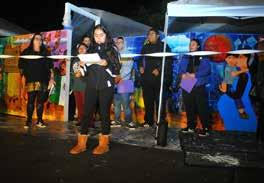
Friends, family and advocates gathered to honor the 85 lives lost of unhoused people in the streets of Contra Costa County in the last two years.
Held at the 40 Voices African American Holistic Wellness & Resource Hub in Antioch, the memorial recognized people who died while experiencing homelessness and emphasized health disparities experienced by the unhoused population in Contra Costa.
The event was held Dec. 19 in observance of National Homeless Persons Memorial Day. It was co-hosted by Antioch Seventh Day Adventist Church, Bay Area Rescue Mission, the city of Antioch, Contra Costa Council on Homelessness, NAMI Contra Costa, and Safe Organized Spaces Richmond, bringing together a number of previously unhoused people and other residents.
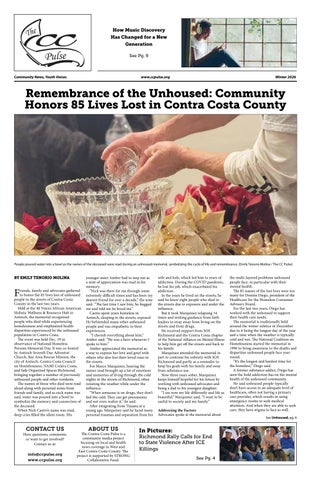
The names of those who died were read aloud along with personal notes from friends and family, and as each name was said, water was poured into a bowl to symbolize the memory and connection of the deceased.
When Nick Castro’s name was read, deep cries filled the silent room. His
CONTACT US
Have questions, comments, or want to get involved? Contact us at:
younger sister Amber had to step out as a note of appreciation was read in his memory.
“Nick was there for me through some extremely difficult times and has been my dearest friend for over a decade,” the note said. “The last time I saw him, he hugged me and told me he loved me.”
Castro spent years homeless in Antioch, sleeping in the streets, exposed. He befriended many other unhoused people and was empathetic to their experiences.
“I cherish everything about him,” Amber said. “He was a hero whenever I spoke to him.”
Amber appreciated the memorial as a way to express her love and grief with others who also lost their loved ones in the streets.
For Marco Marquinez, hearing the names read brought up a lot of emotions and memories of living through the cold nights in the streets of Richmond, often resisting the weather while under the influence.
“When someone is on drugs, they don’t feel the cold. They can get pneumonia and not even realize it,” he said.
After emigrating from Tijuana at a young age, Marquinez said he faced many personal traumas and separation from his
info@ccpulse.org www.ccpulse.org ABOUT
The Contra Costa Pulse is a community media project focusing on local and health news coverage in West and East Contra Costa County. The project is supported by STRONG Collaborative Fund.
wife and kids, which led him to years of addiction. During the COVID pandemic, he lost his job, which exacerbated his addiction.
In the years he lived on the streets, he said he knew eight people who died in the streets due to exposure and under the influence.
But it took Marquinez relapsing 14 times and seeking guidance from faith leaders to stray away from living on the streets and from drugs.
He received support from SOS Richmond and the Contra Costa chapter of the National Alliance on Mental Illness to help him get off the streets and back to his family.
Marquinez attended the memorial in part to continue his sobriety with SOS Richmond and partly as a reminder to keep his goals with his family and away from substance use.
Now three years sober, Marquinez keeps himself hopeful for his future by working with unhoused advocates and being a dad to his youngest daughter.
“I see now my life differently and life as beautiful,” Marquinez said, “I want to be useful to society and my family.”
Addressing the Factors Advocates spoke at the memorial about
the multi-layered problems unhoused people face, in particular with their mental health.
The 85 names of the lost lives were too many for Donnie Diego, president of the Healthcare for the Homeless Consumer Advisory Board.
For the last two years, Diego has worked with the unhoused to support their health care needs.
The memorial is traditionally held around the winter solstice in December due to it being the longest day of the year and a time when the weather is typically cold and wet. The National Coalition on Homelessness started the memorial in 1990 to bring awareness to the deaths and disparities unhoused people face yearround.
“It’s the longest and hardest time for the homeless,” Diego said.
A former substance addict, Diego has seen the hold addiction has on the mental health of the unhoused community.
He said unhoused people typically don’t have access to an adequate level of healthcare, often not having a primary care provider, which results in using emergency rooms to seek medical attention. And when they are able to seek care, they have stigma to face as well.



Publisher
Malcolm Marshall
Editor Danielle Parenteau-Decker
Denis Perez-Bravo
Joe Porrello
Samantha Kennedy
Arianna Caramagno
Emily Tenorio Molina
Aina de Lapparent Alvarez
Jasmine Ford America Leon
Vernon Whitmore
Sandy Close
Michael J. Fitzgerald
The Contra Costa Pulse is a community media project founded by New America Media, focusing on local and health news coverage in West and East Contra Costa County.
The project is supported by The California Endowment and the STRONG Collaborative Fund.
Have questions, comments, or want to get involved?
Contact The Contra Costa Pulse at info@ccpulse.org www.ccpulse..org
BY SAMANTHA KENNEDY
he Contra Costa Board of
TSupervisors named Supervisor Diane Burgis its chair and Supervisor Ken Carlson its vice chair for 2026 at its Jan. 13 meeting, as the county faces what she described as “complex challenges.”
Burgis served as vice chair for the previous year and succeeds District 2 Supervisor Candace Andersen. She has represented District 3 since 2016, which encompasses Brentwood, Oakley and parts of Antioch as well as the unincorporated communities of Bethel Island, Blackhawk, Byron, Diablo, Discovery Bay and Knightsen.
“At a time when our communities are facing complex challenges, I look forward to advancing solutions that strengthen emergency preparedness and public safety, expand access to mental health services, and ensure County government remains responsive, equitable, and accountable to the residents we serve,” said Burgis in a press release.
Burgis said at the meeting that her goal as the newly appointed chair is to “bring people together” in the face of division.
“We have a lot here in Contra Costa that we can be proud of, and we can show people how we can do better,” she added.
The leadership shift also makes Carlson the board’s first openly LGBTQ+ member
to serve in the role, and positions him to serve as chair next year.
“This year gives us the opportunity to strengthen systems that we’ve built over many years, as well as to reaffirm our values and how we put our values into action,” said Carlson at the meeting.
His District 4 includes the cities of Concord, Clayton, Pleasant Hill, and Walnut Creek. He also represents Contra Costa Centre, Morgan Territory Road, Ayers Ranch, and many areas in unincorporated Walnut Creek, including North Gate, San Miguel and Shell Ridge.
“Alongside Chair Burgis and the full Board, my focus will be on delivering practical solutions that support public safety, promote mental health and wellbeing, and reflect the values of the diverse communities we represent,” Carlson also said in the release.
Burgis serves on more than 30 board and regional committees and chairs the county Economic Development Committee and California Delta Protection Council.
According to her biography on the county website, her “priorities include protecting and enhancing the Delta ecosystem and water quality; promoting public safety with improved fire protection and law enforcement coverage; addressing the homelessness and housing affordability crisis; improving mental health response; bringing more services
to East County; and building our local economy to bring jobs closer to home.” Carlson is a former Concord police officer and city council member and mayor in Pleasant Hill. His biography says he prioritizes “vulnerable communities, immigrant rights, and animal welfare.” As supervisor, he has helped expand Stand Together Contra Costa, which provides legal services for immigrants, and the county’s Basic Health Care Program to cover undocumented residents. Carlson has also secured funding for spay/neuter clinics for low-income pet owners, the Community Youth Center in Concord, and the county’s Services and Access for Everyone center.
In the past year, the board responded to the then-delayed CalFresh benefits with a $21 million allocation and upped free food support for county residents before the benefits were reissued and heard community calls for a non-cooperation policy with federal immigration authorities and residents’ concerns about the Sheriff’s Office's cooperation with Immigration and Customs Enforcement. Burgis and Carlson will lead the fivemember board, which also includes Supervisors John Gioia in District 1 and Shanelle Scales-Preston in District 5 and manages a $7.16 billion budget. •
BY SAMANTHA KENNEDY
Gov. Gavin Newsom touted progress made on homelessness and hopeful changes to the education system while taking aim at President Donald Trump in his last State of the State address.
The two-term governor gave the address in person for the first time since 2020, delivering it Jan. 8 at the state Capitol, where he also brought news of a more than $42 billion windfall for the upcoming budget.
“We know the truth,” said Newsom. “California’s success is not by chance. It’s by design. We’vecreated the conditions where dreamers and doers and misfits and marvels with grit and ingenuity come to build the impossible.”
That truth Newsom pointed to includes a 9% decline in unsheltered homelessness statewide, with Contra Costa County coming down by 34.8% for 2025. For the state that is home to the nation’s largest number of homeless individuals, it’s “not enough,” he said.
Under Newsom, the state has created the sometimes disappointing CARE Court, which provides services to those

with certain substance use and mental health illnesses, and the passing of Prop. 1 to build $6.38 billion in mental health facilities.
And Newsom was clear on what that meant for counties going forward: “No more excuses. It’s time to bring people off the streets and out of encampments and into housing and treatment.”
Trump and Republicans have for years said the state struggles with homelessness and crime, which Newsom countered with stats that show declines in violent crime — and overall — for this past year. Trump used claims of high crime to launch a later abandoned attempt to send around 100 federal immigration agents to the Bay Area.
Newsom’s address came on the heels of the fatal shooting by Immigration and Customs Enforcement in Minneapolis of Renee Nicole Good, who was a U.S. citizen. Coming amid the Trump administration’s crackdown on immigration, it was at least the second death involving an ICE agent since September.
“The federal government, respectfully, it’s unrecognizable. Protecting the powerful at the expense of the vulnerable.
Their credo seems to be about fear: fear of the future, fear of the stranger, fear of change,” said Newsom about Trump’s policy changes.
However, one of Newsom’s proposals was one on common ground with Trump. The governor said he wants to target investors “snatching up” homes and forcing rents up “too damn high.”
Trump made that proposal ahead of Newsom’s announcement.
On the education front, Newsom said that today’s budget will have some of the “most significant” investments in the state’s history. That includes $27,418 in spending per pupil, he added.
One education-related proposal did catch state Superintendent of Public Instruction Tony Thurmond off guard, according to CalMatters. Newsom is proposing that the state Department of Education be overseen by the state Board of Education instead of the superintendent.
“Unfortunately, on this particular issue, they are not aligned,” said Liz Sanders, a spokesperson for the Department of Education, according to CalMatters. •
BY SAMANTHA KENNEDY
The city of Antioch is moving the possibility of bringing a warming center to the region to the back burner as it puts all its efforts into attempting to house a chunk of its homeless population on near-freezing nights in a local motel.
Council members gave staff the goahead to further flesh out the details of potentially housing residents at the nowclosed Comfort Inn, using funding from the Emergency Voucher Program and possibly other buckets.
The move was prompted by concerns that the city has no warming center or emergency shelter for homeless residents, requiring them often to travel to Richmond or further.
“We all know mistakes will be made because we’re trying to do this as quickly as we possibly can, but from a humanitarian perspective, this is the right way to go,” said Mayor Pro Tem Don Freitas.
The hotel has 119 rooms available — and another community area with a capacity of up to 45 people — offered at $45 per night, Andrew Becker, a representative for the hotel, said.
The process won’t be easy. The city has the largest population of homeless residents in the county at 246, which is still considered an undercount, and it would have to provide case management and take responsibility for any damages.
City Manager Bessie Marie Scott said that the city’s Coordinated Outreach and Referral Engagement, or CORE, and Angelo Quinto Community Response teams could be asked to supplement current services to provide support for the project. That would mean a drop in services elsewhere or increased costs to a city already facing a deficit.
And current funding through the voucher program is only enough for “a few nights” of shelter without dipping into other funding sources, said Scott. There is approximately $5,000 to $6,000 in voucher funding.
The site is the potential location of a HomeKey+ facility for permanent supportive housing that council members first applied for last year. Becker, who said he was also authorized to speak on behalf of the developer of that project, suggested providing shelter on the site until the award of the funding. HomeKey+ funding is not guaranteed.
“So you, in essence, are saying we can actually provide you space for housing now instead of waiting until this thing opens up in occupancy,” said Becker.
That path would include additional support from the county for clinical support and additional funding from the city through programs like the Community Development Block Grant, he said.
Doing so would be a “full-time operation” and have a monthly price tag of more than $160,000 using a $400,000 allocation through the end of June, said Scott.
“Do the math and hope you get HomeKey+,” she told council members.
Thinking long-term: Council members say county and faith groups need to ‘step up’
The project is only an immediate potential option for homeless residents and doesn’t fill the void of not having a warming center or shelter in the city.
That’s a problem the county needs to help solve, council members and advocates said.
“The Board of Supervisors, they’re the ones that have the resources that can
make those funds immediately available. It may be that we take a couple of buses to Martinez … and have a discussion. I’m not afraid of political pressure,” said Freitas. “It’s time to ask them to step up as well.”
Fretias pointed to specific funding sources, like the Keller Canyon Mitigation Fund, which provides grants of up to $10,000 in Pittsburg and Antioch, and the $1 million in Community Impact Funds from Supervisor Shanelle Scales-Preston and BOS Chair Diane Burgis, who represent parts of the city.
The Keller Canyon fund requires most of its funding to go towards its target area in Pittsburg, and East County supervisors have said that their current applications already surpass the funding amount, though Burgis is holding off on most spending due to uncertainties under the Trump administration.
Melissa Case and Nichole Gardner said they wanted to see more advocacy on the issue from the city and the public to the county.
“You all need to be letting them know that we need those funds in our city. They know that we are struggling,” said Gardner.
Former interim Police Chief William “Brian” Addington, now acting as a consultant for the city, said that the county has “no plans” to open a warming center in East County.
The city can also partner with faith groups to offset the costs of a warming center.
Only one church has expressed interest in doing so, a report from Scott shows.
Council members agreed to later pursue potential partnerships with the county and faith groups that could lead to a warming center in the city. •

BY SAMANTHA KENNEDY
An artificial intelligence data center is listed as a possible feature of the Bridgehead Industrial Project in Oakley, but residents made their opposition clear to the city Planning Commission, citing environmental, health and cost concerns.
Residents rallied at the Jan. 20 meeting to oppose the project that would bring 3.1 million square feet of logistics buildings, an industrial warehouse, and a possible data center to two split areas adjacent to Highway 160 northwest of the city.
Planning commissioners ultimately recommended the project’s approval to the City Council but placed an additional requirement of a Conditional Use Permit for data centers. That means, if a data center were to be part of the project, it would have to get additional approval and review.
“That really closes the gap, if there were any gap between a business just coming in and operating,” said Ken Strelo, Oakley’s community development director. Strelo clarified that no data center was currently being proposed, but said “that doesn’t mean someday they might not, right?”
The vote by commissioners is the first approval of applications for rezoning the sites, adopting design guidelines, dividing the 164-acre project into 10 lots, and certifying the Environmental Impact Report.
Audience members responded to the vote with booing, applauding for Vice Chair Kerry Harvey’s and Commissioner Yared Oliveros’s no votes, and a resident’s outburst about commissioners prioritizing jobs over the environment. That criticism spilled over after the vote.
“Shame on you for not listening to your constituents, you’re not the one who’s going to have the health effects,” one resident told commissioners after the vote.
Environmental impacts that come with A.I. data centers were a common issue raised by residents. A.I. data centers consume large amounts of energy and water, studies have found, which increases greenhouse gas emissions and strains resources or pollutes neighbors.
Surrounding the project areas are residences, the Big Break Regional Shoreline Park and trail, the Oakley Logistics Center, and the San Joaquin River.
Data centers use that energy to power operations and water to prevent overheating in computers that are performing for A.I.
Conan Moats, a member of the Diablo Water District’s Board of Directors, said that about 16.7% of the project could be made up of a data center. Right now, Moats said DWD can provide 71,287 gallons of water per day, around the same amount as the under 100,000 gallons per day Strelo said the project will likely use. Still, Moats questioned how that need might grow should a data center be brought in.
A resident living by the proposed site areas, who only identified herself as Colleen, questioned the strain a potential data center could put on resources.
“Who’s really going to pay?” she asked. “What assurances do we have that we won't have the droning sounds or vibrations emitting from the data
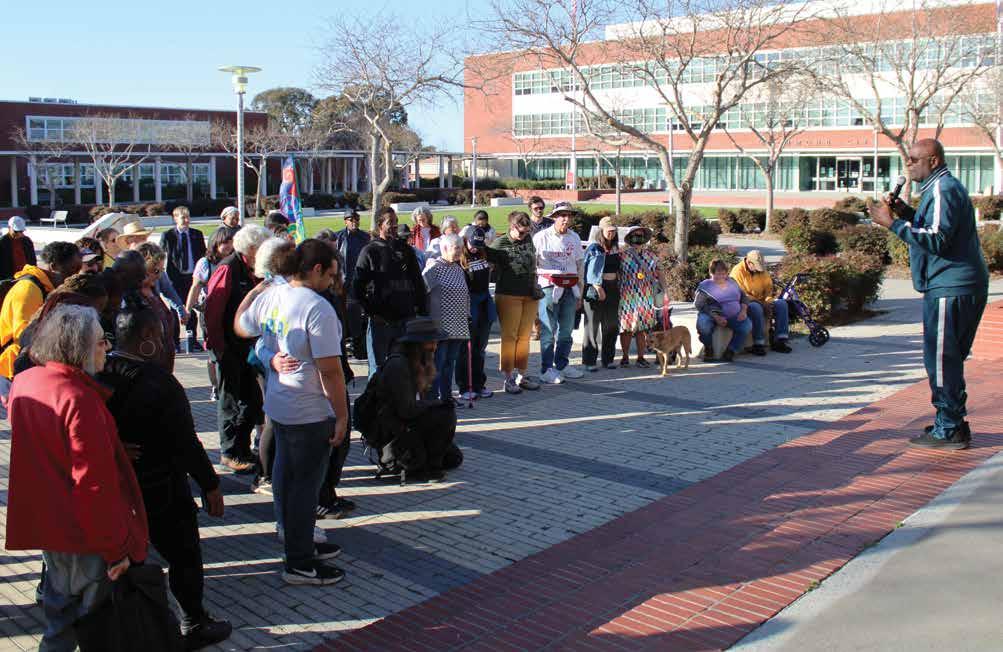
Attendees lock arms during a closing prayer at the Unity Vigil for people killed by immigration agents held at
“ We matter.”
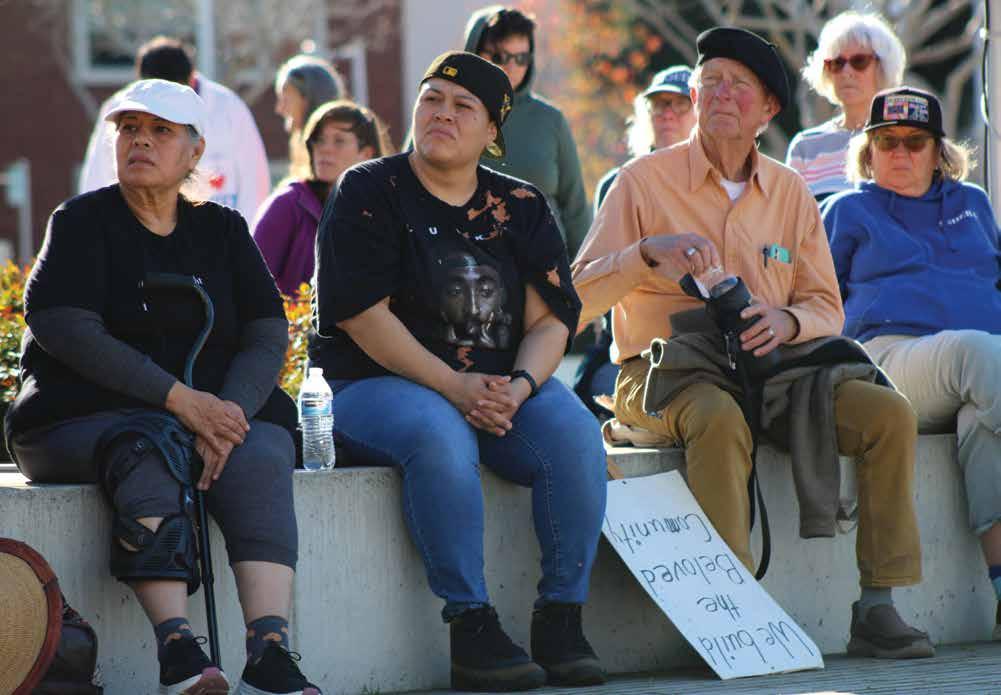
That chant echoed across Civic Center Plaza in Richmond on Jan. 19 as about 50 residents, faith leaders and local officials gathered for a peaceful, multicultural vigil in response to recent killings by Immigration and Customs Enforcement agents nationwide.
Organized by Faith in Action East Bay and The Freedmen Federation, the event featured speeches, prayers and calls to end state violence. The gathering was supported by the city of Richmond.
The rally came less than two weeks after an Immigration and Customs Enforcement agent shot and killed Renee Nicole Good in Minneapolis. According to The Trace, a news organization dedicated to covering gun violence in the U.S., ICE agents have opened fire on 17 people since the Trump administration’s current immigration crackdown began, killing four and injuring another eight. It says these numbers are likely an undercount, however, as shootings are not always publicly reported.
Event organizer Kira Lee, with FIA East Bay, served as emcee, introducing speakers including City Council member Claudia Jimenez, former City Council member Melvin Willis, United Teachers of Richmond President Francisco Ortiz, Richmond mayoral candidate Ahmad Anderson, and District 1 Supervisor John Gioia.
With the event held on Martin Luther King Jr. Day,
many channeled and quoted the civil rights icon with various messages, all opposing state violence.
“The things that divide us are the lies, and the only thing that can bring us together is the truth,” Lee said. In a powerful moment, the names of those killed by ICE agents were repeated by the crowd in unison.
“If we decided that life was sacred before today, the names that we read off together would still be here,” Lee said.
Willis praised Richmond residents and their willingness to affect positive change by showing up when it matters.
“Community members know what we’re seeing is wrong, and we may not feel like we have power, but we do have the power of our voice… the power to show up and the power to shift the narrative,” said Willis. “We will always stand up and fight for justice, we will always stand up to fight for our neighbors, we will always stand up to fight for our families — not because of any obligation — because it is the right thing to do.”
At one point, Lee asked attendees to raise their hands if they were immigrants, and then if they were afraid of state violence. Nearly everyone raised their hands.
“This is not about immigration — this is about fear and deciding who belongs and who does not,” said Lee.
Jimenez said the trepidation is present everywhere.
“When they show up in our neighborhoods, in our schools, in our churches — nobody is truly safe, not immigrants, not citizens, not children, not the elderly,” she said. “This kind of unchecked power threatens the
very foundation of our democracy.”
To combat such fears, the nonprofit community safety group Reimagine RIchmond started a 24-hour hotline and chat groups where community members can acquire information in real time, as well as a community watch with volunteers trained to be “legal observers” who can verify ICE vehicles and spread the word quickly.
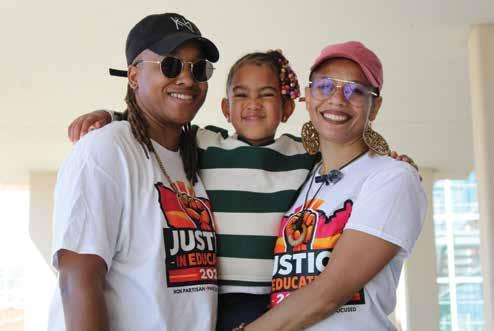
The event also marked the public launch of Richmond’s 2026 Justice in Education strategy, a community-driven proposal that aims to remove law enforcement practices which harm Black and Brown families by making larger investments in school facilities and infrastructure, along with providing more access to culturally responsive counselors and service providers.
“Education is the thing facism attacks first,” said Lee. Richmond’s sanctuary protections prohibit ICE operations in public spaces, and the city has allocated more than $1 million from its general fund for immigrant legal aid.
Gioia said the next step is the state and federal government adopting Richmond’s successful local policies that decrease state violence. Before handing off the microphone, he noted the importance of translating the energy from the Jan. 19 gathering into yearlong advocacy, as opposed to just one day remembering victims of state violence.
Faith in Action East Bay holds Ceasefire Night Walks in different Oakland locations on varying Fridays from 6-8 p.m., including Jan. 30 and three walks each in February and March. •



Betty Reid Soskin, a trailblazing civil rights activist, historian and longtime Richmond resident whose life spanned more than a century of American history, died Dec 21 at age 104.
Soskin was born Betty Charbonnet in 1921 in Detroit and spent her early childhood in New Orleans before moving to the Bay Area in 1927 and graduating from Oakland’s Castlemont High School.
She came of age during the Great Depression and World War II. During the war, she worked as a file clerk in a segregated boilermakers union, an experience that shaped her lifelong commitment to telling the full story of America’s past.
In the Bay Area, she became active in local politics, community organizing and music. With her thenhusband Mel Reid, she co-owned Reid’s Records in Berkeley, one of the first Black-owned record stores in California.
Her activism extended into public service. Soskin worked in Berkeley city government and as a field representative for former California state Assemblymember Dion Aroner and state Sen. Loni Hancock.
Later in life, Soskin gained national recognition as a park ranger at the Rosie the Riveter World War II Home Front National Historical Park in Richmond, a job she started at the age of 85. Well into her 90s, she led tours that challenged visitors to confront the realities of segregation and discrimination during the war years, centering the experiences of Black workers and women whose stories were often omitted from official narratives. She was known for boldly speaking about racism and exclusion of Black women, even when those truths were uncomfortable. “I want to be remembered as one who told the truth,” she said during her retirement ceremony at the Craneway Pavillion in 2022. Soskin was 100 when
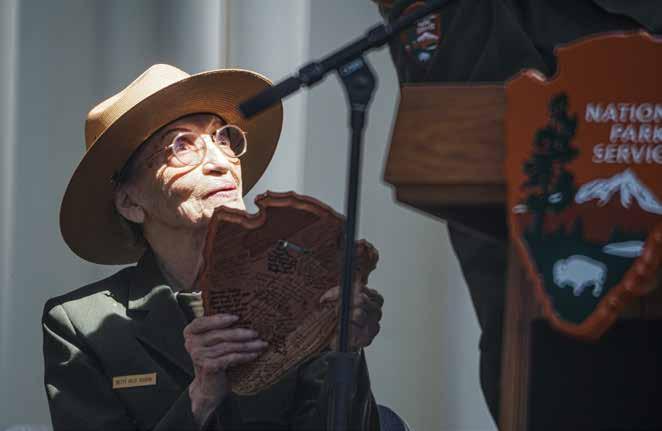
she retired.
In 2015, Soskin became the oldest active National Park Service ranger in the country. Even after stepping back from regular tours, she remained closely connected to the park and its mission, mentoring younger historians and continuing to write and speak publicly.
Soskin survived a violent assault during a robbery in her home in 2016, an experience she later described as transformative. “I learned I could take care of myself. I learned that I could survive, that I wasn’t a victim,” she told the Richmond Pulse at the time. She credited community support for her recovery, saying, “The support allowed me to reclaim my space.”
In 2018, her memoir, “Sign My Name to Freedom: A Memoir of a Pioneering Life,” was released, chronicling her long and rich life.
She later survived a stroke in 2019, again returning to public life with resilience and clarity. Throughout her later years, she continued to remind audiences that progress requires honesty and sustained effort. She often spoke of the arc of history and reminded young people that democracy is something to be participated in and re-created by each generation.
In 2009, Soskin attended the first inauguration of President Barack Obama as a guest of then-Rep. George Miller, who represented Richmond in Congress. In his

second term, Obama gave her a commemorative coin stamped with the presidential seal after she introduced him at a Christmas tree-lighting ceremony. That coin was one of the items stolen in the 2016 robbery, but the White House said at the time it would be replaced. When Soskin celebrated her 100th birthday on Sept. 23, 2021, Obama surprised her with a video message.
In Richmond, Soskin was more than a national figure. She was a treasured elder and a moral compass. In a city often marked by political bickering and infighting, she was admired by all. She was a living example of truth, wisdom and grace.
Betty Reid Soskin leaves behind a legacy rooted in truth-telling, courage and a passion for life. Her life stands as a reminder that history doesn’t live in the past. It is lived and carried forward by those willing to speak. Soskin is survived by family members who include her son Robert, daughters Dorian and Diara, five grandchildren and one great-grandchild. Her family says that a public memorial will be announced. In the meantime, they encourage people to pay their respects by making a donation to support Betty Reid Soskin Middle School in El Sobrante or the completion of the documentary about her life, also called “Sign My Name to Freedom.” •
Continued from page 3
Continued from page 1 centers 24/7 and affecting people's health? I don't want to live with that. Would you?”
“When people have that fear of being looked at, people step back with resistance,” Diego said.
He speaks from experience of talking with various unhoused people in East County, who he says have told him that potential judgment from health professionals makes them feel unworthy of medical and mental help.
Gigi Crowder, the chief executive officer of NAMI Contra Costa, said East County needs to provide more homelessness services.
According to 2024 data from Contra Costa Continuum of Care, the county homeless services agency, a total of 2,049 households lost their housing in Antioch, the highest rate in the whole county. Although county services supports people with finding housing, East County residents are among the most vulnerable when it comes to finding immediate support and thus resort to sleeping on the streets.
Antioch doesn’t have a shelter for people with immediate needs. The Delta Landing shelter in Pittsburg is shortterm, emergency housing, while the Winter Nights Safe Parking Shelters in Antioch provide a place for unhoused individuals living in vehicles.
The county is also using $4.1 million from the Encampment Resolution Funding state grant to provide an interim shelter site in Antioch.
“Antioch does not fund this issue in a robust way,” said Crawford, “and its root cause of mental health.” •

A staff report said the project could create 3,500 new jobs and another 3,700 one-time construction jobs while bringing in a $1.1 million surplus to the city. Those economic benefits were cited by the project’s only public supporters, members of local unions, as a reason to move the proposal forward. •

BY MICHAEL FITZGERALD
Caregivers need care too. That could be the motto of Caregiver OneCall, a 1-year-old organization that provides real-time support for caregivers. And it does so for free.
Antioch-based Caregiver OneCall is the creation of Nikki Lopez, founder and board chair of the organization. Her story about the creation of the organization starts with Lopez having to step up herself during the Covid-19 pandemic. She needed to become a caregiver for her grandmother.
“The physical part was a lot,” she says. “But it was hard emotionally too. It tore me up.”
Out of that experience and talking with many people about the work and challenges faced by caregivers, Lopez realized how much caregivers need assistance in their work too. In too many instances, caregivers become nearly invisible. When someone visits a patient, family member or anyone being taken care of, they only see the client, not the caregiver themselves.
Plus, many caregivers receive little real training in what’s required or the challenges of the emotional side of caregiving. All that prompted Lopez to create her growing organization. It currently fields calls from all over the U.S. every day — and night. Fifty calls a day are common, she says. And that number is growing. She said California alone has more than 4 million caregivers in all types of situations. And at times, they need some help.
“We want to be a nationally recognized source to provide help and respite for caregivers,” she said. “We want to cover all caregivers.”
What caregivers do and recognition of their roles in helping people will be on full display Thursday, Feb. 26, on the anniversary of the creation of Caregiver OneCall. That evening, Emmy-winning Dave Clark of KTVU

will emcee the “All Our Love for Caregivers Gala,” a black-tie event of dining, music, and entertainment to focus on the work of caregivers and to raise funds to support Caregiver OneCall’s services.
“The goal of the event is all about awareness of the work of caregivers,” Lopez says. “It acknowledgment of what they do.”
The fiscal goal is $100,000. As of Jan. 22, $16,300 has been raised.
The gala will feature keynote speaker Christina Irvine of the Family Caregivers Alliance of San Francisco. Also on the list of notables is Debbie Toth of Pleasant Hill’s Choice in Aging organization who will be honored for her service. The evening will include a special musical guest, award-winning neo-soul artist Anastasia Downey.
The gala will be at the Centre Concord, 5298 Clayton Road in Concord, from 6 to 9 p.m. Doors open at 5 p.m. Parking is free.
Tickets are $150 for individuals with other pricing for those wishing to sponsor the work of the group at higher levels. The proceeds from all tickets and sponsorships


will go towards the organization’s $100,000 fundraising goal.
Caregiver OneCall is a 501(c)(3) nonprofit organization. It’s free, 24/7 caregiver support line is (833) 927-6599. The support line is available for any caregiver feeling overwhelmed by the burden of taking care of aging parents, disabled persons, fragile family members, or others.
Caregiver OneCall also provides education for caregivers and can suggest referrals to specialists. It’s understood that many caregivers themselves may be facing issues like housing instability, financial strains and burnout, Lopez notes. Trained volunteers and professionals can provide emotional support and stepby-step guidance on medical and legal issues, culturally sensitive help in multiple languages, and a compassionate ear.
All the services offered by CaregiverOneCall are free of charge.
“Our mission is simple,” Lopez says. “No caregiver should ever feel alone at 2 a.m.” •


‘If
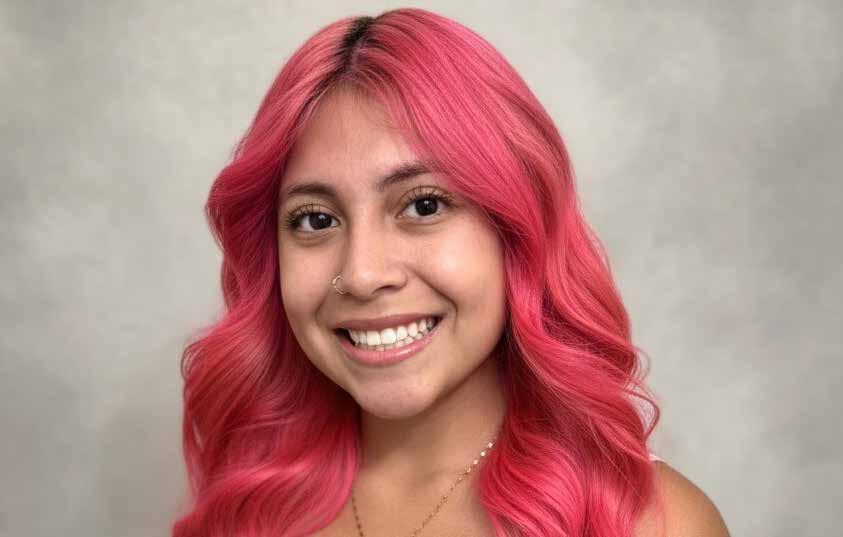
Editor’s note: Elena Velazquez is a 17-year-old environmental justice advocate and community leader from Richmond whose work spans food justice, youth leadership, and civic engagement. She has volunteered with organizations including Urban Tilth, Bay Area Girls Club, The Latina Center, and the Richmond Youth Council, and currently serves as president of her school’s National Honor Society. This interview was conducted ahead of her receiving the Youth Humanitarian Award at the Contra Costa County Board of Supervisors meeting on Jan. 20. It has been edited lightly for clarity.
Contra Costa Pulse: You’re only 17 years old. What does receiving the Youth Humanitarian Award mean to you at this point in your life?
Elena Velazquez: It means everything. Truthfully, it didn’t really hit me until I went to Martinez to film a short video to be shown at the awards ceremony. That was when I actually realized this is going to be one of my moments, where I get to give a speech and say, if I can do it, you can too.
I won’t lie, it’s a lot sometimes, and I’m surprised I don’t find myself feeling overwhelmed. But I think after so many years of trying different leadership positions, this kind of recognition reassures me that I’m doing something right. The environmental and civic work I do will definitely continue with [me] as I head off to college this fall.
Contra Costa Pulse: Can you tell us about the work or actions that led to this recognition? What inspired you to get involved?
Elena Velazquez: The inspiration definitely ties back to when I first started volunteering with The Latina Center. [I was] 7 years old, going along with my mom to their events. She was the one who helped make me aware of people who needed help without it being too much for me to handle.
Slowly but surely, as I grew up, she would teach me about the issues in our community. [It went] from her telling me people were hungry and volunteering during the holiday season, to being 15 and participating in a benefit concert advocating against domestic violence. Realizing the power I had to make a difference, even at such a young age, inspires me to continue working and further my involvement.
Contra Costa Pulse: Who or what has shaped your
COMMENTARY • ARIANNA CARAMAGNO
W hen I was growing up, El Sobrante always seemed less like a place and more like a bridge between places. When you spend your entire life living in a place whose name roughly translates to “The Leftovers,” it’s difficult to imagine it as anything other than that. Unlike other nearby cities with big shopping malls, tourist attractions, or direct access to the bay, El Sobrante lacks a lot of the charm that most of the Bay Area is known for. Aside from the gurdwara, a Sikh temple, in the hills, not much stood out to me as a kid,
sense of responsibility to your community?
Elena Velazquez: All the people who ask about me or remember me from when I was a little girl out volunteering with my mom. These are people who believe in me, care about my well-being, and are interested in whether I’m furthering my studies and still volunteering. [They] have shaped my mindset and made me feel that I do have a responsibility to the community. They see my heart and want to see me out in the world, so let me show them that I want to be here.
Contra Costa Pulse: What challenges have you faced while doing this work, especially as a young person?
Elena Velazquez: As a young person, surprisingly, these experiences were never something I thought I would go through. But people are intimidated, adults specifically. There have been a couple of incidents with people who were very bitter toward me, sometimes just mean while working together, or not open to any of my ideas, making them seem insignificant.
It’s sad because they were people I had first looked up to in a new workplace or volunteer experience. I had some help from my support system around me to realize they way they had treated me was never about me, but how they viewed themselves. And how they thought it would be okay to treat a young person that way because [they assumed we wouldn’t] stand up to the adult in power.
Contra Costa Pulse: How do you balance school, personal life, and community involvement?
Elena Velazquez: That’s a hard question, truthfully. It took me years to finally feel like I had the hang of it. Everything is important, and sometimes I would find
and I felt self-conscious about where I lived. It took years for me to understand that what El Sobrante lacked, it made up for in something far more lasting: a sense of belonging.
Though I didn’t see it at the time, the space where I found belonging in El Sobrante was the library.
As an elementary school student, I spent a lot of time going to the library, partly to read and partly because of the air conditioning. Although I mostly focused on looking through the graphic novels and young adult sections during my visits, going to the library also gave me the opportunity to find joy in the El Sobrante community.
It was a safe place where I was able to read, get free meals as a student, listen to author talks, and attend community events with other people who also happened to live in El Sobrante. Being surrounded by kind people who helped cultivate such a welcoming space in my small community made me feel proud of where I lived instead of the usual embarrassment.
It was only when the library burnt down in 2018 and had to be rebuilt that I understood what I had lost.
The Richmond Library was only a short drive away, but it wasn’t the same. I had completely taken for granted
myself feeling like I was neglecting one aspect of my life over another.
[I’d stress] about wanting perfect grades but not wanting to drop an activity, or cancel plans with my friends, while also wanting a rest day for myself to do self care. Then there’d be a meeting, so I’d have to miss [something else]. It’s a lot. But it’s so worth it.
That’s why I started really using my email, calendars, and Post-it notes all over my laptop, along with support from friends in similar groups. They help me ask the right questions before taking on a new task or project, which makes my life much easier. And finally, learning how to say no. Being able to say I don’t have the time, or I don’t have the energy, has been huge.
Putting my mental health, relationships, and school first has helped everything else fall into place and find a rhythm. I wouldn’t have it any other way.
Contra Costa Pulse: What advice would you give other young people who want to make a difference but don’t know how or where to start?
Elena Velazquez: We have social media. I cannot stress it enough, use it. Find local causes by searching your city name along with the word volunteer.
If you care about a cause and are able to support it in any way, just try. I think young people are often afraid to go somewhere where they don’t know anyone. Take a friend, or let the community welcome and embrace you as you start your service journey.
If you have a free afternoon, that’s a new [opportunity] to do good and feel good. Even if you don’t enjoy a certain program or event, you still gain experience. I encourage [young people] to always find one reason to do it again. •
what an everyday space like the library had meant for everyone in El Sobrante — beyond providing access to books and activities.
There were few other community spaces I knew in El Sobrante where people of all ages could feel a sense of belonging together. Losing the library meant losing a lot of the connections I had made with my community and waiting for it to be rebuilt felt like an eternity.
Returning to the library as an adult doesn’t fill me with the same childlike wonder, but it does still fill me with a sense of belonging. Although the interior of the library and the books are different, the space still holds the same meaning that made the original library so important to me. Being able to see both new and old generations have access to the same space and opportunities that fostered my own sense of community growing up is enlightening. While El Sobrante may lack the same excitement and flashy infrastructure of bigger cities, it makes up for it completely in community. Despite not living in a place with much noteworthiness
Even if others may see it as leftovers, I am grateful it is where I grew up. •
BY AMERICA LEON
Before the social media and streaming era reshaped how music travels, platforms like MTV, radio and magazines were the primary vehicles for music promotion and discovery. Music journalists, radio DJs and MTV’s video jockeys played an outsized role in shaping taste, curating the sounds that defined popular culture for generations of listeners.
Today, that human curation has largely given way to algorithms.
Listeners now are likely to get their music recommendations from Spotify’s personalized playlists and A.I.-powered DJ, or their perfectly curated TikTok For You Page. The centrality of music streaming platforms and social media apps today means that, rather than being curated exclusively by real people, algorithms are also influencing the music that gets released and heard.
“Usually, I will post a chorus online. … If I like the response, I’ll finish it, and I’ll drop it,” said Grammynominated artist Sombr in an interview with the podcast Switched on Pop. The 20-year-old best new artist nominee’s unique approach to music production and promotion exemplifies a major shift in the music industry where social media apps and algorithms are playing an increasingly important role. Today’s emerging artists can leverage their social media presence to promote their music and shape the creative process itself.
While Sombr’s hit-making approach is particularly noteworthy, it is indicative of a greater industry trend: Leaning into social media has become the norm in today’s music scene.
Swedish singer-songwriter Zara Larsson rode the wave of the unpredictable TikTok algorithm, contributing to the revival of her 2015 track “Lush Life,” which reentered music charts in multiple countries a decade after its release. Some of the credit for her reemergence in the mainstream music scene can be attributed to the TikTok algorithm’s ability to amplify viral moments to create larger trends.
Larsson’s reemergence puts her among the likes of Sabrina Carpenter and Chappell Roan, who experienced similar algorithm-boosted pushes in 2024, causing their music to be discovered by millions of new fans. Each of their respective rises to pop-stardom were not orchestrated attempts to go viral but the result of a series of events that thrust them into the mainstream consciousness.
Larsson’s 2025 album, “Midnight Sun,” is nominated for best dance pop recording at the 68th annual Grammy Awards. Though we can point to dance trends, viral concert videos, and even a dolphin meme that circulated in 2024 as reasons for her recent resurgence, her success

is a product of continuing to work to refine her craft and find her audience, which coincided with social media trends at the right time for listeners of today to rediscover her music.
Even seasoned artists have taken to social media and leaned into online culture and trends; think five-time Grammy-winner Mariah Carey “defrosting” every winter to sing “It’s Time!” to kick off the holiday season. While algorithms can amplify artists’ reach, they also limit the music that we listen to. With more and more artists finding success at the intersection of social media, internet culture and music, virality has also become an expectation for many in the industry. In 2022, 31-yearold American singer-songwriter Halsey posted in a now-deleted TikTok video that their record company said they could not release new music “unless they can fake a viral moment on TikTok.” The prevalence of social media marketing has forced even some established artists to attempt to appeal to the algorithm and strive for an “imaginary goalpost of views or virality” before they can share their art with the world.
In a 2025 interview with Zane Lowe, Halsey opened up about not being permitted to release a new album due to their fifth studio album, “The Great Impersonator,” not performing to their label’s standards. Pressure for immediate hits means that songs are shelved, artists lose significant creative freedom, and music discovery is limited further by industry gatekeepers who want music to suit an algorithm.
When creativity is suppressed, we risk losing out on tracks that never get a chance to have their moment, let alone a renewed moment sometime in the future.
The “slow rise” that Carpenter spoke about in her 2023 speech at Variety’s Hitmakers event may not be attainable for future emerging artists with the

constraints presented by the unattainable demand of virality. Record executives’ unrealistic expectations mean that the existing limited opportunities for newer artists’ music to be discovered and heard by the masses will likely diminish.
In an effort to go viral, many musicians have accompanied their album rollouts with short song snippets and choreographed dance routines. Smaller artists attempt to work the algorithm by comparing their music to the work of well-established artists, hoping to find their target audience. Typical formats include something along the lines of “If this landed on your FYP, you must like [insert genre] music that sounds like [insert well-known artist]” or “Wish you could have been a fan of [insert well-known artist] before they blew up? This is your sign to be an early fan of [insert small artist].” My concern is that it may be impossible to be the first you if you carve your path attempting to be the second version of someone else.
Music consumption trends, patterns and mediums are most certainly not the same as they were even a decade ago. The songs that comprise the soundtrack of the modern generation are not just today's charttopping hits but older songs that have found renewed popularity and appealed to new audiences. Radio and video media are no longer the primary modes of music discovery; music streaming services can provide music recommendations based on our tastes, and social media algorithms can further the curation and gatekeeping of music.
If algorithms are the future of popular music, we must consider what may be lost. Just think of the kind of art we may never discover — or may not be created in the first place — if we stick exclusively to our For You Pages and personalized sets from A.I. DJs. •

BY AINA DE LAPPARENT ALVAREZ
F or the past two and a half months, millions of Americans have agonized over whether to forgo or downgrade their health insurance as premiums surged nationwide. This year, health plan costs increased by an average of 114%, according to the Kaiser Family Foundation.
The increase follows Congress’ decision not to extend a President Biden-era tax credit which lowered costs on the Affordable Care Act Marketplace. On Jan. 16, American Community Media hosted a panel to explain how the subsidy’s lapse will affect access to health care and what is being done to face that crisis.
Open enrollment for health insurance closed Jan. 15 in 43 states. So far, 1.4 million fewer people chose coverage on the ACA. Anthony Wright, executive director of the nonprofit Families USA, thinks that preliminary numbers are just the tip of the tragedy.
“Many more folks fall off coverage as they are not able to pay that higher premium in January, in February, in March, especially after certain grace periods and other things come into effect,” he said.
What can people do at the individual level?
Wright outline several steps consumers can take when enrolling in healthcare.
First, use official websites like healthcare.gov or Covered California (coveredca.com) to avoid websites with “junk plans” that don’t meet regulations.
Second, he encouraged consumers to shop and compare. “The best deal last year would not necessarily be the best deal this year,” Wright said, “especially with this dramatic change in the expiration of some of the subsidies that are available.”
The expired subsidy was for people making between 400% and 600% of the poverty level ($62,000 to $94,000 for an individual or $128,000 to $193,000 for a family of four). But the baseline tax credit is still available for people under 400% the poverty level which is $60,000 for an individual and $125,000 for a family of four.
A third and “not great option” is buying down. Underinsurance can still be a safety net against full bankruptcy, however, in case of an accident or health scare. In California, a bronze plan includes three doctor visits for preventive care, Wright said.
Some states have stepped in, with New Mexico approving additional subsidies and California looking into similar options. But answers won’t come from the individual or the state level, Wright said.
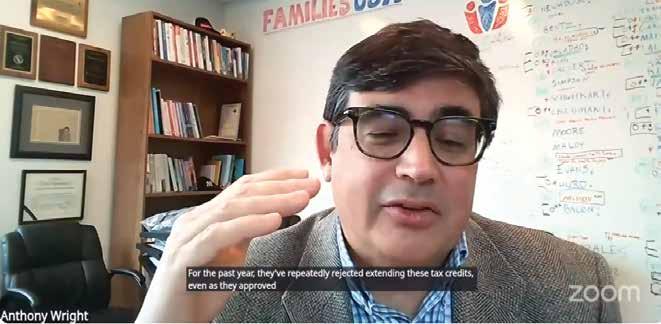
“What the states can do is a fraction of what was in the federal deal,” he said. “So we need federal action.”
Wright pointed to a House vote in January supporting a three-year extension, which included backing from 17 Republicans. Open enrollment might be over, but the fight is ongoing.
Why is health care so expensive in the U.S.?
The widening gap in health care access goes beyond the problem of subsidies. According to Neale Mahoney, a professor of economics at Stanford University, the United States spends the most of any country on health care.
Over the last two generations, health care expenditure has increased from 8% to 18% of the country’s gross domestic product. While about a third of the federal budget goes to health care, and employers contribute for 160 million Americans, prices are too burdensome. For a family of four, $27,000 is the average cost of health care this year, according to the Kaiser Family Foundation.
“If you are a small business owner or you are a firm trying to make it in a difficult environment, providing that health insurance, even if you think that’s hugely important to your employees, is a huge weight on your bottom line,” Mahoney said. “The body of evidence we have suggests that higher health care costs mean lower wages and less jobs.”
And it’s about to get worse for all, Wright said.
People opting out of insurance tend to be healthier, so the pool will be smaller and sicker. Premiums will rise. “This has a cascading impact on increased costs and on decreased services for everybody, not just those who are directly impacted,” he continued.
‘Push on all the available levers’
Addressing the health care crisis will require multiple approaches, panelists said.

“There isn’t one quick fix to reform our health care system,” Mahoney said. “To make meaningful progress, we actually have to push on all the available levers.”
One challenge is ensuring there are enough health care workers, particularly in rural and other underserved communities. Mahoney said loosening caps on how many doctors can train, allowing more doctors to immigrate from other countries, and expanding the scope of care nurses and other practitioners can provide would be helpful.
Another fight is controlling costs. Mahoney pointed out that Medicaid work requirements add administrative burdens, which make it more costly. Also, expanding Medicare to younger folks and negotiating more drug costs would make health care markets more competitive.
“I think even economists who tend to be skeptical about price controls and about the public sector realize that more forceful medicine is needed in the healthcare sector,” Mahoney said.
Merith Basey, executive director of Patients for Affordable Drugs, a nonprofit focused on policies to lower drug costs, said prescription drug prices in the U.S. are four to eight times higher than in other highincome countries.
To counter that, policy needs to support generic medicine, which lowers the price of the already existing drug by 39% and competition, which cuts prices by 95%, Basey said.
There is a glimmer of hope in drug price negotiations, Basey added, thanks to the work of Families USA, Patients for Affordable Drugs, and other organizers. Since Jan. 1, the cost of the costliest and most commonly used drugs like insulin and cancer drugs, went down by 63%.
Basey said expanding negotiations to include the 60 most expensive drugs would be a critical step toward reining in prescription costs. •


BY KILEY RUSSELL BAY CITY NEWS
F
ive former world-class athletes will be inducted into the Bay Area Sports Hall of Fame in May, including a San Francisco Giants shortstop, a San Francisco 49ers offensive lineman, two Olympic gold medalists and a champion college rugby coach.
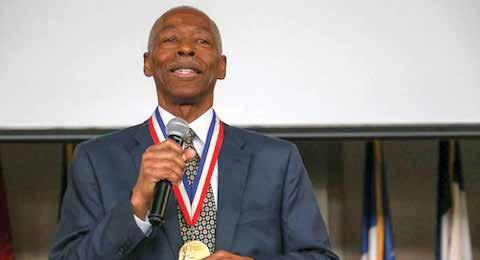
The BASHOF Class of 2026, which was announced Wednesday, includes fan favorite and two-time World Series champion Brandon Crawford, 49ers lineman Jesse Sapolu, Olympic swimmer Missy Franklin, Olympic sprinter Eddie Hart and University of California, Berkeley rugby coach Jack Clark.
Crawford, who is from Mountain View, spent all but one of his 14 Major League Baseball seasons with the Giants. In addition to his two championships, he earned three All Star appearances, four Gold Glove awards and two Defensive Player of the Year nods, and was also the first shortstop to hit a grand slam in an MLB postseason game.
Crawford retired from baseball in 2024.
Sapolu won four Super Bowls with the 49ers, was a two-time Pro Bowl selection and earned National Football League All-Pro honors at both center and guard. Sapolu played football at the University of Hawaii and was selected in the 11th round of the 1983 draft. He retired in 1997 having played his whole career for San Francisco.
Franklin has won 28 swimming medals, including five Olympic golds and one bronze, and held the world record
BY JASMINE FORD
On a chilly, foggy morning, about 40 people from Antioch and the surrounding East County area gathered Jan. 19. at the skate park on Lone Tree Way to paint and beautify the space in honor of the Martin Luther King Jr. holiday. The skate park restoration project was one of three Day of Service events held in Antioch.
Mayor Ron Bernal said the event reflected the power of community service to bring people together “and make Antioch better.”
“We’re all a beautiful community, and again, we just want to get out together and make it better, get off our phones, get out of our homes, to see what all this place can be,” he said. “Antioch is a phenomenal city, between the rivers, the hills, the park districts, everything in between. It’s a gem.”
Bernal acknowledged that Antioch often faces criticism but said events like this highlight the city’s strengths. “There’s so much that’s positive,” he said. “Community events bring people together to do something positive.”
Recreational coordinator La’Nae Jackson said she was impressed by the turnout.
"The event was to produce the feeling of ‘I don’t need to travel out to celebrate,’ and it’s been super rewarding," Jackson said. "It’s been super rewarding to have conversations with people and seeing the change of how people are talking about living in Antioch, and hearing people say, ‘I’m really excited about this’ or ‘see it coming back’ and we’re a large city, like we can do a lot."
in the 200-meter backstroke from 2012 to 2019. At the age of 17, she dominated the backstroke in the 100-meter and 200-meter races at the 2012 Summer Olympics in London.
As a UC Berkeley swimmer, Franklin won the 2015 NCAA Women’s Division I Swimming and Diving Team Championship, seven individual NCAA championships and won the 2015 Collegiate Woman of the Year and Honda Sports Award as the nation’s top female swimmer.
Clark, another Cal sports legend, is currently coaching his 43rd season as head coach of men’s rugby, where he’s so far taken home 30 National Championships and produced 157 All-Americans. He was also head coach of the USA National Team from 1993 to 1999 and the team’s general manager from 1993 to 2003.
Hart, a Pittsburg native and Cal’s third inductee of 2026, is an Olympic gold medalist, Olympic Trials champion, two-time world record holder and Olympic
record holder.
Hart won state titles in the 100-yard and 200-yard races at Contra Costa College and later captured NCAA titles in the 100-yard dash and 4×110-yard relay while competing for Cal.
Ranked among the top 10 U.S. sprinters five times between 1970 and 1979, he was inducted into the UC Berkeley Hall of Fame in 1988.
All the inductees will be celebrated at the BASHOF Class of 2026 Enshrinement Dinner on May 14 at the Hyatt Regency Embarcadero in San Francisco.
For more information, people can visit bashof.org.
Copyright © 2026 Bay City News, Inc. All rights reserved. Republication, rebroadcast or redistribution without the express written consent of Bay City News, Inc. is prohibited. Bay City News is a 24/7 news service covering the greater Bay Area. •

Martin Luther King Jr. was known for his leadership in the civil rights movement and standing up for justice. His goal was to bring about change for African Americans by organizing and participating in civil rights actions such as boycotts, marches and nonviolent resistance.
King’s "I Have a Dream" speech still echoes in the hearts and minds of African Americans today, bringing about hope for the future and motivation to act on injustices in their neighborhoods. In terms of service, King famously said, "Everybody can be great because everybody can serve."
The event shows how Antioch residents are using King’s legacy as a call to action through service and community building. The Antioch Community Center, where the skate park is located, strives to be a collective for all, and encourages the community to participate. Many of its past events have included Dia de los Muertos, Veteran’s Day, and other kid-friendly activities.
“We want to have intentional art on our skate park, for the kids especially,” said Ami’Satu Kamara, an Antioch municipal employee.
Kamara said the city plans to introduce skate lessons at the park and invite local artists to contribute graffiti art, refreshing a space that has not been updated for a while.
“[Today] we see a lot of participants from our community, and from our classes. It’s really great to see them not only in our classes, but also see them participate in the events that we see in the community itself.”
Ronda Herd, an Oakley resident, said she attended after looking for a way to volunteer on the holiday.
"This morning, I woke up and said, ‘I want to find something I can do of service today,’ and didn’t see anything in my actual city,” she said, “but I saw this, and I said, ‘Let me jump in the car and go over and see,’ and so I’m glad I came."
Some youth groups including Antioch High school's Key Club and the Girl Scouts of Northern California America also attended. Many of the volunteers said seeing youth participate in the event was both inspiring and motivating.
Photographer Michael Smith, who documents the Antioch community events said, "It’s the Martin Luther King Day of Service. Getting the community involved, essentially, beautifying the community, right? You need to give back and get back in order to make the community better."
Organizers said the event was part of a broader effort to foster unity, connection and hope for Antioch’s future. Antioch community events can be found at antiochca. gov/622/Activity-Registration-Recreation-Guide. •