It is twenty five years since the Department of Architecture and Planning published Cambridge Townscape, an appraisal of the character of the historic core. ln the interval the Kite area, in the angle between Newmarket Road and East Road, has been economically transformed. With its bright new yahooville environment firmly embedded in the City fabric, time indeed to remember and resuscitate the hegemony of conservation and to gift-wrap the Grafton Centre in the sanitised historic remains of the Kite.
Outside the first City Conservation area, but on its boundary, the Kite has been prioritised by a fresh generation of planners, as the first of a series of studies looking at the character of the increased number of conservation areas in the City which, thankfully, enables a more inclusive recording of the vernacular architecture and urban topos of Cambridge as a city, rather than tourist enclave. Like its progenitor, the studies now in draft promise to add to the stock of documented detailed knowledge of the built environment of Cambridge. And like Cambridge Townscape, it profers anodyne visual appraisal operating under the restricted codes of its adjectival lexicon (good, best, fine, notable, potential for improvement). But its own remit extends beyond that of recording, to form a guideline brief for property owners and developers; and in so doing raises the spectre of methodology. Notwithstanding, this proactive initiative by the Gity Planners is to be warmly welcomed, and in this article CA has invited Jon Burgess, senior planner (conservation) to outline the ideas and concepts of the partnership scheme with English Heritage for conservation area appraisal.
The streets around the Grafton Centre contain some of the most characterful residential properties in the City. Even the name the Kite (so called because of the configuration of the perimeter streets) evokes an image of quiet gentility.
Much of the early development was by an architect / speculator / banker I mayor called Charles Humfry. His buildings ranged from the grand Dolls Close to the more vernacular Orchard Street. The latter was apparenlly built for the workers on his estate with a windowless mansard roof to avoid overlooking the private grounds of St Catherines Olose, his own house. By 1846, Humfry was in financial difficulties and his house. was sold to be developed as Victoria Street and Earl Street.
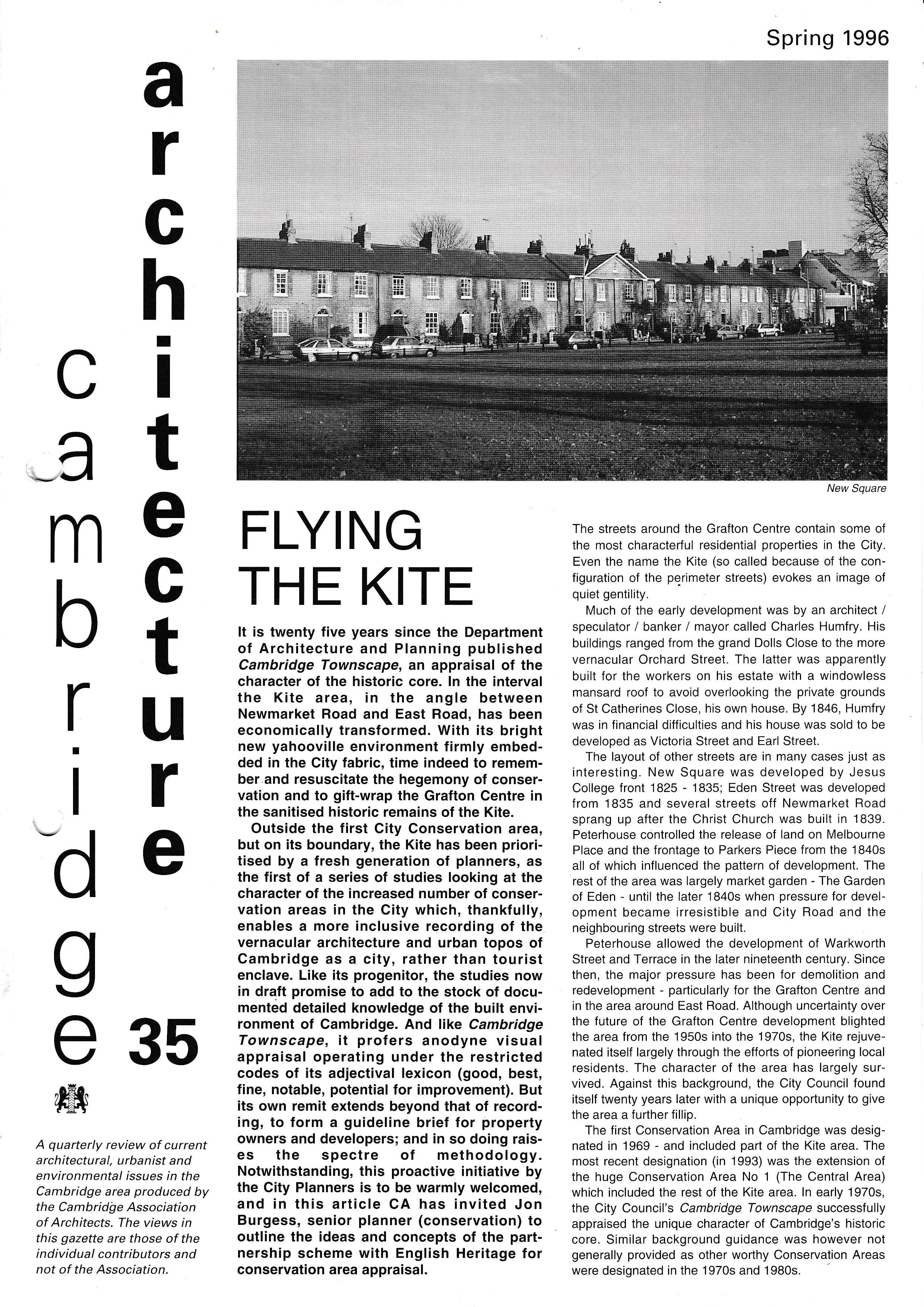
The layout of other streets are in many cases just as interesting. New Square was developed by Jesus College front t825 - 1835; Eden Street was developed from 1835 and several streets off Newmarket Road sprang up after the Christ Church was built in 1839. Peterhouse controlled the release of land on Melbourne Place and the frontage to Parkers Piece from the 1840s all of which influenced the pattern of development. The rest of the area was largely market garden - The Garden of Eden - until the later 1840s when pressure for development became irresistible and City Road and the neighbouring streets were buili.
Peierhouse allowed the development of Warkworth Street and Terrace in the later nineteenth century. Since then, the major pressure has been for demolition and redevelopment - partlcularly for the Grafton Centre and in the area around East Road. Although uncertainty over the future of the Grafton Centre development blighted the area from the 1950s into the 1970s, the Kite reiuvenated itself largely through the efforts of pioneering local residents. The character of the area has largely survived. Against this background, the City Council found itself twenty years later with a unique opportunity to give the area a further fillip.
The first Conservation Area in Cambridge was designated in 1969 - and included part of the Kite area. The most recent designation (in 1993) was ihe extension of the huge Conservation Area No 1 (The Central Area) which included the rest of the Kite area. ln early 1970s, the City Council's Cambridge Townscape successfully appraised the unique character of Cambridge's historic core. Similar background guidance was however not generally provided as other worthy Conservation Areas were designated in the 1970s and 1980s.
New Square
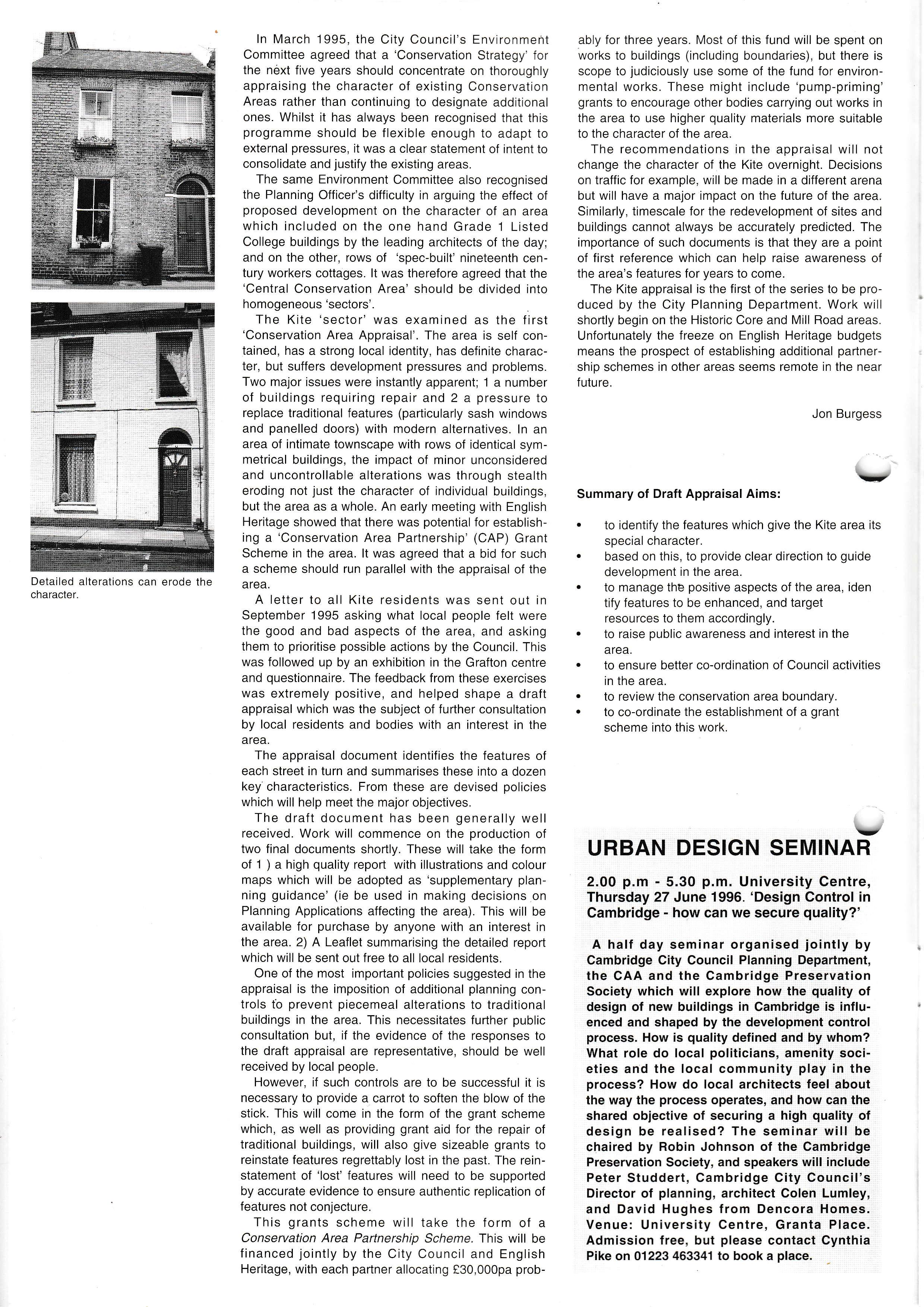
Detailed alterations can erode the character.
ln March 1995, the City Council's Environmeht Committee agreed ihat a 'Conservation Strategy' for the next five years should concentrate on thoroughly appraising the character of existing Conservation Areas rather than continuing to designate additional ones. Whilst it has always been recognised that this programme should be flexible enough to adapt to external pressures, it was a clear statement of intent to consolidate and justify the existing areas.
The same Environment Committee also recognised the Planning Officer's difficulty in arguing the effect of proposed development on the character of an area which included on the one hand Grade 1 Listed College buildings by the leading architects of the day; and on the other, rows of 'spec-built' nineteenth century workers cottages. lt was therefore agreed that the 'Central Conservation Area' should be divided into homogeneous'sectors'.
The Kite 'sector' was examined as the first 'Conservation Area Appraisal'. The area is self contained, has a strong local identity, has definite character, but suffers development pressures and problems. Two major issues were instanily apparent; 1 a number of buildings requiring repair and 2 a pressure to replace traditional features (particularly sash windows and panelled doors) with modern alternatives. ln an area of intimate townscape with rows of identical symmetrical buildings, the impact of minor unconsidered and uncontrollable alterations was through stealth eroding not just the character of individual buildings, but the area as a whole. An early meeting with English Heritage showed that there was potential for establishing a 'Conservation Area Partnership' (CAP) Grant Scheme in the area. lt was agreed that a bid for such a scheme should run parallel with the appraisal of the area.
A letter to all Kite residents was sent out in September 1995 asking what local people felt were the good and bad aspects of the area, and asking them to prioritise possible aclions by the Council. This was followed up by an exhibition in the Grafton centre and questionnaire. The feedback from these exercises was extremely positive, and helped shape a draft appraisal which was the subiect of further consultaiion by local residents and bodies with an interest in the area.
The appraisal document identifies the features of each street in turn and summarises these into a dozen key'characteristics. From these are devised policies which will help meet the major obiectives.
The draft document has been generally well received. Work will commence on the production of two final documents shortly. These will take the form of 1 ) a high quality report with illustrations and colour maps which will be adopted as 'supplementary planning guidance' (ie be used in making decisions.on Planning Applicaiions affecting the area). This will be available for purchase by anyone with an inierest in the area. 2) A Leaflet summarising the detailed report which will be sent out free to all local residents.
One of the most important policies suggested in the appraisal is the imposition of additional planning controls tb prevent piecemeal alterations to traditional buildings in the area. This necessitates further public consultation but, if the evidence of the responses to the draft appraisal are representative, should be well received by local people.
However, if such controls are to be successful it is necessary to provide a carrot to soften the blow of the siick. This will come in the form of the grant scheme which, as well as providing grant aid for the repair of traditional buildings, will also give sizeable grants to reinstate features regrettably lost in the past. The reinstatement of 'lost' features will need to be supported by accurate evidence to ensure authentic replication of features not conjecture.
This grants scheme will take the form of a Conservation Area Partnership Scheme. This will be financed jointly by the City Council and English Heritage, with each partner allocating f30,000pa prob-
ably for three years. Most of this fund will be spent on works to buildings (including boundaries), but there is scope to judiciously use some of the fund for environmental works. These mighi include 'pump-priming' grants to encourage other bodies carrying out works in the area to use higher quality materials more suitable to the character of the area.
The recommendations in the appraisal will not change the character of the Kite overnight. Decisions on traffic for example, will be made in a different arena but will have a major impact on the future of the area. Similarly, timescale for the redevelopment of sites and buildings cannot always be accurately predicted. The importance of such documents is that they are a point of first reference which can help raise awareness of the area's features for years to come.
The Kite appraisal is the first of the series to be produced by the City Planning Department. Work will shortly begin on the Historic Core and Mill Road areas. Unfortunately the freeze on English Heritage budgets means ihe prospect of establishing addltional partnership schemes in other areas seems remote in the near future.
Jon Burgess
Summary of Draft Appraisal Aims:
. to identify the features which give the Kite area its special character.
. based on this, to provide clear direction to guide development in the area.
. to manage the positive aspects of the area, iden tify features to be enhanced, and target resources to them accordingly. to raise public awareness and interest in the area.
to ensure better co-ordination of Council activities in the area.
to review the conservation area boundary. to co-ordinate the establishment of a grant scheme into this work.
URBAN DESIGN SEMINAR
2.00 p.m - 5.30 p.m. University Centre, Thursday 27 June 1996. 'Design Control in Cambridge - how can we secure quality?'
A half day seminar organised jointly by Cambridge Cily Council Planning Department, the CAA and the Cambridge Preservation Society which will explore how the quality of design of new buildings in Cambridge is influenced and shaped by the development control process. How is quality defined and by whom? What role do local politicians, amenity societies and the local community play in the process? How do local architects feel about the way the process operates, and how can the shared objective of securing a high quality of design be realised? The seminar will be chaired by Robin Johnson ol the Cambridge Preservation Society, and speakers will include Peter Studdert, Cambridge City Council's Director of planning, architect Colen Lumley, and David Hughes from Dencora Homes. Venue: University Centre, Granta Place. Admission free, but please contact Cynthia Pike on 01223 463341 to book a place.
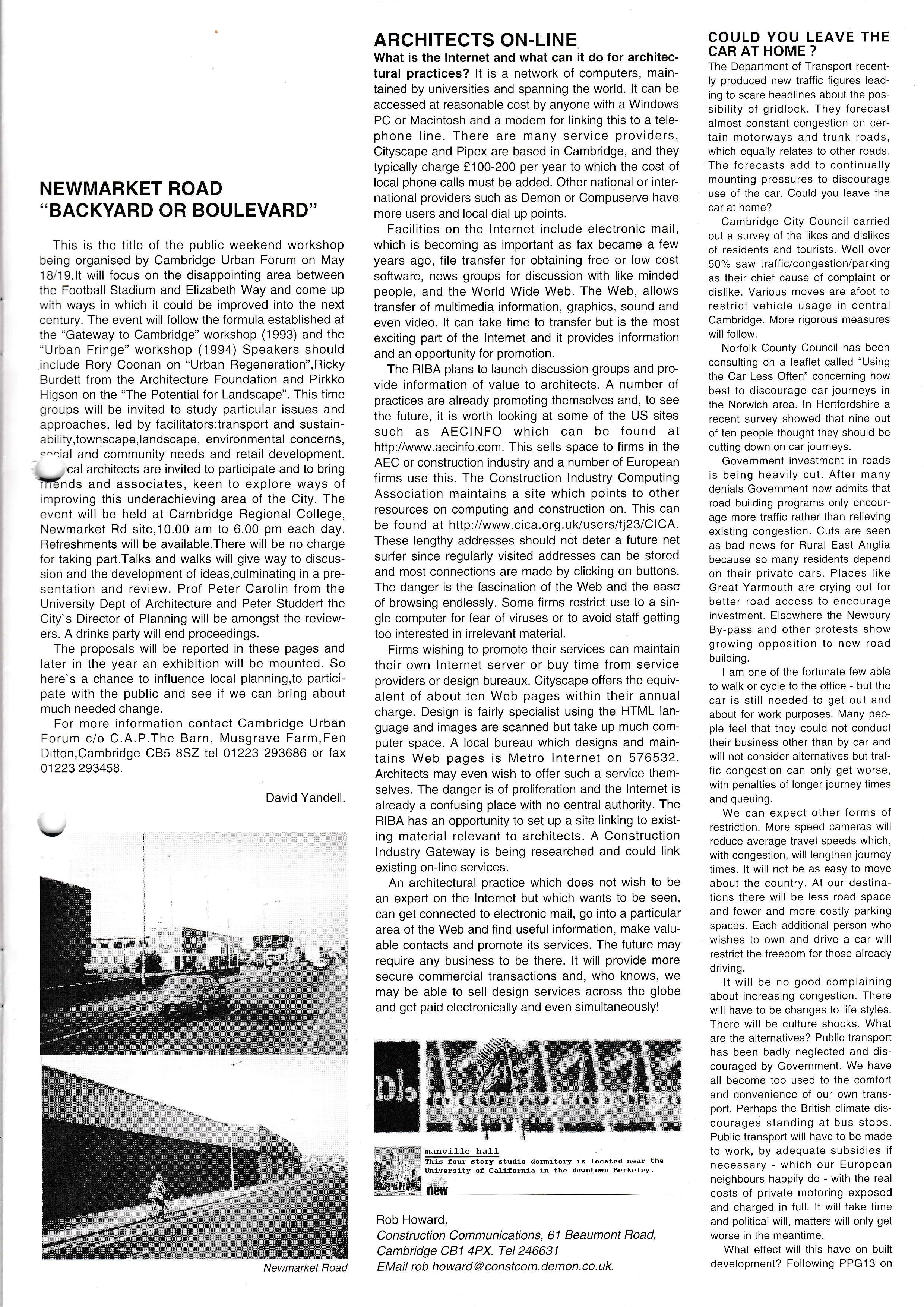
NEWMARKET ROAD ,.BACKYARD OR BOULEVARD"
This is the title of the public weekend workshop being organised by Cambridge Urban Forum on May '18/19.|t will focus on the disappointing area between the Football Stadium and Elizabeth Way and come up with ways in which it could be improved into the next century. The event will follow the formula established at the "Gateway to Cambridge" workshop (1993) and the "Urban Fringe" workshop (1994) Speakers should include Rory Coonan on "Urban Regeneration",Ricky Burdett from the Architecture Foundation and Pirkko Higson on the "The Potential for Landscape". This time groups will be invited to study particular issues and approaches, led by facilitators:transport and sustainability,townscape,landscape, environmental concerns, -s^cial and community needs and retail development. l. :cal architects are invited to participate and to bring ,rldnos and associates, keen to explore ways of improving this underachieving area of the City. The event will be held at Cambridge Regional College, Newmarket Rd site,10.00 am to 6.00 pm each day. Refreshments will be available.There will be no charge for taking part.Talks and walks will give way to discussion and the development of ideas,culminating in a presentation and review. Prof Peter Carolin from the University Dept of Architecture and Peter Studdert the City's Director of Planning will be amongst the reviewers. A drinks party will end proceedings.
The proposals will be reported in these pages and later in the year an exhibition will be mounted. So here's a chance to influence local planning,to participate with the public and see if we can bring about much needed change.
For more information contact Cambridge Urban Forum c/o C.A.P.The Barn, Musgrave Farm,Fen Ditton,Cambridge CB5 8SZ tel 01223 293686 or fax 01223 293458.
David Yandell.
ARCHITECTS ON.LINE
What is the lnternet and what can it do for architectural practices? lt is a network of computers, maintained by universities and spanning the world. lt can be accessed at reasonable cost by anyone with a Windows PC or Macintosh and a modem for linking this to a telephone line. There are many service providers, Cityscape and Pipex are based in Cambridge, and they typically charge t100-200 per year to which the cost of local phone calls must be added. Other national or international providers such as Demon or Compuserve have more users and local dial up points.
Facilities on the lnternet include electronic mail, which is becoming as important as fax became a few years ago, file transfer for obtaining free or low cost software, news groups for discussion with like minded people, and the World Wide Web. The Web, allows transfer of multimedia information, graphics, sound and even video. lt can take time to transfer but is the most exciting part of the lnternet and it provides information and an opporlunity for promotion.
The RIBA plans to launch discussion groups and provide information of value to architects. A number of practices are already promoting themselves and, to see the future, it is worth looking at some of the US sites such as AECINFO which can be found at http://www.aecinfo.com. This sells space to firms in the AEC or construction industry and a number of European firms use this. The Construction lndustry Computing Association maintains a site which points to other resources on computing and construction on. This can be ou nd at http ://www. cica. o rg. u k/us er s lIj23 I CICA. These lengthy addresses should not deter a future net surfer since regularly visited addresses can be stored and most connections are made by clicking on buttons. The danger is the fascination of the Web and the ease of browsing endlessly. Some firms restrict use to a single computer for fear of viruses or to avoid staff getting too interested in irrelevant material.
Firms wishing to promote their services can maintain their own lnternet server or buy time from service providers or design bureaux. Cityscape offers the equivaleni of about ten Web pages within their annual charge. Design is fairly specialist using the HTML language and images are scanned but take up much computer space. A local bureau which designs and maintains Web pages is Metro lnternet on 576532. Architects may even wish to offer such a service themselves. The danger is of proliferation and the lnternet is already a confusing place with no central authority. The RIBA has an opportunity lo set up a site linking to existing material relevant to architects. A Construction lndustry Gateway is being researched and could link existing on-line services.
An architectural practice which does not wish to be an expert on the lnternet but which wants to be seen, can get connected to electronic mail, go into a particular area of the Web and find useful information, make valuable coniacts and promote its services. The future may require any business to be there. lt will provide more secure commercial transactions and, who knows, we may be able to sell design services across the globe and get paid electronically and even simultaneously!
COULD YOU LEAVE THE CAR AT HOME ?
The Department of Transport recently produced new traffic figures leading to scare headlines about the possibility of gridlock. They forecast almosl constant congestion on certain motorways and trunk roads, which equally relates to other roads. The forecasts add to continually mounting pressures to discourage use of the car. Could you leave the car at home?
Cambridge City Council carried out a survey of the likes and dislikes of residents and tourists. Well over 50% saw traffic/congestion/parking as their chief cause of complaint or dislike. Various moves are afoot to restrict v.ehicle usage in central Cambridge. More rigorous measures will follow.
Norlolk County Council has been consulting on a leaflet called "Using the Car Less Often" concerning how best to discourage car journeys in the Norwich area. ln Hertfordshire a recent survey showed that nine out of ten people thought they should be cutting down on car journeys. Government investment in roads is being heavily cut. After many denials Government now admits that road building programs only encourage more traffic rather than relieving existing congestion. Cuts are seen as bad news lor Rural East Anglia because so many residents depend on their private cars. Places like Great Yarmouth are crying out for better road access to encourage investment. Elsewhere the Newbury By-pass and other protests show growing opposition to new road building.
I am one of the fortunate few able to walk or cycle to the office - but the car is still needed to get out and about for work purposes. Many people feel that they could not conduct their business other than by car and will not consider alternatives but traffic congestion can only get worse, with penalties of longer journey times and queuing.
We can expect other forms of restriction. More speed cameras will reduce average travel speeds which, with congestion, will lengthen journey times. lt will not be as easy to move about the country. At our destinations there will be less road space and fewer and more costly parking spaces. Each additional person who wishes to own and drive a car will restrict the freedom for those already driving.
It will be no good complaining about increasing congestion. There will have to be changes to life stylesThere will be culture shocks. What are the alternatives? Public transport has been badly neglected and discouraged by Government. We have all become too used to the comfort and convenience of our own transport. Perhaps the British climate discourages standing at bus stops. Public transport will have to be made to work, by adequate subsidies if necessary - which our European neighbours happily do - with the real costs of private motoring exposed and charged in full. lt will take time and political will, matters will only get worse in the meantime.
What effect will this have on built development? Following PPGl3 on
manville hall fiffiilGiiil-.tudio domitory is aodated near thE University of Cdfornia h the dl,mt(,m EerkeA€y.
Transport, Government produced its' glossy "A Guide to Better Practice" concerned with reducing the need to travel through land use and transport planning. Following its advice literally means housing, shopping and everything else concentrated in town centres and near communications nodes offering public transporl connections. Will our towns and cities be able to cope with such concentration? Will it mean increased densities, less open space, and less greenery?. How will your profession respond? Will you leave the car at home?
Colin Smith
THE BAUHAUS IN CAMBRIDGESHIRE
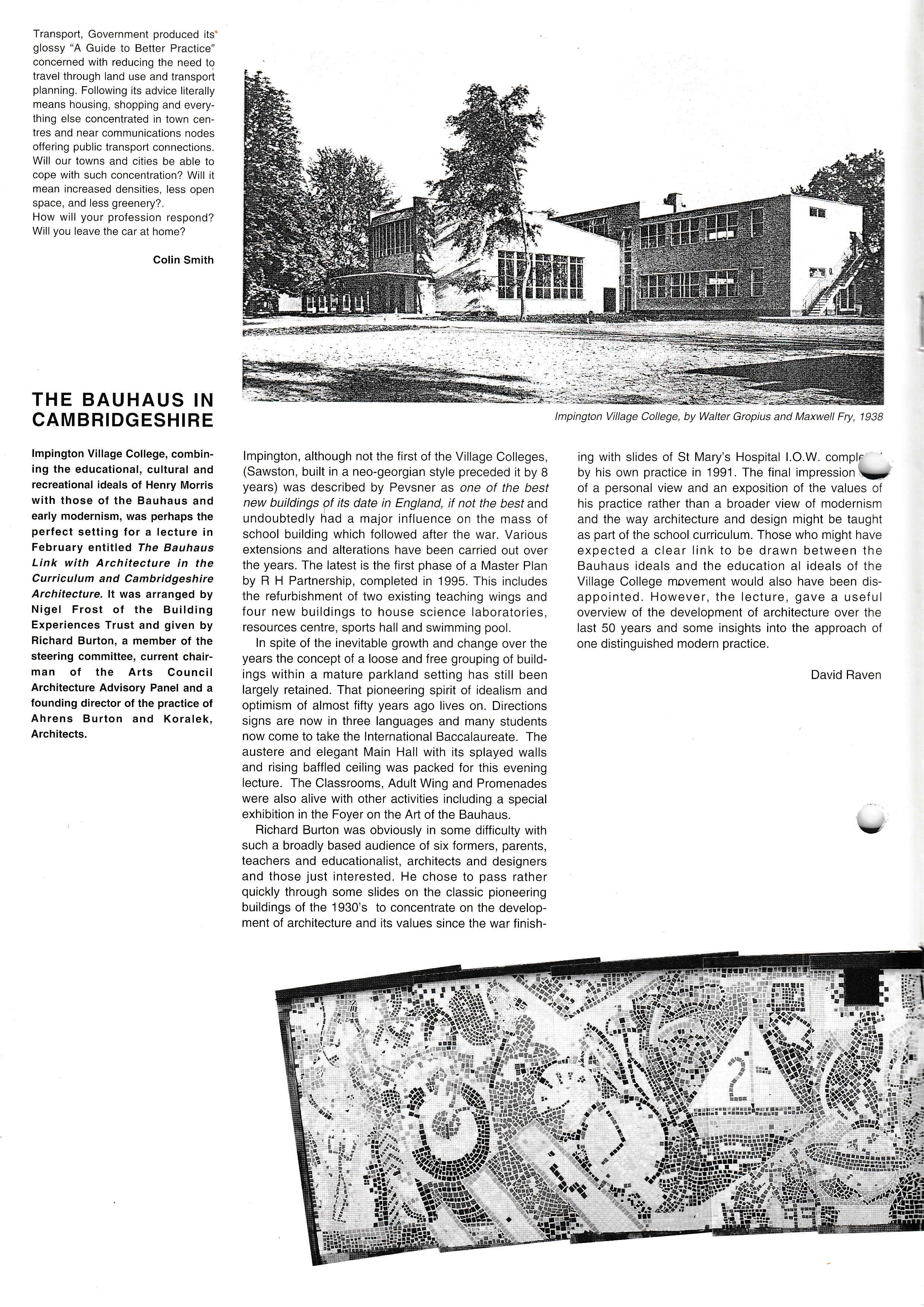
Impington Village College, combining the educational, cultural and recreational ideals of Henry Morris with those of the Bauhaus and early modernism, was perhaps the perfect setting for a lecture in February entitled The Bauhaus Link with Atchitecture in the Curriculum and Cambridgeshire Architectute, lt was arranged by Nigel Frost of the Building Experiences Trust and given by Richard Burton, a member of the steering commillee, current chairman of the Arts Council Architecture Advisory Panel and a founding director of the practice of Ahrens Burton and Koralek, Architects.
lmpington, although not the first of the Village Colleges, (Sawston, built in a neo-georgian style preceded it by B years) was described by Pevsner as one of the best new buildings gf its date in England, if not the besf and undoubtedly had a major influence on the mass of school building which followed after the war. Various extensions and alterations have been carried out over the years. The latest is the first phase of a Master Plan by R H Partnership, completed in 1995. This includes the refurbishment of two existing teaching wings and four new buildings to house science laboratories, resources centre, spods hall and swimming pool.
ln spite of the inevitable growth and change over the years the concept of a loose and free grouping of buildings within a mature parkland setting has still been largely retained. That pioneering spirit of idealism and optimism of almost fifty years ago lives on. Directions signs are now in three languages and many students now come to take the lnternational Baccalaureate. The austere and elegant Main Hall wiih its splayed walls and rising baffled ceiling was packed for this evening lecture. The Classrooms, Adult Wing and Promenades were also alive with other activities including a special exhibition in the Foyer on the Art of the Bauhaus.
Richard Burion was obviously in some difficulty with such a broadly based audience of six formers, parents, teachers and educationalisi, architects and designers and those just interested. He chose to pass rather quickly through some slides on the classic pioneering buildings of the 1930's to concentrate on the development of architecture and its values since the war finish-
ing with slides of St Mary's Hospital l.O.W. complc by his own practice in 1991. The final impression j: of a personal view and an exposition of the values of his practice rather than a broader view of modernism and the way architecture and design might be taught as part of the school curriculum. Those who might have expected a clear link to be drawn between the Bauhaus ideals and the education al ideals of the Village College movement would also have been disappointed. However, the lecture, gave a useful overview of the development of architecture over the last 50 years and some insights into the approach of one distinguished modern practice.
David Raven
lmpington Village College, by Walter Gropius and Maxwell Fry, 1938
Rules of thumb: design techniques
f or energy efficiency. one day seminar crganised by the Eastern Region Energy Group at Cranfield University, held on 14 March 1996.
,','ro cou d resist thrs seminar. with its subtitle: How , - : ) is your intuition? The f lier pointed out that experi--:. often becomes encapsulated as dheuristici pro,: r..r res or 'rules of thumb', allowing us to make .-- 3n decisions quickly and with reasonable confi:=-ce. But ln the light of changes in expectations dur-: :he last 20 years, how can we be sure that our :=s qn decisions will still produce the performance we '=., rez I looked to this seminar to provide me with : -e ru es, but it turned out that life isn't quite as sim: : as that.......
-rav d Brennan of W S Atkins Consultants Ltd ',:-sed most clearly on the title of the seminar. Rules : : app icable primarily to preliminary assessments for - ^-: e repetitive designs, and later as a broad check - 'nal detailed calculations. They are only appropri.. to steady state applications, and need to be used - \,by those with appropriate experience. He :=scribed some of the rules of thumb available for =.: mating costs. thermal loads, electrical loads, and .::.ce requirements, and cited several sources of -':rmation. such as BSRIA Technical Note TN17/95 'he ASHRAE Pocket Book. Then he looked in -ir al a rule of thumb for the thermal load of a sim-- : bu lding in Wsqm. A back of envelope calculation :.ealed the rule of thumb to be 30-90% too high. He :rcluded that a simple spreadsheet would take little : ^'e to set up yet be much more accurate about total .-:rmal loads and more informative about where heat ':uld be lost from the building. Rules should be treat:r as no more than reminders and checks.
rr,latthew Grace of ECD gave us a slick presentation -' BREEAM, the Building Research Establishment :rvrronmental Assessment Method. While BREEAM is -rrv quite well established in the market place, it was = useful reminder of the building types it covers and ^l\,v credits are awarded when global, neighbourhood ::d indoor criteria are met.
Bill Batty of Cranfield gave the most jolly talk. He s,ggested that architects are driven by the aesthet;c ^lperative, engineers by the technological imperative. lesigning requires that the differing perspectives of .rese and other professions are somehow integrated. )esign problems cannot be stated comprehensively: h.ief requires subjective interpretation. The number ype of decisions varies as the design process :ts'7eeds. lt is often difficult to identify what data is relevant until the design process has begun to advance. The combination of possibilities even in a limited prorect (such as glazing area, orientation and thermal rnass to take just three) soon exceeds our capacity to analyse them all. Computer-based performance modelling can be used to look at trends early in the design
process, as well as at detailed issues later.
Alistair Guthrie of Ove Arup & Partners illustraied his talk about inter-disciplinary teamwork using a number of prestige international projects as case studies. Engineering requires experience and pragmaiism to help establish the right concepts, which can then be refined. He set out a number of criteria for successful inter-disciplinary working: everyone should put their ideas on the table - and not compromise at the first sessions. . good guesses were often valuable as initial responses and should be explained to the design team.
. but the team should be tolerant - there should be no recriminations when earlier guesses are checked and, if necessary, revised.
As examples, he illustrated how conditioned air is blown across an inner skin.suspended from the roof at Kansai Airport, and described earlier performance related analyses at the New Caledonia Cultural Cenire and the Galleria at Ispra. Much was learned from each project - which could then feed forward to future projects. He concluded that we need; to re-calibrate our collective thumbs regularly.
Where Grace was slick, Batty Jolly, Guthrie prestigious and Brennan sceptical, the presentation on the implications and challenges of interdisciplinary working by Barrie Page of Essex County Council was for me the most thought provoking. Essex has sold its architects department to WS Atkins, retaining somel0% of ii for core activities such as policy setting. Page described a design team exercise held at Cranfield to plan a primary school. This was intended to draw on the collective experience of Cranfield, Essex and Atkins. lts purpose was to encourage interdisciplinary working and it was hoped that the team's colleclive energy would be harnessed, each discipline contributing their own knowledge at the early stages so as to optimise decisions in terms of efficiency, economy and quality. Bringing to the table preconceived schemes was discouraged.
An ideal working environment was set up:
. much hard work had gone into preparing the brief, yet it was not too prescriptive.
. members of the design team were hand picked for the exercise.
. the whole design team, plus the client, were pre sent.
the team had access to past Essex schemes to draw upon.
computer modelling was available to them for analysing strategic options.
The objectives were purposely limited to:
. assessing the strategic use of the site.
. deciding on the general disposilion of the accommodation.
establishing broadly the building fabric, fenestra tion and environmental performance.
ln practice, while the speaker portrayed the design exercise as successful, he admitted that the teams did not perform quite as had been expected. Among the issues which emerged were: . overfamiliaritywithiraditional roles and deep-rooted professional prejudices. computer modelling seen as a threat to creativity. ihe environmental agenda seen as distorting educational aims.
. lingering low morale following the trade sale of the department.
This was a compelling description of what should have been an ideal scenario within which to design a new primary school.
The advantages, as well as the piifalls, were very capably brought out in a presentation that raised many issues about the management of design creativity. It deserves to be much more widely disseminated.
Overall this was a well organised day, very well attended by 20 architects, 11 engineers and 12 other professionals. lt was competently chaired by Anne Cooper of Rickaby Thompson Associates who is the newly elected chair of EREG. As well as the formal presentations there were some lively question sessions. lf we did not come away with new rules of thumb io apply in practice, we nevertheless learned much about their strengths and weaknesses, as well as the imporiance of interdisciplinary working and the management issues it raises.
Sebastian Macmillan. Eclipse Research Consultanis.
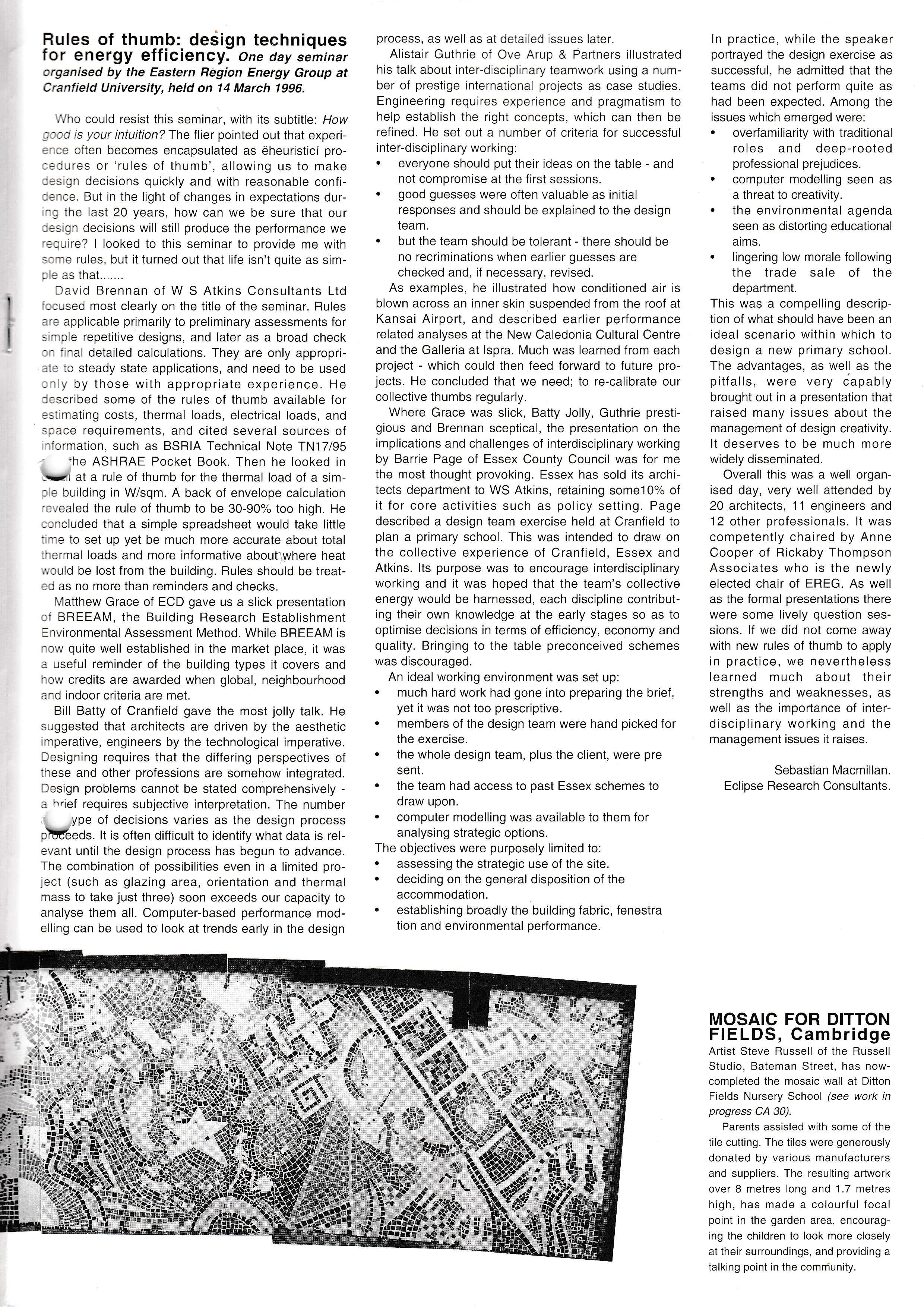
MOSAIC FOR DITTON FIELDS, Cambridge
Artist Steve Russell of the Russell Studio, Bateman Street, has nowcompleted the mosaic wall at Ditton Fields Nursery School (see work in progress CA 30).
Parents assisted with some of the tile cutting. The tiles were generously donated by various manufacturers and suppliers. The resulting artwork over 8 metres long and 1.7 metres high, has made a colourful focal point in the garden area, encouraging the children to look more closely at their surroundings, and providing a talking point in the comniunity.
HISTORIC BUILDINGS
RECONCILING THE LEGISLATION
A survey of legislation and its effe6t on the conservation of historic buildings and ancient monuments is being carried out by the Camden Consultancy on behalf of the Departments of National Heritage and the Environment. A series of seminars and a questionnaire will form the basis of a study which is due for completion by the end of August.
Study Aims:
to identily cases where regula tions have come into conflict with the alteration or preserva tion of historic buildings; . to provide a clear understanding of the scale of the problem; and to present recommendations on how to overcome these prob lems.
The research will serve 2 main purposes. lt will be looking at ways of ensuring that building, and other regulations and slandards, do not unnecessarily stand in the way of conservation adapting it lor useful purposes. Secondly, the research forms part of the Government's continuing review of regulations, and is about looking at the conflicts that have arisen between regulations, standards and listed building consents, and learning lessons to ensure that practical solutions are found and widely followed by others.
The seminars have brought together designers, contractors, clients, building control officers, fire officers, environmental health officers and conservation and civic societies, to identify a range of examples where legislative controls have cut across good conservation practices. A questionnaire will be sent out to around 1000 specialists in both conservation and legislation. While the Cambridge seminar on 24 April will be the last of the series, the questionnaire provides an opportunity for anyone who considers they have relevant experience or knowledge to contribute to the study: lt is hoped that the questionnaire will identify examples of conflict but also successful reconciliation.
The consu_ltancy would like to hear about specific problems encountered in the application ol legislation to historic build;ngs and ancient monuments. The information should include explanatory drawrngs showing the problem and, how it was resolved and details of the building, use, and legislation concerned (building and fire regulations, health and safety regulations, planning and listed building consents etc). Experience of good and bad practice in the orchestration of the relevant controls by the authorities responsible would also be welcome.
lf you have relevant experience or knowledge, and would be willing to fill in the questlonnaire, please contact Sylvester Bone br John Loring of the Camden Consultancy at: 2 St Martins, Bayham Street, London NWI CBD lel 01714856275 or 01423 569641.
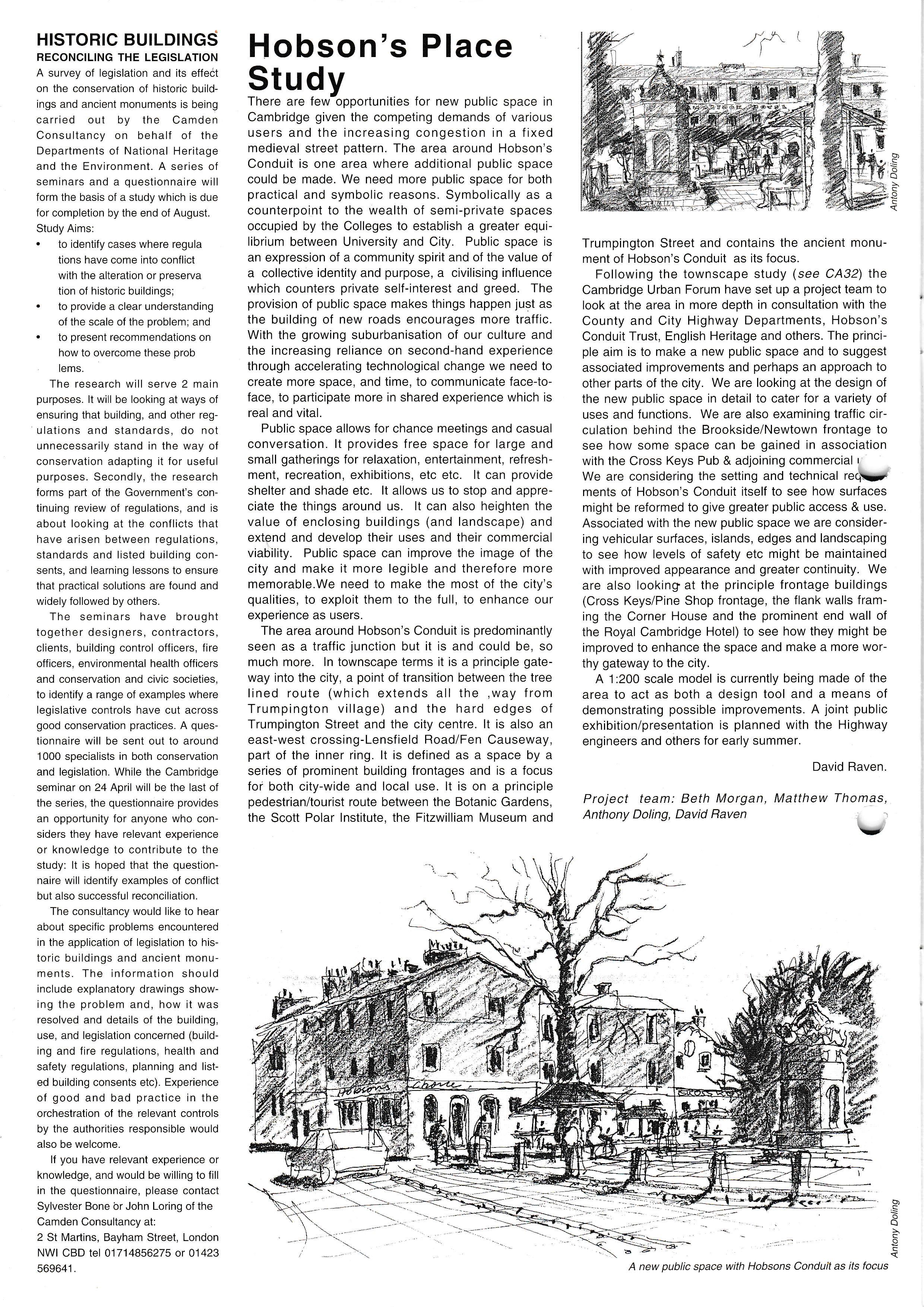
Hobson's Place Studv
There are few'opportunities for new public space in Cambridge given the competing demands of various users and the increasing congestion in a fixed medieval street pattern. The area around Hobson's Conduit is one area where additional public space could be made. We need more public space for both practical and symbolic reasons. Symbolically as a counterpoint to the wealih of semi-private spaces occupied by the Colleges to establish a greater equilibrium between University and City. Public space is an expression of a community spirit and of ihe value of a collective identity and purpose, a civilising influence which counters private self-interest and greed. The provision of public space makes things happen just as the building of new roads encourages more traffic. With the growing suburbanisation of our culture and the increasing reliance on second-hand experience through accelerating technological change we need to create more space, and time, to communicate face-toface, io participate more in shared experience which is real and vital.
Public space allows for chance meetings and casual conversation. lt provides free space for large and small gatherings for relaxation, entertainment, refreshment, recreation, exhibitions, etc etc. lt can provide shelter and shade etc. lt allows us to stop and appreciate the things around us. lt can also heighten the value of enclosing buildings (and landscape) and extpnd and develop their uses and their commercial viability. Public space can improve the image of the city and make it more legible and therefore more memorable.We need to make the most of the city's qualities, to exploit them to the full, to enhance our experience as users.
The area around Hobson's Conduit is predominantly seen as a traffic junction but it is and could be, so much more. ln townscape terms it is a principle gateway into the city, a point of transition between the tree lined route (which extends all the ,way f rom Trumpington village) and the hard edges of Trumpington Street and the city centre. lt is also an east-west crossing-Lensfield Road/Fen Causeway, part of the inner ring. lt is defined as a space by a series of prominent building frontages and is a focus fol both city-wide and local use. li is on a principle pedestrian/tourist route between the Botanic Gardens, the Scott Polar lnstitute, the Fitzwilliam Museum and
J* "\
Trumpington Street and contains the ancient monument of Hobson's Conduit as its focus.
Following the townscape study (see CA32) lhe Cambridge Urban Forum have set up a project team to look at the area in more depth in consultation with the County and City Highway Departments, Hobson's Conduit Trust, English Heritage and others. The principle aim is to make a new public space and to suggest associated improvements and perhaps an approach to other parts of the city. We are looking at the design of the new public space in detail to cater for a variety of uses and functions. We are also examining traffic circulation behind the Brookside/Newtown frontage to see how some space can be gained in association with the Cross Keys Pub & adjoining commercial 1 We are considering the setting and technical tedY ments of Hobson's Conduit itself to see how surfaces might be reformed to give greater public access & use. Associated wiih the new public space we are considering vehicular surfaces, islands, edges and landscaping to see how levels of safety etc might be maintained with improved appearance and greater continuity. We are also looking at the principle frontage buildings (Cross Keys/Pine Shop frontage, the flank walls framing ihe Corner House and the prominent end wall of the Royal Cambridge Hotel) to see how they might be improved to enhance the space and make a more worthy gateway to the city.
A 1:200 scale model is currently being made of the area to act as both a design tool and a means of demonstrating possible improvements. A joint public exhibition/presentation is planned with the Highway engineers and others for early summer.
Project team: Beth Morgan, Anthony Doling, David Raven
David Raven. Matthew Thomas,
COLLOQUIUM . DIRECTIONS IN
ARCHITECTURE
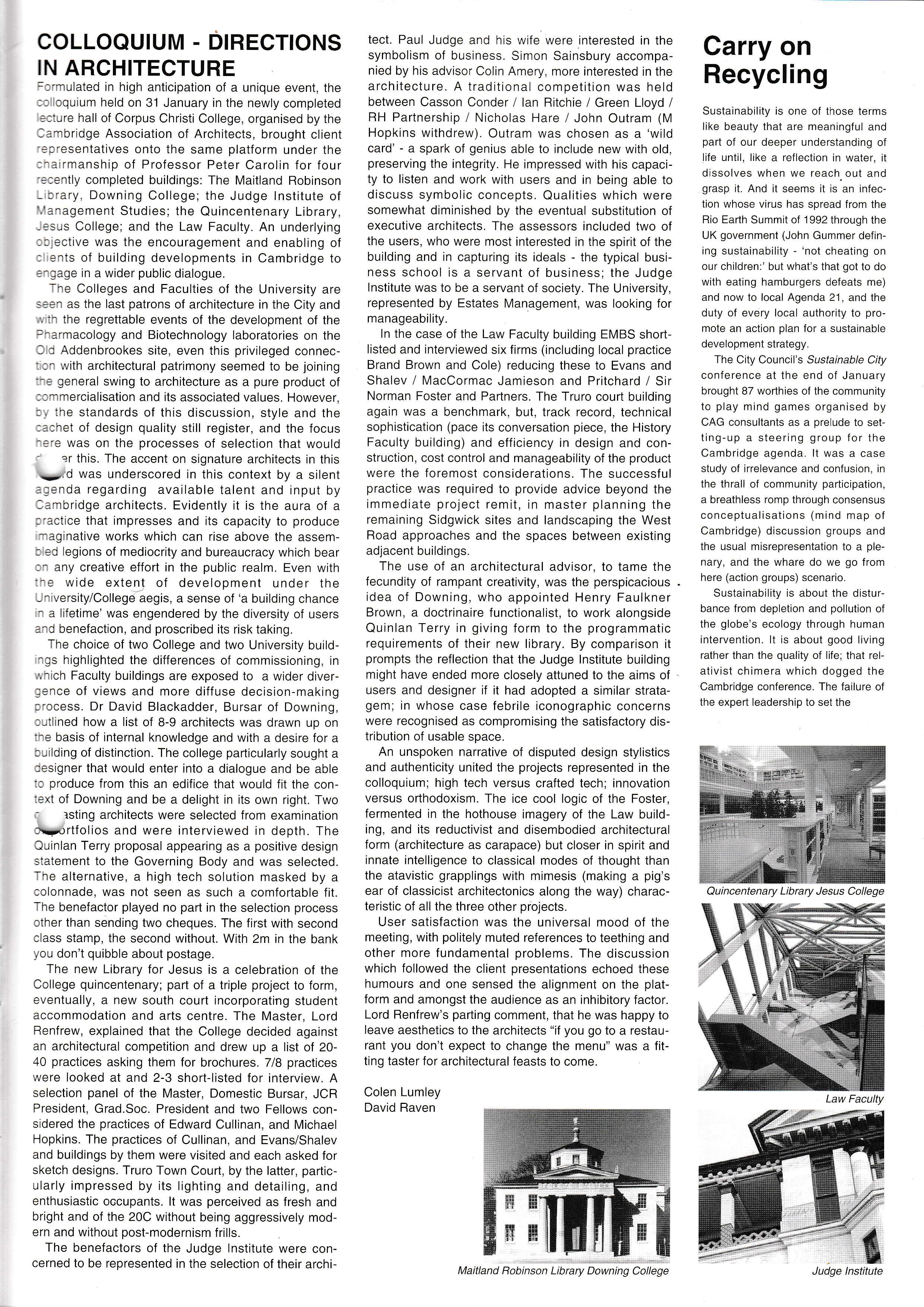
Formulated in high anticipation of a unique event, the colloquium held on 31 January in the newly completed lecture hall of Corpus Christi College, organised by the Cambridge Association of Architects, brought client representatives onto the same platform under the chairmanship of Professor Peter Carolin for four recently completed buildings: The Maitland Robinson Library, Downing College; the Judge Institute of Management Studies; the Quincentenary Library, Jesus College; and the Law Faculty. An underlying objective was the encouragemeni and enabling of clients of building developments in Cambridge to engage in a wider public dialogue.
The Colleges and Faculties of the Unlversity are seen as the last patrons of architecture in the City and with the regrettable events of the development of the Pharmacology and Biotechnology laboratories on the Old Addenbrookes site, even this privileged connection with architectural patrimony seemed to be joining the general swing to architecture as a pure product of commercialisation and its associated values. However, by the standards of this discussion, style and the cachet of design quality still register, and the focus here was on the processes of selection that would f er this. The accent on signature architects in this lld was underscored in this context by a silent agenda regarding available talent and input by Cambridge architects. Evidently it is the aura of a practice that impresses and its capacity to produce imaginative works which can rise above the assembled legions of mediocrity and bureaucracy which bear on any creative effort in the public realm. Even with the wide exte-nt of development under the University/Collegd aegis, a sense of 'a building chance in a lifetime' was engendered by the diversity of users and benefaction, and proscribed its risk taking.
The choice of two College and two University buildings highlighted the differences of commissioning, in which Faculty buildings are exposed to a wider divergence of views and more diffuse decision-making process. Dr David Blackadder, Bursar of Downing, outlined how a list of 8-9 architects was drawn up on the basis of internal knowledge and with a desire for a building of distinction. The college particularly sought a designer that would enter into a dialogue and be able to produce from this an edifice that would fit the contexi of Downing and be a delight in its own right. Two q isting architects were selected from examination il#rttolios and were interviewed in depth. The Quinlan Terry proposal appearing as a positive design statement to the Governing Body and was selected. The alternative, a high tech solution masked by a colonnade, was not seen as such a comfortable fit. The benefactor played no part in the selection process other than sending two cheques. The first with second class stamp, the second without. With 2m in the bank you don't quibble about postage.
The new Library for Jesus is a celebration of the College quincentenary; part of a triple project to form, eventually, a new south court incorporating student accommodation and arts centre. The Master, Lord Renfrew, explained that the College decided against an architectural competition and drew up a list of 2040 practices asking them for brochures. 7/B practices were looked at and 2-3 short-listed for interview. A selection panel of the Master, Domestic Bursar, JCR President, Grad.Soc. President and two Fellows considered the practices of Edward Cullinan, and Michael Hopkins. The practices of Cullinan, and Evans/Shalev and buildings by them were visited and each asked for sketch designs. Truro Town Court, by the latter, particularly impressed by its lighting and detailing, and enthusiastic occupants. lt was perceived as fresh and bright and of the 20C without being aggressively modern and without post-modernism frills.
The benefactors of the Judge lnstitute were concerned to be represented in the selection of their archi-
tect. Paul Judge and his wife were interested in the symbolism of business. Simon Sainsbury accompanied by his advisor Colin Amery, more interested in the architecture. A traditional competition was held between Casson Conder / Ian Ritchie / Green Lloyd / RH Partnership / Nicholas Hare / John Outram (M Hopkins withdrew). Outram was chosen as a 'wild card' - a spark of genius able to include new with old, preserving the integrity. He impressed wiih his capacity to listen and work with users and in being able to discuss symbolic concepts. Qualities which were somewhat diminished by the eventual substitution of executive architects. The assessors included two of the users, who were most interested in the spirit of the building and in capturing its ideals - the typical business school is a servant of business; the Judge lnstitute was to be a servant of society. The University, represented by Estates Man.agement, was looking for manageability.
ln the case of the Law Faculty building EMBS shortlisted and interviewed six firms (including local practice Brand Brown and Cole) reducing these to Evans and Shalev / MacCormac Jamieson and Pritchard / Sir Norman Foster and Partners. The Truro court building again was a benchmark, but, track record, technical sophistication (pace its conversation piece, the History Faculty building) and efficiency in design and construction, cost control and manageability of the product were the foremost considerations. The successful practice was required to provide advice beyond the immediate project remit, in master planning the remaining Sidgwick sites and landscaping the West Road approaches and the spaces between existing adjacent buildings.
The use of an architectural advisor, to tame the fecundity of rampant creativity, was the perspicacious idea of Downing, who appointed Henry Faulkner Brown, a doctrinaire functionalist, to work alongside Quinlan Terry in giving form to the programmatic requirements of their new library. By comparison it prompts the reflection that the Judge lnstitute building might have ended more closely attuned to ihe aims ofusers and designer if it had adopted a similar stratagem; in whose case febrile iconographic concerns were recognised as compromising ihe satisfactory distribution of usable space.
An unspoken narrative of disputed design stylistics and authenticity united the projects represented in the colloquium; high tech versus crafted tech; innovation versus orthodoxism. The ice cool logic of the Foster, fermented in the hothouse imagery of the Law building, and its reductivist and disembodied architectural form (architecture as carapace) but closer in spirit and innate intelligence to classical modes of thought than the atavistic grapplings with mimesis (making a pig's ear of classicist architectonics along the way) characteristic of all the three other proiects.
User satisfaction was the universal mood of the meeting, with politely muted references to teething and other more fundamental problems. The discussion which followed the client presentations echoed these humours and one sensed the alignment on ihe platform and amongst the audience as an inhibitory factor.
Lord Renfrew's parting comment, that he was happy to leave aesthetics to the architects "if you go to a restaurant you don't expect to change the menu" was a fitting taster for architectural feasts to come.
Colen Lumley
David Raven
Carry on Recycling
Sustainability is one ol those terms like beauty that are meaningful and part of our deeper understanding of life until, like a reflection in water, it dissolves when we reach. out and grasp it. And it seems it is an infection whose virus has spread from the Rio Earth Summit of 1992 through the UK government (John Gummer defining sustainability - 'not cheating on our children:' but what's that got to do with eating hamburgers defeats me) and now to local Agenda 21, and the duty of ev€iry local authority to promote an action plan for a sustainable development strategy.
The City Council's Sustainable City conference at the end of January brought 87 worthies of the community to play mind games organised by CAG consultants as a prelude to setting-up a steering group for the Cambridge agenda. lt was a case study of irrelevance and confusion. in the thrall of community participation, a breathless romp through consensus conceptualisations (mind map of Cambridge) discussion groups and the usual misrepresentation to a plenary, and the whare do we go from here (action groups) scenario.
Sustainability is about the disturbance from depletion and pollution of the globe's ecology through human intervention. It is about good living rather than the quality of life; that relativist chimera which dogged the Cambridge conference. The failure of the expert leadership to set the
Maittand Robinson tiorary ooiiiing Coiiege
Q uince nten ary Library Jesus Col lege
Law Faculty
By
u,orking closely with architects and designers rve clclir,cr highest quality. custom built lirrniture to spccification, on tinre and within budget.
Call 01954 230263 lr) rc(ci\c ru:c >tttrlic: LrilcLcllL \'UIIIIIIi\\iutl5 within Clambridge University and other local u,ork.
FOXGLOVE
Miurufacturers of custom built furrriturc u,here dctail rnatters
56 58 High Stleet Swavesc), Canbridgeshire CB4 5QU
WANT MORE WORK and INCREASED CLIENT SATISFACTION ?
Capitalise professionally through the expanding field of premises security. Increase your oppofiunities by offering your clients a lirsl class design service. Because I specialise, I am more thorough and quicker than generalist M&E consultants. You and your clients will notice the difference. Secure your future, call me with your next project-
Irhoro (lf) is ir technologv u,irh l.orh commercLrl rnll consumer applicatir)ns. ln businc-ss, it has uscs i)r an\enc u,ishing to cligirally stc,re, manipuLare or displal irrrges.
Typical commercial applicaticrrs inclLrLle the archiving oi images onto Photo (lt) discs br imaue libraries, the digitisation oi photos for use in Jesktop prrblishe.J d(rcuments Ior lirho prlnring and other colour ourpur devices. rnii the pro.luction of presentarion naterials onto Photo Cl) ibr clisplly on n TV via a Photo (il) flsygr or a CID-Rom XA .lrive,rn a con)putcr.
lr' rl 1,,'rn, rr'in;.r I h.'ru r I'l l. r, r rn conjunctiorr with vour T! you anrl your tamiLy can vierv irniLy picturcs.
The Carrbri.lge Printing lark, NIilton, Orrnbridge .]8,+ 6AZ
Tclephonc' 011/l 12'0,+41
Frx:0lli.l .1207El
ISt)N: ur1l23 42161-l
Enrail: f hotoCD@DAR.co.rrk h r tp, //n u,rv. co lr)11 rf, agcs. cLrrn
context sowed the seeds of diffuseness. wirl the expected hate issues surfacing and distorting the debate. Transportation (the vehicular kindalthough for a moment it almost emerged as a solution to population pollulion) has more to do with the quality of li{e and economy than is acknowledged by the road reduclion lobby. By failing to focus on the centrality of the global dialogue, no stratification of issues resulted. leaving an undi{ferentiated mass of subjects to arbitrary and equal classification for turther scrutiny by action groups. The complexities of energy conservation and embodied energy in the built environment are reflected in the multifarious professional and industrial endeavours that underpin development. There has been an expanding green consciousness for some time and if anything it is held back by lack of available knowledge of cause and e{fect, for co-ordination and auditing ol inlormation, the processes from material sources to finished product. This is one level o{ addressing the concerns. At the local level we -,rst keep recycling the rubbish, a I l a little more attention to tre sonf C,L.
EREG SEMINAR.
22. May PHOTOVOLTAICS lN
BUlLDlNGS.Robinson College
Details: Anne Cooper 01223 315766
URBAN DESIGN SEMINAR
27 June 2 - 5.30pm University Centre (see box)
CAMBRIDGE URBAN FORUM
18/19 May. Weekend Workshop on Newmarket Road. Details: David Yandell 01223 293686
"EH.g" CAA/RIBA ffi oranv
CAA Committee meelings first lvlonday of the month 6.30pm Architecture Centre. All welcome
Procedures Part L & External Walls. Reservations 01 91 281 8393
51h June CA AGI\r4. 6.45pm - ist lnformation Centre (O/d L y) Wheeler Street opp. Corn Exchlllge. Speaker Peter Studdert Cambridge in the Next Millenium
July. CAA Dinner. TBA.
ABCHITECTUBE GALLERY 12 April - 11 May OPEN CAMBRIDGE
Exhibition of ideas for an'Open Cambridge' by 12 local architects. 1 - ]6 May
RIBA EASTERN REGION AWARDS 1 996
August - September PETER FLUCK MOBILES MOVEMENT SONORE
Letters and contributions to Cambridge Architecture are welcomed. Copy deadline lor Summer lssue, 10 June 1996
tssN 1381 3375
Editorial Board: David Baven '|co- editors Colen Lumley I Anne Cooper