on-code railings in the greater Seattle area are getting renewed attention, including fees and even some red tags, even at buildings that were grandfathered in. Safety is the bottom line. Widely spaced pickets, short railings, and loose railings are potential hazards. Our wrought iron railings are safe, beautiful, maintenance-free, and can last for decades. We fabricate them in our shop, ensuring high quality, competitive pricing, and timely installation.
Since 2004, greater Seattle's go-to general contractor for small to large construction projects, from railings to kitchens to full buildings.
Your Next Customer Is a RHAWA Member:
Meet Them at Our 2026 EVENTS
RHAWA’s events are built around one core mission: bringing the right people together at the right time. Thanks to the incredible support of our 2025 sponsors, we were able to deliver education, engagement, and statewide connections that truly moved the rental housing industry forward. In 2026, we’re raising the bar again—with an event slate designed to help you grow brand visibility, build relationships, and connect directly with housing providers who are ready to act.
CORE SERIES Sponsorships
RHAWA’s Compliance & Operational Rental Excellence (CORE) Series is our high-energy Saturday-morning crash course for housing providers, running 8:30am–12pm and designed for owners and managers who make real purchasing decisions.
In 2026, CORE will be offered in two distinct tracks, spring and summer, allowing sponsors to align their visibility with peak seasons for turns, maintenance, and service demand. Sponsorships span Bellevue, Vancouver, and Spokane, making CORE an ideal way to connect with members
locally while maintaining statewide exposure. Sponsor benefits can include logo promotion, onsite visibility, attendee list access, and podium time, with bundle options available for sponsors looking to participate across multiple tracks or locations.
LEGAL
FORUM
CONTACT
Creative Director
Sisi Mereness: (206) 905-0605
Deputy Director
Melissa Canfield: (206) 905-0615
Engagement Coordinator
Daniel Bannon: (206) 905-0609
Engagement Coordinator
Daniel Klemme: (206) 905-0611
ONLINE LEGAL FORUM
This summer, June 17, 3-5:30 pm RHAWA’s Online Legal Forum offers a powerful sponsorship opportunity, especially for law firms. Sponsors receive pre-event advertising, in-event visibility, and dedicated time to engage directly with attendees. It's the ideal platform to showcase expertise and build trust with decision-makers focused on compliance and risk reduction.
ENGAGE 26 Sponsorships
October 14–15, 2026, marks the return of ENGAGE—RHAWA’s flagship conference and largest event of the year, with 350–400 attendees expected. ENGAGE brings together housing providers, property managers, developers, attorneys, lawmakers, and industry stakeholders for two days of education, policy conversation, and networking. For sponsors, it’s unmatched statewide visibility heading into the 4th quarter featuring benefits like exhibitor booth placement, prominent logo placement across event marketing, attendee list access, program advertising, and higher-tier opportunities such as podium time and co-branded swag.
Marketing & Sales Associate
Luke Brown: (206) 905-0610
Member Programs Director
Denise Myers: (206) 905-0614
Support Services Administrator
Val Kushi: (206) 283-0816
Support Services Specialist (Resource Desk) Sue Lewis: RHAwa.org/supportcenter
Support Services Specialist (Eastern WA Desk)
Steve Wareham: (509) 535-1018
CONNECT WITH US
COUNCIL
Submit
Educational articles featured in Current must be between 500 and 1500 words, include an author bio, professional headshot and contact information. High-resolution (300 dpi) graphics and photos should be sent separately. Deadlines are generally 30 days before the issue date, which is the first of each month. The editors reserve the right to edit, revise, or reject any submitted material. Submit to publications@RHAwa.org.
Advertise
(rates, production specifications, and deadlines), contact Luke Brown: lbrown@RHAwa.org.
Luke Brown
Brown | Marketing & Sales
MARCH CALENDAR
Denise Myers | Member Programs Director | dmyers@RHAwa.org | (206) 905-0614
All
class sessions are presented ONLINE only unless otherwise specified.
For all ONLINE classes, 30-day access to a recording of the session is included. Upgrade your membership to include a premium dues package. The Weekly ONLINE Session Package includes 12-months' access to live weekly ONLINE educational sessions for $250/person/year. The ONDEMAND Library Package provides full access to over one hundred recorded educational sessions for $120/person/year.
ESTABLISHING EFFECTIVE SCREENING CRITERIA
When: Wednesday, March 4 | 1-2:30pm
Cost: $35 Members | $70 Guests
Under Washington law, before obtaining any information about a prospective tenant, you must give them your screening criteria notice. It must indicate what information you will access, what criteria may result in denial, and other specific details about any consumer report you may use. Using this notice will assist you in effectively screening out high-risk tenants while following all fair housing laws and rental regulations. Attorney Chris Benis will review the laws and best practices for writing criteria based on key terms of your rental agreement, income, rental history, financial history, criminal and civil court records, and other important factors. Both effective and cautionary examples will be shared.
PM
SERIES-02: HARASSMENT PREVENTION & RESOLUTION
When: Thursday, March 5 | 12-1pm
Cost: $35 Members | $70 Guests
In this session, you will learn best practices for monitoring your property for harassment and resolving discriminatory harassment between employees, tenants, or management. We will explore:
• Civil rights and harassment in the residential housing environment as it relates to employment and housing.
• Reporting, investigating and resolving discriminatory behavior.
• Prevention of sexual and other types of harassment on your rental property.
Instructor: Michael Chin, Civil Rights Attorney
PM SERIES-03: FAIR HOUSING BASICS
When: Thursday, March 12 | 12-1pm
Cost: $35 Members | $70 Guests
In this session, you will learn best practices for providing fair and equal housing opportunities to prospects and tenants. We will explore:
• Protected classes in various jurisdictions, including the concept of disparate impact.
• How to process accommodation requests, including use of service animals.
• How to respond to retaliation and harassment claims involving tenants and/or staff members.
Instructor: Max Glasson, Landlord-Tenant Attorney
PM SERIES-04: MARKETING YOUR RENTALS
When: Thursday, March 19 | 12-1pm
Cost: $35 Members | $70 Guests
Discover how to evaluate your market area for maximum effectiveness of rental sales efforts. We will explore:
• How to evaluate the rental market and set rent based on analysis of comparable properties.
• Best practices for advertising vacancies.
• How to build a relationship-based sales process.
Instructor: Cory Brewer, PM Professional
PM SERIES-05:
WORKING WITH PROSPECTIVE TENANTS
When: Thursday, March 26 | 12-1pm
Cost: $35 Members | $70 Guests
Learn how to work with prospective tenants, close sales with qualified tenants, and more:
• Responding to inquiries, explaining rental terms and screening criteria.
• Evaluating applications and properly following up.
• Applying Fair Housing best practices when working with prospective tenants.
Instructor: Christopher Cutting, Landlord-Tenant Attorney
LINK MEETINGS
Casual member meetings with topical discussions. No fee, simply order and pay for food at restaurant venues. March topic is Bookkeeping and Taxes, + a Legislative Session Update.
• Birch Conference Room, Vancouver | Tuesday, March 10, 6-7:30pm
• The Onion Bar & Grill, Spokane | Tuesday, March 10, 6-8pm
• Location TBD, South King County | Tuesday, March 10, 6:30-8pm
• St. Andrews Pub, Seattle | Thursday, March 12, 6-8pm
• Darcy’s, Spokane Valley | Monday, March 16, 12-1:30pm
• Dave & Buster’s, Bellevue | Tuesday, March 17, 6-8pm
• Ben Dews Clubhouse, Tacoma | Thursday, March 19, 6-7:30pm
• Bob’s Burgers, Everett | Thursday, March 19, 6:30-8pm
• LINK Meeting, ONLINE | Tuesday, March 24, 6-7:30pm
*Meeting time and subject may change. Please check the calendar at RHAwa.org/events.
PLEASE NOTE:
Our event sales are subject to Washington State tax as of October 1, 2025
To cover this cost, the price of individual class prices will increase to $35 for members. Non-member pricing will increase to $220 for law topics and $70 for all other topics.
Rental Housing is No Longer “ BUSINESS AS USUAL”
Denise Myers | Member Programs Director | dmyers@RHAwa.org | (206) 905-0614
New laws, higher penalties, and increased enforcement mean rental owners must adapt, or risk losing control of their properties.
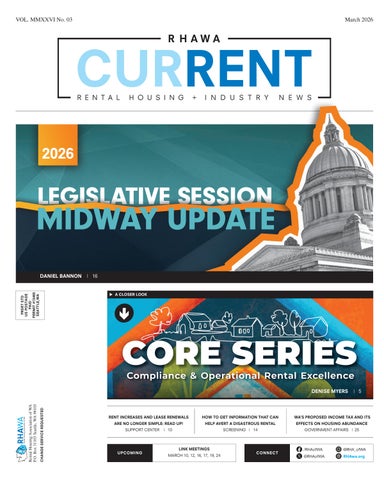
RHAWA’s Compliance & Operational Rental Excellence (CORE) Series is a statewide, in-person educational tour designed for rental housing providers who want to stay compliant, reduce risk, and operate with confidence in an increasingly complex regulatory environment. Consisting of two sessions and presented in three regions, the series brings Washington's leading industry experts directly to your area for focused, practical education you can put to use immediately. The CORE Series offers 2.5 hours of practical, in-person education with time for questions, a convenient Saturday morning schedule, opportunities to connect with peers, flexible registration options, and light refreshments to make learning easy and accessible.
Two Powerful Sessions. One Smarter Way to Run Rentals: Each session will include 2.5 hours of concentrated
educational content plus 1 hour for Q&A and networking.
Spring: Critical Compliance
Navigate Washington’s evolving legislative and regulatory landscape with confidence. Gain clarity on the latest statewide and local compliance requirements, helping you reduce risk and avoid costly mistakes in 2026.
Leading regional landlord-tenant attorneys will cover key compliance issues throughout tenancy, like marketing and tenant selection, leasing, rent increases, and lease renewals, compliance issues, move-outs, and evictions.
March 28 | Puget Sound Venue: Bellevue College
Speakers: Christopher Cutting, Attorney, Cutting Law PC & Synthia Melton, Attorney, Dimension Law Group PLLC
April 18 | Eastern WA
Venue: CenterPlace Regional Event Center
Speaker: Maxwell Glasson, Attorney, Williams Kastner
May 16 | Southwest WA
Venue: Keller Williams Olympic Speaker: Bradley Kraus, Attorney, Warren Allen LLC
Summer: Operational Excellence
Sharpen your systems and strengthen your bottom line. Learn proven strategies to streamline operations, control costs, improve tenant retention, and leverage technology to reduce dayto-day friction. Experienced property management experts and financial professionals will share best practices for operating rental housing under the new realities of regulation and increasing costs in Washington. Speaker details
will be announced as we get closer to the summer event dates.
June 27 | Puget Sound Venue: Bellevue College
July 11 | Eastern WA
Venue: CenterPlace Regional Event Center
July 18 | Southwest WA
Venue: Keller Williams Olympic
Who
Should Attend:
RHAWA’s CORE Series will be customized to meet the needs of housing providers with rental housing in and around each of our three venue areas — Puget Sound, Eastern WA, and Southwest WA. By hosting these sessions in the three most densely populated regions of the state, we aim to draw participants across our entire membership. Our goal is to provide an opportunity for most members to benefit from these rich in-person educational experiences, and return to their day without the burden of long-distance travel. Go to RHAwa.org/core-series-2026 to learn more, and register to attend any or all of the six sessions offered.
Become a Sponsor
Our CORE Series sponsors play a vital role in supporting high-quality education for Washington housing providers while connecting directly with engaged owners and managers. Interested in becoming a sponsor, have questions or want to discuss the best fit for your business? Contact Luke Brown at lbrown@RHAwa.org or (206) 905-0610.
How Washington LLCs PROTECT Real Estate Investors
(Only If You Use Them Correctly)
Washington real estate investors often form limited liability companies (LLCs) to hold rental properties, joint ventures, and development projects. A Washington LLC can create a legal separation between your investment activities and your personal assets when it is formed and operated correctly under RCW 25.15 (the Washington Limited Liability Company Act).
But creating the LLC is only the beginning. An LLC is just a name if you don’t run it as a separate business
Many investors assume that filing the formation documents automatically protects everything they own. In reality, the day-to-day operation of the LLC matters just as much as filing with the Secretary of State. The same is true when you own property with a partner: you need a clear operating agreement so every-one understands what happens if someone wants out, becomes disabled, or passes away.
This guide is for Washington real estate investors, small development groups, and families holding investment property. You’ll learn:
• how LLC liability protection works under Washington law
• when that protection can be lost
• why operating agreements matter in partnership deals
• practical steps for running your LLC properly
• why these issues are especially important now in Washington
Why LLCs Matter for Washington Real Estate Investors
What an LLC protects under Washington law
A limited liability company (LLC) is a separate legal entity created under RCW 25.15. If you form an LLC and operate it correctly:
• the LLC owns the property
• contracts and agreements are made in the LLC’s name
• liability for disputes is generally limited to the LLC’s assets
The core idea is that your personal assets are not automatically at risk if your LLC faces a lawsuit over a tenant injury, a construction dispute, or another real-estate issue.
Washington law respects this separation when the
LLC is treated like a real business — not as an ex-tension of its owners.
When liability protection can be lost
Washington law also recognizes that there are circumstances where it is appropriate to hold LLC mem-bers personally responsible. Under RCW 25.15.061, courts may “pierce the veil” when the LLC is used as an alter-ego of its members or to carry out wrongful conduct.
In practice, the risk increases when:
• business and personal funds are mixed
• the LLC has no internal records or documentation
• real property is titled in a member’s name instead of the LLC
• contracts are routinely signed personally, not on behalf of the LLC
• there is no written operating agreement
It’s important to understand that veil-piercing is not automatic just because a mistake happens. Wash-ington courts look at the full factual picture:
• Are finances separated?
• Is property titled to the LLC?
• Are decisions documented?
• Does the LLC maintain required records?
Signing something personally can increase the risk that a court views you as personally obligated, but it is one factor among many — not a guaranteed loss of protection.
Continued on page 8
Julie Martiniello | Co-owner & Managing Partner | Dimension Law Group, PLLC | Vendor Member Since 2017
Julie Martiniello
How Washington LLCs Protect Real Estate Investors
Why this matters in Washington real estate Washington real estate is process-driven. Even small projects can involve:
• building permits
• land-use reviews
• environmental conditions
• city or county deadlines
• lender requirements
• tight refinancing timelines
If the member who knows the project best becomes unavailable (due to death, disability, or dispute), important deadlines can be missed. Once a permit expires or a project stalls, it can be difficult or costly to recover.
This is why entity structure, succession planning, and operating agreements are especially im-portant for Washington investors.
The Operating Agreement: The Most Overlooked Tool in Washington Real Estate
Why handshake deals fall apart
Many investors in Washington start deals informally:
• two friends buying a duplex
• a small group converting a property
• family investing together
Everyone is aligned in the beginning, and it can feel awkward to talk about “what if something bad happens.” But years later, circumstances change:
• someone wants to sell
• a member moves away
• the market shifts
• a refinancing opportunity appears
• a member passes away
Without a written operating agreement, partners often find themselves building rules from scratch in the middle of conflict or grief.
What a strong operating agreement covers
A well-drafted operating agreement usually covers:
• ownership and contributions
o how ownership percentages are calculated
o how capital contributions are documented
• decision-making
o who can act for the LLC
o what requires a vote and what requires unanimous consent
• exit strategy
o how a member can sell their interest
o whether the LLC or other members have a right of first refusal
• valuation
o how the membership interest is valued if someone leaves
• death or incapacity
o whether heirs receive economic rights, voting rights, or both
• dispute resolution
o mediation or arbitration procedures
o deadlock rules
These are not theoretical issues. They are common events in multi-owner real estate.
Special considerations for Washington investors
Because Washington has city and county deadlines tied to land use, your operating agreement should also consider:
• who responds to building-department requests
• how decisions about ADUs or DADUs will be made
• how refinancing proceeds are allocated
• when profits are distributed versus retained
• whether a 1031 exchange requires unanimous consent
Well-written agreements protect relationships and investments.
Running Your Washington LLC Correctly (Not Just Filing the Paper)
Forming an LLC is only the first step. To maintain liability protection, you must operate it like a separate business.
Separate assets and accounts
Good practices include:
• keep separate bank accounts
• record contributions and distributions
• maintain separate accounting records
• ensure income and expenses run through the LLC account
• avoid using the LLC to pay personal expenses
Real estate should be titled to the LLC, subject to any lender restrictions. Some lenders require consent before transferring title into an LLC, so it’s wise to review loan documents before retitling.
Contracting in the right name
Contracts related to the property should be in the LLC’s name, with the member signing in their official capacity. For example: Evergreen Holdings LLC
By: Jane Doe, Managing Member
Signing personally increases the risk that someone later argues you accepted personal liability, especially if the LLC is not consistently treated as separate.
Internal records required by Washington law Washington law requires LLCs to maintain certain internal records. Under RCW 25.15.136, a Washing-ton LLC should keep at its principal office:
• the Certificate of Formation and amendments
• a list of members and their interests
• records of contributions and distributions
• copies of written consents or minutes
These records help prove that the LLC truly operates as a business.
In addition, Washington law often treats a charging order as the primary remedy for creditors of a member. While this protection does not cover all scenarios, it reflects the state’s preference to protect LLC assets from being taken directly to satisfy personal debts of a member — a protection that assumes the LLC is properly operated.
Why This Matters More Now in Washington
More co-investing and infill development
Changes in zoning and housing policy — including laws that encourage ADUs and small infill projects — have allowed more Washington residents to co-invest in real estate. With more people participating in one deal, the risk of unclear agreements grows, especially when tied to a permit or financing timeline.
Courts expect clean records
In disputes, courts look at whether the LLC is operated as a business:
• separate accounts
• proper titling
• record-keeping under RCW 25.15.136
• documented decisions
If the LLC is only a formality, limited liability may be harder to defend.
Estate tax changes increase planning needs
Washington has its own estate tax, separate from federal rules. As of 2025, the Washington estate-tax
YOUR AID
exemption is $3 million for certain decedents, with higher rates above that threshold.
Forming an LLC does not remove property from your taxable estate — the value of your membership in-terest is included in the calculation. The planning question becomes:
• how your interest passes at death
• whether heirs receive economic vs. voting rights
• how estate tax affects the project and the surviving partners
For real estate held through LLCs, estate planning and operating agreements should work together.
LLCs are powerful tools for Washington real estate investors
But the protection comes from how you use them, not just from filing the paperwork. To strengthen your position:
1. Treat the LLC like a real business
2. Use a clear operating agreement for multi-owner deals
3. Separate accounts, records, and contracts
4. Understand how Washington’s estate-tax rules affect ownership transfers
These steps do not guarantee any outcome, but they significantly improve the chances that your LLC will function the way you expect — and protect the investment when circumstances change.
Property owners who are forming a new LLC, buying with a partner, or revisiting their structure may benefit from a legal review to understand their current level of protection under Washington law.
Disclaimer
This article is for general informational purposes only and does not constitute legal advice. Reading this post does not create an attorney–client relationship. Laws and regulations change over time and vary by situation. Please consult a licensed Washington attorney for legal advice specific to your circumstances.
Julie Martiniello is a Co-Owner and Managing Partner at Dimension Law Group, where she focuses on Estate Planning, Probate, Real Estate, and Business Law, helping business owners, real estate investors, and families protect their assets and plan for the future. She may be contacted via julie@dimensionlaw. com. Visit their website dimensionlaw.com.
Rent Increases & Lease Renewals are No Longer Simple: Read Up!
Denise Myers | Member Programs Director |
dmyers@RHAwa.org
(206) 905-0614
It is a necessary industry practice to raise rent regularly in order to cover rising costs and keep properties in the range of market rent. With the passage of EHB 1217 in 2025, Rent Increases and Lease Renewals became extremely complicated and fraught with risk if not done correctly. Significant fines and rent increase rollbacks are a very real threat, so it is very important to document your rent increase policies and follow all state and local government regulations on increasing rent. We are hoping our legislators will modify some of these requirements in the 2026 legislative session, and will, of course, let you know immediately if and when anything changes. These law summary, tips and best practices are provided in our Support Center article on Rent Increases.
PLANNING AHEAD
• Consider emailing tenants in advance, informing them of the increase, potentially offering reasons for the increase, and explaining the new legal requirement for service so they are not alarmed by the new process.
• You may try setting an appointment so that you can serve each tenant by placing the notice in their hand - this removes the requirement to mail.
• This meeting could be an annual routine, including a discussion
about any maintenance issues and an inspection.
• If using fixed-term leases, create reminders on your calendar prompting you to serve rent increase notices and lease renewal offers with the necessary notice period (at least 90 days; or up to at least 180 days based on local government restrictions) to align with the end of the current term.
• If no rent increase is needed on a lease renewal and you are enforcing fixed lease terms, you may send a lease renewal offer with more than 90 days' notice. If they sign within 30 days, service is not required. If the tenant does not sign, serve an End of Term Notice with Lease Renewal (RHAWA form). If they do not sign in for 30 days, they must vacate at the end of the term. Follow up with additional communications as needed.
• Do not do any rent increases in first year of tenancy, and only do one increase per 12-month period.
RENT INCREASE STEPS
1. COMPLETE FORM – Determine rent increase, ensuring it is below the current cap (see below). Allow more than 90 days, or greater per any applicable local laws listed below. Fill out the RHAWA Rent Increase Notice form, print, sign,
and make the number of copies necessary per service method below.
Note: A common best practice is to make an additional copy or copies for any unknown occupants.
2. SERVE NOTICE - Serve the notice using one of the following methods:
Method One: If you can, set an appointment to personally place a separate copy of the notice in the hand of each and every adult tenant. If you are able to accomplish this, mailing the notice is not required.
As additional proof of service, you can ask each tenant to sign the second page in the notice packet as documentation of receipt.
Method Two: Prepare 2 copies for each adult tenant, plus an additional 2 for any other occupants. (The “other occupants” copies are a best practice, required if there happens to be an extra person living there not listed on the notice.)
• First copy per person is left with a person of reasonable age who answers the door, or all copies are posted on the door.
• Second copy per person (each in separate envelope for each tenant + envelope addressed to all other occupants) is mailed USPS Certified with no return receipt requested to comply with the law in effect since July 27, 2025.
• Keep original on file along with proof of service.
If in a fixed-term lease, give/send a Lease Renewal Offer in writing at the same time or after the rent increase notice (see Lease Renewal Laws below).
If you receive regular rental assistance payments for this tenant, send a copy of the notice to the Housing Authority or other provider(s).
3. DOCUMENT SERVICE - Preferably on the day of service, sign and retain the declaration of service for proof of how you served the notice, and get documentation of certified mail. Other optional forms of proof:
• If serving in person, have each tenant sign the receipt included in the RHAWA notice form.
• Photos of all the addressed envelopes.
• Photo of notice posted on the door.
• Selfie of you standing at the door (geo-stamped and timestamped).
• Email follow-up with tenants recapping your meeting with them.
LEGAL REQUIREMENTS FOR RENT INCREASE NOTICE
For all residential tenancies, under
Denise Myers
RCW 59.18.140 and EHB 1217 (WA 2025):
• No rent increase can be given in the first 12 months of tenancy.
• Minimum notice for rent increase is 90 days.
• You must use a specific rent increase notice form included in the statute, EHB 1217 (WA 2025). The RHAWA Rent Increase Notice complies with the statute.
• Rent increase notice must be served like an eviction notice per RCW 59.12.040. (See new requirements.) See Notice Service Instructions + Declaration of Service.
• Rent increase is limited to 7% + Consumer Price Index (CPI) or 10% which ever is less, per 12-month period. For each calendar year, the CPI number to be referenced will be selected and announced by the Department of Commerce (DOC) at https://www.commerce.wa.gov/ housing-policy/hb1217-landlord-resource-center/.
o From 5/7/25 through 12/31/25, the rent increase cap was 10%.
o From 1/1/26 through 12/31/26, the rent increase cap is 9.683%
o A new cap for 2027 will be announced by DOC in June of 2026.
• Whether utilities are considered "rent" for purposes of rent control and notices to pay rent or vacate depends on a number of factors, including how they are defined in the lease, how they are billed and paid, how frequently they are billed, how they are calculated, to whom they
are paid, and who is ultimately liable to the utility provider if they go unpaid. RHAWA recommends that members seek advice from an attorney who can consider how each of these factors weighs in their particular circumstances to determine whether a particular utility charge is "rent" for either or both of these purposes.
• The law prohibits offering any incentives based on length of term or month-to-month status other than a 5% difference in monthly rent amount. If offering an incentive in an existing tenancy, the higher offer must conform with the rent increase limit, 7% +CPI.
• Tenant must give a “notice to cure” to the landlord who increases rent unlawfully. Even without it, AG can still bring enforcement action.
• Per the statutory form, but not actually spelled out in law, only one rent increase can be given in any 12-month period after the first 12-month period.
Lease Renewal Laws
If you have a term lease, you cannot unilaterally raise the rent mid-term. To require a tenant to sign a lease renewal rather than going into a monthto-month tenancy, RCW 59.18.650(1) stipulates that you serve an “end of term” notice at least 60 days prior to the end of the term. Per the End of Term Notice, the tenant has 30 days to sign, or they must vacate.
Under EHB 1217 in effect on 5/7/2025,
if the lease renewal offer includes a rent increase, notice of that increase must be served at least 90 days before the end of the term, using the state-mandated notice form. The housing provider can serve the two notice forms (End of Term Notice with Renewal AND Rent and Fee Increase) together in one notice packet if desired.
If an extended rent increase notice is required under a local government law, consider serving the rent increase notice first and then the lease renewal with a copy of the rent increase notice form attached. In Seattle, this is required since a rent increase is required with more than 180 days, and renewal must be offered between 60 and 90 days. Use the appropriate version of the RHAWA form, End of Term Notice with Lease Renewal, following the provided instructions.
Local Government Regulations
RCW 35.21.830 still prohibits cities or counties in Washington from implementing their own rent increase caps. However, several local governments have enacted laws that require extended notice periods for rent increases and other measures intended to complicate the process for increasing rent. View the full Support Center article on Rent Increases or the instruction page in the Rent and Fee Increase Notice form for a full list of local law requirements.
Documentation of Rent Increase Practices
RCW 59.18.240 prohibits the landlord
from retaliation or making reprisals against the tenant in response to the tenant doing anything that was within their rights to do. Retaliatory actions include rent increases. RCW 59.18.250 states that if a landlord takes an adverse action (such as a rent increase) within 90 days of a tenant exercising their rights, such as making a fair housing complaint, there is a rebuttable presumption that the landlord is guilty of retaliation, and the burden of proof is on the landlord. Similarly, a landlord could be accused of "economic eviction" if they raise rent excessively with the intention of forcing people to move out. Therefore, it is very important to only give rent increases using fair and consistent practices based upon nondiscriminatory, nonretaliatory business needs and rental market trends. It is also important to document your rent increase practices in case you need to respond to a retaliation complaint. See Support Center article, Setting Rent Rate for more information.
Formal legal advice and review is recommended prior to selection and use of this information. RHAWA does not represent your selection or execution of this information as appropriate for your specific circumstance. The material contained and represented herein, although obtained from reliable sources, is not considered legal advice or to be used as a substitution for legal counsel.
Challenging Markets to Be
The rental landscape could pose challenges for some housing providers this year due to shifting economic conditions and market corrections that are reshaping rental demand patterns across the country. While property ownership remains a viable pathway to wealth creation, some markets are shifting that require heightened expertise and strategic planning from investors. Markets that experienced rapid pandemic-era growth are now facing normalizing and increasing inventory levels or are located in regions where economic and demographic trends are shifting unfavorably for rental property investments, creating uncertainty for investors who expanded their portfolios during the boom years.
1. Being a Housing Provider in Miami, Florida
Miami, Florida leads the pack as one of the challenging markets for housing providers in 2026. The city experienced a dramatic shift from the pandemic-era boom to a cooling market that is now favoring buyers over sellers. According to Zillow’s market analysis, Miami tops the list of markets where the balance has shifted significantly, creating new obstacles for rental property owners who must adapt to changing conditions.
Miami housing providers face a triple challenge in today’s market. They must navigate the city’s increasingly complex regulatory environment with stricter housing ordinances and tenant protections. Simultaneously, they contend with market volatility driven by heavy reliance on international buyers and seasonal residents. Declining property values coupled with rising insurance costs are squeezing profit margins across the board. Furthermore, housing providers are addressing heightened competition for tenants as the market cools. This competition has resulted in longer vacancy periods and downward pressure on rental rates. To maintain profitability in Miami’s tourism-dependent economy, many housing providers are implementing flexible leasing strategies.
2. Being a Housing Provider in Tampa, Florida
Tampa represents another Florida market experiencing significant cooling after years of rapid growth. The city has seen a dramatic increase in housing inventory while sales volumes decline, creating a more challenging environment for housing providers who must compete for tenants in an increasingly buyer-friendly market.
For Tampa housing providers, local ordinances around rental licensing and property standards have tightened considerably, requiring more investment in compliance with stricter inspections and higher penalties for violations. Simultaneously, the rapid construction boom has created an oversupply in many neighborhoods, increasing competition and forcing housing providers to differentiate their properties to maintain occupancy rates. Further complicating matters, operational costs are escalating due to rising insurance premiums, increased property taxes, and higher maintenance expenses, which are squeezing profit margins. This financial pressure requires housing providers to implement more sophisticated financial management strategies while balancing market limitations on rent increases.
3. Being a Housing Provider in Austin, Texas
Austin, Texas transformed from one of the hottest pandemic-era markets to a significantly cooled environment, representing one of the more dramatic shifts in
the country. The city’s tech-driven economy, while still strong, is no longer generating the same level of in-migration that fueled rental demand during 2020-2022.
Austin’s heavy reliance on the technology sector has created economic vulnerability, with recent layoffs and remote work policies reducing demand for premium rental properties near major employers. Housing providers who purchased properties at peak prices during 2021-2022 are particularly affected as property values normalize, making it difficult to justify premium rental rates while refinancing options remain limited due to higher interest rates. Additionally, the cooling market has created a more tenant-favorable environment, forcing housing providers to compete for quality renters through enhanced marketing efforts, improved amenities, and more competitive pricing. These combined factors have altered Austin’s rental landscape.
4. Being a Housing Provider in San Antonio,
Texas
San Antonio’s market normalization after pandemic-era growth has created a challenging environment for housing providers, particularly those who expanded their portfolios during the boom years. The city’s more modest economic base compared to Austin creates additional challenges in maintaining rental demand.
The city’s economy, while stable, lacks the high-paying job growth that drives premium rental demand, with its dependence on military installations, healthcare, and tourism creating income limitations that cap rental growth potential. As home prices stabilize, more residents are finding homeownership accessible again, reducing the pool of potential long-term renters and forcing housing providers to focus more heavily on tenant retention and property differentiation. Additionally, San Antonio’s sprawling geography and limited public transportation options create location-based challenges, with properties in less desirable areas facing increased vacancy risks while those in prime locations command premium prices that may not be sustainable in the current market conditions.
Real Estate Transition Solutions | RHAWA Vendor Member
a Housing Provider in
5. Being a Housing Provider in Nashville, Tennessee
Nashville, Tennessee has been specifically identified by Redfin as a market experiencing major cooling in 2026, making it one of the more challenging environments for housing providers. The city’s rapid growth during the pandemic attracted substantial real estate investment, but that momentum has slowed considerably.
Nashville’s heavy reliance on tourism and entertainment creates economic vulnerability to downturns and changing travel patterns, with limited high-paying job growth to support premium rental rates. Meanwhile, Nashville’s construction boom has led to market saturation in downtown and trendy neighborhoods, forcing housing providers to invest in property improvements and enhanced amenities to remain competitive amid increasing supply. Also, local regulations around short-term rentals and property standards are evolving rapidly, requiring housing providers to stay current with changing requirements while facing enhanced enforcement of building codes and safety standards that add to operational costs.
6. Being a Housing Provider in San Francisco, California
San Francisco leads a group of California markets that present unique challenges due to strict regulations and declining property values. The city’s complex regulatory environment, combined with market corrections, creates one of the most operationally challenging environments for housing providers in the country.
2026 2026
San Francisco’s rent control ordinances rank among the nation’s most restrictive, severely limiting rent adjustments while tenant protection laws make evictions extremely difficult and costly. At the same time, housing providers face a large financial burden from high property taxes, expensive maintenance costs, and complex regulatory compliance requirements including costly permitting processes. Further complicating matters, property values are declining, particularly in commercial-adjacent areas, as ongoing challenges in the office market create uncertainty about long-term appreciation and rental demand stability in what was once considered a premier real estate market.
7. Being a Housing Provider in New York City, New York
New York City continues to present unique challenges for housing providers, despite some areas showing rent growth acceleration. The city’s complex regulatory framework and high operational costs create ongoing difficulties for rental property owners.
NYC has extensive rent stabilization laws and tenant protection regulations that can create significant legal risks, with recent legislative changes making evictions more difficult and expensive. Operating expenses remain exceptionally high due to steep property taxes, expensive maintenance costs, and mandatory building improvements—all compounded by costly permitting processes and union labor requirements. Additionally, despite rent growth in some areas, the city’s affordability crisis is creating higher tenant turnover rates, requiring housing providers to invest more heavily in retention strategies while navigating an increasingly complex regulatory landscape.
Alternatives to Being an Active Housing Provider
There is a lot to contend with in being a Housing Provider where there is both risk and great reward, however, just as seasons change, so do the reasons for investing in rental property. If you are feeling the strain more than the benefits at this phase in your Housing Provider journey, or if your lifestyle objectives have taken prior-
ity over your financial goals at this cycle of your life, then we want to help educate you on your options in order to fulfill your financial and lifestyle needs.
Maximize Benefits and Minimize Future Regrets
When considering the sale of an investment property, clarifying your financial, personal and lifestyle goals is critical to choosing the best strategy for your objectives and needs. Whether cashing out, exchanging into another fee simple property, or exchanging into a Delaware Statutory Trust (DST) portfolio—setting your post-sale objectives before selling can help you align outcomes with your goals.
1. If immediate liquidity is key, cashing out without reinvesting is an option if you need funds now or are less concerned about the tax impact of capital gains.
2. If continuing active property management appeals to you, a 1031 Exchange into another fee simple property allows you to remain involved in managing and directly impacting the investment.
3. If passive income and tax deferral are priorities, a 1031 Exchange into a DST may offer tax deferral and passive income without operational responsibilities, though such investments may not be suitable for all investors.
In summary, for seasoned housing providers considering new opportunities and for those contemplating an exit from real estate altogether, understanding the shifting rental market dynamics will help investors make better decisions about where to allocate resources and how to structure investment strategies. A licensed 1031 Exchange Advisor can review strategies tailored to your goals.
This material is for informational purposes only and not investment, tax, or legal advice. All investments involve risk, including loss of principal. Representatives are registered with Aurora Securities, Inc. (Member FINRA/SIPC) and advisory services are offered through Secure Asset Management, LLC.
Real Estate Transition Solutions (RETS) is a consulting firm specializing in tax-deferred 1031 Exchange strategies and Delaware Statutory Trust investment property. For over 28 years, we have helped investment property owners perform successful 1031 Exchanges by developing and implementing well-planned, tax-efficient transition plans carefully designed to meet their objectives. Book a complimentary consultation at re-transition.com/RHAwa or call (206) 502-4862.
How to Get Information That Can Help Avert a Rental
| RHAwa.org/screening
Is your latest applicant a dream tenant… or a hidden nightmare?
Few things disrupt rental owners' monthly cash flow faster than problem tenants. Despite the most rigorous screening, sometimes bad apples slip through, stopping rent payments and damaging property.
By the time eviction proceedings start, you will have likely lost thousands in unpaid rent, legal fees, and repairs. An eviction judgment can follow tenants for years, making it difficult for you to rent out that property again.
This article walks you through one of the best ways to avoid evictions: looking up past evictions for your applicants. We’ll cover why you should look into past evictions and then discuss four methods for how to look up evictions to make sure you find the best tenants for your rental property.
How to Look Up Evictions: And Why
Protecting your rental property and ensuring a steady cash flow starts with thorough tenant screening. One crucial aspect of this process is looking up eviction records for your applicants. Eviction checks provide invaluable insights into a prospective tenant's rental history, helping you assess the risks they might pose to your property and finances.
By examining an applicant's eviction records, you can gauge how likely they are to pay rent on time, follow lease terms, and take care of your property. A history of frequent evictions may indicate they’re not financially stable. It might also reveal a pattern of problematic behavior that could lead to property damage, legal issues, or disturbances that could affect your other tenants and property neighbors.
As a housing provider, you are responsible for protecting your investment, ensuring your tenants' well-being, and maintaining a positive reputation within the community. Renting to tenants with a history of evic-
tions can jeopardize these goals, leading to lost income, costly repairs, and other complications every property manager wants to avoid.
Knowing how to look up evictions effectively minimizes these risks and helps you make informed decisions. We'll explore four methods you can use to investigate an applicant's eviction history, empowering you to select reliable tenants and safeguard your rental property's long-term success.
1. Search Court Records
Searching court records is one of the most effective ways to uncover potential tenants' eviction histories. This search will reveal any eviction cases associated with that person, providing valuable insights into their rental background.
When reviewing the search results, look for a summary of each case to understand the circumstances surrounding the eviction. Remember, an eviction doesn't always indicate a bad tenant. There might be outside circumstances — like a housing provider failing to maintain the property or personal hardships faced by the tenant — that contributed to the eviction.
However, if you notice a pattern of multiple evictions or particularly concerning behavior, it may be wise to discuss the situation with the applicant to better understand their story and make an informed decision about renting to them.
You can search court records using a few different processes:
• Online Case Search
Many states offer online court case searches, helping you quickly and easily find eviction records. To begin, visit your state's court website or the website for the court in the same city or county as your rental unit. Enter the full legal name of the tenant, housing provider, property management company, or case number in the appropriate search fields to see results.
•
Some states, like Missouri, provide detailed case information online for free. This might include the date of the eviction order, any money the tenant owes, and whether or not the debt has been paid. Use these resources to gather as much information as possible about the applicant's eviction history.
In-Person Case Search
If your state or county doesn't provide online court records, you can conduct an in-person case search at the courthouse. This search lets you view or copy the entire case file, including all documents and court orders related to the eviction.
To access the information, ask to view or copy the case file at the courthouse. Be prepared; you may need to pay a fee to access these records. You'll need to provide the name of at least one party involved or the case number to locate the relevant records.
By combining online and in-person court record searches, you can build a thorough understanding of an applicant's eviction history and make well-informed decisions to protect your rental property and ensure a stable, reliable tenancy.
2. Work with a Tenant Screening Service
Working with a tenant screening service can be a game-changer when it comes to how to look up evictions. These companies specialize in tenant screening and provide comprehensive eviction reports, saving you time and effort.
Intellirent, for example, offers robust tenant screening options and a customizable online application process. Bundling a background check and eviction report streamlines your screening process and offers a holistic view of your applicant's rental history in one convenient portal.
Continued on page 24
Eric Hurst | Chief Technology Officer
Eric Hurst
Real Estate Industry Unites to Challenge EHB 1217 in Court
A coordinated legal defense by RHAWA & MHCW to protect housing stability.
The real estate industry has launched a coordinated legal challenge against the State of Washington, seeking declaratory and injunctive relief against EHB 1217. The lawsuit argues that the legislation violates multiple provisions of the Washington and United States Constitutions and is therefore unenforceable.
A Unified Industry Front
While the lawsuit arises from the manufactured housing context, its implications extend far beyond a single housing type. This action represents a unified front by housing providers across the state. The Rental Housing Association of Washington (RHAWA) is proud to be working in coordination with Manufactured Housing Communities of Washington (MHCW) in this case, providing legal expertise, strategic support, and resources through our Legal Defense Fund.
This partnership reflects our shared commitment to the manufactured housing sector—a critical component of Washington’s housing stock. As RHAWA provides leases, forms, and advocacy for manufactured housing communities, we are dedicated to ensuring that the rights of all housing providers are respected.
A Flawed and Unconstitutional Policy
“This law isn’t just bad policy, it’s unconstitutional, unworkable, and actively undermining the long-term stability of manufactured housing communities across Washington,” the industry coalition stated.
EHB 1217 creates an impossible operating environment because it imposes mandatory rent caps without a safety valve. Many housing providers are small to mid-sized operators who face fluctuating costs—such as spiking
property taxes, insurance premiums, and utility rates. By offering no hardship exemption and no due process for property owners facing these emergencies or infrastructure failures, the law effectively traps providers in a model where operating costs can legally exceed income, with no avenue for relief.
The Constitutional Stakes
The case raises broader questions about the constitutional limits of rent regulation, retroactive legislation, due process protections, and equal treatment under the law. According to the complaint, EHB 1217 retroactively invalidates previously lawful lease terms and rent notices, denies property owners any administrative or judicial process to seek review, and creates a system of unequal treatment by exempting certain public and nonprofit operators while handcuffing private housing providers.
The industry argues that these features collectively violate foundational constitutional protections, including prohibitions on uncompensated takings and impairment of contracts, and are already producing real-world consequences, such as owners exiting the market and reduced housing availability due to instability.
Why This Case Matters
RHAWA believes that protecting these constitutional guardrails is essential to maintaining a housing system capable of delivering stable, abundant housing for Washington residents. This case ultimately asks a fundamental question: Can housing policy pursue stability without sacrificing legality, predictability, and the constitutional principles that allow housing providers to operate, invest, and remain in the market?
At the time of writing this article, the 2026 Legislative Session is around halfway done and this year is certainly one of the most interesting Legislative Sessions of my career so far at RHAWA. While the 2025 Legislative Session was defined by the looming threat of Rent Control combined with dozens of other bills restricting rental housing providers, 2026 so far has presented many technical bills of which we oppose some and surprisingly support others.
Membership engagement has also taken a notably different form in this year’s legislative session. This year we have seen consistent engagement in our weekly briefing rooms with many familiar faces from last year but also several newcomers and first time advocates, more than any year before. Conversation and brainstorming is a major factor in this year’s briefing rooms as the time is not as monopolized by worried conversations about the most recent amendments to rent control and any other bills that has dropped the previous week.
However, this is not to say that this year has been any slower than last year’s session. The short schedule of this session has turned technical fix bills into policies that we must rapidly respond to provide our feedback and
MIDWAY UPDATE
make valuable changes to legislation that will shift our industry in more subtle ways.
As a reminder, the 2025 Legislative Session took place from January 13th to April 27th, making it one of the longest sessions possible. The 2026 Legislative Session by comparison is more than an month shorter, taking place from January 12th to March 12th. This, combined with the high importance of the issues the state is tackling this year, have resulted in a somewhat chaotic energy in Olympia. For housing providers though, this year may seem relatively quiet.
As I mentioned earlier, this year we are dealing with several housing related bills, but most of them are simply technical fixes with one notable exception. The exception I speak of is revising the mailing of notice to no longer require certified mail. The certified mail requirements passed in 2025 have resulted in the mailing of nearly all notices costing over five times as much as previous years. These requirements were not working for any side of the equation; housing providers had greatly increased costs, tenants were less likely to receive their notices and were sometimes required to go to a post office to pick up notices, as well as the post office being completely overwhelmed with the artificial increase in new certified mailings. Luckily, the fact that this problem was clear from all sides of
the political spectrum created bi partisan support to fix this issue. However, the original legislation presented to fix this issue was not quite what RHAWA has in mind.
This brings us to HB 2452, which is in it’s second version at the time of writing this article. The first version of HB 2452 would have provided some additional options for service of rent increases only.
HB 2452 (First Draft)
• Modifies language regarding rent increase notices to be served by at least one of the following methods: personal delivery, first class mail, or affixing a copy of the notice in a conspicuous place on the dwelling unit.
• Requires rent increase notices under the Manufactured/Mobile Home Landlord-Tenant Act (MHLTA) to be served in the same manner as required for other notices under the MHLTA.
This bill was originally pitched as the fix to the certified mail requirements, but it would not have accomplished that goal for any notices other than rent increases. RHAWA met with key lawmakers in order to communicate that this bill, in fact, did not solve the problems with certified mail requirements which led to the second bill we supported in the 2026 Legislative Session: HB 2664.
HB 2664 is an incredibly short, but effective, bill that removes the requirement for notices to be mailed by certified mail.
HB 2664
• Modifies language in RCW 59.12.040 to remove certified mail requirement when serving notice.
With the introduction of this bill it was initially looking like we would achieve two wins in this year’s session, removal of certified notice (HB 2664) and gaining some additional options when serving rent increase notices (HB 2452). However, things are never that simple in Olympia. During the reading and discussion of both of these bills in Executive Session of the House Housing Committee the rent increase notice modifications were removed from HB 2452 and it was stated that keeping the beneficial provisions in HB 2452 would be “redundant”. This was, at best, a misunderstanding of our notice service process and was a disappointing development in this year’s session. Our members who attended Legislative Day on the Hill on February fourth spoke directly with their lawmakers, encouraging them to add these helpful provisions back to HB 2452. However, as the time of writing this article no changes have been made.
While there are a few other bills we are tracking throughout this years session, most bills are a low priority for lawmakers this year… except for one.
But before we get to that, there are several bills we tracked that either will not move forward this year, or have been amended to a point where we are no longer concerned about the impact of these bills on our membership.
The first bill, SB 5937, was introduced in the first week of Session and its original version would have categorized all systems of entry using electronic technology as “smart access systems” and would have additionally mandated that you provide a privacy policy to all residents if this was the case. It also required housing providers using a “smart access system” to provide alternative forms of entry upon request such as a psychical key. The language in the current version of this bill, which is likely to pass, improves the definition of “smart access system” to no longer include basic forms of electronic entry such as a keypad. It also removes the requirement for alternative forms of entry except for situations where the building utilized a biometric identification system or a purely app based entry system. In the case that one of these systems is used, you must accommodate a request for a more simplified entry system such as a keycard, fob or physical key.
Moving on from bills which are likely to pass to bills that are likely to fail in this year’s session. House Bill 2265 and Senate Bill 6200 both regulate portable cooling devices, requiring housing providers to allow residents to purchase
and use their own portable cooling devices. HB 2265 had other provisions that were much more harmful than SB 6200, establishing new habitability standards and creating a warm weather eviction ban. Both of these bills seem to have lost momentum in this year’s session and are not likely to pass in the 2026 Legislative Session. Senate Bill 6139 was a bill RHAWA was “Other” AKA “Neutral” on this bill because it would have allowed partial rental payments to not delay an eviction process, however, it would have required that any method of payment previously available to tenants must remain available for the remainder of tenancy. This would have resulted in many housing providers violating the law without their knowledge if they were to switch banks or property management software during a tenancy. Thanks to the engagement of our members and the efforts made by RHAWA behind the scenes, all of these bills are likely to fail in this year’s Legislative Session.
Now we arrive at the elephant in the room: the income tax. My colleague Daniel Klemme provides a more through overview of this policy in his article this month but it would be impossible to discuss this year’s Legislative Session without mentioning this. At the time of writing this article, we have only just received the official language of the bill a few days ago and it is likely you have already read a multitude of local news articles speaking to pros and cons of the proposed tax.
A quick summary of the original version of the income tax is included below, but I would assume by the time you are reading this there have already been modifications to this 65 page monster of a bill. You can use the blow summary to give you some perspective on where the bill started in comparison to the current version of the bill.
HB 2724 / SB 6346
• Imposes a 9.9% tax on “Washington taxable income,” defined by reference to federal Adjusted Gross Income (AGI), after a $1,000,000 standard deduction.
• Caps the $1,000,000 deduction for married couples and domestic partners at $1,000,000 combined, while two unmarried individuals each receive a separate $1,000,000 deduction.
• Applies to net rental income, net business income, wages, and passthrough LLC / partnership / S-Corp income, including undistributed income retained in the business for reserves, capital improvements, or debt obligations.
• Prohibits any independent Washington loss carry forward unless the loss qualifies as a federal Net Operating Loss (NOL) that reduces future federal AGI.
• Credits for B&O taxes and taxes paid to other jurisdictions are limited, non-refundable, and cannot be carried forward.
• Applies to Washington-source income even if the property owner
resides out of state.
• Excludes long-term real estate capital gains under current draft language (Sec. 302), but this is statutory and can be changed by future legislatures.
• Does not take effect until January 1, 2028, with revenue not expected until 2029.
• Approximately 95% of projected revenue flows into the state General Fund, with a small portion directed toward a prosecutor/public safety account.
This bill is literally and figuratively huge, consuming much of the bandwidth of both lawmakers and lobbyists in Olympia. Check in with RHAWA staff or join one of our weekly briefing rooms to get updates on any of the bills I have mentioned in this article or in a call to action.
As we move into the final weeks of the 2026 Legislative Session I want to do what I always do and thank all of the members who took time out of their day to testify on these important pieces of legislation. Whether it was your first time getting involved or you’re a seasoned housing advocate, we are on track to make some real positive changes this year which is not something that I am usually able to say when providing legislative updates. RHAWA will always continue to advocate for your rights and provide the highest level of service to our membership.
VENDOR LISTINGS
We encourage you to consider the vendors found within these listings for your rental business needs. When seeking competitive bids, be sure to mention your RHAWA membership as many offer member discounts. RHAWA does not specifically endorse any business listed herein. References are always recommended. If you would like to submit a customer testimonial for our records, please submit to publications@RHAwa.org. Please note that changes made to a vendor member profile will not be reflected in the CURRENT Vendor Listings unless the change is also sent to publications@RHAwa.org.
Reinhart Electric & Service (425) 251-5201 | reinhartelectric.net
Energy Benchmarking Services Michael Jones | (206) 245-8737 EnergyBenchmarkingServices.com SRC Windows & Doors (253) 565-2488 | srcwindows.com ENGINEERING
RDH Building Science (206) 462-5726 marndt@rdh.com | rdh.com
PLANNING
Dimension Law Group PLLC Synthia Melton (206) 973-3500 | dimensionlaw.com
Flynn and Associates, PLLC Sean Flynn (206) 330-0608 | theflynnfirm.com
Olympic Estate Group, LLC
G.A. “Jeri” Schuhmann (206) 799-0544 | jerischuhmann1@gmail.com Whipple Law Group, PLLC (509) 869-3223 | whiplaw@gmail.com whiplawgroup.com
Carroll, Biddle, & Bilanko, PLLC (206) 818-9962
EVICTIONS
Eller Law Firm PLLC (206) 801-1188 | accessevictions.com
LT Services, Inc. (206) 241-1550 | ltservices.net
Loeffler Law Group, PLLC (206) 443-8678 | loefflerlawgroup.com
Paper Pushers Process Service (206) 779-0721 | paperpushers@gmail.com paperpushersprocess.com
1031 Capital Solutions (800) 445-5908 | 1031capitalsolutions.com
Gourley Law Group / The Exchange Connection (360) 568-5065 | gourleylawgroup.com
Real Estate Transition Solutions (206) 502-4862 | info@re-transition.com re-transition.com/rhawa
Sound Realty Group Charles Burnett, CCIM (206) 931-6036 | soundrealtygroup.com
1031 (425) 247-3307 | velocity1031.com
&
Inc. (831) 682-5647 | cpkmortgage.com
Estate Group, LLC G.A. “Jeri” Schuhmann (206) 799-0544 jerischuhmann1@gmail.com
GUTTER CLEAN + INSTALLATION
Axis Roof and Gutter, Inc. (360) 653-ROOF(7663) | axisroofandgutter.com
HANDYMAN SERVICES
Next Level Property Maintenance (206) 922-8119 | nxtlevelpm.com
Bruce Davis, Sr. | Day & Nite Plumbing & Heating, Inc. | 2020 RHAWA Vendor Member of the Year
Ready or not, here comes a new month. Already! Because of the deadlines they have for us, as I write this article, it’s still dark, cold, and wet. So, what’s new, right? The changing global weather patterns have generally been making the Pacific NW winters longer, colder, and wetter. But whether it feels like it or not, spring is right around the corner. And, since by then we’ll want to be starting to look at and work on outside maintenance, it’s a good idea to get started this month with inside maintenance.
Normally, we recommend to our Housing providers and property managers that their rental or lease agreements include interior maintenance checks, two times a year, in the spring and in the fall. As the new month begins, there is plenty of time to get Entry Notices out so that the spring interior maintenance check can be done this month. I realize that many housing providers and property managers recoil a bit when it comes to actually doing maintenance checks, but without exception, not ONE that we work with has regretted getting them started and doing them, because no matter how well you screen your tenants, you just don’t know what you don’t know until you take a quick look. It’s kind of like President Reagan used to say: ”Trust… but Verify” .
Semi-annual maintenance checks can be minimally intrusive; just 10 or 15 minutes. All it has to be is a physical walk-through of each room, with detailed attention to the kitchen and bathrooms.
When we do them for our clients, after the initial introduction at the door (which has been expected sometime that week), we have our phone/camera in hand, and as we enter each room, we smoothly follow a wall all the way around the room back to where we started. If we see something that needs attention, like a bad ding in a wall or a fixture not working, we snap a quick pic as we say, “we need to take care of that”, but we don’t do any kind of third
degree like “how did that happen?” We just take a quick pic to document and then keep moving.
Of course, the main thing we are looking for, besides blatant abuse/damages, is any problems or issues around water because water damage is so relentless and unforgiving. Consequently, the interior maintenance checklist we use has a line item for every water-related damage area that we’ve seen that needs to be watched.
Kitchen
• Flooring
• Walls, Switches + Light Fixtures
• Counter tops + Back-splash
• Faucet + Sink
• Under Sink
• Window + Sill
• Appliances
• Other
Dining Area
• Flooring
• Walls, Switches + Light Fixtures
• Windows + Sills
• Other
Main Bath
• Flooring
• Walls, Switches + Light Fixtures
• Fan
• Counter tops + Back-splash
• Faucet + Sink
• Under Sink
• Toilet + its Floor Caulking
• Tub/Shower, Caulking + Door
• Tub, Shower + Faucet
• Window + Sill
• Other
Living Room
• Flooring
• Walls + Switches
• Window + Sill
• Other
For example, instead of the checklist looking like this…
How to Get Information That Can Help Avert a Disastrous Rental
Tenant screening services are also useful for screening out-of-state tenants. They have the expertise and resources to track down eviction records across state lines, which can be a complicated process. Using their services ensures you have access to the information you need to make informed decisions.
In addition to eviction reports, these services often provide a range of other screening tools, such as credit checks, criminal background checks, and employment verification. By leveraging these comprehensive screening options, you can build a well-rounded understanding of your applicant's suitability as a tenant.
3. Use Tenant References
Tenant references are another valuable tool for uncovering eviction histories during the tenant verification process. Ask the applicant for a list of previous housing provider references, including names, contact information, and tenancy dates, so you can contact them for a reference.
Be sure to verify the legitimacy of the references before contacting them. With today’s technology, it’s easy to fake references or have friends or family stand in for real housing providers, providing a dishonest account of the tenant’s history.
Once you’ve validated that you’re really talking to a past housing provider, ask them about the tenant's:
1. Rent payment consistency
2. Past-due rent or eviction proceedings
3. Property maintenance
4. Complaints from neighbors or other tenants
5. Likelihood of the housing provider renting to the tenant again
If the applicant has multiple past tenancies, speak to multiple housing providers to identify any red flags or patterns of bad behavior. Some housing providers may hesitate to provide damaging information, so read between the lines and look for hesitation or reluctance in their responses.
4. Ask The Tenant’s Prior Housing Provider
Gather information from potential tenants' prior housing providers — beyond those they listed as references — to get a complete picture of their rental history beyond evictions. Ask for previous evictions and their reasons on the rental application.
When you contact prior housing providers, even if the tenant claims no evictions, ask about:
1. Rent payment consistency
2. Property damage or lease violations
3. Eviction proceedings initiated
4. Willingness to rent to the tenant again
Getting this information from multiple prior housing providers helps identify bad behavior patterns or potential problems. However, eviction history should not be the sole determinant of a tenant's suitability. Use this information alongside other screening tools for a well-rounded assessment.
How To Look Up Evictions: The Easy Way
Looking up past evictions is crucial for avoiding poor-fit tenants, but the process can be stressful and time-consuming. Intellirent offers a solution that simplifies tenant screenings, including credit checks, background checks, and eviction record searches.
With Intellirent, you can access all the essential information in one convenient platform, saving you time and effort. Say goodbye to navigating multiple court websites or spending hours on the phone with previous housing providers.
Create a free account through RHAWA. Just login to RHAwa.org and select Screening from the Member Access menu, then “Click to Launch.” After a quick sign-up process, post your first listing with Intellirent to experience how the user-friendly interface and powerful screening tools can streamline your leasing and tenant screening processes.
“As nightfall does not come at once, neither does oppression. In both instances, there is a twilight when everything remains seemingly unchanged. And it is in such twilight that we all must be most aware of change in the air—however slight—lest we become unwitting victims of the darkness.”
The Rental Housing Association of Washington exists to support the providers who house our state, to advocate for policies that expand housing supply, and to ensure that rental housing remains viable for independent owners and operators.
Housing abundance, more homes, better-maintained homes, and sustained private investment—is not an abstract goal. It is the only durable path to housing stability.
However, Washington’s proposed 9.9 percent income tax introduces a “twilight” of structural risk that directly undermines this stability. While often described as a “tax on millionaires,” the design of the policy reveals a framework misaligned with the economic realities of rental housing.
By importing federal income definitions, aggregating household income, taxing undistributed pass-through earnings, and increasing compliance exposure, the proposal increases risk in a sector that already operates on thin margins and long planning horizons. The result is not theoretical. It is reduced reinvestment, slower supply growth, market consolidation, and increased pressure on tenants over time.
A NOTE ON FUTURE RISK: TODAY’S BILL IS TOMORROW’S BASELINE
Important: The figures in this analysis—including the 9.9% rate and the $1 million threshold—are based on the current legislative text. However, these figures are statutory, not constitutional. They can be revised by a simple majority vote in any future legislative session.
Crucially, this tax does not take effect until January 1, 2028, with revenue not expected until 2029. It does nothing to address Washington’s current budget shortfalls or the deficit projected for the immediate future.
This reveals the true nature of the proposal. It is not an emergency measure to fix a hole in the budget; it is a structural expansion of the state itself. This is the Leviathan in motion: a government apparatus establishing a permanent, potent
— Justice William O. Douglas (raised in Yakima, WA)
new revenue stream not to pay for what it has done, but to clear the path for what it intends to become. By the time the revenue arrives in 2029, the state’s spending baseline will have already risen to meet it, requiring the cycle—and likely the tax rates—to expand once again.
UNDERSTANDING THE MECHANICS
While the headline is the 9.9% rate, the impact lies in the technical structure of the tax. RHAWA’s analysis of the legislative proposal highlights several key mechanisms that every housing provider must understand:
• The Rate & Base: A 9.9% tax is imposed on “Washington taxable income,” defined broadly by reference to federal Adjusted Gross Income (AGI).
• The Deduction: A standard deduction of $1,000,000 is established. While indexed for inflation, for married couples and domestic partners, the deduction is capped at $1,000,000 combined. This creates a disparity compared to two unmarried individuals, who would each receive their own $1 million deduction (see “Marriage Penalty” below).
• No Independent WA Loss Carryforwards: Crucially, the proposal diverges from federal tax principles by prohibiting any independent Washington-specific carryforward of losses. Unless a loss qualifies as a Federal Net Operating Loss (NOL) that reduces your future federal AGI, the “Washington” portion of that loss effectively disappears.
• Credit Limitations: Credits for taxes paid to other jurisdictions or B&O taxes are restricted—they are non-refundable and cannot be carried forward or backward.
• Administration: The Department of Revenue is granted broad authority to administer the tax, including requirements for quarterly estimated payments and audit powers similar to existing business taxes.
WHAT COUNTS AS INCOME—AND WHY HOUSING IS AFFECTED
Because the proposal uses federal AGI as the starting point, the taxable base includes wages, salaries, net business income, and net rental income (to the extent included in federal AGI).
Daniel
For rental housing providers, the treatment of pass-through entities is decisive. Most rental housing in Washington is owned through LLCs, partnerships, or S corporations. Under the proposed structure, owners are taxed on their pro-rata share of the entity’s income.
Crucially, “pass-through income” is defined to include both distributed and undistributed federal taxable income. This means providers will face tax liabilities on net income that has not been cashed out, but instead retained in the business for future reserves, capital improvements, or debt service covenants.
This increases the likelihood that providers face new tax obligations in years when liquidity is constrained. In effect, the tax hits reinvestment capital before it can be deployed to maintain housing quality.
Sidebar: Does It Count as “Washington Taxable Income”?
Income Source Status Under Proposal
Wages & Salaries Included
Net Rental Income
Undistributed LLC Income
Short-Term Property Gains (Flips)
Long-Term Capital Gains (Real Estate)
Federal Bond Interest
Included (To the extent included in Federal AGI)
Included (Taxed even if kept for future reserves)
Included (Taxed as ordinary income)
Excluded (Deducted under Sec. 302; addback applies only to taxpayers owing WA capital gains tax)
Excluded
THE “HOUSING CYCLE PENALTY”: A CASE STUDY
To understand why the lack of independent loss carryforwards is so damaging to housing, consider the following common scenario for a mid-sized housing provider who incurs a loss during a major renovation year.
Scenario: A provider spends heavily on repairs in Year 1, resulting in a net loss that is absorbed by other income (e.g., a spouse's W-2 wages) on their joint federal return, leaving no Federal Net Operating Loss (NOL) to carry forward.
Timeline Financial Reality Federal Tax Logic Proposed WA Tax Logic
Year 1 -$300,000 (Net Loss)
Loss absorbed by other income (No Federal NOL generated).
Year 2 +$1,300,000 (Net Gain) Taxable Income = $1.3M (Loss was used in Year 1).
This structure penalizes providers for making necessary capital improvements, incentivizing deferred maintenance and degrading the quality of housing stock over time.
HOUSEHOLD AGGREGATION AND THE MARRIAGE PENALTY
The proposal aggregates income at the household level. Rental income is combined with wage or business income earned by a spouse or partner, and the shared deduction applies regardless of the income source. This aggregation creates a stark disadvantage for family-run businesses compared to unmarried partners or corporate structures.
Table: The Marriage Penalty Impact Scenario: Two household leaders running the exact same business with $1.8M total net income.
Loss effectively disappears for WA purposes. No independent WA carryforward.
= $1.3M (No ability to “save” Year 1 loss for Year 2).
This penalty creates an arbitrary cost for family ownership, often the backbone of naturally occurring affordable housing in Washington.
WHY THIS MATTERS BEYOND “HIGH EARNERS”
Housing markets transmit cost and risk. Taxes imposed at the ownership and capital
level do not stay there; they shape market behavior. When housing providers face higher and less predictable tax exposure, predictable behavioral responses follow:
• Capital is diverted from property upgrades toward tax compliance and reserves.
• Marginal providers—particularly smaller operators unable to absorb the administrative complexity of apportionment rules—exit the market.
• Ownership consolidates toward larger entities better positioned to manage compliance and overhead.
• Out-of-State Impact: It is worth noting that this tax applies to income derived from Washington property regardless of where the owner lives. This impacts the out-of-state investment capital that Washington relies on to build and maintain its housing supply.
Over time, these dynamics constrain supply and reduce flexibility, placing upward pressure on rents and reducing choices for tenants—including households that will never approach the statutory income threshold.
WHY TENANTS SHOULD OPPOSE THIS PROPOSAL
Tenants are often told that taxes on housing providers will not affect them. In reality, rental housing markets transmit cost, risk, and constraint directly to renters. When a policy increases the volatility and cost of providing housing, tenants experience the consequences first.
This proposal raises the cost of operating rental housing in ways that reduce reinvestment, slow new supply, and narrow the range of housing options available to renters. As providers divert capital toward tax compliance and reserves—or exit the market altogether—fewer homes are built, fewer upgrades are made, and fewer units remain available at any given price point.
Over time, this has predictable effects. Renters face tighter vacancy rates, reduced bargaining power, and fewer choices. Housing providers become less flexible when working with tenants during periods of hardship, because higher fixed costs
leave less room to absorb risk. Deferred maintenance becomes more common as reinvestment is penalized, degrading housing quality and tenant experience.
THE "PUBLIC SAFETY" ILLUSION
Notably, approximately 95% of the projected revenue from this tax flows into the state’s General Fund, with a remaining 5% directed toward a new prosecutor and county public safety account. While framed as targeted investment in safety, Washington’s budget structure allows funds to be shifted freely between categories. This design creates a political narrative around "law and order" to shield the tax from criticism, while functionally doing little more than expanding the General Fund's capacity to absorb new spending.
Importantly, these effects fall hardest on moderate-income renters—not high earners. Tenants seeking naturally occurring affordable housing, older units, or smallscale rental properties are the most exposed when small and mid-sized providers exit, and ownership consolidates into fewer, larger operators.
In a housing-constrained market, policies that reduce supply and reinvestment do not create affordability. They do the opposite. They increase competition for fewer homes and shift costs downstream to the people who rely on the rental market the most. Tenants need more homes, more choice, and more stable housing providers. This proposal moves the market in the opposite direction.
WHO IS MOST IMPACTED BY THIS PROPOSAL?
HB 2724 / SB 6346 does not hit all housing providers evenly. Its structure specifically targets the operational models most common among local, mid-sized housing providers—the very people who maintain the bulk of Washington’s naturally occurring affordable housing.
Leviathan: Washington’s Proposed Income Tax and Its Effects on Housing Abundance
Based on the bill’s definitions of income, deductions, and loss carry forwards, these are the profiles most exposed to the new tax:
1. The “Prudent” Operator (Small & Mid-Sized LLCs)
• Profile: An owner of a 20-unit building in Spokane who keeps $200,000 in the LLC bank account to save for a future roof replacement or unexpected vacancy.
• The Hit: Because the proposal taxes undistributed pass-through income, this owner is taxed on that $200,000 as if it were personal salary, even though they cannot spend it. They face a cash tax liability on “phantom income” that is legally trapped in the business for safety and maintenance.
2. The Married “Mom-and-Pop” (Family-Run Businesses)
• Profile: A married couple with
W-2 day jobs who manage a small portfolio of rentals on the side.
• The Hit: The shared $1,000,000 deduction cap for married couples creates a structural disadvantage for family businesses. This couple reaches the tax threshold twice as fast as two unmarried business partners with the exact same income, effectively facing a marriage penalty for running a housing business together.
3. The “Turnaround” Specialist (Rehabbers)
• Profile: An investor who buys a dilapidated duplex, incurs a heavy repair loss in Year 1 (which they offset against their other W-2 income on their federal return), and stabilizes it in Year 2.
• The Hit: Because the Year 1 loss was used federally, there
is no Federal NOL to carry forward. Since the bill prohibits carrying forward Washington-specific losses, the owner pays zero tax in the bad year but pays full tax on the Year 2 “recovery” income. The state taxes the revenue recovery while ignoring the startup costs that made it possible.
4. The Short-Term Developer
• Profile: An investor or builder who constructs or renovates housing for sale (merchant building).
• The Hit: Unlike long-term holders who can deduct long-term capital gains from the tax base, those with short-term gains or ordinary business income from development are fully exposed to the 9.9% rate. This subtly punishes the active creation of new housing supply while sheltering passive holding.
5. Self-Managing Providers Who Do Not “Pay Themselves”
• Profile: Owners who do not take regular distributions or salaries, preferring to let earnings sit in the business to maintain liquidity and property quality.
• The Hit: Under this proposal, they are taxed on that retained income regardless of whether they ever personally receive it.
6. Out-of-State Investors Who Own Washington Property
• The Hit: Income derived from Washington real estate is allocated to Washington regardless of where the owner resides. This directly affects the national investment capital that Washington relies on to purchase, rehabilitate, and maintain its housing stock.
Who is Safe? Conversely, the tax structure largely exempts two groups:
• Long-Term Holders: Owners who simply hold property for appreciation and sell after one year are generally exempt from this specific tax on the sale proceeds (due to the deduction for long-term capital gains and the real estate exemption in the add back rules).
• Institutional Giants: Large C-Corporations and REITs do not pass income through to individuals in the same way, often shielding them from the personal income tax mechanisms designed in this bill.
RHAWA’s Position
RHAWA is unequivocally pro-housing. We support policies that expand supply, encourage reinvestment, and preserve a diverse ecosystem of housing providers—from small, independent owners to larger operators capable of building at scale.
A tax framework that broadly imports federal income definitions, taxes undistributed pass-through income, aggregates household income, and increases compliance exposure, which directly goes against those goals. It penalizes reinvestment, accelerates consolidation, and reduces the longterm production and maintenance of housing.
Washington needs more homes. This proposal will not build them. It will set in motion the slow-moving Leviathan described at the outset, one that grows quietly in structure while the conditions for housing abundance steadily recede.
Continued from page 23
Rental Maintenance: Let’s Get Started Right! Our Itemized Interior Maintenance Checklist
Simply list every room or area in the units normally and include enough line-items to quickly double-check the primary areas of concern. It can be just like the Water Heater or Furnace Checklist, which normally lists everything that needs to be serviced/ checked.
You get the idea. Being able to get the Interior Maintenance Checklist out of the way now helps the year get started nicely and helps set the tone for being proactive and prepared for the year ahead.
Bruce Davis, Sr. is a Licensed Journeyman Plumber, Licensed Electrician, HVAC/R Electrical Administrator, HVAC/R ,and Certified WA State C.E.U. Instructor. Day and Nite Plumbing and Heating, Inc has been in Lynnwood serving Snohomish and N. King County for over 68-years, and Bruce Sr. has been President and working at this family-owned business for 36-years. Bruce can be contacted at: Email: Bruce@dayandnite.net. Day and Nite Plumbing and Heating Inc. 16614 13 Ave. W., Lynnwood, WA 98037, (800) 972-7000.
Submissions are compiled and printed, depending on space available. RHAWA does not guarantee submissions will be included.
Interested in Submitting Your Announcement?
We welcome information about industry job postings, new employee and location information, and more. If you have questions, or would like to submit an item for consideration, email publications@RHAwa.org.
How Stagnant Interest Rates are Reshaping Puget Sound Multifamily HIGHER FOR LONGER:
For much of the past two years, multifamily owners across the Puget Sound region have operated under the assumption that interest rates would eventually decline and unlock improved pricing and transaction activity. Today, that expectation is shifting.
Rather than continuing to rise or meaningfully fall, interest rates appear to be settling into a “higher for longer” environment. The Federal Reserve has cut the federal funds rate by 75 basis points over the last 6 months; however, multifamily interest rates have remained the same due to the 5 & 10 year bond prices going unchanged. While this stability has reduced volatility, it has also changed how multifamily value is created and preserved in Washington State.
A flat interest-rate environment is not a reset. Buyers and lenders have recalibrated underwriting assumptions around debt costs, a new political environment, and risk tolerance. As a result, the market is no longer waiting for rate relief - it is functioning under a new set of rules.
This has important implications for owners. Operating expenses such as insurance, taxes, and utilities continue to rise regardless of interest rates, while rent growth remains constrained by regulation and new supply absorption. In this environment, simply waiting for market conditions to improve without working on building operations will reduce long-term flexibility. Property value creation has shifted to factors owners
can control: rent positioning, expense management, and regulatory planning. Buyers are prioritizing a building's in-place performance and realistic growth paths over optimistic assumptions about future capital markets.
Sales are still happening in the Puget Sound multifamily market, but it favors assets that are intentionally positioned. Properties with defined operational strategies and executable growth plans are transacting, while assets dependent on future rate compression or market recovery are struggling to attract buyers.
Interest rates have settled into a new normal. The key question for owners is no longer when rates will fall, but whether their property is positioned to succeed if they don’t.
On the Platt-Urquhart-Douglas team at Paragon, our expertise goes beyond just a listing. We’ve tailored
our brokerage approach to help owners not only prepare for a sale today but also plan for sales down the road - by navigating the ever-changing multifamily market in 2026 and beyond. Give us a call if you’d like to strategize what the next 12–36 months could look like for your investment property.
If you would like to know more about 1031 exchanges, want to know the market value of your investment property or would like a referral to a tax, legal or 1031 exchange professional, please feel free to reach out to anyone on their team. Brian Platt at Brian@ ParagonREA.com (206) 251-8483, Michael Urquhart at Michael@ParagonREA.com (425) 999-6650, Ben Douglas at Ben@ParagonREA.com (206) 658-7247, or Rowan Davis at Rowan@ParagonREA.com (206) 406-9105.
Ben Douglas Rowan Davis
Brian Platt
Michael Urquhart
Brian Platt, Michael Urquhart, Ben Douglas & Rowan Davis | Paragon Real Estate Advisors | RHAWA Vendor Member
PENDING - 9 UNITS
AVAILABLE - 8 UNITS
- 19 UNITS
AVAILABLE - 21 UNITS
PENDING - 8 UNITS
For the past 30 years Paragon Real Estate Advisors has been the premier commercial real estate brokerage firm in the Puget Sound. When our expert knowledge of the greater Seattle area is paired with our targeted marketing strategies, our contract negotiation skills, and our vast network of contacts; it is easy to see why we are experts in our market.
AVAILABLE - 8 Units
With the recent interest rate drop the market is starting to move! If you have any questions or would like to speak about your personal investment properties and projected market trends, we would be happy to help you. Call us today to speak with one of our specialized commercial brokers to start a free property evaluation.
One Bedroom Apt ............................................. From $100
Two Bedroom Apt ............................................. From $110
Three Bedroom Apt ........................................... From $120
Houses/Townhouses Bid Only
Vinyl Plank Floor Cleaning
Studio Apt ........................................................... From $90
One Bedroom Apt .............................................. From $100
Two Bedroom Apt ............................................. From $11 0
Three Bedroom Apt ....................................... From $120
Houses/Townhouses ............................................ Bid Only
Vinyl Plank Clear Coat Finish
Studio Apt ........................................................... From $90
One Bedroom Apt .............................................. From $100
Two Bedroom Apt ......................................
Three Bedroom Apt ....................................
Houses/Townhouses
From $11 0
Apartment Painting
Coat Labor Only. Customer to Supply Paint Walls Only* Ceilings Only
Apartment Cleaning
MASTER YOUR PROPERTY MANAGEMENT SKILLS
MANAGER SERIES
Our dynamic 12-part series, designed for property managers (but also great for owners) goes live online weekly starting on Thursday, February 26th, from 12-1pm. Members can join any single live virtual class for just $35, or go all-in to save 50% on the entire series at an unbeatable $210. We’ve got great ticket options for our guests too! Let’s turn your property management challenges into triumphs! View details and register at: RHAwa.org/events. Register for entire series by February 25th to SAVE 50%.
For questions about the series or RHAWA’s Rental Housing Academy, please contact Denise Myers at dmyers@RHAwa.org.
WHERE YOUR ROOF IS OUR ROOF
About Us
We are very proud to be a family owned and operated company. John, Barry and Jill have been serving RHA Members for over 22 years. Our focus is to solve customers’ roof problems and concerns with a reliable, high-quality roof system. Our dedicated crews take pride in their craftsmanship and treat our customers roofs as if it were our own.
We Stand by Stability
Polyflex G (torch down) provides an exceptionally durable roofing product and provides long-term weathering performance. With a granulated surface, Polyflex G exceeds all minimum ASTM standards for tensile strength, puncture resistance and flexibility. This torch down roof membrane is ideal for Northwest roofs; where common branches sometimes fall or residents want a roof-top patio. We stand behind Ployglass APP Membranes with the most reliable warranties in the industry. Their warranty provides extended protection, assuring the optimum system performance is guaranteed.
About Elizabeth Gregory Home (EGH)
EGH inspires homeless women to transform their lives. Through services offered, women can meet immediate needs, as well as long-range goals to break the cycle of homelessness.
Learn more about EGH and how you can help at eghseattle.org. Thank you.
Contact John Paust for more information:
Special pricing for RHAWA members AND $100 donation toward EGH with paid re-roof contract!