Welcome to the latest edition of Retail News, your premier source for the latest insights, trends, and innovations in the FMCG retail industry. Whether you’re a seasoned professional or a newcomer, we bring you the news analysis and thought leadership that helps shape the future of retail.
This month, we catch up with Dubliner Frank Gleeson, newly relocated to the USA where he has taken up the reins of the National Association of Convenience Stores (NACS), arguably the most powerful retail organisation on the planet (Page 12). Also inside, we showcase some brand new chocolate and sugar products from Nestlé Confectionery (Page 20), report on the Irish AgriFood Regulator’s second annual supplier survey (Page 24), and reveal some of the latest innovations, created to make life easier for you across food safety (Page 18), security (Page 44) and artificial intelligence (Page 46), as well as revealing the winners of the NOffLA Off-Licence of the Year Awards (Page 38).
As the retail landscape continues to evolve, our insights offer a valuable perspective for anyone looking to stay ahead of the curve in today’s competitive market.
We hope this edition of Retail News equips you with the knowledge to thrive in a dynamic retail environment.
Brian Clark Advertising & Marketing Director, Retail News
2 Falling claims, rising premiums; the minefield of Irish insurance.
3 New CEO announced for Musgrave.
4 Irish food, drink and horticulture exports reach a record €19 billion.
5 BWG NextGen Entrepreneurs Programme celebrates first graduates; Meat Matters conference held in Dublin.
6 Lidl tops €2 billion spend with Irish suppliers; Vape representatives urge Minister to close vape ban loopholes.
7 Irish shoppers reset after festive splurge.
12 Retail News Interview
Since January of this year, Dubliner Frank Gleeson is the new President and CEO of NACS, the Americaheadquartered National Association of Convenience Stores, which has more than 1,300 retail members in over 50 countries around the globe.
18 Food Safety: Kelsius
Kelsius’ new FoodTrak365 monitoring device extends food safety beyond the store and protects food in transit.
20 Nestlé Confectionery
Nestlé Confectionery have embraced 2026 with a host of new product innovations, sure to grab consumers’ attention in-store.
22
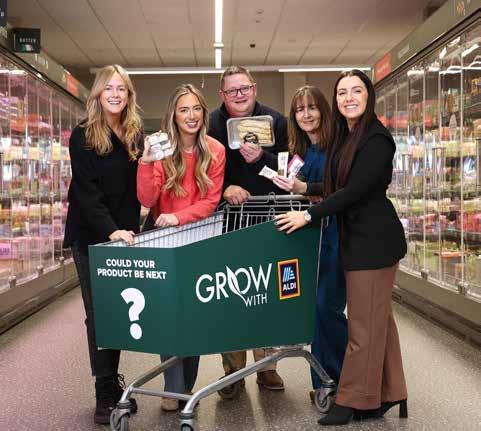
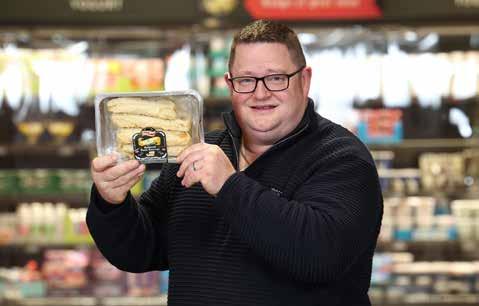
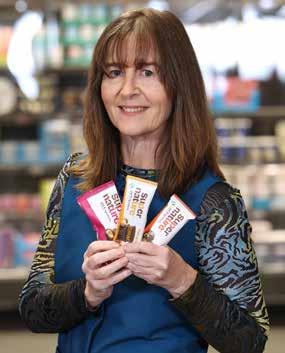
Grow with Aldi
Three Irish food producers were crowned winners of Grow with Aldi 2025.
24 Agri-Food Regulator
The Agri-Food Regulator recently carried out its second annual supplier survey, which will guide their work for the year ahead.
30 Food & Drink Manufacturing
Food Drink Ireland’s 2026 manufacturing report reveals broadly positive sentiment, but with concerns for the future.
31
Centra National Conference
Centra enjoyed record sales of €2.2 billion in 2025.
36
Lidl Kickstart
Lidl Ireland recently called on small to medium food & drink producers to apply for the 10th Lidl Kickstart Supplier Development Programme.
37 Mayfair
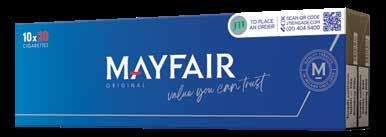
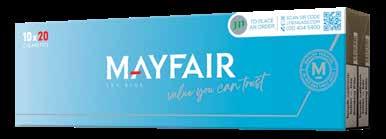
Mayfair unveiled a bold new look for 2026.
38
NOffLA Off Licence of the Year Awards
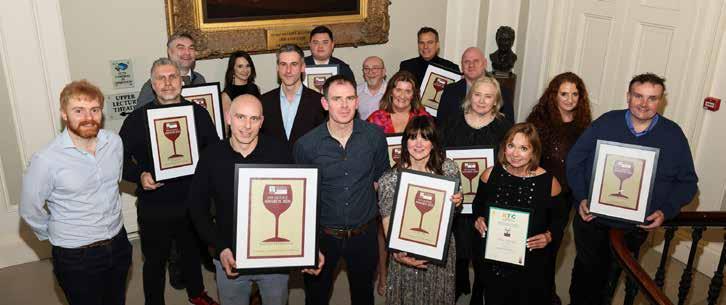
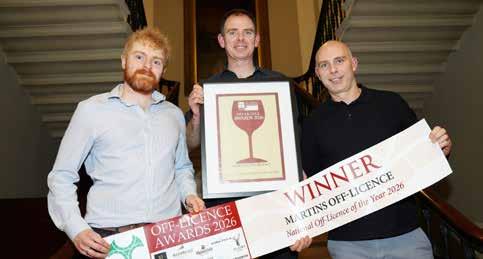
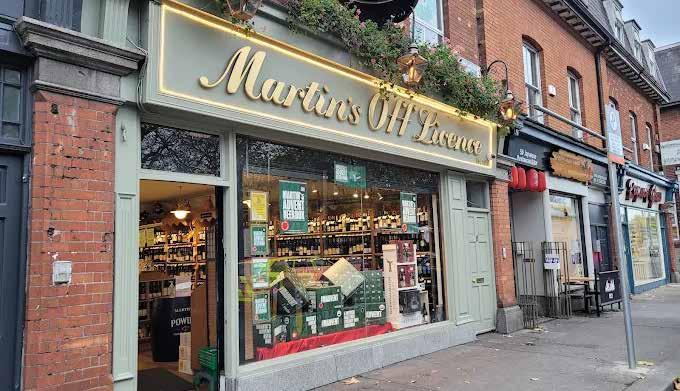
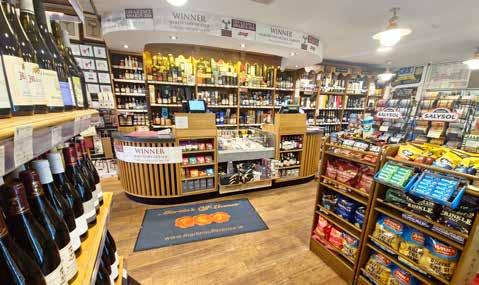
Martin’s off-licence in Fairview, Dublin 3, was the overall winner of the NOffLA Off-Licence of the Year Award for 2026.
42 E-Commerce Trends
Karim Iskandar, on the biggest E-commerce trends for 2026, with an emphasis on the grocery sector.
44 Shoplifting
A design competition organised by ECR Retail Loss showcased brand new innovations to combat shoplifting.
46
Artificial Intelligence
A new global study identifies critical gaps in AI adoption among retailers.
Falling claims, rising premiums: the insurance
THE Alliance for Insurance Reform (AIR) has condemned what it describes as a “deep disconnect” between falling insurance claims, strong insurer profits and “stubbornly rising premiums”. The claim was made following the release of the Central Bank’s National Claims Information Database (NCID) liability-insurance report for 2024, which found evidence of rising legal costs and an increasing percentage of claims being settled through the courts.
“The Central Bank's report makes it clear that the benefits of government insurance reforms are not being passed on to policyholders,” Brian Hanley, CEO of AIR told Retail News. “Insurers are retaining savings in the form of double-digit profits, far exceeding international norms, and yet at the same time are raising premiums for higher-tax policyholders. They're certainly prioritising their own profits over their policyholders. I think it's very regrettable at a time when the cost of doing business is so high that we are not seeing the benefits.”
The Central Bank report collected data to the end of 2024, examining trends in premiums, policy types, claim costs, settlements, and overall market profitability. The report found that most liability-insurance policies in Ireland remain relatively low cost: around 90% of all policies had an annual premium of less than €5,000. Despite this, and a significant programme of government reform, “based on all available metrics, premium has trended upwards in recent years.”
According to the Central Bank, insurers recorded a 10% profit margin (€137 million) on liability insurance in 2024. This correlated with a 4% rise in average liability premiums.
Vincent Jennings, CEO of the Convenience Stores and Newsagents Association (CSNA), an AIR board member, described the report as “proof positive that despite all the work the government has done, the insurance industry is still profiteering. We've provided detail to the government about our nationwide members who are experiencing increased pricing of premiums. Insurance companies are getting significant benefits from the changes in the laws. They're the ones who are deciding that they're not budging [with premium prices].”
The report shows that settlement
patterns for injury claims are heavily litigation-driven. In 2024, 71% of injury claimants and 87% of total injury costs were settled through the courts. In the second half of the year, only 37% of litigated claims were resolved under the Injuries Resolution Board (IRB) guidelines. According to the Central Bank report, legal fees now match awards in the majority of claims. “[Claimants] are being persuaded by their lawyers they've got a good case to increase what the IRB is suggesting,” said Jennings.
In a submission this month to the Cost of Business Advisory Forum, RGDATA called for action around the issue of legal costs for insurance claims. This, said the grocery
group, was directly responsible for the increasing price of premiums.
“It has been well established that high legal costs associated with personal injury [PI] litigation are a direct contributory factor to the overall cost of insurance in Ireland,” RGDATA wrote in its submission. “While recent reforms, including the work of the Injuries Resolution Board, have made some positive impact on reducing PI costs, the legal profession retains a strong vested interest in ensuring that legal costs remain at an excessively high level.”
Yet evidence within the Central Bank report suggests there is no benefit to taking a case through the courts. Hanley explained: “The average compensation at the Injuries Board is €25,000 and in litigation it's also €25,000. So there's no apparent benefit to claiming, yet legal costs go from €694 at the Injuries Board to €25,055 [through the courts].”
There is, however, a financial incentive for the legal profession. “Legal costs are matching the awards in that litigation channel, which arguably doubles the cost of settling the claim. Increased costs have to be paid in the form of increased premiums.” Although compensation awards are the same via courts as they are through the IRB, the length of time they take to resolve can be years apart, said Jennings. “The compensation is almost the same and yet there's a delay of an additional two years going through the court system."
Brian Hanley, CEO of the Alliance for Insurance Reform.
minefield of Irish New CEO announced for Musgrave
In their submission to the Cost of Business forum, RGDATA called on government to introduce an “unrelenting focus… on reducing the level and scale of personal injury awards and the legal fees for personal injury cases, to such an extent that litigation to resolve personal injury claims is a last resort. Non-adversarial means of addressing genuine compensation claims must be the norm and should be focused on delivering reasonable levels of compensation in the most costeffective manner possible.”
AIR wants the government to take “decisive action” to ensure greater numbers of appropriate claims are settled at the Injuries Resolution Board. RGDATA, prompted by the Judicial Council’s recent recommendation to increase the level of personal injury awards by 17%, also want the judiciary removed from decisions to set Personal Injury Guideline levels: “Decisions on the applicable legal processes and the relevant guidelines on personal injury award levels should be political issues and not matters for the judiciary to determine.”
Vincent Jennings suggested the introduction of a new regulatory body, similar to the Residential Tenancies Board (which regulates the property rental sector) or the Workplace Relations Commission, “which has clear decision making and binding determination abilities” around insurance. The Irish insurance industry, believe retail representatives, still lacks sufficient competition.
“We haven't seen a new entrant in the Irish market for liability insurance in more than a decade,” notes Brian Hanley. “There are a number of positive commitments in the government’s Action Plan for Insurance reform but there don't appear to be sufficient resources to promote competition in the insurance market. If competition is a silver bullet to put downward pressure on premiums, then it should be treated as such.”
The government’s most recent Action Plan for Insurance Reform, launched in July 2025, targeted a number of priority areas: Transparency & Affordability and Legal Reform, alongside Competitiveness & Availability, which gives businesses some confidence. “But ultimately they have to hold insurers to account publicly on our behalf and put pressure on them to pass on the savings,” said Hanley, who met Robert Troy TD, Minister of State at the Department of Finance, this month to discuss the issue.
“We made it clear to the Minister, the government didn't get into this for insurer profits to go up and for premiums to continue to rise,” he insisted. “They need to continue to put pressure on insurers to pass on the savings. And that's what the Alliance will be doing as well.”
MUSGRAVE have announced the appointment of Niall Anderton as Chief Executive Officer and Executive Director, succeeding Noel Keeley who will retire from the business at the end of this year.
Niall Anderton brings a wealth of commercial experience from his previous roles across the international retail landscape. He joins Musgrave Group on May 1 from Alimentation Couche-Tard (Circle-K), where he most recently served as Global SVP Strategy & Transformation and a member of the Global Executive. Headquartered in Canada, Alimentation Couche-Tard is the second-largest convenience retailer worldwide, with 17,300 stores across 29 countries. Niall joined Alimentation Couche-Tard in 2015 following the acquisition of Topaz in Ireland, where he served as CFO and CEO, and subsequently as Senior Vice President Operations Europe. He previously held senior management positions with Primark and Telefonica 02, having qualified as a chartered accountant with KPMG.
Niall Anderton, incoming CEO at Musgrave.
“Niall brings a wealth of experience and strong leadership to our team at Musgrave and is exceptionally well placed to guide the business forward in an era of considerable opportunity,” said Nicky Hartery, Chairman, Musgrave Group. “As one of Europe’s leading family-owned businesses, we know that Niall will play a pivotal role in building the future of our business for the continued benefit of our customers, colleagues, shareholders and communities.”
Commenting on the retirement of Noel Keeley, Hartery said: “I would like to take this opportunity to thank Noel Keeley for his immense contribution and dedication, which has helped position the business strongly for the future. During his 22 years with the business, Noel has held many roles. He became CEO in 2020 and navigated his first few months as CEO exceptionally well considering the immense challenges of the Covid-19 pandemic. The board and I would like to acknowledge the role Noel played in leading the business, driving growth across all our brands, strengthening the culture of our business and setting us up for substantive growth and transformation in the years ahead. We wish him the very best for his retirement."
Vincent Jennings, CEO, CSNA.
Irish food, drink and horticulture exports reach a record €19 billion
THE value of Ireland’s food, drink and horticulture exports increased by 12% in 2025 to reach a record €19 billion, according to Bord Bia’s Export Performance and Prospects Report 2025/26, published recently.
This milestone performance was delivered amid one of the most volatile trading environments in recent years, shaped by geopolitical uncertainty, extreme weather events, persistent inflation, and shifting consumer behaviour. Despite these pressures, Irish exporters demonstrated strong resilience, with growth largely underpinned by higher prices across key categories, most notably beef and dairy.
Dairy exports rose by 14% to €7.3 billion, supported by improved dairy prices in the first half of the year, and a strong grass-growing season throughout which boosted milk production. Export volumes (excluding milk and cream) increased by 12%, with butter and cheese accounting for the majority of value growth. Commodity prices across several key export categories declined sharply during the autumn months.
Meat and livestock exports increased by 18% to just over €5 billion, driven by significant price increases in beef and live exports. Tight supplies of cattle across Ireland and key markets led to a surge in beef prices but reduced export volumes.
Prepared Consumer Foods (PCF) exports grew by 9% to €3.6 billion, aided by strong performance in chocolate confectionery, juices, carbonated beverages and meal solutions, and a 10% increase in exports to the UK. Drinks exports recorded a marginal increase of 2% to €2 billion, despite shifting trade dynamics, particularly in the US market.
Seafood exports rose by 9% to €635 million, as a significant increase in volumes offset weaker returns for many species. However, the sector faces increased challenges ahead as quotas look set to be significantly reduced for some species.
Horticulture and cereals exports increased marginally to €330 million, with mushroom exports edging higher, while cereals values declined due to lower global prices.
“2025 can be described as one of the most volatile years our sector has experienced in recent memory. Yet, against this backdrop, the Irish food, drink and horticulture industry reached a record €19 billion in exports, demonstrating its ability to continue building value even in turbulent conditions,” revealed Jim O’Toole, CEO, Bord Bia. “By investing in strategic insight, sustainability and trusted customer relationships, the sector is moving beyond volume-led growth and positioning itself to deliver greater value in global markets. This progress has been achieved despite ongoing volatility across trade, consumer sentiment and climate conditions, which shows little sign of easing.”
Minister for Agriculture, Food and the Marine, Martin Heydon TD, said, “I am pleased to see that when the estimated €2.2 billion in non-edible agri-food products is added to Bord Bia’s estimated €19 billion export value of Irish food and drink, resulting in total agrifood exports of €21.2 billion, that there was an overall estimated increase of 11% in the total Irish agri-food exports in 2025 when compared to 2024. Given all the challenges facing the industry, this is a significant achievement. I am confident that with support from both my Department and the marketing and promotion support provided by Bord Bia, our farmers, fishers, food companies, and food and drink producers will continue to face into
and work through these ongoing challenges in 2026.”
Minister of State at the Department of Agriculture, Food and the Marine, Noel Grealish TD, said , “While there is market uncertainty associated with the outlook for 2026, global demand for highquality food and animal protein is increasing with population, urbanisation and affluence…In 2026, we need to continue to work together in facing and adapting to challenges, as we strive to maintain success for all actors across the sector.”
Exports to the European Union increased strongly by 16% in 2025 to €7.1 billion, accounting for 37% of total Irish food, drink and horticulture export value. Growth was concentrated in the region’s largest markets - the Netherlands, France, Germany, Spain and Belgium - which together accounted for €5.2 billion in exports, an increase of 17%, driven primarily by higher beef and dairy returns.
The UK remained Ireland’s largest single export destination, with export values rising by 14% to €6.7 billion, representing 35% of total exports. Beef, dairy and prepared consumer foods were the main contributors to growth, although inflation continued to affect consumer affordability.
Exports to international markets increased by 5% to an estimated €5.2 billion, representing 28% of total exports. North America strengthened its position within international markets, driven by an 11% increase in dairy export value to €1 billion. Exports to Asia were broadly stable at €1.1 billion, with stronger dairy shipments to Southeast Asia offsetting declines in beef and pigmeat exports, particularly to China and Japan. Africa recorded one of the strongest growth performances, with exports increasing by 9% to €975 million, led by significant growth in drink and seafood exports, both of which recorded increases of almost 60%, highlighting the continued diversification of Ireland’s export base across international markets.
According to Bord Bia’s CEO Sentiment Survey, Irish food and drink exporters enter 2026 with a more cautious outlook. While overall sentiment remains moderately positive, growth expectations have softened compared with the previous year, reflecting ongoing cost pressures, geopolitical uncertainty and subdued consumer demand in some markets. Just over half of companies expect export growth in 2026, while almost two in five report delaying planned investment due to economic and market conditions. Labour costs continue to represent the most significant risk to competitiveness.
Bord Bia CEO Jim O’Toole with Minister of State at the Department of Agriculture, Food and the Marine, Noel Grealish TD.
BWG NextGen Entrepreneurs Programme celebrates first graduates
BWG Foods have marked a major milestone in their commitment to the future of Irish retail with the successful graduation of the first group of their NextGen Entrepreneurs Programme, while simultaneously welcoming a new intake of participants to the innovative initiative.
Designed to support the next generation of retail leaders and entrepreneurs, the BWG NextGen Entrepreneurs Programme was launched as a bespoke succession and leadership development course, tailored specifically to the needs of Ireland’s independent retail sector. The completion of the inaugural programme represents a significant achievement for both participants and mentors, and reinforces BWG’s long-term investment in people, capability and entrepreneurship.
A total of 26 participants completed the 2024/25 programme, which ran over eight months and combined academic learning, hands-on experience and real-world retail application. The programme was delivered in partnership with Dublin City University (DCU) and supported by 16 mentors, drawn from both BWG Foods and independent retailers.
Participants also completed 12 days of DCU lectures and took part in an international study trip to the Netherlands, gaining firsthand exposure to international retail formats, innovation and bestin-class execution. At the heart of the programme were its three defining pillars - Networking, Education and Mentorship - enabling participants to build strong peer networks, gain rigorous academic insight and benefit from one-to-one guidance from experienced retail leaders.
Core modules included entrepreneurial mindset, strategy and business model development, leadership and team management, financial management, retail operations, innovation, customer experience, change management, and technology and digital transformation.
The mentoring element of the programme, led by senior leaders across BWG, has been a cornerstone of its success. This initiative has provided participants with invaluable guidance, real-world insights, and the opportunity to learn directly from experienced professionals. This mentoring approach will remain an ongoing commitment, ensuring that as the next generation of leaders emerges, they receive the support, knowledge and confidence
required to thrive in a dynamic and competitive environment.
“The graduation of our first NextGen Entrepreneurs Programme cohort is a significant milestone for BWG and for the independent retail sector,” noted Peter Donohoe, Chief People Officer, BWG Foods. “This programme is about more than education; it’s about building confidence, capability and long-term sustainability for future retail leaders. The engagement, ambition and practical application demonstrated by the participants throughout the programme has been exceptional, and we are excited to see how they apply these learnings in their businesses and careers.”
Following the success of the inaugural programme, BWG have now welcomed a second intake of 21 participants, who have already commenced the programme. The new cohort, who started with a look-and-learn trip to the Netherlands, will follow the same blended learning model, combining theory-led education with hands-on retail application, mentoring and peer collaboration.
By investing in initiatives such as the NextGen Entrepreneurs Programme, BWG Foods continue to demonstrate their commitment to developing entrepreneurial talent, supporting succession planning and strengthening the long-term future of Ireland’s independent retail sector.
Meat Matters conference held in Dublin
TEAGASC recently convened industry, policymakers and researchers at the Food Innovation Gateways event, Meat Matters: Shaping the Future of Fresh, Value-Added, and Meal Innovation, held at the Teagasc Ashtown Food Research Centre, Dublin.
The event brought together leaders from across the meat and prepared consumer food sectors to explore future innovation opportunities in fresh meat, value-added products and meal solutions, and to examine how research, technology and collaboration can support competitiveness, sustainability, and consumer trust in domestic and international markets.
“As the national body for agri-food research and innovation, Teagasc plays a convening role in bringing together industry, research, and policy to address shared challenges and opportunities,” said Professor Frank O’Mara, Director of Teagasc. “Meat Matters highlights how science-led innovation and collaboration can support the future competitiveness and sustainability of Ireland’s meat sector.”
are (l-r): Dr Ruth
of Food
Dr Eva
Food and Agribusiness; Professor Frank O’Mara, Teagasc Director; and Dr. Geraldine Duffy, Teagasc Ashtown Enterprise Leader.
Graduates of the inaugural BWG NextGen Entrepreneurs Programme in conjunction with DCU.
Pictured
Hamill, Head
Quality and Sensory, Teagasc; with Dr John Colreavy, Director, Meat Technology Ireland;
Gocsik, Rabobank
Lidl tops €2 billion spend with Irish suppliers
LIDL Ireland have broken the €2 billion spend mark in procuring goods and services from Irish businesses in 2025, an increase of €337 million (or 20%) on 2024, according to the retailer’s latest annual Supplier and Business Partner Impact Report.
Ireland’s fastest growing supermarket retailer, according to retail analysts Kantar, now supports a growing network of more than 1,800 producers and business partners across the island of Ireland, which reflects the retailer’s sustained growth over the last 12 months, reaching new heights with market share of 13.7%.
According to the report, Lidl Ireland procured €1.4 billion worth of goods from the Irish agri-food sector in 2025, up €167 million (or
Pictured at the launch of Lidl Ireland's Supplier and Business Partner Impact Report 2025 are Lidl Ireland and Northern Ireland CEO Robert Ryan with Minister for Agriculture, Food and the Marine Martin Heydon TD, alongside Hazel Garry and Nicolae Dogotaru from the Patrician Primary School in Newbridge.
13%) on 2024, and boosted their spend with Irish business partners by 40% year-on-year, procuring a further €595 million worth of services.
With a firm commitment to provide Irish producers with unrivalled access to international markets, Lidl continued to showcase the best of Irish produce on the world stage through their expansive global store network in 2025. More than €404 million of produce from Irish suppliers was exported to Lidl stores across the UK, EU and USA, an increase of 12.5% on 2024 figures.
“Today’s announcement clearly demonstrates Lidl’s impact in Ireland and affirms their commitment to Irish business and the local economy,” said Martin Heydon TD, Minister for Agriculture, Food and the Marine. “Breaking the €2 billion procurement mark from Irish suppliers is a milestone achievement. I look forward to their continued support for agri-food producers and wider business partners who continue to benefit from this ever-increasing investment.”
Robert Ryan, CEO, Lidl Ireland & Northern Ireland, said: “Over the last 12 months, Lidl Ireland have achieved phenomenal market share growth and welcomed more than 1.5 million weekly shoppers across our doors. For us, a key driver of success is our longstanding relationships with Irish suppliers, and it’s no surprise to see that our record market share growth to 13.7% in Ireland is also matched with our growing investment into Irish agri-food businesses.”
He noted how Lidl Ireland have more than doubled their spend with Irish producers in just four years. “As we continue this momentum, growing our Irish supplier network has never been more important,” he said. “We’re very much doubling down on our investment and prioritising local sourcing of high quality, nutritious and great tasting food at market-leading value, which customers can expect when they shop at Lidl”.
Vape representatives urge Minister to close vape ban loopholes
AS the Public Health (Single-Use Vapes) Bill 2025 continued its passage through the Dáil recently, Responsible Vaping Ireland (RVI), which represents more than 3,500 independent vape retailers nationwide, is warning that emerging loopholes in the proposed legislation must be urgently addressed to ensure the ban works in practice.
When the Bill was first introduced in the Dáil on December 12, 2025, a number of TDs raised concerns about enforcement and potential loopholes, including Social Democrats TD Pádraig Rice and Sinn Féin health spokesperson David Cullinane, both of whom urged the Minister to ensure the legislation is robust.
Against that backdrop, RVI said manufacturers are already modifying disposable vapes in ways that undermine the intent of the Bill, by adding charging ports or nominal removable pods so that products can be marketed as “reusable”, while still being sold cheaply and treated by consumers as disposable items.
According to retailers, these devices are not genuinely reusable in real-world use. They are typically low-cost, poor-quality products that consumers discard after short periods, despite superficial design changes. The addition of charging ports to devices never intended for repeated use also raises concerns around product safety and battery integrity.
The group warned that Ireland risks repeating the experience of the UK, where a disposable vape ban introduced last June has led to a rapid increase in so-called “fake reusable” devices designed specifically to exploit loopholes in the law. This, it said,
has complicated enforcement and weakened both environmental protections and efforts to restrict youth access.
“With the Bill now progressing through the Dáil, it’s critical that these issues are addressed before the legislation is finalised,” said Lorraine Carolan, spokesperson for Responsible Vaping Ireland.
“We are already seeing disposable vapes being retrofitted with charging ports or token refill features purely to get around the proposed ban.
“These products are still being treated as disposable by consumers, but now carry additional safety and enforcement risks. If the gaps aren’t closed, Ireland will face the same problems the UK is now dealing with - non-compliant products flooding the market and a ban that falls short of its objectives.”
Irish shoppers reset after festive splurge
TAKE-home grocery sales in Ireland rose by 5% in the four weeks to January 25, 2026, according to the latest data from Worldpanel by Numerator, with shoppers spending more than €1.2 billion on groceries over the period.
While shoppers made slightly more trips to stores compared to the corresponding period last year, they purchased 1.9% fewer packs year-onyear, highlighting continued caution among Irish consumers as grocery inflation rose to 6.82%, up from 6.25% over the 12 weeks.
“January is typically the time when shoppers reset their household budgets, and this year was no different. While grocery sales continued to grow, rising inflation meant that value remained front of mind for consumers,” explained Emer Healy, Business Development Director at Worldpanel by Numerator.
“Our latest pressure group study reveals that more shoppers in Ireland are finding the current economic climate tough, with 31% feeling that they are struggling to make ends meet. This is no surprise: rising grocery inflation means that consumers are increasingly feeling the pinch.”
After grocery spending hit a record high in December, shoppers have looked to rein in costs in January, a trend that would typically boost the share of own label products. Grocery spending and the volume sold on promotion over the latest 12-week period remained at a record low of just 19.6%, suggesting that shoppers are managing their budgets through everyday choices rather than increased promotional purchasing.
Own label products accounted for 43.4% of total grocery spend, up 0.7 percentage points on the previous month, with shoppers spending more than €1.7 billion on own label goods over the latest 12-week period. The strong performance of premium own label goods also continued, with growth standing at 5%, while branded products remained resilient, growing 7.3% and ahead of the total market, which grew at 5.2%.
Emer Healy, Business Development Director at Worldpanel by Numerator.
stocked up in time for the start of flu season.
“As shoppers refocus on health after the indulgence of the festive period and the onset of flu season, we’re seeing growing demand for everyday staples that support their wellbeing goals, such as products rich in protein and fibre,” noted Emer Healy. “The wettest January in eight years also drove demand for ‘comfort food’ options to be enjoyed at home.
“Rather than following short-term, diet-driven trends, consumers are opting for a more balanced, sustainable approach to healthy eating built around familiar, accessible foods that fit naturally into their daily routines. With more shoppers exploring plant-based choices through Veganuary, meat alternative products experienced an uplift during the period, with shoppers spending an additional €838,000 on meat substitutes versus last year.”
Online grocery sales continued their strong march, rising 7% year on year to take 5.8% value share. Shoppers spent an additional €15 million online, driven by larger trips, with nearly 20% of Irish households purchasing groceries online during the latest 12-week period.
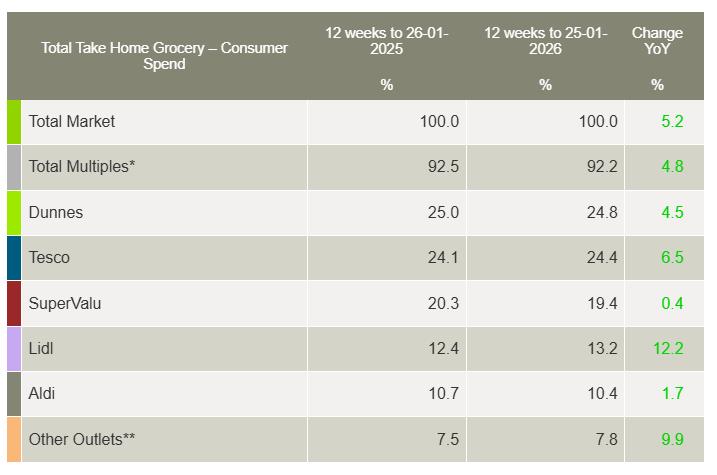
Among the retailers, Dunnes hold 24.8% market share, up on the previous 12-week period and with sales growth of 4.5% year on year. Larger trips and new shopper recruits contributed an additional €29.8 million to their overall performance.
Tesco claim just under a quarter of the market, at 24.4%, with value growth of 6.5% year on year. An influx of new shoppers contributed an additional €27.9 million to the grocer’s overall performance.
SuperValu hold 19.4% market share, with growth of 0.4%. They remain the most frequently visited grocer, averaging 22 trips per shopper, while new shopper recruits over the 12-week period contributed an additional €36.7 million to their overall performance.
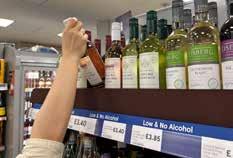
In January, Irish shoppers spent an additional €454k on low- and no-alcoholic beverages, amid greater participation in Dry January. Spending on fresh fruit, chilled smoothies, juices and yoghurts was also on the rise, increasing by more than €8.1 million, while healthcare sales increased 6.8% year on year, with consumers ploughing an additional €1.8 million into the category as they
Lidl were once again the fastest-growing grocer, up 12.2% and holding 13.2% of the market. Alongside recruiting new shoppers instore, existing shoppers picked up more volume in store, with both groups combined contributing an additional €29.9 million to overall performance.
Aldi hold 10.4% market share, up 1.7%, driven by an influx of new shoppers who drove an additional €13.8 million in sales.
Mace launch new Right Options campaign
MACE recently announced the launch of their new Mace Right Options campaign, a multi-phase initiative designed to help people make more informed, healthier food choices as part of everyday life. The campaign is led by Mace Brand Ambassador and Irish rugby legend Johnny Sexton, alongside health and nutrition coach Ciara Turley, better known as @thetummyfairy. Running until April, Mace Right Options aims to make healthy eating feel more achievable, practical and familyfriendly, with a focus on fuelling the body properly and supporting better decision-making around food. Keith Crawford, Mace Sales Director, said: “Our Mace retailers are deeply committed to supporting healthier living in their communities. Mace Right Options reflects that commitment, by making it easier for shoppers to access healthier choices and trusted guidance in-store and online.”
Ballygowan tees off Ryder Cup partnership
BALLYGOWAN, Britvic Ireland’s natural mineral water brand, has announced a landmark partnership agreement as Official Supporter of the 2027 Ryder Cup, which will be hosted at Adare Manor in Co. Limerick. Ballygowan is sourced and bottled in Newcastle West, just 30 minutes from Adare Manor, making this a truly local partnership for one of the largest sporting events ever staged in Ireland. The partnership is structured as a bespoke, Irelandonly agreement, reflecting a unique opportunity presented by the Ryder Cup returning to Irish soil, where Ballygowan will be the exclusive water category partner for the event. “We are incredibly proud to return as an Official Supporter of the Ryder Cup in 2027,” said Kevin Donnelly, Managing Director of Britvic Ireland. “This partnership reflects Ballygowan’s heritage, its local roots in Limerick, and its long-standing connection with professional golf.” Kevin is pictured with Sian Young, Sustainable Business & Corporate Affairs Director of Britvic Ireland, and Richard Atkinson, Chief Ryder Cup Officer at the European Tour Group.
Lidl open new Bundoran store
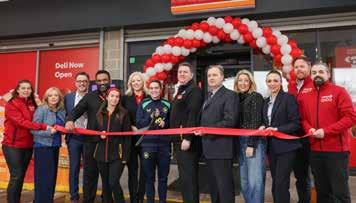
LIDL Ireland opened the doors to their brand-new store in Bundoran, Co. Donegal, on February 12, bringing the retailer's ‘More to Value’ proposition to the Bundoran community. The ribbon-cutting ceremony for the new state-of-the-art store was attended by ladies Gaelic football stars, including Donegal Captain Roisin Rodgers and Donegal Senior Aodh Ruadh BAS player Cait Gillespie. The new store, located on Station Road, marks a major milestone in the retailer’s investment in Co. Donegal, with planning permission granted in 2023 to relocate from the store’s previous location, also on Station Road, which has served the community since 2006.
SuperValu Food of the Future Award winner
SUPERVALU recently announced Tegan Timmons from Coláiste Bride, County Dublin, as the winner of the SuperValu Food of the Future Award at the 2026 Stripe Young Scientist and Technology Exhibition, which SuperValu proudly supported for the first time as a Silver Sponsor. The winning project, ‘Nutritrack: Rethinking healthy eating’, impressed judges with its innovative approach to promoting nutritional awareness. By focusing on nutrients rather than calories, the app encourages healthier eating choices and supports UN Sustainable Development Goal 4: Quality Education. This forward-thinking solution aligns strongly with SuperValu’s commitment to inspiring healthier communities. The SuperValu Food of the Future Award celebrates projects that enhance consumer confidence through transparency, accountability and trust in how food is produced and sourced. Rita Kirwan, Marketing Director, Musgrave Retail, is pictured with award winner Tegan Timmons.
John West extend Féile sponsorship
JOHN West have extended their sponsorship of Féile, the GAA’s national under-15 Gaelic games celebration, across all four codes and grades, until 2028. “John West Féile has nurtured a wonderful enthusiasm for our games and has been the making of many friendships and memories,” said Jarlath Burns, Uachtarán CLG. “Generations have experienced the joy of being a part of Féile na nGael (camogie and hurling) and Féile Peile na nÓg (Gaelic football and ladies football) and I warmly thank John West for its sponsorship.” Jarlath Burns is pictured at Croke Park with Isabelle O’Meara and Cillian O’Hanlon of O’Tooles GAA Club.
Love Irish Food and Gala partner on Irish brand showcase
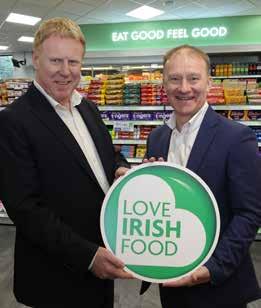
LOVE Irish Food and Gala Retail have announced a new partnership starting this year, which will see member brands showcased in up to 230 Gala stores nationwide. The first activation began on February 1, serving as an introduction of the Love Irish Food brand to Gala customers, and establishing a platform for future activities and opportunities to expand the visibility and offering of Love Irish Food members in Gala stores. “We are delighted to partner with Gala Retail, a retailer that has community, quality and Irish provenance at its core,” noted Conor Kilduff, Executive Director, Love Irish Food (right). “This collaboration offers our members a unique opportunity to reach shoppers in every corner of the country through a trusted retail brand. Our first activation is just the beginning, and we look forward to building a strong platform for Irish-made brands within Gala stores in the months and years ahead.” Gary Desmond, CEO of Gala Retail (left), said, “With Irishness, community and quality core values within Gala Retail, we are delighted to partner with Love Irish Food to further strengthen our stores’ commitment to the promotion and listing of Irish brands. By putting great Irish brands front and centre in our independently owned Gala stores, we’re proud to give shoppers a clear local choice, while supporting Irish producers across the country.”
Katie Taylor gets behind the fight for Ladies Gaelic Football
KATIE Taylor is pictured at Croke Park at the launch of the new nationwide TV ad campaign putting skill in the spotlight as Lidl confirmed their extended new partnership with LGFA to 2030 with fresh €7.5 million investment into the women’s game. New research by Lidl Ireland reveals a shift in public perception of skill, quality and excitement of women’s sport in Ireland with the ‘Katie Taylor effect’ driving positive impact. Irish sporting legend and world renowned boxer Katie Taylor put her weight behind a new campaign by the retailer, reminding the public that ‘Greatness Deserves to be Seen’. Irish media coverage of LGFA has tripled since 2020, but the ladies' game only receives one article for every 15 of the men’s game. “As a role model for other female athletes, I take my responsibility very seriously and I’m proud to use my platform to support others,” noted Katie. “Visibility matters. When young girls see women competing, winning and being celebrated on the biggest stages, it changes what they believe is possible for themselves.”
Spider Awards 2026 shortlist announced
THE Spider Awards, Ireland’s longest-running and most prestigious digital awards ceremony, have announced the shortlist for the 29th annual event on March 13. The grocery and FMCG market is well represented, with SuperValu nominated for the Best App Award, Pat the Baker and Centra nominated for the Best Consumer Campaign Award, Musgrave MarketPlace and SuperValu shortlisted in the Best in E-Commerce Award category, Centra in the Social Media category, while BWG Foods are in the running for the Best Use of Disruptive Technology Award. Applegreen, Londis, Spar, Centra and One4All, meanwhile, are shortlisted for the Best Integrated Media Campaign Award. Pictured are (l-r): Naoise O Conchubhair, Head of Digital, Design Studio; Terry Spence, Director of B2B Sales, One4all; Alma Bustos, Event Manager, The Spiders; and Gerard Tannam, Brand Director, Islandbridge.
Aramark
build momentum across sports and events portfolio
ARAMARK Ireland saw increased activity in 2025, driven by demand across their sports, events and hospitality portfolio and continued investment in people, technology and sustainability. The company delivered services at 55 major national and international events during the year, including fixtures and festivals at Croke Park, Thomond Park, Punchestown and the K Club. “2025 was one of our busiest and most commercially significant years,” said Kevin McGinley (pictured), Managing Director of Aramark Food Solutions Ireland. “We supported a packed calendar of concerts, sporting fixtures and premium events, while continuing to raise standards around food quality, service delivery, and operational efficiency.”
Industry News
SiSú partners with Katie Taylor on new range
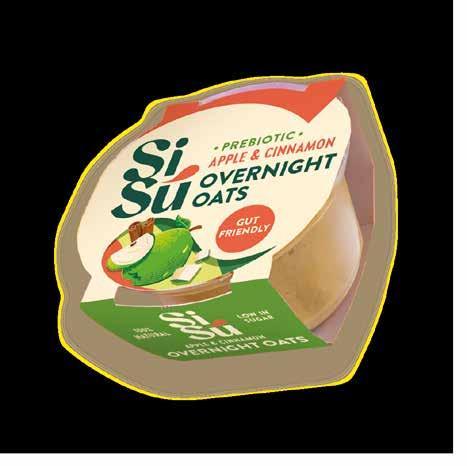
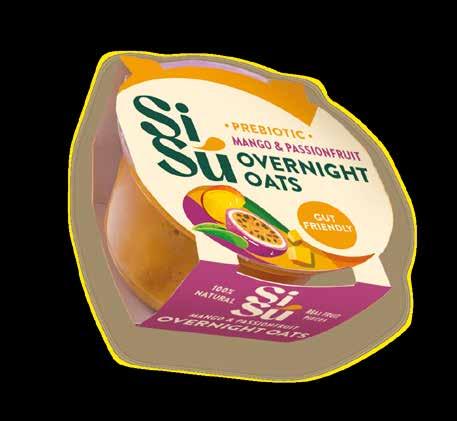
OLYMPIC and world boxing champion Katie Taylor has partnered with Irish wellness brand SiSú as the company enters its next phase of growth and expands beyond beverages with the launch of its new Prebiotic Overnight Oats range. Already established in retail and foodservice through its range of cold-pressed juices, wellness shots, organic kombucha and plant-based milks, the move marks SiSú’s first step into functional foods as part of a longterm collaboration with Taylor, focused on everyday performance nutrition. Designed for busy consumers seeking convenient, functional breakfast options, the new range combines Irish glutenfree oats with natural prebiotic ingredients that help promote beneficial gut bacteria and support digestive health. The product also delivers strong commercial appeal for retail and foodservice partners, with a chilled shelf life of up to 45 days, supporting operational efficiency and reduced waste.
IGBF Tour de Grocer
THE Irish Grocers Benevolent Fund’s annual charity cycle, Tour de Grocer, is back this year. Taking place on June 17 and 18, the route starts and ends in Faithlegg in Waterford, via the Radisson Little Island, Cork. The 300km round trip is one of the highlights of the year for the cycling fraternity amongst the grocery trade. The event is once again coordinated by Kevin Keating, Joint MD, Tennant & Ruttle. It costs €1750 per person to take part. For more information on sponsorship and participation, please contact: Léonie Thornton in Hotel Solutions DMC. Email:- leonie@hotel-solutions.ie. Tel: (01) 6309211.
SuperValu and Centra mark two years of DRS
Appointment at Ornua
ORNUA have announced the appointment of Patrick Blake as Managing Director of Ornua Foods UK & Europe. Patrick, who is currently the business unit’s Executive Director, Ireland, Europe & Strategic Sourcing, will take up his new role in March 2026. Patrick brings a wealth of experience to his new role, having held several senior leadership positions across Ornua’s global business since joining the organisation in 2013. In his new role as Managing Director of Ornua Foods UK & Europe, Patrick will be responsible for leading Ornua’s own label business in the UK, as well as driving forward the growth of Kerrygold, the UK’s number two branded block butter and fastest growing major butter brand, and Pilgrims Choice, the UK’s number two cheddar brand. He will also have responsibility for leading the team supporting the ongoing success of Kerrygold in Ireland and other key European markets.
‘Bloom’
bank holiday is back!
SUPERVALU and Centra are marking 500 million container returns across 577 stores nationwide, just two years after the launch of the Deposit Return Scheme. With the largest Deposit Return Scheme estate of any retailer in Ireland, Musgrave is the among the first retailers to reach 500 million container returns. “As a community retailer with the largest network of Reverse Vending Machines across Ireland, SuperValu and Centra are proud to play a part in supporting customers to make a positive recycling impact,” said Luke Hanlon (pictured), Managing Director of SuperValu and Centra. He described the 500 million milestone as a reflection of “not only the commitment of our customers, but also the ongoing investment and innovation of our independent retailers, and the generosity shown through continued donations to our charity partners. We also continue to see real generosity at a local level, like in Sheahan’s Centra in Killarney, where donated deposits were used to fund a defibrillator for the community. It’s a great example of how small, everyday actions can deliver real benefits in towns and villages right across Ireland.”
BORD Bia Bloom, Ireland’s most celebrated festival of gardening, food, and sustainable living, returns for its 20th year this June bank holiday weekend. Homegrown heroes Diarmuid Gavin, Neven Maguire, Trisha Lewis and Donal Skehan are set to return, alongside a host of leading Irish and international experts that will appear across the festival’s jampacked programme. Organisers are also putting the finishing touches to a new Wellness Area in advance of the final line-up, which will be announced over the coming months. From vibrant show gardens and delicious local food to inspiring talks and hands-on workshops, Bloom signals the start of summer and is a great day out for all ages. Bord Bia Bloom returns to its home in the Phoenix Park from May 28 to June 1.
safefood for business is a FREE food safety eLearning tool for small businesses in the food industry - from manufacturing to catering and service.
Train your staff in basic food safety over 8 short and practical modules. Plus, you can track their progress across any device as they work towards a certificate of completion.
Scan the QR code to sign up for food safety training and get access to online resources
The king of convenience
As President and CEO of the National Association of Convenience Stores (NACS) in the USA, Frank Gleeson is arguably the most powerful advocate for convenience stores worldwide. The former Aramark Northern European CEO, Topaz Retail Director and Retail Ireland Chairman explains what NACS offers its Irish membership and how a Northside Dubliner is heading up the biggest trade association for convenience retailers on the planet.
SINCE January of this year, Dubliner Frank Gleeson is the new President and CEO of NACS, the America-headquartered National Association of Convenience Stores, which has more than 1,300 retail members in over 50 countries around the globe.
Frank, only the fourth person to lead NACS in its 64-year history, has a lifetime’s experience in foodservice and convenience retailing, having been Retail Director of Topaz Energy Group in Ireland and President and CEO of Aramark Northern Europe from 2017 to 2014.
He also has vast experience of working with a trade association, having been Chair of Retail Ireland and also served the wider Ibec community on a variety of boards.
This is not his first role within NACS either. Frank served on the NACS International Board for 19 years and was on the NACS Board of Directors for 11 years, including his term as 2018-19 NACS Chairman of the Board.
He admits that the move to the US was a huge one, but it’s a challenge he is relishing, having earmarked the role for a number of years as one he would absolutely love if and when the position became available.
“I've arrived in here at a very exciting time,” he insists. “There's a lot going on, economy and politically. It's a time of change in terms of consumers, in terms of
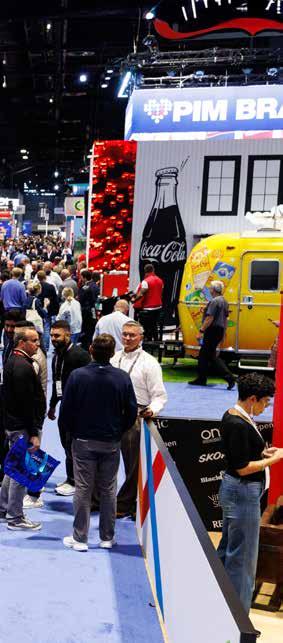
technology, and politically. But our industry is one of constant change, and NACS is a very big organisation. We recently held our annual NACS show in Chicago with 25,000 attendees from 70 countries.
“Here in the US, one in two Americans visit a c-store every single day, so we are at the heart of American society. When there’s a weather event, we are the first doors open to serve the community with water, food and fuel. It’s exciting to be in the middle of that.”
A time of change
He’s not at all worried about taking up the role at a time of such political turmoil, particularly in the US, where the Trump administration had been behind significant global upheaval in terms of tariffs and the threat of trade wars.
“We've always had change, especially in this industry,” he muses. “In my career, I've managed through two recessions, Covid, financial crashes, political change. Change is always on the agenda; you just need to respond to change in a positive way, whether that is in Ireland, the UK, Europe or the US.
“Ireland's pretty stable,” he continues. “We've had a centrist government for a long time, and there's no surprise that we're the darling in Europe or globally. We're educating more people. We are stable
financially. We are perhaps a little behind in terms of investment, where there is more ambition needed. But I think countries can learn from each other in terms of what is the best political or business environment that helps your citizens and your businesses thrive. I'm all for trying to work on solutions, not complain about problems.”
He believes that politics, like much of life, works in cycles. “Every system has a way of correcting itself at some stage, and maybe we need to have that bit of diversity to figure out what is a better solution in the mid to long term.”
Frank is based in Alexandria, VA, in the Washington, DC, metro area, in the heart of the US power centre, where another recent immigrant, former Finance Minister Paschal Donohoe TD, recently took up a role with the World Bank. Indeed, the two northside Dubliners have been in touch in recent weeks and remain close: “I'm so proud of him because he served our nation with pride. He served Europe with pride. We're both two good success stories for Ireland, Paschal in the political arena and myself in business.”
While living in Alexandria, the role of CEO brings a lot of travel, where Frank is on the road every second week, so his wife Marion is currently spending her time between 'the USA and Dublin, where the couple’s grownup children and grandchildren live.
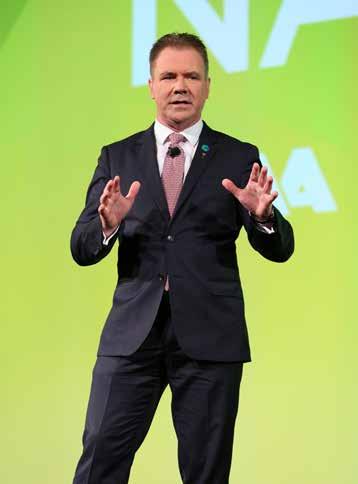
Frank Gleeson speaking at the recent NACS Trade Show in Chicago, which attracted 25,000 attendees.
“There are direct flights from Dublin twice a day, so it’s working out very well so far,” Frank smiles over a webchat from his office, which is only 10 minutes’ from the White House.
A wealth of experience
The transition to the US has been great, he enthuses. Looking back over the 40-year career journey that has taken him to NACS, Frank believes that the experiences he gained, from Xtravision to Statoil, Topaz and Aramark, have all helped to shape him for his current role.
It was while at Statoil (which became Topaz and then was bought over by Circle K), that Frank really got an insight into the global convenience business. “They were looking to grow the convenience side of the business,” he recalls. “I went on a
fact-finding mission and so got exposed to the US market, where I was first exposed to NACS. I actually came to Washington, where I met one of the NACS staffers and they brought me around to visit a number of top quality convenience stores. It was a very exciting time to be involved in the business because we were investing in convenience and in foodservice, doing some really innovative things.”
While at Topaz Ireland, Frank met with the owner of Circle K, Alain Bouchard: “He had shown interest in buying Topaz but the deal didn’t get done at that time.”
When he left Topaz, Frank made a “very deliberate” decision for the next phase of his career: “I took up a role with Aramark, because I wanted to gain greater foodservice and international experience. Aramark had a plan for me to
run their business in northern Europe and the Middle East, which was a very broadbased business, incorporating everything from gas stations to business dining, oil rigs to theme parks. It was a billion dollar business, with 22,000 people working there.”
He describes it as “the most challenging job I've ever had”, but it taught him a lot about international business and about running a business with both B2B and B2C operations. “It was “transformational career-wise”, he admits.
At the same time, Frank was very involved in NACS, where he was elected the first non-North American Chairman of the organisation in 2018: “I was very privileged to work with people like Henry Armour, my predecessor as CEO of NACS, and he took an interest in me and taught me how the
The NACS Trade Show attracted 25,000 attendees from over 70 countries around the world to see the future of convenience retailing.
association works. He has been a wonderful mentor.”
Indeed, the former CEO is staying on in an international capacity, and will continue to help guide Frank’s first months in the role.
Frank explains that NACS works in a very similar manner to Ibec in Ireland, with a board and executive committee. In Ibec, Frank served as Retail Ireland Chairman, as well as working in a variety of roles and committees across the wider Ibec family, which culminated in his being elected President of Ibec in September 2021.
“That is the number one elected role in Ireland for business and it was the proudest moment of my life, being up on stage giving a speech, with my family down in the audience, alongside all the key business leaders in the country and major
politicians,” he recalls.
This period was not without its challenges, though, as Frank’s presidency of Ibec coincided with lockdowns under the Covid pandemic. “I remember quite distinctly myself and Noel Keeley (Musgrave CEO) were advocating very hard for hospitality and retail, and we managed to work with government to get the pandemic unemployment scheme put in place. That was critical. It saved a lot of businesses, but more importantly, allowed us rebound back out of Covid quicker than most countries in the world. That's a great example of associations working with governments to create a good business environment.”
The voice of c-stores
This experience will all help him in his role with NACS, he believes, highlighting the association’s key pillars, which are similar to those of Ibec, the main one being advocacy.
“We want to make sure our voice is heard,” he insists. “And we are very effective and efficient doing that in the same way Ibec is in Ireland. I believe that NACS is one of the best business organisations, not just in America, but in the world, in the same way I would consider Ibec the best organisation in Europe for advocacy.”
He also stresses NACS’ excellent work in the area of education and networking, providing executive education programmes in some of the best universities in the US, like Cornell, MIT, and Yale.
The third area where NACS excel is in data analysis: “We have all our members’ information, and we delve into that data and provide insights back to our membership so that they can make better decisions. We have invested in ways to utilise the data at our disposal to make sure that our members are on the leading edge and that they have the opportunity to be the best they can be.”
The Irish connection NACS has historically had close ties with Ireland, and the association continues to have a number of Irish members. Frank is in regular contact with Applegreen CEO Joe Barrett, while Maxol Group CEO Brian Donaldson has recently joined the NACS board.
“Ireland is very much a convenience market of world renown,” Frank stresses, citing the amount of times Irish stores have been winners of the NACS Convenience Store of the Year Award. “Ireland is a world-class market for convenience and
I believe that NACS is one of the best business organisations, not just in America, but in the world, in the same way I would consider Ibec the best organisation in Europe for advocacy.
foodservice, and a lot of companies from other countries travel to Ireland, observing and learning. That’s the great thing about NACS; we can learn from each other.”
The relationship between Ireland and the US remains “extremely close”, according to Frank. “Ireland's the number six investor in the US as a country. Our firms are growing in the US with very strong ties. We have 40 million Americans with Irish heritage. We just had one of the biggest NFL games outside the US in Dublin. My own personal view is we learned from America and now America is learning from us in convenience retailing. So it's a symbiotic relationship where we're all on this journey now.”
He stresses that Ireland and the US remain at the “top tier” of international convenience retailing. “What I've seen in Ireland is competition breeds excellence and the better everyone gets, the whole industry moves up in terms of quality, and you only need to look at the really strong competitors we have in the Irish convenience market. So it's great to have the chance to come over and work with an association that I deeply admire, as well as working with people that I already have great relationships and friendships with.”
For Irish retailers, the main benefit from being part of NACS is that they get access
Retail News Interview
to best practice from retailers right across the world, as well as the NACS show, which Frank describes as “the best trade show in the world, with all of the equipment, all of the products and all of the education sessions that retailers need, during a week-long programme in one place. It's a highly efficient way of learning what is going on in the industry globally.”
NACS also allows members to network with other retailers from right across the globe. “With the size of our membership, there is always somebody somewhere with a similar challenge to one you’re going through and they’re not competing with you,” Frank smiles. “So, through our extensive network, you can reach out to somebody globally, and build a relationship with them and they could help you solve the problem.
“Our network allows members to see what the best-of-the-best are doing globally, and bring that back to their business. If you can do that with even one thing every year, your business will get better. In NACS, we are great at facilitating that and under my leadership, that will continue. You can go across America and there are pockets of real retail excellence that I think your readers could learn from, and there’s now an Irish guy over here who's willing to help them.”
Frank Gleeson: “With the size of our membership, there is always somebody somewhere with a similar challenge to one you’re going through and they’re not competing with you.”
things that are happening somewhere that you can learn from and use to improve your business.”
He believes that Japan has some lessons to teach c-store groups, particularly in terms of retail technology and their supply chain, with so many stores concentrated in the big cities. Norway, meanwhile, is ahead of the curve when it comes to electric vehicles (EVs), while he also singles out 7-Eleven in Denmark as a shining example of modern downtown and airport convenience shopping, and Lion Place in Argentina as a world leader in motorway service stations, while some US operators are changing from a drive-through model to a click-and-collect service.
“With NACS, you have access to the very best retailers in the world. I think the challenge for your readers always is how do they codify that and put that into their business in a way that they can replicate it successfully for the Irish market,” Frank explains. “If you've got a lens into the future, you have a chance to change or improve your business model but you have to be curious, to want to understand the
The fuels transition
One area that he believes isn’t changing as fast as was perhaps predicted is the move from fossil fuels to renewables, with lessons for forecourt retailers, governments and consumers to learn.
While Norway is head-and-shoulders ahead of the rest of the world in terms of EV adoption, thanks to a very strong government incentivisation and grant process, take-up in the rest of the world has not been as fast as some commentators expected.
“There's a vast difference between the top and the bottom in terms of movement, across countries and within the US, across states,” he insists. “California might be moving faster than other states, in the same way that Norway's moving faster than Ireland or the UK. I think the challenges are around infrastructure, customer demand, and economics. I think adoption of EVs will be slower than people expect,
and if governments want to accelerate the process, they have to think about how can they help retailers and consumers to adopt the new technologies.”
He believes that manufacturers are doing their part, with new technologies improving EVs, as well as hybrid engine technology, all the time: “Technology is moving all the time, and attitudes are moving all the time, but I don't predict the end of fossil fuels anytime soon.”
Growing the business
When asked what he hopes to achieve as CEO and President of NACS, Frank’s answer is simple: growth. “I think we can become bigger globally. I think we can be more effective. I think we can continue to improve our industry in terms of its image, its education and its quality and standards,” he insists. “The top guys will always do well, as will mid-tier operators, but my dream would be to rise the tide, to bring everybody in the industry to a higher standard and allow them to be more profitable, more sustainable and to grow. One of the biggest growth areas for us is in foodservice, where I have 10 years of really extensive experience.
“When you look at Ireland, every fuel station in the country sells a very extensive menu right across the day, and that's the kind of vision I have, that we will become the go-to place for convenience at its widest sense, not just in America, but globally. And also, I want our industry to have a reputation for quality, service, and kindness.”
Before we go, Frank insists on paying tribute to those people who have helped him in his career, from Statoil to Aramark: “I want to thank everybody I've worked with in Ireland over the years. I have so many mentors and friends that helped me; you don't get to be CEO of an association like NACS without the help of others. So my final thought is, I want to help anybody I can help because a lot of people helped me throughout my career and I'm always willing to reciprocate with that kindness and support.”
Protecting your business: a practical guide to liability and defamation
IRISH retailers continue to operate in an increasingly litigious environment, but recent legal developments offer a more balanced framework for managing risk. At a recent Retail Ireland member briefing, delivered by Mason Hayes & Curran, we examined two areas that consistently challenge the sector: occupiers’ liability and defamation. Understanding how the law is evolving, and how to apply it on the shop floor, can make a real difference to your business.
Under the Occupiers’ Liability Act 1995, a retailer is considered the “occupier” if they exercise control over the premises. The duty owed to customers is the “common duty of care”, which requires taking reasonable steps to ensure their safety. Crucially, this is not an obligation to eliminate every possible hazard.
The Courts and Civil Law (Miscellaneous Provisions) Act 2023 has now placed helpful principles on a statutory footing. When assessing whether a retailer has met their duty of care, courts must consider the likelihood of a danger arising, the probability and potential severity of an injury, the practicality and cost of preventative measures, and the social utility of the activity taking place.
This reflects a more realistic approach: retailers are not expected to remove ordinary, everyday risks such as standard kerbs or minor surface irregularities. The law also more clearly recognises the “voluntary assumption of risk”, meaning customers are expected to take reasonable care for their own safety.
To successfully defend a claim, a retailer must be able to demonstrate that reasonable care was taken. Consistent cleaning practices, documented staff training, and clear “clean as you go” procedures remain essential.
If an incident occurs, CCTV footage should be secured immediately, ideally covering the period before and after the event to establish how and when a hazard arose. Accident reports should record facts only, avoiding speculation, and photographs of the scene should be taken promptly. These straightforward steps often prove decisive in court.
Defamation: protecting property without damaging reputations
Defamation remains a significant concern, particularly in situations involving suspected shoplifting. A statement becomes defamatory if it harms a person’s reputation in the eyes of reasonable members of society. In a retail setting, “publication” can occur simply by being overheard by other customers, which is why discretion is so important.
Retailers do, however, have a strong defence in the form of qualified privilege. This allows staff to make enquiries to protect property, provided they act honestly, reasonably, and without malice. Crucially, this protection can be lost through “excessive
publication”. If an enquiry is made loudly or unnecessarily in front of others, the legal protections are potentially diminished.
Discreet interactions are essential. Staff should, where possible, verify suspicions, such as by checking CCTV, before approaching a customer. Physical contact should be avoided, as it risks escalating a situation into an assault claim. Training also plays a crucial role: calm, professional language not only protects the retailer but can also reduce damages if a claim proceeds, particularly where a plaintiff behaves aggressively.
Legislative progress: The Defamation (Amendment) Bill Retail Ireland has long sought clearer protection for businesses making routine enquiries about unpaid goods, and the Defamation (Amendment) Bill 2024 addresses this. As this legislation, which is not currently law, moves toward full legislative sign-off and implementation, it introduces a new statutory defence confirming that a retailer does not defame a customer simply by making a reasonable request for information to establish whether an item has been paid for.
In practice, this means that asking for a receipt or querying whether goods belong to a customer will not, on its own, give rise to a defamation claim, provided the interaction is carried out honestly and without malice. This planned reform is very welcome and is designed to reduce opportunistic claims and give staff greater confidence in carrying out loss-prevention duties.
A safer, more sustainable retail environment
By focusing on reasonable care within our premises and adopting discreet, measured approaches to security interactions, retailers can significantly reduce their exposure to claims. These practices not only protect businesses but also support a safer, more welcoming environment for all.
Tel: 01-6051558 | www.retailireland.ie
Need more?
and supports, please visit us at www.retailireland.ie
Food Safety: Kelsius
Closing the cold chain loop
Kelsius’ new FoodTrak365 monitoring device extends food safety beyond the store and protects food in transit.
FOR food retailers, maintaining safe temperatures does not stop at the cold room door. From central distribution to individual store deliveries, food in transit is just as vulnerable to temperature breaches as food on the shelf. Yet for many food retailers, this stage of the cold chain remains one of the least monitored.
Transport-related temperature issues can lead to rejected deliveries, unnecessary waste, and difficult conversations with suppliers. In some cases, the problem is only discovered after stock has already been unloaded and stored, leaving retailers with limited options and increased risk.
FoodTrak365, the latest solution from Kelsius, has been developed to close this gap by providing simple, continuous temperature monitoring during food transport.
Food deliveries are exposed to a range of variables. Vehicle doors opened too frequently, refrigeration units underperforming, or delays on the road can
all cause temperatures to drift outside safe limits. Unlike fixed cold rooms, delivery vehicles might not always be checked regularly, particularly when routes are busy or cover long distances.
Manual checks at dispatch or delivery provide only a snapshot. They cannot show what happened during the journey itself. For retailers, this lack of visibility makes it harder to verify compliance, protect stock, and confidently accept deliveries.
Practical monitoring solution for transport FoodTrak365 is a compact temperature monitoring device designed specifically for vans and trucks transporting fresh or frozen food. It installs quickly, requires no additional hardware, and operates independently once in place.
The system continuously records temperature data throughout each journey. If temperatures move outside set thresholds, alerts are automatically sent to nominated staff, allowing issues to be addressed before stock is compromised. This real-time insight helps retailers and suppliers act quickly, rather than discovering problems after the fact.
Because data is securely stored in the cloud, full temperature histories are available for review, reporting, and audits.
Supporting compliance and accountability
For food retailers, being able to demonstrate control of the cold chain is essential. Environmental Health Officers increasingly expect clear records that show how food safety is managed, including during transport.
FoodTrak365 provides a verifiable audit trail that can be accessed at any time. Retailers can confirm that deliveries arrived within safe limits, resolve disputes with suppliers more easily, and show due diligence during inspections.
Temperature breaches in transit often lead to precautionary disposal of stock, even when the risk is unclear. Over time, these losses add up. By identifying issues early and providing accurate data, FoodTrak365 helps retailers make informed decisions and avoid unnecessary waste.
Preventing even a small number of rejected or spoiled deliveries can have a noticeable impact on margins, particularly for fresh meat, dairy, and frozen products.
Developed with retailers in mind
As with other Kelsius solutions, FoodTrak365 focuses on simplicity and reliability. The device is discreet, easy to manage, and backed by ongoing support.
For retailers already using Kelsius systems in-store, FoodTrak365 extends the same approach to the transport stage, creating a more complete view of food safety from depot to delivery.
Food safety does not begin and end at the shop floor. With increased pressure on retailers to reduce waste, improve traceability, and meet compliance requirements, transport monitoring has become a practical necessity.
FoodTrak365 offers food retailers a straightforward way to protect stock in transit, strengthen supplier accountability, and gain confidence that temperature control is maintained every step of the way. To learn more about FoodTrak365, visit www.kelsius.com.
The Kelsius FoodTrak365 monitoring device for food in transit.
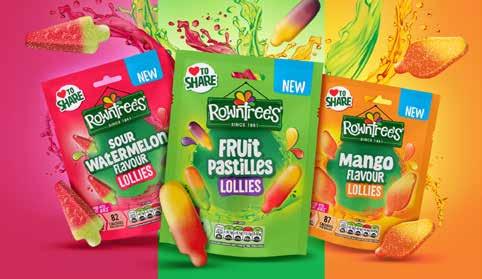
Major innovations from Nestlé Confectionery
Nestlé Confectionery have embraced 2026 with a host of new product innovations, sure to grab consumers’ attention in-store.
NESTLÉ CONFECTIONERY have kickstarted 2026 with a range of innovations across some of their best-known and most-loved brands, including KitKat, Aero and Rowntree’s.
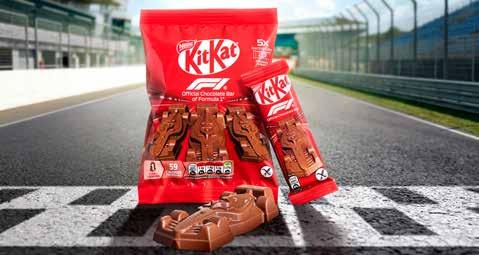
KitKat revs up for 2026 KitKat is proud to be the official chocolate bar of Formula 1. To mark this exciting partnership, the brand is launching a chocolate masterpiece in the shape of a Formula 1 racing car, the first of its kind. Featuring a smooth milk chocolate shell with creamy filling and embedded crispy cereal pieces, the product showcases Nestlé’s world-class R&D expertise and precision manufacturing.
“The R&D Centre in York is a global hub for innovation in confectionery, where pioneering ideas are transformed into reality,” explained Louise Barrett, Head of the Nestlé Research and Development Centre for Confectionery, York, UK. “Just as Formula 1 teams apply meticulous
precision to every design detail, our KitKat teams have worked tirelessly on elevating even the tiniest design elements, drawing on their deep expertise in product development and moulding, to engineer this miniature replica of a Formula 1 car for consumers to enjoy on their next break.”
The KitKat F1 chocolate car is available since January 2026, as the global partnership kicks off in alignment with the F1 calendar.
KitKat will feature at key F1 races in Nestlé’s top markets during the 2026 season. The partnership goes beyond trackside visibility, delivering immersive fan experiences through social media engagement, exclusive merchandise, in-store activations, prize promotions, and innovative, limited-edition products. KitKat will also appear with targeted ads during the Netflix series, Drive to Survive, giving fans unique ways to engage with a sport that’s rapidly gaining traction among
younger generations.
“Crafted in the iconic shape of a Formula 1 car and inspired by the thrill of both Formula 1 and the KitKat break, this treat has been made for fans who crave excitement both on and off the track,” noted Scott Coles, Managing Director for Nestlé Confectionery in the UK and Ireland. “We want to bring exhilarating F1 breaks to everyone. KitKat's always been about those feel-good breaks and now, much like those crucial pit stops during any F1 race, we want KitKat fans to hit that pause button, making it even easier to disconnect and re-charge.
“Combining product innovation with strong consumer engagement is what sets KitKat apart from the competition and we can’t wait to share what’s next for the UK & Ireland in 2026.”
The KitKat Formula 1 chocolate car is available in single (29g) and multi-pack (5x11g).
Cookie dough joins the KitKat family
It’s a cookie dough take over! KitKat is launching its new cookie dough flavour range, now available across some of consumers’ favourite KitKat products. This delicious twist combines the iconic KitKat crispy wafer with the rich, comforting taste of cookie dough, creating the ultimate sweet treat.
The new KitKat cookie dough flavour range includes:
• KitKat 4 Finger Cookie Dough Flavour (available in single and multipack formats)
KitKat 2 Finger Cookie Dough Flavour (available in multipack format)
KitKat Cookie Dough Flavour Sharing Bar
KitKat takes poll position this spring with launch of a new F1 chocolate car and a global Formula 1 partnership.
KitKat’s new cookie dough flavour range combines the iconic KitKat crispy wafer with the rich, comforting taste of cookie dough, creating the ultimate sweet treat.
Whether your shoppers are looking for a coffee break companion or a shareable treat, the new KitKat cookie dough flavour range has something for everyone.
“We’re thrilled to bring this exciting new flavour to our fans,” said Maria McKenna, Marketing Manager at Nestlé Ireland. “Cookie dough is a much-loved taste and combining it with KitKat’s signature crunch makes for a loaded experience."
The KitKat cookie dough flavour range is available now in selected stores. The full range will be available nationwide from April.
KitKat is one of Nestlé’s flagship brands. Celebrating its 90th birthday last year and enjoyed in more than 80 countries, KitKat was invented in York in 1935 as 'Rowntree's Chocolate Crisp', the name 'KitKat' was adopted a couple of years later. The brand has gone on to become a worldwide phenomenon, with its ‘Have a Break, Have a KitKat’ message, championing the importance of taking a moment to pause.
Aero Caramel Flavour Bubbles
Brand new Aero Caramel flavour bubbles have been floating their way onto shop shelves across Ireland.
The new treat from Nestlé Confectionery combines smooth caramel flavour bubbles in a milk chocolate and caramel flavour shell. The Aero Caramel flavour bubbles are perfect for sharing moments between friends and family.
Talking about the launch, Maria McKenna, said: “We’re so pleased to be expanding our much-loved Aero Bubbles range with a flavour we know Aero fans adore. Aero Caramel flavour bubbles bring together our signature bubbly texture with a smooth caramel flavour, offering a bubbly smooth treat that’s perfect for sharing. It’s a great
New Aero Caramel flavour bubbles combine smooth caramel flavour bubbles in a milk chocolate and caramel flavour shell, perfect for sharing moments between friends and family.
way to kick off the year, and we can’t wait for chocolate fans to enjoy this delicious new addition to the Aero family.”
Aero Caramel flavour bubbles join Aero Bubbles Peppermint in the range, alongside the wider Aero portfolio.
Rowntree’s Lollies – ice inspired!
Store owners don’t need a freezer for the new Rowntree’s Lollies range, inspired by Rowntree’s Ice Lollies. These fruity flavoured sweets are bringing a burst of summer all year round.
The range includes three delicious flavours, each made with real fruit juice: Fruit Pastilles Lollies, Sour Watermelon Flavour Lollies and Mango Flavour Lollies.
This exciting new range allows fans to enjoy the beloved flavours of Rowntree’s Ice Lollies no matter the weather, perfect for sharing on any occasion.
“We’re thrilled to bring the bold, fruity flavours of our iconic ice lollies into a new sweet format,” explained Maria McKenna. “This launch means fans can enjoy the taste they love, whatever the season, in a fun and shareable way. It’s all about giving people more of what they enjoy, vibrant flavours and real fruit juice.”
Packaged in a 130g sharing bag, Rowntree’s Lollies are bringing the refreshing experience of Rowntree’s Ice Lollies into a convenient, on-the-go sweet treat that’s ideal for sharing.
This is not the first time Rowntree’s has re-imagined one of its much-loved brands. Last year Rowntree’s released Jelly Tots Tangy, a sour twist on the classic Jelly Tots.
The Rowntree’s Lollies range is not suitable for vegetarians or those following a Halal diet.
Rowntree’s Lollies bring the refreshing experience of Rowntree’s Ice Lollies into a convenient, on-the-go sweet treat that’s ideal for sharing.
the
Grow with Aldi
Grow with Aldi winners announced
Three Irish food producers have achieved nationwide recognition, having been crowned winners of Grow with Aldi 2025, with products now on shelves nationwide.
ALDI Ireland have announced the 2025 winners of the Grow with Aldi programme, with three Irish producers from Cavan, Dublin, and Tyrone currently with their products available in 166 Aldi stores nationwide since January 8.
The announcement came as Aldi opened applications for the 2026 programme, inviting innovative Irish food producers to apply for the chance to bring their products to shelves across the country.
The 2025 winners were chosen following a nationwide call-out that saw emerging food and drinks producers from all over the Ireland apply to take part. In September, 30 finalists were shortlisted and saw their products go on sale in Aldi stores nationwide as part of a twoweek Specialbuys promotion, with these three winners coming out on top as high performers and fan favourites.
The Grow with Aldi 2025 winners are: Chip Shop Curry Sausages from Barry John Sausages, Co. Cavan; Peanut Butter Cups, Hazelnut Clusters, and Chocolate Covered Almonds from Supernature Snacks, Co. Dublin; and Caramelised Biscuit Energy Balls, Hazelnut Chocolate Energy Balls, and Pistachio Crispy Energy Balls, from Oatco Superfuel, Co. Tyrone.
About the winners
Barry John Sausages is a family-run business based in Lurganboy, Co. Cavan, specialising in artisanal sausages made using Bord Bia Certified pork. Their winning Chip Shop Curry Sausages deliver bold, nostalgic flavour with quality craftsmanship, making them a firm favourite for hearty family meals.
are (l-r): Cassie Stokes, Grow with Aldi Brand Ambassador; Laura Murphy, Oatco Superfuel; Barry Crowe, Barry Johns Sausages; Noele McEvoy, Supernature Snacks; and Rachael O’Connor, Buying Director, Aldi Ireland.
Supernature Snacks is a Dublin-based business that creates delicious chocolate snacks made with carefully selected natural ingredients. Their winning range includes Peanut Butter Cups, Hazelnut Clusters and Chocolate Covered Almonds, all crafted without processed sugars or artificial additives. Rich, indulgent and better-for-you, they offer a feel-good treat without compromising taste.
Oatco Superfuel is a Co. Tyrone-based business producing a range of oat-based energy balls made with wholesome ingredients. Crafted using oats, dates and natural flavours, the winning range includes Caramelised Biscuit, Hazelnut Chocolate and Pistachio Crispy Energy Balls. Packed with flavour and goodness, they’re the perfect on-the-go snack for busy days or a post-workout boost.
All three winners now have their products available in 166 Aldi stores nationwide, allowing shoppers to discover the finest Irish artisan food at unbeatable prices.
Pictured
Laura Murphy, Oatco Superfuel
A tremendous opportunity
Speaking about the win, Barry Crowe of Barry John Sausages said: “We are absolutely delighted to be named one of this year’s Grow with Aldi winners. As a family-run business, this opportunity means so much to us and represents a huge milestone in our journey. Seeing our Chip Shop Curry Sausages land on shelves nationwide is incredibly exciting, and we’re very grateful to Aldi and the Grow team for their support throughout the process. We can’t wait for customers across Ireland to be able to access our sausages in Aldi stores!”
Noele McEvoy of Supernature Snacks said: “We’re thrilled to be chosen as one of the Grow with Aldi 2025 winners.
The programme has been an amazing platform for our business and having the chance to bring our delicious treats to a national audience is a huge achievement for us. We’re incredibly thankful to Aldi for believing in our products and supporting small Irish producers, and we hope Aldi shoppers love our snacks as much as we do.”
Laura Murphy of Oatco Superfuel said: “Being selected as a Grow with Aldi winner is a huge vote of confidence for our business. Oatco was created to deliver great-tasting energy using simple, wholesome ingredients, and having the opportunity to bring that to shoppers nationwide is incredibly rewarding. We are so excited to see our energy balls land in stores across the country.”
Exceptional talent and ambition
The programme once again highlighted the exceptional talent and ambition of Irish food and drink producers. From family-run businesses to innovative emerging brands, this year’s winners showcase the quality and creativity found right across the island of Ireland.
Speaking about the announcement, Rachael O’Connor, Buying Director at Aldi Ireland, said: “We are delighted to announce this year’s Grow with Aldi winners, showing just how much talent and innovation exists across Ireland. Seeing their products make it to shelves nationwide is what the programme is all about, and now we’re encouraging the next wave of Irish producers to take that leap and apply for 2026.”
For more information on the Grow with Aldi programme, visit: www.growwithaldi.ie
Aldi Ireland launch new brand platform
ALDI Ireland recently announced the launch of their new brand platform, ‘Aldi. It’s Not Complicated.’ marking a significant strategic refocus for the retailer. Amidst a retail landscape defined by increasing complexity, Aldi are hitting the reset button to remind Irish consumers that the best value doesn’t need to be complicated.
Aldi’s new campaign – developed in partnership with renowned brand agency Pablo - directly addresses consumer fatigue by stripping away the hoops, returning instead to the core promise of straightforward, great food at low prices for everyone.
As part of the campaign launch, Aldi revealed a new flagship television advert that parodies the mental gymnastics that often define the modern grocery shopping experience. The advert highlights the hidden costs to everyday items such as a simple tin of tomatoes, driven by unnecessary complications, baffling presentation and needless packaging. The wider ‘Aldi. It’s Not Complicated.’ campaign also rolled out across radio, out-ofhome, and digital channels nationwide from January 19.
Niall O’Connor, Country Managing Director at Aldi Ireland.
“The Aldi model has always been simple: great quality food at the lowest possible prices,” said Niall O’Connor, Country Managing Director at Aldi Ireland. “We have always been a customer champion, committed to delivering for our customers every single day. Of course, the market we operate in has changed. Retail has become louder, more complicated, and increasingly cluttered. Our response is not to add to that complexity, but to strip it away. That’s why we’re launching our new brand and marketing campaign – ‘Aldi. It’s Not Complicated.’”
Noele McEvoy, Supernature Snacks.
Barry Crowe, Barry Johns Sausages.
Agri-Food Regulator launches second survey
The Agri-Food Regulator recently carried out its second annual survey of agri-food suppliers, which will guide their work for the year ahead.
THE Irish Agri-Food Regulator (An Rialálaí Agraibhia) recently ran its second annual online survey for food and beverage producers across Ireland, giving them an opportunity to confidentially provide feedback about their experiences of trading with eight specific retailers and wholesalers.
“Hearing from suppliers about their on-the-ground experiences is important as it directly informs our work programme in promoting fairness all across the supply chain,” said Niamh Lenehan, CEO of the Agri-Food Regulator.
Both direct and indirect suppliers of agrifood products to Aldi Ireland, BWG Foods, Dunnes Stores, Lidl Ireland, Marks and
Spencer Ireland, Musgrave Group, Sysco Ireland and Tesco Ireland were invited to complete the survey before February 18 of this year. The Agri-Food Regulator is currently analysing the responses, which are then used to inform the Regulator’s work going forward.
The “lived experience” of suppliers “This is our second supplier survey,” said Niamh Lenehan, who noted that the survey records the “lived experience” of suppliers in dealing with the retail trade: “It is a key annual process to help facilitate suppliers informing the Regulator about their trading experiences over the last 12 months.”
Questions cover suppliers’ experiences
of unfair trading practices (UTPs), their relationships with buyers, and other issues that may impact them. The Agri-Food Regulator is the enforcement authority for the unfair trading regulations that seek to protect smaller suppliers of agri-food products from larger buyers through the prohibition of certain practices.
“This feedback is used in a practical way that benefits food and drink producers of all sizes. The information assists us in respect of awareness campaigns, the conducting of risk-based inspections, and will be used to support the development of buyer guidelines,” explained Niamh Lenehan. “We do, however, appreciate the nature of supplier/buyer relationships and so the survey is anonymous and confidential. Buyers will not know if their supplier completes it.”
Unfair trading practices
Last year’s survey, which gathered feedback on over 940 trading relationships, found a high overall level of supplier satisfaction with how buyers conduct their business, though one in seven respondents reported being subject to an unfair trading practice (UTP).
Requiring the supplier to pay for loss or product deterioration and delayed payments were the two most common issues faced by respondents. However, many suppliers admitted to not raising potential breaches in UTPs with buyers, either due to lack of awareness on their rights, or the wish to maintain long-term relationships.
“Honest and frank feedback from suppliers is crucial,” noted Niamh Lenehan. “Last year’s survey findings have helped to inform our ongoing work programme with respect to awareness campaigns and the conducting of risk-based inspections. The information provided also helps inform the Regulator of good practices on the ground and will be used to support the development of buyer guidelines.”
It is intended that the findings will be published in summer.
Niamh Lenehan, CEO of the Agri-Food Regulator.
Health management
Health & Wellness is no longer niche, but is very much part of the mainstream food market, as more and more consumers seek out healthier, more nutritious and functional foods.
HEALTHY eating is no longer a niche segment within the Irish grocery market; it is a mainstream expectation that is reshaping product ranges, shelf space, and brand strategy. For retailers and FMCG brands operating in Ireland, understanding how consumer definitions of “healthy” are evolving is critical to driving growth and maintaining relevance.
One of the most significant shifts is greater scrutiny of ingredients and nutritional value. Irish shoppers are increasingly label-literate, actively avoiding products perceived as overly processed or high in sugar, salt, and artificial additives. For FMCG manufacturers, this has accelerated reformulation efforts and increased demand for cleanlabel credentials. Retailers, in turn, are responding by expanding better-for-you ranges, highlighting nutritional signposting, and giving greater visibility to products that meet health-conscious criteria.
Protein, fibre, and functional benefits have become key product differentiators across multiple categories, from dairy and snacks to ready meals and beverages. Products positioned around satiety, energy, gut health, or immunity are performing well, particularly when benefits are clearly communicated on-pack. For retailers, this
trend supports clearer navigation in-store - whether through zoning, shelf labelling, or curated health ranges - to help shoppers make faster, more confident decisions.
The continued rise of plant-based and flexitarian eating also has clear implications. While the growth of pure meat alternatives has moderated, demand for plant-forward products, blended proteins, and vegetable-led meals remains strong. Irish consumers increasingly expect plant-based options to deliver on taste, nutrition, and value, not just ethical appeal. Retailers are responding by rationalising ranges, prioritising quality over novelty, and integrating plant-based products into mainstream categories rather than isolating them.
Local sourcing and sustainability are increasingly linked to perceptions of health and trust. Irish provenance, short supply chains, and environmentally responsible production resonate strongly with shoppers and can justify premium pricing when communicated effectively. For FMCG brands, this places emphasis on transparent storytelling and credible sustainability claims. Retailers benefit from showcasing local suppliers and aligning healthy eating strategies with wider ESG commitments.
remains a powerful driver, particularly in urban and commuter locations. Growth in health-led convenience foods, such as fresh ready meals, meal kits, and healthier food-to-go options, presents opportunities for margin and differentiation. Retailers that can combine freshness, nutrition, and speed are well positioned, while brands that support these missions with adaptable formats and portion sizes can also make considerable gains.
The healthy snacking segment continues to outperform many traditional categories. Shoppers are looking for permissible indulgence: snacks that feel satisfying but align with health goals. This creates opportunities for innovation in portion control, natural ingredients, and functional positioning. From a retail perspective, secondary siting and impulse placement of healthier snacks can drive incremental sales.
However, price sensitivity is an ongoing challenge. While interest in healthy products is high, affordability remains a barrier for many households. Promotions, multipacks, and entry-level SKUs play an important role in driving trial and repeat purchase.
Recent research from Holland & Barrett shows that a clear majority of Irish
Convenience
Health & Wellness
adults are prioritising their future health: approximately eight in 10 are taking steps today to support physical and mental wellbeing, with particular focus on brain and gut health, fitness and preventative nutrition.
This shift is reshaping the food, beverage and personal care segments of the FMCG market. Across categories, products that align with health outcomes and lifestyle goals are gaining traction. High-protein, high-fibre, low-sugar options and functional ingredients are no longer niche; they are mainstream expectations among consumers seeking both performance and nutritional benefits from everyday purchases.
Fermented products and probiotic-rich offerings like kombucha and kefir are gaining visibility, tapping into broader global trends around digestive wellness. Technology is now an integrated part of consumer wellness journeys. A large proportion of Irish shoppers use apps or wearable devices to monitor sleep, activity and overall wellbeing — a behaviour that influences dietary choices and brand loyalty.
For FMCG brands, this means opportunities to harness digital platforms for education, personalised recommendations and loyalty programmes that speak to ongoing lifestyle goals rather than one-off purchases.
Success in this space depends on delivering genuine nutritional value, clear communication, and accessible pricing, while aligning with consumer expectations around sustainability and convenience. For both retailers and brands, healthy eating is no longer an add-on strategy, but a core driver of long-term category growth.
Yakult rolls out new look bottles in the UK and Ireland
Yakult has introduced a new easier-torecycle bottle in the UK and Ireland, as part of its ongoing packaging sustainability improvements.
The redesign removes the plastic sleeve from Yakult Balance and Yakult Plus Peach and the red ink from all Yakult Original bottles to create a simplified bottle with a clear debossed Yakult logo. The updated bottle is made from high-density polyethylene (HDPE) - a material widely accepted in existing recycling systems, making it easier to recycle.
Taste and product formulation remain unchanged, and each variant retains its familiar, brightly coloured cap for clear differentiation on shelf and in home.
The update applies across the full range
Yakult has introduced a new easier-torecycle bottle in the UK and Ireland, for Yakult Original, Yakult Balance and Yakult Plus Peach.
– Yakult Original, Yakult Balance, and Yakult Plus Peach - which all contain 20 billion of Yakult’s unique L. casei Shirota bacteria, scientifically proven to reach the gut alive and increase both the lactobacilli and bifidobacteria in the gut.
The range includes Yakult Original, with a hint of lemon and vanilla flavours. Yakult Balance contains 68% less sugar and 38% fewer calories than Original and is rich in vitamin D, to support immunity and muscle and bone health.
Vitamin D contributes to the normal function of the immune system and the maintenance of normal bones and muscle function. Each bottle of Yakult Balance accounts for 30% of the EU reference intake for vitamin D. Enjoy as part of a healthy balanced diet and lifestyle. Recommended consumption: 1 bottle per day.
Yakult Plus brings a juicy peach flavour, is rich in vitamin C to support the immune
Taste and product formulation remain unchanged with the new Yakult design, while each variant retains its familiar, brightly coloured cap for clear differentiation on shelf and in home.
system and help reduce fatigue, and contains fibre that feeds gut bacteria. Vitamin C supports the normal functioning of the immune system and contributes to the reduction of tiredness and fatigue. Each bottle of Yakult Plus accounts for 30% of the EU reference intake for vitamin C; consumers should enjoy as part of a healthy balanced diet and lifestyle.
Alongside the bottle change, the pack designs have a fresh new look to aid standout on shelf and enhance delivery of key product benefits. The outer carton is also widely recycled, made from 100% FSC-certified material, ensuring materials come from responsibly managed forests and other controlled sources.
Yakult was developed over 90 years ago by the Japanese scientist Dr Shirota, who spent many years investigating the benefits of intestinal bacteria. In the 1930s, he selected and cultivated a unique strain of lactic acid bacteria - L. casei Shirota. In 1935, this bacteria was used to create the iconic fermented skimmed milk drink –Yakult.
For more information, please visit yakult.ie
Shredded Wheat’s new Fruit Wheats range Nestlé Cereals are bringing a deliciously fruity twist to high fibre breakfasts with the launch of their new Shredded Wheat Fruit Wheats range nationwide in time for ‘Fibre February’. Shredded Wheat Raisin Wheats, Blueberry Wheats, Apricot Wheats
Shredded Wheat Raisin Wheats, Blueberry Wheats, Apricot Wheats and Red Berry Wheats are bitesize biscuits, made with toasted whole grain wheat and a delicious fruity filling.
and Red Berry Wheats are bitesize biscuits, made with toasted whole grain wheat and a delicious fruity filling. With no added sugar, the new breakfast cereal is high in fibre, low in fat and salt and suitable for vegans.
The full line-up offers shoppers a choice of deliciously fruity, high fibre cereals wrapped in classic wholegrain Shredded Wheat bitesize biscuits.
Shredded Wheat Fruit Wheats brings
Health & Wellness
Shredded Wheat Raisin Wheats, a delicious twist for high fibre breakfasts.
together toasted whole grain wheat for the wholesome simplicity that shoppers love with a deliciously fruity filling that contains no added sugar (only contains naturally occurring sugars).
“Fruit Wheats are an exciting addition to the Shredded Wheat family,” said Jennifer Walsh, Country Manager, Nestlé Cereals. “They are deliciously fruity and high in fibre, landing just when people are looking for easy ways to increase their fibre intake. We’ve kept things simple: wholegrain wheat, no added sugar, a delicious fruit filling in a choice of raisin, blueberry, apricot and red berry: recipes that suits a wide range of diets. We think shoppers are going to love it.”
Oatly launch Matcha Oat Drink
Oatly, the world's original and largest oat drink company, are shaking up the spring drink game with the launch of their latest flavour innovation, the new Matcha Oat Drink, into retail stores across the country. Made for the matchaobsessed and the matcha-curious, Oatly’s Matcha Oat Drink is a new ready-to-drink, frothable product that offers a convenient alternative to the traditional, time consuming, ritual of matcha making – with zero fuss and maximum flavour.
Lidl Ireland commits to new fibre target
LIDL Ireland recently became the first supermarket retailer in the island of Ireland to announce a fibre strategy which aims to achieve an increase in the tonnage of total fibre sold by 20% and to boost the volume of wholegrains sold to 20% of total grains by 2030. The retailer also confirmed a new partnership with registered dietician Orla Walsh as part of their commitment to customers in supporting better health and wellbeing.
Working in partnership with Orla over the last 12 months, the retailer reviewed their full product range and engaged with longstanding local suppliers across the country to develop innovative solutions to increase fibre content within selected ownbrand everyday and essential food items.
Oatly’s Matcha Oat Drink is a new ready-to-drink, frothable product that offers a convenient alternative to the traditional, time consuming, ritual of matcha making.
Pictured at the launch of Lidl Ireland’s landmark fibre commitment are (l-r): Elaine O’Connor, Head of Sustainability at Lidl Ireland & Northern Ireland, and Registered Dietician Orla Walsh.
To date, an initial batch of 30 products have already undergone reformulation aimed at increasing fibre content. In 2026, additional products will be reformulated to increase fibre, with products labelled as ‘High in Fibre’ or ‘Source of Fibre’ where applicable, helping shoppers seeking healthier or more nutritious options to easily access affordable, quality food for improved overall health.
According to the Food Safety Authority of Ireland, around 80% of people in Ireland are fibre deficient, eating just 18 grams of fibre per day on average and falling short of the recommended daily intake of around 25-35 grams of fibre.
“At Lidl, we’re committed to supporting healthy and sustainable diets and setting ambitious targets to ensure our food is good for both people and the planet. By setting an ambitious target to significantly increase fibre content of our products, we’re leading from the front and we’re very proud to be the first Irish retailer to take tangible action,” noted Kevin Duffy, Chief Commercial Officer at Lidl Ireland & Northern Ireland. “Not only does that mean introducing new high-fibre products to our ever-expanding range, but it also means boosting the nutritional value of our existing products and making everyday items healthier, with no compromise on quality or taste.”
For centuries, matcha has been revered, but its journey from ancient ritual to modern sensation is undeniable. Ireland has fallen head over heels for its vibrant green hue and distinctive umami notes. In fact, the 'matcha latte phenomenon' has seen demand skyrocket by a staggering 155% across Ireland between June 2024 and July 2025 alone – a testament to its meteoric rise. This isn't just a trend; it's a lifestyle shift. With iced beverages dominating, and matcha now capturing nearly 5% of all coffee drink sales, up from
just over 2% in 2024, Oatly are stepping in to deliver exactly what Irish consumers are craving: convenience without compromise. Oatly Matcha Oat Drink is an ambient, ready-to-drink carton that bridges the gap between craft and convenience. With its signature matcha colour, Oatly Matcha Oat Drink offers a sweet green tea taste with a hint of vanilla that blends perfectly with Oatly’s smooth and creamy oat base. 100% plant-based, dairy-free, the drink is best served cold over ice but can also be enjoyed warm.
SiSú packs a punch with Katie Taylor
Irish wellness brand
SiSú has partnered with Irish and international boxing superstar Katie Taylor on their new range of Prebiotic Overnight Oats.
KATIE Taylor, Ireland’s Olympic and world boxing champion, has partnered with Irish wellness brand SiSú as the company launch their new Prebiotic Overnight Oats range.
Designed for busy consumers seeking convenient, functional breakfast options, the new range combines Irish gluten-free oats with natural prebiotic ingredients that help promote beneficial gut bacteria and support digestive health. The product also delivers strong commercial appeal for retail and foodservice partners, with a chilled shelf life of up to 45 days, supporting operational efficiency and reduced waste.
The partnership reflects Taylor’s focus on simple, high-quality nutrition to support training and recovery, while positioning SiSú for continued category expansion.
The brand name SiSú, derived from the Finnish word meaning determination and resilience in the face of adversity, mirrors the qualities Taylor is known for. “I am incredibly proud to join SiSú, a homegrown Irish health and wellness business, not just as an ambassador but as a collaborator,” said Katie Taylor. “Throughout my career, I’ve always prioritised wellness and functionality, and that extends to what I eat and drink every day. What makes this partnership such a strong fit is our shared vision. I’m working directly with the team to help develop
the next generation of functional products that make healthy choices easier for people. It’s in my nature to seek the best, and I’ve found that partner in SiSú.”
Founded in Ireland by the McGann family, SiSú has built a reputation for better-for-you functional products that support wellbeing without compromising on taste, earning 12 Great Taste Awards across its portfolio.
“Partnering with Katie is about shared mindset rather than celebrity endorsement,” said Aisling McGann, Chief Operations Officer.
“Katie represents resilience, discipline and authenticity, values that have shaped SiSú from day one. As a young Irish brand, we’re ambitious about where we can go next. Expanding into functional foods is a natural evolution for us, and having Katie working alongside us as we develop future products gives us huge confidence in what we’re building. Most importantly, everything we create has to deliver on taste as well as function because healthy choices only work when people genuinely enjoy them.”
Aisling McGann, Chief Operations Officer, SiSú, and Katie Taylor.
Cautious optimism for food and drink manufacturing
Food Drink Ireland’s 2026 manufacturing report reveals broadly positive sentiment in the sector, but expectations for the months ahead show rising concern. Positive momentum in food and drink manufacturing is tempered by workforce concerns.
FOOD Drink Ireland (FDI), the Ibec group representing the food and drink sector, recently released its Food and Drink Manufacturing Report for 2026. While current sentiment remains broadly positive, the report highlights a growing caution regarding the outlook for the next six months.
Currently, only 7% of manufacturers rate their business as poor, but this figure is expected to double to 14% in the months ahead.
Rising costs a key concern
The report identifies a significant focus on rising operational costs. Wage growth is a primary concern, with 79% expecting costs to increase. Beyond direct wages, the sector is grappling with critical workforcerelated hurdles. The next three major challenges identified by food and drink manufacturers are attracting and retaining a quality workforce (64%), the availability of housing for employees (57%) and the cost of energy (57%).
Despite these pressures, the sector continues to show resilience in longterm growth strategies. Food and drink manufacturers are bucking the wider manufacturing trend by showing small but consistent annual increases in capital investment and R&D activity since 2023. Improving profitability remains the single greatest business priority for 2026 (57%), followed by a greater emphasis on introducing or increasing R&D activity (36%).
The report also tracks the sector’s digital and environmental transitions. While sustainability remains a universal priority (93%), there is a shift toward enhancing and extending existing initiatives (71%) rather than introducing new ones.
Additionally, 57% of businesses plan
Paul Kelly, FDI Director.
to adopt AI initiatives, driven by the need for improved efficiency and productivity, although this remains lower than the wider manufacturing community.
FDI priorities for the EU Presidency “Food and drink manufacturing accounts for half of direct expenditure by the entire manufacturing sector in the Irish economy, spanning payroll, Irish materials, and Irish services,” explains Paul Kelly, FDI Director. “Its extensive regional footprint makes it the heart of the social fabric of rural Ireland. With food and drink exports reaching a record value of €19 billion in 2025, the sector’s performance is directly linked to the health of the national economy.
“As Ireland prepares for the Presidency of the EU, it is critical that policy at both a national and European level supports the sector in addressing its competitiveness challenges, particularly around labour and energy, while safeguarding our export-led growth.”
FDI’s priorities for the Irish Presidency of the EU include: Strengthen the Single Market: ensure
Challenges ahead
THE major challenges facing Food & Drink manufacturers were identified as:
1. Cost of labour (79%)
2. Attracting and retaining a quality workforce (64%)
3. Cost of energy (57%)
4. Availability of housing for employees (57%)
5. Cost of raw materials (43%)
6. Regulatory environment (43%)
7. Cyber security (43%)
8. Irish planning regulations (43%)
9. Transportation and logistics cost (43%)s
10. Trade uncertainties (29%)
11. Availability/access to EU or Government-funded support (29%)
the removal of barriers to trade and the seamless movement of goods across Europe.
• Proactive trade policy: support an outward-looking common trade policy to protect and expand Irish food and drink exports.
• Energy costs and decarbonisation: minimise energy costs for manufacturers and provide robust supports for the transition to carbon neutrality.
• Competitive and fair supply chain: ensure policy frameworks support a fair environment for all participants in the food supply chain.
• Research and development: Provide enhanced support for industry investment in R&D.
Centra report record sales in 2025
The Centra National Conference recently revealed that the retailer enjoyed record sales of €2.2 billion in 2025.
CENTRA have announced plans to invest €27 million in their store network and create more than 500 new jobs nationwide in 2026, as part of their continued expansion and long-term growth strategy.
The investment and expansion programme will support new store openings, the refurbishment of 25 stores and the revamp of a further 40 locations during 2026, strengthening Centra’s presence in communities across the country and enhancing the customer experience, alongside continued investment in digital innovation and the evolution of store design and technology.
The announcement comes as Centra report record sales of €2.2 billion for 2025 at their national conference, representing growth of 4.6% year-on-year. Performance was driven by organic growth, continued expansion of the store network and targeted investment in store upgrades and Centra’s continuous evolution of their fresh food, own-brand and on-the-go offerings.
Evolving the customer offer
“As Ireland’s leading convenience retailer, we are pleased to be investing in the continued growth of store network and the communities we serve,” revealed Luke Hanlon, Centra Managing Director. “In 2026, we will invest €27 million in new and upgraded stores across the country and create over 500 new jobs nationwide. This builds on a strong performance in 2025 and reflects what sets Centra apart, locally owned retailers delivering great service at the heart of communities, supported by a relentless focus on evolving our offer and enhancing the customer experience.
“Looking ahead, our ambition is to grow our store network to 600 locations by 2030, enabling us to have a Centra in every community in Ireland. This reflects our vision for shaping the future of convenience retail in Ireland through innovation, fresh food leadership and investment in our stores and people. This will ensure
we continue delivering a best-in-class convenience experience for customers nationwide.”
Future of convenience
Centra continue to invest in the future of convenience retail by evolving their food and beverage offering. Already over the past year, customers have taken to offerings including the newly introduced high-protein Egg Muffin, which was a standout success, with over one million sold in its first year, while Centra’s deli section experienced 7.4% growth as nearly 10 million chicken fillet rolls were prepared across Ireland in 2025.
Moo’d ice cream also performed strongly, with sales increasing by 15% during the summer months. Frank & Honest coffee continued to lead the market as Ireland’s number one on-the-go coffee brand, with sales growth of 10.9% year-onyear and more than 26 million cups now sold annually, underlining the strength of Centra’s fresh food and food-to-go proposition.
Frank and Honest is growing its onthe-go coffee offering to meet increasing
demand for choice from house or dark roast options to dairy or oat alternatives, hot or cold formats and new brewing styles. Matcha is now also available in selected stores.
Centra continue to expand their range of functional beverages with the introduction of The Happy Pear gut health soda range, alongside continued growth in high-protein, high-fibre and nutrient-dense meal options, such as Clean Cut Meals.
Community impact
In 2025, over €450,000 was raised for the Irish Cancer Society between Centra’s Deposit Return Scheme (DRS) charity partnership and the Big Pink Breakfast campaign and Centra’s support for Hurling for Cancer Research. The DRS initiative, now available across 352 Centra stores nationwide, allows customers to donate their deposit when returning cans and bottles, highlighting the collective impact of customer participation and community action. Centra have been a proud partner of the Irish Cancer Society for 16 years, supporting vital care services and lifesaving cancer research.
Pictured at the Centra National Conference are (l-r): Luke Hanlon, Managing Director, Centra; Cormac Dawson, Director of Sales, Centra; and Richard Tiernan, Centra Council Chair.
Inver open first Fuel Pod in Clonmel
INVER recently announced the opening of their first Inver Fuel Pod in Clonmel, Co. Tipperary, offering motorists and commercial customers a new approach and new location for refuelling.
The Fuel Pod has been developed by Inver as a pay-as-you-go modular fuelling solution for a range of locations. The design of the Fuel Pod reduces the cost of installation and ongoing maintenance, as the system is delivered as a fully integrated unit.
Due to its flexibility, the Fuel Pod also offers new options for Inver’s commercial customers and retailers that may not have had the space or capital for their own onsite refuelling capability. It can also be used for time-limited projects, as it can be dismantled and moved on to the next project site.
“The Inver Fuel Pod enables us to increase fuel supply across Ireland through an innovative, flexible and cost-effective solution that supplements our traditional forecourt offer. It ensures reliable supply
where it’s needed,” said Ben Lenihan, Head of Retail Fuel, Inver Energy. “It is also ideal for haulage, logistics, and construction companies looking to fuel their fleets efficiently in confined or remote locations or simply looking for a solution that doesn’t require major groundwork. Because the system is installed and supported by Inver, companies can rely on a turnkey service that enables them to redeploy the unit across different depots or project locations with confidence.”
Circle K expand partnership with Too Good To Go
CIRCLE K are making it easier than ever to save good food from going to waste, with over 120 stores across Dublin, the east and midlands now live on the Too Good To Go app, the world’s largest marketplace for surplus food. For 2026, Circle K are aiming to have all of their Irish stores on the app by the end of Q1, which will make them one of Too Good To Go’s largest partners in Ireland.
The partnership kicked off with two trial locations in Dublin, and following their success, the initiative scaled to over 120 stores in under five months – a testament to Circle K’s efficiency, innovation, and the seamless integration of Too Good To Go into any partner business.
Circle K offers the €4.99 ‘Deal for Two’ Surprise Bag, available exclusively on the Too Good To Go app. Each Surprise Bag contains two sandwiches and two pastries, giving customers a ready-to-enjoy meal worth around €15 for just €4.99.
“We’re thrilled to see Circle K fully embrace our mission to save good food from going to waste,” noted Machaela O’Leary, Sales Manager at Too Good To Go. “The ‘Deal for Two’ Surprise Bag is a fantastic way to make surplus food accessible, affordable, and enjoyable for everyone, while making a real impact on reducing food waste nationwide."
Gillian McGowran, Director Market Development at Circle K: “Sustainability is a key focus for everyone at Circle K, and our customers want practical solutions that help them reduce food waste in
their everyday lives. By expanding our partnership with Too Good To Go, across all of our locations nationwide, we’re driving more sustainable consumption and helping to reduce food waste across Ireland.”
The Fuel Pod in Clonmel is the 12th Inver
Inver plan to deploy Fuel Pods across multiple sites in 2026.
location in Ireland to supply HVO at the pump and there are plans to deploy Fuel Pods across multiple sites in 2026.
Pictured announcing the expanded partnership are (l-r): Machaela O’Leary, Sales Manager at Too Good To Go, and Gillian McGowran, Director Market Development at Circle K.
Circle K officially open seven new stores
CIRCLE K recently marked the official opening of seven newly rebranded Circle K locations in Airside, Rolestown, Dodder, Kilmore, Balbriggan, and Skerries in Co. Dublin, and Batterstown,
Ciara Foxton, Managing Director of Circle K Ireland, is pictured with Irish international footballer Jamie Finn and Circle K colleagues at the grand opening of the Circle K Airside store in Swords, Co. Dublin.
Co. Meath, following the acquisition of these sites from The Pelco Group.
The transition has been completed with minimal disruption to store operations, ensuring continuity for both employees and customers. Across the seven sites, all 142 existing roles have been retained, reinforcing Circle K’s position as a significant local employer. Each store continues to be managed by its existing store manager and team, while customers will now benefit from Circle K’s expanded convenience offering, alongside the same local service they know and trust.
The official opening was marked at an event at the Airside location by Ciara Foxton, Managing Director of Circle K Ireland, members of the Circle K team, and local Republic of Ireland international footballer Jamie Finn.
“Today’s official opening marks an important milestone for Circle K as we continue to invest in our retail network across Ireland,” noted Ciara Foxton. “Retaining experienced local teams and ensuring a smooth transition for customers have been central to this process, and we are delighted to officially welcome these seven new locations to the Circle K network.”
Applegreen partner with youth mental health charity
APPLEGREEN have appointed Jigsaw, the national charity for youth mental health, as their official charity partner for the next three years (2026–2028), reinforcing the company’s long-standing commitment to supporting communities across Ireland. Applegreen aim to raise at least €1 million in funds for Jigsaw over the next three years and will also work to highlight Jigsaw’s vital work across their store network in Ireland.
In 2025, Jigsaw had the highest ever number of referrals to its services around Ireland, with over 11,000 young people referred for support, an increase of 23% on the previous year, which reflects the youth mental health crisis that exists in Ireland today.
Through the new partnership, Applegreen will support Jigsaw’s work in providing free early intervention mental health services for children and young people aged 12–25 years, helping them cope with challenges such as anxiety, depression, loneliness and isolation.
Huge amounts of customers visit Applegreen stores across Ireland every week and a key fundraising element is the ‘You Buy We Give’ initiative, where every time an instore purchase is made, Applegreen donates 1c to its charitable fund on the customer’s behalf. To launch the partnership, Applegreen doubled this to 2c cent per instore transaction for the month of February.
Applegreen will also support with a heavyweight awareness campaign, as well as organising other fundraising events and activities throughout the partnership.
“Our colleagues made it clear that youth mental health matters deeply to them,” revealed Seamus Stapleton, Applegreen Ireland Managing Director. “Jigsaw’s mission, national reach and commitment to accessible, early support closely align with Applegreen’s focus on community wellbeing. Partnering with Jigsaw allows us to support young people across Ireland in a meaningful and impactful way in local communities. Also, we are delighted that our colleagues working in our sites across Ireland, over 50% of whom are under 25 years of age, may gain access to the range of supports that Jigsaw provides.”
Pictured are (l-r): Rosie Begley, Applegreen Social Impact Manager; Joseph Duffy, CEO, Jigsaw; Seamus Stapleton, Applegreen Managing Director – Ireland; and Mike Mansfield, Jigsaw’s Director of Communications and Fundraising.
Dr Joseph Duffy, Jigsaw CEO, said: “Jigsaw is delighted to partner with Applegreen, as it brings together a shared belief that communities thrive when we look out for one another. This partnership will help us reach more children and young people across Ireland at a time when demand for mental health supports continues to surge. When our young people struggle, our families struggle; and by working together with Applegreen colleagues, suppliers and customers, we can ensure that more families have access to the vital help they need, when it matters most. This partnership is rooted in a shared belief that real change happens when organisations come together with passion and purpose.”
A decade of development
Lidl Ireland recently called on local small to medium food & drink producers to apply for the 10th Lidl Kickstart Supplier Development Programme.
LIDL Ireland are gearing up to give a ‘Kickstart’ to local food and drink producers with the 2026 Lidl Kickstart Supplier Development Programme, designed to support small and medium sized suppliers into the industry.
Now in its tenth year, the Lidl Kickstart Supplier Development Programme, backed by Bord Bia, offers artisan producers a crucial opportunity to enter the highly competitive supermarket retail sector. Successful applicants undergo a bespoke six-month supplier development programme, receiving dedicated business support from Lidl’s in-house experts, and culminating in a promotional listing of Lidl Kickstart supplier products in the retailer’s 234 stores across the island of Ireland.
The six-month Lidl Kickstart Supplier Development Programme provides successful applicants with dedicated business support from Lidl experts, focusing on practical aspects such as production efficiency, product development, packaging, social media guidance, administration support and strategies for successful scaling.
Last year’s intake saw more than 46 artisan products from 25 Irish producers
hit the shelves of Lidl stores across the island of Ireland. Since its launch in 2017, Lidl have invested more than €42 million in supporting over 300 Irish businesses through the Lidl Kickstart Supplier Development Programme. Indeed, many Lidl Kickstart suppliers have also benefited from having their products exported across Lidl’s international network of stores.
Long-term
success
“Lidl's Kickstart Supplier Development programme champions local Irish producers,” stressed Kevin Duffy, Chief Commercial Officer at Lidl Ireland & Northern Ireland. “It's not just about getting products on our shelves; it enables these businesses to grow significantly, offering our customers a fantastic, vibrant selection of innovative new Irish products.
“We are incredibly proud of the programme's long-term success. Over the past 10 years, we’ve seen phenomenal achievements from participants like Fused by Fiona, securing full, permanent listings and becoming everyday fixtures in our stores. What’s more, we’ve leveraged our massive international store network to help products go global, opening up exciting
new markets across the UK, Europe, and the USA,” he added. “As we look to build on this decade of success, we really want to encourage any aspiring food and drink entrepreneurs who are interested in scaling their business to connect with us."
Invaluable opportunity
Commenting on the partnership, Adam Baker, Global Retail Specialist at Bord Bia, said: “Lidl's Kickstart Supplier Development Programme is an invaluable opportunity for any emerging Irish food or drink business. Now in its tenth year, this hugely successful supplier development programme has really gone from strength to strength!
“It's a superb chance for small businesses to get their products in front of a major retailer, with multiple opportunities to upscale your business and potentially sell your product in over 234 stores across the island of Ireland. This programme can help Irish brands prepare for international growth and export potential, aligning with Bord Bia’s mission to champion Irish food, drink, and horticulture on the global stage."
For more information, visit www.lidl.ie/kickstart.
Bold new look for Mayfair
AS we step into 2026, Mayfair enters a new era; modern, confident and built on 26 years of success in Ireland. For 19 consecutive years, Mayfair has been Ireland’s best-selling value cigarette (NielsenIQ ROI Extended Scantrack, RMC SOS, November 30, 2025), and that leadership continues with a refreshed design that reflects its heritage with a forwardthinking style.
Commitment to quality
A modernised logo, a contemporary quality and heritage stamp, and a handwritten brand promise deliver reassurance that Mayfair’s commitment to quality has never wavered.
In a market where value means more than price alone, Mayfair remains the choice for adult consumers seeking genuine value without compromise, and a reliable, proven brand for retailers.
Dependable value
While the trade outer design has evolved, the product itself has remained unchanged. The same hand-picked tobacco and the same familiar taste, giving adult consumers exactly what they expect… consistently great tobacco.
It’s a new year, and a new look, with the same great taste, the same unwavering quality, and the same dependable value - the kind you can trust.
Mayfair, Ireland’s best-selling value cigarette brand for 19 years, has a bold new look for 2026.
NOffLA announce OffLicence of the Year winners
Martin’s off-licence in Fairview, Dublin 3, was announced as the overall winner of the NOffLA OffLicence of the Year Award for 2026. Store owner Declan Martin discusses what the win means for the family business.
THE National Off-Licence Association (NOffLA) has unveiled the winners of their prestigious annual Off-Licence of the Year Awards 2026, marking the 30th anniversary of the Awards. The awards ceremony took place at the Honourable Society of King’s Inns, celebrating excellence across the independent offlicence sector.
NOffLA, founded in 1991, represents independent specialist off-licences throughout Ireland, with the sector representing 5,900 jobs across 26 counties. The Off-Licence of the Year Awards highlight retailers who deliver exceptional service, maintain the highest retail standards, and embody the spirit of community-focused, independent business.
Industry Recognition
“This year’s Awards mark a significant milestone for NOffLA as we celebrate 30 years of recognising excellence in independent off-licence retailing,” noted Cathal McHugh, Chairman of NOffLA, speaking at the awards presentation. “Our members embody the essence of ‘shopping
local’ by combining exceptional service, specialist knowledge, and unique product offerings. These independent retailers are not only masters of their craft but are also central to their communities, driving local employment and championing Irish products. Their commitment to quality
creates a unique shopping experience that larger retailers cannot replicate.”
Independent off-licences continue to operate in an increasingly challenging environment, facing rising costs, complex regulation and one of the highest alcohol excise regimes in Europe, the NOffLA Chair stressed: “Despite this, our members continue to invest in their businesses, their staff and their customers, delivering a quality of service that sets them apart.”
NOffLA Off-Licence of the Year
This year’s competition featured 47 finalists, with the overall award of National Off-
Pictured are Damian Martin, Declan Martin, and Enda Molloy from Martin's Off Licence, NOffLA Off-Licence of the Year 2026.
Licence of the Year 2026 winner announced as Martin’s Off-Licence, Fairview, Dublin 3.
A delighted Declan Martin told Retail News that while Martin’s had won other NOffLA Awards over the years, this is their first time to win the overall award, and himself, his brother Damien and all the staff at the Fairview off-licence are absolutely thrilled with the win. The reaction from their customers both on social media and in-person in the store has been “very positive”, since the announcement, and the Award win stands front-and-centre on Martin's website.
Martin's has been a fixture on Marino Mart in Dublin, looking onto Fairview Park, since 1978, with Declan and Damien’s father Tom started the business.
Being named Off-Licence of the Year after 48 years in business is recognition that the Martins continue to serve their customers’ needs with a top class range of wines, beers and spirits.
“We have revamped the shop over the years,” Declan notes. “But we want to keep the wooden shelves, the nice flooring and lighting, and all the things that have made the shop a success, but at the same time, we want to keep the selection of products on the shelves modern, on-trend and up-todate, so you have to stay in tune with what's happening in the markets and adjust accordingly.”
Martin's are long-time members of NOffLA and Declan has seen a lot of change in the business over the years. “When we joined NOffLA, there would have been a lot of independent off-licences around but there aren’t nearly so many now. Many of them have moved over to symbol groups or moved out of the market altogether,” he recalls. “We've been approached many times over the years but we're happy with our family name over the door and that's the way it's always going to be.”
Declan is quick to point out the benefits of the organisation. “NOffLA is very important for the industry. They're a lobbying group who they do a lot of work behind the scenes that they probably don't get recognised for.
“We are a restricted industry, and while we all want to see responsible drinking for everybody involved, this is our trade, and we try to protect our business as much as we can.”
He believes that the fact that Martin's is family-owned and family-run gives them an advantage that other off-licence chains cannot have. “You know when you walk in those doors, you're going to get myself or Damien in the shop, and a lot of our staff have been with us for a long time too. We employ local staff, and so a lot of our
NOffLA Off-Licence of the Year Awards
customers would know us and our staff and trust us.”
Knowledge and range are very important for any independent off-licence, but Declan believes that what really sets them apart is the level of service customers receive: “It's the extra miles you're prepared to go the whole time just to make sure the customer gets what they want.”
Martin's run very successful wine and beer clubs, whereby customers sign up for a delivery of new drinks every month, with a variety of price points available. “We started those at the beginning of the Covid pandemic, when maybe some people didn't want to be travelling and calling into stores, so they signed up for the different clubs." This has proved so popular that Declan and Damien have ended up buying in new varieties of wine specifically for customers
who are part of their wine club.
To that end, they join forces with some other independent off-licences to import some wines directly from wineries in the south of France, but for the most part, they rely on their suppliers: “We're blessed in Ireland that the wine market has such brilliant suppliers, who do so much research and then bring products to us that we can pick and choose. Together with our suppliers, we'll identify different market trends and we work together to see what's needed or where the gaps are and where you can fill these gaps.”
In terms of market trends, Declan feels that craft beer and gin have plateaued in recent months, while the non-alcoholic market continues to grow at pace, especially when it comes to beer and particularly at this time of year.
Martin's off-licence in Fairview has been a stalwart of the community since opening in 1978.
The team from Martin’s: James Barry, Damian Martin, Declan Martin, and Enda Molloy, with the NOffLA Off-Licence of the Year Award.
NOffLA Off-Licence of the Year Awards
“It peaks early in the year but it is very strong all year round,” he insists. “With nonalcoholic beers especially, the quality is very, very good.”
Declan feels the spirits category has declined in recent months. Sales of smaller sizes, including naggins and half-bottles, continue to do well, but larger bottle sizes for spirits have dropped back, he insists.
“Inflation is huge and wages aren’t really matching it, so people are watching the pennies a little bit, but they have no problem spending at important times of the year, like Christmas, Easter or when they want to treat themselves,” he says. “On a daily basis, though, that kind of up-spend is probably not as strong as it would have been post-Covid.”
That said, Declan points out a remarkable growth in tequila sales, particularly superpremium tequila. “Our biggest selling tequila last year was the most expensive tequila we have in the shop, at around €180 per bottle,” he reveals.
2026 Award Winners
All 47 finalists were awarded certificates of ‘Excellence’ and a Customer Service Award based on their performance. Other awards on the night included:
NOffLA's RTC On-Line Graduate(s) of the Year – Holly Tucker, Kellers Carry Out Nenagh and Sean Cantwell, Gibney's of Malahide
NOffLA's Responsible Retailer of the Year 2026 – O'Donovans Off-Licence Group
19 Crimes' Best First Time Entrant 2026 –Mitchell & Son, The Vaults
El Coto's Customer Service Award of the Year 2026 – Molloys, Clonsilla
Malbado's Food Retailer of the Year 2026 –64 Wine, Glasthule, Co. Dublin
Redbreast's Spirit Specialist of the Year 2026 – Mitchell & Son, Glasthule, Co. Dublin
Guinness' Beer Specialist of the Year 2026 –McHugh's, Kilbarrack
Dona Paula's Wine Specialist of the Year 2026 – Jus De Vine, Portmarnock
Hennessy Cognac's Munster Off-Licence of the Year 2026 – Number 21, Dungarvan, Co. Waterford
Drumshanbo Gun Powder Irish Gin's Connacht/Ulster Off-Licence of the Year 2026 – Dicey’s Off-Licence, Ballyshannon.
Martin's has been revamped a number of times but still retains features like wooden shelving and flooring that help it to stand out.
Mionetto’s Leinster Off-Licence of the Year 2026 – The Wine Centre, Kilkenny.
Alpha Zeta's Dublin Off-Licence of the Year 2026 – Blackrock Cellar, Co. Dublin
NOffLA's National Off-Licence of the Year 2026 – Martin’s Off-Licence, Fairview, Dublin
These winners were recognised for their dedication to quality, innovation, and customer service, setting a benchmark for excellence in the sector. The Off-Licence of the Year Awards 2026 stand as a testament to the resilience, passion, and dedication of Ireland’s off-licence community.
Judging for the Awards involves an examination of over 100 aspects of each entrant’s business. Final awards were allocated following this process.
Unnecessary burdens putting Irish businesses at risk
NOffLA also used the occasion to highlight a number of ongoing policy and regulatory challenges facing the sector. The Association reiterated its call for a reduction in Ireland’s alcohol excise duties, which remain the second highest in Europe. Cathal McHugh urged the Government to reduce alcohol excise duty to help ease the high cost burdens experienced by many independent off-licences in recent years.
“With Minimum Unit Pricing now firmly embedded in the Irish market, these high excise rates can no longer be justified on public health grounds alone,” he insisted. “Reducing excise would provide meaningful relief to independent retailers already under pressure from rising operational costs and would support the long-term
sustainability and competitiveness of community-based businesses.”
NOffLA also emphasised the need for robust regulation of distance and online alcohol sales as part of the forthcoming reform of Ireland’s alcohol licensing laws. While recognising that consumer purchasing habits are changing, NOffLA stressed that online and distance selling must operate on a fair and equivalent regulatory basis to bricks-and-mortar retailers.
The Association has consistently raised concerns that the current framework creates gaps in age verification, delivery safeguards and enforcement, particularly where sellers have no physical retail presence or operate across borders.
“Independent off-licence retailers are subject to strict licensing, inspection and training requirements,” Cathal McHugh said. “It is essential that distance and online alcohol sales are regulated to the same standard, to protect young people, support responsible retailing and ensure a genuine level playing field for all operators.”
NOffLA called on the Government to engage with industry to ensure that forthcoming legislation addresses these enforcement gaps and provides clear, workable rules governing online and distance alcohol sales.
McHugh also noted that while the Association welcomed the postponement of the planned alcohol labelling regulations to 2028, NOffLA continues to support a harmonised EU approach to labelling in order to avoid placing Irish retailers at a competitive disadvantage to their European counterparts.
For more information, visit www.noffla.ie.
Irish drinks exports reach €2 billion
IRISH Drinks exports increased by 2% to €2 billion in 2025, driven by an increase in beer and cream liqueurs, according to the latest figures from Bord Bia. The results were very encouraging, given that overall, the market for Irish drinks was challenging, with difficult trading conditions, persisting inventory issues and slower depletion rates due to a squeeze on consumer spending. Exporters also had to adapt to new trading conditions because of tariffs on goods entering the US, the largest single market for Irish drink exports.
Exports of Irish whiskey, which account for 45% of total drinks export value, declined by 5% to €930 million in 2025. In contrast, Irish cream liqueur exports increased by 10% to €430 million (up 20% since 2023), while Irish beer exports rose by 7% to an estimated €350 million. Spirits-based ready-to-drink (RTD) exports reached €220 million in 2025. Irish cider exports recorded a marginal decline to just over €75 million, while Irish gin exports fell by 14% as markets continued to rationalise the range of brands offered for sale.
“After years of turbulence, from the pandemic to rising costs and renewed US tariffs, Ireland’s drinks industry continues to deliver strong export growth and diversify its markets,” noted Cormac Healy (pictured), Director, Drinks Ireland. “While global uncertainties, cost pressures, and shifting consumer dynamics remain challenging at present, the medium and long term
prospects for the Irish drinks sector are positive, filled with opportunities.
“Investment across the island shows our commitment, but the sector now needs targeted support, especially for new and small businesses, if we are to maintain Ireland’s hard-earned reputation for excellence and innovation. Ensuring competitiveness, fair regulation and progress on key trade priorities will be essential for both sustaining momentum and protecting against further volatility.”
Eoin Ó Catháin, Director of the Irish Whiskey Association (IWA), noted how “the introduction of a 15% tariff on exports to the USA - our biggest market - remains a challenge for our sector, with exports falling 5% in 2025. We hope that 2026 will see renewed efforts to return to the 'zero-for-zero' trading arrangement with the USA, for the benefit of transatlantic trade for both American and Irish Whiskey producers.”
Coca-Cola partners with Northern Ireland football
THE Coca-Cola Company, alongside its strategic bottling partner Coca-Cola HBC Ireland and Northern Ireland, has announced a new soft drinks partnership with the Irish Football Association (Irish FA) and the Northern Ireland Football League (NIFL).
The partnership will bring supporters together to champion both national and domestic teams across Northern Ireland through activations and activities, celebrating the passion for football and the spirit of sport. Coca-Cola will activate the sponsorship across multiple brands within its portfolio, including Coca-Cola Original Taste, Coca-Cola Zero Sugar and Powerade, by making football fans’ favourite soft drinks available on matchdays, along with branding activities, social media content and providing fans with exclusive access to events. Pictured are Amruta Vaidya, Country Manager, Coca-Cola Ireland; Patrick Nelson, Chief Executive, Irish FA; Simon Fitzpatrick, General Manager, Coca-Cola HBC Ireland and Northern Ireland; and Gerard Lawlor, Chief Executive, NI Football League.
Drinks sector is vital to local economies
NEW research from Drinks Ireland reveals a strong continuation of moderate and responsible drinking, alongside clear public recognition of the industry’s important role in supporting local economies.
The research highlights the vital role the drinks industry plays in sustaining rural and regional economies. 73% of drinkers surveyed agree that local breweries and distilleries make a positive contribution to their communities, while 80% say these producers provide important employment
at a local or regional level. 81% consider Irish breweries and distilleries to be important to the national tourism offering.
The report also points to a sustained national movement toward more balanced drinking habits, with 54% consuming less alcohol than they were a year ago, 63% agreeing that there has been a clear movement toward “less but better”, while 74% favour education and awareness as the most effective supports for responsible drinking, rather than more regulation and restriction.
“These findings confirm what we in the industry have been seeing for years, which is a real and measurable shift in how people across Ireland are approaching alcohol,” noted Pat Rigney (pictured), Drinks Ireland Chair and founder of The Shed Distillery in Drumshanbo. “They are valuing moderation and are adopting a ‘less but better’ mindset. People are drinking more consciously and placing greater value on quality, craft and the overall experience, rather than quantity alone.”
An omnichannel perspective for grocery retail
Karim Iskandar, CEO International & Managing Director, Syndigo, looks at the biggest E-commerce trends for 2026, between maximum efficiency and true experience, with an emphasis on the grocery sector.
WHILE grocery retail remains predominantly bricks-and-mortar, digital touchpoints increasingly shape the in-store experience. E-commerce is no longer a separate channel, but an integral part of a broader omnichannel ecosystem, from shelf to screen, from warehouse to checkout.
The following nine trends show what brands and retailers can expect in 2026, and how to best prepare for it.
1. Experience economy: experience becomes the new currency
The digital race is shifting from pure product competition toward holistic product and brand experiences. Customers no longer buy functional benefits alone. They look for brands that spark emotion and deliver individual value, from personalised product worlds to exceptional postpurchase services. In grocery retail, this experience increasingly starts at the shelf and continues digitally via mobile devices, loyalty apps, or QR and 2D codes. For companies, this means delivering content in the right context. Those who connect product data, visual assets, and authentic reviews can create persuasive moments
that stay with customers throughout (and beyond) the entire journey.
2. Agentic commerce: AI as the shopping assistant
Agent-based AI systems are taking over more tasks, including procurement and online shopping, with particularly tangible impact in grocery, driven by automated replenishment, recurring purchases, and AI-supported assortment and pricing decisions. At the same time, agent-based systems are increasingly acting on behalf of consumers, changing the customer journey. Retailers must now “convince” the machines as much as they convince human customers. Only structured, complete, and trustworthy product information will ensure visibility in these AI-driven selections. Data quality and interoperability are becoming strategic success factors in the years ahead.
3. Digital shelf intelligence: visibility through real-time insights
The digital shelf has become the most valuable real estate for consumer attention. With intelligent analytics, companies
Karim Iskandar, CEO International & Managing Director, Syndigo (www.syndigo.com).
can now monitor in real time how their products are displayed, priced, and reviewed online, an approach that for grocery retailers increasingly extends to the physical shelf, combining POS data, availability, promotions, and digital content performance. Insights into content quality, customer ratings, and competitor activity are powerful levers for sales growth. Brands and retailers don’t have to fly blind; with cockpit-like visibility you can continuously optimise product presentation and performance.
E-commerce is no longer a separate channel, but an integral part of a broader omnichannel ecosystem.
4. Social commerce & shoppable content: platforms turn into marketplaces
Social media platforms are evolving into powerful sales channels. Live shopping, shoppable posts, and creator collaborations merge inspiration and transaction in real time, while in grocery, social commerce often translates into recipe-driven content, local storytelling, and brand-building rather than immediate checkout. For brands and retailers, success depends on telling stories that connect inspiration with purchase, often translating social engagement into instore visits, basket building, or app-based shopping rather than immediate checkout. Consistent data and visual assets, combined with automated workflows, are essential. Only those who maintain a coherent brand image across channels, and use automated data flows to streamline the purchase process, can scale social commerce efficiently.
5. Online-to-Offline (O2O) integration: building bridges between worlds
Consumers move effortlessly between digital and physical touchpoints. Whether through click-and-collect, return-to-store, or QR codes on shelves, the line between online and offline continues to blur. This is particularly true in grocery retail, where frequent, time-sensitive purchases, often driven by immediate meal needs, make convenience and availability decisive. Retailers mastering O2O models can enhance customer convenience while reducing operational costs. Such seamless integration, however, requires consistent product data across all channels, regardless of whether the customer is browsing online or buying in-store.
6. 2D Codes: added value on the package
Another emerging innovation is the 2D code, a next-generation QR code set to replace the traditional barcode in retail by 2027. The advantage: it can hold a wide range of product information, displayed
dynamically depending on the scanner or device. For grocery retailers, this opens up new possibilities at the shelf, from dynamic pricing and promotions at checkout to rich product, allergen, and sustainability information for shoppers. This can mean that retailers automatically pull pricing data at checkout, while consumers scanning the same code can access rich product details from brand sources. Once again, data quality becomes critical; it determines the true informational value of the code.
Consumers continue to care deeply about where products come from and what impact their purchases have. As information on supply chains, materials, ingredients, and carbon footprints is moving from “nice-to-have” to nonnegotiable, transparency around origin, sourcing, and production conditions becomes particularly influential in grocery retail at the point of sale. Credibility is key to earning customer trust, but transparency requires reliable data. Companies that structure and display sustainability information clearly can both meet regulatory demands and satisfy growing consumer expectations.
Grocery retailers need to connect instore operations, digital touchpoints, and supply chain data into one coherent omnichannel strategy.
8. Payment experience: invisible transactions
By 2026, payment will become an almost invisible part of the customer journey. Every hurdle in the payment process poses a risk of conversion loss, a reality that in grocery applies equally to self-checkout, mobile payment, and click-and-collect scenarios. Security and simplicity are equally vital. The key lies in seamlessly embedding payment into the overall buying process, complete with accurate pricing, availability, and delivery data. Customers expect the transition from inspiration to transaction to be effortless and error-free.
About the author
KARIM Iskandar heads Syndigo’s international business and is responsible for go-to-market strategy, sales, finance, operations, product strategy, and partnerships. Prior to joining Syndigo, he worked at JRNI, a customer engagement platform that drives shoppers to in-store experiences via digital channels, where he launched the company’s business in both Europe and the USA. Karim thrives in hyper-growth environments. He began his career at Forrester Research during its expansion from $30 million to $170 million in revenue, as part of the European launch team, and ultimately served as UK General Manager. Since then, he has held leadership roles across various software, technology, and research companies, helping them launch, scale, and grow rapidly on an international level.
9. Q-Commerce: speed as the new differentiator
Quick commerce is evolving from an urban niche into a new standard, with expectations shifting toward same-day or even one-hour delivery, particularly in grocery retail, where speed is closely linked to freshness, local availability, and efficient store-based fulfillment models. This raises the bar for logistics, partner networks, and inventory management, and once again depends on reliable data. Speed must not come at the expense of quality. Companies must ensure that even at maximum velocity, all content and product data remain consistent across every touchpoint; otherwise, the experience suffers.
Conclusion: a strong foundation matters E-commerce in 2026 will be more datadriven than ever, but not just for efficiency’s sake. Clean, structured data is the foundation for true customer centricity and meaningful product experiences.
For grocery retailers, this means connecting in-store operations, digital touchpoints, and supply chain data into one coherent omnichannel strategy. The most successful brands and retailers will be those that embrace these trends holistically. Whether AI or sustainability, rapid delivery or radical transparency, efficiency or experience, success depends on one thing above all: reliable, intelligent product communication.
A NEW report from ECR Retail Loss focuses on brand new innovations to combat shoplifting, via a design competition which challenged students to rethink how to cut retail theft without locking products away, frustrating shoppers or adding to packaging waste.
Mirrors that talk back, shelves that create the illusion of human presence, self-destructing security tags and a perfume tester that dispenses presprayed paper were some of the ideas revealed in the Designs Against Shoplifting report, published by ECR Retail Loss in collaboration with Central St Martins.
Working alongside retailers and the Design Against Crime Research Lab, the students developed a series of practical and sustainable concepts to deploy in stores.
The winning concepts explore how design itself can subtly reshape behaviour, raising perceived risk, reducing opportunity and disrupting theft techniques at the point they occur.
Innovations to combat shoplifting
A design competition organised by ECR Retail Loss showcased brand new innovations, created specifically to combat shoplifting without locking products away from view.
The winning design innovations
The winning concepts include:
‘Reflect Points’, which place mirrors and culturally resonant messaging next to hightheft cosmetic products. Aimed particularly at teenage shoppers, the design replaces warnings and surveillance with humour and self-recognition, prompting a pause at the moment of temptation rather than confrontation after the fact.
‘Uncanny’ embeds soft lighting and ambient sound into shelving to create the illusion that someone else is nearby. The design seeks to unsettle opportunistic theft in otherwise unstaffed aisles, while remaining almost invisible to genuine shoppers.
‘The Lift(er)-Proof Tag’ reimagines the humble security label as both a deterrent and a sustainability intervention. Made from perforated, paper-based materials, the tag is designed to tear and fragment if tampered with, making quick removal difficult and visibly damaging the product for resale.
‘Essence’ tackles one of beauty retail’s most persistent loss points: perfume testers. Instead of leaving vulnerable bottles on display, the design dispenses fragrance onto pre-sprayed paper strips, allowing customers to sample scents freely without direct access to the product.
Other designs rethink access rather than blocking it outright, such as ‘The Only Exit’, which physically limits products to one-ata-time removal through a narrow outlet, slowing grab-and-run theft and making behaviour more visible.
‘PickAware’ is a discreet, sensor-based anti-theft device that promotes selfawareness and ethical behaviour in retail spaces, particularly wine aisles. When a shopper lifts a bottle, the system detects the movement and plays a convivial sound such as the clink of glasses. This lighthearted audio cue signals awareness of the action without accusation, subtly reminding customers that their behaviour is visible.
More provocative ideas, such as ‘Boobytrap’ and ‘Torture’, explore how ‘Reflect Points’ place mirrors
packaging and tags might actively undermine the resale value of stolen goods, shifting theft from a low-risk, high-reward activity into one where tampering visibly destroys the product.
Security, sustainability and experience designed together
What unites the projects is a shared philosophy that security should be designed in, not bolted on.
Many of the concepts deliberately reuse existing infrastructure, reduce material intensity or give security components multiple functions, reflecting the operational and environmental constraints retailers now face.
With EU sustainability targets and brand commitments increasingly limiting the use of excess packaging and single-use plastics, the report argues that retailers can no longer afford security solutions that work against climate goals or customer experience.
The student concepts provide tangible design inspiration for retailers looking to find new approaches to loss prevention that are lighter, smarter and more human.
‘PickAware’ is a discreet, sensor-based anti-theft device; when a shopper lifts a bottle, the system detects the movement and plays a convivial sound such as the clink of glasses.
This is the second design challenge ECR Retail Loss ran with the university, with the students working directly with retailers on their ideas. When it was run previously, one of the students was recruited straight from the course to one of the retailer’s development teams, showing that while these are currently only concepts, they are not created in a vacuum and can inspire real world developments on the shop floor.
“Over the years, the design ideas from students at UAL has surprised, delighted and inspired our retailers, so we are super excited to see how retailers and brand owners will respond to this latest set of anti-theft designs,” summed up Colin Peacock, Group Strategy Coordinator, ECR Retail Loss.
Retail’s repeatability problem: why returns fraud continues to escalate
RETURNS fraud and abuse are not one-off mistakes but repeatable behaviours, according to major new research from ECR Retail Loss, entitled ‘Playbooks for tackling returns fraud and abuse’.
The study of 6,000 shoppers across Europe, the US, Canada and Australia, finds that seven in 10 offenders say they would “definitely” or “maybe” do it again after a successful fraudulent return.
These findings suggest that once fraudulent or abusive behaviour is rewarded, it is likely to escalate rather than disappear.
However, the research also shows that this is not a mass customer problem, with 83% of shoppers reporting no involvement in problematic returns at all. A small minority of repeat offenders account for a disproportionate share of losses.
The challenge for retailers, the study argues, is not to clamp down on everyone, but to stop systems unintentionally reinforcing bad behaviour among a few.
“What this research makes very clear is that returns fraud and abuse are not random or evenly spread. Most customers do the right thing, most of the time,” says John Fonteijn, Chair of ECR Retail Loss. “If retailers treat all returns the same, they either penalise good customers or fail to stop the problem where it actually sits.”
The new report by Professor Michael Townsley, Director of the Social Analytics Lab at Griffith University, South East Queensland, is one of the largest studies ever conducted into returns fraud and abuse.
Alongside surveys of 6,000 shoppers, Prof. Townsley analysed online refunding communities, and conducted collaborative workshops with leading retailers.
The report introduces the “repeatability problem”: the tendency for returns fraud and abuse to persist and escalate when customers encounter little friction, challenge or consequence.
Nearly 90% of respondents who admitted to problematic returns said they experienced no difficulty completing the process, effectively reinforcing the behaviour.
The research also draws a clear distinction between returns abuse (opportunistic behaviours such as wardrobing or excessive bracketing) and returns fraud, which involves deliberate deception such as false “did not arrive” claims, switch-item fraud or fake tracking IDs.
Prof. Townsley warns that treating these behaviours as the same leads to blunt interventions that either alienate honest customers or fail to deter high-risk offenders.
Alongside mapping how different forms of returns fraud and abuse actually occur, the report identifies three critical enablers for effective prevention:
1. Aligned KPIs, so customer service and risk are managed together;
2. Joined-up data, linking purchase, delivery, return and refund;
3. Empowered frontline teams, protected from manipulation and supported to apply consistent controls.
Building on this foundation, the research sets out practical playbooks for tackling opportunistic abuse and organised fraud. These are supported by realworld examples and detailed crime scripts showing where interventions are most effective.
For more information, visit ecrloss.com
Artificial Intelligence
Retailers lag behind on AI adoption
A new global study identifies critical gaps in AI adoption among retailers, including a definite disconnect between the importance of AI adoption for retailers and steps towards real-world implementation.
A NEW study by Tata Consultancy Services (TCS), a global leader in IT services, consulting, and business solutions operating a service delivery centre in Ireland, reveals that while AI ranks among the top enablers for retailers, executives have made limited progress in deploying AI at scale.
The TCS Global Retail Outlook 2026, released at the NRF Big Show 2026 in New York, reveals only 24% of retailers currently use AI for autonomous decisionmaking, while 85% have not yet begun implementing, or are even planning for, multi-agent AI systems. What’s more, to address the most strategic objectives, such as driving profitable growth and improving customer experience and loyalty, retail executives consider AI initiatives their most or second-most preferred tactic. And the more financially successful a retailer is, the more AI initiatives they have in the pipeline. Based on responses from more than 800 senior retail executives across 18 countries, including Ireland, and five major subsectors, the study highlights the operational pressures currently shaping retail transformation.
Executives identify the ability to sense market shifts in real time and utilising
adaptive AI-powered decision-making among their top priorities for the next one to two years, a signal that retailers increasingly see digital intelligence and agility as inseparable.
Despite AI’s strategic importance, deployment remains concentrated around customer-facing applications. 51% of retailers are only just now making basic AI technologies, such as chatbots and virtual assistants, their top AI initiative, suggesting that adoption of advanced intelligence capabilities in retail remains at a superficial level. However, the study suggests these more basic tools will not transform retail economics without deeper integration across merchandising, supply chain, and pricing.
Pervasive intelligence embedded across the value chain
“Retailers today are united in their belief that AI will define the next era of competitiveness, yet most have only scratched the surface of its potential,” explained Krishnan Ramanujan, President of TCS’s Consumer Business Group. “Our Global Retail Outlook reveals that the true opportunity lies in shifting from isolated experiments to pervasive intelligence
embedded across the value chain. The retailers that master this transition will become more perceptive enterprises, capable of learning, adapting, and responding in real time. TCS is prepared to address the gaps in the value chain and is building AI-led solutions to unlock the next phase of growth for retailers.”
The study also reveals that following cost optimisation, AI-powered technologies are ranked among the top essential capabilities for 2026, with the ability to sense market changes and competitor moves in real time and adaptive AI-powered decision-making capabilities ranked #2 and #3 (out of 10) for retailers. In terms of retailers’ biggest hurdles leading into 2026, the workforce skills gap was near the top of challenges, second only to financial pressures.
Retail sector at a crossroads
“The retail sector is at a defining crossroads,” noted Cheenttan Voraa, Global Head of Retail Consulting.
“Leaders recognise AI as an essential technology to stay ahead in the next era of competitiveness, yet most organisations remain early in their journey toward true enterprise intelligence. Advancing from siloed use cases to connected, perceptive
A futuristic clothing store where the clothes have been replaced with digital projections.
systems will require bold investments, not only in technology but in AI-savvy talent, along with improved processes and operating models. TCS is committed to partnering with retailers and empowering them to lead in the AI era.”
The study indicates that retailers see AI-powered decision-making, faster time-to-market for products and services, and automated workflows among the capabilities that will most significantly impact performance in the near term, surpassing conventional business analytics and intelligence tools. Executives also express strong urgency around cybersecurity and privacy and in the data still locked inside loyalty programmes, where fewer than half say they’re able to use such information to demonstrate marketing ROI, set pricing, or conduct product and assortment planning.
Factors for success
Key findings
Key results from the survey include:
• 51% of retailers cite chatbots and virtual assistants as their leading AI initiative today, suggesting most retailers have not yet begun to use AI outside of isolated customer engagement platforms.
• 85% of retailers are not yet using multi-agent AI systems; nearly half (48%) have no plans to do so.
Only 33% of retailers see digital literacy programmes for employees as a way to achieve organisational transformation and talent upskilling.
• Just 37% of retailers use loyalty insights to inform channel or store experience strategies, a missed opportunity to gain enterprise intelligence.
Only 45% apply loyalty insights to
WHAT retail leaders rank as critical success factors for their organisation in 2026:
1. Cost reduction through process optimisation.
2. Ability to sense market changes and competitor moves in real time.
4. Faster time-to-market for new products and services.
5. Automated workflows that reduce manual intervention.
6. AI agents that can orchestrate complex, multi-step processes.
7. Responsive supply chains.
8. Systems that can infer customer needs.
9. Technology that captures documented procedures and employee expertise.
10. Traditional business intelligence and reporting tools.
Artificial
About TCS
TATA Consultancy Services (TCS) are digital transformation and technology partners of choice for industry-leading organisations worldwide. Since their inception in 1968, TCS have upheld the highest standards of innovation, engineering excellence and customer service. Rooted in the heritage of the Tata Group, TCS support clients from strategic advisory to platform modernisation, data unification, and the deployment of next-generation retail solutions powered by GenAI.
pricing and promotions.
• 39% of retailers are deploying AIpowered demand sensing for supply chain resiliency.
• 42% plan to implement AI-driven dynamic pricing to improve margin performance, but this needs to be handled with care to avoid “surveillance pricing” becoming a brand problem.
• The top essential capabilities for 2026 for retailers include: 1. cost reduction through optimisation; 2. having the ability to sense market changes and competitor moves in real time; and 3. adaptive AI-powered decision-making capabilities.
These findings show that in a market rapidly shifting toward intelligent, experience-led retail, a paradigm shift is needed. TCS’s vision for this future, known as “perceptive retail,” integrates AI, machine learning, and multi-agent systems to help retailers interpret signals, adapt operations in real time, and orchestrate decisions across the value chain.
TCS Global Retail Outlook Report
What’s New
HUNKY DORYS LAUNCH GOLDEN RUGBY BALL PROMOTION
HUNKY Dorys, Ireland’s number one crinkle cut Crisp brand, are turning snacking into a game with an exciting new on-pack promotion. 25 lucky fans can win €500 each by finding a Golden Rugby Ball inside participating packs. The promotion is available across share bags and multipacks for a limited time only in retailers nationwide. Full terms and conditions and instructions on how to claim prizes can be found on-pack. Hunky Dorys: made for big crunch moments.
SUBWAY UNVEIL CHICKEN FILLET SUB
WITH research commissioned by Subway revealing that Irish consumers purchase an average of 3.36 Chicken Fillet Rolls a month, resulting in over 200 million Chicken Fillet Rolls being consumed in the Republic of Ireland yearly, the nation’s love affair with the Chicken Fillet Roll is undeniable! And now, Subway are officially entering into Chicken Fillet Roll territory, as they announced the launch of their brandnew, and fully customisable, Chicken Fillet Sub, available in stores nationwide. Irish comedian and social media star Garron Noone was on hand to launch the new taste sensation.
CLONAKILTY REVEAL NEW SPICE TRAIL PUDDINGS
IRELAND’S favourite pudding makers, Clonakilty, are bringing a world of flavour to Irish brunch plates with the launch of their brand new Clonakilty Spice Trail Pudding range. Inspired by distinctive global flavours and spices, and crafted with generations of pudding making expertise, the new range puts a fresh twist on an Irish classic. The new range includes the rich and warming Clonakilty Picante Pudding, inspired by Spain, and the hot and tangy Clonakilty Jalapeño Pudding, inspired by Mexico. “As a nation, we are known for our love of travel and exploring new cuisines. Now that same sense of adventure can be found at your kitchen table with our new Clonakilty Spice Trail puddings.” says Colette Twomey, MD and owner of Clonakilty Food Co.
MR. TAYTO IS BACK WITH TAYTO HEARTS
MR. Tayto is a big believer in sharing the love and the little gestures that show you care about someone. Following previous success, Mr. Tayto is back for the third year running this Valentine’s Day with Tayto Hearts, the spicy, heart-shaped snack that’s guaranteed to win over the one you love. To celebrate the return of Tayto Hearts, Mr. Tayto is giving away the chance to win a dazzling diamond ring worth €5,000 with an exciting on-pack promotion. Because nothing says love like a bold snack… and a bit of sparkle. Tayto Hearts are available for a limited time only in a 95g pack.
GLUTEN-FREE COLIN THE CATERPILLAR CAKE FROM M&S
M&S have introduced Made Without Wheat Gluten Free Colin the Caterpillar Cake, following numerous requests from customers on social media. After spending years perfecting the recipe without compromising on M&S quality and flavour, the Gluten Free Colin cake has all the same, loveable features including his super chocolatey sponge, velvety buttercream and of course his face and boots, just made without wheat.
At the IGBF we assist the families of over 300 of your colleagues every month. These f amilies are more unfortuna te than ourselv es and without y our support such assistanc e would not be possible... But we still need your help to
To Donate: ww.igbf. l For Assistance: ww.igbf.ie/help/our_help.html For Queries: info@igbf.ie continue making the difference.
Confusion around workplace waste can lead to contamination and missed recycling opportunities.