
Research Australia is the national peak body for health and medical research and innovation We use our unique convening power to position health and medical research and innovation as a driver of a healthy population and contributor to a healthy economy. This report was delivered during a time of key national reforms, and we acknowledge the importance of this report in contributing to these reforms and being responsive to an evolving landscape.
Research Australia acknowledges the Traditional Custodians of the land upon which the health and medical research and innovation workforce undertake their roles. We pay our respects to Aboriginal and Torres Strait Islander Elders - past and presentand acknowledge the vital role that Aboriginal and Torres Strait Islander peoples and their cultures play in contributing to the health of their Country, their communities, as well as to Australia – as the first scientists, healers, innovators and story tellers of this land. We acknowledge the importance of Connection to Country for health and wellbeing
Cite: Research Australia Policy Discussion Paper: Workforce – Looking Ahead: Shaping the Research Workforce for Tomorrow Policy Discussion Paper 2026.
The drafting of this report was completed by Dr Talia Avrahamzon and Max Chester. Contributing staff members included Nadia Levin. The development of the report was guided by a steering committee, with contributions from Dr Chantal Donovan, Professor Timothy Carey, Professor Natalie Munro, Dr Su-Chen Lim, Associate Professor Tomoko Sugiura and Dr Rebecca Keough. Guiding feedback was also supplied by CQ University, Deakin University and Monash University
Open Sans


This policy discussion paper aims to contribute to the national dialogue on the urgent need to strengthen the health and medical research and innovation workforce across all disciplines, sectors, and career stages It identifies current gaps, outlines emerging priorities, and proposes actionable strategies to ensure Australia attracts, supports, and retains a diverse and skilled research workforce capable of meeting the current and future health challenges
The paper also aims to contribute to the development of a National Health and Medical Research Workforce Plan as part of the National Health and Medical Research Strategy (National Strategy). Research Australia has continuously led the call within the sector for a National Strategy since 2021 and has long advocated for the need to develop a National Health and Medical Research Workforce Plan as a critical enabler to strengthen the entire health and medical research and innovation ecosystem
This paper provides an overview of the current policy, funding, data and systems landscape relating to the health and medical research and innovation workforce It also identifies key priority areas for enhancing and shaping the research workforce needed for Australia’s healthy and prosperous present and future. This paper was originally developed to guide discussions at Research Australia’s University Roundtable, held at Flinders University, in October 2025¹. The final version of this paper incorporates the feedback received at the roundtable and further input from Research Australia’s members.
A steering committee comprised of Research Australia’s university members guided the original development of this paper². We acknowledge their contributions and guidance. We also acknowledge all entities committed to strengthening and empowering the health and medical research and innovation workforce, acknowledging that it underpins the entire ecosystem, ensuring that research and evidence translates into improved healthcare and patient outcomes, stronger public health systems and a more productive and dynamic economy.
Priority Area 1:
Addressing job insecurity
Priority Area 2:
Defining and measuring the research workforce
Develop and implement the National Health and Medical Research Workforce Plan as an immediate priority.
Remove the 2021 legislative cap that limits Medical Research Future Fund expenditure to increase the amount of funding available from $650m in-line with the Future Fund Board of Guardian’s determinations ($1.1 billion in 2026-27).
Commit to ongoing annual funding increases for the National Health and Medical Research Council At a minimum, increases must be in line with the CPI-rate and also include the projected circa. 2% increases outlined in the Budget forward estimates.
Define a pathway to fund the full costs of research, including infrastructure, in a rational and sustainable way.
Prioritise the alignment of public investment in health and medical research and innovation alongside measures to increase investment through co-funding with states and territories, industry and philanthropy to strengthen available funding for researcher salaries and positions.
Increase the accessibility and availability of grants which run for 5 years or longer to grow the number of longer-term and permanent research positions.
Identify models to contribute to institutional accountability for job security and strengthen employment protections and workforce standards across the health and medical research and innovation sector.
Include measures in future workforce planning initiatives to improve Psychosocial Safety Climate and embed a supportive culture across the sector and access to resources which prevent secondary stress and vicarious trauma within the research profession.
Government to co-develop a comprehensive and widely acknowledged definition of the health and medical research and innovation workforce
Government fund and establish a comprehensive annual Health and Medical Research and Innovation Workforce Data Collection.
Priority Area 2 (continued)
Embed a novel approach to workforce planning initiatives, drawing on established frameworks while acknowledging the unique position of the research and innovation workforce. Create mechanisms for sharing of evidence-based workforce activities and strategies across the sector.
Develop the National Health and Medical Research Workforce Plan with a clearly articulated Theory of Change and rigorous monitoring and evaluation framework.
Priority Area 3: Taking a pipeline approach to capacity and capability development
Embed a pipeline approach to workforce planning from primary and secondary education to entry and progression within the workforce to empower innovators, critical thinkers, and problemsolvers from the earliest stages of learning.
Align K–12 curriculum reform with tertiary education pathways (including university and Vocational Education and Training) and national workforce strategies to ensure the skills required for future research and innovation are developed in a connected way. Evidence-led student engagement initiatives should be scaled, focussing on empowering high school students to undertake education, and later career pathways, in STEM subjects, particularly those under-represented in health and medical research and STEM fields throughout the career pipeline through to leadership positions.
Incentivise honours participation or other entry models, particularly in critical disciplines, by exploring targeted funding for research training and recognition of research capability within graduate employment pathways.
Jobs and Skills Australia to lead data collection to track postgraduate career trajectories after PhD training
Strengthen VET pathways into the health and medical research and innovation sector, especially in supporting developing Australia’s advanced manufacturing capabilities
Develop a template for VET-industry collaborations to be scaled once proven as a successful model.
Expand training pathways across the ecosystem through new dedicated funding and investment to enable researchers to upskill in existing and emerging fields.
Priority Area 3 (continued)
Priority Area 4: Addressing systemic barriers for priority workforce cohorts
Develop condition-neutral capacity-building frameworks to strengthen research skills that are transferable across multiple health domains.
Encourage and incentivise researcher movement across disciplines and sector boundaries.
Scale translational fellowships, industry PhDs, and postdoctoral placements and identify ambitious numerical targets for doing so based on previous programs, such as the REDI program. Reforms to internal HR policies should be used to promote circular mobility and embed flexible employment models such as secondments and cross-sector placements, while maintaining career progression and employment security.
Invest in a bi-annual National Early-Mid Career Researcher Survey, building on an existing survey undertaken by Melbourne University and Monash University, with Research Australia as auspice. Develop novel co-investment funding approaches to support more permanent research positions for EMCRs
Commit to a policy framework that recognises the significance of supporting EMCRs for the sustainability of the research workforce, drawing on models like the UK's Research Development Concordat.
Create centrally funded national programs for EMCRs to increase professional development, training, internships, sponsored opportunities and visibility, alongside mentorship opportunities at low or no cost, subsidised travel costs and living expenses, and/or provide stipends for longer courses.
Utilise policy developments such as the SERD to better define and increase awareness of pathways between academia and industry. Increase the availability of clinical practice and research training programs across Australia, with a specific focus on priority populations.
Partnerships between universities and health service providers should be developed to grow the number of clinician researchers, alongside research programs for health practitioners without HDR qualifications.
Priority Area 4 (continued)
Priority Area 5: Developing research-active workplaces through organisational change
Fund the research component of the salaries of clinicianresearchers under the National Health Reform Agreement in health settings covered by the Agreement
Progress a new streamlined funding scheme to support clinicianresearchers with two streams targeted at existing clinicianresearchers with a PhD and clinicians commencing or undertaking a PhD.
Invest in the implementation of a Consumer Recognition Framework.
Consider developing dedicated funding streams or fellowships for lived experience researchers within MRFF and NHMRC schemes. Explore scaling dual-career models and mentorship and training programs that pair lived experience researchers with academic and clinical mentors.
Link university research block funding to governance, transparency and accountability measures to ensure that public investment in health and medical research delivers sustainable, high-quality outcomes.
Build research-active workplaces by:
Integrating research into strategic and workforce planning, recognising it as a key competency and performance objective.
Developing governance frameworks which align with established ethical principles, guidelines for responsible research conduct, and relevant legislation.
Align performance frameworks and funding models with research participation.
Incentivise research through career progression pathways and recognition frameworks – particularly for clinician-researchers and allied health professionals (or hybrid roles) to strengthen retention and foster a culture of innovation.
Develop and apply a robust research assessment framework into workforce design for health and medical research to enable circular mobility.
Priority Area 6: Addressing discrimination and embedding diversity, equity, and inclusion in workforce development
Establish a 'mandatory', sector-wide Institutional Accreditation Scheme linked to public funding (NHMRC/MRFF/ARC).
Embed a better understanding of the unique factors contributing to underrepresentation across all priority populations in workforce planning initiatives.
Prioritise high-quality data collection which captures priority populations within the health and medical research and innovation workforce.
Embed diversity, equity, and inclusion evaluation and monitoring frameworks to strengthen accountability MRFF and NHMRC should expedite a systems-wide approach to increasing representation of priority populations across grant applications, funding allocations, and chief investigator appointments.
Leverage other workforce and employment strategies, such as gender responsive budgeting to address the gender disparity within the sector, especially in research leadership positions. Develop specific and targeted actions relating to equitable career development that also extend across all priority populations. Conduct a scan of existing programs to address underrepresentation across priority populations to inform areas of scalability and current gaps, acknowledging that some may require specific funding to progress
Address systemic intersectional discrimination within the workforce through attitudinal and behavioural changes, supported by systemic and institutional monitoring and evaluation, and capacity building approaches to support changes to address bias and deficit discourses.
Priority Area 7: Valuing global research talent and collaboration
Nurture and expand international collaboration and research networks, including by pursuing opportunities such as Australia’s association to Horizon Europe.
Strategically align existing grant fellowship programs to support health and medical research-specific talent attraction.
Attract international research talent in tandem with approaches to increase and prioritise domestic capacity and capability development, including supports for the repatriation of Australian researchers after international experience

A strong and sustainable health and medical research and innovation workforce underpins the capacity of Australia’s health and innovation system to generate, translate, and apply evidence that improves health outcomes, supports innovation, and drives economic growth However, workforce challenges – including fragmented career pathways, inequitable access to opportunities, limited workforce data, and insufficient alignment between research skills and system needs – threaten the current and long-term effectiveness and competitiveness of the sector.
In a recent global study of 38 OECD countries including Australia, a third of science researchers leave academia within 5 years, raising concerns about the long-term retention of scientific talent³. It is also important to note that higher education providers and other organisations across Australia are currently facing extreme financial challenges which is resulting in budget cuts and staff redundancies The personal and operational impacts of this extends out to our national research capacity and capabilities, likely to lead to reduced discovery, innovation and translation, as well as missed opportunities for international investment and collaboration Nationally, the findings of the National Health and Medical Research Workforce Audit⁴ and subsequent Draft National Health and Medical Research Strategy has highlighted the unique strengths of the sector, as well as several focus areas as key policy reforms. Research Australia remains deeply concerned with recent findings around job security and career pathways, the gender and seniority gap, underrepresentation of researchers from priority groups including in regional and rural hubs, and researcher retention. This, combined with the insights and perspectives of our steering committee and broader membership across the sector, highlight the need for immediate action, investment and prioritisation – embodied within the current national reform agenda.
Firstly, we need a shared understanding of what we mean by the health and medical research and innovation workforce. This will be defined in the following sections, which will then inform the remainder of the policy discussion paper and 7 priority areas for reform.
Health and medical research and innovation
While there are a range of definitions of research across key bodies undertaking and funding research activity⁵ ⁹ , Research Australia defines health and medical research as research aimed at understanding and improving the health and wellbeing of people It draws on our knowledge of the human body, the world around us, including diverse ways of interpreting the world, to find ways to identify, understand, prevent, and cure disease; reduce injury and
improve the delivery of health services; and help us to lead healthier lives. As such, health and medical research extends across the life-course and embraces an incredibly wide range of diverse disciplines, including Aboriginal and Torres Strait Islander knowledge systems and methodologies, spanning from medicine, the sciences, mathematics, engineering, economics, allied health, epidemiology, health equity, social sciences, policy and politics, and health services research to name a few.
Innovation within this context refers to the process of translating novel ideas, discoveries, or approaches into practical solutions that improve health outcomes, enhance medical practices, or streamline health care delivery¹⁰. This can involve the development of new treatments, medical devices, technologies, diagnostics, or models of care. Discovery research plays an essential and underpinning role in generating the fundamental scientific knowledge that enables the development of innovations.
Where does health and medical research and innovation take place?
Health and medical research and innovation takes place in a broad range of settings across Australia, defined collectively as research-active workplaces. Research-active workplaces are organisations or settings in which research and innovation are embedded as core functions of organisational values, governance, practice, policy, and / or service delivery In the health and medical context, research-active workplaces may include hospitals, health services, universities, MRIs, industry partners, and government agencies where research is integrated into routine operations, driving continual improvement, innovation, and evidence-based decision-making.
Currently, there is not a universally agreed definition of the health and medical research and innovation workforce Research Australia, for the purpose of this paper, defines the health and medical research and innovation workforce as professionals who directly and actively contribute to generating, translating, maintaining and applying knowledge to better understand, prevent, and respond to health challenges, and to improve health outcomes. This workforce encompasses individuals from diverse disciplines and roles across the research and innovation continuum and sector.
Alongside Research Australia’s definition of the workforce, the 2024 Health and Medical Research (HMR) Workforce Audit put forward the following definitions to better support the understanding of the HMR workforce, segmenting the sector into three. The Audit is the most recent attempt to quantify the workforce, which found there were a total of 39,690 active researchers nationwide¹¹. While Research Australia questions the methodology of the Audit in its capacity to arrive at this definitive figure, noting that it does not capture the true diversity of research-roles and pathways and limits its inclusion of non-research innovation roles, the Audit is a useful source to help interpret the broad range of roles across the ecosystem.
Traditional researchers (65% of total active researchers): those who perform research or support research in organisations like universities and MRIs.
Non-traditional researchers (33% of total active researchers¹²): private sector workers (e g pharmaceuticals, MedTech, biotech); those in clinical roles who produce or support research (e.g. medical doctors, nurses, midwives, allied health workers, etc.)
Inactive researchers: those who have previously worked as traditional or nontraditional researchers but now work in other roles across the economy
Instead of providing a ‘precise, agreed definition for the workforce and its segments’, the 2024 Audit highlights how previous research into the health and medical research workforce has prioritised and focused on different segments to answer different questions, which has in turn yielded a range of definitions and numerical estimates for distinctive parts of the pipeline rather than a homogenous and widely agreed definition. Research Australia agrees that developing a comprehensive definition of the people and organisations that form the Australian health and medical research and innovation workforce, including further attention to the diverse and significant disciplines, should be prioritised, as cited in the Audit¹³ and Draft National Health and Medical Research Strategy¹⁴
In addition to adopting a broad and inclusive definition of the health and medical research and innovation workforce, Research Australia has also identified priority workforce cohorts or profiles that are currently underrepresented and/or underinvested in, or emerging Increasing Australia’s pool of active researchers and safeguarding the future diversity of the workforce requires targeted investment, pathways, and an inclusive and aligned workforce strategy. We define priority workforces to be:
Early and mid-career academics or researchers (EMCA/Rs): are typically defined as researchers who have held a PhD or equivalent qualification for a period less than or equal to five years at the time of their application (early career researchers), and those with between 5-15 years¹⁵ of experience since the award of a PhD or equivalent qualification (mid-career researchers)¹⁶. The HMR Workforce Audit identifies that 24% of HMR researchers had graduated in the last 4 years, and that 21% of researchers were 59 years post-graduation, making EMCA/Rs the largest group within the workforce¹⁷. Clinician researchers: are trained health practitioners across fields such as medicine, nursing, midwifery, or allied health, who also engage in research. They play a critical role in bridging the gap between scientific knowledge and healthcare delivery, ensuring research addresses real-world problems, and accelerating the adoption of new evidence into practice.
Discipline-based researchers: Further clarity is needed on which fields or disciplines across the health and medical research and innovation workforce have gaps now and for the future.
Priority populations as researchers: According to the Australian Institute of Health and Welfare (AIHW), population groups that experience social inequalities and disadvantage resulting in health inequity are considered priority populations. These include Aboriginal and Torres Strait Islander people, Culturally and Linguistically Diverse (CALD) people, LGBTIQA+ people, people with disability, people with mental health conditions, people in low socioeconomic groups and people living in regional, rural, remote, and very remote (RRRvR) areas¹⁸ Strengthening the representation of priority populations within the health and medical research and innovation workforce requires addressing the systemic barriers that have led to marginalisation, alongside deliberate actions to enhance access, build capacity, and create equitable opportunities for participation and advancement. A diverse workforce brings together a wider range of perspectives, experiences, and cultural understandings, which enrich the research process and ensure that research priorities and outcomes are more equitable and relevant across communities.
Given the broad and multidisciplinary nature of the Australian health and medical research and innovation workforce, the current policy landscape is inherently complex and siloed The workforce is influenced by a range of strategies and agreements at the Commonwealth and State and Territory level, as well as organisations and institutions undertaking research, translation, and commercialisation.
The draft National Health and Medical Research Strategy, while yet to be finalised, is a critical policy framework which will help inform future workforce development across its 10year horizon and beyond The Strategy lists Workforce as 1 of 4 key enabling initiatives and outlines the development of an Australian Health and Medical Research Workforce Plan to provide a framework for attracting, retaining, and developing a diverse health and medical research and translation workforce. While at the time of writing, it is scant on specific and measurable actions, the Plan explores clarifying workforce definitions and data, enhancing diversity and job security through long-term funding mechanisms, fostering science literacy, and enabling career pathways and training.
Furthermore, the Medical Research Future Fund (MRFF) and National Health and Medical Research Council (NHMRC), as the two main funding bodies for health and medical research and innovation, also significantly influence the development of the workforce through their policy and funding decisions.
For example, the Australian Medical Research and Innovation Strategy 2021–2026, underpinning the MRFF, states as part of its Strategic Objectives a commitment to deliver:
A skilled and sustainable health and medical research workforce with expertise in research translation, innovation, and commercialisation.
The MRFF since its inception in 2015 has played a central role in bolstering the health and medical and innovation workforce through its annual $650 million funding allocation, however, the lack of reliable and cohesive workforce data makes it challenging to measure the alignment between the Strategic Objectives and outcomes in relation to its impact on the workforce. Regardless of the limited MRFF impact data on the workforce, the MRFF has the potential to make further contributions to health and medical research and innovation (and in turn the workforce) if it were to release all available funds in-line with the Future Fund Board of Guardian’s determinations ($1 1 billion in 2026-27) Research Australia has long advocated for the release of these funds to ensure long-term sustainability and smarter investment across our sector.
At a jurisdictional level, recent and emerging workforce strategies demonstrate a shared policy focus on attracting and retaining research talent, strengthening workforce capability in research translation and innovation, and embedding research activity within healthcare delivery The WA Health and Medical Research Strategy 2023-2033, NSW Health Research and Innovation Strategy 2025-2030 and Victorian Health and Medical Research Strategy: 2022-2032 are all specific to health and medical research and recognise workforce as a critical enabler of a thriving and high-performing system, with common priorities including sustainable career pathways – particularly for clinician researchers, enhancing cross-sector collaboration, and fostering inclusion and diversity within the research ecosystem. While the scope and maturity of these and other jurisdictional strategies vary, they collectively reflect a shift toward a more integrated and coordinated approach to workforce development which should be embodied through the upcoming Australian Health and Medical Research Workforce Plan.
Applying a broader lens, at the Commonwealth-level there is a range of existing national workforce strategies within the wider health system which are also highly relevant. Key initiatives include: the National Medical Workforce Strategy 2021-2031; Nurse Practitioner Workforce Plan, Mental Health Workforce Strategy 2022-2032; National Aboriginal and Torres Strait Islander Health Workforce Strategic Framework and Implementation Plan 2021–2031; and National Allied Health Workforce Strategy - currently in development. The World Health Organisation’s Global Strategy on Human Resources for Health: Workforce 2030 adds an international perspective, outlining a global vision for strengthening the health workforce including education, equitable distribution, skills mix, planning, and investment.
While not exhaustive, these frameworks give a contextual understanding of the broad range of national and international policy frameworks which intersect when personnel involved in the health system workforce are also research active.
In addition to the range of workforce policy frameworks at a national and jurisdictional level and within the policy silo of health, cross-portfolio reform agendas also frequently impact the workforce For example, the Universities Accord under the education portfolio, outlines key recommendations for improving workforce capability and capacity within higher education, which, given that the majority of health and medical research and innovation takes place in higher education institutes, is highly pertinent yet not all-inclusive of the entire health and medical research and innovation ecosystem. The Strategic Examination of R&D (SERD) within the industry portfolio, while yet to be finalised, is a further example of a crossportfolio policy reform agenda significantly implicating the sector. Through 6 issues papers, the SERD outlined proposals to promote mobility across sectors and build workforce capabilities that match Australia’s future national research, development, and innovation priorities.
Furthermore, the National Agreement of Closing the Gap sets out both national and jurisdictional accountability to improving health outcomes of Aboriginal and Torres Strait Islander peoples. Investing in genuine partnerships, the community-controlled sector and health workforce, alongside addressing embedded institutional racism and building a more capable, inclusive, culturally safe, and responsive health sector forms, as well as shared access to data for local decision making are key aspects of all governments’ accountabilities. Similarly, Australia’s Disability Strategy, endorsed by all Australian governments aims to improve the health outcomes for people with disability, and includes a dedicated focus on workforce capability and attitudes and enabling workforces. As such any health and medical research and innovation workforce strategy needs to account for both these cross-cutting population-focussed nationally agreed reform agendas. Discipline-based strategies, such as ARCS Australia’s Strengthening Australia’s Clinical Trials Workforce White Paper, also provides tangible recommendations and pathways for specific workforce segments (in this case clinical trials) and should be considered within a broader sector-wide focus on workforce development.
With responsibility and governance for the workforce spread across multiple sectors and layers, workforce policy and planning is complex, and risks continued siloing and inconsistency. The advent of the National Health and Medical Research Workforce Plan provides a timely opportunity to bring greater coherence and coordination to Australia’s fragmented workforce policy landscape, as demonstrated through our policy landscape scan. By aligning existing Commonwealth and jurisdictional strategies under a unitary framework, the Plan can create strategic direction to workforce planning, capability development, and system integration with a distinct focus on health and medical research and innovation.

Funding for health and medical research and innovation and by extension the workforce underpinning it, is derived from multiple sources and streams of public, private, and philanthropic investment. Around $10.44 billion is spent on health and medical research per year¹⁹, representing a significant ongoing investment in the ecosystem
The largest funder is the federal government, primarily the NHMRC through the Medical Research Endowment Account (MREA) and the MRFF’s annual funding allocations of $1.04 billion and $650 million respectively Both funding bodies provide competitive grants that support researchers, projects, and clinical trials. Within the MRFF, there are specific funding streams under the $125 million per annum Researchers Theme to support the research workforce’s capacity and capabilities, specifically the Clinician Researchers, Early to MidCareer Researchers, and Frontier Health and Medical Research streams. Further funding to support workforce capacity and capability development is also provided by other Commonwealth Government departments and agencies, including through the National Collaborative Research Infrastructure Strategy (NCRIS), Research Block Grants and Research Training Program (RTP) administered by the Department of Education, and wider funding from the Australian Research Council and CSIRO. Other notable sources of funding to sustain the health and medical research and innovation workforce include:
State and Territory Governments: invest in research institutes, hospitals, and health innovation initiatives where researchers are employed and undertake research
Governments also procure and fund research projects.
Universities and Research Institutes: universities contribute by funding salaries, laboratories, and research programs, supported by student fees and general revenue.
Independent MRIs also raise funds to support the workforce
Philanthropy and Not-For-Profits: charitable organisations, foundations, and not-forprofits provide significant research fellowships and project grants.
Industry and Private Healthcare: pharmaceutical, biotech, and medtech companies invest directly in research collaborations and clinical trials, as well as commercialisation and translation pathways and roles, creating workforce opportunities.
International funding: through bilateral agreements, international collaborations networks, foreign government investment, global consortia and foreign research agencies.
The 2024 Workforce Audit found that Federal Government grants are the most common source of funding for traditional researchers, with the top three most common grants being NHMRC (68%), MRFF (42%), and ARC (12%) funding streams²⁰. Institutional and private sector funding are the most common type of funding for non-traditional researchers²¹
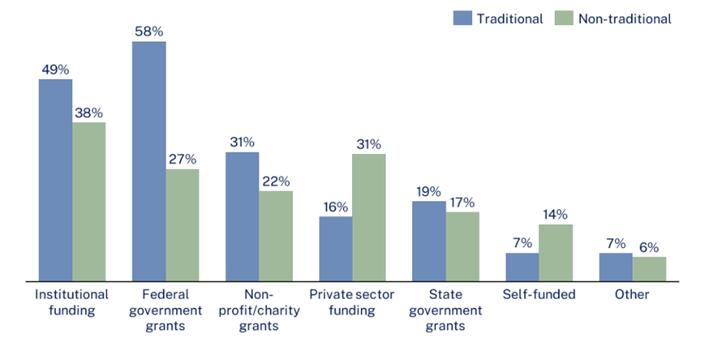
Source: Primary source of funding for a research position (Proportion of current researchers) in Department of Health and Aged Care – Australian Health and Medical Research Workforce Audit 2024.
Despite significant investment in health and medical research and innovation, the current funding landscape relies heavily on competitive, short-term grant funding, leaving many researchers’ careers dependent on their ability to secure grants such as those from the NHMRC, MRFF and ARC. Even when funding is obtained, it often does not cover the full cost of research, with indirect costs such as infrastructure, equipment and administrative support frequently unfunded As competition for limited funding increases and grant success rates decline (including a recent success rate of 8.1% for the 2025 NHMRC Ideas Grants)²², researchers face growing pressure and workloads to secure funding while balancing additional responsibilities, placing considerable and unsustainable strain on the research workforce.
The health and medical research and innovation workforce spans a complex and interconnected landscape. Workforce policy and funding intersect across education, employment, health, and innovation systems, creating both challenges and opportunities for coordination. Recognising this complexity is essential to building a sustainable, future-ready workforce
To address current challenges across the health and medical research and innovation workforce, the following priorities were identified as critical Priority Area 1 (Addressing job insecurity) is intentionally positioned first and must take immediate priority for the future
sustainability of the sector. Priority Area’s 2-7 are for illustrative purposes and not indicative of an ordering system.
Priority Area 1: Addressing job insecurity
Priority Area 2: Defining and measuring the research workforce
Priority Area 3: Taking a pipeline approach to capacity and capability development
Priority Area 4: Addressing systemic barriers for priority workforce cohorts
Priority Area 5: Developing research-active workplaces through organisational change
Priority Area 6: Addressing discrimination and embedding diversity, equity, and inclusion in workforce development
Priority Area 7: Valuing global research talent and collaboration
Although Australia invests in health and medical research at multiple levels, the nature of this investment has produced an unintended consequence: a research workforce experiencing chronic job insecurity due to competition for short-term, project-based funding. The average success rate for MRFF grant applications, for example, is 23%²³, with recent success rates for some NHMRC schemes much lower, reflecting the highly competitive nature of available funding streams. In addition, even when grant funding is secured, the project-based nature of research grants manifests in high levels of short-term employment contracts while indirectly discouraging long-term planning, limiting career development opportunities and contributing to attrition.
Previous Research Australia analysis highlighted 54% of researchers at universities and 74% of researchers at MRIs are employed on a contract basis (most commonly on a 12-month contract term)²⁴. This is supported by findings in the Universities Accord, which highlighted a considerable rise in casual staff employment in the higher education sector since 1995²⁵. Looking beyond universities and MRIs, the Australian Health and Medical Research Workforce Audit also found that 31% of researchers based in the private sector or in clinical roles (defined collectively as the non-traditional sector) are on fixed-term or casual contracts²⁶ Across sectors, the rates of contract employment are far higher than the national average across the wider economy²⁷. Funding stability remains a critical issue for the health and medical research and innovation workforce, with persistent short-term and fragmented funding models undermining job security, career progression, and the sector’s capacity to retain and develop skilled researchers
Even when researchers secure competitive grant funding, the amount awarded rarely covers the full costs of conducting research, and the rising costs of conducting research is creating
further pressures in this area. The indirect costs of research can include equipment, infrastructure, administrative staff, and access to resources. For every $1 in research income, it is estimated that $1.20 in indirect cost funding is required to support it²⁸. Without funding models that meet the full cost of research, both individuals and institutions will continue to bear unsustainable burdens that ultimately impede Australia’s research capability and innovation potential. We need to define a pathway to fund the full costs of research, including infrastructure, in a sustainable way
Reform is needed to strengthen workforce stability, guided by the development and implementation of the National Health and Medical Research Workforce Plan as an immediate priority. Government should establish a pathway to fund the full cost of research, increase NHMRC funding in line with CPI, release the full available MRFF funds, and better align public investment in health and medical research and innovation. Greater coinvestment from states and territories, industry and philanthropy will also be important to support researcher salaries and positions.
Increasing the availability of longer-term grants and permanent research positions will also help address workforce insecurity. Proposals such as allocating a minimum share of grants with durations of five years or more could improve job stability and reduce reliance on short-term contracts. These reforms should be accompanied by stronger workforce standards, institutional accountability for employment practices In addition, there needs to be measures put in place to improve Psychosocial Safety Climate across the university sector, and enable researcher wellbeing, including measures to address the ‘widespread and deep crisis of mental health among university staff’ demonstrated in the 2025 results of the Australian University Census on Staff Wellbeing²⁹. Additional measures should also address the growing awareness of secondary stress and vicarious trauma in sensitive research areas³⁰ through enabling networks such as The Australian Advocacy for Safe and Ethical Research in Sensitive ConTexts Network (AASERT).
Develop and implement the National Health and Medical Research Workforce Plan as an immediate priority.
Remove the 2021 legislative cap that limits Medical Research Future Fund expenditure to increase the amount of funding available from $650m in-line with the Future Fund Board of Guardian’s determinations ($1.1 billion in 2026-27).
Commit to ongoing annual funding increases for the National Health and Medical Research Council At a minimum, increases must be in line with the CPI-rate and also include the projected circa. 2% increases outlined in the Budget forward estimates. Define a pathway to fund the full costs of research, including infrastructure, in a rational and sustainable way.
Prioritise the alignment of public investment in health and medical research and innovation alongside measures to increase investment through co-funding with states and territories, industry and philanthropy to strengthen available funding for researcher salaries and positions
Increase the accessibility and availability of grants which run for 5 years or longer to grow the number of longer-term and permanent research positions.
Identify models to contribute to institutional accountability for job security and strengthen employment protections and workforce standards across the health and medical research and innovation sector.
Include measures in future workforce planning initiatives to improve Psychosocial Safety Climate and embed a supportive culture across the sector and access to resources which prevent secondary stress and vicarious trauma within the research profession.
Current definitions and data on the health and medical research workforce is fragmented and incomplete, limiting our ability to accurately assess capacity, skills gaps, and future needs. Much of the information is spread across institutions, disciplines, and funding bodies, with little consistency in definitions or reporting, as outlined above. The 2024 Health and Medical Research Workforce Audit provides an important snapshot, but it is constrained by gaps in coverage and an inability to capture the full diversity of research roles and pathways, as well as emerging fields such as the clinician-researcher workforce. As a result, policymakers and funders lack the comprehensive, longitudinal evidence needed to guide workforce planning and investment As the audit states, “without consistent, regular, and comprehensive data collection by responsible government agencies or peak bodies, any analysis will be limited to available disparate sources”³¹.
In terms of defining the workforce, the Draft National Strategy cites adjustments to the Australian Bureau of Statistics’ (ABS) Standard Classification of Occupations to improve accurate workforce categorisation or working with health service providers to identify measures of embedded research activity This builds on recommendations from the 2022 Innovation Metrics Review, which also recommended updating the Standard Classification of Occupations for new and emerging occupations that are expected to have increasing importance³²
While adjustments to ABS classifications and engagement with health service providers to
identify measures of embedded research activity have merit, a non-ambiguous and widely acknowledged definition is required through engagement with the sector, alongside robust longitudinal data collection to measure the workforce. Government should initiate a comprehensive annual Health and Medical Research and Innovation Workforce Data Collection (Data Collection) which, through annual reporting, maps and forecasts the numbers, demographics, profiles, and funding sources of the workforce, alongside other key metrics The collection should take example from other publicly available workforce data collections, such as the Health Workforce Data Dashboard³³. Once established, the annual Data Collection should be used to empower workforce planning and wider accountability, monitoring, and evaluation of workforce development initiatives to inform advocacy for funding based on accurate metrics.
As an example, Queensland Health developed a Strategic Workforce Planning Framework & Playbook³⁴ in 2025 which outlines a 3-phase process (Current state, Future forecasts, and Bridging the gap) to workforce planning. The Commonwealth government should follow a similar targeted and systematic approach to workforce planning for the health and medical research and innovation workforce, noting that health workforce planning and modelling relies on service utilisation or needs-based models whereas there are no such equivalents for the research workforce. A novel approach, co-developed with the sector is required.
Critically, the National Health and Medical Research Workforce Plan must be developed with a clearly articulated Theory of Change, alongside a rigorous monitoring and evaluation framework. This will enable the ongoing development of tools to strengthen the health and medical research and innovation system to achieve the planned strategic outcomes envisaged in the plan.
Government to co-develop a comprehensive and widely acknowledged definition of the health and medical research and innovation workforce.
Government fund and establish a comprehensive annual Health and Medical Research and Innovation Workforce Data Collection.
Embed a novel approach to workforce planning initiatives, drawing on established frameworks while acknowledging the unique position of the research and innovation workforce.
Create mechanisms for sharing of evidence-based workforce activities and strategies across the sector
Develop the National Health and Medical Research Workforce Plan with a clearly articulated Theory of Change and rigorous monitoring and evaluation framework.

To create a health and medical research and innovation workforce for tomorrow, there needs to be clear and dynamic career pathways available to current and future researchers. A recent study highlighted that total employment in Australia is projected to grow by 13 7% between 2024-2034, with critical capacity development required in several fields relating to health and medical research and innovation³⁵. According to the report, medical biotechnology, for example, will largely be necessary for addressing the needs of Australia’s ageing population, with employment of life scientists projected to increase from 10,400 to 12,200 between 2024 and 2034³⁶. Similar forecast metrics should be developed for all professions within the health and medical research and innovation workforce as part of workforce planning initiatives outlined in Priority Area 2
To avoid skills bottlenecks which hamper the growth of high-tech industries, we must ensure a seamless pipeline of skills development and progression across all education and career stages. As an example, the South Australian Defence Industry Workforce and Skills Action Plan takes a pipeline approach to workforce planning, providing a snapshot of initiatives spanning from early education through to mid-career level roles³⁷ By looking at the whole picture, the Taskforce overseeing the Plan found that many initiatives already existed and required scaling instead of reinvention, while enabling the identification of gaps and opportunities for new initiatives. A similar pipeline approach to workforce planning for the health and medical research and innovation workforce should be implemented, spanning stages from primary and secondary education to entry and progression within the workforce to identify and scale current initiatives and address gaps. The following sub-sections provide insights and recommendations across primary and secondary, higher, and postgraduate education, as well as within the workforce as essential components of the pipeline.
Embedding a pipeline approach starts with primary and secondary education. Australia needs to create a national culture of innovation excellence – particularly in health and medical research and innovation to inspire the next generation of researchers. This means rewiring the education and training system to empower innovators, critical thinkers, and problemsolvers from the earliest stages of learning Aligning K–12 curriculum reform with tertiary education pathways (including university and Vocational Education and Training) and national workforce strategies will ensure that the skills required for future research and innovation are developed in a deliberate and connected way. As well as empowering learners, a wholeof-systems approach must be implemented which addresses key issues within the STEM teaching profession. These include tackling chronic workforce shortages³⁸, particularly in regional, rural, remote and very remote communities, and related practices such as out-of-
field (OOF) teaching and permission to teach (PTT) authorisation. This will ensure continued and equitable access to specialised knowledge and expertise within STEM fields, which in turn will improve pathways to further study in these areas.
By embedding scientific curiosity, digital literacy, and entrepreneurial capability throughout the learning continuum, Australia can build a skilled and adaptable workforce ready to drive health and medical research and innovation into the future To support this, evidence-led student engagement initiatives should be scaled, focussing on empowering high school students to undertake education, and later career pathways, in STEM subjects, particularly those under-represented in health and medical research and STEM fields throughout the career pipeline through to leadership positions. For example, the Workforce Audit found that while 52% of the health and medical research workforce are women, they account for only 25% of the most senior positions³⁹. Research Australia and Abbvie’s Future Health Leaders program is an example of engagement initiatives that target cohorts to increase exposure to the health and medical research sector and a wide variety of career options.
In 2024, Research Australia, in partnership with AbbVie, launched the Future Health Leaders Program, a program designed specifically for female high school students interested in health and medical research, innovation, and life sciences.
Now in its third year, the FHL Program is a targeted program that addresses evidencebased barriers to women’s representation in the health and medical research workforce and leadership, empowering young women to continue their STEM education It is specifically designed to reduce barriers to transitioning from secondary to tertiary study by introducing role models and career options, and inspiring engagement with STEM education.
To ensure diversity of experience, the program provides support for those who may face additional barriers to participation, including those experiencing financial hardship, those living in rural or remote areas, and those from cultural backgrounds that may be marginalised from progressing a career in STEM. FHL was launched in 2024, and saw the participants develop meaningful connections with each other and female leaders in the health and medical research field and increased the participants’ interest to progress studies in medical research fields.
There has been significant recent debate about the Australian honours classificationconsidered to be the traditional pathway to a PhD and a bridge between undergraduate and postgraduate study⁴⁰ The qualification typically is not internationally transferable, as most international universities require a two-year masters degree for PhD entry. Some universities, such as Macquarie University have stopped delivering one-year honours degrees (except Bachelor of Psychological Sciences), which has led to increases in the university’s annual higher degree research completions and improved overseas degree recognition for Macquarie graduates⁴¹.
The perceived progressive shift away from honours programs however has negative implications for the research pipeline, as highlighted by academics, particularly in allied health fields. In allied health, midwifery, and nursing, low honours enrolments reflect a limited research culture, poor institutional support, and the perception that research training is less valuable than clinical experience. These challenges are compounded by workforce pressures, a lack of supervisory capacity, and financial disincentives for universities to maintain small, resource-intensive honours cohorts⁴². To reverse this trend and preserve the national research pipeline, governments and universities should consider models to address this challenge. This may include incentivising honours participation (or exploring other internationally recognised models), particularly in critical disciplines needed to bolster the sector to be future-ready This could include targeted funding for research training and recognition of research capability within graduate employment pathways. A coordinated, sector-wide approach is needed to balance international comparability with the need to maintain a robust, inclusive entry point into the research workforce
Academia plays a critical role in developing the health and medical research workforce and providing the advanced training that underpins research, development, and innovation. Despite an increase in domestic PhD completions by 41 per cent from 2000 to 2023, enrolment has declined by 8 per cent from 2018 to 2023⁴³, highlighting a concerning shift within the context of the growing need to build capacity, as outlined above. A robust job market, combined with limited financial support within the context of cost-of-living pressures and uncertain career prospects in academia, has discouraged many domestic students from undertaking PhDs⁴⁴. To sustain and strengthen the workforce, support for industry sponsored PhDs, postdocs, and internships in private companies should be increased. These internships should ensure that PhD training is seen as a valuable foundation not only for academic roles but also for careers across the wider health and medical research ecosystem. The tracking of postgraduate career trajectories after PhD training should also be embedded and led by Jobs and Skills Australia, given the critical need to collect this data to inform our understanding of the research workforce following academia.
According to the Jobs and Skills Australia publication Connecting for impact: Aligning productivity, participation and skills, transitions between VET (Vocational Education and Training) and higher education – in both directions – are increasingly common to meet evolving career goals and changing job requirements⁴⁵ This fluidity is being furthered by reforms to enable tertiary harmonisation and strengthen links between higher education and VET, led by the Australian Tertiary Education Commission (ATEC) and a new Tertiary System Advisory Council From a health and medical research and innovation perspective, VET pathways into the sector should be strengthened to build a larger, well-trained pipeline, support the development of Australia’s advanced manufacturing capabilities, and diversify entry points into the research workforce, including through dual sector universities. Data collection and workforce metrics collected as part of the National Health and Medical Research Workforce Plan should be utilised to understand which research and innovation roles are currently inaccessible or under-served by VET qualifications, to inform priority VET pathway development This will reduce over reliance on higher education pathways - which are traditionally seen as the main pathway into research. A template for VET-industry collaborations should also be developed and scaled once proven as a successful model. Diversified entry pathways into health and medical research and innovation broaden workforce diversity, support reskilling and upskilling and contribute towards addressing skills shortages identified through steps outlined in Priority Area 2.
Promoting upskilling, mobility, and non-traditional pathways
Rapid technological and societal change including advances in AI, quantum technologies, robotics, and life sciences requires researchers to continually update their skills. Expanding training pathways across the research ecosystem, supported by targeted funding and sector-informed priorities, is essential to enable upskilling in emerging fields. Conditionneutral capacity-building frameworks should also be developed to build transferable skills across health domains and reduce siloed expertise.
In 2021 the UK Research and Innovation (UKRI) funded a series of projects aimed at developing data science training opportunities to upskill health and bioscience researchers The Innovation Scholars Scheme was intended to strengthen the UK’s digital workforce capacity and ensure that researchers had the necessary skills and confidence to analyse their own data.
The scheme was open to UK-based researchers and professionals with proven experience in the area of data science or training provision. The host organisation had to be eligible to receive research council funding. Collaborations within and across sectors were encouraged.
A total budget of £5 million was available through the Scheme. Nine projects were funded, seven of which will be platformed in the UKRI Digital Research Skills Catalyst, a new centralised portal being developed to enable researchers to easily locate data training resources that best suit their needs, and access specialised support with project-specific data enquiries
Greater researcher mobility across disciplines and sectors should be encouraged to diversify career pathways and strengthen innovation. Circular mobility through initiatives such as translational fellowships, industry PhDs, and postdoctoral placements supports knowledge transfer and helps bridge the “valley of death” between discovery and translation Government should scale such programs within the SERD and National Strategy, with clear targets informed by previous initiatives such as the REDI program (referenced in Priority Area 4) Institutions also play a role by reforming HR policies to enable flexible employment models, including secondments and cross-sector placements across research, clinical, industry, policy, and community settings, ensuring that skills and experience circulate while maintaining career progression and security.
Finally, the sector must recognise and encourage non-traditional entry pathways at all career stages. Attracting professionals from fields such as data science, engineering, and policy broadens the skills base and supports interdisciplinary collaboration Strengthening research capacity within the broader health system is also critical for translation, evidencebased practice, and progress toward health equity.
Embed a pipeline approach to workforce planning from primary and secondary education to entry and progression within the workforce to empower innovators, critical thinkers, and problem-solvers from the earliest stages of learning.
Align K–12 curriculum reform with tertiary education pathways (including university and Vocational Education and Training) and national workforce strategies to ensure the skills required for future research and innovation are developed in a connected way.
Evidence-led student engagement initiatives should be scaled, focussing on empowering high school students to undertake education, and later career pathways, in STEM subjects, particularly those under-represented in health and medical research and STEM fields throughout the career pipeline through to leadership positions.
Incentivise honours participation or other entry models, particularly in critical disciplines, by exploring targeted funding for research training and recognition of research capability within graduate employment pathways.
Jobs and Skills Australia to lead data collection to track postgraduate career trajectories after PhD training
Strengthen VET pathways into the health and medical research and innovation sector, especially in supporting developing Australia’s advanced manufacturing capabilities. Develop a template for VET-industry collaborations to be scaled once proven as a successful model.
Expand training pathways across the ecosystem through new dedicated funding and investment to enable researchers to upskill in existing and emerging fields.
Develop condition-neutral capacity-building frameworks to strengthen research skills that are transferable across multiple health domains.
Encourage and incentivise researcher movement across disciplines and sector boundaries
Scale translational fellowships, industry PhDs, and postdoctoral placements and identify ambitious numerical targets for doing so based on previous programs, such as the REDI program
Reforms to internal HR policies should be used to promote circular mobility and embed flexible employment models such as secondments and cross-sector placements, while maintaining career progression and employment security.
As outlined in the previous sections of this paper, there are a range of priority workforce cohorts that have traditionally been marginalised or require unique approaches to increase their profile in the sector These include EMCA/Rs, clinician researchers and lived experience researchers, which are elevated with in this priority area. Ensuring a diverse and inclusive workforce is included in Priority Area 6.
As previously described, Early and Mid-Career Academics and Researchers (EMCA/Rs – going forward EMCRs) are typically defined as researchers who have held a PhD or equivalent qualification for a period less than or equal to five years at the time of their application (early career researchers), and those with between 5-15 years⁴⁶ of experience since the award of a PhD or equivalent qualification (mid-career researchers). Through our previous EMCR Working Group, survey, and broader member engagement, Research Australia has identified significant challenges in supporting and retaining this critical workforce segment, with EMCRs frequently reporting difficulties such as poor work-life balance, underpayment relative to qualification, inadequate career development and support, and stress.
Advancing data on EMCRs is a crucial starting point for reforms Australia should invest in a bi-annual National Early-Mid Career Researcher Survey to provide longitudinal data, monitor trends, identify opportunities, and recommend positive systemic changes across the health and medical research and innovation sector In 2023, Research Australia undertook a National Workplace Culture and Wellbeing Survey aimed at assessing the experiences of EMCRs in health and medical research faculties across Australia in collaboration with an EMCR-led project team from the Faculty of Medicine Dentistry and Health Sciences (MDHS) at The University of Melbourne (UOM) and Faculty of Medicine, Nursing and Health Sciences (FMNHS) at Monash University. This followed a previous EMCR survey undertaken by the teams at the University of Melbourne and Monash University. The bi-annual National EarlyMid Career Researcher Survey should build on this previous work, with Research Australia as auspice.
Within this survey, there should be a specific focus on identifying the extent and impact of secondary stress and vicarious trauma on EMCRs working in sensitive topic areas to enable provision of effective support strategies and mitigate the risk of EMCR attrition. Development of the survey, alongside the proposed Health and Medical Research and Innovation Workforce Data Collection would provide a unique opportunity to track the career pathways of EMCRs and identify areas where attrition occurs to develop targeted interventions accordingly.
Stronger support for EMCRs cannot be achieved without increased and dedicated funding to cover the real costs of recruitment and retention. Under current funding settings, intense competition for grants has normalised insecure employment, with many EMCRs confined to casual or short-term contracts (often 12 months or less)⁴⁷ Research organisations are routinely unable to offer ongoing positions when employment is wholly dependent on fixedterm grant income. This chronic underfunding directly undermines workforce stability, drives talented researchers out of the system, and constrains Australia’s future research capacity. Addressing this requires new investment, both from government and from coinvestment funding models which include philanthropic organisations and industry.
Further to improving funding mechanisms for EMCRs, Australia should commit to a policy framework that recognises the significance of supporting EMCRs for the sustainability of the research workforce, potentially using models like the UK's Research Development Concordat to ensure commitment to career development and progression Centrally funded national programs for professional development should also be available to all EMCRs, providing professional development, training, internships, sponsored opportunities and visibility, alongside mentorship opportunities at low or no cost, subsidised travel costs and living expenses, and/or provide stipends for longer courses. Furthermore, recent policy developments, such as the SERD, should be used as the auspices to better define and increase awareness of pathways between academia and industry. An example is the MRFF Researcher Exchange and Development within Industry (REDI) program – although no longer existing, the program delivered training, mentoring, and industry placements to more than 8,400 participants across Australia to build industry experience and exposure to entrepreneurism⁴⁸
Clinician researchers are trained health practitioners across fields such as medicine, nursing, midwifery, or allied health, who also engage in research. They play a critical role in bridging the gap between scientific knowledge and healthcare delivery, ensuring research addresses real world problems, and accelerating the adoption of new evidence into practice. This is important, as when healthcare providers are research active, processes of care and patient outcomes become enriched and improved⁴⁹ Research Australia has previously reported significant challenges within the clinician-researcher workforce, and while there are no reliable statistics, the consensus is that the number of clinician researchers is declining. Working and training in both clinical and research roles has been reported to be extraordinarily challenging due to enormous time demands Other issues include funding and renumeration, job insecurity, and a lack of managed career pathways (which have been largely ad hoc with no national framework for training and support), as well as workplace culture
The Australian Government should utilise the upcoming Health and Medical Research Workforce Plan to integrate clinical practice and research training within a broader drive to make training programs more available across Australia. This would include a particular focus on priority populations, including but not limited to Aboriginal and Torres Strait Islander peoples and RRRvR communities. A new fellowship grant scheme should also be created alongside the MRFF Clinician Researcher initiative. This streamlined funding scheme should have two streams – one for existing clinician researchers with a PhD and one for clinicians commencing or undertaking a PhD. All applicants who meet the selection criteria could go into a lottery from which a certain number of five-year fellowships are awarded. The fellowships would fund 2-3 days per week of research of the applicant’s choice. It could be solo research, research as part of a team or as leader of a team. Beyond assessing eligibility, there would be no other need to further evaluate applications, and no peer review would be required.
Lived experience researchers use their personal knowledge and expertise to inform the strategic direction, governance, design, and delivery of research. They are prominent in mental health research but are also increasing in other areas of health and medical research, in addressing research questions related to the delivery of care and service design To fully realise the value of this emerging workforce, the sector needs to create sustainable training and career pathways, ensure equitable recognition and resourcing, and provide support mechanisms, including psychosocial support when working within sensitive topic areas. Likewise, the health and medical research and innovation workforce across the ecosystem also needs to enhance its capabilities and capacity to recognise the role of lived experience researchers and engage inclusively. Research Australia recently partnered with the National Centre for Epidemiology and Population Health at the Australian National University with the aim to co-design a national recognition framework (including remuneration) for recognising consumer contributions in health research. The co-designed recognition framework is the first of its kind in Australia It offers practical tools, guiding questions, and flexible options that can be adopted by research organisations. The framework supports inclusive, transparent, and sustainable engagement, and aligns with both national priorities and international best practice and will be launched shortly
To support the recognition framework, government should consider developing dedicated funding streams or fellowships for lived experience researchers within MRFF and NHMRC schemes, recognising lived experience as a research expertise and aligning with the recent focus on community and community member engagement in research. The sector should also explore scaling dual-career models and mentorship and training programs that pair lived experience researchers with academic and clinical mentors to build capacity in research design, analysis, and leadership.
Invest in a bi-annual National Early-Mid Career Researcher Survey, building on an existing survey undertaken by Melbourne University and Monash University, with Research Australia as auspice.
Develop novel co-investment funding approaches to support more permanent research positions for EMCRs
Commit to a policy framework that recognises the significance of supporting EMCRs for the sustainability of the research workforce, drawing on models like the UK's Research Development Concordat
Create centrally funded national programs for EMCRs to increase professional development, training, internships, sponsored opportunities and visibility, alongside mentorship opportunities at low or no cost, subsidised travel costs and living expenses, and/or provide stipends for longer courses.
Utilise policy developments such as the SERD to better define and increase awareness of pathways between academia and industry.
Increase the availability of clinical practice and research training programs across Australia, with a specific focus on priority populations.
Partnerships between universities and health service providers should be developed to grow the number of clinician researchers, alongside research programs for health practitioners without HDR qualifications.
Fund the research component of the salaries of clinician researchers under the National Health Reform Agreement in health settings covered by the Agreement.
Progress a new streamlined funding scheme to support clinician researchers with two streams targeted at existing clinician researchers with a PhD and clinicians commencing or undertaking a PhD.
Invest in the implementation of a Consumer Recognition Framework
Consider developing dedicated funding streams or fellowships for lived experience researchers within MRFF and NHMRC schemes.
Explore scaling dual-career models and mentorship and training programs that pair lived experience researchers with academic and clinical mentors.

Embedding research as a core function within health systems and supporting clinicians, allied health professionals, and technical staff to engage in discovery and translation should be promoted and framed as a national asset However, for a range of reasons, many health services and organisations are not embedding research in their organisational activity. Some reasons include being constrained by short-term funding, limited protected time, and fragmented organisational support, including constrained perceptions about what constitutes credible, important, and useful health research. Achieving a sustainable and research-active workforce requires deliberate organisational change that aligns leadership, structures, governance, and incentives elevating research.
Looking briefly specifically at universities within the broader sector, the Senate committee inquiry into the quality of governance at Australian higher education providers identified systemic governance failures across the public university sector⁵⁰. Universities are central custodians of Australia’s publicly funded health and medical research system; however, current research block funding arrangements largely reward research income and volume, with little regard to the governance capability of recipient institutions. This creates a structural gap: institutions may continue to receive substantial public research funding even where governance, transparency and accountability frameworks are not demonstrated Addressing this gap is critical to ensuring that public investment in health and medical research delivers sustainable, high-quality outcomes.
Furthermore, to build research-active environments across the health and medical research and innovation sector, organisations and health services must integrate research into strategic and workforce planning, recognising it as a key competency and performance objective This should be underpinned by governance frameworks which align with established ethical principles, guidelines for responsible research conduct, and relevant legislation. Developing research-active workplaces also depends on aligning performance frameworks and funding models with research participation Incentivising research through career progression pathways and recognition frameworks – including for existing as well as new clinician researchers for all health and medical professionals, which may require discrete approaches for different professions, can strengthen retention and foster a culture of innovation.
When framing career progression pathways and recognition frameworks, it is important to acknowledge and critically analyse the traditional use of metrics such as journal impact factors, number of publications and citations, and amount of grant funding secured to inform
the recruitment and promotion of researchers and the consequential shaping of research practices and career decisions to fit these criteria⁵¹. Within an entrenched “metrics culture”, publishing can become the end rather than a means of communicating results to advance the creation of further knowledge⁵² To avoid narrowing the purpose of research at a time where innovation and economic productivity is at the forefront of national policy reforms, a balanced approach is needed – one that also values societal impact, community engagement, and collaboration as core measures of success For example, the NHMRC Investigator Grant, which accounts for about 40% of annual commitments from the Medical Research Endowment Account⁵³, has been recognised internationally for including information about impact in the scheme⁵⁴. Within the scheme’s research impact assessment criteria, 2 sub-criteria relate to ‘Reach and significance’ (10%) and ‘Applicant’s contribution to the impact’ (10%)⁵⁵.
In addition, ACOLA’s report Research Assessment in Australia: Evidence for Modernisation⁵⁶ , commissioned by the Office of the Chief Scientist examined how research metrics influence Australia’s research workforce, research quality, outputs, and impact. The report concludes that the current system of research assessment in Australia is inadequate and does not effectively serve its intended purpose. To address these shortcomings, ACOLA outlines six key “pillars” for modernising research assessment that promote more comprehensive, fair, and forward-looking evaluation practices. Building on these findings, the Office of the Chief Scientist released a proposed Skills and Experience Framework for Researcher Assessment to guide implementation of these reforms and better align assessment approaches with the evolving needs of the research and innovation system. This report and framework could guide a review of circular mobility within health and medical research and innovation
In doing so it would recognise and reward cross-sector experience, applied research, and collaborative roles as core indicators of excellence Assessment processes should move beyond publication metrics to include measures of translational impact, interdisciplinary collaboration, and real-world application including beneficial societal impact. The assessment framework would operationalise these reforms, ensuring that researchers can move fluidly across sectors without disadvantage – strengthening innovation, capacity, and the long-term sustainability of Australia’s health and medical research and innovation ecosystem. Particular measures for those working in discovery science may need to be considered
Link university research block funding to governance, transparency and accountability measures to ensure that public investment in health and medical research delivers sustainable, high-quality outcomes.
Build research-active workplaces by:
Integrating research into strategic and workforce planning, recognising it as a key competency and performance objective.
Developing governance frameworks which align with established ethical principles, guidelines for responsible research conduct, and relevant legislation
Align performance frameworks and funding models with research participation.
Incentivise research through career progression pathways and recognition frameworks –particularly for clinician researchers and allied health professionals (or hybrid roles) to strengthen retention and foster a culture of innovation.
Develop and apply a robust research assessment framework into workforce design for health and medical research to enable circular mobility
A diverse workforce brings together a wider range of perspectives, experiences, and cultural understandings, which enrich the research process and ensure that research priorities and outcomes are more equitable and relevant across communities. Australia possesses a deep reservoir of talent across communities which represents a significant national strength with the capacity to drive forward world-leading health and medical research and innovation This potential remains underutilised due to ingrained structural barriers and cultural biases that impede equitable access to research careers and leadership roles.
Applying the lens of disability, university students with disability have significantly lower retention and completion rates than students without disability. This disparity limits the pool of qualified graduates entering the workforce (for example, from available data, 1% of people in STEM-qualified occupations have a disability, compared to 21.4% of the population having a disability), reducing the diversity of perspectives, experiences, and approaches that drive and enrich innovation
The National Disability Research Partnership (NDRP) has established the Disability Research Leadership Program to recognise and support emerging and early-career researchers with disability. In its inaugural year, the program provides $15,000 of Financial Support Funding and up to $15,000 for Professional Development Funding for professional learning and other activities to support current Masters by Research and PhD candidates with disability in their research studies While not focused on health and medical research and innovation alone, this scheme is an example of support which can increase the pool of graduates entering the workforce.
There are structural barriers across the education and workforce pipeline and a need to embed a better understanding in workforce planning initiatives of the different factors contributing to underrepresentation which are specific and unique to each priority population group. Further along with the progression of careers, lack of diversity in leadership roles and mentors can exacerbate this dynamic The challenge is not a deficit of skills or capability within underrepresented groups, but rather the persistence of institutional practices and norms that privilege certain pathways, networks, and perspectives. Overcoming these and intersectional barriers to participation is of critical importance, especially given the current skills gaps highlighted across the STEM workforce within the 2025 Australian Science, Australia’s Future: Science 2035⁵⁷ report which, if not addressed, will dramatically hinder our capacity to meet future challenges.
As outlined in Priority Area 2, current data on the health and medical research and innovation workforce is fragmented and incomplete, limiting our ability to accurately assess capacity, skills gaps, and future needs. The same is true for publicly available workforce data for priority populations within the health and medical research workforce, however broader data collections such as The STEM Equity Monitor highlight key issues such as underrepresentation of Aboriginal and Torres Strait Islander people in STEM teaching and research at universities – just 0 4% in 2023, well below Aboriginal and Torres Strait Islander people’s 3.2% share of the Australian population⁵⁸. The report also highlights inequities in
NHMRC funding allocations and chief investigator appointments;126 women received NHMRC funding, with 57 as chief investigator. In comparison, 202 men received NHMRC funding, including 79 as chief investigator⁵⁹
Government should prioritise high-quality data collection which captures priority populations within the health and medical research and innovation workforce as part of the proposed Data Collection outlined above. This should be then used to inform and embed diversity, equity, and inclusion evaluation and monitoring frameworks to strengthen accountability. In addition, the MRFF and NHMRC should expedite a systems-wide approach to increasing representation of priority populations across grant applications, funding allocations, and chief investigator appointments. This should take example from changes in 2023 to the NHMRC Investigator Grant, which aimed to achieve equal numbers of grants by gender and is advancing trends towards achieving gender parity⁶⁰ We do note there is complexity in capturing this kind of data, for unless individuals feel their workplaces are culturally safe and inclusive, it is unlikely individuals will disclose their identity for a range of reasons, impacting on an accurate picture. Regardless, evidence-led approaches to elevating diversity, equity and inclusion through addressing systemic discrimination needs to be prioritised.
There are a range of government and non-government policy frameworks guiding diversity, equity, and inclusion across the health and medical research and innovation sector The proposed National Health and Medical Research Workforce Plan should outline measures to align existing workforce strategies such as the National Aboriginal and Torres Strait Islander Health Workforce Strategic Framework and Implementation Plan 2021–2031, which is notably not referenced within the Strategy, and leverage other workforce and employment strategies, such as gender responsive budgeting to address the gender disparity within the sector, especially in research leadership positions. Specific and targeted actions relating to equitable career development must also extend across priority populations, including Aboriginal and Torres Strait Islander peoples and RRRvR communities, but just as importantly Culturally and Linguistically Diverse (CALD) people, LGBTIQA+ people, people in low socioeconomic groups, and people with a disability Conducting a scan of existing programs to address underrepresentation across priority populations will help inform areas of scalability and current gaps, acknowledging that some may require specific funding to progress. This should be conducted as part of the above-mentioned pipeline approach to capacity and capability development.
Although women make up 75% of the health and related workforce, they remain underrepresented in leadership roles – holding only 45% of public hospital board chair positions, 39% of private hospital CEO roles, 38% of chief medical or health officer roles, and 28% of medical dean positions. This reflects an ongoing failure to support women’s career progression equitably.
The Advancing Women in Healthcare Leadership Initiative is a large-scale collaboration led by Monash University and funded by two National Health and Medical Research Council (NHMRC) partnership grants and partnership contributions. The initiative is a large-scale national research implementation and impact initiative involving over 26 partners.
It focuses on identifying and implementing effective strategies for organisational change and achieving lasting improvements in women’s leadership across the healthcare sector.
Addressing systemic intersectional discrimination
Addressing systemic intersectional discrimination is critical as individuals can experience overlapping forms of systemic discrimination impacting pathways and retention in the health and medical research and innovation workforce. Discrimination based on gender, ethnicity/race, disability, sexuality, socioeconomic status, and geographic location interact in unique ways to amplify current biases and deficits in the workforce.
Systemic intersectional discrimination needs to be addressed at multiple levels, including attitudinal and behavioural changes, supported by systemic and institutional monitoring and evaluation linked to mandatory requirements, and capacity building approaches to support changes to address systemic discrimination, bias and deficit discourses This needs to be underpinned across all aspects of institutions and systems, including: leadership and values (beyond mission statements); governance, systems, policies, and procedures; recruitment and retention of marginalised workforces, as well as capacity building to ensure all staff are responsible to ensuring organisational cultural safety and inclusion; and that the research itself is underpinned by a focus on equity (similar to the requirements in the Statement on Sex, Gender, Variations of Sex Characteristics and Sexual Orientation in Health and Medical Research)
Establish a 'mandatory', sector-wide Institutional Accreditation Scheme linked to public funding (NHMRC/MRFF/ARC).
Embed a better understanding of the unique factors contributing to underrepresentation across all priority populations in workforce planning initiatives
Prioritise high-quality data collection which captures priority populations within the health and medical research and innovation workforce.
Embed diversity, equity, and inclusion evaluation and monitoring frameworks to strengthen accountability.
MRFF and NHMRC should expedite a systems-wide approach to increasing representation of priority populations across grant applications, funding allocations, and chief investigator appointments.
Leverage other workforce and employment strategies, such as gender responsive budgeting to address the gender disparity within the sector, especially in research leadership positions
Develop specific and targeted actions relating to equitable career development that also extend across all priority populations.
Conduct a scan of existing programs to address underrepresentation across priority populations to inform areas of scalability and current gaps, acknowledging that some may require specific funding to progress.
Address systemic intersectional discrimination within the workforce through attitudinal and behavioural changes, supported by systemic and institutional monitoring and evaluation, and capacity building approaches to support changes to address bias and deficit discourses.
The health and medical research workforce in Australia has a distinctly international profile. According to the 2024 Australian Health and Medical Research Workforce Audit, more than 40% of researchers were born overseas and 35% of traditional researchers relocated to Australia for a research position⁶¹ The findings of the Audit also suggest a two-way flow of international mobility, highlighting that 44% of traditional researchers have worked overseas at some point in their careers⁶². The international and interconnected nature of the research workforce has also contributed to Australia’s global research standing, for example
international co-authorship rates in the ‘Medical and Health’ field have more than doubled over the past two decades⁶³. Australia should continue to nurture and expand international collaboration and research networks to strengthen its position as a global leader in health and medical research and innovation, including through pursuing opportunities such as association to Horizon Europe.
The expansion of international collaborative networks should be prioritised in tandem with broader measures to attract global research talent to Australia. Several global talent attraction programs already exist across Commonwealth and State and Territory government levels, as well as through individual institutions and universities For example, The Australian Research Council’s (ARC) Discovery Program provides fellowship grant opportunities which support international collaboration and research training and career opportunities for the best Australian and international researchers, aligned with national priorities⁶⁴ Specific funding for fellowships with the aim of attracting top research talent has also been progressed at State and Territory level, including by the South Australian Government.
Measures to attract international research talent to Australia should be strategically aligned in tandem with interventions to increase and prioritise domestic capacity and capability development, as outlined in the contents of this paper. Supporting the repatriation of Australian researchers after international experience would also be an effective strategy to enhance national research capability and capacity.
The South Australian Government, through the Global Researcher Attraction Program, will commit up to $6 million of funding from 2025-26 to 2029-30 for up to 4 Fellowships with the aim of attracting high-calibre researchers of any nationality, including Australians living overseas, to South Australia to expand the State’s globally competitive and recognised STEM (Science, Technology, Engineering, Mathematics, and Medicine) research talent and leadership.
The Program will support individuals who can fill state capability gaps and add significant value to areas of state priority in partnership with South Australian researchintensive universities and institutes. Potential fellowship recipients will need to demonstrate impact on their field of research, or in the translation of discoveries into potential new products, processes, or services that is aligned with South Australian priority areas.
Nurture and expand international collaboration and research networks, including by pursuing opportunities such as Australia’s association to Horizon Europe. Strategically align existing grant fellowship programs to support health and medical research-specific talent attraction.
Attract international research talent in tandem with approaches to increase and prioritise domestic capacity and capability development, including supports for the repatriation of Australian researchers after international experience.
Australia’s health and medical research and innovation workforce is central to the nation’s ability to improve health outcomes including addressing equitable health outcomes for priority populations, strengthen health systems, and drive economic growth. As this policy discussion paper highlights, sustaining and empowering this workforce requires coordinated policy, investment, and collaboration across the broader research and innovation ecosystem. The National Health and Medical Research Workforce Plan offers a unique opportunity to establish enduring reforms based around the 7 priority areas outlined in this paper.
Research Australia remains committed to working with diverse stakeholders, the sector, and government across the health and medical research and innovation sector to enable and build a strong, diverse, and future-ready workforce. By investing in people – the foundation of discovery and innovation – Australia can secure a healthier, more resilient, and prosperous future
¹ The Research Australia University Roundtable (the Roundtable), is a committee of Research Australia, providing a forum for discussion of matters of relevance to the University members of Research Australia which directly inform Research Australia’s policy and advocacy platforms. The October Roundtable, held at Flinders University, in South Australia, focussed on shaping the health and medical research and innovation workforce of the future.
² Research Australia extended an open invitation to all University members to participate in the Steering committee. The Steering Committee included members from 6 universities: University of Technology Sydney, CQ University, Southern Cross University, University of Western Australia, Australian National University, Flinders University
³ Kwiek, M and Szymula, L. (2024). ‘Quantifying attrition in science: a cohort-based, longitudinal study of scientists in 38 OECD countries’ Higher Education 89, 1465–1493
⁴ Department of Health and Aged Care. (2024). ‘The Australian Health and Medical Research Workforce Audit’. Australian Government.
⁵ Department of Education. (2024). ‘Final Higher Education Research Data Collection specifications for the collection of 2024 data’. Australian Government.
⁶ National Health and Medical Research Council. (2025). ‘Research Translation’. Australian Government.
⁷ National Health and Medical Research Council. (2022). ‘NHMRC Research Translation Strategy 2022-2025’. Australian Government.
⁸ Medical Research Future Fund Act (2015) Australian Government See https://www.legislation.gov.au/C2015A00116/latest/text.
⁹ Department of Health, Disability and Ageing (2025) ‘’About health and medical research in Australia’. Australian Government.
¹⁰ Leighann Kimble and M Rashad Massoud (2016) ‘What do we mean by Innovation in Healthcare?’. European Medical Journal Innovations 1, no. 1.
¹¹ Department of Health and Aged Care. (2024). ‘The Australian Health and Medical Research Workforce Audit’ Australian Government Pg 4-5
¹² Noting that the remaining 2% of total active researchers were found to work across both the traditional and non-traditional sectors
¹³ Department of Health and Aged Care. (2024). ‘The Australian Health and Medical Research Workforce Audit’. Australian Government. Pg 4-5.
¹⁴ Department of Health, Disability and Ageing. (2025). ‘National Health and Medical Research Strategy 2026-2036’. Australian Government.
¹⁵ Different definitions of Mid-Career Researchers (MCRs) exist, with some academics recognising an MCR as a researcher with between 5-10 years of experience. For the purpose of this paper, the Australian Research Council definition has been applied, specifying MCRs as researchers with 5-15 years of experience
¹⁶ Australian Research Council. (2025). ‘Glossary’. Australian Government. See https://www arc gov au/sites/default/files/minisite/static/4511/2016-17/glossary html
¹⁷ Department of Health and Aged Care. (2024). ‘The Australian Health and Medical Research Workforce Audit’. Australian Government. Pg 15.
¹⁸ Australian Institute of Health and Welfare. (2024). ‘Health promotion and health protection’. See https://www.aihw.gov.au/reports/australias-health/health-promotion.
¹⁹ See https://researchaustralia.org/australian-research-facts/.
²⁰ Department of Health and Aged Care (2024) ‘The Australian Health and Medical Research Workforce Audit’. Australian Government. Pg 49.
²¹ Department of Health and Aged Care. (2024). ‘The Australian Health and Medical Research Workforce Audit’. Australian Government. Pg 49.
²² National Health and Medical Research Council. (2025). ‘2025 Ideas Grants Factsheet’. Australian Government See https://www.nhmrc.gov.au/sites/default/files/documents/attachments/grant%20documents/ NHMRC-2025-Ideas-Grant-factsheet.pdf.
²³ See https://www.intellectlabs.com.au/blogdatabase/unlocking-insights-into-mrff-grants-keytrends-and-success-rates.
²⁴ Research Australia (2020) ‘The impact of COVID-19 on health and medical researchers’ Research Australia.
²⁵ Australian Universities Accord Review Panel (2023) ‘Australian Universities Accord’ Australian Government.’ Pg 231.
²⁶ Department of Health and Aged Care. (2024). ‘The Australian Health and Medical Research Workforce Audit’. Australian Government. Pg 3.
²⁷ Research Australia. (2020). ‘The impact of COVID-19 on health and medical researchers’. Research Australia.
²⁸ See https://go8.edu.au/wp-content/uploads/2022/05/Supporting-Australian-Research.pdf.
²⁹ PSC Global Observatory Team, Adelaide University. (2025). ‘Australian University Census on Staff Wellbeing’ See https://stresscafe net/wp-content/uploads/2026/02/Census-OverviewReport-12-02.pdf.
³⁰ Preventing and Responding to Secondary TraumA in Researchers addressing Sensitive issueS (PRESTARSS). Centre for Quality and Patient Safety Research. Deakin University. See https://iht.deakin.edu.au/project/prestarss/.
³¹ Department of Health, Disability and Ageing. (2024). ‘The Australian Health and Medical Research Workforce Audit’. Mandala. Pg 9.
³² Department of Industry, Innovation and Science (2022) ‘Improving innovation indicators’ Australian Government.
³³ See https://hwd health gov au/resources/dashboards/nhwds-summary-metrics html
³⁴ Queensland Health. (2025). ‘Strategic Workforce Planning Framework & Playbook’. Queensland Government.
³⁵ Australian Academy of Science. (2025). ‘Australian Science, Australia’s Future: Science 2035’. Australian Academy of Science.
³⁶ Ibid.
³⁷ Government of South Australia and Australian Government (2023) ‘South Australian Defence Industry Workforce and Skills Action Plan’.
³⁸ OECD. (2025). ‘ECD Teaching and Learning International Survey (TALIS)’. See https://www oecd org/en/publications/results-from-talis-2024 90df6235-en/full-report html
³⁹ Department of Health and Aged Care. (2024). ‘The Australian Health and Medical Research Workforce Audit’ Australian Government Pg 18
⁴⁰ Horstmanshof, L., Boyd, B. (2019). ‘W(h)ither the honours degree in Australian universities?’, Australian Universities Review 61, 2.
⁴¹ Ibid.
⁴² Shipton, EV , Kearney, L , Delaney, L , Kilgour, C (2024) ‘Midwifery and nursing honours programs in Australia and New Zealand: A scoping review of contemporary challenges and opportunities’. Women and Birth 37. Pg 3.
⁴³ Universities Australia (2024) ‘Investing in PhD candidates in Australia’ AGGR
⁴⁴ Ibid.
⁴⁵ Jobs and Skills Australia. (2025). ‘Connecting for impact: Aligning productivity, participation and skills’. Australian Government.
⁴⁶ Different definitions of Mid-Career Researchers (MCRs) exist, with some academics recognising an MCR as a researcher with between 5-10 years of experience. For the purpose of this paper, the Australian Research Council definition has been applied, specifying MCRs as researchers with 5-15 years of experience
⁴⁷ Research Australia. (2020). ‘COVID 19 Report Series: The Impact of COVID-19 on health and medical researchers’ 1212 researchers responded to the survey 77% of ECRs and 59% of MCRs reported being employed on a casual or contract basis. The most common contract term was 12 months.
⁴⁸ See https://www.health.gov.au/our-work/mrff-researcher-exchange-and-developmentwithin-industry-initiative.
⁴⁹ Boaz, A , Goodenough, B , Hanney, S et al (2024) ‘If health organisations and staff engage in research, does healthcare improve? Strengthening the evidence base through systematic reviews’. Health Res Policy Sys 22, 113.
⁵⁰ Senate Education and Employment Legislation Committee. (2025). ‘Quality of governance at Australian higher education providers: Final report’. Australian Government. See https://www.aph.gov.au/Parliamentary Business/Committees/Senate/Education and Employ ment/UniversityGovernance48/Final report
⁵¹ Grant, Jonathan. (2021). ‘Academic Incentives and Research Impact: Developing Reward and Recognition Systems to Better People’s Lives’ Academy Health
⁵² Brazil, Rachel. (2021). ‘What’s wrong with research culture?’. Royal Society of Chemistry.
⁵³ See https://www nhmrc gov au/funding/find-funding/investigator-grants/outcomes
⁵⁴ Grant, Jonathan. (2021). ‘Academic Incentives and Research Impact: Developing Reward and Recognition Systems to Better People’s Lives’ Academy Health
⁵⁵ See https://www.nhmrc.gov.au/funding/find-funding/investigator-grants/key-changes.
⁵⁶ See https://acola org/wp-content/uploads/2023/11/ACOLA ResearchAssessment FINAL pdf
⁵⁷ Australian Academy of Science. (2025). ‘Australian Science, Australia’s Future: Science 2035’. Australian Academy of Science
⁵⁸ Department of Industry, Science and Resources. (2025). ‘STEM Equity Monitor 2025’. Australian Government. Pg 29.
⁵⁹ Ibid.
⁶⁰ Department of Health and Aged Care (2025) ‘National Health and Medical Research Strategy Issues Paper – April 2025’. Australian Government.
⁶¹ Department of Health, Disability and Ageing (2024) ‘The Australian Health and Medical Research Workforce Audit’. Mandala. Pg 3.
⁶² Ibid.
⁶³ See https://www.industry.gov.au/publications/australian-innovation-statistics/collaboration.
⁶⁴ Australian Research Council (2025) ‘Discovery Program Grant Guidelines – Fellowships’ Australian Government.