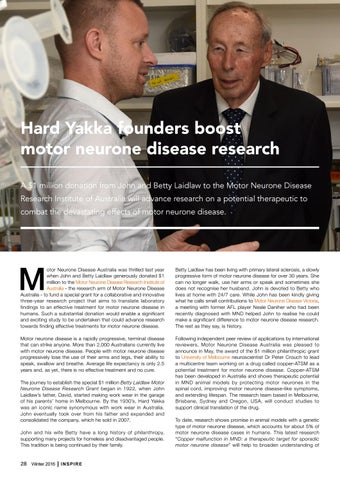
Hard Yakka founders boost motor neurone disease research A $1 million donation from John and Betty Laidlaw to the Motor Neurone Disease Research Institute of Australia will advance research on a potential therapeutic to combat the devastating effects of motor neurone disease.
M
otor Neurone Disease Australia was thrilled last year when John and Betty Laidlaw generously donated $1 million to the Motor Neurone Disease Research Institute of Australia - the research arm of Motor Neurone Disease Australia - to fund a special grant for a collaborative and innovative three-year research project that aims to translate laboratory findings to an effective treatment for motor neurone disease in humans. Such a substantial donation would enable a significant and exciting study to be undertaken that could advance research towards finding effective treatments for motor neurone disease.
Betty Laidlaw has been living with primary lateral sclerosis, a slowly progressive form of motor neurone disease for over 30 years. She can no longer walk, use her arms or speak and sometimes she does not recognise her husband. John is devoted to Betty who lives at home with 24/7 care. While John has been kindly giving what he calls small contributions to Motor Neurone Disease Victoria, a meeting with former AFL player Neale Daniher who had been recently diagnosed with MND helped John to realise he could make a significant difference to motor neurone disease research. The rest as they say, is history.
Motor neurone disease is a rapidly progressive, terminal disease that can strike anyone. More than 2,000 Australians currently live with motor neurone disease. People with motor neurone disease progressively lose the use of their arms and legs, their ability to speak, swallow and breathe. Average life expectancy is only 2.5 years and, as yet, there is no effective treatment and no cure.
Following independent peer review of applications by international reviewers, Motor Neurone Disease Australia was pleased to announce in May, the award of the $1 million philanthropic grant to University of Melbourne neuroscientist Dr Peter Crouch to lead a multicentre team working on a drug called copper-ATSM as a potential treatment for motor neurone disease. Copper-ATSM has been developed in Australia and shows therapeutic potential in MND animal models by protecting motor neurones in the spinal cord, improving motor neurone disease-like symptoms, and extending lifespan. The research team based in Melbourne, Brisbane, Sydney and Oregon, USA, will conduct studies to support clinical translation of the drug.
The journey to establish the special $1 million Betty Laidlaw Motor Neurone Disease Research Grant began in 1922, when John Laidlaw’s father, David, started making work wear in the garage of his parents’ home in Melbourne. By the 1930’s, Hard Yakka was an iconic name synonymous with work wear in Australia. John eventually took over from his father and expanded and consolidated the company, which he sold in 2007. John and his wife Betty have a long history of philanthropy, supporting many projects for homeless and disadvantaged people. This tradition is being continued by their family.
28
Winter 2016
|
INSPI RE
To date, research shows promise in animal models with a genetic type of motor neurone disease, which accounts for about 5% of motor neurone disease cases in humans. This latest research “Copper malfunction in MND: a therapeutic target for sporadic motor neurone disease” will help to broaden understanding of