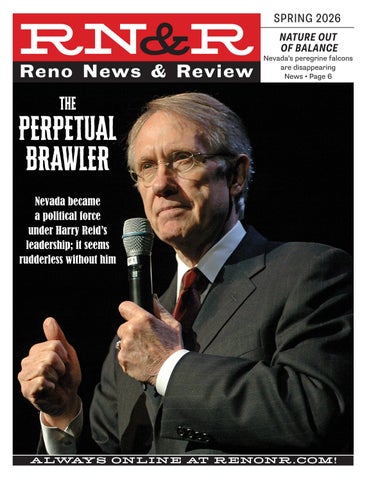
Spring 2026

Page 1


Nevada’s peregrine falcons are disappearing News • Page 6

The PERPETUAL BRAWLER

Nevada became a political force under Harry Reid’s leadership; it seems rudderless without him

Mailing address: 31855 Date Palm Drive, No. 3-263, Cathedral City, CA 92234 775-324-4440 • RenoNR.com

Publisher/Executive Editor

Jimmy Boegle

Managing Editor

Kris Vagner

Editor at Large

Frank X. Mullen

Photo Editor

David Robert

Contributors

Matt Bieker, Mark Earnest, Bob Grimm, Helena Guglielmino, Matt Jones, Matt King, Kelley Lang, Chris Lanier, Michael Moberly, Alice Osborn, David Rodriguez, Sarah Russell, Jessica Santina, Jason Sarna, Geoff Schumacher, Max Stone, Marc Tiar, Delaney Uronen, Robert Victor, Matt Westfield, Leah Wigren, Susan Winters

The Reno News & Review quarterly zine is published in March, June and December, with the Best of Northern Nevada issue published in September. The RN&R is online every day, all the time, at RenoNR. com. All content is ©2026 and may not be published or reprinted in any form without the written permission of the publisher.

The RN&R is a proud member of the Association of Alternative Newsmedia, the Nevada Press Association, and the Local Independent Online News Publishers.

The print edition is back; here’s an explanation

I was both touched and saddened by the kind words from many, many readers when we announced we’d be ending our regular monthly print editions with our December 2025 issue. A whole lot of you made it clear that you’d deeply miss the physical, analog version of the Reno News & Review.

The decision to end the regular print edition was not based on demand; we were still printing 25,000 copies a month, with all but a small percentage of those copies snatched up at nearly 700 locations around the region. Unfortunately, we had no choice but to end it because of the economics. Advertising was down, and print costs were up, based largely on the fact that there are no large web presses left in Northern Nevada—and as a result, we were losing thousands of dollars each month.

we’ve been exploring ways in which we could continue producing a physical edition of the RN&R without losing money. I’ve talked to other publishers to get ideas, looked at various options, and done a lot of number-crunching.

I am happy to announce we have come up with a plan—and you are reading the first result of that plan.

The RN&R’s print edition will now be published quarterly. One of those four yearly issues will be the aforementioned large-scale Best of Northern Nevada issue, in mid-September.

That said, we never completely closed the door on print. We have always planned to continue producing our Best of Northern Nevada edition in September—with a large print run, on newsprint, just like before. We also said we were open to continuing regular printing should we receive a really large check to fund our efforts.

Alas, that really large check never came—so for the last three months,

Each of the other three issues—in March (this one!), June and December—will be full-color magazine-style editions, featuring a variety of stories (that are still relevant, of course) published at RenoNR.com over the previous three months. The press run for these three issues will be small (think three digits), with each issue available for purchase—including delivery via mail—for $9.99, or $35.99 for the year (all four issues, including Best of Northern Nevada). Single copies will be available for purchase at Recyled Records, and possibly other places down the line.

While we are charging for the physical issues, we have not forgotten our mission of making all of our news available for free to anyone who wants it. The PDF of each issue will be emailed for free to all of our newsletter subscribers, and it will be available at RenoNR.com for free download. To accommodate readers who want to enjoy the physical magazine without paying for it, we hope to give a handful of copies to each Washoe County library branch, for people to enjoy in-house.

I know this plan is far from perfect—but it’s the best we could come up with in order to get a print edition in front of as many people as possible, without losing money and/or diverting many resources away from our coverage. (If you have better ideas, of course, we’re all ears.)

Meanwhile, I encourage all readers to subscribe to all of our newsletters, and to read our coverage at RenoNR.com. Kris Vagner and our team are doing a splendid job of covering local news, arts, food and music, just as we’ve done since the first edition of Nevada Weekly hit newsstands more than 32 years ago.

Thanks, as always, for reading. I hope you enjoy our first-ever print magazine, whether you’re reading via PDF or a physical copy.

—JIMMY BOEGLE jimmyb@renonr.com

‘A

new life on death row’ (Feb. 24, 2000)

Following up on a cover story regarding a controversial court case—26 years later

On Feb. 24, 2000, the RN&R’s cover story focused on a then-recently overturned murder conviction.

“A new life on death row” was the headline on the piece, a compelling read by D. Brian Burghart. It examined the December 1978 murder of Richard Minor Jr., and the trial of his accused killer, John Francis Mazzan, who was convicted and sent to death row. The state Supreme Court had overturned the case, “determining that Washoe County prosecutors withheld evidence that they had investigated two drug dealers who may have had reason to kill Minor,” as Burghart wrote.

At the time of the story, the Washoe County District Attorney’s Office was pondering whether to re-try Mazzan, who had always claimed he was innocent.

In the 26 years since, the RN&R never followed up on the story. After re-reading the piece, I was curious about what happened— so I decided to follow up myself.

Here are two excerpts from the piece.

Richard Minor Jr. had been stabbed 15 times when his father, Reno Justice of the Peace Richard C. Minor, found him dead.

That much is certain. What isn’t certain is that the man who was convicted for the murder, John Francis Mazzan-who has spent 20 years behind bars awaiting his own execution—actually wielded the knife.

On Jan. 27, the Nevada Supreme Court unanimously reversed Mazzan’s 1979 first-degree murder conviction, determining that Washoe County prosecutors withheld evidence that they had investigated two drug dealers who may have had reason to kill Minor. The disclosure of the investigation, which is required by law, may have cast doubt on their murder case against Mazzan.

The Supreme Court left open the possibility to retry Mazzan, and as he sits in the Ely State Prison, the Washoe County District Attorney’s Office is considering a new trial for the 20-plus-year-old crime. The district attorney’s office could also decide not to retry the case.

If the office does decide to retry the case, Mazzan’s attorneys say they will argue that it would be impossible for Mazzan to get a fair trial, since some of the witnesses are dead, and the evidence and memories of the surviving witnesses are too old to be reliable.

If the district attorney’s office chooses not to retry Mazzan, he will be set free. That decision could be made in a matter of days-ending the 21-year-long saga for Mazzan.

Mazzan moved to Reno in April 1978, according to Nevada Supreme Court documents. He was ... a hairdresser, small-time pot smoker and cocaine user. He bought his cocaine from April Barber, a Mustang Ranch prostitute. He got his pot from Barber’s boyfriend, Richard Minor, say court records.

On the evening of Dec. 20, 1978, he and Minor were taping albums, snorting coke and smoking pot in Minor’s converted-garage home at 906 1/2 Holcomb Ave. Several people saw him at the apartment, including a man, John Sullivan, who bought a quarter-ounce of Hawaiian sensimilla marijuana, “Maui Wowee,” for $65 from Minor. In the hours after midnight, Mazzan tried to leave, but his car wouldn’t start, according to court testimony. Minor let him crash behind the couch in the tiny living room.

Sometime during the night, Mazzan said, he heard a fight going on in the kitchen. He said he saw his friend covered with blood and fighting with someone.

He said he heard two people run from the house and a car drive away. Mazzan said he stepped outside but didn’t see anyone. He returned in time to watch Minor collapse and die. Minor was 26.

He fled the scene without notifying police of the murder. When he arrived home, he cleaned up. Minor’s father, a justice of the peace who eventually became a district court judge, found his son’s body the next day.

Two days later, Mazzan flew to Las Vegas to see his wife, who was employed as a dancer. Las Vegas police contacted him there and told him he was a suspect. He returned to Reno on Dec. 26 and went to the Reno police station the following morning. He was questioned for about 12 hours before he was arrested for the murder.

At first he lied, according to court records, saying he hadn’t seen anything—until he was told the police had found blood in his car. He then admitted that he’d been present, but he made other statements that police later proved to be lies. At that time, police also strip-searched him, looking for bruises, since Minor was 6 feet 4 inches tall and weighed around 215 pounds, and the pattern of blood in the house suggested a struggle. No bruises were found on the 6-feet-1-inch Mazzan.

It was barely a week later, while Mazzan was in jail, that a garbage worker found a bloody coat belonging to Mazzan and a purse and bloody clothes that belonged to April Barber in a trash can near Mazzan’s home. According to eyewitnesses at the trial, the items were placed in the trash can after Mazzan was jailed. Barber had been missing for around a month, and speculation arose

that she’d been killed in connection with Minor’s murder. Her murder was never solved.

A series of newspaper stories document what would happen regarding Mazzan’s case over the next five years.

In April 2000, Judge Peter Breen gave Mazzan a chance to leave prison by setting a bail amount of $100,000, according to an Associated Press story. A May 18, 2000, AP piece, published in the Las Vegas Sun, tells us Mazzan was indeed set free—but that the DA’s office had decided to retry Mazzan:

Jack Mazzan has been taking long walks, contacting family and old friends. He tries out cell phones, CDs and the Internet—all firsts after 20 years on Nevada’s death row. Since the January reversal of Mazzan’s murder conviction and his May 6 release, he’s taking tentative steps in a world he had seen only on a printed page or on a prison television set.

Mazzan could go back to prison if he loses at a retrial scheduled for July. But if he is cleared, he’ll walk away after having spent more time at death’s door than anyone in this country to successfully appeal a capital murder conviction since the U.S. Supreme Court reinstated the death penalty in 1976.

However, Mazzan’s freedom would not last. A wire-service piece in the Los Angeles Times dated Sept. 28, 2001, explained that after several delays, Mazzan was going to be retried for Minor’s murder—and was now being charged for the murder of April Barber. One reason: “New

continued on Page 5

Robots rule

At CES, humanoid helpers that do your dishes and keep your kids company were all the rage

One year ago, the U.S. was declared “open for business”—but much of what has happened over the last 12 months has confused and mitigated the potential for U.S. expansion with our allies and partners. I spend way too much time reassuring our international partners of our sincerity.

Despite all of the machinations, my company will be bringing 40 more Polish companies to Nevada over the next 21 months, and up to 200 tech companies from Korea. Why these particular countries? Well, because we’ve managed to piss them off less than innumerable other international partners.

From a market standpoint, these two countries also represent incredible emerging economies with highly educated and highly motivated populations. Poland just passed Japan as a Top 20 economy. Similarly, Korea is just booming—its international expansion is undeniable. Look at LG, Samsung, Kia, Hyundai, etc. All have formidably exploded onto the U.S. scene over the last few decades. The scaling Korean investment in automation, robotics and chip manufacturing has been unrelenting over the last decade.

That is a great segue to give you my brain dump on the 2026 Consumer Electronics Show in Las Vegas, as I did a year ago in this very column. It was more of the same, with “AI everywhere,” in products from lawnmowers to sex toys, and finger rings that do everything including leading presentations without a clicker. The AI sex-toy booth had the longest lines for demos, too, go figure. (I kept walking and didn’t touch anything.)

I was honored to be invited by the organizers of the annual Global Business Innovation Summit to be the moderator for a startup panel that was to listen, question and comment on a dozen Korean tech companies. The tech coming out of Korea is truly amazing, via companies as varied as agtech, chip-making, EV suppliers and robotics. The room of 350 people were impressed by the tech and the program. I invited our Polish delegation to the later soiree, and we had a truly international party. It was a hoot.

There was not any section of CES where Koreans weren’t present. Every pavilion and convention center had a Korean delegation. They are a tech powerhouse, and growing quickly, similar to my dear friends in Poland—great tech, great people, great economy. I was introduced to many new friends. I will apparently be heading to Korea in the next few months to learn more.

Back to the CES floor: Interestingly, the packed-in-previous-years Meta/RayBan booth was nowhere to be found this year. They are understandably re-thinking the aug-

mented reality strategy more deeply now.

This year featured noticeably more refined robots than last year. They are really starting to develop the kinematics—the abilities to replicate natural human movement, from sitting to walking to grabbing. In my days of building the early virtual reality worlds and pioneering real-world VR apps (circa 1992-1994), one of the hardest things to replicate was human movement. Recall the videos over the last year of the robots losing balance, falling over or being very “mechanical” in their movements.

The robots on display this year are targeted not as prototypes and demos for the future, but as human assistants in the home, ready for you to command them now. The companies are simplifying the interfaces and programming real skills such as doing laundry, dishes and mopping. Robots cleaning robotic toilets—yaaayyy! They even have AI pets that follow and baby-sit your toddler, no kidding. I have the brochure. It’s a bit creepy—but you can take one home today! The vacuums are way past the 2004 Roomba stage now, with arms to move socks out of the way, climb stairs and cool stuff like that.

According to an interview by Jennifer Jolly of USA Today, with Joe Alcedo of Youmanoids—a Los Angeles robotics showroom, no kidding— he’s already sold more than 60 quadruped robots and 10 humanoid robots since August 2025. Most sales were to families, hobbyists and schools. The

bots range in price from $5,000 to $20,000.

It’s interesting that robot stores are now popping up. When you ask a human salesperson to see the manager, do you get a robot? Hmmmmmm. Anyway, these are first to market in the retail space, but no doubt, you and I will be seeing these new retailers coming to a strip mall near you. Stay tuned.

There were companies at CES that simply make the “hands” and grabbers for robots. Two-finger grabbers and hands with four to six fingers showed incredible movement and gentle dexterity. These companies are now building the detailed robotic accoutrements that will bring the tech down in price and into a showroom near you.

Recall the legacy of the AI robotic tech that has been around for decades: The aforementioned Roomba, Boston Dynamics’ “dogbots” and others have been pioneering first-generation tech for real-world applications since MIT started pioneering the tech decades before that. In hospitals, restaurants and the auto industry, robots have been ever-more noticeable, especially since the pandemic. In Europe, they’ve had robot busboys for a few years now. They may be here, too, but I haven’t seen them yet.

It is clear: We are entering the era of real personal robots—and not going back. It eerily reminds me of the cool concept of “personal computers” that were new when I was a young man in the ’80s.

In the Ukrainian pavilion at the Consumer Electronics Show, robotic hands demonstrated how robots’ tactile capabilities have increased. Photo/Matt Westfield

tests on a pair of shoes found at Mazzan’s home disclosed traces of Barber’s DNA.”

That new DNA evidence was vital. Mazzan’s trial was delayed several more times, but in 2002, after claiming he was innocent for decades, Mazzan admitted he had murdered both Minor and Barber. On May 24, 2002, the Nevada Appeal reported:

In a plea deal made Feb. 15, Mazzan surprised everyone by agreeing to admit he killed Minor if (Washoe County District Attorney Richard) Gammick agreed not to prosecute him in the death of Barber. He was resentenced to life with possible parole three months ago and, since he has already served more than 21 years, was scheduled for his first parole hearing almost immediately.

Mazzan, who spent 20 years on Nevada’s death row, was arrested Sept. 10, 2001, for the second murder. Minor had never admitted killing Barber until his Thursday hearing before the Parole Board.

Speaking to the board, Mazzan first repeated his admission that he stabbed Minor to death in the victim’s apartment after the two argued over the profits from a drug deal.

“We got very high and we entered a major argument over the proceeds,” he told Parole Board members Thomas Goodson, John Morrow and Dorla Salling. “The argument just got out of control and I killed him.”

Then Salling asked about Barber. Mazzan replied that the girl was dead “because I killed her.”

The Parole Board denied Mazzan’s request. In January 2005, Mazzan again requested parole, and was again denied, according to the Las Vegas Sun, which reported: “David Smith, a spokesman for the board, said the vote was unanimous. He said the board’s denial was based on the nature and severity of the crime and ‘the need to protect the public from further criminal activity.’ Mazzan will not be able to apply against until May of 2008.”

This is the last news story regarding Mazzan that I can find online.

According to the online Nevada Department of Corrections database, Mazzan went before the parole board again every three years, in March 2011, March 2014, and March 2017—and was apparently denied each time. But on April 15, 2019, Mazzan again went in front of the Parole Board, for the sixth time—and this time, his request was granted. The database includes a small, grainy picture of Mazzan, holding a piece of paper that includes his name, his offender ID and the words, “Parole 6/19/2019.”

Mazzan is 79 today. Online records indicate he likely resides somewhere in Nevada, but his exact whereabouts are unclear.

STREETALK

What would you like to see changed by the end of the year?

Subscribe to our From the Archives newsletter, published every Monday, at RenoNR.com.

Asked at Magpie Coffee Roasters, 1715 S. Wells Ave.

Amanda Powers Project manager

Politics! I want to see it all go away. I want to see grocery prices come down, but I don’t hold much hope for that. That’s what I want, and I’m sure that others want that, too. Politics are very divisive and violent right now. I feel that we are going backward. I’d like to see the world go back to some form of sanity.

Elizabeth Koebele University of Nevada, Reno, professor

I’d like to see a change in how our water resources are managed, as it’s becoming increasingly contentious. We all need water, and I’d like to see more collaboration and diverse voices included in how we develop our water policies.

Lillian Deffebach Interior design student

I’d like to see Gothic interior design make a comeback in fashion. I’d like to see interior design change to a dark and moody aesthetic. It fits the times that we’re living in. It’s a dark, dark world out there.

Noah Silverman Tree care expert

I’d like to see more Starbucks in Reno. I need proximity to work and home. I drive too far to find a Starbucks. That’s the problem. I want a premium product, and I like the whole corporate, robotic experience. I’ll pay whatever for that.

Mark Hirose Coffee roaster

I’d like to see a ban on cursive writing. Nobody can read it today. It’s a poor man’s calligraphy. It’s a dead artform; it’s not useful anymore. Signatures used to be pretty and flowing, and now they’re just a line on a screen.

Nature out of balance

Once a conservation success story, Nevada’s peregrine falcons are now disappearing

While investigating peregrine falcon territories across Nevada—suspended by a rope on a cliff face or peering through a telescope focused on tiny rock alcoves— wildlife biologist Joe Barnes documented a disturbing trend: Half of the state’s peregrines have vanished.

“From 2023 to 2025, in 72 differet (Nevada peregrine) territories, overall occupancy rate is down 51 percent,” said Barnes, who works for the U.S. Fish and Wildlife Service in Reno and has studied raptors for more than two decades. “Half of the population has blinked out; we’ve lost half of our breeding population. Even more so, at Lake Mead, which was the stronghold, it’s only 44 percent occupancy. And things are still declining.”

Peregrine falcons have been a wildlife conservation success story in the Silver State, across the U.S., and throughout the Northern Hemisphere. The birds faced extinction by the 1960s but recovered after the pesticide DDT was banned in 1972. Peregrines returned as a breeding species in Nevada in 1985, and by 1999, they were removed from the nation’s Endangered Species List.

Barnes began studying the birds in Southern Nevada in 2004, when there were just 10 known nesting territories in the state. Since then, he and his collaborators have identified 101 nesting territories, containing 202 individual birds. Today, Barnes said, fewer than half of those nesting pairs remain.

The missing birds haven’t migrated—they are presumed dead, he said.

That’s because peregrines mate for life, and the nesting pairs stake out a specific territory, defending it against other falcons and predators. They may move their nests from season to season, but they stay within the bounds of their defensive space. If one adult bird dies, its place is usually taken by wandering single falcons called “floaters,” who join a territory’s surviving bird.

“It’s hard to keep tabs on the floaters,” Barnes said. “Those are the prospectors. They see a vacancy, and they jump in. But the numbers (of nesting birds) are lower year after year. That means that the floaters also are down. Normally, the ratio is one breeder for every three or four non-breeders. When a spot opens, they fill it. But we’ve lost much of our floater population, too.”

It’s a global phenomenon. Researchers across the U.S. and around the world are reporting similar drastic reductions in peregrine populations. No one knows why that’s happening, but Barnes and other researchers suspect an especially virulent strain of bird flu is the main culprit.

In 2015, when a different strain of bird flu appeared, peregrine populations also decreased the following year. Their numbers rebounded as the flu threat dissipated. In 2022, a new strain of especially lethal avian flu arrived—and is still killing birds.

“(In 2016), the birds got hit one year but made it through the single cycle,” Barnes said.

Wildlife biologist Joe Barnes with a peregrine falcon nestling at Lake Mohave. Photo courtesy of Joe Barnes, U.S. Fish and Wildlife Service, Reno

“But the 2022 strain is still out there, persisting over multiple years. With the previous strain, they just had to ride it out. … This new strain is almost 100 percent lethal to peregrines, and they die within three days. There’s no developing immunity to this strain, at least so far.”

Peregrines probably get the virus by preying on infected waterfowl, he said; waterfowl usually make up more than half their diet. The hunters bring the disease back to their nests, and the whole falcon family dies within days.

In addition, Barnes suspects mercury pollution depresses the birds’ immune systems, making them more susceptible to the virus.

He scaled cliffs and collected scraps from peregrines’ meals from hundreds of nests. “We’ve tested the birds the falcons ate for mercury, and the aquatic birds have higher mercury loads,” Barnes said. “Terrestrial birds have lower levels. … In all, I’ve counted 117 species of prey. Peregrines will eat everything from a hummingbird up to a Canada goose.”

In 23 years of studying falcons and other raptors, Barnes has made several discoveries and come up with ways to streamline the surveys of the elusive peregrines, which nest in remote areas. Barnes, who previously worked for the Nevada Department of Wildlife and also studies ferruginous hawks and golden eagles, said Nevada’s golden eagle population also has been decimated.

“We had about 3,000 golden eagles in the state, and we lost about 300 of them by 2024,” Barnes said. The eagles mostly prey on rabbits and other small mammals, rather than birds, so avian flu isn’t suspected as the cause of that decline.

Because eagles and falcons are no longer considered endangered species, research funding is hard to come by, Barnes noted. His work “is done on a shoestring,” he said. He climbs cliffs on some weekends and pores over data at home to keep tabs on the state’s peregrines. He searches nooks and crannies in towering cliffs. He scans mountain ranges and ridges for a glimpse of the falcons, which can dive from the clouds at more than 200 mph to sink their barbed beaks and razor-like talons into their prey.

However, against avian flu, the powerful predator is defenseless.

“Hopefully this year, I’ll see if (their numbers) have plateaued and stabilized, or if their population is still in decline,” Barnes said. “Wildlife and nature are resilient if you give them a chance. That’s comforting. I don’t want to be the guy saying the sky is falling. I want to get the full picture, the full story, and not preach doom and gloom. My job is to get the data and try to shine a light on something.

“Nature fights its way back.”

Road risks

Why did Washoe County traffic fatalities increase in 2025? An expert from the sheriff’s office offers insights

In 2025, the number of people killed in car crashes in Nevada decreased. However, in Washoe County, the number increased 26.09%—from 46 to 58, according to a statewide report from the Nevada Department of Public Safety.

Why? Lt. Chad McKinnon, of the Washoe County Sheriff’s Office Major Accidents division, said the major culprit is impaired driving.

“Every year, we try to (take) 5% more impaired drivers off the road,” McKinnon said. “And the past couple of years, we’ve been just crushing that number. I think this year, we were actually up almost 20%. It’s alarming, because that’s just the ones that we’re catching. Just with that alone, it shows that there is a problem.”

The 2023 report “Nevada Traffic Safety Crash Facts” by Zero Fatalities Nevada—a coalition formed by the Nevada Department of Public Safety, the Nevada Department of Transportation, Nevada Department of Motor Vehicles, and Nevada Highway Patrol— found that 44% of crash fatalities from 2017

to 2021 were due to an impaired driver.

“A lot of the DUI crashes we get that do involve a serious injury or death—it’s usually a younger-age person,” McKinnon said.

The 2023 report found that men ages 21 to 35 constituted the greatest number of at-fault drivers in fatal impaired driving crashes in Nevada.

“When you’re at that age, you just have that

In 2025, the number of traffic-crash fatalities in Nevada decreased compared to 2024—but in Washoe County, it increased. Photo/David Robert

overconfidence,” McKinnon said. “You feel like the world is untouchable at that point, and that’s what I think hurt Washoe County more than anything. I wish that we could get a stronger sentence when someone gets a DUI—a stronger financial burden, some mandatory jail sentence, whatever it is, because I feel like it’s happening more and more now, where people are getting more comfortable thinking that, ‘Oh, I can drive drunk again. I haven’t been caught yet.’”

During the special session last November, the Nevada Legislature passed the Safe Streets and Neighborhoods Act (Assembly Bill 4). The bill increased sentence lengths and other penalties for both first and second DUI offences.

“We’re thankful that there are harsher penalties for DUI repeat offenders and for people who cause substantial injury or death,” McKinnon said. “We’re hoping that we can continue to get (the laws) changed and make it even more strict to keep these people from recurring.”

McKinnon said that speeding is another factor in a lot of car-related deaths. Speeding accounted for 30% of them in Nevada from 2017-2021.

“That’s why sometimes we’re thankful for the increased traffic, because it does slow everybody down,” he said.

Finally, 21% of Nevada’s total fatalities from 2017-2021 involved people not wearing seatbelts. Said McKinnon: “That’s another thing, just like DUIs—it blows my mind if it’s not second nature to anyone getting in a car, that as soon as you get in, you buckle up.

“The big thing to put out there is please, always, always wear a seatbelt. That is the first thing you can do to save everyone in your car’s lives, including yourself. The second thing is drunk driving’s got to stop. You know, you’ve got to be the person who makes the better decision and says, ‘What if that was my family that got hurt from someone doing something that I could prevent?’ If you can put yourself in someone else’s shoes … I think that’s the only way you can ever start to make a difference.”

What’s the buzz?

Do you have what it takes to take up beekeeping?

Bees don’t hibernate.

That was one of many wonderful things I learned about raising bees in our region from Northern Nevada Beekeepers Association (NNBA) president Jim Russell. Russell said that is a common question during the association’s outreach and education events.

Let’s also get the other big question out of the way—yes, beekeepers get stung. In fact, one of the first pieces of advice he gives people excited about the prospect of keeping bees is that if you have to carry an EpiPen, this probably isn’t the hobby for you.

But let’s back up a little bit—I wanted to spotlight a subculture in our area that many people may not realize exists here, given our high desert climate: beekeeping.

Russell likes to joke that he keeps 50,000 head of “livestock” in his modestly sized backyard. That’s how many bees he’s had since 2008. The previous year, headlines about colony collapse disorder kept popping up as commercial beekeepers were plagued by failures of colonies around the country.

“I wanted to do something to help save the planet,” Russell said.

There’s an idea that if honeybees go extinct, the human race won’t be too far behind. “I don’t know if that’s really true,

because there are other pollinators,” he said. But it makes you think. Since he liked to travel and didn’t have any pets, and bees sort of take care of themselves for a period of time, it seemed like a good fit.

With seven colonies (to clarify the lingo: one hive, the white boxes you commonly see beekeepers tending to, houses one colony of bees, and your collection of hives makes up your apiary) under his control, Russell is your basic hobbyist-class beekeeper, with anywhere from two to 20 hives, typical of the majority of beekeepers in our area. Besides environmental motivation, sometimes people want to get honey for their own use and to share with friends and family; others have dollar signs in their eyes. Russell recounted stories of people wanting to get started, and then showing up at NNBA meetings excited to reap the rewards of big jars of honey that sell for top dollar at farmers’ markets—without realizing the amount of work (and sticky work, at that) that goes into collecting it.

Once you have more than about 25 hives, up to 100 or so, you are officially a “sideliner,” where the time and investment going into beekeeping is more than just a hobby, but not quite your profession. Typically, beekeepers at this level are doing it as a source of income from honey sales, at least, and sometimes transporting colonies to California

As Northern Nevada Beekeepers Association president Jim Russell explained, some of the most important tools for beekeepers are a hive tool for prying hive boxes, a smoker for calming bees, and, of course, a netted veil.

Photo/Kris Vagner

to provide pollination to the agricultural sector. You might be surprised how dependent the almond industry is on migrant bees coming from all over the country, with hives transported on trucks just to pollinate almond trees each spring. The native pollinators aren’t nearly enough to support the massive volume of almonds being grown, so almond growers rely on bees being brought in from elsewhere.

Larger than sideliners are commercial beekeeping operations. There are some among the alfalfa fields in Fernley and Fallon, and one here in Reno, Hidden Valley Honey.

Russell says the NNBA membership currently hovers around 100, with meetings held March through October; a good meeting might have around 60 people in attendance. Although it’s impossible to know exactly how many beekeepers we have in our area who are nonmembers, Russell estimates the membership represents less than half the active beekeepers in the greater Truckee Meadows.

Members sometimes move on after getting started and learning what they need to from other beekeepers. As Russell explained, “They come for one or two years, and they find out that our meeting lectures are about the same every year, because we talk about what’s going on in your apiary the next month. And that never really changes.”

NNBA is the predominant group in our area, while there are also groups in nearby rural counties, and a noteworthy nonprofit locally, Bees4Vets, which teaches beekeeping as a form of therapy for PTSD and traumatic brain injury for veterans and first responders.

If you’re considering joining the beekeeping ranks, the NNBA website has a basic getting started page, including links to recommended videos and tips on what you can expect to spend. (Plan on around $600 in startup costs.) The NNBA also offers Beekeeping 101 classes.

The absolute first thing, Russell said: “Talk to your neighbors about how they feel about having bees in the backyard. You have to be a good neighbor.” If those neighbors have a pool, bees will likely be drawn to it. A good south-facing location for the hive will be needed.

Even when it is cold and snowy, remember that there are dozens of your neighbors keeping a watchful eye on their hives out there, tending to their queens, gathering honey—and quietly saving the planet.

Measles is back!

The percentage of vaccinated Nevadans is decreasing— and that means dangerous preventable diseases are increasing

One recent weekend, I spent some time doing something that is SO VERY 2026: I went through my childhood records to confirm that I had, in fact, gotten the measles vaccine.

I was pretty sure I had been vaccinated, and I even had a recollection of getting measles at one point when I was young—but stories like this, from Wired, prompted me to want to be 100 percent sure:

Some children affected by measles in the ongoing South Carolina outbreak have developed a serious complication of the disease called encephalitis, or swelling of the brain, state epidemiologist Linda Bell said.

The South Carolina measles outbreak began in October with a handful of infec-

tions. … The surge could mean another bad year of measles for the United States, which had more than 2,267 cases—the highest in 30 years—in 2025. Declining vaccination rates across the country are driving the resurgence.

Encephalitis is a rare but severe complication of measles that can lead to convulsions and cause deafness or intellectual disability in children. It usually occurs within 30 days of an initial measles infection and can happen if the brain becomes infected with the virus or if an immune reaction to the virus causes inflammation in the brain. Among children who get measles encephalitis, 10 to 15 percent die.

Yikes. I am very far from being a child, but seeing as measles is even worse on adults than it is on children … better safe than sorry. Fortunately, I was able to find my records

Because there were still measles outbreaks in schools and even colleges in the late 1980s, the American Academy of Pediatrics in 1989 recommended students get a second shot—and Jimmy indeed received an MMR booster vaccine that year.

fairly quickly. According to the handwritten “Immunization and health record” tri-fold card my mom gave me a while back, I know that I indeed received the measles, mumps and rubella (MMR) vaccine when I was a year old. As for that recollection of having measles, I was mostly correct: When I was 7 (as a student at Elko Grammar School No. 2!), I got German measles, also known as rubella, despite being vaccinated.

Because there were still outbreaks in schools and even colleges in the late 1980s, the American Academy of Pediatrics in 1989 recommended students get a second shot—and I indeed received an MMR booster vaccine that year, when I was 14 years old, when I was a freshman at Wooster High School. This two-dose recommendation became the standard and is credited with helping the U.S. get to the point where measles was declared eradicated in 2000 (and rubella was declared eradicated in 2004).

As of this issue’s early March publication date, we have not had to deal with a lot of recent measles cases in Nevada. The Nevada Office of State Epidemiology dashboard shows two reported cases in the state in 2025. One of those cases was local: An unvaccinated adult man who was hospitalized tested positive on Dec. 26, according to Northern Nevada Public Health. It was the first reported measles case in Washoe County since April 2018.

But other diseases that can be largely prevented by vaccines are spreading. As of Feb. 25, according to the aforementioned state dashboard, there have been 26 reported statewide cases of pertussis—you probably know it as whooping cough—including eight in Washoe County, three in Douglas County, and one in Carson City. There have been six cases of chicken pox, four of which were in Washoe County.

It’s almost certain that we’ll be seeing more of these preventable diseases. A recent data piece by The Washington Post showed that Nevada’s MMR vaccination rates for kindergartners has fallen from 95 percent before the pandemic to 91 percent now—below herd-immunity status.

The story includes a searchable database, where you can look up schools that reported data. My alma mater, Elko Grammar School No. 2, is down to a 90.7 percent MMR vaccination rate.

As the United States heads toward having its “measles eradicated” status revoked, take note: If you’re not sure you’re fully vaccinated, check your records and/or talk to your doctor.

Inept, corrupt and should-be-jailed people like Robert F. Kennedy Jr. are in charge now, and as a result, measles and other preventable yet dangerous diseases are back—in an increasingly big way.

ARTS & CULTURE

A tiny pet is trending

Spider Stuff Co. offers spiders for sale, handmade arachnid accoutrements and ‘spider

parties’ in bars

Lauren Taylor, 35, was terrified of spiders.

Growing up, she thought they wanted to crawl all over her and bite her. This changed a few years ago, when she saw a Phidippus regius (or “regal”) jumping spider on social media.

“I was like, that’s the cutest thing I’ve ever seen,” Taylor told the RN&R

The social media post prompted her to purchase a regal online. Unfortunately, the spider she was sent wasn’t a regal, so she had to repeat the online ordering process, which, according to Taylor, due to overnight shipping costs, isn’t cheap.

“I’m like, what am I even doing, spending hundreds of dollars on spiders?” Taylor said.

Her fear of arachnids quickly transformed into fascination and love. She made a cute home for her spiders and started selling homemade acorn hides (where the spiders can burrow and make a hammock) on Etsy. The acorn hides took off, and soon after that, Taylor started breeding spiders, which is how Spider Stuff Co. was born.

Taylor’s husband, Tom Hedblom, 41, recently came aboard full time to manage the photography, video, outreach and emails, and the two have been introducing people to the idea of jumping spiders as “cute, tiny pets.” In three years, business has grown from online-only sales to working reptile shows and conventions, and hosting local “spider parties” around Reno.

One recent spider party, “Spiders & Spirits,” took place at Underworld Distillery. In the back, near the distillery equipment, Spider Stuff Co. had a booth set up where patrons could meet, hold and purchase jumping spiders, and browse handmade spider enclosures (aka “condos”), decor and company apparel.

A crowd formed around the booth as patrons of varying ages browsed the merchandise, played with the spiders and asked questions such as: “What do the spiders eat?” “How big do they get?” “Do they have fangs?”

One Phidippus otiosus (or “Oti”) male named Snorlax piqued patron Selena Wilson’s interest. After holding the spider in her hands for several minutes, she purchased it, along with a new spider condo.

When asked how she learned about jumping spiders, Wilson said she first saw one while on vacation in Bali. The spider was in the outdoor bathroom, and when she reached for it, the spider jumped on her hand before immediately jumping off.

After returning to Reno, Wilson did some research and found out jumping spiders were a “big thing.” (If you haven’t come across evidence of the trend yet Etsy has a wealth of jumping spider accessories, merch and dwellings.)

Wilson purchased her first jumping spider from Spider Stuff Co. at their “Tacos and Spiders” event last September at Skyline Café.

“I feel like it makes me super-present and makes me feel like a kid again,” she said.

Male spiders live around two years, and females around three. Personalities vary based on the species

“When I was little, I used to sit in my garden and watch the bees pollinate flowers. So, it kind of just brings me back to my whimsy.”

According to Taylor, the spiders are very low maintenance. Their diet consists of mealworms, one per week, and water, which is spritzed on the walls of the spider’s condo via a spray bottle every other day. Cleaning is minimal and mostly involves wiping up a “little white dot” of feces and removing the mealworm carcass each week from the “feeder dish.”

Male spiders live around two years, and females around three. Personalities vary based on the species, and sizes range from the size of a dime to the circumference of a ping-pong ball. Like most humans, they sleep at night and are awake during the day. They are also intelligent.

“They’re so smart,” said Taylor. “You would never think about having a relationship with a spider. But once it happens, you’re like, ‘Hey, this is the coolest thing ever.’”

Taylor’s favorite spider is named Barbara.

“She’s all over my Instagram,” said Taylor. (See for yourself @spiderstuff.co.) “I can just hold her in my hand, and she just sits there. Or she’ll hop to my phone, and I can just be on my phone, and she’s just sitting there hanging out.”

Everyone who adopts a spider from Spider Stuff Co. gets everything they need to get started: live food (10 mealworms), a spray bottle and a paper copy of their Care Guide.

When asked if she was ever bitten, Taylor said, “I’ve never.”

“They give you so many signs,” said Taylor. “They basically flex their teeth out. And then they usually put their arms out to the side to make themselves look bigger. It’s usually only going to happen to if someone’s … poking it with an inanimate object. They hate that.”

Taylor added that a jumping spider’s bite is “not medically significant.”

The main mission of Spider Stuff Co, is to educate the public and help people get over their fear of spiders. Aside from hosting spider parties, Spider Stuff Co. also hosts events at schools.

“This winter, we did three—two in one day,” said Taylor. “We bring other reptiles, too. So, we have bearded dragons and frogs and beetles. All the kids want to hold the roaches. This is so weird. But it’s cool to see kids, you know, be scared of something and then get over it real quick.”

One of Taylor’s goals is to do big school presentations, where the whole school is in attendance.

When asked if her fear of spiders had been completely eradicated, Taylor said, “I love them all. I’m like, ‘You guys are cool.’ Any bugs, too.”

ART OF THE STATE

Whimsical license

The artists from Lasting Dose Tattoo don’t just draw on skin

It seems like a no-brainer for a tattoo artist to also work on fine art or drawing, whether it’s in a public space or just at home. That kind of creative scenario is true of at least two people who are part of Lasting Dose Tattoo.

“I think fine art just opens the boundaries of what you can do,” said Joe C. Rock, who has been with Lasting Dose as a tattoo artist for six years. “With tattoos, you have to rein them in and have one that’s going last and look good, and you don’t want to take whimsical license when you do a tattoo. You want to do it straightforwardly, so it looks good for a long time. But, with painting and fine art, I can start splattering paint and be a little

more loose and carefree.”

Mike Curatello, who owns Lasting Dose Tattoo and Art Collective, agrees.

“People like us need that outlet, to be able to paint the things we want to paint and not be confined to the parameters of a tattoo: really good outline, really good color, placement, stuff like that,” said Curatello, who has been tattooing for 25 years and doing fine art for at least 30.

“Tattooing has its rules, and I think for people like us, it’s nice to paint without those rules,” Curatello added.

Said Rock: “Tattooing comes from the soul, but I think painting comes from there a little more. It’s definitely a way to express yourself as

Lasting Dose Tattoo owner Mike Curatello and artist Joe C. Rock are planning a year’s worth of group gallery exhibitions featuring tattoo artists’ works in other media, along with creations by art colleagues from outside the tattoo world. Photo/Mark Earnest

opposed to tattooing, which is for someone else.”

The Lasting Dose crew has been hosting Chinese-zodiac-themed shows at its own gallery, inside its Midtown shop, every year since 2016.

The 2026 show, Year of the Horse, featured horse-themed artworks in various media, and was hosted at McKinley Arts and Culture Center earlier this year.

“As tattooers, we draw and tattoo that imagery all the time, so it just seemed like a good fit for a group show, to give the artists kind of a direction,” Curatello said.

While it was not the first Lasting Dose group show outside of their gallery shop—Rock said they put together an Art of Tattooers show last year at Sierra Arts Gallery—it was their first time at McKinley.

“Some of the artists work here, but some of them are from other shops,” Curatello said. “And some of them aren’t tattooers at all. They’re just friends of ours who have done the group shows with us over the years.”

The Lasting Dose leaders are planning a full complement of shows for 2026 at their own space—which is pretty substantial since its expansion and redesign in 2020—including their annual Protect Your Decks skateboard-themed show in July and the Creep Show exhibition and costume party in October.

“We’re definitely trying harder to promote and put together more group shows and get more people involved, and get our game out there,” Curatello said. “You know, we’re not a huge gallery, but we care about what we do, and we want to bring in other people who also care about what they do.”

Added Rock: “We want to bring a fine art aesthetic to the tattoo-shop feel.”

Curatello quickly added, “Without it feeling too pretentious.”

Rock said not all tattoo artists who do fine art would be allowed in a “normal gallery.”

“We do have criteria, a certain level of artwork, to be in here, but we don’t want to be as elitist as some galleries would be,” he said. “If we enjoy your artwork, we don’t care if it’s illustration, line work, painting or whatever.”

Added Curatello: “If it’s cool, if it’s done well, then we’ll love it. We want to have people here who normally wouldn’t come in here or be a part of this world.”

Lasting Dose Tattoo and Art Collective, including a dedicated gallery space, is located at 888 S. Virginia St. Hours are noon to 7 p.m., Tuesday through Saturday. Learn more at www. instagram.com/lastingdosetattoo.

WESTERN LIT

The perpetual brawler

Nevada became a political force under Harry Reid’s leadership; it seems rudderless without him

In the spring of 2010, an upstart political movement called the Tea Party held a rally dubbed the “Showdown in Searchlight.” An estimated 9,000 people trekked to a secluded desert area about two miles outside the old mining town, 50 miles south of Las Vegas.

It was a terrible location for a gathering of that size, as Searchlight is a tiny burg with few services. But the location was symbolically important to the Tea Partiers, because it was the hometown of one of their most hated foes—Senate Majority Leader Harry Reid.

Along with President Barack Obama and House Speaker Nancy Pelosi, Reid was regarded as a poster boy for everything that was wrong with Washington. Amid the dusty assemblage of the “Don’t Tread on Me” faithful, a man held a carefully crafted sign that read, “The Plague: Obama, Reid, Pelosi,” with the names of the Democratic leaders surrounding a skull-and-crossbones symbol. Another sign festooned a port-a-potty: “Harry Reid Donation Center.”

The “Showdown in Searchlight” occurred at a time when Reid was beginning a re-election bid for a fifth term, and it wasn’t looking good for him. His poll numbers were down, and a couple of potential Republican challengers looked like they could beat him.

But in the frenzy of the Tea Party movement, Nevada Republicans chose a little-known, far-right candidate in the primary,

Sharron Angle. The Reid campaign celebrated.

Although Angle wasn’t a strong candidate, polls suggested she could beat Reid. Nate Silver’s calculations predicted his ouster. But Nevada Republicans had no answer for Reid’s ground game—his statewide political organization that concentrated on voter registration and turnout. Reid’s strategy was to win big in Clark County and Washoe County. In the 15 rural counties, he knew he couldn’t win, but he did everything he could to reduce the margins.

By 9:45 p.m. on election night, it was over. Major news outlets called the race for Reid. He won comfortably by 6 percentage points.

Reid’s victory contrasted with a national mid-term election that did not go well for the Democrats. They ceded control of the House of Representatives and lost six Senate seats, although they kept the upper chamber.

Although Reid had once again displayed his political acumen, the 2010 election foreshadowed a dramatic shift in Nevada politics. By 2014, Republicans controlled all of the major state offices in Nevada, and Democrats became the minority party in the U.S. Senate. Reid’s political domination—in Nevada and Washington—was coming to an end. He retired in 2017.

It had been quite a run for the “son of Searchlight,” who grew up in a shack made of railroad ties and chicken wire. Who attended a school with two classrooms. Who hitchhiked 40 miles to the Las Vegas suburb of Henderson to attend

Reid with mentor Mike O’Callaghan in an undated photo. O’Callaghan was Nevada’s governor for most of the 1970s. Reid served under him as lieutenant governor from 1971’75. Photo courtesy of the Reid family

high school.

Reid blossomed at Basic High. He was elected student body president, and he played football and baseball. “Harry was not the biggest or the fastest player,” recalled the late Gov. O’Callaghan, one of Reid’s teachers, “but he displayed grit, eagerness, and a fierce competitive spirit that more than made up for his physical limitations.” Reid also took up boxing, and under O’Callaghan’s tutelage fought in the Golden Gloves.

The Game Changer: How Harry Reid Remade the Rules and Showed Democrats How to Fight (Simon & Schuster, 2026), an excellent new biography by veteran Las Vegas journalist Jon Ralston, draws a connection between Reid’s determination to escape his hardscrabble origins and his relentless pursuit of legislative progress in Nevada and Washington, D.C.

“Reid’s career can be seen like the fifteen marathons he ran—an endurance test where he worked harder and stayed longer than anyone else, always playing the long game,” Ralston writes.

Nearly every journalist assigned to write a profile of Reid could not resist his origin story. But it’s worth reprising here to reacquaint ourselves with a person who, against incredible odds, climbed to the highest ranks of American politics and achieved important things.

Reid’s tenure in politics was almost derailed more than once in the years before his first congressional election. After the young trial attorney enjoyed a productive freshman term in the Nevada Assembly and won election as the state’s lieutenant governor, he took a bold leap in 1974, challenging popular Nevada Republican Paul Laxalt in a U.S. Senate race. The contest was closer than it deserved to be, with Reid losing by only 612 votes.

Rather than lying low for a while and contemplating his next move, Reid jumped into an ill-conceived campaign for Las Vegas mayor. He lost again. “Many thought Election Day 1975 signaled the end of Harry Reid’s political career,” Ralston writes.

But Reid’s old friend and mentor O’Callaghan asked him to chair the Nevada Gaming Commission, a high-profile post at a time when the state was ramping up efforts to pry organized crime out of the casino industry. His Gaming Commission tenure was tumultuous—so much so that there’s a character inspired by him in the Martin Scorsese film Casino—and it almost sunk him for good. FBI wiretaps recorded a mobster talking about a Nevada politician he called “Mr. Clean” or “Clean-Face.” He was talking about Reid, the nickname suggesting a naïve young man who would not be suspected of

underworld entanglements.

As Reid denied wrongdoing, a thorough state investigation ensued. In the end, he was cleared, opening the door for a second life in elective politics. Wasting no time, Reid ran for Congress and won in 1982. He would remain in Washington’s corridors of power for the next 34 years.

In the late ’90s, after a close call in his re-election bid against John Ensign, Reid crafted the elements of a political strategy that became known in Nevada as the “Reid Machine.” He had a knack for cultivating personal relationships that he could depend on to deliver a steady stream of campaign contributions and votes. He even wheedled a modest campaign contribution out of New York businessman Donald Trump.

He also surrounded himself with a talented team of aides—mostly women—who helped him develop a formula founded on voter registration and turnout. Reid took over the state’s frail Democratic Party and turned it into a juggernaut that appealed to new constituencies.

“Reid presciently saw how decisive the Latino vote could be—for him and for other statewide contenders, including presidential nominees,” Ralston writes.

Reid was the ultimate pragmatist, managing to become a darling of environmentalists for his support of wilderness while at the same time staunchly defending the mining industry. He was opposed to abortion, but he supported a woman’s right to choose. He was comfortable alienating some voters—he was genuinely despised in vast stretches of rural Nevada—as long as he still had enough support to win on Election Day.

In this way, Reid became Nevada’s political godfather, grooming candidates and directing money and people to the party’s best advantage. The Reid Machine produced winners at every level of the Nevada ballot. It played a key role in national politics as well. Reid’s voter registration

and turnout efforts transformed Nevada into a swing state with an early spot on the presidential nominating calendar, prompting candidates to schedule campaign rallies in Las Vegas, Reno and rural towns that had never seen a national politician before. Nevada became a “reliably blue state,” as Ralston puts it, favoring Obama, Hillary Clinton and Joe Biden over the Republicans who traditionally carried Western states. His influence in Nevada paled in comparison with what he achieved in Washington. From his earliest days in D.C., Reid built relationships that would serve him well as he climbed the ladder from committee chairman to whip to minority leader to, in 2007, majority leader. One of his earliest friends and mentors was Robert Byrd, the influential West Virginia senator. The two men bonded over their shared experience of “desperate poverty,” Maryland Sen. Barbara Mikulski recalls in The Game Changer. “They really liked the night school crowd over the prep school crowd.”

Ralston recounts multiple anecdotes about Reid’s relentless drive to pass or block legislation, but few can compare with the 2009 battle over the Affordable Care Act. Overcoming a seemingly endless string of obstacles, Reid wheeled and dealed to secure the 60 votes needed for Senate passage on Christmas Eve 2009. When President Obama signed the bill the following March, he lavished praise upon Reid for making it happen.

Reid’s membership in the Church of Jesus Christ of Latter-day Saints was always a subject of curiosity, if not skepticism, during his political career. Ralston, with access to Reid and his wife, Landra, provides a sensitive portrait of the couple’s decision to join the church, in 1960, when he was an undergraduate in Logan, Utah. Harry and Landra were influenced by the example of a neighbor family that regularly sat down together for dinner and started with a prayer. Reid never had such an experience in his troubled youth and wanted it for his family. Although Reid did not often speak of his faith, Ralston says he attended church regularly and even taught Sunday school.

Politically, Reid’s LDS membership proved to be of mixed benefit. While he had church members who helped him with his campaigns, a large majority of the faith’s rank and file were very conservative and could not support him. Further hampering his cause, Reid was not born into the faith. He was not connected to any of the socially influential Mormon families with ancestry dating to the church’s founding.

Considering all that Reid accomplished, it would be easy for a biographer to gloss over his flaws and failures. Ralston, who as a political reporter crossed swords with Reid numerous times, does not shy from pointing out the late senator’s missteps and errors in judgment. Reid generated bipartisan scorn when he publicly called President George W. Bush a “loser.” His reference to Obama having “no Negro dialect unless he wanted to have one” fueled a backlash that Reid seemed to have trouble understanding. (Reid and Obama maintained a strong relationship before and after the comment was

published.)

Reid also tarnished his legacy when he spread rumors about political rivals that he had no evidence to support.

The most egregious example was his repeated assertion that Republican presidential candidate Mitt

Romney had not paid taxes for 10 years. Reid defended this smear campaign on the indefensible grounds that it worked. It did: Romney lost. But Reid’s derisive name-calling prefigured the steady stream of verbal abuse and lies that are the bedrock of the MAGA movement.

But it is a measure of Reid’s temperament that he decided, after years of obstinance, to embrace Ralston’s desire to write his biography. As Nevada’s most prominent political commentator, in print and on television, Ralston had skewered Reid on numerous occasions. In researching the book, Ralston found correspondence showing that Reid had gotten him fired from the local NBC affiliate.

Reid finally agreed to cooperate with Ralston, participating in 24 hour-long Zoom interviews in the months before his death. Reid knew he wouldn’t like everything Ralston would write, but he recognized the book would benefit from the memories and insights that only he could provide.

Remnants of the Reid Machine continue to play a role in Nevada politics, but without the man himself anointing candidates and pulling strings, the party seems to have lost some of its mojo. After Reid’s passing in 2021, Nevada’s presidential majority turned red again.

In his introduction to Reid’s book about his hometown of Searchlight, published in 1998, O’Callaghan promises that “in the future, there will be biographies written about Harry Reid, and he will be considered one of the pivotal political forces in Nevada history.” O’Callaghan was right about the biographies, but his prediction about Reid’s legacy understates the case.

“What Reid cared about was the acquisition of power and using it to the ends he saw were justified—for his country, his state, his family, his friends,” Ralston writes. In this sense, Reid was never a “Clean-Face,” as the mobsters described him. He could be as ruthless as they were in the pursuit of his political goals, a trait sorely lacking in his party today.

Geoff Schumacher is the author of Sun, Sin & Suburbia: The History of Modern Las Vegas. On the cover: Harry Reid speaks in Reno in 2006. File photo/David Robert

Jon Ralston, Reid biographer and founder/CEO of The Nevada Independent, held marathon Zoom interviews with the late senator in the months before his death. Photo/courtesy of Simon & Schuster

Celebrating 90

Nonagenarian Carol Purroy’s latest book is a guide to aging with gusto and joy

Carol Purroy has been a disaster-relief worker, a therapist, a travel agent and a writing teacher. This past fall, she celebrated her 90th birthday by publishing a book, Audacious Aging. It’s part self-help, part how-to, with wisps of lighthearted sass and ideas for staying active and having fun at retirement age and beyond.

Purroy makes a case for seniors to embrace social media, offers a few money management tips, quotes Hunter Thompson, and discusses which terms to use for your love interest if it seems like you’re too old for “boyfriend” or girlfriend.” (She favors “flame.”) She highlights people who’ve made achievements late in life, like Laura Ingalls Wilder, who published her first book, Little House on the Prairie, at 65, and Fauja Singh, a British-Indian farmer who finished a marathon at 100.

Audacious Aging is available on Am-

azon, and Purroy is set to teach a Truckee Meadows Community College extension class, also called “Audacious Aging,” on Monday afternoons in April.

You’ve taught a lot of memoir-writing classes. What’s one thing you’ve learned about people from that experience?

That everybody’s got a story—or a thousand stories. The more they write, the more they open up and find new things to write about. … Everybody is interesting.

What, for you, has been the biggest mindset change that has come with age? Being accepting and adaptive is the most important thing.

In any particular way?

Well, for instance, I used to do a lot of handwork. I knitted a lot. I have to brag a little bit …

Carol Purroy, on accepting limitations with aging: “You have no choice but to accept it. You know, some people would be resentful and angry, and there’s no point in that. So, you just say, ‘OK, now I do other things.’”

Photo/Kris Vagner

Go for it!

One year, I knitted 140 hats for homeless people. Sometimes I did two hats a day. And I can’t knit anymore. I used to sew a lot. I used to do embroidery things, and I can’t do that anymore. My hands don’t work. They’re numb, and I can’t even feel when I’m holding a needle. So, that’s been kind of hard to accept, but I don’t have any choice.

How did you come to peace with that change? You have no choice but to accept it. You know, some people would be resentful and angry, and there’s no point in that. So, you just say, “OK, now I do other things.”

Another thing you wrote about is that, in the U.S., we have a different—often less reverent—perception of age and older people than some cultures do.

And I don’t think we’re going to change that immediately. … That’s sort of why I wrote the book—because we have been brainwashed to think that, when we’re old, we can’t do anything. And it’s true: We have limitations now that we didn’t used to have, but we can still do a lot of things, and we should focus on what we can still do rather than what we can’t do anymore.

What are you going do next?

I don’t know. I keep changing.

Are there any local classes, groups or activities that you personally recommend for seniors?

At TMCC, there’s the EPIC (Educational Programs Inspiring the Community) program, which my little class is going to be part of. And they offer all kinds of things for older people. I would say just find something that interests you. And, of course, the senior centers, too, have a lot of things going. … For instance, there’s a mahjong group. I never thought of playing mahjong, but I’ve read recently that this is terrific for brain aliveness.

Is there anything else you’d like people to know?

One is that people who have purpose in life are much happier and live longer. So, I would say find a purpose and something you love. … If you can live with purpose, you’ll be much happier. And the other thing, which is also about happiness, is dancing. I read an article just this week that dancing is probably the best exercise you can get. I used to go dancing three or four times a week. … When I see people jogging, they don’t smile. They look like they’re an agony. But when you dance, you can’t help smiling.

FILM & TV

Pulling strings

Homegrown celeb Kristoffer Polaha directs and stars in a film that’s a ‘love letter to Reno’

Back in 1994, a 17-year-old Kristoffer Polaha sat in a darkened theater at Cinema 1 and 2 in Sparks watching Quentin Tarantino’s Pulp Fiction.

Always drawn to show business, Polaha, who later went on to graduate from New York University’s Tisch School of the Arts, quietly made himself a promise: Someday, he’d make movies here in Reno—movies actually set here.

Now, more than 30 years later, he can say he’s kept that promise with Mimics, a supernatural thriller about a down-on-his-luck comedian, a ventriloquist’s dummy and the steep price of stardom, which celebrated its premiere at the Pioneer Center for the Performing Arts before opening in 400 theaters nationwide in February.

In fact, this is a thoroughly Reno film. It began as an idea from Marc Oakley, Polaha’s friend since first-grade at Anderson Elementary.

“Back in 2020, he messaged me on Facebook, and he was like, ‘Hey, bro, I want to write a screenplay,’” Polaha said. “And he pitched me this idea of this little creepy doll. I was intrigued, because the doll movies work. They’re a trope.”

He pointed to the Chucky and Annabelle films, as well as the Anthony Hopkins film Magic, as examples. “They’re a Hollywood trope, and they haven’t been done in a long time. We haven’t had a new doll movie in probably 30 years. But whenever there is a doll movie, they work.”

Polaha suggested Oakley write a speculative (read: unpaid) script so he could determine whether it was a project worth pursuing. Oakley spent the next several months—made easier by the forced pan-

demic downtime—crafting a script that Polaha thought was great, albeit too long.

Thus began a back-and-forth exchange in which they refined and tightened the script, getting it to the point where Polaha not only wanted to produce the film, but he also wanted to direct it and play the lead role, Sam. Next came a nearly four-year process of securing investments, during which time the 2023 writers’ strike looked like a sign that this was not meant to be. Nonetheless, an initial investment of $50,000 led to more, with roughly half of the funding coming from Reno.

By April 2024, it was fully funded, and by June 10, cameras were rolling.

The resulting film is, as Polaha puts it, “a love letter to Reno.” Not only did he and Oakley draw heavily on the local population for its cast and crew—including Arianne Zucker, a Lake Tahoe resident with credits that include Days of Our Lives—creating jobs and contributing heavily to the local economy, but it is set entirely in Reno, with numerous locations that should be recognizable for locals. Shim’s Surplus Speakeasy, the Pioneer Center, Mountain View Cemetery, the Riverwalk, Saint Mary’s hospital, the downtown Reno skyline, the shore of Lake Tahoe and numerous other recognizable spots play major roles in the film.

Renoites will also appreciate the caliber of bona fide talent involved in the project—including actors Chris Parnell (known for his work on Saturday Night Live and 30 Rock) and Stephen Tobolowsky (best known as Ned Ryerson in Groundhog Day, with roles in numerous TV shows and films, including Memento), with Los Angeles-based recording artist Moriah in a lead role. Polaha’s son, Micah, seems to be following in his father’s footsteps; he makes a cameo in one of the funniest scenes of the film.

Horror-adjacent

Mimics tells the story of Sam Reinhold (Polaha), a lonely, aspiring comedian who takes the mic nightly for a disinterested crowd at Shim’s, doing subpar impressions with the help of his “sidekick,” a threadbare hand puppet. Other aspects of his life aren’t great, either; he lives in an apartment with his ailing grandpa (Tobolowsky) and works days stocking shelves at a local grocery store, Super Duper (a role played by a local Raley’s). His grandpa, the emcee at Shim’s (Austin Basis) and his co-worker Virginia (Moriah) are Sam’s only friends, and they know how much he wants to make his comedy career a success. When a mysterious invitation arrives presenting Sam with the opportunity of a lifetime, they’re all ecstatic that his dream will finally come true. With the opportunity comes Fergus, a creepy ventriloquist’s dummy that at first seems to be a huge hit with audiences. But before long, it’s unclear who’s actually the puppet and who’s pulling the strings.

Fans of Polaha may know of his roles in Mad Men, Jurassic World: Dominion and Wonder Woman 1984. But it’s just as likely they became fans by catching the handsome actor’s many appearances on the Hallmark Channel, or through his roles on TV shows such as North Shore and Life Unexpected. He’s exceedingly generous with fans, down-to-earth and humble about his success. The actor has intentionally cultivated a reputation that is family-friendly, values-driven and inspired by his faith as a Christian.

As such, a horror-adjacent film such as Mimics is a departure he hesitated to take at first. “I want to tell stories for everybody,” he said. “I never really wanted to make a horror movie, and I’ve been very vocal about it in the press. There are certain things you’ll never see me do, and one of them is a horror film.”

As he explains, what sets Mimics apart from the average horror film (aside from its comedy and romantic storyline) is its philosophical and spiritual undertones. Through his encounter with the occult, Sam is forced to confront inner demons and decide what he ultimately wants to stand for. Fans may also see a new side to Polaha in Sam’s impressions.

“I’m a weirdo,” he joked, explaining how they wound up in the script. “Marc, back in the day, in like third-grade, would be like, how do you make the sound of breaking glass? How do you make a gun sound? He was always fascinated by it.”

Driving much of the story are some of Polaha’s own experiences with what he felt were supernatural forces. For one, he actually received a mysterious and somewhat sinister invitation, like Sam, and the character of Virginia shares a story about an experience drawn directly from Polaha’s own life.

“It really is a love letter to the city,” he said.

Kristoffer Polaha and Chris Parnell during a shoot.

THE DISH

On a busy Friday at Noble Pie Parlor, Ryan Goldhammer moves through his kitchen with the efficiency of someone who’s been making pizza for more than 20 years. The braided crusts, housemade sauce and wildly creative toppings tell the Noble Pie story—from the Pep in Yo’ Step featuring two types of pepperoni plus pepperoni’d bacon, to the PB&J (pineapple, basil and jalapeño)—and don’t sleep on the award-winning wings!

Goldhammer presses dough and feeds it through a rolling machine while also coaching his up-and-coming pizzaiolos—and sharing the story behind his Sicilian tomato sauce, a recipe refined over five generations. His techniques include par-baking crusts for Friday night rushes and making house sausages, for a Reno-style evolution of the East Coast pizza traditions he learned at Blue Moon, the legendary Reno pizza spot (which closed in 2017) where many locals first fell in love with New York-style pies.

What’s the best thing you’ve eaten recently?

Without doubt, the Atlantis Thanksgiving feast in the Grand Ballroom. It is hard to beat a menu that has everything under the sun on it for one price! Chef David Holman and his team do absolutely fantastic work.

Your kitchen is on fire!

(Metaphorically.) What are you cooking?

My personal favorite dish is our Eggs in Purgatory—a Sicilian take on shakshuka. We start with a cast-iron pan brushed liberally with roasted garlic olive oil. To that, we add our pomodoro pelati (San Marzano plum tomatoes blended and reduced with smashed garlic, basil and crushed chili flakes), along with our house blend of Mediterranean spices,

eggs and feta cheese.

The eggs poach perfectly in the simmering bath of rich flavors, and the concentrated brightness of acidic tomatoes balances beautifully with the warm spices. We finish the dish with toasted Italian breadcrumbs, fresh parsley, scallions and a drizzle of sweet basil-infused oil, served with clarified butter-brushed sourdough toast.

Who is/was your strongest culinary influence? From a young age, I was drawn to culinary programming on PBS—shows like Yan Can Cook, Julia Child, Jacques Pépin, etc. Later, I became glued to the Food Network in the early ‘90s. If it was all about cooking, it was all good with me.

I have always felt a deep connection to Jamie Oliver—simple cooking with great care and respect for the ingredients. I love that rustic style.

What is your go-to midnight snack? It has to be scrambled eggs. I think the incredible, edible egg is the most wondrous food on Earth—silky, luscious and satisfying every time. I like to use a riff on the Thomas Keller method.

Which local restaurant deserves more attention, and why? Wow, that is a very tough question. There are a lot of places that I think deserve more praise, but I’m going to go with a local legend here, mostly because I think that the newer generation doesn’t even know much about this place.

Brickies Tavern has one of the best burgers in town, awesome daily specials and a great breakfast featuring a hand-pounded chicken-fried steak. It’s got some of the best dive-bar vibes around, but since it’s a full restaurant, it’s all ages welcome.

Some other places get kudos for their longevity, but Brickies has been here since 1956 as a restaurant—and even earlier than that as a local grocer and meat market.

How does food contribute to our community? Food is our community. There is only one thing that you do at least two to four times per day, every single day: Eat. There is nothing more important. Eating and drinking is life. And since the dawn of man, it is something that is about togetherness. We are a tribal species.

Even the history of a restaurant is fascinatingly rooted in community. What started off as a “tavern” added simple soups with hunks of bread to feed guests a complimentary snack. What evolved as an “inn” offered lodging, and with that came more robust food offerings. These taverns and inns became the focal point of community and commerce in towns and villages, and eventually cities. (These

are places) where the butcher, farmer, haberdasher and teacher all came together around a table or bar top to laugh and cheer and become nourished in every way.

The evolution of the term “restaurant” is rooted in the French word “restaurer”—a place where people come to restore their physical, mental and emotional health amongst friends, family and community.

What is the one thing you won’t eat?

I’m not sure if there is anything I won’t eat—at least once, that is. I have had some pretty weird stuff doing kaiseki/omakase (multi-course Japanese) meals. Maybe something that I would not be that keen to try again is fish eyes.

Please share your favorite food memory from growing up.

My favorite food memory growing up isn’t tied to one particular dish. It’s about the company you keep, and there’s nothing better than a simple backyard BBQ or cookout, especially growing up in Henderson, Nev.

The routine was always the same: early morning soccer or baseball game, then back to the house to get ready for everyone to come over. Adults would chat and visit, but most importantly, (they would) man that grill—burgers and dogs, sausages and ribs, potato salads, slaws and all the favorite fixings.

Same as it was then, same as it is now—a good BBQ is about as American as it gets.

What is the one kitchen tool you can’t live without?

A great Japanese chef’s knife! Keep your knives sharp. Keep them clean, and learn how to hold them with confidence. Take your time to learn all of the cuts and techniques. Go slow. Work on solid skills, and then work on speed. That’s it. Simple tools to do complex cooking.

What has been your most memorable meal?

One of my favorite family traditions happens on Thanksgiving. Whether we are with my folks or hanging with my new little family (wife and daughter) and friends, it is always the same.

We wake on that Thursday and start to steam clams (littleneck, cherry or cockles if available). A nice bath of pho or seafood stock, caramelized leek-shallot-fennel-garlic, and an array of earthy and warm spices, Old Bay and other goodies. We melt some butter, add some spoonfuls of the steaming broth and a healthy squeeze of lemon juice, then top the clams with some chive, parsley and lemon zest. Lastly, we throw in some toasted sourdough baguette chunks—and then we are ready to party!

LIQUID CONVERSATIONS

NA all the way

The hottest booze-free libations for 2026 and beyond

As more and more people slow down their alcohol consumption, I always get asked, “What is new and fun in the NA world these days?”

To help guide you through the world of spirit-free tipples, I thought I would share what is trending and exciting in the world of teetotaling.

Matcha, matcha, matcha

In 2025, the world went matcha-crazy. At Starbucks, which reported a 40 percent yearover-year increase in matcha sales for the first quarter of 2025, its top two viral drinks of the year were its Dubai Chocolate matcha and its Strawberry Matcha.

From big coffee chains to small mom-andpop shops, matcha is king. This is in part due to the world seeking brighter, more interesting options for caffeine. Gen Z is seeking out iced caffeine options and responding to drinks that are bright in color and bold in flavor, all things matcha does very well.

But not all is well in the matcha world: Growers and wholesale producers of matcha, a traditional Japanese tea grown in the

shade and made into a powder with care, cannot keep up with demand. Pretenders to the matcha process—so protected in Japan—now offer lesser options, like powdered green tea and flavored varieties, to keep up with demand.

There is another option, however, that some (like me) argue is a tea with a more interesting flavor, which is much more available these days. Hojicha, which is made from roasting mature leaves as well as stems and twigs from later harvests of the camellia sinensis plant (where matcha comes from), has the potential to take the world by storm. Rich, roasty flavors make it perfect for lattes, and it pairs well with flavors like hazelnut and vanilla.

The dirtiest trend

I write drink recipes for a living, and for the past year, I have received more requests for dirty sodas than for any other beverage category. Originally made as a fun beverage hack for Mormons looking for something interesting to drink, the dirty soda has spread beyond Utah.

A traditional recipe for a dirty soda is soda, syrup and non-dairy creamer, but the drink has grown beyond that into a world of flavor. The

The world embraced bright, bold matcha with such fervor in 2025 that growers are having a hard time keeping up with demand. (This beauty is from Coffeebar.) Photo/ David Robert

popularity of the show Secret Lives of Mormon Wives features messy drama for the world to slurp up—and a dirty soda is in each of their dramatic hands.

The largest dirty-soda outlet is a chain called Swig, which has made it to Las Vegas, but not Northern Nevada—at least not yet: Swig now has more than 120 locations, with more coming, growing by 54% just in 2025. However, Sonic, Carl’s Jr., Jack in the Box and many others have joined the pack, selling these creamy sodas. The marriage of sparkling beverages with bold flavors and creamy texture is a match made in heaven, and people are thirsty for it. The menu at Swig reads like a person high on sugar closed their eyes and threw a dart at flavors, with combinations like Coke Zero, peach puree, pineapple, lime and coconut cream—all in one drink; the flavors can be mind-blowing. While this trend may be keeping dentists up at night, it is not going anywhere.

Ready to drink

When the non-alcoholic cocktail movement took off in earnest, we saw a lot of one-to-one spirit alternatives—products that did everything in their power to be the flavor equivalent of whiskey, gin or tequila, without the booze. However, many people looking for spirit-free cocktails aren’t exactly looking for drinks that taste like what they are trying to avoid. These days, there is a world of ready-to-drink canned options that offer the interesting, complex flavors of a cocktail without pretending to be one.

Beverage industry darling The Pathfinder, a non-alcoholic amaro, has released a series of canned drinks, the newest being its Espresso Tonic can, which might be its most interesting and delicious offering yet. They partnered with Seattle coffee shop Caffe Vita to offer a blend of quality coffee, bitter tonic and wild herbaceous Pathfinder, which is great out of the can or on the rocks. This canned cocktail will be available Jan. 1 at Whole Foods, and at local retailers like Craft Wine and Beer later in the month.

Other great complex canned sippers are the many wild flavors from Casmara Club, which take the idea of a spritz and turn it up to 11. My love for Casmara Club’s many options is overflowing, as each is a bitter, refreshing, lightly salty reminder that there are people in the world who are much better at making drinks than I am. My favorite of theirs is their Super Classico, which prompts the question: What if a Negroni and a Coke had a baby, and it was handsome and delicious? Made from classic Italian bittering herbs and citrus, bourbon-grade Madagascar vanilla and minimally processed demerara cane sugar, Super Classico tastes as stylish as it feels to drink it.

One-of-a-kind treats

Aged, single barrel spirits are the most romantic boozes

There is something romantic about aged spirits. The idea that someone works hard to distill a spirit, then fills a handmade oak barrel with it, only to wait decades to enjoy it, is inherently romantic. We fantasize about the painstaking effort and patience it takes to make our favorite aged drinks, and after we finish our glass, we have tasted not only the distilled product, but time.

What many people don’t know is that most of your favorite aged spirits are a blend of different ages. Producers take a cross-section of aged barrels and blend them together to make a brand’s signature flavor, which is why your favorite whiskey tastes like your favorite whiskey every time. Each barrel has unique qualities based on where it was aged, how long it was aged, and environmental factors, such as whether there were hot summers or cold winters during the years it was aging.

But on rare occasions, a barrel of a particular aged spirit is so unique and spectacular that it gets set aside for what is known as a

single barrel. Single barrels are the most romantic version of spirits, a product hand-selected because it represents ideas or flavors that make it perfectly unique, yet familiar.

In our community, several bars and retail shops offer single-barrel programs, where their teams have met with brands and selected single-barrel spirits available only at their establishments. To shine a light on the process, I spoke with three people uniquely knowledgeable about the barrel selection process—to bring you behind the barrel.

Before a bar or retail store can access a single-barrel offering, local distributors must work with the brand to bring it to the state. In Nevada, all alcoholic beverages must go through a distributor for tax reasons, so a distributor’s job is to represent the products in their portfolio and serve as an ambassador for the brand and the accounts they serve.

Kyle Wickersham is the Northern Nevada on-premise (bars and restaurants) field sales manager for Breakthru Beverage, one of the

Bartender August Hart pours a shot of Planteray single-barrel rum at Curse of Cane. Photo/David Robert

largest distributors in the U.S.

“The first thing that typically happens is a long conversation with the account,” Wickersham told me. “As a distributor, it’s important for us to be as transparent as possible in the entire process.”

Barrels can be expensive, some as high as $20,000, and typically yield around 240 750-milliliter bottles, which is a lot of bottles to sell. “The last thing we want is bottles to sit in storage or in a back room, so we like to help accounts strategize to sell,” Wickersham said. “Our job isn’t done until every bottle is sold.”

The big selling point is that the barrel an account picks, once bottled, will never exist again.

“From grain, distillation and maturation, it’s nearly impossible to duplicate a single barrel,” Wickersham said. “They are really purchasing a part of that distillery’s history.”

Ivan Fontana, owner of Death and Taxes and Curse of Cane, is no stranger to rare spirits. His bars have selected 45 different single barrels, so they are experts at choosing offerings that stand out.

“We look for big, bold and rich flavor profiles,” Fontana said. He wants consistency across selections—a way for people to try it and say, “Oh, this is a Death and Taxes pick.”

“Our guests can recognize and trust our palate,” Fontana said.

Recently, his team selected a barrel of rum with a cult-like following: Planteray. They chose a spirit made from Dominican sugar cane, finished in sherry casks. Planteray single barrels are few and far between, so it’s a big deal to try one.

Fontana and his team first started serving barrel picks in 2018, and they have no plans to slow down, with more on the way this year.

When AJ Chhabra, owner of Drams and Smoke in Reno, picked his first barrel in 2022, he had no idea he would be reach the 50-barrel mark in 2026.

“When we first started, our first barrel was safe, something everyone could enjoy,” Chhabra explained. “That really wasn’t my style, so after our first barrel, I started to trust myself and go with what I thought was excellent.”

The market has rewarded Chhabra and his team with lines around the parking lot on his release days. It is not easy to pick things that people love; each selection is critiqued and argued over for weeks.

“To be a part of our program, the value must be there, as well as the quality,” Chhabra said. “Barrels used to be a novel part of our program, but now they are what describes us.”

So if you are in the market for something that will never exist again, that teams of people sat in rooms and debated the merits of, that expresses a brand’s identity but is wholly unique—ask for a single barrel.

MUSICBEAT

Every emotion

After tumult and loss, Reno band Sad Giants are finally releasing their debut album

A decade ago, the Sad Giants burst onto the Reno scene thanks to their pop-punk mix with heart-wrenching vocal performances and somber guitar lines. Songs like “Car Ballet,” “Sullen Hearts” and “Sunday Best” attached hook-filled melodies and memorable choruses to moments of struggle and pain.

The band was on a tear, with great song after great song, and big show after big show … and then came COVID-19.

“The first five years, we were doing great, and then COVID hit—and nothing was certain anymore,” said frontman Bobby Benedict during a recent Zoom interview with the band. “Quentin (Young) was our original bassist, and he left the band for a little bit to take care of his kids going to high school. We had my friend Nik Taro fill in on bass during some shows during COVID— and he died in a car accident in 2021. At that point, I wasn’t even sure I wanted to do the band anymore.”

With help from check-ins from his bandmates, Benedict weathered the emotional storm and came back to the group—finally ready to take musical action. At last, Sad Giants released their debut album, Space Case, in January.

During the interview with Benedict (vocals/guitar), Young (bass), Jeremy Martin (lead guitar) and Jesse Moran (drums), Benedict explained how dealing with his grief led to the creation of Space Case

“I was not communicating anything to anybody,” he said. “I was just sitting in my

room making a bunch of demos, and at one point when I was making these demos, I reached out to a producer friend of ours who produced the album, Colin Christian from Wires & Noise Audio Services. He was like, ‘These are good; what does the rest of the band say?’ And I was like, ‘Oh, shit, I have an entire band I have not been talking to.’ I went on a little acoustic tour with a friend of mine, recorded some acoustic tracks that are out there, and came back, and I was like, ‘I have a band that I need to talk to.’” Sad Giants decided to act on the moment and recorded the album over the last year.

“We just decided to spend 2025 as the ‘record the album’ year, and get it done and get it out, because we had so many demos,” Benedict said. “It was really hard to hold myself to any sort of schedule, but we finally got it done, and now I just want to get out there to commemorate the fact that we, as a band, are still making it. We’re going to keep doing it. It was almost the end for a lot of things, for a lot of people, so now I think this new era of Sad Giants is like new life.”

While Space Case fits the established tone of impassioned, sentimental songwriting across Sad Giants’ discography, the new album delves deeper into lachrymose lyrics and moving musical moments.

“This album is dealing with mental-health issues, which is sort of a thing we always have going on in our songs, because I’m just that kind of guy,” Benedict said. “But then in the middle of this ‘oh no, I’m so crazy, and relationships are hard’ album is a quick gut punch of, ‘also, people are dying all around you; all your friends … if

Quentin Young, Jesse Moran, Bobby Benedict and Jeremy Martin are Sad Giants. Photo/ David Robert

they’re not dead yet, they’re going to die eventually, and you’ve just got to deal with that.’ It’s a melancholy recollection for the rest of the album on friendship and the way we have relationships with each other. I think it’s going to be good for us to start on a real dark note—a real hard look at ourselves—so anything we do afterward is going to be a nice, light-hearted romp.”

One song even includes a voicemail that Benedict left Moran after hearing the news of Taro’s passing.

“That song ended up being a celebration of the friendship we had, and then it hits you with the voicemail, and then the next song, ‘Caveman,’ was just my stream-of-conscious examination of my own grief at the time,” Benedict said.

“Caveman” makes use of an inside joke held between Benedict and Taro.

“I didn’t want to write music … but I remember me and Nik were joking one time, and he said, ‘What Fall Out Boy does is just steal a line from a movie and write a pop-punk song around it. So I was like, ‘Fuck it; I’ll do that,’” Benedict said. “The same fight scene (in Closer) that the ‘he tastes like you, only sweeter’ line that Fall Out Boy song (“Thnks fr th Mmrs”) came from, I stole the ‘I’m a fucking caveman’ line from as well. I was just like, ‘I can’t write shit, so I’ve just got to steal something real quick to feel something.’ I think it worked.”

The members of Sad Giants each shared what they hope listeners take away from Space Case Young said he wants the lesson “to be happy, even though shit can be bad, and to ‘Hold On,’ just like one of our songs. I love that about this band. It’s been about people feeling better, going through stuff and just doing better.”

Moran, more explicitly, said: “At this point, I’m just doing music to just do music, and I don’t really care what anybody takes from it. Whatever they take from it is whatever they take from it, and I’m happy that someone can reminisce or connect with it. That’s gravy on top.”

Added Benedict: “I echo that same sentiment: Once the art is out there, it’s not ours anymore; it kind of just exists, and we have to do our justice to that art we made.”

Newest member Martin said: “I’ve been in the band for two months now, and they just shoved me into all these things, which is good. I think that one of the coolest things about this group and this album is that it just goes to show in this day and age, where everybody makes all their music with AI and just self-produces these little things in their houses, it’s kind of cool to see us, a mid-30s- and upper-40s-age band, that’s still doing it. There’s not a lot of that around.”

Learn more about Sad Giants at www.instagram.com/sadgiants.

MUSICBEAT

Tunes by the slice

Pizzava in Sparks: Pizza shop by day, DIY music venue by night

Local show promoters have been running DIY music venues for decades, at least since the beginnings of the band 7 Seconds in 1980. A pizza place in Sparks is one of the latest spaces to keep up this long-standing tradition.

The Pizzava at 670 E. Prater Way started hosting shows in November 2024 with its then-delivery driver, Jude Watson, as the booker and organizer. Even though he switched jobs and has been an assistant manager at Floorcraft since May 2025, Watson continues to bring bands to Pizzava— and not just punk bands.

“We’ll take whatever, genre-wise,” he said during an interview at Pizzava. “We don’t discriminate for sure. We’re not like a hardcore-only venue or anything like that, but a lot of punk stuff does come through here. Now and again, we get an indie-rock show, or we have a ska and reggae DJ night last March, which was really interesting.

“It’s just pure coincidence that a lot of what we book is punk stuff, but I’m not complaining, because I love that. I love DIY music, any and all.”

Building momentum

The idea came to Watson in the summer of 2024, during a trip up to the Clock-Out Lounge in Seattle to see the Canadian postpunk/hardcore band Life in Vacuum.

“At the Clock-Out, during the day, they run a pizza joint in that space,” Watson said. “And at night, they have a section in the (show) spot that sells slices.”

Watson saw that Pizzava had a similar setup—an order counter separate from the dining area. “If I could sway management, we could do shows there, if we could just clear everything out of the dining space and put that stuff somewhere,” he said.

So, he and his friends in his own punk band Ignoramus—Wyatt Kretchman and Russell Hatzi—brought in the band’s PA system to Pizzava and hosted the first show there in November with a trio of Reno-Sparks bands: Caelum, Reeking Slug and Violent Crime. They charged $5 at the door and $3 for a pizza slice. Watson said the show drew about 40 people.

Two months later, he heard from a local DIY booker named Corey Gyll, who is also in the bands Buckaroo and Uncalled For. He wanted to book a group from San Luis Obispo, Calif., named Typewriter and four more locals, including the popular punk band Pissmixer.

“This was Pissmixer’s first show back after a long, long time, and I’m super grateful that we were able to have them here for their comeback shows,” Watson said. Around 90 people showed up that night, he said.

Momentum duly built, Watson and his helpers have continued to book at the Sparks Pizzava, also now known as “Pizzava Showspace.” Bands contact him directly, and promoters in town ask for time on the schedule—among them Nate Strange at Outside Eye Productions, Chimpfanzine and Slimewall. Those latter two book shows in lots of alternate spaces, including a now-infamous show at the Denny’s in Sparks this past December.

Jude Watson in the Pizzava Showspace in Sparks before he and volunteers clear the tables away for a show. Photo/Mark Earnest

Shows from anywhere and anyone Larger independent venues such as the Holland Project are also helping Watson put on concerts at Pizzava. One of the most memorable has been a show with Texas hardcore bands L.I.E. and Cable, for which the Holland Project needed another venue.

Watson said that show drew 150 people. “It was so hot in here, you could see the steam coming from the AC,” he said. “But it was a really great show. It was super energetic and super fun.”

Watson said he has an open booking policy. “They could be friends like ours or damn near perfect strangers,” he said. That—along with the fact that the venue is in Sparks, separate from Midtown or Wells Avenue, where most DIY shows take place—gives this show space its own identity in the DIY music scene.

Apart from the booking, Watson also designs the occasional show flier and does most of the online promotion. He runs the door sometimes and helps run the sound system if needed. He takes no fee, and neither does Pizzava.

“It’s basically free to book,” Watson said. “If a show does really great, then I might take maybe 10 percent of the door, but not to pocket it. I put it in a backup fund, just in case we need more gear or to fix something. But it’s totally not-for-profit and volunteer-run.”

Those volunteers include friends who work the door, and sometimes Watson’s mom, Mandy Colbert, to help move tables.

“I don’t want to take all the credit,” he said. “We would not be here today if not for all the help from my friends and the bands and the people who make the fliers. It’s definitely a collaborative effort from all angles.”

Shannon Tadeo, the owner of Pizzava’s Reno-Sparks locations and Watson’s former boss, said she wanted to encourage Watson to become a show promoter when he pitched the idea to her.

“First of all, Jude is doing a really great job,” she said, “but also, I remember what going to shows was like. I saw one of Jude’s (Ignoramus) shows at Holland, and that gave me nostalgia for where I used to go.

“And, for the show-goers, it’s always good, clean fun. There are never problems, no fights or anything that’s crazy. And the local bands are getting support from the audience, so it’s cool. There’s no reason not to have shows there.”

Visit www.instagram.com/pizzava.showspace to learn about more upcoming shows and, if your band would like to book a show, to send a direct message Jude Watson.

MUSICBEAT

Evolving act

The members of Reno band Ranger have swapped their macho roots for the vulnerability of dreampop

For two longtime Reno musicians and brothers—guitarist/vocalist Cody and bassist/vocalist Greggy Rea—their newest band, Ranger, was more than just another music project to start up in the early 2020s. It has ended up being a complete 180-degree change that they both said helped them out as people as much as musicians.

“I was breaking up with a longtime friend and a longtime girlfriend, and coming from a lot of toxic masculine bullshit left over from my youth,” Cody said of that post-lockdown timeframe. “I was just done with that whole macho bullshit culture, frat culture. And it was bleeding into my music life, as it does with a lot of bands—just really toxic environments.

“And so, if I’m being honest about (the members of Ranger) coming together as friends, it felt really clean and really transparent and loving. And that was like, ‘Oh God, yeah, this has to be a band.’”

The brothers worked together for most of the 2010s in a group that had changing members and three different names: City of August, Bluff Caller and The Band Washoe.

“I felt like Cody and I were about ready to give up or go do our own thing,” Greggy said. “And then this whole new community came in, and it almost felt too good to be true.

It’s like a fairy tale, for two or three years to just be in this honeymoon phase, and it still is.”

This joy-inducing switch-up in social circles has brought Ranger a following and a distinctive rock-meets-dreampop sound. It’s led to playing at the Off Beat Festival and making a regular name for themselves at venues like The Alpine, the Holland Project and Lo-Bar. They’ve also ventured into California for shows within the past year.

Along with the Reas, Ranger features guitarist/vocalist Aris Andrews and keyboard player Caleb Collins. Cody plays drums on the band’s recordings, but John Walker is their drummer for live shows.

The band started as a social circle first, meeting at parties or nights out. Cody said he met Andrews at a mutual friend’s pool party in 2021.

“He and I just immediately hit it off in a total social capacity,” Cody said. “It wasn’t really about music at first. We kind of clicked and immediately found out that we just enjoyed each other’s company. And then, of course, it’s kind of unavoidable—you get into talking about music and what’s going on, and things just lined up perfectly for the band.”

Around that same timeframe, Greggy said he bumped into Andrews on the dance floor at The Emerson. Collins was a friend of Andrews who has been a mainstay in his past bands, even

Ranger includes, from left, Aris Andrews, Caleb Collins, Cody Rea and Greggy Rea.

during times that they lived in Tennessee and Northern California.

“Caleb and I always loved playing together,” Andrews said. “He played with me a lot in my solo work (as Aris James), and it was like a no-brainer when this was forming.”

With a lineup in place, the group took several years to craft songs in their own studio, which moved around a lot from 2022 to 2025—to the basement of Shim’s Supply, Cody’s apartment, an office space in Midtown and, for now, a more permanent home in Andrews’ basement.

Ranger’s debut album, You Don’t Have to Be Anyone, released in May 2025, mixes different music worlds together. The sound of modern dreampop—long story short, it’s melody-driven indie rock with an atmospheric haze courtesy of overdriven and effect-laden guitars—is welded to harmonies and melodies not too far away from the big-stadium sounds of straight-ahead alternative rock from the 2000s.

With a texture and lyrical vulnerability that recalls classic music written by women-led bands like The Sundays or Cocteau Twins, it totally fits the group’s mutual breakaway from the typical “dude rock” vibe.

“I think what stands out in a lot of those bands is the pitch of the vocals if they are sung by a woman,” said Andrews, who is also in the local garage/indie band Church Ladies. “Like a band like Night Tapes, who we all adore, their vocals always come through, and you can hear what she’s saying.

“We like that the lyrics are still there, and they have an important place, and they are EQ’ed just right. They have their sonic room, and we try to keep it like that for our music while still keeping it dreamy in a sense—keeping the guitars affected.”

Cody, who does the recording and mixing for Ranger, admitted that he’s uncomfortable about fitting into a specific genre, quickly adding that “it sounds so pretentious” to say that.

“I do feel a little insecure sometimes about calling us a dreampop band,” Cody said. “We’re not afraid to be uncool, even if that’s hard to take sometimes. Like, we have Coldplay leanings and Radiohead leanings, and there are times when it’s just like, ‘Oh God, this is, like, really borrowed, weird-forward alt-rock.’

“I think on the next album, too, we want to ride the line between dark, dreamy, washed-out music, but also our sense of earnest lyrics that deal with shame and sex and second changes and all this stuff that we keep coming back to. I don’t want to sacrifice all that in order to be some super-sick, coded dreampop band. So, it’s a moving target.”

Learn more about Ranger, at ranger.set.bio or instagram.com/ranger__world.

THE LUCKY 13

Next Question is a certified source of “high-desert emo” jams in the Reno music scene. With a sound that blends the emotionally raw punk energy of Joyce Manor with the indie-psych shoegaze soundscapes of Dinosaur Jr., Next Question has quickly established themselves thanks to a unique and often-up-tempo musical edge. Songs like “Astigmatism,” “Exposure Therapy” and “Sandcastle Stomper” travel through pop-punk vibes and would fit perfectly on the soundtrack to a Tony Hawk’s Pro Skater game. For more information, visit www.instagram.com/next. question.band. Guitarist/vocalist Jack Lucian is the latest to answer The Lucky 13. Photo by David Robert

What was the first concert you attended?

The first concert I attended (minus maybe being dragged along to something as a toddler) was Twenty One Pilots in Anaheim. I know, starting things off strong with some Twenty One Pilots talk, right? They were absolutely pivotal for me in building my own relationship with music. I was 9 or 10 when I saw them, my mom and I got these crazy free box seats from a relative of ours who has crazy connections like that in that area. It was pretty phenomenal.

What was the first album you owned? Blurryface and Vessel by Twenty One Pilots. … I remember my mom getting them for me at Barnes and Noble when I was 8 or 9. That pretty much started my obsession with CDs for whatever reason. I think I thought that was the only way you could own music at the time, and I just stuck with it. I still enjoy listening to Blurryface and Vessel on rare occasions, although there are a couple of tracks on each I can definitely do without these days. A way cooler answer would be the fourth or fifth album I ever owned, which was Melophobia by Cage the Elephant. To this day, I think that is one of the best rock ’n’ roll records post-2010.

What bands are you listening to right now?

A huge part of my listening rotation over the past year and a half or so has been absolutely ransacked by this band called Frog. It’s not just me; it’s all of my closest friends, too. It’s this weird, folky, sad, indie, twangy lo-fi shit that is really hard to describe, but it’s maybe the most addicted I’ve been to a single artist ever. The stuff he sings about and the moods and vibes they create are just unparalleled. I don’t know how else to describe it. My current obsession over the past month is this ’80s band called Prefab Sprout. I think I originally checked them out because they get mentioned in a Death Cab for Cutie song. It’s this weird, nerdy take on ’80s new wave/British pop rock stuff. It’s like if you took Tears for Fears and showed them a bunch of Steely Dan and Cake. … Blackstallion from Reno have also been in heavy rotation.

What artist, genre or musical trend does everyone love, but you don’t get?

I guess I’ve kind of soured on new shoegaze/grunge-gaze type stuff lately. Being in a young indie rock band in the 2020s, that genre is shoved in my face all the time, and I get it—heavy trippy guitars and open tunings are sick, but it is evidently really hard to make something in that space that isn’t super derivative. I’m talking about stuff inspired by Deftones and Hum and Smashing Pumpkins and obviously the big two shoegaze albums. All great stuff, obviously (except Deftones ha ha), but people don’t realize how hard it is to make stuff in that style sound actually unique and innovative. That being said, I don’t want to discourage people from trying—go buy that pedal, dude. Malcolm (Critchley, Next Question’s guitarist) isn’t gonna like reading this. He knows what I mean, though.

What musical act, current or defunct, would you most like to see perform live?

A couple of my favorites that I’ve never gotten to see are Destroyer (Dan Bejar), Grandaddy, The Decemberists, and MGMT. Hopefully I’ll get to see a couple of those this year. I think Grandaddy is going to be at Kilby Block Party this year (in Salt Lake City), so that’s cool. Shoutout KBP, man; that is a ridiculously good festival. I want Next Question to play it so bad. In terms of defunct ones, that list could get off the rails easily, ha ha. Wasn’t there some talk of Radiohead touring again soon? Seeing them would be insane.

What’s your favorite musical guilty pleasure? I’ve already gone over Twenty One Pilots and Prefab Sprout, so at this point, what do I really have to be guilty about? The only thing I could consider a guilty pleasure is something that I know deep down

kind of sucks. For the sake of the argument, I’ll go with First Impressions of Earth by The Strokes. Don’t get me wrong; it has some genuinely amazing songs on it, especially the first few, but there’s some total slop on there where Julian is just totally falling apart.

What’s your favorite music venue?

It would be crazy to say anything but the Holland Project. It’s no exaggeration to say that place has made me the man I am today. It was my first local show, the first place I played onstage both solo and with a band, with countless other essential experiences. The staff are legends, dude, maintaining a place like that when art is being so devalued in our society. Staying local, I’d also be crazy not to say Midnight Coffee Roasting. That’s my people, man. … They really care about the community they create and the passion they put into the world and it shows.

What’s the one song lyric you can’t get out of your head?

“That man took you to fast casual on your birthday, it’s the worst thing.” Y’all don’t know that one yet.

What band or artist changed your life? How?

Charity Kiss showed me how good a band from your own city can be. The first couple of times I saw them, it just gave me that warm, tingly feeling that you want to get from a good rock show. If you told me at that time that I would eventually gig with them and befriend them, I would’ve possibly fainted. With zero bias, I can say they’re one of the best bands I have seen play, not just locally, but in general.

You have one question to ask one musician. What’s the question, and who are you asking? I would ask Chad Matheny (Emperor X) what the hell he’s talking about on, like, half of the songs on his record Western Teleport. There are, like, four I understand, and the rest might as well be in another language. Easy 10/10 album nonetheless.

What song would you like played at your funeral? “Sometimes” by Jonathan Edwards.

Figurative gun to your head, what is your favorite album of all time?

My gut answer for this question for the past four years, even if I don’t listen to it nearly as much as I used to, is We Have the Facts and We’re Voting Yes by Death Cab for Cutie. The impact it had on me probably can’t be touched by any other album.

What song should everyone listen to right now? Everyone should go listen to “Unspeakable” by Blackstallion.

15 MINUTES

Courtney Vogt

Northern Nevada director for Spread the Word Nevada, a literacy group launching a children’s book drive

Nevada is the fifth-worst U.S. state regarding literacy rates, according to stats from World Population Review. Courtney Vogt, Northern Nevada director for the statewide literacy group Spread the Word Nevada, said that during the COVID pandemic, many young children fell even further behind in reading. The group—with offices in Reno, Las Vegas and Elko—is celebrating its 25th anniversary with a Community Book Drive. They are seeking monetary donations and book donations at several locations in the Truckee Meadows, with the goal of funding 2,500 home libraries. (A “library” is a stack of eight books for a child to keep.) To learn more, visit spreadthewordnevada.org, or email cvogt@stwn. org. Photo by Kris Vagner

What does Nevada’s literacy crisis look like at the moment?

Right now, only about 28% of students in fourth-grade are reading at grade level statewide. Washoe County—we’re a little bit higher. We’re at about 42%. What happens is, when the students can’t read at grade level, they’re unable to complete their homework. They’re unable to do the things that they need to do in order to grow and be successful in the future. It’s really impactful, even on their adult life, when they are behind. And we don’t really give them that opportunity to catch up once they are behind in that grade.

Tell me about the solutions that Spread the Word Nevada brings to schools. One of our major initiatives is making sure that kids have access to books within their homes and also that they get to choose those books so that they’re excited about reading. … When they get a book that they get to own, it just gets them excited. It brings them confidence. It brings them joy.

What books are resonating with students right now?

The older kids are definitely into the graphic novels. You’ll see Baby-Sitters Club, but in a graphic novel format; Goosebumps; Diary of a Wimpy Kid. They really love those illustrated books. … They can actually really help with that literacy component.

In addition to the work that Spread the Word Nevada is doing, what else needs to happen to improve Nevada’s literacy rate?

Really making sure that families know how important it is to engage your child

in books and to read to your children. I think that’s huge. … If they’re Spanish-speaking, read to them in Spanish. It doesn’t matter; read them in whatever language you speak. It makes a huge difference. … And one-on-one time in schools, if they do fall behind, is super important so that we can make sure that they’re caught up and they can be successful moving forward.

How do students react when you give them their own books?

The kids get so excited. For one, they always ask, “Do I get to keep this?” because they’re not used to being able to keep it. Then, a lot of times, instead of going and playing soccer, we find them sitting on the playground reading with groups of friends. It’s pretty inspiring to see the difference that it makes—just them being able to have a book that they can call their own and that they’re excited about.

What else should people know about your work?

Some people don’t realize that when you can’t read a sign on a door or a text message that it can make your day really hard, or you can’t apply for a job, or different things like that. … When children do know how to read, it impacts our community—not just today, but in the future.

Turn static files into dynamic content formats.

Create a flipbook