


Staff
General Manager
Rick Nelson
Editor
Wayne Price
Editorial Assistant
Tina Schweitzer
President Vance McCoy
Midwest Electric Cooperative Corporation
Vice President/Secretary
Dan Scheer
Howard Greeley Rural Public Power District
Treasurer Stewart Huneke
Norris Public Power District
Published monthly by the Nebraska Rural Electric Association, 1244 K Street, Box 82048, Lincoln, Nebraska 68501, (402) 475-4988.
Advertising in the Nebraska Magazine does not imply endorsement for products by the Nebraska Rural Electric Association. Correspondence should be sent to Wayne Price, Editor, Nebraska Magazine, Box 82048, Lincoln, NE 68501.
The Nebraska Magazine is printed by the Aradius Group, 4700 F Street, Omaha, NE 68117. Form 3579 should be sent to Nebraska Magazine, Box 82048, Lincoln, NE 68501.
Periodicals postage paid at Lincoln, Neb.
POSTMASTER: send address changes to Nebraska Magazine, 1244 K Street, Box 82048, Lincoln, NE 68501.
Publication numbers are USPS 071-630 and ISSN 30697549.
Subscriber Services: Cost of subscription for consumers of participating member-systems is $2.14 per year (17.8 cents per month), plus periodicals postage paid from equity accruing to the consumer. For nonmembers, a subscription is $10 per year or $20 for three years, plus local and state tax. Single copy, $2.50.


A Lakota horse therapist on the Santee Dakota Reservation uses equine therapy and spiritual practices to help Native Americans confront intergenerational trauma, addiction, and grief. Guided by the horses themselves, the healing process allows participants — and the healer — to release pain, reconnect spiritually, and move forward.
Post-pandemic supply chain disruptions continue to strain Nebraska’s public power districts and electric cooperatives as rising electricity demand collides with shortages of equipment, skilled labor, and higher costs driven by tariffs and long lead times.
ON THE COVER
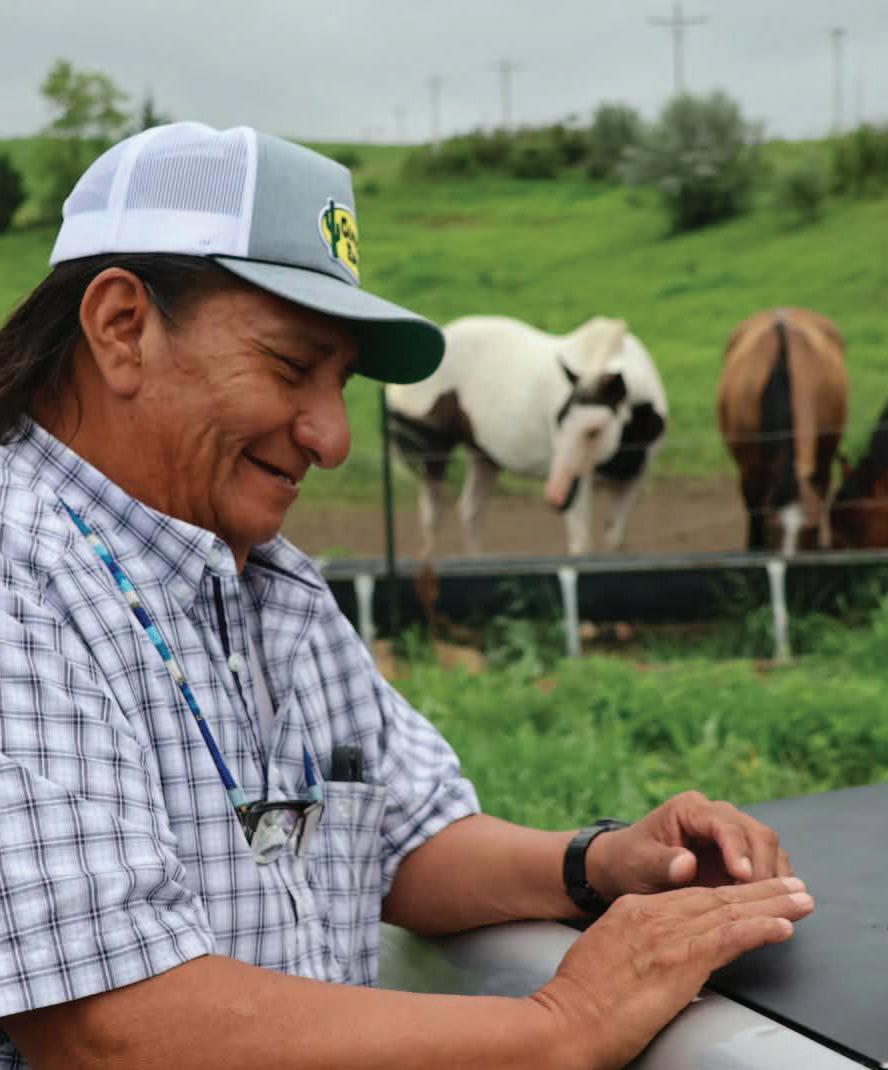
Doug Widow has been using equine therapy to work with Native American recovering alcoholics and addicts in Santee for more than a decade. He burns sage to be used to help prepare himself and a client for an equine therapy session to address the man’s trauma. Photograph by Tim Trudell
In Nebraska, electricity isn’t just a service—it’s a shared commitment. Unlike most states, where private companies answer to shareholders, Nebraska’s electric utilities are owned by the people they serve. This unique public power model allows communities to focus on what truly matters: providing reliable, affordable electricity for every home, farm, and business across the state.
Keeping rates low doesn’t happen by accident. Local control means decisions about rates and spending are made by community-elected boards, not distant investors. These boards live and work in the same towns they serve, so they understand how rising costs affect families and small businesses. Their goal isn’t to maximize profit—it’s to balance budgets wisely and plan ahead for the future.
One way Nebraska’s public power utilities manage affordability is through smart financial planning. Because they don’t pay dividends to shareholders, every dollar collected goes back into maintaining and improving the electric system. This includes upgrading power lines, investing in new technologies, and building reserves to handle unexpected costs such as storm repairs. The focus is always on stability and value for the customer.
Another key to keeping rates low is transparency. Public utilities hold open meetings where budgets and rate structures are discussed in plain view. Customers can attend, ask questions, and see how decisions are made. This open process builds trust and accountability. It also helps ensure that rate adjustments are fair and reflect actual costs, not profit margins.
Visit our website at nebraskamagazine.org

Energy efficiency programs are another cost-saving tool. Utilities across the state help customers use less energy through rebates, energy audits, and education programs. Every kilowatt-hour saved reduces strain on the system and delays the need for costly infrastructure expansion. These efforts not only lower bills but also support Nebraska’s goal of a more sustainable, resilient energy future.
The results speak for themselves. Year after year, Nebraska’s electric rates remain among the lowest in the nation. That’s a direct reflection of the state’s commitment to local control, financial responsibility, and community service.
In a world where energy costs are rising, Nebraska stands apart. Public power ensures that affordability isn’t just a promise—it’s a principle. And as long as Nebraskans continue to own their utilities, that principle will continue to power the Good Life.
Bob
Beatty is the General Manager of KBR Rural Public Power District, headquartered in Ainsworth, Neb.
Cost based and reliable electric service is the Public Power mission and has been forever. The question has always arisen about what is more important to the customer. My belief is that the average customer is more concerned with the cost than reliability until that time when the power goes out. Then reliability jumps to the head of the line. People take for granted that when they switch the light on it will come on. And really that is the way it should be. We in the industry are the ones that should be concerned about reliability, not the customer. We want customers to take it for granted that the power is always going to be there. That means that we are doing our job.
Reliability does not come easy nor cheap. Every day we come to work, reliability is the main priority, second only to safety, that we plan and work toward. To get that power to switch on when you need it takes the effort of many entities and people. To start at the top policy makers and regulators at both the state and federal level can play a big part in establishing a reliable electric grid. There was a saying when I was in the military, which I would clean up for this publication. “Lead, follow or get the heck out of the way.” In many cases the best thing a politician can do to help is just get the heck out of way and let us do our job.
To get the electricity from the generator to the end user is a multi-faceted process with many steps taken along the way to ensure peak reliability. The generation facilities need to ensure a steady supply chain of fuel and proper maintenance to keep everything running. The next step is to get the energy to the end use customers. This requires a robust transmission system which not only requires maintenance, but also experienced system operators to manage the flow of electricity correctly. There is always the threat of bad actors at all levels which is why cybersecurity is becoming a major part of reliability.
At the distribution level we have many avenues we take to achieve peak reliability. Two-way feeds are one way. If one feed goes down, we can switch it over to the other source. This is always a major goal of our work plans. A strong maintenance plan can go a long way to ensure reliability. We have transformers, breakers and other components on a regular schedule to be inspected and serviced before issues arise. Pole checking and replacing is probably the main tool in the toolbox for us. We schedule our whole system to be checked on a 10-year cycle, and all reject poles are replaced when they are found.
However, you can spend all the money and perform all the maintenance in the world but at the end of the day if the right amount of wind, snow and ice hit your system it is going to be affected. The best you can do is try to minimize the damage.
The goal will always remain the same. Let us worry about keeping the lights on. Public power has been and remains the best at providing this service.
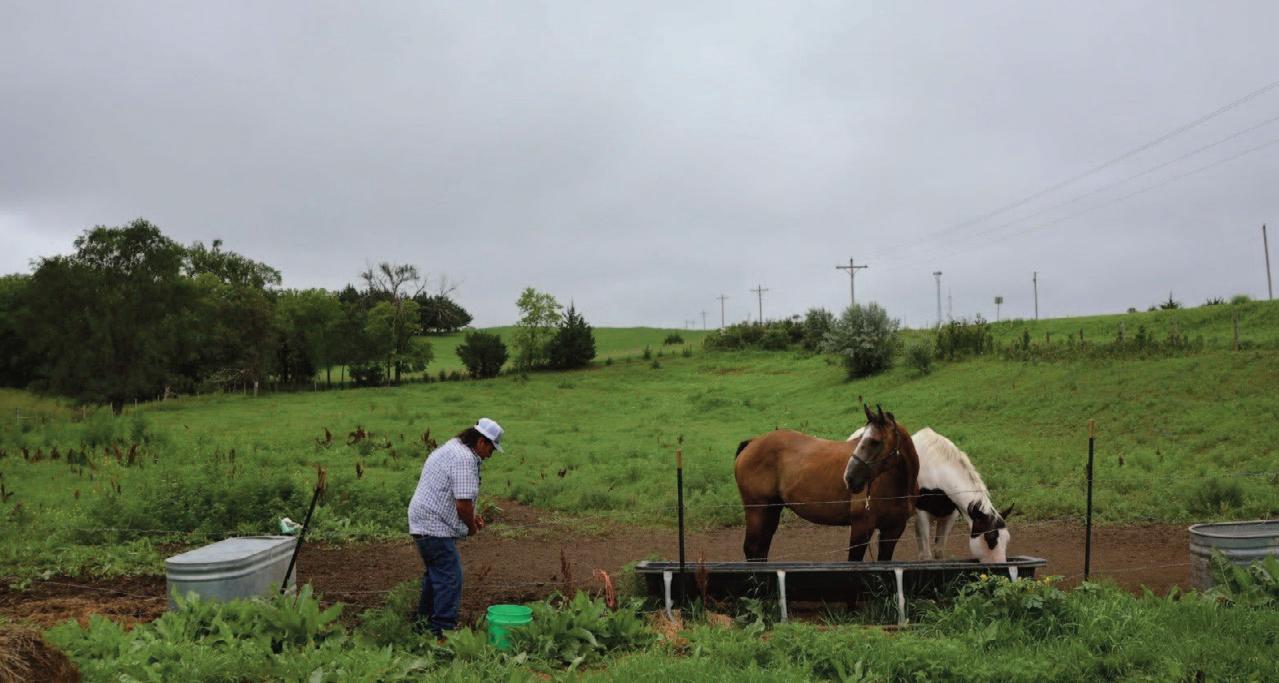


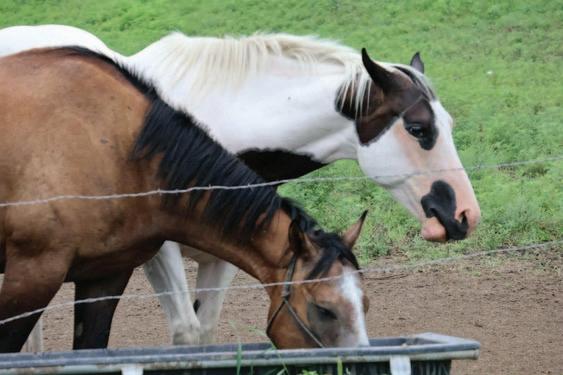
The brown mare stares as the two men chat about the importance of equine therapy. After a few minutes, one of the men looks again, the mare is still staring at him.
"She's looking at me," the man said to Doug Widow. "Do I come over?"
Widow looks up from the front of the pick-up on which he's leaning.
"Before you go in, face the west and I'll say a prayer," he said.
Afterward, he entered the corral Widow keeps his horses to begin several minutes of equine therapy to address personal trauma that has impacted his life for several years.
Widow, a Lakota citizen, has lived on the Santee Dakota (Sioux) reservation since 2012. He primarily practices equine therapy with Native Americans seeking
to overcome alcohol and drug addiction.
"They knew you were coming four days ago," Widow said. "They've been agitated. They know you have unresolved trauma."
Intergenerational trauma is common among Native Americans. The Indigenous experience of historical suffering is considered a source of intergenerational trauma responses, as well as a possible factor for longterm distress and substance abuse, according to the National Institute of Health.
Intergenerational trauma can include post-traumatic stress disorder (PTSD), cultural identification, substance dependence, anxiety disorders and conduct disorder/antisocial personality disorder (ASPD), a NIH study reported.
Usually, the horses are in the corral on the southern
edge of Santee. People see them whenever they drive into town.
After visiting for about 30 minutes, Widow decided to head into the woods and see if they were going to come to the corral.
About 10 minutes later, Widow appeared with three horses walking behind him.
"I asked if they were going to come up and they let me know they were ready," he said.
The healing process is unique. Rather than try to pair a person with a horse, the horse decides who it will help, Widow said.
"They sense the trauma. They know which one is bestsuited to handle it," he said.
In order to address the trauma the brown mare felt in him, the man, a Santee tribal citizen, began by running his hand over her in a clockwise manner. Each side of
A Lakota horse therapist on the Santee Dakota Reservation uses equine therapy and spiritual practices to help Native Americans confront intergenerational trauma, addiction, and grief. Guided by the horses themselves, the healing process allows participants — and the healer — to release pain, reconnect spiritually, and move forward.
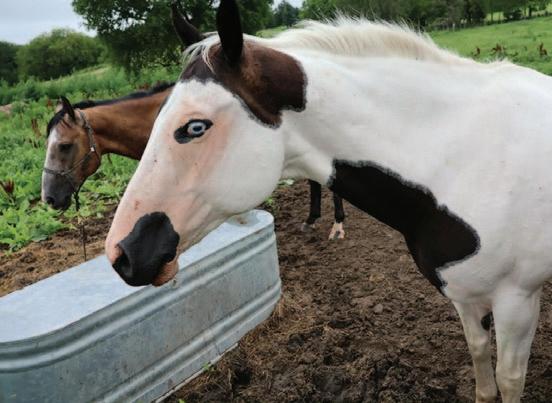
His mares in the corral he uses on the edge of town in Santee.

by Tim Trudell
the horse represents the stages of a person's life: right is infancy, left is adolescence.
Standing with his hands on the horse's back, he silently communicated with her. A painted pony saunters over, joining the session. Honoring it by addressing each quarter, he then stood in-between the mares, a hand on each of them.
After about 20 minutes of silence, the horses turned away. He followed Widow's directions, walking to the middle of the corral while Widow said a series of prayers. When finished, one of the horses brushed her tail against his face.
After watching from a distance, a gelding walked to him and rubbed his nose against the man.
Continued on Page 8
"He's letting you know that you are OK now," Widow said. "He wouldn't approach before because he was scared of what you were going through. He's not scared anymore. He wants you to know you don't need to be scared, too."
Horses sense a person's trauma and react accordingly, Widow said.
"The reason they don't come up, the reason she didn't go up to you is because whatever you're going through keeps you from doing things," he said. "That's what's caused a lot of stuff in your life that didn't make sense."
Widow's work as a horse therapist came late in life. He knew he didn't always fit in with others, but didn't understand why, Widow said.
When he learned he was a Heyoka, a person who senses others' energy and feelings, it made sense, Widow said.
"People talk about, 'Oh, you gotta have this and you gotta have that,' but it's just like everything in life," he said. "Like, for me growing up, there was a crowd over there, and I always tried to fit in, and I couldn't. Or there's something going on, and how come I'm not part of that? Been like that my whole life, and the main thing is it was like that until my wife died in 2022."
His wife was his partner in all ways possible, Widow said. She was his horse whisperer; she'd round up the ponies and help get them into the trailer on trips, he said.
He lost his wife almost four years ago. It took him three years to work through issues surrounding her death.
Realizing he guides his clients to address issues impacting their lives, it was time to follow his own advice, Widow said.
"I finally did a wiping of the tear, and it really helped me," he said. "I always thought that, 'Hey, I don't need help. I could do it myself, but I knew I had to reach out."
Knowing it was his calling to help others through equine therapy, but, as a Heyoka, feeling others' emotions can be overwhelming, Widow said.
"A lot of times they get to be too much for us, and so that's what makes us not want to go anywhere or do anything, because of that," he said. "So it's not all that."
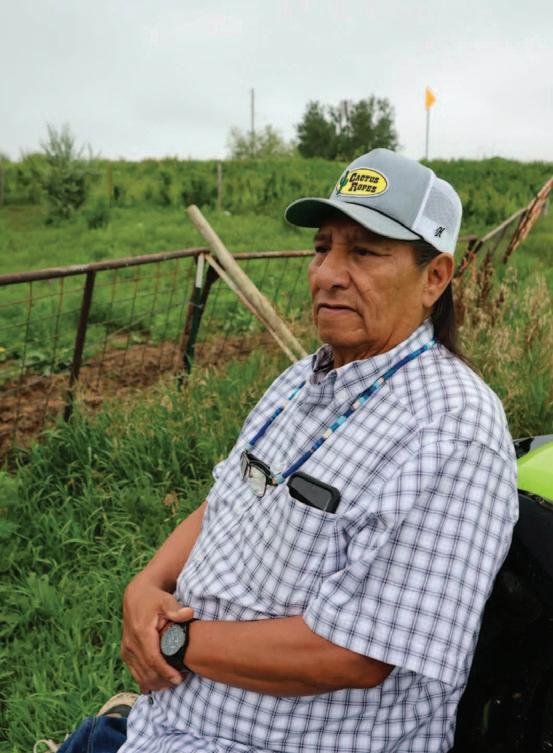
Doug Widow has been using equine therapy to work with Native American recovering alcoholics and addicts in Santee for more than a decade. Photographs by Tim Trudell
Regardless, he understands the responsibility passed to him by the ancestors, Widow said.
"Some people get to the point where they say, 'Well, that's enough,'" he said. "But there's still a lifetime to address. When I first came here, I helped a lady. I even gave her a horse. Now, she has more horses."
While he works with people to address trauma through equine therapy, Widow also leads others through sweats, which help resolve issues people have through spirituality. He leads a weekly sweat involving recovering alcoholics and addicts.
"It's awesome work," Widow said. "But, I don't know how to get myself out there."
Regardless, people in need know how to find him. While his calling as a Heyoka challenges his own emotions, Widow knows he's helping others.



In times of economic uncertainty—when inflation rises, markets fluctuate, and long-term financial stability feels less predictable—many investors turn to gold as a dependable store of value. By holding a portion of your wealth in gold, you can help safeguard your portfolio and preserve longterm financial security, even when broader economic conditions are unclear.
Since 2015, gold has surged over 400% — outpacing both the S&P 500 and the Dow during the same period.


American Gold Reserve is releasing government-issued $5 Gold American Eagles completely free of dealer markup for only $529 each. These beautiful $5 Gold American Eagles are a perfect way to enter the gold market. Set for immediate public release, availability is limited and supplies are expected to sell out quickly.
• Free of dealer markup.
• Gold provides protection against inflation and deflation.
• Gold offers financial cover during geopolitical and macroeconomic uncertainty.
• A strong portfolio diversifier.
Minimum order of 5 coins
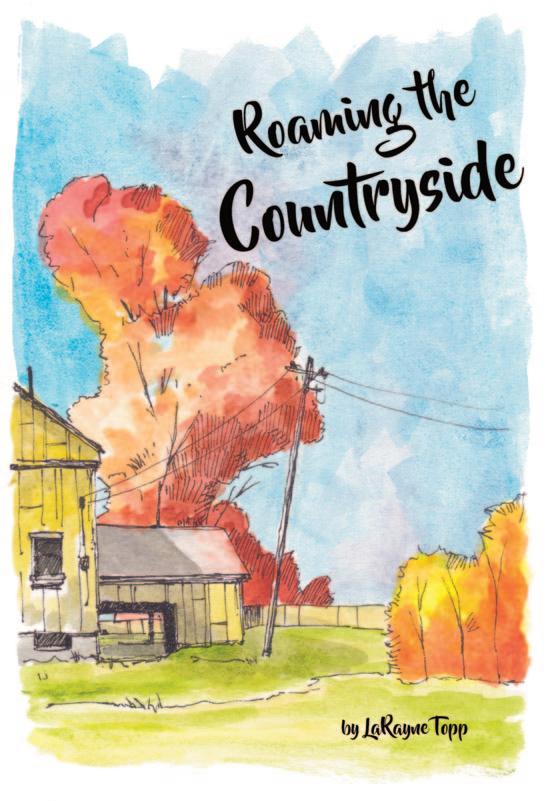
They wait till the coast is clear. Less than rowdy, whitetailed deer and cottontail rabbits creep quietly from their camouflaged hiding spaces, and then in a glorious burst of freedom, bounce across the terrain. Overhead cliff swallows and shorebirds soar. Violets and Dutchman’s breeches border the trails while cottonwoods, bur oak and coffeetrees create a shady canopy.
It’s a time machine, a Wayback contrivance, a conveyor belt designed to take its travelers back eons in time. It’s Mulberry Bend Overlook and from its vantage point, one can scan the hilly terrain south to Nebraska and north across the Missouri River to South Dakota. If you look far enough, you can just make out the past. Stretching more than 60 feet high and threaded with nearly a mile of nature trails, Mulberry Bend Overlook enjoys frequent houseguests. Big bluestem and side oats grama, wild four-o’clocks and milkweed, shell-leaf penstemon and prairie coneflower, all seem to have invited aunts and uncles and far distant cousins to take up residence beside them. If they could speak, what a tale they could tell.
After all, peeking over the hilltops, some ancestor from their family most assuredly watched thousands of years ago as Yankton Sioux Indians built villages on the river banks below, their houses stucco-ed with packed earth and wood. Their lives today the envy of many a modern-day man, these People of the End Village drew hickory arrows from a hide bowcase, quietly besting deer, antelope, small game and even a bison or two with steady aim, providing the tribe with an early day, highprotein diet.
Then came the day when a strange sort of man paddled by in fancy britches with skin as pale as white prairie clover, his canoe packed high with beaver fur. Men like him sometimes took a tribal wife as his own, and headed for St. Louis to trade in fur, until the day, that is, when fashion dictated the replacement of beaver hats with silk.
In 1804, more of the same sort came to that bend of the river in keelboat and pirogues. With leaders Meriwether Lewis and William Clark, they were on the lookout for wildlife to satisfy their hungry crew: soldiers, frontiersmen and interpreters, plus someone they called York, a large man, maybe 200 pounds. With skin darker than the Sioux, he used a long thunderstick to kill buffalo, deer and game. Perhaps the color of York’s skin so intrigued the Sioux that they gave the expedition a pass through their territory. Whether that’s so or not, these interlopers changed the lives of the Yankton Sioux forever, bringing what they preferred to call “civilization.”
Then in 1881, more changes came to Mulberry Bend. The surging water of the Missouri carried massive blocks of ice on its shoulders, eroding into the river banks below, while slinging sediment behind itself onto the opposite banks to create curving oxbows. The river waters eventually broke through these oxbows to create shorter channels, thereby carving a new path.
The valley’s new course is what one sees today while perched on top of the time machine. The river still courses by, never static, just like the lives of those who once lived along its banks, one sort of creature affecting the lives of another. Much like a chorus singing a song, the voices of nature combine with history to whisper the stories left behind, in those same waters, under that same sky overlooking the Mulberry Bend Overlook.
This is LaRayne Topp, just roaming the countryside
By Larry Oetken

Winter storms that bring ice and heavy snow can create serious safety risks both inside and outside the home. Falling tree limbs and damaged power lines are common during these events, and knowing how to respond can help prevent injury or worse.
Any power line that is down or hanging low should be treated as dangerous, even if it is not sparking or arcing. Lines can still be carrying electricity, and nearby metal objects, fences, or equipment may also become energized.
Power lines that appear inactive can suddenly
SAFE. EFFICIENT. EXPERIENCED.
The program is nationally recognized for comprehensive utility line and job training safety. Classes are taught by expert faculty committed to student success.
HANDS-ON LEARNING.
Study and perform wiring, pole climbing, metering, operating bucket trucks and digger derricks, and line construction. Graduates have high job placement rates and the skills and confidence to excel on the job.
become live again as crews work to restore service or when generators are used incorrectly. For that reason, it is important to stay well clear of all downed lines and to report them to your local electric utility right away. Never attempt to move a line or anything touching it. Drivers should also avoid driving over downed lines, as a vehicle can catch the line and pull down poles or other equipment, creating additional hazards.
Storm damage can also affect traffic signals, making intersections more dangerous. Slow down and use extra caution when lights are out. If you plan to use a generator during an outage, operate it exactly as directed, keeping it outside and away from windows and doors. Taking these simple precautions can make a significant difference during severe winter weather.
Larry Oetken is the Director of Job Training & Safety for the Nebraska Rural Electric Association.

by James Dukesherer, NREA Director of Government Relations
By the time you read this article, this year’s 60-day legislative session will be more than half done. NREA’s Legislative Committee and Board of Directors, composed of representatives from all of our 35 public power utilities across rural Nebraska, came together last month to review the nearly 600 bills that were introduced this session and to take official positions. Official positions were taken on 14 bills. Here is our position on a few of these bills:
LB 1010 — Introduced on behalf of the Nebraska Power Association, would place energy storage resources—large batteries (ESR) under the purview of the Nebraska Power Review Board. Private companies deploying ESRs would be required to enter into a power purchase agreement with a public power utility and obtain the consent of any impacted electric utilities in the project area. A competing bill, LB 1193, was also introduced on this topic. LB 1193 would allow for the private development of ESRs without the requirement for a contractual relationship with public power. NREA is Opposed to LB 1193.
LB 1027 — Would require a Privately Developed Renewable Energy Generation Facility (a privately-owned renewable project) to enter into a power purchase agreement with a public power utility and to receive Power Review Board approval before the project can be constructed.
LB 1261 — Would allow large (more than 1,000 megawatt) thermal generation facilities to be privately owned in Nebraska. Although such a large generator would be privately-owned, the bill contains multiple protections to ensure our public power model is protected.
LB 964 — Would require all political subdivisions to hold a public hearing prior to any sale, lease, or purchase of real property. The bill also contains additional publication requirements. Public power electric utilities are already subject to Open Meetings and Public Records Laws ensuring the public has access to the information this bill attempts to address.
LB 1026 — Would restrict a public power utility from closing or altering a generation plant unless the closure or alteration is due to at least one of the four qualifications noted in the bill. Public power electric utilities are governed by a publicly elected or appointed board. The decision to close or alter a power plant is a difficult and expensive decision that is best made by those closest to the issue.
LB 1093 — Provides an exemption in statute for telecommunication providers to the 811 Call Before You Dig Act. The bill allows for some “hand digging” without notification to One Call and having the area marked. Contact with buried electric utilities can be expensive and dangerous to telecommunication employees. When it comes to the safety of employees and protection from electrocution there is no room for an exemption.
LB 1172 — Would require an electric supplier’s generation mix to be composed of at least 75 percent dispatchable generation (coal, natural gas, hydro, nuclear). Public power must comply with strict federal regulations for ensuring reliable electric service. LB 1172 fails to understand these requirements and how public power works every day to ensure Nebraskans have access to reliable electric service.
LB 1204 — Would address statewide zoning requirements for energy storage facilities and renewable energy projects. The bill proposes a one-size fits all approach to zoning regulations across the state and removes the local control of each county to set its own requirements for such projects.
LB 1255 — Would prohibit public power suppliers from exercising the power of eminent domain.
LB 1064, LB 1111, LB 1259 — A number of bills have been introduced this session to address the development of very large loads in Nebraska by private companies. Whether the project be a crypto-currency operation, a battery storage facility, a data center, or a large industrial load, these bills, in one way or another, claim to help public power and protect Nebraska’s electric consumers as we interconnect these customers to our system. Some of these bills open the door for private companies to be able to serve the electric needs of Nebraska consumers. All of these bills fail to understand how public power sets rates
and how we deal with large loads. Public power utilities routinely require individualized rate structures, cost recovery mechanisms, interconnection and transmission studies, financial commitments, and operational safeguards when interconnecting large loads. We are confident in our ability to manage the risks associated with large customers without transferring costs to other ratepayers and without the need for additional legislation.
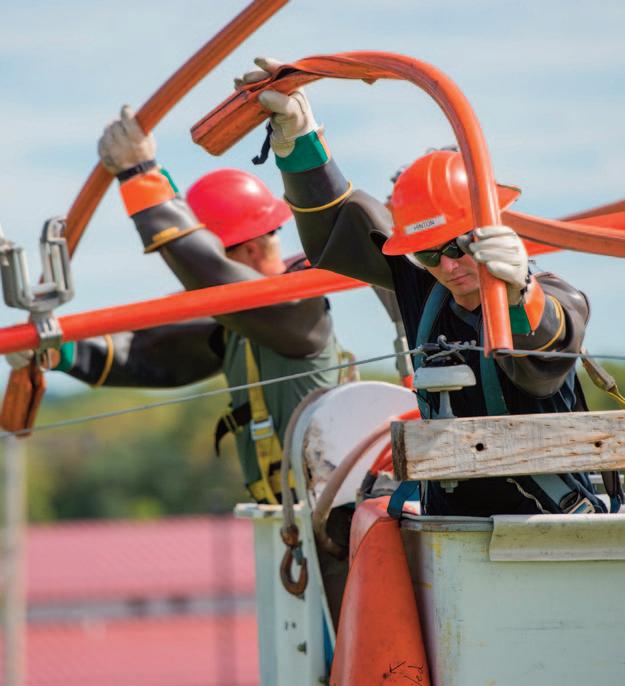
Most jobs do not require climbing 40 feet in the air to work near power lines carrying 7,200 volts. But for utility lineworkers, that is a normal day. These workers maintain the poles and lines that power our homes, schools and businesses. Never post signs or attach anything to a utility pole. Nails, staples and tacks can damage workers’ safety gear and increase the risk of injury or electric shock. Do not put tree stands on power poles either. It is dangerous and often illegal.
Help keep lineworkers safe. Stay away from overhead power lines and respect all utility poles.
by Cathy Cash
Kinks in the supply chain caused by the COVID pandemic—remember the run on toilet paper?—may be in the rearview for regular consumers, but new bottlenecks in the flow of goods and services are challenging Nebraska’s public power districts and electric cooperatives to deliver affordable and reliable service. And the circumstances squeezing the supply chains for rural electric utilities are unlikely to ease in the foreseeable future.
Basically, we’re talking about a higher demand for electricity, but supply of equipment needed to maintain or build more power plants has not kept up. Then there’s a skilled labor shortage to get the job done and tariffs on imported materials. All these things add up to delayed energy projects at increased costs.
With all things digital from phones to thermostats, electricity use is up. To sustain the growing digital economy, huge data centers with appetites for electricity akin to that of a small city are sprouting up across rural America and rural electric utilities’ service territories. These centers soak up extreme amounts of power to serve the internet’s relentless demand for high-speed networking, data storage and AI (artificial intelligence) that make the World Wide Web user-friendly.
But even in this post-pandemic world, there still remains a scarcity of materials, equipment and workers to get new power generation sources built.
After the pandemic forced manufacturing to shutter for months in 2020, a lot of experienced employees retired or never even went back to their jobs making transformers and other equipment essential to distributing electricity to consumers. The supply of some transformers has never been fully replenished, and the lack of a competent workforce today makes that a constant game of catch-up.
U.S.-based engineering, procurement and construction firms are scrambling to meet work orders for new power projects as there is more demand today than they can keep up with, says Stephanie Crawford, regulatory affairs director at the National Rural Electric Cooperative Association.
Public power districts and electric co-ops are “finding that these firms cannot respond to requests, they’re charging price premiums or that planning for projects four years out is already ‘too late,’” she says.
As a result, equipment crucial for electricity projects— from new substations to power plant maintenance and outage repairs after storms hit—are on delay and coming in at much higher prices.
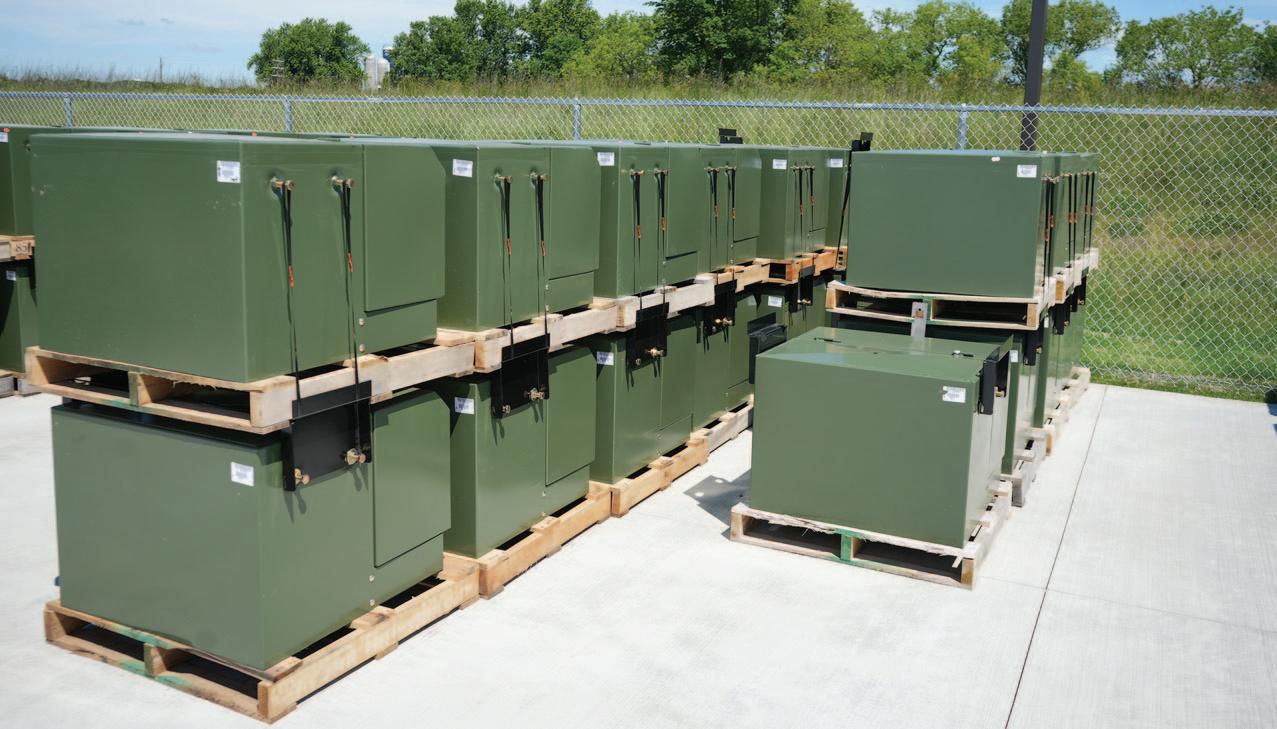
Rural electric utilities are seeing lag times of up to four years between an order for a transformer and its ultimate delivery. Prices are up 70% to 100% compared to 2020. Lead times for new gas turbines for a power plant can range from three to six years and cost 25% more than just three years ago.
According to one industry insider, a rural electric utility that spent $10 million on materials and equipment for electricity projects and maintenance in 2020 had to spend over $15.5 million in 2025 to keep up.
So, what is your rural electric utility doing to maintain reliable and affordable service?
Collaboration, which is baked into every utility’s DNA, is key. Public power districts and electric cooperatives are finding themselves working with equipment suppliers and contractors closer than ever and planning their orders at least a year in advance of construction to work out the snags of the current supply chain.
Knowing their exact inventory and the physical storage space also helps rural electric utilities keep
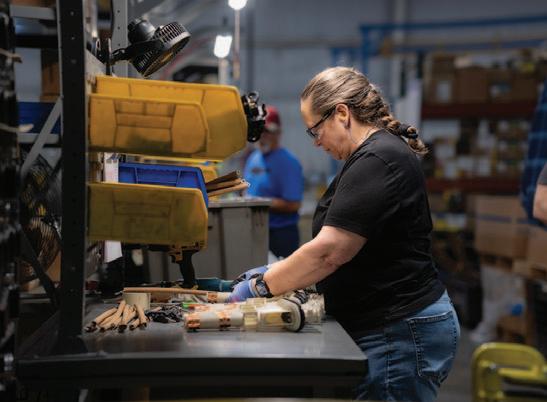
Above: After the pandemic, many skilled workers retired from manufacturing jobs making distribution transformers and other essential energy equipment. The shrunken labor force is challenging the supply for new power plant construction, maintenance or outage recovery.
Opposite: Rural electric utilities are seeing lag times of up to four years between orders and delivery of transformers at double the prices compared to pre-pandemic times. Photographs provided by ERMCO
necessary equipment on hand, materials flowing and projects as near to schedule as possible.
ERMCO, a subsidiary of Little Rock-based Arkansas Electric Cooperatives, makes distribution transformers with American-made steel at its facilities in Tennessee and Georgia and is not experiencing price spikes or delays. Still, the transformer market as a whole is not immune to price pressures impacting other manufacturers reliant on imported cores made with foreign steel.
The biggest challenge right now is “navigating uncertainty,” says ERMCO President and CEO Tim Mills.
“The best path forward is to develop a long-term sourcing strategy and work closely with suppliers to lock in future needs. We need to embrace a more collaborative model between utilities and their suppliers.”
By working as a team, rural electric utilities, manufacturers and their industry partners will be able to improve forecasting their equipment needs, stay ahead of potential demand changes and experience a smoother supply chain.
If you had a new fence to install at home, you would likely research property lines, ordinances, and fence types. Then you would get to the point of purchasing, prepping, and assembling materials to get work started. However, you would still not be ready to dig. There is a very important step missing— calling 811.
811 is a free service that will have buried public utilities marked on your property so that you can safely dig around them. Just call 811, or submit an online request at call811.com at least a few business days before you plan to dig.
Digging without having utility lines marked can result in damage to gas, electric, communications, water, and sewer systems. Checking the safety of a location before you begin digging is important for both professionals and homeowners. It helps prevent accidents on projects of all sizes and scopes.
When contacting 811, make sure

that you have clearly identified your planned digging area and outline it in white paint if possible. The service uses ground-penetrating radar to search for and locate the buried public utility lines that are on your property. Lines will be marked with flags or paint. The color indicates the type of utility located. After the area has been
marked, the CGA reports that you have less than 1 percent chance of causing damage if you respect the markings.
If you have any private utilities, you will need to hire a private utility locator. Some examples of private utilities include: underground sprinkler system, invisible fences, data communication systems, private water systems, or gas piping to a garage.
Even if you have had an area marked before, call to have the area checked again. Natural changes to the soil, such as erosion or root growth, can alter the depth and location of buried lines. Once all buried lines have been marked, respect the boundaries, and dig carefully.
Keep yourself from having to dig out of trouble, and call 811 before your digging project begins. For more safety information, visit SafeElectricity.org.




by Miranda Boutelle
One of the most common questions I get about energy efficiency rebate programs is, “Why would the company that sells me energy want me to use less of their product?” It’s a good question. Rebates provide financial incentives for people to use less energy in their homes by reducing the costs of efficiency upgrades, such as insulation, new HVAC systems, water heaters or other appliances. This helps your electric cooperative save money by eliminating or delaying the need to buy additional power or build new power generation facilities. Using less energy also helps lighten the load on existing generation and transmission infrastructure that delivers power to your home through your public power district or electric cooperative. Helping consumers save energy is a powerful tool for electric utilities. Instead of building or paying for more power generation to meet rising needs in the local community, electric utilities create programs that help people save energy in their homes and businesses.
Your electric utility and other local organizations may offer efficiency programs with special incentives for home upgrades, such as rebates paid after a project is completed. State and federal tax credits may also allow you to reduce the amount of taxes you owe for completing eligible home purchases or upgrades. Federal energy efficiency tax credits ended Dec. 31, 2025. If you completed any upgrades before that date, you can apply for

credits on your 2025 federal filings. Energy efficiency programs are funded through a variety of sources, including surcharges on customer utility bills, grants, and state and federal funding. Some states and regions are required by law to provide energy efficiency programs.
If you are planning to purchase new appliances, equipment or complete an efficiency upgrade, do your research first. I recommend starting with your public power district or electric cooperative to see if they offer energy efficiency programs. Also check with your state energy office, which might have additional programs to help. The Inflation Reduction Act allocated federal funds to state-administered programs, including home efficiency rebates and home electrification and appliance rebates, to help residents with retrofits such as windows, insulation, air sealing, HVAC equipment and appliance upgrades. There are also income-eligible programs available for energy assistance and weatherization, such as
the U.S. Department of Energy Weatherization Assistance Program, typically administered by a local community action agency.
Once you identify a rebate, tax credit or financing option you’re interested in, review the criteria carefully. Criteria can vary by program, so make sure you know the eligibility requirements before making a purchase to avoid missing out on energy-saving opportunities. Some programs require preapproval before you begin a project. Proof of existing equipment or conditions may be required, such as insulation levels or window types. You may also need to schedule an energy audit conducted by a program representative or photo documentation.
Once you know your project meets the requirements of any available programs, you can proceed with installation. You will likely need to fill out an application and submit a final invoice to prove the project is complete. You may also need to submit pictures or have an inspection from a program representative.
Once approved, your rebate will typically be issued as a bill credit or check, depending on the source.
Participating in a rebate program can help you lower your energy use, save money and improve comfort in your home. It can also help your energy provider and the electric grid. Contact your public power district or electric cooperative to learn more about available rebates and incentives.

















Collectors LOVE “firsts” as no collection is complete without the very first coin. First-year coins are almost always the most coveted coins and the 1964 First Year Silver Kennedy Half Dollar is no exception, especially when you consider the coin has been struck for over 60 years! But there’s something else that makes the First-Year 1964 Kennedy Half Dollar hoarded by all…
The Only Silver Kennedy Struck in 90% Silver
What makes the 1964 Silver Kennedy Half Dollar stand out is its silver composition. While Silver Kennedy Half Dollars were issued from 1964-1970, the 1964 Silver Half is the ONLY YEAR made in 90% silver!
PUBLIC RELEASE - ONLY 1,193 COINS AVAILABLE
Rarcoa, America’s Oldest Coin Company, is announcing the public release of 1,193 of the very first year and only 90% silver year, 1964 Silver Kennedy Half Dollars. What may be even more impressive is that each coin is in Brilliant Uncirculated condition, pristine as the day they were released.
SOLD NATIONALLY FOR AS MUCH AS $103
This same 1964 Silver Kennedy Half Dollar sells nationally for as much as $103. But thanks to Rarcoa’s buying power and deep numismatic expertise, you won’t have to pay $103. You won’t have to pay $90. You won’t even have to pay $70.







SHIPPING on 3 or More!










Limited time only. Product total over $149 before taxes (if any). Standard domestic shipping only. Not valid on previous purchases
mention this code when you call.
In a town of about 750 people, it doesn’t take long for word to spread when something special opens its doors. In Clay Center, that something is The Spoon House—a restaurant rooted as deeply in community as it is in history.
The Spoon House is housed in the former First Bank of Clay Center, a stately building constructed in 1887. Before becoming a restaurant, the building served many roles—an internet company, a health department office, and even a short-lived beauty shop tucked into the back. What it had never been was a place to gather over a hot meal.
That changed in May 2022, when Tony Witherspoon opened The Spoon House. Witherspoon moved to Nebraska from Kansas City, Missouri, to play basketball at York College. Fatherhood soon followed, and with it a decision to put down roots close to his children. Opening a restaurant in small-town Nebraska was both a business move and a commitment.
Witherspoon renovated the interior, carefully preserving the building’s character. The original bank vault remains, and upstairs—once a ballroom—hints at the building’s elegant past. Before passing state food inspection, The Spoon House operated on freewill donations, serving breakfast to the community every Wednesday. “We were able to serve food while we did work on the building because it was a free will donation,” Witherspoon said.
Today, Witherspoon does most of the cooking, assisted by employees Tracy Smalley, Christina Price, and Adrianna DeGarmo. Together, they emphasize customer service and a family-style atmosphere. The menu has earned a loyal following, especially for smoked brisket, Philly cheesesteak sandwiches, and classic biscuits and gravy.
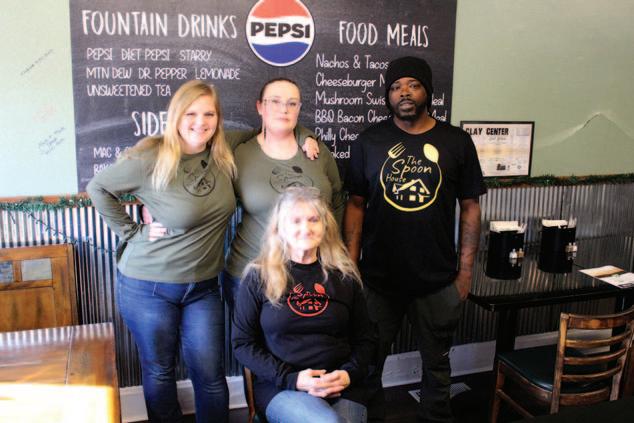
Community involvement is central to the business. Sandy Creek High School donated kitchen equipment, and Witherspoon has hosted fundraisers for the school. He also gives back through “Skill and Drills with The Spoon House,” an after-school basketball fundamentals program for kids. Every customer is invited to sign the walls—a growing patchwork of names that reflects local pride and support.
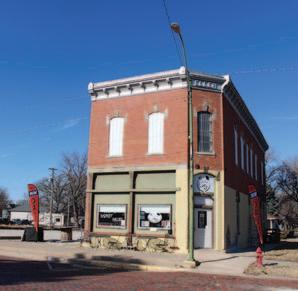
Open Monday through Friday from 10 a.m. to 8 p.m., and Sundays from 2 to 8 p.m., The Spoon House is more than a restaurant. It’s a reminder that in small towns like Clay Center, opportunity, history, and community can still share the same table.
Clay Center, the county seat of Clay County, was once the home of “Old Trusty” poultry incubators and brooders sold nationwide. The factory employed hundreds and left a legacy still celebrated each September during Old Trusty Days. Today, that same spirit of enterprise lives on just off the town square.

4 1/2 pounds pork shoulder or Boston butt
26 ounces sweet and spicy barbecue sauce
1/2 tablespoon garlic
1/2 tablespoon fresh cracked black pepper fresh sandwich buns
Dandy Celery, cut and pickled jalapenos coleslaw (optional) potato salad (optional) baked beans (optional)
Place pork in slow cooker.
Mix barbecue sauce, garlic and pepper. Pour over pork shoulder.
Cook on low 8 1/2-10 hours or high 6-7 hours.
Shred meat and serve on buns with pickled celery and jalapenos. Top with coleslaw, if desired. Serve with potato salad or baked beans, if desired.
Recipe courtesy of Duda Farm Fresh Foods
1 pound ground beef or venison
4 bell peppers
2 cups rice
1 6 oz. package sliced pepperoni
1 6 oz. package sliced Canadian bacon
3 cups shredded cheddar cheese
1/2 white onion, diced
1/2 cup mushrooms, diced
1 14-oz jar pizza sauce parmesan cheese
Brown ground meat in skillet. Add rice, cook 2 more minutes, and allow to cool. In large bowl combine meat mixture, cheese, pepperoni, Canadian bacon, pizza sauce, onion, and mushrooms. Mix thoroughly.
Remove pepper tops, cutting at an angle as if carving a pumpkin. Remove seeds and save tops. Place 2 Tbsp cheese in each pepper. Add venison mixture to peppers, packing down until 1 inch from top. Fill remaining space with additional cheese. Place tops on peppers and position upright in meatloaf pan in preheated oven at 350° for 40 mins. Serves 4.
Alan Bartels, Farwell, Nebraska
2 10 oz. cans beef consommé
2 14.5 oz. cans beef broth
2 cups diced carrots
2 cups diced celery
2 cups peeled diced potatoes
1 cup diced onion
1 28 oz. can tomatoes with juice (I used the diced)
1 tablespoon Kitchen Bouquet
1 tablespoon Heinz 57 sauce
1 tablespoon Worcestershire sauce
1/2 teaspoon ground black pepper (original recipe said 1 teaspoon)
1 teaspoon garlic powder
1 16 oz. package frozen mixed vegetables
1 lb. lean ground round, browned and drained
Add the consommé, broth, carrots, celery, potatoes, onion, tomatoes, Kitchen Bouquet, Heinz 57, Worcestershire sauce, pepper and garlic powder to large soup pot. Bring to a boil. Reduce heat and simmer, covered, 30 minutes. Add frozen vegetables and browned meat. Simmer covered for 30 minutes to 1 hour until potatoes are fork tender.
Although this soup is named Vegetable Steak Soup, it has no steak in it. The combination of the Kitchen Bouquet, Heinz 57 and Worcestershire sauce gives it a steak flavor. It’s also good made a day in advance and it freezes well.
















There’s strength in choosing the rural way of life— rising early, working hard, and building something that lasts. At Tri-State G&T, we share that commitment and are working with our members to protect your way of life and power what’s next.
Our business model drives how we plan our diverse energy mix—solar, wind, natural gas, hydro, and batteries—so we can weather any storm and meet the growing energy needs of the West. Now that’s reliability.

Scan to learn more or visit www.tristate.coop/powering-future
Tri-State is a not-for-profit power supplier to cooperatives and public power districts in Colorado, Nebraska, New Mexico and Wyoming.