Another random document with no related content on Scribd:
The Project Gutenberg eBook of The adventuress
This ebook is for the use of anyone anywhere in the United States and most other parts of the world at no cost and with almost no restrictions whatsoever. You may copy it, give it away or re-use it under the terms of the Project Gutenberg License included with this ebook or online at www.gutenberg.org. If you are not located in the United States, you will have to check the laws of the country where you are located before using this eBook.
Title: The adventuress A Craig Kennedy detective story
Author: Arthur B. Reeve
Illustrator: Will Foster
Release date: April 17, 2024 [eBook #73414]
Language: English
Original publication: New York: Harper & Brothers, 1917
Credits: Carol Brown, Tim Lindell and the Online Distributed Proofreading Team at https://www.pgdp.net (This book was produced from images made available by the HathiTrust Digital Library.)
THE ADVENTURESS
BOOKS BY ARTHUR B. REEVE
CraigKennedyDetectiveStories
THE ADVENTURESS THE TREASURE-TRAIN THE SILENT BULLET THE POISONED PEN THE DREAM DOCTOR THE EXPLOITS OF ELAINE THE ROMANCE OF ELAINE THE EAR IN THE WALL THE WAR TERROR GOLD OF THE GODS THE SOCIAL GANGSTER
OtherDetectiveStories
GUY GARRICK
CONSTANCE DUNLAP
HARPER & BROTHERS, NEW YORK [ESTABLISHED 1817]
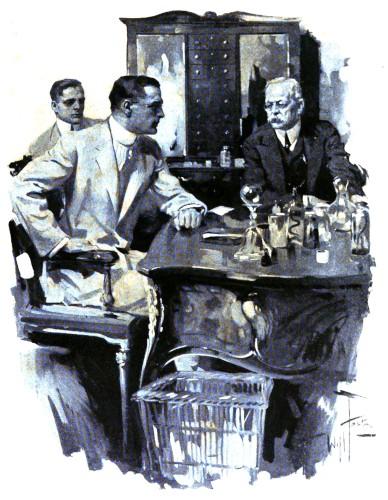
CRAIG KENNEDY IN HIS LABORATORY
THE ADVENTURESS
A CRAIG KENNEDY DETECTIVE STORY
BY
ARTHUR B. REEVE
AUTHOR OF “TheTreasureTrain”andotherCraig
KennedyScientificDetectiveStories
FRONTISPIECE BY WILL FOSTER
HARPER & BROTHERS PUBLISHERS
N E W Y O R K A N D L O N D O N
THE ADVENTURESS
Copyright, 1917, by Harper & Brothers
Printed in the United States of America
Published November, 1917
C O N T E N T S
CHAP
I. THE MYSTERY OF THE “SYBARITE”
II. THE SECRET SERVICE
III. THE CABARET DANCER
IV. THE BURGLAR’S MICROPHONE
V. THE WHITE LIGHT CAFÉ
VI. THE POISON GAS
VII. THE DIVORCE DETECTIVE
VIII. THE PULMOTOR
IX. THE TRAILING OF PAQUITA
X. THE DETECTAPHONE DETECTOR
XI. THE FRAME-UP
XII. THE EAVESDROPPERS
XIII. THE SERPENT’S TOOTH
XIV. THE GEOPHONE
XV. THE NIGHT OF TERROR
XVI. THE INVISIBLE INK
XVII. THE CIPHER LETTER
XVIII. THE RADIO DETECTIVE
XIX. THE WIRELESS WIRETAPPER
XX. THE SPEED DEMON
XXI. THE SUBMARINE EAR
XXII. THE TELAUTOMATON
XXIII. THE CURB MARKET
XXIV. THE PHANTOM CIRCUIT
XXV. THE ADVENTURESS
THE ADVENTURESS
THE ADVENTURESS I
THE MYSTERY OF THE “SYBARITE”
A REVOLVER-SHOT followed by the crash of glass sounded in our hall.
At the same instant the laboratory door burst open and an elderly, distinguished-looking man stumbled in on us, his hat now off, his coat and collar awry, his hair rumpled, and his face wearing a dazed, uncertain expression, as though he did not yet comprehend what had so suddenly taken place.
“My God!” he exclaimed, gazing about in a vain effort to restore his dignity and equilibrium. “What was that? I hardly had my hand on the knob when it happened.”
A glance was enough to assure Kennedy that the man was unhurt, except for the shock, and in a moment he dashed out into the hall.
The front door of the Chemistry Building had been shattered by a revolver-shot. But not even the trace of a skulking figure could be seen on the campus. Pursuit was useless. There was, apparently, no one to pursue.
Pale and agitated still, the man sank limply into a chair as I forced a stimulant into his trembling lips.
Kennedy closed the door and stood there a moment, a look of inquiry on his face, but without a word.
“Some one—must have—shadowed me—all the way,” gasped the man as he gulped hard, “must have seen me come in—tried to shoot
me before I had a chance to tell you my story.”
It was some minutes before our strange visitor regained his poise, and Craig refrained from questioning him, though I was consumed with curiosity to know the reason of his sudden entrance.
When at last he did speak, his first words were so different from anything I had expected that I could hardly believe him to be the same person. In spite of his nervousness, his tone was that of a hard, practical man of business.
“I suppose you know something of Maddox Munitions, Incorporated?” he inquired, somewhat brusquely.
I did not quite understand a man who could be himself so soon after an episode such as he had been through, nor do I think Kennedy did, either.
“I have no interest in ‘war brides,’” returned Craig, coldly.
“Nor have I—as such,” the man agreed, apparently rather pleased than otherwise at the stand-off attitude Kennedy had assumed. “But I happen to be Maxwell Hastings, attorney for Marshall Maddox, who was—”
Kennedy wheeled about suddenly, interrupting. “Whose body was found floating in Westport Bay this morning. Yes, Mr. Jameson and I have read the little five-line despatch in the papers this morning. I thought there was something back of it.”
As for me, I was even more excited now than Kennedy and I could see a smile of satisfaction flit over the face of Hastings. In a few sentences the clever lawyer had extracted from us what others took all manner of time and art to discover. He knew that we were interested, that he could depend on Kennedy’s taking the case.
Kennedy and I exchanged a significant glance. We had discussed the thing cursorily at the breakfast-table as we did any odd bit of news that interested us.
Already I knew, or fancied I knew, something of the affair. For it was at the time when explosions in munitions plants had furnished many thrilling chapters of news.
All the explosions had not been confined to the plants, however. There had been and still were going on explosions less sanguinary but quite as interesting in the Maddox family itself.
There was a hundred million dollars as the apple of discord, and a most deadly feud had divided the heirs. Together they had made money so fast that one might think they would not feel even annoyance over a stray million here and there. But, as so often happens, jealousy had crept in. Sudden wealth seemed to have turned the heads of the whole family. Marshall Maddox was reported to have been making efforts to oust the others and make himself master of the big concern.
“Maddox had had some trouble with his wife, hadn’t he?” I asked, recalling scattered paragraphs lately in the papers.
Hastings nodded. “They were separated. That, too, was part of the family disagreement. His sister, Frances, took the part of his wife, Irene, I believe.”
Hastings considered a moment, as though debating how far he should go in exposing the private affairs of his client, then caught the eye of Kennedy, and seemed to realize that as long as he had called Craig into the case he must be frank, at least with us.
“At the Westport Harbor House,” he added, deliberately, “we know that there was a little Mexican dancer, Paquita. Perhaps you have heard of her on the stage and in the cabarets of New York. Marshall Maddox knew her in the city.”
He paused. Evidently he had something more to say and was considering the best way to say it.
Finally Hastings leaned over and whispered, “We know, too, that Shelby Maddox, his brother, had met Paquita at the Harbor House just before the family conference which brought them all together.”
It was evident that, at least to Hastings, there was something in the affair that looked ugly to him as far as Shelby was concerned.
“It’s not at all strange,” he added, “that two men as unlike as Marshall and Shelby should disagree. Marshall was the dominating type, eager for power; Shelby easy-going, more interested in having a good time. In this affair of Paquita—whatever it amounted to—I’m not at all surprised at Shelby. He is younger than Marshall was—and inclined to be a sport. Still, there was a vein of susceptibility in Marshall, too. There must have been.”
Hastings paused. Human frailties were out of his ken as a lawyer. Property he understood; passions, no. With him the law had been a jealous mistress and had brooked no rival.
“It was on Shelby’s yacht, the Sybarite, was it not, that the tragedy occurred?” ventured Kennedy.
It was a leading question and Hastings knew it. He drew in a long, contemplative breath as he decided whether he should consent to be led.
“Yes—and no,” he answered, finally. “They were there on the yacht, of course, to agree to disagree and to divide the family fortune. Shelby Maddox went to Westport on the yacht, and it was so hot at the Harbor House that they decided to hold the conference on the Sybarite. Marshall Maddox and I had motored out from town. The sister, Frances, and her husband, Johnson Walcott, live on the other side of the island. They motored over, also bringing with them Johnson Walcott’s sister, Winifred, who stayed at the Harbor House. Johnson Walcott himself went ashore from the yacht early in the evening, having to go to the city on business. That was all right, for there was Bruce, the lawyer who represented Frances Maddox—I mean Mrs. Walcott, of course. You see, I’ve known the family so long that I often forget that she is married. Shelby had his lawyer, also, Mr. Harvey. That was the party. As for the tragedy, I can’t say that we know positively that it took place on the yacht. No. We don’t knowanything.”
“Well,” temporized Hastings, “I can’t say that it was especially. The division was made. Marshall won control of the company—or at least would have done so if the terms agreed on had been signed in the morning. He agreed to form a syndicate to buy the others out, and the price at which the stock was to be sold was fixed.”
“But did they dispute about anything?” persisted Kennedy, seeing how the lawyer had evaded his question.
Hastings seemed rather to appreciate the insistence than to be annoyed by it. So far, I could see that the great corporation lawyer was taking Kennedy’s measure quite as much as Craig was doing the same by him.
“Yes,” he answered, “there was one thing that occasioned more dispute than anything else. Maddox Munitions have purchased a wonderful new war invention, the telautomaton—wireless control of submarines, torpedoes, ships, vehicles, aeroplanes, everything,—the last word in the new science of telautomatics.”
An exclamation of surprise escaped Kennedy. Often he and I had discussed the subject and he had even done some work on it.
“Of course,” resumed Hastings, “we have had to acquire certain rights and the basic, pioneer patents are not ours. But the manner in which this telautomaton has been perfected over everything yet devised by inventors renders it the most valuable single piece of property we have. At last we have an efficient electric arm that we can stretch out through space to do our work and fight our battles. Our system will revolutionize industry as well as warfare.”
It was not difficult to catch the enthusiasm which Hastings showed over the telautomaton. There was something fascinating about the very idea.
Kennedy, however, shook his head gravely. “Too big a secret to be in the hands of a corporation,” he objected. “In warfare it should
only be possessed by the Government, and in industry it is—well, it is a public service in itself. So that went to Marshall Maddox also?”
Hastings nodded.
“There will be trouble over that,” warned Kennedy. “Mark my words. It is too big a secret.” For a moment he pondered, then changed the subject. “What happened after the conference?”
“It was so late when we finished,” continued Hastings, “and there were still some minor details to be cleared up in the morning. We all decided to stay on the yacht rather than go ashore to the Harbor House. The Sybarite is a large yacht, and we each had a cabin, so that we all turned in. There wasn’t much sociability in a crowd like that to keep them up later than was necessary.”
“Yes,” prompted Kennedy as Hastings paused. “Marshall Maddox seemed all right when he retired?”
“Perfectly. I went into his cabin and we chatted a few moments before I went to mine, planning some steps we would take in the morning to clear things up, especially to release all claims on the telautomaton. I remember that Maddox seemed in very good spirits over the way things had been going, though very tired. To my mind, that removes the possibility of its having been suicide.”
“Nothing is impossible until it is proved so,” corrected Kennedy. “Go on. Tell me how it was discovered.”
“I slept later than usual,” replied Hastings, seeking to get everything in order. “The first thing I heard was Shelby’s Jap, Mito, rapping on all the doors to make sure that we were awake. We had agreed to that. Well, we gathered on the deck, all except Mr. Maddox. We waited, no one thinking much about it except myself. I can’t say why it was, but I felt uneasy. Mr. Maddox had always been so punctual and I had known him so long. It was not like him to be the last on an occasion like this.
“Finally some one, I think it was Shelby, suggested that inasmuch as I was in a sense his representative, I might go and hurry him up.
I was only too glad to go. I walked forward to the cabin he occupied and rapped on the door. No answer. I tried the handle. To my surprise it turned and I pushed the door open.”
“Don’t stop,” urged Kennedy, eagerly. “What did you see?”
“Nothing,” replied Hastings. “There was nothing there. The bed had been slept in. But Mr. Maddox was gone!”
“How about his clothes?”
“Just as he had left them.”
“What did you do next?”
“I shouted an alarm and they all came running to me. Shelby called the crew, Mito, the steward, every one. We questioned them all. No one had seen or heard anything out of the way.”
“At least that’s what everybody said,” observed Craig. “What then?”
“No one knew what to do. Just about that time, however, we heard a horn on a small boat tooting shrilly, as though for help. It was an oysterman on his way to the oyster beds. His kicker had stopped and he was signaling, apparently for help. I don’t know why it was, but Mrs. Walcott must have thought something was wrong. Even before one of the crew could find out what was the matter she picked up a marine glass lying on a wicker chair.
“‘It—it’s a body!’ she cried, dropping the glasses to the deck.
“That was enough for us. Like a flash it went through my mind that it could be no other than Mr. Maddox.”
“What did you do then?”
“The most natural thing. We did not wait for the oysterman to come to us. We piled into one of Shelby’s tenders and went to him. Sure enough, the oysterman had found the body, floating in the bay.”
There was a trace of a tear in Hastings’s eye, and his voice faltered a bit. I rather liked him better for it. Except for fear at the revolver-shot, I had almost begun to think him devoid of feeling.
“So far as we could see,” he resumed, as though ashamed to show weakness even over one whom he had known so long, “there was nothing to show whether he might not have got up, fallen overboard in some way, and have been drowned, or might have been the victim of foul play—except one thing.”
“What was that?” inquired Kennedy, eagerly.
“Maddox and I had taken out with us, in a brief-case which he carried, the plans of the telautomaton. The model is in the company’s safe here in New York. This morning when we went back to Maddox’s room I found that the brief-case was missing. The plans are gone! You were right. There has been trouble over them.”
Kennedy eyed Hastings keenly. “You found nothing in the room that would give a hint?”
“I didn’t look,” returned Hastings. “I sealed the door and window —or port-hole—whatever you call it—had them locked and placed a wax seal bearing the impression of my ring, so that if it is broken, I will know by whom. Everything there is just as it was. I wanted it that way, for I had heard of you, and determined to come to town myself and get you.”
“The body?”
“I had the oysterman take it to an undertaking establishment in the town so that we would have witnesses of everything that happened after its discovery.”
“Did any of them suggest a theory?” asked Kennedy, after a moment’s thought. “Or say anything?”
Hastings nodded negatively. “I think we were all too busy watching one another to talk,” he ventured. “I was the only one who acted, and they let me go ahead. Perhaps none of them dared stop me.”
“You don’t mean that there was a conspiracy?” I put in.
“Oh no,” smiled Hastings, indulgently. “They could never have agreed long enough, even against Marshall Maddox, to conspire. No, indeed. I mean that if one had objected, he would immediately have laid himself open to suspicion from the rest. We all went ashore together. And now I must get back to Westport immediately. I’m not even going to take time to go down to the office. Kennedy, will you come?”
“An unnecessary question,” returned Craig, rising. “A mystery like this is the breath of my life. You could scarcely keep me away.”
“Thank you,” said Hastings. “You won’t regret it, financially or otherwise.”
We went out into the hall, and Kennedy started to lock the laboratory door, when Hastings drew back.
“You’ll pardon me?” he explained. “The shot was fired at me out here. I naturally can’t forget it.”
With Kennedy on one side and myself on the other, all three of us on the alert, we hurried out and into a taxicab to go down to the station.
As we jolted along Kennedy plied the lawyer with a rapid fire of questions. Even he could furnish no clue as to who had fired the shot at him or why.
II
THE SECRET SERVICE
HALF an hour later we were on our way by train to Westport with Hastings. As the train whisked us along Craig leaned back in his chair and surveyed the glimpses of water and countryside through the window. Now and then, as we got farther out from the city, through a break in the trees one could catch glimpses of the deepblue salt water of bay and Sound, and the dazzling whiteness of sand.
Now and then Kennedy would break in with a question to Hastings, showing that his mind was actively at work on the case, but by his manner I could see that he was eager to get on the spot before all that he considered important had been messed up by others.
Hastings hurried us directly from the train to the little undertaking establishment to which the body of Marshall Maddox had been taken.
A crowd of the curious had already gathered, and we pushed our way in through them.
There lay the body. It had a peculiar, bloated appearance and the face was cyanosed and blue. Maddox had been a large man and well set up. In death he was still a striking figure. What was the secret behind those saturnine features?
“Not a scratch or a bruise on him, except those made in handling the body,” remarked the coroner, who was also a doctor, as he greeted Kennedy.
Craig nodded, then began his own long and careful investigation. He was so busily engaged, and I knew that it was so important to keep him from being interrupted, that I placed myself between him and those who crowded into the little room back of the shop.
But before I knew it a heavily veiled woman had brushed past me and stood before the body.
“Irene Maddox!” I heard Hastings whisper in Kennedy’s ear as Craig straightened up in surprise.
As she stood there there could be no doubt that Irene Maddox had been very bitter toward her husband. The wound to her pride had been deep. But the tragedy had softened her. She stood tearless, however, before the body, and as well as I could do so through her veil I studied her face. What did his death mean to her, aside from the dower rights that came to her in his fortune? It was impossible to say.
She stood there several minutes, then turned and walked deliberately out through the crowd, looking neither to the right nor to the left. I found myself wondering at the action. Yet why should she have shown more emotion? He had been nothing to her but a name—a hateful name—for years.
My speculation was cut short by the peculiar action of a darkskinned, Latin-American-looking man whose face I had not noticed in the crowd before the arrival of Mrs. Maddox. As she left he followed her out.
Curious, I turned and went out also. I reached the street door just in time to see Irene Maddox climb into a car with two other people.
“Who are they?” I asked a boy standing by the door.
“Mr. and Mrs. Walcott,” he replied.
Even in death the family feud persisted. The Walcotts had not even entered.
“Did you know that the Walcotts brought Mrs. Maddox here?” I asked Hastings as I returned to Kennedy.
“No, but I’m not surprised,” he returned. “You remember I told you Frances took Irene’s part. Walcott must have returned from the city as soon as he heard of the tragedy.”
“Who was that sallow-faced individual who followed her out?” I asked. “Did you notice him?”
“Yes, I saw him, but I don’t know who he can be,” replied Hastings. “I don’t think I ever saw him before.”
“That Latin-American?” interposed Kennedy, who had completed his first investigation and made arrangements to co-operate with the coroner in carrying on the autopsy in his own laboratory. “I was wondering myself whether he could have any connection with Paquita. Where is she now?”
“At the Harbor House, I suppose,” answered Hastings—“that is, if she is in town.”
Kennedy hurried out of the establishment ahead of us and we looked down the street in time to see our man headed in the direction the Walcott automobile had taken.
He had too good a start of us, however, and before we could overtake him he had reached the Harbor House and entered. We had gained considerably on him, but not enough to find out where he went in the big hotel.
The Harbor House was a most attractive, fashionable hostelry, a favorite run for motor parties out from the city. On the water-front stood a large, red-roofed, stucco building known as the Casino, entirely given over to amusements. Its wide porch of red tiles, contrasting with the innumerable white tables on it, looked out over the sheltered mouth of Westport Bay and on into the Sound, where, faintly outlined on the horizon, one saw the Connecticut shore.
Back of the Casino, and on a hill so that it looked directly over the roof of the lower building, was the hotel itself, commonly known as
the Lodge, a new, up-to-date, shingle-sheathed building with every convenience that money and an expensive architect could provide. The place was ideal for summer sports—golf, tennis, motoring, bathing, boating, practically everything one could wish.
As we walked through the Lodge we could almost feel in the air the excited gossip that the death of Maddox had created in the little summer colony at Westport.
Vainly seeking our dark-skinned man, we crossed to the Casino. As we approached the porch Hastings took Kennedy’s arm.
“There are Shelby Maddox and Winifred Walcott,” he whispered.
“I should like to meet them,” said Kennedy, glancing at the couple whom Hastings had indicated at the far end of the porch.
Following the lawyer, we approached them.
Shelby Maddox was a tall young chap, rather good-looking, inclined to the athletic, and with that deferential, interested manner which women find almost irresistible.
As we approached he was talking earnestly, oblivious to everything else. I could not blame him. Winifred was a slender, vivacious girl, whose gray-blue eyes caught and held yours even while you admired her well-rounded cheeks, innocent of make-up. Her high forehead denoted an intellect which the feminine masses of puffy light-brown hair made all the more charming. One felt her personality in every action. She was not afraid of sun and air. A pile of the more serious magazines near her indicated that she was quite as much alive to the great movements that are stirring the world today as she was to the outdoor life that glowed in her face. It was easy to see that Shelby Maddox was having a new experience.
“Good morning,” greeted Hastings.
Winifred smiled, but Shelby was plainly annoyed at the intrusion of the lawyer. I could not make out whether there was an aversion to Hastings behind the annoyance or not.
The introductions over, we sat down for a moment. Hastings had been careful not to say that Kennedy was a detective, but to hint that he was a friend and, by implication, a lawyer.
“It must have been a severe shock when you heard what had happened,” he began, speaking to Winifred.
“It was indeed,” she replied, gravely. “You see, I stayed here at the Harbor House while my brother and sister-in-law were on the yacht. Johnson came off early because he had to go to the city, and telephoned up to the room that they were going to be late and Frances would stay out on the yacht. Then when I came down this morning they were just bringing the body ashore.”
She shuddered at the recollection and Shelby flashed a look at Kennedy as though he could knife him for bringing up the distasteful subject. It seemed as though Shelby Maddox was pretty unconcerned about his brother’s death.
“Strange that you heard nothing on the yacht,” switched Kennedy, looking full at Shelby.
“We didn’t,” returned the young man, but in a tone that showed his attention was somewhere else.
I followed the direction of his eyes.
A petite, frilly, voluptuous figure stood in the doorway. She had an almost orchid beauty that more than suggested the parasite. Of a type quite the opposite of Winifred, she had nevertheless something interesting about her. For the born adventuress is always a baffling study.
Even before Hastings whispered I knew it must be Paquita.
She passed across the porch toward a flight of steps that led down to the shore, and as she did so nodded to Shelby with a smile, at the same time casting a look at Winifred such as only one woman can when she is taking in another at a glance. Winifred was first of all a woman. Her face flushed almost imperceptibly, but her own
glance of estimation never faltered. I felt that there was a silent clash. Winifred was the antithesis of Paquita.
Shelby failed even with his cigarette to cover up his confusion. But as I searched his face I thought I saw one thing at least. Whatever might or might not have been the truth in Hastings’s story of Shelby’s acquaintance with Paquita once, it was evident now that Winifred Walcott quite filled his eye.
As she paused before going down the steps Paquita darted back one more look at Shelby. Had he once felt the lure? At least now he made no move. And Paquita was insanely jealous.
“I should like to have Mr. Kennedy look over the Sybarite, especially the room which I sealed,” suggested Hastings in a tone which was not peremptory, but nevertheless was final.
Shelby looked from Hastings to Winifred. The passing of Paquita seemed to have thrown a cloud over the sunshine which had brightened the moments before. He was torn between two emotions. There was no denying the request of Hastings. Yet this was no time to leave Winifred suspicious.
“I think you had better go,” she said, finally, as Shelby hesitated.
“Would you not be one of the party?” he asked, eagerly.
“I don’t think I could stand it,” she replied, hastily.
It was perfectly natural. Yet I could see that it left Shelby uncertain of her real reason.
Reluctantly he said good-by and we four made our way down the dock to the float where was moored a fast tender of the yacht. We climbed aboard, and the man in charge started the humming, manycylindered engine. We darted off in a cloud of spray.
Once I saw Kennedy looking back, and I looked back also. In the far corner of the Casino stood the sallow-faced man, watching us intently. Who and what could he be?
Westport Bay is one of those fjords, as they almost might be called, which run in among the beautifully wooded hills of the north shore of Long Island.
The Sybarite was lying at anchor a mile or so offshore. As we approached her we saw that she was a 150-foot, long, low-lying craft of the new type, fitted with gas-engines, and built quite as much for comfort as for speed. She was an elaborately built craft, with all the latest conveniences, having a main saloon, dining-room, library, and many state-rooms, all artistically decorated. In fact, it must have cost a small fortune merely to run the yacht.
As we boarded it Shelby led the way to the sheltered deck aft, and we sat down for a moment to become acquainted.
“Mito,” he called to a Japanese servant, “take the gentlemen’s hats. And bring us cigars.”
The servant obeyed silently. Evidently Shelby spared nothing that made for comfort.
“First of all,” began Craig, “I want to see the state-room where Marshall Maddox slept.”
Shelby arose, apparently willingly enough, and led the way to the lower berth deck. Hastings carefully examined the seal which he had left on the door and, finding it intact, broke it and unlocked the door for us.
It was a bedroom rather than a state-room. The walls were paneled in wood and the port-hole was finished inside to look like a window. It was toward this port-hole that Kennedy first directed his attention, opening it and peering out at the water below.
“Quite large enough for a man to get through—or throw a body through,” he commented, turning to me.
I looked out also. “It’s a long way to the water,” I remarked, thinking perhaps he meant that a boat might have nosed up alongside and some one have entered that way.
“Still, if one had a good-sized cruiser, one might reach it by standing on the roof of the cabin,” he observed. “At any rate, there’d be difficulty in disposing of a body that way.”
He turned. The wind had swung the yacht around so that the sun streamed in through the open port. Kennedy bent down and picked up some little bright slivers of thin metal that lay scattered here and there on the carpet.
He looked about at the furniture, then bent down and examined the side of the bedstead. It seemed to be pitted with little marks. He rose, and as he did so his gaze fell on one of the brass fittings of the cabin. It seemed to have turned green, almost to be corroded. With his penknife he scraped off some of the corrosion and placed it on a piece of paper, which he folded up.
The examination of the state-room completed, Shelby took us about the boat. First of all, he showed us the handsomely furnished main saloon opening into a little library, almost as if it were an apartment.
“It was here,” he volunteered, “that we held the conference last night.”
For the first time I became aware, although Kennedy had noticed it before, that when we boarded the Sybarite Mito had been about. He had passed twice down the hall while we were in the state-room occupied by Marshall Maddox. He was now busy in the library, but on our entrance had withdrawn deferentially, as though not wishing to intrude.
Henceforth I watched the Japanese keenly as he padded about the boat. Everywhere we went I fancied that he turned up. He seemed ubiquitous. Was it that he was solicitous of the wants of his master? Had he received instructions from him? Did the slant-eyed Oriental have something hidden behind that inscrutable face of his?
There did not seem to be anything else that we could discover aboard the yacht. Though we interviewed the officer and those of the crew who had been on watch, we were unable to find out from
them that anything unusual had been observed, either as far as any other boat was concerned or on the Sybariteitself. In spite of them, the affair was as completely shrouded in mystery as ever.
Having looked the yacht over, Kennedy seemed now to be eager to get ashore again.
“I hope you are satisfied, gentlemen?” asked Shelby at last as our tour brought us to the mahogany steps that led from the outside of the white hull to the tender which had brought us out.
“Very well—so far,” returned Kennedy.
Maddox looked up quickly, but did not ask what he meant. “If there is any way in which I can be of service to you,” he continued, “you have only to command me. I have as much reason as any one to clear up the mystery in this unfortunate affair. I believe I will go ashore with you.”
He did not need to say that he was eager to get back to see Winifred Walcott, any more than Kennedy needed to tell me that he would like to see our sallow-faced friend again.
The tender skimmed over the waves, throwing the spray gaily as we sped back to the Harbor House dock.
We landed and Maddox excused himself, repeating his desire to aid us. Down the beach toward the bath-houses I could make out the frilly Paquita, surrounded now by several of the bathers, all men. Maddox saw her, but paid no attention. He was headed for the veranda of the Lodge.
The day was growing older and the Casino was beginning to liven up. In the exquisitely appointed ballroom, which was used also for morning and afternoon dances, strains of the one-step attracted some dozen couples. Kennedy sauntered along, searching the faces we passed in the hope of seeing some one who might be of value to know on the case, now and then reminding Hastings not to neglect to point out any one who might lend aid. Hastings saw no one, however, and as we mounted the steps to the Lodge excused himself