![]()


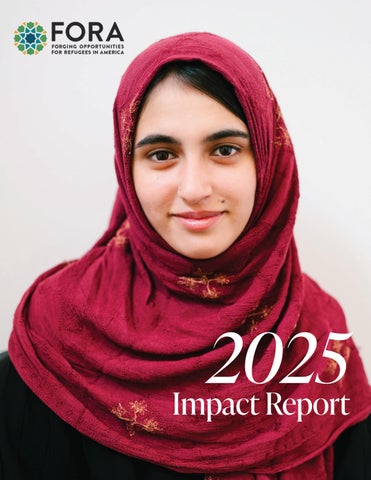
Naghma (age 17) has triumphed over the unimaginable handicap young girls in Afghanistan face daily—banishment from schools. The country’s Taliban rulers forbid girls to go to school after second grade, so at only seven years old, Naghma ended her schooling. She was 13 when she came to America with her brother and parents knowing little English. The only English she did know, she said in Pashto through an interpreter, was “Hi, how are you?”
She was excited to enroll in high school and shared, “I was so glad that I’m in school again—that there is peace here, and there was a situation where I could study.” However, her limited English held her back. She didn’t understand what people were saying and received poor grades, including a number of failures. Then she came to FORA, where intensive tutoring worked language magic. Naghma explained she received many F’s without FORA. Now, she is proud of her grades, receiving A’s in multiple subjects, including English. “My teacher is so happy with me,” she said.
But the challenge is not over. “There is only one year left of school, but I don’t want to leave,” she said in Pashto. “I still don’t know enough English. I want to continue learning. I want to take eleventh grade again—to learn English a lot better.”
Still, she is proud of how far she has come and is grateful for the tutoring and encouragement she has found at FORA. “FORA is so good,” she said in English. “I am so happy I’m coming to FORA. The people are so good. I know so much more English now. I’m talking to you—and I understand.”
Every day, children who have fled war and persecution arrive at FORA filled with determination and are waiting for a chance to learn. More than 150 refugee children are still on our waitlist, longing for that opportunity.
Education is the key to their future, and you hold that key.
Your gift can open the door to possibility, to belonging, to a brighter tomorrow. Together, we can ensure every child has the chance to learn, to grow, and to thrive.
WILL YOU PLEASE GIVE TODAY?
Across the country, refugee families are being left behind. Programs are closing. Services are shrinking. Refugee parents and refugee children are losing the support they need to build a future.
But not at FORA.
Because this is our time. And this is their future at stake.
Today, because of you, despite it all, refugee families know they are not alone. They know someone, including and especially you, is standing in solidarity with them. They know they are welcomed to this land by their neighborhoods and communities and by you.
In the past year, 120 refugee children received approximately 50,000 hours of one-on-one tutoring. Refugee parents sat again and again with us in front offices and teachers’ classrooms and learned how to interact with schools and teachers and speak up for their children. Refugee families who once felt powerless are finding strength. They will not be silenced in this dire time for so many.
Still, while we ensure our students and parents are protected and can fully access their rights, 150 refugee children are on our waitlist. We do not advertise a waitlist, but the names are there because parents demand we have a waitlist. Their faces are in our minds every day, even as we stay focused on the students already in our care.
Because of you, refugee children who once felt invisible are reading with joy, solving math problems, and walking into classrooms with confidence. Refugee parents who once felt unsure are finding their voices. Refugee families who once felt alone now know they belong.
Right now, we need to raise $400,000 more than last year. Not later. Now. This is what it takes to protect the progress we have made and to make sure FORA will continue standing in solidarity with refugee families for years to come.
And here is how we will do it. Our donors, including, hopefully you, will increase their giving. Many will double it. Larger gifts will keep our programs strong, keep our staff and tutors steady, and give refugee families the stability they count on.
We also need 80 new tutors who can give at least four hours or more a week, and introductions to friends who believe, as you do, that refugee families should never be left behind.
FORA is not standing still. We are preparing for the future. Together, because of you, we will keep standing in solidarity with refugee families, remembering those still waiting, and proving what is possible when a community chooses to stand together. Political landscapes change over time. But we will never change in our resolve, because, as always, remain committed to forging opportunities for refugees in America.
With gratitude and resolve,

Rebecca Clendenen Chief Development Officer rebeccac
@refugeefora.org

Our 120 refugee children, their pre-literate parents, and their under-school age siblings are receiving the support they need to get on a path toward becoming active and joyful members of our community, full of potential and hope.
When you first come to the U.S. as a refugee student, you may go through experiences similar to other students arriving in America. You feel overwhelmed by life in a new country full of difficulty and opportunity. Then you start school, but you may have never stepped foot in a classroom before or you and your family have been barred from entering one for years or generations. You find yourself falling behind, and the teacher and school system are not always able to accommodate your needs.
Globally, refugees spend an average of ten years in camps with little to no access to formal education before resettlement. For many families, this educational gap is even deeper because oppressive regimes bar them from school for generations, leaving them fully illiterate even in their native language. As a result, refugee children who have lost years of learning are classified as Students with Limited or Interrupted Formal Education (SLIFE). Most refugee children fall into this category, entering school significantly behind or completely illiterate.
When they are finally resettled in the United States, they are placed in public schools based on their age and not education level. Chicago has one of the largest SLIFE refugee populations in the U.S. Most schools lack programs tailored to address this foundational learning gap, especially after kindergarten. Twelve-year-olds who cannot count by two are placed in middle school math classes, and teenagers who cannot speak English or read or write in any language are placed in high school science and history classes. Pullout ESL programming, designed for children literate in their native language, is inadequate to meet these students’ needs. Fewer than ten percent of SLIFE students in the U.S. go on to graduate from high school.
We at FORA believe it is time to rewrite the rules. These children can thrive; they just need a little specialized help, someone to believe in them and give them a space to learn with educational resources tailored to their level. That is what we do at FORA. We respond to the issue with precision and joy, restoring hope to these children and their families. FORA students are breaking through the glass ceiling. They are classified as SLIFE, but most of them are on track to not only graduate high school, but to go on to college.
Thanks to more than 50,000 hours of individualized tutoring last year alone, we have seen these children transform from feeling overwhelmed and out of place to gaining confidence and discovering their love of learning. FORA isn’t just a tutoring center; it’s a place of transformation for our 120 students, their families, and their futures.
Our tutoring program is made possible by your generous donations and grants from the WC and EJ Thornton Foundation, the Patrick and Anna M. Cudahy Fund, the Peter and Judy Blum Kovler Foundation, the James B Boskey Memorial Foundation, the Naperville Rotary Charities Inc, Society for Science, Chicago Cosmopolitan Rotary Club, The New Frontiers Foundation, Dollar General Literacy Foundation, the Annenberg Foundation, Council of Islamic Organizations of Greater Chicago, the Lohengrin Foundation, Caerus Foundation, DePaul University, the State of Illinois, Lewis Sebring Foundation, the Chicago Community Trust, the Helen Brach Foundation, the WP and HB White Foundation, and the Jewish Federation of Metropolitan Chicago. This incredible progress is thanks to you, and we need your continued support to keep these incredible results going.
Refugee Children =
50,000+ Hours of Individualized Tutoring

Faheem didn’t want to leave Afghanistan, but his father had been a security officer on a U.S. military base in Kandahar, a province in Southern Afghanistan. When the Taliban took power, American advisers told their family to come to the Kabul airport to leave.
Their family stayed deep inside the airport, as the outside became a scene of desperation and chaos. Five days after the Taliban takeover, Faheem and the rest of his family were on a 4 a.m. flight to Abu Dhabi.
Once they arrived in Chicago, Faheem and his siblings began school. For him, learning a new language at age nine was a serious challenge. “It was hard; I was only learning the ABCs,” he said. In fifth grade, he barely knew English and in sixth grade, he decided he would change that.
“I worked hard. I had that as my goal.” In 2023 he began at FORA. “I started working on math; that’s my favorite subject.” Now a freshman in High School, he hopes to become an engineer.
FORA has become a central part of his life. “I love FORA,” he said. “It helps me grow and learn. And I made friends here. All my friends are here.”
From the Spring of 2024 to the Spring of 2025, our students made the largest gain on nationally normed standardized tests that we have ever seen.
Our 2024 median reading percentile was 16th, and one year later, in the Spring of 2025, the same students had a median of 35th percentile. This year’s gains in reading reflect a strategic adjustment to our curriculum. In previous years, students showed stronger progress in math, so we intensified our focus on literacy to help students build English proficiency and close the gap between their reading and math growth.
This jump is not only shockingly large (statistically significant at p ≤0.01), it also represents a move into a range where classroom instruction can be meaningful and impactful. Students who are reading at the 16th percentile will naturally struggle to participate, while students reading at the 35th percentile are reading well enough for their teacher to include them in assignments and instruction.
In math, our students continued to demonstrate statistically significant growth (p ≤0.01) and grade-level achievement. The median for our students in Spring 2024 was 40th percentile in math, which improved to 46th percentile in Spring 2025, demonstrating the potential of refugee scholars.
These numbers represent the efforts of countless volunteer tutors, as well as daily dedication and hard work from our students. Together, we are demonstrating how much unschooled refugee children can achieve. These remarkable scholars are succeeding and excelling, despite the efforts of oppressors who denied them the academic foundations that they and their families deserved.
Now, take a look at the numbers below and see the gains we’ve made. Imagine the possibilities that lie ahead as we continue to build on this momentum together.
Change from First Score at FORA to Spring 2025
Improvement in National Percentile Rank for students in the program for about a year (median of 2 years and 9 months, n=78) cross-referenced to grade level achievement.


Back in Kabul, Sadrudin had a large, close family and spent all day with his cousins, whose father ran a burger shop. But his own father had worked as a mechanic for the American armed forces in Afghanistan, so once the Taliban took control, it was no longer safe for the family to stay.
They first flew to Dubai, where they stayed three months before arriving in Chicago in 2022, where Sadrudin got his first culture shock at the airport. “I saw this girl—she was in her underwear,” he said, amazed at the clothing that was acceptable in America. “I was like, ‘I’m cooked. In Afghanistan, we don’t do that.’ ”
However, the more immediate challenge came when he started school. The gregarious third grader found himself spending his days alone. “I had no friends for five months, because I didn’t know English and they didn’t know Farsi,” he said. Back in Afghanistan he had seen his younger brother at some point every day in school; here in America, their paths never crossed. “I was crying because I couldn’t see him,” Sadrudin said. Now, he and his two brothers attend FORA, and Sadrudin chats easily in English and does well in school.
The family has settled into life in Chicago where his father has found work as a mechanic, and Sadrudin has become a major fan of the city’s beaches. On a recent family trip to the lakefront, “I swam the whole day,” he said happily.
Sadrudin began sixth grade in the fall and has made many friends along the way. “A lot,” he said. “I have friends in fourth grade, sixth grade, seventh grade and eighth grade. I have like 34, 35 friends. And four or five friends here at FORA.”
FORA has made a profound difference in his life: “Before, when I was at school, I couldn’t read. Now I read,” he said.
FORA parents are equipped to take an active role in their children’s education, paving the way for remarkable learning gains, school achievement, and lasting joy.
Imagine being a Rohingya refugee parent who has finally made it to the United States. Your child now has the chance to pursue the education you were never able to access, the kind of future you have always dreamt for them. However, as school begins, it quickly becomes clear that enrollment alone isn’t enough. Your child is struggling and you do not know how to help. The language barrier feels impossible, the system is confusing and you feel adrift. You want nothing more than to support your child’s education, but without the tools to do so, you feel powerless.
That is where FORA’s Family-School Partnership (FSP) program comes in. Made possible through the generosity of the Jewish United Fund, the Helen Brach Foundation, the W.P. and H.B. White Foundation and donors like you, we change this reality. The program equips parents with the skills and confidence to actively participate in their child’s education, ensuring they can advocate for their needs while students receive the support essential to success.
The FSP team partners closely with families and schools, keeping parents informed about grades, attendance, and progress. When challenges emerge, FSP connects parents and school personnel to identify concerns and create solutions, guaranteeing students have the comprehensive support they require to thrive. Through the collaboration of parents, teachers and FORA staff, student outcomes soar.
Your generosity allows us to continue breaking down barriers and creating a supportive network where every child has the chance to thrive. Please help us continue this important work.
From September 2024 to August 2025, FORA staff have conducted more than...
1,696 interventions to support students, parents, teachers, and school staff, including conducting 830 parent meetings, 706 academic support & advising meetings with students, 74 parent-teacher conferences attended and 86 admission and registration meetings facilitated with the students and parents.


FORA’s Education in Action program gives students the opportunity to put their classroom learning into practice through extracurricular activities, while also building essential soft skills such as communication, collaboration, and problem-solving.
Our K-5 students, guided by dedicated volunteers, have thrived through weekly Spring workshops. They have actively developed their abilities to construct compelling arguments, engage in debates, and refine their public speaking skills. Their hard work has paid off, as they have grown in both confidence and communication, stepping up as more articulate and assured leaders.
GIRL UP
Our GirlUp FORA club, part of the UN-sponsored global organization, creates a space for our girls to empower each other and improve their communities. By breaking down language barriers and bridging age differences, these young leaders create a more supportive, united community at FORA.
Our VEX Robotics program guides our students through designing, building and programming robots. Over the fall and winter, our sixth through twelfth grade students designed, built, and programmed robots to tackle this year’s VEX challenge: pick up rings and hang them on different rungs of a stationary object. Students applied the scientific method to develop and test their designs, perfecting their robots and enhancing both their technical skills and their confidence.
Our younger students (grades K through five) participated in weekly LEGO robotics activities which focused on the themes of energy storage, creation, and consumption. LEGO robotics provides an interactive physical, manipulable manifestation of math, wherein students can apply what they are learning to a real-world context of problem-solving and local competition.
MATH CIRCLES
Math Circles is a prestigious math learning organization taught by university professors who have adapted their advanced math curriculum to age appropriate activities for teaching math to third to twelfth grade students. Each session they take deep math concepts and present them in interesting, hands-on and joyful ways. Invited to West Ridge by FORA, Math Circles utilizes our space as a community hub every Sunday to provide this program to students in West Ridge, FORA students, and students on FORA’s waitlist.


Nicole, nine years old, didn’t know anything about Chicago when she and Lydia came to the U.S. with their family. She also didn’t know anything about FORA. “I was really nervous stepping into FORA,” she said. “But Michael told me I don’t have to be afraid of anything. So I started to learn English. It was really hard—but fun.”
Nicole’s six-year-old sister, Lydia, didn’t always find it fun. “She was very stressed about school,” Nicole said. “Every day when she woke up at 6:30 a.m. She was very frustrated.”
“I started learning to read, but sometimes I just can’t do it. My head keeps hurting,” Lydia said. For a while, she stopped going to FORA. But her older sister guided her back. “I taught her how not to be stressed out and how to have a little rest before coming to tutoring. She started feeling calm about coming to FORA,” Nicole said.
Both girls are at FORA now. They have opposite subject preferences. “Reading is easy for me; I love reading,” Nicole said. “Lydia loves math more. So she tries to work on reading, and I try to do math.”
Nicole has high expectations for herself; she is still disappointed that she didn’t win her school’s spelling bee last year. She intends to study harder, in part to repay her parents for their sacrifices. “My mom and dad worked so hard to come here for a better life,” she said. “In Ethiopia, it was really hard. And here my mom has struggled so much. She works a night shift opening boxes; her hands hurt so much. And my dad drives Uber.”
“I promised them that when I grow up, I will try my best to do the best I can to make a better life for them.”

FORA is the only after-school learning center in the country fully dedicated to unlocking the potential of SLIFE refugee children through personalized, intensive foundational education. Each year, we provide over 50,000 hours of High Impact Tutoring (HIT) to over 120 refugee students, designed to bridge educational gaps and set students on a path toward success. We are here to empower refugee children, ensuring they have the opportunity to not only catch up academically but to excel in every aspect of their lives.
These students have faced immense adversity throughout their lives. They have been displaced from their homes, separated from family members and forced to live in refugee camps or slums for months to years at a time. Despite these challenges, they arrive in a new country full of hope. At FORA, we help give them the tools and encouragement they need to turn that hope into reality. With our guidance, these children are not just overcoming the trauma of their past but are rediscovering their potential. Watching them flourish academically and grow in confidence is the ultimate reward, proving that every child, given the right opportunities, can achieve greatness.

FORA is focused on filling in the gaps of our students’ education through foundational math and literacy.
The pedagogical strategy we use, High Impact Tutoring (HIT), is an evidence-based approach that is defined as five or more hours of tutoring per week with at most a 4:1 student to tutor ratio and is proven to help students achieve significant gains rapidly. In November 2020, the Annenberg Institute at Brown University endorsed this educational strategy as the best response to COVID learning loss. However, FORA is the only organization that takes this approach with refugee students. And because our students are some of the most disenfranchised in the world, FORA goes well above and beyond standard HIT practices.
Students come to FORA’s center for two hours every weekday after school for ten hours a week, year-round, and receive mostly one-to-one instruction on the fundamentals of reading and math. By the time current kindergarten students graduate high school, they will each have had more than 6,000 hours of individualized FORA tutoring with curricula that are tailored to their needs.


Rana never imagined she would have to leave Syria. “I love, I love, I love my country,” she said. But when war came and their home was bombed, she was forced to spend five months staying with friends and relatives before she and Lana, only six months old at the time, joined Rana’s mother and sister in Jordan.
“Everything was hard; everything was new,” Rana said, switching to Arabic through an interpreter. They stayed in Jordan for nine years, spending six of those years going through the process of moving as refugees to America, arriving in Chicago in 2021. “We were all excited; it was a chance for a new start,” Rana said.
The transition was difficult; her husband, a tailor in Syria, struggled to find work. During the Covid shutdowns, Rana worked to teach herself English at home. Lana started school without knowing any English. “I was at zero percent,” she said in English, with the precision of the math whiz she has since become. “It was very difficult for me. I couldn’t understand what the teachers said, what the kids were saying,” Lana recalled.
“Before FORA, she wasn’t that happy at school,” her mother said. “One time she got lost inside the school building, and she was scared. She couldn’t express herself.”
But then Lana came to FORA. “I started learning a little English, word by word,” she said. “At school, I started to make more friends. I started understanding what the teachers said and participating more in class.” Her confidence began to grow, allowing her to feel more comfortable both inside and outside the classroom.
At thirteen, she is now excelling in math. This summer, FORA sent her and seven other students to join Math Circles of Chicago for two weeks across town at Walter Payton High School designed to engage students in advanced and challenging math. Lana said she is so happy that from now on Math Circles will be right here at FORA. “She is very smart,” her mother said proudly. “I’m very happy Lana is here.”
The entire family is moving forward. Rana is studying English at Truman College, her husband has found a job as a salesman and tailor at a men’s suit store, and their two older daughters are studying to become a medical assistant and a nurse.
Rana would like Lana to become a pharmacist, but the seventh-grader has her own ideas. “I want to become either a businesswoman or a lawyer,” Lana said.
Malali, 9 AFGHANISTAN
Malali, Faheem’s sister, started 4th grade this school year. Every afternoon, she walks to FORA with her two siblings and seven cousins, all of whom also receive tutoring. After attending FORA for nearly two years, Malali has grown significantly in both reading and foundational mathematics.
Coming to FORA each day has given her the opportunity to learn more English and to read, which is her favorite subject. “The tutors are so nice,” Malali said when speaking about her experience in the program. In addition, Malali participated in FORA’s LEGO Robotics program where she said she enjoyed working in teams with other FORA students to design small contraptions that demonstrate energy flow and consumption. The confidence and support she feels from the volunteers have created a strong sense of community around her.
When asked what she wants to be when she grows up, she said she wants to be a doctor because “I want to help people.”

Melike Oncu (President) is the Chief Strategy Officer of the International Code Council, where she has served since joining in 2008 as Assistant General Counsel. She holds a juris doctorate from George Washington University and a bachelor’s degree from Lafayette College, and began her legal career as a corporate attorney with White & Case, LLP before serving as Of Counsel at Bingham McCutchen, LLP. She currently lives in Chevy Chase, MD with her husband, two teenage daughters, and their dog.
Lena Jessen (Vice President) is an active community volunteer, serving on the board of the University of Chicago Laboratory Schools as chair of the Alumni and Family Relations and Development Committee. She also sits on the board of High Jump, where she chairs the Program Committee. She previously served on the board of the Hyde Park Youth Symphony and has professional experience in marketing, sales, and consulting within the biotech, skincare, and medical device industries. Lena holds a B.S. from Southern Methodist University and an MBA from the University of Chicago.
Christine Spears (Treasurer), originally from Minnesota, recently returned to the Minneapolis area after two decades in Washington, DC. She began her career with KPMG before transitioning to nonprofit finance, spending 12 years with International Justice Mission, where she helped grow the organization’s budget from $9 million to $50 million while leading Finance and HR. Christine has since held finance leadership roles with Power to Decide and as a consultant to DC nonprofits, and she now serves as Controller and VP of Finance at Special Olympics International; outside of work, she enjoys running, weightlifting, and walks with her 7th grade son and 9th grade daughter, both future FORA tutors!
Zainab Baig, MD (Board Member) is a Board-Certified Internist who has practiced as a Hospitalist and Practice Builder in Chicagoland hospitals for over 20 years. She most recently served as an Associate Medical Director at Elevance Health (formerly Anthem) and also serves on the board of AMPI USA, a nonprofit providing affordable healthcare to poor and refugee communities worldwide. A graduate of Osmania Medical College in Hyderabad, India, with residency training at a Cornell University hospital in New York City, Zainab has been a dedicated volunteer and fundraiser for FORA since 2019, passionate about expanding access to healthcare and education for underprivileged communities.
Farah Noor Cheema (Board Member; President Emeritus) was born and raised in Pakistan, where she earned her medical degree with honors from King Edward Medical University before immigrating to England and later the United States. Inspired by the transformative power of community service, she has spent the last decade promoting self-sufficiency and empowerment through education while holding volunteer leadership roles with institutions such as the Avery Coonley School, University of Chicago Laboratory Schools, and the Muslim Leadership Academy at the Islamic Foundation of Villa Park. Farah has also served on the board of the U.S. branch of the Hunar Foundation and worked with organizations including the Islamic Council of North America, Viator House of Hospitality, the Human Development Foundation, and multiple interfaith initiatives.


Bill Forsyth (Board Member) is the founder and President of Frontier Partners, an investment consulting firm established in 1993, and a Founder and Director of the New Frontiers Foundation, which supports educational opportunities for underserved youth in Chicago. He has held leadership roles with the University of Illinois Alumni Association, the University of Illinois Foundation, Loyola Academy, Horizons for Youth, and Tutoring Chicago. Bill holds a B.S. from the University of Illinois and an MBA from the University of Chicago.
Julie Schulz Halbower (Board Member), a Chicago native, earned a B.A. in Economics from Duke University and a J.D. from Northwestern Pritzker School of Law. She began her legal career in New York City with the law firm Coudert Bros. She moved back to Chicago, where she practiced commercial litigation at a mid-sized firm for several years, and then served as Associate General Counsel at Grant Thornton LLP. After practicing law for 15 years, she retired to focus on her family. Julie has served on boards of other children- and healthcare-focused charities, and now splits her time between Kenilworth, IL, Naples, FL, and Pentwater, MI with her husband and three dogs. She has two daughters in college who both volunteered for FORA.
Shaik Kaleem (Board Member) was born and raised in India, where he earned a Bachelor’s Degree in Electronics and Communications Engineering from the University of Madras before moving to the U.S. in 1985 to pursue a Master’s in Computer Engineering at Wayne State University. He has since built a long career in the communications and technology industry, spending the last 26 years at Cisco Systems, Inc., where he is currently Senior Director of Global Business Development for Cisco’s IoT Business, leading market expansion across industries such as manufacturing, energy, transportation, and the public sector. Based in the Chicago area with his wife, Kaleem has also been deeply engaged in community service through the Islamic Foundation for 25 years, serving as a Board Trustee and chair of the Technology & Communications Committee while organizing numerous fundraising drives in support of giving, community service, and refugee settlement.
Larry McManus (Board Member) is currently the managing director at Modern Wealth Management. He has extensive international management experience across Asia, Japan, and Europe, including mergers and acquisitions, acquisition integrations, business development, and sales at companies such as Cisco Systems, Ericsson, BET, Ltd., and ISS, Inc. He holds a B.S. in Finance with a minor in Real Estate from Clemson University, an MBA from the University of South Carolina, and completed the Advanced Program of International Management at the Copenhagen School of Business. Larry and his wife, Pamela, have four children and two grandchildren, enjoy traveling, hiking, golf, and college basketball, and he serves on multiple boards and supports charitable causes including FORA, Habitat for Humanity, the Women’s Shelter in Columbia, SC, and the Food Bank of North Carolina.
Wendy Kaplan Miller (Board Member) attended Amherst College, where she co-led the Cambodian Refugee Tutoring Project, and taught fourth grade at the Bullis School in Potomac, MD. After graduating from Harvard Law School, she served as an AmeriCorps and Greater Boston Legal Services attorney focusing on domestic violence and housing issues. She currently lives in Laguna Beach with her husband and dog, with two sons living nearby in Los Angeles.
Kathleen O’Connor (Co-Founder and Educational Programs Director (Volunteer)) has dedicated her career to teaching in diverse educational settings. She graduated magna cum laude from Amherst College in History, earned a Master’s in Education from Harvard University, and a Ph.D. in Developmental Psychology from Vanderbilt University, where her research focused on family-school partnerships and she developed math curricula for underprivileged students and undergraduates. Kathleen has taught in the U.S. and abroad, worked as an educational consultant, and served as an assistant professor at Dominican University, earning multiple awards for teaching, community activism, and educational impact, including recognition as NBC Chicago Today Show’s “Hero of the Month” in 2024.
Michael O’Connor (Co-Founder and Managing Director (Volunteer)) attended Amherst College and Harvard Law School, where he served as President of the Harvard Legal Aid Bureau and gained experience with organizations including the U.F.W., the Federal Reserve Bank of New York, the Southern Center for Human Rights, the D.C. Public Defender Service, and the U.S. Department of Justice. In the 1990s, he worked as a Senior Trial Attorney for the Civil Rights Division of the DOJ and as Associate Counsel to the President at the White House, followed by international field work with Catholic Relief Services in Madagascar and Kosovo and as Regional Director for South Asia at International Justice Mission, testifying before Congress on human trafficking. Since 2007, he has been a portfolio manager in the financial industry.
Casey Varela (Board Member) is President of the Lewis-Sebring Family Foundation and previously served as Manager of Strategic Partnerships at Youth & Opportunity United (2015–2020) and Associate Director at Heartland Alliance for Human Needs & Human Rights (2000–2005). She earned her B.A. from Kenyon College in 1996 and a Master of Arts from the Crown Family School of Social Work, Policy, and Practice at the University of Chicago in 2000. Casey has held leadership roles on numerous boards, including the ETHS Educational Foundation, McGaw YMCA, Kingsley Elementary School PTA, and Evanston Community Foundation, and lives in Evanston with her husband, George Varela, and their two college-aged daughters.
Nausheen Zaidi, MD (Board Member) is a Board-Certified Maternal Fetal Medicine specialist and OB/GYN practicing in Chicago. She completed her residency at UIC and fellowship at the University of Chicago Hospital, and has lived in Chicago for the past 20 years with her three children. Since 2022, Nausheen has volunteered with FORA, supporting its mission to promote education for refugee children and help ensure their long-term success, while enjoying travel and movies in her free time.


This is our moment. This is their future at stake.

We live in uncertain times, but we are not powerless. What you give matters. Your support means a refugee child learns to read, solves their first math problem, and begins to believe they belong in a classroom. And those differences are everything. A child who can read will not be silenced. A child who can do math will not be cheated. A child who believes they belong will not give up. That is what your gift does. It turns survival into strength.
Will you give today? Their future depends on it.

First, our students require a significant investment of time. Each child attends FORA five days a week, two hours a day, for at least 48 weeks a year—totaling approximately 480 hours of tutoring per student annually. With 120 students enrolled, this amounts to more than 50,000 hours of instruction each year. Having been denied access to education for generations under totalitarian governments and rogue regimes, rebuilding their educational foundation and restoring their right to learn requires time and consistency.
Second, each student benefits from an individualized curriculum. Tailoring instruction to the specific needs of refugee learners, many of whom have missed years of schooling, is essential to ensure they are neither disengaged nor overwhelmed. Students must be challenged, but not discouraged. Because every child learns at their own pace, our team carefully evaluates each student’s progress every week and adjusts lessons accordingly.
Third, maintaining a two-to-one student-tutor ratio or lower is crucial. This close ratio fosters both academic growth and social-emotional development. Students’ confidence, focus, and joy in learning all increase when they are supported by dedicated tutors who guide and encourage them.
Finally, parents remain at the heart of each child’s educational journey, both at FORA and within their schools, where our collective efforts have an even greater impact. Through FORA’s Family-School Partnership program, parents regularly connect with teachers and staff to collaborate on the best strategies to support their children. Families set the tone for educational priorities, and our parents are deeply engaged and committed to FORA’s mission and approach.
We are now focused on building our capacity to reduce the waitlist of over 150 refugee children eager for education. Your generous support will help us to sustain and grow our programs so these children receive the individualized support they need to thrive. Will you join us in empowering the next generation of learners?
You can donate in one of the following ways:
If your company offers a donation matching program, please consider using it to double your contribution. You can send a check or a recurring credit card donation via the attached envelope.
We also happily accept stock donations. If you would like to make a stock donation, please write to Nathan Van Kampen at nathanvk@refugeefora.org.
You can go to our website www.refugeefora.org and donate via the “Donate” button in the upper right-hand corner of our homepage or use the following QR code to be led to our donation page.

In addition to donations, FORA needs the following:
The refugee children we serve yearn and deserve to know that they are welcomed here. Please come and tell them in person that you welcome them to America. If you would like to visit, please reach out to Rebecca Clendenen at rebeccac@refugeefora.org.
Corporations who are willing to provide internships, host corporate volunteer days at FORA, and/or donate to our capital campaign or fundraising galas, are encouraged to reach out to Rebecca Clendenen at rebeccac@refugeefora.org.
Our organization thrives because of our volunteers. Please join our dedicated team of amazing volunteers. We need in-person volunteers of any age who are willing to come four hours per week. We also need adult online tutors who can tutor one hour every weekday during tutoring hours (4:30 p.m. to 6:30 p.m. and 7 p.m. to 9 p.m., on weekdays throughout the school year; or every morning or early afternoon on weekdays during the summer). To learn more about volunteering at FORA, reach out to Alia Mnayer at aliam@refugeefora.org.

Sign up to be a tutor at FORA! Scan the code to fill out our application.
Together, we are... Forging Opportunities for Refugees in America.