The University of Indianapolis has been recognized by the American Council on Education (ACE) and the Carnegie Foundation for the Advancement of Teaching with the 2026 Community Engagement (CE) Classification.
These foundations partnered in 2022 to recognize universities that exemplify a strong commitment to community engagement, and UIndy has been recognized three times as one of 80 private universities to achieve the CE classification, according to UIndy360. Carnegie classifications are often used as a standard for funders, researchers and policymakers, making these classifications important to the universities they recognize.
“This is significant because it validates the importance of collaborations,” UIndy’s Director of Service-Learning and Community Engagement Marianna Foulkrod said. “When we look at the reports, findings and the story that has been told through data, we are reminded very quickly how important this work is. It re-engages us, rejuvenates our passion and reminds us that we cannot progress without one another.”
UIndy is involved in several different service-based initiatives that impact the broader community, such as Special Olympics, the Burmese American Community Institute and Fry Scholar service projects, according to Foulkrod. The university is also partnered with over 200 non-profit organizations, such as the
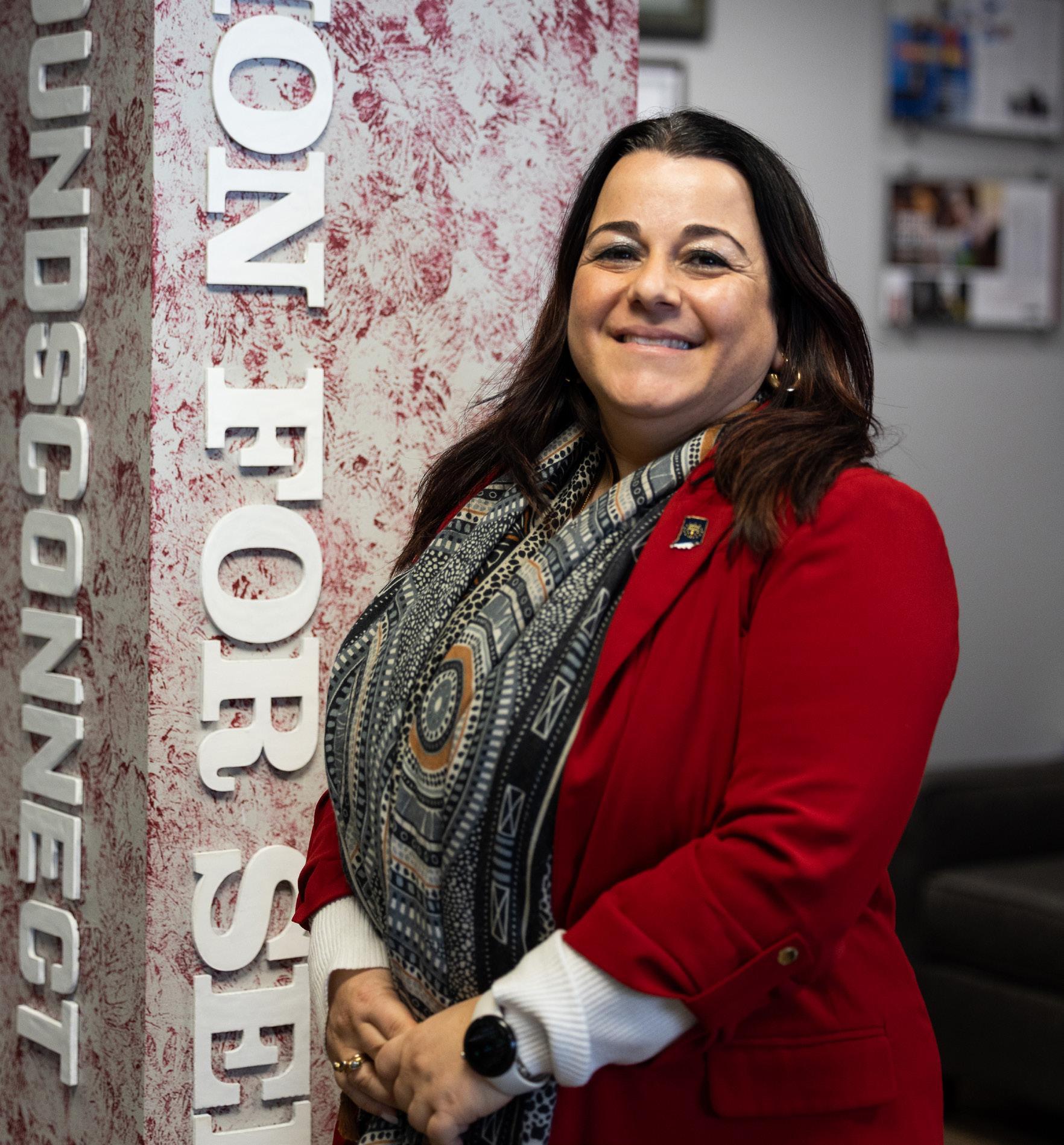
Director of Service-Learning and Community Engagement Marianna
center on Feb. 2. UIndy has been recognized three times for the Community Engagement
Arthritis Foundation, Beacon of Hope Crisis Center and Bethany Early Learning Ministry, according to HoundsConnect.
“...There's not just this isolated community that we have on the south side of Indianapolis, but rather an integrated component of the
local community and the regional community is something that I think we [UIndy] and the students should be proud of as they engage and make an impact,” UIndy Provost and Executive Vice President Chris Plouff said.
“We have students that
are committed to being the best versions of themselves as engaged, responsible citizens of their city and their world,” Foulkrod said. “This is your [students] classification. You earned it as much as your administration and faculty.”
UIndy strives to promote
“education for service,” which is largely done through the Center for Service-Learning and Community Engagement, according to uindy.edu. Plouff emphasized how social responsibility and community engagement are key aspects of the UIndy student experience, and this recognition helps promote these values and opportunities to potential members of the UIndy community. In addition, Plouff said this recognition can be influential regarding the future of UIndy’s community engagement.
“We do this well so that a community partner, when they're working with us, would know that they're working with an organization that is committed to this and is understanding of how to do it and how to do it appropriately,” Plouff said.
Foulkrod also discussed how students at UIndy have participated in service initiatives specific to their studies. For example, nursing students have hosted free clinics open to the public, and public health students have developed information sessions about public health in order to educate those who are new to this country.
“We want to be able to participate in hands-on real experiences. There is no better way for our students to learn and grow,” Foulkrod said. “In return, the community receives fresh ideas and a new skill set. They see the population that's going to be their workforce in the very near future.”
UIndy’s ongoing service projects can be found on HoundsConnect, which is a tool for students to track their service hours and develop a service resume.
Striving for unity among nations
President Donald Trump chairs "Board of Peace" in hopes to reconstruct Gaza
By Ella Harner MANAGING EDITOR
President Donald Trump is determined to end the war on Gaza after officially ratifying his proposed Board of Peace in January, according to the U.S. Embassy. The Board of Peace was created by Trump to oversee the rebuilding of Gaza after destruction from the IsraeliPalestine war, according to CNN. In addition to the United States, Trump has invited other countries to join, according to AP News. While various countries
have said “yes” to Trump's invitation, many others have yet to respond, with some even saying no, according to AP News. Though there is no official reason why countries have not yet made their decision, the $1 billion investment to become a lifetime member of the board might be affecting its legitimacy, according to University of Indianapolis Professor of International Relations Milind Thakar.
According to Thakar, organizations like the United Nations take a proportionate amount of money from its members. This means richer
countries, like Canada, Germany or the U.S., pay more than the poorer countries. Thakar referred to the Board of Peace as a sort of “rich man’s club.”
University of Indianapolis Professor of International Relations Douglas Woodwell believes the $1 billion sign-on is not a bad idea. Woodwell explained that, rather than begging preexisting members for money in the future, the board chose to do so immediately. If each member paid $1 billion for their lifetime spot, that would be over $25 billion for reconstruction, which,
according to Woodwell, is a “darn good start.”
Trump will be chairing the board for life, heading the organization's mission for promoting stability, peace and governance “in areas affected or threatened by conflict,” according to CNN. While the board is new, it has not shared what exactly success would look like, according to Thakar.
Futuristic-looking highrises were shown in a slideshow at the World Economic Forum, highlighting what Gaza will look like after the board's multistep reconstruction plan is completed, according to CNN. The presentation explained that the board's plan included Hamas demilitarizing, which the U.S. is “going to enforce.”
“We've been watching so much miserable news from [Gaza] for years now,” Woodwell said. “I would like to see them, by the end of this decade, maybe, steamrolling toward a better future.”
“Now, it could well turn out that this could be a wonderful organization with a really good plan to rehabilitate Gaza into a functioning, thriving economy,” Thakar said. “But I'm not going to hold my breath on that, because I'd like to see something more clearly articulated.”
Photo by Willa Allen
Foulkrod poses outside the SLCE
Classification.
OPINION
Runway reformation
Political fashion on the red carpet: Creating community or reducing action?
By Natalie Childers ARTS & GRAPHICS DIRECTOR
The 83rd annual Golden Globes saw celebrities wearing Anti-ICE pins. At what point do we ditch the performative political fashion and ask celebrities to lead the public, or actually be good?
The pins seen at the award show were in honor of Renee Good, a mother of three who was fatally shot by a U.S. Immigration and Customs Enforcement agent on Jan. 7. Those supporting and producing the pins referred to the cause as the #BeGood Campaign, meant to support and lead others in the pursuit of kindness, and to honor those who have suffered at the hands of the unkind, according to The New York Times.
The 2026 Golden Globes saw various high-profile celebrities
like Mark Ruffalo, Ariana Grande, Wanda Sykes and others wearing these simple pins in support of the #BeGood campaign. While to some, this display is gratifying and restorative to the families of those affected, what are these pins actually doing for those who are affected, and how are they leading the movement further?
We have seen this form of protest before at the 2024 Oscar awards, as reported by NPR. Artists wore red pins on their outfits in support of Artists4Ceasefire in support of the cause, before the announcement of the proposed Israeli-Palestinian ceasefire.
These pins do not affect
the legislature or protections that those doing these acts are receiving. For example, the Indiana bill that was
place. These pins do not serve as an outward call to action, nor are they even particularly informative to those watching at home.
recently sent to the House, which enforces local cooperation and penalizes noncompliance with these federal agents, as described by the Indiana Capitol Chronicle, is allowing this brutality to take
“This is for the people in the United States who are terrorized and scared today. I know I’m one of them,” said actor and filmmaker Mark Ruffalo, in an interview with USA Today. This moment, with Ruffalo taking a verbal stand through his own platform as an actor, may have been the most informative of the award ceremony, but that is where the information and action end when it comes to these palm-sized
statements. While plenty of celebrities do commit to change further than what we are seeing, like Ariana Grande has done for children in Gaza, according to Roya News, many stop at these gestures.
On one hand, these notions of resistance can create a trusting community that helps those around them. On the other hand, they often take the place of real action. While it is important to speak out against institutional violence, speaking out is becoming increasingly ineffective every single day. Justice requires action. People need support and community. Those who have been victimized by this brutality deserve more than a pin; they deserve justice. Pins worn at a high-class event on the lapel of a $3,000 suit are not providing those resources.
A brand new Barbie doll for all
By Samantha Funk STAFF WRITER
Barbie has yet again changed the game for girls everywhere. However, not everyone is happy. In her pink, noise-cancelling headphones comes Autistic Barbie, being a polarizing addition to the brand.
As an autistic woman, the news of a Barbie that was like me was enthralling. Finally, female autism representation from an organization by and for autistic people! Growing up neurodivergent can feel isolating; as a child, I often equated it to being left out of a joke everyone else was in on. Having Barbies was a refuge for me. No matter what my peers were doing that I didn’t understand, I understood Barbie. This new doll adds so much meaning to that feeling of solace and refuge. Girls will see her noisecancelling headphones, indirect eye contact, and argumentative
and alternative communication device, and say this is me — I finally have a doll just like me. So, is there an issue? Should we not be glad children can see the spectrum on which so many of us find ourselves in their toys and everyday life? Others’ complaints, like the Miami Herald’s, revolved around her gender. According to sources such as IU, autism spectrum disorder is diagnosed up to 4 times more in men.
According to Mattel, the autistic Barbie doll features elbow and wrist articulation, allowing stimming, which some members of the autistic community use to process
sensory information or express
excitement. The doll is also designed with an eye gaze to
the side, which is similar to how some members of the autistic community avoid direct eye contact. The doll wears a short-sleeved, purple dress with a flowy skirt that has less fabric-to-skin contact. She even has purple flats, so she stays stable! This is a far cry from the days of freak shows and portrayals of characters in media such as Doctor Shaun Murphy in The Good Doctor or Sam Gardner from Atypical. Both men are white, and quite frankly, far more close to people’s “image of autism” than this Barbie. It doesn’t take too skilled of an eye to see that stories based around autistic women are all too rare. Could this be because, just like this Barbie, no matter
Grok is going X-plicit
By Ella Harner MANAGING EDITOR
Artificial Intelligence can be used for anything – writing your papers, texting your friends and even generating nonconsensual boudoir photoshoots!
Elon Musk, the owner of both Tesla and SpaceX, acquired the social media app Twitter, which he later renamed X, in 2022 for $44 billion, according to The New York Times. Shortly after buying out Twitter, Musk claimed that addressing the problems that the app faced with child sexual abuse
material, according to NBC.
Musk, known for owning business after business, launched his artificial intelligence chatbot Grok in 2023, which has been updated to newer versions since, according to Business Insider.
The newest version of Grok can be tagged in posts across X, where people can ask questions and generate images and videos in their replies.
The problem with this? Grok will generate anything. According to The New York Times, Grok generated and shared at least 1.8 million sexualized photos of women.
People all over the world used
the free-functioning chatbot on X to undress women and put them into sexualized poses, according to The Guardian. After the outcry that came from the photos flooding people’s feeds, Musk changed the feature to only be accessible to subscribers. Researcher at AI Forensics Paul Bouchaud told The Guardian that the videos that Grok created were “fully pornographic” and “look professional.” AI is just another way women can be sexualized online. Unconsensual pornography is getting increasingly more available online, especially when you can make it yourself with the touch of a button. According to
a study done by UN Women, 57% of women across 51 countries have experienced video or image-based abuse online, where private content was shared with malicious intent. This only gets worse with AI, where fake photos can be created and then shared across the internet of unwilling women. As AI becomes more trained and accessible, will women be pushed back? Will misogynistic norms become regular? Will women face fear, knowing that every day they might get online to see themselves generated into a pose they never made while in clothes they never wore?
how women present themselves, do they not uphold a certain standard in people’s minds? I cannot count the number of times I have gotten “But you don’t look autistic!” when I tell people I’m autistic, as if autism can only show itself in 8-year-old boys who uphold the stereotype. Of course, I don’t look like your grandson, Martha. I am a 22-year-old woman. No woman is immune to the twisting and turning to make yourself good enough, not even, it seems, a doll. What should be a win has turned into a feeling of disappointment where there once was hope and optimism.
Perhaps we need to stop and think about Barbie’s target audience, young girls. Think of the children who will be seeing themselves represented properly for the first time, and think twice about how much harm the doll is supposedly doing.
Corrections
The Reflector acknowledges its mistakes. When a mistake occurs, we will print corrections here on the Opinion page.
If you catch a mistake, please contact us at reflector@uindy.edu.
In our Nov. 18 Issue:
In our Holiday Crossword, the 6-Down hint should have been labeled 7-Down. What do you think?
Send your letters to the editor or other correspondence to reflector@uindy.edu
The opinions in this section do not necessarily reflect those of The Reflector staff.
Graphic by Natalie Childers
Graphic by Ella Harner
AI: In class and beyond
AI
usage varies among students and professionals, blurring the lines of ethical
By Logan McInnes EDITOR-IN-CHIEF
Throughout various departments at the University of Indianapolis and across the diverse workforce, the use of artificial intelligence is highly debated, regarding when, where and how it should be used.
Psychology Associate Professor and Program Director of the Department of Psychological Sciences Katie Boucher said she believes AI usage should be carefully regulated but that it is important for faculty to have some flexibility in the way they utilize or restrict it. However, she said faculty should be careful and intentional about how AI is introduced in the classroom, and they should be clear regarding where the penalties for students using it lie.
Within the psychology department, Boucher said when a student seems to be inappropriately using AI for the first time, she and other faculty members make a point to sit down with that student to hear their intentions and how they used it. Instead of automatically labeling it “academic misconduct” and giving the student a zero, they should be allowed to understand the instructor’s unique philosophy around AI usage and a chance to explain themselves so that both parties can learn, according to Boucher. On the other hand, Boucher said a student simply using AI repeatedly as a crutch for everything prevents them from making mistakes, which are key to learning new material.
“We’re being very mindful of helping our students understand the unique implications of AI for psychology,” Boucher said. “There’s some [research] work coming out now that shows utilizing AI extensively means that you learn it less, and it is encoded less deeply in your memory. And so if it’s information you really need for grad school, professional school or for your job, you’re not learning it as much, depending on how you utilize AI.”
When it comes to using AI for therapy and counseling, Boucher said research is starting to show that AI is trained to see you as a client, simply wanting to please you and give you better answers. On the contrary, a therapist will push the client by asking follow-up questions about why they feel a certain way, and the therapist can detect nonverbal cues and when a client struggles with whether to self-disclose information, which Boucher said AI large language models cannot do.
Boucher said there are instances where AI chatbots can be very helpful, such as when a student is experiencing suicidal thoughts at 2 a.m. However, she said there needs to be safeguards that the AI will not accidentally give out information that would further the self-harm.
“If we have, in those moments, something that could be very scripted and utilize the power of AI, that’s awesome, but once the person has been connected to a therapy resource, what parts of this need to be human?” Boucher said. “What parts of this need to be engaged with an individual
who has more training that can spot nonverbal cues that would be very hard for an AI program to do?”
Some additional ways Boucher said AI usage could be helpful are for writing out routine documents for the mass amounts of paperwork for clients, for constructing qualitative research and it allows quick accessibility for documents. Yet, she mentioned that the protection of that information, originally meant to be “confidential,” is unclear where it goes when it is written into AI.
Communication Assistant Professor of Communication, Media Program Director and General Manager of UINDY-TV and WICR 88.7, Rick Dunkle, said there is no way we cannot embrace AI because the new generation will be dealing with it for the rest of their lives. Nevertheless, Dunkle said there is a time and a place for using it.
“We’re not going to pretend that AI doesn’t exist,” Dunkle said. “I don’t want students to use it for any of their final work, but to pretend that it’s not a fantastic search engine
the WGA [Writers Guild of America] was up in arms,” Dunkle said. “That’s why they struck because they recognize that now you’re taking IP [intellectual property] that has been created and owned by other people and using it to train AI. You’ve got to remember, AI is not thinking for itself. It’s mimicking itself. It’s taking previous work, figuring out how that was made, and then basically running it through its own algorithm to generate its new thing, which is just a rehash of all that it’s absorbed and spitting out a version that it thinks you will like. That’s not being creative.”
Engineering Associate Dean and Director of the R.B. Annis School of Engineering Ken Reid said simply putting questions into ChatGPT is very easy right now, but it does not serve you well as a student. However, Reid emphasized how AI is useful for efficiency purposes, such as writing lab reports to go back and analyze, critique and correct, and as a research tool. UIndy’s Department of Engineering has three majors that directly relate to AI, which are Software Engineering, Computer
“In computer science, we saw a big drop a couple of years ago when a lot of the bigger Meta and Microsoft companies did some bigger layoffs,” Reid said. “I think that was probably the industry correction, and now we’re at a level where we’re still seeing a demand for jobs.”
Assistant Professor of Computer Science and Software Engineering HungFu (Aaron) Chang said AI is used as a learning assistant and brainstorming tool for students, especially for project-based learning within the department’s “DesignSpine” courses. Chang said when using AI, it is essential to have previous fundamental knowledge of the subject matter to ask more specific, detailed and directed questions, which leads to more well-rounded answers.
When someone uses AI to give them a direct answer without any thought, that is the worst way to use it, according to Chang. He said looking at someone to learn how to ride a bicycle and actually hopping on it to ride it yourself are two completely different things.
“The large language model is a machine that has all the previous knowledge on the internet… but still not the future knowledge,” Chang
use
according to specifications. Chang complemented Reid’s optimistic view of the future job force by saying that as AI continues to change and develop, so does the industry. Chang acknowledged that right now is a tough time for graduating seniors going into the job force, but as people learn more about AI and how to adapt it in new settings, the job force will rebound and new career opportunities will come about.
English Associate Professor of English Barney Haney said that within the English department, there are a variety of ideas and thoughts about AI usage. However, he said students are not allowed to use it at all in his creative writing and first-year seminar courses.
“If AI is doing the reading, critical thinking and writing for students, they have learned nothing,” Haney said. “All I’ve done is collected a paycheck.” If a student uses AI all the way through their time at UIndy, at the end of the day, all they have is a fraudulent piece of paper that says “UIndy” on it, according to Haney. He said not only has that student wasted their time and money at UIndy, but they have also harmed the reputation of everyone else who has that degree.
Haney furthered this idea by using the analogy of someone graduating with a fraudulent piece of paper, stating, “Train Conductor.” If a company in need of conductors approached that student and told them to hop up in the train and drive it, they would automatically see that the student has no idea what they are doing when they do not know where to begin.
and can’t help you brainstorm, is disingenuous…
We’re going to need students to know how to use AI effectively before they go out into the workforce because their employers are going to expect them to know how to use it well.”
Work should never be turned in that has been entirely generated by AI, but it is useful for brainstorming headlines and writing examples, according to Dunkle. Although he said he will never let AI be the “final writer of something.”
Dunkle said he does not care whether or not a student uses AI in the brainstorming process, but they cannot pass it off as their own work. Students should always identify when they have used AI and double-check it for accuracy, according to Dunkle.
As a child of the 1980s Terminator generation, Dunkle said he grew up with the fear of AI and saw the evils early on. People then saw that automation would take over certain jobs, according to Dunkle, and the creative industry never thought it would match their level. But in spite of that, Dunkle said people have trained AI with previous creative works by submitting old television shows and having it write new episodes.
“That’s cheating, and why
Engineering and Computer Science, according to Reid.
“When you’re first learning computer programming, for instance, you do need to know how to write computer programs,” Reid said. “So don’t use AI to write your first few programs, because eventually you’re not going to be able to write anything… But for a seasoned programmer, if you need a function or a routine to do something, and you have AI generate that… it could be more efficient.”
Reid used the analogy of when calculators first came into schools, and students were told not to use them to learn math. Now, students use calculators to do the math they know how to do, according to Reid, to more efficiently solve bigger problems at hand.
Reid said there is a nationwide drop in interest in computer science and software engineering, which he finds surprising. The reason people give is that they think AI will take jobs, but somebody has to incorporate AI into computer systems, according to Reid. He is optimistic that the demand for these jobs will increase as AI develops.
said. “So the benefit of having the previous knowledge is you now know what’s going on right now, so you can improve, which drives future innovation.”
Finding the line between using AI ethically to improve and using it unethically, which results in a lack of knowledge and critical thinking, is a very tough challenge for every educator, according to Chang. To address this issue, in his Computer Science 101 programming courses, Chang said it is obvious when students try to get help from AI because it often gives more information than is needed. He said he makes a point to talk with students who use it incorrectly, teaching them where AI is right and wrong and where it has gone beyond the purpose of the assignment and subject matter, teaching them where discernment, knowledge and critical thinking are needed.
Another way in which Chang allows his students to use AI is within upper 300 and 400 level courses, such as Computer Science 310 called “User Interface and Game Development.” Chang said students in this course build upon their previous knowledge by creating a game, using AI to write their own programs and implement instructions
“If one of our goals at this university is learning to serve, then we’re failing ourselves and our communities when we present a fraudulent front out there,” Haney said. “The other ethical issue is that all that data that was fed into ChatGPT and the other large language models was stolen. They took all these authors’ books… and a vast amount of stuff, and just stole it. It was all copyrighted… If you and I stole like that, we would be in jail big time.”
Haney said he is concerned about AI “scooping up” professors’ intellectual property and teaching materials. This would result in the loss of their jobs and allow universities to keep those professors’ salaries in their pockets, according to Haney.
This year, Haney said he has been teaching “low tech, no tech,” meaning hardly any technology in the classroom and writing everything out by hand, except for essays and discussion posts on Brightspace. He said it has been much better, as the students know each other’s names, are less distracted and can have more face-to-face conversations.
“Distractions make challenges harder, but when we eliminate them and build a strong community around shared challenges, we become stronger together,” Haney said. “Our understanding grows, we feel less isolated and collaboration lightens the burden, showing us that working together is not only possible beyond the classroom, but necessary.”
Graphic by Natalie Childers
Jammin’ out at UIndy
By Willa Allen SOCIAL MEDIA MANAGER
The University of Indianapolis hosted its first “Battle of the Bands” on Feb. 3, showcasing student talent in various musical genres, spanning post-punk emo, blues and rock, R&B, indie and metal.
The event was organized by the UIndy Music Industry Club, led by junior music industry major and club president Emerson Graft,
and junior music industry major and club vice president Makinzee Bradley.
The Music Industry Club had previously been planning an open mic night, but those plans fell through, according to Bradley and Graft. They said there is a lack of live music opportunities on campus and wanted to create an event that could become recurring and allow bands to prepare in advance.
“I think there’s not a whole lot of opportunity to show off your
music, especially if you are in a music program,” Graft said. “The real music world isn’t recitals and orchestras. Your general live music gig is a club, a small, intimate environment, and you’re not playing Bach concertos. It’s really exciting to kind of give people that opportunity to say, ‘This is my expression and my music,’ in a more natural setting.”
The judging panel included two faculty members from UIndy’s music department, Associate Professor and Director of Music Technology Programs Brett Leonard, and Associate Adjunct Professor and Percussion Director Terence Mayhew, along with two students, Bradley and senior English major and UIndy Poet Laureate Piper Parks.
The Battle of the Bands featured an open, first-come, first-served sign-up process, according to Graft. The only requirement was that each band had a connection to UIndy.
The drummer for jazz band, “What The Funk?” Jaspar Fadely, said events like “Battle of the Bands” can have a positive impact on student musicians and the university as a whole.
“I really think that the Battle of the Bands is going to help if we can make sure that we do what we need to do, market where we need to market and advertise,” Fadely said. “It’ll really help us get our name out there, get more people coming to the university and get more people involved.”
Guy Roddy, guitarist for “Union
Ace,” said performing in the Battle of the Bands marked the band’s first live performance and gave them a chance to introduce their music to fellow UIndy students. According to Bradley, the event also encouraged audience participation. Attendees were able to fill out a bracket predicting which bands would advance, with the most accurate bracket winning a prize.
The winning band, “Union Ace,” received a recording studio session, a prize Bradley said would help spotlight musicians who may not otherwise have access to professional recording opportunities. The “crowd favorite” was “Amy and The Foleys”, which the audience went wild for.
“It was a pleasure to make history with you guys,” Bradley said.
New UIndy acting class study
UIndy professors to study the effects of acting on students with learning disabilities
By Pete Roeger STAFF WRITER
Editor’s Note: The writer of this story is a student in Grant Williams’ acting class.
Two University of Indianapolis faculty members are conducting an interdisciplinary study on the social effects of an acting class on students with learning-related disabilities.
Co-author of the study and Assistant Professor of Theatre Grant Williams is teaching the same acting class to two cohorts of students. As of February 2026, he is teaching a class for the general student population. In the fall semesters, he teaches the same class to students enrolled in the Build program, a service for UIndy students with learning disabilities.
Students in the current class will be used as the control group for the study, while the target group will be students in his fall 2026 Build class. The study will utilize surveys given to students at the beginning and end of each class, measuring their mood.
The study’s other co-author, behavioral specialist and College of Education and Behavioral Sciences Assistant Professor David Schena, is evaluating and assessing the data for the study. Williams teaches the class and collects the raw data.
Williams and Schena both praised what they saw as the other’s strengths, with Schena calling Williams a “great actor,” and Williams calling Schena an “expert” in psychological data.
Schena introduced the study to students on the first day of the class; however, he plays no role in teaching the class itself.
The study came about through an introduction by the Director of Disability Services and Build Betsy McGill. Previously, Williams taught one acting class that included both Build and non-Build students, with around half of the class typically being in Build, according to Williams. He said that the outcomes typical of his acting class were different for Build students.
“A lot of the typical acting exercises that I would include in a typical class, or a nonBuild class, didn’t hit properly with those [Build] students, or they didn’t respond in the same way,” Williams said. “It was very interesting to me that the same methods need to be tailored or shifted.”
Williams added that he did not think this was a bad thing, only that it meant his teaching style needed to be adjusted.
McGill said she placed many of her students in Williams’ acting classes before the shift. An acting class helps teach her students skills, such as flexible thinking, according to McGill, who added that many of her students struggle socially.
McGill said she worked with Williams to create a new section of the acting class designed specifically for Build students. McGill said that this class was so successful for her students that she and Williams decided to open another section to nonBuild students.
Williams said he sees a positive impact of the class on Build students and would like to teach this section every semester. However, due to his time constraints, he said he could only offer it once per year.
“You, in some ways, practice being a little awkward and doing
things you’re not comfortable, intrinsically, doing,” Schena said of students in acting classes. “But you gain that confidence, and you practice those skills, which is wonderful for a lot of skill learning, social anxiety, etc.”
Schena and Williams also said they would consider publishing their research. Schena said that existing research related to the effects of acting classes on students with learningrelated disabilities is largely experimental and primarily focuses on school-age children. He hoped this study, if published, would expand the literature in this area as it relates to college students. Williams agreed, saying that he is a strong believer in the positive effects of acting and believes that research in this area, as it develops, will support this notion.
Photo by Willa Allen
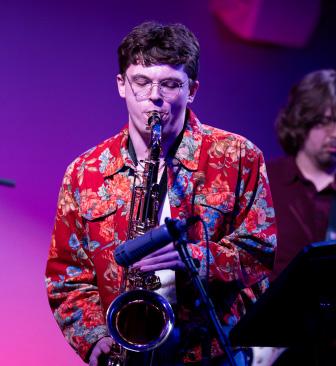
“What The Funk?” saxophonist Michael Armington performs at “Battle of the Bands” on Feb. 3. “What The Funk?” is a modern Jazz/Funk/Neo-soul group.
Lead electric guitarist Guy Roddy plays behind his head during “Union Ace’s” set at “Battle of the Bands.” “Union Ace” won first place in the competition.
Photo by Willa Allen
Graphic by Natalie Childers
Greyhounds heating up
UIndy men’s basketball wins four of their last six games, honing in on
By Brayton Bowen SPORTS EDITOR
The University of Indianapolis men’s basketball team is hitting its stride at a crucial point in the season, as the Greyhounds have made GLVC competition their strong suit, winning four of their last six games.
At 9–5 in conference play, the Greyhounds are surging at the right time as the regular season enters its final stretch.
“The defensive end is our number one priority,” said head coach Scott Heady. “We have played solid defensive halves, but we have yet to put together a full game of great defense.”
That mindset has been echoed by the players, who have taken pride in communication and effort on the defensive end of the floor. Several Greyhounds have stepped up as vocal leaders, helping the team maintain an identity at all times.
“We’re focused on doing whatever it takes to win,” said redshirt freshman Tyler Parrish. “We emphasize defense, rebounding and taking care of the ball. We’re focused on playing for a full 40 minutes.”
That approach has paid off during the Greyhounds’ recent stretch of conference play. In their wins, the Hounds have controlled games by out-rebounding
opponents and winning the turnover margin, allowing the Greyhounds to close out games with control.
The Greyhounds’ offense has grown alongside their improved defense, with Carmelo Harris leading the way at 17.6 points per game in conference play and younger players like Parrish stepping up with increased minutes.
Since joining the starting lineup, Parrish has been a
standout performer, scoring 20 or more points in multiple games and shooting 27-for65 (42%) from three-point range, emerging as a key contributor to the offense.
“My teammates do a great job finding me,” Parrish said. “It’s really about all of us making the right play. Whether that’s me scoring or kicking it out to someone else.”
Heady also praised the physicality and impact of his
frontcourt players, Center Kelvin Amoako and Forward Shaun Arnold.
“ [Arnold] is just a dog,” said Heady. “He plays really hard. You know, he’s probably one of the best rebounders, if not the best in the league. Kelvin has been rock solid, too. We’ve really got a good inside-outside game going offensively right now.”
Amoako is the only player on the roster to have started all 21 games for the Hounds, nearly averaging a doubledouble (9.8 PPG, 8.0 RPG).
Arnold, the most recent
defense
GLVC player of the week, averages 10.6 PPG and 8.4 RPG.
As the regular season winds down, the Greyhounds aim to carry their momentum into key conference matchups. Indianapolis is set to face the No. 1 and No. 2 teams in the GLVC, IllinoisSpringfield and McKendree, in back-to-back games on Feb. 12 and 14. Victories in these matchups would boost the Greyhounds’ conference standing and position them for a stronger seed in the GLVC tournament.
“I just won the national championship at Indiana University. It can be done,” head coach Curt Cignetti said moments after capturing the 2026 College Football Playoff National Championship.
It had been done. Indiana outlasted Miami (Fla.) 27–21, completing one of the most improbable championship runs in college football history.
Cignetti’s words captured the magnitude of the moment. In a sport defined by tradition, talent pipelines and blue-blood power, he had just taken one of the historically lowest-performing programs to the sport’s summit.
Indiana’s rise stands as one of the greatest stories in sports, not because the Hoosiers had the most talent, the best facilities or a decorated history, but because they had none of those things.
Entering the 2025 season, Indiana ranked 72 nationally
in roster talent, per 247Sports.
The Hoosiers featured just seven four-star players and no fivestars. Few believed they would even factor into the College Football Playoff conversation.
Doubt lingered as Indiana kept winning. The Hoosiers knocked off two top-ten teams and went 12-0 during their regular season, yet skepticism followed them onto the national stage. Many analysts and fans questioned whether a roster lacking elite, top-end talent could sustain success against college football’s traditional powers.
That narrative changed when Indiana stunned then-ranked No. 1 Ohio State 13–10 in the Big Ten Championship Game. After that, the selection committee had no choice. The Hoosiers were ranked No. 1 heading into the College Football Playoff.
Indiana then erased any remaining doubt in dominating fashion, as the Hoosiers dismantled Alabama 38–3 in the Rose Bowl quarterfinal before overwhelming Oregon 56–22 in
the Peach Bowl semifinal.
Suddenly, Indiana stood on the brink of the impossible, transforming a program with 715 all-time losses into one competing for the College Football Playoff National Championship.
The final hurdle was Miami (Fla.), one of the nation’s most talented and battle-tested teams, playing in its home stadium.
The Hurricanes’ defense ranked fifth in all of college football in points per game allowed, per the NCAA.
Not to mention, both of Miami’s pass rushers, Reuben Bein Jr. and Akheem Mesidor, are projected first-round picks in the upcoming 2026 NFL Draft, according to the NFL.
The championship game was a dogfight, every yard earned the hard way. The Hurricanes closed multiple 10-point deficits and kept the game competitive from beginning to end.
No play captured that better than Fernando Mendoza’s 12yard rushing touchdown on fourth-and-five in the fourth
quarter. Indiana’s Heismanwinning quarterback absorbed multiple hits before launching himself toward the goal line, sacrificing his body for the program he helped redefine.
“I’m going to die for my team out there, and I know they’re going to do the same for me,” Mendoza stated in a post-game interview.
That mindset did not appear by accident. It was cultivated week after week by a program that fully bought into Cignetti’s vision. The selflessness Mendoza described on the field is the same tough-nosed mentality Indiana’s head coach has preached since day one: trust the work, trust each other and let the results follow.
The Hoosier’s championship run can be defined in one word: Relentless. They refused to be defined by a century devoid of success, reaching heights no one believed they could. While this story took place on the football field, the lessons it teaches reach far beyond, inspiring those in the Hoosier state and around the country to never give up.
Photo by Willa Allen
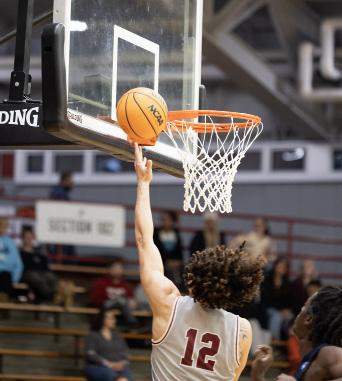
Shaun Arnold scoring a layup against Lincoln (Mo.). Arnold was named the GLVC player of the week on Feb. 2, 2026.
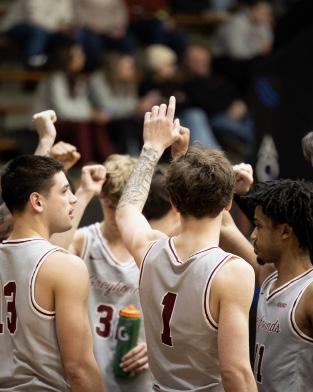
UIndy men’s basketball team huddling during a timeout against Lincoln (Mo.). The Greyhounds defeated the Blue Tigers by a final score of 101-73.
Photo by Willa Allen
IUI cancels MLK dinner
What a dinner cancellation means for which national holidays are being recognized
By Mia Kerberg STAFF WRITER
The Indiana University of Indianapolis’ cancellation of its annual Martin Luther King Jr. dinner prompted a student-led “eat-in” on its campus.
This dinner would have marked the fifty-seventh year of its running and had never been cancelled before, according to the IndyStar. IUI has stated they have a new task force working on celebrations to ensure that they follow their intended purpose and continue advancing their institutional message. According to WFYI, there have been “recent policy changes at Indiana University and other colleges, following 2025 policies from President Donald Trump and Governor Mike Braun, regarding diversity, equity and inclusion
policies in government and public institutions.”
Students organized the eat-in as a response to the cancellation, emphasizing community and conversation rather than demonstration.
One student who attended the event, Dason Tichenor, said the gathering reflected what organizers intended, describing a relaxing, welcoming atmosphere.
“We all came together,” Tichenor said. “There was no marching or chanting. None of that. It was just a small gettogether.”
The cancellation came as colleges across Indiana continue to adjust programming amid broader changes to diversity, equity
Recent hire
By Willa Allen SOCIAL MEDIA MANAGER
Deputy Athletic Director for Internal Operations and Compliance Andrew Stafford began his first semester at the University of Indianapolis after being hired in December 2025.
Stafford developed an interest in athletics while attending the University of North Carolina at Chapel Hill, where he worked with the football program in recruiting and quarterback scouting. He later joined James Madison University’s football staff as an assistant to the head coach, where he handled recruiting operations and administrative responsibilities.
He then moved to Elon University, where he oversaw athletic development components for athletics and began working in compliance. Before coming to UIndy, Stafford served as assistant athletic director for compliance at
Lenoir-Rhyne University.
“I think the longer you’re in athletics, you get a list of schools that you kind of have your eye on that fit a bill,” Stafford said. “UIndy has been a long, successful Division Two program. Division Two is a really healthy place in college athletics right now, and I was always evaluating a potential next step in my career.”
In his new role, Stafford said he focuses on problem-solving and ensuring athletic department operations run effectively. Stafford said his priorities stepping into this new role include building relationships, enhancing the student-athlete experiences and strengthening connections between athletics and other departments and the surrounding community.
“It means a great deal to be in a position to drive strategic leadership for a department,” Stafford said.
“That’s really what I’ve been working towards since I got into college athletics.”
and inclusion initiatives at public institutions. Due to Black History Month being recognized in February, some students expressed concern about how similar decisions could affect future cultural events.
Assistant Director of Student Engagement and Belonging Student Affairs Selena Jackson-King said UIndy plans to maintain its annual traditions. JacksonKing assured that UIndy will still be celebrating Black History Month, noting that student groups, including Project Regalia and the Black Student Association, are partnering this year to host the Black Excellence Dinner and other events.
Jackson-King emphasized the importance of maintaining cultural celebrations for students, saying she hopes IUI responds transparently to student concerns. The dinner cancellation signals a wakeup call for the UIndy campus community to hold strong to its values, highlighting the student experience, according to Jackson-King.
While IUI has not announced plans to reschedule the canceled dinner, students and nearby campus communities continue to monitor how similar decisions may shape future cultural programming.
“I think more than anything, people want honesty and being clear and upfront with the students like this is the situation at hand,” JacksonKing said.
Photo by Willa Allen
Deputy Athletic Director for Internal Operations and Compliance
Andrew Stafford was hired in December 2025. Stafford oversees departmental operations, ensuring they run effectively.
Graphic by Ella Harner
Rivals representing
How TV representation can change the game for the LGBTQ+ community
By Ella Harner MANAGING EDITOR
“Heated Rivalry,” the Canadian sports romance series, took the internet by storm overnight. Fans all over the world became obsessed with Shane, Ilya and the beauty of representation.
Media representation, according to the Oxford Review, refers to how communities are portrayed across television, news, social media and other forms of media. It includes how the media portrays these different communities, especially those who are historically marginalized.
According to a study from the University of Northern Colorado, LGBTQ+ representation is not simply about including queer people in media, but portraying them as
complex individuals with broad storylines. Heated Rivalry, for instance, focuses on two hockey players who are unable to come out due to the expectations of their teams, family and fans, according to IMDb. This does not stop the two from wanting to experience love though, which challenges them to grow from their fear.
According to Medium, “It is important to have publicly and unapologetically gay characters in media, just as much as it is important to acknowledge this isn’t everyone’s reality. That is equally as important to portray on screen.”
This can be well extended to the hockey community.
The National Hockey League remains the only major male sports league in the U.S. to have no players out as LGBTQ+, which could be because of the hyper-masculine and tough
expectations that the hockey world puts on its players, according to OutSports.
For example, Jesse Kortuem is a hockey player who stepped away from the ice out of fear his sexuality would not be accepted, according to Out Magazine. Years later, Kortuem joined a higher-level league, but still kept his identity private from his teammates.
“On the outside, I was still a top-tier player. On the inside, I was still that kid in Minnesota hiding.” Kortuem said in his coming-out statement on Facebook. “Like many closeted athletes, revealing who I truly was to my team would change everything in an instant. Their opinion of me could bring negative attention to the team with the “gay player,” so I never took the chance. Those who know me best know that I don’t share much, if anything,
publicly on social media, but lately, something has sparked in me (ok – yes, credit to #HeatedRivalry). I realized it is finally time to share a journey I have kept close to the vest for a long time.”
With accurate, diverse and inclusive LGBTQ+ representation in the media, members of the community who are afraid to come out can feel less alone. This is especially accurate for male LGBTQ+ athletes, like Kortruem, who are in a position where masculinity is often prioritized.
In this coming out statement, Kortruem explained that coming out in the 2000s did not “feel like an option” to him, “especially with so little positive representation in the media at the time.”
“I know many closeted and gay men in the hockey world are being hit hard by Heated
Rivalry’s success,” Kortuem said in an interview with Out Magazine, “Never in my life did I think something so positive and loving could come from such a masculine sport.”
Grammys were ICE cold
By Genevieve Condon ENTERTAINMENT EDITOR
Stunning dresses, beautiful voices and some of Hollywood’s most talented celebrities gathered on Feb. 1 for one of the most glamorous events of the year: the 2026 Grammys.
The Grammys were hosted by comedian and writer Trevor Noah for the sixth and final time. Noah joked that he “believes in term limits,” a dig at the current president, according to PBS. Noah had several jokes relating to politics, which generated a response from Trump himself, according to the Ealing Times. However, Noah’s jokes and bits were generally well-received by the audience.
As for the outfits, some of Vogue’s best dressed celebrities include Lady Gaga in Matières Fécales, Bad Bunny in Schiaparelli, Angelique Kidjo in Louis Vuitton, Justin Bieber in Balenciaga and Haley Bieber in Alaïa. Another notable outfit came from Chappell Roan, who was dressed in Mugler. Her gown was burgundy, backless, sheer and last but not least, held up by rings attached to faux nipple covers. According to People magazine, the look was inspired by the spring/summer 1998 “Jeu
de Paume” couture collection by Manfred Thierry Mugler, revisited for the spring/summer 2026 collection by Miguel Castro Freitas. Nevertheless, it made waves on platforms like TikTok as one of the most memorable outfits of the night.
The ceremony opened with a performance by Rosé and Bruno Mars singing their hit song, “APT.” Other main performers included Sabrina Carpenter, Lady Gaga, Clipse, Justin Bieber, Tyler The Creator, Pharrell Williams and Lauryn Hill. In addition, all nominees for “Best New Artist” performed. Standout performances included Lauryn Hill, Sabrina Carpenter and Tyler The Creator, according to USA Today.
The Grammys give out over 90 awards, but typically only 10-12 are televised. The “Big Four,” or four most prestigious awards, are Record of the Year, Album of the Year, Song of the Year and Best New Artist. This year, the Record of the Year was awarded to “Luther” by Kendrick Lamar with SZA. In the acceptance speech, SZA spoke up about being hopeful in this trying political climate, and the following winners also made nods to politics.
The Album of the Year went to Bad Bunny’s “Debí Tirar Más Fotos,” making him the first Latin artist in Grammys history to win
the award, according to BBC. Bad Bunny was also awarded best musicá urbana album. In both speeches, he stood up for immigrants with sentiments such as “ICE out” and a dedication to those who had to “leave their home, land and country to follow their dreams,” according to BBC. Similarly, the winner of Song of the Year, Billie Eilish with “Wildflower,”addressed the current political climate in her acceptance speech. According to BBC, Eilish said, “I feel like we just need to keep fighting,speaking up and protesting. Our voices really do matter, and the people matter.” Finally, Best New Artist was awarded to Olivia Dean, who also utilized her speech to protest the current treatment of immigrants. Dean said she is the granddaughter of an immigrant, and that those people should be celebrated, according to BBC.
The speeches were not the only forms of protest at the Grammys. According to Elle magazine, several celebrities such as Kehlani, Justin and Hailey Bieber, Joni Mitchell and Justin Vernon wore pins with the phrase “ICE out” across the front.
Overall,the 2026 Grammys were jam-packed with the usual awards, performances and high fashion, along with celebrities who decided to bring their political grievances, making for a memorable night.
Did the Duffers let us down
By Mia Kerberg & Gabe Carillo STAFF WRITERS
PROS
“Stranger Things” has officially ended, leaving fans of the Netflix series distraught about the theories and plot-packing. However, I loved the ending; it was everything it needed to be without doing too much or too little.
First, regarding camera work and scene directions, I loved how each scene looked. Especially during emotional moments, it felt deliberate and immersive to watch. Close-ups on characters’ faces made everything feel more real, especially during the final episode. The set design during the final battle was also strong. Hawkins and the Upside Down blending together looked messy and broken, which matched how high the stakes were.
The cast still being the same was one of the strongest parts. I liked that the main party of actors were consistent with their traits
and behaviors. The main group felt older and more mature, and it showed. Character interactions were emotional without being too cheesy. The small moments, such as quiet talks and final goodbyes, hit harder than the action. To me, it’s about the plot and the slice of life conversations, not about the action.
I also really liked the ending. It reminds me of playing a video game or playing Dungeons and Dragons; you level up the whole game and use all your final powers on the boss fight. It goes smoothly, then, in most games, characters get their endings wrapped up nicely, either good or bad, based on your actions, and the final scenes focus on the main character(s). That is exactly how the last episode felt. The whole season followed a D&D and gaming style, and it worked so well for Stranger Things since it had that retro theme. Regarding Eleven’s fate, I think she is alive. One of those sonic boom things took her to her knees, but the fact that she was able
to stand alone with 5 of them pointing at her hints at the fact that she is an illusion in that moment. That detail felt very intentional. I like that Mike took notice and mentioned her in the ending D&D scene.
Speaking of the final D&D scene, the Duffer brothers stated in their interview with Netflix that it was the last scene they filmed, and the last time they are in a room together as those characters, which is raw and beautiful. Overall, the plot ended in a way that felt earned. Not perfect, but satisfying. I enjoyed how every character throughout the last season got a little spotlight or quip side conversation to make sure their ending or new beginning was shown. Although some fans argue they should have gotten more content, what we were given was good, and I enjoyed it overall.
CONS
“Stranger Things” began as a nostalgic sci-fi mystery with twists and turns at every corner. Now
it has expanded to include a world of different dimensions, monsters and psychic powers. The final fight did not have as much action as many had hoped to see. The Duffer brothers chose to remove the demogorgons to reduce redundancy in the series and to showcase the Mind Flayer and Vecna. This makes sense as the Mind Flayer is a larger creature that we are familiar with, and Vecna is the ultimate main antagonist of the series. However, the fight against the two beings felt empty with the environment as the Abyss looked kind of like a big, stormy, yellow desert. I felt the color scheme of the Abyss was off-putting compared to the darker tones of the upside down and the previous seasons. Furthermore, when the military seizes the party to capture Eleven for her powers and she sacrifices herself to save both the party and close the connection between Earth and the Abyss, it felt like the Duffer brothers wanted to remove Eleven with -
out giving her the ending she deserved. Eleven has been in this weird situation since she was born, but the party gave her opportunities to experience a normal life. Therefore, out of all the characters, I felt she deserved to have a better ending than she did.
As far as the ending of the show went and the bases it covered, I felt there were a lot of plot points that could have been delved deeper into by the end of the series. The feeling that not every question I had was answered lingered with me after finishing the last episode. Although the ending itself was clean enough and the party had made it to the end of their journey, I still wish the Duffer brothers had been more open to the idea of including the little details and answering questions that were raised earlier in the season or series as a whole.
Ultimately, I did not like the final season as much as the rest of the series. The ending felt rushed and as if it was only a quick, easy way to tie the bow on the show.
Graphic by Ella Harner
Graphic by Ella Harner
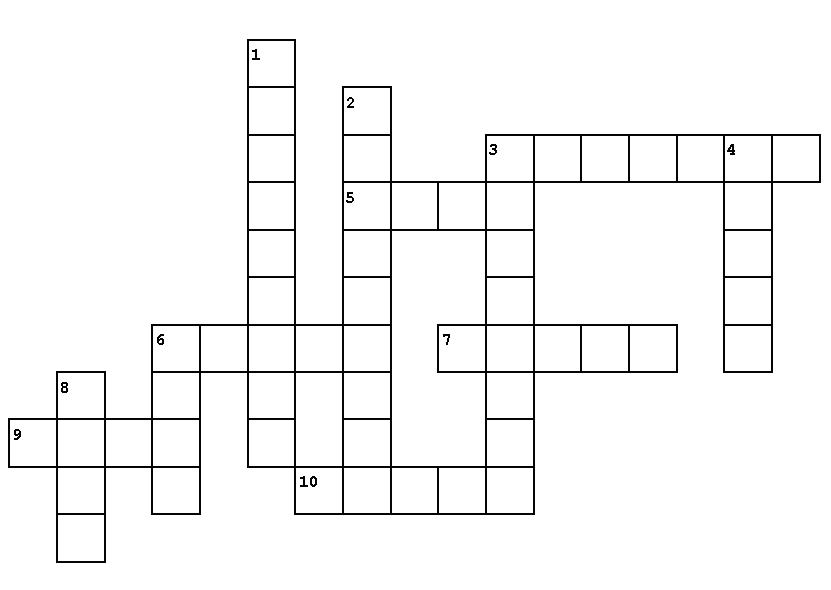
Valentine’s Day Crossword
DOWN ACROSS
3. Bouquets of these are often given as gifts
5. “I ____ you!”
6. Shape often associated with Valentine’s Day
7. The Roman God of Love
9. “If you like it then you shoulda put a ____ on it!”