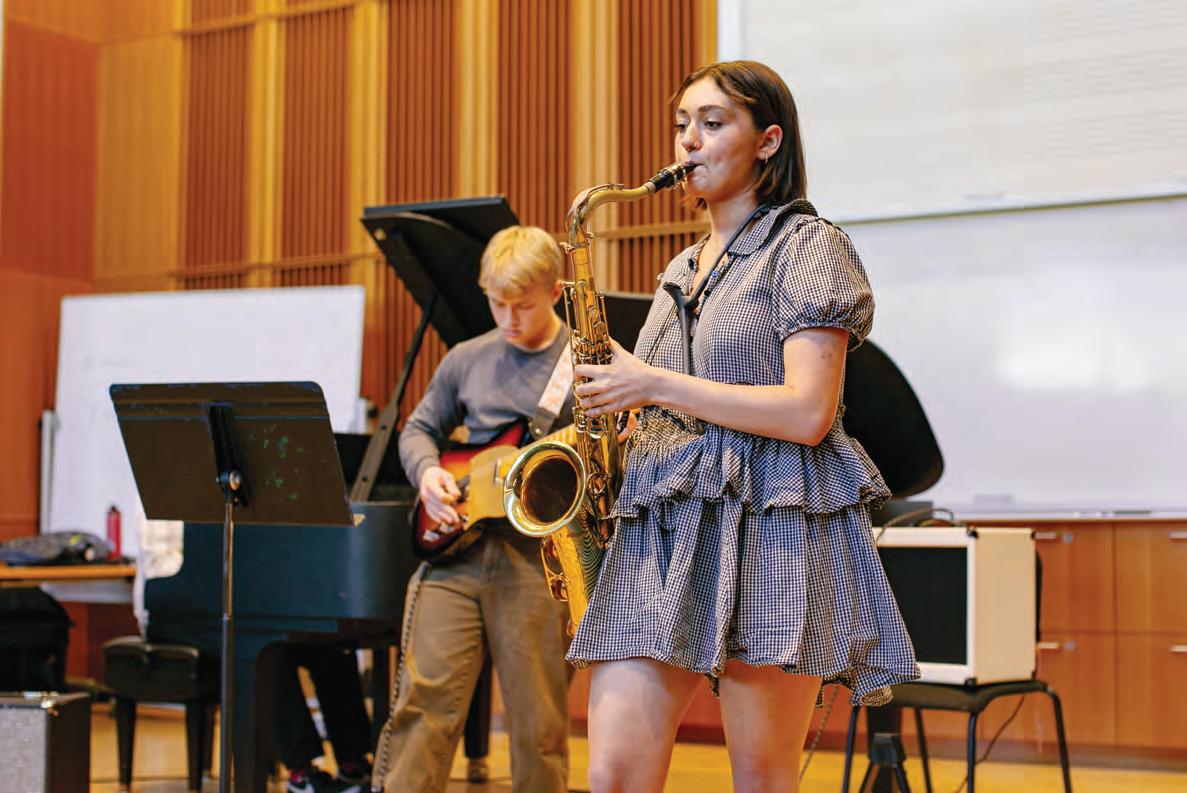
How to Thrive in Wild Times
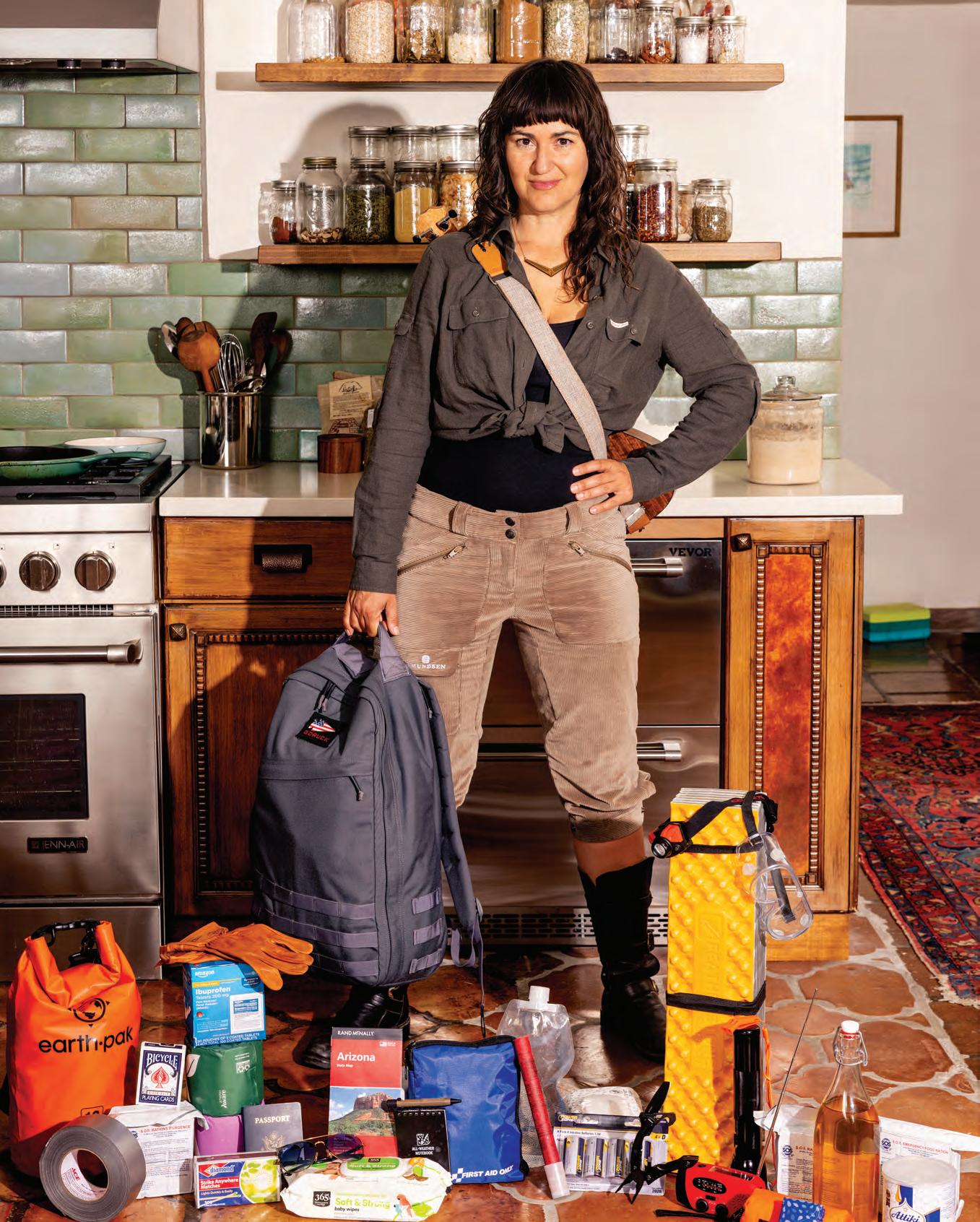
According to cooperation theorist Athena Aktipis ’02, the one thing we really need? Each other.

According to cooperation theorist Athena Aktipis ’02, the one thing we really need? Each other.

By supporting the Annual Fund, you provide essential financial aid for 61% of students on campus today. During this critical time, your giving also sustains Reed’s core values of academic excellence, student success, and independence of thought and expression.
Annual Fund gifts offer immediate impact and long-term stability. Remove uncertainty for students and help Reed adapt in a rapidly changing world by making an Annual Fund gift today.
reed.edu/annualfund
Winter 2025 Volume 104, No. 3
EDITOR
Katie Pelletier ’03
ART DIRECTOR
Tom Humphrey
WRITERS/EDITORS
Bennett Campbell Ferguson
Cara Nixon
CLASS NOTES EDITOR
Joanne Hossack ’82
REEDIANA EDITOR
Robin Tovey ’97
GRAMMATICAL KAPELLMEISTER
Virginia O. Hancock ’62
PROJECT MAESTRO
Caitlyn Schock
COMMUNICATIONS SPECIALIST
Autumn Barber
CREATIVE DIRECTOR
Lauren Rennan
CHIEF COMMUNICATIONS OFFICER
Sheena McFarland
Reed College is an institution of higher education in the liberal arts and sciences devoted to the intrinsic value of intellectual pursuit and governed by the highest standards of scholarly practice, critical thought, and creativity.
Reed Magazine provides news of interest to the Reed community. Views expressed in the magazine belong to their authors and do not necessarily represent those of Reed College.
Reed Magazine (ISSN 08958564) is published three times a year by the Office of Strategic Communications at Reed College. Periodicals postage paid at Portland, Oregon.
Postmaster:
Reed Magazine
3203 SE Woodstock Blvd. Portland, Oregon 97202-8138
reed.magazine@reed.edu
www.reed.edu/reed-magazine
When we began planning this issue, we wanted a story that was hopeful to run with our annual “What Is a Reedie?” feature. Something upbeat. In our stack of books submitted for Reediana we had one called A Field Guide to the Apocalypse by Athena Aktipis ’02 which seemed to be an unlikely candidate, perhaps disqualified for having “apocalypse” in the title. But staff writer Cara Nixon insisted we look into it. It’s about how to have hope, she said.
She was right. In this issue, Cara talks with Athena about what it means to cooperate and care for one another when the world feels precarious. Athena, a cooperation theorist, argues that thriving in hard times depends on generosity and connection. Her ideas feel especially resonant this year, as our Reedies venture out into a world that is in much need of their critical thinking and unique insights.
You’ll meet several of these new graduates in this issue’s “What Is a Reedie?” feature. Economics major Oscar Pulliam
’25 created A Redneck’s Guide to the Affordable Care Act and Small-Town America for his thesis—a project born of his determination that people in rural communities shouldn’t be priced out of basic care. Math major Sajid Bin Mahamud ’25 reflects on the sense of grounding he found at Reed, inspired by a story of migration and belonging in Jhumpa Lahiri’s “The Third and Final Continent.”
Psychology and religion major Rowan Soeiro ’25 worked with community organizations that help unhoused Oregonians recover vital documents and support one another in addiction recovery.
Each of these stories— Athena’s, Oscar’s, Sajid’s, Rowan’s—reminds me that hope is not naïve. It’s an act of collaboration. It’s what happens when people choose to engage with the world, not withdraw from it .
—Katie Pelletier ’03, Editor
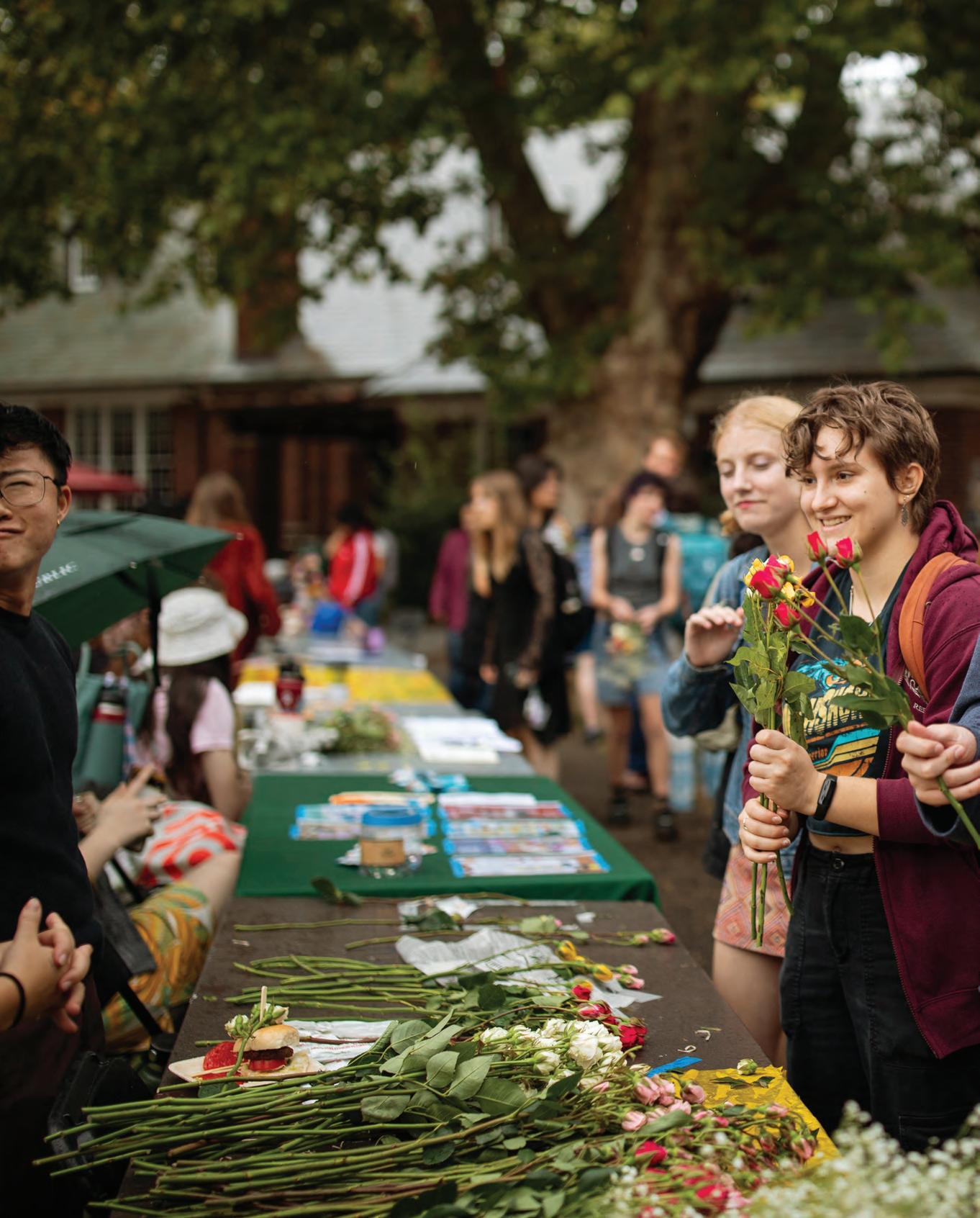
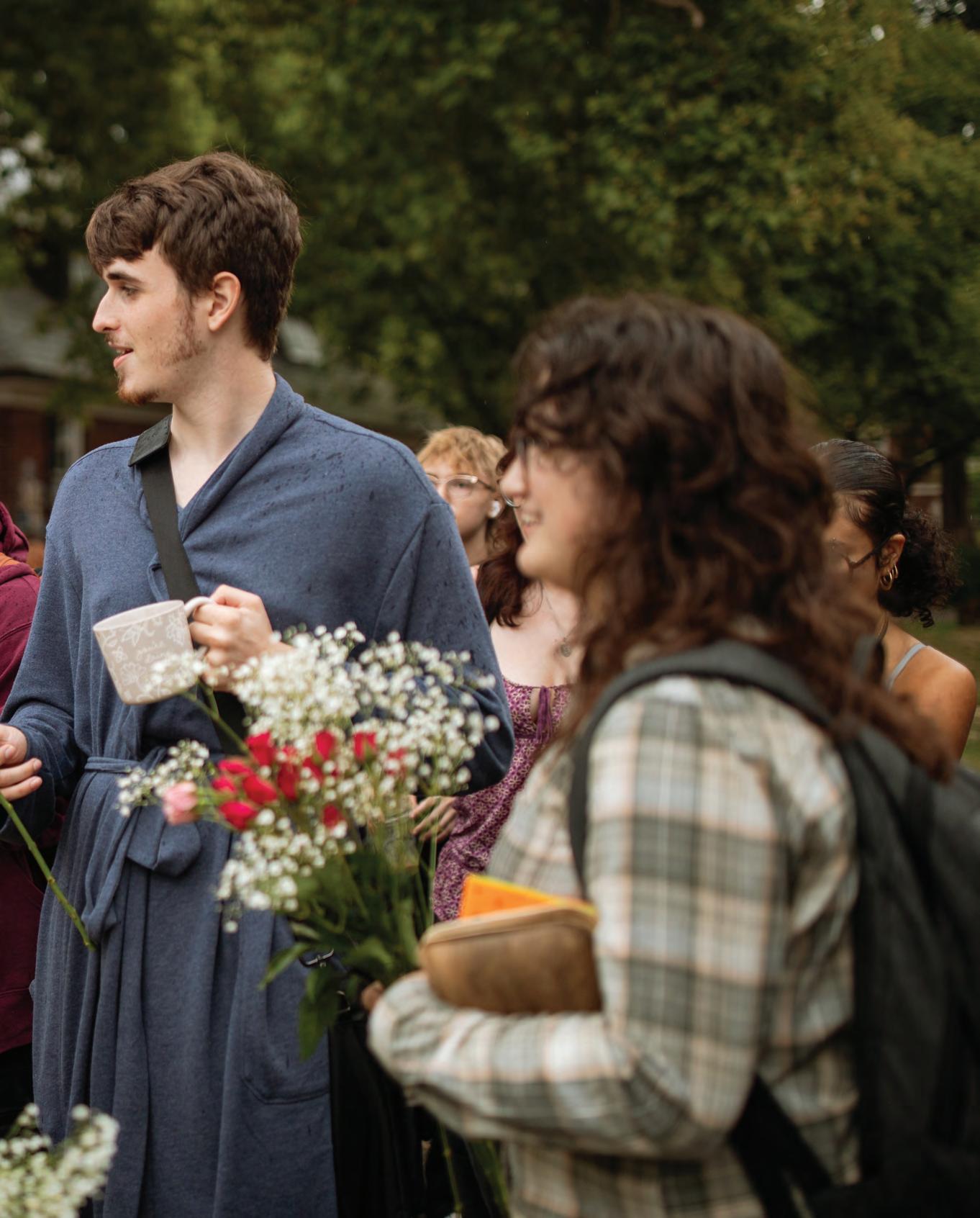
Fresh flowers were a bright spot at the rain-soaked Student Clubs Fair held in the Quad in September, where Leaders from more than 60 clubs promoted their activities and invited new members to get involved.
By Cara Nixon
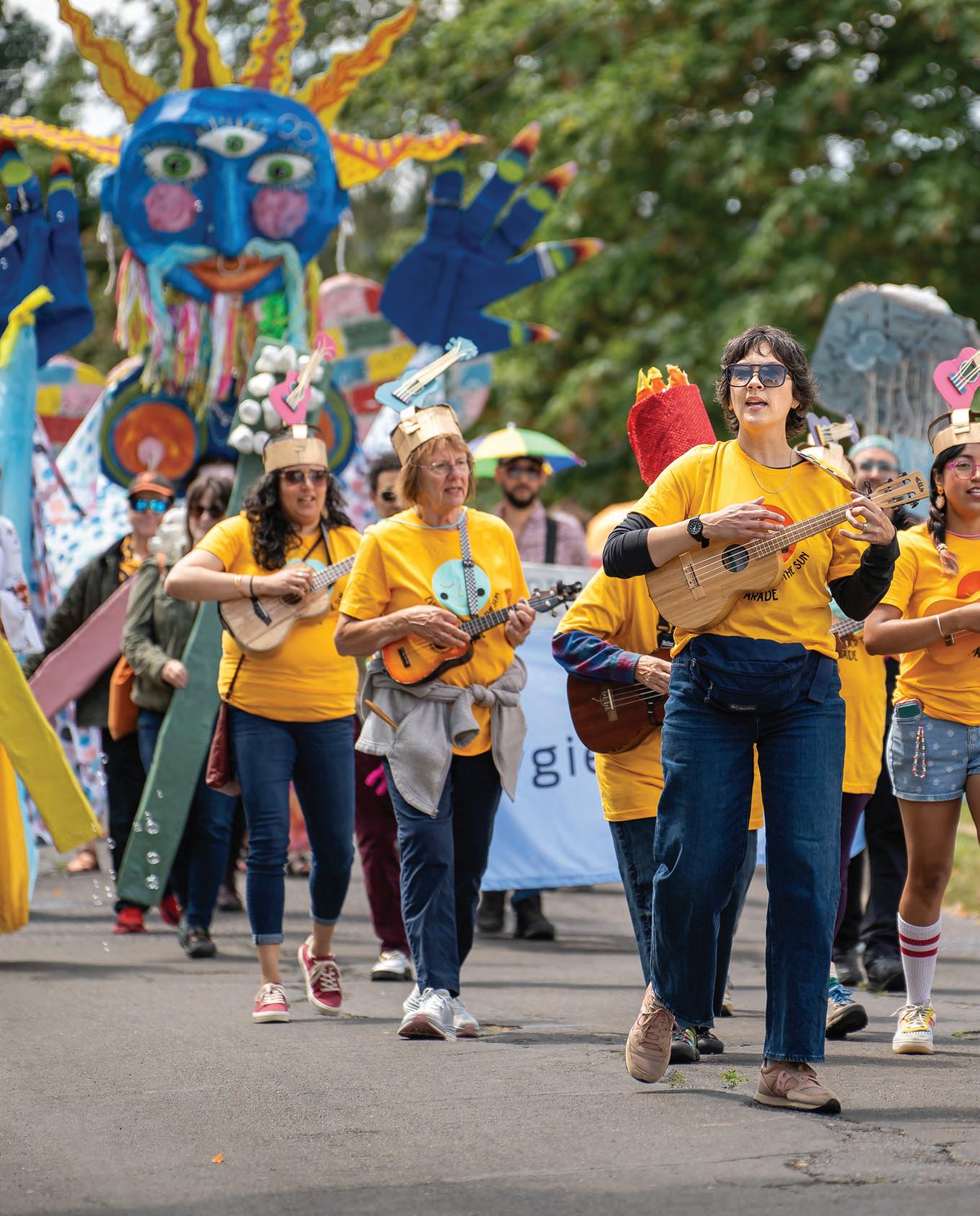
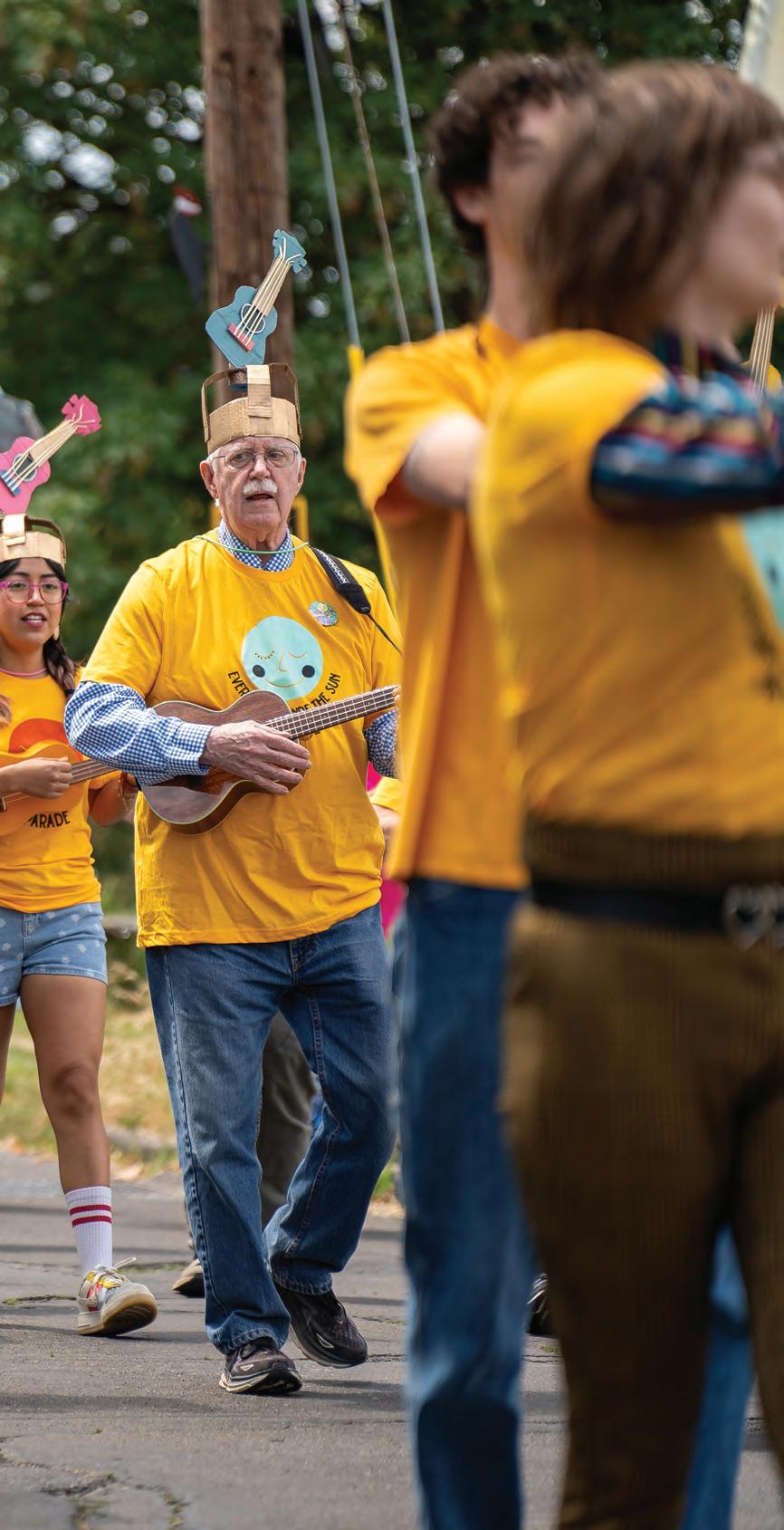
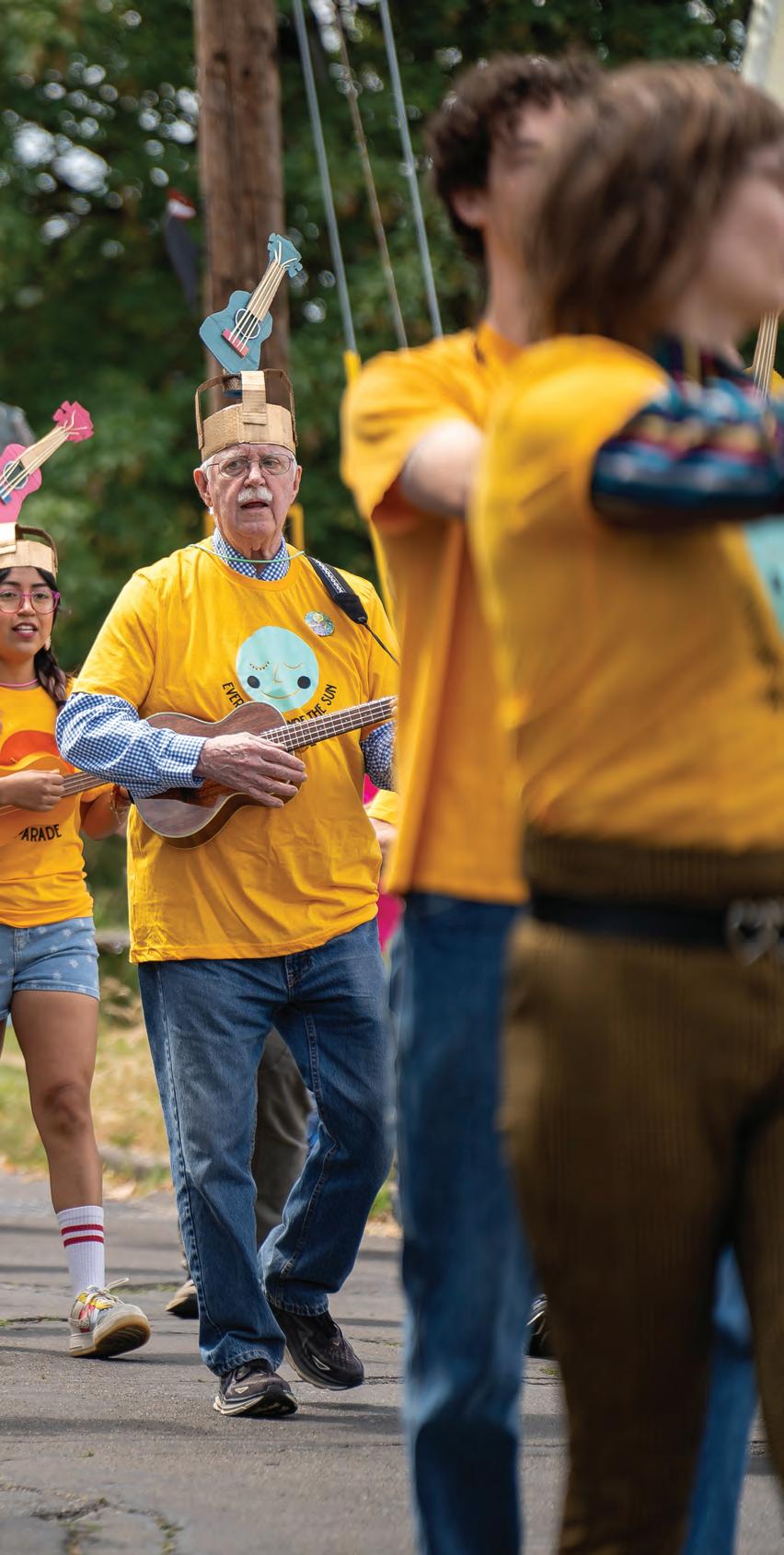
The procession champions community, playfulness, and joy.
As an artist, Professor Catherine Ming T’ien Duffly [theatre] knows the value of play. “Especially now, we really need to find moments of joy and play—and together, not just secretly in our houses,” Duffly says. That philosophy inspired her to create Everything Under the Sun, an annual procession through Sellwood that unites residents through jubilant congregation and puppetry.
“It’s connected to combating isolation and bringing people together through artmaking,” Duffly says. “But I would say that even more than that, it’s about wanting people to remember that we all are creative beings— and that being creative together is a really great way to build community.”
Everything Under the Sun began two years ago and has steadily grown, taking on community partners like hygiene4all, a hygiene hub for unsheltered Portlanders. “For me, it’s a really important aspect of culture–building, especially in Portland—that we make space,” says Cecile Szollas ’25, who helps organize the parade. “[We] use art and theatre and community gathering to create culture in our individual groups—as well as with our community partners.”
A biology major who has worked for Reed Sustainability, Cecile led puppet workshops at Llewellyn Elementary School—which contributed to the parade’s menagerie of puppets, from an ornate crow to an adorably scary spider.
“Joy is so important to sustain us in dark times,” says Duffly, who has announced that the parade will continue in 2026. “I think that finding moments of joy will be really important for us over the next several years.”
—Bennett Campbell Ferguson
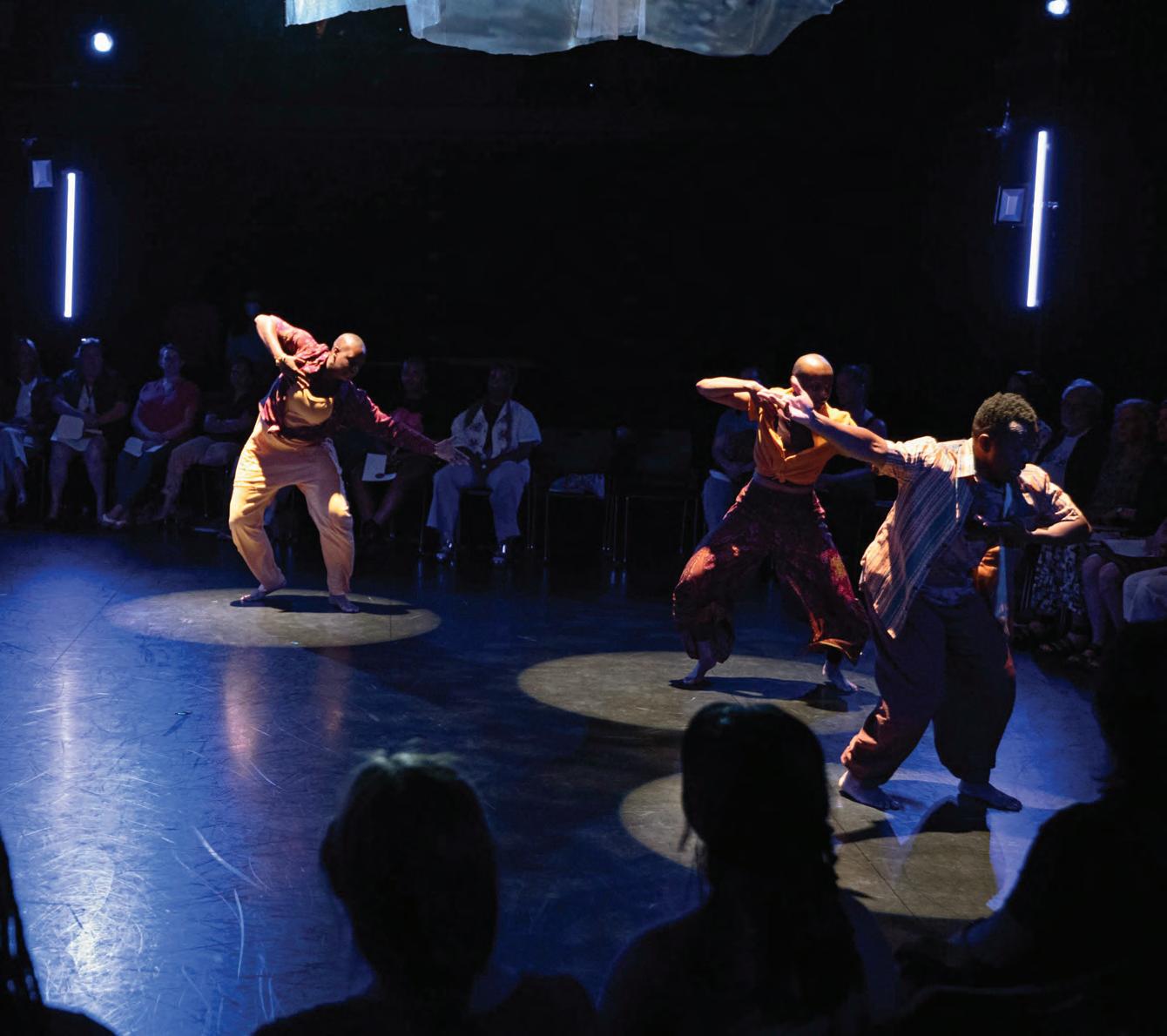
Professor Oluyinka Akinjiola told the stories of these community lineage keepers through dance.
There is no singular definition for a griot, says Professor Oluyinka Akinjiola [dance].
Across locations, ethnic groups, and cultures, the role of a griot varies. They’re storytellers. Lineage keepers. Guides. In their communities, they help others when they become lost on their life journeys. Though griots are born into the tradition, they still have to choose to walk the path.
When someone is brought to a griot, they’ll be reminded of the larger ancestry connected to their existence—but the griot’s guidance isn’t explicit. Rather, it’s conveyed through Tama drumming, hair braiding, tailoring, or other artistic expressions.
“One way that all griots have a correlation, is that the way that they tell stories, give advice, and answer questions is an art in itself,” Akinjiola says.
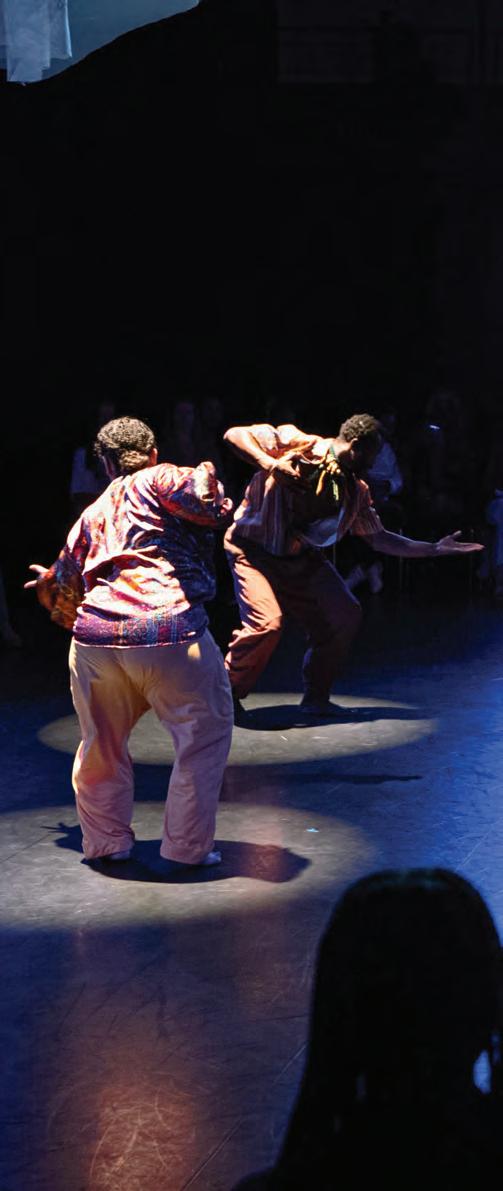
That’s why Akinjiola thought dance would be the perfect medium to tell the stories of griots. A performance that opened this fall in the Performing Arts Building’s Massee Performance Lab, GRIOT, her latest work, was presented by the Reed College Dance Department and Rejoice! Diaspora Dance Theater, a dance ensemble led by Akinjiola.
Two years in the making, choreographed by Akinjiola and her collaborator Michael Galen, GRIOT took audiences on a journey from Senegal to Brazil to the American South to witness the impact of griots in their cultures and communities. Audiences were immersed in the experience of visiting a griot, surrounded by music developed and performed by Tama drum master and griot Massamba Diop, and by a score created by Galen.
Akinjiola spent her 20s studying dance in Brazil with dancer Clyde Alafiju Morgan. Galen has long worked with Diop. It was their stories that inspired the show.
From interviews with Alafiju Morgan and Diop, Akinjiola and Galen worked to find commonalities and overarching themes. Together, they held workshops to ensure all the elements worked in harmony. Diop himself featured as a griot and musician in the performances. Next spring, Alafiju Morgan will take on a similar role when the show goes to Brazil.
“Our big hope is that people think about the griots in their lives, and also their ancestors,” Akinjiola says. “We’re hoping that people really start to think about those individuals that help us arrive where we are today and not forget them in our own personal journeys.” —Cara Nixon
SPERLING AWARD
Besides having been born in China and having taken another trip there many years ago, Sydney Stitt ’25 h adn’t done much globetrotting. “I haven’t even been to the East Coast,” she said this past summer. This fall, that changed, as she moved to England to begin studying history at the University of Cambridge, an opportunity made possible b y the Sperling Studentship award.
GRIOT invited audiences to experience the unique process of visiting a Griot with an intimate roundstage performance.
John Sperling ’48, who earned his PhD in economic history from Cambridge, committed funds to support Reed graduates in the pursuit of postgraduate studies at the institution. Sydney always dreamed of furthering her history studies and the Sperling award has brought her aspirations of becoming a historian within reach.
At Cambridge, Sydney is pursuing a master’s program in world history. She’s particularly interested in researching a topic she
Stitt ’25
already began delving into while at Reed: how tiger hunting by British imperial personnel influenced their perspective on the colonies, specifically India. Her work at Cambridge will similarly focus on environmental history, the history of trophy hunting, and imperial history.
But even as she prepared for her next big adventure, Sydney reminisced about Reed. “I love Reed,” she said, “and I’m going to miss it a lot.” —Cara Nixon
SEGEL FELLOWSHIP
Prior to his death in 2021, Professor Edward Segel [history 1973-2011] said, “I’m always happy if my students go on to become thoughtful thinkers, PhDs, and academics. But what I really want them to do is go out and take over the world.”
That dream endures through the Edward B. Segel Fellowship for International Study, which allows up to two applicants each year, studying any of the disciplines represented in the Division of History and Social Sciences at Reed College, to attend one year of a graduate school program.
This year, the awardees are Miles Sanford ’24 and Madeline Yap ’25 . Miles will study sociocultural analysis of knowledge and communication at Universi-
dad Complutense Madrid, while Madeline will study economic and social history at the University of Cambridge.
According to Peter Goodman ’89, Segel encouraged students to ask “the biggest questions that could be asked—questions about justice, tradition, and social progress.” Thanks to his enduring legacy, those questions continue to be asked by students like Miles and Madeline.
—Bennett Campbell Ferguson
Sanford ’24Yap ’25
Reed continues its longstanding tradition of engaging the local school community in programs on and off campus.
“Everything I have tried to do in my time at Reed has been rooted in a desire to be a good neighbor,” says Greg MacNaughton ’89, education outreach coordinator for the Douglas F. Cooley Memorial Art Gallery.
Reed is located in a Portland neighborhood with four public elementary schools within a half mile of campus. It’s only logical, then, that something like the Open Gallery Program, founded in 2004 by Cooley Gallery Director Stephanie Snyder ’91, would exist.
“I see my role as an ambassador from our classrooms to theirs,” Greg says, “helping the teachers, children, and families of this neighborhood by sharing resources, bringing the public onto campus, and taking our scholarship out into public life.”
Serving Portland Public Schools as well as programs for at-risk youth, the Open Gallery Program provides firsthand experiences with contemporary and historical works of art free of charge.
The Open Gallery Program is just one example of how Reed brings the public onto campus, and in turn takes scholarship and knowledge out into the community to prepare educated and engaged citizens.
Whether introducing young students to art galleries, sending faculty and staff to speak at local high schools, or opening campus to future generations of scientists, here are the ways Reed continues to foster relationships with the local K–12 community.
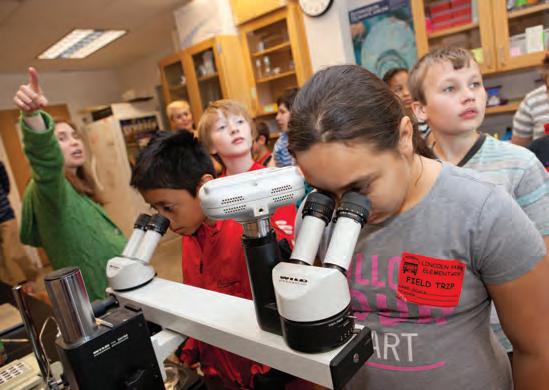
Since 1996, the Reed College Science Outreach program has provided public school students with hands-on, inquirybased science experiences every week. In recent years, the curriculum has expanded to include math, computer science, and physics.
Science Outreach provides interactive, high-quality science education to young students while also giving Reed students a positive servicelearning opportunity in the local community as they visit the same classroom once a week for lessons throughout the school year.
For Portland-area high schools and clubs, Reed facilitates a Speakers Bureau of faculty and staff to address topics of interest and expertise. Professor Betsey Brada [anthropology] can discuss what anthropology is. Professor Derek Applewhite [biology] can speak to his experiences as someone from a group historically excluded from science. Milyon Trulove, vice president and dean of admission and financial aid, is available to demystify the process of applying to colleges.
For almost 40 years, high school students and teachers enthusiastic about math have gathered at Reed on a spring Saturday to participate in a workshop hosted by the mathematics and statistics department.
On a special Saturday each year, high school students and Latin teachers from around the Northwest gather to explore a topic related to the culture and
literature of early Romans in a forum sponsored by the Reed Department of Greek, Latin, and Ancient Mediterranean Studies. “Outreach programming, including Speakers Bureau, F.L. Griffin MathFest, and Latin Forum, takes fundamental elements of Reed’s pedagogy such as curiosity and intellectual exploration beyond the classroom and beyond the campus,” says Laura Zientek, associate dean of graduate and special programs.
Reed is home to many science spaces, from classrooms and laboratories to the Research Reactor and Physics Machine Shop. One day each year, these spots become available to the community through the Open Days event, jointly organized by special programs and Science Outreach.
Through Open Days, the greater Portland community, including local K–12 students, have the opportunity to view science up close—whether touring the reactor or viewing zebrafish through microscopes in a Reed lab.
THEATRE SYMPOSIA
Each fall, a faculty-directed production is shown in the Diver Studio Theatre in the Performing Arts Building. High school students and teachers can see these shows for free, with complimentary tickets on designated dates provided by the special programs office. Directly following each play, the department offers a “talk back,” allowing students and teachers to ask faculty, cast, and crew questions about the performance.
Perhaps Reed’s longeststanding partnership with local high school students— almost half a century old— the Young Scholars program allows seniors to take one college class at Reed for the full academic year while concurrently enrolled in high school.
The highly selective program is open to students in the Portland area who show outstanding academic achievement and a commitment to serious study in a particular interest area. —Cara Nixon
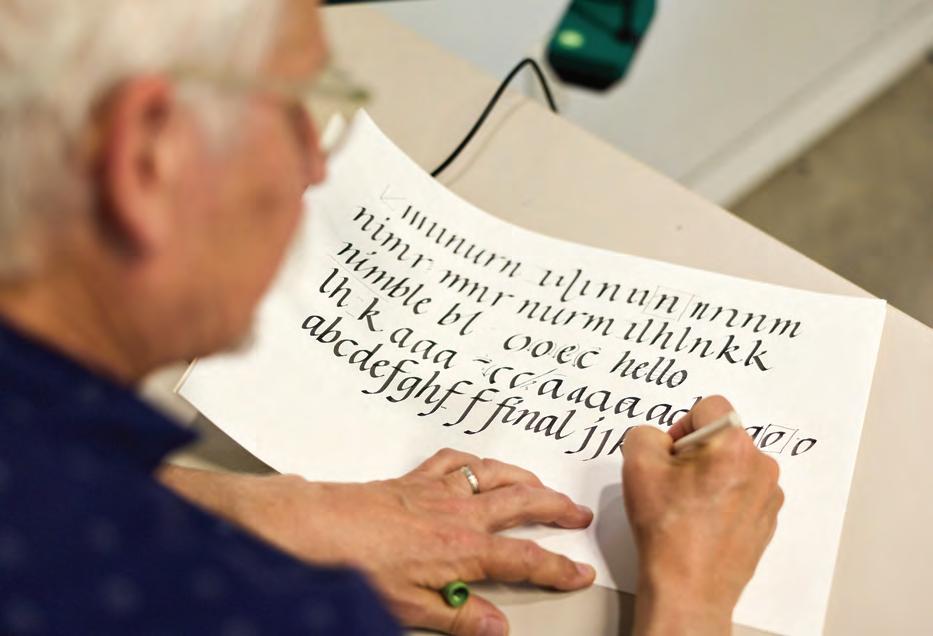
The gift is one of 600 individual contributions to the calligraphy initiative.
From Professor Lloyd Reynolds [English and art, 1929-69] mentoring future Adobe designer Sumner Stone ’67 to Steve Jobs learning the difference between serif and sans serif typefaces, a devotion to calligraphy has long been a defining feature of Reed.
Now, an anonymous gift of $1 million to Reed’s calligraphy initiative endowment has ensured that students will be able to study calligraphy for years to come, solidifying the artform’s place at the core of the Reed experience.
“This gift is amazing because it secures calligraphy at Reed for posterity,” says Cooley Gallery curator and director Stephanie Snyder ’91 , who started the endowment with her husband, Jonathan Snyder ’91
The donation is one of over 600 individual gifts (including the Snyders’ contribution to establish the endowment) pledged to bolster calligraphy at Reed. Thanks
to that support, Reed students can continue to enjoy workshops led by Gregory MacNaughton ’89, the Cooley Gallery’s education outreach and calligraphy initiative coordinator.
“I am incredibly proud of the work that Gregory MacNaughton has done to make this possible,” Snyder says. “We gave funding, but he has put in the hard work every day that has made this possible. He deserves everyone’s gratitude.”
After flourishing under the leadership of Lloyd Reynolds and Robert Palladino, Reed’s calligraphy program was shuttered in the 1980s. The anonymous gift marks the culmination of a revival that began when Snyder and MacNaughton founded the Scriptorium program in 2012, building on the legacy of Reed calligraphy legends like Jaki Svaren ’50. Through those efforts, calligraphy has become essential at Reed. “Lloyd Reynolds said, ‘Calligraphy is the laboratory class of the humanities,’” Snyder says. “And it is.” —Bennett Campbell Ferguson
spin a good yarn. Knot Binary: A Trans and Nonbinary Craft Circle is continuing the enduring tradition of knitting at Reed, thanks to the leadership of HCC therapists Skylar Willson-Ko and Sarah Fleischauer. The group builds on the legacy of Reed knitters like Laura Birek ’03, who was featured in an Interweave Knits magazine article about how campuses were “crawling with knitters.”
Calligraphy at Reed, Year-by-Year:
1938: Lloyd Reynolds begins teaching calligraphy and graphic design courses.
1972: Steve Jobs takes calligraphy at Reed.
2012: Scriptorium program is founded.
2025: Reed receives $1 million calligraphy gift.
many “commie bikes” around these days, but cycling remains as popular as ever at Reed—so popular that manager Logan Warren ’28 has reopened Reed’s Mark Angeles ’15 Memorial Bike Co-op, which is offering a $100 stipend for first-time bike buyers. Logan hopes the Co-op will be a haven for Reed cyclists…and herald the return of “bike jousting.” (Yes, it’s an actual Reed tradition.)
Science Outreach has a scaly mascot: classroom pet Puppy, a nine-year-old bearded dragon who has represented Science Outreach at events like the Student Worker Fair. Unfortunately, Puppy could not be reached for comment due to his busy schedule, which includes on-campus networking and eating dandelions.
President Audrey Bilger, Dean of the Faculty
Kathy Oleson, and Associate Dean of the Faculty Suzy Renn discuss the nurturing of student and faculty research at Reed.
By Bennett Campbell Ferguson
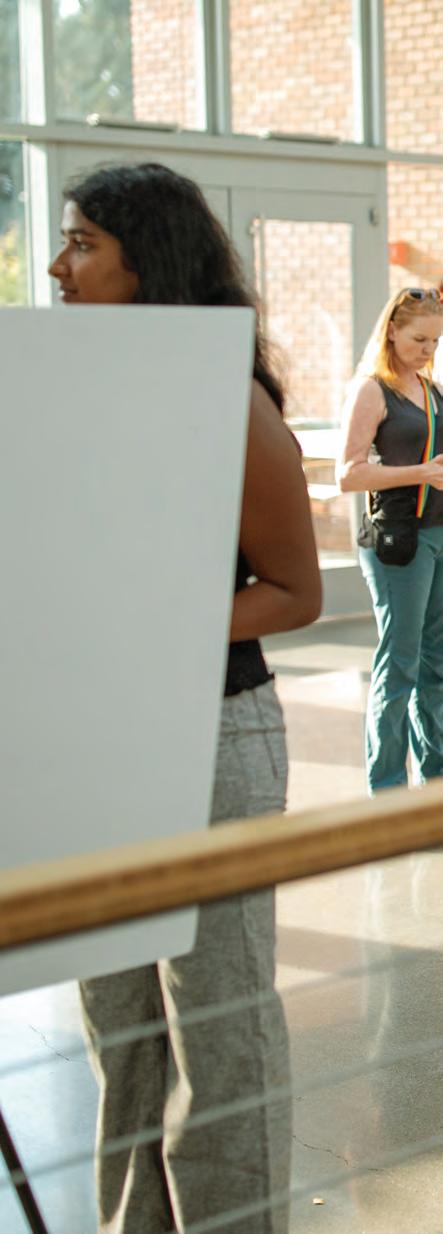
During her first days at Reed, President Audrey Bilger attended a poster fair showcasing student research— and left the event profoundly moved by the passion Reedies expressed for education and communication.
“I was told, ‘Oh, you should just walk through and maybe take about 10–15 minutes,’” Bilger says. “I ended up staying probably closer to a couple of hours—because when you stop to hear a student talk about their research, you are enraptured.”
Events like this express Reed students’ commitment to both the pursuit of knowledge and the joy of discovery. “What is it that makes Reed so special?” Bilger asks. “You go to something like this and you see how passionate rigor is, how excited people are about doing excellent work.”
Reed students and faculty undertake a staggering array of research projects, from Joshua tree root excavations to studies of rat learning to searches for elusive oak hybrids. These and other projects are made possible because of institutional funding, an umbrella term for donor gifts utilized by the college to support the work of students, faculty, and staff.
“Fundamentally, you put money toward things and that shows what you value,” says Kathy Oleson, dean of the faculty and Patricia and Clifford Lunneborg Professor of Psychology. “Investing in faculty research, that’s investing in the college. We’re going to have people that are involved in their field and are better teachers.”
Institutional funding has tangible benefits for Reed community members, whether or not they are engaged in research. It is what enables a department head to undertake comprehensive leadership training, a staff member to show their support for a student worker by taking them to lunch, or a student to expand their intellectual horizons by attending a conference.
“When students get to go to conferences, it introduces them to a professional context that they can imagine themselves entering into,” Bilger says. “It also allows them to feel a sense of agency, particularly if they are presenting.”
Institutional funding also encompasses financial aid, an area in which Reed is nationally recognized. With 100% of need being met for first-year students who receive need-based aid, the college was recently ranked as one of the top five colleges in the country for financial aid based on student surveys by the Princeton Review.
“We want to support the values of our community,” Bilger says. “We believe in the value of education and critical thinking and lifetime learning. That’s what we do here.”
Institutional funding at Reed is possible because of benefactors such as the late Dan Greenberg ’62 and his wife and philanthropic partner Susan Steinhauser (whose gift enabled Reed to create the Greenberg Distinguished Scholar Program) and the late trustee John D. Gray and his wife, Betty Gray (who originated the Gray Fund, which supports out-of-the-classroom activities ranging from athletics to the arts).
“The strongest motivator for people who contribute financially to Reed is gratitude for the opportunities that they received—and a desire to ensure that students coming after them will have those opportunities too,” Bilger says.
The fruits of institutional funding were on display at the President’s Student Showcase last September, which
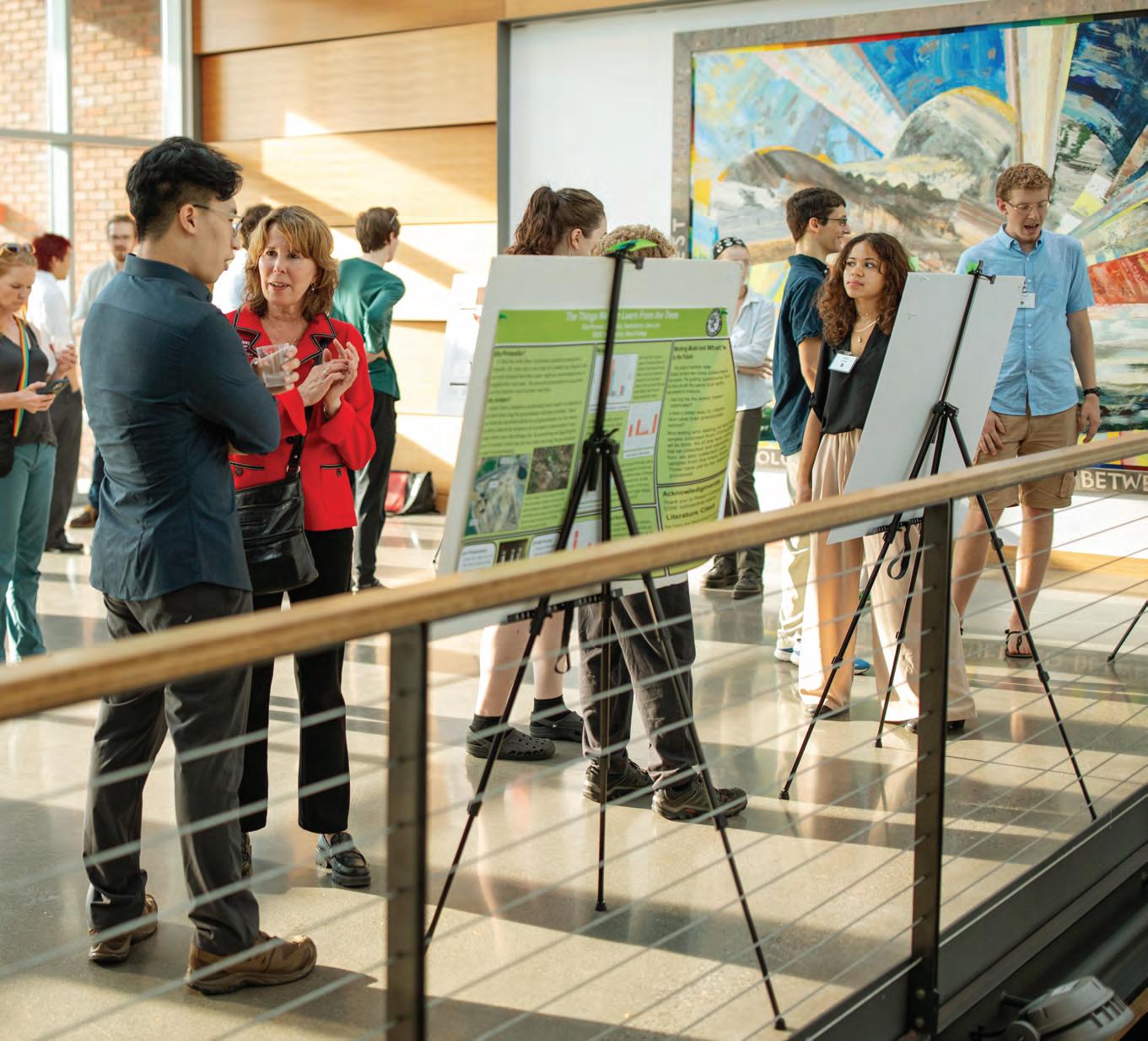
exhibited summer student research— with a dramatic increase in the number of humanities and internship participants, who represented nearly half of the presenters.
“For many students, that’ll be their first opportunity to really present their research,” says Suzy Renn, associate dean of the faculty and Roger M. Perlmutter Professor of Biology. “It’s stu-
dents from across campus—who have been supported by staff, faculty, and the Center for Life Beyond Reed—and we’re bringing them all together.”
That work creates a circle of gratitude, sustained by alumni who support higher education out of gratitude for their own experiences—and by Bilger herself, who notes that institutional funding can be a potent defense
against attempts to devalue, degrade, and defund higher education.
“In my lifetime, I’ve witnessed the attrition of public funding and support for higher education,” Bilger says. “We have gratitude for those who recognize how deeply meaningful this education is—how rare and precious an institution like Reed is. That, in this moment, is something I’m acutely aware of.”
They trained self-driving cars, fronted bands, and tackled each other on the rugby field. They’re as dedicated as they are dynamic—meet 12 members of the class of 2025.
Edited by Bennett Campbell Ferguson and Cara Nixon
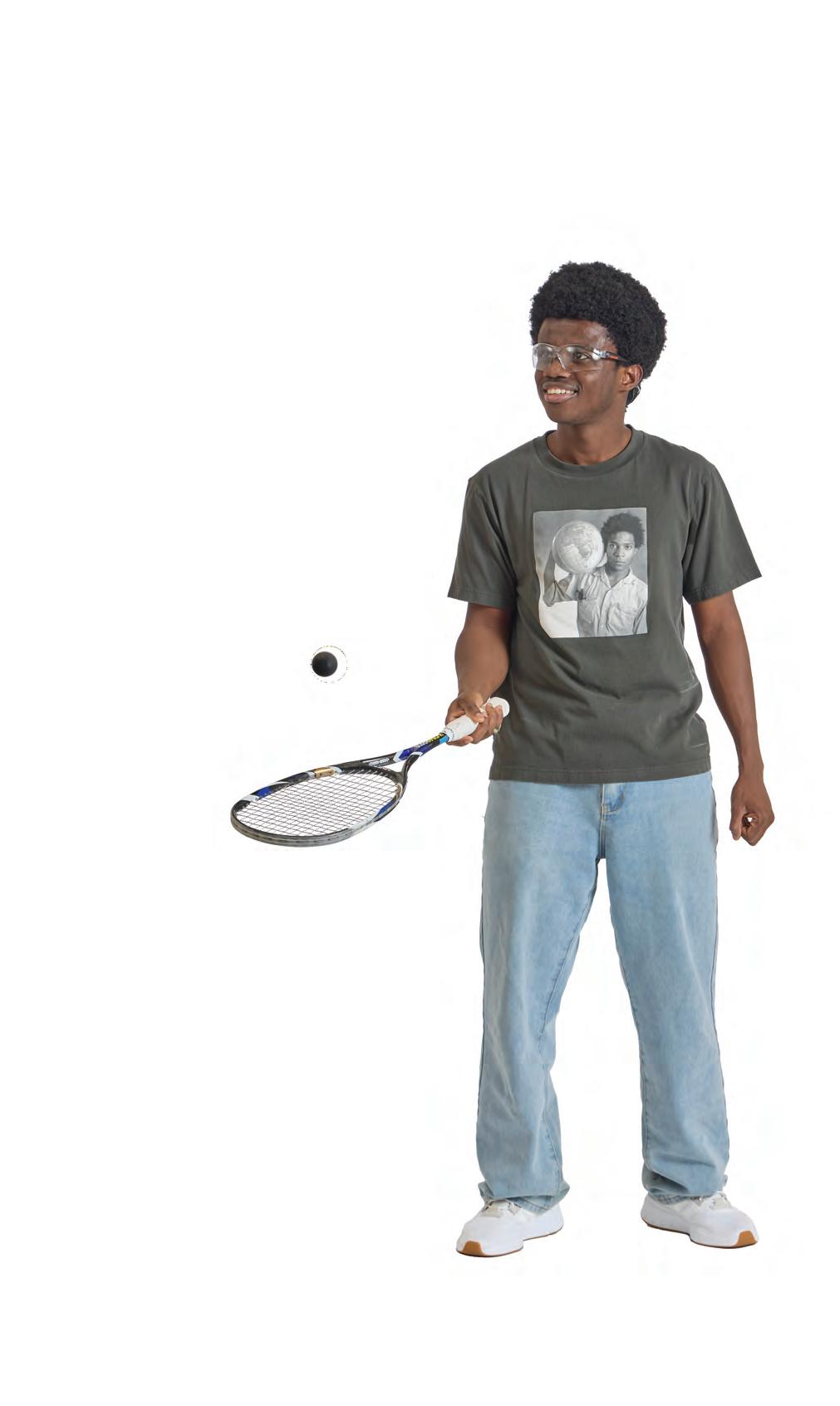
Hometown: Accra, Ghana
Thesis adviser: Professor Greg Anderson [computer science]
Thesis: “Constrained Rein forcement Learning Using Lagrange Multipliers”
What it’s about: Testing the safety of reinforcement learn ing algorithms, specifically within the context of autono mous vehicles.
What it’s really about: Train ing self-driving cars to be able to navigate neighborhoods and roads safely.
In high school: I was really curi ous and adventurous. I always wanted to try new things, see new places. That’s what drew me to Reed. I was on this jour ney of, “I don’t know anything about myself.” I wanted to broaden my horizons.
Influential professor: Professor David Ramirez Dominguez [computer science]. He helped me understand a lot of computer science concepts. The pace of the class was sometimes overwhelming, and he was always there to explain things and break them down. I’m grateful to him. Also, my thesis adviser, Greg Anderson.
Outside the classroom: Reed Finance and Investment Club, squash team, Black Student Union, Science Outreach.
Influential book: Principles: Life and Work by Ray Dalio. It definitely introduced me to the idea of structured thinking—thinking of things in terms of a system. Every deci sion of your life is contributing to a system: a series of events
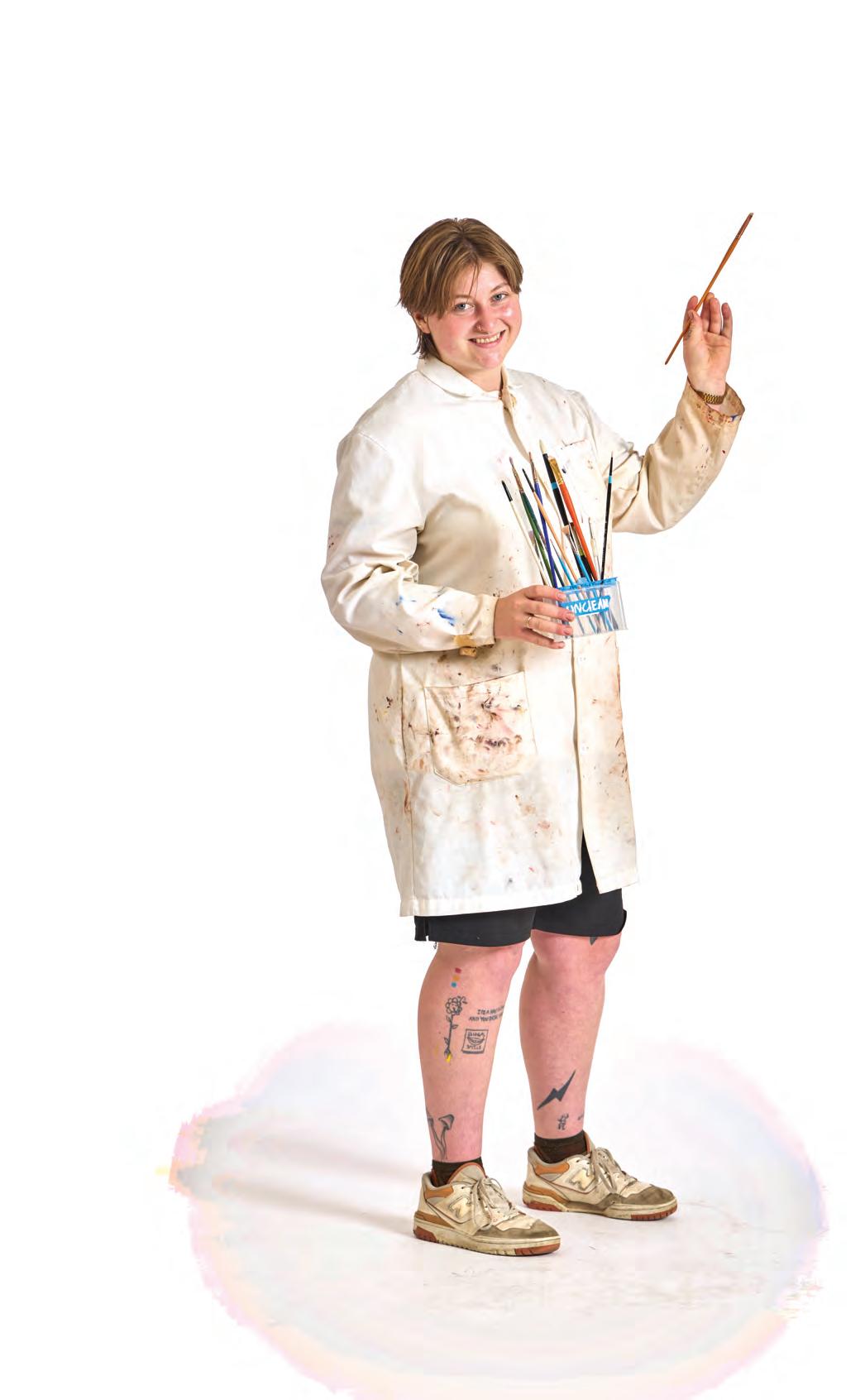
ART/BIOLOGY MAJOR
Hometown: Fairbanks, Alaska
Thesis advisers: Professor Drew Anderson [biology] and Profes sor Juniper Harrower [art]
Thesis: “Always Already”
What it’s about: Bridging the gap between science and the way in which science is disseminated and experienced by the public.
What it’s really about: it’s really hard to extract sci ence from its cultural context. I have made a whole art show that is reflecting on that. And a mating experiment with fish. It’s also a lot about the value we ascribe to things. Art is something that you only get to pursue as a treat. It’s not really valued as a practice.
In high school: I was really high achieving, but extremely dysfunctional. I was the kid in high school who your parents would tell you not to hang out with. That’s not really a fun answer, but it’s true.
Influential professor: sor Daniel Duford [art]. He changed the way that I think about everything. One day in a figure-drawing class, he gave us a reading from a book about Neanderthals, about how tiny little bone fragments show so much about how an individual lived. Daniel was talking about how the act of looking, the act of seeing the person you’re painting a por trait of is an act of letting that person’s existence speak to you. That was mind blowing.
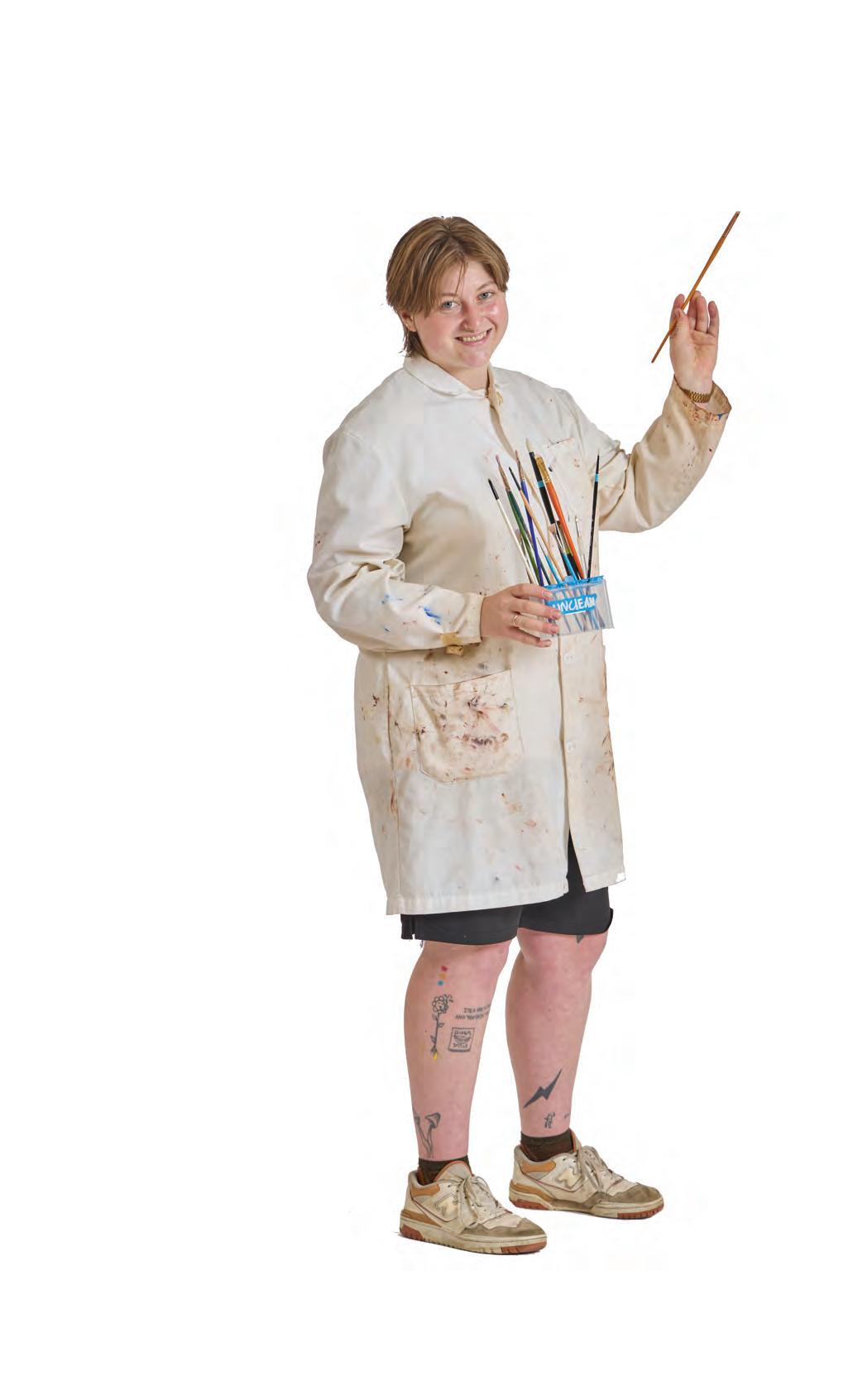
Hometown: Beaverton, Oregon
Thesis Adviser: Professor Derek Applewhite [biology]
Thesis: “Ouch! My Wound!— Interrogating the Effects of Microtubule Polarity Regulators on Cellular Migration in Drosophila”
What it’s about: Identifying possible protein targets that control or manipulate cellular motility. I’m looking at how we can change the behavior of cell crawl patterns and behavior by knocking down certain proteins. We used this awesome technology developed by the Ritz Lab called Proteinweaver.
What it’s really about: Watching cells move on a glass plate.
Challenges faced: I’ve consistently had to work 40-hour weeks to support my family. A lot of [my challenges] centered around how to balance what I wanted to gain from my academics, my relationships with this awesome community, and what I had to do to just survive. That was a challenge, but I feel like the Reed community has been very supportive of me.
Outside the classroom: I’ve been involved with the Peer Mentor Program my entire time here. With my background, I didn’t envision that I’d be here in the first place, and PMP helped me navigate the college space. Being able to then continue that legacy for other students as a mentor and co-coordinator was really fulfilling.
Cool stuff: Research with Professor Derek Applewhite was life changing. Going through the trials and tribulations of research, seeing when things
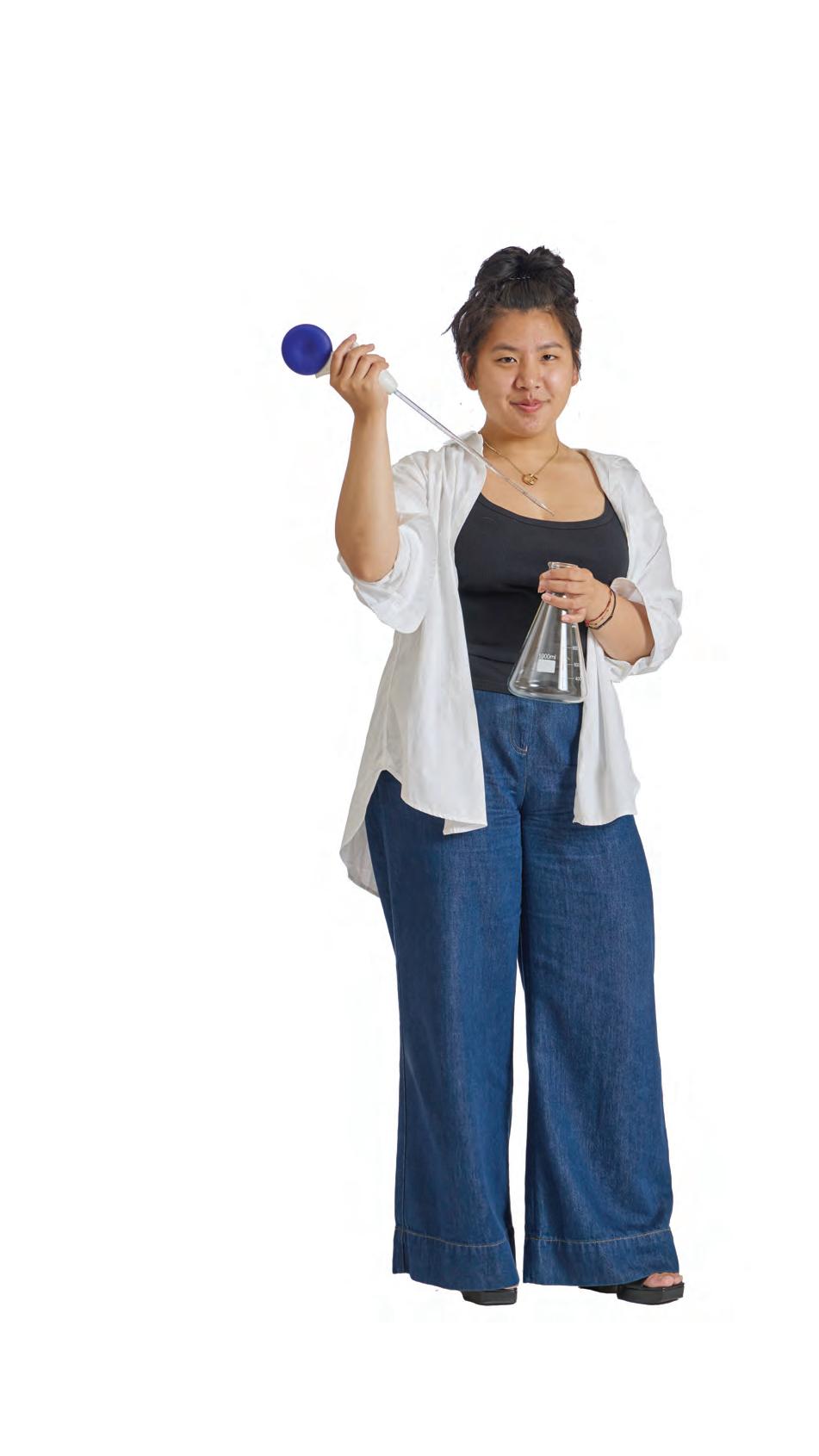
Hometown: Pittsboro, North Carolina
Thesis Adviser: Professor Lind sey Novak [economics]
Thesis: “A Redneck’s Guide to the Affordable Care Act & Small Town America”
What it’s about: Analyzing Medicaid in rural areas, looking at the Affordable Care Act, and the differential effect between rural and urban places. Growing up, my dad worked in emergency rooms in rural areas. I wondered: Why do people’s behaviors in rural areas differ so much from what would be an optimal economic choice, or the regu lar choice, in an urban area?
What it’s really about: A redneck’s guide to not getting priced out of healthcare.
Outside the classroom: I ran the darkroom, finance, and photography clubs. I was the head photographer for the Griffin yearbook. I played rugby. I worked at the Computer Repair Shop as a techni cian. I was a reactor operator and an RA for the economics department. I took photos for public affairs. I was also a trip leader and student chaperone for Reed Outdoor Programs and Education.
What gave me joy: Rugby and spending time in the mountains are my main escape from work. It’s hard to worry about whatever essay is due when I’m getting tackled.
Influential book: I was stressed out one day. This is a real story—it sounds stupid, but I found Marcus Aurelius’s Meditations on the ground, like a perfect copy from
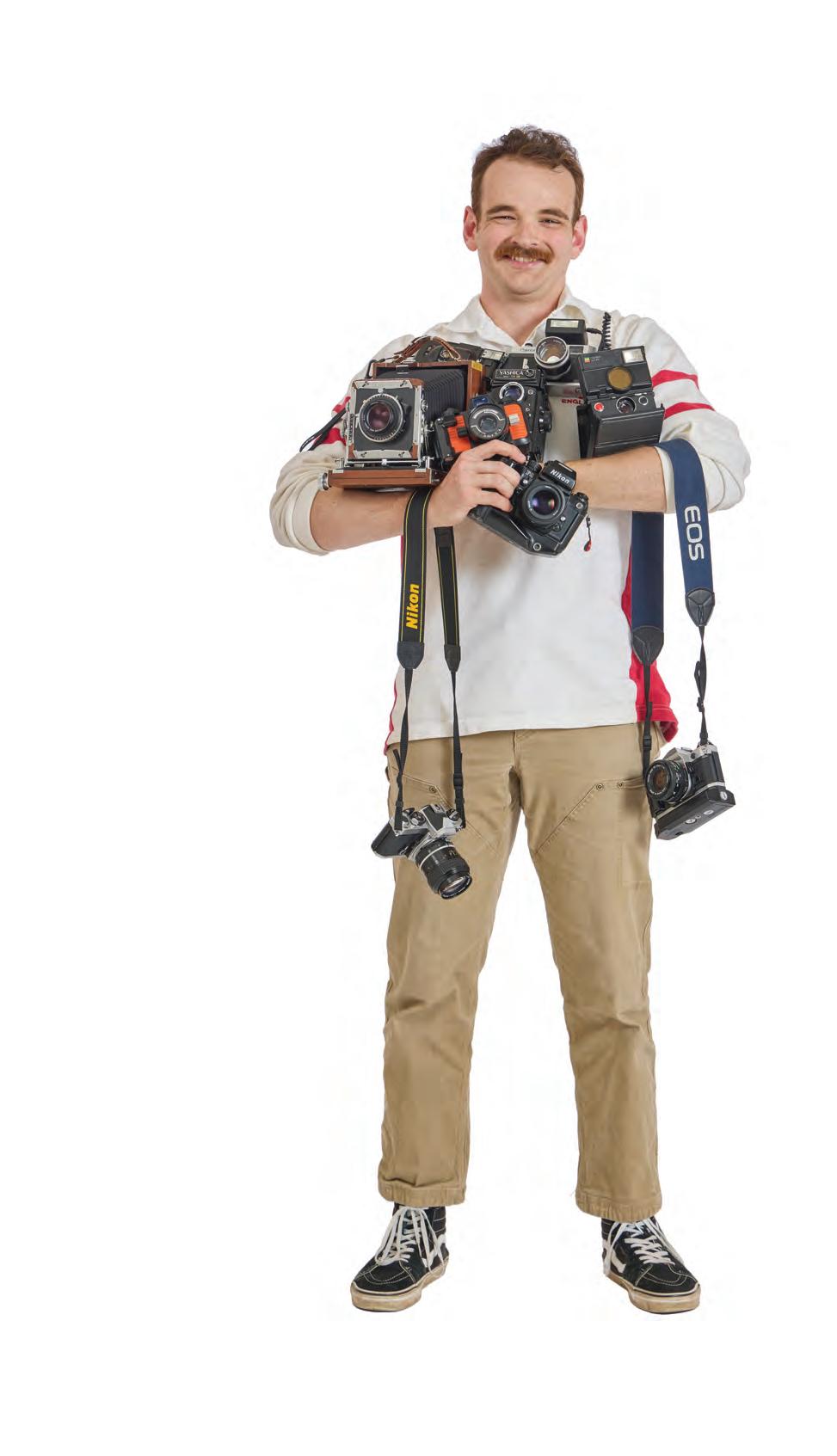
Hometown: Raleigh, North Carolina
Thesis adviser: Professor Nathalia King [English and humanities]
Thesis: “I Was Blind but Now I See: Tragedy, America, and the Experience of History in Faulkner’s Absalom, Absalom!”
What it’s about: Using theory of tragedy to find cohesive meaning in the layered storytelling and confusing perspectives of narrators in William Faulkner’s Absalom, Absalom!
What it’s really about: Trying to bring Faulkner into the present day and what the Civil War did to the American project—and how we can use Faulkner to think about what kind of orientation we take to politics today.
Influential class or professor: Introduction to Literary Theory. Just having a broad introduction to a wide array of approaches to literature and philosophical concepts was really enlightening—not for any particular idea, but for the variety of ways it allowed me to see how concepts fit into literary and political phenomena.
Outside the classroom: Rugby is certainly tough and demanding, but the camaraderie and fellowship is really fun. Having a routine helped me make the transition from being in the army to being a college student.
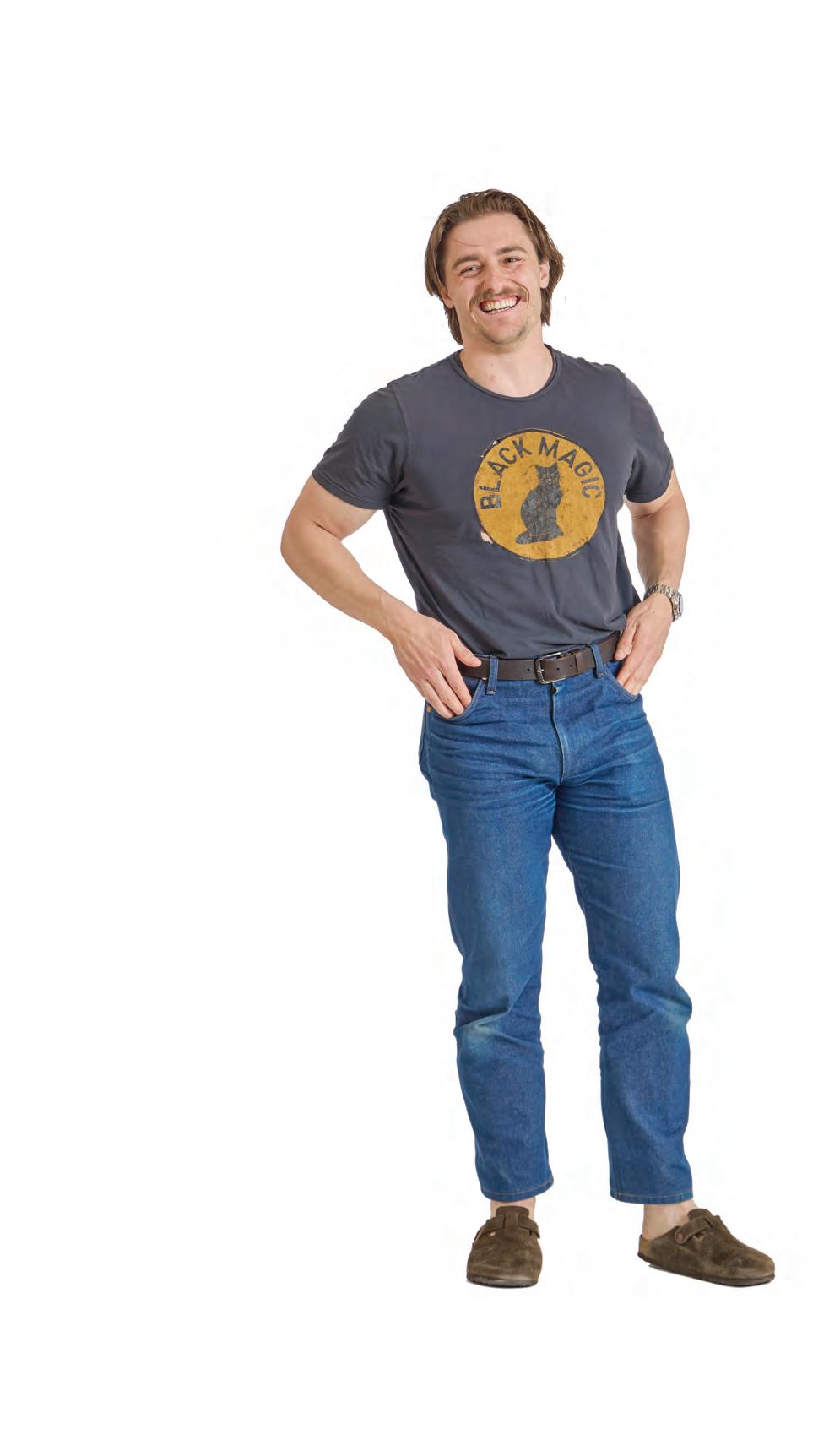
Hometown: Beijing, China
Thesis Adviser: Professor Gerri Ondrizek [studio art]
Thesis: “Creativity Entangled: A Posthumanist Perspective on AI Art”
What it’s about: A both art-historical and specula tive investigation into the role of the artist and how it has changed since the ’60s, how that question becomes relevant when we have AI art replacing a lot of the work we usually consider artists’ work, and where artists should place their work now as we have technology revolutionizing what we consider creativity.
What it’s really about: to get a job as an artist in the age of AI.
Outside the classroom: a housing advisor for three years, for Chinese House and then Birchwood Apartments. That’s pretty cool, because it guaranteed a single [room] for me, but also, it really helped me think about how to en gage a community.
Influential class: Art history classes have definitely been important to me and how I think about my own practice.
Cool stuff: I studied abroad in Paris. It was totally mind blowing. I went to all these museums, and the experience of a different culture really opened up my perspective.
Concept that blew my mind: I was in this class with Profes sor Michael Stevenson Jr. that changed how I think about artistic practice. I used to think there’s painting, there’s

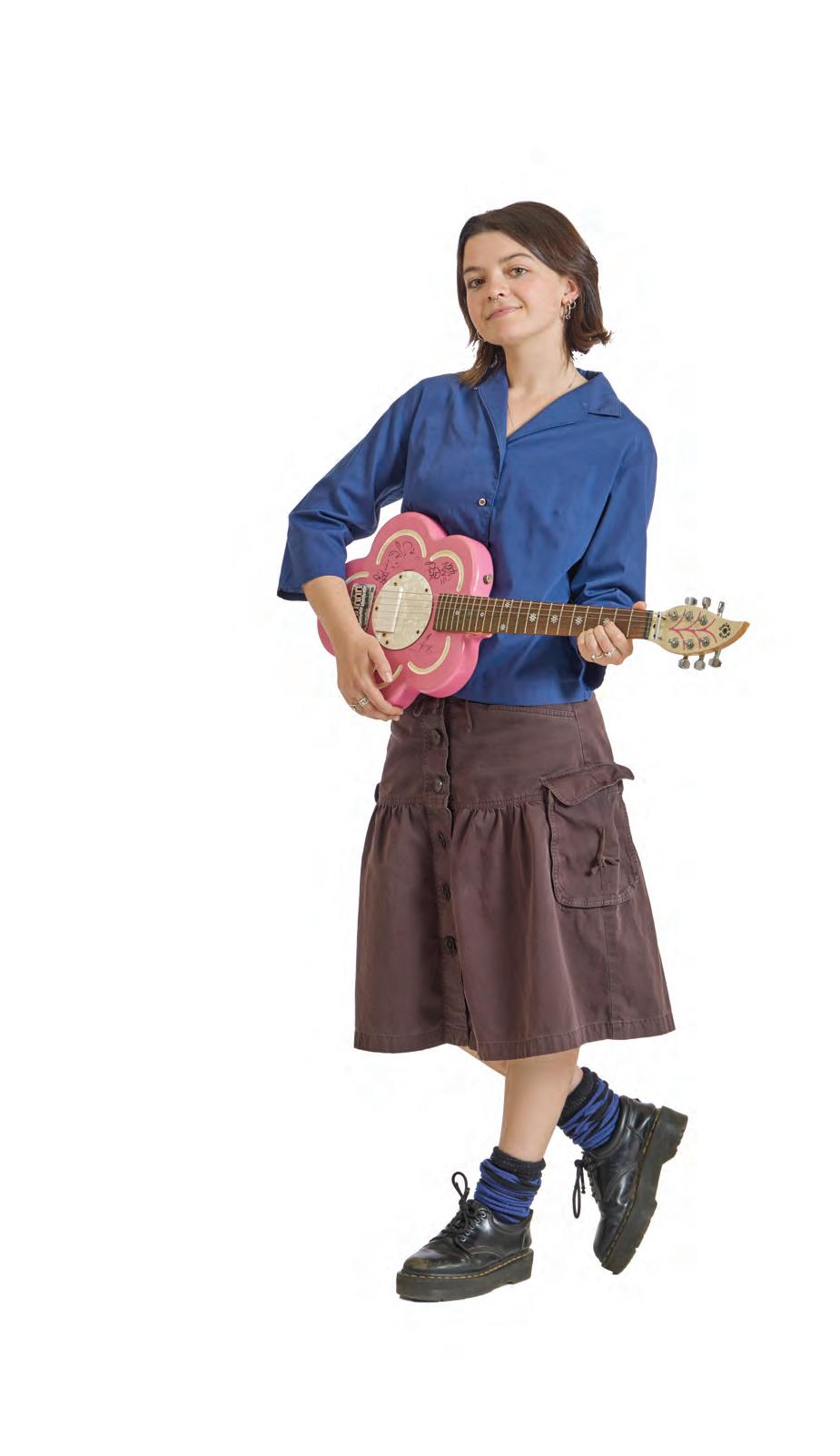
Hometown: Ojai, California
Thesis adviser: Professor Maria Fantinato G. Siqueira [music]
Thesis: “‘I’m Not Pretty’: An Ethnographic Study on Inclusion in the Portland DIY Music Scene”
What it’s about: How gender and inclusion shape participation, creativity, and space making in the Portland DIY scene. Through interviews, ethnography, and music analysis, I explore whether DIY truly resists mainstream exclusions or reproduces them in new forms—raising broader questions about what it means to build an equitable community.
What it’s really about: Queer artists in the Portland DIY scene.
In high school: I was continuously putting on a new experiment with my body and my dress. Dyeing my hair or cutting it short, or experimenting with punk fashions and trends—and the more normative trends of my high school years. I was the girl who was experimenting with who I wanted to be. I think I’m still that person in many ways—experimenting with gender, experimenting with personality, experimenting with music.
Influential class: Cultural Study of Music, taught by Professor Morgan Luker [music], was very influential and made me realize, “I can write about music. I can write about it and I can study it and I can think about it in new ways.” And I don’t think I would have written the thesis I wrote without the influence of that class and the ways that we looked at ethnomusicology.
Outside the classroom: Tea Club, open mics at the Paradox Café, working in the Cooley Art Gallery, organizing Reed Arts Weekend (RAW).
Influential media: system’s “Dance Yourself Clean.” I remember hearing that song in the pool hall my freshman year during Renn Fayre. Every time I hear that song, I feel so happy and feel like I’m a part of something. I don’t think I’ll ever be able to hear that song again and not think about Reed and think about my time here.
Concept that blew my mind: When I took a conducting class from Professor Shohei Kobayashi [music], we learned to lead with our bodies, lead with our emotions. A lot of the time, you’re supposed to hide those things, act as if you’re okay. When you’re conducting, you really listen to the music and think, “How can I express these emotions?” That con cept has been so influential in my music learning here—it carries through, no matter what subject I’m looking at. There’s always that power of emotion and that power of the self.
Awards, fellowships, grants: The President’s Summer Fellowship. My project was starting a music blog called The Nova Journal as a collaborative and refresh ing space for exploring how we listen to and write about music. I still write for it today!
What’s next?
Portland and keep participat ing and contributing to the local music scene. Whether I’m in the front row, on stage, or behind the scenes!
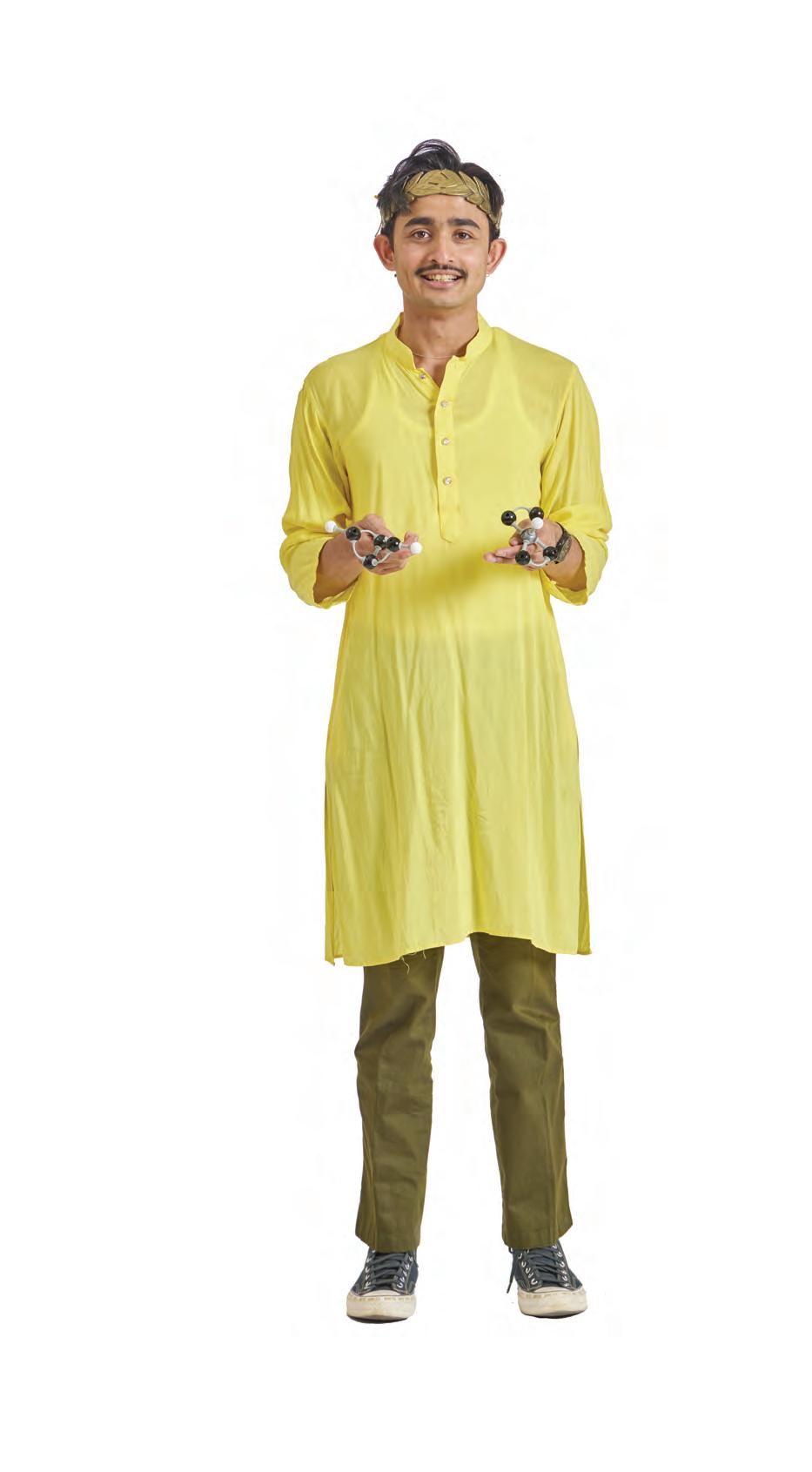
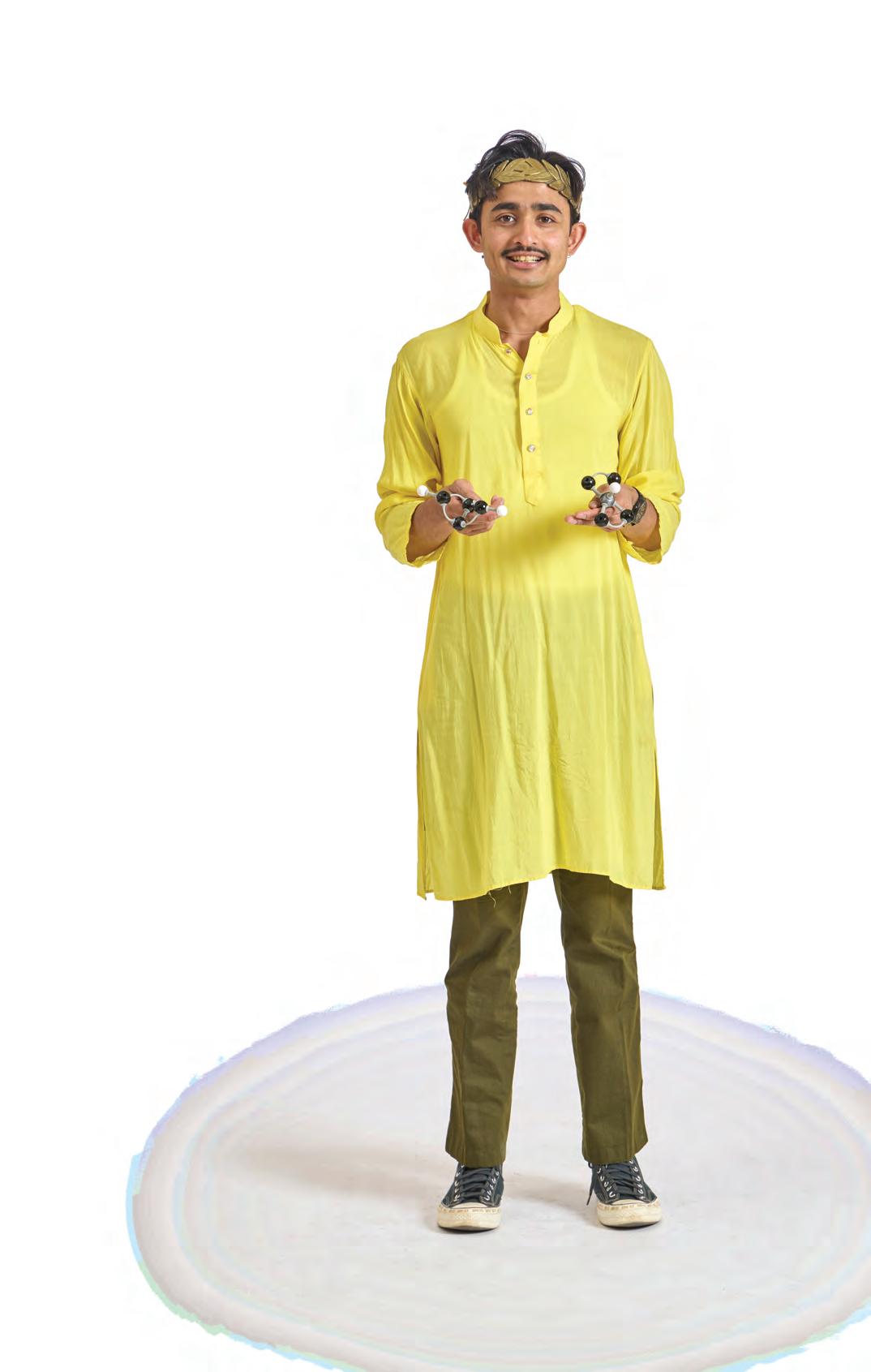
MATHEMATICS MAJOR
Hometown: Dhaka, Bangladesh
Thesis Adviser: Professor Jamie Pommersheim [math ematics]
Thesis: “Spectral Characteriza tion of the Closed Walk Matrix”
What it’s about: tionally, the most efficient way to store information is in terms of numbers. And it turns out, the most efficient way to store graphs is in terms of matrices. I study the tradeoff between these two approaches: stor ing information purely in a graphical manner as opposed to storing them in a numerical manner.
What it’s really tively representing networks.
Outside the classroom: worked in the admissions office for the international division. It’s a place where you get to present the version of Reed you imagined. In my mind, Reed is a place where people are curious, risk-taking, and incredibly kind. I got to give prospies a version of that image.
Concept that blew my mind: The law of diminishing returns. After a certain point, doing the same thing stops meeting the expected returns . . . so, sometimes it’s fun to style my hair a little differently, watch a “boring” movie, or add broc coli to stew.
Influential book: story “The Third and Final Continent” by Jhumpa Lahiri. The main character was born in India, went to the UK for study, and came to the U.S. for
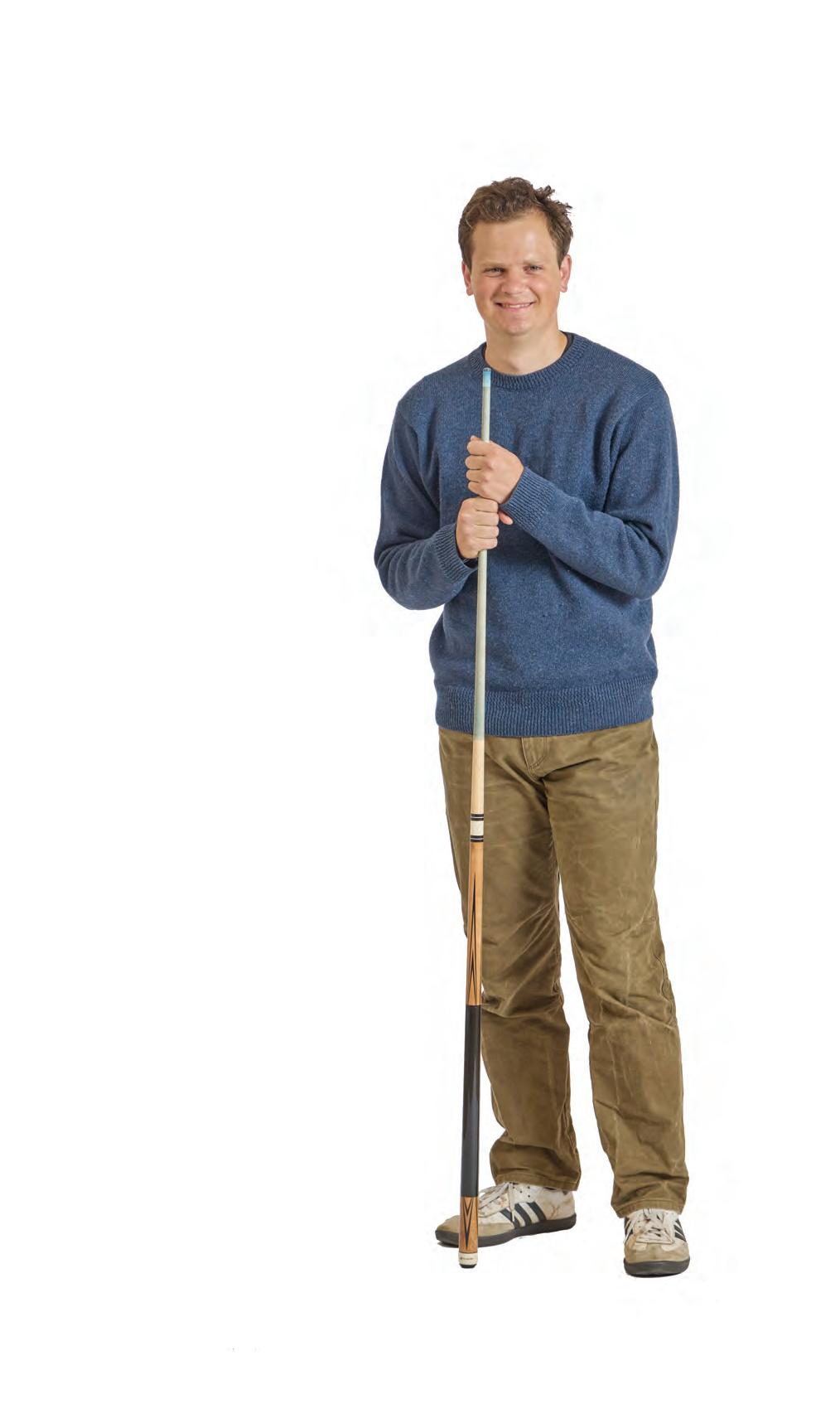
Hometown: Fort Collins, Colorado
Thesis adviser: Professor Franklin [physics]
Thesis: “A Continuum Model for Physical Billiards”
What it’s about: The physics of pool. I started playing a lot of pool during my freshman year. There’s this guy who made these pool tutorial videos informed by physics, Dr. Dave, who’s an engineering professor at Colorado State University. My thesis is really an extension of what he and other pool nerds have been thinking about.
What it’s really about: How much interesting physics there is, even in seemingly boring places.
In high school: I was the band and science kid (I played the trombone). I had all these academic clubs I did with my friends. Every lunch we had a different science competition we would participate in— Science Bowl, Ocean Bowl, anything you could imagine.
Influential class: Thermal Physics with Professor Noah Charles [physics]. I had done a research experience the summer before in solid-state physics, and I had been exposed to all these different ideas that I had no familiarity with. I took Noah’s class and it was very well presented—it was an engaging, interesting class, and every unit offered an explanation for something I had heard about but didn’t know the specifics of. It was a very enlightening experience.
Hometown: Columbus, Ohio
Thesis Adviser: Professor Kara Cerveny [biology]
Thesis: “Spatiotemporal Dynamics of Cell Cycle Kinetics in the Zebrafish Optic Tectum”
What it’s about: Understanding how this particular brain area in zebrafish, the optic tectum, operates. It’s in charge of visual development and processing. There’s a sim ilar brain area in humans, the superior colliculus. My project is comparing the known anat omy of this area in zebrafish to the area in humans, and the biological mechanisms that contribute to its development.
What it’s really about: Look ing at zebrafish brains and understanding how the optic tectum works.
Outside the classroom: As the financial wellness student coordinator, I helped build the financial literacy programming. Our goal was to target all students, but a special focus on underrepresented students from marginalized communities who may not have access to personal finance information.
Cool stuff: I studied abroad in Barcelona. That was an amaz ing experience. Shortly before I left, I started my own fashion blog, in part to record my ad ventures in Spain, and then to talk about clothes. Earlier this year, I got invited to New York Fashion Week as a member of the press, and that was a huge milestone for me.
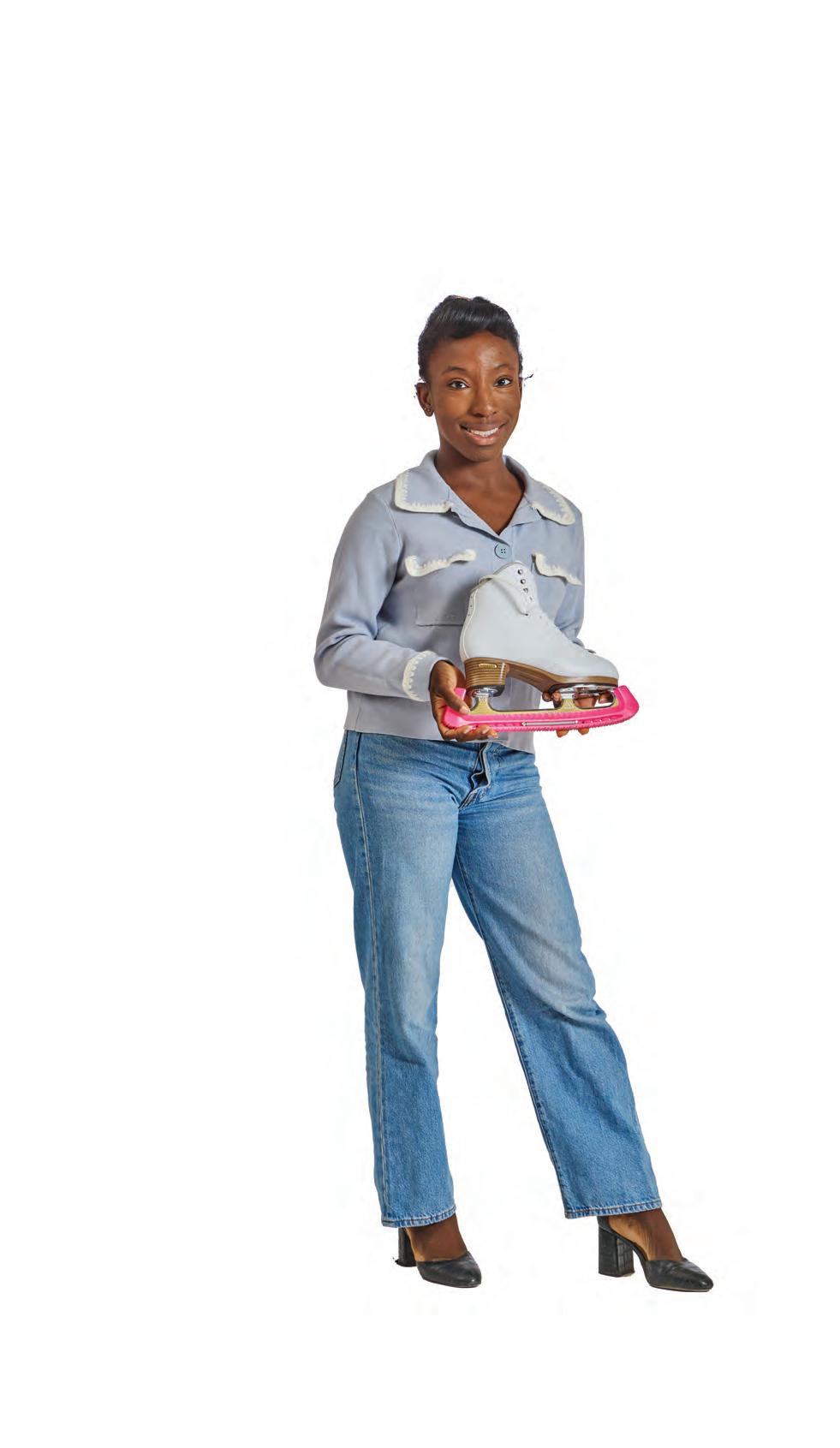
What gave me joy: Figure skating at the Lloyd Center.
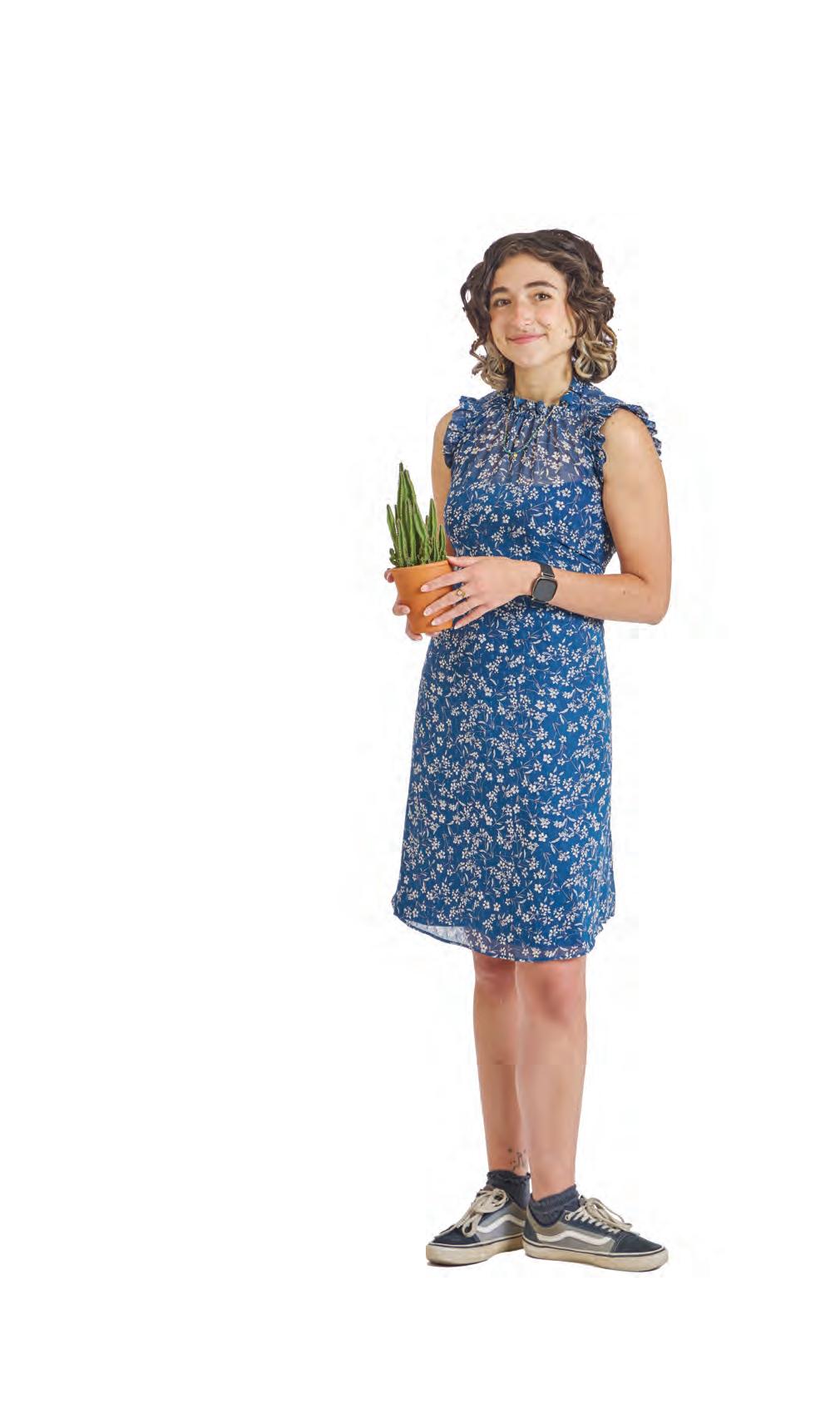
Hometown: Santa Fe, New Mexico
Thesis Advisers: Professor Megan Bruun [psychology] and Professor Chauncey Diego Francisco Handy [religion]
Thesis: “Death and Divine Order: Religion and Prosocial Responsibility in Presbyterian Communities”
What it’s about: Mortality salience in Presbyterian communities. Basically how aware people are of their own mortality, religiosity, and how those two factors contribute to prosocial responsibility. If everyone is predestined, if that’s already been decided for you, why care? Why do we need to be socially responsi ble to each other, or kind?
What it’s really about: If people are more aware of their death or more religious, will they be more socially responsible?
Outside the classroom: I worked with the Mental Health and Addiction Association of Oregon. The MHAAO has helped to fill in that dearth that we have in mental health care, because not enough mental health providers work on a peer basis. It’s people who have been through addiction and emerged from it helping other people recover.
Influential professor: Profes sor Kristin Scheible [religion]. I came to her with the idea for my major when I was a fresh man. It doesn’t really exist, so I sat down and talked with her for hours, and she was like, “Okay, you know, yeah, let’s do it.” She’s inspirational, passion ate—a very kind person.
Cool stuff: I studied abroad in Scotland. It was incredi ble. I think studying abroad and traveling, especially as somebody who hadn’t really been out of the country, really opened my eyes and broad ened my perspective.
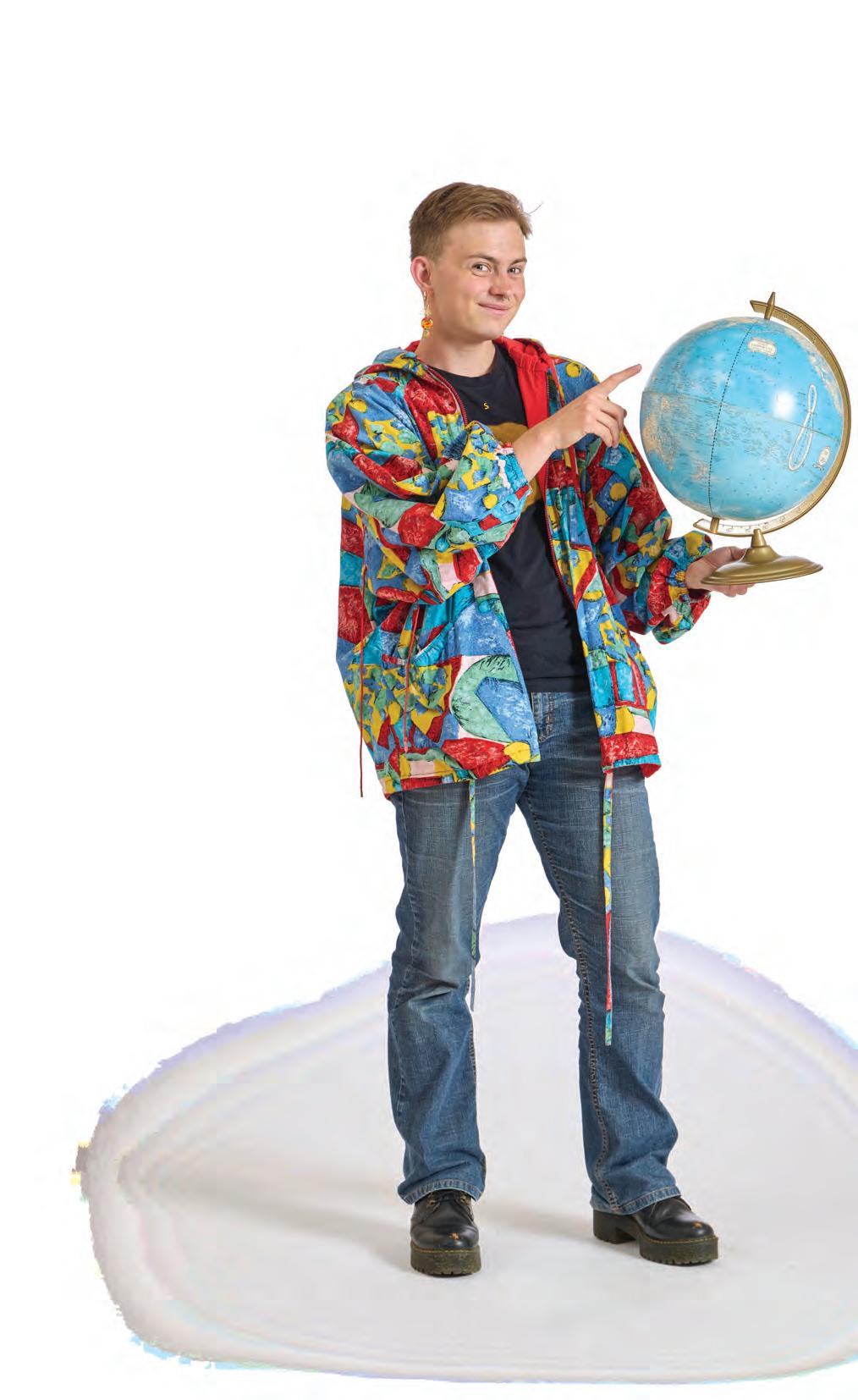
Hometown: Austin, Texas
Thesis adviser: Professor Benjamin Lazier [history and humanities]
Thesis: “Students and ‘the Scars of a Democracy’: Polit ical Possibilities at the West German Campus from 1967 to 1969”
What it’s about: The West German student movement from 1967 to 1969. It’s looking at it both through archival evidence of what the students were interested in—what they came to think about global ization and democracy at the university and abroad—and also their interactions with three professors.
What it’s really about: The fear of fascism coming back.
In high school: I was super artsy in high school. I was always drawing in my classes. I was just moving recently, and at home I found all of my pre-calculus worksheets and they were just drawings!
Influential professor: Profes sor Paddy Riley [history and humanities] has been a huge influence on me. He was one of the people who taught me to trust my own ideas and keep writing. I would come into his office hours and ask to go a little over the assigned word count, and every paper would keep getting longer and longer. He also vouched for me to become a Hum and writing tutor.
Outside the classroom: ing tutor, orientation leader, house adviser for the German House, DJ at KRRC, layout editor for the Quest, organizer for the Union of Reed College Housing Advisers (URCHA).
a field guide to face them.
By Cara Nixon
In the winter of 2023, a snowstorm had swept through the Rocky Mountains of Colorado. Athena Aktipis ’02 drove freshly plowed roads on her way home to Flagstaff, Arizona, from Crested Butte, where she’d been doing some of her favorite things: cross-country skiing, writing in nature, and jamming with friends.
Shiny black streets starkly contrasted with a landscape painted white with deep snow. The sun had yet to set, but the canyon she wound through covered the dying light, making it appear as night. Earlier, before Athena left, a barista at her go-to Crested Butte coffee shop had warned her about the weather and advised: If you’re surprised by an animal wandering into the road, don’t slam on your brakes—instead, slow down. Athena doesn’t believe in metaphysical forces, but that message seemed to be a funny kind of foreshadowing.
That evening, a herd of black cows blended into the black road, and when Athena ran into them, she remembered the barista’s sage advice, slowing down rather than braking sharply.
There were no human or bovine casualties, but the accident still totaled her car. Luckily, Athena is a prepared sort of person. After studying evolution and cancer for years, her recent work as a cooperation theorist has focused on how we can not only survive during crises, but thrive in them, too. She managed to get her car to the side of the road and unpacked her
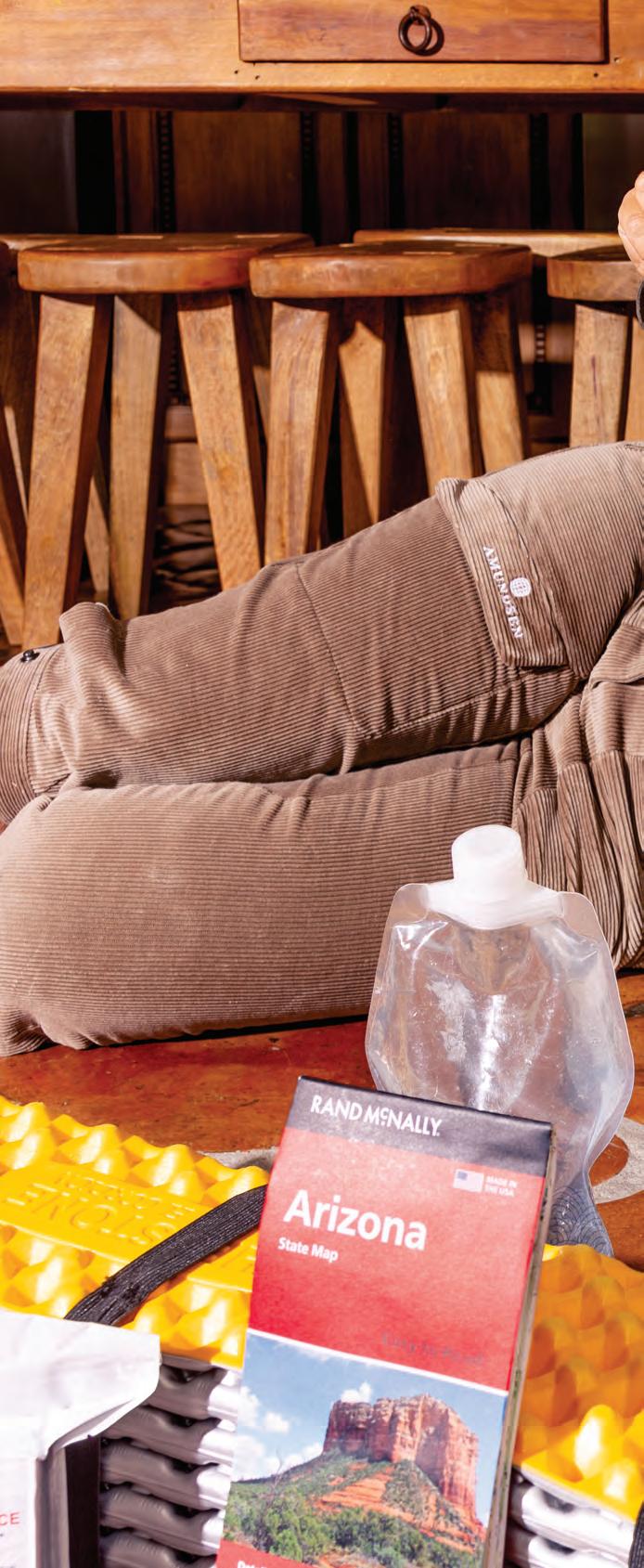
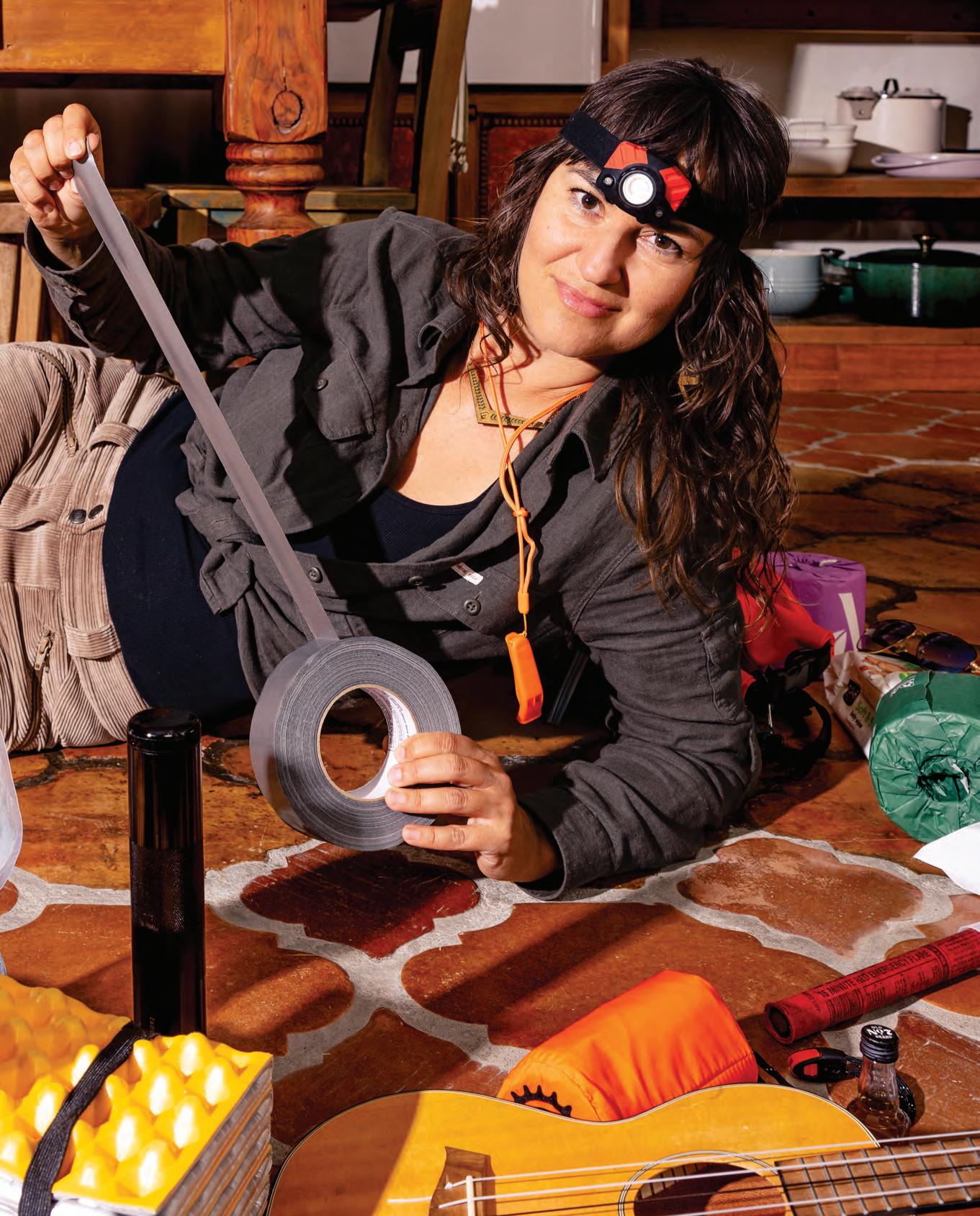
car emergency kit. Donning her reflective vest, she placed flares around herself, creating a triangle of protection, and, with no cell service, could only hope someone would stop.
Someone eventually did. Passing through with his wife, an off-duty worker from Dolores Fire Rescue—a fire department made up entirely of volunteers—pulled his truck over. The couple sprang into action: ensuring she hadn’t been hurt, driving down the road to call the tow truck, and contacting the police to report the accident. Athena sat in the warmth of their truck cab, thinking that this experience, despite how distressing it had been, proved something about her research: Humans do spontaneously have a desire to help others.
That night, Athena called up a friend
whether humans are naturally cooperative and generous is a resounding, undoubtable yes. More often than not, in fact, humans prefer to help rather than harm one another. “When things get ugly,” Athena says, “people don’t get ugly.” And her research proves it.
In her lab at Arizona State University, where she teaches in the psychology department (her students call her by her first name, in the Reed tradition), Athena and her team combine psychology, evolutionary biology, computer science, and anthropology to study human generosity, cancer and multicellular bodies, the microbiome, and even the microscopic ecosystem inside kombucha. Her work is the definition of interdisciplinary. But there’s one thread connecting it all: cooperation. How can we better approach treating cancer, essentially
“I came to the conclusion that the world was kinda messed up and getting worse, and that under–standing human behavior was the best place to start if we wanted to do something about it.”
nearby and crashed at his house. The next day, when she struggled to find a way home, it was he, accompanied by his dog, Smokey, who drove her five hours back to Flagstaff. Again, a key aspect of her work was proven: The most important thing to have in times of crisis is each other—our communities, our friends, our life teammates.
Athena understands it may be hard for some to buy. Are humans really a naturally cooperative and generous species? Much of the media we consume tells us we’re not. On TV, a troubled citizen shoots an unsuspecting comrade, stealing his supplies and leaving him to be eaten by zombies. In books, a final girl runs from the serial killer, abandoning her injured friend. In movies, a character betrays a friend, handing him over to the evil villain. Evolution and behavior research has long helped tout these claims, encouraging us to assume everyone, in most situations, is only going to help themself. Better to presume everyone will be selfish, and be selfish, too. This is the way to protect ourselves.
If you ask Athena, all of that is totally backwards. Her answer to the question of
a breakdown of multicellular cooperation? How do the microbes within our gut work together to protect us? How can we use kombucha as a test case for understanding other instances of symbiosis? These are all questions she seeks to answer.
But most recently, Athena has been particularly interested in how people respond “when shit hits the fan.” “Do they help each other? Is that evolutionarily viable? If so, what are the mechanisms?” she wonders. Specifically, she’s interested in how we humans can survive and thrive as we face apocalypses.
She doesn’t necessarily mean apocalypses of the zombie variety, though she often uses zombies as a metaphor to explain her research. Rather, in her 2024 book, A Field Guide to the Apocalypse: A Mostly Serious Guide to Surviving Our Wild Times, she defines an apocalypse as “a catastrophic event that reveals the underlying risk that we face; an event that forces a reckoning and restructuring of the world as we know it.” There are direct correlations between past disasters and new eras: the Middle Ages brought the Renaissance; the
bubonic plague led to the Enlightenment; even the COVID-19 pandemic gave rise to remote work. These periods can be summed up in a couple of words: “wild times.”
If the idea of “wild times” frightens you, Athena seeks to quell your fears: after all, she writes, our ancestors have survived such times before us, and we already live in an apocalyptic present. We face an apocalyptic future, too. As codirector of the Human Generosity Project, the first largescale transdisciplinary project investigating the relationship between biological and cultural influences on human generosity, Athena has mined endless examples of instances in which populations in crisis display cooperation and generosity over division and selfishness.
In nine societies across the world, HGP anthropologists study how people share, focusing on the norms and cultural practices that underlie it. Lab work further explores the rules that allow human generosity and why it sometimes breaks down. Computational modeling helps HGP researchers discover how sharing rules shape social interactions and largescale outcomes. Across the board, they’ve found that sharing systems based on need enhance human survival and help mitigate risk for the entire system.
By understanding if and how humans help one another in crisis, Athena says we can better understand how to survive and thrive in apocalyptic times, too.
For Athena, exploring and analyzing the way we humans deal with crises has been a lifelong endeavor.
From a young age, she had a nagging feeling that something wasn’t right with the world. As she grew up in the ’90s, progress, capitalism, and technology were considered kings. But Athena thought about the way humans lived and wondered if there wasn’t a better path forward, other options that could help us better navigate our collective future. She is an endlessly curious kind of person. So, often, she would get on her bike and ride to her local bookstore in the suburbs of Chicago and read everything she could about the environment, ecology, evolutionary biology, and human psychology. “I came to
the conclusion that the world was kinda messed up and getting worse,” she writes, “and that understanding human behavior was the best place to start if we wanted to do something about it.”
It was at Reed that this mission was set in motion. When she visited campus while applying for colleges, she felt almost immediately that she belonged. She sat in on Professor Dan Reisberg’s [1986–2019] psychology class, which he held outside. After presenting a question to the students in the course, Dan turned to Athena and asked for her opinion. At that moment she realized that, if she attended Reed, she would be respected as a learner. Sitting on the grass by the psych building, she thought to herself: “Oh, this is what I want my education to be like.”
Her freshman year, Mel Rutherford [psychology 1998–99], a pioneer of the evolutionary psychology field, had been hired as a visiting professor. Athena knew from the jump she wanted to work with him. Even though the class he taught was typically reserved for upperclassmen, he let Athena enroll after he tested her knowledge with a round of questions. The following semester, she took another one of Mel’s classes, and independently studied with him, too, eager to learn all she could from him. He gave her the same reading list he’d completed in graduate school and told her to pick a few things to put together a syllabus. In typical Athena fashion, though, she chose them all, reading every single book on the list and meeting with Mel each week to discuss them.
Reed fostered her interdisciplinary spirit, too. Aside from her psychology courses, Athena received mentorship from Professor Noelwah Netusil, and it was her economic expertise that encouraged Athena to apply her other studies to broader systems and concepts like game theory. If there’s one way to describe Athena, Noelwah says, it’s that she’s “truly fearless.”
That extended to Athena’s teaching herself programming languages, specifically NetLogo, an agent-based modeling language, so she could perform research for her thesis—a project about intertemporal choice and uncertainty about the future, which, funnily enough, are concepts not far off from the kind of work she does now on cooperation and the apocalypse. After
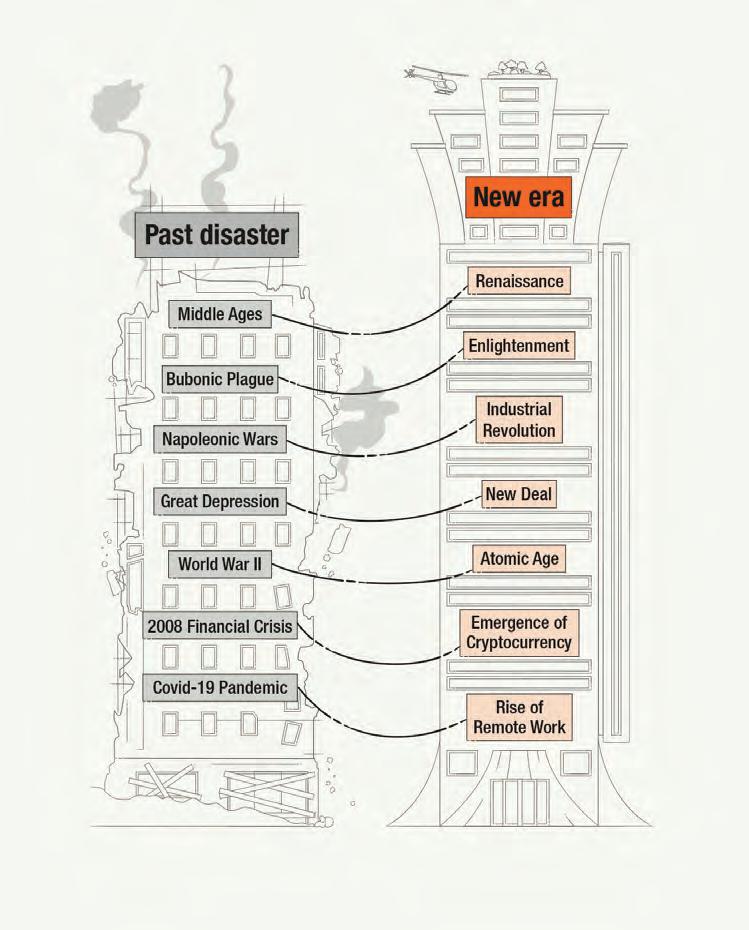
“Historically, times of death and disaster have given rise to innovative thinking and clever inventions,” writes Athena in A Field Guide to the Apocalypse.
graduation, her mastery of agent-based modeling got her a job developing and coteaching a graduate class at Portland State University at the age of 21.
Her early experiences studying evolutionary psychology, strategic interactions, and choice and uncertainty started her on the path to her cooperation studies. “Just being in an environment where everybody had the same focus and values around inquiry and learning and respecting each other,” she says, “that was really a very special time.”
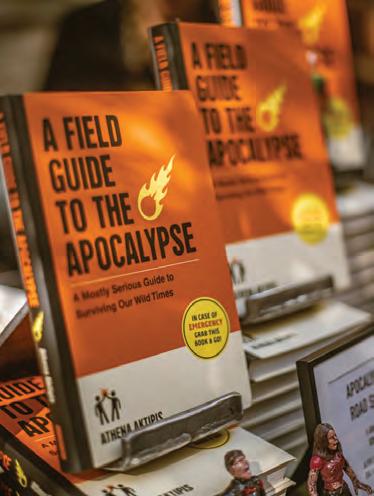
But Athena was always keen to put the concepts she’d studied into practice and encourage others to do the same; hence why A Field Guide to the Apocalypse is structured as a step-by-step guide, a road map to navigating our wild times. Full of both helpful and funny illustrations, the book uses Athena’s research as the foundation to prepare readers for innumerable apocalyptic scenarios—and have fun while doing it. Bound like a genuine field guide, it’s meant for dire circumstances. As the front reads: “In case of emergency grab this book and go!”
In the Great Rift Valley of Kenya and Tanzania, nestled among deep lakes and tall volcanoes, resides a group of pastoralists called the Maasai. Facing threats of drought, disease, and theft, the Maasai employ risk sharing through a special helping relationship called osotua, or “umbilical cord.” Every Massai household has osotua partners they can turn to when they’re in need—if a partner can assist without sacrificing their own needs, they will help. “If osotua partners do end up helping each other,” writes Athena in A Field Guide to the Apocalypse, “it’s done with an open heart and no expectation of repayment.”
When Athena hit those cows in Colorado and had nowhere to go, it was a friend— an osotua partner, one could argue—who gave her a place to stay overnight and then drove her home to Flagstaff. “No matter how careful you are or how much you try to prevent bad things from happening, sometimes shit just happens,” she says. “If you have a network of people who you can rely on when you’re out of your own scope of ability to handle it, then that can be really mutually beneficial.”
Athena is the sort to find community almost anywhere she goes. She’s the type to chat up strangers while in line at the grocery store, which is how she originally began a conversation with the barista in Crested Butte who may have saved her life.
As a graduate student at the University of Pennsylvania, her cooperation studies began in earnest. But on the side, even her hobbies centered on cooperation, and community, too. With her husband at the time, she taught salsa dancing out of their house, something she’d also done on and off campus while at Reed. When they had a baby and therefore less room in the house, Athena and her partner opened a dance studio down the street.
“It was a way to be really connected to the community and to get exercise and add joy to a lot of people’s lives,” she says. And it ended up bleeding into her work, too. A project on the capacity of entrainment—getting in sync with our fellow humans—and how that’s based on ecological functions is one of her most highly-cited papers. “All organisms basically evolve to pay attention
to rhythmic sounds, whether they’re predators or prey or whatever, because those are important indicators that there’s something intentional out there,” Athena explains. “So even our ability to detect rhythmic information is based on the existence of others.”
Does her research inform her hobbies, or do her hobbies inform her research?
Athena says it’s both. “The way I exist in the world is I’m just really curious and interested in, I’m not gonna say, like, everything, but in lots of things,” she says. “And I find joy in lots of things.”
Anthropologist Lee Cronk has worked with Athena since 2008, mostly as her fellow codirector at the HGP. He says her ability to branch out and “take on the excitement of novelty” is what makes her a unique researcher in her field. “She doesn’t want to be boring,” he says. “She pursues interesting things. And she doesn’t just take it for granted that the current accepted wisdom is right, because it’s often not. Science is an ongoing process, and she likes to make science fun.”
When Athena left UPenn (as the first student to graduate from the PhD psychology program with a computational modeling dissertation), she began to realize how her work studying the evolution of cooperation applied to understanding the evolution of cancer, too. The human body is a cooperative cellular society, Athena explains, and cancer cells represent a failure and breakdown in that cooperation. In 2011, she cofounded the Center for Evolution and Cancer in San Francisco the first center of its kind. As a fellow at the Institute for Advanced Study in Berlin, she continued this work, discussing the big questions in cancer biology with a cancer evolution working group, which led to publishing a paper on cooperation and cheating in multicellularity.
This research culminated in Athena’s 2020 book, The Cheating Cell: How Evolution Helps Us Understand and Treat Cancer, which covers the ways cells break away from cooperation and cheat to create a lose-lose situation. This evolutionary approach offers new ways of thinking about how we address cancer and the ways we treat it.
There’s a fear around relying on one another, particularly those we don’t know. But Athena, based on her research, has found that it’s best to be “cautiously coop-

erative” with our fellow humans—watching out for signs of narcissism, selfishness, or bad intentions, but acknowledging that almost 100% of the time, it’s going to be a mutually beneficial relationship.
The HGP has found that it’s not only the Maasai who help each other in times of need. Such practices appear consistently in different societies across the world. “Humans, there’s never been a way for
us to survive on our own,” Athena says. “We have always been part of collectives.” And we always should be, she says. If anyone takes any of her apocalypse-preparation advice, Athena wants it to be what’s exemplified by the HGP-studied Maasai: Build a team of people you trust—it could be the difference not only between demise and survival, but between survival and what Athena calls “thrival,” too.
Step 2: Build Your Bunker (or Maybe Just Start a Go Bag)
Just south of the Russian-Mongolian border, in a landscape etched with flowing rivers and tall mountains, live a group of seminomadic pastoralists. Facing severe winter storms and natural disasters, they cut and store hay, build shelters, and make preparations in advance because of their
unpredictable climate. Besides their own risk-reduction processes, like providing assistance to one another while in need, this group is also ready for incoming apocalypses because of their foresight to prep. When you hear the word “prepper,” what may come to mind is a gun-wielding, bunker-building conspiracy theorist. But, according to Athena, there are many variations of preppers. Some have deep pantries

stocked with canned goods and meticulously packed go bags in their homes and cars for when disaster strikes. Others take to growing and fermenting their own food, or have already skipped town to live on a middle-of-nowhere piece of land. And some—hopeless helpers, Athena calls them—aren’t necessarily apocalypseready, but are prepared to take action when given direction in a crisis.
During the evolutionary history of the human species, 20 to 30 percent of all people died from some apocalyptic event, whether it was a natural disaster, famine, or disease. “We come from a long line of humans that dealt, one way or another, with apocalypses on a daily basis,” Athena writes. As a result, we’re built for change and survival, largely because we’re also biologically predisposed to communicate, cooperate, and use our minds to problem solve.
Our brains aren’t always helpful, though. Sometimes they can work against us in the form of what Athena calls our worst vulnerability: denial. Denial often leads to us avoiding problems or overshooting our own abilities, which can land—and has landed—us in deep trouble, and usually harms us in the long run for facing future disasters. In a way, denial can hijack your brain, an idea that Athena is exploring more
in her next book, Hijacked, which discusses all the ways we can be commandeered by parasites, relationships, and social media.
Even Athena has faced her own challenges with denial—initially avoiding prepping because she felt overwhelmed by the task. Now, though, she keeps a deep pantry filled with nuts and grains, and a fermenting station where she makes kombucha, sourdough, and yogurt. A shelterin-place kit lives in her house, too—a box of everything she and her family would need to survive for 72 hours without leaving the house. She keeps the car kit that helped her in Colorado, and often uses what she calls her everyday carry adventure kit, a collection of items—a whistle, hair tie, emergency blanket, and more— for whenever she’s going out into nature.
When it comes to prepping, Athena considers: “What’s my everyday life actually like? How can I have the things I need to manage risk in my daily life? And then, how can I play and have fun with it, whether it’s being more minimalist as I travel, or being more maximalist when I’m at home?”
Denial and avoidance can convince us that prepping is a surefire way to only make us feel doomed about our situation. But that hasn’t been Athena’s experience. “The act of doing things is why I
feel hopeful,” she says. “It is the taking action that feeds back into the hope, and then I’m hopeful, so I’m taking action.” It’s this mindset that’s led her to face and embrace wild times, rather than turn away from them. It’s what inspires her not only to prepare for apocalyptic scenarios, but to seek them out—driving her to solo camp with nothing but a tent and cooking supplies or to go off-roading in the muddy sticks with friends. To Athena, these challenges are about getting yourself in trouble. “And then part of the fun is figuring out how you get out of it,” she says.
In the rugged landscape of Uganda, not far from the Kenyan border, the Ik people can sometimes be found reenacting raids from neighboring groups with drama, music, singing, and dancing. “These events are serious parties, in every sense,” Athena writes, “and are an example of how we can do the same in the face of true existential risks.”
In the spring of 2025, Athena and her friends gathered at Bubbling Wells Ranch in Desert Hot Springs, California. Among
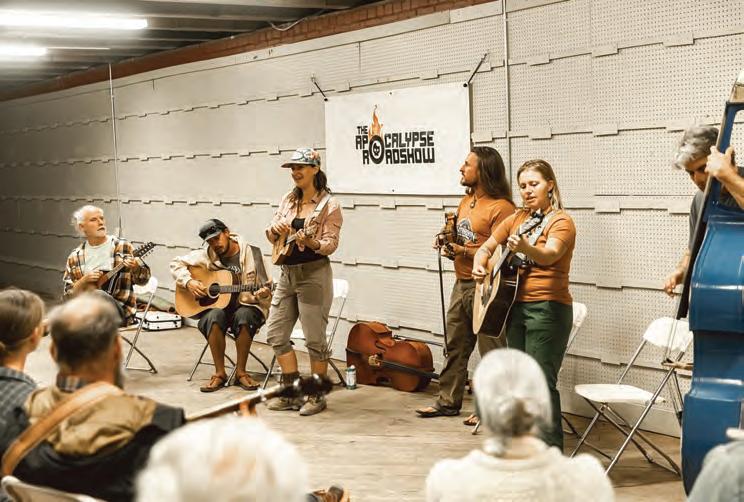
the palm trees of the California desert, they played music, laughed, created art, and discussed the apocalypse, too. The event was just one part of a traveling variety show called the Apocalypse Roadshow, a production of the educational nonprofit Athena helps run, Zombified Media, and an alternative book tour all about embodying the principles of A Field Guide to the Apocalypse. Athena has traveled all over the country, from Los Angeles to Chicago, and all over the world, too, from Melbourne, Australia, to Reykjavik, Iceland, to blend fun with disaster prep. “It combines creativity and grappling with what’s going on in the world,” she says.
Athena says fun is a key part of surviving our wild times. Fun is a destressor, a revitalizer, and a way to be in community with others. And it’s something she applies to her work, too. “The necessity for rigor and precision [in science] is not mutually exclusive with novelty and excitement and fun,” one of Athena’s graduate students, Scout Mastick ’14, says. “Athena models that philosophy in her work, and takes measures to make sure that her graduate students don’t lose sight of it over the course of our education.”
For Athena, fun looks like lots of things—skiing, dancing, off-roading, music, comedy, and always, always adventure. She combines a few of these skills for the Apocalypse Roadshow to get folks excited about preparing for crises, rather than avoidant and fearful.
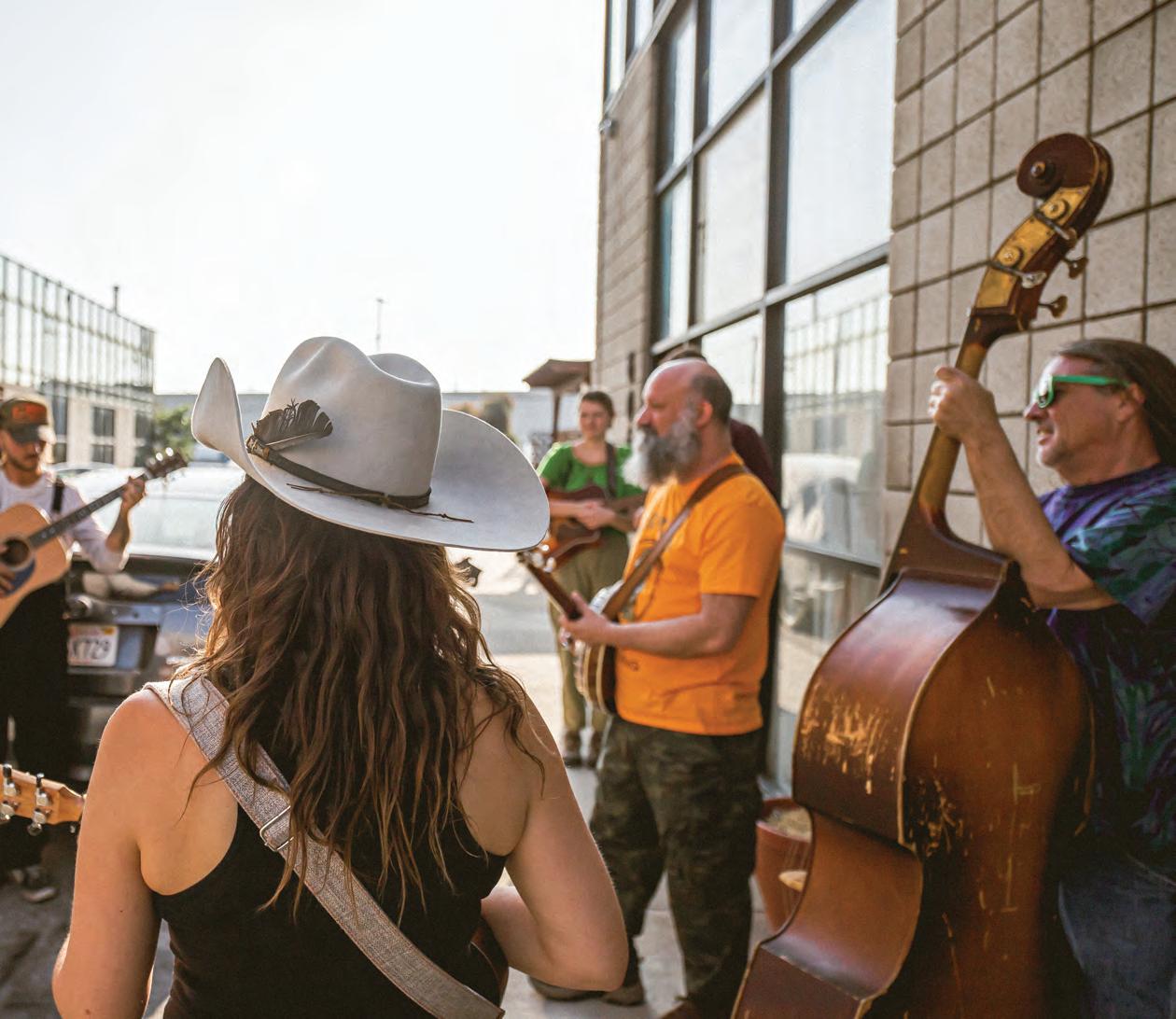
Music has long been part of Athena’s life. Her mother was a musician, and her maternal grandfather was the national musician of Austria. At Reed, she’d venture to the music department with friends and jam out on the instruments. Later in life, when her daughter began learning ukulele, she picked it up, too, and started carrying it everywhere she went. Often, that’s what she plays, but other times you’ll catch her jamming on the cello, the stand-up bass, or the Greek bouzouki.
At bluegrass festivals, Athena combines her love of music and community, finding not only joy, but hope, in tent camping and playing music with strangers. Especially if those strangers are not people she typically surrounds herself with. “It’s some of the most grounding times in my life, because you’re with people creating
FROM A
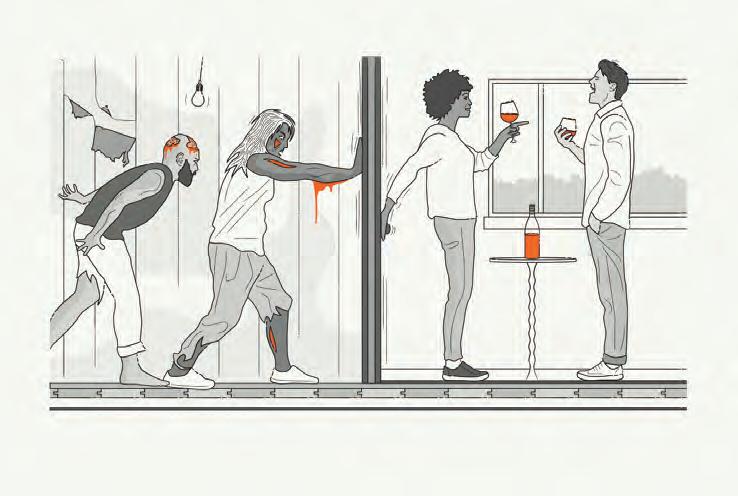
“As long as there’s somebody volunteering to hold the door so the zombies don’t come in, everything can be okay, even in the apocalypse,” writes Athena in A Field Guide to the Apocalypse.
something together that you all appreciate, and meeting people who are very different from you,” she says. “In the bluegrass community, there are a lot of people who are very conservative, you know, waving Trump flags, but everybody is playing music together, and people like each other as people, even if they don’t agree with each other’s politics.”
That’s another thing that may set Athena apart from other researchers in and outside of her field—her willingness to explore beyond her echo chamber. She understands that the world feels frightening right now, and that finding common ground with others can be difficult. But when you study the science of cooperation as she does, it’s easy to see that in every disaster, you can find an instance of cooperation and generosity through conflict and tragedy. Community members helping a neighbor hose down the flames engulfing their house. Someone risking their own life to rescue another from a flash flood. Health care professionals continuing to work every day despite fear and risk during a worldwide pandemic. That’s what keeps Athena optimistic in our wild times: “It’s people being there to help each other in times of need, and seeing that in my work, and also seeing that in my real
life, when I’ve been in situations where I’m in need.”
Her most recent project builds on these principles. This November, Athena launched The Cooperative Futures Institute, the culmination of many decades of her work. A public benefit corporation, the CFI applies biological and evolutionary principles of cooperation to shape systems that are mutually beneficial for humans, societies, and the technologies we create.
Athena still finds time to have fun, of course. In early September, she didn’t have to venture far for the Apocalypse Roadshow’s latest stop. At Pickin’ in the Pines, a bluegrass and acoustic music festival hosted in the tall pine trees of Flagstaff, Athena and her crew taught a workshop on how jamming is about cooperation, community, and intergenerational cultural transmission. It was another chance to foster community through music, all while discussing rather than denying our apocalyptic times.
As she jams with strangers, injects comedy into otherwise-daunting concepts, and continues to prove the generosity and cooperation of humans in her research, Athena finds hope in an uncertain climate, mostly, she says, “in the humanity of the people you meet when you go out into the world.”
Edited by Robin Tovey ’97
How Bill Witherspoon ’65 immortalized his desert journeys.
From founding a fine art and digital technology company to dwelling on and off in Oregon’s high desert for more than 50 years, Bill Witherspoon ’65 has spent his life pursuing unlikely journeys that became unshakable callings.
“Now that I’m old enough to look back and want to see a pattern, it’s not been a conventional or expected path,” he says. “But that’s true for a lot of Reedies, so there’s nothing strange there.”
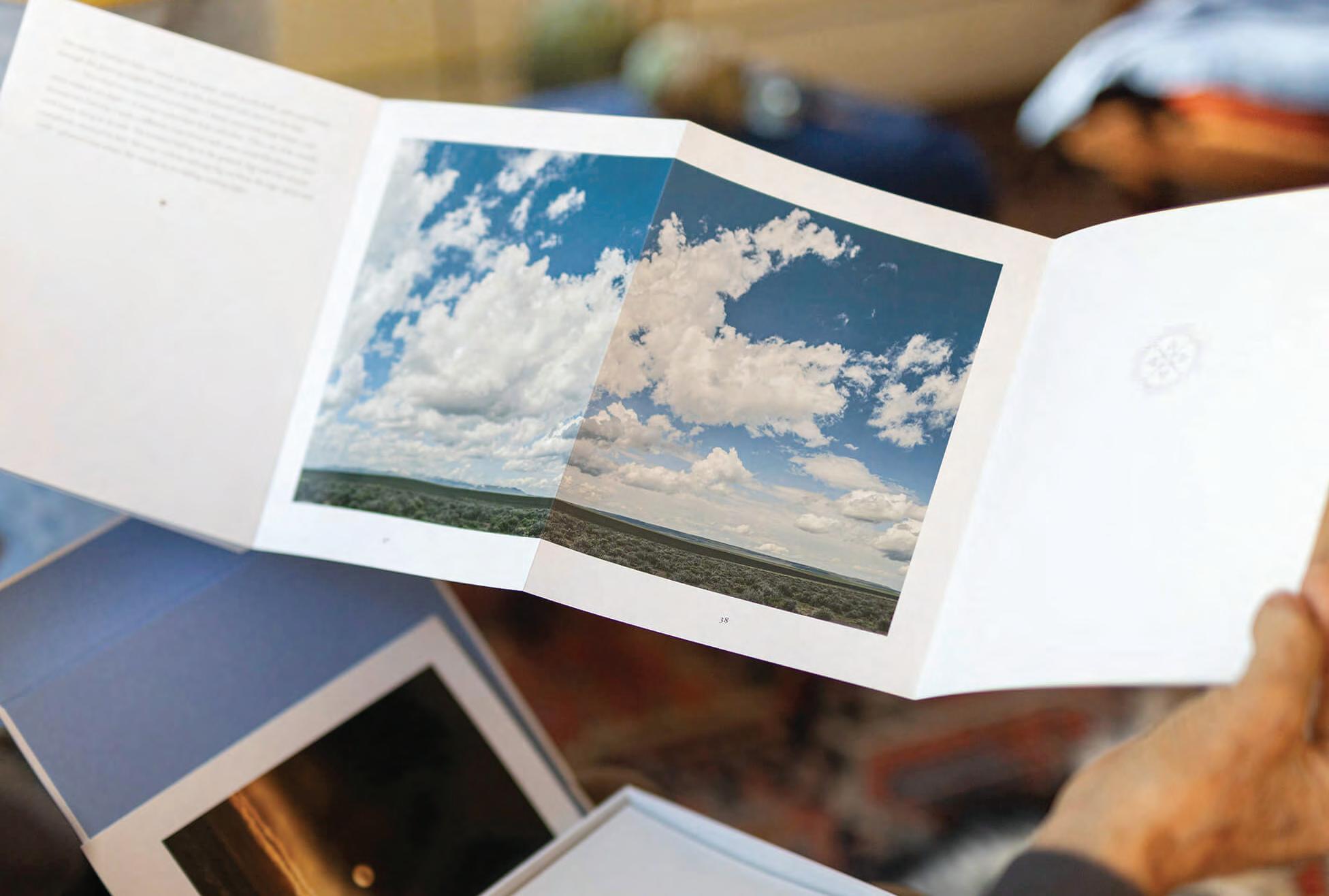
Bill’s path is immortalized in his memoir, Enter Space: Stories from the High Desert, a book that is as much a physical being as it is a narrative work: a clamshell hull containing five accordion-fold booklets, with 27 stories and 108 photographs.
“What we’re talking about is how one person used the desert—or was used by the desert,” Bill says. “I also built businesses
and lived and had a family. And those, too, are tools.”
While Bill studied Russian at Reed and was a protégé of Professor Lloyd Reynolds [art 1929–69], many of his memories of his college years revolve around adventures beyond campus: rock climbing, mountain climbing, spelunking.
“My experience of being an artist is being someone who wants to see deeply, to know deeply, to understand deeply,” he says. “If you have this desire to see into nature, then [the desert] is a great place to do it, if you have a minimalist temperament. That was my nature.”
Chronicling Bill’s encounters with beautifully remote locales like Mickey Basin, the National Antelope Refuge, and Steens Mountain, Enter Space is overflowing with moments not easily literalized—like Bill’s
near-death experience after his boat went over a waterfall.
“There’s no boat pictures or river pictures, but there are pictures looking east and west into the atmosphere at the subtle gradation of colors that occurs when the sun is below the horizon,” Bill says. The goal was to choose images that evoked what he felt in the moment, aided by book designers Franca Bator, David Navarrete, Andrew Murray, and Brian Smestad.
Today, Bill divides his time among Oregon, Iowa, and India. The desert remains an animating force in his life.
“I really try to get [across] what it is about the desert that attracts me—why I love it, why I think of it as a friend, as a mentor, as a teacher,” he says. “What is there on the horizon is an eyes-open, sensory experience that is as close to the beyond— as close to infinity—as you can get.”
—Bennett Campbell Ferguson
Prof. Josh Howe and Alexander Lemons MALS ’19 , in alternating chapters, investigate links between American foreign policy and heavy-metals toxicity in the Middle East. After returning home from multiple tours of duty, seriously and mysteriously ill, Lemons meets Howe in class at Reed. Through a combination of research and personal narrative, their collaboration looks beyond bullets and bombs to the “slow violence” of toxic exposure and lasting trauma among military personnel.
(W. W. Norton & Co, 2025)
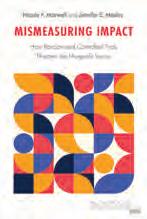
Randomized controlled trials (RCTs) are a controversial topic in the nonprofit world because they can cost millions of dollars and last for years—money, time, and effort that could go to serving needy people who benefit from nonprofit programs. This book by two University of Chicago professors, including Jennifer Mosley ’96 , pushes back against the notion that RCTs are a necessary or even effective means of evaluation and suggests superior options. (Stanford Business Books, 2025)
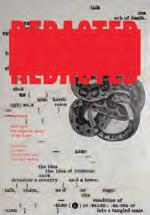
Prof. Charlene Makley and her coeditors have compiled essays, poems, artwork, and memes—a bricolage of media that conveys the experience of living in stateinflected worlds. By engaging with redaction in politically charged contexts (from the U.S. and Denmark to Russia, China, and North Korea), the volume examines and questions ageold coordinates that no longer make sense, relations being reconfigured in new, recursive, and unrecognizable ways.
(Punctum Books, 2024)
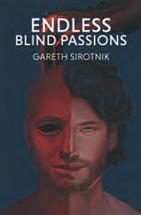
In his first novel, Gareth Sirotnik ’69 tells a tale of a nation running amok, all under the guise of 9/11 intrigue and a gay romance. When FBI agents turn up at a Seattle houseboat, protagonist Monty contends with accusations and revelations about his Afghan boyfriend, and his own life story unravels. Facing up to former duplicity—his own and that of those he has loved—the ensuing narrative draws a prescient portrait of approaching dystopia. (Capsicum Press, 2025)
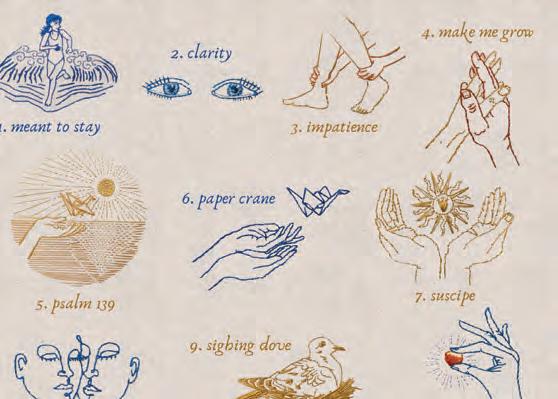
Jessica Gerhardt ’11 released her debut fulllength album Alight Beyond the Sea, a record that honors her Catholic and Jewish heritage in exploring themes in Psalm 139. Some lyrics and songs take their inspiration from mystics including Ignatius of Loyola, John of the Cross, and Julian of Norwich. Gerhardt also combined her passion for art and music by hand-embroidering 10 pieces as cover art. Lee Oser ’88 and Kevin Kraft ’95, members of the Riflebirds of Portland, announced a new album titled Windmills on the Moon, featuring nextgen talent that makes the recording a family affair (see Class Notes). Angel’s Share, a play by Dominic Finocciaro ’11 was awarded first place in the Echo Theater company’s 2024 New Play Competition. The work is a “speculative fiction” exploring grief, love, and family.
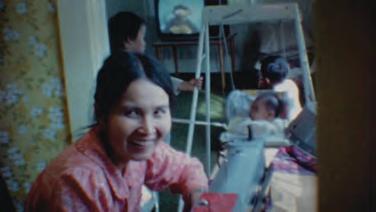
Cathy Linh Che ’02’s short documentary, We Were the Scenery, premiered at Sundance and won the Short Film Jury Prize for Nonfiction. The film narrates her parents’ lives as extras in Apocalypse Now and is a complement to her poetry collection, Becoming Ghost, in which she uses persona, speculation, and the golden-shovel form to raise questions about telling familial stories to a broader public and the meaning of forgiveness.
Edited by Joanne Hossack ’82
1952
John Boswell Hudson , John’s wife Sandra, and Belinda (Reiss) Bates ’78 were recently reminiscing about Reed College. John suggested forming a Reed Club for Iowa City, and Belinda suggested the name “GryphonHawks.” They all thought that a capital idea! If there is sufficient interest, they will arrange a gathering at a local venue at a future date. All Reedies or Reedites in the Iowa City area are invited to respond to JohnBoswellHudson@gmail.com.
1956
First completely enclosed shopping mall opens in Edina, Minnesota.
1957–59
Look! Up in the sky! It’s Sputnik 1!
1960
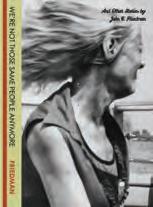
John B. Friedman has published a collection of short stories and a novella: We’re Not Those Same People Anymore, available on Amazon. Also this year, his short stories were included in Academic Fiction, The Greyhound Journal, the Maryland Literary Review, and The October Hill Magazine
1961
Look! Up in the sky! It’s Ham the Astrochimp!
1962
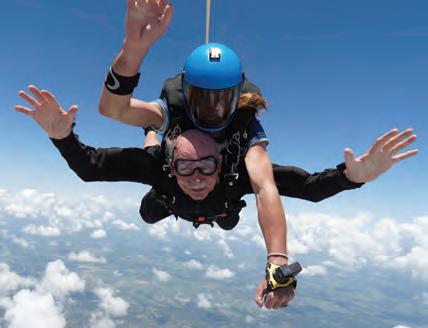
Michael Taylor and his son and granddaughter jumped out of a perfectly good airplane at 14,000 feet. “It’s never too late to have a happy adolescence.”
1963
After graduating with a BA in mathematics, Joanna (Mehrer) Kapner was hired by a small closely held company, an employee benefits consulting firm, and stayed there for 35 years, starting as an actuarial trainee and retiring as a consulting actuary. After retirement, Joanna served in a good many volunteer roles, ranging from running
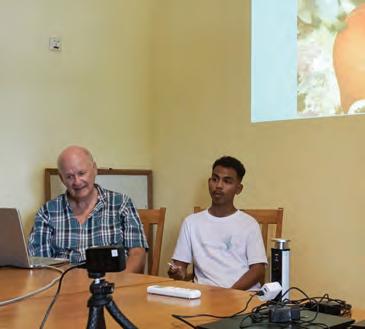
a charitable outreach program at her Jewish congregation to serving as president of the board of her 900-apartment housing cooperative. She was also able to visit many foreign countries, ranging from Mexico to England, Russia, India, and Iceland (her two daughters had grown up by then and left home). Joanna is now largely housebound, having difficulties with vision, hearing, and walking, “but I am fortunate to have enough postretirement income to make donations, mostly to programs that feed the hungry and/or shelter the homeless. I am donating to Reed this year because I gather that the college has taken a stand in support of those American educational institutions still striving to speak, write and teach in freedom from government interference. (In this respect I can only hope that I am not supporting a losing cause.)”
After many decades together, Stanley F. “Shimke” Levine and his wife have decided to part ways. Consequently, Stanley has left France and has established residence on the Upper West Side of New York City. He is excited to be able to walk out the door and find himself in the midst of the vibrancy and dynamism of the city, with the opportunity to partake of its rich intellectual and artistic life and the serendipity made possible by the concentration of people of all kinds there.
Majda Sajovic Jones recently moved from her house to an apartment in a CCRC in the same town she has lived in for 25 years (Portola Valley, California). “Quite the transition! But now that I’m here I find it comfortable, with fewer demands on my time and several new friends, including some Reedies. I’m traveling a lot, always interested in new travel companions.”
Larry Randall writes, “I have resided in a senior living facility in New Paltz, New York, for the past nine years, the first seven with my wife, Marla, who died early in 2023. Although it’s a small facility in a small town, the wisdom of our choice has been validated in several ways, including by learning that two couples here each have a daughter who is a Reed alumna. I am very active in our community through membership on the resident governing council and by chairing a committee bringing outside speakers here bimonthly for the past five years. While here, I have also honed my photography skills such that my images are now used in our in-house publications as well as decorating hallways and offices.”
Constance Putnam is “fully retired—but with more than one writing project on reserve . . . in case I ever finish getting fully moved in and acclimated to life in a retirement community in Nashua, New
3.
Hampshire. Quite a change after 44 years in a house in Concord, Massachusetts. Weird to be back in the state where I was born but a long way from the town where I grew up.
1966 60TH REUNION
Survey finds that 100% of New Yorkers over 60 pronounce “bird” like “boid.”
1967
John Cushing and 74 other members of the Portland Megaband played for several hundred dancers at a large contra dance at PSU’s Smith Ballroom. John also served water to hundreds of dogs and dozens of people during Oregon Humane Society’s Doggie Dash.
1968
Look! Up in the sky! It’s Chitty Chitty Bang Bang!
1969
Stephen Sellery received his PhD in management sciences from Kozminski University this year. His thesis was on the National Health Service of England (UK), looking at justifications for austerity budgeting.
After a long career as a professional writer and editor in Vancouver, Canada, Gareth Sirotnik has written his first novel, Endless Blind Passions, at age 77, fulfilling a lifetime ambition. Two sequels are in the works. Gareth writes, “At my age I couldn’t afford to “knock on doors” for years
trying to get a publisher or agent, so I finally decided to self-publish, but to do so in a totally professional manner as if I had a good publisher—of the genre that mostly existed in the past. So I assembled a team of eight professionals to work with me: a book editor and a proofreader (both in Scotland), an illustrator (who happens to be my ex-partner), a book designer, a blurb specialist, a social media expert, and a videographer. My former assistant on an international journal I created and ran for 12 years had become adept at placing books on Amazon, so he completed the team. And I created my own publishing imprint to host my work.” Nicely done, Gareth!
1970
After 23 years of teaching Asian cultures and history (at Wake Forest University and Wingate University in North Carolina), James Hastings is retiring and contemplating relocating. Based on an exit interview, Wingate published a decent account of his trajectory over the past 55 years that gives a nod to Reed’s influence, which you can find online: “Hastings Took Winding Path, through Wine Country and India, to Get to Wingate.”
Craig Latrell recently directed his 25th play at Hamilton College, and is in the process of creating a positive masculinity workshop for the High Atlas Foundation in Marrakech, Morocco, where he is regularly in
Class Notes are the heart of Reed Magazine—send us your news! Email reed.magazine@reed.edu or find our form at https://www.reed.edu/reed-magazine/.
These Class Notes reflect information we received by August 27. The deadline for our next issue is December 31.
residence. Craig’s son majors in studio art at Sarah Lawrence College, and his husband works in admissions for Roosevelt University.
Willard McCarty writes, “Now 15 years as emeritus professor, I’ve drifted away from my disciplinary point of origin to writing about divination and computation for a Cambridge (UK) workshop, ‘Science in the Forest, Science in the Past,’ with G.E.R. Lloyd, Marilyn Strathern, Reviel Netz, and others. I’m also starting up a book series with Berghahn, Interdisciplinary Research in the Arts, Sciences and Humanities. Submissions welcome! Four beautiful grandchildren so far.
1971 55TH REUNION
Doug Fenner recently spent 3 months in Indonesia, diving on reefs and teaching university students and NGO members about corals and coral reefs. Indonesia has the world’s fourth largest population, and is longer from east to west than the continental U.S. It has 17,000 islands, is tied with Australia for the largest area of coral reefs in the world. and is tied with the Philippines for the highest diversity of reef organisms. Doug taught workshops in six different universities and found the students to be friendly and eager, quick learners. He spent the last month working with a professor at a university that has 50,000 students, working to find new species of coral in the professor’s collection of 700 corals. Doug enjoyed tasting new foods,
6.
7.
learning new words, photographing colorful mosques, and being amazed at the density of traffic in some spots, including motorbikes.
Cynthia Whitehead is cutting back on translation in favor of editing and music these days—choral and cello. The Bay Area has more groups than you can imagine.
Robert Weppner just wants to go on record with the very freshest of evidence to reassure current seniors that they may be afflicted with thesis anxiety nightmares as many as 50 or more years in the future.
Jill Gay is fleeing Trump and will be in the EU until summer 2026, when she plans to help Dems in elections, as long as we have elections.
Dr. Lucinda Jackson is a career consultant for scientists of all ages: from high schoolers looking towards college to college students investigating grad school, PhDs hunting for their first job, people developing their careers, and retirees seeking their next acts. Jackson developed a course, “Career Transitions: Making Them Your Best Opportunity,” that she taught in Washington, D.C., this August and will teach again in San Jose, California (October ’25) and in Atlanta, Georgia (March ’26), at American Chemical Society conferences. She’s qualified to teach this since she counted up her jobs recently and lost track at 40! She’s also in love—with her new granddaughter Valentina. Last month they hiked in Cordova, Alaska, where Lucinda lived in 1972 with William (Bill) Hammonds ’72 They (re)visited Mummy Island near Cordova, where Lucinda and Bill dug clams and lived in a tent!
1974
World welcomes Dungeons & Dragons.
Timothy Havel extended Heron’s formula for the area of a triangle to higher dimensions. See https://arxiv. org/pdf/2204.08089v12.
Rod Bauer is back in the San Francisco Bay Area after working for a self-driving AI startup in London. In addition to working in tech marketing for many years, Rod has taught at the University of California and the Culinary Institute of America in the Napa Valley, and was a FordMozilla Fellow for media and democracy with Common Cause in Washington, D.C. He continues to pursue the love of food and wine that he inherited from his food professional parents, which pursuit has included partnering in a Mediterranean restaurant and Ramini Mozzarella, a farmstead mozzarella di bufala creamery and farm in Sonoma. He devotes much of his time to writing and tries to resist the temptation to open a restaurant. He sails whenever he can and loves to travel.
Having published 13 children’s books with major American publishers, seen his books translated into many different languages, and traveled the world giving readings, David Greenberg switched to writing restaurant reviews for FoodieHK (premier online culinary magazine in Hong Kong) in 2017. Returning to the United States in 2022, David and his wife Susan have begun writing travel articles for Northwest Travel & Life Magazine; read them at https://www.ardentgourmet.com/ published-magazine-articles.
Arthur Lyford writes, “After 40 years, we have sold the practice ‘The Art of Dentistry’ here in Hollis, New Hampshire. I plan on continuing to teach in Southern California, in Boston, and internationally doing live patient surgery and lectures. Son Jeffrey and Dr. Ellie’s twin three-year-old grandsons outside of Boston and visiting
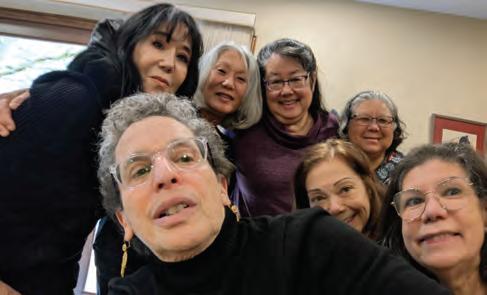
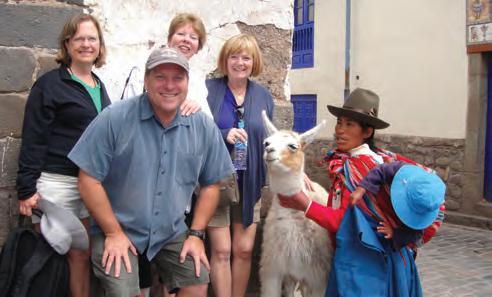
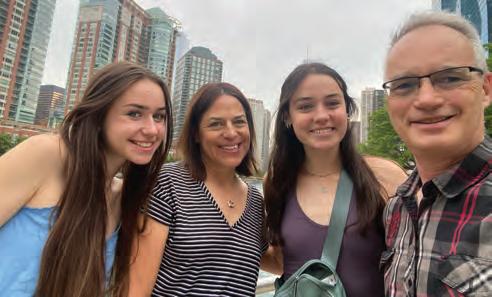
daughter Molly in Washington state will occupy some time. We will split time between the States and Sophie’s native Paris. And of course I look forward to keeping up with the Silverbacks from the classes of ’76 and ’77! Stay tuned!”
1977
201st anniversary of signing of Declaration of Independence. We hope your ears have recovered from the fireworks.
2.
3.
Kiyomi Shimamoto Camp wrote that in March, she, Diane Mohr Hallman , Jeri Janowsky , Irene Kitamura, Jo Oshiro, and Carolyn Iwasaki Woody ’79 gathered at the home of Ana Marquez Brown for food, conversation, and lots of laughter. The group had been meeting every couple of weeks via Zoom since the COVID pandemic along with Gloria Drenguis Johnson ’79 , who wasn’t able to attend. The next day, Ana, Irene, and Kiyomi watched First Love , pausing the movie every time they thought they recognized someone (“really, the only way to watch it!”). While in Portland, Kiyomi also visited Emeritus Professor Ray Mayer [math 1974–2002]. “He’s slowing down but still walks to his Reed office a few times each week and seems to enjoy having visitors.”
In April, Jaci Cuddy was “looking to survive the next 4 years without my head exploding.” In August, Jaci wrote that she was getting ready to retire—at least part-time— at Brives, a farm estate outside of Forcalquier, France. “Perhaps things won’t look so unsettling from a distant viewpoint. Au revoir.”
Look! Up in the sky! It’s a bicycle! Flying over the English Channel!
1980
Charles Goodmacher writes, “Hearkening back to 1980 and helping to organize Reed Students
Against the Draft (SAD), I’m finally winding down my paid professional career as an advocate/activist/lobbyist. The 2026 legislative session here in New Mexico will be my 19th year at the legislature (5 as a staff analyst in the 1990s), and it’ll be 14 as a lobbyist. I helped found Healthy Climate New Mexico, and also work on contract for Earthworks, the Leukemia and Lymphoma Society, and others. My daughters are both graduating this year, one from high school (on to the University of Denver) and one from the University of Colorado Denver; both are honors graduates! I will persist in fighting against climate change and for diversity, equity, and inclusion.”
Mark Goldman and his wife, Astrid, are enjoying retirement after long careers in biotech: Astrid in clinical research, and Mark in research, development (alongside his favorite Reed chem [1972–79] prof Will Bloch), and regulatory affairs. They’re taking time together to travel and learn Spanish, and Astrid is the president of the Northern California Latvian American Association. Mark continues to pursue his passion for Shakespeare, acting in numerous productions over the years; as of April, his favorite role was King of France in All’s Well that Ends Well, and he was looking forward to playing the title role in the coming summer’s Actors Ensemble of Berkeley production of Cymbeline.
Mike Peters is still in Albuquerque, retired and enjoying the quiet life. “Happily married
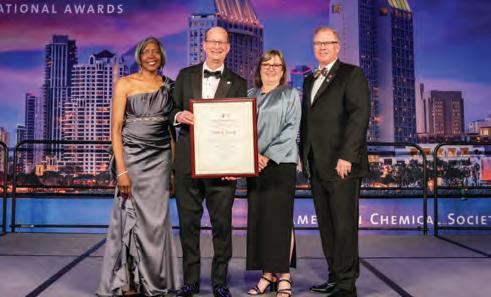
for 38.5 years(!). Taking lots of little day trips and staying somewhat active. Every day my life is informed and improved by the time I spent (and especially by the people with whom I spent that time) at Reed. Love Reed. Love you all. p.s. I got onto Antiques Roadshow because of a friendship I made during my year off between sophomore and junior years. That was fun!”
1981 45TH REUNION
Prince Charles becomes engaged to 19-year-old family friend.
World welcomes Diet Coke, Crystal Light, and Trivial Pursuit.
In February 2025 Don Asher and Bruce Johnson ’82 cruised down the Nile and saw all the things. Congratulations to Mark Bussell , who received the 2025 American Chemical Society Award for Research at an Undergraduate Institution. The award honors chemistry faculty members whose research “has achieved wide recognition and contributed significantly to chemistry and to the professional development of undergraduate students.” Mark was honored with other 2025 ACS national award recipients at a ceremony and banquet in San Diego on Tuesday, March 25, 2025, at the spring ACS National Meeting. He continues as a chemistry faculty member at Western Washington University.

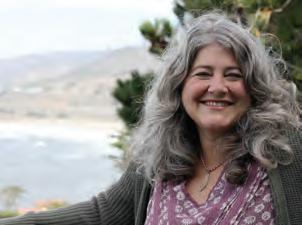
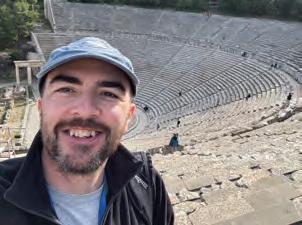
March update from Lilita Keire: “In Minneapolis, working remotely as a senior technical writer on a two-person dream team for a pharmaceutical company in Maine. Virginia Card and I are happy to celebrate our son Reid’s graduation from Reed, class of 2024, at commencement on May 19. The whole family is attending—would not miss it for the world! Connect at lily.keire@gmail.com.”
1984
2 + 2 = 5.
1985
Doug Helton retired from NOAA on April 30, 2025.
Rebecca (Shier) Parks and her husband Gary Lee Parks have released three acoustic-based albums: original songs by Rebecca, solo guitar work by Rebecca, and songs by others featuring Gary. The album of originals, Secret Stage, features a song about the creative life Rebecca and Gary share as musician and artist, a song written to thank Rebecca’s best girlfriend for the gift of a kidney, and songs about
combating injustice ranging from domestic violence to dictatorship. After playing piano nearly all her life, Rebecca took up fingerstyle guitar at the tender age of 45. No one ever asked her about a solo piano album, but several people asked about a solo guitar album, so she recorded one, Adventures with Amy (Amy is her guitar). It includes an arrangement of the second movement of Beethoven’s Sonata Pathétique. Gary was the supportive spouse through two previous album releases, and Rebecca wanted to give him a chance to shine, because he’s a versatile singer. So they recorded some of their favorite songs by others on Dyad, with Gary mostly singing lead vocals. Artists covered range from Siouxsie and the Banshees to Toad the Wet Sprocket to Led Zeppelin.See rebeccaparksmusic.com.
1986 40TH REUNION
Look! Up in the sky! It’s Halley’s Comet!
1987
RIP Andy Warhol.
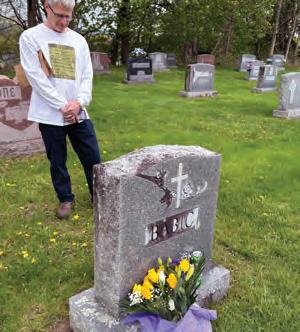
Lee Oser is an English professor by day and a bass player in the Riflebirds of Portland by night. The band, which includes guitarist Kevin Kraft ’95, has a new album titled Windmills on the Moon, and it features backup singing by “the mermaids,” next-gen talent (two daughters and a niece) who make the recording a family affair. Lee reports, “It was great to see Reed people at our July gigs in Portland, and to meet the gracious Audrey Bilger at our Music Millennium performance.”
Bill Ecker and Emily Ecker ’90 paid homage to and left offerings at the gravestone of a dear friend and classmate, Michael Babic. Michael died suddenly during his time at Reed in 1989. They have missed him ever since. He is buried at Saint Mary’s Cemetery (section W) in Troy, New York, not far from where he grew up. Paul Knoepfler has started a monthly column over at STAT News (statnews.com) called “Lab Dish,”
1. Reedies—alumni, faculty, and current students—gather at the American Physical Society’s Global Physics Summit. Left to right: Matthew Hwang ’21, Orion Lee ’23, Prof. Jennifer Heath, Saba Goodarzi ’20, Benjamin Larson ’12, Pranay Pingali ’27, Jackson Anderson ’21, Rubayat Jalal ’26, J. R. Cruise ’19, Ella Banyas ’17, Phil Jahelka ’14, Prof. Noah Charles, Deven Misra ’22, Joaquin Fernandez Odell ’25, Prof. Darrell Schroeter ’95, Hailey Fazio ’24, Prof. Nicole James.
2. Bill Ecker ’89 visits the grave of Michael Babic ’89.
3. Children’s book author and social justice activist Laura Atkins ’92. (Photo credit: Janine Macbeth)
4. Ben Robbins ’90 visits Epidaurus, Greece.
5. Darcy Jorgensen ’86’s Little Monsters: Katsu (Chiweenie) on the left and Gyoza (RatCha) on the right.
about stem cells and other similar areas of research like CRISPR gene editing, as well as what is going on at the FDA with biological therapy oversight. Paul still does his blog The Niche (https://ipscell.com) too. “Doing both of these doubles the chances I can get into hot water. Still having fun in my lab as a professor too.”
Andrew Mason has been busy on his zafu with the Diamond Sangha since graduating and has been the lead teacher at Ring of Moss Zendo for seven years, carrying forward the Mountains and Rivers form of Zen set forward by Gary Snyder ’51. Over the next three years, with high aspirations of animating Reed’s strong role in landing Zen in the West, Ring of Moss has plans for renovating an old farmhouse and barn in Milwaukie, Oregon, about a mile south of campus. “Come on by and sit with us!”
Ben Robbins went to Greece to see the birthplace of democracy and apologize a lot.
Diana Rosberg is having a series of articles on neurodiversity among international school leaders published at tieonline.com. Each article will feature a profile of a neurodivergent school leader. The first two articles are titled “Better Together: Neurodiversity in International School Leadership” and “Diana Rosberg Connects the Dots (Autism).”
1992
Laura Atkins has continued her passion for children’s books and social justice by being a member of the Social Justice Children’s Book Fair organizing team. The event takes place in Oakland each December and uplifts indie social justice children’s book creators. In May 2025 the fair cocurated the Bay Area Book Festival’s Family Day, creating a program of diverse, inclusive, provocative, and entertaining panels, activities, and read-alouds. Laura’s latest picture book, Bringing
the Beach Home, was read by a Drag Queen Story Hour representative, and was published on July 1. The book honors Laura’s late father and tells the story of Rowan, who connects to nature and creativity to find a deep sense of home. Learn more at lauraatkins.com.
Congratulations to Kate Aubrecht on her election to the American Association for the Advancement of Science! Kate is an associate professor of chemistry at Stony Brook University.
“After a mostly literary past,” writes Anja Larson, “I am proud to say I am mostly science-based, (although sadly too old for the Coast Guard) with a new, sudden need to be learning Italian. It means moving!”
Joseph Orosco has accepted a second term as the president of Oregon State University’s academic faculty union, United Academics of OSU. “We just bargained our second contract after a struggle of 18 months and are looking to see how to defend public higher education with all the transformations at the federal level.”
Sculptor Rachel Whiteread wins both the Turner Prize for the best young British artist and the K Foundation art award for the worst British artist. On the same day.
Jer Faludi is very excited to announce his book, Sustainable Design from Vision to Action! After far too many years, it’s out. “Sorry to have missed the 30th reunion; I live too far away. But maybe this note makes up for it? No? Okay, maybe next time.”
Several Reedies attended the American Physical Society’s Global Physics Summit in Anaheim, California, in March 2025. Professor Darrell Schroeter [physics] sent us photographic proof.
Rachel Cloues is delighted to report that her nephew Riley has transferred to Reed and will begin his
The nominating committee of the board of directors of the alumni association proposes the following nominees to serve terms on the Alumni Board beginning July 1, 2026:
Nominee for Alumni Trustee
Andrei Stephens ’08
Nominee for President
Laramie Van Duzer Silber ’13
Nominee for Vice-President
Peter Miller ’06
Nominee for Secretary
Gray Karpel ’08
Nominee for At-Large Members
Rick Beaumont ’08
Molly Moss ’95
Jefferson Ratliff ’25
Susan Shea/Capwell ’04
Amanda Waldroupe ’07
Nominations Committee for 2026-2027
Katie Rempe ’05
Laramie Van Duzer Silber ’13
Carla Beam ’76
Claire Dennerlein Manson ’02
Vasiliy Safin ’07
Chapter Leadership Council
Representatives
Ashley Potter ’07
Nico Terry ’17
Gray Karpel ’08
Please find additional details on the nominees and petition process on alumni.reed.edu.
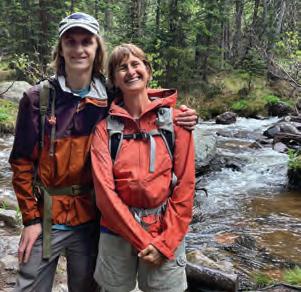
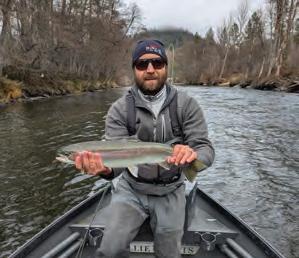
senior year in the fall. (He didn’t even know she had gone to Reed when he applied!) In other news, Rachel is still living in San Francisco with her husband and 16-year-old son, happily working as a teacherlibrarian in a public middle school. Darcy Jorgensen has comfortably settled into assisted living in Santa Rosa, California. She wrote in May that she hoped to be joined soon by her beloved Little Monsters, Katsu and Gyoza. (See photo.)
Using facts, 14-year-old gets 43 of his 50 classmates to vote to ban “dihydrogen monoxide” for his science fair project.
Miriam Moore is a contributing writer in Thank You for the Days: Fans of the Kinks Share 60 Years of Stories, as is her dad. “My Kinks story features my famous (in my mind) KRRC show Kinky Thoughts, which from 1994 to 1996 played two (and sometimes more) hours
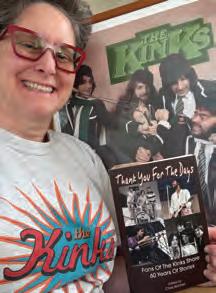
of nothing but the Kinks for the Sunday morning enjoyment of the small bits of campus that could get KRRC’s signal. (I know someone in Eliot Hall could hear me because she called to tell me I’d missed daylight saving time and had an extra hour to spin discs— thank you, kind listener!) Also mentioned is the brief return of Kinky Thoughts as a summer fillin on Hamilton College’s WHCL in 2016. I have many fond memories of those quiet mornings in the Eliot basement. Though I had all the CDs to play myself, I still loved the room of vinyl, the graffiti on the soundproof walls, and the general deshabille of KRRC. Rock on.”
In August, Amy Reading spoke about her book The World She Edited: Katharine S. White at The New Yorker as part of the Summer Author Series at The Mount, a National Historic Landmark and cultural center in Lenox, Massachusetts, dedicated to the intellectual, artistic, and humanitarian legacy of author Edith Wharton. Thanks to Ellen
Vicki Sufian ’67 for this news. (See Reediana, Spring 2025.)
Michael Burdick started a new job in April 2024 as fiscal policy advisor at the Oregon Department of Human Services.
Daphne Stanford writes, “I’ve been hosting The Poetry Show on KRBX, our local community radio station here in Boise, since August of 2012. I am always looking for new poets to feature on my show. (Shout-out to KRRC for providing my first terrestrial radio broadcasting experiences, back in the day!) For book review inquiries, please email thepoetryshow@radioboise.org. Find recent interviews at https://www.mixcloud.com/ DaphneElizabethLariosStanford/.”
Michael Jellinek ’s bike shop, Cyclepath, has opened a second location on Northwest Thurman Street at
1. Rachel Cloues ’96 and nephew Riley hike
2. Kinks fan Miriam Moore ’98 with book (to which she contributed) and mementos.
3. Amy Reading ’98 speaks about her book The World She Edited at The Mount.
4. Dylan Burns ’03, Miriam Rigby ’02, and Robin Loehrke ’02 got together in Amsterdam in August.
5. Van Butsic ’03 goes fishing (see photo 10)!
6. Cyclepath owner Michael Jellinek ’01 (right) with Reid Stolberg, his first customer at the new Northwest Thurman location.
7. Natalie Tschechaniuk ’03 during installation of exhibits at Edelman Fossil Park and Museum. Watch out, baby Hadrosaurus!
8. Award-winning poet Cate Peebles ’02.
the historic location of Fat Tire Farm. The original Cyclepath in Northeast Portland is now Cyclepath East, and the new store is Cyclepath West. Both stores offer a curated selection of bikes, and Cyclepath West, complementing its location near Forest Park, offers a selection of trail running shoes and accessories as well.
Greg McClellan has been making wine in Oregon since graduating. Last year Greg, his wife, and his winemaking mentors opened up a tasting room called Winery Lane Collective at their winery in Beaverton!
Laura Schacherer is professor of chemistry at Indian River State College in Florida.
Alexander Dickow has published a new book of poetry called The Distance, and You In It, and coedited with Patricia Sustrac the Dictionnaire Max Jacob, a literary reference work in French.
Last issue we left out Marian Macindoe’ s photos from 2024 Cookie Day! The happy revelers are pictured this time (see photos.)
Cate (Katie) Peebles ’s second collection of poetry, The Haunting, was published by Tupelo Press in 2025. Her chapbook, Sun King, was the 2024 Editor’s Selection for the Tomaž Šalamun Prize and is forthcoming from Factory Hollow Press in 2025. She lives in Pittsburgh, where she is a doctoral student in literature at the University of Pittsburgh.
Miriam Rigby, Robin Loehrke, and their son Fritz met up with
Dylan Burns ’03 and his wife in Amsterdam in August. They ate a few meals and explored a castle.
Jonathan Gilbert submitted a photo of the inaugural Reed alum basketball game at the new sports center at Reunions 2025, along with a relevant quote from Pindar’s Pythian 8:
(“You ephemerals! What is one? What is no one? Of a shadow, a dream is man. But when a gleam, heaven-sent, comes, a bright glow is upon men, and a sweet eon.”)
After more than five years of work, Natalie Tschechaniuk and her colleagues at G&A opened the Edelman Fossil Park & Museum to the public in March 2025! The Fossil Park is a one-of-a-kind place that brings Cretaceous-era dinosaurs to life to help visitors understand their place in time: how our actions in the present have an impact on the future. “As a director of production at G&A, my job is to work with incredibly talented creative teams to design museum experiences that inspire. I’m so proud of the Fossil Park—it was a labor of love and now it’s open for all to enjoy!” See www.efm.org.
In a move completely unrelated to the documentary Super Size Me, McDonalds discontinues “Super Size” menu.
Nate Tompkins must have missed a meeting while on sabbatical after getting tenure at Wabash College, because they named him chair of the physics department starting this fall.
Paul T. Baker was promoted to associate professor with tenure at Widener University this past spring. He will be on sabbatical in fall 2025 at Oregon State University working on detecting gravitational waves with a pulsar timing array. He’s also looking forward to moss, mist, and chanterelle mushrooms.
Dawn Teele , a Johns Hopkins political science professor who studies gender and politics, has been named an Andrew Carnegie Fellow for the class of 2025. Dawn, who has spent the last 15 years studying gender inequity, will explore whether the differences between men’s and women’s political preferences are an unrecognized driver of polarization in the United States.
Monty Python members Terry Jones and Terry Gilliam lead a group of 5,567 people in playing “Always Look On The Bright Side of Life” to set Guinness World Record for the largest coconut orchestra.
Allison Jones Hunt is teaching painting at the New Mexico Art League and exhibiting art throughout the Southwest after moving to
9. Players at the inaugural Reed alum basketball game at the new Sports Center, Reunions 2025 Left to right: Randy Hicks [chem staff], Erik Brakstad ’89, David James ’19, Dave Gallison ’78, ZeSean Ali ’20, Xander Harris ’15, Stefan Stackhouse ’16, Colin Daniel ’00, Chris Hallstrom ’92, Jonathan Gilbert ’03. Participants not pictured: Wayne Bennett ’93, Scott M. Youngstedt ’85.
10. Andrew Pomerantz, Rose Macindoe Pomerantz, Claire McCabe ’02, Camas Goble ’02, Patrick Cunningham, Melissa (Feineman) Suzuno ’02, Lindsey Selden ’03, Renaud des Rosiers ’99, Remi des Rosiers, West Macindoe Pomerantz, Beth (Bridges) des Rosiers ’02, Marian Macindoe ’02, and Thea des Rosiers get together for “2024 Cookie Day.” Not pictured: Octavia (McCabe) Cunningham, adorably sleeping off-camera, and Van Butsic ’03, fishing (see photo 5).
11. Dawn Teele ’06 has been named an Andrew Carnegie Fellow!
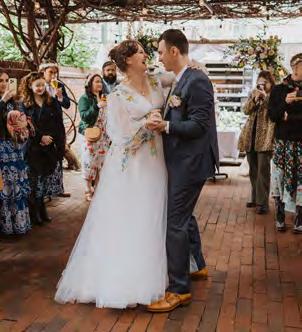
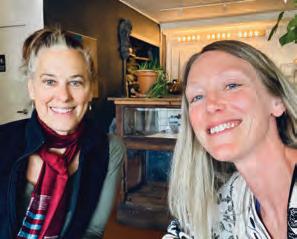
Albuquerque, New Mexico, with her husband Sam. Her first solo show of abstract paintings took place at Surface Gallery in Colorado Springs, Colorado, in September.
Rachel Mercer and author Kate Christensen ’86 convened to establish the Taos Reed Alumnae Writers’ Club, of which there are only—and may only ever be—two members.
2011 15TH REUNION
Look! Up in the sky! It’s a bugnado!
2012
Annie Sui was in an episode of General Hospital.
Sasha Wolff is in the PhD program for English and literary arts with a concentration in creative writing at the University of Denver.
2013
Nick Pittman sent in a photo of himself, sons Jamie and Devin, and Alex Houston and Ned Carson with new baby Leo.
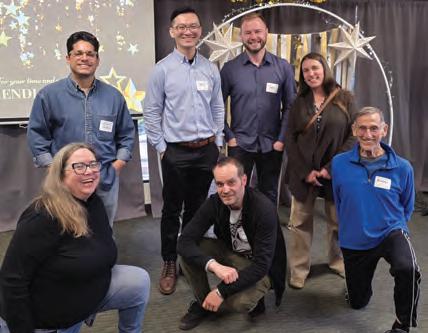
Jason Leong Campbell received the 2025 Friend of Friendly House award from Friendly House, a local community services center (settlement house) in Northwest Portland. This award recognizes individuals, families, groups or businesses that have provided exceptional support to Friendly House by sharing their time, energy, or resources. Jason was recognized for his service on the board and leadership during the organization’s challenging period in 2020–21.
Left Shark takes over internet.
Olivia Dawson and Theo Landsman got married in Washington, D.C., on March 15, 2025. They had a small restaurant wedding with five Reedies in attendance, where their first dance was to “This Must Be the Place (Naive Melody)” by The Talking Heads. Their wedding rings were designed and made by a goldsmith in Portland to
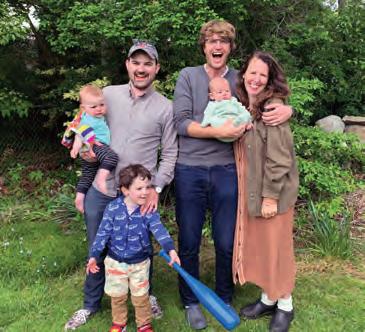
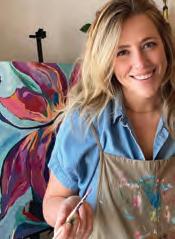
honor where they met. Their rehearsal dinner included trivia questions covering topics like the Doyle Owl and the site of their first date, The Waffle Window. They even had a vintage photo booth to honor all the Renn Fayre photo strips from years past!
Look! Up in the sky! It’s . . . wait, where’s the sun?
Mia Leung is pleased to announce the completion of her master of science degree in business analytics at the Cornell Johnson School of Management.
Greetings from Four Seasons Total Landscaping!
2021 5TH REUNION Britney freed.
2022–25
Look! Up in the sky! It’s Katy Perry!
2. Jason Leong Campbell ’14 (back, second from left) with the rest of the Friendlies Awards recipients, May 2025.
3. Nick Pittman ’13 with sons Jamie and Devin, and Alex Houston ’13 and Ned Carson ’13 with new baby Leo.
4. The Taos Reed Alumnae Writers’ Club: Kate Christensen ’86 and Rachel Mercer ’10.
5. It’s Annie Sui ’12 on General Hospital!
6. Allison Jones Hunt ’10 is teaching and making art in Albuquerque, New Mexico.
Edited by Bennett Campbell Ferguson
Robert Shellow ’51
January 29, 2025, in Baltimore, Maryland, of complications from Parkinson’s Disease. A distinguished psychologist, researcher, and consultant, Dr. Robert Shellow was best known for his involvement with the Kerner Commission, which studied the causes of the 1967 race riots. Titled The Harvest of American Racism, the commission’s report challenged the claim that the disturbances were instigated by apolitical Black men—and questioned the use of the term “riots” altogether.
Rob was born in 1929 in Milwaukee, Wisconsin. At Reed, he studied psychology, writing his thesis, “Intersensory Phenomena: The Effects of Auditory Stimulation on Visual Acuity,” under Professor Frederick Courts [psychology 1945–69]. Though Rob sometimes felt out of place on campus, he bonded with Professor Stanley Moore [philosophy 1948–54] and worked alongside Gary Snyder ’51 at The Associated Press and The Oregonian.
In 1955, Rob joined the Commissioned Corps of the United States Public Health Service, then advanced through the grades to Commander and worked with the Bureau of Prisons. Spurred by his interest in social science, he ultimately took a position at the NIMH Mental Health Study Center, where he participated in research on suburban runaways of the 1960s.
Rob’s career spanned government service, academia, and private consulting—an eclectic path that included a pivotal dinner at the White House. There, he was offered the position of deputy director of research for
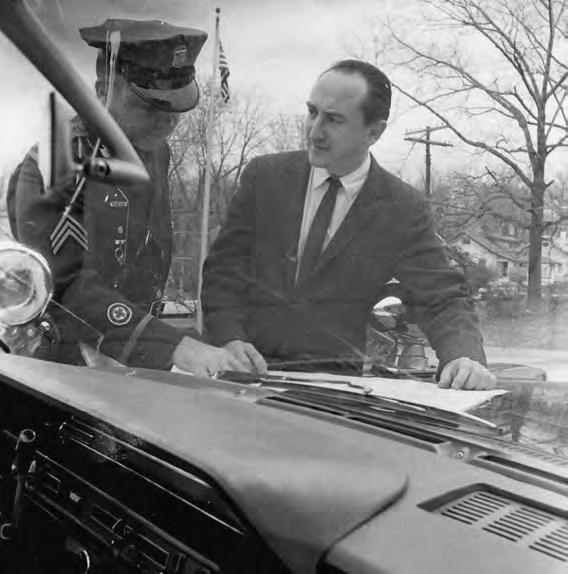
the Kerner Commission, which was headed by Illinois Governor Otto Kerner Jr. and convened by President Lyndon B. Johnson.
“It was a pretty heavy experience, being invited by members of the White House, and they were turning their attention to me,” Rob told Reed Magazine in 2019. “I said eventually, ‘But why me?’” Though his expertise in the sociology of policing and police-community relations made him eminently qualified, he would later learn that several other social scientists had declined the job, fearing that the report’s findings would be whitewashed. “I was naïve,” Rob later admitted.
Unfortunately for Rob, the fears of the aforementioned social scientists were confirmed when the commission’s executive director, David Ginsburg, dismissed a draft of the report as “politically explosive” and fired Rob’s staff. “I thought, ‘Well, what the hell do they
want?’” Rob said. “‘We did what we were supposed to do.’”
When the Kerner Commission released its report in 1968, Rob and his team’s analysis of the disturbances as a response to racism in America was absent. He moved on, teaching classes on juvenile justice and criminal behavior as a professor at Carnegie Mellon and founding his own security consulting firm, the International Management Analysis and Resources Corporation.
In 2014, the Kerner Report attracted fresh attention when the killing of Michael Brown, an 18-year-old Black man, by a white police officer led to protests in Ferguson, Missouri. Four years later, the Kerner Report was finally published by the University of Michigan Press in its entirety, with added recollections from Rob and his colleagues.
“I think without Reed College I probably wouldn’t have followed this trajectory,” Rob
told Reed Magazine in 2019. “[Reed] kind of tells you, ‘You can do that and risk things.’”
A brilliant yet humble thinker, Rob was known for his insights, confidence, and wit, seeking truth through balance and diplomacy in divisive times. He is survived by his wife, Dorothea, and his daughters, Sarah and Leslie.
March 7, 2025.
A pioneering faith leader who refused to compromise her identity or her beliefs, Jeanne Knepper was the first openly gay woman to be ordained and appointed within the Oregon-Idaho Conference of the United Methodist Church. She dedicated her life to inclusivity, seeking connection with conviction.
“She was good at calling people out, but she wanted to build bridges,” says the retired Reverend Marcia Hauer, Jeanne’s wife. “‘I’m not going to back down.’ That was her whole attitude toward life.”
Born in 1947, Jeanne earned a bachelor of arts in physics at Reed, writing her thesis on acceleration-dependent radiation terms with advising from Professor Dennis Hoffman [physics 1959–90]. She paid her way by taking two work-study jobs, one in the infirmary and one in the library.
“I did not tell the two places that I had a job, because I think there was a limit that you weren’t supposed to have more than 15 hours,” Jeanne recalled in 2019. “And I had a 15-hour job with each place.”
During her Reed years, Jeanne could often be found in
the bookstore, where she sought not only a sense of belonging, but a sense of self. “When I was at Reed, I haunted the bookstore looking for a book someplace that would connect with me and tell me who I was or how I fit into the world,” she said.
Jeanne’s journey to selfacceptance was marked by struggle. “I cried,” she told The Oregonian in 2012. “I studied. I prayed. I wrote in my journal. It was all a dynamic process. As the church was moving to the right, I was moving the opposite direction.”
In 1982, while Jeanne was still in seminary, she was elected to what was then known as a probationary membership in the United Methodist Church. A decade later, the Board of Ordained Ministry’s recommendation to the Oregon-Idaho Conference Clergy Session that she receive an appointment was defeated, but the Judicial Council of the UMC ruled in her favor in 1993.
“We were a very different conference back then,” said the Reverend Daryl Blanksma, a retired member of the conference’s Queer Clergy Caucus. “Up until 2016, we (queer clergy) were mostly in the closet and it was mostly just Jeanne out there.”
Jeanne, who served at Shalom Ministries and Portland University Park UMC, was finally ordained an elder in Oregon-Idaho in 1996. Striving to find common ground, she showed kindness even to those who condemned her—including a peer in the church whom she suggested read Acts 10, in which Peter has a vision of God calling upon him to welcome a Gentile into the Christian community.
“My mom was immovable,” Jeanne’s daughter, Andrea Knepper, said in a eulogy. “She was extraordinarily stubborn. She
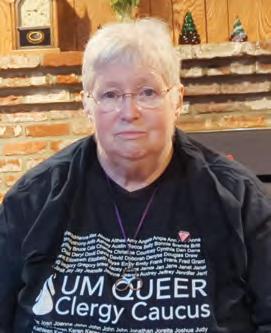
won every argument she had— whether or not she was right!”
Throughout Jeanne’s life, her determination manifested in memorable and surprising ways, whether she was defending her siblings from a local bully or punching a young man from a fraternity who had insulted Mrs. Buckler, an elderly neighbor. “Mom told me that violence wasn’t the answer to problems, and turned herself into the police,” Andrea said. “She got the fraternity shut down; Mrs. Buckler no longer had loud men singing obscenities on her front lawn.”
During General Conference 2024, Knepper and Hauer celebrated at home as LGBTQIA+ restrictions were removed from the Book of Discipline. “It’s like you’ve lived watching blackand-white TV for your whole life and suddenly we are in living color and it’s wonderful,” Knepper said at the time. “Oh, it’s a glorious day, but it cannot be spoken without that underlay of so much dedication and determination through pain.”
Since Jeanne’s retirement in 2012, her impact upon the church has endured. “I want her to be remembered for what she did for the conference,” says Hauer. “This was a very homophobic annual conference. We
became a reconciling annual conference in 1996 thanks in large part to Jeanne.”
Jeanne is survived by Marcia and two daughters, Andrea Knepper and Laura Bowman
May 23, 2025, in Tigard, Oregon.
Born in 1932 in Witt, Illinois, George Guthrie had a long and distinguished career as a high school educator. He studied economics at Reed, then earned a master’s degree in education from Lewis & Clark College in 1958.
George married the literal girl next door, Dolores “Dee” Grannell, in 1963 and moved to Tigard, where he and Dee built a house and raised their two boys. They were married for just shy of 55 years, until Dee’s passing in 2018 at the age of 85.
At Newport High School, George taught math and science. He later taught at his alma mater, Jefferson High School, and eventually became vice principal. After serving as an administrator at Grant, Madison, and Benson high schools, he finished his career as principal of Franklin High School, retiring in 1989.
George is survived by his sons, Eugene and Michael.
Donna Gelfand ’58
April 6, 2025, in Logan, Utah.
Donna Mae Gelfand was a widely published professor of developmental child psychology at the University of Utah, known for her work on books such as Child Behavior Analysis and Therapy. Her time at Reed was an
inflection point in her journey from being a rural public school student to becoming an influential academic.
Born in a tiny mill town in Washington state, Donna attended a one-room schoolhouse as a child. Though she had expected to become a high school teacher, her experiences at Reed convinced her to pursue a career in academia. She savored her humanities coursework—and went on to earn a BA in psychology from Reed and her doctorate at the age of 23 from Stanford University.
In addition to her faculty role at the University of Utah, Donna served as department chair of the psychology department and the first female dean of the College of Social and Behavioral Science, a position she held for a decade.
For nearly 50 years, Donna was happily married to Sidney Gelfand, with whom she had a daughter, Laura. Together, the three of them skied, backpacked, camped, ran many Western rivers, and sought out rock art that Donna then embroidered on chambray shirts.
After Sid’s death in 2010, Donna accompanied her daughter on several international trips, but her true passion was a hiking group made up of fellow emeritus faculty. Their ambitious weekly hikes structured Donna’s life in retirement and kept her happy and healthy well into her 80s.
Donna is survived by her daughter, Laura.
Nov. 20, 2024, in Urbana, Illinois.
A professor emeritus at the University of Illinois department of mathematics and a pioneer in nonstandard analysis, Peter A.
Loeb was a quintessentially nonstandard human, father, husband, and friend—and the originator of the Loeb measure, which has been used by mathematicians worldwide.
After studying mathematics at Reed, Peter graduated in the top half of the first graduating class from Harvey Mudd College in 1959. He received his MS at Princeton in 1961 and his PhD from Stanford.
Peter’s first professorship was at UCLA, where he remained until he became an assistant professor at the University of Illinois in 1968. He and his wife, Jane Loeb, remained in ChampaignUrbana for the next 56 years— or, as Peter would say, “more than 1% of recorded human history.”
In 1975, Peter published a mathematical construction that has since been called the “Loeb measure” (though never by him). The Loeb measure has inspired a vast literature in mathematics and beyond, leading to important applications in probability theory, potential theory, number theory, mathematical economics, and mathematical physics.
Peter received international recognition for his work and served as a visiting scholar at institutions around the world (including Yale, Caltech, Chalmers University of Technology in Sweden, Tokyo Science University, and the National University of Singapore). In the last year of his life, he spoke and was honored at a special session of the American Mathematical Society in San Francisco titled “Loeb Measure after 50 Years.”
Peter’s acute brain was not reserved only for academics. He had a phenomenal memory for tunes and his sense of humor was endemic, as was his particularity about word choice. (He would not have approved
of the use of “endemic” in the previous sentence.)
A lifelong Democrat, Peter was active in the party for many years, as well as in the local music scene. Always an enthusiastic singer on family car trips and around the campfires of his youth, he joined the Choral Union upon retirement and began taking voice classes, continuing his singing lessons until the day before he became bedridden.
Peter is survived by his wife of 66 years, Jane, and his children, Eric, Gwen, and Aaron.
Donald L. Pavia ’63
April 15, 2025.
Born in Portland, Oregon, in 1941, Donald L. Pavia majored in chemistry at Reed, writing his thesis on tricyclodecane and related compounds under Professor John E.H. Hancock [chemistry 1955–89].
After receiving his MS and PhD from Yale University, Don did postdoctoral work at the University of Wisconsin Madison and taught organic chemistry at Western Washington University from 1970 to 2007. A true Renaissance man, he enjoyed sailing, woodworking, model railroading, and railroad history.
Don is survived by his loving wife of 51 years, Neva Jean, and three children, Morgan, Kevin, and Bronwyn.
David Hiebert ’64
February 2, 2025, of mesothelioma.
Born in 1942, Dave lived in occupied Germany while his father was flying reconnaissance missions o ver the Iron Curtain after
World War II. Upon returning to the United States in 1954, his parents bought a remodeled former one-room schoolhouse east of Sandy, Oregon.
Dave graduated from Sandy Union High School in 1959, then attended Reed for three years, studying economics. A fixture of 1960s counterculture, he lived in Haight Ashbury during the Summer of Love and attended an Acid Test put on by Ken Kesey and the Merry Pranksters.
When he moved back to Oregon, Dave began working at Gunderson Bros., where he learned to weld and became a boilermaker. By 1984, he had joined the steamfitters union; he retired from the union in 1998, though he taught classes for apprentices and journeymen until his death.
In 1971, Dave met his first wife, Joan Chandler, while taking classes at PCC. He lost her to cancer in 2003, after a 32-year relationship. Though heartbroken, Dave had the good fortune to meet and later marry Frankie Lodge—and felt he had won the lottery by finding a second wife who was as wonderful as his first.
A steadfast skier, Dave was able to ski double black diamond runs at Whistler at age 80, even after a lifetime of construction work. He especially enjoyed skiing at Timberline with his grandson, Max Chandler, and exploring the Oregon outback with his brother, Fritz.
Dave is survived by his wife, Frankie.
Donald Fiser MAT ’66
April 20, 2025, in Lake Oswego, Oregon.
A natural-born leader, Donald Fiser was a champion of Portland schools, whether he was working
as a teacher at Jefferson High School or an administrator at Portland Community College.
Born in 1940 in Olympia, Washington, Don served as student body president of Olympia High School, ran all–state in track, and played football. He received his bachelor’s degree at the University of Washington, then earned his master’s degree in teaching in Reed.
After teaching history at Jefferson, Don held many roles at PCC, from dean to vice president, until his retirement. As a retiree, he spent countless hours volunteering at Fish Emergency Service, Store to Door, NorthWest Medical teams, and his favorite place, Sunshine Division—and received a Light a Fire award from Portland Monthly in acknowledgment of his service.
Don is survived by his son Mark, his wife, Sharon, and his stepdaughter, Janelle.
William Carey-Voris ’67
April 27, 2025, in Saint Louis, Missouri. Jonathan CareyVoris (né Van Voorhis) was born in Lansing, Michigan. He earned his bachelor’s degree in English from Reed, where he developed his interest in the lifeworks of James Joyce.
Following graduation, Jonathan worked as a librarian in New York City, nurturing his appreciation for literature. He traveled to Europe and followed the path of Joyce’s research, which he applied to his master’s degree in English from the University of Tulsa.
At the Spartan School of Aeronautics, Jonathan served as an editor of training
manuals and met his beloved wife of 30 years, the late Elizabeth Carey-Voris. In the early ’80s, the couple moved to Saint Louis, where Jonathan worked for the aerospace manufacturing corporation McDonnell Douglas and later Boeing. His work as senior quality auditor guided training development of the US Navy’s F/A-18 Hornet, plus numerous other iconic Boeing aircraft.
Upon retirement, Jonathan commenced French language classes at Alliance Française de St Louis, where he mastered both spoken and written French. He loved reading a wide variety of literature and enjoyed a range of movie genres, plus French soap operas.
Jonathan was known for his personalized, handcrafted, witty cards that honored his friends’ birthdays, anniversaries, and other special occasions. He was admired for his colorful stories and his dedication to living the Golden Rule.
Philip Fetzer MAT ’70
February 21, 2025.
Born in 1943 in Pasadena, California, Philip Lee Fetzer was raised in a large family after his mother passed away at a young age. He was profoundly impacted by his education in the Episcopal Church of Los Angeles—and earned a Carver Award for Christian and moral leadership in 1961.
That year, Philip began studying history at Princeton, where he later met his wife, Elizabeth “Betty” Deininger, who worked in the job placement office there. They married in 1967, and even in his later years when his health
declined, Philip would often speak of his love for her.
Philip came of age during the civil rights movement, the Vietnam War, and Watergate. He was fearless during the Freedom Summer of 1964 in Mississippi, where he registered Black Americans to vote, and later he began teaching public school in inner Los Angeles.
After a stint in the Peace Corps, Philip moved to a small suburb of Sacramento, California, where he taught history and government until 1988. He won the respect of his colleagues as he fought for the just treatment of teachers as president of his teachers’ union.
While teaching public school, Philip spent summers finishing his dissertation in political science in 1981 at the University of Oregon, having completed his master of arts in teaching at Reed. He then taught at California Polytechnic State University, San Luis Obispo, where his values sometimes put him at odds with a conservative campus full of engineers, architects, and farmers.
Philip retired to Cape Cod in 2005 with Betty. He suffered a heart attack in 2009 and was cared for by Betty until 2010, when she passed away. Matt, their son, moved in to care for his father, building a relationship founded in their shared passion for teaching, memories of tossing the football until dusk, and seeing Star Wars films together.
Philip is survived by Matt, who says he was profoundly shaped by his father: “He gave me a righteous core and a love of books and culture and learning, and did so with an easygoing wit and always a twinkle.”
Dean Elliott Frost ’77 March 6, 2025, in St. Paul, Minnesota, of cancer.
Dean Frost was a proud Reedie who majored in psychology, writing his thesis on the effects of stress on leadership. He then attended the University of Washington, where he received a master’s degree and a PhD in psychology.
Born in 1954 in Minot, North Dakota, and raised in the Pacific Northwest, Dean was a prolific scholar of the human mind. He published work on implicit leadership theory, management development, emotional intelligence, financial decision-making, and social power, working for a staggering range of organizations (including FEMA and Intel).
An educator to his core, Dean became a professor of industrial psychology at Portland State University, as well as at the University of Virginia, Duquesne University, and Walden University. He was a passionate teacher, whether he was mentoring university students or helping his grandchildren with homework or fishing.
After nearly two years of “cancering” with courage and grace, Dean passed away peacefully with family at home in St. Paul. He is survived by his wife, Kathryn Engdahl, and his daughter, Safiya Smith.
July 17, 2024. Patty was born in Spokane, Washington. She was a musical student, singing in a select choir and mastering five instruments, including the bassoon (which she played for AllNorthwest Band).
After high school, Patty took college classes for 20 years, finally earning a bachelor’s degree from Western Oregon University and a master’s degree from Reed. “[I have] attended several colleges,” she wrote in 1989. “Reed gave me the best, most valuable education of any!”
For 20 years, Patty was married to Peter G. Stone, with her six children born in five different states because of Peter’s Air Force assignments. She also taught at Perrydale High School and McNary High School in Salem, where she met and married Vince Wixon.
Throughout her life, Patty had a passion for poetry, publishing four books of her poems and hosting an annual poetry program featuring Oregon poets laureate and many poets from the Rogue Valley. Committed to fostering a love for writing in others, she directed the Oregon Writing Project in three school districts (and held administration positions in Central Point, Eagle Point, and Ashland).
In addition to serving on the board of Friends of Hannon Library at Southern Oregon University, Patty was an organizing member of the Friends of William Stafford. She helped establish the Stafford Archives, housed at Lewis & Clark College, producing 97 CDs of over 40 years of the poet William Stafford’s readings, workshops, and lectures.
Patty also organized the International Writers Series in Ashland, an extension of the Mountain Writers Series in Portland. Each school year, the series brought well-known writers to do readings in the Rogue Valley and teach high school students and faculty.
In 2014, Patty and Vince were awarded the Stewart
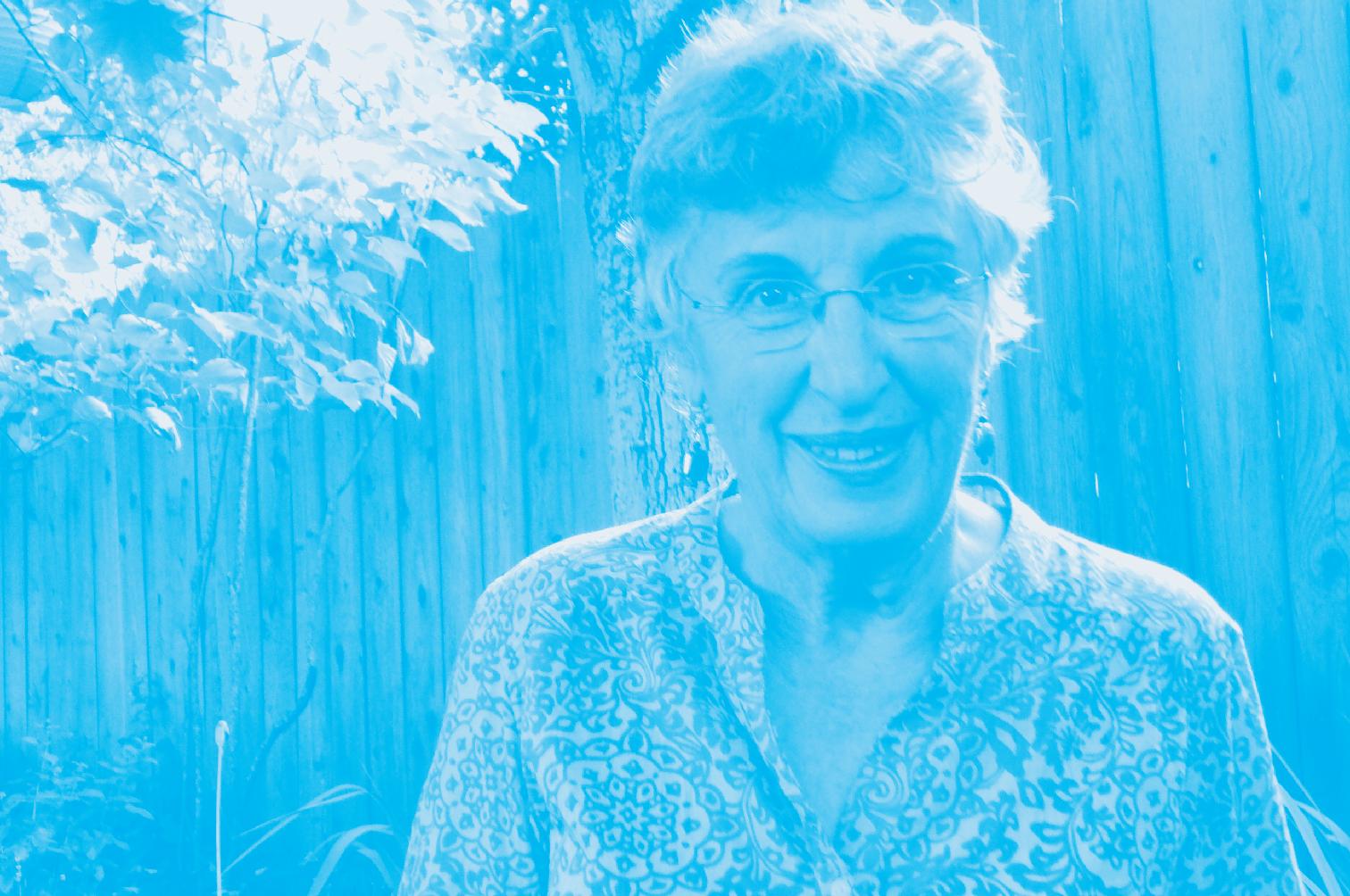
H. Holbrook Literary Legacy Award for their contributions to the literary life of Oregon. Patty is also remembered for her chocolate truffles and her 20-year tenure as a costume stitcher for the Oregon Shakespeare Festival.
Patty is survived by her husband, Vince, and her children, Delight Stone, Michael Stone, Gordon Stone, Beth Pepper, Larry Stone, and Eric Stone.
Patricia Bennett ’98
February 22, 2025, in Baltimore, Maryland, of breast cancer.
Patricia Hope Ben nett was born in Boston in 1976. She studied phys ics at Reed, writ ing her thesis, “The Silicon Exciton,” with advising from Professor John Essick [physics 1993–2022].
After graduating, Patricia attended the Chicago Art Insti tute and the Schuler School of Fine Arts in Baltimore. She ultimately chose a career as an event planner, becoming known for her paintings of wedding receptions with the bride and groom as the central focus.
Patricia was also an artist in residence at the Cylburn Arboretum in Baltimore for a year, as well as a singer in the choir at the Anglican Church of the Resurrection in Timonium, Maryland. Her passing is mourned by her two children, Arabella and Atlas Mosson; her mother, Diane Davis Whitney; and her father, Dr. G. Vann Bennett.
February 25, 2025, in Eugene, Oregon, of cancer.
Dove Catherine Hotz’s wit, writ
correct in her mathematics and unrepentant in question ing authority, so teacher and student agreed to disagree.
After working in the Bay Area, including at UC Berkeley, Dove bought a home in North east Portland. In addition to working at Concordia Univer sity, the Multnomah County Library, and Metro, she attended Reed, which extended her grasp of feminism and power. Her the sis, titled “Furious Feminist: The Riotous Radicalism of Dr. Marie Equi,” was written with advising from Professor Jacqueline Dirks [history and humanities].
Dove retired in 2015 and toured Eastern Oregon with her husband, Eric Signell. “She was always great at sending cards and little handmade gifts to friends and family for any occasion that she felt warranted it,” Eric said. “We were gypsies looking for our forever home, for the next nine years starting in 2015.” They found that home in Eugene, on Wendover Street—whose eight letters, fittingly, include “dove.”
Although not a smoker, Dove was diagnosed in September 2020 with stage 4 terminal small cell lung cancer. She faced the illness squarely and
Reed

LEGACY GIFTS made through your will or trust provide crucial financial support for Reed and influence generations of students. Gifts can be tailored to meet your and your family’s financial and philanthropic goals.

CONTACT KATHY SAITAS in the office of gift planning to discuss mutually beneficial and creative ways to make a difference at Reed: giftplanning@reed.edu 503-777-7573 reed.edu/legacyplanning

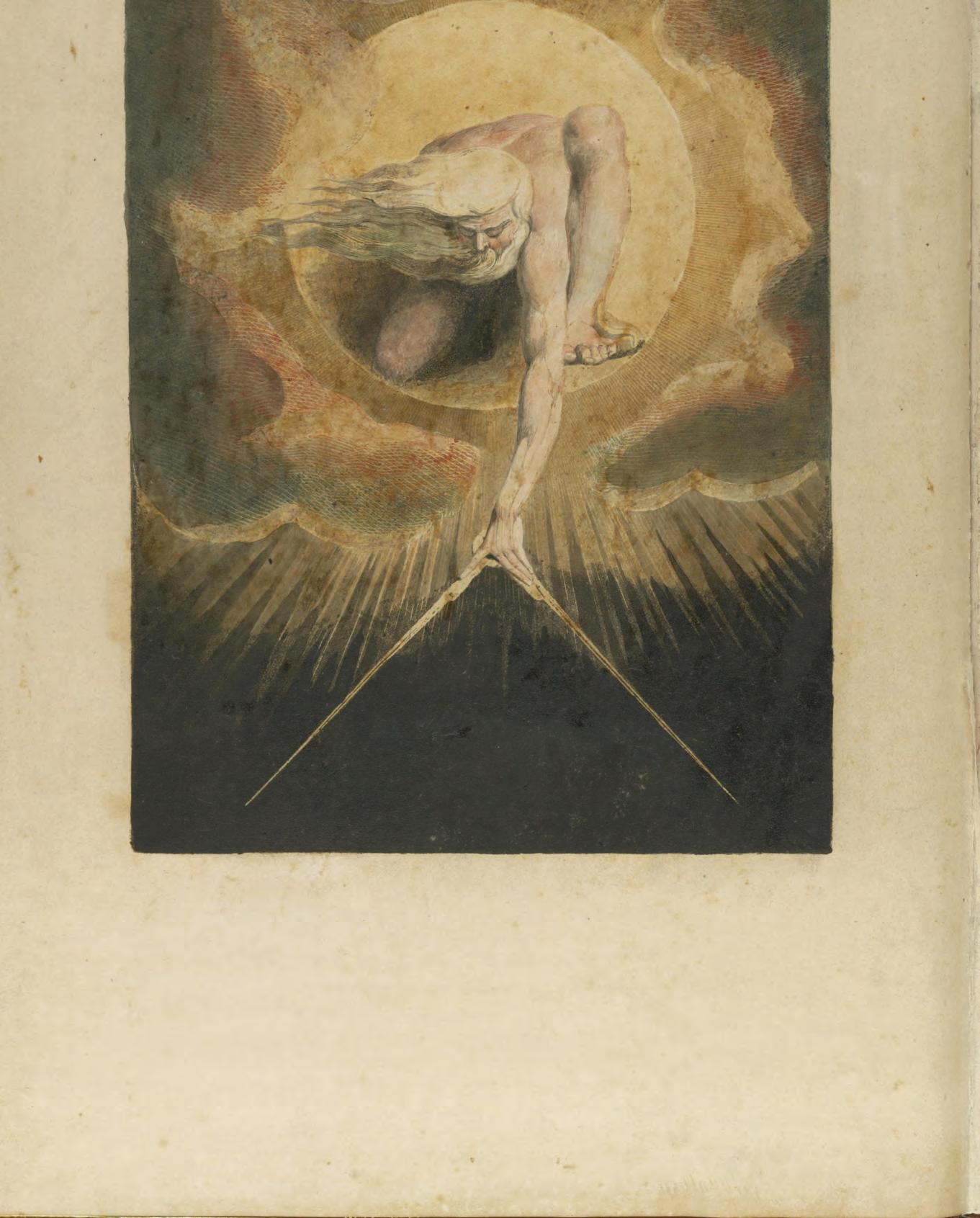
ENG 220: Visual Narrative, Hogarth to Blake, examines William Blake’s etchings in the context of the explosion of pictorial storytelling that accompanies the rise of the novel in 18th-century England. We focus on the new form of the printed image, a more accessible format than the panel painting, and one easier to adapt to new political, religious, or private ends. Among the works we study are the intensely personal representations of joy and struggle that Blake produces at the end of the century.
This image, “The Ancient of Days,” is the frontispiece to Blake’s Europe, A Prophecy (1794). Like many of Blake’s works, it’s smaller than one might imagine, measuring 9 by 6.5 inches. The vast majority of Blake’s image output is at this scale, designed as part of a series of illuminated books combining text and image, which Blake designed and etched himself in a unique process. Each was hand-colored, so that no two copies are quite the same, a practice which undermines the idea of a single original image.
Magisterial as this image is, its representation of the figure Urizen measuring the void is not an unalloyed image of triumphant creation, but a more complex post-Enlightenment vision of reason dividing and limiting human experience. Blake’s own elaborate mythological system is critical of any limitations that choke off the imagination; which, freed of oppressive restraint, can deliver an “immense world of delight.” —Maureen Harkin, Professor of English and Humanities

3203 SE Woodstock Blvd.
Portland, Oregon 97202-8138