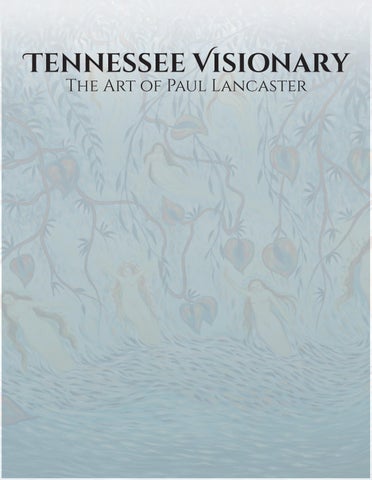
Tennessee Visionary
The Art of Paul Lancaster
The Reece Museum in cooperation with Grey Carter-Objects of Art Present
Tennessee Visionary
The Art of Paul Lancaster
July 22 — September 20, 2024
Tennessee Visionary features paintings and etchings that explore the artistic journey of Paul Lancaster (1930 – 2019), a self-taught artist and Tennessee native. Without any formal art education, Lancaster began to paint in the late 1950s and has gained increasing recognition for his creations. One could easily see his works as "visions" of a beautiful life rich, in the wonders of nature.

Paul Lancaster was born in Lobelville,Tennessee, in 1930 and resided in Nashville. Without any art education, Lancaster began to paint around 1959 and has gained increasing recognition for his creations. His works are held in private collections as well as the permanent collections of the Smithsonian, American Visionary Art Museum, Hickory Art Museum, University of Virginia, The Parthenon in Nashville, the Reece Museum, and others.
Lancaster’s early works had more primitive qualities and appeared full of fantasy. His work grew exceptionally so that many cannot believe he is self taught. He has worked with most media available to the painter and has even taught himself how to create etchings. These graphic works has proven significant, for it is in his etchings that his great facility for drawn lines and subtle color can be fully accomplished.
Paul was a simple man, quiet and modest. He was part Cherokee, which influenced his personality and is clearly reflected in his work. One could easily see his works as “visions” of a beautiful life deeply enriched by the wonders of nature. He belonged to the outdoors and his works always belonged to nature and the spiritual. The subjects of his work are the forests, woods and streams. Figures are in his works but they may seem unimportant, helpful for proportion but not always essential to the presentation. When he did include figures they were usually feminine, and always beautiful. Working strictly from imagination, he often animated his trees and rocks suggesting animal or human forms. His visions were peaceful and quiet, almost fairy tale, pretty and idealistic. Lancaster was a true self-taught artist in every respect— his knowledge and technique are natural gifts rather than academic. His skills were honed by more than fifty years of artistry. While his style ranged from the simple to the extraordinarily complex, it always met the viewer with innocence and honesty. In this sense, he was great rather than good. “Paul Lancaster: Immersed in Nature” was published in 2009 and described his life and his art. Lancaster passed away on June 18, 2019.
Grey Carter Owner, Grey Carter-Objects of Art McLean, Virgina

My first introduction to Paul Lancaster’s work came from visiting a colleague who was assembling a collection of Outsider art for sale. That night, I had no intention of making a purchase, but I found it difficult to resist the gentle, calming face of the young woman greeting me from Paul’s first canvas I encountered; her smile was inviting and peaceful. Since then, my husband and I have unintentionally but inevitably begun to build a small collection, acquiring pieces like those of Paul Lancaster’s that seem to belong on our walls.
As I began to collect more art I admired, I discovered that with most artists I encountered, I could acquire two to three pieces and achieve a nice representation of their style and work. While their art often showed recognizable and consistent approaches across their works, Paul Lancaster’s pieces stood out for their gentleness and the peaceful reactions they evoked, yet he was never repetitive or predictable. It was challenging to comfortably attribute multiple pieces to the same artist when looking at his diverse art. While many were unmistakably by Paul Lancaster, the variety in mediums, subjects, and colors was consistently amazing and captivating.
Though some of Paul’s later pieces depicted an almost fairyland woods, he explored far beyond this realm. His works often portrayed nymphs with woodland vines delicately curving around what my grandmother would call “zaftig” young women, alongside beautiful scenes featuring very realistic subjects. However varied, a common thread in his art was its consistent sense of peace and invitation. I like to imagine much of his art as windows into the world he imagined stepping into from the home where he lived with his wife for many years.
Across his works, I observed Paul transition from enchanting fairyland settings to realistic scenes, such as his inviting depiction of children playing with fireflies on a late autumn evening. One of my favorites, currently gracing my living room, depicts a small group of children passing through the woods, captured from the perspective of a woodland mouse gazing up through colorful autumn leaves. He also painted a serene winter scene of a small stream winding through gentle snowdrifts amidst bare winter trees. This work contrasts sharply with the ethereal world of his wood nymphs and the majestic, ancient-feeling tree trunks that could rival Baobab trees.
Additionally, he created quiet and peaceful scenes featuring young girls in sparsely furnished rooms, wearing dresses that hint at Asian influence, playing near stand-alone screens also painted with these motifs. Another piece, delicate and exquisite, featured floral patterns meticulously rendered on silk, each petal of the Queen Anne’s Lace distinct and defined. Adjacent to it hangs a vibrant floral piece by Paul, crafted by tearing and collaging what seems to be construction paper onto a solid base. Both artworks are beautiful and distinct in style and approach, almost as if they were created by two entirely different artists.
Paul Lancaster is one of the most creative and captivating self-taught artists I’ve had the pleasure of encountering. His art sparked our appreciation and eventual collection of self-taught artists, which my husband and I pursue with great delight.
Jan Brecht-Clark, PhD Independent Consultant & Art Collector Cooper, Texas

The Reece Museum’s permanent collection of artifacts has always been rooted in folkways and folk culture. Beginning as early as 1928, students and community members at our university chose to donate objects representative of material culture, local history, and the lived experiences of their families. When the museum officially opened in 1965, staff members used the interests and needs of the campus and Johnson City communities to guide the intentional, continual collecting and preservation of artworks and artifacts on local, regional, national, and international levels.
Throughout decades of change in and around the Reece Museum, the growth and collecting practice of the museum has always consistently reflected the museum’s mission to best serve its community while voicing and displaying the stories of its home region. The history of the Reece Museum’s permanent collection is directly emulative of broader national and international folk and outsider art movements, patterns, and historically significant events, through an Appalachian lens. The collecting practices of the museum have shifted in reaction to communal needs and cultural changes.
In Appalachia, there is a constant state of questioning as to who belongs within and who is firmly positioned “outside.” Maps, geographic resources, and collected data are posited in an effort to cleanly divide, categorize, and organize a region that spreads across several states and provides residence to millions of people. Further, there is an outdated history of Appalachians being described using offensive, generalizing language that purposely distinguishes people within the region as being wholly separate from the rest of the United States. Appalachians are treated as the nation’s outliers because of differences that are largely the result of
exploitation and scapegoating that have lasted for decades. Such classifications are sometimes utilized to separate artists and artworks into factions that delineate academic backgrounds, places of origin, and proposed levels of skill.
The scope of the collection provides categories and classifications that help us organize the permanent collection. On our online portal, users can view specific subgenres of artworks or artists, either by clicking buttons such as “Appalachian Art,” or by using keyword searches to view available works that pertain to certain themes or were created by specific artists. In person, visitors of our collections spaces will notice that our holdings are stored according to a multitude of traits, including size, material, medium, and condition. However, there are always exceptions to the rules—artworks and artists that transcend categorization and expand beyond one genre in our permanent collection. Such are the works of Paul Lancaster (1930 – 2019).
Born in Lobelville, a small city in Perry County, Tennessee, it is estimated that Lancaster began to paint around the age of 29 without any art education. By definition, this firmly places Lancaster within the genres of outsider and self-taught art, to distinguish his lack of training from artists who received a formal education. In my experience, viewers are often surprised to learn Lancaster was self-taught because of the complex details that are characteristic of his works. Lancaster’s use of color and his attention to detail allow viewers to become immersed in the scenes that he created. His works have been described as having ethereal or mystical traits, qualifying Lancaster as a visionary artist that depicted scenes from a world that is not restricted to our known reality.

The Reece Museum holds seven artworks by Lancaster in our permanent collection: three etchings and four paintings. Each artwork is distinguishably made by Lancaster, and yet they each have a unique identity that seamlessly blends with other artworks in our collection. Several of our works include variations of a forest scene, but the techniques and color palettes employed by Lancaster subtly—or sometimes, drastically—vary from piece to piece.
“Rider Coming,” an etching from 1978, was our first Lancaster acquisition donated by Grey and Linda Carter in 2018. The rich forest greens are reminiscent of many other landscape artworks in our collection, but it is Lancaster’s fine linework and the depth and shape of the tall trees that stand out among other examples. The trees are so serenely distinctive that, if one does not look carefully, it can be easy to glance over the focal point of the etching: a small figure dressed in red and riding a horse among the trees. In contrast, “Snow Scene,” a painting from 1995, features a selection of vibrant purples and blues to provide dimension to a snowy riverside. Viewers that look closely will notice that the bare trees in the foreground feature blended hues that are not commonly associated with winter weather, such as pinks and yellows, framing the peaceful lake with a surreal, dream-like barrier that is enticing and wondrous.
Lancaster’s defining artistic traits are not restraining or predictable in any sense—his artworks have strong personalities, inviting their viewers to step inside each vision to dream with him. Seeing his artworks side by side in one gallery is a beautifully overwhelming experience in which viewers have the opportunity to spend seemingly endless amounts of time moving from story to story, scene to scene. Lancaster’s works embody the heart of visionary
art, in that they transcend the parameters of time and space that we are so aware of in everyday life. The detailed, dreamlike quality of Lancaster’s works bring something to our permanent collection that we might otherwise lack.
Through the donations of artworks from generous artists and collectors, the Reece Museum is building a collection of folk, outsider, self-taught, and visionary art that aligns with our earliest institutional mission and intentions. The beauty in preserving artworks and historical artifacts in our collection is that we are caring for more than just the physical presence of the artifact itself—we are also the stewards and keepers of the lived experiences that the artifact evoked from its previous owners, caretakers, and creators. We value the stories of the donors and the artists as equally as we value the physical artifacts themselves.
I am reminded of this as I view our Lancaster artworks alongside the many that were kindly loaned to us from our Co-Curator, Grey Carter. These artworks make and carry so much meaning in the visual scenes that Lancaster created alone. They additionally carry the meanings and memories of Lancaster himself, and the collector who saw value in the artworks and chose to acquire them and share them with the world through exhibits and publications. We invite you to step inside the many visions of Lancaster in “Tennessee Visionary: The Art of Paul Lancaster.”
Savannah Bennett, MA Collections Manager, Reece Museum Johnson City, Tennessee


Bathers & Fireflies, 1994
30 x 24” oil on canvas
Beneath, 2000
30 x 24” oil on canvas

Enchanted Rolling Hills, 1999 36 x 42” oil on canvas


Sleeping Beauty, 1997
14 x 18” oil
Sun Glowing on the Woods, 2007
16 x 20” oil on canvas
Summer Light Plays, 2004
16 x 20” oil on canvas
on canvas

Dreaming of Eve, 2001
40 x 30” oil on canvas

Bathers in Sunlight, 1981
39.25 x 39.25” oil on canvas


Forest Beauty, 1994
30 x 24” oil on canvas
Bathers with Cat, 2000
30 x 24” oil on canvas


Mountain Lakes, 1964
30 x 45” oil on panel
Reece Museum Permanent Collection
Autumn Walk, 1999
24 x 30” oil on canvas


Communion, 2000
24 x 20” oil on canvas
Exotic Bather Seated, 1998
24 x 20” oil on canvas


Earth Mother II, 2000
30 x 24” oil on canvas
Water Nymphs, 1999
24 x 24” oil on canvas


Nude with Red Flower, 2007
24 x 18” oil on canvas
Nature’s Pattern II, 2002
24 x 20” oil on canvas

Interior With Two Dancers, 2005 40 x 40” oil on canvas

Exotic Forest Garden, 2002
18 x 24” oil on canvas

Spring Bathers, 2001
30 x 40” oil on canvas


Butterflies in the Thicket, 2009
16.5 x 12”
mixed media drawing
Mother and Child with Bird, 2009
17.25 x 12” mixed media drawing

Summer Play, 2002
40 x 40” oil on canvas


Opening in the Woods, 2005
24 x 18” oil on canvas
Angels Watch While Children Play, 2004
20 x 16” oil on canvas


Harvest, 2000
30 x 24” oil on canvas
May Dance, 2001
20 x 24” oil on canvas

Daydreaming, 2004 30 x 24” oil on canvas


Summer Muse, 2005
18 x 12” oil on canvas
Exotic Nude Wading, c. 1995
10.25 x 8” oil on canvas

Day Dreamer, 2006
40 x 24” oil on canvas


Little Nymphs, 2000
22 x 28” oil on canvas
Autumn By the Lake, 1996
22 x 28” oil on canvas
Reece Museum
Permanent Collection


Forest Bather, 2004
10 x 8” oil on canvas
Bather, 1997
10 x 8” oil on canvas
Nude in Flowers, c. 1970s
3.5 x 2.5” watercolor & ink


Scene, 1995
24 x 30” oil on panel
Dreamscape, 2011
36 x 48” oil on canvas
Snow
Reece Museum
Permanent Collection
Emerging

Little Butterfly Angel, 2007 36 x 13” oil on canvas


Snow Sunset, 1994
24 x 36” oil on canvas
Lady in Striped Dress, 2011
30 x 22” oil on canvas

Still Life, White & Blue, undated 13.25 x 8, hand colored etching

Floral Still Life, Pink & Red, undated 13.25 x 8”, hand colored etching

Untitled, undated 7 x 10”, etching
Floral


Selected untitled etchings


Indian Rock (Sunlight), 1975 11.5 x 17, hand colored etching

Indian Rock (Twilight), 1975
11.5 x 17, hand colored etching


Selected untitled etchings


Balloon Boy, 1978
14 x 11”, mono print with inset

Spring, 1978
16 x 12”, hand colored etching

Winter, 1975 16 x 12”, hand colored etching
The Reece Museum in cooperation with Grey Carter-Objects of Art Present
Tennessee Visionary
The Art of Paul Lancaster
Exhibition
Curated by Grey Carter & Spenser Brenner
Catalog
Design — Spenser Brenner
Photography — Alexis Campbell
Printing — BMC Creative
Reece Museum Staff
Rebecca Proffitt — Director
Spenser Brenner — Exhibition Coordinator
Savannah Bennett — Collections Manager
Ashley Gregg — Education Curator

The Reece Museum is a unit of the Center of Excellence for Appalachian Studies and Services, which is housed in the ETSU Department of Appalachian Studies. The Reece Museum is located on the campus of East Tennessee State University and is open Monday through Friday, 9 a.m. to 4:30 p.m. For more information, please visit www.etsu.edu/reece or phone (423) 439-4392. ETSU is an equal opportunity employer. Printed By BMC: #250269-A-25