2025 PipeScreams

Page 1


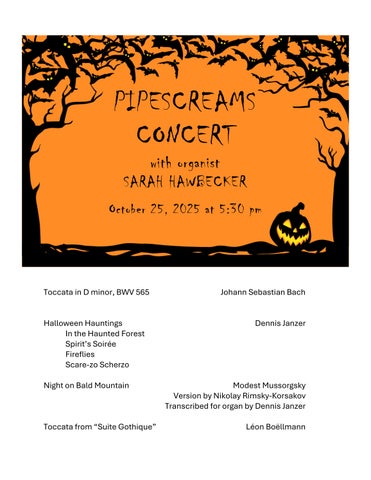
PIPESCREAMS CONCERT with

organist

October 25, 2025 at 5:30 pm

Toccata in D minor, BWV 565

Johann Sebastian Bach

Halloween Hauntings Dennis Janzer

In the Haunted Forest

Spirit’s Soirée

Fireflies

Scare-zo Scherzo

Night on Bald Mountain Modest Mussorgsky

Version by Nikolay Rimsky-Korsakov

Transcribed for organ by Dennis Janzer

Toccata from “Suite Gothique”

Léon Boëllmann

SARAH HAWBECKER

ABOUT THE ARTIST

Cruella d’orgue is the alter ego of Sarah Hawbecker, Redeemer’s Organist and Director of Children’s Music since 1996. A native of Illinois, she studied organ and church music with John Ferguson at St. Olaf College, earning the Bachelor of Music degree, magna cum laude with Departmental Distinction. She earned the Master of Music degree in Organ Performance from the Eastman School of Music, where she studied with Russell Saunders. Ms. Hawbecker is a prize winner of numerous competitions, including both the 1998 and 1996 National Young Artists Competition in Organ Performance, and first prize in the 1988 Undergraduate Organ Competition, Ottumwa, Iowa. Her performances have been broadcast on American Public Media’s radio program Pipedreams® . She is a frequent workshop presenter and performer, adjudicator for local, regional, and national organ competitions, and has published articles in The American Organist, CrossAccent, and The Chorister. A lifetime member of the American Guild of Organists, she served three terms on its national council, and completed two terms on the Board of the Association of Lutheran Church Musicians. She is on the roster of Concert Artist Cooperative (www.concertartistcooperative.com)

UPCOMING CONCERTS

Sunday, November 16~ 7:00 pm

HARVEST HOME CONCERT~ A Midtown Thanksgiving Celebration with the Redeemer Choir, Our Song Atlanta, Carillon Ringers, and soloists

Friday, January 30 ~ 7:30 pm

ORGAN ANNIVERSARY CONCERT

Nathaniel Gumbs, Riverside Church, New York City

Friday, March 20 ~ 7:30 pm

BACH BIRTHDAY BASH

A variety of vocalists and instrumentalists present works by Johann Sebastian Bach in celebration of his birthday

About the Organ

Each pipe organ is unique and designed for the space in which it will be used. Redeemer’s instrument was built by Orgues Létourneau in Saint-Hyacinthe, Québec, Canada. It was installed and voiced in the church in 2002 and dedicated on December 15, 2002. This organ has three keyboards for the hands to play, called manuals, and one for the feet, called the pedal. Each keyboard controls a division, or grouping of pipes. There is a separate pipe for each key in every tone color. The pipes are arranged in rows, called ranks. To get the pipes to play, the organist pulls a knob, or stop. (It’s called a “stop” because when it’s pushed in, it stops the pipe from sounding.) Some stops control more than one rank, which blend to make one voice. Redeemer’s organ has 59 stops comprised of 4,119 individual pipes divided among 73 ranks.

Each stop on the organ also has a number, which tells at which pitch the note sounds. An 8’ stop will sound at the written pitch; 4’ an octave higher; 2’ two octaves higher; 16’ an octave lower. Two divisions, the Swell and the Postiv, are each housed in a box with shutters. The organist can control the shutters with a pedal, causing the sound to swell or diminish according to whether the shutters are open or closed.

The pipes of the organ are made of either wood or a metal alloy, and are either flue pipes or reed pipes. Most organ pipes are flues and are categorized into three groups according to their tone color. First are the principals. Principals are the basic organ sound, not trying to imitate any other sound. The pipes you can see in the façade are principals. The second family is the flutes. Flutes can be made of wood or metal, and they do sound like flutes, or recorders. Strings make up the third family. String pipes are narrow in scale and imitate the sound of a violin. Most organs have very few string stops. Making up the fourth family of pipes are the reeds. These pipes actually have a metal tongue that vibrates against a brass tube called a shallot. Many of the reed stops have names borrowed from the orchestra, like oboe and trumpet.

Sitting at the console, the organist has access to not just the stop drawknobs, but a number of other buttons and controls. The organist can change combinations of sounds quickly by setting pistons, buttons under each manual, which are stored in a computer memory.

After the concert, please come up to the console, take a closer look, and ask questions. See why Mozart called the organ “the King of Instruments!”

Turn static files into dynamic content formats.

Create a flipbook
Issuu converts static files into: digital portfolios, online yearbooks, online catalogs, digital photo albums and more. Sign up and create your flipbook.
2025 PipeScreams by redeemeratl - Issuu