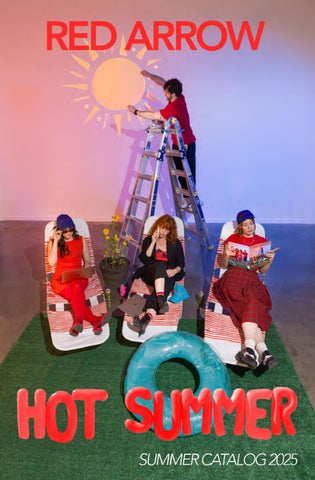
Red Arrow is pleased to present the third installment of our annual summer group exhibition. This year, the show—renamed HOT SUMMER—takes on a new form, departing from the gallery walls and moving directly to your home via an old-school, JCPenny-inspired catalog!
Previously titled Nashville Hot Summer, this year’s iteration sheds its geographic anchor to reflect a more fluid and mobile presentation.
This issue runs from July 21st through August 31, 2025, and features the work of 14 artists based across the globe—from the UK to Nigeria, and of course, Nashville, TN. The selection highlights both foundational relationships within the gallery and newly emerging voices.
The curatorial approach is guided by one shared conviction: the work is burning hot with vitality—bold in concept, rich in execution, and ready to be seen. We’re thrilled to share it in this summer group show format.
For inquiries or additional information, please email info@theredarrowgallery.com
HOT SUMMER ARTISTS:
Eleanor Aldrich (Albuquerque, NM)
Marlos E’van (Nashville, TN)
Linda King Ferguson (Marquette, MI, and Nashville, TN)
Lauren Gregory (Nashville, TN)
Brett Douglas Hunter (Nashville, TN)
Duncan McDaniel (Nashville, TN)
Johnson Ocheja (Kaduna, Nigeria)
Charlie Oscar Patterson (Kent, United Kingdom)
Jocelyn Reid (Fayetteville, AR)
Jacob Rochester (Los Angeles, CA)
Moises Salazar (Chicago, IL)
Margaret R. Thompson (Santa Fe, NM)
Mathew Tom (Brooklyn, NY)
Demetrius Wilson ( New York, NY)
Charlie Oscar Patterson
Charlie Oscar Patterson simultaneously produces multiple bodies of work that embrace the history of modernist painting, they are a continuation and combination of minimalism and abstraction that merge sculpture with painting.
Downplaying the decorative qualities of the canvas while at the same time playing on its physicality, Patterson leads us on a journey to discover new perceptions of space and light.
While colour is one of Patterson’s foremost visual markers, each artwork plays a “sound” through rhythmic intervention, and their movement through time is captured by the shifting light. In Patterson’s work, light becomes a conduit, a vehicle for transporting colour from the smooth surface of the object to our discerning eye. His deep fascination with colour is first and foremost an exploration of light since light is colour. Building up many layers of dense oil paint, Patterson cleverly focuses on the use of a single colour tone to emphasise the work’s surface as well as its highlights and shadow - the canvas brought to life as you move around the artwork and the light changes. This focused combination of colour and shape speaks to his concern with emphasizing the physical presence of the artwork itself, rather than an expression of the artist’s voice – his monochrome pieces are a great example of this.
In Patterson’s work light completes the artwork and at the same time transforms it. One can better understand Patterson’s practice by perceiving light more like sound. In the same way you make an instrument to produce a specific sound, Patterson’s artworks are instruments that play the light. Describing his artistic process, Patterson reflects that, “building the frame is like writing the score and painting is like playing for the first time.” Like the keys of a piano, the three-dimensional extensions of the canvas act as tools for Patterson to play with light, o ering infinite possibilities and variations of shadow and tonality. Composing his artworks like a musical score, Patterson’s architectures become instruments that can be heard playing solid rhythms of colour to the beat of light and shadow. Patterson’s work is experiential. Through his gesture the work becomes an object, an installation – it acquires a certain presence that involves the spectator as they share the same space.
Whisky Story Time
Oil, wax, collected earth on canvas
48 x 36 in (121.92 x 91.44 cm)
$6,500.00
Margaret R. Thompson
“I build worlds through my art that are tributes to my interest in the sacred - a universal sacred that exists in the corners of our psyches. The subjects I paint live between our physical realm and spaces beyond the categories of known experience. They are unrestrained, undefined, and free. There is a strange beauty I aim to capture in the life of each piece, an awareness of the 'unseen world' going on at all times, all around us.
I use oils, wax, raw pigments, earth, and various surfaces to build narratives in my work that embody the soul of a memory. In a way, each painting is a documentary that memorializes the life force of a moment, real or imagined- I never want to forget. The human relationship to nature is palpable in everything I create. Having lived in and constantly in awe of the coastlines of Northern California, the jungle of Mexico's Yucatan, and the high desert of northern New Mexico, I make art that asks us to appreciate the magic of creation.
The work combined as a whole is my worldview, my constant project. It strengthens my connection to the world. My practice is aspirational, rejecting basic conventional modes of living for a more utopian existence where dreams, nature, curiosity, and spirit coexist as our highest values.”
-Margaret R. Thompson
Jacob Rochester
Use my heart, use my mind, use my hands (Diptych)
2025
Oil on canvas
30 x 64 in (76.20 x 162.56 cm)
$7,200.00
Harmony I’ve found within (Diptych)
2025
Oil on linen
71 x 38 in (180.34 x 96.52 cm)
$7,500.00
Equivalence / Go To
and acrylic on linen 16 x 12 in (40.64 x 30.48 cm)
$2,000.00
Equivalence / Copacetic Notions
x 30.48 cm)
$2,000.00
“As a painter who believes in the language of abstraction, I think of my works as emotive social bodies. My 2025 Equivalence Series mingles graphic planar painted forms with hard edges among gradated hued and stained atmospheres, flirting with suggestive relations and tellings. Although Roland Barthes spoke about humanity’s general condition, writing, “work is a defense against mortality”, personal experiences that created ruptures such as cancer, Covid isolation, and physical displacements give a curative subjectivity to my practice, which employs techniques that reveal and conceal.
Trauma and mending pose questions about the tension between the duality of strength and vulnerability, and their counterparts of disability and healing and hope, and generosity. Careful labor and construction give way to transformative states that translate the circumstances of a changed life with shifting social conditions into an abstracted language with mnemic traces.”
-Linda King Ferguson
Linda King Ferguson
“Made in a series, this sculpture is part of a body of work that addresses three common fears that many femmes hold at some point in their lives. Blindfold is about being alonebees, some of the most communal insects, adorn the entire work. High on the chain that the sculpture hangs from, four charms spell a word – MISS - almost indecipherable due to their tiny size. This refers to the multimeaning of the word. It's a title for a single woman, a word describing a failure, and a term to talk about longing for something or someone.”
-Jocelyn Reid
Three Fears (Blindfold)
NewArtist Alert
Tears, Blood, Sweat (Apple)
Wilson’s work stems from a place of personal biography and collectively shared experience. Finding both moments of stillness and activity, his work constantly adapts while it moves through pockets of the whole. Flirting with the idea of location, there is a feeling of impermanence and abstraction in Wilson’s paintings, while the colors tell stories of figures and landscapes that have yet to be concretized or revealed. Wilson describes his paintings as working through a process of displacement and is interested in how time can be handled. His paintings do not take on the task of blending time, specifically past and present, but rather distort it to challenge one's visual field and comprehensive capacity to identify breaks in time. Adaptation is therefore a major theme in the artist’s current body of work. Specifically, Wilson adapts through the linguistic and interpretative relationships set up by color. Color alludes to persons, but also other things, other contexts, like the environment itself.
In Wilson’s paintings, he is reforming and revising combinations of words, pictures, past and present paintings, images, and moments, all in hopes of constructing something that is dressed in ambiguity while screaming its essence and everything that has aided its form. Viewing the world through a fragmented lens, in large part due to his turbulent upbringing due to moving around extensively, is vastly prevalent in his practice. Never resting for too long, always on the move, and active.
Demetrius Wilson (B.1996, Boston) currently lives and works in New York City. Wilson completed his MFA at Hunter College,
Demetrius Wilson
’24.
Eleanor Aldrich
Nancy and the Pink Raft
Tied Hands, Friend, and Spector
2024
Oil and enamel on canvas
48 x 36 in (121.92 x 91.44 cm)
$5,400.00
“My work plays with the tension between a depiction of the thing and the thing itself. I use thick textural materials which have an undeniable reality to them in the way they interact with actual light and shadow. Much of my work seeks to undermine or circumvent realistic rendering by using elements of low-relief. The fact of the material creates tension when combined with pictorial rendering. The physicality of the material invites the empathy of the body and is at times funny, beautiful, revolting, and satisfying. The materials are metaphoric of the messy reality of the body, risk, conformity, and issues of control. I attribute my appreciation of mystery and the possibility of transformation in my work to my Catholic upbringing, in which materials were transformed and images held power over life.
The subject matter in this body of work is primarily taken from Nancy Drew and other similar book covers; the girl sleuth is posed partially mugging for the viewer, and partially involved in her surroundings. I use a grooved trowel to rake paint into cross-contours to form female torsos, limbs, and hair. The immediacy of this technique pushes against traditional associations of slowly built-up oil paint, but retains its richness. The thickness and illusion of form this creates belies the fact that there is no skin or body— just the textures of hair and clothing, and the body of the paint. Her meetings with unknown spaces, shadows of strangers, and even ghosts function as kitchy metaphors for my own anxieties. Like traditional images of girls and women in art, she is a subject/object on unfriendly ground. In my work, the subject is in quiet rebellion— the illusion of form attracts the viewer, but o ers an external shell in lieu of flesh, and there is a feeling of excess and an element of risk that hints at barely controlled femininity”
-Eleanor Aldrich
Marlos E'van
Marlos E’van (b. 1988) interweaves di erent media such as painting, performance, and filmmaking, creating worlds in which their art recollects cultural histories: joy, pain, celebration, sorrow, and complex emotions from reenacted scenes of American narratives. Marlos’ work is inspired by cult films such as Robocop, Total Recall, and Terminator, which blend fiction set alongside backdrops of dystopian landscapes and alternative realities that speak to long-standing American social problems. Evan’s use of found materials, obsessive mark making, text, and hyperbole encourages dialogue among di erent classes and demographics. The symbols they use, such as historical figures, clowns, and fast food elements, are commonly found in the history of Western civilization; these symbols cross-examine stereotypes and institutions that allow certain inequalities to thrive. By changing the context of these elements, E’van transforms them into instruments of meaningful reflection and understanding. By
“I used to live in India. In India, the gods live in the mountains, it's a holy place that you cannot enter. I like this idea of a hidden, special place where your imagination can run wild. Holy Mountain is the name of my favorite movie. It's by Alejandro Jodorowsky. It's about transformation.”
-Mathew Tom
Mathew Tom is a painter based in Brooklyn, New York. He holds a BFA in Painting from the University of Central Florida, a Post-Baccalaureate Certificate in Painting from the School of the Art Institute of Chicago, and an MFA in Fine Art from Goldsmiths, University of London.
Tom has been awarded several prestigious fellowships and residencies, including the Starr Fellowship from the Royal Academy in London, the Whisper Residency at the Centre for Chinese Contemporary Art in Manchester, and the League Residency at Vyt from the Art Students League of New York.
He has exhibited his work internationally, with shows in the United States, England, Wales, Spain, the Netherlands, Denmark, South Korea, Taiwan, and India. His solo exhibitions have been held at the Royal Academy of Arts in London, Christine Park Gallery in Chelsea, New York, and at The Hole in Tribeca, New York.
Holy Mountain (Blue) 2023
Oil on linen 41 x 41 in (104.14 x 104.14 cm) $12,000.00
Mathew Tom
Duncan McDaniel
Duncan McDaniel (B. 1982) is a Nashville-based multidisciplinary artist whose vibrant, layered works explore the intersection of light, color, and form. Drawing from a wide range of materials—paint, found objects, plexiglass, and sculptural elements—McDaniel creates immersive visual experiences in a variety of mediums, from painting and drawing to public art and site-specific installations. He has exhibited at The Red Arrow, OZ Arts Nashville, The Parthenon Museum, and Elephant Gallery. McDaniel’s work is featured as permanent installations at The Nashville International Airport, at the Finery Development in Wedgewood-Houston, along with other public and private collections across the US.
and Pandrossos
Just the Two of US 2022
Glittler on canvas, fabric, yarn, sequin
46 x 36 x 2.50 in (116.84 x 91.44 x 6.35 cm)
$6,500.00
Moises Salazar
“Growing up in Chicago to immigrant parents, I experienced firsthand the instability of living in the United States and the violence one can face. I dedicate my practice to advocating for the communities I am a part of, and my paintings act as a visual exploration of my interest in Colonial, Mexican, and Catholic histories, primarily alongside LGBTQIA+ narratives.
My existence as a non-binary first-generation Mexican American creates a state of conflict within my identity, and this tension is the most prevalent influence in my practice. As a queer person who is also a New American, my lived experience has been one of constantly combating instability, discrimination, and erasure.
Using glitter, a material often stigmatized, I create depictions of queer and immigrant bodies. With my own likeness as template, I create faceless figures serving as a stand-in for any queer Latinx youth. The figures I paint are proudly defiant and glamorous. Inspired by fashion and drag culture, I use a myriad of embellishments, fabrics, and textures combined with traditional Mexican craft techniques.
Through this process, the bodies I paint become immortalized to combat the erasure of these communities and transform that pain into healing and restorative energy.”
-Moises Salazar
Lauren Gregory
Lauren Gregory (she/her) is a painter, animator, director, and quilter who is best known for her technique of oil paint stop-motion animation, a way of making her paintings move. Born and raised in the mountains of East Tennessee, she began as an observational portrait painter, capturing friends and family in quick one-session sittings. Lauren is the third in a lineage of southern female painters, following in the footsteps of her mother and grandmother.
She received an MFA from the School of the Art Institute of Chicago in 2009, and since then has created GIFs, looped video installations, and narrative animated shorts that have screened at MoMA P.S.1, the New Museum, MOCA Los Angeles, and at film festivals around the world. She has directed and animated music videos for
part of Lauren’s practice in recent years especially since moving back down south.
She teaches Experimental Animation at Parsons School of Design and teaches quilting at Ox-bow School of Art. She is represented in New York by the Elijah Wheat Showroom and in Nashville by Red Arrow. Lauren lives and works in Nashville, Tennessee.
The End of the Tunnel
My friend beside our church
Johnson Ocheja
Born in 1993, Johnson Ocheja originates from the culturally rich Kogi State, Nigeria—a region nestled between Nigeria's powerhouses, Abuja and Lagos, and graced by the confluence of the Benue and Niger rivers. This dynamic region is also the heartbeat of the Igala ethnic community, to which Johnson proudly belongs.
Johnosn is a self-taught painter who focuses on portraiture. Johnson honed his craft through avidly consuming YouTube tutorials. His signature style involves meticulous depictions of black individuals using a prominent blue hue. Occasionally, he employs an impasto method, applying acrylic or oil paint directly with his fingers. This creates unique patterns on his subjects' skin, evoking images of scarification, a timeless African cultural tradition signifying a iliation or rites of passage.
For Ocheja, art transcends mere self-expression—it's a vibrant dialogue with the world. His pieces not only celebrate black beauty and consciousness but also resonate with the multi-faceted narratives and diversities in today’s Nigerian society, a society steeped in historical richness and teeming with cultural, political, religious, ethnic, and racial vibrancy.
Brett Douglas Hunter
Brett Douglas Hunter is a sculpture artist who creates colorful, whimsical sculptures using papercrete and various industrial materials. Forever inspired by his family of self-propelled artists and builders, Hunter continues to dive further into the world of sculpture and oddball furniture making. His practice was recently featured in Hi-Fructose Magazine, and Hunter's work can be seen at Franconia Sculpture Park in Minnesota, yearly installations at the Bonnaroo Music and Arts Festival, or his campsite-for-rent on his home property outside of Nashville, Tennessee.