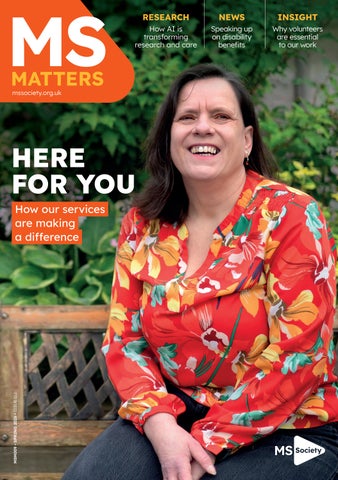
MS Matters Spring 2026

Page 1


Cover photography: Anthony Cullen
MS Help Hub

Latest info

Disabled Person’s Railcard

Proof of an MS diagnosis is enough to qualify for the railcard. We now explain what to do if you’re asked for extra details. Search ‘railcard’ on our website for our train travel information.

We’ve reviewed and rebranded our ‘Just diagnosed’ booklet.

Online, you can find updated information about: fatigue childhood MS fasting and MS (PDF factsheet)

And the disease modifying drugs: ublituximab (Briumvi) alemtuzumab (Lemtrada) teriflunomide (Aubagio)

There are new expert blogs from healthcare professionals on: Five signs of MS foot drop and how orthotics can help and Have I got anxiety or MS tingling?

Find all this and more at mssociety.org.uk

If you’re not online, call our MS Help Hub on 0808 800 8000.

elcome to our Spring 2026 issue of MS Matters. In this issue, we’re focusing on services for the MS community.

In April we launched MS Help – the new way we’re working to deliver our services and support (see page 14).

This connects all our UK-wide, digital and community services and makes it easier to find the support you need.

Last year I was involved in our ‘community listening sessions’ where we reached out to our volunteers and people who use our services. We listened to your views on what we’re getting right and how we could do better. These conversations have helped us shape MS Help and improve service delivery for everyone affected by MS.

We’ve also spoken to volunteers and people who use our services for this issue of MS Matters to find out what they value most about

them. On page 18, Fiona, our cover star, talks about why she enjoys volunteering at MS Society information events. And Rhyiza and Toria talk about how our website information and LivingWell webinars have supported them.

We look at how research turns into real-world services for people with MS (page 30) and how artificial intelligence (AI) is transforming MS care and research (page 34).

We hope you enjoy this issue. If you’d like to share your story or experiences, please get in touch at msmatters@ mssociety.org.uk

Play the MS Society Lottery! Enter our Weekly Lottery to be in with a chance of winning up to £10,000. There are great cash prizes to be won, so don’t miss out on a chance to win big. Plus, with every entry, you’ll be helping to fund ground-breaking research and vital services for people with MS. Enter online from just £1 a week at mssociety.org.uk/weekly-lottery

Income from advertising and inserts included in MS Matters goes towards the magazine’s production costs, such as printing and postage, leaving more of the charity’s money available to help stop MS. Advertisements must conform to the British Code of Advertising Practice. Some of the products and services advertised in this magazine may be of interest or benefit to people in the MS community. However, their inclusion does not imply endorsement by the MS Society, and we cannot guarantee their quality. We recommend doing your research before making any decisions or purchases to ensure they are right for you.

#MS Think Again: challenging assumptions and raising awareness

MS Awareness Week is just around the corner, from 20 to 26 April 2026.

This is our biggest opportunity of the year to shine a light on what it’s really like to live with MS. Our goal is to raise as much awareness as possible among the public, while also bringing the MS community together.

Once again, we’re teaming up with our friends at MS Together, MS Trust, MS-UK, Neuro Therapy Network, Overcoming MS, Shift.ms and Talks with MS.

Together we’ll be hitting back against MS assumptions and the harm they can cause. We worked with a group of volunteers from our MS community to come up with this theme. They told us that

incorrect assumptions about MS can lead to real-life consequences. From being underestimated at work to being harassed for using a disabled parking space.

So this MS Awareness Week we’re encouraging the public to listen, learn, and think again before saying something that could hurt or have a negative impact.

We’ve surveyed our MS community to find out more about assumptions, misconceptions and the impact they have. We’ll be sharing the results from 20 April, along with people’s stories, information and resources. Also, keep your eyes peeled for stories in the news and on social media.

Treasa Anderson, who lives with relapsing remitting MS, said “Taking part in a focus group with others living with MS feels important to me. It makes sure people with lived experience have a genuine voice in shaping the work of MS charities. Co-production matters because decisions are stronger and more meaningful when people directly affected are at the table.

“While sharing experiences of MS can be emotional, it’s also incredibly powerful and uplifting to connect with others who truly understand the journey. Bringing charities together around a common goal strengthens that impact even further. It gives us the chance to challenge the myths, assumptions and judgments that are often made about MS by people who don’t live with it.”

We want this year’s MS Awareness Week to be the biggest one yet. But we need your help. Visit mssociety. org.uk/msaw to find out how you can get involved and use the hashtag #MSThinkAgain

Shaping campaigns and speaking up in parliament

We’ve launched a disability benefits panel to support our campaigning work.

In 2026, we’re working with a panel of people with MS to shape our campaigning on disability benefits. The panel is made up of 24 people from across the UK, of different ages and with different types of MS.

The group will share experiences of Personal Independence Payment (PIP) and Scotland’s Adult Disability Payment (ADP). They’ll help develop campaigns to improve disability benefits. This builds on our campaign win last year to protect PIP, which safeguarded over £100 million a year in payments for people with MS.

Rob, who has MS, joined the panel in December. Speaking about the importance of improving disability benefits, he said “Just because various symptoms are not present during a single, one hour assessment doesn’t mean that person doesn’t need support. This should never lead to a simplistic assumption about the ongoing pain, lack of mobility and host of other symptoms that people with MS deal

with as part of their daily life.”

Sharing insights with politicians

It’s also important that our campaigning voices are heard in parliament. That’s why we support the All-Party Parliamentary Group (APPG) for MS. This is a group of MPs and Members of the House of Lords from different political parties, all with an interest in MS. We share insights from the MS community with the APPG, and the group facilitates events that highlight our latest research and policy developments. This helps make sure APPG members can speak up more effectively about MS in parliament.

disability benefits panel member

Oliver Ryan, Chair of the APPG and MP for Burnley, shared

what motivates him to speak up for people with MS: “I came to appreciate the vital sense of community the MS Society fosters for individuals like my mum. These experiences instilled in me a lifelong commitment to helping others affected by MS.”

Ahead of the elections in Scotland and Wales, we’re calling for the next government in each nation to commit to a fairer, healthier future for people living with MS. Will you join us and add your voice to the campaign?

Sign the pledge today at mssociety.org.uk/ wales-elections and mssociety. org.uk/scotland -elections

Oliver Ryan MP (back centre) with attendees of the APPG meeting on clinical research

Stop MS Appeal: what we’ve achieved

Our 10-year fundraising appeal is having a lasting impact on MS research.

The final total for our Stop MS Appeal is in! Thanks to our supporters, we raised an incredible £101.9 million for MS research.

The Appeal has allowed us to make bigger, bolder investments in MS research. We’ve invested in and strengthened every stage of the research pipeline, from groundbreaking experimental work to world-leading clinical trials.

Dr Emma Gray, our Director of Research, said “Today, we have late-stage clinical trials underway for all types of MS. That would’ve been hard to imagine a decade ago.

Clinical trials

26 clinical trials supported

1,413 months of research funded as part of clinical trials

3,631 people recruited onto clinical trials

Early Career Researchers

More than 4,000 people signed up to participate in the Octopus clinical trial

240,210 hours of research funded as part of clinical trials

40 PhD students funded and funding leveraged for a further 8

34 research projects awarded to support Early Career Researchers totalling over £4.7M d

re We n

“Perhaps what I’m proudest of is how the MS community has stepped forward. Thousands of people have

“We’ve built a level of coordination and focus around progressive MS that simply didn’t exist before. And we’ve created the infrastructure to keep testing treatments until we find the ones that will truly transform lives.

signed up to take part in trials. We now have a trial-ready community, united by hope and a shared belief in progress.”

For more than a decade, the Stop MS Appeal has funded cutting-edge research and brought us closer than ever to stopping MS. But the

journey can’t stop now. Until we can stop MS for everyone, we need your continued support to fund the next breakthroughs and help create a world free from MS.

Read more about the impact of our Stop MS Appeal at mssociety.org.uk/ impact-report

• UK’s only wheelchair accessible car

• Rear entry with manual tailgate and ramp

increased headroom

• Front parking sensors,

Ford Connect: 3 Flexible WAV Solutions

Rear Passenger

• Rear entry with manual tailgate and anti-slip ramp

• Flexible seating and inclusive wheelchair position when seats are folded

• Exceptional build quality with optimum interior space and headroom (145cm)

• Navigation, Apple Car Play, Android Auto and Bluetooth

Upfront Passenger

• Travel upfront next to the driver

• Side entry with a manual ramp and sliding door

• Front and rear parking aids, air conditioning, DAB radio with 10” touch screen

Drive From/ Upfront Passenger

• Drive directly from your wheelchair

• Swap easily between driving and upfront passenger positions

• Rear entry with manual or automated tailgate and ramp

• Two rear fold down seats and exceptional interior headroom

Challenge MS in 2026! Activities

Would you, a friend or family member like to fundraise for us at work?

We’re inviting you to take part in our employee fundraising challenge in your workplace to support people affected by MS. Gather a team of colleagues together to join an MS Walk, climb a mountain or take part in an overseas adventure. Challenge events are the ultimate team-building exercise, with exciting minichallenges and prizes thrown in along the way. Your team will compete with other companies to top

our 2026 Challenge MS leaderboard.

You and your team could: climb a mountain (Yr Wyddfa or Ben Nevis are highly recommended) take on a long-distance hike walk, roll or stroll on one of our incredible MS Walks choose from lots of other challenges, including cycle rides and runs. It’s up to you!

We’ll also provide support to help you challenge perceptions about MS in your workplace.

And if your company can match employee fundraising, your efforts could raise even more!

Interested in getting involved?

Email us at mscorporate@ mssociety.org.uk or visit mssociety.org.uk/challengeMS

Diary dates

Webinars

Cake Break

June

Host a Cake Break with friends, family or at work and make every slice count to stopMS.

Email fundraising@ mssociety.org.uk

Zip It For MS

Saturday 6 June

Take on the challenge of the UK’s highest zipline and help stop MS.

Email fundraising@ mssociety.org.uk

MS Walk

Various dates

Join us in one of six cities to walk, stroll or roll 5, 10, 15 or 20k and raisefunds. mssociety.org.uk/ ms-walk-2026

Great North Run

Sunday 13 September

Take on the iconic Great North Run half marathon this autumn. mssociety.org.uk/ gnr-2026

Friendly Shoes webinar

Thursday 30April, 6.30 to 7.30pm

Our partner Friendly Shoes will talk about adaptive footwear and why it’s important for people withMS. mssociety.org.uk/ friendly-shoes

World MS Day webinar

Thursday 28May, 6.30 to 7.30pm

We’re celebrating World MS Day by hosting a webinar to showcase what’s new in MS research. mssociety.org.uk/ world-ms-day

Find out about our programme of webinars and events, including our monthly peer group sessions, at mssociety.org.uk/ living-wellprogramme

Introducing MS Help

We’ve launched MS Help to connect all our UK-wide, digital and community services. Gavin Atkins explains how it will help us support you better.

What is MS Help?

MS Help is the new way we’re working to deliver all our services and support. It’s about building an ongoing relationship with you so we can offer you the right services when you need them. It’ll make it easier for you to find trusted information, expert guidance and personal support.

Why are we making these changes?

We’ve developed MS Help after listening to the MS community. You told us you value our services – but that it can be hard to find the support you need. Our services weren’t joined up.

So the first thing we’re doing is making our services easier to navigate. In the next couple of years, we’re working hard to improve our existing services and develop new ones to meet your needs.

Will volunteers still deliver MS Society services?

Yes. Our 3,000 volunteers will always be so important to everything we do. Volunteers help design and deliver our UK-wide services, like our LivingWell webinars and our befriending service. And our 235 local groups offer more

than 1,000 services, including physical activity classes and social events. Part of MS Help is about supporting volunteers better.

How will MS Help support people to live well with MS?

The first thing you’ll see is our new ‘MS Help Hub’. This provides a simple way for people to access our services. It brings together all our support to help you live well and maintain your physical, emotional and financial wellbeing.

It’s a single point of contact. That means you’ll connect to the MS Help Hub, no matter if you phone us, email us, or use our new webchat. We’re launching webchat in April for people who want to speak to us online.

From the Hub, you can find information, and we can signpost you to any of our UK-wide, digital or local community services.

What can people expect when they contact the MS Help Hub?

You can expect the same warm welcome and the listening ear we’ve always offered. But we’re going to

MS Help Hub Emails MS Society
Benefi advicets

Elizabeth

Elizabeth is in her fifties and has been living and working with MS for a number of years. She now needs to use a wheelchair most of the time and will need to reduce how much she works. She needs benefits advice to make a realistic plan.

Easy to contact

I couldn’t really find the information I needed from my own search online, but then I thought... I should email the experts... the MS Society. The email address was very easy to find, and because I was emailing, I could include a lot of detail.

A seamless service

Within hours I had an email back from the booking service with some dates to speak to a benefits advisor. They also included some supporting information for me. This really helped to prepare me for the appointment. The advisor was excellent, clearly explaining everything to me and laying out my options.

I feel confident

The care I felt in my conversations with the MS Society and the information I got from the benefits advisor have filled me with confidence. I feel ready and prepared for the next chapter in my work life.

Check-in call to make sure they have all they need

do some things differently. That includes inviting you to share your data with us. This way, you’ll only have to tell us your story once. It’ll mean we can tailor our support, recommend services and check in with you to see if the service has helped.

Of course, you can choose not to share your data. You’ll still get the same high-quality support, but we won’t be able to refer to any information you’ve previously shared with us.

Are there other changes people will notice?

On our website, the MS Help Hub will make it easier to find information about local events and services. We’re also introducing new ways for our volunteers to share information. This means you’ll have a much smoother experience of moving between national and local services. And when you get in touch, it’ll be easier for us to find the right support for you.

Can people still contact their local group directly?

Absolutely! If you already know what support you need and where to go for it, that’s great. But if you don’t, the MS Help Hub is a starting point. It’s here to make it easier to access our services, recognising that everyone’s experiences are different.

Making sure MS Help works for you

Marie Nixon has volunteered with us for 26 years, alongside her husband Stuart, who has secondary progressive MS. Marie has been closely involved in developing MS Help. As one of three community representa-

Over the years, I’ve had . MS Help Hub

tives, she’s been making sure the voices of people affected by MS are heard. What interested me about MS Help is that it’s designed to tackle everything at once, rather than in siloes. It’s about how the MS Society can support people affected by MS to live the best lives they can.

Harmony

Harmony is in her forties and has just moved to a new area. She misses the MS community and friends she left behind. She wants to connect with her new community.

Location search

One of my friends is an MS Group volunteer. They told me community events are promoted on the MS Society website. I discovered local activities to help manage my MS, but no coffee morning.

Volunteer support

I decided to set up my own coffee morning. With support from my local MS Help Team, it was easy to set up an event and share it with my local community.

I

feel

at home

It was a great success! The new friends I made have helped me feel at home.

many conversations with people about how they live with MS and what they need day-to-day. I’m a physio, so I also see things from the perspective of healthcare professionals.

Listening to the community

My role in developing MS Help has been to ask “How have we involved people affected by MS?” That’s because people

who use our services must be at the centre of everything. We’ve got to ask “How easy is it for them to pick up the phone, turn on the laptop,

Elizabeth and Harmony’s stories are based on the experiences of people who have contacted the MS Help Hub.

or have a conversation with somebody?” We’ve got to make sure it works for everyone, no matter what level of disability someone has. We’ve looked at lots of research with our community. And last year we ran 28 listening sessions across the UK, where we spoke to volunteers and members of the MS community. We’ve presented our ideas, and asked “What have we forgotten? How can we improve this?”

Remaining relevant

The new MS Help Hub will mean people can get support and information more easily than before. It’ll take away the fear of being passed from one person to another. And it’ll keep evolving so we can make sure it remains relevant and useful.

So, please, get in touch! Whatever support you need or questions you have – and there are no stupid questions – we’re here for you.

We’d love to hear what you think of the new

so we can keep improving it! Visit our website at www.mssociety.org.uk/mshelp to use our new webchat. Call us on 0808 800 8000 or email helphub@mssociety.org.uk

Here for you How our services are making a difference

As

we make all our services easier to find through MS Help, three people with MS explain why they’re important.

Information events are really worthwhile

Fiona was diagnosed with relapsing remitting MS in 2002 and started volunteering with her MS Society group in Braintree four years later. She’s now a Regional Development Events Volunteer for the East of England.

I went along to my first local group meeting in 2006. I’d got to the stage where I wanted to meet other people who had MS.

While I was there, the group’s Treasurer said they were stepping down. They asked if anyone was prepared to take over, and I put my hand up. I took on the newsletter and Facebook page as well.

I also started helping with a six-week course called

‘Getting to Grips’. It was run in Essex for people newly diagnosed with MS and their families. I liked seeing people who’d never been to an MS event before start to relax and feel glad they came. And linking people up with others in the same situation so they could start to form a friendship.

In 2023, I decided to step down from my role at the Braintree group. That’s when Gina, the Regional Development Officer, told me about the new role, which involves organising information events across the East of England.

Flexible volunteering Gina and I organise events on different topics, from what to do when you’re newly diagnosed to understanding benefits. The role is very

flexible, with one event every couple of months.

It’s lovely meeting people from different places and hearing how they’re dealing with their MS and sharing my own experiences. I have a lot of knowledge to pass on from supporting so many people with MS!

Last year, I volunteered at a ‘community listening session’, which was part of the project to develop MS Help. People with MS came along because they wanted to help shape the future of the MS Society. One thing that came out of these sessions was that people said the events Gina and I organise are really worthwhile. There wasn’t much information out there when I was diagnosed. It’s so great to know people are getting the information they need now.

I have a lot of knowledge to pass on from supporting so many people with MS!

I met an incredible group of people

Toria, a secondary school geography teacher, was diagnosed with relapsing remitting MS in 2018. Our LivingWell webinars and online courses helped her accept her diagnosis and learn how to manage her MS.

When I was diagnosed, I went into complete denial. I wouldn’t acknowledge it or talk about it with anyone, including close family. I just couldn’t get my head around the diagnosis.

The first time I did something about it was in March 2020. I was struggling with fatigue and I found the MS Society’s online fatigue management webinar by chance.

It was fascinating. They had an expert talking about fatigue management. There were also volunteers who talked about how fatigue affects them, and what works and what doesn’t. It was the first time I’d listened to someone else who also had MS. I realised I wasn’t alone.

After that, I did a lot of the LivingWell courses and webinars. After completing the newly diagnosed course, I finally started talking about my MS. It was a huge step for me to realise that people wouldn’t perceive me as broken.

The cognition webinar blew my mind. I thought I’d been going bonkers, forgetting words and names, and losing things like my keys. I was getting really stressed about it. The combination of the expert’s knowledge and the volunteers’ tips revolutionised my approach to managing my MS.

Reasonable adjustments

During a webinar on employment, I found out I was entitled to an occupational health assessment. Since then, my school has been brilliant. They’ve made reasonable adjustments, like a reduced timetable. One of my biggest issues is balance. I have a classroom on the ground floor, next to an accessible door and toilet, and close to my departmental office.

Through the courses, I met the most incredible group of people. We laughed and talked, and my confidence really started growing. In March 2021, I gave an online talk to my Dad’s Rotary Club about MS. It was like a coming-out party! I’ve also done some fundraising for the MS Society, including a skydive and a year-long 1,500-mile walking challenge.

I’m now a LivingWell volunteer, helping deliver courses and webinars. I got so much out of them and wanted to give something back. My role is to share my experiences and keep the conversation going. I really enjoy it. If you can make a difference to even one person, that’s such a positive thing.

If you can make a difference to even one person, that’s such a positive thing

The website was like my guidebook

Rhyiza, who has primary progressive MS, was diagnosed the day before her 26th birthday. She turned to our website, community forum and LivingWell webinars for information and support.

I’d had symptoms from the age of 12 or 13 – mainly severe pain in my legs. But it was put down to growing pains and, later, anxiety. So I was shocked when I got my diagnosis, but also relieved that my symptoms could be put down to a condition.

At the time, I didn’t know much about MS. I’d heard of it because one of the characters in the TV soap ‘Neighbours’ had it. But that was it.

The MS Society website was like my guidebook. My MS nurses referred me to it and told me about the information booklets. There’s one for when you’re newly diagnosed and there was one on different drugs you can take. This was invaluable because I was coming from a place where I had no understanding, and the drug choice was mine to make.

Information on sleeping and how exercise can help you sleep better has also been really useful. I’m up a lot at night with leg pain, so it was good because it made me start doing things to help myself.

A kind place

The forum was really good as well. I could look at the booklet for the facts and then go onto the forum to see how people had found different medications. It was good to have both the factual information and people’s personal experiences. It also felt like a kind place to be, which made me feel a lot better.

I’ve also done some LivingWell webinars. I went to

the newly diagnosed webinar, one about the Octopus trial and one on working and MS. And my Auntie Caroline has called the helpline [now the MS Help Hub]. She keeps up to date on clinical trial information and wanted to check something she’d read.

I’m thankful for how the MS Society’s services have supported me. It’s helped me realise life isn’t over. You can still do the things you want to do, at your own pace.

If you’d like to know more about any of our services, please visit our new MS Help Hub. You can call us on 0808 800 8000 and email us at helphub@mssociety.org.uk

To use our new webchat, please visit our website at mssociety.org.uk

You can also search for local services and support at mssociety.org.uk/near-me

So much effort goes into the smallest of tasks

Actress Gillian Wright is best known for playing Jean Slater in EastEnders. Her sister Lois, a teaching assistant, has secondary progressive MS. They talk about their close relationship and the challenges Lois faces.

Lois says “I was diagnosed with MS in the early 1990s. I managed my MS on my own for a long time. I didn’t tell anyone because I didn’t want people to feel sorry for me. When I had relapsing remitting MS, people wouldn’t have known that anything was wrong.

“When I was pregnant with my son Stan, my symptoms cleared up. I didn’t have anything for about five years. But when Stan started school, and I got a new job as a teaching assistant, it started again. It was Gill who noticed that I was limping. It took 11 years of sheer determination and effort to continue walking, with a stick and a frame, before needing a manual wheelchair.

“Work is important to me. Without it, life would be very

insular. I teach with my voice alone, having lost the ability to demonstrate with my hands. I’ve adapted my teaching over the years as my MS has progressed. It’s frustrating.

Getting carers in “I’ve always battled with my MS, determined to keep my independence,

leaving everything – like getting an electric wheelchair and carers – to the last possible minute. Now I have carers four times a day. They are a huge part of my life, spending five hours a day with them, which is more than some people spend with their families. It’s difficult.”

Gillian says “One thing I admire about Lois is her determination to keep doing what she’s able to do, while she still can. She’s a single parent and brought Stan up mostly on her own while coping with secondary progressive MS. Her life is very hard. So much effort goes into even the smallest of tasks.

“The most difficult thing from my point of view is the feeling of helplessness. I often wish I could wave a magic

Lois with her son Stan as a baby

Changing attitudes towards mental health

Gillian plays the character of Jean Slater in EastEnders who has bipolar disorder. She has won numerous awards for this role.

Gillian says “Jean is a very interesting character to play because she can turn on a sixpence – up one minute and down the next. When I started playing

You can see Gillian’s handmade bags on her Instagram @handmade betweenscenes

her 21 years ago, bipolar disorder wasn’t talked about much. Sometimes, people would shout out derogatory comments, but I’ve seen a change in attitudes over time. Now people come up to me and say ‘Thank you. I don’t feel so alone now. There’s somebody like me on screen.’ This matters to me.”

wand. It’s hard not having a solution.

“Lois is my best friend. She’s funny, courageous, supportive and patient. There are some big things we miss that we used to do, like going on holiday together.”

Lois says “Gill is multitalented. She is a fantastic, versatile actress. I’ve seen most of her work over the years in theatre and television, not just EastEnders. Her creativity knows no end! She can draw, paint, cook and bake. Every week she brings me homemade food, with veg from her allotment, for my freezer.

“Whilst she’s waiting backstage or on set, she knits and felts bags and makes blankets to sell at arts and craft fairs, raising money for MS charities. Above all, she has absolute integrity in everything she does.”

If you’re looking into getting support from social care services, find out more at mssociety. org.uk/socialcare-services

Gillian and Lois at the ‘Banksy Limitless’ exhibition in London

It’s a chance to bring hope to others

Living with MS can feel uncertain, but planning ahead can bring peace of mind and the power to change lives.

We can offer practical support to help you prepare for the future, including a free will-writing service.

Victoria decided to leave a gift in her will after getting information and support from our volunteer support advisers. She says “I hope my gift can help the MS Society in their future research and make sure the calming people on the helpline [now the MS Help Hub] continue to be there for people struggling with MS. That would make me extremely happy.”

Steve told us “Including a gift to the MS Society in my will is a chance to play a small role in bringing hope to the lives of people with MS. And to be part of something

bigger than myself.”

And Shirley found relief and purpose. “I feel so relieved and pleased to now have everything sorted,” she says.

“I was so grateful for your free will-writing help that I decided to leave a gift in my will to support your work.

I’ve also signed up to donate my brain and spinal cord to the MS Society Tissue Bank after my death, to support

future research. This decision has given me a real sense of contributing and being part of a future that provides hope for people with MS.”

By planning ahead and making your will, you can make sure people know your wishes. The people and causes you care about receive what you want to give them. And you get a chance to help create a future free from MS.

Find out more about... writing a will

Our free will-writing service removes the cost and hassle of planning ahead. You can visit a solicitor or have someone come to your home. Or you can complete your will online or over the phone. We’re here to support you every step of the way. Learn more at mssociety.org.uk/free-will-service or call 020 8438 0828.

Regular Exercise at a Low Price

Call our friendly team in Milton Keynes on 01908 564100 to arrange a FREE, no-obligation demonstration in your home

THERA-Trainer UK Ltd.

Active and passive movement (with or without motor support)

Increases mobility

Strengthens the muscles

Improves levels of stamina and flexibility

Encourages cardiovascular system

Exercising of legs and/or arms is possible

Improves metabolism and vitality

Exercising is possible from a chair or a wheel chair

We have moved to new premises Come and visit our showroom By appointment only - call 01908 564100

T. 01908 564100 | info.uk@thera-trainer.com | www.thera-trainer.co.uk

Our new research strategy

We believe in a future free from MS. And research is how we’ll get there. But research is a marathon, not a sprint. Big breakthroughs, like we’ve had in recent times, take many years, even decades. That’s why it’s so important we have a clear research strategy.

Our new research strategy focuses on three priorities that reflect what matters most to people living with MS:

Theme 1 Manage the impact of MS holistically to improve quality of life

Theme 2 Find new treatments to stop MS from getting worse for everyone

Theme 3 Drive towards the possibility of preventing MS in future generations

Do you want to find out more about our three research priorities? Please visit mssociety.org.uk/ms-research-priorities

Action plan to improve diversity in research

For our research, we’ve also launched our new equity, equality, diversity and inclusion (EEDI) action plan. We want better treatments, care and support that works for everyone. So research must reflect the diversity of people living with MS in the UK. That means diversity in who takes part in research, and diversity in who drives it. Both matter.

We know these deep-rooted issues won’t be solved overnight. In 2021, we launched our first EEDI action plan for MS research. Since then, we’ve

listened to what people told us and learned from what worked and what didn’t. We’ve used these learnings to shape our new action plan.

You can find out more about our new EEDI action plan at mssociety.org.uk/ research-diversity

From a world with MS, to a future free

A gift in your will

We’ve never been so close to stopping MS. And it’s support from gifts in wills that makes our vital research and support possible. Will you remember us in your will and help stop MS for future generations?

For more information or to write your will for free today, visit

Ocrelizumab slows disability progression in more people with primary progressive MS

Aresearch trial has found that ocrelizumab (Ocrevus) slowed the disability progression and the worsening of hand and arm function in people with primary progressive MS. This includes older people and people with more advanced MS. Researchers shared the results of the ORATORIO-HAND trial at the 2025 ECTRIMS in Barcelona – the world’s largest MS research conference.

ORATORIO-HAND was a phase 3 trial that tested ocrelizumab in people with primary progressive MS.

Ocrelizumab is already licensed for people with active relapsing remitting MS and early primary progressive MS. Many previous trials have focused on walking to measure if a treatment is effective. That means we don’t know if those treatments are also effective for people with more advanced MS.

The trial shows that ocrelizumab could help slow disability progression and the worsening of hand and arm function for people with more advanced primary progressive MS. The results could mean that ocrelizumab is made

available for even more people with primary progressive MS, who currently don’t have access to treatments. The next step will be for the treatment to go through approval before it could become available to this group.

You can find out more at mssociety.org.uk/ oratorio-hand

Largest ever study of cognition in MS

Up to 70% of people with MS experience cognitive problems, like trouble with thinking or memory. But most tests to detect this are time-consuming and expensive, so they’re rarely offered to people with MS.

Now, data from the largest ever study of cognition in people with MS has revealed a group of people whose symptoms are often overlooked. The researchers adapted an online assessment called Cognitron. By adapting

it for people with MS, they could detect cognitive impairment in greater detail. They found there’s a group of people who experience cognitive problems but very little physical disability. Symptoms in this group often remain unrecognised, and people might not get the support they need.

Dr Catherine Godbold, our Senior Research Communications Manager, says “MS symptoms are

different for everyone and often invisible. But for too long, cognition has been overlooked and neglected, leaving people to struggle alone without access to the right treatment and services. Cognitron-MS has the potential to transform the testing of cognitive functioning for people with MS.”

You can find out more at mssociety.org.uk/ cognitron

Lost in translation

Why research innovation doesn’t always reach people with MS

Professor Roshan das Nair tells us how his work makes sure the results of MS research reach people in the real world.

Even with so many disease-modifying therapies available for MS nowadays, we still see people experiencing significant disability. We know fatigue and cognitive difficulties (like problems with attention or memory) are, for instance, still the biggest reasons people drop out of work.

To find out more about Roshan’s study, visit neuroms.org

non-drug interventions for things like cognitive difficulties do work. Our cognitive rehabilitation programmes help people recognise when their cognitive symptoms are occurring in their daily lives. And we help put strategies in place to cope.

Professor Roshan das Nair Professor

the University of Nottingham,

in Norway and

My research focuses on non-drug interventions for MS symptoms. Therapies that don’t involve medication, like psychological or rehabilitation programmes.

It’s sometimes considered less ‘sexy’ research, but it can make a real difference to people’s lives. It might mean someone can walk down the aisle with their daughter at her wedding. Or remember to pick up their kids from school. Or stay in a job.

Moving beyond effectiveness

We’ve started seeing good evidence from research that

Yet people aren’t actually getting these programmes. That’s the gap I’m focused on now. If we know something’s effective, how do we implement it in the real world?

NHS

under pressure

For a lot of research innovations, the healthcare sector is responsible for delivering the intervention. Commissioners need to be willing to pay for it. Providers need to figure out how they can deliver it. Clinicians need to be comfortable delivering it. But we all know much of the sector is at breaking point. Everyone’s overstretched. Trying to add in more responsibilities isn’t always wise. Solutions might be things like

Our cognitive rehabilitation programmes help people recognise when their cognitive symptoms are occurring in their daily lives

changing who does a particular activity. For example, screening people with MS for cognitive symptoms is typically done by a clinical psychologist or neuropsychologist. There’s a very limited number of those specialists available.

This means long waiting-lists, and for some people, their condition getting worse while they’re waiting.

NEuRoMS study

I’m leading a study called NEuRoMS. We’ve developed digital screening for MS cognitive symptoms. And it’s done by people with MS themselves.

We can then evaluate the impact of rehabilitation for people with mild to moderate cognitive difficulties. This group is most often left out. So that’s

another potential solution: not only asking, does this intervention work, but also who does it work best for?

We’ve implemented the cognitive screening in seven NHS trusts, where it’s become part of usual care. We’ve screened about 7,000 people with MS now.

Building in solutions from the start

When we design programmes like this, we should figure out what might be a barrier down the line. So we can build in solutions right from the start.

We faced some reluctance to embed our screening in clinical practice. Some clinicians were worried it could make people worse. What if it alarmed them or made them feel less confident in their cognitive abilities?

So we did a study to check this. Thankfully, we demonstrated doing the screening doesn’t have that risk. If we hadn’t taken this approach to test issues and reassure stakeholders, the whole thing could have ground to a halt.

Raising visibility

Ultimately, even if you have a tool or technique that works really well, it’s not miraculously going to be absorbed in routine care. If we want large-scale, meaningful change, we need to make sure everyone who matters is actively involved right from the start of every research project.

We fought hard for a long time to raise the visibility of non-drug interventions. Now we need more focus on health services research, to make sure effective interventions reach the people they’re intended for.

MS services

How can we make them more inclusive?

When researching and creating MS services, we need to involve people affected by MS. We spoke to Dr Alison Thomson and Francine Parker about their work to improve MS services for people from minoritised ethnic backgrounds.

We know people from minoritised ethnic groups face inequalities when accessing MS services. We also know they’ve been systematically excluded from research.

We want to know what barriers and challenges people experience when accessing treatment and support for their MS. And to create tangible plans of how we can improve MS services, including healthcare, information provision and research. We want to make them more accessible and useful for people from minoritised ethnic backgrounds.

Involving

people affected by MS

We worked with people with lived experience of MS at all stages of the project. It wasn’t just about asking them our research questions. Instead, we worked with them to decide which questions to ask and how to ask them.

As researchers and healthcare professionals, we only have our own individual experiences. We need to learn from the people who are actually using our services.

Our recommendations

This has been an amazing project, and it’s been incredibly rewarding to work with our peer researchers. Based on the information we gathered, we’ve published recommendations on how we can provide better, more inclusive services. For example: When organising events, information providers should plan for cultural and practical access needs. For example, dietary and prayer needs, religious calendars, timing and accessible venues. Healthcare professionals should improve culturally relevant signposting. For example, local and national MS support options, including smaller peer networks and culturally specific groups. Researchers should work with people affected by MS across the whole research process, including shaping questions, and interpreting and sharing findings.

You can read more about these recommendations at mssociety.org. uk/ms-peer-research

It’s so important that we listen to patients and don’t make assumptions

Iwas diagnosed with MS nearly 29 years ago. It was very difficult when I was first diagnosed. I wasn’t taken seriously, I was given wrong information, and I felt there was no representation of people who looked like me.

Things have slowly started to change, but many people are still not accessing the services and information they need. This is especially true for people from minoritised backgrounds. It’s so important that we listen to patients and don’t make assumptions based on race, cultural background or age.

Sharing my expertise

I was initially invited to become a peer researcher by my MS nurse. Being a peer researcher means I can use my lived experiences to shape research.

Find out more about... getting involved in research

I didn’t have any previous experience working in research. But I received a lot of training and support from Alison and her team. I interviewed four people with MS from Black and South Asian backgrounds about their experiences with MS services. I was also involved in many other parts of the project, such as workshops and writing an article for a scientific journal.

Get involved!

If you’re interested in getting involved in research, give it a go. I’d do it again in a heartbeat. It brought so much meaning to me and has opened many more doors. For example, I’m now taking part in other research projects as well. And we recently won an award for our work.

There are lots of ways to get involved in research. For example, joining a study or trial. Or by joining our Research Network. This is a group of people affected by MS who use their lived experience of MS to influence and shape research. You can find out more by visiting mssociety.org.uk/research-opps

Artificial intelligence

Five ways it’s transforming MS research and care

MS affects everyone differently. And people can experience a lot of changes in their MS over their lifetime.

Artificial intelligence (AI) is increasingly being used as a powerful tool to make sense of these variations.

Artificial intelligence can find patterns in vast amounts of data and turn them into ways to improve the lives of people with MS. Here, we explore five ways AI is already advancing MS research and care.

1

Better, faster MRI analysis

2 Precision medicine

What is AI?

AI is the field of computer science focused on building systems that can simulate human intelligence, such as:

MRI scans play an essential role in diagnosing and monitoring MS. They help doctors see and measure changes in the brain caused by MS. And they track signs that may predict how a person’s MS could progress. Researchers are developing and using AI tools to analyse scans faster and more accurately than the human eye can.

Recognising patterns in data

Solving problems

Making decisions and predictions.

We’re funding researchers from the University of Cambridge to test an AI tool for this. It can quickly analyse MRI scans, highlight subtle changes and track how a person’s MS changes over time. The team is testing if this information helps predict future relapses or disability. And if the quicker analysis reduces waiting times.

MS affects people in very different ways. So finding the right treatment is often a process of trial and error. AI can change this by analysing huge amounts of data to find patterns. And it can predict which treatments are most likely to work for each person’s specific biology. We’re supporting researchers at the University of Cambridge to see if AI could help match people with the best first drug for their MS.

This personalised approach could help doctors and people with MS make more informed treatment decisions earlier. It could help doctors give effective treatments while reducing unnecessary side effects.

3

Redefining types of MS

MS is currently described as three main types: relapsing remitting, primary progressive, and secondary progressive. These are based on how someone’s MS symptoms behave. The lines between these MS types can be blurry, but treatment decisions are often based on these labels.

Dr Arman Eshaghi from University College London has used AI to look at the big picture. His research shows these labels don’t always reflect what’s happening inside the body. The team used an AI tool to analyse thousands of MRI scans alongside blood tests measuring ‘serum neurofilament light chain’ (sNfL). This is a protein that’s released into the blood when nerves are damaged. The AI revealed two new biological patterns:

An early high sNfL pattern. This version is aggressive from the start. A lower sNfL pattern. This version progresses more slowly.

Over time, understanding more about these broad patterns will help make sure people get the right treatment at the right time.

4

Understanding how other conditions impact MS

About 77% of people with MS live with other health conditions, like anxiety, depression, or high blood pressure. We’re supporting researchers at the University of Liverpool to use AI to study these links. By analysing

data from the UK MS Register, their AI approach identifies which other conditions are linked to faster MS progression. This should help doctors understand who’s most at risk and guide their care.

5

Speeding up drug discovery

AI could speed up drug discovery in several ways. Researchers are using AI to quickly analyse lots of data and find drugs already approved for other conditions which might treat MS. They’re also looking into virtual models of someone’s MS, meaning treatments could be tested first on a computer version. These virtual versions of MS are called ‘digital twins’. They could help predict which options might work best.

A powerful sidekick for the MS community

The idea of AI can feel quite futuristic and scary. But it can be viewed as a helpful sidekick for healthcare and research professionals. The potential applications for MS are huge. But even the most sophisticated AI is only as smart as the information it’s fed. By bringing together cutting-edge research with high-quality data from the MS community, we can make MS care and research more efficient, informed and personalised.

Find out more about... the UK MS Register

By joining the UK MS Register, you can help provide vital data to make this progress possible and support future MS research. Join today at mssociety.org.uk/uk-ms-register

Ask the expert

We rely on digital tools every single day – from shopping to keeping in touch with friends and family. But how could digital tools be used to support MS services? We caught up with Professor Rona MossMorris from King’s College London to learn more about her research into digital health interventions.

Refuel-MS has now reached its recruitment goal of 380 participants. We’re expecting the first results in 2027.

QWhat are digital health interventions?

Digital health interventions use technology to improve healthcare. They’re already being used across medicine, from making appointments to giving people ways to monitor their health. My team is working on ways of offering evidence-based digital tools to people with MS, with a focus on managing symptoms.

Q What symptoms are you focusing on?

A lot of my work has been on fatigue and MS, so that was our starting point. We know quite a lot about what can be effective for fatigue. But a survey showed that fewer than 10% of people with MS in the UK were being offered these treatments. This is why we set up the Refuel-MS trial to test whether a tailored digital treatment can help reduce MS fatigue. But there are a lot of other symptoms that people with MS might need to manage. So there’s a risk that we could end up with

If the trial shows RefuelMS is effective, it will help us put together a case for how it could be offered on the NHS

hundreds of products on the market for different symptoms. PhD students in our MS Society Doctoral Training Centre (DTC) are working to create and test a single app with our industry partner, Avegen. This will offer different treatments for different MS symptoms, with a current focus on pain, sexual difficulties and psychological distress. The longer-term idea is that these will join Refuel-MS in a single app called Navigate MS. So people can focus on the symptoms that are most important to them using just one app.

QHow have people with MS shaped your work?

We work closely with our patient advisory group. This includes people with MS from different backgrounds, genders, ages, and with different types of MS. They help us identify any barriers or issues

with the products we’re creating and suggest ways to overcome them. For example, we’ve learned that although many people have a smartphone, they might find it difficult to use our apps on it. But this can be solved by lending out larger devices like tablets for people to use.

QHow could these digital treatments fit in with other support available?

They could create what we think of as a ‘stepped care’ model. For some people, this might look like an app they can download and work through on their own. And that might be all they need. Whereas people who need more support can work through the app alongside a healthcare professional. We’re not suggesting these digital interventions should replace healthcare professionals. But

we need to think pragmatically about how we use the resources we have available in the best way possible.

QHow could people with MS access tools like these?

At the moment, getting these tools into the clinic is very complex. They need to go through a strict process to make sure they’re safe and effective, like a drug would. As a team, we’ve learned a lot about the process and how to navigate it – something we certainly didn’t know

when we started!

It can be costly, both financially and in terms of time. People often try to get around this by marketing their tools as ‘wellness’ products instead. This can be cheaper, but it means they might not necessarily be evidence-based. We’d rather go through the official processes to make sure our interventions are both safe and effective, even if it takes more time and money.

Another way these tools could be rolled out is through MS organisations. At the moment, we’re

working with the MS Society to promote a digital app called Orbi through the MS Help Hub and local groups. This is based on research we ran looking at managing distress for people with chronic health conditions, including MS.

QWhat are the next steps for your research?

The PhD students working as part of the DTC are quite early in the process and are currently building

their interventions. For Refuel-MS, the trial is ongoing, and we’re gathering data to understand if it’s an effective tool. We should have the results ready to share next year.

As part of that project, we’re looking at how it could be implemented in an NHS trust. And what the uptake and cost are like. If the trial shows Refuel-MS is effective, it will help us put together a case for how it could be offered on the NHS.

For ways to support your physical and mental health, visit mssociety.org.uk/self-care

Ruth Leonard

MS Society Virtual Communities Manager, Chair of the Association of Volunteer Managers, hospice volunteer and co-author of a book on volunteer involvement.

We’ve all got something to give

Ruth Leonard, our Virtual Communities Manager, talks about the valuable role our volunteers play in supporting people affected by MS.

Why are volunteers so important?

Volunteers are vital to the MS Society – and society in general. It’s only through involving volunteers that we hear about what we need to change. This means we can make sure our work is grounded in reality. Research shows people are more likely to believe something they’re told by a volunteer or a peer than a professional or staff member. And there’s that sense of knowing somebody is there for you because they’ve chosen to volunteer, rather than because it’s their job.

What can volunteers do at the MS Society?

We have a huge range of things volunteers can do. As well as our local groups, there are emotional support roles in our new MS Help Hub and volunteering roles

in our shops. There are also opportunities in fundraising, campaigning, and shaping and reviewing our information and research. The list goes on!

One of the trends we’re seeing in the UK is a decline in people wanting to volunteer in fixed, formal roles. That’s why we’re looking at bringing in more flexible and informal volunteering opportunities. We need to make sure people can give time in a way that works for them.

To me, volunteering is a spectrum. It isn’t just about doing a formal role that an organisation has told you to do. It’s about seeing a need and working with others to make a change. We’ve all got something to give.

lots of ways to get involved. You could volunteer for a couple of hours every few months by helping with a LivingWell online course or webinar (see page 20). You could be a befriender and offer regular support to someone affected by MS. You could fundraise with your local group.

What impresses you most about our volunteers?

There’s so much passion to do the right thing in the right way. And a real sense of commitment and care. Since I joined a year ago, volunteers have also been really honest about changes they’d like to see.

What are the benefits of volunteering with the MS Society?

There are proven wellbeing benefits to volunteering. In fact, it’s recommended by the NHS in their ‘5 steps to wellbeing’. Volunteering can help reduce isolation. The chance to do something meaningful with others really helps volunteers feel more connected with their communities.

By volunteering with us, you’d be part of a passionate and engaged community. There are

If you volunteer with us, I’d like to say ‘thank you’. What you do for us is massive. We couldn’t achieve what we do without you. And if there’s something you want us to change, I’d encourage you to get in touch. Please use your voice to help us continue to improve.

I also think there are people out there doing things for us who might not see themselves as a ‘Volunteer’ with a capital ‘V’. If you’re giving time to support us in some way, you’re probably volunteering. Again, I’d like to say ‘thank you’ and encourage you to get in touch so we can offer support.

Celebrating our volunteers

We’re getting ready to celebrate Volunteers’ Week from Monday 1 June to Sunday 7 June. It’s a time every year when charities, voluntary groups, social organisations and volunteers come together. And it’s a time to recognise the incredible impact volunteers have in communities around the UK. We’ll be showcasing the incredible impact our volunteers have on the MS community. Keep an eye on our website and social media channels!

If you’re interested in volunteering or would like to know more about opportunities to get involved, visit mssociety.org.uk/ volunteer-with-us

If you’re already a volunteer and would like to share your experiences and ideas, please email Volunteering@ mssociety.org.uk

Volunteers from our West and Central London group

Banbridge and District Group

When the group started, we had about five or six members coming along. Now we have around 25, so it’s really grown.

Starting the group wasn’t easy. I’d never done anything like it before. It was a learning process and I had to find my voice.

Moving the venue for our meetings to a place in the town has helped attract more people. It’s more accessible for a lot of members. There’s a pizza parlour over the road, so we’ve had pizza nights. And we invited a local author along to give a talk. We try to organise activities that appeal to both men and women. We’ve been to see musicals at the Grand Opera House in Belfast. And we’re currently organising a trip to see the Belfast Giants hockey team. It’s a lot of fun!

Judith Beresford, Group Coordinator

I support the group with anything that needs financial oversight. That includes paying suppliers for things like the reflexology service we offer and banking the money we raise. I also do our end-of-year finance report. The role is flexible, so it fits around my full-time job and my family. And I take great pleasure and pride in helping people with MS.

Neil Rooney, Finance Volunteer

Quick facts

Started 2022

Regular volunteers 8 Members 25+

Benefits Subsidised reflexology service

Monthly meetings and talks

Social events and trips

I started fundraising for the group just before Christmas 2024. We ran a raffle where we asked local businesses to donate a voucher or a hamper. It raised around £1,300!

We followed this with raffles at Easter and Christmas 2025, raising another £2,000.

All the money we raise stays within the Banbridge group. I like to feel like I’m helping people. It takes you out of yourself and makes you forget for a while that you have MS. Leanne King, Fundraising Volunteer

Contact facebook.com/ Banbridge-DistrictMS-Society-Group mssociety.org.uk/ banbridge-group

Find your local group

Our groups offer support and connection in your area. Find a group near you at mssociety.org.uk/ near-me

Have your say

We asked you which invisible symptoms you find most difficult to explain to other people.

The numbness and tingling in my feet, legs and hands and how it changes through the day. For example, it gets even worse after exercise.

Sally Dace

The dizziness, the fatigue, the ‘hug’… It’s so frustrating looking completely fine, but not being able to do normal things I used to do. I always feel I have to try and prove my illness to people because to them, it just looks like laziness and excuses.

Jasmine Nightingale

Mental and physical fatigue, which makes all the other symptoms tougher, too. It’s even harder when you don’t get any of the support your employer promised. It’s much easier working for myself now.

Ryan Gardner

Dysphagia. This is the worst for me with MS.

Sara Pearson

Sudden weakness and tingling in my legs after very short spells of movement. It’s like having fizzy marshmallows instead of legs.

Hesitant bladder, struggling to pass urine. There’s not much about this online.

How quickly something can change. Yes, I’m OK, having a good day today but tomorrow might be totally different.

Lottie Brooks

Definitely fatigue, bladder and bowel dysfunction, and spasticity. I have to repeat my symptoms and explain often.

Balance. From having a great day to suddenly struggling to walk in a straight line. Also, the daily fatigue is a battle. This is a tiredness people just don’t get.

Shrd_method

The feeling that ants are crawling all over my body. People say to me “how can you feel them in your legs when you have no feeling in your legs?”

How do you make your voice heard when it comes to MS? Send your thoughts to msmatters@mssociety.org.uk We’ll also post the question on our social media at facebook. com/mssocietyuk and instagram.com/mssocietyuk

Did you know you could be supporting the MS Society while doing your shopping?

You don’t have to run a marathon to support us. You can make a real difference to people affected by MS when you’re shopping online. It’s free (and far less tiring).

Whether it’s signing up to sites like easyfundraising or shopping with one of the many companies who donate to us every time you make a purchase with them, you might already be buying something that could support the MS Society.

Scan the QR code to learn more about how your online shop could support our work, or visit: mssociety.org.uk/ online-shopping

Did you know?

You can donate your unwanted items to companies who will recycle them and make a donation to the MS Society.

You could recycle: Jewellery, stamps, watches, gadgets, books, old clothes and loads more. See our website for more details.

Your thoughts

Menopause research and finding hope through swimming.

Menopause research

I was really pleased to read about Professor Ruth Dobson’s research into MS and the menopause as it’s so often dismissed. (MS Matters Autumn/ Winter 2025 issue, page 38.)

I had a complete hysterectomy in my mid-thirties due to gynaecological problems. I started hormone replacement therapy (HRT) very shortly afterwards due to the severity of my symptoms. I’m still using it now, decades later. I was diagnosed with MS only a year later.

A couple of years ago, I was told to stop HRT for four weeks due to surgery. It had a horrific effect on me. I lost my ability to stand, my MS fatigue became so extreme that I could barely function, and every MS symptom worsened.

I decided to restart the HRT and, within a few days, I felt as if I was completely recovered from

the surgery. I could stand again, walk with crutches again and wasn’t collapsing, exhausted. My experience tells me that menopause is a major contributor to increased MS symptoms. I hope this research will raise understanding. Claire (not her real name)

Everyone experiences MS and menopause differently. And what works for one person might not work for others. There’s still a lot to learn about how menopause affects MS symptoms and progression. Researchers like Professor Ruth Dobson are exploring those links. And using people’s lived experience to improve the support and treatment available for people with MS. You can find out more about the menopause and MS at mssociety.org.uk/ menopause-ms

Do you have something to share?

Please get in touch and let us know your views.

Swim club gave me hope I was just starting to get over my third back-to-back relapse when I discovered my local MS Society group runs a swim club. I found it using the search facility on the MS Society website. It directed me to the Milton Keynes and District MS Swim Club. I could hardly walk at the time and was feeling very low. Everyone was very welcoming, but the best thing of all was that when I got in the pool, I could still swim well. For the first time in many months, I felt like ‘me’ again.

It gave me hope that all wasn’t lost and really helped with my mental health and fitness. I’ve now been attending for over 11 years. Local groups can really make a difference!

Ophelia

Our mission is to keep MS Society’s community informed about all aspects of multiple sclerosis, from news to practical advice. It’s packed with the latest news about the search for new treatments and provides practical advice about managing symptoms. Key areas of interest include:

Products that help with independent living

Mobility equipment

Equipment around the home

uipment around the home

Clothing and footwear

othing and footwear

Transport

ansport

Travel

avel

Fitness

ness

Leisure

sure

Finding community and moral support

Andrew decided to volunteer with the MS Society group in St Helen’s, Merseyside, after they offered him companionship and support.

Iused to go walking with the local Ramblers group. Halfway through one of the walks, somebody stopped me because they’d noticed I was dragging my leg. I went to the doctor, and they sent me for an MRI scan. After more tests, including a lumbar puncture, I was diagnosed with relapsing remitting MS in June 2019.

The main benefit is meeting other people who are in Volunteer spotlight

the same boat as yourself. Finding a bit of community and moral support. Without the group, I’d have been stuck at home on my lonesome. And I would’ve found it harder to accept things.

Spotify playlist and turn up on the night with my phone and a Bluetooth soundbar to provide the music.

About six months later, I started looking around to see if there was any local support. It was my girlfriend, Tilly, who chivvied me along. I found the St Helen’s MS Society group on Facebook. When you join something new, you always think “What’s it going to be like?” But they’re a lovely group of people.

Quizzes, singalongs and tech David, the Group Coordinator, invited me to join the committee about 18 months ago. Tilly and I are helping with some of the entertainment evenings. We organised a quiz a few months back, because we like pub quizzes.

I also helped with an ABBA singalong evening. David picked out a selection of songs. My job was to build a

I used to work in IT, so I’m also the unofficial tech support for people who want to be at the meetings, but can’t make it on the night. I set up Zoom so people can watch it online.

I like the feeling that I’m doing my bit for other people and giving a little bit back. I always have a good laugh at the meetings. Everyone in the group is very cheerful and upbeat.

Are you interested in volunteering with your local group? Visit mssociety. org.uk/near-me

What motivated you to join the MS Society?

I wanted to provide clear, reliable information to people who contact us, alongside compassionate support.

I was motivated by the chance to give people the knowledge they need to better understand MS, navigate services, and feel more confident in making decisions. This really resonated with me. I was also drawn to an organisation that places lived experience at the heart of its work.

GETTING TO KNOW YOU

Manju Das

Manju is our new MS Help Hub Manager. Before this, she was an Information Officer.

MS Help Hub Manager!

I lead the day-to-day delivery of the Hub, supporting staff and volunteers to provide high-quality, relationship-based

What are you most looking forward to about the role?

Help Hub

If you could have a superpower, what would it be?

The ability to remove barriers, turning isolation into connection and limitation into choice. What gives you hope?

Outside of work, I’ve always been committed to volunteering. I’ve been involved with Samaritans for nearly 12 years.

I’m excited to help shape a service that feels joined-up, accessible and genuinely personcentred. It’s about supporting a compassionate team to do their best work, in a safe and inclusive way.

Can you tell us about your new role?

I’m so excited about my new role as

The resilience of the MS community and the dedication of volunteers and colleagues. Even through periods of change, the care, professionalism and commitment I see every day continue to shine through.

What’s the best advice you’ve been given?

“Lead by example – with integrity, empathy and purpose.”

To contact the MS Help Hub call us on 0808 800 8000. Email helphub@ mssociety.org.uk or visit our website at mssociety.org.uk to use our new webchat.

MS

MS Matters

Readers get 10% off all TGA Mobility scooters, powerchairs and wheelchairs*

Take Life Outdoors with TGA Mobility

At TGA, we believe that when it gets harder to move, you needn’t stop living. We provide scooters and wheelchairs tailored to suit all kinds of people with all kinds of needs. Which is why we are supporting MS Society so that MS Matters readers can receive a 10% discount on our range of mobility scooters, powerchairs and wheelchairs.

To ensure you find the ideal product, TGA offers a free home demonstration appointment with a qualified regional advisor so you can try our products with no pressure or obligation in the comfort of your own home and surroundings – making sure you get the right product for you.

tgamobility.co.uk

*T&Cs apply. See website for details.

Turn static files into dynamic content formats.

Create a flipbook
MS Matters Spring 2026 by Redactive Media Group - Issuu