the journal of the chartered association of building engineers
January 2021
buildingengineer January 2021 | www.buildingengineer.org.uk
Perfect storm Has the tide turned on procurement?
Step Up
Sound advice
The whole truth
Leading by example
A training programme built on the applied framework of CABE’s competencies
The Acoustic Verification Scheme is a level playing field for product specification
What does the concept of forensics mean in the built environment?
CABE HQ’s refurbishment is a procurement best practice case study
1 Front Cover_BE Jan 2021_Building Engineer.indd 1
10/12/2020 14:55
One Hennesy winner of the Building Health, Safety & Wellbeing Award 2020
Awarding Excellence Submit your project today Building Engineers deserve the spotlight, winning a Built Environment Award shows the level of distinction and quality that your team contribute towards construction projects. Submissions are now open, give your project the opportunity to win. For more information, FAQs, and to submit, visit:
cbuilde.com/BE2021 Contact: E: jordan.sutton@cbuilde.com T: +44 (0)1604 404121 Closing date for submissions: 31 May 2021
CABE.JAN21.002.indd 49
04/12/2020 11:31
JANUARY 2021
CONTENTS
building engineer 21 The tax man commeth Why it’s essential to get to grips with your VAT responsibilities
WELCOME 05 Welcome CABE President Jayne Hall considers the challenges and changes 2020 brought
22 Skin deep The fire safety performance claims of renders need closer examination now more than ever
INFORMATION 06 The briefing News and views INTELLIGENCE
11
12 Step up A two-year training programme based on CABE’s competencies
22
INSIGHT
21
16 Sound advice Using the Acoustic Verification Scheme to specify with confidence
30
18 Cross Reports Unsafe loading conditions and the need for improved information sharing
Printed by Warners
3 Contents_BE Jan 2021_Building Engineer.indd 3
Advertising: Email: cabe-ads@redactive.co.uk Tel: 020 7880 6206
32 The perfect storm Why it’s time to transform the survivalist model of procurement and move to more collaborative practices COMMUNITY 40 Report and accounts For the year ended 31 August 2020, plus a statement from Chief Executive Dr Gavin Dunn
20 The whole truth Understanding what the concept of forensics means in the built environment
Publisher: Will Hurrell Editor: Rebecca Davies-Nash Email: cabe-editorial@redactive.co.uk Designer: Joe McAllister Picture researcher: Claire Echavarry Sub-editor: Alison Krog Production: Aysha Miah-Edwards Email: aysha.miah@redactive.co.uk Tel: 020 7880 6241
3
30 Leading by example How the current refurbishment of CABE HQ is setting high standards for the industry
14 Silver lining Benefits to be gained from digital quality management platforms in Covid-19 times
Building Engineer is published on behalf of the Chartered Association of Building Engineers (CABE) by Redactive Publishing Ltd Tel: 020 7880 6200 Email: info@redactive.co.uk redactive.co.uk
26 Tapestry of change Preparing for a shift in the regulations dictating energy efficiency for new housing in England
BUILDING ENGINEER
Firm foundations Why apprentices are key to the future success of the construction industry
11
JANUARY 2021
10 Planning ahead A personal account of the attraction and importance of a career in planning
25 More with less Going digital to reduce the environmental impact when installing piping systems
45 Member focus 46 Association update
Volume 96 No 1 January 2021 The Official Journal of the Chartered Association of Building Engineers Chief Executive: Dr Gavin Dunn Patron: The Earl of Lytton President: Jayne Hall Email: info@cbuilde.com cbuilde.com
Subscription Rates: UK and Ireland £85.00, Overseas £120 (per annum, 10 issues a year, sterling).
Building Engineer has been carefully prepared but articles are published without responsibility on the part of the publishers or authors for loss occasioned to any person acting or refraining from action as a result of any view, information or advice included therein. Articles published in Building Engineer do not necessarily reflect the opinions of the Chartered Association of Building Engineers, nor can the Chartered Association of Building Engineers, the publishers or authors accept any responsibility for any claims made by advertisers. ISSN: 0969-8213
10/12/2020 14:56
CABE is now offering Professional Interviews for: • CABE Chartered Membership • Chartered Engineer registration; and • Chartered Environmentalist registration.
JANUARY 2021
Becoming a Chartered Member, or gaining registration as a Chartered Engineer or Chartered Environmentalist helps you to progress your career; proving your knowledge and competence within the industry. For more information, or to apply please contact membership@cbuilde.com or +44 (0) 1604 404121 Please ensure that you will be a position to submit your application by the submission date that corresponds with your interview date.
BUILDING ENGINEER
4
Webinar Wednesday
The Importance of Metal Air Bricks 13 January 2021 | 1 hour CPD Presented by Allan Hurdle of Smoke Control Association Looking at the advantages of using metal air bricks over plastic, this webinar will provide you with an insight into the use of a metal air brick supply and exhaust system and explore the various test standards that a firebrick has to achieve.
Register your Free Attendance at cbuilde.com/webinars #WebinarWednesdays
CABE.JAN21.004.indd 4
02/12/2020 14:12
PRESIDENT JAYNE HALL
WELCOME
Welcome
ILLUSTRATION: SAM KERR
“Modernising our website capabilities has been a boon to delivering continuous member services”
5 BUILDING ENGINEER
5 Welcome_BE Jan 2021_Building Engineer.indd 5
In fact, our Association’s investment in digital has stood us in good stead and the modernising of our website capabilities has been a boon to delivering continuous member services throughout the pandemic. The CABE Built Environment Awards still took place last year, albeit with less pomp and ceremony than planned, and you may still view the winning projects at cbuilde.com/awards, together with the round table discussion on Accountability across the built environment. You can also access a selection of interesting news articles and CPD webinars, details on membership, jobs and the CABE Community forum where members can engage directly with each other. Despite this I know that, for some of you, 2020 was not the best of years. The CABE Benevolent Fund has supported members in dire need, and the CABE team has rallied round to ensure that members have access to essential training, professional support and networking. CABE has also been reaching out to members and talking about mental health and wellbeing and codes of conduct and ethics. The past year has seen the membership grow, with a very pleasing increase in diversity. CABE Board is more representative of the industry demographics, with a 40% increase in women members and a shift in reducing the average age. CABE is indeed a forwardlooking organisation. It just remains for me to thank our Chief Executive, Gavin Dunn, with the support of all the crew at HQ, my fellow Board Directors, all the regional chairs and committees and all of you – our membership – without whom there would be no CABE. Together we hope 2021 brings smoother water ahead.
JANUARY 2021
2
020 will surely be remembered as an extraordinary year for all of us with challenges and opportunities that we could not have imagined. Of course, the scourge of Coronavirus is still with us. We are all doing our best to keep business as usual. What has been shown over the past 12 months is how, on a human level, local communities and businesses have come together to support each other. Businesses have embraced innovation to survive, adapting positively to the restrictions and regulations and now Covid-safe working practices have become the new norm. At my workplace I have seen a shift to homeworking and online meetings. Naturally, there are issues this raises in terms of managing remote and fragmented teams. Keeping people connected and being mindful of their wellbeing becomes a key priority, especially understanding that everyone’s circumstances are different and the journey is difficult for all of us in its own way. For instance, going to work may no longer be a refuge from difficult home circumstances. Other demands may put pressure on loyalties, and prioritising may become a struggle. The responsibilities of modern leadership have evolved and it is more important than ever to build those networks and collaborate and support each other. The traditional ways of meeting in person over a conference and a coffee have been stymied by Covid-19. Our fabulous series of BuildEng events had been growing in popularity and recognition around the regions, and so it was extremely disappointing for the entire calendar to be postponed. As your President I know how much hard work and planning goes into these events and it has been so frustrating that I have not been able to travel the country to meet our dedicated regional committees and their members. I am also saddened that I have missed the opportunity to travel further afield to visit the CABE international chapters. Though, by the powers of modern technology, I will be able to speak to many of you this year at online events.
Jayne Hall BSc (Hons) PCABE FCABE Chartered Building Engineer CABE President
10/12/2020 14:56
INFORMATION
The briefing
NEWS AND VIEWS FROM THE INDUSTRY
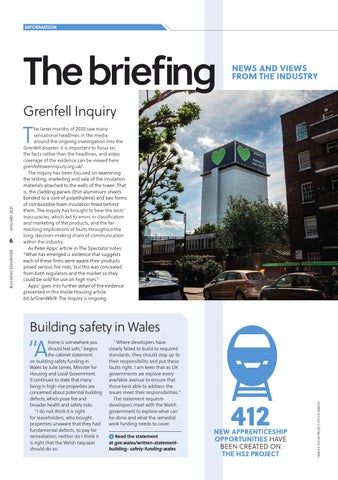
Grenfell Inquiry
JANUARY 2021
T
BUILDING ENGINEER
6
he latter months of 2020 saw many sensational headlines in the media around the ongoing investigation into the Grenfell disaster. It is important to focus on the facts rather than the headlines, and video coverage of the evidence can be viewed here: grenfelltowerinquiry.org.uk/ The inquiry has been focused on examining the testing, marketing and sale of the insulation materials attached to the walls of the tower. That is, the cladding panels (thin aluminium sheets bonded to a core of polyethylene) and two forms of combustible foam insulation fitted behind them. The inquiry has brought to bear the tests’ inaccuracies, which led to errors in classification and marketing of the products, and the farreaching implications of faults throughout the long, decision-making chain of communication within the industry. As Peter Apps’ article in The Spectator notes: “What has emerged is evidence that suggests each of these firms were aware their products posed serious fire risks, but this was concealed from both regulators and the market so they could be sold for use on high rises.” Apps’ goes into further detail of the evidence presented in this Inside Housing article bit.ly/GrenWk19. The inquiry is ongoing.
“A
home is somewhere you should feel safe,” begins the cabinet statement on building safety funding in Wales by Julie James, Minister for Housing and Local Government. It continues to state that many living in high-rise properties are concerned about potential building defects, which pose fire and broader health and safety risks. “I do not think it is right for leaseholders, who bought properties unaware that they had fundamental defects, to pay for remediation; neither do I think it is right that the Welsh taxpayer should do so.
6-9 TheBriefing_BE Jan 2021_Building Engineer.indd 6
“Where developers have clearly failed to build to required standards, they should step up to their responsibility and put these faults right. I am keen that as UK governments we explore every available avenue to ensure that those best able to address the issues meet their responsibilities.” The statement requests developers meet with the Welsh government to explore what can be done and what the remedial work funding needs to cover. Read the statement at gov.wales/written-statementbuilding- safety-funding-wales
412
NEW APPRENTICESHIP OPPORTUNITIES HAVE BEEN CREATED ON THE HS2 PROJECT
IMAGES: NOUN PROJECY, ISTOCK IMAGES
Building safety in Wales
10/12/2020 16:16
THE BRIEFING
Free expertled webinars to support your journey to CEnv
T
6-9 TheBriefing_BE Jan 2021_Building Engineer.indd 7
To accelerate and streamline its operations, contractor Sir Robert McAlpine has adopted a common data environment (CDE) from SaaS provider Business Collaborator (BC), now part of Bentley Systems. It will drive end-to-end project and asset information management across new projects, and enable a
single, unique data source to be accessed by Sir Robert McAlpine and its supply chain partners. The CDE helps to manage the vast amount of built asset data, improving programme and asset control, consistency and access to project and supply chain information.
7 BUILDING ENGINEER
CABE is licensed by the Society for the Environment to award Chartered Environmentalist (CEnv) registration to members. Find out more about becoming a CEnv via CABE at cbuilde. com/page/register_with_socenv
Digital systems JANUARY 2021
hinking about becoming a Chartered Environmentalist (CEnv)? Then make sure you catch the Society for the Environment’s (SocEnv) recent webinar recordings. They provide the latest information, advice and insight into the positive impacts of registration, the skills required and the application process. If you would like to explore the benefits of CEnv registration, watch the How CEnv Has Helped Me and My Career webinar – with perceptiveness from three leading professionals on their experiences of securing CEnv and the opportunities they have experienced since. From the employer perspective check out the Value of Professional Registration featuring insights from the Environment Agency and Willmott Dixon on why it values professional membership and registration for its staff. If you’re already sold on the benefits, but have questions regarding your application, the CEnv Application Top Tips and The Skills Required for a Successful Application webinars are a great source of information. Led by experienced assessors of CEnv applications, they provide advice on how to approach your application and common mistakes to avoid. Whatever your questions just head to SocEnv’s YouTube channel at bit.ly/3n4XnfR Throughout 2021, SocEnv will be running more registration-focused webinars, so keep checking socenv.org. uk/webinars for updates.
Building a better future World Green Building Council highlights innovation in the sustainable building sector with Building A Better Future series of documentary-style films. They explore how sustainable buildings can address climate, health and wellbeing and resource efficiency issues as well as the profound impact buildings can have on the quality of people’s lives and the crucial role buildings can play in tackling climate change. The series is only available outside the UK at: buildingabetterfutureseries.com
Building Engineer needs you! We’re calling on members to show the realities of their day-to-day roles by sending us pictures of their work. We want to showcase excellence in the built environment and see the true expertise of CABE’s membership with pictures of projects in progress and particularly solutions to problems that are encountered. Please send high-resolution, smart-device images to cabe@redactive.co.uk
10/12/2020 16:17
INFORMATION
Global Grad Show 2020
T
he 2020 show saw a record 1,600 graduation projects submitted by students in 270 universities – a 30% increase on the previous year – and 100 shortlisted. Of those, funding to take the solutions to market was announced on two innovations. One of these is a reflective thermochromic paint from SpectrumLab that changes its colour based on temperature. The IP-backed new material was developed for use in construction, with the aim of reducing building’s temperature variance and improving energy efficiency. If applied at scale, the technology has the potential to help regulate heat islands and urban temperatures.
JANUARY 2021
Explore the Global Grad Show here: globalgradshow.com
BUILDING ENGINEER
8
Earthquake forecasting
N
aturally-formed balancing boulders could be used to help scientists to forecast large earthquakes more precisely. Precariously balanced rocks (PBRs) are found throughout the world (characterised by a slender boulder on a pedestal boulder) and have survived earthquake shaking over thousands of years. They can, therefore, indicate the upper limit of earthquake shaking that has occurred since they were first formed – shaking that, were it strong enough, would have caused them to topple. Earthquake hazard models estimate the likelihood of future earthquakes in a given location. They help engineers decide where buildings should be built and how robust they should be – as well as informing earthquake insurance prices in high-risk areas. Imperial College London researchers have been working on a new approach by counting rare cosmic ray-generated atoms in PBRs and digitally modelling PBR-earthquake interactions. Anna Rood, from Imperial’s department of civil and environmental engineering, said: “PBRs act like inverse seismometers by capturing regional seismic history that we weren’t around to see.” They found that combining their calculations with existing models reduced the uncertainty of earthquake hazard estimates at the site by 49%, and, by removing the worst-case-scenario estimates, reduced the average size of earthquakes estimated to happen once every 10,000 years by 27%. The team are now using their techniques to validate hazard estimates for southern California – one of the most hazardous and densely populated regions of the United States. Read the full study at bit.ly/quakestudy
6-9 TheBriefing_BE Jan 2021_Building Engineer.indd 8
33% target The boardrooms of the country’s top businesses have long been male-dominated spaces, with the government recommending in 2015 that the boards of all FTSE 350 companies should be 33% by 2020. So, did the UK hit the target? Debut has examined the gender split of FTSE 100 boardrooms and found things do seem to be improving, with women taking 36% of current board roles. However, just five currently employ more female directors than male and almost a third of companies are yet to meet the 33% target. The construction and materials
sector did achieve the most diverse FTSE 100 sector status with a 50/50 split of male and female board members. Read more at bit.ly/GFboardroom
10/12/2020 16:17
THE BRIEFING
NEWS IN BRIEF
Low-carbon cost
The Building Controls Industry Association (BCIA) 2021 BCIA Awards will take place in May 2021. They recognise innovation, product development, project delivery and great training in the building controls sector. The closing date for entries is 22 January 2021, enter at bcia.co.uk/ bcia-awards/ Entries for the 2021 Federation of Master Builder Awards close on 15 January, register here: fmb.org. uk/2021-master-builder-awards
INSURANCE STANDARDS
In December, the Committee on Climate Change set out the costs and benefits of reaching net zero, and advice on the UK’s carbon budget, postponed from the summer owing to the Coronavirus crisis.
R&D HIGH
Construction Services Apprentice of the Year
IMAGE: ISTOCK, GETTY
A
London South Bank University (LSBU) student won a prestigious Construction Services Apprentice of the Year award at the BAME Apprenticeships Awards 2020, while a second, female engineering LSBU apprentice was highly commended. Romario Cazaubon, who is currently enrolled on a fiveyear quantity surveying degree apprenticeship with Mace Group, took the top prize for construction services apprentice. Dionne Alder, who is enrolled on a civil engineering apprenticeship with Southwark Council as her employer, received a highly commended from the judges. Both students are studying part-time on their respective degree courses at LSBU’s School of Architecture and the Built Environment (BEA), while completing their apprenticeships.
6-9 TheBriefing_BE Jan 2021_Building Engineer.indd 9
Since apprenticeship schemes were first introduced at LSBU four years ago, the university has enrolled over half (51%) of all apprentices from a BAME/multiethnic background: 16% black, 27% Asian, and 8% mixed race. Of these applicants, 43% are female, working in typically male-dominated professions, such as building services and engineering, as well as typically female-dominated professions such as healthcare (55%). In 2019-2020, out of a total of 1,600 LSBU apprentices, 38% degree/higher apprentices were women, with 28% studying for careers in architecture, building services and planning (17% in quantity surveying, 9% in engineering, 6% in architecture and 6% in chartered planning) with 7% in business management.
ONS data shows research and development spending in the UK construction industry jumped 11.5% annually to a new record high says Catax. Total construction sector spending on R&D rose to £417m in 2019, an increase of £43m from the £374m recorded a year earlier. The industry now employs 6,000 people directly involved in R&D, however, the rate of growth in R&D spending has slowed from the 16.9% rise recorded in 2018. Uncertainty surrounds what impact the Covid-19 pandemic will have on the level of investment in 2020, though the construction sector continues to pursue a range of technological advances, not least progress in modern methods of construction (MMC) and environmental performance.
9 BUILDING ENGINEER
Read more at bit.ly/CCCcostdown
UK warranty and insurance provider for new homes NHBC has launched the 2021 edition of its technical Standards. Effective for every new home covered by an NHBC warranty where foundations are begun on or after 1 January 2021. Updates to the new version include a full review of the chapter on flat roofs, terraces and balconies among others. View and download Standards 2021 for free at nhbc.co.uk/ standards_2021
JANUARY 2021
Chris Stark, Chief Executive of the Committee on Climate Change, the UK’s independent statutory adviser, said the cost of moving to a low-carbon economy had come down significantly. When the Climate Change Act was passed in the UK in 2008, the government estimated that the cost of meeting its then target of an 80% reduction in emissions by 2050 would be about 2% of GDP over that period. The costs are now expected to be well below that. Renewable energy prices have plunged in the last decade, putting solar and wind at lower cost than fossil fuels in many countries, spurring a global boom in clean power. The International Energy Agency said there had been record growth in renewable energy installation in 2020, despite the Coronavirus pandemic and low oil prices.
AWARDS
Have an opinion on something in this issue or something you’d like to discuss with your peers? e-mail the Editor at cabe@redactive.co.uk
10/12/2020 16:17
INTELLIGENCE
I
was lucky that my dad started a business in the industry, so I had a natural route in. From the age of 16, I spent my summers in the offices, attending appeal hearings, working with the inhouse architects and putting together the relevant documents for each application. I did a construction course at college; of course, I was one of very few females and people of colour. I did a Property and Planning course at university, which was good because it allowed me to get an understanding of valuation, property management, property law and planning law. Having a holistic view allows you to understand not just your role but where you fit in the process. You understand how your decisions affect development costs, timescales, design, finance and funding options, because planning lies at the very centre of it all.
PLANNING AS A CAREER
In the current climate, planning is under the spotlight. Boris Johnson’s intention to increase permitted development rules is, on the surface, a perfect way to level up Britain and help us to meet our housing targets. However, the proposed changes open the door for unintended consequences in terms of housing quality. In addition, community groups will become even more marginalised than now they already are when it comes to securing appropriate property and applying for planning permission.
I see planning as an ecosystem, the gateway to everything; it is what helps businesses to grow, homes to be built, and it provides public space to celebrate. It affects your quality of home life, work life and your health, and without it I believe there would be chaos. With the construction industry facing a significant skills gap in every area, I would encourage more people to consider planning as a career path. For more, visit taproperty.co.uk
JANUARY 2021
Drawn to planning
BUILDING ENGINEER
10
The process of reading planning policy and creating your argument to secure an approval for your client is what drives me. Calling your client to say you’ve got approval is thrilling. Securing D1 change of use applications is notoriously difficult – in some cases more than others – and I like a good challenge. Many times I have found myself having to go to appeal – discussing the merits of a case with the council and the inspector, anticipating the comments of the council and having a response ready supported by the evidence needed to prove my own point. Trust me, it is an even better feeling to have an application refused and then won on appeal. Planning can be a passionate business depending on your drive or focus. When you look at a building you begin to imagine how people will interact with it. What types of people will use the space? How can you make it better and give it a new life? This is especially true for niche work in the D1 sector: nurseries, medical facilities and religious groups. These buildings are community focused with many people flowing in and out of them. Each space is unique to the client, and planners must be creative with how they use space.
Different roles Working as a planning consultant for the local authority and for a consultancy are quite different, despite essentially being the same job, because the focus is slightly different. The local authority works to enforce the rules set out in planning policy, which is down to interpretation, while consultancies try to work those rules to benefit their client.
10 BAME_BE Jan 2021_Building Engineer.indd 10
Planning ahead What drew Olamide Adenugba, Planning Director at T A Property, to an industry with an image problem for women and BAME people?
10/12/2020 14:57
INTELLIGENCE
APPRENTICESHIPS
Firm foundations Mark Wakeford, joint MD of construction firm Stepnell, believes apprentices are key to the call to “Build, build, build”
T
JANUARY 2021
he development and success of the UK’s construction sector has never been more important. With the burden of the current economic crisis resting firmly on its shoulders, it’s time for the construction industry to properly invest in apprentices and trainees to secure the future of the sector. In recent years, a growing emphasis has been placed on the importance of upskilling the next generation. Covid-19 has brought this into stark relief with the threat of furlough and widespread redundancies that placed apprenticeship schemes at risk of dissolution. Bringing the next generation into the industry is crucial given the Prime Minister’s announcement to reboot the British economy through infrastructure.
I believe that construction companies should be open to exploring new areas and listen to the younger generation about what they want. For example, one of Stepnell’s current apprentices found a passion for using the Viewpoint Field View app, which allows the capture of real-time field data on-site. The apprentice then became a Field View champion, giving them a high level of responsibility to visit sites across the country to record data and teach senior members of staff how to use the application. Stepnell’s Emerging Talent programme is central to maximising the company’s intake of trainees and offers tailored support in their chosen area of expertise, encouraging development through formal mentorship programmes, six-month reviews and the opportunity to gain recognised qualifications. Kieran Gubbins, graduate and Assistant Quantity Surveyor at Stepnell, said: “During my time as a Stepnell trainee, I have been able assist with multi-million-pound projects and run my own projects with the support of others. It’s great that I’ve been given that level of responsibility, which is often where trainees can get de-motivated if they are not actively involved or given that trust. “I think it is important that young people are supported in the industry, particularly as a lot of knowledge can often lie with the older generation. It’s an ageing workforce and, therefore, essential that young people can drive the future of the sector, bringing new technologies and ways of learning with them.” Luke Beardsmore, who has just completed 12 months’ work experience at Stepnell and will join the team as an Assistant Site Manager once he graduates, said: “Throughout lockdown, I had to step up into my site management role as I was given more responsibility due to other staff being furloughed, which has been
11 ApprenticeshipsBE Jan 2021_Building Engineer.indd 11
11
“There is often the assumption that trainees make the tea and do the admin jobs. But I have been given a huge amount of responsibility”
ENG BUILDING ENGINEER
IMAGE: ISTOCK
Train, train, train
hugely beneficial for my development and confidence. There is often an assumption that trainees make the tea and do the admin jobs. But I have been given a huge amount of responsibility from working on-site and watching my managers solve problems and deal with challenges.” With the construction industry facing its biggest skills shortage yet, it’s more important than ever that the industry looks for new talent. Luke added: “There wasn’t a lot of information about the construction industry when I was choosing my career path at school. I think there needs to be more awareness about the different aspects to encourage the younger generation to get involved. People need to listen to the younger workforce, we are hungry and passionate to succeed, and we want to learn as much as we can.” For more, visit: stepnell.co.uk or join the conversation at @Stepnellltd
10/12/2020 14:58
INTELLIGENCE
Step up
a specialism. For Stroma, the idea took hold that these could be used as a foundation for imparting professional training and standards as part of its work to fill the skills shortage. “It was quite the task to use the competencies to map out an effective twoyear training programme,” says Jonathan. “You have to look at each element of the competency and ask ‘how do you teach that in a classroom?’ and then ‘how do you apply it to the job?’. The course is a mix of academic work and vocational training – almost like an apprenticeship – with mentoring from an experienced surveyor or senior manager. We’ve worked to bring in external specialists too, so there is a broader understanding of the role and how it sits with other professions. For example, in year one there’s a bespoke fire regulations and safety course, and in year two there’s an acoustic knowledge course. Both are delivered by external experts.” Jonathan notes that the course application process is stringent because choosing the right people is key. “We expect people to work hard,” he says. The course is a mixture of group seminars, webinars and one-to-one support as well as the practical elements that take into account that people learn differently. “Some people need more repetition than others and some are very proactive in their approach, reading around the academic study and asking plenty of questions.”
Jonathan Gallie, Group HR Director for Stroma, discusses a training programme built on the applied framework of CABE’s competencies
JANUARY 2021
S BUILDING ENGINEER
12
troma’s Academy offers recent graduates, construction career changers and qualified surveyors the chance to become chartered building control surveyors and building engineers. In response to the skills shortage, Stroma decided to upskill its own and provide a route into the profession for those with relevant qualifications, such as early-year professionals, university and college leavers, and those leaving a trade who wanted to upskill. What sets the Academy apart, however, is that CABE’s core competencies were used to guide the learning and full professional membership of CABE awaits those who complete the course. In 2019, Stroma became a Company Partner of CABE – the same year that CABE announced its new professional competency frameworks and disciplinary procedures. These set out in a structured way the knowledge or evidence required to demonstrate competence relevant to
CABE’s professional competencies are the framework on which the course is based The course mixes academic work and vocational training with mentoring from an experienced surveyor or senior manager
12-13 Training_BE Jan 2021_Building Engineer.indd 12
11/12/2020 09:44
STAFF DEVELOPMENT
“After two years, they have worked towards becoming chartered building control surveyors and can apply for CABE membership” Every six weeks, the students complete a webinar or session to assess their progress. After two years, they have worked towards becoming chartered building control surveyors; but there’s plenty to incentivise them along the way such as salary mapping and the opportunity to apply for CABE membership upon completion.
Assessing the assessors
13 BUILDING ENGINEER
For more details about the training, visit stroma.com/people/academy Read the CABE Competency Frameworks bit.ly/BE-MCF
JANUARY 2021
The course itself is also being constantly evaluated. “There’s an anonymous survey after each year that acts as a barometer for what’s working well and what we need to refine,” he says. So what has the feedback revealed? “Unsurprisingly,” he jokes, “no matter whether it’s a CPD event or a conference, the sandwiches are always the thing that people complain about.” On a serious note, he felt buoyed that the feedback has been so positive and those finishing the academy are now achieving CABE membership. Surprisingly the students said they wanted more of certain elements, particularly the bespoke fire course, which Jonathan believes is a reaction to the media coverage of the Grenfell inquiry. As a consequence, the fire regulations and safety course is covered again in year two giving the students a perspective on the information one year on, with more experience.
Inevitably Covid-19 casts its shadow, too. “It has been hard. Covid-19 had stopped things for six months,” he says, but the students recommenced in December. Even though they are months behind there will be a structured plan of action to ensure they are chartered by summer 2021. “We’re condensing some sessions, bringing in more external speakers and doing more virtual learning. That’s looking more likely to be the way we deliver the academic elements for the foreseeable future anyway.” There are some things that can’t be done virtually. The practical elements have to be carried out on-site under supervision, so they will have to be completed with Covid-19 safety restrictions in place. Technology may be able to offer some support here too, with filmed demonstrations or assessments that can be watched again to improve learning. “The course isn’t set in stone, it’s about refining and adapting it to ensure the next generation of building control surveyors are the best, most competent they can be.”
KNOWLEDGE AND UNDERSTANDING General competency
Evidential scope
A
Use a combination of general and specialist building engineering knowledge and understanding to apply existing and emerging technology relevant to your work.
A1
Maintain and extend a sound theoretical approach to the application of technology in building engineering practice and demonstrate detailed knowledge of and the ability to apply technical standards, codes, regulatory and other requirements relevant to your work. This could include the ability to: Identify the limits of your own personal knowledge and skills Strive to extend your own technological capability Broaden and deepen your own knowledge base through new applications and techniques.
12-13 Training_BE Jan 2021_Building Engineer.indd 13
Evidence could include how you engage in formal learning such as: Learning new building engineering theories and techniques in the workplace, at seminars, etc Broadening your knowledge of building engineering codes, standards and specifications Assisting in the development of industry standards and codes of practice. Evidence should also demonstrate: Understanding of the scope of work you undertake, and the knowledge required to be competent to do so Knowledge of relevant technical standards, codes or regulations etc Practical examples of how you have applied these standards Knowledge and understanding of inclusive design in the built environment.
10/12/2020 14:58
INTELLIGENCE
JANUARY 2021
“A 30-minute site walk by an individual provides planners with up-to-date progress reports”
14 BUILDING ENGINEER
DIGITAL FIRST
L
ike most industries, the construction sector and the people who work within it have had a difficult year with the Coronavirus pandemic disrupting normal life, working life, impacting on physical and mental health, and reducing output. However, changes in industry practice resulting from Covid-19 could be an opportunity for the sector to accelerate its rate of digital adoption and start reaping the benefits of improved productivity and efficiency. Digital advances enable construction to be tracked, planned and managed in a way that was previously not possible. Hard-hat mounted cameras capture data that is then analysed using artificial intelligence (AI). State-of-the-art computer vision algorithms together with Building Information Modelling (BIM)
can create an in-depth view of the project that means a greater likelihood that the project finishes on time and on budget. Buildots’ experience on construction sites before the lockdown period was that people stuck to their old habits of checking everything manually even though the data was available on digital platforms. During the pandemic, however, there has been a 60% increase in the use of digital quality management platforms as planners and commercial managers working from home began utilising the full potential of these systems. A 30-minute site walk by an individual provides planners with up-to-date progress reports, commercial teams with work done per trade and activity, and clients with a high-level view of the project status. These are just a few examples of how data can boost the productivity of the site team.
After lockdown
Even though most sites continue to be fully operational there is an ongoing need for social distancing. So a requirement for fewer personnel to be on-site and correspondingly less frequent site visits means advanced quality management and site monitoring technology comes into its own again. The construction industry has relied solely on the management skills of human beings for too long, expecting a single construction manager to control a 5,000m2 site, or often base critical decisions on memory. This can have detrimental effects on the process, such as delays only discovered a week later, or a trade showing up on-site with no available areas to work in. The ability to detect issues long before they snowball into bigger problems through technology has led to a lowering of overall project risk. Moreover, it has led to better planning and communication and collaboration across the site from client, to contractor, to subcontractor. It’s time for construction to rebuild its processes based on the digital tools and technologies available. The pandemic could be the catalyst for that, as constraints such as the ones imposed by the virus have meant people are already performing outside of their comfort zones. Let’s use this as an opportunity to drive change and creativity as people are more willing to give the technology a chance.
Silver lining? Patrick Scannell, Senior Project Manager at Buildots, asks if Covid-19 will prove a catalyst for change in construction
14 BuildotsBE Jan 2021_Building Engineer.indd 14
For more, visit buildots.com
10/12/2020 14:59
Scan the QR code to read about the day to day life of our Building Control Surveyor, Kayleigh Wardle-Tubb! BUILDING CONTROL
#StromaStories
Advertorial
Meet Ian O'Connor Managing Director, Stroma Building Control Ian has been with the business for 10 years now. He discusses the future of Stroma Building Control and how we're investing in technology to benefit our clients and staff. What are your plans for Stroma Building Control?
Why should Building Control Surveyors join the team?
We’re working on Commercial and Residential projects across England and Wales so we’ll continue to act in support of our clients to interpret the regulations and check that buildings are compliant. We’re closely monitoring the regulatory changes as a result of the Building a Safer Future review and expect there to be some interesting opportunities for our business. Finally, we have the unique benefit of working as part of a larger group. Our ambition is to offer lifetime value to our clients offering building safety, environmental sustainability and regulatory compliance services.
At Stroma Building Control we play to our strengths. There are dedicated teams for Residential, Commercial and Major Projects allowing an opportunity for you to do the work you enjoy. Working alongside our HR team we have a proactive approach to learning and development, offering regular CPD and training to improve your skills and maintain your levels of competence.
What type of candidate are you looking for in the business? The onset of new Building Regulations in the coming year will lead to changes in the traditional role of a Building Control Surveyor. As a business we need to be adaptive to that change and the Surveyors coming into that team will need to share that mindset.
How are we using technology and new ways of working to support clients? The Coronavirus pandemic has forced many businesses to think differently about the way they do things. Stroma was no different and we had already invested in a new CRM system which has allowed
us to improve customer service to clients across all project types. We’re committed to a data and technology first approach to become more efficient and responsive on the projects we serve. Social distancing has prompted us to look closely at how we carry out important parts of our job, such as site inspections and how we can transform our approach using technology.
What's the future like for Stroma Building Control?
The future looks very exciting and represents a real challenge for our industry. Stroma Building Control will be collaborating with CABE, CICAIR and other industry bodies to ensure that competence and compliance are at the forefront of construction. Visit stroma.com/careers
CABE.JAN21.015.indd 49
04/12/2020 12:26
INTELLIGENCE
BUILDING ENGINEER
16
Acoustic Verification Scheme For FIS, the journey to the acoustic verification process began with operable walls and instances where these walls were not performing in the way that was expected, leading to disputes. Investigations revealed that this was partly due to the installation process and the fact that these partitions are often dismantled and re-erected by non-trained staff. If the acoustic seals are not exactly right, acoustical integrity can be compromised by leakage and flanking sound coming through. FIS also found evidence of falsification. In some cases, interrogation of test reports revealed that manufacturers were testing an operable wall like a normal fixed partition and physically sealing every
16-17 AcousticVSBE Jan 2021_Building Engineer.indd 16
Sound advice Joe Cilia, Technical Director at the Finishes & Interiors Sector (FIS), considers how designers and specifiers can use the Acoustic Verification Scheme to specify products with confidence
joint during the test process. For realistic results a product should be operated five times before the test commences to demonstrate it is completely operable. The Acoustic Verification Scheme provided a method by which independent acoustic consultant Cundall verified acoustic test data. FIS was then able to provide assurances that the test evidence being presented was accurate. For contractors such as Wilmott Dixon, the verification scheme meant they could specify manufacturers in confidence that it was a level playing field; products had been tested in the same way and had comparable figures. As a result, the contractor is only using operable walls that have met the requirements of the scheme. Kevin Dundas at Wilmott Dixon noted: “There is a growing understanding of the intrinsic link between good acoustic management and wellbeing for
IMAGE: GETTY IMAGES
JANUARY 2021
T
he importance of a product’s acoustic performance cannot be understated and is one of the keys to the success of any workplace design. All too often products are tested in different ways, and difficulties in comparing evidence leaves room for performance to be exaggerated. This can lead to poor acoustics, impacting employees’ wellbeing and their ability to concentrate, work collaboratively and productively, and even lead to vital information leaking. How then can specifiers compare products like for like and ensure they are creating an environment that manages noise? To eliminate confusion and concerns, the Finishes & Interiors Sector (FIS) has created the Acoustic Verification Scheme to standardise performance data for partitions and operable walls. For specifiers, creating the ideal acoustic environment can be challenging, which is why it’s important to consider the acoustic needs of the interior office space early in the design process. Sound can be controlled either through absorption, which deals with reverberation within the space and makes it a better place to work in, and through insulation, which deals with the control of sound from one space to another. Hard reflective surfaces in office buildings, such as glass, concrete and plaster, will require specifiers to counter that with sound-absorbing products, such as ceilings, rafts and wall panels, to reduce reverberation and dampen unpleasant noises in the environment. The sound absorption properties of these materials depend on the way in which they are installed. For example, if products are tested with a void behind them, but installed directly against the slab or a wall, this will have a detrimental impact on the absorption performance on-site. A common source of noise disturbance is the transmission of sound through walls or floors. Poor sound insulation (also referred to as attenuation) between adjacent rooms will result in disturbance and a loss of privacy. Partitions and cavity barriers are generally used for sound insulation and provide privacy or a division from a noisy and potentially disturbing activity. The only way a specifier can evaluate and compare the performance of two products is by looking at the data provided to them. They need to be able to understand the acoustic claims, what conditions the products should be installed and ensure that the results aren’t misleading.
10/12/2020 15:00
ACOUSTIC VERIFICATION SCHEME
JANUARY 2021
17 BUILDING ENGINEER
occupants, and this scheme helps to deliver what our customers expect from us and our industry.” Driven by FIS members keen to develop a level playing field across the sector, the scheme quickly evolved to cover glazed partitions. In this instance the concerns were not about operation, but the size and configuration of systems tested. In a similar way FIS agreed a set of parameters that would constitute a
“There is a growing understanding of the intrinsic link between good acoustic management and wellbeing for occupants”
16-17 AcousticVSBE Jan 2021_Building Engineer.indd 17
test that could be used for comparison reasons. This would then provide specifiers and architects with the assurance that if they choose a product from this list all products will have been tested in the same way and all data has been verified. The scheme is key to raising standards and quality in the supply chain. The Acoustic Verification Scheme has been created to ensure that those seeking to exemplify best practice are recognised and rewarded for this and prevent inaccurate or misleading information from undermining the market and responsible manufacturers. The verification framework provides consistency and enables the comparison of products and systems on a like-for-like basis. Visit thefis.org Manufacturers that want to have data verified can email info@thefis.org
10/12/2020 15:00
INTELLIGENCE
CROSS REPORTS
Report 968
JANUARY 2021
Confidential Reporting on Structural Safety. Report 958: Execution not matching design assumptions
BUILDING ENGINEER
18
This situation highlights the need for temporary works to enable permanent works to be installed correctly.
T
his report involves a large residential building project. The building was steel framed and at first-floor level had large span transfer beams that took the load from major columns spanning over a wide opening at ground floor. The transfer beams were arranged in pairs with the design load assumed to be spread evenly between them. Early during occupation, concrete soffit panels that were attached to the bottom flanges of the transfer beams were found to be cracked. Upon investigation, it was discovered that the bottom flanges of the pairs of beams had spread apart by up to 70mm. An analysis was undertaken by the original designer and independently by a third party. The conclusion they both reached was that the loading from the column was applied to the inner part of the inside flanges at the tops of the pairs of transfer beams and not directly over the webs as the design had assumed. This was causing a rotation of the beams; failure was only averted by secondary connections and fixings causing some additional restraint. Remedial measures were put in place. The designs had been reviewed by building control and also by an independent third-party checker before construction. The designs were, in fact, fine; but the connection of the column to the pairs of beams was not detailed at that point, and it was not highlighted that this was a critical part of the design.
“Where there are twin beams consideration should be given to how the pair will interact”
Normal design implicitly assumes members are loaded in the vertical direction with members restrained against torsion. However, that assumption can be invalid. It is especially important to consider possible twists during construction, which can easily occur, say, during successive increments of vertical loading. A more general issue is that, almost invariably, loading and stability conditions will differ between construction stages and the completed stage. The onus is on the whole team to assure safe construction can take place and permanent works designers must ensure that any limitations on loading conditions are conveyed to contractors. A point made by the reporter is that the alignment of the column supported on the transfer beams was not directly over the webs. For safety, realistic loading conditions must always be part of the model. In reality, no axial load can be presumed totally concentric because positional tolerances exist and are permitted. A column is always going to have some
18-19 CrossReportsBE Jan 2021_Building Engineer.indd 18
IMAGES: ALAMY, ISTOCK.COM
Comments
10/12/2020 15:01
CROSS REPORTS
eccentricity to its support, and a heavy axial load at a small tolerance is going to produce significant torsion. It might be recalled that one cause of the box girder bridge failures in the 1960/70s was that transverse girder webs did not align with the supports below and the webs buckled as a result. In practical terms, where there are twin beams consideration should be given to how the pair will interact and provision made for eccentricities and load sharing. To ensure this is the case, the detailed design drawings should be available to the contractor at the time of constructing the relevant elements. Having a process in place whereby the execution is not allowed to commence without the detailed design stage being completed and approved would help prevent similar issues. Detail, alignment and tolerance all need attention at all stages of construction. Designers must challenge themselves: How do I know this will be safe and will remain so? What must be done right (or in some specific way) to ensure this safety?
Confidential Reporting on Structural Safety. Report 971: Workmanship in domestic buildings This case of improvised solution on domestic projects emphasises the need for better information sharing and competence in resolving unforeseen clashes safely
A
reporter on-site discovered that a steel beam had the web cut away at the support to avoid having to divert some services. The cut-out meant that the whole of the loading on the beam would have been supported by just bending in the bottom flange once the temporary props had been removed. Additionally, the site staff did not have all the structural drawings for the project, so had made up a beam to column connection as a flexible end plate whereas there needed to be a full-moment end plate connection.
Comments Domestic projects may not have the full range of professionals around and are – especially for one-off buildings – constructed by firms with limited resources. This does not exempt the builders, or anyone else involved, from acting responsibly and it
18-19 CrossReportsBE Jan 2021_Building Engineer.indd 19
19 BUILDING ENGINEER
Report 971
JANUARY 2021
CROSS REPORTS
is a real concern that sections of a major loadbearing component could simply be cut away for the convenience of a service installer. That there was an incomplete set of structural drawings on-site shows a lack of oversight particularly when the design called for a full-moment end plate connection. The theme of failure by unauthorised change is commonplace. As in other reports, this exemplifies why a person who is not competent must not make design alterations that could have severe consequences. Designers – whoever employs them – client and main contractor or sub-contractor must ensure that the final drawings are distributed to all parties and that they approve the detailed designs and drawings. If contractors are unsure about any structural matters, they must consult the designers and not assume design responsibilities by devising their own details. Some sectors of the industry are allowing incompetence to reign. Large and complex buildings are the focus of current interest with the draft Building Safety Bill, but the proposed legislation needs to be in place for smaller buildings too to prevent such dangerous occurrences in future. Thankfully, this one was picked up, but how many are not? If you would like to receive the CROSS reports newsletter, visit structural-safety.org/subscribe
“Designers – whoever employs them – client and main contractor or sub-contractor must ensure that the final drawings are distributed to all parties and that they approve the detailed designs and drawings“
10/12/2020 15:01
INTELLIGENCE
FORENSIC ENGINEERING
expert may not realise that opposing counsel is employing such a tactic. As a matter of practicality, the forensic engineer providing expert testimony can (and should) really only answer questions asked, and eschew amplification, except where it may be particularly material. Curiously, this leads to the next point.
BUILDING ENGINEER
20
T
he concept of forensics, at least in the West, seems commonly to be associated exclusively with criminal matters. However, as defined by Merriam-Webster (our favorite definition source in the States) it means “belonging to, used in, or suitable to courts of judicature or to public discussion and debate”. As it turns out, there are ample situations where construction defects and other building-related matters are best (or only) resolved through the use of forensic investigative and analytical skills in the practice of engineering, be it manufacturing, design, construction or even operations and maintenance of buildings and building infrastructure systems. However, how these skills are interpreted in court is another matter. One could easily write a book on the subject, but for the purpose of this article, we will limit it to two approaches.
The whole truth
The nature of the engineer
While this might seem to be a laudable endeavour, it is quite problematic in legal proceedings. Solicitors and barristers are generally not knowledgeable of technical matters that are material to a case, and may not ask a question in a proper fashion, or intentionally slaughter a question so that the expert’s testimony in deposition may be used to later impeach the expert’s testimony at trial. When the trial testimony appears to contradict that testimony given during deposition, the witness will be asked if they are lying. This is further problematic as the counsel who has engaged the
The engineers’ inherent nature is a significant factor in addressing legal matters and the deposition (particularly as practised in the US legal system). Engineers are problem solvers at heart, they also appear to have a predilection for loquaciousness. The problem arises when a question is posed to the engineer as expert witness and is incomplete or illogical, or in some other way flawed. It is the nature of engineers to want to fix the question so that the truth of the matter in question can be properly explored and revealed.
20 ForensicWitnessBE Jan 2021_Building Engineer.indd 20
US-based forensic engineer James P Waltz FCABE discusses what forensics mean in the built environment
In the movie My Cousin Vinny (bear with me), Mona Lisa Vito is presented to the court by defence counsel as an expert on automobiles. The prosecution seeks to determine her qualifications by asking what the ignition timing would be on a 1955 Chevrolet with a 327 cubic inch (5.4 litre) engine. Miss Vito says she cannot answer the question, as it is a trick. Asked to explain why, she observes that the 327 V8 engine was not provided in Chevrolet saloons until 1964, and therefore there is no answer to the question as posed. In this case the fact that the question was unanswerable was easy to explain. However, in more complicated or obscure matters, that a question assumes facts not in evidence may not be so easy to explain. For the court, what might sound like a perfectly reasonable technical question for the engineer would be like asking: “What is the colour of the number nine?” The wise forensic engineer will make it a practice under oath to listen very carefully to questions posed by opposing counsel. The author’s practice is to ask the suspected unanswerable question to be repeated, then repeated once more, before adjudging the question to be unanswerable, and then to respond that: “The question makes no sense whatsoever, and that attempting to answer such a question would be based entirely on supposition, so no answer is, therefore, offered.” The forensic engineer providing such a response should be prepared to be treated with anger and even accusation of violating their oath (or affirmation) – and they should refrain from attempting to answer the unanswerable question in the face of such behavior by counsel. Anyone considering forensic engineering as a career path should be prepared not only to investigate and determine the causes of failure in a structure and provide expert testimony on how to fix an existing structural problem, but also how to best present their evidence in court to those who may not share their knowledge or expertise. James Waltz features as the CABE member profile on page 48
IMAGE: ISTOCK.COM
JANUARY 2021
The unanswerable question
10/12/2020 15:17
INTELLIGENCE
VAT RESPONSIBILITIES
V
Common mistakes include
The 5% reduced rate of VAT applies if: Self-contained homes are constructed within non-residential buildings A house is converted into a flat, or a flat is converted into a house Work is carried out on a property that has stood empty for two years at the time the work commences. Commercial property developers can also recover VAT on related expenditure, but they must adhere to certain regulations in order to do so. It can be beneficial to charge VAT on the rent or sale income that the business will generate from the developed property. However, this approach will often require the developer to formally opt to tax the property, a step that is often missed. Property developers should seek professional assistance when it comes to ensuring they are compliant with all aspects of their VAT obligations. Without this, they run the risk of being subject to an investigation from HMRC, which could lead to considerable costs if it is discovered they have flouted regulations. For more, visit thevatpeople.co.uk/sectors/ land-and-property-development
21 BUILDING ENGINEER
Failing to declare VAT on a property sale Missing out on the opportunity to recover VAT by failing to consider the implications of selling or renting property on a VAT-exempt basis Failing to consider VAT at the appropriate time. VAT is regularly considered at the last minute, often when it is too late to plan to reduce the cost of a particular project.
A number of reliefs are available to property developers calculating their VAT responsibilities and should be considered from project to project. The reduced rate of VAT is applicable to qualifying services provided to contractors relating to projects that involve a change in the number of single-household dwellings in a building. This also applies to cases in which there is set to be a change in the use of a residential building.
JANUARY 2021
AT is a complex area that is difficult for many businesses in a wide variety of sectors to grasp. Even those with a reasonable degree of knowledge of VAT and how it works often have limited understanding when it comes to the particular nuances relevant to their operations. Property developers are by no means exempt from this and regularly fail to recognise areas in which potential savings could have been made. Very often, developers make inaccurate assumptions about their VAT responsibilities, which can prove to be risky considering the large sums of money involved in such projects. This is particularly true for smaller-scale developers. All businesses must register for VAT with HMRC when the taxable turnover for their business amounts to more than £83,000. Calculating taxable turnover is simple: you should add up the total value of everything you sell in a 12-month period that is not considered to be exempt from VAT or outside the scope of VAT. VAT should not be charged on goods and services that are considered to be exempt from VAT, while it also cannot be reclaimed on any goods and services that have been administered in relation to exempt business activities.
The tax man commeth IMAGE: ISTOCK.COM
Rob McCann, Director at The VAT People, suggests there’s more to VAT than meets the eye
21 VATAdviceBE Jan 2021_Building Engineer.indd 21
10/12/2020 15:17
INTELLIGENCE
JANUARY 2021
D
BUILDING ENGINEER
22
espite the overwhelming focus on tackling the Coronavirus crisis and its economic impact, one issue has never left the minds of those who are setting the policy for the future of construction regulation and enforcement. For more than three years, fire safety has been an issue of paramount importance with many product manufacturers and building specifiers continuing to develop and promote fire safety initiatives. Saint-Gobain Weber’s renders, decorative finishes and external wall insulation (EWI) products, for example, have been tested, retested and reviewed to assess fire safety. Each variation has been put under scrutiny to understand its suitability for multiple building types and scenarios, not just in isolation but also in combinations and building systems most commonly found in the UK. But what does this tell us really? What do designers need to consider when reviewing the fire safety claims being made by any product manufacturer today? A warning bell about product marketing claims was rung by Dame Judith Hackitt in her 2018 review after the Grenfell Tower tragedy. She pointed out that the system for testing and certifying products for use in construction was “disjointed, confused, unhelpful, and lacks any sort of transparency”. This baton was then picked up by the Marketing Integrity Group of the Construction Products Association (CPA), which published research into the issue of product marketing. Since then the CPA has been developing a new voluntary code of conduct and a marketing trust scheme for building products, including proposals that all stated performance data for products must be referenced
back to a dated test or a specified desktop calculation. Where a test is referenced it must state the test, date passed, under what standard, where it was tested, by whom and how long the test is valid for. Most importantly, it is being proposed that the known limitations of a product must also be stated.
Is A2 classification enough? Most specifiers will be familiar with the British Standard 476 fire test series, which continue to be important. But today’s specifications also demand a good understanding of different testing regimes, including the Euroclass classifications, which range from A1 (best) to F (worst). These gradings rely on products passing stringent European (EN) standards, which are different from BS 476. The EN standard is based on tests for the materials and system’s response to fire, smoke development and droplets while burning. In essence, the Euroclass system focuses on the overall combustibility of materials and contribution to fire load. Ever since additional building regulations guidance was issued in England at the end of 2018, which introduced a ban on the use of combustible materials in the external walls of high-risk residential buildings, there has been a steady presumption that a Euroclass A1 or A2 classification is required for all façade materials. Or, more precisely, a presumption for dwellings over 18m in favour of either A1, which is basically completely non-combustible, or for A2-s1, d0, which describes products that are of limited combustibility and generate very little smoke development and no flaming droplets or particles. This A1 / A2 approach is still considered by many clients and specifiers to design out
Skin deep Lee Lambley, Technical Director at Weber, advises clients, architects, contractors and product specifiers to look more closely now at the fire safety performance claims of renders than they have in the past
22-23 RenderFireSafety_BE Jan 2021_Building Engineer.indd 22
risk and creates confidence that a building will always comply to future building regulations. However, in some cases, this has led to an over-simplification. It’s not enough just to look for an A2 classification, it’s the information that sits behind this grading that matters most. The Euroclass test relates to how a product reacts to fire, but there are also essential BS tests regarding fire resistance that look at integrity and load-bearing capacity, for example. Do you have all the test data, and if so to what standard was
10/12/2020 15:18
FIRE SAFETY PERFORMANCE
22-23 RenderFireSafety_BE Jan 2021_Building Engineer.indd 23
and other aspects of performance. It’s imperative that specifiers interrogate the evidence for renders and related external wall insulation ( EWI) systems, and all test evidence should be made openly available to all customers and published ideally available on the manufacturers website, particularly relating to products used on external façades. One important check is to ensure that all the documentation matches up. The Euroclass certification for a product should align with the individual test
What’s in a colour?
23
Perhaps surprisingly, one of the key issues in testing renders for fire safety is the colour of the render. Historically manufacturers have only tested lighter colours, such as white or cream; not just because these are the most popular colours, but also because the amount of organic (and, therefore, combustible) content in these renders is less, and so they are more likely to pass a fire test more easily. This is clearly not in the spirit of the Hackitt recommendations or the culture of product safety now required. An appropriate range of colours should be tested separately with the support of the UKAS testing facility. Producers should have this assessment to cover their full colour range, especially reds, which contain the highest level of organic content. Greys and yellows can also throw up interesting test results that need careful checking. If this all sounds complicated, it isn’t. It probably takes about half an hour to check product claims, and once you are familiar with what you’re looking at it’s not difficult to identify anomalies. Specifiers and contractors should just keep asking questions and not take anything at face value. Any reputable product manufacturer will be happy to share all their test data openly and honestly.
BUILDING ENGINEER
that test carried out? Was the testing done by a UKAS-accredited test centre? Have you seen the actual test data or just gone from claims in the marketing literature? Most specifiers look at the classification report summary and think “that’s my due diligence done”. But it’s nowhere near that simple. Product decisions should only be made on the basis of the full suite of documentation, including the complete set of individual test reports looking at the calorific value of the product, the way it responds to surface spread of flame
reports. The test reports should align with the Declaration of Performance (DoP). Another important check is the date of the test data, as it may be quite old – and chances are, the product may be materially different now from that which was originally tested. Any change to a product’s formulation, no matter how small, means that previous test data may be invalid and the product may need to be tested again.
JANUARY 2021
IMAGE: ALAMY
“Any change to a product’s formulation, no matter how small, means that previous test data may be invalid”
For more, visit uk.weber/facades
10/12/2020 15:18
Improve retention Increase diversity Attract new employees Utilise levy-funding Level 6 Building Control Surveyor (Degree) Level 6 Chartered Surveyor (Degree) BSc (Hons) and MSc route options
JANUARY 2021
Level 6 Construction Site Management (Degree) ucem.ac.uk/apprenticeships businessdevelopment@ucem.ac.uk
DEVELOP YOUR TALENT
Provider of online apprenticeships
BUILDING ENGINEER
24
Get involved with your Region CABE Virtual Regional AGM’s are now taking place Join us for these FREE CPD events; and discover how your region can help you.
Book your place at cbuilde.com/regions
CABE.JAN21.024.indd 24
04/12/2020 12:16
INTELLIGENCE
More with less Shaun Hughes, Regional Manager Southern UK at Victaulic, suggests best practice for using fewer resources
Energy-saving alternatives Sometimes the simplest innovations bring the biggest change. Victaulic’s grooved mechanical pipe joining technology involves grooved pipes encased by a gasket, positioned by coupling housings and tightened by a pair of nuts and bolts. It is a strong installation alternative and a means to transitioning to low-carbon construction practices (compared to more traditional methods such as welding or flanging). Aside from the fumes, welding can use up to 4kW per hour on an eight-inch joint, whereas grooved mechanical joints use just a fraction of that. This is due to their mechanical nature, as a grooved coupling is installed by simply tightening two nuts and bolts by using much more efficient tools such as an impact gun or, in some cases, a hand ratchet. This process is much more efficient than arc welding, which for a typical four-inch, Schedule 40 carbon steel joint consumes 5kW of electrical energy with an estimated 25% waste during installation. The impact of this energy-saving potential is seen more clearly as a case
study. A recent project numbering 1,105 welds on Schedule 40 pipe sized 10 inches through 24 inches required 123,227kWh of energy to be consumed at a total cost of £16,500. Factoring in a 25% kWh waste on welded joints equals a loss of £4,125 and 30,807kWh on this job alone. By using the grooved mechanical pipe joining, this single project saved 131,250kWh – the equivalent of the average electricity consumed by 375 UK homes in one month (working on an average use of 350kWh). The wasted electricity (32,900kWh) would have equalled the amount of average electricity consumed by almost 94 homes in one month. In addition, the systems are easy to modify or expand without engaging in rework as the pieces are not permanently welded together. Eliminating rework eliminates the associated waste, such as the need to order more than what’s needed or to stockpile product replacements that drive up raw material and transportation costs. Using grooved technology also considerably decreases the use of consumables, which accounts for up to 9% of the cost of a welded installation, making grooved couplings not only a more sustainable alternative, but also a more cost-effective measure. Adopting sustainable construction methods will reduce an organisation’s impact on the environment and bring tangible benefits too. Piping systems shouldn’t be overlooked as they present great opportunities for a cleaner construction future.
25 BUILDING ENGINEER
25 PipesBE Jan 2021_Building Engineer.indd 25
employ the use of pre-site methodology such as BIM is due to its ability to save resources; the technology allows contractors and engineers to pre-emptively conceptualise structures. Bespoke tools, such as Victaulic’s own software add-in Tools for Revit®, offer engineers an easy way to increase pipe size or rotate components such as valves and fittings during the design. It also allows engineers to complete pipe runs at specified angles, create fabrication assembly documents, resize pipe and change fitting and accessory sizes thereby minimising waste by avoiding potential errors.
JANUARY 2021
T
he construction industry, by its very nature, is a big user of natural resources. But with growing concerns over climate change and the finite nature of these resources, there is increasing pressure on construction firms to reduce their environmental impact. The need to embrace modern and cleaner methods of construction has been highlighted at both a global and local level. The United Nations’ General Assembly seeks to ensure sustainable consumption and production patterns as one of its Sustainable Development Goals (SDGs). In the UK, the government’s strategy for the construction sector seeks to achieve a sustainable and smart industry, which efficiently uses resources and leads the world in low-carbon and green construction, by the year 2025. While the Edie State of Sustainability in Construction report found almost two-thirds of businesses operating in the UK construction industry are now more committed to taking action on sustainability than 12 months previously. One of the government’s key priorities is to adopt innovative technologies and embrace digital design. There are already several options to do this, such as Building Information Modelling (BIM) – an intelligent 3D model-based process that has been a solution of choice in even the most challenging piping system projects for some time. The key reason the construction sector, and specifically the PVF sector (piping, valve, fitting), is increasingly choosing to
ENERGY-SAVING PIPING INSTALLATION
Visit victaulic.com for more information, or for the BIM software tool visit victaulicsoftware.com/#intro
11/12/2020 09:44
JANUARY 2021
INTELLIGENCE
BUILDING ENGINEER
26
Tapestry of change Part L and F are changing to weave energy efficiency, ventilation and overheating risk into a co-ordinated policy and, as Elaine Knutt discovers, it sees a shift in focus from CO2 to primary energy
26-29 PartL_BE Jan 2021_Building Engineer.indd 26
T
he regulations dictating the energyefficiency standards of new housing in England are about to undergo a significant shift: an outline version of the Future Homes Standard (FHS) together with comprehensive updates of Part L (Conservation of Fuel and Power) and Part F (Ventilation) are due to be implemented this year. Together, their targets should raise the sector’s game and ambitions ahead of a tougher challenge to come – the full 2025 Future Homes Standard, which is likely to ban gas boilers and seek a 75-80% reduction on carbon emissions compared with Part L 2013.
10/12/2020 15:53
26-29 PartL_BE Jan 2021_Building Engineer.indd 27
“A progress report suggested that overheating homes could cause 4,500 premature deaths per year by 2050 if nothing is done”
of past mistakes as we go forward. It could be argued that we had taken our eye off the ball, either because the regulations had fallen behind requirements or simply the regulations weren’t being followed, and we need to fix that because the evidence suggested that compliance with the regulations was poor.” Overheating and draft recommendations on dealing with it, alongside proposals to improve the energy performance of existing dwellings, will be explored more fully in the soon-to-be-published consultation, where Dunn also suggests that the issue of “consequential improvements” – where domestic extensions or conversions would trigger a need to improve thermal performance – could also make a return.
Options to consider
gas boilers are likely to be banned
The first consultation, from October 2019 to February 2020, covered the updates to Parts L and F, and an outline version of the contents of the 2025 Future Homes Standard. With between 3,000 and 4,000 responses, Dunn says there was perhaps ten times the typical volume of submissions for this type of consultation suggesting a much greater interest in these proposals compared to past revisions. As he explains, the new Part L represents a conceptual shift away from some of the ideas that held sway under the Code for Sustainable Homes, the six-step framework that was due to mandate zerocarbon homes by 2016 but was rolled back in 2015. At the level of individual homes, it shifts the focus away from achieving zero on a notional balance sheet of carbon emissions in favour of minimising the primary energy used for the regulated energy uses of heating, lighting, domestic hot water and ventilation. In other words, the principal metric to be measured and managed has changed from CO2 to kWh. The reduced focus on carbon emissions responds to the fact that CO2 has become less useful as a proxy for reducing energy consumption per se. With the electricity grid decarbonising more rapidly than previously expected, the resulting decrease in measured carbon emissions could flatter the energy performance of homes that lack rigorous airtightness or insulation standards and would be unhelpful for making the shift to low-carbon heating that will be necessary in the coming years. So, Part L 2021 features a target energy rate to replace the target emissions rate, giving homeowners or housing providers a more accurate measure of overall energy usage. As with its forerunner, the target energy rate will be calculated at the design
27 BUILDING ENGINEER
The text of the new Approved Documents and the interim FHS will incorporate feedback from a major consultation exercise from October 2019 to February 2020. However, ahead of publication there will be a further consultation on mitigating overheating risk in new housing and energyefficiency requirements for improving existing dwellings. Once that additional feedback is incorporated, the full package of documents is expected to have a commencement in late 2021, followed by a one-year transition period before the higher standards will have to be built into all new housing starts. CABE Chief Executive Dr Gavin Dunn has had an insider’s view of the process, sitting on the government’s Building Regulations Advisory Committee (BRAC) and chairing the BRAC working group on the 2025 Future Homes Standard and interim steps towards it. As he points out, the regulatory updates follow a period when it became clear that Part L for new dwellings and Part F had not been working in harmony. With Part L’s clear requirements on fabric, insulation and airtightness, which had dominated the industry’s thinking, Part F’s menu of options on the ventilation standards needed to dovetail with them but had proved harder to deliver. This has resulted in a generation of new-build homes with a higher prevalence of inadequate ventilation and a risk of overheating in summer, sometimes in combination with condensation in winter and poor indoor air quality putting the health of occupants as risk. In 2019, a progress report from the Committee on Climate Change, citing peerreviewed research from University College, London, suggested that overheating homes could cause 4,500 premature deaths per year by 2050 if nothing is done. With climate change driving up summer temperatures and increasing the likelihood of heatwaves, Dunn says it is time to rebuild the regulatory structure on a firmer platform. “In the UK, we have quite an open and critical culture, and when updating regulations we should harness the learning
JANUARY 2021
IMAGE: SHUTTERSTOCK
REGULATIONS
10/12/2020 15:53
INTELLIGENCE
“All too often the industry doesn’t pay enough attention to these things as they happen quite slowly”
stage using authorised SAP (standard assessment procedure) software. However, carbon emissions will be retained as a secondary metric in the updated Part L, with the new update proposing up to a 31% improvement over the emissions typical of a Part L 2013 design to be followed by a 75%-80% uptick (versus 2013 standards) for the Future Homes Standard in 2015. Responses to the proposals suggest that people want to go “further and faster” says Dunn.
JANUARY 2021
Put to the test
BUILDING ENGINEER
28
One likely change in Part L 2021 will be the requirement to carry out an airtightness test on every completed flat or house, a potential step-change for housebuilders that Dunn says has been greeted with relative equanimity. “Major house-builders have said it was not an issue, as there were plenty of experts available to do the testing. Their priority was to make sure there was a level playing field [with smaller developers] so they were supportive.” Dr Hywel Davies, Technical Director of the Chartered Institute of Building Services Engineers, and chair of BRAC, notes that such a requirement would still cast ripples into the pond. “Housebuilders will have contracts with testing organisations that will need to be extended, and is there enough testing kit available? You cannot turn a requirement like that on in five minutes.” The new update could usher in additional shake-ups in airtightness testing, with a proposal that the testing methodology should be published by CIBSE rather than by one of the existing competent persons schemes. In addition, the consultation proposed a new testing methodology. For two decades, tests have been carried out using a blower door test, where a calibrated fan blows air into the home until a defined pressure of
26-29 PartL_BE Jan 2021_Building Engineer.indd 28
50 pascals is achieved and the total airflow needed is recorded. Based on research originally undertaken at Nottingham University, a new pulse test procedure has been developed. This relies on placing a compressor inside a home and emitting a pulse of pressurised air, then measuring how long it takes for the higher pressure to revert to normal. Davies acknowledges that this potentially simpler methodology could involve a learning curve for the industry. “People understood the values from blower door tests; but what would the equivalent values in a pulse test look like? We need more testing to calibrate the results from the two tests.”
The Future Homes Standard The other much-trailed change could come in the outline Future Homes Standard, in the form of a future ban on connecting new homes to the gas grid by 2025. With gas boilers no longer an option, this would force housebuilders to install low-temperature heating systems such as air source heat pumps in at least a generation of new housing. “We will move back in time to the 1970s when new housing estates were not necessarily connected to the national gas grid,” says CIBSE’s Davies. While hydrogen could eventually replace natural gas in the nation’s grid, he feels that few developers would install the pipes to allow retrofit connections.
10/12/2020 15:54
He sees the ban as an important flagship policy in the government’s wider commitment, adopted in July 2019, to achieve net-zero emissions by 2050. “Bluntly, we need a firm target, and I would be extremely surprised if [the government] rolled it back,” he says, referring to the loss of momentum following the 2015 zero-carbon U-turn, and the shelved Green Deal retrofit campaign. As Dunn says, lower temperature heating systems will require a “significant” focus on fabric efficiency, while Davies highlights the need to upscale capacity in the heat pump sector. “In 2020, we installed just 20,000 heat pumps. If we are building 200,000 to 300,000 homes a year by 2025, then we have four years to upgrade manufacturing capacity and the number of people who can install them. We need that target to maintain momentum and to give investors the confidence to invest.” Further implications, Dunn notes, will be the need to design in space for electricity or heat storage batteries, while a mandate to install electric vehicle charging points will be addressed in separate regulations. The FHS will also set out future requirements on installing smart sensor technology on energy consumption, air quality and other factors. “There isn’t quite the confidence in the technology to do that now, but by 2025 we would hope to have sophisticated performance verification,” says Dunn.
26-29 PartL_BE Jan 2021_Building Engineer.indd 29
Meanwhile, changes to Part F are likely to centre on simplifying and stripping back the guidance. Research commissioned by the Ministry of Housing, Community and Local Government and carried out by Aecom showed that very new few homes built to Part L 2013 fully complied with any of the three ventilation methodologies set out in Part F 2013. Dunn also notes that publication of the studies in September 2019 itself was a clear signal of government’s intent to act on the findings. The new update will, therefore, focus on simplifying the guidance to design teams. “For trickle vents, there will be a room by room approach to dictate the size of vents, making it simple to comply and visually inspect,” says Dunn. More complex systems using mechanical ventilation heat recovery units will still be possible, but requirements on the design, testing and commissioning are likely to be strengthened. Dunn believes that large sections of the target audience are not yet aware that the curtain is about to rise on a new act, although Covid-19’s place at the centre of stage for most of 2020 is clearly a factor. “Unfortunately all too often the industry doesn’t pay enough attention to these things as they happen quite slowly; and thanks to transitional arrangements, they often have plenty of time to figure it out even after regulatory changes come into force.” However, another key difference that Dunn highlights is that the transition period has been set at just 12 months. That followed evidence that some volume housebuilders had started work to build out large sites in order to lock in the prevailing Part L rules rather than building to newer updates. “In 2018, we looked at how many homes were still being built to older regulations standards and found that a substantial number of homes built in 2018 were still following 2006 standards,” Dunn says. “That’s unacceptable from a consumer point of view. The transitional arrangements were there so as not to disrupt investment in housing; that worked but in many cases it went too far and can’t happen this time.” Instead, the transitional arrangements will apply on a plot-by-plot basis, with the result that full compliance across the board can be expected within about two years of implementing the new regulations. “For the housebuilders still building to older standards as a result of the long transitional arrangements in the past, the jump [to Part L 2021] will be quite significant,” Dunn predicts. Overall, the industry can infer that the 2021 regulations are a chance to upgrade design standards and build quality ahead of the Future Homes Standard 2025. With climate change urgency ramping up and the 2050 net zero target ever closer, the tough 2025 targets will only leave room for those that can truly deliver low-energy designs and verifiable performance.
29 BUILDING ENGINEER
with boilers no longer an option, this would force housebuilders to install low-temperature heating systems
A breath of fresh air
JANUARY 2021
IMAGE: SHUTTERSTOCK
REGULATIONS
For more, visit bit.ly/ADfuelandpower, bit.ly/VentdocF and read The Future Homes Standard Consultation here bit.ly/FutHomesSC
10/12/2020 15:54
JANUARY 2021
INTELLIGENCE
BUILDING ENGINEER
30
T
he headquarters of CABE were purpose-built in the late 1970s and essentially have not been modernised since. The building consequently did not reflect who we were as an Association. People came to CABE HQ to have their professional interview in front of a panel of experts and become a chartered member of a modern organisation, but that certainly was not the impression that the building gave. In 2014, the Association received its Royal Chapter and following a rebrand in 2019, which relaunched the Building Engineer journal, a new CABE website and an IT system, it became clear that the building did not reflect the up-to-date organisation. Moreover, it offered staff a poor working environment that was too hot in summer and too cold in winter. The building also hosted training courses in a room that was only accessible via stairs, so we needed to take urgent steps to make CABE HQ comply with Part M of the Building Regulations: Access to and use of buildings (England). This first phase of work also lays solid foundations for later installation of the renewable technologies and low-carbon heating systems with the aim to make HQ carbon neutral. We recruited
30-31 CABEProcurement_BE Jan 2021_Building Engineer.indd 30
Leading by example Jackie Macaulay, Chief Operations Officer, CABE, discusses the importance of transparency and procurement in the refurbishment of CABE HQ consultants to develop a roadmap to zero-carbon performance for the building that recommended installing solar panels and solar tubes, Monodraught natural ventilation and an air-source heat pump. In light of CABE’s commitment to sustainability, an additional focus was placed on retaining and re-using as much of the original fabric as possible. The biggest embodied carbon saving comes from the decision to retain the building as a whole, but we have worked
hard to re-use existing materials such as ceilings, doors and woodwork where possible. This is not just about saving money – it might be cheaper to replace some elements – but about reducing waste and minimising demand for new products; for example, the old library shelves are being used to create features around the building. We have also worked with the contractor to ensure that the uPVC windows, carpet and other items that are being replaced go to a specialist recycling plant.
10/12/2020 15:19
REFURBISHING CABE HQ
How did CABE procure the project? As CABE and its executive team are construction experts, the £0.5m project had to be procured in a professional way that upheld the values in CABE’s Code of Conduct, and it needed an architect and a contractor committed to similar values. Part of what we do is assessing the competency of our members, so it was important to us to be the best client we could be and manage the procurement to the highest standards. As a not-for-profit organisation deriving income from membership fees and training courses, we had to spend resources openly and transparently. While we wanted a modernised and sustainable building, our focus was on enhancing the services offered to staff and the industry.
Selecting the architects
Selecting the contractors
“The greatest embodied carbon saving comes from the decision to retain the building as a whole”
30-31 CABEProcurement_BE Jan 2021_Building Engineer.indd 31
Phase 1 With the impact of Covid-19 and uncertainty in the economy, it became clear that the full scope of the zero-carbon requirements would not be possible without dipping into the Association’s reserves. It was critical to install the external lift to meet the disability and access requirements of Part M, and we were determined to create the best possible working environment for staff, members and visitors. We took out the explicit requirement to make the refurbishment carbon neutral, removing certain elements including the air-source heat pump. As we had conducted the procurement by focusing on building a positive relationship and shared values, the architects and contractors were prepared to work with us on the changes without this affecting the overall intention.
What will the offices be like after this first phase of works? We will have a series of ground-floor meeting and boardrooms, and a coffee area with doors opening out to the grounds, which we plan to landscape for air quality and biodiversity over the coming years. Upstairs we will have the main office, a dedicated AV suite and a large teaching space. It will be a bright, airy and relaxed working environment for staff, members coming for a professional interview or those attending training sessions. We are also equipping the building to become an income generator; as so many people are now working from home there is a need for meeting space and hot desking. Carrying out the project in the middle of Covid-19 has shown the benefits of building the relationship between us and the contractors, as we have been able to continue in difficult circumstances without any extension to the programme or budget. It also means that we have been able to support employment in our own sector during a difficult period. Being a good client is important to us, we hope that managing the procurement in the way that we have, shows how to get the best out of people and out of the construction industry.
31 BUILDING ENGINEER
The same procurement process was followed with the contractors and we invited expressions of interest. Interested parties visited HQ for an informal interview and to take a look at the building. These informal visits proved to be beneficial for all parties allowing them to visualise the project and discover more about our drivers. Following submission of tender documents, a shortlist of contractors presented their tender to the executive team. As part of the tender presentation we asked the contractors for information about other relevant projects that they had worked on, on staff competency, sustainability and their financial stability, as well as the project budget and timeline. It was important to us that that the successful contractor’s key values aligned with our own. We were looking for evidence of good practice around not just their ability to undertake the project, but the way they worked with their staff and their subcontractors. After all, financial stress is a big issue in the construction industry and can have a devasting impact on an individual’s mental health and wellbeing. We wanted evidence of ensuring health, safety and wellbeing standards on-site; especially as the building would be occupied throughout the project, which would mean there would be potential contact points between CABE staff and construction workers for the duration of the project. The final tenders were all within £50,000 of each other reflecting the detailed brief and comprehensive scheme information, reinforcing the benefits of the additional time spent on the brief and talking to the contractors before they submitted tenders. Ultimately, we appointed local contractor, Steele & Bray. Their commitment to sustainability and recycling – on average over 80% of waste produced on their projects is recycled – firmly met with the tender’s objectives. They have a strong record on health and safety and wanted to build a relationship with us – an important factor in ensuring the project’s success. Part of CABE’s mission is to share knowledge and raise
standards within the industry and Steele & Bray’s commitment to an apprenticeship programme, with links with Moulton College, aligns with this mission. Their scheme supports young people entering the construction industry and equips them with the necessary skills to help ensure a competent workforce for the future.
JANUARY 2021
The procurement process we followed involved the creation of a clear and detailed project plan before we invited expressions of interest. We defined the project plan with terms of reference, tender documents and clear objectives for the outcome of the project. This created a detailed tender brief that included the culture we wanted to build, the working relationship we wanted with the winning bidder and how the project would add value to the Association. We advertised and approached various architects, including local suppliers, and longlisted firms were invited to an informal interview at HQ. This gave them the chance to ask further questions and to understand more about the project. It also ensured that we established a relationship before they made the decision to go to full tender. Upon receiving the submitted tender documents we followed a shortlisting process and identified architects that met the tender brief in the most appropriate way. We then held final interviews and presentations with the senior executive team. Stagg Architects were selected as it was clear from their tender that they not only met the brief, but that they wanted to work with us, as a professional association. They wanted to create a building with a building engineer focus and not just create a building with architectural features – a building that functioned for us. Their values on sustainability and the circular economy sat alongside our desire
for the project to improve the carbon footprint of HQ and to recycle and reuse materials wherever possible.
11/12/2020 09:45
INSIGHT
JANUARY 2021
The perfect storm When did current procurement practices fall out of favour, asks James Cash, and will clients and industry seize the opportunity to enact their transformation?
F
or shipwrecked mariners, the custom of the sea was the unwritten convention that starving survivors in a lifeboat might draw lots to determine who survives and who – by feeding their shipmates – were to die. For centuries, this grisly custom was both recognised and accepted in broader society, with the surviving mariners tacitly pardoned. All of this changed in 1884 following the case of R v Dudley and Stephens (two of four survivors from the shipwrecked yacht Mignonette who had killed and consumed a comatose shipmate), which found that necessity was no longer a defence of murder. This change in public and legal opinion seems just as relevant today as the construction industry continues to experience its own perfect storm of revelations, not least in relation to the survivalist model of procurement that has predominated in recent decades. Evidence that the procurement eco-system is distressed is compelling. Top-tier suppliers race to the bottom on price in order to win business to the detriment of those further down the supply chain, creating their own risks of insolvency. Profits and liquidity are consumed by over-competitive cost-cutting at every level as suppliers gnaw away at each other’s profits. And clients continue to incentivise these models of behaviour by overly relying on the cheapest option as an indicator of best value.
32-39 PerfectStorm_BE Jan 2021_Building Engineer.indd 32
ILLUSTRATION: SIMON PEMBERTON
BUILDING ENGINEER
32
10/12/2020 15:20
PROCUREMENT PRACTICES
JANUARY 2021
33 BUILDING ENGINEER
“Evidence that the procurement eco-system is distressed is compelling. Top-tier suppliers race to the bottom on price in order to win business to the detriment of those further down the supply chain. Profits and liquidity are consumed by over-competitive cost-cutting at every level as suppliers gnaw away at each other’s profits”
32-39 PerfectStorm_BE Jan 2021_Building Engineer.indd 33
10/12/2020 15:20
INSIGHT
JANUARY 2021
Procuring for value
BUILDING ENGINEER
34
The Construction Leadership Council’s Procuring for Value report urged clients to change their mindsets about value. With relatively small changes in approach and behaviour, they could reap significant productivity gains across the construction sector. It urged the industry, clients and government to work together to establish a whole-life integrated sector to improve performance, end-user satisfaction and deliver broader societal benefits through higher-quality buildings. Observing that the current approach is highly transactional, the report said there was little motivation for designers, contractors and suppliers to engage with each other at an early stage of a project or take an interest and learn from the building once it is in use. All parties were, therefore, destined to repeat mistakes. They fail to adopt best practice, the result of which is buildings that do not
meet the needs and expectations of the people that live and work there. Procurement systems, the report said, need to align the objectives of multiple project stakeholders to create the most significant value. The UK government’s Industrial Strategy Whitepaper in 2017 introduced the balanced scorecard that requires procurers to consider relevant social and economic objectives, such as skills development, diverse supply chains and sustainability, as well as cost-effectiveness. However, while the scorecard is a useful starting point for a new definition of value, many in the industry consider it is still too broad and open to interpretation. And currently it acts as a tick-box exercise to go through, rather than a project enhancing tool. By developing an industry-wide definition of value that takes into
account more than the initial capital cost, the industry can produce a universal methodology for procurement and promote shared and consistent standards across the industry. The industry also needs to work with the Infrastructure and Projects Authority (IPA) to develop cost and performance benchmarks for assets and suppliers. Creating an industry dashboard that is regularly updated will enable the industry to demonstrate it has increased capacity, productivity and reduced negative environmental impacts. The report also recommended establishing an end-user rating system for built assets to help monitor how the people living and working in them view those assets. Meanwhile, developing a cross-industry prequalification process would reduce bureaucracy from the procurement system.
At its worst, this leads to poorer outcomes, including substandard and potentially unsafe buildings, unhappy tenants, and a financially distressed and demoralised construction industry. It’s unsustainable and there are no long-term benefits for anyone. So, have we finally reached a point where these visible and tangible defects in the procurement process have become unpalatable to the industry and society at large? Will a sea change in behaviour follow and what could that look like? Richard Harral, Technical Director at CABE, says: “I think we’re at a tipping point where we have to make some very conscious decisions about whether to carry on as we have done for decades or start to invest in changing our approach to procurement and value. “I’d argue very strongly that continuing to procure as we have done is unacceptable and ultimately not in the interest of anyone in the development chain. That includes clients, consultants, contractors and residents.”
Downward spiral The procurement process is currently trapped in a vicious circle. Complexity and under-performance in the construction industry often push clients to fixate on the lowest capital cost as the only indicator of value. However, lowest capital cost models of procurement create a system that suppresses costs in a way that distorts contractor and supplier business models. Construction businesses respond by cutting costs to stay competitive, but not by improving productivity or efficiency (as should happen in a genuinely competitive market). Instead they marginally chip away at quality. Poor outcomes follow; poor-quality assets that often involve higher maintenance costs over the life of the building. Dissatisfaction with the quality of
32-39 PerfectStorm_BE Jan 2021_Building Engineer.indd 34
10/12/2020 15:21
PROCUREMENT PRACTICES
Perceptions of value
“Continuing to procure as we have done is not in the interest of anyone in the development chain”
32-39 PerfectStorm_BE Jan 2021_Building Engineer.indd 35
35 BUILDING ENGINEER
A critical factor in improving the procurement process involves redefining clients’ perception of what value is. In July 2018, the government published the Construction Sector Deal, and the report of the Public Administration and Constitutional Affairs Committee, which determined that the collapse of Carillion was due in part to the government’s procurement policies. In response, the Construction Leadership Council (CLC) published Procuring for Value, setting out recommendations for creating a sustainable business model for the entire supply chain. The author of the report, Ann Bentley, is a CLC member and global director at international cost management and quantity surveyor Rider Levett Bucknall. She says there are several factors inhibiting clients from taking a value-led approach right now. Further research showed clients didn’t have common standards and there was also a lack of knowledge. “There were often tough time and annual budget pressures. People didn’t want to be the first to do it. And in some places, there was a conviction that lowest price gives the best value, even though the evidence tells us that isn’t the case. “We came up with some solutions to this. Such as having a more common definition of what value is, and enhancing the competence of practitioners, particularly in advisors, so that they could talk about value. People need real evidence about value, as opposed to rhetoric.” This could include a consistent digital platform to capture and analyse the information that is coming
JANUARY 2021
the outcome reinforces the client’s view that if they cannot guarantee the quality of the build, they should pay as little as possible, which perpetuates underpricing to win work. So the downward cycle continues. “The evidence is clear that this approach is not working,” Harral says. “Tier one contracting is increasingly unprofitable and unviable. Do we need any better evidence than the collapse of firms such as Carillion to recognise that cost suppression has gone too far?” The signs are that the sector’s predominant business models are not just unsustainable but potentially unsafe. There are also compelling indicators that it is damaging the people who work in the industry. According to a report by the Chartered Institute of Building, 26% of construction industry professionals thought about taking their own lives in 2019. It’s a factor that can only have increased as a result of Covid-19 and the lockdown. Harral says: “The human cost of bad procurement to the construction industry itself – in mental health and physical health terms – is both unsustainable and unjustifiable. The stress experienced by people working in an overcompetitive market remains one of the key reasons for construction’s critical skills shortage. If clients want a more skilled, stable and competent workforce, they need to think actively about how their approach to procurement can support a better working environment.” Meanwhile, with an ever-increasing focus on climate change, the construction sector needs to be more capable of designing and delivering buildings that perform as predicted. While legislation, such as the Building Safety Bill, aims to have a positive impact on the industry, it should also prompt client bodies to think differently about procurement activities and their development process. “When you drive costs down in construction, it’s not like shopping online and getting price comparisons,” Harral notes. “Ultimately the product changes to reflect the price that’s paid. Where you’re getting that lower price, someone is taking less time, taking less profit and less margin. They are changing something or doing things differently. That’s fine if the innovation is sound, but it can also mean poorer quality, or safety or durability.” What then are the solutions that will lead to a significant change in procurement? Harral says: “Firstly clients must move away from the lowest capital price as a primary metric of success, to an approach that focuses on ensuring that projects are reasonably costed and that the supply chain and all the way down can make a reasonable profit. “An unprofitable sector cannot deliver the safe and sustainable buildings we need; and it cannot improve to deliver genuine improvements in efficiency and productivity that can lead to meaningful reductions in cost and programme, which will help meet housing supply targets.”
11/12/2020 09:45
JANUARY 2021
INSIGHT
BUILDING ENGINEER
36
in. The Construction Innovation Hub now has funding to develop a suite of tools that will help define the value profile for a given project because value is a different thing according to different projects for different clients. Bentley says these tools will guide clients through the individual delivery models and commercial strategies needed to ensure the delivery of what is genuinely best value. “It will also provide a benchmark facility against which you can forecast and measure performance. And that’s forecasting performance through the design period, and then measuring performance during the occupation period. If that’s tied in with the commercial models, it would give you incentives for the whole of the supply chain that will help you to deliver value on your projects.” Instead of just looking at finance, clients can consider a whole range of different values that might come to play on a project. Clients can discern what is most important to them and identify where value accrues on a project to establish a value profile that can be converted into a value index. Bentley says: “Instead of just tendering on the basis of price, you can tender against this value index. Not only will you be looking at price, but other factors such as the competence of contractors and designers, and also the human value of the actual building they’re going to deliver. Clients will be able to compare suppliers on a properly benchmarked index and pick the ones that present the best value to them. “Value can be defined. It’s not easy, but it’s not impossible. With the sort of target that we’re developing at the hub, it will give everybody tools to create a value baseline. And I think it will be a gamechanger in terms of how value can be delivered.”
Better collaboration will improve outcomes Once clients are able to compare a wider range of outcomes, rather than reacting on basic capital cost, the argument for better forms of procurement become self-evident. Harral says: “Client bodies need
“The collaborative relationship involves sharing the risks and resolving problems through the life of the project”
32-39 PerfectStorm_BE Jan 2021_Building Engineer.indd 36
to understand that it is impossible to generate real efficiency and productivity gains in projects where the tender price is less than the real cost of completing the work. If those gains are achieved, it is most likely at the expense of something more valuable in the medium- to long-term. “And if the economic arguments on their own are insufficient then regulation and increased integration of ethical values at strategic level must also be used to compel necessary change.” In addition to a more formalised value definition and benchmark system there are several other useful tools that can provide better certainty in the delivery of projects, while also ensuring realistic expectations are established about the progress of the project at an early stage. Harral says: “There needs to be a shift to the use of alliancing and collaborative forms of procurement to support integrated design and construction supply chains. There are many good examples of how this can be achieved, but uptake remains low.”
Alliancing The use of alliancing and partnering in construction and infrastructure projects are not new and was a key element of the 1998 Egan Report, Rethinking Construction. The concept involves two or more organisations working together to improve performance through agreeing on mutual objectives, devising a way for resolving any disputes and “committing themselves to continuous improvement, measuring progress and sharing gains”. The thinking behind partnering is to depart from a traditional construction approach, based on arm’s length commercial and contractual relationships and onerous contract terms. It involves active management of all aspects of the project, as opposed to reactive management of putting things right when issues arise and depend on personal commitment and trusting relationships. The collaborative relationship involves sharing the risks and resolving problems throughout the life of the project. “Flexibility underpins the alliance model,” says Paul Walsh partner at Hill Dickinson, “which allows the contract and parties to adapt easily to the changes to address complex design, construction and environmental issues that may not be evident at the outset of the project. This is perhaps the key advantage of the alliance model.” Clients and contractors expect change and innovation in delivery timescales with the focus on outcome as opposed to the process, which may affect
10/12/2020 15:21
PROCUREMENT PRACTICES
timings and budget. The alliance model works on a unified agreement under which all parties share the benefits and risks. This is different from the traditional contracting model where each party operates under its own separate contract containing separate objectives. Walsh adds: “Any gain or pain is linked with good or poor performance overall and not to the performance of individual parties. The idea is to create an integrated structure whereby multiple suppliers work together under one central alliance to deliver the project as a whole.” The collaborative framework has a set of shared values leading to unanimous and principle-based decision-making, ideally supported by several good-faith obligations such as co-operation and communication between the parties.
SHEFFIELD HALLAM UNIVERSITY CAMPUS MASTERPLAN
32-39 PerfectStorm_BE Jan 2021_Building Engineer.indd 37
Integrated project insurance (IPI)
Sheffield Hallam University went out to tender to create a ground-breaking new procurement and delivery model
Similar to alliancing, IPI aims to align the interests of all parties with the functional needs of the client, helping to create a culture of collaboration. IPI collectively insures the client and all other alliance partners, including consultants, specialists, manufacturers, construction managers and their supply chains. It replaces the liability-driven professional indemnity insurance with financial loss cover where the overrun costs exceed a specific level determined by the policy. IPI has been a long time in the development, first conceived in Sir Michael Latham’s report in 1984, and reiterated in the Egan report in 1998 and subsequent efforts to reduce the adversarial and fragmented nature of contracting arrangements. In 2008, Constructing Excellence told the government select committee on business and enterprise that too often insurance included: “redundant layers of consultant, contractor and supplier cover which often do not protect the client”. There is also a lot of waste. The committee heard as much as “£1bn was wasted every year on insurance cover that provides for the same types of risk”. Insurance brokers Griffiths & Armour also calculated that for every £1 paid out in professional indemnity claims £5 had been spent in legal fees. Under a single policy, the need for litigation is significantly reduced. IPI aims to improve and encourage integrated teams and remove the barriers to achieving integration. One of those barriers is the liability culture
37 BUILDING ENGINEER
In June 2020, Sheffield Hallam University announced it had appointed three partner suppliers to form the Hallam Alliance to deliver the university’s new campus plan. The Alliance is described as a ground-breaking new construction industry procurement and delivery model, tipped to inspire change in the construction industry procurement. The Alliance comprises the university, design-consultancy BDP-Arup, construction firm BAM and facilities management specialists CBRE. The university announced a 20-year development framework for the Sheffield Hallam estate and went out to tender to create an alliance who will be involved throughout the entire project. The alliance approach encourages a shared ethos of partnership, collaboration and innovation to bring about more effective and efficient developments. The first phase
JANUARY 2021
could see £220m invested over the next five years focused on the university’s city centre estate. The partnership will share profits and losses to ensure that all parties work efficiently. The Hallam Alliance is one of the first adopters of NEC4 Alliance Contract (ALC) operating under a governance structure with formal cooperative boards which require unanimous agreement, making decisions on issues on a best-for-project basis. The contract is designed for use on major projects and programmes of work where longer-term collaborative ways of working are to be created. It can also be used to deliver a programme where several lower-value projects can be combined to create a major programme of works. Paul Cleminson, Construction Director at BAM, which is behind ten current higher education buildings, says: “This new type of framework means the clients, designers, construction contractors and FM providers all have the same goals and objectives, with benefits such as a transparent, open-book costs approach and improved risk management. This builds mutual trust, which will then drive efficiencies, standardisation and the continuous improvement we are all seeking.”
10/12/2020 15:21
BUILDING ENGINEER
38
and the insurances that are fragmented to mirror an older fragmented construction industry. When you have many different parties protected by many individual insurances, the policies don’t provide overall protection. Procurement sets people at each other’s throats from the beginning, and the separate insurances can accentuate the problem because they encourage the shifting of blame onto the other players. IPI is a single policy taken by the client and will cover the client and all the members of the team. It protects against the risks that were typically covered by contractors’ allrisks and third-party or public liability policies. It will also cover the risks usually covered by public indemnity policies but won’t cover it in quite the same way. It tends to cover the cost of the project – the cost plan – so that if there is a problem on the project and it causes the cost plan to overspend it will cover some of that, avoiding a lot of legal and forensic costs of pinning the blame. There is a pain and gain share to the integrated team, and if all parties are working closely together it is in the interest of all members to ensure mistakes, defects and overruns do not arise. It is also an opportunity for some contractors in the supply chain to be part of large projects where previously they could not accept the degree of liability that prime suppliers needed to pass down. IPI, therefore, can have an impact that goes beyond the top-tier contractors. Helen Tapper, President of the Finishes & Interiors Sector (FIS) says: “I’m convinced that integrated project insurance will help accelerate genuine supply chain partnerships, real collaboration and a pipeline approach that will provide an opportunity to invest in off-site and the people we need. “A move towards project insurance will start to ensure that risks are clearly thought through from the outset, throughout. And we move away from the build
Dudley College of Technology’s Advance II construction training centre embraced the collaborative IPI approach
“If all parties are working closely together it is in the interest of all members to ensure mistakes, defects and overruns do not arise”
32-39 PerfectStorm_BE Jan 2021_Building Engineer.indd 38
and design culture that we find ourselves in. A more project-based approach with risk management will reduce the risk in construction and enable companies to think beyond the next project.”
DUDLEY COLLEGE OF TECHNOLOGY Among recent projects that have successfully embraced the collaborative approach, Dudley College of Technology is an exemplar. IPI has been used twice by the college based in the West Midlands. The first on its £12m Advance II construction training centre project designed by Metz Architects; and second on the £26m Institute of Transformational Technologies designed by Cullinan Studio currently under development. The Advance II block was the first official government trial project for IPI. The aim was to shave 30% off the construction programme and deliver a capital cost saving of up to 20% by giving all parties ownership of the design decisions and contribute to decisions that balanced risk and resources. In September 2014, Dudley College published the procurement notice, setting out expectations on IPI. Shortlisted bidders then took part in team-based behavioural workshops to assess which firms would be best capable of forming an alliance. In May 2015 the six key players – the client, the contractors Speller Metcalf and Metz Architects, Fulcro, H&H Architectural and Derry Building Services – signed an alliance contract binding each into a virtual company. With a contingency fund of £1m, IPI gave the college a guaranteed cost of what their liability would be if the job went wrong. The project cost overrun liability is limited by a combination of pain/gain mechanism. In this instance, a cost overrun of up to £500,000 on
IMAGE: ALAMY
JANUARY 2021
INSIGHT
10/12/2020 15:22
PROCUREMENT PRACTICES
Two-stage book tendering
39 BUILDING ENGINEER
In two-stage tendering, the contractor is first involved in increasing cost certainty and enhancing the construction process in an advisory capacity before the scheme is fully designed. Typically, the contractors will submit a price for assisting the client in designing the building, together with a schedule of rates – used to value the scope of works where the final nature or quantities are not yet known – that in the second stage will be used to form a fixed price for the complete works. Jonathan Parker, national framework manager, Pagabo says: “Historically, the two-stage route has
been the most popular within the construction industry, but in recent times the single-stage process has gained in popularity. “The shift occurred because property teams are under increasing pressure to manage costs and need full visibility of these at the earliest stage. However, by doing this, they are losing the potential development flexibility and added value that comes with the collaborative two-stage process.” At the second stage, the pre-contract process is complete. The contractor enters into a detailed contract negotiation with the client, which will include price, programme and contract conditions. The client and their teams will collaborate with the chosen contractor to design and develop the whole project. At this stage, they create a bill of quantities, a final price and final contract with the contractor. The advantages of this approach are that it brings in contractors/subcontractors in at an early stage of the project, helping them to deliver a more practical and buildable design, with fewer costly problems to resolve on-site during construction or to rectify after the build. Such early engagement tends to lead to improvements in the practicalities and affordability of the design, and construction methods reducing financial and time costs. Like the other initiatives discussed, two-stage tendering can lead to a more collaborative project team and help identify significant risks early. Likewise, stakeholders can spot and share opportunities earlier in the process and develop them with more chance of success. Like IPI, this collaborative approach can lead to pain/gain-style agreements and the more successful the scheme is all parties benefit. However, two-stage tendering is often suited to projects that are more bespoke and complex where early contractor engagement is essential to assist in finalising a design and ensure efficiencies on-site in terms of time and cost.
JANUARY 2021
the agreed target build cost of £10m would be shared among the alliance, with overspend above £10.5m paid out through the insurance policy. Meanwhile, any savings up to 7.5% of the budget would be shared among the alliance members. A paper published by Reading University based on an in-depth study of the project claimed: “Advance II, under IPI, has broken new ground in project procurement, organisation and delivery and demonstrated considerable benefit from collaborative working among the key project participants. The project has achieved many notable successes and has generated valuable learning for future applications of IPI, as well as for collaborative project working more generally. “The collaborative strength of the alliance has been tested by important developments on Advance II, notably during detailed design and construction when it emerged that the Target Outrun Cost might be exceeded and, later, when the agreed completion date came under threat. It is a testament to the robustness of the IPI model that both the Alliance Contract and IPI Policy remained unchallenged through the process; and also that the collaborative commitment among the Alliance prevailed and helped to identify solutions founded on the collective approach to risk and reward sharing.”
Time and tide The industry needs to change now, particularly if it is to avoid similar pricing pressures, caused by the financial crises as the economy recovers from Covid-19. Risks will only increase if a client’s choice of procurement pathway remains predicated on an assumption that lowest cost is best value. It’s time to recognise that in perusing lowest-cost models, clients are effectively driving the supply chain to feed on each other to remain solvent. Procurers will need to put more time and resource into scoping out their projects, as Bentley says: “They should genuinely understand what things cost before they go out to tender. Many clients often don’t know what the costs are, they don’t know what is realistic, they just know what is cheapest.” Meanwhile, contractors must look for more collaborative working that bridges the gaps between on-site, and off-site; design, build and facilities management. They must look for early-stage engagement to help their clients accurately price projects in a way that delivers sustainable benefits for all. Only then will procurement no longer feel like drawing straws in a lifeboat.
32-39 PerfectStorm_BE Jan 2021_Building Engineer.indd 39
10/12/2020 15:22
COMMUNITY
Report and Accounts for the year ended 31 August 2020
NOTICE OF 8TH ANNUAL GENERAL MEETING
JANUARY 2021
N
BUILDING ENGINEER
40
otice is hereby given that the 8th Annual General Meeting of Chartered Association of Building Engineers will be held virtually on Saturday 13 February 2021 at 9.30am for the following purposes: 1 To approve the Report and Accounts for the year ended 31 August 2020 2 To authorise the Company Secretary to appoint auditors for the ensuring year and to fix their remuneration 3 To receive and confirm the results of the nominations and election for Vice President and members of the Board. This meeting is open to all Chartered Members of Chartered Association of Building Engineers and the President and the Board will welcome your presence. If you wish to attend, please e-mail erin.wills@cbuilde.com By order of the Board of the Association. Dr Gavin Dunn Chief Executive & Company Secretary December 2020
40-44 AccountsAG.indd 40
ANNUAL REVIEW – CHIEF EXECUTIVE STATEMENT
F
or the Chartered Association, the year has been one of considerable challenge and complexity due to the unprecedented events we have all had to face. However, it has also been a year of steadfast progress towards our strategic vision for the future of the building engineering profession. Overall the Association has continued to make progress despite many unexpected events: notably the Covid-19 pandemic and the continued inquiry into the Grenfell fire, but also the ever increasing calls for cultural change across the sector to address perceived failings with regard to professional competency, health, diversity, inclusivity and the response to climate change and climate resilience. While CABE has not been unaffected by these significant external events, it has been able to quickly learn, adapt and respond, which is a great testament to the work and commitment of the headquarters’ team, board members, regional and chapter committee members and volunteers from across the Association. During the year, a number of significant milestones were achieved in the execution of CABE’s five-year plan. Highlights included achieving a licence from the Engineering Council conferring our ability to award CEng registration to building engineers for the first time and the opening of the Association’s first overseas office in Hong Kong to better support and develop membership in the Hong Kong and wider Asia Pacific region. We have also continued to develop our digital delivery platforms including the launch of the online Building Engineer journal and CABE online
10/12/2020 15:55
REPORT AND ACCOUNTS
MEMBERSHIP DEMOGRAPHICS BY MEMBERSHIP GRADE
BY MEMBER AGE 25%
20% Students Technician
23.4% 0.8%
15%
Graduate
1.6%
Associate
10.7%
Chartered Member
0.6%
5%
Chartered Building Engineer
41.0%
0%
Chartered Fellow
15.6%
10%
< 20
Retired
5.9%
Life
0.3%
20-30
31-40
41-50
51-60
61-70
71-80
81-90
91-100
BY GENDER
Male 90%
Female 10%
JANUARY 2021
Measuring progress CABE’s strategy is to grow and develop the membership of the Association, improve the diversity and demographics of membership, and demonstrably show that its membership is developing their skills and competence. Only two years into the implementation of the strategy, we can already start to measure the impact it is having, with the total membership of the Association now in excess of 9,000 and the number of female members now exceeds 10% for the first time. While clearly these numbers show that there is still much more to do, they also represent significant improvement compared to the membership of the Association only a few years ago. It is very encouraging to see a considerable increase
40-44 AccountsAG.indd 41
in the number of younger members of the Association – both students and professionals under the age of 40. There appears to also be a growing diversity in the areas of professional practice by members across a much wider range of building engineering specialisms and a lower proportion of members working in areas such as building control alone. The growth and increased diversity (demographic and field of practice) of the membership bodes well for securing the longterm future and standing of the Association. Furthermore, it has been great to see an increase in the number of members completing their annual CPD disclosures and an increase in the average amount of CPD hours recorded by members, indicating that members are increasingly undertaking more CPD to develop themselves and also increasingly disciplined in the recording of that development. The approach to CPD and the ability to demonstrate ongoing professional competence are a critical area for all professionals currently and in the future expect increased external scrutiny in this regard. So, if you are one of the members who has not yet updated your CPD record or reviewed your approach to your professional development I would encourage you to do so before it is too late.
41 BUILDING ENGINEER
community for members allowing them to connect with each other to discuss shared experiences and industry developments. This is in addition to significant digitalisation of our back-office systems to drive greater efficiency and the ability to deliver everything we do digitally in multiple locations simultaneously. We also launched new Company and Academic Partnership programmes designed to build strong relationships with those organisations employing and educating building engineers around the world. Relationships that recognise organisations that share our values and commitment to promoting competency in building engineering. Helping them to gain greater recognition and support their employees and students through their development to become fully qualified building engineers. These partnership programmes have had considerable early success having had greater impact than the schemes they replaced in only their first year.
Impact of the pandemic The Covid-19 pandemic significantly affected the operations of the Association in the latter half of the financial year from March 2020 onwards. Principally the various lockdowns that restricted the movement of people forced the cancellation of a significant number of events, training and other face-to-face activities. This resulted in a considerable loss of revenue to the Association and greatly reduced the availability of normal activities to members. Fortunately, we
10/12/2020 15:55
COMMUNITY
FINANCIAL
BY AREA OF EXPERTISE
Designers
9%
Operations and Maintenance
15%
Surveying
16%
Sustainability
4%
Construction
11%
Fire Safety
3%
Health and Safety
3%
Specialist Surveying
3%
CABE achieved an operating loss of £176,682 in 2019/20, which includes a one-off adjustment of £66k which has been moved forward into the current financial year due to a change in how we accrue membership income in the accounts. On a like-forlike basis total income increased 2% and profit/loss finished ahead of budget given various investments implemented in the year.
Income Total income received by the Association in 2019/20 was £1,892,655.
Consultant Engineering 15% Building Control
17%
Other
4%
Total income in 2019/20 and 2018/19 related to: 2019/20 %
£000s
%
Subscriptions
1,550
81
1,405
76
Other Operating Income
23
334
18
437
Interest
9
1
16
1
Other
0
0
0
0
TOTAL INCOME
JANUARY 2021 BUILDING ENGINEER
42
were able to achieve savings in the cancellation and rescheduling of events and through aggressive cost management across the Association’s operations to limit the overall financial impact. Importantly we were also able to shift rapidly to the digital delivery of the much of our activities including communications, training, CPD, webinars and video conference-based meetings and conference events. While these digital activities have not made the same financial contribution as traditional events, they have enabled us to greatly increase our engagement with a much larger number of people across a much greater geographical area – globally, in fact – and with greater frequently. An unexpected positive that is unlikely to be reversed when the pandemic is over. The pandemic has also had a considerable impact on the headquarters’ team, many of whom have spent many months working from home, some in isolation and all having to learn how to use new technologies and adapt to different ways for working in order to maintain the operations of the Association on behalf of the members. The pandemic also delayed the start and reduced the specification of the planned refurbishment of the headquarters building. Overall, the Association continued to make progress against its strategic objectives this year and has been able to successfully adapt and respond to the various impacts of the pandemic. As a result, the Association continues to become bigger, more diverse, more effective, more digital and ever more focussed on developing the competency of the building engineering profession for the future.
2018/19
£000s
1,893
1,858
Subscription income increased from £1,405,220 (2019) to £1,549,512 (2020) and other operating income, which includes income from events and jobs board, decreased from £410,231 (2019) to £334,235 (2020).
Expenditure Total expenditure incurred by the Association in 2019/20 was £2,060,429 during the year. An increase
Dr Gavin Dunn Chief Executive
40-44 AccountsAG.indd 42
10/12/2020 15:55
REPORT AND ACCOUNTS
of 4% compared with the previous year. The total expenditure in 2019-20 and 2018-19 related to: 2019/20
Conference and events fees received in advance totalled £53,389 (2019: £75,694).
2018/19
£000s
%
£000s
%
1,087
53
1,109
56
Association Activities
732
36
456
23
Administration Costs
159
8
304
15
Premises Costs
55
2
72
4
Depreciation
27
1
36
2
Staff Costs
TOTAL EXPENDITURE
2,060
DIRECTORS’ REPORT The directors present their report with the financial statements of the company for the year ending 31 August 2020.
Principal activities
1,977
Chartered Association of Building Engineers (CABE) is a unifying voice in the construction sector.
Corporation tax Corporation tax arises on the Association’s net revenues from the jobs board, journal advertising and non-member attendance at events. The corporation tax charge for year ended 31 August 2020 was £11,468 (2019: £14,754).
Bringing together members who work across the life-cycle of the built environment specialising across a wide range of disciplines, CABE shares knowledge, raise standards and develops professionals, enabling them to meet the highest standards we all expect of them.
Balance sheet
By supporting our members CABE improves collaboration and competency ensuring that buildings meet our essential human needs, today and tomorrow.
CABE Directors’ interests Chartered Association of Building Engineers is a company incorporated by Royal Charter RC 000867 and is the active trading entity for 2019/2020.
Other capital expenditure incurred in the year totalled £17,680 (2019: £33,993) The Association’s liabilities at 31 August 2020 were £1,770,587 (2019: £824,210), which included £1,561,594 members’ subs in advance (2019: £603,450).
43 S C McArthur J Davies J Simpson
K Blunden A Burd R Flynn
Other changes in directors holding office are as follows: D Taylor – resigned 31 May 2020 R Smith – resigned 31 May 2020 D Burrell – resigned 31 May 2020 D Fordham – appointed 1 June 2020 R Urwin – appointed 1 June 2020 J Birt – appointed 1 June 2020
BUILDING ENGINEER
Directors J Hall R Wilks M Wadood
JANUARY 2021
The Association’s aggregate reserves at 31 August 2020 were £2,079,703 (2019: £2,258,945). Cash reserves at the year-end totalled £1,993,762 (2019: £1,655,702). The net book value of land and buildings at the year-end was £848,296 (2019: £779,979).
Auditors Cottons Accountants LLP appointed as auditors in June 2019. A resolution that Cottons Accountants LLP be reappointed as auditors to the Association will be put to the Annual General Meeting.
Statement as to disclosure of information to auditors
IMAGE: ISTOCK
So far as the directors are aware, there is no relevant audit information (as defined by Section 418 of the Companies Act 2006) of which the company’s auditors are unaware, and each director has taken all steps that he/she ought to have taken as a director in order to make himself/herself aware of any relevant audit information and to establish that the company auditors are aware of that information.
40-44 AccountsAG.indd 43
On behalf of the board Dr Gavin Dunn Chief Executive & Company Secretary December 2020
10/12/2020 15:56
REPORT OF THE INDEPENDENT AUDITOR ON THE SUMMARY FINANCIAL STATEMENTS OF CHARTERED ASSOCIATION OF BUILDING ENGINEERS
a high level of assurance but is not a guarantee that an audit conducted in accordance with ISAs (UK) will always detect a material misstatement when it exists. Misstatements can arise from fraud or error and are considered material if, individually or in the aggregate, they could reasonably be expected to influence the economic decisions of users taken on the basis of these financial statements. Cottons Accountants LLP Statutory Auditors 1 Billing Road Northampton NN1 5AL Date: 6 November 2020
The accompanying summary financial statements, which comprise the summary balance sheet as at 31 August 2020 and the summary profit and loss account for the year ended, are derived from the audited financial statements of Chartered Association of Building Engineers for the year end 31 August 2020.
JANUARY 2021
Opinion
BUILDING ENGINEER
44
We have audited the financial statements of Chartered Association of Building Engineers (the company) for the year ended 31 August 2020, which comprise the income statement, balance sheet and notes to the financial statements, including a summary of significant accounting policies. The financial reporting framework that has been applied in their preparation is applicable law and United Kingdom Accounting Standards, including Financial Reporting Standard 102 ‘The Financial Reporting Standard applicable in the UK and Republic of Ireland’ (United Kingdom Generally Accepted Accounting Practice). In our opinion the financial statements: give a true and fair view of the state of the company’s affairs as at 31 August 2020 and of its loss for the year then ended; have been properly prepared in accordance with United Kingdom Generally Accepted Accounting Practice; and have been prepared in accordance with the requirements of the Companies Act 2006.
Balance sheet as at 31 August 2020 2019/2020 £
The directors are responsible for the preparation of the financial statements and for being satisfied that they give a true and fair view, and for such internal control as the directors determine necessary to enable the preparation of financial statements that are free from material misstatement, whether due to fraud or error. In preparing the financial statements, the directors are responsible for assessing the company’s ability to continue as a going concern, disclosing, as applicable, matters related to going concern and using the going concern basis of accounting unless the directors either intend to liquidate the company or to cease operations, or have no realistic alternative but to do so.
Auditors’ responsibilities for the audit of the financial statements Our objectives are to obtain reasonable assurance about whether the financial statements as a whole are free from material misstatement, whether due to fraud or error, and to issue a report of the auditors that includes our opinion. Reasonable assurance is
40-44 AccountsAG.indd 44
£
£
Fixed Assets Tangible Assets
905,678
832,763
Current Assets Debtors
950,850
594,690
Cash at bank and in hand
1,993,762
1,655,702
2,944,612
2,250,392
Creditors Amounts falling due within one year
1,770,587
824,210
Net Current Assets
1,174,025
1,426,182
Total Assets Less Current Liabilities
2,079,703
2,258,945
Reserves Retained earnings
2,079,703
2,258,945
2,079,703
2,258,945
Detailed Profit and Loss Account for the year ended 31 August 2020 2019/2020 £
Responsibilities of directors
2018/2019 £
2018/2019 £
£
£
Income Subscriptions
1,549,512
1,405,220
Other operating income
334,235
436,535
Deposit account interest
8,908
16,148 1,892,655
1,857,903
Expenditure Staff costs
1,073,779
Other operating charges
959,637
1,063,454 877,152 2,033,416
1,940,606
(140,761) Depreciation
27,013
Net (Loss)/Profit Taxation Provision Loss Profit for the Financial Year
(82,703) 35,993
(167,774) 11,468
(118,696) 14,754
(179,242)
(133,450)
The summary financial statement and director’s report has been extracted from the full statutory financial statements of Chartered Association of Building Engineers and may not contain sufficient information to allow for a full understanding of the financial affairs of the Association. This report and accounts will be approved at the AGM on 13 February 2021.
10/12/2020 15:56
COMMUNITY
INDUSTRY MOVERS AND SHAKERS
MEMBER FOCUS
5 minutes with... James P Waltz FCABE is Principal Engineer at Engineering Resource Associates, California
Have you always had an interest in construction? Actually, I went to university to study engineering so I could design and build race cars.
Q
What was your route into the profession? The shutdown of the Apollo programme and a war got in the way. To support my family I ended up in facilities engineering at a US Airforce base. I realised that while automobiles were (and are) my passion, my nature is to be a designer and a builder. High-performance facilities gave expression to my racing nature, and I chose energy engineering as a focus of my career. I guess I have done OK, as I have published two books on the subject and garnered many awards.
What role does CABE play in the US? One of the issues facilities engineers face here is that we are often regarded by middle and upper management as janitors with screwdrivers. This image is one that myself and many of my associates are working hard to change. We must demonstrate our skills and hammer home the critical value of the infrastructure systems in the buildings we work on. This has resulted in my serious engagement in the healthcare field, as acute care hospitals must have infrastructure systems that provide safe and comfortable facilities that enhance the environment of care. As most healthcare projects in the US are architect-led, there is often inadequate attention given to this. I employ my forensic skills to investigate existing, non-performing buildings and infrastructure systems, and pilot the needed remediation work.
Q
What are the current challenges of your role? Finding ways to bypass the traditional, highly structured and siloed approach to facilities infrastructure design and construction. In my office we perform engineer-led, multi-disciplinary projects to correct non-performing buildings and their infrastructure.
Q
How is technology supporting your role? The digital world where mechanical and electrical equipment information is available on the internet instead of outdated hard copy catalogues.
Q
What inspires you? Embracing the concept of kaizen so as to make every project just a little bit better than the last. The state of the engineering art must advance.
Q
What is the biggest challenge facing the profession? Recognition of the value of our profession and our work as building engineers. The know-nothing Dilbert manager is all too prevalent today.
Q
What advice would you give your 20-year-old self? Get experience in design/build contracting sooner rather than later. Understanding the contracting process is critical to doing good design work. That and being able to appreciate multiple points of view can avoid needless contention, promote teamwork and rapid progress.
45 BUILDING ENGINEER
Q
Q
JANUARY 2021
A noted speaker and author, James P Waltz was named International Energy Engineer of the Year for 1993 by the Association of Energy Engineers, elected to AEE’s Hall of Fame in 2005, and AEE’s Scholarship Chair from 2001 to 2012. He has taught performance contracting and building simulation seminars for AEE, taught engineering courses at the University of California, Berkeley and San Francisco State University, serves on the editorial advisory board for HPAC Engineering magazine, and was a member of the DOE’s 1997 International Performance Measurement & Verification Protocol (IPMVP) Technical Committee.
Q
What question do you get asked most often? How come I am so fast on the racetrack. (I am a championship race kart driver, which is how I satisfy my passion for automobiles).
“One of the issues facilities engineers face here [the US] is that we are often regarded as janitors with screwdrivers”
45 MemberFocus_BE Jan 2021_Building Engineer.indd 45
10/12/2020 15:22
COMMUNITY
Association update Transfer your CEng registration
T
JANUARY 2021
Macau Chapter celebrates
BUILDING ENGINEER
46
T
he CABE Macau Chapter got together in October for their first annual dinner – an evening that attracted more than 100 attendees. Macau Chapter Chair Danny Chan and members of the Macau Chapter were honoured to welcome guests from Macau Institute of Management, Macau Engineers
CABE HQ is changing If you have read CABE CEO Jackie Macaulay’s piece on page 30, you will know of the changes taking place at CABE HQ; and in the past few weeks, Lutyens House has become a building site. There are lots of exciting changes that will make Lutyens House a venue that can be used by members, staff and visitors. Refurbishments include a spacious coffee lounge, meeting spaces and the installation of a new lift to ensure access for everyone. The project will create modern offices and an environment members can be proud to visit. The work is due to finish in the spring and we look forward to being able to welcome you later in 2021.
46-47 Association_BE Jan 2021_Building Engineer.indd 46
Association, MUST, IEEE, SOE, Macau Safety Association, ASHARE and Macau Construction Association, and to see such passion from the industry for the work they do. The evening was also an opportunity to raise funds for Macau Lonely Pets Association. Look out for more CABE events in Macau in 2021.
he industry is at an important moment in its history, and there has never been a more important time to demonstrate your competence. The CABE Competency Framework is aligned with the Engineering Council’s assuring your employer, your peers and your customers of your commitment to make buildings perform better, to be more inclusive, safer and sustainable over time. After gaining the Engineer Council licence earlier this year, CABE is now in a position to offer chartered building engineers who hold chartered engineer (CEng) registration with a different institution the opportunity to transfer their CEng registration to CABE, or to add an additional registration with the Engineering Council.
To find out more visit cbuilde.com/ cengtransfer
CABE virtual online training CABE is excited to announce that it can now offer some of its high-quality, in-depth training courses virtually. Delivered by expert speakers, the virtual classrooms now give you the opportunity to access CPD training courses online and experience the benefits of face-to-face training, including workshop elements, group discussions, and sharing experiences and knowledge. Courses available include the popular Certificate in Building Control, Fire Safety Practitioner Certificate, Basic Structural Design for NonStructural Engineers and Certificate in Party Wall Studies. Kirri Porter-White, Training and Learning Development Manager at CABE, said: “CABE virtual training is a great way replicate a classroom environment, giving delegates the convenience of online learning with the additional benefits of participant interaction.” To book your place, please visit cbuilde.com/trainingcourses
10/12/2020 15:23
ASSOCIATION UPDATE
Building a Safer Future Charter
Live chat Visitors to cbuilde.com now have an additional way to communicate with HQ thanks to the introduction of a Live Chat box. Part of CABE’s digital transformation, this new function allows visitors to pose questions directly to team members for a quick response to help them to discover more about CABE. Head of Membership Ian McLaughlan commented: “Live Chat is a great addition to cbuilde.com and has already proved to be really popular. The team at HQ have being contacted by individuals throughout the world and they have been able to help with questions about membership, as well as discussing CPD opportunities. “It is great to see so many people embracing the Live Chat and the team are looking forward to helping more people in the coming months.”
46-47 Association_BE Jan 2021_Building Engineer.indd 47
CHARTERED FELLOWS P Cooper – Oxted D Graham – Perth M Hennessey – Cardiff A Patel – Esher J Spillane – Limerick CHARTERED BUILDING ENGINEERS C Cheng – Hong Kong YT Cheng – Hong Kong T Dyer – East Kilbride B Lee – Salisbury KK Leong – Malaysia J Lohan – Roscommon D McKenzie – Telford HP Ng – Hong Kong D Tan – Singapore V Vanacore – London MY Wong – Hong Kong CHARTERED MEMBERS KLA Lee – Hong Kong THF Tom – Hong Kong ASSOCIATES D Baldwin – Banbury OM Chan – Hong Kong M Dunsford – Bristol S Fitzgerald – Grantham T Fuller – Gillingham EM Gronek – Edinburgh W Holden – Blackburn R Johnson – Bushey A Kime – Worthing V Moran – Northwich A Nicholls – Luton A Phillips – Newport L Price – Mevagissey E Prince – Haywards Heath S Rafferty – Southport M Scarrott – Milton Keynes A Tomlinson – Petersfield N Whiteley – Withernsea MH Zulkifli – Malaysia GRADUATES J Biffin – Shrewsbury L Jeffery – Bath Members who have achieved a higher grade: FELLOWS I Batkin – Burton upon Trent M Caulfield – Rixton C Leigh – Prescot R Marasini – Bishopstoke L McGibbon – London CHARTERED BUILDING ENGINEERS P Henry – Billingham S Hutchins – Folkestone D Mulvihill – Ashbourne G Roberts – Gresford P Scott – Chelmsford CHARTERED MEMBERS C Blakeborough – Whitby
R Brunton – Broxbourne A Woods – Gillingham ASSOCIATES D Ashton – Derby M Paiva-Kynch – Abingdon M Percy – Sychdyn C Pratt – Dawlish S Ray – Rochester GRADUATES MJ Howard – Cork I Hui – Hong Kong L Kinsella – Clonlara J Rae – Wishaw TECHNICIAN S Lewis – Selsey Want to find out if you are eligible for a higher grade? Send a CV to membership@ cbuilde.com for review. We welcome back into membership: CHARTERED FELLOWS J Mohd Nor – Malaysia K Sou – Macau T Symonds – United States CHARTERED BUILDING ENGINEERS A Anthony – Singapore CH Chan – Hong Kong SH Cheung – Hong Kong W Hung – Hong Kong ASSOCIATE A Copeland – Wednesbury
47 BUILDING ENGINEER
Find out more about the Charter at buildingasaferfuture.org.uk/
CABE is delighted to welcome the following into membership:
JANUARY 2021
CABE is pleased to become a Registered Signatory of the Building a Safer Future Charter. It recognises that becoming a Registered Signatory is an important first step towards achieving the culture and behavioural change required in relation to the Charter’s objectives around building safety. In confirming support as a Registered Signatory, CABE will now be working to ensure that it embeds the principles of the Charter into the Association’s activities. The Building a Safer Future Charter is an industry commitment to ensure that people’s safety is put first before any other building priority. As a signatory of the charter, CABE agrees to instil the five commitments within the Association and to promote them to the wider CABE community. Jayne Hall, CABE President, commented: “CABE members specialise in professional roles that cover the life-cycle of a building. We understand the importance of collaboration and the value in sharing information across disciplines to create a safer industry for all. We are delighted to sign up to this charter to reinforce our commitment to helping improve the safety of the industry, to ensure all buildings meet the safety needs of individuals now and in the future.”
MEMBER NEWS
CABE is pleased to welcome the following new partners: COMPANY PARTNERS Earlcroft Limited Lockton Companies LLP t/a CheckMate Part B Consulting Property Line Solutions Qualifications for Industry Queensbridge Construction Limited Ubique BC Services Ltd We regret to announce the death of the following member: William A Stibbe MCABE Retd b.1946 ad.1996 Region: Eastern For membership information, contact HQ on +44 (0)1604 404121 or e-mail membership@cbuilde.com The above membership information is taken from 7 October to 1 December 2020
10/12/2020 15:24
PRODUCT AND SERVICES
JANUARY 2021
New Draka Connectivity Range Launched in Environmentally Friendly Packaging Draka, a brand of Prysmian Group – the world leader in power and telecommunications cables and systems – is pleased to launch a new, improved connectivity range of products for use with its copper Draka Universal Cabling System. The new connectivity products are supplied in plastic-free, environmentally friendly packaging.
The new Draka Cat5e and Cat6 unshielded copper connectivity range has been completely revised and updated for increased quality and performance, whilst also maintaining its competitive edge in the market. Designed with the installer in mind, the connectivity products come with several new features
for quick and simple installation. All panels, keystones and modules feature both LSA+ and 110 punch down, whilst Euro and LJ6C modules now come with top and bottom cable fixing points. Vertical and horizontal panels benefit from increased robustness, with the vertical panel now including a metal rear cable management bar. The Euro and LJ6C modules IDC terminal have a coloured T568A/B wire map. Lastly, each connectivity product in the new range comes with all the accessories required to complete its installation. The appearance of the connectivity products has transformed and now all come with a modern, uniform look with updated Draka branding. The packaging for the new Draka UC copper connectivity range has also benefitted from a completely
new look, but more fundamental changes have been made in this area. The new packaging has been designed to be the most environmentally conscious yet: plastic free. Products are now housed in boxes manufactured with recycled materials and water-based inks are used for the printing. The boxes themselves are 100% reusable and can be readily recycled. Along with the installer focused design of the connectivity, Draka has made improvements to copper cabling; making the boxes more robust and adding sequential meter markings to the cable sheath. The extra robustness of the boxes eliminates the chance for cable to snag when pulling. The meter markings enable customers to clearly see how much cable remains within the box, reducing waste and allowing better inventory management. The new copper connectivity range is one of the latest additions to the Draka Universal Cabling System, with further innovative products due to be announced shortly. For more information on the Universal Cabling System, please visit Draka’s new UK website: mms.drakauk.com
BUILDING ENGINEER
48
PROJECT SURVEYORS (2 Posts) HERTFORDSHIRE / LONDON & THE NORTH WEST
Giving you autonomy to build relaƟonships with our excellent clients whilst rewarding your talent and experience, this career move will see you welcomed and supported by our great teams located either in the North West or at our oĸce located in Waƞord. At Salus we appreciate that to achieve your desired work life balance, you might prefer to not have a daily commute to the oĸce. We are happy to oīer you the facility to work part of your week from home and will also always endeavour to accommodate your site inspecƟon area within your county. We can oīer you the Ňexibility to have a shorter working week, ensuring that you have Ɵme to enjoy your home life whilst sƟll relishing a great career with an excepƟonal Approved Inspector.
Working for us you can expect: • CompeƟƟve Salary + London WeighƟng Allowance • 31 Days Annual Leave + bank holidays • Pension Scheme • £4,800pa Car Allowance plus 45p per mile or • Generous contribuƟon to our new tax eĸcient hybrid/ electric car scheme • Payment of 2 professional fees • Excellent structured Career Pathway opportuniƟes including Management Training and Building Control Specialisms Send your CV to recruitment@salusai.co.uk For more informaƟon or an informal chat: London & Herƞordshire please call STEVE MOORE- 07876 824 824 North West please call STEVEN COOPER - 07500 776 358 Visit our website at - www.salusai.co.uk
Come and be a part of our exceptional teams
48 PandS_BE Jan 2021_Building Engineer.indd 48
10/12/2020 15:24
FORGET 2020...
RESET FOR 2021 Building Control Surveyors - London and Essex Applicants should be accredited or working towards RICS, CABE, CIOB status, TW MTQI F WJQJ[FSY YJHMSNHFQ VZFQNܪHFYNTS NS HTSXYWZHYNTS
Experience / Skills:
Package Includes:
- Relevant experience in plan checking and site inspection
- Salary up to £75k
- Appropriate knowledge and understanding of the Building Regulations, associated legislation and construction standards
- Transparent & generous performance-related bonus scheme - Excellent leave entitlement
- Commercial awareness
- Flexible working arrangements
- Ability to work as part of a team
- Payment of professional subs
- Full UK Driving Licence
&IINYNTSFQ GJSJܪY TUYNTSX
vantagebuildingcontrol.com/careers CABE.JAN21.049.indd 49
- Company pension scheme
careers@vantagebuildingcontrol.com 04/12/2020 12:30
STMC Building Control STMC ARE SEEKING TO APPOINT
Building Control Surveyor- Kent Studious Limited are a small but established Corporate Approved Inspector operating primarily in the South East of England. We provide building control services for predominantly domestic projects but also commercial, education and small-scale housing schemes in Kent, Sussex and South East London. We are seeking to appoint a full or part time surveyor to operate primarily from our office in Kings Hill, Kent, although home working is also possible.
JANUARY 2021
The successful candidate will be offered a package relevant to their experience and abilities. You should be qualified to Corporate member of RICS, CABE or CIOB or eligible for membership, ideally have several years’ experience in building control surveying, or with a good level of constructionknowledge and have excellent communication and negotiation skills. If you would like to apply for the vacancy or discuss working with us please forward your current CV with a covering letter to: Stuart Brown, Studious Limited, Suite 11, 60 Churchill Square, Kings Hill, West Malling, Kent ME19 4YU or email in stuart@studious.uk.com. Any enquiries will be treated with the strictest confidence.
EXPERIENCED AND QUALIFIED BUILDING CONTROL SURVEYORS IN WEST & EAST MIDLANDS AND ESSEX OTHER AREAS WILL BE CONSIDERED PROFESSIONAL CONSULTANCY OPPORTUNITIES ALSO AVAILABLE IN CENTRAL LONDON
The successful applicants will be part of a team committed to providing an excellent customer service for a varied portfolio of clients on a diverse workload. For the right applicants, who can contribute to the growth of the company, we offer a market leading remuneration package, including a generous car allowance or company car, pension scheme, salary protection and life insurance. To discuss the opportunities with STMC please contact; Bill Hollomon Director 07802 285 766 bill.hollomon@stmc.co.uk
HEAD OFFICE 1 Adbaston Road, Trafford Park, Manchester M32 0TP Website: www.stmc.co.uk PROVIDING BUILDING CONTROL SERVICES THROUGHOUT ENGLAND AND WALES
BUILDING ENGINEER
50
WOULD YOU LIKE TO SEE YOUR ADVERT IN BUILDING ENGINEER? Building Control Manager & Building Control Surveyor
the journall of the chartered association of building engineers
June 2020
Competitive Salary + Bonus + Benefits
July / August
usse hthou igh To the Lighthouse
As a minimum you should have • Full membership of CABE, RICS or CIOB • Excellent technical knowledge of both commercial and residential projects • Excellent time management skills • Conversant with relevant legislation, technical guidance and the CIC code of conduct for approved inspectors. • Full driving license For further information regarding the role please apply directly to Simon Betteridge at Approved Building Control, via the email: info@approvedbuildingcontrol.co.uk
CABE.JAN21.050.indd 50
Pooled knowledge
Blue sky thinking
The global collaboration that assesses new watermanagement innovations
From theory to practice, why witth nably with susttain Building sustainably systems blue-green roofengine ny many er.org.uk as many ises as timber raises uilding the norm | www.b to become need ers August 2020 we answ it answers questionss as it July /
2020
May 2020
An exciting opportunity to become part of a highly regarded and growing Approved Inspectors operating within Derbyshire the Midlands and beyond. Based in our Derby office, we are looking for an experienced building control surveyor and building control manager to join our friendly team.
nginegeinreer engineer uildinge buildinge e e in in d g il nbu rgen e g in d il u b
ineers lding eng tion of bui ed associa engineers the charter buildingthe journal of ation of red associJune 2020 | www.cbuilde.com the charte of l rna the jou
that bind The ties cable ties that
e.com | www.cbuild May 2020
in Enemy withfficient
gy-e The ener with unexpected nces buildings conseque and fatal
g bad Breathinry safety and
Respirato nogen andlimits new carci exposure mutagen
in Electrical integrity res maintain temperatu extreme
Heating trials
Can domestic consumers switch to thinking of heat as simply another utility?
ty for fire safe A new era lesson in A history legislation and fire-safety is different fell why Gren
Open and shut case ventilation, acoustic and thermal he ventilation, TThe omfort problems of our own making cco comfort
ce Saving fa The curious
nge Sea cha On top of
he TTh The
ing Placemaking brownfield
the world
Regenerat ng re-energisi sites and
mtrack abov rrm efoing rrefo etty Runn affety of ssaf below, ide of science lab in between ng ttide risi rising e,
dism
standard Olympian ing meets h build
Finnis design to Japanese pics the Olym celebrate
collect Click andmodular and The rise of ing – can off-site build industry? it save the
s communitie
18/06/2020
eering
engin
17/04/2020
E
Engineer.indd
case of faça
ineer indd
11:25
14:38
1
1
For advertising opportunities contact Daniel Goodwin at daniel.goodwin@redactive.co.uk
04/12/2020 12:25
Virtual Training “Giving you the convenience of online learning with the advantages of a classroom-led training course.” NEW – Certificate in Building Control 23-25 February 2021 | Week 1
CPD | 42 hours
23-26 March 2021 | Week 2 Essential learning for those working in Building Control and those designing to meet the Building Regulations.
£1,270 CABE Members | £1,650 Non-members
NEW – Fire Safety Practitioner Certificate & Principles of Fire Safety – Additional introduction day 19 January 2021 | Additional introduction day
CPD | 30 hours
20-21 January 2021 | Week 1 01-03 February 2021 | Week 2 An introduction to the interpretation and practical application of Part B of the Building Regulations.
£1,110 CABE Members | £1,440 Non-members
Fire Safety Codes for Building Design: BS 9999 9 27 January 2021
CPD | 6 hours
Concentrates primarily on the use of the code in design of means of escape from fire.
£240 CABE Members | £350 Non-members
Book your place now cbuilde.com/trainingcourses Or contact training@cbuilde.com
CABE.JAN21.051.indd 49
02/12/2020 14:09
If undelivered please return to: CABE Lutyens House Billing Brook Road Northampton NN3 8NW
save the date 14-15 October 2021
constructive collaboration
CABE Annual Conference & Exhibition, Milton Keynes, UK
This year’s conference and exhibition will be bolder and more accessible than ever, creating a space for inspiration, connection, and collaboration. Watch this space.
Sponsored by:
Insurance Services Administered by the MFL AďŹƒnity division of McParland Finn Ltd
CABE.JAN21.052.indd 52
02/12/2020 14:16