• To accurately decode words with vowel suffixes where the base spelling changes upon adding a vowel suffix.
• Specifically, to accurately decode words that follow the 1-1-1 Doubling Rule, the Drop the e Rule, and the Change the y to i Rule.
• To build recognition of sets of homophone Heart Words: passed, past, whole, hole, red, read, wood, and would.
Teacher Materials
• Orbit Online and Teacher Dashboard
• Blank copy of Orbit Student Workbook 2
Student Materials
• SyllaBoards™ Kit
• Orbit Student Workbook 2
• InferCabulary and Reading Playground
• Quick Check – printed and copied (Supply Room HQ)
• Unit 10 Home Connection Letter – printed and copied (Supply Room HQ)
• pencil
What You Need to Know
Vowel Suffixes
• A base is the part of the word that carries the foundational meaning when the prefix or suffix is taken away. For example, code is the base of decodable
• A suffix is a morpheme that is added to the end of a base to change the meaning or function in some way. For example, help is a verb and helper is a noun.
• A vowel suffix is a suffix that begins with a vowel (- ed, -ing, - er, - es, -able, - est, - ous, -ive, -ible, -y).
• A consonant suffix is a suffix that begins with a consonant (- s, -ness, -ment, -ly, -ful, -less).
• Derivational suffixes are added to the end of a base to change the meaning, often by changing its part of speech (-ment, -ness, -able, -ible, -ly, -ful, -ism, -ist, -ish, -ity).
• Inflectional endings (- er, - ed, - s, - es, and -ing), or inflectional suffixes, are suffixes that change verb tense and number (or amount) of a base.
Inflectional ending - er:
• - er is used to make an adjective comparative. For example, adding - er to the free base big (an adjective) creates the word bigger. Something that is bigger than something else is “more big” than the original item.
past tense. For example, adding - ed to the free base help (a present tense verb) turns the verb into the past tense verb helped. Adding - ed to the free base rent (a present tense verb) turns the verb into the past tense verb rented.
– T here are many common words whose past tense is not created by adding the inflectional ending - ed. For example, the past tense of run is ran, not runned. The past tense of do is did, not doed.
• I n earlier grades, students learned that suffix - ed spells three sounds: /d/, /t/, and /ihd/. Suffix - ed adds the syllable /ihd/ to a word when the base ends in d (handed) or t (rented).
– - ed can also be added as a suffix to change the meaning of the base. As a suffix, - ed can turn a noun into an adjective. For example, the noun slant becomes the adjective slanted; the noun hand can become an adjective, as in left-handed. This does not affect students’ decoding of words that end with - ed
Inflectional ending -s:
• - s added to a base that is a noun makes the noun plural, or tells us that there is more than one, for nouns other than those ending in the letters s, sh, ch, x , or z. For example, adding - s to the free base goat (a singular noun) turns the word into the plural noun goats (more than one goat). Adding - s to the free base book turns the word into the plural noun books (more than one book).
FORTXPILOTUSEONLY
• - er can also be added to a base that is a verb to turn the verb into a noun. For example, adding - er to the free base help (a verb) creates the noun helper. Adding - er to the free base garden (a verb) creates the noun gardener. In this case, - er is not considered an inflectional ending, because it changes the meaning of the base rather than the function. This does not affect students’ decoding of words that end with - er
Inflectional ending -ed:
• - ed added to a base that is a verb makes the verb
• - s added to a base can also make a verb present tense when the subject is he, she, or it. This is known as the third person singular present tense. For example, the verb run can be changed from the first person singular present tense (I run) to the third person singular present tense (he, she, or it runs; the dog runs) by adding the inflectional ending - s
• When the base ends in an unvoiced consonant, the inflectional ending - s will spell the sound /s/ (as in cats or sticks). When the base ends in a voiced consonant, the inflectional ending - s will
What You Need to Know
spell the sound /z/ (as in dogs or beds). It is not important to explain this to students, as long as they decode words with - s properly.
Inflectional ending -es:
• - es is pronounced /ihz/.
• - es added to a base that is a noun makes the noun plural when the noun ends in the letters s, sh, ch, x , or z. For example, adding - es to the free base bus (a singular noun ending in s) turns the word into the plural noun buses (more than one bus). Other examples include bush – bushes, box – boxes, and beach – beaches.
• - es added to a base ending in the letters s, sh, ch, x , or z can also make a verb present tense when the subject is he, she, or it. As noted above, this is known as the third person singular present tense. For example, the verb fuss can be changed from the first person singular present tense (I fuss) to the third person singular present tense (he, she, or it fusses; the baby fusses) by adding the inflectional ending - es. Other examples include she pushes; it reaches; the athlete boxes; the bee buzzes).
Inflectional ending -ing:
• -ing added to a verb makes the verb the present participle. This shows that the action of the verb is in progress or continuous. For example, adding -ing to the free base look (a verb) turns it into the present participle looking (as in, someone is in the process of looking for their missing watch).
• I n previous grades, students learned to read the letters ing as a chunk that reliably spells the sounds /ing/.
• S pelling words that end with consonant suffixes is fairly simple because the consonant suffix is almost always added without changing the base. One notable exception is judge – judgment, in which the final e is dropped before adding the suffix -ment
• Words with vowel suffixes can sometimes be troublesome to read and spell.
• Students have learned about the following rules in the Unit 7 morphology lessons. This unit will focus on decoding and encoding rather than exclusively on meaning.
Adding Vowel Suffixes Using the 1-1-1 Doubling Rule
• T he 1-1-1 Doubling Rule is a spelling rule for adding vowel suffixes to certain Closed Syllable words called 1-1-1 words.
• A 1 -1-1 word has one syllable with one vowel letter followed immediately by only one consonant letter. For example, the word ram is a 1-1-1 word, but the words ream (two vowels) and ramp (two consonants) are not.
• T he 1-1-1 Doubling Rule explains when to double the final consonant before adding a vowel suffix to a Closed Syllable word. The 1-1-1 Doubling Rule applies only to vowel suffixes.
• If a one-syllable word has one vowel letter followed immediately by one consonant letter (1-1-1), double the final consonant before adding a vowel suffix: run – run n ing, jet – jet ted, and hug – hug gable
- A n exception occurs when a word ends with the letter x . The letter x is never doubled, even if the word is a 1-1-1 word: wax – waxing, mix – mixed, six – sixes, and tax – taxable
• D oubling the consonant in 1-1-1 words makes it clear that the vowel in the base word is short because the first of the doubled consonants “closes” the syllable before the suffix.
• U nderstanding the 1-1-1 Doubling Rule helps students differentiate between words such as hopping – hoping, scarring – scaring, and pinning – pining
• Whenever the base is a Closed Syllable but not a 1-1-1 word, do not double the consonant when adding a vowel suffix. Some examples are:
What You Need to Know
– O ne syllable with one vowel letter followed by more than one consonant letter: branch – branching, crush – crushed, rent – rentable, strength – strengthen, and rust – rusty
Adding Vowel Suffixes to Words with More than One Syllable
• T he 1-1-1 Doubling Rule applies to multisyllabic words only if the accent is on the last syllable and the last syllable is a 1-1-1 syllable: adMIT –adMITting, emBED – emBED d ed, and beGIN –beGIN ner. However, the n is not doubled in open – opening because the accent is not on the last syllable.
• T his rule has many exceptions where the last syllable is not accented, yet the final consonant is doubled: cancel – cancelling or program –programmable
• K nowing when syllables are stressed and unstressed comes with knowledge of word pronunciation. This information can be obtained through a dictionary. A teacher can also provide pronunciation information for words students are not familiar with.
Adding Vowel Suffixes Using the Drop the e Rule
• T he Drop the e Rule is used when adding most vowel suffixes to a word that ends in a silent e For example, the word bake drops the e before adding – ed (baked), - er (baker), or -ing (baking).
• A nother notable exception is when a vowel suffix that does not begin with i or e gets added to a base where the final e is needed to spell a soft c or g phoneme as in the word trace. When adding a suffix such as -able, the e is still needed to maintain the soft c phoneme. The word is spelled traceable
• T he Drop the e Rule is used to avoid having two vowels in a row that would create a new sound, such as bakeed, bakeer, or bakeing.
• T he Drop the e Rule is not used when adding consonant suffixes.
Adding Vowel Suffixes Using the Change y to i Rule
• T he Change the y to i Rule is used when a word ends in a consonant + y and a vowel suffix is added. For example, the y is changed to an i when adding the suffixes to rely (relied), busy (busiest), and try (tries).
• The y does not change if it follows a vowel, or is a part of a vowel team, as in play (playing).
• T his rule does not apply when adding suffix -ing because there would be two letter i s in a row. For example, try becomes trying, not triing and dye becomes dyeing, not dyiing
FORTXPILOTUSEONLY
• N ote that this rule does NOT always apply to words where a final e is a part of a vowel team. For example, agree becomes agreeing. Removing the final e would change the sound of the final phoneme in the base. However, adding suffix - ed to agree requires the removal of the final e in agree because eee is not an acceptable letter sequence in English words.
Start Teaching
Vowel Suffix Rules/Spell It Right Rules
1. State Objectives
O PEN Orbit Online to Unit 10, Lesson 1, Phonics.
CLICK TO DISPLAY Objectives.
SAY:
• “At the end of today’s lesson, you will be able to:
– read words with vowel suffixes where the base’s spelling changes when we add the vowel suffix.
• We learned about these Spell It Right Rules in Unit 7 in our Morphology lessons.
– s pecifically read words that follow the 1-1-1 Doubling Rule, the Drop the e Rule, and the Change the y to i Rule.
– recognize four sets of homophone Heart Words.
• Let’s start off by observing a new group of words.”
FORTXPILOTUSEONLY
2. Word Observatory
CLICK TO DISPLAY Word Observatory.
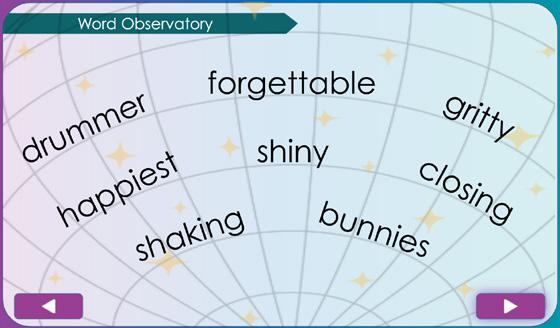
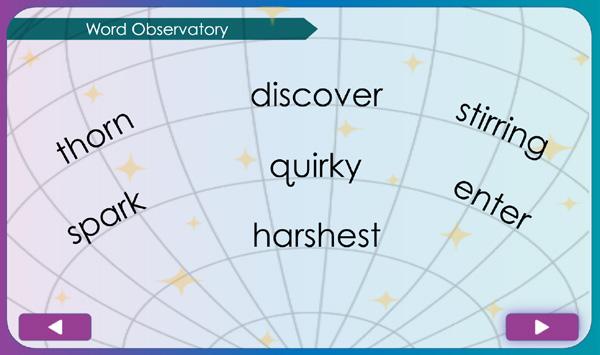
SAY “Take a moment to carefully observe these words: drummer, forgettable, gritty, happiest, shiny, closing, shaking, bunnies. Look for things that all or a few of the words have in common. One example is that most of the words have two syllables (drummer, shaking, gritty, shiny, closing, bunnies).”
ASK “What are other things some or all of these words have in common?”
• Possible answers include words that are verbs (shaking, closing), words ending with suffixes (all words), or words with suffix -y (gritty, shiny).
• Additional prompts: What do you notice about words with double letters? Think about parts of speech. Are there any letters that made a sound you didn’t expect?
SAY “The common feature of all these words that we will focus on in this unit is suffixes.”
3. View Vowel Suffixes Animation
CLICK TO DISPLAY Vowel Suffixes Animation.
SAY “Let’s watch this animation to review vowel suffixes and to learn about a few rules that help us read and spell certain words with vowel suffixes. We’ve already learned a bit about the Spell It Right Rules in Unit 7 in our morphology lessons. In this unit, we’ll focus on reading and spelling with vowel suffixes.”
CLICK TO PLAY the animation.
4. Review Words with Vowel Suffixes
SAY “Let’s review what we just learned.”
ASK:
• “ What is a suffix?” (A: a morpheme that is added to the end of a base to change the meaning)
• “ What is the difference between a consonant suffix and a vowel suffix?” (A: A vowel suffix begins with a vowel, like -es. A consonant suffix begins with a consonant, like -s.)
• “ How does adding a suffix change the meaning of a word?” (A: Suffixes change parts of speech as in help – helper, verb tense as in walk – walked, or amount as in paper – papers.)
CLICK TO DISPLAY Review: skimming
ASK “Do you see a suffix?” (A: yes, -ing)
SAY “When we see a suffix, let’s cover it up so we can focus on the base.”
CLICK TO COVER suffix -ing
ASK “How many vowels do you see in the rest of the word?” (A: one)
CLICK TO UNDERLINE the vowel.
ASK “So, how many syllables will the base have?” (A: one)
CLICK TO PLACE one SyllaBoard™ under the word skimming
SAY “I’ll add the i to the board.”
CLICK TO ADD an i to the board.
SAY “Let’s bring down our consonants in the base. I’m not sure that the second m is a part of the base, so I’m going to leave that off for now.”
CLICK TO ADD the consonants.
ASK:
• “ What is the base?” (A: skim)
• “ Is that a free or bound base?” (A: free)
sk i mm i ng skim
CLICK TO UNCOVER the suffix and box it in.
ASK:
• “ What type of suffix is -ing, vowel or consonant?” (A: vowel)
• “ What happens to a 1-1-1 base, like skim, when adding a vowel suffix?” (A: we double the last consonant)
FORTXPILOTUSEONLY
sk i mm i ng skim ming
• “ What is that rule called?” (A: the 1-1-1 Doubling Rule)
• “ Is suffix -ing just a sound or a whole syllable with a vowel phoneme?” (A: whole syllable)
SAY:
• “ So, it will need its own SyllaBoard™. Let’s add another board (click to add ) and add i-n- g to the new last board (click to add ing).
• If we add the doubled m to the end of the first board or the beginning of the second board, it will not change the pronunciation, so let’s just split the consonants for now and add it to the second board (click to add the letter m)
• T he doubled consonant helps us see that the first syllable is closed and we should read it with a short vowel phoneme.”
ASK “What is the whole word?” (A: skimming)
CLICK TO REVEAL the contextual image for skimming
SAY “Papa enjoys skimming the newspaper while he eats breakfast. A synonym for this definition of skimming is glancing. To skim means to look over quickly.”
ASK “How does the suffix -ing change the word?” (A: changes the tense)
SAY:
• “ Let’s remember this strategy that we can add to our multisyllabic word reading procedure. When we come to a word we don’t know, we can first look for any suffixes and cover them up to help us focus on the base.
• T his is also useful for words with prefixes like un-, pre-, in-, and dis-.
• O nce we cover up the parts we already know, we can underline the vowels and segment the syllables and then add the prefixes and suffixes back on to read the whole word.
• Remembering the vowel suffix rules will help us read the base with the correct vowel phoneme.”
5. Word Sort
SAY “Now we are going to sort words into four groups. We will look for the suffix rule that is applied to each word and then sort them.”
CLICK TO DISPLAY Word Sort.
SAY “Our categories are 1-1-1 Doubling Rule, Drop the e Rule, Change y to i Rule, and then there is a fourth column for words with no change needed before adding the vowel suffix.”
CLICK TO REVEAL the word beginner.
SAY “I see the vowel suffix - er and the base begin.”
ASK “Which rule was used to spell the word beginner?” (A: the 1-1-1 Doubling Rule)
SAY ”Yes, even though begin has two syllables, the second syllable, in, is one syllable with one vowel followed by one consonant so the n is doubled before adding the suffix.”
CLICK TO MOVE the word beginner under 1-1-1 DOUBLING.
CLICK TO REVEAL the word largest
SAY “I see the vowel suffix - est and the base large.”
ASK “Which rule was used to spell the word largest?” (A: Drop the e)
SAY “Yes, large ends in e so that e is dropped before adding the vowel suffix - est . If we kept the e, we would read the word as largeest .”
CLICK TO MOVE the word largest under DROP THE E.
CLICK TO REVEAL the word landed
SAY “I see the vowel suffix - ed and the base land.”
ASK “Which rule was used to spell the word landed?” (A: no change)
SAY “There is no spelling change needed to add the vowel suffix - ed to the base word land.”
CLICK TO MOVE the word landed under NO CHANGE.
CLICK TO REVEAL the word noisier.
SAY “I see the vowel suffix - er and the base noisy.”
ASK “Which rule was used to spell the word noisier?” (A: Change y to i)
SAY ”In noisy, the y is changed to i before adding the vowel suffix - er.”
CLICK TO MOVE the word noisier under CHANGE Y TO I.
CONTINUE SORTING WORDS by examining suffixes and bases: foggy, tried, falling, grazing.
Answer Key
1-1-1 Doubling Drop e Change y to i No Change beginner largest noisier landed foggy grazing tried falling
6. Read Words with Vowel Suffixes Using the Multisyllabic Word Reading Procedure
I DO melodies
SAY:
• “ Let’s break down some words with vowel suffixes.
• D o not say the word if you know it.”
C LICK TO DISPLAY I Do: melodies
SAY:
• “ We’re going to add a new beginning question. Do I see a suffix? I do. I see suffix - es
• B ecause I already know this suffix and don’t have to figure it out, I’m going to cover it up to help me figure out the rest of the word.”
CLICK TO COVER suffix - es
SAY:
• “ With the suffix covered up, I see three vowels (click to underline the vowels) and they are all apart.
• T his means that my base will have three syllables, so I’ll put down three SyllaBoards™.”
CLICK TO PLACE three SyllaBoards™ under the word melodies.
SAY “Now, I’ll add an e to the first board, an o to the second, and an i to the third.”
CLICK TO ADD the vowels to the boards.
SAY “Next, I’ll add the consonants in order while separating them on the boards to surround the vowel spellings.”
CLICK TO ADD the consonants to the boards.
SAY:
• “ Now I should be able to read the base, /mĕl/ /ō/ /dī/ (read incorrectly with a long o in the second syllable and a long i phoneme in the final syllable).
• T his sounds like a word I know, but it’s not quite right. I know that sometimes a vowel in an Open Syllable, like the o here, can spell schwa, so I’ll try that. /mĕl/ /uh/ /dī/ (read incorrectly again with a long i phoneme in the final syllable)
• T hat sounds closer, but it’s still not right. I’m going to uncover the suffix to see if that helps me.”
CLICK TO UNCOVER suffix - es and box it in
melodi i ng
m e l od ies
mel o di y
m e l od ies
mel o dies cascading
SAY:
• “Oh, it’s a vowel suffix, and there is a rule that says to change y to i before adding a vowel suffix.
• T he letter before the vowel suffix is an i, so I’ll see what happens if I temporarily change it to a y.”
CLICK TO ADD the letter y above the i.
SAY:
• “ I know that y at the end of a multisyllabic word often spells the phoneme /ē/, so the base must be melody. The y changed to an i before adding e- s
• U sually, suffix - es spells /ihz/, but in this word, it just spells the phoneme /z/.
• We don’t just add an s to most words that end in y ; we add e- s instead.
• B ecause suffix - es just spells a sound and not a whole syllable, I’ll add it to the last SyllaBoard™.”
CLICK TO REMOVE the letter y and add suffix - es to the third board.
ASK “How does suffix - es change the word?” (A: makes it plural)
CLICK TO REVEAL the contextual image for melodies
SAY:
• “ Melodies are musical sounds or notes that sound lovely together.
• ‘ The choir’s rich melodies filled the auditorium with joy.’
• N ow, let’s read a couple of words together.
• Place your SyllaBoards™, dry erase marker, and eraser on your desk.”
WE DO cascading
SAY “Do not say the word if you know it.”
CLICK TO DISPLAY We Do: cascading
ASK “Do you see a suffix at the end of the word?” (A: yes, -ing)
SAY “To help us figure out the base, let’s cover up the suffix and see what’s left.”
ASK “How many vowels do you see now?” (A: two)
CLICK TO UNDERLINE the vowels.
ASK:
• “Are the vowels together or apart?” (A: apart)
Phonics
c a sc a d i ng
c a sc a d i ng cas cad
c a sc a ding cas cad
c a sc a ding cas cade
c a sc a ding
cas cad ing
• “ So, how many syllables will the base have?” (A: two)
CLICK TO PLACE two SyllaBoards™ under the word cascading and ask students to put two boards on their desks.
SAY “I’ll add an a to each board.”
CLICK TO ADD the vowels to the boards and ask students to do the same.
SAY “Next, we will add the consonants in order while separating them on the boards to surround the vowel spellings.”
CLICK TO ADD the consonants to the boards and have students do the same.
ASK:
• “ What does the first board spell?” (A: cas pronounced /kăs/)
• “ What does the second board spell?” (A: cad pronounced /kăd/)
• “ Have you heard the word cascad?” (A: no)
SAY “I’m not sure that cascad is a word. Let’s uncover the suffix to see if that helps.”
CLICK TO UNCOVER suffix -ing and box it in.
SAY:
• “Oh, it’s a vowel suffix, and there is a rule that says to Drop the e before adding a vowel suffix.
• We should try that because if the last syllable was supposed to have a short vowel phoneme, that last consonant would be doubled, like in the word skimming that we broke down earlier.
• Let’s try temporarily adding the e in to see if it sounds like a word we know.”
CLICK TO ADD the letter e after the d and ask students to do the same.
ASK:
• “ If the second syllable used to be c-a- d- e, how would we pronounce it?” (A: /kād/)
• “ What is the whole base?” (A: cascade)
• “ Is suffix -ing just a sound or a whole syllable with a vowel phoneme?” (A: whole syllable)
SAY “So, it will need its own SyllaBoard™. Let’s add another board (click to add), remove the e, and add i-n- g to the new last board (click to remove the letter e and to add ing).”
ASK “What is the whole word?” (A: cascading)
Note: If students do not need a step-by-step review of a particular word, click through the procedure quickly to reach the confirming image.
Remember: This independent work is critical and consolidates transfer of skills.
Answer Key drabbest
dra bbest drab
dra bbest drab b est deciding d ec id ing de cid d ec iding de cid ing babies ba bies ba bi ba bies ba b ies
CLICK TO REVEAL the contextual image for cascading
SAY “Yes, the base is cascade, which means to fall in stages, like a waterfall or fabric, so cascading means it is happening right now in the present tense.”
YOU DO drabbest, deciding, babies
SAY “Now it’s your turn to follow the routine on your own. Clear your boards.”
For each word:
• s how the word,
• a llow students time to complete the procedure independently,
• c irculate to check student boards and note any misconceptions,
• and review after each word to segment and read the words correctly, by clicking through the procedure until you reach the confirming image if students are struggling.
CLICK TO DISPLAY YOU DO: Spell It Right Rules.
drabbest
• Cover - est, underline a, put down one board, add the a, add the consonants [drab], uncover - est, read the base, bring down another board, add - est to the second board, and then bring down the doubled b.
• [d rab] [best]
• 1 -1-1 Doubling Rule
• Contextual Sentence: “This is the drabbest chair I’ve ever seen; it’s so boring.”
REVIEW student boards after each word and walk through the routine listed below if students are struggling to segment and read the word correctly. Provide Positive Error Correction as needed.
deciding
• Cover -ing, underline e and i, put down two boards, add the vowels, add the consonants [de] [cid], uncover -ing, temporarily add e after d, read the base word, bring down another board, remove e and add -ing to the third board.
• [de] [cid] [ing] or [de] [ci] [ding] to better match pronunciation
• D rop the e Rule
• Contextual Sentence: “I need help deciding between chocolate cake and cheesecake.”
babies
• Cover - es, underline a and i, put down two boards, add the vowels, add the consonants [ba] [bi], uncover - es, temporarily add y above i, read the base, remove y and add - es to the second board.
• [ba] [bies]
FORTXPILOTUSEONLY
Answer Key
1. Circle any i that was changed from y in the word.
replied, studied, hurried
2. Draw a box around the original word that used to contain an e escaping, opposing, decorated, increasing
3. Underline the consonants that were doubled because a vowel suffix was added to the word.
fla pping, scru bbable, formatting, jogg er, permitting
4. Write the word that needed NO change when the vowel suffix was added.
bluffed, buzzed
• Change y to i Rule
• Contextual Sentence: “The babies played happily on the mat.”
Routine For Teacher Reference:
• “ Do you see a suffix?” (A: yes)
• If so, cover it to focus on the rest of the word.
• “ How many vowels are in the remaining part?” (Answers vary.)
• “Are they together or apart?” (A: apart)
• Put down the corresponding number of SyllaBoards™. (If there are two vowels in the base, students should put down two boards.)
• Write each vowel on its own board.
• F ill in the consonants.
• U se Touch & Say to read the syllables.
• U ncover the suffix to help determine if a vowel suffix rule was used. (If needed, flex the vowel to schwa to read the word correctly.)
– If Drop the e, temporarily add the e to aid in pronunciation.
– If 1-1-1 Doubling, add the doubled consonant to the board with the vowel suffix.
– If Change y to i, temporarily add the y above to aid in pronunciation.
7. Word Hunt
PAIR STUDENTS and have them sit together.
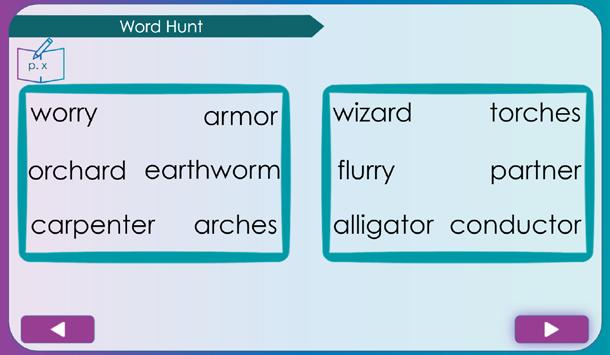
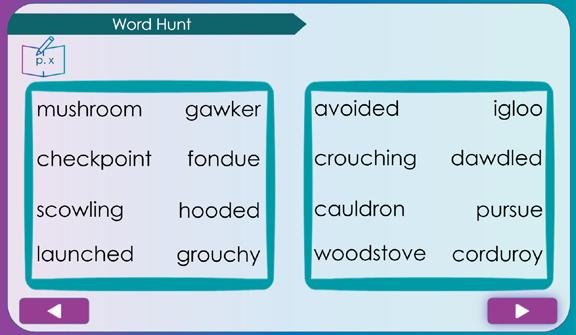
SAY “Now we’ll read words with vowel suffixes. Then, you will hunt for words with your partner. Open your workbooks to page 1.”
CLICK TO DISPLAY Word Hunt.
SAY “Each partner will read one box of words aloud while the other partner checks if the word is being pronounced correctly. Then we will check the words together.”
PROVIDE students time to read the two boxes. Then, have a pair read the words to the class, checking for proper pronunciation.
SAY “Read through the Hunt & Answer questions with your partner and answer them together. Write your answers on the lines.”
REVIEW answers as a whole class, and have students adjust answers as necessary.
8. Decodable Passage Teacher Read
SAY:
• “ Turn to page 2.
• O ur passage for this unit is called ‘The Lumberjack Legend,’ and it includes our Heart Words and words with vowel suffixes.
• Today, I’m going to read it aloud to you while you follow along in your books.
• Let’s answer a few questions first.”
CLICK TO DISPLAY Activating Prior Knowledge. Read the title and the questions and quickly discuss the answers.
CLICK TO DISPLAY Words to Preview. Read through the words and have students repeat them. Read the definitions and quickly discuss any connections to the words.
CLICK TO DISPLAY Point and Say words. Read through the words and have students repeat them.
CLICK TO DISPLAY Heart Words. Read through the words and have students repeat them.
SAY “Now pay attention to the way I read with accuracy and how I read smoothly, with fluency, and intonation, how my voice changes to help the listener understand the text.”
READ “The Lumberjack Legend” aloud with appropriate fluency and intonation.
ASK “Were your predictions on what the passage was going to be about correct?”
POINT OUT the compound words in the passage and ask students to read them and to break them into their smaller component words: lumberjack , footsteps, flapjacks, folklore, and hardworking
SAY:
• “ Let’s go back through and find those Heart Words before we learn more about spelling them.
• F ind the first underlined word, point to it, and say it with me.”
CONTINUE with the remaining Heart Words.
Answer Key
carve + - ed > carved
challenge + - er > challenger
tiny + - est > tiniest
slam + -ing > slamming
crab + -y > crabby
IF TIME ALLOWS, EXPLAIN anything new you have learned from the text and allow students to do the same.
9. Heart Word Magic
CLICK TO DISPLAY Heart Word Magic.
SAY:
• “ Let’s watch our Heart Word Magic animation for the Unit 10 words: passed and past, red and read, whole and hole, and would and wood.
• T his week, we have four pairs of words that sound the same but are spelled differently and have different meanings.
• We’ll learn more about homophones in the animation.”
CLICK TO PLAY the Heart Word Magic animation.
10. Climb in InferCabulary and Play in the Reading Playground
CLICK TO DISPLAY Climb in InferCabulary
Students climb independently in InferCabulary for 15 minutes.
CLICK THE TOGGLE BUTTON TO DISPLAY Play in Playground.
Students play independently in the Reading Playground for up to 10 minutes.
11. Quick Check
CLICK TO DISPLAY Quick Check.
DISTRIBUTE the Unit 10, Lesson 1 Quick Checks.
SAY “For today’s Quick Check, you will add vowel suffixes to a base. Apply one of the rules, 1-1-1- Doubling, Drop the e, or Change i to y for each word.”
FORTXPILOTUSEONLY
Unit 10 Lesson 2
Self-Assessment and “Rascal Jack and the Briar Bluff” Reading Vocabulary
Objectives
• To determine word knowledge through self-assessment.
• To preview a text by activating prior knowledge, making connections to personal experiences and books students have read in the past, and defining unfamiliar words.
• Confirm that the words from Module 2 were unstarred and the words from Module 3 have been starred as directed in Module 2, Unit 9.
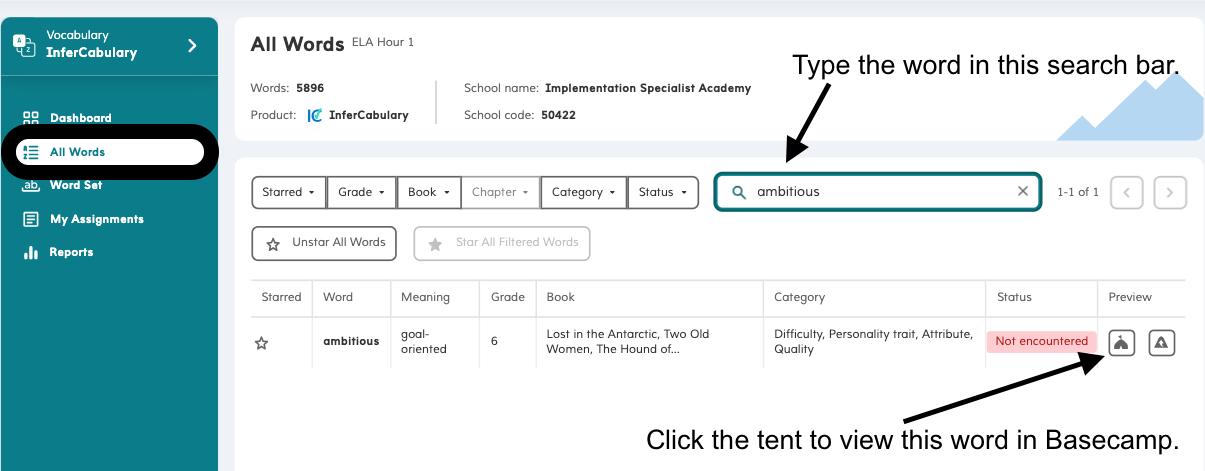
• Create the InferCabulary Expedition Pretest for Module 3 by building an assignment from the word set entitled Orbit Module 3 Expedition Pretest.
• For detailed directions see “How to Create the Expedition Game Assignment in InferCabulary ” on page 73.
Note: Words will fit in more than one category but are placed with the category that is most prominent.
Full Word Set for Module 3
Words related to trickster tales or character traits abrupt ambitious briar cunning legendary massive mighty mischievous protruding receding resourceful scheme scuffle theme trait trickster wilderness
Words that include the suffix -ic acidic acrobatic apologetic basic charismatic domestic dramatic energetic frantic lethargic magnetic microscopic nostalgic sympathetic toxic
Words that include the base vis invisible supervision visible visionary
Words included in phonics lessons colliding compelling flammable witty
Words considered highly prevalent bacteria canyon frontier organism pollution prairie
Cloze Passage Answer Key
• To prepare for the second reading of “Rascal Jack and the Briar Bluff” in Unit 13, Lesson 4, you may fill in the missing words in the Vocabulary Passage on page XX of your blank copy of the Orbit Student Workbook 2 using the answers provided in Orbit Online
FORTXPILOTUSEONLY
Words that include the base spect disrespectful perspective respectful spectacle
Start Teaching
Self-Assessment and “Rascal Jack and the Briar Bluff” Reading
FORTXPILOTUSEONLY
1. State Objectives
OPEN Orbit Online to Unit 10, Lesson 2, Vocabulary.
CLICK TO DISPLAY Objectives.
SAY “At the end of today’s lesson, you will be able to:
• identify how much you already know about certain words and use this information to track your own word learning progress.
• u se semantic links to find related words.
• prepare to read a folktale by making connections to your experiences and to books you have read and by figuring out the meanings of new words.”
2. Self-Assessment
CLICK TO DISPLAY Module 3 Self-Assessment.
STUDENTS OPEN their workbooks to page 5, Word Knowledge Self-Assessment.
SAY:
• “ Remember that we start every new module with a self-assessment of the words we will encounter throughout the next four weeks.
• You will see these words in InferCabulary as well as other activities throughout the module.
• T he goal is to deeply learn these words so that we can remember them in other activities and use them when we read and write.
• Let’s review the three levels we use to decide how well we might know a word.
• U se a plus sign next to each word that you recognize and know well enough to also think of 2-3 semantically related words.
• Put a checkmark next to the words that you recognize but do not know deeply enough to be able to talk about with 2-3 semantically related words.
• F inally, put a dash next to words that you are not familiar with or do not remember hearing before.
Vocabulary
Note: Add in any anecdotal observations from the Module 2 Self-Assessment such as, “I remember how challenging it was for many of you the first time you went through the words at the start of Module 2 compared to how much you knew at the end.” Or, “I noticed many of you started with mostly checkmarks in Module 2, but ended with several more plus signs.”
• Remember that this is all part of your word-learning journey. It is okay that there might be words you are unfamiliar with or words that you do not know deeply. That means we are in the right spot for learning.
• I a lso want you to remember that we will come back to these words in a few weeks when you will be able to measure your progress.”
READ each of the words aloud as the students follow along in their workbooks and complete the self-reflection.
3. “Rascal Jack and the Briar Bluff” First Reading
CLICK TO DISPLAY Folktales.
SAY:
• “A folktale is a story that has been told for many years. There is usually a lesson, or moral, at the end.
• T he characters are made-up, and often include talking animals or magical people.
• T he folktale we will read today is a trickster tale. In a trickster tale, a character uses their brain to outsmart others.”
CLICK TO DISPLAY What Do You Already Know?
SAY “Before we begin reading, we will think about what we already know about the topic and make connections to other stories we have read or heard.”
ASK the following questions to activate students’ prior knowledge and encourage discussion:
• “ Have you ever heard a story where an animal acts like a person and talks or plays tricks? What do you remember about that story?”
• (Click to replace with new question.) “Have you read any other stories
Vocabulary about trickster characters like Anansi the Spider or Coyote? What kinds of things do those characters usually do?”
• (Click to replace with new question.) “Have you ever played a trick on someone (in a fun way) or had someone play a trick on you? How did it feel? What happened?”
FORTXPILOTUSEONLY
• (Click to replace with new question.) “Why do you think people enjoy stories where someone clever wins against someone bigger or stronger?”
CLICK TO DISPLAY Words to Preview.
SAY:
• “ Before I begin reading, let’s preview some words that may be new to you.
• A pine marten is a small, furry animal that lives in forests. It looks a bit like a mix between a cat and a weasel. Pine martens have soft brown fur, a long bushy tail, and a creamy-colored patch on their chest. They are great climbers and love to jump from tree to tree.”
ASK “What animals does this pine marten remind you of?” (Call on 1-2 student volunteers to share.)
CLICK TO ADD badger.
SAY “A badger is a short, strong animal with a thick body and short legs. It has a gray body and a black-and-white-striped face that makes it easy to recognize.”
ASK “Have you ever seen a badger or read a story that included a badger?” (Call on 1-2 student volunteers to share.)
CLICK TO ADD prank
SAY “A prank is a kind of trick played on someone to make them look silly and to amuse others. For example, ‘Millie played a silly prank on her friend by spreading toothpaste on her crackers instead of peanut butter.’”
CLICK TO DISPLAY Time to Read!
STUDENTS OPEN their workbooks to page 6, Passage – “Rascal Jack and the Briar Bluff.”
SAY “I will read the folktale aloud as you follow along with me. We will not start filling in the blanks until the next lesson.”
READ “Rascal Jack and the Briar Bluff” aloud without the missing words. Take this opportunity to model fluent reading with expression.
SAY “In the next lesson, we will look closely at the first paragraph of this folktale and use semantic links, parts of speech, and our vocabulary words to fill in the blanks.”
Answer Key
1. forest, climb, bushy tail, jump
2. short, strong, gray, thick
3. B
4. Climb in InferCabulary and Play in the Reading Playground
CLICK TO DISPLAY Climb in InferCabulary
Students climb independently in InferCabulary for 15 minutes.
CLICK THE TOGGLE BUTTON TO DISPLAY Play in Playground.
Students play independently in the Reading Playground for up to 10 minutes.
5. Quick Check
CLICK TO DISPLAY Quick Check.
DISTRIBUTE the Unit 10, Lesson 2 Quick Checks.
SAY “Circle the words that are related to pine marten. Next, circle the words that are related to badger. Then, you will choose the answer that is an example of a prank.”
Unit 10 Lesson 3
Vowel Suffixes/Spell It Right Rules Practice Phonics
Objectives
• To accurately decode and encode multisyllabic words with vowel suffixes.
• To accurately decode and encode the homophone Heart Words: passed, past, whole, hole, red, read, wood, and would
• To practice oral reading fluency with decodable texts.
• “At the end of today’s lesson, you will be able to:
– read and spell multisyllabic words with vowel suffixes.
– s pell our Unit 10 Heart Words.
– read words, sentences, and our passage with greater fluency.”
2. Practice Heart Word Spelling
CLICK TO DISPLAY Heart Words.
SAY:
• “ Each of our Heart Words in this unit is a homophone. A homophone is a word that sounds the same as another word with a different spelling and meaning.
• Let’s look at the pairs of words, how they are spelled, and their meanings.”
ASK:
• “ What is this word (point to red)?” (A: red)
• “And what is this word (point to read)?” (A: /rĕd/ or /rēd/)
SAY:
• “ R- e-a- d is a word that is pronounced in two ways, /rĕd/ with a short e and /rēd/ with a long e
• T he pronunciation depends on the context, or what other words are around it that indicate present tense or past tense.
• T he past tense, /rĕd/ is a homophone with the word for the color red They are spelled differently, but they sound the same. You have to use the context to help you figure out which word to write when spelling.”
ASK “What letter, or letters, is not making the sound we expect in r- e-
Answer Key
a - d ?” (A: ea spelling short e)
CLICK TO CHANGE the ea from black to red and add a heart above it.
SAY “We are expecting the ea to spell its long vowel phoneme because ea is a vowel team that spells /ē/ most of the time. Instead, this ea spells the sound /ĕ/ when the word is in the past tense, /rĕd/: ‘Yesterday, I read three chapters of my book before bed.’”
REVIEW each of the three remaining pairs of homophones, asking the same questions as above and noting the unexpected vowel sounds. hole (an empty space) = expected VCe spelling whole (entire) = wh spells /h/, which is not very common and distinguishes the meaning of the word wood (from a tree) = oo is a regular spelling of the // sound would (past tense of will) = oul spells //
past (before now) = Closed Syllable with regular sound-spelling correspondence passed (to move, in the past) = ed indicates the past tense
CLICK TO DISPLAY Heart Word Spelling.
SAY “Turn to page 9 in your workbooks, and we’ll practice spelling the Heart Words we just went over. You’ll need to listen to the sentence to know which homophone to write.”
DICTATE the words, one at a time, reading the contextual sentence to help students make informed spelling decisions:
1. red - She chose a red apple.
2. read - He read the magazine while he waited for his appointment.
3. whole - Do you want olives on the whole pizza?
4. hole - I can fix the hole in my pants with a needle and some thread.
5. wood - We built garden beds using four pieces of wood
6. would - I would like to visit Paris someday.
7. passed - The car passed by the grocery store.
8. past – The play was set in the past .
FOR EACH WORD, STUDENTS:
• FILL IN a dot for each sound that they hear.
• WRITE a grapheme in each box with a dot in print.
• FILL IN a heart above the tricky part(s).
• WRITE the whole word on the final line in cursive.
REMIND STUDENTS to use their phonics knowledge to spell the phonetically predictable parts of each word and to write legibly in print.
After students have spelled each word, CLICK TO HIGHLIGHT THE ROWS AND REVEAL the answers and review them, one at a time. (Click once for each dot representing a phoneme, then once for each grapheme, a third time to display the hearts over the tricky graphemes, then once again to display the completed word in cursive.)
FORTXPILOTUSEONLY
3. Review
ASK:
• “ What is a suffix?” (A: a morpheme that is added to the end of a base to change the meaning)
• “ What are some suffixes you recall?” (A: Vowel suffixes: -ed, -ing, -er, -es, -able, -est, -ous, -ive, -ible, and -y. Consonant suffixes: -s, -ness, -ment, -ly, -ful, and -less).
• “ How do suffixes - s and - es change a base?” (A: make a noun plural; make a verb present tense)
• “ How do suffixes - ed and - ing change a base?” (A: change the verb tense to past or present)
• “ How does suffix - er change a base?” (A: makes a noun or compares two things)
• “ How does suffix - est change a base?” (A: it means ‘the most’ when comparing three or more things, as in fastest)
• “ What three rules have we learned about adding suffixes to words?” (A: the 1-1-1 Doubling Rule, Drop the e Rule, Change y to i Rule)
4. Partner Phrase Reading
CLICK TO DISPLAY Partner Phrase Reading.
STUDENTS PLACE workbooks and pencils on their desks.
SAY:
• “ Let’s read some words with suffixes in our Partner Phrase Reading.
• Turn to page 10 in your workbooks.
• Q uietly read the phrases to yourself. If you get stuck on a word, look for a suffix and cover it, underline the rest of the vowels, and break up the syllables to help you figure it out.”
STUDENTS READ QUIETLY TO THEMSELVES as many phrases as they can in the time given.
ASSIGN PAIRS OF STUDENTS to work together to read phrases fluently to each other and check each other’s work. Determine which student will act as the Reader first and which will be the Checker.
Have your blank copy of the workbook available as you monitor pairs throughout the room.
STUDENTS TRADE WORKBOOKS before the beginning of the paired activity.
See page xx for full Partner Phrase Reading directions and page xx for differentiation and challenge directions.
SAY “Now we’ll examine complete sentences to look for suffixes, and then read the sentences with fluency.”
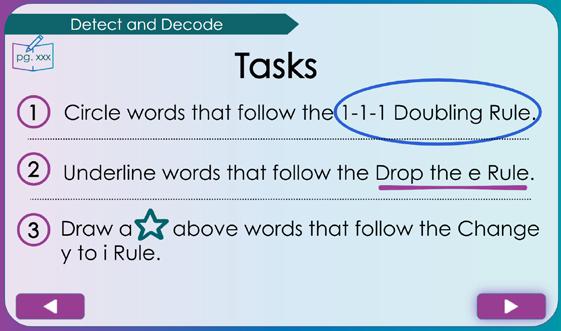
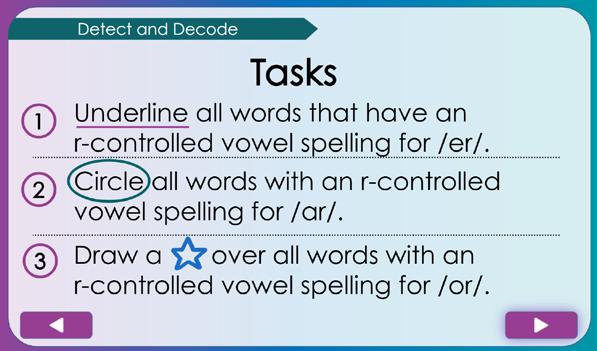
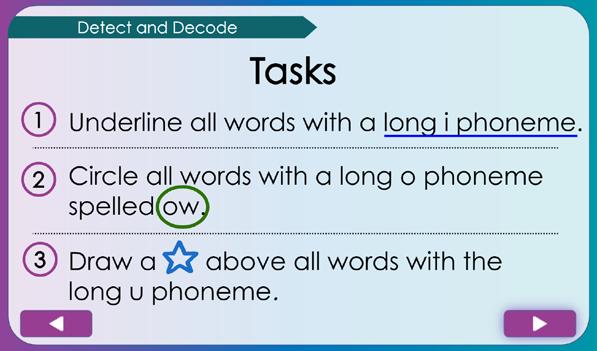
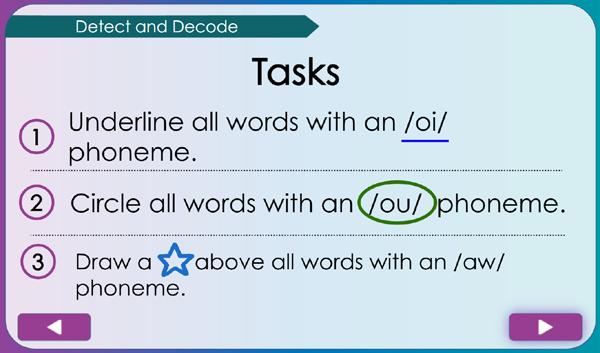
CLICK TO DISPLAY Detect & Decode. Read the tasks aloud.
SAY “Read each sentence and complete your tasks. When you are done, we will discuss what you found and then we’ll all have a few chances to read sentences aloud.”
After students have had time to complete their Detect tasks, DISCUSS their findings.
For Discussion: Words with Vowel Suffixes but No Change
cracked (sentence 4) tricky (5) traveling (6) The first syllable is accented, so the l does not need to be doubled.
*Also, less commonly spelled travelling talented (7) meeting (10)
• Remember, our goal is to read each sentence accurately the first time.
• O ur secondary goal is to read fluently, as if we were talking to a friend.
• Readers, make sure you read loudly enough for everyone to hear.
• Checkers, that is everyone who is not reading, pay careful attention to the Reader and the text.
Note: All students should read at least two sentences. It is expected that students will read sentences already read by another student. It may be beneficial to have struggling readers read a sentence after it has already been heard by the group.
• Q uietly mark any errors in your workbook. Remember to make your marks light.”
CALL ON INDIVIDUAL STUDENTS to read sentences, one at time.
DIRECT CHECKERS to give a thumbs up if the Reader reads all the words correctly or a thumb to the side if the Reader misreads a word(s). If the Reader misreads any words, follow Positive Error Correction instructions (see page 11 in Teacher Guide Book 1 for full directions).
FORTXPILOTUSEONLY
6. Split It!
CLICK TO DISPLAY Split It!
SAY:
• “ We are going to spell some longer words in our workbooks.
• After we Whale Talk each word, we’ll spell the word one syllable at a time by listening to the sounds in each syllable.
• Let’s spell the first word together. Turn to page 11.”
CLICK TO HIGHLIGHT row #1.
SAY:
• “ The first word is messiest . Repeat. (Students repeat messiest .)
• Messiest , as in, ‘My closet is messy, but my oldest brother’s is the messiest .’
• N ow, let’s Whale Talk messiest together.” ( Whale Talk messiest by holding your lips together and shouting mess-i-est Students Whale Talk with you.)
ASK “How many syllables did you feel in messiest ?” (A: three)
SAY:
• “Since messiest has three syllables, /mĕs/ /ē/ /ihst/, we will fill in dots in the first three boxes.
• A s you fill in each dot, say the syllables in messiest with me.
• /mĕs/ (click to fill in 1st dot), /ē/ (click for 2nd dot), /ihst/ (click for 3rd dot).”
SAY:
• “ Now, let’s spell each syllable in messiest by listening to the sounds in that syllable.
• The first syllable is mess - /m/ /ĕ/ /s/, mess . This is a syllable we know how to spell.”
ASK “How do we spell mess?” (A: m-e-s-s)
Phonics
SAY ”The Double Trouble rule tells us to double the letters s , f, l , or z if they come right after a short vowel in a single-syllable word. This is the base, mess .”
CLICK TO ADD the syllable mess to the first box.
SAY “If the base is mess , then it sounds like this word has two suffixes. If we just added the first suffix, the word would be messy.”
ASK “What suffix would we add to mess to make messy ?” (A: suffix -y)
SAY:
• “ Since the new word ends in a y, I need to change the y to an i before I add vowel suffix - est
• S pell the syllable /ē/ with an i in the second section.
• I f it helps you to write the word messy with a y and then to erase the y and change it to i , you can do that.”
CLICK TO ADD the syllable i to the second box.
ASK “And how do we spell vowel suffix /ihst/?” (A: e-s-t)
CLICK TO ADD the syllable est to the third box.
SAY:
• “ Let’s check our work using Touch & Say. We’ll touch each section as we read the syllable, and then we’ll blend the whole word together, /mĕs/ /ē/ /ihst/, messiest .
• Write the whole word together on the line on the right.”
CLICK TO ADD the word messiest to the final line.
CONTINUE the above process for the remaining words, one at a time. Review the answers at the end. Provide Positive Error Correction if needed. (See page 34 in Teacher Guide Book 1 for full directions.)
REMIND students to write legibly in cursive.
The vowels spelling the schwa phoneme are underlined in the words below. The spelling of schwa can be provided if needed.
2. upsetting - [up] [set] [ting] or [up] [sett] [ing]
• “ It was upsetting when my ice cream fell on the ground.”
• “ I soaked the filthy socks after the soccer game.”
5. commended - [com] [mend] [ed] or [com] [men] [ded]
• “ The coach commended the player for her perseverance.”
• * The base of commended is mend . Com is a prefix.
FORTXPILOTUSEONLY
7. Sentence Dictation Practice
SAY:
• “ Now, we’re going to put our suffix word spelling practice into use writing whole sentences.
• I ’ll say a sentence, and then I’ll repeat it slowly several times while you write it down.”
ASK “How do all sentences start and end?” (A: with a capital letter and with a period, a question mark, or an exclamation point)
SAY “Do your best to listen for places you might need a comma or quotation marks and do your best to think about the base word as you add suffixes to words.”
For each sentence:
CLICK TO DISPLAY Dictation Sentence Images, one at a time.
READ each sentence once with appropriate fluency and intonation.
STUDENTS REPEAT the sentence and count the number of words in the sentence. They write the number of words at the end. This will help them check that they’ve written each word.
REPEAT the sentence several times slowly as students write.
1. I have the thinner pile of trading cards. (8)
2. H ave you read the upsetting message and replied ? (8)
3. I n the past, the diner always had the tastiest pancakes. (10)
CLICK TO DISPLAY all three sentences and review as necessary. Students then make any necessary corrections.
8. Decodable Passage Practice
SAY:
• “ You heard me read the passage ‘The Lumberjack Legend’ earlier this week. Now, it’s your turn to get some practice reading the passage with a partner.
• You should focus on reading the words correctly, but this is also a time to work on your fluency.
Words with vowel suffixes that follow the 1-1-1 Doubling Rule:
– I f you see a question mark at the end of a sentence, like in the first sentence, change your voice to make it sound like a question.
– I f something you read doesn’t sound right, go back and reread it. There is no need to rush.
• Let’s go back to page 2.”
CLICK TO DISPLAY Words to Preview. Review quickly.
CLICK TO DISPLAY Point and Say Words. Review quickly.
CLICK TO DISPLAY Heart Words. Review quickly.
GROUP students into pairs and determine which student will be Reader 1 and which will be Reader 2.
COMPLETE the Decodable Passage Practice procedure. Refer to page 54 in Teacher Guide Book 1 for details of the complete procedure.
SAY:
• “ With your partner, find four words in the passage that have suffixes. Challenge yourself to find one word that follows each rule: 1-1-1 Doubling Rule, the Drop the e Rule, and the Change the y to i Rule. The last word you find can follow any of these rules or be a word with a suffix that does not require a spelling change. Write those on your workbook page at the end of the passage.
• U se your best legible cursive handwriting. I should easily be able to read your words as I walk around.”
REVIEW student answers as a class.
TIME PERMITTING, HAVE STUDENTS LOOK FOR other words with the target concept. The lists below contain all words with suffixes and the rules they follow.
Words with vowel suffixes that follow the Drop the e Rule:
Words with vowel suffixes that follow the Change the y to i Rule:
Words with vowel suffixes that do not follow a rule biggest funny cutting dragging strapped logging trekking muddy larger uses exciting later sized named wider amazing created stories relied stretching strongest passed enjoyed telling rocking frying helped turned hardworking cleared constructed
9. Climb in InferCabulary and Play in the Reading Playground
CLICK TO DISPLAY Climb in InferCabulary
Students climb independently in InferCabulary for 15 minutes.
CLICK THE TOGGLE BUTTON TO DISPLAY Play in Playground.
FORTXPILOTUSEONLY
Students play independently in the Reading Playground for up to 10 minutes.
10. Quick Check
CLICK TO DISPLAY Quick Check.
DISTRIBUTE the Unit 10, Lesson 3 Quick Checks.
SAY “For today’s Quick Check, you’ll read words with suffixes and determine which rule is followed. You will write the word under the column heading 1-1-1 Double, Drop the e, Change y to i , or No Change.”
Answer Key
1-1-1 Doubling Drop e Change y to i No Change chatter exploded happiest brushed bidding charger angrier editing
Unit 10 Lesson 4
Semantic Reasoning and “Rascal Jack and the Briar Bluff” Cloze & Questions Vocabulary
Objectives
• To use semantic reasoning to identify related words.
• To use related words to construct a definition.
• To use semantic links, parts of speech, and word meanings to find missing words in a cloze passage.
• To ask and answer questions while reading a folktale to support and demonstrate comprehension.
Semantic Reasoning and “Rascal Jack and the Briar Bluff” Cloze & Questions
FORTXPILOTUSEONLY
1. State Objectives
OPEN Orbit Online to Unit 10, Lesson 4, Vocabulary.
CLICK TO DISPLAY Objectives.
SAY:
• “At the end of today’s lesson, you will be able to:
– u se related words to build a definition.
– u se semantic links, word classes, and vocabulary words to find the missing words in a folktale.
– a sk and answer questions about a folktale.”
2. Semantic Reasoning Word Work – Briar
CLICK TO DISPLAY Semantic Reasoning Word Work - Briar
STUDENTS OPEN their workbooks to page 12, Word Work Worksheet – Briar.
SAY:
• “ We will complete another Word Work Worksheet to collect semantically related words for the word briar
• Remember that you will need to find either the category or example AND three other related words. If you find more than three related words, choose the three that will be the most helpful in defining the word.
• O nce you have found the related words you want to use, you will write a strong definition.”
CLICK TO DISPLAY Briar Basecamp.
ASK “What is the first step in this process?” (A: Look at all six pictures and make observations about how they are similar.)
SAY “We can also use our prior knowledge to decide what these pictures might tell us about the word briar.”
ASK “Does anyone want to share their observations?” (A: Validate all logical connections that might relate to the images. Redirect or request clarification as needed.)
SAY “Listen to each caption as I read it out loud. As I read each caption, write down the semantically related words on your worksheet.”
CLICK TO ADD, then READ each of the following captions. After reading each caption, give students 1-2 minutes to write related words. Then, click to add the next caption.
• “ This plant grows berries and thorns on tangled vines.”
• “ Be careful of these sharp tangled branches growing in the woods.”
• “ Birds hide in the dense thicket where no one can see them.”
• “ We had to cut through these brambles with strong clippers.”
• “Our fence is covered by plants that are full of thorns.”
• “ The vines on these bushes are tangled and prickly.”
SAY:
• “ Let me know if you need me to reread any of the captions.
• O nce you have chosen the most helpful related words, use them to draft your definition.
• Read it over and decide what words you should add or remove. Don’t forget to add punctuation.
• When you have completed all your edits, write the final version. (Click to show Connection Crossover.)
• Wow! It looks like there is a Connection Crossover here. This signal means that we have already learned a word that could help us understand this one. According to this note, it is a word that could be the category for briar.”
ASK “Does anyone know what this word might be?” (A: vegetation)
3. Cloze and Questions: “Rascal Jack and the Briar Bluff”
CLICK TO DISPLAY Sort the Words.
SAY “Before we read the first two paragraphs and fill in the blanks, let’s sort the vocabulary words by word class. Knowing each word’s job will help us choose the right ones.”
CALL ON a student to read the first word.
ASK “Is briar a person, place, or thing, or does it describe?” (A: it is a thing) (Click to move briars to the person, place, thing column.)
REPEAT THIS ROUTINE with the remaining vocabulary words in the list. Use the answer key to support students.
CLICK TO DISPLAY Read: “Rascal Jack and the Briar Bluff.”
Vocabulary
STUDENTS OPEN their workbooks to page 6, Passage - “Rascal Jack and the Briar Bluff.”
SAY:
• “ You will use the word bank, semantic links, and word classes to fill in the blanks.
• I will read the passage first as you follow along.” (Read the paragraph aloud as students follow along.)
CLICK TO DISPLAY Fill In the Blanks.
SAY “Let’s do the first one together: ‘Deep in the , where the trees were tall and briar bushes curled across the ground, lived a pine marten named Rascal Jack.’”
ASK:
• “ What type of word do we need to fill in the blank?” (A: a place)
• “ What are the places in our word bank?” (A: wilderness)
• “ What have you learned about the word wilderness?” (A: it is an area of wild and natural land that is not being used by people)
CLICK TO ADD the word wilderness to the blank.
SAY:
• “ You will work with a small group to fill in the other blank in the passage.
• Remember, in our classroom, everyone’s voice matters. People share in different ways—some talk, some use sign language, some use devices, and some need a little extra time to get their words out.
• O ur job is to listen carefully, take turns, stay on topic, and keep the room calm so every voice can be heard and respected.”
Answer Key
Jack was a trickster who loved to play sneaky pranks.
STUDENTS WORK in small groups to find the missing word. When students have finished, review the correct answer as a whole group. Once the correct missing word is identified, click to add it.
USE the following prompts to encourage students to explain their thinking:
• “ How did you know the missing word was ____?” (Sample responses: “The sentence says, ‘Jack was a ____.’ Since it was telling about a character, I knew the missing word had to be a character/person.”)
• “ What words helped you decide?” (Sample response: “ Tricksters pull pranks.”)
Redirections
If students fill in the blank with the incorrect word, redirect them with the following questions:
Vocabulary
• “ What type of word is needed to fill in the blank?”
• “ How do you know it should be a [person, place, or thing; or description]?”
• “ What are the [people, places, or things; descriptions] in our word bank?”
• “ Tell me what you have learned about [incorrect word]. Does the sentence make sense if you use its definition to fill in the blank? If not, what other word would match the meaning of the sentence?”
• “ What words are related to the missing word? How are the words semantically linked?”
CLICK TO DISPLAY Question Words.
SAY:
• “ Here is the list of question words. Remember, the question word who asks about a person or people.
• What asks for information. When it is combined with a form of the verb do, it asks for information about an action, or what happened.
• When asks about the time an event happened.
• Where asks about location.
• When we read ‘Snacks Around the World,’ you learned how to ask and answer Right There questions. The answer to a Right There question can be found in one spot in the text.
• I n this activity, you will work with a small group to choose a question word and ask a Right There question about this paragraph.”
CLICK TO DISPLAY Passage.
STUDENTS WORK in small groups to choose a question word and create a Right There question. Circulate between the groups to provide support as needed.
CALL ON student volunteers to share their questions and identify the answers. (Sample responses: “Where does Rascal Jack live?” “What is Rascal Jack famous for?” “Who does Rascal Jack like to annoy?”)
4. Complete Expedition Assignment in InferCabulary
CLICK TO DISPLAY Expedition Assignment.
SAY “Instead of climbing today, please open your assignment area and complete the assignment titled Orbit Module 3 Expedition Pretest. When you are finished, you may use the rest of the time to climb the mountain.”
Vocabulary
5. Quick Check
CLICK TO DISPLAY Quick Check.
DISTRIBUTE the Unit 10, Lesson 4 Quick Checks.
SAY “Circle the words that are related to trickster. Next, circle the words that are related to wilderness. Then, you will choose the word that does not belong.”
Answer Key
1. prank, clever, cheat, trick
2. wild, mountains, animals, trees
3. spectacle
Unit 10 Lesson 5
Knowledge Checkpoint: Vowel Suffixes/Spell It Right Rules
Objectives
• To accurately decode and encode multisyllabic words with vowel suffixes.
• To read controlled text with Closed, Open, and VCe Syllable words with vowel suffixes accurately, fluently, and with understanding.
• To accurately decode and encode the Heart Words: passed, past, whole, hole, red, read, wood, and would
Teacher Materials
• O rbit Online and Teacher Dashboard
• B lank copy of Orbit Student Workbook 2
Student Materials
• S pelling & Dictation page –printed and copied (Supply Room HQ or page XX in the Appendix)
Knowledge Checkpoint: Vowel Suffixes/ Spell It Right Rules
FORTXPILOTUSEONLY
1. State Objectives
OPEN Orbit Online to Unit 10, Lesson 5, Phonics.
CLICK TO DISPLAY Objectives.
SAY:
• “At the end of today’s lesson, you will be able to:
– s how that you can read and spell multisyllabic words with vowel suffixes by themselves and in phrases and sentences.
– s how that you can spell our Unit 10 Heart Words.”
2. Optional Warm-Up Activity
CLICK TO DISPLAY Warm-Up: Vowel Suffix Rules.
SAY:
• “ To warm up, let’s do some brain and body exercises.
• I ’ll show a word with a vowel suffix, and we’ll read it together.
• If the word follows the Drop the e Rule, drop down to the ground in a crouch. (Have students practice.)
• If the word follows the Change y to i Rule, change your body by turning backward. (Have students practice.)
• If the word follows the 1-1-1 Doubling Rule, jump up twice in a row. (Have students practice.)
• F inally, if the word requires NO change, just stand still. (Have students practice.)
• B efore you make your move, we’ll all have a chance to look carefully at the word. When I say ‘Go!’ crouch down, turn around, jump twice, or stand still.”
CLICK TO REVEAL each new word, read it with students, provide thinking time, and then say “Go.” Review the vowel suffix rule before clicking for the next word.
1. funnier (Change y to i)
2. shaded (Drop the e)
Note: Print the Spelling & Dictation page from Orbit Online’s Supply Room HQ or page XX in the Appendix.
3. framing (Drop the e)
4. grabby ( 1-1-1 Doubling)
5. clicked (No change)
6. exploding (Drop the e)
7. permitting ( 1-1-1 Doubling)
8. hobbies (Change y to i)
3. Spelling and Dictation
CLICK TO DISPLAY Spelling & Dictation.
SAY “We have been practicing spelling Heart Words that are homophones and words with vowel suffixes. For today’s spelling test, write the words in your best handwriting on your Spelling & Dictation paper.”
D ISTRIBUTE a Spelling & Dictation page to each student.
REMIND students to use the handwriting lines for letter formation, using the Moon and Star lines to size the letters.
READ aloud the twenty words and two dictation sentences to students.
• For spelling words, use the contextual sentences below to ensure students have heard the word correctly.
• For dictation sentences, have students repeat the sentence and count the number of words in the sentence before writing.
1. spotty – Spotty showers means it might rain in some places, but not everywhere.
2. happier – They are happier when they can play outside.
3. filing – We are filing our drawings in hanging folders.
4. slimmest – Use the slimmest paintbrush to add the fine details.
5. tries – He tries to comfort the baby by singing softly.
6. shiny – The shiny part of seashells is called mother of pearl.
7. challenger – A challenger is someone in a contest or race.
8. unstoppable – The track team’s star was unstoppable in every race.
9. replied – Luke replied promptly to the invitation that he could attend the ceremony.
10. winner – The winner of the tennis tournament received a trophy.
11. excuses – He had many excuses for being late to class.
12. coziest – Mama bear found the coziest den in the mountains for the long winter.
SAY “For the homophones, you’ll need to think about the meaning of the word to choose the correct spelling. Write the first homophone you hear in the sentence, write a slash, and then write the second homophone in the sentence on the same line.”
13. /rĕd/ – She read over the directions carefully before using her new bright red camera.
14. /păst / – In past summers, we have passed right by the waterfall.
15. /w d/ - Would you like to help me chop the wood ?
16. /hōl/ – The whole family of squirrels quickly dug a hole and located an acorn.
Dictation Sentences
1. Eve studied for her exam until closing time. (8)
2. I a m saving the cash I get from babysitting. (9)
4. Decodable Passage Fluency and Comprehension
CLICK TO DISPLAY Decodable Passage.
SAY:
• “ We have read ‘The Lumberjack Legend’ twice this week. Now, it’s your turn to read the passage accurately and fluently. You’ll add another column to your tracking chart.
• O pen your workbooks to page 2.
• Your goal is to read with greater accuracy than the first time you read the passage, aiming for 98% accuracy or higher, but remember that you can always reread if you notice you made a mistake or if something you read doesn’t make sense.
• Remember that accuracy is more important than speed. Read carefully.”
GROUP students into the same reading pairs as earlier in the week. The student who was Reader 1 in Lesson 3 will be Reader 1 today for a repeated reading. Reader 2 will begin as Checker.
PROCEDURE:
1. CLICK TO DISPLAY AND BRIEFLY REVIEW the “Words to Preview,” “Point and Say,” and “Heart Words” at the top left of the passage with students.
2. READERS SWAP WORKBOOKS and follow the procedure on
1.
page 54 in Teacher Guide Book 1 as students take turns being the Reader and Checker while tracking miscues, timing a one-minute reading (click to display the timer for each reader), and rereading any misread sentences.
3. EACH STUDENT CHARTS their own Accuracy Percentage & Words Correct Per Minute using the chart at the end of their workbook.
ASK:
• “ What is something you did well in the oral reading compared to your practice read?”
• “ What is something to improve in your oral reading?”
• “ Would a few students share their growth?”
SAY:
• “ With practice, we can improve our reading accuracy, prosody, and speed. Improving these skills allows us to better understand what we are reading.
• Let’s see what we understood by answering the Investigate the Text questions.”
READ ALOUD OR HAVE STUDENTS READ INDEPENDENTLY the Investigate the Text questions. Students will underline their answers to questions #1-4 directly in the passage. For questions #5 and #6, students will “Think” about their answer, “Pair” up with a classmate to discuss their own experiences and opinions, and then “Write” their responses on the handwriting lines. Their answers should be complete sentences written in legible cursive handwriting. The inferential questions foster discussion between all students, helping them find personal and social connections with each passage.
CLICK TO DISPLAY answers and review with students after they have completed all questions in their workbooks, asking for volunteers to read their answers to questions #5-6.
Answer Key
2. How did Paul grease his flapjack pan? He relied on normal sized men to skate in his frying pan. They had bacon strapped to their feet so the flapjacks didn’t stick!
Answer Key
3. What natural landmark did the stories say Paul carved with his ax?
One funny tale explains that Paul Bunyan made the Grand Canyon. He did this just by dragging his ax behind him!
4. How did the stories of Paul Bunyan live on before they were written down?
Paul’s tales were passed down by word of mouth. That means they were told rather than read
5. The tales say Paul Bunyan was 7 feet tall. The average man in America is 5 feet 9 inches tall. Does the height difference make it seem realistic that Paul could do all the things the stories say?
6. What is something you are really good at that makes you feel proud, like Paul Bunyan with his strength?
5. Climb in InferCabulary and Play in the Reading Playground
CLICK TO DISPLAY Climb in InferCabulary.
Students climb independently in InferCabulary for 15 minutes.
CLICK THE TOGGLE BUTTON TO DISPLAY Play in Playground
Students play independently in the Reading Playground for up to 10 minutes.
6. Quick Check
CLICK TO DISPLAY Quick Check.
DISTRIBUTE the Unit 10, Lesson 5 Quick Checks.
SAY:
Answer Key
1. s entence with luck iest with i underlined
2. s entence with grabbed with b underlined
3. s entence with gradi ng with di underlined to show where the e was dropped
• “ For today’s Quick Check you will write three sentences, each with a word that requires a spelling change. Listen to the word or base, how to change it, and underline the spelling change within your sentence.
1. The first word is lucky. Write a sentence with the word luckiest and underline the spelling change.
2. The second base is grab. Write a sentence with the word grabbed and underline the spelling change.
3. The third base is grade. Write a sentence with the word grading and underline the spelling change.”
Unit 11 Lesson 1
Prefixes em- and en-
Objectives
• To learn and identify the prefixes em- and en-.
• To determine the meaning of words using knowledge of morphemes.
• To use knowledge of morphemes and context clues to use newly defined words in connected text.
• U nit 11 Home Connection Letter – printed and copied (Supply Room HQ)
• pencil
Morphology
Prefix en- and em-
What You Need to Know
Suffix -ic
FORTXPILOTUSEONLY
• Prefixes en- and em- are both derived from Latin and typically mean to put into or onto or cause to be, make. These prefixes can be added to free bases, bound bases, and roots to form a verb. For example, the word enable means to make able, encircle means to form a circle around, and empower means to give power to. The reason these prefixes have been grouped is not only that they have the same meaning but simply that em- is a variation of the prefix en-. It is primarily used with words that begin with the consonants b and p (as in the words embark , embrace, and employ) for the ease of pronunciation. It may be important for students to recognize that these prefixes change the function of the base, often turning nouns or adjectives into verbs that express causing or initiating an action.
Prefix ex-
• Prefix ex- also derives from the Latin language and means out or from. It is used to show that something is moving outward or is no longer part of something. For example, exit means to go out, exhale means to breathe out, and extract means to pull out of. The prefix ex- is related to the prefixes e- and ec-, which carry the same meaning but appear in different spellings based on pronunciation and modern English spelling patterns. For instance, the words emit (to send out) and erase (to rub out) use the prefix e-, while the words eccentric (out of center) and eclectic (selected out of various sources) use the prefix ec-. These variations occur because Latin prefixes are adjusted slightly depending on the first letter of the base, making the word smoother to pronounce. It is helpful to bring attention to these variations when teaching so that recognizing the related prefixes becomes fluent.
• T he suffix -ic is commonly added to the end of nouns to form adjectives. Deriving from both the Greek and Latin languages, it means relating to or having the nature of. For example, historic means related to history and magnetic means having the nature of a magnet. The suffix -ic also has a spelling variation -tic, which appears in words like athletic and poetic . In many of these words, the -tic form comes from combining -ic with another morpheme; often -t from the root or base is carried into the new spelling or it reflects how the word evolved from Greek or Latin. Teaching this variation will help students decode unfamiliar words and more accurately identify morphemes. It will become easier to recognize the base with the new spelling pattern due to the addition of the suffix (robotic = in the nature of a robot, energetic = related to having energy).
Greek Combining Forms
• Greek combining forms are a family of a few types of morphemes; typically prefixes and roots that originate from the Greek language and are used to form complex English words. We see Greek combining forms mostly in academic, scientific, and technical vocabulary. Unlike Latin roots, which often appear in the everyday English language (e.g., dict in predict), Greek combining forms are more commonly found in specialized terms like telephone (tele meaning far, phone meaning sound) or photograph ( photo meaning light, graph meaning writing). These forms entered the English language primarily through scholarly and scientific discourse during the Renaissance and Enlightenment, as Greek was the language of early science and philosophy. It is important to teach the difference between Greek combining forms and Latin roots because they serve different functions and often appear in different contexts. Understanding these distinctions helps students decode unfamiliar words, build
What You Need to Know
vocabulary, and gain confidence when reading nonfiction or subject-specific texts, especially in areas like science, math, and technology. In Orbit students will learn the term Greek combining forms as a term that refers to the origin of a morpheme. It is not important for their understanding of morphemes to memorize which roots and affixes come from Greek or Latin. This knowledge will only build their curiosity, decoding skills, and meaning-making skills when it comes to word study.
Choral Response Procedures
• T he following choral response procedures will be indicated in the script throughout the rest of the Orbit units. Now that students have a stronger understanding of morphemes and the routines, it is important to enhance students’ engagement through whole group response. If a choral response procedure is not indicated in the text but you feel it may benefit students, return to this page to follow the simple procedures to add to student engagement. You will also find a detailed Turn and Talk procedure on page XX of the appendix.
• Choral Reading & Response:
- Cue: “Read with me…” (point to slide) or “Say with me…”
- Think time: 2-3 seconds.
- Signal: Point to class or drop hand.
- Response: All students read/say together.
- Positive Error Correction if needed or Positive Feedback (e.g., thumbs up).
• Finger Response:
- Cue: “Use finger tap to show me how many…”
- Think time: 2-3 seconds. Students hold fingers on the edge of their desk or seat.
- Signal: Point to class.
- Response: Students hold up answers silently.
- Positive Error Correction if needed or Positive Feedback (e.g., thumbs up).
Start Teaching
Prefixes em- and en-
FORTXPILOTUSEONLY
1.State Objectives
OPEN Orbit Online to Unit 11, Lesson 1, Morphology.
CLICK TO DISPLAY Objectives.
SAY:
• “At the end of today’s lesson, you will be able to:
-identify and define the prefixes em- and en-.
-determine the meaning of words with the prefixes em- and en-.
-determine the missing words in a sentence by looking at morphemes and using key words.”
2.Morpheme Families
CLICK TO DISPLAY Morpheme Families: en-, em-.
DIRECT students to turn to page 14 in their Orbit Student Workbook 2.
SAY:
• “Become a word detective. Silently read each word and look for similarities in the spellings and meanings.
• Write your ideas in the notes section of your workbook. (Briefly allow students time to write down their ideas.)
• Talk with your partner about what you notice. Pay attention to your partner’s response, as you will share out their answer at the end.
• You may use this sentence stem to get you started: I notice that some words have .” (Walk around the room listening to and supporting students.)
CALL ON two or three students to share what their partner noticed in the word exploration. (A: answers will vary)
CLICK TO REVEAL the divided webs highlighting the prefixes.
POINT TO the words with prefix em- and DIRECT students to read the words with you.
POINT TO the words with prefix en- and DIRECT students to read the words with you.
SAY “Now we will learn more about these prefixes.”
3. Learn Prefixes en- and em-
CLICK TO DISPLAY Learn Prefixes en-, em-.
• T he example free base we see in our chart is brace. To brace enmake, put into large > enlarge emmake, put into brace > embrace
DIRECT students to the prefix chart in their workbook.
SAY:
• “ Displayed on this chart are the prefixes e-n /ĕn/ and e-m /ĕm/.
• Let’s learn the meaning and an example of each prefix.”
CLICK TO REVEAL the meaning of en- and the example free base large
SAY:
• “ The first prefix we will learn is e-n, /ĕn/.
• T his prefix means make, put into
• Write the definition in your workbook.
• T he example free base we see in the chart is large. If something is large it is greater in size than usual or average.”
CLICK TO REVEAL the sentence and image.
SAY “Read the example sentence with me: ‘The giant’s large footsteps shook the castle walls.’”
CLICK TO REVEAL the new sentence and image.
SAY:
• “ If we add the prefix en- to the word large we get the word enlarge.
• Let’s examine this example word, enlarge
• When you enlarge something, you make it greater in size.
• Read the example sentence with me, ‘The ogre tried to enlarge his cave to store more treasure.’
• T his indicates that the ogre tried to make the cave greater in size.
• Write the word enlarge in your workbook.”
CLICK TO REVEAL the meaning of em- and the example free base brace
SAY:
• “ The second prefix we will learn is e-m, /ĕm/.
• T his prefix’s meaning is also make, put into It is the same definition as en-. Write the definition in your workbook.
Morphology
something means to strengthen or support it with something else.”
CLICK TO REVEAL the sentence and image.
SAY “Read the example sentence with me, ‘The villagers brace their doors before the big bad wolf blows.’”
CLICK TO REVEAL the example word embrace with the sentence and image.
SAY:
• “ If we add the prefix em- to the word brace we get the word embrace
• If you embrace someone, you put your arms around them and hold them tightly, usually to show your affection for them. It can also mean you give your support to an idea.
• Read the example sentence with me, ‘At the end of the tale, the lost siblings embrace in a happy reunion.’
• T his indicates that the siblings put their arms around each other with support.
• Write the word embrace in your workbook.”
CLICK TO DISPLAY Word Family Map: Prefixes.
SAY:
• “ Take a closer look at the word families. Be a word detective and think about how each of the words is spelled.
• Talk with your partner about what you notice.
• You may use this sentence stem to get you started: I notice the prefix em- is used .” (Walk around the room listening to and supporting students. After a short time remind students to switch partners.)
CALL ON one or two students to share what they noticed. (A: Answers will vary. You use the prefix em- before the letters b and p.)
SAY:
• “ Before the consonants b and p, you use the em- spelling of this prefix.
• T he variations of the prefix en- and em- come from different spelling patterns.
• A base that begins with consonants b and p will use the spelling variation e-m.”
4. Morpheme Puzzles
DIRECT students to turn to the Morpheme Puzzles in their workbook on page 15.
SAY:
• “ Now we will look at some new words that include the prefixes we just learned.
• We will use Morpheme Puzzles to help us identify the morphemes of each word.
• Pay attention to how the word changes as we dissect or pull apart each puzzle.
• We will do the first one together.”
I DO enable
CLICK TO DISPLAY the puzzle enable
SAY “This is the first puzzle. Let’s identify the morphemes.”
DIRECT students to use the correct number of fingers to tap the table to show their answer. When you indicate, have them raise their hand revealing their answer. (Use the Choral Finger Response routine on page XX of the What You Need to Know at the beginning of the lesson.)
ASK for a choral response:
• “ How many morphemes are in this word? Tap the table. Show me.” (A: 2)
• “ What is the prefix?” (A: en-)
• “ What is the free base?” (A: able)
CLICK TO SEPARATE the puzzle pieces.
SAY:
• “ If we take the puzzle apart, we see a prefix and a free base: enand able
• Write these morphemes in the first set of puzzle pieces on page XX of your workbook.”
WE DO endangering
CLICK TO DISPLAY the puzzle endangering.
SAY “Let’s identify the morphemes.”
ASK for a choral response:
Morphology
• “ How many morphemes are in this word? Tap the table. Show me.” (A: 3)
• “ What is the prefix?” (A: en-)
• “ What is the free base?” (A: danger)
• “ What is the suffix?” (A: -ing)
CLICK TO SEPARATE the puzzle pieces.
SAY:
• “ If we take the puzzle apart, we see a prefix, a free base, and a suffix: en-, danger, and -ing.
• Write these morphemes in the second set of puzzle pieces in your workbook.”
YOU DO encircle, entrapment, empower, embellish, embark
SAY “Now it is your turn to complete the rest of the Morpheme Puzzles with your partner. Alternate roles of worker and checker.”
CLICK TO DISPLAY Morpheme Puzzles: YOU DO.
FOR EACH PUZZLE:
• A llow students time to complete the procedure with a partner.
• M onitor student work and note any misconceptions.
SAY “I will click through the puzzles to separate the morphemes. Check your work and make any necessary adjustments.”
CLICK TO REVEAL each answer by separating the puzzle pieces into morphemes.
5. Interpret It
I DO embark
CLICK TO DISPLAY Interpret It: I DO embark
SAY:
• “ Let’s determine the meaning of these words using our routine, Interpret It
• Remember our first step is to identify the base.”
ASK “What is the base?” (A: bark)
SAY “Although this sounds like a free base we all know—bark as in the sound a dog makes or the bark from a tree—bark is a root that has a
Morphology
em bark
bark ship, boat; journey, enterprise em make, put into
different meaning. We will learn the meaning in a moment.”
ASK “What is the prefix in this word?” (A: em-)
C LICK TO SEPARATE the morphemes.
SAY “Now that I have identified the morphemes, I need to determine the meaning. I will start with the root, bark .”
FORTXPILOTUSEONLY
Embark means
Embark means to go into or on a ship.
CLICK TO SHOW the image for bark .
SAY “The meaning of the root bark is a ship or boat. It explains a journey or enterprise.”
CLICK TO REVEAL the definition of bark .
CLICK TO REVEAL the definition of em-.
ASK “What is the meaning of the prefix em-?” (A: make, put into)
SAY:
• “ Now I will put these meanings together to interpret the word embark
• T he prefix em- changes the meaning by telling us something is made or put into
• It is important that I include words from each of the morphemes’ meanings in the new definition.
• I a lways start the definition with the word I am defining: Embark means .”
CLICK TO REVEAL the sentence stem.
CLICK TO REVEAL the definition.
SAY “Notice that in the definition I included key words from the meaning of each morpheme.”
ASK “What key word did I include for em-?” (A: into)
CLICK TO HIGHLIGHT the word into.
ASK “What key word did I include for bark?” (A: ship)
CLICK TO HIGHLIGHT the word ship
SAY:
• “ These days we have more than just ships to use to travel. So, another way to think of the definition is embark means to begin a journey or go on an adventure.
• O ne of the reasons we study morphemes is to figure out the meaning of unfamiliar words.
• We also need to work on moving from the literal meanings of morphemes to understanding words on a deeper level. It will help to do this by putting words in context.”
Morphology
make, put into able to have the skill, strength, or means to do something
Enable means
Enable means to make possible with someone’s skill or strength.
WE DO enable
CLICK TO DISPLAY Interpret It: WE DO enable
SAY “The new word is enable. Look for the word enable on page 16 of your workbook. Take a moment to find the base.”
ASK for a choral response:
• “ What is the base?” (A: able)
• “ What is the prefix in this word?” (A: en-)
CLICK TO SEPARATE the morphemes.
SAY “Write the morphemes under the word enable in your workbook on the correctly labeled line.”
CLICK TO REVEAL the image for able.
SAY “Discuss with your partner the meaning of each morpheme. Pay close attention to what your partner responds.” (Walk around the room listening to and supporting students. After a short time remind students to switch partners.)
CALL ON one or two students to share the meanings of the morphemes from their partner. (A: en- means make, put into; answers will vary for able)
CLICK TO REVEAL the meaning of each morpheme.
SAY “Move to the handwriting line in your workbook. Let’s use this sentence frame to help us write the definition of enable using key words from the meanings of the morphemes.”
CLICK TO SHOW the sentence frame.
SAY:
• “ Work with a partner to make a definition for the word enable using the sentence stem and key words.
• Write the definition on the line in your workbook. Write down the definition you believe makes the most sense.” (Allow students 2-3 minutes to discuss and write their definition.)
ASK “What is your definition of the word enable?” (A: answers will vary)
CLICK TO REVEAL the example definition.
ASK “What key word is included for en-?” (A: make)
CLICK TO HIGHLIGHT the word make.
ASK “What key words are included for able?” (A: skill, strength)
CLICK TO HIGHLIGHT the words skill and strength
Morphology
Answer Key
1. En/trap: Entrap means to put something into a device for catching
2. Em/power : Empower means to put strength and authority into someone.
3. En/danger/ing : Endangering means to currently be putting someone into a risky situation
Answer Key
(example context clues are underlined)
1. The crafty goblin tried to entrap the prince by hiding a pit beneath glittering leaves.
2. The wise tortoise taught that skill and perseverance could enable a champion to finish races others fear to start.
3. A c loak woven from starlight could empower the timid mouse with strength to stand up to the barn owl.
*answer key continued on next page
YOU DO entrap, empower, endangering
SAY:
• “ Work with your partner to complete the process above for each word.
• Work together to write a complete definition using the key words from the meanings of the morphemes.
• U se the provided images and definitions of the roots.”
PROVIDE students with time to collaborate as partners. Circulate to coach and support as needed.
CLICK TO DISPLAY the morphemes and definitions of the words, allowing students to check their work if necessary for error correction. If students are struggling with one or more definitions, spend time interpreting the word as a group.
6. Climb in InferCabulary and Play in the Reading Playground
CLICK TO DISPLAY Climb in InferCabulary
Students climb independently in InferCabulary for 15 minutes.
CLICK THE TOGGLE BUTTON TO DISPLAY Play in Playground.
Students play independently in the Reading Playground for up to 10 minutes.
7 . Quick Check
CLICK TO DISPLAY Quick Check.
DISTRIBUTE the Unit 11, Lesson 1 Quick Checks.
SAY:
• “ You will complete five cloze sentences.
• Read each sentence and underline the context clues to determine the word that best fits in the blank.
• Complete the sentence by writing the chosen word on the blank line.”
Answer Key
(continued)
4. H iding the silver map from the young knight was endangering the quest, pushing the heroes into harm instead of safety.
5. W ise owls reminded the squirrel that before they embark , one must pack a brave mind.
FORTXPILOTUSEONLY
Unit 11 Lesson 2
Vocabulary Venture and “Rascal Jack and the Briar Bluff” Cloze & Questions Vocabulary
Objectives
• To conduct a full word-level analysis of the structure and meaning of the word flammable by identifying its syllables, morphological components (base and suffix), and semantically related words.
• To use semantic links, parts of speech, and word meanings to find missing words in a cloze passage.
• To ask and answer questions while reading a folktale to support and demonstrate comprehension.
• T his Vocabulary Venture will explore the word flammable. Because the syllabication is different than the morphological breakdown for this word, students will see how morphemes connect spelling patterns to word meaning.
Understanding Figurative Expressions
• M ost languages include words or expressions that are not meant to be interpreted as the sum of each word’s literal meaning. However, the ability to recognize such figures of speech and to correctly interpret them is a skill that evolves across the years.
• B efore kindergarten, most children use language at a literal level. If an adult says they are “getting cold feet,” the child is likely to suggest they put on a pair of warm socks, not understanding that the adult is nervous or hesitant to do something!
• D uring the first years of school, children begin to appreciate word play, simple jokes, and common expressions such as “it’s raining cats and dogs” if given enough context and support.
• B y third grade, with the development of metalinguistic skills, students improve their ability to recognize abstract and non-literal language. At this stage, they are ready to learn how to logically interpret and creatively use early forms of figurative expression.
Metaphors and Similes
• Metaphors and similes are two early forms of figurative language that are appropriate for direct instruction.
often something unusual or unexpected.
FORTXPILOTUSEONLY
• Both metaphors and similes are figures of speech that compare two things. They borrow a feature from one thing and apply it to a different thing,
• A metaphor says that one item is equal to, or is the same thing as, the second item. In this lesson, an equal sign symbolizes this concept.
• A n example of a metaphor is, “That cafeteria was a zoo today!” You will generally see the word is or was in a metaphor.
• A s imile states that one item is like, or similar to, the second item. In this lesson, an approximately equal to sign symbolizes the concept.
• A n example of a simile is, “The box was as light as a feather.“ A simile will always include the word as or like.”
The Significance of Directly Teaching Figurative Expressions
• T he skills that students need to accurately interpret figurative language are the same ones they have been developing during earlier lessons in the Orbit program:
- K nowledge of semantic relationships
- La nguage flexibility and knowledge of multiple-meaning words
- T he ability to make observations, comparisons, and inferences (as with InferCabulary)
- D rawing conclusions based on background knowledge and context clues
• E xplicitly teaching your students how to recognize expressions that don’t make sense when taken literally, and giving them strategies for correct interpretation, helps to build critical thinking skills that can boost reading comprehension, improve expressive writing, and support social communication.
Start Teaching Vocabulary Venture and “Rascal Jack and the Briar Bluff” Cloze & Questions
1. State Objectives
OPEN Orbit Online to Unit 11, Lesson 2, Vocabulary.
CLICK TO DISPLAY Objectives.
SAY:
• “At the end of today’s lesson, you will be able to:
- break apart a word to understand what it means and how it’s built.
- u se semantic links, word classes, and vocabulary words to find the missing words in a folktale.
- a sk and answer Right There questions about a folktale.”
2. Vocabulary Venture – Flammable
CLICK TO DISPLAY Vocabulary Venture – Flammable – Syllables.
STUDENTS OPEN their workbooks to page 18, Vocabulary Venture.
SAY “Let’s complete another Vocabulary Venture to apply all the things we are learning about how words work. Make sure to follow along with me and write the information down in your workbooks.”
ASK:
• “ What is the word?” (A: flammable)
• “ How many syllables do you hear?” (A: three)
CLICK TO REVEAL three Syllaboards™
ASK:
• “ What is the first syllable?” (A: flam) (Click to show the syllable flam in the first box.)
• “ What type of syllable is this?” (A: closed)
• “ What about the second syllable?” (A: ma) (Click to show the syllable ma in the second box.)
• “ What type of syllable is this?” (A: open)
• “Can we hear a schwa in either of these syllables?” (A: yes, the second
Vocabulary syllable) (Click to underline the a in the syllable ma )
• “ How about this last syllable?” (A: ble) (Click to show the syllable ble in the third box.)
• “ What type of syllable is this?” (A: consonant -le syllable)
FORTXPILOTUSEONLY
Note: Accept all answers that correctly include the suffix -able.
CLICK TO DISPLAY Morphology.
SAY “Now that we have thought about the sounds, syllables, and letters in the word flammable, our next phase of this venture is to think about the meaningful parts of the word.”
ASK:
• “ What are the special chunks of a word called?” (A: prefix, suffix, base, affix)
• “ Let’s start with the base of this word. What is the base of the word flammable?” (A: flamm, flame) (Click to show flame in the base area.)
SAY “The base of this word is flame, which comes from the Latin root flammare.”
ASK :
• “ What are some other words that have the same base?” (A: flames, flaming, flamed) (Click to show the words flames and flaming )
• “Can anyone tell me what happened to the e in flaming?” (A: The silent e in flame gets dropped when we add -ing.)
• “ Does this word have a prefix?” (A: no) (Click to show the three X signs.)
• “ How about a suffix?” (A: -able) (Click to show -able in the suffix area.)
• “ What are some other words that include this same suffix?” (A: acceptable, affordable, reasonable) (Click to show answers.)
• “ What does the suffix -able mean? (A: can do) (Click to show the answer.)
SAY “Before we move on to the last step of our venture, I want to point out another spelling rule. We already talked about how the silent e is dropped when we add endings like -ing and -able.”
ASK “What else do you notice when flame becomes flammable? (A: the m is doubled, the 1-1-1 Doubling Rule happens)
SAY “We just covered so much about the way letters, sounds, and syllables work and change depending on meaning for the word flammable. Now let’s collect a few related words that will help us deepen our understanding of flammable.”
Vocabulary
Note: Students are allowed to add their own related words.
CLICK TO DISPLAY Semantic Study.
SAY:
• “ If anyone has seen this word while working in InferCabulary, you have already encountered many related words.
• Related words such as dangerous and explosive describe things that are flammable. (Click to underline words and flash the description icon.)
• Related words like burst, burn, and explode are the actions of something flammable. (Click to underline words and flash the action icon.)
• F inally, related words like gasoline, sparklers, and dry grass are examples of things that are flammable.” (Click to underline words and flash the example icon.)
CLICK TO DISPLAY Semantically Related Words.
SAY:
• “ The last part of this venture is to pick some of the words we collected and list them here in this box.
• Later on, we will use these words to create our own sentences, so try to pick your favorites and make sure you have a few different types of connections.
• H ere are the ones I chose. (Click to show the words.)
• Dangerous and explosive describe something flammable
• Burst and explode are actions that can be done by something flammable
• Dry grass and chemicals are examples of things that are flammable
• I j ust thought of another example that was not in the images or captions. A candle is definitely something that is flammable, so I am going to add that word, too.” (Click to add the word candle.)
ASK “I just realized one more thing we can talk about. What do we notice about the words explosive and explode?” (Click to circle both words.) (A: They are morphologically related. They both have the prefix ex-. They have the same core meaning about blowing up, but one is a description and the other is an action.)
3. Cloze and Questions: “Rascal Jack and the Briar Bluff”
CLICK TO DISPLAY Read: “Rascal Jack and the Briar Bluff.”
STUDENTS OPEN their workbooks to page 6, Passage – “Rascal Jack and the Briar Bluff.”
Vocabulary
SAY:
• “ You will use the word bank and what you have learned about semantic links and word classes to fill in the blanks.
• I will read the passage first as you follow along.” (Read the paragraph aloud as students follow along.)
CLICK TO DISPLAY Fill In the Blanks.
SAY:
• “Remember, in our classroom, everyone’s voice matters. People share in different ways—some talk, some use sign language, some use devices, and some need a little extra time to get their words out.
• Our job is to listen carefully, take turns, stay on topic, and keep the room calm so every voice can be heard and respected.”
STUDENTS WORK in small groups to find the two missing words.
CALL ON student volunteers to read each sentence and to fill in the blank with the missing word. Once the correct missing word is identified, CLICK TO ADD it.
Answer Key
“What’s wrong, Grizzle? Are you planning a new scheme to catch me?”
“But Jack whispered, ‘I just found something massive near the old hollow log—so big it almost didn’t fit.’”
FORTXPILOTUSEONLY
U SE the following prompts to encourage students to explain their thinking:
• “ How did you know the missing word was ?” (Sample responses: “The blank came right after a description, so I knew it had to be a thing.” “I could tell the missing word was describing ‘something.’”)
• “ What words helped you decide?” (Sample responses: “ Big is a synonym for massive.” “We can plan a scheme.”)
Redirection
If students fill in the blank with the incorrect word, redirect them with the following questions:
• “ What type of word is needed to fill in the blank?”
• “ How do you know it should be a [person, place, or thing; or description]?”
• “ What are the [people, places, or things; descriptions] in our word bank?”
• “ Tell me what you have learned about [incorrect word]. Does the sentence make sense if you use its definition to fill in the blank? If not, what other word would match the meaning of the sentence?”
• “ What words are related to the missing word? How are the words semantically linked?”
CLICK TO DISPLAY Passage.
Vocabulary
Answer Key
We can plan a scheme.
A mountain can be described as massive.
A mountain can be described as huge
A scheme can be described as mischievous
A trick means the same as a scheme
A scheme means the same as a trick .
A plan means the same as a scheme.
A scheme means the same as a plan
Tiny is the opposite of massive
Massive is the opposite of tiny
STUDENTS TURN their workbooks to page 7, Right There Questions.
SAY “Now you will work with your small group to choose a question word and ask a Right There question about this paragraph.”
STUDENTS WORK in small groups to choose a question word and create a Right There question.
CALL ON student volunteers to share their questions and identify the answers. (Sample responses: “Who does Jack see sitting under a tree?” “What does Jack tell Grizzle he found?” “What does Grizzle do after Jack tells him what he found?” “Where does Jack say the treasure chest is?”)
4. Climb in InferCabulary and Play in the Reading Playground
CLICK TO DISPLAY Climb in InferCabulary.
Students climb independently in InferCabulary for 15 minutes.
CLICK THE TOGGLE BUTTON TO DISPLAY Play in Playground
Students play independently in the Reading Playground for up to 10 minutes.
5. Quick Check
CLICK TO DISPLAY Quick Check.
DISTRIBUTE the Unit 11, Lesson 2 Quick Checks.
SAY “Use the word bank to build four connections according to the link icons.”
FORTXPILOTUSEONLY
Unit 11 Lesson 3
Prefix ex- and Suffix -ic
Objectives
• To learn and identify the prefix ex- and suffix -ic
• To determine the meanings of words using knowledge of morphemes.
• To use knowledge of morphemes and contextual clues to use newly defined words in connected text.
OPEN Orbit Online to Unit 11, Lesson 3, Morphology.
CLICK TO DISPLAY Objectives.
SAY:
• “At the end of today’s lesson you will be able to:
- d efine the prefix ex- and suffix -ic .
- dissect Morpheme Puzzles to identify learned morphemes.
- u se the meaning of the affixes ex- and -ic to interpret the meanings of unknown vocabulary words.”
2. Morpheme Families ex- and -ic
CLICK TO DISPLAY Morpheme Families ex- and -ic
DIRECT students to turn to page 19 in their Orbit Student Workbook 2.
SAY:
• “ Become a word detective. Silently read each word and look for similarities and differences.
• Write your ideas in the notes section of your workbook. (Briefly allow students time to write down their ideas.)
• Talk with your partner about what you notice. Pay attention to your partner’s response, as I may ask you to share their answer.
• You may use this sentence stem to get you started: I notice that some words have .”
CALL ON two or three students to share what similarities and differences they noticed. (A: answers will vary)
Possible Answers:
• Each word includes two or three morphemes.
• S ome words include the same affixes.
• S ome words in each family have two morphemes while others include three morphemes.
• S ome words include free bases while others include bound bases.
Morphology
CLICK TO REVEAL the divided webs highlighting the common prefix and suffix.
POINT TO the words with prefix ex- and DIRECT students to read the words with you.
POINT TO the words with suffix -ic and DIRECT students to read the words with you.
SAY “Now we will learn more about these affixes.”
3. Learn Affixes ex- and -ic
CLICK TO DISPLAY Learn Affixes ex- and -ic
DIRECT students to the Prefix ex- and Suffix -ic chart on page 19 of their workbook.
SAY:
• “ I want you to notice a new row in the meaning chart. (Point to the row that states ‘Related to.’)
• Many of the morphemes we learn have variations or different spellings when used in modern English words. This often helps us with decoding and pronouncing words.
• We will name those affixes here as a reference to help us identify these in the future.”
CLICK TO REVEAL the meaning and related prefixes.
SAY:
• “ The first prefix is e-x , /ĕks/.
• T he meaning of this prefix is out of or from
• T he related prefixes are e /ē/ and e- c /ĕk/.
• We may see these prefixes in words such as ecstatic and erupt
• Write the meaning of the prefix ex- and related prefixes in your workbook.” (Allow students time to write the necessary information in their workbook.)
CLICK TO REVEAL the example word export
SAY:
• “ Let’s examine this example word, export
CLICK TO REVEAL the sentence and image. -ic relating to, having the nature of makes an adjective Related to -tic acid > acidic exout of, from Related to e-, ecport > export
• Export means to carry something out of ; typically, we use this word when describing something being moved from one country to another.”
Morphology
SAY:
• “ Read the example sentence with me, ‘Japan exports many cars to other countries all over the world.’
• Write export in your workbook.”
CLICK TO REVEAL the meaning, function, and related suffix for -ic
FORTXPILOTUSEONLY
SAY:
• “ The suffix we will learn today is i- c, /ĭk/.
• T his suffix’s meaning is relating to or having the nature of
• T here is a related suffix that you will see in the spelling of different words, the suffix t-i- c /tĭk/.
• O ften, we will see the suffix -tic /tĭk/ at the end of bases and roots. For example, in the word antibiotic.
• Write the meaning of the suffix -ic and related suffix in your workbook.
• T he example free base on our chart is acid Acid is a substance that has a sour taste and is typically strong enough to burn through items.”
CLICK TO REVEAL the example word acidic, sentence and image.
SAY:
• “ If we add the suffix -ic to the word acid we get the word acidic . Read the new word with me: acidic .
• Acidic is no longer a noun but will be used as an adjective because it will describe how something has the nature of acid.
• Read the example sentence with me, ‘The salad dressing is too acidic for my taste.’
• Write acidic in your workbook.”
DIRECT students to the Morpheme Puzzle routine in their workbook once they are finished writing in their chart.
4. Morpheme Puzzles
CLICK TO DISPLAY Morpheme Puzzles: I DO dramatic
SAY:
• “ Now we will look at some new words that include the prefix and suffix we just learned.
• We will use Morpheme Puzzles to help us identify the morphemes of each word.
Morphology
• Pay attention to how the word changes as we dissect or pull apart each puzzle.
• We will do the first two together.”
I DO dramatic
SAY “Use finger tap to show me now many morphemes are in the word.” (Use the Finger Response routine from page 47 in the What You Need to Know section.)
ASK for a choral response:
• “ How many morphemes are in this word? Tap the table. Show me.” (A: 2)
• “ What is the base or root?” (A: drama)
• “ What is the suffix?” (A: -tic)
CLICK TO SEPARATE the puzzle pieces.
SAY:
• “ If we take the puzzle apart, we see a free base and a suffix: drama and -tic .
• Write these morphemes in the first set of puzzle pieces on page 20 of your workbook.”
WE DO extractor
CLICK TO DISPLAY Morpheme Puzzles: WE DO extractor.
SAY “Let’s identify the morphemes.”
SAY “Use finger tap to show me now many morphemes are in the word.”
ASK for a choral response:
• “ How many morphemes are in this word? Tap the table. Show me.” (A: 3)
• “ What is the prefix?” (A: ex-)
• “ What is the root?” (A: tract)
• “ What is the suffix?” (A: -or)
CLICK TO SEPARATE the puzzle pieces.
SAY “Write the morphemes in the second set of puzzle pieces in your workbook.”
Morphology
YOU DO poetic, explode, graphic, exclaimed, robotic, expire, excitement, acrobatic
SAY “Now it is your turn to complete the rest of the Morpheme Puzzles with your partner. Alternate roles of worker and checker. Notice that there are three puzzle piece options for each word, your job is to decide which ones are needed. Cross out the puzzle piece that is not needed.”
FORTXPILOTUSEONLY
CLICK TO DISPLAY Morpheme Puzzles: YOU DO.
For each puzzle:
• A llow students time to complete the procedure with a partner.
• Circulate the room to check student work and note any misconceptions.
SAY “I will click through the puzzles to separate the morphemes. Check your work and make any necessary adjustments.”
CLICK TO REVEAL each answer by separating the puzzle pieces into morphemes.
5. Interpret It
CLICK TO DISPLAY Interpret It: I DO expire.
SAY:
• “ Let’s determine the meanings of these words using our routine, Interpret It.
• Remember our first step is to identify the base.”
I DO expire
C LICK TO SHOW the morphemes.
ASK:
• “ What is the prefix in the word expire?” (A: ex-)
• “ What is the root in the word expire?” (A: pire)
SAY “The root pire is bound to the prefix; it cannot stand alone.”
CLICK TO SHOW the meaning of each morpheme and the image for the root pire
SAY:
• “ The meaning of the prefix ex- is out of
• T he meaning of the root pire is to breathe
Morphology
Expire means .
Expire means to breathe out.
plode to clap hands, loud noise exout of, from
• I will use the sentence stem to help me interpret the word expire.”
CLICK TO SHOW the sentence stem.
SAY:
• “ To complete this sentence stem, I need to take both meanings and put them together.
• T his would sound like ‘ Expire means to breathe out.’”
CLICK TO REVEAL the definition of expire.
SAY “Read the definition with me: ‘ Expire means to breathe out.’”
CLICK TO HIGHLIGHT the words breathe and out
ASK:
• “ What key word did I use from the definition of the prefix to interpret the meaning of expire?” (A: out)
• “ What key word did I use from the definition of the root to interpret the meaning of expire?” (A: breathe)
WE DO explode, extract
CLICK TO DISPLAY Interpret It: WE DO explode
SAY “Move to number one of the Interpret It routine on page 21 of your workbook. Now let’s look at the word explode.”
ASK for a choral response:
• “ What is the prefix in the word explode?” (A: ex-)
• “ What is the root in the word explode?” (A: plode)
SAY “The root plode is bound to the prefix; it cannot stand alone.”
CLICK TO SEPARATE the morphemes.
CLICK TO SHOW the meaning of each morpheme and the image for the root plode.
ASK:
• “ What is the meaning of the prefix ex-?” (A: out of)
• “ What is the meaning of the root plode?” (A: to clap hands, a loud noise)
SAY:
• “ The root plode comes from Latin plaudere /plŏdair/.
• I n this word we can interpret this to mean a loud noise. When there is a lot of clapping at once it becomes very loud.
Morphology
Explode means
• I will use the sentence frame to help us interpret the word explode.”
C LICK TO SHOW the sentence frame.
SAY:
• “ To complete this sentence stem, we need to take both meanings and put them together.
FORTXPILOTUSEONLY
Explode means to put out a loud clap or noise
• U se the sentence stem to discuss the meaning of explode with a partner.
• Write your definition in your workbook.” (Briefly allow students time to write the definition of the word.)
CALL ON individual students to share their definitions. (A: Answers will vary. Students can use the literal meaning or interpret the meaning based on the discussion of the root.)
CLICK TO REVEAL the example definition of explode.
SAY “Read the example sentence with me, ‘ Explode means to put out a loud clap or noise.’”
CLICK TO HIGHLIGHT the words out, clap and noise.
ASK:
• “ What key words did I use from the definition of the prefix to interpret the meaning of explode?” (A: out)
• “ What key words did I use from the definitions of the root to interpret the meaning of explode?” (A: clap and noise)
CLICK TO DISPLAY the word extract .
ASK for choral response:
• “ What is the new word?” (A: extract)
• “ What is the prefix in the word extract?” (A: ex-)
• “ What is the root in the word extract?” (A: tract)
CLICK TO REVEAL the morphemes.
SAY “The root tract means to draw.”
ASK “What is the meaning of the prefix ex-?” (A: out of, from)
CLICK TO REVEAL the meaning of each morpheme and the image for tract
SAY:
• “ The root tract comes from Latin trahere /trŭheer/ and means to draw. In this case, the meaning of tract is not what we typically think of when we hear the word draw.
Morphology
Extract means
Extract means to pull out or draw something out.
Answer Key
1. Robot/ic : Robotic describes a person having the nature of a machine
2. Pre/histor/ic : Prehistoric means relating to events that happened before and in the past .
• T he root tract refers to the meaning drag out or pull out. In the image we see a tow truck pulling a smaller car out of the mud.”
CLICK TO ADD to the definition of tract
CLICK TO SHOW the sentence frame.
SAY:
• “ Use the sentence stem to discuss the meaning of extract with a partner.
• Write your definition in your workbook.” (Briefly allow students time to write the definition of the word.)
CALL ON individual students to share their definitions. (A: Answers will vary. Students can use the literal meaning or interpret the meaning based on the discussion of the root.)
CLICK TO REVEAL the example definition and the key words pull, draw, and out
SAY:
• “ Read the example definition with me: ‘ Extract means to pull out or draw something out.’
• T he prefix ex- means out and the root tract means to pull or draw out.”
YOU DO robotic, prehistoric
SAY “Now it is your turn to use the Interpret It routine with more words. Work on the next two words in your workbook independently. We will come back together to review the answers.”
For each word:
• A llow students time to complete the procedure independently.
• M onitor student work and note any misconceptions.
• If students are struggling, review the Interpret It words and meanings together as a whole group.
CLICK TO DISPLAY the morphemes and definitions of the words, allowing students to check their work if necessary for error correction.
SAY:
• “ Notice that the base history has a spelling change when the suffix -ic is added to the end. Like the Drop the e rule, the y is dropped with the addition of the suffix so that there is not a double vowel.
• Correct any mistakes in your workbook if necessary.”
Answer Key
1. T he factory used robotic arms to lift heavy parts. This showed how machines can do jobs like humans.
2. T he dentist had to extract my tooth by pulling it out carefully with special tools.
3. When the flame reached the firecracker, it caused it to explode with a loud noise and colors bursting out.
4. T he museum displayed prehistoric bones from dinosaurs that lived long before history was written.
5. After holding her breath for a long time, she had to expire to let all the air out of her lungs.
6. Climb in InferCabulary and Play in the Reading Playground
CLICK TO DISPLAY Climb in InferCabulary
Students climb independently in InferCabulary for 15 minutes.
FORTXPILOTUSEONLY
Note: The context clues are not indicated here in the answer key, because students’ answers may vary widely. Look for key words that students have underlined that directly tie to the meanings of the morphemes in each word. At this point in the curriculum students should be able to finish the sentence with the correct word and be able to justify their answer using clues from the sentence. If possible, follow up during small group to ask students why they chose the context clues they did.
CLICK THE TOGGLE BUTTON TO DISPLAY Play in Playground.
Students play independently in the Reading Playground for up to 10 minutes.
7. Quick Check
CLICK TO DISPLAY Quick Check.
DISTRIBUTE Unit 11, Lesson 3 Quick Checks.
SAY:
• “ You will use the words from Interpret It to complete five cloze sentences.
• B efore you begin, underline the affixes in the word bank. Then underline the context clues in each sentence before you insert the correct word.”
Unit 11 Lesson 4
Figurative Language: Metaphors & Similes and “Rascal
Jack and the Briar Bluff” Cloze & Questions Vocabulary
Objectives
• To differentiate between literal and figurative language.
• To use language flexibility to identify and interpret the intended meanings of words and phrases used as figures of speech.
• To recognize and explain the use of metaphors and similes.
• To use figurative language in speaking and writing.
• To use semantic links, parts of speech, and word meanings to find missing words in a cloze passage.
• To ask and answer questions while reading a folktale to support and demonstrate comprehension.
Figurative Language: Metaphors & Similes and “Rascal Jack and the Briar Bluff” Cloze & Questions
1. State Objectives
OPEN Orbit Online to Unit 11, Lesson 4, Vocabulary.
CLICK TO DISPLAY Objectives.
SAY:
• “At the end of today’s lesson, you will be able to:
- tell the difference between literal and figurative language.
- u se figurative language.
- recognize and explain metaphors and similes.
- u se semantic links, word classes, and vocabulary words to find the missing words in a folktale.
- a sk and answer Right There questions about a folktale.”
2. Review Language Flexibility and Literal vs. Figurative Language
CLICK TO DISPLAY Rock: A Multiple-Meaning Word.
SAY:
• “ Do you remember our discussion of the word rock? Most of us pictured this (point to image of rocks). That’s the noun form— concrete and easy to see, touch, and describe.
• T hen we used language flexibility to find other meanings: rock as a verb (click to add image of mom rocking a baby) and an adjective (click to add image of rock band). These are less concrete but still common.
• F inally, we explored, ‘She is my rock .’” (Click to add image of a woman and boy.)
CLICK TO DISPLAY Figure of Speech.
SAY:
• “ When words represent ideas beyond their usual meaning, it’s called
Vocabulary
figurative language . When we call a person a rock, we are not using this noun to name a literal person, place, or thing, but as an abstract idea. (Point to the cloud icon.)
• We know people aren’t made of rock, but they can have character traits that are described the same way as the physical features of a rock. (Click to add the two rock images and definitions.)
FORTXPILOTUSEONLY
• Listen to these definitions for rock: A rock is a piece of the Earth that feels solid, and A rock is a person who is solid, strong, and always there.”
ASK :
• “ What word appears in both definitions?” (A: solid) (Click to highlight the word solid.)
• “ What other words describe the characteristics of a rock?” (A: strong, always there) (Click to add the words solid, strong, always there.)
SAY “When we say, ‘She is my rock,’ we use a figure of speech called a metaphor.”
3. Metaphors and Similes
CLICK TO DISPLAY Metaphor and Simile.
SAY:
• “Both metaphors and similes are figures of speech that compare two things. They borrow a feature from one thing and apply it to a different thing, often something unusual or unexpected.
• H ere is the difference: a metaphor says that one item is equal to, or is the same thing as, the second item. You will see the word is or was in a metaphor. (Click to highlight the word is and to add the equal sign.)
• A simile states that one item is like, or similar to, the second item. A simile will always include the word as or like .” (Click to highlight the words as and like and to add the approximately equal sign.)
4. Sorting Metaphors and Similes
CLICK TO DISPLAY Which Figure of Speech?
SAY:
• “ Let’s look at some figurative expressions and decide if each is a metaphor or a simile
• Let’s do the first one together.
• Listen: ‘Your friendly smile is sunshine on a rainy day.’
• I see the word is connecting smile and sunshine . (Click to highlight the word is .)
Vocabulary
• This is a metaphor because it suggests that a smile and sunshine are the same thing, even though this is not literally true.”
ASK “What do a friendly smile and sunshine have in common?” (A: they feel good; they warm you up)
SAY:
FORTXPILOTUSEONLY
Answer Key
• T hat cafeteria was a zoo today!
- keyword(s) / type of expression: was / metaphor
• H e is a fish out of water at parties.
- keyword(s) / type of expression: is / metaphor
• M om’s hug wrapped me like a warm blanket.
- keyword(s) / type of expression: like / simile
• “ Both a smile and sunshine can make you feel warm. Just like the word rock , warm is a multiple-meaning word.
• The literal, or concrete, meaning of warm is ‘not too hot, just comfortable.’
• Warm can also be used abstractly. When something makes you feel a warm emotion, it is a pleasant and comfortable feeling.
• Let’s put an X in the metaphor column.” (Click to add an X to the first column.)
ASK :
• “ Listen to the next one: ‘The box was as light as a feather.’ What two things are being compared?” (A: a box and a feather)
• “ Do you see any words that help you decide if this is a metaphor or a simile?” (A: as, as light as) (Click to highlight the words as light as.)
• “ Is this a metaphor or a simile?” (A: a simile) (Click to add an X to the second column.)
SAY:
• “ This simile uses the word light to describe a box and a feather.
• A box is not literally the same weight as a feather, but it can be much lighter than expected!”
COMPLETE the remaining items using this routine and the answer key. CLICK TO HIGHLIGHT the keywords in each sentence, then CLICK TO ADD an X in the correct column.
5. Building a Metaphor
CLICK TO DISPLAY Building a Metaphor.
SAY:
• “ Let’s work together to build some metaphors.
• I n the first column, I see the word dancer. In the third column, graceful movement describes a feature you expect to find in dancers.
• We need to choose an item for the second column that shares this characteristic.”
Vocabulary
ASK “Listen: window, thunder, gazelle . Which one moves gracefully?” (A: a gazelle) (Click to move gazelle to the second column.)
SAY “Yes, a gazelle is a small antelope that runs quickly and leaps gracefully.”
ASK:
FORTXPILOTUSEONLY
• “ The next item is book . The feature listed for a book is that it offers a new view. What else can show you a different view?” (A: a window) (Click to move window to the second column.)
• “ Finally, what is a feature of drumming?” (A: a loud rumbling noise)
• “ What else matches this description?” (A: thunder) (Click to move thunder to the second column.)
SAY:
• “ Now we have all the information we need to build three metaphors! (Click to add the cloze sentences.)
• I ’ll start to read a sentence, and when I come to the blank, you will tell me which word from the chart I should use to complete it. Ready?”
ASK “The dancer is a…” (A: gazelle) (Click to add gazelle to the blank space.)
SAY “Now let’s read it together: ‘The dancer is a gazelle as she leaps across the stage.’”
ASK:
• “ Is the dancer on the stage really a gazelle?” (A: no)
• “ Why does this metaphor compare a dancer to a gazelle?” (A: because they are both graceful; they share a common trait)
• “ Ready for the next one? ‘For me, this book was a…’” (A: window) (Click to add the word window.)
SAY:
• “ Now let’s read it together: ‘For me, this book was a window into a new world.’
• Finally, let’s read the last metaphor together, filling in the missing word. Ready? (Click to add the word thunder )
• ‘ The band’s drumming is thunder rolling across the field.’”
CLICK TO DISPLAY Imagine That!
SAY:
• “ Great work, everyone. When you use what you know about word meanings and clues, you can understand expressions that aren’t meant literally.
Vocabulary
Answer Key
2. T he fresh snow sparkled like diamonds in the sun.
• Common feature: they twinkle, make sparkling light
3. T he pillow on my bed is as flat as a pancake
• Common feature: very thin, totally flat
• I t can take practice to make sense of them.
• M aybe that’s why they’re called figures of speech—because you need to figure them out!”
6. Practice: Building a Simile
CLICK TO DISPLAY Building a Simile.
SAY:
• “ Now we will use our knowledge of descriptive language and semantic links to work with similes.
• Remember, a simile is a figure of speech in which two things are compared because they share a common characteristic.
• S imiles always contain the word as or like .
• Look at these words and phrases (point to the bottom) and listen while I read them: total darkness , diamonds , twinkling light , pancake, very thin , and coal
• We will use these words to complete these sentences and explain the similes we create.”
ASK:
• “ Help me finish the first sentence: ‘Last night was as black as…’” (A: coal) (Click to move coal to the first blank.)
• “ What do night and coal have in common?” (A: total darkness, they can be black) (Click to move total darkness to the next blank.)
• “ If we wanted to make a different simile, what else could be described as ‘black as coal’?” (A: ink, a tunnel, a panther, etc.)
COMPLETE the remaining similes using the same routine and the provided answer key. CLICK TO ADD each correct answer. Encourage students to think of additional similes they could make by swapping out the first thing being compared.
CLICK TO DISPLAY Imagine That!
SAY “Using metaphors, similes, and other figures of speech can be a fun way to use your imagination and make your writing more colorful.”
7. Cloze and Questions: “Rascal Jack and the Briar Bluff”
CLICK TO DISPLAY Read: “Rascal Jack and the Briar Bluff.”
STUDENTS OPEN their workbooks to page 6, Vocabulary Passage –“Rascal Jack and the Briar Bluff.”
Vocabulary
SAY:
• “ You will use the word bank and what you have learned about semantic links and word classes to fill in the blanks.
• I will read the passage first as you follow along.” (Read the paragraph aloud as students follow along.)
CLICK TO DISPLAY Fill In the Blanks.
SAY:
• “Remember, in our classroom, everyone’s voice matters. People share in different ways—some talk, some use sign language, some use devices, and some need a little extra time to get their words out.
• Our job is to listen carefully, take turns, stay on topic, and keep the room calm so every voice can be heard and respected.”
STUDENTS WORK in pairs to find the two missing words. When students have finished, review the correct answers as a whole group.
CALL ON student volunteers to read each sentence and to fill in the blank with the missing word. Once the correct missing word is identified, CLICK TO ADD it.
Answer Key
“But when he reached out—snap!—a hidden vine caught his paw, and he fell into a patch of briars .”
“Grizzle growled, ‘I’ve had enough of your mischief !’”
FORTXPILOTUSEONLY
USE the following prompts to encourage students to explain their thinking:
• “ How did you know the missing word was ?” (Sample responses: “The sentence says Grizzle fell into a ‘patch of…’ so I knew it had to be a thing.” “Grizzle says, ‘I’ve had enough of your…’ and since the blank follows ‘your,’ I knew it had to be a thing.”)
• “ What words helped you decide?” (Sample responses: “ Briars are often found where vines , weeds , trees , and stumps are.” “Jack’s pretend treasure and hidden vine trap are examples of mischief.”)
Redirection
If students fill in the blank with the incorrect word, redirect them with the following questions:
“ What type of word is needed to fill in the blank?”
• “ How do you know it should be a [person, place, or thing; or description]?”
• “ What are the [people, places, or things; descriptions] in our word bank?”
• “ Tell me what you have learned about [incorrect word]. Does the sentence make sense if you use its definition to fill in the blank? If not, what other word would match the meaning of the sentence?”
• “ What words are related to the missing word? How are the words semantically linked?”
Vocabulary
Answer Key
CLICK TO DISPLAY Passage.
STUDENTS TURN their workbooks to page 7, Right There Questions.
SAY “Now you will work with your partner to choose a question word and ask a Right There question about this paragraph.”
STUDENTS WORK in pairs to choose a question word and create a Right There question.
CALL ON student volunteers to share their questions and identify the answers. (Sample responses: “What did Jack hide under the tree to trick Grizzle?” “What happens to Grizzle when he reaches the ‘treasure’?”)
8. Climb in InferCabulary and Play in the Reading Playground
CLICK TO DISPLAY Climb in InferCabulary
Students climb independently in InferCabulary for 15 minutes.
CLICK THE TOGGLE BUTTON TO DISPLAY Play in Playground
Students play independently in the Reading Playground for up to 10 minutes.
9. Quick Check
CLICK TO DISPLAY Quick Check.
DISTRIBUTE the Unit 11, Lesson 4 Quick Checks.
SAY:
• “ First, choose the simile that best describes Grizzle when he falls into the briar patch and realizes he’s fallen for another one of Jack’s tricks.
• Then, choose the word that completes the metaphor to correctly describe Rascal Jack.
• Finally, choose the simile that can be used to correctly describe the image.”
Unit 11 Lesson 5
Greek Combining Forms
Objectives
• To explain the term Greek combining form and its relation to the morphological word structure.
• To identify common Greek combining forms using word webs and sorts.
• To interpret the meaning of unknown words using common morphemes and context clues.
• To answer comprehension questions using the identified words from the MorphStory
OPEN Orbit Online to Unit 11, Lesson 5, Morphology.
CLICK TO DISPLAY Objectives.
SAY:
• “At the end of today’s lesson, you will be able to:
- explain the term Greek combining form.
- identify common Greek combining forms using a morpheme web.
- read a MorphStory and use context clues to interpret the meaning of unknown words with common Greek combining forms.
- a nswer comprehension questions that use the newly defined words.”
2. Greek Combining Forms
CLICK TO DISPLAY Definition: Greek Combining Forms.
SAY:
• “ In Unit 9 we learned about the origin of modern English words. We learned that the words we read and speak today come from old languages, like Latin.
• I n this lesson we will look at Greek combining forms . Greek is another old language from which modern English words have been formed.
• There are three important things to remember about Greek combining forms .”
CLICK TO SHOW the first line of text about Greek combining forms and the image.
READ the first line about Greek combining forms
SAY “We can consider Greek combining forms to be part of the root family, so we will color code them blue.”(Click to highlight Greek combining forms blue.)
CLICK TO SHOW AND READ the second line of text about Greek combining forms.
Morphology
SAY:
• “Greek combining forms are typically used in more complex words, like thermometer and biology. (Click to show the terms thermometer and biology.)
• Biology is made of two Greek combining forms: bio and -logy. The combining forms are highlighted in blue for each word.” (Point to the Greek combining forms thermo, bio and -logy.)
ASK “Using the color code, where are the Greek combining forms in the words thermometer and biology? In the beginning, end, or both?” (A: both)
CLICK TO SHOW AND READ the third line of text about Greek combining forms
SAY:
• “ Most likely, a Greek combining form will be bound to at least one more morpheme.
• Let’s look at some examples of Greek combining forms with word exploration.”
CLICK TO DISPLAY Morpheme Family: Greek Combining Forms.
SAY:
• “Open your workbook to page 23.
• B ecome a word detective. Silently read each word and look for similarities and any morphemes you already know.
• I n the notes section of your workbook write the morphemes you recognize and the morphemes that are similar between words. (Allow students to take a moment to discuss the words and write in their workbook.)
• Talk with your partner about what you notice. Pay attention to your partner’s response. You will share out their answer at the end. (Use the Turn and Talk Procedure from the appendix on page XX if needed.)
• U se the sentence stems:
- I recognize the morpheme
- I notice the morphemes are similar in the words and .”
CALL ON two or three students to share what their partner noticed in the word exploration. (A: answers will vary)
ASK:
• “ What morphemes do you recognize in these words?” (A: answers will vary; students’ familiarity with affixes and roots will determine their answers)
Morphology
• “ What morphemes are similar in the words?” (A: auto, mag, tele, photo)
• “ What is the placement of these morphemes in each word?” (A: they are at the beginning)
CLICK TO REVEAL the Greek combining forms.
FORTXPILOTUSEONLY
SAY:
• “ The Greek combining forms we can identify in this group of words are mag, auto, photo, and tele
• We can move these words into a morpheme family web to show that they all have the same Greek combining form.”
CLICK TO MOVE the words into webs.
POINT TO the words with the Greek combining form mag and direct students to read the words with you.
POINT TO the words with Greek combining form tele and direct students to read the words with you.
POINT TO the words with Greek combining form photo and direct students to read the words with you.
POINT TO the words with Greek combining form auto and direct students to read the words with you.
SAY “Choose one morpheme web from the screen to record in your workbook underneath your notes section.”
3. MorphStory
CLICK TO DISPLAY MorphStory Paragraph 1.
SAY “Look at the Morpheme Bank in your workbook.”
ASK “What are the Greek combining forms we will identify?” (A: magos, tele, and auto)
SAY:
• “ Whisper read the meaning of each Greek combining form to yourself. (Allow students to read the forms independently.)
• I will read the passage aloud first. As I read, follow along in your workbook.
• For the first reading, you are not expected to identify the words with the Greek combining forms from the Morpheme Bank. The first read is to familiarize yourself with the text.”
READ the passage “The Magical Messenger.” Students read with you silently in their workbook. (Use your copy of the blank Orbit Student Workbook 2 to read the entire passage.)
Morphology
CLICK TO SHOW MorphStory Paragraph 1.
SAY “Now you will whisper read the first paragraph again. This time, pay attention to the morphemes in each word. Circle any words that include the Greek combining forms from the Morpheme Bank.” (Support struggling readers by allowing them to work with a partner or in a small group.)
ASK “What are the words you circled in paragraph one? Whisper to the partner next to you.” (A: magician and magic)
CLICK TO REVEAL the circled words.
ASK :
• “ What words included the Greek combining form?” (A: magician and magic)
• “ What is the root in magician and magic?” (A: mag or magos)
CLICK TO REVEAL the root mag in each word.
SAY:
• “ Notice that the root magos has been shortened to the root mag in each word.
• O ften, we will see Greek combining forms shortened or with a change in vowel at the end. This will not change the core meaning of the form.
• T he next step of the MorphStory is to find context clues in the passage that help us understand the meaning of the words we have identified.
• Even if we do not recognize all the morphemes of each word, we can still interpret the meaning based on the information we have.
• Reread the first paragraph to look for context clues that surround each word that could help you interpret the definitions of the words magician and magic .” (Allow students to look for context clues.)
STUDENTS READ the first paragraph and underline context clues that help them understand the words already identified.
SAY “Discuss with your partner what you underlined and why.”
CLICK TO SHOW the example context clues.
ASK:
• “ Did you underline any context clues that are different from the examples? If so, please raise your hand. I am eager to hear your thinking.” (A: answers will vary)
• “ How do your context clues and the example clues help you interpret the identified words?” (A: answers will vary)
Morphology
SAY:
• “ Interpret the meanings of the words magic and magician on the lines underneath the MorphStory in your workbook.
• Remember to always start your definition with the word you are defining.”
FORTXPILOTUSEONLY
Answer Key
• Paragraph 2
- Telephone
- Context clues: message, far away, speak, device
- Telephone means a device that lets you talk to someone far away.
• Paragraph 3
- Automobile, automatic
- Context clues: vehicle, itself, drives
- Automobile means a vehicle that moves by itself.
- Automatic means related to doing something by itself.
CLICK TO SHOW the sentence stems. (Allow students to write their definitions in their workbook.)
ASK one to two students to share their definition of each word.
CLICK TO SHOW the example meanings.
SAY:
• “Add anything to your personal definition if you feel it is needed. (Allow students time to make changes.)
• Let’s look at paragraph two.”
CLICK TO DISPLAY MorphStory Paragraph 2.
REPEAT the same routine for Paragraphs 2 and 3.
SAY:
• “ Now let’s answer the comprehension questions.
• After reading the questions together, you will work with a partner to answer the questions using the new words we have defined.”
CLICK TO DISPLAY Comprehension Questions.
READ the first question.
SAY:
• “ Take a moment to think about your answer or use the text to help you find the correct answer. Then write your answer in your workbook.
• O nce you and your partner have written your answers, turn and talk about what you wrote.
• Pay attention to your partner’s answer so that you can share it with the class when you are finished.”
ASK one to two students to share their partner’s answer with the class. (A: Luther was a magic helper. He used magic tricks to help the town’s people.)
REPEAT this routine with the next two questions:
• “ What was the invention he made to reach the king and how did it help?” (A: He made a telephone; it was able to reach the king from far away.)
• “ What vehicle did he use to get to the new kingdom and why did the townspeople think it was amazing?” (A: He used an automobile. They thought it was amazing because it drove by itself.)
Answer Key
Morphemes: tele/graph
Meaning: distant, far/to write
Sentence: Answers will vary.
4. Climb in InferCabulary and Play in the Reading Playground
CLICK TO DISPLAY Climb in InferCabulary
Students climb independently in InferCabulary for 15 minutes.
CLICK THE TOGGLE BUTTON TO DISPLAY Play in Playground.
Students play independently in the Reading Playground for up to 10 minutes.
5. Quick Check
CLICK TO DISPLAY Quick Check.
DISTRIBUTE Unit 11, Lesson 5 Quick Checks.
SAY:
• “ First, you will identify the morphemes in the word telegraph.
• T hen you will determine the meaning of the morpheme you have learned.
• F inally, you will write a sentence that includes the word.”
FORTXPILOTUSEONLY
Unit 12 Lesson 1
FORTXPILOTUSEONLY
R-Controlled Syllables Phonics
Objectives
• To accurately decode words with R-Controlled Syllables.
• To build recognition of Heart Words: sure, every, measure, figure, and the homophone pair herd/heard
• U nit 12 Home Connection Letter – printed and copied (Supply Room HQ)
• pencil
What You Need to Know
R-controlled Vowels
• S ome vowel phonemes are not categorized as long or short vowels. In Orbit, these vowel phonemes are categorized as “r-controlled” or “other” vowels.
• I n r-controlled vowels, the vowel letter(s) and letter r combine to make what many hear as one phoneme. The r-controlled vowel phonemes taught in Orbit are:
- /ar/, as in barn, car, and smart
• /âr/, as in parent (This is technically two phonemes, but it is taught as an alternate set of phonemes for the r-controlled vowel spelling ar.)
- /or/, as in fork , door, bore, soar, and pour
- /er/, as in her, bird, hurt, earth, doctor, and nectar
• T he pronunciation of r-controlled phonemes varies by dialect and region.
• S ome refer to r-controlled vowel spellings as “Bossy R,” where the letter r changes the sound of the vowel. A mnemonic is “R in charge.”
• T he various spellings of /or/, and the fact that a vowel’s pronunciation is influenced by the /r/ that follows it, make /or/ tricky to categorize for reading purposes.
- T he spelling of the sound /or/ varies.
• M ost common spellings are or (for), ore (tore), and oar (boar).
• Less common spellings of /or/ are our (four, gourd, course) and oor (door, poor, floor).
• S ome linguists consider r-controlled vowels to be two phonemes. For decoding, it is easier to teach them as one sound. Sometimes reading programs consider the /or/ phoneme to be one sound or two sounds based solely on the way it
is spelled. Orbit teaches r-controlled spellings as one phoneme.
R-Controlled Phoneme AR as in Barn
The most common exception for spelling the sound /ar/ is ear (heart, hearth). Almost all words with this spelling are derivatives of the word heart (heartless, heartfelt, heartbreak , heartily). In addition, the letters ear can spell other sounds in common words such as earth (ear spells /er/) or hear (ear spells long e plus /r/).
R-Controlled Phoneme OR as in Fork
• T here are several other ways to spell the r-controlled vowel sound /or/. They include:
- ore (tore, pore, bookstore)
- oar (boar, soar, uproar)
- our (four, gourd, courtside)
- oor (floor, poor, doorbell).
• T hese additional spellings occur mainly in singlesyllable words or in multisyllabic words that are compound words (drugstore, punchboard) or derivatives of single-syllable words with these spellings (mournful, soaring).
R-Controlled Phoneme AR as in Care
• T he vowel sound in /âr/ (sounds like air) is close to a long a vowel sound but is distorted because it is followed by the sound /r/. (To some ears, the vowel sound in /âr/ is closer to a short e sound than a long a sound, but it is more commonly heard as a distorted long a sound.)
• Orbit does not teach the phoneme combination
What You Need to Know
/âr/ as a true r-controlled vowel, because the distorted vowel sound can be separated from the consonant sound /r/.
• T his lesson teaches just one of the spellings of the phoneme combination /â/ + /r/: ar. Other spellings include are (Vowel-Consonant-e spelling), and air and ear (Vowel Team spellings).
- T he letters ar can spell /âr/ in multisyllabic words, such as Mary, parent, and scary.
- T he letters ar sometimes sound like /âr/ in the suffix -ary, as in dictionary and necessary. This often depends on dialect.
- T he vowel-consonant-e spelling are spells the sounds /âr/ in one-syllable words, such as dare, care, and hare, and in multisyllabic words, such as aware, prepare, and ensnare.
- T he vowel team letters air spell the sounds /âr/ at the end of one-syllable words, such as chair, fair, hair, pair, and stair, in derivatives of these words, such as hairy and pairing, and in compound words, such as chairlift, hairnet, and staircase
- T he vowel team letters ear spell the sounds /âr/ at the end of a few common one-syllable words, such as bear, pear, swear, and wear, in derivatives of these words, such as bearable and wearing, and in compound words, such as bearskin and sleepwear This spelling is much less common than the others.
R-Controlled Phoneme ER as in Fern, Bird, and Burn
• T he vowel phoneme /er/ is the middle phoneme in the word bird
er (fern), ir (bird), and ur (burn). Three less common spellings of /er/ are ar (calendar), or (doctor), and ear (earth).
FORTXPILOTUSEONLY
• T he phoneme /er/ is recognized by linguists as one phoneme.
• T he three most common spellings of /er/ are
- When or and ar are in an unaccented syllable at the end of a word, they often spell the sound /er/: labor, rigor, clamor, sector, cellar, dollar, hangar, and mortar
- T he letters or spell the sound /er/ in several common one-syllable words that begin with the letter w, including work , word, worm, and worse
- T he letters ar spell the sound /er/ in words that involve direction and in which ward is the final syllable. Some examples are frontward, backward, inward, outward, forward, onward, downward, upward, homeward, leeward, windward, and wayward
- T he letters ar also spell the sound /er/ in a few other words where -ward does not involve direction. These include coward, awkward, afterward, and steward. Three common exceptions are award, reward, and toward, in which the letters ar spell the sound /or/.
• T he phoneme /er/ is easy to recognize in spoken words. It is easy to read once students understand the ways to spell the phoneme. However, the phoneme /er/ is quite difficult to spell because there are three common choices and three only slightly less common choices for spelling it.
• T here are several other uncommon ways to spell the sound /er/. These include our (scourge), urr (purr), and yr (myrtle). Due to their infrequency, these spellings are not taught in Orbit.
• T he vowel phoneme /er/ is more troublesome for spelling than for reading. Unfortunately, there are no rules that govern which spelling to use for the sound /er/. Be sure to stay positive about students’ spelling. Encourage students to either look in a dictionary or ask you if they are not sure which spelling to use for a particular word.
What You Need to Know
R-Controlled Phonemes and Their Spellings
phoneme /ar/ /er/ /or/ /âr/(air)
most common spelling
least common spelling ar (barn)
her (her) or (fork) are (care) ear (heart) ir (bird) ore (sore) ar (area)
ur (turn) oar (soar) ear (bear)
ear (earth) our (four) air (pair) or (doctor) oor (floor) ar (dollar) ar (war)
ure (sure)
our (scourge)
urr (purr)
yr (myrtle)
R-Controlled
Start Teaching
Syllables
FORTXPILOTUSEONLY
1. State Objectives
OPEN Orbit Online to Unit 12, Lesson 1, Phonics.
CLICK TO DISPLAY Objectives.
SAY:
• “At the end of today’s lesson, you will be able to:
- read words with R-Controlled Syllables.
- recognize six new Heart Words.
• Let’s start off by observing a new group of words.”
2. Word Observatory
CLICK TO DISPLAY Word Observatory.
SAY “Take a moment to carefully observe these words: thorn, discover, stirring, spark , quirky, enter, harshest . Look for things that all or some of the words have in common. One example is that most of the words have two syllables (stirring, quirky, enter, harshest).”
ASK “What are other things some or all of these words have in common?”
• Possible answers include words that can be adjectives (stirring, quirky, harshest), words with suffixes (stirring, quirky, harshest), or words that have an r-controlled vowel (all words).
SAY “The common feature of all these words that we will focus on in this unit is r-controlled vowel spellings.”
3. View R-Controlled Syllables Animation
CLICK TO DISPLAY R-Controlled Syllables Animation.
SAY “Let’s watch this animation to review R-Controlled Syllables and the way these r-controlled vowel phonemes can be spelled.”
CLICK TO PLAY the animation.
4. Review Words with R-Controlled Vowels
SAY “Let’s review the r-controlled vowel phonemes and spellings.”
partnership
Note: Students may not know that - ship is a suffix. You can explain that it means “state of being.”
partner i ng
p a r t n e r i ng
p a r t n e r i ng
p a r t n e r i ng
partner i ng
ar er
ASK:
• “What is the R-Controlled Syllable hand signal?” (A: students show pointer and middle fingers crossed; the letter R in ASL)
• “ What are the r-controlled vowel sounds?” (A: /ar/ like in car, /or/ like in born, and /er/ like in her)
• “ How is /ar/ most commonly spelled?” (A: a - r)
SAY “The only other way to spell /ar/ is ear like in the word heart , but that is very rare.”
ASK:
• “ What are the other phonemes that the vowel spelling a-r can spell?” (A: /âr/ as in parent)
• “ How is /or/ most commonly spelled?” (A: o - r)
• “ What are some other ways to spell /or/?” (A: ore, our, oor, and oar)
• “ How is /er/ most commonly spelled?” (A: e - r, i - r, and u - r)
• “ What are some other ways to spell /er/? Hint: there are six ways total.” (A: ear - earth, or - doctor, and ar - dollar)
• “ When do or and ar spell /er/?” (A: at the ends of words or after the letter w)
SAY “I’m going to show a word, but please do not read it out loud if you know it.”
CLICK TO DISPLAY Review: partnership
ASK “Do you see a prefix or a suffix?” (A: yes, suffix -ship)
SAY “Let’s cover it up so we can focus on the base.”
ASK:
• “ Do you see a vowel-consonant-e pattern?” (A: no)
• “ How many vowels do you see now?” (A: two)
CLICK TO UNDERLINE the a and the e
ASK “Do you see a vowel with an r right after it (show the r-controlled hand signal)?” (A: yes, ar and er)
CLICK TO UNDERLINE each r in a continuous line with the a and the e
ASK “How many syllables are in the base?” (A: two)
CLICK TO ADD two SyllaBoards™ under the word partnership.
SAY “I’ll add the vowel spellings, ar and er, to the boards.”
SAY “Let’s bring down our consonants in the base.”
CLICK TO ADD the consonant letters to the board.
ASK:
• “ What is the base?” (A: partner)
• “ Is that a free or bound base?” (A: free)
SAY “Let’s uncover the suffix.”
CLICK TO UNCOVER the suffix and box it in.
SAY “I know - ship is a suffix that is usually on its own, so I’ll add one board after partner.”
CLICK TO ADD a SyllaBoard ™ after the current boards.
SAY:
• “And now I’ll add the suffix to the board (click to add -ship).
• This word has three syllables because there are three vowel spellings that are not next to each other.
• Remember when we see an r-controlled spelling, the vowel and the letter r go on the same SyllaBoard ™. It is an R-Controlled Syllable.
• Both syllables in the base are R-Controlled Syllables.”
POINT TO and read each SyllaBoard™, /part/ /ner/ /shĭp/, partnership.
CLICK TO REVEAL the contextual image for partnership
SAY “ Partnership means the state of being a partner, or someone who works closely with you. For example, ‘The tennis players’ partnership on the court helped them win the doubles tournament.’”
5. Word Sort
SAY “Now we are going to sort words into four groups. We will place words in one of four columns: /ar/, /or/, /er/, or /âr/.”
CLICK TO DISPLAY Word Sort. Read the column headers: /ar/, /or/, /er/, and /âr/.
CLICK TO REVEAL the word garlic .
ASK “Look for the r-controlled vowel spelling. What phoneme does the r-controlled spelling make in this word?” (A: /ar/)
SAY “The first syllable is /gar/, and the second syllable is /lĭk/, garlic .”
CLICK TO MOVE the word garlic under the /ar/ heading.
CLICK TO REVEAL, read aloud, and then click to sort the remaining words.
d e p a r t m e n t
i ng p a r t i ng
i ng p a r t i ng
i ng p a r t i ng
i ng p a r t i ng
i ng p a r t i ng ar
i ng p a r t i ng part
ASK INDIVIDUAL STUDENTS to look for an r-controlled vowel spelling to determine which sound the r-controlled spelling makes. (Answers are below the words in the table.)
CHECK SORT by reading the words in each column and stating what all the words in the column have in common. For example, read garlic , alarm , and harness aloud together and have a student explain that all the words have the /ar/ sound spelled with a – r
6. Read Real Words with R-Controlled Syllables Using the Multisyllabic Word Reading Procedure
I DO department
SAY “Let’s look at more words with R-Controlled Syllables. Please do not read the word aloud if you know it.”
CLICK TO DISPLAY I DO: department
SAY:
• “ You might not already know this, but de - is a prefix. It means ‘off’ or ‘from.’
• Let’s cover the prefix and suffix up so we can focus on the base.
• I see just one vowel in the base now.”
CLICK TO UNDERLINE the a
SAY “I see an r right after the vowel letter a , which means that this is an r-controlled vowel (show the r-controlled hand signal), so I’ll underline the a and r together.”
CLICK TO UNDERLINE the r in a continuous line with the a .
SAY “With just one vowel spelling, it means there is just one syllable in the base.”
CLICK TO ADD one SyllaBoard ™ under the word department .
SAY “I’ll add the vowel spelling, ar, to the board.”
CLICK TO ADD the ar to the board.
SAY “I’ll bring down the consonants in the base.”
CLICK TO ADD the consonant letters to the board.
SAY
• “The base is part , and it’s a free base because it doesn’t need to have a prefix or suffix attached to be a complete word.
Phonics
d e p a r t m e n t part
d e p a r t m e n t part
d e p a r t m e n t de part ment
• “I’ll uncover the prefix and suffix.”
C LICK TO UNCOVER the prefix and suffix and box them in.
SAY “I know de - is a prefix that is usually in its own syllable and - ment is a suffix that is also usually in its own syllable, so I’ll add one board before part and one after it.”
FORTXPILOTUSEONLY
Note: If needed, remind students that the suffix - ment is pronounced with a schwa phoneme.
CLICK TO ADD a SyllaBoard™ before and after the current board.
SAY:
• “And now I’ll add the prefix and suffix to the boards (click to add deand -ment).
• This word has three syllables because there are three vowel spellings that are not next to each other.
• The a and the r together are one vowel spelling because the a and the r work together to spell one phoneme.”
ASK:
• “ What kind of vowel phoneme do we expect to hear in the first syllable?” (A: long)
• “ What kind of vowel phoneme do we expect to hear in the second syllable?” (A: r-controlled, /ar/)
• “ What kind of vowel phoneme do we expect to hear in the third syllable?” (A: scwha)
POINT TO and read each SyllaBoard, “/dē/ /part/ /mihnt/.”
SAY “The prefix de - is usually pronounced with a schwa phoneme, /dih/ - /dih/ /part/ /mihnt/, but some dialects or accents pronounce the prefix de - with a long e phoneme, /dē/ - /dē/ /part/ /mihnt/.”
CLICK TO REVEAL the contextual image for department
SAY “ Department is a noun that is a category or division in a group or business. For example, ‘Alex’s job at the grocery store is to keep the produce department stocked with fresh fruits.’”
WE DO whirlwind, nocturnal
SAY:
• “ Let’s break down some words with R-Controlled Syllables together.
• Place your SyllaBoards™ , dry erase marker, and eraser on your desk.”
CLICK TO DISPLAY We Do: whirlwind
SAY “Do not say the word if you know it. We will use our questions to help
w h i r l w i n d
w h i r l w i n d ir r
w h i r l w i n d whirl wind
us read the word.”
ASK:
• “ Do you see a prefix or suffix?” (A: no)
• “ Do you see vowel-consonant-e pattern?” (A: no)
• “ How many vowels are in this word?” (A: two)
• “Are the vowels together or apart?” (A: apart)
– /w/ /ĭ/ /n/ /d/, wind w h i r l w i n d
CLICK TO UNDERLINE the i and the i
ASK “Do you see an r-controlled vowel spelling (show the r-controlled hand signal)?” (A: yes, ir)
SAY “Let’s underline the i and r together to show they are one vowel spelling.”
C LICK TO UNDERLINE the i and r
ASK “How many syllables in this word?” (A: two)
SAY:
• “ This word has two syllables because there are two vowel spellings that are not next to each other.
• We’ll need two SyllaBoards™.”
CLICK TO PLACE two SyllaBoards™ under the word whirlwind and ask students to put two boards on their desks.
SAY “Let’s add the ir on the first board, and the i on the second board.”
CLICK TO ADD the vowels to the boards.
SAY “Next, we’ll add the consonants to surround the vowel spellings.”
ASK:
• “ Which consonants would you add to the first board?” (A: wh and l)
• “ How can you tell that the l shouldn’t go on the second board?” (A: l and w don’t blend together)
CLICK TO ADD the consonant letters to each board.
SAY:
• “ I see that the first syllable is an R-Controlled Syllable and the second is a Closed Syllable.
• We can use Touch & Say to read the syllables, one at a time. Read them with me.
– /w/ /er/ /l/, whirl
Answer Key nocturnal noct urn al o ur noc turn noct urnal
noc turn a l
Note: Vowel suffix -al indicates an adjective that means related to or pertaining to
– I’ve heard the word whirlwind , so I don’t need to try a long i in the second syllable, which would make it whirl - wined .”
CLICK TO REVEAL the contextual image for whirlwind
SAY:
• “A whirlwind is a small, spinning column of air, like a much smaller, weaker tornado that doesn’t usually do any damage.
• I t is often used as a metaphor to describe something scattered and moving quickly, such as a whirlwind of activity or a whirlwind of leaves.
• Clear your boards for the next word.”
FOLLOW THE SAME PROCEDURE as above for the word nocturnal
nocturnal – Cover suffix -al , underline the vowel spellings o and ur, put down two boards, add the vowel spellings to the boards [o] [ur], add the consonants [noc] [turn], uncover suffix -al , add a third board, add suffix -al to third board. Underline the a that spells schwa
*This word can also be accurately segmented as [noc] [tur] [nal].
Contextual Sentence: “ Nocturnal refers to animals that are awake at night and asleep during the day, like owls, bats, raccoons, and hedgehogs.”
YOU DO caterpillar, exported, marinate, gurling
SAY “Now it’s your turn to follow the routine on your own. Clear your boards.”
For each word:
• s how the word,
• a llow students time to complete the procedure independently,
• circulate to check student boards and note any misconceptions,
• a nd review after each word to segment and read the words correctly by clicking through the procedure until you reach the confirming image if students are struggling.
* If students do not need a step-by-step review of a particular word, click through the procedure quickly to reach the confirming image.
HELP students remember that if the word they read does not make sense, they should flex the placement of one of the consonants or one of the vowels to the schwa phoneme.
CLICK TO DISPLAY You Do.
Answer Key caterpillar
c ate rpi ll ar a e i ar cat er pill ar exported ex por ted or e
d ex port ed
Note: If necessary, remind students that prefix ex- means “out of” or “from” and “port” is a base that means “to carry.” Have them come up with a definition for the word “exported.” marinate
m ari n ate ar i ate
mar i nate gurgling
g urgl ed gurgl
g u r g l i n g gur gling
Note: The word gurgling follows the Drop the e Rule. This information is more important for spelling than for reading this word.
caterpillar – Underline a , er, i , ar, put down four boards, add the vowel spellings to the boards [a] [er], [i], [ar], add the consonants [cat] [er] [pill] [ar]. *This word can also be accurately segmented as [cat] [er] [pil] [lar].
Contextual Sentence: “The caterpillar changed into a butterfly through a process called metamorphosis.”
REVIEW student boards after each word and walk through the procedure below if students are struggling to segment and read the word correctly. Provide Positive Error Correction as needed.
exported – Cover ex- and - ed , underline or, put down one board, add the vowel spelling to the board [or], add the consonants [port], read the base word, uncover ex- and - ed , bring down two more boards, and add ex- to the first board and - ed to the third board. Underline the e that spells schwa
Contextual Sentence: “The market specializes in foods exported from France and Italy.”
marinate – Underline ar, i , a and e and scoop the a and e, put down three boards, add the vowel spellings to the boards [ar] [i] [ate], add the consonants [mar] [i] [nate]. Underline the i that spells schwa. *This word can also be accurately segmented as [mar] [in] [ate].
Contextual Sentence: “Can you please marinate the chicken in soy sauce a few hours before dinner?”
gurgling – Cover - ing , underline ur, put down one board, add the vowel spelling to the board [ur], add the consonants [gurgl], uncover - ing , bring down one more board, move gl over to beginning of second board to aid in pronunciation, [gur] [gling].
Contextual Sentence: “The baby sat on the blanket, gurgling with delight as she played.”
7. Word Hunt
PAIR STUDENTS and have them sit together.
SAY “Now we’ll read words with R-Controlled Syllables. Then, you will hunt for words with your partner. Open your workbooks to page 26.”
CLICK TO DISPLAY Word Hunt.
SAY “Each partner will read one box of words aloud while the other partner checks if the word is being pronounced correctly. Then we will check the words together.”
PROVIDE students time to read the two boxes. Then, have a pair read the words to the class, checking for proper pronunciation.
SAY “Read through the Hunt & Answer questions with your partner and answer them together. Write your answers on the lines.”
REVIEW answers as a whole class, and have students adjust answers as necessary.
Answer Key
1. U nderline words that have an r-controlled spelling for /er/. worry, orchard , carpenter, armor, earthworm , wizard , flurry, alligator, partner, conductor
2. Which two words are plural? arches , torches
3. Write two words that have or spelling the sound /er/. worry, armor, earthworm , alligator, conductor
4. What sound do the letters or spell right after the letter w ? /er/
8. Decodable Passage Teacher Read
SAY:
• “ Turn to page 27.
• O ur passage for this unit is a folktale called ‘How Turtle Got His Bumpy Shell’ and it includes our Heart Words and words with R-Controlled Syllables.
• Today, I’m going to read it aloud to you while you follow along in your books.
• Let’s answer a few questions first.”
CLICK TO DISPLAY Activating Prior Knowledge. Read the title and the questions and quickly discuss the answers.
CLICK TO DISPLAY Words to Preview. Read through the words and have students repeat them. Read the definitions and quickly discuss any connections to the words.
CLICK TO DISPLAY Point and Say Words. Read through the words and have students repeat them.
CLICK TO DISPLAY Heart Words. Read through the words and have students repeat them.
SAY “Now pay attention to the way I read with accuracy and how I read smoothly, with fluency, and intonation, how my voice changes to help the listener understand the text.”
READ “How Turtle Got His Bumpy Shell” aloud with appropriate fluency and intonation.
ASK “Were your predictions on what the passage was going to be about correct?”
POINT OUT the compound words in the passage and ask students to read them and to break them into their smaller component words: halfway and something .
CLICK TO DISPLAY Heart Word Review.
SAY:
• “ Let’s go back through and find those Heart Words before we learn more about spelling them.
• Find the first underlined word, point to it, and say it with me.”
CONTINUE with the remaining Heart Words.
IF TIME ALLOWS, EXPLAIN anything new you have learned from the text and allow students to do the same.
• “ Let’s watch our Heart Word Magic animation for the Unit 12 words: every, sure, figure, measure, and the homophone pair herd/heard.
• T his week, we have a pair of words that sound the same but are spelled differently and have different meanings.
• We learned about homophones in Unit 10 and will hear more about them in this animation.”
CLICK TO PLAY the Heart Word Magic animation.
10. Climb in InferCabulary and Play in the Reading Playground
CLICK TO DISPLAY Climb in InferCabulary.
Students climb independently in InferCabulary for 15 minutes.
CLICK THE TOGGLE BUTTON TO DISPLAY Play in Playground
Students play independently in the Reading Playground for up to 10 minutes.
11. Quick Check
CLICK TO DISPLAY Quick Check.
DISTRIBUTE the Unit 12, Lesson 1 Quick Checks.
SAY “For today’s Quick Check, you will read words and circle which r-controlled vowel sound, /ar/, /or/, /er/, or /âr/ is in the word.”
Unit 12 Lesson 2
Figurative Language: Idioms and Cloze & Questions: “Rascal Jack and the Briar Bluff” Vocabulary
Objectives
• To use language flexibility to identify figures of speech and interpret their intended meanings.
• To recognize and explain the use of idioms.
• To effectively use figurative language in speaking and writing.
• To use semantic links, parts of speech, and word meanings to find missing words in a cloze passage.
• To ask and answer questions while reading a folktale to support and demonstrate comprehension.
Teacher Materials
• Orbit Online and Teacher Dashboard
• Blank copy of Orbit Student Workbook 2
Student Materials
• Orbit Student Workbook 2
• InferCabulary and Reading Playground
• Quick Check – printed and copied (Supply Room HQ)
• pencil
What You Need to Know
Idioms
• Idioms are common figurative expressions that can have both literal and nonliteral meanings. The phrase “break a leg,” if taken literally, indicates that one might fracture a bone in their lower limb. When these same words are used to wish an actor good luck in their upcoming performance; however, this phrase has a completely different meaning!
• I dioms are the most frequently used form of figurative expression in both spoken and written language. Some idioms can have more than one figurative meaning. For instance, “give them a hand” can mean to help someone with a task or to give them applause. When used as figures of speech, these phrases do not mean the same thing as the sum of their literal words.
• Children under the age of seven tend to interpret idioms literally unless given strong contextual support and repeated exposure. By around age eight, students are ready to use their developing inferential skills and background knowledge to recognize relevant context clues that help them discover the hidden meanings of idioms.
• Transparent idioms are easier to interpret because students can guess their meanings from clues found within the literal words of the expression. For example, once students discover that the word cut can also mean ”to stop an action,” they can determine that the idiom cut it out does not mean “to separate with a sharp instrument.”
interpretation helps to build critical thinking skills that can boost reading comprehension, improve expressive writing, and support social communication.
FORTXPILOTUSEONLY
• Opaque idioms are more difficult for students to figure out because the literal words do not give clues to the idiom’s intended meaning. Expressions such as “break a leg” make no sense, as the intended meaning is quite the opposite of the literal meaning! Such idioms must be taught explicitly, as whole units, while providing relevant context and multiple examples.
• G uiding your students on how to recognize idioms and giving them strategies for correct
Hyperbole
• Hy perbole (hi-PURR-buh-lee) is figurative speech that uses deliberate exaggeration to make a point. Hyperbolic statements are not meant to be taken seriously, nor are they intended to deceive. However, they can stretch the truth to unrealistic proportions!
• T he word hyperbole has Greek origins and translates to “throwing beyond,” meaning to exaggerate, or to make something sound way more extreme than it truly is. These statements occur most frequently in everyday conversation, storytelling, and literature and are used to add humor, create vivid mental images, or express strong emotions.
• Many children naturally use hyperbole to express strong feelings like impatience (“Hurry up, I’ve been waiting forever!”), fatigue (“I can’t carry this, it weighs a ton!”), or excitement (“This is the best day in the world!”), and may be able to recognize silly and impossible statements used by others. However, they will still need guidance to identify and interpret hyperbolic statements that are more abstract or lack familiar context.
Think and Search Questions
• T hink and Search questions are questions with answers that are found in more than one location within a text. This is a literal question that serves as the second “layer” within the Question-Answer Relationship framework.
• To answer Think and Search questions, students are taught to follow a three-step process:
1. T hink – determine the key words in the question and underline them
What
2. S earch – look through the text to find words and ideas that are related to the key words in the question, then underline them
3. Put It Together – combine the words and ideas found throughout the text into a complete sentence to answer the question
• To support students as they look for related words and ideas in the text, encourage them to consider the semantic connections between the key words in the question and then to search for words throughout the text that are connected to them with that link.
• When discussing answers to these questions, be sure to prompt students to share where they found their answers in the text.
• To prepare students for future writing skills, they are required to answer text-based questions in complete sentences starting in lesson 4.
Start Teaching
Figurative Language: Idioms and Cloze & Questions: “Rascal Jack and the Briar Bluff”
FORTXPILOTUSEONLY
1. State Objectives
OPEN Orbit Online to Unit 12, Lesson 2, Vocabulary.
CLICK TO DISPLAY Objectives.
SAY:
• “At the end of today’s lesson, you will be able to:
- u se flexible thinking to identify non-literal phrases and interpret their meanings.
- recognize and explain the use of idioms.
- u se figurative language, including idioms, in speaking and writing.
- u se semantic links, word classes, and vocabulary words to find the missing words in a folktale.
- a sk and answer questions about a folktale.”
2. Introduction to Idioms
CLICK TO DISPLAY Expected Word Meaning.
SAY:
• “ We have learned that many words have more than one meaning, and that some can serve different purposes in a sentence.
• Let’s sort the words at the bottom of this chart to decide what type of word each one is and to talk about its typical meaning. Then we will put some of the words together to create phrases you have likely heard before.”
ASK:
• “ Which words are used as actions?” (A: break, cut, have) (Click to move the words to the chart.)
• “ Yes, we usually use these words as verbs. Which words are objects, or nouns?” (A: ball, ice) (Click to move the words to the chart.)
• “ What type of word is out?” (A: description) (Click to move the word to the chart.)
Vocabulary
Answer Key
break: to smash or split
cut: to separate with a sharp instrument
have: to own or possess
ball: a round object used for sports
ice: frozen water
out: away from; not in
• “Yes, out describes where something is. Now let’s talk about what each of these words means. Who can define the word break?” (Listen to student responses, then click to add the meaning of the word.)
COMPLETE the remaining definitions, asking students for their ideas. CLICK TO ADD each definition to the boxes.
CLICK TO DISPLAY Break the Ice: Literal.
SAY:
• “Our first phrase is break the ice. Using what we know about the words break and ice, can you picture this? (Click to add the sentence and picture.)
• Listen to a sentence using this phrase: ‘I used a shovel to break the ice so I could fish in the pond.’ We are using the phrase break the ice with its literal meaning.”
CLICK TO DISPLAY Break the Ice: Figurative.
ASK “Now listen to this phrase used in a different sentence: ‘The visitors were nervous, so I told some jokes to break the ice.’ Can you picture this?” (Listen to student responses.)
SAY:
• “ That doesn’t make any sense when I think of the literal meanings of the words break the ice ! (Click to cross out the top pictures with a red line.) When you hear an expression that doesn’t sound quite right in a certain situation, you have likely discovered an idiom
• An idiom is an expression that can have both literal and figurative meanings. When we use an idiom as a figure of speech, we are saying one thing but meaning something else!
• S ometimes idioms are transparent so that we can guess their meanings from the literal words in the phrase. Let’s look for some clues to understand break the ice.”
CLICK TO ADD the first picture at the bottom.
ASK “What do you notice in the first picture? How do you think these people feel?” (A: They look scared, worried, nervous.)
SAY “Yes, their mouths are closed, and their eyebrows are tight.”
ASK “Do they look ready to talk to you?” (A: no)
SAY:
• “This feels awkward because we don’t have any idea what they are thinking. (Click to bold the word ice in the sentence.)
• J ust like ice on a pond, we can’t access what is on the other side when it’s frozen over.
Vocabulary
• A s hovel broke the literal ice on the pond.” (Click to bold the word break in the sentence.)
ASK “What can we use to break the figurative ice of our nervous visitors?” (A: jokes)
CLICK TO ADD the second picture at the bottom.
ASK:
• “ How do you think these people feel now? How can you tell?” (A: They look happy, relieved. They are smiling and laughing, their faces relaxed.)
SAY:
• “The idiom break the ice means doing something kind or funny to break through the tension of an uncomfortable situation. The words in the idiom gave us some clues to its meaning. Let’s explore another phrase.”
CLICK TO DISPLAY Cut It Out: Literal.
SAY:
• “Our next phrase is cut it out . Using the expected definitions of the words cut and out, can you picture this? (Click to add the sentence and picture.)
• Listen to a sentence using this phrase: ‘I knew that you’d like this picture, so I cut it out for you.’
• We are using the phrase cut it out with its literal meaning.”
CLICK TO DISPLAY Cut It Out: Figurative.
SAY:
• “Now listen to this phrase used differently: ‘I don’t like it when you pound on the table. I already told you to cut it out !’
• C an you picture this? It doesn’t make sense when I think of the literal meanings of the words cut and out ! (Click to cross out the top pictures with a red line.) It looks like we discovered another idiom !”
CLICK TO ADD the first picture at the bottom.
ASK “What do you notice in the first picture? How do you think this girl feels?” (A: the girl is pounding; naughty, silly, mean)
SAY “She seems to be having fun, but someone doesn’t like it!”
ASK:
• “ Who do you think told her to cut it out?” (A: her mom or dad, a teacher, a babysitter)
• “ What does the speaker want this girl to do?” (A: to stop pounding)
Vocabulary
SAY:
• “ Let’s see if any words in this idiom give us a clue to its figurative meaning. (Click to bold the word cut in the sentence.)
• O ur literal definition of cut was ‘to separate with a sharp instrument.’ I don’t think anyone would want this young girl to have something sharp!”
CLICK TO ADD the second picture at the bottom.
ASK:
• “ What did the girl do when she was told to cut it out?” (A: She stopped pounding.)
• “ Do you think cut has a figurative meaning? What else can it mean?” (A: to stop something)
• “ It makes me think of movie directors! When they want to stop filming a scene, what do they call out?” (A: cut!)
• “Can you think of other expressions that use the word cut to mean ‘stop doing something’?” (Listen to student responses. Examples may include ‘cut the lights/power/electricity,’ ‘cut off a relationship,’ ‘cut someone off from speaking.’)
CLICK TO DISPLAY Have a Ball: Literal.
SAY “Our next phrase is have a ball. Using the expected definitions of the words have and ball, can you picture this?”
CLICK TO ADD the sentence and picture.
SAY:
• “ Listen to a sentence using this phrase: ‘I’m ready to play some baseball at the field. I hope you have a ball.’
• We are using the phrase have a ball with its literal meaning.”
CLICK TO DISPLAY Have a Ball: Figurative.
SAY:
• “ We learned that some idioms can be transparent, where the literal words can help us guess the figurative meanings. The words ice, break , and cut can refer to nonliteral ideas that make an idiom’s meaning clearer.
• H owever, some idioms are more opaque. While transparent means you can see through something, like a window, opaque is quite the opposite—you can’t see through it at all, like a wall.
• N ow listen to this sentence: ‘I hope you have a ball on the field trip to the aquarium!’
• T his doesn’t make sense when I think of the literal meanings of the
Vocabulary
words have and ball.” (Click to cross out the top pictures with a red line.)
CLICK TO ADD the first picture at the bottom.
ASK:
FORTXPILOTUSEONLY
• “ What do you notice in the first picture?” (A: kids are watching a whale jump)
• “ We can’t tell how they feel because we can’t see their faces. What might they be thinking?” (Listen to student responses.)
SAY “The words have a ball give us no clue to what the speaker means. Why would you take a ball to an aquarium? Let’s see if the next picture gives us a clue.”
CLICK TO ADD the second picture at the bottom.
ASK:
• “ What do you notice about the children in this picture?” (A: They are smiling, laughing; they got wet.)
• “ Do you think this is fun for them?” (A: yes)
• “ Do you think the person who said, ‘I hope you have a ball,’ wanted them to have fun?” (A: yes)
• “Can you think of other fun situations where you might say you had a ball?” (Listen to student responses.)
SAY:
• “ We learned that some idioms are harder to figure out because the words say one thing but mean something else.
• When this happens, we can look for context clues, like other words or pictures, to help us understand what the speaker means.”
3. Transparent Idioms
CLICK TO DISPLAY I See What You Mean.
SAY:
• “ When you hear someone use an idiom, you often know what the speaker means because you’ve heard the expression many times before in similar situations.
• If you have never heard an expression, sometimes words within the idiom can give you clues to their hidden meanings. Let’s look at a few of these common idioms now.”
CLICK TO ADD the idiom text in the first column.
Idiom
ASK:
• “ When would you ask someone, ‘Can you give me a hand?’” (A: When I’m doing something hard and I can’t do it alone.)
• “ What does it mean?” (A: come help me do something)
SAY:
• “ In this idiom, the literal words are clues to the phrase’s meaning. (Click to add the clues.)
• Give or lend means to offer something to another.
• Your hand is a part of your body, so no one expects you to literally give them your hand! But we do use our hands to do many helpful things. (Click to add the definition.)
• When you give someone a hand, or lend a hand, you are offering to use your hands to help do a task.”
COMPLETE the remaining definitions, asking students for their ideas and guiding a discussion using the following answer key. CLICK TO ADD each idiom, then CLICK TO ADD clues to their boxes. After discussion, CLICK TO ADD definitions to their boxes.
Answer Key
Word Clues to Meaning
FORTXPILOTUSEONLY
Intended Meaning
give me a hand or lend me a hand give/lend – offer hand – help help to do something hold your tongue hold – stop acting tongue – speaking stop yourself from speaking hit the books hit – forceful contact books – knowledge source study very hard
4. Opaque Idioms
CLICK TO DISPLAY It’s Just a Figure of Speech.
SAY:
• “ When you hear someone use an idiom, you often know what the speaker means because you’ve heard the expression many times before in similar situations.
• Listen to this sentence: ‘I called out, “ Break a leg tonight!” as the dancer went backstage to get ready for her performance.’” (C lick to add the first picture and first question.)
ASK:
• “ Why would someone say this? Does the speaker want the dancer
Vocabulary to get hurt?” (A: no) (C lick to add the second picture and second question.)
• “ What does break a leg mean in this sentence?” (A: good luck) (C lick to add the third question.)
• “ What can help you figure out the meaning of this idiom?” (Listen to student responses.)
FORTXPILOTUSEONLY
Answer Key
1. give me a hand
2. hit the books
3. hold your tongue
4. got your back
SAY:
• “ The literal meaning of break a leg does not make sense here, and the words give no clue to its figurative meaning.
• This is an opaque idiom. It’s hard to see through, so we need to find other ways to understand its intended meaning. (C lick to underline the word performance.)
• T he word performance and the picture of the dancer bowing on a stage tell us that she just did a show for an audience. But why say break a leg?
• T his expression has been used by actors in theater for a long time. They thought it was bad luck to wish someone good luck directly, so they said something that is the opposite!
• T his is an expression you just need to learn from experience.”
5. Practice Activity
CLICK TO DISPLAY In Other Words.
SAY:
• “ You will work with a partner during this activity.
• Remember, in our classroom, everyone’s voice matters. People share in different ways—some talk, some use sign language, some use devices, and some need a little extra time to get their words out.
• Our job is to listen carefully, take turns, stay on topic, and keep the room calm so every voice can be heard and respected.
• I n the left column, we see some common idioms. Each of these expressions will complete a sentence on the right side.
• Take turns completing the sentences. After your partner completes a sentence, ask them to explain the idiom they chose.
• Work together to find clues in the literal words of the idiom and/or in the sentence context.”
REVIEW THE ACTIVITY with students and discuss the word clues and sentence context clues. After each item, CLICK TO ADD the correct answer to the blank lines using the answer key.
6. Cloze and Questions: “Rascal Jack and the Briar Bluff”
CLICK TO DISPLAY Read: “Rascal Jack and the Briar Bluff.”
STUDENTS OPEN their workbooks to page 6, Passage – “Rascal Jack and the Briar Bluff.”
SAY:
• “ You will use the word bank, semantic links, and word classes to fill in the blanks.
• I will read the passage first as you follow along.” (Read the paragraphs aloud as students follow along.)
CLICK TO DISPLAY Fill In the Blanks.
STUDENTS WORK in pairs to find the four missing words. When students have finished, review the correct answers as a whole group.
CALL ON student volunteers to read each sentence and to fill in the blank with the missing word. Once the correct missing word is identified, CLICK TO ADD it.
Answer Key
“The two animals rolled and tumbled, kicking up leaves and dirt in their scuffle.”
“Grizzle jumped on the rock and landed with a mighty SPLASH in the cold, gooey mud.”
“The forest animals told the story again and again— how the legendary trickster fooled Grizzle with glowing bugs and a slippery trick.”
“And everyone said the same thing: If the cunning Rascal Jack was nearby, you’d better be careful… because the next trick was probably already on its way.”
FORTXPILOTUSEONLY
USE the following prompts to encourage students to explain their thinking:
• “ How did you know the missing word was ?” (Sample response: “The blank comes before a thing, so I decided it was probably a description.”)
• “ What words helped you decide?” (Sample responses: “A scuffle can include kicking and tumbling.” “A splash can be described as mighty.” “People tell stories about legendary characters again and again.” “A trickster can be described as legendary.” “ Rascal Jack can be described as cunning.”)
Redirection
If students fill in the blank with the incorrect word, redirect them with the following questions:
• “ What type of word is needed to fill in the blank?”
• “ How do you know it should be a [person, place, or thing; or description]?”
• “ What are the [people, places, or things; descriptions] in our word bank?”
• “ Tell me what you have learned about [incorrect word]. Does the sentence make sense if you use its definition to fill in the blank? If not, what other word would match the meaning of the sentence?”
• “ What words are related to the missing word? How are the words semantically linked?”
Vocabulary
CLICK TO DISPLAY Passage.
STUDENTS TURN their workbooks to page 7, Right There Questions.
SAY “Now you will work with your partner to choose a question word and ask a Right There question about these two paragraphs.”
FORTXPILOTUSEONLY
Answer Key
STUDENTS WORK in pairs to choose a question word and create a Right There question.
CALL ON student volunteers to share their questions and identify the answers. (Sample responses: “What did Jack do after he got free from the scuffle with Grizzle?” “Who told the story of Rascal Jack’s prank again and again?”)
7. Climb in InferCabulary and Play in the Reading Playground
CLICK TO DISPLAY Climb in InferCabulary
Students climb independently in InferCabulary for 15 minutes.
CLICK THE TOGGLE BUTTON TO DISPLAY Play in Playground
Students play independently in the Reading Playground for up to 10 minutes.
8. Quick Check
CLICK TO DISPLAY Quick Check.
DISTRIBUTE the Unit 12, Lesson 2 Quick Checks.
SAY “First, you will select the meaning of the idiom in the sentence. Then, you will choose the idiom that best completes the sentence and identify the clue words that helped you determine the meaning of the idiom.”
Unit 12 Lesson 3
FORTXPILOTUSEONLY
R-Controlled Syllables Practice Phonics
Objectives
• To accurately decode and encode multisyllabic words with R-Controlled Syllables.
• To recognize and accurately decode and encode the Heart Words: every, sure, figure, measure, and the homophone pair herd/heard
• To practice oral reading fluency with decodable text.
• “At the end of today’s lesson, you will be able to:
- read and spell multisyllabic words with R-Controlled Syllables.
- s pell our Unit 12 Heart Words.
- read words, sentences, and our passage with greater fluency.”
2. Practice Heart Word Spelling
CLICK TO DISPLAY Heart Words.
SAY:
• “ Each of our Heart Words in this unit has an r-controlled vowel spelling.
• Let’s look at the words, how they are spelled, and their meanings.”
ASK:
• “ What is the first word?” (A: sure)
• “And what letter, or letters, is not making the sound we expect?” (A: s and ure)
CLICK TO CHANGE the s from black to red and add a heart above it.
SAY “We are expecting the s to spell /s/, but it says /sh/ in this word.“
CLICK TO CHANGE the ure from black to red and add a heart above them.
SAY “The letters ure all work together to spell the r-controlled phoneme /er/.”
REVIEW each of the five remaining words, asking the same questions as above and noting the unexpected sounds.
• every = er says /r/ instead of expected /er/; two syllables instead of expected three syllables
• figure = ure says /yer/
Phonics
• measure = ea spells /ĕ/; s has a /zh/ sound; ure spells /er/ like in sure
• herd = no unexpected sounds
• heard = no unexpected sounds; ear is a less common spelling of /er/
CLICK TO DISPLAY Heart Word Spelling.
SAY “Turn to page 30 in your workbooks, and we’ll practice the Heart Words we just went over.”
DICTATE the words, one at a time, reading the contextual sentence:
1. sure – My teacher was sure I would love this book.
2. herd – The farmer cares for her herd of goats.
3. heard – I heard the music from your headphones from across the room!
4. every – My dog will eat every single piece of her food.
5. figure – Marcus was able to figure out the puzzle on his own.
6. measure – Piper uses a cup to measure the flour for the cookies.
F OR EACH WORD, STUDENTS:
• FILL IN a dot for each sound/syllable that they hear.
• WRITE a grapheme/syllable in each box with a dot.
• F ILL IN/DRAW a heart above the tricky part(s).
• WRITE the whole word on the final line.
REMIND STUDENTS to use their phonics knowledge to spell the phonetically predictable parts of each word and to write legibly in print. Students should write the final word in cursive.
After students have spelled each single-syllable word, CLICK TO HIGHLIGHT THE ROWS AND REVEAL the answers and review them, one at a time. (Click once for each dot representing a phoneme, then once for each grapheme, a third time to display the hearts over the tricky graphemes, and then once again to display the completed word.)
After students have spelled each multisyllabic word, CLICK TO HIGHLIGHT THE ROWS AND REVEAL the answers and review them, one at a time. (Click once for each dot representing a syllable, then once to add each syllable, a third time to display the hearts over the tricky graphemes, and then once again to display the completed word.)
3. Review
ASK:
• “ What is an r-controlled vowel spelling?” (A: when a vowel or a vowel
Phonics
team is immediately followed by an r, the letters combine to spell a single r-controlled vowel phoneme)
• “ What are the r-controlled vowel sounds?” (A: /ar/ like in car, /or/ like in born, and /er/ like in her)
• “ If you see the spelling ar, what phonemes can it spell?” (A: /ar/ like in car, or /âr/ as in care)
FORTXPILOTUSEONLY
Answer Key
Words with R-Controlled Vowel Spelling for /er/ enter (sentence 1) October (2) favorite, dirty (3) early, herself (4) heard, interrupting (5) orchards (6) searches, return, Thursday (7)
*answer key continued on next page
• “ If you see the spellings er, ir, ur, or ear, what phoneme will they most likely spell?” (A: /er/)
• “ When can ar and or spell the phoneme /er/?” (A: at the end of a multisyllabic word and sometimes after the letter w)
4. Partner Phrase Reading
CLICK TO DISPLAY Partner Phrase Reading.
SAY:
• “ Turn to page 31 in your workbooks for Partner Phrase Reading.
• Q uietly read the phrases to yourself. If you get stuck on a word, underline the vowel spellings and break up the syllables to help you figure it out. If something doesn’t sound quite right, go back and reread.”
STUDENTS READ QUIETLY TO THEMSELVES as many phrases as they can in the time given.
ASSIGN PAIRS OF STUDENTS to work together to read phrases fluently to each other and check each other’s work. Determine which student will act as the Reader first and which will be the Checker.
STUDENTS TRADE workbooks before the beginning of the paired activity.
5. Detect and Decode
SAY “Now, we will examine complete sentences to look for particular spellings, or syllable types, and then read them with fluency.”
CLICK TO DISPLAY Detect & Decode. Read the tasks aloud.
SAY “Read each sentence and complete your tasks. When you are finished, we will discuss what you found and then we’ll all have a few chances to read sentences aloud.”
After students have had time to complete their Detect tasks, DISCUSS their findings.
Words with R-Controlled Vowel Spelling for /ar/ carnival, charged, carload (sentence 1) cargo, March (2) large (6)
Words with R-Controlled Vowel Spelling for /or/ exported (sentence 2) chore (3) morning (4) *oranges, orchards, Florida (6) Dora, for, before (7) your (8) forest (9) or, porch (10)
*Note that oranges in Sentence #6 has different pronunciations; /or/ or /ar/ is acceptable.
SAY:
• “ Let’s read!
• Remember, our goal is to read each sentence accurately the first time.
• O ur secondary goal is to read fluently, as if we were talking to a friend.
• Readers, make sure you read loudly enough for everyone to hear.
• Checkers, that is everyone who is not reading, pay careful attention to the Reader and the text.
• Q uietly mark any errors in your workbook. Remember to make your marks light.”
CALL ON INDIVIDUAL STUDENTS to read sentences, one at a time.
DIRECT CHECKERS to give a thumbs up if the Reader reads all of the words correctly or a thumbs to the side if the Reader misreads a word(s). If the Reader misreads any words, follow Positive Error Correction instructions (see page 11 in Teacher Guide Book 1 for full directions).
6. Split It!
CLICK TO DISPLAY Split It!
SAY:
• “ We are going to spell some longer words in our workbooks using Whale Talk to help us hear the number of syllables so we can spell them one at a time.
• Let’s Whale Talk and spell the first word together. Turn to page 32.”
CLICK TO HIGHLIGHT row #1.
SAY:
• “Organize. Repeat. (Students repeat organize.)
• Organize, as in, ‘Labeling and color coding are ways to organize school supplies.’
• N ow, let’s Whale Talk organize together.” (Whale Talk organize by holding your lips together and shouting or-ga-nize. Students Whale Talk with you.)
ASK “How many syllables do you hear in organize?” (A: three)
SAY:
• “Since organize has three syllables, or-ga-nize, we will fill in dots in the first three boxes.
• As you fill in each dot, say the syllable in organize with me.
• /or/ (click to fill in 1st dot), /guh/ (click for 2nd dot), /nīz/ (click for 3rd dot)
Phonics
• N ow, let’s spell each syllable in organize by listening to the sounds in that syllable.
• T he first syllable is or - /or/, or. ”
ASK “What is the most common way to spell or?” (A: or)
FORTXPILOTUSEONLY
CLICK TO ADD the syllable or to the first box.
SAY “The second syllable is ga - /g/ /uh/, ga .”
“The library has always been one of my favorite places.” or or ga or ga nize
ASK “How do we spell the syllable /guh/?” (A: g-a; if students struggle with this schwa spelling, you can give them the vowel spelling.)
CLICK TO ADD the syllable ga to the second box.
ASK “I hear a long vowel in the last syllable, but it’s not at the end, so how do we spell the final syllable, nize?” (A: n-i-z-e)
SAY “Write the syllable nize in the third section.”
C LICK TO ADD the syllable nize to the third box.
SAY:
• “ Let’s check our work by using Touch & Say. We’ll touch each section as we read the syllable, and then we’ll blend the whole word together: or-ga-nize, organize
• Write the whole word together on the line on the right.”
CLICK TO ADD the word organize to the final line.
CONTINUE the above process for the remaining words, one at a time. Review the answers at the end. Provide Positive Error Correction if needed (see page 34 in Teacher Guide Book 1 for full directions).
REMIND students to write legibly. They should write the complete word in cursive.
The vowels spelling the schwa phoneme are underlined in the words below. The spelling of schwa can be provided if needed.
2. ignored - [ig] [nored]
“She ignored the noise and kept reading her book.”
*This word follows the Drop the e Rule.
3. swirling - [swirl] [ing]
“The wind was swirling the leaves around on the playground.”
4. remembered - [re] [mem] [bered]
“He remembered to bring his umbrella in case it rained later.”
5. library - [li] [brar] [y]
7. Sentence Dictation Practice
SAY:
• “ Now, we’re going to put our r-controlled spelling practice into use writing whole sentences.
• I ’ll say a sentence, and then I’ll repeat it slowly several times while you write it down.”
FORTXPILOTUSEONLY
For each sentence:
CLICK TO DISPLAY Dictation Sentence Images, one at a time.
READ each sentence once with appropriate fluency and intonation.
STUDENTS REPEAT the sentence and count the number of words in the sentence. They write the number of words at the end. This will help them check that they’ve written each word.
REPEAT the sentence several times slowly as students write.
1. Please order thirty hats for the marching band. (8)
2. Perhaps you misheard your primary doctor’s advice. (7)
3. On Thursday, there’s a skateboarding contest in Portland. (8)
CLICK TO DISPLAY Dictation Sentences. Review as necessary. Students then make any necessary corrections.
8. Decodable Passage Practice
SAY “You heard me read the passage ‘How Turtle Got His Bumpy Shell’ earlier this week. Now, it’s your turn to get some practice reading the passage with a partner. Let’s go back to page 27.“
CLICK TO DISPLAY Words to Preview. Review Quickly.
CLICK TO DISPLAY Point and Say Words. Review Quickly.
CLICK TO DISPLAY Heart Words. Review Quickly.
GROUP students in pairs and determine which student will be Reader 1 and which student will be Reader 2.
PROCEDURE:
• Each Reader will read one section as the Checker provides support when prompted.
• Remind students to underline the vowel spellings and segment the syllables of words they struggle with before asking their partner for help.
SAY:
• “ With your partner, find four words with r-controlled vowel spellings
Phonics in the passage. Write those on your workbook page at the end of the passage.
• U se your best legible cursive handwriting. I should easily be able to read your words as I walk around.”
REVIEW student answers as a class. TIME PERMITTING, HAVE STUDENTS LOOK FOR other words with the target concepts. The lists below contain r-controlled vowel spellings.
R-Controlled Words Sound Spelling
canary air ar carrots air arr carry air arr embarrassed air arr arms ar ar darted ar ar far ar ar farther ar ar marched ar ar marching ar ar parted ar ar started ar ar beaver er er burrow er ur circle er ir clover er er early er ear earth er ear faster er er forever or/er or/er hurt er ur leader(s) er er learn er ear manners er er muttered er er never er er pattern er er
perfect er er river er er scampered er er splintered er er stompers er er swirls er ir thunder er er turning er ur turtle er ur under er er whirled er ir world er or before or ore boring or or forest or or forget or or important or or moral or or morning or or north or or shortcut or or toward or ar
9. Climb in InferCabulary and Play in the Reading Playground
CLICK TO DISPLAY Climb in InferCabulary. Students climb independently in InferCabulary for 15 minutes.
CLICK THE TOGGLE BUTTON TO DISPLAY Play in Playground
Students play independently in the Reading Playground for up to 10 minutes.
10. Quick Check
CLICK TO DISPLAY Quick Check.
DISTRIBUTE the Unit 12, Lesson 3 Quick Checks.
Phonics
Answer Key
1. for | got | ten
2. N o | vem | ber
3. gar | den | ing
SAY “For today’s Quick Check, you will write three words with R-Controlled Syllables and divide the words into syllables. You can use our Whale Talk strategy to help you divide the syllables.”
1. forgotten – The forgotten mitten was under the table.
2. November – November is the eleventh month of the calendar year.
3. gardening – I enjoy gardening and eating the fresh vegetables I’ve grown.
Unit 12 Lesson 4
Figurative Language: Hyperbole and Introduction to Think & Search Questions Vocabulary
Objectives
• To use language flexibility to identify figures of speech and interpret their intended meanings.
• To recognize and explain the use of hyperbole (exaggeration).
• To effectively use figurative language, including hyperbole, in speaking and writing.
• To answer Think and Search questions to support and demonstrate comprehension.
Teacher Materials
• Orbit Online and Teacher Dashboard
• B lank copy of Orbit Student Workbook 2
Student Materials
• Orbit Student Workbook 2
• InferCabulary and Reading Playground
• Quick Check – printed and copied (Supply Room HQ)
• pencil
Start Teaching
Figurative Language: Hyperbole and Introduction to Think & Search Questions
1. State Objectives
OPEN Orbit Online to Unit 12, Lesson 4, Vocabulary.
CLICK TO DISPLAY Objectives.
SAY:
• “At the end of today’s lesson, you will be able to:
- u se flexible thinking to identify non-literal phrases and interpret their meanings.
- recognize and explain the use of hyperbole (exaggeration).
- u se figurative language, including hyperbole, in speaking and writing.
- an swer Think and Search questions by using information from different parts of the text and putting them together to make one strong answer.”
2. Introduction to Hyperbole (Exaggeration)
CLICK TO DISPLAY Idiom Review.
SAY:
• “We learned that an idiom is an expression that can have both literal and figurative meanings. Sometimes, we say one thing but mean something else!
• Some idioms are transparent ; we can guess their meanings from the literal words in the phrase.
• Remember the idiom cut it out? Once we realized that the word cut also means ‘to stop,’ this expression became easier to interpret.
• Once we understood the intended meanings, we could picture both a literal and a figurative scenario in our minds.”
CLICK TO DISPLAY Stretching the Truth.
SAY:
• “Listen to a new sentence that contains the idiom cut it out: ‘It drives me crazy when you pound on the table. I told you a million times to cut it out!’
Vocabulary
• We can still picture this little girl pounding and the adult getting very frustrated.
• Now think about this new phrase: It drives me crazy.” (Click to add the first picture at the bottom.)
ASK:
• “Do you think the adult has literally gone crazy?” (A: no)
• “What are some words that better describe what she must be feeling?” (Listen to student responses.)
SAY:
• “Yes, words like aggravated, irritated, stressed out, furious, exasperated… these words all express very intense levels of frustration and anger.
• This woman’s feelings were so strong that she needed an equally strong way to express herself.
• Now think about the phrase I told you a million times.” (Click to add the second picture at the bottom.)
ASK:
• “Did she literally tell the girl to stop pounding a million times?” (A: no)
• “Why did she say this?” (A: because she told the girl to stop many times)
• “Yes, it’s probably true that the woman repeated herself many times, but not a million! Can you picture that?” (A: no)
SAY:
• “That seems pretty extreme. I think this woman is stretching the truth!
• The name for this type of figurative language is hyperbole.”
CLICK TO DISPLAY Hyperbole = Exaggeration.
SAY:
• “This word can be fun to say. (Pronounce the whole word, then say it one syllable at a time while pointing to the SyllaBoards.)
• Now try it with me! Hyperbole.” /hi-PURR-buh-lee/
CLICK TO ADD ‘hyper = beyond’ and ‘ bole = throwing.’
SAY:
• “This word has Greek roots. The first part, hyper, means beyond. The second part, bolē, means throwing
• This translation of throwing beyond means to exaggerate, or to make something sound way bigger or more extreme than it actually is.”
Vocabulary (Click to add hyperbole = exaggeration.)
CLICK TO DISPLAY How Big Is Your Dog?
SAY:
• “ Hyperboles, or hyperbolic statements, are not meant to be taken seriously, but are used to speak playfully or to make a strong point.
FORTXPILOTUSEONLY
• A child might brag, ‘My dog is as big as a horse, and I can ride on his back!’”
ASK:
• “Do you think the boy can really ride his dog like a horse?” (A: no)
• “Do you think this boy is lying?” (Listen to student responses.) (Click to add picture on the left.)
• “Do you think the boy’s dog looks like this?” (A: no)
• “Why not?” (A: because it’s not a big dog)
• “So, you think he really does have a big dog?” (A: yes) (Click to add picture on the right.)
• “Could his dog look like this?” (A: yes)
SAY:
• “So, even though the boy said something that would not likely be true (click to highlight the words horse and ride), part of what he said really is true! (Click to highlight the words dog and big.)
• This is one important feature of hyperbole: there is always some truth in the statement, but the truth gets exaggerated to bring attention to it.”
3. Word Clues in Hyperbole
CLICK TO DISPLAY Can You Believe It?
SAY:
• “Let’s explore a few more examples of hyperbole and find words that give us clues to their intended meanings.
• Here’s the first one: I’m starving! (Click to add the first hyperbole.)
• Raise your hand if you have heard or said this statement before.
• We often say this when we are really just hungry, but it’s not usually true that we are really starving from a constant lack of food.”
ASK “Why would you say this? What do you really mean?” (A: that I’m very hungry)
Vocabulary
SAY:
• “Right. You are so hungry that you might be getting anxious to eat again. (Click to add the intended meaning.)
• The words hungry and starving are both related to wanting to eat, but to say that you are starving is hyperbole, an exaggeration. (Click to add the word clues.)
• Now think about this expression: Your bag weighs a ton!” (Click to add the second hyperbole.)
ASK:
• “Does the bag really weigh a ton?” (A: no)
• “What is true about the bag?” (A: It’s very heavy.) (Click to add the intended meaning.)
SAY:
• “Yes, a ton is 2,000 pounds! No one has a bag weighing that much, but it might be too heavy for you to carry. (Click to add the word clues.)
• Using this exaggeration makes a strong point about that.
• Look at the last statement: I waited forever! (Click to add the last hyperbole.)
• This can’t possibly be true, but the person who said this wants to express their unhappiness about waiting. (Click to add the intended meaning and word clues.)
• The word forever is extreme, but it certainly captures the speaker’s impatience with the situation.”
4. Interpreting Idioms and Hyperbole with Context Clues
CLICK TO DISPLAY The Science Test.
SAY:
• “Knowing how to interpret figures of speech can help you understand the stories that you read.
• Let’s read a short passage together. After we read the first part of the story, you will work with a partner to look for idioms and hyperboles.
• Listen and follow along as I read.”
READ the first half of “The Science Test.”
ASSIGN partners.
Answer Key
1. running on empty
2. out of the blue
3. brain almost melted (mental effort and exhaustion); I only got two seconds of sleep (getting less sleep than needed); pounding harder than a jackhammer (nervousness or fear)
4. pull a fast one
5. think on my feet
6. hardest test in the history of the world (difficulty); I could jump over the moon (very happy, celebrating)
Answer Key
1. B
2. C
3. D
4. A
SAY:
• “Remember, in our classroom, everyone’s voice matters. People share in different ways—some talk, some use sign language, some use devices, and some need a little extra time to get their words out.
• Our job is to listen carefully, take turns, stay on topic, and keep the room calm so every voice can be heard and respected.”
STUDENTS WORK in pairs to orally answer the first three questions. When students have finished, discuss the answers using the provided answer key.
CLICK TO HIGHLIGHT the idioms red, and then CLICK TO HIGHLIGHT the hyperboles in blue.
REPEAT THIS PROCEDURE for the second half of the story using the following answer key.
STUDENTS WORK in pairs to answer the next three questions. When students have finished, discuss the answers using the provided answer key. CLICK TO HIGHLIGHT the idioms red, and then CLICK TO HIGHLIGHT the hyperboles in blue.
5. Practice Activity
CLICK TO DISPLAY Take It to the Next Level.
SAY:
• “ You will work with a partner during this activity.
• At the top are four sentences that express how a person feels in a situation. At the bottom are four hyperboles. Each of these hyperboles is an exaggerated way to express the same idea in one of the sentences.
• Take turns reading a sentence and choosing the hyperbole that matches it. After your partner completes a match, share experiences you’ve had or describe situations in which you might use the exaggerated expression.”
REVIEW THE ACTIVITY with students and discuss any word clues or sentence context clues. After each item, CLICK TO ADD the letter for the correct answer to the blank lines.
6. Introduction to Think and Search Questions
SAY “When we read the article ‘Snacks Around the World,’ you asked and answered Right There questions.”
ASK “What is a Right There question?” (A: a question with an answer that can be found in one spot in the text)
Vocabulary
CLICK TO DISPLAY Think and Search Questions.
SAY:
• “ Now, we will learn about a new type of question: a Think and Search question. We will focus on answering these types of questions.
FORTXPILOTUSEONLY
• To answer a Think and Search question, you:
- think about the important words in the question and underline them (click to add icon),
- then search the text for information related to those words that can help to answer the question. Underline the information in the text. (Click to add icon.)
- F inally, you put the information together to form the answer.” (Click to add icon.)
STUDENTS OPEN their workbooks to page 33, Introduction to Think and Search Questions.
CLICK TO DISPLAY Question 1.
SAY “We will practice answering Think and Search questions about the article ‘Snacks Around the World.’”
CALL ON a student volunteer to read the question: “What are some examples of sweet snacks around the world?”
SAY:
• “ There are some key words in this question that can help us find the information we need to answer it. The key words are the most important words in the question. (Click to underline the words examples, sweet snacks, and world and add the icons above them. Direct students to underline the key words in their workbooks.)
• We can use these key words to guide us as we skim, or look quickly over, the text and find information.”
ASK “Skim through the article, which you can find on page 34. Which paragraph is all about sweet snacks?” (A: the second paragraph)
CLICK TO DISPLAY Paragraph Two of “Snacks Around the World.”
SAY “Now we will skim the paragraph for examples of sweet snacks.” (Pause to allow students time to find examples.)
ASK “What are some examples of sweet snacks around the world?” (A: eclairs, fruit, cotton candy, and caramel apples) (Click to underline examples. Direct students to underline the examples in their workbooks.)
SAY:
• “ We found information in three different sentences to help us answer this question.
Vocabulary
• S ometimes information can be found in more than one paragraph.
• To find it, we can keep skimming the text for words and ideas that connect to key words in the question.”
CLICK TO DISPLAY Paragraph Four of “Snacks Around the World.”
FORTXPILOTUSEONLY
Redirection: If students struggle to find information to help them, remind them to find key words in the question first, and then prompt them to consider which semantic link could help them find connected words and information in the article. Students should use the object-description link to help them find words that describe how snacks taste.
SAY:
• “ We are looking for examples of sweet snacks. If I skim the article, I see in paragraph four, it mentions ‘gummy bears,’ ‘dried mango,’ and ‘gelato.’ (Click to underline examples. Direct students to underline the examples in their workbooks.)
• We found information to help us answer this question in two different paragraphs in the article. We also had to look in different sentences within each paragraph.”
CLICK TO DISPLAY Question and Answer.
SAY “Here is the answer to this question in a complete sentence: ‘Some examples of sweet snacks around the world are eclairs, fruit, cotton candy, caramel apples, gummy bears, dried mango, and gelato.’”
DIRECT students to write the answer in their workbooks in their best cursive handwriting.
CLICK TO DISPLAY Question 2.
SAY:
• “ You will work with a small group to answer question number two: ‘What are three tastes mentioned in the article that snacks can have?’
• Remember to find key words in the question, then skim through the article for related words and ideas.
• U nderline information that will help you answer the question.
• T hen, put the information together in a complete sentence. Write in your best cursive handwriting.”
STUDENTS WORK in small groups to answer the question. Circulate the room and provide support as needed. When students have finished working, call on volunteers to share their answers.
CLICK TO ADD the icons and to underline the key words in the question.
SAY “The key words in the question are ‘three,’ ‘tastes,’ and ‘snacks.’ That means you needed to find three words throughout the text that describe how snacks can taste.”
CLICK TO ADD sample answer.
SAY “Here is an answer you might have written: ‘Snacks can be savory, bitter, or sweet.’ If your answer is different, that’s okay! Your answer should include three of these tastes: sweet, sour, savory, spicy, salty, or bitter.”
Vocabulary
Answer Key
Answers should be in complete sentences and should include three of the following: sweet, sour, savory, spicy, salty, bitter.
Answer Key
CLICK TO DISPLAY Paragraph Two of “Snacks Around the World.”
SAY “In paragraph two, the words sweet, sour, and spicy describe how snacks can taste.”
CLICK TO DISPLAY Paragraph Three of “Snacks Around the World.”
SAY “In paragraph three, the words savory, salty, spicy, and bitter describe how snacks can taste.”
7. Climb in InferCabulary and Play in the Reading Playground
CLICK TO DISPLAY Climb in InferCabulary
Students climb independently in InferCabulary for 15 minutes.
CLICK THE TOGGLE BUTTON TO DISPLAY Play in Playground
Students play independently in the Reading Playground for up to 10 minutes.
8. Quick Check
CLICK TO DISPLAY Quick Check.
DISTRIBUTE the Unit 12, Lesson 4 Quick Checks.
SAY “First, you will choose the hyperbole that describes the image. Then, you will choose the emotion that is being exaggerated with the hyperbole in the sentence.”
• “At the end of today’s lesson, you will be able to:
- s how that you can identify, read, and spell words with common r-controlled vowel spellings by themselves and in phrases and sentences.
- s how that you can spell our Unit 12 Heart Words.”
2. Optional Warm-Up Activity
CLICK TO DISPLAY Warm Up: Which R-Controlled Phoneme?
SAY:
• “ To warm up, let’s do some brain and body exercise.
• I ’ll show you a word and you decide which r-controlled phoneme is in the word.
• The three phoneme choices are /ar/ like in barn , /or/ like in fork , and /er/ like in bird .
• To choose /ar/ as your answer, make a barn roof over your head (join fingertips over head for a roof).
• To choose /or/ as your answer, pretend you are eating with a fork (move hand to mouth as if eating with a fork)
• To choose /er/ as your answer, flap like a bird (flap arms).
• Let’s do the first one together.”
CLICK TO REVEAL the word dollar
SAY “This word is dollar. I see that it is spelled with a - r, but I hear /er/ when I read the word. I’ll choose the /er/ image, bird , and flap my arms to show my answer.”
CLICK TO REVEAL each new word. Once students have time to motion their answer, click to show the answer.
1. garbage (/ar/ like in barn)
2. uproar (/or/ like in fork)
3. learning (/er/ like in bird)
4. seashore (/or/ like in fork)
FORTXPILOTUSEONLY
5. hamburger (/er/ like in bird)
6. orbit (/or/ like in fork)
7. calendar (/er/ like in bird)
8. scarred (/ar/ like in barn)
9. doorstep (/or/ like in fork)
10. lemur (/er/ like in bird)
3. Spelling and Dictation
CLICK TO DISPLAY Spelling & Dictation.
SAY “We have been practicing spelling Heart Words and words with R-Controlled Syllables. For today’s spelling test, write the words in your best handwriting on our Spelling & Dictation paper.”
DISTRIBUTE a Spelling & Dictation page to each student.
REMIND students to use the handwriting lines for letter formation, using the Moon and Star lines to size letters.
READ aloud the seventeen words and two dictation sentences to students.
• For spelling words, use the contextual sentences below to ensure students have heard the word correctly.
• For dictation sentences, have students repeat the sentence and count the number of words in the sentence before writing.
1. sturdy – The table is sturdy and does not wobble.
2. properly – She tied her shoes properly before running.
3. different – Tortoises are different from turtles in that they live on land.
4. cardboard – We built an amazing fort with cardboard boxes.
5. suburban – Suburban areas are outside of cities.
6. bakeries – Bakeries sell breads, cakes, and cookies.
7. scorched – The grass was dry because it had been scorched by the summer sun.
8. parent – The female parent of a mule is a mare.
9. confirmed – The coach confirmed that the game starts at 4:00.
10. starving – The plants were starving from lack of sun and water.
11. cornstarch – Cornstarch is used to thicken soups and sauces in cooking.
FORTXPILOTUSEONLY
12. every – Do you eat vegetables every day?
13. measure – The nurse measures my height in feet and inches.
14. figure – My little brother carries his favorite action figure with him all the time.
15. sure – My teacher was sure I would love this book.
SAY “For the homophone pair, you’ll need to think about the meaning of the word to choose the correct spelling. Write the first homophone you hear in the sentence, write a slash, and then write the second homophone in the sentence on the same line.”
16. heard/herd - I heard the dog barking when the herd of goats ran toward her.
Dictation Sentences:
1. U se the normal markers in the morning. (7)
2. T he snowbirds will return next winter. (6)
4. Decodable Passage Fluency and Comprehension
CLICK TO DISPLAY Decodable Passage.
SAY:
• “ We have read ‘How Turtle Got His Bumpy Shell’ twice this week. Now, it’s your turn to read the passage accurately and fluently. You’ll add another column to your tracking chart.
• O pen your workbooks to page 27.
• Your goal is to read with greater accuracy than the first time you read the passage, aiming for 98% accuracy or higher, but remember that you can always reread if you notice you made a mistake or if something you read doesn’t make sense.
• Remember that accuracy is more important than speed. Read carefully.”
GROUP students into the same reading pairs as earlier in the week. The student who was Reader 1 in Lesson 3 will be Reader 1 today for a repeated reading. Reader 2 will begin as Checker.
PROCEDURE:
1. CLICK TO DISPLAY AND BRIEFLY REVIEW the “Words to Preview,” “Point and Say,” and “Heart” words at the top left of the passage with students.
2. READERS SWAP WORKBOOKS and follow the procedure on page 54 in Teacher Guide Book 1 as students take turns being the Reader and Checker while tracking miscues, timing a one-minute reading (click to display the timer for each reader), and rereading any misread sentences.
3. EACH STUDENT CHARTS their own Accuracy Percentage & Words Correct Per Minute using the chart at the end of their workbook.
ASK:
• “ What is something you did well in the oral reading compared to your practice read?”
• “ What is something to improve in your oral reading?”
• “ Would a few students share their growth?”
SAY:
• “ With practice, we can improve our reading accuracy, prosody, and speed. Improving these skills allows us to better understand what we are reading.
• Let’s see what we understood by answering the Investigate the Text questions.”
READ ALOUD OR HAVE STUDENTS READ INDEPENDENTLY the Investigate the Text questions. Students will underline their answers to questions #1-4 directly in the passage. For questions #5 and #6, students will “Think” about their answer, “Pair” up with a classmate to discuss their own experiences and opinions, and then “Write” their responses on the handwriting lines. Their answers should be complete sentences written in legible cursive handwriting. The inferential questions foster discussion between all students, helping them find personal and social connections with each passage.
CLICK TO DISPLAY answers and review with students after they have completed all questions in their workbooks, asking for volunteers to read their answers to questions #5-6.
1. Why did Turtle stop in the middle of the race?
Answer Key
But halfway there, he saw a patch of clover and thought, This is boring. A
nap won’t hurt.
Answer Key
2. What happened to Turtle’s shell when he fell into the river?
His shiny shell split into bump, jappged pieces like a broken plate.
3. Where did the race between Turtle and the elephants end?
Turtle woke up early and darted toward the river but when he finally made it, the elepants were already there.
4. What did Turtle say that showed he was arrogant, or proud?
“I’m faster than thunder!”
boast. “I
5. *What lesson do you think Turtle learned after the race and his fall?
6. *How might the story be different if Turtle had stayed focused and not stopped to nap?
5. Climb in InferCabulary a nd Play in the Reading Playground
CLICK TO DISPLAY Climb in InferCabulary.
Students climb independently in InferCabulary for 15 minutes.
CLICK THE TOGGLE BUTTON TO DISPLAY Play in Playground.
Students play independently in the Reading Playground for up to 10 minutes.
6. Quick Check
CLICK TO DISPLAY Quick Check.
DISTRIBUTE the Unit 12, Lesson 5 Quick Checks.
SAY:
• “ For today’s Quick Check, you will write two words with r-controlled vowel spellings and choose one to write in a complete sentence with a Heart Word from this unit: sure, every, figure, measure, herd, heard.
• T he first word is harvesting
• T he second word is mutter
• U se one of these words with a Heart Word in a complete sentence.”
*Answers will vary. An example is: Be sure to speak clearly and not mutter
Unit 13 Lesson 1
Latin Roots vis and spect
Objectives
• To learn and identify the bound roots vis and spect
• To determine the meanings of words using knowledge of morphemes.
• To use knowledge of morphemes and context clues to use newly defined words in connected text.
• U nit 13 Home Connection Letter – printed and copied (Supply Room HQ)
• pencil
Morphology
What You Need to Know
Latin Root vis
• T he Latin root vis /vĭz/means to see. It comes from the Latin verb videre, which means to see or to perceive. This root appears in many common English words that relate to sight or mental imagery. For example, vision refers to the ability to see, while visual describes anything that can be seen. The word invisible uses the prefix in(meaning not) and the root vis, forming a word that means not able to be seen. Recognizing the root vis helps students understand and decode words related to sight and perception.
Latin Root spect
• T he Latin root spect /spĕct/ means to look or to watch. It comes from the Latin word spectare, which means to observe or behold. This root is found in many words used in both everyday language and academic settings. For instance, a spectator is someone who watches an event, and to inspect something means to look at it carefully. The word respect originally meant to look back at or to regard with attention, which has evolved to mean showing care or honor toward someone. Teaching students the root spect builds a strong foundation for understanding words that involve observing or paying attention.
Greek Combining Form scope
• T he Greek combining form scope /scōp/ means to look at or to observe and comes from the word skopos. It is commonly used in scientific and technical vocabulary to name tools or devices used for viewing. Many words that include the word scope will also include another Greek combining form. For example, a telescope is used to look at things far away (with telemeaning far), and a microscope is used to look at tiny things (with micro- meaning small ). Understanding the combining form scope helps students recognize and decode many words related to seeing and examining.
Start Teaching
Latin Roots vis and spect
FORTXPILOTUSEONLY
1. State Objectives
OPEN Orbit Online to Unit 13, Lesson 1, Morphology.
CLICK TO DISPLAY Objectives.
SAY:
• “At the end of today’s lesson, you will be able to:
- l earn and identify the Latin roots vis and spect .
- i nterpret the meanings of words using knowledge of morphemes.
- u se knowledge of morphemes and contextual clues to use newly defined words in sentences.”
2. Morpheme Families
CLICK TO DISPLAY Morpheme Families: vis and spect
DIRECT students to turn to page 36 in their Orbit Student Workbook 2.
SAY:
• “ Become a word detective. Silently read each word and look for similarities in the spellings and meanings.
• Write your ideas in the notes section of your workbook. (Briefly allow students time to write down their ideas.)
• Talk with your partner about what you notice. Pay attention to what your partner shares; you may share out their answer at the end.
• You may use this sentence stem to get you started: I notice .”
CALL ON two to three students to share what their partner noticed during the word exploration. (A: answers will vary; words include the same group of letters v-i-s and words with s-p-e-c-t)
CLICK TO REVEAL the divided webs highlighting the roots.
DIRECT students to choral read the words with the root vis
DIRECT students to choral read the words with the root spect .
SAY “Now we will learn more about these roots.”
3. Learn Roots vis and spect
CLICK TO DISPLAY Latin Root vis.
DIRECT students to the Latin Roots vis and spect chart on page 146 in their workbook.
FORTXPILOTUSEONLY
SAY:
• “ This is a root that cannot stand alone. It is a bound root.
• T he Latin root v-i- s /vĭz/ is from the Latin videre, meaning to see
• T he example word is visible
• Write the meaning and the example word in the chart in your notebook.” (Briefly allow students time to write notes on their chart.)
CLICK TO SHOW the sentence frame.
DIRECT students to whisper the answer to themselves.
CLICK TO REVEAL the completed sentence frame.
CLICK TO SHOW the sticky note.
SAY:
• “ The suffix -ible is a spelling variant of the suffix -able and means to be able
• Based on that information and the meaning of the root, how would you define visible?
• U se the sentence stem to help you.”
CLICK TO REVEAL the sentence frame.
SAY:
• “ Take a moment to think about how to complete the sentence stem. (Allow students time to prepare.)
• Turn to your partner and tell them the meaning of visible using the sentence stem.”
ASK “What is the meaning of the word visible?” (A: Visible describes something that can be seen.)
CLICK TO REVEAL the completed sentence stem.
CLICK TO DISPLAY Latin Root spect
D IRECT students to the second column in the Latin Roots vis and spect chart in their workbook.
SAY:
• “ This is a root that cannot stand alone. It is a bound root.
Morphology
• T he root s-p - e- c-t /spĕkt/ is from the Latin specere or spectare, meaning to look.
• T he example word is inspector
• Write the meaning and the example word in the chart in your notebook.” (Briefly allow students time to write notes on their chart.)
FORTXPILOTUSEONLY
CLICK TO SHOW the sentence frame.
DIRECT students to whisper the answer to themselves.
CLICK TO REVEAL the completed sentence frame.
CLICK TO REVEAL the thought bubble.
READ “We have learned that the prefix in- means not. It is important to know that it can also mean in or into.”
CLICK TO REVEAL the sticky note.
READ “The suffix - or has the same meaning as suffix - er. They can both be used to describe a person or thing that does an action.”
SAY:
• “ Based on this information and the meaning of the root, how would you interpret the meaning of inspector?
• U se the sentence stem to help you.”
CLICK TO REVEAL the sentence frame, “An inspector is .”
SAY:
• “ Take a moment to think about how to complete the sentence stem. (Allow students a moment to prepare.)
• Turn to your partner and tell them the meaning of inspector using the sentence stem.”
ASK “What is the meaning of inspector?” (A: An inspector is a person who looks into something.)
CLICK TO REVEAL the completed sentence stem.
SAY “Usually it is an inspector ’s job to examine something closely. For example, a fire inspector examines buildings to be sure they are following fire safety regulations.”
4. Morpheme Puzzles
DIRECT students to turn to the Morpheme Puzzles in their workbook on page 37.
Morphology
SAY:
• “ Now we will look at some new words that include the roots we just learned.
• We will use Morpheme Puzzles to help us identify the morphemes of each word.
FORTXPILOTUSEONLY
• Pay attention to how the word changes as we dissect or pull apart each puzzle.
• We will do the first one together.”
I DO revision
CLICK TO DISPLAY Morpheme Puzzles: I DO revision.
SAY “This is the first puzzle. Let’s identify the morphemes.”
DIRECT students to use the correct number of fingers to tap the table to show their answer. When you indicate, have them raise their hand revealing their answer. (Use the Choral Finger Response routine on page 47 of the What You Need to Know section of Unit 11 Lesson 1.)
ASK for a choral response:
• “ How many morphemes are in this word? Tap the table. Show me.” (A: 3)
• “ What is the root?” (A: vis)
• “ What is the prefix?” (A: re)
• “ What is the suffix?” (A: ion)
CLICK TO SEPARATE the puzzle pieces.
SAY:
• “ If we take the puzzle apart, we see a root, a prefix, and a suffix: re-, vis, and -ion.
• Write these morphemes in the first set of puzzle pieces on page 37 of your workbook.”
WE DO advisor, retrospect
CLICK TO DISPLAY Morpheme Puzzles: WE DO advisor
SAY “Let’s identify the morphemes.”
ASK for a choral response:
• “ How many morphemes are in this word? Tap the table. Show me.” (A: 3)
Morphology
• “ What is the root?” (A: vis)
• “ What is the prefix?” (A: ad-)
• “ What is the suffix?” (A: -or)
CLICK TO SEPARATE the puzzle pieces.
SAY:
• “ If we take the puzzle apart, we see a prefix, a root, and a suffix: ad-, vis, and - or
• Write these morphemes in the second set of puzzle pieces in your workbook.”
SAY “Be a word detective and think about how the morphemes are divided and how the syllables are divided. What do you notice? Talk with your partner about what you notice.” (Walk the room listening to and supporting students. After a short time, remind students to switch partners.)
CALL ON one or two students to share what they noticed. (A: the syllables are divided ad-vi-sor, making the i spell a long vowel sound; the syllable and morphemes are the same number but there are different breaks in the word)
CLICK TO DISPLAY Morpheme Puzzles: WE DO retrospect
SAY “Let’s identify the morphemes.”
ASK for a choral response:
• “ How many morphemes are in this word? Tap the table. Show me.” (A: 2)
• “ What is the root?” (A: spect)
• “ What is the prefix?” (A: retro-)
SAY “The prefix retro - means backward or going back. Notice that it is similar to a prefix we already know, re-, which has a similar meaning to go back.”
CLICK TO SEPARATE the puzzle pieces.
SAY:
• “If we take the puzzle apart, we see a prefix and a root: retro- and spect.
• Write these morphemes in the third set of puzzle pieces in your workbook. Since there is no suffix, you will cross out the suffix puzzle piece.”
Morphology
YOU DO vision, visor, television, inspect, spectate
SAY “Now it is your turn to complete the rest of the Morpheme Puzzles with your partner. Alternate roles of worker and checker. Cross out the puzzle pieces that are not needed.”
CLICK TO DISPLAY Morpheme Puzzles: YOU DO.
FOR EACH PUZZLE:
• A llow pairs time to complete the procedure with a partner.
• M onitor student work and note any misconceptions.
• Remind students that they will need to cross out any puzzle pieces that are not necessary.
SAY “I will click through the puzzles to separate the morphemes. Check your work and make any necessary adjustments.”
CLICK TO REVEAL answers by separating the puzzle pieces into morphemes.
5. Interpret It
I DO revise
C LICK TO DISPLAY Interpret It: I DO revise
SAY:
• “ Let’s determine the meanings of these words using the Interpret It routine.
• Remember our first step is to identify the base.”
ASK:
• “ What is the base?” (A: vis)
• “ What is the prefix in this word?” (A: re-)
CLICK TO SEPARATE the morphemes.
SAY:
• “ The root, vis means to see. Notice there is an added e at the end. For these two morphemes to make a real word in modern English we need to add the silent e .
• N ow that I have identified the morphemes, I need to determine the meaning. I will start with the root, vis .”
CLICK TO SHOW the image for vis .
SAY “The meaning of the root vis is to see.”
Morphology
Revise means
Revise means to go back and see.
CLICK TO REVEAL the definition of vis
CLICK TO REVEAL the definition of re-.
ASK “What is the meaning of the prefix re -?” (A: again or back)
SAY:
• “ Now I will put these meanings together to interpret the word revise .
• The prefix re - adds to the meaning, again or back
• I t is important that I include words from each of the morphemes’ meanings in the new definition.
• I a lways start the definition with the word I am defining: Revise means .”
CLICK TO REVEAL the sentence stem.
CLICK TO REVEAL the definition.
SAY “Notice that I included key words from the meaning of each morpheme in the definition.”
ASK “What key word did I include for re -?” (A: back)
CLICK TO HIGHLIGHT the words go back
ASK “What key word did I include for vis?” (A: to see)
CLICK TO HIGHLIGHT the words to see .
SAY:
• “ One of the reasons we study morphemes is to figure out the meaning of unfamiliar words.
• We also need to work on moving from the literal meanings of morphemes to understanding words on a deeper level. Putting words in context helps us learn more about words.”
CLICK TO SHOW the contextual sentence.
READ “After writing your first draft, sometimes you need to revise it.”
SAY:
• “ This means we go back to our writing to change it or make improvements.
• To make improvements we must look back at our writing.
• S o, let’s make our definition of revise stronger now that we understand the context of the word.”
CLICK TO REPLACE the original definition.
READ “ Revise means to go back and change something to make it better or more accurate.” vis to see re again or back
FORTXPILOTUSEONLY
Morphology
SAY “Which morpheme meanings are not included in the definition? How is the definition different from the original? Talk with your partner about what you notice.” (Walk the room, listening to and supporting students. After a short time, remind students to switch partners.)
CALL ON one or two students to share what they noticed. (A: the morphemes do not make it clear that it is to change something to improve it; the definition does not include to see)
CLICK TO REVEAL the additional information highlighted.
SAY “The morphemes are implied in this definition. When we go back it is assumed that we are looking at something to revise it. It does not need to be in the definition for us to understand that. Additionally, the morphemes do not tell you that it is to change and improve something.”
WE DO evidence
CLICK TO DISPLAY Interpret It: WE DO evidence
SAY “This word is evidence . Look for the word evidence on page 38 of your workbook. Take a moment to find the base.”
ASK “What is the base?” (A: vid)
FORTXPILOTUSEONLY
e vid ence
e vid ence out, from to see
having the quality of (makes a noun)
Evidence means
ASK “What is your definition of the word evidence?” (A: answers will vary) evidence
SAY “This is a spelling variant of the root vis , which means to see. The d is often used when followed by certain Latin suffixes like - ent or - ence .”
CLICK TO SEPARATE the morphemes.
ASK:
• “ What is the prefix in this word?” (A: e-)
• “ What is the suffix?” (A: -ence)
SAY “Write the morphemes under the word evidence in your workbook on the correct line.”
CLICK TO REVEAL the meaning of each morpheme.
SAY “Move to the handwriting line in your workbook. Let’s use this sentence frame to help us write the definition of evidence using key words from the meanings of the morphemes.”
CLICK TO SHOW the sentence frame.
SAY:
• “ Work with a partner to make a definition for the word evidence using the sentence stem and key words.
• Write the definition on the line in your workbook. Write down the definition you believe makes the most sense.” (Allow students 2-3 minutes to discuss and write their definition.)
Morphology
Evidence means having the quality of something being shown outwardly.
CLICK TO REVEAL the example definition.
ASK “What key word is included for e -?” (A: outwardly)
CLICK TO HIGHLIGHT the word outwardly
ASK “What key words are included for vid ?” (A: shown)
FORTXPILOTUSEONLY
CLICK TO HIGHLIGHT the word shown .
ASK “What key words are included for - ence?” (A: quality of)
CLICK TO HIGHLIGHT the words quality of
SAY:
• “ Let’s work on moving from the literal meanings of morphemes to understanding words on a deeper level.
• Let’s read this word in context.”
CLICK TO SHOW the contextual sentence.
READ “When you answer questions about a text, teachers often ask you to provide the evidence .”
SAY:
• “ To be able to provide evidence, you must have seen it.
• A lso, the word clearly implies that it is laid out .”
CLICK TO REPLACE the original definition.
READ “ Evidence is anything that you see, experience, read, or are told that causes you to believe that something is true or has really happened.”
SAY “How is the dictionary definition different from the original? Talk with your partner about what you notice.” (Walk the room, listening to and supporting students. After a short time remind students to switch partners.)
CALL ON one or two students to share what they noticed. (A: Answers will vary. The morphemes do not make it clear that it causes you to believe that something is true. Vis tells you it has to do with seeing but does not include other ways of encountering the evidence.)
CLICK TO REVEAL the additional information highlighted.
SAY “The definition of the root, vis , is included in the definition. However, the morphemes do not tell you that evidence can also be heard, read, or stated. They also do not let you know that it is to cause you to believe something.”
YOU DO envision, inspection
SAY:
• “ Work with your partner to complete the same process for each word.
Morphology
Answer Key
En/vis/ion: Envision means the act of looking in to see something.
Sentence: Close your eyes and envision what the character looks like based on the author’s description.
Dictionary definition: Envision means to picture in your mind or imagine something not yet in existence
In/spect/ion: Inspection means the act of looking into something.
Sentence: Please do an inspection of your desk before going home to make sure you have it organized for tomorrow.
Dictionary definition: An inspection is the act of looking at every part of something carefully in order to find out about it or check that it is all right.
Answer Key
(example context clues are underlined)
1. The toy inspector makes sure every toy is safe by looking into each part.
2. We can only see the stars at night because they are visible in the dark.
3. The detective looked carefully for anything that could be evidence
4. He needed to revise his math work after seeing he skipped a step.
5. The class finished the year with a retrospect book project to look back on their favorite memories.
• Work together to write a complete definition using the key words from the meanings of the morphemes.
• U se the provided images and definitions of the affixes we have not learned yet.
• After you have finished interpreting the meaning of each word, we will discuss the context and dictionary definition together.”
PROVIDE students with time to collaborate as partners. Circulate to coach and support as needed.
CLICK TO DISPLAY each meaning, contextual sentence, and definition and follow the same routine as above for each word.
CLICK TO REVEAL each contextual sentence and dictionary definition, allowing students to check their work if necessary for error correction. Discuss the differences between their definition and the dictionary definition.
6. Climb in InferCabulary and Play in the Reading Playground
CLICK TO DISPLAY Climb in InferCabulary
Students climb independently in InferCabulary for 15 minutes.
CLICK THE TOGGLE BUTTON TO DISPLAY Play in Playground.
Students play independently in the Reading Playground for up to 10 minutes.
7. Quick Check
CLICK TO DISPLAY Quick Check.
DISTRIBUTE the Unit 13, Lesson 1 Quick Checks.
SAY:
• “ You will complete five cloze sentences.
• Read each sentence and underline the context clues to determine the word that best fits in the blank.
• Complete the sentence by writing the chosen word on the blank line.”
Unit 13 Lesson 2
Vocabulary Venture, Pick Two, and Answering
Think & Search Questions
Objectives
• To conduct a full word-level analysis of the structure and meaning of the word receding by identifying its syllables, morphological components (prefix, base, and suffix), and semantically related words so students are able to include the word in a sentence.
• To apply flexible thinking and semantic reasoning to independently create and explain word connections using target vocabulary.
• To answer Think and Search questions to support and demonstrate comprehension.
Teacher Materials
• Orbit Online and Teacher Dashboard
• B lank copy of Orbit Student Workbook 2
• N otecards with target words from the Pick Two activity written on them
• This Vocabulary Venture will continue to guide students through a deep exploration of the word receding by analyzing its syllables, morphology (prefix, base, and suffix), and semantic connections. The newly added sentence-writing step provides a structured way for students to apply their word knowledge in context, reinforcing both meaning (semantics) and grammar (syntax). Students plan their sentence by considering the word’s part of speech, selecting related words, and constructing a complete thought, further strengthening word learning by moving from analysis to application. Initially, only one related word is involved to allow emphasis on correct usage of the target word itself. Over time, students will learn how to incorporate more related words to create complex sentences.
Pick Two
• To prepare for this activity, the teacher will write down the following words onto notecards:
• acidic
• bacteria
• briar
• cunning
• flammable
• invisible
• massive
• microscopic
Would You Rather
FORTXPILOTUSEONLY
• mischievous
• organism
• pollution
• protruding
• receding
• toxic
• trickster
• wilderness
• T hese cards should be distributed two per student to ensure that everyone is able to find at least one other student with a related word. Duplicates or triplicates may be needed for larger classes.
• T his activity will follow a similar process to the one used in the previous module. This time, however, students will create questions using the descriptive vocabulary they’ve been learning to ask about the preferred qualities of a friend, neighbor, or doctor. Students will also be encouraged to follow up by asking “why,” prompting them to think about and explain their reasoning.
• A lthough this is not a formal assessment, it provides an opportunity for creativity and deeper reflection. For example, a student might say they prefer a lethargic neighbor over a charismatic one and explain that they don’t want to be disturbed often.
• T he goal of this activity is to build awareness while offering insight into students’ understanding of vocabulary. If a student cannot support their reasoning with a related word or example, it may indicate they don’t fully understand the word they chose.
Create InferCabulary Expedition Posttest
• Create the InferCabulary Expedition Posttest for Module 3 by copying the pretest assignment.
• For detailed directions, see “How to Create the Expedition Game Post-Assessment in InferCabulary ” on page 221.
InferCabulary Preparation for the Next Module
• O pen the word set entitled Orbit Module 3.
• U nstar the words from Module 3.
• O pen the word set entitled Orbit Module 4.
• Star the words listed for Module 4.
Note: Because closed syllables usually have a short vowel sound, remind students of the “drop the e” spelling rule when adding the ending -ing to a VCe word.
OPEN Orbit Online to Unit 13, Lesson 2, Vocabulary.
CLICK TO DISPLAY Objectives.
SAY:
• “At the end of today’s lesson, you will be able to:
- break apart a word to understand what it means and how it’s built.
- connect words and explain how they go together.
- an swer Think and Search questions by using information from different parts of the text and putting them together to make one strong answer.”
2. Vocabulary Venture – Receding
CLICK TO DISPLAY Vocabulary Venture - Syllables.
STUDENTS OPEN their workbooks to page 40, Vocabulary Venture.
SAY “Let’s complete another Vocabulary Venture to apply all the things we are learning about how words work. Make sure to follow along with me and write the information down in your workbooks.”
ASK:
• “ What is this word?” (A: receding)
• “ How many syllables do you hear?” (A: three)
CLICK TO REVEAL three SyllaBoards™
ASK:
• “ What is the first syllable?” (A: re) (Click to show the syllable re in the first box.)
• “ What type of syllable is this?” (A: open)
• “ What about the second syllable?” (A: ced) (Click to show the syllable ced in the second box.)
• “ What type of syllable is this?” (A: closed, soft c)
Vocabulary
• “Can we hear a schwa in either of these syllables?” (A: yes, the first syllable; some people say it as a long vowel) (Click to underline the syllable re in the first box.)
• “ How about this last syllable?” (A: ing) (Click to show the syllable ing in the third box.)
FORTXPILOTUSEONLY
Note: Acknowledge and accept any other words students may share that include the prefix re -.
• “ What type of syllable is this?” (A: closed, suffix, inflectional ending)
CLICK TO DISPLAY Morphology.
SAY:
• “ Now that we have thought about the sounds, syllables, and letters in the word receding, our next phase of this venture is to think about the meaningful parts of the word.
• T he base of this word is cede, which comes from the Latin root cedere. (Click to show cede in the base area.)
• It means to go or to give up.” (Click to show the meaning.)
ASK:
• “ Is this a free or a bound base?” (A: free)
• “ How can you tell?” (A: it can stand on its own as a word that means to go or to give up.)
• “ If you had to pick the two words that share the same base, which two would you choose?” (Click to show three choices.)
• “ Precede, concede, or seedling?” (A: precede and concede) (Click to cross off seedling.)
• “ Why did you choose to cross off seedling?” (A: it is spelled differently, seed is a free base, has a different meaning, is a homophone)
• “Does receding have a prefix?” (A: yes)
• “ What is it?” (A: re-) (Click to show the prefix re-.)
• “ This is a prefix we have worked with before. What does it mean?” (A: to go back, to do again) (Click to show the meaning.)
• “ If you had to pick the two words that also use this prefix, which two would you choose?” (Click to show the three choices.)
• “ Real, rewind, or review?” (A: rewind and review) (Click to cross off real.)
• “ Why did you choose to cross off real?” (A: the ‘re’ is part of the actual word; it is not a prefix)
• “ So, we’ve talked about the prefix and the base of this word. Is there a suffix?” (A: yes) (Click to show -ing in the suffix area.)
Vocabulary
Note: Acknowledge and accept any other words students may share that include the suffix - ing
• “ What does the suffix -ing mean?” (A: happening right now) (Click to show the answer.)
• “ If you had to pick the two words that also use this suffix, which two would you choose?” (Click to show three choices.)
• “ Reading, finger, or learning?” (A: reading and learning) (Click to cross off finger.)
FORTXPILOTUSEONLY
Note: You can decide whether to read the captions aloud or have the students read to themselves.
• “ Why did you choose to cross off finger?” (A: the ‘ing’ is part of the word; it is not a suffix)
SAY:
• “ We just covered quite a bit of information about the way letters, sounds, and syllables work and change depending on meaning for the word receding.
• N ow we are ready to collect a few related words that will help us deepen our understanding of this word’s meaning.”
CLICK TO DISPLAY Semantic Study.
SAY:
• “ If anyone has seen this word while working in InferCabulary, you have already encountered many related words.
• Let’s take a moment to look at these images and read these captions.
• Related words and phrases like disappearing, going back, shrinking, and fading are actions that can be synonyms for receding. (Click to underline words and flash the action and synonym icon.)
• Related words such as slowly describe things that are receding (Click to underline words and flash the description icon.)
• Related words like clouds, tide, darkness, and hairline are examples of objects that can be receding. (Click to underline words and flash the example icon.)
• N otice that I did not underline road or car. Remember that a related word must have a strong connection. Roads and cars do many different things, so on their own, they are not as strongly related to receding
• F inally, a related word like distance is a location often used with receding.” (Click to underline words and flash the location icon.)
CLICK TO DISPLAY Semantically Related Words.
SAY “Here are some of the words we found in the captions. I did not write all of them down, but it is a good idea to have at least five copied down in your workbook. These related words will help us write a destination sentence.”
Note: Acknowledge and accept any other words students may share that answer ‘who or what’ and are related to receding
CLICK TO DISPLAY Sentence Planning.
SAY:
• “ We know every complete sentence must have the answers to these questions:
- Who or what?
- I s what, has what, or does what?
• Today, we are going to break this second question into three smaller parts. (Click to separate the examples.)
• If we answer ‘is what,’ we have the verb is but we also need a description. (Click to show description.)
• If we answer ‘has what,’ we have the possessive verb has, but we still need an object. (Click to show object.)
• If we answer ‘does what,’ we need the action. (Click to show action.)
• T his will help us determine how to use our target word, receding. (Click to show receding.)
ASK:
• “Does receding answer the question ‘who or what’?” (A: no)
• “Is receding something that can be owned or is a part of something?” (A: no)
• “Is receding an action?” (A: yes) (Click to show receding.)
• “ Now that we have an answer to the second question and we know we can use receding as a description or an action, what related word should we use to answer ‘who or what’?” (A: clouds, tide, darkness)
SAY “I am going to use clouds to answer ‘who or what.’ (Click to show clouds.) Now I am ready to write my sentence.”
CLICK TO DISPLAY Destination Sentence.
SAY:
• “ I already have my planning points figured out.
• I will use receding as an action to answer ‘does what?’
• I will use the related word clouds to answer ‘who or what?’
• When I put them together, I have an interesting sentence that correctly uses the word receding.
• U sing some of the words that we collected, complete your own planning points.
Vocabulary
• Use receding as an action for today.
• Write down ‘who or what’ your sentence will be about and put it all together.”
GIVE STUDENTS a few minutes to create their sentences. As you walk around the room, make sure students have completed their planning points. Use their planning to assess their sentence creation. A strong sentence will include correct syntactical use of the target word with one related word in a complete sentence.
FORTXPILOTUSEONLY
Note: Give students the time they need to find their classmate connections. When everyone has finished, you can collect the notecards, shuffle them, and redistribute them for an additional turn.
3. Pick Two
CLICK TO DISPLAY Pick Two.
SAY:
• “ Let’s return to our Pick Two activity. Remember that this is where we’ll use what we know about our vocabulary words to find connections between them.
• H ere are some of the semantic links we have learned at the bottom of the screen. I will give each of you two notecards with words we have studied during this module.
• Remember that your job is to use one of your words to make a connection with someone else’s word.
• T his time, both partners will share information. The first person will share the words with this sentence frame, ‘Our words are and .’
• T he second person will explain the connection by finishing the sentence starter, ‘They connect because...’
• You have three minutes to quietly look for someone who has a word that relates to one of your words, and then we will share our findings.”
DISTRIBUTE two Pick Two notecards to each student.
Use the following list of possible connections as a reference as you guide students to explain the word connections they complete:
Link Type Connection With Possible Explanation
object-description Pollution can be described as toxic
object-description Pollution can be described as flammable
object-description Pollution can be described as acidic
object-description A trickster can be described as toxic . (figuratively)
object-description A trickster can be described as cunning
object-description A trickster can be described as mischievous
Vocabulary
Note: If students identify toxic , flammable, and/or acidic as synonyms, clarify that while these terms can sometimes be related, they are not true synonyms and do not always apply to the same substances.
The following scaffolds can be provided for students in need of support:
• Provide students with the link to use for each connection and allow them to select the word pair.
• Provide students with the word pairs and allow them to select the link that connects them.
object-description An organism can be described as microscopic object-description An organism can be described as invisible object-description Bacteria can be described as toxic . object-description Bacteria can be described as acidic . object-description Bacteria can be described as microscopic object-description Bacteria can be described as invisible object-description A briar can be described as protruding object-description A briar can be described as receding. object-description A prairie can be described as massive. object-description The wilderness can be described as massive object-location A briar can be found in the wilderness object-location A briar can be found on a prairie example-category A prairie is an example of wilderness. example-category Bacteria is an example of an organism synonyms
Mischievous means the same or nearly the same as cunning. synonyms
Microscopic means the same or nearly the same as invisible antonyms Microscopic means the opposite of massive antonyms Protruding means the opposite of receding.
4. Answer Think And Search Questions
CLICK TO DISPLAY Question Words.
SAY “You have been practicing using the question words who, what, when, and where to ask Right There questions and Think and Search questions.”
CLICK TO DISPLAY How.
SAY “Another useful question word is how.”
CALL ON a student volunteer to read the sentence.
SAY “This sentence might sound familiar. We read a shorter version of it when you first learned about question words. I’ve added some information to it!”
FORTXPILOTUSEONLY
CLICK TO ADD the question “How does Lexie play?”
SAY:
• “ We can use the question word how to ask for information about the
Vocabulary way or process in which something is done.
• How is often answered by an adjective or an adverb. (Call on a student volunteer to read the question.)
• T his question is asking about the way Lexie plays. (Click to add the how icon and underline ‘happily.’ )
• ‘ Lexie plays happily.’” (Click to add the answer.)
CLICK TO ADD the next question “How often does Lexie play at the park?”
SAY:
• “ How can also be used to ask about degree or extent.
• When we ask how in this way, we’re trying to find out how big, how small, how many, how long, how often, or how far something is or happens.” (Call on a student volunteer to read the question.)
CLICK TO ADD the how icon and underline “every Friday.”
READ “Lexie plays at the park every Friday.”
CLICK TO ADD the answer.
CLICK TO DISPLAY Think.
ASSIGN partners.
SAY “Let’s talk about the steps to answering Think and Search questions. There is a picture on the screen to help you if you get stuck. Turn to your partner and take turns describing the first step: Think.”
CALL ON a student volunteer to describe the first step. CLICK TO SHOW the answer.
CLICK TO DISPLAY Search.
SAY “Now turn to your partner and take turns describing the second step: Search.”
CALL ON a student volunteer to describe the second step. CLICK TO SHOW the answer.
CLICK TO DISPLAY Put It Together.
SAY “Now turn to your partner and take turns describing the third step: Put It Together.”
CALL ON a student volunteer to describe the third step. CLICK TO SHOW the answer.
STUDENTS OPEN their workbooks to page 41, Answer Think and Search Questions.
CLICK TO DISPLAY Question 1.
SAY “Now let’s answer a Think and Search question together. The Think
Vocabulary
and Search questions we will answer today begin with how.”
CALL ON a student volunteer to read the question: “How are snacks different around the world?”
SAY:
• “ This question is asking us, ‘In what way are snacks different around the world?’
• Work with your partner from before to think about and underline the key words in the question.”
STUDENTS WORK in pairs to underline the key words in the question. When students have finished, call on volunteers to share their answers.
CLICK TO UNDERLINE the words snacks, different, and world and to add the icons above them.
SAY:
• “ Snacks is a key word that tells us the object the question is about.
• Different is a descriptive word, and it is a key word that tells us what kind of related words we need to find—words that describe snacks.
• T he key word world tells us that we need to look for different locations throughout the text to help us answer the question correctly.
Answer Key
Key words students underline may include sweet, salty, sour, spicy, bitter, savory, chewy, soft, crunchy, creamy.
FORTXPILOTUSEONLY
• Work with your partner to find words throughout the text that describe how snacks are different around the world.”
STUDENTS WORK in pairs to search the text for and underline related words. When students have finished, call on volunteers to share their answers.
SAY “Now work with your partner to answer the question in a complete sentence. Use your best cursive handwriting.”
STUDENTS WORK in pairs to compose a complete sentence that answers the question. When students have finished, call on volunteers to share their answers.
CLICK TO ADD sample answer.
SAY:
• “ Here is an answer you might have written: ‘Snacks around the world can taste sweet, salty, or sour, and they can have a chewy, crunchy, or creamy texture.’
• If your answer is different, that’s okay!
• Your answer should be a complete sentence, and it should include some words that describe different tastes and some words that describe different textures.”
CLICK TO DISPLAY Question 2.
Vocabulary
Redirection: If students struggle to find information to help them, remind them to find key words in the question first, then prompt them to consider which semantic link could help them find connected words and information in the article. Students should use the object (character)action link to help them find parts of the text that explain how Jack tricks Grizzle.
Answer Key
Key words students should underline in the question: Jack , trick , and Grizzle
Text evidence students underline may include:
• Paragraph 3“…filled a tree stump with shiny beetle shells and glowing mushrooms…,” “hidden vine caught his paw, and he fell into a patch of briars…”
• Paragraph 4 - “grabbed some sticky mud and smeared it on a flat rock…,” “Grizzle jumped on the rock and landed with a mighty SPLASH…”
Sentences may vary, but should be complete and include the fake treasure and the slippery mud.
SAY “Now you will work with your partner to answer a Think and Search question about the trickster tale ‘Rascal Jack and the Briar Bluff.’”
STUDENTS WORK in pairs to identify key words in the question, search the text for related words, and compose a complete sentence that answers the question. Circulate the room and offer support as needed. When students have finished, CLICK TO UNDERLINE the key words in the sentence and add the icons, then CLICK TO ADD the sample answer. Use the answer key to discuss their answers.
5. Climb in InferCabulary and Play in the Reading Playground
CLICK TO DISPLAY Climb in InferCabulary
Students climb independently in InferCabulary for 15 minutes.
CLICK THE TOGGLE BUTTON TO DISPLAY Play in Playground
Students play independently in the Reading Playground for up to 10 minutes.
6. Quick Check
CLICK TO DISPLAY Quick Check.
DISTRIBUTE the Unit 13, Lesson 2 Quick Checks.
SAY “First, you will put the words in size order. Start at the bottom and work up to the biggest one at the top. Then you will choose the sentence that is using the word receding correctly. Finally, you will select the choice that describes how someone is feeling if they are lethargic.”
FORTXPILOTUSEONLY
Answer Key
1. massive, large, medium, small, microscopic
2. C
3. C
FORTXPILOTUSEONLY
Unit 13 Lesson 3
Greek Combining Form scope Morphology
Objectives
• To learn the meaning and to identify the Greek combining form scope.
• To categorize words based on the meanings of their Latin roots and Greek combining forms.
• To interpret the meaning of new words using knowledge of morphemes.
Related to: Latin roots spect, vis scope > telescope
Start Teaching
Greek Combining Form scope
1. State Objectives
OPEN Orbit Online to Unit 13, Lesson 3, Morphology.
CLICK TO DISPLAY Objectives.
SAY:
• “At the end of today’s lesson, you will be able to:
- identify and define the Greek combining form scope.
- c ategorize words based on the meanings of their Latin roots and Greek combining forms.
- u se morphemes to interpret the meanings of new words.“
2. Learn Greek Combining Form scope
CLICK TO DISPLAY Greek Combining Form scope
DIRECT students to the Greek combining form scope chart on page 42 of the Orbit Student Workbook 2
SAY “Before we work on being word detectives in this lesson, we will learn a new Greek combining form.”
CLICK TO REVEAL the meaning and the related roots.
SAY:
• “ This is the Greek combining form scope /skōp/.
• T he meaning of this form is to see, observe
• T his combining form is related by meaning to the Latin roots we learned in the previous lesson, spect and vis.
• T he difference between these morphemes is the word origin. The roots spect and vis come from the ancient Latin language, while the combining form spect comes from the Greek language.
• Write the meaning and the related roots in your workbook.” (Allow students time to write the necessary information in their workbook.)
CLICK TO REVEAL the example word telescope with the sentence and image.
SAY:
• “ Let’s examine this example word, telescope
• You have learned the meaning of the Greek combining form tele. It means far or distant.”
FORTXPILOTUSEONLY
ASK “Using the meanings of tele and scope, what meaning can we interpret for the word telescope?” (A: answers will vary)
SAY:
• “ We can interpret that telescope means something along the lines of observing something far away or in the distance.
• A telescope is a tool that we use to observe objects far away; it makes the object visible to us. Typically, a telescope is used to look at things in space.
• Read the example sentence with me, ‘We used the telescope to observe the stars and planets during the cloudless summer night.’
• Write telescope in the chart on page 42 of your workbook.”
DIRECT students to the Morpheme Categories section in their workbook.
3. Morpheme Families & Categories
CLICK TO DISPLAY Morpheme Categories: carry and see
SAY:
• “ Many of the roots and Greek combining forms we will learn have similar meanings and connections.
• I n this lesson, we will practice identifying those connections by categorizing the morphemes by meaning.
• Recognizing the similarities in word meaning based on their morphemes will help us comprehend words in text.”
CLICK TO REVEAL the words.
SAY:
• “ Become a word detective. Silently read each word and look for similarities and differences.
• Write your ideas in the notes section of your workbook. (Briefly allow students time to write down their ideas.)
• Talk with your partner about what you notice. Pay attention to your partner’s response, as I may ask you to share their answer.
• You may use this sentence stem to get you started: I notice that some words have .” (Click to show the sentence stem at the bottom of the screen.)
Morphology
CALL ON two or three students to share what similarities and differences they noticed. (A: answers will vary)
DIRECT students to pay attention to which Latin roots and Greek combining forms they recognize from previous lessons and MorphStories
ASK:
FORTXPILOTUSEONLY
• “ What prefixes do you recognize?” (A: in-, re-, pre-, dis-, ex-) (Click to highlight the prefixes.)
• “ What suffixes do you recognize?” (A: -able, -or) (Click to highlight the suffixes.)
• “ What bases (roots and combining forms) do you recognize?” (A: vis, spect, tract, scope, fer, and port) (Click to highlight the bases.)
SAY:
• “ There are a couple different ways we could sort these words. We could sort them by matching roots or combining forms, we could sort them by affixes, or we could sort them by meaning.
• Let’s focus on meaning. Some of morphemes we noticed are Latin roots and Greek combining forms that we have learned previously. (Click to underline the roots and combining forms.)
• W ith your partner, refer to the MorphStories and the meaning charts in your workbook to find the meanings of the roots fer, tract, port, vis, and spect . Then use the meaning of scope that we learned in this lesson.
• O nce you know the meaning of each, decide how you want to sort them into the two columns of the chart on page XX of your workbook.
• T he titles of the columns are left blank on purpose so that you can choose which words you want to go into each category.” (Allow students time to find the meaning and sort the words.)
CALL ON two or three students to share which words they put into each column and why. (A: answers will vary)
SAY “Let’s check to see how the words are sorted by their meaning.”
CLICK TO DISPLAY Category Meaning Chart.
SAY “Let’s figure out the common meaning in each of the columns.”
ASK:
• “ If you had any differences in your categories, what were they and why did you categorize the words that way?” (A: answers will vary)
• “ What is the common meaning of the roots in column one?” (A: carry, drag, pull)
CLICK TO REVEAL the title of the first column.
Morphology
SAY:
• “ The roots in each of the words in first column have a similar meaning; to carry or pull.
• We can put them in the same category because once they are made into real words by adding affixes, their definitions would have something to do with carrying or pulling
FORTXPILOTUSEONLY
• Write the title at the top of this column in your workbook.”
ASK “What is the similar meaning of the roots and combining form in column two?” (A: to see)
CLICK TO REVEAL the title of the second column.
SAY:
• “ The roots and combining form in column two have a similar meaning; to see
• Each of their definitions will reveal that they have something to do with seeing or observing.
• Write the title at the top of the second column in your workbook.
• It is important that we take the time to recognize the similarities in morpheme meanings.
• T hat way, when we are trying to identify and interpret words in text, we can make connections to morphemes and the meanings that we already know.”
4. Interpret It
CLICK TO DISPLAY Interpret It: I DO
SAY “Let’s learn a little bit more about words that use the form scope. Go to the Interpret It section on page 43 of your workbook.”
I DO hydroscope
CLICK TO SHOW the morphemes.
ASK:
• “ What is the first morpheme in hydroscope?” (A: hydro)
• “ What is the second morpheme in hydroscope?” (A: scope)
• “ Based on the color code, what types of morphemes are these?” (A: roots or Greek combining forms; they are blue, which is the color we code for a root or a Greek combining form)
SAY “Both bases in this word are Greek combining forms. Just like
Morphology
hydro water scope to see, observe
Hydroscope is a
Hydroscope is a is a tool to observe the water.
compound words that include two free bases, some words can include two Greek combining forms to make a real word.”
CLICK TO SHOW the meaning of each combining form and the images.
SAY:
• “ The meaning of the form hydro is water
• T he meaning of the form scope is to see or observe.
• I will use the sentence stem to help me define the word hydroscope.”
CLICK TO SHOW the sentence stem.
SAY:
• “ To complete this sentence stem, I need to take both meanings and put them together.
• T his would sound like ‘ Hydroscope is a tool to observe the water.’”
CLICK TO REVEAL the definition of hydroscope
SAY “Read the definition with me: ‘ Hydroscope is a tool to observe the water.’
CLICK TO HIGHLIGHT the words observe and water
ASK “What key words did I use from the definition of each of the forms to interpret the meaning of hydroscope?” (A: observe and water)
CLICK TO SHOW the contextual sentence.
READ “The scientists used a hydroscope to see the coral reef and underwater plants from their boat.”
SAY:
• “ This word refers to a tool used to look deep into the water, to see what is underneath the surface.
• Typically, when we are using the Greek combining form scope we will refer to tools that are used to observe.
• Let’s look at the dictionary definition of the word hydroscope.”
CLICK TO REPLACE the original definition.
READ “Hydroscope is a tool or device that allows someone to see an object deep below the surface of the water.”
SAY “What part of the dictionary definition is different from the one I originally wrote? Talk with your partner about what you notice.” (Walk the room, listening to and supporting students. After a short time, remind students to switch partners.)
CALL ON one or two students to share what they noticed. (A: the
Morphology
morphemes do not make it clear that it is the tool sees under the water)
CLICK TO HIGHLIGHT the additional information.
SAY “The morphemes do not specify that this tool looks under the water. Let’s interpret the next two words together.”
WE DO helioscope, kaleidoscope
CLICK TO DISPLAY Interpret It: WE DO helioscope
SAY “Move to number one of the Interpret It routine on page 43 of your workbook. Now let’s look at the word helioscope.”
ASK “What morpheme do you recognize in the word helioscope? Turn to your partner and whisper the answer to them.” (A: scope)
SAY “The Greek combining form scope is the second morpheme in this word. The first morpheme is the Greek combining form helio /hē/ /lē/ /ō/.”
CLICK TO SHOW the morphemes.
CLICK TO SHOW the meanings and images.
ASK “What is the meaning of the Greek form helio?” (A: sun)
SAY:
• “ Write the morphemes and their meanings in your workbook.
• A n interesting connection to the Greek form helio is to the name of the Greek god Helios. (Click to show image of Helios.)
• H elios is the Greek god of the sun. He is said to drive his golden chariot across the sky each day, bringing light to the Earth.
• N ow we will interpret the meaning of helioscope. Remember, words that use the combining form scope often describe tools for observation.”
CLICK TO SHOW the sentence frame.
SAY:
• “ Take the meanings of both morphemes and put them together to complete the sentence stem.
• U se the sentence stem to discuss the meaning of helioscope with a partner.
• Write your definition in your workbook.
• After you write your definition, underline the key words you used from each morpheme.” (Briefly allow students time to write the definition of the word.)
helioscope
helio
Morphology
Helioscope is a tool that is used to observe the sun.
CALL ON individual students to share their definitions. (A: answers will vary)
CLICK TO REVEAL the example definition of helioscope and the key words.
SAY “Read the example definition with me, ‘ Helioscope is a tool that is used to observe the sun .’”
ASK:
• “ What key word did I use from the definition of helio?” (A: sun)
• “ What key words did I use from the definition of scope?” (A: tool and observe)
CLICK TO SHOW the contextual sentence.
READ “You must use a helioscope to observe the flares on the sun, otherwise you will hurt your eyes.”
SAY “This word refers to a tool used to look at the surface of the sun without damaging your eyes.”
CLICK TO REPLACE the original definition.
READ “A helioscope is a type of telescope for viewing the sun. It is adapted to protect the eyes of the viewer.”
SAY “What part of the dictionary definition is different from the one we originally wrote? Talk with your partner about what you notice.” (Walk the room, listening to and supporting students. After a short time, remind students to switch partners.)
CALL ON one or two students to share what they noticed. (A: the dictionary definition gives us more information; it is compared to a telescope; the morphemes do not explain how the tool protects the viewer; the verb viewing is used instead of observe or see)
CLICK TO HIGHLIGHT the additional information.
SAY “The dictionary definition gives us a little bit more information about the helioscope than we would be able to gather after only seeing the word in context.”
CLICK TO DISPLAY the word kaleidoscope
ASK “Do you recognize any of the morphemes in this new word? Whisper the answer to your partner.” (A: scope)
CLICK TO REVEAL the morphemes.
SAY:
• “ The new word is kaleidoscope. The morpheme we have learned in this word is the Greek form scope
• T his word is broken into three combining forms. The first two forms
Morphology have been modified to fit modern English spellings. (Click to show the original combining forms.)
• Write the morphemes in your workbook.
• N ow let’s look at the meaning of each of the morphemes to interpret a definition.”
CLICK TO REVEAL the meaning of each morpheme and the images.
ASK:
• “ What does the first combining form ‘ kal ’ mean?” (A: beautiful)
• “ What does the second combining form ‘eido’ mean?” (A: shape)
• “ What does the final combining form ‘scope’ mean?” (A: to see or observe)
SAY “Write the meaning of each morpheme in your workbook.”
Kaleidoscope is a
Kaleidoscope is a toy to see beautiful shapes .
CLICK TO SHOW the sentence frame.
SAY:
• “ Use the sentence stem to discuss the meaning of kaleidoscope with a partner.
• Write your definition in your workbook.” (Briefly allow students time to write the definition of the word.)
CALL ON individual students to share their definitions. (A: answers will vary)
CLICK TO REVEAL the example definition and the key words see, beautiful, and shapes
SAY:
• “ Read the example definition with me: ‘ Kaleidoscope is a toy to see beautiful shapes.’
• H ave you ever played with a kaleidoscope?
• It is a toy shaped like a tube with a small hole at one end. If you look through the hole and turn the other end of the tube, you can see a pattern of colors that changes as you turn the tube around.” (Click the Comprehension Boost icon to show an image of a kaleidoscope.)
CLICK TO SHOW the contextual sentences.
READ “My family gifted me a kaleidoscope for my birthday. I love looking through it at all the bright, beautiful colors.”
SAY “A kaleidoscope is not a tool, but it is a noun, and it can be used to see something. It is used to see beautiful, colorful pictures.”
CLICK TO REPLACE the original definition.
Morphology
Answer Key
1. micro/scope: Microscope is a tool to observe something small .
a. Contextual sentence: We looked at the wings of the butterfly through a microscope in science class.
b. D ictionary definition: A microscope is an instrument that uses a lens to make very small objects larger so they can be seen more easily.
2. tele/scop/ic : Telescopic describes something that is related to a telescope. It helps someone observe things far away
a. Contextual sentence: The astronomer used a telescopic lens to see the craters on the moon.
b. D ictionary definition: Telescopic describes something only being visible through a telescope and having the ability to view something in the distance. (Explain to students that, in this case, the definition from the morphemes is very similar to the dictionary definition. It is still important to know the meaning of different morphemes because they give us clues to the dictionary definitions.)
READ “A kaleidoscope is a tube with small bits of colored glass and mirrors inside. The tube is held to the eye and turned to see changing forms.”
SAY “What part of the dictionary definition is different from the one we originally wrote? Talk with your partner about what you notice.” (Walk the room, listening to and supporting students. After a short time, remind students to switch partners.)
CALL ON one or two students to share what they noticed. (A: the dictionary definition gives us more information; it tells us how the kaleidoscope works and what kind of beauty is inside)
CLICK TO HIGHLIGHT the important additional information.
SAY “The dictionary definition gives us a little bit more information about the kaleidoscope than we would be able to gather only after seeing the word in context.”
YOU DO microscope, telescopic
SAY:
• “ Now it is your turn to use the Interpret It routine with more words.
• N otice that the meaning of one of the morphemes is given to you in number three.”
ASK “What is the meaning of the morpheme micro?” (A: small)
SAY “Work on numbers three and four in your workbook independently. We will come back together to review the answers, the contextual sentences, and the dictionary definitions.”
FOR EACH WORD:
• A llow students time to complete the procedure independently.
• M onitor student work and note any misconceptions.
• O nce students have completed the words microscope and telescopic, review the answers and the contextual sentences together.
CLICK TO DISPLAY Interpret It: YOU DO microscope and telescopic
Follow the routine from above if needed. Allow students to check their work if necessary for error correction. Discuss the contextual sentences and differences in the dictionary definitions for each word.
SAY “Correct any mistakes in your workbook if necessary.”
Answer Key
(example context clues are underlined)
1. T he scientist used a hydroscope to see things deep under the water without getting wet.
2. T he bug was too small to see with just my eyes, so my teacher gave me a microscope to observe its wings and colors.
3. To safely observe the sun without hurting your eyes, you need to use a helioscope.
4. T he astronauts used a telescopic lens to see the stars and planets far away in outer space.
5. When I turned the tube on the kaleidoscope, I saw beautiful shapes and patterns.
5. Climb in InferCabulary and Play in the Reading Playground
CLICK TO DISPLAY Climb in InferCabulary
Students climb independently in InferCabulary for 15 minutes.
CLICK THE TOGGLE BUTTON TO DISPLAY Play in Playground.
Students play independently in the Reading Playground for up to 10 minutes.
6. Quick Check
CLICK TO DISPLAY Quick Check.
DISTRIBUTE the Unit 13, Lesson 3 Quick Checks.
SAY:
• “ You will complete five cloze sentences.
• Read each sentence and underline the context clues to determine the word that best fits in the blank.
• Complete the sentence by writing the chosen word on the blank line.”
FORTXPILOTUSEONLY
Unit 13 Lesson 4
Would You Rather and Content Passage Vocabulary
Objectives
• To choose precise and appropriate words to convey intended meaning.
• To use vocabulary words expressively in social interactions.
• To read aloud with appropriate rate, accuracy, and expression.
• To answer questions after reading a folktale to support and demonstrate comprehension.
• To determine growth of word knowledge through selfassessment.
• To apply flexible thinking and semantic reasoning to independently create and explain word connections using target vocabulary.
OPEN Orbit Online to Unit 13, Lesson 4, Vocabulary.
CLICK TO DISPLAY Objectives.
SAY:
• “At the end of today’s lesson, you will be able to:
- u se vocabulary words to communicate with your classmates.
- read aloud with the right speed, clear words, and good expression.
- a nswer questions about what you read to show you understand it.
- reflect on your word learning over the past four weeks.
- connect words and explain how they go together.”
2. Would You Rather
CLICK TO DISPLAY Word Sort – Qualities.
SAY:
• “ Many of the words that we have been studying in this module describe people.
• T hese types of words are also known as qualities.
• T hey include features or traits that tell what someone is like.
• S ome qualities are positive. For example, I hope that people think I am kind and understanding. These words describe what I am like as a person.
• S ome qualities are negative. I certainly hope that no one thinks that I am rude or boring
• We have talked about positive and negative in previous lessons, so let’s sort these words into each group.”
ASK “Is the word ambitious positive or negative?” (A: positive) (Click to move the word ambitious .)
CALL ON students to read each target word and identify the correct group. Words will appear in the order shown in the Answer Key. CLICK THE WORD to send it to the correct group. REDIRECT with a review of what students know about the word’s meaning.
Vocabulary
STUDENTS OPEN their workbooks to page 45, Would You Rather –Friends, Neighbors, and Doctors Edition.
CLICK TO DISPLAY Build the Question: Step 1.
SAY:
FORTXPILOTUSEONLY
• “ Let’s take these words and use them to build more Would You Rather questions.
• T his time we only need to pick the type of person we want to talk about.
• We will not use any specific people for this activity.
• O ur choices are friend, neighbor, or doctor
• Circle the one you will use. I am going to choose neighbor (Click to circle the word neighbor.)
CLICK TO DISPLAY Build the Question: Step 2.
SAY “Choose one positive quality and one negative quality. I will choose charismatic and mischievous.” (Click to circle the words charismatic and mischievous )
CLICK TO DISPLAY Build the Question: Step 3.
SAY “Now I will put these choices into the template. We will use the same type of person for each option.” (Click to fill the template.)
CLICK TO DISPLAY Build the Question: Step 4.
SAY “Write out your final draft and be ready to read it to three classmates.”
CLICK TO DISPLAY Build the Question: Step 5.
SAY:
• “ Use the table to record each classmate’s name and their answer.
• We will add one more thing to this conversation. After your classmate picks one of the choices, have them explain to you a reason why.
• You do not need to write it down, but make sure you listen to what they say.”
STUDENTS WORK in small groups to ask and answer questions.
As students are sharing their questions, listen to be sure they are reading and pronouncing the target words correctly. Listen, also, to the answers they are giving. If the reason does not match the meaning of the word they chose, redirect by reminding them of that word’s meaning. Key ideas addressed in InferCabulary are shared in the table below.
Vocabulary
Target Word
General Information from InferCabulary About the Word’s Meaning ambitious
Works hard, has a lot of energy, successful, gets things done, entrepreneur, scientist charismatic
Likeable, charming, bubbly, magnetic personality, salesperson, leader, teacher toxic
***Used figuratively - this will not be directly stated in InferCabulary, so the student will be drawing inferences — mean, bad attitude, makes things go wrong disrespectful
Naughty, rude, has bad manners, not listening, teasing, ignoring resourceful
Solves problems, clever, smart, creative, can use everday items to fix things, helpful sympathetic
Cares for others, stands up for people, giving, sharing, helpful, kind lethargic
No energy, slow, tired, uninvolved, sleeping, staying inside all day mischievous
Slightly naughty, going where you should not go, sneaking food, jumping on the bed frantic
Out of control, scared, worried, panicked, overwhelmed witty
Funny, silly, clever, creative, likes to have fun
*If you ever want to view a specific word in InferCabulary, begin on the All Words page, type in the target word, and select the tent icon. This will show you six images and their captions. Sometimes words are programmed with more than six examples that do not appear every time.
3. “Rascal Jack And The Briar Bluff” Second Reading
STUDENTS OPEN their workbooks to page 6, Passage – “Rascal Jack and the Briar Bluff.”
Vocabulary
CLICK TO DISPLAY Time to Read!
SAY “Now that we have found all the missing words, we will reread ‘Rascal Jack and the Briar Bluff’ aloud together. Then, we will answer some Think and Search questions about the story.”
As a group, READ the story aloud.
FORTXPILOTUSEONLY
CLICK TO DISPLAY Investigate the Text.
SAY “Now you will work with a partner to answer Right There and Think and Search questions about the story. Your answers should be in complete sentences.”
ASK:
• “ What information must a complete sentence include?” (A: a who or what and the answer to “is what, has what, or does what”)
• “ What do you do first when answering a Think and Search question?” (A: think about the key words in the question and underline them)
• “ What do you do next?” (A: search the text for information related to those words that can help to answer the question; underline those words)
• “ Then what do you do?” (A: put the information together to form the answer)
STUDENTS TURN their workbooks to page 46, Investigate the Text.
ASSIGN partners.
STUDENTS WORK in pairs to answer the Investigate the Text questions.
CLICK TO DISPLAY Investigate the Text – Questions.
USE the answer key to discuss the questions and text evidence. Prompt students to identify the type of each question before providing the answer(s). Students should identify where they found the answers.
CLICK TO REPLACE each question on the screen with the next as you discuss them.
Answer Key
of
1. “ Who is Jack’s favorite neighbor to prank?” Right There A: Grizzle Gray is Jack’s favorite neighbor to prank.
Paragraph 1 – “His favorite target was his grumpy neighbor, Grizzle Gray the badger.”
2. “ What character traits help Jack escape from Grizzle?”
3. “ How does Grizzle react to Jack’s tricks?”
Think and Search
4. “ Who tells the story of how Rascal Jack fooled Grizzle Gray?”
Think and Search
A: Jack is smart, fast, a quick thinker, and cunning.
Right There
A: Grizzle becomes angry, growling and chasing after Jack, then jumping on him.
A: The forest animals tell and retell the story of Rascal Jack and Grizzle Gray.
Paragraph 1 – “smart thinking,” “helped him get away”
Paragraph 4 – “ran fast,” “wiggled free just in time,” “thinking quickly”
Paragraph 5 – “The forest animals told the story again and again”
Note: Be sure to give students enough time to really reflect on their learning. This time spent will empower students to engage with their own learning while also providing additional encounters with the target words.
SAY “Throughout the past few weeks, we used this trickster tale to practice using semantic links, word classes, and vocabulary words to find missing words. We learned how to answer Think and Search questions by finding related words throughout the text and putting them together to form an answer.”
4. Self-Assessment Review
STUDENTS OPEN their workbooks to page 5, Word Knowledge SelfAssessment.
SAY:
• “ Remember during unit 10, we read these words and rated them based on three different levels.
• We put a plus sign if we recognized the word and could name 2-3 related words.
• We put a check mark if we heard the word before, but couldn’t talk about it or explain it.
• We put a minus sign if we had never heard or seen the word before.
• N ow you will read through the list and think about the words again. Put a plus sign, check mark, or minus sign in the empty columns.”
(Click to reference empty columns.)
CLICK TO DISPLAY Reflection Statements.
Vocabulary
SAY:
• “ We have one more step in this process.
• At the bottom of this page, there are some statements for you to complete.
FORTXPILOTUSEONLY
• For the first one, circle one description. ‘I notice that my word knowledge (stayed the same/ grew a little/ grew a lot).’ Circle the option that best matches your learning. Remember to be honest with yourself.
• For the next three, share your thoughts on the words we studied. ‘I like the word . I do not like the word . I am still confused about the word .’
• F inally, describe how you are using some of these new words! ‘I used the word outside of class to talk about .’
• If you have not had a chance to use one of these new words, do not worry. You can leave it blank. We will answer these same questions or similar ones at the end of every module.”
Answer Key
Possible Responses:
Energetic is the opposite of lethargic
Lethargic is the opposite of energetic .
Bacteria can be microscopic .
An organism can be microscopic
Bacteria is an example of an organism
Ambitious is an example of a trait
Energetic is an example of a trait .
Lethargic is an example of a trait .
An organism can grow.
Bacteria can grow
5. InferCabulary Expedition
CLICK TO DISPLAY Complete an Expedition.
SAY:
• “ There is a new activity waiting for you on your InferCabulary dashboard today.
• Please open the Assignments button and complete the assignment entitled Module 3 Expedition Posttest.
• If you finish while others are still working, please continue climbing until everyone is finished.”
6. Quick Check
CLICK TO DISPLAY Quick Check.
DISTRIBUTE the Unit 13, Lesson 4 Quick Checks.
SAY “Use the word bank to build four semantic connections according to the link icons.”
FORTXPILOTUSEONLY
Unit 13 Lesson 5
Latin Roots and Greek Combining
Forms Review
Objectives
• To identify words that include familiar Latin roots and Greek combining forms.
• To interpret the meanings of new words using the morpheme meanings.
• To answer comprehension questions using the newly defined words.
Teacher Materials
• Orbit Online and Teacher Dashboard
• Blank copy of Orbit Student Workbook 2
Student Materials
• Orbit Student Workbook 2
• InferCabulary and Reading Playground
• Quick Check – printed and copied (Supply Room HQ)
• pencils
Morphology
Start Teaching
1. State Objectives
OPEN Orbit Online to Unit 13, Lesson 5, Morphology.
FORTXPILOTUSEONLY
CLICK TO DISPLAY Objectives.
SAY:
• “At the end of today’s lesson, you will be able to:
- identify words with familiar Latin roots and Greek combining forms.
- i nterpret the meaning of the new words using the morphemes.
- a nswer comprehension questions using the definitions of the new words.”
2. MorphStory
CLICK TO DISPLAY MorphStory Paragraph 1.
SAY:
• “ Look at the Morpheme Bank on page 48 in your workbook.
• I n this lesson, we will review the Latin roots and Greek combining forms that we have learned so far in Orbit.
• You will see all the roots and combining forms from the previous MorphStories and our lessons.
• Whisper read the morphemes and their meanings in your Morpheme Bank.” (Allow students to read the morphemes and meanings independently.)
ASK “Which roots and combining forms have a similar meaning?” (A: fer, port, and tract mean to carry; vis, spect, and scope mean to see)
SAY:
• “ I will read the passage aloud first. As I read, follow along in your workbook.
• T he first read is to familiarize yourself with the text.”
READ the passage “The Girl and the Talking Mirror.” Students read with you silently in their workbook. (Use your copy of the blank Orbit Student Workbook 2 to read the entire passage.)
SAY “Now you will whisper read the first paragraph again. This time, pay attention to the morphemes in each word. Circle any words that include
Morphology
the roots and combining forms from the Morpheme Bank.” (Support struggling readers by allowing them to work with a partner or in a small group.)
CLICK TO SHOW Paragraph 1.
ASK “What are the words you circled in paragraph one? Whisper to the partner next to you.” (A: magical, teleport, and dictate)
FORTXPILOTUSEONLY
CLICK TO REVEAL the circled words.
ASK:
• “ What words included a Greek combining form or Latin root?” (A: magical, teleport, and dictate)
• “What is the Greek combining form in magical?” (A: mag or magos)
• “What is the root in teleport?” (A: port)
• “What is the Greek combining form in teleport?” (A: tele)
• “What is the root in dictate?” (A: dict)
CLICK TO REVEAL the root and combining form in each word.
SAY:
• “ The next step of the MorphStory is to find context clues in the passage that help us understand the meanings of the words we have identified.
• Even if we do not recognize all the morphemes of each word, we can still interpret the meaning based on the information we have.
• Reread the first paragraph to look for context clues that surround each word that could help you interpret the definitions of the words magical, dictate, and teleport .” (Allow students to look for context clues.)
STUDENTS READ the first paragraph and underline context clues that help them understand the words already identified.
SAY “Discuss with your partner what you underlined and why.”
CLICK TO SHOW the example context clues.
ASK:
• “ Did you underline any context clues that are different from the examples? If so, please raise your hand. I am eager to hear your thinking.” (A: answers will vary)
• “ How do your context clues and the example clues help you interpret the identified words?” (A: answers will vary)
Morphology
SAY:
• “ Interpret the meanings of the words magical, teleport, and dictate on the first three lines underneath the MorphStory in your workbook.
• Remember to always start your definition with the word you are defining.”
FORTXPILOTUSEONLY
CLICK TO SHOW the sentence stems for each word.
ASK one or two students to share their definition of each word.
CLICK TO SHOW the example meanings.
SAY:
• “Add anything to your personal definition if you feel it is needed. (Allow students time to make changes.)
• Let’s look at paragraph two.”
CLICK TO DISPLAY MorphStory Paragraph 2.
SAY:
• “ You will now read and identify the roots and combining forms with your partner.
• Take turns reading the next paragraph and together identify the words that include the Latin roots from the Morpheme Bank.
• O n the writing lines under the MorphStory, interpret the meaning of each word you identify.
• D o not move on to the Comprehension Questions yet!” (Allow students enough time, ideally 10-15 minutes, to complete the routine for the rest of the story.)
CLICK TO DISPLAY MorphStory Paragraphs 3, 4, and 5. Discuss the answers and allow students to share their interpretations of each word and discuss any misconceptions.
Answer Key
2 specter pale, who Specter is a person who sees; may be pale. (Explain to students that this word describes a type of ghost or spirit.)
2 re spect honor Respect means to look back again. (Explain this is the literal definition of the morphemes and that the word respect also takes on the meaning of paying attention to how you treat someone; it is how you honor them. Remind students that the dictionary definition of a word may not be the same as the morpheme meanings. They will need to work with the word in context to understand its full definition.)
2 scope observed Scope is a tool that is used to observe.
2 telescope distant, shows, far away Telescope is a tool that lets you see things far away.
2 auto matically by itself
3 of fered bringing
4 & 5
Automatically describes doing something by itself.
Offered means to bring someone something in the past.
dis tract carry out, without him seeing Distract means to pull away, the opposite of pulling toward. (Explain that, in this case, the fox is pulling attention away from the giant. He is doing something without the giant seeing him.)
4 & 5 vis ions seeing, showed Visions means the act of seeing multiple things.
SAY:
• “ Now let’s answer the comprehension questions. Go to page 50 in your workbook.
• After reading the questions together, you will work with a partner to answer the questions using the new words we have defined.”
CLICK TO DISPLAY Comprehension Questions.
READ the first question.
SAY:
• “ Take a moment to think about your answer or use the text to help you find the correct answer. Then write your answer in your workbook.
• O nce you and your partner have written your answers, turn and talk about what you wrote.
• Pay attention to your partner’s answer so that you can share it with the class when you are finished.”
ASK one to two students to share their partner’s answer with the class. (A: The specter wants people to respect and honor the trees.)
REPEAT this routine with the next three questions:
• “ In the story about the fox, how did the word distract help you understand what the fox did to the giant?” (A: answers will vary; students should include an understanding that distract means to pull attention away)
• “ How was the boy kind to the traveler?” (A: he offered him some food)
• “ Why are the folktales Zuri sees and hears in the mirror called visions?” (A: answers will vary; students should explain in their own words that visions are things that we see, and the mirror shows her the folktales)
Answer Key
Student answers will vary. Review each Quick Check to ensure students understand the new vocabulary and familiar Latin roots and Greek combining forms.
3. Climb in InferCabulary and Play in the Reading Playground
CLICK TO DISPLAY Climb in InferCabulary
• Students climb independently in InferCabulary for 15 minutes.
CLICK THE TOGGLE BUTTON TO DISPLAY Play in Playground.
• Students play independently in the Reading Playground for up to 10 minutes.
4. Quick Check
CLICK TO DISPLAY Quick Check.
DISTRIBUTE Unit 13, Lesson 5 Quick Checks.
SAY:
• “Choose one of the new words you defined in the MorphStory.
• U se the handwriting lines on your Quick Check to write a new sentence that helps you put the new word in context.
• T he sentence should not be related to the story. Show that you know what the word means by creating a different context.”
Unit 14 Lesson 1
Vowel Team Syllables Phonics
Objectives
• To accurately decode words with Vowel Team Syllables.
• To build recognition of Heart Words: head, friends, mountains, against, and certain
Teacher Materials
• Orbit Online and Teacher Dashboard
• Blank copy of Orbit Student Workbook 2
Student Materials
• SyllaBoards™ Kit
• Orbit Student Workbook 2
• InferCabulary and Reading Playground
• Quick Check – printed and copied (Supply Room HQ)
• Unit 14 Home Connection Letter –printed and copied (Supply Room HQ)
• pencil
What You Need to Know
Long Vowel Phonemes
• For the long vowel phonemes, /ā/, /ē/, /ī/, /ō/, and /y/, the letter names and the phonemes are the same. However, the name of the letter u is actually two phonemes: the consonant sound /y/ and the vowel sound //. Because of this, some disagreement exists about whether to teach the long u sound as /y/ or //. Orbit follows the more common method used by reading teachers by assigning the term “long u” to the sounds /y/. Many reading teachers have found that teaching the phoneme for long u as /y/ makes understanding phonics patterns easier than trying to be technical and teaching long u as two sounds.
– The phoneme // is taught as a part of a group of vowel phonemes known as “Other Vowels” in Unit 16.
• The RGR Sound-Spelling Wall (found in Orbit’s Supply Room HQ) is an excellent resource for sound production, vowel spellings, and visual support. The Advanced Vowel Valley section includes a mouth formation picture, a guideword icon, a sound box (pronunciation key), and the most common spellings for the phoneme.
• Long vowel phonemes are most often spelled with a single vowel in an Open Syllable (he, g o, began, hotel), followed by the VCe syllable (five, la ke).
Vowel Teams
• The next most frequent group of long vowel spellings is common Vowel Teams:
– long a: ai, ay (paint, play)
• ai within syllable, ay at end of syllable
– long u: none
FORTXPILOTUSEONLY
– long e: ee, ea (feet, beans)
– long i: igh (night) –
long o: oa, ow (boat, grow)
• When two vowels are together in a word, sometimes they combine to spell a single vowel phoneme. These are often called “vowel teams.” This feature is sometimes called “vowel digraphs” because, like consonant digraphs, two letters combine to produce a single phoneme. However, vowel teams can contain more than two letters.
• A vowel team can represent a long, short, or diphthong vowel sound.
• Some vowel teams include consonants, such as y in ay (say), ey (key), oy (boy), and uy (buy); w in aw (saw), ew (few), and ow (bow/bow); gh in -augh (caught), - ough (though), -igh (sight); and al spelling /aw/ in walk
• Orbit Unit 14 reviews the common Vowel Teams taught in second grade and introduces some of the less common Vowel Teams:
– long a: ea (steak), ei (vein), eigh (weigh), ey (obey)
– long e: ie (piece), ey (key), ei (ceiling)
– long i: eigh (height), ye (bye), ie (pie)
– long o: oe (toe), ough (dough)
– long u: ew (few), ue (cue)
The table below shows how often each long vowel spelling occurs in English. Some spellings are so rare that research hasn’t assigned a frequency percentage. Orbit still introduces these spellings because some frequently used words include them.
Spelling Words with Long Vowel Phonemes
Spelling words with long vowel phonemes can be tricky as there are many ways to spell each long vowel phoneme. In some instances, there are fairly clear guidelines on which spelling is correct. For example, if you hear the long a phoneme at the end of a word,
What You Need to Know
single-syllable or multisyllabic, the spelling will most likely be ay. However, this is not the case with most long vowel phoneme spellings. For example, if you hear the long a phoneme and then a consonant phoneme after it at the end of a word, the spelling may be a_e, ai, eigh, or ei. Students in Orbit will focus on the four most frequent spellings. These are listed in the 2nd and 3rd columns in the chart below.
When assisting students with spelling long vowel phonemes, it is important to teach them to focus on the most common spellings and, often, to treat some long vowel phonemes as they do the tricky
parts of Heart Words. Students should always use all the phonics knowledge at their disposal to spell, but there are some instances where they will need to memorize a long vowel spelling for a particular word. Homophones are one example of where a memorized spelling is associated with meaning. Way and weigh are homophones. The spelling alone determines meaning. Vein and vain, sole and soul, and cue and queue are other examples. As students are exposed to more and more printed material in and out of the classroom, they will begin to see patterns and remember spellings. Encourage and offer support as needed.
Long Vowel Sound Open and VCe Syllables Common Vowel Teams Less Common Vowel Teams
long a a = 45% (vacation)
a-e = 35% (mate)
long e y = 41% (muddy)
e = 40% (zero)
*e-e (compete)
long i i = 37% (pilot)
i-e = 37% (hide)
y & y-e = 14% (try, type)
ai = 9% (bait)
ay = 6% (stay)
ee = 6% (feet)
ea = 6% (meat)
igh = 6% (sigh)
long o
o = 73% (go)
o-e = 14% (hope)
long u u = 62% (cupid)
u-e = 21% (mute)
oa = 5% (boat)
ow = 5% (grow)
none
*ea (steak)
*ei (vein)
*eigh (weigh)
*ey (obey)
*ie (chief)
*ey (key)
*ei (ceiling)
*eigh (height)
*ye (bye)
*ie (tie)
*oe (toe)
*ough (dough)
ew = 7% (few)
ue = 4% (cue)
*Frequency percentages not included in research due to the small number of words that include these spellings.
Start Teaching
Vowel Team Syllables
1. State Objectives
OPEN Orbit Online to Unit 14, Lesson 1, Phonics.
CLICK TO DISPLAY Objectives.
SAY:
• “At the end of today’s lesson, you will be able to:
– read words with Vowel Team Syllables.
– recognize five new Heart Words.
• Let’s start off by observing a new group of words.”
FORTXPILOTUSEONLY
2. Word Observatory
CLICK TO DISPLAY Word Observatory.
SAY “Take a moment to carefully observe these words: beak , roam, paint, few, right, low, keep, and stray Look for things that all or a few of the words have in common.”
ASK “What do all or some of these words have in common?”
• Possible answers include words that have long vowels, words that have two vowels together, and single-syllable words.
SAY:
• “The common feature of all these words that we will focus on in this unit is two or more letters working together to spell one vowel phoneme.
• Note that some of the ‘vowel teams’ often have two vowels together, such as the ea in beak and the oa in roam, and sometimes a consonant is one of the teammates, such as the igh in right and the ow in low
• In this unit, we will review the most common vowel teams and learn about some less common vowel teams.”
3. View Common Vowel Teams Animation
CLICK TO DISPLAY Common Vowel Teams animation.
Phonics
SAY “Watch this animation to review long vowels and the common vowel teams that can spell them.”
CLICK TO PLAY the Common Vowel Teams animation.
4. Review Common Vowel Teams
CLICK TO DISPLAY Long a Spellings Chart.
SAY:
• “We heard that long vowels are most often spelled with the vowel as an Open Syllable or the VCe spelling. Long vowels can also be spelled with vowel teams. Make the vowel team hand signal with me.
• Open your workbooks to page XX.
• Let’s quickly go over some long vowel phoneme spellings.
– a spells long a in an Open Syllable. The guideword is acorn (Click to add to chart. Students write acorn in 1st row.)
– a-consonant-e spells long a in a VCe Syllable. The guideword is ape (Click to add to chart. Students write ape in 2nd row.)
– ai spells long a in the middle of a Vowel Team Syllable. The guideword is nail . (Click to add to chart. Students write nail in 3rd row.)
– ay spells long a at the end of a Vowel Team Syllable. The guideword is hay (Click to add to chart. Students write hay in 4th row.)
• We’ll fill in the rest of long a later.”
CLICK TO DISPLAY Long e Spellings Chart.
SAY:
• “Let’s look at some of the spellings of long e .
– y spells long e in an Open Syllable. The guideword is candy. (Click to add to chart. Students write candy in 1st row.)
– e spells long e in an Open Syllable. The guideword is equal . (Click to add to chart. Students write equal in 2nd row.)
– ee spells long e in a Vowel Team Syllable. The guideword is teeth (Click to add to chart. Students write teeth in 3rd row.)
– ea spells long e in a Vowel Team Syllable. The guideword is eagle (Click to add to chart. Students write eagle in 4th row.)
– e-consonant- e spells long e in a VCe Syllable. The guideword is the name Eve .
(Click to add to chart. Students write Eve in 5th row.)
• We’ll fill in the rest of long e later.”
CLICK TO DISPLAY Long i Spellings Chart.
SAY:
• “Let’s look at some of the spellings of long i
– i-consonant-e spells long i in a VCe Syllable. The guideword is ice . (Click to add to chart. Students write ice in 1st row.)
– i spells long i in an Open Syllable. The guideword is icicle . (Click to add to chart. Students write icicle in 2nd row.)
– y spells long i in an Open Syllable. The guideword is cry (Click to add to chart. Students write cry in 3rd row.)
– y-consonant-e spells long i in a VCe Syllable. The guideword is type . (Click to add to chart. Students write type in 4th row.)
– igh spells long i in a Vowel Team Syllable. The guideword is thigh . (Click to add to chart. Students write thigh in 5th row.)
• We’ll fill in the rest of long i later.”
CLICK TO DISPLAY Long o Spellings Chart.
SAY:
• “Let’s look at some of the spellings of long o
– o spells long o in an Open Syllable. The guideword is open (Click to add to chart. Students write open in 1st row.)
– o-consonant-e spells long o in a VCe Syllable. The guideword is cone . (Click to add to chart. Students write cone in 2nd row.)
– oa spells long o in the middle of a Vowel Team Syllable. The guideword is boat (Click to add to chart. Students write boat in 3rd row.)
– ow spells long o at the end of a Vowel Team Syllable most of the time, but it can also appear before consonants l and n and before digraph th . The guideword is snow (Click to add to chart. Students write snow in 4th row.)
• We’ll fill in the last two spellings of long o later.”
CLICK TO DISPLAY Long u Spellings Chart.
SAY:
• “Let’s look at some of the spellings of long u .
Phonics
– u spells long u in an Open Syllable. The guideword is unicorn (Click to add to chart. Students write unicorn in 1st row.)
– u-consonant-e spells long u in a VCe Syllable. The guideword is cube .” (Click to add to chart. Students write cube in 2nd row.)
• We’ll fill in the last two spellings of long u later.
• The vowel teams we just listed are the most common ones you probably learned about in second grade. There are also less common vowel teams that are useful to know for reading and spelling because, even though they are rare, we see them in some very common words.”
5. View Less Common Vowel Team Syllables Animation
CLICK TO DISPLAY Less Common Vowel Teams animation.
SAY “Watch this animation to review some less common vowel teams that can spell long vowel phonemes.”
CLICK TO PLAY the Less Common Vowel Teams animation.
6. Review Words with Less Common Vowel Teams
CLICK TO DISPLAY Long a Spellings Chart.
SAY “Let’s add to the less common vowel team guidewords to the charts, starting with long a .
• ea spells long a in a Vowel Team Syllable. The guideword is break . (Click to add to chart. Students write break in 5th row.)
• ei spells long a in a Vowel Team Syllable. The guideword is vein . (Click to add to chart. Students write vein in 6th row.)
• eigh spells long a in a Vowel Team Syllable. The guideword is eight (Click to add to chart. Students write eight in 7th row.)
• ey spells long a in a Vowel Team Syllable. The guideword is hey.” (Click to add to chart. Students write hey in 8th row.)
CLICK TO DISPLAY Long e Spellings Chart.
SAY “Now let’s add three more long e spellings.
• ie spells long e in an Open Syllable. The guideword is yield . (Click to add to chart. Students write yield in 6th row.)
• ey spells long e in an Open Syllable. The guideword is key (Click to add to chart. Students write key in 7th row.)
• ei spells long e in a Vowel Team Syllable. The guideword is ceiling .” (Click to add to chart. Students write ceiling in 8th row.)
CLICK TO DISPLAY Long i Spellings Chart.
SAY “Long i has three more less common spellings as well.
• eigh spells long i in a Vowel Team Syllable. The guideword is height (Click to add to chart. Students write height in 6th row.)
• ye spells long i in a Vowel Team Syllable. The guideword is bye (Click to add to chart. Students write bye in 7th row.)
• ie spells long i in a Vowel Team Syllable. The guideword is pie .” (Click to add to chart. Students write pie in 8th row.)
CLICK TO DISPLAY Long o Spellings Chart.
SAY “Long o has two more spellings to add.
• oe spells long o at the end of a Vowel Team Syllable. The guideword is toe . (Click to add to chart. Students write toe in 5th row.)
• ough spells long o at the end of a Vowel Team Syllable. The guideword is dough .” (Click to add to chart. Students write dough in 6th row.)
CLICK TO DISPLAY Long u Spellings Chart.
SAY “Lastly, we’ll add two more spellings for long u
• ew spells long u in a Vowel Team Syllable. The guideword is few (Click to add to chart. Students write few in 3rd row.)
• ue spells long u in a Vowel Team Syllable. The guideword is cue .” (Click to add to chart. Students write cue in 4th row.)
SAY “We will be coming back to this chart later in this unit. You can also use this as a reference for spelling.”
7. Word Sort
SAY “Now we are going to sort words into five groups, one for each long vowel phoneme. I’ll read the word, and you tell me which long vowel phoneme the vowel team spells in the word.”
CLICK TO DISPLAY Word Sort.
SAY “The headers are /ā/, /ē/, / ī/, /ō/, and /y/. The first word is fifteen .”
CLICK TO REVEAL the word fifteen .
ASK “Look for a vowel team spelling. Which long vowel phoneme does the vowel team make in this word?” (A: /ē/)
Phonics
CLICK TO MOVE the word fifteen under the /ē/ heading.
CLICK TO REVEAL , read aloud, and then CLICK TO SORT the remaining words.
ASK INDIVIDUAL STUDENTS to look for a vowel team spelling and then determine which long vowel phoneme the vowel team spells. (Answers are below the words in the table.)
CHECK SORT by reading the words in each column aloud together and stating what all the words in the column have in common. For example, fifteen and receive have vowel teams that make the long e phoneme.
Note: The word height is the only common English word where eigh spells long i , but it is a useful word, so it is included here.
8. Read Real Words with Vowel Teams Using the Multisyllabic Word Reading Procedure
I DO disbelief
SAY:
• “I’ll break down a word with a Vowel Team Syllable as an example, and then we’ll do some together.
• I’m going to show a word, but please do not read it out loud if you know it.”
CLICK TO DISPLAY Review: disbelief
• “Do you see an r-controlled spelling?” (A: no) disbelief dis
ASK “Do you see a prefix or suffix?” (A: yes, dis-)
SAY “Yes, dis - is a prefix that means not or the opposite of. Let’s cover it up so we can focus on the base.”
ASK “How many vowels are in the rest of the word?” (A: three)
CLICK TO UNDERLINE the e, i , and e .
ASK:
• “Are the vowels together or apart?” (A: apart, and together)
• “Do you see a vowel-consonant-e?” (A: no)
Phonics
• “Do you see a vowel team?” (A: yes)
• “Which vowels work together as a team?” (A: i and e)
SAY “The i and e are a vowel team that makes the long e phoneme in this word.”
FORTXPILOTUSEONLY
dis be l ief
CLICK TO UNDERLINE the ie with one line.
ASK:
• “How many vowel spellings in this word?” (A: two)
• “How many syllables in this word?” (A: two)
CLICK TO ADD two SyllaBoards™ under the word belief
SAY “I’ll add the vowel spellings, e and ie, to the boards. Remember, i and e stick together on one board because they work together as a vowel team.”
CLICK TO ADD e and ie to the boards.
SAY:
• “Thinking about the syllable types helps me place consonants on the boards.
• I could put the l on the first board after b-e, which would make the first syllable /b ĕ l/, but thinking about the Double Trouble rule I know makes me think there would be two l s.
• I’ll try the l on the seconds board, which leaves the Open Syllable /b ē/ or /buh/ as the first syllable.”
CLICK TO ADD the consonant letters to the boards.
ASK:
• “What kind of vowel do we expect to hear in the first syllable?” (A: long or schwa, Open Syllable)
• “In the second syllable?” (A: long, Vowel Team Syllable)
• “How do we pronounce the base then?” (A: belief)
SAY “Let’s uncover the prefix.”
CLICK TO UNCOVER the prefix, and box it in.
SAY “I know dis - is a prefix that is usually on its own, so I’ll add one board before belief.”
CLICK TO ADD a SyllaBoard™ before the current boards.
SAY:
• “And now I’ll add the prefix to the board. (Click to add dis-.)
Phonics
• This word has three syllables because there are three vowel spellings that are not next to each other.
• Remember when we see a vowel team spelling, the vowel team goes on one SyllaBoard™. It is a Vowel Team Syllable.”
POINT TO and read each SyllaBoard ™, /d ĭ s/ /buh/ /l ēf/, disbelief.
CLICK TO REVEAL the contextual image for disbelief
SAY “ Disbelief means that something is not accepted as true. For example, ‘I stared in disbelief as my brother ate the last cookie that I had been saving for dessert.’”
WE DO neighbor, meadow
SAY:
• “Let’s break down some words with Vowel Team Syllables together.
• Place your SyllaBoards™, dry erase marker, and eraser on your desk.
• Please do not read this word out loud if you know it.”
CLICK TO DISPLAY Review: neighbor
ASK:
• “Do we see a prefix or suffix?” (A: no)
• “How many vowel letters are in the word?” (A: three)
CLICK TO UNDERLINE the e, i , and o
ASK:
• “Are the vowels together or apart?” (A: together and apart)
• “Do we see a vowel-consonant-e?” (A: no)
• “Do we see an r-controlled spelling?” (A: yes, or)
• “Do we see a vowel team?” (A: yes)
• “Which vowels work together as a team?” (A: e and i)
SAY “The e, i , g , and h are a four-letter vowel team that spells the long a phoneme in this word, and the o and r are an r-controlled vowel spelling.”
CLICK TO UNDERLINE the eigh with one line and or with another line.
ASK:
• “How many vowel spellings in this word?” (A: two)
• “How many syllables in this word?” (A: two)
CLICK TO ADD two SyllaBoards™ under the word neighbor, and have students put down two SyllaBoards™
Phonics
neigh bor
eigh or
neigh bor
neigh bor
SAY “We’ll add the vowel spellings, eigh and or, to the boards. Remember, the letters eigh stick together on one board because they work together as a team, just like or.”
CLICK TO ADD eigh and or to the boards, and have students write them on their boards.
ASK “Just based on the vowel spellings here, can we see any specific syllable types?” (A: yes, eigh is a Vowel Team Syllable and or is an R-Controlled Syllable)
SAY:
• “Thinking about the syllable types helps us place consonants on the boards.
• The n obviously goes on the first board.
• Now, we need to decide where to put the b
• The vowel team eigh is going to spell a long vowel phoneme whether the b is at the end or not, so I think we should put it on the second board. Even though the g and h are a part of the vowel spelling, we often still split between consonants.”
CLICK TO ADD the consonant letters to the boards, and have students do the same.
ASK:
• “What vowel phoneme do we expect to hear in the first syllable?” (A: long a)
• “In the second syllable?” (A: /or/)
POINT TO and read each SyllaBoard ™, /n ā/ /bor/, neighbor (Intentionally mispronounce with /or/ instead of /er/.)
ASK “So, the word is /n ā/ /bor/, neighbor ?” (Intentionally mispronounce with /or/ instead of /er/.) (A: no, it should be /n ā/ /ber/, neighbor)
SAY “Yes, remember that or often spells /er/ at the end of longer words.”
CLICK TO REVEAL the contextual image for neighbor
SAY “In the mornings, I go next door and get a ride to school with my neighbor.”
CLICK TO DISPLAY We Do: meadow
SAY “Do not say the word if you know it. We will use our questions to help us read the word.”
ASK:
• “Do we see a prefix or suffix?” (A: no)
• “Do we see vowel-consonant-e pattern?” (A: no)
Phonics
• “Do we see an r-controlled spelling?” (A: no)
• “How many vowels are in this word?” (A: three)
• “Are the vowels together or apart?” (A: together, apart)
CLICK TO UNDERLINE the e, a , and o.
ASK “Do we see a vowel team spelling (show the vowel team hand signal)?” (A: yes, ea and ow)
SAY “Let’s underline the e and a together and the o and w together to show they are each one vowel spelling.”
CLICK TO UNDERLINE the ea and the ow together.
ASK:
• “How many syllables in this word?” (A: two)
• “How many SyllaBoards™ will we need?” (A: two)
CLICK TO PLACE two SyllaBoards™ under the word meadow, and ask students to put two boards on their desks.
SAY “Let’s add the ea on the first board, and the ow on the second board.”
CLICK TO ADD the vowels to the boards.
SAY “Next, we’ll add the consonants to surround the vowel spellings.”
ASK:
• “Which consonants would you add to the first board?” (A: m and d, or just m)
• “Does it matter where the d gets placed?” (A: no, because the ea is a vowel team and will make the same sound whether there is a consonant after it or not)
SAY “It doesn’t really matter for this word, so let’s just add it to the end of the first board.”
CLICK TO ADD the consonant letters to the first board.
SAY:
• “I see that the first syllable is a Vowel Team Syllable; ea usually makes the long e phoneme, but I know the ea team can be tricky and make the short e phoneme, and very rarely the long a phoneme.
• The second syllable is also a Vowel Team Syllable. When the letter w comes right after a vowel, it acts as part of the team.”
ASK “What sound does the vowel team ow usually spell?” (A: long o)
Phonics
c h i m n e y i ey chim ney
SAY:
• “We can use Touch & Say to read the syllables, one at a time. Read them with me.
– /m/ /ē/ /d/, meed (mispronounce the syllable with a long e phoneme)
– /ō /, o
– /mēd/ /ō/, meedo – That is not a word I know. I’ll try a different sound that ea can make.
– Let’s try short e – /m/ /ĕ/ /d/, med , /ō/
– /mĕd/ /ō/, meadow.”
CLICK TO REVEAL the contextual image for meadow
SAY:
• “A meadow is a piece of land covered with grass, possibly for making hay.
• Clear your boards for the next word.”
YOU DO chimney, continue, doughlike
SAY “Now it’s your turn to follow the routine on your own. Clear your boards.”
For each word:
• show the word,
• allow students time to complete the procedure independently,
• circulate to check student boards and note any misconceptions,
• and review after each word to segment and read the words correctly by clicking through the procedure until you reach the confirming image if students are struggling.
– *If students do not need a step-by-step review of a particular word, click through the procedure quickly to reach the confirming image.
HELP students remember that if the word they read does not make sense, they should flex the placement of one of the consonants or one of the vowels to the schwa phoneme.
CLICK TO DISPLAY You Do.
chimney – Underline the vowel spellings i and ey, put down two boards, add the vowel spellings to the boards [i] [ey], add the consonants [chim] [ney].
Contextual Sentence: “A chimney is the part of a building that provides a
Phonics
ough ike
dough like
vertical path for smoke to rise out of the building.”
continue – Underline o, i , and ue, put down three boards, add the vowel spellings to the boards [o] [i] [ue], add the consonants [con] [tin] [ue].
Contextual Sentence: “I need to continue my chores until I am finished.” doughlike – Underline ough , i , and e, and scoop the i and e, put down two boards, add the vowel spellings to the boards [ough] [ike], add the consonants [dough] [like].
Contextual Sentence: “The slime felt soft and doughlike as I stretched and squished it in my hands.”
REVIEW student boards after each word and walk through the procedure above if students are struggling to segment and read the word correctly. Provide Positive Error Correction as needed.
9. Word Hunt
PAIR STUDENTS and have them sit together.
Answer Key
1. Which two words have a vowel team spelling with the long u phoneme? value, argue
2. Which two words have a common vowel team spelling the short e phoneme? breaded , dreading
3. Which two words have the vowel team ie that spells the long e phoneme? yield , retrieving
4. Which word has two vowel teams? trainload
FORTXPILOTUSEONLY
SAY “Now we’ll read words with Vowel Team Syllables. Then, you will hunt for words with your partner. Open your workbooks to page XX, and then swap books with your partner so they will be marking up your book for you.”
CLICK TO DISPLAY Word Hunt.
SAY “Each partner will read one box of words aloud while the other partner checks if the word is being pronounced correctly. Then we will check the words together.”
PROVIDE students time to read the two boxes. Then, have a pair of students read the words to the class, checking for proper pronunciation.
STUDENTS SWAP workbooks back to their owners.
SAY “Read through the Hunt & Answer questions with your partner and answer them together. Write your answers on the lines.”
REVIEW answers as a whole class and have students adjust answers as necessary.
10. Decodable Passage Teacher Read
SAY:
• “Turn to page XX.
• Our passage for this unit is nonfiction, and it’s called ‘Nature Is Good for You!’ It includes our Heart Words and words with Vowel Team Syllables.
• Today, I’m going to read it aloud to you while you follow along in your books.
• Let’s answer a few questions first.”
CLICK TO DISPLAY Activating Prior Knowledge. Read the title and the questions and quickly discuss the answers.
CLICK TO DISPLAY Words to Preview. Read through the words and have students repeat them. Read the definitions and quickly discuss any connections to the words.
FORTXPILOTUSEONLY
CLICK TO DISPLAY Point and Say Words. Read through the words and have students repeat them.
CLICK TO DISPLAY Heart Words. Read through the words and have students repeat them.
SAY “Now pay attention to the way I read with accuracy and how I read smoothly, with fluency, and intonation, how my voice changes to help the listener understand the text.”
READ ”Nature Is Good for You!” aloud with appropriate fluency and intonation.
ASK “Were your predictions on what the passage was going to be about correct?”
POINT OUT the compound words in the passage and ask students to read them and to break them into their smaller component words: sunshine, outside, sunscreen , sunburn , indoor, barefoot , and outdoors
CLICK TO DISPLAY Heart Word Review.
SAY:
• “Let’s go back through and find those Heart Words before we learn more about spelling them.
• Find the first underlined word, point to it, and say it with me.”
CONTINUE with the remaining Heart Words.
If time allows, explain anything new you have learned from the text and allow students to do the same.
11. Heart Word Magic
CLICK TO DISPLAY Heart Word Magic.
SAY “Let’s watch our Heart Word Magic animation for the Unit 14 words: head , mountains , against , friends , and certain .”
CLICK TO PLAY the Heart Word Magic animation.
Answer Key
Closed shrimp rest
Open pro why
VCe brave same
R-Controlled shirt harsh
Vowel Team pie cue
12.
Climb
in InferCabulary and Play in the Reading Playground.
CLICK TO DISPLAY Climb in InferCabulary
Students climb independently in InferCabulary for 15 minutes.
CLICK THE TOGGLE BUTTON TO DISPLAY Play in Playground
Students play independently in the Reading Playground for up to 10 minutes.
13. Quick Check
CLICK TO DISPLAY Quick Check.
DISTRIBUTE the Unit 14, Lesson 1 Quick Checks.
SAY “For today’s Quick Check, you will determine the syllable type of the words in the bank. Write each word in the column of its syllable type.”
FORTXPILOTUSEONLY
Unit 14 Lesson 2
Self-Assessment and “Step Outside: Why
Nature Is Good for Everyone” First Reading Vocabulary
Objectives
• To determine word knowledge of a new set of words through self-assessment.
• To preview a text by activating prior knowledge and making connections to personal experiences and defining unfamiliar words.
Teacher Materials
• Orbit Online and Teacher Dashboard
• Blank copy of Orbit Student Workbook 2
Student Materials
• Orbit Student Workbook 2
• InferCabulary and Reading Playground
• Quick Check – printed and copied (Supply Room HQ)
• pencil
Vocabulary
What You Need to Know
InferCabulary
Full Word Set for Module 4
Words will fit in more than one category but are placed with the category that is most prominent.
Words related to nature bluff brook cavern cliff creature delta dune foliage habitat lagoon leisure marsh meandering peninsula recreation scampering summit teeming trails urban
Words used to describe nature beneficial dangerous gloomy hectic idyllic isolated perilous remote rural secluded serene tranquil treacherous
Words that include target morphology patterns aquarium aquatic biotic botanical external interchangeable intersection isolated solo solitude submerged subterranean suburban superb superior terrace territory
Expanding Kernel Sentences
FORTXPILOTUSEONLY
• In previous lessons, when students answered Think and Search questions, they were presented with the question, and then they formed a complete sentence by combining the information they found in the text. Beginning in Lesson 4, students will be presented with a kernel sentence in addition to the Think and Search question. A kernel sentence is a complete sentence, but it contains only the necessary components of a complete sentence and no additional details. Students will begin to practice expanding kernel sentences with their answers to Think and Search questions. They will do this by writing down the phrases they find in the text that help to answer the question. After writing down the phrases, they will combine them and add them to the kernel sentence to expand it into a fuller, more informative and accurate sentence.
• Expanding sentences is an essential, foundational writing skill that reinforces grammar, syntax, and punctuation concepts in context.
• When students answer Think and Search questions by expanding kernel sentences, they apply their understanding of WH questions, word meaning and function, semantic connections, and syntax—all within the context of reading comprehension.
Cloze Passage Answer Key
• To prepare for the second reading of “Step Outside: Why Nature Is Good for Everyone” in Unit 17, Lesson 2, you may fill in the missing words in the Vocabulary Passage on page XX of your blank copy of the Orbit Student Workbook 2 using the answers provided in Orbit Online.
Note: Add in any anecdotal observations from the Module 3 Self-Assessment such as, “I remember how challenging it was for many of you the first time you went through the words at the start of Module 3 compared to how many you knew at the end.” Or, “I noticed many of you started with mostly checkmarks in Module 3 but ended with several more plus signs.”
Start Teaching
Self-Assessment and “Step Outside: Why Nature Is Good or Everyone” First Reading
1. State Objectives
OPEN Orbit Online to Unit 14, Lesson 2, Vocabulary.
CLICK TO DISPLAY Objectives.
SAY:
• “At the end of today’s lesson, you will be able to:
– identify how much you already know about certain words and use this information to track your own word learning progress.
– prepare to read an opinion essay by making connections to your experiences, identifying the meanings of new words, and identifying the part of speech of vocabulary words.”
2. Self-Assessment
CLICK TO DISPLAY Module 4 Self-Assessment.
STUDENTS OPEN their workbooks to page XX, Self-Assessment Module 4.
SAY:
• “Let’s begin module 4 with the self-assessment.
• Here are the words we will encounter throughout the next four weeks.
• You will see these words in InferCabulary, as well as in other activities, throughout the module.
• The goal is to deeply learn these words so that we can remember them in other activities and use them when we read and write.
• Remember to use a plus sign next to each word that you recognize and know well enough to also think of 2-3 semantically related words.
• Put a checkmark next to the words that you recognize but do not know deeply enough to be able to talk about with 2-3 semantically related words.
• Finally, put a dash next to words that you are not familiar with or do not remember hearing before.
– Remember that this is all part of your word-learning journey. It is
Vocabulary
okay that there might be words you are unfamiliar with or words that you do not know deeply. That means we are in the right spot for learning.
• I also want you to remember that we will come back to these words in a few weeks when you will be able to measure your progress.”
READ each of the words aloud as the students follow along in their workbooks and complete the self-reflection.
3. “Step Outside: Why Nature Is Good for Everyone” Reading
CLICK TO DISPLAY Opinion Writing.
SAY:
• “An opinion text states the author’s opinion on a topic. An opinion is someone’s thoughts, beliefs, and feelings about something. It is not a fact.
• An opinion text provides reasons for the author’s opinion (click to add second bullet), and it uses transition words (click to add third bullet).
• Transition words help a writer or speaker to connect and organize their ideas. Because, also, for example, and first, second, and last are examples of transition words.
• Authors might express their opinions in letters, essays, or articles. (Click to add fourth bullet )
• Today, we will read an opinion essay about nature.”
CLICK TO DISPLAY What Do You Already Know?
SAY “Before we begin reading, we will think about what we already know about the topic and make connections to our experiences with nature and what we have read about nature.”
Vocabulary
ASK the following questions to activate students’ prior knowledge and encourage discussion:
• “What is nature?” (A: things that are not man-made and are normally found outdoors)
• (Click to replace with new question .) “Can you describe nature where you live? What does it look like? What does it sound like? What does it smell like?”
FORTXPILOTUSEONLY
• (Click to replace with new question .) “What are your favorite activities to do in nature? Can you talk about a time you had fun in nature?”
• (Click to replace with new question .) “What can we do to take care of nature?”
CLICK TO DISPLAY Words to Preview.
SAY:
• “Before I begin reading, let’s preview some words that may be new to you.
• Like we just talked about, nature is something that is not man-made and it is usually found outdoors. Examples of nature include trees, dirt, animals, clouds, mountains, and creeks.”
ASK “What is something from nature you have seen recently?” (Call on 1-2 student volunteers to share.)
CLICK TO ADD admire
SAY “Admire is an action word. To admire someone or something means to look at it or them with respect and approval.”
ASK “What is something, or who is someone, you admire?” (Call on 1-2 student volunteers to share.)
CLICK TO ADD first, next, and last
SAY “ First, next, and last are words that show order. We call these transition words. Writers can use these words to put their ideas in order.”
DIRECT three student volunteers to stand in the front of the room in a line. PROMPT the rest of the class to name the student who is first in line, then the student who is next in line, then the student who is last in line.
CLICK TO DISPLAY Time to Read!
STUDENTS OPEN their workbooks to page XX, Vocabulary Passage –“Step Outside: Why Nature Is Good for Everyone.”
SAY:
• “In an opinion essay, the writer will give their opinion in the first paragraph. They will also list the reasons for their opinion in the first paragraph.
Vocabulary
Answer Key
beneficial - description
creatures - thing
foliage - thing
gloomy - description
habitats - place
hectic - description
stroll - thing
teeming - description trails - thing
tranquil - description
• I will read the opinion essay aloud as you follow along with me. As I read, see if you can find the writer’s opinion.
• Remember, we will not start filling in the blanks until the next lesson.”
READ “Step Outside: Why Nature Is Good for Everyone” aloud without the missing words. Take this opportunity to model fluent reading with expression.
CLICK TO DISPLAY Paragraph #1.
ASK “What is the writer’s opinion?” (A: everyone should spend more time in nature) (Click to underline the opinion )
DIRECT students to underline the opinion in their workbooks.
ASK:
• “Was that a Right There question or a Think and Search question?” (A: Right There question)
• “How do you know that was a Right There question?” (A: because the answer can be found in one place in the text)
• “Were there any words in the paragraph that helped you identify the writer’s opinion?” (A: I think)
SAY “An opinion is not a fact. It is a person’s thoughts, beliefs, and feelings about something. So, when someone says, ‘I think,’ they are about to give their opinion.”
CLICK TO DISPLAY Sort the Words.
SAY:
• “In the next Vocabulary lesson, we will look closely at the first two paragraphs of this opinion essay and use semantic links, parts of speech, and our vocabulary words to fill in the blanks.
• To get ready, let’s sort the vocabulary words that will be in our word bank by their word class. Knowing each word’s job will help us choose the right ones when it is time to fill in the blanks.”
CALL ON a student to read the first word.
ASK “Is beneficial a person, place, or thing, or does it describe?” (A: it describes) (Click to move the word beneficial to the description column.)
REPEAT THIS ROUTINE with the remaining vocabulary words in the list. Use the answer key to support students.
4. Climb in InferCabulary and Play in the Reading Playground
CLICK TO DISPLAY Climb in InferCabulary
Vocabulary
Answer Key
1. tree, outside, birds, wilderness 2. B 3. A
Students climb independently in InferCabulary for 15 minutes.
CLICK THE TOGGLE BUTTON TO DISPLAY Play in Playground
Students play independently in the Reading Playground for up to 10 minutes.
5. Quick Check
CLICK TO DISPLAY Quick Check.
DISTRIBUTE the Unit 14, Lesson 2 Quick Checks.
SAY “First, you will circle the words that are related to nature. Next, you will choose the sentence that is using the word admire correctly. Finally, you will find the runner that comes next after the runner in green.”
FORTXPILOTUSEONLY
Unit 14 Lesson 3
Vowel Team Syllables
Objectives
• To accurately decode and encode multisyllabic words with Vowel Team Syllables.
• To recognize and accurately decode and encode the Heart Words: head, mountains, against, friends, and certain
• To practice oral reading fluency with decodable text.
Teacher Materials
• Orbit Online and Teacher Dashboard
• InferCabulary and Reading Playground
• Blank copy of Orbit Students Workbook 2
Student Materials
• Orbit Student Workbook 2
• InferCabulary and Reading Playground
• Quick Check – printed and copied (Supply Room HQ)
• pencil
Start Teaching
Vowel Team Syllables Practice
FORTXPILOTUSEONLY
1. State Objectives
OPEN Orbit Online to Unit 14, Lesson 3, Phonics.
CLICK TO DISPLAY Objectives.
SAY:
• “At the end of today’s lesson, you will be able to:
– read and spell multisyllabic words with Vowel Team Syllables.
– spell our Unit 14 Heart Words.
– read words, sentences, and our passage with greater fluency.”
2. Practice Heart Word Spelling
CLICK TO DISPLAY Heart Words.
SAY:
• “Each of our Heart Words in this unit has a vowel team spelling.
• Let’s look at the words, how they are spelled, and their meanings.”
ASK:
• “What is the first word?” (A: head)
• “And what letter, or letters, is not making the sound we expect?” (A: e and a)
CLICK TO CHANGE the ea from black to red and add a heart above it.
SAY “We expect the ea to spell /ē/, but it says /ĕ/ i n this word. We practiced a few words like this in our last Phonics lesson.”
REVIEW each of the four remaining words, asking the same questions as above and noting the unexpected sounds.
mountains = ai says /ih/ instead of the expected /ā/ against = ai says /ĕ/ instead of the expected /ā/ friends = ie says /ĕ/ instead of the expected /ē/ certain = ai says /ih/ instead of the expected /ā/
CLICK TO DISPLAY Heart Word Spelling.
Phonics
SAY “Turn to page XX in your workbooks, and we’ll practice the Heart Words we just went over.”
DICTATE the words, one at a time, reading the contextual sentence:
1. head – The model of the human head was used to design wigs.
2. friends – The boys had been friends since kindergarten.
3. mountains – We saw snow on the top of the mountains during our trip.
4. against – I propped my bike up against the tree.
5. certain – We can be certain that the sun will rise every morning.
For each word, students:
• FILL IN a dot for each sound/syllable they hear.
• WRITE a grapheme/syllable for each box with a dot.
• FILL IN/DRAW a heart above the tricky part.
• WRITE the whole word on the final line.
REMIND STUDENTS to use their phonics knowledge to spell the phonetically predictable parts of each word and to write legibly in print. Students should write the final word in cursive.
Answer Key
FORTXPILOTUSEONLY
tain
After students have spelled each single-syllable word, CLICK TO HIGHLIGHT THE ROWS AND REVEAL the answers and review them, one at a time. (Click once for each dot representing a phoneme, then once for each grapheme, a third time to display the hearts over the tricky graphemes, and then once again to display the completed word.)
After students have spelled each multisyllabic word, CLICK TO HIGHLIGHT THE ROWS AND REVEAL the answers and review them, one at a time. (Click once for each dot representing a syllable, then once to add each syllable, a third time to display the hearts over the tricky graphemes, and then once again to display the completed word.)
3. Review
CLICK TO DISPLAY Long a Spellings Chart.
SAY:
• “Next, we’re going to quickly review the long vowel phoneme spellings and learn a sentence for each long vowel phoneme that will help us remember the most common spellings.
• Turn back to page XX.
• Let’s read the long vowel spelling and then the guideword for each long a spelling together.
– a , acorn
– a-consonant-e, ape
– ai , nail
– ay, hay
– ea , break
– ei , vein
– eigh , eight
– ey, hey
• Draw a neat box around the first two spellings and guidewords. Those are the most common spellings. (Click to box in first two rows.)
• Now, draw a neat circle around the ai and ay spellings and their guidewords. These are the next most common. (Click to circle rows three and four.)
• If you get stuck spelling a long a word, these top four are the most common spellings you should try.
• Let’s jump to the bottom of the page and use these top four guidewords to create a complete sentence that might be helpful for remembering the most common long a spellings.”
CLICK TO ADD the Long a Sentence and work with students to fill in the blanks in order. Each subsequent click will fill in one blank at a time.
Long a: The acorn -loving ape found a nail in the hay
CONTINUE with the remaining charts in the same manner.
Long e
• y, candy
• e, equal
• ee, teeth
• ea , eagle
• e-consonant-e, Eve
• ie, yield
• ey, key
• ei , ceiling
Long e: Lots of candy is equal to rotten teeth for the eagle .
Long i
• i-consonant-e, ice
• i , icicle
• y, cry
Phonics
Note: The long i spellings y and y-consonant- e are often lumped together in research, so both spellings are included in the top four. Igh is included in the sentence because of its usefulness.
• y-consonant-e, type
• igh, thigh
• eigh , height
• ye, bye
FORTXPILOTUSEONLY
• ie, pie
Long i: Ice or icicle —don’t cry about the type on your injured thigh
Long o
• o, open
• o-consonant-e, cone
• oa, boat
• ow, snow
• oe, toe
• ough, dough
Long o: Open the cone on the boat to collect the snow
Long u
• u, unicorn
• u-consonant-e, cube
• ew, few
• ue, cue
Long u: The unicorn drew a cube
4. Partner Phrase Reading
CLICK TO DISPLAY Partner Phrase Reading.
SAY:
• “Turn to page XX for Partner Phrase Reading.
• Quietly read the phrases to yourself. If you get stuck on a word, underline the vowel spellings and break up the syllables to help you figure it out. If something doesn’t sound quite right, go back and reread.”
STUDENTS READ QUIETLY TO THEMSELVES as many phrases as they can in the time given.
ASSIGN PAIRS OF STUDENTS to work together to read phrases fluently to each other and check each other’s work. Determine which
student will act as the Reader first and which will be the Checker.
STUDENTS TRADE workbooks before the beginning of the paired activity.
Answer Key
Words with Long i Vowel Spellings frightening (6) ice (7) tighten, night, coastline (9) brightest (10)
Words with Long o Vowel Spelling ow bungalow (1) showcase (2) snowdrift (4) borrow (6) follow, hollow (8)
Words with Long u Vowel Spellings ew Matthew (6) ue venue (1)
5. Detect & Decode
SAY “Now, we will examine complete sentences to look for particular spellings, or syllable types, and then read them with fluency.”
CLICK TO DISPLAY Detect & Decode. Read the tasks aloud.
SAY “Read each sentence and complete your tasks. When you are finished, we will discuss what you found and then we’ll all have a few chances to read sentences aloud.”
After students have had time to complete their Detect tasks, DISCUSS their findings.
SAY:
• “Let’s read!
• Remember, our goal is to read each sentence accurately the first time.
• Our secondary goal is to read fluently, as if we were talking to a friend.
• Readers, make sure you read loudly enough for everyone to hear.
• Checkers, that is everyone who is not reading, pay careful attention to the Reader and the text.
• Quietly mark any errors in your workbook. Remember to make your marks light.”
CALL ON INDIVIDUAL STUDENTS to read sentences, one at a time.
DIRECT CHECKERS to give a thumbs up if the Reader reads all of the words correctly or a thumbs to the side if the Reader misreads a word(s). If the Reader misreads any words, follow Positive Error Correction instructions (see page XX for full directions).
6. Split It!
CLICK TO DISPLAY Split It!
SAY:
• “We are going to spell some longer words in our workbooks using Whale Talk to help us hear the number of syllables so we can spell them one at a time.
• Let’s Whale Talk and spell the first word together. Turn to page XX.”
• Uploaded , as in, ‘He uploaded his homework to the classroom website.’
• Now, let’s Whale Talk uploaded together.” (Whale Talk uploaded by holding your lips together and shouting up-load-ed. Students Whale Talk with you.)
ASK “How many syllables do you hear in uploaded?” (A: three)
SAY:
• “Since uploaded has three syllables, up - load - ed , we will fill in dots in the first three boxes.
• As you fill in each dot, say the syllables in uploaded with me.
• /ŭ p/ (click to fill in 1 st dot), /l ō d/ (click for 2nd dot), /ihd/ (click for 3rd dot).
• Now, let’s spell each syllable in uploaded by listening to the sounds in that syllable.
• The first syllable is up - /ŭ p/, up.”
ASK “How do we spell the syllable, /ŭp/?” (A: u-p)
CLICK TO ADD the syllable up to the first box.
SAY:
• “The second syllable is load - /l/ /ō/ /d/, load .
• I hear the long o sound in the syllable. If it were at the end, I’d think about spelling the long o with ow, but since the long o sound has a /d/ after it, I will use the oa vowel team spelling.”
ASK “How do we spell the syllable, /lōd/?” (A: l-o-a-d)
CLICK TO ADD the syllable load to the second box.
SAY “The third syllable is ed - /ih/ /d/, ed .”
ASK “How do we spell the suffix /ihd/?” (A: e-d)
CLICK TO ADD the syllable ed to the third box.
SAY:
• “Let’s check our work by using Touch & Say. We’ll touch each section as we read the syllable, and then we’ll blend the whole word together: up - load - ed , uploaded .
• Write the whole word together on the line on the right.”
CLICK TO ADD the word uploaded to the final line.
Phonics
CONTINUE the above process for the remaining words, one at a time. Review the answers at the end. Provide Positive Error Correction if needed. (See page XX for full directions.)
REMIND students to write legibly. They should write the complete word in cursive.
FORTXPILOTUSEONLY
Note: Spelling long vowel phonemes is difficult because there are so many options. Encourage students to try the most common spellings first and to think about the patterns they have encountered. For example, in spelling containers , we can hear that the second syllable is /tān/. The long a phoneme is most often spelled ai in the middle of a syllable, so this would be the most logical choice.
The vowels spelling the schwa phoneme are underlined in the words below. The spelling of schwa can be provided if needed
2. constrain - [con] [strain]
– “The small box will constrain how many toys we can pack.”
3. fewest - [few] [est]
– “This book has the fewest pages with the smallest words.”
4. unsightly - [un] [sight] [ly]
–“ The big stain on his shirt was unsightly, which means it looked messy and not nice to see.”
5. passkey - [pass] [key]
– “We needed a passkey, similar to a code, to open the locked doors.”
7. Sentence Dictation Practice
SAY:
• “Now, we’re going to put our vowel team spelling practice into use writing whole sentences.
• I’ll say a sentence, and then I’ll repeat it slowly several times while you write it down.”
For each sentence:
CLICK TO DISPLAY Dictation Sentence Images, one at a time.
READ each sentence once with appropriate fluency and intonation.
STUDENTS REPEAT the sentence and count the number of words in the sentence. They write the number of words at the end. This will help them check that they’ve written each word.
REPEAT the sentence several times slowly as students write.
1. The backlight cast a shadow that gave me an eerie feeling . (11)
2. The containers of grain were sealed tightly. (7)
3. Did they try to lift the heavy load with a pulley ? (11)
CLICK TO DISPLAY Dictation Sentences. Review as necessary. Students then make any necessary corrections.
8. Decodable Passage Practice
SAY “You heard me read the passage ‘Nature Is Good for You!’ earlier this week. Now, it’s your turn to get some practice reading the passage with a partner. Let’s go back to page XX.”
CLICK TO DISPLAY Words to Preview. Review Quickly.
CLICK TO DISPLAY Point and Say Words. Review Quickly.
CLICK TO DISPLAY Heart Words. Review Quickly.
GROUP students in pairs and determine which student will be Reader 1 and which student will be Reader 2.
Procedure:
• Each Reader will read one section as the Checker provides support when prompted.
• Remind students to underline the vowel spellings and segment the syllables of words they struggle with before asking their partner for help.
SAY:
• “With your partner, find four words with vowel team spellings in the passage. Write those on your workbook page at the end of the passage.
• Use your best legible cursive handwriting. I should easily be able to read your words as I walk around.”
REVIEW student answers as a class.
TIME PERMITTING, HAVE STUDENTS LOOK FOR other words with the target concepts. The lists below contain vowel team spellings.
Vowel Team Words Sound
Vowel Team Words Sound
9. Climb in InferCabulary and Play in the Reading Playground
CLICK TO DISPLAY Climb in InferCabulary
Students climb independently in InferCabulary for 15 minutes.
FORTXPILOTUSEONLY
Answer Key
long a display
long e screamed speechless
long o elbow
CLICK THE TOGGLE BUTTON TO DISPLAY Play in Playground
Students play independently in the Reading Playground for up to 10 minutes
10. Quick Check
CLICK TO DISPLAY Quick Check.
DISTRIBUTE the Unit 14, Lesson 3 Quick Checks.
SAY “For today’s Quick Check, I will say four words with Vowel Teams. Write each word under the header for the long vowel phoneme in the word. For example, if the word is sleep, I would write it under long e and use the correct long e vowel team, ee .”
1. screamed – The kids screamed with joy when they saw the roller coaster.
2. display – We will display our science projects in the hallway.
3. elbow – His arm cast went from his fingers to his elbow.
4. speechless – Grandma was speechless when she arrived at her surprise party.
FORTXPILOTUSEONLY
Unit 14 Lesson 4
Semantic Reasoning and “Step Outside: Why Nature Is Good for Everyone” Cloze & Questions Vocabulary
Objectives
• To use semantic reasoning to identify related words.
• To use related words to construct a definition.
• To use semantic links, parts of speech, and word meanings to find missing words in a cloze passage.
• To answer Think and Search questions while reading an opinion essay to support and demonstrate comprehension.
Teacher Materials
• Orbit Online and Teacher Dashboard
• Blank copy of Orbit Student Workbook 2
Student Materials
• Orbit Student Workbook 2
• InferCabulary
• Quick Check – printed and copied (Supply Room HQ)
• pencil
Start Teaching
Semantic Reasoning and “Step Outside: Why Nature Is Good for Everyone” Cloze
& Questions
1. State Objectives
OPEN Orbit Online to Unit 14, Lesson 4, Vocabulary.
CLICK TO DISPLAY Objectives.
SAY:
• “At the end of today’s lesson, you will be able to:
– use related words to build a definition of the word peninsula.
– use semantic links, word classes, and vocabulary words to find the missing words in an opinion essay.
– answer Think and Search questions by using information from different parts of the text and putting it together to make one strong answer.”
2. Semantic Reasoning Word Work – Peninsula
STUDENTS OPEN their workbooks to page XX, Word Work Worksheet –Peninsula.
SAY:
• “We will complete another Word Work worksheet to collect semantically related words for the word peninsula
• Remember that you will need to find either the category or an example AND three other related words. If you find more than three related words, choose the three that will be the most helpful in defining the word.
• Once you have found the related words you want to use, you will write a strong definition.”
CLICK TO DISPLAY Peninsula Basecamp.
SAY “The word you will be studying is peninsula.”
ASK “What is the first step in this process?” (A: Look at all six pictures and make observations about how they are similar.)
SAY “We can also use our prior knowledge to decide what these pictures
Vocabulary
might tell us about the word peninsula.”
CALL ON student volunteers to share their observations. Validate all logical connections that might relate to the images. Redirect or request clarification as needed.
SAY “Listen to each caption as I read it out loud. As I read each caption, write down the semantically related words on your worksheet.” (Click to reveal all captions.)
FORTXPILOTUSEONLY
• READ each of the following captions. After reading the captions, give students 1-2 minutes to write related words.
• “This thin area of land is still connected, but it sticks out and is surrounded by water on three other sides.”
• “This landform provides beautiful views of the sunrise over the ocean.”
• “We drove along the narrow strip of land all the way to the end where there was shoreline on all three sides.”
• “Ancient explorers often settled in places that stuck out into the sea to have easy access to trade.”
• “Florida is a unique landform because it is surrounded by water on three sides.”
• “Because it is nearly surrounded by water, this area has a cooler climate in the summer.”
SAY:
• “Let me know if you need me to reread any of the captions.
• Once you have chosen the most helpful related words, use them to draft your definition.
• Read it over and decide what words you should add or remove. Don’t forget to add punctuation.
• When everyone has finished, you will turn to the person next to you and compare your definitions.”
GIVE STUDENTS four minutes to complete their sentences. As you walk around the room, look to see that they have selected helpful related words in their checklists. Redirect as necessary to ensure the definitions will be accurate.
SAY:
• “Now I want you to turn to your partner and compare definitions.
• Circle the items you chose that were similar and talk about the related words you chose that were different.
• If you or your partner chose a word that was not strongly related, use this time to go back and find one that will make your definition stronger.
Vocabulary
Note: Moving forward, you may choose to have students read the paragraphs aloud with you prior to completing the cloze procedure activity.
Answer Key
“Being in nature is beneficial because it makes people feel happy.”
“These things help people feel relaxed and tranquil.”
“If someone is feeling gloomy, going outside can help them feel better.”
“Time outdoors can help them escape a hectic, busy day.”
• Remember, in our classroom, everyone’s voice matters. People share in different ways—some talk, some use sign language, some use devices, and some need a little extra time to get their words out.
• Our job is to listen carefully, take turns, stay on topic, and keep the room calm so every voice can be heard and respected.”
When students are finished, CALL ON volunteers to share their definitions with the whole group. Provide feedback as needed using the answer key.
Link
Related
Words from Pictures and Captions
(not an exclusive list — accept all logical related suggestions.)
category landform
example Florida, Baja Peninsula whole continent, country, region, mainland part three sides, beaches, shore, roads description narrow, thin, connected action sticks out, juts out location lake, ocean, water composition n/a synonym n/a antonym island (no connection to land)
3. Cloze and Questions: “Step Outside: Why Nature Is Good for Everyone”
CLICK TO DISPLAY Read: “Step Outside: Why Nature Is Good for Everyone.”
STUDENTS OPEN their workbooks to page XX, Vocabulary Passage –“Step Outside: Why Nature Is Good for Everyone.”
SAY:
• “You will use the word bank, semantic links, and word classes to fill in the blanks.
• I will read the two paragraphs first as you follow along.” (Read the paragraphs aloud as students follow along.)
CLICK TO DISPLAY Fill In the Blanks.
STUDENTS WORK in pairs to find the four missing words. When students have finished, review the correct answers as a whole group.
C ALL ON student volunteers to read each sentence and to fill in the blank with the missing word. Once the correct missing word is identified, CLICK TO ADD it.
Vocabulary
USE the following prompts to encourage students to explain their thinking:
• “How did you know the missing word was ____?” (Sample response: “The linking word is/feeling /feel came before the blank, and that helped me realize the missing word is a description.”)
• “What words helped you decide?” (Sample responses: “ Feeling happy is an example of a benefit .” “ Nature can be described as beneficial.” “ Relaxed means almost the same as tranquil.” “Gloomy is a type of feeling.” “ Busy means almost the same as hectic .”) If students fill in the blank with the incorrect word, redirect them with the following questions:
Redirection:
“What type of word is needed to fill in the blank?”
“How do you know it should be a [person, place, or thing; or description]?”
“What are the [people, places, or things; descriptions] in our word bank?”
“Tell me what you have learned about [incorrect word]. Does the sentence make sense if you use its definition to fill in the blank? If not, what other word would match the meaning of the sentence?”
“What words are related to the missing word? How are the words semantically linked?”
CLICK TO DISPLAY Question Words.
SAY “So far, you have used the question words who, what, when, where, and how to ask Right There questions and Think and Search questions.”
CLICK TO DISPLAY Why.
SAY “Another useful question word is why. I’ve added some more information to our sentence about Lexie that we’ve been using to learn question words.”
CALL ON a student volunteer to read the sentence: “Lexie plays happily at the park after school every Friday because she loves being outside with her friends.”
CLICK TO ADD the question “Why does Lexie play at the park?”
SAY:
• “We can use the question word why to ask for a reason. (Call on a student volunteer to read the question )
• This question is asking for Lexie’s reason for playing at the park. (Click to add the why icon and underline ‘because she loves being outside with her friends.’ )
Vocabulary
• ‘Lexie plays at the park every Friday because she loves being outside with her friends.’” (Click to add the answer.)
ASK “Did the word because help you when you were looking for the answer to the ‘why’ question? If yes, how did the word because help you answer the ‘why’ question?” (A: the word because tells us a reason is about to be given) (Click to make the word because red.)
FORTXPILOTUSEONLY
SAY “When looking for the answer to a ‘why’ question, the word because might not always be used in the text. But when it is, it can be a helpful key word when looking for reasons in a text.”
CLICK TO DISPLAY Answering Think and Search Questions.
ASK:
• “What do you do first when answering a Think and Search question?” (A: think about the key words in the question and underline them)
• “What do you do next?” (A: search the text for information related to those words that can help answer the question; underline those words)
• “What do you do last?” (A: put the information together to form the answer)
STUDENTS TURN their workbooks to page XX, Think and Search Questions.
CLICK TO DISPLAY Question #1.
SAY:
• “Below each Think and Search Question, you will see a short sentence, called a kernel sentence. This kernel sentence is a starting point for your answer.
• Think of it as a popcorn kernel that hasn’t popped yet. It’s your job to add information to the sentence to help it pop into a more interesting and informative sentence.
• To do this, you will add the information you find in the text to the kernel sentence to help you answer the question.
• Let’s do two together. Follow along with me in your workbooks.”
CALL ON a student volunteer to read the first question: “Why does nature help people?“ and then to read the kernel sentence below it: “Nature helps people.“
SAY “Let’s underline nature and help as the key words in the question.” (Click to underline the key words and to add the icon above “why.” )
CLICK TO DISPLAY Paragraph #1.
SAY “Last time, we found the author’s opinion. It was in the first paragraph.”
Vocabulary
ASK “What is the author’s opinion?” (A: everyone should spend more time outside)
SAY:
• “If the author thinks everyone should spend more time outside, the author must think being outside in nature is a good thing. Based on my own prior knowledge, I know that when something is considered ‘good’ it can also be considered ‘helpful.’
• The question I need to answer is ‘Why does nature help people?’ I remember that the question word why asks for a reason.
• To find the reasons why, I know I can look in the first paragraph.
• I’m going to be on the lookout for the word because since it introduces reasons, and I’m going to search for words and ideas related to nature and help.”
CLICK TO UNDERLINE the word because
CALL ON a student volunteer to read the sentence containing the word because
SAY:
• “We found a reason! In your workbook, write down ‘makes people feel happy.’ (Click to underline ‘makes people feel happy.’ )
• There will rarely be just one reason in an opinion essay. I think we can find more reasons to answer the why question.”
CLICK TO UNDERLINE the remaining two reasons.
SAY “The key word helps tells me I’m looking for actions—things nature can do. The next two sentences say that nature can give people chances to explore, and it can teach people how to care for the Earth.”
STUDENTS UNDERLINE the two remaining reasons in their workbooks.
CLICK TO DISPLAY Question #1.
SAY “Now we can add these reasons to the kernel to expand it into a better sentence. ‘Nature helps people because it makes them happy, it gives them chances to explore, and it can teach them how to care for the Earth.’”
STUDENTS WRITE the expanded sentence in their workbooks.
CLICK TO DISPLAY Question #2.
CALL ON a student volunteer to read the second question: “How does nature help people feel happy and calm?” and then to read the kernel sentence below it: “Nature helps people feel happy and calm.“
ASK:
• “What key words should we underline in this question?” (A: nature,
Vocabulary helps, happy, calm) (Click to underline the key words.)
• “What kind of words could we look for in the text related to happy and calm?” (A: synonyms)
• “What does the question word how ask about?” (A: the way or process in which something is done, or it can ask for the degree or extent of something, such as how much, how long, how often, or how big)
• “If how is asking about a process in which something is done, what kind of words should we look for in the text—people, places, or things; actions; or descriptions?” (A: actions)
CLICK TO DISPLAY Paragraph #2.
ASK “Do you see any synonyms for happy and calm?” (A: relaxed, tranquil, cheerful)
CLICK TO ADD icons.
ASK “What are some actions that you see in the paragraph?” (A: hear, feel, breathe, escape, sitting, walking)
CLICK TO UNDERLINE the action phrases and add icons. DIRECT students to underline them and then write them down in their workbooks.
CLICK TO DISPLAY Question #2.
SAY:
• “Now we can add these reasons to the kernel to expand it into a better sentence.
• But wait a minute. Can nature sit under a tree, walk on soft grass, hear birds chirping, or feel or breathe? No!
• It is a location where people can do these things.
• I think we’ve learned enough about semantic links to help us explain this in our own words.”
ASK “How can we expand the kernel sentence with information from the text in a clear and correct way?” (Answers will vary. Sample response: “Nature helps people feel happy and calm by giving them a place to escape a busy day, sit under a tree, hear birds chirping, and walk on grass.”)
CLICK TO ADD expanded kernel.
STUDENTS WRITE the expanded sentence in their workbooks.
4. Complete Expedition Assignment in InferCabulary
CLICK TO DISPLAY Expedition Time.
SAY “Instead of climbing today, please open your assignment area and
Vocabulary
complete the assignment titled Orbit Module 4 Expedition Pretest. When you are finished, you may use the rest of the time to climb the mountain.”
5. Quick Check
CLICK TO DISPLAY Quick Check.
DISTRIBUTE the Unit 14, Lesson 4 Quick Checks.
SAY “First, you will choose the word that does not belong in each group. Then, you will choose the sentence that is using the word peninsula correctly.” Answer
Vocabulary
FORTXPILOTUSEONLY
Unit 14 Lesson 5
Knowledge Checkpoint: Vowel Team Syllables Phonics
Objectives
• To accurately decode and encode multisyllabic words with Vowel Team Syllables.
• To recognize and accurately decode and encode the Heart Words: head, mountains, against, friends, and certain
• To practice oral reading fluency with decodable text.
Teacher Materials
• Orbit Online and Teacher Dashboard
• InferCabulary and Reading Playground
• Blank copy of Orbit Students Workbook 2
Student Materials
• Spelling and Dictation page –printed and copied (Supply Room HQ or page XX in the Appendix)
• Orbit Student Workbook 2
• InferCabulary and Reading Playground
• Quick Check – printed and copied (Supply Room HQ)
• pencil
Start Teaching
Knowledge Checkpoint: Vowel Team Syllables
1. State Objectives
OPEN Orbit Online to Unit 14, Lesson 5, Phonics.
CLICK TO DISPLAY Objectives.
SAY:
• “At the end of today’s lesson, you will be able to:
– show that you can identify, read, and spell words with vowel team spellings by themselves and in phrases and sentences.
– show that you can spell our Unit 14 Heart Words.”
2. Optional Warm-Up Activity
CLICK TO DISPLAY Warm Up: Vowel Team or No Vowel Team?
SAY:
• “To warm up, let’s play Vowel Team or No Vowel Team?
• I’m going to show a word, and if you see a vowel team in it, move to the vowel team side of the room. If you do not see a vowel team in the word, move to the no vowel team side of the room.”
ASK “What is a vowel team?” (A: two vowels that work together to make one sound)
SAY “The first word is shallow.”
CLICK TO DISPLAY the word shallow
STUDENTS MOVE to the vowel team side because the ow in shallow is a vowel team.
REPEAT rounds of the game with the remaining words: twelve (no vowel team), carpet (no vowel team), painful (vowel team), blemish (no vowel team), toasty (vowel team), lucky (no vowel team), seaweed (vowel team), value (vowel team), and exactly (no vowel team).
3. Spelling and Dictation
CLICK TO DISPLAY Spelling & Dictation.
Phonics
SAY “We have been practicing spelling Heart Words and words with Vowel Team Syllables. For today’s spelling test, write the words in your best handwriting on our Spelling & Dictation paper.”
DISTRIBUTE a Spelling & Dictation page to each student.
REMIND students to use the handwriting lines for letter formation, using the Moon and Star lines to size letters.
READ aloud the sixteen words and two dictation sentences to students.
• For spelling words, use the contextual sentences below to ensure students have heard the word correctly.
• For dictation sentences, have students repeat the sentence and count the number of words in the sentence before writing.
1. repeat – The song was so good that I had it on repeat all afternoon.
2. unsightly – We covered the unsightly stain on the carpet with a chair.
3. complain – I may complain if they don’t turn their music down.
4. approach – The dog had a friendly approach and wagged its tail when it saw us.
5. nephew - My nephew is my sister’s son.
6. weightless – The astronaut felt weightless as she floated inside the spaceship.
7. disagree – The partners disagree about the answer to the problem.
8. continue – He will continue reading his book before bedtime.
9. shielded – She shielded her eyes from the sun with her hand.
10. regrowth – After the fire, the forest showed signs of regrowth with small green plants.
11. thorough – She did a thorough job cleaning her room, making sure everything was in its place.
12. mountains – Hiking in the mountains is one of my favorite activities.
13. against – We leaned against the wall to rest.
14. certain – She was certain it would rain because the clouds were so dark.
15. head – Wearing a hat on your head helps you stay warm.
16. friends – Friends help each other when times are tough.
Dictation Sentences:
1. The blowfish swims through the seaweed by the reef. (9)
2. Turn right after the roadside stand to reach the cornfield. (10)
4. Decodable Passage Fluency and Comprehension
CLICK TO DISPLAY Decodable Passage.
SAY:
• “We have read ‘Nature Is Good for You!’ twice this week. Now, it’s your turn to read the passage accurately and fluently. You’ll add another column to your tracking chart.
• Open your workbooks to page XX.
• Your goal is to read with greater accuracy than the first time you read the passage, aiming for 98% accuracy or higher, but remember that you can always reread if you notice you made a mistake or if something you read doesn’t make sense.
• Remember that accuracy is more important than speed. Read carefully.”
GROUP students into the same reading pairs as earlier in the week. The student who was Reader 1 in Lesson 3 will be Reader 1 today for a repeated reading. Reader 2 will begin as Checker.
Procedure:
1. CLICK TO DISPLAY AND BRIEFLY REVIEW the “Words to Preview,” “Point and Say,” and “Heart Words” at the top left of the passage with students.
2. READERS SWAP WORKBOOKS and follow the procedure on page XX as students take turns being the Reader and Checker while tracking miscues, timing a one-minute reading (click to display the timer for each reader), and rereading any misread sentences.
3. EACH STUDENT CHARTS their own Accuracy Percentage & Words Correct Per Minute using the chart at the end of their workbook.
ASK:
• “What is something you did well in the oral reading compared to your practice read?”
• “What is something to improve in your oral reading?”
• “Would a few students share their growth?”
SAY:
• “With practice, we can improve our reading accuracy, prosody, and speed. Improving these skills allows us to better understand what we are reading.
• Let’s see what we understood by answering the Investigate the Text questions.”
1. What does vitamin D do for your body?
READ ALOUD OR HAVE STUDENTS READ INDEPENDENTLY the Investigate the Text questions. Students will underline their answers to questions #1-4 directly in the passage and write the question number at the beginning of the answer sentence. Students will write answers to questions #5-6 on the handwriting lines. Their answers should be complete sentences written in legible cursive handwriting.
CLICK TO DISPLAY answers and review with students after they have completed all questions in their workbooks, asking for volunteers to read their answers to questions #5-6.
Answer Key
This helps your bones grow strong and keeps you from feeling weak or sick.
2. What type of exercise might you get outside?
You might climb a hill or run.
3. What may help you feel better if you are sad?
If you feel melancholy, roaming through the trees might help you feel better.
4. Why should you wear
and a hat on sunny days?
5. What do you think the author meant by “open the door to nature?”
6. Write a sentence about your favorite things to do in nature.
5. Climb in InferCabulary and Play in the Reading Playground
CLICK TO DISPLAY Climb in InferCabulary.
Students climb independently in InferCabulary for 15 minutes.
CLICK THE TOGGLE BUTTON TO DISPLAY Play in Playground
Students play independently in the Reading Playground for up to 10 minutes.
6. Quick Check
CLICK TO DISPLAY Quick Check. DISTRIBUTE the Unit 14, Lesson 5 Quick Checks.
Phonics
SAY “For today’s Quick Check, you will determine the syllable types in the names of a few states. Write the syllables in the correct columns. The states are: Maine, Delaware, Tennessee, and Vermont .”
Answer Key
Maine Maine
Del-a-ware Del a ware
Ten-nes-see Ten / nes see Ver-mont mont Ver
Unit 15 Lesson 1
Directional Prefixes trans-, inter-, over-
Objectives
• To define the directional prefixes trans-, inter-, and over-.
• To determine the meanings of words using the target prefixes.
• To apply knowledge of morphemes and contextual clues to use newly defined words in connected text.
• U nit 13 Home Connection Letter – printed and copied (Supply Room HQ)
• pencil
Morphology
What You Need to Know
Prefixes trans-, inter-, and over-
• Prefix trans- comes from Latin and means across, through, or beyond. It appears in many English words that describe movement or change from one place or state to another. For example, transport means to carry across, transmit means to send across, and transform means to change form. This prefix often signals that something is moving from one side to another or is changing completely.
• Prefix inter- comes from Latin and means between or among. It shows up in many words that describe connections or interactions between people, places, or things. For example, international means between nations, interact means to act between or with others, and intersect means to cut across or meet. This prefix often signals a link or relationship between more than one person or thing.
• Prefix over- comes from Old English and means above, too much, or extra. It often shows that something is done to an excessive degree or is positioned higher than something else. For example, overeat means to eat too much, overlook can mean to look over something from above, and overheat means to heat too much. This prefix can have a literal sense (physically above) or a figurative sense (too much of something), so context clues are key for students to figure out which meaning applies.
Suffix -al
Greek Combining Form bio
• Greek combining form bio means life. It appears in many scientific and everyday words connected to living things. For example, biography means a written story of someone’s life (graph = write), biology means the study of life (-logy = study of), and biome means a community of life in a certain environment. Because bio is a combining form, it usually appears at the beginning of words and connects with other Greek or Latin morphemes. Students can use this combining form to help them figure out unfamiliar science vocabulary.
Latin Root aqua
• Latin root aqua means water. It appears in words connected to water in nature, science, and everyday life. For example, aquarium means a tank for keeping water animals, aquatic means living in or related to water, and aqueduct means a channel that leads water (duct = lead). This root is often found in scientific and descriptive terms and can also appear in brand or product names. Teaching aqua helps students connect meaning across subjects, especially in science and geography.
FORTXPILOTUSEONLY
• Suffix -al comes from Latin and means related to or like. When added to a base or root, it turns the word into an adjective describing something that has the qualities of or relates to the base. For example, natural means related to nature, magical means related to magic, and personal means related to a person. This suffix is common and typically attached to nouns. It is often used in combination with other suffixes, like in the word magically or statistically
Start Teaching
Directional Prefixes trans-, inter-, over-
1. State Objectives
OPEN Orbit Online to Unit 15, Lesson 1, Morphology.
CLICK TO DISPLAY Objectives.
SAY:
• “At the end of today’s lesson, you will be able to:
– define the directional prefixes trans-, inter-, and over-.
– determine the meanings of words using the target prefixes.
– use knowledge of morphemes and context clues to use newly defined words in sentences.”
2. Morpheme Families
CLICK TO DISPLAY Morpheme Families: trans-, inter- and over-.
DIRECT students to turn to page XX in their Orbit Student Workbook 2.
SAY:
• “Become a word detective. Look for prefixes in these words.
• Write your ideas in the notes section of your workbook.” (Briefly allow students time to write down their ideas.)
CLICK TO REVEAL the words sorted into columns based on the prefixes.
ASK “What similarities do these words have at the beginning?” (A: answers will vary; trans-, in-, inter-, over-)
CLICK TO REVEAL the column headers and highlighted prefixes.
ASK “What are the prefixes in this collection of words? Whisper to your partner.” (A: trans-, inter-, over-; allow students to spell out prefixes if they are having trouble pronouncing them)
I DO trans-
CLICK TO DISPLAY Infer Morphemes: I DO trans-.
READ the captions:
• “She is moving the plant from the pot to the ground.
Morphology
• The plane flew across the Atlantic Ocean.
• The butterfly went across the threshold from chrysalis to butterfly.”
ASK “What are some ideas and words the captions have in common?” (A: answers will vary; moving from and to, flew across, went across)
CLICK TO REVEAL the common words and ideas.
SAY:
• “Each caption describes a word that uses the prefix t-r-a-n- s, /trăns/.
• Based on that information, I will try to think of a good definition for the prefix trans-.
• There is some type of movement in each caption. For example, ‘the plane flew.’
• I also see the word across in two of the captions.”
CLICK TO REVEAL the speech bubble.
READ “I think trans- means moving across.”
SAY “Here is a simple sketch depicting moving across.”
CLICK TO REVEAL the sketch.
WE DO inter-
DIRECT students to Prefix inter- in their workbooks.
SAY “Now we will do one together. Find the images and captions for the words with the prefix i-n-t- e-r, /ĭn/ /ter/.”
CLICK TO DISPLAY Infer Morphemes: WE DO inter-.
READ the captions:
• “New shades bloom between the colors as they swirl together within clear water.
• The gears lock together, their teeth moving within each groove.
• Conversation flows between rooms through the wall-mounted handset.”
SAY “Underline the common ideas and words in the captions under each image for inter-.” (Allow students time to look at the captions and find common ideas.)
ASK “What are some ideas and words the captions have in common?” (A: answers will vary; between, together, and within)
CLICK TO REVEAL the common ideas and words.
Morphology
SAY:
• “Based on that information, try to interpret the meaning for the prefix inter-.
• Complete the sentence stem in your workbook: I think inter- means .
• Then draw a sketch that will show the meaning.” (Allow students time to complete this work.)
CLICK TO REVEAL the speech bubble and the sketch.
READ “I think inter- means between or together.”
ASK :
• “Are your definition and sketch like these?” (A: answers will vary)
• “Were they different? If so, why do you think they are different?” (A: answers will vary)
CALL ON one or two students to share their work.
YOU DO over-
CLICK TO DISPLAY Infer Morphemes: YOU DO over-.
SAY:
• “Work with your partner to complete the same process for the prefix o -v- e-r, /ō//ver/.
• Work together to read the captions and underline ideas and words they have in common.
• Write what you think the prefix over- means in your workbook.
• Draw a simple sketch to depict the meaning you wrote.” (Provide students with time to collaborate as partners. Circulate to coach and support as needed.)
CLICK TO REVEAL the common ideas, example definition and sketch.
ASK:
• “Are your definition and sketch like these?” (A: answers will vary)
• “Were they different? If so, why do you think they are different?” (A: answers will vary)
CALL ON one or two students to share their work.
SAY “Now we will learn the definitions for these prefixes. It will be fun to see how close we came to the definitions.”
Morphology
3. Learn Directional Prefixes trans-, inter-, and over-
CLICK TO DISPLAY Learn Directional Prefixes: trans-, inter-, over-.
DIRECT students to the prefix chart on page XX in their workbook.
FORTXPILOTUSEONLY
SAY:
• “Displayed on this chart are the prefixes trans-, inter- and over-.
• Let’s learn the meaning and an example of each prefix.”
CLICK TO REVEAL the meaning of trans- and the root port
SAY:
• “The first prefix we will learn is trans-.
• This prefix means across
• Write the definition in your workbook.
• The example root we see in our chart is port .”
CLICK TO REVEAL sticky note.
SAY “The root port means to carry or a gate or door.”
CLICK TO REVEAL the example word, image and sample sentence.
SAY:
• “If we add the prefix trans- to the root port we get the word transport
• When you transport something, you carry it across
• Read the example sentence with me, ‘Trains transport boxes of food to different towns. ’
• This tells us that trains carry boxes of food across town borders.
• Write the word transport in your workbook.”
CLICK TO REVEAL the meaning of inter- and the root rupt .
SAY:
• “The second prefix we will learn is inter-.
• This prefix’s meaning is between, within, or among.
• Write the definitions in your workbook.
• The example root we see in our chart is rupt .”
CLICK TO REVEAL thought bubble.
SAY “The root rupt means to break or to burst.”
Morphology
CLICK TO REVEAL the example word interrupt
SAY:
• “If we add the prefix inter- to the root rupt we get the word interrupt
• If you interrupt an activity, you burst in between it.”
FORTXPILOTUSEONLY
CLICK TO REVEAL the image and sample sentence.
SAY:
• “Read the example sentence with me, ‘Try not to interrupt when someone is answering a question.’
• This tells us that it is important not to break in between someone’s words.
• Write the word interrupt in your workbook.”
CLICK TO REVEAL the meaning of over- and the free base power.
SAY:
• “This is the prefix over- and it means over or above
• Write the definition in your workbook.
• The example free base we see in our chart is power.”
CLICK TO REVEAL the sticky note.
SAY “ Power means strength, control, authority, or influence.”
CLICK TO REVEAL the example word overpower
SAY:
• “If we add the prefix over- to the free base power, we get the word overpower
• Overpower means to have strength, control, authority, or influence over someone or something.”
CLICK TO REVEAL the image and sample sentence.
SAY:
• “Read the example sentence with me, ‘Loud thunder can overpower a dog’s bark.’
• This tells us that the sound of thunder is much louder and more powerful than the sound of a dog’s bark.
• Write the word overpower in your workbook.”
4. Interpret It
Morphology
I DO internet
CLICK TO DISPLAY Interpret It: I DO internet
SAY:
• “Let’s determine the meanings of words using the Interpret It routine.
• Remember our first step is to identify the base.”
ASK:
• “What is the base?” (A: net)
• “What is the prefix in this word?” (A: inter-)
CLICK TO SEPARATE the morphemes.
CLICK TO REVEAL the definition of inter-.
SAY “The meaning of the prefix inter- is between, within, or among.”
CLICK TO REVEAL the definition of net
SAY “The meaning of the base net is a set of linked pathways .”
CLICK TO REVEAL the image for net .
FORTXPILOTUSEONLY
Internet means a connection between multiple linked pathways.
SAY:
• “Now I will put these meanings together to interpret the word internet .
• The prefix inter- adds to the meaning between, within, or among
• It is important that I include words from each of the morphemes’ meanings in the new definition.”
CLICK TO REVEAL the sentence stem.
SAY “The sentence stem, ‘Internet means ,’ will help me state the definition.”
CLICK TO REVEAL the definition.
READ the definition: “ Internet means a connection between multiple linked pathways .”
SAY “Notice that I included key words from the meaning of each morpheme in the definition.”
ASK “What key word did I include for inter-?” (A: between)
CLICK TO HIGHLIGHT the word between
ASK “What key words did I include for net ?” (A: linked pathways)
CLICK TO HIGHLIGHT the words linked pathways .
SAY “Let’s move from the literal meanings of morphemes to
Morphology
understanding the word on a deeper level. Putting words in context helps us learn more about words.”
CLICK TO SHOW the contextual sentence.
READ “When learning about space, I can use the internet to look up pictures and videos about the different space explorations of scientists all over the world.”
FORTXPILOTUSEONLY
SAY:
• “This means we can use technology to connect to a web of information networks connected through technology that reaches all over the world.
• The internet is also referred to as the ‘World Wide Web.’ That is why the three letters ‘www’ are found at the start of internet addresses or websites.
• So, let’s make our definition of internet stronger now that we understand the context of the word.”
CLICK TO REPLACE the original definition.
READ “The internet is the network that allows computer users to connect with computers all over the world to communicate and share information.”
ASK “How is the definition different from the original? Talk with your partner about what you notice.” (A: answers will vary) (Walk the room, listening to and supporting students. After a short time, remind students to switch partners.)
CALL ON one or two students to share what they noticed. (Look for possible answers such as the morphemes do not make it clear that the internet is related to computers and technology.)
CLICK TO REVEAL the additional information.
SAY “The prefix inter- means between, within, or among. This definition uses the word connect to indicate information going between computers and sharing information among the different networks.”
WE DO transfer
CLICK TO DISPLAY Interpret It: WE DO transfer.
S AY “This word is transfer. Look for the word transfer on page XX of your workbook. ”
ASK:
• “What is the prefix in this word?” (A: trans-)
• “What is the root?” (A: fer)
Morphology
Transfer means .
Transfer means to carry something across.
C LICK TO SEPARATE the morphemes.
SAY “Write the morphemes under the word transfer in your workbook on the correct line.”
CLICK TO REVEAL the meaning of each morpheme.
SAY:
• “The prefix trans - means across
• You might remember this root from the MorphStory in Unit 9. The root fer means to carry.
• Move to the handwriting line in your workbook. Let’s use this sentence stem to help us write the definition of transfer using key words from the meanings of the morphemes. “
C LICK TO SHOW the sentence frame.
SAY:
• “Work with a partner to write a definition for the word transfer using the sentence stem and key words.
• Write the definition on the line in your workbook. Write down the definition you believe makes the most sense.” (Allow students 2-3 minutes to discuss and write their definition.)
ASK “What is your definition of the word transfer ?” (A: answers will vary)
CLICK TO REVEAL the example definition.
ASK “What key word is included for trans -?” (A: across)
CLICK TO HIGHLIGHT the word across
ASK “What key words are included for fer ?” (A: to carry)
CLICK TO HIGHLIGHT the words to carry.
SAY “Let’s read this word in context.”
CLICK TO SHOW the contextual sentence.
READ “Dad showed me how to transfer photos from the phone to the computer.“
SAY:
• “The father did not show him how to physically carry the photos across something to get them from the phone to the computer.
• However, the photos moved from one device to another through invisible connections.”
CLICK TO REPLACE the original definition.
READ “If you transfer something or someone from one place to another, trans fer fer to carry trans across
Morphology
Answer Key
1. Inter/act : Interact means to do something among people.
Sentence: Our teacher asked us to interact during group work.
Dictionary definition: Interact means to communicate as people work or spend time together.
2. Over/cook/ed : Overcooked means food was prepared by heating too much .
Sentence: Dad threw away the overcooked toast because it was burnt.
Dictionary definition: Overcooked means food was prepared by heating too much until it became dry, burnt, or inedible.
3. Trans/fix/ed : Transfixed means attached or fastened across something in the past
Sentence: We were transfixed by the bright fireworks.
Dictionary definition: Transfixed means to have been made motionless , especially from shock or admiration .
they go from the first place to the second.”
ASK “How is the dictionary definition different from the original? Talk with your partner about what you notice.” (A: answers will vary) (Walk the room, listening to and supporting students. After a short time remind students to switch partners.)
CALL ON one or two students to share what they noticed. (Look for answers such as, from this definition we know that things are moved, but it doesn’t state that the things must be carried.)
CLICK TO REVEAL the additional information highlighted.
SAY “The definition of the prefix trans - is included in the dictionary definition, but it is implied that something is being carried from the root fer. We do not need to include the verb to carry since that will not always make sense in context.”
YOU DO interact, overcooked, transfixed
SAY:
• “Work with your partner to complete the same process for each word.
• Work together to write a complete definition using the key words from the meanings of the morphemes.
• Use the provided images and definitions of the affixes we have not learned yet.
• After you have finished interpreting the meaning of each word, we will discuss the context and dictionary definition together.” (Provide students with time to collaborate as partners. Circulate to coach and support as needed.)
CLICK TO DISPLAY Interpret It: YOU DO.
CLICK TO REVEAL each meaning, contextual sentence and dictionary definition allowing students to check their work if necessary for error correction. Discuss the differences in their definition and the dictionary definition.
5. Climb in InferCabulary and Play in the Reading Playground
CLICK TO DISPLAY Climb in InferCabulary
Students climb independently in InferCabulary for 15 minutes.
CLICK THE TOGGLE BUTTON TO DISPLAY Play in Playground
Students play independently in the Reading Playground for up to 10 minutes.
Answer Key
1. Transfixed by the sizzle of the pan, Maya barely noticed the timer blinking in the corner.
2. The vegetables soon turned to rubber and were overcooked , sending smoke into the kitchen.
3. Determined to save dinner, she opened her laptop and dove into the internet for ideas.
4. She found a clever trick to transfer the sad vegetables from the pan into the blender to create a tasty sauce.
5. Grateful for the chance to interact and talk with helpful strangers online, she plated the revived meal with a satisfied grin.
6. Quick Check
CLICK TO DISPLAY Quick Check.
DISTRIBUTE the Unit 15, Lesson 1 Quick Checks.
SAY:
• “You will complete five cloze sentences.
• Read each sentence and use the surrounding words as context clues to determine the word that best fits in the blank.
• Complete the sentence by writing the chosen word on the blank line.”
Unit 15 Lesson 2
Vocabulary Venture and “Step Outside: Why
Nature Is Good for Everyone” Cloze & Questions
Objectives
• To conduct a full word-level analysis of the structure and meaning of the word interchangeable by identifying its syllables, morphological components (prefix, base, and suffix), and semantically related words.
• To use semantic links, parts of speech, and word meanings to find missing words in a cloze passage.
• To answer Think and Search questions while reading an opinion essay to support and demonstrate comprehension.
Teacher Materials
• Orbit Online and Teacher Dashboard
• Blank copy of Orbit Student Workbook 2
Student Materials
• Orbit Student Workbook 2
• InferCabulary and Reading Playground
• Quick Check – printed and copied (Supply Room HQ)
• pencil
What You Need to Know
Analogies
• Now that your students have gained proficiency in recognizing and creating semantic connections between words, they are ready for the next step: making connections between those connections using analogies !
• Understanding and making analogies is a skill that primarily relies on knowledge of semantic word relationships. Your students will also be calling on the critical thinking skills and language flexibility they have practiced in their work with multiple-meaning words, figurative expressions, and language nuances.
• Students will learn to make a correlation between word pairs that share a semantic link. For example, the analogy “ finger is to hand as toe is to foot” compares two sets of words that are connected by a part-whole relationship. This example is easy for beginners to understand as the links “ finger-hand” and “ toe-foot” also belong to the same category—body parts. However, analogies are especially useful for comparing relationships between words from different categories or domains.
• Analogies like “ star is to galaxy as note is to song ” and “cell is to organism as senator is to Congress” both connect word pairs with part-whole links. Yet, they do so across diverse subjects (astronomy-music and biologygovernment). In this way, analogies can help students bridge the gap between known concepts and new ones.
Benefits of Teaching Analogies
• Analogical thinking, or a solid understanding of how analogies work, can have a deep impact on a student’s ability to recall, understand, and critically analyze text, all skills required for effective reading comprehension. Some benefits include improved ability:
– to recall information as it has been stored in a semantically organized way
– to make inferences and predictions
– to support problem-solving
– to understand complex or abstract concepts by relating them to known ideas and experiences
• By leveraging prior knowledge of semantic word relationships and applying it to their work with analogies, students develop critical thinking skills that will help them recognize patterns, simplify complex ideas, and connect new concepts to known information. These skills will not only support students with text comprehension but can also be applied across the curriculum.
FORTXPILOTUSEONLY
• In these lessons, you will guide students through the process of recognizing, matching, completing, and creating analogies. Emphasis is placed on discovering the shared connection between word pairs. After providing full visual and verbal support (providing icons and explanatory phrases), there is a gradual release of responsibility to the students to internalize the thinking process.
Answer Key
Syllable Type in closed ter r-controlled change soft g; version of VCe syllable a schwa ble consonant le
Start Teaching
Vocabulary Venture and “Step Outside: Why Nature Is Good for Everyone” Cloze & Questions
1. State Objectives
OPEN Orbit Online to Unit 15, Lesson 2, Vocabulary.
CLICK TO DISPLAY Objectives.
SAY:
• “At the end of today’s lesson, you will be able to:
– break apart a word to understand what it means and how it is built.
– use semantic links, word classes, and vocabulary words to find the missing words in an opinion essay.
– answer Think and Search questions by using information from different parts of the text and putting them together to make one strong answer.”
2. Vocabulary Venture – Interchangeable
CLICK TO DISPLAY Vocabulary Venture – Syllables.
STUDENTS OPEN their workbooks to page XX, Vocabulary Venture –Interchangeable.
SAY “Let’s complete another Vocabulary Venture to apply all the things we are learning about how words work.”
ASK:
• “What is this word?” (A: interchangeable)
• “How many syllables do you hear?” (A: five)
CLICK TO REVEAL five SyllaBoards™.
ASK “Let’s identify each syllable and what type it is. What is the first syllable?” (A: in, closed syllable) (Click to show the first syllable in.)
IDENTIFY the remaining 4 syllables. (Click to show each syllable after it has been addressed.)
CLICK TO DISPLAY Morphology.
SAY “Now that we have thought about the sounds, syllables, and letters
Vocabulary in the word interchangeable, our next phase of this venture is to think about the meaningful parts of the word.”
ASK:
• “What is the base of this word?” (A: change) (Click to show change in the base area.)
FORTXPILOTUSEONLY
Note: Acknowledge and accept any other words students may share that include the prefix inter-
Note: Acknowledge and accept any other words students may share that include the suffix -able.
Note: You can decide whether to read the captions aloud or have the students read to themselves.
Note: If students select alarm clock or phone, redirect by pointing out that each one, by itself, is not known to be interchangeable. If students select cookie recipe, wrench, or size, redirect them by explaining that these items are not presented as an example of what is interchangeable
• “What does it mean to change something?” (A: to switch or swap) (Click to show the meaning.)
• “Is this a free or a bound base?” (A: free)
• “How can you tell?” (A: It is a word on its own.)
• “What are some other words that contain the free base change?” (A: changed, changes, changing) (Click to show words.)
• “Does this word have a prefix?” (A: yes)
• “What is it?” (A: inter) (Click to show the prefix inter -.)
• “What does this prefix mean?” (A: between or among) (Click to show the meaning.)
• “Can we think of other words that contain this prefix?” (A: internet, interview, international) (Click to show words.)
• “Does this word have a suffix?” (A: yes)
• “What is it?” (A: -able) (Click to show the suffix - able )
• “We have already worked with a word that contained this suffix. What does it mean?” (A: can be done) (Click to show the meaning.)
• “What are some other words that contain this suffix?” (A: flammable, valuable, doable) (Click to show words.)
CLICK TO DISPLAY Semantic Study.
SAY:
• “If anyone has seen this word while working in InferCabulary, you have already encountered many related words.
• Let’s take a moment to look at these images and read these captions.”
ASK:
• “What are some examples of things shown here that are interchangeable?” (A: players, ingredients, grains, parts, tire) (Click to underline words and flash the example icon.)
• “What are the actions of something that is interchangeable?” (A: replace, substitute, exchanged, switched, swap) (Click to underline words and flash the action icon.)
• “What are some descriptive qualities of things that are
Vocabulary interchangeable?” (A: same, similar, equivalent) (Click to underline words and flash the description icon.)
CLICK TO DISPLAY Semantically Related Words.
SAY “Here are some of the words we found in the captions. I did not write all of them down, but it is a good idea to have at least five copied down in your workbook. These related words will help us write a destination sentence.”
FORTXPILOTUSEONLY
Note: Acknowledge and accept any other words students may share that answer ‘who or what’ and are related to interchangeable
CLICK TO DISPLAY Sentence Planning.
SAY “Let’s go through and plan out how we will use interchangeable.” (Click to show interchangeable )
ASK:
• “Does interchangeable answer the question ‘who or what’?” (A: no)
• “Now that we have an answer to the second question, which related word will we use to answer ‘who or what’?” (A: players, ingredients, grains, parts, tire)
SAY “I am going to use ingredients to answer ‘who or what.’ (Click to show ingredients ) Now I am ready to write my sentence. ”
CLICK TO DISPLAY Destination Sentence.
SAY:
• “I already have my planning points figured out.
• I will use interchangeable as a description to answer ‘is what?’
• I will use the related word ingredients to answer ‘who or what?’
• When I put them together, I have a complete sentence that correctly uses the word interchangeable
• Using some of the words that we collected, complete your own planning points.
• Interchangeable can only be used as a description, so that part is already done for you.
• Write down who or what your sentence will be about and put it all together.”
Give students a few minutes to create their sentences. As you walk around the room, make sure students have completed their planning points. Use their planning to assess their sentence creation. A strong sentence will include correct syntactical use of the target word with one related word in a complete sentence.
3. Cloze and Questions: “Step Outside: Why Nature Is Good for Everyone”
CLICK TO DISPLAY Read: “Step Outside: Why Nature Is Good for Everyone.”
STUDENTS OPEN their workbooks to page XX, Vocabulary Passage –“Step Outside: Why Nature Is Good for Everyone.”
SAY:
• “You will use the word bank, semantic links, and word classes to fill in the blanks.
• I will read the three paragraphs first as you follow along.” (Read the paragraphs aloud as students follow along.)
CLICK TO DISPLAY Fill In the Blanks.
STUDENTS WORK in pairs to find the six missing words. When students have finished, review the correct answers as a whole group.
CALL ON student volunteers to read each sentence and to fill in the blank with the missing word. Once the correct missing word is identified, CLICK TO ADD it.
Answer Key
“You might find a creek teeming with fish and want to try fishing.”
“You could see bright tree foliage in fall or colorful blossoms in spring.”
“Some forests have trails that lead to cool places like waterfalls or big open fields.”
“When people watch wild creatures in their habitats and admire flowers and trees, they see why we need to protect them.”
“So put on your walking shoes and take a stroll.”
FORTXPILOTUSEONLY
USE the following prompts to encourage students to explain their thinking:
• “How did you know the missing word was a (person, place, thing; description)?”
• “What words helped you decide?” (Sample responses: “Creeks can be described as teeming.” “ Foliage can be described as bright .”
“ Foliage can be found on a tree.” “ Trails can be found in forests.” “Creatures can be described as wild.” “Creatures can be found in habitats.” “ Walking means almost the same as a stroll.”)
Redirection:
If students fill in the blank with the incorrect word, redirect them with the following questions:
• “What type of word is needed to fill in the blank?”
• “How do you know it should be a [person, place, or thing; or description]?”
• “What are the [people, places, or things; descriptions] in our word bank?”
• “Tell me what you have learned about [incorrect word]. Does the sentence make sense if you use its definition to fill in the blank? If not, what other word would match the meaning of the sentence?”
• “What words are related to the missing word? How are the words semantically linked?”
Redirection:
If students respond with fish or creek , prompt them by asking, “Are there more related details to include about the (fish, creek, etc.)?”
CLICK TO DISPLAY Question Words.
SAY “Now you will answer Think and Search questions with a partner about these three paragraphs. Remember, these are the question words we have learned so far: who, what, when, where, how, and why.”
STUDENTS TURN their workbooks to page XX, Think and Search Questions.
CLICK TO DISPLAY Question #1.
SAY:
• “Below the question, you will see a kernel sentence that you will expand into a more interesting and informative sentence.
• To do this, add the information you find in the text to the kernel sentence to help you answer the question.”
CALL ON a student volunteer to read the question: “What things might people see in nature?“ then to read the kernel sentence below it: “People might see things.“
STUDENTS WORK in pairs to answer the Think and Search question.
ASK:
• “What key words did you underline in the question?” (Click to underline the key words see and nature and to add the icon.)
• “In which paragraph can we look to find information to help us answer this question?” (A: third paragraph)
CLICK TO DISPLAY Paragraph #3.
ASK “What information in the paragraph can we underline? We’re looking for things people can see in nature.” (A: “creek teeming with fish,” “bright tree foliage,” “colorful blossoms,” “waterfalls,” “big open fields”) (Click to underline related information and add icons.)
CLICK TO DISPLAY Question #1.
CALL ON student volunteers to share their answers to the question. Answers should be complete sentences that expand on the provided kernel. CLICK TO ADD and then read the sample answer on the board.
CLICK TO DISPLAY Question #2.
CALL ON a student volunteer to read the question: “How can people care for the Earth?“ then to read the kernel sentence below it: “People can care for the Earth.“
STUDENTS WORK in pairs to answer the Think and Search question.
ASK:
• “What key words did you underline in the question?” (Click to underline the key words care and Earth and to add the icon.)
Vocabulary
Answer Key
1. Possible responses:
A creek means almost the same as a brook .
A brook means almost the same as a creek
Aquatic describes brook
Aquatic describes creek
Aquatic describes fish
Aquatic can describe a habitat
Aquatic can describe a creature
Teeming can describe a brook .
Teeming can describe a creek
A fish is a type of creature
A brook is a type of habitat
A creek is a type of habitat
A brook is where you can find a fish.
A creek is where you can find a fish.
A habitat is where you can find a creature
• “In which paragraph can we look to find information to help us answer this question?” (A: fourth paragraph)
CLICK TO DISPLAY Paragraph #4.
ASK “What information in the paragraph can we underline? We’re looking for ways people can care for the Earth.” (A: “protect,” “not to litter,” “be kind to animals,” “keep the Earth clean”) (Click to underline related information and add icons.)
CLICK TO DISPLAY Question #4.
CALL ON student volunteers to share their answers to the question. Answers should be complete sentences that expand on the provided kernel. CLICK TO ADD and then read the sample answer on the board.
4. Climb in InferCabulary and Play in the Reading Playground
CLICK TO DISPLAY Climb in InferCabulary.
Students climb independently in InferCabulary for 15 minutes.
CLICK THE TOGGLE BUTTON TO DISPLAY Play in Playground
Students play independently in the Reading Playground for up to 10 minutes.
5. Quick Check
CLICK TO DISPLAY Quick Check.
DISTRIBUTE the Unit 15, Lesson 2 Quick Checks.
SAY “Use the word bank to build four connections according to the link icons.”
Unit 15 Lesson 3
Suffix -al
Objectives
• To learn the suffix -al.
• To interpret the meanings of words using knowledge of morphemes.
• To determine the missing words in a sentence using the meanings of morphemes and key words.
Teacher Materials
• Orbit Online and Teacher Dashboard
• Blank copy of Orbit Student Workbook 2
Student Materials
• Orbit Student Workbook 2
• InferCabulary and Reading Playground
• Quick Check – printed and copied (Supply Room HQ)
• pencil
Start Teaching
Suffix -al
FORTXPILOTUSEONLY
1. State Objectives
OPEN Orbit Online to Unit 15, Lesson 3, Morphology.
CLICK TO DISPLAY Objectives.
SAY:
“At the end of today’s lesson, you will be able to:
– define the suffix -al.
– interpret the meanings of words using the morphemes.
– determine the missing words in a sentence using the meanings of morphemes and key words.”
2. Morpheme Family : Suffix -al
CLICK TO DISPLAY Morpheme Family: Suffix -al
DIRECT students to turn to page XX in their Orbit Student Workbook 2.
• “Become a word detective. Silently read each word and look for similarities and differences.
• Write your ideas in the notes section of your workbook. (Briefly allow students time to write down their ideas.)
• Talk with your partner about what you notice. Pay attention to your partner’s response, as I may ask you to share their answer.
• You may use this sentence stem to get you started: I notice the words have .” (Point to the sentence stem at the bottom of the screen.)
CALL ON two to three students to share what similarities and differences they noticed.
SAY “Let’s examine the morpheme family.”
ASK “Do any of the words in this family include morphemes you are familiar with?” (A: external and internal)
CLICK TO HIGHLIGHT the morphemes extern and intern.
SAY “These morphemes are roots, but they do include familiar parts. We have learned the prefixes ex- and in-, which play into the meanings of these roots. We will discuss more about this later in the lesson.”
Morphology
ASK “What did you notice about the ending of each word in this family?” (A: all the words end in a-l, they all have the same suffix)
CLICK TO HIGHLIGHT the suffix -al.
SAY:
FORTXPILOTUSEONLY
• “I will now highlight the rest of the roots and bases in this family. (Click to highlight the roots and bases.)
• Now that I have put the words into the color code for morphemes, take a moment to identify a base you are familiar with.”
ASK “Which base do you recognize? Turn to your partner and whisper your answer.” (A: answers will vary)
SAY “Let’s learn the suffix that is used in this morpheme family and work on interpreting the meanings of some of these words.”
3. Learn the Suffix -al
CLICK TO DISPLAY Suffix -al
SAY “Move your pencil to the Suffix -al chart on page XX of your workbook.”
• “Read the example sentence with me, ‘I do not show my personal -al like, related to makes an adjective Related to: -ial, -tual, -tial serial, factual, substantial person > personal
CLICK TO REVEAL the meaning of suffix -al and the related suffixes.
SAY:
• “The suffix we will learn today is a-l, /uhl/.
• The meaning of this suffix is like or related to.
• This suffix has a few related suffixes or spelling variations we will see in different words. These are the suffixes i-a-l /ē//uhl/, t-u-a-l /choo//uhl/ and t -i-a-l /shuhl/, like in the words serial, factual, and substantial.
• Write the meaning of the suffix -al in the first row and the related suffixes in the second row of the chart in your workbook.” (Allow students time to write the necessary information in their workbook.)
CLICK TO REVEAL the example word personal
SAY:
• “Let’s examine this example word, personal.
• Personal describes something that is related to one person. Often it is something that is not shared with others or is private.”
CLICK TO REVEAL the sentence and image.
SAY:
Morphology
notebook to others; it is full of my feelings I do not want to share!’
• Write personal in your workbook.
• Once you have finished writing, turn to your partner and name one item people might consider personal.”
FORTXPILOTUSEONLY
norm al ize
4. Interpret It
CLICK TO DISPLAY Interpret It: I DO normalize.
SAY:
• “Let’s determine the meanings of words that use the suffix -al using the routine Interpret It.
• The first word is normalize
• Remember the first step is to identify the base.”
I DO normalize
CLICK TO SHOW the morphemes.
ASK:
• “What is the base in this word?” (A: norm)
• “Based on the color code for morphemes, what kind of base is norm?” (A: a root)
SAY “The root norm is a free root; in the modern English language it can stand alone. It comes from the Latin root norma /norm/ /uh/.”
ASK:
• “Is there a prefix or suffix in the word normalize?” (A: a suffix, two suffixes)
• “There are two suffixes; what are the suffixes?” (A: -al and -ize)
CLICK TO SHOW the meaning of each morpheme and the image for the root norm
standard of something, typical behavior
ize make, show al like, related to norm
SAY:
• “The meaning of the root norm is a standard of something or a typical behavior. The image shows girls in their school uniform; it is the norm for a lot of students to wear a school uniform.
• The meaning of the suffix -al is like or related to
• The meaning of the suffix -ize /īze/ is to make or show
• I will use the sentence stem to interpret the meaning of normalize.”
Morphology
Normalize describes
Normalize describes something that is related to the standard.
CLICK TO SHOW the sentence stem.
SAY:
• “Sometimes it can be confusing to make a definition when a word has multiple suffixes, so to help I’m going to start with the first suffix and the root.
• This would make the word normal.
• Normal describes something that is related to the standard.”
C LICK TO ADD the definition to the sentence stem.
SAY:
• “Now let’s add the suffix -ize. This turns the word into a verb.
• Normalize means to make something related to the standard.”
CLICK TO CHANGE the definition of normalize
SAY:
• “Read the definition with me: ‘ Normalize means to make something related to the standard.’
• To normalize something is to treat it as the standard or return something to a normal state.”
CLICK TO HIGHLIGHT the words make, related to, and standard
ASK:
• “What key words did I use to represent the suffixes -al and -ize?” (A: make, related to)
• “What key word did I use to represent the root norm?” (A: standard)
WE DO final, internal
CLICK TO DISPLAY Interpret It: WE DO final
SAY “Move to number one of the Interpret It routine on page XX of your workbook. Now let’s look at the word final.”
CLICK TO SHOW the morphemes.
ASK for a choral response: “What is the suffix in final?” (A: -al)
SAY “The root in final is fin, /fĭn/. It comes from the Latin root finis, /fĭn/ /ĭs/.”
CLICK TO SHOW the meaning of each morpheme and the image for the root fin
Morphology
fin the end of something, the last al like, related to
Final describes .
Final describes something related to the end.
ASK:
• “What is the meaning of the root fin?” (A: the end of something, the last)
• “What is the meaning of the suffix -al?” (A: like, related to)
SAY:
• “Write the morphemes and the meaning under final in your workbook.
• Let’s use the sentence stem to help us interpret the meaning of final.”
CLICK TO SHOW the sentence stem.
SAY:
• “To complete this sentence stem, we need to take both meanings and put them together.
• Use the sentence stem to discuss the meaning of final with a partner.
• Write your definition on the line in your workbook.” (Briefly allow students time to write the definition of the word.)
CALL ON individual students to share their definitions. (A: Answers will vary. Students can use the literal meaning or interpret the definition based on the discussion of the root.)
CLICK TO REVEAL the example definition of final.
SAY:
• “Read the example sentence with me, ‘ Final describes something related to the end.’
• Remember that the suffix -al makes the word an adjective, so the word will be describing something.
• Final describes the event, thing, or person that is at the end.”
CLICK TO HIGHLIGHT the words related to and end.
ASK :
• “What key words did I use from the definition of the suffix to interpret the meaning of final?” (A: related to)
• “What key word did I use from the definition of the root to interpret the meaning of final?” (A: end)
CLICK TO DISPLAY Interpret It: WE DO internal
ASK for choral response:
• “What is the new word?” (A: internal)
• “What is the suffix in the word internal?” (A: -al)
Morphology
intern al intern
within al related to
Internal describes .
CLICK TO REVEAL the morphemes.
SAY:
• “The root of this word is intern, which comes from the Latin internus /ĭn//ter//nŭs/. This root includes a morpheme that we may recognize.
• The root includes the prefix inter-, which means between, within, or among. The root intern holds the same meaning within. ”
FORTXPILOTUSEONLY
Internal describes something related to being within something else.
CLICK TO REVEAL the meaning of each morpheme and image.
SAY “Write the morphemes and the definition of each morpheme in your workbook for internal.”
CLICK TO SHOW the sentence frame.
SAY:
• “Use the sentence stem to discuss the meaning of internal with a partner.
• Write your definition in your workbook.” (Briefly allow students time to write the definition of the word.)
CALL ON individual students to share their definitions. (Students can use the literal meaning or interpret the meaning based on the discussion of the root.)
CLICK TO REVEAL the example definition and the key words related to and within
SAY “Read the example definition with me: ‘ Internal describes something related to being within something else.’”
ASK:
• “What key word did I use to represent the meaning of intern?” (A: within)
• “What key words did I use to represent the meaning of -al?” (A: related to)
YOU DO external, personally, musical
SAY “Now it is your turn to use the Interpret It routine with more words. Work on the next three words in your workbook independently. We will come back together to review the answers.”
For each word:
• Allow students time to complete the procedure independently.
• Monitor student work and note any misconceptions.
• If students are struggling, review the Interpret It words and meanings together as a whole group.
Morphology
Answer Key
1. extern/al: External describes something that is on the outside of something else.
2. person/al/ly : Personally describes how something is done in your own way
3. music/al: Musical describes something related to songs or instruments. normalize internal external
CLICK TO DISPLAY Interpret It: YOU DO.
SAY TO SUPPORT STUDENT UNDERSTANDING:
• “Notice external has a similar root to the word internal. This is the family of morphemes that use the Latin roots externus and internus They have the same meaning as the prefixes that are included within the root: inter- and ex-.
FORTXPILOTUSEONLY
The doctor took an X-ray to look for injuries and see the bones inside my body.
• The literal definition of personally describes the characteristics of ‘one human.’ Think of this as an individual. We use the term personally to describe someone’s individual opinion or thoughts. They are not influenced by the thoughts of others. The final suffix turns the word into an adverb, meaning this word will describe how something is done.
• Notice the word describes is a key word in multiple definitions. This is highlighted because the suffix -al turns the word to an adjective and we use the word describe to explain the adjective.
• Correct any mistakes in your workbook if necessary.”
6. Cloze Sentences
CLICK TO DISPLAY Cloze Sentences: First Set.
SAY:
• “Now we are going to use the words we defined to complete cloze sentences.
• We practiced using the morphemes of each word to define the words, but once we use them in sentences we can expand on our definitions.
• Go to the Cloze Sentences section of your workbook on page XX.
• Let’s do the first three sentences together.”
WE DO normalize, internal, external
CLICK TO REVEAL the word bank.
SAY:
• “Read the words in the word bank with me: normalize, internal, external
• I will read the first sentence. Listen for key words that will help you find the correct word.
• Once I have finished reading, turn to your partner and tell them which key words help you find the missing word.”
CLICK TO REVEAL the first cloze sentence.
READ the first sentence. PAUSE to let students discuss the key words
Morphology with a partner.
ASK “What are the key words you found to help us determine the correct word?” (A: X-ray, inside)
CLICK TO HIGHLIGHT the words X-ray and inside
FORTXPILOTUSEONLY
The doctor took an X-ray to look for internal injuries and see the bones inside my body.
The turtle’s shell gives it protection from dangers, or anything outside that will hurt it.
The turtle’s shell gives it protection from external dangers, or anything outside that will hurt it.
Teachers should making mistakes, so students know it is okay and a standard part of learning.
SAY:
• “The key words that give us context clues to complete this sentence are X-ray and inside
• I know an X-ray looks within something, so that makes sense with the word internal
• The word inside also relates to something within, giving me another clue to complete the sentence with internal.
• So, I will choose the word internal to complete this sentence.”
CLICK TO ADD the word internal to the first sentence.
SAY “Write the word internal in the first sentence in your workbook. I will read the second sentence. Listen for key words that will help you find the correct word. Then turn to your partner to discuss which key words you chose.”
CLICK TO REVEAL the second cloze sentence.
READ the second sentence. PAUSE to let students discuss the key words with a partner.
ASK “Which key words help us determine how to complete this sentence?” (A: outside, shell)
CLICK TO HIGHLIGHT the words shell and outside
SAY:
• “The key words I chose are shell and outside.
• I know a turtle’s shell is on the outside of his body as his home, and it is protecting him from dangers that are coming from outside of the shell
• The only word in the word bank that would fit this sentence is external, because the root extern means out
• Write the word external in the second sentence in your workbook.”
CLICK TO ADD the word external to the second sentence.
CLICK TO REVEAL the third cloze sentence.
SAY:
• “Read the third sentence with me: ‘Teachers should making
Morphology mistakes, so students know it is okay and a standard part of learning.’
• Turn to your partner and discuss the key words that help you decide which word completes the sentence. Explain why those clues fit with the word you chose.” (Allow students a moment to discuss their answer with their partner.)
ASK:
• “Which key words help us determine how to complete this sentence?” (A: making, okay, standard)
• “Why did you choose those key words? How do they relate to the morphemes of the words in the word bank?” (A: answers will vary)
CLICK TO HIGHLIGHT the words making, okay, and standard
SAY:
• “The key word making relates back to the suffix -ize.
• The words okay and standard relate to the meaning of the root norm.
• This helps me choose the word normalize to complete this sentence.
• Write the word normalize in the third sentence in your workbook.”
C LICK TO ADD the word normalize to the third sentence.
Teachers should normalize making mistakes, so students know it is okay and a standard part of learning.
The parade was full of drums and trumpets, and the band made everyone want to dance in the street.
The referee blew the whistle to signal the score at the end of the game.
I like ice cream, but it’s my opinion that chocolate is better than vanilla.
SAY “Now it is your turn to complete the final three sentences in your workbook. Work with a partner to read the sentence, choose the context clues that relate to a word in the word bank, and complete the sentence.”
YOU DO final, personally, musical
CLICK TO DISPLAY Cloze Sentences: YOU DO.
For each sentence:
• allow students time to complete the procedure with a partner.
• monitor student work and note any misconceptions.
• if students are struggling, review the Cloze Sentences routine by clicking through the procedure below.
SAY “Look at sentence number four, whisper read the sentence, and underline key words that may give us clues as to which word completes the sentence.”
ASK “What key words did you underline?” (A: answers will vary; discuss how answers give clues to one of the words in the word bank)
CLICK TO HIGHLIGHT the words drums, trumpets, and band.
SAY “Here are some key words that may give us a clue. Write the word on the blank line from the word bank that you think completes this sentence.”
Morphology
The parade was full of drums and trumpets, and the musical band made everyone want to dance in the street.
Answer Key
The referee blew the whistle to signal the final score at the end of the game.
I like ice cream, but personally it’s my opinion that chocolate is better than vanilla.
Answer Key
Morphemes: origin/al
Example Meanings: beginning/related to Answers will vary for the definition.
Example definition: Original means that something is related to the beginning.
ASK “What is the word that completes the sentence?” (A: musical)
CLICK TO ADD the word musical to complete the sentence.
REPEAT this routine with the final two sentences.
7. Climb in InferCabulary and Play in the Reading Playground
CLICK TO DISPLAY Climb in InferCabulary.
Students climb independently in InferCabulary for 15 minutes.
CLICK THE TOGGLE BUTTON TO DISPLAY Play in Playground
Students play independently in the Reading Playground for up to 10 minutes.
8. Quick Check
CLICK TO DISPLAY Quick Check.
DISTRIBUTE Unit 15, Lesson 3 Quick Checks.
SAY:
• “Now you will complete a Quick Check to interpret a word with the suffix -al.
• Identify the morphemes in the word and write the meaning of each.
• Use the sentence stem to write your definition of the word.”
FORTXPILOTUSEONLY
Unit 15 Lesson 4
Introduction to Analogies Vocabulary
Objectives
• To identify the semantic link between two words and produce a sentence that explains the relationship.
• To recognize analogies by identifying and matching new word pairs that share the same type of semantic relationship as a given word pair.
• To complete analogies by providing the missing word(s) in the second word pair.
Teacher Materials
• Orbit Online and Teacher Dashboard
• Blank copy of Orbit Student Workbook 2
Student Materials
• Orbit Student Workbook 2
• InferCabulary and Reading Playground
• Quick Check – printed and copied (Supply Room HQ)
• pencil
Start Teaching Introduction to Analogies
FORTXPILOTUSEONLY
1. State Objectives
OPEN Orbit Online to Unit 15, Lesson 4, Vocabulary.
CLICK TO DISPLAY Objectives.
SAY:
• “At the end of today’s lesson, you will be able to:
– identify and explain the semantic links between two words.
– recognize analogies and match word pairs that share the same semantic relationship.
– complete the second half of an unfinished analogy.”
2. Review of Semantic Links
CLICK TO DISPLAY What’s the Connection?
SAY:
• “You have learned about word relationships called semantic links We’ve been using this chain (point to link graphic) to represent the connection between a target word and a related word
• The most important link is here (point to the middle link) in the middle, the explanation .”
CLICK TO DISPLAY Synonym Link.
SAY:
• “For example, this synonym link shows the connection between the words bright and brilliant
• In the outer links of the chain, we see a sun with two halves that are a bit different, but they are both still a sun. These suns give us a clue to the semantic relationship between the words.
• Above the center link is an explanation that tells us directly how these words are related: ‘ bright means the same thing as brilliant .’”
CLICK TO DISPLAY Types of Semantic Links.
SAY:
• “Here are all the semantic links we learned. Each one has an icon and an explanation that tells us how two words are related.
Vocabulary
• As we continued to work with these links, you likely found that you didn’t need clues from the images or explanations anymore because you now understand them so well!”
CLICK TO DISPLAY In Other Words.
SAY:
• “Remember, this link of the chain (point to center ring) explains exactly how two words are related.
• We’ve learned that any given word can have many connections to other words, so we must be clear about the type of link we are showing.” (Click to add the word connection.)
ASK:
• “I see the words link and connection below the middle link. Can you think of any other words that mean the same thing?” (Listen to student responses, then click to add the words relationship and association.)
• “What is the name for words that have the same meaning?” (A: synonyms) (Click to add the Synonyms icon.)
SAY:
• “Yes, the words link , connection, relationship, and association are synonyms.
• Here is a new word for our list: correlation (Click to add the word correlation.)
• Give me a thumbs-up if you have heard this word before.
• Let’s say it: /kor/ /uh/ /lā/ /shun/.
• Now let’s explore the word correlation together.”
ASK :
• “Can you find another word in our list that shares a word part with correlation?” (A: relationship)
• “Yes, I see the word relation inside both relationship and correlation (Click to highlight relation in two words.) Do you see a prefix in our new word?” (A: yes, co)
SAY:
• “Right, the prefix co- means with, together, or at the same time. (Click to highlight co-.)
• A person who flies a plane is called a pilot and the person who helps to fly the plane is the copilot .
• Think about the word cooperate.”
Vocabulary
ASK :
• “When your teacher asks you to cooperate with another student and complete a task, what are you supposed to do?” (A: work together to do the task)
• “Right. If the main actor in a movie is called the star, what do you call the actor with the second-biggest role?” (A: the costar)
FORTXPILOTUSEONLY
• “Finally, if an incident is an event, or something that happens, what does the word coincident describe?” (A: things that happen at the same time)
SAY “Look again at our new word correlation. If a relationship between words is called a semantic link, then a correlation can be a connection between two semantic links !”
3. Introduction to Analogies
CLICK TO DISPLAY Connecting One Relationship to Another.
SAY:
• “These correlations between two pairs of words that share a semantic link are called analogies.
• Give me a thumbs-up if you have heard this word before.
• Let’s say it: /uh/ /năl/ /uh/ /jēz/.”
CLICK TO DISPLAY Which One Matches?
SAY “When we were learning the different semantic links, we practiced using them with the activity Which Link Should We Use, where we picked the semantic link that connects two words.”
ASK :
• “Look at the words begin and start . Which link connects these two words?”(A: they are synonyms) (Click to add correct answer. )
• “How are loud and quiet related?” (A: they are antonyms) (Click to add correct answer.)
• “How are yell and shout connected?” (A: they are synonyms) (Click to add correct answer.)
• “We decided that begin and start are connected by the synonym link. Which other word pair is linked the same way?” (A: yell and shout) (Click to add an arrow between the word pairs.)
SAY:
• “We can say that begin and start are linked because they are synonyms in the same way that yell and shout are related because they are also synonyms.
Vocabulary
• These two word pairs, begin and start , and yell and shout, correlate, or have a shared feature.
• We can express these related word pairs as an analogy.”
CLICK TO DISPLAY Analogy Structure.
FORTXPILOTUSEONLY
SAY:
• “Analogies have their own special structure that takes away the clues or explanations that we’ve seen in our work with semantic links.
• This is how we would show an analogy using the word pairs we just explored: ‘ begin is to start as yell is to shout .’
• Completing an analogy is like doing a word puzzle, but you must provide the missing pieces!”
CLICK TO DISPLAY Fewer Words, Same Idea
SAY:
• “In this example, the completed synonym link is fully explained: begin means the same as start . (Click to add next line of text.)
• You are already familiar with this link, so if I said ‘ begin is related to start,’ you could look at those words and figure out how they are related. (Click to add the next line of text.)
• The analogy structure uses just two words to suggest the same idea: is to. (Click to add the next line of text.)
• Finally, the word as connects the two related word pairs.
• Let’s read this analogy together: ‘ begin is to start as yell is to shout .’”
CLICK TO DISPLAY A Simple Expression.
SAY:
• “Using analogies is a simple way to express some complex thinking about word relationships.
• We still need to think about semantic links and explain how words, or word pairs, are associated to solve these analogy word puzzles, but this whole process can happen inside our brains. (Click to cross out the link graphics.)
• Let’s work together to practice what we’ve learned!”
4. Sorting Word Pairs and Completing Analogies
CLICK TO DISPLAY Sort Analogy Word Pairs.
Vocabulary
SAY:
• “Each of these word pairs is one half of an analogy.
• Each word pair is related by one of three semantic links: synonym , antonym , or part-whole.”
ASK:
• “The first one says, ‘ wet is to dry.’ How are these words related?” (A: wet is the antonym/opposite of dry) (Click to move the words to the antonym column.)
• “Which link describes ‘ large is to big’?” (A: synonym) (Click to move the words to the synonym column.)
• “How about ‘ finger is to hand ’?” (A: part-whole) (Click to move the words to the part-whole column.)
COMPLETE the remaining examples using the same routine and the provided answer key. CLICK TO ADD each word pair to its correct column.
Answer Key
Synonym Analogies
1. large is to big
2. happy is to joyful
3. sad is to unhappy
Antonym Analogies
1. wet is to dry
2. cold is to hot
3. full is to empty
Part-Whole Analogies
1. finger is to hand
2. wheel is to bike
3. page is to book
CLICK TO DISPLAY Apples to Oranges.
SAY:
• “Raise your hand if you have ever heard the expression ‘It’s like comparing apples to oranges.’ People say this when they feel that two things being compared are too different to make a fair comparison.
• How could you decide if a video game is better than a pizza? That totally depends on whether you want to play or eat! That’s an example of comparing ‘apples to oranges.’ (Click to add the second row.)
• When you compare ‘apples to apples,’ the two things you compare have more in common. For example, deciding which pizza tastes better, thin crust or deep-dish.”
• Analogies work the same way. We need to make sure that both word pairs in the analogy are related to each other in the same way.” (Click to add the third row.)
ASK:
• “Look at this analogy: ‘ happy is to joyful as wet is to dry.’ How are happy and joyful related?” (A: they are synonyms)
• “How are wet and dry linked?” (A: they are antonyms)
• “Do these two word pairs share the same kind of relationship?” (A: no)
SAY “Yes, that’s like comparing apples to oranges! (Click to add red Xs after the first and third rows.)
ASK:
• “What kind of link should the second word pair have to make a correct
Vocabulary
Answer Key
1. wheel is to bike / page is to book
2. happy is to joyful / large is to big
3. cold is to hot / wet is to dry
analogy?” (A: they should also be synonyms) (Click to cross out the wrong answer and add the correct one.)
• “Is this analogy correct? ‘ Happy is to joyful as large is to big.’” (A: yes)
• “Do the word pairs have the same semantic link?” (A: yes, both pairs are synonyms) (Click to add the fourth row.)
• “Who can explain whether this analogy is correct?” (Call on a student to respond.)
SAY:
• “The analogy ‘wheel is to bike as page is to book ’ is correct because both word pairs are connected by the part-whole link.
• This is an example of comparing apples to apples!” (Click to add green checkmarks after the second and fourth rows.)
CLICK TO DISPLAY Apples to Apples.
SAY:
• “Look at the groups of word pairs that we already sorted out.
• Let’s practice completing some analogies by choosing a second word pair that shares a semantic link with the first word pair.
• In the first analogy, I chose ‘ finger is to hand ’ from the part-whole column.”
ASK:
• “Where will I look to choose my second word pair?” (A: in the part-whole column)
• “That’s right. It must have the same semantic link. Who can finish this analogy?” (Call on a student to respond.)
SAY:
• “There are two correct analogies that we can create for our first item. We can say ‘ finger is to hand as wheel is to bike’ (click to add ) , or we can say ‘ finger is to hand as page is to book ’ (click to replace with new word pair).
• In both cases, the word pairs share the part-whole link.”
COMPLETE the remaining examples using the same routine and the provided answer key. CLICK TO ADD each word pair to its correct line.
CLICK TO DISPLAY The Last Word.
SAY:
• “Let’s practice completing some analogies that are missing a word at the end.
Vocabulary
Answer Key
1. a . smooth
b. antonym
2. a. bus
b. part-whole
3. a. caring
b. synonym
4. a. near
b. antonym
5. a. honest
b. synonym Answer Key
1. sparse / antonyms
2. neat / antonyms
3. avocado / part-whole
4. clever / synonyms
• Choose a word from the column on the right to finish the second word pair of each analogy. Then explain how those word pairs are correlated
• Let’s do the first one together.”
ASK:
• “Finish this analogy: ‘unfinished is to complete as crunchy is to…’” (A: smooth) (Click to move the word smooth to the first line.)
• “How are unfinished and complete linked?” (A: they are antonyms) (Click to add the word antonym to the second line.)
• “How are crunchy and smooth linked?” (A: they are antonyms)
SAY:
• “Yes, crunchy is the antonym, or the opposite, of smooth, in the same way that unfinished is the antonym of complete.
• Remember, when words are antonyms, they are still connected to the same idea, even though they are opposites. They show different amounts or levels of the same thing.
• In this case, crunchy and smooth are opposite textures.”
COMPLETE the remaining examples using the same routine and the provided answer key. CLICK TO ADD each word or explanation to its correct line.
5. Practice Activity
CLICK TO DISPLAY Completing and Explaining Analogies.
SAY:
• “You will work with a partner during this activity.
• Here are four analogies that must be completed.
• Take turns reading an analogy and choosing the correct word to complete it. Then discuss how the word pairs are related.
• Work together to think of another appropriate word pair for the second half of each analogy.”
REVIEW THE ACTIVITY with students. After each item, CLICK TO HIGHLIGHT the correct answer. Ask students to share some of their alternative endings.
6. Climb in InferCabulary and Play in the Reading Playground
CLICK TO DISPLAY Climb in InferCabulary
Students climb independently in InferCabulary for 15 minutes.
CLICK THE TOGGLE BUTTON TO DISPLAY Play in Playground.
Students play independently in the Reading Playground for up to 10 minutes.
7. Quick Check
CLICK TO DISPLAY Quick Check.
DISTRIBUTE the Unit 15, Lesson 4 Quick Checks.
Answer Key
1. secluded; synonyms
2. serene; antonyms
3. tree; part-whole
FORTXPILOTUSEONLY
SAY “Circle the word that correctly completes each analogy. Identify how the words are related.”
Vocabulary
FORTXPILOTUSEONLY
Unit 15 Lesson 5
Greek Combining Form bio and Latin Root aqua
Objectives
• To identify words that include the Greek combining form bio and the Latin root aqua.
• To interpret the meanings of new words using the morpheme meanings.
• To answer comprehension questions using the newly defined words.
Teacher Materials
• Orbit Online and Teacher Dashboard
• Blank copy of Orbit Student Workbook 2
Student Materials
• Orbit Student Workbook 2
• InferCabulary and Reading Playground
• Quick Check – printed and copied (Supply Room HQ)
• pencils
Start Teaching
Greek Combining Form bio and Latin Root aqua
1. State Objectives
OPEN Orbit Online to Unit 15, Lesson 5, Morphology.
CLICK TO DISPLAY Objectives.
SAY:
• “At the end of today’s lesson, you will be able to:
– identify words with the Greek combining form bio and the Latin root aqua
– interpret the meanings of the new words using the morphemes.
– answer comprehension questions using the definitions of the new words.”
2. Learn Greek Combining Form bio & Latin Root aqua
CLICK TO DISPLAY Morpheme Categories: bio and aqua.
DIRECT students to turn to page XX in their Orbit Student Workbook 2.
SAY:
• “Become a word detective. Look for the common morphemes in these words.
• Write your ideas in the notes section of your workbook.” (Briefly allow students time to write down their ideas.)
CLICK TO REVEAL the sorted words.
SAY “Let’s look at the sorted words with a corresponding image to help us interpret the meanings.”
CLICK TO DISPLAY Greek combining form bio
READ the captions:
• “The scientist measures the living matter in the forest for their report.
• It was interesting to read about the life of Benjamin Franklin.
• There are many places on Earth that support different types of life.”
Morphology
ASK “What are some ideas and words the captions have in common?” (A: life, living, nature)
CLICK TO REVEAL the common words and ideas.
SAY:
• “All of the captions describe words that use the Greek combining form b -i- o /bī//ō/.
• Based on that information, let’s try to interpret the meaning of bio
• Turn to your partner and tell them what you think the combining form bio means. Then write what you think in your notes section.” (Allow students a moment to each explain the meaning of bio.)
CLICK TO REVEAL the speech bubble.
READ “ Bio has to do with living things.”
SAY “Let’s look at the next set of words.”
CLICK TO DISPLAY Latin root aqua
READ the captions:
• “Each tank holds many different types of fish and water plants.
• The captain landed the plane skillfully in the water next to the dock.
• She enjoys water sports in the summer.”
ASK “What are some ideas and words the captions have in common?” (A: water, fish, dock, water sports, things that have to do with water)
CLICK TO REVEAL the common words and ideas.
SAY:
• “All of the captions describe words that use the Latin root a- q-u-a, /ŏ//kwuh/.
• Based on that information, let’s try to interpret the meaning of aqua
• Turn to your partner and tell them what you think the root aqua means. Then write what you think in your notes section.” (Allow students a moment to each explain the meaning of aqua.)
CLICK TO REVEAL the speech bubble.
READ “Aqua has to do with water or being in water.”
SAY “Move to the morpheme chart on page XX of your workbook. We will use the interpretations that we came up with to fill it out.”
CLICK TO DISPLAY Greek combining form bio and Latin root aqua
CLICK TO REVEAL the meaning of the Greek combining form bio.
Morphology
SAY:
• “The Greek combining form bio means life
• Write the meaning in the first row of the chart in your workbook.” (Allow students time to write the necessary information in their workbook.)
CLICK TO REVEAL the example word biology.
SAY:
• “Let’s examine this example word, biology
• The word biology has two combining forms, bio and -logy /lŏ//jē/.
• The combining form -logy is used to describe the study of something, so biology means the study of life.”
CLICK TO REVEAL the sentence and image.
SAY:
• “Read the example sentence with me, ‘In biology class we looked at different organisms under the microscope.’
• Write biology in your workbook.”
CLICK TO REVEAL the meaning of the Latin root aqua
SAY:
• “The Latin root aqua means water
• Write the meaning in the first row of the chart in your workbook.” (Allow students time to write the necessary information in their workbook.)
CLICK TO REVEAL the example word aquatic
SAY:
• “Let’s examine this example word, aquatic
• The word aquatic has two morphemes, aqua and the suffix -tic .”
CLICK TO SHOW AND READ the thought bubble.
ASK “Now that we know the meanings of the morphemes, what does the word aquatic mean?” (A: relating to water)
CLICK TO REVEAL the sentence and image.
SAY:
• “Read the example sentence with me, ‘The girl loves aquatic sports during the hot summer.’
• Swimming is an aquatic sport because it takes place in the water.
Morphology
Aquatic is a way to describe something that is related to water.
• Write aquatic in your workbook.”
3. MorphStory
CLICK TO DISPLAY MorphStory Paragraph 1.
SAY:
• “Look at the Morpheme Bank in your workbook.
• In this MorphStory we will use the combining form bio and the root aqua to help us understand new words in the passage.
• Whisper read the morphemes and their meanings in your Morpheme Bank.” (Allow students to read the forms independently.)
READ the passage “Why We Should Save the Ocean.” Students read with you silently in their workbook. (Use your copy of the blank Orbit Student Workbook 2 to read the entire passage.)
CLICK TO SHOW the first paragraph.
SAY “Now you will whisper read the first paragraph again. This time, pay attention to the morphemes in each word. Circle any words that include bio or aqua from the Morpheme Bank.” (Support struggling readers by allowing them to work with a partner or in a small group.)
ASK “What are the words you circled in paragraph one? Whisper to the partner next to you.” (A: biodiversity and aquatic)
CLICK TO REVEAL the circled words.
ASK:
• “Which Greek combining form does the word biodiversity include?” (A: bio)
• “Which Latin root does the word aquatic include?” (A: aqua)
CLICK TO REVEAL the combining form bio and the root aqua
SAY:
• “The next step of the MorphStory is to find context clues in the passage that help us understand the meanings of the words we have identified.
• Even if we do not recognize all the morphemes of the words, we can still interpret the meanings based on the information we have.
• Reread the first paragraph to look for context clues that surround the words biodiversity and aquatic that will help you understand their
Morphology
Answer Key
Paragraph 2
• Biomes
– Context clues: ocean, places where water covers land
– Biomes are places where things live and grow, like the ocean.
• Biosphere
– Context clues: Earth, live on Earth
– Biosphere is the part of Earth where life grows and lives.
Paragraph 3
• Aquarium
– Context clues: ocean, local
– Aquarium is a local place where they keep aquatic life.
meaning.” (Allow students to look for context clues.)
STUDENTS READ the first paragraph and underline context clues that help them understand the new words.
SAY “Discuss with your partner what you underlined and why.”
CLICK TO SHOW the example context clues.
ASK:
• “Did you underline any context clues that are different from the examples? If so, please raise your hand. I am eager to hear your thinking.” (A: answers will vary)
• “How do your context clues and the example clues help you interpret the identified words?” (A: answers will vary)
SAY:
• “Interpret the meanings of the words biodiversity and aquatic on the first and second lines underneath the MorphStory in your workbook.
• Remember to always start your definition with the word you are defining.”
CLICK TO SHOW the sentence stems. (Allow students to write their definitions in their workbook.)
ASK one or two students to share their definition of each word.
CLICK TO SHOW the example definitions.
SAY:
• “Add anything to your personal definition if you feel it is needed. (Allow students time to make changes.)
• Let’s look at paragraph two.”
CLICK TO DISPLAY MorphStory Paragraph 2.
REPEAT the same routine for Paragraphs 2 and 3. REMIND students that they may recognize words that they have already interpreted in paragraphs two and three. They do not need to write the definition again, but the new context clues may help them add more to their original definition.
SAY:
• “Now let’s answer the comprehension questions.
• After reading the questions together, you will work with a partner to answer the questions using the new words we have defined.”
CLICK TO DISPLAY Comprehension Questions.
READ the first question: “Think of a biome that grows where you live.
Morphology
Answer Key
Morphemes: aqua/plane
Meaning: water/flying vehicle (answers will vary)
Sentence: Answers will vary.
Sentence Example: The aquaplane landed safely in the water. (Look for key words that indicate students understand an aquaplane takes off and lands in the water.)
What is the name of the biome and what grows within it ?”
SAY:
• “Take a moment to think about your answer or use the text to help you find the correct answer. Then write your answer in your workbook.
• Once you and your partner have written your answers, turn and talk about what you wrote.
• Pay attention to your partner’s answer so that you can share it with the class when you are finished.”
ASK one or two students to share their partner’s answer with the class. (A: answers will vary)
REPEAT this routine with the next two questions:
• Based on the meaning of biodiversity, how does this help explain what a coral reef is? (A: a coral reef is a place that is home to many different plants and animals; it is full of biodiversity)
• The author believes you should protect the ocean to protect Earth’s biosphere. What is one reason they give that this is important? (A: answers will vary; students should indicate where they found the answer in the text)
4. Climb in InferCabulary and Play in the Reading Playground
CLICK TO DISPLAY Climb in InferCabulary
Students climb independently in InferCabulary for 15 minutes.
CLICK THE TOGGLE BUTTON TO DISPLAY Play in Playground.
Students play independently in the Reading Playground for up to 10 minutes.
5. Quick Check
CLICK TO DISPLAY Quick Check.
DISTRIBUTE Unit 15, Lesson 5 Quick Checks.
SAY:
• “First, you will identify the morphemes in the word aquaplane
• Then you will determine the meanings of the morphemes.
• Finally, you will write a sentence that includes the word. Your sentence must show that you understand the word aquaplane
• Some clues to achieve this might be to include where the plane is, what it is doing, or how it works.”
FORTXPILOTUSEONLY
Unit 16 Lesson 1
Other Vowels Phonics
Objectives
• To accurately decode words with Other Vowel spellings.
• To build recognition of Heart Words: laugh, through, enough, group, thought, and young
• U nit 16 Home Connection Letter – printed and copied (Supply Room HQ)
• pencil
What You Need to Know
Other Vowel Phonemes
Students have learned about common vowel teams, like when long a is spelled ai or ay, r-controlled vowel teams like ar, and less common vowel teams, like when long a is spelled eigh or ea. In this unit, students will learn about additional vowel teams with what Really Great Reading calls “other” vowel phonemes. Some reading programs call these vowel sounds “variant vowels.”
Some “other” vowels are considered diphthongs (from Greek meaning “two sounds”). With most vowel phonemes, the lips, mouth, and jaw stay in one relative position as the phoneme is articulated. A diphthong is different. The position of the mouth changes as a diphthong is articulated. A diphthong is a vowel phoneme that has two parts. Diphthongs are also called “glides” or “gliding vowels” because the mouth glides from one part of the vowel phoneme directly into another. The diphthongs taught in Orbit are /oi/ as in oink and /ou/ as in ouch.
There are five other vowel phonemes:
• // as in ooze: oo (ooze), u-e (rude), ew (grew), ue (true), or u (truth)
- *Note that this sound is different from /y/ like in unicorn, although some of the same spellings apply: u-e (use), ew (few), ue (cue), and u (unicorn).
• /oi/ as in oink : oi (boil) or oy (boy)
• /ou/ as in ouch: ou (out) or ow (cow)
• // as in book : oo (hood), u (put), oul (should)
• /aw/ as in awesome: aw (hawk), au (launch), or a+l (hall, talk), awe (awesome), o (frog)
- *Note that in some dialects, some of these spellings are pronounced as more of a short o phoneme.
RGR Sound-Spelling Wall
The RGR Sound-Spelling Wall is an excellent resource for teachers and students and can be found in Orbit’s Supply Room HQ. Other Vowel spellings are located in the Advanced Vowel Valley portion of the SoundSpelling Wall.
Hand Motions for Other Vowel Phonemes
Review motions for the “other” vowel phonemes as needed.
• T he motion for // is holding out your hand, palm facing upward, and wiggling your fingers slightly, as if there is green slime oozing through them.
• T he motion for /oi/ is pressing up on the tip of your nose to make a pig nose making the “oink ” sound.
• T he motion for /ou/ is touching the top of your hand as if you are putting a bandage on a cut that makes you say “ouch !”
• T he motion for // is pretending your hands are a book and opening the book in front of your chest.
• T he motion for /aw/ is the American Sign Language sign for “awesome” (as in “fantastic” or “wonderful”), which is holding the hands above the shoulders with palms facing front, and slightly raising the hands toward the ceiling twice.
Other Vowel Phoneme //
• The vowel phoneme // is the first phoneme in the word ooze. Ways to spell the other vowel sound // include oo (boot), u (flu), u_e (flute), ew (news), ou (soup), and ue (due).
• The Vowel Team spelling oo (boot, spoon, igloo) is the most common spelling of //. This spelling
What You Need to Know
of // most often occurs in the middle of onesyllable words (food, scoot) or in the middle of a syllable in a multisyllabic word (ty coon, boom er ang). It occurs less frequently at the end of a syllable (too, zoo, tab oo, kan ga roo).
• The Open Syllable u spelling of // usually occurs at the end of a syllable in multisyllabic words (pe tu ni a, ju ve nile, su perb). It also occurs in some words that have two vowels together, with each vowel spelling a vowel sound in a different syllable (flu ent, ru in, cru el). Words with these vowel patterns (called “split vowels”) are taught in Orbit Unit 20.
• The Vowel-Consonant-e spelling u_e has previously been taught as a spelling of long u, /y/. In this lesson, it is taught as a spelling of //. It is common in one-syllable words (rude, prune) and at the end of multisyllabic words (ex clude, sa lute).
• The Vowel Team ew spelling of // is less common and occurs most often at the end of one-syllable words (crew, yew) and at the end of a syllable in multisyllabic words (re new, stew ard).
• There are some additional, less common ways to spell the phoneme //. These include ou (group) and ue (clue).
• The vowel phoneme // is more troublesome for spelling than for reading. Unfortunately, there are no rules that govern which spelling to use for the sound //. Be sure to stay positive about students’ spelling. Encourage students to either look in a dictionary or ask you if they are not sure which spelling to use for a particular word.
Other Vowel Phoneme /oi/
• T he vowel phoneme /oi/ is the first phoneme in the word oink . It is a diphthong.
• S ome regional dialects, particularly in the South, pronounce this phoneme very differently. The
difference is sometimes referred to as a glide deletion because the /oi/ is not pronounced as a diphthong.
• T he spelling oi is most often found in the middle of a syllable in one-syllable and multisyllabic words (broil, point, dis ap point, thy roid).
• The oi spelling of /oi/ is also found at the beginning of a few words (oil, oink , ointment).
• Very rarely, the oi spelling of /oi/ is found at the end of a syllable (poison, toilet). Most of the time, students should choose the oy spelling if /oi/ is heard at the end of a syllable.
• The oy spelling of /oi/ occurs at the end of a syllable in one-syllable and multisyllabic words (boy, Troy, en joy, flam boy ant). This spelling never occurs in the middle of a syllable.
Other Vowel Phoneme /ou/
• The vowel phoneme /ou/ is the first phoneme in the word ouch. It is a diphthong, just like the “other” vowel phoneme /oi/. The two common ways to spell the sound /ou/ are ou and ow.
• The Vowel Team ou spelling of /ou/ is the most common. It occurs at the beginning of onesyllable words (oust, ouch) and in the middle of a syllable in one-syllable and multisyllabic words (bounce, found, moun tain, a stound). Two exceptions in which the spelling ou occurs at the end of a syllable are the one-syllable word thou and the two-syllable word thou sand
• The Vowel Team ow spelling of /ou/ is most often used when the phoneme is at the end of a word or syllable (cow, en dow). The letters ow can also spell /ou/ in the middle of a syllable that ends in the letter n or l (clown, brown, growl, scowl). The same spelling patterns apply to multisyllabic words (en dow, row dy, clown ish, be fowl). One common exception is the word owl, in which ow spells /ou/ at the beginning of the word. Students have already learned that ow also spells the long
o phoneme (own, blown).
What You Need to Know
• A much less common spelling of /ou/ is ough (bough, drought). This is also a rare spelling of long o (though).
Other Vowel Phoneme //
• T he vowel phoneme // is the middle phoneme in the word book .
• T he most common way to spell the sound // is oo. The Vowel Team oo spelling of // occurs in the middle of a syllable in one-syllable and multisyllabic words (book , foot, un der stood, rook ie).
• T he Open Syllable u spelling of // is much less common. The letter u spells // in the middle of a syllable in one-syllable and multisyllabic words (put, bush, butch er, bul let).
• T he sound // can also be spelled oul (could, would, should) and o (woman). These spellings are rare.
– The words could, would, and should are high-frequency words that most students already know and the only three words that use this spelling for the sound //.
Other Vowel Phoneme /aw/
• T he vowel phoneme /aw/ is the first phoneme in the word awesome. Two common ways to spell /aw/ are au and aw
• T he Vowel Team au often spells /aw/ at the beginning of multisyllabic words (au di o, Au gust, au then tic). The au spelling is also used in the middle of a syllable in one-syllable and multisyllabic words (fault, haunt, launch, claus tro pho bi a, laun dry).
• T he Vowel Team aw spells /aw/ at the end of one-syllable words (flaw, law) and in the middle of one-syllable words when followed by the
letter n, k , or l (lawn, pawn, hawk , squawk , bawl, crawl). The letters aw also spell /aw/ in multisyllabic words (aw ful, awk ward, daw dle).
• Two less common spellings for the sound /aw/ are ough (bought, fought) and augh (caught, taught).
• I n some regional dialects, another spelling of /aw/ is the letter a followed by the letter l, as in tall and walk . Students learned how to read words with the chunk all spelling the sounds /awl/ (also sometimes pronounced as /ŏl/).
• T he /aw/ phoneme has been replaced by the short o phoneme in many regional dialects. If you live in one of these regions (generally the South, Southwest, and Midwest), you can teach the spellings au and aw as if they spell short o. You can determine whether you are in a region that uses short o instead of /aw/ if the pairs Dawn and Don, caught and cot, and taught and tot sound the same to you.
• T he /aw/ phoneme is spelled with an a in the -all, -alt, -ald, and -alk word families as well as in some common words like water and walnut
Start Teaching
Other Vowels
FORTXPILOTUSEONLY
1. State Objectives
OPEN Orbit Online to Unit 16, Lesson 1, Phonics.
CLICK TO DISPLAY Objectives.
SAY:
• “At the end of today’s lesson, you will be able to: - read words with Other Vowel spellings.
- recognize six new Heart Words.
• Let’s start off by observing a new group of words.”
2. Word Observatory
CLICK TO DISPLAY Word Observatory.
SAY “Take a moment to carefully observe these words: hawk , county, boiling, foolish, author, goodness, power, and joyful. Look for things that all or a few of the words have in common.”
ASK “What do all or some of these words have in common?”
• Possible answers include words that have suffixes, words that have two vowels together, and two-syllable words.
SAY:
• “ The common feature of all these words that we will focus on in this unit is an additional type of vowel group called Other Vowels.
• We have learned about short vowels, long vowels, and r-controlled vowels, and now we will focus on other vowels, which are neither short, long, nor r-controlled.”
3. View Other Vowels Animation
CLICK TO DISPLAY Other Vowels Animation.
SAY ”Watch this animation to review other vowel phonemes and their common spellings. We’ll learn a few other spellings for these phonemes later in this lesson.”
CLICK TO PLAY the Other Vowels animation.
4. Review Other Vowels
CLICK TO DISPLAY Other Vowels Spelling Chart: //
SAY:
• “ We heard that other vowel phonemes are most often spelled with vowel teams, but a few can be spelled with single vowel letters or a vowel-consonant-e pattern.
• O pen your workbooks to page xx.
• Let’s quickly go over the other vowel phoneme spellings, starting with /oo/.”
ASK “What are a few words that include the // sound?” (A: food, choose, smooth…)
SAY:
• “ o - o spells //. The guideword is ooze.
- T he motion for // is holding out your hand, palm facing upward, and wiggling your fingers slightly, as if there is green slime oozing through them.
(Click to add to chart. Students write ooze in 1st row.)
• u- consonant- e spells //. The guideword is dune (Click to add to chart. Students write dune in 2nd row.)
• u spells //. The guideword is flu (Click to add to chart. Students write flu in 3rd row.)
• e-w spells //. The guideword is crew (Click to add to chart. Students write crew in 4th row.)
• u- e spells //. The guideword is glue.” (Click to add to chart. Students write glue in 5th row.)
CLICK TO DISPLAY Other Vowels Spelling Chart: /oi/
ASK “What phoneme do oink and oyster begin with?” (A: /oi/)
SAY:
• “o-i spells /oi/. The guideword is oink
- T he motion for /oi/ is pressing up on the tip of your nose to make a pig nose while making the ‘oink ’ sound.
(Click to add to chart. Students write oink in 1st row.)
• o -y spells /oi/. The guideword is boy.” (Click to add to chart. Students write boy in 2nd row.)
CLICK TO DISPLAY Other Vowels Spelling Chart: /ou/
Phonics
ASK “What phoneme do ouch and owl begin with?” (A: /ou/)
SAY:
• “ o -u spells /ou/. The guideword is ouch
– The motion for /ou/ is touching the top of your hand as if you are putting a bandage on a cut that makes you say ‘ouch ! (Click to add to chart. Students write ouch in 1st row.)
• o -w spells /ou/. The guideword is cow (Click to add to chart. Students write cow in 2nd row.)
• Rarely, o -u- g-h spells long /ou/. The guideword is drought .” (Click to add to chart. Students write drought in 3 rd row.)
CLICK TO DISPLAY Other Vowels Spelling Chart: //
ASK “What vowel phoneme do book and could have?” (A: //)
SAY:
• “ o - o spells //. The guideword is book
- T he motion for // is pretending your hands are a book and opening the book in front of your chest. (Click to add to chart. Students write book in 1st row.)
• u spells //. The guideword is bush. (Click to add to chart. Students write bush in 2nd row.)
• o spells //. The guideword is woman (Click to add to chart. Students write woman in 3rd row.)
• o -u-l spells //. The guideword is should.” (Click to add to chart. Students write should in 4th row.)
CLICK TO DISPLAY Other Vowels Spelling Chart: /aw/
ASK “What phoneme do author and awesome begin with?” (A: /aw/)
SAY:
• “ a-w- e spells /aw/. The guideword is awesome. This is not the most common spelling, which is why is it not in the top row.
- T he motion for /aw/ is the American Sign Language sign for ‘ awesome’ (as in ‘fantastic’ or ‘wonderful’), which is holding the hands above the shoulders with palms facing front, and slightly raising the hands toward the ceiling twice.
(Click to add to chart. Students write awesome in 6th row.)
• a-u spells /aw/. The guideword is launch. (Click to add to chart. Students write launch in 1st row.)
• a-w spells /aw/. The guideword is saw
Phonics
(Click to add to chart. Students write saw in 2nd row.)
• o spells /aw/. The guideword is frog (*This depends on dialect.) (Click to add to chart. Students write frog in 3rd row.)
• a+ll spells /aw/. The guideword is ball (Click to add to chart. Students write ball in 4th row.)
• a-l spells /aw/. The guideword is chalk .” (*This depends on dialect.) (Click to add to chart. Students write chalk in 5th row.)
FORTXPILOTUSEONLY
Answer Key
/aw/ squawking sauna
/ou/ brownies cloudless
/oi/ pointed enjoyed
// barefoot pudding
// baboon consume
5. Word Sort
SAY “Now we are going to sort words into five groups, one for each of the other vowel phonemes. I’ll read the word, and you tell me which vowel phoneme you hear in the word.”
CLICK TO DISPLAY Word Sort.
SAY “The headers are /aw/ like in awesome, /ou/ like in ouch, /oi/ like in oink , /oo/ like in book , and /oo/ like in ooze. The first word is baboon.”
CLICK TO REVEAL the word baboon.
ASK “Look for an other vowel team spelling and say the word to yourself. Which phoneme does the vowel team make in this word?” (A: //)
CLICK TO MOVE the word baboon under the // heading.
CLICK TO REVEAL , read aloud, and then CLICK TO SORT the remaining words.
ASK INDIVIDUAL STUDENTS to look for other vowel team spellings and then determine which vowel phoneme is in the word. (Answers are below the words in the table.)
CHECK SORT by reading the words in each column aloud together and stating what all the words in the column have in common. For example, brownies and cloudless both include the /ou/ phoneme.
6. Read Real Words with Other Vowels Using the Multisyllabic Word Reading Procedure
I DO cartoonist
SAY:
• “ I’ll break down a word with an Other Vowel spelling as an example, and then we will do some together.
• I ’m going to show you a word, but please do not read it out loud if you know it.”
cartoon ist
c a r t o o n i s t
c
CLICK TO DISPLAY Review: cartoonist
SAY:
• “I don’t see a prefix, but I see suffix -ist
• The suffix -ist indicates a person who makes something, like an artist makes art.”
CLICK TO COVER the suffix -ist
SAY “Now, I see three vowels in the rest of the word, so I’ll underline those.”
CLICK TO UNDERLINE the a, o, and o
SAY:
• “The a is apart, but the o and o are together.
• I don’t see a vowel-consonant-e, but I see the r-controlled spelling, a-r.
• I also see that the o and o are a vowel team.”
CLICK TO UNDERLINE ar and oo with one line each.
SAY “So, there are two vowel spellings in this word, which means there are two syllables and I need two boards.”
CLICK TO ADD two SyllaBoards™ under the word cartoon
SAY:
• “ I’ll add the vowel spellings, ar and oo, to the boards.
• The a and r stick together because they are an r-controlled vowel spelling. The o and the o stick together because they are a vowel team.”
CLICK TO ADD ar and oo to the boards.
SAY:
• “ Next, I’ll add the consonants. I’ll add the c to the first board and the n to the last board.
• I k now that the sounds of r-controlled vowels and vowel teams stay the same whether there is a consonant at the end or not, so I can add the t to either board and I should still be able to read the word. I’ll try it on the second board.”
CLICK TO ADD the consonant letters to the boards.
ASK “How do we pronounce this base?” (A: cartoon)
SAY:
• “One sound o - o can make is // like in book , but when o - o is followed by the letter n, it spells // like in moon and spoon.
Phonics
c a r t o o n i s t car toon
c a r t o o n i s t car toon
c a r t o o n i s t car toon ist
r
resounding
r
• Let’s uncover the suffix.”
CLICK TO UNCOVER the suffix and box it in.
SAY “I know -ist is a suffix that is usually on its own, so I’ll add one board after cartoon.”
CLICK TO ADD a SyllaBoard ™ after the current boards.
SAY:
• “And now I’ll add the suffix to the board. (Click to add -ist.)
• This word has three syllables because there are three vowel spellings that are not next to each other.
• Remember when we see a vowel team spelling, the vowel team goes on one SyllaBoard ™. It is a Vowel Team Syllable.”
POINT TO and read each SyllaBoard ™, /car/ /t n/ /ist/, cartoonist .
CLICK TO REVEAL the contextual image for cartoonist .
SAY “A cartoonist is a person who draws cartoons, which are simple drawings used for humor or exaggeration. For example, ‘Snoopy is a famous character created by cartoonist Charles Schulz.’”
WE DO resounding, ointment
SAY:
• “ Let’s break down some words with Other Vowel phonemes together.
• Place your SyllaBoards™, dry erase marker, and eraser on your desk.
• Please do not read this word out loud if you know it.”
CLICK TO DISPLAY Review: resounding
ASK “Do we see a prefix or suffix?” (A: yes, prefix re-, suffix -ing)
CLICK TO COVER the prefix re- and the suffix -ing.
ASK “How many vowel letters are in the word?” (A: two)
CLICK TO UNDERLINE the o and u
ASK:
• “Are the vowels together or apart?” (A: together)
• “ Do you see a vowel-consonant-e?” (A: no)
• “ Do you see an r-controlled spelling?” (A: no)
• “ Do you see a vowel team?” (A: yes, ou)
CLICK TO UNDERLINE the ou with one line.
r e s o u n d iing
r e s o u n d iing sound
r e s o u n d i n g sound
r e s o u n d i n g sound
r e s o u n d i n g re sound ing
ASK:
• “ How many vowel spellings in this word?” (A: one)
• “ How many syllables in this word?” (A: one)
CLICK TO ADD one SyllaBoard ™ under the word sound.
SAY:
• “ I’ll add the vowel spelling ou to the board.
• The o and u stick together because they work together as a vowel team.”
CLICK TO ADD ou to the board.
SAY “Next, I’ll add the consonants. Since it is one syllable, all the consonants are added to the one board.”
CLICK TO ADD the consonant letters to the board.
ASK “How do we pronounce this base?” (A: sound)
SAY:
• “ Let’s uncover the prefix and suffix. (Click to uncover.)
• I k now re- is a prefix that means back or again, so I’ll add one board before sound.
• A nd -ing is also a whole syllable on its own, so I’ll add one board after sound too.”
C LICK TO ADD one SyllaBoard ™ before the current board and one after.
SAY:
• “And now I’ll add the prefix and suffix to the board. (Click to add reand -ing.)
• This word has three syllables because there are three vowel spellings that are not next to each other.”
ASK a student to read each SyllaBoard ™ and then blend the syllables together, /rih/ /sound/ /ing/, resounding. (Students will likely read the letter s with the /s/ phoneme.)
SAY:
• “ When we add the prefix, the sound of the letter s changes from /s/ to /z/, resounding
• T he prefix changes the meaning of the word, meaning to sound again
• T he suffix -ing means that this is happening now.”
CLICK TO REVEAL the contextual image for resounding.
SAY:
• “ We can break this word down by units of meaning, starting with the base, sound, which means to make noise.
• When we add the prefix, re-, the meaning changes to sound again
FORTXPILOTUSEONLY
ointment
o i n t iment
o i n t iment o i n t iment o
o i n t iment
• When we add the suffix, -ing, it means sound again now
• A resounding sound is clear and repetitive. For example, ‘The mallet hit the gong with a resounding boom that filled the room.’
• Let’s do one more word together. Do not read this word out loud if you know it.”
CLICK TO DISPLAY Review: ointment
ASK “Do we see a prefix or suffix?” (A: yes, suffix -ment)
C LICK TO COVER the suffix -ment
ASK “How many vowel letters are in the base?” (A: two)
CLICK TO UNDERLINE the o and i
ASK:
• “Are the vowels together or apart?” (A: together)
• “ Do you see a vowel-consonant-e?” (A: no)
• “ Do you see an r-controlled spelling?” (A: no)
• “ Do you see a vowel team?” (A: yes, oi)
CLICK TO UNDERLINE the oi with one line.
ASK:
• “ How many vowel spellings in this word?” (A: one)
• “ How many syllables in this word?” (A: one)
CLICK TO ADD one SyllaBoard ™ under the word oint
SAY:
• “ I’ll add the vowel spelling oi to the board.
• The o and i stick together because they work together as a vowel team.”
CLICK TO ADD oi to the board.
SAY “Next I’ll add the consonants.”
CLICK TO ADD the consonant letters to the board.
m
SAY:
• “ Let’s uncover the suffix. (Click to uncover and box in the suffix.)
• I k now -ment is a whole syllable, so I’ll add one board after oint .”
CLICK TO ADD a SyllaBoard ™ after the current board.
SAY:
• “And now I’ll add the suffix to the board. (Click to add -ment .)
• T his word has two syllables because there are two vowel spellings that are not next to each other.”
POINT TO and read each SyllaBoard ™, /oint/ /mihnt/, ointment
CLICK TO REVEAL the contextual image for ointment
SAY:
• “ We can break this word down to find its meaning. Oint is from the verb anoint, which means to smear with an oily substance
• T he suffix -ment makes the word a noun, so ointment is the actual substance that is smeared.
• ‘ The nurse applied a soothing ointment to the burn to reduce the pain and prevent infection.’”
YOU DO brawny, profoundly, misunderstood
SAY “Now it’s your turn to follow the routine on your own. Clear your boards.”
For each word:
• s how the word,
• a llow students time to complete the procedure independently,
• c irculate to check student boards and note any misconceptions,
• a nd review after each word to segment and read the words correctly by clicking through the procedure until you reach the confirming image if students are struggling.
*If students do not need a step-by-step review of a particular word, click through the procedure quickly to reach the confirming image.
HELP students remember that if the word they read does not make sense, they should flex the placement of one of the consonants or one of the vowels to schwa
CLICK TO DISPLAY You Do.
brawny – Cover suffix -y, underline the vowel spelling aw, put down one board, add the vowel spelling to the board [aw], add the consonants
[brawn], uncover suffix, add a board after brawn and bring down suffix -y to the second board [brawn] [y].
Contextual Sentence: “The brawny lumberjack lifted the heavy load with ease.”
profoundly – Cover prefix pro - and suffix -ly, underline ou, put down one board, add the vowel spelling to the board [ou], add the consonants [found], uncover prefix and suffix, add one board before and one after found and bring down prefix pro - and suffix -ly to the first and third boards [pro] [found] [ly].
Contextual Sentence: “They were profoundly moved by the kindness of their community in their time of need.”
FORTXPILOTUSEONLY
Note: Students may not know that mis- is a prefix. Explain that it means wrong or badly, so the word misunderstood means understood, or comprehended, something incorrectly in the past
Answer Key
1. Which two words have the phoneme // like ooze spelled with oo? mushroom, igloo
2. Which two words have the phoneme // like ooze spelled with ue? fondue, pursue
3. Which two words have the phoneme /ou/ like ouch spelled with ou? grouchy, crouching
4. Which two words have the phoneme // like book spelled with oo? hooded, woodstove
misunderstood – Cover prefix mis-, underline u, er, and oo, put down three boards, add the vowel spellings to the boards [u] [er] [oo], add the consonants [un] [der] [stood], uncover prefix, add one board before understood and bring down prefix mis- to the first board [mis] [un] [der] [stood].
Contextual Sentence: “She misunderstood the directions and had to start over.”
REVIEW student boards after each word and walk through the procedure above if students are struggling to segment and read the word correctly. Provide Positive Error Correction as needed.
7. Word Hunt
PAIR STUDENTS and have them sit together.
SAY “Now we’ll read words with Other Vowels. Then, you will hunt for words with your partner. Open your workbooks to page XX, and then swap books with your partner so they will be marking up your book for you.”
CLICK TO DISPLAY Word Hunt.
SAY “Each partner will read one box of words aloud while the other partner checks if the word is being pronounced correctly. Then we will check the words together.”
P ROVIDE students time to read the two boxes. Then, have a pair of students read the words to the class, checking for proper pronunciation.
STUDENTS SWAP workbooks back to their owners.
SAY “Read through the Hunt & Answer questions with your partner and answer them together. Write your answers on the lines.”
REVIEW answers as a whole class and have students adjust answers as necessary.
8. Decodable Passage Teacher Read
SAY:
• “ Turn to page XX.
• O ur passage for this unit is called ‘The Great Nature Scavenger Hunt.’ It includes our Heart Words and words with Other Vowels.
• Today, I’m going to read it aloud to you while you follow along in your books.
• Let’s answer a few questions first.”
CLICK TO DISPLAY Activating Prior Knowledge. Read the title and the questions and quickly discuss the answers.
CLICK TO DISPLAY Words to Preview. Read through the words and have students repeat them. Read the definitions and quickly discuss any connections to the words.
CLICK TO DISPLAY Point and Say Words. Read through the words and have students repeat them.
CLICK TO DISPLAY Heart Words. Read through the words and have students repeat them.
SAY “Now pay attention to the way I read with accuracy and how I read smoothly, with fluency, and intonation, how my voice changes to help the listener understand the text.”
READ “The Great Nature Scavenger Hunt” aloud with appropriate fluency and intonation.
ASK “Were your predictions on what the passage was going to be about correct?”
POINT OUT the compound words in the passage and ask students to read them and to break them into their smaller component words: pinecone, something , everyone, anything , outdoor, overlook , wildflowers , butterflies , sunlight , and sundown .
CLICK TO DISPLAY Heart Word Review.
SAY:
• “ Let’s go back through and find those Heart Words before we learn more about spelling them.
• Find the first underlined word, point to it, and say it with me.”
CONTINUE with the remaining Heart Words.
IF TIME ALLOWS, EXPLAIN anything new you have learned from the text and allow students to do the same.
Answer Key
// ooze
jewel
/oi/ oink oyster
// book crooked
/aw/ awesome pausing
/ou/ ouch browser
9. Heart Word Magic
CLICK TO DISPLAY Heart Word Magic.
SAY “Let’s watch our Heart Word Magic animation for the Unit 16 words: laugh , through , enough , group, thought , and young .”
CLICK TO PLAY the Heart Word Magic animation.
10. Climb in InferCabulary and Play in the Reading Playground
CLICK TO DISPLAY Climb in InferCabulary
Students climb independently in InferCabulary for 15 minutes.
CLICK THE TOGGLE BUTTON TO DISPLAY Play in Playground
Students play independently in the Reading Playground for up to 10 minutes.
11. Quick Check
CLICK TO DISPLAY Quick Check.
DISTRIBUTE the Unit 16, Lesson 1 Quick Checks.
SAY “For today’s Quick Check, you will match a word with an Other Vowel spelling to its phoneme. Write each word under the picture of its Other Vowel phoneme.”
Unit 16 Lesson 2
Analogies, Part 2 and Introduction to Text and Me Questions Vocabulary
Objectives
• To recognize analogies by identifying and matching new word pairs that share the same type of relationship as a given word pair.
• To complete analogies by providing the missing word(s) in the second word pair.
• To create analogies by choosing a semantic link and providing two word sets that follow the analogy structure (“ is to as is to ”).
• To combine an understanding of the text with prior knowledge to make inferences.
• To answer Text and Me questions while reading an opinion essay to support and demonstrate comprehension.
• T his is the third type of question in the QuestionAnswer Relationship (QAR) framework that students will learn to answer. Text and Me questions require students to use both the information from the text and their prior knowledge or experiences to make an inference. The answer is not directly stated in the text, so students must read between the lines and think critically.
• Challenge: One common challenge students face is feeling unsure about their own prior knowledge. It’s important to help them realize that personal experiences, feelings, and thoughts count as valid and useful knowledge. Encourage students to make text-to-self, text-to-text, and text-to-world connections. You can prompt students by asking:
“ How does this part remind you of something in your life?”
“ What do you already know about this topic?”
“ What would you do or think if you were in this situation?”
• Students will build on the process they’ve already learned for answering Right There and Think and Search questions. The steps for answering Text and Me questions intentionally align with the semantic reasoning steps students use to figure out the meanings of new words. This connection helps reinforce both comprehension and vocabulary learning, and it promotes generalization across reading tasks.
Start Teaching
Analogies, Part 2 and Introduction to Text and Me Questions
1. State Objectives
OPEN Orbit Online to Unit 16, Lesson 2, Vocabulary.
CLICK TO DISPLAY Objectives.
SAY:
• “At the end of today’s lesson, you will be able to:
- recognize analogies and match word pairs that share the same semantic relationship.
- complete the second half of an unfinished analogy.
- build new analogies based on a semantic link that follows the analogy structure ( is to as is to ).
- combine what you read with what you already know to answer Text and Me questions about a text.”
2. Analogy Structure and Reversible Links
CLICK TO DISPLAY Analogies.
SAY:
• “ We have learned that analogies express a correlation between word pairs.
• T he words in the first pair are related to each other by a particular semantic link.
• To form an analogy, the second pair of words must also be related to each other by the same link.”
CLICK TO DISPLAY Analogy Structure.
SAY:
• “ Remember, analogies have a simple structure that takes away the icon clues or explanations that we used to explain semantic links.
• T he words is to (point to the blue words) are like the middle part of a semantic link (point to a middle link). It’s the place where we explain how two words are related.
• When we see ‘ begin is to start,’ we can say to ourselves, ‘How
Vocabulary is begin related to start? They mean the same thing; they are synonyms.’
• T he second pair of words, ‘yell is to shout,’ must also be synonyms.
• A n unfinished analogy is like a word puzzle, but you must provide the missing pieces!”
CLICK TO DISPLAY Semantic Links.
SAY:
• “ We have already practiced working with analogies using synonyms, antonyms, and part-whole semantic links. (Click to add text under the icons.)
• I n this lesson, we will include analogies that use three more links. (Click to add icons.) They are example-category, object-location, and object-action.”
ASK “Who can tell me the words we use to explain these connections?” (Call on student volunteers to respond.) (Click to add text under the icons.)
CLICK TO DISPLAY Make a Choice.
SAY:
• “ When we were learning semantic links, we practiced choosing the link that best connected two words with the activity Which Link Should We Use?
• For each word pair, we had to decide which order, or sequence, of icons and their explanations best fit the word relationship.”
ASK:
• “ Look at this example. Can you use the correct explanation to tell me how the words kick and ball are linked?” (A: We can kick a ball.)
• “ What do we call the semantic link we used to connect these words?” (A: the action-object link)
• “ Right, this link starts with the words we can. What would this sound like if we used the explanation can from the reversed link, objectaction?” (A: A kick can ball.)
SAY “That doesn’t sound right at all!”
CLICK TO DISPLAY Reversible Links.
SAY:
• “ We learned that the order of most semantic links can be reversed, so we must pay attention to the sequence we choose.
• T he words in our explanation, that middle link, change based on the direction of the word relationship.
Vocabulary
• For example, the object-action link is joined by the word can. ‘Scissors can cut.’ (Click to add reversed link.)
• When we use the reversed action-object link, the explanation we can not only changes in its wording, but it also moves to the beginning of our statement. ‘We can cut paper.’”
FORTXPILOTUSEONLY
3. Directionality in Analogies
CLICK TO DISPLAY Two-Way Street.
SAY:
• “ Two of the semantic links we learned do not restrict the order of the two words in a pair. These are the synonym and antonym links.
• Look at this analogy: ‘ begin is to start as yell is to shout .’ We know this analogy is correct because both word pairs are connected by the same semantic link. (Click to add a check mark.)
• Let’s see what happens if I reverse the order of the words in these pairs: ‘start is to begin as shout is to yell.’” (Click to add second line of text.)
ASK:
• “ Is this analogy still correct?” (A: yes) (Click to add a check mark.)
• “ What semantic link connects the word pairs?” (A: the synonym link)
SAY:
• “ That’s right. We can put synonyms in either order! (Click to add third line of text.)
• H ere is another analogy: ‘wet is to dry as empty is to full.’”
ASK:
• “ Is this analogy correct?” (A: yes) (Click to add a check mark.)
• “ What semantic link connects the word pairs?” (A: the antonym link)
• “ Will this analogy still work if we switch the order of the words in one or both of the pairs?” (A: yes) (Click to add fourth line of text.)
SAY:
• “Correct, we can also put antonyms in either order. (Click to add a check mark.)
• We can think of the synonym and antonym semantic links as two-way streets: no matter which direction you go, you are still correct!”
CLICK TO DISPLAY One-Way Street.
Vocabulary
SAY:
• “ The order of words in synonym and antonym pairs is flexible, but the sequence of words in other semantic links is not reversible. They are like one-way streets. (Click to replace text with one-way sign image.) (Click to add new analogy.)
• Look at this analogy: ‘ ball is to roll as fly is to kite.’”
ASK:
• “ What is the semantic link for the first word pair?” (A: object-action) (Click to add first graphic.)
• “ Does the second word pair have the same link? What is it?” (A: no, it’s action-object) (Click to add second graphic.)
• “ Is this analogy correct?” (A: no) (Click to add a red X.)
• “ Why is this incorrect?” (A: because the word pairs do not share the same semantic link)
SAY:
• “ Yes, it’s as if we were driving down a one-way street, then suddenly turned around and started to drive in the wrong direction!
• Even though both word pairs are related by action, the first pair shows an action being done by an object, but the other pair shows an action being done to the object.
• Let’s fix this analogy!”
CLICK TO DISPLAY Sequence Matters.
SAY:
• “ Listen to the repaired analogy: ‘ ball is to roll as kite is to fly.’
• N ow, both word pairs share the same semantic link—object-action—as shown by the order of the words in each pair.
• A s we continue to work with analogies, remember that most of the time, the sequence of words really matters!”
4. Sorting Word Pairs and Completing Analogies
CLICK TO DISPLAY Sort Analogy Word Pairs.
SAY:
• “ Each of these word pairs is one half of an analogy.
• Each pair will be related by one of three semantic links: examplecategory, object-location , or object-action.”
Answer Key
Example-Category:
1. plow is to tool
2. prairie is to habitat
3. canyon is to landform
Object-Location:
1. porter is to hotel
2. crop is to field
3. dune is to desert
Object-Action:
1. reporter is to write
2. magnet is to attract
3. rabbit is to scamper
Note: Only the first possible correct answer will appear on the line. Accept the other two correct answers if students provide them.
Answer Key
1. porter is to hotel / crop is to field / dune is to desert
2. reporter is to write / magnet is to attract / rabbit is to scamper
3. plow is to tool / prairie is to habitat / canyon is to landform
ASK:
• “ The first one says, ‘reporter is to write.’ How are these words related?” (A: a reporter can write; it’s an object-action link) (Click to move the words to the object-action column.)
• “ Which link describes ‘plow is to tool ’?” (A: example-category) (Click to move the words to the example-category column.)
• “ How about ‘porter is to hotel ’? ” (A: object-location) (Click to move the words to the object-location column.)
COMPLETE the remaining examples using the same routine and the provided answer key. CLICK TO ADD each word pair to its correct column.
CLICK TO DISPLAY Apples to Apples.
SAY:
• “ Look at the groups of word pairs that we already sorted out.
• Let’s practice completing some analogies by choosing a second word pair that shares a semantic link with the first word pair.
• I n the first analogy, we see a word pair that is not from one of the sorted columns. Listen: ‘shark is to ocean.’”
ASK:
• “ Which of our three semantic links explains how shark is related to ocean?” (A: object-location)
• “ Where will I look to choose my second word pair?” (A: the objectlocation column)
SAY:
• “ That’s right. It must have the same semantic link. There are several correct analogies that we can create for our first item.
• For example, we can say ‘shark is to ocean as porter is to hotel.’ (Click to add the words to the first line.)
• N ow let’s work together to make other object-location analogies by combining word pairs with the same relationship.”
C OMPLETE the remaining examples using the same routine and the provided answer key. CLICK TO ADD each word pair to its correct line.
CLICK TO DISPLAY The Last Word.
SAY:
• “ Let’s practice completing analogies that are missing a word at the end.
• Choose a word from the column on the right to finish the second
Vocabulary
word pair of each analogy. Then explain how those word pairs are correlated.
• These correlations can be explained by one of the semantic links shown here. (Point to the link icons.)
• Let’s do the first one together.”
ASK:
• “ Finish this analogy: ‘pick is to apples as harvest is to’…” (A: crops) (Click to move the word crops to the first line.)
• “ How are pick and apples linked?” (A: by the action-object link) (Click to add the words action-object to the second line.)
• “Are harvest and crops linked in the same way?” (A: yes)
SAY:
• “Correct, I noticed that in this example, both word pairs start with an action and are followed by an object that receives that action.
Answer Key
1. a . crops
b. action-object
2. a . aquarium
b. object-location
3. a . serene
b. antonym
4. a . spin
b. object-action
5. a . landform
b. example-category
• Remember, we need to make sure that the semantic relationships are both moving in the same direction, just like the cars on a one-way street.”
COMPLETE the remaining examples using the same routine and the provided answer key. CLICK TO ADD each word or explanation to its correct line.
5. Building Analogies
CLICK TO DISPLAY Build Your Own.
SAY:
• “ Now that you have practiced matching, completing, and explaining analogies, it’s time to start building your own!
• Let’s focus on the same three semantic links we’ve practiced in this lesson: example-category, object-location , or object-action.
• For each of the links, you will see three analogy starters. The first says, ‘eagle is to…’?”
ASK “Complete this sentence: An eagle is an example of a…” (A: bird) (Click to add the word bird to the blank space.)
SAY:
• “ That’s right, bird is the category, and eagle is an example of a bird.
• It’s true that eagles can fly, that eagles have feathers, and that eagles can be found in trees. However, we need to provide the kind of information required to complete a given link.
Vocabulary
Answer Key
example-category:
1. eagle is to bird
2. Mars is to planet
3. hexagon is to shape object-location:
1. book is to library
2. microscope is to laboratory
3. toaster is to kitchen object-action:
1. jet is to soar
2. horse is to gallop
3. scale is to weigh
Redirection: If students respond with mismatched semantic links, prompt them by asking, “What semantic link connects your first pair of words? What link connects your second pair of words? How can we change the second pair so it correlates to the first pair?”
• Let’s finish the next two example-category links.”
COMPLETE the remaining examples using the same routine and the provided answer key. CLICK TO ADD each word to its correct space.
SAY:
• “ Now it’s time to build your own analogies! (Click to add blank analogy frames.) You will work with a partner during this activity.
• H ere are three analogies that must be created.
• U se the first frame to create an example-category analogy. That means that both sets of words must start with an example of something, followed by the name of the category it belongs to.
• U se the second frame to build an object-location analogy, and the third frame for an object-action analogy.
• Work together to think of appropriate word pairs and write your ideas on a piece of paper.
• You can look back at the completed analogy starters in each column to make sure you’re on the right track.
• N ow you may take out your pencil and some paper.”
REVIEW THE ACTIVITY with students. Ask students to share analogies from each of the three semantic link categories. Accept all responses that accurately use the correct semantic link in both word pairs.
6. Introduction to Text and Me Questions
SAY “You have learned about two types of questions: Right There questions and Think and Search questions.”
CLICK TO DISPLAY Right There Questions.
ASK “How do we answer a Right There question?” (A: use the question word and key words in the question to guide us in finding related details in one spot in the text)
CLICK TO DISPLAY Think and Search Questions.
ASK “How do we answer a Think and Search question?” (A: think about the question to find the key words and consider what kind of information the question word is asking for, then search for related details in more than one spot in the text, and then put that information together to form the answer)
CLICK TO DISPLAY Text and Me Questions.
SAY:
• “ Now, we will learn about a new type of question: a Text and Me question.
Vocabulary
• We answer Text and Me questions by combining what we read with what we already know.
• To answer a Text and Me question, we will add to the process we have already learned for answering questions about a text.” (Click to make the differences red.)
CLICK TO DISPLAY Step #1.
SAY:
• “ We begin with the same step we take to answer Right There and Think and Search questions—we think about the question.
• We find the key words and think about the information the question word is asking for.”
CALL ON a student volunteer to read the question: “Why do different countries have different snacks?”
SAY “Important words in this question that will help us as we look for information are countries, different, and snacks.”
ASK “What information does the question word why ask for?” (A: reasons) (Click to underline the key words and add the icons and arrow.)
CLICK TO DISPLAY Step #2.
SAY:
• “ Next, we search for relevant details in the text.
• D etails that are relevant
- a re related to the key words in the question,
- g ive the type of information the question word asks for, and
- help me answer the question.”
CALL ON a student volunteer to read the paragraph while all students follow along.
SAY:
• “ To find relevant details in this paragraph, we should look for words and ideas related to the key words countries, different, and snacks We can also look for the key words themselves in the text. We’re looking for information that gives us reasons why snacks are different from one country to the next.
• ‘All around the world, people reach for snacks when they feel hungry between meals.’ Okay, I see some of the key words and related words in this sentence, such as world, snacks, hungry, and meals, but this detail gives the reason why people eat snacks, not why snacks are different from one country to another. This isn’t a relevant detail.
• ‘ Each country has its own favorite treats which contain ingredients
Vocabulary that are easy to find there.’ Oh, I see the word country and the word treats, which is a synonym for snacks. I see the word ingredient, as well. From my prior knowledge, I know that ingredients are used to make snacks. This sentence is relevant!
• I n the next sentence, I see the key words snacks, different, and country. I also see the phrase ‘this means.’ This phrase is used by authors to introduce an explanation or definition. I think the information in this sentence gives me more information about the sentence before it. I will underline this sentence.” (Click to underline details.)
CLICK TO DISPLAY Step #3.
SAY:
• “ Next, we make a list of the relevant details we found in the text and of relevant details we already know.
• From the text, we read that the favorite snacks in each country contain ingredients that are easy to find there. (Click to add bullet.)
• From my prior knowledge, I know that different ingredients come from different countries. When I was at the grocery store, I saw a sticker on a banana that said, ‘Product of Guatemala.’ This means the bananas came from Guatemala. I can’t grow them where I live.” (Click to add bullet.)
CLICK TO DISPLAY Step #4.
SAY:
• “Once we have our list of relevant details, we need to figure out how they are connected. How do we do this? By asking ourselves some questions. (Click to add each question as you read it.)
- What do these details have in common?
- H ow are these details related to each other?
• What do these details have in common? They both focus on ‘different ingredients.’ That seems to be important.
• H ow are these details related to each other? If the ingredients available determine what type of snacks people eat, and different ingredients are available in different countries, then each country will have different snacks.”
CLICK TO DISPLAY Step #5.
SAY:
FORTXPILOTUSEONLY
• “ The final step is to identify the new understanding we have. (Click to add answer.) Different countries have different snacks because there are different ingredients found in different countries.
• To answer a Text and Me question, we must use what we read along
Vocabulary with what we already know to make connections and form new understanding.”
7. Climb in InferCabulary and Play in the Reading Playground
CLICK TO DISPLAY Climb in InferCabulary
Students climb independently in InferCabulary for 15 minutes.
CLICK THE TOGGLE BUTTON TO DISPLAY Play in Playground
Students play independently in the Reading Playground for up to 10 minutes.
8. Quick Check
CLICK TO DISPLAY Quick Check.
DISTRIBUTE the Unit 16, Lesson 2 Quick Checks.
Answer Key
1. landform; examplecategory
2. forest; object-location
3. plunge; object-action
SAY “Circle the word that correctly completes each analogy. Identify how the words are related.”
Unit 16 Lesson 3
Other Vowels Practice Phonics
Objectives
• To accurately decode and encode multisyllabic words with Other Vowel spellings.
• To recognize and accurately decode and encode the Heart Words: laugh, through, enough, group, thought, and young
• To practice oral reading fluency with decodable text.
• “At the end of today’s lesson, you will be able to:
- read and spell multisyllabic words with Other Vowel spellings.
- s pell our Unit 16 Heart Words.
- read words, sentences, and our passage with greater fluency.”
2. Practice Heart Word Spelling
CLICK TO DISPLAY Heart Words.
SAY:
• “ Each of our Heart Words in this unit has an unusual sound spelling with au or ou
• Let’s look at the words, how they are spelled, and their meanings.”
ASK:
• “ What is the first word?” (A: laugh)
• “ How many phonemes do you hear?” (A: three, /l/ /ă/ /f/)
• “And what letter, or letters, is not making the sound we expect?” (A: au and gh)
CLICK TO CHANGE the au from black to red and add a heart above it.
SAY “We expect au to spell /aw/, but what does it spell in this word?” (A: /ă/)
CLICK TO CHANGE the gh from black to red and add a heart above it.
ASK “We expect gh to spell /g/, but what does it spell in this word?” (A: /f/)
REVIEW each of the five remaining words, asking the same questions as above and noting the unexpected sounds.
through = ough says // instead of the expected /ou/
enough = ou says /ŭ/ instead of the expected /ou/, the gh says /f/ group = ou says // instead of the expected /ou/ thought = ough says /aw/ instead of the expected /ou/ young = ou says /ŭ/ instead of the expected /ou/
FORTXPILOTUSEONLY
Answer Key 1. 2. 3. 4. 5. 6. th r ough th ough t
CLICK TO DISPLAY Heart Word Spelling.
SAY “Turn to page XX in your workbooks, and we’ll practice the Heart Words we just went over.”
DICTATE the words, one at a time, reading the contextual sentence:
1. laugh – Some people close their eyes when they laugh hard.
2. through – The child crawled through the play tunnel.
3. group – There are many delicious choices in the fruit group.
4. thought – Have you thought about what flavor ice cream you like best?
5. young – The young girl chatted with her grandpa.
6. enough – Dad told the waiter when there was enough juice.
FOR EACH WORD, STUDENTS:
• FILL IN a dot for each sound/syllable they hear.
• WRITE a grapheme/syllable for each box with a dot.
• FILL IN/DRAW a heart above the tricky part.
• WRITE the whole word on the final line.
REMIND STUDENTS to use their phonics knowledge to spell the phonetically predictable parts of each word and to write legibly in print. Students should write the final word in cursive.
After students have spelled each single-syllable word, CLICK TO HIGHLIGHT THE ROWS AND REVEAL the answers and review them, one at a time. (Click once for each dot representing a phoneme, then once for each grapheme, a third time to display the hearts over the tricky graphemes, and then once again to display the completed word.)
After students have spelled each multisyllabic word, CLICK TO HIGHLIGHT THE ROWS AND REVEAL the answers and review them, one at a time. (Click once for each dot representing a syllable, then once to add each syllable, a third time to display the hearts over the tricky graphemes, and then once again to display the completed word.)
3. Review
CLICK TO DISPLAY Other Vowels Spelling Chart.
SAY:
• “ Next, we’re going to quickly review the other vowel phoneme spellings and learn a sentence for each long vowel phoneme that will help us remember the most common spellings.
• Turn back to page XX.
• Let’s read the long vowel spelling and then the guideword for each // spelling together.
- oo, ooze
- u-e, rule
- u, flu
- ew, crew
- ue, glue
• D raw a neat box around the first two spellings and guidewords. Those are the most common spellings. (Click to box in first two rows.)
• N ow, draw a neat circle around the u spelling and its guideword. This is the next most common. (Click to box in row three.)
• I f you get stuck spelling a syllable with the // phoneme, the top three are the most common spellings you should try.
• Let’s jump to the bottom of the page and use these top four guidewords to create a complete sentence that might be helpful for remembering the most common // spellings.”
CLICK TO ADD the oo sentence and work with students to fill in the blanks in order. Each subsequent click will fill in one blank at a time.
//: If you ooze kindness, you can rule even the worst flu
CONTINUE with the remaining charts in the same manner.
/oi/
- oi, oink
- oy, boy
/oi/: The boy laughed when he heard the pig oink
FORTXPILOTUSEONLY
/ou/
- ou, ouch
- ow, cow
- ough, drought
/ou/: “ Ouch !” cried the cow.
- oo, book
- u, bush
- o, woman
FORTXPILOTUSEONLY
- oul, should //: She read her book near the bush /aw/
- u, launch
- aw, saw
- o, frog
- a+ll, ball
- al, chalk
- aw, awesome
/aw/: At the launch , I saw the frog with a ball
4. Partner Phrase Reading
CLICK TO DISPLAY Partner Phrase Reading.
SAY:
• “ Turn to page XX for Partner Phrase Reading.
• Q uietly read the phrases to yourself. If you get stuck on a word, underline the vowel spellings and break up the syllables to help you figure it out. If something doesn’t sound quite right, go back and reread.”
STUDENTS READ QUIETLY TO THEMSELVES as many phrases as they can in the time given.
ASSIGN PAIRS OF STUDENTS to work together to read phrases fluently to each other and check each other’s work. Determine which student will act as the Reader first and which will be the Checker.
STUDENTS TRADE workbooks before the beginning of the paired activity.
5. Detect & Decode
SAY “Now, we will examine complete sentences to look for particular spellings, or syllable types, and then read them with fluency.”
Answer Key
Words with /oi/ spellings employment, loitering (sentence 5) sirloin, tenderloin (6) loyal, noisy (8) topsoil (9)
Words with /ou/ spellings crowd*, loudly, Groundhog (1) down (2) countertop, flounder (3) allowed, around, checkout (5) owls (7) rowdy (8) ground, around (9) around (10) *crowd is the exception to the ow spelling /ou/ before l and n rule
Words with /aw/ spellings applauded (1) sawdust (2) paw (3) author’s, autograph, launch, August (4) Paul (10)
CLICK TO DISPLAY Detect & Decode. Read the tasks aloud.
SAY “Read each sentence and complete your tasks. When you are finished, we will discuss what you found, and then we’ll all have a few chances to read sentences aloud.”
After students have had time to complete their Detect tasks, DISCUSS their findings.
SAY:
• “ Let’s read!
• Remember, our goal is to read each sentence accurately the first time.
• O ur secondary goal is to read fluently, as if we were talking to a friend.
• Readers, make sure you read loudly enough for everyone to hear.
• Checkers, that is everyone who is not reading, pay careful attention to the Reader and the text.
• Q uietly mark any errors in your workbook. Remember to make your marks light.”
CALL ON INDIVIDUAL STUDENTS to read sentences, one at a time.
DIRECT CHECKERS to give a thumbs up if the Reader reads all of the words correctly or a thumbs to the side if the Reader misreads a word(s). If the Reader misreads any words, follow Positive Error Correction instructions (see page XX for full directions).
6. Split It!
CLICK TO DISPLAY Split It!
SAY:
• “ We are going to spell some longer words in our workbooks using Whale Talk to help us hear the number of syllables so we can spell them one at a time.
• Let’s Whale Talk and spell the first word together. Turn to page XX.”
• Downspout , as in, ‘Rain flows from the roof through the downspout and away from the building.’
• N ow, let’s Whale Talk downspout together.” (Whale Talk downspout by holding your lips together and shouting down-spout . Students Whale Talk with you.)
Phonics
ASK “How many syllables do you hear in downspout ?” (A: two)
SAY:
• “Since downspout has two syllables, down - spout , we will fill in dots in the first two boxes.
FORTXPILOTUSEONLY
• A s you fill in each dot, say the syllables in downspout with me.
• /doun/ (click to fill in 1st dot), /spout/ (click for 2nd dot)
• N ow, let’s spell each syllable in downspout by listening to the sounds in that syllable.
• The first syllable is down - /d/ /ou/ /n/, down .”
ASK “How do we spell the syllable down?” (A: d-o-w-n)
SAY “If the sound you hear after /ou/ is /n/, most of the time /ou/ is spelled ow like in brown , clown , and gown .”
CLICK TO ADD the syllable down to the first box.
SAY:
• “ The second syllable is spout - /s/ /p/ /ou/ /t/, spout
• I hear the /ou/ sound in the middle of the syllable, and I hear the whole word out at the end. Maybe we can use our knowledge of out to spell spout .
• This trick does not always work, but I know that we often use the ow spelling when the next sound is /l/ or /n/. However, the next sound in spout is /t/.”
ASK “How do we spell the syllable /spout/?” (A: s-p-o-u-t)
CLICK TO ADD the syllable spout to the second box.
SAY:
• “ Let’s check our work by using Touch & Say. We’ll touch each section as we read the syllable, and then we’ll blend the whole word together: down - spout , downspout
• Write the whole word together on the line on the right.”
CLICK TO ADD the word downspout to the final line.
CONTINUE the above process for the remaining words, one at a time. Review the answers at the end. Provide Positive Error Correction if needed. (See page XX for full directions.)
REMIND students to write legibly. They should write the complete word in cursive.
2. saunter - [saun] [ter]
• “ My grandpa likes to saunter, but I like to walk fast.”
3. soonest - [soon] [est]
• “The soonest available appointment is next week.”
4. uncoil - [un] [coil]
• “ I will uncoil the hose to see if it will reach the garden.”
5. bookshelf - [book] [shelf]
• “ The graphic novels are on the left bookshelf.”
7. Sentence Dictation Practice
SAY:
• “ Now, we’re going to put our Other Vowel spelling practice into use writing whole sentences.
• I ’ll say a sentence, and then I’ll repeat it slowly several times while you write it down.”
For each sentence:
CLICK TO DISPLAY Dictation Sentence Images, one at a time. READ each sentence once with appropriate fluency and intonation.
STUDENTS REPEAT the sentence and count the number of words in the sentence. They write the number of words at the end. This will help them check that they’ve written each word.
REPEAT the sentence several times slowly as students write.
1. Audrey put her maroon hoodie in her light laundry. (9)
2. The grouchy baby crawled toward the toybox . (7)
3. Be sure the soil stays moist so the flowers will bloom . (11)
CLICK TO DISPLAY Dictation Sentences. Review as necessary. Students then make any necessary corrections.
8. Decodable Passage Practice
SAY “You heard me read the passage ‘The Great Nature Scavenger Hunt’ earlier this week. Now, it’s your turn to get some practice reading the passage with a partner. Let’s go back to page XX.“
CLICK TO DISPLAY Words to Preview. Review Quickly.
CLICK TO DISPLAY Point and Say Words. Review Quickly.
CLICK TO DISPLAY Heart Words. Review Quickly.
GROUP students in pairs and determine which student will be Reader 1
Phonics and which student will be Reader 2.
Procedure:
• Each Reader will read one section as the Checker provides support when prompted.
• Remind students to underline the vowel spellings and segment the syllables of words they struggle with before asking their partner for help.
SAY:
• “ With your partner, find four words with Other Vowel spellings in the passage. Write those on your workbook page at the end of the passage.
• U se your best legible cursive handwriting. I should easily be able to read your words as I walk around.”
REVIEW student answers as a class.
TIME PERMITTING, HAVE STUDENTS LOOK FOR other words with the target concepts. The lists below contain vowel team spellings.
Vowel Team Words Sound Spelling Audrey
FORTXPILOTUSEONLY
woods
brook
looked
(book)
(book)
(book)
full oo (book)
good
overlook
(book)
understood oo (book) oo bush oo (book) u Rudy oo (ooze) u Juniper oo (ooze) u
Answer Key
// ooze
boost | ed (also boos | ted)
crush | proof
droop | ing (also droo | ping)
// book
good | ness
par | ent | hood
un | der | cooked
9. Climb in InferCabulary and Play in the Reading Playground
CLICK TO DISPLAY Climb in InferCabulary.
Students climb independently in InferCabulary for 15 minutes.
CLICK THE TOGGLE BUTTON TO DISPLAY Play in Playground
Students play independently in the Reading Playground for up to 10 minutes.
10. Quick Check
CLICK TO DISPLAY Quick Check.
DISTRIBUTE the Unit 16, Lesson 3 Quick Checks.
SAY “For today’s Quick Check, read the words and decide which phoneme the oo makes, // as in ooze, or // as in book . Write the word in the column. Then, divide the word into syllables with vertical lines.”
Unit 16 Lesson 4
Analogies, Part 3 and Practice Answering Text and Me Questions Vocabulary
Objectives
• To recognize analogies by identifying and matching new word pairs that share the same type of relationship as a given word pair.
• To complete analogies by providing the missing word(s) in the second word pair.
• To create analogies by choosing a semantic link and providing two word sets that follow the analogy structure (“ is to as is to ”).
• To combine an understanding of the text with prior knowledge to make inferences.
• To answer Text and Me questions while reading an opinion essay to support and demonstrate comprehension.
OPEN Orbit Online to Unit 16, Lesson 4, Vocabulary.
CLICK TO DISPLAY Objectives.
SAY:
• “At the end of today’s lesson, you will be able to:
- recognize analogies and match word pairs that share the same semantic relationship.
- complete the second half of an unfinished analogy.
- build new analogies based on a semantic link that follows the analogy structure ( is to as is to ).
- combine what you read with what you already know to answer Text and Me questions about a text.”
2. Analogy Structure and Sequence
CLICK TO DISPLAY Analogies: Sequence Matters.
SAY:
• “ We know that analogies express a correlation between word pairs.
• T he words in the first pair are related to each other by a particular semantic link.
• To form an analogy, the second pair of words must be connected by the same link with the words in the correct order.”
CLICK TO DISPLAY Semantic Links.
SAY:
• “ We have practiced working with analogies using six different semantic links.
• I n this lesson, we will explore analogies that use two more links. (Click to add icons.) They are object-description and object-material.”
ASK “Who can tell me the words we use to explain these connections?” (Call on student volunteers to respond.) (Click to add linking phrases under the icons.)
Vocabulary
3. Sorting Word Pairs and Completing Analogies
CLICK TO DISPLAY Sort Analogy Word Pairs.
SAY:
• “ This word pair shows one half of an analogy.
• Each of these pairs will be related by one of two semantic links: objectdescription or object-material.”
ASK:
• “ The first one says, ‘sloth is to lethargic .’ How are these words related?” (A: a sloth is/can be described as lethargic; it’s an objectdescription link)
• “ What does lethargic mean?” (A: to have no energy; to be slow or lazy) (Click to move the words to the object-description column and show next word pair.)
• “ Which link describes ‘rock is to mineral’ ?” (A: object-material) (Click to move the words to the object-material column and show the next pair.)
Answer Key
Object-Description
1. sloth is to lethargic
2. blanket is to bulky
3. coffee is to bitter
Object-Material
1. rock is to mineral
2. guacamole is to avocado
3. dune is to sand
COMPLETE the remaining examples using the same routine and the provided answer key. CLICK TO ADD each word pair to its correct column.
CLICK TO DISPLAY Apples to Apples.
SAY:
• “ Here are the word pairs that we just sorted.
• Let’s practice completing analogies by choosing a second word pair that shares a semantic link with the first word pair.
• I n the first analogy, we see a word pair that is not from one of the sorted columns. Listen: ‘cliff is to treacherous.’”
ASK:
• “ Which of the semantic links explains how cliff is related to treacherous?” (A: object-description)
• “ Where will I look to choose my second word pair?” (A: the objectdescription column)
SAY:
• “Correct. There are several correct analogies that we can create for our first item.
• For example, we can say ‘cliff is to treacherous as sloth is to lethargic .’ (Click to add the words to the first line.)
Vocabulary
Note: Only one possible correct answer will appear on the line. Accept the other two correct answers if students provide them.
Answer Key
1. sloth is to lethargic / blanket is to bulky / coffee is to bitter
2. rock is to mineral / guacamole is to avocado / dune is to sand
3. rock is to mineral / guacamole is to avocado / dune is to sand
Answer Key
1. a . idyllic
b. object-description
2. a . marble
b. object-material
3. a . fight
b. synonym
4. a . ambitious b. antonym
5. a. shallow
b. object-description
• N ow let’s work together to make other analogies by combining word pairs with the same relationship.”
COMPLETE the remaining examples using the same routine and the provided answer key. CLICK TO ADD each word pair to its correct line.
C LICK TO DISPLAY The Last Word.
SAY:
• “ Now let’s complete analogies that are missing a word at the end.
• Choose a word from the column on the right to finish the second word pair of each analogy. Then explain how those word pairs are correlated.
• These correlations can be explained by any one of the semantic links shown here. (Point to the link icons.)
• Let’s do the first one together.”
ASK:
• “ Finish this analogy: ‘swamp is to gloomy as garden is to’…” (A: idyllic) (Click to move the word idyllic to the first line.)
• “ How are swamp and gloomy linked?” (A: by the object-description link) (Click to add the words object-description to the second line.)
• “Are garden and idyllic linked in the same way?” (A: yes)
C OMPLETE the remaining examples using the same routine and the provided answer key. CLICK TO ADD each word or explanation to its correct line.
4. Reflecting on Analogies
CLICK TO DISPLAY Layers of Word Meaning.
SAY:
• “ You have learned a lot about analogies in our recent lessons, but this is not the first time you have seen or heard them!
• I n our first Orbit vocabulary lesson, we discovered that most words have multiple layers of meaning and that they are all related to many other words.
• We made an analogy that compared the idea of a word having layers of meaning to a tree having many branches.”
ASK:
• “ What is the semantic link that connects tree and branches?” (A: whole-part) (Click to add icon.)
Vocabulary
• “Can we use this link to describe a word and its many layers of meaning?” (A: yes)
CLICK TO DISPLAY Getting to Know You.
SAY:
FORTXPILOTUSEONLY
• “ Then we compared these two ideas: learning about a new word and getting to know a friend
• I n that earlier lesson, we said, ‘Just like learning about a friend, we can learn more about words to better understand them. The more you know about a word, the deeper your connection to it becomes.’
• For example, you understand a word more deeply once you know if it has multiple meanings, shades of meaning, or figurative uses.”
ASK “Who can tell me some things that might help you get to know a new friend?” (Call on student volunteers to respond.)
SAY:
• Yes, you can get to know more about a new friend when you discover their personality traits, meet their family, or find out that they like to do the same things you do!
• F inally, you can learn that a word is related to lots of other words, just like a new friend might be related to or be friends with many other people.”
CLICK TO DISPLAY It’s Kind of Like This.
SAY:
• “ We have used our knowledge of semantic links to discover connections between words (point to the row of icons), and to make correlations between word pairs in analogies. (Point to the analogy and the object-action link.)
• B ut we have also learned to be flexible in our thinking! There are many ways words and ideas are related beyond the common links we have worked with.”
ASK:
• “ How are these words linked? Mother and daughter. (A: they are relatives; people in the same family)
• “ How about brother and sister? Are they linked in the same way as mother and daughter? (A: yes)
• “ Is a painter connected to a paintbrush the same way a builder is linked to a hammer? How? (A: yes; both word pairs name a person and a tool they use in their job)
• “ Using the same link, what would be connected to a firefighter?” (A: hose, ladder, firetruck)
Vocabulary
SAY:
• “ Right! We haven’t learned an icon or connecting words for these specific relationships, but people use analogies to compare or explain all kinds of things!
• H owever, they are not likely to say, ‘ this is to this as that is to that.’ Instead, they use typical conversational language. (Click to add the last line of text.)
• For example, I might say, ‘Solving a math word problem is kind of like being a detective because you have to look for clues and figure out the answer step by step.’”
CLICK TO DISPLAY Building Bridges.
SAY “When we work with analogies, we are using analogical thinking.”
ASK:
• “Can you see a smaller word inside of analogical? What is it?” (A: logical, logic) (Click to highlight logical.)
• “ Who can tell me what the word logical means?” (A: that something makes sense; it’s reasonable)
• “ Is it logical to use an umbrella on a rainy day?” (A: yes)
• “ What is the logical thing to do if a room is too dark?” (A: turn on a light)
SAY:
• “ Let’s say that your flashlight doesn’t turn on, so you put a new battery in it. Now it works!
• Later that day, you sit down to watch TV, and you notice that the remote control isn’t working.”
ASK:
• “ What can you do with the remote control?” (A: put a new battery in it)
• “ How did you know to do that?” (A: because it worked for the flashlight)
SAY:
• “ Since you already learned what works for the flashlight, you used that knowledge or experience to figure out what should work for the remote control. You used analogical thinking! (Click to add the definition of analogical thinking.)
• B ecause the flashlight and the remote control are both devices that run on battery power, it was logical to guess that what works for one device also applies to the other. (Click to add the bridge graphic.)
• U sing analogical thinking is like building a bridge that connects known
Vocabulary
ideas to new ones.”
CLICK TO DISPLAY The Magic Is in the Middle.
ASK “Do you remember how we talked about the importance of the middle ring in a semantic link? What goes there?” (A: the explanation of how the words are related)
FORTXPILOTUSEONLY
CLICK TO ADD the analogy phrase.
SAY:
• “ It’s kind of like that with analogies, too. (Click to add the bridge graphic.)
• The explanation of how two ideas are related, just like the foundation supporting the bridge, needs to be solid and strong. And, yes, I just used an analogy!”
CLICK TO DISPLAY Analogies All Around.
SAY:
• “ We can use analogies in our everyday lives to help us understand new ideas by relating them to familiar ones because they share some of the same characteristics.
• For example, when you are learning about multiplication for the first time, a teacher might use an analogy like this (click to add math symbols): ‘Multiplication is like addition because we are trying to find a total number, but instead of doing it step by step, we jump forward to get the total faster.’
• (Click to add puck and ball images.) If you are learning a new sport, say hockey, a friend might explain that it is similar to a sport you already play, such as soccer.”
ASK “Who can help me complete this idea? Hockey is like soccer because…” (Call on student volunteers to respond.) (Click to add explanation.)
READ the explanation: “In both sports, players pass, defend, and try to score by getting the puck or ball past a guard into a net.”
SAY:
• “ I see a lot of similarities between these sports! If I were already a good soccer player, I might feel more confident about trying hockey.
• If you pay attention, you might hear analogies being used all around you.”
5. Practice Activity
CLICK TO DISPLAY Build Your Own.
Answer Key
1. traffic signs/school rules (keep you safe, give you direction, etc.)
2. ed iting your writing/ cleaning your room (get rid of things not needed, get organized and neat)
3. doing homework/ practicing sports (keep working on skills to help later with a test/a game)
4. heart/water pump (moves blood through veins/water through pipes)
SAY:
• “ You will work with a partner during this activity.
• H ere are two open analogies that must be completed.
• Take turns choosing two related words or phrases from the list to fill in the blanks.
• T hen work together to explain how the two things are related.
• Take out your pencil and a piece of paper so you can write down your ideas.”
REVIEW THE ACTIVITY with students. CLICK TO COLOR CODE the correct answer pairs. Ask students to share some of their explanations.
6. Practice Answering Text and Me Questions
SAY:
• “ Let’s review how to answer a Text and Me question.
• We answer Text and Me questions by combining what we read with what we already know.”
STUDENTS OPEN their workbooks to page XX, Practice Answering Text and Me Questions.
CLICK TO DISPLAY Review Step #1.
ASK “What is the first step?” (A: think about the question, then find the key words and think about the information the question word is asking for)
CALL ON a student volunteer to read the question: “What kinds of snacks might someone eat when it’s cold?”
ASK “What are the key words we should underline?” (A: snacks, cold) (Click to underline the key words.)
DIRECT STUDENTS to underline the key words in their workbooks.
ASK:
• “ What is the question word?” (A: what)
• “ What information, or details, will we look for based on the question word?” (A: things, specifically snacks)
CLICK TO DISPLAY Review Step #2.
ASK:
• “ What is the second step?” (A: search for relevant details in the text)
• “ What makes a detail relevant?” (A: it is related to the key words in the question, gives the type of information the question word asks for, and
Vocabulary
Redirection: If students identify other sentences in the article as relevant, prompt them with these questions:
• I s this detail related to the key words in the question?
• D oes this detail give the type of information the question word is asking for?
• I s this detail related to the type of weather in which snacks are eaten?
helps answer the question)
CALL ON a student volunteer to read the paragraph. The article can be found on pages XX in the workbook.
ASK:
FORTXPILOTUSEONLY
• “ What relevant details are in this paragraph?” (A: “During the hot months, Italians cool off with a thick and creamy frozen treat called gelato…”) (Click to underline the sentence. Direct students to underline it in their workbooks.)
• “ Why is this a relevant detail?” (A: hot is the opposite of cold; gelato/ ice cream is an example of a snack; a treat is a synonym for a snack; frozen is a synonym for cold; cool is a synonym for cold)
CLICK TO DISPLAY Review Step #3.
ASK:
• “ What is the third step?” (A: make a list of details from the text and from what I already know)
• “ What relevant detail from the text did we find?” (A: in hot months, Italians try to cool off; in hot months, Italians like to eat gelato) (Click to add each bullet. Direct students to write them down in their workbooks under the heading “The text says…” )
• “ What do we already know about this topic?” (Answers will vary, but should be similar to: people enjoy hot chocolate, hot tea, or soup when it’s cold; when people are cold, they want something to warm them up) (Click to add sample answers. Direct students to write them down in their workbooks under the heading “I already know that…” )
CLICK TO DISPLAY Review Step #4.
SAY “Now that we have our list of relevant details, we need to figure out how they are connected by asking ourselves the next two questions in your workbook.”
ASK:
• “ What do these details have in common?” (A: Each detail is about what people do or eat in different temperatures.) (Click to add.)
• “ How are these details connected to each other?” (A: There is a pattern of opposites. In hot months, people try to cool off, and in cold months, people try to warm up. In hot months, people eat cold food, and in cold months, people eat warm food.) (Click to add.)
STUDENTS RECORD these answers in their workbooks.
CLICK TO DISPLAY Review Step #5.
ASK “What understanding do we have, based on the connections between what we read and what we already know?” (A: When it’s cold, people will eat snacks that can help them warm up, such as hot chocolate,
Vocabulary
warm bread, or soup.) (Click to add sample answer.)
STUDENTS WRITE their answer in cursive in their workbooks.
CLICK TO DISPLAY Partner Practice.
SAY “Now you will work with a partner to answer the next Text and Me question. Turn to page XX in your workbook.”
CALL ON a student to read the question: “Why do you think the author of ‘Rascal Jack and the Briar Bluff’ chose a pine marten and a badger?”
SAY “The story can be found on pages XX of your workbook.”
When students have finished working, use the remaining click directions and script to discuss their answers:
ASK:
• “ What are the key words in the question?” (A: pine marten and badger) (Click to underline.)
• “ What type of information is the question word asking for?” (A: reasons) (Click to add.)
CLICK TO DISPLAY Relevant Details in the Text.
ASK “What relevant details did you find in the story?”
• A nswers may include (click to add each bullet):
- habitat – “deep in the wilderness,” “forest animals”
- G rizzle – “serious,” “grumpy,” “growled,” “landed with a mighty splash”
- Jack – “smart thinking,” “big smile,” “laughing,” “ran fast,” “disappeared into the trees,” “proud of another escape”
CLICK TO DISPLAY Relevant Details You Already Know.
ASK “What do you already know about pine martens and badgers? Hint: you learned some information about them before we read ‘Rascal Jack and the Briar Bluff’!” (A: pine marten – small, furry, lives in forests, great climber and loves jumping between trees; badger – short and strong, thick body, black and white face) (Click to add each bullet with sample answers.)
CLICK TO DISPLAY Connect the Details.
ASK:
• “ What do these details have in common?” (A: both animals live in the forest) (Click to add.)
• “ How are these details related to each other?” (A: These animals live in the same habitat, but they sound very different from each other. Pine martens sound cute, playful, and mischievous. Badgers sound serious, big, and grumpy.) (Click to add.)
Vocabulary
CLICK TO DISPLAY Build Meaning.
ASK “What new understanding do we have from connecting what the text says about pine martens and badgers and what we already know about them?” (A: The author needed two animals that live in the forest—one that is cute and mischievous, and one that is grumpy and big.) (Click to add sample answer.)
7. Climb in InferCabulary and Play in the Reading Playground
CLICK TO DISPLAY Climb in InferCabulary.
Students climb independently in InferCabulary for 15 minutes.
CLICK THE TOGGLE BUTTON TO DISPLAY Play in Playground
Students play independently in the Reading Playground for up to 10 minutes.
8. Quick Check
CLICK TO DISPLAY Quick Check.
DISTRIBUTE the Unit 16, Lesson 4 Quick Checks.
SAY “Circle the word that correctly completes each analogy. Identify how the words are related.”
Answer Key
1. deep; object-description
2. coral; object-material
3. tranquil; antonym
FORTXPILOTUSEONLY
Unit 16 Lesson 5
Knowledge Checkpoint: Other Vowel Spellings Phonics
Objectives
• To accurately decode and encode multisyllabic words with Other Vowel spellings.
• To recognize and accurately decode and encode the Heart Words: laugh, through, enough, group, thought, and young
• To practice oral reading fluency with decodable text.
Teacher Materials
• Orbit Online and Teacher Dashboard
• B lank copy of Orbit Student Workbook 2
Student Materials
• S pelling and Dictation page – printed and copied (Supply Room HQ or page XX in the Appendix)
• “At the end of today’s lesson, you will be able to:
- s how that you can identify, read, and spell words with other vowel spellings by themselves and in phrases and sentences.
- s how that you can spell our Unit 16 Heart Words.”
2. Optional Warm-Up Activity
CLICK TO DISPLAY Warm Up: Other Vowel Motions.
SAY:
• “ To warm up, let’s play Other Vowel Motions.
• I ’m going to show you a word. Read the word to yourself, paying attention to the other vowel phoneme. Make the motion that goes with the other vowel phoneme in the word.”
ASK “What are the five other vowel phonemes?”
(A: //, /oi/, /ou/, //, /aw/)
REVIEW hand motions for the other vowel sounds:
// ooze: The motion for // is holding out a hand, palm facing upward, and wiggling fingers slightly, as if there is green slime oozing through them.
/oi/ oink: The motion for /oi/ is pressing up on the tip of your nose to make a pig nose while making the “oink ” sound.
/ou/ ouch: The motion for /ou/ is touching the top of the hand as if there is a cut that would make a person say “ouch !”
// book: The motion for // is pretending students’ hands are a book and opening the book in front of their chest.
/aw/ awesome: The motion for /aw/ is the American Sign Language sign for “awesome” (as in “fantastic” or “wonderful”), which is holding the hands above the shoulders with palms facing front, and slightly raising the hands toward the ceiling twice.
CLICK TO DISPLAY the word taunt
SAY “Show me the motion for this word.”
ALLOW students to respond with the /aw/ motion by holding their hands above their shoulders with palms facing front while slightly raising the hands toward the ceiling twice.
SAY “The word taunt has the /aw/ sound.” (Make the /aw/ motion.)
REPEAT rounds of the game with the remaining words: booth , (ooze motion), destroy (oink), vouch (ouch), woodshed (book), unlawful (awesome), thousand (ouch), should (book), true (ooze), empower (ouch), and shrewdly (ooze).
3. Spelling and Dictation
CLICK TO DISPLAY Spelling & Dictation.
SAY “We have been practicing spelling Heart Words and words with other vowel spellings. For today’s spelling test, write the words in your best handwriting on our Spelling & Dictation paper.”
DISTRIBUTE a Spelling & Dictation page to each student.
REMIND students to use the handwriting lines for letter formation, using the Moon and Star lines to size letters.
READ aloud the sixteen words and two dictation sentences to students.
• For spelling words, use the contextual sentences below to ensure students have heard the word correctly.
• For dictation sentences, have students repeat the sentence and count the number of words in the sentence before writing.
1. awning – We waited under the shop’s striped awning during the rainstorm.
2. employment – Marcus is seeking employment in healthcare.
3. underground – Trains often travel underground in large cities.
4. poison – The sign warned that the bottle had poison and should not be touched.
5. included – The game parts included a spinner, tokens, and pawns for each player.
6. raccoon – A raccoon is a nocturnal animal known for its black mask around its eyes.
7. drowsy – After reading for a while, she felt drowsy and drifted off to sleep.
8. newborn – The newborn puppies huddled together for warmth.
9. residue – A sticky residue remained on the counter where the juice was spilled.
10. default – The computer comes with default settings that can be changed.
11. group – A musical group with three people is a trio.
12. through – We hiked through the forest to get to the waterfall.
13. laugh – The comedian made the whole audience laugh
14. thought – Have you thought about the topic of your project?
15. young – A young whale is called a calf.
16. enough – I have enough popcorn to share with friends.
Dictation Sentences:
1. Roy found the rooster clawing around the woodshed. (8)
2. A lways avoid a growling animal chewing on its bone. (9)
4. Decodable Passage Fluency and Comprehension
CLICK TO DISPLAY Decodable Passage.
S AY:
• “ We have read ‘The Great Nature Scavenger Hunt’ twice this week. Now, it’s your turn to read the passage accurately and fluently. You’ll add another column to your tracking chart.
• O pen your workbooks to page XX.
• Your goal is to read with greater accuracy than the first time you read the passage, aiming for 98% accuracy or higher, but remember that you can always reread if you notice you made a mistake or if something you read doesn’t make sense.
• Remember that accuracy is more important than speed. Read carefully.”
GROUP students into the same reading pairs as earlier in the week. The student who was Reader 1 in Lesson 3 will be Reader 1 today for a repeated reading. Reader 2 will begin as Checker.
PROCEDURE:
1. CLICK TO DISPLAY AND BRIEFLY REVIEW the “Words to Preview,” “Point and Say,” and “Heart Words” at the top left of the passage with students.
2. READERS SWAP WORKBOOKS and follow the procedure on page
Phonics
XX as students take turns being the Reader and Checker while tracking miscues, timing a one-minute reading (click to display the timer for each reader), and rereading any misread sentences.
3. EACH STUDENT CHARTS their own Accuracy Percentage & Words Correct Per Minute using the chart at the end of their workbook.
ASK :
• “ What is something you did well in the oral reading compared to your practice read?”
• “ What is something to improve in your oral reading?”
• “ Would a few students share their growth?”
SAY:
• “ With practice, we can improve our reading accuracy, prosody, and speed. Improving these skills allows us to better understand what we are reading.
• Let’s see what we understood by answering the Investigate the Text questions.”
READ ALOUD OR HAVE STUDENTS READ INDEPENDENTLY the Investigate the Text questions. Students will underline their answers to questions #1-4 directly in the passage. For questions #5 and #6, students will “Think” about their answer, “Pair” up with a classmate to discuss their own experiences and opinions, and then “Write” their responses on the handwriting lines. Their answers should be complete sentences written in legible cursive handwriting. The inferential questions foster discussion between all students, helping them find personal and social connections with each passage.
CLICK TO DISPLAY answers and review with students after they have completed all questions in their workbooks, asking for volunteers to read their answers to questions #5-6.
Answer Key
1. What was on the scavenger hunt list? Name at least two items. Each of them had a list of things to find—like a pinecone, something round, a feather, and a smooth rock. 55
2. What sounds did Juniper describe as being like an “outdoor spa”?
“Even the noises—the wind, the birds, the splash of water—it's like an outdoor spa .” 204
3. What did Rudy suggest for their next scavenger hunt?
“Next time,” said Rudy, “let’s bring our young sibilings with us. Nature’s too good not to enjoy with them.” 332 1 2 3
Answer Key
4. What did the group hear as they walked through the tall grass?
The group walked through tall grass and heard the croak of frogs. 222
5. How can you tell that the friends enjoyed spending time in nature? Give evidence from the passage.
6. What is something fun or unusual that you’ve found while out in nature? Where did you find it? Be specific.
SAY “For today’s Quick Check, read the words in the word bank. Write each word under the type of vowel it has: Long, R-Controlled, or Other.” 4
Answer Key Long oatmeal braided
R-controlled Saturn carton
Other August discount
5. Climb InferCabulary and Play in the Reading Playground
CLICK TO DISPLAY Climb in InferCabulary.
Students climb independently in InferCabulary for 15 minutes.
CLICK THE TOGGLE BUTTON TO DISPLAY Play in Playground
Students play independently in the Reading Playground for up to 10 minutes.
6. Quick Check
CLICK TO DISPLAY Quick Check.
DISTRIBUTE the Unit 16, Lesson 5 Quick Checks.
Unit 17 Lesson 1
Prefixes sub-, sur-, and super- Morphology
Objectives
• To define the prefixes sub -, sur-, and super-.
• To interpret the meanings of words using knowledge of prefixes.
• To use knowledge of morphemes and context clues to use newly defined words in connected text.
Teacher Materials
• Orbit Online and Teacher Dashboard
• Blank copy of Orbit Student Workbook 2
Student Materials
• Orbit Student Workbook 2
• InferCabulary and Reading Playground
• Quick Check – printed and copied (Supply Room HQ)
• Unit 17 Home Connection Letter – printed and copied (Supply Room HQ)
• pencil
What You Need to Know
Prefixes sub-, sur-, and super-
• The prefix sub- /sŭb/ means under, below, or beneath. It comes directly from the Latin word sub, meaning under or close to. This prefix is found in many common English words that describe something positioned lower or operating underneath something else. For example, a submarine travels under the sea, and a subway runs below the ground. Sometimes sub - changes spelling to suc-, sup-, or sus- before certain letters, as in succeed or support . Understanding the prefix sub - helps students see the relationship of under or less than in the meaning of a word.
• The prefix sur- /ser/ means over, above, or in addition to. It comes from Old French sur, which itself traces back to the Latin word super, meaning above. This prefix often appears in words that convey the idea of going beyond a normal limit or being positioned higher. For example, surplus means more than what is needed, and surpass means to go beyond a certain point or standard. Recognizing the prefix sur- helps students understand that the word involves something extra, additional, or exceeding what is usual.
• The prefix super- /s //per/ means over, above, or beyond. It comes from the Latin word super, meaning above or on top of. In modern English, it often implies something superior, excessive, or extraordinary. For example, a superstructure is the part of a building built above its base, and a superhero is a hero with powers beyond those of ordinary humans. Recognizing the prefix super- allows students to identify that the word has a sense of being greater, higher, or beyond the usual.
Greek Combining Form auto-
• The Greek combining form auto - /aw//tō/ means self or same. It comes from the Greek word autos, which means self. This combining form appears in many English words that describe actions done by oneself or things that operate independently. For example, an autograph is a person’s own signature, and automatic describes something that works by itself without needing much human control. The combining form auto - is often joined with other Greek or Latin roots to create words used in everyday language and academic vocabulary. Recognizing auto - helps students understand that the word’s meaning is connected to the idea of self or acting on its own
Start Teaching
Prefixes sub-, sur-, and super-
1. State Objectives
OPEN Orbit Online to Unit 17, Lesson 1, Morphology.
CLICK TO DISPLAY Objectives.
SAY:
• “At the end of today’s lesson, you will be able to:
– define the prefixes sub -, sur-, and super-.
– interpret the meaning of words using the target prefixes.
– use knowledge of morphemes and context clues to use newly defined words in sentences.”
2. Morpheme Families
CLICK TO DISPLAY Morpheme Families: sub -, sur-, and super-.
DIRECT students to turn to page XX in their workbook.
SAY:
• “Become a word detective. Look for prefixes in these words.
• Use the blank chart in your workbook to sort the words based on the prefixes you find. Use each prefix as a title to each column in the chart.” (Briefly allow students time to complete the chart.)
ASK “What similarities do these words have at the beginning?” (A: answers will vary; sub-, sur-, super-)
CLICK TO REVEAL the words sorted into columns based on the prefixes
ASK “What are the prefixes in this collection of words? Whisper to your partner.” (A: sub-, sur-, super- ; allow students to spell out the prefixes at this stage)
2. Inferring Morphemes
I DO sub-
CLICK TO DISPLAY Inferring Morphemes: I DO sub -.
READ the captions:
Morphology
• “Passengers wait as the train glides into the underground station.
• The silent, giant steel craft drifts beneath the watery expanse.
• To help them focus, the reader highlights the small lines beneath the bold main title.”
ASK “What are some ideas and words the captions have in common?”
(A: answers will vary; underground, beneath)
CLICK TO REVEAL the common words and ideas.
SAY:
• “Each caption describes a word that uses the prefix s-u-b /sŭb/.
• Based on that information, I will work to create a definition for the prefix sub -.
• Each picture and caption relates to something that is under or beneath. For example, the caption for submarine explains it is beneath the water.”
CLICK TO REVEAL the speech bubble.
READ “I think sub - means something that is beneath.”
CLICK TO REVEAL the sketch.
SAY “Here is a simple sketch depicting beneath.”
WE DO sur-
DIRECT students to go to Inferring Morphemes: sur- on page XX in their workbook.
SAY “Now we will do one together. Look at the images and captions for the words with the prefix s-u-r, /ser/.”
CLICK TO DISPLAY Inferring Morphemes: WE DO sur-.
READ the captions:
• “Stacks of boxes overflow metal shelves, revealing extra inventory waiting to be shipped.
• With a calm sigh, the chess player hands over the game; he has been beaten.
• She wipes all over the top of the table to clean its glassy outer layer.”
SAY “Underline the common ideas and words in the captions under each image for sur-.” (Allow students time to look at the captions and find common ideas.)
ASK “What are some ideas and words the captions have in common?”
(A: answers will vary; overflow, extra, over, top)
Morphology
CLICK TO REVEAL the common ideas and words.
SAY:
• “Based on that information, work to create a definition for the prefix sur-.
• Complete the sentence stem in your workbook: I think sur- means
• Draw a sketch that will show the meaning.” (Allow students time to complete this work.)
CLICK TO REVEAL the speech bubble and the sketch.
READ “I think sur- means over, extra, top.”
ASK
• “Are your definition and sketch like these?” (A: answers will vary)
• “Are they different? If so, why do you think they are different?” (A: answers will vary)
SAY “This prefix was a bit tricky. Ultimately, each caption and image showed things happening on top of something else.” (Point to show how in each image something is happening on top of something else or that the “overflow” is coming over top the shelves.)
CALL ON one or two students to share their work.
YOU DO super-
CLICK TO DISPLAY Inferring Morphemes: super-.
SAY:
• “Work with your partner to complete the same process for the prefix s-u-p - e-r, /s //per/.
• Work together to read the captions and underline ideas and words they have in common.
• Write what you think the prefix super- means in the thought bubble.
• Draw a simple sketch to depict the meaning you think it is.” (Provide students with time to collaborate as partners. Circulate to coach and support as needed.)
CLICK TO REVEAL the underlined words, the example definition, and the sketch.
READ “I think super- means above and beyond.”
ASK
• “Are your definition and sketch like these?” (A: answers will vary)
• “Are they different? If so, why do you think they are different?”
Morphology
(A: answers will vary)
CALL ON one or two students to share their work.
SAY “Now we will learn the definitions for these prefixes. It will be fun to see how close we came to the definitions.”
FORTXPILOTUSEONLY
sub-
under, beneath, near
Related to: suf- in suf fix A suffix comes at the end of a word.
way > subway
3. Learn Prefixes sub-, sur-, and super-
CLICK TO DISPLAY Learn Prefix: sub -.
DIRECT students to the prefix chart on page XX in their workbook.
CLICK TO REVEAL the meaning of sub - and the related prefix.
SAY:
• “The first prefix we will learn is sub -.
• This prefix means under, beneath, near.
• This prefix has a related prefix suf- /sŭf/ in the word suffix; a suffix comes at the end of a word.
• Write the definition and related prefix in your workbook.”
CLICK TO REVEAL the example word subway
SAY “Let’s examine this example word, subway.”
CLICK TO REVEAL a sticky note.
SAY:
• “The free base way means road, path, track, or course of travel
• If we add the prefix sub - to the free base way we get the word subway
• A subway is a course of travel that is underground.”
CLICK TO REVEAL the image and sample sentence.
SAY:
• “Read the example sentence with me, ‘I enjoy hearing live music as I walk down the subway station stairs.’
• This tells us that you must go downstairs to get to the subway station. The subway itself is a train that will take you to different places by traveling underground.
• Write the word subway in your workbook.”
CLICK TO DISPLAY Learn Prefixes: sur-, and super-.
CLICK TO REVEAL the meaning of sur- and the related prefix.
SAY:
Morphology
over, above, additional
Related to: superplus > sur plus superover, above, additional
Related to: surfast > super fast
• “The second prefix we will learn is sur-.
• This prefix means over, above, additional
• This prefix is related to the prefix super-.
• Write the definition and related prefix in your workbook.”
CLICK TO REVEAL the example word surplus
• If we add the prefix super- to the free base fast, we get the word superfast . sur-
SAY “Let’s examine this example word, surplus.”
CLICK TO REVEAL sticky note.
SAY:
• “The free base plus means more
• If we add the prefix sur- to the free base plus we get the word surplus.
• A surplus of something is more than needed Over and above emphasize that there is a large amount over.”
CLICK TO REVEAL the image and sample sentence.
SAY:
• “Read the example sentence with me, ‘Unfortunately, the surplus of apples was rotting on the ground because no one used them.’
• This tells us that the apple tree produced an amount of apples over the amount that was needed.
• Write the word surplus in your workbook.”
CLICK TO REVEAL the meaning of super- and the related prefix.
SAY:
• “The third prefix we will learn is super-.
• This prefix also means over, above, additional.
• This prefix is related to the prefix sur-. Both prefixes have the same meaning.
• Write the definition and related prefix in your workbook.”
CLICK TO REVEAL the example word superfast
SAY “Let’s examine this example word, superfast .”
CLICK TO REVEAL sticky note.
SAY:
• “The free base fast means quick.
Morphology
• Superfast means overly quick.”
CLICK TO REVEAL the image and sample sentence.
SAY:
• “Read the example sentence with me, ‘The cheetah is a superfast hunter, racing across the savanna in a blur of motion.’
FORTXPILOTUSEONLY
sub tropic al sub under, beneath, near tropic a region by the equator with warm climates al like, relating to
• This tells us that the cheetah races so fast that the surroundings become a blur.
• Write the word superfast in your workbook.”
4. Interpret It
I DO subtropic al
CLICK TO DISPLAY Interpret It: I DO subtropical.
SAY:
• “Let’s determine the meanings of words using the Interpret It routine.
• Remember our first step is to identify the base.
• I notice the base tropic in this word. That means there are two more morphemes.
• This word has the prefix sub - and the suffix -al.”
CLICK TO SEPARATE the morphemes.
CLICK TO REVEAL the definition of sub -.
SAY “The meaning of the prefix sub - is under, beneath, near.”
CLICK TO REVEAL the definition of tropic
SAY “The meaning of the base tropic is region by the equator with warm climates.”
CLICK TO REVEAL the image for tropic
CLICK TO REVEAL the definition of the suffix -al.
SAY:
• “The meaning of the suffix -al is like or relating to. It changes a noun into an adjective.
• Now I will put these meanings together to interpret the word subtropical
• It is important that I include words from each of the morphemes’ meanings in the new definition.”
Morphology
Subtropical describes
Subtropical describes the area of the world near the region by the equator.
CLICK TO REVEAL the sentence stem.
SAY “The sentence stem, ‘Subtropical describes ,’ will help me state the definition.”
CLICK TO REVEAL the definition.
READ “ Subtropical describes the area of the world near the region by the equator.”
SAY “Notice that I included key words from the meaning of each morpheme in the definition.”
ASK “What key word did I include for sub -?” (A: near)
CLICK TO HIGHLIGHT the word near
ASK “What key words did I include for tropic?” (A: region by the equator)
CLICK TO HIGHLIGHT the words region by the equator
ASK “What key word did I include for the suffix -al?” (A: describes)
SAY “Since -al makes it an adjective meaning like or related to, the word describes in the definition tells us it is an adjective.”
CLICK TO HIGHLIGHT the word describes.
SAY “Look at the picture for subtropical on page XX in your workbook. Circle the sections on the map that are subtropical.”
CLICK TO SHOW a large image of subtropical.
ASK “Where is the label for the subtropics on the map?” (A: above and below the red section of the map; above and below the equator)
SAY “The subtropics, or where it is subtropical, are going to be the areas near and surrounding the equator. On the map the labels tell us it is the surrounding area for the tropics and the equator. Let’s look at another word.”
WE DO survive
CLICK TO DISPLAY Interpret It: WE DO survive.
SAY “This word is survive. Look for the word survive on page XX of your workbook. Take a moment to find the base.”
ASK:
• “What is the prefix in this word?” (A: sur-)
• “What is the base or root?” (A: vive)
CLICK TO SEPARATE the morphemes.
SAY “Write the morphemes under the word survive in your workbook on the correctly labeled line.”
Morphology
sur viv(e) over, above, additional to live
Survive means to
C LICK TO REVEAL the meaning of each morpheme.
SAY:
• “The prefix sur- means over, above, additional
• The root viv /vĭv/ means to live.
FORTXPILOTUSEONLY
Survive means to live over and above.
• Notice the root viv has an additional vowel e at the end. We cannot end a word in consonant v, so the e is added to make this a silent e syllable. This will also make the vowel a long vowel i, once the final e is added.
• Move to the handwriting line in your workbook. Let’s use this sentence stem to help us write the definition of survive using key words from the meanings of the morphemes. “
CLICK TO SHOW the sentence frame.
SAY:
• “Work with a partner to write a definition for the word survive using the sentence stem and key words.
• Write the definition on the line in your workbook. Write down the definition you believe makes the most sense.” (Allow students 2-3 minutes to discuss and write their definition.)
CALL ON one or two students to share their definition.
CLICK TO REVEAL the example definition.
ASK “What key word is included for sur-?” (A: over and above)
CLICK TO HIGHLIGHT the word over and above.
ASK “What key words are included for viv?” (A: to live)
CLICK TO HIGHLIGHT the words to live
SAY “Let’s read this word in context.”
CLICK TO SHOW the contextual sentence.
READ “The cactus can survive in the hot desert without much water.“
SAY “Most living plants and animals need water. However, the cactus has adapted so that it can live even in the dangerous dry desert environment.”
CLICK TO REPLACE the original definition.
READ “If something survives, it continues to live even after being in a dangerous situation.”
ASK “How is the dictionary definition different from the original? Talk with your partner about what you notice.” (A: answers will vary; the original definition includes over and above; it does not include information about overcoming a hardship) (Walk the room, listening to and supporting
Answer Key
1. sur/name: over, above, additional a word by which someone is known
Surname means an additional word by which a person is known
Her surname is the same as her father’s.
Surname means the name that you share with other members of your family. In English-speaking countries, it is usually your last name
2. sub/merge under, beneath, near to dip, plunge, sink
Submerge means to dip or plunge under
The submarine can submerge deep under the ocean.
Submerge means to go below the surface of some water or another liquid
3. sur/round over, above, additional circular
Surround means to be or go all the way around something.
Friends surround the birthday kid while they sing Happy Birthday.
Surround means to have something be all around a person or thing.
(Teaching note: in this case, the dictionary definition is similar enough to the literal definition that there is nothing to highlight.)
students. After a short time remind students to switch partners.)
CALL ON one or two students to share what they noticed.
CLICK TO REVEAL the additional information highlighted.
SAY “The definition of the root viv is included in the dictionary definition. Our original definition did not include there being a hardship to overcome. The prefix sur- implies over but doesn’t suggest over what.”
YOU DO surname, submerge, surround, supervision
SAY:
• “Work with your partner to complete the same process for each word.
• Work together to write a complete definition using the key words from the meanings of the morphemes.
• Use the provided images and definitions of the affixes we have not learned yet.
• After you have finished interpreting the meaning of each word, we will discuss the context and dictionary definition together.” (Provide students with time to collaborate as partners. Circulate to coach and support as needed.)
CLICK TO DISPLAY Interpret It: YOU DO surname, submerge, surround, supervision.
CLICK TO REVEAL the example definition, then each contextual sentence and dictionary definition, allowing students to check their work if necessary for error correction. Discuss the differences between their definition and the dictionary definition.
5. Climb in InferCabulary and Play in the Reading Playground
CLICK TO DISPLAY Climb in InferCabulary.
Students climb independently in InferCabulary for 15 minutes.
CLICK THE TOGGLE BUTTON TO DISPLAY Play in Playground
Students play independently in the Reading Playground for up to 10 minutes.
6. Quick Check
CLICK TO DISPLAY Quick Check.
DISTRIBUTE the Unit 17, Lesson 1 Quick Checks.
Answer Key
*answer key continued
4. super/vis/ion over, above, additional to see the act of
Supervision means the act of seeing over.
With supervision, we built a birdhouse using real tools.
Supervision is the act of making sure an activity is done correctly or that the person doing the task is behaving correctly
Answer Key
(example context clues are underlined):
1. I will write my surname, Miller, on all my camp equipment to identify if it gets lost.
2. Tall trees surround the camp boundaries , making it feel peaceful and safe.
3. Every activity is done under the supervision of our camp leaders to ensure we are doing things correctly and safely
4. I am proud that I learned how to submerge my head while swimming in the lake. It was fun to dive down deep !
SAY:
• “You will complete five cloze sentences.
• Read each sentence and underline the context clues to determine the word that best fits in the blank.
• Complete the sentence by writing the chosen word on the blank line.”
FORTXPILOTUSEONLY
5. Every day the camp counselors teach us skills that could help us survive in the wild
Unit 17 Lesson 2
Vocabulary Venture, Pick Two, and Content
Passage
Objectives
• To conduct a full word-level analysis of the structure and meaning of the word aquatic by identifying its syllables, morphological components (prefix, base, and suffix), and semantically related words so students can include the word in a sentence.
• To apply flexible thinking and semantic reasoning to independently create and explain word connections using target vocabulary.
• To read aloud with appropriate rate, accuracy, and expression.
• To answer questions after reading an opinion essay to support and demonstrate comprehension.
Teacher Materials
• Orbit Online and Teacher Dashboard
• Blank copy of Orbit Student Workbook 2
• Notecards with target words from the Pick Two activity written on them
Student Materials
• Orbit Student Workbook 2
• InferCabulary and Reading Playground
• Quick Check – printed and copied (Supply Room HQ)
• pencil
What You Need to Know
Pick Two
• As students become more familiar with how words relate to one another, they also need to learn how to evaluate the strength of those connections.
• This activity will begin with a short mini-lesson on how to gauge the strength of a word connection and when to provide additional information to support weaker relations.
• To prepare for this activity, the teacher will write down the following words onto notecards two to three times depending on the size of your class to ensure everyone has two notecards:
Create InferCabulary Expedition Posttest and Pretest
• Create the InferCabulary Expedition Posttest for Module 4 by copying the pretest assignment.
• For detailed directions, see “How to Create the Expedition Game Post-Assessment in InferCabulary ” in TG1 on page 221.
• Create the InferCabulary Expedition Pretest for Module 5 by building an assignment from the word set entitled Orbit Module 5 Expedition Pretest.
• For detailed directions see “How to Create the
Expedition Game Assignment in InferCabulary ” in TG1 on page 73.
InferCabulary Preparation for the Next Module
• Open the word set entitled Orbit Module 4.
• Unstar the words from Module 4.
• Open the word set entitled Orbit Module 5.
• Star the words listed for Module 5.
Start Teaching
Vocabulary Venture, Pick Two, and Content Passage
1. State Objectives
OPEN Orbit Online to Unit 17, Lesson 2, Vocabulary.
CLICK TO DISPLAY Objectives.
SAY:
• “At the end of today’s lesson, you will be able to:
– break apart a word to understand what it means and how it’s built.
– connect words and explain how they go together.
– read aloud with the right speed, clear words, and good expression.
– answer Think and Search and Text and Me questions about what you read to show you understand it.”
2. Vocabulary Venture – Aquatic
CLICK TO DISPLAY Vocabulary Venture – Syllables.
STUDENTS OPEN their workbooks to page XX, Vocabulary Venture.
SAY “Time for another Vocabulary Venture. Remember, this is where we apply all the things we are learning about how words work.”
ASK:
• “What is this word?” (A: aquatic)
• “How many syllables do you hear?” (A: three)
CLICK TO REVEAL three SyllaBoards™.
ASK:
• “What is the first syllable?” (A: a) (Click to show the syllable a in the first box.)
• “What type of syllable is this?” (A: schwa)
• “What about the second syllable?” (A: quat) (Click to show the syllable quat in the second box.)
• “What type of syllable is this?” (A: closed)
• “How about this last syllable?” (A: ic) (Click to show the syllable ic in the third box.)
Vocabulary
Note: While aqua can refer to a shade of blue-green color, this is a modern borrowing. The base in aquatic and aquarium is bound, even if aqua can be a standalone word in graphic design or paint names.
Note: Acknowledge and accept any other words students may share that include the base aqua
Note: Students have been introduced to this pattern in Unit 11. -Tic is another form of the suffix -ic and is used with some bases due to modern spelling rules.
Note: Acknowledge and accept any other words students may share that include the suffix -tic or -ic .
Note: You may decide whether to read the captions aloud or have the students read to themselves.
Note: Students may notice that these captions are different from those in InferCabulary. These captions were rewritten specifically for this lesson to include only general nouns that would make sense to describe as aquatic at the sentence level.
• “What type of syllable is this?” (A: closed)
SAY “Make sure you have copied this information into your workbook.”
CLICK TO DISPLAY Morphology.
SAY “Now that we have thought about the sounds, syllables, and letters in the word aquatic, our next phase of this venture is to think about the meaningful parts of the word.”
ASK “What is the base of this word?” (A: aqua) (Click to add aqua to the base area.)
SAY “Aqua means water.” (Click to show the meaning.)
ASK:
• “What are some other words that contain the base aqua?” (A: aquarium, aquapark, aquaplane) (Click to show words.)
• “Even if we had never heard those last two words before, knowing that aqua refers to water, what do these words mean?” (A: a water park, a plane that lands on the water)
• “Does this word have a prefix?” (A: no) (Click to add three Xs.)
• “Does this word have a suffix?” (A: yes)
• “What is it?” (A: -tic) (Click to show the suffix -tic )
• “What does this suffix mean?” (A: relating to, describes something) (Click to show the meaning.)
• “We learned many words with this suffix in our last module. Who can give me a few?” (A: acrobatic, dramatic, energetic) (Click to show words.)
SAY “Copy this information into your workbook.”
CLICK TO DISPLAY Semantic Study.
SAY:
• “If anyone has seen this word while working in InferCabulary, you have already encountered many related words.
• Let’s take a moment to look over these images, read these captions, and write down a few related words in your workbook that might help you answer the question ‘who or what?’
• That means we will be focusing on examples of things that can be described as aquatic .”
CLICK TO DISPLAY Semantically Related Words.
SAY “Take a few minutes to share your words with a partner. Help each other ensure you have chosen examples of things that might be considered aquatic .”
Vocabulary
Answer Key
Examples from the captions of things that might be described as aquatic: environment plants animals park activities/activity ecosystems kayaking coral
sea creatures tank surfing waves
CLICK TO DISPLAY Sentence Planning.
SAY “Let’s start planning out our sentence. During our morphology study of this word, we identified the suffix as -tic . We also identified the meaning of this suffix as relating to or describing something.”
ASK “Where would aquatic be best used in this plan?” (A: to answer ‘is what’) (Click to move aquatic.)
FORTXPILOTUSEONLY
CLICK TO DISPLAY Destination Sentence.
SAY “You now have everything you need to complete the planning points and write your simple sentence. I will give you a few minutes to put it all together and then we will share.”
GIVE STUDENTS a few minutes to create their sentences. As you walk around the room, make sure students have completed their planning points. Use their planning to assess their sentence creation. A strong sentence will include correct syntactical use of the target word with one related word in a complete sentence.
SHARE student sentences, noting correct use of aquatic to describe one of the examples shared in the captions. Accept additional examples even if they result in a statement that is obvious, such as A fish is aquatic.
3. Pick Two
CLICK TO DISPLAY Strong and Weak Connections.
SAY:
• “It is time to play Pick Two with some words from Module 4. Remember that this is where we’ll use what we know about our vocabulary words to find connections between them.
• We have had a lot of practice finding related words and making connections, so now you will find more and more ways to connect words.
• With so many options, we are ready to learn about strong connections and weak connections. They are both important, but weak connections will require a little more information from you.
• We will use an analogy of a target to help us learn more. (Click to show arrow.)
• The middle of a target is called a bull’s-eye, and it is the center and most important part of the target.”
CLICK TO DISPLAY Always Related.
SAY:
• “When you think of a related word that is always true in every situation, you have a strong connection. (Click to show always.)
Vocabulary
• You do not need to give any more information.
• Let’s use the word brook from our Pick Two activity. (Click to show brook.)
• We just learned about the word aquatic and how it literally means describing water. (Click to show aquatic.) Since a brook is moving water, this is a very strong connection. (Click to show strong arm symbol.)
• A brook can be described as aquatic .”
CLICK TO DISPLAY Usually Related.
SAY:
• “The same is true for words that are usually related. (Click to show usually.)
• These are words that most people would expect because they are common and happen more often, so you do not need to give any more information.
• Most brooks are peaceful. (Click to show peaceful.)
• They are found out in the country where there are few people and very little going on.
• Because this is a usual and expected connection, it is also a strong connection.” (Click to show strong arm symbol.)
CLICK TO DISPLAY Sometimes Related.
SAY:
• “Sometimes there are words that might relate to the target word, but only sometimes. (Click to show sometimes.)
• These are the words that will need more information. For example, a brook is not known for being busy, but if it were a situation where it went through a city park full of toy boats and people splashing around, then it would be related. (Click to show busy.)
• A brook might be busy if it is located in the middle of a city park. I must have this extra bit of information for this relationship to become strong.” (Click to show “Needs more information.” )
CLICK TO DISPLAY Never Related.
SAY:
• “You already know so much about related words, but we will finish this discussion with a reminder that some words are never related. (Click to show never )
• It might seem obvious to you, but many others will not understand as well as you. They might think that dusty is related to brook just because it is a description. (Click to show dusty )
Vocabulary
Note: Give students the time they need to find their classmate connections. When everyone has finished, you can collect the notecards, shuffle them, and redistribute them for an additional turn.
• You know better than that because unless someone is trying to be silly or confusing, there is no situation where a brook is dusty.” (Click to show X.)
CLICK TO DISPLAY Pick Two.
SAY:
• “I will give each of you two notecards with words we have studied during this module.
• Remember that your job is to use one of your words to make a connection with someone else’s word.
• Remember that both partners will share information. The first person will share the words with this sentence frame, ‘Our words are and .’
• The second person will explain the connection by finishing the sentence starter, ‘They connect because...’
• You have three minutes to quietly look for someone who has a word that relates to one of your words, and then we will share our findings.”
D ISTRIBUTE two Pick Two notecards to each student.
Use the following list of possible connections as a reference as you guide students to explain the word connections they complete. Connections with an asterisk would be considered a weak connection and require additional information to support it:
Link Type Connection
objectdescription
objectdescription
objectdescription
objectdescription
objectdescription
A brook can be described as aquatic
A brook can be described as meandering.
A brook can be described as tranquil
A brook can be described as rural
Potential Follow-Up Explanation
*A brook might be described as dangerous/treacherous. Requires mention of heavy rains, flooding, slippery rocks, dangerous wildlife, or any other situationally relevant example.
Vocabulary
objectdescription
*A brook might be described as hectic/urban.
Requires mention of being in a populated area or any other situationally relevant example.
objectdescription
objectdescription
objectdescription
objectdescription
objectdescription
objectdescription
A cavern can be described as dangerous/treacherous
*A cavern might be described as tranquil Requires mention of the cavern being empty and quiet.
A cliff can be described as dangerous
A cliff can be described as treacherous.
A habitat can be described as tranquil
*A habitat might be described as dangerous/treacherous
FORTXPILOTUSEONLY
objectdescription
*A habitat might be described as urban/rural.
Requires mention of animals, pollution, predators, or any other situationally relevant example.
Requires mention of location, who lives there, or any other situationally relevant example.
objectdescription
objectdescription
objectdescription
objectdescription
A trail can be described as meandering.
A trail can be described as tranquil
A trail can be described as rural
*A trail might be described as dangerous/treacherous.
objectdescription
*A trail might be described as hectic/urban
Requires mention of heavy rains, flooding, slippery rocks, dangerous wildlife, or any other situationally relevant example.
Requires mention of being in a populated area or any other situationally relevant example.
objectdescription
A hiker can be described as meandering.
Vocabulary
objectlocation
A creature can be found in a habitat .
objectlocation A creature can be found in a cavern
objectlocation A hiker can be found on a trail
objectlocation
Note: There may be additional connections to be made based on books you are reading or contextspecific situations that are special to you and your classroom.
Note: The following scaffolds can be provided for students in need of support:
• Provide students with the link to use for each connection and allow them to select the word pair.
• Provide students with the word pairs and allow them to select the link that connects them.
*A hiker might be found in a cavern Requires mention of an accident, seeking shelter, or any other situationally relevant example.
examplecategory A cavern is an example of a habitat
examplecategory A brook is an example of a habitat
examplecategory A cavern is an example of a landform.
examplecategory A cliff is an example of a landform
synonyms Dangerous means the same or nearly the same as treacherous
antonyms Urban means the opposite of rural
antonyms Tranquil means the opposite of hectic
4. “Step Outside: Why Nature Is Good for Everyone” Second Reading
STUDENTS OPEN their workbooks to page XX, Passage – “Step Outside: Why Nature Is Good for Everyone.”
CLICK TO DISPLAY Time to Read!
SAY “Now that we have found all the missing words, we will reread ‘Step Outside: Why Nature Is Good for Everyone’ aloud together. Then, you will answer some Think and Search and Text and Me questions about the essay.”
As a group, READ the essay aloud.
STUDENTS TURN their workbooks to page XX, Investigate the Text.
SAY:
• “Now you will work on your own to answer the questions about the essay.
Vocabulary
Question
1. “What are the three reasons the author gives for why nature is beneficial?”
• Kernel sentences have been provided below each Think and Search question. Expand each kernel to help you answer the questions in complete sentences.
• You will not expand a kernel to answer the Text and Me question, but your answer should still be in a complete sentence. Use your best cursive handwriting for all your answers.”
FORTXPILOTUSEONLY
2. “Where might someone go to enjoy nature?”
STUDENTS WORK independently to answer the Investigate the Text questions.
CLICK TO DISPLAY Investigate the Text.
USE the answer key to discuss the questions, text evidence, student prior knowledge (as applicable), and answers.
CLICK TO REPLACE each question on the screen with the next as you discuss them.
Answer Key
Text Evidence
Paragraph 1 – “Being in nature is beneficial because it makes people feel happy. It gives them chances to explore. It teaches them to care for the Earth.”
Paragraph 2 – “First, nature helps people feel happy and calm.”
Paragraph 3 – “Next, nature is a great place to explore.”
Paragraph 4 – “Last, spending time in nature teaches us to care for the Earth.”
Paragraph 5 – “Nature makes people happy. It gives them a place to explore. It teaches them to care for the planet.”
Paragraph 1 – “in parks, forests, or near lakes and rivers”
Paragraph 3 – “You might find a creek…,” “Some forests have trails that lead to cool places like waterfalls or big open fields.”
Paragraph 5 – “pack a snack and blanket for a park picnic”
Intended Meaning
A: Nature is beneficial because it makes people feel happy and calm, it gives people a place to explore, and it teaches people to care for the Earth.
A: People can enjoy nature in forests, parks, or open fields, on trails, or near waterfalls, lakes, and rivers.
3. “What could happen if people don’t spend time in nature?”
Answer Key
Paragraph 1 – “Being in nature is beneficial because it makes people feel happy. It gives them chances to explore. It teaches them to care for the Earth.”
Paragraph 2 – “First, nature helps people feel happy and calm.”
Paragraph 3 – “Next, nature is a great place to explore.”
Paragraph 4 – “Last, spending time in nature teaches us to care for the Earth.”
Paragraph 5 – “Nature makes people happy. It gives them a place to explore. It teaches them to care for the planet.”
Redirection:
If students respond with an incorrect answer, use the following think-aloud to model the inferencing process for them.
• “I see here in the text that it says nature makes people feel happy. I also know that when I am stuck inside because of rain or snow for long periods of time, I feel stuck or bored. If I put these together, I have enough information to answer this question.
I think that people might feel unhappy or bored if they do not get outside.”
Answers will vary. Accept relevant details. Sample responses –
• I get bored and sad when I have to stay inside for too long.
• I saw an ad about the effects of pollution on sea turtles. If people didn’t visit the ocean and find out this is happening, we wouldn’t know how to fix it.
• On a field trip last year, we visited [relevant location] and learned [knowledge relevant to nature].
• If people aren’t happy and calm, they are sad and upset or stressed.
A: If people don’t spend time in nature, they could become unhappy and unhealthy, and they would not know how or why to care for the Earth.
5. Climb in InferCabulary and Play in the Reading Playground
CLICK TO DISPLAY Climb in InferCabulary
Students climb independently in InferCabulary for 15 minutes.
CLICK THE TOGGLE BUTTON TO DISPLAY Play in Playground.
Students play independently in the Reading Playground for up to 10 minutes.
6. Quick Check
CLICK TO DISPLAY Quick Check.
DISTRIBUTE the Unit 17, Lesson 2 Quick Checks.
SAY “Match the ‘who or what’ with an ‘is what, has what, or does what’ that best completes the sentence.”
Unit 17 Lesson 3
Greek Combining Form auto
Objectives
• To learn the Greek combining form auto
• To identify and sort words based on their morphemes.
• To interpret the meanings of words using knowledge of morphemes.
Teacher Materials
• Orbit Online and Teacher Dashboard
• Blank copy of Orbit Student Workbook 2
Student Materials
• Orbit Student Workbook 2
• InferCabulary and Reading Playground
• Quick Check – printed and copied (Supply Room HQ)
• pencil
Morphology
Start Teaching
Greek Combining Form auto
1. State Objectives
OPEN Orbit Online to Unit 17, Lesson 3, Morphology.
CLICK TO DISPLAY Objectives.
SAY:
• “At the end of today’s lesson, you will be able to:
– define the Greek combining form auto.
– identify and sort words into morpheme family webs based on their morphemes.
– interpret the meaning of words using the morphemes.”
2. Explore Words: Greek Combining Form auto
CLICK TO DISPLAY Explore Words: Greek combining form auto
DIRECT students to turn to page XX in their workbooks.
SAY:
• “Become a word detective. Silently read each word and look for similarities and differences.
• Talk with your partner about what you notice. Pay attention to your partner’s response, as I may ask you to share their answer.
• You may use this sentence stem to get you started: I notice that many words have .” (Point to the sentence stem at the bottom of the screen.)
CALL ON two or three students to share what similarities and differences they noticed.
SAY “Let’s examine the morpheme family.”
ASK “Do any of the words in this family include morphemes you are familiar with?” (A: suffixes -y, -ic, and -al)
CLICK TO HIGHLIGHT the suffixes -y, -ic, and -al in the applicable words.
SAY “There is one more suffix in this family we haven’t learned yet, but I want to draw your attention to it. (Click to highlight -ous, /ŭs/.)
ASK “What did you notice about the beginning of each word in this
Morphology
family?” (A: all the words begin with the same letters, a-u-t-o)
CLICK TO HIGHLIGHT the Greek combining form auto
SAY “The Greek combining form a-u-t- o, /aw//tō/, is the common morpheme in this family. Like most combining forms it is used at the beginning of these words.”
CLICK TO ADD the common morpheme auto to the middle of the web.
SAY:
• “Now that we have identified the common morpheme in all the words, write that morpheme, the Greek combining form auto, in the center of the morpheme web in your workbook.
• Notice that there are still morphemes in the word we have not named and identified.
• For example, I recognize another combining form, bio, in two of the words. (Click to highlight bio in the words autobiography and autobiographical.)
• I noticed another morpheme these two words have in common, the Greek combining form graph.” (Click to highlight graph in the words autobiography and autobiographical.)
ASK “Is there another word that has the combining form graph? (A: autograph) (Click to highlight graph in the word autograph.)
CLICK TO SHOW the Greek combining form graph category.
SAY:
• “Sorting these words together helps me understand that they all have a similar meaning based on the common morphemes auto and graph
• Draw a box around these three words in your workbook. Write the common morpheme, other than auto, at the top of the box. (Click to reveal the combining form graph.)
• Now work with your partner to find other words that have additional morphemes in common. When you identify the common morphemes, circle them in the word.
• Draw a box around the words that go together and write the common morpheme at the top, the same way we did for the Greek combining form graph (Allow students enough time to collaborate and write in the remaining common morphemes. Support students by pointing out the letter patterns in each word.)
CALL ON two or three students to share their findings.
CLICK TO REVEAL the boxes for the combining forms crat and nom
Morphology
SAY:
• “The categories on the right side of the screen show the combining forms crat /crăt/ and nom /nōm/.
• Notice that the combining form nom presents as a closed syllable, but when it is pronounced in the words autonomy and autonomous, the vowel shifts. (Segment the syllables in each word to draw attention to the long o vowel and the schwa in these words: /uh//tŏn//uh//mē/; / uh//tŏn//uh//mŭs/.)
• Check your boxes and make any necessary changes.
• There are still three words in which we need to finish identifying the morphemes.”
CLICK TO REVEAL the final morphemes.
SAY:
• “The words automotive, automobile, and automatic stand alone because the only common morpheme they share is auto.
• By sorting the words to highlight their common morphemes we can make connections to help us interpret the meanings.
• Let’s look at images and captions to help us determine the meaning of the combining form auto.”
CLICK TO DISPLAY Inferring Morphemes: auto
READ the captions:
• “I was so excited to get the famous baseball player to sign my ball before the game.
• We have a tea kettle that shuts itself off on its own when it is done heating up.
• Children want to do things on their own but still rely on their parents while growing up.”
SAY “Take your time to underline what you think the common ideas and words are in the captions under each image for auto.” (Allow students time to look at the captions and find common ideas.)
ASK “What are some ideas and words the captions have in common?” (A: answers will vary; sign, itself, its own, their own)
CLICK TO REVEAL the common ideas and words.
SAY:
FORTXPILOTUSEONLY
• “Two of the captions use the terms ‘its own’ and ‘their own,’ which signals belonging. The caption with the baseball player tells us that he used his signature to sign the ball, which implies that he is writing his own name on the ball.
Morphology
• Based on that information, try to interpret the meaning for the Greek combining form auto.
• Complete the sentence stem in your workbook: I think auto means
• Then draw a sketch that will show the meaning.” (Allow students time to complete this work.)
CLICK TO REVEAL the speech bubble and the sketch.
READ “I think auto means by itself and on its own.”
ASK:
• “Are your definition and sketch like these?” (A: answers will vary)
• “Are they different? If so, why do you think they are different?” (A: answers will vary)
CALL ON one or two students to share their work.
SAY “Now we will learn the definition for auto. It will be fun to see how close we came to the definition.”
3. Learn the Greek Combining Form auto
CLICK TO DISPLAY Greek combining form auto.
SAY:
• “Move your pencil to the Greek combining form auto chart on page XX of your workbook.
• We are learning the Greek combining form auto on a deeper level in this lesson. We looked at the combining form in Unit 11 while reading and understanding a MorphStory about magic.
• After this lesson, your understanding of auto will deepen, and interpreting words that include auto will become easier.”
CLICK TO REVEAL the meaning of combining form auto
SAY:
• “The combining form auto means self. This combining form is often paired with a base to show us that it is doing something on its own or by it self.
• Write the meaning of auto in the first row in your workbook.” (Allow students time to write the necessary information in their workbook.)
CLICK TO REVEAL the example word automobile.
SAY:
• “Let’s examine this example word, automobile
Morphology
• The base of this word is mobile, which means able to be moved and moved easily from one place to another.
• When the combining form auto is added to the base, the word becomes automobile and literally means moving by itself.”
CLICK TO REVEAL the sentence and image.
SAY:
• “Read the example sentence with me, ‘We prefer to take my dad’s classic automobile instead of walking.’
• Notice that the example sentence and image are referring to a car.
• The word automobile is another word for a car. If we think about when cars were first invented, we can understand that people would have thought they were moving by themselves because cars did not require help from horses or humans to move.
• Write automobile in your workbook. Let’s take a closer look at some words that include the combining form auto.”
4. Interpret It
CLICK TO DISPLAY Interpret It: I DO autonomy
SAY:
• “Let’s determine the meanings of words with the Greek combining form auto using the routine Interpret It
• The first word is autonomy.
• Remember the first step is to identify the base.”
I DO autonomy
CLICK TO SHOW the morphemes.
SAY:
• “The first morpheme is the Greek combining form auto
• The root nom /nōm/ is a root that comes from nomos /nō/ /mōs/.
• Remember that additional vowels can be added to a root to help with pronunciation and modern spelling rules. That is why there is a y added to the end of the root.
• Notice this word has a difference in syllables and morphemes: /uh//tŏn//uh//mē/ and auto -nom-y.”
CLICK TO SHOW the meaning of each morpheme and the sketch for auto.
ASK “What is the meaning of auto?” (A: self)
Morphology
Autonomy is
Autonomy is a self-custom or self-law.
SAY:
• “The meaning of the root nom is a custom or law
• I will use the sentence stem to interpret the meaning of autonomy.”
CLICK TO SHOW the sentence stem.
SAY “Putting the morphemes together to make the literal meaning, this definition would say, ‘Autonomy is a self-custom or self-law.’”
CLICK TO REVEAL the literal definition of autonomy.
ASK:
• “What key word did I use to represent the combining form auto?” (A: self)
• “What key words did I use to represent the root nom?” (A: custom and law)
CLICK TO HIGHLIGHT the words self, custom, and law.
SAY “Let’s move from the literal meanings of this word to understanding it on a deeper level. We will start by putting the word in context.”
CLICK TO SHOW the contextual sentence.
READ “Children want to have autonomy but still rely on their parents while growing up.”
SAY:
• “Remember that autonomy was a word we looked at when inferring the meaning of auto.
• The contextual sentence used autonomy to replace the words ‘do things on their own.’
• Let’s look at the dictionary definition to help us understand this word more.”
CLICK TO REPLACE the original definition.
READ “Autonomy is having freedom and independence from a governing body.”
ASK “How is the definition different from the original? Talk with your partner about what you notice.” (A: answers will vary) (Walk the room, listening to and supporting students. After a short time, remind students to switch partners.)
CALL ON one or two students to share what they noticed. (Listen for possible answers such as the morphemes do not make it clear that autonomy means having independence or doing something on your own.)
CLICK TO REVEAL the additional information.
Morphology
SAY:
• “The literal definition tells us that autonomy means having laws for oneself.
• The contextual sentence and dictionary definition give use a bit more information.
• Autonomy means being independent from someone or something setting the rules and laws.
• Children want to be independent from their parents, but they may not always be ready. In that sentence, the parents would be considered the ‘governing body.’
• Let’s interpret two words together.”
WE DO automatic, autograph
CLICK TO DISPLAY Interpret It: WE DO automatic
SAY “Move to number one of the Interpret It routine on page XX of your workbook. Now let’s look at the word automatic .”
CLICK TO SHOW the morphemes.
ASK for a choral response:
• “What is the Greek combining form in this word?” (A: auto)
• “What is the suffix in automatic?” (A: -ic)
SAY “The root is mat and comes from matos /măt//ōs/.”
CLICK TO SHOW the meaning of each morpheme and the sketch for auto
ASK:
• “What is the meaning of the root mat?” (A: animated)
• “What is the meaning of the suffix -ic?” (A: relating to)
SAY:
• “Write the morphemes and the meanings under automatic in your workbook.
• Let’s use the sentence stem to help us interpret the literal meaning of automatic .”
CLICK TO SHOW the sentence stem.
SAY:
• “To complete this sentence stem, we need to take both meanings and put them together.
Morphology
Automatic describes something related to animating itself.
• Use the sentence stem to discuss the meaning of automatic with a partner.
• Write your definition on the line in your workbook.” (Briefly allow students time to write the definition of the word.)
CALL ON one or two students to share their definitions.
CLICK TO REVEAL the example definition of automatic
SAY:
• “Read the example definition with me, ‘Automatic describes something related to animating itself.’
• Remember that the suffix -ic makes the word an adjective, so the word will be describing something.
• Automatic describes a person or thing animating itself.”
CLICK TO HIGHLIGHT the words related to, animating, and itself
ASK:
• “What key word did I use from the meaning of auto?” (A: itself)
• “What key word did I use from the meaning of mat?” (A: animating)
• “What key words did I use from the meaning of -ic?” (A: related to)
CLICK TO SHOW the contextual sentence.
READ “We have an automatic tea kettle that shuts off when it is done heating up.”
SAY:
• “Automatic was another word we looked at when inferring the meaning of auto
• The contextual sentence used automatic to replace the words ‘itself’ and ‘on its own.’
• Let’s look at the dictionary definition to help us understand this word more.”
CLICK TO REPLACE the literal definition.
READ “Automatic describes something working or operating by itself.”
ASK “How is the definition different from the original? Talk with your partner about what you notice.” (A: answers will vary) (Walk the room, listening to and supporting students. After a short time, remind students to switch partners.)
CALL ON one or two students to share what they noticed. (Look for possible answers such as the morphemes do not make it clear that it is
Morphology
about an object working on its own.)
CLICK TO REVEAL the additional information.
SAY:
• “The literal definition tells us that automatic describes something animating itself.
• Animating could be a synonym for working or operating, which we see in the dictionary definition.
• The contextual sentence explains that the tea kettle is automatic because it shuts off on its own. This means it works without someone else doing anything.”
CLICK TO DISPLAY Interpret It: WE DO autograph.
ASK for choral response:
• “What is the new word?” (A: autograph)
• “What is the combining form that you recognize in the word autograph?” (A: auto)
CLICK TO REVEAL the morphemes.
SAY:
• “This word has two morphemes, auto and graph /grăf/.
• The Greek combining form graph means to write or written.”
CLICK TO REVEAL the meaning of each morpheme and the images.
SAY “Write the morphemes and the definition of each morpheme in your workbook for autograph.”
C LICK TO SHOW the sentence frame.
SAY:
• “Use the sentence stem to discuss the meaning of autograph with a partner.
• Write your definition in your workbook.” (Briefly allow students time to write the definition of the word.)
CALL ON one or two students to share their definitions. (Students should use the literal definition for this interpretation.)
CLICK TO REVEAL the example definition and the key words.
SAY “Read the example definition with me: ‘Autograph is something written by yourself.’”
ASK:
• “What key word did I use to represent the meaning of auto?”
Morphology
Answer Key
auto/bio/graphy = self/ life/written
Autobiography describes something being written about life by yourself.
Frederick Douglass wrote an autobiography about the events of his life.
Autobiography describes a narrative about a person’s life as told by that person.
auto/pilot = self/a person who drives a vehicle Autopilot is something driving itself.
The plane was flying on autopilot when the captain needed a rest.
Autopilot is a device for automatically steering ships, planes, and spacecraft.
(A: yourself)
• “What key word did I use to represent the meaning of graph?” (A: written)
CLICK TO SHOW the contextual sentence.
READ “I was so excited to get the famous baseball player’s autograph before the game.”
SAY:
• “Autograph was another word we looked at when inferring the meaning of auto
• The contextual sentence used autograph to replace the word ‘sign,’ because this is an indication the baseball player used his personal signature.
• Let’s look at the dictionary definition.”
CLICK TO REPLACE the literal definition.
READ “An autograph is a person’s name written in their own handwriting.”
ASK “How is the definition different from the original? Talk with your partner about what you notice.” (A: answers will vary) (Walk the room, listening to and supporting students. After a short time, remind students to switch partners.)
CALL ON one or two students to share what they noticed. (Look for possible answers such as the dictionary definition adds more information telling us it is someone’s name.)
CLICK TO REVEAL the additional information.
SAY:
• “The literal definition tells us that an autograph is something written by someone.
• The dictionary definition adds important information. An autograph is someone’s name in their own handwriting.”
YOU DO autobiography, autopilot
SAY “Now it is your turn to use the Interpret It routine with two more words. Work on the next words in your workbook independently. We will come back together to review the answers.”
For each word:
• Allow students time to complete the procedure independently.
• Monitor student work and note any misconceptions.
Morphology
Answer Key
(example context clues are underlined):
1. When the plane reached the right height, the captain turned on the autopilot, and the plane kept flying by itself
2. Mia wrote an autobiography about her own life, from when she was born until now.
3. The automatic doors at the grocery store opened all by themselves when we walked up.
4. After the small island won its freedom from the king, it had autonomy and could make its own laws .
5. T he famous soccer player signed his name on my shirt, giving me his autograph
• If students are struggling, review the Interpret It words and meanings together as a whole group.
CLICK TO DISPLAY Interpret It: YOU DO autobiography and autopilot
5. Climb in InferCabulary and Play in the Reading Playground
CLICK TO DISPLAY Climb in InferCabulary
Students climb independently in InferCabulary for 15 minutes.
CLICK THE TOGGLE BUTTON TO DISPLAY Play in Playground.
Students play independently in the Reading Playground for up to 10 minutes.
6. Quick Check
CLICK TO DISPLAY Quick Check.
DISTRIBUTE the Unit 17, Lesson 3 Quick Checks.
SAY:
• “You will complete five cloze sentences.
• Read each sentence and underline the surrounding context clues to determine the word that best fits in the blank.
• Complete the sentence by writing the chosen word on the blank line.”
Unit 17 Lesson 4
Would You Rather and Self-Assessment Vocabulary
Objectives
• To choose precise and appropriate words to convey intended meaning.
• To use vocabulary words expressively in social interactions.
• To determine growth of word knowledge through selfassessment.
Teacher Materials
• Orbit Online and Teacher Dashboard
• Blank copy of Orbit Student Workbook
Student Materials
• Orbit Student Workbook 2
• InferCabulary
• Quick Check – printed and copied (Supply Room HQ)
• pencil
Vocabulary
Before you begin teaching, make sure you have done the following:
• unstar the words for Module 4 (directions in TG1, page 221)
• star the words for Module 5 (directions in TG1, page 72)
• create and assign the Module 4 Expedition Posttest (directions in TG1, page 221)
FORTXPILOTUSEONLY
Note: It is not often that we encourage representing vocabulary words with a single image because of their nuanced meanings. This quick review of each single image is designed to reengage what students have already learned, as well as provide important visual reminders of the different features of each location that they may use when they give their reasoning.
• create and assign the Module 5 Expedition Pretest (directions in TG1, page 73)
Start Teaching
Would You Rather and Self-Assessment
1. State Objectives
OPEN Orbit Online to Unit 17, Lesson 4, Vocabulary.
CLICK TO DISPLAY Objectives.
SAY:
• “At the end of today’s lesson, you will be able to:
– use vocabulary words to share your opinions with your classmates.
– explain your ideas with a reason.
– reflect on your word learning over the past four weeks.”
2. Would You Rather
STUDENTS OPEN their workbooks to page XX, Would You Rather –Nature Vacation Edition.
CLICK TO DISPLAY Would You Rather: Nature Vacation Edition.
SAY:
• “Some of the words we have been studying in this module are landforms or places in nature.
• Today, we will use these words to talk about places we’d like to visit.
• Let’s take a moment to label each of these locations so that we have them as a reference later.
• You may use the word bank here on this slide. (Point to the word bank.)
• Let’s take three minutes to fill these in.”
Vocabulary
Note: Use this time to walk around the classroom to ensure that students are properly identifying the landforms. This is the foundation for the remainder of the activity. Support struggling students by identifying key parts of the image for them.
Answer Key
Answers provided in order from left to right, top to bottom: cliff brook dune
lagoon
cavern rural countryside bluff marsh peninsula
Note: Verbal conversation can be challenging for some students. Gestural cues like waves or nods will also be included as supportive options alongside verbal ones.
S TUDENTS WORK independently to fill in the blanks.
When students have finished, review the correct answers with them using the provided answer key, pointing to each image as you, or student volunteers, identify the correct answer.
CLICK TO DISPLAY Build Your Question.
SAY:
• “Now I want you to think about two different places that are interesting to you. Use these two places to complete your question. (Point to the sentence template.)
• Once you are sure of your ideas, write the final question.” (Point to the handwriting lines.)
STUDENTS WORK independently to fill in the blanks for three minutes.
SAY “Before we begin talking with our classmates, let’s go over some important parts about having a conversation.”
ASK “Who can tell me the first thing we should do to start a conversation?” (A: Look to see if the other person is available to talk.)
CLICK TO DISPLAY Wait and Get Their Attention
SAY:
• “Before you talk to someone, check to see if they’re ready. (Click to show explanation.)
• Look at what they’re doing. If they’re on their phone or talking to someone else, wait until they’re free.
• Once they seem ready, get their attention. (Click to show explanation.)
• We can do this in two different ways.
• We can use words. (Click to show speech bubble.)
• We can also use gestures. (Click to show square around her hand waving.)
• When they look at you, use eye contact (click to show arrows)—that means look at their face—so they know you’re ready to talk.”
CLICK TO DISPLAY Starting the Conversation in Class.
SAY “Everyone in this class is familiar with this activity. In a few moments you will go and find someone to ask your question. They know it is going to happen, so it is okay to start right away with your question.”
CLICK TO DISPLAY Starting the Conversation Outside of Class.
Vocabulary
SAY:
• “If you ever try this outside of class—and I hope you do!—you’ll want to give a little more introduction.
• Imagine someone walked up and asked you to do math with no explanation. That would be confusing!
• So, if you’re outside of class, first say something like ‘How are you?’ or ‘Hi! Can I ask you a question?’ after you get their attention. (Click to show speech bubble.)
• Be sure to listen to their answer!”
CLICK TO DISPLAY Listen to Their Response
SAY “Back in class, after you ask your question, your classmate will answer with their opinion and then give one or two reasons why, using this sentence frame.” (Point to the sentence frame.)
CLICK TO DISPLAY Peninsula or Bluff?
SAY:
• “If someone asked me: ‘Would you rather visit a peninsula or a bluff?’ I would need to think about what I have learned during my InferCabulary word studies about each word.
• I love water, and a peninsula is surrounded by water. So, I could say, ‘I would rather visit a peninsula because it’s surrounded by water and I love the ocean.’
• There are many other reasons, but I want you to think about your own.
• While the other person is answering your question, you still have something to do.”
CLICK TO DISPLAY Are You Listening?
SAY “While your classmate is answering, your job is to listen—really listen. (Click to show arrows.) Don’t talk. Look at the speaker. Listening shows respect and makes people want to keep talking.”
CLICK TO DISPLAY Give Some Feedback.
SAY:
• “After they finish, show that you were listening by giving a quick response.
• You can say something like ‘Cool!’ or ‘Interesting!’ (Click to add words in speech bubbles.)
• Or you can give a thumbs up, smile, or nod. (Click to add symbols.) These small gestures show you care about their answer.
• Now go and find out where your classmates would rather visit!”
Vocabulary
STUDENTS WORK in small groups to ask and answer questions. As students are sharing their questions, listen to be sure they are reading and pronouncing the target words correctly. Listen, also, to the answers they are giving. If the reason does not match the meaning of the word they chose, redirect by reminding them of that word’s meaning. Key ideas addressed in InferCabulary are shared in the table below.
Answer Key
FORTXPILOTUSEONLY
Note: If you ever want to view a specific word in InferCabulary, begin on the All Words page, type in the target word, and select the tent icon. This will show you six images and their captions. Sometimes words are programmed with more than six examples that do not appear every time.
Target Word
Bluff
General Information from Infercabulary About the Word’s Meaning
steep, overlooking water, tall, look down, ocean, and any other logical feature
Brook peaceful, babbling, water, river, fish, and any other logical feature
Cavern open, dark, empty, lookout, cave, and any other logical feature
Cliff high, straight up, mountain’s edge, steep, sharp drop, and any other logical feature
Dune hills, sand, wind, beach, dune buggy, kite flying, tall, hot, and any other logical feature
Lagoon water near larger body of water set apart by rocks and sand, and any other logical feature
Marsh muddy, frogs, fish, blue herons, no trees, grassy, water, or any other logical featuresides, or any other logical feature
Penninsula ocean, shore, beach, narrow land, surrounded by water on three sides, or any other logical feature
Note: Be sure to give students enough time to really reflect on their learning. This time spent will empower students to engage with their own learning while also providing additional encounters with the target words.
3. Self-Assessment Review
STUDENTS OPEN their workbooks to page XX, Self-Assessment Module 4.
SAY:
FORTXPILOTUSEONLY
• “Remember during Unit 14, we read these words and rated them based on three different levels.
• We put a plus sign if we recognized the word and could name 2-3 related words.
• We put a check mark if we heard the word before, but couldn’t talk about it, or explain it.
• We put a minus sign if we had never heard or seen the word before.
• Now you will read through the list and think about the words again. Put a plus sign, check mark, or minus sign in the empty columns.” (Click to reference empty columns.)
CLICK TO DISPLAY Reflection Statements.
SAY:
• “We have one more step in this process.
• At the bottom of this page, there are some statements for you to complete.
• For the first one, circle one description. ‘I notice that my word knowledge (stayed the same/ grew a little/ grew a lot).’ Circle the option that best matches your learning. Remember to be honest with yourself.
• For the next three, share your thoughts on the words we studied. ‘I like the word . I do not like the word . I am still confused about the word .’
• Finally, describe how you are using some of these new words! ‘I used the word outside of class to talk about .’
• If you have not had a chance to use one of these new words, do not worry. You can leave it blank. We will answer these same questions or similar ones at the end of every module.”
DIRECT students to share their reflections with a classmate sitting nearby.
Answer Key
Answers will vary. They should express a complete thought.
• Reasons to support a tranquil brook may include references to liking silence, being alone, preferring water, fish, or vegetation, etc.
• Reasons to support a superb dune may include the fact that superb already means great, liking sand, warm, hills, going up and down, etc.
4. InferCabulary Expedition
CLICK TO DISPLAY Expedition Time.
SAY:
• “There is a new activity waiting for you on your InferCabulary dashboard today.
• Please open the Assignments button and complete the assignment entitled Module 4 Expedition Posttest.
• If you finish while others are still working, please continue climbing until everyone is finished.”
5. Quick Check
CLICK TO DISPLAY Quick Check.
DISTRIBUTE the Unit 17, Lesson 4 Quick Checks.
SAY “Answer the Would You Rather question by using the sentence frame to form a complete sentence.”
FORTXPILOTUSEONLY
Unit 17 Lesson 5
Cumulative Review: Student Practice Morphology
Objectives
• To identify morphemes using Morpheme Puzzles
• To combine morphemes and interpret the meaning.
• To use knowledge of morphemes and context clues to use newly defined words in sentences.
Teacher Materials
• Orbit Online and Teacher Dashboard
• Blank copy of Orbit Student Workbook 2
Student Materials
• Orbit Student Workbook 2
• InferCabulary and Reading Playground
• Quick Check – printed and copied (Supply Room HQ)
• pencil
Start Teaching
Cumulative Review: Student Practice
FORTXPILOTUSEONLY
1. State Objectives
OPEN Orbit Online to Unit 17, Lesson 5, Morphology.
CLICK TO DISPLAY Objectives.
SAY:
• “At the end of today’s lesson, you will be able to:
– identify morphemes using Morpheme Puzzles.
– combine morphemes and interpret the meaning of words using the Pictionary Review game.
– use knowledge of morphemes and context clues to use newly defined words in sentences.”
2. Morpheme Review
CLICK TO DISPLAY Morpheme Review Bank.
DIRECT students to open their workbooks to page XX.
SAY:
– “Before we complete review activities, let’s look at the Morpheme Review Bank at the top of your workbook page.
– Whisper read the morphemes and their meaning in your workbook.
– While you read, put a check mark next to the morphemes that you can identify and define in new words. Circle the morphemes that you are not sure about.” (Allow students a few minutes to read and assess the morphemes in their review bank.)
ASK “Which morphemes are you still unsure about and need more review?” (A: answers will vary)
SAY “In this lesson, we will practice the morphemes in your review bank by working with Morpheme Puzzles, a Pictionary Review game, and Cloze Sentences.”
3. Morpheme Puzzles
DIRECT students to turn to the Morpheme Puzzles in their workbook on page XX.
Morphology
SAY:
• “We are going to dissect words using the morphemes from your review bank.
• We will use Morpheme Puzzles to help us identify the morphemes of each word.
• We will do the first two together.”
WE DO employed, overlook
CLICK TO DISPLAY Morpheme Puzzles: WE DO employed.
SAY “Let’s identify the morphemes.”
ASK for a choral response:
• “How many morphemes are in this word? Tap the table. Show me.” (A: 3)
• “What is the prefix?” (A: em-)
• “What is the suffix?” (A: -ed)
SAY “The root in this word is ploy /ploi/.”
CLICK TO SEPARATE the puzzle pieces.
SAY:
• “If we take the puzzle apart, we see a prefix, a root, and a suffix: em-, ploy, and - ed
• Write these morphemes in the first set of puzzle pieces in your workbook.”
SAY “Be a word detective and think about how the morphemes are divided and how the syllables are divided. What do you notice? Talk with your partner about what you notice.” (Walk the room listening to and supporting students. After a short time, remind students to switch partners.)
CALL ON one or two students to share what they noticed. (A: the syllables are divided /ĕm//ploid/, meaning the - ed does not add a third syllable; the syllable and morphemes are not the same)
CLICK TO DISPLAY Morpheme Puzzles: WE DO overlook
SAY “Let’s identify the morphemes.”
ASK for a choral response:
• “How many morphemes are in this word? Tap the table. Show me.” (A: 2)
• “What is the base?” (A: look)
Morphology
• “What is the prefix?” (A: over-)
CLICK TO SEPARATE the puzzle pieces.
SAY:
• “If we take the puzzle apart, we see a prefix and a free base: over- and look
• Write these morphemes in the second set of puzzle pieces in your workbook. Since there is no suffix, you will cross out the suffix puzzle piece.”
YOU DO antibiotic, unexcited, important, revision, intersection, heroic, intercepts, suspect
SAY “Now it is your turn to complete the rest of the Morpheme Puzzles with your partner. Remember that not every word will use all pieces, so it is your job to identify which morphemes go in which pieces. Alternate roles of worker and checker.”
CLICK TO DISPLAY Morpheme Puzzles: YOU DO.
FOR EACH PUZZLE:
• Allow pairs time to complete the procedure.
• Monitor student work and note any misconceptions.
• Remind students that they will need to cross out any puzzle pieces that are not necessary.
SAY “I will click through the puzzles to separate the morphemes. Check your work and make any necessary adjustments.”
CLICK TO REVEAL each answer by separating the puzzle pieces into morphemes.
4. Pictionary Review
CLICK TO DISPLAY Pictionary Review
SAY:
• “To review the meanings of some of the morphemes we have learned, we will play a version of Pictionary.
• Go to page XX of your student workbook in the Pictionary Review section.
• I will reveal a picture.
• You will determine which morphemes you can put together to create the real word based on what the picture shows. Then we will write the word in our workbooks.
Morphology
Answer Key
Word? Morphemes?
export ex port
supervise super vis(e)
reporter re port er
respect re spect
invisible in vis ible
transport trans port
inspector in spect or
television tele vis ion
specter spect er
revision re vis ion
The magician seemed to disappear before our eyes. One second, he was there; the next, he was invisible.
• Here is the first picture.”
CLICK TO REVEAL the image of export
SAY:
• “Look through the morphemes displayed on the screen.
• Once you have determined the correct morphemes, write the word on line one in your workbook.”
CLICK TO REVEAL the morphemes ex and port .
ASK:
• “What is the word?” (A: export)
• “What about the image tells us it is export?” (A: answers will vary; the arrow pointing away, the ship taking things away)
CLICK TO REVEAL the word export
SAY “Write export on line number one in your workbook. Let’s look at number two.”
CLICK TO REVEAL the image of supervise
ASK “Which morphemes fit this picture?” (A: prefix super-, root vis)
CLICK TO REVEAL the morphemes super- and vis.
ASK:
• “What is the word for the picture?” (A: supervise)
• “What about the image tells us it is supervise?” (A: answers will vary; the woman looking over the students)
CLICK TO SHOW the final e being added to the root vis
CLICK TO REVEAL the word supervise
SAY “Write supervise on line number two in your workbook.”
REPEAT this routine for numbers three through ten.
5. Cloze Sentences
CLICK TO DISPLAY Cloze Sentences: Student Practice.
WE DO invisible
SAY:
• “Move to the Cloze Sentences section on page XX of your workbook. Now we will take some of the words we have put together in Pictionary and put them into context.
Morphology
Answer Key
(example context clues are underlined):
1. T he magician seemed to disappear before our eyes . One second, he was there; the next, he was invisible
2. Late at night, Maria thought she saw a ghostly figure floating in the hallway. She was sure it was a specter.
3. M r. Allen’s job is to supervise the playground by watching and making sure all the kids are safe.
4. T he city hired someone to check every building for safety problems. The inspector wore a badge and carried a checklist to look at everything important.
5. Jenna writes news stories about important events. As a reporter, she interviews people and shares their words with the community.
6. Trucks and trains work all day to carry goods from factories to stores. They help transport products where they are needed.
• Use the context clues to help you choose the correct sentence.
• Let’s make connections together in the first sentence.
• Read the sentence with me, ‘The magician seemed to disappear before our eyes. One second, he was there; the next, he was .’
FORTXPILOTUSEONLY
6. We show our teachers respect by listening and watching carefully, following directions, and speaking politely
CLICK TO HIGHLIGHT the key words disappear and eyes
SAY:
• “Underline the key words in the first sentence.
• Disappear and eyes give us a clue to which word will complete this sentence from the word bank.
• Both key words tell us that something is not seen. The word invisible has the morphemes in- and vis, which mean not and to see
• This sentence describes the magician being invisible.”
CLICK TO REVEAL the answer, invisible, to complete the sentence.
YOU DO specter, supervise, inspector, reporter, transport, respect
SAY “Underline the context clues in the sentences, then write the word that completes the sentence from the word bank.”
STUDENTS UNDERLINE the context clues and WRITE the answers from the word bank to complete each sentence independently.
CALL ON individual students to read the words they wrote and which context clues they underlined to help them.
CLICK TO REVEAL each sentence, context clues, and answer.
STUDENTS CHECK answers and correct any mistakes.
6. Climb in InferCabulary and Play in the Reading Playground
CLICK TO DISPLAY Climb in InferCabulary
Students climb independently in InferCabulary for 15 minutes.
CLICK THE TOGGLE BUTTON TO DISPLAY Play in Playground.
Students play independently in the Reading Playground for up to 10 minutes.
7. Quick Check
CLICK TO DISPLAY Quick Check.
Answer Key
sub + tract + ing = subtracting
sub - means under, beneath, near tract means to carry, pull -ing means happening now, current
Answers may vary; allow students to use literal meanings of morphemes:
Subtracting means the act of pulling under.
Subtracting means the act of taking away to make less.
DISTRIBUTE the Unit 17, Lesson 5 Quick Checks.
SAY:
• “In this Quick Check, you will complete one Morpheme Addition equation, then define the new word.
• Begin by solving the equation, then use the Interpret It routine to define the new word.