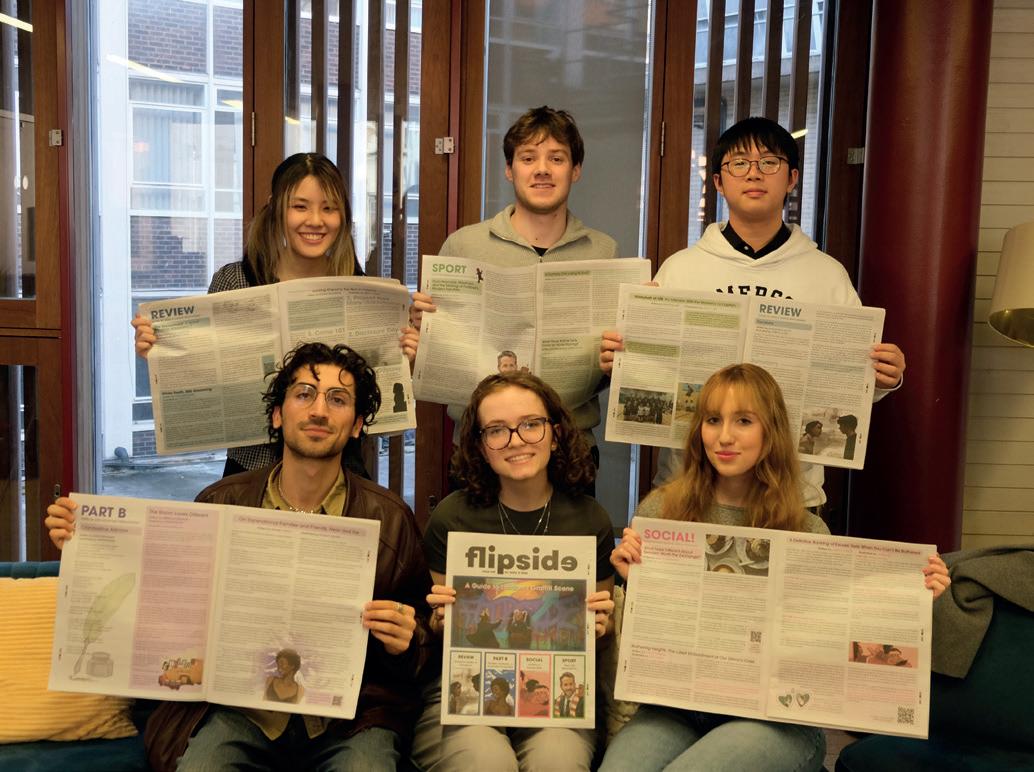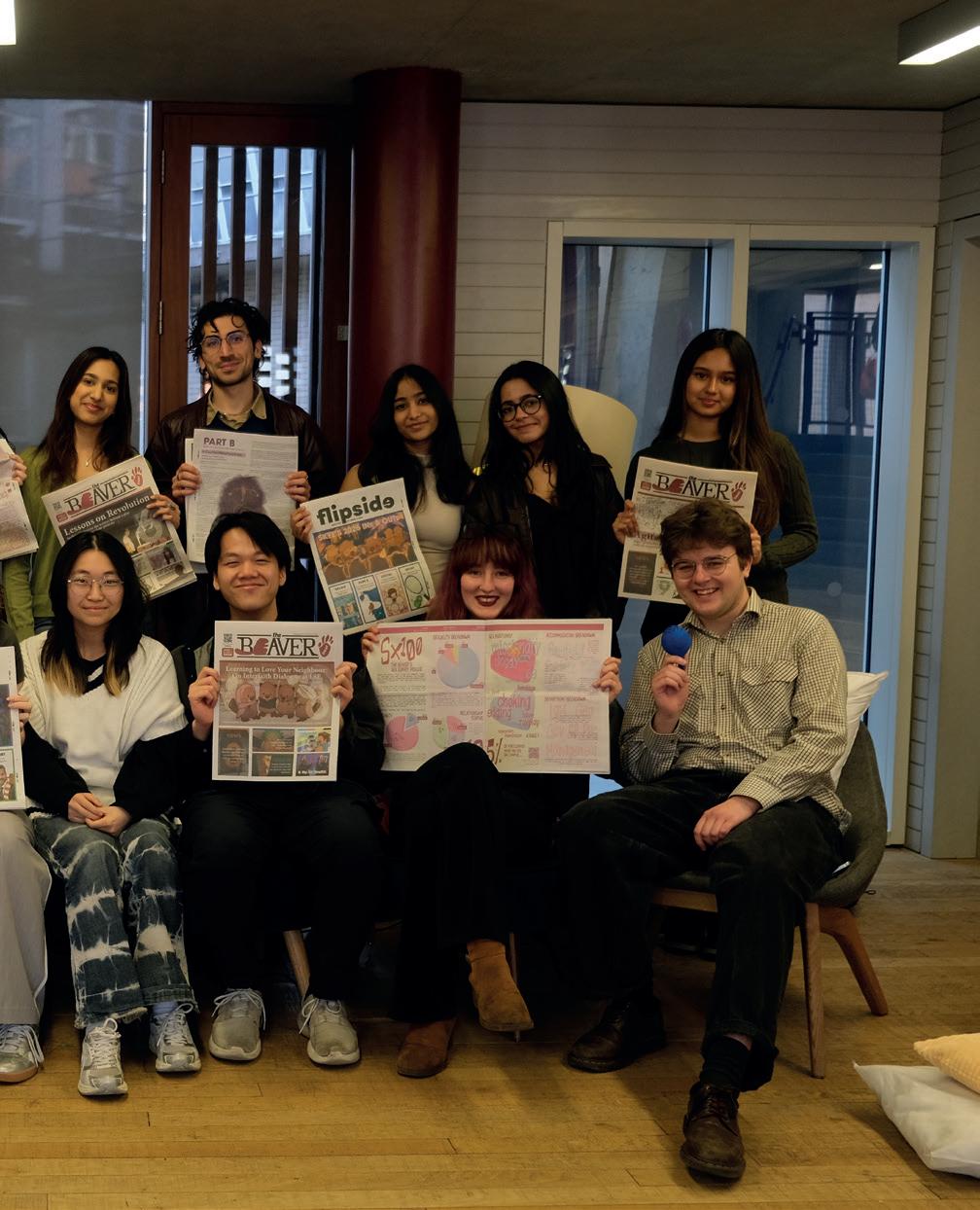






























Editors Jack Baker Amy O’Donoghue
news.beaver@lsesu.org
Amy O'Donoghue News Editor
Shreya Gupta
Opinion Editor
Emerson Lam
Sports Editor
Sylvain Chan
Illustration
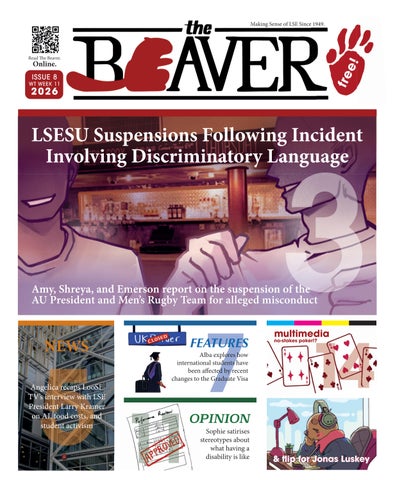
Both the LSESU Athletics Union President and the Men’s Rugby Club have been suspended for the remainder of the 25/26 academic year, as confirmed by a statement published by LSESU on the 20th March. The suspension follows an investigation by the SU. This investigation concerned an incident at the Three Tuns, where a complaint was made that rugby team members were wearing shirts that had discriminatory language on them The AU President was also present at this gathering, leading to his suspension, although he has stated to The Beaver that he attended this
event in a ‘personal capacity’ and was not an ‘active participant’.
Multiple verified sources told The Beaver that such misconduct was related to an incident that took place at the Three Tuns, where a complaint was made by an onlooker that rugby team members were wearing shirts that had ‘discriminatory language’ on them.
A different confidential source told The Beaver that these were being worn by social members of the team, who do not compete in Varsity. This source told The Beaver that the rugby team wanted to solve the problem by cutting social members, but that this was not sufficient for the SU.
The president of the Men’s Rugby Club stepped down from his position after the incident, preceding the SU investigation regarding the club. The outcome of this investigation showed that the club violated the SU Code of Conduct and “presented serious risks to student wellbeing and safety”. The subsequent sus-
pension involves both sporting and social activities, meaning the club cannot compete in Varsity for the rest of the academic year, nor host social events.
When the former AU President was questioned about his involvement with this incident, he stated: “To clarify, I attended the event in a personal capacity and was not involved in its organisation. The SU has recognised that I was not an active participant and intervened. Unfortunately, I can’t comment further due to SU policies around confidentiality.”
Regarding the future of the rugby team, a member of the Men’s Rugby team told The Beaver that the club held an internal meeting with its members, and stated that due to ‘repeated social misconduct’, the rugby team would no longer be operating as a club for the time being. No further details were given to the members on the situation for the next academic year.
He also gave his view that it was “unfair that the SU has punished the entire team, even those who genuinely love rugby like myself and have paid a hefty fee of £140 for the year, but haven’t participated in these incidents. It’s understandable that Varsity has been suspended, but stopping the club’s ability to participate in matches and training makes it difficult for those who were simply a part of the club for the sport.”
The SU have confirmed that they will be in touch with members regarding a partial refund for the activity missed.
When asked for comment, the Athletics Union told The Beaver: “Sadly, we have been kept in the dark on this matter by the SU, so we are unable to provide any information other than what has already been publicly stated. What we can say is that we fully respect the SU’s decision. We believe all clubs have a responsibility to operate in line
with the rules and regulations set out for them, and where that does not happen, it is right that action is taken. As an Athletics Union, we are one community. Any form of misconduct that has the potential to exclude members or undermine the inclusive environment we strive to build is something we cannot and do not support.”
The LSESU Men’s Rugby Club gave the following statement: "We wholeheartedly condemn the conduct of the few individuals involved in the incident, which is wholly unrepresentative of our values and the wider club. Those known to be responsible were internally sanctioned, and additional training and governance measures have been implemented. We have accepted all disciplinary outcomes imposed by LSESU in full and without challenge. Inclusivity, respect, and representation are central to what we stand for. We are committed to ensuring our club reflects those values in everything we do."
Amy O'Donoghue News Editor
Interest group JustRight Ghana has expressed their anger and concern at Dr. Mahamudu Bawumia’s selection as a keynote speaker at the LSE Africa Summit 2026. They have cited his commitment to the criminalisation of LGBTQ existence as the reason for this concern.
Dr. Bawumia will be one of the key speakers at the Summit, taking place on 28-29 March. He is the former Vice President of Ghana and has announced his intention to run for president in 2028. He is also a Fellow of the International Growth Centre, an institution based between LSE and Oxford University.
JustRight Ghana has highlighted Dr. Bawumia’s verbal opposition to LGBTQ rights, noting that he has repeatedly pledged to sign Ghana’s Human Sexual Rights and Family Values Bill 2025. This bill would criminalise LGBTQ exist-
ence, implementing penalties of up to 10 years imprisonment for advocacy, and mandating family reporting. Dr. Bawumia has made his strong support for such measures clear, stating that he won’t allow LGBTQ activities in Ghana “no matter the consequences”.
Speaking directly to The Beaver, JustRight Ghana stated: “Our concerns begin with the very real and urgent situation facing LGBTQ persons in Ghana. Dr. Mahamudu Bawumia has repeatedly and publicly committed to supporting and signing legislation that would significantly expand the criminalisation of LGBTQ people, their expression, and even advocacy on their behalf. This is not a hypothetical concern — such laws create an environment where individuals can face arrest, violence, social exclusion, and the breakdown of family and community support systems simply for who they are or for speaking out."
"Against this backdrop, we are deeply concerned by the deci-
sion of the [LSE] to provide Dr. Bawumia a platform, particularly on a subject like artificial intelligence and governance. In the hands of governments hostile to minority rights, digital technologies can be used as tools of surveillance and repression. This makes the choice of speaker especially significant.”
When contacted for comment, LSE Africa Summit told The Beaver:
“Dr Bawumia was invited to open the Summit which this year will be on the theme of AI in Africa. Dr Bawumia’s career as a former Vice-President of Ghana, and Deputy Governor at the Bank of Ghana gives him a unique perspective from which to address these issues. At the point when we became aware of his past statements regarding LGBTQ+ rights the offer to speak had already been extended, and the offer accepted. It is LSE policy not to withdraw an invitation to speak once it has been extended and accept-
ed to protect free speech and so it was decided to continue with the programme as planned.
This will not, however, be an uncritical platforming of a politician. There will be a Q&A session following his speech.We will also be hosting policy dialogues the following day on issues relating to the future of AI in Africa. In these, we will directly address the potential of AI to be used to discriminate against the LGBTQ+ community. The opinions of speakers do not reflect the opinions of the Summit Organising Committee. Issues of inequality and discrimination are very important to us and have been so throughout the process of planning the Summit. We have designed our programme to ensure there is space for these topics to be fairly discussed. We believe that the Summit will be an inclusive space where diverse views, opinions and identities will be respected. Moreso, this diversity will be reflected through tangible contributions to our discussions and published outputs.”
An LSE spokesperson said:
“Our Code of Practice on Free Speech is designed to protect and promote lawful freedom of expression on campus, including the ability of our community to refute ideas lawfully and protecting an individual’s rights to freedom of expression within the law.
“This is enshrined in UK law by the Higher Education (Freedom of Speech) Act 2023, which LSE has an obligation to adhere.
“A range of events happen at LSE each day, covering many viewpoints and positions, including on controversial issues. LSE does not, however, endorse speakers or views at our events. As outlined on LSE event listings: ‘LSE holds a wide range of events, covering many of the most controversial issues of the day, and speakers at our events may express views that cause offence. The views expressed by speakers at LSE events do not reflect the position or views of the London School of Economics and Political Science.’ ”










































Anna Alexiev Staff Writer
For thirty years, Dubai sold access to the Middle East without exposure to it. Iran sits across the water. Iraq is nearby. Yemen's war is within range. e region hasn't been stable in living memory and is unlikely to be anytime soon. Dubai's proposition was that geography could be overridden. at with enough glass, enough air conditioning, enough careful positioning, you could exist in the Middle East without being subject to it.
Permanent sun. No income tax. An unspoken agreement: whatever happened in the neighbourhood stayed in the neighbourhood. And it worked. Banks relocated from London and Geneva. Russian money arrived a%er Western sanctions made Zurich complicated. British expats le% behind grey skies and 45% tax rates. Everyone came because Dubai o ered location without consequences.
On February 28th, consequences arrived.
When images of smoke over Palm Jumeirah circulated, the dominant Western response was not sympathy. It was something closer to satisfaction. Social media lled with jokes about tax exiles. oughts and prayers to everyone who moved to Dubai to avoid paying for the NHS. Incredible scenes as passive income fails to intercept incoming missiles. e mockery had a readiness to it. Not spontaneous but stored, waiting for the moment. Cities under attack usually get sympathy. Dubai got memes.
Before Dubai, there was Beirut. e “Paris of the Middle East” was a phrase that now sounds like an elegy. In the 1960s, Beirut was what Dubai would later
"Cities under attack usually get sympathy. Dubai got memes."
try to become: a neutral nancial hub, cosmopolitan, multilingual, a place where regional enemies could coexist because the city served everyone. Banking secrecy laws attracted Gulf money. Mediterranean beaches attracted European tourists. e American University of Beirut attracted intellectuals from across the Arab world. When the 1975-1990 civil war destroyed it, the world mourned. Writers eulogised what was lost. e destruction of Beirut became a symbol of tragedy, something beautiful and rare, extinguished by forces beyond its control.
Dubai and Beirut served similar functions. Both o ered neutrality in unstable regions. Both attracted money, talent, and refuge for people escaping the surrounding con ict. Both positioned themselves as exceptions. But nobody wrote elegies when debris fell on Palm Jumeirah.
Beirut was understood as a place with a soul: history, culture, a literary scene, architecture that predated the nancial services industry. Its neutrality seemed organic, an expression of Lebanese pluralism, fragile but genuine.
Dubai makes no such claim. e city is explicit about what it is: a transaction. e towers, the arti cial islands, the ski slope in a desert — none of it pretends to be anything other than engineered. Dubai doesn’t have centuries of history. It has a business model.
is honesty is precisely what provokes hostility. Dubai represents, with unusual clarity, the idea that you can purchase your way out of geography, politics, and consequence. at money can construct an exception. at the rules governing every-
one else need not apply if you can a ord the alternative.
e principle isn’t new. It operates everywhere, just less visibly: private healthcare while public systems strain; gated communities while cities decay; second passports, o shore accounts, tax arrangements that exist in the gap between jurisdictions. e wealthy have always lived in a di erent world from everyone else; they just didn't build an actual city there. Dubai made the implicit, explicit. It took the principle and gave it a skyline. What makes this uncomfortable isn’t that the premise is false. It’s that it has been, until recently, substantially true. e rules really were di erent if you could pay for the di erence. Dubai was proof of concept, and proof of concept is harder to tolerate than quiet practice.
Dubai’s safety wasn’t luck but a product, actively maintained. e arrangement required being valuable to all sides while aligned with none. Banks that couldn’t operate in Iran held
meetings with Iranian clients in Dubai. Israeli rms reached Gulf markets through Emirati intermediaries. American defence contractors and Iranian shipping companies cleared cargo through the same port. Jebel Ali, one of the ten busiest ports on earth, processed goods that couldn't move through more politically exposed routes.
e UAE’s function was blankness: neutral ground where adversaries coexist because everyone needs the ground more than they need to contest it. Switzerland built something similar in Europe over centuries. Singapore did it in Asia. Dubai did it faster, at the intersection of three continents, insisting instability was someone else’s concern.
is works only if all parties agree that the neutral ground is more valuable intact than destroyed. For thirty years, they agreed. en someone recalculated.
" e UAE's function was blankness: neutral ground where adversaries coexist because everyone needs the ground more than they need to contest it."
Iran’s retaliation against US and Israeli strikes didn’t exempt Dubai. A drone hit near the Fairmont on Palm Jumeirah. Amazon con rmed two data centres took direct strikes. e airport sustained damage. Iranian state media claimed the data centre attacks were deliberate, aimed at the infrastructure powering regional commerce. When Amazon’s servers went dark, the e ects were immediate. Ride-hailing apps failed across the Gulf. Payment processors stopped. Banks couldn’t clear transactions.
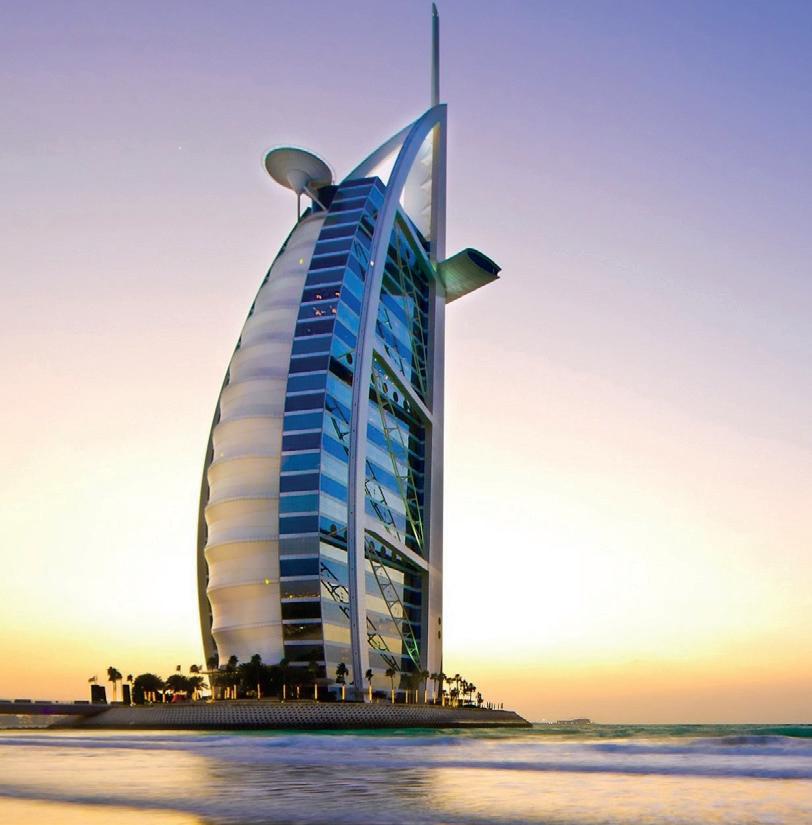
Most of the visible damage came from successful defence. e UAE’s missile systems intercepted 92% of incoming missiles and 94% of drones. But interception doesn’t mean disappearance. Wreckage still falls. e Jebel Ali port re started from debris. So did the damage to the Burj Al Arab. ree workers died. None directly from Iranian weapons, all from fragments of things the UAE shot down.
e global audience watching Dubai burn did not know or care about these distinctions. ey saw what they saw: the place that promised immunity was no longer immune.
e UAE is 90% expatriate. In the Western imagination, this means in uencers and hedge fund managers — people who post about brunch and zero tax rates. ese people exist. ey’re visible by design. Visibility is their product. But they're not the denominator.
For every nance relocation, there are hundreds of construction workers from Pakistan, domestic sta from the Philippines, drivers from Nepal, cleaners from Ethiopia. Labour sourced from the third world who came because the wage di erential between Dubai and Dhaka justi es years away from family. ey’re not there