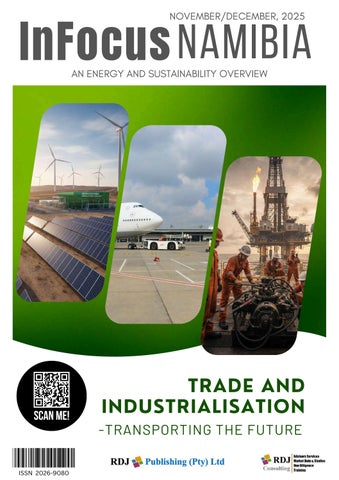
InFocus Namibia - November/December 2025

Page 1


AN ENERGY AND SUSTAINABILITY OVERVIEW

EDITION: NOV/DEC 2025

The Corridors that lead to Trade and Industrialisation

This report is a FREE Publication written and authored through collaboration with RDJ Consulting Services CC based in Windhoek, Namibia

The content is collected from publicly available information and so its accuracycannotbeguaranteed.

Quick Facts

N A M I B I A

POPULATION

6.50

NDP 6: A Split Ministry Doesn’t Mean a Split Vision

March 2025, saw Namibia with a freshly restructured government, leading to the decision to split the former Ministry of Industrialisation

and Trade into two separate portfolios Trade saw itself anchored under the Ministry of International Relations and Trade, while industrialisation moved under the Ministry of Mines and Energy.

On paper, the logic seems sound: trade is an external-facing activity, and industrialisation sits comfortably alongside the country’s mineral-driven economy But in practice, the split introduces a real tension, because Namibia’s Sixth National Development Plan (NDP 6), covering 2025 to 2030, is built on the premise that trade and industry must work hand-in-hand, not in parallel silos

NDP 6 is arguably Namibia’s most ambitious development plan since Independence It stakes its success on

transforming the country from an exporter of raw materials to a diversified, value-adding economy capable of producing jobs and increasing incomes. By 2030, the government hopes to see manufacturing contribute nearly a fifth of gross domestic product (GDP), export receipts dominated by processed goods, and up to 80,000 new jobs generated in factories, workshops, and industrial parks across the country.

With trade diplomacy sitting in one building and industrial policy being crafted in another, Namibia must construct a solid bridge between these needs This cannot be an occasional joint meeting of Executive Directors (Eds) or a polite exchange of Cabinet memos It requires a permanent, high-level steering body that aligns priorities, clears bottlenecks, and ensures that every export-promotion effort is directly connected to what local industries can produce

If Namibia wants to grow its finished goods exports from fish fillets and copper plates to processed foods, green hydrogen components, textiles, and electric-vehicle minerals, then its diplomats must become industrial ambassadors Trade missions need to be far more targeted such as identifying buyers, negotiating market access, addressing tariff barriers, and channeling investors into the proposed Special Economic Zones (SEZs). This calls for the two ministries to craft a joint industrial diplomacy strategy, ensuring that Namibia’s embassies and foreign service staff are actively promoting the country’s industrial potential, not merely its political relations

One of the quickest ways for reform to fail is when investors face confusion.

If trade rules, rebates, industrial incentives, approvals, and investment facilitation sit in different ministries with varying timelines or criteria, investors will either walk away or choose easier destinations NDP 6 is very clear about the need for stronger incentives of the likes of tax breaks, export support, blended finance, and grants for valueaddition. But these must emerge from a single, integrated incentive framework administered jointly by both ministries. Namibia cannot afford duplication, mixed messages, or bureaucratic detours

Then there is this!

Industrialisation is not just about factories, it is about comparative advantage, creating competitive products, pricing them well, and getting them into foreign markets Because these responsibilities are now split, both ministries must synchronise their strategies on matters such as:

product standards trade-related infrastructure

customs facilitation

export diversification

trade agreements and market-opening negotiations

Market access is therefore a priority.

But to meet national targets, Namibia must ensure that the products leaving its ports genuinely reflect the country’s industrial ambitions, not just its mineral wealth

Namibia intends to introduce new tools such as credit guarantees, subsidised loans, blended finance facilities, and industrial upgrading grants. If these sit in separate ministries or parastatals with different application rules, manufacturers and investors will drown in bureaucracy before they produce a single item The country would benefit from creating a joint Industrial Finance Facility (such can be enhanced via the Development Bank of Namibia with a revised mandate), overseen by both Ministry of finance and supported by other state-owned financial institutions. With unified decision-making, industrialists would finally gain the clarity and speed needed to scale production

One of the biggest lessons from previous NDP cycles is that development plans fail when they are not co-created with the businesses expected to implement them. SMEs, manufacturers, logistics providers, and exporters must be present at the table and not as observers, but as strategic partners

A Workforce to Match the Vision

When Namibia speaks of industrialisation, it often conjures images of factories humming with machinery, export-ready goods rolling off

conveyor belts, and modern infrastructure lighting up the national landscape. But beneath that vision lies something more fundamental, people.

People with the skills, confidence, and technical capacity to build, operate, and grow the industries Namibia hopes to create under its Sixth National Development Plan (NDP 6) Globally, countries face deep skills shortages at nearly every level examined, from artisans to engineers, researchers, technicians, and trade specialists. This is the heart of Namibia’s challenge: Industrialisation without skills is aspiration without engines

Do we have a workforce capable of driving the industrial future we imagine?

But Namibia’s workforce, from trainees to senior technicians, cannot be asked to navigate two sets of expectations. The skills pipeline must be coherent, strategic, and future-focused According to Dr Lorato Kavetuna, an economist and skills researcher, the biggest danger is not unemployment, it’s mismatched training

“We have graduates who cannot find jobs,” she says, “and industries who cannot find graduates. That contradiction is a sign of a skills ecosystem running on parallel tracks NDP 6 tries to correct that ” She explains that as Namibia moves toward green hydrogen, mineral beneficiation, food processing, advanced textiles, pharmaceutical manufacturing, and logistics, the labour market will demand entirely new skill sets. “Without a shared national roadmap,” she warns, “we risk building the wrong capacity at the wrong time ” At the Namibia Training Authority (NTA) centres across the country, instructors see this daily

Across Namibia’s vocational centres and universities, the story is much the same. Many curricula lag years behind industry needs, and training often prioritises theory over hands-on experience If Namibia wants to build industries in green hydrogen, lithium refining, food processing, advanced textiles, or renewable energy systems, it must overhaul what and how it teaches.

Curricula must become industry-driven, reviewed every two to three years with employers at the table Digital literacy that guides from data analysis to automation interfaces that must be mainstreamed across all training areas STEM (science, technology, engineering, and mathematics) education must be strengthened from primary school onward.

Around the world, successful industrial nations share one principle: employers shape the training system, not the other way around Namibia has taken steps in this direction, but more is needed The country should scale up dual training models, where students spend half their time in class and half on factory floors. Internships and apprenticeships must become compulsory for graduation, not optional add-ons

What skills must Namibia build today to create the industrial future it wants tomorrow?

While universities often steal the spotlight, Namibia’s real industrial future lies in its vocational training centres (VTCs) These institutions will produce the welders, technicians, machinists, electricians, and operators who keep factories running. Yet many VTCs operate with ageing equipment and curricula designed before automation became standard

To become industrialisation engines, VTCs must be modernised with: up-to-date machinery (CNC, robotics, digital fabrication) smarter workshops for mechatronics and electronics instructors trained in current industrial technologies closer partnerships with manufacturers modern teaching materials and digital tools

Across Namibia’s universities, valuable research often sits unused such as in the form of blueprints, prototypes, and innovations that never reach industry Industrialisation demands applied research that solves real problems These include improving water-efficient farming, designing safer processing equipment, testing hydrogen storage systems, or advancing mineral refining technologies.

These qualities are as critical as machine-handling skills Recognising this, training institutions must embed soft skills training into all programmes so ensuring Namibian workers thrive in demanding industrial environments

Industrialisation brings constant technological change. Workers trained today may need new skills in five years. Namibia must encourage continuous learning through: micro-certifications online and blended learning short technical courses upskilling programmes for mid-career workers

Industrialisation should not leave older workers behind, it must carry them forward A nation becomes industrialised not by accident, but by design

And as always the conversation continues at infocus@rdjpublishing.africa.

20.13/ US$ 1.18 perlitreDiesel50ppm

Namibia’s Kudu Field Confirms First Liquid

Hydrocarbon Discovery

contributed by:

BW Energy confirms light oil and condensate discovery at Namibia’s Kudu gas field

Kharas-1 results boost basin understanding; FID now targeted for late 2026 Kudu seen as key to Namibia’s energy security and first hydrocarbon production

Norwegian operator BW Energy announced on Wednesday the discovery of liquid hydrocarbons, including condensates and light oil, in deeper

fractured volcaniclastic formations at the Kudu gas field in Namibia It is the first confirmed liquid find at the field and follows final results from the Kharas-1 appraisal well, which was drilled to a total depth of 5,100 meters (16,732 feet) The well, drilled using Odfjell Drilling’s Deepsea Mira platform, also confirmed the presence of dry gas.

BW Energy CEO Carl Arnet said the well achieved its technical objectives by testing multiple targets in one bore and provided valuable data He added that confirming the presence of liquids significantly improves the company’s understanding of the basin’s petroleum system. As planned, the data-gathering well will now be plugged and abandoned. The company will shift its focus to higher-value prospects that contain both gas and liquids, with new appraisal wells planned for 2026 and 2027

The results come as BW Energy restructures its leadership to strengthen Africa’s role in its growth strategy. In September 2025, Brice Morlot was appointed Chief Operating Officer and Thomas Young became Chief Financial Officer as part of a broader effort to accelerate African projects The company’s portfolio on the continent, centered on the Dussafu hub in Gabon, which produces

40,000 barrels per day, and the Kudu project in Namibia, supports its goal of reaching 90,000 barrels per day of net production by 2028 through a phased and low-cost development approach

The Kharas-1 findings move the Kudu project closer to a Final Investment Decision Initially planned for 2024 and later postponed to 2025, the decision is now targeted for late 2026 in line with the government’s timeline.

For Namibia, the discovery is strategically important The country imports more than 60 percent of its electricity and continues to face recurring shortages With an initial phase planned for 420 MW and potential expansion to 800 MW, Kudu could provide 50 to 60 percent of national baseload needs with lower emissions than coal. Any surplus electricity could be exported through the Southern African Power Pool

Beyond energy security, the project is expected to generate jobs, tax revenue, local contracting opportunities, and skills development. With prospective resources in the Orange Basin estimated at between 11 and 20 billion barrels, and a national objective of achieving first commercial production by 2030, Kudu is positioned to become Namibia’s first commercial hydrocarbon development

Can Namibia Unlock Its Potential in Southern Africa’s Automotive Value Chain?

With just five years left to achieve Vision 2030, Namibia faces a pivotal moment. Industrialisation and manufacturing stand at

the core of this vision, not merely as economic goals, but as the engines of job creation, skills growth, technology transfer, and true transformation. At its heart, Vision 2030 is about shifting Namibia from a consuming nation to a producing one

Why the Automotive Industry Matters

The automotive industry, in particular, offers Namibia a strategic opportunity to move from just being a consumer of imported vehicles and parts to an active participant in regional and global value chains.

So what does this mean for Namibia? It means that the journey toward industrialisation could realistically begin with something tangible: strengthening and diversifying the local manufacturing base for components, supplying these to markets such as South Africa and beyond

And if the country remains committed, it’s not impossible to one day see this path leading to sustainable vehicle assembly But for now, the focus must be on local manufacturing, value addition, and participation in regional value chains to amplify market reach.

Namibia’s Current Contribution to the South African Automotive Sector

Here’s the good news: Namibia already plays a modest, yet meaningful role in supplying parts to South Africa’s welldeveloped automotive industry, noting that South Africa’s automotive industry accounts for around five (5) percent of the country’s GDP and produces over half a million vehicles annually

According to UN Comtrade 2023 data, Namibia exported approximately US$716,950 worth of “motor vehicle parts, nes” (not elsewhere specified) to South Africa, weighing about 21,421 kg. By 2024, exports of bumpers and vehicle parts stood at US$28,920, and motor vehicle seats at

roughly US$53,210.

Now, these figures might appear small in absolute terms, but in reality, they represent a crucial foothold - a meaningful starting point for Namibia Something that can be scaled up through policy support, supplier development, and infrastructure investments.

And since this is the foundation of what could become a major industry, it’s worth asking: what makes Namibia such a strategic and ideal location for venturing into component manufacturing?

Strategic Advantages: Why Namibia Makes Sense

Consider this: the Walvis Bay Corridors provide efficient logistics connections to South Africa, Angola, Zambia, the DRC, and global shipping routes, positioning Namibia as a natural partner for regional automotive supply chains.

On top of that, Namibia boasts a stable political environment and an investor-friendly regulatory framework The National Automotive Assembly Development Policy Framework (NAADP, 2019-2021), now phased out, significantly advanced Namibia’s vehicle assembly and automotive sector, and with a new Automotive Policy Framework being developed by the United Nations Economic Commission for Africa (UN-ECA) for Namibia and Lesotho, it paves the way for more structured growth and regional value chain alignment

And that’s not all Other favourable factors include: Abundant minerals such as copper, zinc, and rare earth elements which are crucial for producing wires, batteries, and electronic components

Green energy potential through the emergence of Namibia’s green hydrogen economy, offering a futureproof, low-carbon energy source for manufacturing

This aligns neatly with the global shift toward electric vehicles (EVs) and decarbonised production - a trend that could position Namibia ahead of the curve if it moves strategically

Challenges Holding Namibia Back

We know that every opportunity comes with its share of hurdles, and Namibia’s manufacturing sector is still in its infancy To achieve the industrialisation goals of Vision 2030, the following constraints must be addressed: Small production scale: Exports remain low-volume and broadly categorised, restricting access to high-value Tier 1 supply contracts

Skills gaps: Namibia must cultivate specialised technical and engineering skills that meet Original Equipment Manufacturer (OEM) standards for design, production, and quality assurance.

Infrastructure and certification: Testing facilities, quality management systems, and supplier certification programs need significant strengthening to compete effectively with established South African suppliers

This implies that unless Namibia scales up production and builds a stronger technical ecosystem, it risks remaining a peripheral player rather than a regional contender.

Opportunities for Growth and Expansion

Despite these challenges, Namibia’s window of opportunity is wide open.

Supplier Development and Localisation: Strengthening Namibia’s SME base through targeted training and certification programs can help local firms meet Tier 1 and Tier 2 supplier standards

Aftermarket Parts Production: There’s significant potential in producing replacement parts and niche components such as off-road, mining or agricultural vehicles, where Namibia already has a comparative advantage

Regional Policy Alignment: Using Southern African Customs Union (SACU) and African Continental Free Trade Area (AfCFTA) platforms to harmonise regulatory frameworks with South Africa’s can enable seamless cross-border participation and access to larger markets. Investment in Assembly: Namibia could expand from component manufacturing to small-scale vehicle assembly for trucks, buses, and specialised vehicles, thereby creating jobs and boosting local skills

Green Manufacturing: Here’s where Namibia can truly stand out. By leveraging renewable energy, the country can become a hub for low-carbon vehicle component production, making it attractive to investors seeking to meet Environmental, Social, and Governance (ESG) goals

And remember in a world increasingly driven by sustainability, being green isn’t just an ethical choice, it’s a competitive advantage.

So where does Namibia go from here?

Namibia’s automotive journey has a foundation - the NAADPF and the Automotive Policy Framework (under development). Real progress, however, hinges on collaboration, so we all have a role to play: the Government needs to finalise regulations and incentives; the Private Sector needs to invest in skills and technology; and Development Partners must back capacity and market access

If these efforts align, Namibia can evolve from a modest assembler to a competitive force in Southern Africa’s automotive value chain, thereby creating jobs, diversifying exports, and fuelling industrial growth After all, that is what Vision 2030 is all about: a Namibia that not only dreams of industrialisation but builds it, one component, one partnership, one factory at a time

Disclaimer

The Views and Opinions expressed in this article are those of the author alone, and do not necessarily represent or reflect theviews,policiesorpositionsoftheauthor’scurrentorpast employer,organisationoranyotheraffiliatedentities.

After Months of Stalled Talks, Galp's Giant Namibia Oil Field Draws Supermajor Bidders

Galp in advanced talks to sell up to 40% stake in Mopane project

TotalEnergies and Chevron emerge as leading bidders after slow start

Sale aims to share deepwater costs amid regulatory and market challenges

AAfter months of trying to sell part of its stake in the Mopane oil project in Namibia, Galp has finally drawn interest from major international oil

companies According to sources cited by international media on Wednesday, TotalEnergies and Chevron are now leading contenders among potential buyers

Galp is in advanced talks to sell up to 40% of its stake in the project. The company has shortlisted several candidates and plans to announce a final decision by year-end.

Galp began seeking to reduce its position in Mopane in early 2025 in an effort to share the substantial costs required to advance the project The sale process stalled for months, as the company received no formal offers despite approaching several international exploration companies.

This slow start came amid investor caution An Agence Ecofin analysis published in July highlighted concerns, including an economic model and resource volumes still

awaiting confirmation, as well as a high proportion of gas, which is harder to bring to market. Other factors included the high development costs associated with deepwater projects and regulatory uncertainties, particularly around operational control and rising local content requirements in Namibia

Mopane is regarded as one of Namibia’s most significant discoveries since 2022. Galp confirmed the presence of a large oil system there in May 2024, at a time when exploration activity had intensified following major discoveries by TotalEnergies and Shell in 2022 and 2023 Namibia’s state-owned oil company, Namcor, said in 2024 that progress on these offshore projects could pave the way for oil production within the next decade

AI in Namibia 2026+: Navigating the Future of Work

As Namibia moves into the second half of the 2020s, artificial intelligence (AI) is set to have a growing impact on the country’s labour market. Experts

warn of both disruption and opportunity and call on policymakers, businesses, and workers to act now to steer the change in a socially inclusive way.

AI Threats and Job Disruption

According to a recent analysis by the International Monetary Fund (IMF), AI could threaten up to 40% of jobs globally, potentially exacerbating inequality In Namibia, the risk is compounded by structural challenges: limited digital infrastructure, uneven access to connectivity, and a skills gap. Locally, roles that involve repetitive, routine tasks are particularly vulnerable. According to reporting in The Namibian, jobs such as data entry, entry-level administrative work, some financial functions, and

customer service could face significant pressure from AI automation.

In Namibia’s engineering and industrial sectors, where AIenabled automation is already being adopted, predictive maintenance and autonomous systems are streamlining operations but may reduce demand for certain manual or semi-skilled jobs. In the creative and media industries, too, AI threatens to displace some tasks. The Namibian has noted that tools like generative text and image systems could automate parts of the creative chain, even as they offer new possibilities

Opportunities and Growth

Despite disruption, AI also offers promising opportunities During a webinar on the “Future of Work in the AI Age,” hosted by the Namibia University of Science and

Technology (NUST) and the University of Johannesburg, thought leaders emphasised that AI should be viewed as an enabler not a threat

Key growth areas include:

1 Upskilling & ICT Careers: Namibia’s future lies in innovation, digital skills, and ICT. Demand is expected for AI-proficient professionals: data scientists, software engineers, machine-learning specialists, and business analysts

2 Public Services and Government: AI could improve service delivery in health, education, and governance, through predictive diagnostics, personalised learning, and automated administrative workflows.

3.Agriculture: AI-enabled precision farming, resource optimisation, and predictive analytics hold promise for Namibia’s agricultural sector, especially given its emphasis on sustainable growth

4 Engineering & Energy: In sectors like mining, energy, and construction, AI-driven predictive maintenance and optimisation can boost efficiency, reduce downtime, and lower costs.

5.AI Ethics, Governance & Research: Local institutions could take a lead in developing governance frameworks, ethical AI practices, and research suited to Namibian contexts For example, the National Commission on Research, Science, and Technology (NCRST) has already identified the need to align higher education with future skills.

Risks & Inequalities

However, the transition is not risk-free The IMF warns that in countries with weaker infrastructure, AI adoption could increase inequality because they may lack the capacity to fully capitalise on AI gains.

Older workers, low-skilled workers, and those in remote or underserved areas may be most exposed to displacement Moreover, Namibia’s existing digital divide differences in internet quality across regions could worsen if AI investment concentrates in urban centres Gendered impacts may also emerge. Across Africa, studies suggest that women may be disproportionately affected by automation, particularly in service and outsourcing roles. If unchecked, this could widen existing gender disparities in the labour force

Mitigating the Impact: What Namibia Can Do

To address these challenges and harness AI’s potential, several strategies emerge:

1 Upskilling and Reskilling Programmes

The government and private sector should invest in scalable training: microlearning modules, online AI courses, certifications, and extended reality platforms.

Vocational and tertiary education institutions need to integrate AI, data science, and digital literacy into their curricula. The 4IR (Fourth Industrial Revolution) Task Force report recommends aligning tertiary education with future labor-market needs.

2 Infrastructure Investment

Expand reliable high-speed internet (e g , 5G) and electrification, especially in rural areas, to ensure equitable access to AI-enabled services

Develop data centres and cloud infrastructure to support local AI applications and reduce dependence on foreign infrastructure.

3 Social Safety Nets

Introduce social protection mechanisms unemployment support, retraining stipends, and transition programs for displaced workers to buffer short-term shocks. The IMF argues these are crucial for inclusive AI transitions.

Design job transition pathways, particularly for vulnerable groups (older workers, low-skilled, women), to help them move into AI-enabled roles

4 Governance, Ethics & Trust

Establish a national AI governance framework to regulate deployment, ensure data privacy, fairness, and accountability.

Promote research into African-centered trust in AI: recent studies show that trust among African professionals is shaped by communal values, relationality, and ethics

Encourage public-private partnerships to invest in locally relevant AI innovations not just adopting off-the-shelf systems.

5.Inclusive Innovation & Entrepreneurship

Support AI startups that address local problems (e g in agriculture, health, education) via incubation, seed funding, and mentorship

Boost women’s participation in STEM through targeted scholarships, mentorship programmes, and inclusive hiring practices to avert gendered displacement.

Outlook: Balanced Risk, Significant Opportunity

From 2026 onwards, AI is likely to reshape Namibia’s job market eliminating some roles, but creating new ones in their place The net effect will depend heavily on policy choices, investment in skills, and equitable access If the country acts decisively to close infrastructure gaps, invest in human capital, and build ethical governance, AI could become a lever for inclusive growth. On the other hand, failure to do so could aggravate inequality and job insecurity

In short, AI poses both a risk and a promise for Namibia’s future but its impact will be determined by how thoughtfully and proactively the nation prepares.

Readings:

The Brief, “AI has potential to transform Namibia business” (2024) TheBrief com na

IOL / The Namibian, “Take a look at the jobs that are vulnerable to being taken over by AI” (2024).

Lithon, “AI and Automation in Namibia’s Engineering Sector” (2025).

The Namibian, “Navigating the Impact of AI on the Media and Creative Industry” (2023)

The Namibian, Mare & Kaisara, “Spotlight on the Impact of AI on the Future of Work” (2025)

International Monetary Fund (IMF) reporting on AI risk to jobs and inequality.

Namibia Journal of Managerial Sciences, Phulu, “The Role of Artificial Intelligence in Recruitment” (2025)

4IR Task Force Final Report to the President of Namibia (2022)

Kinyua Gikunda, “Harnessing Artificial Intelligence for Sustainable Agricultural Development in Africa” (2024). Amugongo, Bidwell & Mwatukange, “Enriching Moral Perspectives on AI: Concepts of Trust amongst Africans” (2025)

2025)

Name of Reservoir

Author’s analysis and representation of NamWater’s weekly dam bulletin - dated 17 November 2025

According to records by NamWater’s weekly Dam Bulletins, Namibia has a total Reservoir capacity of 1556.712 million cubic meters (Mm3), whose present volumes stand at 1258.586 Mm3 (or 80.8%). This means that the country’s water deficit is currently 298.126 Mm3 (or 19.2%)

Source: Erongo RED (https://www erongored com/consumtion-index/)

Spotlight on Team Namibia

Welcome to the Spotlight Series, a platform where we engage with visionary industry leaders who are driving innovation and

shaping a more sustainable future In this edition, we are honoured to feature Team Namibia, a member-based, nonprofit movement committed to empowering Namibian consumers to buy local while promoting the growth and production of high-quality local goods and services. Through its initiatives, Team Namibia continues to play a vital role in strengthening national identity, boosting the local economy, and fostering pride in Namibian-made excellence

1. What does Team Namibia do?

Founded in 2003, Team Namibia is a Section 21 company (association not-for-gain), established to enable Namibians to advance their own economically sustainable future by promoting the use of local products and services.

Team Namibia members support the country’s national objective of sustained economic growth, as outlined in the National Development Plans

In essence, Team Namibia is a member-based, non-profit movement that mobilises Namibian consumers to buy local while promoting the production and consumption of quality Namibian goods and services.

2. Where does it derive its mandate?

Team Namibia derives its mandate from Namibia’s national development goals and policies, which aim to drive economic growth, industrialisation, and job creation. The organisation works in alignment with key public and private stakeholders to promote local value addition, entrepreneurship, and competitiveness within the Namibian economy

3. What is Team Namibia’s Vision, Mission, and Value Proposition?

Vision:

To make Namibian products and services part of everyday life.

Mission:

To facilitate the increased consumption of Namibian products and services locally and internationally by inspiring competitive standards, stimulating consumer confidence, and promoting economic sustainability.

Value Proposition:

Team Namibia unites local businesses and consumers under the principle of UUKUMWE - working together to make a positive impact on the Namibian economy There is more strength in a team.

4. How does Team Namibia build consumer confidence?

Team Namibia builds consumer confidence by promoting quality, credibility, and trust in Namibian products and services Through collaboration with members, regulatory bodies, and other stakeholders, Team Namibia ensures that products carrying the Team Namibia logo meet high standards and can compete effectively in both local and international markets

By showcasing excellence and reliability, Team Namibia helps consumers feel confident that buying local also means buying quality.

5. How does Team Namibia promote economic sustainability in local industries?

Team Namibia promotes economic sustainability by fostering collaboration across industries and encouraging shared growth rather than competition in isolation

By creating platforms for partnership, innovation, and visibility, Team Namibia helps prevent the duplication or misuse of resources Through brand building, advocacy, and promotion, the organisation strengthens the competitiveness of Namibian products and services, ensuring they meet market demands locally and globally, while keeping economic value within the country.

6. What are the benefits of Team Namibia membership?

Team Namibia provides a sustainable competitive advantage for Namibian products and services by offering members the following benefits:

1 Use of the Team Namibia Logo: Members can display the official Team Namibia logo on their products and corporate branding, symbolising economic contribution and competitive quality

2.Association with Competitive Standards: The logo represents high standards and inspires consumer trust and loyalty.

3 Marketing and Promotional Campaigns: Members gain exposure through Team Namibia’s national campaigns, which promote local brands to consumers

4 Business Listings and Online Visibility: Free listings in directories and on Team Namibia’s online portal to improve brand accessibility.

5. Business-to-Business Opportunities: Access to matchmaking platforms and SME information portals that enhance competitiveness and visibility

6 Knowledge Sharing and Mentorship: Opportunities to share best practices, receive mentorship, and participate in knowledge-exchange sessions.

7. Digital Exposure: Features on Team Namibia’s blog, social media, and cost-effective online advertising options

8 Networking Opportunities: Complimentary access to the Team Namibia AGM and other stakeholder events with highprofile speakers

9. Market Intelligence: Access to insights from stakeholder perception surveys across industries and consumer segments.

10 Ongoing Communication: Regular newsletters and updates on campaigns, opportunities, and news relevant to members

7. How can a company become a member of Team Namibia?

Companies can become members by completing the Team Namibia membership application form, available on the official website or by contacting the Team Namibia office directly.

Applicants are required to submit the following supporting documents:

Business Registration Certificate from BIPA Good Standing Certificate from NAMRA Social Security Commission registration proof Quality Assurance Certificate (where applicable)

Team Namibia offers different membership packages based on a company’s annual turnover, which can be requested from the Team Namibia office

Once the application and supporting documents are reviewed and approved, members gain access to all branding privileges, promotional opportunities, and participation in Team Namibia campaigns that promote locally made products and services.

Email: marketing@teamnamibia.com or publicrelations@teamnamibia com Mobile: 081 147 6669

Address: 4 Dr Kwame Nkrumah Avenue, 4th Floor, Bridgeview Offices, Windhoek, Namibia

8. What has been Team Namibia’s proudest moment so far?

One of Team Namibia’s proudest moments has been the successful relaunch of its brand identity, which renewed public awareness and inspired a new generation of Namibians to support and buy local

Other key milestones include strategic collaborations with institutions such as the Namibian Standards Institution (NSI), which recently launched the National Standardisation Strategy and Plan (NSSP), Brand Namibia, and the Ministry of Information and Communication Technology (MICT) through its Nationhood and National Pride Programme and the My Namibia, My Country, My Pride campaign

Team Namibia has also been instrumental in implementing impactful consumer campaigns such as Buy Local, Grow Namibia and the Travel Local Campaign, both of which promote local consumption and tourism These achievements collectively highlight Team Namibia’s ongoing role in strengthening national pride, unity, and confidence in Namibian products and services.

As RDJ Consulting we pride ourselves as specialised consultants who provide advisory services, market data and studies, due diligence and offer world class training within our core business area. Collaboration forms an integral part of what we do, and for this year, we are making it a priority.

OUR FOOTPRINT

Asia Britain Caribbean Southern Africa USA

Our innovative strategies are baked daily at 40 Copper Street, Prosperita, Windhoek, Namibia.

Contact us today to discover how our unique services add value to your business!

JULIA N. EMBULA

Aspiring Data Analyst

Julia N. Embula is a third-year student at the Namibia University of Science and Technology, pursuing a Bachelor’s degree in Applied Mathematics and Statistics She is a dedicated and analytical individual with a strong passion for problem-solving and working with data. Her love for mathematics began in school, and her curiosity about how numbers and data can be applied to real-world situations to solve complex problems inspired her academic journey in this field

During her internship as a Research and Data Analyst, Julia aims to apply her theoretical knowledge to practical environments while gaining hands-on experience in data collection, analysis, reporting, and interpretation. She views this opportunity as a key stepping stone toward her long-term goal of building a successful career in data analysis

1. What attracted you to join the RDJ Group as a Research and Data Analysis Intern?

What attracted me to RDJ Consulting was that, after doing my research, I found out that they offer great learning opportunity and that around 80% of their interns are employed at renowned local and international institutions after their internship.

2. What kind of projects or research areas are you currently working on?

Right now, I’m working on research and data analysis project where I collect, organise and analyse data to support decision making. I work with excel to identify trends, compare performances and generate useful insights. Through this work I’m gaining hand on experience in applying theoretical knowledge to real-world problems

3. What skills or insights have you gained so far from this internship?

I have improved data collection and analysis especially using excel to interpret and present data efficiency. I have also learned how to work with real world dataset, identify trends and communicate findings in reports and presentations

4. What do you enjoy most about working with this team or department?

What I enjoy most about working with the RDJ Consulting team is the supportive and collaborative environment Everyone is willing to guide me whenever I need help, which make learning easier, I appreciate how open the team is they value each members contribution, working in such environment has really motivated me to keep improving.

5. What advice, tips, or lessons would you give to fellow students pursuing the same course and looking for internships?

My advice to fellow students pursuing Mathematics and Statistics is to stay curious and open to learning beyond the classroom. Internships are a great opportunity to apply what you’ve learned in real situations, so don’t be afraid to take on challenges or ask questions that’s how you grow I’d also say start looking for internships early and research the companies you’re applying to, choose one that offers real learning experiences, not just busy work

6. Finally, when it comes to selecting an institution for your Work Integrated Learning (WIL), why do you believe it is important for students to thoroughly research the institution before deciding where to complete their placement?

It’s very important for students to thoroughly research an institution before choosing where to do their Work Integrated Learning (WIL) because the experience you gain depends a lot on the environment and opportunities the organization provides also understand the company’s culture, values, and type of projects also helps you know what to expect and how you can contribute meaningfully. In the end, choosing the right institution can make a big difference in developing your skills, building professional connections and preparing you for your future career

Tenders

Development Bank of Namibia

Description: Procurement of Panel Mentoring and Coaching Consultancy Services for the Development Bank of Namibia

Bid Closing date: 08 December 2025 at 10h00 Namibian Time https://www.dbn.com.na/wp-content/uploads/2025/10/01-Procurement-of-Panel-Mentoring-and-Coaching-ConsultancyServices-for-the-Development-Bank-of-Namibia.pdf

Namibia Airports Company

Description: Supply Delivery And Installation Of Digital Signage For Hosea Kutako International, Walvis Bay International, Eros And Andimba Toivo Ya Toivo Airports

Bid Closing date: 08 December 2025 https://www.airports.com.na/procurement/bid-opening-supply-delivery-and-installation-of-digital-signage-for-hoseakutako-international-walvis-bay-international-eros-and-andimba-toivo-ya-toivo-airports/412/

TransNamib

Description: Supply, and Delivery of Herbicides for Weed Spray for 2026 Season.

Bid Closing date: 16 December 2025 at 12h00 Namibian Time https://www.transnamib.com.na/procurement/

NamWater

Description: Provision of revaluation services for water supply infrastructure for NamWater. Closing date: 18 December 2025 at 11h00 https://www.namwater.com.na/index.php/quotations/22-procurement/997-provision-of-revaluation-services-for-watersupply-infrastructure-for-namwater

NamPower

Description: Request for Expression of Interest for the Provision of Professional Engineering Consultancy Services for the Design & Construction Supervision of the Omburu PV-II Power Project.

Bid Closing date: 19 December 2025 at 10h00 Namibian Time https://www.nampower.com.na/Bid.aspx?id=292293

Debmarine Namibia

Description: Supply of a Vessel Platform for Offshore Survey Operations

Bid Closing date: 09 January 2026 at 12h00 Namibian Time https://debmarine.com/uploads/documents/d5b8f18d9d1a1ed287696f77a7143d8302aa799f.pdf

Central Procurement Board of Namibia

Description: Pre-qualification of Building Works (BW) and Civil Works (CW) Contractors for a Period of One (1) Year

Bid Closing date: 21 January 2026 at 11h00 Namibian Time https://www.cpbn.com.na/index/bid/92

DAVID JARRETT

EDITORINCHIEFAND CHIEFEXECUTIVEOFFICER

@RDJGROUP

NICOLE FELIX CHIEFDESIGNER (LAYOUTANDDESIGN) @RDJPUBLISHING

SILPA KANGHONO COORDINATOR:DIGITALMARKETINGAND EVENTS

@RDJPUBLISHING

LAHJA AMAAMBO CONTRIBUTINGAUTHOR @RDJGROUP

GRACE KANGOTUE CHIEFRESEARCHER/ECONOMIST EDITOR @RDJCONSULTING

RESEARCHBY: PUBLISHEDBY:

PRINTEDBY:

Turn static files into dynamic content formats.

Create a flipbook
Issuu converts static files into: digital portfolios, online yearbooks, online catalogs, digital photo albums and more. Sign up and create your flipbook.
InFocus Namibia - November/December 2025 by RDJ Publishing - Issuu