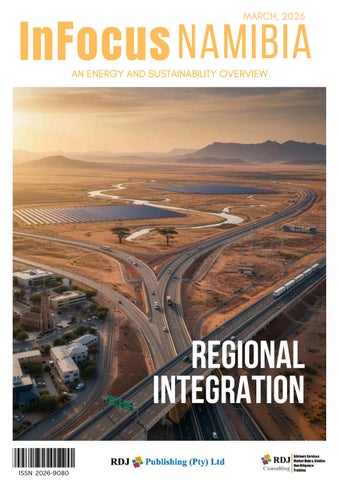
InFocus Namibia - March 2026

Page 1


AN ENERGY AND SUSTAINABILITY OVERVIEW

REGIONAL INTEGRATION

CELEBRATING36YEARSOF FREEDOMANDUNITY

As we honour our nation’s journey, we remain committed to contributing to a future of growth, innovation,andsharedprosperityforallNamibians.

Coverimage:GoogleAIStudio

Editor: DavidJarrett

DeputyEditor:NicoleFelix

Contributors:SilpaKanghono, LahjaAmaambo,ChilomboOlga Priscila,ReneeJarrett,GraceKangotue

ChiefDesigner:NicoleFelix

RDJ Publishing (Pty) Ltd is the publishing home of the InFocus Namibia, written and authored through the collaboration with RDJ Consulting Services CC (www rdjconsulting co za)

This report is a FREE Publication The content is collected from publicly available information, and so its accuracy cannot be guaranteed

RDJ Consulting Services CC is an advisory consultancy to the Energy, Water and Transport Sectors with a focus on sustainable operations and renewable energy.

From The Editor

United for impact… From Neighbours to Partners,

DearReader,

WelcometothewellanticipatednexteditionofInFocusNamibia,proudlyresearchedand,as youknow,producedinNamibia.

This edition coincides with Namibia’s 36th Independence Day, offering a timely moment to reflectnotonlyonhowfarthenationhascome,butalsoonthepathahead.Independence, afterall,isnotjustaboutsovereignty,butitisalsoaboutstrategicpositioning,resilience,and theabilitytocollaboratemeaningfullywithinabroaderregionalandglobalcontext

As such, Namibia’s geographic advantage within the Southern Africa region places it at the crossroadsofglobalopportunities.Withaccesstokeytradecorridorsandports,thecountry has long recognised the importance of regional integration as a driver of economic growth and energy security Its participation in these regional trading blocs and power markets has notonlystrengthenedNamibia’seconomicfootingbutalsounderscoredacriticalshift,from operatingasneighbourstofunctioningaspartners.

Nowhere is this transformation more evident to all than in the energy sector Regional cooperationmechanisms,suchascross-borderelectricitytrading,continuetoplayavitalrole instabilisingsupplyandsupportingdevelopment.WhileNamibiahashistoricallybeenanet importer of electricity, recent trends point to a paradigm shift Local generation is steadily increasing, with domestic supply surpassing imports in both 2024 and 2025, recording 54% and52%respectively.Thismarksasignificantmilestoneinthecountry’senergyjourney.

Yet, Namibia’s ambitions extend beyond self-sufficiency As the nation works to deliver reliable,affordable,andinclusivecleanenergyforitscitizens,itisalsopositioningitselfasa contributor to regional energy resilience and coordination. This was clearly reflected during the SADC Sustainable Energy Week 2026, held in Victoria Falls, Zimbabwe, where policymakers,utilities,investors,andtechnicalexpertsconvenedtoadvanceasharedvision: driving regional economic growth through clean energy and efficiency The event was held under the theme: “Driving Regional Economic Growth through Clean Energy and Energy Efficiency.”

Within this evolving landscape, Namibia is taking decisive steps Investments in grid infrastructure,utility-scalebatterystorage,andhigh-voltagetransmissionlinesarepavingthe way for a more resilient and flexible energy system. These developments not only enhance domestic supply but also strengthen Namibia’s role within the regional power pool, which enablesthecountrytobothdrawfromandcontributetoasharedenergynetwork

Atthesametime,Namibiaislookingbeyondelectronstomolecules Theemergenceofgreen hydrogen and green iron projects along the southern coastline signals a bold new chapter Leveraging world-class renewable resources, these initiatives position Namibia as a future exporter of clean energy and green industrial products. These initiatives are not merely an environmental commitment, but also a strategic pin toward long-term economic resilience andglobalcompetitivenessinadecarbonisingworld

NOTE1:Wewelcomelettersandarticlesfromreadersgloballyandrequirethatyouprovideyourfulldetailssuchasname, current address and contact phone/WhatsApp number as well as email. We however reserve the right to amend, modify or rejectsubmissions.Youmayalsorequestthatyourdetailsbewithheldfrompublication.

NOTE 2: InFocus Namibia is published monthly and is FREE to Readers. The magazine is paid for by advertising and the researchsupportfromRDJConsultingServicesCC,Windhoek,Namibia.

Quick Facts

N A M I B I A

POPULATION

(2023 POPULATION AND HOUSING CENSUS)

UNEMPLOYMENT RATE (2023 POPULATION AND HOUSING CENSUS) 36.9%

LITERACY RATE (15+ YEARS) (2023 POPULATION AND HOUSING CENSUS) 87%

Gross Domestic Product (GDP) at market prices (2024)

GINI COEFFICIENT (2024)

6.50

REPO RATE (Feb 2026)

PRIME LENDING RATE (Feb 2026) 10.00

INFLATION (CPI) (Feb 2026)

4,288 GWh 670 MW MAXIMUM DEMAND (2025)

TOTAL ELECTRICITY UNITS SOLD (2024)

Inflation (CPI) (February 2026) 6.50 2.40

Repo Rate (18 February 2026)

Repo Rate 2025 Monetary Policy Announcement Dates

Monthly Inflation Rate 22 17 12 21 02

Lead Story

SADC Energy Week 2026: A Region Wiring Itself Together

Victoria Falls,

Zimbabwe — 23–27 February 2026.

Sustainable Energy Week 2026 convened energy professionals and policymakers to address critical challenges and opportunities in the sector

Convened by Zimbabwe’s Ministry of Energy and Power Development together with the SADC Secretariat and the SADC Centre for Renewable Energy and Energy Efficiency (SACREEE), the Week drew ministers, utilities, investors and technical partners for five days of policy dialogue, investment matchmaking and technical exchanges under the theme “Driving Regional Economic Growth through Clean Energy and Energy Efficiency ”

Conference theme: "Driving Regional Economic Growth through Clean Energy and Energy Efficiency"

Speakers stressed that energy access, security and affordability are the backbone of industrialisation and trade in SADC, and that deeper grid integration is the fastest, least cost way to get there Universal access to energy remains a priority, with economic models for off-grid solutions gaining traction Community solar grids, solar irrigation systems, and anchor loads were presented as

viable approaches for reaching remote areas These models enable productive uses of energy, supporting rural businesses and industrialization

The SADC Executive Secretary reported a weighted regional electricity access of approximately 56%, acknowledging progress but also the persistence of gaps and climate related shocks that exposed hydropower vulnerabilities during the 2024–2025 droughts Coal still dominates the mix (approximately 59%), hydropower contributes approximately 24%, and solar/wind/gas have risen to approximately 12% a decade long shift that SEW aims to accelerate with policy and finance.

Ensuring affordable, reliable, and sustainable energy access is fundamental for promoting inclusive economic growth and strengthening resilience throughout the SADC region Despite progress, numerous rural and peri-urban communities remain underserved by modern energy services, limiting prospects for local enterprise development, value addition, and enhanced livelihoods. Promoting productive use of energy (PUE) represents a transformative strategy, broadening the benefits of

electrification beyond household consumption to foster income generation, employment opportunities, and improved food security

Productive energy use emerged as a central theme of Agrivoltaics (Agri-PV). Presentations and discussions showcased rural agricultural models, village-level programs, and innovations like floating solar and anchor loads Community solar grids and solar-powered irrigation were highlighted for their role in supporting business centers and capacity building These initiatives are driving rural industrialization and improving livelihoods by fostering economic activity and food security.

The conference underscored the importance of affordable clean cooking solutions for improving public health Experts highlighted that accessible technologies such as LPG stoves and advanced biomass systems can reduce respiratory illnesses and enhance overall well-being. Discussions emphasized linking financing mechanisms to carbon markets, enabling subsidies to lower costs for households. Policymakers debated LPG tax policies to ensure affordability while supporting clean energy adoption

Regional leaders examined the Southern African power pool's energy trilemma consisting of balancing security, affordability, and sustainability. The discussions stressed alignment with regional protocols and international climate efforts Unlocking renewable energy potential, such as solar and hydro, was seen as essential for utility resilience and long-term energy security

SEW highlighted critical interconnector projects including ZIZABONA (Zimbabwe–Zambia–Botswana–Namibia) and the ZIZA leg, strengthened through cooperation between

N$ 19.63/ US$ 1.16 perlitreDiesel50ppm

Batteries Unlock Namibia’s Renewable Future

Namibia already imports roughly half or more of its electricity depending on the hydrological flows, with peak demand above 600MW, and has set out

multiple grid and storage projects to lower costs and increase security of supply NamPower is moving ahead with utility scale batteries at strategic substations and new 400kV lines as an approach that can soak up daytime solar and wind, meeting some of the firm supply at Windhoek, Walvis Bay/Swakopmund and mining heavy Erongo, and strengthen interconnections into the Southern African Power Pool (SAPP)

Two current grid scale projects help frame Namibia’s near term rollout First, the Omburu BESS (near Omaruru) which is a roughly 51–54MW lithium iron phosphate installation which will target ancillary services and evening peaks, with commissioning slated for 2026. Another, the Lithops BESS to be based in Erongo (45MW/90MWh) has entered procurement under the World Bank-backed Transmission Expansion and Energy Storage (TEES)

program, explicitly designed to support heavy mining loads and store surplus solar power in the coastal load pocket These systems assist the backbone of new transmission, most notably the Auas–Kokerboom 400 kV line, so that stored energy can be moved efficiently to other demand centres and to SAPP interfaces

For policy makers, the investment thesis is straightforward: batteries placed at or near load hedge price volatility, reduce import exposure during the evening peak, and create tradable flexibility that can be monetised through SAPP’s day ahead and bilateral markets as they deepen. For private equity, Namibia’s tenderable, sovereign backed projects (KfW/World Bank) offer construction ready grid nodes and de risked off take via NamPower’s single buyer model

Lithium ion batteries has become the default for 2 – 4 hour grid services thanks to current low capex and high efficiency, but round trip performance falls with higher ambient heat and lifecycle degradation, and fire codes can constrain siting in dense urban zones or indoors Vanadium

redox flow batteries (VRFBs) are said to address those pain points as they use non flammable aqueous electrolytes that show minimal capacity fade over 20 – 30 years, and can scale energy (MWh) by simply enlarging tanks, which is ideal where Namibia needs 6 – 10+ hours to shift solar into the evening or cover overnight wind lulls at the coasts.

Africa isn’t new to VRFB and so it is not starting from zero Eskom’s early VRFB pilots demonstrated multi hour smoothing and black start use cases; today, Namibia can leapfrog with commercial scale deployments co-located at substations and industrial feeders A local VRFB supply chain could also align with Southern Africa’s vanadium resource endowment, creating a regional hedge on electrolyte supply while capturing value beyond mining

Where batteries change the Namibian map

Windhoek (Auas/Gerus corridor). BESS nodes here reduce North South congestion, stabilise the network around the capital and anchor trades across the Caprivi (Zambezi) HVDC link, which already connects Namibia to Zambia and SAPP’s eastern path. Erongo (Lithops/Walvis Bay/Swakopmund). A 45MW/90MWh asset at Lithops can firm coastal wind, absorb midday PV and shave evening mining peaks improving power quality for export facing metallurgy and logistics at the port

Diversification: Green Steel

Namibia stands at a pivotal moment in its economic journey Long known for its mineral wealth and traditional industries, the country is now

positioning itself as a global player in green steel and hydrogen For business leaders seeking growth and resilience in a changing world, Namibia’s push toward sustainable green industrialization offers a compelling case study in diversification and opportunity

Like many resource-rich nations, Namibia has sought ways to broaden its economic base and reduce reliance on legacy sectors The emergence of green steel and hydrogen as viable commercial markets is transforming what was once a climate conversation into a procurement reality Major steel buyers including automakers, construction firms, and consumer brands are actively seeking lowcarbon inputs, turning green steel into a tradable advantage.

The global shift toward decarbonization is fueling demand for green iron and steel Traditionally, steel production relies on coal-intensive blast furnaces, making it one of the

most carbon-heavy industrial processes. By leveraging green hydrogen as a reducing agent, Namibia can produce direct reduced iron (DRI) with minimal emissions This technological transition unlocks new export markets while supporting international climate commitments

Namibia’s abundant solar and wind resources of well renowned abundance, give it a distinct edge in the global race for green industrialization. The country’s southern coastline offers world-class conditions for renewable energy generation, setting the stage for scalable green hydrogen and green iron projects Namibia is already recognized as a leader in green hydrogen, with several initiatives aimed at converting renewable power into export-grade products.

These strengths are attracting international investment and partnerships, aligning Namibia’s economic goals with global sustainability trends

Pioneering Net Zero Iron Production

At the forefront of Namibia’s industrial transformation is the HyIron technology, which is deployed in the Oshivela project This initiative aims to produce iron at net zero emissions, starting with an annual output of 15,000 tonnes of DRI. The project is a milestone not only for Namibia but for the broader green steel movement, demonstrating that commercial-scale, low-carbon production is achievable

While the initial phase is modest, the long-term vision is to scale operations and expand into full steelmaking as market conditions evolve.

Scaling up green steel and hydrogen projects requires careful stewardship of Namibia’s natural resources Water supply, land use, biodiversity, and social license are critical factors The southern coastline features sensitive ecosystems and protected areas, making cumulativeimpact planning and transparent environmental management essential. Without proper safeguards, rapid industrialization could threaten both biodiversity and local communities

Success hinges on integrating sustainability into every stage of project development Designing desalination and brine management as shared services, with clear environmental safeguards, ensures that water use does not compromise local ecosystems or communities. Embedding local benefit commitments such as with jobs, supplier participation, housing, and improved municipal services into project design requirements helps avoid the risk of

Namibia: External Shocks and Strategic Options

When wars occur far from our borders, Namibia can be tempted to treat the consequences as “noise” , that must not be translated into panic

Therefore, businesses, households, and the Bank of Namibia (BoN) can manage until the world calms down

treat the consequences as “noise”?

However, the current Middle East conflict fits this, especially as the way it is already reshaping oil and gas prices, risk premiums, and even global interest-rate expectations This suggests a need for a more durable shift to strategies for a world in which shocks arrive more often, last longer, and transmit faster into African balance sheets If South Africa, as the region’s main financial anchor, starts to see rate cuts later and less than expected, Namibia’s policy and investment choices could become tighter, not looser The question is not whether Namibia will feel the impact, but whether it will translate the pressure into a clearer growth strategy

The first and most visible channel is the energy sector. Namibia is a net (100%) importer of refined fuel and many petroleum-linked inputs, so higher crude prices and freight costs quickly filter into the transport bill, food distribution, construction materials, and ultimately the cost of living This is not merely a consumer story, it is also a national competitiveness story.

If diesel and logistics become structurally pricier, then every export which will include beef, fish, grapes, uranium, or emerging green industrial products, must work harder to earn the same margin That reality increases the value of domestic efficiency such as better port turnaround times, more reliable rail and road corridors, and targeted energy solutions for transport and industry. It also strengthens the case for accelerating local energy resilience (renewables, storage, and grid upgrades), not as climate branding but as inflation protection

The second channel is monetary, and it is uniquely constraining. Namibia’s dollar is pegged to the South

African rand via the Common Monetary Area arrangement, which effectively imports South Africa’s interest-rate cycle into Namibia If South Africa’s central bank finds it can cut rates only twice rather than three times, as some large financial institutions now expect, BoN’s room to ease credit conditions also narrows.

For households, that can mean a longer period of elevated debt servicing and slower discretionary spending For firms, it can mean deferred expansion, cautious hiring, and more expensive working capital. For the government, it can mean a stubbornly high cost of domestic borrowing at precisely the time when citizens most want visible investment in jobs and services

Trade policy shifts may, however, offer Namibia an offsetting opportunity If China proceeds with removing import duties on African exports, the prize will not automatically go to the largest producers; it will go to the countries that can meet standards, ship reliably, and scale supply Namibia’s advantage is not volume, but it is credibility and traceability That suggests a forward plan focused on:

(1) strengthening sanitary and phytosanitary systems for meat and horticulture,

(2) expanding cold-chain and inspection capacity at ports and borders, and

(3) using digital traceability to protect premium pricing for fisheries and beef

Done well, Namibia can treat a more open approach to others, such as Asia, with a focus on the Chinese market as a catalyst to move up the value chain, rather than as a channel for exporting raw product with thin margins.

A future view also points to a bigger strategic role for Namibia as a logistics and services platform When global trade routes feel less predictable, firms diversify routes, inventory, and supplier bases. Walvis Bay and the TransKalahari and Walvis Bay–Ndola–Lubumbashi corridors can become more valuable to regional producers seeking redundancy and speed Therefore, if Namibia invests in the “not so fanciful” basics like predictable customs processes, transparent port tariffs, security on corridors, and reliable rail rehabilitation In a world where geopolitics raises the cost of delay, logistics reliability becomes a national comparative advantage.

logistics reliability becomes a national comparative advantage

Energy geopolitics is also shifting closer to home Angola’s offshore developments such as the reported acquisition of interests in oil blocks signal continued capital allocation to the region’s hydrocarbons even as the world talks up transition. For Namibia, the lesson is mixed. First, the region’s energy story will remain mixed for years with hydrocarbons and renewables coexisting, and price volatility will persist Second, Namibia’s own energy pathway should increasingly prioritize flexibility Whether Namibia ultimately becomes a producer in its own offshore basins or remains an importer, the near-term economic win is reducing exposure to imported price spikes through diversified generation, demand management, and regional power trade Further, increased electrification of the energy sector such as with e-mobility, create a further approach to energy security and reduced import vulnerability A pragmatic approach would treat using renewables to lower the average cost of power and protect competitiveness.

Petroleum(Imported)

Biomass(Traditional)

Electricity(Imported/Local)

Other(Coal/Solar)

Source: https://www.iea.org/countries/namibia/energy-mix

Over the next three to five years, Namibia’s economic debate should be defined less by any single commodity discovery and more by how well the country navigates an era of recurring volatility. If interest rates stay higher for longer in the region, growth will come disproportionately from productivity like doing the basics better, faster, and more predictably If energy prices remain jumpy, resilience will come from diversification and efficiency, not wishful forecasting And if trade preferences expand whether through China’s tariff changes or other realignments like competitiveness will come from standards, reliability, and value addition. In that future, Namibia’s best response is neither fear nor complacency. It is strategic sobriety: assume the world will remain noisy, then build institutions, infrastructure, and export capability that perform well anyway

Namibia’s best response is neither fear nor complacency.

The time to act is therefore now, while choices still feel discretionary. Namibia cannot control wars, oil benchmarks, or South Africa’s rate path, but it can control how quickly it removes bottlenecks, how consistently it signals policy predictability, and how deliberately it builds export capacity that earns hard currency in any environment

RDJConsultingillustrationofvariedenergydata

2026)

Name of Reservoir

Author’s analysis and representation of NamWater’s weekly dam bulletin - dated 16/03/2026

According to records by NamWater’s weekly Dam Bulletins, Namibia has a total Reservoir capacity of 1556.71 million cubic meters (Mm3), whose present volumes stand at 1231.86 Mm3 (or 79.1%). This means that the country’s water deficit is currently 324.85 Mm3 (or 20.9%) SOURCE: RDJ

Executive Spotlight

Spotlight on Mr. Francois Robinson

elcome to the Spotlight Series, a platform where we engage with visionary industry leaders who are drivinginnovationandshapingamoresustainable

future. In this edition, we are honoured to feature Mr. Francois Robinson,theExecutiveDirectorofthe Regional Energy Regulators Association of Southern Africa (RERA). In this interview, we explore his executive role, his overarching vision for advancing energy regulation across the Southern African region, key attributes you bringtoleadingRERAandmore.

1. Can you describe your executive role?

As the Executive Director of RERA, I play a central leadership and management role in guiding the association and implementing its mandate within the Southern African Development Community (SADC) region.RERAitselfisaformalassociationofnationalenergy regulators from SADC member states, established in 2002 to promote harmonisation of energy regulation and cooperation acrosstheregion.

TheoverallpurposeofmyroleasExecutiveDirectoristo: ProvidestrategicleadershipanddirectiontoRERA

EnsuringthatRERA’sobjectives,asdefinedinitsconstitution andgovernancedecisions,areeffectivelyimplemented Managingday-to-dayoperationsoftheSecretariatand representingtheorganisationatregionalandinternational platforms.

Myroletypicallyincludes:

1.StrategicGuidance&Leadership

LeadtheformulationandimplementationofRERA’sstrategic initiatives.

EnsurethatRERA’sactivitiesalignwithitsmissionto harmoniseregulatorypoliciesandfostercooperationamong regulatorsintheSADCregion.

2.Management&Administration

Overseetheadministrative,operational,andhumanresource functionsoftheRERASecretariat

Developpoliciesandsystemsthatenhancetheefficiencyand effectivenessoftheorganisation.

3.ResourceMobilisation

Spearhead efforts to secure funding and support from development partners and stakeholders for RERA’s programmesandprojects.

4.Coordination&StakeholderRelations

Manage relationships with SADC institutions, member state regulators, civil society, private sector partners, and internationalbodies

CoordinateactivitiesbetweenRERAanditskeystakeholders

5.GovernanceSupport

Act as the secretariat to RERA’s governing structures (Plenary, Executive Committee, and Portfolio Committees), including preparingagendas,reports,andminutes Reportonorganisationalprogress,financialstatus,workplans, andperformancetogoverningbodies

6.Representation

Represent RERA at regional and global energy regulatory meetingsandforums,promotingitsmissionandinterests

The Executive Director ensures that RERA effectively supports its membersby:

Advancing harmonised energy regulatory frameworks that facilitateregionalenergytradeandcooperation.

Building capacity and sharing information among national regulators.

Promoting a sustainable, investment-friendly regional energy marketacrossSADC.

RERA is headquartered in Windhoek, Namibia, and operates through a Secretariat that implements decisions made by the Plenary and Executive Committee structures composed of representativesfrommemberenergyregulators.

2. What is the Vision, Mission and Value proposition of RERA?

TheVisionofRERA “To be the leading regional regulatory authority advancing an integrated, sustainable and efficient energy sector in the SADC region”

The Mission of RERA “Driving strategic collaboration to harmonize regulations, foster technological innovations, enhance data exchange which attracting investment in the energy sector”

RERA’sUniqueValuePropositionsguidedbytheStrategicPlanare:

UVP1Leadingplatformforregulatoryharmonization

UVP2Capacitybuilderandknowledgehub

UVP3Policycoordinationandstrategicconveningrole

UVP4Marketenablerforregionalintegration

UVP5Promoteroftransparency,predictability,andinvestor confidence

UVP6Driverofprivatesectorconfidenceandregionalinvestment readiness

UVP7Catalystforaninclusive,just,andsustainableenergy transition

UVP8Modern,agile,andfuture-readyregulator

UVP9Championoftrust,equity,andend-userengagement

UVP10Regionalfacilitatorforintegratedenergymarkets

3. Where does RERA derive its mandate

RERA derives its mandate from its constitution. The objectives of RERAfallintofourbroadcategories,namely:

CapacityBuildingandInformationSharing

Facilitate energy regulatory capacity-building among Members at both national and regional level through information sharing and skillstraining.

FacilitationofEnergySectorPolicy,LegislationandTrade

Enhance the increasing integration of energy systems and energy trade in the Southern African region and beyond through the facilitation of harmonized policy in Energy Sectors, legislation and regulators for cross-border trading, focusing on issues affecting the economicefficiencyofenergyinterconnectionsandenergytradeand ontermsandconditionsforaccesstotransmissionanddistribution capacity,safetyandcross-bordertariffs

ConsumerProtectionandCommunicationServices

Enhanceconsumerawarenessandprotectionthroughdissemination of information and standardization of consumer rights, protection and communication in accordance with best practices and national legislation

RegionalRegulatoryCo-operation

Deliberate and make recommendations to members on issues that falloutsidenationaljurisdiction,andtoexercisesuchpowersasmay beconferredonRERAthroughtheSADCEnergyProtocol

4. As The Executive Director of RERA, how would you describe your overarching vision for advancing energy regulation across the Southern African region?

ThestrategicvisionfortheRegionalEnergyRegulatorsAssociationof

SouthernAfrica(RERA)forthenextfiveyears(2025-2030)iscentred onafundamentalinstitutionaltransformation.Assuch,myvisionas thenewlyappointedExecutiveDirectorwillbeguidedbytheRERA Strategic Plan 2025-2029 and the institutional mandate to evolve RERA from a voluntary association into a legally empowered regionalregulatoryauthority.

The overarching goal is to establish the Southern Africa Regional Energy Regulators Authority (SARERA),whichwillserveastheleading regionalregulatorybodyfortheenergysectorintheSADCregion

Myimmediatefocusistherebyonensuringoperationalstabilityand managingthetransition Thelong-termvision,however,isamatter ofinstitutionalstrategy,buildingontheworkofpreviousleadership, and the collective mandate from SADC Member States The vision forthenextfiveyearsisthereforedefinedbythestrategicroadmap toachievetheSARERAtransformation

5. What aspect of your sector keeps you awake at night?

Generally, it is not unusual to note that the under-performance of someoftheenergyentitiesincludingtheState-Ownedutilities.

There could be a variety of reasons for this situation. These include butnotlimitedtonon-costreflectivepricesandtariffs,unsustainable subsidies and limited public sector finance for new infrastructure. The poor performance of the energy entities is often manifested in terms of poor quality and unreliability of supply and services, and low levels of access to services. Private sector participation is fairly limited due a number of reasons including the lack of enabling regulatoryframeworks.

Someissuesthatkeepmeawakeare:

Incompatible country regulatory frameworks, instruments and methods

Limitedregionalintegrationandelectricity/energytrade:theregions regulatory frameworks were still not yet fully harmonised resulting intolimitedregionalelectricitytrade

Non-sustainabilityoftheelectricity/energyindustry

Non-fullcostrecoverytariffs/pricesinmostMemberStatesresulting into utilities or regulated entities that are not credit worthy and unable to attract the much-needed investment to increase generation/production, transmission and distribution capacity of electricity/energy; Low access to quality and affordable energy services: most Member States had very low electricity access rates especiallyintheruralareas

Lack of a regional energy information system or database that can be used as a resource by regulators, governments, investors andotherstakeholders.

Insufficientcompetitiveregionalelectricity/energytrade Lackofeffectivecooperationandcoordinationamongkeyregional playersandTransmissioncapacitybottlenecks.

Uncoordinated planning and development of the energy sector intheregion

Diminishing surplus generation capacity due to lack of implementable integrated least cost generation plans that would optimisetheenergyresourcesthatexistintheregionanddiversify energy sources that are currently largely dependent on hydro and coal;and,

Uncoordinated planning by regional players: which has led to lack of optimisation of competitive advantages that Member States have Isolated planning has led to development of relatively expensive projects in some member states which could have been servedbycheaperpowerfromotherstates

6.As a mentor, what are some of the key attributes you bring to leading RERA?

To effectively lead an organization like the RERA, one needs a unique blend of technical knowledge, diplomatic finesse, and strategic vision It's not just about managing an association; it's aboutsteeringtheenergyfutureofaregion

SomekeyattributesIbelieveIbringeffectivelytoleadRERA:

1.StrategicVision&RegionalMindset

DeepUnderstandingoftheSADCEnergyLandscape:Onemusthave acomprehensivegraspoftheSADCregion'senergychallengesand opportunities. This includes the energy mix (coal, hydro, gas, renewables), the state of grid infrastructure, the critical issue of energy access, and the goals of the African Continental Free Trade Area (AfCFTA). I must look beyond national borders to a truly integratedregionalmarket.

Champion of Regional Integration: The primary role of RERA is to harmonize regulatory frameworks to facilitate a single regional electricitymarket Imustbeanunwaveringadvocateforthisvision, able to articulate the long-term benefits of integration (energy security,lowercosts,investmentattraction)toallstakeholders

Foresight and Adaptability: The global energy sector is in flux with theenergytransition,technologicaldisruption(likebatterystorage

andsmartgrids),andclimatechange.Imustanticipatethesetrends andsteerRERA'sstrategytohelpmemberregulatorsadapt,ensuring theregion'senergyfutureisbothsustainableandresilient.

2.Diplomatic&PoliticalAcumen

NeutralandTrustedConvener:RERAbringstogetherregulatorsfrom diversecountrieswithvaryingpoliticalsystems,economicstrengths, andnationalinterests.Imustbeaconsummatediplomat,seenasa neutral and trusted party who can create a safe space for open dialogueandconsensus-buildingoncontentiousissues

StakeholderRelationshipManagement:Therolerequiresmanaginga complexwebofrelationships:

WithMemberRegulators:Understandingtheirindividual capacityconstraintsandnationalpriorities

WithSADCInstitutions:WorkingcloselywiththeSADC SecretariatandotherbodiestoalignRERA'sworkwiththe broaderregionalagenda

WithGovernmentsandUtilities:Engagingwithnational ministriesandpowerutilitiestobuildbuy-inforregional regulatoryframeworks

WithDevelopmentPartnersandInvestors:ArticulatingRERA's valuetosecuretechnicalandfinancialsupportforitsprograms andtocreateapredictableenvironmentforinvestment InfluencewithoutAuthority:Icannotdictatetosovereign regulators.Theirpowerliesininfluence,usingdata,best practices,andcompellingargumentstopersuadememberstates tovoluntarilyharmonizetheirrulesandpractices.

3.Technical&RegulatoryExpertise

CredibleAuthorityonEnergyRegulation:Imustpossessadeep, respectedcommandofutilityregulation.Thisincludestariffsetting, licensing,gridcodes,marketdesign,qualityofservicestandards,and consumerprotection.Thistechnicalcredibilityisessentialfor guidingtheworkofexpertworkinggroupsandearningtherespectof memberregulators.

KnowledgeofEnergyEconomicsandFinance:Understandingproject finance,powerpurchaseagreements(PPAs),andtheeconomicsof differentgenerationtechnologiesiscritical Imustguideregulators onhowtocreateframeworksthatattractprivateinvestmentwhile protectingconsumerinterests

CommitmenttoCapacityBuilding:AkeyfunctionofRERAisto strengthentheinstitutionalcapacityofitsmemberregulators,many ofwhichmaybeyoungorunder-resourced Imustchampionand overseeeffectivetrainingprograms,knowledgesharing,andpeer-topeerlearninginitiatives

4.Organizational&ManagerialLeadership

Excellent Communication Skills: The ability to communicate complex technical and policy issues clearly and persuasively is paramount This includes writing high-level reports, delivering presentations at international forums, and communicating RERA's visiontothemediaandthepublic

Resource Mobilization and Management: RERA is likely reliant on member contributions and donor funding I believe I am a skilled fundraiser and grant-writer, able to build a compelling case for support I strive towards being a prudent manager of the association'sfinancesandastrongleaderforitssecretariatstaff

EmpoweringandCollaborativeLeadershipStyle:Themosteffective leaders in a consensus-based organization are not autocrats They buildstrongteams,delegateeffectively,andcreateanenvironment where the collective expertise of the member regulators and the secretariatcanflourish.

By focusing on these attributes, I truly believe I can help not just manage RERA but truly lead it as a pivotal force for regional developmentandenergysecurityintheSADCregion

7. What has been your proudest moment to date leading RERA so far?

Iwouldsaytheprocessofthedevelopmentandthefinalizationof the RERA Strategic Plan 2025-2029; it gave me a new perspective andalignmentwhereRERAwantstobeinthefuture.

Also,theplanningandhostingoftheRERAAnnualConferenceand GeneralMeetingsin2025,itwasaverysuccessfulevent,anditalso gavemeanopportunitytoengageallRERAStakeholders.

And finally, being able to expand the human resource of RERA by appointinganExecutiveAssistantaswellasaProgrammeOfficer.

Tenders

Ministry of Industries, Mines and Energy (MIME) - Namibia

Description: Expression of Interest (EOI) for the Review of Industrial Policy for the Republic of Namibia and its Implementation Strategy (Sc/Rp/15-15/25/26)

Bid Closing Date: 27 March 2026 at 10h00 https://www.mme.gov.na/files/vacancies/4fe EOI%20Industrial%20Policy.pdf

NamPower

Description: Request for Quotation for Replacement of rotten wooden poles with steel poles for the perimeter fences of the Northern Region's NamPower substations

Bid Closing Date: 02 April 2026 at 10h00 Namibian Time https://www.nampower.com.na/Bid.aspx?id=292393

Description: Consultancy Services for A) Review of Carbon/ Environmental Credit Projects, and B) Registration, Verification and Monetisation of Such Projects

Bid Closing Date: 17 April 2026 at 10h00 Namibian Time https://www.nampower.com.na/Bid.aspx?id=292389

Namibia Airports Company

Description: Supply, Delivery and Installation of 40 kVA UPS Units & Accessories for Eros Airport, Andimba Toivo Ya Toivo Airport & Walvis Bay International Airport.

Bid Closing Date: 02 April 2026 https://www.airports.com.na/procurement/supply-delivery-and-installation-of-40-kva-ups-units-accessories-for-erosairport-andimba-toivo-ya-toivo-airport-walvis-bay-international-airport/436/

Namibia Investment Promotion and Development Board (NIPDB)

Description: Development of a Five-Year Impact Report for the Namibia Investment Promotion and Development Board (NIPDB).

Bid Closing Date: 28 April 2026 at 11h00 Namibia Local Time https://www.nipdb.com/ files/ugd/77942a 5fe401e833f6472583deb6ea4e82ed84.pdf

As RDJ Consulting, we pride ourselves as specialised consultants who provide advisory services, market data and studies, due diligence and offer world-class training within our core business area. Collaboration forms an integral part of what we do, and for this year, we are making it a priority.

OUR FOOTPRINT

Asia Britain Caribbean Southern Africa

USA

Our innovative strategies are baked daily at 40 Copper Street, Prosperita, Windhoek, Namibia.

Contact us today to discover how our unique services add value to your business!

C O N T R I B U T I N G A U T H O

DAVID JARRETT

EDITORINCHIEFAND CHIEFEXECUTIVEOFFICER

@RDJGROUP

NICOLE FELIX CHIEFDESIGNER (LAYOUTANDDESIGN) @RDJPUBLISHING

SILPA KANGHONO COORDINATOR:DIGITALMARKETINGAND EVENTS

@RDJPUBLISHING

LAHJA AMAAMBO CONTRIBUTINGAUTHOR @RDJGROUP

GRACE KANGOTUE CHIEFRESEARCHER/ECONOMIST EDITOR @RDJCONSULTING

RESEARCHBY: PUBLISHEDBY:

PRINTEDBY:

Turn static files into dynamic content formats.

Create a flipbook
InFocus Namibia - March 2026 by RDJ Publishing - Issuu