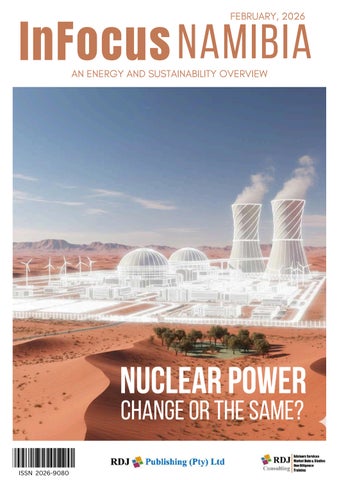
InFocus Namibia - February 2026

Page 1


AN ENERGY AND SUSTAINABILITY OVERVIEW

Coverimage:GoogleAIStudio

Editor: DavidJarrett

DeputyEditor:NicoleFelix

Contributors:SilpaKanghono, LahjaAmaambo,ChilomboOlga Priscila,ReneeJarrett,GraceKangotue

ChiefDesigner:NicoleFelix

RDJ Publishing (Pty) Ltd is the publishing home of the InFocus Namibia, written and authored through the collaboration with RDJ Consulting Services CC (www rdjconsulting co za)

This report is a FREE Publication The content is collected from publicly available information, and so its accuracy cannot be guaranteed

RDJ Consulting Services CC is an advisory consultancy to the Energy, Water and Transport Sectors with a focus on sustainable operations and renewable energy.

From The Editor

Will Namibia’s energy space evolve or remain the same?

NOTE1:Wewelcomelettersandarticlesfromreadersgloballyandrequirethatyouprovideyourfulldetailssuchasname, current address and contact phone/WhatsApp number as well as email. We however reserve the right to amend, modify or rejectsubmissions.Youmayalsorequestthatyourdetailsbewithheldfrompublication.

NOTE 2: InFocus Namibia is published monthly and is FREE to Readers. The magazine is paid for by advertising and the researchsupportfromRDJConsultingServicesCC,Windhoek,Namibia.

N A M I B I A

POPULATION

(2023 POPULATION AND HOUSING CENSUS)

Gross Domestic Product (GDP) at market prices (2024)

GINI COEFFICIENT (2024)

UNEMPLOYMENT RATE (2023 POPULATION AND HOUSING CENSUS) 36.9%

LITERACY RATE (15+ YEARS) (2023 POPULATION AND HOUSING CENSUS) 87%

6.50

REPO RATE (Feb 2026)

PRIME LENDING RATE (Feb 2026) 10.00

INFLATION (CPI) (Jan 2026)

4,288 GWh 672 MW MAXIMUM DEMAND (ELECTRICITY) 2024

TOTAL ELECTRICITY UNITS SOLD

NUCLEAR INDUSTRY: NAMIBIA FACTS

NDP6 will serve as a foundation to lay the groundwork for future exploitation of the advanced nuclear technology. Hence, this focus area suggests embarking on medium-term nuclear projects while laying the foundation for further large-scale development projects beyond the NDP6 period.

3.2%

Gross Domestic Product (GDP) at market prices (2024)

The contribution of the nuclear industry to economic development over the NDP5 period and preceding periods is confined to uranium mining, which contributed 3.2 per cent of total GDP in 2024 and applications in the radiation medicine field.

A Strategy for the Nuclear Industry has been developed to support the implementation of the Nuclear Fuel Cycle Policy of 2014 and the Nuclear Science and Technology Policy of 2016 which articulate the national aspirations regarding making nuclear technology as a complimentary vehicle to support attainment of national development objectives.

Namibia Nuclear Industry Selected Targets

Inflation

22 17 12 21 02

Lead Story

Nuclear Power in Namibia: Weighing the Pros and Cons

A Conversational Exploration of Namibia’s Energy Future

Introduction: Namibia’s Energy Landscape and Rising Electricity Demand

Namibia, known for its sweeping deserts, dramatic coastlines, and rich uranium deposits, is standing at a fascinating energy crossroads. The country is

growing, its towns are buzzing with new businesses, its industries are expanding, and more homes than ever are being connected to the grid. With this growth comes a steady rise in electricity demand, and the question on everyone’s mind is: How will Namibia power its future?

As conversations echo from Parliament to coffee shops, one idea sparks both excitement and debate “nuclear power” Supporters see it as a bold step forward, a chance for Namibia to transform its own natural uranium wealth into clean, reliable energy. Critics worry about safety, cost, and whether the country is ready for such a leap.

We have covered the basics before but these discussions aren’t just technical as they are deeply connected to everyday life They touch on whether households will have affordable electricity, whether businesses can operate without costly power shortages, and whether the country can secure an energy system that is both modern and resilient

Namibia’s electricity consumption has been on an upward trajectory. According to the Namibia Statistics Agency, the country’s electricity demand increased by nearly 4% annually over the past decade, reaching approximately 4.1 terawatt-hours (TWh) in 2025 This growth is fueled by urbanization, industrial expansion, and efforts to electrify rural communities New suburbs are spreading along the edges of towns, factories and mines are expanding production, and thousands of rural households are switching on electric lights for the first time.

But this growing appetite for power comes with a catch However, Namibia still imports about 60% of its electricity from neighbouring countries, making its energy security vulnerable to regional supply shocks and price fluctuations (Namibia Statistics Agency, 2025; NamPower Annual Report, 2025).

One of the most compelling arguments for nuclear power is its ability to generate large amounts of electricity reliably and consistently over long periods A single 1,000-megawatt (MW) nuclear reactor can supply over 8 TWh of electricity per year, which would be twice Namibia’s current annual

consumption Unlike solar and wind, nuclear energy operates continuously, regardless of weather or time of day, ensuring a stable power supply (World Nuclear Association, 2024).

A single 1,000-megawatt (MW) nuclear reactor can supply over 8 TWh of electricity per annum, which would be twice Namibia’s current annual consumption.

And entering the conversation are Small Modular Reactors, or SMRs, which are often described as the “next generation” of nuclear power, compact, flexible, and far easier to manage than traditional large reactors Instead of being massive, one off mega projects, SMRs are built in factories, transported in pieces, and assembled on site like high tech building blocks. This modular approach could dramatically reduce construction time and cost, while also making nuclear power more accessible for countries with smaller grids, like Namibia SMRs produce far less electricity than full scale reactors, but that’s part of their charm: they can be added gradually, matched to local demand, and even placed in remote regions where large plants wouldn’t make sense. Supporters see them as a cleaner, steadier alternative to diesel generators and a way to bring reliable power to growing towns and industries without overloading the grid While still relatively new on the global stage, SMRs are gaining momentum as a promising middle ground between renewable energy and conventional nuclear power

From a climate change perspective, nuclear power produces minimal greenhouse gas emissions compared to fossil fuels. The International Energy Agency (IEA) estimates that nuclear plants emit less than 15 grams of CO per kilowatt-hour (kWh) generated, compared to over 800 grams for coal-fired plants such as Van Eck (Windhoek) With Namibia’s commitment to reducing carbon emissions under international agreements, nuclear energy could help the country meet its climate goals (IEA, 2023) 2

Another plus is that Namibia is also one of the world’s top uranium producers, accounting for about 10% of global output Developing a nuclear industry could add value to its uranium resources, create high-skilled jobs, and boost economic growth (World Nuclear Association, 2024)

Despite its advantages, nuclear power comes with significant challenges. The upfront costs are enormous as a typical nuclear plant can cost between US$6 billion and US$9 billion to build, not including future decommissioning and waste management expenses (World Nuclear Industry Status Report, 2024) For Namibia, whose entire annual national budget in 2025 was about US$6 1 billion, this would be a massive financial undertaking (Namibian Ministry of Finance, 2025).

Namibian annual national budget in 2025 was approximately US$6.1 billion

Waste management poses another challenge. Nuclear reactors generate radioactive waste that must be securely stored for thousands of years Namibia currently lacks the infrastructure, expertise, and regulatory framework for long-term radioactive waste management (International Atomic Energy Agency, 2023)

Safety is also a further concern. While severe nuclear accidents are rare, their potential impact is catastrophic. Public perceptions of risk are heightened by events like Fukushima and Chernobyl, which can make gaining public acceptance difficult (World Health Organization, 2021)

Integrating nuclear power into Namibia’s energy mix is not as simple as building a reactor. The country’s electricity grid is designed for lower-capacity sources and would require extensive upgrades to handle the output of even a single nuclear plant According to NamPower, the national grid currently supports a peak load of about 600 MW which is far less than what a standard nuclear reactor produces (NamPower Annual Report, 2025).

Moreover, Namibia would need to develop a highly skilled workforce, establish independent nuclear safety authoritiesand enact robust regulatory policies before any project could begin This institutional and human capital development could take a decade or more

Policy-wise, Namibia would also need to ensure compliance with international nuclear safety and non-proliferation treaties, adding another layer of complexity and cost (International Atomic Energy Agency, 2023)

N$ 19.63/ US$ 1.23 perlitreDiesel50ppm

Norwegian firm BW Energy’s entry into Angola’s oil sector faces a legal hurdle

contributed by:

BW Energy’s Angola offshore entry faces partner preemption notice Partner may exercise right of first refusal on Blocks 14, 14K Deal with Azule Energy remains pending regulatory, contractual outcomes

BW Energy’s planned entry into Angola’s offshore oil sector has hit a legal obstacle. The Norwegian company said on Friday, Feb. 6, that an existing

partner in offshore Blocks 14 and 14K has notified its intention to exercise a right of first refusal over the transaction, which BW is pursuing alongside France’s Maurel & Prom

BW did not identify the partner It said the exercise of the preemption right would allow that partner to step into the buyers’ place on the same contractual terms. BW added that the divestment agreement signed with the seller, Azule Energy, remains in effect for now, pending any new contract between Azule Energy and the party exercising the right No further details were provided on the procedure

The development comes as part of BW Energy’s efforts to establish a foothold in Angola. In December 2025, the company said it had signed an agreement with Azule

Energy, alongside Maurel & Prom, to acquire interests in the two producing blocks. Under the deal, BW Energy was to acquire 10% of Block 14 and 5% of Block 14K, with Maurel & Prom taking equivalent stakes

The blocks are operated by U S oil major Chevron off the coast of Angola and rank among the country’s key oil assets.

The transaction is part of BW Energy’s broader expansion strategy in Africa After strengthening its position in Namibia, the company has presented Angola as a new pillar of its regional growth, targeting producing offshore assets capable of generating immediate cash flow Any transfer of interests in the blocks remains subject to regulatory approval and potential preemption by existing partners.

Renewables vs. Nuclear: A Namibian Pathway

Monthly Namibia Statistical Agency (NSA) electricity bulletins show that Namibia’s grid swings with hydrology (Ruacana) and regional availability.

Table 1(2024 / 2025) Selected NSA electricity data

Localgeneration Imports

February2024

January 2025

609%ofdemand (Ruacana873%oflocaloutput)

609%ofdemand (Ruacana851%)

391%imported (mainly 597% Zambia; 187% South Africa;15.7%Zimbabwe)

391%imported (SouthAfrica492%;Zambia334%)

March2025 59.1%ofdemand 40.9%imported

In Namibia’s intensely price sensitive electricity landscape, where a significant share of power is still imported and tariff pressures are a reality, the most

practical way to expand capacity in the near term is to prioritize technologies that are quick to build, low cost, and low‑risk.

Utility scale solar and onshore wind fall squarely into this category with global cost benchmarks consistently show them as the cheapest new build generation options, with rapid construction timelines and steadily improving performance.

When paired with grid reinforcement and modern battery storage, these renewables not only reduce reliance on volatile imports but also enhance system resilience at a fraction of the financial burden associated with more complex technologies.

By contrast, despite its appeal as a steady, emissions free baseload source, nuclear power presents formidable challenges for an electricity power system of Namibia’s size Nuclear projects demand massive upfront capital, extended development horizons, and robust regulatory, safety, and waste management frameworks that take years to establish

New Licensing Vision Powering Progress

Countries across Africa are seeking new ways to attract investment, enhance reliability and lower consumer costs Few sectors reflect this

transitional momentum more clearly than Namibia’s own Electricity Supply Industry (ESI), where decades old licensing processes are being reevaluated to meet the realities of contemporary energy generation

This transformation was brought into sharp focus on 10 February 2026, when Electricity Control Board (ECB) CEO Robert N. Kahimise delivered opening remarks at a stakeholder workshop hosted at Windhoek’s Avani Hotel The event marked the unveiling of proposed simplified licence conditions for Small Embedded Generators (SEGs) and pilot projects, an initiative that signals a meaningful shift from traditional regulatory rigidity to a more agile, innovation friendly framework.

Kahimise’s message was clear “Namibia must maintain regulatory discipline while eliminating unnecessary barriers that hamper growth” His address mirrored the sentiments echoed in multiple reports covering this national initiative, all underscoring embedded generation’s rising importance to Namibia’s energy future.

Embedded generation also known as distributed generation refers to smaller scale power production facilities that connect directly to localized distribution grid networks

rather than the national transmission backbone. These systems are generally installed by private companies, commercial entities, households or specialized developers, often deploying solar, wind, hybrid or emerging technologies.

Interest in such systems has surged across Namibia, driven by three intersecting factors:

1.High dependence on electricity imports, which accounts for a significant portion of national consumption

2 Rapidly falling renewable energy costs, especially photovoltaic systems

3.Growing demand for energy autonomy from businesses, mines, farms and communities seeking resilience against outages and tariff fluctuations.

Yet despite their promise, small scale power producers have historically faced licensing hurdles designed for utility scale generators, limiting widespread adoption Reports indicate that innovators with systems under 2 MW were held to the same regulatory requirements as large independent power producers a mismatch that increased administrative burdens, costs and approval timelines

This misalignment helped set the stage for the ECB’s rethink

The CEO’s Message: Regulation With Purpose, Not Resistance

In his remarks, Kahimise reaffirmed the ECB’s statutory role: ensuring orderly growth, system reliability, consumer protection and fair market participation,

all authorized under the Electricity Act of 2007, which requires licensing or exemption for any person generating, trading, transmitting, supplying, distributing or importing power

But regulation, he argued, must evolve with the industry

Kahimise emphasized the need to identify and remove barriers that impede growth particularly those aspects that create over regulation, which can deter investors, slow down innovation, and disadvantage smaller market participants He acknowledged that excessive administrative requirements could act as “a hindrance to new entrants, ” especially at a time when Namibia urgently needs fresh capacity, diversified sources and green investment.

The proposed simplified licensing framework rests on three pillars:

1. Capacity Based Categorisation

Up to 2 MW for standard Small Embedded Generators. Up to 5 MW for innovative pilot projects utilising emerging technologies such as green hydrogen, advanced storage or hybrid micro grids

2. Reduced Administrative Burden for Low‑Impact Systems

Serve own consumption (e.g., businesses installing solar for internal use).

Operate under willing buyer willing seller arrangements (private rooftop installations providing energy to a single consumer)

Have minimal influence on national tariffs and therefore do not require extensive economic oversight

3. Clarity on Tariffs, Licensing Duration and Obligations

While increasing flexibility, the ECB maintains accountability Reports show that tariff schedules may be waived for systems used for private consumption or resale models that do not affect public pricing but not for systems influencing customer tariffs

Regulatory levies and surcharges remain compulsory, ensuring that simplified licensing does not undermine systemic fairness The ECB will also apply consistent criteria when determining licence duration

Although the ECB is advancing a light handed regulatory system, it makes clear that simplified licensing does not equate to deregulation without oversight

All projects must still:

Comply with the Electricity Act of 2007. Undergo the mandatory 30‑day public objection period

Adhere to technical safety codes, grid connection standards and environmental requirements

The aim is proportional regulation that is rigorous where necessary, flexible where appropriate. This ensures:

Grid stability remains protected

Consumer interests are not compromised

Market fairness is upheld

Technical safety is enforced.

If successfully enacted and supported, the simplified licensing framework may become a cornerstone of Namibia’s journey toward a more flexible, renewable and economically vibrant electricity supply industry, one where small embedded generators play a big and increasingly indispensable role.

2026)

Name of Reservoir

Author’s analysis and representation of NamWater’s weekly dam bulletin - dated 09/02/2026

According to records by NamWater’s weekly Dam Bulletins, Namibia has a total Reservoir capacity of 1556.71 million cubic meters (Mm3), whose present volumes stand at 1210.17 Mm3 (or 77.7%). This means that the country’s water deficit is currently 346.54 Mm3 (or 22.3%) SOURCE: RDJ CONSULTING

Namibia joins Luanda Agreement to promote natural diamonds globally

contributed by:

Namibia becomes party to Luanda Agreement alongside Angola, Botswana, and DRC Initiative aims to counter rising competition from lab-grown diamonds

Natural diamonds accounted for 14.7 % of Namibia’s exports in 2024

Namibia has joined the Luanda Agreement, an informal initiative created to promote the image of natural diamonds among consumers worldwide.

In addition to Angola, which hosted the founding meeting in Luanda in June 2025, the group’s founding members include Botswana, the Democratic Republic of Congo, De Beers, and industry organizations such as India’s GJEPC and Belgium’s AWDC.

“Natural diamonds have helped shape Namibia’s economic story for more than a century, creating jobs, supporting communities and contributing directly to national development By joining the Luanda Accord, Namibia is affirming that producing countries have both a stake and a responsibility in telling the true story of natural diamonds, ” said Namibia’s Minister of Industries, Mines and Energy (MIME), Modestus Amutse

The signing comes at a sensitive time for diamondproducing countries, which are facing growing competition from synthetic diamonds. Often perceived by some consumers as more ethical, lab-grown diamonds are increasingly favoured over mined stones, which can be associated with human rights abuses or environmental

damage.

This shift has contributed to a sharp decline in demand and prices for natural diamonds, forcing countries such as Botswana, where diamonds are central to the economy, to cut production in recent years In Namibia, diamonds accounted for 14 7 % of total exports in 2024 and 3 4 % of gross domestic product, according to the Chamber of Mines.

Implementation of the Luanda Agreement is overseen by the Natural Diamond Council (NDC), an organisation dedicated to educating consumers about the value of natural diamonds and their positive impact The project’s budget, which includes advertising campaigns, has not been disclosed. The agreement provides that 1% of annual revenues from rough diamond sales will be allocated to its funding.

De Beers plans an initial contribution of $8 million Endiama and Sodiam, Angola’s two state-owned companies responsible for diamond production and marketing, have also committed to initial contributions of $8 million each.

De Beers Maintains a Cautious Production Outlook for 2026 as Demand Weakens

contributed by:

De Beers cuts 2026 diamond production forecast to 21-26 million carats

Weak natural diamond demand, lab-grown competition pressure output

Lower production weighs on Botswana economy reliant on diamonds

While the natural diamond market remains weak, De Beers has struck a cautious tone for 2026. In an operational report published on Thursday,

Feb 5, the diamond group, which has major operations in Botswana, said it now expects production of between 21 million and 26 million carats this year, down from a previous forecast of 26 million to 29 million.

The revised guidance continues the adjustment of its operating plan following cuts already implemented in 2025 “Production guidance for 2026 is revised to 21–26 million carats (100% basis) (previously 26-29 million carats), in response to the challenging rough diamond trading conditions. De Beers continues to monitor rough diamond trading conditions in order to align output with prevailing demand,” the company said, adding that it would continue to align output with demand

Global demand for natural diamonds has declined sharply in recent years, notably due to growing competition from laboratory-grown stones. De Beers has responded by scaling back production targets In 2025, it revised its guidance to 20 million to 23 million carats, from an initial 30 million to 33 million

While output reached 21 6 million carats, annual production still fell 12% In Botswana, where De Beers operates the Jwaneng and Orapa mines, production dropped 16% Output in Namibia was down 7% year on year. Only South Africa’s Venetia mine recorded an increase of 3%, while production in Canada fell 7%.

The cautious strategy carries implications for host countries, particularly Botswana, whose economy remains heavily dependent on diamond revenues Authorities expect a second consecutive year of economic contraction in 2025, with GDP forecast to shrink by 3% amid lower diamond sales.

How market conditions evolve in 2026 and what that means for De Beers’ production plans remains uncertain Meanwhile, the company is preparing for its demerger from parent Anglo American as part of a restructuring announced in 2024.

Why Can’t We leave CITES?

“African wildlife will not be protected through Western conservation approaches but through the involvement of local communities” , says Namibian conservationist Margaret Jacobsohn.

“And rightly so, who is better placed to decide on how to manage and run this African wildlife, than those who live with it daily, those who are

daily exposed to sometimes life-threatening animals?

How many countries have a track record of a successful and sustainable conservation model like Namibia? A reality that should enable and entitle Namibians to be able to run, manage and trade in its sustainably managed wildlife resources

A conservation model that has become a global showcase, emulated by many countries Yet, the irony is, countries that hardly have any wildlife resources are dictating to those who have managed to maintain or “repopulate” their wildlife resources.

Trading in our ivory, which mostly had been obtained through legal means, will enable us to solve many of Namibia’s socio-economic challenges, especially facing those in rural areas, who are exposed to these wildlife species daily The existing stock of 46 286kg registered raw ivory, which Namibia wants permission to trade in, comes from elephants that died of natural causes and from wildlife management operations, it is reported.

Mind you, many inhabitants in those areas have lost their livelihoods as a result of these successful conservation efforts Fences are broken daily, especially in the arid Erongo and Kunene regions, where these subsistence farmers are trying to eke out a livelihood

Many subsistence farmers have lost their animals, such as cattle, goats and cows, because of this consistent damage to fences and water infrastructure Ultimately, livestock is exposed to theft and other predators, which results in the loss of livelihoods for these communities Frequent damage to water infrastructure means frequent repair and maintenance, which is a financial burden on the government. In many cases, fixing this damaged infrastructure can take months and even years Again, who is at the receiving end? Not the “arm-chaired” conservationist or the tourists, but the “poor” Namibian men and women, on the ground

Similarly, in the north and northeastern regions, where horticultural production is mostly practised, elephants destroy gardens daily, depriving people of their hard-earned income According to Namibian conservation scientists, the biggest long-term threat to Namibia's elephant population is not poaching, but habitat loss, leading to blocked migration routes and growing human-wildlife conflict where there are no incentives to protect wildlife.

So, again, my question is, are Namibians not able to make their own decisions when it comes to their livelihood?

Can there be a thorough explanation for the layman to understand why we should not break away from the Convention on International Trade in Endangered Species of Wild Fauna and Flora (CITES) if its decisions do not benefit the ordinary Namibian? Why should we follow the “World Order” if others are able to break it left and right?

I believe, Namibia together with Angola, Botswana, Namibia, Zambia and Zimbabwe, which make up the Kavango-Zambezi Trans-Frontier Conservation Area (KAZATFCA), joined by South Africa, can and have the power to withdraw from CITES to send a strong message These countries are home to more than two-thirds of the African elephant population of about 450,000.

So again, I ask, why can we not withdraw from CITES, if those in the know are of the opinion that there is no conservation or scientific problem? Is it perhaps a political problem or will? Or perhaps some hidden benefit that we are not in the know of?

China’s Export Surge Impacts on Namibia and Its Outlook

As the global chemical industry in 2026 continues against the backdrop of a persistent downturn that began in the wake of the COVID-19 pandemic, those

initial shocks persist, the industry continues to grapple with stubbornly low profitability. Aside from a brief margin spike during the supply chain chaos of 2021–2022, chemical producers across continents have faced relentless pressure from oversupply and depressed operating rates According to current S&P Global forecasts, these headwinds are likely to persist for another two to three years, keeping basic chemical operating rates below the levels necessary for robust profitability.

The core reason for this prolonged downturn is, in a word, China Over the past two decades, China has turbocharged its domestic chemical sector through aggressive incentives and policy support, driving investments that have far outpaced global demand growth Much of this expansion was tied to China’s once-booming construction, housing,

and infrastructure sectors However, as domestic consumption slows, Chinese producers are pivoting to the global market with a new export-oriented focus The result is a flood of competitively priced chemicals from modern, subsidized plants that now challenge producers in Asia, the Middle East, Europe, and North America.

This shift has created a strategic imbalance between China’s centrally planned supply expansion and the marketdriven approaches of other regions, where producers must answer to quarterly returns and shareholder expectations For countries like Namibia, this new reality presents both challenges and opportunities.

Namibia, a rising player in Africa’s industrial landscape, finds itself at a crossroads as the ripple effects of China’s export surge reshape global chemical markets The country’s chemical sector, though smaller than those of regional giants like South Africa or Egypt, is increasingly

integrated into global supply chains As Namibia seeks to industrialize and diversify its economy, the chemical downturn and its Chinese-driven dynamics will significantly influence the nation’s outlook. With China exporting more chemicals at lower prices, Namibian manufacturers will face heightened competition This could erode margins for local producers, forcing them to either innovate, specialize, or risk being outcompeted by cheaper imports

China’s export surge is also poised to affect Namibia’s emerging green hydrogen sector and its derivatives, such as ammonia and methanol As Namibia positions itself as a future hub for green hydrogen production leveraging its abundant renewable resources and strategic location, Chinese competition in downstream chemicals and derivatives could present both opportunities and headwinds.

On one hand, lower global chemical prices driven by Chinese exports may compress margins for any Namibian green hydrogen projects that aim to convert hydrogen into value-added chemicals for export This could make it tougher for new projects to secure financing or reach profitability, especially if Chinese producers, benefiting from scale and various subsidies, can offer similar products at lower costs

On the other hand, Namibia’s focus on producing green hydrogen using renewable energy offers a distinct

Executive Spotlight

Spotlight on Ms. Lovisa Neshila

Interview by Ms Silpa Kanghono (Coordinator: Digital Marketing and Events - RDJ Publishing)

elcome to the Spotlight Series a platform where we engagewithvisionaryindustryleaderswhoaredriving innovationandshapingamoresustainablefuture.In thisedition,wearehonouredtofeatureMs.LovisaNeshila,Business DevelopmentManagerat HDF Energy Africa.Shesharesinsightsinto her role, her overarching vision for expanding HDF Energy, the essentialleadershipqualityandmore

1. Can you describe your managerial role and key responsibilities at HDF Energy?

AsBusinessDevelopmentManagerat HDF Energy,myrolesitsatthe intersectionofstrategy,diplomacy,andprojectexecution.

At the earliest stage, I assess whether a country presents a viable opportunityfordeploying HDF’s Renewstable® hydrogenpowerplant model.Thisinvolvesdeeppowermarketanalysis,understandingthe energy mix, especially the share of fossil fuel generation, the gap in low-carbon dispatchable capacity, infrastructure constraints, regulatory frameworks, and hydrogen readiness. The key question I askis: Is there a structural need that HDF can solve sustainably and competitively?

Once the market opportunity is confirmed, I develop the market entry plan, select the best project sites, identify key risks and constraints, and build a strong local network including EPC contractors, equity investors, lenders, and development finance institutions

Beyondstrategy,Iactivelyengagegovernments,regulators,utilities, and communities to align stakeholders and drive projects toward bankability, financial close, and ultimately execution In essence, I help translate innovation into implementable, investable infrastructure

In Africa especially, many grids are characterized by high dependence on imported fossil fuels, aging thermal infrastructure, growingdemandandlimitedstoragecapacity.

Our market entry decisions are therefore data driven. We evaluate the energy mix, grid pain points, regulatory maturity, hydrogen infrastructurepotential,sovereignappetiteforenergyindependence, andaccesstolong-termofftakeagreements.

We enter markets where our technology is not just innovative but necessary ForNamibiainparticular,theopportunityisprofound:to move beyond energy import dependency and position itself as a leadinggreenindustrialhubanchoredinlocalbaseloadpower

4. From your perspective, what is your overarching vision for expanding HDF Energy’s footprint and impact in Africa and other emerging markets?

Myoverarchingvisionisrootedinpurpose.

I believe Africa has a once-in-a-generation opportunity to leapfrog into a just, resilient and low-carbon energy future, one that is not extractive, but value-creating. Reliable green baseload power is the foundationofthatfuture.

ForNamibia,thismeansusingourrenewableresourceadvantageto anchor domestic industrialisation, reduce import dependency, strengthen grid stability, and attract green manufacturing and processingindustries.

More broadly across emerging markets, expansion must go beyond projectdevelopment Itmustincludeskillstransfer,localcontent participation, technology adoption, and long-term ecosystem building Infrastructure should not only produce megawatts, but it shouldalsoproduceopportunity

My vision is to contribute meaningfully to positioning Namibia and Africa not as passive participants in the energy transition, but as leaderswithinit

5. What aspect of your sector keeps you awake at night?

Namibia remains significantly exposed to external supply and price shocks because a large share of our electricity is imported. This creates vulnerability not only to fuel price volatility and regional constraints, but also to decisions made beyond our borders. For a small, growing economy, energy security is directly linked to economicstabilityandcompetitiveness

The solutions are not the constraints. We have exceptional solar resources, viable storage technologies, and proven models for dispatchable renewable power. The challenge lies in alignment, speed,andexecutionensuringregulatoryclarity,strengtheninggrid readiness,andcoordinatinginstitutionaldecision-making.

Large-scale infrastructure takes time. Yet our exposure to import dependencycreatesurgency.

That tension is what motivates me It reinforces the importance of structured strategy, strong partnerships, and purposeful leadership to translate opportunity into bankable, locally anchored projects thatenhanceNamibia’senergysovereignty

6. In your role, what leadership qualities do you believe are essential for successfully driving HDF Energy’s projects forward?

Purpose-drivenleadershipisessential.

First, strategic foresight - the ability to understand how policy, finance,infrastructure,andcommunitydynamicsintersect.

Second, resilience and patience - infrastructure development is complex and long-term. Conviction must be sustained through negotiationcyclesanduncertainty.

Third, relational intelligence - trust is the currency of large-scale transformation Whetherengagingutilities,ministries,development

institutions, financiers, or local communities, credibility and transparencyarecritical

Finally, I believe in leadership anchored in service recognising that energy infrastructure ultimately exists to improve lives, enable economicgrowth,andcreatenationalresilience

7. What has been your proudest moment so far at HDF Energy?

My proudest moments are those where vision begins to crystallise intosharednationalambition Whendiscussionswithpolicymakers, financiers, and technical stakeholders move from curiosity to conviction, when they begin to see that firm renewable power can underpin energy sovereignty and industrial competitiveness, that alignmentispowerful Formepersonally,itisdeeplymeaningfulto contributetosolutionsthatcanhelpNamibiatransitionfromenergy vulnerabilitytoenergyleadership.Livingandworkingwithintention means aligning professional responsibility with national purpose. Being part of shaping that trajectory is both a privilege and a responsibilityIcarrywithgreatseriousness.

Tenders

NamPower

Description: Initial Selection (IS) of the Engineering Procurement and Construction (EPC) Contractors for the 45 MW / 90 MWh Lithops Battery Energy Storage System (BESS) Project.

Bid Closing Date: 27 February 2026 at 10h00 Namibian Time https://www nampower com na/Bid aspx?id=292316

CENORED (Pty) Ltd

Description: Supply and Delivery of One (1) HPE Dl560 GEN 10 Sap S4 HANA Compliant Server.

Bid Closing Date: 02 March 2026 at 10h00 https://cenored.com.na/wp-content/uploads/2026/01/NEWSPAPER-ADVERT-SUPPLY-AND-DELIVERY-OF-ONE-1-HPE-DL560-GEN10-SAP-S4-HANA-COMPLIANT-SERVER-3 pdf

Namdeb

Description: Invitation to Tender for the Provision of Electrical and Instrumentation Support Services

Bid Closing Date: 06 March 2026 at 16h00 https://namdeb.com/opportunities/tender-eoi/

Regional Energy Regulators Association of Southern Africa (RERA)

Description: Supply, Delivery, Installation and Deployment, Testing, Training and Commissioning of Software; and Provision of Cloud Infrastructure for Energy Information and Database System (EIDBMS)

Bid Closing Date: 10 March 2026 at 09h00 AM Namibian Time https://rerasadc.com/2026/01/request-for-bids-supply-delivery-installation-and-deployment-testing-training-andcommissioning-of-software-and-provision-of-cloud-infrastructure-for-energy-information-and-database-system-eidb/

TransNamib

Description: Supply and Delivery of Wagon Spares

Bid Closing Date: 12 March 2026 https://www transnamib com na/procurement/

As RDJ Consulting, we pride ourselves as specialised consultants who provide advisory services, market data and studies, due diligence and offer world-class training within our core business area. Collaboration forms an integral part of what we do, and for this year, we are making it a priority.

OUR FOOTPRINT

Asia Britain Caribbean Southern Africa

USA

Our innovative strategies are baked daily at 40 Copper Street, Prosperita, Windhoek, Namibia.

Contact us today to discover how our unique services add value to your business!

February12,2026

From time to time, figures disclosed in audited financial statements ignite public debate, particularly when they relate to loan write-offs These conversations are understandable and, in many ways, healthy in a transparentfinancialsystem

FromHindsighttoForesight

In the past, banks recognised credit losses only after borrowers had already defaulted, often masking underlying risk and overstating financial strength. The global financial crisis of 2008 exposed the danger of this approach,aslosseswererecognisedtoolate.

This shift gave rise to the introduction of International Financial Reporting Standard (IFRS) 9, which shifted banking to a forward-looking model IFRS 9 requires financial institutions to recognise expected credit losses earlier and to write off loans once there is no reasonable expectationofrecovery Thisensuresthatbalancesheets reflect economic reality rather than delayed or optimistic assumptions.

WhataWrite-OffReallyMeans

Awrite-offoccurswhenaloanhasreachedapointwhere, from an accounting perspective, there is no longer a reasonableexpectationofrecovery.Thispointistypically reached only after a borrower has failed to honour their repayment obligations and the bank has exhausted all reasonable recovery options These steps usually include enforcing security, liquidating pledged assets, pursuing legalremedies,andlistingthedefaultingclientwithcredit informationbureaux,amongothercollectionmeasures

Thisprocessisnotarbitrary.Financialinstitutionsoperate within internationally accepted best-practice standards that govern when impaired debts must be recognised. In Namibia, the regulatory framework implemented by the BankofNamibiarequiresbankinginstitutionstowriteoff qualifyingnon-performing

exposures after 365 days in arrears Most commercial banks apply this benchmark as part of standard risk managementandregulatorycompliance

Development finance institutions apply an even more measuredapproach.Giventheirmandatetosupportlongterm economic development and higher-risk sectors, institutionssuchastheDevelopmentBankofNamibiause the365-dayinarrearsrequirementasabenchmark,while allowingforanadditionalcalibratedextensionof90days beforeawrite-offisapplied.

Crucially, an accounting write-off does not mean debt forgiveness It remains the obligation of the financier to recover or continue attempting to recover any amounts that may be possible At this stage, the write-off simply ensures that loans with no reasonable expectation of recovery no longer distort the bank’s true financial position.

WhatWrite-OffsMeanforFinancialInstitutions

Farfrom signalling distress, write-offs improve the credibility of a financial institution’s balance sheet. They ensurethatassetvaluesarenotoverstated,thatrisksare acknowledgedhonestly,andthatstakeholderscanrelyon thefinancialinformationpresented

Overtime,somelegacyexposuresinevitablyreachapoint where accounting standards require them to be recognised as impaired Addressing these exposures transparentlyisahallmarkofgoodgovernance.

TheBiggerPicture

At its core, writing off bad debts is about integrity. It ensures that financial institutions present financial statements that reflect economic reality rather than optimism.Whenunderstoodinthiscontext,write-offsare not a cause for alarm, but evidence of a financial system thatisfunctioningasitshould

C O N T R I B U T I N G A U T

DAVID JARRETT

EDITORINCHIEFAND CHIEFEXECUTIVEOFFICER

@RDJGROUP

NICOLE FELIX CHIEFDESIGNER (LAYOUTANDDESIGN) @RDJPUBLISHING

SILPA KANGHONO COORDINATOR:DIGITALMARKETINGAND EVENTS

@RDJPUBLISHING

LAHJA AMAAMBO CONTRIBUTINGAUTHOR @RDJGROUP

GRACE KANGOTUE CHIEFRESEARCHER/ECONOMIST EDITOR @RDJCONSULTING

RESEARCHBY: PUBLISHEDBY:

PRINTEDBY:

Turn static files into dynamic content formats.

Create a flipbook