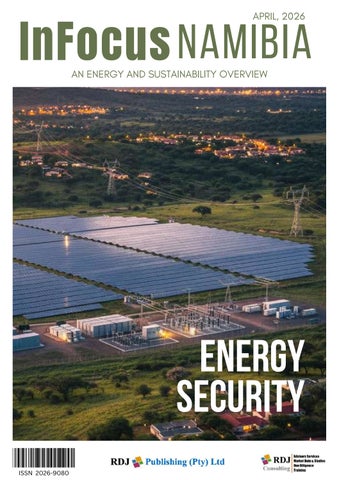
RDJ Publishing (Pty) Ltd is the publishing home of the InFocus Namibia, written and authored through the collaboration with RDJ Consulting Services CC (www rdjconsulting co za)
This report is a FREE Publication The content is collected from publicly available information, and so its accuracy cannot be guaranteed
RDJ Consulting Services CC is an advisory consultancy to the Energy, Water and Transport Sectors with a focus on sustainable operations and renewable energy.
From The Editor
A Powered Nation
DearReader,
Welcome to the long-anticipated edition of InFocus Namibia, proudly researched and producedinNamibia.
AcrossNamibia,householdsandindustriesarealsoconfrontingthisnewreality,andassuch reliable and affordable energy efforts can no longer be taken for granted Today, energy security extends beyond simply keeping the lights on. It requires systems that are resilient, cost-effective,environmentallyresponsible,andcapableofwithstandingfutureshocks.
AccordingtoSouthernAfricaPowerPool,2022,only56percentofNamibianshaveaccessto electricity, leaving many households without reliable power for essential needs such as lighting, education, and economic participation. This underscores the urgent need for inclusiveenergysolutionsthatexpandaccess,particularlyinremoteareaswhereunderserved communitiesreside,whilestrengtheningnationaldevelopmentandimprovingqualityoflife
Addressing this gap requires a clear and coordinated national effort. By strategically developing its energy sector across renewables, hydrocarbons, and emerging technologies, Namibiacanmovesteadilytowarduniversalaccess Thevisionfor2030isbothambitiousand necessary,whereeveryNamibian,regardlessoflocation,isexpectedtobenefitfromreliable and affordable power. Achieving this will not only strengthen energy independence but also driveinclusivegrowthandunlockthecountry’sfulleconomicpotential
AkeystepinthisjourneyliesinNamibia’sabilitytoleverageitsnaturalendowedresources, includingthedevelopmentoflocalrefiningcapacity.Establishinganoilrefinerywouldreduce reliance on imported fuels, protect the country from global price volatility, and strengthen energy reliability Beyond energy security, it would also stimulate job creation, support downstreamindustries,andreinforceNamibia’srolewithinregionalenergymarkets,building amoreself-sufficientandresilienteconomy.
This vision can be further strengthened by Namibia’s emerging green hydrogen sector By integratinggreenhydrogen,particularlyfromtheErongoregion,intorefiningprocessessuch as crude oil desulphurization, Namibia can produce low-sulphur fuels with significantly reduced emissions This “green refinery” approach not only ensures compliance with global environmentalstandardsbutalsoenhancesexportcompetitiveness,positioningNamibiaasa leaderinsustainablefuelproduction.
Equally important is the role of local participation in securing the country’s energy future ThroughframeworkssuchasthePetroleum(ExplorationandProduction)ActandtheNational LocalContentPolicy,Namibiaisactivelyenablinglocalbusinessestoparticipateintheenergy valuechain ThesepoliciesensurethatNamibianenterprisescancompeteforcontracts,form joint ventures with international operators, and benefit from knowledge and technology transfer This approach strengthens domestic capacity while ensuring that energy developmenttranslatesintolong-termnationaleconomicbenefit.
NOTE1:Wewelcomelettersandarticlesfromreadersgloballyandrequirethatyouprovideyourfulldetailssuchasname, current address and contact phone/WhatsApp number as well as email. We however reserve the right to amend, modify or rejectsubmissions.Youmayalsorequestthatyourdetailsbewithheldfrompublication.
NOTE 2: InFocus Namibia is published monthly and is FREE to Readers. The magazine is paid for by advertising and the researchsupportfromRDJConsultingServicesCC,Windhoek,Namibia.
Quick Facts
N A M I B I A
POPULATION
(2023 POPULATION AND HOUSING CENSUS)
UNEMPLOYMENT RATE (2023 POPULATION AND HOUSING CENSUS) 36.9%
LITERACY RATE (15+ YEARS) (2023 POPULATION AND HOUSING CENSUS) 87%
Gross Domestic Product (GDP) at market prices (2024)
Lead Story The Energy / Poverty Paradox: Unlocking Booms
The Namibian nation is attracting global attention for its ambitious oil and green hydrogen ventures, promising billions in investment and the prospect
of transforming its economy. Yet, beneath this optimism lies a sobering reality: only 56 percent of Namibians have access to electricity, with rural communities disproportionately affected Recent examples include the launch of megaprojects such as the Hyphen Hydrogen Energy initiative, which aims to produce green hydrogen for export, and the expansion of offshore oil exploration by international companies.
While these projects are set to generate substantial revenue, the infrastructure to be built, such as pipelines and export terminals, which then primarily serves international markets and often bypasses rural settlements. As a result, many rural families continue to rely on kerosene and firewood for their energy needs, highlighting the persistent
gap between resource extraction and local access (Smith, 2024; Mupupa & Haufiku, 2025)
Namibia’s energy poverty is stark and persistent Despite the country’s resource wealth, more than four out of ten Namibians remain disconnected from the grid. This gap has profound socio-economic implications, hindering education, healthcare, and local enterprise Rural families often rely on costly and unhealthy alternatives, such as kerosene and firewood, which perpetuate cycles of poverty and limit opportunities for growth (Smith, 2024)
Namibia’s mega-projects in oil and hydrogen are primarily export-oriented. Infrastructure is built to channel resources abroad, not to serve domestic needs Pipelines, ports, and processing facilities often bypass rural settlements, reinforcing a pattern where energy extraction benefits global markets more than local households The disconnect
is not just physical, therefore it’s systemic, rooted in investment strategies and policy frameworks that prioritize revenue over rural inclusion (Mupupa & Haufiku, 2025).
Emerging gas-to-power projects offer a pathway to address Namibia’s energy paradox By converting locally sourced gas into electricity, the country can expand its generation capacity and channel new power to underserved regions Proposals for a National Electrification Fund are gaining traction, aiming to pool revenues from oil and gas to subsidize rural infrastructure and grid extensions. Such initiatives could catalyze widespread access if paired with transparent governance and targeted investment (Namibia Ministry of Mines and Energy, 2026)
Namibia’s green hydrogen sector is poised to generate renewable energy surpluses. Excess electricity from wind and solar can be redirected to rural homes, reducing costs and emissions Additionally, water desalination linked to hydrogen production can supply clean water to arid regions, further enhancing quality of life These synergies present a unique opportunity: harnessing advanced technology to deliver basic services where they are needed most (van der Merwe et al., 2026).
The challenge is clear: how can Namibia’s energy riches translate into tangible benefits for its people?
Policy innovation is essential to bridge the extractionaccess divide The Local Content Policy mandates that energy projects contribute to community development, while Social Investment Credits reward companies for funding electrification and education Productive use programs encourage rural entrepreneurship by providing grants for small businesses to adopt electric tools, boosting
Aviation Week Africa 2026
The Aviation Week Africa marked its third summit, under the theme “Linking Africa: Partners for Growth,” in Windhoek, Namibia, from 22 to 24 April 2026 Hosted at the Mercure Hotel Windhoek, the event brought together a broad mix of aviation stakeholders from across the continent and beyond, creating a space for collaboration and forward-looking aviation dialogue
Participants represented a wide cross-section of the industry, including airlines, airport authorities, regulators, government officials, investors, military aviation authorities, technology providers, and training institutions. Discussions throughout the summit focused on exploring strategies that will drive air connectivity, strengthen safety frameworks, and support innovation and sustainability within Africa’s aviation landscape.
Although the programme spanned over four days, the opening day was primarily dedicated to delegate arrivals and registration This allowed participants travelling from across the continent and beyond sufficient time to settle in, complete registration, and prepare for the sessions ahead
The official opening on the second day featured impactful remarks and contributions from leaders shaping Namibia’s aviation and tourism landscape Hon Idileni Daniel, Minister of Environment, Forestry and Tourism, extended a warm welcome to Namibia In a candid and forward-looking address, the Minister of Works and Transport, Hon Veikko Nekundi, addressed the pressing issue of flight prices in Namibia, pointing out the importance of affordability and access.
A notable focus of the summit was the third day’s emphasis on women ’ s participation in aviation. As such, Day 3 of Aviation Week Africa focused on Women in Aviation, celebrating and strengthening female leadership across Africa’s aviation industry. The day featured a panel discussion with women from various sectors of aviation, who shared insights on their careers and the challenges they face in the industry The day also marked a historic moment with Hellen Ngwira Mwambathe, CEO and Founder of Aviation Week Africa, together with Ms Toska Sem, Executive Director at the Namibia Civil Aviation Authority, unveiling the new Women in Aviation logo, marking a significant step in promoting visibility and inclusion This moment underscored a broader shift towards greater inclusion and recognition of women ’ s contributions within the sector
The final day turned attention to the next generation, shifting the focus to youth empowerment, with an emphasis on preparing the next generation for careers in aviation. The day engaged learners from invited schools, including Havana High School, Jan Möhr Secondary School, and St. George’s Diocesan School. Discussions highlighted the wide range of career opportunities within the aviation sector, while inspiring and encouraging learners to explore pathways within the industry.
Overall, the Aviation Week Africa 2026 summit demonstrated the value of collaboration, inclusivity, and strategic thinking in advancing Africa’s aviation sector By bringing together experienced professionals and aspiring young talent, the summit reinforced a shared vision for a more connected and resilient aviation future
23.63/ US$ 1.43 perlitreDiesel50ppm
Oil & Gas
Refinery Dreams and Energy Independence
Namibia’s drive for energy security has long hinged on the goal of refining its own crude oil With the Orange Basin’s Venus and Graff fields set to begin
production in April 2026, the national conversation has shifted from whether a refinery is possible to how it should be executed to safeguard Namibia’s energy future
Namibia’s energy aspirations, highlights Walvis Bay’s transformation with the proposed US$4 billion refinery positioned as a strategic step toward energy sovereignty. Proponents argue that local refining would insulate Namibia from external supply risks
Setting Up an Oil Refinery
Establishing an oil refinery is a cornerstone for achieving energy security and reducing dependency on imported fuels For Namibia, developing local refining capacity is not only a strategic move to insulate the nation from supply volatility, but also a catalyst for economic growth and
A refinery requires substantial land, preferably near a port such as Walvis Bay, to facilitate crude import and product export. Essential utilities include reliable electricity, water supply, and access to transportation networks (rail and road) for feedstock and product movement Specialised equipment, such as distillation columns, reactors, storage tanks, and safety systems, must meet international standards to ensure efficiency and safety (African Energy Council, 2026).
The setup process involves securing environmental impact assessments (EIA), safety certifications, and operational permits from national agencies Compliance with international best practices and Namibian legislation is mandatory, covering emissions, waste management, and occupational health. Stakeholder consultations and public hearings are typically required to address community and environmental concerns (Ministry of Industries, Mines and Energy, 2024)
regional integration (African Energy Council, 2026)
Planning and feasibility studies usually span 12–18 months, followed by regulatory approvals within 6–12 months Construction of a mid-sized refinery (60,000 bpd) can take 36–48 months, with commissioning and operational rampup requiring an additional 6–12 months Overall, the process from concept to full operation may extend over five years (Standard Bank Namibia, 2025).
The project demands multidisciplinary expertise, including chemical and process engineering, project management, safety and environmental specialists, and skilled technicians for plant operations Ongoing training and capacity development are crucial to maintain operational excellence and regulatory compliance (NAMCOR, 2026).
Key Steps in Refinery Establishment
1 Feasibility Study: Assess market, technical, and economic viability
2 Site Selection: Identify and secure suitable land with access to utilities
3.Regulatory Approvals: Obtain environmental, safety, and operational permits
4.Detailed Engineering & Design: Develop technical specifications and construction plans
5 Procurement & Contracting: Source equipment and select contractors
6 Construction:Build refinery infrastructure and install equipment
7. Commissioning: Test systems and train staff for safe operations
8 Operations Start-Up: Begin production and monitor for regulatory compliance
However, as the project moves into advanced feasibility in early 2026, experts caution that the planned 60,000-barrelper-day (bpd) capacity far surpasses Namibia’s current demand, which is less than 25,000 bpd (Standard Bank Namibia, 2025) This raises questions about balancing energy independence with the risk of excess capacity, a critical consideration for long-term energy security
Does Economy of Scale matter?
Ensuring the commercial viability of a refinery is vital for energy security, as smaller plants face higher costs per barrel than large-scale international competitors Namibia’s proposed “boutique” refinery, at 60,000 bpd, is projected to satisfy only about 40% of its output [offtake] through domestic consumption (Ministry of Industries, Mines and Energy, 2024) Policymakers, however, view the surplus as a strategic asset, aiming to leverage it as an export resource for neighbouring landlocked Southern African Development Community (SADC) countries such as Zambia, Zimbabwe, and Botswana. This approach could diversify Namibia’s energy markets and strengthen regional supply resilience, supporting broader energy security objectives.
The success of Namibia’s refinery project and its contribution to energy security depend on effective regional integration Enhancements to the Walvis Bay-NdolaLubumbashi Corridor and upgrades to TransNamib’s rail network by 2026 are expected to improve inland distribution (TransNamib, 2025). If Namibia can deliver fuel at a lower cost than imports from South Africa’s ageing refineries, the surplus could be absorbed by neighbouring countries, bolstering regional energy stability Still, competition from
Angola’s newly opened Lobito refinery may challenge Namibia’s position, potentially reducing margins and testing the resilience of its energy security strategy (African Energy Council, 2026)
Integrating Green Hydrogen?
Namibia’s emerging green hydrogen sector introduces a new dimension to its energy security approach By utilising green hydrogen from the Erongo region for crude oil desulphurization, Namibia could produce premium lowsulphur fuels with lower carbon emissions, meeting international environmental standards and expanding export opportunities (Hyphen Hydrogen Energy, 2025) This “Green Refinery” concept enhances the sustainability and security of Namibia’s energy supply, positioning the country at the forefront of eco-friendly fuel production
From a national security perspective, developing a domestic refinery would reduce Namibia’s exposure to global supply chain disruptions and currency fluctuations NAMCOR (2026) forecasts significant foreign exchange savings from local refining However, risks remain: regional demand may not meet expectations, and the shift toward electric vehicles in SADC countries could leave Namibia with an underused, costly facility. These uncertainties highlight the need for flexible, adaptive energy security strategies that account for market volatility and technological change
The US$4 billion refinery proposal is more than an infrastructure investment; it represents a critical test of Namibia’s energy security policies and regional leadership. While domestic demand alone does not justify the facility,
Entering the Upstream Oil and Gas Sector
The upstream oil and gas sector in Namibia is rapidly evolving, offering fresh possibilities for local businesses to participate and prosper As of April
2026, the country's regulatory landscape is designed to encourage Namibian enterprise involvement, making now the ideal time to understand your rights and prepare to enter the market
The Petroleum (Exploration and Production) Act and Namibia’s National Local Content Policy are the twin pillars supporting local enterprise participation. The Petroleum Act recognizes the right of Namibian businesses to compete for contracts and supply goods and services in upstream activities Meanwhile, the Local Content Policy sets clear targets for Namibian ownership, employment, and use of domestic suppliers, ensuring international operators prioritize local partnerships (Parliament of the Republic of Namibia, 1991; Ministry of Industries, Mines and Energy (MIME), 2024).
Pathways for Namibian Enterprises
Namibian enterprises have several promising opportunities to participate in the country’s burgeoning upstream oil and gas sector. Local firms often benefit from a right of first refusal on certain contracts, meaning they are given priority access to bid before foreign competitors. This approach ensures that Namibian businesses are at the forefront of new commercial prospects, strengthening local industry and skills (MIME, 2024)
Collaboration is also strongly encouraged within the sector. The regulatory framework supports joint ventures between Namibian companies and international partners, fostering capacity building and facilitating the transfer of vital technical knowledge to local players Such partnerships are essential for expanding the expertise and reach of Namibian enterprises (Namibian Competition Commission (NCC), 2025).
In addition, major contracts are frequently unbundled into smaller, more manageable packages This strategy allows smaller Namibian businesses to compete on a level playing field with larger firms, enabling a broader base of local participation and nurturing a more diverse supplier ecosystem (NAMCOR, 2026).
To fully engage in the sector, Namibian enterprises must meet several key compliance requirements The first step is to register with the appropriate oil and gas vendor portals, which is a prerequisite for eligibility to participate in tenders and procurement processes (NAMCOR, 2026)
Additionally, companies must obtain a current tax clearance certificate to qualify for both public and private sector contracts This demonstrates fiscal responsibility and adherence to national regulations (Standard Bank Namibia, 2025) Adopting international standards, such as ISO 9001 for quality and safety, further enhances a company’s competitiveness and credibility within the industry (Standard Bank Namibia, 2025).
Financial Supporting Mechanisms
Financial support mechanisms are in place to bolster the success of Namibian enterprises. Many contracts within the sector offer favourable and accelerated payment terms, ensuring that local businesses have steady cash flow to sustain their operations (MIME, 2024)
Furthermore, Namibia’s Sovereign Wealth Fund provides credit lines for qualifying enterprises This initiative makes it easier for local companies to access the capital required to participate effectively in the sector and to invest in their
2026)
Name of Reservoir
Author’s analysis and representation of NamWater’s weekly dam bulletin - dated 20/04/2026
According to records by NamWater’s weekly Dam Bulletins, Namibia has a total Reservoir capacity of 1556.71 million cubic meters (Mm3), whose present volumes stand at 1286.27 Mm3 (or 82.6%). This means that the country’s water deficit is currently 270.44 Mm3 (or 17.4 %) SOURCE: RDJ
As RDJ Consulting, we pride ourselves as specialised consultants who provide advisory services: market data and studies, due diligence and offer world-class training within our core business area. Collaboration forms an integral part of what we do, and for this year, we are making it a priority.
OUR FOOTPRINT
Asia Britain Caribbean Southern Africa
USA
Our innovative strategies are baked daily at 40 Copper Street, Prosperita, Windhoek, Namibia.
Contact us today to discover how our unique services add value to your business!
Electrical Revolution: Driving Change Transport
Namibia can embark on a transformative journey toward a greener future, with electric mobility (emobility) at the heart of urban innovation. The City
of Windhoek can be the steward leading the charge, demonstrating a commitment to sustainability through the transition of its municipal fleet to electric vehicles. This shift would form part of a broader movement that seeks to redefine public transport, foster local industry, and secure the nation’s energy future
E-mobility refers to the use of electric-powered vehicles for transportation, including cars, buses, and bikes Unlike conventional vehicles that rely on imported fossil fuels, electric vehicles (EVs) operate using batteries charged from local energy sources. For Namibia, e-mobility represents an opportunity to utilise renewable energy and build a resilient transport sector For Namibia, e-mobility provides a pathway to reduce carbon emissions, harness indigenous energy resources, and build a robust transport sector (Jones, 2024).
Windhoek’s public transportation would undergo a comprehensive transformation, with the introduction of electric buses. These new buses would replace the ageing diesel models and could even enhance job creation and be integrated into a circular ‘produce, use, recover’ energy system The buses could be powered by renewable energy generated locally, and their batteries are systematically managed for optimal performance and reduced waste (Brown & Williams, 2025)
Practical examples of this transformation include the deployment of electric buses on high-traffic routes such as Independence Avenue and the Katutura corridor in particular, which would then have improved air quality and reduced noise pollution Additionally, Windhoek can then have established charging stations at major transit hubs, allowing for efficient overnight charging using stored solargenerated electricity. The city has also launched a mobile app that can be integrated to provide real-time tracking for electric buses, enhancing commuter convenience and
reliability (Namibia Transport Authority, 2026).
Beyond buses, Windhoek can start piloting electric taxis and e-bike sharing programs These initiatives offer affordable and clean alternatives for short-distance travel, especially benefiting low-income communities and students. The city has partnered with local universities to install e-bike docking stations and provide subsidized rides, fostering greater mobility and environmental awareness (Miller, 2026)
Energy Security, Reduced Import Dependency, Environmental Stewardship
A key aspect of Windhoek’s strategy would be the creation of a circular battery economy When batteries reach the end of their vehicle service life, they are repurposed for stationary energy storage, supporting municipal buildings and reinforcing grid stability. The city has established a battery refurbishment center, where local technicians diagnose and restore batteries for secondary use This approach not only extends battery utility but also generates new jobs and technical training opportunities for Namibians (Green Energy Namibia, 2025).
Central to Windhoek’s approach therefore is the circular battery economy For example, batteries eventually retired from the bus fleet can be now used to provide backup power for hospitals and schools during outages, ensuring critical services remain operational or as arbitrage storing excess solar for sunset hours. The refurbishment center can also collaborate with local startups to innovate new applications for used batteries, such as solar-powered irrigation pumps for rural farmers (Kavango Innovation Hub, 2026) taking the impact wider than the initial target
Through investment in electric mobility and circular energy systems, Namibia is bolstering its energy security by ensuring reliable access to locally produced power. This reduces dependence on imported fuels and technology, insulating the economy from volatile global markets The public transport transformation also supports environmental stewardship, as emissions are cut and responsible resource management is promoted (UN Environment Programme, 2025).
Description: Consultancy Services for (A) Review of Carbon/ Environmental Credit Projects, and (B) Registration, Verification and Monetisation of Such Projects.
Bid Closing Date: 08 May 2026 at 10h00 https://www.nampower.com.na/procurement/bids/registration?BidsPageIndex=1&Category=1&Id=292389
Meatco
Description: Supply and Delivery of Steam Coal for a Period of (3) Years
Bid Closing Date: 19 May 2026 at 11h00 https://www.meatco.com.na/index/bid/96
NamPower
Description: Consultancy Services for the Provision of Meteorological Resource, Ambient Air Quality, and Noise Level Data for the Otjikoto Biomass Power Station, near Tsumeb
Bid Closing Date: 22 May 2026 at 10h00 https://www.nampower.com.na/procurement/bids/registration?BidsPageIndex=1&Category=1&Id=292429
NamWater
Description: Rehabilitation of Ogongo Sludge Ponds Compulsory Pre-Bid Meeting: 01 Jun 2026 at 10h00
Bid Closing Date: 18 June 2026 at 11h00 https://www.namwater.com.na/index.php/quotations/22-procurement/1057-rehabilitation-of-ogongo-sludge-pond
DAVID JARRETT
EDITORINCHIEFAND CHIEFEXECUTIVEOFFICER
@RDJGROUP
NICOLE FELIX CHIEFDESIGNER (LAYOUTANDDESIGN) @RDJPUBLISHING