All photos were submitted by the MDE or their respective districts unless otherwise noted.
On the Cover
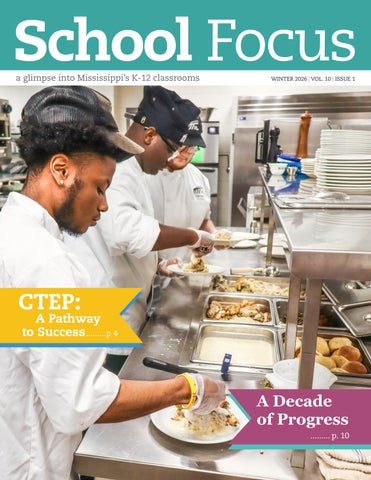
Students at Pascagoula-Gautier working in Cafe Bridge as part of their culinary experience in CTE.
Innovating Pathways for Success
Allison Allsup
The Pascagoula-Gautier School District (PGSD) is quickly becoming known for its innovation. Located in the southeast corner of Mississippi, this public school district houses approximately 6,500 students in 19 elementary (K-4), academy (5-6), middle school (7-8), high school (9-12) and specialty school campuses that serve the cities of Gautier and Pascagoula, MS.
Under the leadership of Derek Read, director of CTE and workforce development, the district is making strides in offering diverse opportunities for its students. As the director now for five years,
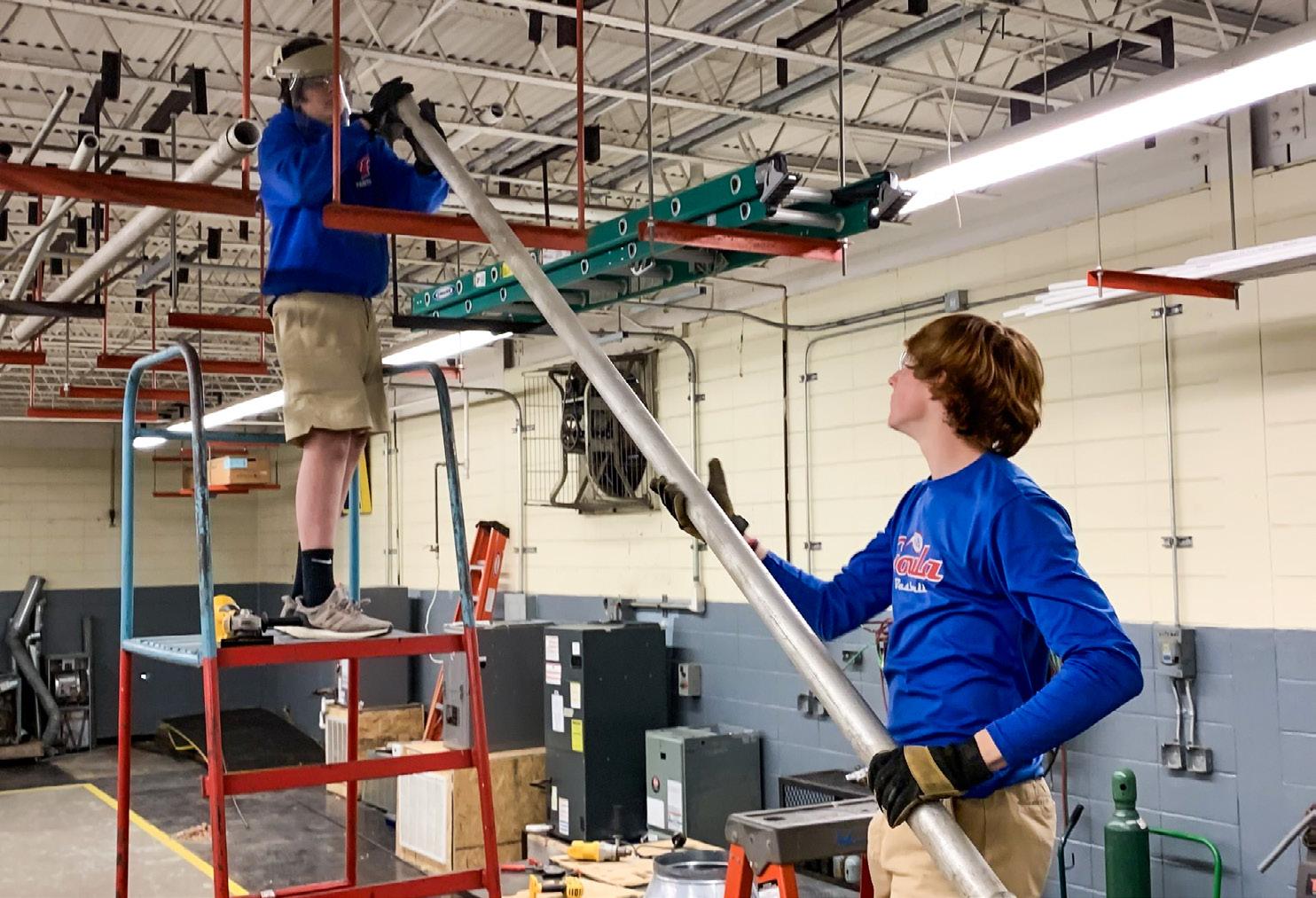
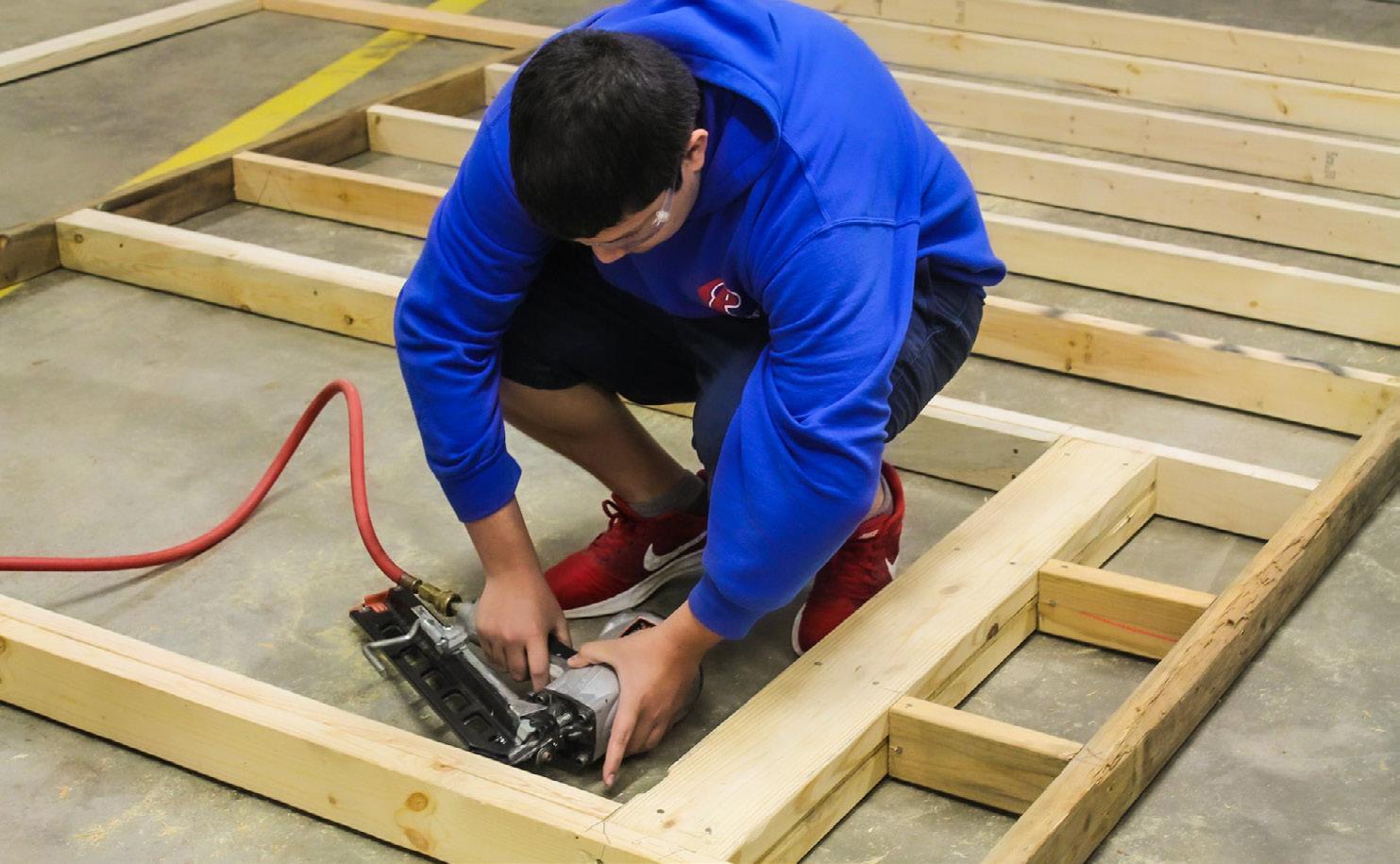
Read has recently established CTE Plus, a program that brings cutting-edge education opportunities for high school students, especially for those with an Individualized Education Program (IEP).
Read designed CTEP specifically to target the CTE programs that have lower enrollment numbers. Not only does this allow students who receive special education services the opportunity to participate in CTE programs but also boosts the overall enrollment of all CTE programs in this district.
Partnering with companies like Ingalls, McDonald’s and Singing River Federal Credit Union, high school students are gaining on-the-job experience with
internships and work-based learning before they graduate. Knowing how impactful and lifechanging opportunities like these can be, Read has made it his goal to create pathways to success for all students as they figure out their college and career decisions, especially those who may have had no other way of accessing them otherwise. The importance of this program cannot be overstated as it helps to promote growth and equity among all students by providing those opportunities to a much broader base.
Programs like these are already making a big impact, and not just to the students of this district. The recent push to include special education stu -
dents into certain classrooms has other districts taking notice. So much so that many are now working to achieve something similar. With plans to meet with other directors every other month and also spreading the word through conferences and word of mouth, Read hopes that will be the case sooner rather than later.
“There are pockets of phenomenal programs throughout the state, but it’s programs like these that I wish I could see more of because of how much it’s done for us,” Read said. “When I can give a student something that lets them feel like they can do something for themselves, whether it be getting a job or just feeling confident in themselves to do something and take care of themselves after they graduate, that’s success to me.”
Special education directors have wanted programs like this for years, and as a former counselor himself, Read knew how necessary it was as well. After he became the CTE director, he knew he was in the right position to start making changes. With an idea in mind, the next step became finding the right teacher for the job.
While Read set the ball in motion, Eric Hollis, football coach and CTE Plus coordinator, has been responsible for successfully implementing it. “It wouldn’t work without Hollis,” Read emphasized. “As a coach, he can reach students that sometimes a normal teacher can’t.”
Hollis, who has been the CTEP coordinator for two years now, functions essentially as an inclusion teacher for the students in CTEP. Working closely with student services liaisons, Hollis provides special education services for those students while helping the CTE instructors with remediation and strategies to better serve those under his instruction. Having only taught SPED in his career, Hollis is passionate about the position to help students with disabilities since many of them do not have the proper support needed to achieve their postsecondary goals. With
this in mind, he sets out each day to help those who need it find a direction or purpose for their life after high school.
“You have to be willing to take a risk with programs like these,” Hollis stated. “You may get some students that have behavioral issues or concerns, but what I have seen is the vast majority of those students find their passion in those buildings, and it helps transform them into something better.”
To make this program thrive, there are a lot of moving parts with many people involved in every step. Everyone is working together to bring the best possible outcomes for students. While Read hopes to continue adding more offerings and programs to expand its reach for years to come, Hollis believes every CTE building nationwide should be trying to adopt programs such as these.
“Dr. Read has a vision to target and
assist any student with an opportunity to be a part of our programs and give them the foundation and tools to hopefully build a successful career after graduation from high school,” Hollis reiterated. “I think what makes it a triumph is for the simple fact that we are giving an entire population of students a chance at success that they otherwise would not have had.”
Students working together to prepare meals for the café as part of the culinary CTE class.
Thrive Conference
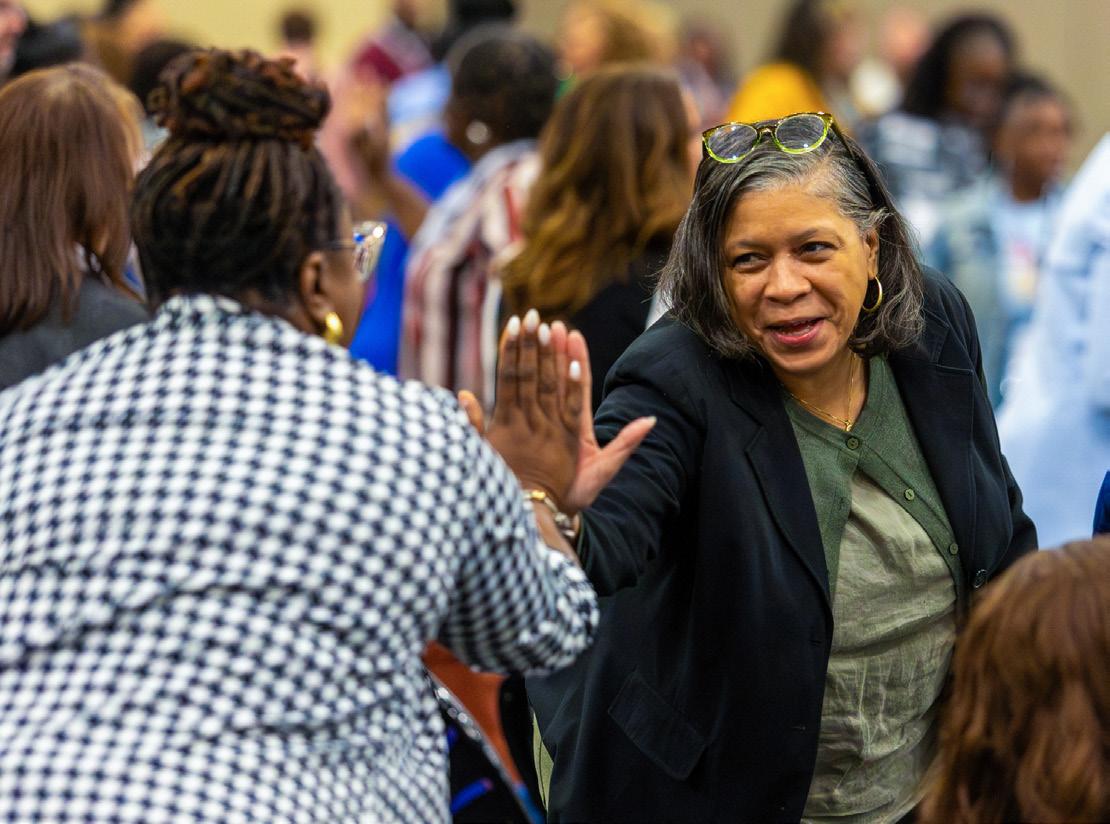
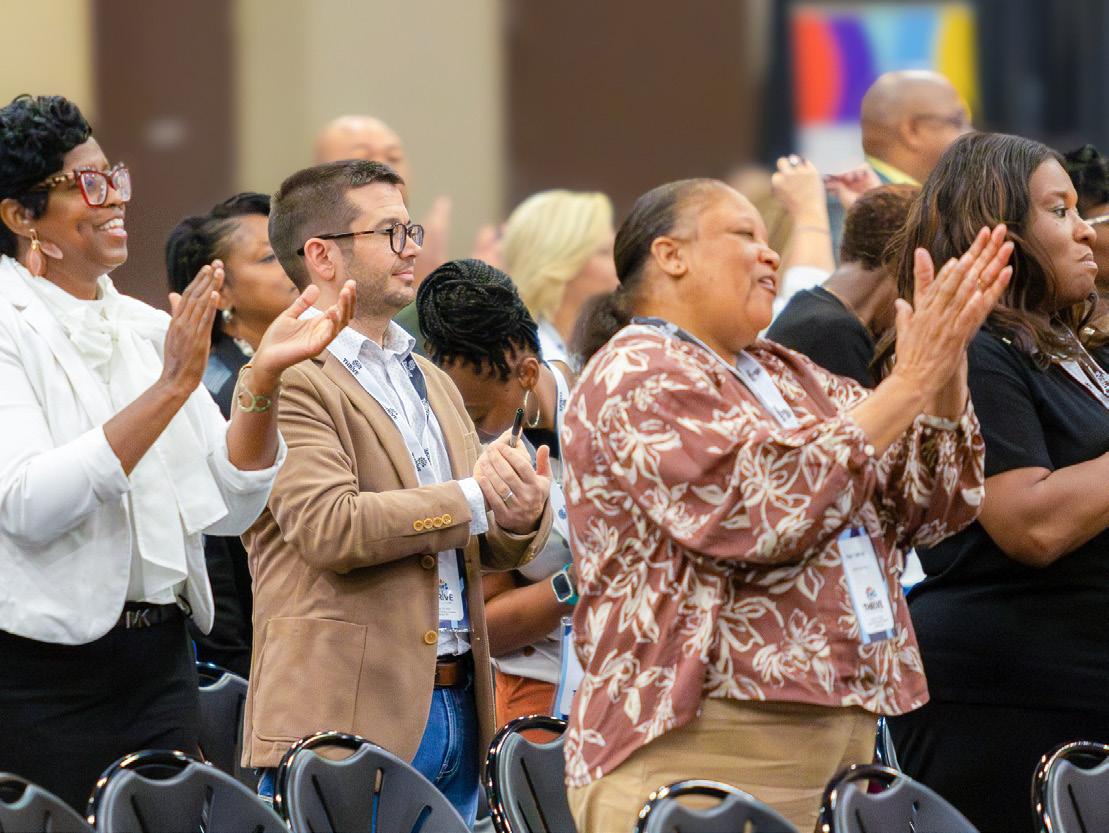
The Thrive Conference, hosted by the Mississippi Department of Education (MDE) Office of Federal Programs, provided educators, leaders and partners with practical strategies, resources and tools to strengthen programs and services that support students across Mississippi. Sessions highlighted effective practices, collaboration and innovative approaches designed to help every child reach their full potential. The event reflected the shared commitment to ensuring that all students, including those who need additional support, have the opportunity to
succeed in school and beyond.
This year’s conference included required sessions for EL Coordinators, Homeless Coordinators and Foster Care Coordinators. In addition, MDE strongly encouraged the participation of family and community engagement liaisons, juvenile detention center staff and other stakeholders who play a vital role in providing students with instructional and support services.
During the three-day event, Keynote Speaker Keith L. Brown encouraged educators, innovators and community part-
ners to gather and learn practical strategies and real-world solutions to support at-risk students.
MDE also offered focused pre-session opportunities that ranged from providing new federal program directors with a focused introduction to the Education Department General Administrative Regulations (EDGAR); an interactive training that immersed participants in the daily realities faced by families living in poverty; and a training that gave participants strategies, resources and practical tools to strengthen services for English Learners.
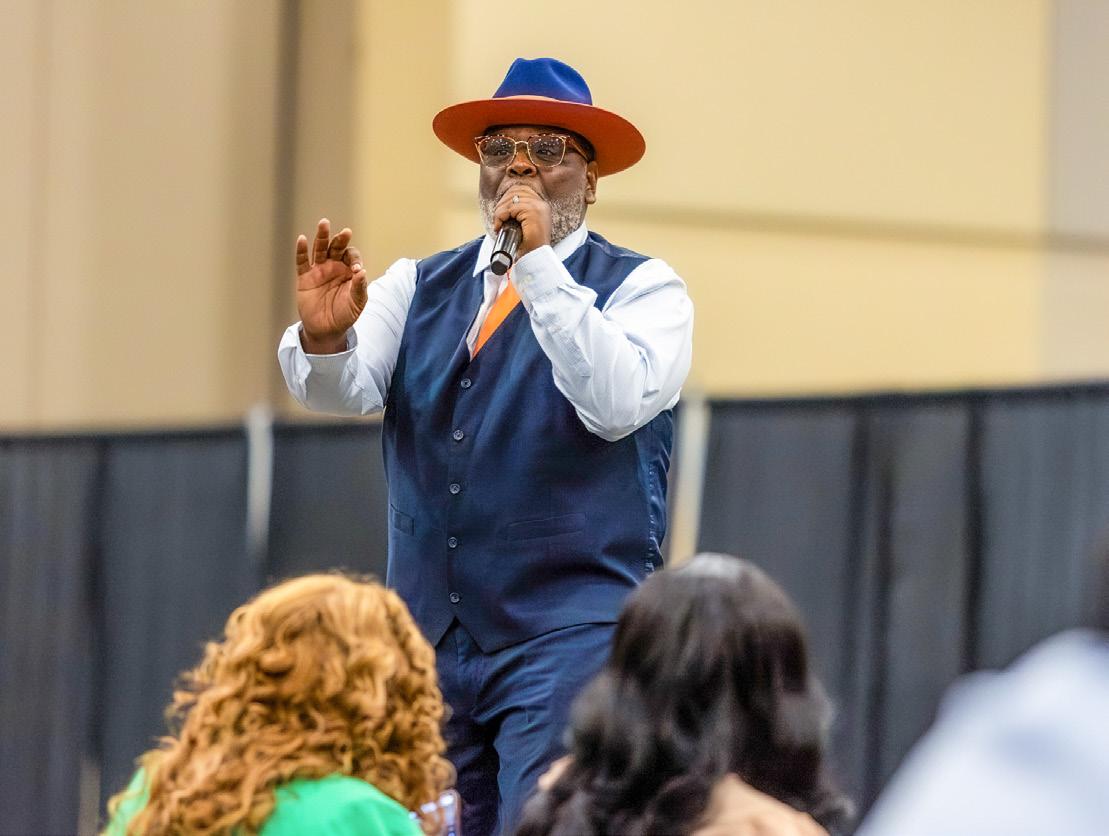
Keith L. Brown was the keynote speaker for the conferenece.
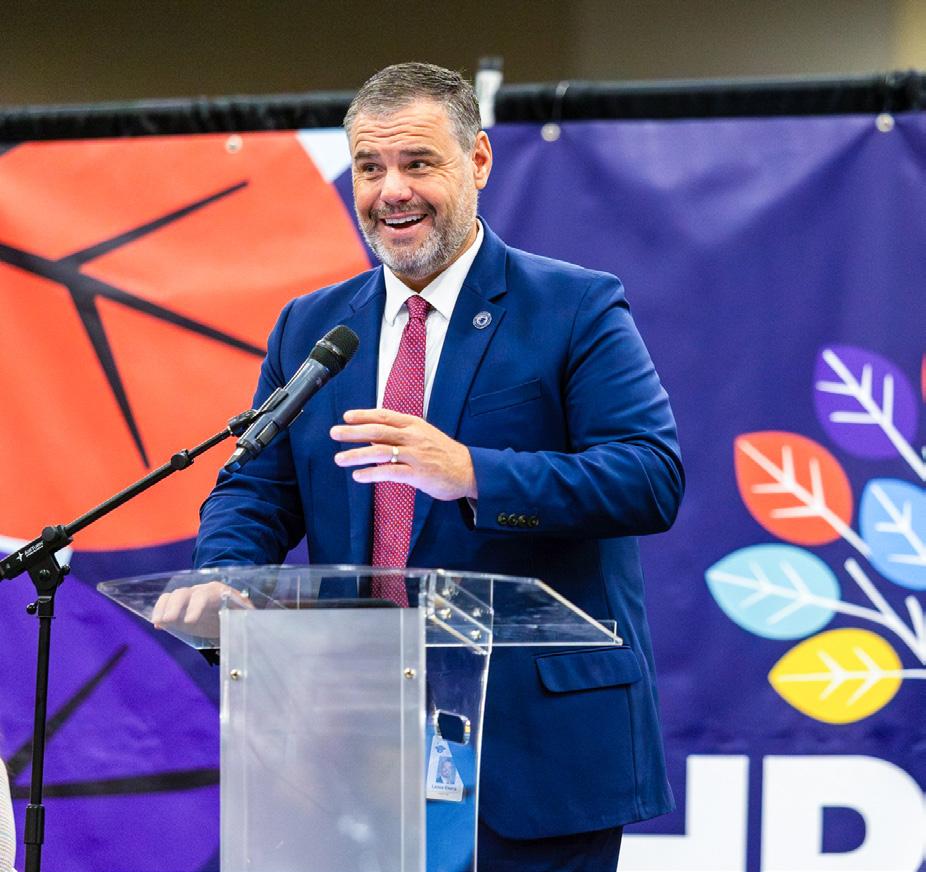
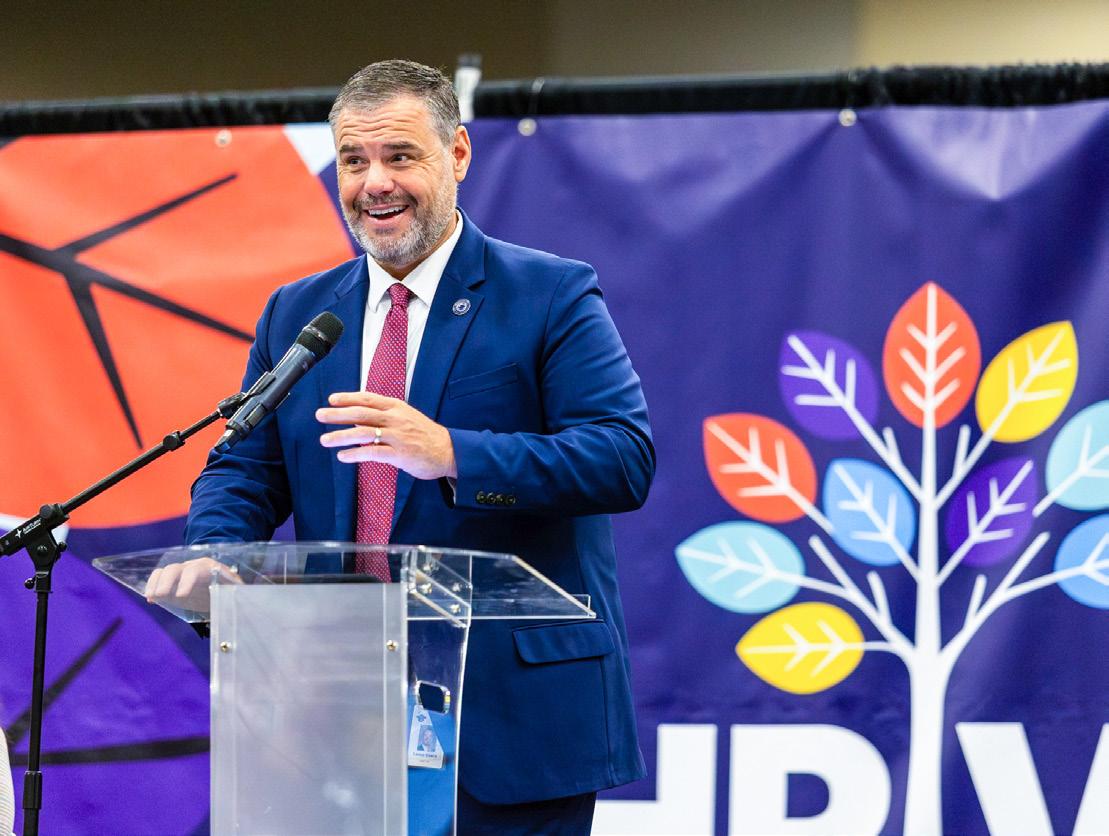
State Superintendent Lance Evans speaking at Thrive.
U.S. Secretary of Education Visits Oxford School District
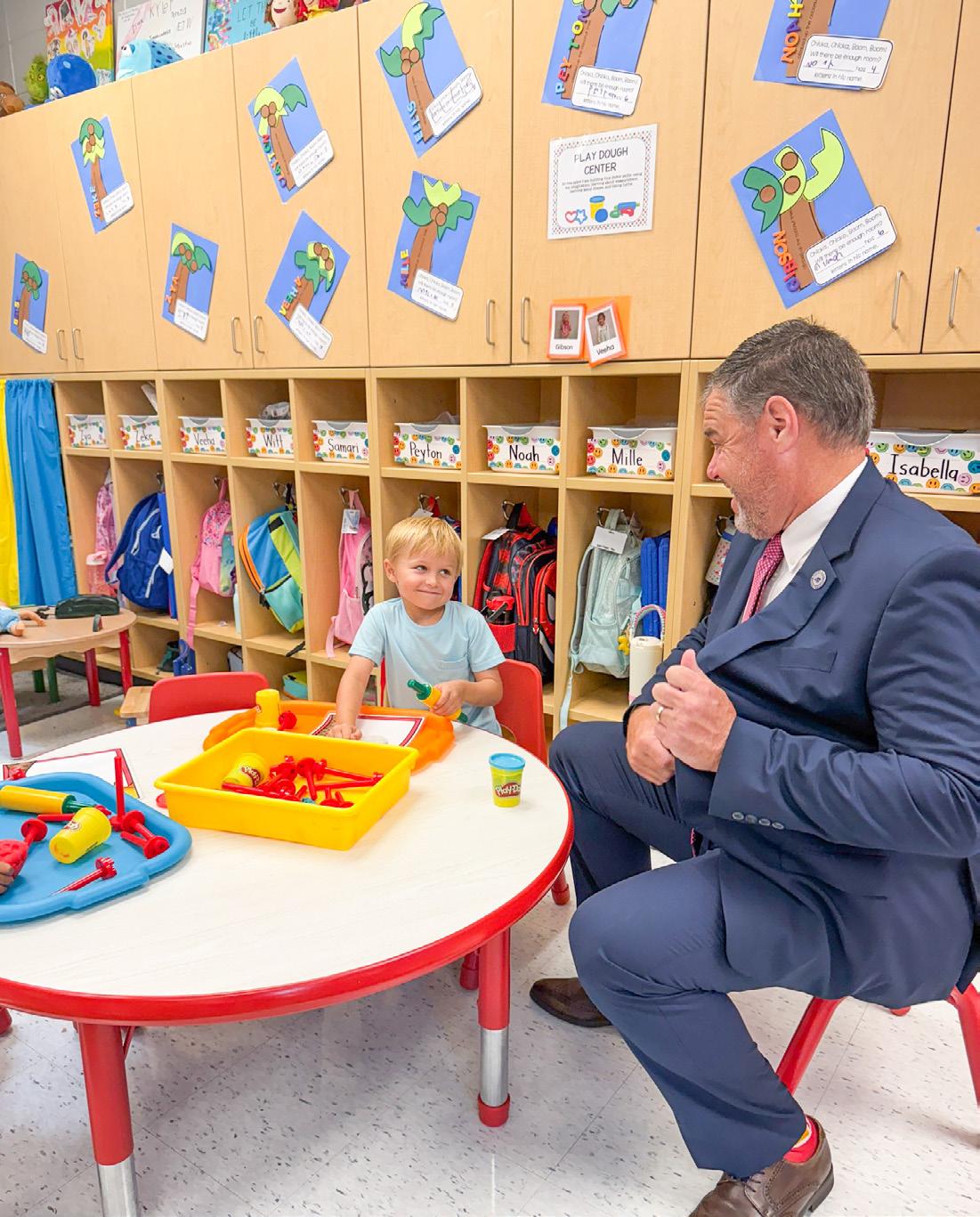
Oxford School District (OSD) welcomed U.S. Secretary of Education Linda McMahon, along with state and local elected officials, for a visit as a part of the Returning Education to the States tour that shined a spotlight on the district’s innovative work in K-12 public education.
OSD proudly used the Early Childhood Center as the showcase site for the visit to highlight the power of early education in laying the foundation for lifelong learning. “We chose for Secretary McMahon to visit the Oxford Early Childhood Center because OSD shares the belief that early childhood education
is the most powerful mechanism we have to shrink or eliminate achievement gaps in our country,” said Oxford’s Superintendent Bradley Roberson.
Following the tour, Secretary McMahon joined Superintendent Roberson, state and local government officials, district leaders, teachers, students and community stakeholders for a roundtable discussion on key topics such as literacy, district innovation, teacher recruitment and retention, high school acceleration, fiscal management and the value of co-curricular activities. The district had the opportunity to share what makes
public education so special in the Oxford School District and throughout the state of Mississippi.
“Mississippi has made remarkable strides in early literacy through focused state leadership and a return to the fundamentals. It was a joy to start my morning by reading to students in Oxford and witnessing the ‘Mississippi Miracle’ firsthand,” McMahon said. “The experiences will help inform our ongoing efforts to encourage local involvement in education across the nation.”
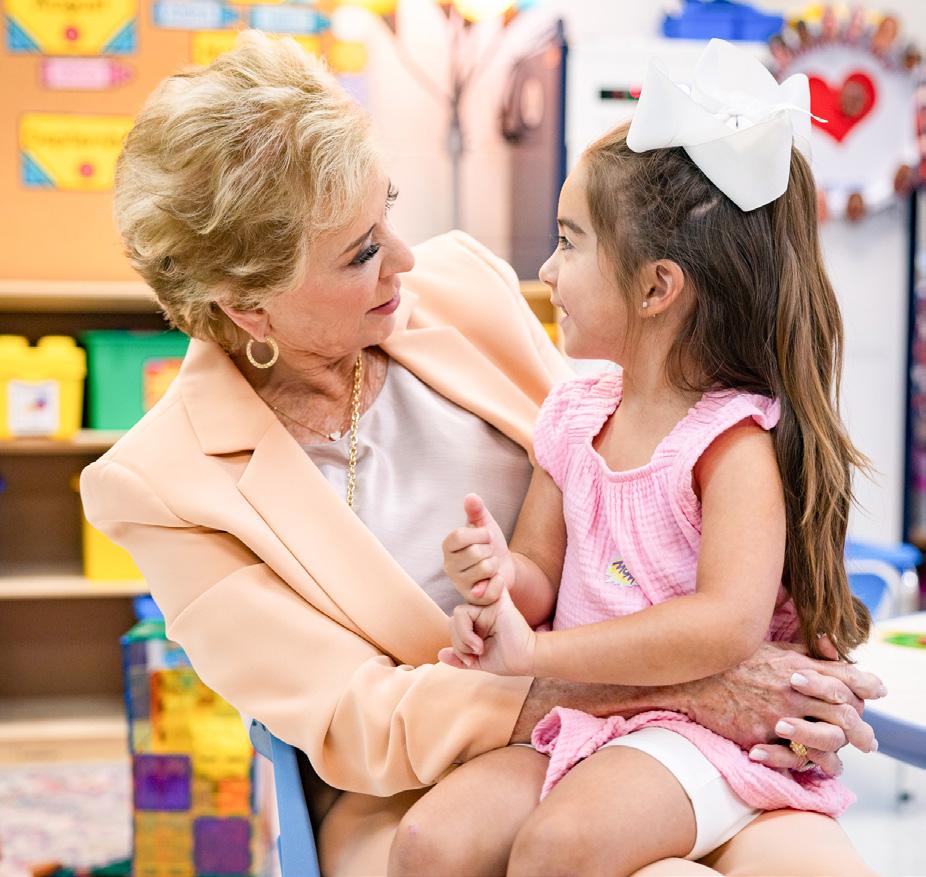
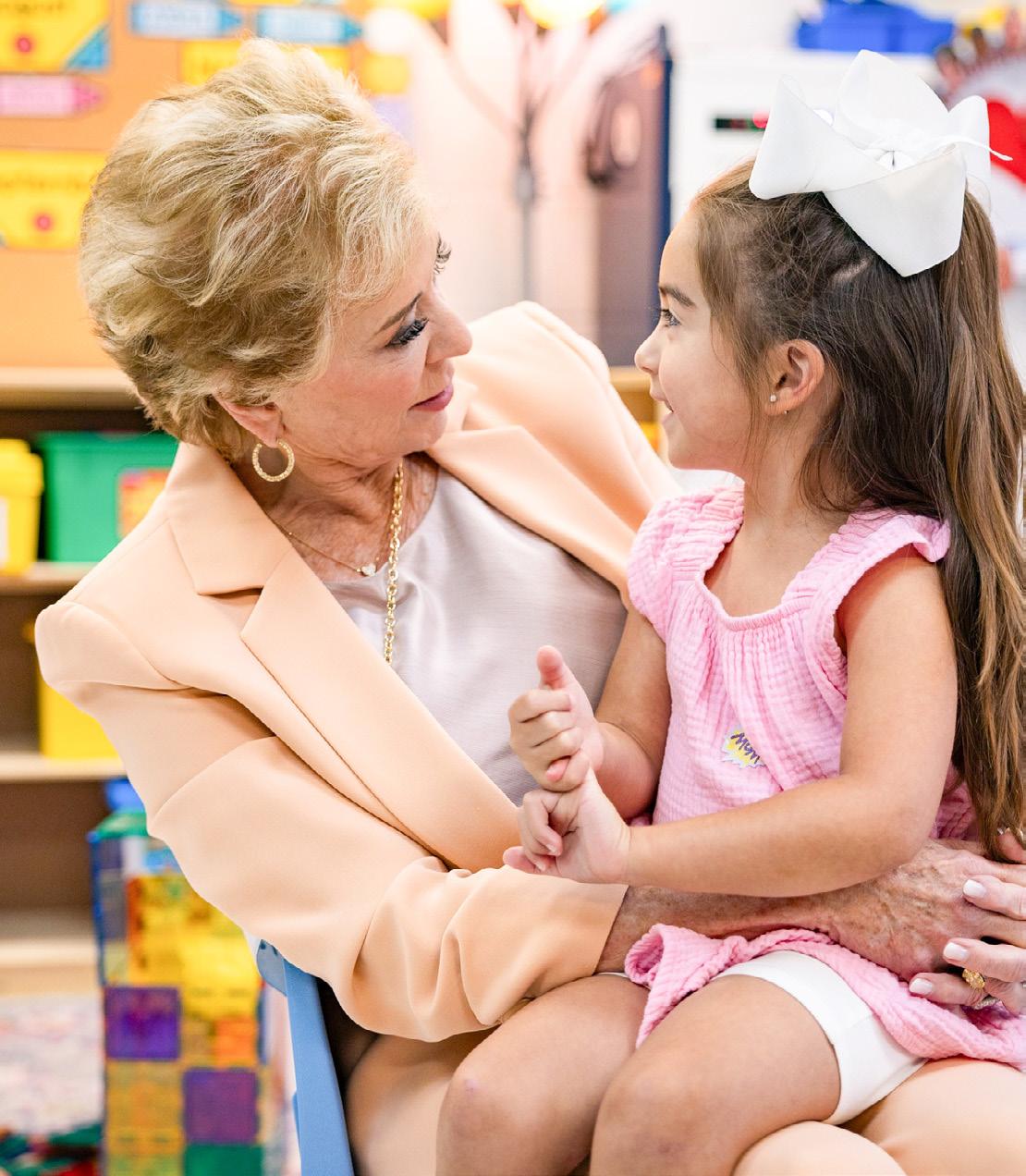
Top left: OSD hosted a roundtable discussion on education within the district following the tour. Top right and bottom left: McMahon visited the Oxford Early Childhood Center and spent time with the students in their classrooms. Center left: McMahon, Roberson and Evans pictured in a classroom at Oxford Early Childhood Center. Bottom right: Evans pictured with a student during the tour.
Celebrating 10 Years of Mississippi’s State Systemic Improvement Plan
Kelly Watson
As the Mississippi Department of Education (MDE) Office of Special Education celebrates the 10th anniversary of the State Systemic Improvement Plan (SSIP), it’s clear that a decade of dedication to literacy has transformed outcomes for students with disabilities across Mississippi. SSIP is a comprehensive, multi-year plan based on creating high expectations for students with disabilities. The plan is focused on building the capacity of local districts to implement and scale-up evidence-based practices in reading with a focus on third grade reading
The first SSIP meeting in 2025 with the theme: Building Literacy: Constructing the Foundation for Students with Disabilities.
SSIP Professional Development Total Numbers for 24-25 SY:
proficiency. By focusing on the bolstering of reading foundations within school districts, SSIP is ensuring that progress will be sustainable and have a lasting impact for years to come. Edryce Thompson, who works in the MDE’s bureau of policy and practice, said, “Our ultimate goal is for our students with disabilities to graduate with a standard high school diploma.” One of the best ways to ensure this outcome is to give students a strong foundation of literacy. Since its inception, Mississippi’s SSIP has worked in tandem with the Literacy-Based Promotion Act (LBPA), legislation passed in 2013 to ensure that every child completing third grade reads at or above grade level. This partnership has
Professional Development Session presented: 88
Participants at SSIP Provided PD Sessions: 1,797
built a powerful foundation for progress, not only supporting students with disabilities but also strengthening literacy instruction statewide.
Over the past decade, Mississippi has demonstrated remarkable consistency and results. The state has met its State-Identified Measurable Result (SiMR) target
nearly every year since the program began, missing it only once by one percent during the height of the pandemic.
The SiMR focuses on increasing the percentage of third-grade students with Specific Learning Disabilities (SLD), Language/Speech (L/S) impairments, and Other Health Impairments (OHI) who
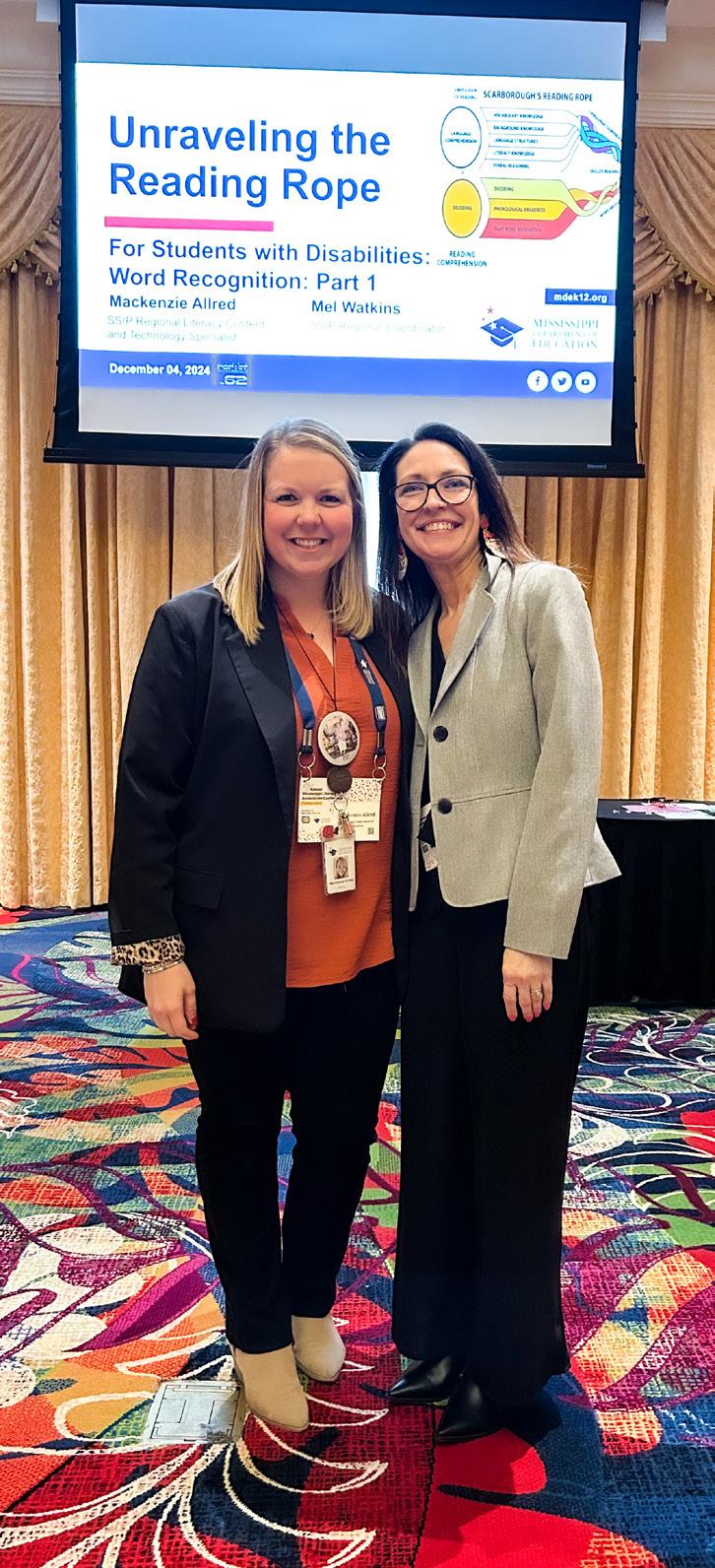
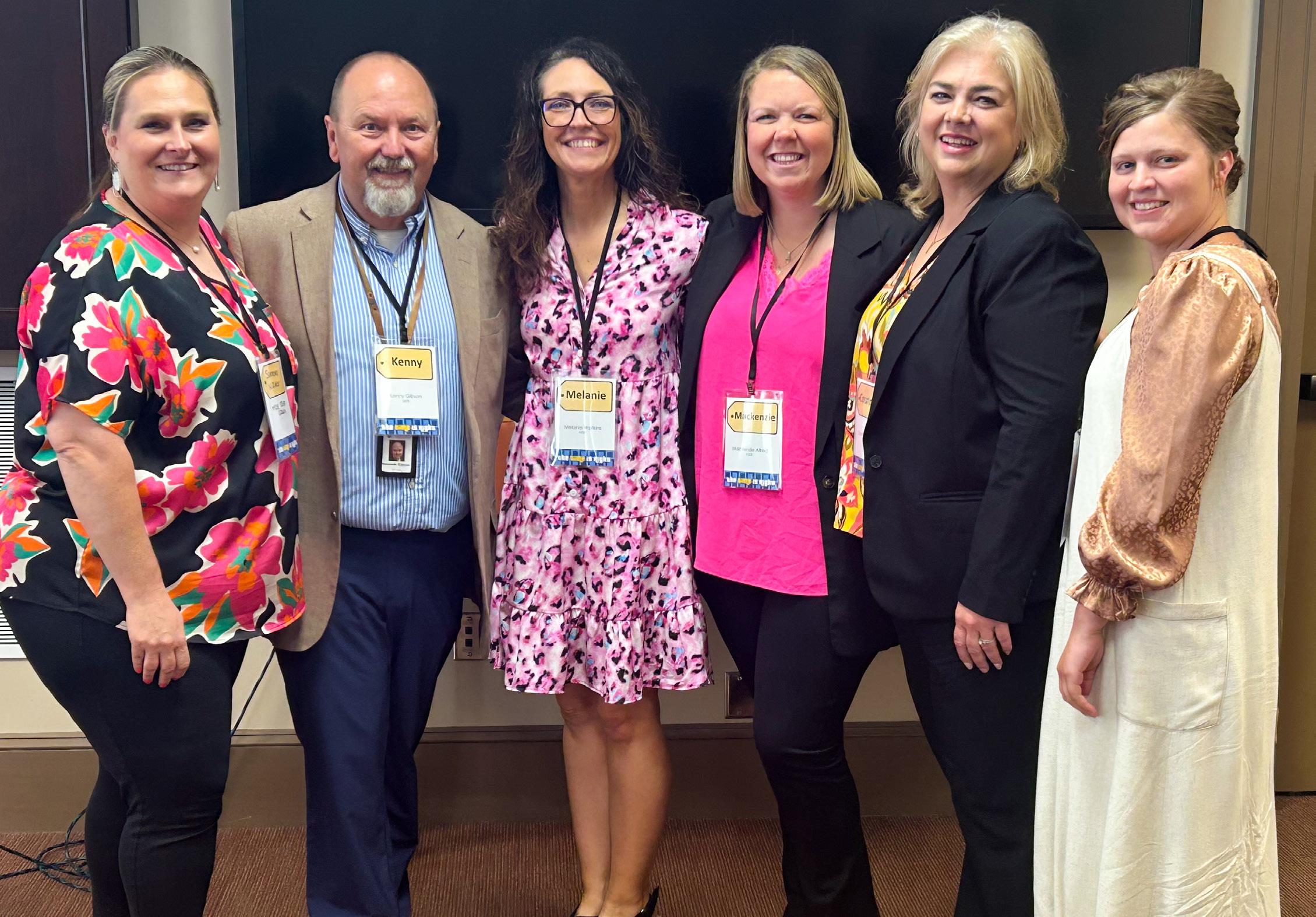
Mackenzie Allred and Melanie Watkins presenting at the 2024 Mississippi Literacy Association conference.
2024-25 MISSISSIPPI
Administrator Debriefs Coaching Conferences
Model Lessons
Co-Taught Lessons
School-Based Professional Development (PD)
School-Based Professional Learning Communities (PLCs)
Statewide Professional Development (RESA, Conferences-MLA, OSI Convening, MS CEC)
score proficient (levels 3, 4 or 5) on the statewide reading assessment. For the 2024-2025 school year, Mississippi’s goal was to reach 21.35% proficiency among this student group.
Data shows how much progress has been made. SSIP literacy support schools for ‘24’25 went from 22.6% in ‘24 to 36% in ‘25. This demonstrates that Mississippi’s model for improvement continues to yield results and proving that with the right support, every child can succeed.
Courtney Sheriff, the state systemic improvement plan K-8 literacy coordinator, said, “Although these are great numbers, they are just numbers to us. But for our literacy coaches, these are all real students that they know and love.”
The key to SSIP’s success is the placement of literacy coaches, who work directly with schools to strengthen instruction for students with disabilities. Schools are selected for SSIP participation based on a range of data, including third-grade reading assessments, special education determinations and school improvement designations. Over the course of SSIP, Mississippi Department of Education (MDE) has served up to 32 districts at one time. The number of districts varies depending upon the availability of literary coaches, and as Sheriff points out, “We don’t have a large number of coaches, but the ones we
do have are making a huge difference.” Full support schools receive coaching two days per week. The literacy coach offers professional development opportunities, as well as in-class demonstrations where they can model lessons for teachers. The goal is to have sustainable change within schools and districts, which is only a possibility when progress is made on a fundamental level.
Throughout SSIP’s 10-year journey, one
constant has been an investment in professional development. Teachers, administrators and literacy coaches are the backbone of this initiative and their commitment to learning and implementing the Science of Reading has been transformative for the state. Last school year alone, more than 1,800 special education teachers and administrators participated in SSIP-led professional development. The trainings immerse
educators in evidence-based literacy practices and provide the tools to translate research into effective classroom instruction.
As Mississippi celebrates the 10th anniversary of SSIP, the focus is turning toward expansion and sustainability. MDE plans to hire additional literacy coaches and create two full-time professional development positions dedicated to Science of Reading training for special education teachers, administrators and coaching staff. Future efforts will also emphasize parent involvement and the continued work of internal and external SSIP taskforces, which help guide decisions and align efforts statewide. Additionally, the Science of Reading framework will be fully embedded into the Office of Special Education’s instructional support documents, ensuring that the practices proven to work remain at the heart of Mississippi’s literacy success.
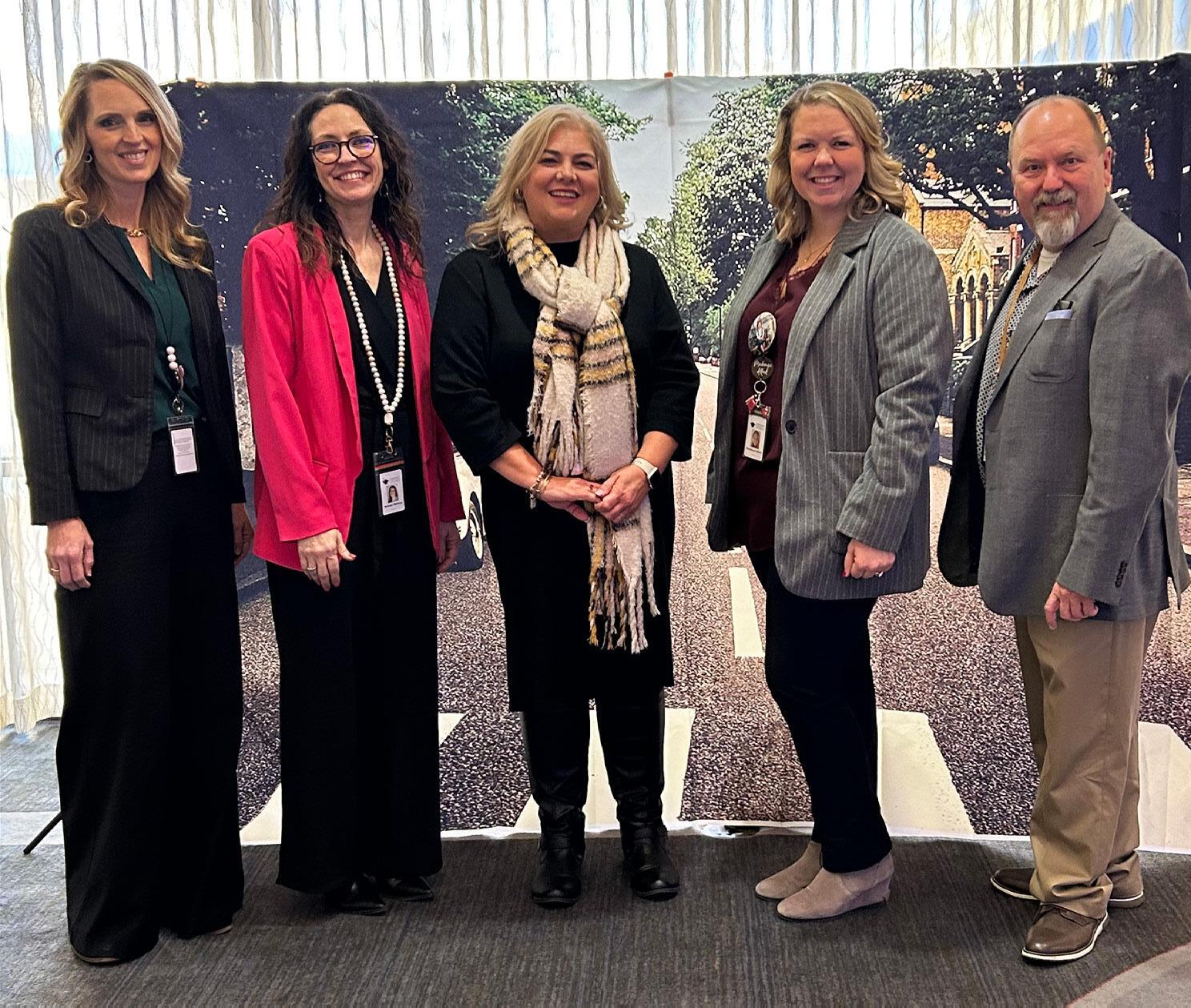
Members of the SSIP team who presented at the Time is Right conference.
MDE Announces 2025-26 State Superintendent Student Advisory Council members
The Mississippi Department of Education (MDE) announced the 114 members of the 2025-26 State Superintendent’s Student Advisory Council (SAC). The council includes students in grades 11-12 and college freshmen attending a Mississippi college or university.
The council consists of 57 new members, which includes 10 students who were semifinalists in spring 2025 for the State Board of Education Junior Representative position, and 57 students who
Keira Adams
Greenwood-Leflore Consolidated School District
Ny’Jeh Austin Louisville Municipal School District
Madison Ballard Kosciusko School District
Jasmaan Banipal
Mississippi School for Mathematics and Science
Isaiah Barbour** Tupelo Public School District
Madison Barnett Clinton Public School District
are returning to the council from the previous school year.
All students come from different backgrounds, school sizes and regions in Mississippi and will be able to share their opinions and offer advice about educational opportunities and policy in Mississippi with Dr. Lance Evans, state superintendent of education.
MDE began the SAC program in 2019. Each fall, the MDE opens applications for new members and students are required
Emma Kate Beckham* Prentiss County School District
John Bell* Jackson Public School District
Evelyn Bello Jones County School District
Kimberly Bello Ramirez Forest Municipal School District
Tessa Blair* Petal School District
Henry Bodenhamer* Gulfport School District
to write a compelling cover letter, submit a resume and provide answers to questions about their interest in the SAC, their accomplishments, educational concerns and academic goals. MDE received nearly 200 applications for membership to this year’s council.
The council’s purpose is to provide a forum for Mississippi’s students to offer diverse perspectives to the State Superintendent of Education. The students will act as liaisons between MDE and public-school students from across the state.
Sadie Breland Greene County School District
GracieKate Burrell Kosciusko School District
Jeremy Burwell*
Mississippi School for Mathematics and Science
DaKia Cameron* Jefferson County School District
Zenaida Caquias Gulfport School District
Israel Cecil
Mississippi School for Mathematics and Science
Representing schools from across the state, the students will research topics about mental health, school safety, cell phone policy, student attendance, teacher shortage and artificial intelligence
The council’s purpose is to provide a forum for Mississippi’s students to offer diverse perspectives to Dr. Lance Evans and serve as liaisons between MDE and public-school students in Mississippi.
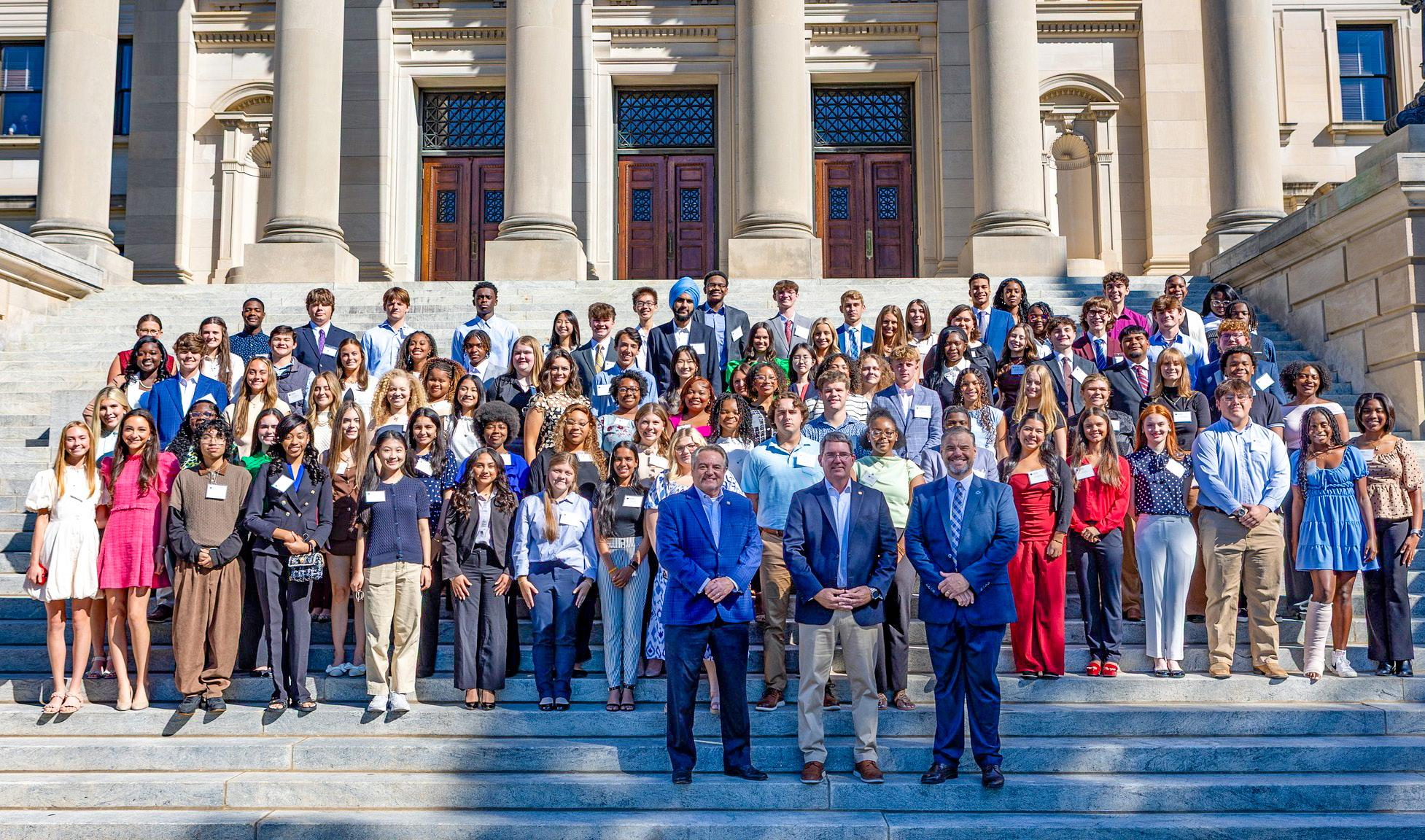
Nearly 90 members of the 2025-26 State Superintendent Student Advisory Council gathered at the Mississippi Capitol for their first meeting of the school year.
Christopher Chen* Mississippi School for Mathematics and Science
Amy Choi** Starkville Oktibbeha Consolidated School District
Katie Chung** Starkville Oktibbeha Consolidated School District
Victoria Clements
Philadelphia Public School District
Bella Cochran Tupelo School District
Owen Coker
Clinton Public School District
Annsley Coleman New Albany School District
Alicia Coleman*
Hinds County School District
Clarissa Coleman*
Jackson Public School District
Meredith Cossey
South Panola School District
Annalise Cox
Pearl Public School District
Kate Davidson* Madison County School District
Anna Davis Vicksburg Warren School District
Kennedy Davis* DeSoto County School District
Price Denham** Lamar County School District
Jamia Dent* Jackson Public Schools
Mariah Dodd Kosciusko School District
Jack Durr
Pearl Public School District
Ava Clarke Edney*
Rankin County School District
Kaelyn Escobedo*
Biloxi Public School District
Mariah Evans Jefferson Davis County
Liwebb Fair Coahoma County School District
John ‘Alex’ Ferrell* New Albany School District
James Fong* DeSoto County School District
Anna Fortenberry North Pike School District
Benjamin “Guy”’ Frugé* Oxford School District
Thad Garner** Chickasaw County School District
Maylee Gilmer* Rankin County School District
D’Aria Gray-Simmons* Clarksdale Municipal School District
Luis Grimaldo Goldinez* Gulfport School District
Taijha Hackett Clinton Public School District
Jonathan Hall Jr.* McComb School District
AnnLee Haney* Lauderdale County School District
Jaiden Hardy Brookhaven School District
Mary Harrelson* Lee County School District
Samuel Haydel Petal School District
Lilly Hicks Neshoba County School District
Josslyn Howard* Ocean Springs School District
Grace Howell* George County School District
Stella Huffman* Pass Christian Public School District
Nevaeh Jackson* Pass Christian Public School District
Jamaya Johnson Kosciusko School District
Isaac Johnson Gulfport School District
Juelz Jordan* Yazoo City Municipal District
Hannah Kraman* Madison County School District
Brenna Lintner-Davis* Smith County School District
Charlotte Luber Oxford School District
Alexandria Luckett* Canton Public School District
Antonio Mabry Greenwood Leflore Consolidated School District
Faith Malembeka Jackson Public School District
Graden Manning Union County School District
Anna Gray Massey* Gulfport School District
An (*) indicates new members for 2025-26.
Andrew Mayo
Tishomingo County School District
Madison McCraney* Yazoo City Municipal School District
Jaden Mosley* Meridian Public School District
Brody Neal* Nettleton School District
Chloe Norwood County School District
Kursactys Owens Jr.* Yazoo Municipal School District
Avani Pacharne** Starkville Oktibbeha Consolidated School District
Tongshu Pan* Madison County School District
Crosby Parker Gulfport School District
Kylar Perkins* Leland School District
Carson Philyaw* Kosciusko School District
Kierstin Polk Hattiesburg Public School District
Sarah Potts Tupelo Public School District
Kennedy Powell Brookhaven School District
Brooks Prewitt Pontotoc County School District
Kaitlyn Price* Sunflower County Consolidated School District
Abigail Ratcliffe** Gulfport School District
Conner Reed Petal School District
Rylee Reid Pearl Public School District
Ajohna Rice Jones County
Sydney Ridgeway* Laurel School District
Madelyn Robinson Tishomingo County School District
An (**) indicates a State Board of Education Junior Student Representative top 10 finalist.
Emily Rogers Jones County School District
Emery Rone* Pascagoula Gautier School District
Abbigale Savage Ocean Springs School District
Lilly Shannon
New Albany School District
Samuel Sharum New Albany School District
Grisham Shelton Tupelo School District
Shruti Singh
Clinton Public School District
Isabelle Smith Harrison County School District
Edgar Solis-Diaz* Jackson Public Schools
Angelina Tan** Starkville Oktibbeha Consolidated School District
Taryn Thompson* Lawerence County School District
Grayson Turner* George County School District
Hayes Tyler** Kosciusko School District
Adalyn Vandiver Pontotoc County School District
Hannah Webb* Clinton Public School District
Natalee Welch Madison County School District
Addison Wilberding Forrest County Agricultural High School District
Carley Williams Clinton Public School District
Erion Wilson Vicksburg-Warren School District
Madisyn Woodall McComb School District
Makayla Wrenn* Mississippi School for Mathematics and Science
Michelle Xie** Lamar County School District
Mississippi’s education ranking has climbed to 16th in the nation – the state’s highest ranking ever – according to the 2025 KIDS COUNT Data Book.
KIDS COUNT® Data Book ranked Mississippi 30th in education in 2024, 32nd in 2023 and 39th in 2022. The state was ranked 48th in 2014 and has experienced continued improvement. Mississippi’s top-tier ranking for education is based on students’ continuous academic improvement. Over the past decade, the statewide graduation rate has risen from 75% to 89.2%, higher than the national average.
The 2025 KIDS COUNT Data Book is a 50-state report of data developed by the Annie E. Casey Foundation, analyzing how children and youth are faring across the nation. Each year, the Data Book presents national and state data from 16
Sweet 16th!
indicators in four domains — economic well-being, education, health and family and community factors — and ranks the states according to how children are faring overall. Mississippi ranks 48th in overall child well-being.
“Mississippi’s momentum in education is the result of strong policies and dedicated, effective educators,” said Dr. Lance Evans, state superintendent of education. “Our students’ achievements have made the state a national leader in improving academic outcomes. I am tremendously proud that our national ranking for education has steadily climbed from 48th in 2014 to 16th in 2025. Mississippi students have proven once again that there is no limit to what they can accomplish with the strong support of Mississippi educators.”
The Children’s Foundation of Mississippi (CFM) works with the national KIDS
COUNT Data Center and produces an annual Mississippi KIDS COUNT Factbook, described as the premier data resource for child well-being in the state of Mississippi.
“We know what children and youth need to grow up healthy and connected so they can thrive as adults: Stable homes, strong schools, nutritious food, meaningful relationships and opportunities to learn, play and grow. Communities that meet these needs are investing wisely, fostering long-term gains like employment and economic growth,” said Linda Southward, CFM executive director. “Despite the state’s overall ranking of 48th, we are extremely encouraged that Mississippi now ranks 16th in education. The recruitment and retention of high-quality educators (childcare through secondary education) is vital to continuing education improvements.”
Supporting Students Educators, Supporting
Office of School and District Transformation
Allison Allsup
The Mississippi Department of Education’s Office of School and District Transformation has been working tirelessly to provide support, guidance and direct assistance for districts seeing little to no movement in terms of increasing outcomes on a consistent basis.
Under the direction of Dr. Lance Evans, state superintendent of education, the Office of School and District Transformation wants to focus on the front end rather than reactionary processes. In short, the idea is to be more strategic and intentional in taking preventative measures rather than allowing schools
to become classified as failing before receiving targeted and intentional support.
The goal is to build a system with strong communication that is coordinated in a way that operates to get the best possible impact for schools, teachers and learners alike.
Dr. Evans has appointed John Ferrell to lead this work. Going into his second year as chief deputy, Ferrell aims to be proactive in supporting schools and their needs by continuing to work collaboratively with all those involved. Since every district is different, the approach is tailored to provide targeted assistance that drives student success. Therefore, the office will not only pro -
vide support for educators at the district level but will also provide support to individual schools who need support.
Ferrell works with Dr. Sonja Robertson, recently retired executive director of school improvement, and Dr. Bryan Marshall, associate superintendent, to implement the process. Working collectively with school and district teams, their efforts to provide support that is meaningful will help those schools reach stronger outcomes. So much so that the work that happens from this process will impact the schools and districts in such a way that the threat or thought of possibly being in a position for school district takeover is eliminated.
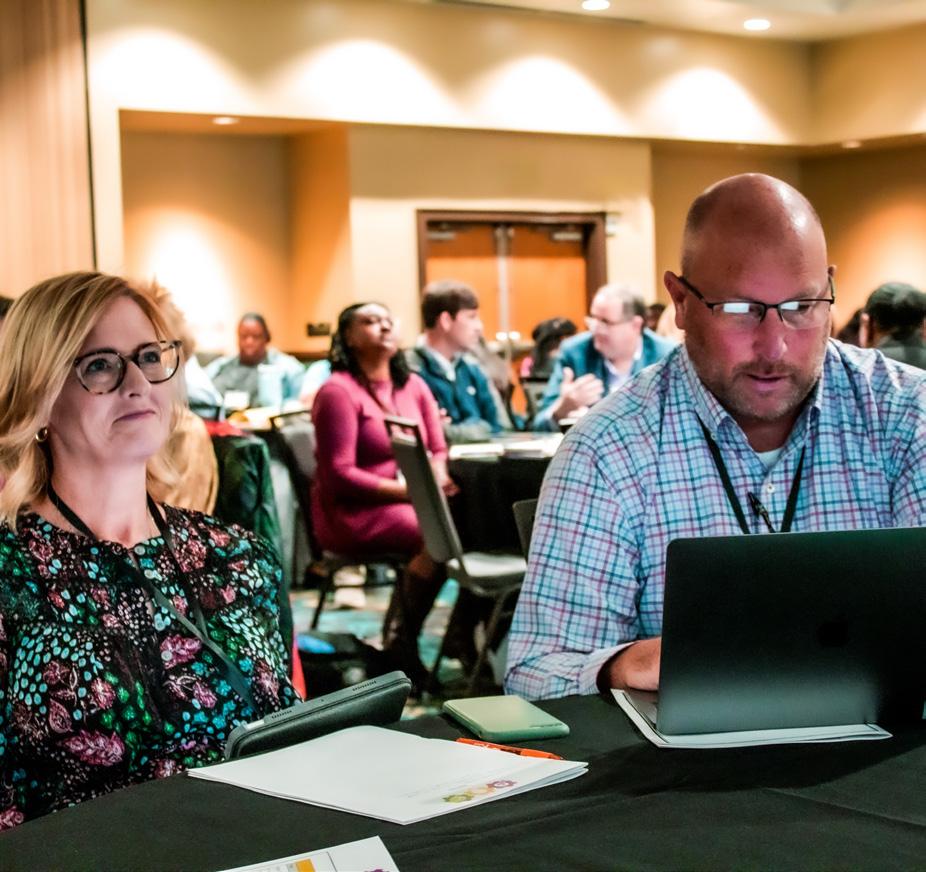
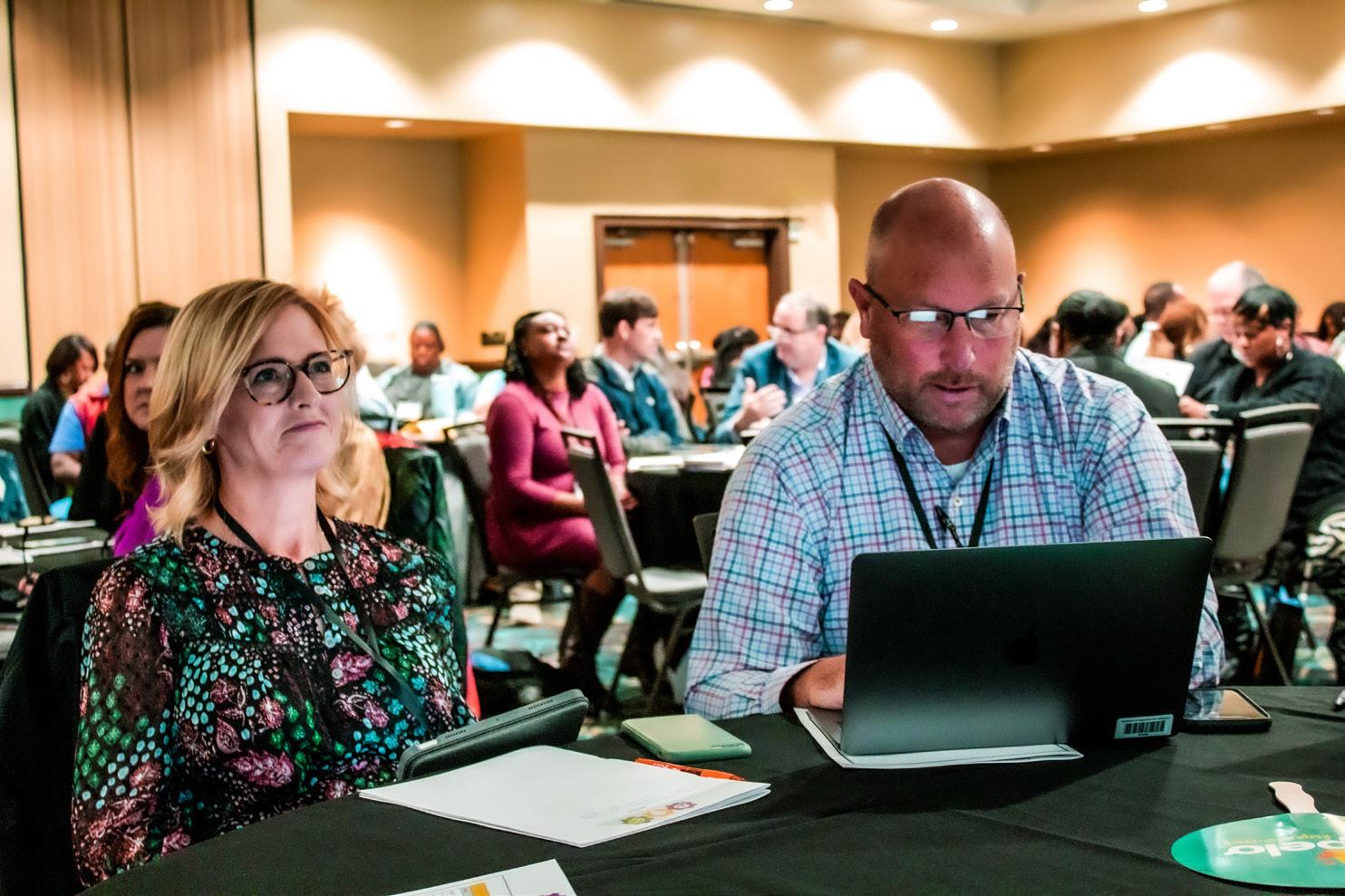
Leaders at the school and district levels participating in sessions at the annual OSI Convening. In these sessions they are learning strategies and tools to use in their school improvement efforts.
“Through collaborative efforts, we want to work with the schools to help teachers and administrators grow,” Ferrell said. “If there are pieces in place where we can help support and help Mississippi students be successful, then naturally, doing so will also help schools be successful.”
Dedicated to supporting educators across the state, the office has recently put forth some successful practices for administrators and superintendents to implement in their schools. One such practice is based on the publication, “The Fundamental 5 Revisited: Exceptional Instruction In Every Setting” by Cain, Laird, Cotton and Ellspermann. As its title suggests, these are five instructional teaching practices that allow administrators to work alongside their teachers, letting them practice and grow together as they create fundamental curriculum that can go into any type of classroom.
Another effort the department is proud of is its current evaluation of how their support aligns internally. The team is working together to ensure whenever different support goes into schools, that everyone is on the same page with what the goal is when working on creating
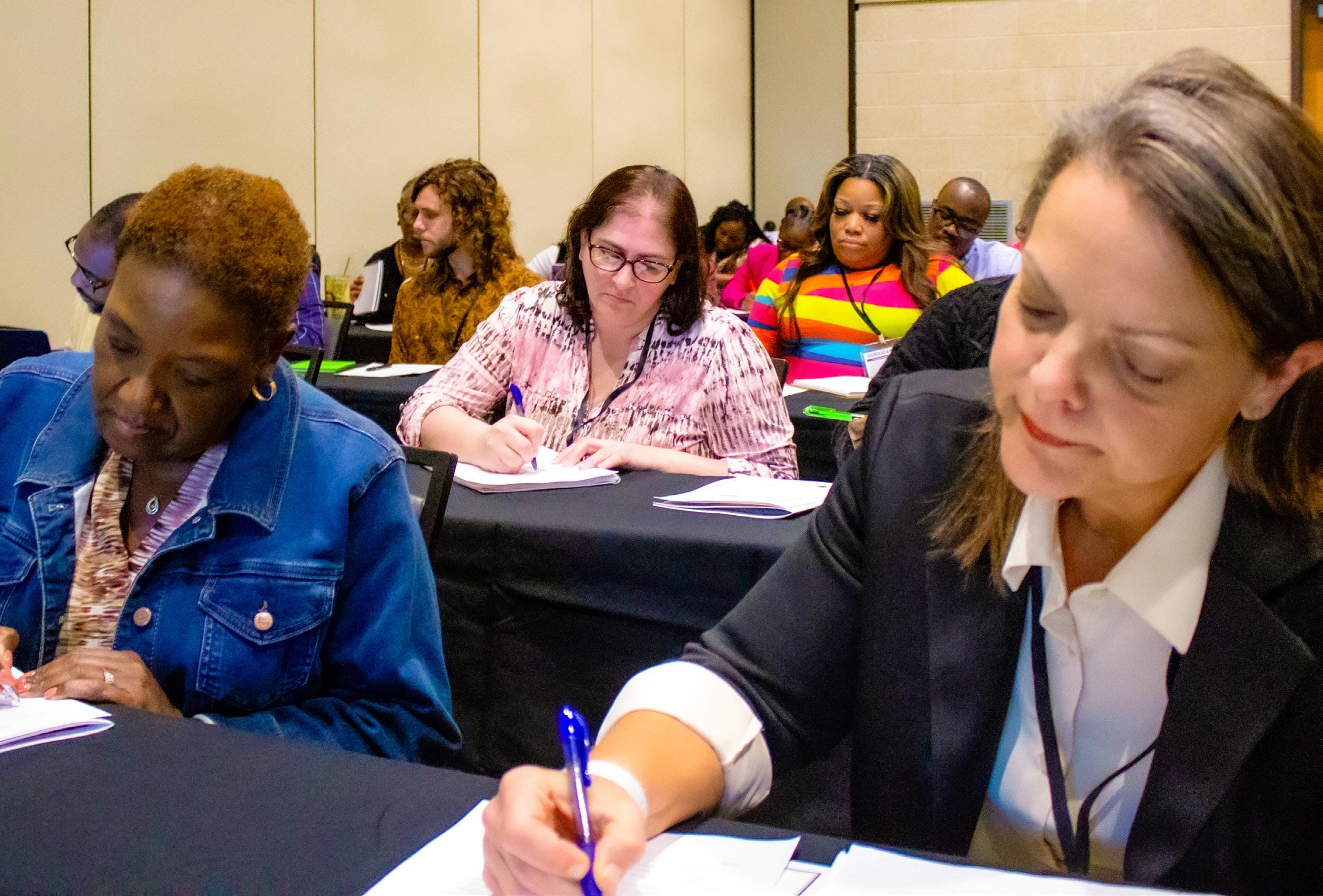
Teachers and administrators participating in a four session Transformational Leadership PD series.
School and district leaders listening to the keynote speaker at the annual OSI Convening.
strategic plans for each school that gets support from the department.
With all the support coming from the department, it’s important to ensure that there is a level of coherence that provides an aligned systematic flow to those schools and districts receiving those supports. Dr. Robertson understands how important these efforts are for not only instructors and administrators, but moreover the students. “With these efforts put in place, the ultimate goal is getting children in the state of Mississippi access to high
quality instruction,” Dr. Robertson said. “When there is support in the development of stronger teachers and leaders in the schools and districts, inevitably a pathway is created in making that happen for the kids.”
The office, which includes school improvement, career and technical education and work force development, is excited about the opportunities that will support districts in the path from school to the workforce. “While the objective is to help grow educators in the state, we need to also make sure kids
understand all the opportunities available to them so they can choose their path, and we can help them get there,” Ferrell said. “Helping educators helps students, and getting students into demanding jobs ultimately helps create the workforce for Mississippi.”
As the MDE continues to facilitate growth and advancement, the aim is to see these combined efforts come together to create systems that, if implemented correctly, will ensure there’s something tangible to use to help instructional practices last the test of time.
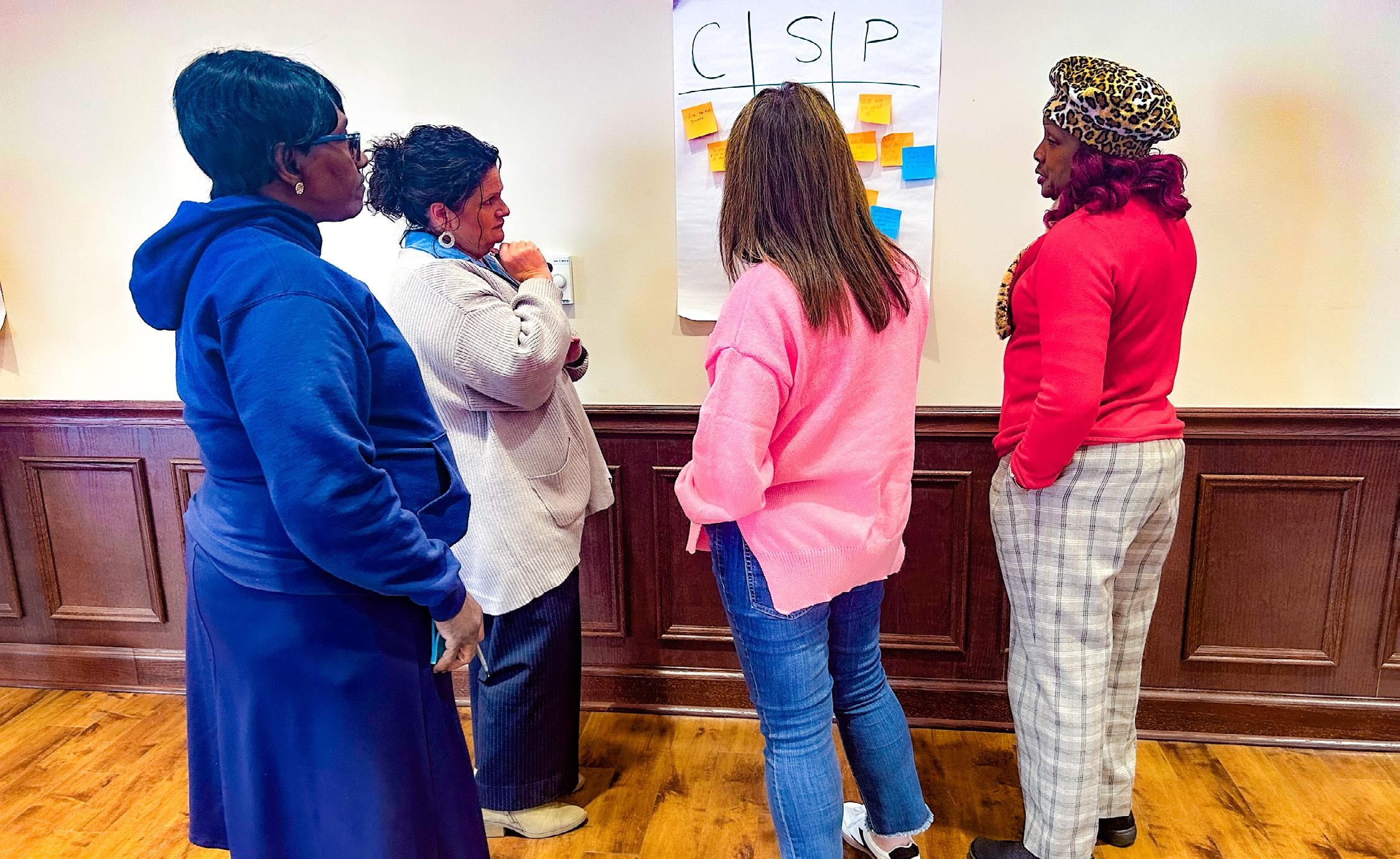
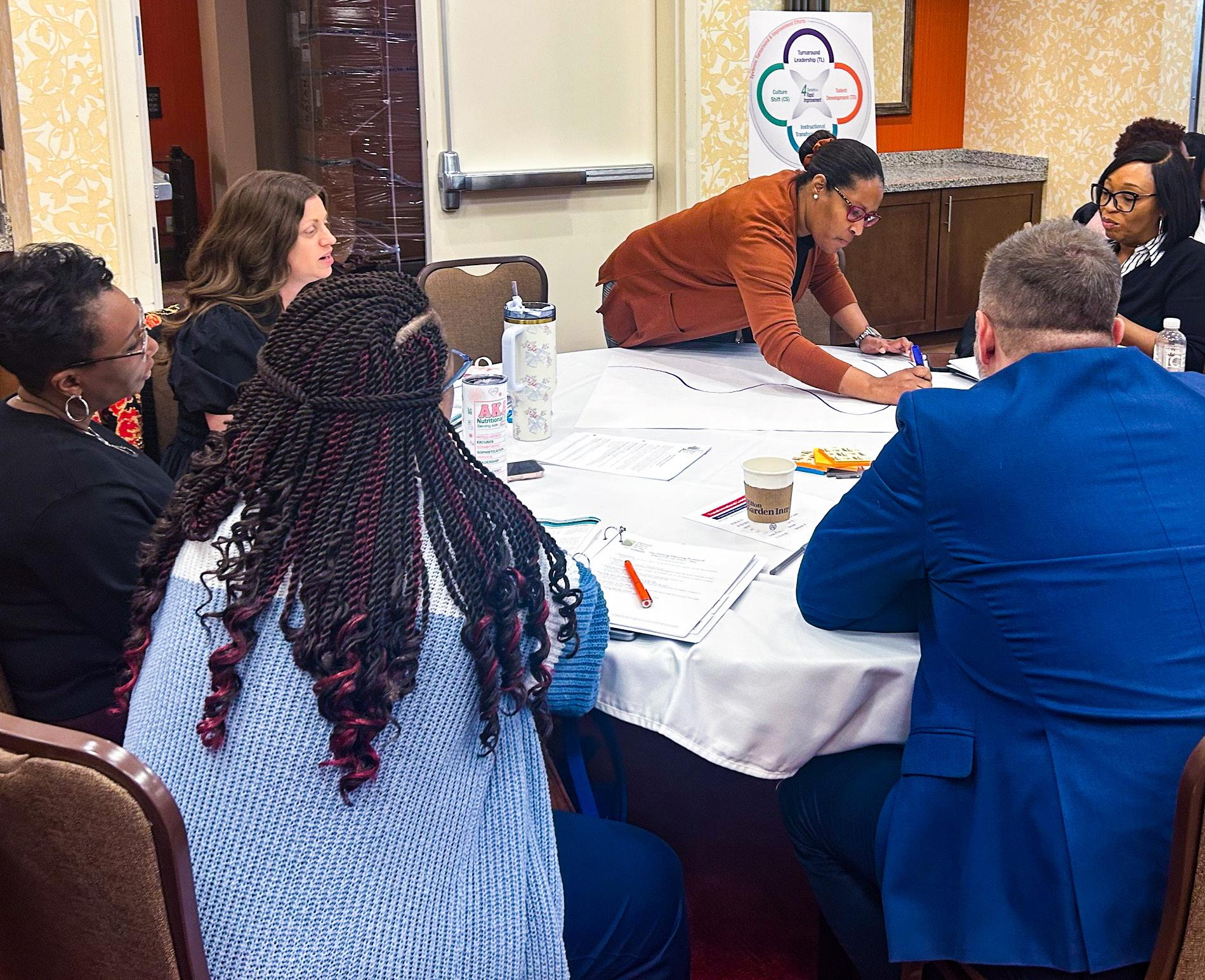
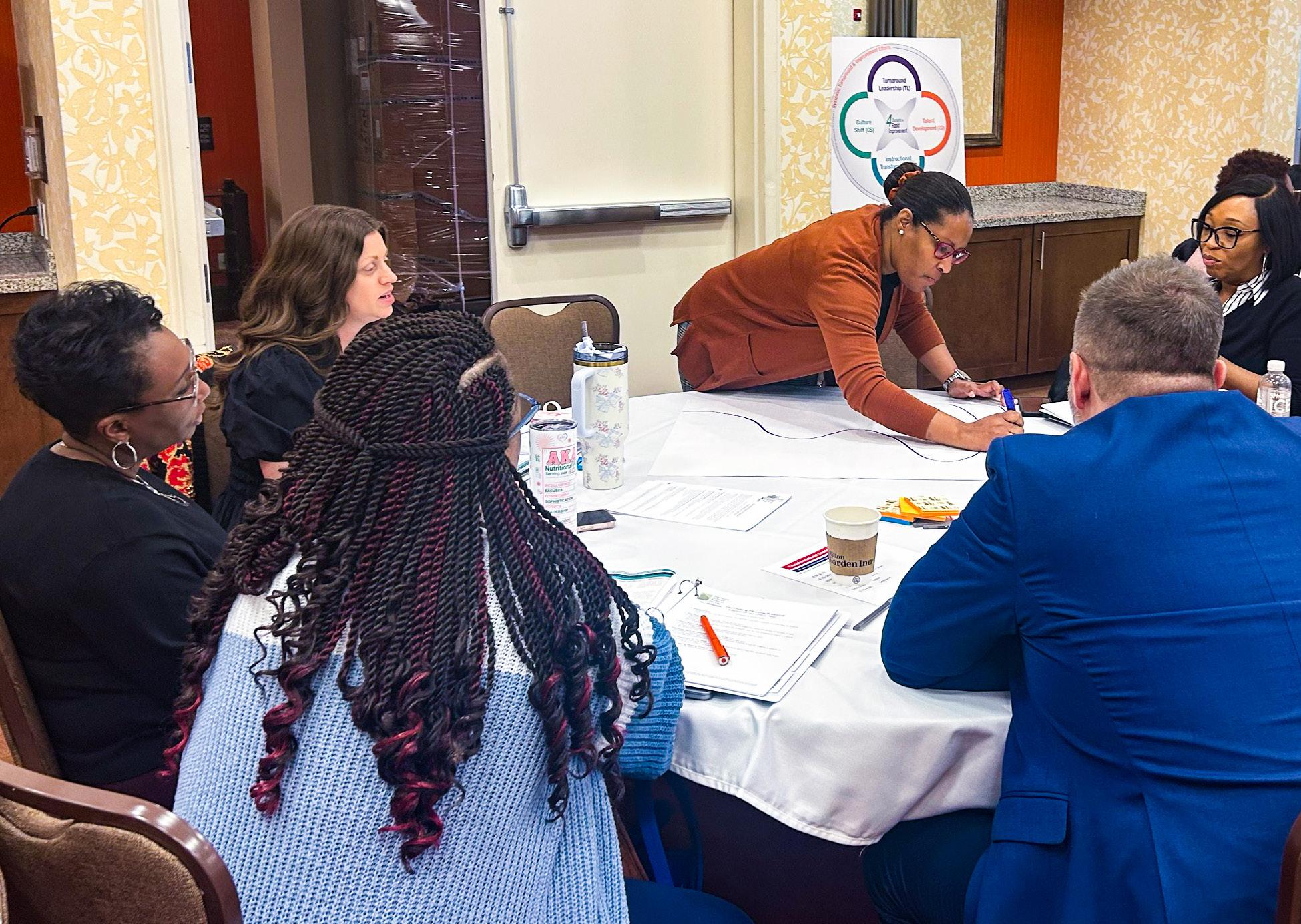
Teachers and administrators at the Transformational Leadership PD series. Here, they are creating a poster that represents one of the five design principles to be used for goal setting and professional growth.
Let’s Get Wild
During Jacket Thrive Intersession, Starkville Oktibbeha Consolidated School District (SOCSD) held a “Let’s Get Wild” enrichment camp. The camp spent part of the week learning about water treatment and how environmental scientists work to control water flow in populated areas. Dr. Beth Baker, assistant director of MSU Extension for Environmental Stewardship,
visited with students to lead hands-on activities to demonstrate her work.
Students tossed balls in class to understand the steps for how water is used, treated and recycled in communities. Then, campers stepped outside to learn about watershed conservation with an interactive demonstration of how scientists and engineers use grass, trees and oth-
er plants to help safeguard facilities and whole communities from excessive water overflow.
SOCSD appreciates MSU’s Department of Wildlife, Fisheries and Aquaculture for partnering with them to help the Yellow Jacket students understand the importance of water conservation and learn about careers within the field.
Following in the Family Footsteps
Mississippi Takes Reading to New Heights
The Mississippi Department of Education announced that 25,399 or 77.3%, – the highest-percentage ever – of third graders passed the initial administration of the third-grade reading assessment given this spring for the 2024-25 school year.
“These results are outstanding. The MDE applauds all educators and families across the state that make literacy a priority,” said Dr. Lance Evans, state superintendent of education. “With a continued emphasis on the science of reading as well as implementation of high-quality instructional materials, we believe Mississippi students will continue to make progress.”
A total of 32,839 third graders took the
assessment. In 2023-24, 75.7% of third graders passed the initial administration of the reading assessment. After the final retests in 2023-24, 84% of third graders passed the test.
In accordance with the Literacy-Based Promotion Act (LBPA), third graders who do not pass the initial administration of the reading test are given up to two attempts to retest. Students who did not pass the initial reading assessment retested in early May. The second retest window was in June 2025.
The LBPA became law in 2013 to improve reading skills of kindergarten through third-grade students in public
schools so every student completing the third grade is able to read at or above grade level. The LBPA requires Mississippi third graders to pass a reading assessment to qualify for promotion to fourth grade. Some students may qualify for good cause exemptions to be promoted to fourth grade.
An amendment to the law in 2016 raised reading-level expectations starting in the 2018-19 school year, requiring third graders to score at level three or higher on the reading portion of the Mississippi Academic Assessment Program (MAAP) English Language Arts (ELA) assessment.