Caring for our Priests
EMOTIONAL WELLNESS
This past February, we held an Emotional Wellness Workshop specifically geared towards priests, and were thrilled that nearly 50 active and senior priests participated.
The workshop was dedicated to the memory of Fr. Jack Sullivan who, before passing away in 2024, had suggested we hold this type of workshop. After Fr. Jack lost his sister and faced some other hardships, he realized the importance of understanding emotional wellness, particularly for priests who tend to have far too much on their plate and often face difficult situations alone.
We are already planning two more workshop sessions in 2026!
The full financial statements can be found on the following pages
Combined Financial Statements and Report of Independent Certified Public Accountants
Archdiocese of Boston Clergy Trust
Clergy Medical/Hospitalization Trust
Clergy Retirement Trust
Clergy Benefit Funding Trust
Regina Cleri Trust
June 30, 2025 and 2024
GRANT THORNTON LLP
53 State St., 16th Floor Boston MA 02109
D +1 617 723 7900
F +1 617 723 6340
REPORT OF INDEPENDENT CERTIFIED PUBLIC ACCOUNTANTS
Board of Trustees
Archdiocese of Boston Clergy Trust
Opinion
We have audited the combined financial statements of the Archdiocese of Boston Clergy Trust (the “Clergy Trust”), which comprise the combined statements of net assets available for benefits and combined statements of accumulated plan benefits as of June 30, 2025 and 2024, and the related combined statements of changes in net assets available for benefits and combined statements of changes in accumulated plan benefits for the years then ended, and the related notes to the combined financial statements.
In our opinion, the accompanying combined financial statements present fairly, in all material respects, the combined net assets available for benefits and combined accumulated plan benefits of the Clergy Trust as of June 30, 2025 and 2024, and the combined changes in its net assets available for benefits and combined changes in accumulated plan benefits for the years then ended in accordance with accounting principles generally accepted in the United States of America.
Basis for opinion
We conducted our audits of the combined financial statements in accordance with auditing standards generally accepted in the United States of America (US GAAS). Our responsibilities under those standards are further described in the Auditor’s Responsibilities for the Audit of the Financial Statements section of our report. We are required to be independent of the Clergy Trust and to meet our other ethical responsibilities in accordance with the relevant ethical requirements relating to our audits. We believe that the audit evidence we have obtained is sufficient and appropriate to provide a basis for our audit opinion.
Responsibilities of management for the financial statements
Management is responsible for the preparation and fair presentation of the financial statements in accordance with accounting principles generally accepted in the United States of America, and for the design, implementation, and maintenance of internal control relevant to the preparation and fair presentation of financial statements that are free from material misstatement, whether due to fraud or error.
In preparing the financial statements, management is required to evaluate whether there are conditions or events, considered in the aggregate, that raise substantial doubt about the Clergy Trust's ability to continue as a going concern for one year after the date the financial statements are available to be issued.
Management is also responsible for maintaining a current plan instrument, including all plan amendments, administering the plan, and determining that the plan's transactions that are presented and disclosed in the financial statements are in conformity with the plan's provisions, including maintaining sufficient records with respect to each of the participants, to determine the benefits due or which may become due to such participants.
Auditor’s responsibilities for the audit of the financial statements
Our objectives are to obtain reasonable assurance about whether the financial statements as a whole are free from material misstatement, whether due to fraud or error, and to issue an auditor’s report that includes our opinion. Reasonable assurance is a high level of assurance but is not absolute assurance and therefore is not a guarantee that an audit conducted in accordance with US GAAS will always detect a material misstatement when it exists. The risk of not detecting a material misstatement resulting from fraud is higher than for one resulting from error, as fraud may involve collusion, forgery, intentional omissions, misrepresentations, or the override of internal control. Misstatements are considered material if there is a substantial likelihood that, individually or in the aggregate, they would influence the judgment made by a reasonable user based on the financial statements.
In performing an audit in accordance with US GAAS, we:
Exercise professional judgment and maintain professional skepticism throughout the audit.
Identify and assess the risks of material misstatement of the financial statements, whether due to fraud or error, and design and perform audit procedures responsive to those risks. Such procedures include examining, on a test basis, evidence regarding the amounts and disclosures in the financial statements.
Obtain an understanding of internal control relevant to the audit in order to design audit procedures that are appropriate in the circumstances, but not for the purpose of expressing an opinion on the effectiveness of the Clergy Trust's internal control. Accordingly, no such opinion is expressed.
Evaluate the appropriateness of accounting policies used and the reasonableness of significant accounting estimates made by management, as well as evaluate the overall presentation of the financial statements.
Conclude whether, in our judgment, there are conditions or events, considered in the aggregate, that raise substantial doubt about the Clergy Trust's ability to continue as a going concern for a reasonable period of time.
We are required to communicate with those charged with governance regarding, among other matters, the planned scope and timing of the audit, significant audit findings, and certain internal control-related matters that we identified during the audit.
Supplemental schedules
Our audits were conducted for the purpose of forming an opinion on the combined financial statements as a whole. The combining statements of net assets available for benefits as of June 30, 2025 and 2024, the combining statements of changes in net assets available for benefits for the years ended June 30, 2025 and 2024, and the statements of changes in net assets available for benefits - Regina Cleri Trust for the years ended June 30, 2025 and 2024 are presented for purposes of additional analysis and are not a required part of the combined financial statements. Such

supplementary information is the responsibility of management and was derived from and relates directly to the underlying accounting and other records used to prepare the combined financial statements. The information has been subjected to the auditing procedures applied in the audits of the combined financial statements and certain additional procedures. These additional procedures included comparing and reconciling such information directly to the underlying accounting and other records used to prepare the combined financial statements or to the combined financial statements themselves, and other additional procedures in accordance with US GAAS.
In our opinion, the information in the accompanying supplemental schedules are fairly stated, in all material respects, in relation to the combined financial statements as a whole.
Boston, Massachusetts November 6, 2025
Archdiocese of Boston Clergy Trust
COMBINED STATEMENTS OF NET ASSETS AVAILABLE FOR BENEFITS
June 30, 2025 and 2024
(Note 3)
(Note 3)
(Note 3)
(Note 3)
(Notes 3, 6 and 11)
(Notes 3 and 7)
NET ASSETS AVAILABLE FOR BENEFITS
The accompanying notes are an integral part of these combined financial statements.
Archdiocese of Boston Clergy Trust
COMBINED STATEMENTS OF CHANGES IN NET ASSETS AVAILABLE FOR BENEFITS
For the years ended June 30, 2025 and 2024 The accompanying notes are an integral part of these
Archdiocese of Boston Clergy Trust
June 30, 2025 and 2024
The accompanying notes are an integral part of these combined financial statements.
Archdiocese of Boston Clergy Trust
COMBINED STATEMENTS OF CHANGES IN ACCUMULATED PLAN BENEFITS
For the years ended June 30, 2025 and 2024
NOTES TO COMBINED FINANCIAL STATEMENTS
June 30, 2025 and 2024
NOTE 1 - DESCRIPTION OF THE CLERGY TRUST
Description of the Trusts
The Archdiocese of Boston Clergy Trust (the “CT”) represents collectively all trusts, as they may exist from time to time, that provide for the health, welfare, disability, and retirement of priests incardinated in the Roman Catholic Archdiocese of Boston (“RCAB”) who are in good standing within the norms of canon law (“Eligible Priests”). The CT combined financial statements include the financial position and activities of the Archdiocese of Boston Clergy Benefit Funding Trust (the “Funding Trust”), the Archdiocese of Boston Clergy Retirement Trust (the “Retirement Trust”), the Archdiocese of Boston Clergy Medical/Hospitalization Trust (the “Medical Trust”) and the Archdiocese of Boston Regina Cleri Trust (“Regina Cleri Trust”).
The CT was established for the purpose of generating and providing support for the benefit of Eligible Priests incardinated in the RCAB, as directed by the Roman Catholic Archbishop of Boston. The CT is not subject to the provisions of the Employee Retirement Income Security Act of 1974 (“ERISA”).
The Archbishop of Boston, by virtue of his office, is responsible for providing for health, welfare, disability, and retirement benefits of Eligible Priests. He appoints the Board of Trustees of the CT, but does not serve as a Trustee. Additionally, the Archbishop of Boston serves as Chairman to numerous separately incorporated Catholic organizations that operate within the Archdiocese of Boston. These organizations are considered to be related organizations.
The Board of Trustees assists the Archbishop of Boston in his responsibilities to Eligible Priests by administering the CT. The Trustees are authorized and empowered to manage the assets of, and benefits provided by the CT as deemed necessary.
Reporting and Disclosure by Corporation Sole
The accounting and financial disclosures within this report for the CT are prepared under U.S. generally accepted accounting principles (“U.S. GAAP”) applicable to defined benefit pension plans and health and welfare plans. The primary objective of the CT combined financial statements is to provide financial information that is useful in assessing the CT’s present and future ability to pay benefits when due.
The CT is the retirement vehicle for the Eligible Priests assigned to the RCAB. Accordingly, the financial reporting of Corporation Sole, as the employer of these priests, includes corresponding accounting and financial disclosures relating to the CT retirement and other post-retirement benefits.
NOTE 2 - DESCRIPTION OF THE TRUSTS
The following brief description of the CT is provided for general information purposes only. Participants should refer to each trust agreement for more complete information.
Funding and Benefits
The CT’s primary sources of funding for benefits are from special collections from parishes in the Archdiocese of Boston and assessments to parishes and other Catholic organizations within the Archdiocese of Boston. As collections and assessments are received from the parishes and other Catholic organizations, they are held in the Funding Trust. Funds are transferred to the Medical Trust, the Retirement Trust, and Regina Cleri Trust at the discretion of the Trustees.
The Medical Trust was established to provide substantially all medical and/or hospitalization coverage to Eligible Priests.
NOTES TO COMBINED FINANCIAL STATEMENTS - CONTINUED
June 30, 2025 and 2024
The Retirement Trust is a noncontributory defined benefit pension plan that provides retirement benefits, which include a stipend as well as room and board covering Eligible Priests.
Regina Cleri is a nonprofit Massachusetts corporation. Regina Cleri is a religious community in the West End of Boston, committed to supporting the health and vocation of the Eligible Priests of the Archdiocese of Boston. Regina Cleri provides resident senior priests with support for their physical and emotional health, quality of life and spiritual life, thereby allowing them to dedicate their later years to their lifelong commitment to their vocation.
The primary benefits provided by the Funding Trust relate to funding of the Medical Trust, the Retirement Trust and Regina Cleri Trust where necessary. The Funding Trust also pays substantially all benefits for Eligible Priests who are currently on health leave or waiting assignment for up to six months. Additional benefits include support for the well-being of Eligible Priests at the discretion of the Trustees.
Assessments to Participating Entities
The CT charges assessments to parishes and related Catholic organizations to partially offset medical, dental, hospitalization, retirement and other benefits for Eligible Priests.
Retirement Benefits
The monthly retirement benefits available to a priest who retires at the general retirement age of 75 includes a stipend as well as room and board; the monthly combined benefit was $2,181 at both June 30, 2025 and 2024. The allocation between stipend and room and board varies based on the retiree’s residence, which can include living on their own, in a parish or at Regina Cleri. The CT does not cover the cost of nursing home care. A priest who has attained at least age 65 may, with the permission of the Archbishop of Boston, retire early and receive a retirement benefit. Any priest who becomes totally and permanently disabled qualifies for retirement benefits. Retirement benefits are available to all Eligible Priests. This program has no vesting provisions.
Other Post-Retirement Benefits
Other post-retirement benefits include health, dental and subsistence benefits.
NOTE 3 - SUMMARY OF SIGNIFICANT ACCOUNTING POLICIES
The significant accounting policies followed by the CT are described below:
Basis of Accounting
The combined financial statements have been prepared on the accrual basis of accounting in accordance with U.S. GAAP.
Net assets, revenues, expenses, gains and losses are classified based upon the existence or absence of donor-imposed restrictions. Accordingly, net assets and changes therein are classified as follows:
Without donor restrictions - Net assets that are not subject to donor-imposed restrictions or for which restrictions have expired. Also included in this category are net assets designated by the Trustees, including funds functioning as endowment.
With donor restrictions - Net assets subject to donor-imposed restrictions that permit the CT to use or expend the donated assets as specified and are satisfied by either the passage of time or by actions of the CT. Also included in this category are net assets subject to donor-imposed restrictions that stipulate that
NOTES TO COMBINED FINANCIAL STATEMENTS - CONTINUED
June 30, 2025 and 2024
resources be maintained permanently, but may permit CT to use or expend part or all of the economic benefits derived from the donated assets to be used in line with donor restrictions.
Cash and Cash Equivalents
Financial instruments with original maturities of three months or less at the purchase date are classified as cash equivalents. Included in cash equivalents are money market funds of $7,200,364 and $5,773,174 at June 30, 2025 and 2024, respectively.
The CT deposits its cash in major financial institutions that are significant in size and reputation. These deposits are insured by the Federal Deposit Insurance Corporation (“FDIC”) up to $250,000, per institution, per trust. While at times funds deposited in banks are in excess of FDIC insured limits, CT has not experienced any losses as a result of the use of uninsured deposit accounts.
Investments
Investments are carried at fair value. Changes in fair values are reflected in the combined statements of changes in net assets available for benefits as net realized and unrealized gains (losses) on investments. Investment transactions are accounted for as of the date the securities are purchased or sold (trade date). Interest income is recorded on an accrual basis. Dividends are recorded on the ex-dividend date.
The CT Investment Committee has elected to invest in the RCAB Collective Investment Partnership (the “Investment Partnership” or “CIP”), the RCAB Fixed Income Fund (the “Fixed Income Fund” or “FIF”), the Westwood Income Opportunity Fund (the “Income Opportunity Fund” or “IOF”) and the Knights of Columbus Commingled Limited Duration Bond Fund (the “Knights of Columbus Fund” or “KoC”). The funds that are established and maintained by RCAB provide common investment pools in which the CT and other organizations related to RCAB may participate. The underlying investments of the Investment Partnership, Fixed Income Fund, Income Opportunity Fund and the Knights of Columbus Fund are primarily equity and fixed-income securities (U.S. Government agency securities, asset-backed securities and corporate bonds) owned either directly or indirectly through mutual funds, private investment entities, and money market funds. The participants in these funds own units based upon a per-unit value at the time of purchase.
Financial instruments with original maturities of greater than three months at the purchase date are classified as investments.
Accounts Receivable
Accounts receivable are stated net of an allowance for credit losses/estimated uncollectible assessments. The allowance is established via a provision charged to operations. Management evaluates its assessments receivable and establishes or adjusts its allowance to an amount that it believes will be adequate to absorb possible losses on accounts that may become uncollectible. Accounts are charged-off against the allowance when management believes that the collectability of the specific account is unlikely.
Land, Building and Equipment
Land, building and equipment are carried at cost, net of accumulated depreciation, or if donated, at appraised value at the time of donation. Depreciation is recorded on the straight-line basis over the estimated useful lives of the assets, which range from three to forty years. Expenditures for maintenance and repairs are expensed as incurred. Depreciation of building and equipment acquired through expenditure of donor-imposed restricted gifts is classified as non-operating expense.
NOTES TO COMBINED FINANCIAL STATEMENTS - CONTINUED
June 30, 2025 and 2024
Prepaid Expenses
Retirement benefit payments are withdrawn from the CT operating cash account by the payroll provider on the last business day of the month in order to be available on the first of the following month for the priests. Included in prepaid expenses are $273,905 and $280,467 for retirement benefits advanced to the payroll provider at June 30, 2025 and 2024, respectively.
Collections from Parishes
Generally, collections from parishes are recognized when received. In addition, any amounts reported by parishes but not yet received by CT are accrued as due from the remitting parish and are included within contributions receivable.
Contributions Receivable, Gifts, Bequests and Contributions
Contributions, including unconditional promises to give, are recognized upon receipt. Contributions other than cash are recorded at fair value at the date of contribution. Contributions with donor-imposed restrictions are reclassified to net assets without donor restrictions when an expenditure is incurred that satisfies the restriction or the designated time elapses. Pledges receivable are carried at estimated net present value, net of allowance for uncollectible amounts. Conditional promises to give are not recognized until the conditions on which they depend are substantially met. There were no conditional promises to give at June 30, 2025 and 2024.
Contributions receivable as of June 30, 2025 and 2024 are presented below:
Receivables due in less than one year
677,220 $ 848,823 Receivables due in one to five years - 37,500
Total unconditional promises to give 677,220 886,323
Less: present value discount and allowance for uncollectible amounts (75,247) (348,176) Contributions receivable, net $ 601,973 $ 538,147
The remaining contributions receivable due in one to five years have been discounted using a rate of 5.50% at June 30, 2024.
Special Events and Deferred Income
Revenue from ticket sales and sponsorships with benefits is recognized at the fair value of the goods or services provided (the exchange amount). Any excess payment over the exchange amount is treated as a contribution. The contribution portion of the amount received for ticket sales prior to the end of the reporting period is presumed to be conditioned on the event taking place, unless explicitly waived by the donor. Accordingly, amounts received prior to the event are recorded as deferred income until the occurrence of the event. Direct costs of special events, such as venue rental, catering, and entertainment, are reported separately as special events direct costs in the statement of changes in net assets available for benefits.
NOTES TO COMBINED FINANCIAL STATEMENTS - CONTINUED
June 30, 2025 and 2024
Giving Societies
Giving Society donations are recognized as revenue when unconditionally and irrevocably committed to the CT.
Payment of Benefits
Benefit payments to participants are recorded upon distribution.
Income Taxes
The CT is included in the annual United States Conference of Catholic Bishops Internal Revenue Service Group Ruling and is therefore exempt from income tax under Section 501(c)(3) of the Internal Revenue Code. The CT recognizes the financial statement benefit of a tax position only after determining that the relevant tax authority would more likely than not sustain the position following an audit. For tax positions meeting the more-likely-than-not threshold, the amount recognized in the combined financial statements is the largest benefit that has a greater than 50% likelihood of being realized upon ultimate settlement with the relevant tax authority. The CT management has reviewed the tax positions for open periods and determined that no provision for income tax is required in the CT financial statements.
Use of Estimates
The preparation of combined financial statements in conformity with U.S. GAAP requires management to make estimates and assumptions that affect the reported amounts and disclosures of assets, liabilities, benefit obligations, contingent assets and liabilities, and changes during the reporting period. Actual results could differ from those estimates. As discussed above, key estimates include the fair value of investments, the allowance for uncollectible assessments, health claims incurred by participants but not yet reported, and accumulated retirement plan benefits and other post-retirement benefits.
The actuarial present value of accumulated retirement plan benefits and other post-retirement benefit obligations are reported based on certain assumptions pertaining to interest rates, inflation rates, health care inflation rates, and participant demographics, all of which are subject to change. Due to uncertainties inherent in the estimations and assumptions process, it is at least reasonably possible that changes in these estimates and assumptions in the near term would affect the combined financial statements.
Operations
Changes in net assets from operations includes all operating revenues and expenses that are an integral part of CT’s programming and supporting activities.
Reclassifications
Certain amounts in the 2024 financial statements have been reclassified to conform to the 2025 presentation.
NOTE 4 - CAPITAL CAMPAIGN
In fiscal year 2018, The Catholic Community Fund of the Archdiocese of Boston, Inc., began the Inspiring Hope Capital Campaign (the “Campaign”). The purpose of the Campaign was to raise funds for the collective mission of the Archdiocese of Boston to strengthen and grow in faith and community. The Campaign closed in fiscal year 2021.
NOTES TO COMBINED FINANCIAL STATEMENTS -
CONTINUED
June 30, 2025 and 2024
Contributions received in relation to the Campaign are shown as contributions - capital campaign, net in the accompanying combined statements of changes in net assets available for benefits.
CT’s segment of the Campaign was to support the ministry of the CT in caring for all eligible priests serving the Archdiocese of Boston. A portion of funds raised were restricted to CT programs, including the development of priest wellness initiatives. Another portion of funds raised were restricted to the Regina Cleri capital improvement construction project, which added 10 residential rooms to increase occupancy, rebuilt the current chapel to facilitate the population aging in place and provided general building upgrades to the 60+ year old structure.
NOTE 5 - SUMMARY OF ACTUARIAL ASSUMPTIONS
Actuarial Present Value of Accumulated Retirement Plan Benefits
Accumulated retirement plan benefits, which include a stipend as well as room and board, are those future periodic payments that are expected to be paid under the Retirement Trust’s provisions to retired and active priests.
The actuarial present value of accumulated retirement plan benefits is determined by an actuary and is the amount that results from applying actuarial assumptions to adjust the accumulated retirement plan benefits to reflect the time value of money (through discounts for interest) and the probability of payment (by means of decrements such as for death, disability, withdrawal, or retirement) between the valuation date and the expected date of payment.
The significant actuarial assumptions used in the valuations are as follows at June 30, 2025 and 2024:
Mortality before and after retirement
Society of Actuaries' Retirement Plans Experience Committee
Headcount weighted Pri-2012 rates for healthy lives, with generational projection using Scale MP-2021. Separate retiree and active participant rates.
Retirement age
Asset valuation
Stipend and room and board paid to priests
Cost of living adjustment
Salary increases
Age graded tables
Market value
$1,481 average per month
None assumed
N/A
Society of Actuaries' Retirement Plans Experience Committee
Headcount weighted Pri-2012 rates for healthy lives, with generational projection using Scale MP-2021. Separate retiree and active participant rates.
Age graded tables
Market value
$1,551 average per month
None assumed
N/A
The most significant assumption change impacting the actuarial present value of other post-retirement benefit obligations at June 30, 2025 was the projected increase in costs at Regina Cleri.
NOTES TO COMBINED FINANCIAL STATEMENTS - CONTINUED
June 30, 2025 and 2024
The foregoing actuarial assumptions are based on the presumption that the Retirement Trust will continue. If the Retirement Trust were to terminate, different actuarial assumptions and other factors might be applicable in determining the actuarial present value of accumulated retirement plan benefits.
Actuarial Present Value of Other Post-Retirement Benefit Obligations
Other post-retirement benefit obligations represent the actuarial present value of those estimated future health, dental and subsistence benefits that are attributed to clergy service rendered through the financial statement date.
Prior to reaching the eligibility date, the post-retirement benefit obligation is the portion of the expected post-retirement benefit obligation that is attributed to each priest’s service rendered to the valuation date.
The actuarial present value of the expected post-retirement benefit obligation is determined by an actuary and is the amount that results from applying actuarial assumptions to historical claims-cost data to estimate future annual incurred claims costs per participant and to adjust such estimates for the time value of money (through discounts for interest) and the probability of payment (by means of decrements such as those for death, disability, withdrawal, or retirement) between the valuation date and the expected date of payment.
For measurement purposes, a 6.50% annual rate of increase in the per capita cost of covered health care benefits was assumed for 2025 and a 6.00% annual rate of increase in the per capita cost of covered health care benefits was assumed for 2024. The rate is assumed to decrease gradually to 4.50% by 2034.
The following were other significant assumptions used in the valuations as of June 30, 2025 and 2024:
Mortality
Effect of 1% increase in healthcare cost trend rate on postretirement
Society of Actuaries’ Retirement Plans Experience Committee
Headcount weighted Pri-2012 rates for healthy lives, with generational projection using Scale MP-2021. Separate retiree and active participant rates.
Society of Actuaries’ Retirement Plans Experience Committee
Headcount weighted Pri-2012 rates for healthy lives, with generational projection using Scale MP-2021. Separate retiree and active participant rates.
3,560,000
The foregoing actuarial assumptions are based on the presumption that the Medical Trust will continue. If the Medical Trust were to terminate, different actuarial assumptions and other factors might be applicable in determining the actuarial present value of other post-retirement benefit obligations.
Reserve for Health Insurance Claims
Reserve for health insurance claims consist of medical and dental claims incurred but not reported as of June 30, 2025 and 2024 for benefits provided to Eligible Priests. Obligations for health claims incurred by Eligible Priests but not reported are estimated by management based on historical experience.
NOTES TO COMBINED FINANCIAL STATEMENTS - CONTINUED June 30, 2025 and 2024
NOTE 6 - INVESTMENTS
CT had the following investments as of June 30, 2025 and 2024:
All investments are reported at fair market value (see Note 11).
The investment objective of the Collective Investment Partnership is to maximize long-term total return, primarily by investing in equity securities, investment grade debt and fixed income securities.
The investment objectives of the Fixed Income Fund are to generate income, hedge growth risk and manage inflation risk, primarily by investing in corporate debt, U.S. Government securities and other fixed income securities.
The Knights of Columbus Commingled Limited Duration Bond Fund seeks long-term capital appreciation by investing in a variety of fixed income instruments, such as securities issued or guaranteed by the U.S. government and its agencies or instrumentalities, municipal bonds, corporate obligations, residential and commercial mortgage-backed securities, and asset-backed securities.
The investment objectives of the Westwood Income Opportunity Fund are to provide current income and to seek capital appreciation, primarily by investing in common stocks, mutual funds, corporate debt and U.S. Government securities.
NOTE 7 - LAND, BUILDING AND EQUIPMENT
Land, building and equipment consists of the following at June 30, 2025 and 2024:
Less: accumulated depreciation (11,814,327) (11,156,401) $ 15,839,485 $ 16,471,251
Depreciation expense totaled $657,926 and $673,439 for the fiscal years ended June 30, 2025 and 2024, respectively.
NOTES TO COMBINED FINANCIAL STATEMENTS - CONTINUED
June 30, 2025 and 2024
NOTE 8 - RELATED PARTY TRANSACTIONS
RCAB
The CT pays for various administrative expenses, which include Plan administrative salaries and a service fee, based on the level of efforts provided for administrative, rent, technology and clerical services provided by RCAB. These amounts are classified as and included within salaries and benefits and service fees in the accompanying statements of changes in net assets available benefits.
RCAB, Health Benefit Plan
CT employees participate in lay employee health, dental, life, disability, and transition assistance plans through RCAB. These expenses are classified as and included within salaries and benefits in the accompanying statements of changes in net assets available benefits.
Boston Catholic Development Services
A service fee based on the level of efforts provided for fundraising is charged to the CT by Boston Catholic Development Services. These fees are classified as and included within fundraising expense in the accompanying statements of changes in net assets available for benefits.
Transfer to Non-Incardinated Trust
CT authorized the transfer of $40,000 for each of the years ended June 30, 2025 and 2024 to the Archdiocese of Boston Benefit Trust for Non-Incardinated Priests Duly Assigned for Service in the Archdiocese of Boston, a related plan to fund the future pension obligations of the non-incardinated priests assigned for service in the Archdiocese of Boston.
The Archdiocese of Boston Benefit Trust for Non-Incardinated Priests Duly Assigned for Service in the Archdiocese of Boston was frozen in 2009.
NOTE 9 - ENDOWMENT
CT’s endowment includes both donor-restricted endowment funds and funds designated by the Board of Trustees to function as quasi-endowments. Quasi-endowment funds are internally restricted until such time as the Trustees vote to release such funds. Quasi-endowment funds are designated to be used for future support of Regina Cleri and the health, welfare and retirement needs of Eligible senior priests.
Interpretation of Relevant Law
The net assets associated with CT’s endowment funds are classified in accordance with relevant state law as interpreted by the Trustees. As a result of this interpretation, CT has classified as net assets with donor restrictions (a) the original value of gifts donated to the permanent endowment, (b) the original value of subsequent gifts to the permanent endowment, and (c) accumulations to the permanent endowment made in accordance with the direction of the applicable donor gift instrument at the time the accumulation is added to the fund (although no existing donor instruments have so directed). The remaining portion of the donorrestricted endowment fund continues to be classified in net assets with donor restrictions and is regarded as “net appreciation” until those amounts are appropriated for expenditure by the Trustees in a manner consistent with CT’s spending policy, the Uniform Prudent Management of Institutional Funds Act, other applicable laws, and donor-imposed restrictions, if any.
NOTES TO COMBINED FINANCIAL STATEMENTS - CONTINUED
June 30, 2025 and 2024
Funds with Deficiencies
From time-to-time, the fair value of assets associated with individual donor-restricted endowment funds may fall below the historic-dollar-value. Deficiencies of this nature are reported by a decrease in net assets with donor restrictions. There were no funds with deficiencies as of June 30, 2025 and 2024.
Endowment Investment Policy
CT has adopted an investment philosophy which, combined with the spending rate, attempts to provide a predictable stream of returns thereby making funds available to programs that are supported, while at the same time seeking to maintain the purchasing power of the endowment assets. Endowment assets include those assets of donor-restricted funds that Regina Cleri must hold in perpetuity or for donor-specified periods. Under CT’s Investment Policy and spending rate, both of which are approved by the Board of Trustees, the endowment assets are invested in a manner that is intended to produce an inflation-adjusted return in excess of the spending rate over a long period of time. Actual returns in any given year will vary.
Endowment Spending Policy
Under the CT spending policy, up to 6% of the current market value (using the most recently available information at the time) of qualifying donor restricted endowment investments is appropriated for expenditure. The appropriate amounts for the years ended June 30, 2025 and 2024 have been reinvested with quasi-endowment funds. The Board of Trustees voted to withdraw $0 and $1,500,000 from the quasiendowment funds to provide working capital for the Regina Cleri Trust for the fiscal years ended June 30, 2025 and 2024, respectively.
Strategies Employed for Achieving Objectives
To satisfy its long-term rate-of-return objectives, CT relies on a total return strategy in which investment returns are achieved through both capital appreciation (realized and unrealized) and current yield (interest and dividends). The CT Investment Committee’s investment rationale is to include an array of different strategies and investment managers for the investment portfolio to reduce overall volatility while providing investment returns above industry benchmarks.
Following are balances and the changes in endowment net assets for the fiscal year ended June 30, 2025: Without Donor Restrictions With Donor Restrictions Total
Balance, June 30, 2024 $ 4,197,773 $ 1,080,358 $ 5,278,131
Balance, June 30, 2025 $ 4,512,625 $ 1,082,261 $ 5,594,886
NOTES TO COMBINED FINANCIAL STATEMENTS -
CONTINUED
June 30, 2025 and 2024
Following are balances and the changes in endowment net assets for the fiscal year ended June 30, 2024: Without Donor Restrictions With Donor Restrictions Total
Balance, June 30, 2023 $
$ 6,456,155
June 30, 2024
NOTE 10 - BENEFICIAL INTERESTS
The CT is a beneficiary under the terms of various wills. The exact value of such interests and the time at which rights to these interests become irrevocable is dependent upon certain future events over which the CT has no control. Accordingly, the CT has not recorded these interests in the accompanying combined financial statements.
NOTE 11 - FAIR VALUE MEASUREMENTS
The CT measures the fair value as the price that would be received to sell an asset or paid to transfer a liability in an orderly transaction between market participants at the measurement price (an exit price). A fair value hierarchy has been established to prioritize the inputs used in valuation techniques to measure fair value. The three levels of the fair value hierarchy are described below.
Level 1 - inputs to the valuation methodology are quoted prices (unadjusted) for identical assets or liabilities in active markets as of the measurement date.
Level 2 - inputs to the valuation methodology are other observable inputs, including quoted prices for similar assets and liabilities in active or non-active markets, inputs other than quoted prices that are observable for the asset or liability, and inputs that are not directly observable, but are corroborated by observable market data.
Level 3 - inputs to the valuation methodology are unobservable for the asset or liability.
A financial instrument’s level within the fair value hierarchy is based on the lowest level of input that is significant to the fair value measurement.
As of June 30, 2025, and 2024, the CT held investments measured at fair value using the net asset value (“NAV”) per share (or its equivalent) as a practical expedient and, accordingly, have not been categorized in the fair value hierarchy. The value of these investments at June 30, 2025 and 2024 was $55,100,318 and $51,409,660, respectively.
NOTES TO COMBINED FINANCIAL STATEMENTS - CONTINUED
June 30, 2025 and 2024
The following table sets forth the liquidity, redemption policies and unfunded commitments of the CT’s financial assets that were accounted for at fair values calculated by using NAV as of June 30, 2025:
The following table sets forth the liquidity, redemption policies and unfunded commitments of the CT’s financial assets that were accounted for at fair values calculated by using NAV as of June 30, 2024:
NOTE 12 - OPERATING EXPENSES
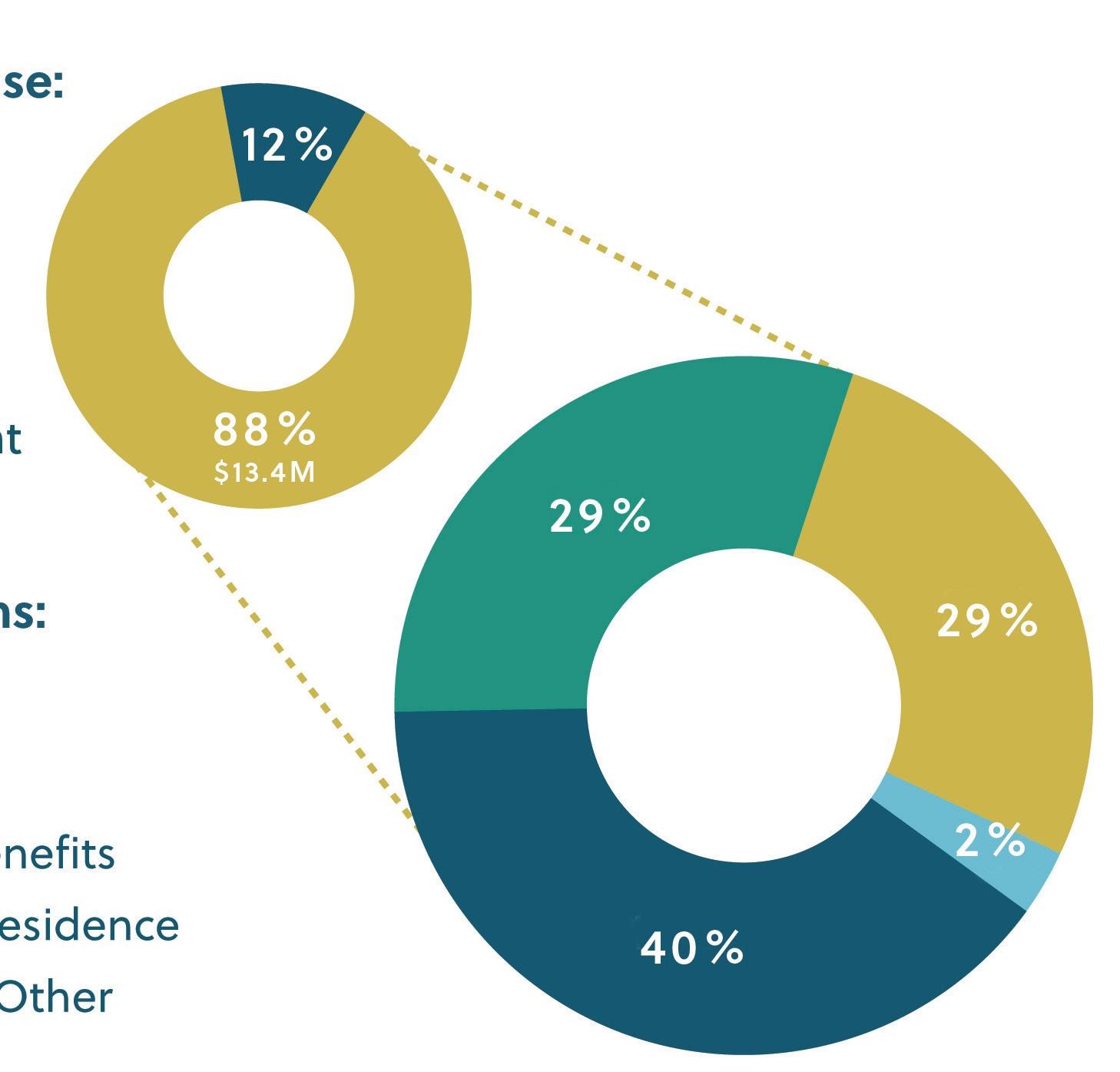
Regina Cleri Residence Operating Expenses
Operating expenses of the Regina Cleri residence, classified by area of service, for the year ended June 30, 2025 are as follows:
NOTES TO COMBINED FINANCIAL STATEMENTS - CONTINUED
June 30, 2025 and 2024
Operating expenses of the Regina Cleri residence, classified by area of service, for the year ended June 30, 2024 are as follows:
NOTE 13 - FINANCIAL INSTRUMENTS AND CONCENTRATIONS OF CREDIT RISK
The CT financial instruments that are potentially subject to concentrations of credit risk consist of cash, cash equivalents (Note 3), and investments (Note 6).
The CT invests in various investment securities through its investments in the CIP, FIF, IOF and KoC. Investment securities are exposed to various risks, such as interest rate, market, and credit risks. Due to the level of risk associated with certain investment securities, it is at least reasonably possible that changes in the values of investment securities will occur in the near term and that such changes could materially affect the amounts reported in the combined statements of net assets available for benefits.
NOTE 14 - NET ASSETS
Net Assets Without Donor Restrictions
Included in net assets without donor restrictions are $4,512,625 and $4,197,773 of board designated (quasiendowment) funds as of June 30, 2025 and 2024, respectively.
Net Assets With Donor Restrictions
Net assets with donor restrictions consisted of the following at June 30:
Net assets released from restrictions during fiscal years 2025 and 2024 were related to time and purpose restrictions being met.
NOTE 15 - SUBSEQUENT EVENTS
Subsequent events have been evaluated through November 6, 2025, which is the date the combined financial statements were available to be issued. There were no subsequent events identified that would require recognition or additional disclosure in CT’s combined financial statements.
SUPPLEMENTAL INFORMATION
Archdiocese of Boston Clergy Trust
COMBINING STATEMENT OF NET ASSETS AVAILABLE FOR BENEFITS
June 30, 2025
Archdiocese of Boston Clergy Trust
COMBINING STATEMENT OF NET ASSETS AVAILABLE FOR BENEFITS
June 30, 2024
Archdiocese of Boston Clergy Trust
COMBINING STATEMENT OF CHANGES IN NET ASSETS AVAILABLE FOR BENEFITS
For the year ended June 30, 2025
Archdiocese of Boston Clergy Trust
COMBINING STATEMENT OF CHANGES IN NET ASSETS AVAILABLE FOR BENEFITS
For the year ended June 30, 2024
Archdiocese of Boston Clergy Trust
REGINA CLERI TRUST
STATEMENT OF CHANGES IN NET ASSETS AVAILABLE FOR BENEFITS
For the year ended June 30, 2025
Archdiocese ofBoston Clergy Trust
REGINA CLERI TRUST
STATEMENT OF CHANGES IN NET ASSETS AVAILABLE FOR BENEFITS
For the year ended June 30, 2024
TO LEARN MORE ABOUT CLERGY TRUST OR TO MAKE A GIFT IN SUPPORT OF OUR MISSION VISIT CLERGYTRUST.ORG OR SCAN THE CODE.
healthier priests. stronger communities.
@clergytrust