
WHAT’S THE FUTURE OF TRANSACTIONAL DOCUMENTS?
PAGE 10
A LOOK AT WHAT 2026 HOLDS FOR THE MAILING INDUSTRY. PAGE 14 DON’T IGNORE THE VALUE OF NON-PROFIT MAIL.
PAGE 24

WHAT’S THE FUTURE OF TRANSACTIONAL DOCUMENTS?
PAGE 10
A LOOK AT WHAT 2026 HOLDS FOR THE MAILING INDUSTRY. PAGE 14 DON’T IGNORE THE VALUE OF NON-PROFIT MAIL.
PAGE 24
In the world of shipping, outbound operations often take center stage. But what about the thousands of packages coming into your organization each month? Whether it’s time-sensitive documents, IT equipment, or critical supplies, every inbound package represents a need, a risk, or a potential disruption.
Modern organizations are realizing that managing inbound logistics is just as important as outbound — especially in environments where time, space, and security are limited. Fortunately, new technologies like inbound package tracking and smart lockers from Pitney Bowes are transforming how inbound deliveries are managed, delivering real value in many ways.
Operational Efficiency: Streamlining the Process Manual inbound workflows are often slow and prone to errors. Packages are logged by hand, if at all, and sit in the mailroom awaiting pickup for hours or even days. This often leads to delivery delays, misplaced items, and extra labor.
With inbound package tracking software, every item is scanned, assigned, and logged upon arrival. Smart lockers allow secure, unattended pickup at the recipient’s convenience without tying up mailroom staff or cluttering up shared spaces.
The outcome? Packages reach recipients faster, allowing your team to focus on more critical tasks.
Risk Mitigation: Protecting what comes in Inbound packages often contain high-value or confidential materials. Without visibility, they can be lost, delayed, or mishandled.
With inbound package tracking and smart lockers, every hand-off is documented. Barcode scans, alerts, and digital signatures ensure accountability and even help support regulatory compliance.
The outcome? Greater visibility, fewer lost items, and stronger chain-of-custody protection.
Employee Experience: Frictionless Package Pickup
In hybrid work environments, expecting employees to wait for deliveries or chase down mailroom staff doesn’t work. Instead, smart lockers and mobile alerts create a self-service experience — packages are ready when employees are.

The outcome? Greater satisfaction and productivity, especially when work depends on timely deliveries.
Cost Management: Doing More with Less Space and Time Manual mailrooms can be costly. Staff spend hours tracking packages, following up on missed pickups, and managing overcrowded storage.
Inbound automation helps reduce labor, speed up package turnover, and optimize space. Plus, analytics offer insight into delivery patterns for better planning allowing for smarter scheduling and resource planning.
The outcome? Time and cost savings that can be redirected toward growth and innovation.
Bottom line: It’s time to rethink your inbound package management As organizations and workplace dynamics evolve, so must the systems that support them. Inbound package tracking and contactless delivery solutions like PitneyTrack® and ParcelPoint™ Smart Lockers are no longer “nice to have” — they’re essential for driving efficiency, savings, and employee satisfaction in the modern workplace.
When it comes to logistics, what comes in is just as important as what goes out. Pitney Bowes can help you modernize your operation.
Scan here to learn more or visit us at pitneybowes.com/ software to get in touch.



VOLUME 38, ISSUE 6
MAGAZINE STAFF
President Chad Griepentrog
Publisher Ken Waddell
Editor Amanda Armendariz amanda.c@rbpub.com
Contributing Writers
Max Clarke, Mark Fallon, Wes Friesen, Rob Hanks, Karen Kimerer, Adam Lewenberg, Christopher Lien, Mike Porter, Kathleen J. Siviter
Audience Development Manager
Rachel Chapman rachel@rbpub.com
Advertising Ken Waddell
608.235.2212 ken.w@rbpub.com
Design Kelli Cooke
MadMen3 PO Box 259098
Madison WI 53725-9098
Tel: 608.241.8777
Fax: 608.241.8666
Email: customerservice@rbpub.com
SUBSCIRBE Subscribe online at MailingSystemsTechnology.com.
Subscriptions are free to qualified recipients: $20 per year to all others in the United States.
Subscription rate for Canada or Mexico is $40 per year, and for elsewhere outside of the United States is $45. Back issue rate is $5.
SEND SUBSCRIPTIONS TO:
Mailing Systems Technology, PO Box 259098, Madison WI 53725-9098 Call 608.241.8777
Fax 608.241.8666
E-mail rachel@rbpub.com Online at MailingSystemsTechnology.com.
REPRINTS: For high quality reprints, please contact Chad Griepentrog, 608-241-8777, chad.g@rbpub.com
All material in this magazine is copyrighted ©2025 by MadMen3 All rights reserved. Nothing may be reproduced in whole or in part without written permission from the publisher. Any correspondence sent to Mailing Systems Technology, MadMen3 or its staff becomes property of MadMen3.
The articles in this magazine represent the views of the authors and not those of MadMen3 or Mailing Systems Technology. MadMen3 and/or Mailing Systems Technology expressly disclaim any liability for the products or services sold or otherwise endorsed by advertisers or authors included in this magazine.
MAILING SYSTEMS TECHNOLOGY
(ISSN 1088-2677) [Volume 38 Issue 6] is published six times per year (January/February, March/April, May/June, July/August, September/October, November/December) by MadMen3, PO Box 259098
Madison WI 53725-9098, 608-241-8777. Periodical postage paid at Madison WI and additional offices.
POSTMASTER
Send address changes to:
Mailing Systems Technology
708 W Mohawk Trail Deforest, WI 53532
BY AMANDA ARMENDARIZ
As we wrap up 2025 and get ready to welcome 2026, many of us in the mailing industry are wondering what the new year will bring. 2026 will be the first full year under a new PMG after Louis DeJoy stepped down, so it will be interesting to see how he steers the proverbial ship now that he’s at the helm. On a recent Mailin’ It! podcast, David Steiner explained how he was excited to work for such an iconic brand as the USPS, noting that this was one of the main factors that led him to step back into the workforce after retirement. “Is there any better brand, iconic brand? I mean, 250 years old, is there any more iconic brand than the United States Postal Service? And so, I thought that’s a pretty cool way to put the end to a career, right? This will definitely be my last job… but what better iconic brand to help succeed than the United States Postal Service?” I hope this enthusiasm steers the organization in the right direction and there is more unity under Steiner’s tenure than there was under DeJoy’s.
In other news, there will not be a rate increase in January like in years past, so mailers have a little bit of a reprieve on
that end (at least until the summertime). The USPS promotions are a great way for mailers to save even more money on postage in the new year. One promotion that I find interesting is the Catalog Insights Promotion, where mailers will get a 10%(!) discount for using catalogs as a marketing tool. This promotion started in October and runs through the end of June, so there’s plenty of time to jump on board if that promotion would make sense for your organization. (And as someone whose home is currently being inundated by holiday season catalogs that are then intercepted by my kids and left in very obvious places for me to find, with certain items circled, naturally, I can attest to their effectiveness!)
As always, no one knows exactly what the new year holds for the print and mail industry. But, as mailers, we can do our part to keep the mail stream thriving and ensure that mail stays relevant for years to come.
As always, thanks for reading Mailing Systems Technology.

BY WES FRIESEN
Integrity in the workplace matters, doesn’t it? In fact, integrity is often viewed as one of the most important and highly sought after characteristics of both employees and employers. A recent global survey by Ernst and Young found that 97% of respondents agree that integrity is a vital foundation for any business. Our personal integrity is crucial, as former Senator Alan Simpson famously said, “If you have integrity, nothing else matters. If you don’t have integrity, nothing else matters.” Business icon Warren Buffett expressed similar sentiments when he said, “In looking for people to hire, you look for three qualities: integrity, intelligence, and energy. And if you don’t have the first, the other two will kill you.”
What is integrity? At its core, our personal integrity is the consistent adherence to reasoned moral and ethical principles. Integrity is the foundation upon which all other virtues and values rest. A simple definition of integrity that has inspired me comes from C.S. Lewis, who wrote, “Integrity is doing the right thing, even when no one is watching.” There are important benefits that come from practicing integrity, including: Builds Trust. Trust is valuable in business and life. Trust cannot be bought; it must be earned through consistent integrity.
and Increases Our Influence. Integrity increases our influence, and influence is the core of what leadership is about according to the top experts like John Maxwell, Stephen Covey, and Jon Gordon. Integrity also protects our reputation from the tremendous damage that comes from unethical behavior or scandal as we have all seem far too
often (remember the Coldplay concert event earlier this year?). I appreciate the warning from Warren Buffett, “It takes 20 years to build a reputation and five minutes to ruin it. If you think about, you’ll do things differently.”
Sets a Positive Example. There is a concept called “shadow the leader” that I was taught and really resonates with me. People around us, including those on our teams, are constantly watching us and drawing conclusions about what really matters to us and what are acceptable attitudes, behaviors, and values. Leaders set the tone and have a huge influence on our teams. Are you (and I) setting positive examples worth emulating?
Improve Performance. When we and our teams are consistently acting with integrity, we will perform at a higher level, especially in the long term. And our customers and business partners will want to do business with us, which has potential financial rewards.
1. Make a personal commitment to being a person of integrity. The starting place for living a life of integrity is to make a conscious choice and commitment to prioritizing integrity. R. Buckminster Fuller advised, “Integrity is the essence of everything successful.” President Dwight Eisenhower shared similar advice when he said, “The supreme quality for leadership is unquestionably integrity. Without it no real success is possible.” Do you want to be more successful in business and life? Let’s start with being people of integrity.
2. Lead by example. Leaders with integrity lead by example, living out the
values and behaviors we want to see in others. I appreciate this quote from motivational speaker Nick Vujicic, “If you want to influence others, the most important thing you can do is be a living example of the principles, ideals, and faith that you advocate.” One important value to lead by example is accountability. Accountability is about taking responsibility for our words, actions, faults, and decisions and admitting mistakes when they happen. Philip Johnson said, “Admitting one’s own faults is the first step to changing them, and it is a demonstration of true bravery and integrity.” We also want to keep our promises and commitments and practice the principle explained by this quote from Lou Holtz, “Don’t ever promise more than you can deliver, but always try to deliver more than you promise.”
3. Put organizational interests above personal ambitions. I played team sports growing up and am a fan of several teams now. The most successful sports teams model the members, including the leaders and best players, putting team interests above their own ambitions. The analogy to the business world is obvious and people of integrity put the organization (team) first.
4. Set clear values. It is important for us to have a clear set of personal values that we aspire to follow. One of the classes I sometimes teach is Business Ethics. One of the assignments is naming the top five to 10 values that the student ascribes to. Being clear on our personal values is especially helpful when we meet the “grey areas” that come our way. In addition to clarifying our personal values, having formalized team values is needed for clarity and setting of expectations. When setting up team values, receiving input from all team members is important to get a true buy-in and a higher quality product.
5. Stay humble and regularly reflect. Integrity isn’t about perfection but about humility and willingness to admit our shortcomings and have a willingness to improve. We can receive help from seeking honest feedback from trusted friends, colleagues, and mentors. And we can grow and improve ourselves when we regularly take time to reflect on our experiences. Keep in mind that “reflected experience is the best teacher.”
6. Model and promote honesty and transparency. Honesty is the bedrock of integrity. Thomas Jefferson spoke to the importance of honesty by saying, “Honesty is the first chapter in the book of wisdom.” We act with integrity when we are truthful in our communications and actions. This includes avoiding misleading statements, half-truths, and deception. Transparency is also important and involves openness and clarity in all our dealings. This includes being upfront about our intentions, expectations, and owning up to errors.
7. Practice fairness, grace, and respect. Fairness is a critical part of integrity. Fairness includes treating all people with impartiality and respect. This means respecting diversity, honoring commitments, and ensuring fair treatment in all our work and personal dealings. Showing grace to others is also important. Grace includes giving people the benefit of doubt and cutting a person slack when they are having a bad day (and we all have the occasional bad days!). I suggest following the Golden Rule (treating a person positively just like we want to be treated positively) and following the Biblical prin-
ciple of “Loving our neighbors (others) as we do ourselves” are helpful guidelines.
8. Resist allure of expediency. We can face the temptation to bend rules, compromise values, or take shortcuts to achieve short-term goals. People of integrity avoid the temptation of expediency and think about long-term outcomes we want for ourselves and our teams.
9. Provide on-going training and encouragement. Sometimes our organizations have ethics training programs we can use with our teams. There are also training options we can pursue provided by third parties. In addition to formal training, periodically discussing with our teams the importance of acting ethically and with integrity with all our stakeholders is valuable.
10. Reward and reinforce integrity. We can reward and reinforce when we see people acting with integrity — especially when it’s done in challenging circumstances. Reinforcement can take different forms. Often the best reward is simply to express verbal appreciation (we all like to hear appreciation, don’t
we!). Sometimes we can go further: written notes, comments in performance appraisals, tangible rewards like food, certificates of appreciation, gift cards, and anything else that a person or team finds meaningful.
Concluding thoughts: Our personal integrity matters. It matters for us and the teams and others we deal with — we set the tone for the people we influence. At the end of the day, we must live with ourselves and our own conscience. Here is a final quote from Charles Evans Hughes, “A man (or woman) has to live with himself, and he should see to it that he always has good company.” Integrity — don’t leave home without it!
Wes Friesen (MBA, EMCM, CMDSM, MCOM, MDC, OSPC, CCE, CBF, CBA, ICP, CMA, CFM, CM, APP, PHR, CTP) is a proven leader and developer of high-performing teams and has extensive experience in both the corporate and non-profit worlds. His book, Your Team Can Soar!, has 42 valuable lessons that will inspire you and give you practical pointers to help you — and your team — soar to new heights of performance. Wes can be contacted at wesmfriesen@gmail.com or at 971.806.0812.
BY KAREN KIMERER
As customer expectations rise and communication channels expand, organizations face a major challenge: delivering messages that are timely, relevant, and compliant regardless of format or device. For service providers, the job is no longer just a simple print-and-mail operation. It has evolved into a complex coordination of content, data, and delivery technologies.
Customer Communications Management (CCM) is the tool that makes this all possible. Standing at the intersection of marketing, operations, and customer experience, CCM plays a critical role in managing those high customer expectations while ensuring both accessibility and brand integrity.
In 2026, CCM will hit a turning point. Artificial Intelligence (AI), automation, and data analytics are redefining how organizations create, deliver, and manage customer messages. At the same time, rising expectations around privacy and accessibility are putting new pressure on every communication touchpoint. For print and mail service providers, this shift opens the door for a more strategic role. Clients no longer just want their materials produced and mailed; they want partners who can better connect physical and digital experiences. Those who step up now have the opportunity to become essential to how brands connect, communicate, and build trust with their customers in the future.
CCM has evolved far beyond its roots in document production. Once centered on print workflows and compliance, it now drives how organizations communicate, transact, and build relationships with customers.
Modern CCM platforms integrate data, design, and delivery technologies to produce personalized, omnichannel communications, from printed statements and policy documents to digital alerts and interactive PDFs. The goal is to ensure that every customer touchpoint builds trust, transparency, and brand consistency.
As we move through 2026 and beyond, the CCM landscape will mirror the broader transformation of the communication ecosystem. Automation is accelerating, and data from the Keypoint Intelligence confirms that organizations are elevating
CCM as a strategic priority. As shown in Figure 1 below, businesses need the most help with integration/automation, expanding digital communication, and improving delivery. Each priority represents an opportunity for providers to add value and guide clients through the modernization of their customer communication strategies.
As expected, AI is amplifying personalization, and organizations of all sizes are rethinking how they connect with customers in a world where every message matters. The challenge is that communication has never been more complex. Customers expect real-time updates, accessible formats, and the freedom to choose how they engage. At the same time, enterprises are under growing pressure to manage compliance, protect data, and control rising delivery costs.
Unfortunately, many firms still rely on legacy systems designed for static print workflows. These platforms simply can’t keep up with today’s omni-channel demands. The results include inconsistent brand experiences and mounting compliance risk. Evolving regulations only add to the strain, requiring organizations to capture consent, safeguard data, and prove accessibility across every channel. Digital-first strategies have accelerated this shift while also exposing new gaps. Staying current and compliant means replacing outdated systems with modern CCM platforms built for integration, automation, and insight.
Organizations that delay modernizing their customer communication systems and strategies risk losing efficiency, customer

trust, and competitive advantage. Outdated CCM infrastructures slow the flow of information, drive up operational costs, and weaken the overall customer experience.
Customers quickly notice when communications are inconsistent across channels. These gaps can erode confidence and loyalty. More critically, non-compliance with accessibility standards or data privacy regulations can expose organizations to significant legal and reputational risk. By contrast, firms investing in nextgeneration CCM and production inkjet technologies are achieving measurable gains. Modern CCM platforms paired with high-speed, full-color inkjet presses enable faster turnaround times, improved data accuracy, and lower costs while elevating the quality of every message.
enhancing data privacy and protection among their most critical goals for the coming year. As automation and AI become integral to communication workflows, leaders are realizing that the same tools driving operational speed must also be designed to uphold the highest standards of trust and transparency.
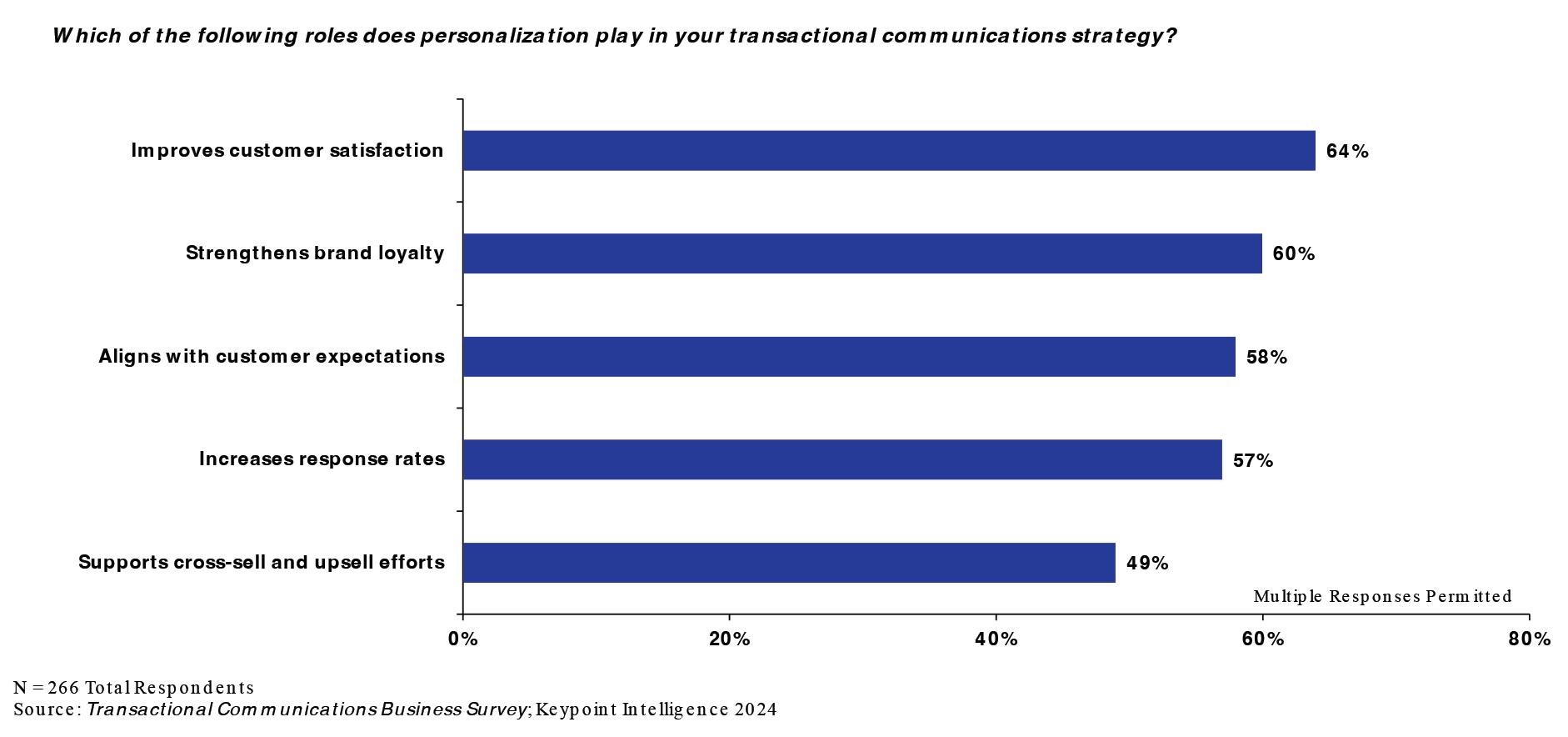
According to Keypoint Intelligence’s research, personalization has emerged as a top strategic priority among CCM leaders. No longer just a marketing tactic, personalization transforms communications into genuine customer connections. When paired with intelligent automation, personalization becomes even more powerful. Automated workflows that connect print and digital channels give organizations the speed and insight to deliver consistent, real-time communications across every touchpoint. Production inkjet technology offers the speed, quality, and flexibility to meet the demands of digital communications, enabling the delivery of personalized content at scale and positioning providers to offer managed communication services, cross-channel campaigns, and data-driven insights that strengthen customer engagement.
So where does CCM go from here, and what must print and mail providers do to stay relevant and profitable in 2026 and beyond? Here are a few tactics.
Security now stands shoulder to shoulder with efficiency and personalization as a top priority for CCM leaders. In fact, nearly half of respondents to Keypoint Intelligence’s research cited
Security in CCM can no longer be treated as a checkbox; it must be a shared responsibility. Service providers, enterprise clients, and technology vendors each play a role in safeguarding sensitive data. Providers must ensure that automation tools and AI-driven workflows follow rigorous access controls, encryption standards, and audit trails.
2. Improve Intelligence through AI and Automation
AI is no longer on the horizon of CCM; it’s at the core. Predictive analytics determine optimal delivery times, while natural-language tools automate message creation, helping organizations deliver with precision and speed. Today’s companies must shift to a unified CCM platform that connects data, content, and channels for consistent, compliant messaging at scale. Fragmented systems slow response times and increase risk.
Automation then takes it further by eliminating manual steps, reducing errors, and freeing teams to focus on higher-value work. For print and mail service providers, embedding AI into production planning, quality control, and content management unlocks new ways to stand out and boost profitability.
3. Create Partnerships that Drive Value Enterprises increasingly want communication partners that do more than print or mail — they want experts who can help design, manage,
and measure the entire customer communication lifecycle. By offering managed CCM services, consulting on workflow automation, and guiding clients through customer journey mapping, print and mail service providers can help organizations align every touchpoint with a consistent brand experience.
Providers that combine these strategic capabilities with communication analytics can shift their role from vendor to trusted partner. Those who make this shift will become indispensable allies in helping organizations modernize their communication strategies without adding internal complexity.
While technology is at the heart of CCM’s evolution, the true goal remains human: to make every customer interaction meaningful, consistent, and clear. In 2026 and beyond, CCM will be shaped by how well organizations consolidate and update disparate platforms, leverage data, and use automation to communicate with empathy and precision.
For print and mail providers, the path forward is clear: Invest in intelligence and integrate digital. By combining trusted print expertise with digital fluency and consultative value, service providers can secure their place in a connected, customer-centric future one communication at a time.
Karen Kimerer of Keypoint Intelligence has experienced the many challenges of expanding current market opportunities and securing new business. She has developed a systematic approach to these opportunities, addressing the unique requirements of becoming a leader in our changing industry.
BY MIKE PORTER
I’ve been involved in producing bills, statements, notices, and other types of transactional documents throughout my career, and I write about those customer communications often in this column. Over the decades, we’ve done much to improve many aspects of design, composition, production, and distribution of customer-facing materials. I wonder if we’ve reached the pinnacle of achievement for transactional documents on paper.
It may be time to take a step away from traditional thinking about transactional documents and imagine a different approach. The future will certainly include digital delivery, and transactional documents are likely to be highly personalized and interactive. Bill and statement presentation will surely differ from the static account status documents the mailing industry has perfected over the years. Companies with experience in creating and distributing print-centric transactional documents should consider how they will handle what comes next.
I know that sounds alarming. I’m not suggesting that paper documents will disappear anytime soon. However, most utility companies, insurers, and financial institutions, which have historically been the clients of print/mail service providers, will probably switch to digital-only communications as soon as conditions allow
it. This transition has already occurred in many countries outside North America. The nature of printed communications limits the contribution paper bills and statements can make to customer experience (CX), a major focus of companies today. If companies choose to use transactional documents to advance their CX objectives, they may see paper documents as an inconvenient channel. As technology continues to advance and consumer expectations and behaviors evolve, the volume of printed and mailed transactional documents will continue to fall.
Paper documents will be with us for quite some time, though. They still offer advantages that are not available through digital channels:
The power of touch – Digital documents cannot offer the personal interaction humans have with a physical document. Organizations should not overlook the impact of a tangible mail piece.
Digital overload – The sheer volume of digital messages aimed at consumers makes it difficult for them to notice and act upon important documents like bills, notices, or invoices if they are buried in screens full of emails or texts. Transactional documents delivered via postal mail will stand out in comparison.
Compliance – Some organizations must deliver documents via postal mail to meet legal and regulatory requirements. Mailed notifications will probably always remain as a backup channel, should digital communications with an individual bounce back as undeliverable or unopened.
Customer preferences – Some consumers are not wild about being pushed towards digital transactional documents. Organizations that give their customers a choice can address individual concerns about digital accessibility, security, and comfort by continuing to offer postal mail as an available communication channel.
Effectiveness - Bills and other important documents delivered via postal mail get opened over 90% of the time. They are effective ways of communicating with customers and can be an excellent means of exposing customers to personalized marketing messages.
In the not-too-distant future, new transactional documents may include more functionality than their paper predecessors and surpass the characteristics of digitally delivered PDFs or HTML. It’s not the delivery method that will be important but the intent to build these documents as positive customer engagement tools. Companies may compose transactional documents using individual customer demographics, customer activity data, and other information to approach the customer with a more immersive experience. Recipients of these communications will do more with them than just check the status of their accounts.
Technologies featured in digital transactional documents could include personalized video, interactive elements like sliders and graphs, custom calculators, self-service capabilities, hover text to offer explanations, educational opportunities, payment portals, and online chatbots. A summary statement would include clickable links to display transaction details on demand. Once a customer takes an action, like paying a bill, the document may instantly update to show their remaining balance or offer financing terms based on their balance, buying history, and credit rating.
A big change in transactional documents would be making them
bidirectional. Customers with questions, comments, or requests (including additional purchases or upgrades) could initiate the transaction without leaving the monthly bill and logging into their account on the company’s website. Because interactive digital documents are not limited by space, customers may have options to access other resources such as FAQs or billing history. The customer experience would be similar whether the customer accessed the document via a PC, mobile phone, or tablet.
As consumers invoke AI agents to handle daily tasks, transactional documents are a likely target. A consumer may want their AI agent to analyze their monthly bills, categorize expenses, pay bills from their bank accounts, issue alerts, and set calendar reminders, for instance. A
paper bill does not lend itself to that kind of automation. This may convince more customers that digital bills are a better fit for their busy lives.
Will the AI agents be successful in extracting all the information they need from a static PDF? Probably not. Companies that issue the bills will want their service providers to distribute electronic documents compatible with the AI agents their customers want to use. This service could be a new revenue opportunity for companies that are already experts in customer communication.
The business of printing and mailing transactional documents will eventually give way to digital alternatives. The number of paper documents to be created will continue to shrink — we just don’t know how fast.
With AI, we’ve seen how rapidly a new technology can have wide-ranging effects on how organizations and individuals conduct their daily lives. The same could happen with traditional bills, statements, and notices delivered via the mail.
Companies built to process paper transactional documents should be prepared to participate in modern customer communication or be satisfied with their piece of a perpetually diminishing slice of the paper document pie.
Mike Porter at Print/Mail Consultants and PMC Content Services creates content that helps attract and retain customers for companies in the mailing and document industry and he assists companies as they integrate new technology. Learn more about his services at www.pmccontentservices.com. Follow @ PMCmike on X, or send him a connection request on LinkedIn.

BY MAX CLARKE
How much mail actually goes missing annually in the States every year? We sent a FOIA to USPS to help us figure it out. This is what we found.
Between 2022 and 2024, 356 billion pieces of mail were handled by USPS. Of that volume, only 542,000 pieces of mail were lost or went missing in the same timeframe. This means that only 0.00015% of mail is officially lost or goes missing. The actual number is likely to be higher, but even if just by 10%, it would still be relatively small compared to the total volume handled by USPS.
We also found that the amount of lost or missing mail has trended up between 2022 and 2024. In 2024, 177,748 pieces of mail were reported as lost or missing, representing a 12.8% decrease from the 2023 figure, but an increase of 10% compared to 2022.
As you’d expect, not every area has mail lost or go missing at the same rate.
In absolute numbers, California has the most mail lost and missing. However,
when we looked at volume by residents, we found that the District of Columbia has the highest rate of lost or missing mail per 100k residents.
In terms of cities, Los Angeles, Chicago, and Brooklyn had the most lost or missing mail, losing more than 3,000 pieces per city annually.
We had expected to get a clear view of the amount of mail stolen, but the closest data tracked by USPS is “lost after delivery.” You can take this as a proxy for which areas have the most porch pirates, but it’s worth keeping in mind that the actual numbers are likely to be far higher.
We found that Chicago, IL, had the highest number (2,838) of “after delivery” lost or missing reports, averaging 946 reports of mail going missing after delivery per year, and 78.8 per month.
Brooklyn, NY, had the second-highest rate, followed closely by Los Angeles.
The actual volumes of mail lost in the US between 2022 and 2024 are likely to be
higher than what we found in the USPS data for three reasons.
Firstly, reporting lost mail is an onerous task and one that many people are likely to avoid. In many cases, it’s probably simpler to just send mail again.
Secondly, when mail is unexpected, its loss can easily go unnoticed. Think of bills and junk mail sent by post. Most people won’t notice when they don’t turn up.
Thirdly, there’s little incentive to report stolen mail to USPS as they have no capacity to find or compensate for it. As such, mail that is stolen aka ‘lost after delivery’ is likely to be massively underreported.
Regardless of the total volume lost annually, if it’s your piece of mail that goes missing, it’s always a big deal. What can you do to avoid mail being lost or stolen? Recipients can take some steps to keep their incoming mail safe.
1. Ensure you have a secure, locking mailbox for deliveries, as well as a safe place for parcels and larger packages.
2. Consider using a PO box or virtual mailbox to ensure packages are recorded and received.
3. If you’re away, make use of the USPS ‘Stop Delivery’ service to delay mail drop-off while you’re not at home. Or, speak with neighbors you trust and arrange for them to pick up your mail.
4. Ask senders to put tracking on your mail so you’ll know for sure if it goes missing. This also expedites the process of claiming mail as missing with USPS.
Max Clarke is the co-founder of Postal, the first AI-native virtual mailbox for business. Max co-founded Postal after struggling with too much incoming mail at a previous company and not being able to find a modern, secure solution. Curious if your state, city, or ZIP Code is a hot spot for lost or missing mail? Read the full study to see how much mail was lost or went missing in your area (and to view the methodology) by visiting https://www.usepostal.com/blog/u-s-areas-with-most-missing-lost-stolen-mail.
The Two Sides Trend Tracker is a biennial global survey and one of the most comprehensive studies into the consumer perceptions of print, paper, and paper-based packaging.
In its latest edition, the survey company, Toluna, gathered responses from 12,400 consumers across 17 countries, including the United States, Canada, South America, South Africa, and Europe, offering valuable insights into global attitudes towards paper-based and digital communication.
Across North America, a growing number of organizations are encouraging customers to transition from paper to digital communications, often citing environmental benefits. However, many of these claims lack evidence and fall under the definition of greenwashing — the use of misleading environmental messaging to justify cost-saving decisions.
The Trend Tracker survey reveals that 64% of US consumers recognize the primary motivation for service providers switching their customer communications to digital is to reduce costs, not to help the environment, an increase from 57% in 2021. Furthermore, 74% believe
they should not be charged more for choosing paper bills or statements.
The right to choose remains important for many consumers. Eighty percent of US consumers agree they should have the right to choose between paper and electronic communications, especially when dealing with financial and service providers. This choice is not only about preference but about accessibility, ensuring that those who cannot easily access digital services are not left behind.
As digital communication becomes increasingly dominant, concerns about its long-term impact are growing. The Trend Tracker results reveal unease and growing concern among consumers regarding issues such as data security, digital fatigue, and the potential health risks associated with excessive screen use.
65% of respondents worry that personal information held digitally is vulnerable to hacking, theft, or loss.
54% feel they spend too much time on digital devices.
48% are concerned about potential health impacts from excessive screen time.
There is also a widespread assumption that digital communication is more environmentally friendly. However, the environmental footprint of digital infrastructure is significant and often underestimated. The energy consumption required for digital technologies is increasing by six percent each year and makes up a significant portion of global emissions (~3.5% in 2021).
Additionally, the issue of electronic waste is escalating. In 2022 alone, the world produced a record 62 million metric tonnes of e-waste, of which just 22.3% of global e-waste was collected for recycling. Recycling activities are not keeping pace with the global growth of e-waste. The non-environmentally sound disposal and treatment of this waste stream pose significant risks to the environment and human health.
The Role of Print in a Balanced Media Landscape
“We recognize that both paper and digital communications play an important role in our everyday lives. They each have their role and complement each other,” says Jules Van Sant, Executive Director of Two Sides North America. “Consumers have shown they want a choice, and it is crucial that people are not misled into thinking paper is not sustainable and that digital is inherently better for the environment than paper.”
Two Sides actively challenges organizations that use unverified and misleading claims, such as ‘Go Green, Go Paperless’, to push digital-only communications. These messages not only mislead consumers but also unfairly damage a North American forest and paper industry that supports 925,000 jobs in the US and millions throughout the supply chain.
An executive summary of the Trend Tracker Survey 2025 was published in July and is available to industry stakeholders upon request. Visit to register your interest in receiving this summary at https://twosidesna.org/ trend-tracker-2025/. The full report, which provides regional data broken down by age and gender, is available exclusively to Two Sides members.

BY CHRISTOPHER LIEN
In 2025, we celebrated the 250th anniversary of mail delivery in the United States of America. Certainly, much has changed since the time of Ben Franklin. However, 2026 may be one of the most transformative years as physical and digital direct marketing continues to converge, and the USPS dynamically adjusts its postal delivery network to respond to declining mail volumes and rising delivery costs.
We kick off January and February of 2026 not with another major price increase, but rather a tentative sense of optimism as the USPS promotions increase to an appreciable five percent to 7.5% for various First-Class and Marketing Mail incentives. USPS incentives are not new, but there is no question there is a renewed interest as direct marketers are rethinking their strategies to leverage direct mail as a foundation for multichannel marketing. This includes the Informed Delivery service from the USPS, which has now reached an impressive 35% saturation of eligible deliveries as of August of 2025. This digital impression of a physical mail piece is a powerful and affordable way for direct marketers to take advantage of omnichannel marketing campaigns.
While the industry focuses on leveraging USPS promotions and incentives, they are also keenly aware that what could have been a major January price change is simply deferred to July of 2026. Thus, the Annual Compliance Report and Determination (ACR and ACD respectively) will be critical as we enter March and April of 2026. The ACD is the Postal Regulatory response to the USPS ACR filing and sets the rate authority, including the density adder, for the USPS to file a price change in mid-April. Current estimates are that the price increase will be somewhere in the range of 5.5% to six percent depending on the Consumer Price Index Urban rate (CPI-U), which forms the rate basis for the USPS. Much is at stake with the 2026 ACD as it also computes how industry workshare is helping to reduce USPS costs and thereby results in a postage discount. Workshare discounts will be critical for the mailing industry to
carefully analyze as the USPS seeks to implement such major changes as zone rate pricing for Marketing Mail and their continued rollout of DFA inspired network changes.
Less than a month after the USPS files what could arguably be the most significant rate case since 1997, the USPS and the industry will gather for the National Postal Forum in Phoenix, AZ from May 3rd through the 6th. NPF is the largest annual gathering of the mailing and shipping community and boasted an impressive attendance of 5,700 people at the Nashville event in 2025. Nearly 50% of the attendees at the Nashville forum were there for the first time, so education and networking will be critical as we rally to prepare for the July price change. Thankfully, venues and initiatives such as the Postal Customer Council (PCC), Areas Inspiring Mail (AIM), industry associations, and even the NPF begin to offer more year-round education and engagement opportunities.
While the industry will spend much of June finalizing software and attempting to determine what, if any, unintended consequences may arise out of the impending price change, July and August will be the real crucible for the mailing industry. Those mail service providers who have implemented advanced automated mailing workflows, scrubbed their customers’ mailing lists from undeliverable as addressed mail, and fully leveraged USPS incentives will be prepared to survive the changes ahead. Those that are unprepared may very likely exit the market or be absorbed as mergers and acquisitions increase at an even higher rate.
September and October of 2026 will focus mostly on network changes as logistics experts work quickly to finalize distribution and entry plans to strategically induct mail into the USPS revised network to further reduce postage and improve delivery service. If the USPS implements zone-based pricing for Marketing Mail, this will result in the industry zone skipping. Zone skipping is a concept whereby industry will change the origin entry to an induction point closer to the final destination, thus reducing what might be a Zone 4 down to a Zone 1price. The concept has existed for Period-

ical Mail for decades, but applying this concept to Marketing Mail would be something very new and it’s still questionable how the USPS might respond to this.
Early November of 2026 will be all about vote by mail, and the expected contentious midterm election will certainly be a major test for both the USPS and our nation as a whole for election accuracy. And the postmark date, which was recently clarified by the USPS, may be a concern. Historically, the understanding from most Americans was that the postmark date on a mail piece reflected when the USPS began processing the mail. However, with changes to the USPS processing network, the date now simply means when the mail was received by the USPS and not when it began processing it, which would be several days later. That clarification needs to be fully understood by mailers with respect to these time-sensitive mail pieces, such as ballots, counting in an election. Hopefully, election officials are aware and changes if necessary are in place by the midterm elections.
As we end the calendar year of 2026, we most likely will see our postal partners still struggling with cost coverage due to declining and changing mail volume. While it may be true that the value of the mail piece will increase throughout 2026 due to enhanced attribution and response rates, that doesn’t necessarily translate to justification for the USPS to raise prices. Could we see Congress pass postal legislation in 2026 to help ease the challenges of the universal service obligation for the USPS? Not likely. If anything, 2026 could provide the basis for the next Congress to contemplate some type of subsidizing legislation to ease the USPS burden of cost coverage and USO. Thus, it is imperative for both the USPS and the mailing industry to continue this public private partnership of working together to innovatively leverage workshare opportunities, improve the value of mail, and bind the nation for another 250 years.
Christopher Lien is EVP Postal Affairs for BCC Software.

The rise of Artificial Intelligence (AI) to generate content has been in a lot of headlines. Writers are concerned that they may be replaced by AI-created material, and artists are worried that they will be replaced by computer programs. Recently, a company released a small film with an “AI Actor.”
However, generative AI, like the examples above, are just a small part of the picture. In this article, we’ll discuss what AI actually is, the history of AI, how businesses are deploying AI, and most importantly, how AI is impacting print and mail.
I thought it would be fun to ask “AI” to explain what it is. So, I put the query to two of the most popular generative engines, ChatGPT and Claude. ChatGPT responded: Artificial intelligence is the simulation of human intelligence processes by machines, especially computer systems, to perform tasks such as learning, reasoning, and problem-solving.
Claude has a very similar response: Artificial intelligence is the development of computer systems that can perform tasks typically requiring human intelligence, such as learning, reasoning, problem-solving, and decision-making.
They both sound correct, but there’s a simpler answer: AI is when machines use computerized systems to do things that appear intelligent. I use this definition because the meaning of the word “intelligent” is still being debated among scientists, philosophers, and academics.
AI isn’t new, but has been part of our lives for almost 50 years. In the 1970s, doctors were using AI systems to assist with medical diagnosis. A decade later, scientists developed programs to handle the scheduling of arrival and departure gates at airports. IBM’s Deep Blue computer beat the reigning world chess champion, Garry Kasparov, in a six-game match in May 1997. In the dawn of the 21st century, there was an explosion of AI applications with the development of neural networks and smartphones.
If you’ve used a language translation program or a mapping application that reacted to traffic conditions, then you have already used AI.
Businesses are expanding the use of AI in multiple areas. Robots aren’t used for dancing or parkour tricks, but actively act as “assistants” in production and warehouses. Drones are used to move product from shelves to shipping. Generative AI can assist with research, including creating tables to compare vendor offerings.
The area with the fastest growth is agentic AI — systems that can autonomously pursue goals by planning, making decisions, and taking actions with minimal human intervention. Chatbots act as customer service staff, answering basic inquiries. Data analytics are used to identify predictive behavior, resulting in better forecasting. Inventories are monitored, with resupply orders automatically placed with vendors offering the best pricing and shipping terms at that moment.
And the best tools to counteract people using AI to launch cyberattacks? AI

BY MARK FALLON
software designed to defend servers and data.
Inbound and outbound mail operations are being impacted by AI on multiple levels. Inbound documents can be scanned and interpreted through AI-driven optical character recognition (OCR) software. That includes structured documents like tax forms, as well as unstructured documents like handwritten letters to customer service.
From there, a different type of robot takes over. Robotic Process Automation — or RPA — can route the documents to the correct person. More sophisticated RPA software can enter the information directly into the company’s workflow system and begin to take action. Claims can be set up and even approved without any human intervention (this isn’t new — I wrote scripts for an RPA system in the 1990s that processed glass claims for an automobile insurance company).
A constant challenge for print-mail operations is managing workload. Making sure all equipment in every step of the process is used to maximum efficiency. At the same time, work has to be scheduled in such a way that service level agreements (SLAs) are met. New planning software uses AI to analyze incoming files, all the variables regarding equipment and paper
stock, then creates workflows to ensure all jobs are completed on time, and in the most cost-effective manner.
Those schedules rely on equipment working properly. Printer and inserter manufacturers are using AI-powered sensors to monitor equipment status. Color print quality can be measured through cameras using AI algorithms. Through secure internet connections, the machines can place service calls — before parts actually break down.
The US Postal Service is promoting ways to use AI to achieve postage savings, specifically in the 2026 Integrated Technology Promotion, which can be used to receive a five percent postage discount. Two options under the promotion include AI. Mailers can create mail pieces that include copy or images that were created by leveraging generative AI tools. These tools may include, but are not limited to: Adobe Firefly, ChatGPT, or Microsoft Copilot.
With all these opportunities, managers need to be thoughtful about the first steps into the world of AI. Begin with the Information Technology (IT) department in your organization. Find out what tools and sites have been reviewed and approved. There are too many bad actors who want to cause harm through viruses embedded in documents and images. Only go where it is safe.
Next, meet with your legal and compliance departments. Find out what information can be loaded into an AI engine. There are legal and regulatory requirements that must be followed to protect data privacy. Further, there are governance rules around data retention. In many cases, no company or customer data can be uploaded to a public AI website.
As mentioned above, many vendors have already integrated AI into software and hardware. Meet with current and prospective vendors and ask about their current and future plans. Go beyond the marketing hype. Ask the question, “What makes this AI?”
Spend time researching on your own. Every week, set aside at least one hour to read articles, attend webinars, or meet with consultants. If possible, sign up for a course with a local or online college or university. AI represents a technological shift that rivals the worldwide web. Knowledge is key.
Throughout all of this, remember that AI is neither a panacea nor an existential threat to humankind. Most business applications are in the early development stages. Just
as many websites were built — and then disappeared — 25 years ago, many AI tools won’t last more than a few years.
When considering AI, think of the applications as additive tools, not replacements. For example, internet shopping is additive. Successful retailers haven’t closed their physical stores. They supplement the physical world with the digital experience. I can order books online from my favorite independent bookstore, and I can also spend a Saturday afternoon browsing the shelves to discover new authors.
AI programs are written by humans — who are biased. That bias can be cultural, racial, even technological. Errors — known as hallucinations — can easily be accepted as fact. There are already public reports of law filings with fake citations. And there is a new term to learn, “slop” — easy to make faux-realistic posts. It has become the new “spam” in our social media feeds.
AI has been proven to help boost performance. It has a similar effect to working on a team with smart people. However, AI also negatively impacts morale and increases boredom. Managers need to help employees understand how the new tools can help them do their jobs better — just like we had to explain to accountants 30 years ago that spreadsheets could help them be more accurate and productive.
It’s important to embrace AI with a sense of optimism. These new tools represent another step in the evolution of computer technology. Robotics help reduce the physical limitations of workers. Systems generate massive volumes of data daily, and AI tools offer the best way to analyze that data to help drive informed decisions.
Humans will always have the edge. A robot (software or hardware) cannot:
Look you in the eye
Consider the feelings of the other person
Make a person feel truly seen or heard
Feel empathy or sympathy
For thousands of years, technology has led to improvements in society. From the wheel, to writing, to the printing press, to computers, to the internet — and now to AI. While we embrace change, we also have to ensure that our humanness remains an equal part of our progress.
Mark Fallon is President & CEO of The Berkshire Company. Mark helps his clients develop solutions using emerging technologies and expert leadership. He can be reached at mmf@berkshire-company.com.
Taking a closer look could save you substantial sums.
By Adam Lewenberg

Iam going to start with a blanket statement based on years of customer research: 99% of medium to large organizations are overspending on mail. You may doubt this statement or even be self-righteous about how you are managing this today, but ask yourself the following three questions.
1. Do you have complete visibility of all the categories in the chart below (Figure 1) for all areas throughout your organization?
2. Is there a process to review these areas with a team with the proper expertise to create change?
3. Is there a way to maintain the mailing data to make sure best practices are occurring?
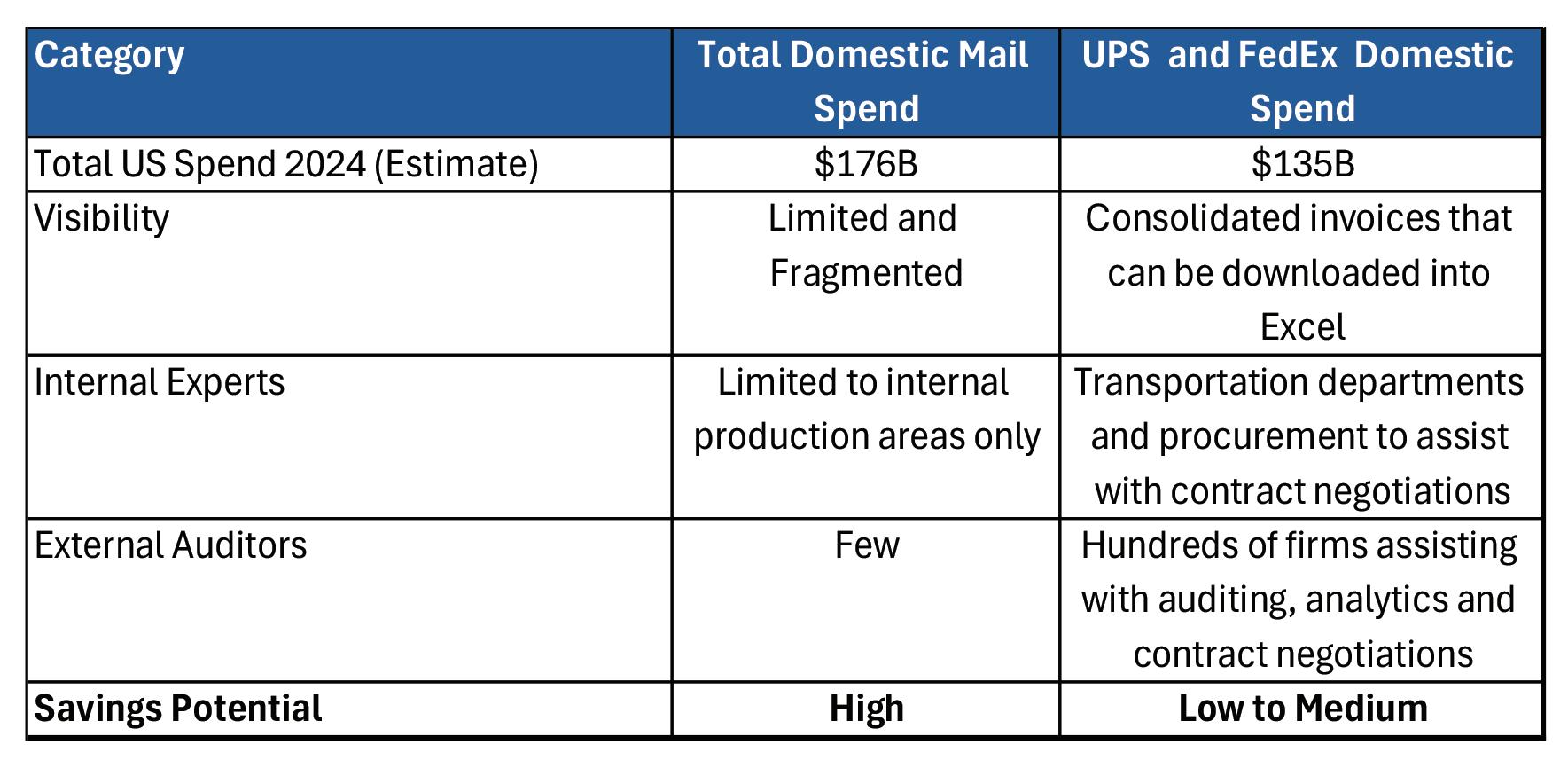
Mail is typically the largest category where there are not the specific controls in place to reduce costs. Organizations are spending an estimated $176 billion annually, and postage alone increased a staggering 35-74% over the last four years. This is larger than UPS and FedEx combined (see Figure 2), which has
teams of internal transportation experts and hundreds of outsourced organizations supporting clients to better manage the spend.
Because there has been so little review of mail, the savings can be much greater than other categories. In this article, we will discuss how to put these controls in place and the benefits of having professional auditing services like those used for most other similar value categories.
As more mail has moved to outsourced print and mail services, people with exper-
tise inside organizations have dwindled. Even if there are staff who understand parts of mail, they are typically only managing a single location or workstream. This means that you must rely on the vendor providing the services who may not always have your best savings interests.
The biggest issue is with outsourced print, mail, and presort services. This is due to the client negotiating the agreements being at a disadvantage to the provider, who has a higher level of expertise and industry exposure. There is seldom the ongoing review required to audit invoices against agreement terms or
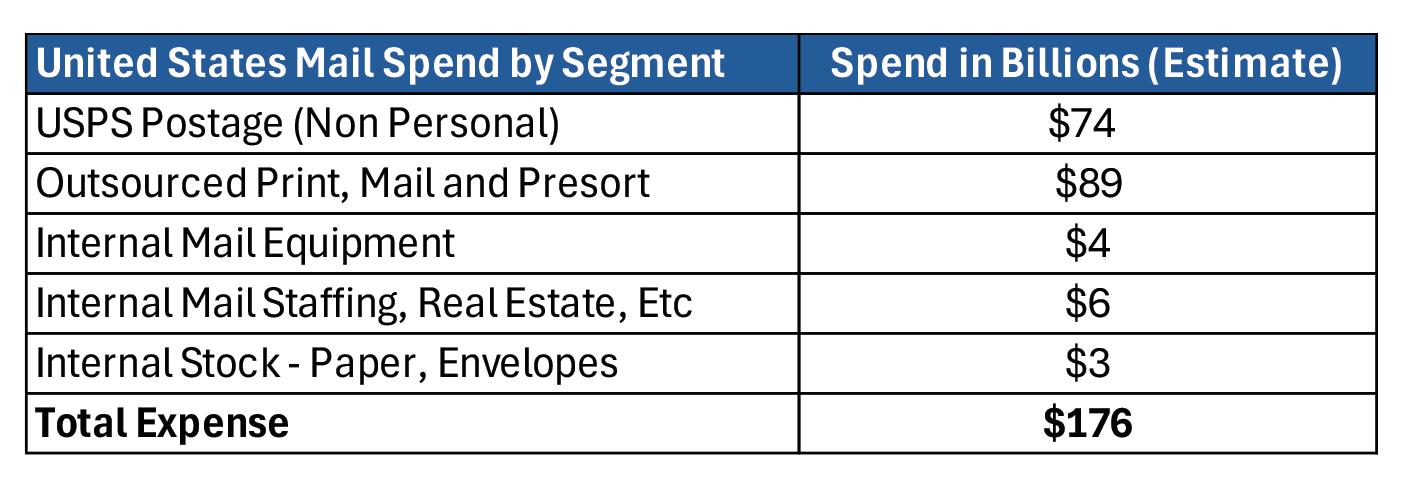

Organizations are spending an estimated $176 billion annually, and postage alone increased a staggering 35-74% over the last four years.
The main reason for overspending is that there is this lack of visibility inside any organization. Mail is fragmented around different groups, locations, accounts, projects, and vendors, making it difficult to centralize the information. The main area of mail spend is USPS postage (non-personal), which is broken out into multiple categories and mail classes. The bulk of the spend will be in one of the following:
changes in business or postal rules. This is dangerous because it is the largest segment of mail expenses.
There are over 100 ways to reduce mailing costs. Without the proper level of expertise, it is impossible to identify and then manage the changes needed to optimize this category. If you do not have this skill internally, consider third-party organizations that can manage this for you.
USPS Permit Accounts – Larger mailings are funded with direct USPS accounts. These are fragmented because there are different groups controlling their own USPS relationships, infrequently linked to a master postage funding model. For example: Statements are processed by one account, business reply accounts are at the office level, and marketing mailings are
managed by third-party vendors that are preparing the mailings.
Postage Produced in Office Locations
– This will be done through postage meters, online postage tools, or direct purchases from the USPS. Most organizations have not put in any controls to manage this spend area with any central visibility and expertise.
Outsourced Print, Mail, and Presort Services – This can be one of the worst categories because there could be one to 50 different service providers used. There is no standardized data format, and most information is received from PDF invoices that are difficult to transpose. There is also huge variability in the fees and level of detail provided by each vendor.
Mail Equipment – Offices may make their own decisions on equipment and are responsible for funding their own postage. There may not be a central owner who is managing this category, and even those that do may not have decent reporting or any centralized invoicing.
Internal Processing Costs – There is a cost to having internal teams process mail that is typically not measured. This has to do with the staff, real estate, and material expenses (such as envelopes and paper).
Most organizations have no way to control the data above and, at best, they are managing it on spreadsheets. To be most effective, the data needs to be stored in a central repository, in a standardized format, so changes can be measured over time.
My firm manages the enterprise mailing and shipping spends for the largest organizations in North America and we have set up a specific methodology to pull this data together, which we will share below. We have found this process to be the easiest and fastest way to collect data, with the highest level of accuracy, while involving the fewest people.
1. Identify your current vendors - The main vendors that should be searched are: a. Mail Equipment – Pitney Bowes, Purchase Power, Reserve Account, Quadient, Hasler, Neopost, Neofunds, Total Funds, Mail Finance, QPF, FP, Francotyp-Postalia, Postalia, Stamps.com, Endecia.com.

b. USPS – USPS, United States Postal Service, Post Office, Postmaster, US Postal Service
c. Outsourced Mail Services – You should survey your main mail center, marketing department as well as the accounts receivable department to see what third-party mail services are being used.
d. Expedited Document and Parcel Shipping – UPS, United Parcel Service, FedEx, Federal Express, and DHL are the primary vendors used by most organizations.
2. Work with Accounts Payable – In most organizations, most of the mail spends will be paid by an invoice that flows through a central accounts payable department. Pull a report of the last 12 months of spend from the vendors above. We recommend using a wildcard * or % before or after the names of these vendors in case it is listed differently inside your system. This spend should be sorted by vendor and then cost center to find the unique relationships. You will see many duplicates as you are paying for similar services throughout this period. Find one or two invoices from each vendor and cost center combination and request PDF copies of the bills. This is needed because you will not have enough information in the Excel export to understand the relationship. From the specific invoice, you will be able to pull the following: Location address, account number, service description, and agreement terms.
3. Go to your largest vendors and see what support they can provide. This is the type of support that we typically find:
a. USPS – You can link the identified spends to a centralized visibility account on the USPS Business Customer Gateway. This can provide you
with the details of the specific transactions processed, balances, and accounts serviced.
b. Outsourced Print, Mail, and Presort Services – Request copies of agreements and invoice, as well as access to their client portals.
c. Mail Equipment – They can either provide you a report of their identified spends or you can take the information that you gathered and create a profile on the vendor’s website. This will provide visibility to the equipment and postage spends throughout your locations. You can also request copies of agreements and end of lease dates where required.
d. Expedited Document and Parcel Shipping – The carriers should be able to provide you consolidated billing details, as well as annual reviews of the total corporate spends.
Postage costs have surged by 35–72%, representing a multimilliondollar expense category for many organizations.
4. Build a central repository for the information – With the way that postage, equipment, and services link, it is best to have a web-based platform that can view these spends together in one place. If this is not possible, you can build a spreadsheet model that would suffice.
5. Update the data – The information is only valuable when it can be updated easily so you can monitor the changes over time.
Savings Gained Through Auditing These are the main savings areas we typically find once the data can be viewed in a centralized format:
Postage Discounts – There are dozens of savings options based on your specific type of mail.
USPS Promotions, Incentives, and Rebates – At any one time there are five to 10 programs offered by the USPS to help mailers reduce costs.
Mail Class Optimization – Making slight changes in the way mail is processed can lead to dramatic savings.
USPS Negotiated Service Agreements – If your volume is high enough, you may qualify to have your own direct agreement with the USPS offering preferred rates. If it is not, you can piggyback on contracts that are already in place by other partners that can be made available.
Outsource Print, Mail, and Presort Service Savings – One of the highest areas of savings based on the variability in rates and this being one of the largest spend areas of mail.
Mail Equipment Savings – We average 74% savings, and you can get the same on your side by being proactive.
Dormant Postage Recovery – Postage prefunding is often forgotten and with the right oversight can be recovered and better managed for the future.
Carrier Optimization – UPS, FedEx, and USPS are typically not a single source solution. Having tools to compare these at the moment of shipment can drastically reduce costs.
Postage costs have surged by 35–72%, representing a multimillion-dollar expense category for many organizations. Yet in many cases, visibility and oversight remain so limited that leaders may be unaware of the true impact — or feel powerless to address it. Mail doesn’t have to be the least managed category. With the right strategies, tools and resources organizations can regain control, simplify oversight, and uncover meaningful savings.
Adam Lewenberg, CMDSS, MDC, President/CEO of Postal Advocate Inc., runs the largest Mail Audit and Recovery firm in the United States and Canada. They manage the biggest mail equipment, postage and mail related services portfolio in the world. Their mission is to help organizations with multi-locations and mail streams reduce expenses, recover lost postage funds, and simplify visibility and oversight. Since 2011, they have helped their clients save an average of 74% and over $103 million on equipment, postage, shipping and outsourced mail service fees. He can be reached at 617.372.6853 or adam.lewenberg@postaladvocate.com.

The Picture Perfect Match System is your solution for retrofitting your existing inserter for mail matching, bar code verification, end of machine verification, and Read and Print using one to four cameras. The system can be purchased as a low-cost visual match system or upgraded to a smart OCR or Barcode system that will stop the inserter automatically. Barcodes include IMB, Data Matrix, and QR along with many more. The OCR is a non-teaching system. The smart systems writes the results to a file for proof of mailing and quality assurance. All upgrades are modular so you only pay for what you need.
https://clearimagetechnologies.com

Engineering Innovation Inc. (Eii) offers robust mail sorting solutions that streamline returns, especially during peak periods. The Champ™ system, designed for precision and reliability, handles high volumes of mail with ease, reducing manual labor and processing time. By efficiently sorting mail and mitigating potential jams or misreads, The Champ™ ensures a seamless workflow that supports return operations.
Complementing this, Eii’s Apian Sort™ cloud-based software provides real-time data insights and seamless integration with existing systems, further enhancing efficiency in mail processing. Together, these solutions enable businesses to manage returns more effectively, reduce operational costs, and maintain customer satisfaction throughout the year.
www.apiansort.com | 765.807.0699 | sales@eii-online.com

From small runs to full-scale production, Kern USA delivers mail and card solutions that work as hard as you do. Our inserting systems, card fulfillment technology, and integrated software are built for precision, speed, and reliability, backed by responsive US service and Swiss engineering excellence. Whether you’re processing daily mail, managing transactional output, or handling secure card operations, Kern provides scalable systems that adapt to your needs. With a focus on quality, partnership, and performance, Kern keeps your operation running efficiently every job, every day.
USA | www.kerninc.com | info.usa @kernworld.com

Why MCS for your inkjet solutions? Since 1991, we have been setting the standard in inkjet solutions, bringing over 30 years of proven success in the mail manufacturing industry. Our comprehensive suite of products and services comes from a single source, ensuring that we offer the most extensive portfolio of solutions available in the industry. We take pride in the strong relationships we have built with more than 80% of the marketing mail market. To maximize efficiency, we provide one unified workflow, along with multiple ink options, including water-based and UV inks.
www.mcspro.com | 800.728.0154 | sales-team@mcspro.com

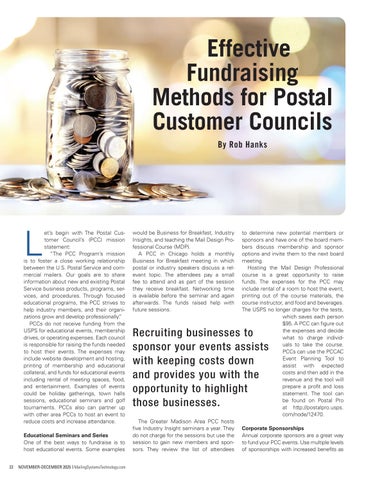
Let’s begin with The Postal Customer Council’s (PCC) mission statement:
“The PCC Program’s mission is to foster a close working relationship between the U.S. Postal Service and commercial mailers. Our goals are to share information about new and existing Postal Service business products, programs, services, and procedures. Through focused educational programs, the PCC strives to help industry members, and their organizations grow and develop professionally.”
PCCs do not receive funding from the USPS for educational events, membership drives, or operating expenses. Each council is responsible for raising the funds needed to host their events. The expenses may include website development and hosting, printing of membership and educational collateral, and funds for educational events including rental of meeting spaces, food, and entertainment. Examples of events could be holiday gatherings, town halls sessions, educational seminars and golf tournaments. PCCs also can partner up with other area PCCs to host an event to reduce costs and increase attendance.
One of the best ways to fundraise is to host educational events. Some examples
By Rob Hanks
would be Business for Breakfast, Industry Insights, and teaching the Mail Design Professional Course (MDP).
A PCC in Chicago holds a monthly Business for Breakfast meeting in which postal or industry speakers discuss a relevant topic. The attendees pay a small fee to attend and as part of the session they receive breakfast. Networking time is available before the seminar and again afterwards. The funds raised help with future sessions.
to determine new potential members or sponsors and have one of the board members discuss membership and sponsor options and invite them to the next board meeting.
Recruiting businesses to sponsor your events assists with keeping costs down and provides you with the opportunity to highlight those businesses.
The Greater Madison Area PCC hosts five Industry Insight seminars a year. They do not charge for the sessions but use the session to gain new members and sponsors. They review the list of attendees
Hosting the Mail Design Professional course is a great opportunity to raise funds. The expenses for the PCC may include rental of a room to host the event, printing out of the course materials, the course instructor, and food and beverages. The USPS no longer charges for the tests, which saves each person $95. A PCC can figure out the expenses and decide what to charge individuals to take the course. PCCs can use the PCCAC Event Planning Tool to assist with expected costs and then add in the revenue and the tool will prepare a profit and loss statement. The tool can be found on Postal Pro at http://postalpro.usps. com/node/12470.
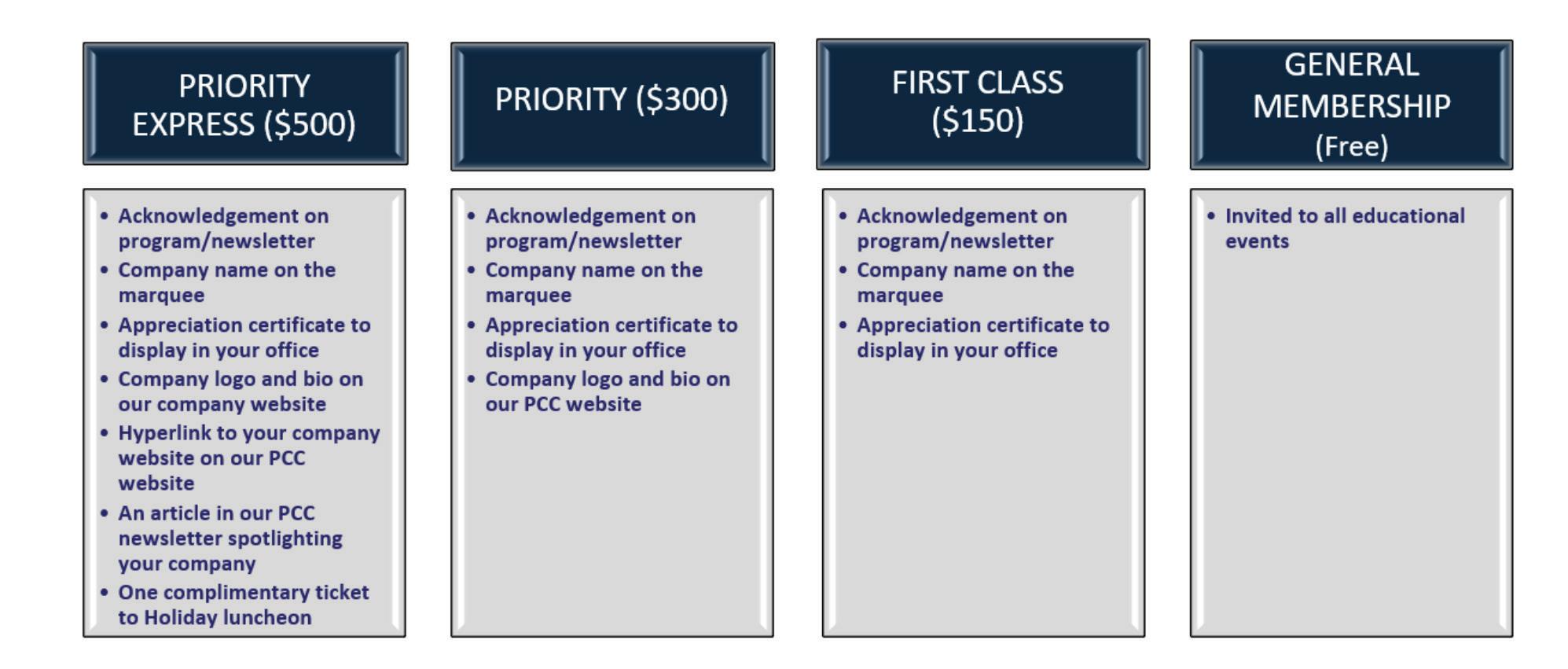
Annual corporate sponsors are a great way to fund your PCC events. Use multiple levels of sponsorships with increased benefits as
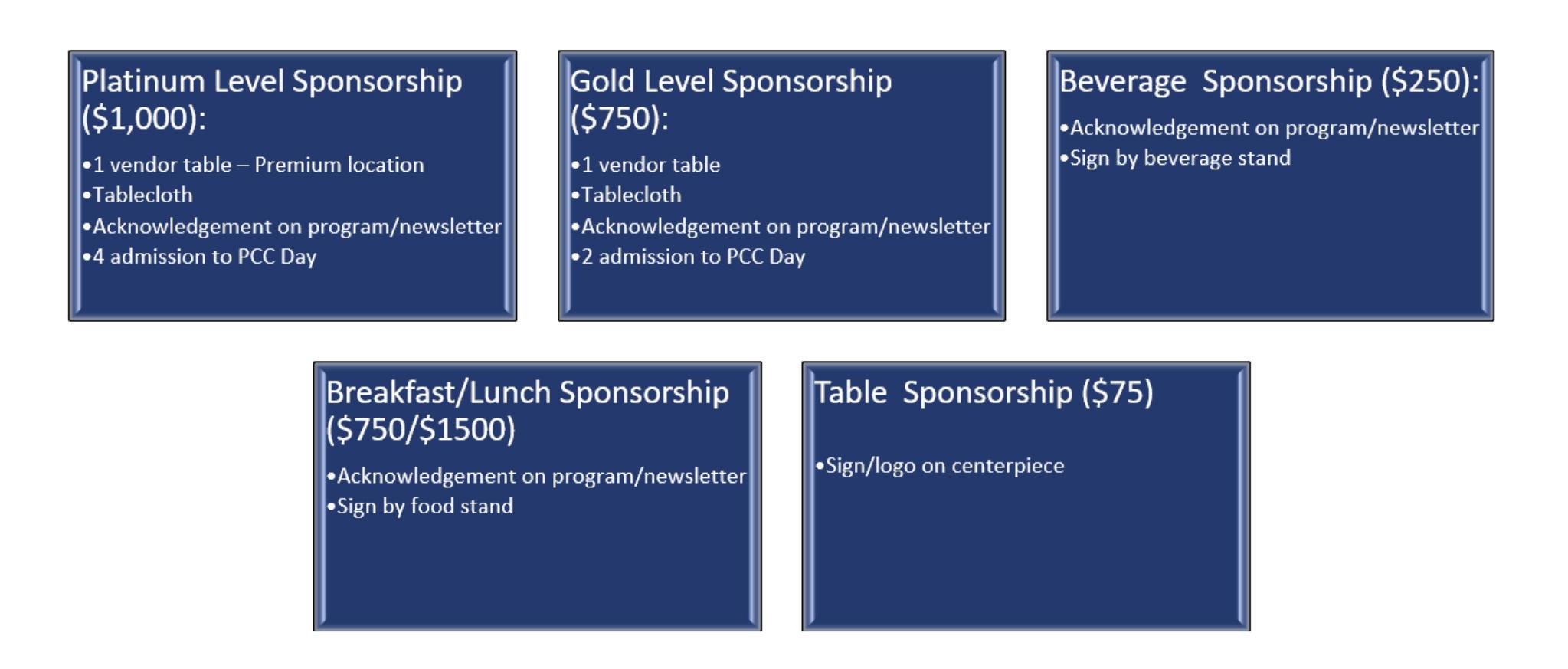
the sponsor levels increase. You can use the same naming convention as the Premiere awards, Platinum, Gold, Silver, and Bronze. Try something a little different like the example below with Priority Express, Priority, First Class, and General. One level that every PCC should have is Time and Materials. This level allows sponsors to donate printing, mailing services, or assisting at an event with registration, set up, or clean up. When developing your sponsor levels, keep in mind the area your PCC is located, the size of your PCC and your membership. If your membership is mainly small to mid-size companies, you will not want to have your sponsorship levels as high as you would if you have larger companies as a member. You do not want to overprice your membership levels as that will drive sponsors away. Be sure to thank your sponsors. A few great ways to do so is to list them on your website, feature them in your newsletter, and have signage at your events.
Recruiting businesses to sponsor your events assists with keeping costs down
and provides you with the opportunity to highlight those businesses. Examples of sponsorships include Hole or Contest Sponsors at golf outings, or Table sponsors at events. Food and beverage sponsors for Breakfast, Lunch, or Beverages and Snacks. Be sure to recognize these sponsors with a call-out during your events, as well as an acknowledgment in your newsletter and on your website. Banners, posters, and signage are also a great way to showcase these businesses. Allow the sponsors to get up during your event and share their company story with your audience. If they are sponsoring a table, have a sign or logo as a centerpiece on the table. Allow your sponsors to set up a table with collateral and be sure to include networking time for attendees to meet your sponsors. If you are unsure of who can or can’t be a sponsor, reference USPS Pub 286 (https:// postalpro.usps.com/node/404).
Now that we have taken a high-level look at some options on how to raise funds, let’s discuss how to stretch those dol-
lars to get the most out of your PCCs fundraising efforts.
Partner with a printer and/or mail house to handle your marketing needs. Your postage is already taken care of by using USPS Permit G-10, so finding a printer or mail service provider to assist with producing your mail piece, processing the date, and addressing and mailing your marketing materials is a huge savings. Also, check with your membership to see if anyone is a graphic designer who may be able to assist with design work. If your designer is a member of your PCC, they should be comfortable in meeting all postal requirements for your mail piece.
Look into free or low-cost venues to host your events. Do you have a member with a large conference room or a training center that is available to host your event? Do you have a college or university that might allow you to use or rent a room at a reduced rate? Does your post office have a room you are able to use? You can also investigate your local library, restaurant with meeting rooms, or a town hall.
This will allow you to split the costs of your event and draw a larger audience. Having a larger audience can also assist you with your request for a USPS speaker. The larger the audience, the USPS will send a higher-ranking executive to your event.
Try utilizing some of these tips for your next PCC event.
Rob Hanks is a sales representative at Suttle-Straus and has more than 30 years of experience in direct mail. Rob is a Certified Direct Mail Professional and a Certified Mail piece Design Professional though the United States Postal Service (USPS) and serves as an Executive Board Member for the Greater Madison Area Postal Customer Council (GMAPCC), as well as the National Educational Co-Chair for the Postal Customer Council Advisory Committee (PCCAC). Rob enjoys the challenges of mail piece design within postal regulations and helping clients save on postage costs.
By Kathleen J. Siviter

In my many years working with the USPS and the mailing industry, I have encountered a lack of education and understanding about the value that nonprofit mail brings — to the USPS, to the industry, and to Americans. I invite you to take a few minutes to look at all the reasons to love and support nonprofit mail.
In 2024, charitable giving in the United States reached an estimated $592.5 billion, which was a 6.3% increase in current dollars (a 3.3% increase after adjusting for inflation), compared to 2023 when charitable giving was $557.16 billion, which was a 1.9% increase in current dollars (but a decline of 2.1% when adjusted for inflation). According to MR Benchmarks, for every $1 raised by nonprofit organizations, about 78 cents was through direct mail. This makes sense when you analyze the demographics of where the majority of charitable donations come from — older Americans, who we know react positively to mail compared to email or social media alternatives.
That doesn’t mean that younger Americans do not support nonprofits — they do! Research shows that the average annual household charitable giving by genera-
tion ranges from $481 from Millennials to $1,367 for the Silent Generation. So while the amount of annual giving grows with age, there is no generation that does not contribute significantly. According to The Rome Group’s 2025 Philanthropic Landscape Survey, direct mail was one of the top three most effective fundraising strategies.
Although nonprofit organizations are exploring and using electronic alternatives, direct mail remains a force to be reckoned with in the nonprofit world. So nonprofit mail has a distinct value to Americans because it is one of the best proven methods of fundraising for nonprofits whose services benefit millions of people. According to the National Council of Nonprofits, “America’s 1.3 million charitable nonprofits feed, heal, shelter, educate, nurture, and inspire people of every age, gender, race, and socioeconomic status, from coast to coast, border to border, and beyond.”
Nonprofit organizations themselves benefit the US economy, with over 1.8 million recognized 501(c)3 organizations in the US employing over 13 million people, representing 9.9% of all private sector employment. As of 2022, nonprofit employment equaled
that from the manufacturing industry segment in the US and was second only to the retail and food industries.
Of course, because direct mail is such a valuable tool for nonprofit organizations, it makes them particularly vulnerable to postage increases, and particularly dependent on how the USPS serves its captive monopoly customers. Even with Congressionally-mandated lower nonprofit postage rates, the frequency and magnitude of postage rate increases the past few years have had a very negative impact on nonprofit organizations’ ability to use direct mail. Nonprofit mail volumes declined by an average of 4.5% annually from FY2021 to FY2024, compared to an average decline of 1.7% annually in the prior 15 years before FY2021.
Another major misconception about nonprofit mail is that because the law mandates that nonprofits pay lower postage rates, that nonprofit mail is not valuable to the USPS. First and foremost, ALL mail volume retention and growth is critical to the USPS’s financial future. For FY2024, $1.85 billion of the USPS’ revenue came from nonprofit mail pieces, which represented over 11% of total
revenue from Marketing Mail and Periodicals. And that doesn’t include the mail in other categories that is generated as a result of a direct mail donation or subscription response.
Most nonprofit mail pieces that are successful in bringing in charitable donations result in more mail pieces being sent that are not at nonprofit postage rates. Subscriptions generate FirstClass Mail pieces for bill payment and Business Reply Mail (BRM) pieces, and charitable donations are returned via First-Class Mail or Business Reply Mail pieces. There is no separate tracking of this mail volume by the USPS to attribute it to nonprofit direct mail, but nonprofit organizations know the postage they spend on mail that is not at nonprofit rates, and it is significant.
Advisory Committee (MTAC), Postal Customer Councils (PCCs), at the National Postal Forum, and more. Nonprofits work to spread the word on the value of mail, and they support USPS promotions and
Most nonprofit mail pieces that are successful in bringing in charitable donations result in more mail pieces being sent that are not at nonprofit postage rates.
Nonprofit organizations also help support the USPS and the mailing industry by being active on the Mailers Technical
incentives as well as workshare initiatives.
Nonprofit mail is also important to the USPS and the mailing industry at large because it connects the over 10 million
Publisher’s Note: The U.S. Postal Service requires the following statement be published for Mailing Systems Technology (Periodicals Class) mailings only. Mailing Systems Technology has had a (Periodicals Class) permit since January 1989. U.S. Postal Service STATEMENT OF OWNERSHIP, MANAGEMENT AND CIRCULATION Required by 39 U.S.C. 3685
1. Publication Title Mailing Systems Technology
2. Publication No. 1088-2677
3. Filing Date September 25, 2025
4. Issue Frequency Jan-Feb, Mar-Apr, May-June, Jul-Aug, Sept-Oct, Nov-Dec
5. No. Of Issues Published Annually 6
6. Annual Subscription Price (if any) Free
7. Complete Mailing Address of Known Office of Publication (Street, City, County, State and ZIP + 4)(Not Printer) MadMen3, P.O. Box 259098, Madison, WI 53725-9098 Contact Person Rachel Chapman, (608)446-6200
8. Complete Mailing Address of the Headquarters of General Business Offices of the Publisher (Not Printer) MadMen3, P.O. Box 259098, Madison WI 53725-9098
9. Full Names and Complete Mailing Address of Publisher, Editor and Managing Editor (Do not leave blank)
Publisher (Name and Complete Mailing Address) Ken Waddell, MadMen3, P.O. Box 259098, Madison WI 53725-9098
Editor (Name and Complete Mailing Address) Amanda Armendariz, MadMen3, P.O. Box 259098, Madison WI 53725-9098
Managing Editor (Name and Complete Mailing Address).......... Amanda Armendariz, MadMen3, P.O. Box 259098, Madison WI 53725-9098
10. Owner (If the publication is owned by a corporation, give the name and address of the corporation immediately followed by the names and addresses of all stockholders owning or holding 1 percent or more of the total amount of stock. If not owned by a corporation, give the names and addresses of the individual owners. If owned by a partnership, or other unincorporated firm, give its name and address as well as those of each individual owner. If the publication is published by a nonprofit organization, give its name and address). (Do Not Leave Blank).
Full Name
Chad Griepentrog
Ken Waddell
Josh Vogt
Complete Mailing Address
P.O. Box 259098, Madison, WI 53725-9098
P.O. Box 259098, Madison, WI 53725-9098
P.O. Box 259098, Madison, WI 53725-9098
11. Known Bondholders, Mortgages and other Security Holders Owning or Holding one Percent or more of Total Amount of Bonds, Mortgages or Other Securities None
12. (Must be completed if the publication title shown in item 1 is a publication published and owned by a non-profit organization). For completion by nonprofit organizations authorized to mail at special rates. The purpose, function and nonprofit status of this organization and the exempt status for federal income
Americans who donate each year to their mail. Nonprofit direct mail has a high response rate, which means recipients are opening and reading nonprofit mail — and the rest of their mail. All things that keep Americans interested in mail and going to the mailbox should be valued and retained — after all, no one is rushing to their mailbox if it only has bills in it.
Nonprofit mail… connecting with Americans for good.
Kathleen J. Siviter is the Executive Director of the Alliance of Nonprofit Mailers (ANM) as well as President of Postal Consulting Services Inc. (PCSi), and she has over 30 years’ experience in the postal industry. She has worked for the U.S. Postal Service, Association for Postal Commerce (PostCom), National Association of Presort Mailers (NAPM) and others. She has also worked with PostalVision 2020, an initiative designed to engage stakeholders in discussions about the future of the American postal system.
Nonrequested Distribution (By Mail and Outside the Mail)
Outside-County as Stated
Percent Paid and/or Requested Circulation
18. Signature and Title of Editor, Publisher, Business Manager or Owner: Rachel Chapman, Audience Development Manager, / September 25, 2025
certify that all information furnished on this form is true and complete. I understand that anyone who furnishes false or misleading information on this form or who omits material or information requested on the form may be subject to criminal sanctions (including fines and imprisonment) and/or civil sanctions (including civil penalties).

By Amanda Armendariz
This year’s PRINTING United in Orlando was an unparalleled success. There were a record-breaking number of both attendees and exhibitors gracing the 1,000,000+ square foot show floor, which showcased some of the latest, most groundbreaking technology available. “PRINTING United Expo continues to prove that the printing industry is vibrant, evolving, and full of opportunity,” said Ford Bowers, CEO, PRINTING United Alliance. “Each year, we see stronger engagement, deeper collaboration, and an even greater spirit of innovation and scale from every corner of print.”
One of the highlights of the show for me was attending the second-ever preshow Media Day event on October 21. I got to spend the day with other journalists covering the printing industry, and we
heard from so many spectacular companies about the products that we would see on the show floor the next day. It was incredibly helpful to get a sneak peek into some of these offerings, so that we could
1:1 networking opportunities that took place on the afternoon of Media Day. We pre-scheduled 20-minute appointments with various exhibitors and used that time to learn all we could before moving on to the next exhibitor (think speed dating, minus the romance!) It’s no wonder that PRINTING United’s Media Day won the Slam Dunk Best New Idea of 2024 Award from Trade Show Executive Magazine, a significant publication for the events and exhibition space.
United in the fall — both shows are must-attends for anyone who wants to stay on top of their print/mail game.
hit the ground running once the exhibit hall opened. I also really enjoyed the
While at PRINTING United, I moderated a panel titled, “Mail’s Place in an Ever-Changing World.” My panelists were Paul Bobnak of Who’s Mailing What, Morgan DiGiorgio of DirectMail2.0, and German Sacristan of Keypoint Intelligence. It was an absolutely wonderful panel discussing how mail remains relevant in this increasingly digital world. We explored how to integrate physical and digital mail in order to improve the effectiveness of both, how to track the efficacy of your direct mail campaign, why mail is so crucial to marketers in terms of customer attention and retention, and much more. There were plenty of other great sessions going on that appealed to mailers. I asked Leanne Herman, Director, Postal Affairs at Sepire for a summary of one of the sessions she was a part of as a panelist. Here’s what she had

to say: “At PRINTING United 2025, Glen Swyers presented to a packed house of attendees to talk about the nuances and value of USPS Promotions. With postage prices continuing to rise, and mail volumes decreasing due to better targeting and more personalization, postage savings at the time of mailing are a must. Glen stressed that the inherent value the promotions bring to the mailing industry is significant, in addition to the postage discount percentages.
The Q&A at the end of the session was lively. Some attendees chose to stay for a while after, asking more focused questions
[about issues] affecting their organizations. All in all, it was a very well-attended, successful discussion on the value of USPS Promotions!”
From the exhibit hall floor to the educational sessions, it’s clear that PRINTING United is taking the necessary steps to ensure that this show continues to cement its place in the print/mail industry. NPF in the spring, PRINTING United in the fall — both shows are must-attends for anyone who wants to stay on top of their print/mail game. I can’t wait to see what PRINTING United 2026 holds. We’ll see you in Las Vegas, October 23-25!
• Over 30,000 registered attendees
• 838 exhibiting companies across all industry market segments
• 4.7 million pounds of equipment on the show floor
• 104 countries represented at the 2025 Expo
• Hundreds of new product launches including global debuts
• More than 100 educational sessions and presentations
• Nearly 60 participating media outlets and association partners from around the world
• 50 top global media outlets attended the exclusive pre-show Media Day event on October 21
• Over 60 students from local and national schools and universities attended the annual Student Day, held in partnership with Print & Graphics Scholarship Foundation (PGSF)
• More than 300 attendees convened at the Women in Print Alliance luncheon
We asked some of the exhibitors what products they brought to this year’s show and what they thought of the exhibit hall. Here’s what they had to say!
“PRINTING United was a great week for Kern USA. We brought the K3200 inserting system and ran it live throughout the show, giving visitors a real look at how smooth and steady it performs. Seeing the reactions from attendees who know the industry so well was the best part. The energy on the floor, the conversations, and the chance to connect with our customers and peers made it a rewarding week for our whole team.”
“MCS introduced the new, low-cost Harrier 4-color inkjet printer at PRINTING United. The Harrier utilizes the latest HP technology and is designed to bring your messages to life with CMYK capabilities for printing images, logos, and graphics. User-friendly, low-maintenance, and highly flexible, this inkjet printer features HP’s Micro-Recirculation Technology. It includes print heads with sizes of 4.25 inches, 8.5 inches, and 12.75 inches, all utilizing HP's advanced 108mm print head technology.”
“PRINTING United 2025 was really a great show for vendors like Quadient. There were a lot of customers that were engaged and actively looking for solutions like our MACH 7 full color envelope printer and our MACH 9DS color printer running in-line with our DS-700iQ inserter, because they offer the speed, ease of use, and productivity that drives profit for commercial printers. It is rewarding to bring hardware to these shows and see the WOW factor on people's faces. It’s a good outlook for print and mail for 2026.”
"PRINTING United was an awesome opportunity to showcase our microgluing solutions and connect with so many professionals across the industry. We had a great time demonstrating the precision, efficiency, and flexibility our technology brings to real-world applications. The feedback and conversations were incredible, sparking new ideas and potential collaborations. Overall, it was an exciting and successful event that highlighted the innovation and momentum driving the printing and packaging industry forward.”
— Valco Melton
The number of people who reported the performance of the United States Postal Service as “excellent” went down compared to last year’s survey (from 14% to 6%), while the number of respondents who rated performance as “poor” increased from 7% to 10%.
By Amanda Armendariz
This year’s results were a mixed bag, as seems to usually be the case. Some items were encouraging (more people are taking part in the USPS promotions, for example), but some were not (such as the ratings of the USPS’s service performance). We’ll keep an eye on these trends in future surveys!
As always, a huge thanks to everyone who completed this survey. We wouldn’t be able to put together this important industry benchmark without you!
Do you feel that the USPS is taking the correct steps to change how it does business in the face of an increasingly digital communications environment?
The number of mailers taking part in the USPS mailing promotions is up substantially compared to last year’s 59%. This is the type of increase we like to see, since these promotions are a great way to get more mail in the mail stream and save money at the same time. If you’re not yet participating, consider doing so in 2026.
Just like in 2024, rates/pricing were the biggest concern when it came to the issues faced in managing the mail center.
Address corrections
Communication/information
Delivery accuracy
Flexibility
Hours of operation
Inconsistency
Mail acceptance
Pickups/drop-offs
Postal personnel
Rates/pricing
Regulations confusing or burdensome
The number of people who reported seeing great results from Informed Delivery went up significantly compared to last year’s survey, and the number of respondents who have no plans of participating in ID decreased slightly as well.
We use ID, and we’ve seen great results from our customers!
We participate in ID, but I don’t know that we’ve seen any concrete results from it.
We do not yet participate in ID, but we plan to.
We don’t take part in ID, and we have no plans to.
Other
Likewise, the number of people who utilize Informed Visibility went up compared to last year. But, the number who said they have no plans to utilize IV also increased.

There has been a lot of talk that the USPS should focus more on the package side of things in order to increase revenue and remain relevant in an age of declining mail volumes. Do you agree with this approach? packages and mail are equally important and should be treated as such
We utilize IV and have found that it allows us to better time our multi-channel marketing efforts.
We utilize IV but haven’t seen any concrete results yet.
We have not yet started utilizing IV, but plan to.
We do not plan to utilize this offering.
Other
Going down to 5-day delivery has been proposed (and rejected) several times, but given the USPS’s continued financial issues, do you think this is something that should be reconsidered?
What is your view on the effectiveness of direct mail for your organization?
Is the industry as a whole doing enough to combat the outdated notion that digital communications are more environmentally friendly?
Louis DeJoy was a rather controversial PMG; which statement most closely matches your feelings about his tenure?
Direct mail is a trusted communication method, and we’ve gotten great results from it.
Other I’m undecided; I think mail is important, but we don’t get the results we used to.
I think we’ll eventually abandon mail and focus solely on our digital efforts.
What is your view of electronic communication methods as used by your organization?
I thought he and his Delivering for America plan were just what we needed to ensure the USPS’s survival, and I’m disappointed he stepped down.
I’m undecided; I think he had some good ideas, but he also seemed unwilling to listen to others’ input. It’s probably best that there is a new PMG.
His DFA plan was not what the industry needed, and he encouraged division, not unity, between the mailers and the USPS. We can only go up from here.
I embrace electronic communication methods because I believe that digital and physical mail should work together in communication efforts.
I embrace electronic communication methods because I believe they are more efficient than physical mail pieces, which eventually will be eliminated.
I am against electronic communication methods because I am fearful that physical mail will be replaced.
I am against electronic communication methods because I personally prefer my information in hard copy format.
Curious about part one of our annual survey, in which we examine wages and staffing trends? Check out MailingSystemsTechnology.com/ PartOne2025
Just because your mail sorters are aging doesn’t mean they’re done. Mail service providers (MSPs) have invested heavily in sorting hardware over the years, and scrapping those machines just because the software is outdated doesn’t make business sense. The Apian Sort Engine from Engineering Innovation Inc. (Eii) makes it possible to keep that hardware in play, performing at a high level with modern capabilities.
Apian Sort modernizes the equipment you already own, replacing outdated service with a cloud-connected, full-featured control system. With Apian Sort, your existing infrastructure gets upgraded — instead of replaced — which means lower capital costs, minimal disruption, and faster ROI.
Currently installed at 13 MSP sites across the U.S., Apian Sort is gaining traction quickly. The technology is already proven on PTI and Criterion IV systems, and Eii is steadily expanding support across other machines and modules. This is a growing ecosystem built specifically for modern mail operations.
At the heart of Apian is a trio of tightly integrated components. The Apian Sort Engine handles everything from sortation logic and address hygiene to second-pass optimization and USPS file management. HiveLink, the cloud-based command center, allows you to manage mail owners, assign work orders, track job status, and access data remotely from any device. On the floor, HivePilot, the embedded industrial controller, keeps your machines running with real-time data syncing and offline failover capabilities that ensure continuity even during network interruptions.
Apian Sort delivers both functionality and fit. It supports both first-class and marketing mail, for letters and flats, with native integration for Mail.dat, CSV, and other standard formats. It’s secure too. Apian Sort is built in a PCI and SOC 2 compliant environment, with multi-factor authentication and multi-year mail data archiving included.
There are no hidden costs or modular upcharges. Apian is sold as a complete system, including support for data exchange, ongoing updates, and upgrade kits that help extend the mechanical lifespan of your machines. Refurbished parts, replacement boards, and wiring are available directly through Eii, making long-term maintenance easier and more cost-effective.
The implementation process is fast and streamlined. After a site survey, installation typically takes place within eight weeks. Training, data migration, and onboarding are handled up front, so your team is ready on day one.
Apian Sort Engine is a forward-looking solution built to protect your capital, increase your operational agility, and keep your business growing on your terms. It’s all about working smarter with what you’ve already got. With modern tools, flexible control, and expert support behind you, you stay efficient, secure, and competitive. Keep sorting sweet with Apian Sort.
eii-online.com
sales@eii-online.com