The articles in this magazine represent the views of the authors and not those of MadMen3 or Mailing Systems Technology. MadMen3 and/or Mailing Systems Technology expressly disclaim any liability for the products or services sold or otherwise endorsed by advertisers or authors included in this magazine.
MAILING SYSTEMS TECHNOLOGY
(ISSN 1088-2677) [Volume 39 Issue 1] is published six times per year (January/February, March/April, May/June, July/August, September/October, November/December) by MadMen3, PO Box 259098 Madison WI 53725-9098, 608-241-8777. Periodical postage paid at Madison WI and additional offices.
POSTMASTER
Send address changes to:
Mailing Systems Technology
708 W Mohawk Trail Deforest, WI 53532
A GOOD START TO THE NEW YEAR
BY AMANDA ARMENDARIZ
2026 has kicked off with some exciting news. In January, the USPS announced in a press release that it has “launched its bidding website to accept proposals for entry to its valuable last-mile delivery network. More than 18,000 USPS destination delivery units (DDUs) and local processing centers (LPCs) nationwide are now accessible to a broader range of customers via the dedicated bid solicitation platform… Customers will have the ability to suggest a combination of volume, pricing and tender times at each available DDU location for USPS delivery either the same day or the next day.”
While the USPS has been selling delivery service direct from its DDU for years now, it was generally limited to a few very large customers. Opening it up to a wider customer base reflects the organization’s belief in its value, and should bolster the USPS’s uncertain financial future. Winning bidders will be notified in the second quarter of 2026, with service beginning in the third quarter. This is certainly an exciting change for the entire industry, as PMG David Steiner notes. “There is no doubt that many companies have flourished as a result of their relationship with USPS and their access to
our last-mile network. We want to continue these successful associations and continue to help those customers grow their business. And those customers can help to support the Postal Service, which has provided unparalleled service to the citizens of the United States for more than 250 years.”
Mailers also have more good news when it comes to the January USPS rate increase, which is a lot less painful than increases in years past (check out page 20 for all the details on what’s staying the same and what is changing). Of course, mailers still face many of the same challenges they have for a while now (convincing the higher-ups of the importance of mail, battling supply costs, cutting through the digital noise) but overall 2026 seems to be off to a good start for our industry. I hope to see many of you at NPF, May 3-6 in Phoenix! What a great place to discuss all of the exciting happenings in our industry.
As always, thanks for reading Mailing Systems Technology.
COOPERATION: A KEY TO LASTING SUCCESS!
BY WES FRIESEN
Henry Ford once said, “If everyone is moving forward together, then success takes care of itself.” When our team members and business partners cooperatively unite our strengths, abilities, and perspectives, the collective results will invariably far exceed what can be achieved alone. Cooperation is the foundation for a thriving, productive, and positive organizational culture — a culture where I would like to work. What about you?
The consistent practice of cooperation in the workplace has desirable benefits, including:
Greater employee satisfaction, engagement, and retention. Supportive work environments where cooperation and collaboration are encouraged will tend to result in team members being more engaged, and with higher satisfaction and retention levels.
Higher quality work. Working well together leads to higher quality work as ideas are shared and team members support each other and strive for excellence together.
Increased productivity and efficiency. Teams that cooperate well can divide work based on individual strengths and support each other as needed, leading to faster completion and less wasted effort.
Improved problem solving and innovation. President Lyndon B. Johnson said, “There are no problems we cannot solve together, and very few that we can solve by ourselves.” Alexander Graham Bell said, “Great discoveries and improvement invariably involve the cooperation of many minds.” We can encourage multiple viewpoints and the free exchange of ideas and knowledge, which fosters creative solutions and supports innovation.
12 Keys to Successful Cooperation
1. Effective leadership. Those of us in leadership positions play a crucial role in fostering a cooperative culture. Team members take behavioral cues from us. We should model positive teamwork and collaboration. This includes positive habits such as encouraging participation and publicly thanking those outside our teams that help us. Besides expressing verbal appreciation, how about throwing a pizza party for a supporting team like IT that helped you on a special project? On the other hand, we need to avoid negative behaviors such as gossiping or venting about other managers and teams. Teamwork-minded managers treat cooperating managers as an extension of the team instead of adopting the “us versus them” mentality.
2. Shared goals and priorities. When we participatively develop shared goals and priorities, it gives us and our teams something to aim for, a true north star. It’s very motivating to work together to pursue goals that we believe in and personally value. Harvard researchers have shown that the most satisfying part of our workday is the feeling that we made progress and did something of value.
3. Role clarity and mutual accountability. Everyone on our teams benefits when roles are clear, where everybody knows who owns what and what they are individually responsible for. That paves the way for our team members to hold themselves and each other accountable.
4. Psychological safety. It is essential that we create a psychologically safe environment if we want to foster a true spirit of cooperation. What does that look like?
An environment where people can speak up, admit mistakes, ask questions and ask for help, and experiment without fear of humiliation or punishment. As leaders we can help build this type of environment by modeling vulnerability (e.g., admitting our own mistakes or admitting “I don’t know”). We can also collect feedback from our teams on a regular basis, which shows we value their opinions and provides us with ideas on how to strengthen our team culture and performance.
5. Mutual support and emphasis on teamwork. Mother Teresa said, “I can do things you cannot, you can do things I cannot; together we can do great things.” We can help support teamwork and cooperation by sharing information, helping when needed, and providing appreciative and constructive feedback. As we model these behaviors, we can encourage our team members to do likewise.
6. Collective sense of efficacy (team confidence). Efficacy is about our confidence in our ability to complete tasks we want to do. As leaders, we want to instill confidence in our teams that they can complete whatever needs to be done to meet the team goals. Celebrating successes collectively helps build team confidence that working together we can be successful. Remember the principle, “success breeds success.”
7. Clear and open communication. We can model and encourage open dialogue to ensure that everyone understands their roles, responsibilities, and goals. Effective communication can be challenging, as illustrated by the George Bernard Shaw quote, “The single biggest problem in communication is the illusion that it has taken place.” Using clear, direct, and honest communication is helpful. And it’s important to actively listen and ensure that all voices are heard (this has been a growth area for me; how are you doing?).
8. Foster a culture of trust and respect. Mutual trust is the glue that holds good teams together. Amy Edmondsen counseled, “Great teams consist of individuals who have learned to trust each other.” Adam Grant expressed similar sentiments by saying, “Great teams have trust at the heart of their success.” We can help build trust in our teams by being people of integrity, such as always doing the right thing (even if difficult) and by keeping our word. And we can model showing respect to
everyone we meet — even those that may have different ideas or beliefs than us.
9. Provide ongoing recognition and appreciation. We all love positive recognition and receiving appreciation, don’t we? Margaret Cousins wrote, “Appreciation can make a day, even change a life. Your willingness to put it into words is all that is necessary.” We can express appreciation and provide ongoing recognition to individuals and to our teams collectively. We can also encourage peer-to-peer praise to spread goodwill, gratitude, and promote harmony among our teams. Peer-to-peer recognition can be done via placing a “kudos” jar in the breakroom where anonymous compliments can be placed and then have the notes read at staff meetings. We can also use electronic means (e.g., designated Slack channel, emails) to encourage team members to express appreciation to each other.
10. Provide right tools and design of work. To see our teams cooperating and collaborating well, we need to provide the resources to make this happen. This includes digital collaboration platforms like Slack, Microsoft Teams, Zoom, and
shared directories and databases. If we have team members working remotely, hybrid, or have people often spread across separate locations, we need to provide remote work infrastructure. This includes reliable internet connections, video conferencing tools, and the hardware to make distance irrelevant.
11. Have frequent feedback loops. Ken Blanchard wrote, “Feedback is the breakfast of champions.” Feedback is important for us as individuals and for our teams to improve performance. There are feedback tools we can use to support ongoing coordination efforts. Tools like quick checkins, standups, checklists, debriefs, and after-action reviews can all be used to support cooperation and develop a continuous improvement mindset.
12. Create collaboration spaces and gather regularly. We can create comfortable workspaces where our teams can work together without disruption to maximize collaboration. These spaces can be used for everything from planned meetings to spontaneous collaboration with everything in between. We also need to gather (meet) regularly to breed a
sense of familiarity and community. Getting together is especially important for teams that may be dispersed, people that work different shifts, or those that travel often. Options for get-togethers include weekly or monthly team meetings, daily huddles, periodic team building activities, or random check-ins.
Concluding thoughts: Here is a Steve Jobs quote that resonates with me: “Great things in business are never done by one person; they’re done by a team of people.” Helen Keller similarly said, “Alone we can do so little; together we can do so much.” Cooperation is essential to developing our teams and is truly a key to lasting success!
Wes Friesen (MBA, EMCM, CMDSM, MCOM, MDC, OSPC, CCE, CBF, CBA, ICP, CMA, CFM, CM, APP, PHR, CTP) is a proven leader and developer of high-performing teams and has extensive experience in both the corporate and non-profit worlds. His book, Your Team Can Soar!, has 42 valuable lessons that will inspire you and give you practical pointers to help you — and your team — soar to new heights of performance. Wes can be contacted at wesmfriesen@gmail.com or at 971.806.0812.
INKJET + INSIGHT: WHY DATA TALENT IS A MUST-HAVE FOR PRINT AND MAIL PROVIDERS IN 2026
BY KAREN KIMERER
Production inkjet has become the symbol of progress in print and mailing services. It delivers faster speeds, full color, lower cost per page, and greater flexibility across transactional and direct mail applications. For many print and mail providers that are serving large enterprises, investing in inkjet felt like a decisive step toward future-proofing their businesses.
As high-speed inkjet adoption accelerates, the competitive advantage is shifting away from the press itself and toward something less visible: data. Success increasingly depends on the ability to translate complex customer data into intelligent decisions about what gets printed, for whom, and when. This transition marks a fundamental change in what it means to be a leader in printing and mailing services.
This shift mirrors what’s happening on the client’s side. Brands are investing heavily in data platforms, analytics, and customer journey orchestration, and they expect their communication partners to offer more than just file execution. Today’s clients are now seeking guidance on integrating print into a data-driven engagement strategy. However, many print and mail providers remain primarily production experts, resulting in a widening gap between inkjet capabilities and customer expectations.
A production inkjet press without datadriven predictive insight is like a highperformance engine stuck in first gear: powerful but lacking direction. In 2026, the
providers that distinguish themselves will be the ones that combine inkjet capacity with data literacy, analytics talent, and workflow intelligence, transforming inkjet from a production asset into a strategic advantage.
Inkjet Is Reshaping Customer Communications
Production inkjet has firmly moved beyond its early adoption phase and is now fundamentally reshaping how customer communications are produced and delivered. In customer communications management (CCM) and direct mail, today’s production inkjet presses enable high-speed, fullcolor output with scalable versioning, personalization, and consistency. These capabilities align perfectly with modern customer engagement strategies.
Market forecasts reinforce this shift. While electrophotography (EP) volumes are flattening or declining in many transactional and promotional segments, production inkjet continues to increase at a healthy compound annual growth rate (CAGR). According to Keypoint Intelligence, inkjet is gaining share in statements, bills, notices, documents, and direct mail. These are applications where speed, color, and personalization matter.
Even so, inkjet’s true strength lies beyond speed. Its real value is the ability to economically produce highly versioned communications, where content, images, offers, and layouts change dynamically
based on data. Inkjet transforms printed communications from static documents into adaptive, targeted touchpoints within the broader customer journey.
This is where the next wave of differentiation begins. As inkjet adoption becomes more widespread, the competitive advantage will come from those who use data most intelligently to determine what goes on the page, who receives it, and when it is delivered… not simply from having the fastest press.
Marketers and CCM leaders are already moving in this direction. Budgets are increasing to make more use of personalized, data-driven engagement programs that span channels and stages of the customer lifecycle. Customer journey orchestration, segmentation, and analytics are no longer experimental; they are core expectations.
Marketing and customer communications teams continue to increase their spending on personalization, data integration, and performance measurement. Importantly for print and mail providers, direct mail and printed communications remain part of these investments because they consistently lift response rates, improve recall, and complement digital channels.
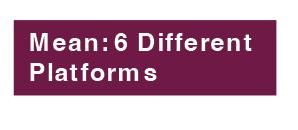
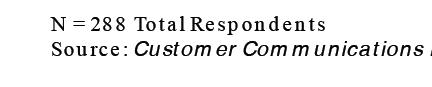
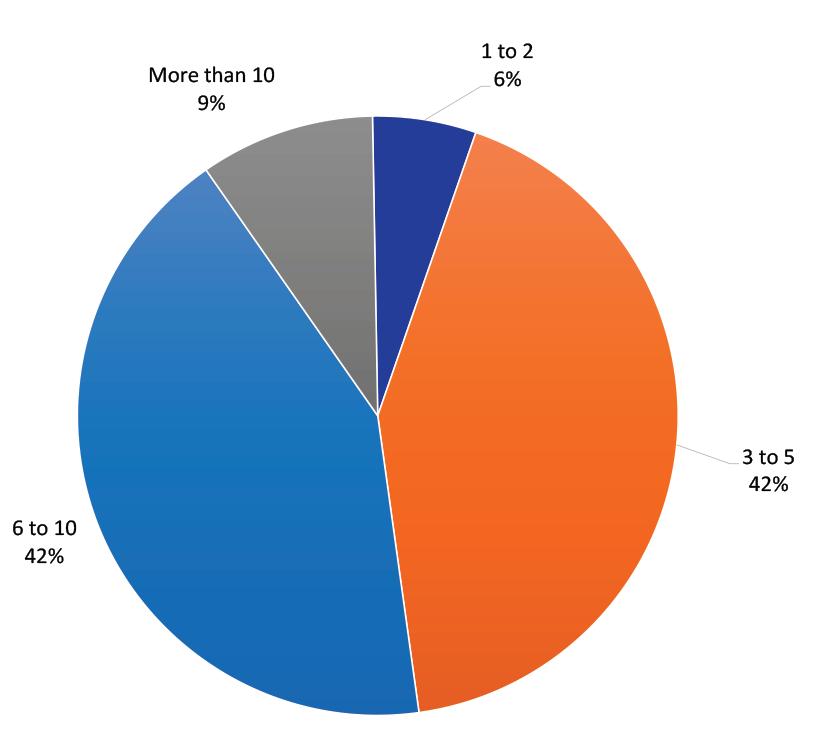
The complication is execution. Research from Keypoint Intelligence’s Customer Communications Direct Marketing survey demonstrates that brands are managing an average of six different communication platforms or systems.
Brands may have intent and budget, but many struggle to translate complex customer data into practical, scalable print programs. Although CRM systems, marketing automation platforms, and data lakes are rich with insight, turning that insight into targeted printed communications requires skills that sit at the intersection of data, marketing logic, and production.
Too often, print and mail providers are positioned as downstream executors rather than strategic partners. They receive “finished lists” and static files, limiting their role to outputting rather than delivering results. This creates an opportunity gap: brands need partners who can operationalize data for print, but few providers are fully prepared to deliver.
What Separates Inkjet Owners from Inkjet Leaders
This gap creates urgency for the industry. While many providers have invested
heavily in production inkjet capacity, far fewer have invested at the same pace in data and analytics capabilities. Print and mail service providers consistently rate themselves lower in advanced data management, variable data printing (VDP) logic, and analytics than in production efficiency or equipment expertise. Many organizations rely on basic personalization aspects like name, address, or perhaps a simple offer relevant to a gender or ZIP Code. More advanced segmentation and decision logic remains underutilized.
Internal analytics resources are often limited or nonexistent. Providers depend on clients or third parties to prepare data, which restricts innovation and slows turnaround. As a result, “personalization” rarely extends into behavior-based messaging, image variation, offer logic, or channel selection driven by customer preferences and history. The implication is clear: without stronger data literacy and analytics capabilities, inkjet will be underleveraged. A production inkjet press without predictive data analysis is like a top-of-the-line sports car stuck in first gear. It’s full of potential, but unable to deliver true value to the business or its clients.
The Question We Should Be Asking
If inkjet is becoming table stakes and marketers are demanding more intelligence from their communication partners, the critical question is no longer “Do we have production inkjet?”.
The better question is, “Do we have the people, workflows, and analytics to turn inkjet capacity into measurable customer impact?”. Answering that question requires a shift in mindset from technology-led investment to capabilityled growth.
The Answer: Build Data People Alongside Inkjet
The most forward-looking print and mail providers are recognizing that their next competitive hire may not sit on the production floor. It may sit alongside operations, account management, and workflow to focus on data.
These types of roles may carry different titles, such as Data Specialist, Marketing Technologist, Analytics Lead, or Variable Data Strategist. What matters more than the actual title is capability. These individuals bridge the gap between client objectives and inkjet execution by translating data into logic that drives print.
Their responsibilities often include:
Cleaning, structuring, and normalizing client data to ensure consistency and usability across campaigns
Designing segmentation and rules that determine offers, images, layouts, and messaging
Managing test-and-learning cycles, including A/B testing and performance measurement
Collaborating with client marketing and CRM teams to align print with broader customer journeys
Paired with production inkjet, these skills unlock the full value of the press. Complex VDP workflows, white-paper factory models, personalized packages, and trigger-based communications become not just possible, but repeatable and scalable.
The results speak for themselves. Providers who invest in data talent see higher response rates, stronger attribution, and deeper client relationships. Print becomes an irreplaceable channel because it is embedded in strategy, not just execution.
From VDP to Predictive Analytics: A Practical Roadmap
For many print and mail providers, this evolution does not require a massive leap. It requires a roadmap.
Step 1: Solidify the Basics. Standardize data intake, hygiene, and basic variable data printing across all inkjet jobs. Ensure that names, regional content, images, and offers are managed consistently and efficiently for every campaign.
Step 2: Add Intelligence and Testing. Introduce segmentation, A/B testing, and response tracking using unique
identifiers and campaign codes. Feed your results back into creative and targeting decisions to improve performance over time.
Step 3: Move Into Predictive Analytics. Collaborate with or hire analysts who can build simple propensity models, likelihood to respond, churn risk, and upsell opportunities. Use these insights to dictate messaging, cadence, and channel mix, including when print is most effective.
Step 4: Reposition the Business. Use results, metrics, and case stories to reposition from print vendor to customer communication partner. Inkjet and data can then become twin pillars of a differentiated value proposition.
The Bottom Line
Many providers already own powerful production inkjet technology. The next wave of leaders will be defined not by speed or volume, but by insight.
Inkjet is the engine. Data and analytics are the GPS, choosing the best route, adapting to changing conditions, and ensuring that customer communications arrive with relevance and purpose. In 2026 and beyond, the providers that invest in both will shape the future of print. Industry leaders understand that succeeding in print involves much more than simply reacting to it.
Karen Kimerer of Keypoint Intelligence has experienced the many challenges of expanding current market opportunities and securing new business. She has developed a systematic approach to these opportunities, addressing the unique requirements of becoming a leader in our changing industry.
FROM PRINT/MAIL VENDOR TO CX PARTNER
BY MIKE PORTER
Your customer communications shop can move from “print vendor” to customer experience (CX) partner if you can tie the materials you produce to a customer journey stage, a business outcome, or a CX metric. Your organization’s repositioning starts when your print/mail operation stops talking about “pieces out the door” and starts speaking in terms like customer retention, lifetime customer value, digital adoption, and customer service call volume.
Mail Is Overlooked by CX Teams
Many CX and digital leaders in your clients’ organizations operate in an ecosystem of web, app, and contact centers. They see the world through dashboards full of click-throughs, app events, and email opens. To them, mailing is just a batch job with a mail date and a postage cost — a black box at the end of the process. This happens when there is no clear link between mailed items and customer behavior.
That perception ensures the CX team views your print/mail service operation (both in-house and outsourced) as a commodity that offers no value beyond on-time and accurate document processing.
Such disconnections can hide real correlations, including both problems and successes. A confusing bill may be driving up customer service calls or contributing to customer churn, but no red flags point to the source of the issue. Likewise, no one notices when a redesigned late payment notice you mailed to delinquent accounts quietly improves the payment speed.
When your operation can show where physical mail supports or disrupts the journey, CX leaders see your print/mail shop as part of the solution set, not simply a cost they constantly seek to reduce or eliminate.
Journey Maps and Postal Mail Touchpoints
A journey map describes customer experiences with a company or an organization. The maps list all the touchpoints
where customers are exposed to a company’s brand. In most organizations, physical mail still appears across several critical stages. In welcome and onboarding, for instance, your print/mail operation furnishes new customers with ID cards, welcome kits, account set-up guidance, and regulated disclosures.
Later, the customer journey may include mailed items such as bills, statements, renewal notices, or loyalty summaries. All these things are customer touchpoints that can enhance or detract from the customer experience.
Customer relationships are further affected by collections-related documents triggered by past-due invoices. These might include notices, disconnect letters, or policy cancellation warnings.
A company may also use the mail to reconnect with customers when emails go unopened, for win-back efforts, or to confirm actions.
Surprisingly, some of these critical customer touchpoints may be missing from a company’s digitally focused customer journey maps. If your mail service operation can help your clients overlay mail onto existing journey maps, you can clarify where physical pieces act as on-ramps into portals, apps, or contact centers. You will also see where they serve as off-ramps that restart relationships when digital channels stall. QR codes, personalized URLs, and unique response paths let CX teams attribute downstream digital actions to specific mail events.
Translate Shop Metrics Into CX Measurements
It’s a good idea to reinforce the impact mailed customer communications have on CX. This will usually require access to data they may not be sharing with you routinely. Often, your shop will complete a job and never hear of any results. The campaign could have been a fantastic success or a fabulous flop, but with no feedback, you have no opportunity to make improvements or build on successes.
Your print/mail operation must show your clients how sharing information allows you to put your extensive knowledge and experience with printed media and the Postal Service to best use. With
a little collaboration, you can help clients reach their business objectives, includ ing maximizing the effectiveness of their direct mail spending.
Traditional data captured by your print/ mail shop includes volumes by document types, segments or triggers, cycle times from data receipt to mailing dates, undeliv erable addresses, duplicates, and individual data points about when recipients received messages and through which chan nels. Your document center information becomes CX‑relevant when combined with enterprise data from the client.
With access to some client controlled information, you may shine a light on journey timing. Organizations want to know how long it takes from customer awareness to interaction, for instance.
Information compiled by a call center can show how the volume of calls and length of talk time correlate to in home dates for statements or notices. Knowl edge that closes the loop between mailings and call center activity can lead to improvements in document design and lower call volume.
How long does it take for customers to make payments, complete forms, or authorize consent after they receive relevant documents in the mail? The answers could encourage your client to change their billing cycles, add payment methods, or insert urgent messaging in the documents to speed up results.
Digital adoption statistics are always interesting from a CX perspective. Show clients how print campaigns fea turing QR codes, pURLs, or statement inserts are urging customers to con nect online.
Once you can cite statistics like, “This redesign cut billing calls by 18% and accelerated payment by 1.7 days for 40% of your customers,” you are no longer discussing the mechanics of print and mail. You are talking about cost‑to‑serve and cash flow, which are board‑level interests.
Your print/mail operation controls some of the cleanest, most structured data about who received what messages, and when. That makes you an indispensable source of evidence.
Concrete Examples for Executives
Here are some projects that will almost always allow you to connect your print/ mail services with the CX performance of your clients.
Your print/mail operation must show your clients how sharing information allows you to put your extensive knowledge and experience with printed media and the Postal Service to best use.
Redesigned Bills and Statements
Map the journey from when the bill is generated to when it is paid and iden tify where customers switch channels or seek help. Use your production data and your clients’ call‑center reports to highlight which customer segments or document types generate the most call volume. Simplify those documents to add clear next steps, digital entry points, graphical data representation, or access to self help resources.
After bill redesign, report changes in payment timing, self‑service usage, and billing‑related call volume by segment.
Onboarding Kits
Tie your new account kit production and mailing dates to a customer’s initial login or first transaction. Redesign the kit so it includes setup links encouraging digital activation, step‑by‑step checklists, and clear explanations of what customers should expect next from the company.
The new function of the welcome kits will be about their effectiveness in acti
vating new customers, supported by your mail shop data and your clients’ dig ital analytics.
Triggered Mailings
Replace large batches with event‑driven mail for key customer interactions like service outages, policy changes, or high‑risk account events. Use your work flow data to show clients how soon the printed notice arrives after the triggering event and compare complaint or escala tion metrics to the prior process.
In many organizations, timely, targeted notices reduce inbound calls and improve satisfaction for affected customers. These are metrics your clients’ CX and compliance teams already track.
How to Start Collaborating with CX and Digital Teams
Work with your clients’ marketing, prod uct, and CX teams to identify all mailed documents by journey stage and objec tive. Ask to participate in customer journey mapping or communication audit projects. Bring samples, volume pat terns, and delivery insights to the table. Propose a pilot project for one high‑im pact flow, such as first‑bill, renewal, or a top complaint driver, and design a small experiment that changes both the docu ment and its role in the journey.
Change the narrative in reports and client meetings by leading with CX and business results, using production met rics as supporting details rather than the headline.
Over time, your clients will stop seeing print and mail as a mechanical endpoint and start treating it as a designed set of touchpoints that shape perception, behavior, and loyalty. That is when your operation earns a permanent seat in the CX stack.
Mike Porter at Print/Mail Consultants and PMC Content Services creates content that helps attract and retain customers for companies in the mailing and document industry and he assists companies as they integrate new technology. Learn more about his services at www.pmccontentservices.com. Follow @ PMCmike on X, or send him a connection request on LinkedIn.
INFORMATION DECADES TOO LATE
BY LEO RAYMOND
The opening months of 2026 saw a flurry of attention — and anxious questions — about a Postal Service rule regarding the postmark. Apparently no one had been paying attention to what happened late last year or over the preceding decades.
On November 24, the Postal Service published Postmarks and Postal Possession, its final rule about postmarks and their meaning. While the document seeks to clarify that postmarks don’t mean what many Americans might think, it’s 50 years too late in doing so. Moreover, given its association with the Regional Transportation Optimization initiative, it contaminates a simple statement with other more subjective issues like “efficiency” and USPS financial sustainability.
Generally, until the 1970s, post offices had a cancelling machine, a simple apparatus that used a mechanized feeder and a changeable dye to apply a postmark on mail bearing a “live” stamp. Though the basic purpose of the machine was to “kill” the stamp to prevent reuse, the application of a date (and “AM” or “PM” in some instances) served to demonstrate that the mail piece was in the mail at that time.
The introduction of area mail processing — built around the aggregation of mail from post offices for mechanized (and, later, automated) processing at a centralized facility (the original sectional
center facility) — meant that post offices would not be doing their own cancellation/postmarking. Rather, that combined function would occur at the “SCF.”
As time passed, processing equipment was upgraded and facilities were further consolidated, but the cancellation/postmarking function continued.
Unfortunately, as the Postal Service many years later realized, this evolution in processing, and the related change in what the postmark represented, was never publicized. Whether because no one in the USPS thought it needed publicity or because it (i.e., postal operations) wasn’t anything about which the public had any need (or interest) to know is lost to history but, nonetheless, the public perception of the postmark remained — obsolete and increasingly inaccurate.
Worse, various government entities cited the postmark in a wide range of documents to define when a mail piece was mailed even though they were unaware that that was no longer true — the USPS never told them otherwise, either.
(Of course, the ZIP Code — which the Postal Service implemented in the 1960s as a tool to facilitate mail distribution — was similarly usurped by a wide range of public and private entities for their own purposes. Ironically those entities later demanded changes to ZIP Codes for their own reasons having nothing to do with the USPS or the original purpose for which ZIP Codes were developed.)
RTO
The advent of the RTO program — one of the most egregiously perverse examples of “efficiency” supplanting a fundamental element of postal service — caused someone in USPS HQ to realize the significant time gap between when a customer would think a mail piece is in the mail and when that mail piece might later be postmarked. Mail from an RTO-impacted area can sit in a collection box or at a post office for days until it is finally transported to a postal processing facility for cancellation and postmarking.
Aside from how the time gap for non-RTO post offices has changed over the decades as area mail processing expanded and evolved, the deliberate delay of mail from RTO-impacted post offices somehow triggered the need for the Postal Service to codify what the postmark means (or doesn’t mean).
(Of course, the USPS also invented “Day 0” and other service measurement manipulations to ensure RTO doesn’t hurt service scores, but that’s another story.)
The USPS apparently realized it could no longer let the public (and government entities) quietly continue in their outdated assumptions about the postmark, and so initiated the needlessly convoluted and legalistic rulemaking that ended with the final rule published last November.
Rather than what should have been stated publicly in the 1970s — that the purpose was to cancel the stamp and that the “postmark” means nothing more than when that happened — the USPS instead launched into a lengthy discussion of cancellation and postmarking and the many permutations of it that can occur — and a gratuitously needless invocation of the “efficiency” allegedly derived from RTO and its role in USPS “self-sufficiency.”
Ultimately, the final rule said little more than what should have been said five decades ago, only this time it included a lot more legal puffery. Perhaps the USPS should make matters even simpler: just cancel the stamp and stop adding a date that requires its significance to be explained by noticeand-comment rulemaking.
Leo Raymond is Owner and Managing Director, Mailers Hub. This article is from Mailers Hub News, a bi-weekly publication available to subscribers. Please visit www.MailersHub.com for more information.
LET YOUR VOICES BE HEARD THROUGH YOUR LOCAL PCC
BY LEWIS L. JOHNSON
What are PCCs?
The Postal Customer Council (PCC) program fosters a close working relationship between the United States Postal Service (USPS) and commercial mailers and shippers, with the goal of sharing information about new and existing Postal Service business products, programs, services, and procedures. PCCs are United States Postal Service (USPS) sponsored organizations where business mailers and shippers meet with USPS local executives to have their issues and concerns addressed. Today, there are 94 active PCCs nationwide.
The well-established partnership between the USPS and the PCC Network began in 1961. Since its inception, local PCCs have served as an open channel for communication, providing
insightful information and best practices, education and training, and networking opportunities.
What’s in It for You?
Here are five reasons you should become a PCC member:
1. Learn about the new and existing Postal Services products, services and procedures.
2. Attend the countless networking opportunities.
3. Help your business grow.
4. Provide your business with a competitive advantage.
5. Grow professionally and enhance your resume.
Dina Kessler, President and Chief Operating Officer for Kessler Creative, states, “In our business, it is crucial that we stay abreast of any changes within the USPS as well as new tools available for both us and our customers. Being an active member of the PCC is the vehicle for us to make that happen as an organization.”
Scan the QR code to hear why members joined their local PCC:
Sign up today to hear the latest news and changes taking place at USPS.
Questions about the PCC Network? Send an email to: PCC@usps.gov.
Lewis L. Johnson joined the United States Postal Service on March 30, 1998, as a National Account Manager. During his Postal Service tenure, he has held positions in Sales, Marketing, and Consumer and Industry Affairs. Currently, Lewis is a member of the Industry Engagement and Outreach team. He serves as a Customer Outreach Specialist. Before joining the Postal Service, Lewis was the Vice President of Sales at Sprint Corporation’s Government Systems Division.
He graduated from the Postal Service’s Advanced Leadership Program in November 2004. Lewis earned a Bachelor of Science Degree in Mathematics and Master’s Degree of Business Administration in Finance from Morgan State University in Baltimore, MD. He did graduate work at Carnegie Mellon University in Pittsburgh, PA, and earned a Professional Leadership Certificate from Marymount University Graduate School in Arlington, VA.
WASHINGTON — Through large investments in new technology and new logistics planning and execution, the U.S. Postal Service (USPS) significantly improved its delivery performance during this past holiday season. Mail items and packages were delivered within 2.5 days on average (16 billion in volume), compared to 2.8 days during the same period last year (Nov. 15 – Jan. 9). On-time delivery scores were higher virtually across the board, with the best scores being in its last mile Destination Delivery Units (DDU). The DDU space is the subject of the USPS bid solicitation process beginning later this month.
Two Sides North America to Continue Legacy of Sustainability Messaging in the Paper and Packaging Industry
Building on the success and impactful research of the Paper + Packaging Board, Two Sides North America (TSNA) will step up to take the lead in promoting positive and environmentallyfocused messaging for the sector. TSNA and the Love Paper Campaign will continue championing the story of sustainability, innovation, and the essential role of paper and packaging materials in our everyday lives.
United Business Mail Announces Merger with Mystic Logistics, Forming a Wholly Owned Subsidiary
Itasca, IL — United Business Mail (UBM) announced a merger with Mystic Logistics, whereby Mystic Logistics becomes a wholly owned subsidiary of United Business Mail. The transaction is effective immediately.
Mystic Logistics will continue to operate under its existing name and brand, maintaining its current leadership structure and operational focus. The existing Mystic Logistics team will remain in place, with Charlene Dufresne as President. The Mystic Logistics team will report through Ms. Dufresne, who will report directly to Bill Boyce, President of United Business Mail.
Crawford Technologies’ Digital Transform Engine Version 5.9 Delivers Enhanced Operational Speeds
Crawford Technologies, provider of innovative document solutions that streamline, improve and manage customer communications, released Version 5.9 of its Digital Transform Engine (DTE), the company’s core engine and the base of its award-winning solutions.
DTE 5.9 further enhances the user experience by accelerating application deployment and streamlining the production of compliant, large print and multilanguage documents, making it easier for companies to deliver communications in the precise format and language that is best for each recipient.
THINK ABOUT IT
One of the most valuable applications of AI in mail operations is preventing problems before customers notice them. By analyzing historical delivery data, route performance, weather patterns, and address quality, AI models can predict where delays or misroutes are likely to occur.
— DAN BARRETT
At the current linear rate, three states could see all post offices closed by the turn of the century. Based on their current closure rates, Kentucky (2068), West Virginia (2087), and North Dakota (2099) could all be without any post offices within 75 years.
THERE IS ONE THING TO COUNT ON EVERY YEAR, AND THAT IS POSTAL AND SHIPPING RATE INCREASES. ON JANUARY 18, 2026, THE POSTAL SERVICE RAISED ITS PRICES, AND THE GOOD NEWS IS THAT MOST MAIL CATEGORIES WILL NOT HAVE AN INCREASE UNTIL THE NEXT RATE CHANGE, WHICH IS EXPECTED IN JULY.
— ADAM LEWENBERG
Consider this: 90% of direct mail is opened by recipients, compared with only 20%-30% of emails. Marketers also report a 12% lift in overall campaign performance when direct mail is included in a centrally orchestrated, multichannel strategy, according to statistics from Postalytics.
— DAVID KLEMPKE
When your operation can show where physical mail supports or disrupts the journey, CX leaders see your print/mail shop as part of the solution set, not simply a cost they constantly seek to reduce or eliminate.
— MIKE
PORTER
We need to start bringing along younger people into leadership roles and prepare our replacements. What’s important to understand is that people born after us have had very different experiences with technology and organizations. We can’t impose our methods or approaches, but we can be open to new ways of doing business.
— MARK FALLON
BY MARK M. FALLON
LOSE THE LABELS – PREPARING FOR GENERATIONAL CHANGE
There is a future for print and mail in the digital age. It will be very different from the past, and may even be unrecognizable to industry veterans. A successful transition includes passing the torch to the next generation of leaders. That will require a plan to prepare our organizations for this shift.
Back in 1996, I became the Vice President, Document Technology and Delivery at a major bank in Boston. The was a significant age gap between me and my direct reports. I was only 34 years old, and several of my team members had been working for the bank for 40 years or more. One of the assistant vice presidents had started as a key-punch operator. My print manager’s son and I were born on the same day.
We turned what could have been an issue — the difference in ages — into our greatest strength. They had decades of experience leading teams, managing processes, and implementing change. I had ideas for new tools and software that could transform the department. By working together, we did that.
At one point, one of those leaders told me she was planning to retire. Not in a day, but in a year. We had an open and honest conversation about a succession plan. There wasn’t just one person to consider, but several. Perhaps, it was time for yet
another reorganization, with new roles and responsibilities.
When we involved other people in our planning, it opened a floodgate of announcements about retiring. Older operators talked about the need to train more employees on their equipment. Some supervisors explained that they didn’t want to become managers, and were okay with someone “jumping over them” into that role. We even brought in people from outside the company for new roles. While there were bumps along the way, we handled the transitions well.
A quarter of a century later, my peers and I are looking at those conversations from the other side of the table. Over 11,000 Americans turn 65 every day. That’s about 4.1 million people a year. While not all of those people will retire (I don’t plan to…. yet), many will. That means a major turnover in our industry.
We need to start bringing along younger people into leadership roles and prepare our replacements. What’s important to understand is that people born after us have had very different experiences with technology and organizations. We can’t impose our methods or approaches, but we can be open to new ways of doing business.
To be successful, we have to avoid having preconceived notions on people due to
their age. Most importantly, we must stop using labels like “Boomer” or “Millennial” or “Generation X, Y, Z, or Alpha.” These labels are distractions created by marketers as “personas” for advertising campaigns.
Before 1980, labels weren’t assigned to generations. In that year, Landon Jones authored a book titled, Great Expectations: America and the Baby Boom Generation. He called people born in the post-war period “baby boomers.” While the exact years are debated, that label is generally applied to people born between 1946 and 1964.
This led to the Strauss–Howe theory that there is a new generational persona every 21 years.
William Strauss was a playwright, and Neil Howe is a consultant. Despite being widely used, the theory is contentious, as it is based on grand generalizations. And all generalizations are dangerous (including this one). We wouldn’t allow sweeping statements about people based on race or gender, and we shouldn’t allow them for age either.
Applying specific characteristics to a person solely because of the year they were born is counterproductive. Yes, a person born in the year 2000 has had widely different experiences than a person born in the year 1960. However, unless the two
individuals spend time with each other, the extent of those differences is unknown.
Communication is the best way to start closing the gap and preparing the next generation of leaders. Managers need to begin holding conversations now, and with a planned schedule for the next several years. These chats need to be two-way discussions with a focus on the future.
This means leaders need to create an atmosphere of trust and openness. My team was successful 30 years ago because people shared their plans for the future. The focus was on learning what the unit needed from people — today and tomorrow. Then we could start identifying who could bring the necessary changes.
You don’t have to wait for someone to announce their planned departure to start preparing for the future. In fact, many people will leave unexpectedly. Smart leaders will have a regularly scheduled meeting dedicated to succession planning. Invitees should include front-line supervisors, mid-level managers, and senior leadership. Planning for the future sends the message that there will be opportunities in the organization — and our industry.
Every organization should have a succession plan for every position. A good start is taking an inventory of the roles and responsibilities for every position. From there, build a cross-training matrix, supplemented by written procedures and checklists. Validate documentation with the people who actually do the job.
In addition to management’s goals, the succession plan needs to consider the individual’s concerns. Education, training, and careers no longer follow the paths set in the 20th century. A front-line supervisor may have no desire for a higher-level position. An operator may want to move into management, and will need mentorship and training to be successful. These discussions will be more productive in a one-on-one format — with regular check-ins.
Most of us have heard the maxim, “a goal without a plan is just a wish.” An organization with employees that have been around for decades has centuries of experience and expertise that may be lost in the coming years. Effective knowledge transfer needs to be thought out and documented in written plans.
The plans need to be flexible to match changing conditions. Unplanned depar-
tures of trainers or trainees will necessitate changes in tempo. New equipment, client requirements or regulations may involve a change in focus. Having a written plan makes it easier to adapt and edit while maintaining momentum.
Management training should focus on outcomes, not methodology. For example, an essential aspect of production is capacity planning. The current manager may use a series of spreadsheets that are updated on a daily or hourly basis. Another person may be aware of an AI-powered software that takes feeds directly from the workorder system and the equipment. Encourage the use of new tools and technologies — even the ones you may not understand.
Through change, we can build a future for the print and mail industry. Building on plans, training, and communication, our organizations can prepare for the departure — and arrival — of key players. The successful transition to the next generation begins today.
Mark Fallon is President & CEO of The Berkshire Company. Mark helps his clients develop solutions using emerging technologies and expert leadership. He can be reached at mmf@berkshire-company.com.
Artificial Intelligence and the Future of the Print and Mail Industry
By Dan Barrett
The print and mail industry has always operated at the intersection of trust, scale, and precision. Whether delivering bills, statements, legal notices, healthcare communications, or marketing messages, mail plays a critical role in how organizations communicate with customers. While volumes and formats continue to evolve, expectations for reliability, visibility, and responsiveness have never been higher.
Artificial intelligence (AI) is emerging as a practical tool to help the industry meet those expectations. Not as a replacement for print and mail, but as a way to make operations smarter, reduce friction, and improve service across complex physical delivery networks. Today, AI is less about experimentation and more about operational advantage.
Why AI Matters Now
Mail remains one of the most trusted communication channels, but trust can erode quickly when deliveries are late, messag-
ing is unclear, or exceptions go unresolved. At the same time, organizations face rising transportation costs, labor constraints, address quality challenges, and pressure to operate more efficiently.
AI is gaining traction because it directly addresses these realities. It helps organizations anticipate issues before they escalate, automate routine decisions, and focus human effort where it has the greatest impact. In practice, AI is helping print and mail operations become more resilient, more transparent, and easier to manage at scale.
Five Practical AI Use Cases in Today’s Mail Ecosystem
Across the industry, several AI applications are already delivering measurable value.
1. Voice-of-Customer and Issue Detection
Mailers and service providers receive large volumes of feedback through call centers, emails, web forms, surveys, and tracking inquiries. Historically, this
information was reviewed manually or summarized long after problems had already affected customers.
AI can now analyze thousands of customer comments and inquiries daily, identifying patterns such as recurring delivery confusion, address-related failures, or spikes in “where is my mail?” contacts tied to specific regions or mail types. Operations teams can spot emerging issues early and intervene while corrective action still makes a difference.
2. Conversational AI for Customer Support
Modern AI-powered virtual assistants go well beyond basic chatbots. They can understand intent, maintain context, and draw from multiple systems to provide meaningful answers.
For example, a business mailer asking about delayed statements can receive clear explanations, status updates, and next steps without waiting for a live agent. When human review is required — such as for compliance-sensitive exceptions — the inquiry is routed with
relevant context already attached. This reduces call volume, shortens resolution time, and improves consistency across support channels.
3. Proactive Exception Management
One of the most valuable applications of AI in mail operations is preventing problems before customers notice them. By analyzing historical delivery data, route performance, weather patterns, and address quality, AI models can predict where delays or misroutes are likely to occur.
Instead of reacting to failed delivery scans or customer complaints, organizations can proactively notify stakeholders, adjust routing plans, or initiate corrective actions. This shift from reactive to proactive service reduces downstream costs and strengthens customer confidence.
4. Intelligent Process Automation
Many operational processes — such as address correction, document verification, claims handling, and exception routing — are repetitive but still require judgment.
The goal is not to adopt technology for its own sake, but to solve practical problems: fewer exceptions, faster resolution, better visibility, and more reliable service.
AI-enhanced automation combines speed with learning.
AI systems can extract and validate information from incoming documents, flag inconsistencies, and route only true exceptions to human staff. Over time, these systems improve accuracy by learning from prior decisions. The result is faster processing, fewer errors, and more staff time devoted to higher-value work.
5. More Relevant, Personalized Mail Communications
AI is also helping organizations make mail more effective, not just more efficient. By analyzing engagement patterns, delivery history, and customer behavior, organizations can better tailor the timing, messaging, and format of communications.
This might include adjusting reminder notices based on past response behavior, aligning mail drops with known delivery patterns, or coordinating print and digital messages so customers receive consistent information across channels. These improvements reduce confusion, increase response rates, and reinforce the value of mail as part of an integrated customer experience.
Trust, Accuracy, and Transparency Remain Essential
While AI offers clear benefits, the print and mail industry operates in environments where accuracy and compliance are non-negotiable. AI systems must be explainable, auditable, and supported by strong data governance. Poor data quality or opaque decision-making can quickly undermine trust.
Successful organizations invest as much in oversight, cybersecurity, and
workforce readiness as they do in technology. AI works best when it augments human expertise — not when it operates in isolation. Employees need clarity on how AI supports their work and where human judgment remains essential.
From Automation to Orchestration
The most effective AI implementations in the print and mail industry focus on orchestration rather than isolated automation. AI connects systems, signals, and decisions across physical and digital workflows, turning operational data into actionable intelligence.
The goal is not to adopt technology for its own sake, but to solve practical problems: fewer exceptions, faster resolution, better visibility, and more reliable service. Organizations that start with these outcomes — and apply AI thoughtfully — will be best positioned to strengthen the role of print and mail in an increasingly datadriven world.
Done right, AI does not replace the fundamentals of the mail industry. It reinforces them, making physical delivery smarter, more predictable, and more trusted.
Dan Barrett is a customer experience and service transformation leader with deep expertise at the intersection of operations, data, and emerging technology. He previously served in a senior customer experience leadership role at the US Postal Service, where he worked across large-scale mail and service operations. Dan now advises organizations on applying AI to improve service delivery, operational performance, and trust. He is the founder of Magnify, LLC, a consultancy focused on AI-enabled service design, measurement, and transformation.
NAVIGATING THE JANUARY 18, 2026 USPS INCREASE
By Adam Lewenberg
There is one thing to count on every year, and that is postal and shipping rate increases. On January 18, 2026, the Postal Service raised its prices, and the good news is that most mail categories will not have an increase until the next rate change, which is expected in July. What is changing are the “Competitive” classes, which, in essence, are services that compete with UPS and FedEx. In this article, we will go over the details so you can properly plan and budget for the changes, as well as find ways to save money by optimizing your carrier services.
Every January, UPS and FedEx have a rate increase, and this year it amounted to 5.9%. USPS has an easy justification to increase their rates at the same time. What is also interesting is that all these carriers had holiday surge pricing starting in October. The January increase seems like a continuation of those rates throughout the entire year until the next holiday price surge.
USPS Increases
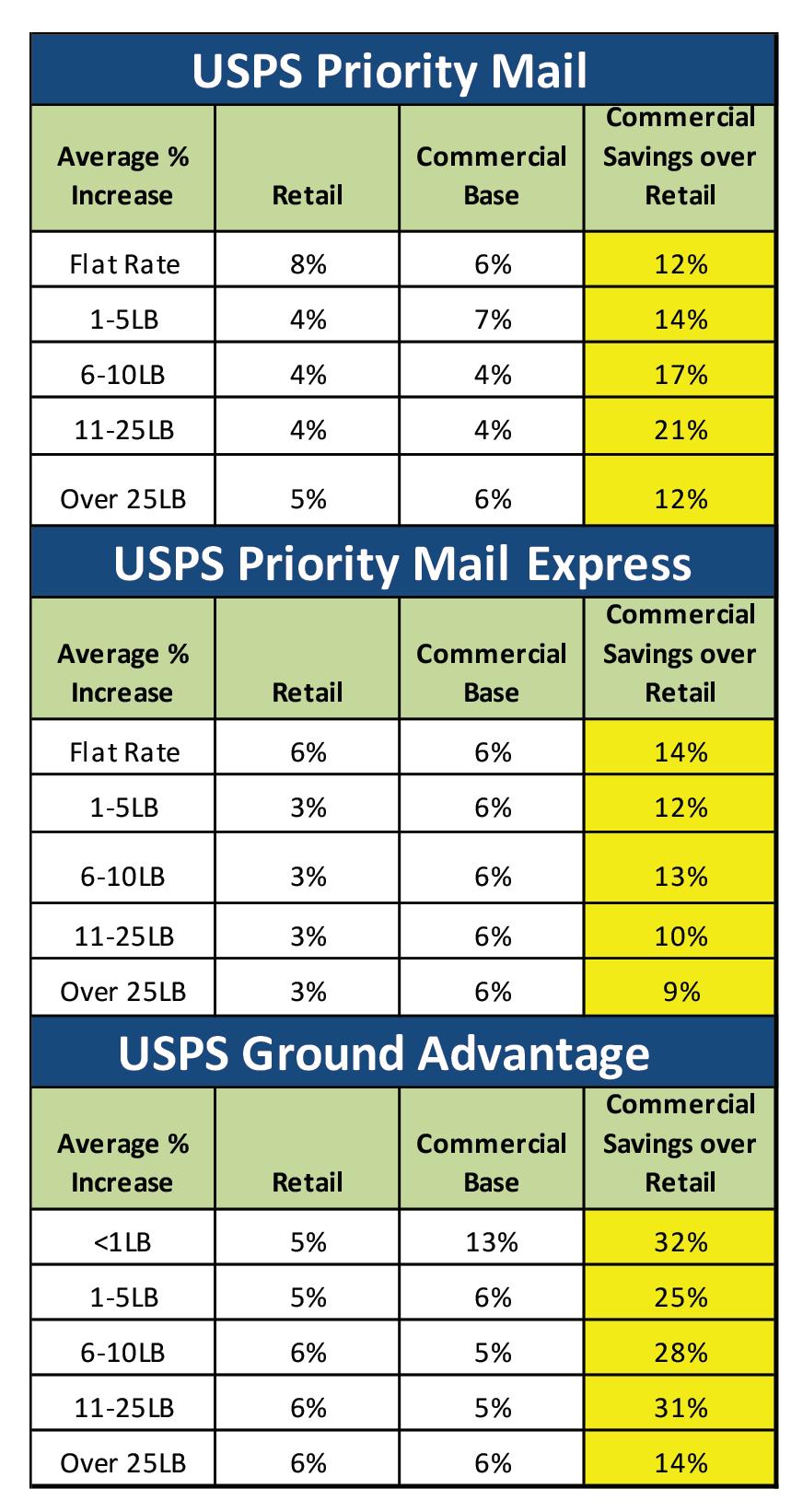
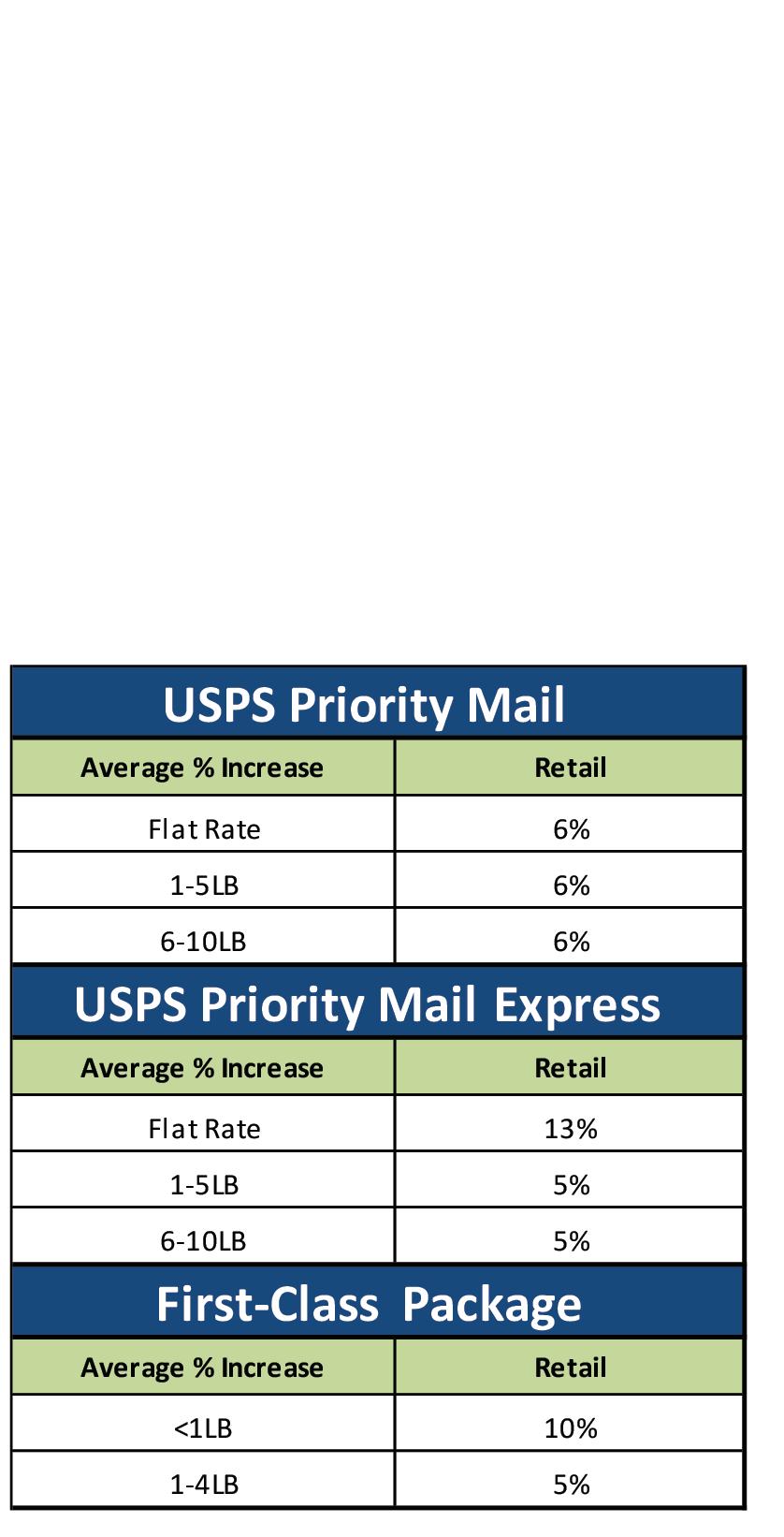
We went through the major rate structures that are changing and included the average percentage increase. Keep in mind that there are two main categories:
Retail – Processed through a postage meter or at the retail counter at the post office.
Commercial – Processed through a shipping tool that can generate 4x6 shipping labels and transmit the transactions to the USPS.
We can see from the Figure 1 that Commercial is having slightly higher increases but still offers significant savings over the retail category (highlighted in yellow).
We also see that International package rates are having similar rate hikes.
Saving Strategies
Compare Prices with and Without USPS
Provided Flat Rate Packaging
The USPS has two ways of calculating prices. One by weight and ZIP Code (Zone), and the
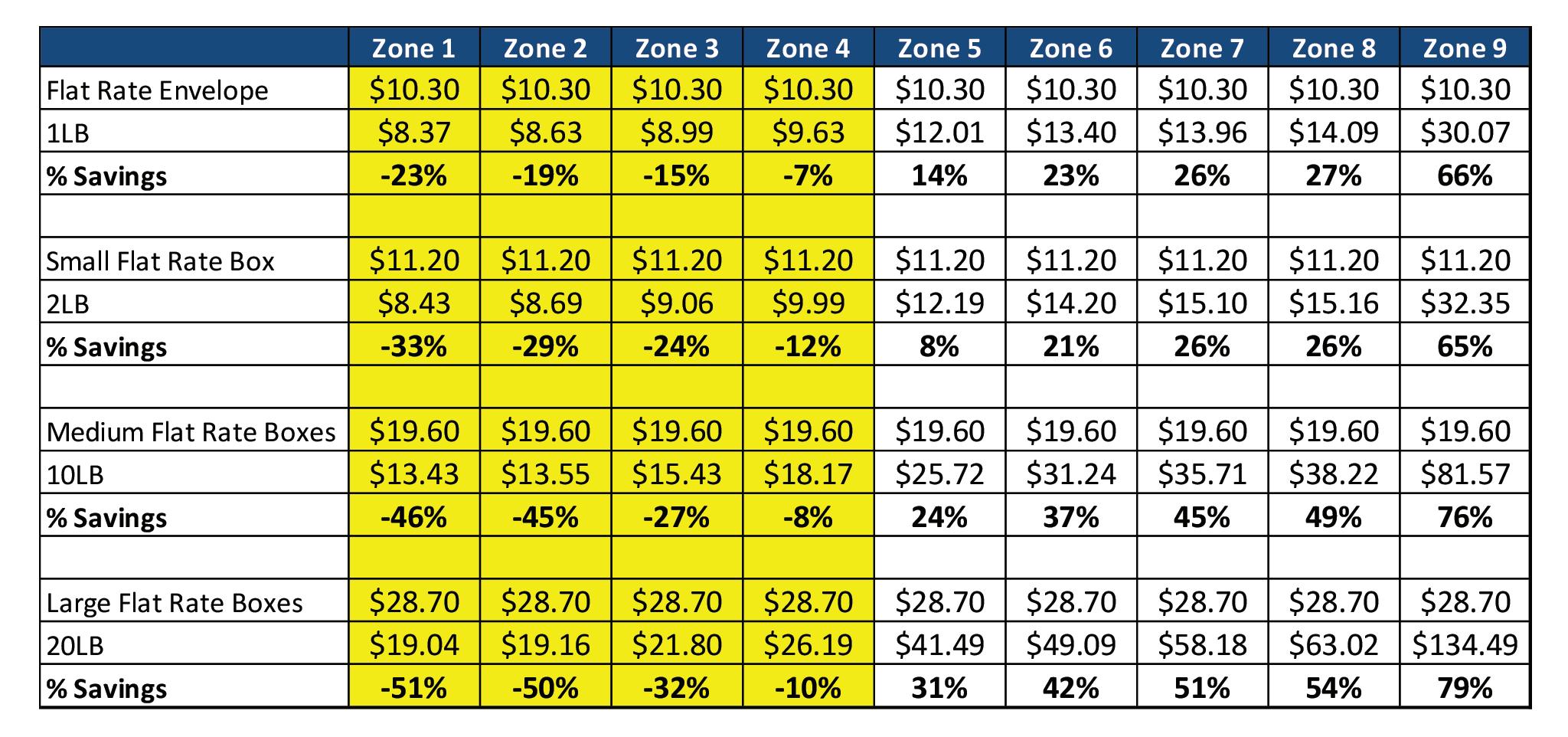
other by using their Flat Rate envelopes and boxes. As you can see from Figure 2, local items going less than 600 miles (Zone 4) are often less expensive using your own packaging, whereas items going farther do better with the Flat Rate options.
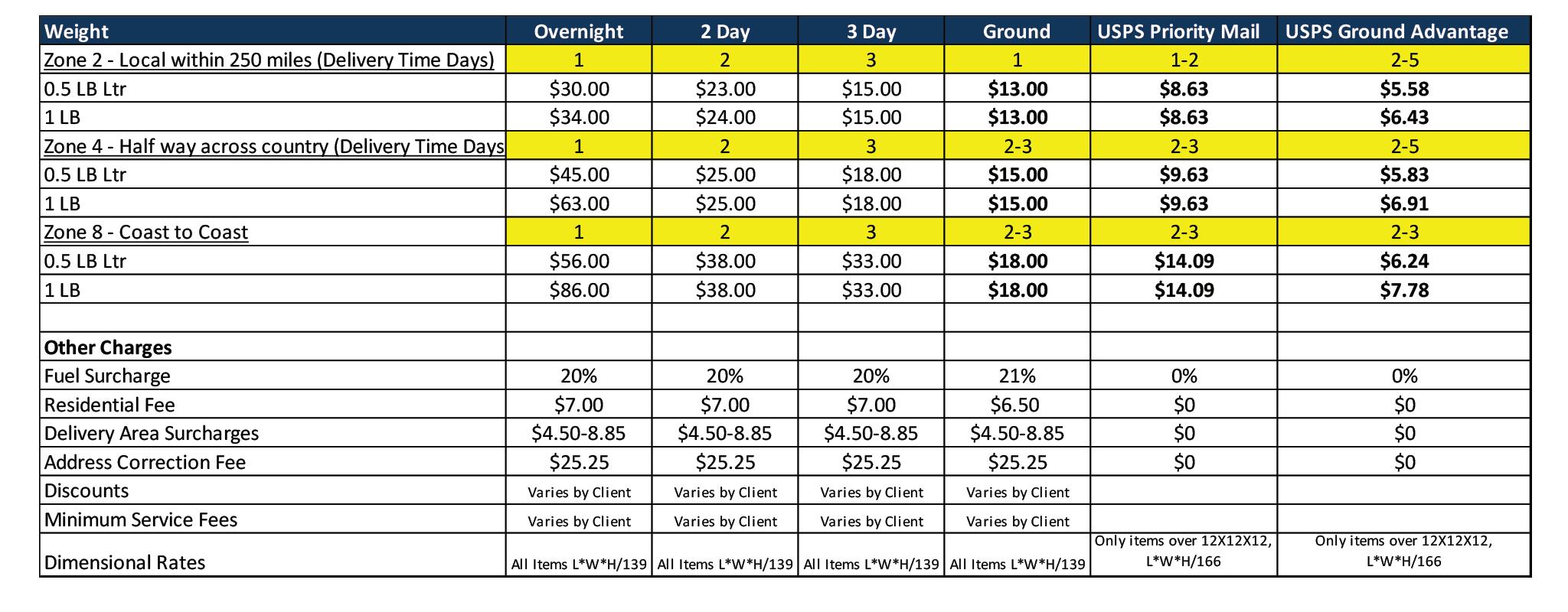
Figure 3 shows the rate comparison for the different service options for all three carriers. Most clients think they are getting the best rates with UPS or FedEx due to their negotiated agreements, but there are other fees that must be considered. The USPS does not charge for the specific fees below that can make the private carriers significantly more expensive:
Every January, UPS and FedEx have a rate increase, and this year it amounted to 5.9%.
Fuel Surcharges – Every private carrier package gets charged this fee, which is now billing at 20-21% of package costs.
Residential Fees – With so many packages sent to homes, this $7 fee can be one of the biggest reasons to move to USPS.
Delivery Area Surcharges – 61% of all ZIP Codes in the US are charged this fee, which can be as high as $8.85 per package.
Address Corrections – At $25.25 per item, these need to be looked at carefully and addresses updated in your system once seen on a bill.
Minimum Service Fees – While UPS and FedEx will offer huge discounts, they will have a floor price that they will not let you go below. This means that your lighter weight items will not get the full discount, potentially making USPS more attractive.
Dimensional Rates – The size of the box matters a lot when it comes to shipping rates because all the callers (including the USPS) will calculate the weight based on the dimensions. The big difference is that
UPS and FedEx will use this calculation for all box sizes vs. the USPS will only implement for items over a cubic foot. For customers using specific online tools, they can get additional USPS discounts for items under a cubic foot as well.
Most clients are using free carrier-provided shipping tools (UPS CampusShip, UPS. com, FedEx.com) that make it difficult to make these comparisons. They will not have USPS rates, and the Ground comparison are typically not displayed next to their air counterparts, making it difficult to see these as an option. We recommend having multi-carrier shipping tools that can display the rates for all options on one screen to make it easy for your users to make the best shipping decisions. We find this type of rate shopping can reduce costs in the four to 12% range and can help offset the annual increases in carrier rates.
Summary
The new USPS rates went into effect on January 18, 2026, and you should budget
four to eight percent increases on your Priority Mail, Priority Mail Express, and Ground Advantage spends. There are great options to reduce costs in these categories including moving from Retail to Commercial Rates, Comparing Flat Rate vs. your own packaging, and rate shopping against UPS and FedEx.
Overall, we got lucky with this rate increase that it was just the Competitive segment, and we will provide details in May of the much bigger increase that you can expect in July.
Adam Lewenberg, CMDSS, MDC, President/CEO of Postal Advocate Inc., runs the largest Mail Audit and Recovery firm in the United States and Canada. They manage the biggest mail equipment, postage and mail related services portfolio in the world. Their mission is to help organizations with multi-locations and mail streams reduce expenses, recover lost postage funds, and simplify visibility and oversight. Since 2011, they have helped their clients save an average of 74% and over $112 million on equipment, postage, shipping and outsourced mail service fees. He can be reached at 617.372.6853 or adam.lewenberg@postaladvocate.com.
Figure
Rate Shop USPS against UPS and FedEx
BY DAVID KLEMPKE
DIRECT MAIL: A STRATEGIC TOOL IN YOUR OMNICHANNEL STRATEGY
In today’s crowded marketing landscape, no single channel is effective on its own. Emails get overlooked, social feeds scroll by in a blur, and online ads compete for your attention every second. Consumers are saturated, engagement is fleeting, and marketers face the growing challenge of finding new ways to stand out.
That’s where direct mail comes in. It offers a tangible, personal approach that cuts through the noise and complements digital efforts. When paired with digital channels and coordinated through modern marketing technology (MarTech) platforms, direct mail doesn’t just support campaigns: it amplifies them. These tools bring your campaigns together by coordinating timing, messaging, and personalization across every channel. When physical touchpoints amplify digital messaging, they capture attention and drive engagement at every stage of the customer journey.
Consider this: 90% of direct mail is opened by recipients, compared with only
20%-30% of emails. Marketers also report a 12% lift in overall campaign performance when direct mail is included in a centrally orchestrated, multichannel strategy, according to statistics from Postalytics.
Direct Mail Plays a Critical Role in Your Omnichannel Strategy Success
An effective omnichannel strategy isn’t about choosing between physical and digital; it’s about orchestrating them to work together. Direct mail acts as the anchor that brings campaigns to life, creating a physical moment that reinforces digital touchpoints.
A mail piece can introduce a message, spark curiosity, or re-engage an audience, while digital channels continue the conversation. When integrated intentionally, direct mail connects the dots across the customer experience, especially when you add digital touchpoints that extend engagement beyond the mailbox: QR codes and personalized URLs (PURLs) allow recipients to instantly access interactive digital content, such
as videos, appointment scheduling, or exclusive offers.
Retargeting and programmatic display ads guide audiences seamlessly from mailbox to screen, reinforcing messaging at every step of the journey.
Data-driven personalization ensures each message feels relevant and tailored, increasing response rates and strengthening the customer relationship.
Modern digital overlays are transforming direct mail into an even more powerful channel. By matching mail recipients to online identities, brands can deliver highly relevant digital ads before or after a mail piece arrives, boosting awareness and initiating early engagement.
Emerging technologies like augmented reality (AR) are taking this further. With AR, recipients can scan a mail piece to unlock immersive experiences — 3D product demos, virtual try-ons, or interactive games — creating memorable, shareable moments that bridge the physical and digital worlds.
The result is a cohesive, omnichannel journey where each touchpoint strengthens the next. Direct mail reaches beyond the mailbox by driving clicks, fueling digital engagement, and reinforcing brand recall, ultimately improving overall campaign performance.
How Direct Mail Supports Every Stage of the Customer Journey
One of the greatest strengths of direct mail is its versatility. It can be used strategically across every stage of the customer journey to reinforce and extend your digital campaigns.
During the Awareness stage, interactive mailers capture attention and help brands stand out. When combined with digital retargeting, they reinforce brand recall across channels, and even younger audiences respond positively, with 72% of Gen Z reporting they feel happier receiving mail than digital messages, according to The Financial Brand
As prospects move into Consideration, personalized offers, product guides, and testimonials build trust and help prospects
make informed decisions. Tools like QR codes and personalized URLs (PURLs) provide seamless access to digital content, driving deeper engagement.
Reach the right people, drive the best results:
Direct mail campaigns leveraging first-party data deliver higher ROI and engagement, proving that precision pays off.
At the Conversion stage, direct mail motivates action. Exclusive offers or limited-time promotions, especially when paired with email follow-ups, can increase conversion rates by up to 40%, according to USPS Delivers.
Finally, for Retention & Loyalty, thoughtful touches such as thank-you notes, anniversary discounts, or VIP offers strengthen long-term relationships, while digital channels maintain ongoing engagement.
Direct mail provides a physical touchpoint that builds credibility and trust, which digital channels alone can’t always achieve. When executed with a data-driven process and supported by modern MarTech, it can also enable hyper-personalized creative at scale, leveraging USPS promotions and postal optimization to stay cost-effective.
Additionally, targeting the right audience is critical. Campaigns using house lists built on first-party customer data deliver the highest ROI — as high as 61% — showing the value of precision, personalization, and centralized campaign orchestration.
Why Direct Mail Matters for Modern Marketers
Direct mail offers capabilities that digital channels alone cannot replicate, including the ability to:
Grab attention in a crowded landscape where digital messages are easily ignored.
Build trust and credibility through tangible, thoughtful messages that foster stronger connections with recipients.
Drive engagement as personalization and interactive elements create memorable experiences. In fact, 69% of organizations tailor content based on individual wants, needs, and behaviors, according to research from Winterberry Group.
Amplify other channels when paired with digital follow-ups, retargeting ads, or email campaigns.
Measure performance by tracking response rates, conversions, and engagement to optimize campaigns in real time.
Direct mail doesn’t operate in isolation. When integrated with digital touchpoints, it creates a verifiable mailbox experience that drives higher response across the marketing mix, priming recipients for follow-up emails, retargeting ads, and social campaigns, leading to measurable lifts in engagement and conversions.
Centralized Management: Simplifying Direct Mail and Digital Integration
Modern MarTech solutions make it easier than ever to manage direct mail and digital campaigns from a single platform, allowing marketers to:
Coordinate timing and messaging so direct mail, email, social, and paid media work in harmony rather than competing.
Leverage data-driven personalization across channels, delivering relevant content to each recipient.
Measure and optimize performance in real time, tracking responses, conversions, and engagement across all touchpoints.
Streamline workflows, reducing duplicate efforts and freeing teams to focus on strategy and creativity.
By combining the tangible impact of direct mail with the agility and reach of digital campaigns, centralized MarTech transforms omnichannel marketing into a high-performing engine. Direct mail evolves from a standalone channel into a catalyst for deeper engagement and higher response rates, resulting in measurable campaign achievements.
Testing and Optimization Make Direct Mail Even Stronger
Just like digital channels, modern direct mail is highly targeted, data-driven, tested, and optimized to produce maximum results. Best practices include:
Digital-first testing: Test creative concepts online before printing to validate messaging and design.
A/B testing: Small adjustments in offers, headlines, or layouts reveal what drives the strongest response.
Frequency and timing: Optimizing mailing cadence ensures your messages reach recipients at the right moment, maintaining relevance without oversaturating your audience.
Full-factorial testing: Evaluating multiple campaign elements identifies the combination that produces peak performance.
Target the right audience and maximize every dollar: Direct mail campaigns using firstparty customer data outperform broader lists, delivering higher ROI, stronger engagement, and measurable results. Precision and personalization aren’t just nice-to-haves — they’re your competitive advantage.
Modern tools make integration seamless. QR codes (whose use surged 323% from 2021–2023) connect physical mail to interactive experiences like videos, landing pages, or appointment scheduling, making engagement measurable and actionable.
Key Takeaways
Direct mail is a powerful, measurable channel that strengthens every aspect of marketing. When centrally managed as part of an omnichannel strategy, it can:
Cut through digital clutter: Physical mail grabs attention in ways that digital channels, like email and online ads, often cannot match.
Engage audiences meaningfully: Personalization, QR codes, and PURLs create interactive experiences that connect offline and online and encourage action.
Recognize that no channel lives in a vacuum: Digital and direct mail reinforce each other, creating familiarity and consistency across touchpoints.
Drive measurable response and conversions: By priming recipients for follow-up emails, retargeting ads, and social campaigns, direct mail fuels higher engagement across the marketing mix.
Amplify the performance of other channels: Coordinated campaigns across direct mail, digital, and paid media create a cohesive journey where each channel strengthens the others.
Build trust and loyalty: Thoughtful and tangible communications foster stronger relationships and make brands more memorable.
Support testing, optimization, and continuous improvement: With centralized MarTech management, marketers can manage content across channels, track performance, and improve ROI over time.
In short, direct mail is most powerful when it is part of an omnichannel ecosystem. Combined with digital channels and enabled by modern MarTech, it helps marketers drive measurable lift and create more meaningful, connected customer experiences.
David D. Klempke MBA, PMP is a marketing technology leader with over two decades of experience in strategic planning, portfolio management, and enterprise solution delivery. As Director of Client Marketing Technology Solutions at IWCO Direct, he drives large-scale business transformations and multi-partner integrations. David holds an MBA in Marketing and a BA in Management Information Systems and Computer Science from Augsburg University, where he also serves as an instructor in data management and project management. His expertise spans product development, cross-functional leadership, and thought leadership in marketing technology.
Is It Time to Improve Your Address & Data Quality?
There may be no greater area of importance for a mailer than their address and data quality. After all, it doesn’t matter how effective and impactful a mail piece is, if it doesn’t get to the right recipient. These three companies are ready to help you improve this aspect of your operation. Reach out to them today!
BCC Software is the leading postal and presort software solutions provider. With 45 years of industry experience, we are dedicated to ensuring that all of our software products and marketing solutions are ahead of the curve and compliant with the latest USPS® regulations. Our suite of address quality, mailing preparation, and data quality services has been recognized across the industry for their robust capabilities. As an organization of thought leaders, BCC Software is continuously dedicated to bringing communications professionals the most innovative postal and data solutions. bccsoftware.com | marketing@bccsoftware.com | 585.341.3329
Anchor Software provides software solutions for direct mailing and marketing organizations, financial and insurance companies, government agencies, utilities, and anyone that processes mailing lists. Anchor’s offerings include USPScertified solutions for address hygiene, change-of-address and presorting. Anchor also offers geocoding, identity resolution, document composition, and variable data printing.
Anchor’s latest innovations include MaxCASS Plus, containing an upgraded engine that processes hundreds of millions of records per hour; AnchorConnect, which allows organizations to seamlessly access Anchor products and services on-premise, cloud, or hybrid; and AnchorGateway that allows on-demand access to processes like Walk-Sequence and Apartment Append.
For 40 years Melissa has provided customer data lists, postal presort, data hygiene and data enrichment solutions to optimize your mailings and mailing operations. We also offer a cloud-based customer management system (CMS) called the Melissa Alert Service. This one-of-a-kind list management platform provides a secure and scalable “vault” for your customers’ data while automatically notifying you of changes to the data including deduplication, change of address, address updates, property changes, deceased flagging and events that matter to you. FTP and advanced API syncing is available. Pricing starts at just $95 per year for 10,000 records. Request a demo today.
Arecent study by Use Postal has revealed the areas of the country where the public is most and least served by their local post office, and which have suffered the most closures.
One in three post offices has shut down since the 1800s, with just 26,428 of the 39,427 that have operated in the US still open and functioning.
Kentucky has seen the most post office closures, as 64% of the post offices ever opened in the state are now shut.
New Jersey has the highest rate of post offices still open, having closed just 12% of the post offices that have ever opened in the state.
A typical USPS post office serves 12,843 people, with those in Florida having the highest population-to-post office ratio (51,708:1).
Connecticut’s Pleasant Valley ZIP Code has the highest population-to-post office ratio, with 114,453 people per post office currently open locally.
Declining Post Offices
Analysis of the USPS’s Post Master Finder by Use Postal found that since the 1800s, a total of 39,427 post offices have opened their doors across the country. However, as of 2025, only 67% remain active and operating, with 26,428 post offices still open.
At the current linear rate, three states could see all post offices closed by the turn of the century.
This decline has been felt most in Kentucky, where 64% of the post offices that have ever opened are now shut. Figures show that since the first post office in the
country, a total of 1892 have opened in Kentucky; however, this has now fallen to just 681.
West Virginia has the second-highest closure rate (54%), with 638 of the 1,400 post offices still open, followed by Virginia (53%), Wyoming (51%), and North Dakota (47%).
The majority of closures nationally occurred through the 1960s and into the 1990s, with a little under 6,500 closures, of which 2,568 occurred in the 1960s. Since 2000, closures have slowed, with just 1,634 as of the latest reporting.
To understand how continuing closures could dismantle the post network, Use Postal applied a linear predictive model. Based on a current average closure rate of 112 post officers per year, Use Postal predicts that all post offices will be closed by 2252.
At the current linear rate, three states could see all post offices closed by the turn of the century. Based on their current closure rates, Kentucky (2068), West Virginia (2087), and North Dakota (2099) could all be without any post offices within 75 years.
It’s worth noting that actual closure rates are likely to be accelerated or slowed by changes in policy (currently under debate), technology shifts, and population dynamics.
Stretched & Busiest Service
On average, there are 12,843 people per post office in the US. However, this average figure varies widely between states. A typical post office in Florida serves approximately 51,708 residents (including children), while a typical post office in Vermont serves 2,475 people.
Behind Florida, Nevada (39,847) and Arizona (39,287) have the secondand third-highest numbers of people served per post office. Meanwhile, California (37,842) and Texas (22,479) round off the five states with the highest ratios.
At the other end of the scale, Vermont has the lowest number of people per post office, with just 2,475. North Dakota has the second-lowest population-to-post office ratio (2,700:1), followed by West Virginia (2,774:1), South Dakota (2,935:1), and Maine (3,260:1).
Narrowing the Post Master Finder data further, Postal found that Connecticut’s Pleasant Valley ZIP Code (06063) has the highest ratio of people per post office. Based on the latest population data, a total of 114,453 people live in and/or are likely served by the Pleasant Valley post office. While branches, stations, and postal stores typically supplement each post office, Pleasant Valley, as a central hub
with a dedicated postmaster, serves the most people in the US.
The ZIP Code and post office with the second-highest population to serve is 78660, better known as Pflugerville. A total of 110,955 people are estimated to be centrally serviced by the single post office in the city, with help from branches, stations, and stores.
Of the remaining eight ZIP Codes and areas behind Pleasant Valley and Pflugerville, six are based in California (see chart to the left).
In response to the study, Max Clarke, CEO of Use Postal, comments: “While email and digital communication has reduced our dependency on mail, it still plays a huge role for business. More than many people realize.
Every year, billions of important business documents, packages, and general mail are sent and received through USPS. Without the postal service, a lot of businesses, particularly in the service sector, would grind to a halt.
As a business that receives mail for others, we see firsthand that the demand for post offices, and the postal service generally, won’t be going away any time soon.”
The Power of Physical Mail
BY JIM BURNS
In today’s digital-first world, physical mail offers a unique advantage by creating a tangible experience that digital messages simply cannot replicate. A letter or package is something recipients can hold, physically open, and even display, allowing the sender’s messaging to stand out in a crowded 2-D landscape.
5 Leading Aspects of Physical Mail
Tangibility - A physical mail piece engages multiple senses, making the message more memorable.
Perceived Effort - Sending a physical letter or package signals thoughtfulness, authenticity, and genuine interest in its recipient.
Attention-Grabbing - While inboxes continue to overflow with digital messaging that is easy to delete with a click, physical mail commands attention and builds curiosity.
Emotional Impact - Receiving a physical mail piece evokes anticipation and appreciation, strengthening relationships and brand loyalty.
Longevity - Unlike emails that vanish or get overlooked, physical mail often remains visible for days or weeks.
Physical Mail
A tactile experience
Shows planning and intention
Grabs your attention
Creates an emotional connection
Physical Mail Arrives on Broadway
Digital Mail
Exists only on a screen
Often considered quick and impersonal
Competes with hundreds of digital messages
Often feels transactional
Physical mail isn’t just for business or formal occasions — it can create extraordinary personal connections, too. A powerful way to experience this level of connection is by reaching out to people who inspire you. For me, that would be Broadway performers. In a world dominated by quick digital messages, a handwritten letter stands out as a gesture of effort and authenticity. It shows
Quick Comparison of Physical Mail vs. Digital Mail
thoughtfulness, creates anticipation, and often leads to memorable exchanges that an email cannot replicate. If you are ready to put the power of physical mail into action, let me share my experience writing to Broadway stars using six proven strategies for maximum impact.
Six Creative Strategies to Elevate Your Physical Mail with a Spotlight on Broadway
If you are ready to put the power of physical mail into action, let me share my experience writing to Broadway stars using six proven strategies for maximum impact.
Personalize Your Message - Mention a specific role or performance that moved you. Share a short, genuine story about how their work impacted you.
Consider the Tactile Experience - Use quality stationery or a themed card related to the show. Handwritten notes feel authentic and memorable.
Timing Matters - Send your letter during the show’s run or after a major milestone (opening night, award nomination). Also, try to time it so your letter arrives on a Tuesday, the first day back for their eight-show performance. If possible, avoid Wednesdays and weekends when they perform two shows a day.
Be Respectful - Express admiration without crossing into overly personal territory. Avoid requests for private contact details.
Accurate Addressing - Use the theater’s official mailing address and include the performer’s name and show title on the envelope.
Ease of Replying - If you hope for a response, include a self-addressed stamped envelope
Here is an example using these six strategies in a letter template created for a Broadway star:
Dear [Performer’s Name],
I wanted to take a moment to tell you how much your performance in [Show Name] meant to me. When I saw the show on [Date], your portrayal of [Character Name] was truly unforgettable. The emotion and energy you brought to the stage made the experience magical. As someone who loves theater, I deeply appreciate the dedication and passion that go into every performance. Thank you for sharing your talent and inspiring audiences night after night.
If possible, I would be thrilled to have a signed Playbill as a keepsake. I have included a self-addressed stamped envelope for your convenience.
Wishing you continued success and standing ovations!
Warm regards,
[Your Name]
(Your Contact Information]
Personal Broadway Experience with Physical Mail
I have had the pleasure of seeing over 100 Broadway plays and musicals in Boston, Maine, and New York. I love taking the train from Boston to New York and planning my trip to maximize the number of shows I can attend. If you go to New York on Tuesday and Wednesday, you can see three shows because they always have matinees on Wednesdays. Additionally, the city is less crowded and hotel prices tend to be less expensive than on a weekend.
Now, if you go to New York on a weekend, you can maximize your love of theatre and see five or six shows over the course of the weekend. On one recent trip, I did just that. Arriving in New York on a Friday afternoon, I went to the half-price ticket booth in Times Square (which is another hidden gem to get discounted theatre tickets) and purchased a ticket to Gypsy (Audra McDonald) for Friday evening. A bonus to using the halfprice ticket booth is that over the next 24 hours, if you show your ticket stub from the show the day before, you can go in the express line. Yes, I have waited in the regular line for an hour before I learned this trick. I went back to the Express line on Saturday and bought tickets to see Maybe Happy Ending (Darren Criss) at 2 PM, Titanique (Jackie Burns - no relation) at 5 PM, and Sunset Boulevard (Nicole Scherzinger) at 8 PM, making it a dizzying three-show day. Then on Sunday, I went to the matinee of Redwood (Idina Menzel) and finished the night seeing Moulin Rouge.
Just like planning a Broadway trip takes extra effort and creates unforgettable memories, sending physical mail requires planning and creative thought to deliver the message as intended.
One of my physical mail success stories was reaching out to Aaron Tveit, who is brilliant in anything he does and won the Tony Award for his performance as Christian in Moulin Rouge. Here is the letter that I sent him and the picture that accompanies this story highlights what I received in return from him.
Dear Mr. Tveit,
I wanted to write to you and express my adoration for Moulin Rouge and your performance in the show. In addition, I wanted to ask if you could sign the enclosed Moulin Rouge playbill that also includes Danny Burstein’s signature.
I was able to see the show on Tuesday, March 21. My first show experience was in New York on September 22, 2019. I have made eight trips to NYC to see Broadway shows and every trip always includes another performance of Moulin Rouge.
I brag about how amazing the show is and have brought ten friends with me to experience Moulin Rouge and recommended it to 20 other people who have seen the show and were thrilled that I told them to see it.
You and the entire cast take us on an amazing journey - the set, the story telling and the singing. I tell everyone that Aaron Tveit has the best male voice on Broadway.
I sat all over the Al Hirschfeld Theatre, from the next to last row in the balcony to the mezzanine and very fortunately, my last trip was able to be in the house seats. I even kept some of the confetti that rained down on me for when I put a collage together from the show and have it framed. Regardless of where I sat, I thoroughly enjoyed every performance of Moulin Rouge.
Thank you for entertaining me for the past four years as Christian. Congratulations on your Tony Award. Best of luck with what opportunities and adventures life takes you on next.
One of the millions of Bohemian fans of Moulin Rouge!
Jim Burns
Why Does This Connection to Broadway Resonate?
Just like planning a Broadway trip takes extra effort and creates unforgettable memories, sending physical mail requires planning and creative thought to deliver the message as intended. Even a handwritten note to a Broadway star stands out in a world dominated by quick digital messages.
Effort Matters - Booking shows and investing your time and money to support the arts, or writing a handwritten letter, both show thoughtfulness and intention.
Tangible Experience - Holding a playbill or a signed note feels as real and lasting as sitting in a theater seat — something an email cannot replicate.
Emotional Impact - Whether it is the excitement of a three-show day or the anticipation of a reply in your mailbox, these experiences create personal connections that digital interaction rarely achieves. In a world where inboxes overflow and notifications vanish in seconds, physical mail stands out as a gesture of effort and authenticity. Whether it is a heartfelt note to a Broadway star or a simple thank-you card to a colleague, the power of physical mail you can hold in your hands is undeniably impactful.
Jim Burns is Sr. Operations Manager, Materials & Mail Services, Linen, CS/ Equipment, MGH Materials Management. For additional Broadway travel and ticket tips, contact Jim Burns directly at jburns7@mgb.org.