2026-2027
www.sequioahs.org
El programa está disponible en español en las páginas opuestas a las que se indican aquí.
The Course Catalog is an annual publication designed to provide students and families with a comprehensive overview of Sequoia’s course offerings, grading scales, graduation requirements, and college admission requirements. Please use this catalog as a reference guide when selecting courses each year.
We are dedicated to serving all students. We strive to establish a personal connection with our students and to address their needs and concerns in the areas of academic development, college/career development, and personal/social development. Counselors frequently collaborate with the College/Career Center, IB Office, District & Site Staff, and outside organizations. For more information you may also visit: www.sequoiahs.org/DEPARTMENT/Counseling/
SUHSD counselors have been streamlining grade level lesson plans district-wide with the guidance of Hatching Results since the 2022-2023 school year.
• Ninth Grade Counseling: Transition to high school, graduation and A-G requirements, and navigating high school tools (IC, CANVAS, and Naviance) and school/ community resources (ie: TRC and Boys and Girls Club).
• Tenth & Eleventh Grade Counseling: Strengths Finder and Career Interest Profiler surveys, college and career exploration, financial aid, and review of A-G and graduation requirements.
• Twelfth Grade Counseling: Transition to life after high school, financial aid for higher education, post-secondary planning, and review of graduation and A-G requirements.
The College and Career Center assists students with post-secondary planning. The College & Career Advisors focus on helping students navigate the college admissions process from 9th to 12th grade. If you have any general questions please contact the College and Career Center or visit the College and Career Center’s website: bit.ly/SHSCCC
El Catálogo de cursos es una publicación anual diseñada para proporcionar a los estudiantes y las familias una descripción general completa de la oferta de cursos, las escalas de calificación, los requisitos de graduación de Sequoia y los requisitos de admisión a la universidad. Utilice este catálogo como guía de referencia al seleccionar cursos cada año.
Estamos dedicados a servir a todos los estudiantes. Nos esforzamos en establecer una conexión personal con nuestros estudiantes y para abordar sus necesidades e inquietudes en las áreas del desarrollo académico, desarrollo de colegios/carreras, y desarrollo personal/social. Los consejeros colaboran con frecuencia con el Centro de Colegios y Carreras, la Oficina de IB, el personal del distrito y de la escuela, y organizaciones externas.
Para más información visite la página del sitio web: www.sequoiahs.org/DEPARTMENT/Counseling/
� Noveno grado- Transición a la escuela secundaria, requisitos de graduación y requisitos A-G, y cómo utilizar las herramientas de la escuela secundaria (IC, CANVAS y Naviance) y los recursos escolares y comunitarios (por ejemplo, TRC y Boys and Girls Club).
� Décimo grado- Encuestas de identificación de fortalezas e intereses profesionales, exploración de opciones universitarias y profesionales, ayuda financiera y revisión de los requisitos A-G y de graduación.
� Onceavo grado- Transición a la vida después de la escuela secundaria, ayuda financiera para la educación superior, planificación de estudios postsecundarios y revisión de los requisitos de graduación y los requisitos A-G.
El centro de colegios y carreras ayuda a los estudiantes con su planificación postsecundaria. El asesor de colegios se enfoca en ayudar a estudiantes de 9no a 12vo grado con el proceso de admisión a la universidad. Para más información favor de visitar la página del sitio web del Centro de Colegios y Carreras bajo departamentos en College & Career Center. bit.ly/SHSCCC
The Diploma Programme (DP) is a curriculum framework designed by the International Baccalaureate (IB) for students in the last two years of high school.
IB students graduating with the IB diploma are able to study at universities all around the world, often with advanced credit. Students report that their involvement with the IB has given them the tools needed to succeed at college. In particular, students comment on their sense of preparedness, self-confidence, research skills and their ability to manage their time. Even more important, they have developed a sense of the world around them and their responsibility to it.
Diploma Programme students study six subjects (three at standard level and three at higher level) over two years and complete three additional requirements: the theory of knowledge (TOK), the extended essay and at least 150 hours of CAS—creativity, activity and service tasks outside of the classroom. In addition to these requirements, students must earn a minimum of 24 points out of a possible 45 points on the final assessments which are externally marked and moderated by the IB, in order to receive an IB diploma.
Theory of knowledge (TOK)
TOK is an interdisciplinary course designed to help students question and understand how they know what they know. Students study how individuals from various disciplines view the world in order to develop their own ways of thinking. By stimulating analysis of knowledge across disciplines, TOK seeks to help students make sense of school and the world.
Creativity, activity, service (CAS)
CAS is an experiential learning component of the DP. Students complete a wide variety of extracurricular, community service and athletic options to fulfill this requirement.
Extended essay
The extended essay introduces students to the demands and rewards of independent work. Emphasis is placed on doing personal research and communicating ideas effectively in order to write a 4,000-word essay in an area of personal interest.
The DP is internationally recognized as representing one of the highest standards in university preparatory education. More than 1,000 colleges and universities in North America have recognition policies on how they weigh it in admissions, advanced standing, college credit and scholarships.
A list of colleges and universities that grant credit, scholarships and/or advanced standing for DP diplomas and certificates is available at www.ibo.org
What kind of student is a good candidate for the DP?
The DP is a rigorous course of study for motivated students. That said, prior academic success is less an indicator of ability to earn the diploma than are a student’s determination to do his or her best, willingness to be organized in order to complete the work while leading a full, balanced life, and a strong commitment to learning in and beyond the classroom.
Do DP students have time for anything beyond academics?
Absolutely. Most successful Diploma Programme students lead very full lives. They are often members of athletic teams and involved in a wide range of activities. Time management and organization are key skills the IB develops in students.
Are IB programmes considered “gifted” programmes?
The IB does not control how schools designate their Diploma Programme. In some instances, schools choose to designate the programme as selective enrolment via application or as a magnet programme. In other cases, the programme is open to any student.
Do DP teachers receive special training?
All DP teachers receive professional development in the IB’s approaches to teaching and approaches to learning from certified IB workshop leaders. This is a requirement for IB World Schools implementing the DP.
Does implementing an IB programme mean my child’s school will not teach local or national standards such as the Common Core?
The IB is committed to making sure that students in IB programmes meet and exceed local or national standards. With the implementation of any IB programme, schools are required to examine their curriculum carefully to ensure that there is alignment with local, state or national standards. More information on the IB and the Common Core is available at www.ibo.org
What’s the difference between the diploma and certificates?
Not all students choose to take the full course load leading to a diploma. Instead, some take a few DP courses in areas where they have a particular interest or strength, similar to honours and Advanced Placement classes. Certificates are awarded on a course-by-course basis to students who choose not to do the full programme. Students who satisfactorily complete a DP course earn a certificate and may be eligible for university credit.
How does the IB DP differ from other university-preparatory programs such as Advanced Placement and Cambridge?
The IB DP is a two-year comprehensive curriculum with a culminating set of externally graded final exams. IB, Advanced Placement (AP) and other college-preparatory curriculums like Cambridge are all university preparatory, academically rigorous programmes. There are important differences, however, in the content and exams. The DP is a cohesive and comprehensive programme, not a collection of individual courses as is the case with Advanced Placement. The most important distinguishing factor is the core of the Diploma Programme (CAS, TOK and extended essay).
A 2012 study by the Consortium for Chicago School Research found that Diploma Programme students who graduated from 12 Chicago public schools were more likely to attend college, attend a selective college and persist in college for 2 years than a matched comparison group. Additional studies on programme impact are available at www.ibo.org/research
How can I learn more about the IB and DP?
• Visit the IB website at www.ibo.org
• Attend school meetings and events
• Speak with your school’s DP coordinator
• Speak with your child’s DP classroom teachers.
El Programa del Diploma (PD) es un marco curricular diseñado por el Bachillerato Internacional (IB) para los alumnos que se encuentran en los dos últimos años de secundaria.
Los alumnos del IB que se gradúan en el PD pueden estudiar en una universidad de cualquier parte del mundo, a menudo con convalidación de créditos. Los alumnos afirman que su participación en el IB les permitió adquirir las herramientas necesarias para obtener buenos resultados en la universidad. En particular, comentan que se sienten preparados y confiados, que poseen las habilidades de investigación necesarias y que saben administrar su tiempo. Lo que es más importante, han logrado comprender el mundo que los rodea y desarrollar sus responsabilidades al respecto.
Los alumnos del Programa del Diploma estudian seis asignaturas (tres de Nivel Medio y tres de Nivel Superior) en el transcurso de dos años, y cumplen con tres requisitos adicionales: el curso Teoría del Conocimiento (TdC), la Monografía y al menos 150 horas de CAS (Creatividad, Actividad y Servicio) fuera del aula. Además de estos requisitos, a fin de graduarse en el PD, los alumnos deben obtener al menos 24 puntos de un máximo de 45 en las evaluaciones finales, corregidas externamente y moderadas por el IB.
Teoría del Conocimiento (TdC)
Teoría del Conocimiento es un curso interdisciplinario concebido para ayudar a los alumnos a que cuestionen y comprendan cómo saben lo que saben.
Los alumnos estudian de qué manera ven el mundo diferentes personas de distintas disciplinas, a fin de desarrollar sus propias formas de pensar. Al promover el análisis del conocimiento en las distintas disciplinas, TdC procura ayudar a los alumnos a desarrollar una comprensión del colegio y el mundo.
Creatividad, Actividad y Servicio (CAS)
CAS es un componente de aprendizaje experiencial del PD. Para cumplir este requisito, los alumnos realizan una amplia variedad
de actividades extracurriculares, deportivas y de servicio a la comunidad.
La Monografía
La Monografía presenta a los alumnos las exigencias y recompensas que conlleva el trabajo independiente. Se hace hincapié en la investigación personal y la comunicación eficaz de ideas para escribir una monografía de 4.000 palabras sobre un área de interés personal.
¿Qué opinión tienen las universidades y otras instituciones de educación superior sobre el Programa del Diploma?
El PD es reconocido internacionalmente por representar uno de los más altos estándares de enseñanza preparatoria para la universidad. Más de 1.000 universidades e instituciones de educación superior en Norteamérica cuentan con políticas de reconocimiento que ponderan la pertinencia del PD con relación a sus criterios de admisión, convalidaciones, créditos académicos y becas.
En www.ibo.org/es se encuentra disponible una lista de universidades e instituciones de educación superior que conceden becas o convalidación de créditos y cursos por los certificados y el Diploma del PD.
¿Qué tipo de alumno es idóneo para el PD?
El PD es un programa de estudios exigente para alumnos motivados. No obstante, el éxito académico previo es menos significativo como indicador de la capacidad para graduarse en el PD que
la determinación de los alumnos de dar lo mejor de sí, la disposición para organizarse para realizar su trabajo y llevar, al mismo tiempo, una vida plena y equilibrada, y un riguroso afán por aprender dentro y fuera del aula.
¿Tienen tiempo los alumnos del PD para realizar actividades más allá del ámbito académico?
Claro que sí. La mayoría de los alumnos del Programa del Diploma que tienen éxito académico viven su vida con mucha plenitud. Suelen formar parte de un equipo deportivo y participar en una amplia variedad de actividades. Las habilidades de organización y gestión del tiempo son destrezas clave que el IB desarrolla en los alumnos.
¿Se consideran los programas del IB como programas para alumnos superdotados?
El IB no controla la manera en que los colegios disponen su Programa del Diploma. En algunos casos, los colegios optan por presentarlo como un programa de matriculación selectiva mediante solicitud o un programa especializado. En otros casos, el programa está abierto para cualquier alumno.
¿Reciben los profesores del PD capacitación especial?
Todos los profesores del PD reciben formación profesional sobre los enfoques de la enseñanza y los enfoques del aprendizaje del IB por parte de responsables de taller certificados del IB. Se trata de un requisito obligatorio para todos los Colegios del Mundo del IB que imparten el PD.
La implementación de un programa del IB, ¿implica que en el colegio al que asiste mi hijo no se enseñarán los estándares de contenidos locales o nacionales, como el currículo estatal común?
El IB ha adquirido el compromiso de velar por que los alumnos matriculados en los programas del IB cumplan sobradamente con los estándares de contenidos locales o nacionales.
Ante la puesta en práctica de cualquier programa del IB, los colegios deben examinar su currículo cuidadosamente a fin de asegurarse que existe una correspondencia con los estándares de contenidos locales o nacionales. Para obtener más información sobre el IB y el currículo estatal común, visite www.ibo.org/es
¿Qué diferencia existe entre el Diploma y los certificados?
No todos los alumnos eligen una carga completa de cursos conducentes a obtener el Diploma. Muchos realizan algunos cursos del PD en áreas de especial interés para ellos o que se ajustan a sus cualidades particulares, como los cursos para alumnos destacados o los del programa Advanced Placement. Los alumnos que deciden no realizar el programa completo reciben un certificado por cada curso realizado. Los alumnos que finalizan satisfactoriamente un curso del PD obtienen un certificado y pueden beneficiarse de créditos universitarios.
¿Cuál es la diferencia entre el Programa del Diploma del IB y otros programas preparatorios para la educación superior, como el programa Advanced Placement y el de Cambridge?
El Programa del Diploma del IB es un programa de estudios integral, de dos años de duración, con un conjunto de exámenes finales corregidos por examinadores externos. El IB, el programa Advanced Placement (AP), el de Cambridge y otros programas preparatorios para la educación universitaria son programas de enseñanza preparatoria para la educación superior de gran rigor académico. No obstante, existen diferencias importantes en lo que respecta al contenido y los exámenes. El PD es un programa integral y cohesivo; no es un conjunto de cursos individuales, como el programa Advanced Placement. La característica distintiva más importante es el tronco común del Programa del Diploma (CAS, TdC y la Monografía).
¿Puede darme un ejemplo concreto sobre cómo el PD prepara a los alumnos para la educación universitaria?
Un estudio realizado en 2012 por el Consortium for Chicago School Research (consorcio de investigaciones escolares de Chicago) determinó que los alumnos del Programa del Diploma graduados de 12 colegios públicos de Chicago mostraron una tendencia mayor que los del grupo de comparación equivalente a estudiar en la universidad, ser aceptados en universidades selectivas y permanecer dos años en la universidad. Puede consultar otros estudios sobre el impacto del programa en http://www.ibo.org/es/about-the-ib/research/
¿Cómo puedo obtener más información sobre el IB y el PD?
• Visite el sitio web del IB: www.ibo.org/es
• Asista a reuniones y eventos en el colegio.
• Hable con el coordinador del PD de su colegio.
• Hable con los profesores de la clase del PD de su hijo.

The aim of all IB programmes is to develop internationally minded people who, recognizing their common humanity and shared guardianship of the planet, help to create a better and more peaceful world.
As IB learners we strive to be:
We nurture our curiosity, developing skills for inquiry and research. We know how to learn independently and with others. We learn with enthusiasm and sustain our love of learning throughout life.
We develop and use conceptual understanding, exploring knowledge across a range of disciplines. We engage with issues and ideas that have local and global signi cance.
We use critical and creative thinking skills to analyse and take responsible action on complex problems. We exercise initiative in making reasoned, ethical decisions.
We express ourselves con dently and creatively in more than one language and in many ways. We collaborate e ectively, listening carefully to the perspectives of other individuals and groups.
We act with integrity and honesty, with a strong sense of fairness and justice, and with respect for the dignity and rights of people everywhere. We take responsibility for our actions and their consequences.
We critically appreciate our own cultures and personal histories, as well as the values and traditions of others. We seek and evaluate a range of points of view, and we are willing to grow from the experience.
We show empathy, compassion and respect. We have a commitment to service, and we act to make a positive di erence in the lives of others and in the world around us.
We approach uncertainty with forethought and determination; we work independently and cooperatively to explore new ideas and innovative strategies. We are resourceful and resilient in the face of challenges and change.
We understand the importance of balancing di erent aspects of our lives intellectual, physical, and emotional to achieve well-being for ourselves and others. We recognize our interdependence with other people and with the world in which we live.
We thoughtfully consider the world and our own ideas and experience. We work to understand our strengths and weaknesses in order to support our learning and personal development.
The IB learner pro le represents 10 attributes valued by IB World Schools. We believe these attributes, and others like them, can help individuals and groups become responsible members of local, national and global communities.
CHE
SOLIDARIDAD INTEGRIDAD
COMUNICACIÓN
INDAGACIÓN
SOLIDARIDAD
MENTALIDAD ABIERTA
EQUILIBRIOEQUILIBRIO
RAZONAMIENTO AUDACIA
EQUILIBRIO
CONOCIMIENTO REFLEXIÓN
INDAGACIÓN
EQUILIBRIO
SOLIDARIDAD
RAZONAMIENTO INTÈGRES
CONOCIMIENTO
COMUNICACIÓN
MENTALIDAD ABIERTA
INDAGACIÓN MENTALIDAD ABIERTA
SOLIDARIDAD SOLIDARIDAD
RAZONAMIENTO COMUNICACIÓN
AUDACIA
INTEGRIDAD
RAZONAMIENTO
CONOCIMIENTO
REFLEXIÓN
COMUNICACIÓN
RAZONAMIENTO MENTALIDAD ABIERTA
EQUILIBRIO
INDAGACIÓN
El objetivo fundamental de los programas del Bachillerato Internacional (IB) es formar personas con mentalidad internacional que, conscientes de la condición que las une como seres humanos y de la responsabilidad que comparten de velar por el planeta, contribuyan a crear un mundo mejor y más pací co.
Como miembros de la comunidad de aprendizaje del IB, nos esforzamos por demostrar los siguientes atributos:
INDAGACIÓN
Cultivamos nuestra curiosidad, a la vez que desarrollamos habilidades para la indagación y la investigación. Sabemos cómo aprender de manera autónoma y junto con otras personas. Aprendemos con entusiasmo y mantenemos estas ansias de aprender durante toda la vida.
CONOCIMIENTO
Desarrollamos y usamos nuestra comprensión conceptual mediante la exploración del conocimiento en una variedad de disciplinas. Nos comprometemos con ideas y cuestiones de importancia local y mundial.
RAZONAMIENTO
Utilizamos habilidades de pensamiento crítico y creativo para analizar y proceder de manera responsable ante problemas complejos. Actuamos por propia iniciativa al tomar decisiones razonadas y éticas.
COMUNICACIÓN
Nos expresamos con con anza y creatividad en diversas lenguas, lenguajes y maneras. Colaboramos e cazmente, escuchando atentamente las perspectivas de otras personas y grupos.
INTEGRIDAD
Actuamos con integridad y honradez, con un profundo sentido de la equidad, la justicia y el respeto por la dignidad y los derechos de las personas en todo el mundo. Asumimos la responsabilidad de nuestros propios actos y sus consecuencias.
MENTALIDAD ABIERTA
Desarrollamos una apreciación crítica de nuestras propias culturas e historias personales, así como de los valores y tradiciones de otras personas. Buscamos y consideramos distintos puntos de vista y mostramos disposición a aprender de la experiencia.
SOLIDARIDAD
Mostramos empatía, sensibilidad y respeto. Nos comprometemos a ayudar y actuamos con el propósito de in uir positivamente en la vida de las personas y el mundo que nos rodea.
AUDACIA
Abordamos la incertidumbre con previsión y determinación. Trabajamos de manera autónoma y colaborativa para explorar nuevas ideas y estrategias innovadoras. Mostramos ingenio y resiliencia cuando enfrentamos cambios y desafíos.
EQUILIBRIO
Entendemos la importancia del equilibrio físico, mental y emocional para lograr el bienestar propio y el de las demás personas. Reconocemos nuestra interdependencia con respecto a otras personas y al mundo en que vivimos.
Evaluamos detenidamente el mundo y nuestras propias ideas y experiencias. Nos esforzamos por comprender nuestras fortalezas y debilidades para, de este modo, contribuir a nuestro aprendizaje y desarrollo personal.
El per l de la comunidad de aprendizaje engloba diez atributos valorados por los Colegios del Mundo del IB. Tenemos la convicción de que estos atributos, y otros similares, pueden ayudar a personas y grupos a ser miembros responsables de las comunidades locales, nacionales y mundiales.
IB English Language & Literature HL

LANGUAGE ACQUISITION
IB Spanish HL
IB Spanish SL (taught over 2 yrs)
IB French HL
IB French SL
SCIENCES
IB Biology HL
IB Chemistry SL
INDIVIDUALS AND SOCIETIES
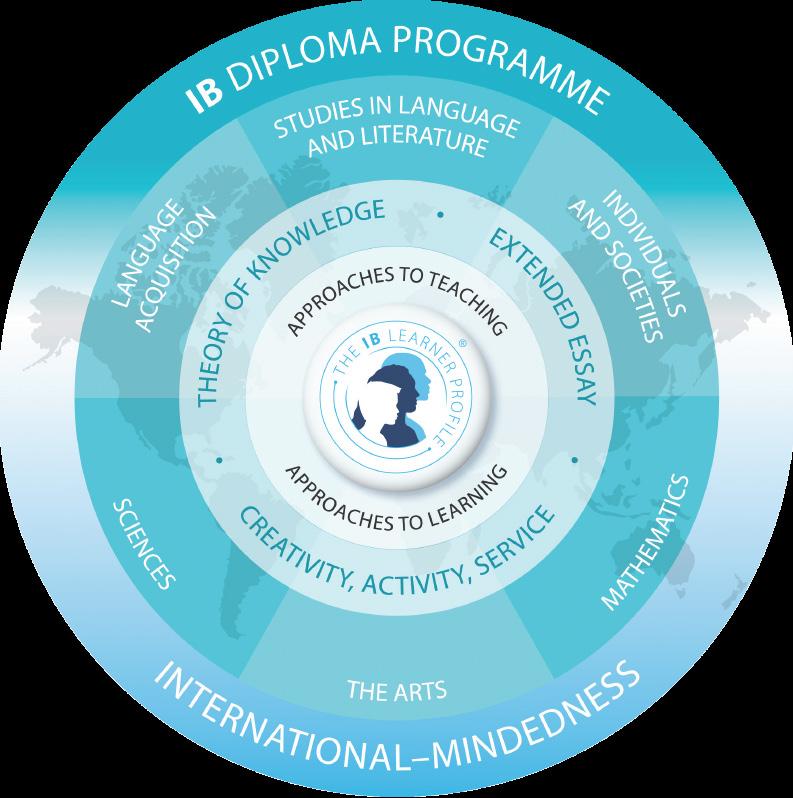
IB Environmental Systems & Societies SL (taught over 2 yrs)
IB Physics SL
IB Visual Arts HL
IB Psychology SL
IB Economics SL
IB Business SL
2nd IB Science SL or HL
2nd IB World Language SL or HL
IB History of the Americas HL
MATHEMATICS
IB Analysis HL
IB Applications HL
IB Analysis SL
IB Applications SL
= Higher Level = Standard Level
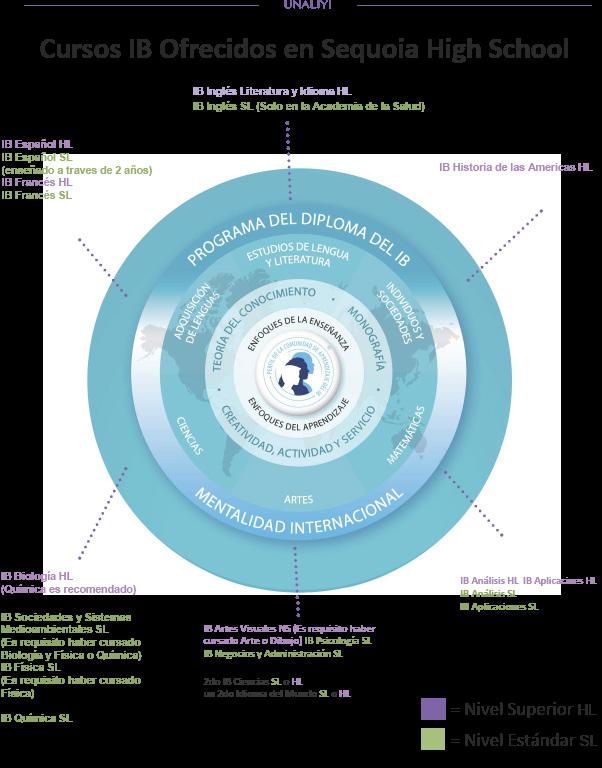
ADQUISICIÓN
IB Español HL
IB Español SL (impartido en 2 años)
IB Francés HL
IB Francés SL
IB Course
Grade in which IB Course is taken
IB Visual Arts 2 year course: 11th and 12th grade
IB Physics* 1 year course: 12thgrade Recommended
IB Biology 2 year course: 11th and 12th grade
IB Spanish 2 year course: 11th and 12th grade
Prerequisite Course Required Grade in which Prerequisite is taken
Art I or Draw/Paint I 9th or 10th
IB French 2 year course: 11th and 12th grade
IB Applications 9th-12th grade
Physics & Concurrently enrolled in IB Math Apps Prep or IB Math Analysis Prep or higher 9th - 11th
Recommended Chemistry 10th
IB Analysis 9th-12th grade
IB Environmental Systems 2 year course: 11th and 12th
IB Business 1 yr course: 11th or 12th
IB Chemistry 11th-12th.
Spanish 2/3 ICAP, Spanish III, or Spanish III NS with C- or higher or teacher recommendation 10th
French 2/3 ICAP or French III with C- or higher or teacher recommendation 10th
IB Math Apps Prep or higher with C- or higher 8th-11th
IB Math Analysis Prep or higher with C- or higher 8th-11th
Recommended Biology AND Chemistry or Physics 9th-10th
Recommended Entrepreneurship I 9th-11th
Successful completion of Chemistry
10th-11th
*IB Physics recommended for senior year - The more math knowledge the better College preparatory pattern of science includes Biology, Chemistry & Physics
Curso IB
Curso en el que se realiza el curso IB
Curso previo obligatorio o recomendado
Curso en el que se realiza el curso previo
Artes Visuales IB Curso de 2 años: 1º y 2º de Bachillerato Arte I o Dibujo/Pintura I Grado 9 o 10
Física IB*
Curso de 1 año: 2º de Bachillerato recomendado
Biología IB Curso de 2 años: 1º y 2º de Bachillerato
IB Español Curso de 2 años: 1º y 2º de Bachillerato
Física y estar matriculado simultáneamente en un curso de preparación de IB Matemáticas Aplicadas o IB Matemáticas Análisis o superior
Se recomienda haber cursado Química
Español 2/3 ICAP, Español III o Español III HS con calificación mínima de Co recomendación del maestro
IB Francés Curso de 2 años: 1º y 2º de Bachillerato
IB Aplicaciones
De 3º de ESO a 2º de Bachillerato
IB Análisis
De 3º de ESO a 2º de Bachillerato
Sistemas Ambientales IB
Curso de 2 años: 1º y 2º de Bachillerato
Empresa IB Curso de 1 año: 1º o 2º de Bachillerato
Química IB 1º-2º de Bachillerato.
Francés 2/3 ICAP o Francés III con calificación mínima de C- o o recomendación del maestro
Curso de Preparación de IB Matemáticas Aplicadas o superior
Curso de Preparación de IB Matemáticas Análisis o superior
Se recomienda haber cursado Biología Y Química o Física
Se recomienda haber cursado Emprendimiento I
Se recomienda haber cursado Química
Grado 9, 10 o 11
Grado 10
Grado 10
Grado 10
Grado 8, 9, 10 o 11
Grado 8, 9, 10 o 11
Grado 9 y 10
Grado 9, 10, 11
Grado 10 o 11
*Se recomienda cursar Física IB en el grado 12: Cuanto más conocimientos de matemáticas, mejor. El itinerario de ciencias preparatorio para la universidad incluye Biología, Química y Física.
The following information is provided to help you understand the way grades are awarded, credits are granted, and students advance from one grade level to another. Additional information is provided regarding how students are able to meet the graduation and University of California & California State University (UC/CSU) college admission requirements. We also provide sample four year plans so you and your student can view potential academic pathways. Please also take advantage of the grade level Course Planning Worksheets we provide to help your student plan course selections for the following school year on pages 19-23.
Sequoia students should be accumulating an average of 30 credits per semester, and a total of 60 credits per school year. All semester-long courses are awarded 5 credits if a student earns a passing grade (D- or higher). All quarter courses are awarded 2.5 credits if a student earns a passing grade.
Additionally, UC’s, CSU’s, and most colleges do not accept D’s as passing grades. Students that earn a D in a course may need to repeat the course to meet A-G (UC/CSU requirements).
All semester-long, college-prep and non-college prep courses will receive the following grade point weight:
A = 4, B = 3, C = 2, D = 1 F = 0
All semester-long IB honors courses will receive the following grade point weight: A = 5, B = 4, C = 3, D = 1, F = 0
GPAs are documented on a student’s high school transcript. Please note that each college or university will recalculate the student’s GPA based on institutional admissions practices.
An out-of-district transfer student with an official transcript verification of subject and credit requirements will be placed at the appropriate grade level.
All freshmen, sophomores, and juniors are required to enroll in a minimum of six classes. All seniors must be enrolled in a minimum of five classes. Students desiring to participate in Sequoia’s Athletics program must be enrolled in at least five classes or 22.5 semester credits. Refer to page 24 for more information regarding athletic eligibility.
For the deadlines to add or drop classes, please refer to the Counseling Department: bit.ly/SequoiaCounseling
La siguiente información es proporcionada para ayudarle a entender la forma en que se otorgan las calificaciones, los créditos son otorgados y los estudiantes proceden de un nivel de grado a otro. Se proporciona información adicional sobre cómo los estudiantes pueden cumplir los requisitos de graduación y admisión a la universidad UC y CSU. También proporcionamos muestras de planes de cuatro años para que usted y su estudiante puedan ver vías académicas potenciales. Por favor también tome ventaja de la Hoja de trabajo de Planificación de Cursos de nivel de grado que le proporcionamos para ayudar a su estudiante a planear la selección de cursos para el próximo año escolar en las páginas 17-21.
Los estudiantes de Sequoia deben estar acumulando un promedio de 30 créditos por semestre y un total de 60 créditos por año escolar. Todos los cursos de semestre completo son otorgados 5 créditos si el estudiante obtiene una calificación aprobatoria (D- o mejor). Todos los cursos del trimestre son otorgados 2.5 créditos si el estudiante obtiene una calificación aprobatoria.
Además, los UC y CSU, y la mayoría de las universidades no aceptan D como calificación aprobatoria. Los estudiantes que obtienen un D en un curso deben repetir el curso para cumplir con los requisitos A-G (requisitos de UC y CSU).
Todos los cursos de preparación universitaria de semestre completo y todos los cursos de semestre no universitarios recibirán la siguiente calificación ponderada:
A = 4, B = 3, C = 2, D = 1 F = 0
Todos los cursos IB de honores de semestre completo recibirán los siguientes puntos de calificación:
A = 5, B = 4, C = 3, D = 1, F = 0
Tenga en cuenta que cada colegio o universidad volverá a calcular el GPA del estudiante basado en las prácticas institucionales de admisión. Los GPA se documentan en el expediente académico de preparatoria del estudiante.
Estudiantes fuera del distrito: Un estudiante transferido fuera del distrito con una verificación oficial de calificaciones de la materia y los requisitos de crédito se colocará en el nivel de grado correspondiente.
Todos los freshmen (grado 9), sophomores (grado 10) y juniors (grado 11) deben estar inscritos en un mínimo de seis clases. Todos los seniors (grado 12) deben estar inscritos en un mínimo de cinco clases. Los estudiantes que deseen participar en deportes deben estar inscritos en por lo menos cinco clases o 25 créditos cada semestre. Refiérase a la página 24 para más información sobre la elegibilidad para deportes.
Para las fechas de agregar y eliminar clases, refiérase al sitio web del departamento de asesoramiento: www.sequoiahs.org/DEPARTMENT/Counseling/
The “A-G” requirements are courses that must be completed with a grade of C- or higher to be eligible to attend a University of California (UC) or California State University (CSU). The following chart explains both the A-G requirements and Sequoia’s graduation requirements.
“A - G” Requirement
Subject Area Years required for A-G
A Social Studies 2
Years/Credits required for Graduation
3 Years/30 credits Must include: World History U.S. History Government & Economics
Other Important Information
Courses that meet the “A” area requirement for UC and CSU are: World History ICAP, Ethnic Studies US History and Government, IB History HL B English 4 4 Years/40 credits
For both graduation and UC/CSU, students are required to pass both semesters of English every year. English I ICAP, English I Intensive, English II Intensive, English II ICAP, III, IV, ELA III and IB English meet the “B” area requirement. Note that starting 2023-24 English I & II Intensive meet the “B” area requirement.
C Math
3 (4 years highly recommended)
D Science
F
2 (3-4 yrs highly recommended)
2 Years/20 credits (Algebra and Geometry minimum)
2 Year/20 credits (including one year of a laboratory science)
World Language 2 (3 years recommended) Not required
Visual and Performing Arts
1 1 Year/10 credits
60 CREDITS*
Elective credits include support & study skills classes.
To meet the “C” area requirement for UC/CSU, students must complete at least Algebra I, Geometry and Algebra II.
For the UC “D” area, students must complete at least 2 years of Lab Science. For the CSU “D” area, students must complete one year of Biology and one year of Chemistry or Physics. Three years of science preferred.
Two levels/years minimum required to meet area “E” must be in the same language. *Credits earned go towards electives or World Language Level III and above can be used in place of the CTE graduation requirement.
These courses include electives in music, dance, drama, and visual art. For UC/CSU students must take a VPA course(s) in the same discipline.
Any course that meets an A-G requirement in areas A-F and exceeds the minimum requirement can be used for area “G”. For example, a third year of science or world language can meet the “G” requirement. Please note that some elective courses are not A-G approved and only meet elective requirements for graduation. Career Technical
1 Year/10 credits
CTE is met through designated CTE courses. World Language Level III and above can be used in place of the CTE graduation requirement. Physical
0 2 Years/20 credits
Ethnic Studies 0 7.5 credits
Life Skills 0 2.5 credits
9th grade SHS sports count towards elective credit only Students may use three seasons of SHS sports from 10th12th grades towards the 2nd year of PE
Ethnic Studies is a required course for all students. Ethnic Studies-P (semester 2) meets area “A” of World History.
Life Skills is a required course for all students. Total
Los requisitos “A-G” son asignaturas que deben aprobarse con una calificación mínima de C- para poder acceder a la Universidad de California (UC) o a la Universidad Estatal de California (CSU). A continuación se presenta una tabla que detalla tanto los requisitos A-G como los requisitos de graduación en Sequoia.
“A - G” Requisito
Área de asignatura Años requeridos para A-G
A Ciencias Sociales 2
Años/Créditos requeridos para la graduación Otra información relevante
3 años/30 créditos
Debe incluir: Historia Mundial, Historia de EE. UU., Gobierno y Economía
B Inglés 4 4 años/40 créditos
E Idioma Extranjero
F3 (se recomiendan 4 años)
2 (se recomienda n 3-4 años)
2 años/20 créditos (mínimo Álgebra y Geometría)
2 años/20 créditos (incluyendo un año de ciencia de laboratorio)
2 (se recomienda n 3 años) No es obligatorio
Artes Visuales y Escénicas 1 1 año/10 créditos
Optativas de Preparación
Universitaria 1
Formación
Profesional y Técnica
Educación Física
60 CRÉDITOS* Los créditos optativos incluyen clases de apoyo y habilidades de estudio.
0 1 año/10 créditos
0 2 años/20 créditos
Estudios Étnicos 0 7,5 créditos
Habilidades para la Vida 0 2,5 créditos
Total de Créditos
Requeridos
220 créditos
Las asignaturas que cumplen con el requisito del área “A” para UC y CSU son: Historia Mundial ICAP, Estudios Étnicos, Historia de EE. UU. y Gobierno, IB History HL
Para graduarse y para UC/CSU, el alumnado debe aprobar ambos semestres de inglés cada año. Inglés I ICAP, Inglés I Intensivo, Inglés II Intensivo, Inglés II ICAP, III, IV, ELA III y IB English cumplen el requisito del área “B”. A partir de 2023-24, Inglés I y II Intensivo cuentan para el área “B”.
Para cumplir con el requisito del área “C” para UC/CSU, los estudiantes deben completar al menos Álgebra I, Geometría y Álgebra II.
Para el área “D” de UC, se requieren al menos 2 años de ciencias de laboratorio. En el caso de CSU, se exige un año de Biología y un año de Química o Física. Se recomienda cursar tres años de ciencias.
Se requieren al menos dos niveles/años en el mismo idioma para completar el área “E”. *Los créditos obtenidos cuentan como optativos o, si se alcanza el nivel III o superior, pueden sustituir el requisito de CTE para graduación.
Estas asignaturas incluyen optativas de música, danza, teatro y artes plásticas. Para UC/CSU, es necesario cursar las materias de Artes Visuales y Escénicas en la misma disciplina.
Cualquier asignatura que cumpla con los requisitos A-G en las áreas A-F y supere el mínimo exigido se puede contabilizar en el área “G”. Por ejemplo, un tercer año de ciencias o de idioma extranjero puede cubrir el requisito “G”. Ten en cuenta que algunas optativas no están homologadas para A-G y sólo cuentan para los requisitos de graduación.
El requisito de Formación Profesional y Técnica se cumple con los cursos designados como CTE. El nivel III y superiores de idioma extranjero pueden sustituir el requisito de CTE para la graduación.
Los deportes de SHS en 9º solo cuentan como crédito optativo. Se pueden utilizar tres temporadas de deportes de SHS en 10º-12º para cumplir el segundo año de Educación Física.
Estudios Étnicos es una asignatura obligatoria para todos los estudiantes. Estudios Étnicos-P (segundo semestre) cumple el área “A” de Historia Mundial.
Habilidades para la Vida es una asignatura obligatoria para todos los estudiantes.
NOTE: 60 elective credits are required for graduation. Core academic courses beyond the graduation requirements meet elective requirements.
P = Course meets UC/CSU a-g requirements
HP = Honors courses that earn an extra grade point for a grade of C- or better & meet UC/CSU a-g requirements
English I-ICAP, II-ICAP, III, IV – P
English I, II Support*
Academic Literacy*
IB English Y1, Y2 – HL – HP
IB English Y1, Y2 – HL – HP (Hlth, DAA)
IB English – SL – HP (Hlth, DAA)
ELD = Courses for English Learners
Hlth = Health Careers Academy (HCA)
HL = IB Higher Level
SL = IB Standard Level
Life Skills (9th, 1st quarter)
World History ICAP – P
Acad World History ICAP Hlth – P
Acad World History ICAP (DAA) – P
US History – P
Acad US History (DAA) – P
Acad US History Hlth – P
American Govt – P
Acad Amer Govt (DAA) – P
Acad English II ICAP, III, IV (DAA) – P Acad Amer Govt Hlth – P
Acad English II ICAP, III Hlth – P
Intervention ELA*
Intervention ELA Support*
English Intensive I-P, II-P
English Intensive I, II Support*
Algebra I – P
Geometry – P
Acc Geo/IB Math Analysis Prep – P
Statistics - P
IB Math Analysis Prep – P
IB Math Applications Prep – P
IB Math Analysis SL – HP
IB Math Analysis HL – HP
IB Math Applications SL – HP
IB Math Applications HL– HP
Multivariable Calculus - P (Cañada)
Ordinary Differential Equations- P (Cañada)
Linear Algebra - P (Cañada)
Economics – P
Acad Economics (DAA) – P
Acad Economics Hlth – P
IB Hist of Amer Y1, Y2 – HP
Biology – P
Biotechnology I-II – P
Human Biology – P
Human Biology – HCA – P
Chemistry – P
Acad Chem (DAA or Hlth) - P
Physics – P
Acad Physics (DAA) - P
IB Biology Y1, Y2 – HL – HP
IB Environmental Sys Y1, Y2-SL – HP
IB Physics SL – HP
IB Chemistry SL- HP
(9th, 2nd quarter)
Ethnic Studies– P (9th, 2nd semester)
Spanish I, II, III, IV – P
Spanish II/III ICAP – P
Spanish I, II, III, IV– NS – P
IB Spanish B– SL –Y4, Y5 – HP
IB Spanish B– HL –Y4, Y5 – HP
French I, II, III, IV – P
French II/III ICAP – P
IB French B– HL –Y4, Y5 – HP
IB French B SL Y4 (by teacher recommendation only)
ELA I, II
ELA III - P
ELD I, II, III*
English III - P
Academic Literacy*
Algebra I EML – P
Geometry EML – P
Geometry PL - P
World History PL - P
US History EML – P
Amer Govt EML – P
Economics EML – P
Biology EML – P
Chemistry EML - P
Biotech 1 & 2 EML-P
World History EML-P
Life Skills EML
Ethnic Studies EML-P
NOTA: Se requieren 60 créditos optativos para graduarse. Las asignaturas académicas básicas que superen los requisitos de graduación cuentan como optativas.
P = El curso cumple los requisitos a-g de UC/CSU
HP = Cursos avanzados que suman un punto extra en la calificación si se obtiene C- o superior y cumplen los requisitos a-g de UC/CSU
Inglés I-ICAP, II-ICAP, III, IV – P
Apoyo en Inglés I, II*
Alfabetización Académica*
IB Inglés Y1, Y2 – HL – HP
IB Inglés Y1, Y2 – HL – HP (Hlth, DAA)
IB Inglés – SL – HP (Hlth, DAA)
Inglés Académico II ICAP, III, IV (DAA) – P
Inglés Académico II ICAP, III Hlth – P
Intervención ELA*
Apoyo en Intervención ELA*
Inglés Intensivo I-P, II-P
Apoyo en Inglés Intensivo I, II*
Álgebra I – P
Geometría – P
Geometría Avanzada/Preparación Análisis
IB Matemáticas – P
Estadística - P
Preparación Análisis IB Matemáticas – P
Preparación Aplicaciones IB Matemáticas – P
Análisis IB Matemáticas SL – HP
Análisis IB Matemáticas HL – HP
Aplicaciones IB Matemáticas SL – HP
Aplicaciones IB Matemáticas HL– HP
Cálculo Multivariable - P (Cañada)
Ecuaciones Diferenciales Ordinarias - P (Cañada)
Álgebra Lineal - P (Cañada)
ELD = Cursos para estudiantes de inglés
Hlth = Health Careers Academy (HCA)
HL = IB Nivel Superior
SL = IB Nivel Estándar
Habilidades para la Vida (9º, primer trimestre)
Historia Mundial ICAP – P
Historia Mundial Académica ICAP Hlth – P
Historia Mundial Académica ICAP (DAA) – P
Historia de Estados Unidos – P
Historia de EE. UU. Académica (DAA) – P
Historia de EE. UU. Académica Salud – P
Gobierno Americano Académico (DAA) – P
Gobierno Americano – P
Economía – P
Economía Académica (DAA) – P
Economía Académica Salud – P
IB Historia de América Y1, Y2 – HP
Biología – P
Biotecnología I-II – P
Biología Humana – P
Biología Humana – HCA – P
Química – P
Química Académica (DAA o Salud) – P
Física – P
Física Académica (DAA) – P
IB Biología Y1, Y2 – HL – HP
IB Sistemas Ambientales Y1, Y2-SL – HP
IB Física SL – HP
IB Química SL – HP
(9º, 2º trimestre)
Estudios Étnicos – P (9º, 2º semestre)
Español I, II, III, IV – P
Español II/III ICAP – P
Español I, II, III, IV– NS – P
IB Español B– SL –Y4, Y5 – HP
IB Español B– HL –Y4, Y5 – HP Francés I, II, III, IV – P Francés II/III ICAP – P
IB Francés B– HL – 4º, 5º año – HP
IB Francés B SL 4º año (solo por recomendación del profesorado)
ELA I, II
ELA III - P
ELD I, II, III*
Inglés III - P
Alfabetización Académica*
Álgebra I EML – P
Geometría EML – P
Geometría PL - P
Historia Mundial PL - P
Historia de Estados Unidos EML – P
Gobierno Americano EML – P
Economía EML – P
Biología EML – P
Química EML - P
Biotecnología 1 y 2 EML-P
Historia Mundial EML-P
Habilidades para la Vida EML
Estudios Étnicos EML-P
VISUAL & PERFORMING ARTS
10 CREDITS REQUIRED FOR GRADUATION
-P & -HP= COURSE MEETS UC/CSU ENTRANCE REQUIREMENTS
Beginning Band-P
Advanced Band-P (audition)**
Band II-P
Choral I-P & II-P
Guitar-P
Piano-P
Beginning Orchestra-P Orchestra-P
Art I-P
Art Studio I-P
Digital Photo I-P & II-P
IB Visual Arts Y1 - HP & Y2 - HP
Ceramics I-P & II-P & III-P
Stagecraft I -P
Inter. Dance-P (audition)**
Dance XL- P (audition)**
Drama I, II, III -P
Multimedia I - P 10th
**Students wanting to pursue these classes need to contact teacher for audition dates.

CAREER TECHNICAL EDUCATION
10 CREDITS REQUIRED FOR GRADUATION -P & -HP= COURSE MEETS UC/CSU ENTRANCE REQUIREMENTS
MEDIA & ENTERTAINMENT
Journalism I-P, II-P, III-P
Adv Digital Photo & Design-P (Photo III)
BUILDING, TRADES & CONSTRUCTION
CTE Wood I, CTE Wood II
HOSPITALITY, TOURISM & RECREATION
CTE Foods & Nutrition I-P CTE Culinary Arts-P 10th-12th DIGITAL ARTS ACADEMY
CTE Multimedia II - P 11th CTE Multimedia III - P 12th
CAREERS ACADEMY
CTE Intro to Health Professions-P 10th
Medical Clinical II-P 12th Entrepreneurship - P
TECHNOLOGY
Java Programming
ADDITIONAL ELECTIVE OPTIONS: -P & -HP= COURSE MEETS UC/CSU ENTRANCE REQUIREMENTS
IB Psychology-HP 11th -12th
IB Economics-HP 11th-12th
May be used in place of CTE to meet this graduation requirement area. French ⅔ ICAP and Spanish ⅔ ICAP do not fulfill this area.
Leadership ASB -P 10th-12th & by teacher recommendation only
PE-2/Weight Train/Conditioning/Dance 10th-12th
[Advancement Via Individual Determination]
AVID I-P, II-P, III-P, IV-P
Wood III 11th-12th
Work Experience 11th-12th
36 hrs. =1 credit [10 credits per semester max & not a scheduled class, after hours]
Each sport = 3.5 credits
Cheerleading = 3.5 credits awarded in the spring only
Sports credits may be used toward the P.E. graduation requirement for 10th -12th grades only
9th grade sports remain as elective credit

If you need more elective credits and work or do community service, for graduation, contact your

ARTES VISUALES Y ESCÉNICAS
SE REQUIEREN 10 CRÉDITOS
PARA GRADUARSE
-P & -HP= EL CURSO CUMPLE LOS REQUISITOS DE UC/CSU
Banda Inicial-P
Banda Avanzada-P (audición)**
Banda II-P
Coro I-P & II-P
Guitarra-P
Piano-P
Orquesta Inicial-P
Orquesta-P
ARTES VISUALES
Arte I-P
IB Artes Visuales Y1 & Y2 - HP
Fotografía Digital I, II-P
Estudio de Arte I-P
Cerámica I, II, III-P
Producción Escénica I-P
ARTES ESCÉNICAS
Danza Intermedia-P (audición)**
Danza XL-P (audición)**
Drama/Teatro I, II, III -P
ACADEMIA DE ARTES DIGITALES
Multimedia I-P 10o
**Quienes estén interesados en cursar estas asignaturas deberán contactar con el profesorado para consultar las fechas de audición.
Educación de Carreras Técnicas 10 CRÉDITOS NECESARIOS
PARA GRADUARSE
-P & -HP= EL CURSO CUMPLE LOS REQUISITOS DE UC/CSU
MEDIOS Y ENTRETENIMIENTO
Periodismo I, II, III-P
Fotografía Digital Avanzada y Diseño-P (Fotografía III)
CONSTRUCCIÓN Y OFICIOS
CTE Carpintería I, CTE Carpintería II
HOSTELERÍA, TURISMO Y RECREACIÓN
CTE Alimentación y Nutrición I-P
CTE Artes Culinarias-P 10º-12º
ACADEMIA DE ARTES DIGITALES
CTE Multimedia II-P 11º
CTE Multimedia III- P 12º
ACADEMIA DE CARRERAS DE SALUD
CTE Introducción a las Profesiones de Salud-P 10o
CTE Clínica Médica I-P 11º
CTE Clínica Médica II-P 12º
Emprendimiento-P
TECNOLOGÍAS DE LA INFORMACIÓN
Programación en Java
Puede sustituir a CTE para cumplir el requisito de graduación en esta área. Francés ⅔ ICAP y Español ⅔ ICAP no cumplen este requisito.
OPCIONES
ADICIONALES DE OPTATIVAS:
-P & -HP= EL CURSO CUMPLE LOS REQUISITOS DE UC/CSU
IB Psicología-HP 11º-12º
IB Economía-HP 11º-12º
IB Empresa-HP 11º-12º
IB TOK-HP 11º-12º
Liderazgo Estudiantil-P 9º
Liderazgo ASB-P 10º-12º y solo por recomendación del profesor
PE-2/Entrenamiento con pesas/Preparación física/Danza 11º-12º
[Avance via Determinación Individual]
AVID I-P, II-P, III-P, IV-P
Carpintería III 11º-12º
Experiencia Laboral 11º-12º
36 horas = 1 crédito [Máximo 10 créditos por semestre y no es una clase programada, se realiza fuera del horario lectivo]
Cada deporte = 3,5 créditos
Animación = 3,5 créditos otorgados solo en primavera
Los créditos deportivos pueden aplicarse al requisito de graduación en Educación Física solo en 4º -6º curso Los deportes de 3º se consideran créditos optativos
Infórmate sobre las Optativas: bit.ly/shselectives
Si necesitas más créditos optativos y trabajas o realizas servicio comunitario para graduarte, contacta con tu orientador asignado
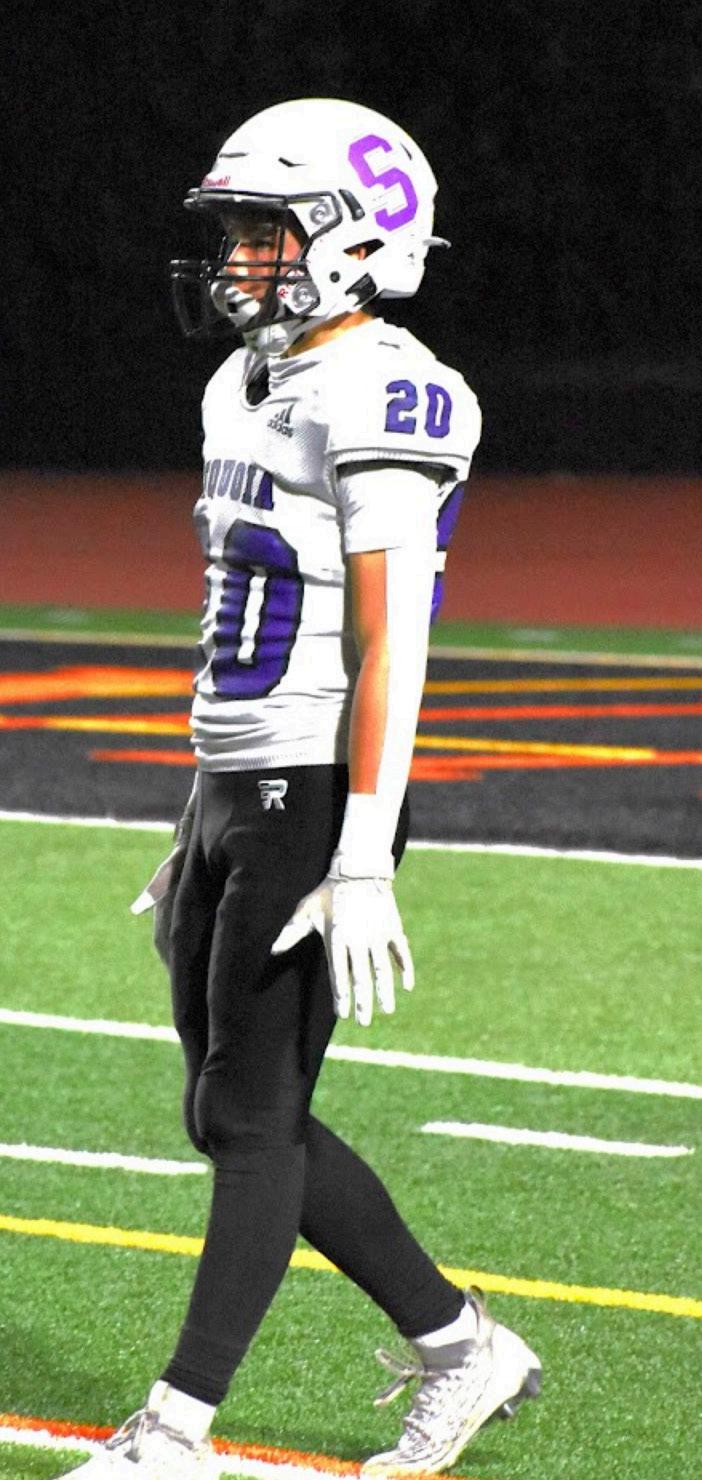
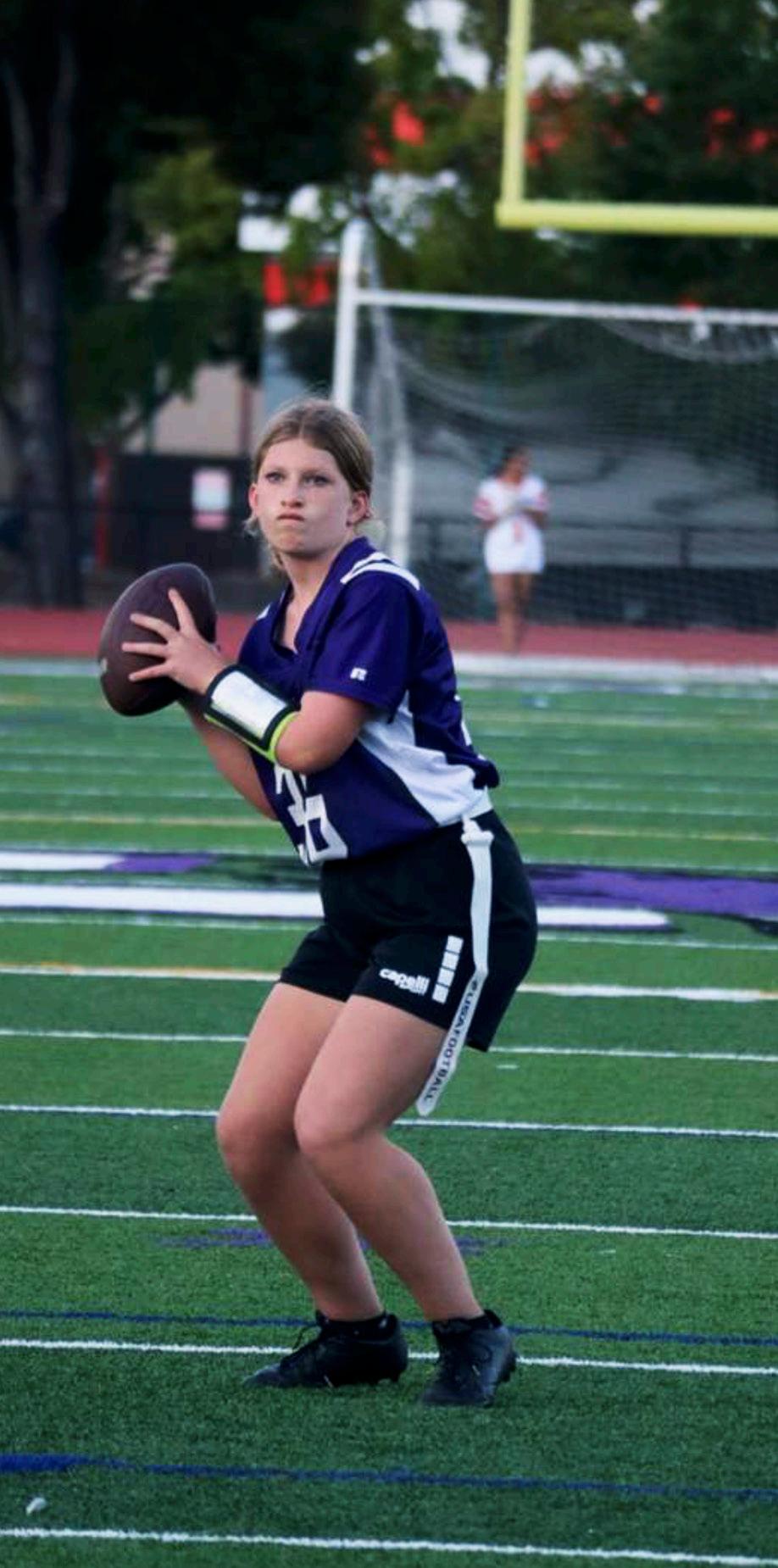
Girls Tennis
Girls Volleyball
Cross Country
Football
Girls Flag Football
We encourage students to explore options when it comes to high school activities, and athletics is one way to do that. If you are planning to play sports at the Division I or II level, you need to register on the NCAA eligibility website starting at the beginning of 11th grade. NCAA requires student athletes to complete a certain number of high school core courses, and maintain a certain minimum GPA in those courses. For additional information regarding NCAA, please visit NCAA Eligibility Center & Sequoia's College/Career Center.
• Must be prepared to commit to at least two-hours of daily practices (Mon-Fri) after school throughout the season.
• Must be cleared annually by a physician. Every year a new physical form needs to uploaded to Sportsnet.
• Must be enrolled in at least five classes each semester (22.5 credits each semester).
• Must be passing a minimum of four 5-credit classes at the end of the previous grading period with an unweighted grade point average (GPA) of 2.0 or better (meets California Interscholastic Federation requirements)
• Cannot fall behind more than 20 credits in the student classification system (i.e. 40 credits = 10th grade, 95 credits = 11th grade, and 155 credits = 12th grade).
• 3.5 credits of a sport played in grades 10th-12th may be used in place of PE during grades 10th-12th. Students must play three seasons 10th-12th in order to satisfy the 2nd year of PE for graduation requirements.
• All freshmen are required to take 9th grade PE or PE-Dance regardless of sports participation.
WINTER SPORTS
Girls & Boys Basketball
Girls & Boys Soccer
Wrestling
Sideline Cheer
Badminton
Baseball
Boys Golf
Boys Tennis
Boys Volleyball
Stunt Cheer
Girls & Boys Lacrosse
Girls Softball
Swimming
Track & Field

For more information regarding Sequoia Athletics, please visit the Sequoia Sports webpage https://seqsports.com
Polo acuático femenino y masculino
Tenis femenino
Voleibol femenino
Campo a través
Fútbol americano
Fútbol bandera femenino
Animamos a los estudiantes a descubrir distintas opciones en las actividades de bachillerato, y el deporte es una excelente alternativa. Si tienes previsto competir en deportes en División I o II, debes registrarte en la web de elegibilidad de la NCAA al comenzar el 3º año de secundaria. La NCAA exige que los atletas estudien una cantidad determinada de asignaturas troncales y mantengan una nota media mínima en ellas. Para más información sobre la NCAA, visita el Centro de Elegibilidad de la NCAA y el Centro Colegios/Carreras de Sequoia.
• Es necesario estar dispuesto a dedicar al menos dos horas diarias a los entrenamientos (de lunes a viernes) después de clase durante toda la temporada.
• Se requiere autorización médica anual. Cada año hay que subir un nuevo formulario de reconocimiento médico a Sportsnet.
• Hay que estar matriculado en al menos cinco asignaturas por semestre (22,5 créditos por semestre).
• Debes aprobar como mínimo cuatro materias de 5 créditos al final del periodo de evaluación anterior, con una media no ponderada igual o superior a 2.0 (cumpliendo los requisitos de la Federación Interescolar de California).
• No puedes retrasarte más de 20 créditos en el sistema de clasificación de estudiantes (por ejemplo, 40 créditos = 2º de secundaria, 95 créditos = 3º de secundaria, y 155 créditos = último curso).
• Se pueden usar 3,5 créditos de un deporte practicado entre 3º y 5º de secundaria en lugar de Educación Física durante esos cursos. Es obligatorio participar en tres temporadas de deporte en 3º-5º de secundaria para cumplir el segundo año de Educación Física que se exige para graduarse.
• Todos los estudiantes de primer año deben cursar Educación Física de 1º o PE-Danza, independientemente de si participan en deportes.
Baloncesto femenino y masculino
Fútbol femenino y masculino
Lucha
Porristas
Bádminton
Béisbol
Golf masculino
Tenis masculino
Voleibol masculino
Porristas
Lacrosse femenino y masculino
Sófbol femenino
Natación
Atletismo
Para más información sobre los deportes en Sequoia, visita la página web de Sequoia Sports https://seqsports.com
Courses Eligible for a 7th period class
• Advanced Dance XL - P (Audition Required)
• AVID I, II, III, IV - P
• Beginning Band - P
• Advanced Band - P (Audition Required)
• Band II - P
• Entrepreneurship I -P
• Choral I, II - P
• Journalism I, II, III - P
• Beginning Orchestra - P
• Orchestra - P
• Leadership-ASB - P
• Drama I, II, III - P
• Student Leadership - P (9th only)
• CTE Wood II
• Wood III
• Java Programming
• P.E./Dance - 10th grade students pursuing IB Art in 11th & 12th grade
• Student Clerk/Technical Assistant
• IB Theory of Knowledge - HP (TOK)
STUDENTS IN THE FOLLOWING COURSES MAY BE SCHEDULED TO TAKE 7 CLASSES:
• Students with 1 or more support classes
• Study Skills (Students with IEP’s)
• Academy students planning to go to a university and who need a 7th course in order to meet graduation and/or A-G requirements
• Danza Avanzada XL - P (requiere audición)
• AVID I, II, III, IV - P
• Banda Inicial - P
• Banda Avanzada - P (requiere audición)
• Banda II - P
• Emprendimiento I - P
• Coral I, II - P
• Periodismo I, II, III - P
• Orquesta Inicial - P
• Orquesta - P
• Liderazgo-ASB - P
• Teatro I, II, III - P
• Liderazgo Estudiantil - P (solo 9º)
• CTE Madera II
• Madera III
• Programación en Java
• Educación Física/Danza - Alumnos de 10º que cursarán Arte IB en 11º y 12º
• Auxiliar de Estudiante/Asistente Técnico
• Teoría del Conocimiento IB - HP (TOK)
LOS ESTUDIANTES EN LOS SIGUIENTES CURSOS PUEDEN PROGRAMARSE PARA CURSAR 7 ASIGNATURAS:
• Estudiantes con una o más clases de apoyo
• Habilidades de Estudio (Estudiantes con IEP)
• Estudiantes de academias que planean ingresar a la universidad y necesitan una séptima asignatura para cumplir requisitos de graduación y/o A-G
Sequoia High School has a college going culture and no matter where a student begins in the 9th grade, the counseling department will help students have an opportunity to be eligible to apply to a 4-year college upon graduation. Counselors meet with all students during the spring semester for the next school year’s course selection. Counselors will conduct a classroom lesson, followed by an individual appointment to finalize schedules. Listed below are a few examples of a 4-year plan.
Life Skills/Ethnic Studies 1-2 World History- PL or EML US History-EML Government-Economics-E ML
ELD I & ELA I ELD II & ELA II
Geometry PL or Geometry EML or Algebra I EML
Biotech EML or Biology EML
PE 1/Dance
CTE/VPA/Elective
Geometry PL or Geometry EML or Algebra I EML
ELD III & ELA III English III & Academic Literacy
IB Math Prep IB Math SL/HL Y1 or Statistics
Biology EML or Chemistry EML Science-Teacher Recommendation Science-Teacher Recommendation
PE/Dance/Elective Elective Elective
CTE/VPA/Elective Elective Elective
Intervention ELA
Intervention ELA Support
English II Intensive English III English IV
English II Intensive Support Academic Literacy Elective
Algebra I Geometry
IB Math Prep IB Math SL /HL Y1 or Statistics
PE 1/Dance PE/Dance Elective Elective
Biology Chemistry or Physics Science Science
Life Skills/ Ethnic Studies 1-2
World History ICAP US History GovernmentEconomics
World Language/Elective World Language/CTE/VPA/ Elective CTE/VPA/Elective
English I Intensive
English II Intensive or English II English III English IV
English I Intensive Support English II Intensive Support or English II Support
Academic Literacy Elective
Algebra I Geometry IB Math Prep IB Math SL/HL Y1 or Statistics
Biology Chemistry or Physics Science Science
PE 1/Dance PE/Dance Elective Elective
Life Skills/Ethnic Studies 1-2 World History ICAP US History GovernmentEconomics
World Language/Elective World Language/CTE/VPA/Elect ive CTE/VPA/Elective
Life Skills/Ethnic Studies 1-2
English I ICAP
Algebra
Biology
Chemistry Elective
PE/Dance/Elective
Life
Biology
Chemistry/Physics/Human Bio/Biotech/IB Physics/IB Chemistry
PE/Dance/Elective
Life Skills/Ethnic Studies 1-2 World History ICAP US History Government-Economics
English I ICAP English II ICAP English III English IV
English I Support English II Support World Language Y3 World Language Y4
Algebra I or Geometry Geometry or IB Math Prep IB Math Prep or IB Math SL/HL Y1
Math SL/HL Y1 or IB Math HL Y2 or Statistics
Biology Chemistry/ Physics Science Science
World Language Y1 World Language Y2 CTE/VPA/Elective CTE/VPA/Elective
PE 1/Dance PE/Dance/Elective
9th 10th 11th 12th
Life Skills/Ethnic Studies 1-2 World History ICAP US History Government-Economics
English I ICAP English II ICAP English III English IV
English I Support English II Support
Algebra I Geometry
Language Y1 or Y2
Math Prep
Language Y2 or Y3
Math SL/HL Y1 or Statistics
Biology Chemistry/ Physics Science Science
PE 1/Dance PE/Dance/Elective CTE/VPA/Elective CTE/VPA/Elective
Study Skills Study Skills Study Skills Study Skills
Life Skills/Ethnic Studies 1-2
World History ICAP US History/IB History of the Americas Y1 Gov’t / Econ/IB History of the Americas Y2
English I ICAP English II ICAP IB English HL Y1-HP IB English HL Y2-HP
Algebra I/Geometry
Geometry/IB Math Prep IB Math Prep or IB Math SL/HL Y1 IB Math SL/HL Y1 or IB Math HL Y2 or Statistics
Biology Chemistry/ Physics Science Science
French 1/Spanish 1/Spanish II NS
French ⅔ ICAP/ Span ⅔ ICAP/ Spanish III NS IB World Language Y4 IB World Language Y5
PE 1/Dance PE/Dance CTE/VPA/Elective CTE/VPA/Elective
9th 10th 11th 12th
Life Skills/Ethnic Studies 1-2
World History ICAP IB History of the Americas Y1
of
Y2
Algebra I or Geometry or IB Math Prep
Geometry or IB Math Prep or IB Math SL/HL Y1
IB Math Prep or IB Math SL/HL Y1 or IB Math HL Y2 IB Math SL/HL Y2 or IB Math HL Y2
Biology Chemistry/ Physics Physics/ IB Biology Y1/IB Physics/ IB Env Systems Y1/ IB Chemistry
French 1/Spanish 1/ Spanish II NS/ Spanish II/French II
PE 1/Dance
French ⅔ ICAP/ Spanish ⅔ ICAP/ Spanish III NS/ Spanish III/French III
Draw-Paint or Art 1 (pre-req for IB Art)/CTE/VPA/Elective/ PE/Dance
IB World Language Y4
IB Visual Arts Y1/IB Business & Management/IB Psychology/IB Economics/VPA/CTE/Other Elective
IB TOK 2nd semester only [Including CAS Requirement & Extended Essay]
IB Biology Y2/IB Physics/ IB Env Systems Y2/ IB Chemistry
IB World Language Y5
IB Visual Arts Y2/ IB Business & Management/IB Psychology/IB Economics/VPA/CTE/Other Elective
IB TOK 1st semester only [Including CAS Requirement & Extended Essay]
Sequoia High School tiene una cultura que asiste a la Universidad y no importa donde empiece como estudiante de 9o grado, planeamos ayudarle a ser elegible para aplicar a una universidad de 4-años después de la graduación. Los consejeros se reúnen con todos los estudiantes el semestre de primavera para la selección para la selección de clases para el próximo año. Los consejeros realizan lecciones en el salón de clases, seguido por citas para finalizar los horarios. A continuación hay algunas muestras de un plan de 4 años.
Habilidades para la Vida/Estudios Étnicos
ELD I y ELA I
Álgebra I EML
Biología EML o Biotecnología EML
Historia Mundial - EML/PL Historia de EE.UU-EML Gobierno y Economía -EML
ELD II y ELA II
Álgebra I EML/ Geometría EML
Biología EML o Química EML
Educación Física 1/ Baile Educación Electiva
CTE/Artes
Visuales/Electiva
Física 2/ Baile/
CTE/Artes
Visuales/Electiva
ELD III y ELA III
Matemáticas preparatoria IB- HP
Ciencia –Recomendación del maestro/a
Electiva
Electiva
Inglés III y Alfabetismo Académico
Matemáticas IB o Estadística
Ciencia –Recomendación del maestro/a
Electiva
Electiva
Intervención ELA
Apoyo de Intervención ELA
Álgebra I
Educación Física 1/Baile Biología
Habilidades para la Vida/Estudios Étnicos 1-2
Idioma Mundial/Electiva
Inglés II Intensivo
Apoyo de Inglés II Intensivo
Inglés III
Alfabetismo Académico
Geometría Matemáticas preparatoria IB
Educación Física 2 /Baile
Electiva
Inglés IV
Electiva
Matemáticas IB o Estadística
Electiva
Quimica o fisica Ciencia Ciencia
Historia Mundial ICAP
Idioma Mundial/ CTE/Artes Visuales/Electiva
Historia de EE.UU. Gobierno y Economía
CTE/Artes Visuales/Electiva
9o grado –Intervención ELA o inglés Intensivo
10o grado – Inglés Intensivo
11o grado - Inglés I ICAP o Inglés II ICAP
9o Inglés I
Intensivo
Apoyo de Inglés I Intensivo
Álgebra I
10o Inglés Intensivo II o Inglés II
Apoyo de Inglés II Intensivo
11o
Inglés III
Alfabetismo Académico
Geometría Matemáticas preparatoria IB
12o
Inglés IV
Matemáticas IB o Estadística
Biología Quimica o fisica Ciencia Ciencia
Habilidades para la Vida/Estudios Étnicos 1-2
Educación Física 1/Baile
Idioma Mundial/Electiva
Historia Mundial ICAP
Educación Física/Baile
Idioma Mundial/ CTE/Artes Visuales/Electiva
Historia de EE.UU. Gobierno y Economía
Electiva
Idioma Mundial/CTE/Artes Visuales/Electiva
Electiva
Verano
9o grado – Inglés Intensivo
10o grado -Inglés Intensivo o Ing. I ICAP o II ICAP
11o grado- Inglés I ICAP o Inglés II ICAP
9o 10o 11o 12o
Habilidades para la Vida/Estudios Étnicos 1-2
Inglés I ICAP
Álgebra 1 o Geometría
Biología
Educación Física 1/Baile
Electiva
Historia Mundial ICAP DAA
Inglés II ICAP DAA
Geometría o Matemáticas preparatoria IB
Química DAA o Física DAA
Historia de EE.UU DAA Gobierno y Economía DAA
Inglés DAA IB HL año 1
Matemáticas preparatoria IB o Matemáticas IB SL/HL año 1
Química DAA/ Física DAA/Sistemas
Ambientales IB año 1/ Biología IB año 1
Inglés IB HL año 2
Matemáticas IB SL/HL año 1 o HL año 2 o Estadística
Biología Humana/ Biotecnología/ Física IB/ Sistemas Ambientales IB año 2/ Biología IB año 2
Multimedia I Multimedia II CTE Multimedia III CTE
Educación Física/Baile/Electiva
Idioma Mundial Año I Idioma Mundial Año II
UNIVERSITARIA 9o 10o 11o
Habilidades para la Vida/Estudios Étnicos 1-2
Inglés I ICAP
Álgebra 1 o Geometría
Biología
Historia Mundial ICAP HCA
Inglés II ICAP HCA
Geometría o Matemáticas preparatoria IB
Historia de EE.UU. HCA
Inglés HCA IB HL año 1
Matemáticas preparatoria IB o Matemáticas IB SL/HL año 1
Química HCA Física HCA
Educ. Física 1/Baile Introducción a Profesiones de Salud CTE
Arte visual
Educación Física/Baile/Electiva
Estudios Clínicos Médicos I CTE
Gobierno y Economía HCA
Inglés HCA IB HL año 2
Matemáticas IB SL/HL año 1 o HL año 2 o Estadística
Biología Humana/ Biotecnología/ Física IB
Estudios Clínicos Médicos II CTE
Idioma Mundial Año 1 Idioma Mundial Año 2
Habilidades para la Vida/Estudios Étnicos 1-2
Inglés I ICAP
Inglés I con Apoyo
Álgebra I o Geometría
Historia Mundial ICAP
Inglés II ICAP
Historia de EE.UU. Gobierno y Economía
Inglés III Inglés IV
Inglés II con Apoyo Idioma Mundial Año 3 Idioma Mundial Año 4
Geometría o Matemáticas preparatoria IB
Matemáticas preparatoria IB o IB
Matemáticas IB SL/HL año 1
Matemáticas IB SL/HL año 1 o HL año 2 o Estadística
Biología Química/Física Otra Opción de Ciencia Otra Opción de Ciencia
Idioma Mundial Año 1 Idioma Mundial Año 2 CTE/Artes Visuales/Electiva CTE/Artes Visuales/Electiva
Educación Física 1/Baile
Educación Física/ Baile/ Electiva
Habilidades para la Vida/Estudios Étnicos 1-2
Inglés I ICAP
Inglés I con Apoyo
Álgebra I
Historia Mundial ICAP Historia de EE.UU. Gobierno y Economía
Inglés II ICAP
Inglés III Inglés IV
Inglés II con Apoyo Idioma Mundial Año 1/2 Idioma Mundial Año 2/3
Geometría
Matemáticas preparatoria IB
Matemáticas IB SL/HL año 1 o Estadística
Biología Física/Química Otra Opción de Ciencia Otra Opción de Ciencia
Educación Física 1/Baile
Técnicas de Estudio RSP
Educación Física/Baile/Electiva CTE/Artes Visuales/Electiva
CTE/Artes Visuales/Electiva
Técnicas de Estudio RSP Técnicas de Estudio RSP Técnicas de Estudio RSP
Habilidades para la Vida/Estudios Étnicos 1-2
Inglés I ICAP
Álgebra I o Geometría
Historia Mundial ICAP
Inglés II ICAP
Geometría o Matemáticas preparatoria IB
Historia de EE.UU/Historia de las Américas año 1
Gobierno y Economía/ Historia de las Américas año 2
Inglés IB HL año 1 Inglés IB HL año 2
Matemáticas preparatoria o IB Matemáticas IB SL/HL año 1
Matemáticas IB SL/HL año 1 o HL año 2 o Estadística
Biología Física/Química Otra Opción de Ciencia Otra Opción de Ciencia
Francés I/Español I/Español II HS
Educación Física 1/Baile
Francés 2/3 ICAP/Español 2/3 ICAP/Español HS III
Idioma Mundial IB Año 4 Idioma Mundial Año 5 IB
Educación Física/Baile CTE/Artes Visuales/Electiva CTE/Artes Visuales/Electiva
9o 10o 11o
Habilidades para la Vida/Estudios Étnicos 1-2
Inglés I ICAP
Álgebra I o Geometría o IB
Matemáticas preparatoria
Biología
Francés I/Español I/Español II HS/Francés II
Educación Física 1/Baile
Dibujo y Pintura o Arte I (pre-requisito para Artes Visuales IB)/CTE/Artes Visuales/ Electiva/Educación Física 2/Baile 12o
Historia Mundial ICAP
Inglés II ICAP
Geometría o IB Matemáticas preparatoria / IB Matemáticas SL/ HL año 1
Química/Biología/Física
Francés 2/3 ICAP/ Español 2/3 ICAP/Español III HS/Español III/Francés III
Historia de las Américas año 1 Historia de las Américas año 2
Inglés IB Año 1
Matemáticas preparatoria o Matemáticas IB SL/HL año 1 o Matemáticas IB HL año 2
Física/Biología IB Año I/Física IB/ Sistemas Ambientales IB
Inglés IB Año 2
Matemáticas IB SL/HL año 1 o Matemáticas IB HL año 2
Biología IB Año 2/Física IB/ Sistemas Ambientales IB
Idioma Mundial Año 4 IB Idioma Mundial IB Año 5
Artes Visuales IB Año 1/Negocios y Administración IB/Psicología IB/Economia IB/Otro curso electivo
TOK IB 2o semestre solamente [incluyendo requisitos CAS y Ensayo Extendido]
Artes Visuales IB Año 1/Negocios y Administración IB/Psicología IB/Economia IB/Otro curso electivo
TOK IB 1o semestre solamente [incluyendo requisitos CAS y Ensayo Extendido]

Students must pass four years (40 credits) of English for graduation requirements.
Intervention ELA is a double-period class designed for students reading below a 6th grade level who also need support and practice with decoding. Proper placement is confirmed using the Reading Inventory, Phonics Inventory, and CORE Phonics Survey. The course uses Houghton Mifflin Harcourt’s System 44 program and 9th/10th grade Common Core ELA standards. It uses a combination of software-based and teacher-led instruction and provides the student with adaptive, individualized learning as well as teacher-mediated direct instruction. Through a combination of teacher-led and software-based instruction, the System 44 student is guided along a systematic path from phonemic awareness to fluent reading. Students receive English credit for one period and elective credit for the second period of support. One period of this course meets the UC “b” requirement.

This double period of English is for students who are reading at least 3 years below grade level as determined by the district placement charts and assessments. This course assists students in the development of powerful reading strategies which they can use to address both academic and real-life text. The curriculum used is READ 180, by Houghton Mifflin Harcourt. The program includes independent reading, whole group and small group direct instruction, and individualized computer-based learning. Students are exposed to grade-level standards and some grade-level texts. Students receive English credit toward graduation for one period and elective credit for the second period of support. One period of this course meets the UC “b” requirement.
This course is designed for students reading at or above the 6th grade level but not yet at grade level as determined by the district placement charts and assessment. English I Support is a class designed to help students improve their reading comprehension, writing, and language skills through Common Core State Standard aligned units. The curriculum focuses heavily on building academic vocabulary, speaking, listening, and writing skills. This course also provides direct support for English I ICAP course work including pre-teaching and re-teaching of concepts and additional time to practice the course’s skills. Students receive elective credit for this course.
This English course of study is based on the 11th grade Common Core State Standards. The objectives of this course include a focus on critical thinking skills; written and oral communication skills; organization of sentence, paragraph, and composition patterns;vocabulary building; and the study of literature and expository text. This course meets the UC “b” requirement.
This course pre-teaches and supports the skills and texts taught in English III and U.S. History classes in order to provide students with better access for success in these college prep courses. Students receive elective credit for this course. Placement is based on the DORA and Reading Inventory tests. It is for: 1) rising 11th graders who were enrolled in English II Intensive or Intervention ELA as 10th graders and did not exit by the end of 10th grade, and 2) rising 11th or 12th graders exiting ELD III.
9th Grade
9th & 10th Grade

10th Grade
11th Grade
12th Grade
This course is designed for students reading at or above the 6th grade level but not yet at grade level as determined by the district placement charts and assessment. English I Support is a class designed to help students improve their reading comprehension, writing, and language skills through Common Core State Standard aligned units. The curriculum focuses heavily on building academic vocabulary, speaking, listening, and writing skills. This course also provides direct support for English I ICAP course work including pre-teachingand re-teaching of concepts and additional time to practice the course’s skills. Students receive elective
English I ICAP is a rigorous course of study based on the 9th grade Common Core State Standards and intended for students reading at or near grade level. The objectives include the study of written communication, vocabulary, and the development of literary analysis with an emphasis on the study of literature and rhetorical analysis. This course is designed to introduce the sophisticated analytical writing, reading, speaking, and listening skills necessary for the IB English course taught in the junior and senior years. Sequoia’s mission is to provide all students access to foundational IB skills in order for them to be able to take advantage of IB courses in the upper grades if they choose. One period of this course meets the UC “b” requirement.
English II ICAP is the second-year preparatory English course offering for the IB English courses taught in the junior and senior years. This course emphasizes a content of global experience while working on logical organization and written communication, analytical writing as required for IB assessments, oral commentary, and presentation. Students enrolled in Acad English II ICAP are in the Digital Arts Academy and students enrolled in Acad English II ICAP Hlth are in the Health Careers Academy. This course meets the UC “b” requirement.



This course of study is based on both the 11th and 12th grade Common Core State Standards and IB objectives. This is the first year of a two-year course that explores the crucial role language plays in communication, reflecting experience, and shaping the world. Throughout the course, students will explore the various ways in which language choices, text types, literary forms, and contextual elements all affect meaning. Through the lens of global issues and with a focus on a wide variety of communicative acts - and relationships between them - the course is meant to develop sensitivity to the foundational nature, and pervasive influence, of language in the world at large. This course is in many ways student- directed, prioritizing student choice and agency, and requiring tenacity and independent thought. Students enrolled in IB English Y1 HL Acad Hlth are in the Health Careers Academy. This course meets the UC “b” requirement. Students enrolled in IB Eng Lang & Lit Y1 HL DAA are in the Digital Arts Academy.
This course of study is based on both the 11th and 12th grade Common Core Standards and IB objectives. This is the second year of a two-year course. In this course, students study a wide range of literary and non-literary texts in a variety of media. By examining communicative acts across literary form and textual type alongside appropriate secondary readings, students will investigate the nature of language itself and the ways in which it shapes and is influenced by identity and culture. Approaches to study in the course are meant to be wide ranging and can include literary theory, sociolinguistics, media studies and critical discourse analysis among others. The two year course is rooted in 3 “Areas of Exploration”: Intertextuality, Readers, Writers and Texts and Time and Space. Students also engage in close examination of “Global Issues” through a variety of mediums and assessments. This course meets the University of California “b” requirement. Students enrolled in IB Eng Lang & Lit Y2 HL DAA are enrolled in the Digital Arts Academy. Students enrolled in IB Eng Lang & Lit Y2 HL HCA are enrolled in the Health Careers Academy.

This course of study is based on the 12th grade Common Core State English standards. English 4 is a dynamic course that focuses on developing critical thinking and communication skills essential for success in college, the workplace, and everyday life. The course comprises four diverse units of study: podcasting and public speaking, dystopian short fiction, a self-directed research paper, and visual literacy: film. Through these units, students will hone their ability to think critically, analyze complex themes, express ideas effectively, and undertake independent research. This course empowers students to be confident communicators, storytellers, and critical thinkers, equipping them with valuable skills that extend beyond the classroom. As a result, students will become informed scholars who are confident, empathetic, and successful in college, career, and life. Students enrolled in Acad English IV DAA are in the Digital Arts Academy. This course meets the UC “b” requirement.
ENGLISH LANGUAGE ARTS (ELA) I & ENGLISH LANGUAGE DEVELOPMENT (ELD) I
This level is for beginning English learners (EL) as determined by ELPAC. These courses follow the state and district ELD standards for beginning English learners. They prepare the EL student to follow oral directions, to understand common vocabulary and basic academic language, to develop beginning English reading skills and to write complete sentences and paragraphs. ELA I fulfills one year of the Sequoia District’s English graduation requirement. Students receive elective credit for ELD I.
LANGUAGE ARTS (ELA) II & ENGLISH LANGUAGE DEVELOPMENT (ELD) II
This level is for early intermediate English learners as determined by ELPAC. These courses follow the state and district ELD standards for early intermediate English learners (EL). The courses prepare the EL student to decode and comprehend high school material, to identify main ideas from class discussion, to demonstrate knowledge and understanding of varied reading genre, to demonstrate basic conversational skills, and the ability to write a short essay. ELA II fulfills one year of the Sequoia District’s English graduation requirement. Students receive elective credit for ELD II.
ENGLISH LANGUAGE ARTS (ELA) III & ENGLISH LANGUAGE DEVELOPMENT (ELD) III
This level is for intermediate English learners as determined by ELPAC. These courses follow the state and district ELD standards for intermediate English learners (EL). They prepare the EL student to understand main ideas and details of a variety of topics, to comprehend rigorous high school content, to discuss/describe in increasingly fluent conversation, to write essays, and to demonstrate literary analysis. ELA III-P fulfills one year of the Sequoia District’s English graduation requirement and fulfills one year of the ‘b’ requirement for the University of California and California State University systems. Students receive elective credit for ELD III.
Para cumplir con los requisitos de graduación, el alumnado debe aprobar cuatro años (40 créditos) de inglés.
La asignatura de Intervención en Lengua Inglesa (ELA) es una clase de doble periodo, pensada para estudiantes con un nivel de lectura inferior al de 6º curso y que requieren apoyo adicional para mejorar la decodificación. La asignación adecuada se determina mediante las pruebas Reading Inventory, Phonics Inventory y CORE Phonics Survey. El curso utiliza el programa System 44 de Houghton Mifflin Harcourt y los estándares de ELA del Common Core de 9º y 10º curso. Se combinan instrucción asistida por ordenador e impartida por el profesorado, proporcionando al estudiante un aprendizaje personalizado y adaptativo junto con enseñanza directa mediada por el docente. Gracias a esta combinación, el alumnado de System 44 avanza de la conciencia fonémica hasta la lectura fluida. Por cada periodo se obtiene crédito de inglés y por el segundo, crédito electivo. Uno de los periodos de esta asignatura cumple el requisito “b” de la UC.
Este curso de doble periodo de inglés está dirigido a estudiantes que leen al menos tres años por debajo del nivel esperado, según las tablas y evaluaciones del distrito. El objetivo es ayudarles a desarrollar estrategias efectivas de lectura, útiles tanto en el ámbito académico como en la vida cotidiana. El currículo utilizado es READ 180, de Houghton Mifflin Harcourt. El programa incluye lectura independiente, instrucción directa en grupos grandes y pequeños, y aprendizaje personalizado mediante ordenador. Los estudiantes trabajan con estándares y textos de nivel de grado. Reciben créditos de inglés para la graduación por un periodo y créditos electivos por el segundo periodo de apoyo. Uno de los periodos de este curso cumple con el requisito “b” de la UC.
INGLÉS
Este curso está pensado para estudiantes que leen en un nivel igual o superior al de sexto año, pero aún no alcanzan el nivel esperado según las tablas y evaluaciones de ubicación del distrito. English I Support es una clase diseñada para ayudar a mejorar la comprensión lectora, la expresión escrita y las habilidades lingüísticas, siguiendo las unidades alineadas a los estándares Common Core State. El programa pone especial énfasis en el desarrollo de vocabulario académico, así como en las habilidades de comunicación oral, escucha y escritura. Además, ofrece apoyo directo para el trabajo del curso English I ICAP, incluyendo la introducción y el refuerzo de conceptos, además de tiempo adicional para practicar las destrezas del curso. Los estudiantes reciben créditos electivos por participar en esta asignatura.
Este curso de inglés se basa en los estándares Common Core de 11º grado. Sus objetivos incluyen el desarrollo del pensamiento crítico, habilidades de comunicación escrita y oral, organización de oraciones, párrafos y textos, ampliación de vocabulario, y el análisis de literatura y textos expositivos. Este curso cumple con el requisito “b” de la UC.
Este curso prepara y apoya las habilidades y los textos que se enseñan en Inglés III y en Historia de EE. UU., facilitando a los estudiantes una mejor oportunidad de éxito en clases preparatorias para la universidad. Los estudiantes reciben créditos electivos por esta asignatura. La ubicación se determina según los resultados de DORA y Reading Inventory. Está dirigido a: 1) estudiantes que pasan a 11º grado, que estuvieron inscritos en Inglés II Intensivo o Intervención ELA en 10º y no salieron al finalizar ese curso, y 2) estudiantes que pasan a 11º o 12º y salen de ELD III.
9º curso
9º y 10º curso
Este curso está dirigido a estudiantes que leen en o por encima del nivel de 6º curso, pero aún no alcanzan el nivel de su grado según los criterios de ubicación y evaluación del distrito. Apoyo de Inglés I ayuda al alumnado a mejorar la comprensión lectora, la escritura y las habilidades lingüísticas mediante unidades alineadas con los Estándares Estatales de Common Core. El currículo enfatiza la ampliación del vocabulario académico, la expresión oral, la escucha y la escritura. Además, ofrece apoyo directo para el trabajo de Inglés I ICAP, incluyendo enseñanza previa y refuerzo de conceptos, así como tiempo extra para practicar habilidades del curso. El alumnado recibe créditos optativos por este curso.
Inglés I ICAP es un curso exigente basado en los Estándares Estatales de Common Core para 9º curso, dirigido a estudiantes que leen en o cerca del nivel de su grado. Los objetivos abarcan el estudio de la comunicación escrita, el vocabulario y el desarrollo de análisis literario, con especial énfasis en literatura y análisis retórico. Este curso prepara al alumnado para adquirir habilidades avanzadas de escritura analítica, lectura, expresión oral y comprensión auditiva, fundamentales para el curso de Inglés IB que se imparte en los últimos años de secundaria. La misión de Sequoia es ofrecer a todos los estudiantes acceso a competencias IB esenciales, permitiendoles aprovechar los cursos IB en cursos superiores si así lo desean. Una hora de este curso cumple con el requisito UC “b”.
Inglés II ICAP es el segundo curso preparatorio de inglés para los programas IB que se imparten en los últimos años de secundaria. Este curso pone el foco en experiencias globales, la organización lógica, la comunicación escrita y la escritura analítica según los requisitos de IB, además de comentarios orales y presentaciones. El alumnado inscrito en Acad Inglés II ICAP pertenece a la Academia de Artes Digitales, y quienes cursan Acad Inglés II ICAP Hlth forman parte de la Academia de Carreras Sanitarias. Este curso cumple con el requisito UC “b”.
Este programa de estudios se basa tanto en los estándares Common Core de 1º y 2º de Bachillerato como en los objetivos del Bachillerato Internacional. Es el primer año de un curso de dos años que explora el papel fundamental del lenguaje en la comunicación, la experiencia y la construcción del mundo. A lo largo del curso, el alumnado descubrirá cómo las elecciones lingüísticas, los tipos de texto, los géneros literarios y el contexto influyen en el significado. Desde la perspectiva de los temas globales y con énfasis en diversos actos comunicativos y sus relaciones, el curso busca fomentar la sensibilidad ante la naturaleza esencial y el impacto profundo del lenguaje en la sociedad. El alumnado orienta en gran medida su propio aprendizaje, priorizando la autonomía, la toma de decisiones y el pensamiento independiente y perseverante. Quienes cursan IB English Y1 HL Acad Hlth pertenecen a la Health Careers Academy. Este curso cumple el requisito “b” de la UC. El alumnado de IB Eng Lang & Lit Y1 HL DAA está inscrito en la Digital Arts Academy.
Este programa de estudios se fundamenta en los estándares Common Core de 1º y 2º de Bachillerato, así como en los objetivos del Bachillerato Internacional. Es el segundo año de un curso de dos años. En esta etapa, el alumnado analiza una amplia selección de textos literarios y no literarios presentados en distintos formatos y medios. Al explorar los actos comunicativos en diversos géneros y tipos de textos, junto con lecturas secundarias pertinentes, investigarán la naturaleza del propio lenguaje y cómo este moldea e influye en la identidad y la cultura. Los enfoques de estudio son variados y pueden abarcar teoría literaria, sociolingüística, estudios de medios y análisis crítico del discurso, entre otros. El curso se articula en torno a tres “Áreas de Exploración”: Intertextualidad; Lectores, Escritores y Textos; y Tiempo y Espacio. Además, se realiza un análisis detallado de “Temas Globales” a través de distintos formatos y evaluaciones. Este curso cumple el requisito “b” de la Universidad de California. El alumnado inscrito en IB Eng Lang & Lit Y2 HL DAA forma parte de la Digital Arts Academy. Quienes están en IB Eng Lang & Lit Y2 HL HCA forman parte de la Health Careers Academy.
Este curso se basa en los estándares estatales de inglés de 12º grado. English 4 es una asignatura dinámica que impulsa el desarrollo del pensamiento crítico y las habilidades comunicativas esenciales para triunfar en la universidad, el mundo laboral y en la vida diaria. El curso se organiza en cuatro unidades diversas: podcasting y oratoria, relatos distópicos breves, un trabajo de investigación autónomo y alfabetización visual a través del cine. A lo largo de estas unidades, el alumnado perfeccionará su capacidad de análisis crítico, interpretación de temáticas complejas, expresión eficaz de ideas y realización de investigaciones independientes. Este curso da herramientas para convertirse en comunicadores seguros, narradores creativos y pensadores críticos, aportando competencias que trascienden el aula. Así, los estudiantes se convertirán en personas informadas, empáticas y preparadas para alcanzar el éxito académico, profesional y personal. El alumnado matriculado en Acad English IV DAA pertenece a la Academia de Artes Digitales. Este curso cumple con el requisito "b" de la UC.
LENGUA Y LITERATURA INGLESA (ELA) I & DESARROLLO DEL INGLÉS (ELD) I
Este nivel está dirigido a estudiantes que se inician en el aprendizaje del inglés (EL), según la evaluación ELPAC. Estas asignaturas siguen los estándares estatales y distritales de ELD para aprendices principiantes de inglés. Preparan al alumnado para seguir instrucciones orales, comprender vocabulario común y lenguaje académico básico, desarrollar habilidades iniciales de lectura en inglés y redactar frases y párrafos completos. ELA I cubre un año del requisito de inglés para graduarse en el Distrito de Sequoia. El alumnado recibe crédito optativo por ELD I.
LENGUA Y LITERATURA INGLESA (ELA) II & DESARROLLO DEL INGLÉS (ELD) II
Este nivel está dirigido a estudiantes de inglés con conocimientos iniciales-intermedios, según la evaluación ELPAC. Estos cursos siguen los estándares estatales y distritales de ELD para este nivel y preparan al alumno para descifrar y comprender materiales académicos de secundaria, identificar ideas principales en debates de clase, demostrar comprensión de diversos géneros de lectura, adquirir destrezas básicas de conversación y desarrollar la capacidad de escribir ensayos breves. ELA II cumple con un año del requisito de inglés para graduarse en el Distrito Sequoia. El alumnado recibe créditos electivos por ELD II.
LENGUA Y LITERATURA INGLESA (ELA) III & DESARROLLO DEL INGLÉS (ELD) III
Este nivel está pensado para estudiantes de inglés con dominio intermedio, según ELPAC. Los cursos cumplen con los estándares estatales y distritales de ELD para estudiantes de este nivel, y preparan al alumnado para comprender ideas principales y detalles de diversos temas, abordar contenidos académicos exigentes, participar en conversaciones cada vez más fluidas, redactar ensayos y realizar análisis literarios. ELA III-P cubre un año del requisito de inglés para graduarse en el Distrito Sequoia y un año del requisito ‘b’ para la Universidad de California y el sistema de la Universidad Estatal de California. Además, los estudiantes obtienen créditos electivos por ELD III.
The course is approved by the University of California to meet the "C" requirement for a-g eligibility.

The course is approved by the University of California to meet the a-g requirements and is considered an honors course.
Students must pass Algebra I and Geometry in order to graduate (minimum).
Placement based on student’s 8th grade course. First-year college-preparatory mathematics sequence adhering to the Common Core Mathematics Standards. Includes the study and operation of real numbers; solving equations, graphing, factorization, linear functions, quadratic functions, exponential functions, statistics, and real world problem solving. Completion of this course meets the Sequoia District Algebra I graduation requirement.
Students must have completed a year of Algebra I as a prerequisite. This course is required by all 4-year colleges. Geometrical concepts are discovered by and taught to students through guided lessons. Common Core Mathematical Standards topics covered include transformations, inductive and deductive reasoning, angles, polygons, congruent triangles, circles, right triangles, similarity, solids, and triangle trigonometry. The UC system requires all students to complete a full year of Geometry to be UC eligible.
In this course geometrical concepts are discovered by and taught to ELD 1 students through guided lessons in Spanish. Common Core Mathematical Standards topics covered include transformations, inductive and deductive reasoning, angles, polygons, congruent triangles, circles, right triangles, similarity, solids, and triangle trigonometry. Pre-Algebra and Algebra topics are also introduced and reviewed to prepare students for higher level math classes.
Prerequisite: completion of Algebra 1 and Geometry with a C- or better. This course is the first in a 2-year sequence that has an emphasis on statistics, modeling, and use of technology. Other topics over the course of the 2 years include Number & Algebra, Functions, Geometry & Trigonometry, and basic Calculus. This class covers the topics of a traditional Algebra II/Trig class. It is appropriate for students who plan to go on to study the social sciences, business, medicine, or other fields with applied statistics. At the end of the 2nd year of this course, students may take the Standard Level (SL) IB exam, or take the Higher Level (HL) IB exam at the end of senior year.
Prerequisite: completion of IB Applications Prep with a C- or better This course has an emphasis on statistics, modeling, and use of technology. Other topics include Number and Algebra, Functions, Geometry and Trigonometry, and Calculus. The class is appropriate for students who plan to go on to study the social sciences, business, medicine, or statistics. At the end of this course, students may take the Standard Level IB exam, or take the Higher Level IB exam at the end of senior year.
Prerequisite: completion of IB Analysis/Applications Prep with a C- or better. Must be a senior to enroll. In this course, students will learn to collect, analyze, and interpret data using concepts like probability, data representation, and statistical inference. There is a focus on real-world data and applications.
Suggested Prerequisites: Algebra I with an A– or better and a strong desire to learn mathematics as well as the desire to take Higher Level IB Math. The material is covered at a high level, and is accelerated so that two courses are taught in one year. Geometry topics include proofs, triangles, polygons, circles, and coordinate geometry. The IB Analysis Prep portion of the course covers linear, quadratic, exponential, and logarithmic functions, graphing, polynomial functions, rational expressions and equations, trigonometry, imaginary and complex numbers, and series. In addition, topics in probability and statistics covered.
Prerequisite: completion of Algebra 1 and Geometry with a C- or better. This course is the first in a 2 year sequence that teaches analytic methods of mathematics with an emphasis on Calculus& Trigonometry. Other topics include Number and Algebra, Functions, Geometry and Trigonometry, and Statistics and Probability. This class covers the topics of a traditional Algebra II/Trig class. It is appropriate for students who plan to go on to study mathematics, physics, engineering, or other subjects with substantial math content. At the end of the 2nd year of this course, students may take the Standard Level (SL) IB exam, or take the Higher Level (HL) IB exam at the end of senior year.
Prerequisite: completion of IB Analysis Prep with a C- or better. This course teaches analytic methods of mathematics with an emphasis on Calculus. Other topics include Number and Algebra, Functions, Geometry and Trigonometry, and Statistics and Probability. The class is appropriate for students who plan to go on to study mathematics, physics, engineering, or other subjects with substantial math content. At the end of this course, students may take the Standard Level IB exam, or take the Higher Level IB exam at the end of senior year.
Prerequisite: completion of IB Mathematics Analysis & Approaches HL Y1 with a C- or better. This course continues the topics from IB Mathematics Analysis & Approaches HL Y1, teaching all of them at a higher level. There is an emphasis on Calculus, but other topics include Number and Algebra, Functions, Geometry and Trigonometry, and Statistics and Probability. The class is appropriate for students who plan to go on to study mathematics, physics, engineering, or other subjects with substantial math content. At the end of their senior year, students may take the Higher Level IB exam. This course meets the UC “c” requirement.
Prerequisite: completion of IB Mathematics Applications HL Y1 with a C- or better. This course continues the themes of IB Applications Mathematics Y1/ HL (first year), teaching them at a higher level. There is an emphasis on statistics and the use of technology, but other topics include Numbers and Algebra, Functions, Geometry and Trigonometry, and Calculus. The class is appropriate for students planning to study social sciences, business, medicine, or statistics. At the end of senior year, students may take the IB High Level exam. This course satisfies the UC “c” requirement.
Prerequisite: Completion of IB Analysis HL Y2. This is an advanced transferable college level honors course that builds upon IB Analysis HL Y1 and Y2. Topics include parametric equations, polar coordinates, vector functions, partial derivatives, multiple integrals, vector calculus, and second-order differential equations. This course is for students who are planning to major in math or science related fields. This course runs in rotation with Ordinary Differential Equations and Linear Algebra. Students do not need to take these courses in any specific sequence.
Prerequisite: Completion of IB Analysis HL Y2 This is an advanced college level honors course that builds upon IB Analysis HL Y1 and Y2. Topics include first order differential equations, systems of two first order equations, second order linear equations, LaPlace transforms, and nonlinear systems of equations and stability. This course runs in rotation with Multivariable Calculus and Linear Algebra. Students do not need to take these courses in any specific sequence
Prerequisite: Completion of IB Analysis HL Y2 This one semester course covers applications of vectors and matrices to systems of linear equations, linear transformations, eigenvectors and eigenvalues, vector spaces and inner products.

El curso está acreditado por la Universidad de California para cumplir el requisito "C" de elegibilidad a-g.

Además, está aprobado para satisfacer los requisitos a-g y se considera un curso de honor.
Para poder graduarse, los estudiantes deben aprobar como mínimo Álgebra I y Geometría.
ÁLGEBRA I
La asignación se basa en el curso que el estudiante realizó en 8º grado. Secuencia matemática preparatoria universitaria de primer año, alineada con los Estándares de Matemáticas del Common Core. Incluye el estudio y manejo de números reales; resolución de ecuaciones, representación gráfica, factorización, funciones lineales, cuadráticas y exponenciales, estadística y resolución de problemas aplicados a la vida real. Completar este curso cumple con el requisito de graduación de Álgebra I del Distrito Sequoia.
GEOMETRÍA
GEOMETRÍA - PL
Se requiere haber cursado un año de Álgebra I como prerrequisito. Este curso es obligatorio para todas las universidades de cuatro años. Los conceptos geométricos se exploran y enseñan mediante lecciones guiadas. Temas cubiertos según los Estándares de Matemáticas del Common Core: transformaciones, razonamiento inductivo y deductivo, ángulos, polígonos, triángulos congruentes, círculos, triángulos rectángulos, semejanza, sólidos y trigonometría de triángulos. El sistema UC exige que todos los estudiantes completen un año completo de Geometría para ser elegibles.
GEOMETRÍA - PL
En este curso, los conceptos geométricos se exploran y se enseñan a estudiantes de ELD 1 mediante lecciones guiadas en español. Entre los temas que se abordan según los Estándares Matemáticos del Currículo Básico figuran transformaciones, razonamiento inductivo y deductivo, ángulos, polígonos, triángulos congruentes, círculos, triángulos rectángulos, semejanza, sólidos y trigonometría de triángulos. También se introduce y repasa contenido de Pre-Álgebra y Álgebra, preparando al alumnado para cursos avanzados de matemáticas.
Requisito previo: haber completado Álgebra 1 y Geometría con al menos una C-. Este curso es el primero de una secuencia de dos años enfocada en estadística, modelización y uso de tecnología. A lo largo de los dos años, también se estudian Números y Álgebra, Funciones, Geometría y Trigonometría, y Cálculo básico. El contenido incluye los temas habituales de Álgebra II/Trigonometría. Está pensado para estudiantes interesados en ciencias sociales, negocios, medicina u otras áreas donde se aplica la estadística. Al finalizar el segundo año, los estudiantes pueden presentar el examen IB de Nivel Estándar (SL), o el de Nivel Superior (HL) al terminar el último año.
IB SL/Y1 HL
Requisito previo: haber completado la preparación para IB Aplicaciones con al menos un C-. Este curso se centra en estadística, modelización y el uso de tecnología. Además, abarca Números y Álgebra, Funciones, Geometría y Trigonometría, así como Cálculo. Es idóneo para quienes desean profundizar en ciencias sociales, negocios, medicina o estadística. Al finalizar, los estudiantes pueden optar por el examen IB de Nivel Estándar, o por el examen IB de Nivel Superior al concluir el último año escolar.
Requisito previo: haber completado la asignatura de Preparación para Análisis/Aplicaciones IB con una calificación mínima de C-. Solo los estudiantes de último curso pueden matricularse. En esta materia, los alumnos aprenderán a recopilar, analizar e interpretar datos aplicando conceptos como probabilidad, representación de datos e inferencia estadística. Se hace especial hincapié en el uso de datos y aplicaciones reales.
Geometría Avanzada/ Preparación para Análisis Matemático IB
Requisitos sugeridos: haber obtenido al menos una A– en Álgebra I, gran interés por aprender matemáticas y ganas de cursar Matemáticas IB de Nivel Superior. El contenido se enseña de forma intensiva y acelerada, cubriendo dos cursos en un solo año. Entre los temas de geometría se incluyen demostraciones, triángulos, polígonos, círculos y geometría analítica. La parte de Preparación para Análisis IB abarca funciones lineales, cuadráticas, exponenciales y logarítmicas, gráficos, funciones polinómicas, expresiones y ecuaciones racionales, trigonometría, números imaginarios y complejos, y sucesiones. Además, se abordan temas de probabilidad y estadística.
Requisito previo: haber completado Álgebra 1 y Geometría con una calificación mínima de C-. Este curso es el primero de una secuencia de dos años en la que se enseñan métodos analíticos de matemáticas, con especial énfasis en Cálculo y Trigonometría. También se estudian temas como Números y Álgebra, Funciones, Geometría y Trigonometría, Estadística y Probabilidad. Abarca los contenidos de un curso tradicional de Álgebra II/Trigonometría y está orientado a estudiantes interesados en continuar sus estudios en matemáticas, física, ingeniería u otras disciplinas con alto contenido matemático. Al finalizar el segundo año, se puede presentar el examen IB de Nivel Estándar (SL) o el de Nivel Superior (HL) al final del último curso escolar.
Análisis Matemático IB SL/Y1 HL
Requisito previo: haber completado la Preparación de Análisis IB con una calificación mínima de C-. Este curso aborda métodos analíticos de las matemáticas, poniendo especial énfasis en el Cálculo. También se estudian temas como Números y Álgebra, Funciones, Geometría y Trigonometría, y Estadística y Probabilidad. Está dirigido a estudiantes que planean continuar estudios de matemáticas, física, ingeniería u otras áreas con alto contenido matemático. Al finalizar el curso, los estudiantes pueden presentar el examen IB de Nivel Estándar o el examen de Nivel Superior al finalizar el último año.
Requisito previo: haber completado IB Mathematics Analysis & Approaches HL Y1 con una calificación mínima de C-. Este curso profundiza en los temas vistos en IB Mathematics Analysis & Approaches HL Y1, abordándolos con mayor rigor. El enfoque principal está en Cálculo, aunque también se trabajan Números y Álgebra, Funciones, Geometría y Trigonometría, y Estadística y Probabilidad. Es adecuado para quienes planean continuar estudios en matemáticas, física, ingeniería u otras áreas con un alto contenido matemático. Al finalizar el último curso, el alumnado podrá presentarse al examen IB de nivel superior. Este curso cumple el requisito “c” de UC.
Requisito previo: Haber completado IB Mathematics Applications HL Y1 con una calificación mínima de C-. Este curso profundiza en los temas de IB Applications Mathematics Y1/ HL (primer año), elevando el nivel de aprendizaje. Se destaca la estadística y el uso de tecnología, junto con otros temas como Números y Álgebra, Funciones, Geometría y Trigonometría, y Cálculo. Es ideal para quienes planean estudiar ciencias sociales, negocios, medicina o estadística. Al finalizar el último curso, los estudiantes pueden presentarse al examen IB de nivel superior. Este curso cumple con el requisito UC “c”.
Requisito previo: Haber completado IB Analysis HL Y2. Este curso avanzado, homologable a nivel universitario, amplía los conocimientos adquiridos en IB Math HL Y1 y Y2. Se abordan temas como ecuaciones paramétricas, coordenadas polares, funciones de vectores, derivadas parciales, integrales múltiples, cálculo vectorial y ecuaciones diferenciales de segundo orden. Está dirigido a estudiantes que desean especializarse en matemáticas o disciplinas científicas. El curso puede alternarse con Ecuaciones Diferenciales Ordinarias y Álgebra Lineal, sin necesidad de seguir un orden específico.
Ecuaciones Diferenciales Ordinarias
Requisito previo: haber finalizado IB Analysis HL Y2. Se trata de un curso avanzado de nivel universitario y de honor, que amplía los conocimientos de IB Analysis HL Y1 y Y2. Se abordan temas como ecuaciones diferenciales de primer orden, sistemas de dos ecuaciones de primer orden, ecuaciones lineales de segundo orden, transformadas de Laplace y sistemas no lineales y estabilidad. Este curso puede alternarse con Cálculo Multivariable y Álgebra Lineal. No es necesario cursar estas materias en un orden específico.
Requisito previo: Haber completado IB Analysis HL Y2. Este curso de un semestre aborda el uso de vectores y matrices en sistemas de ecuaciones lineales, transformaciones lineales, autovectores y autovalores, espacios vectoriales y productos internos.

All courses listed below meet the UC “d” requirement .
The California State Universities require one year of a Physical Science for admissions eligibility.
Students must pass one year of LIFE SCIENCE and one year of CHEMICAL/ PHYSICAL SCIENCE (20 credits) to meet graduation requirements.

10th-12th Grade

Recommended: The ability to solve an unknown variable in an algebraic equation (ie. 5 =7x, solve for x) A rigorous one-year college preparatory lab course. Chemistry concepts are introduced through explanation, discussion and discovery labs. An emphasis is placed on experimental data analysis, problem solving skills, and qualitative and quantitative observations. Explores the structure and function of matter, as well as the quantification of matter and its changes. The applications of chemistry in daily lives and health science are also an integral part of each unit. PHYSICAL SCIENCE

Placement determined using student achievement data or math department recommendation. Suggested Prerequisites: Algebra I with an A– or better and a strong desire to learn mathematics as well as the desire to take Higher Level IB Math. This course is designed to accelerate advanced students to enable them to take IB Math Higher Level Yr 2 and college level math in their junior and/or senior years, and who are planning to pursue a major in math or science. The material is covered at an honors level, and is accelerated so that two courses are taught in one year. The course is excellent preparation for the analysis and synthesis required in advanced math. Geometry topics include proofs, triangles, polygons, circles, and coordinate geometry. The Prep portion of the course covers linear, quadratic, exponential, and logarithmic functions, graphing, polynomial functions, rational expressions and equations, trigonometry, imaginary and complex numbers, and series. In addition, topics in probability and statistics covered.

11th & 12th Grade
11th-12th Grade

In this lab science course, students explore biological concepts that build comprehension around two driving questions: "What connections exist between the living and nonliving components of our changing Earth?" and, "How and in what ways do organisms, including humans, depend on and impact the environment?" Guided by the Life Sciences Next Generation Science Standards, this course engages students through phenomenon and/ or project-driven units to practice asking questions, develop and use models, collect and analyze data, plan and carry out investigations, and construct explanations as they engage in argumentation from evidence. Throughout the course, students build an understanding of life and how life changes over time in response to a changing environment. Central to this understanding is the study of interactions of living organisms and their environments on both macroscopic and microscopic scales. LIFE SCIENCE

Recommended: C or higher in Biology, comfortable working independently to complete a rigorous lab procedure Biotechnology 1 & 2 is a one-year laboratory course (first semester: Biotechnology I; second semester: Biotechnology II) designed to give students an introduction to scientific concepts and basic laboratory research techniques currently used in the field of biotechnology. The course starts with a focus on mastering basic standard laboratory operating procedures, extensive record-keeping through a laboratory notebook, communication skills, safety, and proper use of equipment. Over the course of the year students will learn about growing bacteria cells, using a microscope, DNA and protein isolation, and genetic engineering. Through extensive research and laboratory experience, students will also evaluate career opportunities in the field. Objectives for this course align closely with the NGSS and K-12 scientific practices.
Recommended: C or higher in Biology, Chemistry, or Physics. Human Biology is a course that focuses on the anatomy and physiology of the human body. The structures and functions of various organ systems are studied. Students will explore a variety of areas including diseases, health and fi tness, medicine, and environmental issues that affect the human body by doing lab activities, researching current scientific articles, and working collaboratively in group projects. LIFE SCIENCE.


Prerequisite: Successful completion of physics or passing department placement exam, and concurrent enrollment in IB Math Apps Prep/IB Math Analysis Prep or higher. IB Physics is an introduction to college freshman-level trigonometry-based mechanics, waves, electricity and magnetism, and modern physics. Large emphasis placed on strong experimental design, technique, and analysis.
PHYSICAL SCIENCE
Recommended: Successful completion of Biology & Chemistry with a grade of C or higher. This two-year college-level science course is equivalent to coursework science majors would see in their first years of a biology major. This course will require memorization of detailed processes and systems. Students will take this factual content under- standing and apply it to different scenarios. Emphasis placed on strong experimental design, lab protocols, and data analysis. If schedule allows, students could concurrently enroll in additional science courses. LIFE SCIENCE.


Recommended: Successful completion of 2 lab-science courses, including completion of Biology with a C or higher AND completion of Chemistry or Physics with a C or higher. A two-year, college-level science course that provides students with a coherent perspective on the environment. The emphasis is on the scientific details of the local and global environment with fieldwork and hands-on lab experiences. The course is trans-disciplinary and satisfies both IB groups 3 and 4; students will draw on concepts from the natural sciences and apply this scientific understanding to political and social issues. Students will be expected to use what they know to establish positions on public policy, consider diverse environmental perspectives, and develop an appreciation for the international nature of resolving major environmental issues. INTERDISCIPLINARY (can count as LIFE SCIENCE or PHYSICAL SCIENCE).
Prerequisite: Completion of Chemistry with a C or higher, and concurrent enrollment in IB Math Apps Prep, IB Math Analysis Prep, or higher. In IB Chemistry, students build on the concepts they learned in their first year introductory chemistry course. IB Chemistry focuses on complex problem solving, data analysis, and constructing technical explanations of chemical phenomena. Familiar topics studied in introductory chemistry--the measurement of matter, chemical bonding, chemical reactions, ideal gases, and the mole concept--are covered in greater depth in IB Chemistry. In addition, IB chemists investigate acids and bases, electrochemistry and redox reactions, solution chemistry, organic chemistry, and mass spectrometry. Finally, IB chemists will design their own experiment to collect and analyze data, before reporting out results and implications for future investigations. PHYSICAL SCIENCE
Todos los cursos que aparecen a continuación cumplen con el requisito “d” de la UC.
9.º curso
Las universidades estatales de California exigen un año de Ciencias Físicas para ser admitido.
Para graduarse, el alumnado debe aprobar un año de CIENCIAS DE LA VIDA y un año de CIENCIAS QUÍMICAS/FÍSICAS (20 créditos).

Recomendación: Tener habilidad para resolver incógnitas en ecuaciones algebraicas (por ejemplo, 5 = 7x, resolver x). Curso intensivo de laboratorio de preparación universitaria de un año. Los conceptos químicos se abordan mediante explicaciones, debates y prácticas de laboratorio orientadas al descubrimiento. Se enfatiza el análisis de datos experimentales, el desarrollo de habilidades para resolver problemas y la observación cualitativa y cuantitativa. Se estudian la estructura y función de la materia, así como su cuantificación y los cambios que experimenta. Las aplicaciones de la química en la vida diaria y en las ciencias de la salud forman parte esencial de cada unidad. CIENCIAS FÍSICAS

La asignación está determinada según el rendimiento académico del alumnado o la recomendación del departamento de matemáticas. Prerrequisitos sugeridos: haber cursado Álgebra I con una calificación de A– o superior y tener gran interés por aprender matemáticas, además de la motivación para estudiar Matemáticas IB de Nivel Superior. Este curso está diseñado para acelerar el progreso de estudiantes avanzados, permitiéndoles cursar Matemáticas IB de Nivel Superior Año 2 y asignaturas universitarias de matemáticas durante su tercer y/o cuarto año, especialmente para quienes desean especializarse en matemáticas o ciencias. El contenido se aborda a nivel de honores y con ritmo acelerado, cubriendo dos cursos en un solo año. Es una excelente preparación para el análisis y la síntesis en matemáticas avanzadas. Los temas de geometría incluyen demostraciones, triángulos, polígonos, círculos y geometría analítica. La sección de preparación abarca funciones lineales, cuadráticas, exponenciales y logarítmicas, representación gráfica, funciones polinómicas, fracciones y ecuaciones racionales, trigonometría, números imaginarios y complejos, y sucesiones. Además, se incluyen temas de probabilidad y estadística.
10.º-12.º curso
11.º-12.º curso

11.º-12.º curso
Recomendado: Calificación de C o superior en Biología, y sentirse cómodo trabajando de forma independiente para completar procedimientos de laboratorio exigentes. Biotecnología 1 & 2 es un curso de laboratorio anual (primer semestre: Biotecnología I; segundo semestre: Biotecnología II) diseñado para introducir al alumnado en conceptos científicos y técnicas básicas de investigación de laboratorio empleadas actualmente en el campo de la biotecnología. El curso comienza enfocándose en dominar los procedimientos estándar de laboratorio, el registro detallado en un cuaderno de laboratorio, habilidades de comunicación, seguridad y uso adecuado del equipamiento. Durante el año, los estudiantes aprenderán sobre el cultivo de bacterias, el uso del microscopio, la extracción de ADN y proteínas, y la ingeniería genética. A través de la investigación y la experiencia práctica en laboratorio, también evaluarán oportunidades profesionales en el sector. Los objetivos del curso están alineados con las NGSS y las prácticas científicas de K-12.
En este curso de ciencias de laboratorio, el alumnado explora conceptos biológicos partiendo de dos preguntas clave: "¿Qué conexiones existen entre los elementos vivos y no vivos de nuestro planeta en constante cambio?" y "¿Cómo y de qué manera los organismos, incluyendo los humanos, dependen e influyen en el entorno?" Siguiendo los estándares de ciencias de la vida de la próxima generación, el curso involucra al alumnado en unidades basadas en fenómenos y proyectos, donde practican el planteamiento de preguntas, el desarrollo y uso de modelos, la recogida y el análisis de datos, la planificación y realización de investigaciones y la elaboración de explicaciones, todo ello defendiendo sus ideas a partir de evidencias. Durante el curso, se construye una comprensión sobre la vida y cómo cambia con el tiempo en respuesta al entorno. Es esencial el estudio de las interacciones entre los seres vivos y sus ambientes tanto a escala macroscópica como microscópica. CIENCIAS DE LA VIDA
Recomendado: Calificación de C o superior en Biología, Química o Física. Biología Humana es una asignatura centrada en el estudio de la anatomía y fisiología del cuerpo humano. Se examinan la estructura y el funcionamiento de los diferentes sistemas de órganos. El alumnado investigará temas como enfermedades, salud y condición física, medicina y cuestiones ambientales que afectan al cuerpo humano, a través de actividades prácticas en laboratorio, investigación de artículos científicos actuales y trabajo colaborativo en proyectos grupales. CIENCIAS DE LA VIDA.

Requisito previo: Haber superado la asignatura de Física o aprobar el examen de acceso del departamento, y estar matriculado simultáneamente en IB Aplicaciones Prep, IB Análisis Prep o un nivel superior. Física IB introduce los fundamentos de mecánica basada en trigonometría, ondas, electricidad y magnetismo, así como física moderna, a nivel de primer año universitario. Se da gran importancia al diseño experimental sólido, la técnica y el análisis de datos. CIENCIAS FÍSICAS
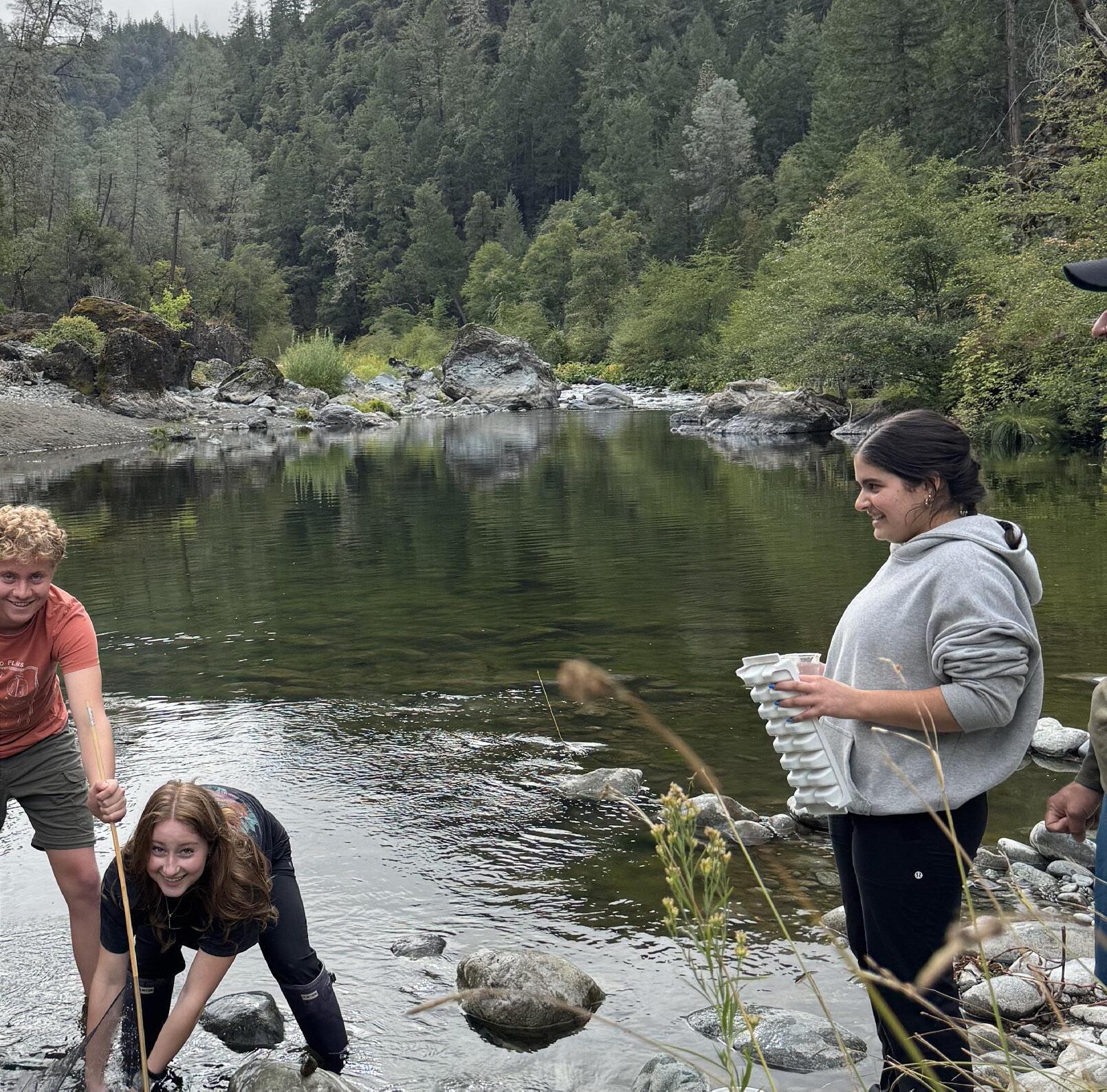
Los estudiantes de Biología IB recogen muestras en el arroyo para descubrir la vida en Camp Bar 717
Recomendado: Haber superado Biología y Química con una nota mínima de C. Este curso de ciencias, de dos años y nivel universitario, equivale a las asignaturas que cursan los estudiantes de carreras científicas en los primeros años de la especialidad de Biología. Aquí será necesario memorizar procesos y sistemas en detalle. Los conocimientos adquiridos se aplicarán a distintas situaciones. El curso pone especial énfasis en el diseño experimental, los protocolos de laboratorio y el análisis de datos. Si el horario lo permite, el alumnado puede matricularse en otras asignaturas científicas de manera simultánea. CIENCIAS DE LA VIDA.
Recomendado: Haber completado dos asignaturas de ciencias de laboratorio, incluyendo Biología con una nota mínima de C Y Química o Física también con al menos un C. Este curso de ciencias, de dos años y nivel universitario, ofrece una visión integral del medio ambiente. El enfoque está en los detalles científicos del entorno local y global, combinando trabajo de campo y actividades prácticas de laboratorio. Es un curso transdisciplinar que cumple los requisitos de los grupos 3 y 4 del IB; el alumnado aplicará conceptos de las ciencias naturales para analizar cuestiones políticas y sociales. Se espera que utilicen sus conocimientos para formar opiniones sobre políticas públicas, considerar diversas perspectivas ambientales y valorar la dimensión internacional de la resolución de grandes retos medioambientales. INTERDISCIPLINAR (puede contabilizarse como CIENCIAS DE LA VIDA o CIENCIAS FÍSICAS).
Requisito previo: Haber completado Química con una nota mínima de C y estar matriculado a la vez en IB Aplicaciones Prep, IB Analisis Prep o superior. En IB Química, el alumnado profundiza en los conceptos aprendidos en su primer curso introductorio. IB Química se centra en la resolución avanzada de problemas, el análisis de datos y la elaboración de explicaciones técnicas sobre fenómenos químicos. Se abordan en mayor profundidad temas ya conocidos como la medición de la materia, enlaces químicos, reacciones químicas, gases ideales y el concepto de mol. Además, se estudian ácidos y bases, electroquímica y reacciones redox, química de soluciones, química orgánica y espectrometría de masas. Finalmente, los estudiantes diseñarán su propio experimento para recopilar y analizar datos, y presentarán los resultados y sus implicaciones para futuras investigaciones. CIENCIAS FÍSICAS.
Life skills is an introductory, quarter-long course that covers mental, emotional, social, personal, and community health, as well as substance abuse. It introduces freshmen to high school, including discussions of high school success skills and goal setting while addressing stateand district-approved Health Education Standards. Using “high school success” as a framework, the course integrates critical academic skills, goal-setting paradigms, and career/college tools. Health concepts covered such as drug abuse, family communication, suicide, stressors, and disease prevention may have personal applications and bolster decision making skills. 9th grade students in Intervention ELA, English I Intensive, ELD I, or ELD II will take Life Skills in the summer after 8th grade through the Sequoia Compass program or will need to make it up in summer school before their senior year.

In this interdisciplinary course, which is still being developed, students will develop the skills to critically examine local, national, and global histories about race, migration, and diaspora. This course is designed to build a foundation for the rest of students’ high school social studies courses and utilized in a variety of historical contexts (e.g. World Studies, U.S. History, Gov’t/Econ, IB History of the Americas, IB World History Topics, etc.)
This is a two semester survey course where students will examine contemporary social movements to those of the past. Students will study movements for change, equality, and justice across the world, as well as an overview of 20th century events.
The goal of this course is to prepare all students for the rigorous IB History courses in the 11th and 12th grades. This is a two semester survey course where students will examine contemporary social movements to those of the past. Students will study movements for change, equality, and justice across the world , as well as an overview of 20th century events.
The objectives of this course include the study of the development of American political, economic and social institutions from Reconstruction to present; preparation for competency as citizens in a democratic society through understanding of democratic tradition. All 11th grade students are enrolled in U.S. History (if not taking IB History of the Americas) regardless of English placement.

The course is approved by the University of California and meets the UC “a” requirement.
The course is approved by the University of California to meet the UC “a” requirement and is considered an honors course.
NOTE: Students must pass three and a half years (35 credits) of Social Studies for graduation requirements.
9th Grade
9th & 10th Grade

10th Grade
10th-11th Grade
11th Grade

IB Y1 11
IB 1 yr 11 or 12 IB Y2 12
12th Grade


The first year of the IB two-year course promotes the acquisition of critical thinking, research writing, and understanding of the methods and strategies of social movements between 1950s - 1970s.

The second year of the IB two-year course where students study a selection of topics in twentieth century world history including the origins of WWII and the Cold War, as well as crises and authoritarian leaders of the Cold War.
This is a year-long, IB course about choice, trade, money, and markets in today’s world. Students interpret real-life topics in the news, including: housing shortages, poverty, unemployment, rising prices, international development, etc. Covering concepts across macro, micro and global economics, students are prepared to carefully consider their choices in today’s economy. Students are also prepared to pursue further studies in business, law, government/politics, and data science. Requirements: Ethnic Studies, World History, Algebra, Geometry. COURSE APPROVAL IS PENDING as of 12/2025.
A one-semester course that studies the problems of politics, the legislative process, political parties, voting, state and federal constitutions, the Bill of Rights, court and justice systems, and state and local governments; and related matters, such as foreign policy, mass media, public opinion and citizen responsibilities.
Habilidades para la vida es una asignatura introductoria de un trimestre que aborda la salud mental, emocional, social, personal y comunitaria, junto con la prevención del consumo de sustancias. Esta materia ayuda a los estudiantes de primer año a adaptarse al instituto, incluyendo debates sobre habilidades para tener éxito en la etapa escolar y la fijación de metas, siguiendo los estándares de educación en salud aprobados por el estado y el distrito. Bajo el enfoque de “éxito en el instituto”, el curso integra habilidades académicas clave, métodos de planificación de objetivos y herramientas para la carrera y la universidad. Se abordan temas como el abuso de drogas, la comunicación en la familia, la prevención del suicidio, el manejo del estrés y la prevención de enfermedades, todos aplicables a la vida cotidiana y útiles para mejorar la toma de decisiones. El alumnado de 9º en Intervention ELA, English I Intensive, ELD I o ELD II cursará Habilidades para la Vida durante el verano posterior a 8º grado a través del programa Sequoia Compass o deberá recuperarla en la escuela de verano antes de su último año.
En este curso interdisciplinar, que aún está en desarrollo, el alumnado adquirirá las competencias necesarias para analizar de manera crítica las historias locales, nacionales y globales sobre raza, migración y diáspora. Esta asignatura está diseñada para proporcionar una base sólida para el resto de los cursos de ciencias sociales en el instituto y se utiliza en diversos contextos históricos (por ejemplo, Estudios Mundiales, Historia de EE. UU., Gobierno/Economía, IB Historia de las Américas, IB Temas de Historia Mundial, etc.)
HISTORIA MUNDIAL - PL
Este curso de dos semestres propone un recorrido por los movimientos sociales contemporáneos y del pasado. El alumnado estudiará movimientos por el cambio, la igualdad y la justicia en distintos lugares del mundo, así como una visión general de los acontecimientos del siglo XX.
HISTORIA MUNDIAL
Este curso tiene como objetivo preparar a todo el alumnado para los exigentes cursos de Historia IB en 1º y 2º de Bachillerato. Es una materia de dos semestres en la que se analizarán movimientos sociales contemporáneos y del pasado, estudiando iniciativas por el cambio, la igualdad y la justicia a nivel global, además de ofrecer una visión general de los principales hechos del siglo XX.
HISTORIA DE EE. UU.
El curso cuenta con la aprobación de la Universidad de California y cumple con el requisito “a” de la UC.
Además, está reconocido como curso de honor por la Universidad de California y cumple el requisito “a” de la UC.
NOTA: Para graduarse, el alumnado debe superar tres años y medio (35 créditos) de
9th Grade
9th & 10th Grade
10th Grade
10th-11th Grade
11th Grade
IB 1 yr 11 or 12
IB Y1 11
IB Y2 12
12th Grade


El primer año del programa IB de dos años fomenta el desarrollo del pensamiento crítico, la redacción de investigaciones y el aprendizaje de métodos y estrategias de movimientos sociales entre los años 1950 y 1970.
Segundo año del programa IB de dos años, en el que el alumnado estudia una selección de temas de la historia mundial del siglo XX, incluyendo los orígenes de la Segunda Guerra Mundial y la Guerra Fría, así como las crisis y líderes autoritarios de la Guerra Fría.
Este curso anual del IB explora temas como las decisiones, el comercio, el dinero y los mercados en el mundo actual. El alumnado analiza asuntos reales de actualidad, como la escasez de viviendas, la pobreza, el desempleo, el aumento de precios y el desarrollo internacional, entre otros. Abordando conceptos de economía global, macro y micro, se prepara a los estudiantes para tomar decisiones informadas en la economía moderna y les brinda bases para estudios futuros en negocios, derecho, gobierno/política y ciencias de datos. Requisitos: Estudios Étnicos, Historia Mundial, Álgebra, Geometría. LA APROBACIÓN DEL CURSO ESTÁ PENDIENTE para diciembre de 2025.
Curso semestral que analiza cuestiones políticas, el proceso legislativo, los partidos políticos, el voto, las constituciones estatal y federal, la Carta de Derechos, los sistemas judiciales y de justicia, y los gobiernos estatal y local; así como temas relacionados, como política exterior, medios de comunicación, opinión pública y deberes ciudadanos.
Los objetivos de este curso incluyen el estudio del desarrollo de las instituciones políticas, económicas y sociales estadounidenses desde la Reconstrucción hasta la actualidad; se busca preparar a los estudiantes para ser ciudadanos competentes en una sociedad democrática, comprendiendo la tradición democrática. Todos los alumnos de 11º curso están matriculados en Historia de EE. UU. (salvo quienes cursen IB Historia de las Américas), sin importar su nivel de inglés.
Introductory courses for the acquisition of another language. It includes the skills necessary for understanding, speaking, reading, and writing. Students will learn appreciation of the culture and heritage of the countries in which the language is spoken. Students who successfully master this level may be recommended to take the corresponding ICAP course. This course meets the UC “e” requirement.
Recommended: Completion of French I/Spanish I - P with a C- or better or teacher/department recommendation based on an assessment. Continuation of year I; intensified study in the four basic skills: listening, reading, speaking, and writing; emphasis on vocabulary enrichment; introduction to literature; appreciation of the culture and heritage of the countries in which the language is spoken; class conducted mostly in the target language. This course meets the UC “e” requirement
Recommended: Completion of French II or Spanish II with a C- or better or teacher/ department recommendation Continuation of year II; refinement of the four basic skills; development of composition skills; additional reading in the literature; appreciation of the culture and heritage of the countries in which the language is spoken; class conducted principally in the target language. This class is designed primarily for sophomores who wish to enter the IB Programme. This course meets the UC “e” requirement.
Prerequisite: Completion of French/ Spanish I with a C- or better or by teacher recommendation post- assessment. This class is designed to bridge the gap for students who entered high school with no previous language experience and who wish to enter the IB Programme. This class is designed primarily for sophomores who wish to enter the IB Programme. The class focuses on the continuation of the reading, writing, listening and speaking skills. It is taught primarily in the target language. This course meets the UC “e” requirement.


Prerequisite: Completion of French/ Spanish III with a C- or better. Continuation of French III/Spanish III; appreciation of the culture and heritage of the countries in which the language is spoken; class conducted in the target language; emphasis on literature and culture with vocabulary building, composition, and oral competency. This course meets the UC “e” requirement

Prerequisite: Ability to write a well-organized paragraph with detail, accuracy, and intermediate vocabulary and comprehend a variety of literary fragments. This course is focused on the development of reading, writing, speaking, and listening, vocabulary building, composition and grammar, spelling, sentence structure, punctuation, accents, and paragraph organization. Students will study literature in Spanish and Spanish speaking cultures through selections from novels, myths, short stories, plays, and poetry. Class is conducted in Spanish. Upon successful completion of SNS II, and teacher recommendation, sophomore students can move into IB Spanish B SL/HL year 4. This course meets the UC “e” requirement.
Recommended: Completion of Spanish II-HS-P with a C- or better or teacher recommendation. In-depth study of literature and composition and further development of literary analysis. Refine grammar, spelling, sentence structure, punctuation, accents and compositional organization. Class conducted in Spanish. Upon successful completion of Spanish III NS and teacher recommendation, sophomore students can move into IB Spanish B SL/HL year 4 in the 11th grade. This course meets the UC “e” requirement.
Prerequisite: Spanish III-HS-P with a C- or better or teacher recommendation. Spanish IV-HS is the next course in sequence after Spanish III-HS. Students will continue to review simple and complex grammatical structures while mastering and perfecting their writing and reading skills through the incorporation of authentic printed materials and some internet sites. The course will be taught in Spanish, so students will be expected to practice their speaking and listening skills through a variety of communicative strategies and units studied. This course meets the UC “e” requirement.
IB FRENCH B HL Y4

Prerequisite: Completion of French 2/3 ICAP or French III with a C- or better or teacher recommendation. Language B is designed for students with previous experience in the target language. The main focus of the course is to give candidates an opportunity to reach a high level of competency in a target language through texts as well as a study of language and culture. Students perform written and oral assessments to demonstrate fluency.
IB FRENCH B SL Y4 GRADE 12 ONLY
Prerequisite: French 2/3 ICAP or teacher recommendation. Registration into the course is solely based on French teacher recommendation.
IB SPANISH B SL Y4 GRADE 11 ONLY.

Prerequisite: Completion of Spanish III, Spanish II/ III ICAP, or Heritage Speakers III with a C- or better, or teacher recommendation. Language B is designed for students with previous experience in the target language. The main focus of the course is to give candidates an opportunity to reach a high level of competency in a target language through texts as well as a study of language and culture. Students perform written and oral assessments to demonstrate fluency.
IB SPANISH B HL Y4 HP GRADE 11 ONLY.
Prerequisite: Completion of Spanish III, Spanish II/ III ICAP, Heritage Speakers III with a C- or better, or teacher recommendation. Language B is designed for students with previous experience in the target language. The main focus of the course is to give candidates an opportunity to reach a high level of competency in a target language through texts as well as a study of language and culture. Students perform written and oral assessments to demonstrate fluency.
IB FRENCH /SPANISH B HL Y5 GRADE 12 ONLY.
Prerequisite: IB French/Spanish B HL Y4 with a C- or better. International Baccalaureate course for students preparing to earn an IB certificate in French and fill a requirement toward an IB Diploma. Completion of IB French/ Spanish B-Y4 with above average grades or equivalent preparation is required. The objectives of this course are to communicate in complex contexts, express opinion, debate and discuss ideas, gain with high proficiency.
World Language Level III and above can be used in place of the CTE graduation requirement.
I / ESPAÑOL I
Cursos introductorios para adquirir un nuevo idioma. Incluyen las habilidades esenciales para comprender, hablar, leer y escribir. El alumnado aprenderá a valorar la cultura y el patrimonio de los países donde se habla el idioma. Quienes dominen este nivel podrán ser recomendados al curso ICAP correspondiente. Este curso cumple con el requisito “e” de la UC.
FRANCÉS II / ESPAÑOL II
Recomendado: Haber completado Francés I/Español I - P con una calificación mínima de C- o contar con la recomendación del profesorado/departamento tras una evaluación. Es la continuación del primer año, con un estudio intensivo de las cuatro competencias básicas: comprensión auditiva, lectura, expresión oral y escritura; se da especial importancia al enriquecimiento del vocabulario, la introducción a la literatura y la apreciación de la cultura y el patrimonio de los países donde se habla el idioma. Las clases se desarrollan principalmente en la lengua objetivo. Este curso cumple con el requisito “e” de la UC.
FRANCÉS / ESPAÑOL III
Recomendado: Haber completado Francés II o Español II con una calificación mínima de C- o contar con la recomendación del profesorado/departamento. Es la continuación del segundo año, centrada en el perfeccionamiento de las cuatro competencias básicas y el desarrollo de habilidades de redacción; incluye lecturas adicionales de obras literarias y fomenta la apreciación de la cultura y el patrimonio de los países donde se habla el idioma. Las clases se imparten principalmente en la lengua objetivo. Este curso está especialmente dirigido a estudiantes de segundo año que deseen ingresar al Programa IB. Este curso cumple con el requisito “e” de la UC.
FRANCÉS / ESPAÑOL III
Requisito previo: Haber completado Francés/Español I con una calificación mínima de C- o contar con la recomendación del profesorado tras una evaluación. Este curso está diseñado para facilitar el acceso de estudiantes que ingresaron al instituto sin experiencia previa en el idioma y desean incorporarse al Programa IB. Se da continuidad al desarrollo de habilidades de lectura, escritura, comprensión auditiva y expresión oral, y se imparte principalmente en la lengua objetivo.


Requisito previo: Haber completado Francés/Español III con una calificación mínima de C-. Continuación de Francés III/Español III; valoración de la cultura y las tradiciones de los países donde se habla el idioma; la clase se imparte en el idioma objetivo; se enfatizan la literatura y la cultura, junto con el desarrollo de vocabulario, redacción y expresión oral. Este curso cumple con el requisito “e” de la UC.
ESPAÑOL II-HS (HABLANTE NATIVO)
Requisito previo: Capacidad para redactar un párrafo bien estructurado, detallado y preciso, utilizando vocabulario intermedio, y comprender diversos fragmentos literarios. Este curso está orientado al desarrollo de la lectura, escritura, expresión oral y comprensión auditiva, así como al fortalecimiento del vocabulario, la composición y la gramática, ortografía, estructura de las frases, puntuación, acentuación y organización de párrafos. El alumnado explorará la literatura en español y las culturas de habla hispana a través de novelas, mitos, relatos breves, obras teatrales y poesía. Las clases se imparten íntegramente en español. Tras completar con éxito II-HS y contar con la recomendación del profesorado, los estudiantes de segundo año podrán avanzar a IB Spanish B SL/HL año 4. Este curso cumple con el requisito “e” de la UC.
Recomendado: Haber cursado Español para Hablantes Nativos II con una nota mínima de C-, o recomendación del profesorado. Estudio profundo de literatura y redacción, y desarrollo avanzado del análisis literario. Se perfeccionan gramática, ortografía, estructura de las frases, puntuación, tildes y organización de textos. La clase se imparte en español. Tras completar exitosamente III-HS y contar con la recomendación docente, los estudiantes de segundo año pueden acceder a IB Spanish B SL/HL año 4 en 11º curso. Este curso cumple con el requisito “e” de la UC.
ESPAÑOL IV-HS (HABLANTE NATIVO)
Requisito previo: Haber completado Español III-HS-P con una calificación mínima de C-. Español IV-HS es la continuación natural tras Español III-HS. En este curso, el alumnado seguirá repasando las estructuras gramaticales, tanto simples como complejas, mientras perfecciona sus habilidades de lectura y escritura mediante el uso de materiales auténticos impresos y recursos de internet. Las clases se imparten en español, por lo que se espera que los estudiantes desarrollen sus destrezas orales y auditivas con distintas estrategias comunicativas y unidades temáticas. Este curso cumple con el requisito “e” de la UC.
Requisito previo: Haber completado Francés II/III ICAP o Francés III con una calificación de C- o superior, o recomendación del profesorado. El curso de Lengua B está pensado para estudiantes con experiencia previa en el idioma objetivo. El propósito principal es que los participantes alcancen un alto dominio de la lengua a través de textos y el estudio de la cultura. Se realizan evaluaciones escritas y orales para demostrar fluidez.
IB FRANCÉS B SL Y4 SOLO PARA GRADO 12.

Requisito previo: Francés 2/3 ICAP o recomendación docente. La inscripción en este curso depende exclusivamente de la recomendación del profesorado de francés.
IB ESPAÑOL B SL Y4 SOLO PARA GRADO 11.

Requisito previo: Haber completado Español III, Español II/III ICAP para hablantes nativos III con una calificación mínima de C- o recomendación docente. El curso de Lengua B está orientado a estudiantes con experiencia previa en el idioma. El objetivo principal es que los alumnos alcancen un nivel avanzado de competencia en la lengua mediante textos y el estudio de la cultura. Se realizan pruebas escritas y orales para acreditar la fluidez.
IB ESPAÑOL B HL Y4 HP SOLO PARA GRADO 11.

Requisito previo: Haber completado Español III, Español II/III ICAP para hablantes nativos III con una calificación mínima de C- o recomendación docente. El curso de Lengua B está dirigido a estudiantes con experiencia previa en el idioma objetivo. El enfoque principal es que los participantes logren un alto nivel de competencia mediante textos y el análisis cultural. Los estudiantes realizan evaluaciones escritas y orales para demostrar su fluidez.
IB FRANCÉS / ESPAÑOL B HL Y5 SOLO PARA GRADO 12.

Requisito previo: IB Francés/Español B HL Año 4 con una calificación mínima de C-. Curso del Bachillerato Internacional dirigido a estudiantes que buscan obtener el certificado IB en Francés y cumplir con los requisitos para el Diploma IB. Se requiere haber completado IB Francés/Español B Año 4 con notas superiores a la media o preparación equivalente. Los objetivos del curso incluyen comunicarse en contextos complejos, expresar opiniones, debatir y argumentar ideas, adquiriendo una alta competencia lingüística.
El nivel III y superiores de Lenguas del Mundo pueden utilizarse como sustituto del requisito de graduación CTE.
10th
This course meets the UC “f ”requirement.
State of the art computer graphics software is introduced with respect to print, and web graphics. Introduction to typography, graphic layout/ design fundamentals, digital design and other computer graphics software applications. Following a VPAs approach, students generate their own creative content for print and/or electronic publication. As part of this course, students will also develop career skill awareness in order to prepare them for career readiness. This course meets the UC “f ”requirement.
Students earn 6 quarter units of college credit by passing this course
Students build on their knowledge of computer graphics for web and print publication. Using state of the art software, students will create projects that involve still graphics, motion graphics and interactive media. Students will also begin to work audio and video into projects. As part of this course, students will also participate in the Academy Mentor Program, which teaches important career skills to students in order to prepare them for success in the working world. This course meets the UC “f ” requirement.
Students earn 4 quarter units of college credit by passing this course.
Multimedia III is a CTE course that is dual enrolled with GID 35 at Foothill College. A central objective of the course is to have the students develop themselves through the art and technique of video production. skills learned in this class will include, but are not limited to: video and film concept creation, video and audio editing, production techniques, media analysis, and broadcast production. By producing short film projects, students will learn how to use video production equipment to express their creativity and demonstrate their newly acquired skills. This class also builds on the foundation of graphic design media development and graphic design that has been developed in Multimedia I and II. Students will work both individually and in teams to create a set of marketing materials for a real-world client. In addition to individual student choice on projects, created work will serve the DAA, Sequoia High groups, and the larger Sequoia community.

Health Professions is a year-long required course for students enrolled in Sequoia’s Health Careers Academy (HCA). This course provides an introduction for students interested in careers in the health care professions by exposing them to the wide variety of jobs in the fi eld along with the educational requirements for each position. Students who achieve competency in this course will not only expand their knowledge in the types of careers in the health fi eld and educational requirements but also develop knowledge and skills required for entry into the health care occupations and meet the needs of the advanced clinical program. Students who successfully coplete the course will earn certifi cation for BLS CPR, and First Aid.
Medical Clinical I is a year-long required course for students enrolled in Sequoia’s Health Careers Academy (HCA). Medical Clinical I is the junior year HCA (CTE) elective. In this course students will learn about HIPAA (Health Insurance Portability and Accountability Act), laws governing health care, develop workplace skills, and understand workplace and personal safety. They will also complete FEMA Community Emergency Response Team (CERT) training/certifi cation. Students develop a medical vocabulary that includes medical abbreviations and symbols through the study of the principles of word construction and word analysis, with emphasis on spelling, pronunciation, diagnosis, disease process, pathology and their interrelationship with body systems. Students work one-on-one with a mentor to gain professional skills, such as resume writing and interview skills, while exploring careers in the health professions.
This course provides advanced instruction and training for students interested in careers in the healthcare professions. Students who achieve competency in this course will develop knowledge and skills in CPR training, immunizations, medical tests, characteristics of a successful health care professional, parameters for phyical history, exam and taking vital signs, OSHA standards for handling bodily fluids, infection control, medical terminology, anatomy and physicology, bloodborne pathogens, administering emergency oxygen, Epi-Pen auto injection, and preparing a professiona portofolio. Successful students will receive certifi cation in BLS CPR (renewal) and First Aid. This course has been UC A-G approved as a “g” elective.
OPTATIVAS TECNOLÓGICAS
10º curso
curso
curso
Este curso cumple con el requisito “f” de la UC.
En este curso se presenta software de gráficos por ordenador de última generación, aplicado a diseño para impresión y web. Se introducen conceptos de tipografía, fundamentos de diseño y composición gráfica, diseño digital y otras aplicaciones informáticas para gráficos. Siguiendo el enfoque VPA, el alumnado crea contenido original para su publicación en formato impreso y/o digital. Además, desarrollarán competencias profesionales para su futura inserción laboral. Este curso cumple con el requisito “f” de UC.
El alumnado obtiene 6 créditos universitarios trimestrales al superar esta asignatura
El alumnado amplía sus conocimientos sobre gráficos por ordenador para publicaciones web e impresas. Utilizando software de última generación, desarrollarán proyectos que integran gráficos estáticos, gráficos en movimiento y medios interactivos. También comenzarán a incorporar audio y vídeo en sus creaciones. Como parte de la asignatura, participarán en el Programa de Mentoría de la Academia, que fomenta habilidades clave para el éxito profesional. Este curso cumple con el requisito “f” de la UC.
Al superar este curso, el alumnado obtiene 4 créditos universitarios trimestrales.
CTE MULTIMEDIA III
Multimedia III es una asignatura CTE que se imparte conjuntamente con GID 35 en Foothill College. El principal objetivo del curso es que el alumnado se desarrolle personal y creativamente a través del arte y la técnica de la producción audiovisual. Entre las habilidades que se adquieren destacan la creación de conceptos para vídeos y películas, edición de vídeo y audio, técnicas de producción, análisis de medios y producción para difusión. Mediante la realización de cortometrajes, los estudiantes aprenderán a manejar equipos de producción de vídeo para expresar su creatividad y demostrar los conocimientos adquiridos. Esta clase también refuerza los cimientos del desarrollo de medios y diseño gráfico trabajados en Multimedia I y II. El alumnado trabajará tanto de manera individual como en equipos para crear materiales de marketing destinados a un cliente real. Además de elegir sus propios proyectos, los trabajos realizados servirán a la DAA, los grupos de Sequoia High y a la comunidad de Sequoia en general.
curso
curso
curso
Profesiones Sanitarias es una asignatura anual obligatoria para quienes están matriculados en la Academia de Carreras Sanitarias (HCA) de Sequoia. Ofrece una visión general para estudiantes interesados en el ámbito sanitario, presentando la variedad de empleos existentes y los requisitos formativos de cada puesto. El alumnado que alcance los objetivos del curso no solo ampliará su conocimiento sobre las diferentes opciones y requisitos educativos, sino que también desarrollará destrezas y saberes necesarios para acceder a ocupaciones sanitarias y responder a las demandas del programa clínico avanzado. Quienes completen el curso satisfactoriamente obtendrán la certificación de RCP BLS y primeros auxilios.
MEDICAL CLINICAL I
Medical Clinical I es un curso obligatorio de un año de duración para el alumnado inscrito en la Academia de Carreras Sanitarias (HCA) de Sequoia. Medical Clinical I es la asignatura optativa CTE de tercer año en la HCA. En este curso, el alumnado explorará la normativa HIPAA (Ley de Portabilidad y Responsabilidad de Seguros de Salud), las leyes que rigen el ámbito sanitario, desarrollará habilidades para el entorno laboral y aprenderá sobre la seguridad en el trabajo y personal. Además, completará la formación/certificación FEMA del Equipo Comunitario de Respuesta a Emergencias (CERT). El curso fomenta el aprendizaje de vocabulario médico, incluyendo abreviaturas y símbolos, a través del estudio de la formación y análisis de palabras, con énfasis en la ortografía, pronunciación, diagnóstico, procesos de enfermedades, patología y su relación con los distintos sistemas corporales. El alumnado trabajará individualmente con un mentor para adquirir habilidades profesionales, como la elaboración de currículums y técnicas de entrevista, mientras explora oportunidades laborales en el sector sanitario.
Este curso ofrece formación avanzada para quienes estén interesados en desarrollar una carrera en el sector sanitario. El alumnado que demuestre competencia adquirirá conocimientos y habilidades en RCP, vacunación, pruebas médicas, características de un/a profesional de la salud exitoso/a, parámetros para la historia clínica, exámenes y toma de signos vitales, normas OSHA para el manejo de fluidos corporales, control de infecciones, terminología médica, anatomía y fisiología, patógenos transmitidos por sangre, administración de oxígeno de emergencia, uso de Epi-Pen y preparación de un portafolio profesional. Quienes superen el curso recibirán la certificación en RCP BLS (renovación) y primeros auxilios. Este curso cuenta con la aprobación UC A-G como optativa “g”.
This class is an introductory class created for the non-artist as well as the accomplished artist. This course does NOT focus on drawing. It is a course designed to explore students’ creative abilities with multiple materials. Materials may include but are not limited to clay, paper-maché, wood, plaster, Paris-craft, tempera, acrylic, collage, printmaking, pen and ink, and pastels. In Art I students learn the fundamentals of art theory, design, and color through thematic lessons based on global issues, the natural world, artists and culture, and students’ own life experiences and emotions.
This course covers low fire clay construction including pinch, slab, coil and a variety of combinations of hand-building methods. Methods of ornamentation and glazing techniques will be explored. Projects include functional and non-functional ware as well as an introduction to the elements of design and the principles of art.
Prerequisite: Ceramics I, having earned a B or higher and/or teacher recommendation. Advanced studies in hand-building and wheel-throwing; elementary chemistry of glazes and kiln-firing techniques. Individual projects are designed to promote artistic development and creativity. Exposure to Art
Prerequisite: Ceramics II, having earned a B or higher and/or teacher Recommendation
This course offers students who have been through the beginning and intermediate level
Ceramics courses a chance to grow as an artist and further explore ceramic techniques. This course encourages and expects a creative and systematic investigation of formal and conceptual issues in 3D design. Students will be expected to solve creative problems using their knowledge of the principles of design. Students will research and apply a range of conceptual approaches as well as show technical competency in a variety of mediums. Class assignments will challenge students to set and achieve creative goals that are personally meaningful to the student artist.
Digital Photography I is an introductory course for students interested in learning the art of taking and developing photos and exploring career paths in photography. Students will learn how to compose, edit, and enhance their own photographs using cameras and a variety of professional software and equipment. While the primary focus will be on digital photography, students will also be exposed to a wide array of alternative processes including, cyanotypes, pinhole cameras, photograms, and introductory darkroom techniques. This is a project-based course where students create personally relevant and meaningful imagery on a wide variety of topics. These topics include portraiture, sports photography, composition, macro photography, abstraction, light painting, and documentary photography. Students will be able to express and share their unique vision of the world through the medium of photography.
Digital Photography II will expand upon the processes and techniques that students learned in Photo I. This course will teach both digital and film photography. Students will learn more advanced darkroom techniques, digital manipulations, and professional light and studio setups as well as, delve into the more technical aspects of digital and film photography. Students will be able to check out digital and film cameras to complete their assignments and shoot photos outside of school hours at locations of their choosing. Exploring and learning about the Art World is also a part of the curriculum. Students are expected to study famous photographers, visit museums, and explore gallery shows. Students are encouraged to submit projects for student publications, competitions, art shows, and displays. Upon completion of this course, students will be able to work independently with film and digital cameras as well as scanners, printers, computers, studio lights, studio backdrops, and models. Students will compile a digital and physical portfolio that can be used to demonstrate their abilities for college entrance or employment in the field of photography. This course does have a heavier workload than Photo I, but it is a great fit for someone who is passionate about photography. The prerequisite for this course is a grade of C or better in Photo I or a passing portfolio review by the teacher. This course may be used to meet the UC “f” requirement.

Photo III is a yearlong course designed for students who are ready to take their digital and darkroom skills to the next level. Students will explore film photo- graphy in depth as well as continue to engage in complex photo shoots both inside and outside the classroom. Projects are largely student driven. Students are expected to study famous photographers, visit museums, and explore gallery shows. Students are encouraged to submit projects for student publications, competitions, art shows, and displays. Upon completion of this course, students will be able to work independently with film and digital cameras as well as scanners, printers, computers, studio lights, studio backdrops, darkroom equipment, and models. Students will compile a digital and physical portfolio that can be used to demonstrate their abilities for college entrance or employment in the field of photography. Prerequisite: C or Better in Photo II
This class is an introductory class for students interested in learning how to draw and paint realistically and stylistically. Students are introduced to various genres and styles of art through visual examples of a wide variety of artists’ works provided in text, slide and poster formats. The course provides explorations in basic drawing, painting and printmaking (including technical studies in each of the mediums). The technical studies are followed by creative projects to enable the student to interpret the newly acquired technique into his/her individual creative and expressive style. Course content includes studies in line, texture, space, form and color. Projects include contour drawings, still-life drawings, plein-air drawings and paintings as well as realistic, stylized and abstract drawing and painting from imagination. Mediums include the use of pencil, colored pencil, charcoal, pastels, pen and ink, acrylic paint and watercolor. This course may be used to meet the UC “f” requirement.
Prerequisite: Draw/Paint I or Art with an average of B or better; portfolio review and/or permission of the instructor. This class is an advanced class for students interested in pursuing creative projects to build upon their previous years’ study of drawing and painting realistically and stylistically. Students are challenged with more in-depth and creative studies and projects – continuing to explore various genres and styles of art. Students will be expected to research and explore different artists and movements in the history of art and to create a journal logging such discoveries. Technical exercises are followed by creative projects to enable the student to interpret the technical mastery into an individual creative, expressive style. This course meets the VPA graduation requirement and may be used to meet the UC “f” requirement.
This course is an introduction to acting, playwriting, directing, improv, and technical theatre. Students will study contemporary and diverse theatrical texts, learn basic theatre vocabulary, perform in various comedic and dramatic scenes, work with their peers to bring artistic visions to life, and creatively tell their own stories. They will explore how theatre arts and storytelling inspires empathy and contributes to social justice.
Prerequisite: Students must have completed the Drama I course OR been involved with at least two Sequoia Drama productions - in this case, students will also need to receive permission from the teacher. This course is an intermediatelevel immersion into acting, playwriting, directing, improv, lighting and sound design, costumes, and performance techniques. It provides second-year students with opportunities to review and build on the skills learned in Drama I, with more responsibility for researching global and multicultural theatre, conducting script and character analysis, applying a wider variety of acting techniques, designing more technical theatre elements, and directing larger performances.
Drama III is an advanced-level study of acting, playwriting, directing, improv, lighting and sound design, costumes, and performance techniques. Students in either pathway will conduct research on world theatre traditions, create a director's notebook and production proposal for a play of their choosing, and engage in the collaborative process of devising original theatre works with their peers.
PREREQUISITES: Students may enroll if they have taken and passed Drama I and Drama II OR if they have taken and passed Drama I and been involved in at least two Sequoia Drama productions.
This course may be used to meet the UC “f” requirement.
The course is approved by the University of California to meet the a-g requirements and is considered an honors course.
Students must pass Algebra I and Geometry in order to graduate (minimum).
This course focuses on the creation of the technical aspects of theatrical production (scenery/set, lighting, sound, and costume), including advanced techniques of design execution. Emphasis is placed upon textual analysis for design, graphic techniques for the communication of design concepts, and communication among members of the production team. Students are expected to participate in the design and execution of departmental productions during the semester, requiring some additional time outside of class. No prior experience in drama or design is required

Prerequisite: Art 1 or Drawing and Painting 1 completed at Sequoia (or equivalent for a transferring student by the end of 10th grade. This course is a two year course taken during Junior and Senior Years. It provides students with an opportunity to develop artistic skills and aesthetic awareness as they reflect upon their own artwork and the works of other artists. This is done through art-making as well as academic research and investigation. Areas of focus are student directed and the instructor serves as a facilitator to student growth. The studio art component: IB Art offers the opportunity for individual creative growth. A wide variety of media and artistic techniques will be explored and documented in a research sketchbook called the Art Journal. In the first year of study, students will begin to build a body of work with emphasis placed on practical production by the student and exploration of a range of creative work in a global context. In the second year, The second year is designed to deepen artistic skills and aesthetic research begun in the previous year. The academic component: IB Art students record in writing the research, investigations and development of their ideas through writing in their art journals about other artists, cultures, and concepts. Additionally, they will create a digital Comparative Study of 3 artists and their works. Students will work toward completing IB assessment tasks to be digitally uploaded to IB for grading and will plan and hang an exhibition of their work which will be on display for the school community in the Spring of their senior year.
Choir is open to all students who are interested in choral/vocal music performance. This course will introduce students to a wide variety of choral/vocal literature from different periods of music history, emphasizing the following vocal/musical skills: breath control, vocal production, intonation, range development, balance, tone production, ear training, rhythm, sight singing and music literacy. Participation in various rehearsals, performances, and activities are part of the course grade. These activities are integral elements that support and extend learning in the classroom.
Guitar I is an introductory course that gives students the opportunity to develop guitar skills in basic music notation, chords, technique, song accompaniment, and composition. Varying musical styles and music history will be explored. Guitar II Prerequisite: Adequate progress in Guitar I or by audition. Continued instruction in technique, repertoire, collaboration, theory, analysis, improvisation, finger-picking, ensemble playing. Emphasis on performance.
Beginning Orchestra class offers students (9-12) an opportunity to learn to play an orchestral instrument. The students and the teacher will collaborate to choose from violin, viola, cello, or double bass for the student to study for the entire year and beyond. Choosing an instrument will be based on the student's physical characteristics, student temperament, prior musical experience, instrument availability, student interest, and the need for balanced instrumentation within the orchestra. The goal of the class is to give the students the fundamental skills needed to continue their development into the next level in the Sequoia Orchestra. Students will have the opportunity to perform music in various concerts, including school performances and adjudicated music festivals. Members of the Beginning Orchestra are also encouraged to seek private lessons and grow individually through solo performances and auditioned ensembles. The Beginning Orchestra will learn/ develop: care and maintenance of their instrument, fundamental techniques of tone production, expressive aspects of performance such as dynamics, articulation, phrasing, fundamental rhythms, a better understanding of world cultures, history, and other forms of art through music, music notation and music reading, orchestral literature in a variety of styles and difficulty, and sight-reading skills.
Prerequisite: Prior experience, audition, and/or teacher recommendation. Orchestra is open to all violin, viola, cello, and bass players with prior performance experience. Intermediate and advanced level musicianship, theory, and performance practice are taught using performance-oriented string ensemble music as the medium of instruction. Performances during evenings and weekends are required as a part of the course.
Prerequisite: PE-Dance, audition, or outside dance training with teacher recommendation. Intermediate Dance is designed to offer those students who have had some experience in dance the opportunity to enhance their technical skills, learn and create formalized choreography, study theatrical qualities (i.e. costumes, lighting, text, music, etc), and perform dance pieces for school events. Intermediate dance is meant to provide the link between beginning dance and advanced dance, improving previously learned dance styles and techniques, while expanding the students’ knowledge of choreography, performance, and history.
Prerequisite: Prior dance experience and audition. Advanced level dance class. This class is structured as a class for a professional dance company. Equal emphasis will be given to choreography and performance as to technique, with training in ballet, contemporary, jazz and hip-hop. Students will create and rehearse a number of complete dance works to be performed in various settings throughout the year. Also addressed will be other aspects of dance production, such as: costuming, lighting design, sound engineering, and make-up application. The class will culminate in a full evening production.
Piano I is an introductory course allows students to develop basic music skills through the study and performance of various keyboard literature. Different musical styles, electronic music, and composition will be explored. Piano II Prerequisite: Piano 1 or permission of instructor, Othello Jefferson, ojefferson@seq.org This course allows students to continue developing music skills through the study and performance of various keyboard literature, with an emphasis on musical styles, electronic music, and composition.
This class that focuses on playing band instruments. Students in this class do not need any experience playing instruments. Students will learn proper instrumental technique, with a focus on long-term development. Students will learn warm-up exercises that will help them develop embouchure, tone, rhythm, and technique. Students will also learn music theory skills that will help them read music, develop their musical ear, and reproduce written and recorded music.
Prerequisite: Audition and permission of instructor Advanced ensemble working with a challenging musical repertoire; audition required. Advanced Band performs at numerous school and community events. Though the main focus is performance, the class also exposes students to musicianship, theory, history, and current issues in the world of music.
Prerequisite: At least two years experience on instrument - inclusive of note reading proficiency - or permission of instructor. Intermediate ensemble. Band II performs at numerous school and community events. Though the main focus is performance, the class also exposes students to musicianship, theory, history, and current issues in the world of music. This course may be used to meet the UC “f” requirement.
Esta asignatura introductoria está pensada tanto para quienes no son artistas como para quienes ya tienen experiencia. El curso NO se centra en el dibujo, sino que está diseñado para que el alumnado explore sus capacidades creativas utilizando distintos materiales. Entre ellos se incluyen, aunque no se limitan a, arcilla, papel maché, madera, yeso, Paris-craft, témperas, acrílicos, collage, grabado, pluma y tinta, y pasteles. En Arte I, el alumnado aprende los conceptos básicos de teoría artística, diseño y color, mediante lecciones temáticas relacionadas con cuestiones globales, el mundo natural, artistas y culturas, así como sus propias experiencias vitales y emociones.
Este curso abarca la construcción con arcilla de baja temperatura, trabajando técnicas como pellizco, planchas, rollos y diversas combinaciones de modelado manual. Se exploran formas de decoración y técnicas de esmaltado. Los proyectos incluyen piezas tanto funcionales como artísticas, además de una introducción a los elementos del diseño y los principios del arte.
Requisito previo: Cerámica I, con calificación de B o superior y/o recomendación del profesorado. Estudio avanzado de modelado manual y torno, química básica de esmaltes y técnicas de cocción en horno. Los proyectos individuales están orientados al desarrollo artístico y la creatividad. Se incluye el estudio de la Historia del Arte y la cerámica contemporánea mediante investigación y redacción.
Requisito previo: Cerámica II, haber obtenido una calificación de B o superior y/o recomendación del profesorado. Este curso está dirigido a quienes han completado los niveles inicial e intermedio de Cerámica y desean seguir creciendo como artistas y perfeccionando sus técnicas cerámicas. Se fomenta y exige una investigación creativa y sistemática de los aspectos formales y conceptuales del diseño tridimensional. El alumnado deberá resolver desafíos creativos aplicando los principios del diseño. Además, investigarán y aplicarán diferentes enfoques conceptuales y demostrarán competencia técnica en diversos materiales. Las tareas de clase les retarán a plantearse y alcanzar objetivos creativos significativos para su desarrollo artístico personal.
FOTOGRAFÍA DIGITAL I
Fotografía Digital I es una asignatura introductoria para quienes desean aprender el arte de tomar y revelar fotografías, y explorar posibles caminos profesionales en este ámbito. Se aprenderá a componer, editar y mejorar imágenes propias con cámaras y diversos programas y equipos profesionales. Aunque el enfoque principal es la fotografía digital, también se enseñarán numerosos procesos alternativos, como cianotipos, cámaras estenopeicas, fotogramas y técnicas básicas de laboratorio. Es un curso basado en proyectos, donde el alumnado crea imágenes personales y significativas sobre temas variados, como retrato, fotografía deportiva, composición, macrofotografía, abstracción, pintura de luz y fotografía documental. El alumnado podrá expresar y compartir su manera única de ver el mundo a través de la fotografía.
FOTOGRAFÍA DIGITAL II
Fotografía Digital II amplía los procesos y técnicas aprendidos en Foto I. En este curso se enseñará tanto fotografía digital como analógica. El alumnado aprenderá técnicas avanzadas de laboratorio, manipulación digital y configuraciones profesionales de iluminación y estudio, además de profundizar en aspectos técnicos de la fotografía digital y de película. Tendrán la posibilidad de utilizar cámaras digitales y de película para sus trabajos y realizar sesiones fotográficas fuera del horario escolar en los lugares que elijan. Explorar y conocer el mundo del arte también forma parte del programa. Se espera que los estudiantes investiguen sobre fotógrafos reconocidos, visiten museos y recorran exposiciones en galerías. Se les anima a presentar sus proyectos a publicaciones estudiantiles, concursos y muestras artísticas. Al finalizar el curso, podrán trabajar de forma autónoma con cámaras de película y digitales, así como con escáneres, impresoras, ordenadores, luces y fondos de estudio y modelos. Elaborarán un porfolio digital y físico que podrán utilizar para acceder a la universidad o al mundo laboral en fotografía. Este curso tiene una carga de trabajo mayor que Foto I, pero es ideal para quienes sienten verdadera pasión por la fotografía. Como requisito previo, se exige una calificación de C o superior en Foto I o superar la revisión de porfolio por parte del profesorado. Este curso puede usarse para cumplir el requisito “f” de la UC.
FOTOGRAFÍA DIGITAL AVANZADA Y DISEÑO
Foto III es un curso anual diseñado para quienes quieren llevar sus habilidades digitales y de laboratorio al siguiente nivel. El alumnado profundizará en la fotografía analógica y participará en sesiones fotográficas complejas, tanto dentro como fuera del aula. Los proyectos tienen un enfoque muy personalizado. Se espera que los estudiantes estudien a fotógrafos destacados, visiten museos y recorran exposiciones en galerías. Se les anima a presentar sus trabajos a publicaciones estudiantiles, concursos y exhibiciones. Al finalizar el curso, podrán trabajar de manera independiente con cámaras digitales y de película, escáneres, impresoras, ordenadores, luces y fondos de estudio, equipo de laboratorio y modelos. Elaborarán un porfolio digital y físico que podrán utilizar para acceder a la universidad o al ámbito profesional de la fotografía. Requisito previo: C o superior en Foto II.
Dibujo/Pintura I

Esta asignatura introductoria está dirigida a quienes desean aprender a dibujar y pintar tanto de manera realista como estilizada. Los estudiantes conocerán diferentes géneros y estilos artísticos mediante ejemplos visuales de obras de artistas destacados, presentados en formato de texto, diapositivas y carteles. El curso ofrece prácticas de dibujo básico, pintura y grabado, incluyendo estudios técnicos en cada disciplina. Tras los ejercicios técnicos, se proponen proyectos creativos para que cada alumno desarrolle su propio estilo expresivo. El contenido aborda temas como línea, textura, espacio, forma y color. Los proyectos incluyen dibujos de contorno, naturalezas muertas, paisajes al aire libre y obras que exploran el realismo, el estilismo y la abstracción desde la imaginación. Se emplean materiales como lápiz, lápices de colores, carboncillo, pastel, tinta, acrílicos y acuarela. Este curso puede utilizarse para cumplir el requisito “f” de UC.
Requisito previo: Haber cursado Dibujo/Pintura I o Arte con una nota media igual o superior a B; revisión de portafolio y/o autorización del profesor. Esta asignatura avanzada está pensada para estudiantes que desean desarrollar proyectos creativos y seguir profundizando en el aprendizaje de dibujo y pintura, tanto realista como estilizado. Se propone a los alumnos retos más complejos y creativos, explorando géneros y estilos artísticos diversos. Se espera que investiguen y estudien distintos artistas y movimientos históricos, registrando sus descubrimientos en un cuaderno de trabajo. Los ejercicios técnicos se complementan con proyectos creativos que permiten transformar la destreza técnica en un estilo personal y expresivo. Esta asignatura cumple con el requisito de graduación VPA y puede servir para la obtención del requisito “f” de UC.
DRAMÁTICA I
Este curso ofrece una introducción a la interpretación, la escritura teatral, la dirección escénica, la improvisación y la técnica teatral. El alumnado explorará textos teatrales contemporáneos y diversos, aprenderá vocabulario básico de teatro, interpretará escenas cómicas y dramáticas, colaborará con sus compañeros para dar vida a sus ideas artísticas y contará sus propias historias de manera creativa. Además, descubrirán cómo
DRAMÁTICA II
Requisito previo: Haber completado el curso Drama I O haber participado en al menos dos producciones de Drama de Sequoia; en este caso, también será necesario obtener la autorización del profesor. Este curso ofrece una inmersión de nivel intermedio en interpretación, escritura teatral, dirección, improvisación, diseño de iluminación y sonido, vestuario y técnicas de puesta en escena. Permite al alumnado de segundo año repasar y ampliar las habilidades adquiridas en Drama I, asumiendo más responsabilidad en la investigación del teatro global y multicultural, el análisis de guion y personajes, la aplicación de una mayor variedad de técnicas de interpretación, el diseño de elementos técnicos y la dirección de
DRAMÁTICA III
Drama III es un curso avanzado enfocado en la interpretación, la escritura teatral, la dirección, la improvisación, el diseño de iluminación y sonido, el vestuario y las técnicas de puesta en escena. El alumnado, independientemente de la trayectoria elegida, investigará tradiciones teatrales de todo el mundo, elaborará un cuaderno de dirección y una propuesta de producción para la obra que seleccione, y participará en la creación colaborativa de nuevas piezas teatrales junto a sus compañeros. REQUISITOS: Se puede matricular quien haya cursado y superado Drama I y Drama II O quien haya cursado y superado Drama I y participado en al menos dos producciones de Drama de Sequoia.

Este curso puede contar para el requisito “f” de la UC.
El curso está reconocido por la Universidad de California para cumplir los requisitos a-g y se considera un curso de honor.
Para graduarse, es necesario aprobar como mínimo Álgebra I
Este curso se centra en la creación de los aspectos técnicos de la producción teatral (escenografía, iluminación, sonido y vestuario), incluyendo técnicas avanzadas de realización de diseño. Se pone especial énfasis en el análisis textual para el diseño, las técnicas gráficas para comunicar conceptos y la colaboración dentro del equipo de producción. Se espera que el alumnado participe en el diseño y ejecución de las producciones del departamento durante el semestre, lo que requerirá dedicar tiempo adicional fuera del horario de clase. No es necesario contar con experiencia previa en teatro o diseño.
Requisito previo: Haber completado Arte 1 o Dibujo y Pintura 1 en Sequoia (o equivalente para estudiantes transferidos antes de acabar 10º curso). Este programa de dos años se realiza durante los años Junior y Senior, ofreciendo a los estudiantes la oportunidad de desarrollar habilidades artísticas y sensibilidad estética, reflexionando sobre su propia obra y la de otros artistas. El aprendizaje se da a través de la práctica artística, la investigación académica y la exploración. Las áreas de interés son dirigidas por el estudiante, con el profesor como guía para su crecimiento. En la parte de taller: IB Arte fomenta el crecimiento creativo individual. Se experimentará con una amplia variedad de técnicas y medios, documentando el proceso en un cuaderno de investigación denominado Diario de Arte. Durante el primer año, los estudiantes comienzan a crear un portafolio, centrado en la producción práctica y la exploración de obras en un contexto global. El segundo año está orientado a profundizar las habilidades artísticas y la investigación estética iniciadas previamente. En la parte teórica: los estudiantes de IB Arte registran por escrito sus investigaciones, desarrollando ideas sobre otros artistas, culturas y conceptos en sus diarios de arte. Además, realizarán un estudio comparativo digital de tres artistas y sus obras. Los alumnos completarán tareas de evaluación IB para su envío digital y planificarán una exposición de sus trabajos, que se mostrará a la comunidad escolar en primavera del último año.
El coro está abierto a todo el alumnado interesado en la interpretación de música coral o vocal. En este curso, los estudiantes descubrirán una amplia selección de piezas corales y vocales de diversas épocas, trabajando las siguientes habilidades musicales y vocales: control de la respiración, técnica vocal, afinación, ampliación del registro, equilibrio, proyección del sonido, educación del oído, ritmo, lectura a primera vista y comprensión musical. La participación en ensayos, actuaciones y actividades diversas contará en la calificación, ya que son elementos fundamentales para reforzar y ampliar el aprendizaje en el aula.
El curso introductorio de Guitarra I ofrece la oportunidad de aprender notación musical básica, acordes, técnica, acompañamiento de canciones y composición. Se explorarán distintos estilos musicales y aspectos de la historia de la música. Requisito previo: experiencia, audición y/o recomendación del profesor. Guitarra II Requisito previo: Haber progresado adecuadamente en Guitarra I o mediante audición. Continuación de la instrucción en técnica, repertorio, colaboración, teoría, análisis, improvisación, técnica de punteo con los dedos y música de conjunto. Énfasis en la actuación musical.
Requisito previo: experiencia, audición y/o recomendación del profesor. La clase de Orquesta Inicial ofrece a los estudiantes de 9º a 12º la posibilidad de aprender a tocar un instrumento de orquesta. El estudiante y el profesor decidirán juntos si se estudia violín, viola, violonchelo o vcontrabajo durante todo el año y en adelante. La elección del instrumento tendrá en cuenta las características físicas del estudiante, su temperamento, experiencia musical previa, disponibilidad de instrumentos, intereses y la necesidad de equilibrio instrumental en la orquesta. El objetivo es dotar al alumnado de las competencias básicas para avanzar al siguiente nivel en la Orquesta Sequoia. Habrá oportunidades para actuar en diferentes conciertos, tanto escolares como festivales musicales evaluados. Se recomienda también buscar clases particulares y desarrollar habilidades individuales mediante solos y agrupaciones por audición. En Orquesta Inicial se aprenderá y desarrollará: cuidado y mantenimiento del instrumento, técnicas fundamentales para la producción de sonido, aspectos expresivos de la interpretación como la dinámica, articulación, fraseo, ritmos básicos, comprensión de culturas, historia y otras artes a través de la música, lectura y notación musical, repertorio orquestal en distintos estilos y niveles de dificultad, y habilidades de lectura a primera vista.
La clase de Orquesta está dirigida a quienes tocan violín, viola, violonchelo o contrabajo y cuentan con experiencia previa. Se abordarán aspectos intermedios y avanzados de la interpretación, teoría y práctica musical, utilizando repertorio para conjuntos de cuerda como base de aprendizaje. Se requiere la participación en conciertos por las tardes y los fines de semana como parte del curso.
Requisito previo: haber cursado E.F.-Danza, audición o formación externa en danza con recomendación docente. La Danza Intermedia está diseñada para quienes ya cuentan con experiencia en danza, permitiéndoles perfeccionar su técnica, crear coreografías formales, explorar elementos teatrales (vestuario, iluminación, texto, música, etc.) y actuar en eventos escolares. Sirve de puente entre el nivel inicial y avanzado, reforzando estilos y técnicas ya aprendidos y ampliando conocimientos de coreografía, interpretación e historia de la danza.
Requisito previo: experiencia previa en danza y audición. Danza XL es una clase avanzada, estructurada como compañía profesional, donde se da igual importancia a la coreografía, la interpretación y la técnica, con formación en ballet, contemporáneo, jazz y hip-hop. El alumnado creará y ensayará varias piezas completas para presentar durante el año en diferentes espacios. También se abordarán otros aspectos de la puesta en escena, como vestuario, diseño de iluminación, sonorización y maquillaje. El curso culmina con una producción completa en horario nocturno.
El curso de Piano I permite desarrollar habilidades musicales básicas a través del estudio y la interpretación de distintas piezas para teclado. Se trabajarán diversos estilos musicales, música electrónica y composición. Piano II Requisito Previo: Piano 1 o permiso del instructor, Sr. Jefferson, ojefferson@seq.org Este curso permite a los estudiantes continuar desarrollando sus habilidades musicales a través del estudio e interpretación de diversas obras para teclado, con énfasis en estilos musicales, música electrónica y composición.
BANDA PARA PRINCIPIANTES
Esta clase se centra en la interpretación de instrumentos de banda. Los estudiantes no necesitan experiencia previa tocando instrumentos. Aprenderán la técnica instrumental adecuada, con un enfoque en el desarrollo a largo plazo. Practicarán ejercicios de calentamiento que les ayudarán a desarrollar la embocadura, el tono, la digitación, el ritmo y la técnica. También adquirirán conocimientos de teoría musical que les permitirán leer partituras, desarrollar su oído musical y reproducir música escrita y grabada.
Requisito previo: audición y permiso del profesorado. Ensamble avanzado que trabaja con repertorio musical desafiante; se requiere audición. La Banda Avanzada participa en numerosos eventos escolares y comunitarios. Aunque el enfoque principal es la interpretación, la clase también acerca al alumnado a la formación musical, teoría, historia y temas actuales del mundo musical.
Requisito previo: Al menos dos años de experiencia con un instrumento, incluyendo dominio de la lectura de partituras, o permiso del instructor. Conjunto instrumental intermedio. La Banda II participa en numerosos eventos escolares y comunitarios. Si bien el enfoque principal es la interpretación musical, la clase también introduce a los estudiantes a la teoría musical, la historia de la música y temas de actualidad en el mundo musical. Este curso puede utilizarse para cumplir con el requisito "f" de la Universidad de California.
The Sequoia High School Computer Science Pathway prepares students with the skills necessary for employment in Software and Systems Development. Worldwide, and especially in the San Francisco Bay Area, there is a high demand for skilled professionals in the software and systems development industry. The San Francisco Bay Area employs approximately 382,000 people (or 11.8% of the market’s total employment) in this industry sector alone. This is sequence of courses will prepare students to enter into the major employment workforce. Throughout the year, students explore the career opportunities available to them through field trips to Google, Facebook, Oracle and Microsoft. Students also complete a career research project where they explore the benefits and requirements of a computer science career.
The course introduces fundamental programming concepts and terminology in an easy, engaging manner. Throughout the course students will have online access to the class curriculum as well as the programming software used in the class. Students will:
• Learn how to define and animate a story using the Alice 3 development environment.
• Create a game and apply Java programming constructs using the Greenfoot development environment, further enhancing a student’s understanding of Java programming.
• Work with Eclipse to understand data types and operators, literals, variable initialization, scope, rules, casts, and expressions.
• Examine features that relate to methods and classes such as public and private access specifi ers, passing objects to a method, returning objects from a method, overloading, recursion static class members, and nested/inner classes
• Progress into encapsulation, inheritance, and polymorphism.

Foods & Nutrition is the fi rst course of a two year sequence. This course is followed by Culinary Arts. Students enrolled in Foods & Nutrition are interested in the culinary and hospitality world, and may be interested in pursuing a career path in foodservice and hospitality or food science, dietetics and nutrition. Topics include: nutrition, food safety and sanitation; facilities and equipment; meal management; food preparation techniques; meal service and etiquette; food and culture; and career exploration in the Foodservice & the Hospitality Industry. At the end of this course, students will be prepared for entry level positions in foodservice & hospitality.
Prerequisite: Foods and Nutrition - P or teacher recommendation Culinary Arts provides advanced experiences in food production, management, and service. Topics include food service operations, advanced food production and baking, catering and professionalism. Laboratory experiences will be conducted in a commercial food service kitchen with a food- serving and dining area. This course greatly expands on skills gained in Foods and Nutrition.
Wood I is a two-semester course in the Industrial Arts Department. Wood I provides instruction in measuring, design, planning, layout, material processing, assembling, and fi nishing. In the classroom and in the woodworking lab students will develop the ability to work safely and effectively with hand tools, power tools, stationary power tools, and woodworking materials. Students will design and build individual projects using a wood lathe, drill press, compound sliding miter saw, band saw, horizontal & vertical belt sander, disc sander, spindle sander, hand sanders, jointer, planer, and table saw. Students will receive instruction on spindle turning and make a variety of projects on the wood lathe. Wood I emphasizes hands-on learning, practical experience, collaboration with peers, and developing positive work habits.
Prerequisite: Completion of CTE Wood I or teacher recommendation Wood II is a two-semester course in the Industrial Arts Department. Students will learn advanced woodworking tools and techniques to design and build individual projects of increased size and complexity. Students will learn how to use a circular saw, scroll saw, jigsaw, plunge router, fi xed base router, router table, double-wide belt sander, pocket machine, panel saw, line bore, pneumatic nailers, and a variety of woodworking jigs. Students will receive instruction in fabrication and fi nishing procedures as they pertain to cabinetmaking and furniture manufacturing. Students will learn bowl turning and spindle turning and make a variety of projects on the wood lathe. Wood II emphasizes developing a student’s ability to design and build a custom project.
Prerequisite: Completion of CTE Wood II or teacher recommendation Wood III is a two-semester course. Students will learn advanced woodworking tools and techniques to design and build individual projects of increased size and complexity. Students will apply the knowledge and techniques acquired in Wood II and receive advanced instruction in design, fabrication, and fi nishing procedures as they pertain to cabinetmaking and furniture manufacturing. Students will learn advanced bowl turning and spindle turning techniques and make a variety of projects on the wood lathe. Wood III emphasizes developing a student’s ability to design and build custom projects. Students will be introduced to 2D and 3D CAD design and create designs for the Woodshop’s CNC Laser and CNC Router System. Students will learn the fundamentals of CNC (Computer Numerically Controlled) machining, engraving, and cutting and learn how to set up and use a CNC Laser and CNC Router to make woodworking projects. Please note that Wood III does not fulfi ll the CTE graduation requirement, credits earned will go towards electives.
Cumple con el requisito de Formación Profesional Específica (FPE) para la graduación.
La ruta de Informática de Sequoia High School prepara al alumnado con las habilidades necesarias para trabajar en el desarrollo de software y sistemas. Tanto globalmente como en el área de la Bahía de San Francisco, existe una gran demanda de profesionales cualificados en este sector. Solo en la Bahía de San Francisco, unas 382.000 personas (lo que representa el 11,8% del empleo total del sector) trabajan en el desarrollo de software y sistemas. Esta secuencia de cursos capacitará a los estudiantes para incorporarse al mercado laboral principal. A lo largo del año, los estudiantes exploran diferentes oportunidades profesionales mediante visitas a empresas como Google, Facebook, Oracle y Microsoft. También realizan un proyecto de investigación de carreras donde analizan los beneficios y requisitos de trabajar en informática.
El curso presenta los conceptos y la terminología básica de programación de forma sencilla y dinámica. Durante el curso, el alumnado tendrá acceso online tanto al temario como al software necesario para programar. Los estudiantes:
• Aprenderán a definir y animar historias utilizando el entorno Alice 3.
• Crearán videojuegos y aplicarán estructuras de Java en el entorno Greenfoot, profundizando en la comprensión de la programación en Java.
• Trabajarán con Eclipse para entender tipos de datos y operadores, literales, inicialización de variables, ámbito, reglas, conversiones y expresiones.
• Explorarán características relacionadas con métodos y clases, como especificadores públicos y privados, pasar y devolver objetos en métodos, sobrecarga, recursividad, miembros estáticos de clase y clases internas/anidadas.
• Avanzarán en conceptos de encapsulamiento, herencia y polimorfismo.
ALIMENTOS Y NUTRICIÓN

Alimentos y Nutrición es la primera asignatura de una secuencia de dos años, seguida por Artes Culinarias. El alumnado que cursa Alimentos y Nutrición muestra interés por el mundo culinario y de la hostelería, y puede considerar desarrollar su carrera profesional en servicios de restauración y hostelería, ciencia de los alimentos, dietética o nutrición. Entre los contenidos se incluyen: nutrición, seguridad alimentaria y saneamiento; instalaciones y equipamiento; gestión de menús; técnicas de preparación de alimentos; servicio y etiqueta en la mesa; gastronomía y cultura; y exploración profesional en el sector de la restauración y la hostelería. Al finalizar el curso, el alumnado estará preparado para acceder a puestos iniciales en el área de restauración y hostelería.
ARTES CULINARIAS
Requisito previo: Alimentos y Nutrición - P o recomendación del profesorado. Artes Culinarias ofrece experiencias avanzadas en producción, gestión y servicio de alimentos. Se abordan temas como operaciones de servicio de comidas, producción avanzada y repostería, catering y profesionalidad. Las prácticas se realizarán en una cocina industrial con zona de comedor y servicio. Este curso amplía considerablemente las habilidades adquiridas en Alimentos y Nutrición.
Carpintería I es un curso anual del Departamento de Artes Industriales. Este curso ofrece formación en medición, diseño, planificación, distribución, procesamiento de materiales, ensamblaje y acabado. Tanto en el aula como en el taller, los estudiantes desarrollan habilidades para trabajar de forma segura y eficiente con herramientas manuales, eléctricas y máquinas fijas, así como con distintos materiales de carpintería. Realizarán proyectos individuales utilizando torno de madera, taladro de columna, sierra ingletadora deslizante, sierra de banda, lijadora de banda horizontal y vertical, lijadora de disco, lijadora de eje, lijadoras manuales, cepillo, regruesadora y sierra de mesa. Recibirán formación en torneado de ejes y realizarán distintos trabajos con el torno de madera. Carpintería I fomenta el aprendizaje práctico, la experiencia directa, el trabajo en equipo y la adquisición de hábitos laborales positivos.
• Requisito previo: Haber completado CTE Carpintería I o contar con la recomendación del profesor. Carpintería II es un curso anual perteneciente al Departamento de Artes Industriales. El alumnado aprenderá a utilizar herramientas y técnicas avanzadas de carpintería para diseñar y crear proyectos individuales de mayor tamaño y dificultad. Se enseñará el manejo de sierra circular, sierra de marquetería, sierra caladora, fresadora de inmersión, fresadora de base fija, mesa para fresadora, lijadora de banda doble, máquina para ensamblajes, sierra de panel, taladro lineal, clavadoras neumáticas y distintos tipos de útiles para carpintería. Además, recibirán formación sobre técnicas de fabricación y acabado orientadas a la construcción de muebles y armarios. Aprenderán torneado de cuencos y ejes, realizando diferentes proyectos con el torno de madera. Carpintería II da especial importancia al desarrollo de la capacidad de cada estudiante para diseñar y realizar un proyecto personalizado.
Requisito previo: Haber completado CTE Carpintería II o contar con la recomendación del profesor. Carpintería III es un curso anual donde el alumnado perfecciona el uso de herramientas y técnicas avanzadas para diseñar y crear proyectos individuales de mayor tamaño y dificultad. Se aplicarán los conocimientos adquiridos en Carpintería II y se recibirán instrucciones avanzadas sobre diseño, fabricación y acabado de muebles y armarios. El curso incluye técnicas avanzadas de torneado de cuencos y ejes, desarrollando diversos proyectos en el torno de madera. Carpintería III potencia la capacidad del estudiante para diseñar y realizar proyectos personalizados. Se introducirá al alumnado en el diseño asistido por ordenador en 2D y 3D, creando diseños para el sistema CNC Láser y Router del taller. Se enseñarán los fundamentos del mecanizado CNC (Control Numérico por Computadora), grabado y corte; así como la configuración y uso del CNC Láser y Router para proyectos de carpintería. Es importante destacar que Carpintería III no cumple con el requisito de graduación CTE; los créditos obtenidos cuentan como optativas.
All 9th graders are required to take P.E. 1 or
The course is approved by the University of California to meet the a-g requirements.

The course may satisfy the VPA graduation requirement.
Students must earn a total of 20 credits of Physical Education to graduate; all PE courses award 2.5 credits at the end of each quarter. Students must pass all 4 quarters in order to earn 10 credits for the entire school year and will be applied towards the P.E. graduation requirement. 3.5 credits of a sport played in grades 10-12 may be used towards PE credits. 9th grade sports only count towards elective credit. After School Sequoia Sports award 3.5 credits at the end of each season. Cheerleading awards 3.5 credits in the Spring semester only. We strongly recommend that students enroll in a PE class at Sequoia in order to fulfill the PE graduation requirement.
P.E. 1 is a core course that is structured to align with the California Physical Education Standards. This curriculum will benefit the students and school as a whole by providing an arena of fitness enhancement as well as physical skill development. This course is designed to provide a healthy and caring environment where students: Begin to develop sound strategies for incorporating physical activity into a comprehensive lifetime activity plan. Practice responsible personal and social behavior by independently following safety guidelines and class procedures as well as exhibiting an understanding of their responsibility as a positive influence on others Understand the connection between personal wellness and the skills and choices that are a part of the lifelong process of maintaining a healthy lifestyle. P.E. 1 focuses on individual and partner based activities. Each quarter will consist of two or more activities in addition to fitness/wellness activities.
Quarter 1: Dual Activities (badminton, tennis, pickleball, etc.)
Quarter 2: Individual Activities (track & field, dance)
Quarter 3: Golf/California State Fitness Testing
Quarter 4: Weight Training/Aquatics
This course includes the conditioning and physical requirements of PE-2 and is designed for those students wishing to further their fitness levels working in a structured program of strength training exercises and aerobic conditioning. Please note that this course may be 0 period.
In addition to the skills outlined in the Physical Education course description, students in PE Dance Course 1 or 2 will also be introduced to various dance styles, engage in choreography and will expand their knowledge about dance as an artistic and cultural form. Students will learn techniques from several theatrical genres, including, but not not limited to, ballet, jazz, contemporary and hip hop dance. No audition or previous experience required.
This course is designed to give students the opportunity to learn through a comprehensive sequentially planned Kinesiology and Physical Education program aligned with the California Content Standards for Physical Education. Students will be empowered to make choices, meet challenges and develop positive behaviors in fitness, wellness and movement activity for a lifetime. Emphasis is placed on students analyzing skills for effective movement. Units of instruction include: introduction to Kinesiology and physical education with personal fitness emphasis, fitness concepts and techniques, cardiorespiratory endurance training, nutrition, team activities, aquatics. P.E. 2 focuses on group based activities. NOTE: Other similar units can be substituted for the list below.
Course Outline:
Quarter 1: Water Polo/Volleyball
Quarter 2: Hockey/Indoor Soccer
Quarter 3: Lacrosse/Cal. Fitness Testing
Quarter 4: Flag Football/Ultimate Frisbee
This year-long course includes the conditioning and physical requirements of PE-2 along with an emphasis on basic yoga techniques. The yoga activities are designed to introduce students safely to the basic postures, breathing techniques, and relaxation methods of yoga. Students will begin to experience the benefits of stretching, moving, and breathing freely as they relieve built up stress, learn to relax, and ultimately get more out of day- today life. The aim of this course is to promote vibrant health, reduce stress and to tap into the body’s latent energy reserves. Yoga, along with other conditioning circuits, will help to achieve the goals of fitness and cardiovascular health.
Prerequisite: Prior dance experience and audition. Advanced level dance class. is class is structured as a class for a professional dance company. Equal emphasis will be given to choreography and performance as to technique, with training in ballet, contemporary, jazz and hip-hop. Students will create and rehearse a number of complete dance works to be performed in various settings throughout the year. Also addressed will be other aspects of dance production, such as: costuming, lighting design, sound engineering, and make-up application. The class will culminate in a full evening production.


Prerequisite: Prior dance experience and audition. Advanced level dance class. This class is structured as a class for a professional dance company. Equal emphasis will be given to choreography and performance as to technique, with training in ballet, contemporary, jazz and hip-hop. Students will create and rehearse a number of complete dance works to be performed in various settings throughout the year. Also addressed will be other aspects of dance production, such as: costuming, lighting design, sound engineering, and make-up application. The class will culminate in a full evening production.
Todo el alumnado de 9º debe cursar E.F. 1 o E.F.
El curso está aprobado por la Universidad de California y cumple los requisitos a-g.
Además, puede satisfacer el requisito de graduación de
El alumnado debe obtener un total de 20 créditos de Educación Física para poder graduarse; todos los cursos de E.F. otorgan 2,5 créditos al finalizar cada trimestre. Es necesario aprobar los 4 trimestres para conseguir 10 créditos en el año escolar completo, los cuales cuentan para el requisito de graduación en E.F. Además, se pueden sumar 3,5 créditos por practicar algún deporte en los cursos de 10º a 12º. Los deportes cursados en 9º solo suman como créditos optativos. Las actividades deportivas extraescolares conceden 3,5 créditos al finalizar cada temporada. La animación (cheerleading/porristas) otorga 3,5 créditos únicamente en el semestre de primavera. Recomendamos encarecidamente que el alumnado se inscriba en una clase de E.F. en Sequoia para cumplir con los requisitos de graduación.
P.E. DANZA 1 Y 2
Además de las competencias descritas en el curso de Educación Física, en PE Danza 1 y 2 el alumnado se introducirá en distintos estilos de danza, participará en la creación coreográfica y ampliará sus conocimientos sobre la danza como forma artística y cultural. Se enseñarán técnicas de varios géneros escénicos, incluyendo, entre otros, ballet, jazz, danza contemporánea y hip-hop. No se requiere audición ni experiencia previa.
E.F. 1 es una asignatura troncal que sigue los Estándares de Educación Física de California. Este programa beneficia tanto al alumnado como al centro, al ofrecer un espacio para mejorar la forma física y desarrollar habilidades motrices. El objetivo es crear un entorno saludable y de apoyo donde el alumnado: Comience a crear estrategias sólidas para incorporar la actividad física en un plan integral para toda la vida. Practique conductas responsables tanto a nivel personal como social, siguiendo de manera autónoma las normas de seguridad y los procedimientos de clase, y demuestre su responsabilidad como influencia positiva en los demás. Comprenda la relación entre el bienestar personal y las habilidades y elecciones que forman parte del proceso de mantener un estilo de vida saludable a lo largo de los años. E.F. 1 se centra en actividades individuales y en pareja. Cada trimestre incluirá dos o más actividades además de ejercicios y actividades de bienestar físico.
Trimestre 1: Actividades en pareja (bádminton, tenis, pickleball, etc.)
Trimestre 2: Actividades individuales (atletismo, danza)
Trimestre 3: Golf/Evaluación de la forma física en California
Trimestre 4: Entrenamiento con pesas/Actividades acuáticas
Este curso incluye los requisitos de acondicionamiento físico de E.F.-2 y está pensado para quienes deseen mejorar su nivel de forma física a través de un programa estructurado de ejercicios de fuerza y entrenamiento aeróbico. Por favor, ten en cuenta que esta asignatura puede impartirse en el periodo 0.
Requisito previo: experiencia previa en danza y superar una audición. Clase de danza de nivel avanzado, estructurada como si fuera una compañía profesional. Se dará la misma importancia a la coreografía y la interpretación que a la técnica, con formación en ballet, danza contemporánea, jazz y hip-hop. A lo largo del curso, el alumnado creará y ensayará diversas piezas coreográficas para presentar en distintos escenarios. Además, se trabajarán otros aspectos de la producción escénica, como el vestuario, la iluminación, el sonido y el maquillaje. La asignatura finalizará con una producción completa en horario nocturno.
Esta asignatura ofrece al alumnado la oportunidad de aprender a través de un programa integral y planificado de Kinesiología y Educación Física, alineado con los Estándares de Contenido de California para Educación Física. Se anima al alumnado a tomar decisiones, afrontar retos y desarrollar hábitos positivos en aptitud física, bienestar y actividades de movimiento para toda la vida. Se hace especial hincapié en el análisis de habilidades para el movimiento efectivo. Las unidades incluyen: introducción a la kinesiología y la educación física con énfasis en la condición física personal, conceptos de técnicas de aptitud física, entrenamiento de resistencia cardiorrespiratoria, nutrición, actividades en equipo y acuáticas. E.F. 2 se enfoca en actividades grupales. NOTA: Se pueden sustituir las unidades por otras similares.
Programa del curso:
Trimestre 1: Waterpolo/voleibol
Trimestre 2: Hockey/fútbol sala
Trimestre 3: Lacrosse/Evaluación de la forma física en California
Trimestre 4: Fútbol bandera/Ultimate frisbee
Este curso anual incluye tanto el acondicionamiento físico como los requisitos de PE-2, con especial atención a las técnicas básicas de yoga. Las actividades de yoga están pensadas para que el alumnado conozca, de forma segura, las posturas fundamentales, técnicas de respiración y métodos de relajación del yoga. A lo largo del curso, los estudiantes irán descubriendo los beneficios de estirarse, moverse y respirar con libertad, reduciendo el estrés acumulado, aprendiendo a relajarse y mejorando su bienestar diario. El propósito de esta asignatura es fomentar la salud, aliviar el estrés y activar las reservas energéticas del cuerpo.
El yoga, junto con otros circuitos de acondicionamiento, contribuirá a alcanzar los objetivos de forma física y salud cardiovascular.
Requisito previo: experiencia previa en danza y superar una audición. Clase de danza de nivel avanzado, estructurada como una compañía profesional. Se prestará igual atención a la coreografía, la interpretación y la técnica, con formación en ballet, contemporáneo, jazz y hip-hop. El alumnado creará y ensayará distintas obras coreográficas que serán representadas en diversos espacios a lo largo del año. Además, se abordarán otros aspectos de la producción dancística como el vestuario, la iluminación, la ingeniería de sonido y el maquillaje. Al final del curso se realizará una producción completa en horario nocturno.
Sequoia High School’s
Special Education Department has a continuum of service options to support students with disabilities. We serve students with a variety of disabilities that range from mild learning disabilities to severe learning and physical disabilities. Our department consists of three basic supports for students with IEPs:
Specialized Academic Instruction (Study Skills), Independent Living Skills (ILS), and Therapeutic Day Class (STARS).
The department works closely with the School Psychologist, Speech and Language Therapist, and the Adaptive Physical Education Program. It is our goal to offer each of our students the very best opportunities available at a comprehensive high school to advance personally, academically, and vocationally.
Study Skills is a course that only students with Special Education services are eligible to take. The curriculum of a given Study Skills class depends upon the needs of the students within that class, but typically instruction in Study Skills includes fostering students’ organizational skills, assignment and test completion, and time management. Study Skills is also typically where students build skills corresponding to their individual IEP and post-secondary transition goals, preparing for schooling, career, and independent living after high school. Study Skills can have benefits for students with a broad range of needs, including difficulties with assignment completion, poor performance on tests, and anxiety about performance at school.
Students with orthopedic impairments, or disabilities significantly affecting a student’s ability to move, communicate and/or walk; students on the autism spectrum with social, emotional, and academic needs; and students with intellectual disabilities are provided support in the Independent Living Skills program. The program provides a highly structured, highly modified functional academic and life skills curriculum to meet the individual needs of students as outlined on their IEPs. Academic instruction, independence training, social skills, and transition services are integral components of the program.
Students who require a small setting with counseling support to access the curriculum attend classes in the STARS program. The IEP team agrees to the periods and subjects that students in STARS require in this therapeutic setting. STARS stands for Successful Transition Achieved with Responsive Support. Mental Health Case Workers support students by offering counseling services that are determined by the IEP team.
The Speech and Language program at Sequoia High School is designed to help students with language processing, voice, speech articulation or fluency changes. Speech therapy is based on specific assessment results that profile the student’s area of need. Speech service needs are determined by the IEP team.
Coach Jim Bell is our Adapted PE teacher at Sequoia High School. Not all students with an IEP receive Adapted PE. He works with all students who have this service on their IEP.
SOCIAL ACADEMIC COMMUNICATION (SAC) LEVEL I, II, & III
Students who require assistance in the areas of social thinking and/or social communication can participate in one class period of SAC based on the IEP team decision. The curriculum in this class comes from researchbased concepts about social cognition that have developed over the past thirty-fi ve years. These include Theory of Mind, Executive Function, Cognitive Behavior Therapy, and Social Emotional Learning. The Social Thinking framework used in SAC class includes teaching specifi c strategies for initiating communication, listening with your whole body, abstract/inferential thinking, understanding perspective taking, seeing the gestalt/big picture, and humor/human relatedness. The course varies in level based on student need.
El Departamento de Educación Especial de Sequoia High School ofrece un abanico de servicios para estudiantes con discapacidad. Atendemos a jóvenes con necesidades que van desde dificultades leves de aprendizaje hasta discapacidades físicas y cognitivas más severas. Nuestro departamento proporciona tres apoyos principales a estudiantes con IEP:
Instrucción Académica Especializada (Study Skills), Habilidades para la Vida Independiente (ILS) y Aula Terapéutica Diurna (STARS).
Trabajamos en estrecha colaboración con el psicólogo escolar, el terapeuta del habla y el programa de Educación Física Adaptada. Nuestro objetivo es brindar a cada estudiante las mejores oportunidades posibles en una escuela secundaria integral para que puedan crecer a nivel personal, académico y profesional.
El curso de Estrategias de Estudio está dirigido exclusivamente a estudiantes que reciben servicios de Educación Especial. El contenido de la clase se adapta a las necesidades de cada grupo, pero normalmente se centra en potenciar las habilidades organizativas, la realización de tareas y exámenes, así como la gestión del tiempo. Además, en esta asignatura los estudiantes desarrollan competencias relacionadas con los objetivos de su IEP y su transición a estudios superiores o al mundo laboral, preparándoles para la vida después del instituto. Las Estrategias de Estudio ofrecen ventajas para alumnos con diversas necesidades, como dificultades para finalizar tareas, bajo rendimiento en exámenes o ansiedad relacionada con el rendimiento escolar.
El programa de Habilidades para la Vida Independiente ofrece apoyo a estudiantes con discapacidades ortopédicas, dificultades significativas en el movimiento, la comunicación o la marcha; a estudiantes dentro del espectro autista con necesidades sociales, emocionales y académicas; y a estudiantes con discapacidad intelectual. Este programa proporciona un currículo académico y de habilidades para la vida altamente estructurado y adaptado, para responder a las necesidades individuales establecidas en los IEP. La enseñanza académica, el desarrollo de la autonomía, las habilidades sociales y los servicios de transición son componentes fundamentales del programa.
El alumnado que necesita un entorno reducido y apoyo psicológico para acceder al currículo asiste a las clases del programa STARS. El equipo IEP determina los horarios y asignaturas que requiere cada estudiante en este entorno terapéutico. STARS significa Transición Exitosa Alcanzada con Apoyo Responsivo. Los trabajadores de salud mental acompañan a los estudiantes ofreciendo servicios de orientación determinados por el equipo IEP.
El programa de Lenguaje y Habla del Instituto Sequoia está diseñado para apoyar a estudiantes con dificultades en el procesamiento del lenguaje, la voz, la articulación del habla o la fluidez. La terapia del habla se basa en los resultados de evaluaciones específicas que identifican el área de necesidad de cada estudiante. El equipo IEP es quien determina los servicios necesarios en este ámbito.
El profesor Jim Bell es nuestro docente de Educación Física Adaptada en Sequoia High School. No todos los estudiantes con un IEP reciben esta asignatura. Él trabaja con aquellos alumnos que tienen este servicio incluido en su plan.
COMUNICACIÓN SOCIAL Y ACADÉMICA (SAC) NIVEL I, II Y III INSTRUCCIÓN ACADÉMICA ESPECIALIZADA
Los estudiantes que necesitan apoyo en habilidades sociales y comunicación pueden participar en una clase de SAC, según decida el equipo del IEP. El contenido de esta asignatura se basa en conceptos de investigación sobre cognición social desarrollados en los últimos treinta y cinco años, como la Teoría de la Mente, Función Ejecutiva, Terapia Cognitivo-Conductual y Aprendizaje Socioemocional. El modelo de Social Thinking utilizado en SAC enseña estrategias específicas para iniciar conversaciones, escuchar con atención, pensamiento abstracto o inferencial, comprender diferentes perspectivas, captar el sentido general y relacionarse con humor y empatía. El nivel de la materia se adapta según las necesidades del alumnado.
The course is approved by the University of California to meet the a-g requirements
This experiential, entrepreneurship-based curriculum is designed to equip 9th-grade students with the skills needed to graduate from high school, and to succeed in college and their careers. The class will guide them through the process of planning, launching and running their own small business. The curriculum is built around a core of six “Spark Skills”: Communication, Collaboration, Innovation, Grit, ProblemSolving, Self-Management. This is a hands-on project-based curriculum that allows a student to think creatively and create their own projects. Each experience in the curriculum is designed to maximize a student’s development of these skills. Along the way, students are taught to apply the skills they learn not only to the running of their businesses but also to their academics, career and life goals. This course has been UC A-G approved as a “g” elective.
Prerequisite: Acceptance into the program. e mission of the Advancement Via Individual Determination (AVID) program is to ensure that first-generation college bound students, and most especially students in the middle capable of completing a rigorous college preparatory path, will succeed in the most rigorous curriculum and increase their enrollment in four-year colleges. To that end, students are tutored in academic subjects, learn time management and note-taking skills, and develop SAT vocabulary and test-taking skills. Particular attention is paid to the enhancement of their writing and reading abilities. AVID students regularly hear guest speakers from colleges and universities, take ELD trips to visit colleges, and are counseled in course selections to make their college applications as competitive as possible. AVID is a four year program and students earn elective credit for this course. This course has been UC A-G approved as a “g” elective.
Open to all 9th grade students. This curricular class provides students with the foundational skills for becoming an active student-leader. The course builds a working definition of leadership, and from there teaches both hard and soft skills, including public speaking, time management, positive habits and helps students understand the value of cooperation, creativity and initiative. Students will also explore initial opportunities for involvement in student activities.
Prerequisite: ASB Adviser appointment. Application & interview process in the spring semester. Students will be charged with curating the culture and climate at Sequoia, and promoting the best possible high school experience for their peers. This group will plan and carry out student activities, facilitate outreach to all students and will serve as a liaison between the student body and the administration. First hand leadership experiences will be supplemented with curricular opportunities. Class may be taken multiple times.
The course is approved by the University of California to meet the a-g requirements and is considered an honors course.
CTE meets the Career Technical Education (CTE) requirement for graduation.
Prerequisite: Grade of C- or higher in most recent English class. This elective course produces and publishes the school newspaper, the Raven Report. Students learn news, sports, feature, and opinion writing, study news ethics and First Amendment rights, develop interviewing skills, and practice photography and design. Journalism I must be taken prior to enrolling in Journalism II/III, which focuses on editor leadership, business skills, and advanced writing and design. Journalism III-P can be repeated for credit. Students receive elective or career technical education (CTE) credit for these courses. These courses have been UC A-G approved as a “g”elective.
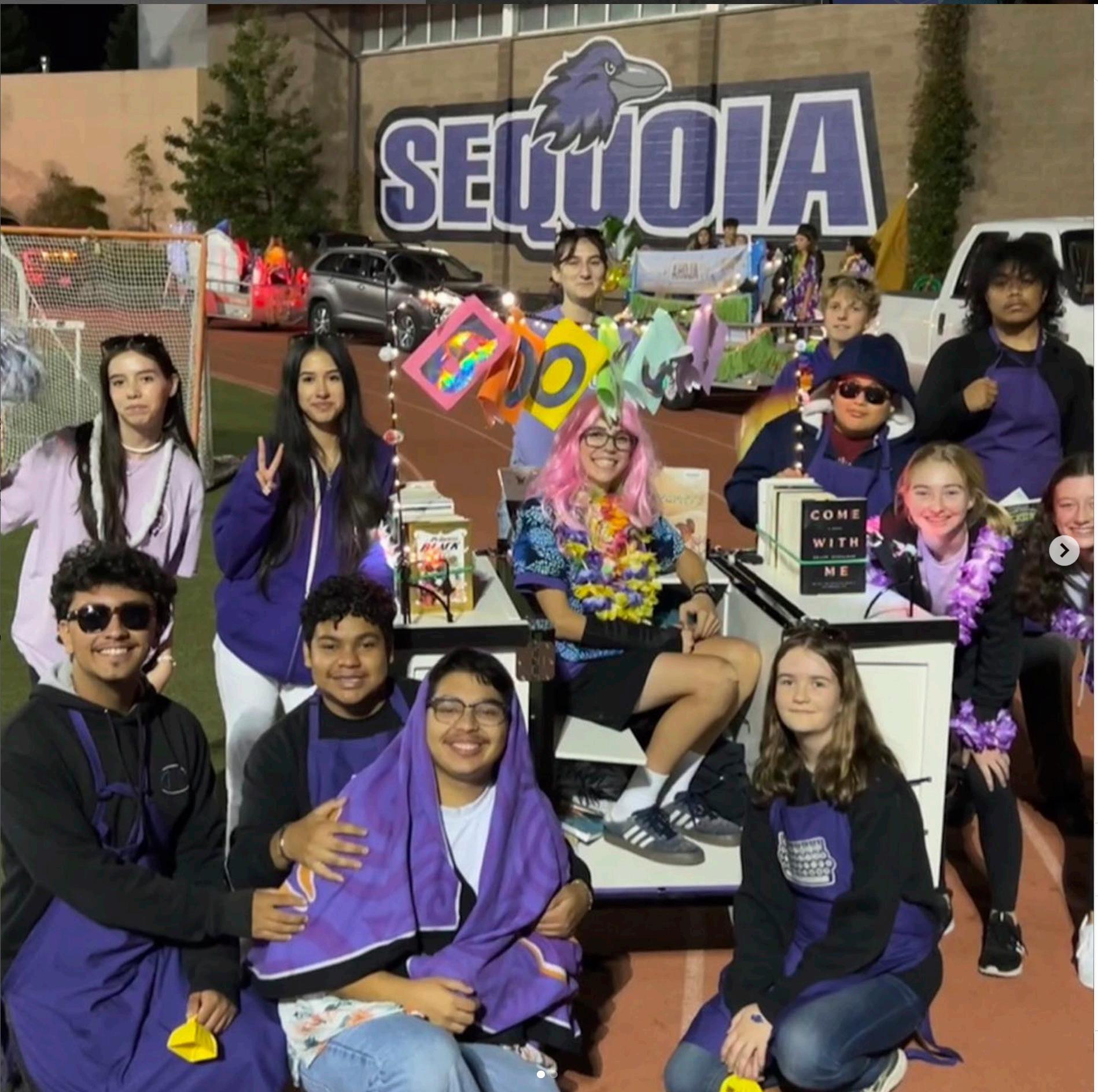
IB Business Management is a Standard Level IB survey course that explores the following aspects of business: organization and environment, human resource management, accounts and finance, operations management and business strategy. The course is interactive and will focus on research and existing business systems. An Internal Assessment is required that allows you to explore changes in an existing business model or program. This course has been UC A-G approved as a “g” elective.
This is an accessible IB course open to IB Diploma students. It is a one year course taken 11th grade spring & 12th grade fall. This class is focused on knowledge and has a heavy focus on student-led discussions.
This course allows students to:
• to reflect on the central question, “How do we know that?”, and to recognize the value of asking that question
• to expose students to ambiguity, uncertainty and questions with multiple plausible answers to equip students to effectively navigate and make sense of the world, and help prepare them to encounter novel and complex situations
• to encourage students to be more aware of their own perspectives and to reflect critically on their own beliefs and assumptions
• to engage students with multiple perspectives, foster open-mindedness and develop intercultural understanding to encourage students to make connections between academic disciplines by exploring underlying
• to prompt students to consider the importance of values, responsibilities and ethical concerns relating
• the production, acquisition, application and communication of knowledge
• to encourage students to form connections between TOK concepts and the world around them

This is a year-long, IB course about choice, trade, money, and markets in today’s world. Students interpret real-life topics in the news, including: housing shortages, poverty, unemployment, rising prices, international development, etc. Covering concepts across macro, micro and global economics, students are prepared to carefully consider their choices in today’s economy. Students are also prepared to pursue further studies in business, law, government/politics, and data science. Requirements: Ethnic Studies, World History, Algebra, Geometry. COURSE APPROVAL IS PENDING as of January 2026.
Prerequisite: Must be 16 years old or a junior; employed at acceptable job site; hold a vocational work permit. Students check-in weekly with the work experience teacher by entering work hours online and must verify work hours through copies of their paycheck stubs. Additionally, students complete one written assignment per month. Students receive one elective credit for every 36 hours worked for a maximum of 360 hours and 10 credits per semester. Credit for the course is based on the number of hours worked and completing written class assignments. Maximum of 40 credits can count toward graduation elective credits. Please note that in order to keep a work permit, students must maintain satisfactory grades and attendance.
Students work as assistants to teachers as laboratory and technology aides. Students give instructional support by working directly with other students; help to prepare laboratory, and shop for instructional material setups. Students also can work as technical support aides for the school’s IT department. Technical Assistants earn variable credit up to 5 credits per semester. Maximum of 10 credits per year. Maximum of 20 credits can count toward graduation. Grade notation: CR or NC.
Assistance in the school offices or helping individual teachers, performing services such as typing, record-keeping, duplicating, tutoring, etc. Students can also work as a Media Center Ambassador. Students will direct visitors to locations and offices and answer basic questions about the school. One-two students can serve in this capacity during each class period of the school day. Grade notation: CR or NC. 2.5 credits per semester (half the credits of regular courses) and a maximum of 5 credits per year. Maximum of 20 credits toward graduation.

Este programa experiencial, enfocado en el emprendimiento, está pensado para dotar al alumnado de 9º curso de las capacidades necesarias para terminar la secundaria y triunfar tanto en la universidad como en su futuro profesional. La asignatura les guía a través de todo el proceso de planificar, lanzar y gestionar su propio pequeño negocio. El currículo se basa en seis competencias clave: Comunicación, Colaboración, Innovación, Perseverancia, Resolución de Problemas y Autogestión. Se trata de una experiencia práctica y basada en proyectos, que anima a cada estudiante a pensar de forma creativa y a desarrollar sus propias iniciativas. Cada actividad está diseñada para potenciar al máximo el desarrollo de estas habilidades. A lo largo del curso, el alumnado aprende a aplicar lo aprendido no solo en sus emprendimientos, sino también en sus estudios, su carrera y sus metas personales. Este curso cuenta con la aprobación de la UC A-G como optativa “g”.
Requisito previo: Ser admitido en el programa. La misión de AVID (Avance mediante esfuerzo individual) es apoyar a estudiantes que serán la primera generación en ir a la universidad, así como a aquellos con potencial para seguir un camino académico exigente, ayudándoles a sobresalir en los estudios y aumentar su acceso a universidades de cuatro años.
Para ello, los alumnos reciben apoyo académico, desarrollan habilidades de gestión del tiempo y técnicas de toma de apuntes, y amplían su vocabulario y estrategias para exámenes como el SAT. Se presta especial atención a mejorar la escritura y la comprensión lectora. Los estudiantes de AVID asisten a charlas de expertos universitarios, realizan visitas a centros de educación superior y reciben orientación sobre la elección de asignaturas para fortalecer sus solicitudes de acceso universitario. El programa AVID dura cuatro años y otorga créditos optativos. Este curso cuenta con la aprobación UC A-G como optativa “g”.
LIDERAZGO ESTUDIANTIL
Disponible para todo el alumnado de 9º curso. Esta asignatura proporciona las bases para convertirse en un líder estudiantil activo. Se trabaja una definición práctica de liderazgo y se enseñan tanto habilidades técnicas como interpersonales, incluyendo oratoria, gestión del tiempo, hábitos positivos y el valor de la cooperación, la creatividad y la iniciativa. Además, los estudiantes descubrirán las primeras oportunidades para participar en actividades escolares.
LIDERAZGO ASB
Requisito previo: Nombramiento por el asesor de ASB.. El proceso incluye una aplicación y entrevista. Los estudiantes serán responsables de fomentar la cultura y el ambiente de Sequoia, así como de crear la mejor experiencia escolar posible para sus compañeros. Este grupo organizará y llevará a cabo actividades estudiantiles, facilitará la integración de todos los alumnos y actuará como enlace entre el cuerpo estudiantil y la administración. Las experiencias prácticas de liderazgo se complementarán con oportunidades curriculares. La asignatura puede cursarse varias veces.
El curso cuenta con la aprobación de la Universidad de California para cumplir los requisitos a-g.
Además, está reconocido como curso de honor por la Universidad de California para los requisitos a-g.
El CTE cumple con la exigencia de Educación Técnica Profesional necesaria para la graduación.
Requisito previo: Haber obtenido una calificación mínima de C- en la última asignatura de inglés. Este curso optativo se dedica a la producción y publicación del periódico escolar Raven Report. Los estudiantes aprenden técnicas de redacción de noticias, deportes, reportajes y opinión, estudian ética periodística y derechos de la Primera Enmienda, perfeccionan habilidades de entrevista y practican fotografía y diseño. Es necesario cursar Periodismo I antes de inscribirse en Periodismo II/III, donde se abordan temas de liderazgo editorial, competencias empresariales y escritura y diseño avanzados. Periodismo III-P puede cursarse varias veces para obtener créditos adicionales. Los estudiantes reciben créditos optativos o de educación técnica profesional (CTE) por estos cursos, que han sido aprobados por la UC como optativa “g”.
Este curso introductorio de dos semestres prepara al alumnado para el examen IB de Psicología. Es una asignatura optativa que se puede cursar para obtener el certificado tras aprobar el examen, o como una de las seis materias necesarias para conseguir el Diploma IB completo. Las exigencias de lectura, escritura e investigación están equiparadas al nivel universitario de primer semestre en Psicología. El ritmo de la asignatura es intenso y se recomienda que los estudiantes tengan una alta motivación para lograr sus objetivos.
IB DIRECCIÓN Y ADMINISTRACIÓN DE EMPRESAS-SL
IB Dirección de Empresas es un curso IB de nivel estándar en el que se exploran los siguientes aspectos empresariales: organización y entorno, gestión de recursos humanos, contabilidad y finanzas, gestión de operaciones y estrategia empresarial. Es un curso interactivo centrado en el análisis y los sistemas empresariales existentes. Se requiere una Evaluación Interna que te permitirá investigar cambios en un modelo o programa de negocio real. Este curso cuenta con la aprobación UC A-G como optativa “g”.
Este curso IB accesible está dirigido a estudiantes del Programa del Diploma IB. Se imparte durante un año, en primavera de 1º de Bachillerato y otoño de 2º. La asignatura gira en torno al conocimiento y da gran protagonismo a los debates dirigidos por el alumnado.
En esta materia, los estudiantes podrán:
• reflexionar sobre la pregunta central: “¿Cómo sabemos esto?” y valorar la importancia de cuestionar
• aprender a convivir con la ambigüedad, la incertidumbre y las preguntas con diversas respuestas posibles, lo que les ayudará a desenvolverse y comprender mejor el mundo, así como a prepararse para situaciones nuevas y complejas
• desarrollar una mayor conciencia sobre sus propias perspectivas y analizar críticamente sus creencias y suposiciones
• interactuar con diferentes puntos de vista, fomentar la apertura y fortalecer la comprensión intercultural, además de conectar disciplinas académicas explorando sus fundamentos
• considerar la importancia de los valores, las responsabilidades y las cuestiones éticas relacionadas
• con la producción, adquisición, aplicación y comunicación del conocimiento
• y vincular los conceptos de TOK con el mundo que les rodea
Este es un curso anual del Programa del Bachillerato Internacional (IB) que explora la toma de decisiones, el comercio, el dinero y los mercados en el mundo actual. El alumnado analiza temas reales presentados en las noticias, como la escasez de viviendas, la pobreza, el desempleo, el aumento de precios, el desarrollo internacional, entre otros. Abarcando conceptos de economía macro, micro y global, este curso prepara a los estudiantes para reflexionar cuidadosamente sobre sus decisiones en la economía actual. Además, les brinda las bases necesarias para continuar su formación en áreas como negocios, derecho, política y ciencia de datos. Requisitos: Estudios Étnicos, Historia Mundial, Álgebra, Geometría. LA APROBACIÓN DEL CURSO ESTÁ PENDIENTE a fecha de enero 2026.
Requisito previo: Tener al menos 16 años o estar en 1º de bachillerato; contar con un empleo en un lugar aprobado y disponer de un permiso de trabajo vocacional. El alumnado debe registrarse semanalmente con el profesor/a de experiencia laboral introduciendo las horas trabajadas en línea y verificarlas mediante copias de las nóminas. Además, cada mes deben entregar una tarea escrita. Por cada 36 horas trabajadas se concede un crédito optativo, con un máximo de 360 horas y 10 créditos por semestre. La obtención de créditos en la asignatura depende tanto de las horas trabajadas como de la entrega de las tareas escritas. Se pueden acumular hasta 40 créditos para el cómputo de optativas de graduación. Es importante destacar que para conservar el permiso de trabajo, es obligatorio mantener buenas calificaciones y una asistencia satisfactoria.
El alumnado colabora como asistente de laboratorio o tecnología, prestando apoyo directo a otros estudiantes, ayudando en la preparación de materiales para prácticas y en la organización de recursos didácticos. También pueden desempeñar funciones como asistentes técnicos en el departamento de informática del centro. Los Asistentes Técnicos pueden obtener hasta 5 créditos por semestre, con un máximo de 10 créditos por año, y hasta 20 créditos válidos para la graduación. Calificación: CR (Aprobado) o NC (No aprobado).
Colaboración en las oficinas del centro o apoyo a profesores, realizando tareas como mecanografía, gestión de registros, duplicado de documentos, tutorías, entre otras. El alumnado también puede desempeñar el papel de Embajador/a del Centro de Medios, orientando a visitantes y respondiendo preguntas básicas sobre la escuela. Uno o dos estudiantes pueden ocupar este puesto en cada periodo lectivo del día escolar. Calificación: CR (Aprobado) o NC (No aprobado). 2,5 créditos por semestre (la mitad de los créditos de las asignaturas habituales) y un máximo de 5 créditos al año. Hasta 20 créditos pueden contarse para la graduación.