Why Autonomous Payment Optimization Becomes a Profit Center at Enterprise Scale, Insights from Ralph

Page 1


Why Autonomous Payment Optimization

Becomes a Profit Center at Enterprise Scale, Insights from Ralph Dangelmaier

Large global businesses process millions of digital transactions every day. Each payment decision affects revenue, customer trust, and operational efficiency. Many companies once viewed payment infrastructure as a basic operational expense Today, that perspective is

changing Payment experts now recognize that enterprise payment intelligence helps businesses unlock hidden revenue by improving approval rates and reducing unnecessary payment failures

Autonomous payment optimization transforms the payment process by using intelligent systems that learn and adapt automatically Traditional payment systems rely on static rules that rarely adjust to changing conditions. Banks update approval models, fraud patterns shift, and regional payment networks evolve When payment systems fail to adapt quickly, transactions are declined even when the customer has enough funds and the purchase is legitimate

Autonomous payment optimization solves this problem by continuously analyzing transaction data and adjusting payment strategies in real time Instead of sending every transaction through the same route, the system studies variables such as card issuer behavior, geography, currency, and historical approval patterns If a specific bank has a higher approval rate for certain transaction types, the system directs similar payments through that path.

This intelligent routing increases successful payment approvals while reducing friction at checkout. Even a small increase in approval rates can have a major impact on revenue for large enterprises For example, improving approval rates by just 1 or 2 percent can recover millions of dollars in annual sales for global companies that process high transaction volumes

Another important benefit is reducing operational costs associated with payment failures When a transaction fails, companies often retry the payment, contact the customer, or lose the sale completely. These failures also create extra customer service work and damage the brand experience Autonomous optimization reduces these issues by identifying the most reliable transaction path before a payment is submitted.

The system also improves fraud detection without harming legitimate customers Older fraud systems sometimes block safe transactions due to rigid rule sets. Autonomous optimization tools use machine learning to analyze behavior patterns, device signals, and transaction history This deeper evaluation helps reduce false declines while still protecting businesses from real threats.

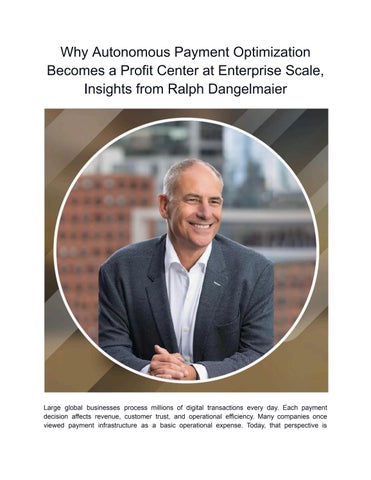
Industry leaders, including Ralph Dangelmaier, emphasize that the future of payments will rely heavily on intelligent automation. Enterprises that treat payment optimization as a strategic advantage will capture more revenue and deliver smoother customer experiences worldwide In this environment, an automated payment routing strategy becomes a powerful driver of profitability, transforming payment operations from a simple processing function into a long-term competitive asset

Turn static files into dynamic content formats.

Create a flipbook