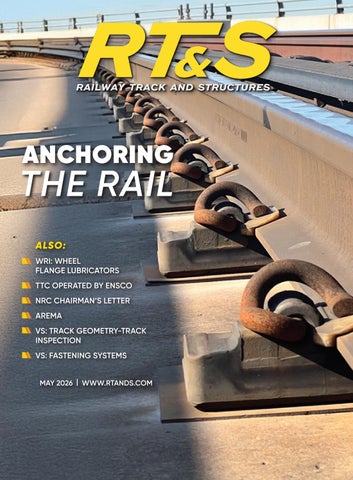
Notebook Engineering Education From the Dome The Journey Toward Increased Track Resiliency
TTC Operated by ENSCO Modeling Vehicle-Track Dynamics and On-Track Testing at the TTC
NRC Chairman’s Column AREMA Message from the President
WRI: Fuel Savings and Wear Reduction: A Case for Locomotive Wheel Flange Lubrication
Vendor Spotlight Track Geometry and Track Inspections
Vendor Spotlight Fastening Systems
OPTIMIZE TRACK TIME MAKE
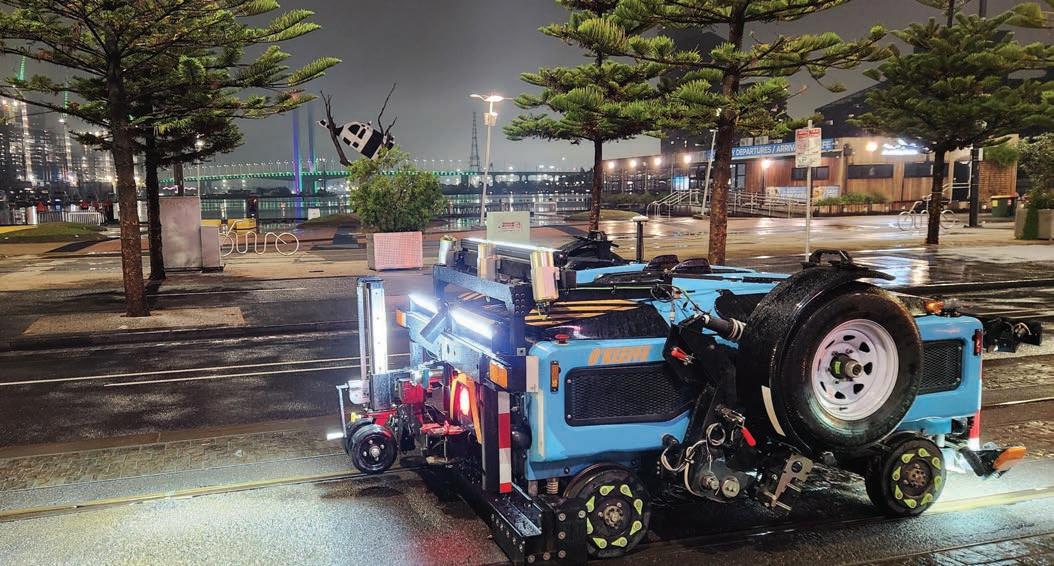
When track time is limited, efficiency is everything. Our products and hands-on service support help crews move faster, work smarter, and finish strong—long-lasting repairs with less time and less labor demands.
Indoor
Vol. 122, No. 5
Print ISSN # 0033-9016, Digital ISSN # 2160-2514
EDITORIAL OFFICES
1025 Rose Creek Drive Suite 620-121
Woodstock, GA 30189
Telephone (470) 865-0933
Website www.rtands.com
DAVID C. LESTER Editor-in-Chief dlester@sbpub.com
JENNIFER M c LAWHORN Managing Editor jmclawhorn@sbpub.com
EDITORIAL BOARD
David Clark, CSX
J. Riley Edwards, PhD, PE, Assitant Professor University of Illinois Urbana-Champaign RailTEC
Daniel Hampton, CSX
Brad Kerchof, formerly Norfolk Southern Jerry Specht, CPKC/AREMA
Robert Tuzik, Talus Associates
Jeffrey Watson, Genesee & Wyoming
Gary Wolf, Wolf Railway Consulting
CORPORATE OFFICES
1809 Capitol Avenue Omaha, NE 68102
Telephone (212) 620-7200 Fax (212) 633-1165
ARTHUR J. MCGINNIS, JR. President and Chairman
JONATHAN CHALON Publisher
MARY CONYERS Production Director
NICOLE D’ANTONA Art Director
HILLARY COLEMAN Graphic Designer
JO ANN BINZ
Circulation Director
MICHELLE ZOLKOS Conference Director
CUSTOMER SERVICE: 847-559-7372
Reprints: PARS International Corp. 253 West 35th Street 7th Floor
New York, NY 10001 212-221-9595; fax 212-221-9195
Continuing Focus on Engineering Education
A Key Mission of RT&S
By David C. Lester, Editor-in-Chief
The March and April 2026 issues of Railway Track and Structures offered a focus on the railroad industry’s need for professionally trained engineers, meaning those with undergraduate and/or graduate degrees in some aspect of engineering, often civil. The March issue discussed the importance of this and presented the informal consortium and cooperation of RT&S, Interface Journal, The University of Illinois UrbanaChampaign and its RailTEC program, the NURail Center of Excellence, and WheelRail Seminars. The magazine has also enjoyed a long association with AREMA, and each member of that organization receives a free annual subscription to RT&S. Moreover, each issue of the magazine includes several pages of material from AREMA. The April issue featured our annual look at some of the top practicing engineers in the rail industry who are under 40 years of age. These folks have several decades of research and/or practice ahead of them and will likely work with and implement concepts and processes in rail engineering and technology that we can only dream of today.
Railway Track and Structures is published for the professional railroad engineering community; Class Is, short lines, engineering consulting firms, suppliers, and those associated in any way with the design, construction, and maintenance of railway infrastructure. A key mission of the magazine is railway engineering education, and we do it in two ways. First, we promote awareness of the need for more rail engineering programs in colleges and universities in North America and the importance of cooperation and synergy among them. Second, each issue offers an in-depth look at railway engineering research, with emphasis on its application. We feature material from WheelRail Seminars, Interface Journal, AREMA, MxV Rail or TTC Operated by ENSCO, and others. You can read about much of this in the March issue of the magazine.
We are also working to help bridge the gulf between industry practitioners and those engaged in university research and those dealing with challenges in the field. Addressing the serious damage done to railroads operating in and through Appalachia by Hurricane Helene in 2024 is one example. Norfolk Southern, CSX, and others rose to the occasion and rebuilt these lines, and most have returned to operation.
To improve our alignment with the academic community, we recently welcomed Dr. J. Riley Edwards, Assistant Professor at the University of Illinois Urbana-Champaign’s Rail Transportation and Engineering Center, to our Editorial Board and as a quarterly columnist.
J. Riley Edwards, Ph.D., P.E., is an Assistant Professor in the Rail Transportation and Engineering Center (RailTEC) at the University of Illinois UrbanaChampaign. He obtained his Bachelor’s degree in Civil Engineering from Vanderbilt University and his MS and PhD in Civil Engineering at UIUC. His research interests are railway infrastructure track system and component design and performance and failure modes associated with infrastructure components. Dr. Edwards has published over 100 conference proceedings and over 70 journal articles related to the design, analysis, performance, and failure modes of railway infrastructure and its components. Dr. Edwards also serves as the Deputy Associate Director for the National University Rail Center of Excellence (NURail CoE), a U.S. DOT transportation center funded by the Federal Railroad Administration. We are very excited to have Riley on our Board and hope that you will join us in welcoming him.
DAVID C. LESTER Editor-in-Chief
Modeling Vehicle-Track Dynamics and On-track Testing at the TTC
Simulation and Physical Testing of Vehicle Performance
Jiasheng Tang, Rail Research Engineer, ENSCO, Inc., Pueblo, CO
Juan Valdes-Salazar, Director of Engineering, ENSCO, Inc., Pueblo, CO
Modern railway systems operate under increasingly demanding conditions, including higher operating speeds, heavier axle loads, and more frequent service. In this environment, it is essential to understand the dynamic behavior of a rail vehicle, particularly a newly developed design, and to evaluate its service worthiness before it enters operation. The objective is to confirm that the vehicle can perform safely and reliably in service without producing unacceptable ride behavior, instability, excessive wheel or rail forces, accelerated wear, or elevated derailment risk.
This evaluation is typically achieved
through a combination of simulation and physical testing. Testing provides direct measurement of vehicle performance under controlled or operational conditions, while simulation enables engineers to investigate a much broader range of scenarios before going to the track. Used together, these methods provide a more efficient and technically informed approach to vehicle development, acceptance, and performance assessment.
Simulation Tools
Dynamics simulation packages developed specifically for railway applications bring together analysis methods that have been refined and validated over many years to predict vehicle dynamic behavior and wheel/ rail interaction. Unlike general purpose multi-body dynamics software, these tools are purpose built for rail applications. This specialization allows them to represent rail specific features in greater detail, including suspension behavior and wheel/rail contact, while also providing a more efficient workflow for railway engineering problems. Often times, two types of software packages are used for dynamic simulations: one for overall longitudinal train dynamics and train handling, and another for detailed railcar dynamic simulation.
One example of the longitudinal train dynamics software is the Train Energy and
Dynamics Simulator (TEDS), developed for the Federal Railroad Administration. TEDS models train level effects such as locomotive tractive effort, dynamic braking, air brake behavior, coupler and draft gear forces, train resistance, grade forces, and energy consumption. This allows engineers to study how forces develop and propagate through the consist during operation. TEDS supports safety evaluations, incident investigations, ride quality studies, new equipment design, and assessment of existing equipment. By simulating the longitudinal dynamics and energy consumption of a train over a given route using user defined consist, track characteristics, and train handling inputs, it captures how throttle and braking commands influence the overall train and the operating conditions experienced by individual vehicles. The resulting train forces can then be used as inputs for railcar dynamic simulations.
For detailed vehicle level analysis, ENSCO uses the Vehicle Analysis Modeling Package In the Railway Environment (VAMPIRE). VAMPIRE is a rail vehicle dynamics simulation package developed specifically for rail applications, bringing together methods that have been carefully developed and validated over many years to predict vehicle dynamic behavior and wheel/rail interaction. It is used to study an individual vehicle’s response to track geometry, suspension characteristics,
and contact conditions, with applications including vehicle design and acceptance, ride and stability analysis, curving and wear studies, accident investigation, and in-service problem diagnosis. The software represents the vehicle as an assembly of masses, wheelsets, and suspension elements, and it can model detailed track and wheel/rail contact conditions to predict outputs such as accelerations, wheel/rail forces, wheel unloading, derailment related indicators, and wear measures.
Characterization for Simulations
Accurate simulation depends on accurate physical properties used in the models. Relying solely on catalog values, historical assumptions, or legacy model libraries can reduce the fidelity of a vehicle model, especially when evaluating new designs. The Transportation Technology Center (TTC) in Pueblo, Colorado, specializes in component level characterization testing needed to support high fidelity simulations.
Using load frames in the TTC’s Rail Dynamics Laboratory, the stiffness and damping behavior of suspension components can be characterized under controlled loading. These tests provide the force-deflection response needed to define how both primary and secondary suspension elements behave in the model.
Friction behavior between bogie components, which is especially important for freight truck designs that rely on frictional damping and load transfer through component interfaces, can be tested at TTC. This measurement is accomplished by the use of so called air tables, which suspends the bogie and uses actuators to apply a controlled moment to the assembly. By measuring the resulting force and displacement, engineers can calculate the friction coefficient between interacting bogies, span bolster, and car bodies.
In addition, test equipment and staff at TTC determine mass and inertia properties for major vehicle components, as well as measure wheel and rail profiles. These are critical inputs for accurate dynamic response and wheel/rail contact modeling. At the train level, TTC testing can also capture coupler force effects and other longitudinal influences on vehicle behavior. This is important because a railcar does not operate in isolation: buff and draft forces transmitted through the train can influence wheel unloading, lateral response, and overall vehicle dynamics, especially under demanding train handling conditions.
All together, these capabilities allow for the development of simulation models using accurate component characterization, friction behavior, mass and inertia properties, wheel/rail
contact data, and train induced force inputs.
Simulation Workflow
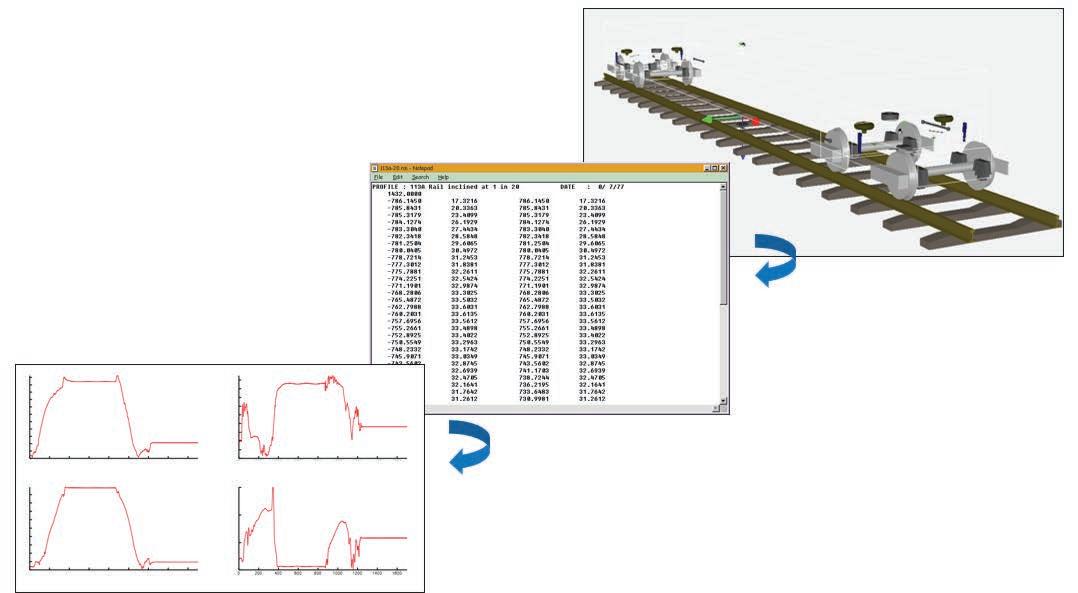
The longitudinal train dynamics simulation begins with definition of the track, train consist, vehicle data, and train handling commands. The track file describes elevation, curvature, superelevation, and grade, while the train file defines the consist and vehicle properties. Train handling commands specify how the train is operated, including throttle, braking, and other control actions. The software then calculates the motion and force distribution throughout the consist. After each run, post processing tools are used to review time histories, acceleration summaries, coupler force summaries, and L/V ratio results.
However, train dynamics simulation (consist of several cars) alone does not always provide the level of detail needed to evaluate a vehicle’s response to track perturbations. For more detailed analysis, the evaluation is
strengthened by applying a vehicle-track interaction model.
In the railcar dynamic simulation, the engineer builds a detailed vehicle model represented by masses, wheelsets, and suspension elements. These include dampers, bumpstops, friction elements, shear springs, and other components that govern how the vehicle responds to forces and motion during operation. Each component is assigned properties such as mass, inertia, stiffness, damping, friction, and their geometric location.
Track modeling is equally important. The track model accounts for curvature, cant or superelevation, twist, roll, gauge, rail inclination, and track irregularities. To represent wheel/rail interaction, the software can generate contact tables using measured wheel and rail profiles. This enables high fidelity and efficient analysis of changing contact conditions, flange interaction, curving behavior, and derailment related scenarios.
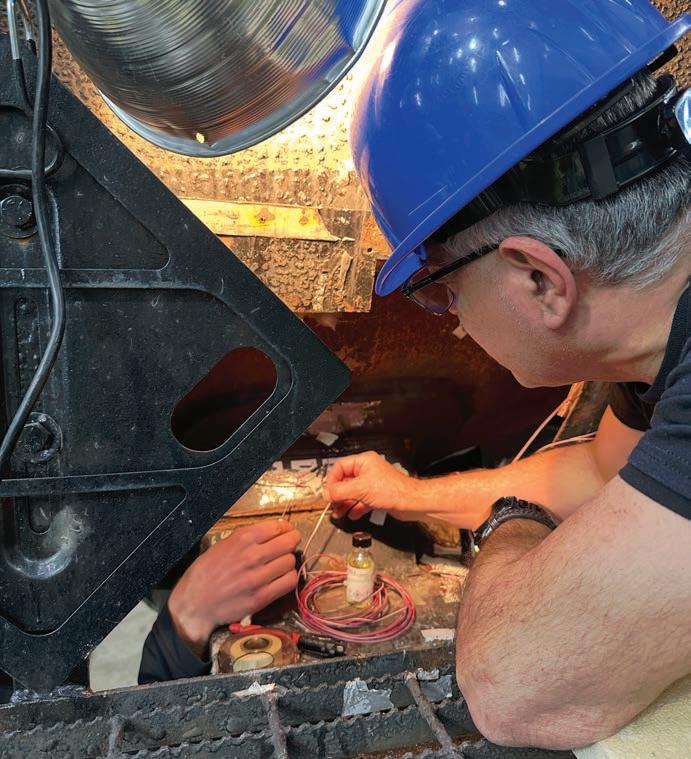
ENSCO engineer instrumenting a tank car for on-track testing at the TTC, installing sensors and wiring to capture real-time vehicle response and Wheel/Rail interaction data.
At the center of this analysis is vehicle track interaction (VTI), which describes how the wheels and rails transmit forces and relative motion as the vehicle travels over the track. VTI has a direct influence on ride quality, curving performance, wheel unloading, wear, stability, and derailment tendency.
The software then simulates the vehicle traveling over the track and calculates outputs such as accelerations, wheel/rail forces, wheel unloading and derailment related measures, and wear related quantities. Accelerations provide insight into ride and vibration behavior, wheel/rail forces indicate how strongly the vehicle loads the track, and wheel unloading measures help identify potentially unsafe operating conditions. Wear related outputs assist in estimating long-term maintenance demand and component life.
the system accurately and reveals effects that may not be fully captured in the initial model. The most effective engineering workflow therefore combines predictive simulation with controlled testing and correlation of measured and simulated results.
Testing at TTC
At TTC, simulation is complemented by on-track testing. TTC provides dedicated rail research and test environments used for prototype evaluation, type testing, vehicle track interaction studies, and other rolling stock performance assessments. The Precision Test Track (PTT) at TTC can be configured to match the conditions required by the AAR Manual of Standards and Recommended Practices (MSRP), allowing vehicle performance to be evaluated in a controlled and repeatable manner.
This controlled setting is superior to
providing a detailed picture of how the vehicle responds as it travels over track perturbations. These measurements are collected in real time. The testing program is typically conducted in a progressive and carefully controlled manner. The vehicle is run through a sequence of incrementally increasing speeds. After each stage, wheel forces are evaluated and derailment tendency is assessed using the ratio of lateral force to vertical force. This ratio, known as the L/V ratio, indicates the tendency of the wheel to climb the rail and therefore serves as an important indicator of derailment risk. A stable car follows the test article for safety, and together with real time monitoring of instrumented measurements, ensures cautious progression of workflow.
Track condition is measured alongside vehicle response. A Track Geometry Measurement System (TGMS) is used
W OMEN IN RAIL AILWAY
Railway Age and RT&S present the fourth annual Women in Rail Conference!
Women in Rail 2026 empowers individuals to grow, lead, and thrive in the rail industry. Women and allies will convene to share strategies for career advancement and leadership success.
Through panels, peer discussions, and networking, attendees will gain insights on compensation, skills, and economic trends while supporting workforce engagement and leadership pipelines.
Women in Rail 2026 stands as a leading industry forum, highlighting practical approaches for moving rail forward.
SPEAKER:
Maryclare Kenney Senior Vice President & Chief Commercial Officer
SPEAKER:
Pam Arpin Senior Vice President & Chief Information Officer CPKC
Graduates: Come Build a Career that Keeps The Country Moving
It’s that time of year when commencement speakers attempt to inspire and offer wisdom to graduates who are transitioning their studies into the next phase of life. For most graduates, that means starting work at a job that they hope will be a springboard to a satisfying career.
Although my first stop wasn’t in our industry, I found my way and would encourage any graduate looking for a challenging and dynamic career – with the added bonus of lifelong friendships –to set your sights on the railway industry.
one person in particular, Gene Tonsager, a retired railroader who had worked at Ames in government relations, was generous with his time and knowledge and eager to make introductions that really advanced my career.
My connections multiplied exponentially, especially as I became involved in the NRC, first as a conference attendee, later on a committee, and then as a board member. Past NRC chairmen – Mike Choat, Jim Hansen, Steve Bolte and Joe Daloisio – have been invaluable coaches who modeled leadership and involved
mistake, and the first time I realized no one was coming to solve it for me.
That’s where your education really begins.
Railroading will challenge you. It will test your judgment, your resilience, and your ability to work with people who see the world differently than you do. But if you lean into it—if you listen, learn, and take pride in the work – you’ll be part of something that quite literally keeps the country moving.
The people who succeed here aren’t the ones chasing titles. They’re the ones who
RAILROADING WILL CHALLENGE YOU. IT WILL TEST YOUR JUDGEMENT, YOUR RESILIENCE, AND YOUR ABILITY TO WORK WITH PEOPLE WHO SEE THE WORLD DIFFERENTLY THAN YOU DO.
Growing up in Michigan as the son of a surveyor, I was always drawn to the outdoors and to the land. After graduation, I was eager to put my degree into action. Unlike so many of my peers, I don’t come from a multi-generational railroad family. My only exposure to the industry was a Lionel model train set my grandfather gave me as a child.
When I relocated to Arizona for an opportunity with a heavy highway civil contractor, I gained experience on a grade separation project involving BNSF and the Arizona Department of Transportation. It was a great experience that ignited my passion for railroads. Eventually my career led me to Ames Construction and I haven’t looked back in more than 20 years.
There’s something about the railroads – and about railroaders – that leads to real connections. I didn’t know anyone in the railroad industry when I started at Ames, but that quickly changed.
I was fortunate to find valuable mentors early on who taught me about railroad geography, networks and how the industry actually works. Numerous superintendents and managers guided my early development in the field, but
me in efforts to foster stronger, safer, and innovative practices between contractors and suppliers and their railway and industrial customers.
The NRC is an indispensable resource for not only cultivating a valuable network, but also for professional development, through its annual conferences, webinars, and committee activities. Our association also draws graduates and other jobseekers to our industry through scholarships, grants, veterans outreach activities, and our jobs database.
You don’t have to be an active NRC member to conveniently access the job postings of all our member companies. Simply click on the “Jobs” tab at the top of our website or go to nrcma.org/jobs to find links to the careers pages of nearly 400 railway contractors and suppliers. It’s no surprise that this database is among the most visited pages on our website. And you don’t have to wait for graduation. Many of these companies also post internships that offer a chance to try out the industry and various jobs in it before making a longer-term commitment.
I don’t remember my commencement speaker. What stuck with me came afterward: the first tough call, the first
stay curious, take ownership, and keep showing up when it’s hard.
Congratulations to the graduates. The path ahead isn’t simple or clearly defined, but it’s worth it. I’ll see you down the track.
“Change is constant. Leadership is a choice.”
CURTIS BILOW Chairman, National Railroad Construction and Maintenance Association (NRC)
FUEL SAVINGS AND WEAR REDUCTION: A CASE FOR LOCOMOTIVE WHEEL FLANGE LUBRICATION
By Jeff Tuzik
The benefits of friction management are well known and often touted. But one benefit in particular—fuel savings—receives far less attention than the others. But as railroads race to meet greenhouse gas reduction targets and ultimately net-zero goals that they have set for themselves, fuel savings have become more than just a costsaving measure. And the energy-saving properties of friction management are in a position to take on increased significance.
“For most railroads, diesel fuel is their single largest purchase expense. It’s a prime target for cost-cutting,” Wayne Kennedy, Principle of Kennedy Consulting, told delegates at the 2025 Wheel/Rail Interaction Heavy Haul Conference.
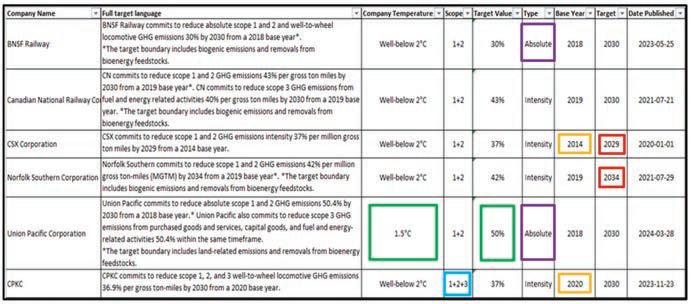
North American Class I railroads have worked with the Science Based Targets initiative (SBTi), an organization that helps companies take validated, science-based actions to curb their carbon footprints, to develop plans to reduce greenhouse gas (GHG) emissions, Kennedy said. Many of these goals are ambitious. (Figure 1 details the SBTi goals set by each of the Class Is.) Generally, they are based on reducing GHG emission, and align with an overarching aim of promoting a ≤2-degree (Celsius) reduction in global temperature rise (it’s worth noting that the SBTi has recently updated their target to a ≤1.5degree reduction).
“For Class Is, locomotive emissions account
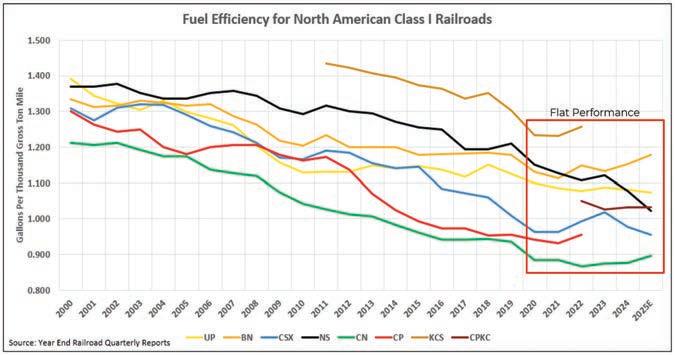
for 85 to 95 percent of their emissions,” Kennedy said. Luckily, (thanks to a number of technological and operational improvements) from both a climate and an economic perspective, fuel efficiency for Class Is has steadily improved since 2000. However, this improvement has flattened since 2020 for all railroads except Norfolk Southern, he said. (See Figure 2 for details.) “The SBTi goals are not fuel efficiency goals per se, but if they were, the 2030 goals set by the Class Is would be impossible to achieve at the current rate of improvement.”
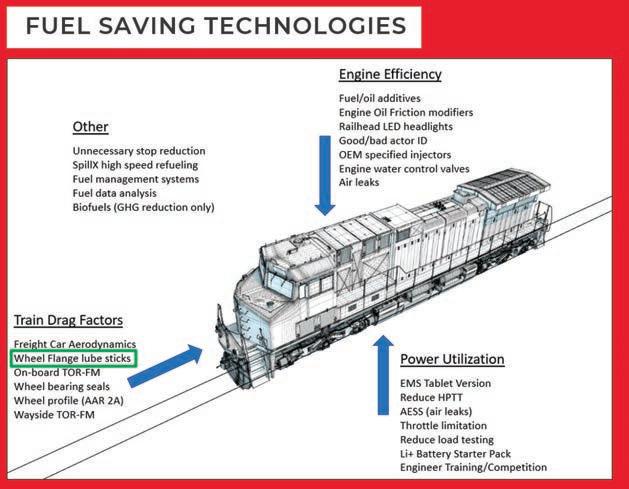
That said, fuel efficiency is important, regardless of the impetus for it. And there are many fuel-saving technologies readily
Photo Credit: Mike Yuhas
Wayne Kennedy, Principle of Kennedy Consulting
Robert Stevens, Managing Partner at First Analytics
available (see Figure 3). But these technologies have very low levels of adoption, Kennedy said. “Many of these technologies (alone) generate fuel savings in the one to three percent range. But,” he said, “the signal-to-noise ratio for fuel data is quite high.” This makes it difficult to prove that fuel-savings is attributable to a specific technology, rather than to a combination of factors. Still, among fuel-saving technologies, locomotive wheel-flange lubrication stands out as a cost-effective option for increasing fuel efficiency, he said.
Solid Stick Flange Lubrication
Solid-stick flange lubrication isn’t a new technology, “it’s been around for decades,” Kennedy said. It’s also a simple technology: a spring-loaded cartridge mounted on the bogie, near the wheel, pushes a solid lubricant stick (molybdenum disulfide is typically the active ingredient) against the flange throat of the wheel to provide a significant reduction in the coefficient of friction at the flange/gageface interface. (Figure 4 shows a diagram of a typical configuration.) “It’s very effective at reducing the wear rate of wheel-flange height and thickness.”
“Proving fuel savings is not for the faint of heart,” Kennedy said. “It requires rigorous statistical analysis.” Fuel consumption is highly variable in general. It’s affected by factors such as:
• Train length
• Train weight
• Commodity (cargo) type
• Horsepower-per-trailing-ton (number of locomotives)
• Topography
• Train speed and aerodynamics
• Locomotive engineer skill/performance
• Locomotive condition
• Car and consist condition
• Track and ballast condition
• Episodic events
• Traffic/congestion
• Weather
• Location
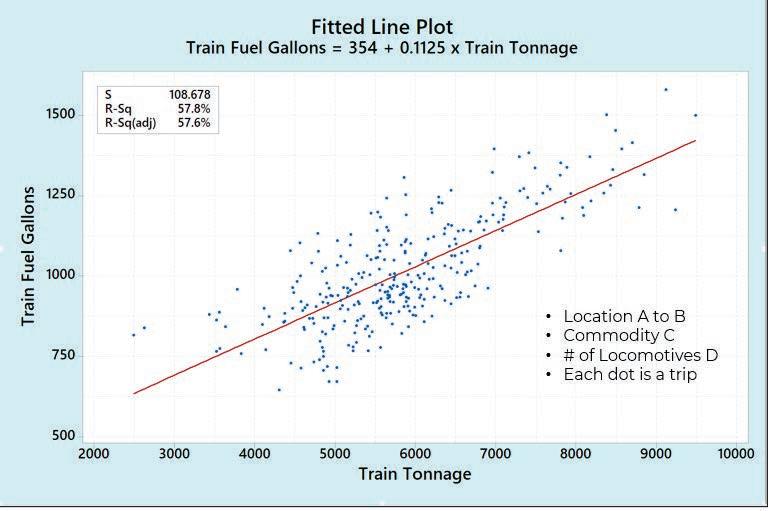
An exhaustive list. The natural question that arises is how to account for all these variables in an accurate, digestible analytical model. Figure 5 shows regressing tonnage against fuel: “segmenting the data to the point where you have several thousands of these regression plots allows you to determine a percentage fuel savings,” Kennedy said. However, depending on how much noise there is in the fuel data and what percentage of fuel savings is targeted, generating valid results will require a significant number of trips over a considerable
Figure 1. SBTi and GHG emissions goals set by various Class I railroads.
Figure 2. Class 1 fuel efficiency data over time.
Figure 3. A sample of many fuel-savings technologies currently available.
span of time (figures that must themselves be statistically derived).
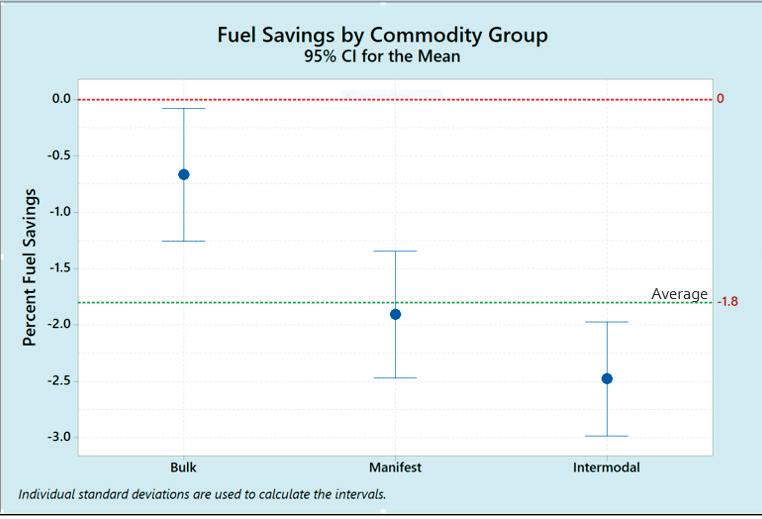
Applying these analytical methods to locomotive-mounted flange-stick testing, Kennedy developed a logistic-regression model using 500,000 trip segments over a period of one year. For this test, the dependent variables were fuel consumption in gallons per thousand gross ton miles (K/KGTM) and train velocity in mph. The independent variables were:
• Locomotive(s) equipped with solid stick flange lubrication (Y/N)
• Train commodity (cargo) group
• Horsepower-per-trailing-ton
Figure 5. A fuel-usage vs tonnage regression plot.
Figure 4. A typical solid-stick wheel-flange lubrication applicator configuration.
JOIN US AT OUR CONFERENCES
WOMEN IN RAIL
October 6–7, 2026 — Schaumburg, IL
Women In Rail empowers professionals to grow and take on leadership roles in the rail industry. The conference brings together women and allies for practical conversations on career advancement and leadership development. Panels and peer discussions address mentorship, compensation, employee resource groups, and emerging industry trends. The event supports both individual growth and stronger workforce pipelines.
LIGHT & HEAVY PASSENGER RAIL
November 4–5, 2026 — Philadelphia, PA
Railway Age / RT&S Light & Heavy Passenger Rail equips transit professionals with the knowledge and connections to improve passenger rail systems across North America. Peer-led sessions focus on practical solutions for planning, design, operations, and maintenance. Case studies explore AI-driven operations, sustainability, electrification, and next-generation rolling stock.
VIRTUAL CONFERENCES
RT&S virtual events offer in-depth case studies and quality research to help MoW professionals excel. The events feature live Q&A sessions with railroad personnel and technology suppliers, providing targeted information based on viewer needs.
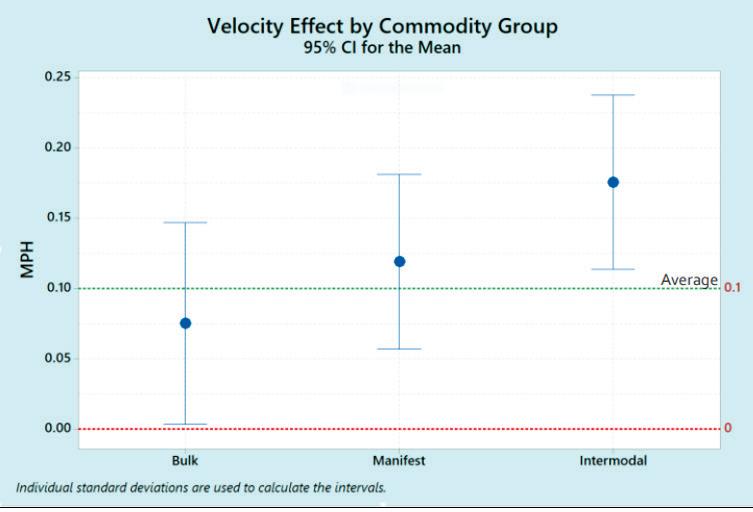
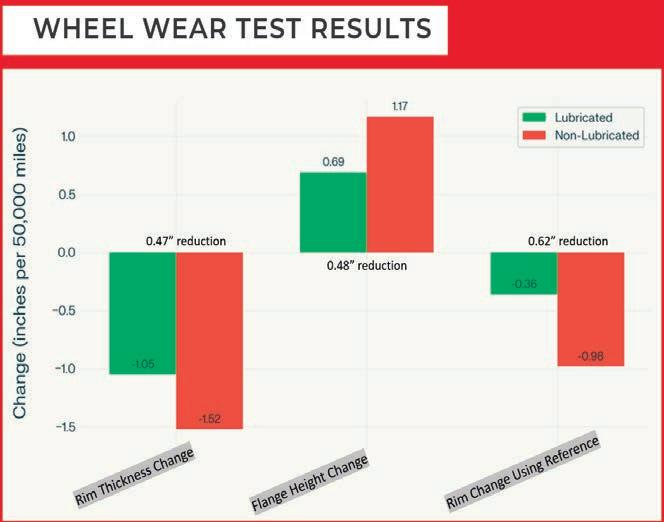
the overall average for all commodity types at ≈2%. Figure 7 shows results for velocity effect by commodity type wherein the average is a 0.10-mph increase: “Not huge, but still meaningful,” he said. “And if you wanted to forgo fuel savings and simply focus on speed, that’s an operational choice you could make, as well.” Naturally, there are also wheel-wear benefits associated with wheel-flange lubrication. Kennedy Consulting and First Analytics performed wheel-wear validation tests by comparing locomotives with and without solid-stick flange lubrication on the same heavy-haul coal route (and thus operating under the same conditions and with the same lading) over a period of six months. The test measured wheel-rim thickness, flange height, and tread-to-witness-groove distance (as a secondary/alternate measure of rim thickness). “The results were pretty impressive, even over the relatively short period of the test,” he said. Rim thickness in lubricated versus unlubricated wheels saw and 0.47-inch reduction, flange height saw and 0.48-inch reduction, and witness groove-to-flange distance saw a 0.62-inch reduction. (Figure 8 shows a detailed graph of this data.) “The data shows a
Supplier Spotlight
Find the right vendors for your business in the RT&S Buyer's Guide. Search for products, research vendors, connect with suppliers and make confident purchasing decisions all in one place. RTandSDirectory.com
Figure 7. Velocity effects due to locomotive wheel flange lubrication.
clear trend toward decreased wear rates and an increase in overall wheel life.”
Fuel Savings Analytics
The detailed fuel savings analyses performed as part of the overall study were performed by the former TTCI at the Transportation Technology Center, specifically on the Wheel/Rail Mechanism (WRM) Loop and the Transit Test Track (TTT) Loop. “Often these types of tests are done during revenue service, but if you can eliminate variables and really focus on your area of interest, like you can at the test center, you can get quite rigorous statistical data,” said co-presenter Robert Stevens, Managing Partner at First Analytics. “As Wayne indicated, we’re looking for a very tiny effect [on fuel] in data that’s very noisy.” Some noise is understandable and explainable, but a good portion of it is inexplicable variability. This means that having confidence in the data is a significant statistical challenge, he said.
Aggregate wheel wear savings due to flange lubrication.
group receives the standard treatment or placebo (no wheel-flange lubrication). “We’re trying to eliminate bias up front, and minimize inherent variance,” Stevens said.
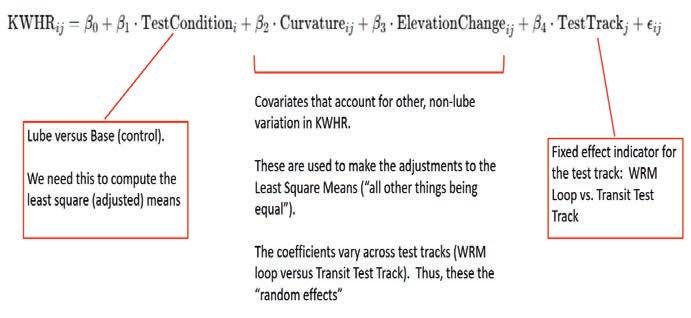
On the back end, data from these tests was analyzed using an ANCOVA (Analysis of Covariance) model (the details of which are shown in Figure 9). In simplified terms, energy usage in kilowatt-hours is a function of test conditions (lubrication vs no lubrication),
covariates or variations from test to test that are unrelated to the test conditions but that effect energy usage, and on which test track (the WRM or the TTT) the run took place.
ANCOVA results for these tests indicated a 3.2% reduction in energy consumption (KWHR per second) for the trains with flangelubrication-equipped locomotives, he said.
Monte Carlo analysis—which (in simplified terms) provides a range of potential outcomes
and their probability of occurrence—applied to these analyses indicated that 90% of all expected outcomes fell between 1.8% and 4.3% energy savings.
Kennedy Consulting and First Analytics also analyzed the effects of flange lubrication on parameters like locomotive throttle position and time spent in various throttle positions. “The analyses didn’t always agree on the magnitude of the effect, but they all agreed that flange lubrication has a demonstrable, positive effect on all parameters related to energy savings,” Kennedy said.
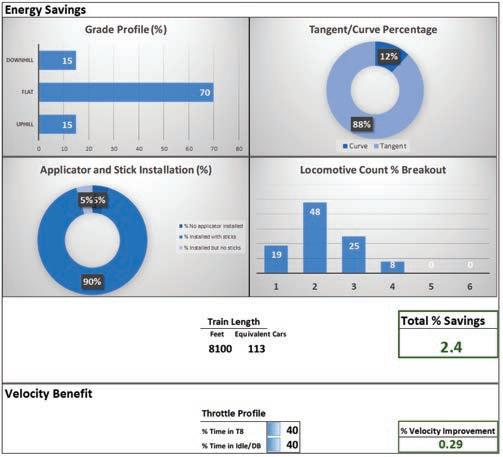
Extrapolating the results from the test track to Class Is in general is no easy task and involves some degree of assumption and indeed additional variance. Thus, Kennedy and Stevens developed a software tool wherein railroads can plug in parameters specific to their own systems in order to generate a predicted fuel savings (based on multiple parameters such as the number of lubrication applicators, number of locomotives, average horsepower-per-trailing-ton, etc.). See Figure 10 for a sample of this application’s output.
From a practical perspective, converting these energy savings to tangible fuel savings
Figure 9. Details of the ANCOVA mode used to assess energy savings.
is difficult, Stevens said. Even average fuel consumption over time for the same train consist, with the same driver, same origin and destination, and nearly the same tonnage and lading, shows tremendous variability, making quantifying the effects of fuel savings that much harder.
Nonetheless, extensive testing and analysis have shown a tangible, demonstrable energy/fuel savings as a direct result of locomotive wheel-flange lubrication. “Even aside from the savings in fuel costs, railroads need all the help they can get in meeting their SBTi GHG emission-reduction goals,” Kennedy said. And, relative to other technologies, solid-stick-wheel-flange lubrication is a simple and inexpensive technology that can help with this. In addition to these benefits, there are proven benefits to wheel/ rail interaction and wheel wear associated with wheel-flange lubrication. With all the benefits, it’s something of a mystery as to why railroads haven’t adopted this technology en masse. Perhaps, as Kennedy said, it’s a matter of developing an even more rigorous statistical approach to proving fuel savings in the
Jeff Tuzik is Managing Editor of Interface Journal https://interfacejournal.com/ This article is based on a presentation
Heavy Haul Conference. https://wheel-railseminars.com/
All images are courtesy of Wayne Kennedy
MOBILE ELEVATED WORK PLATFORM
Figure 10. A plug-and-play fuel savings predictor created by Kennedy Consulting and First Analytics.
TRACK INSPECTING
Identifying track conditions for safety and asset life
By Jennifer McLawhorn, Managing Editor
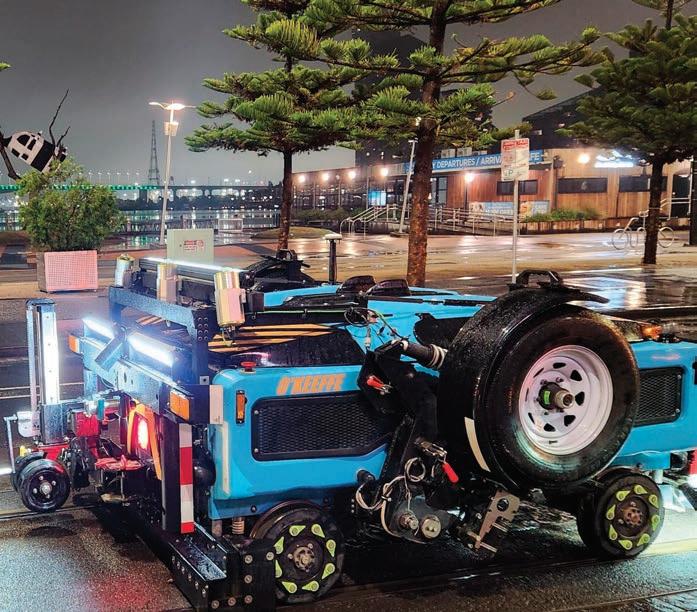
The importance of monitoring track conditions to identify, assess, and address potential defects is critical for rail safety and asset life. What railroad owners and operators need is to be better equipped during track inspections since there are any number of defects that can lead to serious issues or derailments. Railway Track and Structures reached out to vendors, including Holland, who said that in 2025, “FRA data shows that many derailments caused by track geometry defects were related to wide gauge.” The equipment and services detailed in this vendor spotlight help to find issues like wide gauge, ballast condition, and overall infrastructure integrity.
As railroads work to improve safety, manage assets, and control costs, RailPod says it “delivers a scalable, and more cost-effective way to inspect track infrastructure. Designed for daily use, RailPod’s platform collects detailed data on geometry, tie condition, rail profile, ballast, joint bars, fasteners, and top-ofrail—in one pass. The RailPod platform allows flexibility to inspect short line
railroads, Class I railroads, Transit systems, and industrial tracks or yard environments. With minimal disruption to operations, railroads can inspect more frequently and make timely, data-driven maintenance decisions.
“To support regulatory compliance, RailPod’s 213 Inspection App digitizes the manual inspection process, guiding users through each step, capturing data in the field, and automatically generating ready-to-submit reports. It reduces paperwork and ensures accurate, consistent results.
“Each inspection creates a ‘digital twin’ of the right-of-way using high-resolution imagery, LiDAR, laser measurements, and GPS data. This feeds directly into RailPod’s web and mobile software, giving customers instant access and tools for inspection, planning, and engineering. RailPod’s engineering team supports custom requests using collected data to include clearance analysis, road crossing surveys, pre/post-construction documentation, asset management, track charts, and more.
“RailPod continues to expand its
capabilities with catenary wire wear measurements, broken rail detection, switch inspections, grooved rail measurements, and restraining rail inspections, providing more value in one inspection. By reducing costs and increasing data collection frequency, RailPod is changing how railroads manage their track providing better and more cost-effective decisions.”
Loram tells RT&S that “High tonnage railroads operate under extreme loads, and small weaknesses in the trackbed can escalate into defects that consume maintenance windows and budget. Ballast fouling, trapped moisture, poor drainage, and stiffness transitions at switches, culverts, bridges, and joints can all accelerate deterioration.
“Loram’s TRACE approach (Track Root-cause Analytics and Condition Evaluation) supports data-driven, targeted maintenance by integrating AI-aided GPR interpretation, LiDAR, track geometry, and maintenance history in the Rail Doctor® platform. Condition dashboards summarize key indicators, trends, and locations of concern, and turn
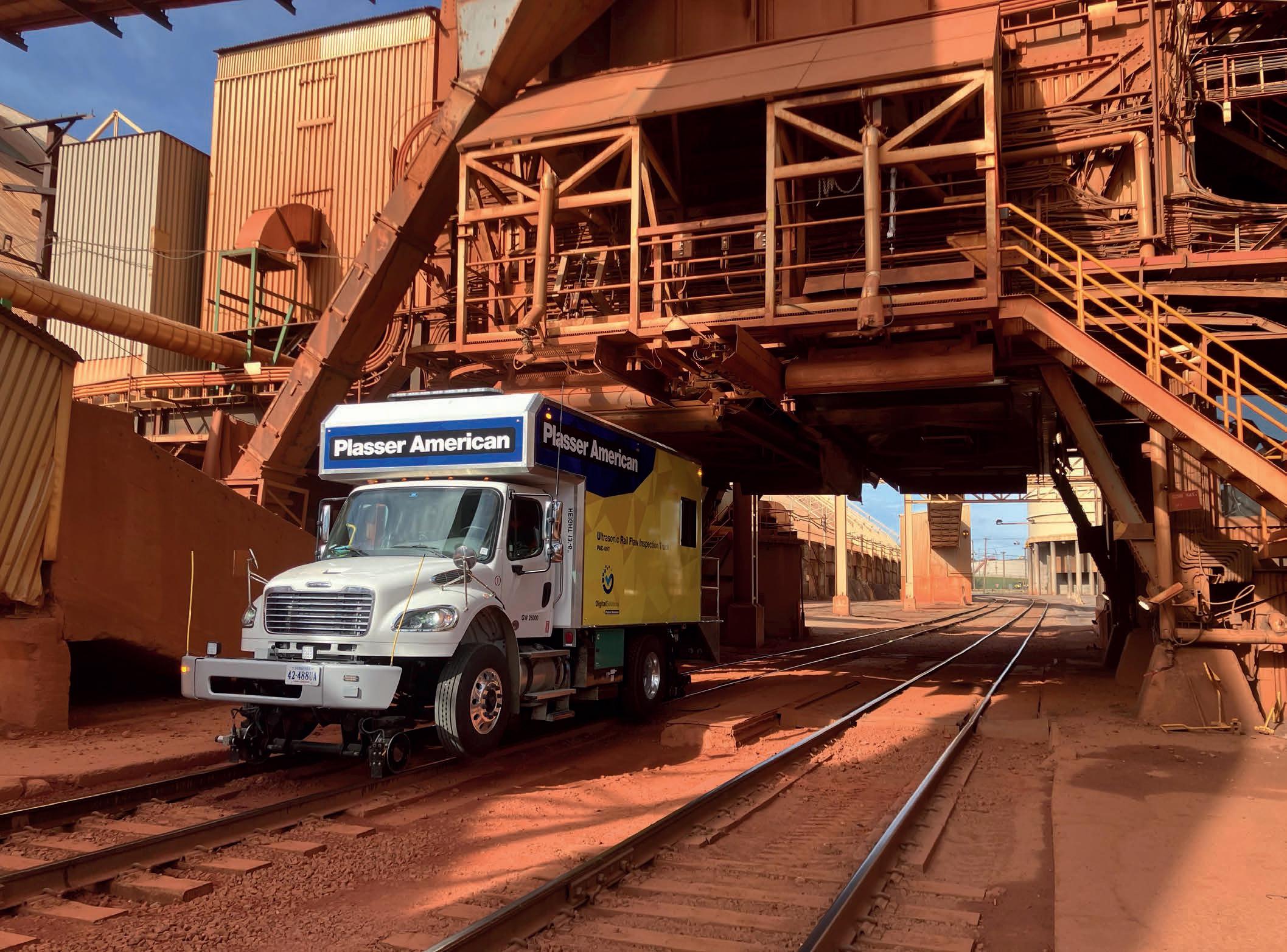
Ultrasonic rail flaw inspection services
Ultrasonic rail flaw inspection is the most effective method for detecting rail defects. Plasser American’s system combines high-speed ultrasonic electronics with a user-friendly interface and detailed reporting. It operates up to 45 mph with 4mm resolution for stop/verify and continuous testing. Hi-rail trucks provide flexibility, and our team delivers reliable results and reports to meet your inspection needs efficiently.
”Plasser & Theurer“, ”Plasser“ and ”P&T“ are internationally
findings into accurately located action plans for targeted corrective work. This gives railroads a clear view not only of where defects appear but also of why they recur and which corrective actions are most likely to prevent repeat work.
“GPR provides continuous visibility into ballast condition, layer thickness, fouling, and moisture distribution, leading indicators of drainage capacity and long-term performance. LiDAR maps corridor and embankment geometry and drainage-related features such as ditch lines and flow paths, helping explain why problems concentrate at specific locations. TRACE links these structural drivers to defect parameters over time, delivering clear, actionable root-cause evidence and better use of maintenance windows. The payoff is measurable.
“TRACE helps railroads prioritize
interventions that address root-cause drivers, validate results before and after work, and focus limited track time where it delivers the greatest return. Accurately located action plans support efficient planning and execution. The result is improved ride quality, fewer unplanned repairs, and better long-term asset performance across high-tonnage corridors. Multi-year deployments on other railroads demonstrate that ongoing monitoring and data-driven planning can reduce recurring defect areas by 70–80% over several years.”
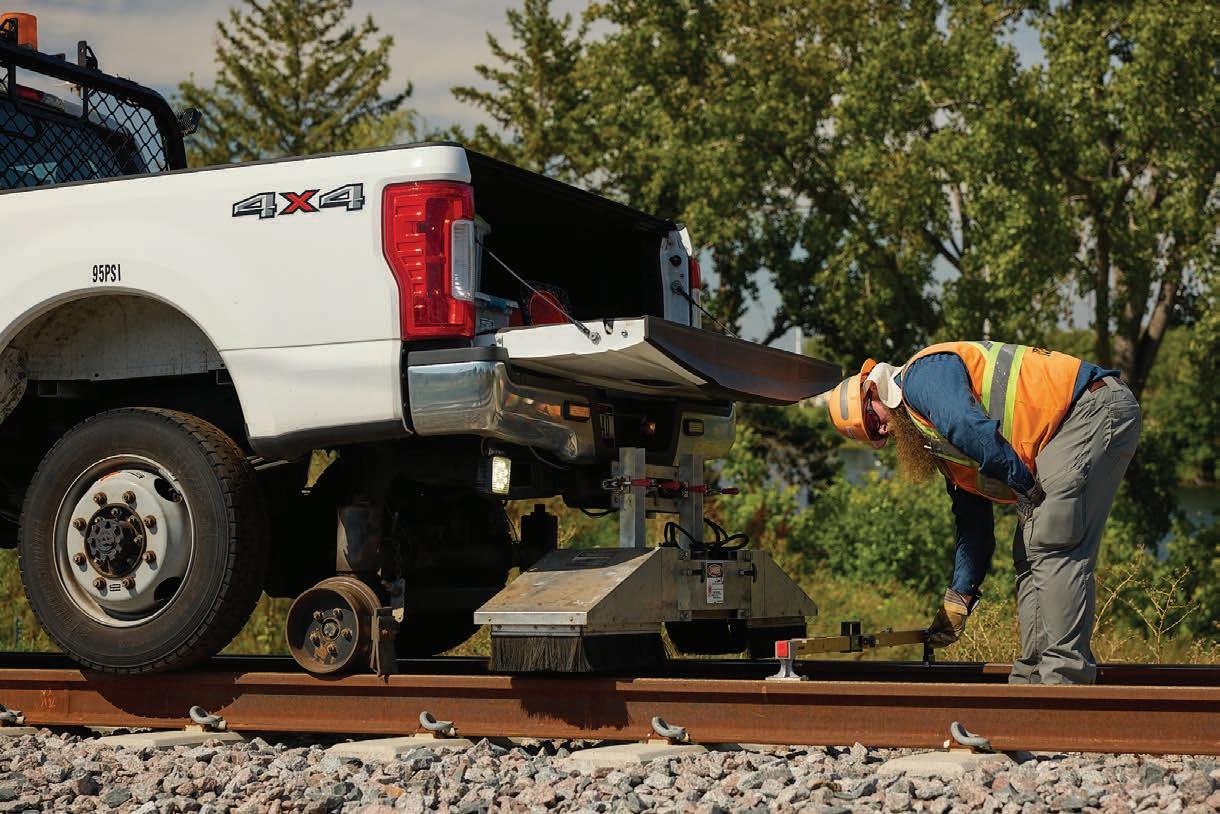
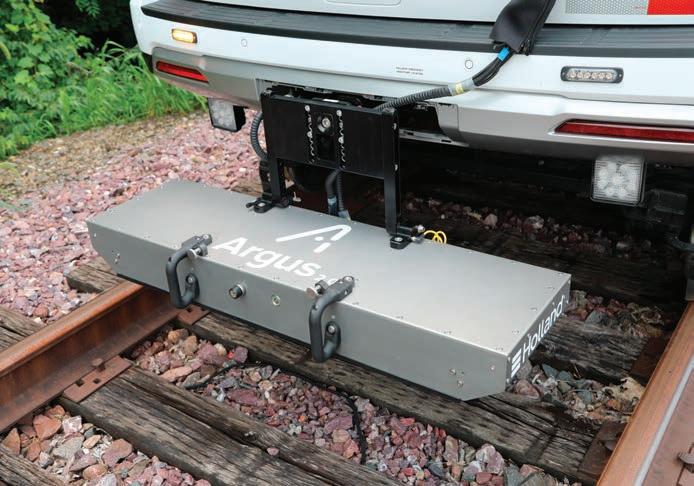
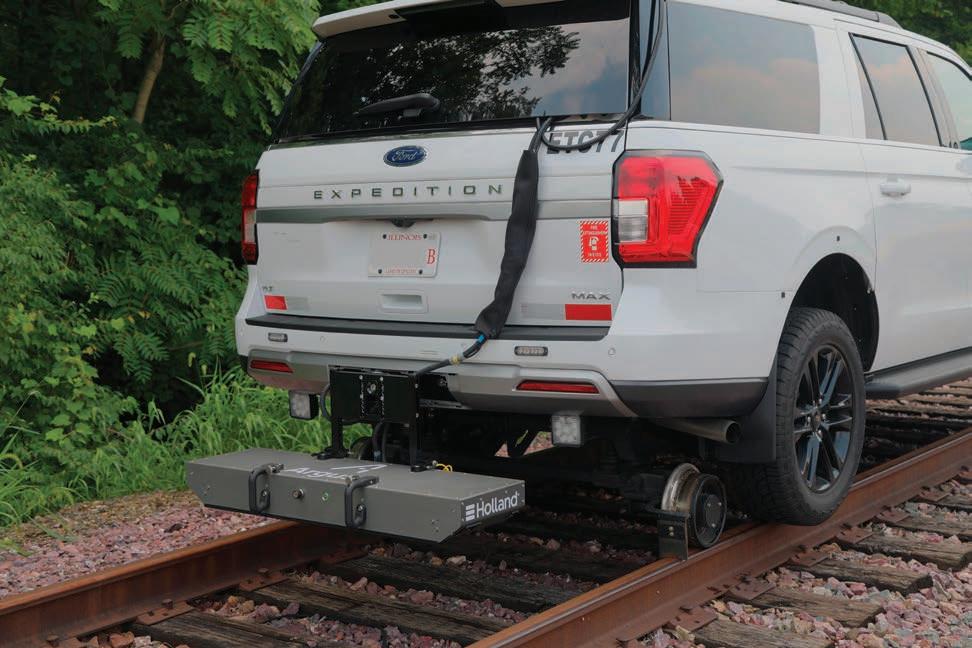
Holland’s Argus® Track Measurement Technology offers “two different systems that allow you to inspect your tracks more frequently and catch these defects and more before they become more than just a headache. The Track Inspector utilizes a noncontact encoder and any hi-rail platform
We innovate to solve global infrastructure challenges
with a hitch receiver so you can perform track inspection anytime, anywhere.
“Featuring three software options, railroads can choose the one that best suits their operators’ needs. Attended software provides real-time testing with comprehensive test reporting. Foot-byfoot geometry data, geometry exception lists, rail profile data and rail size/ weight identification can be exported in csv format after each inspection. Alert software provides visual and audible alerts for any track geometry exceptions, based on the thresholds for that track class. The web interface will show vehicle and defect locations, allowing the operator to stop and back up to the defect location. A downloadable defect report is provided after the run is completed. Autonomous software provides the same working principles as our Locomotive or Rail Car ATGMS but deployed from a hi-rail vehicle. This completely autonomous operation provides data and defect delivery to customer servers or by email notification to designated personnel.”
RailWorks “offers a full spectrum of track maintenance and inspection services tailored to meet the diverse needs of the Class I, Shortline, and Transit sectors across the United States and Canada. With decades of industry experience, we understand the critical importance of maintaining rail infrastructure in optimal condition to ensure safety, reliability, and operational efficiency.
“Our track geometry inspection programs are built on detailed baseline assessments and routine inspections— cornerstones for identifying potential issues and enabling proactive planning for long-term infrastructure integrity.
Photo Credit: Holland
Holland Track Inspector
RailWorks Maintenance of Way combines advanced technology with experienced field personnel to deliver accurate, reliable data collection—empowering railroads to make informed decisions and drive network-wide improvements.
“Our fleet of inspection vehicles is designed to operate efficiently within tight track windows, capturing high-resolution data without disrupting operations. As the rail industry continues to evolve and embrace innovation, RailWorks is at the forefront—delivering actionable insights that help railroads manage increased volumes of data and translate them into meaningful improvements.
“[The company] collaborates closely with clients to develop customized maintenance schedules that minimize downtime, prevent disruptions, and optimize asset performance.”
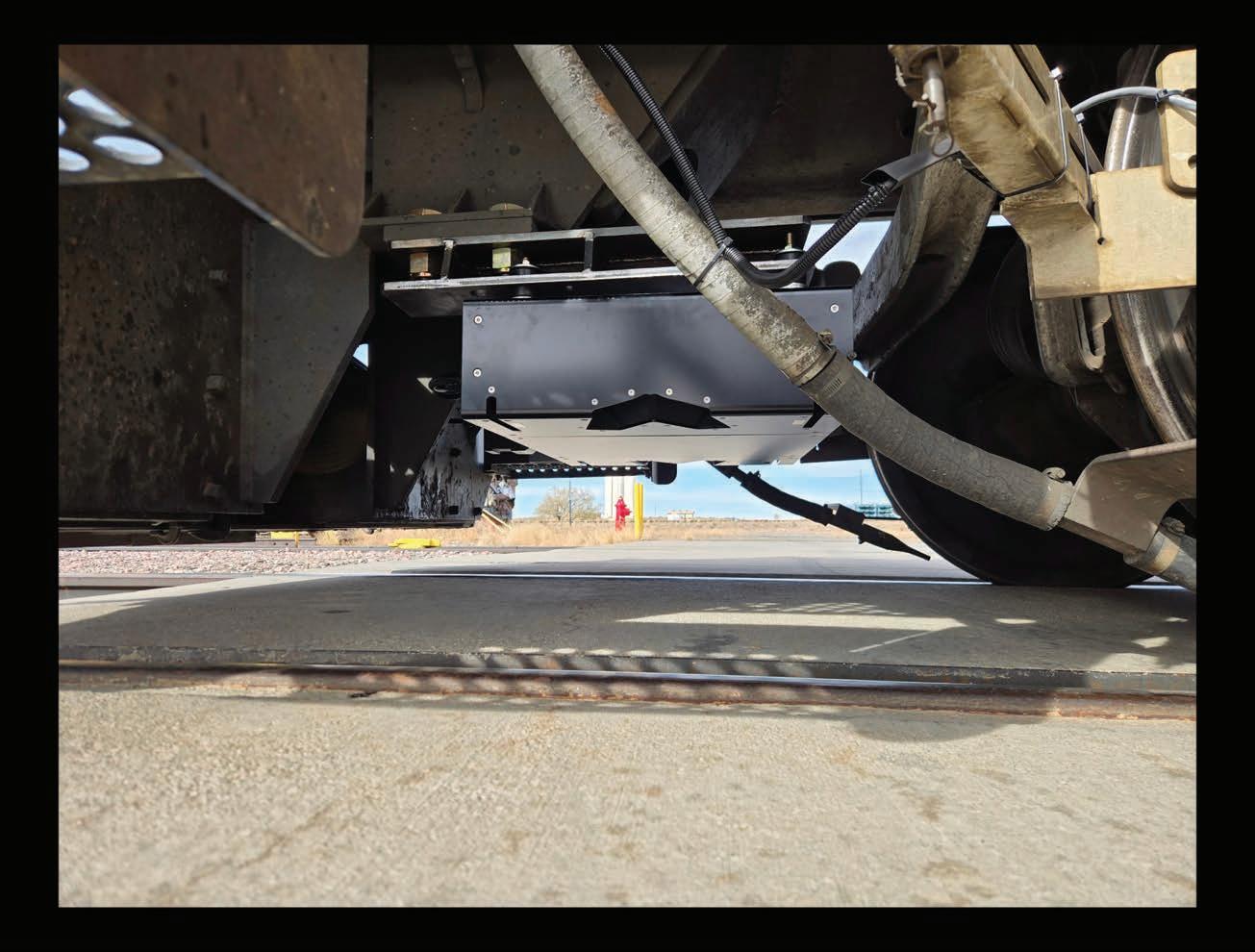
ENSCO Rail says it “is advancing a Next-Generation, Zero Speed Autonomous Track Geometry Measurement System designed for the practical constraints of modern locomotive integration—where space and fit are critical. Unlike traditional
systems that require significant onboard rack space, ENSCO’s solution relocates key components externally to the ATGMS beam, significantly reducing the need for internal locomotive real estate. Its compact, low-profile form factor enables installation in space-constrained environments without impacting existing onboard systems or operations.
“In addition to its reduced footprint, the system delivers geometry measurement down to zero speed, eliminating data gaps during start-stop operations and providing a more complete picture of track condition.
“The system has been successfully tested at the Transportation Technology Center (TTC), demonstrating performance aligned with industry expectations. The design supports compliance with EN 13848-2 under applicable configurations, with further validation and certification efforts planned as part of final product development. Its smaller, more flexible architecture also expands applicability to Maintenance of Way equipment where traditional systems have
been impractical.
“ENSCO is advancing final development with production units expected by the end of calendar year 2026.”
Plasser Group offers up the “Autonomous Track Geometry Measurement System (TGMS). Engineered for realtime, non-contact inspection, the TGMS utilizes advanced optical and inertial sensors to continuously measure critical track parameters—including gauge, alignment, twist, and rail profile—at speeds exceeding 200 mph.
“Designed to operate completely unattended on revenue trains or dedicated inspection cars, it detects subtle defects before they impact service, enabling predictive maintenance that significantly lowers lifecycle costs.
“With proven global deployments and extreme reliability, Plasser Group’s cutting-edge technology delivers the precise, actionable data modern infrastructure managers need to keep their rail networks safe, fluid, and optimized. Engineered for high-speed, comprehensive LiDAR scanning, Plasser Lidar
The Railway Educational Bureau Track Resources
*Offer good through June 30 PrePublication
This book is a defining journey from animaldrawn tramways to today’s high-speed rail, offering an in-depth exploration of the rich history and cutting-edge advancements that have shaped North America’s railroads. With over 750 pages of meticulously researched content, this Cyclopedia is an essential guide and resource for students, railroad professionals, historians, and enthusiasts alike.
Written by veteran FRA inspector Christopher F. Schulte, it draws on over four decades of firsthand experience to decode 4,188 entries spanning critical areas, including track structure, signals, bridges, electrification, and other related topics. This book doesn’t just explain terms; it brings to life the evolution of rail infrastructure, from the early days of strap rails to the modern marvels of asymmetrical switch rails. Readers gain a deeper understanding of past innovations and present-day developments through contemporary and historical terms, expert insights, and hundreds of photos and diagrams.
BKRIC Railroad Infrastructure Cyclopedia $80.00*
Pre-publication price (Regular price: $100.00)
Solution captures a highly precise, 3D virtual image of the track environment in a single pass. Operating seamlessly on existing track maintenance machines or dedicated inspection vehicles, it simultaneously measures critical spatial parameters—including catenary wire position, clearance gauges, ballast profiles, and platform edge distances—without requiring disruptive track closures.
“While TGMS ensures the precise alignment and flawless health of the physical rails, our Plasser Lidar Solution secures the surrounding infrastructure, from ballast profiles to overhead catenary wires.
“Together, these complementary technologies provide infrastructure managers with a complete, 360-degree view of their network. This powerful synergy merges track-level defect detection with spatial hazard analysis, all captured simultaneously without disrupting revenue service.
“By integrating both systems, customers achieve unparalleled actionable network intelligence, maximizing safety and driving predictive maintenance across the entire track ecosystem.”
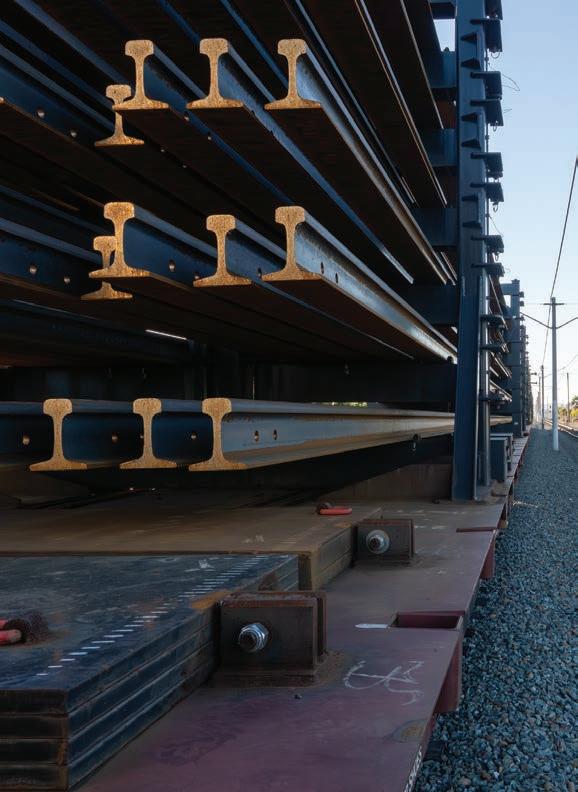
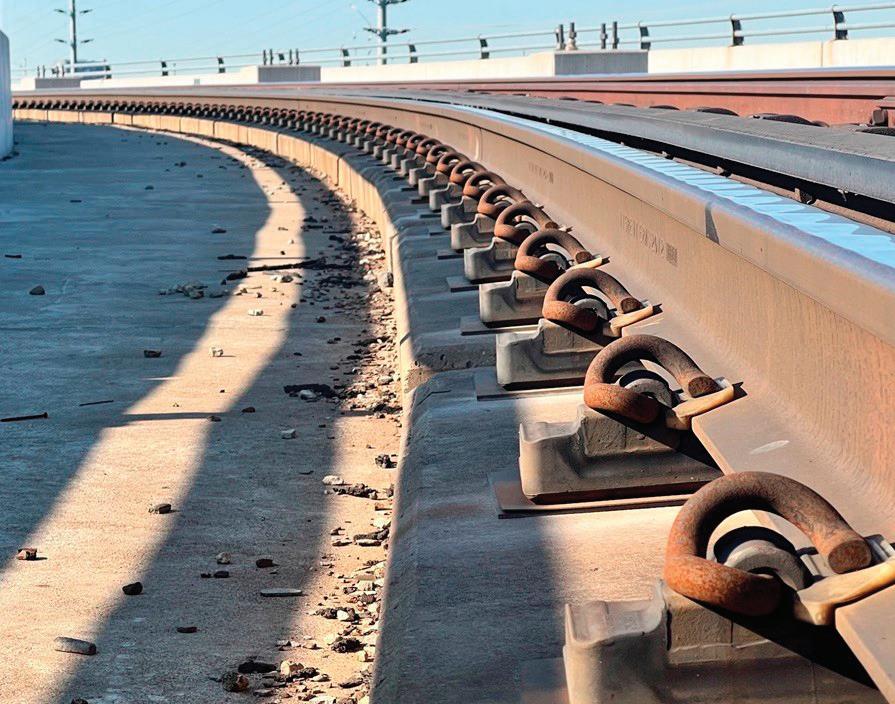
Pandrol’s product range includes track systems suitable for heavy haul, metro, light rail, conventional, and semi to full high-speed applications.
FASTEN-ATING
Spotlighting fastening system solutions
By Jennifer McLawhorn, Managing Editor
In addressing issues that affect rail alignment, such as ‘rail creep’, railroads seek the best in fastening systems. Railway Track and Structures cast a large net to the rail industry to see the best it could offer in terms of securing ties to rails and keeping said rails stable. This is what we caught.
L.B. Foster told RT&S that the “performance of an insulated rail joint is highly dependent on the track support conditions at its location. L.B. Foster has offered an insulated joint plate for many years. This product is designed to provide center support for an insulated bonded joint directly on a wood tie, with the objective of reducing rail deflections and minimizing bending stresses in the joint while maintaining complete electrical separation between the two rails. L.B. Foster’s insulated joint plate consists of a forged steel plate with an electrically
insulating and chemically bonded polyurethane rail seat. Rail restraint is provided by specially designed rail clips that serve as a substitute for conventional rail clips on the insulated joint plate.
“These clips provide electrical insulation as well as uplift and rotational restraint for the insulated joint during typical operational conditions, including tamping. L.B. Foster has developed different clips to accommodate different joint sections. These clips are typically made of electrically insulating fiberglass components. Recently, a new reversible clip has been designed with a metal core encapsulated in polyurethane to improve durability while preserving electrical properties. Other insulating clip solutions have also been developed to support insulated joints on concrete ties using threaded rail fastening systems.”
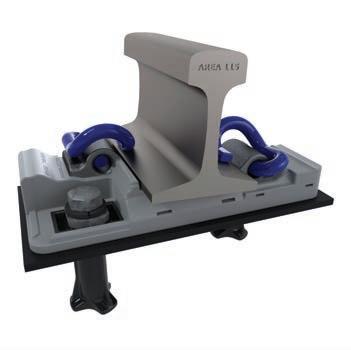
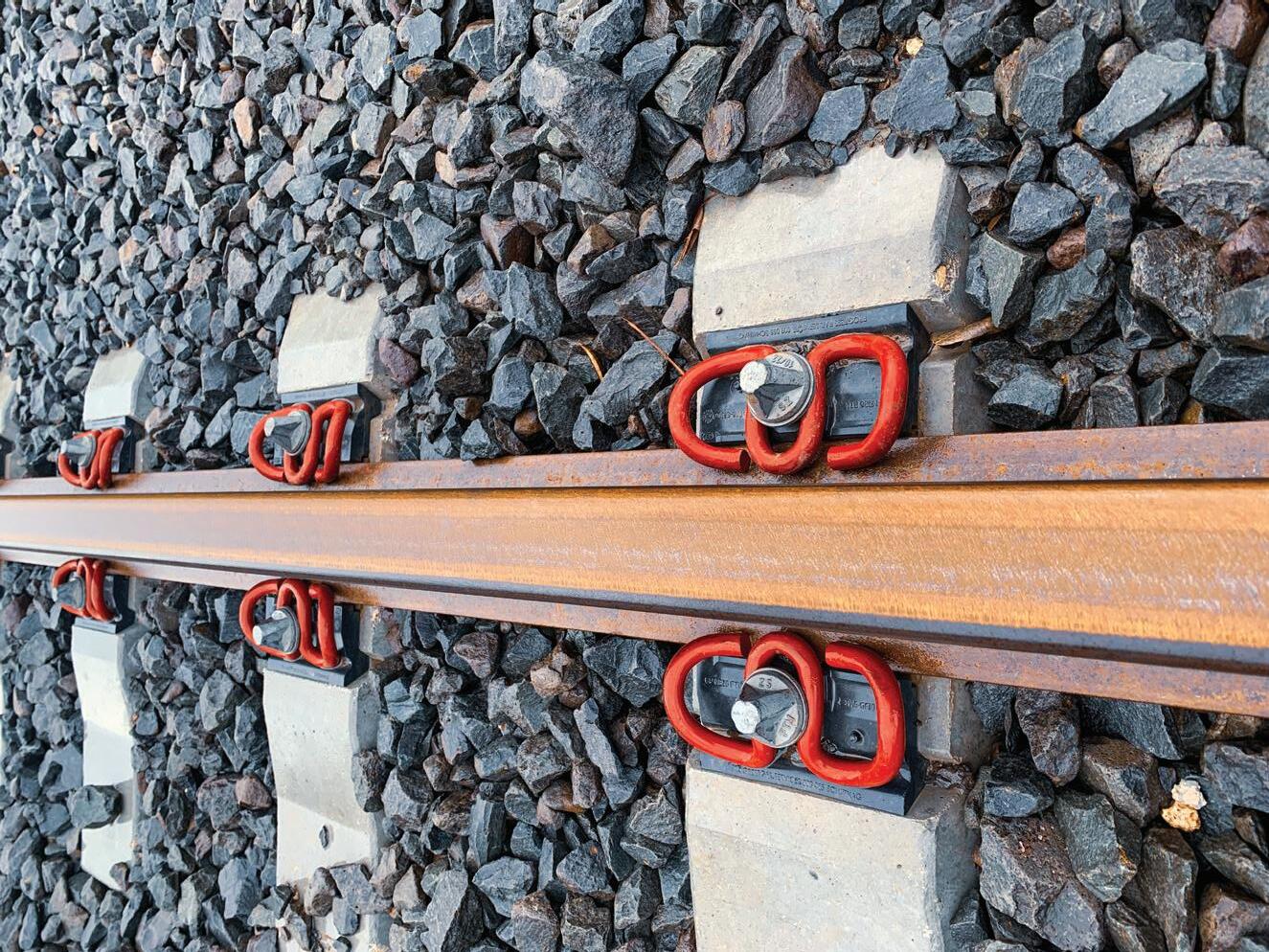
Pandrol “provides a comprehensive
range of rail fastening solutions engineered for concrete, timber, steel, and composite applications, as well as precast concrete blocks and ballast-less slab track systems. These solutions are designed to deliver resilience, reduced maintenance and lifecycle costs, and long-term track stability across a wide range of rail infrastructure applications. Pandrol’s extensive fastening portfolio can be tailored to a broad variety of rail networks, climates, and operating environments across North America and worldwide.
“The Pandrol product range includes track systems suitable for heavy haul railways supporting axle loads up to 40 tons, as well as metro, conventional, light rail, and semi to full highspeed applications operating at speeds up to and exceeding 200 mph. Designed for mechanized installation, these fastening systems reduce rail installation time and labor
Photo Credit: (L&R) Pandrol
requirements while improving overall construction efficiency. They also help address key track challenges, including noise and vibration mitigation, sustainability and low carbon objectives, and antitheft protection. Pandrol offers both threaded and nonthreaded fastening solutions, with dedicated product ranges engineered for high output mechanized track installation and removal. Through the use of premium materials and advanced engineering, Pandrol fasteners are designed to help rail operators maximize network availability, safety, and long-term lifecycle value. The company also manufactures Bonded Baseplates, which are designed to limit corrugation and vibration problems caused by the major dynamic forces generated by passing trains. This innovation solution provides both vertical and lateral stiffness and they are suitable for use on slab tracks, concrete sleepers, steel bridges, ballasted tracks, turnouts and crossings.”
voestalpine Railway Systems
Nortrak (“Nortrak”) “delivers integrated track systems that address the structural, mechanical, and constructability requirements of slab track applications. Foundational to Nortrak’s slab-track portfolio are Low Vibration Track (LVT) block systems and direct fixation (DF) fasteners all developed to perform reliably across a variety of applications and environments. For slab track applications, LVT blocks, manufactured in partnership with Sonneville, are designed to mitigate vibration while maintaining precise rail positioning and load distribution. Tunable stiffness characteristics and multiple block configurations allow adaptation to project specific vibration mitigation and
and rubber molding facilities to ensure consistent quality and shorter lead times. Collectively, these product lines support Nortrak’s systems-based approach, improving compatibility and enabling efficient design, procurement, and longterm asset performance. By delivering coordinated solutions across ballasted and slab track applications, Nortrak simplifies project execution from design through installation and lifecycle support.”
environmental requirements. Sonneville’s new Severe Environment (SE) design incorporates an embedded rubber gasket with the LVT block that interlocks with the boot to form a watertight seal preventing the ingress of any liquid or fine particles that could impact the long-term performance of the system.
“Nortrak direct fixation fasteners include more than 30 rubber bonded designs in service, spanning standard, medium and high attenuation product lines with mainline and special trackwork designs to accommodate virtually any track geometry and vibration mitigation requirement.
“Additionally, Nortrak’s vertically inte grated North American manufacturing includes in-house concrete, ductile iron
Track Inspector
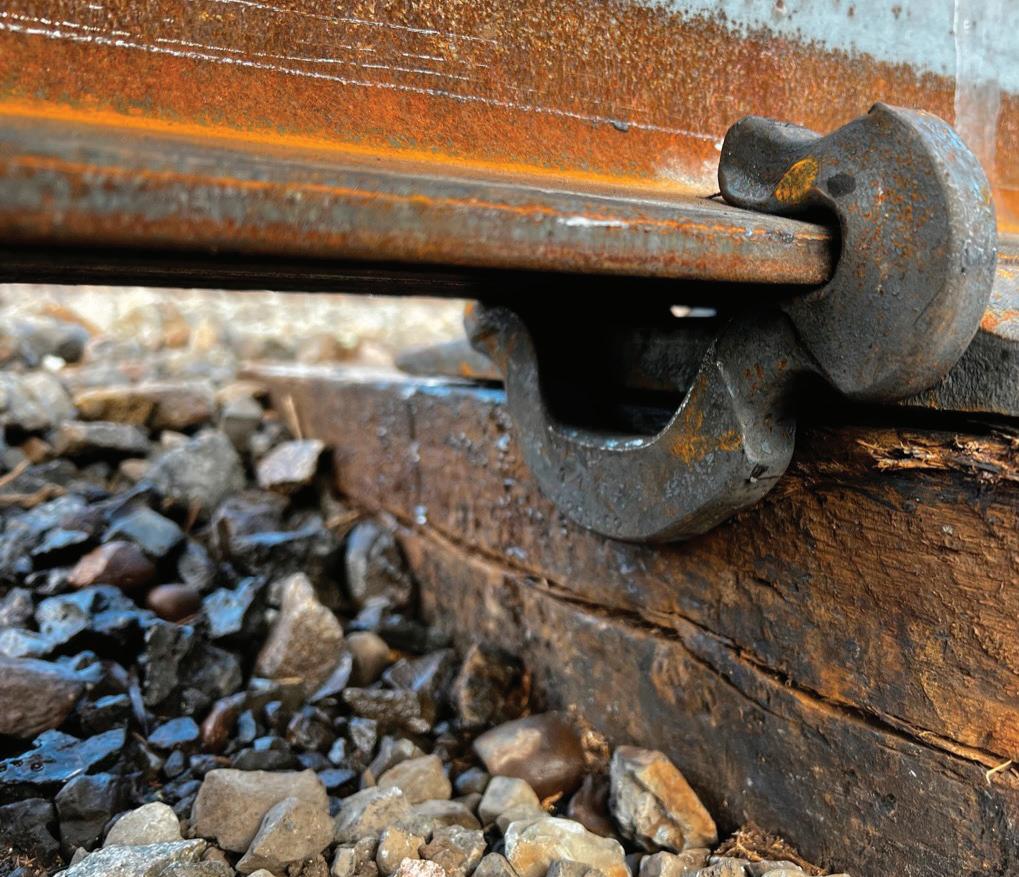
Lewis Bolt & Nut Company told RT&S that it “has manufactured a comprehensive line of rail fastening products for nearly a century, including drive-on rail anchors, screw spikes, track bolts, recessed head timber screws for grade crossings, frog and switch bolts, hook bolt systems, and bridge fasteners. Its facility in La Junta, Colorado produces steel fastener solutions for the North American rail industry. From the start, we’ve remained focused on delivering high-quality products backed by responsive customer service. Our latest innovation, the Viper-1® drive-on rail anchor, was developed in close collaboration with freight railroad partners. It improves performance and sustainability through increased holding power, deeper tie anchoring, and a larger anchor-totie bearing surface, reducing rail movement and minimizing tie and plate wear. Lewis continues to innovate by working closely with customers and leveraging
Real-time track geometry and rail profile measurement for any hi-rail vehicle with a standard hitch mount
Pandrol fastening solution
Spring Cleaning
Punxsutawney Phil’s prediction this year was for six more weeks of winter. Of course, you are probably better off betting on the opposite of his predictions since the success rate is around 35-39 percent. It is a reminder to all of us that the seasonal change is a constant, and railroaders need to be evervigilant of those turning points.
Spring marks a pivotal transition in the railroad industry—a shift from tough winter operations to operational optimization. It marks the time when many projects begin to either upgrade or replace infrastructure. It also begins the preparation for all facets of railroading, from annual rules training to employee safety training. While the term “Spring Cleaning” may suggest routine upkeep, in railroading, it represents a comprehensive and strategic effort to inspect, repair, replace, and prepare critical infrastructure and equipment for the demands of the year ahead.
Following months of exposure to extreme cold, snow, and ice, rail systems require a systematic reset. This could be rail needing to be removed that was added from a broken rail for the Track world, to air conditioner replacement in preparation for the summer heat in the Signals & Communications world. This period of renewal directly impacts safety performance, service reliability, and longterm asset integrity.
The Lasting Effects of Winter Operations
Winter conditions place significant stress on railroad systems. Freeze-thaw cycles can distort track geometry, moisture intrusion can compromise signal systems, and cold temperatures can increase rail brittleness and equipment wear.
Common winter-related impacts include geometry changes in the Track structure (rail/ties/ballast) to powered switch condition changes in Centralized Traffic Control (CTC) systems for Signals. Many of these issues are not immediately visible, making spring inspections essential for identifying and mitigating latent defects before they lead to service interruptions.
Track and Infrastructure Rehabilitation
The track structure forms the foundation of railroad operations, and spring is the primary season for restoring its integrity. Some activities include Track Geometry Correction where track is realigned using tamping and surfacing to correct deviations caused by winter stress, and ballast is rehabilitated by cleaning or replacing fouled ballast to improve drainage and load distribution. Another activity is tie and rail replacement to address deterioration to maintain strength and compliance with safety standards. These efforts ensure the track can support increasing traffic volumes in the months to come.
Signals and Communications Maintenance
Reliable signals and communications systems are essential for safe and efficient operations. Spring maintenance focuses on inspecting circuits affected by moisture intrusion, adjusting power switch locations for the weather changes, and rodent inspection to ensure the mice and other critters haven’t damaged any components necessary for efficient operations. Ensuring system reliability reduces operational risk and supports network fluidity.
Reinforcing Safety Culture
Spring serves as a natural reset for reinforcing safety across the organization.
Railroads often conduct refresher training and safety briefings, review winter incidents and identify trends, reinforce compliance with operating rules, and encourage proactive hazard identification. Many employees will have completed all their annual certifications and exams to prepare for the months ahead. A strong safety culture is essential for executing maintenance activities effectively and protecting employees and assets – ultimately keeping the railroad’s most important assets (people) up to date so that they can perform the tasks necessary in the upcoming months in a safe and efficient manner.
Environmental and Right-of-Way Management
Seasonal transition also requires attention to environmental conditions, such as vegetation management to maintain visibility, removal of debris along the right-of-way that may not have been visible because of snow, and inspection of erosion-prone areas. These efforts support both operational safety and community stewardship.
The Role of AREMA in Supporting Spring Cleaning
The American Railway Engineering and Maintenance-of-Way Association (AREMA) plays a critical role in guiding and enhancing spring maintenance efforts across the industry. AREMA’s Manual for Railway Engineering provides industry-recognized practices for track inspection and maintenance, as well as design for drainage and subgrade. The Communications & Signals Manual gives guidance on practices for incoming professionals and also serves as a reminder for those seasoned individuals who may not encounter the same thing year after year. These practices ensure consistency, safety, and engineering excellence. Through its committees and working groups, AREMA enables professionals to share lessons learned from winter operations and develop solutions to recurring challenges. This collaboration strengthens the industry’s collective expertise and allows railroads to prevent making the same mistakes. AREMA supports workforce readiness
JERRY SPECHT, AREMA President 2025-2026
by offering educational resources and training opportunities as well as access to technical publications. A knowledgeable workforce is essential for executing effective spring maintenance programs.
Technology and the Future of Spring Maintenance
Modern railroads are leveraging technology to enhance spring cleaning efforts. This includes automated track inspection systems to data analytics for predictive maintenance. These tools will improve accuracy, efficiency, and long-term planning capabilities, ultimately streamlining the operations during seasonal changes.
Conclusion
Spring cleaning in the railroad industry is far more than a seasonal task—it is a strategic reset that defines performance for the year ahead.
With the support of organizations like AREMA, the industry benefits from shared knowledge, standardized practices, and continuous innovation.
FYI
Registration is open for the AREMA 2026 Annual Conference & Expo in Kansas City, MO, September 13–16. Join railway professionals from across the industry to learn, connect, and move the industry forward. Booth and sponsorship opportunities are available—secure prime visibility while top spots last: www. conference.arema.org.
Get up to speed fast: The 2026 AREMA Communications & Signals Manual delivers nearly 80 updated, new, or reaffirmed parts with the latest guidance on signal technology, helping you ensure safer, more efficient, and cost‑effective installations—buy your copy today to stay current and consistent.
Download the AREMA 365 App for essential rail resources and networking opportunities. Easy access to news, events, and educational materials lets you stay informed and connected to the industry. Download it today by searching for AREMA in your phone’s app store.
Did you know we offer a wide variety
2026 MEETINGS
MAY 4-6
Committee 5 - Track Charlotte, NC
MAY 14-15
Committee 8 - Concrete Structures & Foundations Pueblo, CO
MAY 19-20
Committee 15 - Steel Structures Lancaster, PA
JUNE 3-4
Committee 9 - Seismic Design for Railway Structures Denver/Golden, CO
JUNE 11
Committee 30 - Ties and Fasteners Urbana, IL
of On Demand education for learning on your time? Browse our most popular webinars, seminars, and Annual Conferences to earn your PDH credits on the go. Visit www.arema.org to start your On Demand learning today.
If you’re looking for a podcast to binge, check out AREMA’s Platform Chats—now celebrating its 50th episode. Featuring guests from every corner of the railway industry, you can catch up on all five seasons available on your favorite listening services today.
Leverage the power of your trusted association’s Railway Careers Network to tap into a talent pool of job candidates with the training and education needed for long t erm success. Visit www.arema.org/careers to post your job today.
NOT AN AREMA MEMBER? JOIN TODAY AT WWW.AREMA.ORG
UPCOMING COMMITTEE MEETINGS
AUGUST 5-6
Committee 7 - Timber Structures Colorado Springs, CO
SEPTEMBER 13
Committee 14 - Yards & Terminals*
Committee 18 - Light Density & Short Line Railways*
Committee 12 - Rail Transit*
Committee 33 - Electric Energy Utilization*
Committee 5 - Track*
SEPTEMBER 14
Committee 13 - Environmental*
Committee 17 - High Speed Rail Systems*
Committee 11 - Commuter & Intercity Rail Systems*
Committee 41 - Track Maintenance*
SEPTEMBER 15-16
Committee 4 - Rail*
SEPTEMBER 16-17
Committee 38 - Information, Defect Detection & Energy Systems*
SEPTEMBER 17
Committee 27 - Maintenance of Way Work Equipment*
SEPTEMBER 26
Committee 16 - Economics of Railway engineering Operations*
MEDIA:
Committee 24 - Education & Professional Development*
Committee 39 - Positive Train Control*
SEPTEMBER 29-30
Committee 15 - Steel Structures Virtual Meeting
*Kansas City, MO, in conjunction with AREMA 2026 Annual Conference & Expo
PROFESSIONAL DEVELOPMENT
Invest in Your Growth: Earn PDHs Anytime with AREMA Education
Access to valuable professional development content is just a few clicks away with AREMA Education. Our On Demand offerings span multiple disciplines, providing accredited Professional Development Hours (PDH) courses that let you learn from industry experts online— without leaving your office.
BENEFITS OF LEARNING ONLINE
1. LEARN MORE
Studies show that participants learn more while taking On Demand courses, as you can skim through the material you understand and spend more time on the more challenging areas.
2. GET INSTANT ACCESS
With AREMA On Demand courses, you don’t have to wait to learn and get your PDHs as they’re available instantly after purchase.
3. CONVENIENT AND FLEXIBLE
Above all, On Demand education is meant to be taken at your own pace and on your time. Study from anywhere in the world, whether from your office or the convenience of your sofa.
4. COURSE VARIETY
AREMA On Demand education offers a wide variety of topics for all areas of railway engineering.
Register and Start Learning today at www.arema.org.
BECOME A MEMBER AND SAVE
Not an AREMA member? Join today at www.arema.org and get discounts on all AREMA Educational Offerings, from Virtual Conferences to our Webinars.
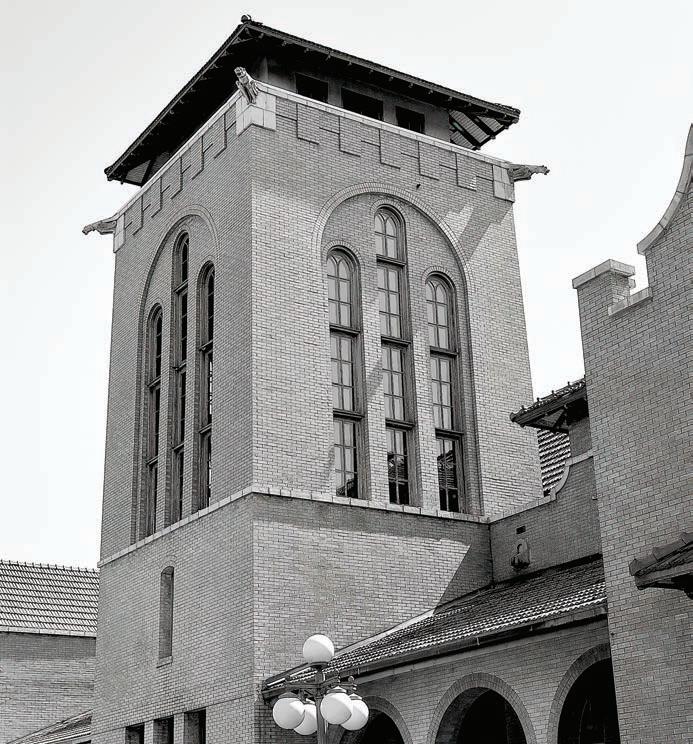
Salisbury, N.C. rail passenger station built by Southern Railway and opened in 1908.
Los Angeles Union Passenger Terminal, opened in 1939. ( All images, David C. Lester Photography).
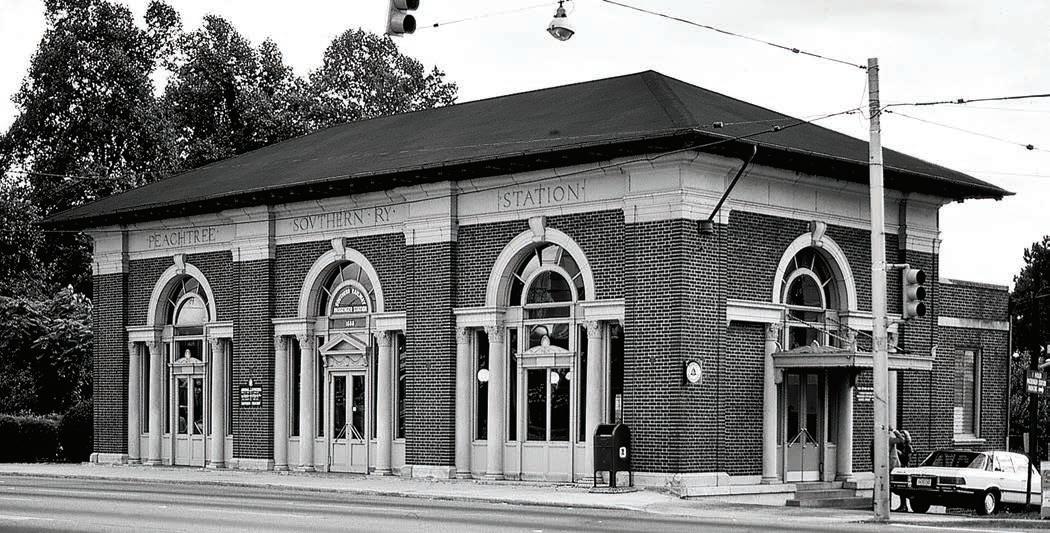
Peachtree Station, Atlanta, opened by Southern Railway in 1918. This image was made in 1975. This is an interesting station because it was built as a “surburban” station to serve wealthy passengers who lived nearby so they could avoid going to Atlanta Terminal Station downtown, approximately 3 miles away. In 1918, Peachtree Street was populated mostly by grand homes of the wealthy, and the station’s design complemented the architecture of these homes. The station remains in service today.
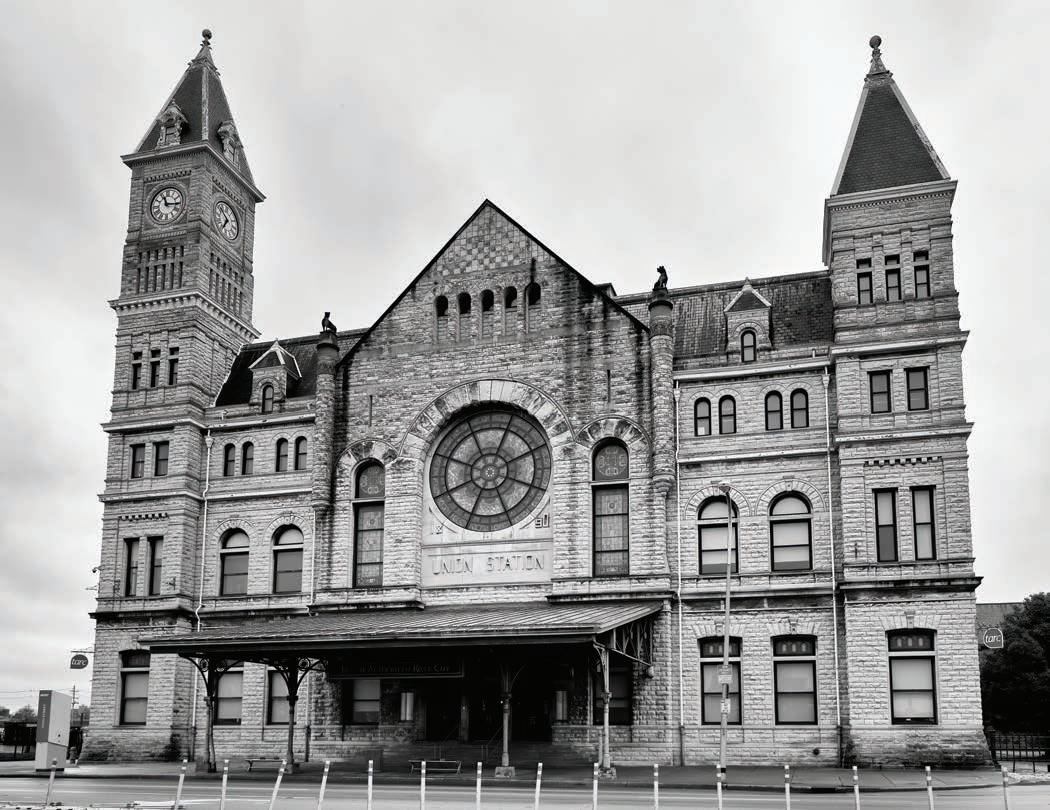
Louisville, Ky. Union Station, opened by the Louisville & Nashville Railroad in 1891.
2400 Enterprise Dr., Independence, KS 67301 Call 620-485-4277 or visit precisionrwy.com for more details
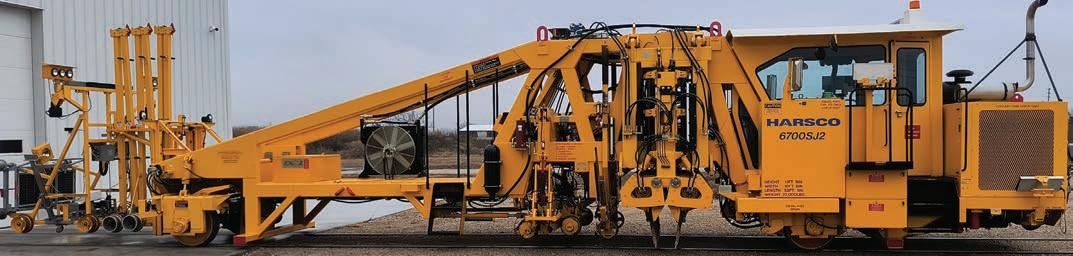
Let Precision remanufacture your non-functional, outdated 6700 into a fully functional 6700 with the latest technology. If you have an old, worn-out 6700 ta m per, we have your solution.
This section has been created solely for the convenience of our readers to facilitate immediate contact with the RAILWAY TRACK & STRUCTURES advertisers in this issue. The Advertisers Index is an editorial feature maintained for the convenience of readers. It is not part of the advertiser contract and RTS assumes no responsibility for the correctness.
Advertising Sales
MAIN OFFICE
JONATHAN CHALON Publisher (212) 620-7224 jchalon@sbpub.com
AL, KY, TN, CHINA
JONATHAN CHALON (212) 620-7224 jchalon@sbpub.com
CT, DE, DC, FL, GA, ME,MD, MA, NH, NJ, NY, NC, OH, PA,RI, SC, VT, VA, WV, CANADA: QUEBEC AND EAST, ONTARIO
JEROME MARULLO (212) 620-7260 jmarullo@sbpub.com
AR, AK, AZ, CA, CO, IA, ID, IL, IN, KS, LA, MI, MN, MO, MS, MT, NE, NM, ND, NV, OK, OR, SD, TX, UT, WA, WI, WY, CANADA: ALBERTA, BRITISH COLUMBIA, MANITOBA, SASKATCHEWAN HEATHER DISABATO (CHICAGO OFFICE) (312) 683-5026 hdisabato@sbpub.com
AMERICAS, EUROPE, ASIA, AFRICA, AUSTRAL ASIA NORTH AMERICA - CT, DE, DC, FL, GA, ME, MD, MA, NH, NJ, NY, NC, OH, PA, RI, SC, VT, VA, WV, AND EASTERN CANADA. EUROPE EXCEPT GERMANY, AUSTRIA, GERMAN SPEAKING SWITZERLAND, EASTERN EUROPE, ITALY, AND ITALIAN-SPEAKING SWITZERLAND. ASIA EXCEPT JAPAN AND CHINA. JEROME MARULLO (212) 620-7260 jmarullo@sbpub.com
GERMANY, AUSTRIA, GERMAN-SPEAKING SWITZERLAND, LATVIA, LITHUANIA, ESTONIA, POLAND, CZECH REPUBLIC, SLOVAKIA, HUNGARY, SLOVENIA, CROATIA AND SERBIA SIMONE AND SIMON FAHR
ITALY, ITALIAN-SPEAKING SWITZERLAND DR. FABIO POTESTA Media Point & Communications SRL Corte Lambruschini Corso Buenos Aires 8 V Piano, Genoa, Italy 16129 +39-10-570-4948
Fax: +39-10-553-0088 info@mediapointsrl.it
JAPAN
KATSUHIRO ISHII
Ace Media Service, Inc. 12-6 4-Chome, Nishiiko, Adachi-Ku Tokyo 121-0824
Japan +81-3-5691-3335
Fax: +81-3-5691-3336 amkatsu@dream.com
IRJ PRO AND CLASSIFIED ADVERTISING SALES JEROME MARULLO (212) 620-7260 jmarullo@sbpub.com
The Journey Toward Increased Track Resiliency
Looking at under tie pad performance
By Dr. J. Riley Edwards
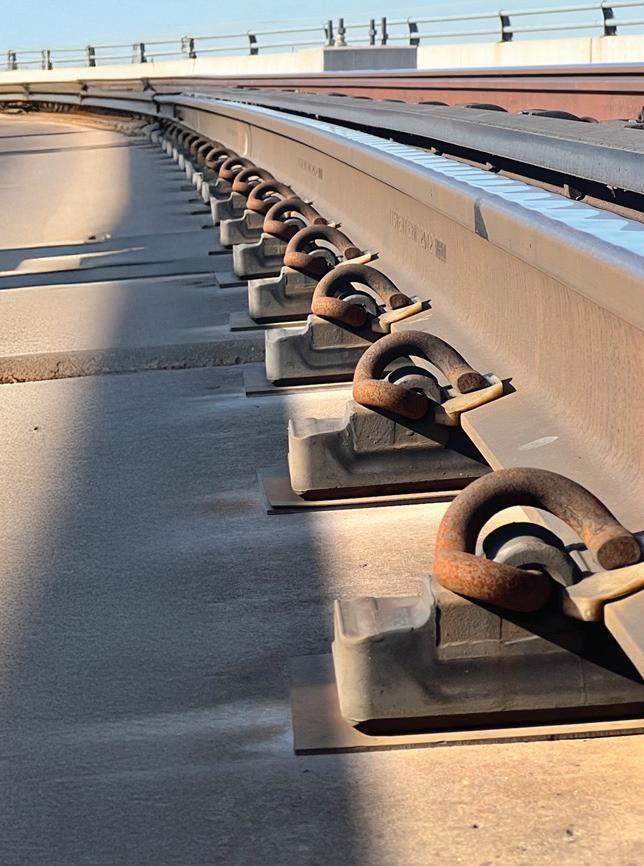
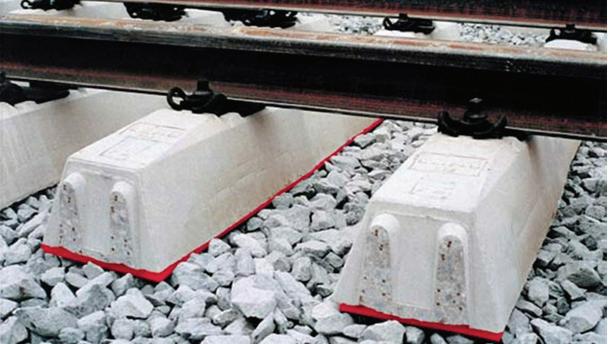
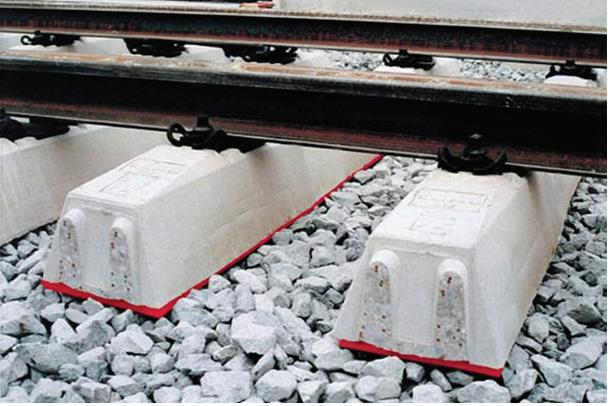
One of the primary predictors of the long-term performance of the track system is how it responds to wheel loads. If the system is too stiff – loads are concentrated, stresses are high, and failures occur. If it’s too soft – we see higher displacements and component wear. One of the only options for changing system response is to adjust the resiliency - or stiffness - of the system. In practice, we have very few locations to adjust track resiliency and even fewer options once track is in service. The rail pad for concrete crossties, under plate pads for timber crosstie turnouts, and under tie pads (UTPs) at the crosstie-to-ballast interface are notable exceptions.
The past decade has seen increased North American interest in track resiliency for rail transit, intercity passenger, and freight railroad applications. RailTEC Senior Research Engineer Arthur Lima has championed research on resilient materials, including leading a working group to develop new text within Chapter 30 (Ties and Fasteners) of the AREMA Manual for Railway Engineering that provides a starting reference point for the industry. The new text provides a starting point for consideration of their use and future additions will aim to further encourage performance-based designs while not stifling innovation.
In addition, Lima has also played a lead role in collecting laboratory and field data to quantify the performance of UTPs. Much of the current research is focused on analyzing the influence of UTPs on track geometry – and quantifying their influence on surfacing cycle intervals. Oftentimes, changing track standards to include new components is slow and
life cycle cost data are needed to justify such changes. Some UTP research questions are driven by concerns about the applicability of results obtained internationally – where axle loads and operating conditions are often different. While physics remains constant, loads, maintenance processes, and even public priorities can change (such as ride quality and noise/ vibration concerns). All such factors drive the economic justification for UTPs and define their reasonable applications.
Amtrak has already observed and quantified the benefits of UTPs in their operations and has included them as standard on their
concrete crossties. As track standards go, this is a notable change. Class I freight railroads have also shown interest. BNSF has tested a variety of designs for both timber and concrete crossties, with many miles of padded concrete crossties in revenue service on a primary corridor. With interest come more perspectives that help positively shape the content that is created so that it serves the industry broadly. Strong partnership between suppliers, end users, and researchers is critical for further UTP adoption and success.
It is worth noting that the resiliency story began before the introduction of UTPs and other resiliency successes are now reflected as design standards. One example is the use of ballast mats on concrete and steel ballast deck bridges; now a standard for most Class Is. Additionally, transits have long employed resilient components to combat noise and vibration, from unique rail pads and fastening systems to floating slab track. We can learn from these experiences – and the paths taken toward implementation of resilient components. Ultimately, further adoption of resilient components hinges on quantifying their impact to life cycle costs under our North American axle loads and operating environment.
Photo Credit: Courtesy of UIUC
Track cross section showing locations where resiliency can be added using elastomeric components. Diagram courtesy of University of Illinois Urbana-Champaign RailTEC.
Discrete element modelling of under sleeper pad using a box test.
Rail Pad
Under Tie Pad
Under Ballast Mat
Built on Experience. Focused on Performance.
A recent mixed traf c project involving passenger and Forged through generations of rail expertise, Progress Rail delivers trackwork and fastener solutions engineered for performance in demanding operating environments. From mixed-traf c corridors to heavy freight and transit operations, our North America–based capabilities provide proven reliability and long-term value. We keep you rolling.