TTC OPERATED BY ENSCO
careful attention, particularly following maintenance or repair work performed at temperatures well below the desired neutral range. Environmental conditions can amplify these challenges. Frozen ballast can significantly increase longitudinal rail resistance, altering the mechanics of rail breaks and RNT restoration. While frozen ballast may temporarily restrain rail movement, subsequent thawing can reduce lateral resistance and increase buckling susceptibility. Seasonal transitions, rather than peak temperatures alone, are therefore critical periods for CWR risk management and inspection planning. Operational trends also play a role. Longer, heavier trains and distributed power operations introduce higher longitudinal and lateral forces into the track structure. In curves, elevated lateral forces can accelerate alignment degradation, increasing the likelihood that a thermal buckle will initiate at a pre-existing defect. These operating realities reinforce the need to view CWR management as a system-level challenge rather than a collection of isolated rules. Another challenge facing industry is variability, both across networks and within individual railroads. Track structure, maintenance practices, traffic mix, climate, and historical installation temperatures can vary significantly from one subdivision to the next. As a result, practices that are effective in one territory may be insufficient or overly conservative in another. This variability complicates standardization and makes it difficult to rely on a single rule or threshold for buckling prevention To address these issues, industry has steadily moved toward more standardized procedures, improved training, and the use of decision-support tools grounded in track mechanics. Regulatory requirements establish a baseline for CWR policies and training, but many railroads have expanded beyond compliance, refining practices based on experience, research findings, and internal risk tolerance. Increasingly, the focus is on proactive intervention, identifying locations and conditions where buckling risk is rising before an incident occurs. Software tools can play important role in this effort. Applications that estimate track buckling strength, evaluate buckling risk, calculate RNT adjustment parameters, and predict rail temperature help translate complex mechanics into practical guidance for both field and engineering rtands.com
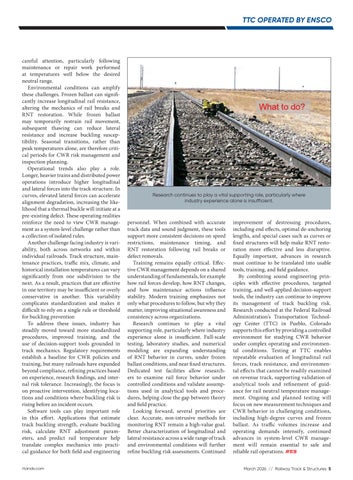
Research continues to play a vital supporting role, particularly where industry experience alone is insufficient.
personnel. When combined with accurate track data and sound judgment, these tools support more consistent decisions on speed restrictions, maintenance timing, and RNT restoration following rail breaks or defect removals. Training remains equally critical. Effective CWR management depends on a shared understanding of fundamentals, for example how rail forces develop, how RNT changes, and how maintenance actions influence stability. Modern training emphasizes not only what procedures to follow, but why they matter, improving situational awareness and consistency across organizations. Research continues to play a vital supporting role, particularly where industry experience alone is insufficient. Full-scale testing, laboratory studies, and numerical modeling are expanding understanding of RNT behavior in curves, under frozen ballast conditions, and near fixed structures. Dedicated test facilities allow researchers to examine rail force behavior under controlled conditions and validate assumptions used in analytical tools and procedures, helping close the gap between theory and field practice. Looking forward, several priorities are clear. Accurate, non-intrusive methods for monitoring RNT remain a high-value goal. Better characterization of longitudinal and lateral resistance across a wide range of track and environmental conditions will further refine buckling risk assessments. Continued
improvement of destressing procedures, including end effects, optimal de-anchoring lengths, and special cases such as curves or fixed structures will help make RNT restoration more effective and less disruptive. Equally important, advances in research must continue to be translated into usable tools, training, and field guidance. By combining sound engineering principles with effective procedures, targeted training, and well-applied decision-support tools, the industry can continue to improve its management of track buckling risk. Research conducted at the Federal Railroad Administration’s Transportation Technology Center (TTC) in Pueblo, Colorado supports this effort by providing a controlled environment for studying CWR behavior under complex operating and environmental conditions. Testing at TTC enables repeatable evaluation of longitudinal rail forces, track resistance, and environmental effects that cannot be readily examined on revenue track, supporting validation of analytical tools and refinement of guidance for rail neutral temperature management. Ongoing and planned testing will focus on new measurement techniques and CWR behavior in challenging conditions, including high-degree curves and frozen ballast. As traffic volumes increase and operating demands intensify, continued advances in system-level CWR management will remain essential to safe and reliable rail operations. March 2026 // Railway Track & Structures 5