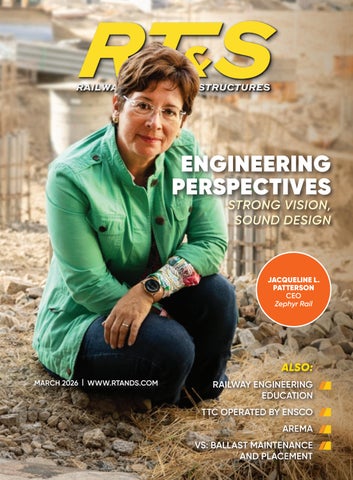
RTS March 2026

Page 1


Solar Powered Electric AggreGate® Stands Alone

LEFT: Accessible gate controllers and battery banks ensure smooth operations and efficient maintenance.

With 25,000+ ballast gates sold worldwide, Miner AggreGate® sets the standard, delivering proven reliability and innovative flexibility. Our new Stand-Alone Solar Powered Electric AggreGate—complete with its own car-mounted work lights for night ballasting—enables independent operation of individual cars anywhere within the ballast train. This boosts MOW agility and efficiency by eliminating the need for grouping manual and automatic cars. An optional remote wireless control system allows for specific car and gate selection for up to 1000 cars. Standard electric, air-powered and manual models are also available.

MIDDLE: Car-mounted solar panels keep the battery banks charged and ready for stand-alone ballast operations.

RIGHT: Miner’s stand-alone LED lighting system enables safer night operations. For safer, more efficient and flexible ballast operations

Vol. 122, No. 3

Print ISSN # 0033-9016, Digital ISSN # 2160-2514

EDITORIAL OFFICES

1025 Rose Creek Drive Suite 620-121 Woodstock, GA 30189 Telephone (470) 865-0933 Website www.rtands.com

DAVID C. LESTER Editor-in-Chief dlester@sbpub.com

JENNIFER M c LAWHORN Managing Editor jmclawhorn@sbpub.com

EDITORIAL BOARD

David Clark, CSX

Daniel Hampton, CSX

Brad Kerchof, formerly Norfolk Southern Jerry Specht, CPKC/AREMA

Robert Tuzik, Talus Associates

Jeffrey Watson, Genesee & Wyoming Gary Wolf, Wolf Railway Consulting

CORPORATE OFFICES 1809 Capitol Avenue Omaha, NE 68102 Telephone (212) 620-7200 Fax (212) 633-1165

ARTHUR J. MCGINNIS, JR. President and Chairman

JONATHAN CHALON Publisher

MARY CONYERS Production Director

NICOLE D’ANTONA Art Director

HILLARY COLEMAN Graphic Designer

JO ANN BINZ Circulation Director

MICHELLE ZOLKOS Conference Director

CUSTOMER SERVICE: 847-559-7372

Reprints: PARS International Corp. 253 West 35th Street 7th Floor New York, NY 10001

212-221-9595; fax 212-221-9195 curt.ciesinski@parsintl.com

Two Important Stories This Month

Important Railroad Reading

Idon’t usually use this space to preview what is included in the new issue of Railway Track and Structures. I’ve always believed that if you want to learn about what’s in the current magazine, check out the table of contents and look at and read the articles. However, I’m making an exception to that this month because of two very important pieces we have that I believe will leave you thinking about what you can do to help the industry move forward.

First, our regular WRI feature is replaced this month with a special piece on railroad engineering education. As you likely know, there are not many colleges and universities that offer rail engineering programs or courses. However, some do, and many consider the University of Illinois UrbanaChampaign to be the epicenter of railroad engineering study in North America. The university refers to its substantial rail engineering program as The Rail Transportation and Engineering Center (RailTEC). UIUC has also expanded its reach through a program called the National University Rail Center of Excellence, or NURail CoE. The NURail CoE website explains it best: “The National University Rail Center of Excellence (NURail CoE) is a nine-university consortium led by the University of Illinois Urbana-Champaign (UIUC) and is the first academic research and education center to be supported by the U.S. Department of Transportation Federal Railroad Administration. Our mission is to develop solutions that will lead to a safer, more efficient, and reliable passenger and freight rail transportation system and rail infrastructure in the United States. NURail CoE will attract, inspire, and educate a new generation of students in railway transportation engineering and provide them with the knowledge to implement these solutions in their pursuit of rail careers.” The nine universities that make up the consortium are the University of Illinois Urbana-Champaign, University of Illinois Chicago, University of Delaware,

Kansas State University, Michigan Technological University, Morgan State University, Rutgers University, University of Texas at Austin, and Tuskegee University. We introduced the NURail CoE consortium in the March 2025 issue, and we’re including another look at it in this month’s rail engineering education feature.

One of the significant efforts to foster education and collaboration is the work of Wheel Rail Seminars, specifically, its two annual Wheel Rail Interface conferences, Heavy Haul, being held April 22-24 in Dallas, and Rail Transit, being held in Boston September 1-3. Railway Track & Structures has been the presenting sponsor of the Heavy Haul conference for several years, and UIUC is the presenting sponsor for the Principles portion of the Heavy Haul conference. The web journal Interface Journal, a friend to RT&S, is the presenting sponsor of the Principles portion of the Rail Transit conference.

Another important feature in this issue is one of our two annual “Perspectives” pieces, Engineering Perspectives. The second, Construction Perspectives, appears in our August issue. The Perspectives series is spearheaded by Managing Editor, Jennifer McLawhorn, and is growing in importance and popularity. The Engineering Perspectives piece features news and outlooks from several large engineering firms that offer rail engineering services in their practice portfolio. Although they’re doing great work and are a very important part of the rail industry, we don’t hear much about them, except mentions and some analysis associated with specific projects. We’re trying to change that with this series.

Continuous Welded Rail: Managing Track Buckling and Stability

Seasonal transitions, rather than peak temperatures alone, are critical periods for CWR risk management and inspection planning.

Continuous welded rail (CWR) is the foundation of modern railroad track. By welding rail into long, continuous strings, typically exceeding 400 feet, railroads have largely eliminated joints, reducing impact loading, lowering maintenance costs, and improving ride quality. CWR also supports heavier axle loads and higher traffic densities that would be impractical with jointed rail. These advantages come with an important trade-off: long, constrained rails are highly sensitive to temperature, and managing the forces they develop is essential to track stability.

Unlike jointed rail, CWR cannot freely expand or contract. Instead, temperature

changes generate longitudinal forces within the rail. In cold conditions, tensile forces dominate and can lead to rail breaks or pull-aparts. In hot conditions, compressive forces dominate and can cause track buckling, often called “sun kinks.” While the basic mechanics are well understood, real-world CWR behavior is shaped by the interaction of track structure, maintenance history, environmental conditions, and train operations. As a result, CWR management remains one of the most demanding aspects of track engineering.

The consequences of ineffective CWR management are well documented. Track buckles are among the most dangerous trackrelated defects because they can develop rapidly and with little warning, often under loaded trains operating at speed. Accident data show that buckled track derailments, while relatively infrequent, are often severe and costly. In many cases, post-incident analysis reveals large reductions in rail neutral temperature (RNT) combined with weakened track resistance. Such conditions significantly narrow the margin between safe operation and instability.

RNT is central to understanding CWR behavior. It is the rail temperature at which the net longitudinal force in the rail is zero and is commonly associated with the temperature at which the rail was installed or last adjusted. Railroads typically aim to maintain a relatively high desired rail neutral temperature to reduce buckling risk

Track buckles are among the most dangerous track-related defects because they can develop rapidly and with little warning.

during hot weather. In practice, however, RNT is not a fixed value. It evolves over time and can be altered by rail breaks, defect removals, interim repairs, tamping, surfacing, curve movement, and longitudinal rail movement under traffic. Each of these activities can incrementally reduce RNT, sometimes without clear visibility to field personnel or engineering staff.

One of the industry’s persistent challenges is that RNT cannot be easily measured in a continuous, non-intrusive way. Traditional methods, such as cutting the rail to measure gap formation or fully de-fastening rail to conduct mechanical tests, are disruptive and impractical for routine use. As a result, railroads often rely on estimates derived from historical records, installation temperatures, or repair data. While these approaches can be effective when well documented and consistently applied, they introduce uncertainty that complicates operational decision-making, particularly during periods of extreme heat when margins are smallest and response time is limited.

Track buckling risk is influenced not only by rail forces but also by the lateral resistance of the track structure. Buckling occurs when compressive forces exceed the track’s ability to resist lateral movement. Lateral resistance depends on many factors, including tie type and spacing, fastener condition, ballast quality, shoulder width, alignment condition, and degree of consolidation. Maintenance activities such as tamping and lining can temporarily weaken resistance, leaving track vulnerable until ballast strength is restored through dynamic stabilization or traffic. During this period, railroads must balance production goals with risk management, often relying on speed restrictions and targeted inspections to bridge the gap.

Curved track adds another layer of complexity. Curvature reduces buckling strength and affects how rail forces are distributed and relieved. Curve “breathing,” maintenance-induced pull-in, and rail breaks within curves can all create uneven RNT profiles that are difficult to assess using traditional assumptions. Fixed structures, such as bridges, crossings, and turnouts, further restrict rail movement and are frequently associated with localized stress concentrations. These locations demand

careful attention, particularly following maintenance or repair work performed at temperatures well below the desired neutral range.

Environmental conditions can amplify these challenges. Frozen ballast can significantly increase longitudinal rail resistance, altering the mechanics of rail breaks and RNT restoration. While frozen ballast may temporarily restrain rail movement, subsequent thawing can reduce lateral resistance and increase buckling susceptibility. Seasonal transitions, rather than peak temperatures alone, are therefore critical periods for CWR risk management and inspection planning.

Operational trends also play a role. Longer, heavier trains and distributed power operations introduce higher longitudinal and lateral forces into the track structure. In curves, elevated lateral forces can accelerate alignment degradation, increasing the likelihood that a thermal buckle will initiate at a pre-existing defect. These operating realities reinforce the need to view CWR management as a system-level challenge rather than a collection of isolated rules.

Another challenge facing industry is variability, both across networks and within individual railroads. Track structure, maintenance practices, traffic mix, climate, and historical installation temperatures can vary significantly from one subdivision to the next. As a result, practices that are effective in one territory may be insufficient or overly conservative in another. This variability complicates standardization and makes it difficult to rely on a single rule or threshold for buckling prevention

To address these issues, industry has steadily moved toward more standardized procedures, improved training, and the use of decision-support tools grounded in track mechanics. Regulatory requirements establish a baseline for CWR policies and training, but many railroads have expanded beyond compliance, refining practices based on experience, research findings, and internal risk tolerance. Increasingly, the focus is on proactive intervention, identifying locations and conditions where buckling risk is rising before an incident occurs.

Software tools can play important role in this effort. Applications that estimate track buckling strength, evaluate buckling risk, calculate RNT adjustment parameters, and predict rail temperature help translate complex mechanics into practical guidance for both field and engineering

personnel. When combined with accurate track data and sound judgment, these tools support more consistent decisions on speed restrictions, maintenance timing, and RNT restoration following rail breaks or defect removals.

Training remains equally critical. Effective CWR management depends on a shared understanding of fundamentals, for example how rail forces develop, how RNT changes, and how maintenance actions influence stability. Modern training emphasizes not only what procedures to follow, but why they matter, improving situational awareness and consistency across organizations.

Research continues to play a vital supporting role, particularly where industry experience alone is insufficient. Full-scale testing, laboratory studies, and numerical modeling are expanding understanding of RNT behavior in curves, under frozen ballast conditions, and near fixed structures. Dedicated test facilities allow researchers to examine rail force behavior under controlled conditions and validate assumptions used in analytical tools and procedures, helping close the gap between theory and field practice.

Looking forward, several priorities are clear. Accurate, non-intrusive methods for monitoring RNT remain a high-value goal. Better characterization of longitudinal and lateral resistance across a wide range of track and environmental conditions will further refine buckling risk assessments. Continued

improvement of destressing procedures, including end effects, optimal de-anchoring lengths, and special cases such as curves or fixed structures will help make RNT restoration more effective and less disruptive. Equally important, advances in research must continue to be translated into usable tools, training, and field guidance. By combining sound engineering principles with effective procedures, targeted training, and well-applied decision-support tools, the industry can continue to improve its management of track buckling risk. Research conducted at the Federal Railroad Administration’s Transportation Technology Center (TTC) in Pueblo, Colorado supports this effort by providing a controlled environment for studying CWR behavior under complex operating and environmental conditions. Testing at TTC enables repeatable evaluation of longitudinal rail forces, track resistance, and environmental effects that cannot be readily examined on revenue track, supporting validation of analytical tools and refinement of guidance for rail neutral temperature management. Ongoing and planned testing will focus on new measurement techniques and CWR behavior in challenging conditions, including high-degree curves and frozen ballast. As traffic volumes increase and operating demands intensify, continued advances in system-level CWR management will remain essential to safe and reliable rail operations.

Research continues to play a vital supporting role, particularly where industry experience alone is insufficient.

The northbound Santa Fe San Diegan drops down the Linda Vista grade near Mirimar, Calif. on July 4, 1964. The train is powered by two Alco PA locomotives, with engine #74 in the lead.

Photography by Tom Gildersleeve, collection of Center for Railroad Photography & Art.

A set of southbound Pennsylvania Railroad MP54 commuter cars moving away from the camera at New Brunswick, N.J., on September 18, 1962. Gildersleeve says: “This section of railroad was an amazing four-track mainline with constant traffic to the point that you could never stand there for more than five minutes without a train passing.”

Photography by Tom Gildersleeve, collection of Center for Railroad Photography & Art.

PRESENTING SPONSOR FOR PRINCIPLES COURSE

The Educational Railroading Conference Leader Since 1994

PRESENTING SPONSOR FOR HEAVY HAUL

The Principles of Wheel/Rail Interaction Course is an intensive, fullday course that provides fundamental coverage of the primary aspects of wheel/rail, vehicle/track interaction. Drawing from both theory and practical application, the course covers contact mechanics, track geometry, vehicle suspension systems, vehicle/track dynamics, wheel/rail profile design, friction management, measurement technologies and more—all the elements that are required to promote a more complete understanding of vehicle/track dynamics and wheel/rail interaction.

The Heavy Haul Seminar is devoted to examining wheel/rail, vehicle/track interaction on rail freight and shared-track passenger systems. The Seminar brings together track and mechanical users, researchers and suppliers in a positive, educational setting like no other in the industry. Information on where and how the latest technology is being used to improve wheel/ rail interaction and overall performance on freight and passenger railways is presented. Information is presented through a combination of seminar sessions, dedicated Q&A periods, and “InfoZone”samples.

The InfoZone is an interactive learning environment that is designed to augment the information presented at the annual Heavy Haul Seminar. The InfoBreaksare short interactive small-group sessions hosted by our partnering company representatives. The format is educational and the information presented concentrates on the “Big Picture” of where the wheel and rail meet.

Information at www.wheel-rail-seminars.com

Questions? Contact Brandon Koenig, Director of Operations 847-808-1818 or email at brandon@wheel-rail-seminars.com Produced by Wheel Rail Seminars

PERSPECTIVE A CHANGE IN

Now that we are firmly in 2026, gain insight from rail engineering leaders on industry growth, technology, and artificial intelligence.

Compiled by Jennifer McLawhorn, Managing Editor and David C. Lester, Editor-in-Chief

Photo Credit: Shutterstock/ Patrick Daxenbichler

ZEPHYR RAIL: Engineering Innovations That Promote Safety, Increase Quality, and Keep Us on Budget and Schedule, Leveraging AI

Artificial intelligence has become a common topic across every industry, often framed in terms of disruption or job replacement. At Zephyr Rail, we apply AI in practical ways that improve safety, design quality, and project execution while preserving the fundamentals of sound rail engineering.

For decades, rail engineering and construction have relied on field data collected under Track & Time, frequently requiring flagging protection and on-track access. While these practices remain essential, they introduce inherent safety exposure, scheduling risk, and complex coordination. As rail corridors grow busier and project timelines tighten, the industry continues to ask how to reduce exposure and improve efficiency while still obtaining the high-quality data required to support informed engineering decisions.

Railroads are increasingly using AI to enhance operations and safety through applications such as predictive maintenance, wayside detector analysis, visual defect detection, and automated yard checks. Advances in AI-enabled drone technology and data analytics are now extending those benefits into the engineering and design space. At Zephyr Rail, AI-supported aerial platforms collect high-resolution corridor data— including top-of-rail elevations and track geometry context—without occupying the track or interrupting operations. Few organizations currently derive surveygrade top-of-rail information remotely, without Track & Time, at scale.

From a safety perspective, the implications are significant. Reducing on-track presence lowers worker exposure to live rail environments and minimizes reliance on complex access coordination. Simply put, the safest time on the track is no time at all. AI-enabled data collection allows teams to reserve track access for activities that truly require it.

Design quality also improves. Dronebased datasets provide consistent, repeatable coverage and dense point

clouds that can be re-analyzed as designs evolve. This supports stronger QA/QC, improves confidence in alignments and profiles, and reduces the risk of missed conditions that can drive change orders during construction. AI does not replace railroad rules or engineering judgment. Instead, it is becoming a practical tool that complements established safety practices, helping rail professionals deliver safer projects, higher-quality designs, and more predictable outcomes.

OLSSON:

Putting People First in a Fast-moving Industry

The rail industry is fast-paced – and at Olsson, that’s exactly how we like it.

Freight doesn’t wait. Passenger agencies don’t wait. Neither do communities. But more than speed, our industry demands responsiveness, efficiency, and, above all, safety. If you serve railroads and public agencies, you learn quickly that these standards aren’t slogans – they’re cultural commitments. They guide how we mobilize, how we communicate, and how we design.

It’s exciting to serve an industry that continuously pursues a better way forward. Safety culture improves every year, driven by our railroad partners who are setting higher expectations and achieving stronger outcomes. At the same time, the industry demands efficiency. This expectation means

fewer slow orders, faster project delivery, improved navigation of regulatory pathways, and advancement of projects without disrupting operations.

One of the most notable industry shifts we’ve observed involves the increasing interface between freight railroads and public agencies. Through federal grants and other safety-driven initiatives, we’ve seen stronger partnerships emerge. These collaborations move projects forward while preserving operational efficiency, striking a balance that benefits everyone.

So, what’s most essential to strengthening our role in a fast-paced, evolving industry that demands safety and responsiveness? The answer is simple: our people.

Olsson exists for its employees. That may sound inward-facing, but in practice, we’ve found that putting people first

gives us the ability to match the pace of the rail industry. When you truly prioritize your people – their development, their well-being, their growth – it shows in how they serve clients. Employees who feel supported take ownership. And employees with ownership take care of their clients and projects.

From our perspective, this is a remarkable time to build a career in rail. Demand for expertise exceeds supply. Across the industry, talented professionals are stepping into meaningful roles. Our focus on people isn’t a strategy – it’s our identity. When you build an environment where professionals can thrive, innovation and client service follow.

The rail industry’s future is strong. And we’re proud to help shape it – one safe, responsive, and efficiently delivered project at a time.

Photo Credit: Olsson

Purposeful Growth, Broadened Capabilities Ahead for RAILPROS AND RAIL INDUSTRY

If 2025 proved anything, it is that RailPros is committed to purposeful growth in service of our clients. Over the past year, we have expanded our team, broadened our capabilities, and opened new offices across North America. That progress reflects not only our momentum, but also the transformation that continues throughout the railroad industry. As infrastructure demands rise and innovation accelerates, we continue to grow alongside the clients we serve. In 2026, railroads face evolving safety expectations, technological advancement, and increasing demand for efficient modes of transportation. In this environment, expertise must go beyond technical skill. Our clients need partners who understand operational, financial, and regulatory realities. We approach every engagement with an owner’s mindset – thinking strategically, acting quickly and decisively, and aligning our work with long-term performance and value.

Safety remains fundamental to everything we do. We believe it extends well beyond regulatory obligation. We are relentless in the pursuit of safety excellence – training, staying focused, and holding each other accountable as we make our way towards the goal of sending everyone home safely every day. Our Training team furthers this pursuit by creating and delivering comprehensive safety, compliance, and technical instruction across all rail disciplines, reinforcing accountability and risk awareness at every level.

Our Field Services team builds on that commitment. Our qualified railroad flaggers (RWICs) coordinate closely with dispatchers, train crews, contractors, and project teams to protect active rail operations. Through disciplined communication and strict adherence to Roadway Worker Protection requirements, they help safeguard personnel, equipment, infrastructure, and train operations. RailPros’ Utility Observation professionals provide oversight when third-party utilities work on or near railroad property. Acting as the railroad’s representative, they monitor activities to ensure compliance with engineering standards and safety requirements—preventing conflicts, protecting assets, and minimizing operational disruption.

Our Engineering services focus on strengthening rail infrastructure and operations. We provide civil and track design for industrial leads, sidings, and yard expansions, as well as bridge, structural, and site development engineering. With our recent acquisition of Diverging Approach, Inc., we now deliver fully integrated signal design, manufacturing, installation, testing, and commissioning—offering seamless end-toend solutions. We also guide projects from planning through commissioning with program management, construction oversight, and inspection services.

Lastly, our Strategic Consulting team supports the freight and industrial rail

sector, including manufacturing, ports, agriculture, and energy, by optimizing how rail integrates with their operations and facilities. Through conceptual and detailed track design, yard and switching evaluations, and operational and safety training, we identify clear, actionable improvements. Our planning, supported by network assessments, traffic flow analysis, and asset evaluations, helps clients allocate capital wisely while maximizing long-term asset performance. Speed of execution sets us apart: we translate strategy into field-ready plans, coordinate stakeholders effectively, and accelerate project delivery to allow our clients to capture value quickly.

GFT AND THE NEXT CHAPTER OF FREIGHT RAIL:

Execution, Insight, Resilience

Freight rail enters 2026 with capital programs intact and very little tolerance for execution missteps. Safety performance keeps improving.

Class I railroads continue to fund core bridge, track, and yard projects even with merger questions in the background.

Federal grants still support sidings, terminals, and grade separations, while Congress wrestles with ideas to improve the speed of delivery of grants to get projects done more efficiently and less expensively.

At the same time, outage windows shrink, construction costs stay high, and railroad executives ask harder questions

about risk, return and schedule certainty. From my seat at GFT, one theme stands out. Execution depends on integration, data, and people working together from the start.

Planning, Engineering, & Construction Support

Planning, engineering, and construction support need to align before crews reach the track. When that happens early, outages stay contained, and recovery does not spill into the next work window. When alignment slips, the cost of catching up grows fast.

The workforce transition continues to shape delivery in quiet but significant ways.

Experienced railroaders are retiring, and their judgment cannot be replaced overnight.

New engineers and inspectors are stepping into complex environments with less buffer than their predecessors had. Knowledge transfer has to be deliberate and embedded in active projects, not left to chance.

For 2026, I expect steady investment, tighter access, and more scrutiny. Firms that listen well, plan with discipline, and stand alongside freight railroads through the full program lifecycle will help expand capacity while sustaining the industry’s record safety performance.

HDR: Industry Insights

Already, 2026 is shaping up to be another exciting and successful year for the rail industry. Industry regulators have outstanding leadership, technology is accelerating innovation, and capital is being allocated for growth.

The industry faces the possibility of supply chain shifts if the UP-NS merger is approved. Uncertainties impacting global supply chains also continue to pose a challenge. But steady hands are managing these challenges and guiding ongoing investment. Every Class I railroad posted growth in 2025, despite substantial headwinds like trade agreement resets and hurricanes.

Severe weather events will continue to challenge the industry. CSX and NS spent hundreds of millions of private money to restore services destroyed by Hurricane Helene; I feel the industry does not get enough credit for the public benefits this private money generates. The efficiency of freight rail boosts the productivity of the nation. While it’s impossible to fund a systemwide hardening of all infrastructure, we see the railroads incorporating resilience upgrades into their projects, sometimes with federal support that recognizes the public benefits.

I just attended the AASHTO Council on Rail Transportation Winter Meeting. It was encouraging to see the FRA, the state DOTs, Class I and short line railroads come together with thought leaders from the consulting industry

to address challenges that can only be met through communication and collaboration. Away from the blue light glare of social media clickbait, I was impressed at the shared focus on railway safety priorities: roadrail crossings. Hundreds of avoidable deaths occur every year at railway crossings, where risky human behavior continues to overcome the best efforts of technology and regulation. There is broad consensus and renewed commitment to advance crossing safety initiatives. The Railway Crossing Elimination Grants (RCE) are a shining example, and many of the 70+ grants the FRA has obligated so far this year are RCE.

Short lines and Class II railroads seem to be entering their Golden Age. CRISI grants and private equity investment provide financial support, while they continue to upskill their human equity with great leadership. A functional partnership with Class Is has evolved that allows each to do what

they excel at, and this creates opportunity for the short line industry. Looking ahead, ongoing investment in technology and innovation will continue to boost safety and reliability metrics. We sense the regulators are trying to catch up and also protect rules that have served well in the past. At HDR, our data science practice group is achieving amazing things for our clients. We are investing heavily in AI. HDR adopted two AI platforms, and we are training our people as “citizen-practitioners”; empowering thousands of our staff to generate smart tech solutions without relying on IT specialists or custom software. HDR also embraces uniquely human abilities. It’s our people who help prioritize objectives to develop solutions that optimize economic and social benefits while minimizing adverse impacts. With strong partnerships and strategic investments, the industry is well positioned to navigate challenges to seize opportunities ahead.

AT HDR, OUR DATA SCIENCE PRACTICE GROUP IS ACHIEVING

The Railway Educational Bureau Track Resources

Design

RAILWAY ENGINEERING EDUCATION

The Quest For Excellence

Discussion with young railroad engineers usually reveals that they weren’t aware of the amount and sophistication of advanced technology employed by the industry before they interviewed and accepted a job with a carrier, agency, or consulting firm. Once on board, however, they quickly learn that the technology and methods used to operate and monitor rail activity is among the most complex and cutting-edge found in any industry. With

most university engineering departments focused heavily on highway and other types of engineering, many graduates pursue jobs in arenas other than rail. Most university engineering departments have little or no rail orientation or coursework. Fortunately, over the past two decades the number of railway engineering programs has expanded, especially in civil engineering. Without rail exposure, young engineers entering the industry must learn rail through on-the-job training and courses

offered by those engineering schools that include rail in their programs. While there’s nothing necessarily wrong with this path, rail would benefit if students were introduced to the industry early in their college years through presentations from the industry or specific carriers, as well as having access to a robust offering of rail engineering courses as they work toward their degrees. Then, engineers could join the industry after graduation with a vastly reduced learning curve.

Photo Credit: University of Illinois Urbana-Champaign

Engineers

The situation is made even more urgent by the tremendous outflow of experienced rail engineering practitioners and leaders due to retirement and attrition. Many in the industry who have at least 30 years of service can retire at 60, which is a relatively young age, and choose to do so. Not only does this rob the industry of experienced resources but reduces the number of folks who can mentor and train engineers just out of school. Therefore, most roads at one time or another must turn to third parties, such as engineering firms or independent consultants, to obtain the expertise they need in an increasingly complex technological environment. Artificial intelligence,

which is spreading like wildfire in our society, is one obvious example. Leveraging AI for things like automated track inspection and digital portals that inspect and report condition results on moving trains in real time has already been accomplished, but there is much more to come. If railroads want to survive, they must embrace technology and have people who understand it and know how to apply it.

The talent drain and sparse educational offerings in rail engineering are a double whammy to the industry. While addressing the talent drain is outside the scope of this discussion, quality education programs can be developed in the university environment.

Many consider the University of Illinois Urbana-Champaign to be the epicenter of rail engineering education in North America. The university’s focus on rail has been strong for decades. While there were several faculty members who worked with the rail industry on engineering research and development, dating back to 1885, one of UIUC’s mid-20th Century leaders was a spark plug for continued growth and success –– Dr. William W. Hay. Hay was a renowned practitioner, teacher, and professor of rail engineering who earned his B.S. in Management Engineering from Carnegie–Mellon University in 1931. After graduation, Hay worked briefly in the rail and chemical industries before pursuing advanced coursework in rail engineering at Yale University in 1932-33. The next decade of Hay’s life was spent working in rail, with the Pennsylvania Railroad, Long Island Rail Road, the Pittsburgh & Lake Erie, and an independent subway system in New

The University of Illinois UrbanaChampaign and Dr. William W. Hay
and students at The University of Illinois UrbanaChampaign work on applied and theoretical research.

York City known as the 8th Avenue Subway. When World War II enveloped the world, Hay joined the Military Railway Service, serving in both the European and Pacific theaters, rising from a 1st Lieutenant to Lieutenant Colonel, and wound up his military years serving as Chief Engineer of the Korean Railways.

After the war, Hay continued his academic study of railway engineering at Yale, then economics at New York University, followed by a stint at the Reading Railroad. While not typical, Hay joined the civil engineering faculty at the University of Illinois in 1947 with only a bachelor’s degree but his vast experience in addition to his education convinced university leadership that he was right for the job. The following year, Hay completed his M.S. in Civil Engineering, then completed his Ph.D in 1956. Once he had his doctorate, he was promoted to the position of Professor of Railway Civil Engineering, a position he held until he retired and was

appointed emeritus professor in 1977. He remained active in teaching for another 12 years. During his 42-year career, Hay taught, mentored, and motivated nearly 700 students. He had a major influence on modern railroad engineering practices and continued building the foundation of the university’s rail engineering program.

In 1983, UIUC’s rail program got a big boost when the Association of American Railroads (AAR) chose three universities, including UIUC, to become part of the organization’s Affiliated Laboratories, under the direction of Professor Ernest Barenberg. Barenberg worked closely with the AAR, the railroads, and dozens of UIUC faculty to help apply their specialized expertise developing solutions to a variety of important problems. When Barenberg retired, UIUC’s rail engineering program was on the precipice of a new era.

A New Era — RailTEC

At this point, most university engineering

departments around the country had dropped any focus on rail that they may have had earlier in the century. Nevertheless, senior Illinois faculty and the administration felt that rail was a critical element of the nation’s transportation system and that its importance was destined to grow. With the rail industry just beginning to enjoy the opportunities offered by the passage of the Staggers Act in 1980, which removed most economic regulation of the industry by the federal government, Illinois’ viewpoint on continued rail growth was spot on.

The AAR believed that the Affiliated Lab at Illinois was the strongest of the three and wanted its rail program to continue. Leaders gathered to discuss the future, including Christopher Barkan, a member of the AAR’s research staff, AAR and UIUC leadership. A decision was made to reinvest in the Illinois rail program and hire Barkan to lead and invigorate it. Barkan pursued three major objectives: broadening the existing rail research program at the

Photo Credit: UIUC
J. Riley Edwards, Arthur de Oliveira Lima and Marcus Dersch (left to right) plan for experimentation on UIUC’s Track Loading System (TLS)

university by engaging new faculty expertise and seeking more and broader funding sources; expanding the rail curriculum to attract top-quality students and provide them with a strong education so they could join the rail industry and, essentially, hit the ground running; and strengthening the university’s service to the rail industry, government, academia, and the public.

Barkan and his colleagues were successful. RailTEC has enjoyed a strong record of achievement and research results from the program have been presented at numerous national and international conferences, including those held by AREMA, AAR, TRB, WCRR, and IHHA. Today, RailTEC is a global leader in applied and theoretical research advancing the field in a broad range of important and timely railroad and rail transit engineering and transportation topics. Advanced research investigations are underway in railway safety, systems, and infrastructure, addressing dozens of topics that are essential to maintaining the safety, efficiency, reliability, sustainability, and resiliency of railroad freight and passenger transportation. Much of this research is translational in nature and having a substantial impact on practice.

UIUC is also hiring two new dedicated rail faculty members this year. This is further evidence of the university’s commitment to the future of rail transport.

NURail — National University Rail Center of Excellence

The University of Illinois UrbanaChampaign’s leadership in railroad research, consulting, and teaching has generated NURail CoE ––National University Rail Center of Excellence, which is a consortium and partnership of universities in the United States, led by UIUC. As of this writing, the member institutions are UIUC, University of Illinois Chicago, University of Delaware, Kansas State University, Michigan Technological University, Morgan State University, Rutgers University, University of

RAILTEC’S GEORGE KRAMBLES DIRECTOR AND CIVIL ENGINEERING PROFESSOR CHRISTOPHER BARKAN A 37-YEAR LEGACY OF RAIL INDUSTRY IMPACT

Over a 37-year railroad career spanning both industry and academia, RailTEC’s George Krambles Director and Civil Engineering Professor Christopher P. L. Barkan has produced more than 200 scholarly publications with a direct impact on railroad safety and operating practices. Much of Barkan’s research focused on increasing rail safety through mitigation of risk for rail transportation of hazardous materials by tank car, where he produced actionable results that aided railroads and other supporting agencies in their ability to make data-driven decisions about tank car design and use.

Barkan’s affinity for rail transportation was kindled by his father, Benedict Barkan, a transportation engineer and enthusiast, who engaged him on rail transportation topics— and train watching—from an early age. Those opportunities sparked a well rounded passion for transportation that later led to Barkan’s career in rail transport.

One of the unique attributes of Barkan’s academic career is his impact across a breadth of rail topic areas. In addition to safety and risk research, Barkan has been involved in research on railway systems and the track infrastructure and its components. He was successful in recruiting faculty from many other disciplines—including mechanical, computer, and electrical engineering—inviting them to apply their expertise to rail research challenges. Many of these connections emerged through his leadership of the AAR’s Affiliated Laboratory at Illinois and continues today as he engages new faculty in his role as Director of the NURail CoE.

Barkan’s research findings have been communicated in the principal technical forums that shape railroad standards and practices including AAR, TRB, and AREMA. Those who have worked closely with Barkan have seen his research bridge the “last mile” from rigorous analysis to implementable guidance, enabling rail safety improvements through effective technology transfer. His leadership of rigorous statistical studies on tank car accident data, and their influence on practices, is an example of his research impact.

Teaching and mentoring students

Beyond his impact on research and its translation into practice, Barkan has built a legacy through teaching and mentoring. Since joining Illinois in 1998, he has mentored and advised hundreds of graduate and undergraduate students from around

the world. His former students now serve in leadership roles across academia, Class I railroads, public agencies, industry associations, and the supplier and consulting community—continuing a tradition of mentoring rail students started by Hay some 50 years before Barkan arrived at Illinois.

Technology transfer and workforce development

Beyond individual student advising, Barkan established platforms for education and knowledge transfer. He has hosted more than 35 conferences and hundreds of seminars that convene students, faculty, government, and private sector practitioners. Most notably, he has been the lead organizer of the annual Railroad Environmental Conference, drawing more than 400 attendees to the Illinois campus each fall.

Barkan has been a driver of rail workforce development efforts to encourage other faculty and institutions to expand rail education. As Barkan has often said, “a rising tide lifts all boats,” and that has been his mantra in advancing railroad engineering education from K–12 to academia. Evidence of Barkan’s impact in growing the field of rail education is reflected in his leadership of the USDOT NURail Center and the current FRA funded NURail Center of Excellence. These centers have strengthened the pipeline of rail engineers and furthered academic collaboration in rail engineering.

Concluding thoughts

Barkan’s many research and education contributions have been recognized through major professional honors, including the TRB Charles H. Hochman Lifetime Achievement Award and, most recently, the TRB 2025 Robert E. Skinner, Jr. Distinguished Transportation Research Management Award for advancing rail research, safety, and operational capacity.

Texas at Austin, and Tuskegee University.

NURail CoE’s principal goals are to achieve a set of research, education, technology transfer collaboration and leadership objectives that not only fulfill center objectives but support and assist achievement of goals beyond the consortium members. These include the rail industry, AAR and FRA research and workforce development goals. They also include working with other colleges and universities, both domestically and internationally, to advance academic rail engineering education and research quality.

Wheel-Rail Seminars and Gordon Bachinsky

For over 30 years, the annual Wheel-Rail Seminars conference, often referred to as the Wheel-Rail Interaction conference, or WRI, has been a major event for the rail engineering and rail engineering education communities. Running for about three days, the conference includes presentations and papers from both Class I and short line engineers, consultants, academia, and others dedicated to promoting and providing rail engineering education. The conference begins with a Principles course, which covers the fundamentals of the interaction between the wheel and rail, followed by papers focused on Heavy Haul rail engineering and Rail Transit engineering. For most of the event’s history, there was one conference that focused on these three arenas. In 2025, however, the decision was made to have two annual conferences — each with a Principles course, but one focusing on Heavy Haul and

the other on Rail Transit. In addition, the Principles courses for each conference differ somewhat in that the Heavy Haul Principles focuses on, obviously, heavy haul principles while the Rail Transit Principles course focuses more on — you guessed it — transit.

From the standpoint of rail engineering education, this split provided stronger educational opportunities, both from the standpoint of learning at the conferences and generating a body of reference work available to practitioners, consultants, and academia. Most of the presentations are on the technical side, but not so technical that they stretch the non-engineer’s ability to understand most of the material. Several years ago, Railway Track & Structures became the presenting sponsor of the Heavy Haul WRI conference.

WRI conferences provide great opportunities for networking among industry, consulting, and academic folks, all in the name of strengthening and promoting rail engineering education. Indeed, the University of Illinois Urbana Champaignled NURail Center of Excellence university consortium is the presenting sponsor for Heavy Haul principles, and transit principles is sponsored by Interface Journal. WRI founder and leader of Wheel-Rail Seminars, Gordon Bachinsky, who enjoyed rail engineering careers with Canadian National, as well as his own company, Advanced Rail Management, (which was sold to Global Rail Group in 2022) tells us that he views the WRI conferences as a way for people to communicate, collaborate, and simply

get to know one another. Bachinsky rightly points out that little progress will be made in strengthening rail engineering education if people don’t talk with each other.

For those interested in attending these conferences in 2026, the Heavy Haul conference will be held in Dallas, Texas, April 22-24, and the Rail Transit conference will be in Boston, September 1-3. Review the website at www.wheel-rail-seminars.com.

Interface Journal

Interface Journal , the Journal of Wheel/ Rail Interaction, is devoted to examining issues associated with wheel/rail interaction and the ways in which technology is being used to resolve them on railroads and transit systems around the world. While it provides theoretical information, the primary focus is on practical application of the tools, technology, products and services that are used to manage wheel/rail, vehicle/ track interaction.

There’s a lot riding on that contact patch between the wheel and the rail. And there is a wealth of research and supplier-driven technology in place and on the horizon that is aimed at improving wheel/rail interaction. The wealth of information and technology now available has placed the industry on the verge of making a philosophical—and practical—leap from reactive to predictive maintenance and planning. It’s going to take investment in technology to do it, but, as evidenced by several articles appearing in this journal, much of what’s needed is available, practical and functional.

Railway Track & Structures

This magazine was founded in the late 1800s and is devoted to covering the latest advances in the design, build, and maintenance and operation of rail, track, and structures in North America. In addition to our own original content, we feature articles from Wheel Rail Seminars conferences, TTC Operated by ENSCO, MxV Rail Research, AREMA, and Interface Journal

The editorial staff is a champion of rail engineering education and seeks to disseminate ideas and materials from colleges and universities with rail engineering programs, especially UIUC, RailTEC, and the NURail consortium. RT&S has a strong relationship with WRI, UIUC, NURail CoE, RailTEC, and Interface Journal. Together, we’re working to promote and improve railway engineering education throughout North America and the world.

Photo Credit: Wheel Rail Seminars
Dr. Riley Edwards, Ph.D., PE, Assistant Professor at UIUC (center), Mychal Weidman (right) with Getzner USA, Inc., at the Wheel Rail Interaction Conference during an ExpoZone break.

W OMEN IN RAIL AILWAY

Railway Age and RT&S present the fourth annual Women in Rail Conference!

Women in Rail 2026 empowers individuals to grow, lead, and thrive in the rail industry. The conference unites women and allies to share strategies for career advancement, leadership development, and workplace success.

Through panels, peer discussions, and networking, attendees gain insights on compensation, skillset enhancement, and economic trends. The event also supports workforce engagement and leadership pipelines, benefiting both individual professionals and the organizations they represent.

Women in Rail 2026 is a must-attend industry event, highlighting diverse experiences and practical methods for moving the industry forward.

OPENING SPEAKER:

BALLAST ALL ABOUT

A Railway Track and Structures vendor spotlight staple

It is no surprise that we cover ballast maintenance in a vendor spotlight twice each year at RT&S. There are many facets of ballast installation, and when we seek input from railroads, vendors, and third-parties, we receive a number of responses that focus on any number of maintenance procedures including distribution, cleaning, and undercutting.

Plasser American says it “offers a full fleet of machines that ensure precise track geometry and track availability. Undercutting and shoulder cleaning remain the best way to ensure clean, unfouled ballast. Its RM802, the largest undercutter in the United States, can work up to 2,000 feet per hour with pre-dumped ballast. The RM80-800

is designed to work at high speeds, even through fouled and muddy conditions. The RM80-800 also includes track lifting and lining devices to allow the machine to clear track side obstacles.

“For shoulder cleaning, Plasser American offers the FRM85 and FRM802 machines. Its Shoulder Ballast Cleaners are designed to cut the entire shoulder width and full depth in one single pass to provide a productive and efficient operation. Offered with a single shaker box, or for higher performance, a double shaker box configuration, these units maintain clean ballast shoulders, promoting proper drainage and reducing the frequency of maintenance cycles. Its next generation GRM4000 is the newest tamper in Plasser’s

high production GRM Line. The GRM4000 offers a modified design with a two-tie tamping unit to significantly increase the production rate and improved weight distribution designed to be transported by road trucks or flat cars. Furthermore, the addition of the Autonomous Remote Stabilizer Upgrade Kit “links” the new GRM4000 remotely to the popular Plasser Dynamic Track Stabilizer PTS90C. This kit consists of two modules—one is installed on the existing stabilizer and the counterpart on an independent lead machine, such as a GRM4000. Once installed, the stabilizer can be fully controlled by the lead machine operator and requires no additional operator. This remote upgrade keeps headcount low and

Photo Credit: Herzog

performance high, while radar safety solutions ensure safe operation on track. Field tests proved the feasibility and safety of the new upgrade kit and delivered the expected results. This new upgrade kit supports the industry’s commitment to safety and efficiency. Ballast maintenance remains a core, recurring expense for railroads, and the right mix of high-performance machines, data-driven planning and targeted investments will lead to life-extension value from their infrastructure. Plasser American’s ballast cleaning and surfacing equipment

are established tools in railroad’s toolboxes, designed to reduce track downtime, lower lifecycle costs, and help networks return to service sooner after heavy work.”

For railroads and contractors that measure ballast work by section quality and production, Knox Kershaw tells RT&S that its KBR 925 Ballast Regulator “delivers the consistency crews depend on shift after shift. The 925 is engineered to produce a clean, repeatable ballast profile with fewer touchup passes—helping maximize track time while maintaining the shoulder definition

and finished section that supports long-term track performance. The KBR 925 is designed around controlled ballast flow and precise placement, allowing operators to shape and dress with accuracy across varying ballast conditions. Visibility and operator-focused controls support repeatability and confidence at production speeds, which translates to uniform results from crew to crew and job to job. The 925’s robust, maintenancefriendly design is built for the realities of daily service—minimizing downtime and keeping the machine working when windows are tight. Backed by Knox Kershaw Inc. and its support network, the KBR 925 is a proven choice for customers who want reliable performance, consistent results, and the productivity to keep pace with today’s maintenance demands.”

RELAM (Railway Equipment Leasing and Maintenance) has “strategically positioned repair facilities across North America and a wide selection of production and maintenance track equipment and hi-rail vehicles available for lease. RELAM offers affordable, late-model machines, reducing transportation costs and ensuring quick access to essential assets. Northern customers have contacted RELAM for ballast regulators from Knox Kershaw, Kershaw, and Nordco that double as snow fighters, keeping tracks clear in any weather and increasing asset utilization. Inventory includes Knox Kershaw series 860, 925, 940, Kershaw 46 Series, 4600, and the Nordco M7, available year-round. We also supply new, rebuilt, and remanufactured Harsco tampers (6700, Mark IV) and track stabilizers (Harsco TS-30 HD, Plasser PTS90C). Reliable field service and parts support minimize downtime through fast responses, on-site diagnostics, and strong technical assistance. Our skilled field team and extensive parts inventory support leased or owned equipment, so customers focus on core operations.”

Herzog says it “continues to shape the future of railroad maintenance through advanced ballast distribution technologies designed to improve productivity, safety, and operational efficiency. Two standout innovations—Herzog’s Automated Conveyor Train (ACT) and GPS ballast trains—illustrate the company’s commitment to precision and versatility across maintenance-of-way and construction applications. Herzog’s Automated Conveyor Train has set a new benchmark for high-volume ballast and aggregate distribution. Capable of distributing more than 2,900 tons of material in a 30-car consist, the system can unload while moving

Photo Credit: Plasser American
Plasser American says ballast maintenance remains a core, recurring expense for railroads.

LEVERAGE OUR EXPERTISE

through curves of up to 13 degrees, a capability that significantly reduces track occupancy time and improves worksite flexibility. The train can also distribute material up to 50 feet from track center, allowing crews to reach difficult areas while maintaining a safe distance from active track infrastructure. The ACT’s oneoperator, climate-controlled design further enhances safety by reducing worker exposure to environmental hazards and silica dust. Complementing these systems, Herzog’s GPS ballast trains deliver precision through automated unloading technology guided by pre-surveyed profile data. Using advanced sensors and inertial systems, these high-speed trains can unload ballast accurately at track centers and shoulders, even in tunnels or areas with limited GPS signal. Operating at speeds up to 20 mph and requiring minimal ground personnel, the GPS ballast trains improve both efficiency and worker safety. Together, these technologies demonstrate Herzog’s ongoing investment in research-driven solutions that help railroads maintain infrastructure with greater accuracy, reduced downtime, and improved safety standards.”

NxGen Rail Services Inc. gives a 2026 update, stating “Over the last two years NxGen Rail has invested heavily in its AI driven processing algorithms, to create the first near-real-time on board fully automated Ground Penetrating Radar measurement and processing systems. These use custom-built step frequency antennas and are designed to work on autonomous track inspection vehicles. In parallel we have also created the first ‘plug-and-play’ GPR systems that can be mounted on the hitch of any hi-rail vehicle and be ready for use in less than 10 minutes. These were designed for use by short lines, or for specific locations that require special or urgent measurement. With over 1.5 million miles of track recorded in North America, Spain and Saudi Arabia, NxGen Rail and its partners are leaders in the application of GPR for the railroad industry.”

Photo Credit: RELAM
Northern customers have contacted RELAM for ballast regulators from Knox Kershaw, Kershaw, and Nordco that double as snow fighters.

Over the last two years, NxGen Rail invested in AI driven processing algorithms to create the first near-real-time on board fully automated Ground Penetrating Radar measurement and processing systems.

For Loram, its “Ballast & Grade Services provide comprehensive solutions to build, restore, and maintain a strong, reliable track foundation for freight, passenger, and

transit railroads nationwide. Integrated capabilities include shoulder ballast cleaning, undercutting, vacuum excavation, and ditching to remove fouled material, improve drainage, and restore ballast performance. Track lifting and material handling services support geometry correction and efficient project execution across new construction, rehabilitation, and maintenance programs. Advanced technologies enhance precision and planning, including ground penetrating radar (GPR) for subsurface assessment and data-driven decision-making. Specialized systems such as HydraDump and GateSync enable accurate ballast distribution, controlled material placement, and improved productivity while minimizing waste and operational disruption. Backed by experienced crews, purpose-built equipment, and decades of railroad maintenance expertise, Loram delivers consistent quality and measurable results. Ballast & Grade Services help customers extend asset life, enhance safety, and maintain dependable, high-performing track infrastructure on time, on budget, and across

The Railway Educational Bureau Federal Regulations

Track Safety Standards Subparts A-F

Track Safety Standards, contains the Track Safety Standards, Subparts A-F, for Classes of track 1-5. The standards cover general information, Roadbed, Track Geometry, Track Structure, Track Appliances and Track-Related Devices, and Inspection. Includes Defect Codes.

Updated July 1, 2025

BKTSSAF Track Safety Standards, Subparts A-F $13.95 Only $12.50 for orders of 50 or more!

Bridge Safety Standards

FRA Part 237 establishes Federal safety requirements for railroad bridges. This rule requires track owners to implement bridge management programs, which include annual inspections of railroad bridges, and to audit the programs. Part 237 also requires track owners to know the safe load capacity of bridges and to conduct special inspections if the weather or other conditions warrant such inspections. Updated July 1, 2025.

BKBRIDGE Bridge Safety Standards $14.00

Only $12.60 for orders of 50 or more!

Workplace Safety

This reprint includes the FRA's Railroad Workplace Safety Standards addressing roadway workers and their work environments. These laws cover such things as: personal protective equipment, fall protection, and scaffolding for bridgeworkers; and training issues. Also includes safety standards for on-track roadway vehicles.

Updated July 1, 2025 BKWRK

for orders of 50 or more!

Track Safety Standards

Classes of Track 6 and Higher: Applies to track required to support the passage of passenger and freight equipment in specific, higher speed ranges. Includes Defect Codes and Appendix C to Part 213 - Statement of Agency Policy on the Safety of Railroad Bridges. Updated July 1, 2025.

BKTSSG Track Safety Standards, Subpart G $14.50

Only $13.00 for orders of 50 or more!

Photo Credit: NxGen Rail

systemwide networks.”

Miner Enterprises’ “AggreGate® ballast discharge gates, control systems and accessories are suitable for both retrofit and new car fleets. Miner’s solar-powered stand-alone electric AggreGate brings more efficiency and flexibility to maintenance-of-way operations by enabling independent operation of every car in the ballast train, thereby eliminating the need for grouping manual and automatic cars. The remote-control system allows operators to effectively ballast inside, outside or both sides of the rail simultaneously. Miner’s optional solar-powered lighting systems also help extend operational flexibility during MOW operations in low light environments. Miner’s dual cylinder air-powered AggreGate is also available in either push button operation or remote-control from distances as great as 300 feet. The manual AggreGate is suitable for new or retrofit application for any open top hopper car. Spring tension holds the large, guillotine door in position at any opening for controlled flow of ballast. Miner AggreGates are the most specified ballast gates in the industry. More than 7200

sets have been sold into service since they first received A.A.R.

Herzog’s Automated Conveyor Train has set a new benchmark for high-volume ballast and aggregate distribution. car
certification.” While

Building the Railroad Professional of Tomorrow: Technical Competency and Leadership in Motion

Have you ever been asked to make a decision where you didn’t have all the information but had to make a decision? This is a situation many leaders face daily: having to make a decision based on limited information. The railroad industry has always demanded a rare combination of deep technical expertise and decisive leadership. From the earliest days of railroading to today’s digitally connected networks, the professionals who thrive are those who commit to continuous personal development—both in mastering the technology of the craft and in leading people through change. As the industry moves into 2026 and beyond, that balance has never been more important.

Railroads are, at their core, highly technical systems. Communications, signals and train control systems, IT infrastructure, cybersecurity, and data integration now sit alongside traditional engineering disciplines as mission-critical functions. Maintaining technical competency is no longer a one-time achievement earned early in a career; it is a lifelong pursuit.

Personal development in technical skills means staying current with

Technical excellence alone, however, is not enough. Railroads operate through people - craft professionals, engineers, managers, and executives working together.

evolving standards, emerging technologies, and best practices. It means understanding not just how systems work, but why they are designed the way they are—and how they interact across departments. Professionals who invest in this level of knowledge build credibility with peers, earn the trust of leadership, and are better equipped to make sound decisions when challenges arise.

Technical excellence alone, however, is not enough. Railroads operate through people—craft professionals, engineers, managers, and executives working together under complex operational and regulatory pressures. Leadership development transforms technical knowledge into real-world impact.

Effective railroad leaders communicate clearly, mentor the next generation, manage risk, and guide teams through technological change. They understand the human side of innovation: training, buy-in, accountability, and culture. Developing these leadership skills early—and refining them throughout a career—positions professionals to influence outcomes well beyond their job descriptions.

One of the most powerful ways to accelerate both technical and leadership growth is active participation in

industry organizations like AREMA. Events such as the Communications Signals & Information Technology (CS&IT) Symposium at the beginning of March provided a unique environment where learning, collaboration, and leadership development converge.

At this Symposium, attendees gained exposure to cutting-edge technical topics, real-world case studies, and evolving industry challenges.

Just as importantly, they engaged in discussions, asked questions, shared experiences, and built professional networks. Presenting a paper, serving on a committee, or simply contributing to technical dialogue helps develop confidence, communication skills, and industry perspective—all essential leadership traits.

Personal development in railroading is not just about individual career advancement; it is about strengthening the entire industry. Technically competent leaders improve safety, reliability, and innovation. They help organizations adapt to change while preserving institutional knowledge and professional standards.

As we are in the midst of March already, the recently held CS&IT Symposium served as a timely reminder: investing in your technical skills sharpens your expertise,

JERRY SPECHT, AREMA President 2025-2026

and investing in your leadership abilities multiplies your influence. Together, they define the railroad professional of tomorrow—ready to lead, ready to innovate, and ready to keep the industry moving forward.

For those who were unable to attend the CS&IT Symposium, these opportunities for growth and engagement continue throughout the year. The AREMA 2026 Annual Conference & Expo, September 13–16 in Kansas City, Missouri, will offer another forum for advancing technical knowledge, developing leadership skills, and strengthening the professional connections that move our industry forward. A full list of upcoming AREMA events supporting career development through education and networking is available at arema.org.

2026 MEETINGS

MARCH 2-3

Committee 36 - Highway-Rail Grade Crossing Warning Systems

MARCH 2

Committee 39 - Positive Train Control

MARCH 3

Committee 36 - Highway-Rail Grade Crossing Warning Systems

Committee 39 - Positive Train Control

Committee 35Information Technology

MARCH 5

Committee 38 - Information, Defect Detection & Energy Systems

Committee 37 - Signal Systems

Committee 35 - Information Technology

MARCH 6

Committee 38 - Information, Defect Detection & Energy Systems

FYI

Stand out at the AREMA 2026 Annual Conference & Expo in Kansas City, MO, September 13–16. Booth and sponsorship opportunities are open—claim prime visibility while top spots are available: www.conference.arema.org.

Get up to speed fast: The 2026 AREMA Communications & Signals Manual delivers nearly 80 updated, new, or reaffirmed parts with the latest guidance on signal technology, helping you ensure safer, more efficient, and cost‑effective installations—buy your copy today to stay current and consistent.

Download the AREMA 365 App for essential rail resources and networking opportunities. Easy access to news, events, and educational materials lets you stay informed and connected to the industry. Download it today by searching for AREMA in your phone’s app store.

Did you know we offer a wide variety of On Demand education for learning on

your time? Browse our most popular webinars, seminars, and Annual Conferences to earn your PDH credits on the go. Visit www.arema.org to start your On Demand learning today.

If you’re looking for a podcast to binge, listen to AREMA’s Platform Chats. It features guests from every aspect of the railway industry. Catch up on all five seasons available on all your favorite listening services today.

Leverage the power of your trusted association’s Railway Careers Network to tap into a talent pool of job candidates with the training and education needed for long t erm success. Visit www.arema.org/careers to post your job today.

CONNECT WITH AREMA ON SOCIAL MEDIA: NOT AN AREMA MEMBER? JOIN TODAY AT WWW.AREMA.ORG

UPCOMING COMMITTEE MEETINGS

Committee 37 - Signal Systems

MARCH 24-25

Committee 4 - Rail Lakehurst, NJ

MAY 4-6

Committee 5 - Track Charlotte, NC

MAY 14-15

Committee 8 - Concrete Structures & Foundations Pueblo, CO

MAY 19-20

Committee 15 - Steel Structures Lancaster, PA

Join a technical committee

JUNE 3-4

Committtee 9 - Seismic Design for Railway Structures Denver/Golden, CO

MAY 19-20

Committee 15 - Steel Structures Lancaster, PA

JUNE 3-4

Committtee 9 - Seismic Design for Railway Structures Denver/Golden, CO

JUNE 11

Committee 30 - Ties and Fasteners Urbana, IL

Joining a technical committee is the starting point for involvement in the Association and an opportunity for lifelong growth in the industry. AREMA has 30 technical committees covering a broad spectrum of railway engineering specialties. Build your network of contacts, sharpen your leadership skills, learn from other members, and maximize your membership investment. If you’re interested in joining a technical committee or sitting in on a meeting as a guest, please contact Alayne Bell at abell@arema.org.

For a complete list of all committee meetings, visit www.arema.org.

The Future of Sustainability in the Railroad Industry: AREMA’s Sustainability and Resiliency Day with the Railroad Environmental Conference 2025

At the end of the Railroad Environmental Conference (RREC) at the University of Illinois (U of I) in October 2024, Trent Hudak, the then past President of the American Railway Engineering and Maintenance-of-Way Association (AREMA), suggested we consider providing the industry with an annual venue to discuss sustainability and resiliency (S&R) and its place in the future of the railroad industry. This idea grew out of a very successful S&R Symposium in February 2024 in Florida. That event was so well supported that attendees had been asking whether something could be held annually to keep this conversation going and current. The RREC S&R Day became that solution.

The RREC has a history of being the premier environmental conference for the railroad industry for nearly 30 years. Adding anything to a reputation like that would take cooperation and good organization. Thankfully, all of this came together at an amazingly rapid pace. Even though

the conversation got started between Beth Caruso of AREMA and Chris Barkan of U of I in November 2024, they were quickly able to come to an agreement by the first week of January 2025 that would make the S&R Day a go. And thanks to the wonderful work of Emma Jean Ehrenhart from the U of I and AREMA’s Director of Education and Events, Lin Guba, the logistics came together without a hitch.

Of course, the largest thanks go to all the speakers who were willing to invest their time and energy into presenting, because without content, there could be no conference. While many firms provided valuable technical insights into how S&R efforts currently support the rail industry, the best highlights come from those who this event is primarily intended to serve: the railroads.

The keynote address that morning was delivered by Ed Sparks, Chief Engineer, Bridge Design and Construction at CSX, and also an AREMA Past President. Among other S&R initiatives that CSX is

working on, his presentation featured the restoration of the Blue Ridge Subdivision in North Carolina and Tennessee after the devastating effects of Hurricane Helene in 2024, as did the presentation by Rebecca Hensley, Senior Manager for Sustainability at CSX, later that day. Their presentations were especially poignant for a conference focused on this subject because they both highlighted two aspects of S&R: the climate change that is driving it and the measures we can take to protect against that change. While the measures taken might seem straightforward, engineered solutions like raising bridge heights to accommodate future flood events and strengthening reinforced river walls to prevent erosion all cost money. But when asked if these costs were worth the investment, Mr. Sparks replied that the results would be better than ever and cheaper in the long run. That theme would be echoed time and again throughout the day: engineering S&R solutions makes sense by

Photo Credit: David C. Lester

lowering risk and saving the railroads’ longer-term costs. (More information on the Blue Ridge Restoration project can be found at https://www.csx.com/index. cfm/about-us/projects-and-partnerships/ blue-ridge-subdivision-recovery/).

While we might think about S&R for railroads as being mostly focused on engineering solutions and making track and bridges bigger and stronger, there are also habitat benefits that can be considered as well. This was first highlighted by Ricky Chiu, Manager – Environmental Impact from CN Railway. His presentation focused on the development of the Milton Logistics Hub in Ontario. The project required the realignment of Indian Creek. Such projects in the past may have been accomplished in the most expeditious manner by similar developers, often resulting in concrete channels that offered no habitat for aquatic and benthic organisms. But CN took this opportunity to not only restore the habitat, but they also enhanced it. By incorporating natural channel designs and retention areas that encouraged the growth of wetland habitat, their development resulted in increased diversity of both plants and animals in the creek and surrounding wetlands, as well as providing enhanced habitat for threatened insect species. Moreover, the surrounding community appreciated the way CN bettered their open spaces, making it easier to develop a project that became more pleasant in the eyes of the residents of Milton. As Ricky said, this is part of how CN designs all their projects, and it ultimately results in reduced maintenance and thereby reduces long-term costs.

Another example of the opportunities for habitat enhancement came from Nick Pryor at CPKC. The presentation highlighted the relationship between CPKC and the Rightsof-Way as Habitat Working Group at U of I – Chicago. This group brings together partners from a variety of transportation and energy companies that all support enhancing the benefits of their rights-of-way (ROW) as habitat, especially for threatened and endangered species. His presentation highlighted how, even though the railroad needs to manage vegetation in its ROW per Federal Railroad Administration safety regulations, this can still be done in a way that enhances habitat for threatened species like Monarch butterflies and a variety of species of bumble bees by supporting native plants, removing invasive species, reducing fire, and stabilizing slopes that might otherwise erode. Mr.

Pryor showed that external stakeholders, customers, and even the employees appreciated this investment by CPKC in a sustainable environment for everyone.

Nicholas Novay, Manager of Engineering for BNSF, also provided a presentation demonstrating how even what have come to be considered common S&R efforts make sense and save money. He discussed BNSF’s LED lighting program. While swapping older incandescent and high-pressure sodium bulbs might seem like a minor effort, doing so saves BNSF over $5 million a year. Other benefits include better visibility and reduced maintenance, so it is a win-win solution for all.

One of the most important calls to action came from Kari Harris, Senior Manager Environmental Assessment, and Sarah Fulton, Senior Manager Climate Change, from CN Railway. They both discussed how AREMA can best help the railroad industry by incorporating these S&R measures, many of which the industry is already doing, into the AREMA Manual for Railway Engineering so that all the railroads can benefit from this experience. As Ms. Fulton said, CN is committed to the United Nations Sustainable Development Goals and has been since 2016. She said they provide a common language for everyone to discuss sustainable development. So, it just made good sense to use them.

This amazing day ended with a panel discussion from Chris Barkan from U of I, Rebecca Henlsey from CSX, and Devin Sprinkle from the Association of American Railroads. These experienced voices supporting the railroad industry for decades reflected on the benefits of S&R and how they saw it becoming more and more an element of rail design well into the future. But Ms. Hensley from CSX probably summed it up best. She noted that CSX was not just incorporating S&R for the regulators, but because their customers expected and wanted them to. In the end, it reduces risk and ends up costing less. And it just makes sense. As Ms. Helsey wrapped things up, she said, “Do the right things for the right reason.” That makes the most sense of all.

Hoping to see you all at RREC S&R Day in 2026!

For more information about the Sustainability & Resiliency Day scheduled for October 27, 2026 and the 28th Railroad Environmental Conference scheduled for October 28 – 29, 2026, visit https://rrec. railtec.illinois.edu/.

PROFESSIONAL DEVELOPMENT

Start 2026 Strong: Get Your PDHs Early and Make This the Year of Your Professional Development

Access to important professional development content is just a few clicks away with AREMA Education. Our On Demand content spans many disciplines of Professional Development Hours (PDHs) accredited courses that allow you to get your PDHs by learning from experts online without leaving your office.

BENEFITS OF LEARNING ONLINE

1. LEARN MORE Studies show that participants learn more while taking On Demand courses as you can skim through the material you understand and take more time in the more challenging areas.

2. GET INSTANT ACCESS With AREMA On Demand courses, you don’t have to wait to learn and get your PDHs as they’re available instantly after purchase.

3. CONVENIENT AND FLEXIBLE

Above all things, On Demand education is meant to take at your own pace and on your time. Study from anywhere in the world, whether from your office or the convenience of your sofa.

4. COURSE VARIETY AREMA On Demand education offers a wide variety of topics for all studies of the railway engineering community.

Register and Start Learning today at www.arema.org.

BECOME A MEMBER AND SAVE

Not an AREMA member? Join today at www.arema.org and get discounts on all AREMA Educational Offerings, from Virtual Conferences to our Webinars.

2400 Enterprise Dr., Independence, KS 67301 Call 620-485-4277 or visit precisionrwy.com for more details

Let Precision remanufacture your non-functional, outdated 6700 into a fully functional 6700 with the latest technology. If you have an old, worn-out 6700 ta m per, we have your solution.

COMPANY

AREMA

Herzog

Hougen Manufacturing, Inc.

Knox Kershaw Inc

L B Foster Company

Loram Maintenance of Way Inc

Miner

Plasser American Corp

RailPros

Railway Educational Bureau

RELAM Inc

Wheel Rail Seminar

Women in Rail

Zephyr Rail

PHONE #

301-459-3200

816-901-4038

866-245-3745

334-387-5669

412-928-3425

763-478-2627

708-220-7137

757-543-3526

262-637-9681

402-346-4300

770-335-9273

847-808-1818

212-620-7200

714- 835-6355

info@trak-star.com knox@knoxkershaw.com glippard@lbfoster.com alexis.b.nubbe@loram.com john.arends@arends-inc.com plasseramerican@plausa.com www.railpros.com bbrundige@sb-reb.com jroberts@relaminc.com www.wheel-rail-seminars.com

Reader Referral Service

This section has been created solely for the convenience of our readers to facilitate immediate contact with the RAILWAY TRACK & STRUCTURES advertisers in this issue. The Advertisers Index is an editorial feature maintained for the convenience of readers. It is not part of the advertiser contract and RTS assumes no responsibility for the correctness.

Advertising Sales

MAIN OFFICE

JONATHAN CHALON Publisher (212) 620-7224 jchalon@sbpub.com

AL, KY, TN, CHINA

JONATHAN CHALON (212) 620-7224 jchalon@sbpub.com

CT, DE, DC, FL, GA, ME,MD, MA, NH, NJ, NY, NC, OH, PA,RI, SC, VT, VA, WV, CANADA: QUEBEC AND EAST, ONTARIO

JEROME MARULLO (212) 620-7260 jmarullo@sbpub.com

AR, AK, AZ, CA, CO, IA, ID, IL, IN, KS, LA, MI, MN, MO, MS, MT, NE, NM, ND, NV, OK, OR, SD, TX, UT, WA, WI, WY, CANADA: ALBERTA, BRITISH COLUMBIA, MANITOBA, SASKATCHEWAN HEATHER DISABATO (CHICAGO OFFICE) (312) 683-5026 hdisabato@sbpub.com

AMERICAS, EUROPE, ASIA, AFRICA, AUSTRAL ASIA NORTH AMERICA - CT, DE, DC, FL, GA, ME, MD, MA, NH, NJ, NY, NC, OH, PA, RI, SC, VT, VA, WV, AND EASTERN CANADA. EUROPE EXCEPT GERMANY, AUSTRIA, GERMAN SPEAKING SWITZERLAND, EASTERN EUROPE, ITALY, AND ITALIAN-SPEAKING SWITZERLAND. ASIA EXCEPT JAPAN AND CHINA. JEROME MARULLO (212) 620-7260 jmarullo@sbpub.com

GERMANY, AUSTRIA, GERMAN-SPEAKING SWITZERLAND, LATVIA, LITHUANIA, ESTONIA, POLAND, CZECH REPUBLIC, SLOVAKIA, HUNGARY, SLOVENIA, CROATIA AND SERBIA SIMONE AND SIMON FAHR

Breitenbergstr. 17 Füssen 87629

Germany Tel: +49 8362 5074996 sfahr@railjournal.com

ITALY, ITALIAN-SPEAKING SWITZERLAND DR. FABIO POTESTA Media Point & Communications SRL Corte Lambruschini

Corso Buenos Aires 8 V Piano, Genoa, Italy 16129

+39-10-570-4948

Fax: +39-10-553-0088 info@mediapointsrl.it

JAPAN

KATSUHIRO ISHII

Ace Media Service, Inc. 12-6 4-Chome, Nishiiko, Adachi-Ku Tokyo 121-0824

Japan

+81-3-5691-3335

Fax: +81-3-5691-3336 amkatsu@dream.com

IRJ PRO AND CLASSIFIED ADVERTISING SALES

JEROME MARULLO (212) 620-7260 jmarullo@sbpub.com

Rail Passenger Service Profitability

Fantasy Land?

The debate around whether common carrier rail passenger service can be profitable is as old as dirt. Privately-owned and publicly-funded railroads have struggled with this for decades. It’s expensive to run passenger trains, and they can be challenging to operate when competing for track time with freight trains. Passengers would not be able to afford ticket prices that covered all costs and left some profit.

It’s generally agreed that passenger operations do not make a profit. Consider that most urban transit and commuter systems have been sitting on a fiscal cliff for the past few years, as federal infrastructure funding runs out, and most systems are scrambling to state and local governments to keep running. Even though ridership is improving, farebox collection represents a relatively low portion of revenue for most systems. Amtrak does not make a profit, and the legislative mandate expecting it to make a profit was reversed seven years after the agency’s inception. And Brightline lost a half-billion dollars in 2024 as ridership and revenue increased significantly. To be fair, though, check out this quote from the Palm Beach Post , quoted by my colleague David Peter Alan, a passenger expert and contributing editor to Railway Age . The quote appeared in David’s RA web story on Brightline finances on September 30, 2025: “According to the privately run passenger train company, Brightline lost about $549 million in 2024, even though its revenue more than doubled compared to 2023.” They also reported: “A big chunk of that, more than $214 million, happened in May 2024 when Brightline refinanced its debt of about $4.6 billion. The Miami-based company also paid $178 million in interest on its debt, it said in its financial statement for 2024. But even without counting debt-related payments, the South Florida-Orlando train still spent more money than it made last year.” For more analysis of Brightline Florida, please see David Peter Alan’s excellent report at this link: https://www.railwayage.com/passenger/ intercity/brightline-loses-nearly -550mm-

in-2024-but-keeps-on-going/

I don’t want to use this space to dwell on statistics. For our discussion, we know that common carrier passenger trains are big money losers. I’m sorry to bring up the facts you’ve heard and read a million times, but they’re part of the story. Back in the “heyday” of passenger rail, private railroads made very little, if any, money on passenger train operation. I’ve read that when private railroads improved their accounting methods and

should be invested in our current infrastructure so operations like Amtrak’s California trains, the Northeast Corridor (NEC), and long-distance trains can be successful, along with commuter and transit rail.

THE DEBATE AROUND WHETHER COMMON CARRIER RAIL PASSENGER SERVICE IS PROFITABLE IS AS OLD AS DIRT. IT IS GENERALLY AGREED THAT PASSENGER OPERATIONS DO NOT MAKE A PROFIT.

segmented revenues and costs associated with freight and passenger service, executives were surprised at the size of the financial gulf between the two. Then, as well all know, the private automobile and the commercial passenger airplane arrived on the scene with strong, continuing infrastructure support (i.e., roads and airports). Once passenger trains lost their mail contracts, it was straight downhill from there.

I strongly believe that rail passenger operations should be run like businesses. Attention to cost control and disciplined, professional operation must be the norm, even though they rely on government investment. However, I think it’s folly to talk about running passenger trains for a self-sustaining profit. Investment in passenger rail is just as valuable to the U.S. economy and society as are roads and airports, which federal and state governments provide. Public money

At the risk of being accused of heresy, I wonder we if need to spend scarce dollars on truly high-speed rail. I’m not talking about Brightline-type service between West Palm Beach and Orlando, which is considered higher-speed , as is the NEC. I think it would be best to spend on traditional (80-90 m.p.h.) speed and higher-speed (125-150 m.p.h) than truly high-speed (200+ m.p.h.). I wonder what the real demand is for high-speed rail between Los Angeles and San Francisco. It requires about one hour and twenty minutes to fly from LAX to SFO, with around 55 minutes in the air. A highspeed train is projected to complete the journey in just under three hours. I wonder how many business travelers would prefer the train.

I’m not sure that the old adage about trains placing you downtown rather than a suburban airport, except maybe, in the NEC, is nearly as important as it used to be because of burgeoning employment and economic activities in the hinterlands of city areas.

Completing the California line is going to cost a lot more than it already has, and maintenance costs will be high. Moreover, are there going to be multiple departures in both directions per day, with each train packed with travelers? I’m not saying that we will never need high-speed rail in the United States, but I just don’t think it’s necessary at this time, considering the long-term, sustaining improvements conventional passenger rail needs now.

I’ve ridden the Shinkansen high-speed rail in Japan, and it’s wonderful. It would be great to have it in the U.S. As I’ve written before, however, I don’t think we’ll see high-speed rail in this country before 100 years have passed, because I don’t believe the political will exists to fund it to completion. With apologies to Charles Barkley’s book of the same title –I may be wrong , but I doubt it

A class of its own

Engineered for maximum reliability under all trackside conditions, this machine delivers consistent performance. Irregular tie spacing does not interrupt production. The Dynamic Track Stabilizer operates continuously within the same work cycle. The 09-2X DYNACAT is a performer you can rely on.

”Plasser & Theurer“, ”Plasser“ and ”P&T“ are internationally registered trademarks

Turn static files into dynamic content formats.

Create a flipbook