RAILWAY ENGINEERING
The University of Illinois UrbanaChampaign and Dr. William W. Hay
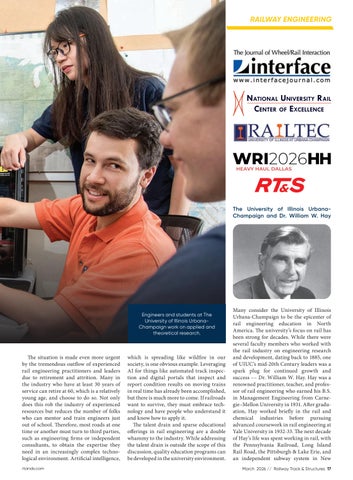
Engineers and students at The University of Illinois UrbanaChampaign work on applied and theoretical research.
The situation is made even more urgent by the tremendous outflow of experienced rail engineering practitioners and leaders due to retirement and attrition. Many in the industry who have at least 30 years of service can retire at 60, which is a relatively young age, and choose to do so. Not only does this rob the industry of experienced resources but reduces the number of folks who can mentor and train engineers just out of school. Therefore, most roads at one time or another must turn to third parties, such as engineering firms or independent consultants, to obtain the expertise they need in an increasingly complex technological environment. Artificial intelligence, rtands.com
which is spreading like wildfire in our society, is one obvious example. Leveraging AI for things like automated track inspection and digital portals that inspect and report condition results on moving trains in real time has already been accomplished, but there is much more to come. If railroads want to survive, they must embrace technology and have people who understand it and know how to apply it. The talent drain and sparse educational offerings in rail engineering are a double whammy to the industry. While addressing the talent drain is outside the scope of this discussion, quality education programs can be developed in the university environment.
Many consider the University of Illinois Urbana-Champaign to be the epicenter of rail engineering education in North America. The university’s focus on rail has been strong for decades. While there were several faculty members who worked with the rail industry on engineering research and development, dating back to 1885, one of UIUC’s mid-20th Century leaders was a spark plug for continued growth and success –– Dr. William W. Hay. Hay was a renowned practitioner, teacher, and professor of rail engineering who earned his B.S. in Management Engineering from Carnegie–Mellon University in 1931. After graduation, Hay worked briefly in the rail and chemical industries before pursuing advanced coursework in rail engineering at Yale University in 1932-33. The next decade of Hay’s life was spent working in rail, with the Pennsylvania Railroad, Long Island Rail Road, the Pittsburgh & Lake Erie, and an independent subway system in New March 2026 // Railway Track & Structures 17