60
Rail Engineer • July 2016
Innovation
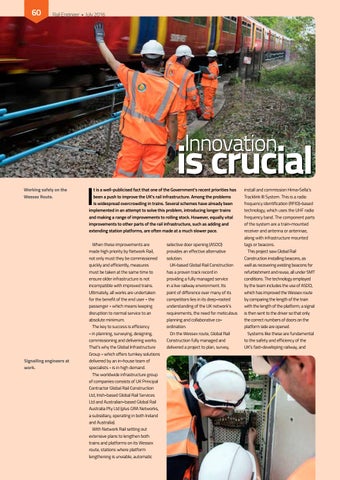
Working safely on the Wessex Route.
Signalling engineers at work.
I
is crucial
t is a well-publicised fact that one of the Government’s recent priorities has been a push to improve the UK’s rail infrastructure. Among the problems is widespread overcrowding in trains. Several schemes have already been implemented in an attempt to solve this problem, introducing longer trains and making a range of improvements to rolling stock. However, equally vital improvements to other parts of the rail infrastructure, such as adding and extending station platforms, are often made at a much slower pace. When these improvements are made high priority by Network Rail, not only must they be commissioned quickly and efficiently, measures must be taken at the same time to ensure older infrastructure is not incompatible with improved trains. Ultimately, all works are undertaken for the benefit of the end user - the passenger - which means keeping disruption to normal service to an absolute minimum. The key to success is efficiency - in planning, surveying, designing, commissioning and delivering works. That’s why the Global Infrastructure Group - which offers turnkey solutions delivered by an in-house team of specialists - is in high demand. The worldwide infrastructure group of companies consists of UK Principal Contractor Global Rail Construction Ltd, Irish-based Global Rail Services Ltd and Australian-based Global Rail Australia Pty Ltd (plus GRA Networks, a subsidiary, operating in both Ireland and Australia). With Network Rail setting out extensive plans to lengthen both trains and platforms on its Wessex route, stations where platform lengthening is unviable, automatic
selective door opening (ASDO) provides an effective alternative solution. UK-based Global Rail Construction has a proven track record in providing a fully managed service in a live railway environment. Its point of difference over many of its competitors lies in its deep-rooted understanding of the UK network’s requirements, the need for meticulous planning and collaborative coordination. On the Wessex route, Global Rail Construction fully managed and delivered a project to plan, survey,
install and commission Hima-Sella’s Tracklink III System. This is a radio frequency identification (RFID)-based technology, which uses the UHF radio frequency band. The component parts of the system are a train-mounted receiver and antenna or antennae, along with infrastructure mounted tags or beacons. This project saw Global Rail Construction installing beacons, as well as recovering existing beacons for refurbishment and reuse, all under SMT conditions. The technology employed by the team includes the use of ASDO, which has improved the Wessex route by comparing the length of the train with the length of the platform; a signal is then sent to the driver so that only the correct numbers of doors on the platform side are opened. Systems like these are fundamental to the safety and efficiency of the UK’s fast-developing railway, and