74
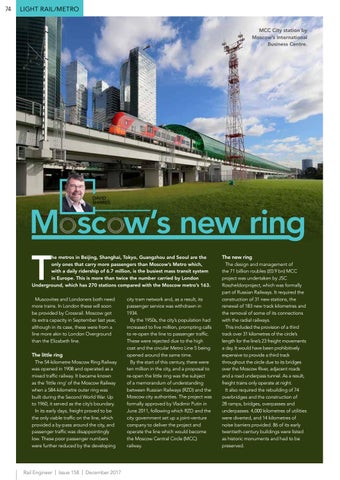
LIGHT RAIL/METRO MCC City station by Moscow’s International Business Centre.
DAVID SHIRRES
M sc w’s new ring T he metros in Beijing, Shanghai, Tokyo, Guangzhou and Seoul are the only ones that carry more passengers than Moscow’s Metro which, with a daily ridership of 6.7 million, is the busiest mass transit system in Europe. This is more than twice the number carried by London Underground, which has 270 stations compared with the Moscow metro’s 163. Muscovites and Londoners both need more trains. In London these will soon be provided by Crossrail. Moscow got its extra capacity in September last year, although in its case, these were from a line more akin to London Overground than the Elizabeth line.
The little ring The 54-kilometre Moscow Ring Railway was opened in 1908 and operated as a mixed traffic railway. It became known as the ‘little ring’ of the Moscow Railway when a 584-kilometre outer ring was built during the Second World War. Up to 1960, it served as the city’s boundary. In its early days, freight proved to be the only viable traffic on the line, which provided a by-pass around the city, and passenger traffic was disappointingly low. These poor passenger numbers were further reduced by the developing
Rail Engineer | Issue 158 | December 2017
city tram network and, as a result, its passenger service was withdrawn in 1934. By the 1950s, the city’s population had increased to five million, prompting calls to re-open the line to passenger traffic. These were rejected due to the high cost and the circular Metro Line 5 being opened around the same time. By the start of this century, there were ten million in the city, and a proposal to re-open the little ring was the subject of a memorandum of understanding between Russian Railways (RZD) and the Moscow city authorities. The project was formally approved by Vladimir Putin in June 2011, following which RZD and the city government set up a joint-venture company to deliver the project and operate the line which would become the Moscow Central Circle (MCC) railway.
The new ring
The design and management of the 71 billion roubles (£0.9 bn) MCC project was undertaken by JSC Roszheldorproject, which was formally part of Russian Railways. It required the construction of 31 new stations, the renewal of 183 new track kilometres and the removal of some of its connections with the radial railways. This included the provision of a third track over 31 kilometres of the circle’s length for the line’s 23 freight movements a day. It would have been prohibitively expensive to provide a third track throughout the circle due to its bridges over the Moscow River, adjacent roads and a road underpass tunnel. As a result, freight trains only operate at night. It also required the rebuilding of 74 overbridges and the construction of 28 ramps, bridges, overpasses and underpasses. 4,000 kilometres of utilities were diverted, and 14 kilometres of noise barriers provided. 86 of its early twentieth-century buildings were listed as historic monuments and had to be preserved.