22 | the rail engineer | august 2012
feature
Edinburgh Waverley
(Right) Inspecting Bowshanks Tunnel. (Below) Newbattle Viaduct - the line’s signature structure.
Brunstane Newcraighall Shawfair NEW BRIDGE UNDER EDINBURGH CITY BYPASS GLENESK VIADUCT
Eskbank
NEW VIADUCT OVER HARDENGREEN ROUNDABOUT NEWBATTLE VIADUCT
Newtongrange
NEW VIADUCT OVER A7
Gorebridge
FALAHILL SUMMIT A7 ROADWORKS NATIONAL GRID HP PIPELINE
14 EXISTING BRIDGES OVER GALA WATER
LEVEL CROSSING REPLACED BY BRIDGE
A
W ATE R
LEVEL CROSSING REPLACED BY BRIDGE
GA
L
Stow
BOWSHANKS TUNNEL
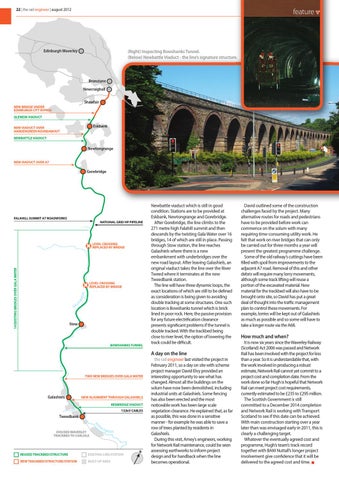
Newbattle viaduct which is still in good condition. Stations are to be provided at Eskbank, Newtongrange and Gorebridge. After Gorebridge, the line climbs to the 271 metre high Falahill summit and then descends by the twisting Gala Water over 16 bridges, 14 of which are still in place. Passing through Stow station, the line reaches Galashiels where there is a new embankment with underbridges over the new road layout. After leaving Galashiels, an original viaduct takes the line over the River Tweed where it terminates at the new Tweedbank station. The line will have three dynamic loops, the exact locations of which are still to be defined as consideration is being given to avoiding double tracking at some structures. One such location is Bowshanks tunnel which is brick lined in poor rock. Here, the passive provision for any future electrification clearance presents significant problems if the tunnel is double tracked. With the trackbed being close to river level, the option of lowering the track could be difficult.
A day on the line
TWO NEW BRIDGES OVER GALA WATER
Galashiels
NEW ALIGNMENT THROUGH GALASHIELS REDBRIDGE VIADUCT 132kV CABLES
Tweedbank RI
V
ER
DISUSED WAVERLEY TRACKBED TO CARLISLE
TW
EED
N
REUSED TRACKBED/STRUCTURE
EXISTING LINE/STATION
NEW TRACKBED/STRUCTURE/STATION
BUILT-UP AREA
the rail engineer last visited the project in February 2011, so a day on site with scheme project manager David Elvy provided an interesting opportunity to see what has changed. Almost all the buildings on the solum have now been demolished, including industrial units at Galashiels. Some fencing has also been erected and the most noticeable work has been large scale vegetation clearance. He explained that, as far as possible, this was done in a sensitive manner - for example he was able to save a row of trees planted by residents in Galashiels. During this visit, Amey’s engineers, working for Network Rail maintenance, could be seen assessing earthworks to inform project design and for handback when the line becomes operational.
David outlined some of the construction challenges faced by the project. Many alternative routes for roads and pedestrians have to be provided before work can commence on the solum with many requiring time-consuming utility work. He felt that work on river bridges that can only be carried out for three months a year will present the greatest programme challenge. Some of the old railway’s cuttings have been filled with spoil from improvements to the adjacent A7 road. Removal of this and other debris will require many lorry movements, although some track lifting will reuse a portion of the excavated material. New material for the trackbed will also have to be brought onto site, so David has put a great deal of thought into the traffic management plan to control these movements. For example, lorries will be kept out of Galashiels as much as possible and so some will have to take a longer route via the A68.
How much and when? It is now six years since the Waverley Railway (Scotland) Act 2006 was passed and Network Rail has been involved with the project for less than a year. So it is understandable that, with the work involved in producing a robust estimate, Network Rail cannot yet commit to a project cost and completion date. From the work done so far Hugh is hopeful that Network Rail can meet project cost requirements, currently estimated to be £235 to £295 million. The Scottish Government is still committed to a December 2014 completion and Network Rail is working with Transport Scotland to see if this date can be achieved. With main construction starting over a year later than was envisaged early in 2011, this is clearly a challenging target. Whatever the eventually agreed cost and programme, Hugh’s team’s track record together with BAM Nuttall’s longer project involvement give confidence that it will be delivered to the agreed cost and time.