February 2013
i s s u e
100 High Speed Interest HS2 ROUTE NORTH OF BIRMINGHAM TO MANCHESTER AND LEEDS ANNOUNCED
Holding back the flood
Sorting out Shugborough Tunnel
100th issue past features selection
Cofferdams filled with water hold back the advancing floods.
Relaying of both lines through Shugborough Tunnel over Christmas 2012.
From Thameslink to St. Pancras, Airdrie Bathgate to Crossrail - our selection.
written by rail engineers for rail engineers
available online at www.therailengineer.com
N EW The Rosehill Rodded System THE PERFECT SOLUTION FOR VERY LONG CROSSINGS AND ACUTE ROAD ANGLES
=
Exceptional lateral and vertical retention Outstanding dimensional stability Now available for all crossing situations
The Crossing g Evolution Evolution continues contiinues In June 2006 we e trialled HoldFast’s HoldFast’s first first rodded platform. platform m. The successful 300 metre trial in Corb Corby by attracted global media m attention as th the e world’ world’s s first rail / road r highway highway.. I 2007 we installed in In i trial locations on the Continent In 2013 this expe experience erience and technolo technology ogy has been evolved, evolved d, applied, tested and d certified for all level crossing crossing situations.
Please contac contact ct Mark Coates Smith M +447970 656143 F + +441285 720748 E mark@holdfastsolutions.co.uk mark k@holdfastsolutions.co o.uk W www.holdfastsolutions.com www.holdfasttsolutions.com HoldFast Level Cros Crossings ssings Ltd is the distrib distributor butor for the Rosehill Rodded R System
february 2013 | the rail engineer | 3
welcome Grahame Taylor’s
Operating notice Surely, by the time you get to this page you will have suspected that there’s something special about this edition of the rail engineer. Perhaps it’s the sheer weight of the magazine, or the large number 100 plastered all over the front cover. Got it yet? Yup, this is the one hundredth edition of the magazine and so we’re having a bit of a celebration. In addition to our normal varied content - of which more in a moment - we have a special selection of articles from the archives. In a normal February edition we would be covering many of the major works carried out over the Christmas period - works that had taken months, if not years of painstaking preparation and planning. But this year, the weather got in the way. At Barrow on Soar near Loughborough, a railway embankment gave up the ghost having suffered a thorough Christmas soaking. The problem was that it chose to expire under an aggregate train so fetching off seven 100t wagons which duly turned over well out of the reach of any road access. Still there were some lucky breaks in the story….. The network had been recovering from other flood events in the west of England and Collin Carr gives us a graphic account of how Network Rail engineers had to erect a temporary dam to hold back the deluge before they could stick their fingers in it. Although not affected by floods, the Shugborough tunnel track relaying project nevertheless had to battle with extremely tight timescales. Persistent problems with structural clearances and troublesome drains forced the planning headway back from the normal three years to just eighteen months. Chris Parker got to hear about structural mysteries and tricky ‘hard spots’ underfoot - the invert perhaps? Whether it was the same squad of high level Network Rail grandees that visited Shugborough as turned up in Slough over Christmas we will Editor Grahame Taylor grahame.taylor@therailengineer.com Production Editor Nigel Wordsworth nigel@rail-media.com Production and design Adam O'Connor adam@rail-media.com Engineering writers chris.parker@therailengineer.com clive.kessell@therailengineer.com collin.carr@therailengineer.com david.shirres@therailengineer.com graeme.bickerdike@therailengineer.com mungo.stacy@therailengineer.com peter.stanton@therailengineer.com steve.bissell@therailengineer.com stuart.marsh@therailengineer.com terry.whitley@therailengineer.com Advertising Asif Ahmed asif@rail-media.com Paul Curtis pc@rail-media.com
never know, but at least in the tunnel they had some action to see. At the Slough footbridge installation site, as Mungo Stacy relates, everyone was packing up ready to go home. Not because they were all off to church - they had just finished early. On a much quieter, but nonetheless challenging, scale Clive Kessell tells us about Bletchley Resignalling - another project to be commissioned this Christmas. Bletchley remained as the sole surviving box using IECC technology between Rugby and Wembley signalling control centres. It has now been closed and control transferred to Rugby - a very complex undertaking. With the recent announcement of the route of the new high speed rail network north of Birmingham it is appropriate to look at the current state of HS2. I’ve been to hear about the intricacies of the hybrid parliamentary bill and the huge engineering undertaking that goes on behind the scenes. Around 800 people are involved in the preparation of detail to answer every query and challenge of the consultation process. And ensuring a complete consistency of drawing detail is just one of the challenges. Around thirty years ago, London Bridge Station was modernised. What went before was a truly dark and grimy throwback to a pre-war era and beneath the station were acres of wine vaults with their unique smell. Everything’s now to be changed as Collin Carr tells us in his update on Thameslink and how it will impact on London Bridge. And the wine vaults - well, it appears they will be the new concourse. So, sit back, crane the magazine to within reach, relax, keep up to date with what’s going on this month and then see just how things have changed in the railway industry over eight short years. Cover Image: High Speed AGV train at Birmingham.
in this issue
High Speed interest 6 Grahame Taylor speaks with Andrew Coombes, HS2 Ltd’s head of specificaton and assurance. Holding back the flood Cofferdams filled with water hold back the advancing floods.
12
Thameslink - next stop London Bridge 22 Collin Carr provides an update on Thameslink and looks at the redevelopment of London Bridge.
Bletchley Resignalling - Closing the gap 30 Christmas saw the area transferred to the control of Rugby. Sorting out Shugborough Tunnel An unexpected inclusion in Network Rail’s work programme for Christmas 2012.
34
Running free 38 Three bridges demolished and one erected over Christmas as part of the Crossrail works near Slough.
©: ALSTOM
the rail engineer Ashby House, Bath Street, Ashby-de-la-Zouch Leicestershire, LE65 2FH Telephone: Fax: Email: Website:
01530 56 00 31 01530 41 21 66 hello@rail-media.com www.therailengineer.com
Editorial copy Email: news@rail-media.com Free controlled circulation Email: subscribe@rail-media.com The small print the rail engineer is published by RailStaff Publications Limited and printed by Pensord.
What makes a package? 52 Four bridge replacements did have a common theme - they were all bridge replacements. After that, there wasn’t much in common. 100th issue past features selection 65 From Thameslink to St. Pancras, Airdrie Bathgate to Crossrail, ERTMS to IP Technology and some incredible photos - our selection.
forthcoming
© All rights reserved. No part of this magazine may be reproduced in any form without the prior written permission of the copyright owners.
features
Sister publication of Signalling & Telecoms; Earthworks Railtex Show issue; Environment
March April
4 | the rail engineer | february 2013
IN BRIEF New infrastructure routemap The Government has published for consultation a set of guidelines and tools to support public and private sector infrastructure providers’ capability to improve the delivery of large scale projects and programmes. Developed by Infrastructure UK in collaboration with industry and academics from the University of Leeds, the ’Infrastructure Procurement Routemap: a guide to improving delivery capability’ provides, for the first time, a coherent approach to assessing and building an effective delivery environment, combining best practice tools and case study examples such as Crossrail. The launch forms part of the Government’s Cost Review programme which aims to make efficiency savings of at least 15% by 2015.
news
HS2
High Speed 2 Route
New track record A track record was broken over Christmas when Network Rail’s track renewal system enjoyed a rare period of unbroken work on the West Coast Main Line.
Track Renewal System 4 (TRS4) is normally used on overnight possessions. But over Christmas it ran for 22-hours at Hillmorton, near Rugby, relaying 4,192 yards of track and sleepers. This effort, by LNW route’s Bletchley high output team, is a UK record. Network Rail’s Steve Featherstone said: “TRS4 is one of the most advanced pieces of track renewal equipment in the world and this just shows what it can do.”
More tram-train? At a recent meeting of the All Party Parliamentary Light Rail Group, Greg Mullholland MP outlined the current progress on the planning of a tram-train link to Leeds-Bradford International Airport (LBIA). The project enjoys cross-party support and three local MPs have been selected to lead a campaign to promote the proposal: Greg Mulholland (LibDem, Leeds North West), Alec Shelbrooke (Con, Elmet and Rothwell) and Gerry Sutcliffe (Lab, Bradford South). Alec Shelbrooke said “The meeting was invaluable for getting all political parties together as well as the major stakeholders to highlight the united aim we have in securing a tram-train link to LBIA.”.
The big news of the month was, of course, the announcement of the HS2 route north of Birmingham. This is no doubt only the start of some heated comments and arguments from affected parties, but it does at least get the discussion started. HS2 will be a dedicated, passenger carrying high-speed railway from London to the North. It will be twin track and will be set in its own formation with a large part of the route either in a cutting or tunnels to avoid too many complaints from neighbours. There will be comparatively few stations. There is no point having quick trains if they keep stopping, although the siting of those stations is important so that passengers can use them easily. Phase 1 will start at Euston, in a new station built alongside the existing one. From there trains will stop at Old Oak Common, not far from Paddington, which will be the interchange with Crossrail. After a fast run to the West Midlands, the next stop will be Birmingham Interchange. Here the lines to the North will peel off. The station will be located the other side of the NEC from the current
Birmingham International station, and a passenger shuttle (remember the old Maglev?) will connect both stations, the NEC and Birmingham Airport. Trains to Birmingham will continue to Curzon Street. This is the other side of the car park from Moor Street and a five or ten minute walk from New Street. Trains going north will travel up to a junction at Water Orton. Manchester trains will follow a route parallel to the current West Coast main line (WCML) to Crewe, where there will be a connection between the two routes. High speed trains will continue to a second junction near the M56/M6 junction at Lymm. Turning right will lead to a stop at Manchester Airport and a terminus at Manchester Piccadilly. Bearing left near Lymm will take trains onto the WCML at Wigan for onward travel to the north and Glasgow. The route to the East Midlands and Leeds will run from Water Orton almost alongside the M42 and within a mile of The Rail Engineer offices at Ashby de la Zouch. It will dive under East Midlands Airport in a tunnel,
emerging and passing East Midlands Parkway on the other side of the car park from the current station building, but without stopping. East Midlands station will actually be at Toton, just off the A52 between Derby and Nottingham. From there, trains will follow the M1 north with a second stop at Sheffield Meadowhall and then on to a new station at Leeds New Lane. A junction at Woodlesford will take trains travelling further north over towards Tadcaster where they will join the East Coast main line via a short stretch of the Dearne Valley Line from Ulleskelf. So there will be city-centre stations in Birmingham, Manchester and Leeds. However, travellers from Sheffield (and Rotherham) and Nottingham and Derby will have to travel 15 minutes or so out of town to catch a train. Journey time from East Midlands to London is quoted as being just under an hour. Trains from the nearby East Midlands Parkway take under an hour and a half now. Whether the travelling public will spend money on a premium ticket (assuming there is one) to save half an hour – well, only time will tell.
february 2013 | the rail engineer | 5
news
SIGNALLING
ROLLING STOCK
Preparing the Hertford Loop
Due to start work this summer, the Hertford National Integration Facility (HNIF) will see European Train Control System (ETCS) kit from four suppliers put through its paces on a 5-mile section of the Hertford loop. A class 313 train is being converted for use in these tests. Rob McIntosh, Network Rail’s project director for ETCS and traffic management, said: “Our facility at Hertford, and the train that will run on it, are further steps towards improving the railway across the country. Vital lessons have already been learned during our trials on the Cambrian Lines and now we are
refining our knowledge in preparation for the future installation cab signalling on Great Western and East Coast main lines.” To allow for the operation of the HNIF, bi-directional signalling has been installed on the northern section of the Hertford Loop so that the down line between Molewood Tunnel and Langley South junction can become a test facility. During peak hours the section will be part of the normal railway, but when ETCS testing is required the block will be ‘switched out’ – switching control from King’s Cross signal box to a laboratory facility being built at Hitchin.
Vectron through the Chunnel Following agreement to apply the European Technical Specifications for Interoperability to freight trains travelling through the Channel Tunnel, tests were recently carried out overnight using a Siemens Vectron locomotive. This is the first locomotive to gain certification under TSI, HS and RST in Europe and is therefore capable of hauling traffic directly from the continent to the UK. The tests were to prove its compatibility with the tunnel’s systems and safety rules. For the test, the Vectron loco hauled wagons with a total weight of 1,350 tonnes into the tunnel via the French
portal and completed a series of traction, braking and pantograph tests. Exiting at Folkestone it returned to France for a second phase of tests. This series of tests is in line with Eurotunnel’s ambition to encourage the development of ‘normal’ rail freight between the UK and continental Europe using the type of locomotives generally in use on the continent. Karl-Hermann Klausecker, chief executive officer of Siemens Locomotives, commented: “We have been able to show that it is possible to operate through the Channel Tunnel, in a reliable and safe manner, using just a standard loco”.
Railtex registration now open registration for Railtex 2013 is O nline now open via the show website. Preregistering gives free entry to the exhibition, avoiding the £20 ticket price payable on the door, and provides access to the extensive programme of additional activities taking place during its three days. By mid-January, the number of companies that had confirmed their participation or reserved stands at the show had risen to 300, with more than 400 expected by the time doors open at the end of April. Together, they will offer an unrivalled opportunity for managers, engineers and buyers from all sectors of the rail market to learn about the latest products, technologies and services. As well as serving as a showcase for the latest from suppliers, Railtex also incorporates a wide-ranging programme of seminars, briefings and discussion forums providing insights into developments in technology and industry thinking - all free to attend with no prior booking. Running throughout the event will be a seminar programme hosted by the rail engineer. Highlights will be keynote speeches by Transport Minister Simon Burns, Network Rail chairman Richard Parry-Jones and Crossrail CEO Andrew Wolstenholme. In
the Project Update Theatre, programme managers will outline the status of major UK rail schemes and, in an innovation at Railtex, The Platform will act as an interactive discussion forum on topical themes with panels of industry experts. Also addressed during the event will be the industry’s skills needs. A programme called ‘Rail - The Next Generation’, devised with the support of the National Skills Academy for Railway Engineering and Young Railway Professionals, will provide opportunities for engineering students and graduates to learn about possible careers in the rail sector during briefing sessions with leading companies. And more immediate career paths may emerge with exhibitors publicising their vacancies and skills requirements via the Recruitment Wall.
Railtex 2013 takes place at Earls Court in London from 30 April to 2 May. For the latest list of exhibitors plus more details of everything taking place at the event, go to the regularly updated show website.
w www.railtex.co.uk
6 | the rail engineer | february 2013
feature
High speed writer
Grahame Taylor
An artist’s impression of the new Curzon Street station alongside Moor Street station.
interest
is about to enter an interesting H S2phase. “Interesting? IIt’s always in an interesting phase!” The surprised interjection was by Andrew Coombes, HS2 Ltd’s head of specification and assurance. It is a great way to start an interview and find that the latest part of this massive project is indeed just one small part of a truly interesting whole. No wonder the repost - a point well made. So, what’s happening now? HS2 Ltd is in the process of compiling the submission for the hybrid bill for the first phase of the network, whilst continuing to progress the development of the more northern second phase. So is this hybrid bill really engineering or just a vast paper exercise? Well, it’s certainly engineering on a grand and detailed scale although there’s plenty of paper involved too. Parliament - that collection of our elected
representatives (bless ’em) - has to satisfy itself that the new railway line between London and the West Midlands is adequate and appropriate and that, through it’s component parts, it will be usable, affordable and operable. All these are stringent tests and through a process of petitions and queries HS2 Ltd’s work will be put under the microscope. Andrew looks back at the previous ‘interesting stages’ to see what has gone on before. Right at the beginning was the route optioneering work carried out preconsultation. Curving and alignment rules coupled with service and passenger assessments gave the basic positions of various options for the railway. The consultation process which followed and which was completed in January 2012 fixed the core alignment.
Land required The hybrid bill is all about establishing the land requirement - how much land either side of the core alignment is needed to accommodate the railway and all its associated equipment. It’s also about how much is required for the railway to be built and to enable suitable environmental mitigations. So there are both permanent and temporary parcels of land involved. All this presupposes a high degree of construction detail. The submission may not contain many of what a railway engineer would recognise as working drawings but, supporting the formal submissions, these are almost exactly what have been prepared. This level of detail is needed so that the full complexity of the project can be understood. Looking at it in a different way, the bill is a railway proposition for something that could be built in a certain way but without stating that that this would be exactly the way it’s going to be built. “We know how it could be run. We know how it could be built. We know how it could be operated but we’re only homing down on the land issue initially.”
Landscaping The bill submission recognises the need for reasonable construction access, how it is going to be used and then how it would be returned. Another example of why land is required is for environmental landscaping. Quite a bit was learnt from HS1 when it was found necessary to negotiate additional lands for landscaping after the bill. “Our environmental colleagues are encouraging us to think about this now rather than later, so that we try to ask only once for land rather than going back again. “Bill submission should be just the once you don’t go back. But it’s a tricky call between affecting people and properties that, in the end, you don’t need to involve versus having to approach them later.” The environmental effects are a major part
february 2013 | the rail engineer | 7
feature
of the submission. In fact the largest part deals with the effects that the construction and operation will have on the environment and what is being done to mitigate these. Of course, at this stage it would be prudent to build in a degree of future proofing. So the maximum number of trains that can be accommodated is known, as is the maximum speed of trains - higher than today. All of this reverts back to a mix of basic physics, anticipation of future demand and technology developments. The constraining envelopes are to do with acceleration and braking capabilities along with noise constraints.
Power and other third party utilities. Part of the test of the bill is that the railway has to be usable, affordable and operable. “So if we are promoting an electrified railway we need to demonstrate that power can be fed into it in adequate quantities!” There are two aspects to this. One is a power requirements analysis which leads to power feeding arrangements. Then there’s the engagement of National Grid so that there’s an understanding that they can actually supply sufficient power at the feeding points. Within the bill itself, land is sought so that the supply points and the feeder stations can be built. All the third party utilities have to be discovered and the effects on them understood. And that’s everything - power lines, telecoms, sewers and even a whole range of high pressure oil pipes. All the utility companies need to be involved to minimise the affects on their businesses.
So what was the starting gun? The starting gun was the Secretary of State’s announcement of the results of consultation and of the preferred route for the first phase. This ‘post-consultation route’ is a line on an Ordnance Survey map and in the station areas it’s a box. The stations are at London Euston, Old Oak Common (interchange with Crossrail), Birmingham Interchange (NEC/Birmingham Airport/Birmingham International station) and Birmingham Curzon Street (next to Birmingham Moor Street). The railway is non-stop throughout the rest of the route. This aligns perfectly with the policy that this is a high speed line which releases capacity on the conventional network to better serve the core conurbations.
Maintenance Part of the detail includes a maintenance proposition which means understanding where maintenance loops and recesses are needed. Washwood Heath, Birmingham will be a rolling stock depot and there’s a maintenance depot at Calvert (near Aylesbury) which is approximately halfway along the route. It was initially thought that there would be maintenance access roads throughout, but this was discounted in the review process. “By the time you’ve gained access to your autotransformer sites, your track feeder sites, crossovers and signalling locations you’re actually quite well provided with access.” HS1 doesn’t have a road throughout - just to the major facilities. But it mustn’t be forgotten that a major access need for HS2 is to tunnels for emergencies.
A single version of the ‘truth’ At consultation, there was a shared cost estimate and that was set against the benefits case for the scheme. This provides an envelope for the cost expectation
which has been apportioned to each area of the route. Each area has a target cost or indeed target saving. The design is all being conducted collaboratively between the teams with experiences being shared. “We have focus groups sharing the expertise and understanding. For example, how you build a good high speed viaduct? How you provide ground treatment for a high speed railway? This consistency of approach is very important for choices that directly affect our land requirements - take, for example, slope angles.” There is a single version of the ‘truth’ building a CAD infrastructure model which can be shared so everyone is contributing to one design. Pulling up the design for one part of the railway will have the same descriptors as any other part. There’s been a lot of work into consistency to ensure that the design is right first time.
Diagram above shows layout at Birmingham Curzon Street.
8 | the rail engineer | february 2013
feature
What is a Hybrid Bill?
Proposed Infrastructure Maintenance Depot near Calvert (Claydon Junction) Bucks. (Right) Suggested layout of Euston Station.
“Going through to future design stages we need to build on this design instead of starting from scratch at each new stage. It’s important to ensure the best design is retained both in terms of a good railway and also in terms of a railway we can afford.” Using BIM (Building Infrastructure Modelling) techniques, the design feeds off the large projects like the Olympics and LUL but takes the processes further than anyone has taken them before. This gives one block of data from which savings can be made right the way through to commissioning and driver training.
Before and after Royal Assent The first sod is due to be cut in 2017 although other things can be started officially when Royal Assent is given in 2015. “Softening up (ancillary) works are trickier as you’re very limited in what you can do before you get Royal Assent. You have no scheme and so you’re expending public money on something that might not exist.” HS2 Ltd is currently working on understanding what early works they could do such as establishing ground clearance in preparation for the major works starting in 2017. “It’s important to provide major work continuity to people who will be finishing Crossrail and some of the major elements of Thameslink at that stage. In terms of the big picture of construction there’s quite a bit involved in enabling a continuity of effort, the retention of skills and enabling people to keep contributing to the economy.”
The design team HS2 Ltd has expanded considerably. It has gone from 60 people at the start of 2012 to roughly 300 in their Victoria offices. These include core HS2 Ltd staff, development partner CH2M HILL and smaller teams from TfL and Network Rail. But then there’s the design team of about 500 - 600 beyond that. The design consultants involved include: • Ove Arup International who are involved in the civils preliminary design, the systems preliminary design and the environmental issues; • Mott MacDonald Ltd - civils preliminary design; • Atkins - civils preliminary design and the environmental issues; • Capita/Ineco JV - civils preliminary design; • Parsons Brinkerhoff Ltd - systems preliminary design; • ERM/Temple/Mott MacDonald Ltd JV environmental issues.
Supporting the hybrid bill What’s coming up next is a process of supporting bill readings and addressing the concerns of petitioners. Once the first reading has gone through it’s pretty much established that the country wants the highspeed railway line and that it has government support. In terms of day to day involvement, HS2 Ltd will have to keep providing supplementary evidence that things are correct and appropriate. At the moment, it is vital that everyone understands the reasoning behind the designs. Again, this is why this single design record and evidence is so important because of the coming challenges. There are exciting times to come from late 2013. So that will be another ‘interesting phase’? “Of course! Just yet another!”
A hybrid bills combines the characteristics of public and private bills. They are used for projects of national importance and involve changes to law which affect both the public and specific individuals and groups, hence the term hybrid. The main elements of the hybrid bill procedure include debates in both Houses of Parliament, assessment by a select committee and the hearing of representations from individuals who would be affected by the proposal (petitioners). It is an established procedure for major railway projects, having been used for HS1 in 1996 and for Crossrail in 2008. Hybrid bills can be long and very detailed, so Parliament usually takes longer to consider them than it would with normal Bills. There are also extra stages in the process which allow people with an interest to petition Parliament. The Hybrid Bill would not only give the Government parliamentary permission to build the line but also any specific powers needed to operate it, including: powers to buy all the necessary land and properties - with compensation to build the line; any changes needed to the existing general laws covering railways; arrangements for dealing with highways and public rights of way; ways to protect historical buildings near the proposed new line; ways to protect gas, water and electricity facilities which might be affected by the line.
Check out latest HS2 engineering vacancies on page 141.
We work in close partnership with clients across the world delivering safe, cost-effective high speed rail schemes
For more information please contact dan.rodgers@aecom.com www.aecom.com
10 | the rail engineer | february 2013
feature
writer
David Shirres
first high speed rail line between two T heBritish cities is expected to be completed in 2026, sixty two years after Japan gave the world its first high speed rail. This is about the same time from the first manned flight to putting a man on the moon. Aidan Grisewood, Transport Scotland’s Director Rail, made this point recently in a presentation on High Speed Rail in Scotland given to the IMechE’s Railway Division in Glasgow. His comments are also reflected in figures published by the International Union of Railways on miles of high-speed lines in place or planned by 2025, with the UK being last of sixteen countries. Its 70 miles is miniscule compared with the four front runners - China, Spain, France and Japan which respectively plan to have 5678, 4415, 4135 and 3774 miles. The good news is that, in 2026, the planned HS2 line from London to Birmingham should add 140 miles while last month’s announcement of the phase 2 extensions to Manchester and Leeds will add a further 221 miles by 2032.
Only half way The announcement of plans to extend the high speed rail network north of Birmingham is welcome news. Overlaying the planned high-speed Y network over a satellite photo of the UK at night shows how it connects centres of population north of London. However the current plan only takes high speed rail halfway from London to Scotland and doesn’t even reach the population centres of North East England. The plan reduces the London to Glasgow time by 50 minutes to 3 hrs 30mins whereas a complete high-speed route would bring this down to only 2 hrs 15 minutes. Moreover, it is possible that this reduction may not be fully realised unless tilting trains can run on the highspeed lines as otherwise there will be longer running times on the winding conventional lines north of Preston.
So, in Scotland the response to this announcement was - why not go all the way? Local authorities and business leaders demanded that the high speed network be extended north of the border and Scotland’s Transport Minister, Keith Brown, called on his Westminster counterpart to commit to a timetable to extend high-speed rail to Scotland. That extra 200 miles of high speed rail will not come cheap. However, the European experience is that the greatest benefit from high speed rail is over long distances such as London to Edinburgh / Glasgow. For example, after TGVs were introduced on the comparable 412 mile route between Paris and Marseille, rail’s market share increased from 22% to 65%. This is reinforced by the report “Fast forward - a high speed rail strategy for Britain” published by Greengauge in 2009 which estimated the regional economic benefits of high speed rail. For central Scotland, the estimated benefit was £19.8 billion (net present value, over a 60 year period) compared with £5.4 billion for the West Midlands. A comprehensive study undertaken by Network Rail in 2009 (New Lines Programme) concluded that the most cost effective option for a rail route between London and Scotland was a new high-speed route connecting London, Birmingham, Manchester, Liverpool, Glasgow and Edinburgh. Over a 60 year period it was considered that for a cost of £35 billion this would generate benefits worth £55 billion.
reviewed the business case for high-speed rail to Scotland and asked 40 businesses for their views. Having done so, the group produced its “Fast Track Scotland” report which sets out Scotland’s case for high speed rail and demonstrated the considerable support for it. Transport Scotland organised a high level summit in Glasgow in November 2012 to further promote the case to extend highspeed rail to Scotland and Northern England. At this summit, Under Secretary of State for Transport Norman Baker advised that the UK Government considered the benefits of high speed rail for Scotland were crucial to the economic wellbeing of the whole country. He gave an assurance that the UK government will continue to work closely with its partners in Scotland to achieve this. This assurance is reflected in the Department for Transport’s command paper “High Speed Rail Investing in Britain’s Future Phase Two: The route to Leeds, Manchester and beyond”. This paper welcomes Scotland’s interest in high-speed rail and commits to a joint study with Transport Scotland to consider Scotland’s aspirations for high speed rail. However it refers to cutting journey times to less than 3 hours with options which could include new high speed lines and/or upgrades to the existing network. This perhaps indicates that the DfT has yet to commit to a complete high speed line to Scotland which would give a 2 hour 15 minute journey time.
Scottish high-speed campaign
Edinburgh to Glasgow at 140mph
Not surprisingly, the Scottish Government is keen to encourage high speed rail. To do so in 2011 it formed the Scottish Partnership Group for High Speed Rail. This Group brought together Glasgow and Edinburgh city councils, Network Rail, Scottish Chambers of Commerce, Transport Scotland and others representing a crosssection of Scottish civic and business life. It
Baker’s presentation to the high speed summit was overshadowed by Scotland’s deputy first minister Nicola Sturgeon. She announced that Scotland is not waiting for Westminster to deliver high-speed rail north of the border but would instead be “firing ahead” with its own plans to build a high speed line which could see 140mph trains running between Edinburgh and Glasgow -
february 2013 | the rail engineer | 11
feature
High Speed Rail
for Scotland Scotland’s high speed timetable
cutting journey times to less than 30 minutes. She felt that this line could be complete by 2024, two years ahead of the HS2 London to Birmingham line. This announcement wasn’t greeted with universal acclaim. As there are already four routes between Scotland’s two main cities, some critics couldn’t see the need for another. Concerns have also been expressed on the lack of information about funding, costs, routes and location of terminal stations. It was clear from Grisewood’s presentation that such criticism misses the point as a faster journey time between Edinburgh and Glasgow is only one benefit of a plan which will also relieve congestion on the existing rail network. At the Scottish high-speed summit, the importance of this point was emphasised by David Simpson, route managing director for Network Rail Scotland, who advised that 30% more train services were operating in Scotland than a decade ago. The real rationale for a high speed rail line within Scotland is a recommendation of the Scottish Partnership Group for High Speed Rail that the Scottish end of the UK high speed network should be built as soon as possible to get the immediate benefit of a high speed line between Edinburgh and Glasgow. This requires around 40 miles of new UIC Gauge high speed railway with no new stations (new city centre stations will not be required until there is a high-speed connection from the south). In addition, it is felt that the geography of southern central Scotland will not require tunnels. The estimated cost of the 140 miles of HS2 from London to Birmingham is £16 billion or £115 million per mile. With stations and tunnels accounting for almost half HS2 construction costs, the Scottish line should cost significantly less than this. Put it in context, its cost is likely to be of the same order as the new Forth road bridge currently under construction.
The Scottish Government’s plan for a high speed rail line in 2024 requires construction to start in 2018. This needs a Parliamentary Bill to be introduced in 2016 based on an outline design which will require surveys, investigations and an Environmental Impact Assessment to be undertaken in 2015. Thus the selected route would need to be decided in 2014 on the basis of route options developed in 2013. In the discussion following the presentation to the IMechE, it became apparent that perhaps the most difficult decision was the location of the terminal stations. Grisewood advised that the advice from HS2 was to determine station locations before choosing a high speed route. In the short term this is not an issue for a proposed Scottish high speed line which will initially use existing stations and their approach tracks. However, passive provision is required for new UIC gauge city-centre terminals which will be constructed as the high-speed line reaches Scotland.
Possible routes from England The Scottish high-speed proposal is at the top end of a high-speed line from England, the route of which has yet to be decided. In his presentation, Grisewood showed how a Scottish high speed line running south of the central belt would fit into all UK high speed network options under consideration. He advised that Transport Scotland is working closely with HS2 to ensure connectivity with the new route from the south. Transport Scotland expect that the preferred high speed route to Scotland will be chosen by 2015. Although Transport Scotland is wise to ensure its high-speed route can accommodate all feasible routes from the south, the DfT’s command paper on high-speed routes to Leeds, Manchester and beyond offers a strong indication of current thinking. In this paper, a diagram entitled “Vision for High Speed Britain” shows the West Coast Main Line connected to the Manchester arm of the highspeed network running to Glasgow and Edinburgh. It also shows the East Coast Main Line connected to the Leeds arm of
the network and finishing at Newcastle. East and West coast lines are classified as “classic comparable services” whereas the line from Newcastle to Edinburgh is an “existing line with potential for future connection to HS2”. It therefore seems a fair bet that the eventual high-speed route to Scotland will be a west coast route. Current thinking is that a high speed route from the south will open around 15 years after the Scottish high speed line. Until then a further option under consideration is a high speed line between the West Coast mainline and the Scottish high speed line. This would speed up journeys across the border by around 15 minutes and release capacity on lines to Edinburgh and Glasgow. This could become part of the high speed network if a west coast route option was selected.
The work of generations HS2 technical director Andrew McNaughton has described the construction of the UK’s high speed rail network as the work of generations with it being many years before England and Scotland are connected by a high speed rail network. The Scottish Government’s plans, however, should give Scotland an internal high speed rail link in the foreseeable future, perhaps even before HS2’s London to Birmingham project. It’s also possible that the example of Scottish high speed rail might spur construction of the remainder of the network to make it the work of one less generation.
(Map below) Proposed Edinburgh to Glasgow High Speed Rail Line in red, and the link to WCML in light red.
12 | the rail engineer | february 2013
PHOTO: BEN BIRCHALL (PA)
feature
writer
Collin Carr
Holding back
Saturated ground
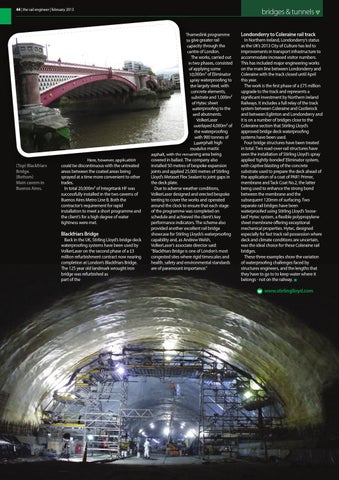
(Top) Cofferdams filled with water hold back the advancing floods.
you will be aware, 2012 was the A ssecond wettest year on record for the UK as a whole and, in England alone, it was the wettest year ever recorded. So it’s been a good year for the ducks, but for many people, including railway engineers, it has been a nightmare - especially in the south west. The last couple of months have been particularly challenging. To find out more, the rail engineer spoke with Steve Hawkins, infrastructure maintenance delivery manager for Network Rail. Steve is based in Plymouth and, with a supporting workforce of over 300, he is responsible for the ‘Safety of The Line’ in Cornwall, Devon and parts of Somerset. Speaking early in January, he recalled how his team had coped with the challenges created by the monsoon rains that fell over the Christmas period.
Rain had been falling consistently throughout the year, and Steve explained that they had already had to deal with a number of local flooding problems. However, by November 2012, the ground was saturated and the Met Office was issuing severe flood warnings on a regular basis throughout the area. One of the locations that Network Rail was very concerned about was Cowley Bridge junction which is on the approach to Exeter from Taunton. The river Exe runs alongside the railway and passes under the branch line to Barnstable. When the river floods, water covers the fields either side of the junction leaving the railway formation stranded in the middle, surrounded by water. A large culvert, approximately 2 x 3 metres in section, normally carries excess water away from the site but, on 22 November, the volume of water in the river was so great that it lapped over the tracks, destabilised the formation and washed away the track ballast. This is a location that is very vulnerable to flooding, and there was a similar incident about twelve years ago when ballast was washed away. However, this time the volume of water was far greater and not only did the water submerge the junction but it then proceeded down the tracks in the direction of Exeter station, flooding a relay room and fourteen trackside location cabinets, causing significant damage to the signalling equipment therein. Assistant signalling engineer David Gill helped bring together a highly skilled team of more than thirty engineers from within Network Rail, McGinley and Signal Construction. This team worked round the clock testing circuits, replacing damaged
the
flood! S&T equipment and replacing about two miles of cables. According to Steve, it was a heroic effort from the signalling team and their permanent way colleagues whose work to restore the track by importing new ballast, stabilising the formation and realigning and consolidating the track ensured that the route was reopened three days later. The signalling, however, would take another two weeks.
Welcome hospitality Alongside the junction is the Cowley Bridge Inn which was also flooded - not for the first time. The landlord cannot get the pub insured, but he was able to provide hot food, a roaring fire and shelter from the rain. Wellies were needed, even inside the pub, but the landlord’s good natured, friendly 24hour service was invaluable and made all the difference over both the first challenging three days and the weeks to come. Four days after the line was reopened in November, with the rain still coming down, Cowley Bridge flooded again. The track was once more washed out and all the signalling systems, which were still being worked on, were all under water again, as were the Looe, Newquay, Barnstaple and Heathfield lines. It was back to square one. With the help of Infrastructure Projects and various contractors, the tracks were repaired again. The line at Cowley Bridge reopened after three days but with no signalling - this would take another three weeks of 24-hour working with the assistance of maintenance and project staff from across the country. During this period, the Network Rail operations team and the train and freight operators also had a challenging time, running a service without any signalling.
february 2013 | the rail engineer | 13
feature The hope was that Mother Nature would be kind and give everyone a chance to dry out and recover from this experience. No chance! There was a record to break and the year was coming to an end. Meteorological forecasts were ominous, rain continued to fall and, four weeks after the line was reopened, new flood warnings were issued. There was a great risk that all the good work would be wasted which clearly would be unacceptable given the additional disruption that this would cause. Something had to be done to ensure that the signalling equipment would be protected, but what should that be?
Great idea!
envisaged by Craig, available in their warehouse in the Midlands. They were dispatched to site immediately. So far so good, but the Met office changed the flooding prediction time. It was now only about ten hours before the floods were expected. The team needed pumps to fill the cofferdams with water but, as one might expect, all such available pumps had been hired out. More quick thinking was needed, this time from signalling telecom maintenance engineer John Tancock who suggested that they contact the fire brigade. This they did and, by midnight with three hours to go, there were four tenders, a lighting tender, a control unit and 20 willing firemen on site pumping water into the
cofferdams which had now arrived. Two of the dams were ready and in place, 80 metres from the relay room, by 02:45. Before long, the dams were holding back a metre head of water. Twenty four hours later, the third dam was ready and positioned as back up behind the front two, in case one failed. Sure enough, one did - so the last line of defence worked and saved the day. It is the first time that this type of protection has been used and Steve is now developing a business case to purchase the appropriate equipment in case there is another attempt to break the rainfall record in the future. This is very likely given the forecasts from the Met Office about possible future rainfall patterns and intensity.
The volume of water from the river was so great that it lapped over the tracks.
Steve suggested to his team that they should sacrifice the track and remove a section of it before the flood water arrived at Cowley Bridge to save the signalling systems. This was unchartered territory and Steve explained that it was time to consider and evaluate any and all ideas that were being proposed. During this process, assistant track maintenance engineer Craig Hocking proposed erecting a dam across the track between the junction and the signalling relay room instead of removing a section of track. Craig suggested that the dam could be a flexible structure filled with water. After searching on the internet to see whether there was such a service available, the team came across a company which specialises in finding solutions to water-based problems. Additional good news was that they had three tubular cofferdams, similar to the ones
Experts IN support services for infrastructure markets Get connected to one of the largest specialist recruitment businesses in the rail industry, for unrivalled support services and the very best professional staff.
0845 543 5953
working together We offer a complete range of staffing from Site Teams to Senior Executives, delivered through dedicated resource teams nationwide.
www.mcginley.co.uk
Head Office: Ground Floor, The Edward Hyde Building, 38 Clarendon Road, Watford, Herts WD17 1JW
• Executive, Professional & Technical Resourcing • Track Maintenance and Renewals • OLE • Electrification • Facilities & Support Services
• Minor Works/Civils • Protection and Warning • S&T • Trades, Labour & Supervisory • Welding
14 | the rail engineer | february 2013
feature
Not to be outdone
The volume of water caused significant damage to the signalling equipment and washed gravel into control cabinets.
Dealing with all this flooding was probably enough to keep any sane railway engineer busy over a Christmas holiday, but in this case it was not the whole story. The cliffs behind the sea wall at Teignmouth were clearly determined not to be outdone by Cowley Bridge and, on 27 November, there was a landslip with 1000 tonnes of material cascading down the cliff toward the main line railway. Fortunately, it fell in the cess and behind the fence that runs parallel with the tracks. The fencing did its job of catching the landslip but it was badly damaged in the process. Only six hours after the start of the flooding at Cowley Bridge in December, another 1000 tonnes of rock and rubble came down, this time completely wiping out about twenty metres of fence and spilling onto the tracks. Network Rail’s hard-pressed maintenance team employed the services of the regional contractor Dyer and Butler to clear the track and remove the debris from site. The line was closed for twelve hours after which it reopened with a 20 mph speed restriction that, at the time of writing, is still in place. Other lines in the area were similarly affected. Twenty six washouts were recorded on the Looe Branch in Cornwall, all of which have now been repaired. The situation was similar on the Barnstable Branch which experienced twenty two washouts between Eggersford and Barnstable. Some were quite significant and the line was not reopened until early January 2013.
Overview On Boxing Day, Steve managed to acquire the services of one of Network Rail’s two helicopters to survey the main routes, check the condition of the fence lines and gain an overview of the lie of the land. Where water was evident, he could estimate the likelihood of it affecting the railway in the future. Throughout this challenging period, Network Rail worked closely with the TOCs and FOCs. The Met Office continually provided forecasts and weather warnings which Steve and his team followed diligently. Everyone worked together and different teams combined and performed effectively. There where no accidents and everyone arrived home safe every day.
Some engineering lateral thinking proved invaluable and Steve ensured that ideas from the team were listened to, valued and evaluated. At the end of the day, the dam at Cowley Bridge worked which was a satisfying outcome for a team of dedicated railway engineers who had experienced an interesting Christmas, although not one they would like to repeat. Here’s to a dry 2013!
february 2013 | the rail engineer | 15
feature
writer
Grahame Taylor
Luck by the Barrow load f you’re going to have seven fully I loaded aggregate wagons fall off the track just after Christmas, you really need a bit of good fortune to help you out. And luck can come from some surprising quarters. Perhaps it could be an obscure piece of railway kit that belongs to someone else that just happens to live a couple of miles down the track. Or perhaps it could even be a helpful local Scout troop.
Saturation point It was wet around Christmas time. Not overwhelmingly wet, just winter wet. Trouble was that this Christmas soaking followed on from weeks of
even worse weather and so just about everything that could be saturated was saturated. Most of our aging railway embankments have got used to being given a good soaking, but every so often it all becomes just too much to bear. This is what happened just to the north of Barrow on Soar on the Midland main line. Originally a two track railway it was widened to accommodate four tracks - and the cheapest way to do it was to place (dump) large quantities of spent ash on either side. Ash was available in huge quantities in the nineteenth and early twentieth centuries and was used for all types of filling operations as well as for track ‘ballast’. Cheap it may have been, but it can be a little fragile at times. Like many revellers after Christmas it too was a little fragile, but this time it was because of too much water.
Bank slip When the railway system reopened for business after the Christmas break, the second train to travel south along the Up slow line was hauling a rake of twenty 100-tonne wagons containing mixed aggregate. The locomotive and the first ten
Aftermath of the derailment, with the damage to the track clearly evident.
Award Winning Excellence in Rail & Engineering Multi-disciplinary specialist engineering company operating in the rail, energy and engineering sectors.
Safety | Professionalism | Innovation | Respect | Integrity | Teamwork www.amco-construction.co.uk | T: 01226 243413 | E: info@amco.co.uk
16 | the rail engineer | february 2013
feature With the toe drainage repaired, the work of taking away the ash began. Fortunately it was possible for the arising spoil to be taken further down the line and placed as bank strengthening. This did away with the need to haul muck away from site.
No big yellow machine
Work on the embankment continued day and night.
wagons would have completed their journey successfully had they not been brought to an abrupt halt by the severance of the brake pipe. Behind the break lay the last seven vehicles, brought off the track when a 20 metre section of the ash bank slipped down by about half a metre. The Slow lines were blocked. The phones started to ring. Receiving their postChristmas phone calls were Richard Walker and Rob Lunn of Network Rail’s infrastructure projects team in Derby. They weren’t the only ones of course. Framework contractor Amalgamated Construction (Amco) was on its way with staff switched straight from emergency works in Wales and the west of England. DB Schenker was also on site, working out how to recover its wagons.
No access road
The use of Lafarge’s stone train was crucial.
Many of our articles that cover track reinstatement mention temporary access roads and the involvement of neighbouring land owners. This time though there was to be no access road and little contact with the neighbours. It just wasn’t that sort of site. It was certainly difficult to get at, but Richard and Rob came to the conclusion early on that
everything could be achieved using the existing rail access and by using trains. This certainly bucks the recent trend. Mind you it was pretty obvious right from the start that rail access was practical whereas road access certainly wasn’t. The team from DB Schenker came to the same conclusion for their wagon recovery. They too opted to work on their tricky operation from track level. But before any earth could be moved or any track could be reinstated, it was necessary to find out what was going on in the embankment. The bank was given a good shave to get the dense vegetation out of the way and access steps were installed. The extent of the slip appeared to be defined, but piezometers needed to be sunk to check on the embankment structure and on its composition. Specialists from Pell Frishman interpreted the findings, defined the limits of the problem and drafted out a design for repairs to the bank.
Long-reach excavator All the equipment made its way to site either as road rail machines or - in the case of Stobart Rail’s 360° long-reach tracked excavator - by loco-hauled low loader wagon. Working its way carefully down the bank side, the excavator established a working area at the bank foot. Luckily it wasn’t necessary to acquire land as there was enough within the boundary line. This was a little ‘indistinct’ to start with and needed to be confirmed by the geomapping team in Manchester.
Fetching in fresh fill to reinstate the bank appeared to be less straightforward. Dumpers, road-railers - it would have taken ages to complete. As luck would have it though, the Infrastructure Projects team has a wide spread of railway engineering knowledge - not just pure civils, but also track civils. This side of the operation spends most of its life fetching and taking away prodigious quantities of stone and has a shrewd idea of what plant is the most appropriate. After all, the high output track relaying machine does not rely on dumpers otherwise it would be a laughably low output track relaying machine. The relayers feed stone to the site from a long rake of wagons and this was just the sort of kit that was needed. But there wasn’t a big yellow machine on the horizon.
Cooperation This again is where luck helps out. Just down the track is the Lafarge Gypsum plant and tucked away in their sidings which were also handy as the road rail access bridge head - was a stone discharge train (SDT). It may not have been yellow, but it was big and could handle respectable and continuous quantities of stone. Above all, it was available. Thus an arrangement was made between Network Rail and Lafarge for the use of this bit of kit. Cooperation between all the parties involved ensured that the sometimes fraught process of running ballast trains at short notice went ahead without a hitch. Over two nights, with a steady discharge from two train loads of stone, the 1600 tonnes of new fill was carefully placed and compacted in layers. Once up to level, track staff were programmed to reinstate the Up slow initially with a temporary speed restriction of 20mph. By mid January and after final tamping and lining, the temporary speed restriction was lifted, the Up slow has returned to normal and the station at Barrow on Soar was able to reopen. And the helpful local Scout troop? What was all that about? Well, they just happened to own a hut that became the messing facilities for the construction gangs and, being helpful, they have been suitably rewarded. So everyone had a bit of luck in the end.
n tio se ac p i n o l la c am t Te en e m ns nk po ba es m R re y a nc S o ge ner -o m w t E rro ar Ba ob e St th on
Stobart Rail 24/7 Emergency Response Stobart Rail's substantial fleet of roadrail vehicles provide a comprehensive series of machine-to-trailer combinations, and also accommodates a host of highly specialised attachments, ranging from tamping and cabling equipment to ground investigation and soil nailing rigs. We are experienced and ready for 24/7 Emergency response whether weather related, operational failure, derailment, culvert collapse - whatever the situation.
As well as providing an experienced earthworks team to assist in the programming and delivery of the works, Stobart Rail provided its 40 tonne payload, 4 axle Rail Low Loader Trailer, towed by one of its fleet of Liebherr RRV’s. This was used to transport the Stobart’s heavy plant plus materials required to quickly reinstate the failed embankment. To enquire about our road–rail vehicles for use on your next project (can include POL) or for our most recent plant register contact us.
David Richardson Plant Hire t. 01228 518 150 e. david.richardson@stobartrail.com Andy Richardson Operations Director t. 01228 882 300 e. andy.richardson@stobartrail.com Keith Winnery Rail Director t. 01228 518 150 e. keith.winnery@stobartrail.com
stobartrail.com
18 | the rail engineer | february 2013
feature
Gaining more traction in energy efficiency
“Switzerland is 100% electrified and is the network model to aim for.”
(Below) Heat exchangers in the tube.
writer
AC versus DC
Peter Stanton
Network Rail’s Peter Dearman needs no introduction to the readers of this magazine. Suffice to say he gave a lively and stretching opening presentation, majoring on construction methods, designs and new technology. He topped it off by a fascinating challenge to rethink the relationship between low voltage DC traction by ground collection and high voltage AC overhead line collection. The audience was left in no doubt there was more debate to come in that direction. Peter’s view is that Switzerland, which is 100% electrified, is the network model to aim for, both in planning for the capacity society demands and building for the business goals of the operators. In the UK, whilst we have the ability to choose how we generate electricity, the advantage of the railways is that it can connect to any energy source. In summary, the railway needs a commitment to a sustained investment plan and a long-term view with a business case to match. The Government plays an important part in deciding the direction in which our railways will move. Mark Gaynor and Shamit Gaiger from the DfT concentrated minds on energy-related issues with a call for a reduction in CO2 and costs as a major deliverable. Progress has been steady - this in the light of passenger cars delivering 55% of all transport emissions while railways contribute 2%. They paved the way with incisive comments on driving techniques and the emerging weight of rolling stock, together with technical developments such as the ability to regenerate energy through modern braking systems.
Railway Division of the Institution of T heMechanical Engineers has a small group which arranges and produces rail related conferences. Unsurprisingly, it rejoices in the name of the Conferences and Seminars SubCommittee. This had previously organised regular and separate conferences on both energy and railway electrification but, in the light of changed financial circumstances amongst potential customers, it was decided to put together a two-day seminar event encompassing both subjects. As can be imagined, the question of energy consumption by trains and the provision of that energy to those trains came out as the core subjects. In other words, the matter of the environment and rail’s place in it was the centre of the speakers’ delivery. Overall, the seminar gave a good overview to where the industry is and where it can be.
Underground thinking This opening was followed by a dip into the world of London Underground’s power supplies by Kevin Payne. Kevin has an eye for history and surprised us all by reminding us that the first proposals for electrification of the sub-surface lines was in fact high voltage AC, this plan only being
changed with the arrival of American ownership of the District Railway: how different things could have been? The system design now looks to major efficiency gains and the seminar was treated to an overview of the massive investment in new power supplies with a sympathetic view to architecture. Probably the most original was the conversion of an old railway building from a Chinese restaurant to a sub-station! Renewals take place against a pattern of rising demand, so improved efficiency becomes the best way to control consumption. To put that demand into scale, usage of “the tube” has risen from 580 million journeys per annum in 1984 to over a thousand million in 2010. The vast quantities of energy used in transporting London Underground’s customers was put into a new light by Dr. Martyn Chimera. Whilst moving trains around we needed to understand that up to 20% of the energy involved was nontraction and, more to the point, a lot of that energy goes to heating up the tunnels. London Underground has had regenerative braking for 25 years and the system has become warmer as time has gone by. Even aerodynamic drag is now looked at in terms of train efficiency, as is the system of fans which are used to control airflow round the system. Later in the conference, Martin’s presentation was amplified by Ian Flynn who really went to the nub of the problems of heat in underground tunnels by putting this in the context of the deep tube programme and the proposed new EVO train as a systems-based response to energy efficacy and tunnel heating. Water-based cooling has been employed in new installations and heat exchangers may be seen over the track at Oxford Circus. To round off the Underground’s view the statistics are impressive: seven new substations, 40 substation upgrades, one new grid intake and one up-graded intake from the grid.
february 2013 | the rail engineer | 19
feature More thoughts on traction Usefully putting the point that electromagnetic effects are everywhere was an absorbing talk by Roger White of Atkins looking at the way electromagnetic effects are modelled and understood. The day finished with David Hartland of Brecknell Willis questioning whether we should be “Heating the Countryside or saving the Kilowatt Hours?” This was a highly entertaining piece, majoring around current collection. Day two continued the subject from the traction and rolling stock point of view when Clive Burrows from FirstGroup put the whole energy equation into context. Energy costs are by far the largest directly manageable traction and rolling stock costs for most train operating companies. Controllable variables include driving style, driver advisory systems and regenerative braking. Infrastructure design can seriously limit the energy efficiency of rolling stock designs of slopes up to stations and down from them are a good example. A series of displays showed how a railway can develop from a baseline of normal driving and conventional signalling through a driver advisory system incrementally through to automatic train operation.
Managing consumption What can be done was illustrated during a talk by John Evans of Alstom West Coast Traincare in which he spelt out the results from a Pendolino running into Euston from Tring with no power; purely coasting! The Virgin television adverts praising Pendolino energy efficiency from regeneration was recalled, set around power savings measured in cups of tea (4,950 million) and
Christmas tree lights (820,000 sets). The conclusion in technical terms came out that CO2 emissions were significantly better than the national average for electric trains and also an identification of the ‘hotel’ load consuming 10% of the energy in service. Reductions in energy consumption can come from managing stabling loads in depots, by controlling traction consumption through the introduction of a power saver mode to limit traction power draw and by improved driving techniques with increased driver awareness of energy consumption. ATOC’s Neil Ovenden introduced a 20point programme to help rail operators improve their efficiency and reduce CO2 emissions. Targets such as on-train metering for electric and diesel trains were mentioned, allied to robust knowledge of energy consumption today and coupled to sensible but challenging targets for the future. Soft issues such as those around people and processes are as important as technical issues. Further traction and rolling stock aspects were added by Mark Ellis of Bombardier with a tantalising scheme to convert existing diesel trains to bi-mode through a brand new pantograph-equipped car. The image of a totally modern, brand new, metro rounded off much of the discussion as Russ Stimson from the Dubai Metro showed what can be done with a fully-automated railway in a very challenging environment with a very discerning customer. The development speaks for itself although energy consumption issues have to be matched against the very high temperatures in which the railway operates. Nevertheless, the fully automatic train system can be programmed to optimise energy
consumption. One example is trains coming into the depot and automatically going to sleep! The methodology to achieve energy efficiency within a British metro was ably illustrated by Richard Hathaway of Invensys in his review of the influence of the signalling systems on the Victoria Line, where an optimum balance of journey time, speed and automatic train regulation can show large energy efficiency gains without a significant worsening of the service as perceived by the customers. Whilst other presenters dealt with construction issues, the interaction between electric traction operations and the chase for energy efficiency in railway operation was clearly put into context during this seminar. New technologies are coming along, and should be adopted, to make sure that rail maintains its place as a most energy efficient form of public transport.
Pendolino under power and (Below) undergoing maintenance at Longsight depot.
20 | the rail engineer | february 2013
feature
King’s Cross
(Inset) Progress at King’s Cross station, December 2012.
2005, King’s Cross station in London S ince has undergone a major programme of restoration and improvement, collectively known as the King’s Cross Station Redevelopment Programme (KXRP). Currently in its final phase, the project will deliver the biggest transformation in the station’s 160-year history, culminating with a grand opening of London’s newest public space in autumn 2013. The eight-year programme has already seen significant changes to the station and its surrounding infrastructure with the addition of a new concourse, major refurbishment of a Grade 1 Listed structure, significant improvements to services and adoption of innovative technologies.
Collaboration Network Rail and Murphy are working together as an integrated team to demolish the redundant structures at the front of the station. Then they will start on the new granite paving for the square, replacing some of the above-ground structures and completing the restoration of the Grade 1 facade. Matt Tolan, Network Rail’s programme manager at King’s Cross commented: “It’s a real pleasure to finally remove a building that’s so unloved and restore the station to
what its original architects intended, as well as create a modern station fit for the twentyfirst century that gives passengers and the local community a huge new space to enjoy.” From the commencement of the project, Network Rail and Murphy have developed a fully integrated team working closely alongside one another, based in a shared project office at King’s Cross Station. “With such a high profile site, in a congested location, a close working relationship with all stakeholders is paramount to delivering a successful project”, explained Elliot Hodgson, Murphy’s project stakeholder manager. As part of furthering this relationship, both sides are investing in developing collaborative working to deliver higher efficiencies and are currently anticipating project certification to BS11000 in spring 2013.
Challenges faced The challenges faced by the team include working in close proximity to a Grade 1 listed building, managing existing structures and services to keep the station fully operational, and maintaining the operation of both Network Rail and London Underground Stations despite the construction and logistics management challenges. Detailed planning of all activities and phases of the deconstruction works was required. This ensured that the Grade 1 facade was not damaged and that critical services to both the station and London Underground were not affected. Preplanning the deconstruction of the space frame roof over the old concourse was an important factor in establishing a safe
and sustainable system of working on such a difficult structure as well as protecting the public and London Underground ground structures throughout this phase. With 140,000 people passing daily through the station, it was recognised that passenger flow management is a key challenge. Following detailed assessment, demarcation of critical areas over the London Underground structures has been undertaken to prevent accidental overloading.
Innovative delivery Patrick Shaw, Murphy’s senior project manager, explained: “Delivering a major remodelling of a station which handles 47 million passengers per year requires meticulous passenger flow management. We have deployed innovative methods including 3D modelling to place the station users at the heart of the planning process. This has ensured safe and easily navigable access, in particular, to and from rail and underground platforms.” The site is further complicated by the existence of the old Fleet River sewer running under the site. Deep excavation to form new connections is expected to reveal interesting historical information. Murphy has engaged the services of the Museum of London Archaeology to provide a watching brief and support during this phase. Once complete, King’s Cross Square will create a world class open space with stunning views of the historic frontage of the station as well as St Pancras International. It will service the needs of a major modern transport interchange, local residents, local businesses and Greater London as a whole.
How do you connect speed and sustainability?
Think Murphy.
Electrification is the future of rail infrastructure, linking passengers with faster journey times and a reduced environmental impact. It’s a task which demands prodigious levels of teamwork and first-class commitment to safe practices. Murphy has an impressive track record of working collaboratively and safely as principal contractor and we’ve won multiple safety awards, including Network Rail’s Partnership Award for Safety. Our specialist engineering capability is well recognised for its innovative approach to the delivery of complex civil engineering
projects such as upgrading the UK’s Railways to accommodate for the National Electrification Programme. For more than 60 years, Murphy has been building and maintaining the infrastructure of the nation. We continue to break new ground with high-profile projects across a range of key industries. From national tunnelling, power and rail projects to major water and wastewater contracts and process plant constructions, with Murphy, the thinking is always as important as the delivery.
Breathing life into infrastructure
For deeper thinking visit www.murphygroup.co.uk
22 | the rail engineer | february 2013
feature
Thameslink Next Stop London Bridge!
Progress writer
Collin Carr spring, the rail engineer gave an L ast update on the progress of the challenging £5.5 billion scheme to improve the Thameslink route through the heart of London from Bedford to Brighton. At the time, the Shard was just becoming a recognised feature of the landscape although it still wasn’t completed. It was also the time when everyone was looking over their shoulder excitedly, albeit with some trepidation, at the prospect of the London Olympics - a success or a national embarrassment? Now however, for the not inconsiderable sum of £24.95, one can take a ride up to the top of the Shard and admire the view knowing that the Olympic Games were delivered on time and without incident, providing the country with something to be proud of. Down at ground level, work has progressed steadily to ensure that the Thameslink project continues to plan and budget, improving the journey for many thousands of commuters. That project is now at the halfway stage and work is progressing well. Chris Binns is Network Rail’s head of engineering for the Thameslink programme and he is clearly still very enthusiastic about the project. He was eager to give a general update on progress, plus an outline of the next phases of work that will lead up to its completion in 2018.
The redesign of Farringdon station is now complete. Many buildings, including a 14 storey office block, have been demolished without incident, platforms extended to accommodate the 12 car trains and a new footbridge constructed to improve passenger connections with London Underground. The existing station roof has been extended by 60 metres and an impressive new ticket hall added to the south. New lift shafts have been constructed that extend down to a level which will form part of the Crossrail service, linking into the station when the tunnel boring machines reach the station area sometime later in the year.
Blackfriars station has been dramatically revamped with its unique access points on both banks of the Thames. Chris wanted to emphasise that the station was opened to passengers in time for the Olympics in accordance with the plan. The installation of more than four thousand solar panels throughout the length of the newly constructed station canopies is now complete and delivering power into the station complex. Balfour Beatty is the principal contractor for this work and Network Rail has recently completed additional structural repair work to the 1869 Grade 2 listed, five span arch bridge that supports the new platforms and station canopies. While already functionally
february 2013 | the rail engineer | 23
feature complete, the final installation of glazing panels, waterproofing and snagging at the station are expected to be completed by the late summer. Chris recalled the challenges that the short stretch of railway between Blackfriars and London Bridge stations posed for the team and he was delighted that they are now resolved to everyone’s satisfaction. This part of the project has certainly concentrated minds throughout, since there has been a need to extend the two track railway to four tracks through a short 350 metre corridor running alongside Southwark cathedral, over Borough Market and across the High Street before passing alongside the Shard and into the station complex at London Bridge.
Preparation for four tracks It was a site that archaeologists as well as engineers wanted access to and some significant archaeological finds were made before the new structure was built by Skanska. The structure consists of six continuous spans of double track bridge with I-girders supporting transverse steelconcrete cross-girders with a concrete slab deck. In addition, a single span tubular steel bridge crosses Borough High Street leading up to the station. Just like the Shard, it is now part of the landscape spanning the beautifully revamped Victorian roof of Borough market and the recently reopened Wheatsheaf public house, minus its top storey! The plan is to bring the viaduct into use by August 2015.
An immense amount of planning and preparation has gone into both these landmark features and other work not detailed here including platform extensions, structural modification, track and signalling. At Borough Market alone there were 247 ‘party wall’ agreements produced and at one stage there were nearly 700 Network Rail delivery staff working on the Thameslink programme. This has now settled down to just fewer than 400 which, Chris thinks, will be the number required for the remainder of the project.
Conflicting movements So, that’s the story so far. Currently underway is the total redevelopment of London Bridge station alongside essential changes to the track layout both east and west. To the east, work will extend out to the New Cross Gates area and include a new structure known as the Bermondsey Dive Under which will be completed by 2016. This will enable Thameslink trains to travel over Charing Cross lines without conflicting moves. Also, the track layout to the west will be reconfigured to ensure that Thameslink
24 | the rail engineer | february 2013
trains will be able to travel round into Blackfriars station independent of other train movements. The team has full authority to proceed with this next stage with approval given by Network Rail and Department for Transport boards last November and receipt of ‘a letter of no objection’ from the Office of Rail Regulation in December. Costain has been appointed as the principal contractor for the station work by Network Rail, supported by WSP and Hyder Consulting for the design work. Balfour Beatty Rail has been appointed as principal contractor for all the track work and Invensys has been awarded the complex signalling design and installation contract, working with a dedicated Network Rail signalling design team for commissioning stage-works and fringe interface issues. The architect for London Bridge station is Grimshaw and their remit has been to convert the existing split level, highly congested station with its six through and nine terminating platforms into one single level station with nine through and six terminating platforms all linked by escalators and lifts to an open concourse. The plan is for Platforms 4 and 5 to be dedicated to Thameslink and the new proposed track layout is designed accordingly.
Spacious concourse To achieve this vision, Network Rail decided to go underground amongst the maze of Dickensian arches and this is where the new concourse will be constructed. It will extend right across the station from north to south running at right angles to the tracks. The space it will create is significant with football pitch proportions. The platforms will be supported on viaducts over the concourse area and each platform will be protected from the elements by a simple canopy structure. Where the canopies span the concourse, northern light glazing will be included to ensure that the concourse area is light as well as weather proof.
feature High quality brickwork walls and arches will be constructed on the outside of the station both along Tooley Street to the north and St Thomas Street to the south. Everything will be brand new and, seen from overhead, the glistening new station platform canopies should appear as shining roots of the shard above. That will be impressive and if it works, it could justify the £24.95 ticket! It all sounds quite straight forward but there is just one minor detail to consider - how do you build the new station without interfering with day to day activities and allow London commuters to use the existing facilities, preferably throughout the whole of the project? The answer is with great difficulty. However, so far, more than 50% of the old train shed roof has already been removed without any problem. A temporary crash deck has been constructed to protect passengers allowing the work to continue.
Staging diagrams The team have produced detailed staging diagrams that cover all the work throughout the whole period from 2013 up to 2018. The detailed diagrams produced over the last two years of development go through ten key integrated station and track remodelling stages underpinned by large folders of detailed charts showing staging sequences and diagrams detailing each event down to the hour. A minimum 14 day buffer has been built into each critical stage of the programme one of the many lessons learnt through experience, something the team has been keen to do. Another example is that there is no longer any “man-marking” within the London Bridge station project. Instead, the most suitable person for the job is appointed, irrespective of their employer. So, where appropriate, Network Rail personnel will take instruction from Costain managers and vice versa. It all depends on what that team members have to offer, not who they work for.
According to Chris Binns, it is this partnering approach that will ensure that the project will be delivered on time and to budget. Also, it is the complexity of the project and the need to provide the level of detail necessary throughout the project that he and the team find so fascinating. Absolutely everything that is planned has a knock on effect which has to be understood, communicated, recorded and managed. As Chris emphasised, there is no other project quite like it and attention to every detail is absolutely essential.
New trains Some actions are not within the direct control of the project team but are integrated into their plans. Enabling works are now underway to provide connections into the train depots required at Three Bridges on the Brighton line and Hornsey on the ECML in preparation for the arrival of the Class 700 although the DfT is responsible for providing the trains, the depot and of course, the Thameslink franchise itself. Real progress is being made and so far Thameslink has delivered 12-car capabilities on the Midland Mainline and through the core area between St Pancras and Blackfriars. This includes major station rebuilding at Farringdon and Blackfriars. The railway systems in this area have also been upgraded to support the final capacity requirements that will eventually be delivered. It is good news so far. The complete rebuild of London Bridge station will increase capacity for thousands of travellers during peak periods and, with the new Dive Under at Bermondsey plus the significant track realignment and associated signalling work, it will offer a logical path for trains, removing the conflicting movements that have frustrated train operators over the years. There is a long way to go and many more engineering stories to tell but, with the enthusiasm displayed by Chris on behalf of the team, there is plenty of room for optimism.
360째 interactive media system
14th March 2013, Loughborough University The Rail Safety Summit has become THE conference for rail safety executives, infrastructure owners, train operators, rail stakeholders and training professionals, with all leading figures from the rail safety, security, risk assessment and training professions all in attendance.
Alistair Dormer, CEO, Hitachi Rail Allan Spence, Director of Safety Strategy, Network Rail (ORR) Colin Dennis, Director, RSSB Colin Wheeler, Chairman Darren Selman, Health & Safety Manager - Assurance, Crossrail Dr. Ian Gaskin, General Manager - SQE, Transport for London Iain Boardman, Network Rail Emma Head, Head of Workforce Safety, Network Rail Paul Russell, Head of CIRAS Richard Sharp, Chairman, Infrastructure Safety Leadership Group Simon French, Deputy Chief Inspector, RAIB Steve Diksa, Assurance Services Director, Bridgeway Consulting
Tickets now on sale at www.railsafetysummit.com
26 | the rail engineer | february 2013
feature
Ap ltale of two atform extensions the face of it the two platform O nextensions should have been very similar - the same busy rail line out of Paddington Station with the same 125mph line speed, approximately the same length and width of extension, the platforms being extended at the same side of the station, the sites just a few miles apart and so the same trains passing through the worksite. Even the same access point was used for some of the work. However, the solutions required from Tata Steel Projects to be able to deliver the platform extensions at West Drayton and Langley Stations required very different solutions. The two projects formed part of the enabling works package for Crossrail West Outer Stations and followed on from the successful completion of a platform extension at Hayes & Harlington Station. Acting as principal contractor, Tata Steel Projects used its niche Modular Platform systems to be able to deliver both projects in different but equally challenging environments.
West Drayton The extension at West Drayton was located on the top of a Victorian earth embankment with a raised ground profile due to a previous platform structure and with numerous buried services. Furthermore, there were residential properties immediately on the toe of the heavily vegetated embankment and so access was limited via the station access or a temporary scaffold. It therefore became clear that a solution requiring minimal depth of construction, minimal excavation and removal of spoil and also minimal wet works was required. Fortunately, Tata Steel Projects can supply
lightweight modular platform systems (previously known as the Corus Rail Modular Platform Systems) that can be constructed without the need for mechanical lifting and only requires a gang of installers. This patented system, which is a Network Rail standard design and which has been used on over 80 new platforms and platform extension projects on the UK and European Rail networks, is unrivalled in its constructability in difficult access conditions and has enabled the delivery of projects to some extremely challenging timescales. However, the frequent leg centres of the standard system still require a foundation and though this is typically easy to build, as the dead loads can be 60% less than equivalent concrete systems and the location of the footings can be behind the blue fencing and out of the track support zone, it still requires a simple strip footing or raft.
“At West Drayton we calculated the cubic metres of spoil removal, the amount of concrete that would have needed importing and when we also considered the narrow space between existing structures and services that was available to place the foundations we came to the conclusion that this solution was not ideal,” commented Tata Steel Projects’ Business Manager, John Wood.
Long Span Several years previously, Tata Steel Projects had developed the ‘Long Span’ platform system which had been used in parts of other schemes, and it was decided that this variant was the best option. The ‘Long Span’ system uses the same basic premise of the standard modular platform system, as it shares many components and so has the same
february 2013 | the rail engineer | 27
feature flexibility and future adjustability inherently designed into it, but replaces the frequent legs with a spanning ladder beam that bridges the 7.32 metre gap between pairs of piles, although other spans can be developed. At West Drayton the construction depth available above existing critical services was constrained to such an extent that the Ladder Beam had to re-engineered. The proximity of residents and the difficulty with spoil removal meant that Tata Steel Projects used low displacement piling for the foundations on this scheme. However; unseen obstructions in the ground caused some difficulty with this operation. The nearest access point was also found to be unsuitable as the hardstanding was insufficient to crane ‘Long Span’ platform units onto road rail trailers. However, all twelve units of the ‘Long Span’ platform system were able to be delivered to an access point five miles from West Drayton, taken to the worksite by road rail vehicle, and the main bulk of the platform structure installed during a single shift of a weekend blockade. Tata Steel Projects’ installers were then able to follow behind and adjust the platform system to the theoretical gauge, install rear fencing, platform lighting, signage, cess stairs and surfacing (using a thin GRP overlay system which was easy to transport to site) during traffic hours and nondisruptive possessions.
Langley In theory, the extension at Langley Station was much simpler to construct with the possibility of creating a temporary access point adjacent to the footprint of the platform extension. Therefore the method chosen was more typical of the Tata Steel Projects platform system. This uses a series of components that can be installed without the need for mechanical lifting. The bulk of the installation can take place behind blue safety fencing so the result is an equally rapid construction, just with a different method of working. The foundations were also much simpler, though piling was used around the existing track drainage system. Also it was possible to deliver materials for a traditional asphalt, precast concrete coper and tactile paving surfacing. Tata Steel Projects were also able to deliver a temporary lift to the opposite platform which was out of gauge.
Similar, yet different So the two stations, while outwardly similar, required modular and offsite construction techniques from both ends of the spectrum, one lightweight with a high degree of repetition able to be installed manually and the other using much fewer but larger units transported and lifted into position with heavy equipment. However, they did both have several aspects in common. The modular system allowed construction to be carried out safely by minimising hours worked on-site and to a high standard of quality by using factory quality assurance techniques for the components. The design is futureproofed by the inherent adjustability in the systems while the components are durable and meet the requirements set-out by Network Rail standards for steel platforms. Also, the installations incorporate techniques that are inherently sustainable such as using offsite construction which minimises waste and transportation and also using steel which consists of a high degree of recycled material. Importantly, by establishing the correct solution for the construction of each of these projects, and by working in collaboration with the client and key delivery partners, Tata Steel Projects was able to deliver both these schemes simultaneously. There was actually one further similarity between the two projects. Both received a STAR Award from
Crossrail in recognition of an excellent Health & Safety record and good site management. Teams of auditors visited both sites to conduct in depth assessments of the quality of both projects before presenting those awards. So they really were two jobs well done!
28 | the rail engineer | february 2013
feature
Building blocks
shortage of new land available for T heresidential, commercial or industrial development has put the spotlight firmly on groundwork. As ideal sites become increasingly scarce, contractors are now redeveloping existing locations and building on hilly and uneven terrain that would have been previously considered unsuitable. This, in turn, has created a whole raft of new challenges associated with the selection of cost effective, aesthetically pleasing and sustainable retaining wall solutions. The current programme of improvements to the national rail infrastructure is a case in point. With Victorian embankments being stabilised and with cuttings being remodelled, there is a good demand for effective and economical retaining walls. As an example, Anderton Concrete was awarded a contract in 2011 by Birse Metro to supply 3,500m² of its Keystone retaining wall system for use on the final part of the £75 million London overground orbital rail network. The new stretch of railway from Surrey Quays to Clapham Junction completed the missing link around the capital (see issue 97, November 2012).
Designer walls The design for the new railway was by Mott MacDonald, and specified Anderton’s Keystone wall in four locations. One of them was a seven metre high, ten metre wide double skinned embankment which supported the railway while the other three were single retaining walls. James Renwick, project manager for Birse Metro, commented: “I was expecting to use concrete retaining walls, so when I saw that the designer had specified blockwork walls I was surprised. However, it all worked out very well.” The Keystone walls are thinner than concrete would have been and can be built in stages. Each layer is pinned together using plastic pegs, and every couple of rows a plastic geotextile mesh is placed over the compacted backfill and
keyed to the wall using those plastic pins. One advantage of using Keystone was that the backfill could be generated on site. The railway crosses Bridgehouse Meadows and there was a lot of building debris which needed to be removed. This was crushed and screened on site and used as the embankment backfill. “As the walls were being built in layers, we could excavate in one area of the site and immediately use that material in the embankments without having to store it anywhere,” James explained. “It was very convenient.” To make sure that the backfill was properly compacted, rigorous geophysical testing was carried out by ESG. “95% of the backfill was recycled in this way,” James continued. “The only new material was directly behind the Keystone wall, all the rest was recycled.” Even the fine material which wasn’t suitable for the walls was reused when the remaining part of Bridgehouse Meadows was landscaped at the end of the job.
Simple installation The walls were erected by sub-contractor Gulldris Contracting although Anderton Concrete was advising. “When we did have issues,” James Renwick continued, “they provided a very good service and answered any queries we had.” The key to a good installation is to get the bottom of the wall right. A ditch was dug two or three blocks deep and
around 700mm wide, and a concrete footer poured just to give a firm, level base. Then the wall was built up from that. There is no ‘toe’, as there would be with a concrete wall, and the base simply has to support the weight of the wall. There is also no need for steel reinforcement and the fact that the wall can be built in stages, with pauses between levels if required, fitted in well with Birse Metro’s programme on site. Block colours were chosen to meet the client’s requirements for a good looking yet unobtrusive design, so the walls were built predominantly from a dark pewter colour enhanced by band courses of light grey flint. Shaun Forrester, sales and marketing director for Anderton Concrete, commented: “A combination of Keystone modular units, positive pin and comb connections and soil reinforcing geogrids delivers ‘rock solid’ stability and performance – its enhanced connection between grid and block is critical to ensure economic designs and the product is available on a design and supply basis. “With the support of Birse Metro, we helped to deliver this project within the tight time-scales and budget to improve this key transport link for those living and working within this area of south London.”
FIRST CLASS RAIL PRODUCTS KEYSTONE The no.1 Modular reinforced earth retaining wall system on the market today. Truly Functional and elegant. Replacing gabion, crib and cast-in-situ walls. Radiused or straight build, ideal for rail, roadside and bridge locations. -EETS (! REQUIREMENTS FOR DURABILITY s !VAILABLE IN A RANGE OF COLOURS
SLOPE-LOC A straight-forward dry lay block that provides a durable hard facing to reinforced soil slopes and embankments. Offers a characteristic sloped face finish which in certain situations is more preferable to the traditional vertical face. DESIGNED TO "3 AND (! s !VAILABLE IN A RANGE OF COLOURS
STEPOC Stepoc combines the ease of Dry build Blockwork Construction with the versatility of poured concrete. The faster more economical way to build. Its unique design makes it faster than traditional methods, therefore making it ideal for: s 2ETAINING WALLS s 3HEER WALLS s ,ATERALLY LOADED PANELS s "LAST PANELS s "UND WALLS s "ASEMENT WALLS s 0LATFORM EDGES
CONCRETE TROUGHING Anderton is the market leader in the supply of cable protection solutions to the rail industry. Anderton manufactures the full range of C1 troughing, including all tees, curves and transitions. All products have full Network Rail Approval. Anderton also offers a wide range of ancillary products including location case bases, point rod rollers, posts and ballast boards and postmix.
For further information on Keystone, Slope-Loc, Stepoc and other associated products contact the Anderton Concrete, sales information centre M O D U L A R
www.andertonconcrete.co.uk
S Y S T E M S
R E D E F I N E D
sales@andertonconcrete.co.uk
civils@andertonconcrete.co.uk
SALES ENQUIRIES Retaining Wall Systems T: 01606 535300 / Civils Products T: 01606 79436 F: 01606 75905 Anderton Concrete Products, Units 1 & 2, Cosgrove Business Park, Soot Hill, Anderton Northwich, Cheshire CW9 6AA.
30 | the rail engineer | february 2013
feature
Bletchley Resignalling writer
Clive Kessell West Coast Main Line (WCML) T heelectrification from Manchester and Liverpool to London in the 1960s produced five power signal boxes at the southern end of the line located at Rugby, Bletchley, Watford, Willesden and Euston. With the WCML route modernisation now nearly complete, all these had been replaced by more modern signalling with the exception of Bletchley, left as an island of relay interlocking between the new Rugby and Wembley Signalling Control Centres (SCC) using Integrated Electronic Control Centre (IECC) technology. Christmas 2012 saw the eventual closure of Bletchley and the area transferred to the control of Rugby. This was a major undertaking so the rail engineer met with Chris Hurst, the project manager, to understand what was involved and how it was accomplished.
Preparatory work The Christmas commissioning was actually Stage 6 of the project, much having been done beforehand in readiness for the changeover. Other than typical preparatory activity, earlier work included the laying in, between August and Christmas 2010, of the slow to fast line junctions south of Bletchley at Drayton Road. These are all single lead crossovers using HPSS point machines and Powerlink back drive mechanisms for 50 or 60mph crossover operation depending on direction of travel, and replace the former double junction immediately to the south of the station platforms. Another new slow line crossover, this one at Water Eaton south of the station, permits reversible working onto the up slow line and facilitates a turnback facility in the Bedford branch platforms.
Closing the Gap
Several signals were moved to revised locations during Christmas 2011 while a blockade possession from October 2012 of the Flyover lines gave the team the opportunity to re-arrange the connections to the relief lines at the north end of the work (Denbigh Hall South junction), simplifying and reducing the amount of point and crossing configuration on the up and down slow lines in the area north of the station. The Milton Keynes VDU work station at the Rugby SCC was modified in preparation to accommodate the revised Bletchley layout and tested out in simulation mode. In addition, the Marston Vale signalling control centre which was provided some years ago as a low cost signalling project for the Bletchley Bedford line, was prepared for an extended coverage to include the flyover lines and potentially onwards towards Oxford for whenever the new East West route is authorised.
Planning for Christmas 2012 With the successful commissioning of several signalling projects over the past two to three years, it was not surprising that Network Rail adopted its now proven ‘hub and spoke’ delivery model for the Bletchley scheme. Planning commenced in 2009 and involved the setting up of a project office at Winter Hill in the Milton Keynes suburbs with an office suite and compound for the storage of material and vehicles plus another compound at Bletchley for additional storage and access to site.
The Network Rail project team and all the main contractors’ project delivery staff were co-located at the Winter Hill site to promote the efficient integration of all project activities. Regular progress, planning and inter-disciplinary design review meetings have been held throughout the project to achieve this. The work has required Network Rail to let several contracts to embrace the various disciplines and aspects of the work. A blockade was decided as the only practical way of doing all the remaining work within the given time constraints. With Christmas Eve on a Monday, surveys suggested that most people would be making their Christmas holiday journeys on the previous Friday or Saturday. Consequently, the possession was timed to start on the 22 Dec at 20:10 for the slow lines and 22:00 for the fast lines. Some diversionary train services during the blockade were provided to the Midlands and North via the Chiltern route to Birmingham using diesel haulage. This had been previously tried and was adequate for the reduced number of passengers. Otherwise, bus replacement services were organised for local passengers
february 2013 | the rail engineer | 31
feature Achieving the planned work Although Bletchley is a relatively compact area, there was a considerable amount to do. First and foremost was installing and commissioning the remaining signal structures and heads not undertaken earlier due to the constraints of the existing infrastructure, completing the remaining signal testing and the re-control of the area previously controlled by Bletchley PSB. Extensive prior testing of the data for the Smartlock, fringing SSI and VHLC controlled interlockings and the associated update of the Master Control Screen at Rugby SCC meant that, despite the complicated nature of the interfaces, this was completed smoothly. Recovery of redundant signal structures was completed along with the commissioning of the high speed points and crossovers at Drayton Road and Water Eaton. Whilst these had been in situ for almost 24 months, the final electrical connections and full functional testing had to be completed. In parallel, the permanent way and OLE works included the plain lining of the remnants of the double junction at the south end of the platforms and removing the complex point work from the slow lines to the Bedford branch platforms (still officially called the Down and Up Cambridge even though the link to that city has been closed since the mid 1960s), leaving only a temporary single line with buffer stop into platform 6 to accommodate the Bedford train services. This has restricted access to
the carriage and freight sidings only from the north end, requiring the new connections at Denbigh Hall South to be made operational. The flyover lines were brought back into use and one of the new relief lines has been connected for the use of engineering and freight trains. The scope of the Christmas project work included the provision and commissioning of: • 56 new LED signals of the Dorman type, with 8 signals being recovered; • 43 new signal structures; • 81 axle counters replacing all the track circuits; • 39 new point ends, using the HPSS point operating equipment for the high speed
• • • • • • • •
junctions, two in-bearer clamplocks and HW2000 machines elsewhere; 12 point machines were recovered; Electric point heating to 35 point ends; 178 new trackside location cases; 39 new AWS magnets and 54 TPWS installations; SPTs at all new signals; 270,000 metres of new signalling and power cable; 32 new OHL structures plus associated wiring; 4000 metres of new drainage and refurbishment of the existing.
Sizeable on-track plant was used to erect the new signalling gantries.
CLIFFORD MARKER
Associates Ltd
K eeping P roject Keeping Project D eliver y o nT rack Delivery on Track
Engineering Assurance •
Providing Assurance and Engineering Management support on demand.
•
Tender documentation review, packaging and preparation.
•
Software-based document management tool implementation and review.
•
Project delivery documentation review and production.
•
Engineering Process Reviews.
•
Provide IRCA (International Register of Certified Auditors) registered auditors for ISO 9001 pre assessment and on-going compliance.
•
Whole project lifecycle (e.g. RIBA. Network Rail GRIP, LU PMF, BS EN 50126, etc.) assurance and engineering support customised to meet specific client requirements.
We are available for a short term fix or your long term project delivery strategy. Tel. +44(0)207 821 6430 Email. enquiries@cliffordmarkerassociates.com For more information, visit: www.cliffordmarkerassociates.com
32 | the rail engineer | february 2013
The heart of the signalling system is one new Smartlock secondgeneration solid state interlocking (SSI) unit provided at Rugby SCC covering four interlocking areas. Such is the enhanced computing power of these new units that it is only running at 50% of its capacity and there is potential to transfer the Milton Keynes area onto this (itself controlled from a traditional SSI since 2009). Linking the Bletchley outside equipment to the Rugby SCC uses existing Marconisupplied fibre-based transmission equipment installed earlier for the WCML route modernisation but with the diverse path being provided by the Network Rail fixed telecom network (FTN) which itself gives full diverse routing to protect against any fault occurring on one of the transmission legs. The FTN has replaced previously rented BT Megastream circuits. The commissioning was successfully achieved requiring 3,500 shifts and 40,000 man hours over the nine days of work. The fast lines were reopened at 04:30 on 27 December so as to allow a train service to operate for the important post-Christmas sales traffic. The slow lines were given back
feature
at 04:30 on 31 December and the railway will remain so configured until Easter.
On-going work With the re-signalling essentially completed and Bletchley PSB closed, there remains some critical track works to accomplish leading up the Easter 2013 Stage 7 commissioning phase. Reconnecting the Bedford line platforms to the up slow via a rationalised layout will provide a turnback facility on platform 5 for trains coming from Euston as well as restoring access to the carriage sidings from the south end. Work which commenced at Christmas to extend platforms 4 and 5 to accommodate 12-car trains will also be completed. The second relief line will be brought into use thus giving a double track loop for trains
requiring time to do crew changeover or hot axle box examinations without obstructing the main running lines. All work will be done within a 40-hour blockade over the Easter period. In the longer term, the proposed East West route from Oxford to Bedford and the Chiltern Railways proposal for an Aylesbury to Milton Keynes service will pass through the Bletchley area. The track and signalling is now in place to support these proposed services but the provision of new high level platforms will be an additional civil engineering challenge. Thus, whilst the WCML will be fully modernised with the last remaining 1960s’ signalling replaced at its southern end, there will continue to be works in the Bletchley vicinity for some time to come.
34 | the rail engineer | february 2013
bridges & tunnels
Sorting out
Shugborough writer
Chris Parker
unexpected inclusion in Network A nRail’s work programme for Christmas 2012 was the relaying of both lines through Shugborough Tunnel. The tunnel, 777 yards long and dating back to 1846, lies on the West Coast Main Line just north of Colwich Junction, south of Stafford. It is on the Shugborough estate of the Earls of Lichfield, the site is of special scientific interest, and its portals are both Grade 2 listed. The project’s late inclusion in the Christmas programme stemmed from the imposition of a temporary speed restriction (TSR) through the tunnel in 2011. This was caused by the restricted clearances in the tunnel resulting from years of track maintenance works lifting the tracks. The speed restriction on this critical section of the West Coast route could not be tolerated
for any length of time. In consequence it was decided that the renewal and lowering of the tracks through the tunnel should be added to the work programme for Christmas 2012, even though this challenged the normal planning timescales. Once the project was added to their workload as a ‘reactive renewal’ in March 2012, Network Rail’s project manager Patrick Vallely and his colleagues were compelled to enter into negotiations with the train operators concerned, particularly Virgin Trains, in order to agree the necessary possessions. This was quite a task in itself as normally Patrick and his colleagues work on a rolling three year work bank. This project was to be planned and delivered in roughly half that time. After discussions with all concerned, Adrian (Ade) Brookes concluded an agreement which granted Network Rail a possession of both lines for a period of eight and a half days between 21:00 on 24 December 2012 and 07:00 on 2 January 2013.
Planning for success What was eventually to become a £2.5 million project required very careful advanced planning by Patrick and his Network Rail colleagues, including Paul
Eamonson (scheme project manager) and Ian Marks (construction manager). They worked in alliance with other company people and colleagues from suppliers. A critical issue, recognised early on, was the importance of having the necessary engineering trains, and the haulage for them, during the Christmas period. It became clear that this haulage would not be available unless some special arrangements were made, and in the end Network Rail had to cancel some less critical works elsewhere to free up the resources required. At first, few details of the structure of the tunnel or of the existing track construction were available to the project team, and without this information it was difficult to develop a plan or specification for the works. Detailed desktop structural investigations were undertaken along with surveys to confirm the arrangements of track and drainage within the tunnel. Many historic drawings were located but, as with many projects of this era, these were largely aspirational rather than as-built. One mystery surrounded the tunnel ventilation shafts. It was known that the tunnel had been constructed with nine of these but, at some past time, they had been sealed and their locations were no longer known. The details of other relevant infrastructure, particularly cable routes and overhead line equipment, were also needed and were obtained similarly by desk study and/or site survey. It was established that the OLE was on the limits of its adjustment and that the drainage was not functioning correctly. Moreover, it was clear that the cable routes, one in each cess, were going to be in the way of the track and drainage works and additionally there were hard materials below ground which were sometimes too high for the necessary depth of excavation for the new track and drainage. With excavation depths of around one metre there was the possibility that the stability of the tunnel structure could be put at risk by the work - but the depth could not
february 2013 | the rail engineer | 35
bridges & tunnels be reduced because of the need to lower the tracks to restore the clearances to normal standards, one of the key project objectives. As a result, Network Rail’s structures team, along with consulting engineers Donaldson Associates, assessed the safety of the tunnel structure in relation to the proposed works and advised on what should be done. All of these issues had to be accounted for in the plans for the works. It was decided that during the main possession the OLE should be released from its supports sufficiently to permit tying it back out of the way of the track relaying machines (TRMs) to be used for the track works. The cable routes also needed to be moved clear, and it was agreed that this would be done by diverting the cables to new routes hung on the tunnel walls. If all this was not enough, the drain in the six foot required complete renewal and the drainage outfall some way outside was found to be obstructed and in poor condition.
Attention to detail It was quickly established that significant enabling works would be needed prior to the main possession, and so a number of smaller track occupations were used in the preceding six months. The drainage outfall was cleared and repaired, the cable route diversions were completed and a number of other preparatory tasks were got out of the way. The advice of the structures experts was that the excavations could not be carried out all at once, and that there should be a real time monitoring system in place to watch for any movements in the structure throughout the works. The track and drainage excavations were therefore planned to be staged accordingly. Datum Monitoring, specialists in the monitoring of structural movements, were engaged to design, install and implement the tunnel monitoring system which they installed using a high accuracy laser distometer and targets fixed on the walls at 10-metre intervals throughout the tunnel. This system was manned and monitored throughout the excavation works, but thankfully no movements of the structure were observed. OLE contractor for the main possession was Bourne Rail, who undertook the work of tying the overhead wires out of the way of the track renewal and reinstated it to the new design afterwards. Main contractor for the works was Amey Colas, who used contingent labour from various suppliers including SkyBlue. Network Rail encouraged an ‘alliance’ approach to the project, so Amey Colas’ permanent way engineer Tom Dwyer and construction manager Tim D’Arcy were heavily involved in planning the successful outcome of the job. It was critical to ensure that the
morale and motivation of staff on the site was maintained at all times during the possession. People working in a tunnel far from their families and friends through Christmas might well be demotivated. A good deal of thought and effort was therefore given to ways in which this problem might be alleviated. The phasing of the work shifts was planned with special care, for example. During the main possession the drainage renewal was undertaken in a rather unusual fashion. As the hard spots limiting easy excavation could not be removed in the time available, conventional catchpits could not be used in all the locations where they would normally have been. Instead, rodding eyes were used at locations where the level of the hard material obstructed the excavation for catchpits. Track relaying machines (TRMs) were used to lift out the old track in panels, loading these onto an engineering train for removal from site. Though no longer good enough for further use in the WCML, the old panels are perfectly serviceable for use on lower category lines or sidings and will be reused accordingly. After excavation and removal of the old ballast, new ballast and new track were installed. Once the first line was completed and ‘fettled’ to a suitable standard, everything was swapped over to allow the other line to be renewed in the same fashion. The track was tamped in preparation for the reopening of the line.
Keeping things fresh The tunnel was regarded as a confined space and so forced ventilation was needed. This was provided by specialist contractor Factair which provided six of their modular 1220mm diameter fans to force air to flow through the tunnel and ensure 17 changes of air per hour inside the structure. The air current
reached speeds up to 2.7m/s. This may sound like overkill, but the specialist contractor points out that the tunnel has an air volume of almost 33,000 cubic metres, and that this volume of air weighs in the region of 39 tonnes at normal pressure and temperature. The fans were placed in the cess adjacent to a tunnel portal, clear of the line, permitting unrestricted use of both tracks. Factair staff attended to the equipment throughout the possession.
Tunnel Ventilation DURING ENGINEERING WORK Factair provide a complete temporary tunnel ventilation and air quality monitoring service. We control the environment within the workplace by managing and clearing air pollution from sources such as:- multiple engine exhausts, ballast handling, welding, cutting and grinding. SERVICES WE OFFER INCLUDE: Feasibility studies with adaptable ventilation schemes to including both self contained engine driven and modular electrically powered fans to allow tailored solutions Deployment and maintenance staff Continuous air quality monitoring and pollution warning service Environmental condition report on completion
Factair Ltd 49 Boss Hall Road Ipswich, Suffolk IP1 5BN
t: 01473 746400 f: 01473 747123 e: enquires@factair.co.uk www.factair.co.uk
36 | the rail engineer | february 2013
bridges & tunnels
(Centre) Patrick Vallely stands in front of his project.
Factair also supplied air-fed respiratory protection for staff involved in particularly dusty operations such as ballast tipping. The kits supplied for this are sophisticated incorporating hard hats and both eye and ear protection in the one system. Finally, Factair provided an air quality monitoring service during the works. Staff were on duty throughout, monitoring
oxygen levels and checking for toxic and pollutant gases including carbon monoxide. They also recorded temperatures, air speeds, dust concentration and more, taking over 3,000 readings in all. Their reports provided their client with evidence that the appropriate duty of care had been exercised in respect of their staff, sub-contractors and others who might be affected. Some 7,200 tonnes of new ballast, 2,300 new sleepers and 3,304 metres of new rail were used in the project, together with 840 tonnes of pea gravel and 660 tonnes of sand and the renewal of 1000 metres of drainage. A total of 1,800 yards of track were relaid, 850 on one line and 950 on the other.
The project’s critical path was closely monitored by the project team throughout the possession and corrective action was taken immediately when necessary to keep the works on time. Network Rail had an operations delivery manager (ODM) on site throughout to assist when there were any railway operational issues, and this proved to be a valuable contributor to the successful achievement of the work and the handback of the possession nearly two hours early on Wednesday 2 January. An additional challenge for Patrick and his colleagues was a planned visit by the Secretary of State for Transport, the Right Honourable Patrick McLoughlin, accompanied by Network Rail’s CEO Sir David Higgins and track programme director Steve Featherstone. This too went well and the visitors were apparently suitably impressed. The TSR has now been removed as the clearances have been restored to the norms required for the route. The new track and drainage will ensure better track quality, now and for the foreseeable future, with a reduced maintenance requirement and greater reliability. Shugborough is well and truly sorted.
Up close & personal Royal Albert Bridge – Saltash, Cornwall
Only on truly close inspection of seemingly inaccessible parts of bridges, walls, dams and confined space areas can you be assured of trusted results. Armed with over 65 professional civil and marine engineers, we have the expertise to inspect, survey, assess, design and recommend remedial works on the largest and most difficult structures on earth. BridgeZone: we excel at inspecting the uninspectable.
STRUCTURAL ENGINEERING
RAIL | HIGHWAYS | PORTS | HARBOURS | AVIATION | UTILITIES
CONSULTANCY
01884 842942 Winner
info@bridgezoneltd.co.uk www.bridgezoneltd.co.uk
38 | the rail engineer | february 2013
bridges & tunnels
writer
Mungo Stacy
Running free Horton Bridge.
are good opportunities for those T here seeking virtue at Christmas-time. Donate to charity; attend midnight mass; force down a third Brussels sprout without grimacing. Or, if you are responsible for a 53 hour possession starting just when Santa should be doing the rounds, show your face on Christmas morning to see how your site team is getting on. A high-level visit to the worksite at Horton Bridge on the Great Western main line in Hillingdon therefore felt cheated upon arrival at 9am to find no work in progress. However, the surprise was a pleasurable one, since the team were actually packing up having completed installation of a new footbridge in just 8 hours. There was plenty of other work going on too. The visit continued to view the demolition of three other bridges, all in the same possession within five miles of each other. These bridge works were carried out by Network Rail on behalf of the Crossrail project, to enable installation of overhead line electrification on the Crossrail West Surface Works section between Paddington and Maidenhead.
Curtain-raiser The Christmas works were just the first stage. At Easter, the works will reverse at the same sites with three installations and one demolition. And these bridge modifications, contracted to Hochtief, include parapet alterations at a further 12 bridges between Maidenhead and the junction to Heathrow Airport at Stockley flyover.
The project to electrify this section is being delivered by Network Rail. In addition to being enabling works for Crossrail, it will also form part of the Great Western main line electrification scheme. As technical coherency between the Great Western and Crossrail projects is necessary, this section uses the same overhead line equipment as the rest of the Great Western route. These four bridges were reconstructed because they were all three-span bridges with curved arches which clashed with the required clearances for the new overhead lines. The new bridge at Horton, which was built alongside the old, was commissioned prior to removal of the old bridge so allowing the diversion of services. For the other bridges constructed on similar alignments, it was necessary to remove the old before the new could be built.
Invisible bridges Three bridges at Horton, Trenches and Old Stockley Road were required to carry pedestrians and cycles only. Designers Hyder working for Hochtief developed a single design for installation at all three locations, with a single span of 33 metres. Geoff Hancox, designated project engineer for Crossrail, explains that the 5.6 metre clearance from rail to soffit is a key feature of the new footbridges. Hancox said: “This allows free-running of the OLE and so, for the electrification, it is almost as if the bridge is not there.” This clearance also allows for the auto-transformer feeder cables and will provide for the largest high-cube container traffic. Hancox notes an increasing interest in whole life costs for electrification, including an ongoing baselining exercise being carried out by Network Rail. “If we can attribute OLE maintenance costs against individual bridges, we can gain a better understanding of costs associated with reduced clearances. This could assist with future decisions on track lowering compared
february 2013 | the rail engineer | 39
bridges & tunnels with reconstruction. It may be that increased costs of reconstruction can be balanced against longer term savings from providing greater clearances for the overhead line equipment.” The single spans also give flexibility for the track layout. Hancox continued: “We took this design decision with an eye on the future. But, it is already giving unexpected benefits and we are taking advantage of this flexibility. A new crossover is planned at the site of Old Stockley Road bridge, to give operational mitigation during the works at Stockley flyover.” These will add extra ramps and overbridges, removing conflicts for Heathrow Express trains accessing the Up Relief line.
Ramped off A downside to increasing the clearances at the bridges is the access from the surroundings. Especially where steep gradients were formerly provided, fitting compliant steps or ramps into the available land became a challenge. New ramps will be provided to all the footbridges. At Horton, an elevated ramp structure will be tucked into the tight space between the railway and the Grand Union canal. At Old Stockley Road, back-spans to the footbridge will be provided allowing the approach embankment to be graded back to the railway rather than needing an abutment. At Trenches an 80 metre long approach ramp will be provided, although even this required agreement with the local authority
for the continuous ramp gradient of 1 in 12 with a single landing. The ramp gains a maximum height of some 2.5 metres over the adjacent land using Keystone reinforced earth units. The project team are currently looking at using lightweight aggregate to reduce surcharge on the existing embankment. The fourth bridge at Middlegreen Road is the sole bridge still carrying a road, albeit a single lane with traffic light controls. It would have been prohibitively costly to modify the road approaches to provide the same clearance as the other bridges hence a clearance of 5.2 metres will be provided. Due to the heavier road traffic and limited construction depth dictated by the approaches, a single span was also not viable. When it is reconstructed at Easter, the bridge will reuse the existing piers and abutments using precast concrete portal units to form a three-span structure. A temporary footbridge provides continuity of access for pedestrians until the new bridge is installed.
A dedicated demolition contractor specialising in the rail industry. Bridge demolitions, station restructure and development. Highly skilled in the marine and river environment.
WWW.GILPINDEMOLITION.COM Tel: 01364 644 611 Email: office@gilpindemolition.com
Eight-hour footbridge The footbridges were designed for efficiency of erection. Jason Hamilton, project manager for Network Rail, explained: “One installation was carried out over Christmas at Horton. It was an extremely smooth operation. We have also realised economies of scale by replicating the same design at the other locations.” The decks are of steel-concrete composite construction. Weathering steel was used for the main girders to minimise future maintenance requirements. The twin girders and bracing were provided and assembled
Demolition of Trenches bridge.
40 | the rail engineer | february 2013
bridges & tunnels In-situ concrete will be poured later to stitch the precast units to the main beams, giving the composite action necessary to carry live loads rather than just self-weight. Grout checks were installed prior to lifting the precast units so this work can be carried out in other, shorter possessions. The precast units were lifted into place with parapet stanchions attached to provide edge protection from the outset. 1.8 metre high solid metal parapets are provided at all the footbridges. In addition, the team consulted the route crime records and attributed trespass incidents to each bridge. With 17 recorded incidents of objects thrown onto the line over the last 10 years, Horton Bridge will be fitted with an overcage to reduce vandalism. Since the same design is used for all the bridges, this could be added at the other bridges in future if required.
Bulldozing Brunel Trenches nearing its end.
New design for Middlegreen Road bridge.
at ground level by Mabey. They were lifted as a complete 29 tonne unit by a 500 tonne crane provided by Ainscough. The concrete deck was formed of 11 precast units each 3 metres long provided by Banghers Precast Concrete. The deck system was designed to be stable in the temporary configuration with the precast units craned into place and supported by the main girders. However, this system requires careful coordination of the pockets within the precast units, the reinforcement projecting into these pockets and the shear studs projecting from the main beams. Hamilton says, “Hochtief carried out a trial lift of a precast unit the week before the possession. They mapped the precast unit onto the main beams to ensure the shear studs and reinforcement lined up. During the possession, every unit sat right first time and this was a major factor in achieving the eight-hour installation time.”
Taking the metaphorical wrecking ball to Brunel’s original fabric is not something to be undertaken lightly. English Heritage carried out an extensive consultation on the whole Great Western route following the announcement of the electrification scheme. The consultation concluded in July 2012 with the listing of 35 further structures in addition to the 56 structures previously listed. The four bridges removed by this project were identified for replacement in the Crossrail Act in 2008. This followed discussion and agreement with English Heritage about which structures could be reconstructed and which could have track lowering. Typically for railway structures, various alterations had been carried out over the years. The first arch span was a semi-elliptical arch constructed in the late 1830s for Brunel’s broad gauge. The addition of the
relief lines in the late 1870s led to a second span to standard gauge. A goods line was added in 1914, leading to the third span, built in a variety of forms including arches and flat metal spans. Jason Hamilton commented: “Demolitions can be difficult. These structures were in excess of 100 years old, some sections approaching 175 years. No matter how much investigation you do, coring, records, trial holes, you never quite know what you will find until you open up the structure.” Hamilton added: “We were also conscious of the Beenham Lockside collapse”. This was an uncontrolled collapse of an arch of this three-span form during its demolition in April 2012. An investigation is currently in progress. Hamilton says, “We took care with the demolition sequence, removing the structures evenly in metre-wide strips to keep the structural integrity”. Demolition was carried out by Gilpin, who used four 30 tonne excavators working simultaneously at each of the three demolition sites. The piers were removed at Trenches and Old Stockley Road bridges. It had been planned to remove the piers to 500mm below sleeper level. However, this proved a little easier than expected as the piers were founded on Terrace Gravels some 200-300mm below the sleepers.
Missing the Mass All works were completed and the track handed back by 16:00 on 26 December, well within the planned times. So, lots for the project to feel justly virtuous about. But there’s plenty more to consider, with tidying off the Christmas works and preparations for the next phase at Easter. Then there are a couple more potential reconstructions under consideration for next Christmas. Maybe, after all, there are easier ways to achieve virtue. Sprout anyone?
Supporting the rail industry for over 50 years Unistrut offers services and products to the entire rail industry from London Underground to National Rail and beyond. Our complete cable management and prefabricated framing products help you tackle even the most complex challenges. Both London Underground approved and a Link-up accredited supplier, our experience in the specification, design and delivery of class leading products and solutions, make us the one stop shop for all your cable management requirements.
Call 0121 580 6300 for more information uksales@unistrut.com
42 | the rail engineer | february 2013
bridges & tunnels
Keep ing
water out Buenos Aires Metro
(Above) Spraying the membrane and (Centre) testing the result. (Bottom) Garage cavern with waterproofing along the axis only.
in this issue, the E lsewhere consequences of having too much water on track or within embankments are discussed. However, water is also a problem for structures engineers. Water getting into bridge decks, or leaking down into tunnels, can cause major difficulties. Waterproofing therefore becomes an important consideration. With over 30 years experience in the rail industry, Stirling Lloyd’s high performance waterproofing systems continue to play an important role in the protection of challenging rail projects in the UK and around the world. As some of its most recent projects confirm, tunnel and bridge deck waterproofing remains a critical consideration on any rail engineering programme.
The growing popularity of sprayed waterproofing membranes for use in tunnels has again been highlighted on the Buenos Aires Metro, the mass transit system that serves the Argentinean capital. The Buenos Aires metro, known locally as ‘el subte’, is an extensive underground system consisting of six lines. One of them, Line B has recently been extended to include additional stations and at the end of the line is a cavernous, four track wide parking garage for the metro trains. Excavated using the New Austrian Tunnelling Method (NATM), this huge space is 18 metres in diameter and 11 metres high and its tunnel lining comprises a cast in-situ invert section and an arch and crown upper half lined with sprayed concrete for both the primary and secondary linings. The tunnel sits 10-15 metres below the water table. A second new structure, the workshop, which utilised a similar construction method, is approximately 12 metres wide and 6.4 metres high and lies around 20 metres below the water table. With both spaces therefore significantly below the water table and the ground conditions in Buenos Aires very permeable, the requirement from the client, Sbase, was for a higher level of watertightness than had been achieved in previous projects. The design of both structures incorporated lattice girders and temporary sprayed concrete as the ground support primary lining. Due to a short construction programme requiring a fast build speed, the design was for permanent unreinforced sprayed concrete as the secondary (final) lining from axis to crown and cast in place concrete in the invert. To facilitate the use of sprayed concrete as the secondary lining, Integritank HF seamless sprayed waterproofing was specified as this forms a strong bond to both the primary and secondary linings. Successfully spraying on to a sheet system is very difficult and so they are not commonly used where sprayed concrete secondary linings are used. In common with all NATM constructed tunnels, the waterproofing membrane would not be accessible after the secondary lining was installed. In addition, due to the permeable ground and the location of the structures below the water table, the ground was to be dewatered locally. This meant that if a system was installed that contained defects they would not become apparent until after the secondary lining had been installed and the de-watering pumps switched off. Consequently Benito Roggio, the main contractor, required a sprayed waterproofing membrane that could be tested in-situ after it had been installed but before the secondary lining was applied, to prove that a continuous, defect free waterproofing installation had been achieved. The Integritank HF system has been specifically designed for incorporation between the primary and secondary concrete linings in NATM tunnels, as well as SEM (Sequential Excavation Method) and SCL (Spray Concrete Lined) types. To meet the challenge of the rapid build programme for both Metro caverns, the waterproofing was scheduled to be installed in phases. Traditional sheet waterproofing usually requires installation in one continuous process which can be restrictive to other works, particularly in a linear tunnel application as they wait for sections to cure.
30 years later and we’re still on track
For over three decades, Stirling Lloyd have been involved in numerous highly challenging rail projects in the UK and around !"#$%&'()#*+,,'-./0#!.0!#,"&1%&23/4"#$3 "&,&%%5#/0#*-* "2*# that have played an integral part in the long-term protection of both the UK’s and international rail networks. Working closely with the design team we are able to offer tailored solutions with both our tightly bonded and loose-laid sheet $3 "&,&%%5#/0#*-* "2*#%11"&./0#(.* ./4 #%/6*. "#3/(#./6*. +# ,"&1%&23/4"#3(73/ 30"*#,&%7.(./0#3#%/"6* %,#$3 "&,&%%5#/0# solution for the rail industry.
Stirling Lloyd’s solutions for the rail industry include: !"#$%&'%()&*+,%!-!../&0$&&&&&&&&1200%3&*+,%!-!../&0$& 4,+,".0&5%62!7"89:%0,&&&&&&&&&&&&&&&&;+!&<+!)&5%62!7"89:%0,&& =..,7!"#$%8&&&&&&&&&&&&&&&&&&&&&&&&&&&&&&&&&&;.3.2!&'%:+!(+,".0
<5>?@A& 5B'C@&'@;D&*E1@5<5>>=BAC @3":"0+,.!® is a seamless, cold spray applied system that cures &3,.('-# %#1%&2#3#(+&38'")#9#":.8'"#2"28&3/"#$. !#/%#7+'/"&38'"# joints or seams. Developed with rail engineers to produce the .("3'#8&.(0"#("4;#$3 "&,&%%5#/0#2"28&3/")#@3":"0+,.!® offers long-term, effective protection that outlasts the design life of !"#8&.(0"<#="" *# !"#>?#@3.' &34;#A,"4.5#43 .%/#B@CDECFGHCIJK# for tightly-bonded systems. 4@5;>&<E'4&FGHIJKFFFGL Hytec#.*#3#'%%*"6'3.()#9#":.8'"#*!"" #2"28&3/"#$. !#":4", .%/3' mechanical properties. Developed for fast track rail possession working, when deck and climate conditions are uncertain and 23*%/&-#3&4!#8&.(0"*#$!"&"#/%#4%/ ./+%+*#("4;#":.* *<#="" *# !"#>?#@3.' &34;#A,"4.5#43 .%/#B@CDECFGHCIJK#1%&#'%%*"6'3.(# systems. 4@5;>&<E'4&FGHIJHFMJGL
Stirling Lloyd’s Major Rail Projects include:
St Pancras Station, London, UK ELIMINATOR
Moorcock Viaduct, Cumbria, UK HYTEC
Blackfriars Bridge, London, UK ELIMINATOR
For more information on our rail systems, FREE CPD or to discuss how we can assist you with your rail project, please contact: JANET TOON
janet.toon@stirlinglloyd.com 01565 6332150
or
KATH KING:
kathryn.king@stirlinglloyd.com 01565 6332149
STIRLING LLOYD UK & WORLD WIDE Stirling Lloyd Polychem Ltd. Union Bank . King Street . Knutsford . Cheshire . WA16 6EF . UK Tel: 01565 633111 . Fax: 01565 633555 . Email: marketing@stirlinglloyd.com Web: www.stirlinglloyd.com/rail
East London Line, London, UK ELIMINATOR & SENTINEL SABA
44 | the rail engineer | february 2013
(Top) Blackfriars Bridge. (Bottom) Main cavern in Buenos Aires.
Here, however, application could be discontinuous with the untreated areas between the coated areas being sprayed at a time more convenient to other trades. In total 20,000m² of Integritank HF was successfully installed in the two caverns of Buenos Aires Metro Line B. Both the contractor’s requirement for rapid installation to meet a short programme and the client’s for a high degree of water tightness were met.
Blackfriars Bridge Back in the UK, Stirling Lloyd’s bridge deck waterproofing systems have been used by VolkerLaser on the second phase of a £3 million refurbishment contract now nearing completion at London’s Blackfriars Bridge. The 125 year old landmark wrought iron bridge was refurbished as part of the
bridges & tunnels Thameslink programme to give greater rail capacity through the centre of London. The works, carried out in two phases, consisted of applying some 10,000m² of Eliminator spray waterproofing to the largely steel, with concrete elements, substrate and 1,000m² of Hytec sheet waterproofing to the end abutments. VolkerLaser overlayed 4,000m² of the waterproofing with 900 tonnes of Laserphalt high modulus mastic asphalt, with the remaining area being covered in ballast. The company also installed 50 metres of bespoke expansion joints and applied 25,000 metres of Stirling Lloyd’s Metaset Flex Sealant to joint gaps in the deck plate. Due to adverse weather conditions, VolkerLaser designed and erected bespoke tenting to cover the works and operated around the clock to ensure that each stage of the programme was completed on schedule and achieved the client’s key performance indicators. The scheme also provided another excellent rail bridge showcase for Stirling Lloyds’s waterproofing capability and, as Andrew Welsh, VolkerLaser’s associate director said: “Blackfriars Bridge is one of London’s most congested sites where rigid timescales and health, safety and environmental standards are of paramount importance.”
Londonderry to Coleraine rail track In Northern Ireland, Londonderry’s status as the UK’s 2013 City of Culture has led to improvements in transport infrastructure to accommodate increased visitor numbers. This has included major engineering works on the main line between Londonderry and Coleraine with the track closed until April this year. The work is the first phase of a £75 million upgrade to the track and represents a significant investment by Northern Ireland Railways. It includes a full relay of the track system between Coleraine and Castlerock and between Eglinton and Londonderry and it is on a number of bridges close to the Coleraine section that Stirling Lloyd’s approved bridge deck waterproofing systems have been used. Four bridge structures have been treated in total. Two road-over-rail structures have seen the installation of Stirling Lloyd’s spray applied ‘tightly-bonded’ Eliminator system, with captive blasting of the concrete substrate used to prepare the deck ahead of the application of a coat of PAR1 Primer, membrane and Tack Coat No.2, the latter being used to enhance the strong bond between the membrane and the subsequent 120mm of surfacing. Two separate rail bridges have been waterproofed using Stirling Lloyd’s ‘looselaid’ Hytec system, a flexible polypropylene sheet membrane offering exceptional mechanical properties. Hytec, designed especially for fast track rail possession where deck and climate conditions are uncertain, was the ideal choice for these Coleraine rail bridges. These three examples show the variation of waterproofing challenges faced by structures engineers, and the lengths that they have to go to to keep water where it belongs - not on the railway.
w www.stirlinglloyd.com
Rail Signalling Products for 2013
46 | the rail engineer | february 2013
bridges & tunnels
writer
Kevin Wharton Bid Manager, Story Contracting Ltd
Christmas at
Milverton Preparatory work
(Top) The completed job at Milverton Viaduct. (Below) Story Contracting engineers inspecting the masonry structure.
Spa in Warwickshire is a L eamington cosmopolitan town famed for its café culture and its medicinal waters. This popular destination draws in plenty of visitors, many of whom arrive along the Leamington Spa and Coventry Line that crosses Milverton Viaduct. This 220 metre long structure was built in 1844 and is situated on the edge of Victoria Park, which was opened in 1899 in celebration of Queen Victoria’s Diamond Jubilee. Today, the viaduct spans the River Leam, several public footpaths leading to the park and a roundabout. The masonry structure of the viaduct had been suffering from long term water ingress which was causing significant damage that would shorten its operational life if intervention did not happen. Usually on schemes like this, the waterproofing is taken care of first and then any other planned remedial works can follow. However, such was the weakened state of Milverton Viaduct that structural repairs were needed just to get the viaduct in a fit state to withstand the impact of the core works that would need to take place.
Work began late in 2012, just as the dark nights were taking hold. Principal contractor Story Contracting’s first task was to remove the thick undergrowth that had built up in most of the viaduct’s sixteen spans. Once that was gone, repairs to the masonry could commence. These included the usual mix of stitching, repointing and recasing, along with some highly skilled work rebuilding damaged feature stonework. The extent of deterioration in the structure meant that almost every square metre of each span required some sort of attention. A variety of access methods was used along the viaduct’s length. Cherry pickers were the preferred option and, where ground conditions weren’t suitable for them, scaffolding was used. For the spans above the public highways temporary traffic management was needed to access the works which were carried out at night to minimise any disruption. Rope access techniques were adopted for the three spans that crossed the river. Earlier works to strengthen the structure had included the installation of more than sixty tie rods through the spandrel walls and through some of the piers. On this scheme each of these tie rods was ultrasonically tested to ensure their continuing integrity. Several of the pattress plates were cracked or broken and repairs to these were completed before they were all blasted and painted in order to enhance their appearance and long-term life.
No Christmas dinner The core waterproofing works were scheduled for a 129-hour possession beginning late on Christmas Eve. In the lead up to this Story Contracting established a trackside compound 200 metres from the southern end of the structure, near Leamington Spa station. This needed to be big enough for the 2,000 tonnes of new ballast, 150 precast concrete sections, and nearly 1,000 new sleepers that the project required, along with having space for all of the spoil that was coming off the structure. Across the country Christmas arrived, turkey dinners were enjoyed and the core possession was underway. Story Contracting removed both tracks from the structure and excavated the ballast and fill material down to the new formation level. The track removal works were sequenced so that the first line was removed by RRVs working from the one adjacent. Once the first line was out, the second was lifted using road-rail tracked excavators working on the ballast bed. When all of the rail and sleepers
february 2013 | the rail engineer | 47
bridges & tunnels were removed the spoil ballast and fill material was excavated progressively back along the bridge towards the access. It was loaded into dumpers and transported back to the cut positions in the track where it was transferred into spoil boxes ready to be removed to the compound by RRV. With the track gone and the fill removed the tie rods were now buried just below the surface. Their positions were identified and precise engineering control of the excavation depth was used to ensure that none were exposed or damaged by the plant working on the viaduct. All of the works on the structure had to be carefully orchestrated throughout the construction process. Strict control of the position and movement of each plant item was enforced to ensure that none of the arches were unevenly loaded at any time.
Putting it all back together One hundred and fifty precast concrete L-shaped parapet units, supplied by Ballymena-based Moore Concrete Services, were next placed along the entire length of either side of the viaduct on a screed bed that was laid to provide a level base and to set the height of the units. They were placed in sequence, working along the viaduct away from the access. As the installation of the precast parapets progressed, an in-situ cast reinforced concrete slab was laid that tied everything together. Fortunately, the weather during the possession was relatively warm and the contingency measures that were in place to ensure the supply of concrete and its protection on site in the event of low temperatures were not needed. Once the concrete had sufficiently cured, a loose laid waterproofing system was installed along the viaduct
(Top) Bottom ballast being compacted. (Below) Track reinstatement nearly complete.
by specialist contractor VolkerLaser. This was lapped up the sides of the precast and welded to an insert in the concrete. At the ends of the viaduct, the waterproofing was tied into a new deck end drain that discharged to ground level soakaways. The track reinstatement followed the track removal process in reverse. Ballast was delivered to the end of the viaduct by RRV and trailer from the compound. Dumpers forward-tipped the ballast onto the structure and it was distributed and levelled by a road rail laser dozer supported by a tracked RRV. Once fully graded and compacted, the first line’s sleepers and rails were installed. This then allowed the second line to be completed by RRVs running on track. RRVs fitted with a clamshell and hauling trailers full of new ballast then dropped the top stone before the tamper arrived, with a tamping bank attachment kept handy in case of tamper breakdown. Welding and stressing was done and followed by a final run through with a profile bucket and a ballast brush. Guard rails were fixed to the new timber sleepers along the full length of the viaduct to complete the core works and the possession was handed back four hours early. Story Contracting’s multi-skilled engineering and project delivery teams provided a full track and civil engineering service. On Milverton Viaduct this ensured that the entire needs of the project were integrated throughout the planning and delivery stages and removed any interface issues between trades that could potentially lead to difficulties on site.
The success of this integrated approach resulted in the Story Contracting team delivering the project ahead of programme, on budget and, most importantly, without any accident or incident.
STRUCTURAL PRECAST FOR RAILWAYS
Bridge Deck Construction Station Platforms Viaduct Slabs Bespoke Units
MOORE CONCRETE PRODUCTS LTD Caherty House, 41 Woodside Rd, Ballymena BT42 4QH N.I. T. 028 2565 2566 F. 028 2565 8480 E. info@moore-concrete.com
www.moore-concrete.com
48 | the rail engineer | february 2013
PHOTO: ©EUROTUNNEL
bridges & tunnels
writer
Collin Carr
Tunnels, and the future for railways, young engineers! Permanent Way is a diverse T heconcept. There is the traditional formation, cess and drainage; there are embankments and cuttings, bridges and viaducts and, when necessary, there is the option, albeit an expensive and always a challenging one, to create a pathway by constructing a tunnel. Very few tunnels are straightforward, each one having its own unique challenges and character. The excellent book by Thomas A Walker on the construction of the Severn Tunnel helps readers to understand the challenges engineers faced when tunnelling in the nineteenth century. A walk through Standedge Tunnel that links the line across the Pennines between Manchester and Leeds with the older canal tunnel below, or even a study of the mesmerising 3D maps of London’s underground stations and services, cannot fail to impress. Many urban transport systems are heavily dependent on tunnels to provide an adequate pathway through the myriad of culverts, sewers, cable routes and piled foundations. Crossrail, probably the biggest engineering project in Europe, must be one of the most complex and challenging tunnelling undertakings today. The Channel Tunnel provides the only high speed route from the UK into Europe. Plans for HS2 are being developed which will extend this route from London to the north of the country. To ensure that it is less invasive on the landscape and more acceptable to local communities, a significant proportion of the proposed route will be provided through tunnels.
Tunnel conference Significant proposals are being developed involving railway tunnels across Europe and tunnelling is now becoming ever more popular in the armoury of options for a railway engineer and that is why THE RAIL ENGINEER attended a recent Tunnelling Conference held at the Institution of Civil Engineers. The scene was set by Matt Sykes, ARUP’s leader for tunnel design, who focussed on the huge potential that tunnelling offers the civil engineer not only in this country but throughout the world. In Shanghai alone, at this moment, there are 39 Tunnel Boring Machines (TBMs) in the ground with a further 20 or more, ready to be put into operation. As well as the major UK rail projects, Crossrail, HS2, London Underground upgrades and Light Rail, there are many others; power station new builds, cable tunnels, Thames Tideway Tunnel, Lee Tunnel and, taking just one example from abroad, the fascinating immersed tunnel project linking Denmark with Germany.
Investing in the future The opportunities are clearly there and that is why the new Tunnelling & Underground Construction Academy (TUCA), based in Ilford, London, has been created. It is a key initiative designed to promote excellence in underground construction which will help to address the need for an adequate skill supply of young, innovative engineers to ensure that every opportunity is taken to maximise this potential flow of tunnelling work.
To highlight the emerging opportunities for young engineers, it was mentioned that when Brunel was only 20 years old he designed and built the first tunnel under a navigable river, the Thames Tunnel. He then went on to design and construct the then longest tunnel in the world, Box Tunnel, when he was 30. Will this next tranche of tunnelling projects offer similar opportunities for innovation for our emerging young engineers?
New build railways Many projects were discussed at the conference, several of which were railway related. Leading off with HS2, Tony Walker, railway business director for Mott McDonald, outlined the progress that was being made with this scheme. The first phase is the development of a Hybrid Bill that will be put to Parliament so that a final route can be agreed by 2014. This Bill will include the route selected, land required, initial design and environmental impact for a high speed railway to the Midlands. Within this first phase will be significant lengths of twin bore tunnel designed to accommodate trains running up to speeds of 400km/hr. To address the pressure wave gradient changes that will emerge from trains entering a confined space at such speed, porous portals will be constructed along with tunnel shafts every 2km. Although details are a little vague at this time, tunnelling between Euston and Old Oak Common and other locations including Amersham and Northolt offer in the region of 36km of tunnelling for the first phase.
february 2013 | the rail engineer | 49
bridges & tunnels Opportunities for young engineers The overall tunnel mileage for this project will be significant. Last September, work started on the second phase of the project, extending the route to Heathrow airport to Manchester and Leeds. The plan is to complete phase1 by 2026 and stage 2 by 2033 - a significant period of work to excite any budding young tunnelling engineer. During the phase 1 process, engineers will have to reconsider the concept of whole life costing for a tunnel. Many tunnels built in the Brunel era are still providing great value for money whereas some younger tunnel structures have caused problems. Quite rightly, HS2 is demanding a far more rigorous review of maintenance costs so that a truer value can be attributed to the overall cost of tunnel construction when compared with other options. It is possible that tunnelling could come out of this exercise in quite a favourable light. A concise update of the Crossrail project was given by Paul Glass, technical director for the BAM Ferrovial Kier joint venture (JV). On the 118km route, 21km of the railway is within 7.1m dia. twin bored tunnels. There are three tunnelling contracts and the JV has the west end Royal Oak Portal to Farringdon Station section. Two tunnel boring machines (TBMs) are being used, one known as Phyllis and the other Ada, each about 150m long and weighing over 1000 tonnes.
A tight squeeze for Phyllis Phyllis is now happily underground but it was a tight squeeze. The TBM had to be moved 400 metres into the portal at Westbourne Park. The journey started with Phyllis sitting on a transporter, passing under a footbridge which had to be jacked up in a possession. To progress further, the TBM was lowered onto skids to travel under gantries with a 12mm clearance, then once into the portal it was jacked down into the launch pit ready for boring. Subsequently, the machine has navigated bridge pile
n s o 30 e u D , 13 Se and ex St ailt R
TUNNEL VISION
foundations, sewer culvert inverts, water mains, gas mains, the A40 flyover and the Hammersmith & City Line. Once Phyllis had reached the Paddington Box, Ada followed and they are now both progressing under Hyde Park. Every movement and pressure change on both TBMs is monitored closely at all times. This includes face pressure, propulsion rate, cutter torque, belt weight and foam injection as well as grout volume pressure. Trends are being analysed continuously and checked against pre determined acceptable limits.
PELI™ AREA LIGHTING ! Portable work area lighting ! ! Rechargeable lighting, ! no fumes, no fuel Instant light with silent ! !! operation ! No trip hazard, no trailing ! cables ! Low battery warning system !
Registered
Peli Products (UK) Ltd Tel: 01457 869999 www.peliproducts.co.uk !"#$%&'"&(()$*!&$+,-.$-/,$0$-.,1"&22$$$-
+34,-4+,-.$$$-,56.5+,
50 | the rail engineer | february 2013
bridges & tunnels
Monitoring movement Precision instruments have been provided by specialist companies. One company, Soldata, is providing 75 Automatic Total Stations working in groups for up to 4 to 5 years within the areas that could be influenced by the
STRAILastic RAILS EMBEDDED IN RUBBER
TBMs. They are also providing water settlement cells, inclinometers, rod extensometers, tilt and crack meters. This is supported by a round the clock data management service. Crossrail is using prisms to monitor rail movement and shape arrays for culverts. To date, ground movement has been contained to within 3 to 4mm and volume loss is 0.34%. They are both well within the specified tolerances and the 50mm per minute progress target for the TBMs is being achieved. At Tottenham Court Road station and Bond Street, major changes are underway. Due to the congestion of tunnels in these station areas and the ever changing shape and incline of the tunnels over short distances, accommodating escalators, walkways, staircases, and service shafts has meant that sprayed concrete techniques are becoming very popular. However, in some instances there is no option but to use old tried and tested mining techniques. Keeping neighbours on side is a high priority and, unfortunately, some of the techniques used do have a tendency to create noise that can travel into adjacent properties. This calls on the skills of other suppliers such as Bruel & Kjaer which were keen to share their expertise in monitoring urban and industrial noise at the event.
Immersed tunnels Moving further afield, an intriguing project shortly to go out to tender is the fixed link tunnel between the
SILKY SMOOTH RIDE
ABSORBS VIBRATION
AS TOUGH AS VEHICLE TYRES
STRAIL is a brand of the
group STRAIL (UK) Ltd. Richard Whatley / Tannery Lane / Send / Woking / GU23 7EF / Great Britain phone +44 (14 83) 22 20 90 / fax +44 (14 83) 22 20 95 / richard@srsrailuk.co.uk
German offshore island of Fehmarm with the Danish island of Lolland in the Baltic Sea. The proposed tunnel link will be approximately twenty-one kilometres long and it will be made up of nine elements, each 217 metres long and consisting of two sections carrying a single railway line and two sections carrying a dual carriage roadway. Each element will be constructed in a specially made harbour then floated out to sea, flooded and lowered into a dredged trench in the seabed. Water will then be pumped out of each element and they will be sealed together and covered. This will take place 35 metres below the sea level and will pose a significant engineering challenge. The technique has been used before, but not to this scale. Invitations to tender for a design and construct contract will be issued early in 2013 and the project value is estimated at £4.6 billion. No doubt a strong consortium will be required to deliver such a complex undertaking. For many experienced railway engineers, the thought of a railway tunnel conjures up an image of dark cold weekends, soot and grime, loose brickwork and falling stonework, bulging linings and sickly diesel fumes. That image will not disappear but there is now another world of tunnelling which involves new build, ingenuity, practical endeavour and prestige. It’s a real opportunity for any budding, young, engineer.
The meeting place for global metro executives and their partners 9 - 11 April 2013, Madrid Join the world's leading urban rail operators at the 9th annual MetroRail. With a new focus on Latin American Infrastructure projects, MetroRail 2013 is a great opportunity to take advantage of the monumental growth of this expanding metro market. Key speakers include:
Carl Desrosiers Chief Executive Officer Société de transport de Montréal
Roberto Roy Secretario Ejecutivo Metro de Panamá
Shahril Mokhtar Group Managing Director Syarikat Prasarana Negara Berhad
The Rail Engineer readers receive an extra 10% off, just enter promotional code HDED online. Register now using the QR code or visit our website at www.terrapinn.com/metrorail/RailEngineer this year featuring
www.terrapinn.com/metrorail/RailEngineer
52 | the rail engineer | february 2013
bridges & tunnels
What makes apackage?
writer
Nigel
Wordsworth Stockport Road
(Top) Wawensmere Road on the move. (Bottom) Stockport Road complete.
looking at a single package of W hen work, it would not be unreasonable to expect that the elements of that work would be similar. Package 602 contained four bridge replacements and did have a common theme - they were all bridge replacements. After that - well, there wasn’t much in common. Geographically, the four were well scattered. Chester Road (underbridge 24) and Stockport Road (overbridge 41) were both on the same line in the Stockport area near Manchester. However the other two were Wawensmere Road underbridge near Henley in Arden, Warwickshire, and Mitchel Brook underbridge in Neasden, London.
Then the bridges were different as well. Chester Road and Wawensmere Road were both simple halfthrough steel road underbridges. Stockport Road was a two-span brick and steel road overbridge, while Mitchel Brook was an early steel girder underbridge crossing Mitchel Brook - part of a flood relief system. However, all four formed package 602, and all four were to be replaced during 2012 by principal contractor MPB Structures. Tony Gee and Partners were engaged to draw up detailed designs for the four bridges. They had completed the site surveys for Network Rail pre-tender and had submitted outline designs during the tender process. However detailed designs for all four bridges still had to be finalised.
The most challenging was probably Stockport Road, near Cheadle Heath station. This had two spans, one over what is now a single track railway but which had formerly been twin track, and the other over a disused formation. Both bridges were in poor condition and were supported on ‘temporary’ trestles. The active railway bridge was to be replaced leaving room for the twin-track railway to be restored. However, as a supermarket has now been built on adjacent land, the second trackbed will never be used for a railway again so the redundant span was to be filled in. Plans were laid for the disused span to be filled in with lightweight concrete. The trestle would be left in place and fully encased to prevent corrosion of the remaining steelwork, with reinforced concrete parapets and the reinstated road construction on top. The new single-span bridge would be formed from pre-stressed concrete beams with a deck slab cast in-situ supported on precast concrete cill units. Consideration was given to keeping the road open so early plans called for the new bridge to be assembled off site, with one parapet in place. This could then be moved into position using a transporter, slid in under the utilities in the road, and the second parapet added afterwards. However,
february 2013 | the rail engineer | 53
bridges & tunnels during negotiations, Stockport Metropolitan Borough Council stated that it was prepared to allow a complete road closure for two weeks. A demolition and reconstruction job like this is often undertaken in 12-16 weeks, so two weeks was really pushing the timetable. However, after consideration and discussions with all concerned, MPB were confident they could complete full reconstruction using traditional methods (using pre-cast concrete beams and a large mobile crane) within this timescale. With all the beams identical to reduce any selection problems, the whole procedure went like clockwork and the road was closed for two weeks at the end of August 2012. MPB’s Tom Green was impressed with the result. “I have worked on over fifty overbridge reconstructions and this is by far the fastest reconstruction I have been involved in,” he commented. “We had the greatest cooperation for everyone from designers to contractors and the local authority. All our plans were in place, and the contingencies worked out, so I was confident it would all go well. But the speed with which everything went together was truly impressive.”
Chester Road On the same weekend that the main beams of the Stockport Road bridge were lifted in, Chester Road bridge was also replaced. Being on the same railway, both bridges could be renewed in the same possession.
Chester Road was a simpler job in many respects. The basis of the design used Network Rail standard U-type deck details which generate steel and concrete designs from standardised inputs. However, such bridges are meant to be free-standing, and it was found that the Chester Road bridge was actually propping apart its abutments. This gave the designers two choices, modify the bridge design, or fix the abutments. The decision taken was to modify the design. The new bridge would be bolted down to the abutments, but the fixing dowels would be covered with an elastomeric cap which would accommodate any small thermal expansion movements over the seasons. While Stockport Road could be finished off during the two week road closure, as Chester Road was a rail underbridge all the work, including track removal and replacement, had to take place in one 52-
hour possession. MPB Structures personnel therefore built the bridge up off-site in the corner of a nearby playing field. The cills were fastened to the deck and, a trial lift was undertaken to make sure everything was stable. On the appointed weekend, the old bridge was moved out of the way by transporter and the complete new one was rolled in. It all sounds simple, but, with two bridges being replaced over the same weekend, MPB Structures needed two teams in place to handle all the work.
Mitchel Brook.
On Track delivering your infrastructure projects. MPB have been successfully delivering rail projects across the UK for more than 20 years. Our works undertaken on the Rail are innovative, flexible and efficient. We work proudly to deliver best value to all involved.
We are focused on delivery and have built a reputation based on customer satisfaction, delivering projects to programme and budget reacting to the ever changing needs of our client. Our directly employed rail
personnel have the technical knowledge and on the ground experience to ensure costeffective and timely delivery of every project. See our website for Case Studies and areas of expertise.
All enquiries 01536 264100 info@mpb.co.uk www.mpb.co.uk
54 | the rail engineer | february 2013
bridges & tunnels
Mitchel Brook
Wawensmere Road: The finished product.
A few weeks earlier, the team had been down in London replacing Mitchel Brook underbridge. This was a single span riveted early steel structure with transversely spanning jack arches which crosses a brook and a flood relief channel. Headroom under the bridge is only about one metre. MPB Structures engaged with the Environment Agency, the local authority and Thames Water to discuss what they could put in the main channel. After agreement, a work platform was constructed that complied with their requirements. Access was a problem. There is a road overbridge within a hundred yards or so of the rail bridge on either side, effectively cutting it off. So MPB Structures and Network Rail negotiated access through the secure compound of a convenient skip-hire company, and the crane was actually situated in the car park. Phil Simmonds, Tony Gee and Partners’ designer for the project, explained that the new bridge was constructed in two halves, left and right, to keep the individual component weights down to minimise crane size. Again, the whole job had to be done in one possession. At the appointed time the track was removed, the old bridge removed, and the two cills lifted in followed by the two half-bridge sections. The insitu stitch was grout filled rather than using ready mix concrete. This removed the requirement for batching concrete during a possession/out of hours and ensured rapid setting to allow the structure to be opened to traffic at the end of the 52 hour
possession. The decks had already been spraywaterproofed. However, the cast-in lifting anchors had to be removed, the holes filled and the waterproofing ‘patched’ using a compatible sheet system which could then be welded to the spray coating. The whole deck has a fall on it so that rainwater flows to one end where it collects in a perforated pipe leading off to the trackside drainage system.
Wawensmere Road That just left Wawensmere Road bridge, a very similar construction to Chester Road. However, this one had twin tracks running across it, so it had two separate decks rather than one. This actually made the restraint of the abutments more straightforward as the twin deck provided restraint across the full width of the abutment. At Chester Road, where only a single deck was required, a separate ground anchor system had to be installed in the redundant track bed areas.
Once again, the bridge was constructed off-site, this time on a nearby farmer’s field, and transported in. So, that was package 602 - four dissimilar bridges in three separate areas of the country. All replaced with concrete and steel structures over a period of four months, two of them on the same weekend. Nichola Smith, Project Manager Network Rail, was pleased with the result. “The collaborative approach to the award of the package meant that both Network Rail, MPB Structures and Tony Gee & Partners were able to work together to tackle the issues and successfully deliver this project to time and budget.” Tom Green from MPB Structures agreed. “The success of the package hinged on designer, contractor and client working closely throughout the entire process,” he commented afterwards. “This ensured that the design was both robust from a maintenance perspective but also that the detailing was tailored to the site and access constraints to ensure all possession works, both road and rail, were carried out as planned. MPB and Tony Gee and Partners were able to draw on a wealth of previous bridge reconstruction experience to simplify quite a complex series of projects and, working in close collaboration with Network Rail, to deliver them on time and without disruption so the travelling public hardly noticed.” And that’s just the way it should be.
The only commercial industry event for LRT operators and their suppliers 9 - 11 April 2013, Hilton Madrid Airport Hotel, Spain Join executives from Europe’s most exciting tram and tram-train projects, as they meet to discuss how to finance new lines, initiate new projects, and recapitalize on existing infrastructure. Rail Engineer readers receive 10%, just enter promotional code MRGM when registering online
Speakers include:
Alberto Gomes Silva Presidente CDURP Best practice in planning a light rail project
François-Xavier Perin Président du Directoire RATP DEV Using LRT as an efficient tool for enhancing urban space
Mogens Hagelskær Chief Odense Tramway Extending light rail routes beyond the city centre
Register now to secure your place. part of Visit the website today or scan this QR code to register your interest and download the brochure.
www.terrapinn.com/lightrail/RailEngineer
56 | the rail engineer | february 2013
feature
writer
Nigel
Switching
Wordsworth
heaters the snow and ice that covered W iththeallnetwork recently, it is remarkable
that any trains ran at all. However, with the exception of a few lines where drifting made it impossible, most trains ran on time. It was a great effort by everyone involved. One thing that will stop the network dead is if ice gets into the switches and points. Operating at ground level, they are often wet and, if that water freezes, so does the whole mechanism. In addition, if snow falls it can pack down between the stock and switch rails and that can also stop the mechanism from moving. For that reason, almost all points on the network are heated. In the past, this has been by way of cartridge heaters on the rail chairs heating the stock rails. The switches gain heat when they are in contact with that stock rail but the one which is out of contact can freeze and snow can settle next to it. When the mechanism is operated, snow can be packed into the gap, preventing movement. In rural areas, away from an electrical power source, some point ends are gas heated. This also can be problematic.
Strip heating Modern systems use electrical strip heaters. A thin casing, about 10mm wide x 4mm thick with an encapsulated cable termination point, heats the steel rail to which it is clipped. Manufactured by SAN Electro Heat A/S in Denmark, the heating elements are supplied in 4, 5 or 6 metre lengths and consume 200W of power per metre when in operation. These heating strips can be fastened to the outside of stock rails, and the inside of switch rails, using metal clips. Thus the whole points system is now heated, preventing the build-up of snow and ice. Normally, the wires are clipped to the foot of the rail. However, if this is not possible because chairs and clamps are in the way, they can be fitted just under the rail head. There are, in fact, two slightly different versions of these elements. Those for use on non-electrified lines, or those under 25kV overhead wires, are steel coated and run at 110V AC, while those on third-rail systems are coated with a clear insulation and run at 110V DC.
Network Rail is part-way through a programme to replace many of its life-expired heaters with this modern system. McNicholas has been engaged on this task since 2006 and has since replaced the heating on over 500 point ends throughout Kent, Wessex, Anglia and Great Eastern. It is more than just changing the heating elements - control cabinets, transformers, temperature sensors and cabling all have to be replaced. McNicholas project manager Shane Watson explained how it is done. “We are acutely aware that possessions are a scarce commodity so we try not to book any possessions ourselves,” he commented. “Instead, we prefer to work back-to-back on existing possessions. We liaise with the local Network Rail teams to identify what work they are doing and we then plan our programme around that thus maximising possession utilisation.”
Work in stages There are four phases to the work. The first is primarily civil engineering. Foundations are laid for all the various control equipment and concrete troughing installed to take the cabling.
february 2013 | the rail engineer | 57
feature
Next, the various control cabinets are installed and a team of electricians fits the power supplies and cables. Thirdly, the old heaters are stripped out and the new system clipped in place and wired in, and then finally everything is tested. A lot of the preliminary work can be done next to a live railway. The power distribution cabinets, usually of glass-reinforced polymer (GRP) construction, and the stainless steel points heating cubicles, are generally situated in the cess. Small concrete foundations are usually sufficient for these. The points heating cubicles are manufactured by A-Belco, and each one contains a Findlay Irvine ‘Icelert’ unit which monitors the temperature of the track and whether the weather is wet or dry. It then controls the heaters, switching them on at 0ºC (or 4º if wet) and off at 7º (or 14º). The power output to the transformers is 230V single phase AC, and this is reduced to 110V to feed the heaters. The transformers are dual wound so that the power to each rail comes off a different circuit, preventing interference with track circuits under fault conditions. Once everything is ready, and a possession is in place, the McNicholas team fits the heater strips to the stock and switch rails. For long sections two or even three lengths
of heater can be used. Each one is powered from one end only and they cannot be linked together, so each one has to be wired back to the transformers separately. The strips are clipped to the rail, normally to the foot, using stainless steel clips every 300mm. Then it’s just a matter of testing. McNicholas’ installers are NICEIC accredited for the basic power connections, but in addition the load going into each heater is checked, the temperature probes are tested using an icing spray, and water is even poured onto the precipitation monitor to check that it can tell wet from dry.
Difficult access For complicated junctions, of course, less work can be done in a green zone so more has to be undertaken under possession.
Shane explains: “Often we can precast the concrete bases, so they take less time to place in-situ. We have worked in areas with really difficult access, such as London Bridge, Blackfriars and Cannon Street, so we are used to making the most of our limited time on track.” Once installed, the system monitors itself. A Findlay Irvine data logger in the points heating cubicle checks that the heaters are consuming their standard 200W per metre. If that increases, or even decreases, then the logger sends an alert to the control centre and an inspection team can be notified. It’s a lot of work for the team from McNicholas. But it keeps the railways running in the ice and snow.
Final testing underway.
58 | the rail engineer | february 2013
feature
High demand for innovative safety solutions is of critical importance to the rail S afety industry as a whole, from senior management downwards. However, it can also be good for business. Sheffield-based rail safety expert Zonegreen says the demand for innovative safety solutions is helping drive the company’s product expansion in the UK and abroad. For example, a state-of-the-art Points Convertor, designed to improve safety, efficiency and traceability in railway maintenance and storage depots, has been launched by the company in response to demand for a cost-effective automated solution.
“The convertor attaches to an existing, manually-operated switch without compromising the integrity of the existing mechanism and, crucially, it requires no civil works or changes to operating procedures.” Tony Hague, managing director of Zonegreen, said that the company is delighted to keep expanding the quality and number of its safety technology products worldwide. “Quality, safety and reliability are at the core of our company values. By developing longterm working relationships with our clients, we ensure our products consistently meet the highest standards of safety,” Hague said.
More safety, less physical effort
The Rail Engineer is good for business
The system improves safety and efficiency in railway depots and sidings and allows the automation and remote operation of manually-operated switches and crossings. It can be controlled by an operator from a remote location using a portable device. This removes the need for an individual to have to negotiate difficult terrain, rails or other potential hazards, so minimising the risk of slips, trips and falls. Now the shunter can operate the points from a safe distance, reducing risk and lowering the accident rate. As well as assisting in the prevention of accidents, a system such as the Zonegreen Points Convertor also greatly reduces the significant physical strains that shunters face with regards to operating points manually and the lasting damage this can do to the body, particularly the back and neck. Zonegreen’s technical director Christian Fletcher explained: “The system is made up of two parts - a points convertor device and an intuitive handset that allows the operator to remotely control the points system.
Zonegreen’s continuous presence in articles and editorials in the rail engineer has attracted widespread interest in the company’s products and reinforced its commitment to the rail market. Sales and marketing executive Alex Rocataliata, who runs the marketing side of the business, explains how the rail engineer represents good value for money for technology companies such as Zonegreen. “We’ve been supporting this magazine since it started 100 issues ago, and we found it to be an extraordinarily good way of communicating with railway engineers and consultants in the UK. As a
business driven by technology and innovation, we concentrate on building great and innovative products for our customers. “An important part of creating a good solution is being able to tell people about it, and to make sure everyone understand the technology and how it can help them to improve safety, efficiency and performance. Rail companies tend to struggle to bring new products into the market, partly because they find it difficult to communicate the benefits of their offering to their customers “There’s a lot of noise out there. There are way too many magazines and engineers sometimes find it hard to distinguish between them. the rail engineer focuses primarily on understanding the rail industry and its problems and strives to have a positive impact on people and companies. That’s why it is so good, because it focuses on what’s important for us.”
Yesterday’s news
convertor powering your manual points
The Zonegreen Points Convertor is a safe, efficient and reliable solution designed especially for modern train care facilities. The Convertor allows the automation and remote operation of traditional manual points/switches and rail road crossings. • Enhanced safety by reducing the potential for slips, trips and falls. • Increased depot efficiency and speeding up of operations by eliminating stops and starts. • Train detection prevents damage to vehicles and infrastructure through operator error.
• Expandable. Routes can be pre-set, re-configured and upgraded at any time. • Traceability. Includes an event logging system to keep a record of the points operation. • Low cost. • LUL approved.
Find out more at www.zonegreen.co.uk Tel: +44 (0)114 230 0822 Fax: +44 (0)871 872 0349 Email: info@zonegreen.co.uk
60 | the rail engineer | february 2013
feature
writer
Clive Kessell
Foxfield
heritage with a difference Foxfield Railway colliery Site.
heritage railways claim to be M any different in order to attract new customers. The differences are usually insignificant in terms of the train ride experience and relate perhaps to unusual items of rolling stock or different ways of marketing. The Minor Railways section of the IRSE (Institution of Railway Signal Engineers) visited the Foxfield railway recently and saw for itself what ‘difference’ really means. The line is near Stoke on Trent and is accessed by a short walk from Blythe Bridge station. Built originally in 1894 to serve the Foxfield colliery at Dilhorne, the line took a circuitous route so as to avoid upsetting the local lord of the manor which necessitated some sharp curves and vicious gradients. The colliery closed in 1964 and a society was formed in 1967, achieving a purchase of the line in 1970. Its mainline connection at Caverswall was severed in 1971 due to the high cost charged to the society for keeping this, although the line to the site of the connection remains in situ. Originally intended as a route to Cheadle, the railway never got that far and hence never had a passenger service, so preserving it for passenger use was one early difference.
To the left of the station is the locomotive running shed, a carriage workshop and a collection of sidings for carriage and wagon storage. The perils of keeping rolling stock in the open are there for all to see, confirming the normal heritage situation of acquiring carriages being easy but with it always being an uphill struggle to keep them in good condition. From the platform, the single line descends to a valley bottom in a north easterly direction, over a level crossing at Cresswell Ford and rising again at 1 in 30 to Dilhorne Park station where there is a run round loop. Passenger services are normally only allowed to go this far at the moment, special permission being required to proceed onwards to the colliery site. The reason for this becomes immediately obvious with the line swinging round to a south east direction and down a gradient of 1 in 21 average and short lengths of 1 in 17 to the site of the erstwhile pit. Here the colliery buildings and pit head gear have been repaired and rail sidings relaid, the intention being for it to be developed into a mining museum. A platform has been built in anticipation of a regular passenger service.
The railway and its operation
Sorting out the signalling
The operational hub is Caverswall Road station, a newly built traditional style terminus on green field land that gives a favourable first impression of how a station should look. This is around a half mile from where the line originally commenced. Inside the station building is the usual ticket office, refreshment room, bar (with some splendid real ales on offer), toilets and administration offices. At the rear is a two road museum shed with steam, diesel and electric industrial locomotives on display. To the right of the station is the single platform from where passenger trains depart, together with berthing sidings. Further on the right is the somewhat cramped locomotive repair workshop, equipped with enough machine tools and equipment to be almost selfsufficient.
In its operational days, the line was operated on a ‘one engine in steam’ principle with various special rules to protect against runaways on the gradients. Points at the colliery were hand worked. Trains were loaded to a maximum of 6 wagons going up the hill to Dilhorne Park. It was evident however that to operate a passenger service and obtain HMRI (Railway Inspectorate) sanction would require a proper signalling system. The main challenge has been signalling Caverswall Road station and sidings. A signalbox was acquired - the ex-North Staffs box from Hockley - and equipped with an LMS-type frame made during World War 2. Other box equipment has been purloined from Finsbury Park and Croes Newydd. Having a mix of LNER, LMS and GWR equipment was a lesson in non-compatible pin sizes!
The box has 20 levers of which 16 are in use controlling 8 signals, 4 points, 3 facing point locks (FPL) and 1 king lever, more on that later. There is a mixture of signal types, both main line and shunt, these controlling a train to and from the ‘main line’ and most yard movements. On usual operating days, a ‘one train working’ operation exists, but on gala days there can be up to eight engines in steam and four trains in service. Even on normal days, the various private owners of locomotives can require lots of shunting moves in the yard, and thus safely separating all of this from passenger carrying trains is a pre-requisite. A signalling methodology had to be devised that gave the right level of protection at an affordable cost. HMRI required full route indication within station limits and a solution based on colour light ground signals was devised with green indicating the main route and yellow indicating a subsidiary route at each turnout. This applies to trains coming from the single line into either the platform or the yard sidings. Another challenge has been what relays to use; on UK main line practice, totally different technology exists between signalling and T&RS applications. Trainborne electrics usually have systems employing standard industrial control technology; typically these use metal to metal contacts that are much cheaper compared to the traditional signal relays and circuit controllers. Thus the relays and lever switches in Caverswall Road box are all standard industrial products. The box locking was initially designed as would befit an electronic system and then converted back into a mechanical locking table. To ensure this would work, a ¼ scale wooden model was built and tested before work commenced on altering the tappet frame. Although track circuits, fouling bars and even axle counters have been considered, these would be expensive and/or complicated and thus other ways of detecting train position have been devised. The locking will not permit any FPL to be
february 2013 | the rail engineer | 61
feature
moved unless all signals are at danger. Similarly any signal cleared for an inbound movement will lock at danger any signal controlling an outbound movement. Occasions arise where no signalman is on duty even when a train service is operating, in which case the King Lever is operated. This frees the locking for inbound and outbound signals but prevents any depot move. Train staff can use the box to control run round moves but must not pull any FPL until it is proved that the complete train is clear of the points. An incident in 2011 took place where, although the train was temporarily stopped, the FPL and point were changed, which resulted in a minor derailment when the train moved forward. As a result, a system using an Acceptance Lever has been devised. When reversed, this lever is locked electrically and it then allows the entry home signal to be operated but restricts all other lever movements. Once in the platform, the guard presses a plunger to indicate the train is complete, and this releases the Acceptance Lever and thus the frame for further movements to take place. This is a rudimentary example of route holding and approach locking.
Down the line Conventional semaphore signals protect outgoing and incoming movements from the single line, the latter with both an outer and inner (colour light) home signal. Once underway, the first significant feature after a long straight is Cresswell Ford level crossing. From the time the railway was built, this rural road had to be suitably protected. It is increasingly busy so conventional gates are provided that are manually closed for train movements with protecting stop signals in each direction, one on the top of a 1 in 30 gradient. Future developments here may include the use of flashing white signals interlocked with the gates to show ‘crossing clear’ to an approaching train. Arrival at Dilhorne Park station has required yet another novel Foxfield feature to be devised. Where a controlled home signal would normally be sited, there is instead a sign in the form of a white trapezium on a black background. Here, trains may only proceed if the line is visibly clear and no other stop indication (e.g. a red flag) is being shown. This is termed a
‘Condition of Entry’ signal and has been inspired by German (DB) practice for lightly used lines. The loop points are controlled from a ground frame and locked conventionally with an FPL. Once the train is safely at a stand, the points and FPL are operated to allow the locomotive to run round. The onward journey to Foxfield colliery is not yet passed for passenger service and much thought is being given to what signalling is required at the terminus and whether any special requirements will be needed for train control on the 1 in 21 gradient. One idea also being investigated is the replacement of conventional FPL’s with claw lock spring points as used on many main line European railways. This is a much simpler arrangement that fulfils the same basic task whilst being cheaper both in installation and maintenance. Originally, the railway was operated on train staff and ticket but this has been replaced with a Tyers key token plus paper tickets if needed. When Santa specials are operating, these heavier trains need a banking engine to assist with the gradients either side of the level crossing. An Intermediate Block Section (IBS) system has been devised using voice radio to co-ordinate banking engine movements with the IBS section marker being the yellow and blue marker board as found on high speed lines. This makes use of an available sign design used for the same purpose but at much lower speed.
Reality and the future Although it is one of the earliest heritage railways, the Foxfield Railway is not in the heritage big league. Its control of finances has to be strict and little money is available for signalling systems and equipment. Much of the kit has been acquired from second hand sources and only around £1000 has been spent on signalling throughout the railway’s many years of operation. Ingenuity has been the order of the day but this in turn has led to an interesting debate with the Railway Inspectorate regarding the interpretation of guidance documents. There is mutual recognition that a 15mph railway does not require the standards that apply to a main line or even one of the busier heritage lines.
Current interpretation of some guidance within the ROGS (Railways and Other Guided transport Systems) regulations implies that changes to the route indication displays are required and this will be achieved by replacing the colour lights with an adapted standard 3 position shunt signal to show 2 upright white lights to indicate proceed straight and two diagonal white lights to show proceed diverging. This also is reminiscent of European practice. Platform entry control also needs changing as currently a green signal is the last aspect before the buffer stop end. An intermediate signal on the platform capable of clearing only to yellow will therefore be installed which will read to a red on the buffer stops. A lot of thought has gone into some innovative low-cost signalling solutions at Foxfield - it is truly a very different heritage line.
(Above) Points inspection at Foxfield Railway.
63
the rail
engineer by rail engineers for rail engineers
100
top projectS
this issue q REPAIRING THE CHANNEL TUNNEL 96 q REBUILDING THE NORTHERN LINE 104 q THE FINAL AóB COUNTDOWN 112 q ERTMS CAMBRIAN TRIALS 100
Covering great projects: from the Nottingham Tram (issue 1) to HS2 (issue 100)
Barlow Train Shed St. Pancras International Station. 70 Reusing the Connaught Tunnel Crossrail refurbish Victorian infrastructure dating back over 130 years. 90
Blackfriars
back in business 82
www.therailengineer.com technology � design � M&E � S&T � stations � energy � DEPOTS � plant � track � rolling stock
tre 100 - old projects section.indd 63
01/02/2013 13:25
tre 100 - old projects section.indd 64
01/02/2013 13:25
the rail engineer • february 2013
65
100 issues and 1,300 articles later...
W
elcome to our celebratory top-ten articles from 100 editions of The Rail Engineer. Ten? Hang on, there seem to be more than ten. Any moderately numerate engineer should notice that there are in fact sixteen, so what’s going on? Well, given a pool of over 1,300 articles written over the past eight years it’s been impossible to keep to our original target. There are just too many great stories out there. The Rail Engineer was born out of railStaff, which is itself 15 years and 182 issues old, and was launched to satisfy a demand from railway engineers to read more about what was going on around the network. Since the first issue in november 2004, The Rail Engineer has been published every month. that’s 100 issues, 1,300 major articles, 4,800 pages and 775,000 copies. the magazine has had two editors and twenty regular writers, all of whom are engineers and experts in their field. there have been articles on innovations in plant and equipment, reports on collapsed and rebuilt earthworks, photographs of floods and snow, details of demolished and reconstructed bridges and even a look at a complete new railway. experts have investigated the latest technology in signalling and telecommunications, surveying and security and have explained new concepts such as remote condition monitoring, ertMS and point clouds. the team has also visited train production lines, bogie factories and traction motor rewinders. alternative fuels, led lighting, passenger information systems, seats and carpets - The Rail Engineer has reported on them all. and so this is our attempt to present our top-ten (sixteen) out of all that lot. It was back in September 2005 when Colin Wheeler, The Rail Engineer editor at the time, put together a piece on what we now know as hS1. “Ctrl: track complete to within a mile of St.
tre 100 - old projects section.indd 65
Pancras!” Just eight years ago transport in and around london was completely different. as the tracks were forged into london, Collin Carr covered the re-emergence of the Barlow train shed at St. Pancras ready for the arrival of the eurostar trains. In the same issue there were images of the first hitachi train for the high speed service run by South eastern trains arriving from Japan. But of course, as we all now know, the Channel tunnel route had its fair share of problems later on in 2008 when a fire broke out on a train carrying lorries. the damage was extensive and caused considerable disruption. three months after the fire, the tunnel was opened to the press so that they could see the reinstatement efforts. The Rail Engineer was represented by Chris Parker whose story has some graphic images of the works in progress. another major london project that we’ve been following has been the redevelopment of Blackfriars. two stories, one by Stuart rackley in 2011 and one by Chris Parker last year chronicle the progress of this extraordinarily complex project. Crossrail was still in its early stages a year ago, but we were keen to send Chris Parker down into the Connaught tunnel to see how it is being rehabilitated for many more years of service. and finally in london - The Rail Engineer really does cover much more than london as we shall see in a moment - I was sent down into the northern line to look at the nightly grind
GrAHAMe tAYLor
of rebuilding the track and infrastructure. this was back in 2006 and was probably the last time that wet film photography was used. the magazine has always had a reputation for impressive images and probably some of the finest were used in a story about the repainting of rannoch viaduct on the unforgiving landscape of rannoch Moor on the West highland line. Most memorable is the centre fold aerial shot of the viaduct, the temporary haul road and the acres of wet nothingness. It was cold nothingness that david Shirres covered when he went over to russia to look at the trans-Siberian landbridge. all the statistics are staggering, which is not surprising on a railway that is the world’s longest at 5,772miles. another railway that we now take for granted is the airdrie Bathgate line. In august 2010, Mungo Stacy covered the final countdown to its reopening, although a brief look at the photographs suggests that there was quite a bit still to do! now it’s a sign of a quality magazine that it can incorporate poetry into its articles. Mungo did so with original lines preceding his piece on the arnside Viaduct, “red is for gantry”. We’ve also included verses by edward thomas and William Mcgonagall - although poetry is probably a generous term for the latter! The Rail Engineer has never shied away from covering complex signalling and telecoms issues. Clive kessell is a regular contributor who ably unravelled the mysteries of ertMS when he
covered the system experiments on the Cambrian Coast in 2010. around about the same time Clive gave us “transmission for all needs”, an erudite summary of the emerging IP technology that is revolutionising the way that just about everything is talking to everything else. our writers are nothing if not flexible. Stuart Marsh is generally more at ease with complex wiring or narrow gauge machinery, but in September 2009 he ventured down the road from his Cumbrian home to look at mining stabilisation works on the Settle and Carlisle line. graeme Bickerdike has a way with words and we’ve included his gloriously atmospheric piece on the Severn Bridge mishap one of a series of articles that he has written on structures of the past. and to complete this summary of our selected specials, terry Whitley clambered in and around the newly delivered Blackpool trams - the culmination of a project that we covered right from its start. Coincidently it was a tram that we featured on the front cover of our very first edition of The Rail Engineer back in november 2004 - but then it was the nottingham tram system which had just opened. the magazine was a little bit thinner than it is today. Issue number one was 32 pages. We’re now running at about 68 or 72 pages per issue so the number of stories is growing almost exponentially. By the time we reach issue 200 our top-ten story selection will probably be around thirty five!
01/02/2013 13:25
66
the rail engineer • february 2013
ctrL
Taken from issue 11: September 2005
track complete to within a Mile of St pancras!
S
lab track has been completed two months early, and a test train has run from Paris to St Pancras. Who would have guessed in August 2002, when the joint venture signed the contract for CTRL2 Track and OCS (Overhead Catenary System), with a completion date of December 2006, that they would have all the track laid in open route and in tunnels, sufficient to run the Mauzin track measuring train from Paris to within one mile of St. Pancras by the middle of August 2005? this is actually 2 months ahead of the programme they set themselves in april 2004! Ctrl1-is the completed section from the tunnel portal to Fawkham Junction just south of ebbsfleet and the thames; Ctrl2 is the section currently being constructed to connect right through to St. Pancras. as we went to press, eurailtest’s track measuring train, Mauzin, arrived on Ctrl2 having travelled from Paris, through the Channel tunnel, up Ctrl1, across the new connection onto Ctrl2, through the thames and london tunnels to within a mile of St. Pancras. By then, the slab track through the tunnels, and the ballasted track across the structures of the open route were both complete and accurately aligned, leaving only the additional platform tracks at Stratford remaining to be done.
40 km of railway, half in tunnels! on Ctrl2 the aCt-JV (the alstom, Carillion, travaux Sud-ouest (tSo), Joint Venture) has been laying a total length of 40km of twin-track high-speed railway. half is on open route, where there is one 6-track station at ebbsfleet. half is in tunnels, 2.5km under the thames, and 17.5km under london, where Stratford 6- track station is in a 1.1km box, 7.5 km from the west london portal. although aCt-JV began planning in 2002, it wasn’t until april 2004 that they started in earnest on site, laying ballasted track at ebbsfleet to give access to the south end of the thames tunnels, which they started concreting in october 2004 and finished by Christmas. Five kilometres of plain-line slab track were concreted using ready-mix concrete, handled by two shuttles, a concrete
colin Wheeler
pump and a multi-purpose gantry (MPg); albeit not without some difficulties with the machinery!
Shuttles - problems and solutions the shuttles suffered mainly traction problems, which were overcome by hauling with a small locomotive until the problem was resolved. the MPg was used for installing sleepers, pulling rails, and moving the props and jigs used for rail position adjustment. In the thames tunnel, one shuttle remained linked to the concrete pump, around 140 metres behind the area being concreted, to incrementally move it and to act as its reservoir of concrete. the second shuttle was used to transport concrete from the tunnel portal, where it was delivered as readymix, to the first shuttle. this system of working
the slabtrack concreting gang at work
tre 100 - old projects section.indd 66
01/02/2013 13:25
the rail engineer • february 2013
67
Work continues at ebbsfleet Station
ensured that there were no interruptions to the supply of concrete for pumping and hence the process was continuous, with the first shuttle and pumping system moving forward at the speed of concreting.
concrete with polypropylene fibres, and additives In January of this year, they started concreting the slab track in the london tunnels using the full scale concrete train; a 450 metre length of tightly packed machinery, attended all the time by a couple of fitters. this machinery proved quite reliable, after the first few weeks of difficulty with the concrete pump. By the 12th august they had finished concreting the 35 km of plain line slab track in the four london tunnels, and were within one mile of St. Pancras. the concrete mix was designed for a 200mm slump; a minimum four hours workability, and a 28-day strength of 37 Mpa, following a 24-hour strength of 8.5 Mpa. In practice, strengths at 28-days exceeded 50 Mpa. 400 kg/cm of cement were used including 28% PFa (pulverised fly ash) to provide a suitable mix for pumping with early strength. the pre-mixed aggregates also included polypropylene fibres, not as reinforcement,
tre 100 - old projects section.indd 67
but to provide the necessary freeze/ thaw resistance at the tunnel portals and resist early age cracking. additionally two additives were used; degussa Sky 545-a superplasticizer, and degussa Stream 5, as a pumping aid.
pumping 350 metres uphill With a maximum gradient of 2.5%, pumping uphill was sometimes necessary. the concrete was pumped to 350 metres in front of the train, spread manually, compacted using vibrating pokers and finished to level by steel trowel. the first stage concrete and adjacent completed walkway, meant that no shuttering was needed.
the concrete train is made up of the following wagons: » 12 of pre-mixed aggregates, including reinforcing fibres. » 1 of water. » 1 of cement, in four silos. » 1 carrying two generators. » 1 with mixing plant, weigh hoppers and a control cabin. » 1 dump wagon, in case of a mixing error. » 1 carrying a re-mixing hopper and concrete pump.
» 4 welfare and workshop wagons, back and front. during concreting, all 450 metres and 22 wagons were inched forward by tractorail, but a Freightliner Class 66 locomotive was used when positioning, and Class 14 shunter, when stabling.
the challenge of concreting in tunnels the challenge of concreting 40km of track in tunnels was seen as very high risk; hence the employment of a ready mix and shuttle system in the thames tunnel, which was key to the logistics of the bulk of the contract, and a separate full scale concrete train in the london tunnels. In the event, thames went very well, and london simply followed; both were on time. Why was this successful? there were a number of contributory factors: » a long time spent in detailed planning. » Careful choice and design of equipment, » and inspection of its manufacture. » thereafter great care in its maintenance and repair. » Very skilled staff on the management of the equipment and the processes. » Comprehensive training of the operatives to use the equipment efficiently. » Careful control using sophisticated
01/02/2013 13:25
68
the rail engineer • february 2013 Multi purpose gantry running on concrete walkways, used to pull rail off a train and position panels of sleepers. Here being used to move jacks and jigs forward after concreting
electronics to produce high strength easily placed concrete, pumpable over a distance of 350 metres uphill. » high strength jacks and jigs, robust yet easily adjustable, to ensure the rails were precisely positioned and held secure to the nearest millimetre, as the operatives clambered all over them placing the concrete.
UIc 60 rail in 216 metre lengths key to the continuity of all long-welded rail and turnout installation, was our logistical interface with Corus and their haulier eWS (english Welsh and Scottish railways). this was especially true of track in tunnels, because the long welded rail trains had to be propelled all the way up the tunnels, and past Stratford Box on recently constructed railway. each 32-bar train had to be pushed up the tunnel four times so that the rail could be unloaded 8 rails at a time, into the side channels of the 1st stage concrete. the rail section used was 60e1 (UIC60) grade 260 supplied by Corus in 216 metre lengths, which had each been flash butt welded from six 36 metre long rolled rails. railtech’s Pla process of aluminothermic welding was used for the site welds.
time to become ‘slick’ after each unloading of long welded rails, trains loaded with sleepers were propelled up the tunnel and the MPg would straddle the
tre 100 - old projects section.indd 68
train, lift a panel of sleepers, roll to position and place them accurately to line. the rails were then lifted by a threader from the channels, onto the sleepers and bolted down loosely. they were then welded together into long lengths and bolted up, leaving them assembled, but lying on the first stage bed. tSo provided an rnd 92, the front of which ran on the assembled track, while the back end lifted sleeper and rails off the bed, and left them supported by jacks and jigs in almost the final position. the surveying team precisely aligned the rails by adjusting the jacks and jigs, then tSo’s CM10 rolls on the rails, checking the vertical and horizontal curves. It is worth remembering that they have up to 160mm of cant on the curves (none of which will be fitted with lubricators), combined with some steep gradients. this is not easy; a big team of people were needed, and they took quite some time to become ‘slick’ at their jobs!
Vossloh not pandrol preferred after technical evaluation design of the slab track was driven by the desire to reduce to an absolute minimum, the effects of noise and vibration. the precast twin block sleepers have each block encased in a plastic boot, lined with stiff neoprene pads restraining horizontal movement, and a single softer neoprene pad supporting the full plan area of the sleeper. this allows some vertical movement under the weight of a train.
this design has been tested endlessly in SnCF’s Paris laboratory, and judging by the effect under the construction trains so far, it looks as though it should be successful when the eurostars run. the only places where twin block sleepers were not used was in turnouts, and where interfacing with network rail’s 3rd rail system would have presented difficulties! Both mono-block and twin block were considered initially, but twin block was preferred due to their proven high speed performance and cost. their better lateral resistance on curves was also a factor with high-speed curves down to 1750 metres and even 400 metres at 80 kph, at the West london tunnel portal! Following a technical evaluation, Vossloh W14 fastenings were chosen in preference to the Pandrol alternative.
Success So here is a success story in regard to track construction on Ctrl2; hopefully before the year is out they will have a similarly upbeat report on the oCS (overhead Catenary System - known elsewhere as the overhead line equipment!), installation. this part of the work was a slow starter, but is coming up fast on the outside rail even as I write! My thanks to Mike Casebourne, aCt JV Project director, for all his help with this article; and we look forward to bringing you an update when the next stage of the work is complete.
01/02/2013 13:25
Our congratulations on your 100th issue www.quattroplant.co.uk Tel: 0845 900 2999 www.quattroplant.co.uk tre 100 - old projects section.indd 69
0845 900 2999
01/02/2013 13:25
70
the rail engineer • february 2013
Taken from issue 35: September 2007
coLIN cArr
the momentum is building, but will St. pancras International Station be a new London landmark?
tre 100 - old projects section.indd 70
01/02/2013 13:25
the rail engineer • february 2013
71
BARLOW train shed
tre 100 - old projects section.indd 71
01/02/2013 13:25
72
the rail engineer • february 2013
London’s new hub the momentum is growing, the publicity machine is cranking up, the message is ‘3 months to go until a station becomes a destination,’ highlighting the completion of the high speed route from Paris to london and particularly the completion of the new and extremely impressive St. Pancras International station. this will be london’s new hub for european rail travel from the 14th november 2007.
Thinking about the approach to St. Pancras by rail, you can only marvel at the feat of engineering including the many viaducts, tunnels, complex track layouts Gothic Victorian train Shed - Grade 1 thinking about the approach to St. Pancras by rail, you can only marvel at the feat of engineering including the many viaducts, tunnels, complex track layouts and the new train shed and concourse link to king’s Cross. nestling behind all of this is the magnificent grade 1, gothic Victorian train shed. It was designed by William
tre 100 - old projects section.indd 72
Barlow and built in 1868 for the Midland railway Company, allowing direct access into london. the station was originally designed for seven platforms but this has now been extended to thirteen of which six extend the full length of the Barlow Shed to accommodate the impressive 400 metre long eurostar trains.
Storage area for beer one of the early engineering challenges that Barlow had to address was how to negotiate the regents Canal that crossed the intended approach to the station site. he decided to build the approach to the station over the regents Canal, which has meant that the station platform level sits six metres above street level. this enabled him to build an undercroft designed for storing Burton’s Beer and other imported products from the Midlands. this undercroft has now been converted into a spacious new eurostar departure and arrivals hall. the open space created by the enormous train shed above the undercroft is where the eurostar trains will finally rest, to disgorge their passengers into the beautiful surroundings of the new St. Pancras Station.
150 years later When William Barlow built this spectacular train Shed
01/02/2013 13:25
the rail engineer • february 2013
with a single span of 74.8m rising up to 30m above ground level at its apex and 213m long, I wonder if he anticipated that it would still be in use 150 years later? If he had the powers of hindsight, what changes would he make to his design to ensure that it would be fit to provide the service that is now required from it? to better understand exactly what engineering challenges were faced by the london Continental railway I spoke to the very enthusiastic, Chief architect on the project, alastair lansley. he is currently writing a book about the train Shed and the station complex to coincide with the opening of the new station. We talked about the engineering issues that had to be addressed to meet the november opening date and ensure that the Barlow train Shed could continue to provide an effective service for an anticipated design life of another 120 years.
Very high tech alastair describes Barlow’s train Shed as a 19th century masterpiece. It was built 25 years before the eiffel tower to a very high technical specification and it remained the largest spanned structure in the world for more than 25 years. Barlow was assisted in his design by r.M. ordish, an engineer of great experience in cast ironwork and glazing. he had worked on the Crystal Palace and had a wealth of experience. the roof of the train Shed includes tied lattice trusses, spaced at 8.9m centres and made up of riveted wrought plate and channel iron. large bolts extend through the base of the lattice trusses down into deep foundations at least six metres below the floor level. the trusses were fabricated and erected by the Butterley enginering Company of derbyshire rising directly from, and tied by the platform floor. this first floor level is constructed of iron buckle plates on a girder grid, supported by 688
tre 100 - old projects section.indd 73
iron columns on six metre brick piers, founded on london Clay. the piers were capped with gritstone padstones. the space between the brick piers was filled in and the space above, occupied by the iron columns formed the undercroft. Incidentally, the column spacing adopted was deigned to accommodate the length of a beer barrel. this was an important social gesture given that it was probably healthier to drink beer than london water at the time.
Sound ironwork In anticipation of the new role for the train Shed, a detailed survey was carried out in the early 1990s. the engineers didn’t find too many problems and they felt confident that with careful consideration the structure could easily function for another 150 years. after all, the train Shed received three direct hits during the Second World War and the shed is still standing! the ironwork was fairly sound but there was corrosion at the truss bases and in the end screens. areas of brickwork were badly weathered and the drainage systems needed to be replaced or overhauled. the roof cladding needed to be replaced which was an opportunity to restore the original crown of ridge & Furrow glazing and Welsh slates.
73
corrosion a study of drawings found in the kew record office and follow up investigations on site revealed convenient rivet holes in the boot at the base of each of the trusses. the holes were large enough for a small person to pass through so a design was completed to strengthen the bases of all the arches. reinforcement was placed through the boot and tied into the holding down bolt mechanism before encasing the work in concrete. this work has resolved the concern about corrosion at the truss bases. other iron work repairs were carried out and the roof has been totally overhauled.
Similar new materials original drawings of the Shed roof were studied to determine how it was originally constructed. Some localised repairs, mainly re-plating, were necessary to the roof to ensure that it would cope with the loading requirements for the next 120 years. roof cladding was based on the original design and the use of similar new materials, taking great care not to damage the original structure. therefore, slate on timber boards has been replaced with new Welsh slate laid over a crinkly tin to minimise the loading and provide a second line of defence against water
01/02/2013 13:25
74
the rail engineer • february 2013
penetration. also, timber framed glazing with lead lined gutters has been replaced by a bespoke prefabricated system built up from aluminium frames and components.
New crown glazing english heritage watched every step ensuring that dimensions and component size of glazing bars, material colours and the interface between the old and the new were appropriate. Clamps rather than drilling were the order of the day. It was forbidden to cut away any part of the original structure and connections between the new glazing system and the ironwork has been achieved by the use of clamps to the top flanges of the main arches and rafters or the removal of the odd rivet. the new crown glazing follows a ridge and furrow profile which is both efficient and attractive, covering the original glazed area of the roof when it was built. the crinkly tin roof sheeting has been stepped off the ironwork to ensure that good ventilation is retained. however, the glazing vents have been reduced since it no longer needs to cater for steam or diesel fumes. the reduction will also ensure that rainwater will not get into the shed, an important detail given our current weather patterns.
competent craftsmen the work carried out to renew badly damaged brickwork was quite extensive. Understandably, there was some concern about whether the skills required to replace the brickwork to the high standard of the original brickwork, were available. however, the end result clearly demonstrates that excellent
tre 100 - old projects section.indd 74
bricklayers can be found, albeit at a price. new bricks were made in the Midlands using the same clay as that used for the original bricks. the west side of the shed was completely renewed creating a new version of 21st Century gothic brickwork. additional stonework repairs were carried out and new drains were installed to ensure that the weathering and deterioration is not repeated. Many internal walls were also refurbished.
Light concrete raft detailed discussions were held with english heritage to ensure that new proposals such as the creation of a booking hall in the undercroft would comply with grade 1 listed building requirements. two rows of the 688 cast iron columns were subsequently removed and a new light, concrete raft, which would act as a tie for the trusses and support the new platform structures, was installed. this raft was designed to sit over the cast columns and buckle plates, bridging the new open area and transferring loads to the brick piers through the cast columns and side walls. this work has been completed to english heritage’s satisfaction and alastair describes this as an excellent example of preserving the past, whilst ensuring that effective architectural design allows the building to contribute to the future. an approach I know, that is fully endorsed by english heritage.
What colour to use? now let us move on to the issue of the sky blue paint! It looks great but was it the original colour? research and analysis of the paint tells
us that the shed has been painted seventeen times during its 139 years existence. the paint used for the opening of the station was in fact red lead paint. the sky blue paint was the first decorative paint to be used probably about eight years later to coincide with the opening of the memorable hotel which fronts the train Shed, designed by gilbert Scott. So what should it be, red lead or sky blue? there’s no contest really, and the end result is truly impressive.
A new London landmark? Before getting involved with this project, alastair made a major contribution to the very sensitive and challenging liverpool Street Station development throughout the 1980s. It was a great success and it seems as though his wealth of talent and experience will ensure that St. Pancras will be no less successful. he reminded me that looking after a grade 1 listed structure like the Barlow Shed is comparable to updating St. Paul’s Cathedral, since they have the same heritage status in that they are both national monuments. the way this project is turning out, it is probable that St. Pancras will become a tourist attraction to match any other in london and a location where people will want to meander and wander through, rather than somewhere that takes you somewhere else. the Barlow roof is in good condition and looks set for another prestigious role over the next 120 years, at least. Both alastair lansley and William Barlow should be very proud of their contribution alongside many others. a london landmark has been re-established.
01/02/2013 13:26
Congratulations to Rail Engineer on its 100th issue!
siemens.co.uk/rail
Maintaining excellence Day in, day out
Britain knows a thing or two about running great railways - and great trains. Luckily so does Siemens and so do the 700 highly skilled employees based at our UK traincare facilities who keep 10 fleets of Siemens trains operating at peak performance around Britain.
With trains that travel over 50 million miles nationwide each year, Siemens is proud to play its part in helping Britain maintain rail industry excellence and improve passenger comfort, day in, day out. So if you are looking for a partner that you can rely on, look no further.
Answers for infrastructure and cities.
tre 100 - old projects section.indd 75 Rail advert eyecatcher.indd 1
01/02/2013 13:26 29/01/2013 12:42
76
the rail engineer • february 2013
Taken from issue 77: March 2011
Delivered through
DEDICATION London’s Blackfriars Station
StUArt rAcKLeY
L
ondon’s Blackfriars Station reopened to the public on 17th January 2011 following an eight-week closure that facilitated the installation of a new track layout - providing future accommodation for two new 12-carriage platforms - and part of an expansive roof spanning the River Thames. It sounds quite straightforward when written in a single sentence. “Yeah, but...” as Vicky Pollard would say, things are rarely so simple.
I was despatched to have a look around, take some photos and write up a story. My guided tour of the worksite left me with the firm conviction that the development of the Blackfriars Station project must be one of the most demanding tasks ever given to a team of railway engineers, designers and planners. the interface between construction, live railway, london Underground, road and river traffic - not to mention the general public - are just some of the challenges the build team faces on a daily basis. the track switch that took place during the Christmas/new year possession was, according to the Senior Programme Manager, a relatively simple task. But its success was ensured by the preparatory work that had been going on over the preceding 12 months or so.
Historical context let’s go back a little. the first dominican Friars to enter england arrived in 1221. Some of them
tre 100 - old projects section.indd 76
came to london, settled in holborn and, later that century, moved to a commanding site near ludgate. they were known as the Black Friars thanks to the colour of their habits, and gave the area its name. the first railway bridge to be built across the thames there opened in 1864. however by the middle of the 20th century it was too weak to carry ‘modern’ trains and was dismantled in 1984. Its supporting columns, which can be seen by pedestrians using the adjacent Blackfriars road bridge, are all that remain. Some of these are being incorporated into the new structure. the current traffic-carrying wrought iron bridge, designed by henri Marc Brunel - son of Isambard kingdom - saw its first train in 1886 and served a new combined through station and terminus on the north bank, originally christened St Paul’s, but which had its name changed to Blackfriars in 1937. It is this bridge that is being rebuilt to carry the extended station.
01/02/2013 13:26
the rail engineer • february 2013
77
The first railway bridge to be built across the Thames at this location opened in 1864. However by the middle of the 20th century it was too weak to carry ‘modern’ trains and was dismantled in 1984. Its supporting columns, which can be seen by pedestrians using the adjacent Blackfriars road bridge, are all that remain.
I have been in the railway industry now for nearly 50 years and can confidently state that this worksite is the most complex and challenging I have ever visited.
The partner you can rely on for nationwide specialist plant tyre repairs • No surprises
Fixed price contracts
• No delays
Site access is no problem for our fully-insured CSCS fitters
• No disputes network rail and construction partner Balfour Beatty Civil engineering ltd are completely rebuilding Blackfriars Station as part of the £6 billion thameslink Programme. the work is ongoing 24 hours per day, 7 days a week, directly employing up to 1,200 people. It will eventually span the river, with entrances and exits on both north and south banks - a feature that will be unique in the Uk - offering passengers
tre 100 - old projects section.indd 77
direct access to tate Modern, Shakespeare’s globe theatre and the london eye. It will be the first new station to serve the Bankside and South Bank areas in over 120 years. two entrances/exits compliant with the requirements of the disability discrimination act will be incorporated, one either side of the water. the station canopy will have glazed north lights and the intention is to incorporate
• No compromise
Safe repairs by trained and experienced fitters
• No doubt
We’ve been in business for over 25 years, you can rely on us through thick and thin
Photographic evidence of damage and electronic job sheets signed on-site
National Contact Centre: 01530 244441
Visit us online: www.tyrefixuk.com
01/02/2013 13:26
78
the rail engineer • february 2013
a solar power scheme that will supply up to 40% of the station’s needs. Four tracks will cross the bridge, two being the through routes recently installed, with two others terminating in platforms that will also be capable of handling 12-car sets.
Layout-wise Users of Blackfriars Station will know that the through lines carrying Bedford-Brighton trains had platforms on the west (upstream) side of the bridge, with three bays for terminating services coming from the south, located on the opposite side. the new layout swaps things over, allowing more northbound trains to run through the station and central london in the future without having to cross the lines that will lead to the terminus platforms. Well before the new track layout was implemented, but an essential part of the enabling works, the bridge (no.410e) carrying the tracks into the old Platforms 4 and 5 was replaced. Completed over Christmas 2009, a full report can be found in Issue 64 of The Rail Engineer (February 2010). this structure has a completely flat deck so that the new tracks could easily be slewed across during the recent blockade. to move the through lines over to the east side of Blackfriars bridge, an eight-week ‘run-through’ (trains not stopping) period was implemented inclusively from 20th november 2010 to 16th January 2011. during this period, a complex and comprehensive programme of work was completed, designed to facilitate improved access for the complicated construction activities that included the removal of pedestrian routes on the bridge’s east side that prevented access to the infrastructure. the following list is not exhaustive but gives some idea of the scope of works » removal of a temporary pedestrian walkway » removal of a temporary footbridge » construction of new through platforms and station roof » installation of new deck plates » S&t/e&P cable pulling and jointing » removal of Platform 4 » extension of tracks into Span 5 of Bridge 410 » removal of a temporary rail bridge » waterproofing of movement joints, screeding abutment and installation of drainage » installation of track on a new alignment » testing and commissioning of cabling » commissioning of signalling and electrification equipment » installation of a temporary footbridge serving the new Platforms 1&2 » recovery of old cable and track » completion of pedestrian access to new Platforms 1 & 2. the grey items were carried out during a Christmas/ new year blockade by a dedicated team of about 250 railwaymen and women who once again showed their
tre 100 - old projects section.indd 78
01/02/2013 13:26
79
the rail engineer • february 2013
commitment to providing a better railway, with minimal inconvenience to the travelling public, by giving up their festive period. the blockade’s workload was completed with some time to spare and the first train to run through did so at 05:08hrs on 31st december 2010.
Building bridges the 1886 bridge, known as Bridge 410, has a five-span wrought iron superstructure supported by four mass concrete and masonry piers. once again, it illustrates
0A
1
0A
2
0A
3
0A
4
the excellence of our 19th century railway engineers, designers and architects. In order to carry out the track realignment, most of 2010 was spent deconstructing the east side of the bridge down to the original wrought iron arches. the project team, particularly the engineers and designers, were pleased to find that the original bridge was in remarkably good condition despite over 100 years exposed to the elements. Minor remedial and strengthening works were necessary at the furthest ends of the arches and to the top flange of the arch behind the outer façade. having stripped down the original, a rebuilt bridge superstructure with new spandrels - having a very similar design and appearance to the original - was put into place. new rib arches, designed by tony gee and Partners, have been installed. a report on this work can be found in Issue 67 of The Rail Engineer (May 2010). I have been in the railway industry now for nearly 50 years and can confidently state that this worksite is the most complex and challenging I have ever visited. appropriately impressive is the site security - the nearby Bank of england would probably be easier to get into! of particular interest is the ongoing work to build the new north-bank london Underground and thameslink entrance, ticket hall and concourse, whilst Circle and district line trains run safely through the old premises. this has been achieved by boxing in the lUl lines with what is vaguely reminiscent of the elongated anderson shelter in which I took refuge with my parents during the Blitz. I’m showing my age now!
tre 100 - old projects section.indd 79
01/02/2013 13:26
80
the rail engineer • february 2013
An artist’s impression of how Blackfriars Station will eventually look.
another aspect of the job that required a great deal of liaison and planning was the provision of a materials storage compound on the west side of the old lUl station in Queen Victoria Street. Imagine the consternation of local authority officials when network rail asked for a piece of a main thoroughfare into the City to be given up for a couple of years! despite the difficulties, the compound is in place and the traffic flows around it.
Using the river thames the execution of any major project in central london inevitably causes problems created by additional vehicular traffic in one of the world’s most overcrowded cities. Usually it comes in the form of heavy lorries, so it’s great to learn that the river thames is being used as a thoroughfare for the delivery and removal of worksite materials. network rail and Balfour Beatty, in close consultation with the Port of london authority and livett’s launches, developed a daily site delivery methodology in line with other river traffic patterns and tidal flow. over the life of the project, in excess of 14,000 tonnes of materials will be
tre 100 - old projects section.indd 80
imported to site, with more than 8,000 tonnes of old deck and pier demolition fabric being removed. It is estimated that use of the river will save about 2,000 lorry journeys. Materials are loaded into the barges at thames Wharf near Blackwall and have a journey time of about 75 minutes to site where they are lifted into position by a crawler crane sitting on the bridge deck. the river is also used as a health and safety tool, in that two safety boats operated by Capital Pleasure Boats and aptly named guard dog and Watchdog patrol the site 24/7. to date, no rescue incidents associated with the project have been recorded although assistance has been given to a couple of jumpers from the road bridge.
the destination wall an original part of the 1886 façade was the destination wall featuring the names of 54 places - as far away as St Petersburg - served by the station. at the time, many were business capitals of europe, highlighting the importance of Blackfriars as a main departure point from london over 120 years ago. the names are carved into individual
sandstone blocks weighing 45120kg. designated for protection by the railway heritage Committee in april 2009, the wall will be carefully removed stone by stone from its current location in the upper concourse. the lettering will be gilded in gold leaf before the wall is rebuilt at its new location in the common station entrance to the north, near the escalators. By december, the new station will handle 12-car trains at a rate of 16 per hour, with the station planned to be fully open in the spring of 2012. Four years later, Blackfriars will be dealing with an hourly influx of 24 trains and the expected 10% rise in passenger numbers predicted for 2015. the redevelopment is also recognised as a strong catalyst for economic growth in the local area, providing more journey opportunities for residents, commuters and tourists.
Many thanks to network rail’s laurence Whitbourn, Senior Programme Manager, and Communications Manager nathan Quigley for their considerable help in facilitating this article.
01/02/2013 13:26
tre 100 - old projects section.indd 81
01/02/2013 13:26
82
the rail engineer • february 2013
Taken from issue 87: January 2012
CHRIS PARKER
srairfkcalb ni kcab ssenisub
T
his article is being written on an auspicious day for Network Rail’s project at Blackfriars. Today, 5 December 2011, the new South entrance of Blackfriars station opened to the public for the first time, making the station the first new one on the South Bank in 125 years. On 12 December the North or Common entrance was due to reopen as well, making Blackfriars the first station to bridge the Thames. At the same time, the first 12-car Thameslink trains will begin to operate through the station. The first fruits of this complex and challenging project will then really become apparent to travellers using the station and associated routes. Lindsay Vamplew, Network Rail’s project director, and his team deserve hearty
tre 100 - old projects section.indd 82
congratulations for getting this far, for they have been managing a demanding combination of challenges since work began in 2008/9. The project has involved, inter alia, a major river bridge, a main line rail station, a London Underground station, another underbridge over a busy thoroughfare, and the management of the realignment and upgrading of a busy railway layout and its signalling. All this has had to be managed whilst both railways remained
operational most of the time and without disrupting traffic on the Thames below.
planned works Readers will be aware from earlier articles that the planned works involved the provision of four new platforms at Blackfriars and the dedication of two through lines to Thameslink. Plans also included the rerouting of those two lines to the opposite side of the station from before so as to avoid conflicting movements with the terminal lines. To achieve this, the river bridge has been repaired, strengthened and widened and the entire station has been rebuilt to occupy the whole bridge. A new South entrance has been
provided on the south bank of the Thames to complement the reconstructed North entrance on the opposite bank. The Thameslink lines are capable of handling 12 car trains and will be able to deal with 24 trains/ hour in each direction once the remainder of the Thameslink route has been brought up to this capacity.
early stages An early stage in the project, completed at Christmas 2009, was the replacement of the rail bridge just south of Queen Victoria Street. A major job anywhere else, this meant the provision of a new 350 tonne composite structure with a 22 metre span to replace the original
01/02/2013 13:26
the rail engineer • february 2013
83
blackfriars back in business The first new station on the South Bank for 125 years, opens to the public.
Victorian bridge. In parallel with this, the Blackfriars underground station is also being refurbished and improved to cater for future demand and is expected to reopen in February 2012. The final two additional terminal platforms in the main line station are due to come into operation in May 2012, completing the project.
Double design Such has been the complexity of it all that two design teams have been involved. Jacobs has provided the structural engineering input for the buildings works, whilst that for the bridgeworks has been provided by Tony Gee & Partners. Steel fabrication has also
tre 100 - old projects section.indd 83
been divided into two contracts, Watson Steel Structures being the main steelwork contractor and Bourne Steel providing the fabrications for the two new station entrances. Approximately 8,000 tonnes of steel has been used in the works in all. The main contractor for the whole scheme has been Balfour Beatty.
rooted in the past The site of the main line railway works has been a Victorian river bridge, and the whole of the site has its “heritage� literally underpinning everything. For example, when constructing foundations for the new underground station, the team encountered the remains of the original Victorian railway station.
This heritage has created some interesting conundrums. For a start it means that almost everything has to be measured and made individually for a specific place in the bridge or the structure of the new station. Standardisation was not a concept that seems to have been applied when the bridge was built over the Thames, and this has meant mirroring the variations of the bridge structure in the new works in many ways. A key example of how this has affected things is given by the precast concrete units manufactured by Charcon for the construction of the new station platforms. No two units are exactly the same because of the variations in the geometry
and dimensions inherent in the supporting bridge structure. Since the site is necessarily very confined, and because there were limits to the amount of weight that could be imposed upon the bridge, it was not possible to stockpile significant numbers of units anywhere on site. Charcon therefore had to construct the units to exact individual dimensions and deliver them to site for installation in precisely the correct order, as required by main contractor Balfour Beatty. To facilitate this, Charcon set aside a dedicated area in their factory exclusively for this project. A special selfcompacting concrete mix was adopted in order that the units quickly gained sufficient strength
01/02/2013 13:26
84
the rail engineer • february 2013
to be handled without damage. transport to site was constrained by the bridge location too, and so, like most other materials, the concrete units had to be delivered by water. In this case, they were moved from tilbury to site on barges operated by Bennett’s Barges (like Charcon, a subsidiary company of aggregate Industries).
complex project tony Westlake of tony gee & Partners reiterated the complexity of the project when I spoke to him. Whilst the partnership was engaged to carry out structural assessment and design work in relation to the strengthening and widening of the river bridge, tony estimates that this probably accounted for only about half their work. the remainder of their efforts went into what he called “construction engineering”, including temporary works designs, the assessment of existing/re-engineered structures to ensure that they can carry the loads imposed during construction (such as the loadings from the crawler cranes employed on each bridge span) and the logistical issues of getting prefabricated steelwork and other large items into the site in good time. It included careful analysis of the processes of deconstruction and reconstruction required in repairing and widening
tre 100 - old projects section.indd 84
The need to keep trains running on both the National Rail and LUL lines throughout the project, with very few track possessions, required further care in the design and sequencing of the works.
the existing bridge structure. this brought back into use the nearer columns of the redundant bridge piers, which have stood in the river alongside the bridge for many years, as supports for the widening on that side of the structure. as with the concrete platform units, and for the same reasons, the new steelwork was pre-assembled as far as possible off-site, this time at thames Wharf, and again barges were used to bring materials to the site of work. the use of river transport had the additional benefit of avoiding many lorry loads
travelling over london’s congested roads.
Keeping trains moving Much effort went into deciding the right sequence for the prefabrication and erection to optimise the construction process. the need to keep trains running on both the national rail and lUl lines throughout the project, with very few track possessions, required further care in the design and sequencing of the works. It was this that led to the decision to split the works into east and west halves,
01/02/2013 13:26
the rail engineer • february 2013
allowing the half not being worked on to carry the mainline rail services whilst the other side was dedicated to the project works. the eastern side was completed first, then the switch was made to the west, and in 2011 it has been this second half that has been the focus of work. to help with this construction engineering process, the main contractor, Balfour Beatty, was appointed and brought into the project early, and assisted in the
design process in order to increase the “buildability” and safety of the design.
pride of place the project team is particularly proud of three features of the job. Firstly, the 4,400 photovoltaic panels to be installed on the station roof will make the station the possessor of the largest solar array in london to date and the biggest solar bridge in the world.
the panels, designed specially for the site and supplied by Sanyo, will generate 900,000kWh of electricity every year, and are expected to supply about half the annual energy requirement of the station. the panels were a challenge to design. they needed to be especially lightweight because of the project’s need to avoid over-stressing the river bridge, but at the same time, due to security requirements, they had to incorporate shatterproof materials. Secondly, the “flying staircases” of the south entrance are quite spectacular. Cantilevering from the main structure between a mezzanine above street level and the platform level above, they apparently have fantastic views of the river and surrounding area. lastly, but certainly not least, the whole complex will be completely accessible for disabled
85
travellers. Whilst this is the norm we expect of new projects, it is still relatively unusual for transport hubs in london. network rail and transport for london will be delighted to see this site added to the list of upgraded locations that meet modern expectations in this way.
Network Rail
Network Rail
tre 100 - old projects section.indd 85
01/02/2013 13:26
86
the rail engineer • february 2013
Taken from issue 80: June 2011
MUNGO STACY
a heron waits. Motionless on one leg, only its yellow eye moves as it scans the water. nothing comes. the wind ruffles its grey feathers. languidly it unfolds its wings and beats away up the kent estuary. arnside village glitters in the sun. a single dog-walker inches along the sandy foreshore. distantly comes the crack of a car backfiring, a vintage Mg negotiating the corner by the station. the eye is led back across the estuary by the 50 brick piers of the railway viaduct. no trains are crossing. on the near shore an oyster catcher struts along the edge of the salt-marsh. But the engineer looks again at the bridge. Its appearance is troubling. there - a change in the parapet line. looking closer - actually, a gap, a missing span. the pier heads, still regular, but each sitting within a nest of scaffolding. now sure of what to look for - yes, a third of the way across, the flash of an orange jacket.
tre 100 - old projects section.indd 86
01/02/2013 13:26
the rail engineer • february 2013
A
rnside Viaduct is the subject of major activity. Close to hand is the give-away - the compound, four sets of double-decker cabins indicating the number of workers involved, a large car park, full, formed of temporary metal plates, stockpiled materials recovered for reuse, and, on the far side, yellow road-rail machines.
reconstruction the approach is a temporary track a kilometre long through the fields of Meathop Farm, where the speed of site traffic is likely to be governed by a flock of sheep. however, there is nothing sedate about the construction work. the ‘board room’ walls are lined with a repeating pattern. eight panels plan in daily detail how all 51 spans will be reconstructed over the course of a 16-week blockade from 28th March to 18th July 2011. Coloured bars run up and down diagrams of the double-track viaduct scheduling the different activities. Production rates are intense. the
tre 100 - old projects section.indd 87
deck is split in half for removal so there are a total of 102 deck units to come out and 102 to go in. the plan assumes five spans to come out daily and, later, three per day to be installed. In between are other activities: drilling sockets for the new bearings, at the rate of 48 holes per day, and placing bearings at 12 a day. the £11.1 million project was tendered as a design and build contract and awarded to May gurney. Project manager Steve richardson explains, “at the start of the project we got all the main subcontractors together in this room and mapped out how the
works would fit together”. this helped all concerned understand the critical activities and how the access would work for each stage, he says. key to the programme is the clever method of replacing the decks. although ingenious, it has been done before, for this viaduct is almost identical to the 49-span leven crossing ten miles further west which was rebuilt in 2006. Client network rail gave a strong hint of its expectation by including the as-built drawings for the leven Viaduct in the tender package.
red gantries leven was memorable for the red gantries which ran up and down putting in the new decks. the same technique is being used at arnside. the red gantry could be mistaken for the same
87
one - in fact, it has been supplied by Mammoet specifically for this project to a design by Chris Booth. the quantum leap at leven was to install new maintenance walkways as independent structural units and run the gantries along them. Placing the walkways first, outside the existing bridge, allowed the deck to be reconstructed between them. this innovation allowed the contractor to complete the works in half the time originally envisaged. the problem was that the original viaduct could not support the weight of its own removal, in particular the high point loads which would be imposed by cranes reaching over to pick up adjacent deck units. the gantries overcame this by loading only the new structural elements. arnside Viaduct has similar
01/02/2013 13:27
88
the rail engineer • february 2013
issues. It was constructed in 1856, initially accommodating just a single line, then doubled in 1863. Four longitudinal wrought iron girders per span provide direct support below each rail, with lattice girders picking up the deck edges. exposure to the sea-salt environment over 150 years has caused the girders to deteriorate to the extent that replacement was deemed the most economic longterm option. trains appeared to make deliberately stately progress across the viaduct. Some passengers surely savoured the slowly-changing vista of the southern lakeland fells and the intimate observations of wildlife disturbed by the rumble of the bridge. however, train speeds were governed not by delight in nature but by a permanent 30mph restriction. Within the last four months this was reduced further to 20mph to ensure dynamic loading effects remained within the safe capacity of the girders.
Lessons learned May gurney sought to improve on the method used five years ago. It commissioned full-scale load testing of the road-rail plant to determine the imposed wheel loadings. assessments were carried out to prove that the remaining girder cross sections could safely carry the point loads as
tre 100 - old projects section.indd 88
the new walkways were craned in. additionally, there was sufficient capacity for a pair of road-rail machines working in tandem on one line to lift out the old girders from the adjacent line. this gives important flexibility in the programme, says richardson, since the down line deck units can be removed in parallel with walkway installation rather than having to wait for the walkways and gantry. It also means only one gantry is needed, compared to the two used on leven Viaduct. there is also a subtle, but important, change to the walkways. a box girder section is used, supported by a single central rocker bearing at each end, rather than twin I-girders. this allows the walkway unit, complete with new parapet, to be installed without removing the handrail from the existing deck. Full edge protection is therefore provided throughout the reconstruction.
Deck detail one line, initially the Up side, remains open throughout to provide access for the full length of the viaduct. the new welded- steel deck units are brought in from the arnside end on road-rail trailers. the gantry has compressed air winches to lift the deck unit, transfer it across to the down side and lower it into position. hydraulic tirfors allow the gantry to move itself to the next span to repeat the operation. once the down side is complete, rails are laid and the process repeated for the Up side. Story rail
is installing the permanent way and providing the road-rail plant. redundant materials are taken to a road access point on the grangeover-Sands side for removal. the decks are designed by gifford. they will provide full ra10 loading capacity and restore linespeed to 60mph. derailment containment is provided by upstands whilst steel stools at nominal 600mm centres support the rails. Mabey fabricated the decks from october 2010 to May 2011. Spans are called off as required from the stockpile at Mabey’s Chepstow factory. original construction details record a nominal 30-foot length for the spans. In practice there are variations between the piers so the individual deck units are made specifically to suit each span. length typically varies by up to 100mm around the average 8550mm between bearings; typical unit weight is 24 tonnes. Span 5 is over the river channel and until 1865 could be drawn back to allow boats to pass. It is longer at 16250mm. It causes some disturbance to the regular production-line construction sequence as special measures are needed for its removal. In particular, one side of the centre beam top flange needs to be removed to allow the new downside deck to be fitted alongside, while it remains supporting the
Up line. the piers were rebuilt around 1914-16 due to oxidation and failure of the original cast iron columns at low-water level. a full survey of all the brick-clad concrete piers is being carried out as part of the project and remedial measures implemented, including stitching across cracks. the estuary sands are a protected environment with just about every acronym in the book -SSSI, SPa, SaC, aonB - and they are on the edge of the lake district national Park. extensive negotiation was needed to permit access to the piers from the estuary. this was essential to install the pier head scaffolding prior to the blockade. the incoming tide is treacherous and can achieve nine knots, faster than can be outrun. Specialist protection is provided on the sands including control of working hours and a jetski in attendance.
Local news the wind funnels into the valley creating a near-constant breeze on the viaduct. In Week two of the blockade it gusted to 60mph, stopping work for four days. “I would not let anyone walk across the viaduct, let alone work on it”, says richardson. Progress recovered quickly, with the team showing they could remove up to 15 spans in a day. We walk on towards arnside and the wind drops as soon as we reach the causeway at the end of the viaduct. a little further, arnside Station is the temporary terminus
01/02/2013 13:27
the rail engineer • february 2013
for trains. a replacement bus service operates. the next station at grange-over- Sands is three miles by rail but a half-hour journey by road. additional bus services therefore serve grange, providing quicker links to and from the West Coast Main line at oxenholme. keeping the station open has been a big plus. “Initially we thought we could not run beyond Carnforth”, says network rail’s project manager Stephen townley. With May gurney appointed, the team’s review of the methodology showed that the construction compound could be sited beyond the station. Further discussions with the train operators and network rail operations staff developed a viable operating plan involving a section of single-line working. a temporary crossing provides level access to both platforms. local interest in the project has been strong. a public open day at grange attracted around 300 people and one at arnside double that. a key issue was potential provision of a public walkway across the bridge. “We’ve listened to what local
residents are saying and appreciate there is a big desire for it,” says townley. Crossing the estuary sands is a popular charity event. Many parties would be involved, including the Crown estate, not least in resolving the land issues associated with creating new paths to each end of the bridge. “We have considered it in our design and made allowance for a bolt-on walkway, but it is a scheme for the future”, townley insists. this interest is in evidence as we take lunch at arnside, our table on the promenade incidentally allowing the project managers to keep an eye on the gantry. even as we sit down, someone approaches: “When’s the viaduct due to be finished?” Within a few minutes, the next query: “What’s that crane for?” the 160- tonne crawler crane sits a few yards beyond the temporary bufferstops at the station, ready to offload deck
89
units arriving by road. townley recounts comments from the open days. he explained that the bridge would be significantly quieter as it would have continuous welded rail fixed to vibration-damping Pandrol VIPa baseplates. one resident, having clarified that this meant there would be no more ‘clickety- clack’, expressed dismay - “when he heard the 06:03 to Barrow go over then he knew it was time to get up”! a roar surrounds us as a fighter plane banks and levels, the 475m straight of the viaduct forming an irresistible training target. Within seconds it is gone, the sound taking longer to fade. the jet returns minutes later, lower, for a second pass. out in the estuary, work proceeds undisturbed on the bridge. the red gantry continues its production line task. the new walkways and parapets, key to the gantry method, are appropriately-enough painted a close match to heron grey.
Railway bridges and components since 1849 From innovative plate girder solutions to more conventional fully welded rail decks Whatever your project...it’s definitely Mabey
Subscribe to the monthly rail newsletter, ‘Bridge Experts’ for updates on the latest projects, technology and industry revelations. @Mabeybridge
Mabey Bridge Limited
MabeyBridgeLtd
Visit www.mabeybridge.com or email your enquiry to our experts rail@mabeybridge.co.uk
tre 100 - old projects section.indd 89
01/02/2013 13:27
90
the rail engineer • february 2013
Taken from issue 91: May 2012
tre 100 - old projects section.indd 90
01/02/2013 13:27
the rail engineer • february 2013
91
reusing the Connaught tunnel CHRIS PARKER
Crossrail refurbish Victorian infrastructure dating back over 130 years
tre 100 - old projects section.indd 91
01/02/2013 13:27
92
the rail engineer • february 2013
C
rossrail contract C315 is very unusual for a major new transport scheme such as Crossrail. It doesn’t involve major new works, like the other parts of this project, rather it is nearly all about the refurbishment of Victorian infrastructure dating back over 130 years.
Connaught tunnel is situated on the former north Woolwich branch of the north london railway and runs under the royal docks. It is to be refurbished to form an essential component of the Crossrail abbey Wood branch, the re-use of existing infrastructure being rightly seen as a positive move. given the complexity of the task as it is now understood, it would be interesting to see how the costs work out in the end compared with the likely cost of a new tunnel.
Back in time let’s get back to the history of the structure before delving deeper into the current project. the original north london line branch to north Woolwich arrived in east london in the middle of the nineteenth century and, amongst other uses, served the developing docks that became the royal docks. these docks became a challenge to the railway’s existence, because they were a huge success and needed ever more room to expand. this expansion led to the creation of three huge new docks between 1855 and 1921, the royal albert, royal Victoria and king george V docks, creating what was then the world’s largest enclosed dock system. the railway crossed the line of the new docks between the
Victoria and albert basins. originally, a swing bridge was planned to allow a navigation channel under it, to enable ships to travel between the docks. this idea rapidly became unacceptable because the shipping traffic grew so much that the railway would have been continually interrupted by the need to open the bridge for ships. In consequence, it was decided to re-route the line through a new tunnel beneath the dock channel instead, and this became Connaught tunnel. It was constructed by cut and cover, lined in brick and it opened in 1878. It was about one kilometre long, with a central twin bore section about 550 metres in length and single, twin track bores at either end. approach cuttings were built at each end, with brick retaining walls and brick arch struts overhead at regular intervals along them. a brick arch invert ran throughout the cuttings as well as the tunnel sections, and the whole was drained by means of six foot drains. these drains ran to the bottom of a pump shaft situated to the north of the docks and to the east of the tunnel. an unusual hexagonal pump house was built in brick at the head of the shaft to house the pumps and associated equipment. Continuing expansion of shipping movements at the london docks caused further problems however. By 1935, the size, and more importantly the draft, of ships had increased to the extent that the extrados of the tunnel arch was being struck by them, with damage caused to both. to stop this, it was necessary to deepen the docks, and in particular to lower the tunnel profile. to this end some 100m of each of the single bore tunnel sections was reconstructed to a smaller gauge. this was still adequate to allow clearance for the trains then in use, but left the tunnel sufficiently reduced in height to permit the required deeper draft in the docks above.
early use of steel the reconstruction of the tunnel was achieved by quite unusual means as it involved the use of cast steel linings. Cast iron is commonplace in such tunnelling applications, but not, at that time, cast steel. Furthermore, the bolted, egg shaped linings were welded to one and other, presumably to ensure that
It was about one kilometre long, with a central twin bore section about 550 metres in length and single, twin track bores at either end.
tre 100 - old projects section.indd 92
01/02/2013 13:27
the rail engineer • february 2013
they were watertight. after this, the tunnel had a fairly uneventful life until World War II, when it was badly damaged by bombing in September 1940. this necessitated a repair roughly 10 metres long by 5 metres high in the upper tunnel haunch on the east side of the arch in the section north of the docks. this repair is still readily apparent today. In the 1960s, the advent of containerisation and the poor industrial relations in the docks led to a rapid decline in trade in the royal docks. the waterways are now used for water sports and exhibitions rather than shipping. the tunnel finally ceased to carry rail traffic in 2006, when that section of the north london line was taken out of use.
Going forward Crossrail contract 315 takes over all of this history with the aim of turning it into twenty-first century rail infrastructure. the site lies between the proposed Custom house Station and the north Woolwich portal of the intended thames tunnel. about half is in tunnel and the remainder in cutting or above ground. led by Project Manager linda Miller, who has over 20 years experience with Bechtel, the Crossrail contract team has a complex job to deal with. this goes beyond what will be apparent from the history already described as, in addition to all that, there is
tre 100 - old projects section.indd 93
london City airport to the south east of the site, with an apron having fuel bunkers below it over part of the tunnel. the excel exhibition centre is close by to the west, alongside the docks, and the docks themselves play host to internationally significant water events such as the london Boat Show. the principal contractor on the team is Vinci Uk’s civil engineering division, taylor Woodrow, whose team is led by Project Manager richard Wall-Morris. linda and richard between them are managing works on the surface, in the tunnel and underwater.
Fortunately no UXos were discovered. another task that started early was the archaeological exploration of those areas considered to be of interest. this investigation involved the archaeological excavation of four sites on the contract as it is now known that there was significant prehistory to the site. a roman road ran through the area of the railway route, and that is believed to have been constructed on the line of a prehistoric pathway. three of these digs have been completed but the fourth has been interrupted by the discovery of a 60kV buried cable.
Heavy silt divers supplied by abwood removed silt from the dock floor
93
and carried out engineering surveys of the underwater area of the site. given the location, it is perhaps not surprising to hear that the “silt” that was removed included a number of submerged cars! the removal of silt was critical to a second form of surveying that was employed in the water. a specially equipped boat, “the galloper”, owned and operated by the Port of london authority (Pla), carried out underwater sonar surveying of the channel above the tunnel. the “Multi-beam” system fitted to the boat deploys an array of 512 ultrasonic beams, giving coverage of the entire underwater zone from horizontally to port through vertically below to horizontally to starboard of the
Investigations Because of the WWII bombing of the area, one of the first tasks was to carry out a survey to check for unexploded ordnance (UXo). this was assisted by the existence of records from the bomb spotters who, during the war, tried to keep track of where bombs had fallen and plot them on maps of the city. these gave some clues as to where bombs were most likely to be found, but it was still necessary to survey the site thoroughly using modern techniques. an armoured truck was supplied by Fugro and operated by eod Contracts, and it probed the site with a 35mm diameter magnetic probe to a depth of 8m. the probe has a 3m range of sensitivity and was deployed in a grid pattern to ensure full site coverage. all areas of permanent or temporary intrusive work had to be checked.
Congratulations to the rail engineer on the 100th issue.
01/02/2013 13:27
94
the rail engineer • february 2013
boat. Scanning in this way, as the boat travels along, gives the data to build up a complete picture of the underwater zone surveyed. this method revealed that the cover to the tunnel was substantially less than previously thought, in some cases being as little as 250mm. In addition, the dock floor was shown to be far more badly damaged than expected.
revised plans these survey findings led to the conclusion that the risk of catastrophic inundation of the tunnel was high, and the method of reconstructing and enlarging the tunnel needed to be reconsidered. Crossrail had intended to strengthen the central tunnel section by removing the steel linings and backfilling the tunnel bores with foamed concrete. they would then have bored through the infilled section to create new tunnels of the required larger cross section to accommodate the Crossrail trains. that method was considered to be excessively risky given the conditions found by the survey. after consultation and discussion, a new methodology was agreed, whereby the tunnel will be exposed from above for the first time since its original
tre 100 - old projects section.indd 94
construction in the 1870s. this will be achieved by construction of two cofferdams, one each side of the tunnel, across the 30 metres wide by 9 metres deep dock channel above. these will seal out the water of the docks each side, enabling the space between to be de-watered and kept dry. the old tunnels below will be removed by excavation within the space between the cofferdams, and the required larger tunnels will be built in their place. thus, in the end, the tunnels will be renewed by the same cut and cover method as was used in their original construction. Since there are two swing bridges over the dock channel today, one for pedestrians, the other the a112, conditions for the work will be quite challenging. that stage of the works will not be starting for some time, however. obviously the cofferdams will preclude any boat movements between the Victoria and royal albert docks. this has important implications for a number of stakeholders in the docks area, in that it would interfere with events involving boats and water sports, for example. Crossrail has consulted about this with the royal docks Management authority and other
stakeholders, and has agreed not to start these works until after the 2013 london Boat Show and to complete the work and remove the cofferdams within 6 months of commencing. as well as improving the gauge of the constricted centre section of the tunnel in this way, it is equally necessary to improve the remainder of the tunnel and the cuttings on either approach. a proper repair to the bomb damaged section of tunnel is part of this work, as is the provision of the extra clearance required by the new trains. at one time it was thought that the clearance work would include removing the brick arch struts from the cutting retaining walls. however, it was decided that it would be preferable to keep these, gaining the extra headroom needed by lowering the inverts in both the tunnel and cutting instead. the drainage needed improving for a modern, intensively used railway in any case, so it was always the intention to replace the old six foot drain with a modern alternative. Invert lowering was thus not going to add to the drainage task.
too much water however, improving the drainage is going to be quite a job in itself. there are two aquifers separated by a clay layer in the strata above the tunnel, and the upper one is heavily charged
with water. the ground is very wet around the structure, and the head of water is quite high. Specialist sub- contractor WJ groundwater is in the process of lowering the groundwater levels under and around the site by pumping, but, despite that, things are still quite wet in the tunnel in places. the final solution involves Bachy-Soletanche grouting the ground around the tunnel using the “tube a manchette” technique to reduce the head and cut off as much as possible of the inflow. any remaining water ingress will be dealt with by a new drainage system. the drainage pump shaft is to be deepened by some seven metres to a final depth of 25 metres by installing a segmental concrete extension beneath the existing structure. the brick shaft will be cleaned and repaired, and modern pumping equipment will be installed. Water will drain to the base of the shaft through a new tunnel and cutting drainage system, connected to the shaft by micro-tunnelling. ground improvement is required in many areas of the site as much of the area is a swamp, according to linda. Improvement is being achieved by installing “controlled modulus columns”, a displacement technique that is an alternative to piling and which is cheaper, quicker and produces less spoil than traditional methods. this work is being undertaken by Ménard, who will
01/02/2013 13:27
the rail engineer • february 2013
be installing some 3,000 columns. the technique is particularly attractive to neighbours of the site due to its low levels of noise and vibration, and the vibration reduction makes it friendlier to nearby utility infrastructure.
Safeguarding structures
all of the brick structures that will be retained are to be cleaned to remove the soot and dirt of years, and will be repaired where necessary to bring them up to prime condition for their new lease of life. the potential for disturbing the tunnel and approach cuttings LTE Advert:Layout 1 15/01/2013 15:41 isPage high, 1given the groundwater
lowering and invert removal, for example. Consequently, the project team is monitoring the structures constantly by means of automated systems that will trigger alarms if significant movements are detected. Included are automatic total stations at regular intervals through the site, each monitoring a series of targets placed around the structures at appropriate points. the pretty little Victorian head house is to be removed from the top of the shaft, since it is too small to accommodate the equipment required for the new system. It will not be lost to posterity though. It is to be removed carefully in a way that will allow its re-erection elsewhere, and is to be donated to newham Borough. linda Miller understands that they intend to pass it on to the SS robin trust, an organisation seeking to
95
preserve the ship “SS robin” in a berth in the royal docks. the ship is one of the oldest surviving steamships in the world, and was built in east london. the pump house may form a ticket office at the quayside beside the restored ship if the trust succeeds with its aims. other works include demolitions, particularly the removal of the old Silvertown Station which has been redundant since the old rail line closed in 2006. Cast in-situ concrete parapet walls along the tops of the retaining walls to the approach cuttings have to be removed and replaced with new equivalents, as they are not considered adequate for modern needs in structural or aesthetic terms. In all, this is a fascinating and complex project, and it is easy to understand why linda Miller particularly asked to be appointed to run this job.
Innovative Track Maintenance Solutions from Aquarius The Aquarius Rail Rovers’ capabilities have just got better with the Load Tray Extension (LTE) • Transfer maintenance crews and additional equipment on track with ease • Transport 2 tonnes on track - that’s 500kg per LTE, (2 per vehicle) and up to one tonne in the Aquarius Rail Rover • LTE 50kg tare - means easy manual handling to deploy onto the track
Save time and money with the Aquarius Rail Rover and LTE: • Less paperwork and hassle - no tachograph required • Quick, easy track access due the Rail Rovers’ high ground clearance and electro-hydraulic rail gear that is activated at the push of a button • Additional tools and equipment are quickly loaded on the lightweight LTE and delivered to the track worksite
Multi-purpose:
• 2 tonne payload for 2 men and equipment or 10 men in Rail Rover and 1 tonne of tools on 2 LTE’s
• The LTE can be used with Aquarius Weld Rovers to carry stressing kit • Can be easily certied for use with other Road Rail Vehicles
Aquarius Railroad Technologies Ltd Providing quality 4x4 RRV’s, efcient and cost effective solutions - Available for hire or sale nationwide
Call the Aquarius team on 01765 635021 for your FREE TRIAL of the LTE with Rail Rover or visit us at www.railrover.com
tre 100 - old projects section.indd 95
01/02/2013 13:27
96
the rail engineer • february 2013
Taken from issue 51: January 2009
J
ust three months after the major fire in the Channel Tunnel, Eurotunnel arranged for an international group of journalists to meet Jacques Gounon, Chairman of Groupe Eurotunnel, at the French tunnel centre at Coquelles. Chris Parker of The Rail Engineer was there.
Intervals explained the two running tunnels are each split into three approximately equal sections - known as ‘intervals’ - by two sets of crossovers. these permit trains to exchange between tunnels in either direction. the southern tunnel consists of intervals 1, 3 and 5, running from the english side to the French in that order. likewise, the northern tunnel consists of intervals 2, 4 and 6, numbered in the same direction. the fire occurred on 11th September in interval 6 which is at the French end of the northern running tunnel. Unsurprisingly, this interval is currently closed but that does not mean that the whole northern tunnel is out of use. trains are able to use the remaining two-thirds, using the crossovers to switch to/from the southern tunnel as appropriate. this means that the capacity of the system is considerably greater than would be the case if only one running tunnel were available.
Maintaining clean air the burning train was brought to a stand by the driver with the door of the club car at cross
tre 100 - old projects section.indd 96
passage (CP) 4898, to the French side of the fire. this permitted the ‘chef de train’ in the club car to open the door into the cross passage and lead 29 lorry drivers to safety in the adjacent service tunnel. this is kept clear of smoke by being maintained at higher air pressure than the running tunnels. a ‘bubble’ of clean air forms in the running tunnel adjacent to the CP after the door is opened, for the evacuees to walk through safely. the fire affected a little over 600m of the tunnel, around 12km from the French end.
preparatory works Interval 6 was occupied by the legal authorities until mid-october. the damaged freight shuttle train could not be removed until they granted permission - this occurred on 14th october, four days earlier than originally forecast. In the interim, eurotunnel was carrying out extensive planning, preparation and logistical work. this involved putting in place the organisation for the repairs, ordering supplies and establishing the staff and work bases, along with logistic facilities for the work. Preparatory works - particularly the recovery
of damaged plant and equipment as well as cleaning of the fire damaged area - were undertaken by eurotunnel’s own maintenance team. the site was handed over to the repair team at the start of december.
Lessons learnt from 1996 the project is led by eurotunnel itself and the company is responsible for defining the project scope, setting its objectives, arranging/ managing the logistics and taking charge of planning and finance. Project management is by a company called SeteC, which is responsible for detailed design and has overall control of the construction works. lead contractor is Freyssinet which is also the civil engineering contractor. track and catenary works are by etF (eurovia travaux Ferroviaires) whilst Vinci energies is responsible for other equipment including the tunnel cooling system which is being dealt with by axima under a sub- contract. lessons learnt from the 1996 fire pointed up the need for rigorous planning, solid logistics support, early ordering of supplies and a coherent and motivated team of businesses.
Works trains the work base, situated near the tunnel’s emergency services centre, provides the
01/02/2013 13:27
the rail engineer • february 2013
97
Just three months after a major fire, Chris Parker hops the channel to visit Groupe Eurotunnel to see how they are making good.
CHRIS PARKER
REPAIRING THE
CHANNEL TUNNEL technical hub for the works. It accommodates the staff of eurotunnel, SeteC and the other contractors in the one office building. all the logistics, planning and works team offices are located here, where up to 80 people can be accommodated. a 5,000m2 preparation area has been established at Coquelles for the storage of materials and equipment, both new items and those recovered from interval 6 for refurbishment. a further 20,000m2 area and a temporary workshop are available for the repair/reconditioning of items - such as cooling pipes - recovered from the damaged area of the tunnel, to be refitted after refurbishment. a train is used to take workers to and from interval 6 from a platform near the tunnel emergency centre. It has room for 100 people and is diesel hauled. this method of staff access was chosen so as to allow the service tunnel and associated SttS (service tunnel transport system) vehicles to remain free to respond to any emergency arising with the commercial trains in the open tunnels. Materials and equipment are transported to and from site by means of works trains. there are three diesel locomotives, 26 flat wagons and five specialised wagons for the sprayed
tre 100 - old projects section.indd 97
concrete (shotcrete) materials. trains and staff operate on an eight hour shift rotation. Factory style works environment the worksite has been prepared very carefully in order to allow, as far as possible, a factory style environment for the works. over a length of 610m, the running tunnel floor has been made up to the level of the concrete trackside walkways by placing ballast, topped by 3.6m-long fire-resistant hardwood timbers placed transversely. this arrangement lies on top of the running track. 3,200 tonnes of ballast were placed from Plasser & theurer conveyor hopper wagons similar to those used in the Uk for ballast delivery on track renewals. 2,500 hardwood timbers were laid. this solid, level platform facilitates the circulation of people, plant and materials, and forms the foundation for the work scaffolding. at the French end of this platform is a pneumatic discharge, storage and transport system that takes cement from wagons delivered by the works trains and feeds it to a shotcrete production plant further along the platform. the work scaffolding is 550m in length, with platforms at two levels. the lower level, to the sides only, gives access to the sides and haunches of the tunnel ring whilst leaving
ample space for plant and materials to move about below the upper platform. this upper platform spans the full width to allow access to the tunnel crown.
exploratory holes Preparatory works leading up to the repair of the tunnel began by securing the damaged tunnel rings. over 1,000 rock bolts, 3m long with expanding anchors, were fitted and grouted with cement grout. the connections between the segments and rings were reinforced where necessary. the tunnel cooling pipes have to be taken down from the worst damaged areas. a complete ring of exploratory holes were core drilled around the tunnel profile at various locations along the damaged length. these core holes allowed the examination of the tunnel lining’s remaining concrete, the surrounding geology and the grout which had been placed during the original construction to fill any gaps around the tunnel lining. the findings were very reassuring as, in all cases, the grout behind the tunnel rings was in excellent condition. In addition, the tunnel had remained dry even where the worst lining damage had been done, with no water penetration.
01/02/2013 13:27
98
the rail engineer • february 2013
chris’ impressions of the tunnel the tunnel is clean and dry. even in the worst damaged areas there is no evidence of water penetration other than that from one or two of the core holes which were leaking a little. this was hardly surprising given the depth to which they had been drilled. the holes will be sealed up again during the repairs. the working platform is clearly an excellent aid to the efficient and safe conduct of the works. the shotcrete plant too is clean and tidy, relatively quiet and produces minimal amounts of dust. the fire had affected the lining segments to a widely varying degree, and clearly the worst effects were at the joints. the heat had evidently penetrated into these and attacked the concrete from the edges of the segments as well as their faces. the scaffolding is impressive. It clearly gives
remotely controlled robots the concrete tunnel rings were damaged by the fire which has caused spalling to varying degrees throughout the fire- affected length. the damage is thought to result from minute air bubbles within the concrete expanding in the enormous heat and breaking the concrete apart. In 1996, the damaged lining concrete was removed laboriously with hand-held jets, hammers and chisels. In contrast, the current removal method has been by high pressure water jetting, using automated, remotelycontrolled robots. Four Conjet robots and one dockmaster have been used. this method has proven faster, safer and cleaner than hand methods. It avoids damage to the reinforcing mesh and leaves a clean, rough surface ideal for adhesion of the new sprayed concrete. the concrete left after the water jetting process is tested using a sclerometer. this is an instrument which measures the homogeneity of the concrete by its resistance to scoring - 20 tests being carried out on each tunnel segment. this process is supplemented by manual testing by experts. In addition, geometric surveys have been undertaken to confirm that the tunnel lining has not moved significantly, and concrete from the core holes has been tested to confirm its soundness.
Shotcrete the first stage in the repair is the fixing of new reinforcement mesh onto the segments that were more severely damaged by the fire. the final stage is the restitution of the full concrete section by the application of shotcrete. this method was chosen for its technical
tre 100 - old projects section.indd 98
performance and economy. the shotcrete production system is, as far as possible, sealed to reduce the emission of dust into the air. It uses the dry mix process, where materials are mixed and blown to the operator’s nozzle or gun without any water added. only within the gun is the necessary small quantity of water injected into the mix, as it is sprayed onto the tunnel lining. this makes the process very clean and dry. the positive air pressure in the service tunnel is used to further clear the air within the worksite. this is done by admitting air from the service tunnel through a cross passage to the Uk side of the site, causing air to flow back through the site to the French portal and out to the open air. the spray process involves high velocities over 360km/hr. Maximum thickness applied at any one time is 150mm, so the worst affected areas need more than one application. It is estimated that 4,000 tonnes will be applied in total. after the final layer has been sprayed, it is trowelled to the correct dimensions and finish.
Ballast lifted by vacuum machines Following the shotcreting is the reinstallation of power cables, optical fibres, catenary, signalling equipment, cooling system and safety equipment. Cabling and fibre optics were damaged over a slightly greater length than the 610m of affected tunnel lining. When the works platform is no longer required, it will be removed to permit the reinstatement of the track. a vacuum machine is planned to lift the ballast and feed it into hoppers for removal from the tunnel by train. Vacuum equipment of a different
good access to all areas of the tunnel lining whilst still permitting easy movement of plant and materials on the working platform below. Hard hats really came into their own, protecting heads from sharp rebar ends that were awkwardly low for all but the shortest. Generally the spalling was less than 30mm in depth. In a few places, the lining segment concrete had been completely removed, exposing small areas of the cement grout behind. Large areas of the reinforcing mesh of many segments had been exposed, and significant areas had been destroyed or damaged enough to need removal and replacement. the heads of the rock bolts used to tie back the damaged segments to the surrounding ground were visible in places. the shotcrete teams are applying the sprayed material over the renewed reinforcement. Further on are the steel-fixers, cutting down the damaged mesh and installing its replacement. the extent of the repairs already achieved was surprising given how little time has elapsed since the tunnel was handed over by the judiciary.
type was also used to collect debris in the learning process earlier in the project. Prior to reopening, all equipment will be tested and proven, and test shuttles will be run.
postscipt the works are scheduled for completion by the middle of February, at a cost expected to be less than €60 million. this represents a substantial improvement upon the time and cost involved in the repairs following the 1996 fire, reflecting eurotunnel’s determination from the outset to do far better than last time.
01/02/2013 13:27
WE MOVE LONDON
London’s transport network is one of the busiest and most complex in the world. As a global leader in rail technology, Bombardier plays a major role in keeping London moving. Our latest BOMBARDIER MOVIA metro trains on London Underground’s Victoria and Sub-Surface lines and new BOMBARDIER ELECTROSTAR vehicles on London Overground are transporting thousands of passengers daily. Behind the scenes, our maintenance teams are supporting 9 train operators and 800 Bombardier-built trains, trams and light rail vehicles to ensure outstanding reliability and availability – every day. And the journey doesn’t end there. With our latest signalling solutions being delivered to London Underground and the development of the new flagship BOMBARDIER AVENTRA electrical multiple unit offering marketleading environmental performance, we are driving The Evolution of Mobility.
To learn more about our company, go to www.bombardier.com BOMBARDIER, AVENTRA, ELECTROSTAR & MOVIA are trademarks of Bombardier Inc. or its subsidiaries.
tre 100 - old projects section.indd 99
01/02/2013 13:27
100
the rail engineer • february 2013
Taken from issue 74: December 2010
CLIVE KESSELL
The UK joins the ERTMS club. Clive Kessell explains all.
T
he UK has at last joined the ERTMS club. With its partial commissioning of the Cambrian line, Britain has reached a milestone in the future of rail signalling. Eventually, ERTMS (or more correctly ETCS - European Train Control System) will be the natural choice for all resignalling projects. It is a small beginning but an important step.
retB alternative the Cambrian route from Shrewsbury to aberystwyth and Pwllheli was resignalled in the 1980s using the retB (radio electronic token Block) system. With its equipment ageing, an upgrade similar to what has been achieved in Scotland (see Issue 66 april 2010) was a possibility but a trial site to test out ertMS (european rail traffic Management System) had to be identified. the Cambrian was seen as ideal, being sufficiently self-contained that only a small number of traction units needed to be equipped with the on-train kit. It could also test out the various interfaces that would be needed with existing pieces of railway infrastructure. as such, valuable experience could be gained before rolling the system out to busier lines. the ertMS concept has been described before in The Rail Engineer (see november & december 2007, May 2009 and october 2010), with its component parts of etCS, gSM-r (the radio bearer) and etMl (the still-tobe-developed traffic management layer). the three levels of ertMS have also been previously described » l1: the standardised bolt-on atP » l2: a complete train control system using radio but retaining some lineside infrastructure » l3: a total radio-based solution but needing much more research before it becomes a practical reality. It is thus the level 2 application for which the Cambrian is the test bed.
project scope the heart of the Cambrian etCS is a new control centre at Machynlleth, close to the arriva trains
tre 100 - old projects section.indd 100
Wales depot. Purpose built, it contains the control and equipment rooms, a simulator, as well as various maintenance areas and facilities. Being close to the depot, this allows easy testing of train-mounted equipment to ensure units leave for operational service with everything working. the etCS equipment has been designed and supplied by ansaldo StS using the latest software, version 2.3.0d. the gSM-r radio infrastructure is supplied by nortel as part of the nationwide roll-out. Very few of the retB radio towers have been used as gSM-r is in the 880Mhz band, requiring many more masts and different coverage planning. trains are fitted with Siemens mobile radios as part of the national contract. the first section from Pwllheli to harlech was commissioned on the 28th october and a publicity day was arranged on 16th november to show how the system works. the remainder of the route will be brought into service some time during the spring of 2011, the date being somewhat dependent on how well this initial stage fairs. So far, the performance has exceeded expectations.
etcS in operation those familiar with new signalling control centres will recognise the similarity to the VdU control screens at Machynlleth. routes are set and trains proceed across the screens in the normal way. however, the means by which this information is received and distributed is totally different. the line is segmented into block sections, these being from one passing loop to the next, except where a manually controlled level crossing
01/02/2013 13:27
101
the rail engineer • february 2013
CaMBrIan trIal signals new era
og
ad m
th
WELSH HIGHLAND RAILWAY
COMMISSIONED SECTION
Harlech
el
llh
Pw
M
ur Sh re w sb
Welshpool
y
i Aberystwyth
th
lle
n hy
ac
tre 100 - old projects section.indd 101
Caernarfon
r Po
is encountered, in which case the block section is limited to that point. a duplicated radio Block Centre (rBC) manages the control of these block sections and supervises the issue of ‚‘movement authorities’. there are no conventional signals but lineside signs mark the block section position for the driver. once a route is set by clicking on the entrance and exit point with a conventional mouse, the system will determine whether this is safe - in other words, there are no other trains in that section - and then the movement authority will be given to the train. this is transmitted via the gSM-r system using the Ftn fibre and transmission network, the radio MSCs at either Stoke or didcot, and the various radio base stations along the route. the movement authority is little more than a data message displayed on the driver’s screen. however, once the train moves, its speed and positional information is constantly sent to the rBC so that speed supervision can be monitored. this happens every 1�2 second. Movement is determined by periodic eurobalises located in the track as well as the train odometer that increments from the balise position. the balises therefore act as reference markers. Should the train be exceeding the permitted speed or not decelerate sufficiently to stop at the end of the movement authority, the brakes will be automatically applied. Since this etCS trial is aimed at testing out the full system, a number of facilities are enabled that were
not possible with retB operation. the most significant is loop operation. the ‘stored energy’ train-activated points have been replaced by clamp locks. this will enable all loops to become bi-directional; the points can also be much higher speed. at stations, this is not too significant but where the loop is in open country and trains are not booked to pass, this will give a useful time saving. applying temporary speed restrictions is made easy with etCS. the location details are built in at the control centre - these then become part of the movement authority and the required speed is made visible to the driver. Should he/she forget the restriction then the brakes are applied. train completeness is achieved by the use of axle counters which count in and out at each block section.
TO BE COMMISSIONED SPRING 2011
Dovey Junction
01/02/2013 13:27
102
the rail engineer • february 2013
Level crossings the Cambrian route features all types of level crossing and the monitoring of these was a constant problem with retB. ahB, aoCl, UWC and full-barrier CCtV control are all encountered. the first three exist as before but the signaller has much more control over train speed if he suspects that things have gone wrong. CCtV crossings remain remotely operated by direct signaller action but these are linked to block sections. once the barriers are lowered and the tV picture shows the crossing to be clear then the movement authority can be given. a quirk of the harlech-Pwllheli section is the flat rail crossing with the Welsh highland railway at Porthmadog. this requires the Whr to control its train movements by ground frame for which a release is required from the etCS system. the signaller has to judge what time he has available - usually allowing 15 minutes - during which time no movement authorities are allowed. no doubt once the Whr trains run to Porthmadog on a regular basis, both parties will get better at the procedures and the time slot will reduce.
rolling stock the line’s arriva trains Wales passenger fleet consists of 24 Class 158 two-car dMUs. all these are now fitted with etCS and gSM- r cab equipment. this has been quite a challenge as the cab of a 158 is small and the retB equipment has to be maintained in service for the time being. retro-fitting rolling stock is an expensive business and it has cost around £350,000 to equip each two-car unit. the fleet becomes captive to the line and it is unlikely that any other units will be deployed until new trains are purchased. Since the latest european directive requires all new rolling stock to be fitted, equipping the trains will not be a future problem. also fitted are three Class 37 diesel locomotives (actually Class 97 as they are part of the engineering fleet) and these will be used for test and engineering purposes. More challenging is what to do about steam
tre 100 - old projects section.indd 102
specials. no immediate solution is in sight but the vision is to have most of the equipment mounted in the support coach with just a remotely linked driver’s panel on the footplate. Funding for this development is awaited so a steam enthusiast benefactor would be welcomed.
training and support the introduction of a new system like etCS requires a whole new training regime for signallers, drivers and technicians. Simulators to mirror both the signalling control consoles and the driver’s train equipment have been procured and installed at the Machynlleth centre. not only do these permit normal day-to-day operational training but faults can be inserted that give experience on how to deal with problems that might occur when in service. technician training, including the use of diagnostics, is also carried out at the centre.
the trial in perspective this project has had a long gestation period but network rail and the suppliers have sensibly taken their time to get the technology right. the only problem identified so far has been the visibility of driver display panels in some lighting conditions and a redesign is being progressed. the Cambrian line is a relative backwater and would not normally justify the expenditure that has been outlaid. however, that is to the line’s advantage and a much improved train service will result. at present this is every two hours but, with an extended loop at Welshpool and improved layout at dovey Junction, one train every hour will be possible. the trial will give valuable operational experience on what etCS can offer, help test the capacity of the gSM-r radio to carry both etCS data and voice traffic, as well as giving an insight into the problems of retrofitting rolling stock. What it won’t do is confirm the capacity of etCS to handle intensive rail traffic on busy main lines and in dense suburban areas, but it will give an indication of system capability. the first section’s commissioning has brought benefits to the Cambrian in terms of public exposure. Full conversion to etCS operation will bring many more with greater operational flexibility delivering better services and, hopefully, increased passenger numbers. Spring time in mid-Wales could look very rosy.
01/02/2013 13:27
We deliver Signalling on London’s Victoria Line With the final major stage of the Victoria Line Upgrade programme commissioned in time for the London 2012 Olympics, the project is reaping benefits. Capacity and performance has improved for London Underground and its passengers, as has the service for the increasing number of people using the line.
Congratulations to the Rail Engineer on reaching its 100th issue!
Invensys provided the Automatic Train Protection and Operation systems, modern high capacity WESTRACE interlockings and a highly functional and capable Automatic Train Supervision and Control System. Service disruption was minimised by overlaying solutions onto existing systems with the first of the new trains running on the live passenger carrying railway three years ahead of final project completion.
Find out how we can help you deliver, visit www.invensysrail.com or call +44 (0) 1249 441441
011390 Line_Rail Engineer_210x297 v3.indd 1 tre 100 -We old deliver_Vic projects section.indd 103
14/01/2013 13:27 10:53 01/02/2013
Taken from issue 21: July 2006
GrAHAMe tAYLor
W
ith around 700,000 passengers a day, the Northern line of the London Underground is one of the most heavily used railways in Europe. From before 5.30 am to well after midnight, heavily loaded trains run every few minutes. They do this day after day; seven days a week - and they have done so over components, many of which were installed well before the Second World War. Inevitably, this sustained pounding has taken its toll london’s underground railways remain one of the city’s most enduring engineering triumphs. the tunnels that honeycomb sub-surface london were built to last. that they are largely unaltered today is a tribute to the engineers of the time. the track too was built to last - jarrah sleepers embedded in a concrete haunch. although jarrah is a very hard timber, eventually it starts to split and shrink. the bullhead chair fastenings deteriorate, and this leads to poor top and line. In turn, this causes poor riding and rail wear. the process accelerates. after many decades, the deterioration has now outstripped the traditional methods of track refurbishment.
tre 100 - old projects section.indd 104
Need more than three sleepers per night only when the train service stops, has there been the opportunity to carry out any maintenance - whether this be on track or escalators, or even station cleaning. even with the most efficient methods of taking possessions, and isolations of the traction current, there is only the opportunity to carry out about three hours of productive work each night. this is how it has been done for decades. But now the track on the northern line - as well as in other parts of the system - requires wholesale, heavy renewal - not just the replacement of the odd rail or sleeper. It needs reconstructing ready for the next 50 - 100 years. this can’t be done with three hours - or just three sleepers - a night!
01/02/2013 13:27
BRAINS, BRAWN & BURGERS The recipe for rebuilding the Northern Line
tre 100 - old projects section.indd 105
01/02/2013 13:27
106
the rail engineer • february 2013
the aim: no overruns! tube lines has a 30-year Public Private Partnership (PPP) contract with london Underground (lU). With a strategic plan covering the 30 years, tube lines has negotiated a series of 52-hour weekend possessions to completely renew the track in targeted sections on the northern line. In the ten weekend blocks under way on the Charing Cross Branch, it is planned to complete 3.8 km of re-railing and reconstruction. Cold-blooded planning and innovation has driven up productivity to such an extent that three months of these long possessions will equal the output of three years of short week night blocks. the gains are dramatic. however tube lines and its contractors, and lUl, have to keep a bargain with the travelling public. the aim is no overruns. nobody travelling during the working week is to have his or her journey disrupted.
the hard graft the work schedule is straightforward - boundaries of science are not stretched:
bottom 113a section, so, resleepering also includes rerailing. tube lines has opted to rerail in advance of resleepering - it’s too risky to attempt both at the same time. But, flatbottom rail doesn’t fit in bullhead chairs! the first step, then, is to adapt the existing jarrah sleepers to accept flatbottom baseplates. Because of differences in construction depth between flatbottom and bullhead, this entails routing out the baseplate footprint before the baseplate can be fitted. once the sleepers have been adapted, the rail is laid in and welded. With a track assured, the next stage is to remove the jarrah sleepers.
Agricultural options as these are embedded in concrete, and as the concrete quality is ‘variable’, there are three possible methods of sleeper extraction. the simplest is to ‘pop’ the sleeper - just lift it out of its socket. Failing this, where the haunch concrete is still acceptable, there is minimum breakout around the sleeper to get it out. Where the concrete haunch is in poor
“Take out old sleepers and replace with concrete sleepers and rerail.”
- are at all straightforward.
‘challenging’ working conditions the photographs illustrate far better than words the working conditions. they are cramped. tube tunnels are small - much, much smaller than surface railway tunnels. there are four rails in the way; two running rails and two traction rails. there are cables, pipes and signalling equipment - and it’s all covered with a heady cocktail of brakedust, steel filings, mud, fluff, oil and rat urine. the lighting is good though. the existing tube sidelights are supplemented with portable lighting sets. dust could be a serious problem, but this is controlled with a sophisticated system of water mist jets. this has the benefit of not only settling the dust, but also lowering the temperature. technicians have got the balance just right so that there’s just enough water without soaking everyone! the working temperature is an issue. With temperatures in london climbing to 32°C and with no air movement from trains, portable ventilation fans have been mounted on the tunnel walls at frequent intervals to assist.
Boys’ toys But, there are special restraints associated with tube tunnel working that make this a little more complex! the existing rails are bullhead and the next generation of tube rail is flat
tre 100 - old projects section.indd 106
condition, there is the option of total refurbishment - breaking out the entire haunch and replacing it and the sleeper. none of these options agricultural though they may be
Physically breaking out concrete is extremely difficult and labour intensive. there is a limit of 20 minutes placed on those using a breaking gun, because of potential white finger injuries. an alternative
method, using a mini-digger in the platform areas, has proved to be very successful - and popular. as can be seen from the photograph, this machine is fitted with a remote joystick control. this, the ultimate ‘boy’s toy’, has led to much greater productivity. another spin-off is that the concrete is reduced to cobble-size debris, rather than the powder generated by jackhammers. as all spoil has to be put into plastic sacks and carried to street level, this speeds up the process of filling the bags. there are battery-powered engineers’ trains on the network to bring in materials and convey spoil, but these are limited in number and cannot service every site. Whatever method of concrete destruction is used, the noise is overpowering. ear protection, along with goggles and dust masks, are essential and strictly enforced.
Stern stuff a new type of replacement concrete sleeper has been perfected and this is secured using a rapid setting, early strength concrete. reaching 15 n/mm2 (2,250lb/in2 to those of mature years) at one hour means that it’s pretty stiff much earlier! When mistakes have been made, those with the task of breaking out have reported that the new stuff is harder than the concrete that it was replacing! this same concrete is used for the reconstruction of the new haunch and for the platform pit sidewalls. It’s all mixed and placed
01/02/2013 13:27
the rail engineer • february 2013
107
by hand. attempts so far to deliver bulk, premixed concrete to site have only led to lengths of solid delivery pipes. Bulk delivery remains the ultimate goal, as hand mixing also means shipping/carrying all concrete to site in bags. this in turn leads to problems with temporary storage and the handling of a chemically reactive substance.
of armies and stomachs how does all this happen, and how does it happen within the ethos of ‘no overruns’? Consider the crude logistics of it all. a 52-hour possession involves mobilising an army of 700 staff. this includes technicians, supervision and all the coalface muscle. at a time when there is considerable pressure on resources to supply other high profile rail activities nationally, maintaining a consistent workforce is a feat in its own right. this workforce is supported and augmented by Morson International, who train and develop critical resources throughout the underground network. there are australians, South africans and workers from eastern europe. there are also considerable financial incentives - but working down the tube in such difficult conditions demands that this be the case.
jamie oliver has yet to make an impact this is a construction site in every sense, and requires construction site safety and welfare facilities. there are even catering facilities laid on, and refreshments are always available. apart from being a visible indication to the staff that welfare is taken seriously, it also makes commonsense to ensure that nobody wanders off to find food late at night - never to return! as well as driving the project, Paul Watson of tube lines also signs off a weekly bill of £8,000 for burgers. Jamie oliver has yet to make any impact!
protecting the stations and the public there are three squads organised
tre 100 - old projects section.indd 107
in nine-hour shifts - with an hour overlap for handover. When the last train has gone and any wayward passengers guided off the premises, the first shift swings into action to protect the station surfaces from damage. during the first 5 1/2 hours, dust curtains are erected in cross-passages, with the public, and platform surfaces and tiled areas are covered with flame-retardant polythene sheeting. Some of the tiles in the underground are of heritage value. Walking surfaces are protected with plywood and the lighting, dust suppression and ventilation systems are installed. on the completion of the track work, the tunnels and stations are cleared of all equipment. the plywood is removed and the polythene sheeting taken away - all by hand. then the heavy cleaning gangs go in. the aim is to obliterate any trace of the engineers’ activities. the result is often that the stations and public areas are cleaner than they ever have been.
Monitoring and mitigation plans Progress is monitored every two hours and communicated throughout the project by e-mail using ‘blackberries’. any slippage prompts a pre-planned mitigation action. the track is due to be back in position ready for traffic at 23.00 Sunday night with signal testing due for completion by 02.00hrs Monday morning. traffic starts at 05.00hrs thus giving an hour for hand back and a two hour contingency. at hand back time minus 10 hours, a critical monitoring regime
kicks in, to alert senior managers of any potential problems. the track is opened at line speed - it is very unusual for any temporary speed restrictions to be needed.
Long-term finance With the long timescales associated with the PPP contract, it is possible to lever financing that would be difficult to justify in shorter-term ventures. at edgware, for example, a longneglected depot was refurbished as a materials staging post. this eliminated an historic problem with engineers’ trains having to negotiate complex routing to get to sites. Forgotten closed stations have been converted into delivery, access and materials storage points. Many of these still have street access - a valuable asset that helps separate the public from engineering operations. Most ambitious of all, a £10m training centre has been built at Stratford for all infrastructure skills. there are benefits for tube line’s contractors too. there are what david Packer of the grantrail/ trackwork Joint Venture calls ‘good contractual foundations’. “Both parties are incentivised to explore innovation. there is ‘pain-share’, but there is also ‘gain- share’”.
postlogue and burgers at the time of writing there have been seven weekend blocks on the Charing Cross Branch, with three more to come. these will be followed by another sixteen between east Finchley and Camden. apart from
recovering another three years of track renewals and installing nearly 1,400 new sleepers, a simple bit of arithmetic predicts that a further £152,000 worth of burgers will be eaten! Come to think of it, brains, brawn and burgers could all be the same thing!
our thanks to Paul Watson, Mike Peach and george hutchinson of tube lines and to david Packer of the grantrail / trackwork Joint Venture for their assistance in the writing of this article.
01/02/2013 13:27
108
the rail engineer • february 2013
Taken from issue 72: October 2010
P
ast articles in The Rail Engineer have described the science, practicality and application of IP technology to railway telecom and data requirements (see ‘The progression to IP’, September 2009 and ‘Lifeblood transfusion’, July 2010). The development work has meant that IP connections can be made direct to a fibre with a transmission distance of up to 100km. This will impact on the digital transmission technologies of the 1980s and 90s - PDH and SDH respectively - since IP will become an alternative option. Moreover, the use of IP with its high security coding and unique addressing is likely to make it suitable for the transport of signalling, electrification control and other safety or quasi-safety information. Such is the pace of technological change that IP is fast becoming dominant in all telecom areas, not just railways. With this universal demand,the volume of equipment produced is escalating at a huge rate, driving a reduction in price. all of this is presenting a challenge to network rail. the company has invested heavily in the provision of the Ftn project (Fixed telecom network) to provide a national network of optical fibre cables and a StM1 (155.52Mbit) Sdh (Synchronous digital hierarchy) transmission capability at the access layer. this has been designed to serve all the major railway centres as well as locations at the trackside where radio masts are sited. the prime use of the Ftn is in support of
tre 100 - old projects section.indd 108
the national gSM-r radio network which is the current technology for all track-totrain communications, both voice and data. however Ftn was always envisaged as the bearer for many other applications telephone traffic, security systems, operational telecommunications, business data requirements plus, potentially, the safetyrelated traffic associated with signalling and electrification power control. the emergence of IP technology will mean it existing alongside Sdh, with the user having alternative technologies for whatever applications are needed.
requirements in Scotland two schemes were emerging in Scotland during 2007 that required good quality resilient digital transmission circuits across a wide area. these were » remoteConditionMonitoring (rCM) on the main edinburgh-glasgow line
» longlinePublicaddress(llPa) for the ayrshire lines and south-west glasgow. research into both of these indicated that proprietary equipment was available having IP ports as a standard facility. knowing how this technology was fast becoming the norm, network rail’s glasgow office embarked on a study to determine the best way of realising this. First thoughts were obviously to use the Ftn and structure the IP provision upon the Sdh backbone. discussions with network rail hQ revealed two problems: yes, it could be done but resourcing the design would be a problem since priority had to be given to designing the networks needed to support the forthcoming olympics; also the alcatel termination units used on the Sdh were an ageing design and could not readily support IP. It would mean acquiring a new unit to work alongside the existing optical interface which would be both expensive and disruptive since interruptions to the Ftn service would be needed whilst the work was carried out. In partnership with network rail hQ, an alternative solution evolved using the fibre cabling provided under the Ftn but structuring the IP directly on spare fibres that existed within the cables. a series of workshops was
01/02/2013 13:27
109
the rail engineer • february 2013
CLIVE KESSELL
TRANSMISSION
W Sig est o na f Sc llin ot Co g C lan wl air en d s tre PS Ca B dd er
CC LI
L2/L3 Switch
ith clu rn Ba
Nits hill S tn w Lo
Core layer nock Cum
Access layer ‘First mile’ layer
L2/L3 Switch
(End device connected)
ar uh nq Sa
Transmission route to RCM centres L2/L3 Switch
ck to at Be
tre 100 - old projects section.indd 109
L2/L3 Switch
Gretna
Hur kled ale
L2/L3 Switch
Du nf er m lin e
Kellerst
St n L2/L3 Switch
et ark ym a H L2/L3
s Carstair
Unused access point
L2/L3 Switch
Myre
Lin e
tts Sho use ho d ul Fa West Calder
L2/L3 Switch
dee Dun ntre Ce ing ll a Sign
w thgo Linli
Carfin Cle lan d
Floors
Kilmarnock
Stn
Airdrie-Bat hg ate
Motherwel l Signallin g Centre
l hil es m Ga
L2/L3 Switch
Falkirk High
ey isl Pa
ill Greenh
Pol mo nt
s ow dc and SB Be awl ill P h Sh een Gr
Pa isl ey Sig na Shawlands llin gC en tre
Kilwin ning Stn
L2/L3 Switch
L2/L3 Switch
L2/L3 Switch
L2/L3 Switch
Largs Marina
Per th
Rutherglen
L2/L3 Switch
g nin loa en Gre
on Flemingt
Cambuslang Stn
ide Stn Burns ECR cart Cath ill ssh Cro l tra en re w C ent c sgo g C n Gla llin sJ a n eld st i Sig Sh We on gt llin Hi
High Finnock Plantation
Finnie ston Jn c Duke St St n
for all rail needs
g llin na Sig y rle ve Wa gh r u inb Ed
re nt Ce
Switch
IM Router (Cisco 7200)
Edinburgh Waverley Stn
MPLS External Services Gateway MPLS
CSC Tunbridge Wells
CSC IM Intelligent Infrastructure Servers Sevenoaks
01/02/2013 13:27
110
the rail engineer • february 2013
set up with various external IP experts to decide how the network might look as well as establishing the costs and detailed design criteria. the loan of typical IP equipment from alcatel and Cisco was extremely helpful in proving whether this was a workable proposition and, together with ongoing local consultation and on-site support, it was soon evident that IP would easily be the most cost effective way of achieving the end objectives.
the detailed design as in all IP networks, a layered design emerged. this comprises a ‘core/aggregation’ layer, an ‘access’ layer, plus local connections via copper cables to station or office devices. two core rings and two access rings have been the initial requirement and these would serve principally the central belt of Scotland with southwards and eastwards extensions. Both are scaleable to permit geographic expansion and an increase in network speed. the core layer rings are routed as follows » greenhill, Carstairs, Beattock, Carlisle, dumfries, kirkconnel, Barassie, Paisley and glasgow » greenhill, Carstairs, edinburgh, dunfermline, dundee, Perth. these coincide at greenhill and Carstairs and
tre 100 - old projects section.indd 110
thus transfer of traffic can take place at these places. the two access rings run to the same geography but with many more calling-in locations plus spurs to branch line termini and cross links serving other through routes. IP node access points will be potentially at all the places where the Sdh transmission nodes are sited, these being predominantly where there are gSM-r base stations. however many of the locations to be served are local stations and to get to these from the nearest access node means using hSdSl (high Speed digital Subscriber line) equipment on copper bearers. the IP network is capable of providing 10 gigabits per second (gbit/s) at the core layer level although only 1gbit/s is currently enabled. this scales down to a desired minimum of 10Mbit/s at the end of a hSdSl feeder. this will provide sufficient capacity for all known railway requirements except CCtV. Should the latter be eventually transferred fully to IP then an upgrade to 10gbit/s will probably be necessary plus, ideally, fibre instead of copper links for the local connections. equipment to do this is already commercially
available. IP networks are in essence a big lan with messages being transmitted to the network with an end address. Should the network get broken at any point then the ring architecture will permit the message to be sent seamlessly via another route. this resilience has been tested thoroughly in Scotland by means of trial rings being set up in a demonstration room and then inviting end users to pull out connectors at will and to observe that functionality was maintained. a recent landslip that broke the cable route gave a real live test of network continuity. the geography of railways is such that building a ring is not always easily possible when stubended lines have to be served. a risk-based approach has been used to decide where it is acceptable to route the out and back legs within the same cable. Where this risk is unacceptable then recourse to leased lines is the only practical means of achieving true diversity. radio links are an alternative but have not been justified in Scotland on cost grounds.
Making the connection all devices connected to an IP network must have a fixed, globally- unique hardware address (MaC address) and an IP address that is valid at the point of network attachment. IP addresses used to be unique in the world but, with the proliferation of devices, there became
01/02/2013 13:27
the rail engineer • february 2013
111
Usage and future aspirations
a shortage of address space. Internet Service Providers (ISP) have circumvented this problem by assigning devices within their own network a non-globally- unique IP address from one of the private ranges and introduced a technique called network address translation (nat) at the boundary with the internet. Since the network in Scotland has no connection to the internet, devices are assigned a unique address from the 10.0.0.0/8 private IP address range. the network is capable of supporting additional address ranges in completely different routing planes. this functionality is used for rCM devices which have addresses from within network rail’s business address range. Importantly for the future, the Scottish network complies with the latest standard IPv6. an IP network has no central hub point and thus the control of the network can be performed at any convenient location where management terminals can be connected. In Scotland, this is currently at edinburgh IeCC, with the system control being done by network rail staff. Primarily this is to control the connection of new devices and associated disconnection if devices are no longer required. It is also possible to monitor traffic levels as well as performing remote diagnostics if the system appears to be operating abnormally.
tre 100 - old projects section.indd 111
the drivers for this IP provision have been mentioned and the resultant llPa system is described on the next page of this issue. remote Condition Monitoring is also seen as a must for future reliable railway operation (see Issue 71, September 2010) as this enables equipment to be monitored on a continuous basis with the objective of spotting potential failures before they actually happen. the e&g line, linking Scotland’s two main cities, is a key route and carries a frequent and commercially important train service. It was chosen as part of a national rCM trial whereby power supplies, point heaters, signalling equipment including interlockings, electrical plant and potentially many other items of infrastructure could all be monitored for hour-by-hour performance. Since the rCM loggers come with an IP port as standard, the need for IP connectivity was crucial. With a high density of loggers at all the major junctions on the route, providing a local IP network was the obvious approach. the data is transferred into network rail’s corporate IP network at edinburgh for onward transmission to the rCM management centre locations at Sevenoaks and tunbridge Wells. the intended future transfer to IP of CCtV, station help points and customer information systems will mean a big saving in private circuit rental costs for both network rail and Scotrail. Using IP for applications such as
signalling and power control is a longer term goal but trials are already proving it to be a practical proposition. More difficult is the future of the Sdh transmission network as part of the Ftn. Whilst this will be used to support gSM-r in the foreseeable future, it will become possible to structure gSM-r over an IP/ethernet network. this may be tested sooner rather than later and will depend to some extent on the radio manufacturers producing equipment with a standard IP port. the Sdh transmission capacity will remain very valuable for many railway telecom and data applications where the more traditional equipment - the etd trunk dialling network, for example - is designed for this type of interface. the emergence of IP is nonetheless going to impact on future transmission thinking. the technology however is only part of the debate - winning over the hearts and minds of other engineering disciplines that IP is right for their applications may be a greater challenge.
Many thanks to Ian Findlay and robert gardner from network rail, glasgow for their help in producing this article, and to Cisco and alcatel for additional technical assistance.
01/02/2013 13:27
112
the rail engineer • february 2013
00 | therailengineer | january 2010
feature
Taken from issue 70: August 2010
MUNGO STACY
10, 9, 8, 7, 6, 5, 4, 3, 2, 1 New station NEW ELECTRIFIED DOUBLE TRACK
Relocated station SINGLE TRACK UPGRADED TO ELECTRIFIED DOUBLE TRACK
R
eopen our disused railways - for many years this has been the cry of enthusiasts and nostalgics. Mainstream thinking has caught up recently as it is realised that rail can offer a sustainable alternative to congested roads. One of the first steps taken by the devolved Scottish administration was to take a hard look at transport and authorise the reopening of a number of key rail links. The first passenger train for over 50 years is due to run between Airdrie and Bathgate before the end of this year but the project neatly illustrates the difficulties and realities of relaying old routes.
Upgraded station SECTION OF DOUBLE TRACK TO BE ELECTRIFIED
Existing station
on st ng vi Li
h rg bu in Ed rk Pa
te ga th Ba
ch llo ge um Dr rie rd Ai
n ee Qu w l go ve as Le Gl ow L
n tio ta ll S ha Up
h rt No
e al ad m ge Ar rid k ac Bl
x ui cr er ld Ca
y le er t av ke W ar h m rg ay bu H in Ed
routewise the airdrie to Bathgate project featured in last month’s magazine with an insight into the track and electrification works. this month it is the turn of the structures. at the risk of boring those who read the route description last time and resisting the temptation to ‘copy and paste’, a brief summary follows for structures engineers
et re St tre 100 - old projects section.indd 112
01/02/2013 13:28
the rail engineer • february 2013
113
the final countdown who skipped a piece apparently about ole and turned to the next article about a rotten bridge. With airdrie at one end and Bathgate at the other, the project naturally lends itself to a three character abbreviation. the project team clearly saw this coming so chose to use a fancy arrow instead which isn’t even in Wingdings, thus aóB. the station before Bathgate is armadale which in turn is preceded by Blackridge. therefore whilst you need to head east to get from airdrie to Bathgate you can also do a different a to B heading west. the next stations beyond Blackridge are Caldercruix and drumgelloch which means that you can take in d and C en route from a to B with an
tre 100 - old projects section.indd 113
intermediate a-B rondo variation. at this point the map may prove of assistance.
Structure numbers how many structures are involved? on the face of it knowing the answer would appear to be pretty crucial. however, the problem with this type of project is keeping track of the figures as every time you add them up they seem to change. Just beyond airdrie Station is underbridge UB64 carrying Broomknoll Street. as the alignment curves into Bathgate it crosses golf club underbridge UB31. do the subtraction: 64 less 31. yes, there are 46 bridges involved! the difference of course stems
from the bridges added since the original Bathgate & Coatbridge railway opened in 1863 such as oB62a and oB34a, and also the 13 new crossings required for the reopening. these include six new footbridges at the stations, other foot and cycle bridges to maintain existing rights of way and a number of new road links. as you cut the numbers in different ways, it is clear why the figures jink around so much. the route started out with 33 existing bridges. one of these will be demolished and not replaced. the new structures will be added. as the project developed, footbridge 57a was deleted from requirements as the play area it was proposed to serve was found to have a rather antisocial
01/02/2013 13:28
114
the rail engineer • february 2013
recreational use. thus that 46 total may really be 44 in the final count but could be 45 before the demolition occurs.
Non-operational civils works having got that cleared up, the design appraisal for the Parliamentary Bill talks of 103 bridges. referring to airdrie-Bathgate overlooks the fact that the project will create a new rail link between glasgow and edinburgh. on the west side, the route as far as drumgelloch was already electrified as part of the glasgow suburban network and double-tracked as far as airdrie. however, to the east, doubling of the line from Bathgate to newbridge Junction and electrification into edinburgh were needed. Modification works to bridges on this section accounts for the other structures. thus extensive works were needed to 18 miles of operational railway in addition to the 15 miles of new link. Integration of the works and ultimately the new train service into the existing network was key, hence network rail was tasked in May 2005 with delivering the project. the contract split reflected the need to start early on the operational sections with working time limited by the availability of possessions. Civils works here were carried out by galliford try, Jarvis and BaM nuttall. Signalling and comms systemwide were done by Invensys. track and ole, as reported last month, were won by Balfour Beatty. the civil engineering between drumgelloch and Bathgate took the lovely title of ‘non-operational civils works’ which probably confirms most people’s suspicions of the abilities of civil engineers. In fact it refers not to the final product but to the state of the railway at the time of works. this was packaged separately to take advantage of the greenfield nature of the site where the usual railway working restrictions did not apply, potentially opening the market to a wider field. Carillion was appointed to this £76 million contract.
Bridge specifics Much of the scope of the bridge works was defined by the May 2006 Parliamentary Bill and its requirements. key amongst these was the intent to electrify the line. electric traction ticks a whole range of boxes - low emissions at point of use, reduced wear and tear on the infrastructure due to lighter vehicles, pleasant station environments and improved passenger comfort with a quiet ride. however, electrification needs space for the wires. extensive reconstruction was needed to provide W10 loading gauge with minimum 4.68m clearance from rail level or 4.78m for new structures. of the 49 existing overbridges between airdrie and edinburgh haymarket (another different number), 60% were too low so 22 were rebuilt with greater clearances and seven demolished. of the 40% retained, 14 needed parapet modification works and only three needed no works at all, these on the section between airdrie and drumgelloch which had already had its single line electrified. the overbridge rebuilding programme had a number of advantages - not least it guaranteed a 120-year design life with low maintenance. Parapets and approach barriers which comply with current h4a standards were built-in. risks were much reduced compared to the uncertainties of structure refurbishments. however, economies of scale are little consolation when so many bridge reconstructions were needed to provide clearance, particularly when some of the removed structures were still in fair condition. It’s no surprise that the structures budget was significant - around £15 million was estimated when the Bill was submitted. In situ integral portals were used extensively to remove the need for bearings and expansion joints, taking advantage of the luxury of having
tre 100 - old projects section.indd 114
01/02/2013 13:28
the rail engineer • february 2013
time to cure the concrete. other common designs for on-line reconstructions reused the existing abutments, casting new cill beams and often inserting U-troughs between the toes, with Macrete precast beams for
tre 100 - old projects section.indd 115
the decks. Work scope for the underbridges was assessed depending on their merits and condition. even so, extensive reconstruction was needed between airdrie and Bathgate, six
115
of 14 underbridges were redecked with a further two new decks beyond Bathgate. lanarkshire Steel and Mabey Bridge provided a clutch of steel decks apiece. a further five underbridges were waterproofed to reduce future maintenance, excavating down to the crown for the arch structures. So reusing the existing infrastructure provides the formation and alignment. But, particularly if the switch is made to electric traction, you may effectively need to start again on the majority of the structures. another statistic - including all 33 existing underbridges and overbridges between airdrie and Bathgate, 70% needed significant structural alterations with only ten avoiding major works.
the human factor even the trackbed is not guaranteed though. When the railway closed to freight in 1982, the advantages of the abandoned
01/02/2013 13:28
116
the rail engineer • february 2013
route were seen by cyclists as the solum was turned into national Cycle route 75 - a similar fate has befallen many disused rail lines. reopening the railway also meant catering for the existing users of the route by reinstating an alternative cycle route at a cost of £7 million. Creation of modern infrastructure also needs to take into account maintenance requirements. a single cess route has been provided adjacent to the Up line throughout using modular trotred units to provide a combined cable route and walkway. Slope works, gabions and retaining walls have been needed to increase the formation width. earthworks were complicated by the poor ground conditions throughout the route, particularly the 20m depth of peat underlying the area around hillend reservoir. at the underbridges a combination of redecking, cantilever arms and new external footbridges have been used to provide the continuous walkway.
tre 100 - old projects section.indd 116
Fast track the project timescales bring a whole new meaning to the phrase high speed rail. From the time the Bill was submitted, the published in-service date has been december 2010 - and the project is still on course to achieve this. Short design and tender periods were the order of the day. the design and construction contracts were kept separate, enabling the design to be progressed by Scott Wilson whilst the Bill was under consideration. detailed designs were therefore available for many of the structures prior to letting the construction contracts, enabling the prices to be fixed. Inevitably external factors led to uncertainty for some bridges: oB35 at armadale had adequate clearance but failed its assessment and was due to be replaced as part of developer-funded improvements to the road network. the property downturn put this on hold but regrettably did not change the project deadline - it was decided to strengthen the existing bridge instead as the unusually
deep 750mm of fill allowed new I-beams to be installed within the available construction depth. Protracted negotiations over a 48” gas main at oB43 led to a projected three-month delay. the proposed three-span bridge would have straightened a nasty kink in the a89 at Bedlormie toll. In what is termed a mid-project efficiency, the design reverted to a single span redeck on the existing road alignment to improve the programme and save on costs. the girders - already fabricated by Mabey Bridge - ended up being modified to suit an alternative design for UB57 to avoid extensive temporary works in the river. to keep things moving network rail’s framework with Carillion was used to procure the designs by Cass hayward while the build was varied into the construction contract. Collaborative working was needed to overcome delays due to the atrocious weather at the start of the year. originally it was planned to hand over complete route sections to the trackwork contractor. the pain
01/02/2013 13:28
the rail engineer • february 2013
of delayed handover in some areas was eased by allowing early access elsewhere so that tasks such as ole foundations could commence. there has been a desire from all involved to be associated with a successful project which has undoubtedly eased these interfaces. Shared project offices have also helped, with network rail, the designer and the contractors all based in armadale. technical approvals are the bane of many a construction programme. In this case network rail gave themselves 14 days to sign off with comments on the first submission. an additional complication was that the bridges carrying public roads would revert to the local authorities so an additional page (and an eighth signature) was added to the Form a for highways authority approval. the road-based approvals such as approach barriers were split out
tre 100 - old projects section.indd 117
from the structures approvals - a good decision given the lengthier timescales for the highway authority responses.
It’s all relative the airdrie Bathgate rail link project has attracted much interest and observation. albert einstein obviously knew about the project when he commented, “logic will get you from a to B. Imagination will take you
117
everywhere.” Fortunately engineers are a pretty logical lot, although a considerable amount of imaginative thinking has been applied in the process. according to american author e B White, “everything in life is somewhere else, and you get there in a car.” It is precisely to change this sort of attitude that transport Scotland is investing £300 million in the rail link which is expected to open on 12th december 2010.
01/02/2013 13:28
118
the rail engineer • february 2013
Taken from issue 49: November 2008
GrAHAMe tAYLor
tre 100 - old projects section.indd 118
01/02/2013 13:28
the rail engineer • february 2013
119
the unforgiving landscape of RANNOCH MOOR
A
wearier looking desert a man never saw” were Robert Louis Stevenson’s choice words to describe the unforgiving landscape of Rannoch Moor. Sitting at an altitude of over 1,000ft, the moor is a labyrinth of lochs, lochans, peat bogs, and streams. It is surrounded by the mountains of the Glen Coe national park that rise to over 3,000ft to the east and west and to over 2,000ft in the north. The moor, one of the last really wild environments in Great Britain has an area of approximately 50 square miles, and is intersected by the single track bi-directional West Highland line running from north to south through the centre of this barren landscape.
tre 100 - old projects section.indd 119
01/02/2013 13:28
120
the rail engineer • february 2013
tre 100 - old projects section.indd 120
01/02/2013 13:28
the rail engineer • february 2013
temporary access roads In april of this year, network rail commissioned the Bolton based principal contractor tI Protective Coatings to undertake the simultaneous refurbishment of two viaducts in this unforgiving environment. the first of the two structures, rannoch Viaduct, is located 300m beyond the north end of rannoch Station. each of its nine spans are supported upon masonry piers.
tre 100 - old projects section.indd 121
the five span garbh ghaoir Viaduct, the second of the structures, spans the SSSI designated river ghaoir, and is located 1.2km to the south of rannoch railway Station. In order to reach both isolated structures over the treacherous, ever changing terrain, tI Protective Coatings laid over 2.5km of aluminium panels to create two roads which would allow their vehicles to traverse the moorland throughout the eight month project. this floating roadway overcame the
121
first of many challenges which would require innovative approaches to ensure a successful outcome. once the roads were in place, construction could start on the three site compounds required to properly manage the project. the compounds were sited upon floating sections of aluminium panelling. these areas had to be strong enough to sustain the weight of the facilities, vehicles and materials which would be stored upon it,
01/02/2013 13:28
122
the rail engineer • february 2013
whilst ensuring they could spread the load across the moor to prevent subsidence of the entire compound.
restoration once the infrastructure was in place and after months of planning, tI Protective Coatings were able to begin the physical work of restoring both structures. Prior to commencing grit blasting operations, both bridges would undergo a full encapsulation to contain the high volume of dust created during the blasting process. once the existing coatings and corrosion had been completely removed, tI Protective Coatings were in a position to apply the first coat of paint. tI Protective Coatings needed to ensure that the structures would be protected for a minimum of 25 years, and so the network rail rt98 approved M24/014 system was selected, supplied by leading paint manufacturers leighs Paints. to ensure a high quality, cost effective service was
tre 100 - old projects section.indd 122
delivered throughout, all coats of paint were applied by ICatS accredited Industrial Painters. Both structures were alive with a mass of different tradesmen. While coatings were removed by grit blasters in one location, painters would be applying new coats in the next. In the completed sections steelwork repair operatives would be carrying out the replacement of corroded sections of the super-structure. Beneath the structure, masonry repair specialists worked upon replacing and re-pointing areas of the masonry piers and abutments, whilst specialist piling contractors carried out the replacement of the ballast retention walls either side of rannoch Viaduct, gaining access with road/rail Vehicles.
cantilever scaffolding despite this, the project wasn’t without its challenges. the structure’s unique location combined with its age posed a conundrum for the scaffolding
contractor. the usual slung scaffold was not suitable, and the alternative to build from the ground up was impossible due to the ground conditions beneath the structures. the solution was to cantilever the scaffold between the two masonry piers either side of the span, so that loadings were distributed into the substructure. this allowed Bolton northwest Scaffolding, a division of tI Protective Coatings, to erect an intricate three tier scaffold accessed via a 4 storey aluminium staircase. the scaffold would go on to be fully encapsulated, and provide a safe working environment within which the refurbishment could take place. the significant number of steelwork repairs on both structures also proved challenging. all trackside walkways across the two structures required renewal over a distance of 560m. the existing timber walkway beams had to
be safely extracted, then the top flange of the supporting girders were prepared and painted before a galvanized eurogrid mesh panel was installed. all of this took place during midweek possessions. Jason Worrall, rail Project Manager for tI Protective Coatings comments: ‘these particular jobs required a lot of initial planning and forward thinking before any work could be undertaken. the unique environment in which these sites were situated posed many challenges, but I am pleased to say that all were overcome. these jobs are part of a long list on which we have worked with network rail and I believe that our work here has ensured that our relationship will continue into the foreseeable future.” In total tI Protective Coatings applied over 8,400 litres of paint to rannoch and garbh ghaoir Viaducts, taking 8 months to complete - some four weeks ahead of schedule.
01/02/2013 13:28
tre 100 - old projects section.indd 123
01/02/2013 13:28
124
the rail engineer • february 2013
Taken from issue 59: September 2009
STUART MARSH
I
f you’ve travelled on the Settle & carlisle line at any time over the past 36 years, it would have been difficult not to notice the 30mph permanent speed restriction (pSr) which extends for almost a mile, just south of British Gypsum’s Kirkby thore works. Subsidence problems in this area have stemmed from abandoned gypsum mine workings that were dug under the railway in the 1960s. the New Stamphill Mine closed in 1972, leaving several mine tunnels passing beneath the railway on two levels. those nearest the surface, some 10-15 metres below ground level, posed the main threat to the stability of the railway infrastructure. Natural processes too, involving surface water seepage into the mines, had caused solution cavities to form in the soft gypsum strata. these voids can migrate to the surface by progressive collapse of the cavity roof. Sinkholes had begun to appear on the adjoining land and differential subsidence had affected three railway bridge structures. extensive track strapping had also been required. the decision was taken to eliminate these problems in conjunction with planned civil engineering and track renewal works scheduled for july.
thinking ahead Steven townley was Network rail’s Scheme project Manager. He told me that “planning for the Kirkby thore remedial works began some 18 months prior to commencement of the works, with extensive ground investigations taking place. core samples were taken and subterranean voids were located using acoustic techniques. there was also extensive sharing of information with British Gypsum. the result was an ambitious scheme that had to be shoe-horned into a scheduled 18-day blockade.” Due to the volume and complexity of
tre 100 - old projects section.indd 124
the works, the £5.2 million main contract was awarded to Birse rail, the LNW civils Framework contractor, with all of the costs being met by Network rail. the works were consistent with the route aspirations which include increased linespeed and passenger service frequency on the line. civils and pway works were awarded to Story rail, with the embankment grading being undertaken by Stobart rail. ecological studies carried out during the planning process highlighted a number of issues. As reported in last month’s issue of The Rail Engineer, specialist consultants Whitcher Wildlife Ltd, acting for Birse rail, identified the northern worksite as an important habitat for great crested newts. And it didn’t stop there. Bat roosts were found under the affected bridges and a badger set had to be relocated. once again, it was illustrated how the railway corridor can provide an important habitat for wildlife.
Divided attention Activity was concentrated on two main worksites, each one dealing with mine working that passed at various angles beneath the railway. the most southerly site was close to milepost 2803�4. Here, two accommodation underbridges - numbers 258 and 259, separated by just 100 yards - had both suffered badly from differential settlement, with fractures opening in the sandstone abutments. Bridge 258, carrying a concrete deck, had suffered significant full-
01/02/2013 13:28
the rail engineer • february 2013
125
coNcrete BLocKS height fracturing of the northern abutment and had become subject to additional examination at three-monthly intervals. the solution here was to infill the bridge. the nearby underbridge 259 had steel trough girders supporting longitudinal timbers. the superstructure was propped in 2007 due to fracturing of the sandstone abutments whilst excessive deck movement had lead to track faults. As the landowner required a right-of-way to be maintained, this bridge was completely reconstructed using pre-formed reinforced concrete block units. At the second worksite some 1,200 yards to the north, a similar situation had affected bridge 262, a three-arch sandstone overbridge with brick-lined arches carrying a single-track road. the Bridge Guard 3 Assessment failed the bridge qualitatively due to parapet and spandrel distortion as well as large diagonal cracks in the westerly arch barrel. the substructure needed substantial underpinning and remedial works undertaken to strengthen that arch. All this had to be completed within an 18day blockade from 9th-28th july. Beforehand, the embankment running northwards from bridge 258 was graded and covered with new topsoil. New cess drainage was the toe of the embankment in the vicinity of bridge 262.
the remedy So what was to be done about the subsidence and sinkhole problems? British Gypsum could not provide consent for the mine tunnels to be infilled so the novel
tre 100 - old projects section.indd 125
mining legacy
solution adopted has been to cast reinforced concrete ground slabs under the track formation at the two problem sites. Stephen townley explained that “these slabs were designed to span sinkholes up to 3 metres in ground slab, cast in five sections, was constructed under overbridge 262 and a 338-metre ground slab of six sections passes over underbridges 258 and 259.� the construction of these slabs required both the Up and Down lines to be completely removed and the formation dug out to
accommodate a concrete blinding upon which the 400mm or 450mm thick track slabs are cast in situ. A 300mm covering of ballast brought the formation up to sleeper level. the width of the slabs meant that embankment grading was required in order to provide sufficient width for cess drainage and walkways. Slightly increasing the angle of the embankment slopes meant that no additional land purchases were necessary. rabbit netting was laid and staked over the finished topsoil profile.
01/02/2013 13:28
126
the rail engineer • february 2013
Methodology on the embankment sections, each slab measures 8550mm wide by 450mm deep, with a 1 in 60 fall each side of the centre line. In cuttings, the slabs are narrowed to a width of 7300mm and have a reduced depth of 400mm. the slabs vary in length between 50 metres and 56 metres and have a 50mm Aerofill expansion gap between them. each slab section is linked to the next by a line of ‘Ancon DSD’ stainless steel shear keys spaced at 600mm centres. At 5 metre intervals along the slab centre line, 50mm galvanized steel monitoring pipes pass through the slab and blinding to allow future ground assessment works to be undertaken. the reinforcement cages for the slabs were constructed within the two site compounds and then placed in position by 100 tonne crawler cranes. concrete pouring was undertaken as a 24-hour operation using two suppliers, tarmac and Hanson, with a third supplier being kept on standby as a contingency. All in all, about 300 lorry loads of pre-mixed concrete were required. Fortunately for some, a forecasted spell of very hot weather did not arrive. Had it done so, the stressing and concrete pouring would have become a night-only operation.
Bridge on a bridge overbridge 262 presented an interesting challenge. this three-arch masonry structure had suffered from differential settlement, causing serious cracking to the westerly arch, less significant cracking of the central arch, dropped voissoir stones and spandrel distortion. old mine workings pass directly under this bridge and it was clear that some serious stabilisation works would be required. Firstly, the cracks in the central and westerly arch barrels were repaired with stainless steel stitching bars and then grouted. L-Bars were grouted into the underside of the westerly arch and stainless steel mesh reinforcement attached. this arch was then strengthened with sprayed concrete to a thickness of 200mm. Meanwhile, at each end of the bridge, a line of seven mini piles was driven vertically from the roadway through the abutments and underlying shale to meet the bedrock. Further stabilisation work involved major underpinning of the incorporated into a cast concrete ground slab of depth 725mm. this was linked to the conventional ground slabs each side of the bridge by shear pins. the leaning spandrel walls also required
tre 100 - old projects section.indd 126
stabilisation. A 775x400mm concrete backing was cast below road level and then pinned at 500mm centres to the spandrel walls and arch barrels by means of resinanchored rebars.
track renewals the permanent way sections over the new ground slabs have had the Up line reinstated as continuous welded rail whilst the Down has been upgraded from jointed track on timber sleepers to concrete sleepers with cWr. the section between the ground slabs and within the limits of the pSr required the Down line to be renewed with concrete sleepers and cWr between 280m 1100 yards to 281m 946 yards. this equated to about 3 miles of track to be renewed and tamped. tamping alone required the use of an ontrack machine for four days. the blockade was to end on 28th july, with further tamping taking place the following weekend. All works associated with the project are to be completed by 11th September.
performance benefits “these intervention works will provide valuable journey time reductions for all stakeholders” explains Stephen townley. “restoring the linespeed of 60mph will reduce passenger train journey time by 11�2 minutes on each line and 41�2 minutes for freight.” Northern rail’s average ppM (passenger performance Measure) currently stands at 86.62%. A 11�2 - minute performance improvement is likely to take it above the 90% target. In the longer term, this project should help to realise capacity benefits. Network rail’s Lancashire and cumbria route Utilisation Strategy aspires to a one-hourly passenger service and the goal is to raise the linespeed along the route to 75mph. Following the ‘Network change’ process, involving consultation with tocs, Focs and signal sighting checks - the full benefits of these works - the lifting of the pSr - is expected during the autumn. one interesting footnote from these works reveals just how far ahead Network rail is planning. electrification of the S&c is not even remotely on the horizon but the track slab under bridge 262 is lowered by 250mm to allow overhead line equipment to be accommodated. Standard procedure perhaps but imagine ribblehead under the wires. Sparks might fly, and not just from the pantographs. What a project that would be!
01/02/2013 13:28
Visit us at our new website:
www.storycontracting.com
Story Contracting is a leading specialist rail contractor providing civil engineering, permanent way and plant hire solutions.
-
With over ten years experience of permanent way and rail related building and civil engineering projects, and now celebrating 25 years in the construction industry, we have grown into a highly respected and well known company offering national coverage.
-
Our core rail activities cover earthworks, design and build, bridges, building, stations, lineside, track and protective coatings.
-
We have the right mix of direct resources and specialist suppliers supported by a dynamic management team. Our in-house labour teams and fleet of road rail and traditional civil engineering plant gives us a formidable capability and total control over quality and safety.
-
Our success is built on proven delivery and on meeting our clients’ needs every time.
www.storycontracting.com T: 01228 590444 Story Contracting Limited Burgh Road Industrial Estate, Carlisle, Cumbria CA2 7NA
tre 100 -Rail.indd old projects Generic 1 section.indd 127
01/02/2013 1/23/2013 8:55:2513:28 AM
128
the rail engineer • february 2013
Taken from issue 72: October 2010
GRAEME BICKERDIKE On the 50th anniversary of the accident that claimed it, Graeme Bickerdike recalls the rise and demise of an infamous railway landmark.
F
or business or for pleasure, through need or curiosity, daily life generally entails some form of travel. Anyone employed by the railway can be thankful of that fact. Rarely though do journeys live long in the memory - your eventual destination being the real draw. But what if you never get there? What if fate intervenes? Fifty years ago this month, George Thompson and James Dew set out on separate journeys that would have appalling consequences for five of their colleagues and one bystander - a piece of spectacular railway engineering.
passage in august 1872, welcoming a trial goods train on 9th January 1886. at its peak, 3,628 men laboured on it. the latter would also come to fruition but those who paid for it probably wished it hadn’t.
Frenzied development
conflicting interests
today, those robbed of daylight as their train plunges beneath the river between Severn tunnel Junction and Pilning probably don’t think twice about the engineering of that four-mile black hole. neither will they care that it was not the first attempt to link the Severn’s west and east sides with a tunnel. Work to extend the Bullo Pill railway through to arlingham had reached the river’s midpoint when, on Friday 13th november 1812, an inrush of water flooded the excavation, leading to its abandonment. all lives were thankfully spared. But the network’s development through much of the 19th century, coupled with the financial rewards to be reaped from South
tre 100 - old projects section.indd 128
Wales’ colossal coal reserves, were to spawn an abundance of similar visions. none was more audacious than Brunel’s 1844 proposal for north and south-facing bridges - each around 800 yards in length - forming part of plans for a line linking london with South Wales, crossing the water eight miles southwest of gloucester. the city’s businessmen, alive to the commercial impact of being bypassed, mounted a vigorous and ultimately victorious campaign against it, securing the route still in use today. the drawing board remained busy with six proposals emerging in 1871 alone. Included within this collection were the Severn tunnel railway and the Severn Bridge railway no.2. the former navigated its parliamentary
engineered by george William keeling and george Wells owen, the four-mile Severn Bridge railway formed a junction with the Severn & Wye and South Wales railways at lydney, then disappeared into a tunnel of 506 yards before climbing onto the bridge to cross the water. at the east side, it joined a branch of the Midland railway at Sharpness docks. Powers were taken to raise its £278,000 estimated price tag. the Severn tunnel, which had also been granted royal assent, was likely to cost three times as much. although the distances between london and South Wales via the two routes were comparable, the bridge benefited from gentler gradients; this lulled the company’s directors into believing that they
01/02/2013 13:29
Lost
would secure the lion’s share of that lucrative coal traffic. running powers over the route had been granted to both the Midland and great Western railways - they could exercise these through investments of £50,000 in the project. But their conflicting interests brought much delay, eventually demanding mediation. When decisionmakers found against it, the initially-supportive gWr walked away to focus its attention on the tunnel. Bickering and financial navel-gazing gave way to physical progress on 3rd July 1875 as company chairman W C lucy laid the two-tonne foundation stone. hamilton’s Windsor Iron Works Co was awarded the £190,000 contract to erect the bridge whilst Vickers & Cooke - later to be replaced by griffith griffiths - was tasked with delivering the remaining structures and stations, work valued at £90,000.
Assembly in situ this was a venture of enormous scale and complexity, made all the more formidable by the Severn’s great tidal flows. 4,162 feet in length, the bridge consisted of two spans of 327 feet over the main channel, with 19 lesser spans and a swing bridge at its eastern end across the gloucester & Berkeley Canal. the western approach was carried on a 13-arch masonry viaduct - no mean feat in itself.
tre 100 - old projects section.indd 129
the rail engineer • february 2013
fog
129
the pier columns were formed of 4-foot cylindrical sections, 10 feet in diameter. the first dozen piers had to be sunk through 28 feet of sand before bedrock was found. extensive staging was assembled from which the cylinders were lowered on chains bolted to the inside flanges. Felt-lined to deal with expansion, they were then filled with concrete. a primitive piling machine helped to drive the sections through a clay ridge close to the east bank. a 10-knot tide rising 30 feet in a little over two hours precluded onshore construction of individual spans prior to them being floated into position. Instead the staging was extended upwards to allow assembly of the ironwork in situ. this operation attained such efficiency that many of the spans were erected in a week, with bolts used as a temporary fix before the riveters came along to provide a permanent one. the greatest challenge - that posed by the navigation channel - faced engineers in the autumn of 1878. Initial efforts were thwarted by the tide which washed away the staging and several pier cylinders; massive timber piles were snapped at their base. But the following February brought the first span’s completion. Work on the second benefited from floodlighting, making the introduction of a night shift possible, and reached its conclusion in august. eight locomotives took part in rolling load tests, deflecting these spans by just 11�2 inches. their construction did though claim the life of workman thomas roberts who plunged into the river from deck level, a distance of 70 feet, striking the staging on his way down.
01/02/2013 13:29
130
the rail engineer • february 2013
power of the tide
Crowds gathered at every vantage point to witness the first public train rumble over the structure on 17th october 1879. on its return run, a detonator was exploded on each of the 21 spans. after crossing again, passengers got off to accompany W C lucy onto the bridge where he ceremonially tightened the last bolt. What would the hSe have said? It was an act of great symbolism, not least because 24 hours earlier the great Spring had penetrated the Severn tunnel’s top heading, flooding the workings to river level. no progress was made there for over a year.
Calm greeted James dew, skipper of the Wastdale h, as he eased his vessel out of avonmouth docks at around 1915 on the evening of tuesday 25th october 1960, embarking on the return leg of a journey that had begun in Worcester early that same morning. travelling with him was a crew of three and 351 tonnes of petroleum spirit. Slightly ahead, he could see the lights of tanker barges which had sailed up from Swansea on the afternoon tide. amongst them was the arkendale h, loaded with 296 tonnes of Britoleum fuel oil and captained by george thompson. although visibility was good, the area around Berkeley Power Station - three miles downstream of the bridge - was notorious for thick fog, a function of cool air blowing over the sun-warmed foreshore. and so it was that evening - by 2200, 16 craft were enveloped. as he passed the power station, thompson swung his barge around to stem the
tide, punching into it at such a rate as to overcome its power. as he reached the piers at Sharpness marking the entrance to its docks, a tug towing several barges crossed his bows, forcing him to kill the power and drift upstream. as he lined up for a second attempt, the Wastdale h emerged from the murk on his port side. on board, dew was fighting the tide and his ignorance - this was only his third day on the river. as they came together and unknown to either skipper, a crewman on the bow secured a line between the vessels. they were now inseparable. thompson and dew battled to prise their craft apart but succeeded only in losing control of them. Caught by the fastflowing current, they were pushed upstream towards the bridge. travelling sideways, the Wastdale h slammed into Pier 17, turning the vessel over. the arkendale h ended up on top of her. as thompson emerged from his wheelhouse, the pier and the two spans it supported fell onto the stricken craft.
Brace yourself But any sense of smugness was shortlived. expected traffic levels failed to materialise and the company’s financial resources were drained further by the Severn & Wye railway - a servant of the Forest of dean’s ailing coal industry - with which it had amalgamated in 1878. losses were cut in 1894 when, with most trains heading for the now-open tunnel, the company was transferred to the Midland and great Western, under the control of a joint committee. the bridge was effectively bankrupt. In 1955, a detailed examination prepared the way for heavier locomotives to use the structure, providing an alternative route from South Wales to Bristol. the following year, with strain gauges installed to record the deflections, a series of tests was carried out involving two Castle-class locomotives, eight loaded grampus wagons and a brake van. the outcome was a £125,000 contract let to Fairfields for the strengthening of almost 500 diagonal braces. Work got underway in 1960, with the firm afforded a nightly possession of the bridge after the last train had passed over at 2145. By late-october, three spans were complete and scaffolding encased a fourth. But suspect ironwork was soon to be the least of the bridge’s problems.
tre 100 - old projects section.indd 130
01/02/2013 13:29
the rail engineer • february 2013
Mounting the rescue Supervisor t C Francis left the signal box at Severn Bridge Station, on the western bank, at 2230. as he walked down onto the bridge, a sheet of flame burst skyward; an explosion followed. he ran back to the box to call the emergency services. on his return, he was confronted by a hole where once there were girders. Still burning fiercely and burdened by the collapsed spans, the barges were carried upstream before grounding on a sandbank. thompson had been struck by flying debris and lost consciousness for a time. once revived, he found his mate Percy Simmonds and engineer Jack Cooper on the stern. knowing that neither could swim, he gave each of them a life belt and instructed them to jump. he did, they didn’t. With the river ablaze all around him, thompson had no choice but to swim for survival. dew too was in the water. he clambered on board the arkendale h where he found the two men wondering what to do next. they had already inflated a life raft but it drifted away. dew led them onto the deck from where they walked into the water. Cooper was swept to the stern of the vessel and caught by its still-revolving propeller. he was eventually rescued. remarkably, dew was found uninjured
tre 100 - old projects section.indd 131
three hours later, upstream of the bridge. the tide carried thompson for three miles before depositing him on the bank. the remaining crewmen - Simmonds (34), Jack dudfield (46), alex Bullock (40), robert niblett (25) and Malcolm hart (17) - all succumbed.
Accident prone the fate of the bridge was engulfed by protracted debate. rebuilding costs were estimated at £312,000 against £250,000 to dismantle it. local opinion favoured the former as the structure provided an important community link, particularly as the children of Sharpness took the train to and from their school at lydney on the opposite side. In december 1961, an underwater survey discovered extensive damage to Pier 16 which was leaning towards the east bank. a contract was awarded to erect a temporary trestle, eliminating any danger of collapse. days before work started, an upturned tanker drifted into Pier 20 on the ebbing tide, causing a further £13,000 worth of damage. this same pier was again the victim when the contractor’s twin-hulled crane broke from its moorings; the deck’s underside was also struck by its jib. the bill on that occasion was £6,000. By 1965, British rail wanted only to cut
131
its losses, having received just £5,000 in compensation for the original disaster. twentyfour companies were invited to tender for the demolition work; 20 withdrew their bids following a site visit. nordman Construction not one of the remaining four - got the job. on tuesday 22nd august 1967, a huge floating crane, Magnus II, was piloted up the Severn. With a propeller at each corner for maximum manoeuvrability, it boasted a lifting capacity of 400 tonnes to a height of 150 feet. When she left three weeks later, the swing bridge, three spans and 21 piers were still standing. It was not until 10th March 1968 three months after the deadline - that another company, Swinnerton & Miller, finished the job with explosives. It was another two years before the debris was cleared.
Mighty bridges Whether to go under, over or around was the conundrum posed by Britain’s great rivers when the railway reached their banks in the 19th century. In meeting nature’s challenge, engineers crafted mighty bridges. Whilst the Forth, tay, royal Border and royal albert continue to shine, the Severn’s lost crossing stands alongside them, if obscured by the mists of time.
01/02/2013 13:29
132
the rail engineer • february 2013
Taken from issue 86: December 2011
DAVID SHIRRES
Trans Siberian
LANDBRIDGE
tre 100 - old projects section.indd 132
01/02/2013 13:29
A
the rail engineer • february 2013
133
sia has many railways, but the trans Siberian is the only line which links eastern Asia to western russia without a change of gauge. Although its potential to attract freight from ships has been recognised since the end of the Soviet era, the trans Siberian railway (known as the transsib) carries only a tiny proportion of all cargo from eastern Asia to europe. this is now likely to change as russian railways (rZD) implements its plan to enhance the transsib to create a “Landbridge� and attract freight from ships. the multi-faceted plan includes infrastructure improvements, new lines, traction and rolling stock, port enhancements and improvements to customs processes. It all sounds very interesting, so the rail engineer was sent to Siberia to learn more.
tre 100 - old projects section.indd 133
01/02/2013 13:29
134
the rail engineer • february 2013
the world’s longest railway the 5,772 mile long transsib, running from Moscow to Vladivostok, is the world’s longest railway. Its construction in just 13 years, from 1891 to 1904, was a remarkable achievement which included constructing bridges across many substantial rivers and the crossing of extensive mountain ranges, all in one of the coldest and most remote environments on earth. there was no economic rationale for the railway at the time. It was built for political reasons to hold together a vast nation and protect its eastern borders. Indeed, when opened in 1904, it was soon used to move troops for the russo-Japanese war. russia lost, one reason being the lack of capacity of the original single line railway. Since then the line has been progressively doubled and electrified. electrification of the line commenced at 3,000V dC in the 1930s, and from the 1960s at 25kV aC with the final section completed in 2002. as a result, 24% is still electrified at 3,000V dC and there are three locations where the voltage changes. the 2,687 mile Baikal amur Mainline (BaM) railway branches off the transsib to the north terminating at the Pacific port of Sovetskaya gavan. this line was started in the 1940s but was only fully completed in 1991. It was built as a strategic alternative to the transsib which runs close to the border with China. It is a largely single-track railway with only the 913 mile western section electrified, and most of its route is built over permafrost. other significant branches off the transsib are the trans-Mongolian and trans- Manchurian lines. the trans-Mongolian crosses the gobi desert to the Chinese border where there is a rail link to Beijing, while the trans-
tre 100 - old projects section.indd 134
01/02/2013 13:29
the rail engineer • february 2013
Manchurian also provides a route to China. From 1901 to 1935 it was originally part of the transsib, with China agreeing to a route through Manchuria which reduced the distance to Vladivostok by 700 miles. the russian transsib route, avoiding Manchuria, opened in 1916. Japan invaded Manchuria in 1935 and promptly changed the gauge to standard. at the Chinese border both routes still change gauge from russian 1520mm to 1435mm standard gauge. Some say that russia chose its broad gauge for defensive reasons. Indeed the break of gauge caused hitler’s troops significant logistical problems. today, however, it is a significant barrier to cross- border freight transit.
transsib freight today transsib frequently carries 71-wagon, 6,000 tonne freight trains which are over a kilometre long. It is a crucial transport link which handles 50% of russia’s imports and exports. Its importance is highlighted by the fact that the trans Siberian highway was only fully paved in 2010. domestic freight is primarily oil, coal and timber. In 2010 the transsib carried 748,544 teU (twenty Foot equivalent Units) of container traffic with domestic, import, export and transit traffic being respectively 66.3%, 16.8%, 14.4% and 2.4%. although still a low percentage, transit traffic is 78% greater than it was in 2009 as a result of rZd’s initiatives to promote the transsib as a landbridge. With a freight transit time of typically 15 days between eastern asia and europe, about half that by ship, rZd believe
tre 100 - old projects section.indd 135
that transsib freight is an attractive option. as an example, since 2008 globaltrans has been running four container trains a day from the port of Vostochny on the Sea of Japan with goods from Japan, China and korea. transContainer, a subsidiary of rZd, operate further regular services between China and europe over the transsib.
transsib vs. container Ships the 21,000 teU transit traffic on the transsib compares with 13.5 million teU on ships from eastern asia to europe. the comparison table explains why transsib container transport costs are higher than by ship. the transsib landbridge is therefore best suited for time sensitive cargos, particularly since ocean carriers introduced extra-slow steaming to reduce fuel costs. as an example, transcontainer’s 2010 annual report shows that 17% of rZd’s transit cargo is auto parts for which a reduction in transit time would reduce inventory costs.
135
transsib in seven days In 2009 rZd adopted the “transsib in Seven days” project as part of their strategic plan. this will require £1 billion to be spent on track improvements by 2015, and a further £900 million invested in the BaM and transsib to: » reduce choke points in the eastern part of the trans-Siberian to e.g. additional and longer loops » develop railway freight hubs on the border with Mongolia, China and north korea to increase throughput where there is a change of gauge » upgrade rail infrastructure at ports of nakhodka and Vostochny, close to Vladivostok » modernise and upgrade container terminals to international standards » reconstruct the russian section of the trans-Manchurian railway with a new border terminal at Zabaikalsk for the change of gauge with an annual capacity of 500,000 teU.
01/02/2013 13:29
136
the rail engineer • february 2013
In addition, port capacity is being enlarged. a recently completed project increased Vladivostok’s capacity to 600,000 teU per year. Currently, transsib trains travel 700 miles a day at 50 mph, taking 9 days from Vladivostok to russia’s border with Belarus. the trains require an inspection every 450 miles, 24 locomotive crew changes and 4 locomotive changes. one planned operational improvement is changing wagon examination methodology so that the complete train receives a thorough examination at a wagon depot prior to departure, allowing train inspections to be done every 1750 miles. this technique was used on a test train in 2009 which travelled from Vladivostok to Moscow in just less than 7 days, covering 845 miles per day. Freight trains are generally restricted to 50 mph on the heavily trafficked transsib. another objective of the 7 day transsib project is to increase daily travel distances to 940 miles by through improved operations, track renewals and better rolling stock permitting higher speeds to 62.5 mph. Until recently, customs clearance, even for
tre 100 - old projects section.indd 136
01/02/2013 13:29
the rail engineer • february 2013
transit cargos, could take up to 5 days. rZd has developed new It systems to facilitate customs inspections and give their customers real time consignment tracking. electronic goods declarations, together with customs agreements with trading partners, have reduced clearance times to a matter of hours.
the ermak Between 2008 and 2015, rZd plan to purchase 7,500 new locos and modernise a further 4,000. For transsib and BaM in 2010/11, this includes purchasing eleven t2M7a diesels, re-engining 56 diesels and the construction of 103 ermak 3eS5k freight locomotives by russian train-maker transmashholding, russia’s largest train builder employing 57,000 and with a turnover of £1.5 billion, which entered into a cooperation agreement with alstom in 2009. the ermak is a 12,300 hp locomotive made up of 3 x 25kv Bo Bo aC locomotives that operate as a single unit with no pantograph on the middle unit. It has regenerative braking, can operate in multiple with a locomotive at the rear of the train and has microprocessor traction drive that takes account of gradient profile to minimise shock load on couplers. Cab heating provides a constant temperature of 16 C even in Siberian winter conditions.
tre 100 - old projects section.indd 137
New Lines the construction of new rail lines creates further opportunities for transsib freight transits. In 2008, work started to reconstruct a 40 mile rail line from hasan, near Vladivostok, to the north korean port of rajin where a new container terminal is being built. rajin is a north korean economic Special Zone and is leased to China, which otherwise has no other access to the Sea of Japan. Freight trains are expected to start running on this new line at the end of 2011. In the West, austria, Slovakia, Ukraine and russia have agreed to undertake a feasibility study to build a 350 mile broad gauge line from košice in Slovakia to a new international container terminal in Vienna. this line is expected to be completed by 2016 at a cost of €4.7 billion and will eliminate the need for transhipment at the russian border due to the change of gauge. In 2009, a 195 mile line between Bam in Iran and Zahedan in Pakistan was opened to provide a rail link from europe to India. In 2013, this will be joined to a rail link between the Persian gulf and the Baltic Sea with the completion of a 235 mile rail line between astara and Qazvin on west side of Caspian Sea. the new line is the result of an agreement between Iran, azerbaijan and russia, and will be connected to the transsib. a rail project still under consideration is
137
extending the BaM railway to Sakhalin Island with a tunnel to Japan. even more ambitious is the idea for a rail connection to the United States through a Bering Strait tunnel. new rail links in russia and alaska could offer the intriguing possibility of a future train journey from london to new york via the transsib.
transsib’s bright future It is always good to see more freight carried by rail, but few in the Uk would consider rail capable of capturing traffic from ocean going ships. rZd expect to do just this. although almost all traffic between eastern asia and europe is currently carried by ship, rZd’s strategy is to make the transsib landbridge increasingly attractive for time sensitive cargos. Implementation of this strategy will require significant investment in infrastructure, traction and rolling stock, so it will be interesting to see if this presents any opportunities for european and Uk suppliers.
this article was written following a press trip to Vladivostok and Irkutsk organised by russian railways (rZd) whose assistance in the preparation of this article is greatly appreciated.
01/02/2013 13:29
138
the rail engineer • february 2013
Taken from issue 84: October 2011
World laUnCh For
TERRY WHITLEY
BLACKPOOL TRAM
tre 100 - old projects section.indd 138
B
lackpool! Just the word brings back memories of summer holidays, donkey rides, the Pleasure Beach, and interminable Party Conferences. But this seaside resort on lancashire’s Fylde coast is also the only town in Britain which still has its original first-generation tram system - or at least part of it. dating back to 1885, the tram system runs from Starr gate, south of Blackpool’s Pleasure Beach, northwards along the coast to Fleetwood Ferry. a mixed collection of trams built over the last 90 years run on the route, some of them open topped, and there are even trams mocked-up to look like boats which are used in the popular “Illuminations” season.
rebuilt tramway
Logical development
however, in 2008 a plan was announced to rebuild the tramway, which had become a little run down, and to purchase a new fleet of 16 trams to bring the whole system into the 21st century. the £101 million project was mainly funded by the government with contributions from Blackpool Council and lancashire County Council. the entire route was to be refurbished, and a depot for the new trams built at Starr gate. thus Blackpool became the first tram operator in the world to place an order for Bombardier’s new FleXIty 2 tram. the first example was delivered in September 2011, with the entire fleet due to go into service at easter 2012. that is why, on 8 September, guests from tram operators around europe, along with representatives from Blackpool Council, lancashire County Council and Bombardier transportation, gathered for the World launch of FleXIty 2. the doors of the pristine new Starr gate depot opened, and in a cloud of smoke, accompanied by music from the Siren string quartet, FleXIty 2 tram number 001 emerged in a rather damp and gloomy daylight. looking resplendent in its purple and white livery, the crowd was suitably impressed and the press corps gathered round to take the first photos. however, true to form, The Rail Engineer hung back from the throng and instead went around the back to find out more about this new tram, and why it is so important to Bombardier.
FleXIty 2 is a logical development of the original family of FleXIty trams that Bombardier has manufactured in various forms since the mid 1990s and of which there are now over 1700 in service worldwide. however, while in the same family, many of the components have been upgraded or redesigned. Corrosion protection has been improved, a particular benefit to Blackpool where the sea air could otherwise cause problems. the body shell is manufactured from corrosion resistant carbon steel. the vehicle body design had to take into account the corrosive elements of the Irish Sea and remove all hollow spaces within the body structure to prevent an accumulation of water and dirt. to assist in this task all welding gaps were sealed. Underframes are coated with ‘tectyle’, a protective wax. this is inspected during routine maintenance.
01/02/2013 13:29
the rail engineer • february 2013
New cab, new body the cab has been redesigned with improved impact protection according to en 15227. the interior is based on an “empty room” so that the customer can design the vehicle to suit local needs. the 100% low floor arrangement makes this even easier. large windows and a new ventilation system make it light and airy, while thinner side panels than on earlier designs give more interior space. Wide doorways (two doubles and two singles on each side) make for quicker boarding. Blackpool have opted for a layout that gives seating for 74 passengers and standing room for a further 148. two multi-purpose areas cater for wheelchairs and pushchairs, and there are large, clear information displays throughout. entrance height is just 320mm above the top of the rail. overall, this launch version of the FleXIty 2 is 32.2 metres long, 3.42 metres high and 2.65 metres wide with five articulated sections. It weighs 40.9 tonnes empty, or 56.7 tonnes laden, with an axle loading of 9.6 tonnes maximum. those six axles are in three new FleXX Urban 3000 bogies, two powered ones and a central trailer bogie.
tre 100 - old projects section.indd 139
139
Bogies
Starr Gate
like the whole tram, the FleXX Urban 3000 is a natural development of earlier, wellestablished bogies. It has a short wheelbase at only 1,850mm which allows the tram to negotiate curves as tight as 25m in service (20m in the depot). to keep the whole bogie compact, and allow it to be fitted to 100% low floor trams, the water-cooled traction motors are mounted longitudinally on the outside of the bogie frames, one each side. these connect with bevel-gearboxes mounted on the outboard end of the axles. the 125kW motors are cooled from radiators mounted on the roof of the tram. there is a fully-integrated hydraulic brake system, as well as an electromagnetic track brake. the FleXX Urban 3000 is a modular design. Converting it from an inside frame type, as on the Blackpool tram, to an outside frame allows it to be used on metre-gauge systems while otherwise utilising the same components. Wheel diameters can vary between 560mm and 640mm (600mm in Blackpool). Primary suspension uses elastomeric springs. the secondary suspension also uses elastomeric springs with lateral and vertical hydraulic dampers, although steel springs are available for some applications. the wheels have a rubber resilient strip between wheel and tyre, as on most trams, to give a smoother and quieter ride. externally, the bogies are hidden behind side fairings.
the new depot at Starr gate is primarily set up to house and maintain the new tram fleet. Some of the heritage trams will be serviced there, and one was sitting in the depot at the launch, but primarily they will be housed at the old rigby road depot. once the full FleXIty 2 fleet is in service, the heritage trams will continue to operate in regular service throughout the year, providing a peak time alternate service between the new trams. otherwise the 21st century trams will run the route, resulting in a quieter and smoother ride, and a journey time that will be 15 minutes quicker from end to end. Staying on a seaside theme, after the 16 new Blackpool trams have been delivered, the factories in Vienna, austria, where the cabs are manufactured, and the assembly plant in Bautzen, germany, will change over to making 7-segment trams for the next customer - australia’s gold Coast rapid transit. 14 of the 45 metre long trams will be delivered “down under” by 2014.
power and control Power for the tram is taken from the 600V dC overhead system through a Stemmanntechnik pantograph. Interestingly, Blackpool’s heritage fleet ran on a non- standard 550V supply - it was only upgraded to 600V this year for these new trams. Bombardier’s own MItraC 2 propulsion control technology is fitted. this includes a regenerative braking system which harvests electrical energy during braking. the size of the traction converters has been reduced, as well as the auxiliary converters that supply power for lighting, air-conditioning, information and control systems. the FleXIty 2 can even be fitted with Bombardier’s novel PrIMoVe induction-loop catenary-less power acquisition system, although this is not part of the Blackpool specification.
FLeXX Urban 3000 Bogie.
01/02/2013 13:29
RailwayPeople.com Fast track your career
thousands of great rail jobs... ...awaiting your application.
www.railwaypeople.com
february 2013 | the rail engineer | 141
senior appointments
We’re going places. Are you? www.storycontracting.com !" #$%%"&'() *+," -.."/-+'" 0110%'$&-'-"2 30% '*" 30((04-&5 102-'-0&2 6+2"/ -& '*" 70%'* 03 8&5(+&/9
!!"#$%&'()!*+,+-&#!./#+'01!! !!"#$%&'()!*+,+-&#!.23435)1!! !!"#$%&'()!6-&,()! !" +%" +& "2'+6(-2*"/: /)&+.-#: 20($'-0& /%-,"& 0%5+&-2+'-0& 4-'* +& "&,-+6(" #(-"&' 6+2" +&/ +& ";#"(("&' %"1$'+'-0& 30% /"(-,"%-&5 60'* '"&/"%"/ 1%0<"#'2 +&/ 3%+."40%=2 4-'*-& '*" >+-( -&/$2'%)? !" 033"% #0.1"'-'-," 2+(+%-"2: %"(0#+'-0& ";1"&2"2 @4*"%" +11(-#+6("A +&/ 0'*"% 6"&"B'2 +220#-+'"/ 4-'* + 2$##"223$( +&/ 30%4+%/ '*-&=-&5 #0.1+&) @-&#($/-&5 #0.1+&) #+% +&/ 60&$2A?
!!!!7$!8$9!:+4&!+!:3-:!;&-#&&!$<!;#34&!+,;!'$==3(=&,(!($!>#3,-!'$,(3,9$9)!3=?#$4&=&,(!($!@:+(!@&!;$A !!!!7$!8$9!:+4&!-#&+(!'9)($=&#!<$'9)!@3(:!(:&!+>353(8!($!&,-+-&!@3(:!'53&,()!+,;!>935;!#&5+(3$,):3?)A !!!!7$!8$9!:+4&!(:&!@3553,-,&))!($!(+0&!$@,&#):3?!($!B!,;!)$59(3$,)!+,;!-&(!#&)95()A C3 )0$ +&24"%"/ D8E '0 '*" +60," '*"& 4" 4+&' '0 *"+% 3%0. )0$? F0%" /"'+-(2 30% '*"2" 102-'-0&2 #+& 6" 30$&/ 0& 0$% 4"62-'" +' 444?2'0%)#0&'%+#'-&5?#0.? G("+2" 2$6.-' #0.1("'"/ +11(-#+'-0&2 @+,+-(+6(" 3%0. 0$% 4"62-'"A '09 %"#%$-'."&'H2'0%)*%?#0?$=? I(02-&5 /+'" 30% +11(-#+'-0&29 J F+%#* KLMJ?
142 | the rail engineer | february 2013
senior appointments
Rail people. Real expertise.
Standards Engineer !"#$$#%&'()"*)+#'
,#-./'0-'10%20%
I#$%&1J(")#*1)*1"1&%"3)#$1&%**,(1,01(,&&)#$1*',+.1)#1'4%1KL!1 M%1N1#"#+%17,'41'4%1+,#*'(-+'),#1,01#% 1(,&&)#$1*',+.1"#31'4%1 4%"=21:")#'%#"#+%91(%7-)&3)#$1"#31:,3%(#)*"'),#1,01%O)*')#$1 *',+.!1/#1'4%1KL1 %1, #1"#31:")#'")#1,=%(1?PAA1(")&1=%4)+&%*91 "7,-'1,#%1'4)(31,01'4%1#"'),#Q*1(,&&)#$1*',+.! B#.%,'9)!"#+'"+'&"$$%('$-'A%&- "#.'!'$)1,5'&1+$- %)'4-&1+%(' -).!#"+!$"-#6'=1)'!**)-!&0'"+'@%)5' 1&0'!A-1$' !"#$!"#"#.'!#(' " *)-@"#.'%4>'&"%#&5'!#('$!",-)"#.'+-,1$"-#+'$-' %%$'$0%'#%%(+'-4'$0%' -(%)#'$)!"#'-*%)!$-)6'84'5-1',"2%'$0%'"(%!'-4'/-)2"#.'"#'!#'%#@")-# %#$' /0%)%'*)-4%++"-#!,"+ '!#('C1!,"$5'-4'+%)@"&%'.-'0!#('"#'0!#(D'/%' /-1,('A%'*,%!+%('$-'("+&1++'$0%'*-++"A","$5'-4'/%,&- "#.'5-1'-#'A-!)(6 90%'+1&&%++41,'&!#("(!$%'/",,'"(%!,,5'0!@%'>'@%'5%!)+')!",/!5' %3*%)"%#&%6'90"+')-,%')%C1")%+'!#'%#."#%%)'%(1&!$%('$-'!$',%!+$' =EFGHEF',%@%,D'$-'!1$0-)'!#(' !#!.%'$0%'*)-(1&$"-#'-4'$%&0#"&!,' (-&1 %#$+'$-' %%$'$0%')%C1")% %#$+'-4'*)-I%&$+'!#('-@%)0!1,' *)-.)! %+6'<-1#('*)!&$"&!,'2#-/,%(.%'-4'J;K'!#('L;K' !"#$%&'(")#*!+,!-.
!"#$%#!#&%'!#(')%*!")'*)!&$"&%+'!,-#.'/"$0'+$)-#.'&1#"&!$"-#' +2",,+'!#('%3*%)"%#&%'-4'/-)2"#.'/"$0"#'&-#$)!&$1!,')%,!$"-#+'"+'!' #%&%++"$56'7-1'/",,'!,+-'*-++%++'%3&%,,%#$'89'+2",,+':;<'=4>'&%?'!#(' 0!@%'$0%'#%&%++!)5'+2",,+'!#('!A","$5'$-'!1$0-)'!#(')%@"%/'$%&0#"&!,' *1A,"&!$"-#+6'7-1'/",,'0!@%'!'*)-!&$"@%'!**)-!&0'/"$0'$0%'!A","$5'$-'1+%' "#"$"!$"@%'!#('A%'!A,%'$-'*)"-)"$"+%'$!+2+'/0",+$'/-)2"#.'$-'$".0$'(%!(,"#%+6 /012,-1"(%1)#'%(%*'%31)#1'4)*1,55,('-#)'215&%"*%1(%0%(1',1'4%10-&&1 6,713%*+()5'),#1,#1,-(1 %7*)'%1 !"#$%&'(")#*!+,!-.8+"(%%(*91 "#31%:")&12,-(10-&&1;<1 )'41"17()%01+,=%()#$1&%''%(91*'"')#$12,-(1 +-((%#'1+,:5%#*"'),#15"+."$%91721>?'41@%7(-"(21>ABC1',D EFG"#$%&'(")#*!+,!-.1 H,1"$%#+)%*15&%"*%!
M!",'N%-*,%' M%!,'L3*%)$"+%
Great opportunities with a fast moving company
Signalling Solutions is a major provider of turn key signaling solutions across the UK. With backing from two major global engineering companies Balfour Beatty and Alstom, an unparalleled product range that includes UK compatible and approved equipment with cutting edge ERTMS and Traffic Management systems already in use across Europe, and a mounting order book we have an exciting future that we want to share with you. Due to our growing reputation within the industry for delivering major projects we continue to win new and exciting contracts UK wide. As a result of being awarded the Framework to deliver the Great Western Main Line upgrades we have a number of exciting and demanding Design opportunities coming up in our Reading office: • • • • •
If you are looking for a new challenge and are keen to develop your skills then we can provide you with a unique opportunity to get involved in and trained on the latest cutting edge technology, such as Smartlock, Modular Signalling, ETCS and next generation signalling. If you are interested in joining a forward thinking company where you can make a real contribution to the success of our business and feel part of a growing team then please apply to recruitment@signallingsolutions.com Signalling Solutions also have offices in Swindon, Birmingham, Derby, York and Radlett. Please contact us if you are interested in working in any of our other offices.
Assistant Designers Designers Principle Designers Design Verifiers Design Engineers
All the above positions have the following benefits: We offer a competitive salary plus a range of benefits including a contributory pension and 25 days holiday. For further information, or to make an application: Tel: +44 (0)1332 262179 email: recruitment@signallingsolutions.com
a Balfour Beatty and Alstom UK company
Influencing your energy strategies with integrated solutions UK Power Networks Services is a leading provider of electrical infrastructure with significant experience of working on high profile transport projects such as High Speed 1, High Speed 2 and Crossrail. UK Power Networks Services: • Consistently delivers results on the most challenging projects • Can undertake the total requirements of any strategic infrastructure project • Has access to a wealth of international experience in providing finance solutions
Contact us by visiting: www.ukpowernetworksservices.co.uk
Consulting
|
Technologies
|
Engineering
|
Construction
|
Operation & Maintenance
|
Finance