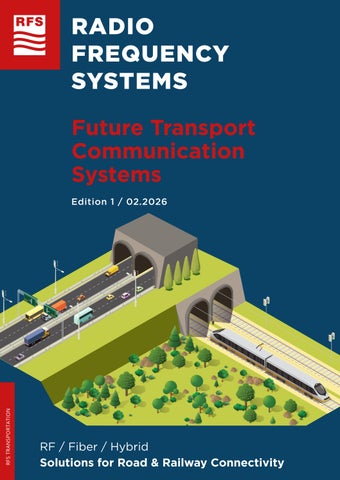
RFS - Future Transport Communication Systems

Page 1


FUTURE TRANSPORT CONNECTIVITY INTRODUCTION

Transport networks are becoming more connected, more data-driven, and more demanding. Expectations for communications continue to rise as rail and road infrastructure needs to support growing mission-critical and commercial applications.

The Challenge

This challenge is compounded as operators navigate a shift in communication standards. Rail networks are transitioning from GSM-R to FRMCS, while 5G-based applications are being deployed more widely across transport environments, and 6G developments are on the horizon.

The result is that transport operators need a communications backbone that can support current operational needs while providing a clear path to future standards. At the same time, they must navigate the physical realities of rail and road deployments, including difficult underground and tunnel environments, performance in harsh conditions, and achieving maximum capacity and performance over long distances.

The Solution

RFS supports these requirements with optical fiber and radiating cable solutions engineered for exceptional performance, network evolution, and long service life across rail and road deployments.

The Full RFS Portfolio

In addition to a full portfolio of feeder cables, jumpers, and accessories to support complete solutions for transport environments, RFS offers flagship radiating cables, optical fiber, and sensing solutions designed specifically for these deployments.

Radiating Cable Solutions

RADIAFLEX, RFS’s leading radiating cable solution, is designed to meet the demanding requirements of missioncritical and commercial applications in tunnels and other enclosed environments.

• Wireless technology agnostic

• Supports multiple frequency bands and wireless technologies simultaneously

• Optimised for low coupling and longitudinal loss to improve communication quality

• Supports wireless services up to 7 GHz, enabling future-ready systems

• Enables high-performance MIMO configurations for increased in-tunnel data speeds

• Meets major international fire and flameretardance standards, including top CPR ratings

Optical Fiber & Sensing Solutions

RFS optical fiber forms a communication backbone while optical sensing solutions provide infrastructure insights that support predictive maintenance, for long-service life, high-performance deployments.

• High-capacity connectivity for mission-critical and commercial applications

• Low attenuation for long-distance performance and network efficiency

• Robust cable designs to withstand harsh operating conditions

• Options for hybrid fiber and power to simplify infrastructure

• Sensing solutions monitoring temperature and stress-strain for complete visibility

FUTURE TRANSPORT CONNECTIVITY INTRODUCTION

A New Standard for Rail

As rail networks need to deliver constant commercial and critical communications coverage, while moving towards future digital standards, they require:

• Continuous coverage for open track and in-tunnels environments

• Flexible support for multiple frequency bands and evolving rail standards

• Low-loss, long-distance performance

• Robust solutions suited to harsh rail operating environments

Accelerating Smart Road Adoption

Road infrastructure is becoming increasingly connected, it must support a growing number of business- and mission-critical applications, needing :

• High-capacity communications infrastructure along highways

• Reliable connectivity over long distances

• Consistent communications in tunnels and enclosed road sections

• Products designed for long-term, durable performance

In this brochure, we highlight some of the key RFS products and solutions supporting rail and road deployments worldwide.

EVERYTHING

FRMCS IS MISSIONCRITICAL

The rail industry is entering a period of transition, with the FRMCS (Future Railway Mobile Communication System) framework set to become the next industry standard. FRMCS will facilitate the next-generation communication within the industry, using 5G technology for key applications.

IoT integration, automated train control, and voice communication for mission-critical applications are among the anticipated applications under the FRMCS standard, and all require the resilience of mission-critical infrastructure. Rail operators moving towards the new standard need not only to future-proof their infrastructure, but ensure it is fully capable of supporting every application with mission-critical resilience, building in connectivity safety nets to for uninterrupted communications.

Ensuring Mission Critical Performance

When making infrastructure decisions, rail operators need to ensure:

• Support for mission-critical voice, data, and signalling applications

• In-built redundancy and proven resilience in harsh environments

Working with an Expert Partner

Part of ensuring a smooth, seamless transition is working with the right partner who has:

• Proven experience with transport mission-critical communication systems

• Track record in managing communications standard transitions

• Commitment to efficient installation and long-life solutions

TRANSPORTATION COMMUNICATION SOLUTIONS

As rail and road tunnel networks expand, reliable communication and monitoring systems are essential to ensure safety and continuous connectivity in confined environments.

The following shows how RFS integrates fire-resistant optical fiber, best-inclass radiating cable, and optical fiber sensing systems to support communication and monitoring across tunnel environments.

RADIATING CABLE AND INSTALLATION COMPONENTS

RFS provides radiating cables designed to eliminate blind spots in tunnel environments, alongside a full range of essential accessories for reliable system performance.

FLAME-RETARDANT OPTICAL CABLE AND OPTICAL ACCESSORIES

RFS offers a full range of high-quality flame-retardant optical cables for tunnel applications, meeting demand for fire resistance, rodent resistance, waterproofing, and chemical corrosion resistance.

OPTICAL FIBER SENSING SYSTEM

RFS offers optical fiber sensing solutions for temperature and condition monitoring, combining reliable sensing cables with software platforms and early-warning capabilities.

RAIL TRANSIT RADIATING

CABLES INTRODUCTION

Our solutions are not only designed for high performance across all FRMCS frequencies, but able to serve multiple applications anticipated with the new standard.

RFS offers different product families to allow for ideal cable selection depending on project specific conditions and constraints e.g. installation position

Description

Broadband RADIAFLEX radiating cables for dual-band FRMCS in 900 and 1900MHz

Low-band optimized RADIAFLEX radiating cables for optimized system performance in 900MHz

Combining RFS’ vertically polarized RAY and horizontally polarized RLK product families take advantage of unique cross-polarization effects to optimize MIMO conditions in tunnels.

A PROVEN TRACK RECORD

Narrow-band radiating cable solution ideally suited to signalling applications

RADIAFLEX® RE60 radiating waveguide is the leading-edge solution for in-tunnel wireless applications in the 5-6 GHz band

We have decades of experience designing and deploying long-life solutions to deliver mission-critical and commercial connectivity throughout transport systems worldwide.

RFS provided its unique, dual-cable multiple-input multipleoutput (MIMO) solution for one of the world’s first MIMO deployments. The innovative RFS solution uses 42 km (26 miles) of dual-polarized radiating cables and antennas to enable communications in new tunnel sections and 10 new stations along the rail line.

The Follobanen project features a unique 4x4 MIMO solution deployed in Norway, which set the world record for in-tunnel download speeds in 2018. RFS’ vertically polarized RAY and horizontally polarized RLK product families take advantage of unique cross-polarization effects to optimize MIMO conditions in tunnels.

Product Profile

Maximum Operating Frequency

Dominant polarization within the designated frequency bands

Application

5G FRMCS / MIMO RADIATING CABLES

MHz

Horizontal

Characteristics and Features

MODEL NAME

Product Profile

Maximum Operating Frequency

Vertical

GSM-R, LTE, 5G for all types of metro, rail and road tunnels

• MIMO compatibility for greater data throughput and capacity

• Compatible with single, dual, and multiple MIMO configurations

• Radiating cable engineered for optimal performance

• Designed without stop bands across the full spectrum

• Ultra-broadband RF bandwidth supporting 2G, 3G, 4G, and 5G commercial wireless and mission-critical communication bands

• Ensures fully futureproofed confined coverage installations

• Jacketing option with best-in-class CPR classification acc. to EN 50575 available

MHz

Dominant polarization within the designated frequency bands Vertical

Application

Characteristics and Features

GSM-R, LTE, 5G for all types of metro, rail and road tunnels

• Vertical polarization optimized for use with vertically polarized train antennas

• Supports combined VHF, TETRA, and GSM-R systems

• Jacketing option with best-in-class CPR classification acc. to EN 50575 available

Product Profile Maximum Operating Frequency

Dominant polarization within the designated frequency bands

Application

5G FRMCS / MIMO RADIATING CABLES

Horizontal

Characteristics and Features

Horizontal

GSM-R, LTE, 5G for all types of metro, rail and road tunnels

• Optimized design for combined mission critical and commercial wireless applications

• Ultra-broadband RF bandwidth supporting 2G, 3G, 4G, and 5G

• Radiating cable engineered for optimal performance

• Designed without stop bands across the full spectrum

• Ensures fully futureproofed confined coverage installations

• Jacketing option with best-in-class CPR classification acc. to EN 50575 available

Dominant polarization within the designated frequency bands

Application

Horizontal

All types of metro, rail and road tunnels

Vertical

Characteristics and Features

• Radiating cable engineered for optimal performance

• Designed without stop bands across the full spectrum

• RF bandwidth supporting 2400 MHz (Wi-Fi)

• Ensures fully futureproofed confined coverage installations

• Jacketing option with best-in-class CPR classification acc. to EN 50575 available

MODEL

MODEL NAME RE60

Product Profile

Maximum Operating Frequency

Dominant Polarization in dedicated bands of operation

Application

SIGNALING RADIATING CABLES

Horizontal

All tunnel and indoor environments

• Optimized RF conditions enabling low overall TCO in the 6000 MHz spectrum

• Superior system performance supports longer amplifier spacing

Characteristics and Features

Product Profile

Operating Frequency

Single Bending Radius

Application

• Low system loss, with performance at 6000 MHz comparable to radiating cables operating in the 2400 MHz ISM band

• Jacketing option with best-in-class CPR classification acc. to EN 50575 available

Characteristics and Features

All types of metro, rail and road tunnels

• Ultra-low attenuation for efficient signal transfer, particularly at high frequencies

• Low VSWR for optimal system performance

• Temperature-stabilized dielectric materials and optimized thermal characteristics enable reliable long-term operation at high transmit power levels

• Jacketing option with best-in-class CPR classification acc. to EN 50575 available

TRANSPORTATION

OPTICAL CABLE INTRODUCTION

OPTICAL CABLE SOLUTIONS FOR TUNNEL APPLICATIONS

RFS optical cable solutions are designed to support communication, monitoring, and safety systems across rail and road tunnel environments.

These solutions are suitable for applications including transmission networks, tunnel communication systems, distributed radio networks, fire detection, and optical sensing installations, where reliable performance is required in demanding operating conditions.

Note:

RFS can provide tailored rail transit optical cable solutions to meet project-specific installation, performance, and physical requirements, for example, fire resistance and rodent protection.

CHARACTERISTICS AND FEATURES

RFS has a full range of optical cables engineered to meet key customer requirements for in-tunnel environments:

Easy Installation and Maintenance

Designed with installation in mind, cables are manufactured with controlled optical fiber excess length to maintain tensile strength, ensure optimal performance, and simplify installation and long-term maintenance.

Resilient Performance

Meeting multiple global fire-resistance standards and using both physical and chemical methods to resist rodent damage and chemical corrosion, the cables are built to withstand the realities of real-world rail deployments.

Robust Construction

Reinforced design elements and durable construction support installation in harsh and mechanically demanding environments, including duct, tunnel, and trackside applications.

Waterproof Protection

Gel-filled loose tubes, moisture barriers, and water-blocking materials work together to prevent water ingress for durability in harsh environments.

TRANSPORTATION OPTICAL CABLE RANGE

RFS offers an extensive range optical fiber and sensing solutions to suit the broadest possible range of customer requirements.

This table provides a high-level, non-exhaustive overview of the applications and environments suited to each of the nine cable types highlighted in this brochure.

GYF(Z)S53+33

RFS Fiber Cables are classified according to various ITU-T (International Telecommunication Union) or IEC (International Electrotechnical Commission) Typical configuration for the cables presented above is singlemode: B6a1 (ITU-T), B1.3 (IEC)

Enhanced Environmental Protection Features for Fiber Optic Cables

RFS fiber optic cables are designed for long-term performance in challenging deployment environments. Optimized construction features such as metallic armour, non-metallic reinforcements and specialised sheath compounds, allow RFS to provide targeted protection against rodents, termites, birds and fire hazards.

The table below summarizes the available protection technologies, either as standard designs or custom solutions.

MULTI-CORE BRANCH OPTICAL CABLE I

Model Number: GJBFJH

Suitable for indoor installations that require multiple fiber terminations from a single cable, GJBFJH is designed for indoor backbone, equipment interconnection, and patching applications.

This cable consists of multiple simplex optical strands made from 900 μm tight-buffered fiber with aramid yarn reinforcement. The strands are arranged around a non-metallic central strength member and protected by an LSZH outer sheath. Alternative sheath materials are available upon request.

Features

• High tensile strength due to stranded structure and non-metallic central strength member

• Fire-resistant option according to CPR EN 50575

• Anti-corrosion, water blocking, flame-retardant, and environmentally friendly

• All-dielectric design, suitable for lightning-prone areas

Technical Details

Note: 1. X refers to fiber type. 2. Technical characteristics may be customized.

Delivery Length

• Standard length: 2,000m; other lengths are also available

UNI-TUBE NON-METALLIC ACCESS OPTICAL CABLE

Model Number: GYGXZY

GYGXZY is designed for indoor and outdoor access network deployments requiring a compact, fully dielectric cable.

Optical fibers are housed in a loose tube made from high-modulus plastic and filled with a filling compound. The tube is wrapped with glass yarn strength members and protected by an LSZH outer sheath.

Features

• Good mechanical and temperature performance

• All-dielectric design suitable for lightning-prone areas

• Compact and lightweight construction for easy installation

• Glass yarn reinforcement provides tensile strength and added rodent resistance

Technical Details

Note: 1. X refers to fiber type. 2. Technical characteristics may be customized.

Storage Information

• Transport/storage temperature: -30°C - +70°C

Delivery Length

• Standard length: 2,000m; other lengths are also available

UNI-TUBE ARMOURED ACCESS OPTICAL CABLE

Model Number: GYGX(Z)S

Suitable for indoor and outdoor access network deployments, GYGX(Z)S is designed for projects where enhanced crush resistance and moisture protection are required.

Optical fibers (250 μm) are housed in a loose tube made from high-modulus plastic and filled with a water-resistant compound. The tube is reinforced with glass yarn, wrapped with corrugated steel tape (PSP), and protected by an LSZH outer sheath.

Features

• Good mechanical and temperature performance

• High-strength, hydrolysis-resistant loose tube

• Crush-resistant design with installation flexibility

• Glass yarn strength members provide tensile reinforcement

• PSP armour enhances moisture protection

• Complies with YD/TI 770, ICEA-596, GR-409, IEC 60794, IEC 332-1 or IEC 332-3C.

Technical Details

Note: 1. X refers to fiber type. 2. Technical characteristics may be customized.

Storage Information

Delivery Length

• Transport/storage temperature: -30°C - +70°C • Standard length: 2,000m; other lengths are also available

ALL DIELECTRIC FIRE-RESISTANCE STRANDED LOOSE TUBE OPTICAL CABLE

Model Numbers: GYFZY / GYG(Z)Y

Designed for access and metropolitan area network deployments. GYFZ/GYG(Z)Y are suitable for indoor and outdoor installations that require dielectric fiber with enhanced fire protection.

Optical fibers are housed in loose tubes made from high-modulus plastic and filled with a filling compound. The tubes are stranded around a non-metallic central strength member to form the cable core. This is wrapped with fire-resistant tape and glass fiber yarn, then protected by an LSZH outer sheath.

Features

• Precise engineering for superior mechanical and temperature performance

• High-strength, hydrolysis-resistant loose tube material

• Compact and lightweight design for ease of installation

• Fire-resistant layer combined with LSZH sheath for enhanced fire performance

• All-dielectric construction suitable for lightning prone areas

• Complies with IEC60331(no cooling), IEC60754-1&2, IEC61034 and IEC60332-3-24

Technical Details

Note: 1. X refers to fiber type. 2. Technical characteristics may be customized.

Storage Information Delivery Length

Transport/storage

STEEL TAPE ARMOURED FIRE-RESISTANCE STRANDED LOOSE TUBE OPTICAL CABLE

Model Number: GYFZS

Designed for metropolitan area network deployments requiring fire resistance and additional structural protection. GYFZS is suitable for indoor and outdoor installations where enhanced durability is required.

Optical fibers are housed in loose tubes made from high-modulus plastic and filled with a filling compound. The tubes are stranded around a non-metallic central strength member to form the cable core. The core is wrapped with fire-resistant tape and corrugated steel tape, then protected by an LSZH outer sheath.

Features

• Precise manufacturing process to ensure mechanical and temperature performance

• High-strength hydrolysis-resistant loose tube construction

• Fire-resistant layer combined with LSZH sheath for enhanced fire performance

• Corrugated steel tape armour ensures flexibility alongside crush protection

• Complies with IEC60331(no cooling), IEC60754-1&2, IEC61034 and IEC60332-3-24

Technical Details

Note: 1. X refers to fiber type. 2. Technical

Storage Information

may be customized.

• Transport/storage temperature: -40°C - +70°C

Delivery Length

• Standard length: 2,000m; other lengths are also available

SEMI-DRY FIRE-RESISTANCE DOUBLE-ARMORED OPTICAL CABLE

Model Number: GYFZS53

Designed for metropolitan area network deployments. GYFZS53 is suitable for indoor and outdoor installations requiring high fire resistance and maximum mechanical protection.

Optical fibers are housed in loose tubes made from high-modulus plastic and filled with a compound. The tubes are stranded around a non-metallic central strength member, wrapped with fire-resistant tape and corrugated steel tape. They are covered with an LSZH inner sheath, reinforced with steel wire armour, and protected by an LSZH outer sheath.

Features

• Precise manufacturing for stable mechanical and temperature performance

• High-strength hydrolysis-resistant loose tube material

• Fire-resistant option according to CPR EN 50575

• Excellent crush resistance

• Complies with IEC6033l(no cooling), IEC60754-1&2, IEC61034 and IEC60332-2-2 4

Technical Details

Note: 1. X refers to fiber type. 2. Technical characteristics may be customized.

Storage Information

Delivery Length

NON-METALLIC ANTI-RODENT OPTICAL CABLE

Suitable for outdoor metropolitan area networks and trunk deployments, the GYF(Z)Y83 uses physical and chemical anti-rodent methods, making it suitable for projects where both rodent resistance and non-metallic construction are required.

Optical fibers are housed in loose tubes made from high-modulus plastic and filled with a filling compound. The tubes are stranded around a non-metallic central strength member. This cable core is filled with filling compound and an inner PE sheath. It is then armored with flat or round FRP and covered with a PE outer sheath.

Features

• Precise manufacturing for superior mechanical and temperature performances

• High-strength loose tubes with good hydrolysis-resistance

• Filling compound providing protection for fibers

• Flat or round FRP armor for physical anti-rodent protection

• Suitable for aerial and duct installations with anti-rodent and anti-lightning requirements

Technical Details

Note: 1. X refers to fiber type. 2. Technical characteristics may be customized.

Storage Information Delivery Length Model Number:

• Transport/storage temperature: -40°C - +70°C • Standard length: 2,000m; other lengths are also available

MULTI-ARMORED FIRE-RESISTANCE OPTICAL CABLE

Designed for metropolitan access network and trunk network deployments requiring fire resistance and enhanced mechanical protection. GYFZS53+33 is suitable for heavy-duty installations where high tensile strength and crush resistance are needed.

Single-mode or multimode fibers are housed in loose tubes made from high-modulus plastic. The tubes are stranded around a central strength member to form the cable core, which is filled with a compound and surrounded by an inner PE sheath. This is wrapped in fire-resistant tape, a layer of corrugated steel tape, and a LSZH middle sheath. This is then wrapped with steel wire and a PE outer sheath.

Features

• Precise manufacturing for superior mechanical and temperature performances

• Strong hydrolysis-resistant loose tubes

• Fire-resistant layer combined with LSZH sheaths for enhanced fire performance

• Excellent crush resistance

• Complies with IEC6033l{no cooling), IEC60754-1&2, IEC61034 and IEC60332-2-24

Technical Details

Note: 1. X refers to fiber type. 2. Technical characteristics may be customized.

Storage Information

Model Number: GYFZS53+33 • Transport/storage

Delivery Length

ALL DIELECTRIC

SELF-SUPPORTING AERIAL OPTICAL CABLE

Model Number: ADSS

Ideal for outdoor aerial network deployments, ADSS is suitable for overhead installation along railway tracks, supporting communication between signaling equipment and control centers.

Optical fibers are housed in loose tubes made from high-modulus plastic and filled with a water-blocking compound. The tubes and fillers are stranded around a central strength member to form the cable core. The core is wrapped with water-blocking tape and reinforced with aramid yarn, then protected by a PE (or AT) outer sheath.

Features

• Precise manufacturing for superior mechanical and temperature performances

• All-dry design improving efficiency of construction and splicing

• Compact, lightweight and soft for self-supporting aerial installation

• Aramid yarns provide good tensile performance

Technical Details

Note: 1. X refers to fiber type. 2. Technical characteristics may be customized.

Storage Information

Delivery Length

• Transport/storage temperature: -40°C - +70°C • Standard length: 2,000m; other lengths are also available

OPTICAL DISTRIBUTION FRAMES

Model Number: GPX035-R

Optical Distribution Frames (ODF) are used for optical fiber cable connection and management. Within the rail sector, they provide a connection point for backbone cables, signaling systems, and transmission equipment, enabling efficient data routing and fiber management.

Features

• Standard 19″ rack-mounted design with front access

• Modular fiber management structure for flexible configuration

• Compatible with SC, FC, LC and other adapter types

• Top or bottom cable entry with integrated fixing and protection

• Suitable for ribbon and non-ribbon optical fiber cables

• Large storage capacity for pigtails and patch cords

• Controlled fiber routing, maintaining a minimum bending radius of 37.5 mm

• Complies with YD/T788-2011, GB/T2423-2008, GB/13873-1998, GB/T9286-1998 and IEC 61300-3-15, -16, -17, -23

Technical Details

GPX035-R-20

GPX035-R-22

GPX035-R-26

Performance

• Operating temperature: -40°C to +60°C

• Ambient humidity: ≤95% (+40°C)

• Atmospheric pressure: 70 kPa to106 kPa

• Insulation resistance: The insulation resistance between grounding device and cabinet metal components is not less than 2 x 10⁴ m Ω / 500 V (DC)

Half open structure

• Withstand Voltage: The withstand voltage between grounding device and cabinet metal components is not less than 3000V (DC)/1min

• Insertion loss: ≤0.3dB

• Return loss: PC type ≥45dB, UPC type ≥50dB, APC type ≥60dB

CROSS CONNECTING CABINET

Model Number:

GF-KJN-A Series

GF-KJN-A Series cabinets are terminal distribution devices used in FTTX systems. In rail communication networks, it supports fiber termination and distribution at user access points within stations, control rooms, and wayside installations.

The distribution box provides protection and management for optical fiber cables and is used for termination, cable branching, cross-connection, and optical splitting. It is typically installed at user access points within FTTX ODN networks. The product is available in indoor and outdoor versions depending on installation requirements, and in distribution or optical splitter configurations according to functional needs.

Features

• Double-layer stainless steel cabinet with sandwich structure for enhanced outdoor protection

• Three-point locking mechanism with built-in hinge for improved security

• Modular tray-type termination unit for convenient installation and future expansion

• Integrated cable entry and protection system suitable for ribbon and non-ribbon optical cables

• Compatible with SC, FC, LC, ST, and other adapter types

• Angled adapter arrangement to reduce laser exposure risk

• Complies with YD/T988-2007, GB/T2423-2008, GB/T3873-1998, GB/T9286-1998, and international standards, including IEC 60529, IEC 62134-1, and UL94

Technical Details

Traditional Cross Connecting Cabinet

cabinet, Wall mounted, with base GXF035-TC-144

GXF035-TC-288

GXF035-TC-576

Performance

• Operating temperature: -40°C to +60°C

• Ambient humidity: ≤95% (+40°C)

• Atmospheric pressure: 70 kPa to 106 kPa

• Insulation resistance: The insulation resistance between grounding device and cabinet metal components is not less than 2 x 10⁴ m Ω / 500V (DC)

SMC cabinet, with base

• Withstand Voltage: The withstand voltage between grounding device and cabinet metal components is not less than 3000V (DC)/1min

• Insertion loss: ≤0.3dB

• Return loss: PC type ≥45dB, UPC type ≥50dB, APC type ≥60dB

CROSS CONNECTING CABINET

Model Number:

GXF035-TS Series

This Optical Cable Splice Box is used at the junction between trunk optical cables and distribution cables within optical transmission networks. In rail communication systems, it supports structured fiber splicing and distribution at trackside cabinets, stations, and wayside installations.

The splice box secures and protects optical cables while enabling fiber splicing, termination, distribution, and routing. It protects fiber splicing points, supports link allocation, safeguards internal components, and allows installation of value-added modules.

Features

• High-quality sheet metal construction with electrostatic surface treatment for strong mechanical performance and durability

• Suitable for indoor, wall-mounted, pole-mounted, and aerial installations

• Supports cassette-type splitters (1:8, 1:16, 1:32)

• Built-in stacked splice trays that are removable for convenient installation and maintenance

• Compatible with FC, SC, and LC adapters; modular design for easy fixation and servicing

• Controlled fiber routing with a minimum bending radius greater than 30 mm

• Clear labeling for fiber connection and distribution

• Door opening angle greater than 120° for convenient operation and maintenance

• Redundant fiber storage and protection

• Complies with YD/T2150-2010, GB/T2423-2008, GB/T3873-1998, GB/T9286-1998 and IEC 61300-315, -16, -17, -23

Technical Details

Performance

• Operating temperature: -40°C to +60°C

• Ambient humidity: ≤95% (+40°C)

• Atmospheric pressure: 70 kPa to 106 kPa

• Insulation resistance: The insulation resistance between grounding device and cabinet metal components is not less than 2 x 10⁴ m Ω / 500V (DC)

• Withstand Voltage: The withstand voltage between grounding device and cabinet metal components is not less than 3000V (DC)/1min

• Insertion loss: ≤0.3dB

• Return loss: PC type ≥45dB, UPC type ≥50dB, APC type ≥60dB

PATCH PANELS

Patch panels provide structured fiber termination and cross-connection within rail communication networks, enabling organized management of backbone and distribution links in stations, control rooms, and equipment cabinets.

PATCH CORDS

RFS optical fibre jumpers are available in both standard and customized configurations, including FC, SC, LC, ST, MU, MT, and E2000 connector types. They support single-mode and multimode applications in simplex, duplex, and micro-duplex formats. With low insertion loss and high return loss performance, they provide reliable and stable connectivity for patching and interconnection within rail communication networks.

Technical Details

Features

• Low insertion loss and high return loss.

• Three end-surface polishing methods: PC, UPC, APC.

• Mechanical durability: 500 times of use.

• Cable materials compliant with OFNR and OFNP flame retardant ratings.

Patch Panel Type
Plug and Play Splicing Connectors
Duplex

SAFETY IS KEY CPR

ROBUST JACKET CONSTRUCTION ENABLES THE HIGHEST CPR CLASSIFICATIONS

RFS CPR-compliant coax, fiber, power and radiating cables feature a specially developed jacket that allows them to achieve best-in-class ratings for burning droplets (d0), low smoke emission (s1) and corrosivity (a1), the most important criteria for fire safety in cables that are installed indoors and underground.

All RFS cables are tested and certified by an external notified body according to EN 50575. In addition, RFS’ manufacturing facility in Hannover, Germany, has been audited and meets the highest system 1+ requirements for type approvals, regular production audits, as well as regular sampling and testing of products by the notified body.

FIND CPR-COMPLIANT CABLES FOR ANY APPLICATION

All RFS CPR-compliant cables are also designated as low-smoke, zero-halogen (LSZH) and meet International Electrotechnical Commission (IEC) standards for flame spread, smoke acidity and low smoke emission. They are compatible with existing RFS connectors, factory-assembled jumpers, grounding kits and clamps, as well as trimming and preparation tools.

RFS HANNOVER BURN CHAMBER

The burn chamber, installed in 2024, extends RFS's testing capabilities and operates in accordance with the international standard EN50399 which refers to the important CPR (Construction Product Regulation) directive of the European Union. Combined with existing fire testing facilities, it gives RFS one of the most comprehensive in-house fire resistance testing capabilities of any organization in the cable space. This will allow RFS to continue offering solutions that meet fire safety standards worldwide.

EUROPEAN CLASS CODE LABELING EXAMPLE

This table explains the CPR class codes using the rating for our CELLFLEX cables as an example: B2ca s1 d0 a1.

RFS BURN CHAMBER

CPR-COMPLIANT CABLES ARE IDEAL FOR INDOOR APPLICATIONS

A BROAD PORTFOLIO OF CPR-COMPLIANT CABLES FOR INDOOR APPLICATIONS

Since July 1, 2017, all communications cables installed in buildings in the European Union (EU) must meet the fire performance requirements in European standard EN 50575 and include the CE marking to comply with EU Construction Products Regulation (CPR) No. 305/2011.

RFS was the first cable vendor to offer RF communications cables with the highest CPR classifications for fire safety. Today, we offer a wide range of CELLFLEX® coaxial cables , RADIAFLEX® radiating cables and HYBRIFLEX® Fiber and power cables that comply with European CPR No. 305/2017. This directive requires that coax and radiating cables meet the fire performance standards in the EN 50575 standard and be classified according to the EN 13501-6 standard.

RFS cables are classified according to the CPR test standards and criteria listed below.

The CPR burning droplets classification is particularly important because burning particles can ignite other cables or infrastructure. Only class d0 cables create no burning particles to deliver the highest levels of fire protection in buildings and tunnels.

RADIO FREQUENCY SYSTEMS

Turn static files into dynamic content formats.

Create a flipbook