Scan the QR code to view our website.
![]()


Scan the QR code to view our website.
A Braman Motorcars Dealership

The best. The most. The first.
Teeth of the Dog, Where the Legend Rests, the Legacy Lives On.

Teeth of the Dog, Pete Dye’s masterpiece and the #1 course in the Caribbean, returns more spectacular than ever. Its iconic oceanfront holes, restored fairways and greens, and an elevated playing experience usher in a new era for this golf legend.
At Casa de Campo® Resort & Villas, legendary golf meets unmatched luxury — with stunning accommodations, world-class dining, a brand-new state-of-the-art spa, marina, equestrian center, shooting center, and exclusive white-sand beaches with crystal-clear waters.
Discover more at casadecampo.com.do • res1@ccampo.com.do • 877-724-9187


Nikki Field & Benjamin Pofcher Associate Brokers

The Sea is Our Clubhouse
Considered one of the most unique Clubs in North America, Barton & Gray Mariners Club outfits the best experiences on the water, operating a fleet of captained Daychasers, Hinckleys, Sailing Catamaran & Boston Whalers from Downeast Maine to the West Indies. All captained, all provisioned and all at your beck and call, Members enjoy a lifetime of yachting with unlimited access to every yacht in every harbor.

bartonandgray.com | (617) 728-3555


EDITOR-IN-CHIEF
DAVID PATRICK C O LUMBIA
EDITORIAL DIRECTOR
ELIZABETH MEIGHER
CREATIVE DIRECTOR
TYKISCHA DELGADO
MANAGING EDITOR
BROOKE KELLY MURRAY
DESIGN EDITOR
JAYNE CHASE
CHIEF TECHNOLOGY OFFICER
ROBERT BENDER
PHOTOGRAPHER-AT-LARGE
JULIE SKARRATT
SOCIETY EDITOR
HI LARY GEARY
CONTRIBUTING WRITERS
GIGI BENSON
JANE CHURCHILL
DOMINICK DUNN (RIP)
TONY HALL
ROBERT JANJIGIAN
RICHARD JOHNSON
KAREN KLOPP
JAMES MACGUIRE
DUNCAN MCLAREN
HAVEN PELL
CHUCK PFEIFER
JANIE PIERREPONT
TAKI THEODORACOPULOS
CONTRIBUTING PHOTOGRAPHERS
HARRY BENSON
CAPEHART PHOTOGRAPHY
BILLY FARRELL
MARY HILLIARD
CRISTINA MACAYA
CUTTY MCGILL
PATRICK MCMULLAN
NICK MELE
ANNIE WATT
SLIM AARONS (RIP)
PUBLISHER AND C.E.O.
S. CHRISTOPHER MEIGHER III
ASSISTANT TO THE C.E.O. KATHLEEN SHERIDAN
ACCOUNTING MANAGER LUWAY LU
MARKETING SERVICES
ROXANNE UNRATH ext. 106
DIRECTOR OF NATIONAL SALES JODY REISS 917.747.6431
PALM BEACH & MIAMI
LINDA LANE SOPER 612.308.4159
CHICAGO
TIMOTHY DERR 847.615.1921
HONG KONG BINA GUPTA 852.2868.1555
MILAN
EMILIO ZERBONI 011.39.031.267.797
BOARD OF ADVISORS
CRISTINA CONDON
JOHN CREGAN
JED H. GARFIELD
KIRK HENCKELS
DANA KOCH
PAM LIEBMAN
LIZA PULITZER
WILLIAM LIE ZECKENDORF
© QUEST MEDIA, LLC 2026. All rights reserved. Vol. 40, No 05.
Q uest—New York From The Inside is published monthly, 12 times a year. Yearly subscription rate: $96.00. Quest, 420 Madison Avenue, 8th Floor, New York, NY 10017. 646.840.3404 fax 646.840.3408. Postmaster: Send address changes to:
Q uest—New York From The Inside, 420 Madison Avenue, 8th Floor, New York, NY 10017.
SUBSCRIPTION INQUIRIES


David Patrick Columbia; Swifty’s List December 2001; Bark of the Town Minnie the dachshund in E.B. White’s office; Quest’s Columnist Taki Theodoracopulos; Bill Cunningham; Dominick Dunne; Quest’s Contributing Photographer Harry Benson.


IT SEEMS self-aggrandizing to tout a 40th anniversary. I mean, it’s barely the beginning of middle age, with a modicum of real world experience and perspective. But, hold on - if you’re still thriving as an independent journal in the magazine biz, reaching f o r t y years of continuous publishing is a bona fide milestone, much more akin to dog years, which would make Quest, well .. 280 YEARS OLD.
“Woof-Woof” says this canine loving pub; let’s give our furry and sociable companion a well deserved bone! And like a spaniel on a five month point, our stalwart staff has spent many long, but highly amusing evenings picking through forty years of richly bound back issues - a withering task that’s been revealing ... touching ... often sobering ... and mostly hilarious (it’s the fluctuating hairdoos that make me “lol”). So buckle-up, you kind and supportive buttercups: a rollicking romp down Memory Lane awaits you in the pages ahead.
Our anniversary’s signature centerpiece is a deep dive into the personalities and institutions that have defined Quest over these past four decades, as told by the scribes, venerated columnists and scallywag reporters who know them well. Current bylines such as Taki, DPC, Audax, Hilary and Sir Harry are reunited with such past laureates as Nick Dunne, David Halberstam, Geordie Greig, Liz Smith and Slim Aarons, to acknowledge but a few. The enticing fabric of the printed word has bound this tribe together for forty (FOUR-0!) years, shaping the social history of not just New York, New York (a city so big they had to name it twice!) but also penetrating those like-minded and formerly “seasonal” communities that blossomed into substantial and stylish year-round residencies - such as Charleston, Newport, Nashville, Millbrook, Naples and of course, Palm Beach. Quest has embraced and adopted these still nascent audiences; indeed, their futures will become our lifeline. But it’s New York that’s always been the bedrock of Quest’s mission; as that American bard of pristine letters, E.B. White, so simply understates it: “New York is the concentrate of art and commerce ... sport and religion ... entertainment and finance. It carries on its lapel the odor of the long past, so that no matter where you sit ... you feel the vibrations of great times and tall deeds”. Amen!
It’s also been requested by Quest’s less “bold faced”, but hugely talented staff to thank YOU, our readers, for your heartening emails, texts and generous messages. It’s your encouragement and thoughtful support that nurtures our lifework, and for which we optimistically feel a stable and more sustainable future. I’m often asked about the so-called demise of magazines, and indeed printed


journalism itself. The answer isn’t a long- winded diatribe about the magnitude of portable devices, digital choices and the ubiquitous streaming services. In truth, Print never died; we just forget why it mattered. Print is the cultural record that will outlast all of us; it engenders loyalty and curiosity, and is far more trusted. As a bright and insightful editor, Megan Wray Schertler, has observed: “Print’s permanence gives weight to lives that are otherwise overlooked”. She’s nailed it! Too many Americans are living in an almost anaesthetized bubbledesperate to feel a “belonging”, or at least something real. At Quest, we write, draw, photograph and compose for your entertainment and enlightenment, and we will never apologize for being a slower media experience. Schertler adds that scrolling makes us anxious, but that print gives us a calm sense of truth. As our digital tolerance is increasingly over stretched, and screen fatigue becomes more corrosive, Quest will strive to be ascendant, capturing in print the nuances of our expanding communities and audiences, while maintaining an authentic social archive for future generations of readers and their families. I truly hope we can count on your continued involvement; our collective journey is just beginning! u


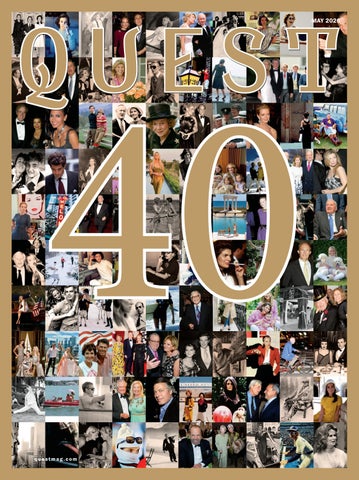
A collection of images by some of our favorite photographers: Harry Benson, Patrick McMullan, Billy Farrell Agency (BFA), Rex Features, Getty Images, CAPEHART, Alamy, Slim Aarons, Julie Skarratt, Ron Galella, Cristina Macaya, and Mary Hilliard.


LOOKING BACK on history of Quest 40 years on. What struck me most, perusing Quest issues of the past 40 years, was how much our culture and social life in New York has changed since Quest first debuted in 1987. “Nouvelle Society,” a term coined by Mr. Fairchild’s WWD, of the movers and the shakers, was reigning in New York at that moment. Glamour girls like Blaine Trump, Carolyne Roehm, Gayfryd Stein-
berg, Louise Grunwald, Duane Hampton, Anne Bass, Nan Kempner, Annette de la Renta, to name only a few, were the news in fashion and society. Theirs was the image reflected in the era.
Heather Cohane, a plucky Englishwoman who had spent time in this country because of her husbands, saw an opportu-

nity at the time. She had decided to start a magazine after her husband Jack Cohane had died, leaving her with three children still of school age. Naturally entrepreneurial and imaginative, she got the idea for a local publication focusing on advertising high-end residential real estate from Cavalcade, a maga-
QUEST, NOVEMBER 1987
zine in London
The early issues of Quest were basically a semi-glossy focusing on residential real estate advertising for the Upper East Side. The editorial content was about the lives and the histories of families associated with the area, along with three or four pages of black and white party pictures capturing some of the leading players.
I first heard of it back then when I was living in Los Ange-


e Greenleaf & Crosby Diamond Collection


les. Larry Ashmead, then Executive Editor of Harper & Row (now HarperCollins) sent me a copy every month, knowing I’d find the content interesting. Reading it, in passing I thought to myself: “I could do that.” It never occurred to me at the time that I’d be so closely associated with it for more than 20 years of the next 30 years.
Quest soon became a popular little magazine, with the slightly eccentric editorial feel, immortalizing, as it were, Society families and their histories, including occasionally Who Made the Dough. Then eight years later, in 1995, a young imaginative magazine publisher, Chris Meigher, of the TIME-LIFE empire of Henry Luce, came along and


made an offer to buy the magazine. He had a better idea. The deal was sealed, and Quest was taken to the best tailor, hairdresser, and jeweler in town, revamped with an identity of glamorous class. No longer a magazine for the nabe, but now for the world.
The early Quests, (’80s through mid-’90s) reflected a clubby sensibility, ironically a kind of innocence that has evaporated today, a social atmosphere that is no longer in style. There were lots of private cocktail parties, given for no


reason other than to entertain friends, as well as occasional charity galas. Heather would be there with her camera, casually snap a few of the guests and put it on a page in the magazine. She didn’t know it at the time but she was documenting a time and an era in New York—which Quest has been doing ever since.
People often ask: Is there a “Society” today? If comparing our socializing habits and rules to a century, or even a half-century ago, the answer is “No.” Society as it functioned back then was an opportunity for women
to gather and exercise power.
Caroline Astor, the lady who ruled Society in New York in the last quarter of the 19th century, had power, and all power is political. It may have seemed like frippery to those outside her realm, but she exercised it in a way that gave her influence in the community.
Her strong card at the outset was her birthright—she was a member of a prominent (and wealthy) New York family that traced its roots back to the early Dutch settlers. She also had a very rich husband to enable her pursuits. Eventually competition outlived her and gained their own power. By then her world had changed anyway. The new leaders were on the threshold of

a world of speed and communication. Interestingly, one of the succeeding generation was Alva Vanderbilt Belmont who by age 50 turned her attentions from grand masked balls in her Fifth Avenue mansion to women’s rights: she joined the the Suffragette movement.
Today’s women, no matter their place on the social ladder, are liberated enough to seek power over their own lives and the lives of others in professional and business life. Although “connections” are always desirable, the social life of today’s woman is imbued with greater purpose. The late Evelyn Lauder who created the Breast Cancer Research Foundation and raised hundreds of millions for the cause, set the course that many women now follow. Today the social life of prominent New Yorkers is dominated mainly by charity benefit dinners and other such events that raise hundreds
of millions for charitable causes. Pay as you go.
The appeal is great because some organization or institution is benefitting financially. As a result of the efforts of these (mainly) women, the charity event business in New York is a billion dollar industry with many sponsors both corporate and philanthropic.

This was accompanied during this same period (the last decade of the 20th century) with the arrival of the internet and the cell phone in our lives. That changed everything in many ways still unimaginable, and apparently forever.
In late ’92, I came to New York on an assignment and happened to meet Heather Cohane one night at a cocktail party at Chanel. Learning that we had a mutual friend in common, Glo-
ria Etting of Philadelphia, she asked if I’d like to write a profile of her. Soon I was writing a couple of features a month for Quest, and the following year Heather asked if I’d like to write a social column too. It was an idea that had fascinated me since I was a kid growing up in Massachusetts where my New York born-and-bred father got the two tabloids everyday—the Daily News and the Daily Mirror. In a very real way I was weaned on Walter Winchell and Ed Sullivan, Suzy, Dorothy Kilgallen, and any other columnist writing about life in the Big Town. It was that very early exposure to New York that drew me to the Big Town when I left college.
Before writing this issue’s Diary, I was looking through the Quests (there are nearly 500
issues) to jog my memory. Two things struck me: how vast this “small” world was and is, and yet how it has changed so dramatically in those three decades. Much of that change is natural. We get older every day, every year, and the dynamic of city life, so ongoing, so fast-moving, leaves little time to notice. When I began down this road in the early ’90s, New York was in flux.
The Baby Boomers had matured to middle age. The social structures for the achievers and the successful ones had changed.
The previous generation was the last to have known the old world where Society was documented in the Social Register and at certain social organizations—private clubs, country clubs, beach clubs.
The last hurrah of that world and way of life was a reconstruction of the sensibilities. Cleveland Amory had written a famous best-selling book in
THE CONSERVATORY GARDEN LUNCHEON IN CENTRAL PARK QUEST, JULY/AUGUST 1988


the late 1950s called Who Killed Society which marked the beginning of the end of that Age. In 1987, I had the pleasure of interviewing the man when he was in Los Angeles publicizing a new book The Cat Who Came for Christmas (which turned out to be the biggest selling book he ever wrote).
We met for lunch at the Polo Lounge in the Beverly Hills Hotel. I asked him the most frequently asked question by anyone who ever interviewed him: Who killed “Society”?
Being a child of a socially prominent Boston family, he first told me about a time when he was in prep school and was invited to spend part of his Christmas vacation with the family of his roommate from

New York. His mother, he recounted, did not like the idea of her son being “exposed” to “those New Yorkers” whom she, a proper Bostonian, regarded as déclassé. Nevertheless he was allowed to go and be “exposed” to it all.
He told me that story about Boston versus New York to preface his answer to my question. He then ticked off a list of several prominent people of that era in New York including the Cushing Sisters: Babe Paley, Minnie Astor, and Betsey Whitney. He said that unlike Boston or Philadelphia, these New Yorkers were in their “social positions” be-


cause they were publicity seekers. And society had become what he called—coining a new word—“publiciety.” The new word didn’t catch on but the idea took hold and in today’s media circus, remains.

The Cushing Sisters, Amory observed, had grown up in Boston where their father, the world famous brain surgeon Harvey Cushing, practiced. But, he added, the sisters could never have made it in Boston unless they married a Cabot or a Lodge, etc. In 1931, Betsey, the second oldest sister, married James Roosevelt, son of (at the time) Governor Franklin D. Roosevelt of New York. Two years later the gov-
ernor became the President of the United States. Betsey’s elder sister Mary (known as Minnie) subsequently met a Roosevelt cousin, Vincent Astor, who was married although long separated from his wife. Minnie became his mistress and eventually his wife. By the time Betsey Roosevelt divorced her gallivanting husband, the President’s son, she now lived in a different world, The New York world – a world of power and money and “Society.”
All three sisters were comfortable in their roles because of their upbringing by their mother who groomed them to marry The Money. Kate Cushing and her husband shared an ambitious point of view about life. Kate’s was about marriage – the woman’s only acceptably suc-

cessful pursuit. Her daughters were courtesans, legalized, so to speak, well aware of their responsibilities and requirements.
“Those girls did what they had to do,” a very close from childhood friend of Mrs. Whitney once told me. She implied and inferred nothing more except to point out that marrying money, as Eppie Lederer (Ann Landers) used to say, “is a hard way to make a living.”
This “social history” was supremely evident in the Quest issues from the beginning of the magazine’s life right up through the beginning of the 21st century. In my research of those early issues, I found myself reminded again of those times when “get the money” wasn’t about the serious philanthropy that enthralls the ambitions of New Yorkers today, but about those individuals pursuing their desires and pursuits. Sometimes witty, some-
times wise, sometimes amusing, making their way in the land of unlimited possibilities. The following are four examples of stories I came upon in some earlier Social Diaries. Aside from the names therein, I found the “blind items” as blind today as they were to the reader yesterday: I had forgotten these stories as well as “who” they were about. As Mr. Shakespeare noted long long ago, “The play’s the thing…”
From Quest April 1995.
tapestries, chandeliers of rock crystal (antique and very expensive), candlesticks of gold. Very grand, very Mittel-europe.

This is New York. A scene. The woman at the party. It was a big apartment above Fifth Avenue. Long, wide rooms of pale green and rose, with 14 or 16 foot ceilings. Gilded 18th-century fauteuil, faded boiserie, Aubusson carpets, Savonnerie
It was a cocktail party. Forty or fifty milled comfortably about the drawing room. She was perfectly dressed for the room (everyone else was underdressed), especially if it were being photographed for a liquor ad. Or the cover of Judith Krantz novel. She stood off to the side with a glass of champagne, her face peering out from under a hat with two long shiny metallic-looking gold feathers all covering a bundle of blonde. Never moving, as if it were her public passing by, as if she were making an appearance. She was wearing a Mary McFadden suit (someone told me) in a mauve-


ish fabric with gold threads that gave it a soft but glinting texture, and around her neck a threetiered choker of large square cut canary yellow diamonds, each in a frame of large white baguettes.
She was standing in all her splendor next to a tall and willowy-looking man with saltand-pepper hair that started with a roll at the top of the forehead the way a lot of toupees do. He did not look like he was her husband, and this woman had a husband. There was something fascinating about the look of her. Like a picture. It was a sweet face but one that looked perfectly sculpted like the smooth, angular perfection of a Leyendecker drawing. It was extremely lifted, yet not an old face. I stood on the other side of the crowd, inconspicuous, so that I could just look. She stood there, never moving, rarely talking but just listening. She was a rara avis, like


no other woman in the room. In some other room, she might have been a dame or a broad or a babe, but here under the gilded cornices she had somehow finally arrived at the right place. When the party was breaking up, I happened to be near her as she was getting her coat. A small man, bald with glasses, looking like Swifty Lazar’s thinner brother, and wearing a black leather overcoat, helped her on with a billowy sable with pelts that ran on the bias and reached to the floor. It seemed more like a temporary shelter than a coat. The collar reached up to the brim of her hat and her sweet face was no almost hidden.
She entered the elevator with the small man in the black leather, the tall man who had been chatting her up, and another small man, roundish, baldish, dark haired, and thoroughly acquiescent looking. According to a friend I was with, the woman had just bought an enormous house on Long Island. They’re adding on to it and making it better. Her name another said was Vicki, or Cherie or Bobbi. My friend who’d met her said she was very nice – sweet, like the face – and she had a voice like Billie Dawn in “Born Yester-


day.” Except she wasn’t. And in the same issue…
They’re talking about Jim Reginato’s piece in the last W, an interview with Rosemarie Kanzler at her estancia on the pampas down Argentine way. Reginato has a talent for getting his subjects to let loose.

There was the photo layout including a picture of our girl reclining in a happy, come hither pose on one of her deep and ample sofas dressed in the proper duds of a rancheras or whatever they call them – the
jodhpurs, the boots, etc. With a few less clothes and a few less years, she could have been a subject for Gauguin.
Not a young woman but obviously still a game girl. She’s had quite a life and most of it giltedged. Mr. Kanzler was the husband before last, an associate of Henry Ford II, and rolling in it. The last one was around for sixteen years, and it’s been said that he did not go gently into that good night, so forget him. She didn’t talk about that. After the rundown on her life and loves and houses and apartments and luncheons and dinner parties, she gives us her view of some of the other girls who’ve breakfast-


ed at Tiffany’s.
Unfortunately she comes off as sniping.Which is a big bad habit of a lot of people in New York society. She gives it to Jayne Wrightsman, for example, innocently sitting up there in her 18th century French imbued ivory tower. Wrightsman gets it right between the eyes for being too formal, to la-dee-dah. Which may be so, but who cares?
Next comes Sao Schlumberger. Mme. S. overdecorates and overdresses and overdoes until Kanzler can’t take it anymore. Poor Sao Schulumberger. Can’t a girl have any fun? Then comes Mercedes Bass. Kanzler knew her when. When what? Is what I’m always curious to know. When nothing.
Bass passes with Madame K. on the spending too-much-money harangue, because after all
it’s there and that’s what it’s for. Kanzler would know. So would the guy sleeping under the cardboard box on the steps of St. James each night. According to Kanzler, Bass fails, however, on the can’t-keep-her-eyes-off-herhusband-at-dinner parties test. She’s either glaring daggers at the woman talking to him or telling him what to eat and not to eat. So? She did know him when there was another Mrs. Bass.
It’s not like any of these girls can’t defend themselves.
repressible ambition and/or their excellent powers of charm and, in some instances, their remarkable beauty.

We’re not talking Little Miss Muffet on her tuffet. But where’s the beef? Or even the curds and whey? What separates these women from the girl next door, or the lady down the hall, is their ir-
They really are different, often living on their own little planets with their own little agendas. Like the very well known Fifth Avenue hostess renowned for her bronze doree ascendency, who had a brother who was always threatening to kill himself. Dozens, maybe scores, maybe hundreds of times, she’d been confronted with this disturbing threat.
One night when he called to tell her he was doing it, he caught her between the salade and the dessert. The dinner that night was for some English lord or French
count. I can’t talk, she tersely informed bro. I’m in the middle of a Dinner. But-but-but… She hung up. He killed himself.
From Quest, November 1994.
Dinner at “21.” Table talk: about the famous heiress who gifted an aging movie star with a check (7 figures) for her pet charity. Heiress died. Star kept the check. Charity begins at home. Talk of Teddy Forstmann’s five or six dates” with Princess Di, the two introduced by Jacob Rothschild. Talk of the memorial service for “Sister” Parish during which the church bells rang 84 times, prompting one local wit to quip, “for whom the bells told.”
More intense talk of the late Slim Keith’s auction. In the later years after Leland Hayward and after Sir Kenneth, Slim had a close friendship with Bill Blass, a


confirmed bachelor if there ever was one. Thick as thieves, she became his hostess. She came to herself as indispensible. He had no taste, so went the story; his houses were so-so. Until Slim. They went everywhere together. Slim thought they were ripe for a mariage de convenance or otherwise. She said so. Quite publicly, much to her friend’s distress. They planned a trip together, to someplace chic and quiet, where they could eat well and lose a few of the avoirdupois. Nantucket. She would drive her big old station wagon. She brought her dogs; he his. From the getgo he seemed displeased about something. What? She couldn’t tell. The car; not chic enough? The


dogs? The driver? They arrived. She took the main house, he the guest cottage. Dinner time. Candlelight; table perfectly set, perfectly chic, perfectly rustic. He came over and took his place. The perfect meal seemed less than.
He went back to his guesthouse.
The next day she discovered he hadwith dog, and nary a word-departed in the night. They never spoke again. At a public affair or a private party, there might be a perfunctory nod. But whatever happened was never explained. The lady went to her grave


never knowing. Not everyone concurred. “She was the sort of woman who could not see what everybody else saw, “ said another at the table.

Hers was a reich life, romantic, good, bad, glad, sad. There were the love letters. Two thick packets entrusted to a friend before she died, with instructions to put them in the right hands posthumously. One packet was from Ernest Hemingway
The other was from a man with whom she had a passionate affair when still married to Keith, an affair fraught with scandalous impli-
cations and never mentioned in her memoir where, as it is with most of us, candor was reserved for those she disliked more than for herself.
It was also a life full of irony. What happened between her and the confirmed bachelor Blass also happened between Truman Capote and her. She’d shut him out after “Cote Basque 1965.” He went to his grave never really knowing. After all, he had known her well, including the depth of her various loyalties. “Vanity of vanities; all is vanity.”
From Quest, September 2001.
The Beauty and the CyberBeast. Way past middle age. A lifetime of wealth, glamour,

celebrity. And now, a newcomer, like most of us, to the World Wide Web and its infinite variety.
She likes surfing the web, looking for bargains, visiting chat rooms, and as it happened, even looking for, well… love… or something along those lines. One day in her explorations, bingo! She met someone. A very interesting man. Not a New Yorker, a bit younger than she, and according to the photo he posted) handsome, hale and from way out there in the heartland. “Not a man who belongs to a club but the kind of a man who has a club that belongs to him,” as Cole Porter put it in “Find me A Primitive Man.”
A correspondence cyber-wise ensued. Almost instantly, she liked what she saw –
or, more accurately, read. And he evidently he did too. Not spring chickens, true, but time had been unusually kind to both. At least in the photos. Since he’d posted his picture, why hadn’t she? He wanted to know. (For the very simple reason that millions would recognize her.) Nevertheless, delighted that he seemed unaware of her social status, she sent him a picture of herself. Anything’s possible.
ing - actually she’d already been but didn’t tell him; and places he’d always dreamed of visiting (or said he had, when she mentioned them).

Finally, some bestlaid plans: a trip to a faraway isle where travelers can find love in bloom. The Far East. Dandy. She made the reservations (since she was paying for them anyway).
meet her dreamboat the same time she met him.
The appointed day came: great excitement, great, excitement. The doorbell rang and loverboy materialized out of cyberspace on her New York doorstep.
Her first thought when she laid eyes on him was: Ohhh. Or, uhhggg
Their correspondence intensified. Soon, they somehow came to believe they were perfect for traveling to exotic (and romantic) places together. Places she’d always dreamed of visit-
He would come to New York so they could travel together from Day One. In her excitement about what was beginning to seem like a fresh and passionate affair, she organized a dinner in honor of his arrival in the City. That way her friends could
For one thing he didn’t really look like his picture. Maybe 30 years ago, but not today. Time hadn’t been nearly as kind as the photograph he sent had led her to believe. On top of that, he could have been younger, but not so’s you’d notice. Actually she looked like a teenager compared to him.
APRIL 1994
QUEST, APRIL 1994


Okay. Then there was his, well … manner. He was a real hayseed, the kind of guy who’d


probably never made it to a town bigger than Cedar Rapids, Iowa. She, on the other hand is famously cosmopolitan and sophisticated.
Nonetheless, our Beauty, being a trouper, decided the show must go on. And go on it did, to dinner with friends anxiously waiting to meet The Man. On first meeting, they too, all thought...uhhggg. And then they thought: Is she really going to go halfway across the world with this? Answer: apparently. The following day, they were up up and away.
On arrival in the appointed Loveland, she immediately made some alterations in their accommodations,: separate
rooms, not the honeymoon suite.
In her pre-travel planning enthusiasm she had also arranged for them to be feted by the local swells, some of whom she knew from New York. Her hosts were, like her, rich and sophisticated and worldly.
The dinner was grand and beautifully laid out. The conversation was smart and witty, although the guest of honor was noticeably not in his element. He seemed to be having the time of his life, however. Maybe it was the Champagne. Maybe it was getting out of Cedar Rapids, but the fellow couldn’t contain his cornpone excitement at dining with such
a svelte crowd, especially when they toasted the newly acquainted “lovers.”
Finally in his (inebriated) innocence, he stood up to speak to his hosts. Boisterously, giddily, he expressed how happy he was to be there, and dining at their fancy table; how wonderful it was to be traveling with “such a beautiful girl.” He then innocently inquired, “Are you people what they call real “aristy-crats?” Huh?
Thud: the sound of how he went over. The Lady of the Hour, the nouvelle cyber-princess, was horrified. Really, she thought. The man had made an ass out of himself. Because he was an ass. The whole time.
Horrible, just horrible. All she wanted to do was get out of there.
Later that night, back in the separate five star lodgings, she decided that the best thing for her was: “LEAVE. Immediately. She changed her reservation to the following morning’s flight back to New York, and packed her bags before she went to bed.
Up at the crack of dawn, she settled their hotel bill, making good for him the several more days they had originally planned. Then, feeling a little guilty about the suddenness of her departure, she went out and bought him a beautiful silk robe. Writing a brief but gentle note of explana-

tion, she slipped it into the box, left it with the concierge, and headed for the airport.
Great relief came over her as soon as the 747 was airborne. Mistakes made and rectified. Life goes on. Back in New York only 72 hours after her original departure, she decided to lay low for a few days to avoid having to explain her gaffe.
A few days later, she got a call from the hotel. There was a problem. Her guest had stayed all the days she’d paid for, but before he checked out, he’d trashed the room and taken with him just about everything that wasn’t nailed downsheets, pillowcases, towels, booze, even a lamp; just cleaned it out. So the hotel would be sending her a bill for the damage. Horrified, doubly embarrassed, she gave them her credit card account number.
“Oh,” the hotel manager
interjected, almost as aside: “Your guest did leave something behind” that perhaps she would like sent to her: a beautiful silk robe. Still in the box. April 17, 2026. It was one of those perfect New York spring mornings that seem to arrive with a kind of ceremony— clear light, soft air, and just enough breeze to remind you that the city can still be tender. I was out with JH, the day after my “great tumble” (more on that later), and though I am still in the process of mending, I was just excited to be out.

to Eli’s Essentials on 91st and Madison to meet JH for breakfast, which remains one of those comforting Upper East Side rituals that feels new to these eyes yet unchanged by the passage of time. I had a bacon, egg, and cheese. A bacon, egg, and cheese — no big deal, Dave!
some larger pattern of memory, history, or style. Even a quiet mid-morning outing becomes a conversation piece if you’re looking closely enough.
The first step toward recovery! I took a cab over


But given the hospital stretch I’d just endured, it felt anything but ordinary. It was a relief simply to sit, to eat, and to look out at the Manhattan light. Being out and about is never really an errand. For me, it has always been an exercise in taking note — connecting what is sitting right in front of you to


Every building here has a story. Every block has a previous life. We talked about the George Baker Jr. mansion and the completely renovated Birdie Vanderbilt mansion, and the pleasure of finding blocks where grand old houses still survive— strong tastes and eccentric ambitions written in stone.
By the time we found a taxi, the morning felt like a solid start. It was a small outing, perhaps. But then, the Diary is made of such things. Not only the galas and official occasions, but the chance encounters. A spring morning on the Upper East Side can contain all of New York if you simply pay attention. And on this morning, it was good to be back at it. u


JUNIOR COMMITTEE OF THE BOYS’ CLUB OF NEW YORK CELEBRATES SUMMER QUEST , SEPTEMBER 2004


Did you hear? Quest is celebrating 40 years?? Should we get a cake?


GLORIOUS FOOD, GREAT SHOPS & GRACIOUS BYWAYS NAPLES, FLORIDA EST. 1919
ALZHEIMER’S ASSOCIATION’S COCKTAIL PARTY IN PALM


MARIANNE AND JOHN CASTLE HOSTED A SMALL DINNER AT MORTON’S IN PALM BEACH FOR THE DUKE AND DUCHESS OF MARLBOROUGH


J E N N I F E R G A R R I G U E S
I n t e r i o r D e s i g n
AN EVENING OF MUSIC AND ART AT ANN NORTON SCULPTURE GARDENS IN WEST PALM BEACH


QUEST, OCTOBER 1990


be slathered be smothered be covered be home.


QUEST, NOVEMBER 1991


QUEST, OCTOBER 1993


“ “
When I anchored the News on WNBC in New York, I was always concerned about getting the story right and reporting on the most important events of the day. But like most women, when I t home, I was concerned about ensuring that my family and I received the very best healthc are
When you need the best medical care with rapid connectivity to our physician, and ample time to discuss your concerns, there is no resource better than Castle Connolly Private Health artners, the leading concierge medical company in the New York metropolitan area . I have used it. I know!
ge model of medical practice has been shown to be ideal for delivering high nt care and satisfaction. Physicians care for fewer patients, which enables o be more focused on their individual needs and goals. Patients, in turn, receive more direct and quicker attention from their physician, including immediate appointments, spend more time with their physician and receive important additional enhancements to improve programs, and more
Dr. Dean McElwain Co-Founder, President & CEO
Castle Connolly Private Health Partners, LLC
“When John K. Castle and I founded Castle Connolly Medical Ltd., it was with one mission in mind- to help people find the best healthcare. That same mission inspired the creation of Castle Connolly Private Health Partners, LLC, a concierge medical company that shares that goal and fulfills that mission by partnering with top doctors.
Dr. John J. Connolly, Co-Founder
Castle Connolly Private Health Partners, LLC

To learn more visit ccphp.net/learn-more or call (516) 518-8712


QUEST, JULY/AUGUST 1996


CONGRATULATIONS TO CHRIS MEIGHER and his fabulous team on the 40th Anniversary of Quest magazine. It is a must-read every month for those in the know. It is a pleasure that a magazine of such high quality would publish my photographs.
My friend Chris and I have worked together since our days at Time Inc. when I photographed for LIFE , TIME , and People , and Chris ran the corporate engine to keep the magazines at the forefront of journalism. We had the best of journalism at that time, and I do miss those days.
Here we are today, still toiling away at what we love. To hold a piece of paper in our hand to read and look at over and over which doesn’t disappear as the computer screen jumps to the next subject…
Let’s hope we can keep it going forever. ◆


WITH APOLOGIES to Mr. Dickens, it was the best of times and the worst of times. The best was New York nightlife, Studio 54 and late nights at Elaine’s, all before smart phones and the World Wide Web; the worst was the AIDS epidemic sweeping New York City. Andy Warhol reigned culturally supreme with his merry nocturnal band of weirdos, his enormous entourage viewing their own destruction as an aesthetic pleasure. Their existence was devoid of meaning
except to attain celebrity. Andy himself had given me a column in his magazine Interview, and I was known as the only heterosexual in his employ. I was also a columnist for Esquire, the New York Post, and the New York Observer, the pink weekly that was ruined and put to death by its last owner and the Donald’s sonin-law, Jared Kushner. He is now Uncle Sam’s genius diplomat, dealing daily with the Middle East while soliciting the Saudis for his own private equity fund.

The Observer was launched by one Arthur Carter, a rich businessman with strange tastes and ideas, but someone who respected good writing and gave leeway to talent. The editor was Graydon Carter (no relation), back then a failing editor but climbing hard to impress his betters. He swung from Orlando Furioso to Uriah Heep, especially where a little man by the name of Si Newhouse was
concerned; Graydon was constantly buttering up the Conde Nast boss in print. It turned out that Graydon was on holiday when I wrote in my weekly column that Si was the only man in the city required to buy two tickets when visiting the New York zoo: one to get in and another to be allowed out (Si having somewhat simian features). Graydon went bananas, ringing assistants to kill the item, but the owner insisted that it stay in—and stay in it did! Nevertheless, Newhouse eventually brought editorial Carter to Vanity Fair, where Graydon finally got to meet and greet a raft of billionaires, his dream fulfilled.
peace, sexual freedom, lack of humbug, and racial harmony. Plus ça change, as they say in cynical gay Paree.
Seeing the past through rose-colored glasses is hardly new. JFK and his time are seen as a fairy tale, as is his son John Jr. and his. Their good looks help. I met many of them when I was young, but we didn’t get along—especially when I told them I was a loyal and good friend of Richard Nixon. Yet it is almost impossible to grasp how Kennedophilia took hold of a nation, and despite car accidents that caused the death of innocents, terrible drug use, and unacceptable behavior towards the fairer sex,

Back then universities still taught students how to think, not what to think, and a recent grad named Candace Bushnell joined us. She had navigated the city, lived the nightlife, and came up with what eventually became known as Sex and the City. She also dated Mr. Big, whose identity she never revealed. She and I got along well, making mischief.
The reason I am on about this past drivel is because of a television series titled Love Story: John F. Kennedy Jr. and Carolyn Bessette. I have not seen it and do not plan to see it, as I’m allergic to most Kennedys (with the exception of Maxwell Kennedy). The movie has obsessed the young, who view that particular time as one of prosperity and
one, hence he was one. I was friends with two of the martyred president’s sisters, Pat and Jean, and dated Lee, Jackie’s sister, off and on for years, but I found the men thuggish.
Although intellectuals have been predicting the imminent collapse of Western civilization from time immemorial, its influence is growing faster than at any time in history. Perhaps not always in a way our forefathers would have wished—music, movies, TV, media, all on a downward trend, but science, technology, democracy and the rule of law on an upward one. Love Story may be “larded with falsehoods”, but that’s


the Kennedy mystique lives on. The idolatry that began with the president’s good looks and personal charm turned into a shared cult of the Kennedys. And now with the movie, it’s on its way to the stratosphere.
A particularly unlikable old bag writing in the Times makes having “made it to the lawn at Hyannis Port” sound like entering Shangri-La, the mythical kingdom of the James Hilton novel of long ago. Those in the know know differently. The Kennedys were a shabby bunch, with a few exceptions. They were called aristocrats by journalists who wouldn’t recognize an aristo if they bumped into one in the middle of Henry Cabot Lodge’s drawing room. JFK acted like

what people love to see and hear about those whom they consider heroes. It was the best of times for newspapers and magazines and nightclubs, and for freaks like Warhol and his crowd, with Ronald Reagan in the White House and the Soviet Union about to implode. If the young Kennedy and his wife remind people of those days, more power to them. ◆
For more Taki: theamericanconservative.com


BY NADJA SAYEJ
IN EUROPE, GALERIE GMURZYNSKA is considered art world royalty. The gallery has established a reputation by hosting high profile exhibitions with artists like Kasimir Malevich, Zaha Hadid and Christo, and have been a regular at high profile art fairs, like Art Basel in Switzerland, this year, they’ll show works by Christoph Niemann. Notably, the gallery helped organize the Joan Miro exhibition at the New National Museum of Monaco, and was attended by Prince Albert II of Monaco.
Galerie Gmurzynska recently celebrated their 60th anniversary with a new flagship gallery in New York City located in the historic Fuller Building, designed by Art Deco-era architects Walker & Gillette in 1928. The new gallery expansion features a 7,000 square foot gallery with a custom library


designed by renowned fashion designer, Jil Sander, who has been friends with the gallery for over 30 years.
Isabelle Bscher is the third-generation gallerist behind Galerie Gmurzynska, following in the footsteps of her grandmother Antonia Gmurzynska, who founded the gallery in 1965 in Cologne, and her mother, Krystyna Gmurzynska (alongside gallery partner, Mathias Rastorfer). The gallery focuses on 20th century masters and represents the estates of Yves Klein, Louise Nevelson and Roberto Matta and has locations in Zurich and New York City.
Next up, the gallery will showcase a two-person exhibition “Picasso/Lam” showcasing the works of Pablo Picasso and his protege, Wifredo Lam, whose work was recently featured in a solo exhibition at the Museum of Modern Art.
“Picasso called Lam his ‘Cuban cousin,’ and became a mentor to him,” said Bscher. “But there has never been a show of the two artists together.” Besides the 2010 Grand Palais exhibition in Paris, showcasing the works of Césaire, Lam and Picasso together, “there hasn’t been an exhibition devoted exclusively to the relationship between Picasso and Lam,” she said.
The exhibition opens on April 23, with opening remarks from Wifredo’s son Eskil Lam. Fashion designer Rachel Scott, the creative director of Proenza Schouler, designed a fashion collection inspired by Lam’s paintings for her Caribbeaninspired brand, Diotima. These pieces will be on view in the gallery. One piece is a skirt interpreting Lam’s 1943 painting called “Omi Obini,” an oil painting that fuses together Cubism,
Surrealism, and Afro-Cuban culture.
“Being from Cuba and then coming to Europe, Lam really met most of the 20th century’s greatest artists in Paris and New York; he was introduced to Salvador Dalí, became part of the Surrealists, and met American abstract expressionists like Willem de Kooning and Jackson Pollock,” said Bscher. “He had great relationships with many, many artists over his lifetime.”
Lam met Picasso in Paris in 1938. Picasso was a trailblazer of cubism, while Lam defined Afro-Caribbean modernism. They exhibited together in 1939. Over 50 works are on view from 1918 to 1978, from collages to ceramics and oil paintings and a 350-page book with never published before archival materials.
The irony is that between 1940 and 1946, Picasso and Lam regularly exhibited together at the Pierre Matisse Gallery, which was also located in the Fuller Building, right where Galerie Gmurzynska resides.
“Our gallery has been going for over 60 years, time flies,” said Bscher. “When I go back and read my grandmother’s correspondence from the 1960s and 1970s; the way artists are responding, the way people think about the art market, even though it has become a bigger place, some things remain very similar. I believe that it’s true.” ◆
Wifredo Lam and Pablo Picasso runs until June 30 at Galerie Gmurzynska in New York City, located at 41 E 57th Street. For more information, visit gmurzynska.com.


fanfare, but literally the embrace of ALL, one of Palm Beach’s most authentic grand dames has left our mortal midst. Jane Will Teagle Boggs Smith has taken her final curtain call at an eternally vibrant 107 years young. That she will be missed is an understatement; that she will be forgotten is blasphemy. She was a legendary sport and cherished companion, holding her own in the most challenging of shooting fields … flying with Juan Trippe aboard his early Pan Am Clipper ships … and cruising The Med’s magic waters as a shipmate with paupers and princes alike. Jane was always upbeat and ever the real deal … an Annie Oakley-like pioneer (with better jewelry!).
When catching her breath and raising a family, plus kennels of canines, Jane was a genuine beacon of charm and well-honed wisdom. Not surprisingly for this indomitable whippet of a woman, she had survived not one, but TWO pandemics, having been born in 1918 as the Spanish influenza was taking a deadly hold on the world stage. Tragically, her mother Catherine Will had contracted influenza and died at the tender age of 25, less than six months after Jane’s
birth. Although symptomatic as a toddler, she and her sister Katherine survived the 1918 pandemic, with Jane living robustly for another 107 trips around the Sun. Said Smith about the Spanish plague: “In those days there were no meds to give you. My grandmother worried that they were burying people alive, just to get them out of the hospitals. I was lucky to survive it and I’ve had a strong immune system ever since.” Indeed she did, beatified with stamina and will power that today is uncommon in most 30-year-olds.
A much beloved and celebrated raconteur who out-lived world wars, depressions, charging elephants and boring dinner partners—not to mention three upstanding and handsome husbands—our intrepid Jane took nothing for granted, counting her legion of trusted friends and dedicated family as her life’s foundation. The grit of “go-for-it” was Jane’s inspiring credo, triumphing over hurdles and speed bumps on her extraordinary life’s journey. This wizened publisher immodestly called her a steadfast and thoughtful pal; I know I echo.
Jane’s countless and devoted acquaintances in saying: “We shall not see her like again”. u

BY JAYNE CHASE


WHEN WIN AND NATALIE Betteridge acquired Greenleaf & Crosby from Win’s father, Terry Betteridge, they made their bold move from their hometown of Greenwich, Connecticut to the coconut-lined, sun drenched avenues of Palm Beach, a place they had only occasionally visited. Now, several years later, the couple has reimagined the brand, transforming Greenleaf & Crosby by Betteridge into a destination for discerning watch collectors and jewelry connoisseurs alike. With roots dating back to the 1700s, the Betteridge legacy is matched by Greenleaf & Crosby’s own rich history. Founded in Jacksonville in 1868 by Damon Greenleaf and J. H. Crosby, Jr., the company flourished as Northern families flocked to Florida’s warmer climate. Catering to an affluent and growing clientele, the store offered fine jewelry, Florida inspired fine china, and even tropical birds native to the state, whose exotic feathers were priced by milliners and wealthy clientele. Additionally, the store carried unique Florida souvenirs

cementing its reputation among seasonal visitors. By the 1920s, Greenleaf & Crosby had become the jewelers of choice for Florida elites, introducing iconic European houses like Van Cleef & Arpels and Patek Philippe to an expanding American audience. In 1933, the company opened its Worth Avenue flagship where it still remains today. The boutique still showcases its original Deco Moderne granite façade trimmed


with silver-white Monel, a rare nickel alloy resistant to the corrosiveness of salt air as well as the Henry Flagler-era mahogany cases, now filled with exceptional estate pieces, classic gemstones, and contemporary designers.
Today, Win and Natalie Betteridge continue to build on that legacy, expanding both watches and jewelry offerings while reinforcing the brand’s position as a premier jeweler. Since relocating to Palm Beach in 2022, they have opened four additional watch boutiques and introduced seasonal designers, often debuting one-of-a-kind collections in Palm Beach. “We want to offer the very best jewelry we can,” says Natalie. “Being able to showcase unique, small and different designers is something we love to do and share with our customers.” Alongside these curated collections, the store features exceptional estate pieces and renowned houses, such as Verdura, Buccellati, Vhernier as well as an extensive selection of highly sought after pre-owned watches.
“Palm Beach is a new home for our entire family,” Natalie adds. “We love living in this community and have two young children in school here so we actively support our customers and places we all frequent in town. We love the Palm Beach Zoo and the Cox Science Center, and charitable events like the Heart Ball, where we have the opportunity to support our children’s classmates and friends. We are incredibly proud to be actively involved in Palm Beach as well as to carry forward the Greenleaf & Crosby legacy of exceptional customer service while making our own mark on Worth Avenue,” she smiles. “Bringing this heritage to a new generation of tastemakers is truly exciting for both of us.” u

Natalie, Hunter, and Oliver Betteridge. Opposite page, clockwise from top: Interior of Greenleaf & Crosby’s Palm Beach flagship; Greenleaf & Crosby shop in the Breakers, Palm Beach Life , January 1930; Greenleaf & Crosby “Gems” advertisement, January 1931; Greenleaf & Crosby “Diamonds” advertisement, January 1931.


THE WORLD OF RALPH LAUREN is brought vividly to life in Ralph Lauren Catwalk, a sweeping visual archive that traces nearly six decades of the designer’s influence on American style. Published by Thames & Hudson, the volume becomes the eleventh title in the publisher’s acclaimed Catwalk series, joining the ranks of Chanel, Dior, Louis Vuitton, Yves Saint Laurent, Prada, Vivienne Westwood, Versace, Chloé, Givenchy, and Jean Paul Gaultier. It also marks an historic milestone: Ralph Lauren is the first American fashion house ever to be included in the series.
Ralph Lauren has long been synonymous with American lifestyle, timeless design, and uncompromising quality. A cultural icon, he built one of the world’s most recognizable families of brands — from Ralph Lauren Collection and Purple

Label to Polo Ralph Lauren, Double RL, Lauren Ralph Lauren, and beyond. As the first designer to articulate a complete lifestyle vision, Lauren created a global universe defined by sophistication, romance, and meticulous attention to detail. What began in 1967 with a line of neckties evolved into a full womenswear collection in 1972, inspired by his wife and


from top left:

Opposite page: Bridget Hall anchoring the runway in a babypink Pony tee and silver heels for Spring 2001; a blush-colored three-piece suit, Spring 2012.
enduring muse, Ricky. His runway shows have since become an extension of his storytelling — immersive, cinematic, and deeply personal.
Authored by renowned fashion journalist Bridget Foley, Ralph Lauren Catwalk presents a remarkable visual timeline of the designer’s creative journey. Featuring more than 1,300 original runway photographs, the book spans Lauren’s debut women’s collection in Fall 1972 through his Fall 2025 presentation. It highlights the breadth of his aesthetic — the interplay of masculine and feminine, rugged and refined — and the cinematic sensibility that has shaped his shows and, in turn, American fashion itself.


Reflecting on the origins of the Catwalk series, Adélia Sabatini, Thames & Hudson’s Editorial Director for Fashion, explains: “My aim was to build a comprehensive reference library and offer fashion lovers the chance to journey through a house’s legacy. The project also allowed us to preserve a public record of the houses’ earliest shows, which, in the Google Images era, were increasingly at risk of becoming forgotten.”
Ralph Lauren Catwalk will be available worldwide on May 7, 2026, joining a series that has sold more than 2.5 million copies globally — and securing Ralph Lauren’s place within the canon of fashion’s most influential houses. ◆

Asprey’s yellow sapphire and diamond Daisy Earrings set in 18k yellow gold. $10,995 at asprey.com.
BY BROOKE KELLY MURRAY & ELIZABETH MEIGHER
AS QUEST marks 40 years of style and Society, this month’s curated selection of finds reflects the enduring taste that has long defined the magazine.

A dazzling composition of colorless baguette, princess and step cut diamonds, totaling an extraordinary 141.16ct, has been expertly secured in platinum to create Pragnell’s Masterpiece Mosaic Collar Necklace. Price upon request at pragnell.co.uk.
Oscar de la Renta’s Porcelain Flower Crystal Embroidered Gown in Champagne. $22,990 at oscardelarenta.com.

Hayden Lasher’s Molly Original handbag.
$1,900 at Michael Hayes Newport at 204 Bellevue Avenue. Call 401.846.3090 for availability or visit michaelhayesnewport.com.


Loro Piana’s linen Marlyn Pants in Winter Sand. $1,110 at us.loropiana.com.

Bacardi Reserva Ocho
Sevillian Orange Cask Finish. $40 at select liquor stores.
Paolo Martorano Bespoke represents a new tradition in fine tailoring - combining the highest standards of the artisanal tradition with an eye for contemporary style. Made-to-Order Overshirt starting at $2,000. Visit paolostyle.com.

variation, resulting in a design that feels structured yet understated. Visit starkcarpet.com.

Barton & Gray Mariners Club offers an assortment of membership options. Members enjoy a lifetime of yachting with the ability to adjust their membership and take advantage of the ever-expanding harbors and new yachts being added to the club. Visit bartonandgray.com.


The BMW Z4 Final Edition. Since its introduction in 2002, the BMW Z4 Roadster has been thrilling enthusiasts with its unique combination of classic proportions, a purist driving experience, and sporty dynamics. Today, BMW announces the Z4 Final Edition – a special Z4 M40i commmorating the end of production of the iconic 2-seat Roadster. The Z4 Final Edition will be characterized by its exclusive BMW Individual paint, unique interior accents, and commemorative badging on the door sill plates. Visit BramanBMW.com.

these enigmatic companions have shaped visual culture. $120 at assouline.com.

Olara is a luxury waterfront residential oasis in the Palm Beaches, where the personalized service of a world-class resort meets the ease of a private sanctuary. Along the Intracoastal on West Palm Beach’s coveted Flagler Drive, Olara brings together over 80,000 square feet of transformative wellness and leisure amenity spaces, signature dining from Michelin-starred Chef José Andrés, and a private marina–all in one unrivaled waterfront destination.

Nestled in Via Mizner off of Worth Avenue, Renato’s—a Palm Beach classic—impresses in every way, making it the perfect restaurant for any special occasion. Visit renatospalmbeach.com.

Elizabeth Gage’s Mabé Pearl and Diamond Sun Ring. $18,650 at elizabeth-gage.com.

Vanessa Noel Turquoise & Diamond Earrings. Price upon request.
In-store at 158 E 64th Street in New York or by phone at 212.906.0054.
The Pink Paradise Signature Reed Diffuser is a fresh-squeezed fragrance from LAFCO New York and The Colony Hotel. $150 at thecolonyedit.com.

LALAoUNIS 22K Gold Spiral Drop Earrings. $30,200 at viacoquina.com.


Treat yourself to a summer escape at Ocean House, Rhode Island’s only AAA Five Diamond and Forbes Five-Star hotel, perched on the bluffs of Watch Hill. Enjoy luxurious rooms, gourmet dining, ocean views, and seasonal events, all with cozy New England charm for an unforgettable getaway. For reservations, visit OceanHouseRI.com.
J.McLaughlin’s Lily Dress in Hibiscus ($298), Liv Leather Belt in Saddle ($128), Bianca Heels in Natural ($468),

at greenleafcrosby.com.

Celebrate the debut of Casa de Campo Fashion Week with a curated stay that blends world-class fashion, cultural experiences, and the signature hospitality of Casa de Campo Resort & Villas in the Dominican Republic. Valid for travel between June 4th - 9th. Rooms starting at $2,999. For more information, visit casadecampo.com.do.

Ralph Lauren Collection’s Leather Bustier ($3,990), Pant ($1,590), Sandal ($1,490), and Necklace ($690). For more information, visit ralphlauren.com.

Charlotte Kellogg’s Valentina handbag in Butter. $225 at charlottekellogg.com.

Dennis Basso’s mint and gold lame

creating a unique one-of-a-kind piece. Made with 18 carat white gold and 204 natural white diamonds. $27,880, additional pricing upon request KITON US. Visit the Palm Beach boutique at 340 Royal Poinciana Way, Suite 307, or call 561.247.7392.

the newest dining experience for guests and members of the Newport Mansions. Enjoy farm-to-table fare in this exclusive, private museum café overlooking the historic gardens of this legendary estate. Wine and beer served. Visit NewportMansions.org.

Silver Petite Moroccan Lantern. $795 at Jennifer Garrigues’ Palm Beach boutique at 308 Peruvian Avenue. Visit jennifergarrigues.com or call 561.659.7085 for availability.


On May 15 - 19, TEFAF New York will take place at The Park Avenue Armory. For more information, visit tefaf.com.
2
PET CELEBRATION DAY
Bring the whole family, pets too, for Animal Rescue Fund of the Hamptons’ tail-wagging pet fair dedicated to the joy the cats and dogs bring. Learn about ARF’s programs and services while enjoying other attractions and local business vendors, along with food, music, pet adoptions, free microchipping, low-cost vaccines, crafts, the dog agility course, and much more! For more information, visit arfhamptons.org.
5
MAD ABOUT JEWELRY
Step into America’s most exciting showcase of original, innovative jewelry design. MAD About Jewelry, the Museum of Arts and Design’s signature benefit celebration and annual curated sale, returns for its 26th milestone year. Discover extraordinary, artistmade jewelry from 45 visionary creators spanning more than 20 countries. From emerging talents to internationally acclaimed innovators, this is the destination for collectors and jewelry lovers to shop, connect, and celebrate the future of the field. For more
information, visit madmuseum.org.
6
CPC HAT LUNCHEON
The Frederick Law Olmsted Awards
Luncheon is the signature event of the Women’s Committee of the Central Park Conservancy, honoring Central Park’s biggest supporters and raising millions

On May 6th, the Boys’ Club of New York will host its annual luncheon at 583 Park Avenue at 12 p.m. For more information, visit bcny.org.
for the Conservancy’s care of the Park. On the first Wednesday each May, Women’s Committee supporters gather in the beautiful Conservatory Garden to celebrate spring and the City’s 843-acre backyard. As NYC’s premier luncheon, tickets to this event are available by invitation only to current Women’s Committee members. The 2026 edition will take place at 11 a.m. For more information, visit centralparknyc.org.
WAXMAN LUNCHEON
The Samuel Waxman Institute for Aging & Cancer will host its 12th Annual Waxman Luncheon at Riverpark in New York. The annual event will bring together philanthropists, supporters, members of the fashion community, and advocates for cancer research for an elegant afternoon in support of lifesaving scientific work. For more information, visit waxmaninstitute.org.
BCNY LUNCHEON
The Boys’ Club of New York will hold its annual luncheon at 583

Park Avenue at 12 p.m. For more information, visit bcny.org.
7
NYC BALLET GALA
New York City Ballet will host its Spring Gala, “Set in Stone - Creation and Preservation.”
The gala will begin with a cocktail reception at 5:30 p.m. with Champagne courtesy of Maison Ruinart, followed by the performance at 7 p.m., and will conclude with an elegant evening of dinner and dancing on the Promenade of the David H. Koch Theater. For more information, visit nycballet.com.
8
VIENNESE OPERA BALL
The 70th anniversary of the Viennese Opera Ball will take place at Cipriani 42nd Street in New York at 8 p.m. The annual white tie charity gala celebrates the cultural relationship between Austria and America, connecting two continents, two cities, and two centuries in one glamorous night. For more information and reservations, visit vienneseoperaball.com.
12
GARDEN GROW GALA
Sutton Place Parks Conservancy will hold its “Make Our Garden Grow” Gala at The
New York. For more information, visit suttonplaceparks.org.
13
CELEBRATING WOMEN
The New York Women’s Foundation will host its Celebrating Women Breakfast at New York Marriott Marquis at 8
a.m. The event embodies the spirit, strength, and resilience of The New York Women’s Foundation community. For more information, visit nywf.org.
LIVING LEGENDS LUNCH
Schwarzman Animal Medical Center will hold its Living Legends
Luncheon at The University Club in New York at 11:30 a.m. For more information, visit amcny.org.
15
TEFAF NEW YORK
TEFAF New York Art Fair will take place at the Park Avenue Amory through May 19th. For more information, visit tefaf.com.
20
FAMILY PARTY
Central Park Conservancy’s Playground Partners will host its annual Family Party. For more information, visit centralparknyc.org.
ABT SPRING GALA
American Ballet Theatre will hold its Spring Gala honoring acclaimed actress, director, writer, and producer Katie Holmes at Cipriani 42nd Street in New York. For more information, visit abt.org.
30
D-D-D SALE AND AUCTION
Southampton Fresh Air Home’s 35th Annual DecoratorsDesigners-Dealers (D-D-D)
Sale and Auction Benefit Gala will take place at 5 p.m. The event will feature designer furniture, rare antiques, and much more. For more information, visit sfah.org.

On


How does a magazine mark its 40th anniversary? We say, with a look at the people, personalities, and institutions that have represented and defined Quest over the past 40 years—as told by the writers who know them.


Over th e last three and a half decades, Quest has been blessed with an exclusive tribe of revered and renowned columnists, several of whom still contribute brilliantly to our issues. Many of these “ink-drenched quill drivers” have penned profiles in the forthcoming pages that celebrate another bunch of bold-faced New Yorkers from our past 35 years. Our columnists’ ever-grateful-and-proud publisher tips his cap to each of his noble scriveners, including the iconic photojournalist and Fleet Street renegade, Harry Benson; the late doyenne and queen of all New York columnists, and the pride of Galveston, Texas, Liz Smith; the erudite, irreverent, and much-envied scoundrel, Taki Theodoracopulos; the ever-glamorous, kind, and generous society scribe, Hilary Geary; the Midas-minded Renaissance man, Michael Thomas; the late Corinthian scholar and decorated sportsman, Eddie Ulmann; the Audaxian reminder of people and places past, Jamie McGuire; and


our own beloved, best-read, loyal, and most-respected editor-in-chief, David Patrick “DPC” Columbia.
One Quest columnist no longer among us is a pal from my TIME LIFE days, Slim Aarons. Slim’s photos captured the sensibility of timeless and casual elegance so embedded in Quest’s understated voice and innately chic style. He was an authentic New England Yankee who saw our world as “attractive people doing attractive things in attractive places.” Slim’s column, “Once Upon A Time,” ran in Quest from 1998 until his death in 2006. We salute—and very much miss—him. Godspeed, old friend.


by Suzie Aijala
From the time I was a little girl growing up in New York City in the ’70s, Central Park has been my oasis in one of the busiest cities in the world. It’s where I learned to roller-skate and ride a bike. It’s where I saw my first concert (Beach Boys and Chicago in Sheep Meadow), and walked with my first boyfriend through the Great Lawn.
But the Central Park of my childhood wasn’t what it is today; back then, the grass was dead, the benches were falling apart, and there was broken glass and garbage everywhere. We were actually afraid to go in after a certain hour.
The Central Park Conservancy changed all of this when it was founded in 1980. Thanks to the hard work and dedication of the Conservancy and its Women’s Committee, for which I serve as president, Central Park has been transformed into a jewel. The Conservancy now welcomes over 42 million visitors to Central Park each year and raises an incredible 75% of the annual $67-million operating budget from private donations. I get inspired every day knowing there are so many wonderful people willing to contribute their time and money so we can all enjoy the best park in the world.
The Women’s Committee, which has raised over $150 million since 1983, is celebrating its 35th anniversary this year and has committed to raise at least $5 million of the $10 million needed to restore the historic Conservatory Gardens, home of the Frederick Law Olmsted Awards Luncheon. I am so passionate about Central Park, having enjoyed its many benefits my entire life, and am so proud to be supporting the gold standard that the Conservancy has created.

by Amy Fine Collins
Diana Vreeland invented the fashion world as we know it—the glitzy, hyperbolic, personality-driven, social, high-low international glamour spectacle, in which appearances are reality, and surface is substance. She understood the need for neophilia—by which I mean the love of change for change’s sake. Vreeland’s Vogue uprooted editorial from reality and even from aspiration. It was dream-driven, a fantasia, and a cornucopia. Paradoxically, she herself was very disciplined in how she dressed, ate, worked, and lived. She really believed that there was no beauty without strangeness, and that truth could be found only through exaggeration. So she was an oracle, but one with detractors. Geoffrey Beene and Eleanor Lambert, for example, objected to her essential indifference to American fashion designers. It was her more self-effacing colleague, Baron Niki de Gunzburg, who championed American fashion. Vreeland’s ever-present revival—in addition to a new biography, the past few years have witnessed the publication of her famous memos and a biopic—shows how much the fashion world is in search of an ancestral totem.


Metropolitan by Charlie McSpadden
“We’ve met before, haven’t we?” asked Whit Stillman, blazer-clad despite the summer heat, on a West Village street corner in July of 2010. Though we hadn’t—that day marked my first as an assistant on his recently released film, Damsels in Distress—it certainly felt like I knew him from his wry and deeply personal films: Metropolitan, Barcelona, and The Last Days of Disco. Though he’ll be the first to denote the separation between his opinions and those of his characters, one can’t help but note that (more than) a few of his traits inform his endearing fictional creations. I was fortunate to experience this firsthand, when, in the middle of the Damsels shoot, an unexpected surgery left me apartment-bound for a week,

immobile, recovering, and aching to return to set. A buzz at my door brought a care package of books and films, with a handwritten note from Whit wishing swift improvement. Much like the sentiments of Metropolitan’s Tom Townsend and Damsels’ Violet, I agree that handwritten notes are rare and to be cherished. And the same goes for Whit’s exceptional and distinct voice in film. Whit brings welcome honesty and nuance to a world prone to caricature, and rewards his audience with deft insights on the vulnerability and social discomfort of youth. Luckily, I felt neither of these adolescent afflictions upon returning to Whit’s set, but instead, refreshed and grateful for his words and generosity.


Brooke Astor
by David Patrick Columbia
She was a child of Victorians who came into young womanhood at the end of the Edwardian era, which had great influence on the American men and women of a certain socioeconomic stratum. This was a woman whose example was contrary to the popular notion of womanhood.
Without the physical trappings of youth, she was a lady who often wore a hat and gloves, white gloves, a lady who wrote a memoir and put it all out on the table, and with grace and style, as well as discretion. She slowly but steadily became the grande dame of a New York that had not seen much of grandes dames since her husband’s grandmother reigned a century before.
She became the right person for the right moment. She had an abiding interest in philanthropy; her choices for assistance were followed up by personal experiences. She walked among the kings, a tiara nearby for her, and had the common touch. By the time she was in her eighties, she was a legend. She was a writer, an artist, an actress. When she lost her love, Fate presented her with the task of giving away the American Astor fortune. She made it her mission and her mission made her.


by Joe Armstrong

I knew about the original Michael’s restaurant in Santa Monica in the late ’70s, when I ran New York and New West magazines and sent Ruth Reichl to do the first review (a rave). When Michael McCarty ventured to New York City, it was at a time when the media gathered at the Four Seasons restaurant, which was getting expensive. I had done a lot of charity work with Robin Williams in the ’80s, and when 9/11 happened, he put his film career on hold to try to make America laugh again. I gave him a lunch the day his national tour hit Carnegie Hall; coincidentally, there was this beautiful café on West 55th Street, so I did it there because it was quiet, wasn’t crowded, and, best of all, had one big round table in a bay window. It was Michael’s.
Robin said, “Have anyone you want, Joe, but please invite Bill Clinton and Billy Crystal.” So I added the great Texas governor Ann Richards, Liz Smith, and Diane Sawyer (Barbara Walters was furious with me about that!). A New York Post photographer in the back room snuck past the Secret Service and took a photo that was big in the paper the next day. Robin went on “The David Letterman Show” and Letterman said, “Tell me about this amazing lunch and how it happened.” The New York Times and Newsweek followed, so it became the lunch heard round the world.
Soon after, Michael’s evolved into a media hangout and its business boomed. Michael himself and Steve Millington were the great conductors of a symphony staff, with the amazing L’Oreal in the control tower doing the greeting and seating. And the Cobb salad was never better anywhere. It was such a warm atmosphere and it was THE media club. It still is.
I gave a few more lunches for longtime friends: Elton John the day Billy Elliot opened on Broadway, Mel Brooks and Susan Stroman for the opening of Young Frankenstein, and for Ken Burns and Meryl Streep with the launch of “The Roosevelts.” Since then, other historic lunches have been hosted by others at that great round table isolated in the big bay window. Michael’s—such a happy place.

by Mark Gilbertson
Raconteur, historian, writer, editor, and popular gentleman, David Patrick Columbia has been an integral and vital part of Quest magazine for 35 years now. Since 1987, David has guided his readers through countless tales of New York society, intertwined with its rich heritage, making his readers aware of the past and present social world of the city and its outposts. Very well informed and often amusing, he is quite the expert on what’s proper and what’s not, and isn’t afraid to point out the difference! However, much to the relief of many a well-known New Yorker, David is the consummate gentleman both in his writings and in person.
Everyone always seems so happy to see David on his daily rounds, whether it be at Michael’s, a dinner party, or one of the myriad of charity events he is so proficient at covering in his online New York Social Diary or in Quest. When out-oftowners and news stations are looking for the inside scoop on life amongst New York’s upper echelon, it’s David they seek to interview.
David is inclusive in his coverage of society and philanthropy, which in New York go practically hand in hand. Charities clamor to get the photos of their benefits into Social Diary and Quest, and he accommodates them if possible. Informed and in demand, fair and entertaining—he’s had a positive effect on Quest and New York.


by Harry Benson
London, 1961: The minute she stepped off the plane she caused a sensation. This wasn’t Mamie Eisenhower—a perfectly nice woman in her own right. But Jackie was beautiful and chic, well educated and instinctively elegant. People screamed, “Jackie! Jackie! Jackie!” everywhere she went. She took it all in her stride.
By the time I moved to New York in 1964, Jackie owned the city. John Fairchild of WWD would later christen her “Jackie O.” She stopped all conversation when she walked into a restaurant. When I asked Liz Smith what she remembered most about Jackie, she told me, “Re-reading all the recent books about the Kennedy years, I am struck once again with what an influence Jackie had on her adoring and, even later, speculative public. Jackie was in a class by herself. When you first photographed her in London in 1961, I loved her from afar. You caught her essence, right up through Caroline’s wedding and after. When I finally met her she was ever intellectually intrigued, adoring gossip and fun and living through the tragedy which she tried so hard to overcome. I think it amused Jackie to be seen with a gossip columnist. She liked to make waves and she both loved and loathed being photographed. You always knew when you had a real star, and she was a real star for the ages.”
I showed this photograph to my friend, design director emeritus of Tiffany & Co. John Loring. It was taken in London in 1962 as Jackie was on her way to Buckingham Palace to lunch with Queen Elizabeth. John said, “That photograph was taken before 1963.” When I asked how he knew, he replied, “She never smiled that way after 1963.”

by Jane Stanton Hitchcock

Dominick Dunne was great company, in art and in life. He was an Irish leprechaun who spun gossip into literary gold. He was also a great friend. I first met Nick when he was emerging from the ruins of a once-glamorous life in Hollywood. He had worked his way out of a deep despondency when an even darker tragedy struck. His only daughter, Dominique, a promising young actress, was strangled by her boyfriend. Her murderer was put on trial in Los Angeles. Nick sat in the courtroom day after day, watching a travesty of justice unfold. He reported it all in a riveting series of articles for Vanity Fair . After that, he deepened.
In 1985, he wrote The Two Mrs. Grenvilles, which established him as a vastly entertaining chronicler of low goings-on in
the high life. He went on to write other classics in the genre he helped create. He also became a crusader for the families of murdered children and for victims’ rights. His power was such that he got a famous murder case reopened and put the perpetrator behind bars.
Success became Nick. He was generous with it, always helping others. His personality was as vibrant and colorful as his signature Turnbull & Asser shirts and ties. Nick had his share of controversy, and practically everything else this life has to offer. He wrote it all down for us to savor.
He always liked to say that Dominique was watching over him. I like to think he’s watching over all of us, then giving the on dit to God at dinner.


Joe Girardi’s triple in the bottom of the third, Charlie Hayes’s grab in foul ground to end it in the top of ninth, and Wade Boggs’s famous celebratory equestrian jaunt around the stadium. To say that the New York Yankees were late to the championship-winning party way back in 1996 is to underestimate just how long it had been since they had last held World Series gold. By ’96, New Yorkers had grown accustomed to winning. The New York Giants had won the Super Bowl in ’90, the Rangers had captured the Stanley Cup in ’94, and that same year the Knicks fell a three-pointer short of taking home the Walter A. Brown trophy. Hell, if you count New Jersey, the Devils won it all in ’95.
For a team that has always taken great pride in its winning traditions, the New York Yankees’ last World Series appearance had been back in ’81—and they hadn’t won it since ’78. Even the lowly Mets of Flushing had managed to eke out a World Series victory since then; their miracle in ’86 had been the last time the City That Never Sleeps had witnessed a World Series triumph.
By October, the listless Yankees of the past decade and a half were no longer. Led by Joe Torre, they won five comefrom-behind playoff victories as World Series underdogs. Five rollercoaster games later, the Yankees were on the verge of winning their 23rd world championship. As Boggs’s steed would agree: the Yanks were back in the saddle again.


by Michael Thomas
For Quest’s 25th Anniversary Issue, I began a hymn to the Metropolitan Museum as follows: “Of the great arks of civilization that dot the city, one above all seems hardly to have put a toe wrong: the Metropolitan Museum of Art. . . . Even as it grows as a tourist attraction, (the Met) prospers as a fortress of high culture, an institution with a contented, motivated, challenged faculty (curatorial staff) whose head person has their backs. Thus was the Met run by Philippe de Montebello, and so is it being run by his successor, Thomas Campbell, (along with) President Emily Rafferty.”
Well, how short-sighted I was. In the half-decade since I wrote that, all hell has broken out uptown. Rafferty retired; Campbell has resigned; curatorial discontent has festered in the wake of new hires, buyouts, and benefit cuts. A cottage industry of Met scandal-mongering has grown up, dangling choice tidbits of gossip before the public like cheesy ornaments on a plastic Christmas tree. Worst of all, the museum’s financial condition has been shown to be if not dire, certainly more parlous than was thought—and this suggests that the Met’s board, which flaunts some of the most glittering, self-regarding names in high finance, went into hibernation sometime around 2013.
These will be fixed. Financial problems can be solved with a mix of prudence and common sense. Initiatives that seemed ill-advised to begin with—a massive push into contemporary art, for openers—have been cut back, although Met Breuer seems to be a success. Nothing good can be said about the pimpish connection to the fashion industry but that foolishness must in due course wither away.
What will never wither is what the Met is really all about: the incomparable treasures it houses and the people who care for and explicate them. Ars longa, vita brevis. Truer words were never spoken.


When the social history of the ’80s is written, Glenn Bernbaum—the cranky, funny, snobby, taste-perfect, complicated, hilarious, grouchy, generous, gossip-loving friend and owner of Mortimer’s—will be defined as the Ward McAllister of his era. Ward McAllister, in case he’s slipping your mind, was the bon-vivant dandy who created the social phenomenon known as the 400, based on the number of people Mrs. William Backhouse Astor, Jr., could fit into her ballroom. Glenn was his own version of McAllister—he created the Mortimer’s set. High society, high finance, and old money mixed with a little new money and a little Hollywood like Betsy and Nancy, plus a few actors and writers, in which category I was. Mortimer’s always seemed more of a swanky club than a restaurant. It was a hangout for a hand-picked crowd.
A couple nights before his death, I went to a private party in the side room of Mortimer’s. Suddenly Glenn walked in from the main room wearing an overcoat, as if he had come in from some other place. He was walking through the domain that he had created, perhaps for the last time. His restaurant closed the day he died, never to be opened again. That’s the way he wanted it.
by Robyn Travers

They were New York: those instantly recognized, immense yellow checkered cabs that once navigated the avenues with pride, their bumpers metallic grins. But in 1999, the venerated vehicles became extinct—dinosaurs of an urban jungle. Now all we have are our memories and a faint nod by a few taxis that wear two small tapered checkered decals as a black armband. Years have gone by since I sat in a checkered cab, but I remember loving the space. It made it fun and easy to go places with friends because they had fold-up stools in the back, so you could get five people in there. This was of course before everyone was hyper about seatbelts. And consider this: a clunky checker could also double as a noble hero. Fresh back from our honeymoon in France, my husband, Peter, was knocked down by a bike messenger and broke his patella. Peter’s Jimmy-Stewart-in-Rear-Window-size cast wouldn’t budge and the colossal cabs were the only cars that could get him to work. It was a very sad day indeed when they were taken off the roads for good.

He was a most unusual person, the likes of whom I’d never met before. Although no stranger to the world known as “Society” in the 20th century, he was the kind of character you’d read about in a novel but never think to know or meet. And yet, in his way, he was a simple man.
The word “chic” is over-used and I’m not sure what it means. Though John, or Johnny, as everyone liked to call him, defined it in his completeness: always a gent, wellturned-out, never calling attention to himself, a good ear, a good laugh, a bit of mystery, and a good life well-lived, apparently doing nothing but being “chic.” Therein the mystery; he was sensible. He possessed a unique combination of characteristics and qualities—easily said but rarely found in life—and therefore difficult to define.
He was naturally gentlemanly, curious, and the kind who if he didn’t have something nice to say (or amusing, which might be more like it with him) said nothing at all. As a very agreeable (a favorite word of his) man, he navigated skillfully for more than 60 years through a world where gossip, bitchery, and malice could be commonplace and even lethal.


September 11, Rudy Giuliani, & Michael Bloomberg
by Alex Travers
It’s a short video clip. No matter how many times you look at it, it seems impossible that the chain of actions and reactions—planes crashing into the World Trade Center towers and their ultimate collapse—could happen, though of course it did.
Like the rest of the country, New York City Mayor Rudy Giuliani was shocked, saddened, and angry after the September 11 attacks. Yet he was determined to rebuild. He helped put both New York and the country at ease, organizing the response of city departments and gaining the support of state and federal authorities to restore Ground Zero. In time, Giuliani became known as “America’s Mayor.” There he was, just weeks after the attacks, at a Mets–Braves game, assuring the country that life must go on. “Tomorrow New York is going to be here,” he maintained. “We’re going to rebuild. And we’re going to be stronger than we were before... I want the people of

New York to be an example to the rest of the country, and the rest of the world, that terrorism can’t stop us.”
Michael Bloomberg was sworn in as mayor of New York City by Giuliani just after midnight on January 1, 2002. Bloomberg’s emergence in the election was big news, and with Giuliani’s endorsement there was belief that the city would be in excellent hands. Over the course of Bloomberg’s three terms, neighborhoods blossomed and many parts of the city changed dramatically. Parks were refurbished and new ones have opened. His contributions to arts and culture had an enormous impact on the city. And now a new, bigger tower (One World Trade Center) has gone up, a symbol of the city’s sturdiness. Nearby, the 9/11 Memorial tells the history of that day. It shows us that freedom carries an enormous weight, but we keep proving just how strong we are.

by Hilary Geary
C. Z. Guest, the celebrated great American beauty, was a society icon but so much more than that. She was a Renaissance woman, a doer who embraced life with her wide range of talents. She could do anything, went everywhere, and did everything with taste, style, and enthusiasm. C. Z. was an energetic entrepreneur who never stopped creating. She wrote books, penned a gardening column, and designed sweaters, candles, and more. Her profile graced the covers of Time magazine and Slim Aarons books, amongst others. Her portrait was painted by Andy Warhol, Salvador Dalí, and Diego Rivera, and she was photographed by all the greats. She was a horticulturist who adored her garden, an animal lover, an athlete who rode and played tennis, too. C. Z. was a fabulous hostess who entertained beautifully at her country house, Templeton. She was always dressed perfectly, never over-dressed but never, ever boring. In fact, C. Z. had a quick wit, was great fun, and, best of all, was a true-blue friend. They don’t make them like that anymore.

by Daniel Cappello
Professional athlete, military man, actor, journalist, author, editor, asteroid namesake, and, yes, even Fireworks Commissioner of New York. Was there any profession or corner of the earth that George Plimpton wasn’t capable of touching?
The inimitable lion of the American literary (and party) scene, his mere presence bespoke an erudite but effortless intellectualism. His was a whisky-laced wit: equal part brains to bite.
I first “met” George—and his tireless sense of taunting—when I was a Harvard undergrad, working on the Ernest Hemingway Collection at the JFK Library. One day, while arms-deep in archives, the phone rang and it was George. He was calling for permission to publish a letter or some document of Hemingway’s in The Par-
is Review. An archivist said we’d have to find the document and get back to him, but George insisted that he needed to know then and there. When the archivist explained that it would take some time just to track the document down, George retorted that he, in fact, already had it. Somehow, at some point in time, he managed to leave the library with it, unnoticed. And now he was playing a game of make-’em-sweat. Suddenly it wasn’t a question about permission, but whether George would be willing to return the document without a stink about how it left. I don’t remember if he ever published it, but it was George in jest, at his best. In his uncannily capable omnipotence, George—as he liked to remind the rest of us—always had the upper hand.


Elizabeth Meigher


I have always been an avid fan of Liz Smith, affectionately known as the “Doyenne of Dish.” Not only because she was a good person with a tremendous heart, but in this era of fake news and paid celebrity interviews, Liz remained comfortably grounded in her long-standing principles. She was a no-BS gal who shot straight from the hip. She probably doesn’t remember this, but we first met when I was about 10 years old at an after-party for a performance of The Nutcracker at Lincoln Center. I was wearing a parentally mandated Laura Ashley dress, but with a slew of rebellious black jelly bracelets running halfway up my arm. “Hey kid, what are you doing here?” she asked in her most charming Texas twang. “Wouldn’t you rather be at a Madonna concert?” Of course she was right, and I thought to myself, “Wow—she’s cool; I like her.” And I have adored her ever since.
Smith became a bona fide New Yorker, having moved from Texas when she was only 25 years old. During her first five years in Manhattan, she was a news producer for NBC-TV while she was also ghostwriting the Cholly Knickerbocker gossip column for the Hearst newspapers. By 1976, Liz was writing a string of self-titled gossip columns for The New York Daily News, Newsday, and The New York Post, most of which

were nationally syndicated. She was the only columnist ever to have had their column printed in three major New York City papers at the same time. At the end of her career, Liz focused on her five-days-a-week column for the New York Social Diary, as well as her regular “Living Legend” feature in Q (the magazine that I edit), for which she profiles a different “legend” in every issue. She has featured such icons as Natalie Wood, Elizabeth Taylor, and Lauren Hutton, as well as Madonna, Michael Jackson, and Cher. And guess what? She knew all of them. Reading Liz’s take on celebrities is especially compelling as she never relied on tired news—she always provided unique insights and anecdotes from her own personal experiences.
Speaking of her personal commitments, Liz was devoted to several charities and has raised millions for Literacy Partners, AIDS, AmFAR, Lighthouse Guild, the Police Athletic League, the New York Landmarks Conservancy, and so many others. Vanity Fair called her “an unflagging standard of integrity and grace that is shamefully rare in today’s media. . . . She redeemes the very institution of the Gossip Column from utter disrepute.” Having had the privilege of working with Liz for over a decade, I couldn’t agree more.

NAN! (Kempner, of course.) New York is not the same without her. She was a “piece of work” and also a work of art. Her medium was the everyday things of life. She turned them into masterpieces. Simple things like the selection of her clothes, a meal cooked by the wonderful Sylvina, a spaghetti party given on a Sunday night, served by Bernardo…things most people think of as unimportant. She made them an art with her flair, originality, style, and attention to detail. The mundane was banished by the perfect perfectionist. Nan had the wide and diverse circle of friends she deserved with her quick wit and quips (often at her own expense); her generosity and curiosity; her love of beauty, art, and music; and her pleasure in sharing all she had. She had exciting new friends who mixed with good friends from her childhood in San Francisco. I thought she valued most those who were truly down-to-earth under their colorful coating of sophistication, style, and flair—like Nan herself.


by Lily Hoagland

Doubles is like the closet to Narnia, or Madeleine L’Engle’s tesseract: breach an unassuming door inside the Sherry-Netherland hotel, descend the lushly carpeted stairs, and you will discover a more genteel world than the one you left behind. The private club has the magic of sophistication, thanks to standard-bearer and proprietor Wendy Carduner. From extravagant holiday events to impromptu late-night after-parties, members share a lifetime of memories among the shades of claret decorating the main dining room. This bastion of old New York celebrated its 30th anniversary in 2006, and has maintained its reputation as a kind of pied-à-terre for generations of high-society denizens. Its longevity proves its status as the best safe haven from the grinding city—all the more so as, situated a full story below Fifth Avenue, there is no cell phone service. For that and many more reasons, we have always RVSP’d yes to Doubles’ invitation to dine, dance, and mingle.

by David Patrick


In the first decade of the 21st century, the public image of the debutante evolved somewhat from its oblivion into what had become a media circus of both young women and men pursuing publicity and branding rather than marital alliances that support community and family traditions. Young women now, however, have different role models than their antecedents. They expect to advance themselves through education and careers, rather than marriage. They often want full-time careers rather than, or as well as, motherhood. They also live in a world where the word “marketing,” as much as education, is a key to accomplishment and achievement. The word debutante, aside from its social intimations, is, as it always was, an “opportunity,” but now it is for the experience of meeting people, of going out into the world, of gathering. And so it remains the ritualistic tradition that it always was, but with some major alteration. What has changed is the world, changed to suit the debutante, the young woman of tomorrow.


It’s well known that Bronson van Wyck creates amazing events and has the best team around. (Shout out to Kari Bien!) I have friends throughout New York City, and elsewhere too, who have had wonderful experiences with his production and planning—from weddings and birthdays to charity dinners and benefits. Having worked with him on one of the most important evenings of my life, I can easily say what a consummate professional he is, though what Bronson is best at is people. You can have the dream setting and all the elements that go with it, but the elusive piece to any event is an authenticity that’s particular to every couple or host. Bronson gets this, just as he understands how to gracefully deal with family politics. The second best part about him is his wit and sense of fun. There’s nothing like planning a party with someone who contributes elegant levity to all that goes wrong—and right. He’s beloved by both sides of my family and by my husband in particular. Any time I would start to worry about something for my own event, Bronson had a simple answer. Today, years after that special evening that he made possible, I still find myself turning to Bronson with questions—and, being the gentleman that he is, he always has the simple answers.


“Jack, just do it. What do you have to lose?” Georgina, my soon-to-be editor at Quest magazine, asked me as we sat side-by-side at a 2008 end-of-summer Bryant Park event. She was offering me the magazine’s “Young and the Guest List” column and, having shown up to the cocktail-casual party in black-tie, I thought the idea that I was going to be offered a society column about anything pretty suspect. I knew Chris Meigher, Quest’s sharp and charming publisher, to be a man of taste (he liked me) and admired him for always being surrounded by beautiful women (namely his wife and daughters) so I figured that this was a man I could work for and learn from. I accepted to helm the column, which had started under Andrew Black in 2006 as a means of giving Quest a younger nightlife voice. Over the next two years I acted as Roger Moore to Andrew Black’s Sean Connery.
The fun in writing YGL was always in the research: I had a method wherein every month I would go to a certain number of events until invariably I would either stick my foot in my mouth or accidently do something stupid enough to warrant a column. If you know me you know I didn’t have to wait that long. After two years, I went Hollywood (via TriBeCa) and the column went Brown. The lovely Elizabeth “Lizzie” Quinn Brown took over in 2010, the Daniel Craig to my Roger Moore. Her work was smart, funny, original—and it continues to be, although she too is no longer with Quest. Lizzie will be missed. Whether she was reporting from Madison Square Garden (she was the biggest Rangers fan in the office) or the newest downtown hotspot, Lizzie’s column was always bursting with energy. Her version of YGL, which she helped redesign, was fun to look at, fun to read. Alex Travers was then assigned the column, until it was taken over by the outgoing Brooke Kelly. Brooke's YGL is a blast to read, even in a pandemic.

Lauren
by Daniel Cappello
Ralph Lauren revolutionized the retail experience in 1986 when he took over the famous Rhinelander Mansion and opened his global flagship at 867 Madison Avenue; he was a visionary in having ushered in the branded retail environment. He quickly became the arbiter of American taste. In Ralph Lauren’s case, it’s always been the casual privilege of the WASP lifestyle par excellence. With a pillar in preppy chic, Lauren has built a global empire around the notion of the idealized American guy gone right—and the glamorous, independent-spirited American woman who’s evolved right there with him.
The company’s founding as a maker of ties, some 60 years ago, could be likened to its prep-school period of life: casual, carefree, collegiate. Over time, Ralph Lauren has gone on to graduate, enter the world, and capture the collective imagination of the American


culture that it represents, and now helps to define. In 2010, on the heels of opening a new Paris location in a sumptuously refurbished hôtel particulier on Boulevard Saint-Germain, housing the still impossible-to-get-into restaurant Ralph’s, the designer dared to recreate a part of that Parisian chic across the street from where it all began in New York. That year, a limestone Beaux-Arts building with decorative ironwork was erected at 888 Madison Avenue as the women’s counterpart to the men’s flagship on the opposite corner. Today, these iconic edifices anchor a strip of Madison Avenue known as Lauren Land. But the gates of the empire don’t stop on Madison Avenue. In 2015, Lauren went on to open the clubbiest of canteens on East 55th Street, aptly named The Polo Bar, where the burger is served with a side of slaw—and a whole lot of tartan touches.
Patrick Columbia

Evelyn Lauder died on a Saturday in late November 2011 at her home here in New York. She had been suffering from a nongenetic ovarian cancer, and had celebrated her 75th birthday that August. She was born Evelyn Hausner to Jewish parents in Vienna in the mid-1930s, an infant when Hitler annexed Austria with the Anschluss in 1938. Her father, who was in the lumber business, had the foresight to get himself, his wife, and his only child out of the country. It was a long and arduous task but, in 1940, the family boarded a steamship for New York. She grew up on West 86th Street. She went to Hunter and met Leonard Lauder. They married four years later. Over the years of their marriage, the Lauders became actively dedicated members of the community. It was an extraordinary life for the child who arrived in New York a refugee from Hitler. In 1989, when Evelyn was 53, she was diagnosed with breast cancer. This matter was never publicized until the time of her death. It was assumed so only because she was so passionately committed to finding a cure. Her own treatment was successful. But by the time she started the Breast Cancer Research Foundation in 1993, she was famous amongst friends and friends of friends for assisting them when the call came. Since she created it, the BCRF has raised hundreds of millions of dollars. Her bravery, her gumption, and her cleverness, as well as her appetite for life, made all of that possible for her as well as hundreds of thousands—possibly even millions—of others. We miss her. We miss her smiling face, her sweet hello. And her courage. Well done, Evelyn, well done.


Albert Hadley
by Bunny Williams

Years from now, when one looks back on the interior designers of the last 35 years, Albert Hadley will stand out as the star on top of the tree. His unique ability to see interiors in many ways made him a master creator. Though he was interested in tradition, he was passionate about Modernism, and his work was always new and fresh. He never adopted a “look” but treated each project with a fresh eye. He spent time with his clients so that their homes represented their lifestyles. He was a skilled interior architect and paid as much attention to the details of a space as to its furnishings. A scholar of the past, all of us fortunate enough to have worked with him spent hours discussing the great interiors of old. But he was also an innovator; in the ’80s, when design was at its most opulent, Albert was always restrained. Because of his editing and his ability to make magical combinations of pieces, his rooms never became dated. The elegant red lacquer library with simple brass moulding that he created for Mrs. Vincent Astor is a great example of his flair for imagining a fresh approach to a room. The combination of the rich leather-bound first-edition books and the shiny red lacquer shelves will remain one of his greatest rooms.

Albert was a true gentleman. In a profession of egos, Albert always put his aside. There was no arrogance or pretension. He was kind and considerate to everyone. Albert cared a great deal about education and was a masterful teacher; because of this and his generosity, many of us received the most amazing education ever. We feel it is our responsibility to pass that gift along to others.
by Daniel Cappello
In a way, the dresses were a sort of metaphor for her life: zesty, colorful, shocking, and bright, yet practical, sensible, reliable, and handy. Lilly Pulitzer, like the shift dress she became famous for, was so much more than a fashionable staple of the town of Palm Beach—she was one of its icons.
It started with a dress born of necessity. In 1959, while working at a juice stand that she opened among the citrus groves, Lilly, an heiress to a famous oil fortune who had married into a famous publishing family, needed something that would hide the stains and spills of oranges and grapefruits. So she had a shift dress made in whimsical prints and irreverent tropical colors, like hot pink and lime green. “I designed collections around whatever struck my fancy,” she once explained: “fruits, vegetables, politics, or peacocks. It was a total change for me, but it made people happy.”

It certainly made the ladies of Palm Beach happy. One glimpse of Lilly, and locals had to have a dress of their own. Soon, the peppy shifts were appearing at dinner tables on the social circuit, and when clients like C. Z. Guest and Jacqueline Kennedy were photographed in them, the demand grew so great that a bona fide resort label was launched, grossing up to $15 million in annual sales.
Like her company, Lilly’s life took turns. She divorced Peter Pulitzer in 1969 and remarried to Enrique Rousseau. Her company sought bankruptcy protection in the ’80s, was revived in the ’90s, and was acquired in 2010 by Oxford Industries; by 2012, annual net sales reached a reported $122.6 million. Though Lilly was no longer the active head of the company, she remained its undeniable soul until her dying day, at the age of 81, in April of 2013. She continued to serve as a creative consultant, approved fabrics and new designs, and helped expand the accessories line. “Whenever we saw Lilly down in Palm Beach,” Jane Paradis, a vice president of the company, tells me, “she was always pushing us to make the collection modern,” which might explain the chic new silhouettes that keep the brand relevant today. Her original shift, in other words, keeps on shifting, but her originality will always endure as its own.


George Washington may very well be the father of America, but when it comes to our home city, Alexander Hamilton will always reign supreme. And thanks to the genius of composer-lyricist-actor-singer Lin-Manuel Miranda, our ten-dollar Founding Father was memorialized for the ages in a new and groundbreaking light—that is, a hip-hop musical titled, simply, Hamilton. Inspired by Ron Chernow’s 2004 biography Alexander Hamilton, Miranda’s musical takes a cue from Hamilton’s immigrant experience (he was an orphan of the Caribbean who muscled his way to the colonies) and sings the story—via a multiethnic cast—of an immigrant nation. Hamilton has enjoyed rapturous acclaim by fans and critics alike, garnering a kind of praise that Shakespeare himself should have enjoyed in his own lifetime (it seems safe to say that Hamilton is likely to sit alongside Hamlet on college syllabi). The musical made its Off-Broadway debut at The Public Theater in February 2015, but buzz about its brilliance was percolating in the year before its opening—and even earlier. Miranda had performed versions of the opening song as early as 2009, and complete acts were being read in workshops by 2013. Once it opened at The Public in the winter of 2015, its engagement quickly sold out. The show moved to Broadway in August 2015 at the Richard Rodgers Theatre, and, last year, Hamilton was nominated for a record-setting 16 Tony Awards, winning 11 of them, including Best Musical. It was also awarded the 2016 Pulitzer Prize for Drama. Hamilton the man, in many regards, will always be the quintessential, if not original, New Yorker—proof positive of the Sinatra mantra, “If I can make it there, I’ll make it anywhere.” We’re just glad Hamilton the musical made itself here in our city too.


The great miracle of the 147th running of the Belmont Stakes—which a bay colt named American Pharoah won, making him the first Triple Crown winner in 37 years—was that long after the race was over, the crowd remained. When American Pharoah crossed the line, beating runner-up Frosted by five-anda-half lengths, fans cheered and cheered. The roars were deafening. But after the noise subsided, they all stayed put, a crowd of 90,000 lingering around the track.

Thirteen horses have failed to make the Triple Crown sweep since 1978. Two—War Emblem in 2002 and California Chrome in 2014—were ridden by Victor Espinoza, Pharoah’s jockey. So there were many skeptics who thought there’d never be another Triple Crown winner, even after Pharoah began making headlines.
There’s a video on the Internet of Pharoah’s first public workout where an exercise rider is nearly tossed off the colt from his acceleration. Spectators watch in silence until one loud “Holy s---” can be heard in the distance. Some credit this as the first blossom of hope for the eventual Triple Crown winner. By the age of two, Pharoah took to the track and was proving he could run. At three, he won the Kentucky Derby and went on to win the Preakness. But there was still the Belmont, the grueling mile-and-a-half race that has dimmed the hope of owners, trainers, and fans alike—and this was a distance Pharoah had never raced. In the end, he handled it perfectly, becoming the twelfth member of the most exclusive group of athletes on earth.
To many, Pharoah’s win was not about strategy or whether or a quick start out of the gate. The past had proved otherwise. This win had to do with faith, which cannot be fought by reason and thrives when faced with doubt. Faith’s only enemy is disbelief. And on June 6, 2015, there were legions of Pharoah’s believers at Belmont. Owner Ahmed Zayat, trainer Bob Baffert, and jockey Victor Espinoza will always be credited for the win that day, but it was also a victory for those who love and believe in the sport.
Bill Cunningham by Chris(topher) Meigher

After my dear mother died, Bill was the last one to call me “Christopher,” always in his soft-toned, near-squeaky voice. It was pure Bill, and it reminded me of my childhood.
As countless others have lovingly remarked, Bill was as likeable as he was genuine. And yet, his modest mannerisms aside, Bill was also a sharp-elbowed competitor who was never bashful about getting the shot he saw…and wanted. Not unlike the legendary Slim Aarons, Bill Cunningham well understood his near-iconic standing in the social scene. Like Slim, he never took it too seriously; it was always just his job.
Even when surrounded by would-be “swans” and stiletto-toed wannabe climbers, all vying for his camera’s attention, Bill was never taken in by the spectacle. He was all about the shot. And the clothes. I once commented to Marian Sulzberger Heiskell of the New York Times clan that “Bill Cunningham is your secret weapon.” Marian paused, then thoughtfully replied: “No, Bill is far more. He’s our street conscience.”
In the time since his death, we have missed Bill’s gentle presence and discerning decency, but we share comfort in knowing that he loved what he did. As did we.


China, North Korea, and ISIS aside, here is what the 45th American president has to contend with: a small group of men and women who have achieved monopoly control over the most powerful means of communication known to man, and who are exploiting this power to shape national opinion to advance their own ideological agenda.


The trouble is that The Donald is no fool. He knows how to get down and dirty and play the same game. He calls them purveyors of FAKE news, and, despite their disinformation campaign, has 60 million Americans behind him. The vituperation shown by the media against Trump, however, is as unprecedented as it is unfair. Simply put, Trump’s most ardent opponents see him as an existential threat, and comparisons between Hitler and Trump abound. The mainstream media has failed to understand that The Donald’s victory at the polls was no fluke; he captured the populist shift while news organizations like the Times and the networks were bewailing the plight of transgenders or some other exotic bunch of the New Democratic coalition.
Just like a Pat Buchanan speech delivered by Spiro Agnew long ago, Trump is now attacking an effete corps of impudent snobs who characterize themselves as intellectuals but who are self-appointed analysts, the majority of whom express their hostility to whatever Trump has to say. Hence the 45th president’s answer to them: You will not have a free hand in selecting, presenting, and interpreting the great issues—I will.
This will be a long and brutal battle as the Fourth Estate does not like its power challenged by anyone, especially a populist like Trump. My personal worry is not North Korea or ISIS, but the media, who have proven that they actually are the enemy of the American people.

Prince Harry and former Hollywood actress Meghan Markle’s wedding took place at St George’s Chapel in Windsor on May 19, 2018. To many, the match seemed hopelessly romantic, as the two met through mutual friends, and what might have seemed like an unlikely pairing ended in a royal wedding. That the two wed was certainly considered remarkable, as their marriage broke from royal tradition in a number of ways. Meghan was not British (an American!), Meghan had been married (a divorcée!), the bride was not Protestant (Meghan was raised Catholic), and Meghan’s father, Thomas Markle, is white, while her mother, Doria Ragland, is black. Additionally, in breaking with the royal norm, Meghan’s father did not walk her down the aisle—Meghan walked down the aisle alone, while Prince Charles accompanied her in her final steps. Yes, Harry and Meghan decided to do things their own way for their royal wedding. For example, the two did not share the traditional “kiss” on the Buckingham Palace balcony. Ever since the weddings of Queen Victoria’s children, it has been customary for royal couples to take to the balcony at Buckingham Palace to acknowledge the crowds below. In 1981, Charles and Diana were the first royal couple to share a kiss in front of the cheering crowds, later followed by Andrew and Sarah, and William and Kate. Because Harry and Meghan chose to marry in Windsor instead of London, there was no balcony appearance. Nevertheless, that didn't stop the newlywed couple from sharing a kiss for the cameras in Windsor.

by Alex Travers

The Notre Dame de Paris fire broke out on April 15, 2019, just after 6 p.m., beneath the roof of the cathedral in Paris. An electrical short was the likely spark for a blaze that nearly burned the famous cathedral to the ground. Fortunately, firefighters followed a protocol developed for this type of disaster, knowing which artworks to rescue—and in which order. They also knew to keep the water pressure low and to avoid spraying the stained-glass windows as to not to shatter the hot glass.

A lot was saved, but reconstruction will continue for the next few years. (The cathedral plans to open in 2024.) It was recently reported that the lattice of the roof, which was badly burned, will be replaced by oak tress in the former royal forest of Bercé. Pictured here is a 65-foot-tall oak tree, one of many being felled as part of the ongoing efforts to rebuild Notre Dame. The tree eventually will join over 1,000 other oaks being used to replace the base of the fallen spire engulfed by the fire.
“What matters isn’t the roof and vault so much as the sanctuary they protect,” said Aline Magnien, director of the Historical Monuments Research Laboratory. “The heart of Notre Dame had been saved.” And we have high hopes Norte Dame will come out this experience enriched.

by Chris Meigher
I admit to inherent optimism, but in the early months of 2020, it was not easy to see around the tight corners of this growing pandemic. By late Spring I was convinced we were beginning to gain back ground—encouraged by how remarkably well (most) people had responded to managing their lives, and their families during the eeriest of Aprils. Still, it was hard to see light at the end of the tunnel. Businesses remained closed, travel halted, and hospitals were overwhelmed with Covid patients. Major streets in New York, London, and Paris were near empty. There were no visitors at the Louvre ... you could hear a penny drop in Piccadilly Circus ... Times Square was ghostly. Yet, we remained hopeful, carefully regaining our moral footing and re-plotting our national course as a beacon of humanity throughout the free world. Fighting a negative tide, our United States produced successful vaccines in less than nine months. Perhaps it's why our Country, and our republic's imperfect system of popular democracy, will survive and prosper in the trying post-pandemic years ahead of us.
Today, there is much good rising around us as we reclaim the uprooted needs of our families, our neighbors, and our planet. Let us each agree not to forget the lessons we’ve gleaned during this most troubled time: learning to better live with others, and indeed within ourselves.


by Chris Meigher

Philip Mountbatten was a man’s man and a gentleman’s gent. During 73 years of marriage to the Queen, he never wavered in his role as prince consort, and complained even less. He was authentically himself and shunned the spotlight of Royal favor upon his modestly attained, yet significant achievements. Such was his Duke’s duty, which he performed with humble grace as a model to all. Influenced by his un-coddled school days at Gordonstoun, he challenged young people to explore adventure outside of the classroom and to vigorously support their communities by example, and not just academic rhetoric. A Royal Naval Officer and an avid sailor, he was often seen competing during England’s Cowes Week where he participated in several one design regattas, including the Dragon class. When I was a crew member on the U.S. Admiral’s Cup team competing at Cowes, I recall a story that perfectly captured the Prince’s wry and subtle wit: on a closehauled course in a rough Solent sea, Prince Phillip’s boat had tacked perhaps too close to another competitor and that skip-

per yelled across to Phillip, “You’re tacking in my water, Sir.” To which the Duke of Edinburgh, tiller-in-hand, stood up and hailed back: “WHO’s water?!”
Born into a modest tier of Greek royalty, he never fully bought into the pomp and often foppish ways of Royal protocol. Yet, he more than honored his oath sworn duty—to The Crown and to The Queen, the latter often calling the Prince “her strength and her stay.” Exhibiting both the devotion he shared for the monarch, plus the drollness of his humor, he was once asked if during their long marriage he’d ever harbored second thoughts about marrying the future Queen of England. Phillip dryly replied: “Divorce? Never!” and then, after a momentary pause: “Murder? Often!”
by Chris Meigher
FROM HER last official photograph, where she’s seen asking the spanking new Prime Minister (QEII’s 15th) to form a government, to the near primal breaking of The Lord Chamberlain’s Wand of Office, the final days of Elizabeth Regina II have cast a sobering yet sentimental humour around the globe ... indeed around her literal orb. Quest has reprised below a few of the thoughtful reflections from responsible media outlets across that orb.
“Most notable is this instant outpouring of media praise for Queen Elizabeth, amid a contemporary culture that elevates daily, even hourly, a value system of self-aggrandizement and artificiality”. —Daniel Henninger; The Wall Street Journal
“In her last years, especially, her face expressed a determination to continue, simply because she had promised before God never to do otherwise”. — The Economist
“(Her) traits made her the rarest of things in modernity: a widely beloved national figure who was respected around the world”. —New York Times
“Elizabeth was what T.S. Eliot, who took British citizenship just after her first birthday, called ‘the still point in the turning world’”. —Dominic Green; The Wall Street Journal
“She was the Mother figure for all of us. Her presence was her power. There was nobody like her - no woman or man”. —David Patrick Columbia; Quest Magazine

With great remorse we bid farewell: “The Queen is dead; long live The King”.


by Robert Janjigian
Those of you familiar with Palm Beach realize the importance of the Phipps family through the town’s rich history. The patriarch, financier Henry Phipps, was also a pioneer investor in Florida real estate. At one time, he and his family owned one-third of the town of Palm Beach, 28 miles of oceanfront between Palm Beach and Fort Lauderdale, prime bayfront property in downtown Miami, and 75 square miles of land in Martin County.
In Palm Beach, Phippses have contributed Phipps Ocean Park and Phipps Plaza, the town’s original Par 3 golf course, and additional developments in the surrounding area, which itself was once referred to by some as “Phippsburgh”, reflecting the family’s roots in the steel capital of the country. Phipps Estates was originally part of the greater Phipps ocean-to-lake holdings adjacent to the original main family manor, the oceanfront 24-acre Casa Bendita. Generations of Phippses were and continue to be charitable supporters of the communities where they’ve settled— in Pennsylvania, New York, and Florida. The family is responsible for the creation of Palm Beach’s Everglades Island, and Henry Phipps Jr.’s son, John “Jay” Phipps, conceived, organized, and named today’s flourishing El Cid neighborhood in West Palm Beach.


2024 marked QUEST's 15th anniversary of publishing our annual Philanthropy Issue, when we feature those remarkable and stalwart "Women of Substance and Style" who make a measurable difference in their respective communities through their charities, cultural institutions and grass-roots outreach to those in quiet need. Teddy Roosevelt, a bold champion of "Big Stick" diplomacy once proclaimed: " ... we are only trustees of the wealth we possess; without the community, there would be little wealth for anybody". We like to think that "TR" would have smiled proudly on QUEST's fifteen year old tradition of saluting these humble and enlightened ladies, each one embraced by their own deserving publics. Our simple ritual of photographing these virtuous ladies in plain white shirts perpetuates itself, because, well ... it's what's inside that counts! And the incomparably keen-eyed Harry Benson, my Queen's knighted colleague for over five decades, has captured year-after-year the unassuming majesty of these accomplished, yet genuinely modest women. They compose a highly prestigious alumnae association ... in addition to being quite easy on the eye!


by Elizabeth Meigher


The city by the sea Anyone who understands Newport knows that Newport is a unique and special place. The Colonial Era port city—a summer playground for America’s captains of industry during the Gilded Age—is a destination like none other; a diverse and loyal coastal community wrought from surf and soul, formed by the ocean and raised by eclectic and outspoken rebels nearly 400 nearly ago. It is a place of sound values, where local baristas, teachers and librarians are as valued and respected as the storied family names and captains of industry who inhabit its rugged cliffs and windswept meadows. Whether you chose to make your way to this seaside locale by car, train, plane, or boat— once you hit the Pell Bridge leading over Narragansett Bay, big city hassles fade into the rear as a sense of tranquility sets in with the sight of sailboats gently aligning the shore. The tang of clean, sea salty air hits your lips and suddenly something feels freshly awake and alive—that’s when you know you’ve made it to Newport. There’s no perfect way to describe it other than to say, you have to experience it. ◆


QUEST, OCTOBER 1994

CELEBRATING 25 YEARS OF QUEST
40 YEARS OF QUES

A look back at 40 years of stories that made Quest the magazine of interest to so many for so long.We share some of our favorite picks from then and now.


Debutantes, power players, and the smart set: Quest’s many features have covered belles and beasts alike, with an eye for what is important to the times and who will influence the future. Writers like William Hamilton, Kyra Larkin, and Eliza Scott shared in-depth stories of the people and topics that shaped our society. The behind-the-scenes looks at personalities and moments became a staple of cocktail conversations.


Once Upon A Time “‘Charlie Dana was a man’s man,’ says Slim Aarons. ‘Which is precisely why he could carry off that lavender jacket!’ Slim took the shot of Charles A. Dana, Jr., in 1985, at his villa at the Lyford Cay Club in the Bahamas. ‘He asked me what he should wear for the photo. As I often did on shoots, I went with him to his closet, and this is what I picked. He hesitated, but only for a moment.’ The photo became one of Aarons’s iconic images, a self-assured man of privilege in a moment of leisure.”
—Laura Cushing, May 2004
Advancing Backwards
“I love rowing a single scull. Truth to tell, I’m not that good at it, though because I wrote about the quest of some scullers for an Olympic gold medal, I have a special entrée into the world of rowing. Some 44 years ago, I rowed in a novice singles competition at Harvard. One of my competitors was a freshman named Karim Khan, but it was a rough, windy day and we all got swamped and no one finished. So I can’t even boast an intramural title. But I still love doing it.”
—David Halberstam, June 1998


Top: Quest’s Wedding Issue is one of its most anticipated, with beautiful glossy spreads of high-society brides and grooms. Middle: Interior decorators like Alexa Hampton, Scott Salvator, and Michael Zabriskie are celebrated for their innovative and interesting aesthetic. Bottom: The inner workings of who’s hot, who succeeded, and who might have wanted to stay home are lovingly chronicled each year by our intrepid writers.


by a series of firmly entrenched denizens of the city (as they invariably took long drags on their ever-present cigarettes) that New York had dramatically changed—even in the last ten years. I interpreted this to mean—as I know they intended me to—‘Well, bumpkin, you missed The Real Thing.’ I decided to rise above the blasé pessimism of those older interlocutors and make the best of things.” —Duane Hampton, February 1997
cadre of jet-setters, so it is little wonder as we drop in on the fes tivities that we find European and Moroccan royalty doing battle with New York bankers and models for a place on the luxury buses picking up their charges in front of the Ritz Hotel in Paris. In no fewer than five languages, guests regale each other with exploits from the night before about a bateau-mouche hired by the groom’s uncle.” —Kristina Stewart, January 2000


The Quest readership may have its base in Manhattan, but the magazine reaches out to cover the people and events of many more places: from the gardens of Greenwich, Connecticut, to the sand dunes in the Hamptons of New York, and all the way down to the seaside of Palm Beach, Florida. The stories of the fascinating and the glamorous happen all over, and the magazine has always made sure that its pages reflect as much.


Taki and Alexandra Theodoracopulos
Brooke Astor
Carroll Petrie
Mario Buatta
Bill Blass
Peter Duchin


Prince Pavlos and Princess Marie-Chantal of Greece
Eleanor Lambert
Liz Smith
Iris Love
Kathleen Hearst
Amanda Burden and Charlie Rose
Herb and Ann Siegel
Barbara Walters
Gayfryd Steinberg
Robert and Blaine Trump
Aerin and Eric Zinterhofer
Dominick Dunne
Lee Radziwill
Kenny Lane
Deeda Blair
Mark Gilbertson
Betty Sherrill
Mr. and Mrs. Arthur Schlesinger
Bianca Jagger


Anjelica Huston
Reinaldo and Carolina Herrera

Princess Elizabeth of Yugoslavia
Leonard and Evelyn Lauder
Mr. and Mrs. Robert Benton
Pat Buckley
Ahmet and Mica Ertegun
Robin Chandler Duke
Mr. and Mrs. Billy Salomon
George Trescher

Kip Forbers
Aileen Mehle
Pat Patterson
Liz Fondaras
C. Z. Guest
Cornelia Guest
Duane Hampton
Fred Krimendahl and Emilia Saint Amand
Boaz Mazor
Barry Humphries
Marc Rosen and Arlene Dahl
Carole McCarthy
Mr. and Mrs. Matt Lauer
Barbara Cook
Joe Eula
Nan and Tommy Kempner
Gabrielle Forte
Dr. William and Gale Hayman-Haseltine
Carl Bernstein and Cheri Kaufman

Peter Bacanovic
Brooke Hayward Duchin
Shirley Lord and Abe Rosenthal
Mr. and Mrs. Arthur Sulzberger
Mary McFadden
Chris and Grace Meigher
Princess Michael of Kent
Serena Boardman
Joan Rivers
Toula Livanos
Mr. and Mrs. Harry Tower
Siri and Tony Mortimer
Avi and Gigi Mortimer
Jeffrey Bilhuber
Dolores Smithies
Nina Zinterhofer
Tom Quick and Pauline Pitt
Jill Roosevelt
Marlene Hess
David and Helen Gurley Brown
Alexa Hampton
Peter Rogers
Mary and Mike Wallace
Joan Collins
Calvin and Kelly Klein


It’s not quite as old as Quest, but this column, dubbed “YGL,” has always managed to capture the energy of the younger generation partying around the globe. So let’s raise a glass to the four columnists—Jack Bryan, Andrew Black, Lizzie Brown, and Alex Travers—who expertly navigated the nightlife map over the years.


BY BROOKE KELLY MURRAY


ON APRIL 10TH, WELL/BEINGS co-founders Amanda Hearst Rønning and Breanna Schultz hosted 100 guests at The Brazilian Court for a reception in support of the charity’s “Save the Mangroves, Save the Ocean” campaign, dedicated to mangrove restoration and the rehabilitation and protection of manatees. Guests enjoyed cocktails and a vegetarian canapé menu by chef Daniel Boulud, with the evening raising $130,000.
IN HONOR of International Women’s Day, The Caring Family Foundation hosted its annual brunch in the Garden at Annabel’s. The event featured a panel led by June Sarpong , who was joined by Lucy Boynton , Katrin Hohl , a leading expert on violence against women and girls, and Natalie Queiroz , a domestic abuse survivor and advocate, for a conversation centered on women’s empowerment.


TO MARK THE end of ski season, Art Production Fund hosted a chalet-inspired gala at the Seagram Building. Guests, encouraged to dress in après-ski attire, were welcomed with a frozen ice bar and a choreographed ice skating performance staged in the center of THE GRILL. The evening continued with a seated, themed dinner featuring fondue and schnitzel, music by the Polar Bears DJs, and more. Proceeds supported the nonprofit’s mission to commission and produce ambitious public art projects. ◆