OPEN HOUSE
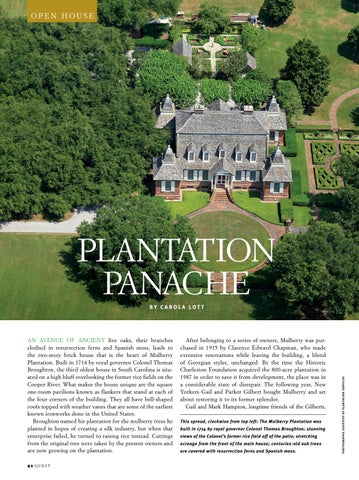
PLANTATION PANACHE AN AVENUE OF ANCIENT live oaks, their branches clothed in resurrection ferns and Spanish moss, leads to the two-story brick house that is the heart of Mulberry Plantation. Built in 1714 by royal governor Colonel Thomas Broughton, the third oldest house in South Carolina is situated on a high bluff overlooking the former rice fields on the Cooper River. What makes the house unique are the square one-room pavilions known as flankers that stand at each of the four corners of the building. They all have bell-shaped roofs topped with weather vanes that are some of the earliest known ironworks done in the United States. Broughton named his plantation for the mulberry trees he planted in hopes of creating a silk industry, but when that enterprise failed, he turned to raising rice instead. Cuttings from the original tree were taken by the present owners and are now growing on the plantation. 92 QUEST
After belonging to a series of owners, Mulberry was purchased in 1915 by Clarence Edward Chapman, who made extensive renovations while leaving the building, a blend of Georgian styles, unchanged. By the time the Historic Charleston Foundation acquired the 800-acre plantation in 1987 in order to save it from development, the place was in a considerable state of disrepair. The following year, New Yorkers Gail and Parker Gilbert bought Mulberry and set about restoring it to its former splendor. Gail and Mark Hampton, longtime friends of the Gilberts, This spread, clockwise from top left: The Mulberry Plantation was built in 1714 by royal governor Colonel Thomas Broughton; stunning views of the Colonel’s former rice field off of the patio; stretching acreage from the front of the main house; centuries-old oak trees are covered with resurrection ferns and Spanish moss.
P H OTO G R A P H S CO U RTE S Y O F P L A N TAT I O N S E RV I C E S
BY CAROLA LOTT