THE JOURNAL Q u een’s U n i v e rs i ty
—
Vol . 1 5 4 , Issue 2
—
M on day, J un e 29, 2026
—
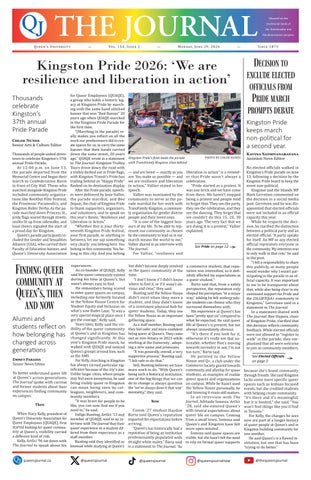
Kingston Pride 2026: ‘We are resilience and liberation in action’ Thousands celebrate Kingston’s 37th annual Pride Parade Chloe Nunes Senior Arts & Culture Editor Thousands of people united downtown to celebrate Kingston’s 37th annual Pride Parade. At 12:00 p.m. on June 13, the parade departed from the Memorial Centre and began their march to Confederation Basin in front of City Hall. Those who marched alongside Kingston Pride included community organizations like ReelOut Film Festival, the Frontenac Paramedics, and Kingston Roller Derby. As the parade marched down Princess St., pride flags soared through streets, smiles lit up from sidewalks, and loud cheers signaled the start of a proud day for Kingston. Queen’s parade participants included the Gender and Sexualities Alliance (GSA), who carried their Faculty of Education banner, and Queen’s University Association
Finding queer community at Queen’s, then and now
Alumni and students reflect on how belonging has changed across generations Emmet Paradis Senior News Editor
To better understand queer life at Queen’s across generations, The Journal spoke with current and former students about their experiences finding community on campus. Then
When Stacy Kelly, president of Queen’s University Association for Queer Employees (QUAQE), first started looking for queer community at Queen’s, visibility carried a different kind of risk. Kelly, ArtSci ’96 sat down with The Journal to speak about his
queensjournal.ca
for Queer Employees (QUAQE), a group who holds a historic legacy at Kingston Pride by marching with the same hand stitched banner that won “Best Banner” 20 years ago when QUAQE marched in the Kingston Pride Parade for the first time. “[Marching in the parade] really makes you reflect on all the work our predecessors did to create spaces for us, to carry the same banner that their hands carried down the same street, 20 years ago.” QUAQE wrote in a statement to The Journal. Kingston Trolley Tours drove down the road with a trolley decked out in Pride flags, with Kingston Transit’s Pride bus trailing behind as “Happy Pride” flashed on its destination display After the Pride parade, speeches were delivered by Josie Vallier, the parade marshal, and Bee Dupuis, the chair of Kingston Pride to thank supporters, organizers, and volunteers, and to speak on this year’s theme, “Resilience and Liberation in Action.” “Whether this is your thirtyseventh Kingston Pride festival, your first parade, or anything in between, let me say something very clearly: you belong here. You belong in this community. You belong in this city. And you belong
experiences. As co-founder of QUAQE, Kelly said the queer community existed during his time at Queen’s, but wasn’t always easy to find. He remembers being scared to enter queer spaces on campus, including one formerly located in the Yellow House Centre for Student Equity and Inclusion on what’s now Bader Lane. “It was a very special magical place once I got the courage,” Kelly said. Years later, Kelly said the visibility of the queer community at Queen’s and in Kingston has changed significantly. At this year’s Kingston Pride march, he walked with QUAQE and noticed Queen’s groups around him, such as the AMS. For Kelly, marching in Kingston has always carried particular significance because of the city’s size. Unlike larger cities, where people may feel more anonymous, he said being visibly queer in Kingston can mean being seen by colleagues, neighbours, and community members. “It was brave for people to be like, you can now find me if you need to,” he said. Indigo Bunting, ArtSci ’13 and member of QUAQE, said in an interview with The Journal that their queer experience as a student differed from their experience as a staff member. Bunting said they identified as bisexual while studying at Queen’s
@queensjournal
Situated on the
traditional lands of
the Anishinaabe and
Haudenosaunee peoples.
Since 1873
Decision to exclude elected officials from Pride march prompts debate Kingston Pride keeps march non-political for a second year.
Kingston Pride’s float leads the parade with TransFamily Kingston close behind.
— and are loved — exactly as you are. You make us possible — and we are resilience and liberation in action,” Vallier stated in her speech. Vallier was nominated by the community to serve as the parade marshal for her work with TransFamily Kingston, a community organization for gender diverse people and their loved ones. “It is one of the biggest honours of my life. To be able to represent our community as chosen by the community to lead us in our march means the world to me,” Vallier shared in an interview with The Journal. For Vallier, “resilience and
but didn’t become deeply involved in the queer community at the time. “I don’t know if I didn’t know where to find it, or if it wasn’t obvious and clear,” they said. Bunting said the Yellow House didn’t exist when they were a student, and they didn’t know of a consistent physical hub for queer students. Today, they see the Yellow House as an important gathering space. As a staff member, Bunting said they feel safer and more confident being queer at Queen’s. They came out as non-binary in 2021 while working at the University , adopting a new name and pronouns. “It was generally, overall, a very supportive process,” Bunting said. “I felt safe to do that.” Still, Bunting believes we have more work to do. “With Queen’s being such a historical institution, one of the big things that we can do to change is always question the ‘we’ve always done it that way’ mentality,” they said. Now
Comm ’27 student Haydon Barta said Queen’s reputation impacted his expectations before arriving. “Queen’s has historically had a reputation of being an institution predominantly populated with straight white males,” Barta said in a statement to The Journal. “As
@queensjournal
PHOTO BY CHLOE NUNES
liberation in action” is a reminder that Pride wasn’t always a celebration. “Pride started as a protest. It was one brick and we have come from there. We haven’t stopped being a protest and people tend to forget that. They see the party, they see the celebration, and they see the dancing. They forget that we couldn’t do this 15, 20, 30 years ago. The very fact that we are doing it is a protest,” Vallier explained. See Pride on page 12
a commerce student, that reputation was intensified, so it definitely affected my expectations as a queer student.” Barta said that, from a safety perspective, the reputation only shaped his perception “in a minor way,” adding he felt undergraduate students can choose who they surround themselves with. His experience at Queen’s has been “pretty spot on” compared to what he expected. He said queer life at Queen’s is present, but not always immediately obvious. “It’s there if you look for it, otherwise it’s really not that noticeable, whether that’s moving towards normalcy or not, I’m not too sure,” Barta said. He pointed to the Yellow House and Q+, a club under the Commerce Society geared towards community and allyship for queer students, as examples of visible queer spaces and organizations on campus. While he hasn’t used the Yellow House personally, he said knowing it exists still matters. In an interview with The Journal, Adelaide Somoza, ArtSci ’28, said she entered Queen’s with neutral expectations about queer life on campus. Coming from a small town, Somoza said Queen’s and Kingston have felt more open-minded. Somoza said queer spaces are visible, but she hasn’t felt the need to rely on formal queer supports
@queensjournalnow
Kavina Sathiyanarayana Assistant News Editor No elected officials walked in Kingston’s Pride parade on June 13, following a decision by the Kingston Pride board to keep the event non-political. Kingston and the Islands MP Mark Gerretsen commented on the decision in a social media post. Gerretsen said he was disappointed that elected officials were not included in an official capacity this year. While he respects the decision, he clarified the distinction between a political party and an elected official. “A party speaks for itself. An MP or any elected official represents everyone in the community. My intention was to only walk in that role,” he said in the post. “I felt a responsibility to share this publicly, as many people would wonder why I wasn’t participating in the parade in an official capacity. It was important to me to be transparent about that, while also being clear in my continued support for Pride and the 2SLGBTQIA+ community in Kingston,” Gerretsen said in a statement to The Journal. In a statement shared with The Journal, Bee Dupuis, chair of Kingston Pride, clarified that this decision reflects community feedback. While elected officials were not allowed to “register to walk” in the parade, they emphasized that all were welcome to join as community members. See Elected Officials on page 3
because she’s found community through friends. She said Kingston lacks some more specific queer spaces such as lesbian-focused events, but she credited students with helping create community. “It’s there and it’s meaningful, but it is limited,” she said. “You won’t find things like you’d find in Toronto.” For Kelly, the changes he sees now are part of a longer history of queer people at Queen’s and in Kingston building community for one another. He said Queen’s is a flawed institution, but one that has been “trying to do better.” @thequeensjournal