NEWS QBAS launches $1,000 scholarship to recognize Black student leadership
Scholarship builds on existing awards to broaden recognition of Black student impact
Jonathan Reilly Senior News Editor
The Queen’s Black Academic Society (QBAS) is rolling out a new annual scholarship for Black students.
Coined the “Chabikuli-Linton Unity & Excellence Scholarship,” the name pays homage to QBAS’s current co-presidents Ismael Linton and Kiana Chabikuli, both ArtSci ’27. The club announced their new $1,000 scholarship on Feb. 6, noting it will be awarded to one self-identifying Blackundergraduate student atQueen’s who demonstrates strong leadership.
In an interview with The Journal, the co-presidents said the scholarship was shaped by their own experiences navigating Queen’s as Black students.
“Coming to the University, one thing that we realized is that oftentimes it’s Black students, or students of color, that bear the
New
burden of creating those spaces that are welcoming for Black students,” Linton said. “Obviously, Queen’s University is a primarily white institution, and so coming in, there are a lot of barriers that students have to face. I mean, we did too in our first year.”
Both credit former QBAS leaders for helping them find a sense of community. The scholarship, they said, is intended to recognize students who take on similar work—often without formal recognition.
“Us creating this award wasn’t necessarily a critique of the awards that already exist,”
Chabikuli said, referencing the Robert Sutherland Prize.
“[It’s] adding on to what has already been put in place that fits broader categories.”
He added that many Black students contribute in ways that don’t always align with traditional award criteria, noting the Robert Sutherland Prize focuses specifically on advancing anti-racism and anti-oppression work at Queen’s.
Chabikuli said there are also students making meaningful contributions through photography, coding, or launching their own nonprofits. The new scholarship, he
Black legacy MeNtorship prograM
helps coNNect kiNgstoN youth with studeNt MeNtors
The program has already created fifteen mentor-mentee pairs
Yael Rusonik Assistant News Editor
A new mentorship program is trying to change who sees themselves at Queen’s.
The Social Issues Commission (SIC) has launched The Black Legacy Mentorship Program, an initiative dedicated to connecting Black youth in the Kingston community with student mentors from the University. In partnership with Queen’s Black Clubs Caucus and Queen’s Black Academic Society, and with help from the University administration, the program has already set up 22 mentees with 15 mentors.
The program was created based on the Scarborough Charter, a document Queen’s signed onto in 2021 that promotes anti-Black racism and Black inclusion in Canadian universities. The program was also designed to align with the United Nations Sustainable Development Goals and the Ontario Dreams Delayed report.
The Journal spoke with the Social Issues Commissioner (External) Mujeedat Lekuti, HealthSci ’26, and the SIC’s Black Initiatives Lead Estelle Ngwa, HealthSci ’27, about their goals for this program.
“What we’re really hoping for with this program is to build
explained, is intended to recognize those unique skill sets and broader records of achievement that may otherwise go unrecognized.
Overall, the scholarship places emphasis on “impact over intent,” a phrase Chabikuli said guided its development.
“A lot of people can join clubs and obtain a title,” he said. “But it’s really what you’re doing with that role.”
Funding for the scholarship is tied in part to QBAS’s successful referendum campaign, which increased the club’s fee from $0.50 to $1.10. However, according to Linton, the primary goal of the referendum was to expand free programming.
“It’s one thing to create these events and have it available, but it’s another thing to make it free and make sure that students are able to attend no matter their financial concerns.”
To minimize bias in the selection process, QBAS has established a committee that includes students, staff, faculty, and an administrator. In addition to the current co-presidents, the selection panel will include the Equity, Diversity, and Inclusion Coordinator at the Yellow House, Tianna Edwards, Vice-Principal (Culture,
Equity, and Inclusion) Stephanie Simpson, and Professor Joseph Kangmennaang from the Black Studies department.
QBAS executive members are ineligible for the award, and committee members are expected to recuse themselves in cases of conflict of interest.
The recipient will be announced in April, with a formal recognition ceremony planned for the annual Black Welcome—an annual event aimed at connecting Black students over cultural food and music—which will take place at the beginning of the next academic year.
Looking ahead, both co-presidents said they hope the scholarship continues to build momentum and support future generations of Black students.
“In a couple of years, I would love to see the various winners of this award serving to grow and flourish the Black population at Queen’s,” Linton said. “I want people to know that Queen’s is a space to go if you’re Black and want to succeed.”
Nominations for the award have been open since its announcement on Feb. 6 and close on March 6 at 11:59 p.m.
Building and defending Black Studies at Queen’s
empowerment for Black local youth in Kingston,” Ngwa explained. “We all made it through navigating the educational system in high school and middle school, but now that we’re empowered by being in University, we’re able to provide students with the resources they need to navigate their social, academic, and personal lives.”
The program’s first session already took place on Jan. 30, offering the mentors and mentees their first opportunity to meet each other.
“We’d already paired them based on similar interests, their background, their culture, and languages they speak,” Ngwa said. “In this session, they did scrapbooking and vision boards. So, we had lots of images of life at Queen’s, and some magazines with Black representation. We also had a document printed out with different affirmations you’d want to see as a high schooler.”
Lekuti shared that she was very happy with the turnout and energy at the first session, with some mentee-mentor pairings staying even after the session had finished to continue chatting and bonding.
“You could see this atmosphere of people being cheerful, people laughing, people making handshakes already,” Lekuti said. “It was just beautiful to see that there’s that connection, and that they were able to make that connection so quickly and so naturally.”
Undergraduate Chair Jennifer Leath reflects on faith, freedom, and the future of a young program
Emmet Paradis & Lilly Meechan
Assistant News Editors
The Black Studies Program at Queen’s was founded to examine the systems, geographies, and ways of knowing that shape Black life.
Four years later, its Undergraduate Chair, JenniferS. Leath, is working to ensure the discipline itself isn’t diminished within the institution. For Leath, her job involves imagining what the discipline can become and confronting the realities that threaten to limit it.
Along with being the undergraduate chair, she’s also an associate professor of Black Religion in the School of Religion, cross-appointed in the Gender Studies Department, and one of three Co-Chairs of BLCK Collective, which includes faculty chairs responsible for partnerships,organizing, events, and communications.
The Black Studies program launched in 2021. It’s an interdisciplinary undergraduate program that engages connections between the arts, social justice, and practices of anti-oppression. The program brings together faculty across units to examine Black life through multiple methodologies and
intellectual traditions.
For Leath, Black Studies isn’t synonymous with including “Black content” in other disciplines. It’s concerned with the architectures, the geographies, the pedagogies, the technologies, ways of knowing, and the systems of Black life.
“Course readings by Black scholars neither accomplish the objectives of Black Studies, nor, alone, make a Black Studies course,” she said in a statement to The Journal.
Leath describes working in the program as a joy because of the students and colleagues. The program is ledcollaboratively through the BLCK Collective.
Still, the program faces structural challenges, as she stated Queen’s has signed the Scarborough Charter, an agreement regarding post-secondary schools upholding black inclusion and anti-black racism.
Particularly, she spoke to Queen’s failing to sustain an “explicit commitment to Black flourishing, inclusive excellence, mutuality, accountability, and resistance against anti-Black racism,” claiming the Black Studies Program has faced funding cuts, retracted provisions, higher enrolment minimums, and reduced staffing since its launch in 2021, due to austerity measures.
Austerity measures are economic policies meant to reduce budget deficits, typically involving cuts to services, staff and operations.
Leath added that these austerity measures “disproportionately and inequitably impact smaller, younger programs like ours,” raising concerns about whether Queen’s
will sustain its commitments to dismantling anti-Black racism and protect Black Studies’ disciplinary autonomy.
Despite those pressures, she calls the program “one of the University’s best kept secrets.” Students receive close mentorship from world-renowned faculty with roots across Canada, the African diaspora, and the African continent.
A major priority is launching BLCK 100, an introductory course designed to offer a variety of responses to the question “What is Black Studies?”and help students apply the disciplineintheir professional lives. Leath didn’t provide a timeline for when this course might be introduced.
Ultimately, Leath hopes students leave Black Studies with an understanding of how Blackness has been constructed through slavery, colonization, and imperialism; how to use anti-racist and anti-colonial tools to transform the world.
Her scholarship and leadership remain rooted in what she describes as a spiritual and social commitment to Black life, the flourishing of Black people and communities in the diaspora and in Africa, and the flourishing of Africa itself.
Before she became a professor, Leath was a high school student reading Alice Walker, W.E.B. Du Bois, Pauli Murray, and Richard Wright in an independent study with her teacher, Mrs. Chery Irving.
“I could say: the rest is history,” Leath said.
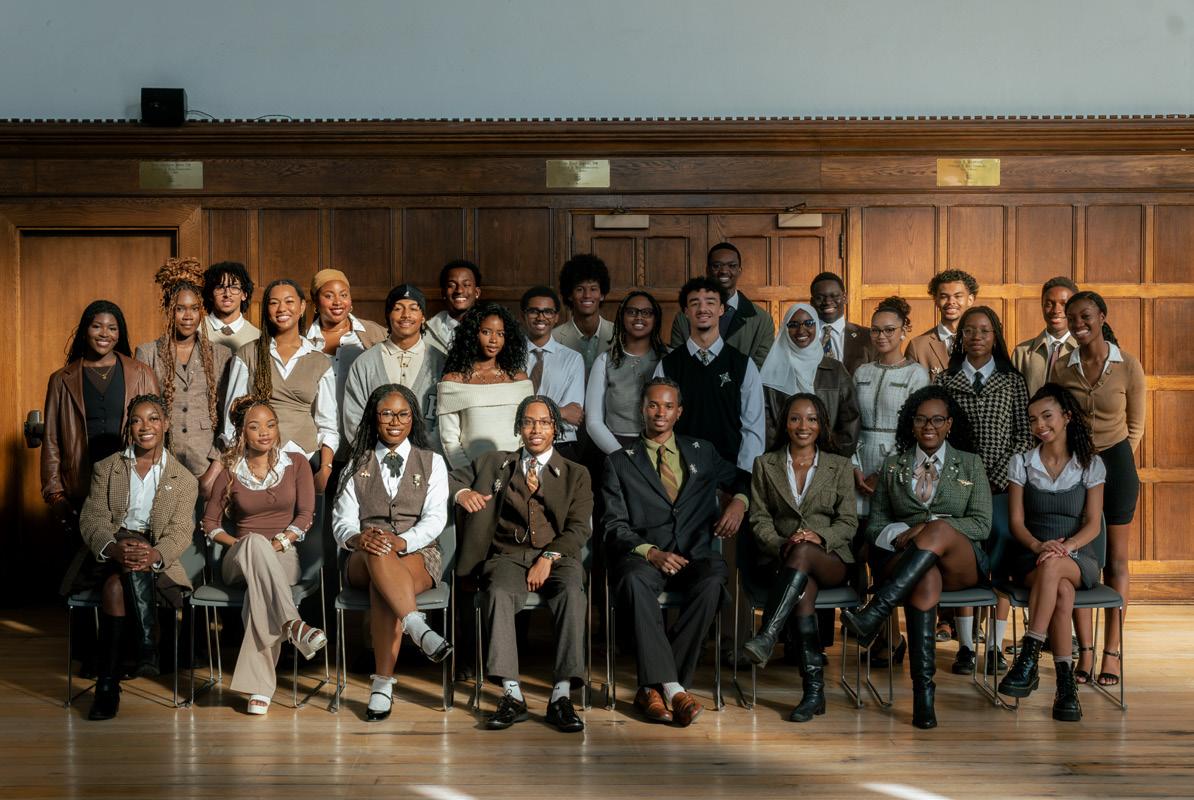
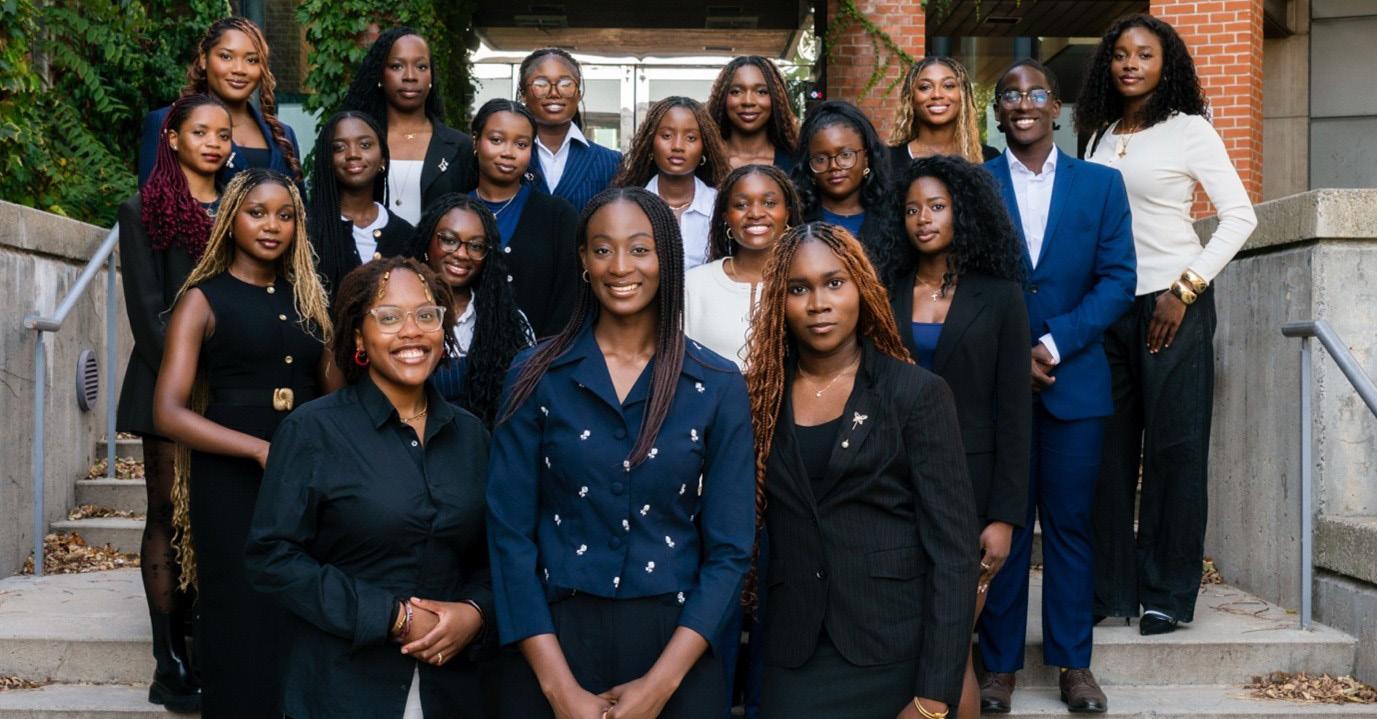
The QBAS 2025-26 team.
PHOTO BY KING-DAVID OLAJUWON
Three Queen’s leaders rack up over $46K in expenses during five-day trip to China
A total of nine Queen’s staff attended the trip for an unknown sum
Jonathan Reilly Senior News Editor
A Redditors freedom of information request has struck again, showing the partial costs of Queen’s recent trip to China.
Revealed through documents posted from an anonymous Reddit account—which has made multiple posts in the past two years relating to Queen’s travel costs—Arts and Science Dean Bob Lemieux, Smith Engineering Dean Kevin Deluzio, and Vice-Provost (Global Engagement) Ann Tierney cumulatively racked up roughly $46,215 in expenses on their October trip to China. The costs were largely attributed to flights, although luxury hotels and limousine rides also added to the expenses.
In a statement to The Journal, the University confirmed the documents’ legitimacy and explained the trip was part of an effort to recruit international students.
“Since 2019, Queen’s international undergraduate enrolment has declined from 12 per cent to the current rate of 7 per cent. This has limited the University’s ability to enrich
our campus community with the diversity of perspectives that international students bring, while limiting the university’s ability to grow revenue,” Queen’s wrote.
In this vein, the University sent a delegation of nine Queen’s senior leaders from Oct. 23 to 28 as part of an annual trip “to advance the University’s profile in China, expand academic partnerships, enhance student recruitment, deepen alumni engagement and advance philanthropic efforts.”
“The delegation activities included two major Queen’s-led events, one in Beijing, the other in Hong Kong, university partner meetings, high school counsellor engagements and alumni relations activities. As a result of the delegation and activities, several partnership agreements are being pursued to expand academic pathways and collaboration.”
The University confirmed that they spent $65,000 on the delegation’s events and activities.
This included the Queen’s Alumni and Friends Reception, the Queen’s Autumn Banquet, a high school guidance counsellor event, a senior leader alumni dinner, domestic travel for delegates within China, presentation materials and collateral for the delegation, as well as event photography.
The University was unable to provide the total travel expenses for the entire nine delegates from Queen’s, citing the quick turnaround.
According to the statement, all travel expenses submitted for this trip were reviewed and processed in accordance with the Travel and Expense Reimbursement Policy.
Lemieux spent about $10,348 on three flights, all business class, including a two-hour and 20-minute domestic Chinese flight. These were all reimbursed, despite the policy claiming travel must be in economy unless there’s documented medical reasons or continuous air travel exceeding nine hours.
“In this case, permission to use business class if required was approved verbally at a planning meeting in advance of the delegation,” Queen’s wrote.
In total, Lemieux spent about $15,419 on the trip, which included $1,659 at the luxury hotel Mandarin Oriental in Hong Kong, and $652.65 at a Four Seasons in Beijing. He also purchased two limousine rides, both with purchase locations in Waterloo, for $205 and $185.
Deluzio racked up the highest bill of the three, spending about $19,534 in total, including $12,430 on flights. For lodging, the engineering dean spent about $2,128 at the Fairmont Royal York in Toronto, $1,377 at the Mandarin Oriental, and $928 at the Four Seasons, totaling about $4,433 in hotel expenses for the five-day trip. There was also a $33.90 alcohol charge outlined in the document, but the University confirmed it was a personal expense that
Ontario Liberals rally against OSAP changes during Kingston caucus meeting
Party
launches
‘Fix
OSAP ASAP’ campaign ahead of March legislative return
Emmet Paradis
Assistant News Editor
Ontario Liberal MPPs used a Kingston caucus meeting to rally opposition to recent changes to the Ontario Student Assistance Program (OSAP).
The Ontario Liberal caucus, which currently holds nine seats at Queen’s Park, met in Kingston from Feb. 23 to 25 so they could prepare for the next legislative session on March 23. According to a press release issued Feb. 19, the caucus convened to shape its priorities, with discussions focused on housing supply, healthcare access, education, and the economy.
The caucus also discussed recent announcements related to postsecondary, including the removal of the tuition freeze and changes to OSAP. In the past, up to 85 per cent of OSAP funding could come in the form of grants. Now, only receiving 25 per cent of funding can come in grants, meaning a minimum of 75 per cent of total OSAP funding will be in loans.
During a media availability
outside Grant Hall at 3:45 p.m. on Feb. 24, multiple MPPs spoke with The Journal after recording a segment on campus.
At the availability, the Ontario Liberal Party (OLP) announced a province-wide campaign titled “Fix OSAP ASAP,” including a petition that had collected more than 9,000 signatures. MPP Stephanie Smyth said the OLP plans to bring the petition to Queen’s Park when the legislature resumes.
“We’re trying to amplify those voices of students,” MPP Adil Shamji said. “This is the beginning of our fight, not the end.”
MPP Tyler Watts said his office has received more than 100 emails from constituents whose financial plans for the fall have been disrupted. He argued the changes will make it harder for young people to enter the workforce and could undermine Ontario’s economic competitiveness.
“Those that are already going through school now have had the carpet ripped out from underneath them,” Watts said. “Those that are thinking of going to university and college […] now have to rethink everything.”
MPP John Fraser, interim leader of the OLP, said that “the most important thing we can do in the global economy is have the most highly educated and trained workforce in the world.”
wasn’t reimbursed.
Tierney spent the least overall, with her trip costing about $11,228. She spent $8,823 on flights, and just over $2,000 on hotels.
The documents also show that Tierney forgot to request permission for a business class flight purchase, which she apologized for in an e-mail to Provost Matthew Evans, as he’s responsible for approving all non-economy flights. She requested retroactive approval for this purchase, which Evans granted, saying, “Completely understand the need.”
Given the travel policy explicitly prohibits luxury hotels, Queen’s explained the lodging selection was based on where the events were taking place in order to maximize delegates time and facilitate meetings.
“Hotels were selected based on the objectives of the major events taking place in each city.
The Beijing Autumn Banquet was held at the Four Seasons, and the Queen’s Alumni and Friends Reception in Hong Kong took place
at the Mandarin Oriental,” Queen’s wrote. “Rooms for delegates were secured as part of a negotiated package rate, ensuring preferred pricing while supporting the relationship-building and business and partnership development objectives of the university. “
The University acknowledged the importance of economic responsibility, given the stressed financial state of the University, but stood behind the expenses.
“We are operating in a period of financial constraint, and prudent stewardship of university resources is critically important. At the same time, strategic travel for in-person engagement and relationshipbuilding delivers outcomes that virtual meetings cannot. It is an important part of our academic mission and can represent a meaningful investment in advancing the university’s reputation, recruitment efforts, overall impact, and financial position.”
Queen’s claimed that these delegations are a customary and necessary part of higher education.
QueeN’s studeNt leaders share advocacy efforts towards Bill 33
AMS maintains the provincial legislation is putting student and club fees at risk
Lilly
Meechan
Assistant News Editor
The OLP also criticized elements of Bill 33, provincial legislation proposing changes to postsecondary governance, including proposed merit-based provisions in post-secondary admissions and measures affecting student unions. MPP for Kingston and the Islands Ted Hsu said universities already operate on merit and suggested the government’s framing risks being divisive.
“Getting into programs isn’t just about looking at a score,” MPP Rob Cerjanec added during the media availability, noting that diverse experiences strengthen classroom environments.
Hsu, who hosted the meeting, said the city’s strong post-secondary presence made it a fitting location for the caucus discussion.
“We’re just talking about how to get ready for the next session of the Ontario Legislature and how to help the people of Ontario,” Ted Hsu said.
Fraser and Hsu emphasized that the upcoming Ontario Liberal leadership race allows members to shape party direction, encouraging students to get involved.
“In a leadership race, you tell the party what direction you want it to go in,” Hsu said.
The Ontario Legislature is scheduled to resume on March 23.
—With files from Lilly Meechan
Both the AMS and the Rector are writing to the provincial government to directly convey Queen’s concerns.
Bill 33, the Supporting Children and Student Act, received Royal Assent at Queen’s Park on Nov. 20.
Introduced by the Ontario Minister of Education, Paul Calandra, the 14-page Bill includes new rules and regulations for public colleges and universities, including changes to admissions and university fee regulations.
The Bill has received wide-spread criticism for giving the provincial government more power over university operations. In a statement to The Journal, Queen’s Rector Niki Boytchuk-Hale said that the Bill is empowering legislation for the government, claiming this has made assessing the Bill difficult.
“The Bill was tabled with limited detail because it is largely enabling legislation,” BoytchukHale said. “As a result, the most substantive requirements are set through the regulatory process following passage of the legislation with consultation. This made it difficult to fully assess the scope and risk, and engage in conversation since last spring through the fall.”
According to Boytchuk-Hale, she held one meeting in December with the Chair of the Board of Trustees, during which student leaders were able to speak to the chair about their concerns. Alongside
a separate report to the Board, where she voiced additional student concerns Boytchuk-Hale also wrote that in February, she sent a letter to the Ministry of Colleges, Universities, Research Excellence and Security, as part of the public consultation period.
Boytchuk-Hale noted that she has been closely following the development of the Bill, and the consistent concern she has heard from the Queen’s student body is the potential changes to ancillary fees.
The Bill gives the government the power to change and regulate any fees that public universities and colleges charge to students.
In an interview with The Journal, AMS Vice-President (University Affairs) Alyssa Perisa, and the AMS’s Commissioner of External Affairs, Edlira Ballaj, shared a similar sentiment to the Rector, stating that their main priority and concern surrounds the ancillary fees.
“It’s [Bill 33] something that can potentially take away the autonomy from students and their oversight over their fees, which is deeply concerning to the AMS,” Perisa said.
Ballaj followed up, stating that Queen’s has the most clubs in Canada and that those club fees could be impacted by the Bill.
Perisa said that, in terms of AMS advocacy, the most important piece has been working with the administration and off-campus partners to ensure students are informed about Bill 33 and its potential impacts.
Continued online at www.queensjournal.ca
Four new students welcomed into the Tri-Colour society for outstanding contributions
Recipients all reflect on their time at Queen’s with ‘The Journal’
Jonathan Reilly & Yael Rusonik Journal Staff
Four students have been awarded the highest tribute that can be paid to a student from the University—the Agnes Benidickson Tricolour Award.
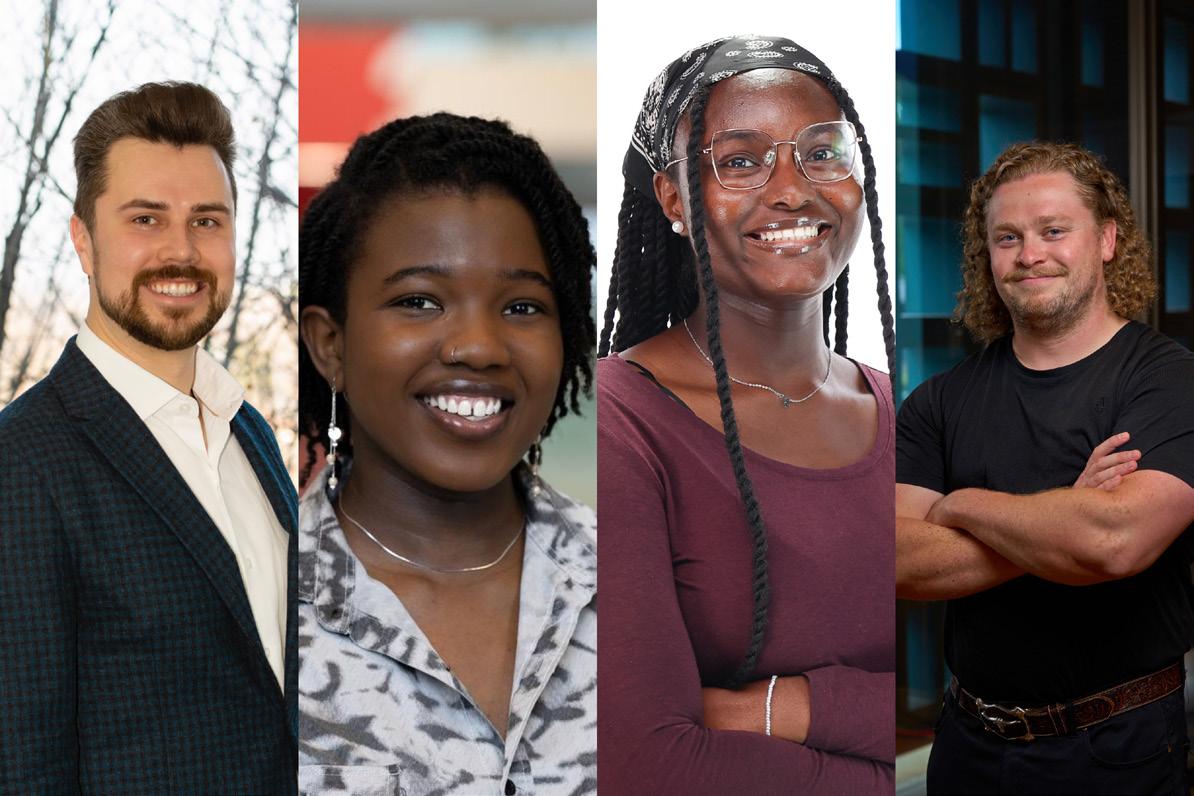
This year’s recipients included Emils Matiss, PhD ’27, Bisola Olaseni, BHSc ’26, Oluwamisimi (Simi) Oluwole, Nurs ’26, and Daniel Reddy, PhD ’26.
In an interview with The Journal, Rector Niki Boytchuk-Hale explained how nominees were scored across four core categories: distinguished service, character, leadership, and support from a broad range of people. While not sharing the specific number of nominees, Boytchuk-Hale said there was a “substantial” amount, almost double what she’s seen in previous years.
The top 10 scoring nominees advanced to interviews held over the Feb. 7 weekend, each lasting roughly 40 minutes. After all interviews concluded, the committee deliberated for fourhours, which Boytchuk-Hale said reflected the strength of the pool.
Each of the recipients sat down with The Journal to discuss their experiences at Queen’s.
Emils Matiss, PhD ’27
Since arriving at Queen’s, Matiss has served across multiple major governing bodies at the University.
He first participated in committees within the Centre for Neuroscience Studies before being elected to Queen’s Senate, where he served two terms and sat on various committees. He later became president of the Society of Graduate and Professional Students (SGPS) and now serves as the graduate student representative on the Board of Trustees.
Advocating within those roles
required working through formal governance channels. During discussions surrounding the Queen’s Graduate Award, a funding award for master’s students at the University, Matiss said the effort extended well beyond one office or organization.
“The work [the SGPS] did last year was a multi-faceted conversation with stakeholders from all around campus,” he said, explaining it wasn’t just the SGPS advocating by themselves but also working with faculty, PSAC 901, and others. “It was really about campus coming together.”
He emphasized communication as central to that work, explaining that advocacy involved “trying to communicate the impact” of what this award meant for students.
Matiss describes his leadership style as rooted in listening.
“It’s setting aside your personal biases and assumptions [and] making sure you do the legwork to understand what’s happening through the perspectives of the people you’re representing.”
One example of tangible impact came during a University Council meeting about food insecurity. After he, along with other student representatives, shared the challenges facing the AMS Food Bank, councillors donated more than $2,000 toward a new fridge. For Matiss, the moment reinforced that sharing student experiences can lead to real change.
Reflecting on the importance of the award, he pointed to the community.
“Nobody exists in isolation,” he said. “It’s an award for the Queen’s community and the Queen’s spirit, not just for individuals.”
Bisola Olaseni, BHSc ’26
Having once been a mentee, unsure whether she would be able to thrive at Queen’s, Olaseni is grateful to now act as a mentor herself, increasing representation and selfconfidence amongst students at the University.
Formerly working as the Lead Equity Ambassador for Undergraduate Admissions and
seNate report outliNes fallout of 300-seat shift froM Bachelor of arts prograMs Professor expresses concerns about potential plan closures in the FAS
Yael Rusonik Assistant News Editor
300 Arts seats were cut—now a Senate report reveals what that decision is costing, and who stands to gain.
The Senate Committee on Academic Development and Procedures (SCADP) has released a report detailing the effects of an April 2025 decision to shift 300 enrolment seats from programs
Recruitment and a coordinator for the Queen’s Health Science Outreach and Summer Program, Olaseni has been able to help increase accessibility and remove barriers for equity-deserving students.
“It just fills me with so much joy when I see high school students go from saying they’re not sure they could become a doctor because nobody looks like them there, or the system is just too complicated, to [realizing] they now have connections, and people they can reach out to,” Olaseni said.
Recognizing systemic racism and biases in Canadian healthcare, Olaseni also took on the challenge of evaluating and making recommendations for a new course on Racism and Health in Canada, GLPH 281, and completing research focused on increasing access to effective care for children with complex developmental needs.
“My goal was to help increase representation and help train medical professionals so that our system can be more aware, and physicians can reflect on their biases and provide better care,” Olaseni said. “Canada does have a diverse population, and we need to start acting like it.”
As Olaseni heads to medical school, she’s looking back with pride at the diversity and community she was able to foster during her time at Queen’s, and is hoping to continue acting as a mentor in this coming phase of her life.
Oluwamisimi (Simi) Oluwole, Nurs ’26
Oluwole received the news she won the award in the middle of a 12-hour clinical shift, adding that the first thing she said was “no way.”
During her time at the University, she has served as a Black initiatives and inclusion facilitator at the Yellow House, a student EDIIA coordinator within Queen’s Health Sciences, the president of the Canadian Black Nurses Alliance chapter at Queen’s, a mentor with QSuccess, and the Chair of the AMS Judicial Committee.
While Oluwole has done many different kinds of work, she feels her biggest impact has been through supporting Black nursing students as a mentor.
“Just being able to support people, whether they’re down, whether they’re happy, celebrate their wins and ensure that they have an excellent first year has been the most rewarding part of this experience.”
Oluwole also co-founded a sickle cell awareness group at Queen’s. She explained that as a Nigerian, sickle cell has always been very pronounced in her community, and that even in Canada she saw patients struggle to get the help they need.
This encouraged her to try and bring light to the issue, leading to the formation of the club and ultimately the running of a simulation about sickle cell.
Reflecting on the award, Oluwole emphasized collective effort.
“It’s not a one-man show by any stretch of the imagination,” she said. “It’s the group mobilization behind it, and this is like a group award. That’s just me going up to get the plaque.”
Daniel Reddy, PhD ’26
A Vanier Scholar in the Department of Chemistry, Reddy has used his time at Queen’s to not only advance his own knowledge and research, but to help his peers receive the funding and opportunity necessary to do the same.
As the founder of the University’s International Student Chapter of the American Chemical Society (Q-ACS), Reddy is proud to have helped the club to secure more than $50,000 in funding and establish over 30 awards rewarding student leadership and research. He explained it was at the club’s annual celebration series dinner that he was really able to realize the impact their work has made.
“Seeing everybody in the room having a good time celebrating each other’s accomplishments, that was really where I holistically saw the impact of what Q-ACS, and our community coming together could do,” Reddy said. Reddy is also excited to have spearheaded the nomination of Alfred R. Bader for an A-CS Historic Chemical Landmark, which he described as having “put Queen’s on the map” in the chemistry world.
“It’s the first one of these chemical landmarks being designated in Canada in the past 20 years,” he said. “[...] The fact that we’re getting one designated here at Queen’s is something I’m really proud of, and that was fun to share with the committee. [...] It really cements Queen’s in the timeline of chemical history.”
For first-year students hoping to one day make an impact in their own fields, Reddy recommends finding and learning from mentors and building connections within their community.
“I’ve loved getting to be an international student here at Queen’s. It really has been a transformative experience for me, and it’s just an honour to be receiving this award so I’m really grateful for all the people [who’ve helped me] and for the opportunities that I’ve had,” Reddy said.
in the Bachelor of Arts (BA) into other degree plans for the 202627 academic year. The request for this report was approved by Senate in May 2025 following broader concerns about the future of the BA and the University’s enrolment priorities.
The report details that 100 seats were reallocated within the Faculty of Arts and Science (FAS), with 50 moving to Computing, 25 shifting to Life Sciences, and 25 being reallocated to Kinesiology. The remaining 200 seats were shifted outside of the FAS, with 75 being reallocated to Smith Business, 75 moving to Smith Engineering, and 50 being shifted to Health Sciences.
The deans of the receiving
faculties all offered reports detailing the changes they’re making to support these shifts. Smith Business explained that they’ll be creating a new cohort and hiring new faculty to accommodate this increase in seats. Still, space-based constraints may require the faculty to make changes that could reduce elective choice and scheduling flexibility, and limit flexibility for international exchange and transfer students.
The other faculties proposed solutions that include changes to curriculum and delivery, and different timetabling and teaching space strategies. Some are also considering making staffing and workload adjustments in teaching and student support roles, and implementing operational changes intended to sustain advising, accommodations, and assessment.
Associate Professor Dan Cohen, who moved the initial motion calling for this report in May
2025, expressed his confusion in an interview with The Journal about how the proposed changes align with the initial goals of the enrolment shift.
“If you go back, the reason [for these shifts in enrolment] was all financial, that they needed to switch enrollments to take advantage of higher tuition-paying programs,” Cohen said. “Now they’re hiring in relationship to how many more students are coming into these other programs. Where is the financial cost-benefit analysis in that? Are any increases in tuition being offset by the fact that now they’re going to hire in Commerce and Engineering?”
Cohen also expressed his disappointment regarding a lack of information in the report on how the University would be helping to mitigate the issues arising from these increases in enrolment.
“We asked specific questions about cross-faculty revenue splits, interdisciplinary
programs, increase in breadth requirements, this sort of thing,” Cohen said. “And that just wasn’t answered, because it was only the faculties responding, and not the administration at all, from what SCADP provided.”
In a written statement to The Journal, Chair of the SCADP, Gavan Watson, claimed that “the Senate motion didn’t request a separate University-administration mitigation report, and no such material was provided to SCADP or omitted from the report.”
The report also discussed other potential changes for the FAS, including redesigning courses and curriculums to encourage more course sharing across departments, redesigning first and second-year programs into a cohort model, and suspending plans “assessed as non-viable” under projected enrolment distributions.
Continued online at www.queensjournal.ca
Left to right: Matiss, Oluwole, Olaseni, and Reddy PHOTO BY JASHAN DUA



FEATURES
With Black students comprising 8.7 per cent of Ontario University athletes, community is taking shape beyond the game
‘A special thing about sports is people from all backgrounds and lives come together and play;’
Black athletes share stories of finding community at Queen’s
Cloey Aconley
Editorials & Features Editor
For many Black athletes at Queen’s, the athletics experience carries layers that don’t disappear with the final whistle.
At a predominantly white institution, for Black student-athletes at Queen’s, the game becomes more than competition. It becomes a site of visibility, pressure, and connection. In response, athletes have built their own networks of support through the BIPOC Student Athletes Committee, initiatives like Culture Day, conference spaces, and, most meaningfully, friendships that extend beyond a single roster. What happens off the field has become just as significant as what happens on it.
Leaving the community you grew up in is challenging for anyone, but for the 10 per cent of the Queen’s student body that identifies as non-white, it can cut an important tie to their cultural identity and life experience. Not being surrounded by the same racial community can cause self-doubt and can take a toll on a person’s mental health, resulting in potentially negative ramifications for athletic and academic success. Representation is important; and being constantly surrounded by people who don’t have the same background can take its toll.
Tattyannah Jackson, ArtSci ’26, has experienced that loss of cultural familiarity firsthand.
“I found that being BIPOC and making friends with someone that doesn’t understand me, doesn’t understand my background, doesn’t understand the way I was raised, kind of made it a little more difficult to connect,” said Jackson in an interview with The Journal. Jackson is both a Women’s Rugby athlete, and the Indigenization – Equity, Diversity, Inclusion, Accessibility, and Anti-Racism (I-EDIAA) Coordinator for Queen’s Athletics and Recreation (A&R), as well as president of the BIPOC Student Athletes Committee (BSAC).
For athletes whose days are mapped out by practice times and team meetings, finding others who share their racial identity beyond their own roster
isn’t always simple. While strong friendships exist across different identities, Olivia Dibua, ArtSci ’27, spoke to the importance of her friendships with other Black Women’s Rugby athletes. “We’re a big team, so 50 people, and I’m still friends with other people on my team, but I think we [Dibua and her Black teammates] found a shared experience and shared bonding in that sense that we are similar,” Dibua said in an interview with The Journal
For teams with smaller rosters, connecting with Black athletes on different teams is essential. These connections can foster development, prevent burnout, and create a critical network of support.

really allowed me to start to really gain my education,” said Carleigh Collins, Queen’s Manager of Athlete Education, Training & Leadership Development, in an interview with The Journal
It was the I-EDIAA task force that identified the need for a stronger BIPOC student athlete community, which has made significant strides since 2021. In her role as BSAC President, Jackson has initiated a variety of social and educational activities, including BIPOC student athletes bowling, board game nights, and informative panels and workshops.
While education remains important, social connectivity has helped BIPOC athletes navigate
“I knew this wasn’t the most diverse school, and I know based on past years it was really white dominated, but I feel like as a Black athlete, especially now in my third year, I’ve found more of a community being a part of the BSAC group,” said a forward on the Women’s Hockey team, Sienna Bullen, ArtSci ’28, in an interview with The Journal.
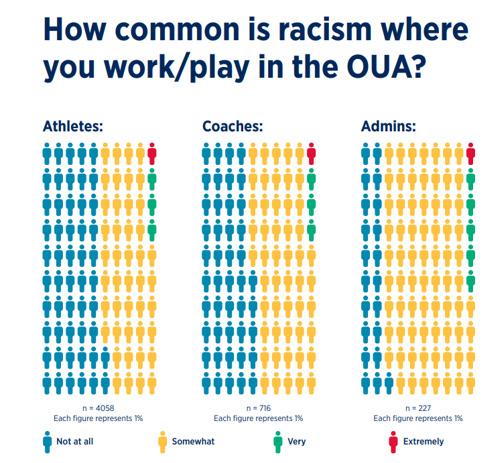
In the wake of the OUA Anti-Racism report in 2021, which revealed the lack of diversity in the OUA and commonality of racism within sport, Queen’s A&R began to recognize the distinct BIPOC student athlete experience.
The report noted that while only one per cent of each group viewed racism as “extremely common,” these results were likely impacted by the 72 per cent of respondents whom identify as white and may not know what racism looks like. In all, the report underscored a need for better representation and increased BIPOC student athlete initiatives across Ontario.
“In the fall of 2021, we had recently launched the I-EDIAA task force within athletics and recreation, so in my first year at Queen’s I was able to sit and serve on that task force and it
life at Queen’s. “There are certain conversations you can’t have with everyone, certain ways you talk about certain things or even language that you use are only used within certain groups. So, it’s honestly very important for me to just feel comfortable and even just be myself,” Jackson said.
For Bullen, participation in the BSAC has been an important element of her experience in athletics. “You can mingle and you can talk […] I think that’s really helpful and not something that I ever thought I would experience at Queen’s, but now that I have, I’ve built a lot of relationships that are some of my best friends now.”
These connections can help Black athletes navigate some of the unique challenges they face. Already overwhelmed with schoolwork and athletic commitments, Black athletes must deal with the reality of attending a school where much of the student body doesn’t have the same lived experience as them.
“It’s a great school Women’s Rugby wise; I just knew if I really wanted it [to attend Queen’s], I had to overcome things. So, the reality is it’s going to be hard for me regardless, but I knew that I had to push through […] which to my
point is why I’m so grateful for my community, they made it that much easier,” Dibua said. She shared how her parents were worried about her coming to Queen’s after another family members experience of feeling excluded due to her race, at Queen’s as well as the demographic being primarily white.
From being treated differently by referees, to overhearing comments from spectators, many Black athletes explain they must navigate challenges some of their white peers may never consider.
“I’ve had good experiences on teams, but I think that kind of changes within games because I will say I’ve not had the best experiences with refs,” Jackson said.
For Jackson, being singled out by a referee can be an isolating experience, especially within rugby, where only the captain is allowed to speak to the referee. This often results in an unfair dynamic, where the captain may not realize a Black athlete is being spoken to differently.
Jackson also spoke to her experience with livestream commentators who sometimes mix her up with the one or two other Black players on the field, even if they look nothing alike.
These experiences aren’t always noticed or understood by white teammates and coaches, making having a community to fall back on even more important.
“I want incoming recruits and future generations to understand that their experience is also valued here, and there are people here to, you know, support them, and there’s a community here as well,” Bullen said.
Creating this community is equally important but looks different for every sport.
Rugby Union was invented in England and disseminated throughout Canada by English colonial officers. Ice Hockey is also
sometimes I felt like I had to work that much harder just to prove that I deserved to be there,” Bullen said. Sports like Basketball have a rich history of Black participation and excellence. But even with this history comes a need to examine the sport at Queen’s and foster open dialogue regarding different experiences within teams.
“We [the basketball team] have weekly meetings […] and we talk about different topics like Queen’s, how it is as an institution, how we can change it, and how people on our team experience different things, and I feel like that’s a good conversation,” said Men’s Basketball player Sam Kong, ArtSci ’27, in an interview with The Journal
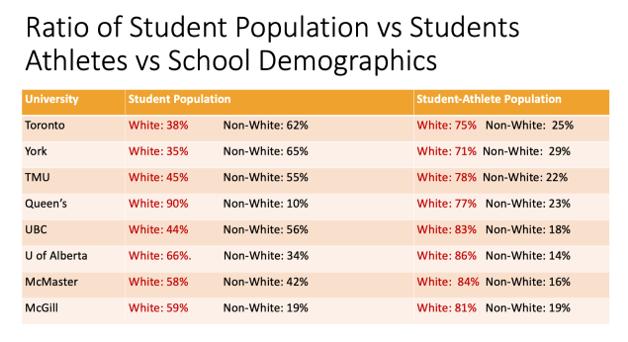
Queen’s is unique, because while it’s a PWI, non-white student athletes make up a larger percentage of the student athlete community than they do student population. According to a 2018 study by Madison Danford and Peter Donnelly, There’s a larger increase in the ratio of non-white to white student athletes compared to other schools in Canada.
The study found that while white student-athletes were significantly overrepresented across Canadian interuniversity sports teams, there was more representation than in the overall student population.
The ratio of non-white athletes to non-white students highlights the role athletics can play in fostering representation and inclusion across campus. “Queen’s Athletics can be a testament to how we can shift the culture throughout the whole school,” Kong said.
The number of white students and student athletes also emphasizes the role of allyship. A&R put an emphasis on providing monthly I-EDIAA training for staff and providing workshops and
predominately white, without a Black athlete in the National Hockey League until Willie O’Ree in 1985. These histories continue today, where representation in some sports is limited.
Bullen grew up as the only Black girl on her hockey team, aside from her sister. “I would feel kind of lonely and isolated […] and
promotional materials to athletes for how they can be a better ally.
“I think education is the base of everything, you can’t fix what you don’t know,” Collins said.
Continued online at www.queensjournal.ca
Commonality of racism in the OUA. Graphic from: The Ontario University Athletics Anti Racism Report 2021
Students, Athletes, and School Demographics. Presented by Sabrina Razack at the 2025 Diversity in Sport Conference
Left to right: Olivia Dibua, Tattynnah Jackson, Sienna Bullen PHOTO BY JASHAN DUA
TIME & MEMORY
What songs come to your mind for each of these scenarios? You’re setting up your student house with friends, at a cookout and/ or unwinding before a night out. These songs vary by individuals and depend on context. These songs act as soundtracks for these special moments and that make life worth living. My letter aims to answer the question, “why these specific songs?”
Time, in the form of songs & Memory, in the form of visual media are the two elements that shape the Black identity and experience as a Black person and the community that we are in. They work by either complementing each other or in tandem to provide a full picture of a particular moment. You would remember these same songs when you see photos from these experiences as the music serves as a sonic call to remember these moments, when our memory starts to fail us.
With the constant battle against the erasure of black people, our stories and community, it is important that we document our lives and the music that we listen to. They work to provide a full picture of who you are, as a black person as individuals, alone and in our community. Thus, proving that we, as black people, are non-monolithic.
Sometimes, we also forget who we are because life, as usual, happens. We can remember ourselves by reviewing our memories and the music at a point. You can see how much you have grown as a person and through reflection, can stay grounded in your identity as a Black person and community. It can be daunting to take a photo of yourself sometimes but your tomorrow self might need it. We cannot move forward without looking back.
So what do you do as the middle child of the past and future? “Be.”
‘To Be’ is to be Present
In this context, the way to be is in the NOW, by documenting some of your favourite moments or everyday life to the music of the day.
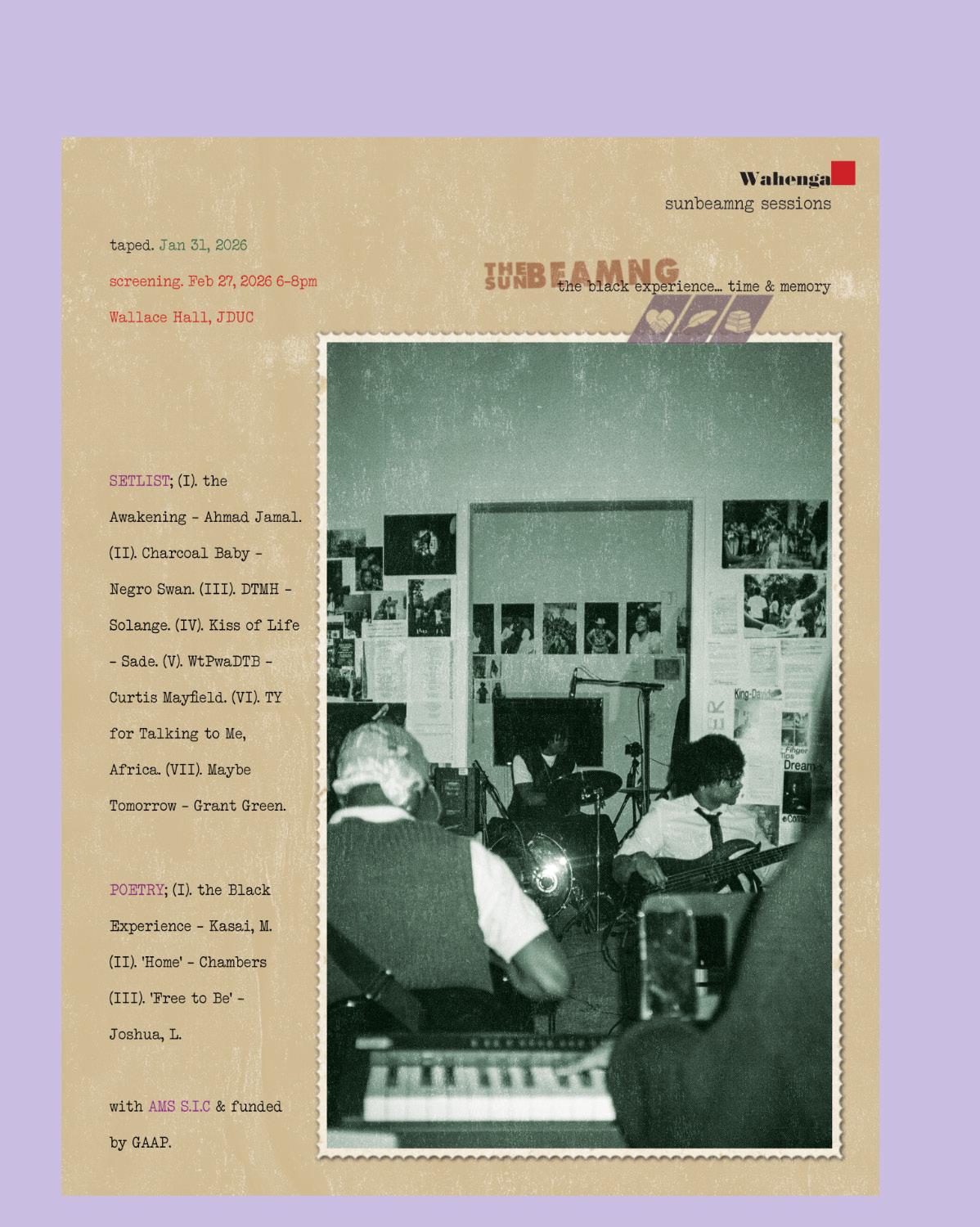
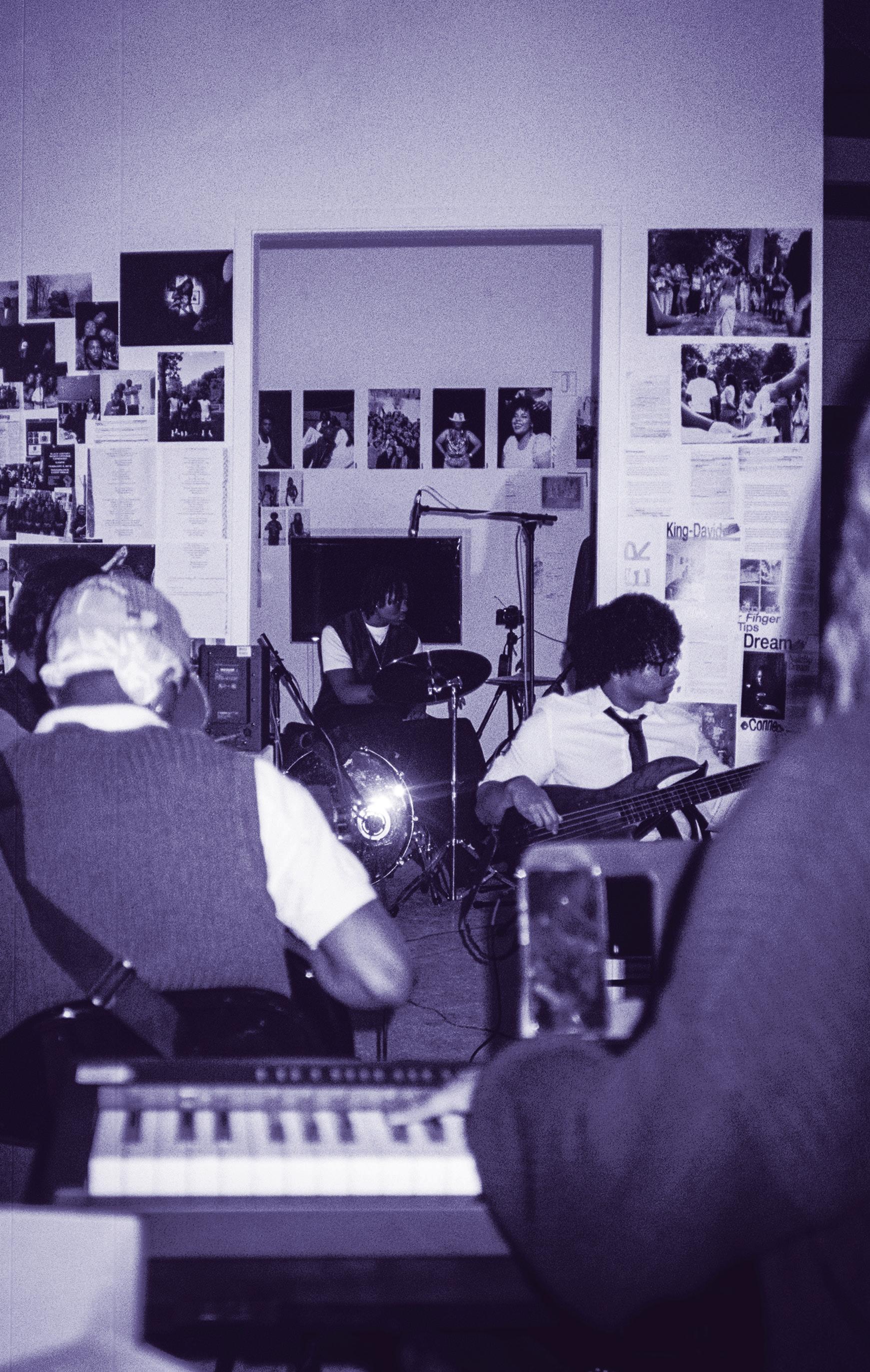
I explored this concept within the Queen’s context in my experimental art thesis, ‘the Black Experience… time & memory’. It was ‘a sunbeamng production’ in collaboration with ams s.i.c.
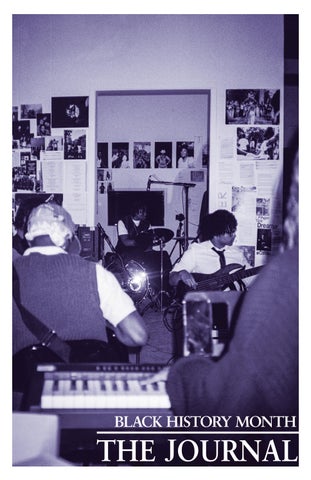
The photo, “UNITED, 2026” at the front features the live sunbeamng session of pick-up band,
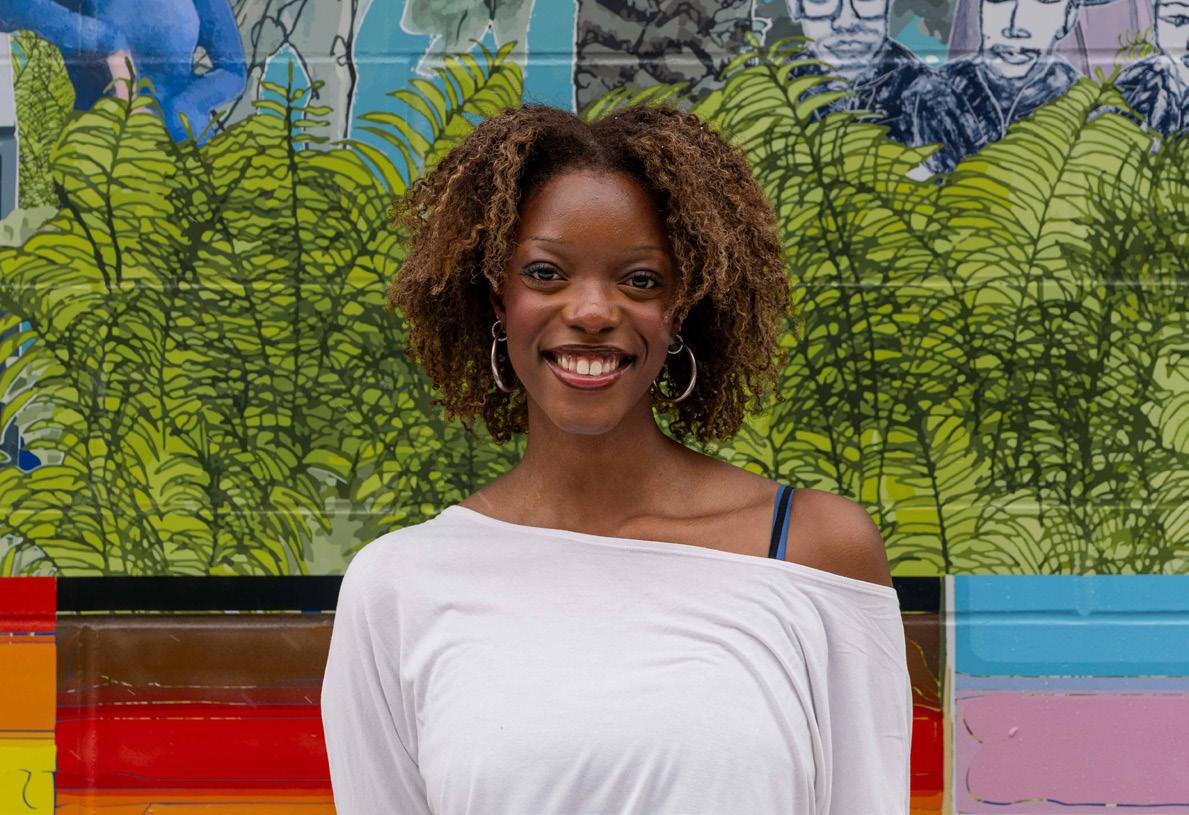
QTBIPOC Advisory Board Member
Every February, Black pain is brought to the spotlight once again.
Black History Month (BHM) urges people to think about the centuries of misery that the Black community was forced to endure, as oppression and pain are put in the spotlight. But education centering the Black experience should focus on more than just the negative parts of history. Black history isn’t just a record of discrimination and hate; it tells a story of invention, joy, and resilience.
Celebrating the Black experience can be a point of contention. Some argue that BHM has become something for companies to commodify and profit from, and that celebrating the month in a positive way undermines the horrors of slavery and Jim Crow.
The reality is that companies do have a history of taking advantage of the month to make more profits, where a single Instagram post of acknowledgement has been enough to boost engagement for a number of brands. Then, once February’s over, posts are buried on feeds, and Black History Month t-shirts are taken off the racks.
But how corporations choose to acknowledge Black History month doesn’t take away from personal and smaller-scale commemoration. Recognizing the positive parts of Black history doesn’t take away from the truth. It doesn’t try to excuse the fact that Black Canadians (and Americans) are affected by racial discrimination that’s so deeply embedded in our society.
Instead, it encourages people, regardless of race, to remember that Black people are more than just the embodiments of trauma. It reminds society that the Black
‘Wahenga’. The film combines the live session and juxtaposes archival media with present-day media to celebrate black identity & arts at Queen’s university and the larger Kingston community.
So, the next time you are hanging out with the homies, on a short walk, or at
videos because you deserve to be remembered. Whether it is by the community or your future self. YOU DESERVE IT.
Stay blessed, fam! Thank you to QJ for having me.
King-David Olajuwon
It’s time to remember that Black history is more than a history of pain
community, more than anything, has a history of perseverance that only gets stronger with time.
While Jim Crow was limiting opportunities and endangering the lives of African Americans in the South, those in the North were participating in the Harlem Renaissance. They used the opportunities available to them to create art, music, and literature, and beyond that, their dedication to racial uplift benefited Black communities everywhere.
It’s possible to be joyous and celebrate while remaining aware ofhistoricalsuffering.Celebrations of cultures are accepted and even encouraged in the 21st century, but would have been difficult for African descended people just a few decades ago. Public gatherings were not only to have fun—they emphasized the presence of Black people in spaces that weren’t always welcoming.
Engaging with positive aspects of Black history can still be a form of remembrance. If celebrations are done consciously, with history in mind, there should be no shame in engaging in these festivities. Especially when they’ve played such an important role in the persistence of Black communities around the world.
There are ways to celebrate Black history and to appreciate
the achievements of Black people in an uplifting way, without disregarding the past. Recognizing that joy is just as essential to the Black experience as sadness provides room for a more well-rounded study.
Only focusing on a traumatic past and refusing to create room for happiness in the present, risks diminishing the importance of resilience in stories about struggles. If Black History and Futures Month really intends to honour both what has passed and what’s to come, confining it to pain makes the “future” seem bleak and hollow.
Black history deserves to be looked at in its entirety. What emerged from the suffering can be just as important as the event itself. The Black experience has never been confined to trauma, and it shouldn’t be remembered that way.
Mayah is a 3rd year History student and one of The Journal’s QTBIPOC Advisory Board members.
Mayah Ricketts
a cookout; please take a couple photos,
IMAGE BY KING-DAVID OLAJUWON
PHOTO BY JASHAN DUA
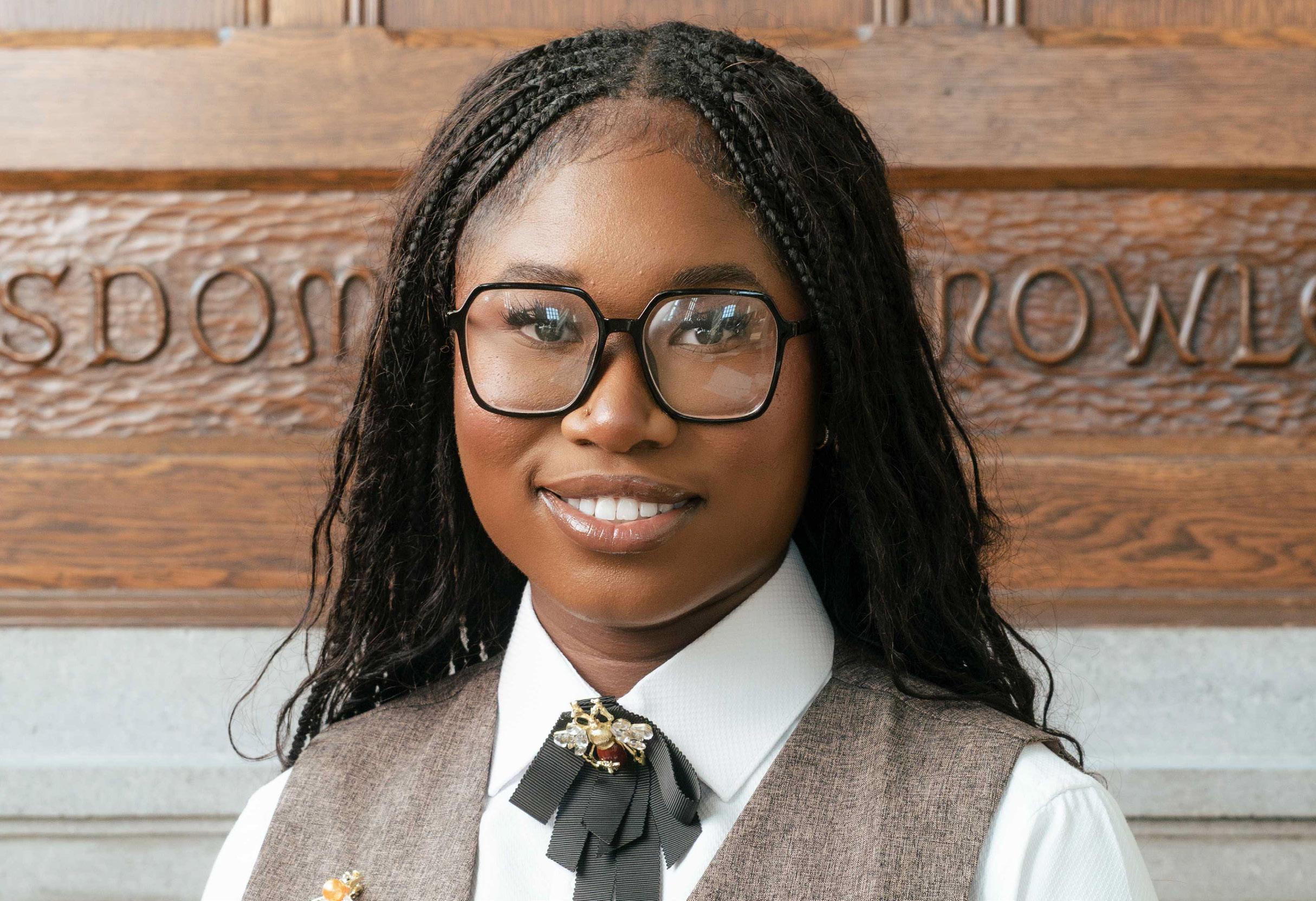
Queen’s University applauds renewed government investment in higher education, yet its impact on students is limited
Marginalized students are an afterthought during great changes
Bernice Yeboah Contributor
Queen’s University says renewed government investment in higher education's a sign of progress, but from a student perspective, that progress is hard to see.
While campus construction continues and official messaging remains optimistic, students are facing rising tuition, heavier loan burdens, and uneven access to support. If the investment is truly returning, it’s not reaching students in ways that meaningfully improve their student experience.
The most visible signs of growth at Queen’s are largely physical. Construction fences surround numerous areas on campus.
While walking on campus, the progression of the construction projects along University Ave., is noticeable, but questions linger if the budget allocated toward these buildings will be put into the support systems that students struggled to find.
While the University has made strides in equity, diversity, and inclusion, acknowledgement often feels conditional on past-performative actions. It can feel at times that the campus’ aesthetics receive more attention than our day-to-day experiences. The University uses these renovations as promise of long-term improvement, but the school remains stagnant when we look beyond the physical.
New buildings don’t lower tuition, reduce rent, or help us decide whether we can afford groceries. For many students, especially those already under financial strain, campus expansion feels disconnected from the realities they face. That reality has become even more difficult with the recent changes to the Ontario Student Assistance Program (OSAP). Financial aid has been redistributed so that loans make up a minimum of 75 per cent of funding and grants make up a maximum of 25 per cent, all while tuition increases.
For low-income and first-generation students, this shift has numerous implications.
As debt’s carried into students’ futures, this influences decisions about graduate school, career choices, and even whether completing a degree feels financially sustainable.
As a first-generation student myself, I’ve had to navigate a lot of my university journey on my own, attempting to put the increasing debt at the back of my mind. With these changes, that quiet anxiety becomes harder to ignore. Rather than background stress, it now shapes how I plan my semesters and how I think about my life after graduation.
Many students on similar journeys as mine, or even completely different, are of the same mindset, but this isn’t something Queen’s can solve with statements alone.
In November of 2021, Queen’s University signed the Scarborough Charter, agreeing to implement the principles
of pledging accountability to Black communities, recognizing Black life and thought, forming working groups to drive change, integrating equity into core institutional functions, and ongoing engagement and consultation.
Since entering the Queen’s community in 2023, I've yet to truly feel the impacts of these principles. Though Queen’s has come very far from where it began and monumental changes have been made, this work can’t slow down and lose momentum.
Many Black students have complained of the difficulties they experience when trying to communicate with the school to discuss their grievances, whether it be related to clubs or their personal lives. From larger administrative struggles of lengthy approval processes to daily struggles of encountering micro aggressive professors and peers, Black students often feel let down consistently by empty promises that the school has made.
The establishment of the Black Liberation Commons was a step in the right direction, but this initiative was taken into the hands of students, rather than the school itself. This room is often unavailable to the Black population, which negates its purpose.
We lack the culturally affirming spaces that we were promised and direly need. These untranslated promises feel performative, rather than revolutionary.
The University’s increased financial stability fails to show in the student experience
RectoR’s Digest: Passing thRough oR being PasseD by?
A case for Kingston on Canada’s high-speed rail
Niki Boytchuk-Hale Staff Writer
I regularly find myself surrounded by files and in deep conversation about things I didn’t even know to wonder about before. But representing the student body on matters central to our community's future requires comfort zone departures.
Travelling to and from Kingston can often be a game of trains, planes, and automobiles. Students go to great lengths to attend Queen’s, and the VIA Rail has been a staple part of the journey. Funnily enough, I’m writing this month’s column on the train, and it was a pleasant surprise that we’re only 30 minutes delayed.
The prospect of fast, reliable travel felt within reach (if you consider a decade close by) when the federal government enlisted Alto to build our country’s first high-speed rail project to run from Québec to Toronto.
for marginalized populations. Many marginalized students are unaware of the community supports they have at hand, especially when they are reliant on the university to disseminate that information. These community spaces foster mentorship, cultural connection, and a sense of belonging that doesn’t exist anywhere else on campus.
Many of these organizations operate with minimal institutional promotion, for example, the Queen’s Black Academic Society, which serves as the largest Black student body on campus. This club provides scholarships, networking opportunities, research, internships, and, most importantly, fosters a sense of belonging.
Many students find these organizations through friends rather than official university channels. Meanwhile, larger organizations that weren’t created with Black students in mind receive greater visibility and institutional backing. This imbalance matters. Access to community shouldn’t be dependent upon insider knowledge. The lack of promotion marginalized student groups face shifts this burden onto the students themselves to build these systems and their community. This calls on the struggles they face to coordinate with the school to create these spaces from the ground up.
Continued online at www.queensjournal.ca
Linking cities through high-speed rail will be transformative. For Kingston, it would energize our city’s vitality and support long-term prosperity. For Queen’s, it means stronger regional and interprovincial ties, creating easier movement for students, researchers, and professionals whose work depends on connections. This infrastructure will expand who can access education, employment, and build a life here.
For these reasons, it came as a great disappointment when Kingston wasn’t named a stop along the route.
Instead, Alto brought forward two corridor options (currently in consultation and spanning far wider than the tracks themselves) that would run somewhere near the areas of Frontenac Provincial Park or Sharbot Lake.
These proposals raise serious concerns.
First, if Alto decided to install a stop for passengers north of Kingston, the drive from campus would range from 30 to 100 minutes, which is hardly accessible.
Secondly, and very importantly, the environmental and ecological implications are profound. One proposed corridor even covers the Queen’s University Biological Station.
When I spoke at Kingston City Council on Feb. 17 with the Alto team present, I urged Council to be unequivocal: if high-speed rail is coming to this region, it must come to Kingston, and do so with full respect for the impact on the lands it crosses.
Continued online at www.queensjournal.ca
PHOTO BY KING-DAVID OLAJUWON
Bernice challenges the lack of support for marginalized groups at Queen's.

<BIZ-SCI-TECH>
How Queen’s Black Pre-Medical Association is building community in medicine
‘Feeling incompetent because of the colour of your skin [...] is a reality for many Black students,’ QBPA exec shares
Ananya Sharma Business, Science, & Technology Editor
While medical school can be an enriching experience for many, it can be isolating for some.
For many Black students aspiring to pursue medicine or currently pursuing medicine at a medical school in Ontario, time spent in lecture halls where representation is limited and on online forums that amplify anxiety about grades and acceptance rates, the journey toward becoming a physician can quickly become overwhelming.
The Queen’s Black PreMedical Association (QBPA), a student-led organization at Queen’s, aims to change that by providing mentorship, networking opportunities, and community-building events, including its annual conference “Representation Matters” on Mar. 28, to help students navigate the pre-medical path.
In an interview with The Journal , Nnamdi Jr. Ndubuka, ArtSci ‘28, and the club’s conference coordinator shared QBPA’s emphasis on building community.
“I’d describe QBPA as a group of like-minded students who are all pursuing the goal to become healthcare professionals. It’s really a place just to foster a community.” Resilience and community are a
big part of being an underrepresented minority and QBPA is a club that offers that community and that mentorship for students to hopefully reach the goals of becoming physicians.”
Exclusionary practices targeted towards Black students in medicine in Ontario isn’t new, with Queen’s School of Medicine being responsible for banning the admittance of Black students in 1918. Though the ban was lifted in 1965, it wasn’t repealed until recently in 2018.
Despite Black people accounting for 6.4 per cent of the national population, they comprise only 1.7 per cent of Canadian medical students.
A 2022 CMAJ study revealed that this underrepresentation is caused by a myriad of factors, the most prevalent being some form of discrimination or racism. According to the study, 59 per cent of respondents had at least one personal encounter with discrimination in medical school.
Furthermore, a longitudinal study set in an undisclosed Canadian medical school revealed that Black and minority students of colour facing daily microaggressions from their peers often didn’t report such instances for fear of having their claims dismissed or lacking access to proper institutional supports.
However, these feelings of “otherness” at academic institutions ripple far. “Minority tax,” a phenomenon experienced by Black faculty at Canadian universities, explains how individuals are often burdened with promoting diversity at their institutions at the expense of pursuing traditional scholarly work more highly esteemed in academia.
A 2017 study on the experiences of racialized
faculty in Canadian academia highlighted that universities reproduce the accepted social hierarchy in which non-white minorities are excluded and marginalized.
But academic settings aren’t where all the challenge is faced; social media can also be an intimidating place for students, as online forums distort expectations about what it takes to get into medical school. With individuals brandishing their academic accomplishments, or others leaving comments on posts to bring others down because of one bad mark.
“You see so many things on [social media] that it can really horrify you,” he said. “But having people [at QBPA] who are basically there at the steps of applying, you get to see, here’s what they’ve done, here’s where they’re at. It’s different to what people see online.”
That exposure offers reassurance. The need for community is amplified by structural challenges faced by Black students in medicine and undergraduate studies.
“The underrepresentation is a big challenge that we [Black students] face here because representation will allow you to have great network opportunities and even potential shadowing opportunities,” Ndubuka said.
These barriers to success can impede students’ self-esteem, which can even affect their academic performance.
“A lot of times, even feeling incompetent simply because of your skin, as silly as it may sound, it’s a reality for many Black pre-med students,” Ndubuka noted.
For Black students unsure that medicine’s the right path for them, Ndubuka adds, “Just go all in. Just go all in as if you do believe this is for you.”
QBPA’s willingness to “go all in” is strengthened by seeing themselves reflected in the future of medicine in Canada—and supporting each other along the way.
Feb. 24.
Public health issues advisory after confirmed measles case in Kingston
Southeast Public Health urges immunization checks and symptom monitoring following confirmed local case
katarina krivokapic
Business, Science, & Technology Editor
Three Kingston locations were identified as potential exposure sites in a measles advisory issued earlier this week.
Southeast Public Health (SEPH) is advising residents of potential measles exposure linked to three Kingston locations between Feb. 9 and Feb. 13: GoodLife Fitness (64 Barrack St.), Metro (310 Barrie St.), and Queen’s University’s Kingston Hall (103 Stuart St.). The advisory follows confirmation of a local case.
Those present at GoodLife on Feb. 9 from 8 to 11 p.m., at Kingston Hall on Feb. 10 from 11:30 a.m. to 2:30 p.m., or at Metro on Feb. 13 from 4:45 to 7 p.m. are encouraged to confirm their immunization status and watch for symptoms for up to 21 days after the potential exposure, according to a notice issued

Measles is a highly contagious viral infection transmitted through airborne droplets produced by coughing, sneezing, or talking. A person with measles can spread the virus four days before a rash appears and remains contagious until four days after the rash develops. Because the virus can remain suspended in the air for a period of time, transmission can occur even without direct contact.
Symptoms typically develop between seven and 21 days after exposure. Early signs include fever, cough, runny nose, and red, watery eyes. A red, blotchy rash generally appears several days later, beginning on the face and spreading downward across the body.
Although many recover without complications, measles can lead to more serious outcomes, such as encephalitis (brain swelling), especially in vulnerable patients such as infants, pregnant individuals, and those who are immunocompromised.
In an e-mail circulated to Queen’s staff and students on Feb. 23, SEPH described guidance based on vaccination status. Individuals born before 1970, those who have received two valid doses of a measles-containing vaccine such as MMR or MMRV, or those with laboratory-confirmed past infection are considered immune and may continue attending work and school.
Those who have received only one dose are advised to book a second dose and may be required to isolate in some settings until March 4. Individuals born in 1970 or later who haven’t been immunized are required to self-isolate and contact public health officials.
The Kingston advisory occurs amid a nationwide increase in measles cases. Federal data as of Feb. 23 reports 254 confirmed cases across Canada in 2026, with 62 new measles cases from Feb. 8 to 14. Ontario declared a measles outbreak last October after more than 2,300 cases and the death of a newborn who contracted the virus before birth.
In Kingston, the current situation remains limited to a confirmed case and identified exposure sites. SEPH continues to provide updates and encourages anyone with questions to contact its Kingston office directly. For now, the focus remains on monitoring and prevention as the 21-day incubation window continues.
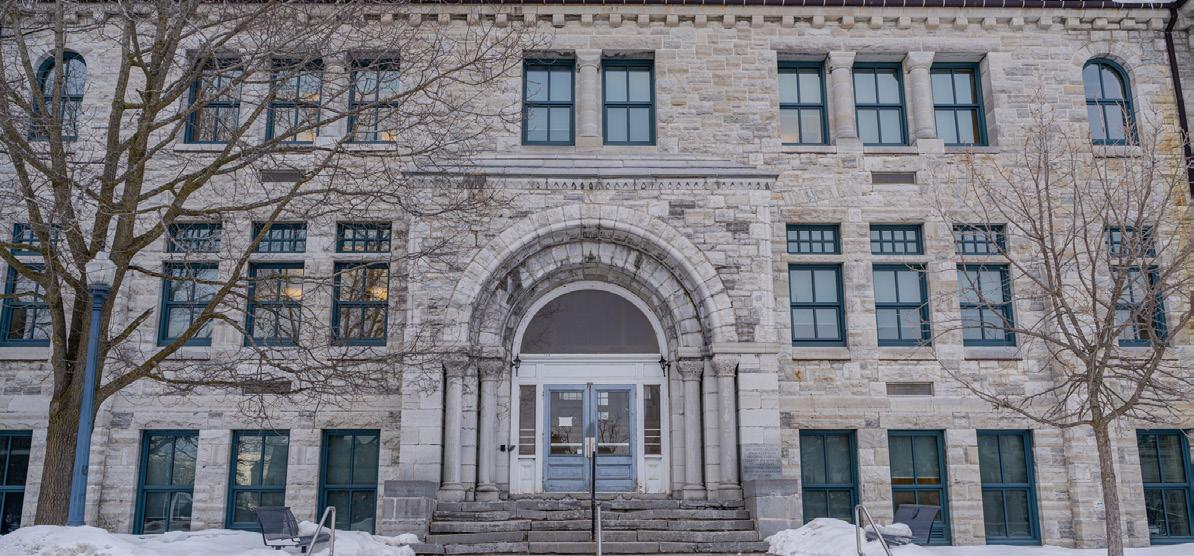
IMAGE SUPPLIED BY QBPA
QBPA’s upcoming annual conference is on March 28.
Potential exposures occurring amid a broader rise in measles cases.
PHOTO BY JASHAN DUA
SP ORTS
Queen’s Volleyball rolls into Semi Finals with three set victories
Playing at home is a fun opportunity to really bring the energy, player says
Noah Cyr Senior Sports Editor
The Gaels are serving, setting, and spiking into the semifinals.
The Women and Men’s Volleyball teams both rolled into the OUA quarterfinals on Feb. 20 in good position for deep playoff runs. The Men’s team finished third in the OUA regular season setting up a home playoff game against the sixth seeded York Lions, who finished with a record of 12-8 season.
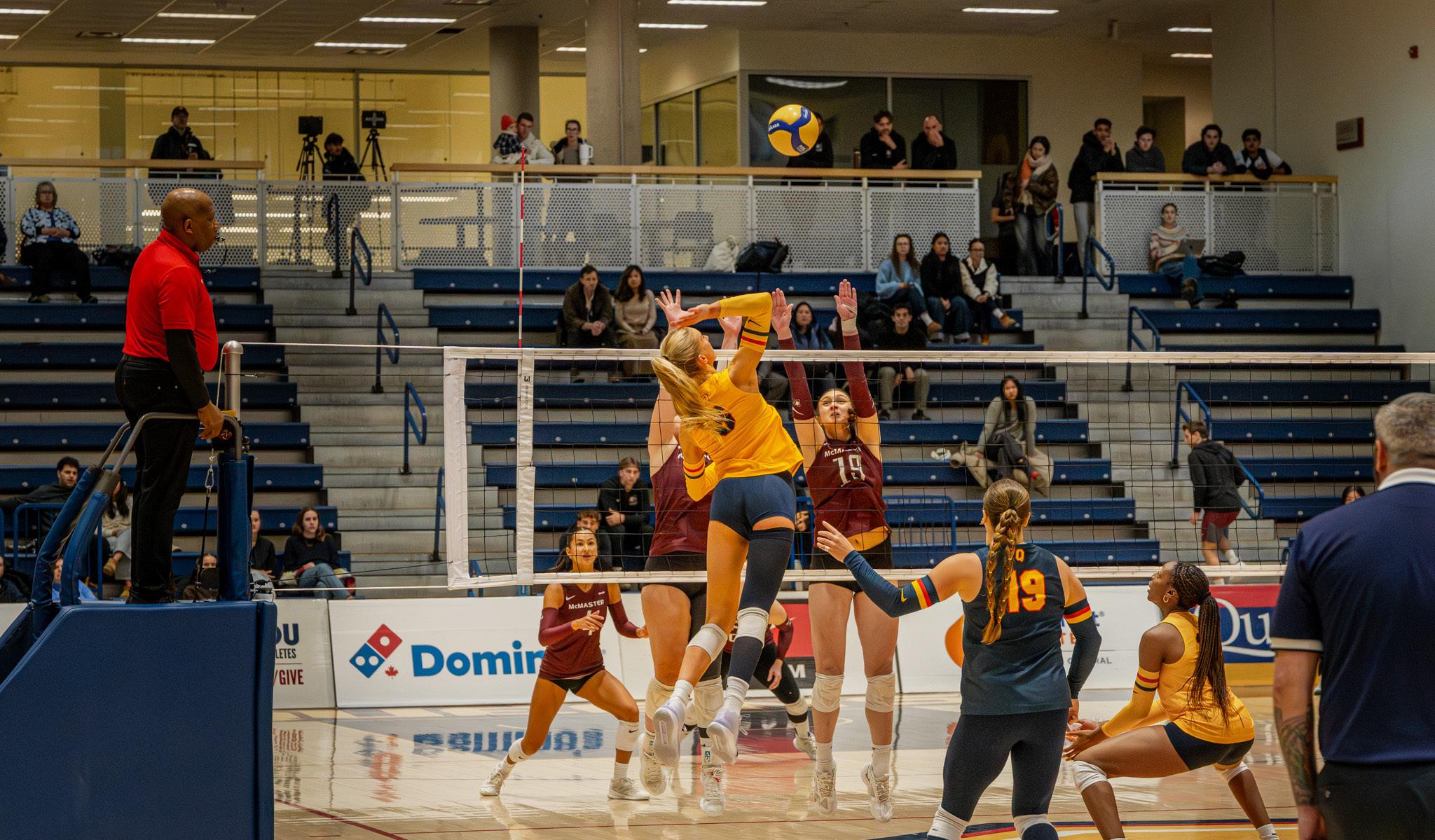
The Women’s team, despite dropping a five-setter thriller in Ottawa in their second last game of the season, have been on an absolute tear, going 9-1 in 2026. The late season successful run earned them a fourth seeded OUA standing and a date with the fifth seeded Guelph Gryphons.
A great matchup for the women’s team, as the Gaels beat the Gryphons all three times playing them this season, with one being a pre-season game. It would come down to a fourth matchup on Feb. 20 at the ARC.
The Gaels would assume dominance in the game from the very beginning, by using a balance of all three phases, offense, defence and serving. The first set was highlighted by two long serving performances by Lauren MacPhail, ArtSci ’27, and Abigail McAlpine, ArtSci ’26, with the Gaels cruising to a 25-11 win.
The second set was a little closer for the first half of the match, as both teams traded back possession of serve. That all changed with a seven-serve run by Claire Carter, Comm ’27, who put the game out of reach and the Gaels would secure the second set victory 25-17. During the set the Gaels amassed 18 kills, where OUA average’s around 11.
The last set again was a quick dominant set by the Gaels who continued to show their hard-hitting offence with a 16 kill performance with Carter contributing eight of them. Yet another long serving run to put the game out of reach as the Gaels would secure the 25-14 victory and an OUA semifinal berth.
On the Men’s side, there was a lot tight of an affair, with the Lions stealing one game earlier on in the year against the Gaels, the fans were poised for a close match. Beginning with the first set with both teams
fighting for each point. This proven by the longest serving run only being three, however the Gaels found a way with some timely offence to secure the first set 25-21.
The second set had the same feeling to it, whoever was going to make the least amount of mistakes was going to win. Both teams managed to make fundamental service errors down the stretch, but the Gaels found a way to fight through and win by a score of 26-24.
More of the same continued in the third set as the Gaels and the Lions felt the playoff pressure in the final set as both teams made critical errors in crucial times. In the final eight points, there was four service errors, two aside making every point matter.
Resilience has been a theme for the Gaels all season and on this night they found a way to win points when it mattered, winning the final set by the narrowest of margins, 25-23.
The Men’s team will host the Nipissing Lakers in the OUA semi-finals at the ARC on Feb. 27 at 7 p.m., while the Women’s team will travel to St. Catherines to take on the number one seed Brock Badgers for a chance at competing for the Quigley Cup.
Women’s basketball season ends at the hands of Carleton
A historic season for the Gaels ends in heartbreak
Noah Cyr Senior Sports Editor
An emotional end to a promising season.
The Queen’s Woman’s basketball team advanced to the OUA semifinals after a swift win against the York Lions on Feb. 18. The Gaels were awarded home-court advantage in the OUA semi-final on Feb. 25 versus the Carleton Ravens after their impressive 21-1 campaign. Standing in their way of a USports championship berth, Carleton, a strong basketball program, who have won the past two out of the past three OUA and USports championships.
The game began with the Gaels stars, Kiyara Letlow, MSc ’26, Bella Gaudet, Comm ’26, Katrina Renon, ArtSci ’27, all contributing on offence early, hoping to be a game long trend. The Ravens would answer back and score
BY
Queen’s Men’s Hockey upsets McGill in first round of playoffs
Noah Cyr Senior Sports Editor
Playoffs is a whole new season, where everything you did in the regular season is moot.
The Gaels squeaked into the playoffs after two massive wins on the road to finish the regular season and leapfrog into sixth place in the OUA East, garnering the last playoff spot available. Their reward, the number seventh ranked team in the country, the McGill Redbirds. The best of three series featured game one on Feb.18 at McGill, game two on Feb. 20 at the Memorial Centre, and a potential game three at McGill on Feb. 22.
Game one, the Gaels struck first with a shot from the point tipped by Gaels forward Kolton Cousins who was streaking to the net. The Redbirds would strike back less than two minutes after the first goal of the game, tying it at one. Late in the period, Gaels Aidan Castle, ArtSci ’29, would capitalize on the powerplay, giving Queen’s the lead.
After a back and forth first nine minutes of the second period, the Gaels would make the Redbirds pay, scoring off a
Whoever wins upcoming series has a great chance of winning the Queen’s Cup, head coach says by committee, making it a tightly contested first quarter that ultimately ended in a two-point lead for the Ravens.
In the second quarter, is where the Gaels struggled the most to score, posting just 20 per cent from field goal but more importantly could not stop the Ravens offence. They would score three 3’s in the court, extending their lead to 12 at one point. The Gaels in the dying seconds would sink a three-pointer hoping to ride that momentum into the second half.
Unfortunately for the Gaels,
turnover and taking a 3-1 lead. Just under two minutes later the Gales added another goal off the stick of Ethan Larmand, ArtSci ’28, to extend the lead to 4-1. However, in the dying seconds of the period, the Redbirds would add one on the powerplay giving them hope going into the third period.
The third period was an all-out attack by the Redbirds who compiled 22 shots in the period as they tried to claw back into the game. They were no match for Gaels goalie Tanner Wickware, MIR ’26, who would end the game with a sensational 47 saves. Queen’s would add two more goals including an empty netter and hold back the Redbirds pursuit, taking the first game by a score of 6-2.
Game two, the Gaels rode momentum from game one, 26 shots to just the Redbirds 13 through two periods. The Redbirds goalie Nicolas Ruccia bounced back with 41 saves in the game as Queens relentless tenaciousness was evident all game long.
Even though the Gaels were winning the shots on goal battle, the Redbirds struck first early in the third period.
The Gaels wouldn’t panic though, as they continued to play the same way and were rewarded. After their forecheck forced a turnover from the Redbird goaltender, Derek Hamilton, ArtSci ’27, passes to a streaking Michael Renwick, ArtSci ’27, who walked into a one-timer beating the
the offensive woes continued as the lead for Carleton grew, the more every shot felt like a must make. The Ravens relied heavily on their best offensive player, Kyana-Jade Poulin who had her best quarter of the game, contributing nine of the 16 points in the quarter. They would go into the final quarter up 15 with all the energy sucked out of the ARC.
The fourth quarter was the final push for the Gaels season hopes as they scratch and clawed at the deficit they faced. Slowly
goalie clean on the far side. The Gaels would continue to push but to no avail so overtime was needed.
Just 2:32 into the overtime period, Hamilton the overtime hero again, capitalizing on a broken play in the slot and sending the Gaels to the quarterfinals.
Head Coach, Brett Gibson talked with The Journal about their recent success and upcoming matchup in the Concordia Stingers. Gibson was emphatic, even in previous interviews that he believed in his group and that it was only a matter of time until this team played to its full potential. “We’re playoff tested, it was just a matter if they believed in themselves and now they do and it’s been really fun to be a part of,” Gibson said.
As a coach, Gibson stresses preparedness, and him and his coaching staff try to make sure the players are as ready as possible for the game ahead. Gibson said on his players that it was “pure execution” in game one and that the confidence only grew in game two.
Looking ahead to the next matchup against the Stingers, Gibson was complimentary but firm with how he’s looking ahead to this series. “They are the premium team in the league, and they’ve got great players, but so do we,” he said.
The Gaels will play Game two of the best of three series at home on Feb.28 at the Memorial Centre, puck drop 7:30 p.m.
but surely, they chipped away at the Ravens lead, getting as close as six points with under a minute remaining. The lead, however, was too great to overcome for the Gaels as they lose by a score of 61-54.
A devasting loss for the Gaels to say the least after one of the most successful regular seasons in Queen’s Woman’s basketball history. A year that saw graduating players dominate and put the league on notice ended on a snowy, quiet, Wednesday night.
PHOTO
JASHAN DUA
The Women won on Feb. 20 against Guelph.
Diversions
Don’t lose sight of spring—horoscopes to carry you through the last days of winter
See what new connections, side quests, and lore drops the future holds for your zodiac sign

Taurus (April 20May 20)
Get ready to handle some negative social feedback this week, Taurus. Something will come to light about a close friend that you might not want to hear, or you may be stuck doing damage control for yourself after the coming weekend. Keep your wits about you. It’s time to keep your friends close, and your enemies closer.

Aquarius (Jan. 20 –Feb 18)

Gemini (May 21 – June 20)
You’ve a one-way ticket to yap city this week, Gemini. Your chit chat will come in handy in making important business connections and friendships, so keep on your toes and ensure your social battery is at full charge. Don’t be caught with an idle tongue when you need to dazzle someone new with fresh discussion.

Virgo (Aug. 23 – Sept. 22)

Aries (March 21 – April 19)
Go crazy this weekend, Aries. You’ve been experiencing a burgeoning romantic connection with someone lately, and it’s time to see this to fruition. Send them a risky night-out text on Saturday; you’ll regret it if you don’t. Warm up the end of a freezing winter with a fun fling!


Cancer (June 21 – July 22)
You said in your New Year’s Resolution you were finally going to start that new hobby you’ve been wanting to for a while. Where are we with that now? You’re about to experience an explosion of creative energy, Cancer, and it’s important you don’t miss out. The “new project” bug has been nipping at you for a minute, and you know the hardest part is getting started.
Libra (Sept. 23 – Oct. 22)

There has never been a worse time for romance, Aquarius. No matter what your love life looks like right now, you should set it aside and focus on money goals as the weekend rolls in. Especially for someone who likes to spend more than they save, upcoming weekends like St. Patty’s could result in the kind of financial ruin you can’t afford—no pun intended. Don’t be that person that buys a round for their friends this weekend; in fact, consider a cozy, frugal night in.

Sagittarius (Nov. 22 –Dec. 21)
You’re dealing with struggles between family and career this week but be confident the right answer will reveal itself to you. Keep your trademark commitment to truth and integrity. Taking the easy route will prove unfruitful. A thoughtful gift may ease tensions and improve your situation.
You’ll have an intimate moment with someone close to you – romantic or platonic– that will completely renew your lease on life, Virgo. Look forward to an inspiring creative connection, or just a chance to view your life with renewed gratitude and love. Tell the people you love that you love them deeply this week!
Your diet has been severely affecting your mood and productivity. Now is the time to prioritize physical wellness and think about how treating yourself right can help with your lofty Libra ideals come to bear. Don’t sit in the backseat when it comes to your life—you’re the one driving! Gathering the right energy through what you eat and drink will give you the strength to conquer obstacles coming your way in March.
ACROSS
1 Big Ben is a big one



Leo (July 23 – Aug. 22)
Woe is you, Leo, for you’ll be stuck choosing between romantic prospects this week. You’ve had someone on the backburner with whom things may be heating up–but an entirely new presence will enter your life this weekend and shake things up completely! How to decide: follow steamy Venus’s lead and let your heart do the thinking, in classic confident Leo fashion.
Capricorn (Dec. 22 – Jan. 19)
You will receive enormous amounts of energy from a personal connection this week—whether it’s private, romantic time with a partner or crush or simply going outside and being social with every person you meet. If you’ve been feeling a little low as of late, or lacking sources of dopamine and excitement, turn to other people. You will be drawn to other humans like never before this week.
56 Finish 57 'Eureka!'
5 Prefaces the word 'Preface'
Pisces (Feb. 19 – March 20)
Enjoy a shift out of the “work” side of your “work life” balance and look forward to sweet, meaningful connections with family and friends throughout March. Say “yes” to every opportunity that involves spending quality time with those you love and bask in the goodness of simply spending time with those you adore this spring.
9 **"Tightrope" singer Janelle** 14 Baseball family name 15 ___-Rooter 16 Molecule parts 17 General idea, 'to get the ______ of things'
18 "_____, brute?"
19 Coffees
20 **Beyoncé's alter ego** 23 Japan's largest active volcano 24 GPS prediction
Snake sound
Not a causer of issues
Large body of water
58 'Please sir, may I have some more' Dickens oprhan
64 **Rapper Kendrick ______**
66 iPhone assistant
67 Brazilian berry
68 Put up 69 Tiny fraction of a min.
70 Pull (in)
71 Church recesses
72 Tabula ___ 73 Crème ___ crème DOWN
1 Luggage
2 Director Kazan
3 Defeat
4 **Singer Vandross and also the titular man in SZA and 64's-across record of the year**
27 SOS responder
28 Opposite of far
48 Ibsen's "Peer ___"

Teacher's advanced deg.
Stocking fabrics
Sugar source
Helluva good, guac, salsa are examples of this
Scorpio (Oct. 23- Nov. 22)
It’s flirting season as spring dawns, Scorpio, and everyone wants you. Get ready to be the belle of the ball this weekend, as the partnership opportunities in many other signs head to the sea in search of your mysterious, water-sign seduction. Keep your heart (and arms) open to receive all the well-earned praise and attention you’ve been craving!
French holy women, abbr. 43 Not quite the finest quality food, or a 75% academically 46 Rugged rock 49 Actor McKellen 50 **'I love this song!' or a hint to the starred clues regarding black artists** 53 'TTYL' synonym, in text
55 Not cloudy: Abbr.
5 Quick-to-erect homes
6 Indian flatbread
7 Suffix with kitchen
8 Early morning hour
9 Your ___ (way to address a queen)
10 Taxonomic suffix
11 The province Carly Simon shouts out in her hit song 'You're So Vain'
12 Stockpile
13 Canadian gas stationns
21 Molecule part, singular of 16-across
22 Ink cartridge blue color
29 Athletic event that happens every four years, but not as big as the olympics
30 Was ahead 31 Decree
32 They (M.P), in French
36 Opposite of far, even though it's duplicated answer is far away in this puzzle.
37 Nine-digit IDs 39 College URL ending 41 Expert 44 Chaperones 45 Tab
47 **Childish Gambino's "This is __________"**
51 Acronym in genetic sequencing
52 "Twilight" vampire played by Robert Pattinson
53 Helmetlike flower petal
54 Choreographer Twyla
59 Travel document
60 "___ Tu" (1974 hit)
61 Frozen drink brand
62 Go yachting
63 **Singer Turner**
65 Unreturned serve


THE PSYCHIC SCHOLAR

ARTS & CULTURE

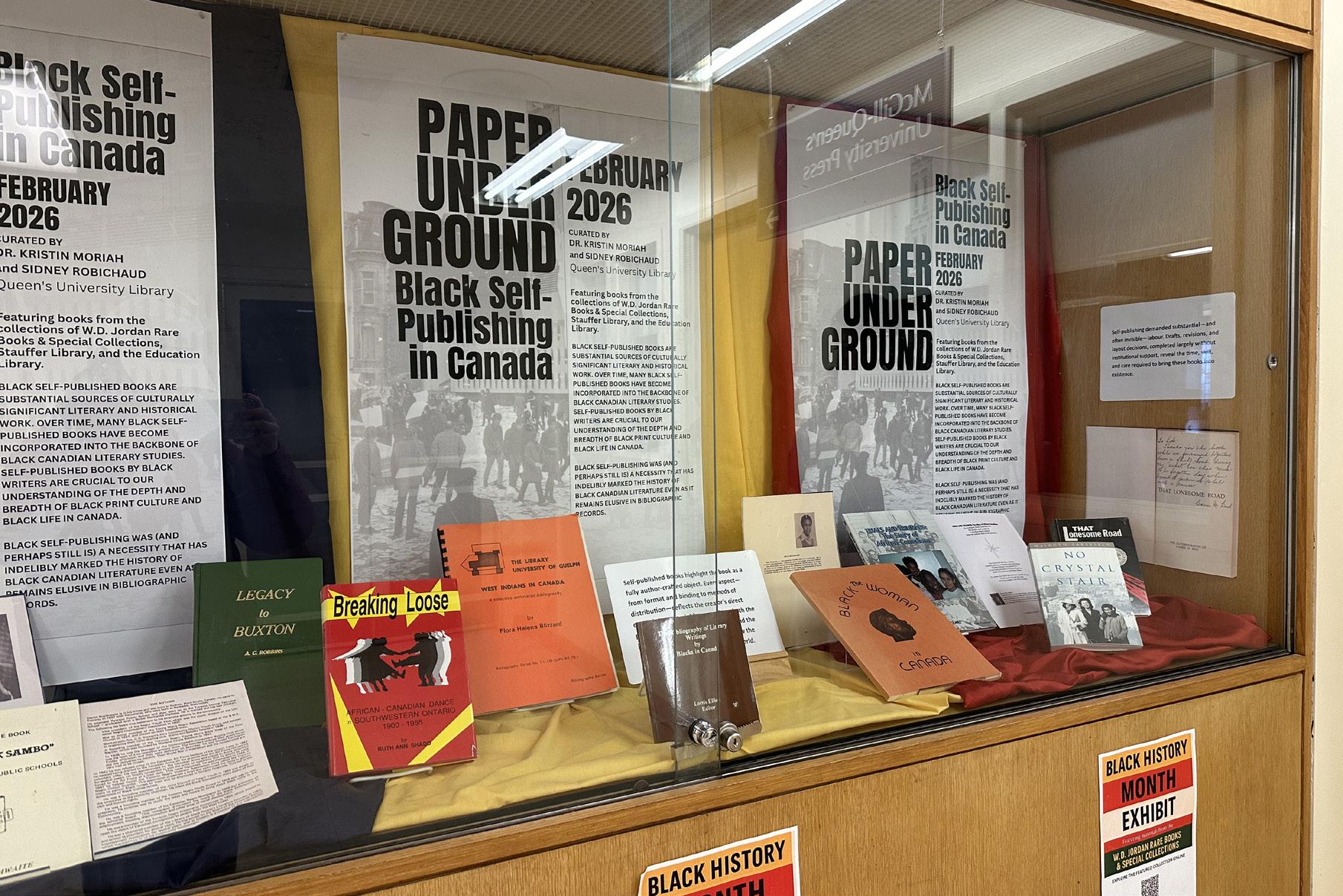
‘Paper Underground’ tells the story of Black self-publishing in Canada
New exhibition at the W.D. Jordan Library spotlights Black authors who fought to put their work on the shelves
Veer
Bhalla
Assistant Arts & Culture Editor
Long before mainstream publishers opened their doors, Black writers in Canada were already telling their own stories.
Queen’s Department of English Literature and Creative Writing’s Paper Underground: Black Self-Publishing in Canada exhibition brings that history to the forefront. Curated by Dr. Kristin Moriah and Research Assistant Sidney Robichaud, the exhibition is on display in the W.D. Jordan Library, outside the 1923 reading room, also known as the Harry Potter room.
“I don’t think anything like this display has been mounted in the past,” Dr. Moriah wrote in a statement to The Journal.
“The study of Black selfpublishing as it relates to black Canadian literature is a
relatively unexamined topic in literary studies.”
Dr. Moriah emphasized that within Canadian Black Studies, it’s commonly known major Canadian publishers have only recently begun publishing Black writers’ work. “That doesn’t mean that Black Canadian writers weren’t publishing important work, but that they saw self-publishing as a means of sidestepping mainstream publishing,” she said. Paper Underground traces a long history of self-publishing in Canada.
Dr. Moriah highlighted one of the earliest examples: John Marrant, who
‘Journal’ alum omar El akkad’s nonfiction dEbut wins
El Akkad sat down with ‘The Journal’ to reflect on his literary journey and the prize’s significance
Eva
Sheahan
Features Editor
This article contains descriptions of war and conflict which may be distressing for some readers.
Journal alum and 2021
Scotiabank Giller Prize winner, Omar El Akkad, ArtSci ’05, has added to his growing list of accolades.
On Nov. 19, the 76th annual US-based National Book Awards took place, administered by the National Book Foundation, accompanied by a musical performance by singer Corinne Bailey Rae, and hosted by Emmy Winner, Jeff Hiller. Amongst all of this excitement, El Akkad won
the Nonfiction National Book Award for his book, One Day Everyone Will Have Always Been Against This. With this award
in 1785 published the book The Lord’s Wonderful Dealings with John Marrant, a Black (Now Going to Preach the Gospel in Nova Scotia).
The tradition of self-publishing continued well into the 20th century. “We have women like Carrie Best, the author of one of the first Black Canadian autobiographies, That Lonesome Road (1977) who chose to self-publish her work.”
Dr. Moriah said. “We have descendants of Mary Ann Shadd Cary, like Ruth Ann Shadd, who go on to chronicle Black life in Chatham-Kent in the twentieth century.” Best’s autobiography, and Ann Shadd’s book, African-Canadia Dance in Southwestern Ontario (1900-1955) (1995) are both part of the exhibit.
The exhibit features books from W.D. Jordan Rare Books & Special Collections, Stauffer Library, and the Education Library.
Bibliographies compiled by Black scholars and librarians are also featured in the exhibition. Moriah noted that these early catalogues treated self-published works as essential rather than peripheral.
“They recognized that selfpublishing was central to Black literary studies in Canada,” said Dr. Moriah. “Those bibliographies may not be flashy, but they contain a wealth of information.”
The exhibit runs from Feb. 2 to 27 and is open to all visitors, with no registration required, providing an opportunity for students, faculty, and community members to explore rare and self-published works by Black Canadian authors firsthand.
Dr. Moriah emphasized the collaborative nature of the exhibition. “Working with Sidney Robichaud and the
u.s. national book award
part manifesto. It’s a rich condemnation of the “West,” as it’s globally perceived. El Akkad calls attention to the role
grateful to be around so many writers I admire and whose work has meant so much to me,” El Akkad said in an

came many complicated feelings.
“It’s very difficult to think in celebratory terms about a book that was written in response to a genocide,” El Akkad said in his acceptance speech.
This book, published last year on Feb. 25, is part memoir,
Western governments have played in oppressing people, specifically the blind eye they’ve turned toward Gaza. El Akkad refuses to do the same.
“I’m incredibly grateful that [the book] has gotten the traction it’s gotten […] I was
library staff was crucial,” she said. As they identified key texts to display, librarians’ expertise “ensured that the display was both informative and visually engaging,” Dr. Moriah said. Paper Underground ultimately examines both the historical significance of Black self-publishing and the ways in which libraries preserve these works for future generations. By bringing these works to light, the display reinforces the value of libraries, scholarship, and collaboration in raising marginalized voices and making their stories accessible.
to a horrific reality. Language is how El Akkad proves witness to the atrocities not only occurring in Gaza, but also everywhere around the world. This, to him, is what makes literature so important, especially when he believes the evil and corrupt systems governing our world depend on the “misuse of language”.
“Under those conditions, we have an obligation to use language for what language is intended to be used for, which is the making of meaning and in that way, there is a component of resistance to the work of literature, particularly in times like this, when we are all being asked, very deliberately, to become more illiterate,” El Akkad said.
Writing is resistance, but it has also always been a home for El Akkad, one that he refuses to give up. He refers to each of his previously published novels, American War (2017) and What Strange Paradise (2021) as a “eulogy for the person [he] was when [he] wrote them.”
Since he’s constantly changing, as we all are, El Akkad’s aware that his ideas and stories adapt to reflect his age and experience—both as a human and a writer.
For the next step, he’s returning with fresh eyes to a draft that he started while working at the Queen’s Biological Station (QUBS) in a mini-writing residency a few years ago.
“All writing is excavation, and every writing project is a dig site and you have to dig through a lot of dirt because you find something worthwhile,” El Akkad said .
interview with The Journal.
“None of that changes the fact that this was a book written in response to one of the most grotesque things I’ve seen in my life.”
For El Akkad, writing the book was a necessary response
El Akkad’s National Book Award win wasn’t celebrated alone. He was joined by other talented writers, including Rabih Alameddine, winner of the Fiction award for The True True Story of Raja the Gullible (and His Mother) , and Patricia Smith, winner of the Poetry award for The Intentions of Thunder.
Want to write for Arts & Culture? E-mail journal_ac@ams.queensu.ca
The exhibit runs from Feb. 2 to 27.
PHOTO BY CLAIRE BAK
‘One Day Everyone Will Have Always Been Against This’ published Feb 25.
GRAPHIC BY ARDEN MASON-OURIQUE
Th1rd Space Collective unifies Kingston creatives through dance and expression
The creative group fosters diverse spaces ‘where dancing is the default,’ says co-founder
Marijka Vernooy Senior Arts & Culture Editor
For the first time in a long time, Kingston has a third space.
One space in particular: Th1rd Space Collective is a bold, artistic group co-founded in September 2024 by creatives Monzy, ArtSci ’22, and Morgan Grace. They hosted their first Afrobeats music and dance night at Lay Low Café on Sep. 27, 2024, and have since expanded their repertoire to include creative networking events, workshops, a brand-new podcast, and more. A little bit of everything, Th1rd Space is bringing diversity and creative unity to Kingston’s nightlife and artistic community, offering opportunities to connect which feel fresh and exciting.
Grace grew up in Kingston, and Monzy ended up here after graduating from Queen’s in 2022. The pair met through a book of poetry they wrote online with fellow author Adriana Moore (Unifysoul), entitled The Woman With Threee Eyes. ‘We actually wrote it before ever meeting in person,” Monzy said in an interview
with The Journal.
Grace and Monzy founded Th1rd Space through the inspiration for their Afrobeats pop-up events at Lay Low, which turn the café-by-day into a vibrant dance floor brimming with fashion, sweat, and good energy. Monzy and Grace were originally driven to host a curated DJ event in the vacant space above Northside Kingston’s former location.
“’We could call it south side, like the flip side,’” Monzy recalled
eventually landing on Lay Low.
The name “Th1rd Space” originated Monzy’s readings about the prohibition era, where alternative spaces like churches, saloons, and theatres became “spaces to create and find pleasure,” she said. “Why don’t we just call it what it is? We’re opening a third space. So that stuck,” Monzy explained.
The “1” in “Th1rd” also carries intention: “We vibrate, all of us, on the same vibration,” Monzy said. “We’re also created to create. We like to
events attended by people from all walks of life, that oneness persists.
Th1rd Space also emerged from a void, of sorts. “I think one good business model is filling voids,” Monzy said.
“In traditional business, that would be targeting people’s pain points.” In Kingston, Monzy thought clear pain points were a lack of clear spaces to harness creative energy, and a lack of diverse spaces in general.
“The city as a whole really needed diverse spaces with diverse
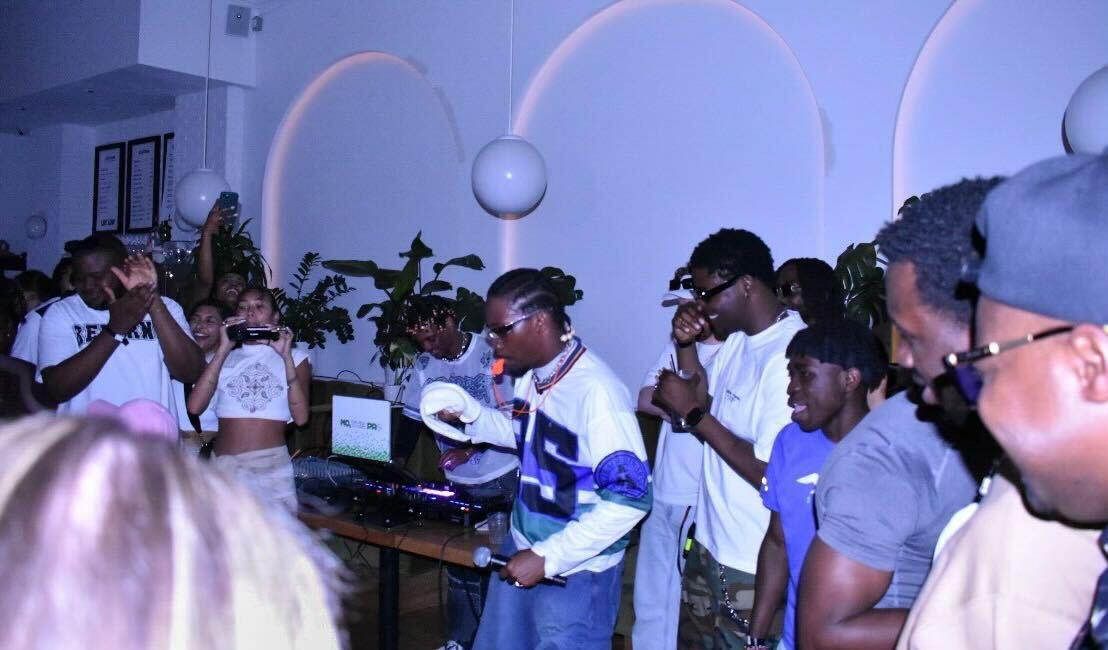
Grace saying to her as they strolled Princess St. one day. “We went, ‘Oh my god, let’s do it.’” Because of Northside’s location change, the two were denied use of the upstairs space,
centre that, and centre third space in that vibration of oneness, rather than sameness,” Monzy said.
For her, the “1” is a reminder that throughout different
music, and places where dancing is the default,” Monzy said.
“There was no reason for that not to be here.”
The collective’s events also offer a space for fashion
Contemporary Black poetry for readers old
A few Black poets to discover and celebrate this Black History Month
Marijka Vernooy
Senior Arts & Culture Editor
As an English student, reading poetry comprises a large part of my week-to-week, something I‘m aware isn’t the case for everyone.
In fact, for casual readers, poetry might be the last thing you’d pick up in your free time. If your memories of reading Grade 10 Shakespeare still haunt you, I’m here to help. In celebration of Black Histories and Futures Month, here are three incredible, modern Black poets whose work you must explore.
Tracy K. Smith
As a Pulitzer-winning poet and the U.S. poet laureate from 2017 to 2019, Smith has the uncanny ability to weave earthly details into sweeping verses about the metaphysical. For example, in “Don’t You Wonder, Sometimes?” from her book Life on Mars, Smith ponders
the existence of an elemental being “Dragging a tail of white-hot matter / The way some of us track tissue / Back from the toilet stall.” This line is as profound as it is absurd, prompting laughter and consideration in equal measure.
Some of her more powerful works confront racial identity in the face of history,
long after.
Faith Akorful
I love poetry that leans into rich imagery to illuminate concepts which may otherwise be hard to visualize. In “Family Affair,” from her book The Seventh Town of Ghosts, Akorful confronts the deceased, interweaving a joyful
on life and death. Akorful’s poetry’s raw, haunting, and beautifully rendered, an invitation into a creative world you’re bound to get lost in.
Terrance Hayes
Hayes’ poems have an artistry to them that can enthrall poetry scholars and casual
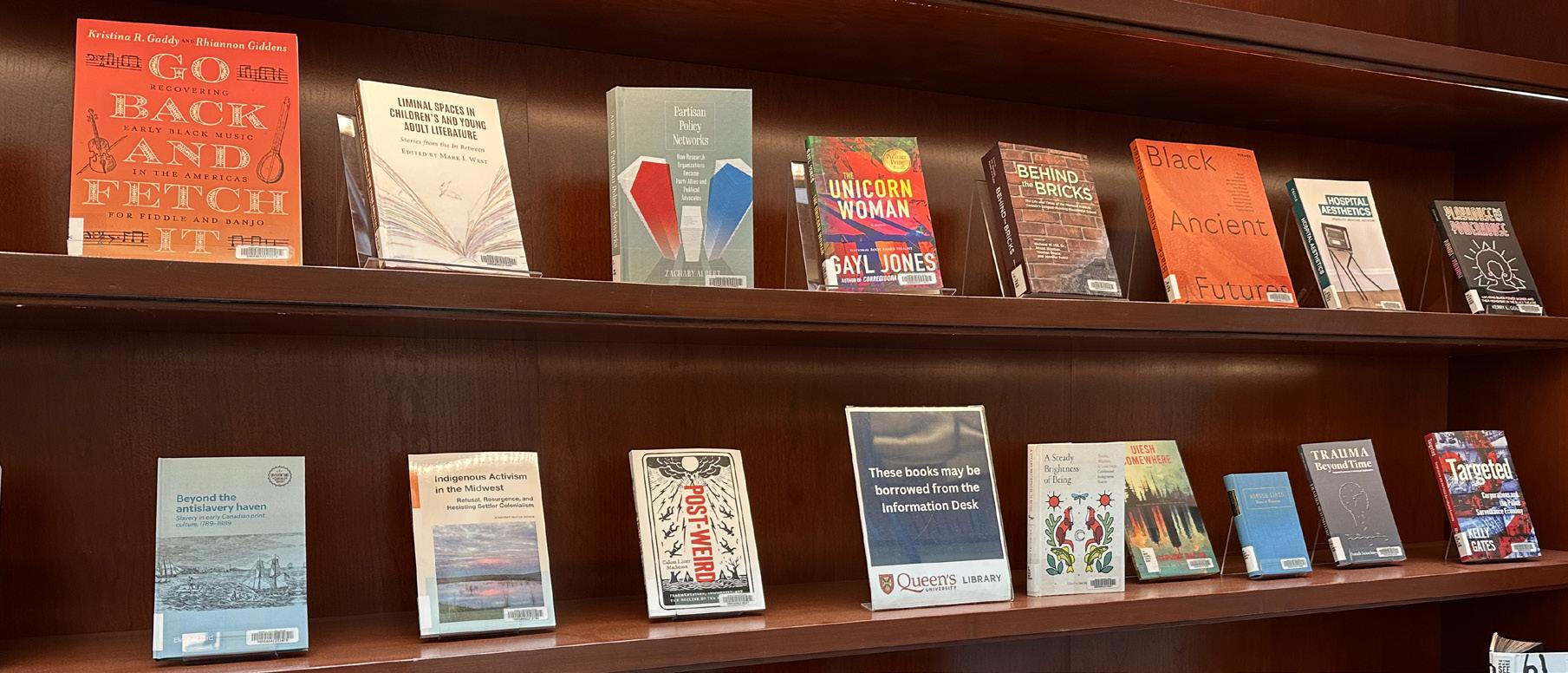
pondering Black existence in the face of colonization. One of my favourite poems from Smith is “Ghazal,” from Wade in the Water, with haunting, bleak imagery that lingers after you close your eyes. The cadence and flow of Smith’s writing makes it just as enjoyable to read as it’s interesting to consider
gathering among residents of heaven and Earth with jarring interruptions from the police.
Much of Akorful’s work blends dream-like inner thoughts into testimonies of writing and living while Black in Canada. In “Vacation,” physical geographies form a history of her own identity, expanding into a meditation
to thrive in Kingston. As a self-described “multidisciplinary artist,” Monzy said fashion is one of her “favourite things ever.” As Monzy put it, “I definitely am intentional about what I’m wearing. I think of how does it intertwine with language? How does it intertwine with movement? The language of the body, dressing the body.” Th1rd Space is unique for its dress codes, often sharing “fit inspo” posts on Instagram ahead of events. Monzy said this addresses concerns from attendees who don’t know what to wear on a night out.
“We’re like, ‘Okay, here are the instructions. Here’s the blueprint,’” she said.
In the future, Monzy said Th1rd Space hopes to move further into commercial and business spaces, while still keeping focus on the people they create for.
Just this weekend they’re hosting a brand-new fashion show in Kingston, along with another Afrobeats pop-up night of dance. “Of course we want to continue hosting spaces for creatives. And people need to dance, people love to dance,” Monzy said. Ultimately, it all comes back to Th1rd Space’s mission statement: “We’re all one, creating under the same sun,” Monzy said. Through seasons of sun and snowy weather, Th1rd Space has brought this vision to life in Kingston. As they continue to grow, they’re definitely one creative group to watch.
and new
where poets use one line from an existing poem they admire, using each word as the last word of each line in their new work.
But the literary genius of Hayes’ work doesn’t make it inaccessible. His verse is often playful, full of emotional twists and meditations on Black masculinity, pop culture, and his own heritage. I especially love “Cocktails with Orpheus” for how it makes the reader aware of their own body, if not a little elevated by the fantastical descriptions of light.
***
readers alike. His poem “Golden Shovel” from the National Book Award-winning collection Lighthead is a form-defining invention all its own. The last words of each line come from poems by Gwendolyn Brooks, the first Black poet to win the Pulitzer Prize. The term “golden shovel” now refers to works
These poets are a great place to begin your journey, but there are works by countless other incredible Black poets available free online, or through Queen’s libraries. Pick up a poem or collection this month and see how poetry transforms you.
Tracy K. Smith, Faith Akorful, and Terrance Hayes are a few of my favourites.
PHOTO BY CLAIRE BAK
Th1rd Space was founded in Kingston in Sep. 2024.
PHOTO SUPPLIED BY TH1RD SPACE COLLECTIVE
‘A
History Exposed’ confronts Canada’s long-ignored history of slavery
Canada’s history of slavery runs deeper than what we’re taught and deserves to be discussed
Daniel Gill Assistant Arts & Culture Editor
This article discusses racism and slavery, which may be distressing for some readers.
For many Canadians, the national story of slavery begins and ends with the Underground Railroad. A History Exposed: The Enslavement of Black People in Canada dismantles that myth.
Originally developed by the Canadian Museum of Immigration at Pier 21 with guest curator Afua Cooper in partnership with the Black Cultural Centre for Nova Scotia, the travelling exhibition is making its stop in Kingston from Jan. 14 to May 22. Displayed at Kingston City Hall’s Market Wing Cultural Space, the exhibition confronts viewers with the often-overlooked realities
of slavery in what’s now Canada.
Structured across several double-sided panels, the exhibition moves from the global context of the transatlantic slave trade to specific biographies.
It traces the history of enslavement from New France through British North America until abolition in 1834, emphasizing how deeply embedded the institution was in colonial economies and social life. Historic records such as sale notices, court documents, and drawings accompany the panels’ text, serving as stark reminders of how normalized slavery was in Canadian society. Several reproduced newspaper advertisements announcing the sale of enslaved people are particularly jarring.
It’s one thing to learn slavery existed here, but it’s another, very much more real and hard feeling to see it marketed
in plain print, reduced to a simple transactional exchange.
Another striking visual element of the exhibition is a black rectangle painted onto the gallery wall, measured to reflect the space allotted to enslaved people aboard ships crossing the Atlantic. Visitors are invited to compare their own bodies to it, creating an immediately sobering effect.
The exhibition also highlights figures like Marie-Josèphe Angélique, executed in Montréal in 1734 and now central to scholarship on Black resistance in Canada. Her story is presented not as an isolated tragedy, but as part of a broader system of racialized control. In featuring her life, the exhibition resists portraying enslaved people solely as victims. It emphasizes the violence of slavery while highlighting the importance
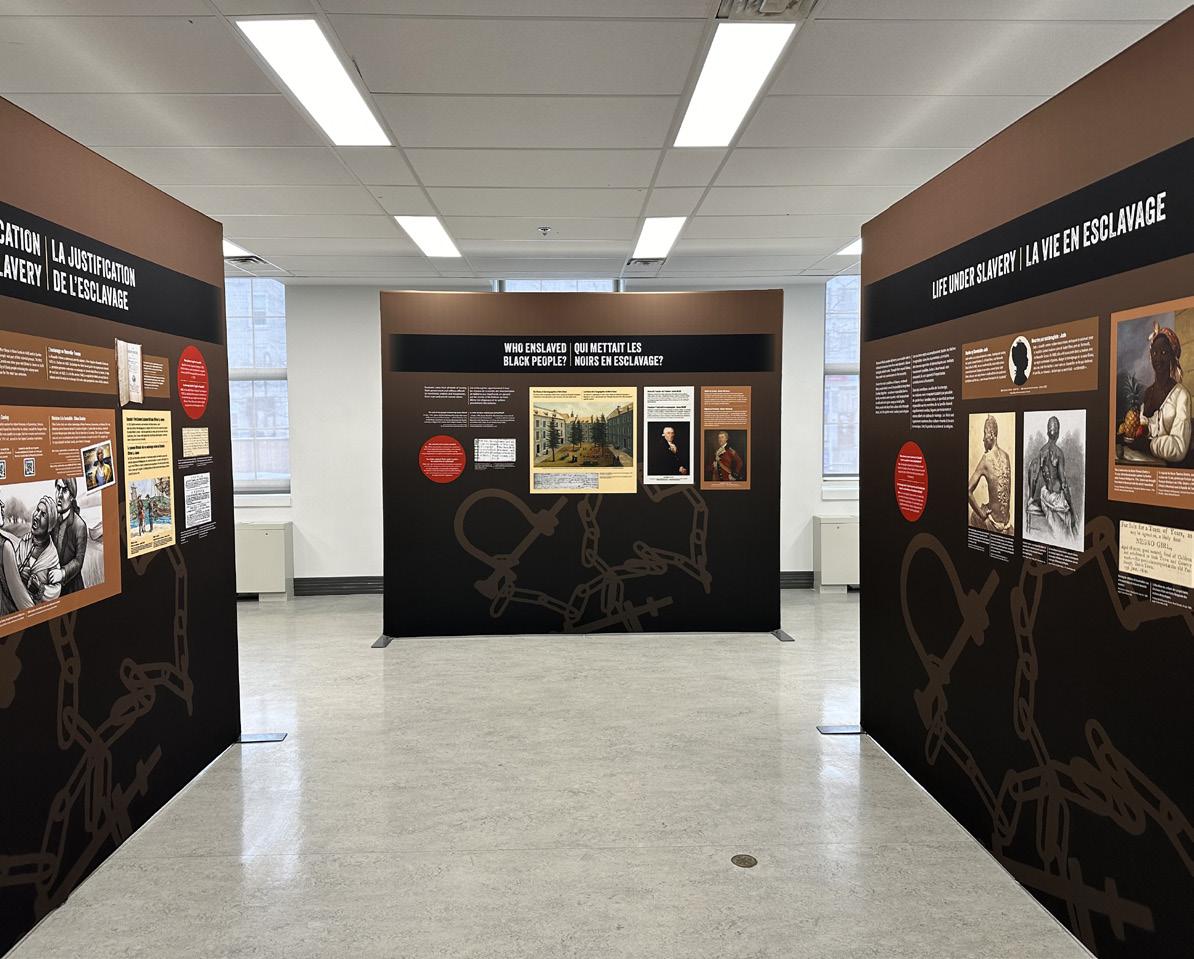
of defiance.
Importantly, the exhibition refuses to soften its language.
Visitors are warned about racist terminology drawn directly from archival sources, a choice that feels necessary.
Sanitizing historical records or omitting them would risk repeating the erasure the exhibition seeks to confront.
Seeing the exhibition in Kingston carries particular weight.
The city is steeped in Loyalist history, presenting this
exhibition in City Hall prompts difficult questions about which local histories are preserved permanently and which are relegated to temporary displays. I left the exhibition feeling productively unsettled. A History Exposed educates with clarity, trusting archival records to speak for themselves, resulting in an exhibition that’s as challenging as it’s essential.
The limits of colour conscious casting in ‘Bridgerton’
Representation on-screen is meaningless if cast members aren’t supported in real life
Veer Bhalla Assistant Arts & Culture Editor
This article discusses racism and homophobia, which may be distressing for some readers.
The concept of colour-blind casting becomes problematic when producers don’t stand up for cast members against racist audiences.
In one period drama, this anchors an ongoing problem of performative diversity.
Created by Chris Van Dusen and produced by Shonda Rhimes for Netflix, Bridgerton (2020) is a period drama centred around the siblings of the Bridgerton family in regency-era England. Each season ascendedtothetopofNetflix’s Top 10 streamed shows upon release. The show was adapted from a series of novels by Julia Quinn, drawing in the books’ passionate fan base.
Unlike its source material, the series has challenged conventional norms of the historical-drama genre; the episodes feature stringquartet covers of popular songs—shout out Kate and Anthony dancing to a string-quartet rendition of Robyn’s “Dancing On My Own”—empowered female characters, and a cast that may be considered “unconventional” for a period drama.
Queen Charlotte, where the real Queen Charlotte’s African ancestry has been rumoured for decades, led to racial equality in British society during the regency era. This allows the show to employ a diverse cast of actors to reflect its diverse audience.
The first season’s explanation for Bridgerton society’s racial diversity was fairly criticized by Vox for ‘handwaving racism’, and the second season received criticism for overlooking the harsh reality of Britain’s colonization and exploitation of India, and putting vastly
portrayals of these characters being white. The hashtag #NotMyDuke trended when Regé-Jean Page was initially cast as Simon Bassett, the fictional Duke of Hastings for being a Black man playing a character initially written as white.
However, Jean-Page’s strong performance seemed to win over most of the books’ fanbase. Many later claimed he was ‘the only reason they watched the show’ after he departed following the first season, once his character’s significance to the plot reduced.
refuse to stand up to racist abuse because it was coming from ‘fans’,” Jean-Page shared on an Instagram story, with fans interpreting the statement as a dig at Bridgerton’s production team. Problems with unfair treatment of cast members of colour didn’t stop after the first season. Simone Ashley, the show’s first female lead of colour, continues to portray Kate Bridgerton on the show. Recently, her and lead actress of the fourth season’s Yerin Ha, have been at the centre of fan discourse about the show’s

different cultures from India into a monolith.
Bridgerton diverges from other period dramas by being set in a fictional world where King George III’s marriage to
While a lot of that criticism’s valid and hasn’t fully been addressed by the show’s creators, fans of the novels found themselves disappointed in the show’s diversity, some fans are unapologetically racist, upset the casting didn’t mimic the novels’
After leaving the show, Page expressed support for the cast of Rings Of Power when they spoke out against hate received by their cast members of colour. “I can’t believe we went through an entire era where production were happy to stand by, tell us it was our own problem and
production team sidelining both characters in promotional images.
Creators finally did address criticism about casting choices when author Julia Quinn took a stand through a Facebook post on June 24, 2024 against the fandom’s criticism of the show
gender-bending one of the future love interests of one of the Bridgerton siblings, implying a future season focused on a queer relationship. The character, Michaela (Michael in the books) Stirling is introduced in the third season. She’s played by Masali Badusa, a Black woman who’s received hate similar to Jean-Page, with the #NotMyMichael replacing #NotMyDuke. While Quinn’s Facebook post focused more on homophobic than racist comments, her expression of support was a step in the right direction because fans stopped scapegoating their homophobic and racist criticism behind the excuse that “the T.V. adaptation is going against what Quinn wanted for the characters”. This ties into a greater issue where corporations are ready to embrace diversity to enlarge their consumer base but not stand by it when it stops working in their favour. When it comes to Bridgerton’s cast members of colour, the show’s production team only expresses care for them when they’re paired against the show’s white leads but doesn’t stand by them when they’re receiving criticism for playing those roles.
Hopefully future shows employing colour-conscious casting recognize that representation’s a responsibility and defend their actors against racist backlash.
The exhibit runs from Jan. 14 to May 22.
PHOTO BY CLAIRE BAK
‘Season 4 Part 2 of Bridgerton has been streaming on Netflix since Feb. 26.
GRAPHIC BY ARDEN MASON-OURIQUE
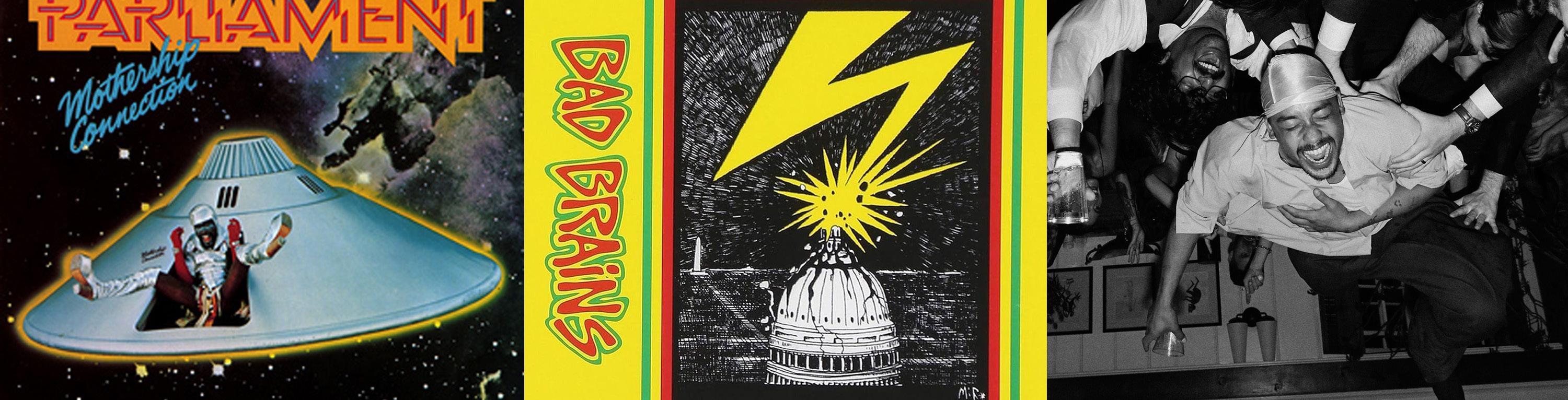
Five albums by Black artists to explore during this Black History Month
From funk to punk, these five albums are timelessly great
Daniel Gill Assistant Arts & Culture Editor
Black musicians have had an immeasurable impact on popular music.
With February marking Black Histories and Futures Month, there’s no better time to dig into some of the most historically significant albums created by Black artists. Spanning rock ’n’ roll, jazz, funk, hardcore punk, and contemporary R&B, these five records all reflect an innovation that continues to shape the sound of popular music.
Berry Is on Top by Chuck Berry
Before the dawn of arena tours and rock stars, there was Chuck Berry. Released in 1959, Berry Is on Top features some of his most defining tracks, including “Johnny B. Goode” and “Roll Over Beethoven,” songs that practically wrote the blueprint for rock music as we know it.
By pioneering the electric guitar as a lead instrument, Berry sharpened the genre’s edges. The songs are fast and tightly constructed, with lyrics laced in sly humour aimed squarely at a teenage audience. Berry fused blues structures with a new kind of speed and showmanship. Listening now, the tracks remain undeniably catchy. The album’s importance lies in how foundational it is, with so much of what we recognize as rock beginning here.
Night Train by Oscar Peterson Trio
A few years later, in a very different register, Oscar Peterson was refining another aspect of mid-20th-century sound. Recorded in 1962, Night Train captures Peterson and his trio in relaxed but razor-sharp form. The title track and standards like “C Jam Blues” are heavy hitters that showcase the trio’s chemistry and
‘wuthEring hEights’ is ragE-bait for English litEraturE maJors
The art of adaptation has stumbled and faceplanted with this movie
Eva Sheahan Features Editor
This article discusses abuse and generational trauma, which may be distressing for some readers.
When “Wuthering Heights” concluded at The Screening Room, there wasn’t a dry eye in the theatre. Except for three—mine, and my two new friends beside me who’d also read the book.
On Feb. 13, Saltburn’s Emerald Fennell’s “Wuthering Heights”, starring Jacob Elordi and Margot Robbie, released in theatres with a score by CharliXCX. Believe me, I have a lot to say. I find it very hard to believe that Fennell even read the
original Emily Brontë’s Wuthering Heights (1847).
The film provides audiences with confusing, superficial mush that seems to say nothing at all.
Adaptations are allowed to take liberties. They’re allowed to reinterpret, modernize, and even provoke. What they shouldn’t be allowed to do—at least not without consequence—is completely abandon the point the author was trying to make. At a bare minimum, an adaptation should show respect for the story it’s borrowing from, and for the intentions behind it.
Fennell’s choices resulted in a fundamental misunderstanding of what Brontë’s Wuthering Heights is actually about.
For those of you who don’t know, Wuthering Heights is the story of Catherine (Cathy) Earnshaw and her tumultuous love affair with Heathcliff, an orphan who was adopted by the Earnshaw’s family. He suffers serious abuse at the hands of Cathy’s
swing. Hailing from Montreal, Peterson stands as one of the most accomplished jazz musicians not just in Canadian history, but of all time. Night Train remains a quintessential work for piano trios and one of the most accessible jazz albums ever recorded, serving as proof technical jazz brilliance and approachability can coexist.
Mothership Connection by Parliament
By the mid-’70s, experimentation had moved from the jazz club to the cosmos. Imbued with a galactic mythology, Mothership Connection transformed funk into something theatrical and expansive. Under the direction of the legendary George Clinton, Parliament built a sonic universe of rubbery basslines, layered harmonies, and intergalactic lore.
The grooves on “Give Up the Funk (Tear the Roof off the Sucker)” are irresistible, but the album’s ambition is just as striking. It treats funk as both spectacle and philosophy, blending together humour,
older brother, Hindley, a character completely erased from the film. The original story then follows Heathcliff’s revenge and Cathy’s awful temper as it stains and ruins the lives of two families: the Earnshaws, who live in the gloomy Wuthering Heights, and the Lintons, their neighbours over on Thrushcross Grange.
Fennell’s story features the moors and has characters of the same name, but most of the original story has been replaced.
In terms of casting, it’s been said countless times, but can only be reiterated: Brontë’s characterization of Heathcliff as racially ambiguous and socially othered isn’t accidental.
From childhood, he’s abandoned, dehumanized, and treated as inferior. His rage, his fixation on Cathy, and his violence aren’t necessarily expressions of romantic intensity, but they’re responses to a world that has systematically denied him belonging and humanity.
Continued online at www.queensjournal.ca
politics, and jams. Its impact runs deep through hip-hop and contemporary R&B, with artists like Dr. Dre, Snoop Dogg, and Ice Cube sampling tracks from Parliament’s funk masterpiece.
Bad Brains by Bad Brains
If Parliament expanded their sound outward, Bad Brains sought something so compressed it feels like listening to lightning in a bottle. Their 1982 self-titled debut is blisteringly fast, technically stunning, and impossible to ignore. Songs often clock in under two minutes yet feel monumental.
The band pivots from ferocious hardcore to dub-inflected reggae without losing coherence. That elasticity challenged assumptions about what punk could contain. In doing so, Bad Brains created one of the most influential hardcore albums ever recorded, serving as a blueprint for the generations of punk-rockers who followed.
Baby by Dijon
Unlike the aggression of Bad Brains, Dijon’s Baby feels intimate but no less transformative. Blending indie rock textures with contemporary R&B sensibilities, the record is loose, warm, and emotionally direct. The album received widespread critical praise upon its release last August. Dijon experiments with structure and production, in doing so, he expands the boundaries of modern R&B and positions himself as one of the genre’s most compelling voices, a feat made all the more impressive considering Baby is only his sophomore album.
From Berry’s foundational rock to Dijon’s genre-blurring R&B, each of these records pushed its genre’s sound forward. Together, they highlight a history of Black musical innovation that continues to shape the sound of popular music today.
Black artists have always been at the forefront of musical experimentation.
GRAPHIC BY JASHAN DUA

How I preserve meaning in a fast-moving world
An old solution to my modern mental overload
Sophie Arora Contributor
At the end of 2025, I reflected on the past year—as many do. As I looked back, I realized that I was struggling to remember all of the little things that I’d done. So many events, facts, and anecdotes that I know were important or exciting to me at the time, but are now just a distant memory.
I knew I’d lived a lot of life, but I didn’t feel like I’d appreciated those moments, nor properly taken them in. It felt like I’d wasted my time, energy, and money on what could now only be recalled as a blur.
All I remembered were the overarching things; I finished my courses, worked a few jobs, and hung out with different people. The specifics escaped me.
All year, I felt like I was always just barely keeping up with everything going on, and never actually taking any time to register what I was doing. It was always just onto the next thing, never reflecting upon the experiences, media, people, and content I had been exposed to.
“It felt like I’d wasted my time, energy, and money on what could now only be recalled as a blur.
This year, I was determined for things to be different. I researched many of the ways others engaged in practicing mindfulness, improving their recollections of experiences, and emphasizing the significance of
smaller, but still important, things.
The issue with most of the techniques I came across was that they required consistent time each day. Being a very overcommitted student, this was something I knew I couldn’t do. Also, I didn’t want to put more pressure on myself to put energy into yet another thing each day.
“This
year, I
was determined for things to be
different.
I eventually came across a method that satisfied my criteria: the commonplace book.
A commonplace book is a knowledge-keeping tool dating back to ancient Greek times. It reached the height of its popularity in the Renaissance period as a response to the influx of accessible information caused by the invention of the printing press. It’s an extremely customizable notebook, and its contents are entirely based on topics of your choosing.
Two pages at the start of the book are set as the index, and the rest is written as you go along. Each time there’s a new topic or theme deemed to be significant, it’s added as the title to the next available page and the corresponding entries are written on that page. This information is then written in the index for ease of location.
If you run out of space on the page for that theme, you simply write the same title on a new page and add that page number to the same index entry. It’s organized enough to be able to locate specific entries, but not so much so that it becomes a hassle to add new ones.
A few of my own topics include quotes from books I’ve read, song lyrics I’ve found
particularly meaningful, facts from my university courses I want to explore further, little pieces of writing I’ve done, and lists of media I’ve engaged with, along with my thoughts on them.
This way, nothing that I want to remember is forgotten, but I also don’t need to constantly keep it in my mind, especially when it may not be relevant to my daily tasks at hand. This allows me to keep a clearer head, and the sheer act of taking the time to write about something means I’ve better stored it in my memory.
This way, the book acts as the perfect trigger for memory recall whenever I wish to devote my time to a specific subject of choice or just simply do some reflection.
My favourite aspect of my commonplace book is that all my topics are whatever I’m intrigued by. At the end of the day, this book is a representation of all of my interests, philosophies, beliefs, and other individualities. It is this fact that makes it so effective.
A typical diary-style journal isn’t very digestible when reading back. It tends to be riddled with insignificant and potentially boring details, and realistically, not every day is going to be engaging. With a commonplace book, it’s simply bullet points or quotes about subjects or occurrences that I take great interest in, with no pressure to add to it everyday.
“At the end of the day, this book is a representation of all of my interests, philosophies, beliefs, and other individualities.
This fact compels me to
reread my past entries over and over again. I’m able to take separate thoughts or quotes and connect them to each other, and then I can build new ideas on top of those old ones. It allows me to truly process and engage with the content and perspectives which have had even a small impact on me in my daily life.
I would recommend that everyone try to keep a commonplace book. It’s a no-pressure way to compile one’s thoughts and ideas in an easy and digestible format. Considering it reached the height of its popularity due to an influx of new information, I would say it’s beneficial now more than ever.
We live in a world where we are constantly plagued by novel ideas, facts, content, and people. Personally, it feels like my mind is partially taken up by an ever-present to-do list. My commonplace book has been able to function as an inventory, to relieve my brain of what might not be important at the current moment, but that I would like to keep for when I have some free time.
A commonplace book feels like a way for me to appreciate the smaller things. A way to derive meaning and a more long-term impact from day-to-day experiences. Taking the time to write even just one point about something interesting that influenced my thoughts or mood makes me feel more like I’m truly living.
I don’t want to take in countless hours of media, content, and conversations and have nothing to say for it in a year, simply because I was always moving on to the next thing. In a world that’s so insanely hectic and with so much pressure to constantly get ahead, I believe it’s incredibly important to appreciate the smaller things. It can be so easy to get caught
up in the bigger picture that we forget to appreciate merely being alive and getting to feel emotions, come up with unique ideas, and engage in our interests.
It has only been a couple of months, but I feel as though I have already learned a lot, both in regard to the actual content I have ingested, as well as about myself.
I find myself rereading my entries quite often, especially those regarding specific situations, events, or thought patterns that come up a lot in my mind. This helps me to calm some of the recurring anxieties I tend to have.
“I don’t want to take in countless hours of media, content, and conversations and have nothing to say for it in a year, simply because I was always moving on to the next thing.
It is a way for me to see that I have already dissected the things I was previously uncertain about. Having the ability to come back to my own words, and get that reassurance from myself, guides me forward as a person. I’ve noticed patterns in relation to ideas I didn’t think I was that intrigued by. I have seen the kinds of emotions and subject matters that compel a strong enough reaction for me to write them down. This simple notebook has allowed me to not only feel more connected to the world around me but also to myself.
Want to write a postscript? E-mail journal_postscript@ams.queensu.ca
Keeping a commonplace book helped me appreciate the little things in life.
PHOTO BY JASHAN DUA