
QIO
QUEENS INTERNATIONAL OBSERVER
A Letter from the Editor
Morgan Tomalty

Dear Reader,
ese past few months have been incredibly exciting for the QIO team. We are thrilled to announce a long-term sustainability plan for the magazine in conjunction with the Queen’s Earth Centre, with all future issues to be printed on 100% recycled paper. us, to celebrate the inaugural environmentally-friendly publication that is currently in your hands, we are proud to present to you QIO 10.3’s Sustainability Issue!
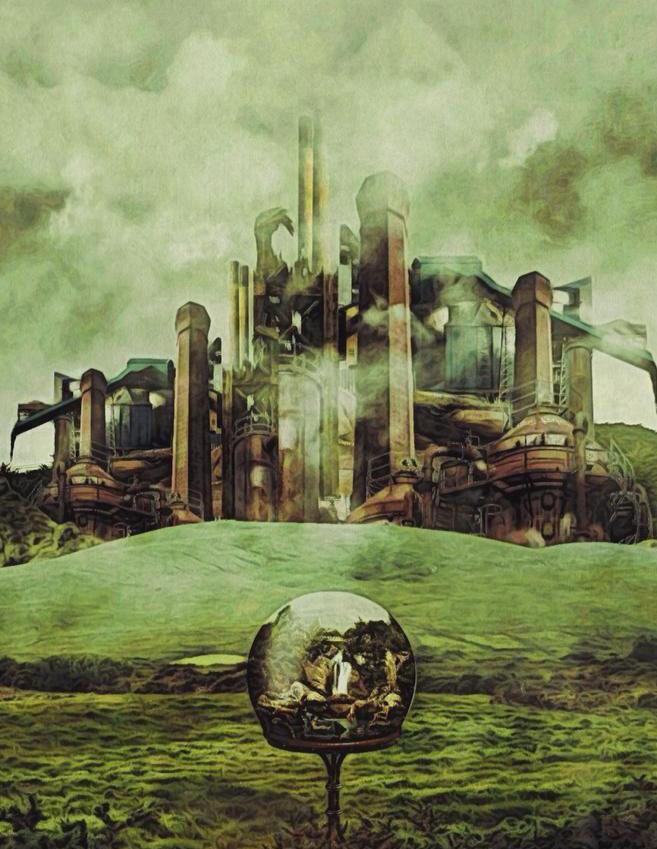
Earth Centre executives Laura Vaz-Jones and Joshua Good eld graciously contributed their knowledge on the bene ts of small-scale farming and the issues surrounding the Keystone pipeline. Additional outside submissions come from Sarah Hobbs, who comments on the recent chemical spill in West Virginia, and Chris Cowan, who tackles climate change and its disastrous impact on the Paci c islands. Alexander McGurk goes head-to-head on the economics of immigration reform in the United States, while Aaron Gi ord delivers a nuanced perspective on the disputes in the Ukraine. Deborah Chu and Erica McLachlan take on our Debate Column this issue, and discuss the tension between technology and the environment. On a more positive and forward-looking note, QIO’s art columnist Claire Pierce pro les several eco-friendly solutions to common modern tribulations. Finally, our front cover is a satirical take on the divergence between technology and the environment by local artist Colin Sinclair.
ese pages will explore a common, but pressing question: will advancements in technology endanger human civilization, or enhance our way of life? How will the irreparable damage of our ecological footprint impact the international community? Our hope is that this issue will deepen your understanding of the multi-faceted relationship between the environment and global a airs.
Happy reading,
Morgan Tomalty, Editor-in-Chief Vol. 10
Deborah Chu and Alexander McGurk, Assistant Editors Vol. 10
Claire
QIO is the Queen's International Observer, a quartlerly student magazine published by the Queen's International A airs Association. e magazine focuses on international news, politics, art, and technology. Want to submit a piece to QIO? Email your 600-900 word piece to contact@ queensobserver.org by midnight of April 4th. All submissions from all faculties and departments are welcome!
KEYSTONE XL
BARRELS OF CONTROVERSY
by Joshua Good eld, Education Director for the Earth Centre
On January 31st, President Obama and the U.S. State Department released the Final Environmental Impact Statement for the northern leg of the TransCanada Keystone XL pipeline proposal. e report highlights that if the pipeline is built, the extraction rates in the tar sands and the demand re neries have regarding oil will likely stay relatively consistent.
Even though it has not yet been approved, Keystone has already become a controversial subject among North Americans. Oil-rich Alberta is leading the charge to extract oil from the tar sands with hopes of nding foreign buyers. is would heighten the reliance on Albertan oil, which releases more greenhouse gases than conventional oil.
President Obama has said that he would allow the Keystone project if there was a clear understanding it would be in the nation’s best interest. Presumably, the goal is for the U.S. to join Canada in becoming energy independent. Becoming energy e cient is a goal articulated by people who
believe that the United States, Canada, and Mexico should not purchase foreign oil. e geographical layout of Keystone makes this a contentious claim, as the pipeline runs through the U.S. and ends in Houston. e controversy exists in that many see the pipeline only as a risk to Americans because of the potential spill points. e proposed line runs through Native American communities and could disturb farms and ranches.
Pipeline opponents would likely discuss the 2010 Enbridge Tar Oil Spill that impacted the Kalamazoo River in Michigan and surrounding areas. e spill caused costs that adversely created greater rates of unemployment, economic concerns, and environmental devastation. Most importantly, it raised the issue that the law does not require pipeline maintenance checks.
As of early February, Democrats and Republicans have formed a coalition to urge President Obama to give the pipeline quick approval. eir main arguments include how pipelines are safer for transporting oil than train and track, their ability to create jobs, and the optimistic hope
of achieving North American energy independence.
If we approach the issues surrounding Keystone through a sustainable lens, we must be critical as to which method of transportation we apply. Alberta is landlocked and the demand for oil elsewhere is only increasing. e fact of the matter is that if Keystone is rejected, like all the other pipeline proposals before it, we would need an immediate alternative oil-to-market approach to justify not using the pipeline.
e project has been accused of being potentially devastating to the environment due to the increased production that would occur on the tar sands. Its opponents believe Obama should take further strides towards tackling climate change during a time believed by many to be our tipping point. Renewable energy is poised for further development, prompting those with a vested interest in clean energy rms to urge American leaders to focus their attention on research and development.
e United States already boasts upwards of 2.6 million miles of pipeline. A proponent of the
pipeline could argue, “So what’s a few more miles?” However, many believe the Keystone project would perpetuate our addiction to oil when we should be trying to reduce the amount of bitumen-based product we rely on.
Increased tar sand production is often seen as a "doomsday" nightmare. Tar sands oil is reported to be the dirtiest and most carbon-intensive product being developed, and the e ects are felt throughout Canada in the form of airborne carbon emissions. Furthermore, the risk of an oil spill is immense in a pipeline that covers such a large area. e terrain that the pipeline would run through also includes the Ogallala Aquifer, which supplies freshwater for irrigation and drinking water for the residents of the High Plains.
e issue becomes placing a value on carbon emissions and the environmental impact an action has. ere are clear risks in Keystone, however, the demand for energy is increasing. Keystone itself may not be considered a major environmental distress,however, furthering an addiction to oil is undoubtedly a contributor to climate change. QIO

The Best and the Brightest (On a Budget)
by Alex McGurk

THE E CONOMICS OF I MMIGRAT ION R EFORM
Detroit will soon be given a new lease on life. On January 23, Michigan Governor Rick Snyder announced plans to bring 50,000 immigrants with advanced degrees into the Motor City. ere would be new business, new jobs, and new taxpayers. Governor Snyder’s resolution was a promise to revitalize the former heart of America’s automotive industry, whose population has more than halved in half a century; whose residents live among abandoned buildings and unlit streets; and where 38 percent live below the poverty line. And best of all - it would not cost the state a thing. »
GovernorSnyder insisted that his immigration plan was the best means restoring the bankrupt city to scal sustainability, but without painful cuts or tax increases, and without funding from the federal government. “Isn't this a great way that doesn't involve large-scale nancial contributions from the federal government to do something dramatic in Detroit?” the Republican governor asked of the assembled press when he rst unveiled his plan. In response, the White House issued a brief press release a rming the president's commitment to “attracting the world's best and brightest” to the United States, suggesting a tacit endorsement of Governor Snyder’s strategy.
Talk in Washington has long been premised on the idea that the United States is facing a critical shortage of the “world's best and brightest.” Among the Washington set, the phrase is usually restricted to workers trained in science, technology, engineering and math, or STEM. In February 2012, the President's Council of Advisors on Science and Technology estimated that the United States would face a shortage of approximately one million STEM professionals over the next decade, potentially precipitating a crisis of national power and prestige. Without an expansion of STEM education, the Council warned that the United States would lose its “historic preeminence in science and technology.”
Silicon Valley rms have been among those pushing hardest for higher skilled immigration quotas. During the debate over a Senate immigration bill last spring. Google, Facebook, Microsoft and other companies
lobbied Congress for expanded high-skilled immigration on the basis that they were having trouble nding quali ed workers because of limits on H-1B skilled visa program, currently capped at 65,000 per year. ese companies argue that it is too costly to retrain older workers, and that the United States is not producing enough young Americans with the skills it needs. eir lobbying e orts ultimately convinced a bipartisan coalition in the Senate to pass a bill that allowed the admittance of more foreign professionals.
But if Washington sees highskilled immigration and STEM education as a means to national greatness, the CEOs of Silicon Valley may have their own reasons. According to a 2013 study by the Economic Policy Institute, H-1B visa holders have lower salaries, fewer patent applications, and fewer Ph.D. dissertation awards than Americans of similar age and education.
ey are also signi cantly less likely to work in research and development than Americans. In other words, few H-1B immigrants are among the “best and brightest”. ey are simply cheaper than American workers. In 2009, Facebook
CEO Mark Zuckerberg told his speechwriter that he saw Facebook as part of a project that “moving from countries to companies”. His support for immigration reform speaks to the same sense of corporate, rather than national, selfinterest.
e bill that passed the Senate in June would immediately raise the number of H-1B visas available per year to 110,000, with the number to expand to 180,000 in the coming years . It would also create a new merit-
based visa system, which will grant 120,000 to 250,000 visas annually to immigrants based on skills, education, family ties, age, and nationality. e Congressional Budget O ce estimates that the Senate bill would lead to a net increase of 100,000 residents remaining in the United States under an H1-B visa by 2018, as well as an additional 2.5 million people coming under a new merit-based points system.
As is normal Congressional practice, the House Judiciary Committee drafted its own high-skilled immigration bill. Titled the SKILLS Visa Act, it would increase the number of H-1B visas to 155,000, increase the employmentbased immigration cap from 140,000 to 235,000 visas per year, but without the meritbased system promised in the Senate bill. House Speaker John Boehner, however, has barred any discussion of any immigration bill on the House oor. e earliest date for a possible debate on immigration will be in 2014, and only after the conclusion of the primary elections in the winter. On January 24, Politico reported that four immigration bills were expected to go to a vote by the end of the summer, including one that grants legal status to undocumented workers but includes no path to citizenship.
Boehner has his reasons for the delay. e Republican Party is divided on immigration, and not on the familiar lines either. Tea Party-linked voices, such as Senator Marco Rubio and Representative Paul Ryan, are among those pushing the hardest for immigration reform. On the other side of the debate, the conservative movement at large remains
wary, fearing that any bill could become a “Trojan Horse” for amnesty, and allow undocumented immigrants a path to citizenship.
e Senate bill includes a provision for fast-tracking the visa applications of the 11.7 million undocumented immigrants in the United States. Immigration opponents in the House Republican Caucus fear that when the House and Senate bills are reconciled in committee, those provisions will pass into law –against the will of the majority of the party, but in line with the views of its leadership and major donors. e Senate bill includes provisions that the majority of the Republican Party do support – increased Border Patrol spending and more high-skilled immigration – but, for immigration opponents, the inclusion of paths to citizenship in bills from the Democratic-majority Senate has always made progress politically poisonous for the House Republican leadership. But there are signs that might be changing.
On January 24, Politico reported that those close to the planning expected votes on four immigration bills by the end of the summer, including one granting legal status to undocumented workers, but no path to citizenship. If they succeed, the Republican leadership and their Silicon Valley backers will get everything they wanted. Immigration reform might be their best opportunity to bring about dramatic change for the United States and without costing the federal government a thing. QIO
THE WATER GAMES
by Sarah Hobbs
West Virginia needs itself a real-life Katniss Everdeen. Unfortunately, the bow-and-arrow wielding heroine was nowhere to be seen when the Appalachian state's recent chemical spill left 300 000 residents without clean water, and the absence of a champion means this particular disaster — the latest in a string of incidents that have marked the region's history of environmental degradation — is in serious danger of being ignored. »
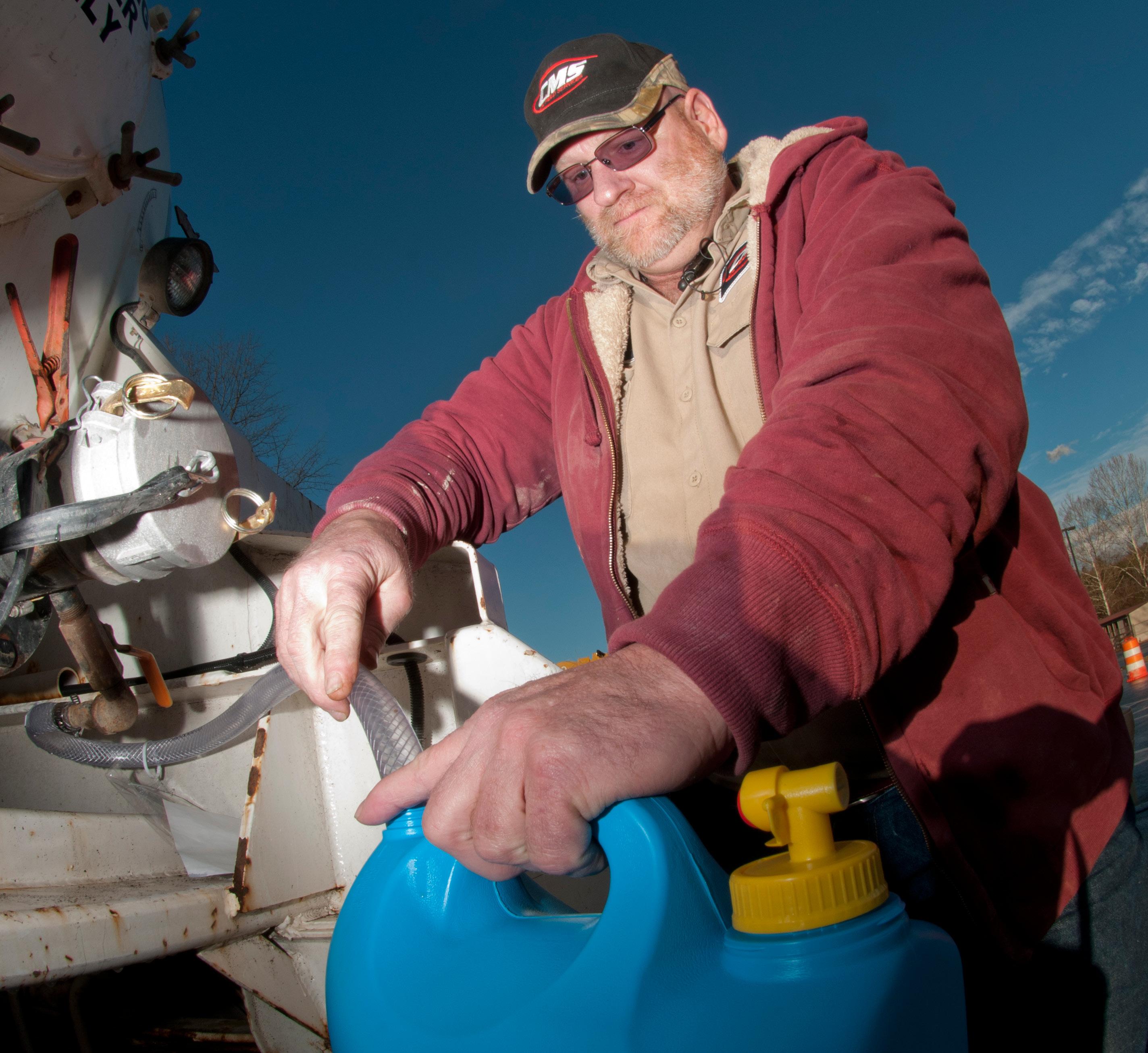
Early this January, 10 000 gallons of a foaming agent used in coal preparation leaked from aboveground tanks belonging to Freedom Industries into West Virginia's Elk River. In a quirk of fate or (more likely) poor planning, these tanks were roughly a mile upstream from the West Virginia American Water Company’s water supply intake. Not long after reports of a strange odour near the river reached the local government, Governor Earl Ray Tomblin was telling residents of nearby counties "not to use tap water for drinking, cooking, washing or bathing" as their water supply had been contaminated with 4-methylcyclohexane methanol. is substance, West Virginians were informed, is harmful if swallowed, and known to cause skin and eye irritations. Cue the rush to the bottled water aisle at the supermarket.
Such was the scale of the crisis that President Barack Obama accepted West Virginia's request for disaster declaration and opened federal aid co ers to the thirsty state. But despite this o cial nod, the West Virginian chemical spill was not deemed “big news” by mainstream media outlets. As Jason Linkins of the Hu ngton Post noted on January 12th, none of the Sunday networks news talk shows even mentioned the story. e question of "why they didn't" dredges up some uncomfortable answers that expose the links between power, politics, and the press. CNN's John Sutter theorizes: " is would be the story everyone in America's talking about if chemicals used for cleaning coal were spilled into a river in a state with more
political clout and media presence."
Much like Katniss’ home in District Twelve, the historically-poor West Virginia isn't important enough to merit national attention. Ironically, West Virginia’s marginalized status likely caused the disaster in the rst place. According to Appalachian Voices, an environmental not-for-pro t, many of the contaminated country wells were part of municipal water networks that extended to rural communities. Due to their tight budgets, state o cials contracted out to private water companies who, driven largely by pro t, tried to serve the maximum number of customers with the smallest number of water supply stations. is may be good business sense, but it created a situation in which an incident at any one water intake station a ected an enormous number of people spread out over a large geographical area.
Although the chemical spill is certainly serious and raises a lot of thorny issues, the story just isn't sexy. e Guardian's Ana Marie Cox puts it like this: " ere's no compelling
narrative, no unfolding drama, no whodunit to solve, and the catastrophic environmental destruction in West Virginia, on a even larger scale than the nine counties a ected by the spill, is old news."
Cox is insinuating that American news providers, much like the ubiquitous media circus of Panem, requires a story to have an element of spectacle and glamour, in order for any attention to be paid to it. If what Cox says about our need for drama in news stories is disturbing, what she says concerning the widespread environmental damage in West Virginia is even more so. Decades of poorly regulated coal mining have taken their toll on the waterways of the state. According to a 2012 study conducted by researchers at Duke and Baylor universities and published in the peerreviewed Environmental Science & Technology, more than 22% of streams and rivers in southern West Virginia are classi ed as "impaired" under state criteria as a result of the water pollution caused by surface coal mining. at's one unhealthy ecosystem.
To clarify, the recent chemical spill did cause some ripples. e US Chemical Safety Board (CSB), the federal agency meant to respond to such crises, sent a team to West Virginia tasked with investigating the leak and minimizing the risk of future incidents. Freedom Industries has been ordered by the state to dismantle the faulty storage containers and properly dispose of their contents by March 15th. Governor Tomblin, US Senator Joe Manchin, Senate President Je Kessler, and House Speaker Tim Miley have all proposed new legislation to standardize aboveground storage containers in West Virginia, and give the state's Department of Environmental Protection the power to regulate their use.
But these have the look and feel of band-aid solutions. ey are reactions to one crisis, not attempts to address the roots of the greater problem. Maybe more e ective action will be taken after the CSB concludes its investigation. Maybe. Or maybe the waterways of West Virginia could really use Katniss Everdeen in a swanky re suit to take their cause to the Capitol. QIO
Kiribati is Sinking Do We Wanna Swim?
by Chris Cowan
Kiribati, Tonga, the Solomon Islands, Micronesia, Tuvalu. To many of us, these small Paci c island states are the missed answers on a Sporcle quiz or an expensive honeymoon destination. Most of these countries are archipelagos, collections of small islands and atolls, tiny specks lost in the vast Paci c Ocean. Most are quite poor, relying on either a few key industries (such as shing or tourism) or foreign aid to provide for their citizens. ey also share another even more distressing fact - climate change threatens these countries more so than almost every other country on Earth.
e threats they face are many. e United Nations Environment Programme’s Intergovernmental Panel on Climate Change (IPCC), the standard in climate change science, has provided perhaps the most in-depth examination of these threats. In its Fifth Assessment Report, released in 2013, the IPCC identi ed the areas of ocean warming, precipitation changes, and sea level rise as the most serious threats to the Paci c island states.
e IPCC estimates that since 1971, the world’s oceans have warmed by an average of 0.11 degrees Celsius per year, and predicts that temperatures will increase by another 1 to 3 degrees Celsius by 2100. IPCC data shows that the Paci c Ocean has experienced greater
than average warming over the past thirty years. It predicts that this trend is likely to continue in the decades to come. is warming has had – and will have – a signi cant impact on the ecosystems that support the Paci c island states. It threatens the temperature-sensitive coral reefs and plankton populations that underpin many ocean ecosystems. ese ecosystems are vital to many of the Paci c island states as they provide the base on which their tourism and shing-based economies depend.
e rise in Earth’s average temperature also has a profound impact on precipitation levels.
e IPCC says that global annual average precipitation is likely to continue to increase, with extreme regional and seasonal variations. e equatorial regions of the Paci c, which include the majority of Paci c island states, are likely to see an increase in rainfall.
Because many Paci c islands depend on rainwater to replenish freshwater stocks, seasonal changes in precipitation could drastically limit drinking water access in o -peak seasons. For example, the approximately 50,000 inhabitants of Tarawa, the capital of Kiribati, depend on an ocean lens – a layer of fresh water that sits above the denser salt water – for fresh water. Because the lens is only replenished by rainwater, changes to seasonal rainfall could leave the city without drinkable water for long periods of time.

Another serious threat is rising sea levels. e Panel estimates that by 2100, the global mean sea level will rise between 0.44 to 0.76 metres. is rise will be regionally uneven, with coastal Atlantic and Paci c regions experiencing a greater increase than in the open ocean, some by as much as 1 to 1.5 metres. Rising sea levels are the greatest long-term threat to the Paci c islands, as many of them are less than 1.5 to 2.0 metres above sea level and almost every population centre is extremely close to the coast. Rising ocean levels can also lead to coastal erosion, which would ood habitable and cultivatable land, and lead to the salinization of fresh water lenses, thus threatening freshwater supplies.
ese factors presage a bleak future for the Paci c island states. Between the rise in sea levels and coastal erosion, it is possible that many of the low-lying islands and atolls that make up these states could disappear altogether. Many estimate that Kiribati, home to 100,000 people, could disappear by 2100. ere are ongoing e orts to reduce the risks associated with climate change. With international help, some islands are building desalinization plants to secure alternate supplies of fresh water. Others are building sea walls to protect against storms and coastal erosion.
Despite these projects, the islands' chances for success seem slim. International e orts
to curb the emissions that contribute to climate change have been mostly unsuccessful and countries like the United States, Canada, and China — now the world’s largest polluter — continue to emit staggering amounts of pollution. I-Kiribati President Anote Tong has said that his government will purchase 3,000 hectares of land in Fiji (one of the few safe Paci c islands) to grow crops in the event of an emergency. But he is not optimistic about his country’s chances for survival, and has stated in an interview with the Guardian that, “for our people to survive, […] they will have to migrate.” is possibility of migration is now very real for the approximately 3 million inhabitants of the Paci c island states. ere have been international calls for the recognition of “climate change refugees,” or those who cite climate change as a reason for asylum, but so far no action has been taken. Nearby Australia and New Zealand would presumably bear the brunt of this migration, but there has been next to no preparation for the coming storm. ough the future of the Paci c island states is uncertain, President Tong is unequivocal on who is to blame for his country’s coming destruction. In an interview with American journalist Je rey Goldberg, he said, “ is is not caused by us. is is caused by you.” QIO
Food Sovereignty Now
e Power of Peasants and the
Future
of Farming
by Laura Vaz-Jones, Marketing Director at Earth Centre
In a world increasingly a ected by climate change, small-scale farmers play a crucial role in food security and environmental stewardship. »
While small-scale farmers may seem like the pastoral remnant of a romanticized past, the growth of transnational food sovereignty movements, particularly in Africa, represent a growing challenge to the environmentally destructive practices of agri-business. In many regions where agribusinesses, like Monsanto and Cargill are operating, the environmental integrity of arable land has been lost to monocropping and intensive agriculture, which require the intensive application of pesticides, herbicides, and fertilizers. Consequently, the loss of biodiversity and degraded soil quality, alongside the concentration of agriculture production in the hands of agri-business, has threatened the livelihoods of small-scale farmers and has destructed arable lands.
Consequently, agro-ecological practices, which promote ecologically sound and sustainable farming methods, are increasingly being adopted by smallholders in Africa and beyond. Agro-ecology is the blending of traditional, localized knowledge with modern agricultural science to maintain food security and genetic and cultural diversity - working with, rather than against, nature to conserve soil fertility and biodiversity. However, agroecology represents more than just the scienti c backbone behind
sustainable farming; it also stands for the fundamental beliefs underpinning the broader food sovereignty movement, which aim to revalorize peasant territories that have been destroyed by harmful agricultural practices. Smallholders have united under a radical food sovereignty framework, in opposition to the social and environmental impacts of agro-business including the destruction of biodiversity, the displacement of peasants and small-scale farmers, growing poverty and income inequality, and the monopolization of the agriculture sector.
e concept emerged in Central America in the 1980s, to protest structural adjustment programs that slashed state support for agriculture and removed trade barriers that destroyed local food production systems. La Via Campesina (“ e International Peasant’s Movement”) introduced the concept to the international arena in 1996, de ning it as the right to healthy and culturally appropriate food produced through ecologically responsible methods, and has asserted the right of local food producers to de ne their own agricultural systems. Moreover, the movement promotes the privileging of local crop production to feed local people, the linking of agricultural prices to production costs, the right of countries to protect
themselves from the dumping of cheap foreign imports, and the widespread adoption of agroecological practices. Proponents of the movement argue that a commitment to food sovereignty is fundamental to maintaining environmental integrity and rural livelihoods.
Food sovereignty attempts to reconceptualize relationships of structural power between transnational agri-business and local food producers and consumers. e movement raises questions about food production, distribution and consumption, by centralizing issues of governance that are often neglected in the food security discourse. By transcending this limited framework, food sovereignty frames the right to food as a human right rather than as a commodity. Furthermore, it does not conceptualize agriculture simply as a pro tgenerating endeavour, but rather centralizes the needs and livelihoods of food producers by incorporating a diversity of small-scale agricultural methods.
Today, La Via Campesina is still the largest promoter of food sovereignty and currently represents millions of smallscale farmers, landless dwellers, agricultural workers, and indigenous people. Over the last two decades, they have fostered similar locally led food sovereignty movements, such as the South African Right to Agrarian Reform for Food Sovereignty Campaign. e Food Sovereignty Campaign, as it has come to be known, was created in 2008 by a group of small-scale farmers, farm workers, rural dwellers, forestry communities, and
urban farmers supported by the NGO, the Surplus People Project. e campaign focuses on overcoming the divide between rural and urban farmers as well as between small-scale farmers and farm workers, and emphasizes the importance of popular education and direct action. Under collective leadership, the Food Sovereignty Campaign has developed into a selfsustaining coalition of social movements led by small-scale farmers and peasants. Having gained strength and legitimacy over the years, they actively supported the farm workers’ strike in late 2012 and early 2013 to demand better living and working conditions, as well as to oppose the environmentally degradation of agro-business system.
With the threat of widespread ecological crisis looming ever closer, it has become imperative that we support food sovereignty and agroecology, and demand radical changes to food production, from the local to the transnational level. Agricultural production is responsible for almost one-third of greenhouse gas emissions and three-quarters of deforestation worldwide; it is thus clear that our current agricultural system is not sustainable for the environment, nor does it foster an equitable system for food producers.
erefore, food sovereignty and agro-ecology are invaluable to reconceptualizing the role of small-scale farmers in mitigating our current ecological crisis and o ering an alternative system for equitable and sustainable agricultural production.
QIO
TECHNOLOGY AND pro. by deborah chu

e foundations of Western modernity were lit by the dawn of the Industrial Revolution.
is was, of course, by no means a painless process. In the late decades of the 19th century, many experienced modernity as ba ing phantasmagoria of sensation. Impressionist paintings dating from this period - of the smog of the railroad, of alien city streets - re ect the anxieties felt towards the “brave new world” of modern technology. e demise of traditional agrarian ways of life, and the increasing urbanization and industrialization that grew in proportion, elicited the sense that life, as it were, was suddenly occurring at a much faster pace than before; that the world around them is in a continuous state of change and ux.
It can be argued that the breakneck speed of technological development has only picked up speed since the 1800s. And the environmental cost has indeed been high: the con uence of industrialization and capitalism has lead to the ravaging of the rainforest, stripping the earth of nonrenewable resources, and rampant pollution of our air, water, and soil. e bene ts of modern society, the innumerable comforts we enjoy, have taken its toll and push us ever closer to the brink.
Almost two hundred years ago, the West was struggling to understand technology and its relationship to humankind. e next great struggle will be to establish a symbiotic relationship between technology and the environment. All signs, however, point to a signi cantly shorter wait. Green technology is fast becoming the new frontier of development, especially in the energy sector. Wind turbines, such as the ones that dot the coast of Wolfe Island, are one such example of alternative methods of energy generation. Scientists are now also turning to ocean current as another source of energy, by harnessing it to turbines and then transformed from mechanical to electrical power. In New York
City, the East River is being out tted with six wavepowered turbines, with potential for future expansion if all goes well. Portugal has instituted a similar project called the ‘Wavebob,’ a buoy system that promises to generate enough power for more than 1,500 homes. Advancements in ocean thermal energy conversion (OTEC) can also mean that we may soon be able to harvest enough thermal energy to equal 250 billion barrels of oil each day. As oceans cover more than 70% of the Earth, such technology could provide a veritable wellspring of power with very little negative impact on the environment.
Our heavy dependence on fossil fuels will also soon be a thing of the past, with the emergence of electric cars on the market as a viable alternative to gas guzzlers. Emerging models such as the General Motors HydroGen4, and the Chevy Equinox Fuel Cell are run by the electricity generated by the combination of hydrogen and oxygen, and therefore will emit only clean water. ese cells are currently also being tested on small devices such as laptops, ushering in the rst steps towards a clean “hydrogen economy.”
e anxiety that underscores humanity’s relationship with technology is a constant refrain that has echoed through the centuries. ough our generation has established an unprecedented intimacy with technology, catastrophic events such as the Fukushima Daiichi nuclear disaster, and the encroaching threat of climate change, compels us to revisit the anxieties of the rst Industrial Revolution. But we have crossed the Rubicon, for better or for worst. e wheels are in motion and there is no stopping them now. e road of adaptation is turbulent - much has been lost, but there is room for revisions and gains as well. We only have to look around us once more for the answer, with clearer and greener eyes. QIO
THE ENVIRONMENT
con. by erica mclachlan

On September 12, 2013 scientists, journalists, authors and politicians convened in Washington, D.C. in order to discuss the longevity of human civilization within the context of the global environmental crisis. e symposium, hosted by David Grinspoon, explored what is often seen as the troubled relationship between science and nature, posing the question “will we survive our world-changing technologies?”
While humans possess an unprecedented capacity, both intellectual and practicable, to positively shape the world through technology, humans have proven, time and time again, that we have di culty applying these technologies in a responsible and sustainable way. As Annalee Newitz points out, technology is neither ‘good’ nor ‘bad,’ but occupies an ambiguous middle zone:
"If there is any kind of tool-making skill that humans excel at most, it’s creating dual-use technologies. Often, our greatest technological achievements […] can be used to improve our environments and to degrade them. As we look to the future of our civilization, we have to bear in mind that our tools will never lead to an either/ or proposition in terms of progress. ere will always be ambiguities."
When it comes to the environmental merits of modern technology, it is not a simple case of either/or, but rather of both/and. It comes down to the choices that people make, whether that is at the level of the individual, or in policymaking.
Unfortunately, developing and actually implementing sustainable technologies presents a formidable obstacle to governments. When it comes down to balancing between short-term gains and planning for long-term sustainability, people tend to make extremely poor choices. Consider, for instance, the current crisis over
the leakage of nuclear waste in Japan post-Fukushima, widely recognized as the worst power-plant accident since Chernobyl. Hundreds of tons of radioactive material have been leaking into the groundwater and the ocean, causing great panic. Indeed, politicians and scientists in Japan were well aware of the dangers posed by seismic activity beforehand, and have not done enough yet to mitigate damages in the future. Evidence of this myopic attitude is certainly extensive.
is short-sighted attitude towards environmentalism proved so pervasive that psychologists launched a formal investigation of this phenomenon in the 1970’s. American psychologist, John Platt, coined the term “social trap” to describe this behavior:
“ e term [social trap] refers to situations in society that contain traps formally like a sh trap, where men or organizations or whole societies get themselves started in some direction or some set of relationships that later prove to be unpleasant or lethal and that they see no easy way to back out of or to avoid.”
Despite being aware of the negative long-term e ects of nuclear waste in Japan- not to mention the considerable public outcry against its use- policymakers continue to make poor decisions for short-term gain. e Japanese government is not alone in its tendency to fall into this “social trap.” Regardless of governments’ familiarity with and consideration of environmental factors in policymaking, there is a fundamental disconnect between planning and action. Rather than being rooted in technological limitation, this disconnect stems from observable patterns in human behavior- an obstacle that is considerably more challenging to overcome.
QIO
THE CRISIS IN UKRAINE
by Aaron Giffords
After ve years of negotiations, Ukraine and the European Union were on the verge of signing a historical agreement to include Ukraine in the European free trade zone. In exchange, Ukraine would reform their current political and legal system towards a more democratic model. However, on November 20 2013, Ukrainian President Viktor Yanukovych abruptly reversed his decision on the agreement, and instead announced his decision to align Ukraine with the Customs Union, composed of Belarus, Kazakhstan, and Russia. It has been estimated that 60% of Ukraine citizens are in favour of
European Union membership, though the Eastern region of the country is more supportive of closer ties with Russia. As a result, President Yanukovych’s decision to renounce ties with the EU has led to turbulent street protests that continue to grip the country.
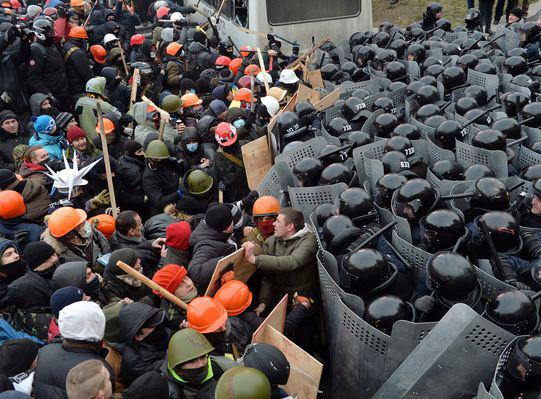
Since the start of the riots (often referred to as “EuroMaidan” in the press), Amnesty International has documented multiple instances of police brutality against peaceful assemblies of protesters. Stephen Larabee, the Distinguished Chair in European Security for RAND Corporation, a non-pro t
research institution on public policy, has declared that these protests spell the end of a stable and independent Ukraine. ose with a less cynical view describe the current situation as another part of a delicate balancing act that re ects the country’s opposing loyalties to Russia and the EU.
Currently, the Ukraine owes Russia $2.7 billion for supplies of natural gas last year alone. Russian President Vladimir Putin was thus able to persuade President Yanukovych to pursue closer ties with Russia in exchange for a cheaper deal on Ukraine’s natural gas supply and an extension on
debt payments. Yanukovych has attempted to make concessions with protesters by o ering the post of Prime Minister to two top opposition leaders, but rumours of a possible coup d’etat has led Yanukovych into using every means available to him in order to maintain his presidency, including the heavy hand of the police. Taras Kuzio, a scholar at the Canadian Institute of Ukrainian studies, is unsurprised by Yanukovych’s responses to the riots: “We have to understand that Viktor Yanukovych is not pro-Russian or pro-European but rather he is pro-Yanukovych.”
President Yanukovych has
long been a divisive gure, and is no stranger to dubious political tactics. In 2011, he made international news when he ordered former Prime Minister Yulia Tymoshenko to serve seven years in prison for making disadvantageous natural gas agreements with Russia. Tymoshenko, a open supporter of a Ukraine-EU trade agreement, had just lost the 2010 presidential elections to Yanukovych, and therefore led many to suspect that her imprisonment may have been an act of political vindictiveness by Yanukovych. e sentencing was clearly hypocritical considering the current natural gas de cit the President is responsible for. Tymoshenko’s incarceration, along with numerous unful lled political reforms, had provided ample reason for the EU to withhold full membership for Ukraine until the Ukraine nally assented to democratic reforms. From Yanukovych’s perspective, any de nitive move in either direction - towards the EU or Russia - would inevitably incite protest, and illustrates the di culty of leading an inherently divided country.
is divide stems back centuries, when the Ukraine was a part of the Russian Empire and only gained independence with the collapse of the Soviet Union in 1991. Even after more than 20 years of independence, many Russians, as well as a fair number of eastern Ukrainians, do not consider Ukraine to be politically separate from Russia. For, apart from the Kremlin’s political in uence, Russia and the Ukraine are also strongly economically interdependent, with Ukraine exporting nearly one-quarter of its goodsworth nearly $17.6 billionto Russia in 2012. President
Putin threatened that should the Ukraine-EU agreement continue, Russia would no longer provide cheap natural gas to the Ukraine, and also halt all Ukrainian imports into Russia. It is estimated that such a move would result in the loss of 400,000 jobs and a quarter of Ukraine’s export pro ts.
With a high state de cit and a struggling economy, the Ukraine is already in a weak economic position. e continuing protests are only exasperating this burden, as the country remains caught in a deadlock and bleeds upwards of $500 million in gross domestic product per day, according to the o cial Ukrainian national news agency UKRinform. Over 200,000 of those who support closer ties with the EU are conducting regular protests in Kyiv, and the situation continues to deteriorate with a backlash of violence against Ukrainian police o cers.
e president has implemented various measures in an attempt to stamp out the protests. One such strategy was to
allow police o cers to use high powered water hoses to disperse the crowds gathering in the square, despite the fact that temperatures remain below freezing. Protesters also received a mass text message informing them that it was now illegal for them to publicly gather under threat of incarceration. More alarming are the reports from mainstream media sources, which allege that the government is kidnapping activists from hospitals, where they are stripped, tortured and, in many cases, killed.
So who really controls the Ukraine? No other country in Europe is so dominated by rich oligarchs. Most of these businessmen would like the option of free trade with the EU but are unwilling to cease relations with Russia entirely, because many of them, like Dmytro Firtash, the president of the Ukrainian employer’s union, have earned their wealth by exploiting the gas con ict between Russia and the Ukraine. It is largely due to this close energy relationship that makes it so di cult for
the Ukraine to move towards closer ties with either the EU or the Customs Union without o ending either party.
Although recent polls suggest that a solid one-third of Ukrainians continue to back President Yanukovych, there is clearly an outspoken number of his citizenry who refuse to stand by idly while the Ukraine slips back into Russia’s sphere of in uence. Whether or not there will be any international response beyond sanctioning the assets of Ukrainian o cials is unsure. EU leaders fear that any strong response could severely damage the already fragile relationship established with Russia, as well as jeopardize the current economic recovery taking place throughout Europe.With Ukraine state security announcing a nation wide“anti terroist” campaign to deal with the “extremist threat”, and the suggestion that armed forces could in fact be deployed, the con ict does not appear to be slowing anytime soon. QIO
e eerie mass text which reads "Dear subscriber, you are registered as a participant in a mass disturbance."

by Claire Pierce

THE ART OF REUSABILITY
At first glance the spherical object looks like some sort of beautiful organism, on closer inspection it inevitably begins to conjure images of plungers, albeit arranged to great aesthetic effect. The hulking 2.2m structure is in fact a reusable wind-powered mine sweeper made from bamboo and biodegradable plastic that costs a little over forty dollars to produce. »
e Mine Kafon WindPowered Deminer (kafon is the Dari word for “explosion”) was featured in the Museum of Modern Art’s recent Applied Design exhibition in New York, which sought to produce design solutions to modern environmental issues without sacri cing visual appeal. Together, these works capture
the energy of a new generation of designers, eager to harness the power of the modern city to create low-cost, environmentally friendly products that have the potential to save millions of lives.
e Mine Kafon was in uenced by designer Massoud Hassani’s
childhood in Afghanistan, where he would entertain himself by building windpowered rolling toys out of the materials he had at hand. His memories of these toys getting blown up by mines, coupled with the landmine-related deaths and injuries of many of his friends, stuck with Hassani, who later began to develop larger,
heavier versions of his childhood toys while at design school in the Netherlands. e Mine Kafon is designed to roll over mine elds and set o the explosives hidden below the surface, while a GPS chip tracks its path. ough the detonation of a mine will inevitably damage parts its structure, these elements are re-
useable and easy to replace, while the parts that are left behind from the explosion do no further damage to the environment. e Mine Kafon has the potential to replace current demining devices, which can cost thousands of dollars apiece and require specialist crews to maintain. Moreover, the United Nations Mine Action Service destroyed over 1.1 million landmines in 2012, freeing 16 000 km2 for productive use. e implications of the Mine Kafon for the e ciency and e cacy of such operations is staggering.
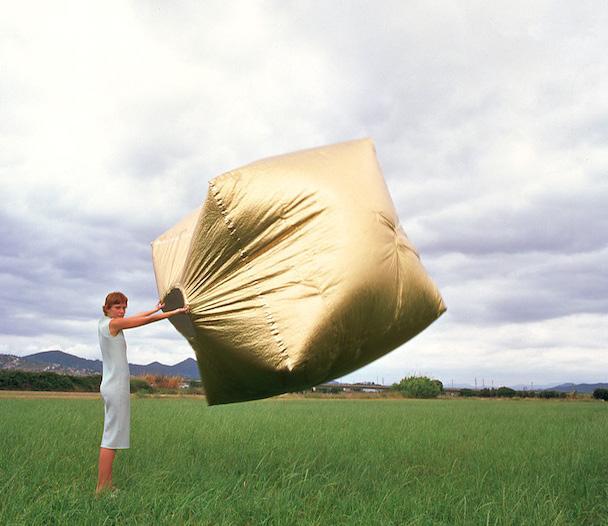
Moving into the urban landscape, Martin Ruiz de Azúa’s Basic House takes a new approach towards tackling the problem of homelessness by making use of the byproducts of metropolitan infrastructure. Basic House is a shelter made of ultra-lightweight re ective polyester capable of folding down to the size of a handkerchief. When attached to a grille in the sidewalk, it in ates to a 2 x 2 metre cube and uses the hot air from the grille to stay heated and in ated. By harnessing this otherwise unused ventilated air, Basic House protects the homeless from the elements while remaining highly portable. e simplicity of the materials and design means that the Basic House could easily be disseminated amongst the homeless population at relatively little cost to
their governments. It is an attractive and highly functional solution to one of the darkest problems of the modern city, and ttingly allows the urban environment to take part in its own redemption.
e devastating e ects of earthquakes have been popular topics for activist artists for decades. One of the most recent and publicized examples is Ai Weiwei’s crusade for justice after the 2008 earthquake in China’s Sichuan province claimed
children around the world attend schools that are near, or built along geological fault lines. e common procedure in the event of an earthquake is almost always to take shelter beneath classroom desks. Yet despite the unanimity of this practice, almost none of the desks currently in use in schools could actually withstand the force of an earthquake and the rubble that may fall as a result. Children end up trapped or crushed beneath collapsed desks that become just as
the lives of more than 5000 school children. Ai took the Chinese government to task over the shoddy “tofu construction” that caused the collapse of several schools in several of his works, including Straight, that was constructed out of thousands of lengths of rebar salvaged from the destroyed schools. But China is hardly the only country where this type of catastrophe is possible. An estimated 300 million
of impact and weight, while still light enough that it could be moved by two students. e table functions perfectly as a day-to-day classroom desk, can shelter at least two students, and can be arranged end-toend with other EPTs to create a tunnel.
e EPT is currently being manufactured for commercial use, thus fostering the hope that disasters on the scale of the Sichuan schools could soon be a thing of the past.
much a hazard as the school building itself. In response to this danger, Israeli designer Arthur Brutter designed the Earthquake Proof Table while still as student at the Bezalel Academy of Arts and Design, and was nominated for a Brit Insurance Design of the Year award - the Academy Awards of the design world - for his invention. Tested in Italy, the table can withstand up to a tonne
e Mine Kafon and Basic House use environmentally friendly materials and passive energy, while the Earthquake Proof Table creates safe spaces in the event of devastating natural disasters. None of these objects sacri ce aesthetics for function or vice versa, and provide attractive, earth-friendly, and cost-e ective solutions to some of the biggest issues facing the modern world. In the near future, we may be viewing them as art objects in a world-famous museum, as well as working objects in the real world. Look no further for proof that design can save your life.
QIO