C M ANN page 1 Y K
1978-2019 QUEENS
41ANNIVERSARY st
EDITION
QUEENS CHRONICLE, Thursday, November 14, 2019 Page 2
C M ANN page 2 Y K
st
41
Call now for a Free Consulta Consultation ation n on alll new w treatme treatments ents for 2020 20 020 Ecogun Nebulizer Ecogun Nebulizer is a device used for myofascial release.It provides soft stimulation to stiff fascia without causing reverse reactions which is a rebound effect from muscles. The Nebulizer is an exclusive device which relaxes the makeup of the myofascia, allowing the fasciato rearrange themselves into position.
1978-2019 QUEENS
ANNIVERSARY
Expires 1/31/20
CONTENTS NY T. 347.229.6952 1270 Broadway, #405, New York, NY 10001
Congratulations Con n gra atu u la ati o ns to to the th e Queens Q u e e ns Chronicle Chrroniicle st on o n ttheir h e i r 41 41 Anniversary! A n n i v e r s a ry !
RESH-076882 RESH-07
Baseball Books Bought & Sold
Start Your Holiday We specialize in Books of American History, Shopping Now! Literature and Music
bookbums@aol.com 104-29 Jamaica Ave., Richmond Hill, N.Y. 11418 718.441.1199
©2019 M1P • AUSB-076873
41ST ANNIVERSARY EDITION • 2019
Knowledge is a wonderful gift to give…
• • • • • • • • • • •
Queens and the early fi lm industry ................... 4 Hundreds of years of horse racing .................... 6 Our history of community theater .................... 8 The Mafia stakes out its turf .............................10 Eight places we couldn’t live without ............. 12 Rockin’ and rollin’ since The Beatles ...............16 The early Mets and their new park ...................18 Tom Seaver: the most Amazin’ of all .............. 20 Queens historian Jack Eichenbaum ................ 22 Carl Ballenas and new communities ............... 24 Recollections of Queens gone by ..................... 26
Train in Woodside photo via Queens Library; Shea Stadium via Dreamstime. On the cover: Horse racing image via Wikipedia; Unisphere file photo; Tom Seaver photo via Dreamstime; Newtown HS photo by Steve Fisher. Supplement editor: Peter C. Mastrosimone; Supplement designer and cover illustrator: Jan Schulman; Editorial layout: Terry Nusspickel
C M ANN page 3 Y K
to Choose or Renew Your Coverage Through WKH 1< 6WDWH RI +HDOWK 0DUNHWSODFH )LGHOLV &DUH·V 4XDOLÀHG +HDOWK 3ODQV 4+3V RIIHU VRPH RI WKH ORZHVW PRQWKO\ SUHPLXPV DYDLODEOH
5L^ PU MVY -PKLSPZ *HYL 8/7Z!
Page 3 QUEENS CHRONICLE, Thursday, November 14, 2019
1RZ·V WKH 7LPH
'HQWDO DQG YLVLRQ FRYHUDJH RSWLRQV 7HOHKHDOWK RQOLQH GRFWRU YLVLWV DYDLODEOH ZLWK FRSD\
(QUROOPHQW 7LPHIUDPHV (for those who are eligible)
5V]LTILY +LJLTILY For individual coverage beginning January 1, 2020 LQ 4XDOLÀHG +HDOWK 3ODQV 4+3
(SS @LHY 3VUN ,Q 1HZ <RUN 6WDWH VSRQVRUHG &KLOG +HDOWK 3OXV (VVHQWLDO 3ODQ DQG 0HGLFDLG SURJUDPV
/RFDO SHUVRQDOL]HG VHUYLFH IURP \RXU )LGHOLV &DUH WHDP
-0+,30: ‹ ÄKLSPZJHYL VYN (1-888-343-3547)
TTY: 711
7R OHDUQ PRUH DERXW DSSO\LQJ IRU KHDOWK LQVXUDQFH LQFOXGLQJ 0HGLFDLG &KLOG +HDOWK 3OXV (VVHQWLDO 3ODQ DQG 4XDOLÀHG +HDOWK 3ODQV WKURXJK 1< 6WDWH RI +HDOWK 7KH 2IÀFLDO +HDOWK 3ODQ 0DUNHWSODFH YLVLW ZZZ Q\VWDWHRIKHDOWK Q\ JRY RU FDOO
41ST ANNIVERSARY EDITION • 2019
7DON ZLWK \RXU )LGHOLV &DUH 5HSUHVHQWDWLYH WRGD\
41ST ANNIVERSARY EDITION • 2019
QUEENS CHRONICLE, Thursday, November 14, 2019 Page 4
C M ANN page 4 Y K
The borough’s memorable movie moments by David Russell Long before sequels, spinoffs and CGI dominated the movie landscape, Astoria was at the center of the Silent Era of film. Adolph Zuckor opened Astoria Studios in 1920 for the Famous Players Film Co., which would eventually become Paramount Pictures. More than 120 films were produced at the studios between its opening and 1932, when it moved operations to the West Coast. The legendary Rudolph Valentino filmed “Monsieur Beaucaire” and “A Sainted Devil” entirely at the studios. As the industry shifted to “talkies,” the first all-talking feature film was shot at the studio and released in 1929. “The Letter” was the story of the wife of a plantation owner shooting a man i n what she said was selfdefense but a love letter to the victim discovered during the trial changes things. Jeanne Eagels starred and received a posthumous nomination for best actress for the second annual Academy Award. The talking film debuts of Claudette Colbert, Edward G. Robinson and Tallulah Bankhead — three stars from the Golden Age of Hollywood — were filmed at the studios. The Marx Brothers went from Broadway to Astoria to produce their first two films, “The Cocoanuts” and “Animal Crackers.” It wasn’t only feature films that were recorded. The studio was home to the Paramount Newsreels as well as the company’s short film divisions.
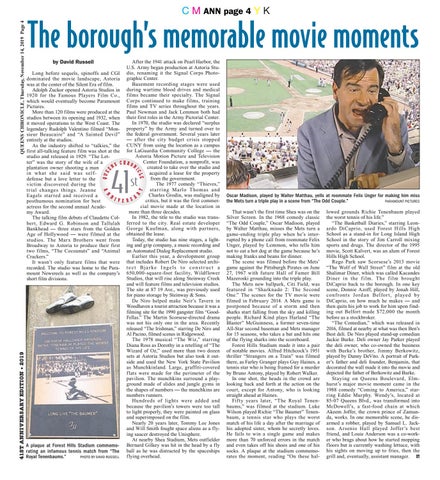
A plaque at Forest Hills Stadium commemorating an infamous tennis match from “The PHOTO BY DAVID RUSSELL Royal Tenenbaums.”
After the 1941 attack on Pearl Harbor, the U.S. Army began production at Astoria Studio, renaming it the Signal Corps Photographic Center. Basement recording stages were used during wartime blood drives and medical films became their specialty. The Signal Corps continued to make films, training films and TV series throughout the years. Paul Newman and Jack Lemmon both had their first roles in the Army Pictorial Center. In 1970, the studio was declared “surplus property” by the Army and turned over to the federal government. Several years later — after the city budget crisis stopped CUNY from using the location as a campus for LaGuardia Community College — the Astoria Motion Picture and Television Center Foundation, a nonprofit, was created to take over the studio and acquired a lease for the property from the government. The 1977 comedy “Thieves,” star r ing Marlo Thomas and Charles Grodin, was maligned by critics, but it was the first commercial movie made at the location in more than three decades. In 1982, the title to the studio was transferred to the city. Real estate developer George Kaufman, along with partners, obtained the lease. Today, the studio has nine stages, a lighting and grip company, a music recording and an Automated Dialog Replacement studio. Earlier this year, a development group that includes Robert De Niro selected archit e c t Bj a r k e I n g el s t o c o n s t r u c t a 650,000-square-foot facility, Wildf lower Studios, that will rise along Steinway Creek and will feature films and television studios. The site at 87 19 Ave., was previously used for piano storage by Steinway & Sons. De Niro helped make Neir’s Tavern in Woodhaven a tourist attraction because it was a filming site for the 1990 gangster film “GoodFellas.” The Martin Scorsese-directed drama was not his only one in the area. Recently released “The Irishman,” starring De Niro and Al Pacino, filmed scenes in Ridgewood. The 1978 musical “The Wiz,” starring Diana Ross as Dorothy in a retelling of “The Wizard of Oz,” used more than two dozen sets at Astoria Studios but also took it outside and used the New York State Pavilion as Munchkinland. Large, graffiti-covered f lats were made for the perimeter of the pavilion. The munchkins surround a playground made of slides and jungle gyms in the shapes of numbers — the munchkins are numbers runners. Hundreds of lights were added and because the pavilion’s towers were too tall to light properly, they were painted on glass and superimposed on the film. Nearly 20 years later, Tommy Lee Jones and Will Smith fought space aliens as a flying saucer destroyed the Unisphere. At nearby Shea Stadium, Mets outfielder Bernard Gilkey was hit in the head by a fly ball as he was distracted by the spaceships flying overhead.
Oscar Madison, played by Walter Matthau, yells at roommate Felix Unger for making him miss PARAMOUNT PICTURES the Mets turn a triple play in a scene from “The Odd Couple.” That wasn’t the first time Shea was on the Silver Screen. In the 1968 comedy classic “The Odd Couple,” Oscar Madison, played by Walter Matthau, misses the Mets turn a game-ending triple play when he’s interrupted by a phone call from roommate Felix Unger, played by Lemmon, who tells him not to eat a hot dog at the game because he’s making franks and beans for dinner. The scene was filmed before the Mets’ game against the Pittsburgh Pirates on June 27, 1967 with future Hall of Famer Bill Mazeroski grounding into the triple play. The Mets new ballpark, Citi Field, was featured in “Sharknado 2: The Second One.” The scenes for the TV movie were filmed in February 2014. A Mets game is postponed because of a storm and then sharks start falling from the sky and killing people. Richard Kind plays Harland “The Blaster” McGuinness, a former seven-time All-Star second baseman and Mets manager for 15 seasons, who takes a bat and hits one of the flying sharks into the scoreboard. Forest Hills Stadium made it into a pair of notable movies. Alfred Hitchcock’s 1951 thriller “Strangers on a Train” was filmed there, as Farley Granger plays Guy Haines, a tennis star who is being framed for a murder by Bruno Antony, played by Robert Walker. In one shot, the heads in the crowd are looking back and forth at the action on the court, except for Antony, who is looking straight ahead at Haines. Fifty years later, “The Royal Tenenbaums,” was filmed at the stadium. Luke Wilson played Richie “The Baumer” Tenenbaum, a tennis star who plays the worst match of his life a day after the marriage of his adopted sister, whom he secretly loves. He fails to win a single game and makes more than 70 unforced errors in the match and even takes off his shoes and one of his socks. A plaque at the stadium commemorates the moment, reading “On these hal-
lowed grounds Richie Tenenbaum played the worst tennis of his life.” “The Basketball Diaries,” starring Leonardo DiCaprio, used Forest Hills High School as a stand-in for Long Island High School in the story of Jim Carroll mixing sports and drugs. The director of the 1995 movie, Scott Kalvert, was an alum of Forest Hills High School. Rego Park saw Scorsese’s 2013 movie “The Wolf of Wall Street” film at the old Shalimar Diner, which was called Kacandes Diner in the f ilm. The f ilm brought DiCaprio back to the borough. In one key scene, Donnie Azoff, played by Jonah Hill, con f ronts Jord a n Belfor t, played by DiCaprio, on how much he makes — and then quits his job to work for him upon finding out Belfort made $72,000 the month before as a stockbroker. “The Comedian,” which was released in 2016, filmed at nearby at what was then Ben’s Best deli. De Niro played stand-up comedian Jackie Burke. Deli owner Jay Parker played the deli owner, who co-owned the business with Burke’s brother, Jimmy Berkowitz, played by Danny DeVito. A portrait of Parker’s father and deli founder, Benjamin, that decorated the wall made it into the movie and depicted the father of Berkowitz and Burke. Staying on Queens Boulevard, Elmhurst’s major movie moment came in the 1988 comedy “Coming to America,” starring Eddie Murphy. Wendy’s, located at 85-07 Queens Blvd., was transformed into McDowell’s, a fast-food chain at which Akeem Joffer, the crown prince of Zamunda, works. In one memorable scene, he disarmed a robber, played by Samuel L. Jackson. Arsenio Hall played Joffer’s best friend, and Louie Anderson was a co-worker who brags about how he started mopping floors but is currently washing lettuce, with his sights on moving up to fries, then the grill and, eventually, assistant manager. Q
C M ANN page 5 Y K Page 5 QUEENS CHRONICLE, Thursday, November 14, 2019
Join us for the Grand Re-Opening of our Ridgewood Branch! Open a Checking Account Get a YETI! (1)
D Drop-off ff a NEW TOY, we’ll donate $5! (2)
Collecting non-perishable food items!
(Toy must be Unwrapped)
(November 20th -26th)
Plus, enjoy FREE coffee, pastries & giveaways!
SPECIAL EVENTS Wednesday, November 20th Ribbon Cutting Ceremony Noon - 2:30pm Cake, refreshments & musical entertainment.
Thursday, November 21st Small Business Day 10:00am - 2:00pm Prizes & deals from local businesses.
Saturday, November 23rd Family Fun Day 10:00am - 2:00pm Kids activities including a balloon artist, costume characters, DJ & more.
Friday, November 22nd Community Appreciation Day Noon - 4:00pm Hot dogs, popcorn & soda. DJ, fall treats & warm apple cider.
Monday, November 25th “Money Monday” All Day Crack the vault to win cool prizes. (See branch for details)
(718) 497-4800 ((71 maspethfederal.com (1) Limit one gift per customer. Customer must open a new basic checking with a $1,500 minimum balance in order to receive the gift. Offer is not available to current Maspeth Federal Savings checking account holders. Applicable 1099 will be issued. Offer available at our Ridgewood branch location during November 20th November 26th (promotional period) only, while supplies last. Color and tumbler size subject to change based on availability. Offer can be withdrawn at any time. Terms & conditions subject to change.YETI is a registered trademark. MASF-075933
(2) The bank will donate $5 per toy collected up to $2,500. Donation to benefit Toys for Tots.
41ST ANNIVERSARY EDITION • 2019
66-60 Fresh Pond Road | Ridgewood, NY 11385 66
41ST ANNIVERSARY EDITION • 2019
QUEENS CHRONICLE, Thursday, November 14, 2019 Page 6
C M ANN page 6 Y K
Horse racing is also the sport of Queens by Michael Gannon Go to Aqueduct Race Track and lay down your $2, and you are participating in a Queens tradition that goes back to 1667. The Dutch had surrendered what is now New York City to the British, and King Charles II, a huge horse racing fan, horse owner and breeder, introduced his favorite sport to his new possession, establishing a race course in what became Queens. To this day, the King Charles II stakes race is run at Newmarket Race Course, formerly the monarch’s private racing grounds. Many tracks came before Aqueduct and some that came after failed to outlast it. And the roster of horses who competed in the borough reads like a social register of equine royalty: Sir Barton, Man o’ War, War Admiral, Gallant Fox, Assault, Count Fleet, Kelso, Forego, Nashua, Secretariat, Seattle Slew, the ill-fated Ruffian, Foolish Pleasure, Bold Forbes, Pleasant Colony, Easy Goer, Cigar, John Henry and others. Not t hat t he r u n was completely contiguous. After the Colonies broke away from England and King George III in 1776, New York State’s new constitution actually banned horse racing beginning in 1802. “I think it was a Puritan thing,” Richard Hourahan, then with the Queens Historical Society, told the Chronicle in 2017. “They didn’t want gambling — and it was fun.” And when the Legislature relented slightly in 1821, it allowed racing in a single county — Queens. That year, Union Course opened up on what is now known as 78th Street in Woodside, though a land survey map from 1838 belonging to the Queens Historical Society shows it as Snedeker Avenue back then. It was the site in 1822 of a match race — two horses going head-to-head — featuring Eclipse, considered the fastest horse in the North, vs. Sir Henry, representing the South. Contemporary reports state future President Andrew Jackson, a passionate horseman who bred racehorses on his Tennessee estate and would continue to do so while in the White House, was on hand.
Eclipse would carry the day. He also would lend his name to a race course that opened in 1825 in Woodhaven near where Woodhaven and Rockaway boulevards intersect. While modern racetracks tend to divide themselves between those catering to thoroughbreds, such as Aqueduct, and harness racing like at Yonkers Raceway or the old Roosevelt Raceway in Nassau County, where the rider is in a sulky, or a twowheeled cart being pulled by a trotter. Eclipse Course welcomed the owners and fans of both. Fashion Course, open between 1856 and 1866 near present-day Corona Plaza, also was named for a victorious steed from Union Course. It served as a harness track. Fashion defeated Peytona in a highly anticipated showdown in 1845. “More than 100,000 people came,” Ed Wendell, a Woodhaven historian, told the Chronicle in a 2017 interview. It should be noted that seven years after Union Course opened, an enterprising business owner decided that track workers and patrons needed a place to relax and have a few drinks. Neir’s Tavern opened across 78th Street in 1829, and while Union Course shut down in 1888, Neir’s remains open to this day, the oldest bar in New York State. While the crowds had f led to other tracks in other locales, you couldn’t keep a good sport down in the rapidly growing borough. By 1894, Aqueduct had been opened in South Ozone Park courtesy of the Queens County Jockey Club. Board or depart a train from the Long Island Rail Road’s Locust Manor Station and you are retracing the steps of patrons of the old Jamaica Race Course. According to the website of the city’s Depar tment of Parks and Recreation, Jamaica opened on April 27, 1903 with a crowd of 15,000 in attendance to see racing on the one-mile track. It was said to be a fast track due to its highly efficient drainage system. It set a single-day record of 64,679 spectators.
Fashion leads Peytona by a neck in a postcard depiction of their famous match race at Union WIKIPEDIA IMAGE Course in Woodside in 1845.
The legendary Kelso, seen here at Aqueduct Race Track, ruled the thoroughbred racing world in FILE PHOT0 1960 and 1961. But while Jamaica gave the Big A and nearby Belmont Racetrack a run for their money, it couldn’t compete and eventually fell into disrepair before closing in 1959. The Rochdale Village public housing complex was erected on the site. But Aqueduct still pays tribute to Jamaica and its impact on the sport’s history every April in the annual Wood Memorial Stakes. Gene Wood, an influential racing supporter, was one of the founders of the Jamaica Race Course. The first Wood Memorial Stakes was run in his honor following his death in 1925. It ran in Jamaica until 1959, shifting since to Aqueduct. The Wood Memorial Stakes is considered one of the important prep races for 3-yearolds leading up to the Kentucky Derby. Four winners of the Wood Memorial — Gallant Fox, Count Fleet, Assault and Seattle Slew — have gone on to win thoroughbred racing’s Triple Crown by taking the Derby, the Preakness Stakes in Maryland and the Belmont Stakes. In a footnote, the favored Secretariat finished a disappointing fourth in the 1972 Wood Memorial, losing to Angle Light. The next time the chestnut stallion was back in New York State, in 1973, would be to claim the Triple Crown and racing immortality, blowing away the rest of the field by an incredible 31 lengths over the second-place finsher in record time. According to the website of the New York Racing Association, the 210-acre Aqueduct complex underwent a $34.5 million rebuild from 1955 to 1959 — perhaps the death knell for the Jamaica Race Course — debuting what then was the most modern racing facility in the country on Sept. 14, 1959 before a crowd of 42,473. And it has had its share of history, according to NYRA. Aqueduct was the site of the only triple
photo finish in stakes race history on June 10, 1944 when Brownie, Bossuet and Wait a Bit all touched their noses to the finish line simultaneously. From 1963 to 1968 Aqueduct actually would host the Belmont Stakes while the Elmont, LI, track and grandstand underwent reconstruction. And not all horsemen are from Kentucky. When John Campo, who grew up in South Ozone Park, looked out the windows of John Adams High School, he could see Aqueduct tantalizingly nearby, beckoning him to come. Eventually the call was too much for the 16-year-old Campo to resist. He dropped out of Adams to work at the track, but Campo took well to his new school, gaining enough knowledge and skill to eventually become a trainer. The exhuberant, blunt and sometimes gruff Campo, who died in 2005, didn’t have the finishing school touches of many in racing circles. But he was able to back up his supreme confidence with his horses, winning more than 1,400 races in his 30-year career. He reached a pinnacle with Pleasant Colony, who took the Wood Memorial, the Derby and the Preakness in 1981 before finishing third at Belmont. On Oct. 6, 1995, it was not a trainer but a shepherd who commanded the world’s attention at Aqueduct when St. John Paul II visited Queens for the second time during his papacy, celebrating Mass out in the open for more than 75,000 pilgrims. “We ought to invite others to come to us by stretching out a helping hand to those in need, by welcoming the newcomer, by speaking words of comfort to the afflicted,” he said. The pope, who had celebrated Mass at Shea Stadium during a visit in 1979, addressed the throngs in English, Castilian, Q Creole, Polish, Korean and Italian.
C M ANN page 7 Y K Page 7 QUEENS CHRONICLE, Thursday, November 14, 2019
Chapin Home for the Aging Serving the New York City, Long Island community at its Jamaica Hills location since 1869.
Long-Term Skilled Nursing Care • Short-Term Rehabilitation IV Hydration & Antibiotic Therapy • Hospice • Respite • Palliative Care Nutrition Services • Ophthalmology/Optometry • Dental Services • Podiatry Audiology • On-Site Beauty Parlor • Adult Day Health Care
CHAH-076130
165-01 Chapin Parkway, Jamaica Hills, NY 11432 (718) 739-2523 | www.chapinhome.org
41ST ANNIVERSARY EDITION • 2019
Chapin’s 150 years of nonprofit mission-driven history has been to provide those who have come to Chapin a true Home‚ where they may find serenity and security.
41ST ANNIVERSARY EDITION • 2019
QUEENS CHRONICLE, Thursday, November 14, 2019 Page 8
C M ANN page 8 Y K
Theater has bonded our communities together by Mark Lord The very day he moved to Woodside, as a newlywed some 70 years ago, Lindo Meli attended Sunday Mass at his church and expressed interest in starting a theater group. The result was St. Mary’s Drama Guild, which remains a fixture in the neighborhood, where its latest production, the musical, “The Fantasticks,” opens Dec. 6. The fervor with which Meli, now a ripe young 100, spoke of those early days — in a recent telephone conversation from his senior living community in New Jersey — was echoed time and again by several other stalwart members of the community theater scene, which has both a long and unusually rich history in the borough. “I knew somewhere there were people aching to be on stage,” Meli explained. “It all developed very quickly. A lot of people came. Some were good, some weren’t.” As he recalled, the troupe’s first production comprised three short plays, all of which Meli directed. He also reserved the leading role in one of them for himself. As far back as the guild goes, it is not the oldest theatrical group in our midst. That honor might well go to the Douglaston Community Theatre, which can trace its roots as far back as the 1920s. According to a 1990 write-up in a local newspaper, a group called the Chu rch a nd D r a m a Association was begun under the auspices of Zion Episcopal Church. When the church burned to the ground on Christmas Eve 1924, the troupers began to hold their meetings at the Douglaston Club,
Countless productions have been staged by community theater groups in Queens, and this author — himself an PHOTO BY MARK LORD actor, director and playwright — has seen as many of them as anyone. assuming the name The Douglaston Players. Yearly memberships were available to area residents for $5 apiece; the fee was later reduced to $1, to eliminate what was described as an embarrassment of riches. In 1950, the principal of PS 98 approached the group about a possible fundraising event, and the play “Life With Father” was put on in the school’s auditorium. The rousing reception led to the formation of a new group, Douglaston Community Theatre, which continued to perform at that school and then at JHS 67.
When the Board of Education drastically raised its rates for use of the auditorium, in the mid-1960s, DCT moved to its permanent home at the rebuilt Zion Church. Barbara Mavro, one of the group’s three current presidents, recalled that her first experience with DCT came when she appeared as a Hot Box Girl in the musical “Guys and Dolls,” in 1979. “We draw actors from all over,” Mavro said of the group’s long-standing policy of open casting. “We used to do a musical every spring,” she added, but in recent years that has become “cost prohibitive.” Still, the group remains active, its latest production, the thriller comedy “Deathtrap,” r unning through Nov. 23.
Mollie Smith has been involved with The Gingerbread Players of St. Luke’s Church in Forest Hills since its inception. Back in 1971, the church’s organist and choir director, Harriet Morin, noted that a member of the congregation, Chip Stokes, was understudying the title role in the New York City Opera’s production of “Amahl and the Night Visitors,” and suggested the church mount a production of their own with the young performer as well as other interested parishioners. Thus, a new theater group was born. Over the years, Smith, her husband, Milburn, and all four of their
Author Mark Lord and Janice Monsanto in The Christian Community Theatre Guild’s 1989 production of “Two By Two,” left, and the cast of the Douglaston Community Theatre group’s 1981 rendering of “Witness for the Prosecution.” Above, a 1927-28 season pass for DCT’s predecessor troupe. COURTESY PHOTOS
children have been involved in shows at the church, as have two of their six grandchildren. “Part of the delight of it all” was sharing the experience with multiple generations of her family, Smith said. Theater, she believes, is one of the few places where children and adults are of equal importance. Also well aware of the role young people play in the theater is Lawrence Bloom, who also recognizes the positive influences theater can have on them. Bloom began his theatrical career while in college in the 1960s and would go on to form not one, but two of his own theatrical groups in the borough. “Theater teaches discipline. You learn to show up, to be on time and to learn your parts. Once the bug bites, it lasts,” he said. Bloom recalled getting his start on the local scene with the Fresh Meadows Community Theater Group, an all-but-forgotten company that held its rehearsals above the Democratic Club on Bell Boulevard. Nowadays, its main claim to fame was the participation of one Estelle Gettleman, who would go on to fame and fortune as Estelle Getty, perhaps best known for her role on television’s “The Golden Girls.” From there, Bloom began performing with the FSF Community Theat re Group, the lo ng t i me r e sid e nt troupe at the Free Synagogue of Flushi ng, wh ich h a s since evolved into Royal Star Theatre in Jamaica Estates. Eventually, Bloom deemed the time right to start his own group, the Sinai Players, which began attracting audiences to Temple Sinai in Forest Hills in 1990, with a production of Neil Simon’s comedy “Come Blow Your Horn.” The group eventually disbanded, but theater was in Bloom’s blood and in 2004 he would go on to found another group, Theatre By The Bay NY, which is now packing ’em in at Bay Terrace Garden Jewish Center with its production of “Gypsy.” Bloom believes in community theater because people “put their real lives aside and come together as a group.” Among the individuals who took to the stage in his shows were real-life teachers, lawyers and doctors, including one neurosurgeon who, he said, “at night, got a big kick out of being in the chorus of ‘Bye Bye Birdie,’” one of many shows he produced and directed. And then there was the late Jerry continued on next page
C M ANN page 9 Y K Page 9 QUEENS CHRONICLE, Thursday, November 14, 2019
In Queens, all the borough’s a stage continued from previous page Garfinkel, a longtime Laurelton resident who, according to his daughter, Marilyn Garfinkel, “wanted to be a songwriter, but he needed to support the family,” so he worked as a linotype setter. But his natural setting was the theater. Garfinkel, who now lives in Florida, explained, “It was always a big deal to be Jerry’s daughter. I loved showing off.” She said she would often tell a stranger seated next to her in the audience, “Hey, that’s dad.” It seemed to Garfinkel that her father was always on stage, often at JHS 59 in Springfield Gardens. His roster of shows included “The Odd Couple,” “Harvey” and, perhaps most memorably, “The Man Who Came to Dinner.” But she laments that because of his commitment to performing, “He was never home.” Like Smith, she appreciates the specialness of having multiple generations of a single family sharing their love of the stage, citing the time her father, sister and a nephew all worked on a production together at Way-Off Broadway Theatre Inc., a group that entertained audiences for years in Bayside. The tradition lives on, as evidenced by another family’s joint participation. But in this case, there was an extra twist. Shana Aborn and John O’Hare met doing theater, an occurrence not as rare as one might expect. Back in 1986, Aborn recalled, the Parkside Players, in Forest Hills, a group dating to 1981, was mounting a production of “Night Must
Fall.” Recently arrived from Maryland, Aborn, who was living in Kew Gardens at the time, was cast in the lead. O’Hare was the show’s stage manager, and when he and Aborn met, she said, “Bells started to vibrate,” adding that “they rang in the follow-up show, ‘Play It Again, Sam.’” “The fact we had this in common made it easy to develop a relationship,” she added. “We understood the commitment involved.” Their two children, Daniel, now 16, and Sarah, 14, were hanging around rehearsals practically since birth, and today remain theatrically involved, each on the boards this season in different shows. Dad helped build the sets for both! “It’s what soccer is to other families,” Aborn said. “We live our lives around auditions, rehearsals, performances.” Every once in a while, the local stage serves as a springboard to greater success in the theater. Several local talents have found their way to Broadway in recent years, among them Luca Padovan, who appeared in “Newsies” and “School of Rock”; Robert Ariza, who was in the revival of “Spring Awakening”; and, perhaps most famously, Andrew Barth Feldman, who currently stars in the title role of “Dear Evan Hansen.” Over the years, a lot of theater groups have come and gone. Among the many that have brought down their final curtains are (in timehonored alphabetical order) Beari Productions (Middle Village), The Christian Community Theatre Guild (touring company), The Colo-
late,” though “sometimes we still pack ’em in.” And so the survival of local theater seems assured, thanks to the involvement of a whole new generation of youngsters feeling the lure of the greasepaint. Theater is an “extremely constructive asset to the community,” Smith said. “It produces a lot of community congeniality.” And, as Meli once proclaimed, “There is no better activity to get involved in than putting Q on a show.”
nial Players (Hollis Hills), The Little Theatre of Forest Hills, Marathon Little Theatre Group (Douglaston), Queen of Peace Drama Club (Flushing), The Spotlight Players (Ozone Park), The Stage Door Repertory Co. (Howard Beach), Temple Sholom Theatre Group (Floral Park), Theatre a la Carte (Douglaston), Theatre Time Productions (Whitestone) and The Village Players (Queens Village). Mavro observed that when it comes to local theater, “The audience has dwindled as of
One Stop Shop For All Your Aquarium Needs!
STORE HOURS:
10% OFF 152-69 10th Avenue Whitestone, NY 11357
All Livestock k with this coupon
718-902-6117 WWW.FISHWORLD1.COM
FISHWORLD USA LIKE US FISHWORLDUSA
“QUALITY AND SERVICE”
FOLLOW US @JMTROPICALS
41ST ANNIVERSARY EDITION • 2019
Great Hobby For All Ages!
Monday - Fri. 11 am - 8 pm Saturday 10 am - 7 pm Sunday 10 am - 6 pm ©2019 M1P • FISH-076832
The cast and crew of the FSF Community Theatre Group’s production of “The Sound of Music,” PHOTO COURTESY MARK LORD directed by this author in 1994.
41ST ANNIVERSARY EDITION • 2019
QUEENS CHRONICLE, Thursday, November 14, 2019 Page 10
C M ANN page 10 Y K
Remembering the Mafia’s heyday in Queens by Ryan Brady It was a time of defining change in Queens. The early post-war years saw the borough develop into what it is today. Thousands of houses went up in the large swathes of the borough that hadn’t been developed already. Idlewild Airport, having begun operations in 1948, was becoming a major job hub. And the Long Island Expressway opened in 1958, with bumper-to-bumper traffic quickly following. During the 20th century’s first half, Costa Nostra activity in New York City had mainly taken place in Brooklyn, the Bronx and Manhattan. Queens would catch up, though. Some mobsters, like John Gotti — who grew up poor in East New York, one of the neighborhoods undergoing white flight in the 1950s — moved to Howard Beach. But the lure of the suburbs wasn’t South Queens’ only draw for someone like Gotti. Idlewild — later known as JFK — was ripe for plunder. “The airport was a major, major, major boon to all five organized crime families,” said Philip Messing, a longtime crime reporter for the New York Post. To the Mafia, the Southeast Queens airport — bigger and busier than LaGuardia — meant no-show jobs, shakedowns, hijackings, cargo to steal and unions to corrupt. And while the Bonnano and Gambino families were more influential there, the Lucchese family pulled off the notorious 1978 Lufthansa heist portrayed in “Goodfellas.” But Idlewild was one of countless cash cows the Cosa Nostra would milk in the borough as its economy expanded after World War II, notes Selw y n Raab, author of “Five Families: The Rise, Decline and Resurgence of America’s Most Powerful Mafia Empires” and a longtime investigative reporter for The New York Times. “The Mafia is a carbon copy of American capitalism,” he told the Chronicle. “Whenever there’s something lucrative, they will exploit it. Queens became a good area to exploit.” And exploit is exactly what mafiosi in Queens did, profiting big time from a carting industry cartel, union infiltration and other illegal activities. “Their bread and butter has always been bookmaking and loansharking,” Raab noted.
No gangster here quite gained Gotti’s level of notoriety, though. As a young man, the Brooklyn native hijacked trucks at Idlewild with his friends and did favors for high-ranking Gambino men. He rose in the family’s ranks to become a capo, using the Bergin Hunt and Fish Club in Ozone Park as his command center. And every year on the Fourth of July, massive crowds would come out to the club’s fireworks display and barbecue. In March 1980, Gotti’s 12-year-old son, Frank, was riding his minibike near his parents’ 85th Street home in Howard Beach when neighbor John Favara fatally struck him with his car. Police ruled the incident an accident, but the driver disappeared months later. According to Brooklyn federal court papers filed in 2009, Favara’s body was dissolved in a vat of acid after his murder. In 1985, Gotti staged a bloody coup to take control of the family from don Paul Castellano, who was famously gunned down by three assassins outside Sparks Steak House in Midtown Manhattan. Known as the “Dapper Don” for his sharp looks, Gotti embraced publicity in a way gangsters normally shunned, schmoozing with reporters. And he earned another nickname, the “Tef lon Don,” for beating three criminal trials in the 1980s. In reality, his men used bribes, intimidation and tampering to secure the acquittals. Then, Gotti underboss Sammy “The Bull” Gravano having turned on him the year before, federal prosecutors convicted Gotti in 1992 on five counts of murder and other charges. Sentenced to life without parole, he died of throat cancer in 2002 at a Missouri hospital for federal prisoners. The prosecutions against John Gotti were part of federal law enforcement’s largescale campaign to destroy the mob in New York City and the rest of the country. A key weapon in the government’s fight was the Racketeering Influenced and Corrupt Organizations Act, which led to more and significantly longer sentences for wiseguys. It wasn’t until 2004, though, that the government convicted the Bonnano family boss known as the “Last Don”: Joseph Massino of Howard Beach. Massino loved food and had the gut to
The CasaBlanca restaurant on 60th Lane in Maspeth, left, that former Bonnano boss Joseph Massino partly owned may have closed years ago, but pedestrians can still observe a sign for its “Crystal Room.” Outside Sparks Steakhouse on 46th Street in Manhattan, Gambino boss Paul Castellano was assassinated on the orders of John Gotti, who took over the crime family and ran GOOGLE MAPS IMAGE, LEFT, AND WIKIPEDIA PHOTO / PIFFLOMAN it from his social club in Ozone Park.
Gambino family boss John Gotti, left, and Bonnano boss Joseph Massino were two of Queens’ FILE PHOTO, LEFT, AND OFFICE OF NEW JERSEY ATTORNEY GENERAL PHOTO most powerful wiseguys. show it, weighing 300 pounds. A Maspeth native who dropped out of Grover Cleveland High School in 10th grade, he took to crime from an early age. He met Gotti when both were young hijackers, and they remained friends as each man’s underworld clout grew.
“
Most people didn’t even know he existed. FBI agents were always mystified by him.
”
– HISTORIAN SELWYN RAAB ON JOSEPH MASSINO In key ways, though, their personalities were very different. Compared to the flamboyant and colorful Gotti, Massino was a ghost. “Most people didn’t even know he existed,” Raab added. “FBI agents always were mystified by him.” He was “old-fashioned, very secluded,” the historian explained. Massino didn’t want his men to bring cell phones to meetings. And unlike Gotti, he didn’t like to have meetings at social clubs. He also urged his men to frequently check their car mirrors to see if they were being followed, Raab said. The Bonnano family was on its deathbed when Massino took it over in 1993. It was kicked out of the Commission — the Mafia’s governing body, made up of the Five Family’s bosses — because of FBI agent Joseph Pistone’s infiltration of the organization, made famous in the film “Donnie Brasco.” Massino got it back on the Commission and grew the Bonnanos to have more than 100 members.
“He was a smooth operator,” Raab said. “He wasn’t a dumb guy. And he might’ve been violent but he was not like Gotti. He wasn’t a brutal killer.” Massino based his operations from the well-regarded CasaBlanca restaurant at 62-15 60 Lane in Maspeth, which he partly owned. Along with the traditional mob activities like loansharking, the historian noted, his family used online gambling and pump-and-dump stock schemes to make money. Indicted in 2003 and convicted in 2004 for eight murders, Massino was facing the death penalty when he turned state’s evidence. That had never been done before by one of the heads of the Five Families. In 2013, he was released from prison into the witness protection program. Thanks to the prosecution of men like Gotti and Massino, the Mafia in Queens may only have a small fraction of its old power. But it’s far from dead. Recent years have seen wiseguys from Howard Beach, Oakland Gardens, Whitestone and other parts of the borough go down. “They have gotten more covert, for sure,” said Joseph Giacalone, a former NYPD detective sergeant. He is a professor at the CUNY John Jay College of Criminal Justice, where he teaches a course about organized crime. One of the 21st century’s major trajectories in law enforcement also has been advantageous to the Mafia, he pointed out. “After 9/11, a lot of the attention was taken away from them and brought to bear on terrorism,” Giacalone said. “Rightly so. “I’m not saying that nobody’s watching the store, but there’s a good possibility that you’ll see a resurgence from them with much less violence and less flashiness.” While the former NYPD officer says the days of mass union racketeering are probably over in Queens and other parts of the city, he says the Mafia is very much alive here. “They’re innovators, they know how to play the system,” he said. “They know the Q game and they know what people want.”
C M ANN page 11 Y K Page 11 QUEENS CHRONICLE, Thursday, November 14, 2019
Older Adults Services for Independence and Safety Together with Northwell, the Commonpoint Queens/CAPE is proud to introduce to you a partnership program called “OASIS” , a one-time scheduled appointment that offers older adults, and their caregivers, a comprehensive memory assessment. There is no charge for this service. The practitioner providing the assessments specializes in geriatric care and is trained to recognize geriatric syndromes, such as dementia, which can be easily overlooked or misunderstood in other clinical settings. The OASIS assessment strategy is to connect patients to the services needed in order to maximize independence, days at home, and quality of life. OASIS is unique because it addresses the “whole person” in order to connect the patient and family with appropriate resources for their individual needs. WHEN: Tuesdays from 1:30 p.m to 4:00 p.m. WHERE: CAPE Outpatient Mental Health Clinic 59-28 Little Neck Parkway, Little Neck 11362 CONTACT: Vincent Bavaro (718) 224-0566 SAMF-076910
RESTAURANT & BAR SUPPLIES OPEN TO ALL RESTAURANT STORE OWNERS AND TO THE
GENERAL PUBLIC
amdusany.com
Min. Delivery $400.00
25,000 Products In Stock!
Please visit our website to see a full list of all our products!
Products we offer:
AMDU-076427
8 MINUTE DRIVE FROM QUEENS CENTER MALL
718-277-205 1 AMDUSA@optonline.net
CALL OR VISIT US
TODAY!
Quality, Selection and EExcellent Customer Service! OPEN 7 DAYS A WEEK Mon.-Fri. 8: 00 am to 6: 00 pm Sat. 10 : 00 am to 6: 00 pm Sun. 9: 00 am to 3: 00 pm
MARG-076525
KITCHEN EQUIPMENT such as: ✔ Blenders ✔ Freezers ✔ Refrigerators ✔ Food Processors ✔ Grills ✔ Fryers ✔ Stoves & More!
AMDUSA Now Has Uniforms All Sizes and All Colors for Women and Men.
934 JAMAICA AVENUE BROOKLYN, NY 11208
Deli Supplies Pizza Supplies Bakery Supplies Bar Supplies Restaurant Supplies Supermarket Supplies
41ST ANNIVERSARY EDITION • 2019
• • • • • •
Our staff of therapists provide focused one-on-one rehab care utilizing the most innovative techniques and technologically advanced equipment to achieve optimal outcomes. We are proud to provide the community with the highest quality Subacute Rehabilitation and Long-Term Care as well as Hospice services as needed in a beautiful and completely Kosher setting.
QUEENS CHRONICLE, Thursday, November 14, 2019 Page 12
C M ANN page 12 Y K
Eight places we are lucky to have by Michael Shain and Steve Fisher What these Queens places have in common is that, beyond dispute, they were all designed and built by hardworking, ingenious people for noble purposes. Old and new, they have given people great pleasure and proved themselves to be deeply useful. These are eight of the places we think make Queens Queens. We gave preference to the things we thought were one of a kind. This is nowhere near a complete list. Serious-minded people could add a bunch more places just as important to life in city’s boldest borough. But it’s a start.
Loew’s Valencia Theater
Citi Field
Of all the movie theaters ever built in Queens, the Loew’s Valencia was perhaps the greatest. Opened in 1929 — just two years after talking pictures were invented — it brought people came from all over the borough and Long Island to see a movie simply because it was a stunning place. When the Valenicia was opened, going to the movies wasn’t a pastime. It was an experience. Alas, the lure of the movies faded into the TV era and, in 1977, Loew’s donated the property to a Pentacostal church, the Tabernacle of Prayer for All People, with the promise that it would be preserved. The city designated the theater a landmark in 1999, one of the few bits of protected property in Queens. But the protection extends only to the exterior. The city is precluded from landmarking the interior — the church part — by the constitutional principle of separation of church and state.
Lets’ go Mets! That’s been the chant of loyal New York Met’s fans since 1964 when the team first played at Shea Stadium in Flushing Meadows Corona Park. The new stadium replaced Shea in 2009. Citigroup pays $20 million a year for the stadium’s naming rights. The facade harkens back to the old Ebbets Field where the Brooklyn “Bums” Dodgers played before moving to California in 1957. But Citi Field is pure Queens; the Flushing 7 train brings the crowds right to its doorstep. With a seating capacity of 41,922 it has enjoyed some attendance records in its 10-year history, including 45,186 for the 2013 All-Star Game and 43,602 to see the Mets beat the NY Yankees 5-1 on Sept. 18, 2015. Let’s go Mets!
Hunters Point South Park
Newtown High School
This new park in Long Island City is an example of what happens when a city changes its mind. For a century, Hunters Point was a place of factories. Some references say it was the center of margarine production in the U.S. at the turn of the last century, when the butter substitute was manufactured by cooking down discarded animal parts for their fat. Suddenly, waterfront property is desirable again and the park at Hunters Point South combines about as many things as can be crammed into an 11-acre space — playing fields, a playground, paths for jogging and bikes, raw nature (in the form of restored marshland) and a spectacular view of the East River and Manhattan from any spot in the park. The crown jewel of Hunters Point South, which was completed last year, is a massive observation deck that rises 30 feet above the park and juts out over the shoreline like the prow of a ship. It is not easy to get there. The nearest subway stop is five blocks away and parking is tough. But it is like no other park in Queens.
If J.K. Rowling had grown up in Elmhurst instead of England, Newtown High School might have been what she had in mind when she created Hogwarts — the school for sorcerers in the Harry Potter books. Its main features are a Renaissance Revival tower, 17 stories tall, topped with a cupola and its steep, gabled roofline. There simply is nothing else like it in Queens. Like other public buildings of its time, it was designed to awe and intimidate. From the day it opened in 1921, it has been a monument as much as a school. In the 1910s, the work of designing schools was not farmed out to private architects as is done today. It was done in-house by a superintendent of school buildings working for the New York City Board of Education. For over 30 years around the turn of the last century, Charles B. J. Snyder, an architect and mechanical engineer, was that superintendent. During that time, he designed and oversaw the construction of more than 170 public schools in New York City, including Newtown. continued on next page
41ST ANNIVERSARY EDITION • 2019
New York State Pavilion The New York State Pavilion, consisting of the Tent of Tomorrow, Theaterama and Observation Towers, built for the 1964-65 World’s Fair was not supposed to last this long. It was designed by Philip Johnson and Lev Zetlin to be temporary, a fun thing to visit during the fair but to be torn down later with the rest of the structures specially built in Flushing Meadows Corona Park for the event. Only Shea Stadium was supposed to be left standing. But the pavilion survived. The reason? Money, or the lack of it, really. The buildings’ unusual design made demolishing them expensive. Cash-strapped governments kept putting off the job. The Observation Towers survived long enough to be cast in starring roles in the 1997 movie “Men in Black.” A couple of rock concerts were staged in the elliptical, open-air Tent of Tomorrow in 1969, followed by a year or two as a roller rink. Other than that, the structures have remained untouched and off limits to the public for nearly half a century. This month, after years of stop-and-start planning, a $24 million preservation project started. The work will shore up the foundations, add lighting and allow public access once again to the Tent of Tomorrow. The towers, alas, will remain closed.
C M ANN page 13 Y K Page 13 QUEENS CHRONICLE, Thursday, November 14, 2019
Queens high points continued from previous page
Rockaway Boardwalk
Ridgewood Savings Bank The Ridgewood Savings Bank headquarters building sits at the intersection of Myrtle and Forest Avenues in the heart of the landmarked Ridgewood North Historic District designated by the New York Landmarks Preservation Commission in 2009. Designed by the architects Halsey, McCormack and Helmer in 1929, its exterior is limestone with a granite base. The interior has marble floors and travertine stone walls; one is delightfully surprised to discover the large mural in the three-story tall banking hall by Angelo Magnanti, painted in 1939. Its scenes depict laborers at work and expresses the concept “Saving is the Secret of Wealth.” This Italian-trained artist decorated many New York City buildings, including two walls in the long-ago demolished Penn Station, proof positive how important it is to protect the city’s treasures.
It’s hard to imagine a piece of architecture more important to the working life of a community than the Rockways Boardwalk. So when five miles of Brazilian teak was ripped off its foundations by Hurricane Sandy, rebuilding the boardwalk became the highest priority of the recovery effort. The restoration took five long years and nearly $500 million to complete. When the job was done, the 117-block boardwalk was transformed. It is no longer wood, but a broad ribbon of glistening concrete instead, with benches, bike paths, shade canopies and brand-new restrooms. Built on top of steel pillars now, the boardwalk and the dunes in front of it are designed to stop the kind of tidal surge that wiped out hundreds of homes in 2012. (What to do about possible flooding from the Jamaica Bay side of the Rockways is still under discussion.) The boardwalk is now an eco-barrier and an invitation to turn your back on the city and embrace beach bliss. P.S. The wood from the old boardwalk is being repurposed for a walkway to be built over a tidal marsh park called Sunset Cove in Broad Channel sometime next year.
Ed Koch Queensboro Bridge “Slow down, you move too fast.” So sang Simon and Garfunkel in their song about the bridge in 1966. Designed by Gustav Lindenthal with Henry Hornbostel its architect, it was completed in 1909. It is cantilevered [made up of structures supported on only one end] and spans the East River from Queens, over Roosevelt Island, to Manhattan. It was designated a landmark by the NY Landmarks Preservation Commission in 1974. In 1925, F. Scott Fitzgerald said it all when he wrote in “The Great Gatsby,” “Over the great bridge, with the sunlight through the girders making a constant flicker upon the moving cars... The city seen from the Queensboro Bridge is always the city seen for the first time, in its first wild promise of all the mystery and beauty in the world.” Q PHOTOS BY STEVE FISHER AND MICHAEL SHAIN
DISCOVER ST. JOHN’S PREP St. John’s Preparatory School is a highly selective college preparatory high school located in the heart of Astoria, minutes from Manhattan. For nearly 150 years, St. John’s Prep has helped its students unlock their intellectual, creative and physical gifts by fostering innovative thinking and leadership. Built on a strong academic foundation centered on “Tradition, Scholarship and Service”, St. John’s Prep prepares students to be thoughtful, well-rounded, critical thinkers who are prepared to make a difference in the world.
Explore SJP’s beautiful campus, engage with our community and discover why so many students choose St. John’s Prep as their foundation for success.
Register on-line @ www.stjohnsprepschool.org St. John’s Preparatory School 21-21 Crescent Street, Astoria, NY Contact Our Admissions Team 718 721-7200 STJO-076906
41ST ANNIVERSARY EDITION • 2019
• Exclusive Baccalaureate Program with St. John’s University • Outstanding academic opportunities with numerous AP Courses, College Extension Classes and rigorous Honors & STEAM Program • Dynamic and creative Visual & Performing Arts Program • Highly Competitive Co-ed Interscholastic Athletic Program
QUEENS CHRONICLE, Thursday, November 14, 2019 Page 14
C M ANN page 14 Y K JFK International Airport is a facility of Sponsored by
JFK REDEVELOPMENT
Harvest Open House
Please join us for our open house and learn about job and business opportunities as we build a 21st Century JFK. 41ST ANNIVERSARY EDITION • 2019
THE PORT AUTHORITY NY & NJ
Thursday, November 21, 2019 4pm – 8pm JFK Redevelopment Community Information Center 144-33 Jamaica Avenue, Jamaica, NY 11435 For more information and to RSVP, please email jfkredevelopment@panynj.gov
A N EWJFK .C OM
718 244-3834
C M ANN page 15 Y K & Paint and Wallpaper JB Family Owned & Operated Serving the Community for 75 years
201 9
4
8 th
ry
1 197
CORP-076858
Page 15 QUEENS CHRONICLE, Thursday, November 14, 2019
Cornerst s n e e Qu Since 1971 one A A n n i ve r s a
FREE SLICE with
10 Pieces Wings (Dine in only)
Now Ser
ving ®
ATOMIC WINGS Authentic. Awesome. Atomic.
Stop by or call. We’re here to help!
$
J&B PAINT & WALLPAPER
FREE
Delivery OPEN 7 DAYS 10:30 am to 10:30 pm
51-23 108th Street Corona
718-271-3736
Golden Grub Award
RATED
like us on Facebook
103-10 Metropolitan Ave., Forest Hills, NY 11375 718-263-7880
5.00 OFF*
*ONLY REDEEMABLE AT J&B PAINT & WALLPAPER BENJAMIN MOORE ® REGAL ® SELECT INTERIOR PAINT
Take advantage of this exclusive offer: Show this ad to receive $5.00 off your purchase of Benjamin Moore ® Regal ® Select Interior paint. Hurry, this offer ends 12/31/19.
83-14 Cooper Ave. Glendale, NY 11385 Fax: (718) 224-0978
Our Other Locations In
Bayside 32nd Ave.
Bayside 44th Ave.
Downtown Flushing
32-25 Francis Lewis Blvd. 44-01 Francis Lewis Blvd. 136-25 37th Ave. Bayside, NY 11358 Bayside, NY 11361 Flushing, NY 11354 Fax: (718) 224-0978 Fax: (718) 352-0292 Fax: (718) 661-1305
Western Queens 72-06 Northern Blvd. Jackson Hts., NY 11372 Fax: (718) 907-2384
41ST ANNIVERSARY EDITION • 2019
www.mainstreetradiology.com (718) 428-1500
41ST ANNIVERSARY EDITION • 2019
QUEENS CHRONICLE, Thursday, November 14, 2019 Page 16
C M ANN page 16 Y K
The Pre-Seaver years at Shea Stadium by Lloyd Carroll The 50th anniversary of the Miracle Mets winning the World Series, arguably the greatest sports story in history, was a tale that was understandably covered quite thoroughly this year. Tying into the celebration of that amazing (it’s nearly impossible to not use that adjective) year was the renaming of Citi Field’s address as 41 Seaver Way in honor of their Hall of Fame pitcher and the man most responsible for changing the fortunes of the New York Mets from laughable losers to the ultimate winners, Tom Seaver, who sadly couldn’t attend the June ceremony because of his battle with dementia. A lot has been wr itten about both extremes in 1960s Mets history; namely the zany ’62 Mets who set a record for fewest wins in a season with 40 (a Major League Baseball record that still stands) and the 1969 Mets and how Seaver’s arrival in 1967 transformed the franchise. But the Mets’ first three years in Queens (1964-1966) before the arrival of Tom Terrific have kind of gotten overlooked even though it was a time when a lot of baby boomers first started following baseball. Shea Stadium opened four days before the World’s Fair did across Roosevelt Avenue in Flushing Meadows Corona Park, on April 17, 1964. The timing wasn’t coincidental, and its location was where New York master builder Robert Moses wanted Brooklyn Dodgers owner Walter O’Malley to move the Brooklyn Dodgers from Flatbush’s aging Ebbets Field. Even though Queens was right next door to Brooklyn, O’Malley was firm in his belief that if the Dodgers couldn’t be in Kings County they might as well move to rapidly growing Southern California. Although Shea Stadium was derided, and I believe unfairly, as a dump when it was razed after the 2008 season, it really was a wonder when it opened. Most cities outside of California had ballparks that were built before the Great Depression. Shea Stadium offered an electric scoreboard and 56,000 seats that were not obstructed by poles. The sight lines to watch a game were spectacular. There were no bleacher seats in the outfield which
meant that when a batter slugged a home run it really did leave the ballpark. The Mets lost the opening game at Shea Stadium 4-3 to the Pittsburgh Pirates, which was par for the course considering that the team lost two-thirds of the games they played in 1964. Two losses from the Mets’ first year in Queens stand out. On June 21, which happened to also be Father’s Day, Philadelphia Phillies ace Jim Bunning tossed a perfect game against the Mets in the first game of a doubleheader. The Mets managed a meager three hits in the second game of the twinbill, as they lost 8-2. Three weeks earlier the Mets managed to also lose a doubleheader but that time to the San Francisco Giants. The second game of the doubleheader lasted 23 innings and went on for 7 hours and 23 minutes until Giants catcher Del Crandall hit a double to drive in two runners to give the Giants an 8-6 win. That game got nationwide attention as it was going on as John Daly, the host of CBS’s “What’s My Line,” which was broadcast live, told the audience about the marathon that was occurring at Shea. CBS executives couldn’t have been too happy with Daly as many New Yorkers probably switched their dials from Channel 2 to Channel 9, which was the Mets’ TV home for many years. One can only imagine how exhausted the Mets’ longtime trio of announcers, Ralph Kiner, Lindsey Nelson and Bob Murphy, were by the time the game ended. The Mets had some memorable wins as well. On May 26 they beat up on the Chicago Cubs 19-1 at Wrigley Field. 1964 will always be bitterly remembered in Philadelphia because the Phillies, who were in first place most of the season, fell apart in the final two weeks as they blew a six-and-a-half-game lead with a mere dozen games left on the schedule. The St. Louis Cardinals were the beneficiaries of the Phillies’ collapse and overtook them in the standings going into the final weekend of the season. As fate would have it, the Mets were the Cards’ opponents in St. Louis for the last three games of the 1964 season and Philadelphia baseball fans had every right to be skeptical that they would
Shea Stadium was six weeks old when this shot was taken during a night game against the Giants on May 29, 1964. The Mets won 4-2, improving their record to 13-30. Below, the stadium FILE PHOTO not too long before it was torn down more than four decades later. receive any help from their sudden allies from Queens. Against all odds, though, Mets ace Al Jackson bested Cardinals future Hall of Famer Bob Gibson 1-0. The next day the Mets pounded the Redbirds 15-5. Order was restored on the last day of the season, however, as the Cardinals beat the Mets 11-5 with the aforementioned Gibson coming out of the bullpen to get the win and clinch the Nat ional Leag ue pen na nt. (I nt rale ague baseball playoffs wouldn’t begin until 1969.) The Cardinals would then beat the Yankees in a very exciting sevengame World Series, which turned out to be the last hurrah for the Mickey Mantle-Whitey Ford-Roger Maris era Bronx Bombers. No remembrance of the Mets’ first year in Queens is complete without a mention of the All-Star Game that was played in midJuly. Second baseman Ron Hunt, who would hit a very respectable .303 that season, became the first Met to ever be elected by his fellow players to start an All-Star Game. Phillies outfielder Johnny Callison smacked a three-run homer in the bottom of the ninth i n n i ng of f of t he Bost on Re d Sox hardthrowing reliever Dick “The Monster” Radatz to give the National League a 7-4 win over the American. The year 1965 was expected to be a step
forward for the Mets from the previous season’s 53-109 record. Alas there was some regression as the Mets finished that year with an even worse 50-112 record. One reason that progress wasn’t made was that general manager Johnny Murphy was more concerned during the off-season about signing overthe-hill big names to draw fans, such as longtime Milwaukee Braves pitcher Warren Spahn and lege n d a r y Ya n k e e s catcher Yogi Berra, who had been fired by the team at the end of the 1964 season even though the Ya n ke e s won t he A mer ica n L eag ue pennant that year. Neither would make it through the year on the roster. Berra quickly retired after getting two hits in nine at-bats while Spahn was traded to the San Francisco Giants after compiling a 4-12 record with the Mets. Interestingly, both Berra and Spahn served as coaches for Mets manager Casey Stengel, for whom 1965 would be his final year in baseball. In July Stengel fell off a barstool at the famous Manhattan watering hole Toots Shor’s. Hospital X-rays showed that Stengel had broken his hip and at age 75 he realized that the physical rehabilitation that he’d need made managing an impossibility. Former New York Giants catcher Wes Westrum replaced him. continued on next page
“
Although Shea Stadium was derided ... as a dump when it was razed after the 2008 season, it really was a wonder when it opened.
”
C M ANN page 17 Y K
continued from previous page The Mets did not have many wins in 1965 but a couple of them were memorable. Cincinnati Reds hurler Jim Maloney would go on to toss two no-hitters in his career but he may best be remembered for the one he should have gotten but didn’t. On June 14 Maloney held the Mets scoreless for 10 innings, but unfortunately for him, his Reds couldn’t score a run either. Mets outfielder Johnny Lewis led off the top of the 11th inning with a home run to give the Mets an eventual 1-0 win. Sandy Koufax is arguably the greatest pitcher of all time, and not sur prisingly the Mets lost 13 straight games without having beaten him going into the evening of Aug. 26. Shea Stadium was always packed whenever those Brooklyn expatriates, the Los Angeles Dodgers, would come to Queens, and Aug. 26, 1965 was no exception. Frank “Tug” McGraw, who was not even 21 years old and would go on to have a stellar career as a relief pitcher for both the Mets and Phillies, was the Mets starting pitcher against Koufax that fateful night. McGraw wasn’t overpow-
ering but he was better than Koufax, who had a rare off night and was quite hittable. The Mets beat Koufax and the Dodgers 5-2. Mets fans had their first Shea Stadium hero to cheer for with the arrival of outfielder Ron Swoboda from the Mets minor league system. Swoboda had home run power, and a lot of them came in clutch situations. He had 15 homers by the All-Star Game but only hit four more t hat yea r as opposi ng pitchers discovered that he had trouble hitting a curveball. Although he would never hit that many homers in a season again, Swoboda did work at both his hitting and his fielding and was, as we all know, one of the heroes of the 1969 World Series. The year 1966 marked the first real signs of progress from the Mets who actually had three pitchers capable of winning in double digits as Jack Fisher, Bob Shaw (acquired in June of that year) and Dennis Ribant (a very underrated pitcher in my book) all won 11 games. The Mets went over the .500 mark for the first time in team history, albeit very
Page 17 QUEENS CHRONICLE, Thursday, November 14, 2019
The Mets before Tom Terrific
The arrivals of shortstop Bud Harrelson and outfielder Cleon Jones, who would both be mainstays for the franchise, came in 1966. In December 1965 Mets general manager Johnny Murphy traded pitcher Al Jackson and third baseman Charley Smith to the Cardinals for their third baseman, Ken Boyer, who had won the MVP Award in 1964. Boyer was on the downside of his career by ’66 but he still hit 14 homers for the Mets and batted a respectable .266. The Mets finished with a record of 66-95, which was good enough for ninth place in the National League. It marked the first time that they were able to finish out of the cellar as the Cubs under their new manager, Leo Durocher, finished last. The Cubs, like the Mets, would enjoy a reversal of fortune by the end of the 1960s. Ironically the New York Yankees finished in last place in the American League that year, though it should be pointed out that they did win more games (70) than the Mets. Nevertheless, The New York Times wrote an editorial titled “The Year of the Mets” the day after the 1966 season concluded. In case you were wondering, the last Mets player to wear number 41 on his uniform before the impending arrival of Tom Seaver was forgettable pitcher Gordon Richardson, who posted an 0-2 The Mets did plenty of growing up between record that year. Better times were on the horizon at their puny 1962 season and the Miracle of Q Shea Stadium. 1969, much of which has been overlooked.
briefly, when they opened the ’66 season by taking two out of three games from the Atlanta Braves to start the season. I remember watching Braves reliever Chi Chi Oliva walking Mets catcher Choo Choo Coleman with the bases loaded in the bottom of the ninth to give the Mets a 3-2 win that chilly April day.
Queens County Savings Bank Congratulates
The Queens Chronicle on the occasion of their
41st Anniversary
The First Savings Bank in Queens (877) 786-6560 • myNYCB.com
A Tradition of Strength, Stability & Service since 1859
41ST ANNIVERSARY EDITION • 2019
Together we continue to be committed to the people and businesses of our community!
41ST ANNIVERSARY EDITION • 2019
QUEENS CHRONICLE, Thursday, November 14, 2019 Page 18
C M ANN page 18 Y K
No. 41 on the field, No. 1 with Mets fans by Michael Gannon
In a time when a pitcher can give up three runs in six innings and leave the game with a “quality start,” Seaver still The return of National League baseball to New York City is tied for seventh all-time with ex-Miracle Met teammate Nolan Ryan with 61 shutouts. hadn’t been going exactly well. There would be plenty of heartache along the way. After five seasons the New York Mets had a collective In 1969 he was two outs away from a perfect game against record of 260-557. They were, as a group, even funnier than their legendary first manager, Casey Stengel, but somehow the hated Cubs at Shea when the otherwise forgettable Jim were far less entertaining. They had escaped the National Qualls and his 10 career runs batted in broke it up with a League’s basement exactly once, when they finished ninth in a single. A year later, however, he did tie a major league record with 10-team league. Then in 1967, they dropped back to 10th. But they did have 19 strikeouts — including a record 10 in a row — against the a glimmer of hope in a 22-year-old kid from California who second-year San Diego Padres. And Mets fans and baseball historians to this day debate made the pitching staff out of spring training, went 16-16, made the All-Star team and won Rookie of the Year with a whether Manager Yogi Berra made the right call with his pitching rotation in the 1973 World Series against the defendclub that lost 101 games and finished 40 games below .500. A quarter-century later he would set what then was the ing champion Oakland Athletics. The Mets were heading to Oakland with a 3-2 lead. As record for the highest-ever percentage of votes on his Hall of every Mets fan of age knows by heart, Berra elected to go with Fame ballot with a 98.84 percent tally. And the first word on George Thomas Seaver’s plaque Seaver and if need be Jon Matlack, both on short rest in games six and seven rather than a rested George Stone, who was in when it was unveiled in Cooperstown, NY, was “Franchise.” Seaver remains the greatest player in Mets history and one the midst of a career year. Seaver pitched very well but was outdueled by fellow future of the greatest in baseball of all time. It all started in controversy — that would nag Mets fans Hall of Famer Jim “Catfish” Hunter. Matlack was pummeled and didn’t survive the third inning. And the next year the Oakthroughout his career with the team — and a bit of luck. The Atlanta Braves had drafted Seaver out of USC, though land Athletics would become a three-peat dynasty. As controversial as Seaver’s original signing had been, the contract and bonus were then voided by Baseball his departure in the 1977 season would become the Commissioner William Eckert for violating rules stuff of legend. governing college players. But having signed a pro He had been involved in contentious talks with contract, Seaver also was no longer eligible to play the Mets over a contract extension, and team Presiin college. dent M. Donald Grant did nothing to conceal his The Mets, Philadelphia Phillies and Cleveland anger over the situation. Indians all took part in a lottery when each agreed When sports columnist Dick Young, a Grant ally, that they would match the terms the Braves had wrote a column dragging Seaver’s wife, Nancy, into offered the young righthander. the fray, the ace went nuclear, demanding a trade. In the first break in team history, the Mets literally A deadline deal with the Cincinnati Reds brought back were pulled out of a hat. Seaver and the Mets franchise — lower-case “f ” — pitcher and former Rookie of the Year Pat Zachary, good-fieldannounced their arrivals simultaneously in 1969 when he won ing, anemic-hitting second baseman Doug Flynn and a pair of 25 games and his first of three Cy Young Awards as the Mira- minor league outfielders, dependable rookie Steve Henderson cle Mets came from nowhere to beat out a stacked Chicago and career spare part Dan Norman, a trade that would keep Cubs team before stunning the heavily favored Baltimore Ori- the team ensconced in the lower depths of the standings for years. oles and all of baseball to win the World Series in five games. It also brought Grant the eternal enmity of Shea Stadium — It was the beginning of a love affair between Seaver and Mets fans that lasts to this day, New Yorkers instantly embrac- and, yes, Citi Field — faithful when that same night he dealt ing the gifted athlete, charismatic personality and above all slugger Dave Kingman to San Diego for injury-plagued utility man Bobby Valentine and relief pitcher Paul Siebert, in what fierce, fearless competitor. And “Tom Terrific” rewarded the fans who came to see him still is known in Mets annals as “The Midnight Massacre.” Seaver would become a three-time All-Star with the Reds. pitch. While the end of the World Series last month marked 36 Mets fans would suffer a further indignity on June 16, 1978 years since he last wore No. 41 in Shea Stadium — the last Met to do so — he still has written a good deal of the Mets’ — one year and one day after the trade — when The Franchise, who threw five one-hitters with the Mets, pitched his all-time record book. His 198 wins in blue and orange still are No. 1 in team his- only career no-hitter, blanking the St. Louis Cardinals in Cincinnati. It would not be until 2012, with tory, as are his earned run average, Johan Santana on the mound, that the strikeouts, shutouts, games started, Mets would see their first and so far innings pitched and complete games. only no-hitter as a team. He is third in games pitched and winBut all seemed forgiven prior to the ning percentage. 1983 season when the Mets reacquired Of course, he also is on the team’s Seaver in a trade. all-time lists for losses (No. 2), walks The Mets that year finished last in allowed (1), hits and home runs allowed the National League East, but Seaver, (1 and 1). then 38 years old, brought respectability He would add Cy Young Awards in to the team, pitching 231 innings 1973 and 1975. Nine of his 12 All-Star toward a 9-14 record. game appearances saw him in a Mets Seaver would eventually record his uniform. He at one point struck out 200 300th major league victory in New or more hitters in nine straight seasons. York City, but again it proved to be And his all-time numbers, stacked up insult added to injury for the Flushing next to baseball’s legends, are even Faithful. more impressive. His 311 wins are 18th After one season having him back all-time, while his 3,640 strikeouts are more than all but five others who have Remembering “Tom Terrific” and “The with the team, the Mets that winter left ever worn a uniform. FILE PHOTO The Franchise unprotected in the free Franchise” forever.
Tom Seaver, the greatest Met ever, conducting one of his master classes in pitching at Shea Stadium. PHOTO BY JEREMY COLI / DREAMSTIME
agent draft compensation pool. The Chicago White Sox swooped in and snagged a pitcher who would win 31 games, including five shutouts, over the next two seasons. The apex came on Aug. 4, 1985 when the 40-year-old Seaver beat the Yankees just up the East River in the Bronx for his 300th career win. Fate brought Seaver tantalizingly close to pitching in a World Series at Shea Stadium one more time. The White Sox in 1986 dealt the then-injured and ineffective Seaver, with a 2-6 record at the time, to the Boston Red Sox, where perhaps the thrill of another pennant chase revived the 41-year-old former ace. His ERA dropped half a run and he went 5-7 before an injury prevented him from being on the Red Sox’s postseason roster. History that year, as it turned out, would be reserved for Mookie Wilson and Bill Buckner. Six men, all pitchers, wore No. 41 with the Mets in their early years. The first, Clem Labine, like a handful of ’62 Mets, was a former Brooklyn Dodger, his Major League ride nearing its end. Grover Powell wore it the next year. Dennis Musgraves, Jim Bethke and Gordie Richardson all wore it in 1965, with Richardson performing an encore in 1966. The Mets made it their first player’s number to be retired on June 24, 1988. And then this past July, shortly after it was announced that Seaver, now 74, is suffering from dementia, the city officially changed Citi Field’s address to 41 Seaver Way in a ceremony attended by his children and some former teammates. The team also has commissioned a statue that is slated to be erected outside the stadium near the Home Run Apple, to once Q again greet all the fans who never forgot.
C M ANN page 19 Y K Page 19 QUEENS CHRONICLE, Thursday, November 14, 2019
Established In 1973
UNLIMITED TUTORING INC. PRIVATE TUTORING AT OUR CENTER OR YOUR HOME Weekdays or Saturday Reasonable Rates - NYC Licensed Teachers ADULTS - CHILDREN Computer Instruction
AFTER SCHOOL PROGRAM 3:30 p.m. to 6:00 p.m. Mon. - Fri. SUBJECTS OFFERED - ELEMENTARY THRU COLLEGE Reading, Mathematics, English, Spanish, French, Chinese, Accounting, Business, Calculus, Physics, Writing, Trigonometry, Chemistry, US History, Biology, Global History, Earth Science, Algebra, Geometry, Living Environment, Cursive Writing
PREPARATION FOR :
©2017 M1P •UNLT-072289
A.C.D.
114-64 MERRICK BLVD., JAMAICA
718-291-0922
EXP. 12/31/19
RATED
#2 OF 589
RATED #1 ON
RESTAURANTS IN FLUSHING, QUEENS BY TRIPADVISOR
Congratulations
Flushing’s Hidden Gem • Reasonably Priced
Complimentary Homemade Dessert Join us at
Private Parties
35-25 FARRINGTON STREET
up to 70 People
BY MARCO HOTEL 718-445-3300
Book Now For Your Holiday Parties and Corporate Events! For Breakfast, Lunch and Dinner From Our Fine Italian Cuisine Extensive Menu MAGNA BREAKFAST SPECIALS Hot or Cold Buffet includes:
$
16
Scrambled Eggs, French Toast, Bacon Strips, Sausage Links, Hash Brown Potatoes, Assorted Cereals, Oatmeal, Hard-Boiled Eggs, Assorted Pastries, Bagels, White & Whole Wheat Bread, Plain Yogurt, Granola Topping, Fresh Fruit, Coffee, Tea, Milk, Orange & Cranberry Juice SALAD BAR: Includes, Salad, Tomatoes, Cheese, Fresh Cut Fruit, Soup & Pasta of the day.
95
1 Block from Main Street off Northern Blvd Blvd. FREE Parking after 5:00 pm Dining Hours 6:30 am-10:00 pm Breakfast, Lunch, and Dinner CLOSED Monday for Lunch and Dinner
718-445-3352
magnarestaurant.com
41ST ANNIVERSARY EDITION • 2019
©2019 M1P • MAGN-076719
1978 1995 2005 1996 1979 2006 1997 1980 2007 1 9 9 8 1981 2008 to the 199 9 1982 2009 20Chronicle 00 Queens 1983 2001 20 10 1984 on it’s 20 1 1 1985 012 2 20 1986 1987 20 1 3 1988 2014 1989 20 1 5 1990 2 0 16 1991 2017 2002 1992 20 1 8 2003 1993 2004 2019 199 94
BESP-074854
• Regents Examinations • PSAT, SAT, ACT, and SSAT • Catholic High School Entrance Exam • N.Y.C. Specialized High School Exam • N.Y. State Math Test and ELA Exams • Common Core • GRE • USMLE • TOEFL Vouchers • ASVAB Accepted • GED • CUNY
QUEENS CHRONICLE, Thursday, November 14, 2019 Page 20
C M ANN page 20 Y K
Borough historian looks back by Katherine Donlevy
Other than being a piece of his history itself, the apartment lies in an area littered “The wonderful thing about getting older with historical remnants. The John Bowne is looking back at your life ... these decisions House lies across the road, the Queens Histhat look like they were mostly coincidences torical Society headquarters can be found — well, they really weren’t,” said Jack down the street and the 1694 Old Quaker Eichenbaum from inside his Flushing apart- Meeting House just a few blocks away, makment that overlooks the Bowne House, which ing it a fitting place for a historian to reside. Eichenbaum’s extensive knowledge of was built in 1661, making it one of the oldest homes in New York City. “You look back at Queens geography gives him a unique edge the critical junctures in your life, [you real- as the borough historian. “Geography and history are opposite sides of the same coin,” ize] they’re part of a master plan.” Eichenbaum will be celebrating a decade said Eichenbaum. “Geography and history as Queens borough historian in 2020, a posi- just come together. I already knew a lot tion he feels he had always been destined to about history through the geography of fill despite not considering the role until a Queens, but I learned a lot and continue to few months before his appointment in 2010. learn a lot.” The role of Queens A Queens native, borough historian is Eichenbaum left the less traditional than in city in 1963 to furother municipalities; ther his education the gover n ment of and pursue a career New York City mainin urban geography, a tains a detailed list of discipline he earned a historical records and Ph.D. in. He spent 13 archives, a task typiyears traveling in cally bestowed upon pursuit of higher eduthe historian. This cation, working and grants Eichenbaum living in Michigan, the freedom to be California, Washing– JACK EICHENBAUM more responsive to the ton, Mexico, Switzerpublic and to take on land and Israel before an educational respona message, which he believes came from a higher power, told him sibility, a duty he is extremely familiar with. Shortly after moving back home, Eichento come home. “I remember being on the number 7 train. baum began his “The Geography of New You know that part in Long Island City York City with Jack Eichenbaum” walking where you get to see the big swoop of the tours. They started as private tours for colskyline? I saw that and said, ‘Well, I’m lege classes, but expanded to the public in home,’” reminisces Eichenbaum. Fancying 1982. Eichenbaum leads his groups through the area since that moment, Eichenbaum various New York City neighborhoods, nicknamed Long Island City “the future of exploring the geography and referencing Queens,” and considered moving there until important points in history. He has contina second premonition disguised as a dream ued the excursions since becoming Queens told him to stay in Flushing, the neighbor- borough historian, and has incorporated hood he was born in. Soon after receiving them into the role. Although he explores a that message, Eichenbaum found the perfect myriad of themes, his favorite is the changapartment. “It was this place,” he said, refer- ing cultures in Queens. “Queens is the greatest immigrant borring to the pre-World War II elevator building on Bowne Street. “This apartment was ough,” Eichenbaum explains. “Things are assigned to me ... I walked in and I said, ‘This is exactly what I want.’ I’ve been here for 41 years.”
“
You look back at the critical junctures in your life, [you realize] they’re a part of a master plan.
41ST ANNIVERSARY EDITION • 2019
”
Jack Eichenbaum enjoys his tea each day at his favorite window that overlooks the Bowne PHOTO BY KATHERINE DONLEVY House, Bowne Park and the Queens Historical Society. just changing so fast. If I haven’t walked down a street in a year, I go, ‘Oh, that wasn’t here before.’” According to a 2019 Economic Snapshot of Queens released by the Office of the New York State Comptroller, Queens is home to 1.1 million immigrants. Immigrants make up 47 percent of the borough population, making it a perfect site for a Contemporary Museum of Immigration, a long-term project Eichenbaum hopes to establish during his time as borough historian. A National Museum of Immigration currently exists on Ellis Island, but it’s mostly focused on European immigration of the early 20th century before President Johnson signed the Immigration and Naturalization Act of 1965, said Eichenbaum. The new law erased ethnic and racial quotas, opening opportunities based on the need for professions and encouraging a wider influx of immigrants. Eichenbaum hopes to see a Contemporary Museum of Immigration in its own building one day, but hopes to kickstart its development within the Queens Museum, which lies in Flushing Meadows Corona Park, the
At left, a crowd boards a train at the now defunct Creedmoor Rifle Range in Queens Village, 1899. At right, the John Bowne House, above in 1922, NEW-YORK HISTORICAL SOCIETY PHOTOS became a designated New York City landmark in 1966.
melting pot of the borough. “It’s right in the middle of the heaviest part of immigration of the whole city.” While this new museum would celebrate the borough’s cultural diversity, a second long-term project would celebrate its religious diversity: the installment of a Flushing Remonstrance National Park Monument. The 1657 petition for freedom of religion was signed just a few blocks from Eichenbaum’s apartment back when Flushing was a Dutch colony and referred to as “Vlishing.” The document pressed for the Quakers to practice their religion without fear of persecution in a time when only the Dutch Reformed Church was allowed, and is often considered a precursor to the United States Constitution provision on freedom of religion within the Bill of Rights. The project is backed by Sixth District Congresswoman Grace Meng (D-Flushing), who in 2014 put through a bill to Congress to allow for a study of a Flushing Remonstrance National Park monument. Eichenbaum hopes to see it expanded further than a statue: “A national park monument is not quite like a national park.” Eichenbaum’s attachment to Flushing makes this project a personal achievement. “I was born here and I live here. I’m close to it. I’m here every day.” In addition to these goals and duties, Eichenbaum has a responsibility to advise Borough President Melinda Katz on behalf of the citizens of Queens by using his historical knowledge of the area and his geographical expertise. He was appointed by Helen Marshall in 2010 during her time as borough president, and reappointed by Katz in 2013. Katz was elected Queens district attorney on Nov. 5, meaning Eichenbaum’s position requires reappointment by her impending replacement. “I would like to continue my role when she leaves,” Eichenbaum said, not quite ready to give up the position that has allowed him to celebrate his home for over Q nine years.
C M ANN page 21 Y K Page 21 QUEENS CHRONICLE, Thursday, November 14, 2019
ALL ROADS LEAD TO JAMAICA HOSPITAL
JAMH-061144
Learn More About our Many Quality Services Including Emergency Medicine • Cardiology • Pulmonary Medicine • Ambulatory Care Advanced Radiology Services • Sleep Center • Obstetrics and Gynecology • Pediatrics By Calling us at 718-206-6000 or Visit our Website at www.jamaicahospital.org
41ST ANNIVERSARY EDITION • 2019
The many roads that make up our community are the same roads that lead to Jamaica Hospital Medical Center. As your neighbor, our wide variety of clinical services are always available to you and your family.
41ST ANNIVERSARY EDITION • 2019
QUEENS CHRONICLE, Thursday, November 14, 2019 Page 22
C M ANN page 22 Y K
How a few Queens communities came to be by Ryan Brady
both communities,” Ballenas said. After a golf course that Alrick Man owned The story of Richmond Hill’s development was impacted negatively by the straightening starts with a Manhattan attorney named Albon out of the railroad, he drained a body of water on the property called Crystal Lake. Queens Platt Man. One day, he was taking his horse-and-car- residents had used the lake as an ice skating riage to his summer house in Lawrence, LI. As rink in the winter, according to borough histohis descendants tell the story, he was on Metro- rian Ron Marzlock. The Kew Gardens Long politan Avenue when he looked over his right Island Rail Road station stands where the body of water used to be. side and saw large swaths of farmland. There was a neighborhood country club, too. “He also noticed that the railroad was building a line through this land,” said historian Carl According to the Kew Gardens Civic AssociaBallenas. “He thought, ‘Well this would make a tion, the building opened in 1916. It had tennis courts, the neighborhood’s first great place to develop a little post office, a news stand and a community.’” police booth. It sat on land that the It became a place where one Kew Gardens Cinema now occucould own a country estate and pies on Lefferts Boulevard. commute to Manhattan daily, he Maple Grove Cemetery opened explained. in central Queens in 1875. Six Ballenas, who teaches at the Brooklyn businessmen bought the Immaculate Conception School in 75-acre property and in return got Jamaica Estates, has written half the money from the sale of books about Richmond Hill, Kew burial lots, according to the Maple Ga rdens, Ja maica , Ja maica Grove Cemetery Association. Estates and Maple Grove CemeCarl Ballenas Queens Boulevard opened in tery. He also chairs the Maple FILE PHOTO 1909, further improving transporGrove Cemetery Association. Man proceeded to buy up other properties in tation in Kew Gardens and other sections of the the area, including the Lefferts Farmhouse by borough. Bodies at that point in history were no lon115th Street and Jamaica Avenue. He and landscape architect Edward Richmond planned the ger being buried in Manhattan, Ballenas notes. “It was a country cemetery,” he said of area’s streets. Man also convinced Southside Maple Grove. Back then, the area was forest. Railroad to have a depot in the neighborhood. Buried at it are many of the “shakers Although some had previously and movers” of Queens history, Ballesaid the neighborhood was named nas noted. The list includes noted after Richmond, Ballenas and real estate speculator Theodore other experts believe its name Archer, the namesake of Archer comes from Man’s ancestral Avenue, and John Sutphin, the home: a London suburb called banker and politician whom SutRichmond Hill. phin Boulevard is named for. Similarly, Kew Gardens takes its Those are two of the bustling comname from a botanical garden in the mercial strips in Jamaica, which first English capital. The neighborhood was existed as a Native American community developed by Albon Man’s son, Alrick. For both Kew Gardens and Richmond Hill, called Yameco and then became a Dutch public transportation made for an attractive colony. “The word Yameco comes from the word place to develop. “That was the impetus for the creation of beaver because that was an area full of bea-
Although it’s now covered by elevated subway tracks, the intersection of Jamaica and Myrtle PHOTOS COURTESY CARL BALLENAS avenues in Richmond Hill used to look very different. vers,” Ballenas said. The settlers bought the land from the natives on Sept. 13, 1655. “Once they got the land they petitioned the governor, Peter Stuyvesant, for permission to settle,” he added. More than a century later, while touring Long Island as president of the United States in 1790, George Washington spent the night at a tavern that then existed at Parsons Boulevard and Jamaica Avenue. In 1794, the Jamaica Post Office opened. It would be the only one in Brooklyn and Queens until 1803. According to Ballenas’ 2010 book “Jamaica Estates,” Felix Isman and Ernestus Glick in 1907 initiated plans for 500 elevated acres north of Hillside Avenue. The space was planned to be a Long Island version of Tuxedo Park, an exclusive Orange County village. The Jamaica Estates gatehouse, built when the community was founded, still stands today on Hillside Avenue. It now boasts a World War Q II memorial, too.
Albon Platt Man was instrumental in the creation of Richmond Hill.
The Kew Gardens Country Club, which opened in 1916, existed where the Kew Gardens Cinema stands today. Hillside Avenue used to be known as “Lovers Lane” due to its stately trees.
C M ANN page 23 Y K
RESTAURANT
Reserve Now For Your Holiday Party!
Fine Italian Cuisine
• Full Bar • Tapas • Paellas • Salumeria • Entrées • Sangria • Desserts
Pla n y ou r Hol id a y Pa rt y to d a y !
Join Us For An Authentic Italian Experience Chicken - Seafood - Veal - Pasta Lighter Menu and Gluten-Free Options
Great Specials Every Day! Full Bar!
HAPPY HOUR Tuesday - Friday 4:00-7:30 pm
Catering on and off premises
CALL FOR DETAILS LIVE MUSIC
Must Try! NEW at Villaggio
Best Quality Steaks many choices and a
Takeout Menu Available
Porterhouse Steak for Two ©2019 M1P • SANT-076764
Reserve a Table or Book a Table Online: OpenTable.com Discover our menu online www.sangriatapaswine.com
29-02 FRANCIS LEWIS BLVD. FLUSHING (Located across the Street from Carvel)
718-358-2727
RISTOR ANTE
MAJOR CREDIT CARDS ACCEPTED Hours: Closed Mondays • Tues. - Thurs. 12 pm - 10 pm • Fri. & Sat 12 pm - 11 pm • Sun. 12 pm - 9:30 pm
©2019 M1P • VILL-076763
Specializing in Spanish Cuisine paired with endless creations of Sangria and Margarita cocktails
VILLAGGIO
Page 23 QUEENS CHRONICLE, Thursday, November 14, 2019
LATIN
Come join us and experience a taste of Spain and the Latin Caribbean cuisine.
See our complete menu at:
www.villaggiohome.com
150-07 14TH ROAD, WHITESTONE
Free Parking
718-747-1111
Open For Lunch & Dinner 7 Days A Week Sun. - Thurs. 12 Noon to 10 pm Fri. & Sat. 12 Noon to 11 pm
41ST ANNIVERSARY EDITION • 2019
FHOU-072136
41ST ANNIVERSARY EDITION • 2019
QUEENS CHRONICLE, Thursday, November 14, 2019 Page 24
C M ANN page 24 Y K
Lennon. McCartney. Harrison. Starr. Shea. by David Russell “Ladies and gentlemen, honored by their country, decorated by their queen, and loved here in America, here are The Beatles.” That was Ed Sullivan’s introduction as John Lennon, Paul McCartney, George Harrison and Ringo Starr came out of the third base dugout at Shea Stadium on Aug. 15, 1965 and changed music forever. The crowd of more than 55,000 was so loud that a police officer could be seen covering his ears as the band walked past him. The iconic concert at the home of the Mets and Jets wasn’t the first time the Fab Four performed in Queens. Six months after The Beatles rocked on “The Ed Sullivan Show,” the group played a pair of shows at Forest Hills Stadium. It was the Shea Stadium show, the first of the group’s second concert tour of the county, that set the record for highest concert attendance. It was the first rock concert at a stadium. The Beatles played 12 songs in approximately a half-hour, not that the screaming crowd could hear them anyway. Hysterical women were screaming and fainting all over the place. Also performing that night were The Young Rascals, Sounds Incorporated, Brenda Holloway and Cannibal & The Headhunters. The Beatles returned to Shea on Aug. 23, 1966. This time, the group only drew 45,000 fans to the stadium. Six days later, they played at Candlestick Park in San Francisco, their final live concert before focusing on studio work. McCartney would return in 2008, making a guest appearance in the last concert at Shea with Billy Joel. There were also appearances from Tony Bennett, Garth Brooks, Roger Daltrey, John Mayer, John Mellencamp and Steven Tyler. The first major concert at Shea after The Beatles’ 1966 performance was held in August 1970. The “Festival for Peace” was an all-day show to raise funds for antiwar political candidates. Performers included Janis Joplin, Paul Simon, Creedence Clearwater Revival, Johnny Winter and Dionne Warwick, among others. Other Shea shows early in the decade
Paul McCartney, left, John Lennon, George Harrison and Ringo Starr sent Shea Stadium into a frenzy when they performed to a wild Shea Stadium crowd that had been struck by FILE PHOTO Beatlemania.
included Grand Funk Railroad and Humble Pie playing on July 9, 1971 and a Stevie Wonder show in July 1973. In July 1976, Rory Gallagher, Robin Trower and Jethro Tull performed, battling the planes overhead. There was another problem as Jethro Tull went on to perform. “Somebody poured a pint of piss over my head,” frontman Ian Anderson told the Chronicle in late August. The Clash, The Who and David Johansen played a pair of shows in October 1982. Forest Hills’ own Simon and Garfunkel played at Shea in August 1983. REM, Joan Jett and the Blackhearts and The Police played Shea less than two weeks later. “We’d like to thank The Beatles for lending us their stadium,” Sting said near the end of the show. There wouldn’t be another concert at Shea until 1989. Fittingly, it was The Rolling Stones touring for the first time in seven years. Living Colour was the opening act for the shows. The Steel Wheels/Urban Jungle Tour marked the last live concerts for The Rolling Stones with original member Bill Wyman on bass guitar. Eric Clapton and Elton John performed at Shea in 1992. Bruce Springsteen played several shows in 2003. Joel played the stadium’s last two shows in July 2008, before it was torn down later that year. Other memorable performances at Shea include Liza Minnelli singing “New York, New York,” during the seventh-inning stretch of the first baseball game in the city after the Sept. 11, 2001 terror attacks, and Frank Sinatra Jr. giving his rendition on June 14, 2002, during the seventh-inning stretch of the first Mets-Yankees game in the city since the attacks. Citi Field, the home of the Mets since 2009, has also seen its share of concerts. From 2012 through 2016 the team had several postgame concerts a year. The first was REO Speedwagon. Other artists included 50 Cent, Huey Lewis and the News, Boys II Men, Steve Miller Band, Heart and Styx. Beyoncé and Dead & Company have both performed at the stadium as well. Forest Hills Stadium has hosted legends for decades. Several weeks before The Beatles’ two shows, Barbra Streisand performed. “Ol’ Blue Eyes” himself, Frank Sinatra, performed in 1965. Bob Dylan was jeered by the Forest Hills crowd, who disapproved of his electric set, considering it a betrayal of folk music. Dylan also performed his newly released “Like a Rolling Stone.” At least the fans who couldn’t get satisfaction then could see the actual Rolling Stones the following year. In 1967, fans saw an unlikely pairing with Jimi Hendrix opening for The Monkees. Many of the teenaged fans heckled Hendrix, hoping to see the TV stars as soon as possible. Hendrix left the tour before it was over. Legend has it he flipped off the Forest Hills
Dead & Company play at Citi Field in June 2018. The group consists of several former Grateful FLICKR PHOTO / TERRY BALLARD Dead members as well as other musicians, including John Mayer. audience and walked off the stage after performing “Wild Thing.” The next year, Diana Ross and the Supremes played Forest Hills with Stevie Wonder. Ross would return several times, most recently in 1996. Wonder got used to Queens and lived with his brother in Birchwood Towers on 66th Road from around 1969 to 1970. The venue lost popularity following the US Open’s move to Flushing in the late 1970s. There were talks to knock down the stadium but instead it was preserved and the concerts continued in 2013. Mumford and Sons played that August. The Who performed at the stadium in 2015 as part of their The Who Hits 50! Tour, with Joan Jett opening for them. The Who had played at the stadium in July 1971. Other notable performers in recent years include Santana, Dolly Parton and Paul Simon. Dylan returned in 2016 with guest
Mavis Staples. This time, Dylan was not heckled by the Forest Hills crowd. Jethro Tull performed in 2019 and nobody poured a cup of piss on Anderson’s head. Parody master Weird Al Yankovic also played at Forest Hills in 2019. Another spot for music lovers to see great shows in the borough is the Kupferberg Center for the Arts on the Queens College campus, which includes three venues. Joplin played at the school fifty years ago. Joel performed in 1996. This decade included performances from Queens native Cyndi Lauper, as part of her She’s So Unusual: 30th Anniversary Tour, and Brian Wilson’s band, including a number of Beach Boys, played in October 2015. Flushing Meadows Corona Park was the site of Simon’s last concert in September 2018. It was the final stop of his Homeward Bound Farewell Tour. Appropriately, the show ended with “The Sound of Silence.” Q
Weird Al Yankovic, the master of parodies including “I Lost on Jeopardy” and “Amish Paradise,” FILE PHOTO performed at Forest Hills Stadium in July 2019.
C M ANN page 25 Y K
- REFINISHING - STRIPPING - KITCHEN CABINETS Now serving all of Queens Commercial and Residential
Established 1852
FREE ESTIMATES F R E E P I C K- U P & D E L I V E RY 23 Meadow Street 718-730-4041 Williamsburg, NY 11206 Furniturerepair1@outlook.com
St. Mary’s Community Mausoleum
Congratulations to the Queens Chronicle on your 41st Anniversary!
Page 25 QUEENS CHRONICLE, Thursday, November 14, 2019
THE BEST FURNITURE & UPHOLSTERY REPAIR
NYC Council Member
Karen Koslowitz Forest Hills, Rego Park, Kew Gardens and Richmond Hill Paid for by Friends of Karen Koslowitz kk4nyc@gmail.com
KARK-076897
29th Council District
Happy Thanksgiving!
$
500 Off 00
This is a Pre-Construction Certificate of Savings of $500.00 per space in the soon to be completed St. Mary’s Mausoleum. Discount may be discontinued without prior notice.
MEDITERRANEAN HOME COOKING
AT ITS BEST!
“Come and Savor Our Mediterranean Flavors!”
WHY COOK?
St. Mary’s Community Mausoleum
Delicious
Fresh & Healthy Meals Home Delivered!
GRILLED
FISH! Plus:
ASK A ABOUT OUR CATERING SPECIALS! IALS! We Cater for all Occasions! FREE Dine In Delicious Home-Cooked Trays or Local Delivery! Delivered To Your Door! Take Out ($10 Minimum) CCall Us Now For More Information!
63-02 WOODHAVEN BLVD., REGO PARK 718-779-0900
Fax: 718-779-0909
www.gyrogrillny.com
©2019 M1P • GYRG-076827
DAILY SPECIALS!
72-02 Astoria Boulevard East Elmhurst, NY 11370 718 278- 3240 STMC-067222
41ST ANNIVERSARY EDITION • 2019
• Shrimp • Octopus
41ST ANNIVERSARY EDITION • 2019
QUEENS CHRONICLE, Thursday, November 14, 2019 Page 26
C M ANN page 26 Y K
Ye olde hangouts — gone but not forgotten by Mark Lord “Those were the days.” Archie Bunker, one of the borough’s most recognizable denizens, famously sang those words at the beginning of every episode of “All In the Family.” A lot of local residents — the real-life kind — could well have joined him in a chorus or two, as they recently reminisced about some of the places that have long since d i s a p p e a r e d exc e pt i n t h ei r memories. Children’s amusement parks and popular teen hangouts, a slew of movie theaters and once jam-packed eateries — their closures seem to have left a permanent longing within those who had once thought they’d be around forever. Cecilia Vaicels, a long-time resident of Bellerose who grew up in Ridgewood, recalled walking along Metropolitan Avenue in Middle Village where they had “all those momand-pop shops.” And she remembered Schoenfeld’s, which, she said, consisted of a series of stores along the route. “They had one store for women,” she said. “You could buy all kinds of women’s clothing, down to slips you can’t find any more.” She was also fond of their selection of outerwear. “They had a rack of sweaters I could buy and wear to the office in winter. They were five dollars. That was my go-to place to look for something inexpensive and well-made.” Across the street, she recalled, “They had a store for the men. They also had what we called a cotton shop because most of the stuff was made of cotton — aprons, dusters, house dresses. “Metropolitan Avenue was a great place to go Christmas shopping,” she added. “So many stores.” She also had fond memories of Jahn’s, an iconic ice cream parlor on Hillside Avenue in Richmond Hill
(as well as other locations around the borough) from the 1930s until 2008. “Their ice cream concoctions — oh, my goodness!” she said. “You could order the kitchen sink,” a serving that came in a big silver bowl that looked like its namesake and came filled with four — count ’em four — flavors of ice cream, along with whipped cream, nuts and sprinkles. So large was each portion that she could never finish it. The ambiance is something she has never forgotten, either. “They had black-and-white tile floors ... tin ceilings, molded and put up in sheets. It was like stepping back in time. If you wanted to go back to the sock-hop days, this was your place to go.” And she recalled the shop’s popular nickelodeon piano, which, she said, sounded “like a one-man band. By the time I was going there, it was a quarter.” It was a place also fondly recalled by Joe Riley, who grew up in Howard Beach. Jahn’s was your place “when you were a teenager looking for a place to hang out with friends,” he said. “It was more about the fellowship.” He also recalled the Big Bow Wow, a local eatery that he considered a landmark. “It was a stopover place to and from the Rockaways,” he said. A restaurant with a game room, it was “a big hangout. I would go there in my early days of high school. We’d ride our bikes there. They had a very long counter. You’d order and the person stationed (nearest you) would prepare the food in front of you. I still talk to friends about it.” Of course, he spent many a day at Rockaway Playland, which he called “a small version of Coney Island,” with its “big white wooden rollercoaster, a lot of rides, games of chance.” Even his memory of being “goaded” by the proprietor of one of the game concessions, as he tried to win himself a 10-speed bicycle as a
The loss of diners such as Scobee, long a mainstay on Northern Boulevard in FILE PHOTO Douglaston, has been felt acutely in Queens.
The Jahn’s ice cream parlor on Hillside Avenue in Richmond Hill was one center of many a Queens teenager’s world — FILE PHOTO as were the popular chain’s other locations in the borough. prize, failed to dim his feelings of nostalgia. “I was too far in to quit,” he said. “I kept going and went through all my money.” His consolation prize was a radio in the shape of a Model T. “As a teenager, it was all mysterious ... a tinge of danger. But something about it was appealing. Good memories,” he said. RKO Keith’s, an extravaga nt movie theater turned multiplex turned abandoned eyesore on Northern Boulevard in F l u s h i n g , p r ov i d e d countless hours of pleasure to its patrons and, following its demise, an equal number of fond recollections. “I used to imagine as a young girl that I was in a grand palace somewhere when I’d go into the ladies’ room,” said Grace Guidotti-Matranga, a native of Bayside who now lives in the Bronx. “It really made you feel like you were in a special place. It breaks my heart what has happened to that place. So sad.” It was where Melanie Lee spent many an hour in darkness, being transported to places far away. Among her earliest recollections of the theater was going with her sister and brother to see “Return of the Jedi” when it first came out in 1983. Like Guidotti-Matranga, she, too, laments what has become of the place. “It’s been sitting empty, wasting space.” She would like to see it turned into a community center of
some sort, perhaps with a banquet hall and a theater that would include movies as well as live stage shows. Judith Mermelstein, who grew up in Forest Hills and now resides in Hillcrest Manor, recalled another — very different — movie theater, the Drake, on Woodhaven Boulevard in Rego Park. “It was a crummy theater,” she ad mit ted, where movies “ w e n t t o d i e .” T h e entrance fee, she recalled was 99 cents, and patrons could see films “a few months out of circulation.” A nd she recalled Mac’s newsstand, a longtime fixture at the corner of Queens Boulevard and Continental Avenue in Forest Hills. “I don’t even know if that was the guy’s name,” she admitted, but that’s what she chose to call him. “He looked like [the actor] Karl Malden, a big florid guy with a knit
cap, plaid jacket and an apron.” What made him stand out was that “he knew what all the customers were interested in,” Mermelstein said. “He had the best selection of out-of-town newspapers and British teen magazines, especially Rave. He kept feeding my interests with appropriate periodicals.” And, of course, the disappearance of so many of the borough’s diners was lamented by many, including Whitestone resident Robert Gold, who recalled Scobee, on Northern Boulevard in Douglaston. “We went there a lot. It had a big parking lot — and they had good food,” he said. A community theater performer, Gold said “all the theater people would hang out there with friends,” usually following a performance. And for the Jewish holidays, he said, Scobee offered a special holiday menu with brisket and matzoh ball soup.” Nothing like a hot bowl of soup — and memories — to warm the
Cecilia Vaicels, left, Judith Mermelstein and Grace Guidotti-Matranga, like countless other longtime Queens residents, remember favorite old stomping COURTESY PHOTOS grounds that are no longer here.
C M ANN page 27 Y K Page 27 QUEENS CHRONICLE, Thursday, November 14, 2019
:06 "3& 8&-$0.&
When you enter Flushing Hospital through our brand new lobby and receive care in one of our completely new or renovated clinical areas, it’s easy to see that Flushing Hospital is a friendly and welcoming environment.
Learn More About our our Many Many Quality QualityServices ServicesIncluding Including Emergency • Wound Care • Ambulatory CareCare EmergencyMedicine Medicine• •Cardiology Cardiology • Wound Care • Ambulatory Chemical Radiology Services ChemicalDependency Dependancy• •Advanced Advanced Radiology Services Robotic • Obstetrics and Gynecology • Pediatrics SurgerySurgery • Obstetrics and Gynecology • Pediatrics
By Calling Callingus usat at718-670-5000 718-670-5000or By Visit our Website ushinghospital.org or Visit our Websiteat atwww.fl www.flushinghospital.org FLUS-072875
41ST ANNIVERSARY EDITION • 2019
It’s also an environment of compassionate and quality care—the type of care you can really be thankful for. The type of care that allows us to say you are welcome!
41ST ANNIVERSARY EDITION • 2019 QUEENS CHRONICLE, Thursday, November 14, 2019 Page 28
C M ANN page 28 Y K