
New forensic studies major under consideration to come to Quinnipiac
By ADRIANA CERBONE Staff Writer
Quinnipiac University’s College of Arts & Sciences (CAS) is in discussion to launch a Bachelor of Science in Forensic Studies next fall to provide new opportunities, knowledge and experience.
Forensic Studies combines natural science with criminal justice and applies science to solve legal problems such as examining fingerprints or DNA to find the truth in a case.
Forensic Studies was launched as a minor at Quinnipiac in 2023.
“The university is exploring the possibility of a forensic studies program, but nothing has been approved,” John Morgan, associate vice president for public relations, wrote in a statement to The Chronicle. “Any proposal must go through the university’s formal academic review and approval process. We will share updates as appropriate.”
Each student within this major has an academic plan that they consult with their academic advisor to build.
First and second year students are required to meet with their advisor at least once a semester to discuss academic, experiential learning, career and co-curricular opportunities.
“With the new business building and the SITE, Quinnipiac is expanding so I believe it is very valuable having more majors,” Mason Marcellus, a junior finance major, said. “I
Local advocates and congresswoman urge Quinnipiac to reopen Irish Great Hunger Museum
By AVA HIGHLAND News Editor
The student-led petition to reopen Quinnipiac University’s Ireland’s Great Hunger Museum reached over 2,000 signatures, leading to a letter sent to President Marie Hardin by Connecticut Congresswoman Rosa DeLauro.
On Oct. 31, three members of Ireland’s Great Hunger Bord — Turlough McConnell, Catherine Shannon and Joseph McDonagh — met with Hardin. As DeLauro was unable to attend, District Director Jennifer Lamb read DeLauro’s letter addressed to Hardin. DeLauro is a U.S. representative for Connecticut’s 3rd Congressional District.
In her letter, she detailed her upset from the museum’s initial closure and urged the university to reconsider the decision.
“Ireland’s Great Hunger Museum provided a sobering experience of the suffering and resilience of the Irish, a story that unfortunately has been replicated across
many decades and cultures,” DeLauro wrote in her letter. “With the building in Hamden specifically designed to enhance the story which the collection tells, the museum became a community treasure and I supported the efforts to reopen it in its current collection so it could continue its critical mission of education and understanding.”
The museum was opened in 2012 by President Emeritus John Lahey, but was later closed in 2020 by President Emerita Judy Olian during the COVID-19 pandemic. The museum housed a collection of visual art, artifacts and printed materials, serving as a resource for students, staff and the local community. It also attracted visitors from Ireland.
“I have long advocated to keep Ireland’s Great Hunger Museum open,” DeLauro wrote in a statement to The Chronicle.
“The museum contains the world’s largest collection of Great Hunger-related art and

artifacts that illuminate the story of The Great Famine and the suffering and resilience of the Irish.”
In 2021, the university announced the permanent closure of the museum and over 100 people, including state officials, gathered at the building on Whitney Avenue in protest.
After the announcement, DeLauro immediately began working with local advocates as well as directors of Ireland’s Great Hunger Bord to request the museum be reopened and advocate for the collection not to be dismantled.
In her letter, DeLauro also highlighted that after the museum’s closing, the university had plans to move the collection to the Gaelic American Club of Fairfield (GAC). However, the GAC did not have the qualifying tax status needed to accept the collection.
The university once again said that they are collaborating with Ireland’s Great Hunger Museum of Fairfield, Inc. (IGHMF) to
provide public access to the collection. President Hardin has not issued a statement.
“(IGHMF) has made meaningful progress on establishing a new home for the collection in Fairfield,” John Morgan, associate vice president of public relations, wrote in a statement to The Chronicle. “In the meantime, IGHMF is showcasing art from the collection through exhibitions around the state and region.”
However, it has been five years since the museum’s closure and the full collection remains inaccessible to the public — a fact that continues to leave DeLauro, Lahey and local advocates unsettled.
“My views on this matter have not changed over the past five years during which time the museum doors have remained closed, the collection is largely collecting dust in Hamden/North Haven,

The official student newspaper of Quinnipiac University since 1929
‘Wicked: For Good’ has its hits and misses
While all eyes were on Gaza, Sudan flew under the radar
Quinnipiac Athletics signs 44 future Bobcats during the collegiate early signing period
MEET THE EDITORS
EDITOR-IN-CHIEF
Alexandra Martinakova
MANAGING EDITOR
Gina Lorusso
MARKETING DIRECTOR
Emily Adorno
CREATIVE DIRECTOR
Tyler Mignault
NEWS EDITOR
Ava Highland
OPINION EDITOR
Lillian Curtin
ASSOCIATE OPINION EDITOR
Joanna Farrell
ASSOCIATE ARTS & LIFE EDITOR
Sophie Murray
SPORTS EDITOR
Claire Frankland
ASSOCIATE SPORTS EDITORS
Emily Marquis
Michael Petitto
Cooper Woodward
DESIGN EDITOR
Katerina Parizkova
ASSOCIATE DESIGN EDITOR
Emily Katz
SOCIAL MEDIA EDITOR
Elisabeth McMahon
ASSOCIATE SOCIAL MEDIA EDITOR
Taylor Huchro
MULTIMEDIA PRODUCTION EDITOR
Quinn O’Neill
ASSOCIATE MULTIMEDIA PRODUCTION EDITOR
Harper Ferraro
ASSOCIATE PHOTOGRAPHY EDITORS
Ryley Lee
Lily Zahka
COPY EDITORS
Anthony Angelillo
Amanda Dronzek
Vivian Gage
Chloe Grant
Neve Wilson
The views expressed in The Chronicle’s opinion section are those of the respective authors. They do not reflect the views of The Chronicle as an organization.
THE CHRONICLE is distributed around all three university campuses every Wednesday. Single copies are free. Newspaper theft is a crime. Please report suspicious activity to university security (203-582-6200). For additional copies, contact the student media office for rates.
ADVERTISING inquiries can be sent to thequchronicle@ gmail.com. Inquiries must be made a week prior to publication. SEND TIPS, including news tips, corrections or suggestions to Alexandra Martinakova at thequchronicle@gmail.com WITH CONCERNS, contact The Chronicle’s advisor Vincent Contrucci, at vincent.contrucci@quinnipiac.edu
LETTERS TO THE EDITOR should be between 150 and 300 words and must be approved by the editor-in-chief before going to print. The Chronicle reserves the right to edit all material, including advertising, based on content, grammar and space requirements. Send letters to thequchronicle@ gmail.com. The opinions expressed in this paper are those of the writers and not necessarily those of The Chronicle.
MAJOR from cover
like how they’re branching off to new fields as well, it’ll allow for more students to be interested in coming to our school.”
Marcellus believes “the more the merrier.”
For the major, first-year students must earn 30 credits with an overall GPA of 2.0 or higher and a science GPA of 2.25 or higher. They must take an English class, First-Year Seminar, 100-level chemistry and biology course and Special Topics in Forensic Science in their first semester.
For their second semester they are required to take another 100-level chemistry and biology course, biostatistics, English and Special Topics in Forensic Science.
Second-year students must earn 60 credits. Courses they are required to take are a 100-level physics course, Crime and Society, University Curriculum Humanities, a 101 level language and two Special Topics in Forensic Science.
During the spring semester, the necessary courses are two Special Topics in Forensic Science, 100-level physics, a 102 level language, Intro to Forensic Science and Forensic Anthropology.
Junior finance 3+1 major with a minor in artificial intelligence Nat Kuna expressed her excitement for the new program.
“I definitely believe that forensic studies would be a great asset to our university’s curriculum,” she said. “I know loads of students that are biology majors but are more interested in cell forensics so having this option may allow students to deepen their studies into something they are more passionate or interested in learning.”
Third and fourth year students have less requirements.
Third year students must take a Special Topics course, University Curriculum Fine Arts, Forensic Issue in Law Enforcement, Gender/ Sex/Sexuality and an elective of choice.
In their second semester, they must take an elective of choice, Bones, Genes and Everything in Between, Dirt Artifacts and Ideas and a University Curriculum Personal Inquiry.
“If students are more passionate about their education, they will put more effort into their studies and help Quinnipiac be seen as a better and more progressive institution,” Kuna said.
Fourth-year students are required to take Career Practicum, Practicing Archaeology and two
electives of their choice. For their last semester, they must take CAS Capstone, Science of Human Diversity (University Breadth) and three electives of their choice.
Forensic Studies majors must have a total of 120 credits for curricular requirements and 64-65 credits, depending on focus, for Forensic Studies. Kuna believes adding more majors to Quinnipiac will help to build new opportunities.
“They started a new sports communications major this year which has been fairly popular, and my newly added minor right now is AI, which is super relevant in the business world,” she said. “It’s very admirable that Quinnipiac is still continuing to add more majors that connect with what is popular in today’s society.”
Many colleges already offer forensic studies such as Pennsylvania State University, University of New Haven, University of Central Florida and more.
“I believe that if our school continues to add more majors, they will stand out among other universities that don’t offer the same opportunities,” Kuna said. “My minor will also help me stand out when applying for jobs which is ultimately the goal once I graduate.”
Quinnipiac students create Bridge USA chapter, promotes political sympathetic discussions
By NATHAN ROJAS Staff Writer
Bridge USA has started a new chapter, Bridge Quinnipiac, at Quinnipiac University. The club was officially recognized as of Oct. 31 and has been placed on probationary status.
Bridge USA is a group whose mission is to “empower young people to engage in constructive dialogue and disagreement to improve the quality of politics,” according to their website.
The organization currently has 108 college chapters across the country.
The Quinnipiac chapter focuses on facilitating “empathetic discussions,” mainly political or polarizing topics, with people who have differing viewpoints, according to Bridge Quinniac President Adrihanna Collins, a sophomore journalism and history double-major.
Bridge Quinnipiac’s editorial board consists of President Adrihanna Collins, Vice President of Events Eden Berry, VP of Outreach Sarah Vincent, VP of Marketing Alan McNeely and VP of Operations Aishe Azani.
“It’s focused on hearing other people’s viewpoints and… understanding what the other person is thinking,” Collins said.
McNeely, senior journalism and political science major, agreed with Collins’ statement.
“We all have disagreements, and it’s OK to disagree with people, but as long as you can sort of understand where the other side is coming from, and that is the perspective of Bridge,” McNeely said.
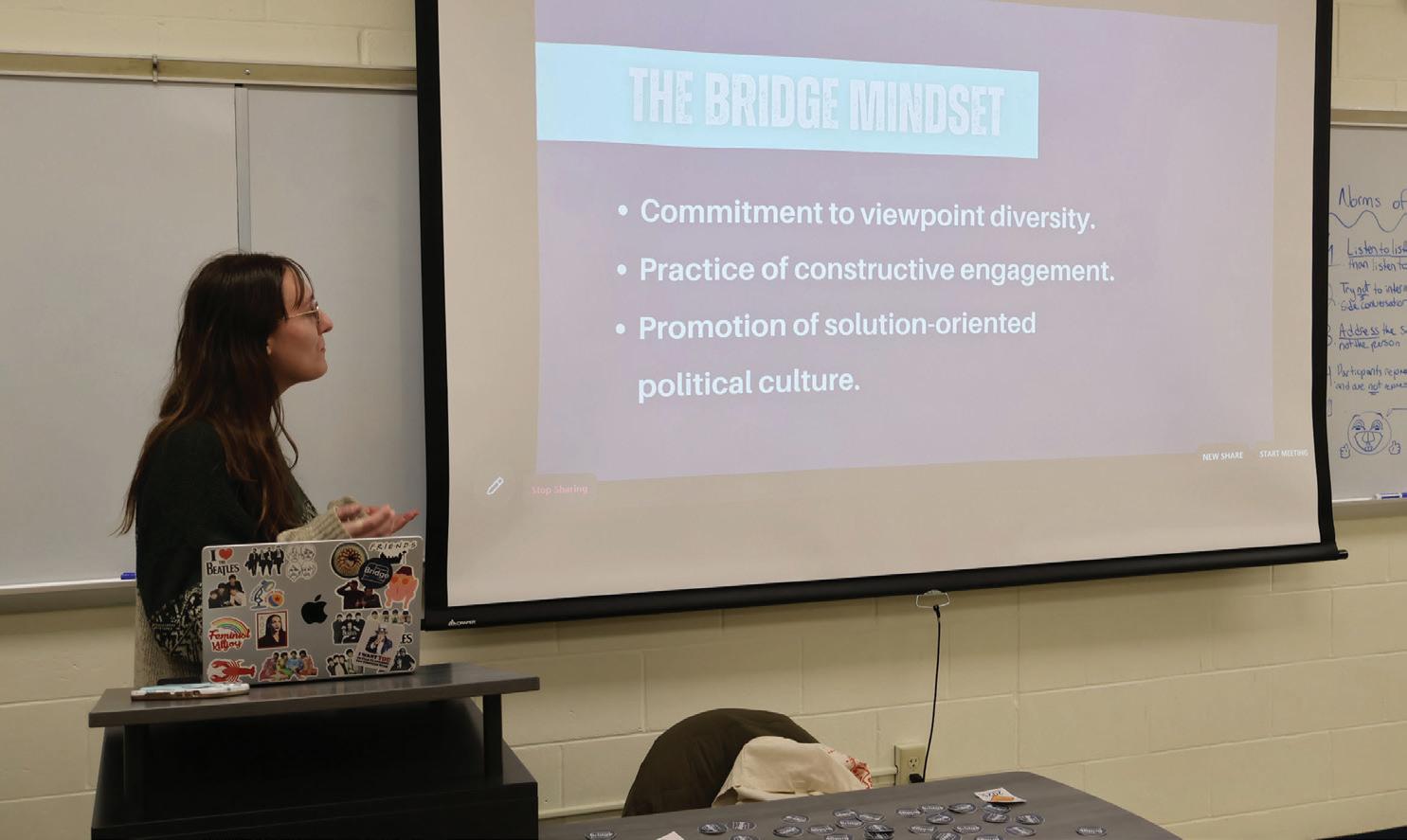
The club aims to create a safe space where students can discuss political issues, and “express your opinion and not feel attacked,” Vincent, sophomore journalism major, said.
“I think it helps people to grow… at least being able to sit down and hear what other people have to say. And I think Bridge is a great way to do that,” McNeely added.
Through this, Bridge Quinnipiac also hopes to end polarization, according to Vincent.

Action for the club started when Bridge USA reached out to Collins, asking if she would be interested in becoming the president.
She accepted the offer and worked with Aticez Zulfi, her assigned communication development chair from Bridge USA, to start Bridge Quinnipiac.
Collins joined Bridge because she’s “interested in kind of cultivating an environment where we’re not only letting our opinions be heard, but we’re listening to other people,” she said.
McNeely also shared his reason for joining.
“The reason why I decided to join Bridge is because I want to be involved in at least trying to sit people down to have a conversation,” he said.
While the group is relatively new, Collins plans to “fit in as many discussions as possible,” something McNeely agrees with.
“We are hosting an immigration/ICE debate on Dec. 2, at Tator Hall 117 and we’re just trying to get more events like this… just people to sit down on both sides,” McNeely said.
Vincent said her goals involve seeing “Quinnipiac become a place where people don’t feel uncomfortable expressing their beliefs.”
Additionally, she also wishes for “Bridge to be a place where people can understand each other as human beings, and understand that not all of us have the same path.”
Collins aims to cultivate “an environment where we’re not only letting our opinions be heard, but we’re listening to other people.”
Bridge Quinnipiac meetings will operate on a biweekly basis.
PHOTO CONTRIBUTED BY BRIDGE QUINNIPIAC
Sophomore journalism and history double-major and Bridge Quinnipiac President Adrihanna Collins leads the club’s first meeting.
PHOTO CONTRIBUTED BY BRIDGE QUINNIPIAC
History and philosophy double-major and Bridge Quinnipiac Vice President of Events Eden Berry participates in the discussion during the organization’s first meeting.
Local and on-campus organizations help those in need of food assistance
By AVA HIGHLAND News Editor
The country’s longest government shutdown in history ended on Nov. 12, but its effects on food assistance continue to impact people across the country. At a time when the need for food is heightened around the holiday season, several local and on-campus organizations at Quinnipiac University took action to help those in need.
The disruptions to the Supplemental Nutrition Assistance Program (SNAP) as a result of the shutdown combined with the “One Big Beautiful Bill Act” (OBBB) both affected people who rely on food assistance.
“SNAP provides food benefits to lowincome families to supplement their grocery budget so they can afford the nutritious food essential to health and well-being,” according to the U.S. Department of Agriculture.
Not only did the shutdown affect those who rely on food assistance, but the Trump administration’s OBBB had a large effect on SNAP benefits as well.
Signed into law on July 4, “this legislation will reduce SNAP funding by approximately $186 billion over 10 years — a 20% cut that marks the largest reduction in the history of the program,” according to Harvard Kennedy School.
The act also created “stricter work requirements on SNAP participants.”
In regard to food assistance, OBBB and the shutdown have significantly affected families everywhere.
In Connecticut alone, hundreds of thousands of people were affected by the shutdown, as reported by DataHaven.
“The shutdown disrupted $72 million in food assistance for about 360,000 Connecticut residents,” according to a report by DataHaven. The report also projected that around 58,000 Connecticut families would lose significant SNAP benefits after the shutdown ended.
Here’s what people are doing to help local families:
CAMPUS-WID E FOOD DRIVE
On campus, Quinnipiac partnered with Hartford Healthcare’s Behavioral Health Network to host a university-wide food drive for the first time.
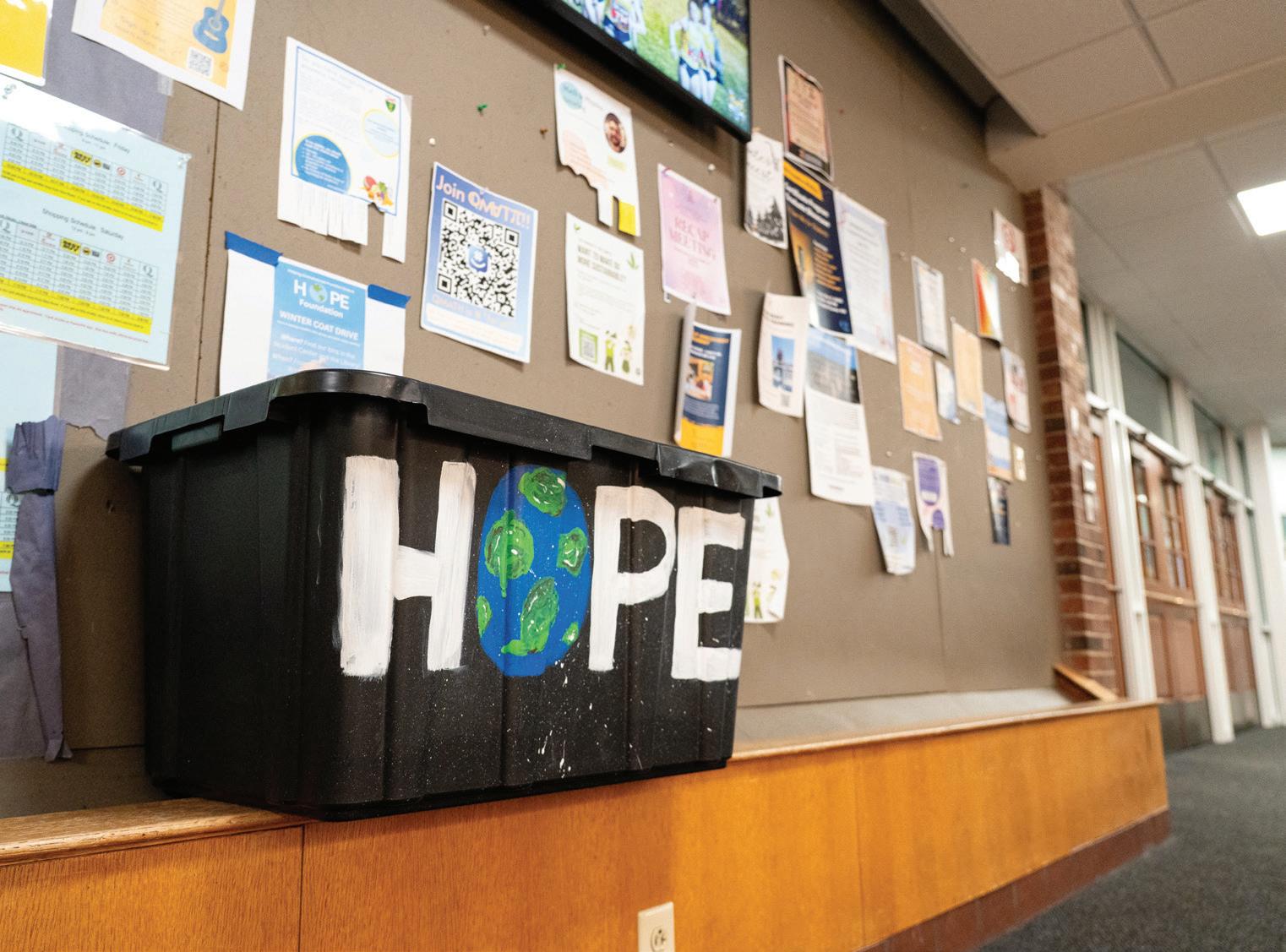
Donations are being collected across all three of Quinnipiac’s campuses from Nov. 13 until Dec. 5. Donations will be distributed among the Bobcat Food Share, Hartford Healthcare as well as the towns of Hamden and North Haven.
“ We really just want to help people that… have found themselves in a food in -
secure position, be it because of SNAP benefits or rising grocery prices or whatever the case may be, we just want to be able to help our community and our neighbors,” Karla Natale, associate vice president of community partnerships & university events, said.
KEEFE COMMUNITY CENTER
Hamden’s Keefe Community Center food pantry has been running for over 30 years and has grown throughout its more than three decades, according to AnneMarie Karavas, the program specialist of the Town of Hamden Community Services. The pantry collects donations through food drives, private and public donations as well as mon-
etary donations both in person or via mail.
The food bank mainly serves Hamden families, but also provides The Emergency Food Assistance Program (TEFAP) to anyone in the state.
In response to the shutdown, the pantry has added more spaces for appointments as well as packed TEFAP bags and handed them out on a walk-in basis.
Karavas explained that in November, the phones constantly rang and the number of people visiting the pantry were growing.
“We can’t keep up,” Karavas wrote.
QUINNIPIAC COTAD AND SOTA
The Quinnipiac Coalition of Occupational Therapy Advocates partnered with the Student Occupational Therapy Association to host an on-campus food drive from Nov. 4 through Nov. 21. All donations were given to both the Keefe Community Center and St. Vincent de Paul’s food pantry in Middletown.
The organizations were inspired to run the food drive after learning that within the Middletown community is a large population of unhoused as well as housing-insecure people who rely on SNAP.
“As a recently appointed executive board we wanted to raise awareness about homelessness and contribute to their food supply as the holidays are approaching, and food insecurity becomes even more pressing,” Silvana Alarcon, chair of the coalition of occupational therapy advocates, wrote in an email to The Chronicle.
In addition to the disruptions to the SNAP program, Alarcon also wanted to take action in regard to the holiday season.
“Especially because this season revolves around holidays, gatherings, and food, we wanted to take the time to recognize and help a community that is often unseen and underserved,” Alarcon wrote.
and the stated plan to move the collection to some entity in the Town of Fairfield remains a pipe dream,” Lahey previously wrote in a statement to The Chronicle.
DeLauro echoed this concern.
“The paintings and sculptures comprising the collection remain in storage without professional curatorial oversight,” DeLauro wrote. “I continue to remain concerned about the safety of the collection and about the future of the building located on Whitney Avenue in Hamden, which itself is a unique and award-winning work of art.”
Without that “curatorial oversight,” the collection could potentially be in jeopardy, according to DeLauro.
Ireland’s Great Hunger Bord member Joseph McDonagh shared the same upset and confusion for the state of the collection.
“It is baffling to think that the University intends to give this asset to a private group in Fairfield who have no prior experience, either with museums or the Great Hunger, a group that has demonstrated little or no ability to raise the $5-7 million needed to build the facility that they are planning,” McDonagh wrote in a statement to The Chronicle. “And when you consider that Quinnipiac University already has an Irish Studies program, a partnership with University College Cork in Ireland, and the
Ireland’s Great Hunger Institute, it makes even less sense.”
McDonagh also noted what is needed to reopen the museum: a board of trustees for
the collection, funds to make the museum self-sufficient and collaboration with university academic departments.
A board of trustees previously existed

but was dismantled.
The push for reopening the museum and keeping the collection safe is not new. The non-profit bord formed in 2022 and “is a global network of people committed to remembering and memorializing the worst catastrophe of 19th century Europe,” according to IrishCentral.
Since its formation, the bord took a special interest in Quinnipiac’s former museum and has since been working to spread awareness and advocate for the museum to be reopened.
In 2023, the bord sent an open letter to former President Joe Biden, asking for his help as he too is of Irish descent. The letter can be found on the bord’s official website, as well as more information on the Great Hunger and the push for Quinnipiac’s museum to be reopened.
As the advocacy for the museum ramps up again, those involved hope to see the university reconsider the closure.
“I will continue to work with the collection’s advocates on a solution, and I urge Quinnipiac University to consider reopening the museum at its Whitney Avenue location,” DeLauro wrote. “The collection must remain accessible and intact for students and the wider community.”
To read Congresswoman Rosa DeLauro’s full letter visit quchronicle.com.
MUSEUM from cover
TYLER MIGNAULT/CHRONICLE
As part of the campus-wide food drive, hope boxes were in various locations across all three campuses for anyone to donate food to.
TYLER MIGNAULT/CHRONICLE
The Whitney Ave. building that is home to the former Quinnipiac Great Hunger Museum remains unused.
Opinion
While all eyes were on Gaza, Sudan flew under the radar
By JOANNA FARRELL Associate Opinion Editor
For the last two years, all eyes have been on Gaza, and rightfully so. However, in a time where news is at our fingertips, it still feels as though we have tunnel vision when it comes to global issues. TikTok seemingly controls the narrative when it comes to widespread awareness, and up until recently, ongoing genocides in Africa have slipped through the cracks of mainstream coverage.
One of the largest issues going on in Africa right now is a mass genocide in Sudan. Upwards of 150,000 people have been murdered on top of other atrocities that are being committed against women and children throughout the Darfur region of the country. Amongst the most attention-drawing sieges is the city of el-Fasher.
People are cowering in fear of the organized armed militia that is making their way through Sudan and terrorizing the small villages that occupy the land.
Like many, you may be asking yourself when this started and how this is happening. Africa has been victim to centuries of colonization and apartheid, which led to weak government structures across the continent. Sudan is one example.
In April 2023, Sudan was plunged into a civil war between its army and the leading militia, known as the Rapid Support Forces (RSF). This
has caused nearly 12 million to flee their homes in fear of the group in what the United Nations is calling the world’s largest humanitarian crisis, according to data from the British Broadcasting Corporation. But why did this civil war start?
Prior to the war, Sudan was under the rule of the widely dis liked Omar al-Bashir. Because of this, the Su dan military and the afore mentioned RSF joined a well-built alliance to stage a coup in 2019. The people craved democracy; however, after the former leader was ousted, Lieutenant-General Abdel Fattah al-Burhan, the leader of Sudan’s military, was not willing to give up control and took the stage as the country’s leader.
This caused a division between the Suda nese military and the RSF. The RSF wanted power too, but was undermined by Burhan, causing the alliance to dissolve in April 2023. The RSF is approximately half the size of the Sudan Armed Forces at 100,000 members.

This skewed the power in Sudan and the RSF now holds control of the Darfur region of Southwest Sudan and the Sudan Armed Forces hold control of northern and eastern Sudan. However, small militias are popping up around
The Associated Press cites that one of the reasons the RSF is targeting the Darfur region of Sudan is because this area is extremely saturated with gold, making it a source of wealth for the country. There has been discourse surrounding a theory that the RSF is partnered with the United Arab Emirates and is exploiting Sudan of their gold resources to send to the UAE in exchange for weapons.
The Emirati government denies that it has any involvement with the RSF, however, the UN has evidence that weapons manufactured in Europe
are being utilized by the militia in Sudan. Members of the United Nations have stated that they will not let this go and will be urging the European Commission to hold a meeting to discuss the possibility of renegotiating trade with the UAE so long as they keep finding evidence that these European weapons are making their way through the United Arab Emirates to the RSF.
In response to the claims, the Envoy of the Minister of Foreign Affairs to the European Union (EU) has stated that the Emirati government has denied these claims several times, which puts the UN and EU in a unique position of whether or not to renegotiate its trade deals with the UAE. The UN justification is there are other ways for the RSF to locate these weapons, although substantial evidence of trade between the RSF and UAE remains.
While there are still many unknowns about the genocide occurring in Sudan, one fact remains: people are being killed by the thousands, and nothing is being done.
Survival should not depend on luck. Being born in a country with a stable government, regardless of a certain gender, race or religion are basic human rights and we must not turn a blind eye to Sudan.
All. Eyes. On. Sudan.
Living with the NY Giants feels like a never-ending punishment
By ANTHONY ANGELILLO Copy Editor
Life as a New York Giants fan feels like a bad joke that never stops; only the punchline keeps getting worse. Each week brings fresh embarrassment as the record sinks toward the bottom of the National Football Conference East.
I have not seen a Giants Super Bowl win since I was five. All I hear from people is “at least the Giants won two Super Bowls against Brady.”
Even though that may be true, recent championships don't matter. I was still in preschool, learning my ABCs and completely unaware that New York even existed.
The public shame I hear when people list the Giants' failures makes me question why I am even a Giants fan, which then reminds me that I had no choice, since I was born into it.
The seasons that actually stay clear in memory look very different. One playoff trip in 2016, then a long stretch of double-digit-loss seasons turned the franchise into a weekly source of stress.
Each fall promised a reset, only to finish with another top draft pick.
The past two years pushed that frustration to a new level. A three-win collapse in 2024 set up this season, in which a 2-10 record, a six-game losing streak, and the firing of head coach Brian Daboll in November made the Giants feel like the most hopeless team in the division.
Then you point out all the leads New York blew and all the close games it lost. You flip the results, and the Giants may actually be a contender. But nope, they are now being crowned the best 2-10 team ever, which is just a slap in the face at this point. Interim coach Mike Kafka is trying to patch together a season that already ended before Thanksgiving.
Nothing sums up the chaos better than the Daniel Jones saga.
The front office gave Jones a fouryear, $160 million contract in 2023, sold fans on stabil ity at quarterback, then moved on less than two sea sons later after ugly losses, injuries, plus benchings. The rela tionship ended so fast, the biggest feeling left was simply confusion.
three-year deal worth more than 37 million dollars, then turned into an Offensive Player of the Year caliber force in green.

Letting former Giants running back Saquon Barkley walk created an even deeper bruise. A homegrown star, a rare bright spot in so many bleak years, left for the Philadelphia Eagles on a
Watching a former face of the franchise run through defenses for a hated rival while the Giants' offense struggles to reach 20 points feels like
This season, the team tried to reset the story with rookie quarterback Jaxson Dart, 25th overall pick in the first round of the 2025 NFL draft. A firstround pick who runs plus throws with fearless confidence should signal hope. Instead, a stint in concussion protocol, plus talk about scaling back his rushing, turns every scramble into a moment that the future
will fall apart before it begins. The team now sits at 2-11, eliminated from playoff contention with weeks left on the schedule.
Ownership carries a huge share of the blame. The Mara family treats the franchise like a family
heirloom, and the product on the field looks stuck in a different decade. Division rivals lean into creative trades, bold analytics and aggressive roster moves, while this team clings to outdated ideas about toughness, tradition and loyalty.
Front-office decisions keep adding layers of frustration. The coaching staff sold a vision of smart football, then made conservative fourthdown calls, timid play designs near the goal line and strange quarterback decisions that never aligned with what fans saw on the field.
Every press conference promises that the plan will work. Every Sunday night tells a different story.
Being a Giants fan since childhood who survived coaching changes, painful draft picks and endless rebuilds, feels less like casual support and more like a permanent part of my life.
Walking away would feel wrong, even with this season making that choice more tempting. However, I will continue to wear my blue Dexter Lawrence jersey in the closet and pray our defense does not continue to blow games, which hopefully will happen less with the firing of Defensive Coordinator Shane Bowen.
The Giants may not deserve support right now, but, as I always fall back on them, the future is bright for the Big Blue Wrecking Crew, and my bond to this team will remain.
Opinion
The structure of the NCAA is vanishing
By REX NAYLOR Staff Writer
Since its existence, the NCAA has been home to college athletes who come from all corners of the world and participate in high-level play, as well as completing a degree. In the last year or so, however, the NCAA has lost its homey feel, transitioning from college-level stakes to allowing professional athletes to compete in their ranks.
Nathaniel Salmon, a 21-year-old, 6-foot-7, 270-pounder from New Zealand had never played football before, but because of his size, scouts convinced him to work out and pick the game up.
Salmon was invited to a camp where he impressed enough to be chosen as part of the International Player Pathway (IPP). It was the same program that discovered Eagles All-Pro lineman Jordan Mailata, who was a rugby star in New Zealand.
Salmon trained at IMG academy in Florida, and was invited to the Chargers rookie minicamp as an undrafted free agent, but did not sign a contract. For many this is where the story would end, but not for Salmon. Salmon never played college football, so the NCAA determined he still has four years of college eligibility.
According to 247 Sports, Salmon holds offers from University of North Carolina, Utah State, Arizona State, Arizona University and Baylor University, and is drawing interest from many
other top schools. Salmon would be two or three years older than a typical freshman entering college football.
“What about the freshman you recruited there?” legendary basketball coach Tom Izzo said about the situation. “That’s somebody’s son and he thinks he’s got himself a good place and all of a sudden, shazam, they pull out of their hat and bring a 21 or 22 year-old in. To me it’s ridiculous. To me it’s embarrassing.”
This isn’t a one-off, though, as other sports have seen similar situations, such as this fall at Ohio State.
The Buckeyes' men’s soccer team recruited Michael Ndiweni, a 21-year-old from Newcastle, England. Ndiweni appeared in a Premier League match as a substitute against Chelsea in November 2023 and again against Paris Saint-Germain a few days later.
Ndiweni has played in eight matches this season, scoring one goal for the Buckeyes. Although this may not seem like much, it can set a dangerous precedent for college sports.
In late September, Santa Clara Broncos signed Thierry Darlan to their basketball team despite him already playing two seasons in the G League. The G League is the minor league of the NBA and allows players to develop before finding their way in the NBA.
Darlan is also 21 and has two more years
of college eligibility per NCAA regulations, but this decision has sparked fierce debate in college basketball. Abdullah Ahmed also spent two years in the G league and was heavily recruited by Brigham Young University (BYU), University of Houston and Auburn University, according to Joe Tipton of Yahoo. Ahmed has since committed to BYU.
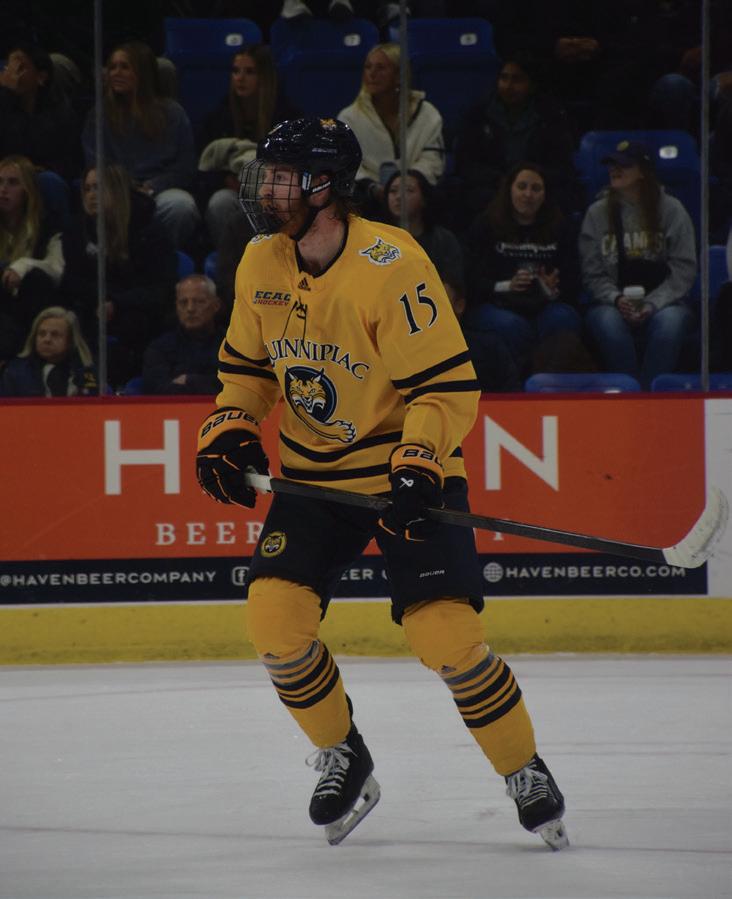
Even at Quinnipiac, men's ice hockey freshman defenseman Graham Sward has two years of minor professional league experience under his belt. Sward previously played for Norfolk Admirals in the East Coast Hockey League (ECHL), and the Manitoba Moose in the American Hockey League (AHL).
St. John’s men’s basketball coach Rick Pitino chimed in on social media, saying in a post: “So let me get this straight, we can now recruit G league players? I have first dibs on Giannis Antetokounmpo!”
The line between amateur athletes and semi-professionalism has greatly diminished, much thanks to the power of Name, Image and Likeness (NIL) which allows players to make money from their name, image and likeness. Many athletes come from all parts of the world to take advantage of American schools for NIL, the resources, exposure and education.
Some of those players are grown men, having
already earned money from playing their sport professionally, competing against 18 and 19-yearolds who have not earned anything and fight for a spot every day.
Is Kamala Harris our happy warrior?
By NICK FIZZANO Contributing Writer
This story may sound familiar to anyone who lived through the last presidential election. A Democratic president kneecapped by his unpopularity within his own party.
It originated with a war in a faraway place that many Americans may not otherwise know of: a more liberal vice president who obviously had the presidency within their own sights, yet remained bound to their older counterpart.
Standing opposite them, a Republican nominee who defied the laws of political gravity and despite a bruising electoral loss just a few years earlier, had returned on a politics of vengeance with the GOP united firmly behind him.
Ultimately, everyone knows how this saga ended, with the president finally announcing he would not be seeking reelection, and the vice president taking the mantle of Democratic nominee, ending in an election where the Republican won a tight popular victory and a large electoral sweep.
However, if you have read this and are thinking of the 2024 election between former Vice President Kamala Harris and President Donald Trump, you wouldn’t be seeing the full picture. Instead, I would ask you to think about the 1968 election, between former Vice President Hubert H. Humphrey and former President Richard M. Nixon.
There have been many comparisons between Former Presidents Lyndon Johnson and Joe Biden: both men took the presidency in unexpected ways, spearheaded far more liberal policies than their previous records would suggest and both were ultimately made one-term presidents due to their unpopularity both with their party and the public.
Yet, in Washington, D.C. a few weeks ago, listening to Harris on her book tour, I began to think further about the similarities between her and Johnson’s deputy, Humphrey. There has been plenty of speculation that Harris will run again in 2028, unsatisfied with her truncated campaign of only 107 days and she hinted toward it at this
event. When asked if she would run again, the former vice president gave a laugh, a comical shrug and responded “maybe.”
Harris and Humphrey represent, thus far, similar characters in history. Both are liberal senators who made a national impact early in their careers, who were forced by the failures of their presidents to bear the mantle of liberalism in deeply difficult elections.
Yet, they each had separate experiences in their campaigns to become the Democratic nominee. While Harris had the party unified around her in a matter of days, Humphrey had to fight off challenges from New York Senator Robert Kennedy (whose son would go on to become a rival of Harris’) and Minnesota Senator Eugene McCarthy. While Harris led the 2024 convention into Chicago with the party behind her, Humphrey’s 1968 convention in Chicago is known as one of the worst calamities of modern politics. Yet, the similarities outshine these differences.
Both Harris and Humphrey were practitioners of Humphrey’s term “the politics of joy.”
Despite the negative tones of their respective opponents, Trump and Nixon, and the vehement rage of their running mates, J.D. Vance and Spiro Agnew, Harris and Humphrey both fought for the brighter politics they became associated with over their careers.
For Humphrey, the politics of joy meant a happier and united approach, as opposed to the deep divisions of the time. Harris’ approach was similar in this regard to the point that her campaign seemed at times to be led more by “vibes” and the wrongness of Trump than a substantive
policy. Humphrey was criticized similarly, and the politics of joy were seen as out of touch with the riots and unrest of the 60s, much as they were with the fear and economic anxiety of 2024.
Both vice presidents additionally struggled due to their presidents. While Johnson and Biden had both removed themselves from the presidential election, neither could stand to watch their legacies be anything but defended with the utmost seriousness by their would-be successors. Johnson bullied and harassed Humphrey into standing by him on Vietnam, threatening to destroy him if he turned away from him.
Ultimately, Humphrey was too late, and his modest public break with Johnson seemed not to matter in the end. Harris fell into a similar situation. While she begged Biden in private to show more humanity in his statements about the Palestinian people, she could not bring herself publicly to break with him, and Biden himself was not above Johnsonian tactics either.
Whether it was calling to tell Harris that he had heard she was “bad mouthing” him just before her incredibly important debate with Trump or pushing her that there could “be no daylight” between them, the 46th president still was not ready to give up entirely.

Biden may have been more subtle than Johnson, but it was unmistakable the octogenarian president intended to make Harris run with him, whether his name was on the ballot or not. Neither Harris nor Humphrey could ultimately make the best of their bad situations, nor escape the leering shadows of their unpopular presidents.
In both 1968 and 2024, Americans saw the
“happy warriors” of the Democratic Party slapped away against quite possibly the two most vengeful candidates the GOP had ever nominated.
What I find truly fascinating though, is that Harris’ likely decision to run again in 2028 will also mirror the first “happy warrior.” Humphrey was quick to throw himself into the campaign for president in 1972, his third (much like 2028 would be for Harris) attempt to gain the presidency. Yet, for all of the power that a former vice president and nominee may have in their party, the Democrats of the 70s had moved on from the man who lost the White House four years earlier, and he ultimately lost the nomination after appearing drained, with no trace of his well-known optimism.
Harris may yet see her fate be the same as Humphrey’s. Already, the Democratic Party is looking for its next fresh faces, and Harris’ may be too tainted by association with a president who retains much of the party’s scorn. If she is to have any chance in 2028, Harris must not subscribe solely to the politics of joy she overemployed in 2024, nor can she adopt the politics of vengeance, demanding that she “deserves” the presidency.
Instead, the politics of joy must be measured with a popular and substantive message to make America a better, happier place, not just window dressing with a smile and catchy songs.
If Harris continues on as Humphrey did, she will lose and join him in history as an almostwas. Harris seems to be sleepwalking in that direction. Even now, she is hesitant to verbally criticize Biden’s conduct; she seems happier declaring “I told you so” than preparing to fight for a presidency in 2028 that she has not earned. Unless Harris can put together policies that are both joyful and substantive, well-thought through and meet the moment, she will join Humphrey in assuming that the nomination was there for them as the previous standard bearer and be left behind by a party moving into the future.
If she can learn her mistakes, Harris may truly be able to deliver a politics of joy for the American people and cement herself as the happy warrior of our age.
TAYLOR HUCHRO/CHRONICLE
Quinnipiac men's ice hockey freshman defenseman Graham Sward previously played for the Norfolk Admirals in the ECHL and the Manitoba Moose in the AHL, two minor professional teams before becoming a Bobcat.
‘I
Arts & Life
have been changed for good’
‘Wicked: For Good’ has its hits and misses
By CLAIRE FRANKLAND Sports Editor
I have been a fan of “Wicked” since the first time I saw it on Broadway in 2022. So you already know how excited I was to watch director Jon Chu deliver the final act in “Wicked: For Good.”
And all I can say is wow.
From the opening scene to the end credits, I was thoroughly impressed with Chu’s cinematic storytelling, which brought the final part of “Wicked’s” story to life.
ACTING
Taking a look at the acting, of course, it was going to be incredible across the board. I mean, look at the lineup: singer-songwriters and actresses Ariana Grande and Cynthia Erivo and actors Jonathan Bailey, Jeff Goldblum and Ethan Slater.
Despite the online slander Grande and Erivo get, you have to give them credit; they are both incredibly talented actresses, and it really shows in their roles as Glinda and Elphaba respectively in “Wicked: For Good.”
Their ability to become one with the character they are portraying and the raw emotion they bring to their roles is incredible. It really shows how dedicated they are and how honored they feel to play these well-known characters.
Slater, as Boq, who becomes the Tin Man, had a lot to deliver in the final part of the “Wicked” story. And let’s just say, he delivered. Despite the little screen time he received, Slater managed to make the Tin Man a very frightening character.
In the song “March of the Witch Hunters,” Boq has his solo part, saying “And this is more than just a service to the Wizard/ I have a personal score to settle with El/ With The Witch!/ It's due to her I'm made of tin/ Her spell made this occur/ So for once, I'm glad I'm heartless/ I'll be heartless killing her!”
The song is evil and filled with anger, with Slater giving just that in his performance. While the film did not include as much singing from the Tin Man as the Broadway version does, his angry, bold delivery embodied everything the character is meant to exemplify towards Elphaba.
Even the death-stare glance he gave up to Glinda, despite being in love with her, sent chills down my spine.
SOUNDTRACK
I am a sucker for musical numbers, so of course I was excited to see how Grande, Erivo, Bailey, Goldblum and Slater delivered in the film.
The film featured two original songs, one of them being “The Girl in the Bubble,” sung by Glinda. While I love Grande’s vocals and feel her execution of the song was very good, the song's placement is what stuck out to me most.
The song was placed in the middle of the musical number for “March of the Witch Hunters,” as the scene cuts from the outside chaos to Glinda inside her room. While the songs’ placement might have made more sense if they evoked similar vibes, the two definitely do not.
“March of the Witch Hunters” is about the Tin Man, Ozians’ and the Cowardly Lion’s desire to kill and defeat Elphaba once and for all.
The song has a dark undertone, representing the anger built up in all the citizens of Oz. On the contrary, “The Girl in the Bubble” focuses on Glinda's emotions and is sung slowly, evoking empathy from the audience for Glinda.
The second original song featured in the movie was “No Place Like Home,” sung by Elphaba. This song is a blatant nod to the signature line “there’s no place like home,” from the “The Wizard of Oz.” Out of the two original songs for the movie, I enjoyed this one more, especially because Elphaba, the wickedest in all of Oz, performs it. When taking a look at all the songs from the original Broadway show, they were all beautifully performed, in large part due to the actors’ live singing.
Bailey and Erivo’s vocals in “As Long as You’re Mine” truly did it for me,
their voices blended perfectly during that scene. While the onscreen chemistry was hit or miss, depending on who you ask online, the harmony in their vocals added an immense amount of raw emotion to the scene.
Similarly, I just can’t get enough of Erivo’s vocals, like in “No Good Deed.” Her vocal performance is always breathtaking and the live recording of songs truly displays her incredible ability to perform live.
Yet, as someone who is a fan of the soundtrack from the Broadway production, I was a little disappointed that the transition from Glinda’s “Fiyero” to Elphaba’s was not only missing in the film, but also on the soundtrack entirely.
CINEMATOGRAPHY
H onestly, just coming from “Wicked,” everyone knew the cinematography in “Wicked: For Good” was going to be top-notch. When Glinda is walking down the aisle of her wedding, while Elphaba is walking down the aisle of the Wizard’s chamber of caged animals, the juxtaposition of the two scenes is insanely well put together.
Everything about the two shots is identical, even down to Glinda and Elphaba’s walking pace, as the two shots are switched back and forth during the scene.
The shot with Glinda has sunlight pouring in, beautiful flowers and a lively atmosphere, signifying that this moment is the highlight of her life.
On the contrary, Elphaba is filmed in a dark environment, dimly
lit, with her ascending down stairs to the darkest moment in her life, after the Wizard lied directly to her face.
Even Alice Brooks, a cinematographer on the film, confirmed this idea, according to Variety, saying, “Glinda and Elphaba are descending stairs ‘to what becomes the consequence of their life.’”
Additionally, towards the end of the film, the opening scene from “Wicked” plays, featuring Glinda in Munchkinland and the musical number “No One Mourns the Wicked.” Yet, instead of the scene transitioning to the flashback of when Glinda and Elphaba first arrive at Shiz University and ultimately meet one another, the camera pans back to Glinda. The scene continues on with Glinda telling the Munchkins how she wishes to bring goodness to all Ozians, human or animal, and bring everyone together.
When I first saw this scene, I’m not going to lie, I thought I may have accidentally bought tickets to the double feature. When I saw the way that the crew was able to blend the scene from the first movie into the additional scenes for the second, and I was amazed.
It really adds so much more to the film, showing how the two acts blend into the same storyline.
Even how the transformation scenes were shot brought out so much emotion and storytelling to the overall plot. While I would have liked to see more of Fiyero’s transformation and just the Scarecrow on screen in general, what was shown of both transformations was beautifully filmed.
The musical numbers all had great cinematography as well, but none of them compared to “No Good Deed.”
Seeing Elphaba in the dimly lit environment with only the sunset on the horizon, surrounded by the flying monkeys with fire, was masterful.
I mean, the symbolism in the film is simply everywhere, even when you least expect it, like the ending shot, meant to represent the cover of the Broadway playbill.
The film is insanely well-crafted, bringing out so much emotion and I, for sure, cried leaving the theater.
Like most films, it has its highs and its lows, but if you haven’t seen it already, what are you doing?
Let’s just hope it doesn’t get snubbed at the Oscars this year.
ILLUSTRATIONS BY EMILY KATZ
Kelsea Ballerini proves to be underrated yet again
A ‘Mount Pleasant’ review
By LILLIAN CURTIN Opinion Editor
The frankly underrated Grammy-nominated singer, Kelsea Ballerini, has blessed us once again with an angelic, vulnerable EP: “Mount Pleasant.”
Each track feels like her therapy session, in the best way possible. You can tell when some artists just write to get an album out and Ballerini isn’t one of them. It’s what separates a singer and an artist.
I’ve been a fan of hers since I saw her on Disney Channel’s “Next Big Thing” when her first album came out in 2015. That album, “The First Time,” didn’t showcase her writing talent. Don’t get me wrong, it’s a great album, but you can tell she’s not the same artist who wrote it.
She’s been developing into a new, more vulnerable artist. We started seeing it in her 2020 albums “Kelsea” and “Ballerini,” which have the same songs, with “Ballerini” being the acoustic version.
We can see her start to open up a little more, specifically in tracks like “homecoming queen?,” “half of my hometown (feat. Kenny Chesney)” and “the way i used to.” Funny enough, her first track on that album is called “overshare.” Never stop oversharing. Ever.
When her EP, “Rolling Up the Welcome Mat,” dropped in February 2023, I was coming to terms with the fact that I needed to leave my longterm boyfriend. So, obviously, that album about her divorce to country singer Morgan Evans got me through a lot.
Ballerini released her most recent EP, titled “Mount Pleasant,” on Nov. 14, and she did not disappoint. Her lyricism is next level, and she’s clearly singing from her heart.
Now, if you haven’t been paying attention to the circle of drama that’s transpired over the past couple of months, let me catch you up.
Madelyn Cline and Chase Stokes, two of the main cast members of “Outer Banks,” dated for a year before they split in 2021. They continue to work together on the show, where they are still love interests. Stokes and Ballerni started dating in 2023, but called it quits this year.
They split on good terms, but it seems some issues were just too mentally draining to overcome, and we hear that in the album.
So what does the title have to do with any of this? Mount Pleasant is in Charleston County, South Carolina, where Cline, Stokes and the rest of the “Outer Banks” cast filmed the show, which basically leaves no speculation needed that this album is mostly about her feelings in that relationship, and out of it.
But I think it would be a shame to just say that this album is about that relationship, and only that relationship. This album is about her feelings as a woman.
The opening song in the EP, “I Sit in Parks,” is the best example of this. She sings, “Did I miss it? By now is it a lucid dream?/ Is it my fault for chasing things a body clock doesn’t wait for?”
It’s hard as a woman to want to focus on yourself when you have people constantly reminding you about the “biological clock” that’s ticking to have children.
It’s one thing if you don’t want kids, and you can focus on your career. But when you want a family, but you also want to do what you can in your “prime,” there is no right answer on how to deal with that, and it’s maddening.
I’m afraid that if I continue to work as hard as I do, and go at the speed that I’m going professionally, I won’t pause until it’s too late. The fear of missing out on motherhood because you’re focusing on yourself doesn’t just hit when you’re in your thirties. I'm barely 20, and
it eats me up when I think about it for too long.
In another line, she sings, “They lay on a blanket, and God damn it, he loves her/I wonder if she wants my freedom like I want to be a mother.”
I went into college thinking I was with the love of my life — the guy I was going to marry. A part of me hung onto that godforsaken relationship as long as I did because, I think, in the back of my mind, in my subconscious, I still had that timeline gnawing at me.
The next song, “People Pleaser,” talks about making decisions and changing your personality for everyone else. Almost every decision you’ve made has been based on what other people want, so when all is said and done, you don’t know yourself, because your personality has been molded to please other people.
The next songs, “Emerald City” and “587,” are where we really get a taste of that postbreakup pain.
Some people took “Emerald City” as a diss to Cline. It just wasn’t. This song was about how destructive jealousy is to yourself and your relationship. She knows it’s a toxic mindset, and she feels horrible about it; that’s why she keeps repeating that her “true colors” come out — it’s guilt.
It’s realistic. Yeah, we hate when women put down other women, but we also hate ourselves when we do it internally. Especially when we know we don’t have a reason to. If that’s the mindset you’re in, you have to force yourself out of it, and it’s hard.
“587” is also about the relationship. The distance between Mount Pleasant and Nashville, Tennessee, where Ballerini usually is, is around 587 miles. The song, opening up with “Where you at?” reminds me a lot of “Mountain With a View” from her EP, “Rolling Up the Welcome Mat,” about her divorce, where she sings, “I wonder if you even know where I am.” We can see the similar patterns that took place in both breakups, the way she might’ve too.
The second-to-last song, “The Revisionist,” digs into having to accept bad decisions that you’ve made, no matter how much you want to go back and “call the Revisionist.”
In the last song, “Check on Your Friends,” she sings, “Pretty far from the girl that she was when she was twenty-four.” It seems like it’s more about her own story than a general message. The beat of this song gives me that old Lady A-type, older country vibe, which gives it a comforting touch to such a heavy song.
Ballerini's work is always filled with emotional depth and, at least for me, gut-wrenching relatability. It’s why I’ll sit in parks and continue to listen to Kelsea Ballerini’s poetic lyricism.

Movies you need to watch once in your life
By SOPHIE MURRAY Associate Arts & Life Editor
Movies offer more than entertainment; they provide comfort and spark nostalgia. In a world full of uncertainty, we turn to films as an escape, allowing ourselves to tune out reality and become immersed in stories that feel safe, familiar or transformative.
There are countless films across every genre. People who turn to movies for nostalgia, comfort or emotional depth, a handful of movies stick out to me as must-watches. While none of these titles aim to reinvent cinema, they offer rich storytelling. What ties these films together is their emotional depth and their deeply human stories.
“LITTLE WOMEN” (2019)
“Little Women,” the classic coming-of-age novel written by Louisa May Alcott in 1868, follows the lives of the four March sisters — Meg (Emma Watson), Jo (Saoirse Ronan), Beth (Eliza Scanlen) and Amy (Florence Pugh) — as they navigate adolescence and adulthood during the Civil War.
In 2019, director Greta Gerwig brought the story to a new generation with an Oscar-winning adaptation. What makes this film stand out is the deep sense of nostalgia. Many viewers grew up reading the novel, and seeing it brought to life on the big screen adds a powerful emotional layer.
Beyond nostalgia, the film delivers deeply human storytelling. It is an empowering work that champions female autonomy, portraying women who actively shape their own paths to happiness. Moving and emotionally resonant, “Little Women” remains essential viewing.
“SOUND OF MUSIC” (1965)
When I think of the “Sound of Music," I immediately think of love, comfort and my
childhood. Growing up, I went through a phase where I watched the “Sound of Music" everyday, captivated by its music, warmth and gentle storytelling.
Set in Austria in 1938, on the eve of Anschluss and the start of WWII, the movie follows Maria (Julie Andrews), a free-spirited woman who quits her life at the abbey to go work as a governess for the seven Von Trapp children. What begins as a rigid, emotionally distant household slowly transforms as Maria brings song, laughter and affection back into their lives. The film weaves together themes of love, family and resilience, that is only elevated by beautiful scenery and iconic musical numbers.
Watching the Von Trapp family rediscover connection and find love in their own ways makes the film so enduring. This is a timeless movie that doesn’t just entertain, but brings people back to something safe and hopeful.
“TITANIC” (1997)
What makes “Titanic” so powerful to me is that it is based on a true story. Seeing such a catastrophic event brought to life on screen emphasizes just how devastating the tragedy
Titanic, the story follows the romance between Rose, a wealthy 17-year-old, and Jack, a poor, struggling artist, told through the memories by an elderly Rose. While the love story between Jack and Rose is undeniably captivating, the film also focuses on Rose’s personal journey and her struggle to find independence and empowerment in a world that tries to suppress her. Their love flourishes as Jack supports her, helping her realize the possibilities of a life she could choose for herself.
As their romance unfolds, they are forced to confront the unimaginable disaster of the iceberg collision. The film doesn’t just show the sinking of the ship, it immerses viewers in the fear, courage and resilience of those aboard. “Titanic” is a cinematic experience that reminds viewers of the fragility of life and the power of love in facing adversity.
“BLACK SWAN” (2010)
“Black Swan” is a psychological horror thriller that tells the story of Nina Sayers (Natalie Portman), a ballerina competing for the dual role of the White Swan and Black Swan in a New York City production of “Swan Lake.” The pressure of the role causes Nina to have a mental breakdown, where her quest towards perfection leads her to embody both physically and mentally the Black Swan, blurring the line between reality and hallucination. What makes it a must watch is how the film is the way it immerses viewers in Nina’s unraveling mind. The tension is heightened by haunting, visually stunning imagery, with dreamlike sequences and symbolic mirrors that amplify her descent into obsession with perfection. The unique

camerawork and creative angles keep audiences off balance, creating a nightmarish experience that is as mesmerizing as it is horrifying. “Black Swan” is a striking exploration of ambition, identity and the dark side of artistic perfection.
“WHEN HARRY MET SALLY” (1989)
“When Harry Met Sally” remains one of the greatest love stories of all time because of its authenticity and relatability. The film follows Harry Burns (Billy Crystal) and Sally Albright (Meg Ryan), who meet after college and instantly dislike each other, but over time, they form a deep friendship that eventually blossoms into romance. They were always so sure of their differences — Harry’s cynicism versus Sally’s optimism — however, they learn so much about themselves through each other. What makes the movie so compelling is its honest portrayal of friendship evolving into love. At first, Harry said women and men can never be friends because it’ll always turn romantic. However, the two of them form a several-year, deep, foundational friendship without crossing a romantic line.
Since they had grown such a deep friendship, their eventual romance felt so natural and earned. The idea that we can be so sure of ourselves but not the world around us makes this a timeless and authentic exploration of human connection. These films remind us why we turn to movies time and time again. They make us feel, take us back to familiar places and remind us what it means to connect with others. Each of these stories is worth visiting once, whether it's the warmth of “The Sound of Music,” the love in “When Harry Met Sally” or the thrill in “Black Swan,” each has the power to make you feel something new.
‘So Easy (To Fall In Love)’ with Olivia Dean
By AVA HIGHLAND News Editor
As a pretty avid concert-goer, I love to see an artist put on a show. Costume changes, background dancers, elaborate sets. I love to see the theatrics, but there's also something so refreshing about a simple and elegant performance.
And over the past few months, that's exactly what we’ve seen from British singer-songwriter Olivia Dean.
Dean’s discography is a blend of pop, modern soul and jazz — it’s classy and soulful but still has that pop-music touch in some of her songs. Her tracks have found their way onto a variety of my playlists.
Dean made a quieter entrance into the industry before her career skyrocketed over the past several months — and it’s a testament to her character as an artist.
“It really has felt like the old-fashioned way, and I like that,” Dean told The Sydney Morning Herald. “I’m not someone who’s interested in rushing success. I’m not trying to do any tricks to get there quicker.”
Dean began releasing singles in 2019, followed by several EPs, before releasing her first album “Messy” in 2023. And just recently, Dean released her sophomore album “The Art of Loving” in September.
One of the album's singles, “Man I Need,” quickly went viral after its early release in August — the song that, in my opinion, really put her and her career in the spotlight. It being released as a single before the album, and going viral, built up anticipation and excitement for the album.
“Man I Need” was her first Billboard Hot 100 Hit, first sitting at No. 82 in September and
later climbing to No. 25 in early October. At the time of publication, “Man I Need” is at No. 4, just below singer-songwriters Taylor Swift, HUNTRIX: EJAE, Audrey Nuna & REI AMI and Alex Warren.
The artist herself made her Billboard Artist 100 list debut on Sept. 20, placed at No. 89. Dean hit her peak position on Nov. 15, making it in the top 10 by securing the No. 7 spot, where she remains as of publication.
Dean’s music is not only climbing charts in the U.S., but the artist is making a mark on the industry across the globe too.
On Spotify, Dean is within the top 100 artists in the world, sitting at No. 58 with nearly 50 million monthly listeners at the time of publication.
Dean’s music has been trending across social media platforms like TikTok and Instagram, with users posting the app's typical content, like lip-syncing videos. But clips from her live performances have garnered significant attention as well, with users sharing how much they like her stage presence and sophisticated style.
And that's also thanks to her stylist, Simone Beyene.
“Sometimes, they’re sequinned—lime-green Mithridate, backless Coperni halternecks, square-necked 16Arlington. Other times, they’re fringed and bobbled, like a feathered gown from David Koma or a white mini from Feben,” Vogue Australia wrote. “Conner Ives, McQueen. Knwls, Rat & Boa, Chopova Lowena—if there’s an upand-coming label, preferably English and unreservedly vivacious, you can expect Dean to adopt it on tour.”
The 26-year-old is doing something
unlike today’s biggest stars in the industry. And that’s not to shade a concert full of those theatrics.
Of course, I was at Taylor Swift’s “The Eras Tour” in a costume of my own. But as I’m growing older I’ve gravitated towards artists like Dean more than ever before. And in such a fast-paced world, especially as a college student, Dean's music creates an outlet to slow things down.
Dean just recently wrapped up her time as an opener for singer Sabrina Carpenter’s final leg of her “Short n’-Sweet Tour” — performing in Pittsburgh, Nashville and New York.
Loving Tour,” Dean is set to headline across venues in the U.S., Canada, Europe and Australia. Dean will take the stage at major U.S. venues including Madison Square Garden, TD Garden in Boston, Chase Center in San Francisco, Toyota Center in Houston and more.
Tickets went on sale Nov. 18 and quickly sold out across venues with eager fans, but greedy scalpers too. Resale ticket prices went for as high as $800 - $900, leading to Dean calling out ticketselling platforms in an Instagram story post.

“Ticketmaster, Live Nation, AEG: You are providing a disgusting service. The prices at which you’re allowing tickets to be re-sold is vile and completely against our wishes. Live music should be affordable and accessible and we need to find a new way of making that possible. BE BETTER,” Dean wrote.
Dean followed up a few days later, after her and her team worked to solve the issue — and it’s one that many face when purchasing
“Ticketmaster and AXS have agreed to refund the difference to anyone who has paid over face value for a ticket and will cap all future ticket resale prices to face value for the North American run of the tour,” Dean wrote. “Thank you for your patience and I’m looking forward to seeing all you real humans at the show.” If you haven’t listened to Dean’s music yet, I strongly encourage you to. Then you too will experience ‘The Art of Loving’ Olivia Dean.
Broadway on Prime: The goated cast of ‘Hazbin Hotel’
By ALEXANDRA MARTINAKOVA Editor-in-Chief
The beginning of December means holiday cheer, the hope for early snow and the arrival of Spotify Wrapped. Unfortunately, I already know what songs are going to dominate mine — and Prime’s “Hazbin Hotel” is at fault.
This so-called “animated adult dark musical horror-comedy TV series” created by YouTube creator Vivziepop is full of great, albeit sometimes funky, animation that originated as a pilot episode in 2019 and was picked up by Prime Video in 2024.
Don’t let the looks deceive you, though. “Hazbin Hotel” is vulgar, graphic and gory, dealing with heavy topics such as the portrayal of sexual assault, addiction, violence, propaganda, queerness, homophobia and religion, and boy, it does not sugarcoat anything.
I don’t know what kind of deal with the devil the casting producers made, but the show has a better cast than most recent TV shows, and the soundtrack to match.
It’s unhinged Broadway with surprisingly great storytelling, following the princess of hell who’s trying to find a way to redeem the sinners — humans who ended up in hell — through her Hazbin Hotel, therefore sparing them from heaven’s exterminations due to overpopulation.
With 16 episodes (and the aforementioned pilot that is semi-canon as a lot of the voice actors changed for the TV version) there 36 tracks that range not only in length, but in production and genre as well.
Before we even get to the cast themselves, these songs are so great because of the production behind them, which is the courtesy of Andrew Underberg — songwriter and composer — and Sam Haft — the lead singer of The Living Tombstone.
If you are a “Five Nights at Freddy’s” fan that name is more than familiar. But even if you are not a nerd like I am, you know who this group
is, as long as you have TikTok. Their song “My Ordinary Life” blew up on the app in 2020, and then in 2021, their song “Discord” rapidly gained popularity. So trust me, you’ve heard them once or twice before.
Back to the Broadway part though — quite literally, as the cast had a one-night show before the premiere of season two this past October.
There’s a lot of characters that get their chance at singing, so let’s start with the song and the voice that got me hooked on this show — “Hell is Forever” sung by the character of Adam, the first human and the leader of the exterminators, voiced by Alex Brightman, the Broadway actor best known for his recurring role as Beetlejuice. Yes, that Tony-nominated Beetlejuice from the trending TikTok audio.
Brightman’s voice as Adam honestly shines in the rock tune that his songs fall into. He makes an
song “Gravity” in Season 2.
This contemporary rock masterpiece is never leaving my playlist. I don’t care what anyone says. Brightman also voices a sinner by the name Sir Pentious, who is quite literally a snake, and the fact that he can sound good while singing with a snake-like lisp will never stop astounding me.
Speaking of Broadway legends, it would be a crime not to mention Christian Borle who plays Vox, the villain of Season 2, and Lucifer Morningstar himself, voiced by Jeremy Jordan.
Borle, a two-time Tony winner, is the centerpiece of Season 2, appearing in half of the songs, somehow stealing every single one of them. And Jordan, a Broadway actor with an incredible resume, most recently as Jay Gatsby in “The Great Gatsby” was the best possible choice for the whimsical character of Lucifer. I really wish they gave him more screen time, as his duet “More than Anything” is one of the most beautiful

Well, it is definitely up there, and it is joined by “Sera’s Confession” sung by Tony-winning Broadway actress Patina Miller and the Speaker of God, voiced by Liz Callaway, most known for her role as Anastasia in the childhood movie by the same name and adult Kiara in “The Lion King 2: Simba’s Pride.” Their vocals are heavenly, no pun intended, considering they play angels, and
Speaking of heavenly vocals, Blake Roman’s character, Angel Dust has some of my favorite songs from this show. Even though this is Roman’s first major project, his falsetto in “Losin’ Streak” and incredible vocals in “Poison” showcase just how much potential he has, and I wouldn’t be surprised if he ends up landing bigger roles after his performance here.
His duet “Loser, Baby” with the character of Husk is a whimsical, explicit song and his
high tones contrast especially well with the deeper tones of Husk’s voice actor, Keith David.
Ever seen “Rick and Morty?” Imagine The President singing the lines “You’re a fucked up little whiny bitch / You’re a loser just like me / You’re a power bottom at rock bottom” to a jazzy tune, and that pretty much sums up this show. His solo “Love in a Bottle” stole the show and the charts, as it is now the second most listened to song from the show.
If “Hazbin Hotel” does one thing right it is picking out the right duets — which is definitely the great work of Haft — and yet another great example is “Easy,” a fun-upbeat track sung by Charlie Morningstar (Broadway’s Erika Henningsen who played Cady Heron in “Mean Girls”) and her girlfriend/fallen-angel Vaggie, voiced by Stephanie Beatriz. Beatriz is known as the voice behind Mirabel in “Encanto,” her role as Rosa Diaz in “Brooklyn 99” and her appearance in Lin-Manuel Miranda’s “In the Heights” as Carla.
At this point, might as well get Miranda in the cast, since Vivziepop managed to get Daphne Rubin-Vega who played Daniella in “In the Heights” and voices a sinner-overlord Carmilla in the show.
The last two names that need to be talked about more in the context of this show is TV actor Amir Talai who voices the fan-favorite radio-demon Alastor, and the new character Abel (yes, that Abel, Adam’s son) voiced by Patrick Stump, the lead singer of Fall Out Boy. His 20 seconds of screen time ate and I can’t wait for him to have a bigger role next season. Maybe I just want more of Fall Out Boy, but who wouldn’t?
There’s definitely a lot more to talk about but all I can say is open up your Spotify and go give the songs a listen. If you can get over lyrics such as “What are we even talking about / Some cracker who fucked up already / He blew his show like the cocks in his mouth / This discussion is senseless and petty” and love musicals, this show will rule over your playlists too.
ILLUSTRATION BY KATERINA PARIZKOVA
‘The Golden Girls’ are still our friends
By ANTHONY ANGELILLO Copy Editor
Four women sit at a kitchen table in Miami, plates of cheesecake in front of them, shoulders slumped from another long day. They trade sharp jokes that land like small bursts of energy, then shift into quiet talk about fear, grief, money or love.
That rhythm feels calmer than a phone screen full of notifications. It offers a picture of friendship that fits campus life in a time when many people feel more connected online than in real life.
“The Golden Girls” ran on NBC from 1985 through 1992 with 180 episodes. The series followed four older women who shared a house in Miami while they faced work, health scares, romance, aging and family drama. Bea Arthur played Dorothy Zbornak, Betty White played Rose Nylund, Rue McClanahan played Blanche Devereaux and Estelle Getty played Sophia Petrillo and Dorothy’s mother. They built an ensemble that drew strong reviews and major awards, including Emmys for every lead.
The show still pulls in new fans decades after the finale. In the week after White died in late 2021, Nielsen data reported that “The Golden Girls” ranked among the top 10 streaming shows in the U. S., with hundreds of millions of minutes viewed on Hulu.
Coverage noted that a large share of viewers were young adults who discovered the roommates through streaming.
This renewed attention lands during a deep crisis of disconnection. A 2023 advisory from the U.S. surgeon general reported that roughly half of adults in the country experience loneliness, with especially high rates among young adults. The World Health Organization
(WHO) estimates that between 17% and 21% of people, ages 13 through 29 feel lonely, with teens showing the worst numbers.
Those numbers seem present in daily life on college campuses. Students carry full course loads, jobs, internships and long stretches in dorm rooms or off-campus housing, which makes life feel quiet in a way that hurts. Many also manage anxiety, depression, trauma or family stress that never fully settles.
The heart of “The Golden Girls” is the chosen family. Three widows and one divorced woman share bills, meals, hospital runs and holiday plans, even when relatives drift or move away.
A sociological study of the show describes how the women model mutual support as they move through life after marriage, rather than fading into the background once husbands exit the story.
Critics frame this bond as a feminist picture of women who build companionship on their own terms. Scholars also note that this image of four older roommates challenging frail grandmother stereotypes, showing later life as active, independent and full of desire.
The most powerful lessons often play out in simple kitchen scenes. Problems regularly end with late-night coffee or dessert at that familiar table.
Rose, Blanche, Dorothy and Sophia tell stories that sting to say out loud, listen without distraction, then give blunt advice that comes from care rather than cruelty.
Writers and critics cite those scenes as the clearest statement of the show's belief in everyday rituals that hold friends together. On a college campus, weekly dinners, group walks or short hallway check-ins can play a
similar role.
Conflict does not vanish inside that house.
The roommates argue over money, jealousy, past secrets or careless jokes. They storm out of rooms, slam doors, then eventually circle back to talk through the problem.
Over time, they learn to apologize in specific terms instead of quick phrases meant to move on, a pattern that one American Association of Retired Persons (AARP) reflection now lists as a central friendship lesson.
“The Golden Girls” also tackles serious social issues that still matter. Episodes confront age discrimination, sexual harassment, homelessness, elder abuse, HIV and AIDS stigma, gay rights, immigration, mental health and health care costs.
The series has also inspired classes, books and academic work. A course at California State University, Long Beach uses episodes to explore women, aging, sexuality, race, HIV and elder abuse, which helps reinvent the picture of old age with women shown as independent, desirable and socially active.
Coverage of the 40th anniversary praises the show for its stories about the AIDS crisis and gay characters on network television during a time when most series stayed silent.
Academic work on the series again notes that these storylines send a clear message about loyalty, since
the four roommates stand with friends who live at the margins of society.
Health experts say that social connections can literally save lives, as the health risk of long-term isolation is comparable to smoking cigarettes each day.
At the same time, the WHO estimates that loneliness accounts for hundreds of thousands of deaths each year worldwide.
Episodes where Dorothy walks Sophia to medical appointments, or where the others stay beside Rose during an HIV scare, turn that research into something softer: clear proof that a steady presence changes how a crisis feels.
For students who stream the show between classes, “The Golden Girls” can look like comfort television. Life hurts less with people who knock on the door without an invitation, answer late calls, push a second slice of dessert across the table when worlds fall apart. Those four roommates created a model of friendship that feels less like nostalgia and more like a map on your screens, almost 40 years later.

The downfall of Antonio Brown
Former NFL wide receiver Antonio Brown once looked like a lock for Canton. During his peak with the Pittsburgh Steelers, he ran crisp routes, exploded out of breaks and pulled away from defenders after the catch.
From 2013 through 2018, he stacked six straight seasons that placed him near the top of the league in catches and receiving yards, with seven Pro Bowls and four first-team All-Pro selections on his resume.
Brown finished his NFL career with 928 receptions, 12,291 receiving yards and 83 receiving touchdowns across 146 games, plus nearly 3,000 return yards.
Those numbers line up with several receivers who already sit in the Pro Football Hall of Fame, which is why many analysts still describe his prime as one of the best stretches ever for a wideout.
That version of Brown feels distant now. The story of his downfall often traces back to one violent moment in January 2016. Late in a wild AFC wild-card game, Cincinnati Bengals linebacker Vontaze Burfict delivered a helmet-tohelmet hit that left Brown motionless on the turf.
The shot put him in concussion protocol, kept him out of the next playoff round, led to a league suspension for Burfict and sparked long debates about player safety.
Public timelines of Brown’s off-field issues often circle back to that night, which many fans believe was the turning point.
Brown had built a reputation as a relentless worker, more than a headline maker. Coaches at Central Michigan, plus staff in Pittsburgh, described his work ethic as second to none, with stories about him staying after practice, running extra routes and catching ball after ball off the JUGS machine while teammates waited in line. Steelers coach Mike Tomlin praised him as
a better worker than player. Years later, Steelers quarterback Mason Rudolph called him one of the hardest workers he had ever seen and a great teammate, praise that fit a former sixth-round pick who fought for every rep and carried a heavy chip on his shoulder.
No one can say for sure that one head injury caused everything that followed. Brain trauma remains hard to connect to specific behavior. Still, the image of Brown on the turf in Cincinnati hangs over the rest of his story.
Tension in Pittsburgh slowly grew during the following seasons. Brown still produced huge numbers. However, sideline outbursts, locker-room social media posts and friction with Steelers quarterback Ben Roethlisberger showed a different side.
By the end of the 2018 season, the relationship between Brown and the Steelers’ front office had collapsed. The franchise traded an elite receiver in his prime to the Oakland Raiders for third and fifth-round picks, a return that showed how eager Pittsburgh felt to move on despite his talent.
The years after turned into a messy slide. With the Raiders, Brown arrived as a centerpiece. Then, frostbitten feet from a cryotherapy mishap, a fight over his preferred helmet model, fines, missed practices and clashes with management led to his release before he ever played a regularseason snap.
The New England Patriots offered him a brief reset. Quarterback Tom Brady pushed for Brown, who scored a touchdown in his only game with the team. That window closed almost as fast as it opened.
Then sexual assault and rape allegations hit in civil court, followed by more disturbing text messages. The Patriots released him within weeks.
Brown eventually returned to the field with the Tampa Bay Buccaneers, after an eightgame suspension for violations of the league's personal conduct policy, with Brady again
vouching for him.
Brown helped the Buccaneers win Super Bowl LV, which should have been a highlight moment. Instead, most fans remember his exit. During a Week 17 game in New York in 2021, he pulled off his jersey, waved to the crowd, then jogged to the locker room midgame. The Bucs cut him soon after. No NFL team has signed him since.
The story after his last snap has looked even darker. Brown faced multiple lawsuits, including accusations of sexual assault, unpaid wages, unpaid rent and other civil complaints.
In 2020 he pleaded no contest to felony battery and other charges after an incident with a moving truck driver, which led to probation and community service.
Attempts to reinvent himself kept falling apart. In 2023, Brown became the majority owner of the Albany Empire in the National Arena League. Within months, the league removed the team for failure to pay league dues and fines linked to Brown’s public comments. Players spoke out about missed paychecks.
Local coverage detailed confusion over who actually controlled the franchise.
Money problems surfaced in public next.
In spring 2024, Brown filed for Chapter 11 bankruptcy in Florida, listing almost $3 million in debts to at least eight creditors, including more than $1 million dollars owed to the truck driver involved in the earlier assault case. Court documents stated that Brown had assets of 50,000 dollars or less, a stunning fall for a player whose NFL contracts reportedly totaled tens of millions.
The legal spiral reached a new level in 2025. Miami-Dade authorities charged Brown with second-degree attempted murder after a May shooting outside a celebrity boxing event.
Investigators say Brown grabbed a handgun from a security guard, chased a man, then fired two shots, with one bullet grazing the victim’s neck.
Police say Brown left the country for Dubai

before the warrant became public. Federal agents later took him into custody abroad. He was extradited to the U.S. in early November, then released from jail on $25,000 bail while he awaits trial with a GPS monitor.
Brown has denied intent to harm and has framed some behavior as the result of possible chronic traumatic encephalopathy, or CTE. However, doctors cannot diagnose that disease in living patients.
The fall of Brown is more than one bad decision or one ugly night in a cold playoff game. It shows how quickly a career that seemed historic can crumble through conflict with teams, serious legal trouble, financial collapse and the toll of a violent sport. On paper, he delivered a top 20 career at his position, with numbers comparable to that of other enshrined receivers. Now he leaves a complicated picture that once saw a clear road to the Hall of Fame, vanished by one winter night in Cincinnati.
By ANTHONY ANGELILLO Copy Editor
GAGE SKIDMORE/WIKIMEDIA COMMONS Antonio Brown, a former star receiver, is now better known for lawsuits and suspensions that derailed his career.
ILLUSTRATION
Wins and snubs of the MAAC Volleyball Awards
By ALEXANDRA MARTINAKOVA Editor-in-Chief
It is that time of the year again, for the AllMAAC Volleyball awards, with them being announced on Nov. 20.
In the 2025 season, Quinnipiac played a 1912 record, 16-2 in the conference. Its season ultimately ended at the hands of Rider University in the MAAC Semi-finals, its earliest exit from the Tournament since the 2022 Cinderella run.
Despite that, the Bobcats posted a great season and the accolades speak for themselves.
Let’s take a look at this year’s wins and snubs of the All-MAAC Awards.
COACH OF THE YEAR
Head coach Kyle Robinson was crowned Coach of the Year for the first time in his seven years at Quinnipiac.
In the 2025 season, Robinson led the Bobcats to 19 wins, 16 in conference with a 13game win streak, and his team has consistently achieved 19 wins for the past three seasons.
Before his tenure at Quinnipiac, Robinson served as assistant coach at Ohio State University.
SETTER OF THE YEAR
Senior Damla Gunes was named MAAC Setter of the Year for the third time in a row.
The Bursa, Turkey native made history two years ago as the program’s first ever Setter of the Year and has only continued to break the ceiling since then.
She was named the MAAC Setter of the Week three times this season and broke Quinnipiac’s Division I record in total assists, breaking 4,000 with just 1,081 this year.
PLAYER OF THE YEAR
Player of the Year went to Rider University’s senior opposite Kiannisha Santiago, though many would argue that Quinnipiac’s graduate opposite Elena Giacomini (the Preseason Player of the Year) should’ve gotten her back-to-back after earning that title as the first Quinnipiac player last season.
The two dominated the competition this year. Giacomini led the MAAC with total points (573) and 502 kills. Santiago was right behind her with 515 points and 435 kills. While it could be argued that Giacomini is clearly in the lead, to put into perspective of just how much of a difference was between these two players and the rest of the confer ence, the No. 3 player in kills was Iona Uni versity’s freshman outside Julia Leonardo with 380 and 429.5 points.
So there is no doubt that it was only one of these two in contention for that title. What most likely split the vote was errors.
Giacomini has a weapon of an arm, any bystander can see that. However, that led her to commit 249 errors with a .178 hitting percentage, while Santiago might have had less kills on the season but only 142 errors with a .271 hitting percentage.
A great example of this is the semifinal match between the two teams. San tiago was a weapon that Quinnipiac could not stop, with her 20 kills on the night. Even though the Bobcats fell 3-1 on sets, Giacomini matched her in kills but committed 10 attack errors while Santiago only had two.
The Bronc set out to prove that she earned the title of Player of the Year and Quinnipiac felt the price of it.
ALL-MAAC FIRST TEAM
Three Bobcats were named to the AllMAAC First Team: Giacomini, Damala Gunes and senior outside hitter Yagmur Gunes. While Giacomini and Damla Gunes proved their spots with flashy stats, Yagmur Gunes
mark in her tenure at Quinnipiac.
ALL-MAAC ACADEMIC TEAM
Six Bobcats were named into the AllMAAC Academic Team: Giacomini, Damla Gunes, Yagmur Gunes and senior middle blockers Milena Silva, Tuana Turhan and outside hitter Ginevra Giovagnoni.
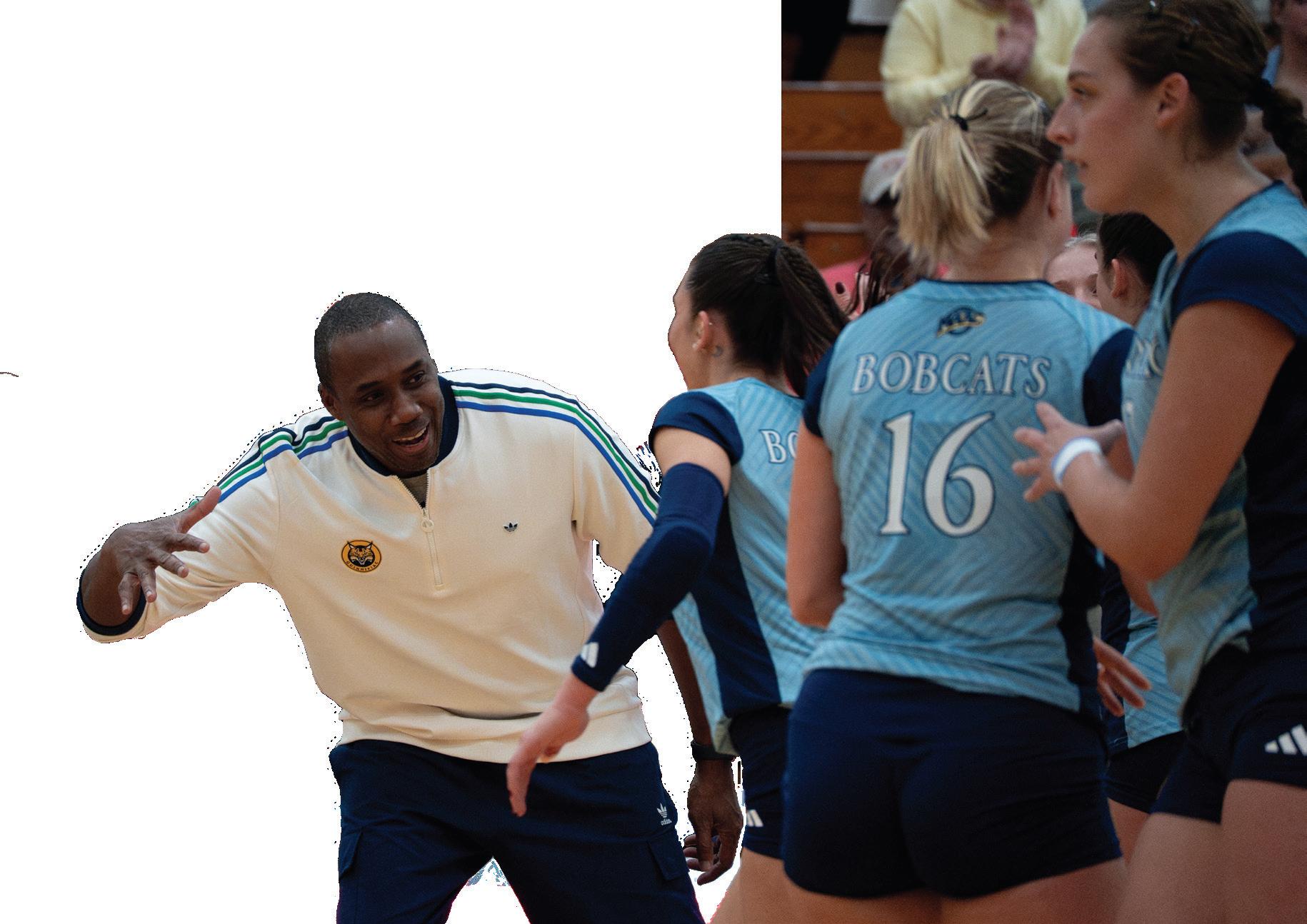
Quinnipiac volleyball's win streak ends at Rider's hands in MAAC Semifinals
By ALEXANDRA MARTINAKOVA Editor-in-Chief
FAIRFIELD — For the first time in four years, Quinnipiac volleyball will not be making an appearance in the MAAC Championship game. Rider University blocked the Bobcats from said game, winning its Saturday afternoon semifinals match-up 3-1.
“Some days you’re the bug, some days you’re the windshield,” head coach Kyle Robinson said.
It was almost a done deal that Quinnipiac was going to face off with Fairfield in the MAAC Finals once again.
Both teams entered the tournament as the No. 1 and No. 2 seeds, with the best conference records. Fairfield had beaten Canisius for that finals spot earlier in the day, and Quinnipiac was coming off a 13-game win streak. All that stood between the same MAAC Finals pair for four years in a row was the No. 3, Rider.
And Rider simply wanted the win more.
THE SET UP
sists — 781 more than the previous Division I record holder.
Alongside Damla, her twin senior outside hitter Yagmur Gunes and graduate student opposite Elena Giacomini were all named to the AllMAAC First Team. Robinson was named MAAC Coach of the Year for the first time. Yagmur Gunes became only the second Bobcat to break the 1,000 kills and digs milestone.
Robinson has called this class “historic” on multiple occasions. And by their accolades, they truly are, not just based on this season.
But Rider had the MAAC Player of the Year senior opposite Kiannisha Santiago, who would prove to be Quinnipiac’s kryptonite.
THE GAME
Quinnipiac was outperformed in a way that it most likely didn’t expect.
It didn’t start out that way, though. The Bobcats won the first set 25-17, out-serving the Broncos and playing a consistent game while Rider fell
Ten different Bobcats saw action as Robinson subbed in junior outside hitter kai Giusta and freshmen set Olszewska and outside hitter Tonelli into the game.
“The athletes on the court just weren’t getting it done,” Robinson said. “We gotta try to find a spark and someone to bring some consistency to our game.”
Damla Gunes has been the “quar terback” of the team since her fresh man season. Nobody expected to see her on the sidelines for half of the game, yet that is exactly what happened.
Two weeks ago, Rider had a singular block assist against Quinnipiac. Thus gane it blocked Quinnipiac 15 times, with a solo block and 28 block assists. No matter what Quinnipiac tried, Rider was always there to match it with more vigor, more power and as Robinson put it, more “hunger.”
“Rider played a really good match,” Robinson said. “We didn’t play our game plan and execute well. That’s just how it goes.”
of her program
this year. She ends her career with 4,212 as-
Errors are fixable though. And once Rider changed its tune, Quinnipiac struggled to
The clear MVP of the game was Rider’s nipiac’s expense and only two attack errors. Quinnipiac’s blockers were no
“I don’t know if we expected them to be that good,” Robinson said. “But either way, The Year for a reason. I don’t know if she really killed us as much as we killed ourselves.” Giacomini was the only player

She kills (20), but the 10 er rors only added to the 28 that the Bobcats amassed in the game.
Yagmur Gunes had the sec ond highest number of kills on the night for the Bobcats (11) and matched sophomore libe ro Carola Negron Diaz’s digs at 12. But not even she could break through Rider’s block for the majority of the time.
The surprise was in the form of senior outside hit ter Ginevra Giovagnoni. Despite sitting out the entire last season due to injury, she was still named to the AllMAAC Preseason Team and led the team in kills in Quinnipiac’s first program sweep over Fairfield.
She recorded six kills and attack errors, of ten getting blocked before her hits could count in any way.
Quinnipiac’s key players who shined the en tire season just did not come through in this game.

On the other hand, senior middle blocker Milena Silva not only opened up the scoring with a kill, but also recorded four on the night.
Giusta, who only saw action in two sets tonight, earned eight kills and the highest hitting percentage on the team.
Freshman middle blocker Asia Belli led the pack with four service aces and recorded five
The only upper hand that Quinnipiac held was its serve. The Bobcats added four more to Belli’s service aces, while Rider committed 12 service errors, many coming from Santiago herself, as her very powerful serve found outside of the court more than it did inside
Rider just had the drive and the grit to not let the ball touch its side of the court and it was no match for what Quinnipiac could come up with.
It was not a pretty final game for Quinnipiac. And it was not a pretty final game for the
With this loss, Quinnipiac now bids farewell to the final players from the roster that completed the Cinderella story and beat Fairfield for the program’s first ever MAAC Title. It also loses the majority of its starting line-up.
“Their play is program changing,” Robinson said. level of commitment to the gram has changed the identity of Quinnipiac volleyball.”
The only ray of hope for the Bobcats is the performance of the next generation shown on the court tonight. If the team builds on the foundation that the returning roster provides, there are still many MAAC Championship games in its future.
And with that, the 2025 season comes to an end.
Quinnipiac women's ice hockey welcomes new recruits
By COOPER WOODWARD Associate Sports Editor
As the NCAA Division 1 signing window closed on Nov. 12, Quinnipiac women’s ice hockey finalized welcoming six recruits to Hamden.
The 2025 Bobcat recruiting class is filled with offensive firepower. Seven of the nine total recruits are forwards. The 2026 group is slated to be a much different one with two defenders, Clara-Mai Van Houte-Cachero and Roasalie Breton, three forwards, Annika Stock, Cas sidy Lobisser, Annabelle Kruzich and goaltender Natalie Dilbone.
International tournament experience defines this class, with Dilbone representing the United States U18 team in the 2023-24 World Junior Championships. Known for her size, poise and athleticism, she has logged starts against top U.S. competition, giving her a strong base to quickly adjust to the ECAC speed and pace of play.
Dilbone quickly soared through the Little Caesars pipeline, progressing from 14U and 16U to 19U, where her final season in the pro gram is ongoing.
Forward Annabelle Kruzich is another stand out in the 2026 class. The Stittsville, Ontario na tive spent the last four seasons with the Missis sauga Hurricanes of the OWHL. Kruzich has had a rocky career in the OWHL, recording 15 points or more in her first two years while recording only 11 in year three.
Nineteen games into her final season, Kruzich has recorded 11
goals, averaging three points per game as the Hurricanes look to make a deep run in the OWHL playoffs.
Fellow forward Cassidy Lobisser also brings more offense to the Bobcat squad in 2026. Lobisser is two years removed from recording 50 goals and 78 total points in 64 total games in the North Ameri- can Hockey Academy circuit.
two-way game and contributions on both ends of the ice, Stock will give the Bobcats much needed depth at the center positions, with seniors Emerson Jarvis and Tessa Holk likely leaving the team next fall.
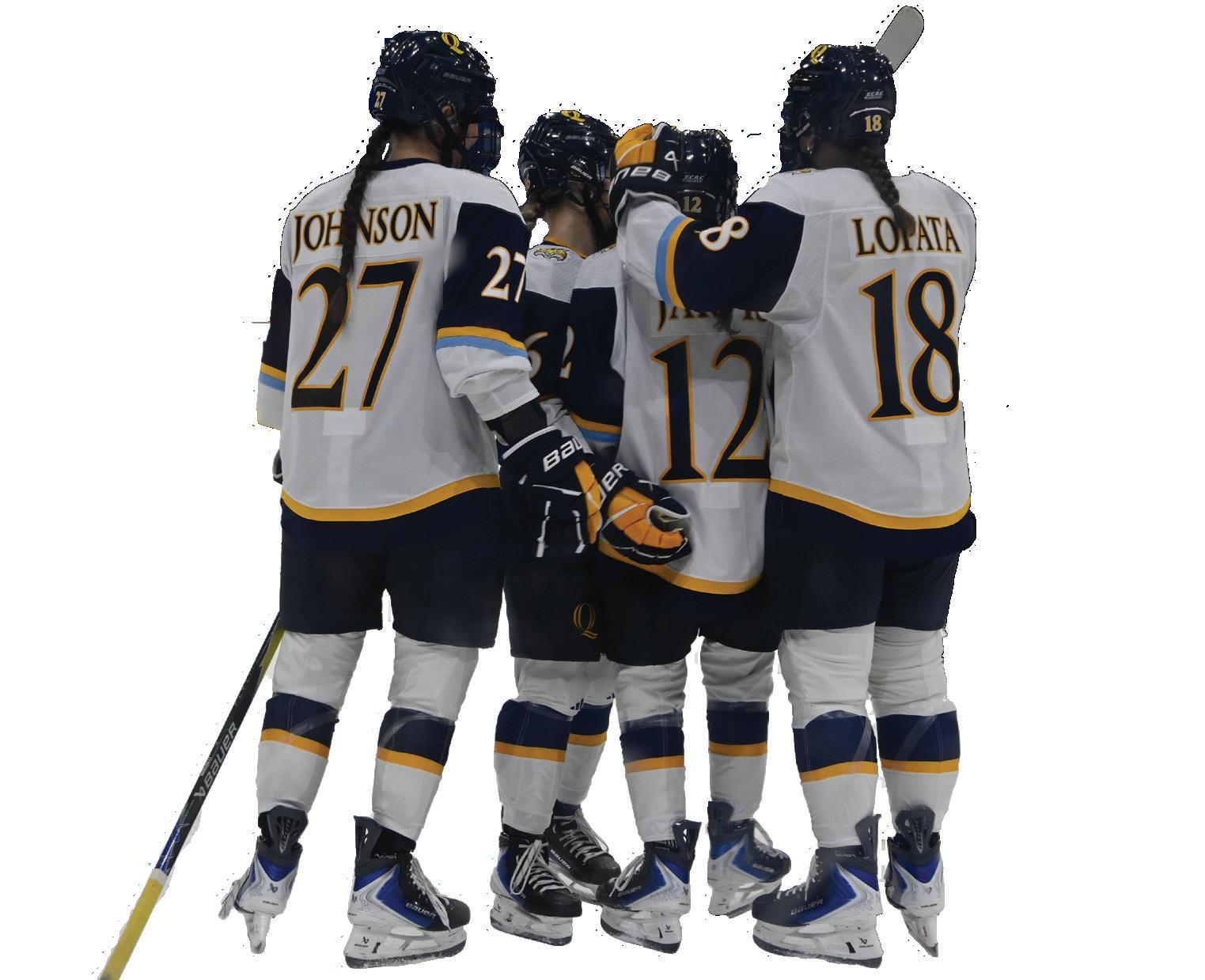
Defensively, the Bobcats will bring on two major additions to the team. Their first recruit goes north of the border into Quebec with the Saint-Bernard native Roasalie Breton. Breton, the captain and top defender for the Cégep Limoilou Titan amassed 66 points in 56 games. Her contributions and productions will strengthen an already deep Bobcat defense.
Last but not least, the Bobcats added Clara-Mai Van HoutteCachero to their blue line. She has been spotlighted in national U18 coverage as one of the key defenders in the Quebec pipeline, competing against the best junior talent in Canada. Houtte-Cachero will bring that background to the Bobcat defensive group.
The 2026 recruits reflects Quinnipiac’s commitment to building a well-rounded team that competes at the top of collegiate hockey. International pedigree, offensive depth and defensive leadership, the foundation for Quinnipiac’s sustained success in the ECAC and beyond has been created.
Men's hockey forward holds nation’s longest consecutive scoring streak
By CLAIRE FRANKLAND Sports Editor
Freshman forward Markus Vidicek has a goal in five straight games, currently holding the longest streak in the country.
The Montreal, Quebec native came to the Bobcats from the Moncton Wildcats in the Quebec Maritime Junior Hockey League, and has 16 points during the 202526 season.
In his last five games, Vidicek has tallied six goals, with two of them coming in the Bobcats’ 3-2 win over Stonehill. His consistent scoring has hoisted the Bobcats above their opponents in their last five games, with wins over Boston University, Clarkson University, St. Lawrence University, the College of Holy Cross and Stonehill.

Quinnipiac Athletics signs 44 future Bobcats during collegiate early signing period
By CLAIRE FRANKLAND Sports Editor
The NCAA early signing period opened on Nov. 12, allowing high school athletes to commit to a college, signing a National Letter of Intent before the regular signing period.
Quinnipiac athletics took no time in welcoming its new commits from a variety of its Division I athletics. Let’s take a look at each team’s future Bobcats.
WOMEN’S BASKETBALL
Women’s basketball has signed four commitments, looking to add more depth and talent to its roster, with three combo guards and one shooting guard.
The Bobcats first announced the commitment of combo guard Imani Mullings. The Plainfield, New Jersey native plays varsity-level ball at Plainfield High School and travels for the New Jersey Panthers.
Quinnipiac also signed on combo guard Ava Thomas from Queens, New York. The 5-foot-9 guard serves as captain of Mary Louis Academy varsity basketball, where the squad was ranked No. 25 in New York state during the 2024 season.
The final combo guard of the Bobcats’ signing is Uliana Doronina. The Syktyvkar, Russia native competes for Hoosac Prep Girls AAA in Hoosick, New York and is expected to join the Bobcats in 2026.
The Bobcats’ lone shooting guard commit is Mya Alston from Mustang, Oklahoma. The 6-foot-1 shooter thus far in her 2026 high school campaign averages 12 points per game in 33 games played.
MEN’S BASKETBALL
Men’s basketball’s lone signing during the early signing period came from guard Malik Fields, whos expeced to graduate high school in 2026. The 6-foot-4 guard plays high school ball at Cardinal Hayes High School and announced his verbal commitment to Quinnipiac in late September.
VOLLEYBALL
Quinnipiac volleyball announced two commits with setter Sophia Gisslen and middle blocker Veronica Pattii.
Gisslen is from Fort Wayne, Indiana and currently plays for Carroll High School, where she and her squad have won back-to-back state titles. Moving over to Pattii, the Roberto, Italy native, currently plays for the Chiona Fiume Volley, with no further information provided on her playing.
ACROBATICS AND TUMBLING
Quinnipiac acrobatics and tumbling featured a lot of signings during this early period, with seven commits signing to join Bobcat Nation.
These commits include Lexie Masters from Bedford, Massachusetts, Allyson White from Pelham, N.H., Megan Gengler from Hillsborough, N.J., Katrina Fedorak from Honolulu, Hawaii, Sarah Patt from Pittsburgh, PA., Italia Oates from Southfield, Mass. and Iliana Lidia from Jacksonville, Florida.
MEN’S ICE HOCKEY
Men’s ice hockey has signed two commits in center Gabriel Frasca and right winger Alex Kostov.
Frasca currently plays in the Ontario Hockey League for the Erie Otters, serving as captain during the 2025-26 campaign. In his first season with the Otters, the Caledon, Ontario native tallied 38 points in 65 games. This season, Frasca has recorded 26 points on 12 goals and 14 assists. Staying in the OHL, Kostov competes for the Flint Firebirds as the squad’s assistant captain. In his first two seasons with the Firebirds, Kostov recorded 56 points, with the Mississauga, Ontario native tallying 31 points thus far into the 2025-26 campaign.
WOMEN’S ICE HOCKEY
In the early signing pool for Quinnipiac women’s ice hockey, the Bobcats signed Clara-Mai Van Houtte-Cachero, Cassidy Lobisser, Anabelle Kruzich, Natalie Dilbone and Annika Stock.
For further information on each commit, check out Cooper Woodward’s article, “Quinnipiac women’s ice hockey welcomes new recruits” (See above).
GOLF
Quinnipiac golf’s lone commitment is from Zoie Chan. According to the World Amateur Golf Ranking website, Chan competes on the Hong Kong Junior National Team, with two first-place finishes and 12 top 10 finishes.
SOFTBALL
Quinnipiac softball welcomed three new Bobcats during signing with Camryn Strother, Kylie Lucia, Cassidy Adams and Abigail Colwill.
Strother is a right-handed pitcher and first baseman from Hainesport. New Jersey. She currently plays for Paul VI High School, finishing the 2024-25 season with a 2.19 ERA and 78 strikeouts.
Lucia is an outfielder and utility player from Trumbull, Conneticut, playing high school softball at Trumbull High School and club softball with the CT Charmers. According to Batters Eye Advanced Performance, Lucia “has extensive experience in hitting, fielding, and pitching. She has trained with some of the top softball coaches in the state including Jacqui Sheftz, Jen Hapanowicz, and Nick Lamberti.”
Adams is a utility player from Murrieta, California, playing for the West Coast Dukes, Vista Murrieta High School and competed for the International Ireland 18u team.
Colwill is a right-handed pitcher and utility player from Averill Park, New York. She is set to make her collegiate debut in Hamden for the 2026-27 season.
RUGBY
Rugby has signed four commitments: Ana Byrne, Brooke Harnisch, Meilin Lemis and Morgan Saylors.
Byrne is a back player for Divine Savior Holy Angels in Wauwatosa, Wisconsin. She was an
all-state back in 2024, helping lead her team to a championship. Lemis is a scrum half from Simbury, Conneticut, who plays for Simsbury High School and was a D2 State Champion in 2024. Saylors is a center and fly-half from Sacramento, California, competing for the Sacramento Harlequins. Harnisch is a prop and center from Pine, Colorado, where she competes for the Monarch Rugby.
WOMEN’S TENNIS
Women’s tennis signed Nola Jones from Oakdale High School. Jones is a four-star recruit from New Market, Maryland, who had a 23-17 record last season.
WOMEN’S LACROSSE
Women’s lacrosse will welcome nine Bobcats, including Rylan Clark, Ava Carpenter, Paige Manning, Radley Cherosnick, Mackenzie Babine, Kaliegh Renkowski, Caroline Pinto, Bridget Callery and Emmy McCartney.
Defender Manning and defender/midfielder Renkowski are both from the Long Island Yellow Jackets, both rostered on the YJ 2026 Manning roster. Additionally to the defensive side of the squad, the Bobcats add Carpenter from Chatham, New Jersey.
Quinnipiac’s signings will bring lots of depth to its forwards, with Clark, Cherosnick, Babine, Pinto, Callery and McCartney all being attackers or midfielders.
MEN’S LACROSSE
Quinnipiac men’s lacrosse signed five commits: Will Howard, Kyle Jenkins, Connor Canei, Sebastian Small and Bodhi Gillies.
Howard, from Cherry Creek High School in Greenwood Village, Colorado, and Canei, from Upper Arlington High School in Upper Arlington, Ohio, will both join the Bobcats’ defensive squad as the only two defenders from the signing period. On the offensive side, the Bobcats will see midfielders Jenkins and Small, along with attacker/ midfielder Gillies.
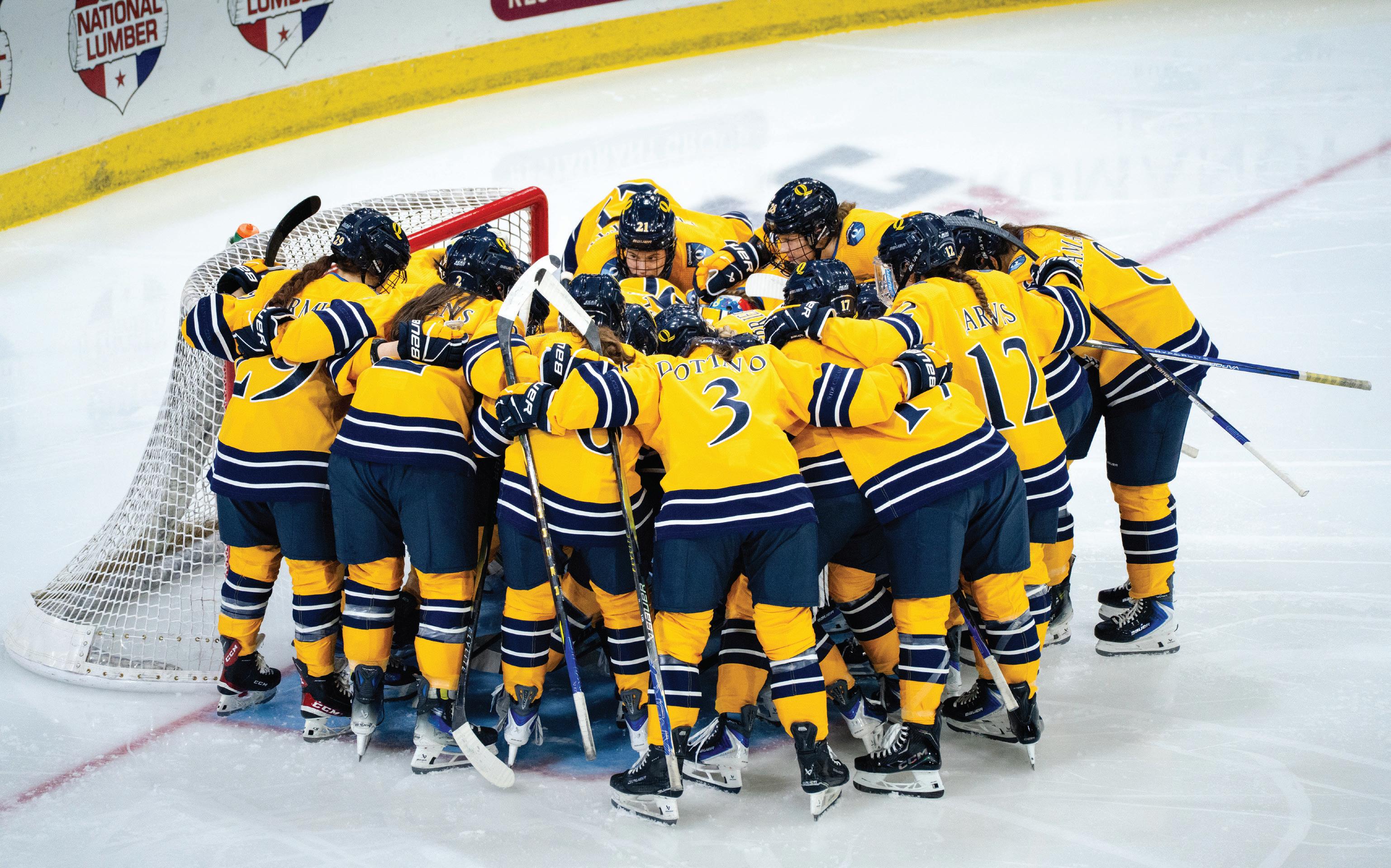
Women's ice hockey faces earliest exit from Nutmeg Classic championship since 2016
STORRS — No. 9 Quinnipiac women’s ice hockey faced off in the annual Nutmeg Classic annual tournament from Nov. 28-29.
In two hard fought battles, the Bobcats faced their earliest exit from the championship game since 2016.
NOVEMBER 28
The Quinnipiac Bobcats have been perennial contenders in the tournament for over a decade. On Friday afternoon, it’s dominant stretch finally came to a close, falling in a tight, back-and-forth contest to the University of Connecticut 4-3.
This marks Quinnipiac’s earliest exit since 2016 when the Bobcats failed to make it to the championship game. Throughout the game, it was the defensive struggles that forced Quinnipiac to play from behind for almost all 60 minutes of play.
“Offensively, we played the kind of game we need to win a championship,” head coach Cass Turner said. “We didn’t have that defensively.”
The opening frame quickly turned into a goalie battle between sophomore Felicia Frank for the Bobcats and graduate student Tia Chan for the Huskies. The offense from both squads tested both keepers early, tallying 20 combined shots by the end of the first period.
One of those shots came from an offensive breakaway from senior center Emerson Jarvis. That breakaway would help the Quinnipiac offense limit the Husky attack to only two chances, both of which were saved by Frank.
Early into the second, Frank would continue to be tested. Back to back to back chances for the UConn offense put them on the doorstep of taking the advantage.
Thirty seconds later, the Huskies would do just that.
Skating deep into the Quinnipiac end, senior forward Brooke Campbell backhanded a pass to fellow senior forward Kyla Josifovic. The Burlington, Ontario native launched the puck past Frank, opening the scoring and giving UConn the 1-0 lead.
Around the halfway mark of the period, the Bobcats responded.
Skating four on four, senior defender Zoe Uens attempted to connect with junior for-
ward Kahlen Lamarche. With the puck still loose, senior center Tessa Holk picked up the puck and sniped it behind Chan and tie the game at one apiece.
The score would not stay tied for long, as junior forward Ashley Allard split the legs of graduate student defender Mia Lopata and found the back of the net minutes after, giving UConn the lead heading into the final frame of play.
Quinnipiac started the third period picking up right where it left off.
Driving into the Husky end, Jarvis found Uens just shy of the blue line. Uens would rip a snap shot that would deflect off junior forward Livvy Dewar and into the back of the net, tying the game once again.
Yet, the score wouldn’t stay knotted for long, as less than 30 seconds later, UConn added to the scoring again.
Sophomore forward Sadie Hotles stole the puck off the skate of sophomore defender Makayla Watson and find Allard right in front of the net. Lightning would strike twice for the Ottawa, Ontario native as she would beat Frank again to give UConn the lead.
“We weren’t helping Felicia at all,” Turner said.
The score stayed at 3-2 until the halfway mark of the final frame. Coming off the bench, Watson weaved her way through the Husky defense and squeezed the puck in between the post and Chan, tying the game once again at three.
“They were shot ready,” Turner said. “They were ready to fire the puck.”
In the final five minutes of the closing period, UConn put the final nail in Quinnipiac’s coffin. Campbell found herself on a two-on-one breakaway deep in the Quinnipiac end. She sent the puck to se nior forward Megan Woodworth, who went go on to beat Frank again and give the Huskies the 4-3 lead.
The score remained that way for the rest of the period, as an empty net offensive rush with under a minute to go for Quinnipiac wasn’t enough. As the final horn rang, the Husky
win became final.
NOVEMBER 29
No. 9 Quinnipiac women’s ice hockey salvaged what would be a forgettable Nutmeg Classic weekend with a 2-0 win against the Sacred Heart Pioneers in the consolation game Saturday afternoon.
The win snaps the three-game skid for the Bobcats, their longest of the season. It also keeps their perfect record against the Pioneers, marking Quinnipiac’s 10th win since 2009.
“We wanted to be in the championship game today,” Watson said. “I’m proud of how our group responded today.”
From the opening puck drop, Quinnipiac repeated the same mistakes on defense as the previous night’s contest against UConn. Passes failing to connect in the Bobcat end combined with great Sacred Heart defense
Johnson would win the faceoff against senior center Sami Bowlby and dish the puck out to Watson awaiting at the blue line. Watson would find graduate student forward Laurence Frenette and junior forward Kahlen Lamarche right in front of the crease.
Despite the chaos, the puck found the stick of Lamarche, who flicked it past senior goaltender Jillian Petruno and into the back of the net, breaking open the scoring for Quinnipiac. That was the sole goal for the period, as the game slowly evolved into a goaltender showcase between Frank and Petruno. Each netminder shut out the opposing team for the next 50 minutes of play, with Petruno recording 56 total saves to Frank’s 22.
One of the best Bobcat chances in the second came halfway through the period. Jarvis won a faceoff and sophomore forward Avery Bairos scooped the loose puck and go end to end, driving with nothing but open

Bairos finally got in range and launched her shot slightly to the left of Petruno, who would deflect the puck right in front of her. Sophomore forward Julia Zielinska cleared it out, keeping the Bobcat lead at one goal. Quinnipiac’s offensive dry spell continued well into the final frame. There was no shortage of shots from the Bobcats’ blue and gold, but none of them were able to get behind Petruno and into the net.
In the closing minutes of the period, the Bobcats broke the scoreless drought.
Lopata found Lamarche just shy of the Pioneer zone, and the rest is history. Lamarche got down right in front of the Pioneer goal and backhanded a shot into the back of the net for her 21st goal of the year.
“She really wanted to be hungry to attack,” Turner said.
“She’s clutch in big moments and likes to score that big one.”
That was all the Bobcats would need as the clock ticked down to zero, finalizing Quinnipiac’s win.
By COOPER WOODWARD Associate Sports Editor