
![]()


from Dr Ron Culley, Chief Executive Officer
Spring is a season of growth — a time when potential begins to show itself, even after a long and difficult winter. At Quarriers, that sense of renewal reflects our purpose: supporting people to build fuller lives.
And although it feels a long time ago now, if you’re one of the people who were generous enough to send a donation to our Christmas Appeal, I am delighted to include an update on the impact of your donation.
I know that the kindness shown to young people through your support reflects a keen understanding of the challenges they face.
It is this understanding of people’s real experiences that shapes our approach to policy, and I’m pleased to introduce Quarriers’ developing activity in this area.
I strongly believe that Quarriers should be politically engaged as an organisation.
We are determined that the lived experience of the people we support shapes the decisions that affect them.
We do this by listening to them and taking what they tell us straight to the people who make policy.


I hope you enjoy hearing from our External Relations & Policy Manager, Ewan Carmichael, who explains the role he plays in this work.
Two examples of this approach are our regular Hear My Voice meetings, where staff and the people we support talk together about social inclusion, and our recent Kinclusion project, where young people shared their experiences of kinship care to help shape Scottish policy.
As we approach the Scottish Parliamentary elections in May, we hope to build a policy platform that election candidates will subscribe to, promoting priorities such as financial inclusion, educational inclusion, Self Directed Support and better pay for the social care workforce.

I look forward to updating you on our campaigns in the future.


Music therapy was recently introduced at the William Quarrier Scottish Epilepsy Centre. Now patients will continue to enjoy the sessions thanks to generous donations from Glasgow Freight Club and the Hospital Saturday Fund.
The William Quarrier Epilepsy Centre (WQSEC) is a 12-bed in-patient hospital run by Quarriers in Glasgow. It provides specialist care for adults living with epilepsy from across Scotland.
A stay at the centre of up to four weeks can bring huge benefits for people with epilepsy who have complex diagnostic and treatment needs. By using advanced video monitoring, EEG and remote data tracking, specialist clinicians carry out detailed assessments – observing seizures and brain activity as they happen. It means
more accurate diagnosis and betterinformed decisions about medication and treatment.
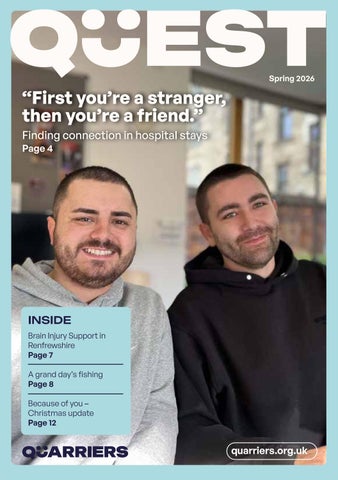
Dale and Jordan, both on their second two-week stay, first met as patients. They share their experiences at the centre and the impact of music therapy sessions in helping them find friendship.
** A special thanks to GFC board member Agnes Coubrough, who nominated Quarriers in memory of her late husband John, who received care at the centre.
A hospital stay is no one’s first choice but one brilliant thing that happens when you come to the WQSEC is meeting other people in a similar situation.

“My epilepsy started six years ago when I collapsed at work. It was a brain infection called autoimmune encephalitis, and I was in a coma for three weeks.
“Life with epilepsy is a challenge. My meds make me groggy and risk physical side effects. The aim is to get onto lighter doses with fewer side effects but the same effectiveness.
“When you have epilepsy it can feel like other people don’t understand. When you come to the WQSEC you meet other people in a similar situation.
“Activities like the music therapy bring people together, get you out of your room and build your confidence.
“Once you have played games like, ‘pass the beat’ and had a laugh you

feel you can open up on your own personal life.
“First you’re a stranger and then you’re a friend.
“That’s how Jordan and I connected the last time we were here, and now we keep in touch. I’m glad the music therapy will continue to be funded — it makes a real difference.”

First you’re a stranger and then you’re a friend.
“I’ve had epilepsy since I was 15. I’m 27 but I can’t drive, can’t have a job.
“When I was younger I seen pals living life – going on holidays, working. I was messed up by that.
“I’ve died twice – woke up in intensive care with family stood round me. But you canny let it get you down. You laugh or you cry.
“This is my second time at the WQSEC to assess my medication. The first time, I tried the music therapy, and it was brilliant.
“Music allows people to express themselves in a different way and it
makes you less guarded. You can all intermingle without it being too formal and it’s open to everybody, which is great for people feeling a bit shy.
“Last time I was here I met Dale and some other people, and that has been brilliant.
“There’s not enough help in the outside world. My family don’t understand – they try and wrap me in bubble wrap.
“But now I know folk who understand – they just get it. I’ve also learned I can use my own life experiences to help other people, and that feels good.”

Music allows people to express themselves in a different way and it makes you less guarded.
celebrates its first birthday in April

Commissioned by Renfrewshire Council, BICS provides practical, everyday support for adults in Renfrewshire living with an acquired or traumatic brain injury, helping them and their families access the services they need.
The team also partners with Renfrewshire Carers Centre and runs a Brain Injury Carers Support Group offering advice and peer support.
Connecting through shared experiences
BICS themed workshop sessions cover topics such as mental health
strategies, benefits, and nutrition. These sessions help people build confidence, learn useful skills, and meet others on a similar recovery journey.
Clubs and activities
BICS also runs social and wellbeing groups including Stepping Out, a gentle walking group, and The Sunshine Club, a friendly space for peer support and connection.
Contact details
• 07498843421
• headinjuryservice@quarriers.org.uk
Your donations to our Children’s Appeal fund activities for young people not just during the summer, but throughout the year.
One activity has young people hooked!
Families Matter Kinship Service supports young people in kinship care. Project Manager Naomi Conway says, “Funding from the Children’s Appeal has been invaluable to our service in providing fun activities and important down time for young people.”
A recent fishing trip offered something a bit different and caught the interest of young men who hadn’t joined in with other activities. For some, it was just what they needed, especially given the complex experiences many bring with them into kinship care.
Naomi says, “The young people we support are living within their wider family and community circle when they cannot live with their birth parents.
“A huge proportion are dealing with trauma and loss. In fact, we have done specialist grief training recently because we realised the huge effects of loss and grief that so many of the young people are facing.

“We know that kinship care allows young people to get the family love and support that they need, and we are there to help families thrive together, even in periods of struggle.

We’re determined to keep the fishing going because some of the boys really need it.

“We have listened to this particular group of young people who have wanted to try something new in the hope that they find something they are passionate about and want to engage with further.
“The fishing day was a brilliant chance for young men to meet each other, spend time outdoors and relax.”
It was all the idea of Kinship Worker Gary O’Neil - himself a keen fisherman.
“The kids loved it,” Gary says. “One young lad, Alfie, started the day walking about saying “This is boring, this is rubbish, Gary, why did I even come here?”
“I said, “You know what, let’s just see how it goes. Come with me, I’ll show you how to cast, maybe someone will even catch a fish.
“By the time it got to lunchtime, we were having something to eat and he said, “I didn’t think I’d like fishing, but I love this.”
“I said to him, “Never jump into something and think straight away I’m not going to enjoy this, because you won’t.”
“I understand where that attitude comes from - he’s someone we’re focused on at the moment while he deals with a lot of loss at home.”
I didn’t think I’d like fishing, but this has been brilliant!

Now, there are plans to hold the activity regularly, thanks to donations to our Children’s Appeal.
Gary says, “The boys enjoyed meeting each other and we hope they can develop those connections. For Alfie, it’s opened up a positive direction at an important time.
“He’s been absolutely lit up by the fishing. He asked for a fishing rod for his birthday, and I hope he gets it. He said, “I’d love to be outside, it will keep me out of trouble.”
“We’re determined to keep the fishing going because some of the boys really need it.”
Thank you to everyone who donated to our Christmas Appeal to provide practical and personal gifts for young people affected by homelessness.
In the run-up to Christmas Day, Quarriers youth housing services received vital funding provided by donations. They were able to create a better Christmas for young people whose lives have too often been shaped by trauma, loss and experiences no young person should have to face.
Each of our services responded in its own way, but one thing was the same: every young person supported over Christmas received something just for them.
We’re delighted to share just some of the moments that were only possible because of the kindness of people like you.


You helped young people feel seen and valued
Your support meant young people received thoughtful gift bags, the chance to choose something of their own, or a personal gift picked just for them.

It actually made me feel really cared about. Thank you. Dylan
delivered bags filled with blankets, sweeties and food to young people in their temporary accommodation.
Because of you, young people enjoyed a warm Christmas dinner, were supported to choose their own festive food, or received a voucher to buy what mattered most to them.

In Glasgow, services hosted a Christmas dinner for young people who wanted to attend, funded by you.
Thank you for being so wonderful to me.
Jenny

A conversation with Policy & External Relations Manager
Ewan Carmichael
What is policy work about?
It’s about being visible and connected with decision makers so we can influence change. Quarriers support over 5,000 people every year - some of the most vulnerable in our society.
Policies are made for them, but without them. We have to amplify the voices that don’t get heard.
We have made real impact in the last year. Just one example is when we spoke to the Scottish and UK government about changes to immigration impacting our ability to employ much-needed international workers.
The First Minister visited a Quarriers service to re-open the Displaced Workers Scheme and meet some of Quarriers’ international workers to hear about the beneficial role they play for people we support.
What does a working day look like?
I might be at parliament in Edinburgh or London speaking to decision makers about advancing support in areas like kinship care, unpaid carers, or school attendance.
I meet other organisations and businesses to discuss the broader issues affecting our communities. Or I am out and about speaking to Quarriers services, hearing from people we support and organising different ways for them to give their views.
I bring my own lived experience to the role. Growing up as an autistic person with ADHD, I understand what it’s like to feel societally excluded and can take that insight into discussions.
What difference can the voices of people supported at Quarriers really make?
A good example is Scottish Government guidance on school attendance.
We ran sessions with young people who find it difficult to attend school, supported by Quarriers service REACH.

by Freepik
Their insights on experiences of poverty and inequality were so raw and real it helped the working group consider those issues.
Those voices of young people will now be featured directly in Scottish government guidance that goes to all educators.
What are Quarriers’ policy priorities?
We’ve got three broad prioritiesinvestment, innovation and inclusion.
One example is our work on digital financial inclusion, campaigning so that people who either don’t want to or can’t use digital banking aren’t left behind. We have formed an alliance with other organisations and have been speaking to the Treasury about how it could impact on people’s lives.
Schools should be able to tell the difference between absence due to disability/ illness and absence due to bad behaviour.
Young person supported by REACH
The impending Scottish elections are a really good opportunity for us to set out the importance of health and social care to MSPs.
For example, we’d love to see something like the Sure-Start centres of the past.
We’re also working on an exciting UK-wide collaboration called The Connection Project, and we’ll be working with the Scottish Government on legislation on kinship care, so watch this space!


