Jamer, M. E. and Assaf, B. A. and Sterbinsky, G. E. and Arena, D. and Lewis, L. H. and Sa\'ul, A. A. and Radtke, G. and Heiman, D., Phys. Rev. B, 91(9), 094409 (2015), DOI.
Abstract Discovering new antiferromagnetic (AF) compounds is at the forefront of developing future spintronic devices without fringing magnetic fields. The AF gapless semiconducting D0₃ phase of V₃Al was successfully synthesised via arc-melting and annealing... Learn more about QD VersaLab
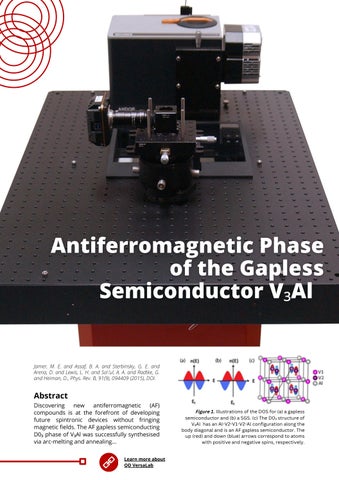
Figure 1. Illustrations of the DOS for (a) a gapless semiconductor and (b) a SGS. (c) The D0₃ structure of V₃Al has an Al-V2-V1-V2-Al configuration along the body diagonal and is an AF gapless semiconductor. The up (red) and down (blue) arrows correspond to atoms with positive and negative spins, respectively.
The AF properties were established through synchrotron measurements of the atomspecific magnetic moments, where the magnetic dichroism reveals large and oppositely oriented moments on individual V atoms.
Magnetisation, x-ray diffraction, and transport measurements also support the antiferromagnetism. This archetypal gapless semiconductor may be considered as a cornerstone for future spintronic devices containing AF elements.
Figure 2. (a) Total energy per f.u. vs unit cell volume of V₃Al for the A15 (blue) and D0₃ (orange) structures. The calculated values for the PM cases are represented by blue squares and the spin-polarised calculations by blue triangles. Solid curves correspond to a fit using the Murnaghan equation of state (Ref. [19]). The AF−D0₃ phase has an 18 meV higher formation energy compared to the lowest energy FM−A15 lattice. See text for details. (b) Total DOS and LDOS for the PMD0₃ structure. Total DOS is represented in black, and the LDOS of the individual atoms are shown for the 3d states of the V1 (blue) and V2 (green) atoms. (c) Total (black), V1 (blue), and V2 (green) projected 3d-DOS for the AF−D0₃ structure. Figure 4. (a) The magnetic moment of V₃Al in units of
Density functional theory calculations confirmed the stability of a type G antiferromagnetism involving only two-thirds of the V atoms, while the remaining V atoms are nonmagnetic.
10−3μB/f.u. The inset shows the overlapping moment vs applied field at 300 and 600 K. The moment is exceedingly small and strictly linear with an applied magnetic field up to 5 T. The temperature dependence of the moment measured at 2 T shows a broad maximum attributed to a Néel transition. (b) XAS spectra of the V atoms in D0₃V₃Al. The intensities for perpendicular (solid blue) and parallel (dashed orange) polarisations were normalised to have the same integral area. The XMLD intensity (solid red curve) shows a 5% difference between the two XAS spectra. In contrast, the XMCD polarisation (solid black curve) at zero indicates negligible total vector-sum magnetic moment on the V atoms.
Quantum Design VersaLab™ Measurement System Figure 3. XRD pattern of D0₃V₃Al taken using 0.7783 Å synchrotron radiation. The peak positions provide a lattice parameter a=6.144±0.012Å. (inset) The Williamson-Hall fit for the (220) and (440) peaks led to a crystallite size D=51nm and an inhomogeneous strain ɛ=0.07%.
3 Tesla Cryogen-free Physical Property Measurement System
With a temperature range of 50 – 400 K, this 3 Tesla platform is perfect for accomplishing many types of materials characterisation in a limited space. Contact our Technical Director: Dr. Shayz Ikram Telephone: (01372) 378822 Email: shayz@qd-uki.co.uk