Advanced Pharma Magazine

Page 1


and AFM Particle

Analysis of Vitamin C

MicroCT

For more than 40 years Quantum Design (QD) has been providing technology solutions to researchers in the fields of physics, chemistry, biotechnology, materials science, and nanotechnology.

Established in 1982 in San Diego, California, Quantum Design is the leading commercial sourceforautomatedmaterialscharacterisation systems offering a variety of measurement capabilities.

QDinstrumentsarefoundintheworld’sleading research institutions and have become the referencestandardforavarietyofmagneticand physicalpropertymeasurements.

Quantum Design instruments are cited in, and providethedatafor,morescientificpublications than any other instrument in the fields of magneticsandmaterialscharacterisation.

Anessentialpartofprovidingscientificsolutions to researchers around the globe is to also offer state-of-the-art instruments from other leading manufacturers.

ThesemanufacturersarechosenbyQDnotonly for their innovative products, but also because they believe in the same level of customer satisfaction and support that scientists have cometoexpectfromQDproductsworldwide.

TheUK’spharmaceuticalandlifesciences industryisoneofthecountry’slargestand most innovative sectors, underpinning both economic growth and global healthcare leadership. With continued investment in advanced manufacturing, nanotechnology, and drug formulation, researchers and process engineers are placing greater emphasis on materials characterisation to understand surface properties, structural features, and nanoscalechemicalinteractions.

Quantum Design UK and Ireland (QDUKI),workinginpartnershipwithleading international manufacturers, provides advancedanalyticalandmicroscopytools thatsupportpharmaceuticaldevelopment, manufacturing, and quality assurance. Tworecentexampleshighlighthowthese technologiesarebeingappliedacrossthe UK to address complex challenges in pharmaceuticalresearchandproduction.

Pharmaceutical products are visuallyoftenverysimilarbutcan have different chemical compositions or proportions of activepharmaceuticalingredients (API).

Hyperspectralimagingprovidesa reliable, rapid, and non-invasive way to analyse the chemical compositionofdrugformulations, such as tablets and capsules, duringproduction

Thechemicalanalysisallows:

Qualitatively toidentify pharmaceuticalproductswith differentactiveingredients.

Quantitatively toidentify pharmaceuticalproductswith differentdosagesandto measuretheuniformityofthe activeingredientdistribution

Hyperspectral imaging enables reliable monitoring of the pharmaceutical manufacturing processes in real time. It can covertheentirematerialstream in-line with close to 100% accuracy. This information can helpmanufacturersensuretheir products’ quality, purity, and consistency and improve the manufacturingprocesses.

Benefits

Non-destructive, rapid, and reliable inspection with close to 100% accuracy

Inspect 100% of the product stream in real-time

Measure the presence, amount, and distribution of API

Avoid mix-ups and improve product quality and safety

CaseStudy

High-speed analysis of powder and tablets with hyperspectral imaging

A common application of NIR spectroscopy is the identification of the active compound or active pharmaceutical ingredient (API) present in a tablet or drug.

AFrenchcompany,Indatechhas developedanewtechnologyfor powder and tablet analysis that relies on the innovative use of optical probes using several optical fibres to measure the surface of the sample. All the fibresareconnectedtoaSpecim NIR hyperspectral imaging system.

Indatechwasfoundin2009bySylvie RousselandFabienChauchard.Two main reasons were that Sylvie had foundoutthatsinglespectracouldn’t provide the critical information that the customer needed while Fabien hadbeendevelopingasolution,based on a multipoint imaging with promising results. This convinced them that hyperspectral imaging wouldbethebestin-linetechnology inthefuture.

Currently Indatech provides solutions mainly for the pharma, biotechandchemicalindustry.Their core business is the high-speed inspectionofatablet(hardness,API, homogeneity) and powder either in manufacturing or in process developmentphase.

Challenging approach meets hyperspectral imaging

Thechallengeintheirapproachistheneed to measure multiple optical fibres at the same time as well as they must be able to change the configuration of the measurement. Before hyperspectral, we testedstandardspectrometerconnectedto an optical multiplexer but in the end, the measurementtooktoolong,”saysFabien...

So, we decided to try the hyperspectral imaging and we found out that the pushbroom imaging is the best approach because the spectra are measured in a single shot without any moving parts and the resolution can also be adapted.” “

“We started discussing with another manufacturer before we met Mr Timo Hyvärinen at a Pharma Congress in the United States. He presented me the company,aswellasthetechnology behind andI’vebeencompletelyconvincedofthe performance and the quality ever since. Specimisveryreactiveandalwaystriesto find a solution in case of a specific need. The products are robust since the company has acquired a long experience. The products have the little things that make the difference in terms of performanceandquality.”saysFabien.

Real partnership is a foundation for excellent results

“Our solution is now compatible with manufacturingmachinespeeds,wehave beenabletoinspectfrom150000to800 000 tablets per hour based on homogeneity and API concentration. Specim’sreactivity,qualityandflexibility bothondeliveringthecameraandwith technical support has met our expectations.Wehavebeenabletobuild a real partnership where our engineers can easily communicate with Specim engineers. This has resulted in continuous improvement in the use of the technology. We have modified the design of our solution based on hyperspectralcamerainordertobeable toworkondifferentproblematicsusing the same detector such as mixing of powder and fluid, compaction of the tablet, capsule filling, lyophilisation and soon.”

To discuss the Specim range of hyperspectral imaging cameras, get in touch with our Sales Manager, Dr. Luke Nicholls by email luke@qd-uki.co.uk or call 01372 378822.

Webinar

How to use limited electron diffraction data to solve metastable pharmaceutical structure at ambient temperature

Inthiswebinar,Dr.GrahameWoollamfrom NovartisAG,SwitzerlandandDr.ParthaDas fromNanoMEGASSPRL,Belgiumpresent:

“Structural analysis of metastable pharmaceutical loratadine form II, by 3D electron diffraction and DFT+D energy minimisation”

based on their paper published in CrystEngComm

Applications:

Orientation&Phasemapping

StrainMapping

Precessionenhanced3D-EDforcrystal structuredetermination

ElectronPairDistributionFunction (ePDF)foramorphousmaterials characterisation

ElectronPairDistributionFunction (ePDF)mapping

ElectricFieldmapping

EnhancedEELSandEDX Spectroscopy

For industrial applications, it is of great interest to understand and determine the crystal structure, identify / characterise several possible polymorphs and to detect / quantify the crystallinity / amorphous phase of final products, since many important chemical and physical properties depend on the crystal structure properties.

Carbamazepine (CBZ),isadrug usedprimarilyinthetreatment of epilepsy and neuropathic pain. It may be used in schizophreniaalongwithother medications and as a second line agent in bipolar disorder. CBZ exists in several polymorphicforms.

Electron

Diffraction Tomography analysiswithTEM using ultrasensitive Timepix detectorwithnocoolingholder allowed to collect diffraction tomography data from individual nanocrystals (size about200nm)andreconstruct thereciprocalspace.

Unit cell determination and structure solution from the measured intensity helped to identify same crystal structure asreportedbyX-raydiffraction.

Electron Diffraction Tomography analysis with TEM using ultrasensitive Timepix detector with no cooling holder allowed to collect diffraction tomography data from individualnanocrystals(sizeabout200nm) andreconstructthereciprocalspace.

Unit cell determination and structure solutionfromthemeasuredintensityhelped to identify same crystal structure as reportedbyX-raydiffraction.

Solved crystal structure of

using

electron diffraction tomography (50º continuous tilt, 3823 reflections , 0.8º resolution)

3D reciprocal space reconstruction of CBZ and studies crystal (about 200 nm size)

Crystal structure of CBZ solved with X-Ray diffraction

carbamazepine
3D

Electron Diffraction

Tomography technique by TEM microscope is particularly useful in case of polyphasic systems (several polymorphs), nm size crystals, and poorly crystalised samples

CM 30 Philips electron microscope and Timepix ultrasensitive detector(insert) at CciT Univ of Barcelona (Spain) where CBZ ED data collection was made.

Trace analysis with TEM high resolution imaging and electron diffraction

High Resolution Virtual Dark Field (VDF) in TEM is a technique that enables detection of very small trace of crystalline material; in the example shown above, trace crystals of very small sizes (eg 10nm) can be observed atverylowquantity(<0.01%).

From left to right : Virtual Dark Field (VDF) TEM high resolution image showing 10 nm resorcinol crystals (arrows) on amorphous background; corresponding ED patterns for crystallites ; individual Nicotinic acid API nanocrystal and its corresponding ED pattern

Structure characterisation (like phase confirmation) of such small crystals can be done using Electron Diffraction onindividual crystallites.

Drug polymorph structure analysis with TEM 3D electron diffraction tomography

Use of precession 3D electron diffraction (PED) with TEM makes possible unit cell and structure determination on individual nanocrystals. Using 3D diffraction tomography,a3Dreconstructionofthe reciprocalspacecanbeperformedby tilting the sample and recording ED patterns (Fig. 1) (typically ±45° every 1°).

Electron Crystallography is considered asthemethodofchoicefor structure determination of nanocrystalline compounds(crystalsassmallas20nm to several microns). Such nanocrystallites reveal typically “X‐Ray amorphous”powderdiffractionpatterns (forsizes<10nm) whereisverydifficult to identify and characterise their structures using X-Ray diffraction techniques.

Collected electron diffraction (ED) patternscanbeprocessedto precisely determinetheunitcelland revealthe space group symmetry of the API crystal. Full atomic crystal structure canalsobeperformed aftercollection and precise measurement of ED intensities.

Measurement of Powder or Lyocake Substances Made Easier - Even in Glass Vials

Themeasurementofpowderorlyocake substancesisafrequentlyencountered and demanding task in the pharmaceutical and biotech industry.

TheChauvinArnouxcompanyIndatech solved it with its HypeReal system based on hyperspectral cameras from theFinnishmanufacturerSpecim.

Indatech´s HypeReal system enables automated, economical measurement of lyocake and powder-like substances in industries such as pharmaceutical or biotech. It drastically reduces development times of vaccines. Image courtesy of Indatech.

Chauchard and his team wanted to develop a solution to this problem withasystemthatwasaseasytouse aspossible,basedonahyperspectral camera.

“Our goal was to make the analysis of powder-like substances as easy as operating a photocopier: it should be enough to place a sample on a microtiter plate and click a button to get the results!”

INNOVATIVE DESIGN

Thebreakthroughcamefromimaging the sample from beneath the vial. Lookingthroughthebaseprovidesa flat, unobstructed view. HypeReal employs a near-infrared hyperspectral camera and spectrograph to capture detailed spectral signatures, which classificationalgorithmsthenuseto identifymaterialproperties.

“Wedecidedtomeasurethepowderlikesubstancesfrombelowbecause this perspective offers the best overview of a flat surface and the largest possible volume,” explains Fabien.

“Checking from the side of the vials usually used in the pharmaceutical and biotech industry would be difficult because of the stickers that are usually placed there to identify the samples. The top view was also outofthequestionduetotheplastic ormetalcapsused.”

At the heart of the system is the Specim FX17 camera, chosen for its compactness, robust performance across temperatures, high image quality, and GigE interface that simplifiescontrol.

“The

fact that we chose Specim as the supplier for the hyperspectral camera used made the implementation of the HypeReal project considerably easier.”

Fabien Chauchard

The InGaAs hyperspectral camera SPECIM FX17 is the basis for the HypeReal system from Indatech.

Fabien Chauchard

Thefirsttestsalreadyshowedthat Indatechhadmadetherightchoice, Chauchard recalls: “The tests were veryencouragingrightfromthestart and showed that the FX17 in combinationwiththeassociatedlens deliveredreallygoodimagequality. Wealsocarriedoutseveralteststo assess the robustness, e.g., by changing the temperature in the housing. However, the FX17 always provided reliable information, even underdifficultconditions.”

BENEFITS IN PRACTICE

HypeReal offers fast, nondestructive, and contactless measurement.Itcandetectresidual moisture in lyophilised products, verify active pharmaceutical ingredients, reveal defects such as cracks or melts, and assess homogeneity—all without toxic reagents. The platform supports different plate and vial formats, includes built-in references, and providesauser-friendlyinterfacefor data,models,andreporting.

The time savings are dramatic. For example, measuring residual moistureinafull96-wellplateusing KarlFischertitrationcantakeweeks. With HypeReal, the same task is completed in about two minutes, withadditional qualityinsights deliveredat thesametime.

ADOPTION AND OUTLOOK

Majorvaccinemanufacturersalready use HypeReal, underscoring its reliability and value. Indatech sees strongpotentialbeyondpharmaand biotech, with applications in agricultureforseedanalysis,inthe foodindustryforflourquality,and eveninculturalheritagefieldssuch as document and painting examination.

By combining Specim’s advanced camera technology with Indatech’s innovative system design, hyperspectralimaginghasbecomea powerful new tool for ensuring quality and efficiency in pharmaceuticalandbiotechresearch andproduction.

Modes: SEM, AFM Topography and Phase, Force-Distance-Curves

Sample: Vitamin C Particles

Surface roughness of Vitamin C tablets, which can be observed by Scanning Electron Microscopy (SEM), playsacrucialroleindefiningitssurface morphology and therefore its delivery rate and interaction time with external stimuli. Atomic Force Microscopy (AFM) then can be used to measure this roughness; however, since the size of theseVitaminCparticlescanrangefrom severalmicronstolessthanhundredsof nm, the accurate positioning of an AFM probe onto specific individual particles becomes very challenging and time consuming.

There are two reasons for this. First, traditional AFM geometry only allows a top-downviewofthesamplesurfacewith opticalmicroscopyOMandsotheAFMtip anddirecttipinteractionwiththesample surface cannot be observed easily. Second, OM in AFM cannot resolve structures below 200 nm very well (as comparedtoSEM).

Using FusionScope’s SEM-enabled Profile View along with its shared coordinate mapping,bothchallengescanberesolved simultaneously without having to change sample environment. This reduces transfer times and contamination exposure while minimising possible timebaseddegradationoftheparticles.

Challenges to Solve

When creating tablets for health and pharmaceutical based ingestion, such as Vitamin C, information on several very importantfeaturesisrequired.Thesefeatures include Surface Morphology and Structure, Reaction to External Stimuli, Delivery Rate, and Contamination levels. To understand these features better, the particles/nanoparticles constructing the tabletaremostoftenanalysedusingarange of different techniques. All in all, this nanoparticleinformationmustprovideaclear understanding of the tablet to resolve technical challenges such as the ideal delivery rate to maximise the impact of the particle (in medicinal and supplement applications). However, this process must also be done in the most efficient manner possible, for example, by using minimum resources,maximisingthroughput,andbeing veryrepeatable.

Current Solution

Surface roughness has become a more significant characteristic of nanoparticles, including Vitamin C, due to its impact on surface morphology. Responses and interactions to external stimuli can be understood with greater clarity, providing more precise information on exchange rate and delivery rate. The best way to measure this property, and one that has gained popularity most recently, is Atomic Force Microscopy(AFM).However,whilepositioning ofthetiponVitaminCparticlesonthescale of µm is straightforward, Vitamin C particles often can be as small as 60 nm. Therefore, positioning of an AFM using conventional optical microscopy (found on most AFMs) is very difficult to do. Additionally, since the surface of Vitamin C tablets on the nanometerscaleaswellasmicrometerscale is very rough, positioning of the AFM using conventional approaches is very challenging resultingincontaminationofthetipaswellas beingoutofposition.

Researchersinacademiaaswellasinindustry utilise a range of techniques to acquire this nanoparticle based information including Xray Diffraction (XRD), for crystallinity information, Energy Dispersive X-ray Spectroscopy (EDS) for direct chemical information, and Transmission Electron Microscopy(TEM)forporosityinformation.

Atpresent,averyregularlyusedtechniqueto acquire morphology and size-based information about the Vitamin C particles is ScanningElectronMicroscopy(SEM).Aswell as direct morphology information about the particle itself, SEM can also be used to monitor morphology changes of the particle upon exposure to external stimuli — such as that of chitosan whereby Vitamin C is encapsulated by TPP-chitosan microspheres orhydroxiapetitebasedVitaminCfortreating bone infections. While surface structure information can be acquired through observation,sizecanbemeasured throughextrapolatingtheseimages.

Our Approach

Inthisstudy,wepresenta comprehensiveinvestigationofVitamin CparticlesutilisingtheFusionScope,aunique correlative analysis platform. FusionScope is a powerful tool that seamlessly combines SEM,AFM,andEDSinasingleplatform(and within a single user interface) offering highresolutionimagingandprecisemeasurements atthenanoscale.BycombiningSEMimaging, AFM topography measurements, and forcedistance curve analysis, we can extract individual particle morphologies, surface roughness, and potential contaminations on theparticlesurfaces.Theabilitytoidentify specificindividualparticleswiththeSEM, guidethecantilevertiptoexactlythe pointofinterest,andobservetheAFM measurementsusingSEM-enabled ProfileView,pavesthewayfor enhancedanalyticalmethodologies inparticleresearchandanalysis.

Workflow

Findthedesired particleusingtheSEM

Navigatethetipusing theSEMProfileView

Performhigh-resolution

Analysethe correlativedata

Figure 1: Workflow to obtain correlative AFM-SEM data on Vitamin C particles using the FusionScope. (a) Identifying target Vitamin C particle. (b) Profile View of cantilever tip positioned on particle. (c) Highresolution AFM image of particle topography. (d) Correlated AFM/SEM image of particle

In the initial phase, the targeted Vitamin C particlecanbeeasilyidentifiedandlocatedwith theSEM(Figure1a).Chargingoftenplaysamajor roleintheSEMimagingoforganicparticlesand canimpedeaccuratemeasurements.Tomitigate thischallenge,abeamaccelerationvoltageof3.5 kVwasutilisedalongsideworkinginProfileView (an80°tiltofsampleandAFMinrespecttothe SEM), effectively curbing the charging phenomenon experienced with these particles. Users benefit from FusionScope’s unified coordinatesystemofAFMandSEM,whichallows fortheautomatedandprecisenavigationofthe AFMtiptothedesiredparticle.

Analysing a Variety of Vitamin C Particles

TheSEMoverviewimage(asdepictedinFigure 2) reveals a variety of different particles exhibitingadiverserangeofsizes.Fromnotably sizableparticleswithdiameters>100µm(1),to medium-sizedparticleswithdiameters>10µm (2), down to numerous diminutive particles (3), thespectrumofparticlesizeisextensive.

Toprovideacomprehensivecharacterisationof these distinct particles, this study focused on analysing three particles showcasing different shapes and/or sizes to assess their surface roughness. Figure 3 displays the SEM top view of the three individual particles, whereby a differentsizeandstructureoftheparticlescan easilybeseen.

Profileviewgivesdirectlineofsighttothe cantilever tip region and ensures the positioningofthetipatthedesiredlocation on the particle (Figure 1b). High-resolution AFM measurements in amplitude modulation (AM) mode then can be performed (Figure 1c), with the SEM providing real-time visualisation of the cantilever tip movement. Both SEM and AFM data can be directly correlated in the FusionScope software, making direct data analysis easy and straightforward (see Figure1d).

Figure 2: SEM overview image of different Vitamin C particles. Large (1), medium (2), and small (3) particles can be identified.

Roughness Measurement Using the FusionScope

Utilising FusionScope’s unified coordinate system for both SEM and AFM, seamless navigation of the AFM tip toward each individual particle is facilitated (Figure 4). The near-orthogonal perspective of the sample and the tip further facilitates precise positioning, particularly advantageous when approachingroughorsmallstructures,suchas Particle3.

High-resolution AFM measurements in AM mode can then be performed on all three particles (see Figure 5). As could already be guessedfromtheSEMtopviewimagesFigure 3), Particle 2 has an internal structure that is notvisibleinParticles1and3.Theevolutionof the AFM data reveals a sample roughness of 600 nm for Particle 1, 420 nm for Particle 2, and150nmforParticle3.

Figure4:SEMProfileViewofthecantileverapproachingthreedifferentparticles.

Thisdemonstratesthecapabilityofthe FusionScopetoanalysethesurfacetopography androughnessofindividualVitaminCparticles easilyandquickly,independentlyoftheirsizeor surfacemorphology.

Figure3:SEMTopViewofthreedifferentindividualVitaminCparticles

Figure 5: AFM Topography data recorded in AM mode on each individual particle are shown. The blue rectangle indicates the area in which the roughness measurement was carried out. Particle roughness varies from ~600 nm (Particle 1), to ~420 nm(Particle 2), and ~150 nm (Particle 3).

Using Phase Imaging and Force-Distance Curves to Investigate Possible Contamination

Acommonchallengeencounteredinparticle preparation lies in the identification of specificcontaminations.Bycombiningphase imaging and force- distance curves on individual particles, FusionScope offers a solution to identify and analyze potential contaminationsoftheparticlesurface.Highresolution AFM measurements of Particle 2 unveiladistinctivecave-likestructurewithin its topography (see Figure 6 top left). However, it is noticeable that a phase contrast is present within the crater, indicating a different surface material of potentialcontamination(seeFig6topright).

This becomes even more visible in the overlayed image of AFM topography and phase (see Figure 6 middle). Using ForceDistance Curves on the two different areas inside the crater structure reveals that the possible non-contaminated part (Figure 6 bottom left; Position 1) exhibits a greater hardnesscomparedtothecontaminatedpart (Figure 6 bottom right; Position 2). In addition, Position 2 also displays a stronger adhesioncomparedtoPosition1.Thesetwo characteristics of the force-distance curves indicate that Particle 2 consists of different materials.

Figure 6: (Top) High resolution AFM topography and phase image of Particle 2 indicates a possible contamination. (Middle) Overlay of AFM topography and phase image revealing the two different materials in the crater structure. (Bottom) Force-Distance Curves at Position 1 and Position 2 indicating different hardness and adhesion.

Preventing Misinterpretation of

Force-Distance Curves

Theinterpretationofforce-distancecurvesto gaininsightsintothemechanicalpropertiesof a sample presents considerable challenges. Especially for small non- flat structures (e.g., Particles,Fibres,Nanowires)thecantilevercan move or damage the samples during the process of obtaining the force-distance data. Hence, the ability to observe the cantilever's movement during the force-distance curve becomes indispensable for identifying potential artifacts. Such an artifact is illustrated in Figure 7, where the whole forcedistancecurveisobservedinProfileViewwith theSEM.

As the cantilever approaches the sample surface(1)itcontactsthesample(2).Thenthe cantileverfirstpushestheparticledownonto the surface (3) before executing the real mechanical probing of the particle (4). This phenomenon culminates in the cantilever bending,asevidencedbytheredcurve(Figure 7b), a distortion that could inadvertently lead to misinterpretation of the slope as a real mechanicalpropertyofthesample.

By combining force-distance measurements with SEM Profile View, FusionScope can circumvent these misleading results and provide a comprehensive analysis of mechanicalpropertiesofsmallobjects.

Figure 7: SEMimages1-4 show the position of the cantilever during the acquisition of a force-distance curve. To illustrate the movement of the particle during the forcedistance curve, horizontal dashed lines were added to the SEM images. The forcedistance curve was divided into three sections (a-c). The force-distance curve (shown in (a)) in the range between images 1 and 2 shows constant deflection of the cantilever during the initial approach to the particle surface.

Therangebetween2and3,on theotherhand,showsan increaseinthedeflection(b). Thisdeflectionisbecausethe cantileverpushestheparticle downwardontothesurface anddoesnotexhibitanyreal mechanicaldata.Thegreen curvein(c)showsthe sequenceoftheforcedistancecurvebetweenthe SEMimages3and4.Avery steepincreasecanbenoticed sincetheparticleisnow completelypushedontothe samplesurface.Thecomplete force-distancecurveisshown infigure(d).

OUTCOMES FusionScope™ from QD Microscopy

Easy to use Correlative AFM with SEM Microscopy Platform

MaterialCharacterisation

QualityControl

FailureAnalysis

Nanostructures

We have reduced transfer time between different measurement systems by having all measurements conducted within one sample chamberanduserinterface.

We have combined different measurement modesintoasinglesystem,makingitsimplerto use and learn, therefore you do not need an expertineachindividualtechnique.Asingleuser can learn fairly quickly how to use all the techniquesononeplatform.

We have made the acquisition process of data, with AFM, very easy by being able to see the cantilever tip approaching the sample surface–minimising measurement setup time as well as contaminationortipdamageinspectiontime.

We are able to perform measurements correlatively, using a joint coordinate system, thereby getting direct like-for-like data independentoftime,atanyangleofinterestand verylocalisedscales.

We have created an easy to maintain system withstrongserviceandsupport.

CHARACTERISESUBWAVELENGTHPARTICLESUSING

AFMANDENERGYDISPERSIVE

SPECTROSCOPY

(EDS)

ALONG

WITHPROFILEVIEW

Modes: SEM, AFM Topography and Phase, EDS

Sample: Superparamagnetic Particles

Easy to use Correlative AFM with SEM Microscopy Platform

For this example, we use carboxyl (COOH) group functionalised magnetic particles as a model system to demonstrate FusionScope’s imaging capability. The FusionScope allows us to image the particle’s surface with picometer resolution. ThewidefieldofviewoftheSEMisemployedto localiseparticlesforAFMimaging.

The topography and phase data from the AFM permit high-resolution inspection of the particle surfaces. We then use the correlated coordinate system and correlative in-situ measurement modes to capture relational AFM and SEM data. Higher-resolution AFM images from a single particle are shown in Figure 1. Finding particular particles of this size to take AFM data would be extremely difficult without FusionScope's correlatedcoordinatesystemandProfileView.

Read the Article

Combinethecomplementarystrengths ofAFMandSEMlikeneverbefore!The FusionScope fully integrates a wide range of advanced AFM measurement techniques with the benefits of SEM imaging. Seamlessly image your sample, identify areas of interest, measure your sample, and combine yourimagingdatainrealtime.

Discover the FusionScope

SURFACE-SENSITIVE CHARACTERISATION OF ATOMIC LAYER DEPOSITION FILMS ON DRUG PARTICLES

INTRODUCTION

Coating the surface of acetaminophen particles with Al₂O₃ and ZnO via atomic layer deposition (ALD) has been shown to effectively modulate drug release rates [1]. The success of these approaches fundamentallydependsontheuniformand conformal application of ALD coatings [2]. This,inturn,raisesacriticalquestion:how can we rigorously confirm the successful formationofanultrathinlayer?Addressing this question necessitates a technique capable of providing surface-sensitive chemical information with high spatial resolution.

CURRENT METHODS

While surface-sensitive techniques such as TOF-SIMS can detect the presenceofAl₂O₃,theyarelimitedto identifying its existence rather than providing comprehensive information on its distribution or coverageacrosstheparticlesurface. Merely establishing the presence of Al₂O₃ at isolated locations is insufficient for validating uniform ALD deposition, thereby excluding TOF-SIMSandsimilarmethodsfrom considerationforthisapplication.

Techniques such as SEM/EDS and TEM-EDS may also be considered; however, the integration of their signals over significant sample thicknesses results in a lack of true surface sensitivity, especially for characterisingultrathin orsingle-moleculelayers. Inpractice,SEM/EDSand TEM-EDS arefar more likelytoyielddominant drug substrate and elementalsignals, with littletono sensitivityto theALDoverlayer.

Figure 1: Top left and right are EDX images of the sample after ALD. Bottom spectra are ATR spectra from untreated acetaminophen sample and 50 cycles ALD Al2O3 on an acetaminophen sample [1].

ATR-FTIR is another candidate technique, utilising an evanescent wavegeneratedattheinterfaceofa high-refractive-indexcrystaltoprobe the sample. Figure 1 demonstrates theapplicationofATR-FTIRtoAl₂O₃ ALDonacetaminophen.However,as evident from the spectra, ATR-FTIR lackstherequiredsurfacesensitivity for this application. The spectra of untreated acetaminophen and that of acetaminophen after 50 ALD cycles are essentially indistinguishable.

UNIQUE PIFM APPROACH

Clearly,thetechniquesdiscussedinthe previoussectiondonothavethespatial resolution or surface sensitivity to investigate ALD films. In contrast, photo-inducedforcemicroscopy(PiFM) offers a uniquely suitable solution. PiFM’s capability to fix the excitation laser at a specific wavenumber and raster scan the sample enables the collection of chemical maps with exceptionalsub5nmspatialresolution. Onceregionsofinterestareidentified, single-point, surface-sensitive wavenumber sweeps can provide detailedchemicalspectrafromthevery surface.

Figure 2 presents PiFM data for Al₂O₃ films on an unnamed drug molecule. Samples A and F possess unknown levels of Al₂O₃ ALD film on the drug particles. AFM topography images for bothsamplesrevealsurfaceroughness or aggregation features approximately 10nminheight.

Because the surfaces look so similar, the topograhy cannot provide any hints to determine if an ALD monolayerhasbeenformed.Therefore, we can apply PiFM to gain chemical dataonthesample.BytuningthePiF excitationlaserto850cm−1 (theAl₂O₃ signature), PiFM imaging reveals a strongAl₂O₃signalinsampleFanda weak signal in sample A. Conversely, imaging at 1235 cm−1 (the drug IR signature) yields a strong drug signal in sample A and a weak signal in sampleF.

TheseresultsindicatethatsampleFis coatedwithauniformALDmonolayer, whereas sample A exhibits none or very little ALD coverage. Therefore, PiFM allows us to gain localised chemical information about these surfaces,whichisnotsomethingthat anyoftheotheranalyticaltechniques considered could provide for this application.

Figure 2: AFM topography images, 850 cm−1 PiFM chemical absorption maps, and 1235 cm−1 PiFM chemical absorption maps for samples A and F

In addition to the PiFM chemical maps, we can corroborate these findings using PiF-IR point spectra and comparing them to various referencesasshowninFigure3.Each PiF-IR spectrum in Figure 3 is an averageof6spectraacquiredwitha ~150 nm pitch. The FTIR control spectrumforAl₂O₃(grey)displaysno distinct peaks and a gradually increasingsignalstartingat1100cm−1

The control uncoated drug particle spectra,acquiredviaATRFTIR(pink), shows the IR peaks associated with thedrugmolecule.TheaveragedPiFIR spectrum taken on the uncoated drugparticle(blue)showspeaksthat agree well with the peaks from the pink reference spectrum on the uncoated drug material ATR FTIR spectrum.ThePiF-IRspectrumtaken on Sample A (green spectrum) exhibits features matching the uncoated drug particles, with no increaseinpeak strengthbelow 1100cm−1.

Figure 3: Averaged PiF-IR spectra from an Al2O3 substrate (grey), an ATF FTIR spectrum from the uncoated drug (pink), Averaged PiF-IR spectra from an uncoated drug particle(blue), and Averaged PiF-IR spectra from Sample A (green) and Sample F (red).

Thisisconsistentwiththelowsignal intensity in the PiFM image at 850 cm−1 in Figure 2. Sample F’s PiF-IR spectrum(red)displaysapronounced Al₂O₃ signal, as indicated by the broad,risingbaselinefrom1100cm−1. Thisisindicativeofamorecontinuous Al2O3 layer,assupportedbyFigure2. Notably,faintdrug-relatedpeaksare still observable in sample F, demonstratingPiFM’sabilitytoprobe through ultrathin ALD films. Ultimately, these point spectra are consistent with Figure 2, strengthening the spotty and complete monolayer diagnoses we made using the single wavenumber PiFMimages.

Therefore, combining PiFM imaging with PiF-IR point spectroscopy allows detailed and accurate chemical characterisation at points of interest determined from topographical images.

In summary, PiFM stands out as the only technique capable of simultaneously delivering surfacesensitive, spatially resolved, and chemically specific data on ALD coatings.

The integration of these three critical dimensions of information is essential forrigorouslyvalidatingtheuniformity andintegrityofALDsurfaces.

While the data presented in this application note used an unknown drug molecule as the substrate, a similar analysis can be performed for anycombinationofsubstrateandthin film(forexample,inorganicororganic substrate covered with inorganic or organicfilminanycombination).

SOLVE PROBLEMS BY SAVING TIME, RESOURCES AND MATERIAL

MILLING

Milling is widely utilised in the pharmaceutical industry, serving several critical applications, including enhancing solubility and bioavailability, particle size reduction, controlled release formulations.Theproductofmilling can sometimes be difficult to analyse for traditional techniques such as PXRD or X-ray. We show herehowelectrondiffracionisideal foranalysisofmilledproducts.

Millingenhancesthesolubilityand bioavailability of poorly soluble drugs by producing amorphous materials that dissolves more readily than their crystalline counterparts.

Millingalsoplaysakeyroleinparticlesizereduction, ensuring uniformity in active pharmaceutical ingredients (APIs) and excipients, which is vital for consistent drug formulation and enhanced drug absorption. Additionally, milling is crucial for developing controlled-release formulations, as it helps achieve the desired particle sizes and distributionsnecessarytomaintaintherapeuticdrug levelsoverextendedperiods.

TheELDICOED-1deviceisdedicated solelytoelectrondiffraction).Itisa user-friendlydevicethatinvestigates crystallinesampleswithparticle sizesbelow1000nm

Overall,millingnotonlyimprovesthe physical and chemical properties of pharmaceutical compounds but also supports the development of advanced drug delivery systems, ultimately contributing to more effectiveandreliablemedications.

Analysing the powder using X-ray powderdiffraction(XRPD)isvitalfor milledsamplesforseveralreasons:

1.ConfirmingAmorphousState

2.DetectingResidualCrystallinity

3.EnsuringBatchConsistency

4.RegulatoryCompliance

However,XRPDhasadetectionlimit of 1-2%, which can sometimes overlook low levels of residual crystallinityorimpurityphases.

To address this limitation, electron diffraction has emerged as a promising solution. With its higher sensitivity, electron diffraction can detect even minimal crystalline residues, ensuring a more accurate characterisation of the milled materials.Thisadvancementsupports the development of more effective and reliable pharmaceutical formulations.

The ELDICO ED-1 from ELDICO Scientificisoptimisedforthispurpose as it has the ability to analyse powdersfullyautomatedusingtheso called electron diffraction crystal mappingmethod.

Carvedilol, comparison ball milling and melt quenching

CASE STUDY

Whereas the sample from melt quenching was fully amorphous, crystallinitywasstillfoundtobe present in samples prepared by ball milling (Fig. 1). Continuous rotation data collection allowed thedetermination and matching oftheunitcellwithCarvedilol.

IncollaborationwiththeResearch CenterPharmaceuticalEngineering GmbH (RCPE) in Graz, Eldico Scientificconductedacasestudyto compare different sample preparationmethods.

Carvedilol was used as an example to assess two different preparation techniques for amorphous APIs, melt quenching and ball milling.Toinvestigate the resulting crystallinity from both preparation techniques, samples were preparedonaTEMgrid.Foreachsample about100particlesweretestedusingthe automatedcrystalmappingmethod.

The results indicate that ball milling time would need to be increased to ensure 100% amorphisation.

Conclusion

Electron diffraction crystal mappingemergesasapowerful toolforprecisecharacterisation of milled pharmaceutical samples.Thistechniqueexcelsin detecting crystalline phases even at extremely low levelsof detection, making it invaluable for assessing the amorphous nature of milled materials. By combining particle screening with continuous rotation diffraction, electron diffraction crystal mapping identifies and identifies crystalline impurities and unknown crystal forms within pharmaceutical formulations. This capability is crucial for ensuring product quality and efficacy, as well as meeting stringent regulatory standardsinthepharmaceutical industry.

Fig.

FEATURES

Sub-5nmIRspatialresolution

Uniquechemical identificationcapability

Builtforindustry

Maximiseefficiency,minimisedisruption

The 300 mm wide sample access door minimises thermal disturbances that causedriftwhileallowingyoutomaximise throughput. With Molecular Vista’s forward moving stage and user friendly headmount,boththetipandsamplecan be easily swapped without opening the entireenclosure.

Self-containedsystem

No need for a special environment. Vista 200 is complete with built in vibration isolation, a temperature controlled acoustic enclosure with 0.1 ºC precision, andafullyenclosedbeampathwithdryair.

Streamlinedprocesses

Vista’sincludeddataanalysissoftware allowsyourteamtogofrommeasurements topresentation-readyresultsquickly.Tight integrationwiththisdataacquisition softwareallowsyoutogettheanswersyou needinrealtime.ThescriptingAPIallows customrecipes,andfilesareopenso integrationwith3rdpartysoftwareiseasy.

ExceptionalAFMperformance

Witha120µmxy-scanner,12µmsample z-scanner, and integrated vibration isolation,theAFMistopnotch.Thehighbandwidthdual-zfeedbacksystemallows truenon-contactAFMforIRPiFM.

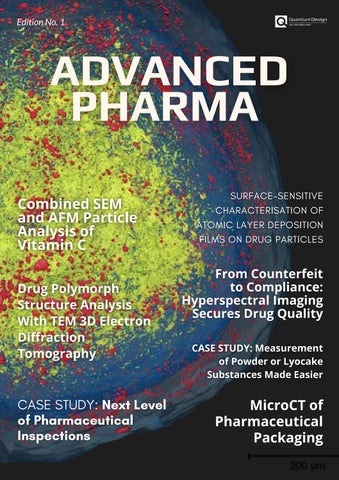
MicroCT of Pharmaceuticals and Pharmaceutical Packaging

MICROCT AND MICROXRF HAVE BECOME INTEGRAL TOOLS FOR INSPECTING

PHARMACEUTICAL PACKAGING AND DEVELOPING NEW DRUG DELIVERY METHODS

Pore network of the polymer sustained release coating for a pill. Imaged by Sigray’s patented multi-spectral x-ray source in EclipseXRM.

Sigray’s EclipseXRM enables rapid non-destructive 3D analysis of pharmaceutical formulations and their packaging. The AttoMap XRF microscopeprovidesmappingof inorganic materials within a tablet, aiding in the understanding of active ingredient distribution and the detectionofcontaminants.

3Dx-raymicroscopy(alsoknown as microCT) is increasingly recognisedasanessentialtool forbothfailureanalysisandthe R&Dofnewpharmaceuticals.For example, ultrahigh-resolution imaging(<300nmspatial)ofpore networksandactiveingredients provides insight into drug releasemechanisms.

Feedbackoninternalstructure can accelerate time-to-market during the research and developmentphase.

Evenafteraproducthasbeen successfullydeveloped,microCT remainsvaluableforidentifying failures in pharmaceutical packaging.

EclipseXRM provides the highest-resolution and highestcontrast images for the wide rangeofsamplesencounteredin a pharmaceutical central laboratory—from polymeric drugs to packaged lyophilised (“lyo”)cakes.

3D view and cross-sections of a Pepcid AC within its packaging

Next Level of Pharmaceutical Inspections

Quality assurance is of utmost importance in pharmaceutical products. Striving for the world wheredrugsarereliablymonitored and tracked, SEA Vision has introducedhyperspectralinspection solution HARLENIR, the combinationofSEAVisionsoftware and Specim camera technology which reveals the chemical composition of a pharmaceutical product and guarantees 100% inspectioncoverage,accuratelyand reliably.SEAVisionchoseSpecim FX17 since it was the only hyperspectralcameraonthemarket tomeettheirrequirementsofspeed andspectralresolution.

SEA Vision is a leader in the pharma industry and a pioneer in applying artificialvisioninpharmaceuticsquality inspection.

It was founded in Italy, Pavia as a university spin-off in 1995, and produces top-quality vision systems solutionstoPharmaceuticalcompanies and packaging machine manufacturers.

Throughouttheirexistence,SEAVision hasbeenstrivingtoprovidethehighest quality vision systems for the pharmaceutical industry. They rely on the latest innovations and the best technologies to improve their product portfolio for quality inspection and to complywithregulatoryguidelines.This goalissupportedbytheirtechnicaland R&Ddepartment’shighcompetencein software algorithms which meet the unique needs of Pharmaceutical customersandOEMsbusiness.

All this has made SEA Vision the leaderoftheirfield.

QUALITY BEYOND THE VISIBLE INSPECTION

To provide the pharmaceutic industry withthehighestqualitybestsolutions, SEA Vision has introduced a new generation of blister inspection technology that goes beyond visible inspection:hyperspectralimaging.

Aerial shot of Pavia, Italy

Hyperspectral imaging provides a reliable way to perform a chemical composition inspection of pharmaceuticalproductsduring theproductionprocess.Thisis particularly important with products that are visually similar but have different proportions of active pharmaceutical ingredient (API).

With hyperspectral imaging, each tablet or capsule can be quickly and reliably identified from their active ingredients. 100% of the products can be inspected,online,inrealtime.

Thechemicalanalysisallows: qualitatively to identify pharmaceutical products with different active principle. quantitatively to identify pharmaceutical products with a different dosage, and to measure the uniformity of the active ingredientdistribution

“In an era of increasing regulation and quality control, the industry needs to improve inspection methods. Systems like HARLENIR provide extra peace of mind for drug manufacturers”

“To this aim,” continues Vittorio Calbucci, “we installed HARLENIR systemonablistermachineprovided by one of the most important Italian OEM. The idea was to check the presence of foreign tablets with different API respect the tablets with the right chemical compounds, and tabletswiththesameAPIbutdifferent dosages.”

Vittorio Calbucci from SEA Vision R&D Department

WHY SPECIM?

InsideSEAVisionsHARLENIRsolution isSpecimFX17camera.

“Wechosethesystemwhichbest satisfiedthecustomers’ requirements,”saysCalbucci.

BeforedecidingonSpecimFX17,SEA Vision evaluated several different technologies versus hyperspectral imaging, such as THz spectroscopy or the combination of a standard vision systemwithafibreopticspectrometer. However, with the first technology, the resolutionandspeedweretoolowwhile with the second solution it was not possibletoinspectthewholesample.

Hyperspectral imaging was chosen as it is possible to perform chemical analysis in a fast way and with high spectral resolution in combination with colour camera imaging which provides an accurate check of pictorial and geometrical parameters oftheobjects.

Sincetheacquisitionrateissohigh,the hyperspectral camera can be installed directly over the production line. It will image the targets as they pass the cameraontheconveyorandcollectsdata of the whole surface of the target, coveringeverypixelofeveryinch.

The production line where HARLENIR withSpecimFXcameraisusedproduces up to 3000 tablets per minute, which requiresanacquisitionfrequencyofclose to500Hz.SpecimFX17framerateof640 Hz is good enough to cover the whole production. Specim FX17 compact size also allowed it to be installed in a small spacewithoutcompromisingthetechnical quality.

TheSpecimFXcameraisready-to-use, andSEAVisionwasabletoperformthe first chemical analysis already on the first days after installation. For the few technical glitches, there was good and timely support available both directly fromSpecimaswellasfromtheirItalian distributor.

SPECIM FX17 cameras are designed forindustrialuse,andeverycamerais calibrated to provide the same output. Thusifthereisaneedformaintenance, the camera can be swapped to a replacement unit on the fly without compromisingtheproduction.

WHAT IS TO COME?

In addition to the tablet inspections, SEA Vision has already tested the SpecimFX17cameraandhyperspectral imagingonotherapplications,whereit workedasexpected.Inthefuture,they expecthyperspectralimagingtohelpto widen their product portfolio and developnewsolutions.

To discuss your application or area of research, please get in touch with our Sales Manager, Dr. Luke Nicholls. Call (01372) 378822 Email luke@qd-uki.co.uk

Hyperspectral

cameras let you see beyond the visual inspection - they reveal the invisible

Non-destructive, rapid, and reliable inspection with close to 100% accuracy

Inspect 100% of the product stream in real-time

Measure the presence, amount, and distribution of API

Avoid mix-ups and improve product quality and safety

High frame rate

High spectral resolution

Small size

Ready-to-use

Good and timely support

What have you been using QD products for recently?

Turn static files into dynamic content formats.

Create a flipbook